EP3492247A2 - Structural rework of cellular core panels - Google Patents
Structural rework of cellular core panels Download PDFInfo
- Publication number
- EP3492247A2 EP3492247A2 EP18189037.7A EP18189037A EP3492247A2 EP 3492247 A2 EP3492247 A2 EP 3492247A2 EP 18189037 A EP18189037 A EP 18189037A EP 3492247 A2 EP3492247 A2 EP 3492247A2
- Authority
- EP
- European Patent Office
- Prior art keywords
- cellular
- cellular core
- rework
- guide
- core
- Prior art date
- Legal status (The legal status is an assumption and is not a legal conclusion. Google has not performed a legal analysis and makes no representation as to the accuracy of the status listed.)
- Granted
Links
Images









Classifications
-
- B—PERFORMING OPERATIONS; TRANSPORTING
- B32—LAYERED PRODUCTS
- B32B—LAYERED PRODUCTS, i.e. PRODUCTS BUILT-UP OF STRATA OF FLAT OR NON-FLAT, e.g. CELLULAR OR HONEYCOMB, FORM
- B32B43/00—Operations specially adapted for layered products and not otherwise provided for, e.g. repairing; Apparatus therefor
- B32B43/003—Cutting
-
- B—PERFORMING OPERATIONS; TRANSPORTING
- B26—HAND CUTTING TOOLS; CUTTING; SEVERING
- B26B—HAND-HELD CUTTING TOOLS NOT OTHERWISE PROVIDED FOR
- B26B3/00—Hand knives with fixed blades
- B26B3/04—Hand knives with fixed blades for performing several incisions simultaneously; Multiple-blade knives
-
- B—PERFORMING OPERATIONS; TRANSPORTING
- B26—HAND CUTTING TOOLS; CUTTING; SEVERING
- B26B—HAND-HELD CUTTING TOOLS NOT OTHERWISE PROVIDED FOR
- B26B29/00—Guards or sheaths or guides for hand cutting tools; Arrangements for guiding hand cutting tools
- B26B29/06—Arrangements for guiding hand cutting tools
-
- B—PERFORMING OPERATIONS; TRANSPORTING
- B26—HAND CUTTING TOOLS; CUTTING; SEVERING
- B26D—CUTTING; DETAILS COMMON TO MACHINES FOR PERFORATING, PUNCHING, CUTTING-OUT, STAMPING-OUT OR SEVERING
- B26D7/00—Details of apparatus for cutting, cutting-out, stamping-out, punching, perforating, or severing by means other than cutting
- B26D7/0006—Means for guiding the cutter
-
- B—PERFORMING OPERATIONS; TRANSPORTING
- B29—WORKING OF PLASTICS; WORKING OF SUBSTANCES IN A PLASTIC STATE IN GENERAL
- B29C—SHAPING OR JOINING OF PLASTICS; SHAPING OF MATERIAL IN A PLASTIC STATE, NOT OTHERWISE PROVIDED FOR; AFTER-TREATMENT OF THE SHAPED PRODUCTS, e.g. REPAIRING
- B29C65/00—Joining or sealing of preformed parts, e.g. welding of plastics materials; Apparatus therefor
- B29C65/48—Joining or sealing of preformed parts, e.g. welding of plastics materials; Apparatus therefor using adhesives, i.e. using supplementary joining material; solvent bonding
-
- B—PERFORMING OPERATIONS; TRANSPORTING
- B29—WORKING OF PLASTICS; WORKING OF SUBSTANCES IN A PLASTIC STATE IN GENERAL
- B29C—SHAPING OR JOINING OF PLASTICS; SHAPING OF MATERIAL IN A PLASTIC STATE, NOT OTHERWISE PROVIDED FOR; AFTER-TREATMENT OF THE SHAPED PRODUCTS, e.g. REPAIRING
- B29C65/00—Joining or sealing of preformed parts, e.g. welding of plastics materials; Apparatus therefor
- B29C65/48—Joining or sealing of preformed parts, e.g. welding of plastics materials; Apparatus therefor using adhesives, i.e. using supplementary joining material; solvent bonding
- B29C65/52—Joining or sealing of preformed parts, e.g. welding of plastics materials; Apparatus therefor using adhesives, i.e. using supplementary joining material; solvent bonding characterised by the way of applying the adhesive
- B29C65/526—Joining or sealing of preformed parts, e.g. welding of plastics materials; Apparatus therefor using adhesives, i.e. using supplementary joining material; solvent bonding characterised by the way of applying the adhesive by printing or by transfer from the surfaces of elements carrying the adhesive, e.g. using brushes, pads, rollers, stencils or silk screens
-
- B—PERFORMING OPERATIONS; TRANSPORTING
- B29—WORKING OF PLASTICS; WORKING OF SUBSTANCES IN A PLASTIC STATE IN GENERAL
- B29C—SHAPING OR JOINING OF PLASTICS; SHAPING OF MATERIAL IN A PLASTIC STATE, NOT OTHERWISE PROVIDED FOR; AFTER-TREATMENT OF THE SHAPED PRODUCTS, e.g. REPAIRING
- B29C66/00—General aspects of processes or apparatus for joining preformed parts
- B29C66/01—General aspects dealing with the joint area or with the area to be joined
- B29C66/02—Preparation of the material, in the area to be joined, prior to joining or welding
- B29C66/022—Mechanical pre-treatments, e.g. reshaping
- B29C66/0224—Mechanical pre-treatments, e.g. reshaping with removal of material
- B29C66/02241—Cutting, e.g. by using waterjets, or sawing
-
- B—PERFORMING OPERATIONS; TRANSPORTING
- B29—WORKING OF PLASTICS; WORKING OF SUBSTANCES IN A PLASTIC STATE IN GENERAL
- B29C—SHAPING OR JOINING OF PLASTICS; SHAPING OF MATERIAL IN A PLASTIC STATE, NOT OTHERWISE PROVIDED FOR; AFTER-TREATMENT OF THE SHAPED PRODUCTS, e.g. REPAIRING
- B29C66/00—General aspects of processes or apparatus for joining preformed parts
- B29C66/01—General aspects dealing with the joint area or with the area to be joined
- B29C66/05—Particular design of joint configurations
- B29C66/20—Particular design of joint configurations particular design of the joint lines, e.g. of the weld lines
- B29C66/22—Particular design of joint configurations particular design of the joint lines, e.g. of the weld lines said joint lines being in the form of recurring patterns
- B29C66/223—Particular design of joint configurations particular design of the joint lines, e.g. of the weld lines said joint lines being in the form of recurring patterns being in the form of a triangle wave or of a sawtooth wave, e.g. zigzagged
-
- B—PERFORMING OPERATIONS; TRANSPORTING
- B29—WORKING OF PLASTICS; WORKING OF SUBSTANCES IN A PLASTIC STATE IN GENERAL
- B29C—SHAPING OR JOINING OF PLASTICS; SHAPING OF MATERIAL IN A PLASTIC STATE, NOT OTHERWISE PROVIDED FOR; AFTER-TREATMENT OF THE SHAPED PRODUCTS, e.g. REPAIRING
- B29C66/00—General aspects of processes or apparatus for joining preformed parts
- B29C66/40—General aspects of joining substantially flat articles, e.g. plates, sheets or web-like materials; Making flat seams in tubular or hollow articles; Joining single elements to substantially flat surfaces
- B29C66/47—Joining single elements to sheets, plates or other substantially flat surfaces
-
- B—PERFORMING OPERATIONS; TRANSPORTING
- B29—WORKING OF PLASTICS; WORKING OF SUBSTANCES IN A PLASTIC STATE IN GENERAL
- B29C—SHAPING OR JOINING OF PLASTICS; SHAPING OF MATERIAL IN A PLASTIC STATE, NOT OTHERWISE PROVIDED FOR; AFTER-TREATMENT OF THE SHAPED PRODUCTS, e.g. REPAIRING
- B29C66/00—General aspects of processes or apparatus for joining preformed parts
- B29C66/40—General aspects of joining substantially flat articles, e.g. plates, sheets or web-like materials; Making flat seams in tubular or hollow articles; Joining single elements to substantially flat surfaces
- B29C66/47—Joining single elements to sheets, plates or other substantially flat surfaces
- B29C66/472—Joining single elements to sheets, plates or other substantially flat surfaces said single elements being substantially flat
-
- B—PERFORMING OPERATIONS; TRANSPORTING
- B29—WORKING OF PLASTICS; WORKING OF SUBSTANCES IN A PLASTIC STATE IN GENERAL
- B29C—SHAPING OR JOINING OF PLASTICS; SHAPING OF MATERIAL IN A PLASTIC STATE, NOT OTHERWISE PROVIDED FOR; AFTER-TREATMENT OF THE SHAPED PRODUCTS, e.g. REPAIRING
- B29C66/00—General aspects of processes or apparatus for joining preformed parts
- B29C66/70—General aspects of processes or apparatus for joining preformed parts characterised by the composition, physical properties or the structure of the material of the parts to be joined; Joining with non-plastics material
- B29C66/72—General aspects of processes or apparatus for joining preformed parts characterised by the composition, physical properties or the structure of the material of the parts to be joined; Joining with non-plastics material characterised by the structure of the material of the parts to be joined
- B29C66/725—General aspects of processes or apparatus for joining preformed parts characterised by the composition, physical properties or the structure of the material of the parts to be joined; Joining with non-plastics material characterised by the structure of the material of the parts to be joined being hollow-walled or honeycombs
- B29C66/7252—General aspects of processes or apparatus for joining preformed parts characterised by the composition, physical properties or the structure of the material of the parts to be joined; Joining with non-plastics material characterised by the structure of the material of the parts to be joined being hollow-walled or honeycombs hollow-walled
- B29C66/72525—General aspects of processes or apparatus for joining preformed parts characterised by the composition, physical properties or the structure of the material of the parts to be joined; Joining with non-plastics material characterised by the structure of the material of the parts to be joined being hollow-walled or honeycombs hollow-walled comprising honeycomb cores
-
- B—PERFORMING OPERATIONS; TRANSPORTING
- B29—WORKING OF PLASTICS; WORKING OF SUBSTANCES IN A PLASTIC STATE IN GENERAL
- B29C—SHAPING OR JOINING OF PLASTICS; SHAPING OF MATERIAL IN A PLASTIC STATE, NOT OTHERWISE PROVIDED FOR; AFTER-TREATMENT OF THE SHAPED PRODUCTS, e.g. REPAIRING
- B29C66/00—General aspects of processes or apparatus for joining preformed parts
- B29C66/70—General aspects of processes or apparatus for joining preformed parts characterised by the composition, physical properties or the structure of the material of the parts to be joined; Joining with non-plastics material
- B29C66/72—General aspects of processes or apparatus for joining preformed parts characterised by the composition, physical properties or the structure of the material of the parts to be joined; Joining with non-plastics material characterised by the structure of the material of the parts to be joined
- B29C66/725—General aspects of processes or apparatus for joining preformed parts characterised by the composition, physical properties or the structure of the material of the parts to be joined; Joining with non-plastics material characterised by the structure of the material of the parts to be joined being hollow-walled or honeycombs
- B29C66/7254—General aspects of processes or apparatus for joining preformed parts characterised by the composition, physical properties or the structure of the material of the parts to be joined; Joining with non-plastics material characterised by the structure of the material of the parts to be joined being hollow-walled or honeycombs honeycomb structures
-
- B—PERFORMING OPERATIONS; TRANSPORTING
- B29—WORKING OF PLASTICS; WORKING OF SUBSTANCES IN A PLASTIC STATE IN GENERAL
- B29C—SHAPING OR JOINING OF PLASTICS; SHAPING OF MATERIAL IN A PLASTIC STATE, NOT OTHERWISE PROVIDED FOR; AFTER-TREATMENT OF THE SHAPED PRODUCTS, e.g. REPAIRING
- B29C69/00—Combinations of shaping techniques not provided for in a single one of main groups B29C39/00 - B29C67/00, e.g. associations of moulding and joining techniques; Apparatus therefore
- B29C69/001—Combinations of shaping techniques not provided for in a single one of main groups B29C39/00 - B29C67/00, e.g. associations of moulding and joining techniques; Apparatus therefore a shaping technique combined with cutting, e.g. in parts or slices combined with rearranging and joining the cut parts
-
- B—PERFORMING OPERATIONS; TRANSPORTING
- B29—WORKING OF PLASTICS; WORKING OF SUBSTANCES IN A PLASTIC STATE IN GENERAL
- B29C—SHAPING OR JOINING OF PLASTICS; SHAPING OF MATERIAL IN A PLASTIC STATE, NOT OTHERWISE PROVIDED FOR; AFTER-TREATMENT OF THE SHAPED PRODUCTS, e.g. REPAIRING
- B29C73/00—Repairing of articles made from plastics or substances in a plastic state, e.g. of articles shaped or produced by using techniques covered by this subclass or subclass B29D
- B29C73/04—Repairing of articles made from plastics or substances in a plastic state, e.g. of articles shaped or produced by using techniques covered by this subclass or subclass B29D using preformed elements
- B29C73/06—Repairing of articles made from plastics or substances in a plastic state, e.g. of articles shaped or produced by using techniques covered by this subclass or subclass B29D using preformed elements using plugs sealing in the hole
-
- B—PERFORMING OPERATIONS; TRANSPORTING
- B29—WORKING OF PLASTICS; WORKING OF SUBSTANCES IN A PLASTIC STATE IN GENERAL
- B29C—SHAPING OR JOINING OF PLASTICS; SHAPING OF MATERIAL IN A PLASTIC STATE, NOT OTHERWISE PROVIDED FOR; AFTER-TREATMENT OF THE SHAPED PRODUCTS, e.g. REPAIRING
- B29C73/00—Repairing of articles made from plastics or substances in a plastic state, e.g. of articles shaped or produced by using techniques covered by this subclass or subclass B29D
- B29C73/04—Repairing of articles made from plastics or substances in a plastic state, e.g. of articles shaped or produced by using techniques covered by this subclass or subclass B29D using preformed elements
- B29C73/10—Repairing of articles made from plastics or substances in a plastic state, e.g. of articles shaped or produced by using techniques covered by this subclass or subclass B29D using preformed elements using patches sealing on the surface of the article
-
- B—PERFORMING OPERATIONS; TRANSPORTING
- B29—WORKING OF PLASTICS; WORKING OF SUBSTANCES IN A PLASTIC STATE IN GENERAL
- B29C—SHAPING OR JOINING OF PLASTICS; SHAPING OF MATERIAL IN A PLASTIC STATE, NOT OTHERWISE PROVIDED FOR; AFTER-TREATMENT OF THE SHAPED PRODUCTS, e.g. REPAIRING
- B29C73/00—Repairing of articles made from plastics or substances in a plastic state, e.g. of articles shaped or produced by using techniques covered by this subclass or subclass B29D
- B29C73/24—Apparatus or accessories not otherwise provided for
- B29C73/26—Apparatus or accessories not otherwise provided for for mechanical pretreatment
-
- B—PERFORMING OPERATIONS; TRANSPORTING
- B29—WORKING OF PLASTICS; WORKING OF SUBSTANCES IN A PLASTIC STATE IN GENERAL
- B29D—PRODUCING PARTICULAR ARTICLES FROM PLASTICS OR FROM SUBSTANCES IN A PLASTIC STATE
- B29D24/00—Producing articles with hollow walls
- B29D24/002—Producing articles with hollow walls formed with structures, e.g. cores placed between two plates or sheets, e.g. partially filled
- B29D24/005—Producing articles with hollow walls formed with structures, e.g. cores placed between two plates or sheets, e.g. partially filled the structure having joined ribs, e.g. honeycomb
-
- B—PERFORMING OPERATIONS; TRANSPORTING
- B29—WORKING OF PLASTICS; WORKING OF SUBSTANCES IN A PLASTIC STATE IN GENERAL
- B29D—PRODUCING PARTICULAR ARTICLES FROM PLASTICS OR FROM SUBSTANCES IN A PLASTIC STATE
- B29D99/00—Subject matter not provided for in other groups of this subclass
- B29D99/001—Producing wall or panel-like structures, e.g. for hulls, fuselages, or buildings
- B29D99/0021—Producing wall or panel-like structures, e.g. for hulls, fuselages, or buildings provided with plain or filled structures, e.g. cores, placed between two or more plates or sheets, e.g. in a matrix
-
- B—PERFORMING OPERATIONS; TRANSPORTING
- B32—LAYERED PRODUCTS
- B32B—LAYERED PRODUCTS, i.e. PRODUCTS BUILT-UP OF STRATA OF FLAT OR NON-FLAT, e.g. CELLULAR OR HONEYCOMB, FORM
- B32B3/00—Layered products comprising a layer with external or internal discontinuities or unevennesses, or a layer of non-planar shape; Layered products comprising a layer having particular features of form
- B32B3/10—Layered products comprising a layer with external or internal discontinuities or unevennesses, or a layer of non-planar shape; Layered products comprising a layer having particular features of form characterised by a discontinuous layer, i.e. formed of separate pieces of material
- B32B3/12—Layered products comprising a layer with external or internal discontinuities or unevennesses, or a layer of non-planar shape; Layered products comprising a layer having particular features of form characterised by a discontinuous layer, i.e. formed of separate pieces of material characterised by a layer of regularly- arranged cells, e.g. a honeycomb structure
-
- B—PERFORMING OPERATIONS; TRANSPORTING
- B32—LAYERED PRODUCTS
- B32B—LAYERED PRODUCTS, i.e. PRODUCTS BUILT-UP OF STRATA OF FLAT OR NON-FLAT, e.g. CELLULAR OR HONEYCOMB, FORM
- B32B3/00—Layered products comprising a layer with external or internal discontinuities or unevennesses, or a layer of non-planar shape; Layered products comprising a layer having particular features of form
- B32B3/26—Layered products comprising a layer with external or internal discontinuities or unevennesses, or a layer of non-planar shape; Layered products comprising a layer having particular features of form characterised by a particular shape of the outline of the cross-section of a continuous layer; characterised by a layer with cavities or internal voids ; characterised by an apertured layer
- B32B3/266—Layered products comprising a layer with external or internal discontinuities or unevennesses, or a layer of non-planar shape; Layered products comprising a layer having particular features of form characterised by a particular shape of the outline of the cross-section of a continuous layer; characterised by a layer with cavities or internal voids ; characterised by an apertured layer characterised by an apertured layer, the apertures going through the whole thickness of the layer, e.g. expanded metal, perforated layer, slit layer regular cells B32B3/12
-
- B—PERFORMING OPERATIONS; TRANSPORTING
- B32—LAYERED PRODUCTS
- B32B—LAYERED PRODUCTS, i.e. PRODUCTS BUILT-UP OF STRATA OF FLAT OR NON-FLAT, e.g. CELLULAR OR HONEYCOMB, FORM
- B32B37/00—Methods or apparatus for laminating, e.g. by curing or by ultrasonic bonding
- B32B37/12—Methods or apparatus for laminating, e.g. by curing or by ultrasonic bonding characterised by using adhesives
-
- B—PERFORMING OPERATIONS; TRANSPORTING
- B32—LAYERED PRODUCTS
- B32B—LAYERED PRODUCTS, i.e. PRODUCTS BUILT-UP OF STRATA OF FLAT OR NON-FLAT, e.g. CELLULAR OR HONEYCOMB, FORM
- B32B37/00—Methods or apparatus for laminating, e.g. by curing or by ultrasonic bonding
- B32B37/14—Methods or apparatus for laminating, e.g. by curing or by ultrasonic bonding characterised by the properties of the layers
- B32B37/146—Methods or apparatus for laminating, e.g. by curing or by ultrasonic bonding characterised by the properties of the layers whereby one or more of the layers is a honeycomb structure
-
- B—PERFORMING OPERATIONS; TRANSPORTING
- B32—LAYERED PRODUCTS
- B32B—LAYERED PRODUCTS, i.e. PRODUCTS BUILT-UP OF STRATA OF FLAT OR NON-FLAT, e.g. CELLULAR OR HONEYCOMB, FORM
- B32B38/00—Ancillary operations in connection with laminating processes
- B32B38/0036—Heat treatment
-
- B—PERFORMING OPERATIONS; TRANSPORTING
- B32—LAYERED PRODUCTS
- B32B—LAYERED PRODUCTS, i.e. PRODUCTS BUILT-UP OF STRATA OF FLAT OR NON-FLAT, e.g. CELLULAR OR HONEYCOMB, FORM
- B32B38/00—Ancillary operations in connection with laminating processes
- B32B38/04—Punching, slitting or perforating
-
- B—PERFORMING OPERATIONS; TRANSPORTING
- B64—AIRCRAFT; AVIATION; COSMONAUTICS
- B64F—GROUND OR AIRCRAFT-CARRIER-DECK INSTALLATIONS SPECIALLY ADAPTED FOR USE IN CONNECTION WITH AIRCRAFT; DESIGNING, MANUFACTURING, ASSEMBLING, CLEANING, MAINTAINING OR REPAIRING AIRCRAFT, NOT OTHERWISE PROVIDED FOR; HANDLING, TRANSPORTING, TESTING OR INSPECTING AIRCRAFT COMPONENTS, NOT OTHERWISE PROVIDED FOR
- B64F5/00—Designing, manufacturing, assembling, cleaning, maintaining or repairing aircraft, not otherwise provided for; Handling, transporting, testing or inspecting aircraft components, not otherwise provided for
- B64F5/40—Maintaining or repairing aircraft
-
- E—FIXED CONSTRUCTIONS
- E04—BUILDING
- E04C—STRUCTURAL ELEMENTS; BUILDING MATERIALS
- E04C2/00—Building elements of relatively thin form for the construction of parts of buildings, e.g. sheet materials, slabs, or panels
- E04C2/30—Building elements of relatively thin form for the construction of parts of buildings, e.g. sheet materials, slabs, or panels characterised by the shape or structure
- E04C2/34—Building elements of relatively thin form for the construction of parts of buildings, e.g. sheet materials, slabs, or panels characterised by the shape or structure composed of two or more spaced sheet-like parts
- E04C2/36—Building elements of relatively thin form for the construction of parts of buildings, e.g. sheet materials, slabs, or panels characterised by the shape or structure composed of two or more spaced sheet-like parts spaced apart by transversely-placed strip material, e.g. honeycomb panels
- E04C2/365—Building elements of relatively thin form for the construction of parts of buildings, e.g. sheet materials, slabs, or panels characterised by the shape or structure composed of two or more spaced sheet-like parts spaced apart by transversely-placed strip material, e.g. honeycomb panels by honeycomb structures
-
- F—MECHANICAL ENGINEERING; LIGHTING; HEATING; WEAPONS; BLASTING
- F02—COMBUSTION ENGINES; HOT-GAS OR COMBUSTION-PRODUCT ENGINE PLANTS
- F02C—GAS-TURBINE PLANTS; AIR INTAKES FOR JET-PROPULSION PLANTS; CONTROLLING FUEL SUPPLY IN AIR-BREATHING JET-PROPULSION PLANTS
- F02C7/00—Features, components parts, details or accessories, not provided for in, or of interest apart form groups F02C1/00 - F02C6/00; Air intakes for jet-propulsion plants
- F02C7/24—Heat or noise insulation
-
- B—PERFORMING OPERATIONS; TRANSPORTING
- B23—MACHINE TOOLS; METAL-WORKING NOT OTHERWISE PROVIDED FOR
- B23P—METAL-WORKING NOT OTHERWISE PROVIDED FOR; COMBINED OPERATIONS; UNIVERSAL MACHINE TOOLS
- B23P2700/00—Indexing scheme relating to the articles being treated, e.g. manufactured, repaired, assembled, connected or other operations covered in the subgroups
- B23P2700/01—Aircraft parts
-
- B—PERFORMING OPERATIONS; TRANSPORTING
- B23—MACHINE TOOLS; METAL-WORKING NOT OTHERWISE PROVIDED FOR
- B23P—METAL-WORKING NOT OTHERWISE PROVIDED FOR; COMBINED OPERATIONS; UNIVERSAL MACHINE TOOLS
- B23P2700/00—Indexing scheme relating to the articles being treated, e.g. manufactured, repaired, assembled, connected or other operations covered in the subgroups
- B23P2700/12—Laminated parts
-
- B—PERFORMING OPERATIONS; TRANSPORTING
- B23—MACHINE TOOLS; METAL-WORKING NOT OTHERWISE PROVIDED FOR
- B23P—METAL-WORKING NOT OTHERWISE PROVIDED FOR; COMBINED OPERATIONS; UNIVERSAL MACHINE TOOLS
- B23P6/00—Restoring or reconditioning objects
-
- B—PERFORMING OPERATIONS; TRANSPORTING
- B29—WORKING OF PLASTICS; WORKING OF SUBSTANCES IN A PLASTIC STATE IN GENERAL
- B29C—SHAPING OR JOINING OF PLASTICS; SHAPING OF MATERIAL IN A PLASTIC STATE, NOT OTHERWISE PROVIDED FOR; AFTER-TREATMENT OF THE SHAPED PRODUCTS, e.g. REPAIRING
- B29C73/00—Repairing of articles made from plastics or substances in a plastic state, e.g. of articles shaped or produced by using techniques covered by this subclass or subclass B29D
- B29C73/24—Apparatus or accessories not otherwise provided for
- B29C73/26—Apparatus or accessories not otherwise provided for for mechanical pretreatment
- B29C2073/264—Apparatus or accessories not otherwise provided for for mechanical pretreatment for cutting out or grooving the area to be repaired
-
- B—PERFORMING OPERATIONS; TRANSPORTING
- B29—WORKING OF PLASTICS; WORKING OF SUBSTANCES IN A PLASTIC STATE IN GENERAL
- B29C—SHAPING OR JOINING OF PLASTICS; SHAPING OF MATERIAL IN A PLASTIC STATE, NOT OTHERWISE PROVIDED FOR; AFTER-TREATMENT OF THE SHAPED PRODUCTS, e.g. REPAIRING
- B29C2793/00—Shaping techniques involving a cutting or machining operation
- B29C2793/0009—Cutting out
- B29C2793/0018—Cutting out for making a hole
-
- B—PERFORMING OPERATIONS; TRANSPORTING
- B29—WORKING OF PLASTICS; WORKING OF SUBSTANCES IN A PLASTIC STATE IN GENERAL
- B29C—SHAPING OR JOINING OF PLASTICS; SHAPING OF MATERIAL IN A PLASTIC STATE, NOT OTHERWISE PROVIDED FOR; AFTER-TREATMENT OF THE SHAPED PRODUCTS, e.g. REPAIRING
- B29C2793/00—Shaping techniques involving a cutting or machining operation
- B29C2793/0081—Shaping techniques involving a cutting or machining operation before shaping
-
- B—PERFORMING OPERATIONS; TRANSPORTING
- B29—WORKING OF PLASTICS; WORKING OF SUBSTANCES IN A PLASTIC STATE IN GENERAL
- B29L—INDEXING SCHEME ASSOCIATED WITH SUBCLASS B29C, RELATING TO PARTICULAR ARTICLES
- B29L2031/00—Other particular articles
- B29L2031/30—Vehicles, e.g. ships or aircraft, or body parts thereof
- B29L2031/3076—Aircrafts
-
- B—PERFORMING OPERATIONS; TRANSPORTING
- B29—WORKING OF PLASTICS; WORKING OF SUBSTANCES IN A PLASTIC STATE IN GENERAL
- B29L—INDEXING SCHEME ASSOCIATED WITH SUBCLASS B29C, RELATING TO PARTICULAR ARTICLES
- B29L2031/00—Other particular articles
- B29L2031/60—Multitubular or multicompartmented articles, e.g. honeycomb
- B29L2031/608—Honeycomb structures
-
- B—PERFORMING OPERATIONS; TRANSPORTING
- B29—WORKING OF PLASTICS; WORKING OF SUBSTANCES IN A PLASTIC STATE IN GENERAL
- B29L—INDEXING SCHEME ASSOCIATED WITH SUBCLASS B29C, RELATING TO PARTICULAR ARTICLES
- B29L2031/00—Other particular articles
- B29L2031/72—Cutting equipment, e.g. punches
-
- B—PERFORMING OPERATIONS; TRANSPORTING
- B32—LAYERED PRODUCTS
- B32B—LAYERED PRODUCTS, i.e. PRODUCTS BUILT-UP OF STRATA OF FLAT OR NON-FLAT, e.g. CELLULAR OR HONEYCOMB, FORM
- B32B38/00—Ancillary operations in connection with laminating processes
- B32B2038/0052—Other operations not otherwise provided for
- B32B2038/0076—Curing, vulcanising, cross-linking
-
- B—PERFORMING OPERATIONS; TRANSPORTING
- B32—LAYERED PRODUCTS
- B32B—LAYERED PRODUCTS, i.e. PRODUCTS BUILT-UP OF STRATA OF FLAT OR NON-FLAT, e.g. CELLULAR OR HONEYCOMB, FORM
- B32B38/00—Ancillary operations in connection with laminating processes
- B32B38/04—Punching, slitting or perforating
- B32B2038/047—Perforating
-
- B—PERFORMING OPERATIONS; TRANSPORTING
- B32—LAYERED PRODUCTS
- B32B—LAYERED PRODUCTS, i.e. PRODUCTS BUILT-UP OF STRATA OF FLAT OR NON-FLAT, e.g. CELLULAR OR HONEYCOMB, FORM
- B32B2305/00—Condition, form or state of the layers or laminate
- B32B2305/02—Cellular or porous
- B32B2305/024—Honeycomb
-
- B—PERFORMING OPERATIONS; TRANSPORTING
- B32—LAYERED PRODUCTS
- B32B—LAYERED PRODUCTS, i.e. PRODUCTS BUILT-UP OF STRATA OF FLAT OR NON-FLAT, e.g. CELLULAR OR HONEYCOMB, FORM
- B32B2307/00—Properties of the layers or laminate
- B32B2307/10—Properties of the layers or laminate having particular acoustical properties
- B32B2307/102—Insulating
-
- B—PERFORMING OPERATIONS; TRANSPORTING
- B32—LAYERED PRODUCTS
- B32B—LAYERED PRODUCTS, i.e. PRODUCTS BUILT-UP OF STRATA OF FLAT OR NON-FLAT, e.g. CELLULAR OR HONEYCOMB, FORM
- B32B2605/00—Vehicles
- B32B2605/18—Aircraft
-
- B—PERFORMING OPERATIONS; TRANSPORTING
- B32—LAYERED PRODUCTS
- B32B—LAYERED PRODUCTS, i.e. PRODUCTS BUILT-UP OF STRATA OF FLAT OR NON-FLAT, e.g. CELLULAR OR HONEYCOMB, FORM
- B32B2607/00—Walls, panels
-
- B—PERFORMING OPERATIONS; TRANSPORTING
- B64—AIRCRAFT; AVIATION; COSMONAUTICS
- B64D—EQUIPMENT FOR FITTING IN OR TO AIRCRAFT; FLIGHT SUITS; PARACHUTES; ARRANGEMENT OR MOUNTING OF POWER PLANTS OR PROPULSION TRANSMISSIONS IN AIRCRAFT
- B64D33/00—Arrangement in aircraft of power plant parts or auxiliaries not otherwise provided for
- B64D33/02—Arrangement in aircraft of power plant parts or auxiliaries not otherwise provided for of combustion air intakes
- B64D2033/0206—Arrangement in aircraft of power plant parts or auxiliaries not otherwise provided for of combustion air intakes comprising noise reduction means, e.g. acoustic liners
-
- B—PERFORMING OPERATIONS; TRANSPORTING
- B64—AIRCRAFT; AVIATION; COSMONAUTICS
- B64D—EQUIPMENT FOR FITTING IN OR TO AIRCRAFT; FLIGHT SUITS; PARACHUTES; ARRANGEMENT OR MOUNTING OF POWER PLANTS OR PROPULSION TRANSMISSIONS IN AIRCRAFT
- B64D33/00—Arrangement in aircraft of power plant parts or auxiliaries not otherwise provided for
- B64D33/02—Arrangement in aircraft of power plant parts or auxiliaries not otherwise provided for of combustion air intakes
-
- F—MECHANICAL ENGINEERING; LIGHTING; HEATING; WEAPONS; BLASTING
- F05—INDEXING SCHEMES RELATING TO ENGINES OR PUMPS IN VARIOUS SUBCLASSES OF CLASSES F01-F04
- F05D—INDEXING SCHEME FOR ASPECTS RELATING TO NON-POSITIVE-DISPLACEMENT MACHINES OR ENGINES, GAS-TURBINES OR JET-PROPULSION PLANTS
- F05D2220/00—Application
- F05D2220/30—Application in turbines
- F05D2220/32—Application in turbines in gas turbines
- F05D2220/323—Application in turbines in gas turbines for aircraft propulsion, e.g. jet engines
-
- F—MECHANICAL ENGINEERING; LIGHTING; HEATING; WEAPONS; BLASTING
- F05—INDEXING SCHEMES RELATING TO ENGINES OR PUMPS IN VARIOUS SUBCLASSES OF CLASSES F01-F04
- F05D—INDEXING SCHEME FOR ASPECTS RELATING TO NON-POSITIVE-DISPLACEMENT MACHINES OR ENGINES, GAS-TURBINES OR JET-PROPULSION PLANTS
- F05D2230/00—Manufacture
- F05D2230/80—Repairing, retrofitting or upgrading methods
-
- F—MECHANICAL ENGINEERING; LIGHTING; HEATING; WEAPONS; BLASTING
- F05—INDEXING SCHEMES RELATING TO ENGINES OR PUMPS IN VARIOUS SUBCLASSES OF CLASSES F01-F04
- F05D—INDEXING SCHEME FOR ASPECTS RELATING TO NON-POSITIVE-DISPLACEMENT MACHINES OR ENGINES, GAS-TURBINES OR JET-PROPULSION PLANTS
- F05D2240/00—Components
- F05D2240/10—Stators
- F05D2240/14—Casings or housings protecting or supporting assemblies within
-
- F—MECHANICAL ENGINEERING; LIGHTING; HEATING; WEAPONS; BLASTING
- F05—INDEXING SCHEMES RELATING TO ENGINES OR PUMPS IN VARIOUS SUBCLASSES OF CLASSES F01-F04
- F05D—INDEXING SCHEME FOR ASPECTS RELATING TO NON-POSITIVE-DISPLACEMENT MACHINES OR ENGINES, GAS-TURBINES OR JET-PROPULSION PLANTS
- F05D2260/00—Function
- F05D2260/96—Preventing, counteracting or reducing vibration or noise
- F05D2260/963—Preventing, counteracting or reducing vibration or noise by Helmholtz resonators
-
- F—MECHANICAL ENGINEERING; LIGHTING; HEATING; WEAPONS; BLASTING
- F05—INDEXING SCHEMES RELATING TO ENGINES OR PUMPS IN VARIOUS SUBCLASSES OF CLASSES F01-F04
- F05D—INDEXING SCHEME FOR ASPECTS RELATING TO NON-POSITIVE-DISPLACEMENT MACHINES OR ENGINES, GAS-TURBINES OR JET-PROPULSION PLANTS
- F05D2300/00—Materials; Properties thereof
- F05D2300/60—Properties or characteristics given to material by treatment or manufacturing
- F05D2300/603—Composites; e.g. fibre-reinforced
Definitions
- the present disclosure relates generally to structures for noise reduction, and structures comprising such areas. More specifically, the present disclosure relates to methods for reworking acoustic panels and non-acoustic panels for structures, restoring acoustic performance to such structures, and structures comprising the reworked areas.
- Aircraft engine assemblies produce high noise levels due to the high airflows through inlets, rotating stages and exhaust nozzles, etc.
- high bypass type aircraft engine assemblies incorporate acoustic panels in various locations of the engine, such as in the inlets of engine nacelles, thrust reversers, etc.
- These acoustic panels sometimes referred to as acoustic treatments may comprise a septumized cellular, or "honeycomb" core oriented, or “sandwiched" between a perforated inner skin and a non-perforated outer skin or facesheet.
- the skins or facesheets may comprise a metal such as aluminum or a composite material
- the honeycomb core may comprise a metal, a ceramic, or a composite material.
- Acoustic sandwich panels include a core sandwiched between two liner sheets. One of the liner sheets is perforated while the other sheet is not perforated.
- the core provides bulk (e.g. separates the inner and outer facesheets) and defines a plurality of cavities. Apertures defined by the perforated liner sheet fluidly couple the cavities ambient environment. Therefore, when air flows across the perforated liner sheet of an acoustic sandwich panel, the cavities in the core act as Helmholz resonators and attenuate the sound of the associated airflow. More specifically, core walls between adjacent cavities in the core act as acoustic septa to attenuate the sound of the airflow
- acoustic panels may require localized repair or reconditioning, known as "rework" to restore their original structural strength and performance.
- rework acoustic panels
- Known reworking for acoustic panels involves splicing the honeycomb core, and using foaming adhesives to secure the reworked sections.
- this type of rework can result in the blockage of honeycomb cells, or otherwise limit the cells comprising the honeycomb core, resulting in less than desired acoustic performance of the affected cells.
- regulations for other aircraft types may not permit structural rework of such areas, resulting in part replacement at significant cost.
- aspects of the present disclosure are directed to methods for reworking structures comprising cellular core panels and reworking cellular core panels, reworked structures comprising the reworked core panels, and guides for reworking cellular acoustic panels and non-acoustic panels, as well as cutting apparatuses for reworking the core panels in larger structures, preferably in situ. Further aspects are directed to reworking acoustic panels and structures comprising the panels, with the panels comprising reworked core sections including, without limitation, honeycomb core sections in acoustic panels and structures comprising the panels.
- a further aspect of the present disclosure is directed to a guide for a cutting instrument, with the guide comprising a base, at least one leg in communication with the base, and a guide slot extending longitudinally through the base, with the guide slot defined by the at least one leg and the base.
- the guide comprises a plurality of legs in communication with the base.
- a further aspect of the present disclosure is directed to reworking a portion of an aircraft using a guide for a cutting instrument, with the guide comprising a base, at least one leg in communication with the base, and a guide slot extending longitudinally through the base, with the guide slot defined by the at least one leg and the base.
- Another aspect of the present disclosure is directed to an apparatus comprising a guide, with the guide comprising a base leg, with the leg dimensioned to engage and extend into, and be received by, a cell in a cellular core section.
- the cellular core section includes a plurality of cell walls, with the guide comprising a guide slot defined by the leg and the base, with the guide slot extending longitudinally within the guide, and a cutting instrument dimensioned to be received by the guide slot.
- the cutting instrument is configured to engage the guide slot and is further configured to move longitudinally within a length of the guide slot, with the cutting instrument comprising a leading blade edge.
- a further aspect of the present disclosure is directed to reworking a portion of an aircraft using an apparatus comprising a guide, with the guide comprising a base leg, with the leg dimensioned to engage and extend into, and be received by, a cell in a cellular core section.
- the cellular core section includes a plurality of cell walls, with the guide comprising a guide slot defined by the leg and the base, with the guide slot extending longitudinally within the guide, and a cutting instrument dimensioned to be received by the guide slot.
- Another aspect of the present disclosure is directed to a method comprising removing a removable cellular section from a cellular core to form a cut-out cellular core, said cut-out cellular core comprising intact cells, said cells comprising an intact septum in each cell, and inserting a cellular rework section plug into the cut-out cellular section, with the cellular rework section plug comprising intact cells, and with the cells comprising an intact septum in each cell.
- the step of removing a removable cellular section from a cellular core to form a cut-out cellular core with the cut-out cellular core comprising intact cells, and with the cells further comprising a plurality of exposed cell walls.
- a cellular rework section plug in the step of inserting a cellular rework section plug into the cut-out cellular core, with the cellular rework section plug comprising intact cells and with the cells further comprising a plurality of exposed cell walls.
- Another aspect of the present disclosure is directed to a method for reworking a structure comprising a cellular core, with the method comprising cutting an area from a cellular core to form a removable cellular section, with the removable cellular core section comprising a plurality of adjoining cells, and removing the removable cellular core section from the cellular core to form a cut-out cellular core, with the cut-out cellular core comprising a plurality of exposed adjoining complete cells, and with the plurality of exposed adjoining cells each comprising an intact septum disposed within each cell.
- Each septum is bounded by cell walls, and the cut-out cellular core comprises a cut-out cellular core geometry.
- a cellular rework section plug is then inserted into the cut-out cellular core and adhered to the cut-out cellular core to form a reworked cellular core, wherein each cell in the cellular reworked cellular core comprises an intact septum disposed within each cell.
- the cellular rework section plug is adhered to the cut-out cellular core to form the reworked cellular core.
- the cut-out cellular core comprises a cut-out cellular core geometry and the cellular rework section plug has a cellular rework section plug geometry.
- the cellular rework section plug geometry substantially matches the cut-out cellular core geometry
- the cells of the cut-out cellular core comprise intact cell walls in each cell.
- the cells of the cellular rework section plug comprise intact cell walls in each cell.
- At least one of the cellular core and the rework section plug comprise a honeycomb structure.
- an acoustic panel comprises the honeycomb structure.
- a method before the step of inserting a cellular rework section plug, a method further comprises inserting a guide to a predetermined depth into a cellular panel stock material comprising a plurality of adjoining cells, with each of the adjoining cells comprising intact cell walls and a septum, with the guide comprising at least one leg.
- a leg of the guide is received into at least one of the adjoining cells, and a cutting instrument is inserted into the guide.
- a cell wall is severed from an adjoining cell of an adjoining cell at a cell wall juncture to form the cellular rework section plug.
- the step of cutting an area from a cellular core to form a removable cellular core section, to form a removable cellular core section in the cellular core further comprises inserting a guide to a predetermined depth into the at least one cell in the cellular core, with cellular core comprising a plurality of adjoining cells, with each of the adjoining cells comprising cell walls and a septum.
- the guide comprises at least one leg that is received into at least one adjoining cell.
- a cutting instrument is inserted into the guide and a cell wall is severed completely from an adjoining cell wall of an adjoining cell at a cell wall juncture.
- a method before the step of cutting an area from a cellular core, a method further comprises removing a portion of at least one covering layer from an acoustic panel to expose to expose a cellular core.
- a method before the step of inserting the cellular rework section plug into the cut-out cellular core, a method further comprises applying an adhesive to at least one of the cut-out cellular core and the cellular rework section plug.
- a method further comprises adhering at least one covering layer over the reworked cellular core with the covering layer comprising at least one composite material layer.
- the covering layer comprises perforations.
- a method further comprises curing the covering layer.
- a method further comprises co-curing the adhesive and the covering layer.
- a method further comprises perforating the covering layer to form acoustic perforations extending through the covering layer.
- acoustic perforations are in formed in the covering layer by drilling.
- the adjoining cells of the cellular rework section plug each comprise an intact septum.
- a method before inserting a cellular rework section plug, a method further comprises forming a cellular rework section plug comprising a plurality of adjoining cells and an outer periphery geometry substantially equivalent to the cut-out cellular core geometry.
- Another aspect of the present disclosure is directed to a method of cutting an area from a cellular core to form a removable cellular core section and a cut-out cellular core section in the cellular core comprising inserting a guide to a predetermined depth into at least one cell of the cellular core, receiving a leg of the guide into at least one cell, and inserting a cutting instrument into the guide and severing a cell wall of the cell completely from an adjoining cell wall of an adjoining cell at a cell wall juncture.
- the cut-out cellular core section comprises a plurality of adjoining cells, with each of the adjoining cells comprising intact cell walls and an intact septum.
- At least one of the cellular core and the cellular rework section plug comprise a honeycomb structure.
- the adjoining cells of the cellular rework section plug each comprise intact cell walls and an intact septum.
- a further aspect is directed to a portion of an aircraft reworked according to any of the methods presented herein.
- a further aspect of the present disclosure is directed to a reworked cellular core made according to any of the aforementioned methods.
- the reworked cellular core comprises a honeycomb structure.
- the reworked cellular core is a component in an acoustic panel.
- a further aspect is directed to a reworked panel comprising the reworked cellular core made according to aspects of the present disclosure.
- the object comprises at least one of an aircraft engine assembly or a thrust reverser.
- a further aspect is directed to a vehicle comprising objects reworked according to presently disclosed methods.
- Another aspect is directed to a vehicle comprising the rework according to disclosed methods, with the vehicle including at least one of: a manned aircraft, and unmanned aircraft, a spacecraft, an unmanned spacecraft, a manned rotorcraft, an unmanned rotorcraft, a manned terrestrial vehicle, an unmanned terrestrial vehicle, a manned surface water borne vehicle, an unmanned surface water borne vehicle, a manned sub-surface water borne vehicle or an unmanned sub-surface water borne vehicle.
- methods for reworking structures comprising reworked core panels, reworked structures comprising the reworked core panels, and guides and apparatuses for reworking cellular core panels for reworking the core panels in structures.
- Further aspects are directed to reworking acoustic panels and structures comprising the cellular core panels, with the panels comprising reworked cellular core sections including, without limitation, honeycomb core sections in acoustic paneling and structures comprising the acoustic paneling.
- aspects of the present disclosure further contemplate reworking non-acoustic cellular core panels, and such panels reworked according to the methods disclosed herein, as well as structures comprising the reworked, non-acoustic panels.
- Acoustic paneling includes structures that are specifically designed to absorb, control, or reflect sound away from a particular area.
- acoustic paneling may be used to reduce the auditory impact of aircraft engines during takeoff, flight, and landing.
- Acoustic paneling within an aircraft may further reduce and/or redirect aircraft noise during takeoff and landing. Such, noise reduction and redirection may be environmentally mandated via regulations, but is also desirable for passengers within an aircraft.
- acoustic paneling is assembled to conform the paneling to the complex geometries of an aircraft and aircraft structures.
- Each cell in an acoustic panel comprises a septum, and, over the area of an entire aircraft, there may be thousands of such cells, with each cell in an acoustic panel comprising an installed septum.
- the reworking may be conducted with the panel requiring rework remaining intact and as a part of a larger structure.
- a larger structure or component such as an air inlet of an aircraft engine nacelle or other structure such as a thrust reverser
- the rework described herein may be conducted in situ, and therefore without removal of the panel from its structure or component, or of the structure or component from a larger structure to which it is attached.
- the methods described herein restore structural strength to reworked panels comprising reworked cellular cores.
- the disclosed methods further enable rework on large rework areas of large structures, in situ if desired.
- the presently disclosed methods enable rework, in situ, if desired, including the rework of cellular core panels of any configuration, both planar and non-planar, with the panels comprising an overall regular or irregular geometry.
- FIGs. 1A and 2A show a guide 10 for use in conjunction with a cutting instrument to form a cutting apparatus used to cut, or otherwise sever, a section of material according to aspects of the present disclosure.
- the guide 10 comprises a handle 10b, and a base 11 in communication with a plurality of legs 12, and a guide slot 13 extending through and defined by the legs 12 and the base 11. While the illustrations depict the legs having a hexagonal shape, other geometric shapes are contemplated.
- FIGs. 1A and 1B show overhead plan views of the guide 10 and 10a shown in FIGs. 1A and 1B respectively, with the view shown downward in the direction of lines 2A and 2B respectively.
- FIGs 2A and 2B respectively, show a guide 10 and 10a for use in conjunction with a cutting instrument to form a cutting apparatus used to cut, or otherwise sever, a section of material according to aspects of the present disclosure.
- the guide 10, 10a comprises a handle 10b, and a base 11 in communication with a leg 12, and a guide slot 13 extending through and defined by the leg 12 and the base 11.
- the depicted, substantially hexagonal, shape of the legs 12 of the guide 10 are dimensioned to fit into and otherwise engage the cellular walls of a honeycomb cellular structure.
- a guide having at least one leg with a geometric shape (e.g., a polygonal, circular, rectangular, or other shape, etc.) that fits into or otherwise engages (but may or may not substantially match) the cellular wall of a cellular core material having a geometry and dimension to receive the leg of the guide.
- the geometry and dimension of the guide leg substantially matches the geometry and dimension of the cellular walls of the cells in the cellular core panel (e.g. substantially rectangular legs on the guide for use in reworking a cellular core having substantially rectangular cells; substantially circular legs on the guide for use in reworking a cellular core having substantially circular cells; substantially polygonal legs on the guide for use in reworking a cellular core having substantially matching polygonal cells , etc.).
- FIGs. 3 and 4 show a cutting apparatus.
- cutting instrument 14 has a blade 15 and a blade edge 16, with the blade 15 having a width "W" substantially equivalent to the width of the guide slot 13, such that blade 15 is accommodated or received by guide slot 13, as shown in FIG. 4 .
- the cutting instrument 14 and the guide 10 comprise a cutting apparatus 17.
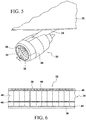
- FIG. 5 shows a high bypass engine 20 is mounted an aircraft wing 22 by a pylon 24.
- the engine 20 includes a surrounding engine nacelle 26 having an air inlet 28.
- the air inlet 28 includes an acoustic area 30 in the form of an acoustic panel 32 for reducing noise caused by high airflow through the air inlet 28 into the engine 20.
- the acoustic panel 32 includes an area requiring rework, hereinafter referred to as a rework area 35 (shown in FIG. 7 et. seq. ).
- the need for rework to the acoustic panel 32 may be the result of any of a number of causes and conditions.
- FIG. 6 illustrates additional details of the acoustic panel 32.
- the acoustic panel 32 comprises a cellular core 34 (shown, in non-limiting fashion, as a honeycomb core) sandwiched between inner facesheet 36 and outer facesheet 38.
- the inner facesheet 36 includes a multiplicity of perforations 44 there through which allow soundwaves including noise to pass through the inner facesheet 36 into the cellular core 34.
- the inner facesheet 36 is attached to a face of the cellular core 34 by an adhesive bond line 40.
- the outer facesheet 38 is attached to the other face of the cellular core 34 by an adhesive bond line 42.
- the inner and outer facesheets 36 and 38 respectively each comprise a laminated composite such as a carbon fiber reinforced plastic (CFRP), however either or both of these facesheets can comprise other materials such as, without limitation, a metal such as aluminum, a ceramic material, etc.
- the cellular core 34 can comprise a metal such as aluminum, a polymer or other material, etc., and is formed of a multiplicity of individual polygonal cells 46 (herein referred to as "cells". In the illustrations, the cells 46 are hexagonal. However other cell geometries are possible and contemplated by aspects of the present disclosure.
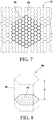
- Each individual cell 46 is shown in FIGs 6 and 8 comprising a septum 48.
- the septum 48 further acts as a noise attenuation feature in acoustic panel used in core materials, and the septum 48 may be made from any desired material.
- each individual cell 46 in the acoustic panel comprises cell walls 45, with each cell septumized by a septum 48 that is positioned within each cell 46 at a preselected depth "D".
- the septums 48, comprising septum perforations 47 assist in dampening and attenuating soundwaves entering cellular core 34 through the perforations 44 in the inner facesheet 36.
- FIG. 7 shows an area of exposed cellular core 34 in panel 32 requiring rework.
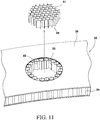
- the section marked in “bold” represents an area of rework or, rework area 35 requiring removal, and when removed from the cellular core 34 becomes the removable cellular core 51 ( FIG. 11 ).
- a section of inner facesheet 36 is removed, exposing a rework area 35 of the cellular core 34 of panel 32.
- FIG. 9 shows a perspective view of an acoustic panel 32, prepared for an area of rework 35 of the cellular core 34.
- the inner facesheet 36 has been prepared by removing a portion of the facesheet that covers the rework area 35, and exposing the cellular core 34.
- the cutting apparatus 17 is in place with legs 12 inserted into cells 46 of the area of rework 35, with blade 15 positioned within guide slot 13 of cutting apparatus 17 such that blade edge 16 (not visible in FIG. 10 ) contacts and severs a cell wall 45 at a cell wall juncture 49 (e.g., the point where cell walls converge and meet adjoining cell walls.
- a cell wall juncture 49 e.g., the point where cell walls converge and meet adjoining cell walls.
- the legs 12 of the guide 10 and the cells 46 are shown as hexagonal in shape, it is presently contemplated that the legs and the cells may be of any shape, so long as the legs of the guide are dimensioned to be received into the cells and retain the guide in a substantially fixed orientation through, for example, a friction fit.
- a striking implement 18 e.g., shown in FIG.
- a guide comprises only one leg (as represented in FIG. 1B and 2B ), with the leg having a geometry and dimension to suitably engage or otherwise fit into a cell in a cellular core panel.
- the leg of a single leg guide would have a dimension and geometry to substantially match the dimension and geometry of the cell.
- a guide comprises only a single leg, it is contemplated that such a guide would comprise a slot extending lengthwise through the leg, or comprise another feature configured to receive a blade and orient the blade edge against a cell wall juncture.
- aspects of the present disclosure that are not illustrated further contemplate a cutting apparatus with a guide or a plurality of guides having an overall substantially circular, hexagonal, or other geometric configuration that could be configured to be placed once or more into the cellular core, with an appropriately configured blade or plurality of blades positioned into the guide or plurality of guides such that pressure applied to the cutting apparatus substantially simultaneously severs the number of cell walls that are required to liberate the cellular core rework area that is to be removed from the cellular core.
- a cellular rework section plug 54, or "plug" is fabricated from a cellular panel stock material 55 or "cellular panel blank".
- the cellular panel stock material 55 is formed from a material substantially the same or different from the material that is used to make the cellular core 34, and further has substantially the same cell size/geometry and overall area as the void left in the cut-out cellular core 53.
- the cellular rework section plug 54 may be expanded or contracted, as desired, so that the dimension of the cells 46 of the cellular rework section plug 54 are substantially identical to the cells 46 of the removable cellular core 51 that is removed from the cellular panel 34. Further, the dimension of the cellular rework section plug 54 made from the cellular panel stock material 55 is therefore substantially the same dimension as that of the space left in the cut-out cellular core 53.
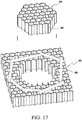
- the cutting of the cellular panel stock material 55 to form the cellular rework section plug 54 is conducted (as shown in FIG. 17 ) so as to maintain an intact, or full cell and an intact septum in each cell in the cellular rework section plug 54.
- the outer peripheral cells of the cellular rework section plug 54 form flat repair plug cell wall edges.
- the cellular rework section plug 54 is dimensioned to fit into the cut-out cellular core section 53 with precision as the cell wall exterior of the cellular rework section plug 54 will abut and otherwise adjoin the exposed cell walls of the cut-out cellular core section 53.
- the cell wall cutting operation similar to that shown in FIG. 10 and described above is also conducted on the cellular panel stock material 55, with the legs 12 of guide 10 positioned into cells 46 (as shown in FIG. 12 ), and with the guide 10 depressed into position within cells 46 (as shown in FIG. 13 ), followed by inserting the blade 15 into the guide slot of the guide 10 with pressure applied to the blade 15 of the cutting apparatus 17 via a striking implement 18 (e.g., a hammer) as shown in FIG. 14 .
- a striking implement 18 e.g., a hammer
- the guide 10 is positioned into cells 46 in the cellular panel stock material 55 (from which the cellular rework section plug 54 is cut).
- the guide slot 13 is positioned in cells 46, such that, when the blade edge 16 of the blade 15 is inserted into guide slot 13 (shown in detail in FIG. 16 ), the cells 46 will be severed at and from adjoining cells at the cell wall juncture 49 (e.g., the point where adjoining cell walls converge).
- FIGs. 15 and 16 are, therefore, close-up views of cells 46 into which first the guide 10 is located (shown in FIG. 15 ), followed by introducing the blade 15 into the guide slot 13 in the guide 10 (as shown in FIG. 16 ).
- the cellular rework section plug 54 will be severed from the cellular panel stock material (e.g., shown as a honeycomb "blank” of stock material) "cleanly". That is, the guide for the cutting instrument, according to aspects of the present disclosure, will position a blade within the guide slot to sever cell walls at the point of cell wall convergence (e.g., at the cell wall juncture 49), leaving substantially no extraneous cell wall material on the cellular rework section plug 54 or the substantially similarly dimensioned cut-out cellular core section 53.
- the guide for the cutting instrument will position a blade within the guide slot to sever cell walls at the point of cell wall convergence (e.g., at the cell wall juncture 49), leaving substantially no extraneous cell wall material on the cellular rework section plug 54 or the substantially similarly dimensioned cut-out cellular core section 53.
- the precision cutting effected by aspects of the present disclosure for, for example, cellular core acoustic panels, the septums present in the cells of the cellular rework section plug 54 and the cells of the substantially similarly dimensioned cut-out cellular core section 53 are left acoustically intact in the cells after cutting.
- FIG. 17 shows a cellular rework section plug 54 that has been cut and removed from a cellular panel stock material 55 according to aspects of the present disclosure. As shown in FIG. 17 , the cell wall 45 has been cleanly severed at the cell wall juncture 49.
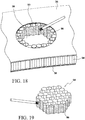
- adhesive 56 is applied to the exposed surfaces of the cut-out cellular core 53.
- adhesive 56 is applied to the outer surface of the cell walls 46 of the cellular rework section plug 54.
- FIGs. 18 and 19 together depict applying adhesive to both the cellular rework section plug 54 and the cut-out cellular core section 53, it is understood that the adhesive 56 applied to only one of the cellular rework section plug 54 or the cut-out cellular core section 53 may suffice to adequately perform the required rework of the acoustic panel.
- the adhesive may be applied in film, paste, or other form, as desired.
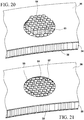
- the cellular rework section plug 54 is fitted into the space left in the cut-out cellular core section 53, and fitted into place as shown in FIG. 21 such that the cell walls of the existing cut-out cellular core section 53 and the cellular rework section plug 54 are positioned adjacent to one another. Therefore, aspects of the present disclosure contemplate that the rework section plug 54 is dimensioned to very closely approximate, or even be identical to the dimension of the space left in the cut-out cellular core section 53.
- Such variances between the rework section plug 54 and the space being filled by the plug 54 in the cut-out cellular core section 53 may range from about 1mil to about 2 mils.
- the replacement plug would be slightly compressed in the transverse and cell wall direction in order to insert the rework section plug 54 into place in the cut-out cellular core section 53.
- the adhesive 56 that is selected for use and applied to both, or either of the cellular rework section plug 54 and the cut-out cellular core section 53 would act as a lubricant to facilitate the insertion of the rework section plug 54 into place in the cut-out cellular core section 53.
- the adhesive 56 that is selected for use and applied to both, or either of the cellular rework section plug 54 and the cut-out cellular core section 53 would also act as gap filler as needed.
- the cellular rework section plug 54 is inserted downwardly into the cut-out cellular core 53 section, to a desired depth, for example, until the bottom of the cellular rework section plug 54 engages the outer facesheet 38, and such that the top surface of the cellular rework section plug 54 is substantially "flush" with the top surface of the cut-out cellular core 53, as shown in FIG. 21 .
- FIG. 21 further shows a bond line 57 now established in the reworked cellular panel 34, with the bond line 57 effectively outlining the perimeter of the cellular rework section plug 54.
- Positioning the cellular rework section plug 54 into its final or near final position can be accomplished with any method that does not adversely impact the structural integrity of the cellular rework section plug 54 or the cut-out cellular core 53. Such methods include, without limitation, vacuum or other pressure-assisted manual or automatic mechanical means, including, but not limited to, processes such as "vacuum bagging", etc. As shown in FIG.
- the cellular rework section plug 54 is fully inserted into a final position in the cut-out-cellular core section 53, to complete the rework of the "original" cellular core 34, now referred to in FIGs 21 , 22 , 23 and 24 as the reworked cellular core 58.
- film, paste, or other adhesive can be applied to the bottom of the rework section plug 54 and/or to the area of the outer facesheet 38 that is beneath the cut-out cellular core 53 (e.g., the inner surface of the outer facesheet), so that the rework section plug 54 is bonded to the outer facesheet 38.
- the rework area is then subjected to elevated temperature in order to cure the thermal adhesive and thereby bond the rework section plug 54 to the cut-out cellular core section 53.
- Other cure techniques are also contemplated including, but not limited to, curing techniques involving elevated temperature and/or pressures, as well as ambient cure techniques.
- FIG. 22 is a cross-sectional side view of the reworked acoustic panel 60 with the cellular core 34 having now been reworked into the reworked cellular core 58.
- Techniques can be used to repair the inner facesheet 36 that will cover the reworked cellular core 58.
- the area 64 of the inner facesheet 36 surrounding the rework area 35 may be scarfed at scarf 64, and rework patch 68 may be fabricated having a taper 62 that substantially matches the scarf 64.
- a layer of adhesive 66 can be applied to the rework area 35.
- Another layer of adhesive 69 can be used to adhesively bond the rework patch 68 to the inner facesheet 36, followed by, for example, vacuum bagging techniques to press the rework patch 68 against the inner facesheet 36.
- FIG. 22 shows a scarfing lap-joint
- other joints can be accomplished other than a scarfing lap joint, including, for example and without limitation, a set-lap joint, etc.
- the rework patch 68 may be equivalently referred to herein as a "covering layer".
- a separate covering layer may cover the rework patch, so that both a rework patch and a covering layer are present.
- FIGs. contemplate reworking acoustic panels by entering the panel through the inner facesheet 36.
- the legs of the guide can be inserted into the cells of the cellular core to a distance adequate to effect the required severing of the cell walls
- further aspects contemplate reworking the acoustic panel by accessing the cellular core via the outer facesheet 38 side of the acoustic panel.
- the location of the septums 48 in each cell may dictate which side of the acoustic panel to access for reworking.
- the curing of the layers of adhesive 66, 69 can occur concurrently with, or subsequent to, the vacuum bagging or other techniques used to effect the replacement section of the inner facesheet covering the rework area of 35 conducted on the cellular core 34
- the adhesive 66, 69 as well as the rework patch 68 are selected such that material from the adhesive 66, 69 and the rework patch 68 will not descend or "weep" into the cells 46 they are covering.
- a prepreg system e.g., BMS-8256, etc.
- BMS-8256 BMS-8256
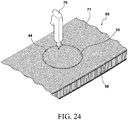
- FIG. 23 shows a perspective view of the reworked acoustic panel 60 shown in FIG. 22 .
- curing can be conducted in one step to cure the adhesive 56 applied to the cut-out cellular core section 53 and the cellular rework section plug 54 as well as the layers of adhesive 66 and 69, and the rework patch 68, if the material used to make the rework patch 68 requires curing (e.g., if the rework patch comprises a prepreg or other composite material).
- acoustic perforations are restored to the reworked inner facesheet 71 covering the rework area 35 of the reworked acoustic panel 60.
- such perforations 44 are physically installed in the reworked inner facesheet 71 of the reworked acoustic panel 60, for example, by drilling with drill 70.
- aspects of the present disclosure contemplate restoring perforations to the inner facesheet manually or in an automated fashion. Further aspects contemplate that an automated machine, for example, controlled manually or by a computer-controlled machine, etc., can perform desired perforation operations such as, for example, by punching or drilling the perforations into the replacement area of the facesheet to form the desired perforation pattern.
- aspects of the present disclosure contemplate the use of a template or other type of guide to assist in restoring a desired perforation pattern into the reworked inner facesheet, in conjunction with the perforation drilling operation, and for example, to insure the proper location and orientation of the perforations relative to each cell (e.g., centered perforations relative to each cell, etc.).
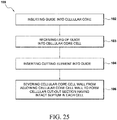
- FIG. 25 is a flowchart outlining aspects of the present disclosure directed to a method 100 for cutting cellular (e.g., honeycomb core) sections from a cellular panel, with the panel comprising an intact septum in each cell, by inserting 102 a guide into the cellular core, inserting 104 a cutting element into the guide, and severing 106 a cellular core cellular cell wall from adjoining cellular core cell walls at cell wall junctures to form a removable cellular section and a cut-out cellular core section, with the cut-out cellular core section comprising an intact septum in each cell after the cutting operation.
- the methods outlined in FIG. 25 are contemplated to be used in the cutting step 302 shown in the methods outlined in FIG. 27 .
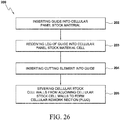
- FIG. 26 is a flowchart outlining further aspects of the present disclosure directed to a method 200 for cutting cellular (e.g., honeycomb core) rework section plugs from cellular panel stock material, otherwise referred equivalently to herein as cellular panel stock or cellular panel "blank", with the cellular panel stock comprising an intact septum in each cell, by inserting 202 a guide into the cellular rework stock, inserting 204 a cutting element into the guide, and severing 206 cellular rework stock cell walls from adjoining cellular rework stock cells at cell wall junctures to form a cellular rework section plug.
- cellular panel stock material otherwise referred equivalently to herein as cellular panel stock or cellular panel “blank”
- the cellular rework section plug is sized to a dimension that is substantially similar to the space left in the removable cut-out cellular core section.
- the methods outlined in FIG. 26 are contemplated to be used in the cutting step 402 shown in the methods outlined in FIG. 28 .
- FIGs. 27A and 27B are flowcharts outlining methods 250 and 300, respectively, for reworking an acoustic panel, according to aspects of the present disclosure.
- a predetermined area 35 of cellular core material requiring rework may be removed from the cellular core 34 such that, when the cellular area requiring rework 35 is precisely severed in a predetermined manner from the cellular core 34, and removed from the cellular core, the cut-out cellular core section 53 that remains comprises intact cells 46 (and therefore intact cell walls 45, with the intact cells 46 retaining an intact septum 48 in each cell.
- a cellular rework section plug 54 can be cut from cellular core stock material.
- the cellular rework section plug comprises intact cells 46 (and therefore intact cell walls 45), with the intact cells 46 retaining an intact septum 48 in each cell.
- FIG. 27A describes an aspect directed to a method 250 wherein a removable cellular core section 51 is removed 304 from the cellular core 34 to form an area of exposed cellular core in the cut-out cellular core section 53 that remains.
- the removable cellular core section 51 is discarded.
- a cellular rework section plug 54 is inserted 306 into the exposed area of the cut-out cellular core 53.
- a predetermined area of cellular core material requiring rework 35 is removed from the cellular core 34 such that, when the cellular area requiring rework 35 is severed from the cellular core 34, and removed from the cellular core 34 as removable cellular core section 51, the cut-out cellular core section 53 that remains, comprises intact cells 46 (and therefore intact cell walls 45), with the intact cells 46 retaining an intact septum 48 in each cell 46.
- the cut-out cellular core section 53 that remains, comprises intact cells 46 (and therefore intact cell walls 45), with the intact cells 46 retaining an intact septum 48 in each cell 46.
- a cellular rework section plug 54 can be cut from cellular core stock material 55.
- the cellular rework section plug 54 comprises intact cells 46 (and therefore intact cell walls 45), with the intact cells 46 retaining an intact septum 48 in each cell. As shown in FIG. 27A , the cellular rework section plug 54 is inserted 306 into the cellular core section. The insertion may be accomplished manually or with the aid of a mechanical device that may or may not be automated.
- FIG. 27B describes another aspect directed to a method 300 that accomplishes the steps of the method 250 outlined shown in FIG. 27A with additional steps provided.
- one or more covering layers of the acoustic panel are first removed in a step of removing 301 a covering layer from the acoustic panel to expose the cellular core 34, followed by, for example, using the presently disclosed guides and apparatuses of the present disclosure for cutting 302 the cellular core 34 to form a removable cellular section 51.
- the removable cellular section 51 that has been severed from the cellular core 34 is removed 304 to form a cellular cut-out section 53 that remains.
- Adhesive is applied 305 to at least one of the exposed cells 46 of the cut-out cellular core section 53 and/or the exposed cells 46 of the cellular rework section plug 54 exterior.
- the application of the adhesive may be done manually or mechanically and in an automated fashion, if desired.
- Any suitable adhesive is contemplated according to aspects of the present disclosure, including, without limitation, curable resin-based adhesives such as, for example epoxy resin-based adhesives.
- the cellular rework section plug (54) is inserted 306 manually or with the aid of a mechanical device that may or may not be automated into the exposed area of the cut-out cellular core (53) and the cellular rework section plug (54) is adhered 308 to the cut-out cellular core section (53) to form a reworked cellular core.
- FIG. 27B further shows the steps of adhering 309 at least one covering layer over the reworked cellular core followed by curing 310 the covering layer.
- the covering layer used replicates the characteristics of the original covering layer that is partially removed to expose the cellular core, and includes, without limitation composite materials, metals, etc.
- the replacement covering layer may differ in material and/or characteristics from the original covering layer that is partially removed to expose the cellular core.
- Curing of the adhesives used may be required and is therefore also contemplated.
- the curing may follow heat- and/or pressure based regimens, although other curing methods are contemplated herein for use with adhesive systems that can be cured in other ways including, without limitation, ultraviolet (UV) curing, ultrasonic curing, etc.
- co-curing of adhesive layers and additional covering layers can be accomplished during the curing 310 step, if desired.
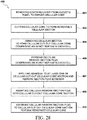
- FIG. 28 is a flowchart describing another aspect directed to a method 400 for reworking an acoustic panel comprising, for example, using the presently disclosed guides and apparatuses of the present disclosure, cutting 402 an area of cellular core material from an acoustic panel to form a cut-out cellular core section and removing 404 a removable cellular core section 51 to form the cut-out cellular core section 53.
- one or more covering layers are first removed in a step of removing 401 a covering layer from an acoustic panel to expose the cellular core.
- a cellular rework section plug 54 is formed 406 by removing the cellular rework section plug from a cellular panel stock according to aspects of the present disclosure, for example, by using the presently disclosed guides and apparatuses of the present disclosure, with the cellular rework section plug sized to a dimension substantially similar to the removed cellular core and the cut-out cellular core section.
- Adhesive is applied 407 to at least one of the exposed cellular core and the rework section plug exterior.
- the cellular rework section plug is inserted 408 into the cut-out cellular core section and the cellular rework section plug is adhered 410 to the cut-out cellular core section to form a reworked cellular core.
- aspects of the present disclosure find use in a variety of potential applications, particularly in the transportation industry including, for example, aerospace, marine, automotive applications and other application where acoustic panels can be employed and are desired.
- aspects of the disclosure may be used in the context of an aircraft manufacturing and service method 500 and aircraft 600 including at least in the component and subassembly manufacturing 506, system integration 508, maintenance and service 514, in the assembly and maintenance of the aircraft airframe 602, and through aircraft interior 604.
- Aircraft applications of the disclosed aspects may include, for example, and without limitation, repair of acoustic areas around engines, such as engine nacelles and thrust reversers.
- exemplary method 500 includes specification and design 502 of the aircraft 600 and material procurement 504.
- component and subassembly manufacturing 506 and system integration 508 of the aircraft 600 takes place.
- the aircraft 600 may go through certification and delivery 510 in order to be placed in service 512.
- routine maintenance and service 514 which may also include modification, reconfiguration, refurbishment, and so on.
- a system integrator may include, without limitation, any number of aircraft manufacturers and major-system subcontractors.
- a third party may include, without limitation, any number of vendors, subcontractors, and suppliers; and an operator may be an airline, leasing company, military entity, service organization, and so on.
- the aircraft 600 produced by exemplary method 500 can include an airframe 602 with a plurality of systems 603 and an interior 604.
- high-level systems 603 include, without limitation, one or more of a propulsion system 604, an electrical system 608, a hydraulic system 610, and an environmental system 612. Any number of other systems can be included.
- an aerospace example is shown, aspects of the present disclosure may be applied to other industries, such as the marine and automotive industries.
- Systems and methods embodied herein may be employed during any one or more of the stages of the production and service method 500.
- components or subassemblies corresponding to production process 506 may be fabricated or manufactured in a manner similar to components or subassemblies produced while the aircraft 600 is in service.
- one or more apparatuses, methods, or a combination thereof may be used during the production stages 506 and 508, for example, by substantially expediting assembly of or reducing the cost of an aircraft 600.
- apparatus embodiments, method embodiments, or a combination thereof may be utilized while the aircraft 600 is in service, for example and without limitation, to maintenance and service 514 the aircraft 600.
- the rework methods according to aspects of the present disclosure also afford advantages over known methods of cellular core panel rework, especially where the reestablishment of a desired degree of substantially uniform structural integrity is desired.
- presently disclosed methods obviate the need for foam adhesives or film adhesives that, for example, may otherwise contribute to unwanted depressions or deformations in replacement repair skins.
- aspects of the present disclosure can employ a wet layup replacement skin ply or plies over cellular core rework area, as opposed to prepreg application that can be used as coverings for inner facesheets of acoustic panels.
- aspects of the present disclosure further contemplate rework methods not requiring reestablishment of perforations into inner facesheets, for example.
- the present disclosure therefore further contemplates reworking panels, portions of panels and aircraft and potions of aircraft made using the cutting instruments and apparatuses disclosed herein.
- the present disclosure further contemplates the use of the disclosed methods to make the disclosed reworked panels or reworked portions of panels in the manufacture of objects, including stationary structures including, without limitation buildings, supports, etc.
- the disclosed reworked panels and reworked portions of panels and methods of their manufacture as well as the use of the disclosed cutting instrument and disclosed apparatuses are further contemplated for use in the manufacture of reworked panels and reworked portions of vehicles, such vehicles including manned and unmanned aircraft, manned and unmanned spacecraft, manned and unmanned rotorcraft, manned and unmanned terrestrial vehicles, manned and unmanned surface water borne vehicles, manned and unmanned sub-surface water borne vehicles, and satellites, etc.
- vehicles including manned and unmanned aircraft, manned and unmanned spacecraft, manned and unmanned rotorcraft, manned and unmanned terrestrial vehicles, manned and unmanned surface water borne vehicles, manned and unmanned sub-surface water borne vehicles, and satellites, etc.
Landscapes
- Engineering & Computer Science (AREA)
- Mechanical Engineering (AREA)
- Forests & Forestry (AREA)
- Life Sciences & Earth Sciences (AREA)
- Chemical & Material Sciences (AREA)
- Combustion & Propulsion (AREA)
- Architecture (AREA)
- Manufacturing & Machinery (AREA)
- Transportation (AREA)
- Aviation & Aerospace Engineering (AREA)
- Civil Engineering (AREA)
- Structural Engineering (AREA)
- Physics & Mathematics (AREA)
- Thermal Sciences (AREA)
- General Engineering & Computer Science (AREA)
- Soundproofing, Sound Blocking, And Sound Damping (AREA)
- Casting Devices For Molds (AREA)
- Biological Treatment Of Waste Water (AREA)
- Laminated Bodies (AREA)
- Working Measures On Existing Buildindgs (AREA)
Abstract
Description
- The present disclosure relates generally to structures for noise reduction, and structures comprising such areas. More specifically, the present disclosure relates to methods for reworking acoustic panels and non-acoustic panels for structures, restoring acoustic performance to such structures, and structures comprising the reworked areas.
- Aircraft engine assemblies produce high noise levels due to the high airflows through inlets, rotating stages and exhaust nozzles, etc. To reduce such noise levels and comply with noise regulations governing commercial aircraft, high bypass type aircraft engine assemblies incorporate acoustic panels in various locations of the engine, such as in the inlets of engine nacelles, thrust reversers, etc. These acoustic panels, sometimes referred to as acoustic treatments may comprise a septumized cellular, or "honeycomb" core oriented, or "sandwiched" between a perforated inner skin and a non-perforated outer skin or facesheet. The skins or facesheets may comprise a metal such as aluminum or a composite material, and the honeycomb core may comprise a metal, a ceramic, or a composite material.
- Acoustic sandwich panels include a core sandwiched between two liner sheets. One of the liner sheets is perforated while the other sheet is not perforated. The core provides bulk (e.g. separates the inner and outer facesheets) and defines a plurality of cavities. Apertures defined by the perforated liner sheet fluidly couple the cavities ambient environment. Therefore, when air flows across the perforated liner sheet of an acoustic sandwich panel, the cavities in the core act as Helmholz resonators and attenuate the sound of the associated airflow. More specifically, core walls between adjacent cavities in the core act as acoustic septa to attenuate the sound of the airflow
- Over the course of a useful life, acoustic panels may require localized repair or reconditioning, known as "rework" to restore their original structural strength and performance. Known reworking for acoustic panels involves splicing the honeycomb core, and using foaming adhesives to secure the reworked sections. However this type of rework can result in the blockage of honeycomb cells, or otherwise limit the cells comprising the honeycomb core, resulting in less than desired acoustic performance of the affected cells. While certain types of aircraft have allowable acoustic loss at acoustic panels within acoustic structures, regulations for other aircraft types may not permit structural rework of such areas, resulting in part replacement at significant cost. Further regulations may allow for the replacement of a portion of the acoustic panels if acoustic performance is restored. However, restoring acoustic performance for reworked acoustic panels and structures comprising acoustic panels, such as aircraft nacelles, thrust reversers, etc., has presented continuing challenges.
- Aspects of the present disclosure are directed to methods for reworking structures comprising cellular core panels and reworking cellular core panels, reworked structures comprising the reworked core panels, and guides for reworking cellular acoustic panels and non-acoustic panels, as well as cutting apparatuses for reworking the core panels in larger structures, preferably in situ. Further aspects are directed to reworking acoustic panels and structures comprising the panels, with the panels comprising reworked core sections including, without limitation, honeycomb core sections in acoustic panels and structures comprising the panels.
- A further aspect of the present disclosure is directed to a guide for a cutting instrument, with the guide comprising a base, at least one leg in communication with the base, and a guide slot extending longitudinally through the base, with the guide slot defined by the at least one leg and the base.
- In another aspect, the guide comprises a plurality of legs in communication with the base.
- A further aspect of the present disclosure is directed to reworking a portion of an aircraft using a guide for a cutting instrument, with the guide comprising a base, at least one leg in communication with the base, and a guide slot extending longitudinally through the base, with the guide slot defined by the at least one leg and the base.
- Another aspect of the present disclosure is directed to an apparatus comprising a guide, with the guide comprising a base leg, with the leg dimensioned to engage and extend into, and be received by, a cell in a cellular core section. The cellular core section includes a plurality of cell walls, with the guide comprising a guide slot defined by the leg and the base, with the guide slot extending longitudinally within the guide, and a cutting instrument dimensioned to be received by the guide slot.
- In another aspect, the cutting instrument is configured to engage the guide slot and is further configured to move longitudinally within a length of the guide slot, with the cutting instrument comprising a leading blade edge.
- A further aspect of the present disclosure is directed to reworking a portion of an aircraft using an apparatus comprising a guide, with the guide comprising a base leg, with the leg dimensioned to engage and extend into, and be received by, a cell in a cellular core section. The cellular core section includes a plurality of cell walls, with the guide comprising a guide slot defined by the leg and the base, with the guide slot extending longitudinally within the guide, and a cutting instrument dimensioned to be received by the guide slot.
- Another aspect of the present disclosure is directed to a method comprising removing a removable cellular section from a cellular core to form a cut-out cellular core, said cut-out cellular core comprising intact cells, said cells comprising an intact septum in each cell, and inserting a cellular rework section plug into the cut-out cellular section, with the cellular rework section plug comprising intact cells, and with the cells comprising an intact septum in each cell.
- In another aspect, before the step of removing a removable cellular section from a cellular core, further comprising cutting an area from a cellular core to form a removable cellular section.
- In another aspect, in the step of removing a removable cellular section from a cellular core to form a cut-out cellular core, with the cut-out cellular core comprising intact cells, and with the cells further comprising a plurality of exposed cell walls.
- In a further aspect, in the step of inserting a cellular rework section plug into the cut-out cellular core, with the cellular rework section plug comprising intact cells and with the cells further comprising a plurality of exposed cell walls.
- Another aspect of the present disclosure is directed to a method for reworking a structure comprising a cellular core, with the method comprising cutting an area from a cellular core to form a removable cellular section, with the removable cellular core section comprising a plurality of adjoining cells, and removing the removable cellular core section from the cellular core to form a cut-out cellular core, with the cut-out cellular core comprising a plurality of exposed adjoining complete cells, and with the plurality of exposed adjoining cells each comprising an intact septum disposed within each cell. Each septum is bounded by cell walls, and the cut-out cellular core comprises a cut-out cellular core geometry. A cellular rework section plug is then inserted into the cut-out cellular core and adhered to the cut-out cellular core to form a reworked cellular core, wherein each cell in the cellular reworked cellular core comprises an intact septum disposed within each cell.
- In a further aspect, the cellular rework section plug is adhered to the cut-out cellular core to form the reworked cellular core.
- In another aspect, the cut-out cellular core comprises a cut-out cellular core geometry and the cellular rework section plug has a cellular rework section plug geometry.
- In a further aspect, the cellular rework section plug geometry substantially matches the cut-out cellular core geometry
- In another aspect, in the step of removing the removable cellular section from the cellular core to form the cut-out cellular core to form the cut-out cellular core, the cells of the cut-out cellular core comprise intact cell walls in each cell.
- In a further aspect, in the step of inserting a cellular rework section plug into the cut-out cellular core, the cells of the cellular rework section plug comprise intact cell walls in each cell.
- In another aspect, at least one of the cellular core and the rework section plug comprise a honeycomb structure.
- In another aspect, an acoustic panel comprises the honeycomb structure.
- In another aspect, before the step of inserting a cellular rework section plug, a method further comprises inserting a guide to a predetermined depth into a cellular panel stock material comprising a plurality of adjoining cells, with each of the adjoining cells comprising intact cell walls and a septum, with the guide comprising at least one leg. A leg of the guide is received into at least one of the adjoining cells, and a cutting instrument is inserted into the guide. A cell wall is severed from an adjoining cell of an adjoining cell at a cell wall juncture to form the cellular rework section plug.
- According to a further aspect, the step of cutting an area from a cellular core to form a removable cellular core section, to form a removable cellular core section in the cellular core further comprises inserting a guide to a predetermined depth into the at least one cell in the cellular core, with cellular core comprising a plurality of adjoining cells, with each of the adjoining cells comprising cell walls and a septum. The guide comprises at least one leg that is received into at least one adjoining cell. A cutting instrument is inserted into the guide and a cell wall is severed completely from an adjoining cell wall of an adjoining cell at a cell wall juncture.
- In another aspect, before the step of cutting an area from a cellular core, a method further comprises removing a portion of at least one covering layer from an acoustic panel to expose to expose a cellular core.
- In another aspect, before the step of inserting the cellular rework section plug into the cut-out cellular core, a method further comprises applying an adhesive to at least one of the cut-out cellular core and the cellular rework section plug.
- In another aspect, after the step of adhering, the cellular rework section to the cut-out cellular core to form a reworked cellular core, a method further comprises adhering at least one covering layer over the reworked cellular core with the covering layer comprising at least one composite material layer.
- In a further aspect, the covering layer comprises perforations.
- In another aspect, after the step of adhering at least one covering layer over the reworked cellular core, a method further comprises curing the covering layer.
- In another aspect, a method further comprises co-curing the adhesive and the covering layer.
- In a further aspect, after the step of curing the covering layer, a method further comprises perforating the covering layer to form acoustic perforations extending through the covering layer.
- In another aspect, acoustic perforations are in formed in the covering layer by drilling.
- In another aspect, after the step of severing the cell wall at the cell wall juncture, the adjoining cells of the cellular rework section plug each comprise an intact septum.
- In a further aspect, before inserting a cellular rework section plug, a method further comprises forming a cellular rework section plug comprising a plurality of adjoining cells and an outer periphery geometry substantially equivalent to the cut-out cellular core geometry.
- Another aspect of the present disclosure is directed to a method of cutting an area from a cellular core to form a removable cellular core section and a cut-out cellular core section in the cellular core comprising inserting a guide to a predetermined depth into at least one cell of the cellular core, receiving a leg of the guide into at least one cell, and inserting a cutting instrument into the guide and severing a cell wall of the cell completely from an adjoining cell wall of an adjoining cell at a cell wall juncture.
- In a further aspect, the cut-out cellular core section comprises a plurality of adjoining cells, with each of the adjoining cells comprising intact cell walls and an intact septum.
- In another aspect, at least one of the cellular core and the cellular rework section plug comprise a honeycomb structure.
- In a further aspect, after the step of severing the cell wall at the cell wall juncture, the adjoining cells of the cellular rework section plug each comprise intact cell walls and an intact septum.
- A further aspect is directed to a portion of an aircraft reworked according to any of the methods presented herein.
- A further aspect of the present disclosure is directed to a reworked cellular core made according to any of the aforementioned methods.
- In another aspect, the reworked cellular core comprises a honeycomb structure.
- In another aspect, the reworked cellular core is a component in an acoustic panel.
- A further aspect is directed to a reworked panel comprising the reworked cellular core made according to aspects of the present disclosure.
- Further aspects are directed to an object comprising the reworked panels made according to any presently disclosed methods.
- According to further aspects, the object comprises at least one of an aircraft engine assembly or a thrust reverser.
- A further aspect is directed to a vehicle comprising objects reworked according to presently disclosed methods.
- Another aspect is directed to a vehicle comprising the rework according to disclosed methods, with the vehicle including at least one of: a manned aircraft, and unmanned aircraft, a spacecraft, an unmanned spacecraft, a manned rotorcraft, an unmanned rotorcraft, a manned terrestrial vehicle, an unmanned terrestrial vehicle, a manned surface water borne vehicle, an unmanned surface water borne vehicle, a manned sub-surface water borne vehicle or an unmanned sub-surface water borne vehicle.
- The features, functions and advantages that have been discussed can be achieved independently in various aspects or may be combined in yet other aspects, further details of which can be seen with reference to the following description and the drawings.
- Having thus described variations of the disclosure in general terms, reference will now be made to the accompanying drawings, which are not necessarily drawn to scale, and wherein:
-
FIG. 1A is a perspective view of a guide having multiple legs; -
FIG. 1B is a perspective view of a guide having one leg; -
FIG. 2A is an overhead plan view of the guide shown inFIG. 1A ; -
FIG. 2B is an overhead view of the guide shown in FIG. IB; -
FIG. 3 is a view of a cutting apparatus comprising the guide shown inFIGs. 1A and 2A and a cutting instrument; -
FIG. 4 is a view of the assembled cutting apparatus ofFIG. 3 ; -
FIG. 5 is an illustration of a perspective view of a portion of the wing showing an engine inlet comprising an acoustic structure requiring repair; -
FIG. 6 is an illustration of a cross-sectional side view of a portion of an acoustic panel forming part of the engine inlet shown inFIG. 5 ; -
FIG. 7 is an overhead plan view of a portion of the acoustic panel ofFIG. 6 requiring rework; -
FIG. 8 is a perspective view of a cell of the cellular core in the acoustic panel shown inFIG. 7 ; -
FIG. 9 is a perspective view of the acoustic panel shown inFIGs. 7 and 8 ; -
FIG. 10 is a perspective view of the acoustic panel shown inFIG. 9 with a cellular core section being cut; -
FIG. 11 is a perspective view of the acoustic panel shown inFIG. 10 , with the removable cellular core section being removed from the cellular core of the panel to form a remaining cut-out cellular core; -
FIGs. 12, 13 and14 are perspective views of a cellular core stock material, or cellular "blank", from which a cellular rework section ("plug") is fashioned; -
FIGs. 15 and 16 are enlarged views of the of cellular core stock material shown inFIGs. 12, 13 and14 ; -
FIG. 17 is a perspective view showing removal of the cellular rework section ("plug") removed from the cellular core stock material shown at least inFIGs. 12, 13 and14 ; -
FIG. 18 is a perspective view of the panel ofFIG. 11 showing the exposed cut-out cellular core with adhesive applied to exposed cell wall surfaces; -
FIG. 19 is a perspective view of the cellular rework section shown inFIG. 17 with adhesive applied to outer cell wall surfaces; -
FIG. 20 is a perspective view of the panel ofFIG. 18 with the cellular rework section ofFIG. 19 being inserted into the panel to form a reworked cellular core in the acoustic panel; -
FIG. 21 is a perspective view of the reworked cellular core in the acoustic panel ofFIG. 20 with the cellular rework section inserted into position in the reworked cellular core of the acoustic panel; -
FIG. 22 is a cross-sectional side view of a reworked acoustic panel shown inFIG. 21 , with covering layer shown in an exploded view; -
FIG. 23 is a perspective view of the panel ofFIG. 22 with a covering layer in position; -
FIG. 24 is a perspective view of the reworked acoustic panel ofFIG. 23 showing perforations formed in the covering sheet; -
FIG. 25 is a flowchart according to aspects of the present disclosure outlining a method for severing cellular core cell walls in a cellular core to form a cut-out cellular core section; -
FIG. 26 is a flowchart according to aspects of the present disclosure outlining a method for severing cellular cell walls from cellular panel stock material stock to form a cellular rework section "plug"; -
FIG. 27A is a flowchart according to aspects of the present disclosure outlining a method for reworking a cellular core according to aspects of the present disclosure; -
FIG. 27B is a flowchart according to aspects of the present disclosure outlining a method for reworking a cellular core according to aspects of the present disclosure; -
FIG. 28 is a flowchart according to aspects of the present disclosure outlining a method for reworking a cellular core according to aspects of the present disclosure and as shown inFIG. 27 including the further steps of making the cellular core rework section ("plug"); -
FIG. 29 is a flow diagram of aircraft production and service methodology; and -
FIG. 30 is a block diagram of an aircraft. - According to the present disclosure, methods for reworking structures are disclosed comprising reworked core panels, reworked structures comprising the reworked core panels, and guides and apparatuses for reworking cellular core panels for reworking the core panels in structures. Further aspects are directed to reworking acoustic panels and structures comprising the cellular core panels, with the panels comprising reworked cellular core sections including, without limitation, honeycomb core sections in acoustic paneling and structures comprising the acoustic paneling. Aspects of the present disclosure further contemplate reworking non-acoustic cellular core panels, and such panels reworked according to the methods disclosed herein, as well as structures comprising the reworked, non-acoustic panels.
- Acoustic paneling includes structures that are specifically designed to absorb, control, or reflect sound away from a particular area. For example, acoustic paneling may be used to reduce the auditory impact of aircraft engines during takeoff, flight, and landing. Acoustic paneling within an aircraft may further reduce and/or redirect aircraft noise during takeoff and landing. Such, noise reduction and redirection may be environmentally mandated via regulations, but is also desirable for passengers within an aircraft.
- Presently, acoustic paneling is assembled to conform the paneling to the complex geometries of an aircraft and aircraft structures. Each cell in an acoustic panel comprises a septum, and, over the area of an entire aircraft, there may be thousands of such cells, with each cell in an acoustic panel comprising an installed septum.
- While aspects of the present disclosure describe and illustrate panels requiring rework, with the rework shown in segments, according to aspects the present disclosure, the reworking may be conducted with the panel requiring rework remaining intact and as a part of a larger structure. For example, if a larger structure or component, such as an air inlet of an aircraft engine nacelle or other structure such as a thrust reverser requires rework to a panel having a cellular core (that may or may not be an acoustic panel), the rework described herein may be conducted in situ, and therefore without removal of the panel from its structure or component, or of the structure or component from a larger structure to which it is attached.
- The methods described herein restore structural strength to reworked panels comprising reworked cellular cores. The disclosed methods further enable rework on large rework areas of large structures, in situ if desired. Further, the presently disclosed methods enable rework, in situ, if desired, including the rework of cellular core panels of any configuration, both planar and non-planar, with the panels comprising an overall regular or irregular geometry.
-
FIGs. 1A and 2A show aguide 10 for use in conjunction with a cutting instrument to form a cutting apparatus used to cut, or otherwise sever, a section of material according to aspects of the present disclosure. As shown inFIGs. 1A and 2A , theguide 10 comprises ahandle 10b, and a base 11 in communication with a plurality oflegs 12, and aguide slot 13 extending through and defined by thelegs 12 and thebase 11. While the illustrations depict the legs having a hexagonal shape, other geometric shapes are contemplated. -
FIGs. 1A and 1B show overhead plan views of theguide FIGs. 1A and 1B respectively, with the view shown downward in the direction oflines FIGs 2A and 2B , respectively, show aguide FIGs. 2A and 2B , theguide handle 10b, and a base 11 in communication with aleg 12, and aguide slot 13 extending through and defined by theleg 12 and thebase 11. Again, while the illustrations depict the leg having a hexagonal shape, other geometric shapes are contemplated. - The depicted, substantially hexagonal, shape of the
legs 12 of the guide 10 (or in the case ofFIGs. 1B and 2B , thesingle leg 12 of theguide 10a) are dimensioned to fit into and otherwise engage the cellular walls of a honeycomb cellular structure. For example, if a cellular core material requires rework, aspects of the present disclosure contemplate a guide having at least one leg with a geometric shape (e.g., a polygonal, circular, rectangular, or other shape, etc.) that fits into or otherwise engages (but may or may not substantially match) the cellular wall of a cellular core material having a geometry and dimension to receive the leg of the guide. - According to further aspects, the geometry and dimension of the guide leg substantially matches the geometry and dimension of the cellular walls of the cells in the cellular core panel (e.g. substantially rectangular legs on the guide for use in reworking a cellular core having substantially rectangular cells; substantially circular legs on the guide for use in reworking a cellular core having substantially circular cells; substantially polygonal legs on the guide for use in reworking a cellular core having substantially matching polygonal cells , etc.).
-
FIGs. 3 and 4 show a cutting apparatus. As shown inFIG. 3 , cuttinginstrument 14 has ablade 15 and ablade edge 16, with theblade 15 having a width "W" substantially equivalent to the width of theguide slot 13, such thatblade 15 is accommodated or received byguide slot 13, as shown inFIG. 4 . Together, the cuttinginstrument 14 and theguide 10 comprise acutting apparatus 17. -
FIG. 5 shows ahigh bypass engine 20 is mounted anaircraft wing 22 by apylon 24. Theengine 20 includes a surroundingengine nacelle 26 having anair inlet 28. Theair inlet 28 includes anacoustic area 30 in the form of anacoustic panel 32 for reducing noise caused by high airflow through theair inlet 28 into theengine 20. Theacoustic panel 32 includes an area requiring rework, hereinafter referred to as a rework area 35 (shown inFIG. 7 et. seq.). The need for rework to theacoustic panel 32 may be the result of any of a number of causes and conditions. -
FIG. 6 illustrates additional details of theacoustic panel 32. Theacoustic panel 32 comprises a cellular core 34 (shown, in non-limiting fashion, as a honeycomb core) sandwiched between inner facesheet 36 andouter facesheet 38. Theinner facesheet 36 includes a multiplicity ofperforations 44 there through which allow soundwaves including noise to pass through theinner facesheet 36 into thecellular core 34. Theinner facesheet 36 is attached to a face of thecellular core 34 by anadhesive bond line 40. Similarly, theouter facesheet 38 is attached to the other face of thecellular core 34 by anadhesive bond line 42. As illustrated, the inner and outer facesheets 36 and 38 respectively, each comprise a laminated composite such as a carbon fiber reinforced plastic (CFRP), however either or both of these facesheets can comprise other materials such as, without limitation, a metal such as aluminum, a ceramic material, etc. Thecellular core 34 can comprise a metal such as aluminum, a polymer or other material, etc., and is formed of a multiplicity of individual polygonal cells 46 (herein referred to as "cells". In the illustrations, thecells 46 are hexagonal. However other cell geometries are possible and contemplated by aspects of the present disclosure. Eachindividual cell 46 is shown inFIGs 6 and8 comprising aseptum 48. Theseptum 48 further acts as a noise attenuation feature in acoustic panel used in core materials, and theseptum 48 may be made from any desired material. - As further shown in
FIG. 8 , eachindividual cell 46 in the acoustic panel comprisescell walls 45, with each cell septumized by aseptum 48 that is positioned within eachcell 46 at a preselected depth "D". Theseptums 48, comprisingseptum perforations 47 assist in dampening and attenuating soundwaves enteringcellular core 34 through theperforations 44 in theinner facesheet 36. -
FIG. 7 shows an area of exposedcellular core 34 inpanel 32 requiring rework. The section marked in "bold" represents an area of rework or, reworkarea 35 requiring removal, and when removed from thecellular core 34 becomes the removable cellular core 51 (FIG. 11 ). According to one aspect of the present disclosure, as shown inFIG. 7 , a section of inner facesheet 36 (as shown inFIG. 6 ) is removed, exposing arework area 35 of thecellular core 34 ofpanel 32. -
FIG. 9 shows a perspective view of anacoustic panel 32, prepared for an area ofrework 35 of thecellular core 34. Theinner facesheet 36 has been prepared by removing a portion of the facesheet that covers therework area 35, and exposing thecellular core 34. - As shown in
FIG. 10 , the cuttingapparatus 17 is in place withlegs 12 inserted intocells 46 of the area ofrework 35, withblade 15 positioned withinguide slot 13 of cuttingapparatus 17 such that blade edge 16 (not visible inFIG. 10 ) contacts and severs acell wall 45 at a cell wall juncture 49 (e.g., the point where cell walls converge and meet adjoining cell walls. While thelegs 12 of theguide 10 and thecells 46 are shown as hexagonal in shape, it is presently contemplated that the legs and the cells may be of any shape, so long as the legs of the guide are dimensioned to be received into the cells and retain the guide in a substantially fixed orientation through, for example, a friction fit. As a striking implement 18 (e.g., shown in FIG. 109 in non-limiting fashion as a hammer) strikes theblade 15, of the cuttingapparatus 17, the blade edge 16 (not visible inFIG. 10 ) severs the cell wall cleanly from adjoining cell walls at acell wall juncture 49. This operation is repeated (around a perimeter of a section of cellular core to be reworked and removed) until, as shown inFIG. 11 , a removablecellular section 51 is separated or "freed" from thecellular core 34 and can be removed from thecellular core 34 to form a cut-outcellular core 53 that now remains in panel 32 (as shown inFIG. 11 ). - Further aspects contemplate the use of manual or automated means to apply directed pressure to the guide for the purpose of positioning the guide into the cellular core, and for the purpose of depressing the blade of the cutting apparatus into the cellular core. According to aspects of the present disclosure, the process of severing the cell wall cleanly from adjoining cell walls at a
cell wall juncture 49 creates a cut-outcellular core 53 that remains from thecellular core 34, with the cut-outcellular core 53 comprising a plurality of cells wherein each cell comprises an intact septum. - In addition, a further cutting apparatus is contemplated wherein a guide comprises only one leg (as represented in
FIG. 1B and 2B ), with the leg having a geometry and dimension to suitably engage or otherwise fit into a cell in a cellular core panel. As with the multi-leg guides described above, the leg of a single leg guide would have a dimension and geometry to substantially match the dimension and geometry of the cell. When a guide comprises only a single leg, it is contemplated that such a guide would comprise a slot extending lengthwise through the leg, or comprise another feature configured to receive a blade and orient the blade edge against a cell wall juncture. - Aspects of the present disclosure that are not illustrated further contemplate a cutting apparatus with a guide or a plurality of guides having an overall substantially circular, hexagonal, or other geometric configuration that could be configured to be placed once or more into the cellular core, with an appropriately configured blade or plurality of blades positioned into the guide or plurality of guides such that pressure applied to the cutting apparatus substantially simultaneously severs the number of cell walls that are required to liberate the cellular core rework area that is to be removed from the cellular core.
- As shown in
FIGs. 12, 13 and14 , in order to replace theremovable core section 51 that is removed from thecellular core 34, a cellularrework section plug 54, or "plug" (as shown inFIG. 17 ) is fabricated from a cellularpanel stock material 55 or "cellular panel blank". - According to an aspect, the cellular
panel stock material 55 is formed from a material substantially the same or different from the material that is used to make thecellular core 34, and further has substantially the same cell size/geometry and overall area as the void left in the cut-outcellular core 53. The cellular rework section plug 54 may be expanded or contracted, as desired, so that the dimension of thecells 46 of the cellular rework section plug 54 are substantially identical to thecells 46 of the removablecellular core 51 that is removed from thecellular panel 34. Further, the dimension of the cellular rework section plug 54 made from the cellularpanel stock material 55 is therefore substantially the same dimension as that of the space left in the cut-outcellular core 53. - According to aspects of the present disclosure, the cutting of the cellular
panel stock material 55 to form the cellular rework section plug 54 (that is removed from the cellular panel stock material 55) is conducted (as shown inFIG. 17 ) so as to maintain an intact, or full cell and an intact septum in each cell in the cellularrework section plug 54. - According to further aspects of the present disclosure, the outer peripheral cells of the cellular rework section plug 54 form flat repair plug cell wall edges. In this way, the cellular
rework section plug 54 is dimensioned to fit into the cut-outcellular core section 53 with precision as the cell wall exterior of the cellular rework section plug 54 will abut and otherwise adjoin the exposed cell walls of the cut-outcellular core section 53. - As shown in
FIGs. 12, 13 and14 , the cell wall cutting operation similar to that shown inFIG. 10 and described above (for cutting thecellular panel 34 being reworked) is also conducted on the cellularpanel stock material 55, with thelegs 12 ofguide 10 positioned into cells 46 (as shown inFIG. 12 ), and with theguide 10 depressed into position within cells 46 (as shown inFIG. 13 ), followed by inserting theblade 15 into the guide slot of theguide 10 with pressure applied to theblade 15 of the cuttingapparatus 17 via a striking implement 18 (e.g., a hammer) as shown inFIG. 14 . - As shown in
FIGs. 12, 13 , and14 , theguide 10 is positioned intocells 46 in the cellular panel stock material 55 (from which the cellularrework section plug 54 is cut). As shown inFIGs. 13 ,14 , and15 , theguide slot 13 is positioned incells 46, such that, when theblade edge 16 of theblade 15 is inserted into guide slot 13 (shown in detail inFIG. 16 ), thecells 46 will be severed at and from adjoining cells at the cell wall juncture 49 (e.g., the point where adjoining cell walls converge).FIGs. 15 and 16 are, therefore, close-up views ofcells 46 into which first theguide 10 is located (shown inFIG. 15 ), followed by introducing theblade 15 into theguide slot 13 in the guide 10 (as shown inFIG. 16 ). - According to aspects of the present disclosure, the cellular rework section plug 54 will be severed from the cellular panel stock material (e.g., shown as a honeycomb "blank" of stock material) "cleanly". That is, the guide for the cutting instrument, according to aspects of the present disclosure, will position a blade within the guide slot to sever cell walls at the point of cell wall convergence (e.g., at the cell wall juncture 49), leaving substantially no extraneous cell wall material on the cellular rework section plug 54 or the substantially similarly dimensioned cut-out
cellular core section 53. Additionally, the precision cutting effected by aspects of the present disclosure for, for example, cellular core acoustic panels, the septums present in the cells of the cellularrework section plug 54 and the cells of the substantially similarly dimensioned cut-outcellular core section 53 are left acoustically intact in the cells after cutting. -
FIG. 17 shows a cellular rework section plug 54 that has been cut and removed from a cellularpanel stock material 55 according to aspects of the present disclosure. As shown inFIG. 17 , thecell wall 45 has been cleanly severed at thecell wall juncture 49. - As shown in
FIG. 18 , adhesive 56 is applied to the exposed surfaces of the cut-outcellular core 53. - Alternatively, or in addition to, applying adhesive to the cut-out
cellular core 53, as shown inFIG. 19 , adhesive 56 is applied to the outer surface of thecell walls 46 of the cellularrework section plug 54. AlthoughFIGs. 18 and 19 together depict applying adhesive to both the cellularrework section plug 54 and the cut-outcellular core section 53, it is understood that the adhesive 56 applied to only one of the cellular rework section plug 54 or the cut-outcellular core section 53 may suffice to adequately perform the required rework of the acoustic panel. The adhesive may be applied in film, paste, or other form, as desired. - As shown in
FIG. 20 , the cellularrework section plug 54 is fitted into the space left in the cut-outcellular core section 53, and fitted into place as shown inFIG. 21 such that the cell walls of the existing cut-outcellular core section 53 and the cellular rework section plug 54 are positioned adjacent to one another. Therefore, aspects of the present disclosure contemplate that therework section plug 54 is dimensioned to very closely approximate, or even be identical to the dimension of the space left in the cut-outcellular core section 53. - Further aspects of the present disclosure appreciate that practical manufacturing tolerances can realize very slight dimensional variances between the
rework section plug 54 and the space being filled by theplug 54 in the cut-outcellular core section 53. Such variances between therework section plug 54 and the space being filled by theplug 54 in the cut-outcellular core section 53 may range from about 1mil to about 2 mils. For example, in such instances where the dimension between therework section plug 54 and the space left in the cut-outcellular core section 53 vary slightly (e.g. a variance ranging from about 1 mil to about 2 mils), the replacement plug would be slightly compressed in the transverse and cell wall direction in order to insert the rework section plug 54 into place in the cut-outcellular core section 53. - According to further aspects, without being bound to any particular theory, it is believed that the adhesive 56 that is selected for use and applied to both, or either of the cellular
rework section plug 54 and the cut-outcellular core section 53 would act as a lubricant to facilitate the insertion of the rework section plug 54 into place in the cut-outcellular core section 53. Again, without being bound to any particular theory, it is believed that the adhesive 56 that is selected for use and applied to both, or either of the cellularrework section plug 54 and the cut-outcellular core section 53, would also act as gap filler as needed. - As shown in
FIG. 20 , the cellularrework section plug 54 is inserted downwardly into the cut-outcellular core 53 section, to a desired depth, for example, until the bottom of the cellularrework section plug 54 engages theouter facesheet 38, and such that the top surface of the cellularrework section plug 54 is substantially "flush" with the top surface of the cut-outcellular core 53, as shown inFIG. 21 . -
FIG. 21 further shows abond line 57 now established in the reworkedcellular panel 34, with thebond line 57 effectively outlining the perimeter of the cellularrework section plug 54. Positioning the cellular rework section plug 54 into its final or near final position can be accomplished with any method that does not adversely impact the structural integrity of the cellular rework section plug 54 or the cut-outcellular core 53. Such methods include, without limitation, vacuum or other pressure-assisted manual or automatic mechanical means, including, but not limited to, processes such as "vacuum bagging", etc. As shown inFIG. 21 , the cellularrework section plug 54 is fully inserted into a final position in the cut-out-cellular core section 53, to complete the rework of the "original"cellular core 34, now referred to inFIGs 21 ,22 ,23 and24 as the reworkedcellular core 58. - According to an aspect of the present disclosure not shown, film, paste, or other adhesive can be applied to the bottom of the
rework section plug 54 and/or to the area of theouter facesheet 38 that is beneath the cut-out cellular core 53 (e.g., the inner surface of the outer facesheet), so that therework section plug 54 is bonded to theouter facesheet 38. The rework area is then subjected to elevated temperature in order to cure the thermal adhesive and thereby bond the rework section plug 54 to the cut-outcellular core section 53. Other cure techniques are also contemplated including, but not limited to, curing techniques involving elevated temperature and/or pressures, as well as ambient cure techniques. -
FIG. 22 is a cross-sectional side view of the reworkedacoustic panel 60 with thecellular core 34 having now been reworked into the reworkedcellular core 58. Techniques can be used to repair theinner facesheet 36 that will cover the reworkedcellular core 58. For example, thearea 64 of theinner facesheet 36 surrounding therework area 35 may be scarfed atscarf 64, and reworkpatch 68 may be fabricated having ataper 62 that substantially matches thescarf 64. A layer of adhesive 66 can be applied to therework area 35. Another layer of adhesive 69 can be used to adhesively bond therework patch 68 to theinner facesheet 36, followed by, for example, vacuum bagging techniques to press therework patch 68 against theinner facesheet 36. WhileFIG. 22 shows a scarfing lap-joint, aspects of the present disclosure further contemplate that, if desired, other joints (not shown) can be accomplished other than a scarfing lap joint, including, for example and without limitation, a set-lap joint, etc. Further, according to aspects of the present disclosure, therework patch 68 may be equivalently referred to herein as a "covering layer". In further aspects, a separate covering layer may cover the rework patch, so that both a rework patch and a covering layer are present. - Aspects of the present disclosure as shown in the FIGs. contemplate reworking acoustic panels by entering the panel through the
inner facesheet 36. However, so long as the legs of the guide can be inserted into the cells of the cellular core to a distance adequate to effect the required severing of the cell walls, further aspects contemplate reworking the acoustic panel by accessing the cellular core via theouter facesheet 38 side of the acoustic panel. Again, the location of theseptums 48 in each cell may dictate which side of the acoustic panel to access for reworking. However, it is theoretically possible to perform the rework from either side of the acoustic panel. - According to aspects of the present disclosure, the curing of the layers of adhesive 66, 69 can occur concurrently with, or subsequent to, the vacuum bagging or other techniques used to effect the replacement section of the inner facesheet covering the rework area of 35 conducted on the
cellular core 34 - For acoustic panels being reworked, the adhesive 66, 69 as well as the
rework patch 68 are selected such that material from the adhesive 66, 69 and therework patch 68 will not descend or "weep" into thecells 46 they are covering. With respect to therework patch 68 for acoustic panels, a prepreg system (e.g., BMS-8256, etc.) can be selected that can be cured separately or co-cured with theadhesives -
FIG. 23 shows a perspective view of the reworkedacoustic panel 60 shown inFIG. 22 . If desired, curing can be conducted in one step to cure the adhesive 56 applied to the cut-outcellular core section 53 and the cellular rework section plug 54 as well as the layers of adhesive 66 and 69, and therework patch 68, if the material used to make therework patch 68 requires curing (e.g., if the rework patch comprises a prepreg or other composite material). - As shown in
FIG. 24 , after curing, if restoration of structural and acoustic properties, for example, in an acoustic panel, is desired, acoustic perforations are restored to the reworkedinner facesheet 71 covering therework area 35 of the reworkedacoustic panel 60. As shown inFIG. 24 such perforations 44 are physically installed in the reworkedinner facesheet 71 of the reworkedacoustic panel 60, for example, by drilling withdrill 70. - Aspects of the present disclosure contemplate restoring perforations to the inner facesheet manually or in an automated fashion. Further aspects contemplate that an automated machine, for example, controlled manually or by a computer-controlled machine, etc., can perform desired perforation operations such as, for example, by punching or drilling the perforations into the replacement area of the facesheet to form the desired perforation pattern.
- Though not shown in
FIG. 24 , aspects of the present disclosure contemplate the use of a template or other type of guide to assist in restoring a desired perforation pattern into the reworked inner facesheet, in conjunction with the perforation drilling operation, and for example, to insure the proper location and orientation of the perforations relative to each cell (e.g., centered perforations relative to each cell, etc.). -
FIG. 25 is a flowchart outlining aspects of the present disclosure directed to amethod 100 for cutting cellular (e.g., honeycomb core) sections from a cellular panel, with the panel comprising an intact septum in each cell, by inserting 102 a guide into the cellular core, inserting 104 a cutting element into the guide, and severing 106 a cellular core cellular cell wall from adjoining cellular core cell walls at cell wall junctures to form a removable cellular section and a cut-out cellular core section, with the cut-out cellular core section comprising an intact septum in each cell after the cutting operation. The methods outlined inFIG. 25 are contemplated to be used in the cuttingstep 302 shown in the methods outlined inFIG. 27 . -
FIG. 26 is a flowchart outlining further aspects of the present disclosure directed to amethod 200 for cutting cellular (e.g., honeycomb core) rework section plugs from cellular panel stock material, otherwise referred equivalently to herein as cellular panel stock or cellular panel "blank", with the cellular panel stock comprising an intact septum in each cell, by inserting 202 a guide into the cellular rework stock, inserting 204 a cutting element into the guide, and severing 206 cellular rework stock cell walls from adjoining cellular rework stock cells at cell wall junctures to form a cellular rework section plug. The cellular rework section plug is sized to a dimension that is substantially similar to the space left in the removable cut-out cellular core section. The methods outlined inFIG. 26 are contemplated to be used in the cuttingstep 402 shown in the methods outlined inFIG. 28 . -
FIGs. 27A and27B areflowcharts outlining methods cell walls 45 of a cellular core at a cell wall juncture, for example, by using the presently disclosed guides and apparatuses of the present disclosure, apredetermined area 35 of cellular core material requiring rework may be removed from thecellular core 34 such that, when the cellulararea requiring rework 35 is precisely severed in a predetermined manner from thecellular core 34, and removed from the cellular core, the cut-outcellular core section 53 that remains comprises intact cells 46 (and thereforeintact cell walls 45, with theintact cells 46 retaining anintact septum 48 in each cell. - Similarly, by precisely cutting, or severing
cell walls 45 of a cellular core stock material at a cell wall juncture, for example, by using the presently disclosed guides and apparatuses of the present disclosure, a cellular rework section plug 54 can be cut from cellular core stock material. The cellular rework section plug comprises intact cells 46 (and therefore intact cell walls 45), with theintact cells 46 retaining anintact septum 48 in each cell. -
FIG. 27A , describes an aspect directed to amethod 250 wherein a removablecellular core section 51 is removed 304 from thecellular core 34 to form an area of exposed cellular core in the cut-outcellular core section 53 that remains. The removablecellular core section 51 is discarded. A cellularrework section plug 54 is inserted 306 into the exposed area of the cut-outcellular core 53. According to thismethod 250 andmethod 300 as outlined inFIG. 27B , (andmethod 400 as outlined inFIG. 28 ) a predetermined area of cellular corematerial requiring rework 35 is removed from thecellular core 34 such that, when the cellulararea requiring rework 35 is severed from thecellular core 34, and removed from thecellular core 34 as removablecellular core section 51, the cut-outcellular core section 53 that remains, comprises intact cells 46 (and therefore intact cell walls 45), with theintact cells 46 retaining anintact septum 48 in eachcell 46. Similarly, by precisely cutting, or severingcell walls 45 of a cellularcore stock material 55 at acell wall juncture 49, for example, by using the presently disclosed guides and apparatuses of the present disclosure, a cellular rework section plug 54 can be cut from cellularcore stock material 55. The cellularrework section plug 54 comprises intact cells 46 (and therefore intact cell walls 45), with theintact cells 46 retaining anintact septum 48 in each cell. As shown inFIG. 27A , the cellularrework section plug 54 is inserted 306 into the cellular core section. The insertion may be accomplished manually or with the aid of a mechanical device that may or may not be automated. -
FIG. 27B describes another aspect directed to amethod 300 that accomplishes the steps of themethod 250 outlined shown inFIG. 27A with additional steps provided. As shown inFIG. 27B , one or more covering layers of the acoustic panel are first removed in a step of removing 301 a covering layer from the acoustic panel to expose thecellular core 34, followed by, for example, using the presently disclosed guides and apparatuses of the present disclosure for cutting 302 thecellular core 34 to form a removablecellular section 51. The removablecellular section 51 that has been severed from thecellular core 34 is removed 304 to form a cellular cut-outsection 53 that remains. Adhesive is applied 305 to at least one of the exposedcells 46 of the cut-outcellular core section 53 and/or the exposedcells 46 of the cellular rework section plug 54 exterior. The application of the adhesive may be done manually or mechanically and in an automated fashion, if desired. Any suitable adhesive is contemplated according to aspects of the present disclosure, including, without limitation, curable resin-based adhesives such as, for example epoxy resin-based adhesives. The cellular rework section plug (54) is inserted 306 manually or with the aid of a mechanical device that may or may not be automated into the exposed area of the cut-out cellular core (53) and the cellular rework section plug (54) is adhered 308 to the cut-out cellular core section (53) to form a reworked cellular core.FIG. 27B further shows the steps of adhering 309 at least one covering layer over the reworked cellular core followed by curing 310 the covering layer. As contemplated by aspects of the present disclosure, the covering layer used replicates the characteristics of the original covering layer that is partially removed to expose the cellular core, and includes, without limitation composite materials, metals, etc. If desired, the replacement covering layer may differ in material and/or characteristics from the original covering layer that is partially removed to expose the cellular core. Curing of the adhesives used may be required and is therefore also contemplated. The curing may follow heat- and/or pressure based regimens, although other curing methods are contemplated herein for use with adhesive systems that can be cured in other ways including, without limitation, ultraviolet (UV) curing, ultrasonic curing, etc. According to further aspects, co-curing of adhesive layers and additional covering layers can be accomplished during the curing 310 step, if desired. -
FIG. 28 is a flowchart describing another aspect directed to amethod 400 for reworking an acoustic panel comprising, for example, using the presently disclosed guides and apparatuses of the present disclosure, cutting 402 an area of cellular core material from an acoustic panel to form a cut-out cellular core section and removing 404 a removablecellular core section 51 to form the cut-outcellular core section 53. Optionally, if required, before the step of cutting 302, one or more covering layers are first removed in a step of removing 401 a covering layer from an acoustic panel to expose the cellular core. A cellularrework section plug 54 is formed 406 by removing the cellular rework section plug from a cellular panel stock according to aspects of the present disclosure, for example, by using the presently disclosed guides and apparatuses of the present disclosure, with the cellular rework section plug sized to a dimension substantially similar to the removed cellular core and the cut-out cellular core section. Adhesive is applied 407 to at least one of the exposed cellular core and the rework section plug exterior. The cellular rework section plug is inserted 408 into the cut-out cellular core section and the cellular rework section plug is adhered 410 to the cut-out cellular core section to form a reworked cellular core. - Aspects of the present disclosure find use in a variety of potential applications, particularly in the transportation industry including, for example, aerospace, marine, automotive applications and other application where acoustic panels can be employed and are desired. Thus, referring now to
FIGs. 29 and 30 , aspects of the disclosure may be used in the context of an aircraft manufacturing andservice method 500 andaircraft 600 including at least in the component andsubassembly manufacturing 506,system integration 508, maintenance andservice 514, in the assembly and maintenance of theaircraft airframe 602, and throughaircraft interior 604. - Aircraft applications of the disclosed aspects may include, for example, and without limitation, repair of acoustic areas around engines, such as engine nacelles and thrust reversers. During pre-production,
exemplary method 500 includes specification anddesign 502 of theaircraft 600 andmaterial procurement 504. During production, component andsubassembly manufacturing 506 andsystem integration 508 of theaircraft 600 takes place. Thereafter, theaircraft 600 may go through certification anddelivery 510 in order to be placed inservice 512. While in service by a customer, theaircraft 600 is scheduled for routine maintenance andservice 514, which may also include modification, reconfiguration, refurbishment, and so on. - Each of the processes of
method 500 can be performed or carried out by a system integrator, a third party, and/or an operator (e.g., a customer). For the purposes of this description, a system integrator may include, without limitation, any number of aircraft manufacturers and major-system subcontractors. Further, a third party may include, without limitation, any number of vendors, subcontractors, and suppliers; and an operator may be an airline, leasing company, military entity, service organization, and so on. - As shown in
FIG. 30 , theaircraft 600 produced byexemplary method 500 can include anairframe 602 with a plurality ofsystems 603 and an interior 604. Examples of high-level systems 603 include, without limitation, one or more of apropulsion system 604, anelectrical system 608, ahydraulic system 610, and anenvironmental system 612. Any number of other systems can be included. Although an aerospace example is shown, aspects of the present disclosure may be applied to other industries, such as the marine and automotive industries. - Systems and methods embodied herein may be employed during any one or more of the stages of the production and
service method 500. For example, components or subassemblies corresponding toproduction process 506 may be fabricated or manufactured in a manner similar to components or subassemblies produced while theaircraft 600 is in service. Also, one or more apparatuses, methods, or a combination thereof may be used during the production stages 506 and 508, for example, by substantially expediting assembly of or reducing the cost of anaircraft 600. Similarly, one or more of apparatus embodiments, method embodiments, or a combination thereof may be utilized while theaircraft 600 is in service, for example and without limitation, to maintenance andservice 514 theaircraft 600. - For cellular core rework that need not involve acoustic characteristics, the rework methods according to aspects of the present disclosure also afford advantages over known methods of cellular core panel rework, especially where the reestablishment of a desired degree of substantially uniform structural integrity is desired. For example, presently disclosed methods obviate the need for foam adhesives or film adhesives that, for example, may otherwise contribute to unwanted depressions or deformations in replacement repair skins. In addition, when a rework of a non-acoustic panel is required, aspects of the present disclosure can employ a wet layup replacement skin ply or plies over cellular core rework area, as opposed to prepreg application that can be used as coverings for inner facesheets of acoustic panels. In such circumstances of non-acoustic panel rework, aspects of the present disclosure further contemplate rework methods not requiring reestablishment of perforations into inner facesheets, for example.
- The present disclosure therefore further contemplates reworking panels, portions of panels and aircraft and potions of aircraft made using the cutting instruments and apparatuses disclosed herein. The present disclosure further contemplates the use of the disclosed methods to make the disclosed reworked panels or reworked portions of panels in the manufacture of objects, including stationary structures including, without limitation buildings, supports, etc. The disclosed reworked panels and reworked portions of panels and methods of their manufacture as well as the use of the disclosed cutting instrument and disclosed apparatuses are further contemplated for use in the manufacture of reworked panels and reworked portions of vehicles, such vehicles including manned and unmanned aircraft, manned and unmanned spacecraft, manned and unmanned rotorcraft, manned and unmanned terrestrial vehicles, manned and unmanned surface water borne vehicles, manned and unmanned sub-surface water borne vehicles, and satellites, etc.
- The present apparatus and method is also referred to in the following clauses which are not to be confused with the claims.
- A1. A guide (10) (10a) for a cutting instrument, the guide comprising:
- a base (11);
- at least one leg (12) in communication with the base, and
- a guide slot (13) extending longitudinally through the base, said guide slot defined by the leg and the base.
- A2. There is also provided, the guide (10) (10a) of Paragraph A1, wherein the guide comprises a plurality of legs (12) in communication with the base (11).
- A3. Reworking a portion of an aircraft (600) using the guide (10) (10a) of Paragraph A1.
- According to a further aspect of the present apparatus, there is provided:
- B1. An apparatus (14) comprising:
- a guide (10) (10a), said guide comprising a base (11), said base comprising at least one leg (12), said leg dimensioned to extend into a cellular core cell (46) in an area (35), of a cellular core (34) said cellular core cell (46) comprising a plurality of cell walls (45), said guide (10) (10a) comprising a guide slot (13) defined by the leg (12) and the base (11), said guide slot (13) extending longitudinally within the guide (12); and
- a cutting instrument (17).
- B2. There is also provided, the apparatus (14) of Paragraph B1, wherein the cutting instrument (17) is configured to engage the guide slot (13), said cutting instrument (17) comprising a blade (15), said blade (15) further configured to move longitudinally within a length of the guide slot (13), said blade (15) comprising a leading cutting edge (16).
- B3. Reworking a portion of an aircraft (600) using the apparatus (14) of Paragraph B1 or B2.
- According to a further aspect of the present method, there is provided:
- C1. A method (250) (300) (400) comprising:
- removing (304) (404) a removable cellular section (51) from a cellular core (34) to form a cut-out cellular core (53), said cut-out cellular core (53) comprising intact cells (46), said cells (46) comprising an intact septum (48) in each cell (46); and
- inserting (306) (406) a cellular rework section plug (54) into the cut-out cellular section (53), said cellular rework section plug (54) comprising intact cells (46), said cells (46) comprising an intact septum (48) in each cell.
- C2. There is also provided, the method (250) (300) (400) of Paragraph C1, wherein, before the step of removing (304) (404) a removable cellular section (51) from a cellular core (34), further comprising:
cutting (302) (402) an area (35) from a cellular core (34) to form a removable cellular section (51). - C3. There is also provided, the method (250) (300) (400) of Paragraph C1 or C2, wherein, in the step of removing (304) (404) a removable cellular section (51) from a cellular core (34) to form a cut-out cellular core (53), said cut-out cellular core (53) comprising intact cells (46), said cells (46) further comprising:
a plurality of exposed cell walls (45). - C4. There is also provided, the method (250) (300) (400) of any of Paragraphs C1 to C3, wherein, in the step of inserting (306) (406) a cellular rework section plug (54) into the cut-out cellular core (53), said cellular rework section plug (54) comprising intact cells (46), said cells (46) further comprising:
a plurality of exposed cell walls (45). - C5. There is also provided, the method (250) (300) (400) of any of Paragraphs C1 to C4, further comprising:
adhering (308) the cellular rework section plug (54) to the cut-out cellular core (53) to form the reworked cellular core (58). - C6. There is also provided, the method (250) (300) (400) of any of Paragraphs C1 to C5, the cut-out cellular core (53) further comprising a cut-out cellular core (53) geometry.
- C7. There is also provided, the method (250) (300) (400) of any of Paragraphs C1 to C6, wherein the cellular rework section plug (54) geometry substantially matching the cut-out cellular core (53) geometry.
- C8. There is also provided, the method (250) (300) (400) of any of Paragraphs C1 to C7, wherein at least one of the cellular core (34) and the cellular rework section plug (54) comprising a honeycomb structure.
- C9. There is also provided, the method (250) (300) (400) of any of Paragraphs C1 to C8, wherein, before the step of inserting (306) (408) a cellular rework section plug (54), further comprising:
- inserting (202) a guide (10) (10a) to a predetermined depth into a cellular panel
stock material (55), said cellular panel stock material (55) comprising a
plurality of adjoining cells (46), each of said adjoining cells (46) comprising intact cell walls (46) and a septum (48); said guide comprising at least one leg (12); - receiving (203) a leg (12) of a guide(10) (10a) into at least one of the adjoining cells (46);
- inserting (204) a cutting instrument (17) into the guide (12); and
- severing (206) a cell wall (45) from an adjoining cell wall (45) of an adjoining cell (46) at a cell wall juncture (49) to form (406) the cellular rework section plug (54).
- inserting (202) a guide (10) (10a) to a predetermined depth into a cellular panel
- C10. A portion of an aircraft (600) reworked according to the method (250) (300) (400) of any of Paragraphs C1 to C9.
- C11. A cellular core (58) made according to the method (250) (300) (400) of any of Paragraphs C1 to C9.
- C12. A panel (60) comprising the reworked cellular core (58) made according to the method (250) (300) (400) of any of Paragraphs C1 to C9.
- C13. An acoustic panel (60) comprising the reworked cellular core (58) made according to the method (250) (300) (400) of any of Paragraphs C1 to C9.
- C14. There is also provided, the method (300) (400) of any of Paragraphs C2 to C9, wherein, in the step of cutting (302) (402) an area (35) from a cellular core (34) to form a removable cellular core section (51) in the cellular core (34), further comprising:
- inserting (102) a guide (10) (10a) to a predetermined depth into at least one cell
(46) of the cellular core (34), said cellular core comprising a plurality of adjoining cells (46), each of said adjoining cells comprising cell walls (45) and a septum (48); said guide (10) (10a) comprising at least one leg (12); - receiving (103) the leg (12) of the guide (10) (10a) into at least one of the adjoining cells;
- inserting (104) a cutting instrument (17) into the guide (12);
- severing (106) a cell wall (45) completely from an adjoining cell wall (45) of an adjoining cell (46) at a cell wall juncture (49).
- inserting (102) a guide (10) (10a) to a predetermined depth into at least one cell
- C15. There is also provided, the method (300) (400) of any of Paragraphs C2 to C9, wherein, before the step of cutting (302) (402) an area (35) from a cellular core (34), further comprising:
removing (301) (401) a portion of at least one layer (36) from an acoustic panel (32) to expose a cellular core (34). - C16. There is also provided, the method (250) (300) (400) of any of Paragraphs C2 to C9, wherein, before the step of inserting (306) (408) the cellular rework section plug (54) into the cut-out cellular core (53), further comprising:
applying (305) an adhesive (56) to at least one of the cut-out cellular core (53) and the cellular rework section plug (54). - C17. There is also provided, the method (300) of any of Paragraphs C5 to C9, wherein, after the step of adhering (308) the cellular rework section plug (54) to the cut-out cellular core (53) to form a reworked cellular core (58), further comprising:
adhering (309) at least one covering layer (68) over the reworked cellular core (58), said covering layer (68) comprising at least one composite material layer. - C18. There is also provided, the method (300) of Paragraph C17, wherein, in the step of adhering at least one covering layer (68), said covering layer (68) comprising perforations (44).
- C19. There is also provided, the method (300) of Paragraph C17 or C18, wherein, after the step of adhering (309) at least one covering layer (68) over the reworked cellular core (58), further comprising:
curing (310) the covering layer (68). - C20. There is also provided, the method (300) of Paragraph C19, wherein, in the step of curing (310) the covering layer (68), further comprising:
co-curing the adhesive (56) and the covering layer (68). - C21. There is also provided, the method (300) of Paragraph C19 or C20, wherein, after the step of curing (310) the covering layer (68), further comprising:
perforating the covering layer (68) to form acoustic perforations (44) extending through the covering layer (68). - C22. A portion of an aircraft (600) reworked according to the method (300) of any of Paragraphs C14 to C21.
- According to a further aspect of the present method, there is provided:
- D1. A method of cutting (300) (400) an area (35) from a cellular core (34) to form a removable cellular core section (51) and a cut-out-cellular core section (53) in the cellular core (34) comprising:
- inserting (102) a guide (10) (10a) to a predetermined depth into a least one cell (46) of the cellular core (34);
- receiving (103) a leg (12) of the guide (10) (10a) into at least one cell (46);
- inserting a cutting instrument (14) into the guide (10) (10a); and
- severing (106) a cell wall (45) of the cell (46) completely from an adjoining cell wall (45) of an adjoining cell (46) at a cell wall juncture (49).
- D2. There is also provided, the method (300) (400) of Paragraph D1, wherein, in the step of severing (106) a cell wall (45) of the cell (46), the cut-out cellular core section (53) comprising a plurality of adjoining cells (46), each of said adjoining cells (46) comprising intact cell walls (45) and an intact septum (48) in each cell (46).
- D3. The reworked cellular core (58) of Paragraph D1 or D2, wherein the reworked cellular core (58) comprises a honeycomb structure.
- D4. A portion of an aircraft (600) reworked according to the method (300) (400) of any of Paragraphs D1 to D3.
- D5. An object (20) (600) comprising the acoustic panel (60) of any of Paragraphs D1 to D4.
- D6. The object (20) (600) of Paragraph D5, wherein the object (20) (600) comprises an aircraft engine (20).
- D7. A vehicle (600) comprising the object (20) (600) of Paragraph D5.
- D8. The vehicle (600) of Paragraph D7, wherein the vehicle comprises at least one of: a manned aircraft, and unmanned aircraft, a spacecraft, an unmanned spacecraft, a manned rotorcraft, an unmanned rotorcraft, a manned terrestrial vehicle, an unmanned terrestrial vehicle, a manned surface water borne vehicle, an unmanned surface water borne vehicle, a manned sub-surface water borne vehicle or an unmanned sub-surface water borne vehicle.
- Aspects of the present disclosure can, of course, be carried out in other ways than those specifically set forth herein without departing from essential characteristics of aspects disclosed herein. The presently disclosed aspects are to be considered in all respects as illustrative and not restrictive, and all changes coming within the meaning and equivalency range of the appended claims are intended to be embraced therein.
Claims (15)
- A guide (10) (10a) for a cutting instrument, the guide comprising:- a base (11);- at least one leg (12) in communication with the base, and- a guide slot (13) extending longitudinally through the base, said guide slot defined by the leg and the base.
- The guide (10) (10a) of Claim 1, wherein the guide comprises a plurality of legs (12) in communication with the base (11).
- Reworking a portion of an aircraft (600) using the guide (10) (10a) of Claim 1 or 2.
- A method (250) (300) (400) comprising:removing (304) (404) a removable cellular section (51) from a cellular core (34) to form a cut-out cellular core (53), said cut-out cellular core (53) comprising intact cells (46), said cells (46) comprising an intact septum (48) in each cell (46); andinserting (306) (406) a cellular rework section plug (54) into the cut-out cellular section (53), said cellular rework section plug (54) comprising intact cells (46), said cells (46) comprising an intact septum (48) in each cell.
- The method (250) (300) (400) of Claim 4, wherein, before the step of removing (304) (404) a removable cellular section (51) from a cellular core (34), further comprising:cutting (302) (402) an area (35) from a cellular core (34) to form a removable cellular section (51).
- The method (250) (300) (400) of Claim 4 or 5, wherein, in the step of removing (304) (404) a removable cellular section (51) from a cellular core (34) to form a cut-out cellular core (53), said cut-out cellular core (53) comprising intact cells (46), said cells (46) further comprising:a plurality of exposed cell walls (45).
- The method (250) (300) (400) of any of Claims 4 to 6 , wherein, in the step of inserting (306) (406) a cellular rework section plug (54) into the cut-out cellular core (53), said cellular rework section plug (54) comprising intact cells (46), said cells (46) further comprising:a plurality of exposed cell walls (45).
- The method (250) (300) (400) of any of Claims 4 to 7, further comprising:adhering (308) the cellular rework section plug (54) to the cut-out cellular core (53) to form the reworked cellular core (58).
- The method (250) (300) (400) of any of Claims 4 to 8, the cut-out cellular core (53) further comprising a cut-out cellular core (53) geometry.
- The method (250) (300) (400) of any of Claims 4 to 9, wherein the cellular rework section plug (54) geometry substantially matching the cut-out cellular core (53) geometry.
- The method (250) (300) (400) of any of Claims 4 to 10, wherein at least one of the cellular core (34) and the cellular rework section plug (54) comprising a honeycomb structure.
- The method (250) (300) (400) of any of Claims 4 to 11, wherein, before the step of inserting (306) (408) a cellular rework section plug (54), further comprising:- inserting (202) a guide (10) (10a) to a predetermined depth into a cellular panel stock material (55), said cellular panel stock material (55) comprising a plurality of adjoining cells (46), each of said adjoining cells (46) comprising intact cell walls (46) and a septum (48); said guide comprising at least one leg (12);- receiving (203) a leg (12) of a guide(10) (10a) into at least one of the adjoining cells (46);- inserting (204) a cutting instrument (17) into the guide (12); and- severing (206) a cell wall (45) from an adjoining cell wall (45) of an adjoining cell (46) at a cell wall juncture (49) to form (406) the cellular rework section plug (54).
- The method (300) (400) of any of Claims 5 to 12, wherein, in the step of cutting (302) (402) an area (35) from a cellular core (34) to form a removable cellular core section (51) in the cellular core (34), further comprising:- inserting (102) a guide (10) (10a) to a predetermined depth into at least one cell (46) of the cellular core (34), said cellular core comprising a plurality of adjoining cells (46), each of said adjoining cells comprising cell walls (45) and a septum (48); said guide (10) (10a) comprising at least one leg (12);- receiving (103) the leg (12) of the guide (10) (10a) into at least one of the adjoining cells;- inserting (104) a cutting instrument (17) into the guide (12);- severing (106) a cell wall (45) completely from an adjoining cell wall (45) of an adjoining cell (46) at a cell wall juncture (49).
- The method (300) (400) of any of Claims 5 to 13, wherein, before the step of cutting (302) (402) an area (35) from a cellular core (34), further comprising:removing (301) (401) a portion of at least one layer (36) from an acoustic panel (32) to expose a cellular core (34).
- The method (250) (300) (400) of any of Claims 5 to 14, wherein, before the step of inserting (306) (408) the cellular rework section plug (54) into the cut-out cellular core (53), further comprising:applying (305) an adhesive (56) to at least one of the cut-out cellular core (53) and the cellular rework section plug (54).
Priority Applications (1)
| Application Number | Priority Date | Filing Date | Title |
|---|---|---|---|
| EP23184508.2A EP4234219B1 (en) | 2017-11-29 | 2018-08-14 | Structural rework of cellular core panels |
Applications Claiming Priority (1)
| Application Number | Priority Date | Filing Date | Title |
|---|---|---|---|
| US15/825,335 US10589505B2 (en) | 2017-11-29 | 2017-11-29 | Structural rework of cellular core panels |
Related Child Applications (2)
| Application Number | Title | Priority Date | Filing Date |
|---|---|---|---|
| EP23184508.2A Division EP4234219B1 (en) | 2017-11-29 | 2018-08-14 | Structural rework of cellular core panels |
| EP23184508.2A Division-Into EP4234219B1 (en) | 2017-11-29 | 2018-08-14 | Structural rework of cellular core panels |
Publications (3)
| Publication Number | Publication Date |
|---|---|
| EP3492247A2 true EP3492247A2 (en) | 2019-06-05 |
| EP3492247A3 EP3492247A3 (en) | 2019-10-09 |
| EP3492247B1 EP3492247B1 (en) | 2023-10-04 |
Family
ID=63490163
Family Applications (2)
| Application Number | Title | Priority Date | Filing Date |
|---|---|---|---|
| EP18189037.7A Active EP3492247B1 (en) | 2017-11-29 | 2018-08-14 | Structural rework of cellular core panels |
| EP23184508.2A Active EP4234219B1 (en) | 2017-11-29 | 2018-08-14 | Structural rework of cellular core panels |
Family Applications After (1)
| Application Number | Title | Priority Date | Filing Date |
|---|---|---|---|
| EP23184508.2A Active EP4234219B1 (en) | 2017-11-29 | 2018-08-14 | Structural rework of cellular core panels |
Country Status (6)
| Country | Link |
|---|---|
| US (2) | US10589505B2 (en) |
| EP (2) | EP3492247B1 (en) |
| CN (1) | CN109834748B (en) |
| BR (1) | BR102018074536B1 (en) |
| CA (1) | CA3017878C (en) |
| ES (2) | ES3057780T3 (en) |
Cited By (1)
| Publication number | Priority date | Publication date | Assignee | Title |
|---|---|---|---|---|
| DE102020133449B3 (en) | 2020-12-15 | 2021-12-30 | Dr. Ing. H.C. F. Porsche Aktiengesellschaft | Ducted propeller of an aircraft, aircraft and component thereof |
Families Citing this family (5)
| Publication number | Priority date | Publication date | Assignee | Title |
|---|---|---|---|---|
| US11421547B2 (en) * | 2020-01-06 | 2022-08-23 | Rohr, Inc. | Thermal-anti-icing system with microwave system |
| RU203213U1 (en) * | 2020-07-08 | 2021-03-26 | Государственное предприятие "Запорожское машиностроительное конструкторское бюро "Прогресс" имени академика А.Г. Ивченко | SOUND-ABSORBING STRUCTURE FOR TURBO-JET TWO-CIRCUIT ENGINE |
| FR3115490B1 (en) * | 2020-10-28 | 2023-04-28 | Safran Aircraft Engines | METHOD FOR REPAIRING A PART FOR AN AIRCRAFT TURBOMACHINE |
| US12134240B2 (en) | 2021-04-13 | 2024-11-05 | The Boeing Company | Methods for repairing composite material using pre-cured plugs |
| US20240343413A1 (en) * | 2023-04-17 | 2024-10-17 | The Boeing Company | Cellular Core for Aircraft Acoustic Panel and Method of Manufacture |
Family Cites Families (22)
| Publication number | Priority date | Publication date | Assignee | Title |
|---|---|---|---|---|
| US870971A (en) | 1906-11-24 | 1907-11-12 | Conrad Lindstrom | Device for cutting key-seats or the like. |
| GB8905200D0 (en) | 1989-03-07 | 1989-04-19 | Ward Jonathan | Cutting guide |
| US5598759B1 (en) | 1994-05-12 | 1998-11-17 | Nat Presto Ind | Food slicing rack devices |
| JPH091263A (en) | 1995-06-20 | 1997-01-07 | Hitachi Ltd | Honeycomb panel repair method |
| US5653836A (en) | 1995-07-28 | 1997-08-05 | Rohr, Inc. | Method of repairing sound attenuation structure used for aircraft applications |
| FR2841031B1 (en) * | 2002-06-17 | 2005-02-11 | Hurel Hispano Le Havre | PROCESS FOR PRODUCING A DOUBLE RESONATOR ACOUSTIC PANEL |
| US8592024B2 (en) | 2006-05-26 | 2013-11-26 | United Technologies Corporation | Repair of perforated acoustic skins by reverse pin transfer molding |
| GB0610695D0 (en) * | 2006-05-31 | 2006-07-12 | L & L Products Inc | Improvements in or relating to honeycomb structures |
| US7935205B2 (en) | 2006-06-19 | 2011-05-03 | United Technologies Corporation | Repair of composite sandwich structures |
| DE102007060662B4 (en) * | 2007-12-17 | 2014-07-24 | Airbus Operations Gmbh | Flugzeugkabinenpaneel |
| FR2971613B1 (en) * | 2011-02-10 | 2013-03-15 | Airbus Operations Sas | PANEL FOR ACOUSTIC PROCESSING COMPRISING JOINT BETWEEN TWO PARTS AND METHOD OF REPAIRING A PANEL FOR ACOUSTIC TREATMENT |
| DE102011052883A1 (en) | 2011-08-22 | 2013-02-28 | Leifheit Ag | Food cutter |
| JP5818700B2 (en) | 2012-01-19 | 2015-11-18 | 三菱航空機株式会社 | Repair method and repair structure of honeycomb sandwich structure |
| US8696843B1 (en) | 2012-09-06 | 2014-04-15 | The Boeing Company | Repair of acoustically treated structures |
| US9015941B2 (en) * | 2012-10-30 | 2015-04-28 | Bell Helicopter Textron Inc. | Method of repairing honeycomb core using pourable structural foam |
| JP2014188996A (en) | 2013-03-28 | 2014-10-06 | Mitsubishi Aircraft Corp | Honeycomb core sandwich structure repair method, and repair result |
| US9381659B2 (en) * | 2014-04-16 | 2016-07-05 | The Boeing Company | Automated apparatus for use in selectively cutting side walls of a honeycomb core |
| CN105173109A (en) * | 2014-06-06 | 2015-12-23 | 哈尔滨飞机工业集团有限责任公司 | Repairing method for honeycomb sandwich structure |
| EP2989998B1 (en) | 2014-08-25 | 2017-12-06 | Arthrex, Inc. | Tibia cutting block |
| US9659556B1 (en) | 2016-02-24 | 2017-05-23 | The Boeing Company | Methods of repairing an acoustic sandwich panel and acoustic sandwich panel repair kits therefor |
| CN105965086B (en) | 2016-05-30 | 2017-12-05 | 清华大学苏州汽车研究院(相城) | A kind of honeycomb aluminum cuts out equipment |
| US10604277B2 (en) | 2017-05-01 | 2020-03-31 | Hexcel Corporation | Plugged acoustic honeycomb |
-
2017
- 2017-11-29 US US15/825,335 patent/US10589505B2/en active Active
-
2018
- 2018-08-14 ES ES23184508T patent/ES3057780T3/en active Active
- 2018-08-14 ES ES18189037T patent/ES2966629T3/en active Active
- 2018-08-14 EP EP18189037.7A patent/EP3492247B1/en active Active
- 2018-08-14 EP EP23184508.2A patent/EP4234219B1/en active Active
- 2018-09-19 CA CA3017878A patent/CA3017878C/en active Active
- 2018-10-19 CN CN201811219514.0A patent/CN109834748B/en active Active
- 2018-11-28 BR BR102018074536-0A patent/BR102018074536B1/en active IP Right Grant
-
2020
- 2020-02-03 US US16/779,922 patent/US11207877B2/en active Active
Non-Patent Citations (1)
| Title |
|---|
| None |
Cited By (2)
| Publication number | Priority date | Publication date | Assignee | Title |
|---|---|---|---|---|
| DE102020133449B3 (en) | 2020-12-15 | 2021-12-30 | Dr. Ing. H.C. F. Porsche Aktiengesellschaft | Ducted propeller of an aircraft, aircraft and component thereof |
| US12180913B2 (en) | 2020-12-15 | 2024-12-31 | Dr. Ing. H.C. F. Porsche Aktiengesellschaft | Ducted fan of an aircraft, aircraft, and component thereof |
Also Published As
| Publication number | Publication date |
|---|---|
| EP4234219A2 (en) | 2023-08-30 |
| US20200223208A1 (en) | 2020-07-16 |
| BR102018074536B1 (en) | 2023-04-18 |
| CN109834748A (en) | 2019-06-04 |
| EP4234219A3 (en) | 2024-03-20 |
| CA3017878C (en) | 2022-11-08 |
| EP4234219B1 (en) | 2025-10-01 |
| BR102018074536A8 (en) | 2023-02-28 |
| ES2966629T3 (en) | 2024-04-23 |
| EP3492247B1 (en) | 2023-10-04 |
| US11207877B2 (en) | 2021-12-28 |
| EP3492247A3 (en) | 2019-10-09 |
| CN109834748B (en) | 2022-05-10 |
| ES3057780T3 (en) | 2026-03-04 |
| US20190160803A1 (en) | 2019-05-30 |
| BR102018074536A2 (en) | 2019-06-25 |
| US10589505B2 (en) | 2020-03-17 |
| CA3017878A1 (en) | 2019-05-29 |
Similar Documents
| Publication | Publication Date | Title |
|---|---|---|
| US11207877B2 (en) | Structural rework of cellular core panels | |
| JP6906017B2 (en) | Formation of septum for cellular core | |
| US8696843B1 (en) | Repair of acoustically treated structures | |
| US11455979B2 (en) | Structural single degree of freedom face sheet acoustic liner | |
| EP3210769B1 (en) | Methods of repairing an acoustic sandwich panel and acoustic sandwich panel repair kits therefor | |
| CN106143869B (en) | Composite structures and methods of forming the same | |
| EP4056355B1 (en) | Machine vision acoustic panel repair with retention of acoustic properties | |
| US10369763B2 (en) | Segmented acoustic insert | |
| EP4046783B1 (en) | Acoustic panel repair with retention of acoustic properties | |
| US9862164B2 (en) | Process or system to reduce cost and weight of aerospace interior structural thermoplastic or composite panel constructions | |
| US11981112B2 (en) | Methods for forming and testing a composite component | |
| US10059068B2 (en) | Composite structure and method of forming thereof | |
| US20200070446A1 (en) | Method and system for forming holes within an uncured composite sheet, and method for forming a composite structure |
Legal Events
| Date | Code | Title | Description |
|---|---|---|---|
| PUAI | Public reference made under article 153(3) epc to a published international application that has entered the european phase |
Free format text: ORIGINAL CODE: 0009012 |
|
| STAA | Information on the status of an ep patent application or granted ep patent |
Free format text: STATUS: REQUEST FOR EXAMINATION WAS MADE |
|
| 17P | Request for examination filed |
Effective date: 20180814 |
|
| AK | Designated contracting states |
Kind code of ref document: A2 Designated state(s): AL AT BE BG CH CY CZ DE DK EE ES FI FR GB GR HR HU IE IS IT LI LT LU LV MC MK MT NL NO PL PT RO RS SE SI SK SM TR |
|
| AX | Request for extension of the european patent |
Extension state: BA ME |
|
| PUAL | Search report despatched |
Free format text: ORIGINAL CODE: 0009013 |
|
| AK | Designated contracting states |
Kind code of ref document: A3 Designated state(s): AL AT BE BG CH CY CZ DE DK EE ES FI FR GB GR HR HU IE IS IT LI LT LU LV MC MK MT NL NO PL PT RO RS SE SI SK SM TR |
|
| AX | Request for extension of the european patent |
Extension state: BA ME |
|
| RIC1 | Information provided on ipc code assigned before grant |
Ipc: B29L 31/30 20060101ALN20190902BHEP Ipc: B26B 3/04 20060101ALI20190902BHEP Ipc: B64F 5/40 20170101ALI20190902BHEP Ipc: B29C 65/48 20060101ALI20190902BHEP Ipc: B29L 31/00 20060101ALN20190902BHEP Ipc: B26D 7/00 20060101ALI20190902BHEP Ipc: B29C 65/52 20060101ALI20190902BHEP Ipc: B29C 69/00 20060101AFI20190902BHEP Ipc: B29C 73/26 20060101ALI20190902BHEP |
|
| STAA | Information on the status of an ep patent application or granted ep patent |
Free format text: STATUS: EXAMINATION IS IN PROGRESS |
|
| 17Q | First examination report despatched |
Effective date: 20201201 |
|
| RIC1 | Information provided on ipc code assigned before grant |
Ipc: B29L 31/60 20060101ALN20220719BHEP Ipc: B64D 33/02 20060101ALN20220719BHEP Ipc: B29L 31/30 20060101ALN20220719BHEP Ipc: B29L 31/00 20060101ALN20220719BHEP Ipc: B29C 73/10 20060101ALI20220719BHEP Ipc: B29C 73/06 20060101ALI20220719BHEP Ipc: B26B 29/06 20060101ALI20220719BHEP Ipc: B64F 5/40 20170101ALI20220719BHEP Ipc: B26D 7/00 20060101ALI20220719BHEP Ipc: B26B 3/04 20060101ALI20220719BHEP Ipc: B29C 73/26 20060101ALI20220719BHEP Ipc: B29C 65/52 20060101ALI20220719BHEP Ipc: B29C 65/48 20060101ALI20220719BHEP Ipc: B29C 69/00 20060101AFI20220719BHEP |
|
| GRAP | Despatch of communication of intention to grant a patent |
Free format text: ORIGINAL CODE: EPIDOSNIGR1 |
|
| STAA | Information on the status of an ep patent application or granted ep patent |
Free format text: STATUS: GRANT OF PATENT IS INTENDED |
|
| RIC1 | Information provided on ipc code assigned before grant |
Ipc: B29L 31/60 20060101ALN20220908BHEP Ipc: B64D 33/02 20060101ALN20220908BHEP Ipc: B29L 31/30 20060101ALN20220908BHEP Ipc: B29L 31/00 20060101ALN20220908BHEP Ipc: B29C 73/10 20060101ALI20220908BHEP Ipc: B29C 73/06 20060101ALI20220908BHEP Ipc: B26B 29/06 20060101ALI20220908BHEP Ipc: B64F 5/40 20170101ALI20220908BHEP Ipc: B26D 7/00 20060101ALI20220908BHEP Ipc: B26B 3/04 20060101ALI20220908BHEP Ipc: B29C 73/26 20060101ALI20220908BHEP Ipc: B29C 65/52 20060101ALI20220908BHEP Ipc: B29C 65/48 20060101ALI20220908BHEP Ipc: B29C 69/00 20060101AFI20220908BHEP |
|
| RIC1 | Information provided on ipc code assigned before grant |
Ipc: B29L 31/60 20060101ALN20220922BHEP Ipc: B64D 33/02 20060101ALN20220922BHEP Ipc: B29L 31/30 20060101ALN20220922BHEP Ipc: B29L 31/00 20060101ALN20220922BHEP Ipc: B29C 73/10 20060101ALI20220922BHEP Ipc: B29C 73/06 20060101ALI20220922BHEP Ipc: B26B 29/06 20060101ALI20220922BHEP Ipc: B64F 5/40 20170101ALI20220922BHEP Ipc: B26D 7/00 20060101ALI20220922BHEP Ipc: B26B 3/04 20060101ALI20220922BHEP Ipc: B29C 73/26 20060101ALI20220922BHEP Ipc: B29C 65/52 20060101ALI20220922BHEP Ipc: B29C 65/48 20060101ALI20220922BHEP Ipc: B29C 69/00 20060101AFI20220922BHEP |
|
| INTG | Intention to grant announced |
Effective date: 20221007 |
|
| GRAJ | Information related to disapproval of communication of intention to grant by the applicant or resumption of examination proceedings by the epo deleted |
Free format text: ORIGINAL CODE: EPIDOSDIGR1 |
|
| STAA | Information on the status of an ep patent application or granted ep patent |
Free format text: STATUS: EXAMINATION IS IN PROGRESS |
|
| INTC | Intention to grant announced (deleted) | ||
| RAP3 | Party data changed (applicant data changed or rights of an application transferred) |
Owner name: THE BOEING COMPANY |
|
| RIC1 | Information provided on ipc code assigned before grant |
Ipc: B29L 31/60 20060101ALN20230216BHEP Ipc: B64D 33/02 20060101ALN20230216BHEP Ipc: B29L 31/30 20060101ALN20230216BHEP Ipc: B29L 31/00 20060101ALN20230216BHEP Ipc: B29C 73/10 20060101ALI20230216BHEP Ipc: B29C 73/06 20060101ALI20230216BHEP Ipc: B26B 29/06 20060101ALI20230216BHEP Ipc: B64F 5/40 20170101ALI20230216BHEP Ipc: B26D 7/00 20060101ALI20230216BHEP Ipc: B26B 3/04 20060101ALI20230216BHEP Ipc: B29C 73/26 20060101ALI20230216BHEP Ipc: B29C 65/52 20060101ALI20230216BHEP Ipc: B29C 65/48 20060101ALI20230216BHEP Ipc: B29C 69/00 20060101AFI20230216BHEP |
|
| GRAP | Despatch of communication of intention to grant a patent |
Free format text: ORIGINAL CODE: EPIDOSNIGR1 |
|
| STAA | Information on the status of an ep patent application or granted ep patent |
Free format text: STATUS: GRANT OF PATENT IS INTENDED |
|
| RIC1 | Information provided on ipc code assigned before grant |
Ipc: B29L 31/60 20060101ALN20230309BHEP Ipc: B64D 33/02 20060101ALN20230309BHEP Ipc: B29L 31/30 20060101ALN20230309BHEP Ipc: B29L 31/00 20060101ALN20230309BHEP Ipc: B29C 73/10 20060101ALI20230309BHEP Ipc: B29C 73/06 20060101ALI20230309BHEP Ipc: B26B 29/06 20060101ALI20230309BHEP Ipc: B64F 5/40 20170101ALI20230309BHEP Ipc: B26D 7/00 20060101ALI20230309BHEP Ipc: B26B 3/04 20060101ALI20230309BHEP Ipc: B29C 73/26 20060101ALI20230309BHEP Ipc: B29C 65/52 20060101ALI20230309BHEP Ipc: B29C 65/48 20060101ALI20230309BHEP Ipc: B29C 69/00 20060101AFI20230309BHEP |
|
| INTG | Intention to grant announced |
Effective date: 20230329 |
|
| RIC1 | Information provided on ipc code assigned before grant |
Ipc: B29L 31/60 20060101ALN20230321BHEP Ipc: B64D 33/02 20060101ALN20230321BHEP Ipc: B29L 31/30 20060101ALN20230321BHEP Ipc: B29L 31/00 20060101ALN20230321BHEP Ipc: B29C 73/10 20060101ALI20230321BHEP Ipc: B29C 73/06 20060101ALI20230321BHEP Ipc: B26B 29/06 20060101ALI20230321BHEP Ipc: B64F 5/40 20170101ALI20230321BHEP Ipc: B26D 7/00 20060101ALI20230321BHEP Ipc: B26B 3/04 20060101ALI20230321BHEP Ipc: B29C 73/26 20060101ALI20230321BHEP Ipc: B29C 65/52 20060101ALI20230321BHEP Ipc: B29C 65/48 20060101ALI20230321BHEP Ipc: B29C 69/00 20060101AFI20230321BHEP |
|
| GRAS | Grant fee paid |
Free format text: ORIGINAL CODE: EPIDOSNIGR3 |
|
| P01 | Opt-out of the competence of the unified patent court (upc) registered |
Effective date: 20230707 |
|
| GRAA | (expected) grant |
Free format text: ORIGINAL CODE: 0009210 |
|
| STAA | Information on the status of an ep patent application or granted ep patent |
Free format text: STATUS: THE PATENT HAS BEEN GRANTED |
|
| AK | Designated contracting states |
Kind code of ref document: B1 Designated state(s): AL AT BE BG CH CY CZ DE DK EE ES FI FR GB GR HR HU IE IS IT LI LT LU LV MC MK MT NL NO PL PT RO RS SE SI SK SM TR |
|
| REG | Reference to a national code |
Ref country code: GB Ref legal event code: FG4D |
|
| REG | Reference to a national code |
Ref country code: CH Ref legal event code: EP |
|
| REG | Reference to a national code |
Ref country code: DE Ref legal event code: R096 Ref document number: 602018058559 Country of ref document: DE |
|
| REG | Reference to a national code |
Ref country code: IE Ref legal event code: FG4D |
|
| REG | Reference to a national code |
Ref country code: LT Ref legal event code: MG9D |
|
| REG | Reference to a national code |
Ref country code: NL Ref legal event code: MP Effective date: 20231004 |
|
| REG | Reference to a national code |
Ref country code: AT Ref legal event code: MK05 Ref document number: 1617326 Country of ref document: AT Kind code of ref document: T Effective date: 20231004 |
|
| PG25 | Lapsed in a contracting state [announced via postgrant information from national office to epo] |
Ref country code: NL Free format text: LAPSE BECAUSE OF FAILURE TO SUBMIT A TRANSLATION OF THE DESCRIPTION OR TO PAY THE FEE WITHIN THE PRESCRIBED TIME-LIMIT Effective date: 20231004 |
|
| PG25 | Lapsed in a contracting state [announced via postgrant information from national office to epo] |
Ref country code: GR Free format text: LAPSE BECAUSE OF FAILURE TO SUBMIT A TRANSLATION OF THE DESCRIPTION OR TO PAY THE FEE WITHIN THE PRESCRIBED TIME-LIMIT Effective date: 20240105 |
|
| PG25 | Lapsed in a contracting state [announced via postgrant information from national office to epo] |
Ref country code: IS Free format text: LAPSE BECAUSE OF FAILURE TO SUBMIT A TRANSLATION OF THE DESCRIPTION OR TO PAY THE FEE WITHIN THE PRESCRIBED TIME-LIMIT Effective date: 20240204 |
|
| PG25 | Lapsed in a contracting state [announced via postgrant information from national office to epo] |
Ref country code: LT Free format text: LAPSE BECAUSE OF FAILURE TO SUBMIT A TRANSLATION OF THE DESCRIPTION OR TO PAY THE FEE WITHIN THE PRESCRIBED TIME-LIMIT Effective date: 20231004 |
|
| PG25 | Lapsed in a contracting state [announced via postgrant information from national office to epo] |
Ref country code: AT Free format text: LAPSE BECAUSE OF FAILURE TO SUBMIT A TRANSLATION OF THE DESCRIPTION OR TO PAY THE FEE WITHIN THE PRESCRIBED TIME-LIMIT Effective date: 20231004 |
|
| REG | Reference to a national code |
Ref country code: ES Ref legal event code: FG2A Ref document number: 2966629 Country of ref document: ES Kind code of ref document: T3 Effective date: 20240423 |
|
| PG25 | Lapsed in a contracting state [announced via postgrant information from national office to epo] |
Ref country code: LT Free format text: LAPSE BECAUSE OF FAILURE TO SUBMIT A TRANSLATION OF THE DESCRIPTION OR TO PAY THE FEE WITHIN THE PRESCRIBED TIME-LIMIT Effective date: 20231004 Ref country code: IS Free format text: LAPSE BECAUSE OF FAILURE TO SUBMIT A TRANSLATION OF THE DESCRIPTION OR TO PAY THE FEE WITHIN THE PRESCRIBED TIME-LIMIT Effective date: 20240204 Ref country code: GR Free format text: LAPSE BECAUSE OF FAILURE TO SUBMIT A TRANSLATION OF THE DESCRIPTION OR TO PAY THE FEE WITHIN THE PRESCRIBED TIME-LIMIT Effective date: 20240105 Ref country code: BG Free format text: LAPSE BECAUSE OF FAILURE TO SUBMIT A TRANSLATION OF THE DESCRIPTION OR TO PAY THE FEE WITHIN THE PRESCRIBED TIME-LIMIT Effective date: 20240104 Ref country code: AT Free format text: LAPSE BECAUSE OF FAILURE TO SUBMIT A TRANSLATION OF THE DESCRIPTION OR TO PAY THE FEE WITHIN THE PRESCRIBED TIME-LIMIT Effective date: 20231004 Ref country code: PT Free format text: LAPSE BECAUSE OF FAILURE TO SUBMIT A TRANSLATION OF THE DESCRIPTION OR TO PAY THE FEE WITHIN THE PRESCRIBED TIME-LIMIT Effective date: 20240205 |
|
| PG25 | Lapsed in a contracting state [announced via postgrant information from national office to epo] |
Ref country code: SE Free format text: LAPSE BECAUSE OF FAILURE TO SUBMIT A TRANSLATION OF THE DESCRIPTION OR TO PAY THE FEE WITHIN THE PRESCRIBED TIME-LIMIT Effective date: 20231004 Ref country code: RS Free format text: LAPSE BECAUSE OF FAILURE TO SUBMIT A TRANSLATION OF THE DESCRIPTION OR TO PAY THE FEE WITHIN THE PRESCRIBED TIME-LIMIT Effective date: 20231004 Ref country code: PL Free format text: LAPSE BECAUSE OF FAILURE TO SUBMIT A TRANSLATION OF THE DESCRIPTION OR TO PAY THE FEE WITHIN THE PRESCRIBED TIME-LIMIT Effective date: 20231004 Ref country code: NO Free format text: LAPSE BECAUSE OF FAILURE TO SUBMIT A TRANSLATION OF THE DESCRIPTION OR TO PAY THE FEE WITHIN THE PRESCRIBED TIME-LIMIT Effective date: 20240104 Ref country code: LV Free format text: LAPSE BECAUSE OF FAILURE TO SUBMIT A TRANSLATION OF THE DESCRIPTION OR TO PAY THE FEE WITHIN THE PRESCRIBED TIME-LIMIT Effective date: 20231004 Ref country code: HR Free format text: LAPSE BECAUSE OF FAILURE TO SUBMIT A TRANSLATION OF THE DESCRIPTION OR TO PAY THE FEE WITHIN THE PRESCRIBED TIME-LIMIT Effective date: 20231004 |
|
| REG | Reference to a national code |
Ref country code: DE Ref legal event code: R097 Ref document number: 602018058559 Country of ref document: DE |
|
| PG25 | Lapsed in a contracting state [announced via postgrant information from national office to epo] |
Ref country code: DK Free format text: LAPSE BECAUSE OF FAILURE TO SUBMIT A TRANSLATION OF THE DESCRIPTION OR TO PAY THE FEE WITHIN THE PRESCRIBED TIME-LIMIT Effective date: 20231004 |
|
| PG25 | Lapsed in a contracting state [announced via postgrant information from national office to epo] |
Ref country code: CZ Free format text: LAPSE BECAUSE OF FAILURE TO SUBMIT A TRANSLATION OF THE DESCRIPTION OR TO PAY THE FEE WITHIN THE PRESCRIBED TIME-LIMIT Effective date: 20231004 |
|
| PG25 | Lapsed in a contracting state [announced via postgrant information from national office to epo] |
Ref country code: SK Free format text: LAPSE BECAUSE OF FAILURE TO SUBMIT A TRANSLATION OF THE DESCRIPTION OR TO PAY THE FEE WITHIN THE PRESCRIBED TIME-LIMIT Effective date: 20231004 |
|
| PG25 | Lapsed in a contracting state [announced via postgrant information from national office to epo] |
Ref country code: SM Free format text: LAPSE BECAUSE OF FAILURE TO SUBMIT A TRANSLATION OF THE DESCRIPTION OR TO PAY THE FEE WITHIN THE PRESCRIBED TIME-LIMIT Effective date: 20231004 Ref country code: SK Free format text: LAPSE BECAUSE OF FAILURE TO SUBMIT A TRANSLATION OF THE DESCRIPTION OR TO PAY THE FEE WITHIN THE PRESCRIBED TIME-LIMIT Effective date: 20231004 Ref country code: RO Free format text: LAPSE BECAUSE OF FAILURE TO SUBMIT A TRANSLATION OF THE DESCRIPTION OR TO PAY THE FEE WITHIN THE PRESCRIBED TIME-LIMIT Effective date: 20231004 Ref country code: EE Free format text: LAPSE BECAUSE OF FAILURE TO SUBMIT A TRANSLATION OF THE DESCRIPTION OR TO PAY THE FEE WITHIN THE PRESCRIBED TIME-LIMIT Effective date: 20231004 Ref country code: DK Free format text: LAPSE BECAUSE OF FAILURE TO SUBMIT A TRANSLATION OF THE DESCRIPTION OR TO PAY THE FEE WITHIN THE PRESCRIBED TIME-LIMIT Effective date: 20231004 Ref country code: CZ Free format text: LAPSE BECAUSE OF FAILURE TO SUBMIT A TRANSLATION OF THE DESCRIPTION OR TO PAY THE FEE WITHIN THE PRESCRIBED TIME-LIMIT Effective date: 20231004 |
|
| PLBE | No opposition filed within time limit |
Free format text: ORIGINAL CODE: 0009261 |
|
| STAA | Information on the status of an ep patent application or granted ep patent |
Free format text: STATUS: NO OPPOSITION FILED WITHIN TIME LIMIT |
|
| 26N | No opposition filed |
Effective date: 20240705 |
|
| PG25 | Lapsed in a contracting state [announced via postgrant information from national office to epo] |
Ref country code: SI Free format text: LAPSE BECAUSE OF FAILURE TO SUBMIT A TRANSLATION OF THE DESCRIPTION OR TO PAY THE FEE WITHIN THE PRESCRIBED TIME-LIMIT Effective date: 20231004 |
|
| PG25 | Lapsed in a contracting state [announced via postgrant information from national office to epo] |
Ref country code: SI Free format text: LAPSE BECAUSE OF FAILURE TO SUBMIT A TRANSLATION OF THE DESCRIPTION OR TO PAY THE FEE WITHIN THE PRESCRIBED TIME-LIMIT Effective date: 20231004 |
|
| REG | Reference to a national code |
Ref country code: CH Ref legal event code: PL |
|
| PG25 | Lapsed in a contracting state [announced via postgrant information from national office to epo] |
Ref country code: LU Free format text: LAPSE BECAUSE OF NON-PAYMENT OF DUE FEES Effective date: 20240814 |
|
| PG25 | Lapsed in a contracting state [announced via postgrant information from national office to epo] |
Ref country code: CH Free format text: LAPSE BECAUSE OF NON-PAYMENT OF DUE FEES Effective date: 20240831 Ref country code: MC Free format text: LAPSE BECAUSE OF FAILURE TO SUBMIT A TRANSLATION OF THE DESCRIPTION OR TO PAY THE FEE WITHIN THE PRESCRIBED TIME-LIMIT Effective date: 20231004 |
|
| REG | Reference to a national code |
Ref country code: BE Ref legal event code: MM Effective date: 20240831 |
|
| PG25 | Lapsed in a contracting state [announced via postgrant information from national office to epo] |
Ref country code: BE Free format text: LAPSE BECAUSE OF NON-PAYMENT OF DUE FEES Effective date: 20240831 |
|
| PG25 | Lapsed in a contracting state [announced via postgrant information from national office to epo] |
Ref country code: IE Free format text: LAPSE BECAUSE OF NON-PAYMENT OF DUE FEES Effective date: 20240814 |
|
| PG25 | Lapsed in a contracting state [announced via postgrant information from national office to epo] |
Ref country code: FI Free format text: LAPSE BECAUSE OF FAILURE TO SUBMIT A TRANSLATION OF THE DESCRIPTION OR TO PAY THE FEE WITHIN THE PRESCRIBED TIME-LIMIT Effective date: 20231004 |
|
| PGFP | Annual fee paid to national office [announced via postgrant information from national office to epo] |
Ref country code: ES Payment date: 20250901 Year of fee payment: 8 |
|
| PGFP | Annual fee paid to national office [announced via postgrant information from national office to epo] |
Ref country code: DE Payment date: 20250827 Year of fee payment: 8 |
|
| PGFP | Annual fee paid to national office [announced via postgrant information from national office to epo] |
Ref country code: IT Payment date: 20250820 Year of fee payment: 8 |
|
| PGFP | Annual fee paid to national office [announced via postgrant information from national office to epo] |
Ref country code: GB Payment date: 20250827 Year of fee payment: 8 |
|
| PGFP | Annual fee paid to national office [announced via postgrant information from national office to epo] |
Ref country code: FR Payment date: 20250825 Year of fee payment: 8 |
|
| PG25 | Lapsed in a contracting state [announced via postgrant information from national office to epo] |
Ref country code: CY Free format text: LAPSE BECAUSE OF FAILURE TO SUBMIT A TRANSLATION OF THE DESCRIPTION OR TO PAY THE FEE WITHIN THE PRESCRIBED TIME-LIMIT; INVALID AB INITIO Effective date: 20180814 |
|
| PG25 | Lapsed in a contracting state [announced via postgrant information from national office to epo] |
Ref country code: HU Free format text: LAPSE BECAUSE OF FAILURE TO SUBMIT A TRANSLATION OF THE DESCRIPTION OR TO PAY THE FEE WITHIN THE PRESCRIBED TIME-LIMIT; INVALID AB INITIO Effective date: 20180814 |