EP3490305A1 - Wireless fidelity (wi-fi) scanning method and related product - Google Patents
Wireless fidelity (wi-fi) scanning method and related product Download PDFInfo
- Publication number
- EP3490305A1 EP3490305A1 EP17878969.9A EP17878969A EP3490305A1 EP 3490305 A1 EP3490305 A1 EP 3490305A1 EP 17878969 A EP17878969 A EP 17878969A EP 3490305 A1 EP3490305 A1 EP 3490305A1
- Authority
- EP
- European Patent Office
- Prior art keywords
- scan
- target
- mobile terminal
- aps
- information
- Prior art date
- Legal status (The legal status is an assumption and is not a legal conclusion. Google has not performed a legal analysis and makes no representation as to the accuracy of the status listed.)
- Granted
Links
Images


Classifications
-
- H—ELECTRICITY
- H04—ELECTRIC COMMUNICATION TECHNIQUE
- H04W—WIRELESS COMMUNICATION NETWORKS
- H04W48/00—Access restriction; Network selection; Access point selection
- H04W48/16—Discovering, processing access restriction or access information
-
- H—ELECTRICITY
- H04—ELECTRIC COMMUNICATION TECHNIQUE
- H04W—WIRELESS COMMUNICATION NETWORKS
- H04W12/00—Security arrangements; Authentication; Protecting privacy or anonymity
- H04W12/06—Authentication
- H04W12/068—Authentication using credential vaults, e.g. password manager applications or one time password [OTP] applications
-
- H—ELECTRICITY
- H04—ELECTRIC COMMUNICATION TECHNIQUE
- H04W—WIRELESS COMMUNICATION NETWORKS
- H04W48/00—Access restriction; Network selection; Access point selection
- H04W48/20—Selecting an access point
-
- H—ELECTRICITY
- H04—ELECTRIC COMMUNICATION TECHNIQUE
- H04W—WIRELESS COMMUNICATION NETWORKS
- H04W52/00—Power management, e.g. Transmission Power Control [TPC] or power classes
- H04W52/02—Power saving arrangements
- H04W52/0209—Power saving arrangements in terminal devices
-
- H—ELECTRICITY
- H04—ELECTRIC COMMUNICATION TECHNIQUE
- H04W—WIRELESS COMMUNICATION NETWORKS
- H04W84/00—Network topologies
- H04W84/02—Hierarchically pre-organised networks, e.g. paging networks, cellular networks, WLAN [Wireless Local Area Network] or WLL [Wireless Local Loop]
- H04W84/10—Small scale networks; Flat hierarchical networks
- H04W84/12—WLAN [Wireless Local Area Networks]
-
- H—ELECTRICITY
- H04—ELECTRIC COMMUNICATION TECHNIQUE
- H04W—WIRELESS COMMUNICATION NETWORKS
- H04W52/00—Power management, e.g. Transmission Power Control [TPC] or power classes
- H04W52/02—Power saving arrangements
- H04W52/0209—Power saving arrangements in terminal devices
- H04W52/0225—Power saving arrangements in terminal devices using monitoring of external events, e.g. the presence of a signal
- H04W52/0241—Power saving arrangements in terminal devices using monitoring of external events, e.g. the presence of a signal where no transmission is received, e.g. out of range of the transmitter
-
- H—ELECTRICITY
- H04—ELECTRIC COMMUNICATION TECHNIQUE
- H04W—WIRELESS COMMUNICATION NETWORKS
- H04W52/00—Power management, e.g. Transmission Power Control [TPC] or power classes
- H04W52/02—Power saving arrangements
- H04W52/0209—Power saving arrangements in terminal devices
- H04W52/0251—Power saving arrangements in terminal devices using monitoring of local events, e.g. events related to user activity
- H04W52/0254—Power saving arrangements in terminal devices using monitoring of local events, e.g. events related to user activity detecting a user operation or a tactile contact or a motion of the device
-
- Y—GENERAL TAGGING OF NEW TECHNOLOGICAL DEVELOPMENTS; GENERAL TAGGING OF CROSS-SECTIONAL TECHNOLOGIES SPANNING OVER SEVERAL SECTIONS OF THE IPC; TECHNICAL SUBJECTS COVERED BY FORMER USPC CROSS-REFERENCE ART COLLECTIONS [XRACs] AND DIGESTS
- Y02—TECHNOLOGIES OR APPLICATIONS FOR MITIGATION OR ADAPTATION AGAINST CLIMATE CHANGE
- Y02D—CLIMATE CHANGE MITIGATION TECHNOLOGIES IN INFORMATION AND COMMUNICATION TECHNOLOGIES [ICT], I.E. INFORMATION AND COMMUNICATION TECHNOLOGIES AIMING AT THE REDUCTION OF THEIR OWN ENERGY USE
- Y02D30/00—Reducing energy consumption in communication networks
- Y02D30/70—Reducing energy consumption in communication networks in wireless communication networks
Definitions
- the present disclosure relates to the field of Internet technology, and more particularly to a method for wireless fidelity (Wi-Fi®) network scan and related products.
- Wi-Fi® wireless fidelity
- Wi-Fi wireless fidelity
- the performance of the mobile terminals required by users is increasingly high, not only high processing speed is required, but also high requirement for a function of the mobile terminals that can be connected to a wireless fidelity (Wi-Fi) network is made by the users.
- Wi-Fi wireless fidelity
- the function of the mobile terminals that can be connected to the Wi-Fi network is also widely used, and is an indispensable function of the mobile terminals.
- the mobile terminals are desired to be not prone to be disconnected from an access point (AP), and also desired to be quickly reconnected to a router after being disconnected from one AP.
- AP access point
- a method for Wi-Fi network scan and related products are provided according to embodiments of the present disclosure, which can improve efficiency of Wi-Fi network scan after being disconnected from a Wi-Fi network.
- a method for Wi-Fi network scan includes the following.
- the mobile terminal After a mobile terminal is disconnected from a target access point (AP), the mobile terminal monitors whether a Wi-Fi chip of the mobile terminal receives a beacon frame from the target AP, and executes Wi-Fi network scan at a preset scan frequency.
- AP target access point
- the mobile terminal When the Wi-Fi chip of the mobile terminal fails to receive the beacon frame from the target AP, the mobile terminal continues to execute the Wi-Fi network scan at the preset scan frequency.
- the mobile terminal When the Wi-Fi chip of the mobile terminal receives the beacon frame from the target AP, the mobile terminal initiates a Wi-Fi network scan mode.
- a device for Wi-Fi network scan includes a processing unit, an executing unit, and an initiating unit.
- the processing unit is configured to monitor whether a Wi-Fi chip of a mobile terminal receives a beacon frame from a target AP and to execute Wi-Fi network scan at a preset scan frequency, after the mobile terminal is disconnected from the target AP.
- the executing unit is configured to continue to execute the Wi-Fi network scan at the preset scan frequency when the Wi-Fi chip of the mobile terminal fails to receive the beacon frame from the target AP.
- the initiating unit is configured to initiate a Wi-Fi scan mode when the Wi-Fi chip of the mobile terminal receives the beacon frame from the target AP.
- a mobile terminal includes a processor, a memory, and one or more programs.
- the one or more programs are stored in the memory and configured to be executed by the processor.
- the programs include instructions which are operable to implement part or all of the operations described in the first aspect.
- a computer storage medium is provided.
- the computer storage medium is configured to store computer programs which are operable with a computer to implement part or all of the operations described in the first aspect.
- a computer program product includes a non-transitory computer readable storage medium configured to store computer programs.
- the computer programs are operable with a computer to implement part or all of the operations described in the first aspect.
- the computer program product may be a software installation package.
- Wi-Fi wireless fidelity
- Mobile terminal in the embodiments of the present disclosure may include smart phones (such as Android® phones, iOS® phones, Windows Phones, etc.), tablet PCs, palmtops, laptops, mobile Internet devices (MID), wearable devices, or the like.
- smart phones such as Android® phones, iOS® phones, Windows Phones, etc.
- tablet PCs such as Samsung Galaxy Tabs, Samsung Galaxy Tabs, etc.
- MID mobile Internet devices
- the mobile terminal generally is in a state of in connection with the Wi-Fi network. It is assumed that the mobile terminal is connected to an AP A, when the mobile terminal is not within a coverage area of the AP A, beacon timeout happens. That is, when failing to receive a beacon frame from the AP A for a long time, the mobile terminal determines that the mobile terminal is beyond the coverage area of the AP A, and is disconnected from the Wi-Fi network. Currently, the mobile terminal is disconnected from the Wi-Fi network as follows.
- the mobile terminal After being disconnected from the Wi-Fi network, the mobile terminal re-executes Wi-Fi network scan at a certain frequency (i.e., a fixed frequency), for example, executes the Wi-Fi network scan once every 30 seconds.
- a certain frequency i.e., a fixed frequency
- the frequency at which the Wi-Fi network scan is executed cannot be set to be large.
- a result of the Wi-Fi network scan (i.e., a Wi-Fi network list) is reported to an operating system of the mobile terminal.
- the system can determine, based on a history connection record, whether there is an AP (including the AP A) previously connected by the mobile terminal.
- the mobile terminal executes the Wi-Fi network scan at the fixed frequency, thus a Wi-Fi network scan mode fails to be initiated quickly even if the beacon frame is received, thereby reducing the efficiency of the Wi-Fi network scan.
- the Wi-Fi network scan is executed as follows.
- the mobile terminal After the mobile terminal is disconnected from a target AP, the mobile terminal monitors whether the Wi-Fi chip of the mobile terminal receives the beacon frame from the target AP, and executes the Wi-Fi network scan at a preset scan frequency.
- the mobile terminal When the Wi-Fi chip of the mobile terminal fails to receive the beacon frame from the target AP, the mobile terminal continues to execute the Wi-Fi network scan at the preset scan frequency.
- the mobile terminal When the Wi-Fi chip of the mobile terminal receives the beacon frame from the target AP, the mobile terminal initiates the Wi-Fi network scan mode.
- the Wi-Fi network scan mode can be quickly initiated, thereby improving the efficiency of the Wi-Fi network scan.
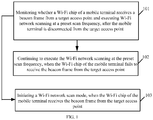
- FIG. 1 is a flow chart illustrating a method for Wi-Fi network scan according to a first embodiment of the present disclosure.
- the method for the Wi-Fi network scan includes the following.
- Step 101 after a mobile terminal is disconnected from a target AP, the mobile terminal monitors whether a Wi-Fi chip of the mobile terminal receives a beacon frame from the target AP, and executes Wi-Fi network scan at a preset scan frequency.
- a communication connection between the mobile terminal and the target AP has been established prior to Step 101, and the mobile terminal is disconnected from the target AP in step 101. Therefore, one thread can be adopted to monitor whether the Wi-Fi chip of the mobile terminal receives the beacon frame from the target AP, and another thread can be further adopted to execute the Wi-Fi network scan at the preset scan frequency.
- the target AP can broadcast the beacon frame at a certain frequency, and only mobile terminals within the coverage area of the target AP can receive the beacon frame.
- the preset scan frequency may be set by the system of the mobile terminal by default, or may be set by the user. Generally, the preset scan frequency cannot be set to be large, because the larger the number of times of executing the Wi-Fi network scan is, the greater the power consumption of the mobile terminal is.
- the beacon frame is broadcast by the target AP, and the target AP is configured to broadcast the beacon frame at a broadcast frequency larger than the preset scan frequency.
- Step 102 when the Wi-Fi chip of the mobile terminal fails to receive the beacon frame from the target AP, the mobile terminal continues to execute the Wi-Fi network scan at the preset scan frequency.
- the mobile terminal In movement of the mobile terminal, if the mobile terminal is beyond the coverage area of the target AP, the mobile terminal fails to receive the beacon frame. In this case, executing the Wi-Fi network scan at the preset scan frequency by the Wi-Fi chip is not interrupted. In this way, the mobile terminal still executes the Wi-Fi network scan at the preset scan frequency, and monitors the beacon frame.
- Step 103 when the Wi-Fi chip of the mobile terminal receives the beacon frame from the target AP, the mobile terminal initiates a Wi-Fi network scan mode.
- the Wi-Fi chip of the mobile terminal When the Wi-Fi chip of the mobile terminal receives the beacon frame from the target AP, an instruction for forcing to scan is transmitted to the Wi-Fi chip. That is, the Wi-Fi network scan mode is initiated immediately to execute the Wi-Fi network scan without waiting for one complete scan cycle.
- the preset scan frequency is executing the Wi-Fi network scan once every 30 seconds, and the beacon frame from the target AP is broadcast once every second. After executing the Wi-Fi network scan once, the Wi-Fi network scan is reexecuted upon elapse of a scan interval of 30 seconds.
- the mobile terminal directly controls the Wi-Fi chip to enter a scan state without waiting for the complete scan cycle of 30 seconds. In this way, the AP corresponding to the beacon frame can be quickly scanned, such that the mobile terminal can be connected to the AP conveniently and quickly.
- the mobile terminal when the mobile terminal is within the coverage area of the AP A, and the communication connection between the mobile terminal and the AP A is established, after the mobile terminal is beyond the coverage area of the AP A, the mobile terminal is disconnected from the AP A.
- the beacon frame can be received, thus the Wi-Fi chip is forced to scan the Wi-Fi network.
- the Wi-Fi network scan mode is initiated as follows.
- AP information of the target AP corresponding to the beacon frame is acquired, and the Wi-Fi network scan is executed based on the AP information.
- the mobile terminal can directly determine the target AP corresponding to the beacon frame and the AP information of the target AP, and execute the Wi-Fi network scan based on the AP information. In this way, it does not need to scan other APs, thereby increasing a speed of the Wi-Fi network scan.
- the Wi-Fi network scan mode is initiated as follows.
- Step A when the Wi-Fi chip fails to be in the scan state, a scan instruction is transmitted to the Wi-Fi chip.
- Step B the Wi-Fi network scan is executed in response to the scan instruction.
- the scan instruction can be transmitted to the Wi-Fi chip.
- the Wi-Fi chip can execute the Wi-Fi network scan after receiving the scan instruction. Since the beacon frame from the target AP is detected, it means that the mobile terminal has entered the coverage area of the target AP. If the Wi-Fi chip fails to be in the scan state at this point, the instruction for forcing to scan can be generated and transmitted to the Wi-Fi chip. The Wi-Fi chip quickly initiates the scan mode after receiving the instruction for forcing to scan.
- step B in response to the scan instruction, the Wi-Fi network scan is executed as follows.
- Step B1 a previous scan record associated with the target AP is acquired, the previous scan record includes information of M APs, where M is an integer larger than one.
- Step B2 information of N APs is selected from the information of the M APs, where N is a positive integer smaller than or equal to M.
- Step B3 the Wi-Fi network scan is executed based on the information of the N APs.
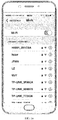
- the mobile terminal can generate one scan record (that is, the Wi-Fi network list illustrated in FIG. 1a, FIG. 1a is a schematic diagram illustrating the Wi-Fi network list) after executing the Wi-Fi network scan once.
- the scan record can include multiple APs and information of the multiple APs.
- the mobile terminal can acquire the previous scan record associated with the target AP, where the previous scan record can be understood as a scan record acquired at a time closest to the current time, and the above-identified "the scan record associated with the target AP" means that "the scan record includes the target AP and the information of the target AP".
- the information of the N APs may be selected from the information of the M APs.
- the information of the M APs may include information of some APs having low security, information of some APs encrypted with dynamic passwords, or information of some unstable APs, etc., it needs to exclude the information of the APs with the above-mentioned situations from the information of the M APs, such that scan speed of the Wi-Fi chip can be improved to some extent.
- the Wi-Fi chip needs to determine signal strength and stability of the AP, which consumes power and time.
- the APs encrypted with dynamic passwords, the APs having low security, or the unstable APs can be directly marked, such that APs (assuming that the information of the N APs is acquired, where N is a positive integer smaller than or equal to M ) other than the APs marked can be directly scanned, thereby executing the Wi-Fi network scan based on the information of the N APs.
- step B2 the information of the N APs is selected from the information of the M APs as follows.
- Step B21 stability of each of the M APs is evaluated based on the information of the M APs to acquire M stability evaluation values.
- Step B22 information of APs corresponding to N stability evaluation values of the M stability evaluation values is acquired, where each of the N stability evaluation values is larger than a preset stability threshold.
- the stability evaluation value of each of the M APs can be determined, and the stability evaluation value of each of the M APs is adopted to evaluate the stability of each of the M APs.
- the preset stability threshold may be set by the system of the mobile terminal by default, or may be set by the user. After determining the stability evaluation value of each of the M APs, the mobile terminal may further acquire the information of the APs corresponding to the N stability evaluation values of the M stability evaluation values, where each of the N stability evaluation values is larger than the preset stability threshold.
- step B21 based on the information of the M APs, the stability of each of the M APs is evaluated as follows.
- Step B211 M stability evaluation index sets are acquired by extracting stability evaluation indexes from the information of the M APs.
- Step B212 the stability of each of the M APs is evaluated based on the M stability evaluation index sets.
- Each of the above-mentioned M stability evaluation index sets includes at least one stability evaluation index.
- at least one stability evaluation index may be adopted to evaluate the stability of each AP to obtain the stability evaluation value of each AP.
- the at least one stability evaluation index for each AP may include, but is not limited to, the number of access users of each AP, a signal strength value of each AP, a network rate of each AP, and a network bandwidth of each AP, or the like.
- multiple stability evaluation indexes may be adopted to evaluate the stability of each AP.
- a weight of each of the multiple stability evaluation indexes is set to acquire multiple stability evaluation values, and a final stability evaluation value can be acquired based on the multiple stability evaluation values and the corresponding weights.
- three stability evaluation indexes i.e., an index A, an index B, and an index C are adopted.
- a weight of the index A is a1
- a weight of the index B is a2
- a weight of the index C is a3.
- a stability evaluation value corresponding to the index A is b1
- a stability evaluation value corresponding to the index B is b2
- a stability evaluation value corresponding to the index C is b3.
- the final stability evaluation value equals to a sum of a1 multiplied by b1, a2 multiplied by b2, and a3 multiplied by b3.
- the method may further include the following after step 103.
- the password corresponding to the target AP is stored in the mobile terminal.
- the password can be automatically input when the target AP is scanned once more, whereby the mobile terminal can be quickly connected to the target AP.
- the mobile terminal monitors whether the Wi-Fi chip of the mobile terminal receives the beacon frame from the target AP and executes the Wi-Fi network scan at the preset scan frequency.
- the Wi-Fi chip of the mobile terminal fails to receive the beacon frame from the target AP, the mobile terminal continues to execute the Wi-Fi network scan at the preset scan frequency.
- the Wi-Fi chip of the mobile terminal receives the beacon frame from the target AP, the mobile terminal initiates the Wi-Fi network scan mode.
- the Wi-Fi chip executes the Wi-Fi network scan at the preset scan frequency, on the other hand, when the beacon frame of the target AP is received, the Wi-Fi chip is forced to execute the Wi-Fi network scan without waiting for a finish of one complete scan cycle. In this way, the Wi-Fi network scan can be quickly initiated, thereby improving the efficiency of the Wi-Fi network scan.
- FIG. 2 is a flow chart illustrating a method for Wi-Fi network scan according to a second embodiment of the present disclosure.
- the method for the Wi-Fi network scan includes the following steps.
- Step 201 after a mobile terminal is disconnected from a target AP, the mobile terminal monitors whether a Wi-Fi chip of the mobile terminal receives a beacon frame from the target AP, and executes Wi-Fi network scan at a preset scan frequency.
- Step 202 when the Wi-Fi chip of the mobile terminal fails to receive the beacon frame from the target AP, the mobile terminal continues to execute the Wi-Fi network scan at the preset scan frequency.
- Step 203 when the Wi-Fi chip of the mobile terminal receives the beacon frame from the target AP, the mobile terminal acquires AP information of the target AP corresponding to the beacon frame, and executes the Wi-Fi network scan based on the AP information.
- the beacon frame from the target AP may carry a hardware address of the target AP.
- the Wi-Fi chip of the mobile terminal receives the beacon frame from the target AP, the Wi-Fi network scan can be executed based on the hardware address. Since just scanning the target AP is executed, and other APs need not to be scanned, the scan speed can be improved to some extent. Since the mobile terminal was previously connected to the target AP, and the password corresponding to the target AP is stored in the mobile terminal, after the target AP is scanned once more, the password can be automatically input, whereby the mobile terminal can quickly be connected to the target AP.
- the mobile terminal monitors whether the Wi-Fi chip of the mobile terminal receives the beacon frame from the target AP, and executes the Wi-Fi network scan at the preset scan frequency.
- the Wi-Fi chip of the mobile terminal fails to receive the beacon frame from the target AP, the mobile terminal continues to execute the Wi-Fi network scan at the preset scan frequency.
- the Wi-Fi chip of the mobile terminal receives the beacon frame from the target AP, the mobile terminal initiates the Wi-Fi network scan mode.
- the Wi-Fi chip executes the Wi-Fi network scan at the preset scan frequency, on the other hand, when the beacon frame of the target AP is received, the Wi-Fi chip is forced to execute the Wi-Fi network scan without waiting for a finish of one complete scan cycle. In this way, the Wi-Fi network scan can be quickly initiated, thereby improving the efficiency of the Wi-Fi network scan.
- FIG. 3a is a block diagram illustrating the device for Wi-Fi network scan according to an embodiment of the present disclosure.
- the device for the Wi-Fi network scan described in the embodiment of the present disclosure includes a processing unit 301, an executing unit 302, and an initiating unit 303.
- the processing unit 301 is configured to monitor whether a Wi-Fi chip of a mobile terminal receives a beacon frame from a target AP and to execute Wi-Fi network scan at a preset scan frequency, after the mobile terminal is disconnected from the target AP.
- the executing unit 302 is configured to continue to execute the Wi-Fi network scan at the preset scan frequency, when the Wi-Fi chip of the mobile terminal fails to receive the beacon frame from the target AP.
- the initiating unit 303 is configured to initiate a Wi-Fi network scan mode when the Wi-Fi chip of the mobile terminal receives the beacon frame from the target AP.
- FIG. 3b is a block diagram illustrating the initiating unit 303 of the device for the Wi-Fi network scan illustrated in FIG. 3a .
- the initiating unit 303 includes a first acquiring module 3031 and a first scanning module 3032.
- the first acquiring module 3031 is configured to acquire AP information of the target AP corresponding to the beacon frame.
- the first scanning module 3032 is configured to execute the Wi-Fi network scan based on the AP information.
- FIG. 3c is another block diagram illustrating the initiating unit 303 of the device for the Wi-Fi network scan illustrated in FIG. 3a .
- the initiating unit 303 includes a transmitting module 3033 and a second scanning module 3034.
- the transmitting module 3033 is configured to transmit a scan instruction to the Wi-Fi chip when the Wi-Fi chip® fails to be in a scan state.
- the second scanning module 3034 is configured to execute the Wi-Fi network scan in response to the scan instruction.
- FIG. 3d is a block diagram illustrating the second scanning module 3034 of the initiating unit 303 illustrated in FIG. 3c .
- the second scanning module 3034 includes a second acquiring module 401, a selecting module 402, and a third scanning module 403.
- the second acquiring module 401 is configured to acquire a previous scan record associated with the target AP, the previous scan record includes information of M APs, where M is an integer larger than one.
- the selecting module 402 is configured to select information of N APs from the information of the M APs, where N is a positive integer smaller than or equal to M.
- the third scanning module 403 is configured to execute the Wi-Fi network scan based on the information of the N APs.
- FIG. 3e is a block diagram illustrating the selecting module 402 of the second scanning module 3034 illustrated in FIG. 3d .
- the selecting module 402 includes an evaluating module 4021 and a third acquiring module 4022.
- the evaluating module 4021 is configured to evaluate stability of each of the M APs based on the information of the M APs to acquire M stability evaluation values.
- the third acquiring module 4022 is configured to acquire the information of the N APs by acquiring information of APs corresponding to N stability evaluation values of the M stability evaluation values, where each of the N stability evaluation values is larger than a preset stability threshold.
- the beacon frame is broadcast by the target AP, and the target AP is configured to broadcast the beacon frame at a broadcast frequency larger than the preset scan frequency.
- FIG. 3f is a block diagram illustrating a modification of the device for the Wi-Fi network scan illustrated in FIG. 3a .
- the device in FIG. 3f further includes a connecting unit 304.
- the connecting unit 304 is configured to input a password automatically and to connect the mobile terminal to the target AP based on the password, when the target AP is scanned by the mobile terminal, where the target AP is an AP to which the mobile terminal was previously connected.
- the Wi-Fi network scan is executed at the preset scan frequency.
- the Wi-Fi chip of the mobile terminal fails to receive the beacon frame from the target AP, the Wi-Fi network scan is continuously executed at the preset scan frequency.
- the Wi-Fi chip of the mobile terminal receives the beacon frame from the target AP, the Wi-Fi network scan mode is initiated.
- the Wi-Fi chip executes the Wi-Fi network scan at the preset scan frequency, on the other hand, when the beacon frame of the target AP is received, the Wi-Fi chip is forced to execute the Wi-Fi network scan without waiting for a finish of one complete scan cycle. In this way, the Wi-Fi network scan can be quickly initiated, thereby improving the efficiency of the Wi-Fi network scan.
- each “unit” used herein should be understood as the broadest meaning as possible, and an object for achieving functions defined by each "unit” may be, for example, an application-specific integrated circuit (ASIC), a single circuit, a processor (shared, dedicated, or chipset) and a memory for executing one or more software or firmware programs, a combinational logic circuit, and/or other suitable components that can achieve the above described functions.
- ASIC application-specific integrated circuit
- processor shared, dedicated, or chipset
- memory for executing one or more software or firmware programs
- combinational logic circuit and/or other suitable components that can achieve the above described functions.
- the processing unit 301 configured to monitor whether the Wi-Fi chip of the mobile terminal receives the beacon frame from the target AP and to execute the Wi-Fi network scan at the preset scan frequency can be implemented by a mobile terminal illustrated in FIG. 4 .
- the mobile terminal may invoke executable program codes in a memory 4000 through a processor 3000 to monitor whether the Wi-Fi chip of the mobile terminal receives the beacon frame from the target AP and to execute the Wi-Fi network scan at the preset scan frequency, after the mobile terminal is disconnected from the target AP.
- FIG. 4 is a block diagram illustrating a mobile terminal according to an embodiment of the present disclosure.
- the mobile terminal includes at least one input device 1000, at least one output device 2000, at least one processor 3000 (such as a CPU), and a memory 4000.
- the input device 1000, the output device 2000, the processor 3000, and the memory 4000 are coupled with each other via a bus 5000.
- the at least one input device 1000 may be a touch panel, a physical button, a mouse, or the like.
- the at least one output device 2000 may be a display screen.
- the memory 4000 may be a high speed RAM memory, or may be a non-volatile memory such as a disk memory.
- the memory 4000 is configured to store a set of program codes.
- the input device 1000, the output device 2000, and the processor 3000 are configured to invoke the program codes stored in the memory 4000 to carry out the following.
- the processor 3000 is configured to monitor whether a Wi-Fi chip of the mobile terminal receives a beacon frame from a target AP and to execute Wi-Fi network scan at a preset scan frequency after the mobile terminal is disconnected from the target AP, to continue to execute the Wi-Fi network scan at the preset scan frequency when the Wi-Fi chip of the mobile terminal fails to receive the beacon frame from the target AP, and to initiate a Wi-Fi network scan mode when the Wi-Fi chip of the mobile terminal receives the beacon frame from the target AP.
- the processor 3000 configured to initiate the Wi-Fi network scan mode is configured to acquire AP information of the target AP corresponding to the beacon frame, and to execute the Wi-Fi network scan based on the AP information.
- the processor 3000 configured to initiate the Wi-Fi network scan mode is configured to transmit a scan instruction to the Wi-Fi chip when the Wi-Fi chip fails to be in a scan state, and to execute the Wi-Fi network scan in response to the scan instruction.
- the processor 3000 configured to execute the Wi-Fi network scan in response to the scan instruction is configured to acquire a previous scan record associated with the target AP, the previous scan record includes information of M APs, where M is an integer larger than one.
- the processor 3000 is further configured to select information of N APs from the information of the M APs, where N is a positive integer smaller than or equal to M.
- the processor 3000 is further configured to execute the Wi-Fi network® scanning based on the information of the N APs.
- the processor 3000 configured to select the information of N APs from the information of the M APs is configured to evaluate stability of each of the M APs based on the information of the M APs to acquire M stability evaluation values, and to acquire the information of the N APs by acquiring information of APs corresponding to N stability evaluation values of the M stability evaluation values, where each of the N stability evaluation values is larger than a preset stability threshold.
- the processor 3000 configured to evaluate the stability of each of the M APs based on the information of the M APs is configured to acquire M stability evaluation index sets by extracting stability evaluation indexes from the information of the M APs, and to evaluate the stability of each of the M APs based on the M stability evaluation index sets.
- the stability evaluation index for each AP includes at least one of: the number of access users of each AP, a signal strength value of each AP, a network rate of each AP, and a network bandwidth of each AP.
- the beacon frame is broadcast by the target AP, and the target AP is configured to broadcast the beacon frame at a broadcast frequency larger than the preset scan frequency.
- the processor 3000 when the target AP is scanned by the mobile terminal, the processor 3000 is further configured to input a password automatically and to connect the mobile terminal to the target AP previously connected by the mobile terminal based on the password.
- Embodiments of the present disclosure further provide a computer storage medium.
- the computer storage medium is configured to store programs which, when executed, are operable to implement part or all of operations of the methods for executing Wi-Fi network scan described in the foregoing method embodiments.
- Embodiments of the present disclosure further provide a computer program product.
- the computer program product includes a non-transitory computer readable storage medium configured to store computer programs.
- the computer programs are operable with a computer to implement part or all of operations of the methods for executing Wi-Fi network scan described in the foregoing method embodiments.
- embodiments of the present disclosure can be provided as a method, an apparatus (device), or a computer program product. Accordingly, the above embodiments of present disclosure may be implemented through hardware, software, or any other combination thereof.
- the present disclosure may take the form of a computer program product embodied on one or more computer readable storage medium (including but not limited to a disk memory, a CD-ROM, an optical memory, etc.) including computer readable program codes.
- Computer programs are stored or distributed in a suitable medium, and are provided together with other hardware or are as part of certain hardware, or are distributed in other forms, such as an Internet-based form, other wired or wireless telecommunication-system-based form, or the like.
- These computer program instructions can also be stored in a computer readable memory that can direct a computer or other programmable data processing devices to operate in a certain manner, to enable instructions stored in the computer readable memory to produce an article of manufacture including an instruction device for implementing functions specified in one or more procedures of the flow charts or one or more blocks of the block diagrams.
- These computer program instructions can also be loaded into a computer or other programmable data processing devices, to enable a computer or other programmable devices to execute a series of operational steps to achieve computer processing, such that instructions executed on a computer or other programmable devices can provide steps for implementing functions specified in one or more procedures of the flow charts or one or more blocks of the block diagrams.
Landscapes
- Engineering & Computer Science (AREA)
- Computer Networks & Wireless Communication (AREA)
- Signal Processing (AREA)
- Computer Security & Cryptography (AREA)
- Mobile Radio Communication Systems (AREA)
Abstract
Description
- This application claims priority to Chinese Patent Application No.
201611143072.7, filed December 7, 2016 - The present disclosure relates to the field of Internet technology, and more particularly to a method for wireless fidelity (Wi-Fi®) network scan and related products.
- With the rapid development of information technology, mobile terminals (such as mobile phones, tablets, etc.) are widely used. The performance of the mobile terminals required by users is increasingly high, not only high processing speed is required, but also high requirement for a function of the mobile terminals that can be connected to a wireless fidelity (Wi-Fi) network is made by the users. Experience related to the Wi-Fi network increasingly attracts user's attention. The function of the mobile terminals that can be connected to the Wi-Fi network is also widely used, and is an indispensable function of the mobile terminals.
- Presently, the mobile terminals are desired to be not prone to be disconnected from an access point (AP), and also desired to be quickly reconnected to a router after being disconnected from one AP.
- A method for Wi-Fi network scan and related products are provided according to embodiments of the present disclosure, which can improve efficiency of Wi-Fi network scan after being disconnected from a Wi-Fi network.
- According to a first embodiment, a method for Wi-Fi network scan is provided. The method includes the following.
- After a mobile terminal is disconnected from a target access point (AP), the mobile terminal monitors whether a Wi-Fi chip of the mobile terminal receives a beacon frame from the target AP, and executes Wi-Fi network scan at a preset scan frequency.
- When the Wi-Fi chip of the mobile terminal fails to receive the beacon frame from the target AP, the mobile terminal continues to execute the Wi-Fi network scan at the preset scan frequency.
- When the Wi-Fi chip of the mobile terminal receives the beacon frame from the target AP, the mobile terminal initiates a Wi-Fi network scan mode.
- According to a second embodiment, a device for Wi-Fi network scan is provided. The device includes a processing unit, an executing unit, and an initiating unit.
- The processing unit is configured to monitor whether a Wi-Fi chip of a mobile terminal receives a beacon frame from a target AP and to execute Wi-Fi network scan at a preset scan frequency, after the mobile terminal is disconnected from the target AP.
- The executing unit is configured to continue to execute the Wi-Fi network scan at the preset scan frequency when the Wi-Fi chip of the mobile terminal fails to receive the beacon frame from the target AP.
- The initiating unit is configured to initiate a Wi-Fi scan mode when the Wi-Fi chip of the mobile terminal receives the beacon frame from the target AP.
- According to a third embodiment, a mobile terminal is provided. The mobile terminal includes a processor, a memory, and one or more programs. The one or more programs are stored in the memory and configured to be executed by the processor. The programs include instructions which are operable to implement part or all of the operations described in the first aspect.
- According to a fourth embodiment, a computer storage medium is provided. The computer storage medium is configured to store computer programs which are operable with a computer to implement part or all of the operations described in the first aspect.
- According to a fifth embodiment, a computer program product is provided. The computer program product includes a non-transitory computer readable storage medium configured to store computer programs. The computer programs are operable with a computer to implement part or all of the operations described in the first aspect. The computer program product may be a software installation package.
- To describe technical solutions in embodiments of the present disclosure more clearly, the following briefly introduces the accompanying drawings required for describing the embodiments. Apparently, the accompanying drawings in the following description merely illustrate some embodiments of the present disclosure. Those of ordinary skill in the art may also obtain other drawings according to these accompanying drawings without creative efforts.
-
FIG. 1 is a flow chart illustrating a method for wireless fidelity (Wi-Fi) network scan according to a first embodiment of the present disclosure. -
FIG. 1a is a schematic diagram illustrating a Wi-Fi network list according to an embodiment of the present disclosure. -
FIG. 2 is a flow chart illustrating a method for Wi-Fi network scan according to a second embodiment of the present disclosure. -
FIG. 3a is a block diagram illustrating a device for Wi-Fi network scan according to an embodiment of the present disclosure. -
FIG. 3b is a block diagram illustrating an initiating unit of the device for the Wi-Fi network scan illustrated inFIG. 3a according to an embodiment of the present disclosure. -
FIG. 3c is another block diagram illustrating the initiating unit of the device for the Wi-Fi network scan illustrated inFIG. 3a according to an embodiment of the present disclosure. -
FIG. 3d is a block diagram illustrating a second scanning module of the initiating unit illustrated inFIG. 3c according to an embodiment of the present disclosure. -
FIG. 3e is a block diagram illustrating a selecting module of the second scanning module illustrated inFIG. 3d according to an embodiment of the present disclosure. -
FIG. 3f is yet another block diagram illustrating the device for the Wi-Fi network scan illustrated inFIG. 3a according to an embodiment of the present disclosure. -
FIG. 4 is a block diagram illustrating a mobile terminal according to an embodiment of the present disclosure. - Generally, when a user moves beyond a coverage area of an access point (AP), a mobile terminal of the user is disconnected from the AP. However, when returning to the coverage area of the AP, the mobile terminal fails to be connected to the AP quickly. The main reason is generally that a wireless fidelity (Wi-Fi) chip of the mobile terminal usually executes Wi-Fi network scan at a fixed frequency. After executing the Wi-Fi network scan once, if the mobile terminal still fails to be connected to a Wi-Fi network, the mobile terminal needs to wait a long time before next Wi-Fi network scan. Therefore, how to improve efficiency of the Wi-Fi network scan needs to be solved instantly. Therefore, a method for Wi-Fi network scan and related products are provided according to embodiments of the present disclosure, which can improve the efficiency of the Wi-Fi network scan after being disconnected from the Wi-Fi network.
- Hereinafter, technical solutions embodied by the embodiments of the present disclosure will be described in a clear and comprehensive manner in reference to the accompanying drawings intended for the embodiments. It is evident that the embodiments described herein constitute merely some rather than all of the embodiments of the present disclosure. Those of ordinary skill in the art is able to derive other embodiments according to these embodiments without making inventive efforts, which all such derived embodiments shall all fall in the protection scope of the present disclosure.
- The terms "first", "second", "third", "fourth", and the like used in the specification, the claims, and the accompany drawings of the present disclosure are used to distinguish different objects rather than describe a particular order. The terms "include", "comprise", and "have" as well as variations thereof are intended to cover non-exclusive inclusion. For example, a process, method, system, product, or apparatus including a series of steps or units is not limited to the listed steps or units, on the contrary, it can optionally include other steps or units that are not listed; alternatively, other steps or units inherent to the process, method, product, or device can be included either.
- The term "embodiment" or "embodiment" referred to herein means that a particular feature, structure, or feature described in conjunction with the embodiment may be included in at least one embodiment of the present disclosure. The phrase appearing in various places in the specification does not necessarily refer to the same embodiment, nor does it refer to an independent or alternative embodiment that is mutually exclusive with other embodiments. It is explicitly and implicitly understood by those skilled in the art that an embodiment described herein may be combined with other embodiments.
- "Mobile terminal" in the embodiments of the present disclosure may include smart phones (such as Android® phones, iOS® phones, Windows Phones, etc.), tablet PCs, palmtops, laptops, mobile Internet devices (MID), wearable devices, or the like. The above-mentioned mobile terminals are merely illustrative and not exhaustive, including but not limited to the above-described mobile terminals.
- It is to be noted that, the mobile terminal generally is in a state of in connection with the Wi-Fi network. It is assumed that the mobile terminal is connected to an AP A, when the mobile terminal is not within a coverage area of the AP A, beacon timeout happens. That is, when failing to receive a beacon frame from the AP A for a long time, the mobile terminal determines that the mobile terminal is beyond the coverage area of the AP A, and is disconnected from the Wi-Fi network. Currently, the mobile terminal is disconnected from the Wi-Fi network as follows.
- Firstly, after being disconnected from the Wi-Fi network, the mobile terminal re-executes Wi-Fi network scan at a certain frequency (i.e., a fixed frequency), for example, executes the Wi-Fi network scan once every 30 seconds. However, since power consumption of the mobile terminal increases when executing the Wi-Fi network scan frequently, the frequency at which the Wi-Fi network scan is executed cannot be set to be large.
- Secondly, after scanning the Wi-Fi network, a result of the Wi-Fi network scan (i.e., a Wi-Fi network list) is reported to an operating system of the mobile terminal. The system can determine, based on a history connection record, whether there is an AP (including the AP A) previously connected by the mobile terminal.
- Finally, when the AP A exists, a communication connection between the AP A and the mobile terminal is established. When there is another AP previously connected by the mobile terminal, the mobile terminal is then connected to the other AP.
- In the above-mentioned process, the mobile terminal executes the Wi-Fi network scan at the fixed frequency, thus a Wi-Fi network scan mode fails to be initiated quickly even if the beacon frame is received, thereby reducing the efficiency of the Wi-Fi network scan.
- In one embodiment, when the mobile terminal is disconnected from the Wi-Fi network, the Wi-Fi network scan is executed as follows.
- After the mobile terminal is disconnected from a target AP, the mobile terminal monitors whether the Wi-Fi chip of the mobile terminal receives the beacon frame from the target AP, and executes the Wi-Fi network scan at a preset scan frequency.
- When the Wi-Fi chip of the mobile terminal fails to receive the beacon frame from the target AP, the mobile terminal continues to execute the Wi-Fi network scan at the preset scan frequency.
- When the Wi-Fi chip of the mobile terminal receives the beacon frame from the target AP, the mobile terminal initiates the Wi-Fi network scan mode.
- In this way, once the mobile terminal receives the beacon frame, the Wi-Fi network scan mode can be quickly initiated, thereby improving the efficiency of the Wi-Fi network scan.
-
FIG. 1 is a flow chart illustrating a method for Wi-Fi network scan according to a first embodiment of the present disclosure. In this embodiment, the method for the Wi-Fi network scan includes the following. -
Step 101, after a mobile terminal is disconnected from a target AP, the mobile terminal monitors whether a Wi-Fi chip of the mobile terminal receives a beacon frame from the target AP, and executes Wi-Fi network scan at a preset scan frequency. - A communication connection between the mobile terminal and the target AP has been established prior to
Step 101, and the mobile terminal is disconnected from the target AP instep 101. Therefore, one thread can be adopted to monitor whether the Wi-Fi chip of the mobile terminal receives the beacon frame from the target AP, and another thread can be further adopted to execute the Wi-Fi network scan at the preset scan frequency. In one embodiment, the target AP can broadcast the beacon frame at a certain frequency, and only mobile terminals within the coverage area of the target AP can receive the beacon frame. The preset scan frequency may be set by the system of the mobile terminal by default, or may be set by the user. Generally, the preset scan frequency cannot be set to be large, because the larger the number of times of executing the Wi-Fi network scan is, the greater the power consumption of the mobile terminal is. - In one embodiment of the present disclosure, the beacon frame is broadcast by the target AP, and the target AP is configured to broadcast the beacon frame at a broadcast frequency larger than the preset scan frequency.
-
Step 102, when the Wi-Fi chip of the mobile terminal fails to receive the beacon frame from the target AP, the mobile terminal continues to execute the Wi-Fi network scan at the preset scan frequency. - In movement of the mobile terminal, if the mobile terminal is beyond the coverage area of the target AP, the mobile terminal fails to receive the beacon frame. In this case, executing the Wi-Fi network scan at the preset scan frequency by the Wi-Fi chip is not interrupted. In this way, the mobile terminal still executes the Wi-Fi network scan at the preset scan frequency, and monitors the beacon frame.
-
Step 103, when the Wi-Fi chip of the mobile terminal receives the beacon frame from the target AP, the mobile terminal initiates a Wi-Fi network scan mode. - When the Wi-Fi chip of the mobile terminal receives the beacon frame from the target AP, an instruction for forcing to scan is transmitted to the Wi-Fi chip. That is, the Wi-Fi network scan mode is initiated immediately to execute the Wi-Fi network scan without waiting for one complete scan cycle.
- For example, it is assumed that the preset scan frequency is executing the Wi-Fi network scan once every 30 seconds, and the beacon frame from the target AP is broadcast once every second. After executing the Wi-Fi network scan once, the Wi-Fi network scan is reexecuted upon elapse of a scan interval of 30 seconds. In this case, when the beacon frame is detected by the mobile terminal within the scan interval of 30 seconds, the mobile terminal directly controls the Wi-Fi chip to enter a scan state without waiting for the complete scan cycle of 30 seconds. In this way, the AP corresponding to the beacon frame can be quickly scanned, such that the mobile terminal can be connected to the AP conveniently and quickly.
- In short, when the mobile terminal is within the coverage area of the AP A, and the communication connection between the mobile terminal and the AP A is established, after the mobile terminal is beyond the coverage area of the AP A, the mobile terminal is disconnected from the AP A. When the mobile terminal re-enters the coverage area of the AP A, the beacon frame can be received, thus the Wi-Fi chip is forced to scan the Wi-Fi network.
- In one embodiment, the Wi-Fi network scan mode is initiated as follows.
- AP information of the target AP corresponding to the beacon frame is acquired, and the Wi-Fi network scan is executed based on the AP information.
- The mobile terminal can directly determine the target AP corresponding to the beacon frame and the AP information of the target AP, and execute the Wi-Fi network scan based on the AP information. In this way, it does not need to scan other APs, thereby increasing a speed of the Wi-Fi network scan.
- In one embodiment, the Wi-Fi network scan mode is initiated as follows.
- Step A, when the Wi-Fi chip fails to be in the scan state, a scan instruction is transmitted to the Wi-Fi chip.
- Step B, the Wi-Fi network scan is executed in response to the scan instruction.
- When the Wi-Fi chip fails to be in the scan state at this point, the scan instruction can be transmitted to the Wi-Fi chip. The Wi-Fi chip can execute the Wi-Fi network scan after receiving the scan instruction. Since the beacon frame from the target AP is detected, it means that the mobile terminal has entered the coverage area of the target AP. If the Wi-Fi chip fails to be in the scan state at this point, the instruction for forcing to scan can be generated and transmitted to the Wi-Fi chip. The Wi-Fi chip quickly initiates the scan mode after receiving the instruction for forcing to scan.
- In one embodiment, in step B, in response to the scan instruction, the Wi-Fi network scan is executed as follows.
- Step B1, a previous scan record associated with the target AP is acquired, the previous scan record includes information of M APs, where M is an integer larger than one.
- Step B2, information of N APs is selected from the information of the M APs, where N is a positive integer smaller than or equal to M.
- Step B3, the Wi-Fi network scan is executed based on the information of the N APs.
- The mobile terminal can generate one scan record (that is, the Wi-Fi network list illustrated in
FIG. 1a, FIG. 1a is a schematic diagram illustrating the Wi-Fi network list) after executing the Wi-Fi network scan once. The scan record can include multiple APs and information of the multiple APs. In step B1, the mobile terminal can acquire the previous scan record associated with the target AP, where the previous scan record can be understood as a scan record acquired at a time closest to the current time, and the above-identified "the scan record associated with the target AP" means that "the scan record includes the target AP and the information of the target AP". Assuming that the previous scan record includes the information of the M APs, the information of the N APs may be selected from the information of the M APs. Since the information of the M APs may include information of some APs having low security, information of some APs encrypted with dynamic passwords, or information of some unstable APs, etc., it needs to exclude the information of the APs with the above-mentioned situations from the information of the M APs, such that scan speed of the Wi-Fi chip can be improved to some extent. When an AP is scanned, the Wi-Fi chip needs to determine signal strength and stability of the AP, which consumes power and time. Thus, in the previous scan record, the APs encrypted with dynamic passwords, the APs having low security, or the unstable APs can be directly marked, such that APs (assuming that the information of the N APs is acquired, where N is a positive integer smaller than or equal to M) other than the APs marked can be directly scanned, thereby executing the Wi-Fi network scan based on the information of the N APs. - In one embodiment, in step B2, the information of the N APs is selected from the information of the M APs as follows.
- Step B21, stability of each of the M APs is evaluated based on the information of the M APs to acquire M stability evaluation values.
- Step B22, information of APs corresponding to N stability evaluation values of the M stability evaluation values is acquired, where each of the N stability evaluation values is larger than a preset stability threshold.
- In step B21, the stability evaluation value of each of the M APs can be determined, and the stability evaluation value of each of the M APs is adopted to evaluate the stability of each of the M APs. The larger the stability evaluation value of one AP is, the higher the stability of the AP is. The preset stability threshold may be set by the system of the mobile terminal by default, or may be set by the user. After determining the stability evaluation value of each of the M APs, the mobile terminal may further acquire the information of the APs corresponding to the N stability evaluation values of the M stability evaluation values, where each of the N stability evaluation values is larger than the preset stability threshold.
- In one embodiment, in step B21, based on the information of the M APs, the stability of each of the M APs is evaluated as follows.
- Step B211, M stability evaluation index sets are acquired by extracting stability evaluation indexes from the information of the M APs.
- Step B212, the stability of each of the M APs is evaluated based on the M stability evaluation index sets.
- Each of the above-mentioned M stability evaluation index sets includes at least one stability evaluation index. In one embodiment, at least one stability evaluation index may be adopted to evaluate the stability of each AP to obtain the stability evaluation value of each AP. The at least one stability evaluation index for each AP may include, but is not limited to, the number of access users of each AP, a signal strength value of each AP, a network rate of each AP, and a network bandwidth of each AP, or the like.
- It is to be noted that since certain limitations may be introduced by evaluating the stability of each AP based on one stability evaluation index, multiple stability evaluation indexes can be adopted to evaluate the stability of each AP. Certainly, it may not be good to adopt many stability evaluation indexes to evaluate the stability of each AP, because the more stability evaluation indexes are, the higher computational complexity of the stability evaluation is, and stability evaluation effect may not be good. Therefore, in the case that requirement for the stability evaluation is high, multiple stability evaluation indexes ranging from two to ten may be adopted to evaluate the stability of each AP. In one embodiment, the number of stability evaluation indexes and the selection of indexes may be determined based on specific embodiment conditions.
- In one embodiment, in the case that requirement for accuracy of the stability evaluation of each AP is high, multiple stability evaluation indexes may be adopted to evaluate the stability of each AP. When evaluating the stability of each AP based on the multiple stability evaluation indexes, a weight of each of the multiple stability evaluation indexes is set to acquire multiple stability evaluation values, and a final stability evaluation value can be acquired based on the multiple stability evaluation values and the corresponding weights. For example, three stability evaluation indexes, i.e., an index A, an index B, and an index C are adopted. A weight of the index A is a1, a weight of the index B is a2, and a weight of the index C is a3. When the stability of one AP is evaluated with the index A, the index B, and the index C, a stability evaluation value corresponding to the index A is b1, a stability evaluation value corresponding to the index B is b2, and a stability evaluation value corresponding to the index C is b3. The final stability evaluation value equals to a sum of a1 multiplied by b1, a2 multiplied by b2, and a3 multiplied by b3. Generally, the larger the stability evaluation value is, the higher the stability of the AP is.
- In one embodiment, the method may further include the following after
step 103. - When the target AP previously connected by the mobile terminal is scanned by the mobile terminal, a password is input automatically, and the mobile terminal is connected to the target AP based on the password.
- Since the mobile terminal was previously connected to the target AP, the password corresponding to the target AP is stored in the mobile terminal. After
step 103, when the target AP is scanned by the mobile terminal in the Wi-Fi network scan, the password can be automatically input when the target AP is scanned once more, whereby the mobile terminal can be quickly connected to the target AP. - It can be seen that in the embodiments of the present disclosure, after the mobile terminal is disconnected from the target AP, the mobile terminal monitors whether the Wi-Fi chip of the mobile terminal receives the beacon frame from the target AP and executes the Wi-Fi network scan at the preset scan frequency. When the Wi-Fi chip of the mobile terminal fails to receive the beacon frame from the target AP, the mobile terminal continues to execute the Wi-Fi network scan at the preset scan frequency. When the Wi-Fi chip of the mobile terminal receives the beacon frame from the target AP, the mobile terminal initiates the Wi-Fi network scan mode. Thus, after being disconnected from the Wi-Fi network, on one hand, the Wi-Fi chip executes the Wi-Fi network scan at the preset scan frequency, on the other hand, when the beacon frame of the target AP is received, the Wi-Fi chip is forced to execute the Wi-Fi network scan without waiting for a finish of one complete scan cycle. In this way, the Wi-Fi network scan can be quickly initiated, thereby improving the efficiency of the Wi-Fi network scan.
- Consistent with the above embodiment,
FIG. 2 is a flow chart illustrating a method for Wi-Fi network scan according to a second embodiment of the present disclosure. In this embodiment, the method for the Wi-Fi network scan includes the following steps. -
Step 201, after a mobile terminal is disconnected from a target AP, the mobile terminal monitors whether a Wi-Fi chip of the mobile terminal receives a beacon frame from the target AP, and executes Wi-Fi network scan at a preset scan frequency. -
Step 202, when the Wi-Fi chip of the mobile terminal fails to receive the beacon frame from the target AP, the mobile terminal continues to execute the Wi-Fi network scan at the preset scan frequency. -
Step 203, when the Wi-Fi chip of the mobile terminal receives the beacon frame from the target AP, the mobile terminal acquires AP information of the target AP corresponding to the beacon frame, and executes the Wi-Fi network scan based on the AP information. - In one embodiment, the beacon frame from the target AP may carry a hardware address of the target AP. When the Wi-Fi chip of the mobile terminal receives the beacon frame from the target AP, the Wi-Fi network scan can be executed based on the hardware address. Since just scanning the target AP is executed, and other APs need not to be scanned, the scan speed can be improved to some extent. Since the mobile terminal was previously connected to the target AP, and the password corresponding to the target AP is stored in the mobile terminal, after the target AP is scanned once more, the password can be automatically input, whereby the mobile terminal can quickly be connected to the target AP.
- It can be seen that in the embodiment of the present disclosure, after the mobile terminal is disconnected from the target AP, the mobile terminal monitors whether the Wi-Fi chip of the mobile terminal receives the beacon frame from the target AP, and executes the Wi-Fi network scan at the preset scan frequency. When the Wi-Fi chip of the mobile terminal fails to receive the beacon frame from the target AP, the mobile terminal continues to execute the Wi-Fi network scan at the preset scan frequency. When the Wi-Fi chip of the mobile terminal receives the beacon frame from the target AP, the mobile terminal initiates the Wi-Fi network scan mode. Thus, after being disconnected from the Wi-Fi network, on one hand, the Wi-Fi chip executes the Wi-Fi network scan at the preset scan frequency, on the other hand, when the beacon frame of the target AP is received, the Wi-Fi chip is forced to execute the Wi-Fi network scan without waiting for a finish of one complete scan cycle. In this way, the Wi-Fi network scan can be quickly initiated, thereby improving the efficiency of the Wi-Fi network scan.
- Consistent with the above embodiments, a device for implementing the above-mentioned method for Wi-Fi scanning is described as follows.
-
FIG. 3a is a block diagram illustrating the device for Wi-Fi network scan according to an embodiment of the present disclosure. The device for the Wi-Fi network scan described in the embodiment of the present disclosure includes aprocessing unit 301, an executingunit 302, and an initiatingunit 303. - The
processing unit 301 is configured to monitor whether a Wi-Fi chip of a mobile terminal receives a beacon frame from a target AP and to execute Wi-Fi network scan at a preset scan frequency, after the mobile terminal is disconnected from the target AP. - The executing
unit 302 is configured to continue to execute the Wi-Fi network scan at the preset scan frequency, when the Wi-Fi chip of the mobile terminal fails to receive the beacon frame from the target AP. - The initiating
unit 303 is configured to initiate a Wi-Fi network scan mode when the Wi-Fi chip of the mobile terminal receives the beacon frame from the target AP. - In one embodiment,
FIG. 3b is a block diagram illustrating the initiatingunit 303 of the device for the Wi-Fi network scan illustrated inFIG. 3a . The initiatingunit 303 includes a first acquiringmodule 3031 and afirst scanning module 3032. - The first acquiring
module 3031 is configured to acquire AP information of the target AP corresponding to the beacon frame. - The
first scanning module 3032 is configured to execute the Wi-Fi network scan based on the AP information. - In one embodiment,
FIG. 3c is another block diagram illustrating the initiatingunit 303 of the device for the Wi-Fi network scan illustrated inFIG. 3a . The initiatingunit 303 includes atransmitting module 3033 and asecond scanning module 3034. - The
transmitting module 3033 is configured to transmit a scan instruction to the Wi-Fi chip when the Wi-Fi chip® fails to be in a scan state. - The
second scanning module 3034 is configured to execute the Wi-Fi network scan in response to the scan instruction. - Furthermore, in one embodiment,
FIG. 3d is a block diagram illustrating thesecond scanning module 3034 of the initiatingunit 303 illustrated inFIG. 3c . Thesecond scanning module 3034 includes a second acquiringmodule 401, a selectingmodule 402, and athird scanning module 403. - The second acquiring
module 401 is configured to acquire a previous scan record associated with the target AP, the previous scan record includes information of M APs, where M is an integer larger than one. - The selecting
module 402 is configured to select information of N APs from the information of the M APs, where N is a positive integer smaller than or equal to M. - The
third scanning module 403 is configured to execute the Wi-Fi network scan based on the information of the N APs. - Furthermore, in one embodiment,
FIG. 3e is a block diagram illustrating the selectingmodule 402 of thesecond scanning module 3034 illustrated inFIG. 3d . The selectingmodule 402 includes an evaluatingmodule 4021 and a third acquiringmodule 4022. - The evaluating
module 4021 is configured to evaluate stability of each of the M APs based on the information of the M APs to acquire M stability evaluation values. - The third acquiring
module 4022 is configured to acquire the information of the N APs by acquiring information of APs corresponding to N stability evaluation values of the M stability evaluation values, where each of the N stability evaluation values is larger than a preset stability threshold. - In one embodiment, the beacon frame is broadcast by the target AP, and the target AP is configured to broadcast the beacon frame at a broadcast frequency larger than the preset scan frequency.
- In one embodiment,
FIG. 3f is a block diagram illustrating a modification of the device for the Wi-Fi network scan illustrated inFIG. 3a . Compared withFIG. 3a , the device inFIG. 3f further includes a connectingunit 304. - The connecting
unit 304 is configured to input a password automatically and to connect the mobile terminal to the target AP based on the password, when the target AP is scanned by the mobile terminal, where the target AP is an AP to which the mobile terminal was previously connected. - It can be seen that, by means of the device for the Wi-Fi network scan provided by the embodiment of the present disclosure, after the mobile terminal is disconnected from the target AP, whether the Wi-Fi chip of the mobile terminal receives the beacon frame from the target AP is monitored, and the Wi-Fi network scan is executed at the preset scan frequency. When the Wi-Fi chip of the mobile terminal fails to receive the beacon frame from the target AP, the Wi-Fi network scan is continuously executed at the preset scan frequency. When the Wi-Fi chip of the mobile terminal receives the beacon frame from the target AP, the Wi-Fi network scan mode is initiated. Thus, after being disconnected from the Wi-Fi network, on one hand, the Wi-Fi chip executes the Wi-Fi network scan at the preset scan frequency, on the other hand, when the beacon frame of the target AP is received, the Wi-Fi chip is forced to execute the Wi-Fi network scan without waiting for a finish of one complete scan cycle. In this way, the Wi-Fi network scan can be quickly initiated, thereby improving the efficiency of the Wi-Fi network scan.
- It should be noted that, the devices for the Wi-Fi network scan described in the embodiments of the present disclosure are presented in the form of functional units. The term "unit" used herein should be understood as the broadest meaning as possible, and an object for achieving functions defined by each "unit" may be, for example, an application-specific integrated circuit (ASIC), a single circuit, a processor (shared, dedicated, or chipset) and a memory for executing one or more software or firmware programs, a combinational logic circuit, and/or other suitable components that can achieve the above described functions.
- As an example, after the mobile terminal is disconnected from the target AP, the
processing unit 301 configured to monitor whether the Wi-Fi chip of the mobile terminal receives the beacon frame from the target AP and to execute the Wi-Fi network scan at the preset scan frequency can be implemented by a mobile terminal illustrated inFIG. 4 . In an embodiment, the mobile terminal may invoke executable program codes in amemory 4000 through aprocessor 3000 to monitor whether the Wi-Fi chip of the mobile terminal receives the beacon frame from the target AP and to execute the Wi-Fi network scan at the preset scan frequency, after the mobile terminal is disconnected from the target AP. - Consistent with the above embodiments,
FIG. 4 is a block diagram illustrating a mobile terminal according to an embodiment of the present disclosure. As illustrated inFIG. 4 , the mobile terminal includes at least oneinput device 1000, at least oneoutput device 2000, at least one processor 3000 (such as a CPU), and amemory 4000. Theinput device 1000, theoutput device 2000, theprocessor 3000, and thememory 4000 are coupled with each other via abus 5000. - In one embodiment, the at least one
input device 1000 may be a touch panel, a physical button, a mouse, or the like. - In one embodiment, the at least one
output device 2000 may be a display screen. - In one embodiment, the
memory 4000 may be a high speed RAM memory, or may be a non-volatile memory such as a disk memory. Thememory 4000 is configured to store a set of program codes. Theinput device 1000, theoutput device 2000, and theprocessor 3000 are configured to invoke the program codes stored in thememory 4000 to carry out the following. - The
processor 3000 is configured to monitor whether a Wi-Fi chip of the mobile terminal receives a beacon frame from a target AP and to execute Wi-Fi network scan at a preset scan frequency after the mobile terminal is disconnected from the target AP, to continue to execute the Wi-Fi network scan at the preset scan frequency when the Wi-Fi chip of the mobile terminal fails to receive the beacon frame from the target AP, and to initiate a Wi-Fi network scan mode when the Wi-Fi chip of the mobile terminal receives the beacon frame from the target AP. - In one embodiment, the
processor 3000 configured to initiate the Wi-Fi network scan mode is configured to acquire AP information of the target AP corresponding to the beacon frame, and to execute the Wi-Fi network scan based on the AP information. - In one embodiment, the
processor 3000 configured to initiate the Wi-Fi network scan mode is configured to transmit a scan instruction to the Wi-Fi chip when the Wi-Fi chip fails to be in a scan state, and to execute the Wi-Fi network scan in response to the scan instruction. - In one embodiment, the
processor 3000 configured to execute the Wi-Fi network scan in response to the scan instruction is configured to acquire a previous scan record associated with the target AP, the previous scan record includes information of M APs, where M is an integer larger than one. Theprocessor 3000 is further configured to select information of N APs from the information of the M APs, where N is a positive integer smaller than or equal to M. Theprocessor 3000 is further configured to execute the Wi-Fi network® scanning based on the information of the N APs. - In one embodiment, the
processor 3000 configured to select the information of N APs from the information of the M APs is configured to evaluate stability of each of the M APs based on the information of the M APs to acquire M stability evaluation values, and to acquire the information of the N APs by acquiring information of APs corresponding to N stability evaluation values of the M stability evaluation values, where each of the N stability evaluation values is larger than a preset stability threshold. - In one embodiment, the
processor 3000 configured to evaluate the stability of each of the M APs based on the information of the M APs is configured to acquire M stability evaluation index sets by extracting stability evaluation indexes from the information of the M APs, and to evaluate the stability of each of the M APs based on the M stability evaluation index sets. - In one embodiment, the stability evaluation index for each AP includes at least one of: the number of access users of each AP, a signal strength value of each AP, a network rate of each AP, and a network bandwidth of each AP.
- In one embodiment, the beacon frame is broadcast by the target AP, and the target AP is configured to broadcast the beacon frame at a broadcast frequency larger than the preset scan frequency.
- In one embodiment, when the target AP is scanned by the mobile terminal, the
processor 3000 is further configured to input a password automatically and to connect the mobile terminal to the target AP previously connected by the mobile terminal based on the password. - Embodiments of the present disclosure further provide a computer storage medium. The computer storage medium is configured to store programs which, when executed, are operable to implement part or all of operations of the methods for executing Wi-Fi network scan described in the foregoing method embodiments.
- Embodiments of the present disclosure further provide a computer program product. The computer program product includes a non-transitory computer readable storage medium configured to store computer programs. The computer programs are operable with a computer to implement part or all of operations of the methods for executing Wi-Fi network scan described in the foregoing method embodiments.
- Although the present disclosure has been described herein in combination with various embodiments of the present disclosure, in the process of implementing the present disclosure seeking for protection, those skilled in the art will understand and achieve other embodiments according to the specification, the claims, and the accompanying drawings of the present disclosure as viewed. The term "comprising" in the claims does not exclude other components or steps. In addition, the term "a/ an" or "one" does not exclude a plurality of components or steps. A single processor or other units may fulfill several functions described in the claims. Certain technical features are described in different dependent claims, however, a possible combination of these technical features can be made to achieve a good effect.
- Those skilled in the art will appreciate that embodiments of the present disclosure can be provided as a method, an apparatus (device), or a computer program product. Accordingly, the above embodiments of present disclosure may be implemented through hardware, software, or any other combination thereof. In addition, the present disclosure may take the form of a computer program product embodied on one or more computer readable storage medium (including but not limited to a disk memory, a CD-ROM, an optical memory, etc.) including computer readable program codes. Computer programs are stored or distributed in a suitable medium, and are provided together with other hardware or are as part of certain hardware, or are distributed in other forms, such as an Internet-based form, other wired or wireless telecommunication-system-based form, or the like.
- The present disclosure has been described with reference to flow charts and/or block diagrams of the methods, apparatuses (devices), and computer program products of the embodiments of the present disclosure. It will be understood that computer program instructions are operable to implement each procedure of the flow charts and/or each block of the block diagrams, and to implement a combination thereof. These computer program instructions can be provided for a processor of a general-purpose computer, a special-purpose computer, an embedded processor, or other programmable data processing devices to produce an equipment, to enable instructions executed by a processor of a computer or other programmable data processing devices to produce a device for implementing functions specified in one or more procedures of the flow charts or one or more blocks of the block diagrams.
- These computer program instructions can also be stored in a computer readable memory that can direct a computer or other programmable data processing devices to operate in a certain manner, to enable instructions stored in the computer readable memory to produce an article of manufacture including an instruction device for implementing functions specified in one or more procedures of the flow charts or one or more blocks of the block diagrams.
- These computer program instructions can also be loaded into a computer or other programmable data processing devices, to enable a computer or other programmable devices to execute a series of operational steps to achieve computer processing, such that instructions executed on a computer or other programmable devices can provide steps for implementing functions specified in one or more procedures of the flow charts or one or more blocks of the block diagrams.
- While the present disclosure has been described with respect to the specific features and embodiments thereof, it should be understood that various modifications and combinations can be made herein without departing from the spirit and scope of the present disclosure. Accordingly, the specification and the accompanying drawings are merely illustrative illustration of the present disclosure as defined by the claims attached, and can be regarded as covering any and all modifications, variations, combinations or equivalents within the scope of the present disclosure. It will be apparent that those skilled in the art can make various modifications and variations to the present disclosure without departing from the spirit and scope of the present disclosure. Thus, it is intended that the present disclosure covers such modifications and variations thereof on the basis of such modifications and variations falling within the scope of the claims and the equivalents thereof.
Claims (20)
- A method for wireless fidelity (Wi-Fi) network scan, comprising:monitoring whether a Wi-Fi chip of a mobile terminal receives a beacon frame from a target access point (AP) and executing Wi-Fi network scan at a preset scan frequency, after the mobile terminal is disconnected from the target AP;continuing to execute the Wi-Fi network scan at the preset scan frequency, when the Wi-Fi chip of the mobile terminal fails to receive the beacon frame from the target AP; andinitiating a Wi-Fi network scan mode when the Wi-Fi chip of the mobile terminal receives the beacon frame from the target AP.
- The method of claim 1, wherein initiating the Wi-Fi network scan mode comprises:acquiring AP information of the target AP corresponding to the beacon frame; andexecuting the Wi-Fi network scan based on the AP information.
- The method of claim 1, wherein initiating the Wi-Fi network scan mode comprises:transmitting a scan instruction to the Wi-Fi chip when the Wi-Fi chip fails to be in a scan state; andexecuting the Wi-Fi network scan in response to the scan instruction.
- The method of claim 3, wherein executing the Wi-Fi network scan in response to the scan instruction comprises:acquiring a previous scan record associated with the target AP, wherein the previous scan record comprises information of M APs, and M is an integer larger than one;selecting information of N APs from the information of the M APs, wherein N is a positive integer smaller than or equal to M; andexecuting the Wi-Fi network scan based on the information of the N APs.
- The method of claim 4, wherein selecting the information of the N APs from the information of the M APs comprises:evaluating stability of each of the M APs based on the information of the M APs to acquire M stability evaluation values; andacquiring the information of the N APs by acquiring information of APs corresponding to N stability evaluation values of the M stability evaluation values, wherein each of the N stability evaluation values is larger than a preset stability threshold.
- The method of claim 5, wherein evaluating the stability of each of the M APs based on the information of the M APs comprises:acquiring M stability evaluation index sets by extracting stability evaluation indexes from the information of the M APs; andevaluating the stability of each of the M APs based on the M stability evaluation index sets.
- The method of claim 6, wherein the stability evaluation indexes comprise at least one of: the number of access users, a signal strength value, a network rate, and a network bandwidth.
- The method of any of claims 1 to 7, wherein the beacon frame is broadcast by the target AP, and the target AP is configured to broadcast the beacon frame at a broadcast frequency larger than the preset scan frequency.
- The method of any of claims 1 to 8, further comprising: inputting a password automatically and connecting the mobile terminal to the target AP based on the password, when the target AP previously connected by the mobile terminal is scanned by the mobile terminal.
- A device for wireless fidelity (Wi-Fi) scanning, comprising:a processing unit, configured to monitor whether a Wi-Fi chip of a mobile terminal receives a beacon frame from a target access point (AP) and to execute Wi-Fi network scan at a preset scan frequency, after the mobile terminal is disconnected from the target AP;an executing unit, configured to continue to execute the Wi-Fi network scan at the preset scan frequency, when the Wi-Fi chip of the mobile terminal fails to receive the beacon frame from the target AP; andan initiating unit, configured to initiate a Wi-Fi network scan mode when the Wi-Fi chip of the mobile terminal receives the beacon frame from the target AP.
- The device of claim 10, wherein the initiating unit comprises:a first acquiring module, configured to acquire AP information of the target AP corresponding to the beacon frame; anda first scanning module, configured to execute the Wi-Fi network scan based on the AP information.
- The device of claim 10, wherein the initiating unit comprises:a transmitting module, configured to transmit a scan instruction to the Wi-Fi chip when the Wi-Fi chip fails to be in a scan state; anda second scanning module, configured to execute the Wi-Fi network scan in response to the scan instruction.
- The device of claim 12, wherein the second scanning module comprises:a second acquiring module, configured to acquire a previous scan record associated with the target AP, wherein the previous scan record comprises information of M APs, and M is an integer larger than one;a selecting module, configured to select information of N APs from the information of the M APs, wherein N is a positive integer smaller than or equal to M; anda third scanning module, configured to execute the Wi-Fi network scan based on the information of the N APs.
- The device of claim 13, wherein the selecting module comprises:an evaluating module, configured to evaluate stability of each of the M APs based on the information of the M APs to acquire M stability evaluation values; anda third acquiring module, configured to acquire the information of the N APs by acquiring information of APs corresponding to N stability evaluation values of the M stability evaluation values, wherein each of the N stability evaluation values is larger than a preset stability threshold.
- The device of claim 14, wherein the evaluating module is configured to:acquire M stability evaluation index sets by extracting stability evaluation indexes from the information of the M APs; andevaluate the stability of each of the M APs based on the M stability evaluation index sets.
- The device of claim 15, wherein the stability evaluation indexes comprise at least one of: the number of access users, a signal strength value, a network rate, and a network bandwidth.
- The device of any of claims 10 to 16, wherein the beacon frame is broadcast by the target AP, and the target AP is configured to broadcast the beacon frame at a broadcast frequency larger than the preset scan frequency.
- A mobile terminal comprising:a processor; anda memory;the processor being configured to invoke codes or instructions stored in the memory to implement the method of any of claims 1 to 9.
- A computer storage medium, configured to store computer programs which are operable with a computer to implement the method of any of claims 1 to 9.
- A computer program product, comprising a non-transitory computer readable storage medium configured to store computer programs, the computer programs being operable with a computer to implement the method of any of claims 1 to 9.
Applications Claiming Priority (2)
| Application Number | Priority Date | Filing Date | Title |
|---|---|---|---|
| CN201611143072.7A CN106604363B (en) | 2016-12-07 | 2016-12-07 | Wireless fidelity Wi-Fi scanning method, mobile terminal and storage medium |
| PCT/CN2017/101466 WO2018103404A1 (en) | 2016-12-07 | 2017-09-12 | Wireless fidelity (wi-fi) scanning method and related product |
Publications (3)
| Publication Number | Publication Date |
|---|---|
| EP3490305A1 true EP3490305A1 (en) | 2019-05-29 |
| EP3490305A4 EP3490305A4 (en) | 2019-09-18 |
| EP3490305B1 EP3490305B1 (en) | 2020-05-13 |
Family
ID=58597646
Family Applications (1)
| Application Number | Title | Priority Date | Filing Date |
|---|---|---|---|
| EP17878969.9A Active EP3490305B1 (en) | 2016-12-07 | 2017-09-12 | Wireless fidelity (wi-fi) scanning method and related product |
Country Status (4)
| Country | Link |
|---|---|
| US (1) | US20190159111A1 (en) |
| EP (1) | EP3490305B1 (en) |
| CN (1) | CN106604363B (en) |
| WO (1) | WO2018103404A1 (en) |
Families Citing this family (5)
| Publication number | Priority date | Publication date | Assignee | Title |
|---|---|---|---|---|
| CN106604363B (en) * | 2016-12-07 | 2019-07-30 | Oppo广东移动通信有限公司 | Wireless fidelity Wi-Fi scanning method, mobile terminal and storage medium |
| CN111163458B (en) * | 2020-01-21 | 2021-12-07 | 腾讯科技(深圳)有限公司 | Data acquisition method, device and system |
| CN113573383B (en) | 2020-04-29 | 2023-04-07 | 京东方科技集团股份有限公司 | Re-network access method after mobile terminal network disconnection and related equipment |
| CN115968012A (en) * | 2021-06-16 | 2023-04-14 | 中兴通讯股份有限公司 | WiFi access method, terminal equipment and storage medium |
| CN115802448A (en) * | 2022-11-23 | 2023-03-14 | 深圳康佳电子科技有限公司 | A WIFI6 network identification and display method, terminal and storage medium |
Family Cites Families (27)
| Publication number | Priority date | Publication date | Assignee | Title |
|---|---|---|---|---|
| US5548818A (en) * | 1992-08-25 | 1996-08-20 | Rockwell International | Network acquisition mechanism for mobile RF data |
| US7286833B2 (en) * | 2004-02-27 | 2007-10-23 | Airespace, Inc. | Selective termination of wireless connections to refresh signal information in wireless node location infrastructure |
| JP5059126B2 (en) * | 2007-12-18 | 2012-10-24 | 日本電信電話株式会社 | Wireless base station device search method, search program, and wireless terminal device |
| US9077727B2 (en) * | 2008-12-30 | 2015-07-07 | Telecom Italia S.P.A. | Method and system for data management in peer-to-peer network |
| US8416710B2 (en) * | 2009-03-30 | 2013-04-09 | At&T Mobility Ii Llc | Indoor competitive survey of wireless networks |
| US8179861B2 (en) * | 2009-08-31 | 2012-05-15 | At&T Intellectual Property I, L.P. | Femtocell originating domain selection |
| US8331929B2 (en) * | 2009-11-24 | 2012-12-11 | At&T Mobility Ii Llc | Mobility-based reselection scan scheduling |
| US9077655B2 (en) * | 2011-03-02 | 2015-07-07 | 3Inova Networks Inc. | Traffic management in distributed wireless networks |
| US8660008B2 (en) * | 2011-03-02 | 2014-02-25 | 3Inova Networks Inc. | Traffic management in distributed wireless networks |
| US8749312B2 (en) * | 2012-04-18 | 2014-06-10 | Qualcomm Incorporated | Optimizing cascade gain stages in a communication system |
| WO2013184110A1 (en) * | 2012-06-06 | 2013-12-12 | Nokia Corporation | Optimized wifi network discovery using bluetooth low-energy |
| DE102012011765B4 (en) * | 2012-06-15 | 2016-05-19 | Tesat-Spacecom Gmbh & Co. Kg | Waveguide busbar |
| CN103582076A (en) * | 2012-08-07 | 2014-02-12 | 中兴通讯股份有限公司 | WLAN WifiTrak control method and device |
| US20140087763A1 (en) * | 2012-09-24 | 2014-03-27 | Qualcomm Incorporated | Non-geotagged access point positioning |
| CN103716857B (en) * | 2012-09-28 | 2017-11-28 | 华为技术有限公司 | Scan method, user equipment and base station |
| US9100778B2 (en) * | 2012-11-13 | 2015-08-04 | Google Inc. | Determining a WiFi scan location |
| US9826464B2 (en) * | 2013-03-26 | 2017-11-21 | Bandwidthx Inc. | Systems and methods for establishing wireless connections based on access conditions |
| US10348723B2 (en) * | 2013-12-11 | 2019-07-09 | Unicredit S.P.A. | Method for biometric recognition of a user amongst a plurality of registered users to a service, employing user localization information |
| CN106171012B (en) * | 2013-12-20 | 2020-01-17 | 英特尔公司 | Wi-Fi scan scheduling and power adaptation for low-power indoor positioning |
| CN104869613A (en) * | 2014-02-25 | 2015-08-26 | 中兴通讯股份有限公司 | WiFi connection control method based on environment identification and device thereof |
| US10111164B2 (en) * | 2014-07-14 | 2018-10-23 | Mitsubishi Electric Corporation | Wireless communication system and wireless communication method |
| US9491691B2 (en) * | 2014-09-11 | 2016-11-08 | Laird Technologies, Inc. | Bluetooth assisted cooperative WiFi scan and roam |
| CN104619040A (en) * | 2015-02-10 | 2015-05-13 | 福州瑞芯微电子有限公司 | Method and system for quickly connecting WIFI equipment |
| US10499328B2 (en) * | 2015-04-06 | 2019-12-03 | Cable Television Laboratories, Inc. | Self-organizing network (SON) with fast initial link setup (FILS) |
| US9998921B2 (en) * | 2015-04-06 | 2018-06-12 | Cable Television Laboratories, Inc. | Self-organizing network (SON) with fast initial link setup (FILS) |
| CN105979516A (en) * | 2015-11-06 | 2016-09-28 | 乐视致新电子科技(天津)有限公司 | Wireless fidelity connection method and system between intelligent terminal and router |
| CN106604363B (en) * | 2016-12-07 | 2019-07-30 | Oppo广东移动通信有限公司 | Wireless fidelity Wi-Fi scanning method, mobile terminal and storage medium |
-
2016
- 2016-12-07 CN CN201611143072.7A patent/CN106604363B/en active Active
-
2017
- 2017-09-12 WO PCT/CN2017/101466 patent/WO2018103404A1/en not_active Ceased
- 2017-09-12 EP EP17878969.9A patent/EP3490305B1/en active Active
-
2019
- 2019-01-22 US US16/253,619 patent/US20190159111A1/en not_active Abandoned
Also Published As
| Publication number | Publication date |
|---|---|
| US20190159111A1 (en) | 2019-05-23 |
| WO2018103404A1 (en) | 2018-06-14 |
| CN106604363A (en) | 2017-04-26 |
| EP3490305A4 (en) | 2019-09-18 |
| CN106604363B (en) | 2019-07-30 |
| EP3490305B1 (en) | 2020-05-13 |
Similar Documents
| Publication | Publication Date | Title |
|---|---|---|
| US11310239B2 (en) | Network connection method, hotspot terminal and management terminal | |
| CN112333332B (en) | Prompt information display method, device and electronic device | |
| EP3490305A1 (en) | Wireless fidelity (wi-fi) scanning method and related product | |
| KR102583091B1 (en) | Random access method, terminal and network device | |
| EP2838309B1 (en) | Method, device and system for establishing data connection | |
| CN110072219B (en) | Electronic device, method, and computer-readable medium for wireless proximity pairing | |
| EP3525417A1 (en) | Data processing method, device, storage medium, electronic device and server | |
| EP4037416B1 (en) | Data receiving method, data sending method, terminal, and network side device | |
| EP3468256B1 (en) | Fast wireless fidelity connection method and apparatus | |
| CN104335497A (en) | Automatic connection of bluetooth human interface devices | |
| EP2790390A1 (en) | Data transmission method and device | |
| EP4044040B1 (en) | Peripheral device pairing | |
| EP3490304A1 (en) | Method for identifying access point and hotspot, and related product | |
| WO2018103402A1 (en) | Wireless fidelity (wifi) scan method and related product | |
| CN111148182A (en) | Device control method, device, storage medium and electronic device | |
| US20150106529A1 (en) | Terminal apparatus and method for connecting to virtual server in virtual desktop infrastructure | |
| CN107318119B (en) | Household appliance networking method, household appliance and computer readable storage medium | |
| CN111757535A (en) | A random access method, instruction method, network device and terminal | |
| WO2018103403A1 (en) | Wireless fidelity (wi-fi) scanning method and related product | |
| CN110621079B (en) | Method for selecting random access resources and terminal equipment | |
| CN108112052B (en) | Terminal network sharing method and device, air conditioner and storage medium | |
| CN106231642A (en) | A network switching method and mobile terminal | |
| CN111148188A (en) | Network connection method, device, storage medium and electronic equipment | |
| CN112188593A (en) | Wireless configuration method and device, storage medium and electronic device | |
| CN107360634B (en) | Data transmission method and device and mobile terminal |
Legal Events
| Date | Code | Title | Description |
|---|---|---|---|
| STAA | Information on the status of an ep patent application or granted ep patent |
Free format text: STATUS: THE INTERNATIONAL PUBLICATION HAS BEEN MADE |
|
| PUAI | Public reference made under article 153(3) epc to a published international application that has entered the european phase |
Free format text: ORIGINAL CODE: 0009012 |
|
| STAA | Information on the status of an ep patent application or granted ep patent |
Free format text: STATUS: REQUEST FOR EXAMINATION WAS MADE |
|
| 17P | Request for examination filed |
Effective date: 20190219 |
|
| AK | Designated contracting states |
Kind code of ref document: A1 Designated state(s): AL AT BE BG CH CY CZ DE DK EE ES FI FR GB GR HR HU IE IS IT LI LT LU LV MC MK MT NL NO PL PT RO RS SE SI SK SM TR |
|
| AX | Request for extension of the european patent |
Extension state: BA ME |
|
| A4 | Supplementary search report drawn up and despatched |
Effective date: 20190816 |
|
| RIC1 | Information provided on ipc code assigned before grant |
Ipc: H04W 48/16 20090101AFI20190809BHEP Ipc: H04W 84/12 20090101ALN20190809BHEP Ipc: H04W 48/20 20090101ALI20190809BHEP Ipc: H04W 52/02 20090101ALI20190809BHEP Ipc: H04W 12/06 20090101ALI20190809BHEP |
|
| RAP1 | Party data changed (applicant data changed or rights of an application transferred) |
Owner name: GUANGDONG OPPO MOBILE TELECOMMUNICATIONS CORP., LT |
|
| GRAP | Despatch of communication of intention to grant a patent |
Free format text: ORIGINAL CODE: EPIDOSNIGR1 |
|
| STAA | Information on the status of an ep patent application or granted ep patent |
Free format text: STATUS: GRANT OF PATENT IS INTENDED |
|
| RIC1 | Information provided on ipc code assigned before grant |
Ipc: H04W 52/02 20090101ALI20200123BHEP Ipc: H04W 84/12 20090101ALN20200123BHEP Ipc: H04W 12/06 20090101ALI20200123BHEP Ipc: H04W 48/20 20090101ALI20200123BHEP Ipc: H04W 48/16 20090101AFI20200123BHEP |
|
| DAV | Request for validation of the european patent (deleted) | ||
| DAX | Request for extension of the european patent (deleted) | ||
| INTG | Intention to grant announced |
Effective date: 20200204 |
|
| GRAS | Grant fee paid |
Free format text: ORIGINAL CODE: EPIDOSNIGR3 |
|
| GRAA | (expected) grant |
Free format text: ORIGINAL CODE: 0009210 |
|
| STAA | Information on the status of an ep patent application or granted ep patent |
Free format text: STATUS: THE PATENT HAS BEEN GRANTED |
|
| AK | Designated contracting states |
Kind code of ref document: B1 Designated state(s): AL AT BE BG CH CY CZ DE DK EE ES FI FR GB GR HR HU IE IS IT LI LT LU LV MC MK MT NL NO PL PT RO RS SE SI SK SM TR |
|
| REG | Reference to a national code |
Ref country code: GB Ref legal event code: FG4D |
|
| REG | Reference to a national code |
Ref country code: CH Ref legal event code: EP |
|
| REG | Reference to a national code |
Ref country code: DE Ref legal event code: R096 Ref document number: 602017016910 Country of ref document: DE |
|
| REG | Reference to a national code |
Ref country code: AT Ref legal event code: REF Ref document number: 1271876 Country of ref document: AT Kind code of ref document: T Effective date: 20200615 |
|
| REG | Reference to a national code |
Ref country code: LT Ref legal event code: MG4D |
|
| REG | Reference to a national code |
Ref country code: NL Ref legal event code: MP Effective date: 20200513 |
|
| PG25 | Lapsed in a contracting state [announced via postgrant information from national office to epo] |
Ref country code: PT Free format text: LAPSE BECAUSE OF FAILURE TO SUBMIT A TRANSLATION OF THE DESCRIPTION OR TO PAY THE FEE WITHIN THE PRESCRIBED TIME-LIMIT Effective date: 20200914 Ref country code: SE Free format text: LAPSE BECAUSE OF FAILURE TO SUBMIT A TRANSLATION OF THE DESCRIPTION OR TO PAY THE FEE WITHIN THE PRESCRIBED TIME-LIMIT Effective date: 20200513 Ref country code: NO Free format text: LAPSE BECAUSE OF FAILURE TO SUBMIT A TRANSLATION OF THE DESCRIPTION OR TO PAY THE FEE WITHIN THE PRESCRIBED TIME-LIMIT Effective date: 20200813 Ref country code: IS Free format text: LAPSE BECAUSE OF FAILURE TO SUBMIT A TRANSLATION OF THE DESCRIPTION OR TO PAY THE FEE WITHIN THE PRESCRIBED TIME-LIMIT Effective date: 20200913 Ref country code: GR Free format text: LAPSE BECAUSE OF FAILURE TO SUBMIT A TRANSLATION OF THE DESCRIPTION OR TO PAY THE FEE WITHIN THE PRESCRIBED TIME-LIMIT Effective date: 20200814 Ref country code: FI Free format text: LAPSE BECAUSE OF FAILURE TO SUBMIT A TRANSLATION OF THE DESCRIPTION OR TO PAY THE FEE WITHIN THE PRESCRIBED TIME-LIMIT Effective date: 20200513 Ref country code: LT Free format text: LAPSE BECAUSE OF FAILURE TO SUBMIT A TRANSLATION OF THE DESCRIPTION OR TO PAY THE FEE WITHIN THE PRESCRIBED TIME-LIMIT Effective date: 20200513 |
|
| PG25 | Lapsed in a contracting state [announced via postgrant information from national office to epo] |
Ref country code: BG Free format text: LAPSE BECAUSE OF FAILURE TO SUBMIT A TRANSLATION OF THE DESCRIPTION OR TO PAY THE FEE WITHIN THE PRESCRIBED TIME-LIMIT Effective date: 20200813 Ref country code: LV Free format text: LAPSE BECAUSE OF FAILURE TO SUBMIT A TRANSLATION OF THE DESCRIPTION OR TO PAY THE FEE WITHIN THE PRESCRIBED TIME-LIMIT Effective date: 20200513 Ref country code: RS Free format text: LAPSE BECAUSE OF FAILURE TO SUBMIT A TRANSLATION OF THE DESCRIPTION OR TO PAY THE FEE WITHIN THE PRESCRIBED TIME-LIMIT Effective date: 20200513 Ref country code: HR Free format text: LAPSE BECAUSE OF FAILURE TO SUBMIT A TRANSLATION OF THE DESCRIPTION OR TO PAY THE FEE WITHIN THE PRESCRIBED TIME-LIMIT Effective date: 20200513 |
|
| REG | Reference to a national code |
Ref country code: AT Ref legal event code: MK05 Ref document number: 1271876 Country of ref document: AT Kind code of ref document: T Effective date: 20200513 |
|
| PG25 | Lapsed in a contracting state [announced via postgrant information from national office to epo] |
Ref country code: NL Free format text: LAPSE BECAUSE OF FAILURE TO SUBMIT A TRANSLATION OF THE DESCRIPTION OR TO PAY THE FEE WITHIN THE PRESCRIBED TIME-LIMIT Effective date: 20200513 Ref country code: AL Free format text: LAPSE BECAUSE OF FAILURE TO SUBMIT A TRANSLATION OF THE DESCRIPTION OR TO PAY THE FEE WITHIN THE PRESCRIBED TIME-LIMIT Effective date: 20200513 |
|
| PG25 | Lapsed in a contracting state [announced via postgrant information from national office to epo] |
Ref country code: ES Free format text: LAPSE BECAUSE OF FAILURE TO SUBMIT A TRANSLATION OF THE DESCRIPTION OR TO PAY THE FEE WITHIN THE PRESCRIBED TIME-LIMIT Effective date: 20200513 Ref country code: RO Free format text: LAPSE BECAUSE OF FAILURE TO SUBMIT A TRANSLATION OF THE DESCRIPTION OR TO PAY THE FEE WITHIN THE PRESCRIBED TIME-LIMIT Effective date: 20200513 Ref country code: AT Free format text: LAPSE BECAUSE OF FAILURE TO SUBMIT A TRANSLATION OF THE DESCRIPTION OR TO PAY THE FEE WITHIN THE PRESCRIBED TIME-LIMIT Effective date: 20200513 Ref country code: CZ Free format text: LAPSE BECAUSE OF FAILURE TO SUBMIT A TRANSLATION OF THE DESCRIPTION OR TO PAY THE FEE WITHIN THE PRESCRIBED TIME-LIMIT Effective date: 20200513 Ref country code: EE Free format text: LAPSE BECAUSE OF FAILURE TO SUBMIT A TRANSLATION OF THE DESCRIPTION OR TO PAY THE FEE WITHIN THE PRESCRIBED TIME-LIMIT Effective date: 20200513 Ref country code: SM Free format text: LAPSE BECAUSE OF FAILURE TO SUBMIT A TRANSLATION OF THE DESCRIPTION OR TO PAY THE FEE WITHIN THE PRESCRIBED TIME-LIMIT Effective date: 20200513 Ref country code: IT Free format text: LAPSE BECAUSE OF FAILURE TO SUBMIT A TRANSLATION OF THE DESCRIPTION OR TO PAY THE FEE WITHIN THE PRESCRIBED TIME-LIMIT Effective date: 20200513 Ref country code: DK Free format text: LAPSE BECAUSE OF FAILURE TO SUBMIT A TRANSLATION OF THE DESCRIPTION OR TO PAY THE FEE WITHIN THE PRESCRIBED TIME-LIMIT Effective date: 20200513 |
|
| REG | Reference to a national code |
Ref country code: DE Ref legal event code: R097 Ref document number: 602017016910 Country of ref document: DE |
|
| PG25 | Lapsed in a contracting state [announced via postgrant information from national office to epo] |
Ref country code: PL Free format text: LAPSE BECAUSE OF FAILURE TO SUBMIT A TRANSLATION OF THE DESCRIPTION OR TO PAY THE FEE WITHIN THE PRESCRIBED TIME-LIMIT Effective date: 20200513 Ref country code: SK Free format text: LAPSE BECAUSE OF FAILURE TO SUBMIT A TRANSLATION OF THE DESCRIPTION OR TO PAY THE FEE WITHIN THE PRESCRIBED TIME-LIMIT Effective date: 20200513 |
|
| PLBE | No opposition filed within time limit |
Free format text: ORIGINAL CODE: 0009261 |
|
| STAA | Information on the status of an ep patent application or granted ep patent |
Free format text: STATUS: NO OPPOSITION FILED WITHIN TIME LIMIT |
|
| 26N | No opposition filed |
Effective date: 20210216 |
|
| REG | Reference to a national code |
Ref country code: CH Ref legal event code: PL |
|
| PG25 | Lapsed in a contracting state [announced via postgrant information from national office to epo] |
Ref country code: SI Free format text: LAPSE BECAUSE OF FAILURE TO SUBMIT A TRANSLATION OF THE DESCRIPTION OR TO PAY THE FEE WITHIN THE PRESCRIBED TIME-LIMIT Effective date: 20200513 |
|
| REG | Reference to a national code |
Ref country code: BE Ref legal event code: MM Effective date: 20200930 |
|
| PG25 | Lapsed in a contracting state [announced via postgrant information from national office to epo] |
Ref country code: LU Free format text: LAPSE BECAUSE OF NON-PAYMENT OF DUE FEES Effective date: 20200912 |
|
| PG25 | Lapsed in a contracting state [announced via postgrant information from national office to epo] |
Ref country code: LI Free format text: LAPSE BECAUSE OF NON-PAYMENT OF DUE FEES Effective date: 20200930 Ref country code: CH Free format text: LAPSE BECAUSE OF NON-PAYMENT OF DUE FEES Effective date: 20200930 Ref country code: BE Free format text: LAPSE BECAUSE OF NON-PAYMENT OF DUE FEES Effective date: 20200930 Ref country code: IE Free format text: LAPSE BECAUSE OF NON-PAYMENT OF DUE FEES Effective date: 20200912 |
|
| PG25 | Lapsed in a contracting state [announced via postgrant information from national office to epo] |
Ref country code: TR Free format text: LAPSE BECAUSE OF FAILURE TO SUBMIT A TRANSLATION OF THE DESCRIPTION OR TO PAY THE FEE WITHIN THE PRESCRIBED TIME-LIMIT Effective date: 20200513 Ref country code: MT Free format text: LAPSE BECAUSE OF FAILURE TO SUBMIT A TRANSLATION OF THE DESCRIPTION OR TO PAY THE FEE WITHIN THE PRESCRIBED TIME-LIMIT Effective date: 20200513 Ref country code: CY Free format text: LAPSE BECAUSE OF FAILURE TO SUBMIT A TRANSLATION OF THE DESCRIPTION OR TO PAY THE FEE WITHIN THE PRESCRIBED TIME-LIMIT Effective date: 20200513 |
|
| PG25 | Lapsed in a contracting state [announced via postgrant information from national office to epo] |
Ref country code: MK Free format text: LAPSE BECAUSE OF FAILURE TO SUBMIT A TRANSLATION OF THE DESCRIPTION OR TO PAY THE FEE WITHIN THE PRESCRIBED TIME-LIMIT Effective date: 20200513 Ref country code: MC Free format text: LAPSE BECAUSE OF FAILURE TO SUBMIT A TRANSLATION OF THE DESCRIPTION OR TO PAY THE FEE WITHIN THE PRESCRIBED TIME-LIMIT Effective date: 20200513 |
|
| P01 | Opt-out of the competence of the unified patent court (upc) registered |
Effective date: 20230412 |
|
| PGFP | Annual fee paid to national office [announced via postgrant information from national office to epo] |
Ref country code: DE Payment date: 20250730 Year of fee payment: 9 |
|
| PGFP | Annual fee paid to national office [announced via postgrant information from national office to epo] |
Ref country code: GB Payment date: 20250731 Year of fee payment: 9 |
|
| PGFP | Annual fee paid to national office [announced via postgrant information from national office to epo] |
Ref country code: FR Payment date: 20250808 Year of fee payment: 9 |