EP3490165A1 - Channel determination device and method for extended wi-fi network - Google Patents
Channel determination device and method for extended wi-fi network Download PDFInfo
- Publication number
- EP3490165A1 EP3490165A1 EP17203122.1A EP17203122A EP3490165A1 EP 3490165 A1 EP3490165 A1 EP 3490165A1 EP 17203122 A EP17203122 A EP 17203122A EP 3490165 A1 EP3490165 A1 EP 3490165A1
- Authority
- EP
- European Patent Office
- Prior art keywords
- channel
- ext
- throughput
- stas
- coefficient
- Prior art date
- Legal status (The legal status is an assumption and is not a legal conclusion. Google has not performed a legal analysis and makes no representation as to the accuracy of the status listed.)
- Withdrawn
Links
- 238000000034 method Methods 0.000 title claims description 14
- 239000004606 Fillers/Extenders Substances 0.000 claims abstract description 12
- 238000004590 computer program Methods 0.000 claims description 4
- 238000004891 communication Methods 0.000 description 17
- 238000004364 calculation method Methods 0.000 description 4
- 230000007246 mechanism Effects 0.000 description 4
- 238000004422 calculation algorithm Methods 0.000 description 2
- 230000006870 function Effects 0.000 description 2
- 230000003068 static effect Effects 0.000 description 2
- 230000009286 beneficial effect Effects 0.000 description 1
- 230000008901 benefit Effects 0.000 description 1
- 230000005540 biological transmission Effects 0.000 description 1
- 230000008859 change Effects 0.000 description 1
- 239000004020 conductor Substances 0.000 description 1
- 230000000694 effects Effects 0.000 description 1
- 238000005516 engineering process Methods 0.000 description 1
- 230000002452 interceptive effect Effects 0.000 description 1
- 238000012986 modification Methods 0.000 description 1
- 230000004048 modification Effects 0.000 description 1
- 230000003287 optical effect Effects 0.000 description 1
- 238000005457 optimization Methods 0.000 description 1
- 230000008520 organization Effects 0.000 description 1
- 230000008447 perception Effects 0.000 description 1
- 230000008569 process Effects 0.000 description 1
- 238000000611 regression analysis Methods 0.000 description 1
- 239000007787 solid Substances 0.000 description 1
- 230000002123 temporal effect Effects 0.000 description 1
- 238000010200 validation analysis Methods 0.000 description 1
Images


Classifications
-
- H—ELECTRICITY
- H04—ELECTRIC COMMUNICATION TECHNIQUE
- H04B—TRANSMISSION
- H04B7/00—Radio transmission systems, i.e. using radiation field
- H04B7/24—Radio transmission systems, i.e. using radiation field for communication between two or more posts
- H04B7/26—Radio transmission systems, i.e. using radiation field for communication between two or more posts at least one of which is mobile
- H04B7/2603—Arrangements for wireless physical layer control
- H04B7/2606—Arrangements for base station coverage control, e.g. by using relays in tunnels
-
- H—ELECTRICITY
- H04—ELECTRIC COMMUNICATION TECHNIQUE
- H04B—TRANSMISSION
- H04B7/00—Radio transmission systems, i.e. using radiation field
- H04B7/14—Relay systems
- H04B7/15—Active relay systems
- H04B7/155—Ground-based stations
- H04B7/15528—Control of operation parameters of a relay station to exploit the physical medium
- H04B7/15542—Selecting at relay station its transmit and receive resources
-
- H—ELECTRICITY
- H04—ELECTRIC COMMUNICATION TECHNIQUE
- H04W—WIRELESS COMMUNICATION NETWORKS
- H04W16/00—Network planning, e.g. coverage or traffic planning tools; Network deployment, e.g. resource partitioning or cells structures
- H04W16/02—Resource partitioning among network components, e.g. reuse partitioning
- H04W16/10—Dynamic resource partitioning
Definitions
- the present disclosure generally relates to the determination of a channel that will be used in a wireless network or WLAN, for instance in a Wi-Fi network, for communication between an access point, e.g. a Wi-Fi router, and a range extender.
- Wi-Fi networks are becoming more complex nowadays. Besides an increasing number of Wi-Fi stations or associated devices, STAs, connected to an access point, AP, the number of APs is increasing as well. Each AP covers an area and the coverages of the different APs may intersect at specific locations. On the other hand, there may be no coverage at other locations such that coverage holes arise.
- a Wi-Fi repeater or range extender, EXT is an effective solution to extend the coverage area of an AP.
- An EXT takes an existing wireless signal from an AP and rebroadcasts it to create an additional network and corresponding coverage. In this way, STAs may still connect to the AP by the EXT that bridges the signal from the STA to the AP.
- the wireless link from the EXT to the AP is further referred to as the back-haul and the wireless link from the EXT to the connecting STAs as the front-haul.
- the EXT selects the channel for communication with the AP according to the channel of the serving AP itself.
- a best performing channel at the EXT location doesn't necessarily corresponds to the channel of the AP. Therefore, in recent years the channel selection process for the AP-to-EXT pair in an uncoordinated environment, such as home or outdoor Wi-Fi networks, has been studied intensively.
- One way the determine a channel is by minimizing interference among APs as disclosed in " A Channel Selection Strategy for WLAN in Urban Areas by Regression Analysis", by Kajita, S. et al. in IEEE WiMob, October 2014 .
- a similar optimization strategy is disclosed in " Study of algorithms to optimize frequency assignment for autonomous IEEE 802.11 access points" by Finsterbusch, M., et al. in International Journal of Computer Science Issues, Vol. 7, Issue 5, pp. 64-72, 201 .
- Another method is based on minimizing potential delay or achieving fairness among users of STAs as disclosed in " Self organization of interfering 802.11 wireless access networks" by Kauffmann, B., et al. in INRIA, Tech. Rep., 2005 .
- the determination of a channel of the AP-to-EXT pair may also be based on maximizing the signal-to-interference ratio at a user level as discussed in " Throughput Validation of an Advanced Channel Assignment Algorithm in IEEE 802.11 WLAN" by Haidar, M. et al. in IEEE International Conference on Communication Software and Networks, pp. 801-806, 2009 .
- an optimal channel at the AP's location doesn't necessarily imply that it is optimal at the EXT's location.
- a Quality of Service, QoS of a STA connected to the EXT may not be optimized due to, for example, a low throughput.
- a network management device for determining an optimal channel out of a plurality of channels for use between a wireless access point, AP, and a range extender, EXT, in a Wi-Fi network comprising a first group of stations, STAs, associated to the AP and a second group of STAs associated to the EXT, the network management device comprising a processing unit configured to:
- the AP-to-EXT pair communicates through a randomly selected channel.
- the processing unit of the network management device first collects for each channel at the AP, at the EXT and at each STA throughput parameters. These collected throughput parameters are indicative for an achievable throughput when using a particular channel of which the parameters are collected from.
- a first coefficient is calculated for each channel. This coefficient is indicative for an achievable throughput of the AP with respect to the total of the achievable throughputs of the STAs of the group of STAs connected to the AP, i.e. the first group. Since the EXT is also connected to the AP at his back-haul, the EXT is in this occurrence considered as a STA of the first group.
- a similar calculation is performed for the STAs of the second group, i.e. STAs connected to the EXT.
- a second coefficient is calculated for each channel, wherein this second coefficient is indicative for an achievable throughput of the EXT with respect to the total of the achievable throughputs of the STAs of this second group.
- the processing unit selects for each channel a lowest value of the first and the second coefficient as the selected coefficient.
- the channel having the highest selected coefficient is determined and becomes the optimal channel for use for communication between the AP and the EXT.
- the processing unit is further configured, when calculating a first and/or second coefficient, to weight an achievable throughput of a STA with respect to the total achievable throughputs of the STAs within its respective group, wherein the weighting is based on an importance of said STA within its respective group.
- a STA may be given more weight when calculating a coefficient when this STA is considered to be more important compared to other STAs within his group.
- the achievable throughput of the STA is thus weighted with respect to the total achievable throughput of the STAs of his group.
- the achievable throughput of the STA will have a bigger effect when calculating a coefficient, since it has a higher impact compared to other STAs. This may be an advantage when, for example, a higher throughput is desired for said STA.
- the EXT is more important within the first group of STAs compared to the other STAs of this group.
- the throughput parameters of a STA for a channel are based on a number of transmitted and received bytes.
- the throughput parameters may be collected in an efficient and straightforward way.
- the first and second coefficient of a channel is calculated based on the number of transmitted and received bytes during a predefined time interval.
- any peak in the collected data is smoothened.
- the processing unit is further configured to switch a channel used by the AP to communicate with the EXT and the STAs of the first group sequentially on successive predefined time intervals such that throughput parameters are collected for each channel.
- a channel used by the AP to communicate with the EXT is switch. This is repeated in a successive manner such that the AP has communicate with the EXT by used of each channel of the plurality of channel.
- throughput parameters are collected for each channel.
- the collection is performed on a real-life situation.
- the processing unit is further configured to instruct the AP and the EXT to switch to the optimal channel.
- the processing unit when the processing unit has determined the optimal channel for communication between the AP and the EXT, it instructs them to switch to this optimal channel.
- the AP and the EXT communicate thus in an optimal way with each other.
- the disclosure relates to a method for determining an optimal channel out of a plurality of channels for use between a wireless access point, AP, and a range extender, EXT, in a Wi-Fi network comprising a first group of stations, STAs, associated to the AP and a second group of STAs associated to the EXT, the network management device comprising a processing unit configured to:
- a computer program product comprising computer-executable instructions for performing the method according to the second aspect when the program is run on a computer.
- a computer readable storage medium comprising the computer program product according to the third aspect.
- a data processing system programmed for carrying out the method according to the second aspect.
- the present invention relates to the determination of a channel that will be used in a wireless network or WLAN, for instance in a Wi-Fi network, for communication between an access point, e.g. a Wi-Fi router, and a range extender
- a Wi-Fi network is a wireless local area network, WLAN, with communication devices communicating based on the IEEE 802.11 standards.
- the communication devices are further connected to another communication network via a wireless access point, an AP.
- a range-extender also referred to as wireless repeater, is a communication device that extends the range of a Wi-Fi network. To achieve this, the range-extender takes an existing signal from the wireless access point and rebroadcasts the signal.
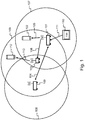
- Fig. 1 illustrates an environment comprising a Wi-Fi network and further comprising a first AP 100 and a second AP 101.
- the environment further comprises an EXT 103 configured to communicate through the wireless link 106 with the AP 101.
- a STA 102 is connected to the AP 101 through the wireless link 105 and a STA 112 is connected to the EXT 103 through the wireless link 113.
- Fig. 1 further illustrates coverages of the AP 100, the AP 101 and the EXT 103.
- the coverage of the AP 100 is illustrated by the area 108, the coverage of AP 101 by area 107 and the coverage of the EXT 103 by area 109.
- Fig. 1 also illustrates a network management device 110 comprising a processing unit 114 configured for determining an optimal channel for communication between AP 101 and EXT 103.
- Fig. 2 illustrates steps performed to determine this optimal channel.
- a random channel is set for the AP 101 to EXT 103 pair.
- the communication link 106 between the AP-to-EXT pair is set randomly.
- This randomly chosen channel identifies the environment 201 of the AP 101, the EXT 103 and the associated devices, like 102 and 112.
- Sensing 202 means that the processing unit 114 of the network management device 110 is aware of the AP-to-EXT environment by collecting data from the AP 101 and the EXT 103.
- the AP 101 and the EXT 103 periodically inform the network management device 110 on their current stat, which may include statistics of transmitted and received bytes and/or packets, transmitted and received packet errors, retransmission rates and channel busy, active and transmit time.
- the statistics may further relate to associated devices, like STA 102 and STA 112, and may further comprise received signal strength indicator, RSSI, levels, transmission and reception modulation and coding scheme, MCS, levels.
- the STAs 102 and 112 may also send data to the network management device 110 including RSSI levels at their respective location and information about their neighbouring APs, like for example AP 100, which may comprise a RSSI level and an operating channel.
- the processing unit 114 uses these collected data in the sensing 202 step to perform calculations of coefficients for every available channel at the AP 101 and at the EXT 103. This step is defined as the perception 203 step and subsequently the calculation of the coefficients 203.
- a first coefficient may be calculated based on throughputs of each channel i available at the AP 101 and the EXT 's103 backhaul.
- a first coefficient of channel i at the AP 101 labelled as w i,AP , is in this occurrence a function of a parameter proportional to the maximum total achievable throughput at the AP 101 when using said channel i and labelled as R i,AP , and a parameter proportional to the achievable throughput of a k th STA when using channel i and labelled as R i,STA k .
- w i,AP f ( R i,AP , R i,STA k ).
- the parameters R i,AP and R i,STA k may be determined, according to a first method, by scanning the environment of the AP 101.
- the AP 101 scans the neighbouring APs, such as 100, to detect their operating channel, their RSSI level and the total busy time fraction for each channel.
- the busy time fraction is defined in the standards IEEE Std 802.11-2012, Wireless LAN Medium Access Control (MAC) and Physical Layer (PHY) Specifications, IEEE, 2012 and used to calculate a channel utilization factor.
- a low busy time fraction indicates less contention on a channel and thus a higher throughput for an end-user of a STA.
- the AP 101 uses Modulation and Coding Schemes, MCS, of its STAs, for example 102, to estimate the total throughput.
- MCS Modulation and Coding Schemes
- the parameters R i,STA k then denotes the maximum MCS that is achievable by STA k when using channel i, in other words a maximum theoretical throughput expressed in Mbps.
- This parameter may be exported from an initial scan done by a user before associating to AP 101.
- the network management device 110 may distinguish between the EXT 103 and a STA 102 by use of their physical addresses.
- the network management device 110 may change the channel at the AP 101 each predefined time interval, for example every five minutes, to collect the throughput of the AP's users, such a STA 102, and the EXT's 103 backhaul. This method may be preferred if the users of the AP 101 are not using real-time services, since switching a channel causes a temporal interruption.
- ⁇ t is the time interval spent on each channel, for example five minutes.
- a second coefficient for each channel i is calculated as well, in this case at the EXT's 103 front-haul.
- a minimum-maximum criterion is applied.
- the processing unit 114 may evaluate 207 if a throughput is optimal after the switching of the channel and if, for example, a lower throughput is observed, the steps 201-206 may be repeated.
- Fig. 3 shows the network management device 110 according to an embodiment of the invention.
- Network management device 110 is suitable for performing the steps according to the above embodiments.
- Network management device 110 may also be incorporated in or used as access point 100-101 or range extender 103.
- Network management device 110 may in general be formed as a suitable general purpose computer and comprise a bus 310, a processor 302, a local memory 304, one or more optional input interfaces 314, one or more optional output interfaces 316, a communication interface 312, a storage element interface 306 and one or more storage elements 308.
- Bus 310 may comprise one or more conductors that permit communication among the components of the network management device 110.
- Processor 302 may include any type of conventional processor or microprocessor that interprets and executes programming instructions.
- Local memory 304 may include a random access memory (RAM) or another type of dynamic storage device that stores information and instructions for execution by processor 302 and/or a read only memory (ROM) or another type of static storage device that stores static information and instructions for use by processor 302.
- Input interface 314 may comprise one or more conventional mechanisms that permit an operator to input information to the network management device 110, such as a keyboard 320, a mouse 330, a pen, voice recognition and/or biometric mechanisms, etc.
- Output interface 316 may comprise one or more conventional mechanisms that output information to the operator, such as a display 340, etc.
- Communication interface 312 may comprise any transceiver-like mechanism such as for example one or more Ethernet interfaces that enables network management device 110 to communicate with other devices and/or systems, for example with access point 100 or 102.
- the communication interface 312 of network management device 110 may be connected to such another network management device by means of a local area network (LAN) or a wide area network (WAN) such as for example the internet.
- Storage element interface 306 may comprise a storage interface such as for example a Serial Advanced Technology Attachment (SATA) interface or a Small Computer System Interface (SCSI) for connecting bus 310 to one or more storage elements 308, such as one or more local disks, for example SATA disk drives, and control the reading and writing of data to and/or from these storage elements 308.
- SATA Serial Advanced Technology Attachment
- SCSI Small Computer System Interface
- the storage elements 308 above is described as a local disk, in general any other suitable computer-readable media such as a removable magnetic disk, optical storage media such as a CD or DVD, -ROM disk, solid state drives, flash memory cards, ... could be used.
- the network management device 110 described above can also run as a virtual machine above the physical hardware.
- top, bottom, over, under, and the like are introduced for descriptive purposes and not necessarily to denote relative positions. It is to be understood that the terms so used are interchangeable under appropriate circumstances and embodiments of the invention are capable of operating according to the present invention in other sequences, or in orientations different from the one(s) described or illustrated above.
Landscapes
- Engineering & Computer Science (AREA)
- Computer Networks & Wireless Communication (AREA)
- Signal Processing (AREA)
- Mobile Radio Communication Systems (AREA)
Abstract
Description
- The present disclosure generally relates to the determination of a channel that will be used in a wireless network or WLAN, for instance in a Wi-Fi network, for communication between an access point, e.g. a Wi-Fi router, and a range extender.
- Wi-Fi networks are becoming more complex nowadays. Besides an increasing number of Wi-Fi stations or associated devices, STAs, connected to an access point, AP, the number of APs is increasing as well. Each AP covers an area and the coverages of the different APs may intersect at specific locations. On the other hand, there may be no coverage at other locations such that coverage holes arise.
- A Wi-Fi repeater or range extender, EXT, is an effective solution to extend the coverage area of an AP. An EXT takes an existing wireless signal from an AP and rebroadcasts it to create an additional network and corresponding coverage. In this way, STAs may still connect to the AP by the EXT that bridges the signal from the STA to the AP. In this disclosure, the wireless link from the EXT to the AP is further referred to as the back-haul and the wireless link from the EXT to the connecting STAs as the front-haul.
- By default, the EXT selects the channel for communication with the AP according to the channel of the serving AP itself. However, a best performing channel at the EXT location doesn't necessarily corresponds to the channel of the AP. Therefore, in recent years the channel selection process for the AP-to-EXT pair in an uncoordinated environment, such as home or outdoor Wi-Fi networks, has been studied intensively.
- One way the determine a channel is by minimizing interference among APs as disclosed in "A Channel Selection Strategy for WLAN in Urban Areas by Regression Analysis", by Kajita, S. et al. in IEEE WiMob, October 2014. A similar optimization strategy is disclosed in "Study of algorithms to optimize frequency assignment for autonomous IEEE 802.11 access points" by Finsterbusch, M., et al. in International Journal of Computer Science Issues, Vol. 7, Issue 5, pp. 64-72, 201.
- Another method is based on minimizing potential delay or achieving fairness among users of STAs as disclosed in "Self organization of interfering 802.11 wireless access networks" by Kauffmann, B., et al. in INRIA, Tech. Rep., 2005.
- The determination of a channel of the AP-to-EXT pair may also be based on maximizing the signal-to-interference ratio at a user level as discussed in "Throughput Validation of an Advanced Channel Assignment Algorithm in IEEE 802.11 WLAN" by Haidar, M. et al. in IEEE International Conference on Communication Software and Networks, pp. 801-806, 2009.
- However, due to different locations of a serving AP and connected EXT an optimal channel at the AP's location doesn't necessarily imply that it is optimal at the EXT's location. For example, due to the existence of a possible hidden node, a Quality of Service, QoS, of a STA connected to the EXT may not be optimized due to, for example, a low throughput.
- It is an object of the present disclosure to alleviate these problems and to provide a solution for determining a channel for use between an AP and an EXT and for optimizing the communication between them.
- This object is achieved, according to a first aspect, by a network management device for determining an optimal channel out of a plurality of channels for use between a wireless access point, AP, and a range extender, EXT, in a Wi-Fi network comprising a first group of stations, STAs, associated to the AP and a second group of STAs associated to the EXT, the network management device comprising a processing unit configured to:
- collect for each channel at the AP, at the EXT and at each STA throughput parameters indicative for an achievable throughput when using said channel; and
- calculate based on the throughput parameters for each channel a first coefficient indicative for an achievable throughput of the AP with respect to the total of the achievable throughputs of the STAs of the first group; and
- calculate based on the throughput parameters for each channel a second coefficient indicative for an achievable throughput of the EXT with respect to the total of the achievable throughputs of the STAs of the second group; and
- select for each channel a lowest value from the first and second coefficient as the selected coefficient; and
- determine a channel having the highest selected coefficient as the optimal channel.
- Initially, the AP-to-EXT pair communicates through a randomly selected channel. In order to determine an optimal channel for this pair, the processing unit of the network management device first collects for each channel at the AP, at the EXT and at each STA throughput parameters. These collected throughput parameters are indicative for an achievable throughput when using a particular channel of which the parameters are collected from.
- Next, based on the throughput parameters a first coefficient is calculated for each channel. This coefficient is indicative for an achievable throughput of the AP with respect to the total of the achievable throughputs of the STAs of the group of STAs connected to the AP, i.e. the first group. Since the EXT is also connected to the AP at his back-haul, the EXT is in this occurrence considered as a STA of the first group.
- Subsequently or simultaneously, a similar calculation is performed for the STAs of the second group, i.e. STAs connected to the EXT. Thus, a second coefficient is calculated for each channel, wherein this second coefficient is indicative for an achievable throughput of the EXT with respect to the total of the achievable throughputs of the STAs of this second group. As a result, for each channel two coefficients are calculated. Then, the processing unit selects for each channel a lowest value of the first and the second coefficient as the selected coefficient. Finally, the channel having the highest selected coefficient is determined and becomes the optimal channel for use for communication between the AP and the EXT.
- Since throughput parameters are not solely calculated at the AP's location, but also at the location of the EXT, both locations are taken into account. Furthermore, by calculating coefficients for each channel, they are all considered to become an optimal channel for communication between the AP and the EXT. Finally, by applying a minimum-maximum criterion, the optimal channel is determined in an efficient and unbiased manner thereby optimizing the overall end user throughput.
- According to an embodiment, the processing unit is further configured, when calculating a first and/or second coefficient, to weight an achievable throughput of a STA with respect to the total achievable throughputs of the STAs within its respective group, wherein the weighting is based on an importance of said STA within its respective group.
- In other words, a STA may be given more weight when calculating a coefficient when this STA is considered to be more important compared to other STAs within his group. The achievable throughput of the STA is thus weighted with respect to the total achievable throughput of the STAs of his group. As a result, the achievable throughput of the STA will have a bigger effect when calculating a coefficient, since it has a higher impact compared to other STAs. This may be an advantage when, for example, a higher throughput is desired for said STA.
- According to an embodiment, the EXT is more important within the first group of STAs compared to the other STAs of this group.
- In other words, by considering the EXT more important within his group when calculating the first coefficient, this will result in a higher throughput for the EXT. This is beneficial when a considerable amount of STAs are connected to the EXT at his front-haul.
- According to an embodiment, the throughput parameters of a STA for a channel are based on a number of transmitted and received bytes.
- In this way, the throughput parameters may be collected in an efficient and straightforward way.
- According to an embodiment, the first and second coefficient of a channel is calculated based on the number of transmitted and received bytes during a predefined time interval.
- In other words, by performing the calculation based on the number of transmitted and received bytes during a predefined time interval, any peak in the collected data is smoothened.
- According to an embodiment, the processing unit is further configured to switch a channel used by the AP to communicate with the EXT and the STAs of the first group sequentially on successive predefined time intervals such that throughput parameters are collected for each channel.
- For example, every five minutes, a channel used by the AP to communicate with the EXT is switch. This is repeated in a successive manner such that the AP has communicate with the EXT by used of each channel of the plurality of channel. As a result, throughput parameters are collected for each channel. Advantageously, the collection is performed on a real-life situation.
- According to an embodiment, the processing unit is further configured to instruct the AP and the EXT to switch to the optimal channel.
- Thus, when the processing unit has determined the optimal channel for communication between the AP and the EXT, it instructs them to switch to this optimal channel. Advantageously, the AP and the EXT communicate thus in an optimal way with each other.
- According to a second aspect, the disclosure relates to a method for determining an optimal channel out of a plurality of channels for use between a wireless access point, AP, and a range extender, EXT, in a Wi-Fi network comprising a first group of stations, STAs, associated to the AP and a second group of STAs associated to the EXT, the network management device comprising a processing unit configured to:
- collecting for each channel at the AP, at the EXT and at each STA throughput parameters indicative for an achievable throughput when using said channel; and
- calculating based on the throughput parameters for each channel a first coefficient indicative for an achievable throughput of the AP with respect to the total of the achievable throughputs of the STAs of the first group; and
- calculating based on the throughput parameters for each channel a second coefficient indicative for an achievable throughput of the EXT with respect to the total of the achievable throughputs of the STAs of the second group; and
- selecting for each channel a lowest value from the first and second coefficient as the selected coefficient; and
- determining a channel having the highest selected coefficient as the optimal channel.
- According to a third aspect, a computer program product is disclosed comprising computer-executable instructions for performing the method according to the second aspect when the program is run on a computer.
- According to a fourth aspect, a computer readable storage medium is disclosed comprising the computer program product according to the third aspect.
- According to a fifth aspect, a data processing system is disclosed programmed for carrying out the method according to the second aspect.
-
-
Fig. 1 illustrates an environment comprises a plurality of APs and an EXT; and -
Fig. 2 illustrates steps performed to determine an optimal channel for the AP-to-EXT pair; and -
Fig. 3 illustrates a suitable computing system for performing steps according to embodiments of the disclosure. - The present invention relates to the determination of a channel that will be used in a wireless network or WLAN, for instance in a Wi-Fi network, for communication between an access point, e.g. a Wi-Fi router, and a range extender
- A Wi-Fi network is a wireless local area network, WLAN, with communication devices communicating based on the IEEE 802.11 standards. The communication devices are further connected to another communication network via a wireless access point, an AP. A range-extender, also referred to as wireless repeater, is a communication device that extends the range of a Wi-Fi network. To achieve this, the range-extender takes an existing signal from the wireless access point and rebroadcasts the signal.
-
Fig. 1 illustrates an environment comprising a Wi-Fi network and further comprising afirst AP 100 and asecond AP 101. The environment further comprises anEXT 103 configured to communicate through thewireless link 106 with theAP 101. ASTA 102 is connected to theAP 101 through thewireless link 105 and aSTA 112 is connected to theEXT 103 through thewireless link 113.Fig. 1 further illustrates coverages of theAP 100, theAP 101 and theEXT 103. The coverage of theAP 100 is illustrated by thearea 108, the coverage ofAP 101 byarea 107 and the coverage of theEXT 103 byarea 109. As illustratedb areas APs distance 104.Fig. 1 also illustrates anetwork management device 110 comprising aprocessing unit 114 configured for determining an optimal channel for communication betweenAP 101 andEXT 103.Fig. 2 illustrates steps performed to determine this optimal channel. - In a
first step 200, a random channel is set for theAP 101 toEXT 103 pair. In other words, thecommunication link 106 between the AP-to-EXT pair is set randomly. This randomly chosen channel identifies theenvironment 201 of theAP 101, theEXT 103 and the associated devices, like 102 and 112. - Secondly, the processing unit collect data. This step is labelled as the
sensing 202 of theenvironment 201. Sensing 202 means that theprocessing unit 114 of thenetwork management device 110 is aware of the AP-to-EXT environment by collecting data from theAP 101 and theEXT 103. TheAP 101 and theEXT 103 periodically inform thenetwork management device 110 on their current stat, which may include statistics of transmitted and received bytes and/or packets, transmitted and received packet errors, retransmission rates and channel busy, active and transmit time. The statistics may further relate to associated devices, likeSTA 102 andSTA 112, and may further comprise received signal strength indicator, RSSI, levels, transmission and reception modulation and coding scheme, MCS, levels. Additionally, theSTAs network management device 110 including RSSI levels at their respective location and information about their neighbouring APs, like forexample AP 100, which may comprise a RSSI level and an operating channel. - Thirdly, the
processing unit 114 uses these collected data in thesensing 202 step to perform calculations of coefficients for every available channel at theAP 101 and at theEXT 103. This step is defined as theperception 203 step and subsequently the calculation of thecoefficients 203. - A first coefficient may be calculated based on throughputs of each channel i available at the
AP 101 and the EXT 's103 backhaul. A first coefficient of channel i at theAP 101, labelled as wi,AP , is in this occurrence a function of a parameter proportional to the maximum total achievable throughput at theAP 101 when using said channel i and labelled as Ri,AP, and a parameter proportional to the achievable throughput of a kth STA when using channel i and labelled as Ri,STAk . In other words, wi,AP = f(Ri,AP, Ri,STAk ). - The parameters R i,AP and Ri,STA
k may be determined, according to a first method, by scanning the environment of theAP 101. TheAP 101 scans the neighbouring APs, such as 100, to detect their operating channel, their RSSI level and the total busy time fraction for each channel. The busy time fraction is defined in the standards IEEE Std 802.11-2012, Wireless LAN Medium Access Control (MAC) and Physical Layer (PHY) Specifications, IEEE, 2012 and used to calculate a channel utilization factor. A low busy time fraction indicates less contention on a channel and thus a higher throughput for an end-user of a STA. Additionally, theAP 101 uses Modulation and Coding Schemes, MCS, of its STAs, for example 102, to estimate the total throughput. The parameters Ri,STAk then denotes the maximum MCS that is achievable by STA k when using channel i, in other words a maximum theoretical throughput expressed in Mbps. This parameter may be exported from an initial scan done by a user before associating toAP 101. Additionally, the parameter Ri,AP denotes a channel utilization of channel i with values in the range of [0,1] given as

- The first coefficient for channel i can then be formulated as

AP 101, ck is the importance of the kth STA. - A way to calculate the value of ck based on the EXT's 103 load is as follows:

EXT 103. Thenetwork management device 110 may distinguish between theEXT 103 and aSTA 102 by use of their physical addresses. - Another method to determine coefficients is based on the actual throughput by the STAs using the total number of transmitted and received bytes. The
network management device 110 may change the channel at theAP 101 each predefined time interval, for example every five minutes, to collect the throughput of the AP's users, such aSTA 102, and the EXT's 103 backhaul. This method may be preferred if the users of theAP 101 are not using real-time services, since switching a channel causes a temporal interruption. - In this method, the parameter Ri,AP may be set at zero, thus Ri,AP = 0, and the parameter Ri,STA
k becomes:


- A second coefficient for each channel i is calculated as well, in this case at the EXT's 103 front-haul. The second coefficient is thus related to the EXT's 103 front-haul throughput and is formulates as:

EXT 103 for channel i. Following a same reasoning as for theAP 102, the general expression for the second coefficient when applying the first method is:
EXT 103, such asSTA 112, and cm is the normalized importance of the mth STA. - In the
next step 205, a minimum-maximum criterion is applied. First, theprocessing unit 114 calculates a selected coefficient for each channel i as wi and calculated as:
- Finally, the
processing unit 114 selects the channel having the maximum selected coefficient, denoted as i* = argmax{wi }. If the current channel of the AP-to-EXT pair is different from this selected channel, theprocessing unit 114switches 206 it to this new optimal channel. - Afterwards, the
processing unit 114 may evaluate 207 if a throughput is optimal after the switching of the channel and if, for example, a lower throughput is observed, the steps 201-206 may be repeated. -
Fig. 3 shows thenetwork management device 110 according to an embodiment of the invention.Network management device 110 is suitable for performing the steps according to the above embodiments.Network management device 110 may also be incorporated in or used as access point 100-101 orrange extender 103.Network management device 110 may in general be formed as a suitable general purpose computer and comprise abus 310, aprocessor 302, alocal memory 304, one or more optional input interfaces 314, one or moreoptional output interfaces 316, acommunication interface 312, astorage element interface 306 and one ormore storage elements 308.Bus 310 may comprise one or more conductors that permit communication among the components of thenetwork management device 110.Processor 302 may include any type of conventional processor or microprocessor that interprets and executes programming instructions.Local memory 304 may include a random access memory (RAM) or another type of dynamic storage device that stores information and instructions for execution byprocessor 302 and/or a read only memory (ROM) or another type of static storage device that stores static information and instructions for use byprocessor 302.Input interface 314 may comprise one or more conventional mechanisms that permit an operator to input information to thenetwork management device 110, such as akeyboard 320, amouse 330, a pen, voice recognition and/or biometric mechanisms, etc.Output interface 316 may comprise one or more conventional mechanisms that output information to the operator, such as adisplay 340, etc.Communication interface 312 may comprise any transceiver-like mechanism such as for example one or more Ethernet interfaces that enablesnetwork management device 110 to communicate with other devices and/or systems, for example withaccess point communication interface 312 ofnetwork management device 110 may be connected to such another network management device by means of a local area network (LAN) or a wide area network (WAN) such as for example the internet.Storage element interface 306 may comprise a storage interface such as for example a Serial Advanced Technology Attachment (SATA) interface or a Small Computer System Interface (SCSI) for connectingbus 310 to one ormore storage elements 308, such as one or more local disks, for example SATA disk drives, and control the reading and writing of data to and/or from thesestorage elements 308. Although thestorage elements 308 above is described as a local disk, in general any other suitable computer-readable media such as a removable magnetic disk, optical storage media such as a CD or DVD, -ROM disk, solid state drives, flash memory cards, ... could be used. Thenetwork management device 110 described above can also run as a virtual machine above the physical hardware. - Although the present invention has been illustrated by reference to specific embodiments, it will be apparent to those skilled in the art that the invention is not limited to the details of the foregoing illustrative embodiments, and that the present invention may be embodied with various changes and modifications without departing from the scope thereof. The present embodiments are therefore to be considered in all respects as illustrative and not restrictive, the scope of the invention being indicated by the appended claims rather than by the foregoing description, and all changes which come within the scope of the claims are therefore intended to be embraced therein.
- It will furthermore be understood by the reader of this patent application that the words "comprising" or "comprise" do not exclude other elements or steps, that the words "a" or "an" do not exclude a plurality, and that a single element, such as a computer system, a processor, or another integrated unit may fulfil the functions of several means recited in the claims. Any reference signs in the claims shall not be construed as limiting the respective claims concerned. The terms "first", "second", third", "a", "b", "c", and the like, when used in the description or in the claims are introduced to distinguish between similar elements or steps and are not necessarily describing a sequential or chronological order. Similarly, the terms "top", "bottom", "over", "under", and the like are introduced for descriptive purposes and not necessarily to denote relative positions. It is to be understood that the terms so used are interchangeable under appropriate circumstances and embodiments of the invention are capable of operating according to the present invention in other sequences, or in orientations different from the one(s) described or illustrated above.
Claims (11)
- A network management (110) device for determining an optimal channel out of a plurality of channels for use between a wireless access point (101), AP, and a range extender (103), EXT, in a Wi-Fi network comprising a first group of stations (102), STAs, associated to the AP (101) and a second group of STAs (112) associated to the EXT (103), the network management device comprising a processing unit (114) configured to:- collect for each channel at the AP (101), at the EXT (103) and at each STA (102, 112) throughput parameters indicative for an achievable throughput when using said channel; and- calculate based on the throughput parameters for each channel a first coefficient indicative for an achievable throughput of the AP (101) with respect to the total of the achievable throughputs of the STAs (102) of the first group; and- calculate based on the throughput parameters for each channel a second coefficient indicative for an achievable throughput of the EXT (103) with respect to the total of the achievable throughputs of the STAs (112) of the second group; and- select for each channel a lowest value from the first and second coefficient as the selected coefficient; and- determine a channel having the highest selected coefficient as the optimal channel.
- The network management device (110) according to claim 1, wherein, when calculating a first and/or second coefficient, an achievable throughput of a STA (102 112)) is weighted with respect to the total achievable throughputs of the STAs (102, 112) within its respective group, the weighting based on an importance of said STA within its respective group.
- The network management device (110) according to claim 2, wherein an EXT (103) is more important within the first group of STAs (102).
- The network management device (110) according to claim 1, wherein throughput parameters of a STA (102, 103, 112) for a channel are based on a number of transmitted and received bytes.
- The network management device (110) according to claim 4, wherein the first and second coefficient of a channel is calculated based on the number of transmitted and received bytes during a predefined time interval.
- The network management device (110) according to claim 5, wherein the processing unit (114) is further configured to switch a channel used by the AP (101) to communicate with the EXT (103) and the STAs (102) of the first group sequentially on successive predefined time intervals such that throughput parameters are collected for each channel.
- The network management device (110) according to claim 3 of claim 6, wherein the processing unit (114) is further configured to instruct the AP (101) and the EXT (103) to switch to the optimal channel.
- A method for determining an optimal channel out of a plurality of channels for use between a wireless access point (101), AP, and a range extender (103), EXT, in a Wi-Fi network comprising a first group of stations, STAs, associated to the AP and a second group of STAs associated to the EXT, the network management device comprising a processing unit configured to:- collecting for each channel at the AP (101), at the EXT (103) and at each STA throughput parameters indicative for an achievable throughput when using said channel; and- calculating based on the throughput parameters for each channel a first coefficient indicative for an achievable throughput of the AP (101) with respect to the total of the achievable throughputs of the STAs of the first group; and- calculating based on the throughput parameters for each channel a second coefficient indicative for an achievable throughput of the EXT (103) with respect to the total of the achievable throughputs of the STAs of the second group; and- selecting for each channel a lowest value from the first and second coefficient as the selected coefficient; and- determining a channel having the highest selected coefficient as the optimal channel.
- A computer program product comprising computer-executable instructions for performing the method according to claim 8 when the program is run on a computer.
- A computer readable storage medium comprising the computer program product according to claim 9.
- A data processing system programmed for carrying out the method according to claim 8.
Priority Applications (2)
| Application Number | Priority Date | Filing Date | Title |
|---|---|---|---|
| EP17203122.1A EP3490165A1 (en) | 2017-11-22 | 2017-11-22 | Channel determination device and method for extended wi-fi network |
| PCT/EP2018/081680 WO2019101662A1 (en) | 2017-11-22 | 2018-11-19 | Channel determination device and method for extended wi-fi network |
Applications Claiming Priority (1)
| Application Number | Priority Date | Filing Date | Title |
|---|---|---|---|
| EP17203122.1A EP3490165A1 (en) | 2017-11-22 | 2017-11-22 | Channel determination device and method for extended wi-fi network |
Publications (1)
| Publication Number | Publication Date |
|---|---|
| EP3490165A1 true EP3490165A1 (en) | 2019-05-29 |
Family
ID=60480164
Family Applications (1)
| Application Number | Title | Priority Date | Filing Date |
|---|---|---|---|
| EP17203122.1A Withdrawn EP3490165A1 (en) | 2017-11-22 | 2017-11-22 | Channel determination device and method for extended wi-fi network |
Country Status (2)
| Country | Link |
|---|---|
| EP (1) | EP3490165A1 (en) |
| WO (1) | WO2019101662A1 (en) |
Families Citing this family (1)
| Publication number | Priority date | Publication date | Assignee | Title |
|---|---|---|---|---|
| CN115996433B (en) * | 2023-03-22 | 2023-06-20 | 新华三技术有限公司 | Radio resource adjustment method, device, electronic equipment and storage medium |
Citations (2)
| Publication number | Priority date | Publication date | Assignee | Title |
|---|---|---|---|---|
| US20150215950A1 (en) * | 2014-01-28 | 2015-07-30 | Netgear, Inc. | Automatic wireless network channel selection |
| US20160219591A1 (en) * | 2013-09-10 | 2016-07-28 | Electronics And Telecommunications Research Institute | Operation method for access point and operation method for relay |
-
2017
- 2017-11-22 EP EP17203122.1A patent/EP3490165A1/en not_active Withdrawn
-
2018
- 2018-11-19 WO PCT/EP2018/081680 patent/WO2019101662A1/en not_active Ceased
Patent Citations (2)
| Publication number | Priority date | Publication date | Assignee | Title |
|---|---|---|---|---|
| US20160219591A1 (en) * | 2013-09-10 | 2016-07-28 | Electronics And Telecommunications Research Institute | Operation method for access point and operation method for relay |
| US20150215950A1 (en) * | 2014-01-28 | 2015-07-30 | Netgear, Inc. | Automatic wireless network channel selection |
Non-Patent Citations (4)
| Title |
|---|
| FINSTERBUSCH, M. ET AL.: "Study of algorithms to optimize frequency assignment for autonomous IEEE 802.11 access points", INTERNATIONAL JOURNAL OF COMPUTER SCIENCE ISSUES, vol. 7, no. 5, pages 64 - 72,201 |
| HAIDAR, M. ET AL.: "Throughput Validation of an Advanced Channel Assignment Algorithm in IEEE 802.11 WLAN", IEEE INTERNATIONAL CONFERENCE ON COMMUNICATION SOFTWARE AND NETWORKS, 2009, pages 801 - 806, XP032392850, DOI: doi:10.1109/ICCSN.2009.41 |
| KAJITA, S. ET AL.: "A Channel Selection Strategy for WLAN in Urban Areas by Regression Analysis", IEEE WIMOB, October 2014 (2014-10-01) |
| KAUFFMANN, B. ET AL.: "Self organization of interfering 802.11 wireless access networks", INRIA, TECH. REP., 2005 |
Also Published As
| Publication number | Publication date |
|---|---|
| WO2019101662A1 (en) | 2019-05-31 |
Similar Documents
| Publication | Publication Date | Title |
|---|---|---|
| KR101583582B1 (en) | Method, device and system for dynamic frequency spectrum optimization | |
| US8488524B2 (en) | Method and system for dynamically assigning channels across multiple radios in a wireless LAN | |
| US8559358B2 (en) | Methods and devices for balancing the load on access points in wireless local area networks | |
| CN105340333B (en) | A method and device for joint configuration of power and channel of WLAN | |
| KR101627885B1 (en) | Device and method for computation of channel loss rate and collision loss rate of communication link(s) in a random access network | |
| KR101088314B1 (en) | Methods and apparatuses for balancing load on access points in wireless local area networks | |
| EP2429232A1 (en) | Method and equipment for selecting terminal during congestion process | |
| US20240314655A1 (en) | Method and cloud server for cloud based client steering | |
| EP3340707A1 (en) | Channel selection device and method for wireless local area network | |
| RU2388186C2 (en) | Method and device for allocating radio resources | |
| WO2019101662A1 (en) | Channel determination device and method for extended wi-fi network | |
| EP3267712B1 (en) | Auto-channel selection of a wireless access point | |
| EP3764681B1 (en) | Wireless communication control method, wireless communication system, and management server | |
| US9226162B2 (en) | Spectrum division method, device, and system | |
| EP3337251A1 (en) | Adapting the transmission power of a wireless access point | |
| WO2024161599A1 (en) | Wireless communication system, wireless communication method, control device, and centralized control program | |
| JP4857947B2 (en) | Load distribution method for mobile communication system, base station apparatus and terminal apparatus | |
| KR101709113B1 (en) | System of resource allocation in wireless lans and method of the same | |
| EP3337059B1 (en) | Assigning an extender to an access point | |
| Zhang et al. | AP load balance strategy in face of high user density | |
| Bilaw et al. | An SDN-based dual AP load balancing scheme for wireless networks | |
| EP3413663B1 (en) | Selection of an optimal communication channel of an access point | |
| EP3327970A1 (en) | Multi-band extended wi-fi network | |
| Khan et al. | SmartRate: A new dynamic rate adaptation algorithm for 802.11 wireless networks | |
| WO2018060160A1 (en) | A platform and method for a self-optimizing wireless network |
Legal Events
| Date | Code | Title | Description |
|---|---|---|---|
| PUAI | Public reference made under article 153(3) epc to a published international application that has entered the european phase |
Free format text: ORIGINAL CODE: 0009012 |
|
| STAA | Information on the status of an ep patent application or granted ep patent |
Free format text: STATUS: THE APPLICATION HAS BEEN PUBLISHED |
|
| AK | Designated contracting states |
Kind code of ref document: A1 Designated state(s): AL AT BE BG CH CY CZ DE DK EE ES FI FR GB GR HR HU IE IS IT LI LT LU LV MC MK MT NL NO PL PT RO RS SE SI SK SM TR |
|
| AX | Request for extension of the european patent |
Extension state: BA ME |
|
| RAP1 | Party data changed (applicant data changed or rights of an application transferred) |
Owner name: NOKIA SOLUTIONS AND NETWORKS OY |
|
| STAA | Information on the status of an ep patent application or granted ep patent |
Free format text: STATUS: REQUEST FOR EXAMINATION WAS MADE |
|
| 17P | Request for examination filed |
Effective date: 20191129 |
|
| RBV | Designated contracting states (corrected) |
Designated state(s): AL AT BE BG CH CY CZ DE DK EE ES FI FR GB GR HR HU IE IS IT LI LT LU LV MC MK MT NL NO PL PT RO RS SE SI SK SM TR |
|
| GRAP | Despatch of communication of intention to grant a patent |
Free format text: ORIGINAL CODE: EPIDOSNIGR1 |
|
| STAA | Information on the status of an ep patent application or granted ep patent |
Free format text: STATUS: GRANT OF PATENT IS INTENDED |
|
| INTG | Intention to grant announced |
Effective date: 20200204 |
|
| STAA | Information on the status of an ep patent application or granted ep patent |
Free format text: STATUS: THE APPLICATION IS DEEMED TO BE WITHDRAWN |
|
| 18D | Application deemed to be withdrawn |
Effective date: 20200616 |