EP3489574A1 - Solid state adaptive headlight - Google Patents
Solid state adaptive headlight Download PDFInfo
- Publication number
- EP3489574A1 EP3489574A1 EP18200095.0A EP18200095A EP3489574A1 EP 3489574 A1 EP3489574 A1 EP 3489574A1 EP 18200095 A EP18200095 A EP 18200095A EP 3489574 A1 EP3489574 A1 EP 3489574A1
- Authority
- EP
- European Patent Office
- Prior art keywords
- illumination
- mla
- optical elements
- led
- projection
- Prior art date
- Legal status (The legal status is an assumption and is not a legal conclusion. Google has not performed a legal analysis and makes no representation as to the accuracy of the status listed.)
- Granted
Links
Images



Classifications
-
- G—PHYSICS
- G02—OPTICS
- G02B—OPTICAL ELEMENTS, SYSTEMS OR APPARATUS
- G02B19/00—Condensers, e.g. light collectors or similar non-imaging optics
- G02B19/0033—Condensers, e.g. light collectors or similar non-imaging optics characterised by the use
- G02B19/0047—Condensers, e.g. light collectors or similar non-imaging optics characterised by the use for use with a light source
- G02B19/0061—Condensers, e.g. light collectors or similar non-imaging optics characterised by the use for use with a light source the light source comprising a LED
- G02B19/0066—Condensers, e.g. light collectors or similar non-imaging optics characterised by the use for use with a light source the light source comprising a LED in the form of an LED array
-
- B—PERFORMING OPERATIONS; TRANSPORTING
- B60—VEHICLES IN GENERAL
- B60Q—ARRANGEMENT OF SIGNALLING OR LIGHTING DEVICES, THE MOUNTING OR SUPPORTING THEREOF OR CIRCUITS THEREFOR, FOR VEHICLES IN GENERAL
- B60Q1/00—Arrangement of optical signalling or lighting devices, the mounting or supporting thereof or circuits therefor
- B60Q1/02—Arrangement of optical signalling or lighting devices, the mounting or supporting thereof or circuits therefor the devices being primarily intended to illuminate the way ahead or to illuminate other areas of way or environments
- B60Q1/04—Arrangement of optical signalling or lighting devices, the mounting or supporting thereof or circuits therefor the devices being primarily intended to illuminate the way ahead or to illuminate other areas of way or environments the devices being headlights
- B60Q1/06—Arrangement of optical signalling or lighting devices, the mounting or supporting thereof or circuits therefor the devices being primarily intended to illuminate the way ahead or to illuminate other areas of way or environments the devices being headlights adjustable, e.g. remotely-controlled from inside vehicle
- B60Q1/08—Arrangement of optical signalling or lighting devices, the mounting or supporting thereof or circuits therefor the devices being primarily intended to illuminate the way ahead or to illuminate other areas of way or environments the devices being headlights adjustable, e.g. remotely-controlled from inside vehicle automatically
- B60Q1/085—Arrangement of optical signalling or lighting devices, the mounting or supporting thereof or circuits therefor the devices being primarily intended to illuminate the way ahead or to illuminate other areas of way or environments the devices being headlights adjustable, e.g. remotely-controlled from inside vehicle automatically due to special conditions, e.g. adverse weather, type of road, badly illuminated road signs or potential dangers
-
- B—PERFORMING OPERATIONS; TRANSPORTING
- B60—VEHICLES IN GENERAL
- B60Q—ARRANGEMENT OF SIGNALLING OR LIGHTING DEVICES, THE MOUNTING OR SUPPORTING THEREOF OR CIRCUITS THEREFOR, FOR VEHICLES IN GENERAL
- B60Q1/00—Arrangement of optical signalling or lighting devices, the mounting or supporting thereof or circuits therefor
- B60Q1/02—Arrangement of optical signalling or lighting devices, the mounting or supporting thereof or circuits therefor the devices being primarily intended to illuminate the way ahead or to illuminate other areas of way or environments
- B60Q1/04—Arrangement of optical signalling or lighting devices, the mounting or supporting thereof or circuits therefor the devices being primarily intended to illuminate the way ahead or to illuminate other areas of way or environments the devices being headlights
- B60Q1/14—Arrangement of optical signalling or lighting devices, the mounting or supporting thereof or circuits therefor the devices being primarily intended to illuminate the way ahead or to illuminate other areas of way or environments the devices being headlights having dimming means
- B60Q1/1415—Dimming circuits
- B60Q1/1423—Automatic dimming circuits, i.e. switching between high beam and low beam due to change of ambient light or light level in road traffic
- B60Q1/143—Automatic dimming circuits, i.e. switching between high beam and low beam due to change of ambient light or light level in road traffic combined with another condition, e.g. using vehicle recognition from camera images or activation of wipers
-
- B—PERFORMING OPERATIONS; TRANSPORTING
- B60—VEHICLES IN GENERAL
- B60Q—ARRANGEMENT OF SIGNALLING OR LIGHTING DEVICES, THE MOUNTING OR SUPPORTING THEREOF OR CIRCUITS THEREFOR, FOR VEHICLES IN GENERAL
- B60Q1/00—Arrangement of optical signalling or lighting devices, the mounting or supporting thereof or circuits therefor
- B60Q1/02—Arrangement of optical signalling or lighting devices, the mounting or supporting thereof or circuits therefor the devices being primarily intended to illuminate the way ahead or to illuminate other areas of way or environments
- B60Q1/04—Arrangement of optical signalling or lighting devices, the mounting or supporting thereof or circuits therefor the devices being primarily intended to illuminate the way ahead or to illuminate other areas of way or environments the devices being headlights
- B60Q1/16—Arrangement of optical signalling or lighting devices, the mounting or supporting thereof or circuits therefor the devices being primarily intended to illuminate the way ahead or to illuminate other areas of way or environments the devices being headlights illuminating the way asymmetrically
-
- F—MECHANICAL ENGINEERING; LIGHTING; HEATING; WEAPONS; BLASTING
- F21—LIGHTING
- F21S—NON-PORTABLE LIGHTING DEVICES; SYSTEMS THEREOF; VEHICLE LIGHTING DEVICES SPECIALLY ADAPTED FOR VEHICLE EXTERIORS
- F21S41/00—Illuminating devices specially adapted for vehicle exteriors, e.g. headlamps
- F21S41/10—Illuminating devices specially adapted for vehicle exteriors, e.g. headlamps characterised by the light source
- F21S41/14—Illuminating devices specially adapted for vehicle exteriors, e.g. headlamps characterised by the light source characterised by the type of light source
- F21S41/141—Light emitting diodes [LED]
- F21S41/143—Light emitting diodes [LED] the main emission direction of the LED being parallel to the optical axis of the illuminating device
-
- F—MECHANICAL ENGINEERING; LIGHTING; HEATING; WEAPONS; BLASTING
- F21—LIGHTING
- F21S—NON-PORTABLE LIGHTING DEVICES; SYSTEMS THEREOF; VEHICLE LIGHTING DEVICES SPECIALLY ADAPTED FOR VEHICLE EXTERIORS
- F21S41/00—Illuminating devices specially adapted for vehicle exteriors, e.g. headlamps
- F21S41/10—Illuminating devices specially adapted for vehicle exteriors, e.g. headlamps characterised by the light source
- F21S41/14—Illuminating devices specially adapted for vehicle exteriors, e.g. headlamps characterised by the light source characterised by the type of light source
- F21S41/141—Light emitting diodes [LED]
- F21S41/147—Light emitting diodes [LED] the main emission direction of the LED being angled to the optical axis of the illuminating device
-
- F—MECHANICAL ENGINEERING; LIGHTING; HEATING; WEAPONS; BLASTING
- F21—LIGHTING
- F21S—NON-PORTABLE LIGHTING DEVICES; SYSTEMS THEREOF; VEHICLE LIGHTING DEVICES SPECIALLY ADAPTED FOR VEHICLE EXTERIORS
- F21S41/00—Illuminating devices specially adapted for vehicle exteriors, e.g. headlamps
- F21S41/10—Illuminating devices specially adapted for vehicle exteriors, e.g. headlamps characterised by the light source
- F21S41/14—Illuminating devices specially adapted for vehicle exteriors, e.g. headlamps characterised by the light source characterised by the type of light source
- F21S41/141—Light emitting diodes [LED]
- F21S41/151—Light emitting diodes [LED] arranged in one or more lines
- F21S41/153—Light emitting diodes [LED] arranged in one or more lines arranged in a matrix
-
- F—MECHANICAL ENGINEERING; LIGHTING; HEATING; WEAPONS; BLASTING
- F21—LIGHTING
- F21S—NON-PORTABLE LIGHTING DEVICES; SYSTEMS THEREOF; VEHICLE LIGHTING DEVICES SPECIALLY ADAPTED FOR VEHICLE EXTERIORS
- F21S41/00—Illuminating devices specially adapted for vehicle exteriors, e.g. headlamps
- F21S41/20—Illuminating devices specially adapted for vehicle exteriors, e.g. headlamps characterised by refractors, transparent cover plates, light guides or filters
- F21S41/24—Light guides
-
- F—MECHANICAL ENGINEERING; LIGHTING; HEATING; WEAPONS; BLASTING
- F21—LIGHTING
- F21S—NON-PORTABLE LIGHTING DEVICES; SYSTEMS THEREOF; VEHICLE LIGHTING DEVICES SPECIALLY ADAPTED FOR VEHICLE EXTERIORS
- F21S41/00—Illuminating devices specially adapted for vehicle exteriors, e.g. headlamps
- F21S41/20—Illuminating devices specially adapted for vehicle exteriors, e.g. headlamps characterised by refractors, transparent cover plates, light guides or filters
- F21S41/25—Projection lenses
-
- F—MECHANICAL ENGINEERING; LIGHTING; HEATING; WEAPONS; BLASTING
- F21—LIGHTING
- F21S—NON-PORTABLE LIGHTING DEVICES; SYSTEMS THEREOF; VEHICLE LIGHTING DEVICES SPECIALLY ADAPTED FOR VEHICLE EXTERIORS
- F21S41/00—Illuminating devices specially adapted for vehicle exteriors, e.g. headlamps
- F21S41/20—Illuminating devices specially adapted for vehicle exteriors, e.g. headlamps characterised by refractors, transparent cover plates, light guides or filters
- F21S41/285—Refractors, transparent cover plates, light guides or filters not provided in groups F21S41/24 - F21S41/2805
-
- F—MECHANICAL ENGINEERING; LIGHTING; HEATING; WEAPONS; BLASTING
- F21—LIGHTING
- F21S—NON-PORTABLE LIGHTING DEVICES; SYSTEMS THEREOF; VEHICLE LIGHTING DEVICES SPECIALLY ADAPTED FOR VEHICLE EXTERIORS
- F21S41/00—Illuminating devices specially adapted for vehicle exteriors, e.g. headlamps
- F21S41/30—Illuminating devices specially adapted for vehicle exteriors, e.g. headlamps characterised by reflectors
- F21S41/32—Optical layout thereof
- F21S41/322—Optical layout thereof the reflector using total internal reflection
-
- F—MECHANICAL ENGINEERING; LIGHTING; HEATING; WEAPONS; BLASTING
- F21—LIGHTING
- F21S—NON-PORTABLE LIGHTING DEVICES; SYSTEMS THEREOF; VEHICLE LIGHTING DEVICES SPECIALLY ADAPTED FOR VEHICLE EXTERIORS
- F21S41/00—Illuminating devices specially adapted for vehicle exteriors, e.g. headlamps
- F21S41/40—Illuminating devices specially adapted for vehicle exteriors, e.g. headlamps characterised by screens, non-reflecting members, light-shielding members or fixed shades
-
- F—MECHANICAL ENGINEERING; LIGHTING; HEATING; WEAPONS; BLASTING
- F21—LIGHTING
- F21S—NON-PORTABLE LIGHTING DEVICES; SYSTEMS THEREOF; VEHICLE LIGHTING DEVICES SPECIALLY ADAPTED FOR VEHICLE EXTERIORS
- F21S41/00—Illuminating devices specially adapted for vehicle exteriors, e.g. headlamps
- F21S41/60—Illuminating devices specially adapted for vehicle exteriors, e.g. headlamps characterised by a variable light distribution
- F21S41/65—Illuminating devices specially adapted for vehicle exteriors, e.g. headlamps characterised by a variable light distribution by acting on light sources
- F21S41/663—Illuminating devices specially adapted for vehicle exteriors, e.g. headlamps characterised by a variable light distribution by acting on light sources by switching light sources
-
- G—PHYSICS
- G02—OPTICS
- G02B—OPTICAL ELEMENTS, SYSTEMS OR APPARATUS
- G02B19/00—Condensers, e.g. light collectors or similar non-imaging optics
- G02B19/0004—Condensers, e.g. light collectors or similar non-imaging optics characterised by the optical means employed
- G02B19/0009—Condensers, e.g. light collectors or similar non-imaging optics characterised by the optical means employed having refractive surfaces only
- G02B19/0014—Condensers, e.g. light collectors or similar non-imaging optics characterised by the optical means employed having refractive surfaces only at least one surface having optical power
-
- G—PHYSICS
- G02—OPTICS
- G02B—OPTICAL ELEMENTS, SYSTEMS OR APPARATUS
- G02B27/00—Optical systems or apparatus not provided for by any of the groups G02B1/00 - G02B26/00, G02B30/00
- G02B27/09—Beam shaping, e.g. changing the cross-sectional area, not otherwise provided for
- G02B27/0938—Using specific optical elements
- G02B27/095—Refractive optical elements
- G02B27/0955—Lenses
- G02B27/0961—Lens arrays
-
- G—PHYSICS
- G02—OPTICS
- G02B—OPTICAL ELEMENTS, SYSTEMS OR APPARATUS
- G02B3/00—Simple or compound lenses
- G02B3/0006—Arrays
- G02B3/0037—Arrays characterized by the distribution or form of lenses
- G02B3/0062—Stacked lens arrays, i.e. refractive surfaces arranged in at least two planes, without structurally separate optical elements in-between
- G02B3/0068—Stacked lens arrays, i.e. refractive surfaces arranged in at least two planes, without structurally separate optical elements in-between arranged in a single integral body or plate, e.g. laminates or hybrid structures with other optical elements
-
- B—PERFORMING OPERATIONS; TRANSPORTING
- B60—VEHICLES IN GENERAL
- B60Q—ARRANGEMENT OF SIGNALLING OR LIGHTING DEVICES, THE MOUNTING OR SUPPORTING THEREOF OR CIRCUITS THEREFOR, FOR VEHICLES IN GENERAL
- B60Q2300/00—Indexing codes for automatically adjustable headlamps or automatically dimmable headlamps
- B60Q2300/05—Special features for controlling or switching of the light beam
- B60Q2300/056—Special anti-blinding beams, e.g. a standard beam is chopped or moved in order not to blind
-
- B—PERFORMING OPERATIONS; TRANSPORTING
- B60—VEHICLES IN GENERAL
- B60Q—ARRANGEMENT OF SIGNALLING OR LIGHTING DEVICES, THE MOUNTING OR SUPPORTING THEREOF OR CIRCUITS THEREFOR, FOR VEHICLES IN GENERAL
- B60Q2300/00—Indexing codes for automatically adjustable headlamps or automatically dimmable headlamps
- B60Q2300/10—Indexing codes relating to particular vehicle conditions
- B60Q2300/11—Linear movements of the vehicle
- B60Q2300/112—Vehicle speed
-
- B—PERFORMING OPERATIONS; TRANSPORTING
- B60—VEHICLES IN GENERAL
- B60Q—ARRANGEMENT OF SIGNALLING OR LIGHTING DEVICES, THE MOUNTING OR SUPPORTING THEREOF OR CIRCUITS THEREFOR, FOR VEHICLES IN GENERAL
- B60Q2300/00—Indexing codes for automatically adjustable headlamps or automatically dimmable headlamps
- B60Q2300/10—Indexing codes relating to particular vehicle conditions
- B60Q2300/14—Other vehicle conditions
- B60Q2300/142—Turn signal actuation
-
- B—PERFORMING OPERATIONS; TRANSPORTING
- B60—VEHICLES IN GENERAL
- B60Q—ARRANGEMENT OF SIGNALLING OR LIGHTING DEVICES, THE MOUNTING OR SUPPORTING THEREOF OR CIRCUITS THEREFOR, FOR VEHICLES IN GENERAL
- B60Q2300/00—Indexing codes for automatically adjustable headlamps or automatically dimmable headlamps
- B60Q2300/20—Indexing codes relating to the driver or the passengers
- B60Q2300/21—Manual control
-
- B—PERFORMING OPERATIONS; TRANSPORTING
- B60—VEHICLES IN GENERAL
- B60Q—ARRANGEMENT OF SIGNALLING OR LIGHTING DEVICES, THE MOUNTING OR SUPPORTING THEREOF OR CIRCUITS THEREFOR, FOR VEHICLES IN GENERAL
- B60Q2300/00—Indexing codes for automatically adjustable headlamps or automatically dimmable headlamps
- B60Q2300/30—Indexing codes relating to the vehicle environment
- B60Q2300/31—Atmospheric conditions
- B60Q2300/314—Ambient light
-
- B—PERFORMING OPERATIONS; TRANSPORTING
- B60—VEHICLES IN GENERAL
- B60Q—ARRANGEMENT OF SIGNALLING OR LIGHTING DEVICES, THE MOUNTING OR SUPPORTING THEREOF OR CIRCUITS THEREFOR, FOR VEHICLES IN GENERAL
- B60Q2300/00—Indexing codes for automatically adjustable headlamps or automatically dimmable headlamps
- B60Q2300/30—Indexing codes relating to the vehicle environment
- B60Q2300/32—Road surface or travel path
- B60Q2300/322—Road curvature
-
- B—PERFORMING OPERATIONS; TRANSPORTING
- B60—VEHICLES IN GENERAL
- B60Q—ARRANGEMENT OF SIGNALLING OR LIGHTING DEVICES, THE MOUNTING OR SUPPORTING THEREOF OR CIRCUITS THEREFOR, FOR VEHICLES IN GENERAL
- B60Q2300/00—Indexing codes for automatically adjustable headlamps or automatically dimmable headlamps
- B60Q2300/30—Indexing codes relating to the vehicle environment
- B60Q2300/33—Driving situation
- B60Q2300/332—Driving situation on city roads
-
- B—PERFORMING OPERATIONS; TRANSPORTING
- B60—VEHICLES IN GENERAL
- B60Q—ARRANGEMENT OF SIGNALLING OR LIGHTING DEVICES, THE MOUNTING OR SUPPORTING THEREOF OR CIRCUITS THEREFOR, FOR VEHICLES IN GENERAL
- B60Q2300/00—Indexing codes for automatically adjustable headlamps or automatically dimmable headlamps
- B60Q2300/30—Indexing codes relating to the vehicle environment
- B60Q2300/33—Driving situation
- B60Q2300/334—Driving situation on motorways
-
- B—PERFORMING OPERATIONS; TRANSPORTING
- B60—VEHICLES IN GENERAL
- B60Q—ARRANGEMENT OF SIGNALLING OR LIGHTING DEVICES, THE MOUNTING OR SUPPORTING THEREOF OR CIRCUITS THEREFOR, FOR VEHICLES IN GENERAL
- B60Q2300/00—Indexing codes for automatically adjustable headlamps or automatically dimmable headlamps
- B60Q2300/40—Indexing codes relating to other road users or special conditions
- B60Q2300/41—Indexing codes relating to other road users or special conditions preceding vehicle
-
- B—PERFORMING OPERATIONS; TRANSPORTING
- B60—VEHICLES IN GENERAL
- B60Q—ARRANGEMENT OF SIGNALLING OR LIGHTING DEVICES, THE MOUNTING OR SUPPORTING THEREOF OR CIRCUITS THEREFOR, FOR VEHICLES IN GENERAL
- B60Q2300/00—Indexing codes for automatically adjustable headlamps or automatically dimmable headlamps
- B60Q2300/40—Indexing codes relating to other road users or special conditions
- B60Q2300/42—Indexing codes relating to other road users or special conditions oncoming vehicle
-
- B—PERFORMING OPERATIONS; TRANSPORTING
- B60—VEHICLES IN GENERAL
- B60Q—ARRANGEMENT OF SIGNALLING OR LIGHTING DEVICES, THE MOUNTING OR SUPPORTING THEREOF OR CIRCUITS THEREFOR, FOR VEHICLES IN GENERAL
- B60Q2300/00—Indexing codes for automatically adjustable headlamps or automatically dimmable headlamps
- B60Q2300/40—Indexing codes relating to other road users or special conditions
- B60Q2300/45—Special conditions, e.g. pedestrians, road signs or potential dangers
-
- B—PERFORMING OPERATIONS; TRANSPORTING
- B60—VEHICLES IN GENERAL
- B60Q—ARRANGEMENT OF SIGNALLING OR LIGHTING DEVICES, THE MOUNTING OR SUPPORTING THEREOF OR CIRCUITS THEREFOR, FOR VEHICLES IN GENERAL
- B60Q2400/00—Special features or arrangements of exterior signal lamps for vehicles
- B60Q2400/50—Projected symbol or information, e.g. onto the road or car body
-
- F—MECHANICAL ENGINEERING; LIGHTING; HEATING; WEAPONS; BLASTING
- F21—LIGHTING
- F21W—INDEXING SCHEME ASSOCIATED WITH SUBCLASSES F21K, F21L, F21S and F21V, RELATING TO USES OR APPLICATIONS OF LIGHTING DEVICES OR SYSTEMS
- F21W2102/00—Exterior vehicle lighting devices for illuminating purposes
- F21W2102/10—Arrangement or contour of the emitted light
- F21W2102/13—Arrangement or contour of the emitted light for high-beam region or low-beam region
-
- F—MECHANICAL ENGINEERING; LIGHTING; HEATING; WEAPONS; BLASTING
- F21—LIGHTING
- F21W—INDEXING SCHEME ASSOCIATED WITH SUBCLASSES F21K, F21L, F21S and F21V, RELATING TO USES OR APPLICATIONS OF LIGHTING DEVICES OR SYSTEMS
- F21W2103/00—Exterior vehicle lighting devices for signalling purposes
- F21W2103/60—Projection of signs from lighting devices, e.g. symbols or information being projected onto the road
Definitions
- the present invention relates generally to vehicle headlights and, more particularly, to an adaptive headlight system that allows the illumination provided by a vehicle's headlights to be tailored to current driving conditions.
- U.S. Patent Application Serial No. 2017/0276311 discloses an alternate approach, one in which a mirror is used to alter the light assembly's illumination pattern.
- a collection mirror comprised of a plurality of inclinable mirror elements is located between the optical member that collects the light emitted by an LED light source and a light projection element. By controlling the position of the elements comprising the collection mirror, predetermined light distribution patterns can be formed.
- the present invention provides an adaptive light module that may be incorporated singularly, or as one of a plurality of light modules, within a vehicle's headlight assembly.
- the light module is comprised of (i) an LED light source, more particularly an LED array (i.e., 1- or 2-dimensional array) that includes a plurality of LEDs; (ii) an illumination micro-lens-array (MLA), where a first focal length corresponds to the illumination MLA; (iii) a projection MLA, where a second focal length corresponds to the projection MLA, and where the first focal length is greater than the second focal length; (iv) at least one collimating optic interposed between the light source and the illumination MLA, where the collimating optic is configured to collimate light generated by the LED light source prior to the light entering the illumination MLA; and (v) an aperture layer interposed between the projection MLA and the illumination MLA, where the aperture layer is configured to provide a cut-off in the illumination field-of-view (FoV) generated by the
- the plurality of LEDs may be divided into at least first and second LED subsets, where the illumination and projection MLAs direct light generated by the first LED subset in a first direction and direct light generated by the second LED subset in a second direction, and where a light control system coupled to the LED light source is configured to selectively and independently activate the first and second LED subsets.
- the plurality of LEDs comprising the LED array may be divided into a plurality of LED groups and the at least one collimating optic may be comprised of a plurality of collimating optics corresponding to the plurality of LED groups.
- the optical axis of at least one of the LED groups may be displaced, or tilted, relative to the optical axis of the corresponding collimating optic.
- the first focal length corresponding to the illumination MLA may correspond to the y-axis of each of the plurality of illumination optical elements comprising the illumination MLA and the second focal length corresponding to the projection MLA may correspond to the y-axis of each of the plurality of projection optical elements comprising the illumination MLA, where the y-axis corresponds to a horizontal plane.
- a third focal length may correspond to the z-axis of each of the plurality of illumination optical elements comprising the illumination MLA and a fourth focal length may correspond to the z-axis of each of the plurality of projection optical elements comprising the projection MLA, where the z-axis is orthogonal to the y-axis.
- the first focal length is larger than the third focal length.
- the cross-section of the illumination and projection optical elements has a non-regular hexagonal shape, where the non-regular hexagonal shape is defined by a first width and a second width and where the ratio of the first width to the second width is preferably between 1.5:1 and 3:1.
- the cross-section of the illumination and projection optical elements has a rectangular shape, where the rectangular shape is defined by a first width and a second width and where the ratio of the first width to the second width is preferably between 1.5:1 and 3:1.
- the distance between the aperture layer and the outer lens surface of the illumination MLA is less than the first focal length.
- the aperture layer may be applied, for example using a deposition process, onto the planar side of the illumination MLA. Alternately, the aperture layer may be applied, for example using a deposition process, onto the planar side of the projection MLA.
- the collimating optic may be comprised of a plurality of collimating optics that correspond to the plurality of LEDs comprising the LED array.
- the plurality of illumination optical elements comprising the illumination MLA may be aligned with the plurality of projection optical elements comprising the projection MLA.
- the plurality of illumination optical elements comprising the illumination MLA may be displaced (i.e., not aligned) with the plurality of projection optical elements comprising the projection MLA, where the displacement between the two MLAs is preferably less than 25 percent of the cross-sectional height of an illumination optical element.
- a first calculation could be termed a second calculation, and, similarly, a first step could be termed a second step, and, similarly, a first component could be termed a second component, without departing from the scope of this disclosure.
- Fig. 1 illustrates the basic design concept of the micro-lens-array (MLA) used in a lighting module 100 designed in accordance with the present invention.
- MLA micro-lens-array
- the light emitted by an LED light source 101 is collimated by collimation optics 103 prior to impinging on MLA 105.
- MLA 105 is also referred to herein as an illumination MLA.
- the light transmitted by MLA 105 passes through aperture layer 107 before entering a second MLA 109, where MLA 109 may also be referred to herein as a projection MLA.
- the light exiting MLA 109 directly illuminates the region of interest, i.e., the roadway in front of the vehicle.
- LED light source 101 may be comprised of a single LED, preferably it is comprised of a plurality of LEDs where the LEDs are either in the form of a linear array, i.e., a 1-dimensional array, or in the form of a 2-dimensional array, also referred to as a matrix LED.
- a 1-dimensional or 2-dimensionalan LED array By utilizing either a 1-dimensional or 2-dimensionalan LED array, improved flux and light color can be achieved.
- an array of LEDs that are either individually addressable or addressable by pre-determined groups allows the illumination distribution pattern generated by the module to be varied as desired, for example decreasing light intensity in a region of the output beam that is directed at on-coming traffic, and/or cars that are directly in front of the vehicle, and/or pedestrians, and/or reflective signs, etc.
- the size of each individually addressable LED should be less than 2 millimeters, while the overall dimensions of the LED array should be less than 6 millimeters.
- MLA 105 pre-shapes the intensity distribution of the light from source 101 that impinges on aperture layer 107, thus allowing a highly efficient optical system with minimal losses in the aperture layer.
- the lens shape for each of the individual lenses 111 comprising MLA 105 may be the same, or they may be different from one another. Lenses 111 can be spherical or aspherical. Similarly, the lens shape for each of the individual lenses 113 comprising MLA 109 may be the same, or they may be different from one another, and they may be either spherical or aspherical.
- each of the lenses comprising MLA 105 and each of the lenses comprising MLA 109 may be equivalent in the y and z directions, preferably the focal length in the z direction is shorter than the focal length in the y direction, thereby helping to achieve the desired asymmetric illumination field of view (FoV) while decreasing the f-number in z allowing a higher light throughput.
- the aspect ratio of the illumination FoV is preferably in the range of 3:1 to 10:1, thus illuminating a wider strip of roadway while minimizing the light that may be directly viewed by on-coming drivers.
- the y direction is measured horizontally (i.e., in the horizon plane) and the z direction is measured vertically (i.e., orthogonal to the horizon plane). Therefore in Fig. 1 , the z direction is illustrated by line 115, the x direction is illustrated by line 117, and the y direction, which is orthogonal to the x and y axes, would be measured directly into the page.
- the focal length of MLA 105 is greater than that of MLA 109, thereby minimizing losses between adjacent channels, where a channel is considered to be a single optical (i.e., lens) element of a micro-lens-array.
- the focal length associated with MLA 109 is between 0.5 millimeters and 5 millimeters while the focal length associated with MLA 105 is between 0.5 millimeters and infinity.
- the refractive index for both the illumination and projection MLAs is between 1.4 and 1.8.
- Preferred materials for the illumination and projection MLAs include glass and a variety of optically transparent resins.
- Aperture layer 107 which can be fabricated from any of a variety of materials (e.g., metals such as aluminum and chromium, resins, silicon, etc.) is used to tailor the light distribution and to provide a sharp cut-off line for the light distribution, especially when the assembly is used in a low beam configuration.
- materials e.g., metals such as aluminum and chromium, resins, silicon, etc.
- the design of the apertures corresponding to each individual lens element of the MLAs may be different, i.e., all apertures of aperture layer 107 can be the same; alternately, all apertures of aperture layer 107 can be different; alternately, aperture layer 107 can be comprised of several groups of apertures where the apertures within each group are the same but the apertures from group to group are different. Accordingly, the shape, size and location of each aperture within layer 107 is individually calculated based on the intended source characteristics, MLA 105, MLA 109, and the desired image in both the near field and far field.
- aperture layer 107 is deposited directly on, or otherwise applied directly to, the planar side of MLA 105 or the planar side of MLA 109.
- Layer 107 can be separate from the planar side of MLA 105 as long as the distance between layer 107 and the planar side of MLA 105 is less than the focal length of MLA 105, thus insuring high light throughput.
- the primary use for aperture layer 107 is to tailor the illumination intensity distribution of the output beam.
- a secondary use for layer 107 is achieved by including alignment features within the layer. For example, by including a cross that is visible in the near field, multiple light modules 100 located within a single vehicle headlight assembly can be co-aligned. This feature can also be used as a parking aid, for example by providing an indicator that is visible in the near field and which can be used by a driver to identify when the car is sufficiently close to a parking garage wall.
- collimation optics 103 collimate the light emitted by source 101 prior to that light entering MLA 105.
- collimation optics 103 allows minimal light beam divergence.
- the divergence of the light exiting optics 103 is less than 10° FWHM (full width at half maximum).
- a single optic 103 is used to collimate the light from source 101 regardless of the number of LEDs comprising the source.
- each LED comprising source 101 is matched to a corresponding collimation optic.
- source 101 is divided into groups of LEDs with each group being matched to a corresponding collimation optic.
- the focal length of collimation optic(s) 103 is between 6 millimeters and 20 millimeters.
- Figs. 2 and 3 provide preferred cross-sections of the MLAs, both MLA 105 and MLA 109, with Fig. 2 illustrating a non-regular hexagonal lens arrangement and Fig. 3 illustrating a rectangular lens arrangement.
- the width of each optical element comprising the array in the y direction i.e., w y
- the width of each optical element comprising the array in the y direction is greater than the width of the same element in the z direction (i.e., w z ).
- the ratio of w y to w z is in the range of 1.5:1 to 3:1, where w y is in the range of 0.6 millimeters to 3 millimeters and w z is in the range of 0.4 millimeters to 3 millimeters.
- the hexagonal configuration is preferred since stray light in the form of ghost images is not directly left and right of the primary intensity distribution, thus reducing cross-talk between adjacent elements.
- MLA 109 may be shifted downwards relative to MLA 105, thereby displacing the optical elements comprising MLA 109 relative to the optical elements comprising MLA 105.
- the downward shift of MLA 109 should be less than 25% of w z in order to insure efficient illumination of the aperture layer 107.
- Figs. 5 and 6 provide light ray traces through a single optical element of MLA 105 and a single optical element of MLA 109, with Fig. 5 showing the non-shifted pattern and Fig. 6 showing the shifted pattern.
- the light exiting the assembly is lower relative to the horizon.
- the angle of the uppermost rays e.g., ray 601, relative to the horizontal axis, are smaller in the shifted arrangement ( Fig. 6 ) compared to the same rays (e.g., ray 501) in the non-shifted arrangement ( Fig. 5 ), thereby further reducing glare and the potential for dazzling or temporarily blinding on-coming drivers.
- the lens elements comprising MLA 105 and MLA 109 can be spherical or aspherical.
- the lenses comprising the illumination MLA 701 can also be configured as freeform optics.
- freeform optics describe optical shapes/surfaces that have little or no rotational symmetry. This form of optic is typically characterized by a mathematical description such as a Zernike polynomial, an xy polynomial, or characterized by a phase function that can be calculated by an iterative Fourier Transform algorithm, etc.
- the illumination system described above integrated into a vehicle's headlight assembly, can be used to tailor the distribution of light based on current driving conditions, conditions such as city driving in which there are cars immediately preceding the car as well as on-coming traffic; high speed highway driving in which there may be intermittent on-coming cars; both city and highway driving where it is desirable to illuminate a curved road during turning; and incidents in which a pedestrian, sign or other obstacle require the illumination intensity to be varied to minimize temporarily blinding a pedestrian or to improve visibility for the driver.
- current driving conditions conditions such as city driving in which there are cars immediately preceding the car as well as on-coming traffic; high speed highway driving in which there may be intermittent on-coming cars; both city and highway driving where it is desirable to illuminate a curved road during turning; and incidents in which a pedestrian, sign or other obstacle require the illumination intensity to be varied to minimize temporarily blinding a pedestrian or to improve visibility for the driver.
- Fig. 8 provides a block diagram of an exemplary headlight control system integrated into a vehicle 800, where each of the headlights, i.e., left headlight assembly 801 and right headlight assembly 803, are controlled by a light control system 805.
- Light control system 805 may be a separate control system or integrated into the vehicle's control system 807 as shown.
- System controller 807 is comprised of a central processing unit (CPU) 809 and memory 811, with memory 811 being comprised of EPROM, EEPROM, flash memory, RAM, solid state drive, hard disk drive, or any other type of memory or combination of memory types.
- controller 805 would utilize a different processor and memory from the processor/memory utilized by controller 807.
- the user manually adjusts the headlights in accordance with current driving conditions.
- User interface 813 used to manually adjust the headlights, may be in the form of a simple switch (e.g., a switch mounted to the steering column or dashboard), or in the form of a more complex interface (e.g., a dash-mounted touch screen, audio interface utilizing verbal commands, etc.).
- Manual operation of the lighting may simply allow the driver to switch between a high beam light profile designed to maximize long range visibility and a low beam light profile designed to provide sufficient illumination for driving while minimizing the risk of dazzling or otherwise temporarily blinding the drivers of on-coming cars as well as those cars directly in front of the user's car.
- the driver can manually adjust headlight system characteristics other than just the selection of low beam/high beam, characteristics such as maximum light intensity and minimum light intensity.
- an ambient light sensor 815 monitors external light levels, allowing the light control system to automatically turn on/off the headlights based on current light levels.
- a forward looking light sensor 817 monitors light directed at the front of the vehicle. In its simplest implementation, monitor 817 is used to alternate between high beams when no on-coming traffic is detected and low beams when on-coming traffic is detected.
- sensor 817 is configured to detect the direction of incident light in addition to light levels, then the headlight control system 805 can alter the light intensity profile of headlights 801/803 to lower light intensity for the region containing the on-coming vehicles while still maintaining higher light intensities for other regions of the roadway.
- sensor 817 may be used to detect light reflected from objects in front of vehicle 800 and lower the light intensity in those regions, thus lowering the intensity of the light that is reflected back at the driver.
- one or more forward looking detectors 819 monitor for objects in front of vehicle 800.
- Detection system 819 may utilize lidar-based sensors, radar-based sensors, a camera operating in the visible spectrum, a camera operating in the infrared spectrum, electromagnetic sensors, ultrasonic sensors, or other sensor types.
- light control system 805 can alter the light distribution profile to lower light intensity directed at cars directly in front of vehicle 800, or at pedestrians, or at other objects in front of the vehicle where higher light intensities would be inappropriate or undesirable.
- light control system 805 alters the light intensity distribution based on upcoming road conditions, for example curves in the road or when the car executes a turn.
- upcoming road conditions for example curves in the road or when the car executes a turn.
- the system can monitor when the driver indicates an upcoming turn by using turn signals 821. The system can also monitor when the car is actually making a turn, for example by monitoring the vehicle's steering system 823.
- the system alters the light intensity distribution of the headlights based on expected road conditions.
- the vehicle's location on a map is used to determine upcoming road conditions.
- the location of vehicle 800 is provided by an on-board GPS system 825.
- Road conditions are preferably provided by an on-board navigation system 827, although this same information may be contained in an on-board data base (e.g., a data base stored in memory 811) or obtained from an external data base using a communication link 829.
- controller 805 also takes into account vehicle speed, a vehicle characteristic provided by sensor 831.
- each headlight assembly may contain a single light module or, as preferred, multiple light modules.
- each light module may use a single LED, preferably each module uses an array of LEDs as previously described.
- each light module includes one or more collimating optical elements as well as the necessary illumination/projection MLAs and the interposed aperture layer.
- the light system is designed to overlap the illuminated FoV generated by different light sources. The inventors have found that an overlap of 4 degrees or less is preferred.
- the present invention provides several means to overlap the illumination FoV that is generated by different light sources within a single headlight assembly.
- the LEDs within a single light module 900 are shifted relative to the corresponding collimation optics.
- exemplary module 900 uses a light source comprised of a 1-dimensional LED array divided into three LED groups 901-903, with each group consisting of one or more individual LEDs.
- each group 901-903 of LEDs is a collimation optic 907-909, respectively.
- optical element 911 includes an illumination MLA, an aperture layer, and a projection MLA as described above.
- LED group 901 is shifted slightly towards the center of the assembly in a direction 913 relative to collimation optic 907.
- LED group 903 is shifted slightly towards the center of the assembly in a direction 915 relative to collimation optic 909.
- This shift between LED groups and the corresponding collimation optics is exemplified by the displacement of the optical axis 917 of LED group 903 relative to the optical axis 919 of collimating optic 909.
- Fig. 10 schematically illustrates an alternate approach to achieving overlap in the illumination FoV generated by different light sources within a single light module.
- module 1000 uses a light source comprised of a 1-dimensional LED array divided into three LED groups 901-903, with each group consisting of one or more individual LEDs. Corresponding to each group of LEDs is a collimation optic 907-909. The light emitted by the LEDs and collimated by optics 907-909 pass through optical element 911.
- LED groups 901 and 903 are not shifted relative to corresponding collimation optics 907 and 909, respectively, as they were in the embodiment shown in Fig. 9 . Rather, and as shown in Fig.
- collimation optics 907 and 909 are tilted outwardly in directions 1001 and 1003, respectively, relative to the corresponding light sources and relative to central collimation optic 908.
- Angling LED groups relative to the corresponding collimation optics is exemplified by the tilt of the optical axis 917 of LED group 903 relative to the optical axis 919 of collimating optic 909. Tilting the collimation optics in this manner results in the desired overlap in the illumination FoV created by the three LED groups.
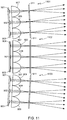
- Fig. 11 schematically illustrates an alternate approach to achieving overlap in the illumination FoV generated by different light sources within a single headlight assembly 1100, where the single headlight assembly includes multiple light modules 1101-1103.
- each light module includes a light source comprised of a 1-dimensional LED array divided into three LED groups 901-903, with each group consisting of one or more individual LEDs.
- Corresponding to each group of LEDs is a collimation optic 907-909. While the use of individual collimation optics allows each module to overlap the illumination distribution created by that particular module, in the exemplary embodiment shown in Fig.
- each module 1101-1103 may utilize a single collimation optic, rather than multiple collimation optics, when light overlap is not desired at the module level.
- the light emitted by the LEDs and collimated by optics 907-909 pass through optical element 911.
- the individual light modules are angled relative to one another to a sufficient degree to generate the desired overlap in the illumination FoV created by the individual modules.
- the present lighting system allows the light intensity distribution from the left and right headlight assemblies to be adapted to current driving conditions.
- the light modules described above there are several means of tailoring the illumination intensity distribution of the FoV.
- the simplest approach is similar to that used in a conventional light assembly, specifically using multiple light modules directed at different regions of the FoV and then selectively activating particular modules in order to obtain the desired light distribution.
- a first light module may provide the desired light when the system is in low beam mode; a second light module may be activated, either in addition to or as a replacement for the first module when it is desirable to illuminate a more distant area (i.e., high beam mode); and a third light module may be activated when illuminating corners and other regions outside of the vehicle's forward path, where the third light module may be activated either in addition to the first and/or second modules, or as a replacement light source for the first and/or second modules.
- the light source (e.g., source 101) is preferably comprised of multiple LEDs, either in the form of a 1-dimensional or a 2-dimensional array, and where the individual LEDs comprising the array, or groups of LEDs comprising the array, are individually addressable. Selective activation of the LEDs within a light module allows the light intensity distribution at the desired illumination FoV to be tailored to current driving needs.
- each LED comprising the light source can be directed at a particular region of the horizon (i.e., the illumination FoV) using the illumination and projection MLAs described above.
- the illumination FoV the illumination and projection MLAs described above.
- selectively activating and deactivating individual LEDs, or groups of LEDs allows the light distribution to be tailored as desired.
- This aspect of the invention is schematically illustrated in Fig. 12 .
- light source 1201 of module 1200 is comprised of nine LEDs divided into three LED groups 1202-1204.
- LED group 1202 is comprised of three LEDs 1205A-1205C;
- LED group 1203 is comprised of three LEDs 1206A-1206C;
- LED group 1204 is comprised of three LEDs 1207A-1207C.
- each LED with an "A” label is represented on the page as the uppermost LED of the corresponding LED group; each LED with a “B” label is represented on the page as the center LED of the corresponding LED group; and each LED with a “C” label is represented on the page as the lowermost LED of the corresponding LED group.
- each group 1202-1204 is a collimation optic 1209-1211, respectively.
- the light emitted by the LEDs and collimated by optics 1209-1211 pass through optical element 1213, where optical element 1213 includes an illumination MLA, an aperture layer, and a projection MLA as previously described.
- the LEDs within module 1200 may or may not be shifted relative to the corresponding collimating optics as described above relative to Fig.
- the collimation optics 1209-1211 and the illumination and projection MLAs comprising element 1213 direct the light emitted by a first set of LEDs (i.e., LEDs 1205B, 1206B and 1207B) in a first direction such that when these LEDs are activated, the illumination distribution at horizon plane 1215 is approximately centered relative to the light module's centerline as shown by ray tracing group 1217.
- a first set of LEDs i.e., LEDs 1205B, 1206B and 1207B
- the collimation optics 1209-1211 and the illumination element 1213 directs the light emitted by a second set of LEDs (i.e., LEDs 1205C, 1206C and 1207C) in a second direction such that when these LEDs are activated, the illumination distribution at horizon plane 1215 is moved off-center as shown by ray tracing group 1219.
- a second set of LEDs i.e., LEDs 1205C, 1206C and 1207C
- two different regions can be illuminated individually by selectively activating different sets of LEDs, or both regions can be simultaneously illuminated by simultaneously activating both sets of LEDs.
- a single light module is not limited to two illumination regions, rather a single light module can illuminate more than two regions if desired.
- any region of the FoV can be illuminated as desired. Additional lighting flexibility, not only in terms of illumination region within the FoV, but also in terms of illumination homogeneity and intensity, can be achieved through the use of multiple light modules.
- Figs. 13A-C illustrate three different (angular) illumination intensity distributions generated by three different LED sets contained within the same light module.
- the FoV is represented by 1301
- the illumination is represented by (angular) illumination intensity profiles 1303-1306, where profile 1303 represents the highest illumination intensity with a fall-off in intensity represented by profiles 1304-1306, where profile 1306 represents the lowest illustrated illumination intensity.
- the aperture layer used in this exemplary configuration creates an illumination cut-offline 1307, where the cut-off includes a kink 1309 that aids in shielding on-coming cars from the light.
- the intensity profile generated by the first set of LEDs is to the left of kink 1309; the intensity profile generated by the second set of LEDs is centered on kink 1309; and the intensity profile generated by the third set of LEDs is to the right of kink 1309.
Landscapes
- Engineering & Computer Science (AREA)
- Physics & Mathematics (AREA)
- General Engineering & Computer Science (AREA)
- Optics & Photonics (AREA)
- General Physics & Mathematics (AREA)
- Microelectronics & Electronic Packaging (AREA)
- Mechanical Engineering (AREA)
- Mathematical Physics (AREA)
- Non-Portable Lighting Devices Or Systems Thereof (AREA)
- Lighting Device Outwards From Vehicle And Optical Signal (AREA)
Abstract
Description
- The present invention relates generally to vehicle headlights and, more particularly, to an adaptive headlight system that allows the illumination provided by a vehicle's headlights to be tailored to current driving conditions.
- Over the years, a variety of techniques have been used to adapt the illumination pattern provided by a vehicle's headlights to current driving conditions, in particular preventing a vehicle's headlights from dazzling and temporarily blinding the drivers of on-coming vehicles while insuring sufficient illumination when traveling at highway speeds in areas in which there is minimal ambient lighting.
- One approach to controlling a light assembly's illumination pattern is through the use of a cut-off bar which, when placed in the assembly's output beam, occludes a portion of the light beam.
U.S. Patent Application Serial No. 2017/0203683 discloses such a light assembly, one in which the position of the cut-off bar is controlled by an electromagnet actuator. -
U.S. Patent Application Serial No. 2017/0276311 discloses an alternate approach, one in which a mirror is used to alter the light assembly's illumination pattern. As disclosed, a collection mirror comprised of a plurality of inclinable mirror elements is located between the optical member that collects the light emitted by an LED light source and a light projection element. By controlling the position of the elements comprising the collection mirror, predetermined light distribution patterns can be formed. - While there are a variety of techniques that may be used to control the light distribution pattern from a vehicle's headlight assembly, these techniques provide limited adaptability, typically providing only two states of operation: high beams and low beams. Accordingly, what is needed is a vehicle headlight assembly that is capable of providing a variety of distribution patterns along with improved performance, where performance is assessed on the qualities of illumination homogeneity, manufacturing ease, cost, and output efficiency. The present invention provides such a light assembly.
- The present invention provides an adaptive light module that may be incorporated singularly, or as one of a plurality of light modules, within a vehicle's headlight assembly. The light module is comprised of (i) an LED light source, more particularly an LED array (i.e., 1- or 2-dimensional array) that includes a plurality of LEDs; (ii) an illumination micro-lens-array (MLA), where a first focal length corresponds to the illumination MLA; (iii) a projection MLA, where a second focal length corresponds to the projection MLA, and where the first focal length is greater than the second focal length; (iv) at least one collimating optic interposed between the light source and the illumination MLA, where the collimating optic is configured to collimate light generated by the LED light source prior to the light entering the illumination MLA; and (v) an aperture layer interposed between the projection MLA and the illumination MLA, where the aperture layer is configured to provide a cut-off in the illumination field-of-view (FoV) generated by the adaptive light module.
- In one aspect, the plurality of LEDs may be divided into at least first and second LED subsets, where the illumination and projection MLAs direct light generated by the first LED subset in a first direction and direct light generated by the second LED subset in a second direction, and where a light control system coupled to the LED light source is configured to selectively and independently activate the first and second LED subsets.
- In another aspect, the plurality of LEDs comprising the LED array may be divided into a plurality of LED groups and the at least one collimating optic may be comprised of a plurality of collimating optics corresponding to the plurality of LED groups. The optical axis of at least one of the LED groups may be displaced, or tilted, relative to the optical axis of the corresponding collimating optic.
- In another aspect, the first focal length corresponding to the illumination MLA may correspond to the y-axis of each of the plurality of illumination optical elements comprising the illumination MLA and the second focal length corresponding to the projection MLA may correspond to the y-axis of each of the plurality of projection optical elements comprising the illumination MLA, where the y-axis corresponds to a horizontal plane. A third focal length may correspond to the z-axis of each of the plurality of illumination optical elements comprising the illumination MLA and a fourth focal length may correspond to the z-axis of each of the plurality of projection optical elements comprising the projection MLA, where the z-axis is orthogonal to the y-axis. Preferably the first focal length is larger than the third focal length. In at least one embodiment, the cross-section of the illumination and projection optical elements has a non-regular hexagonal shape, where the non-regular hexagonal shape is defined by a first width and a second width and where the ratio of the first width to the second width is preferably between 1.5:1 and 3:1. In at least one embodiment, the cross-section of the illumination and projection optical elements has a rectangular shape, where the rectangular shape is defined by a first width and a second width and where the ratio of the first width to the second width is preferably between 1.5:1 and 3:1.
- In another aspect, the distance between the aperture layer and the outer lens surface of the illumination MLA is less than the first focal length. The aperture layer may be applied, for example using a deposition process, onto the planar side of the illumination MLA. Alternately, the aperture layer may be applied, for example using a deposition process, onto the planar side of the projection MLA.
- In another aspect, the collimating optic may be comprised of a plurality of collimating optics that correspond to the plurality of LEDs comprising the LED array.
- In another aspect, the plurality of illumination optical elements comprising the illumination MLA may be aligned with the plurality of projection optical elements comprising the projection MLA.
- In another aspect, the plurality of illumination optical elements comprising the illumination MLA may be displaced (i.e., not aligned) with the plurality of projection optical elements comprising the projection MLA, where the displacement between the two MLAs is preferably less than 25 percent of the cross-sectional height of an illumination optical element.
- A further understanding of the nature and advantages of the present invention may be realized by reference to the remaining portions of the specification and the drawings.
- It should be understood that the accompanying figures are only meant to illustrate, not limit, the scope of the invention and should not be considered to be to scale. Additionally, the same reference label on different figures should be understood to refer to the same component or a component of similar functionality.
-
Fig. 1 illustrates the basic design concept of a lighting module configured in accordance with the present invention; -
Fig. 2 provides a cross-sectional view of a hexagonal lens configuration applicable to the MLAs used in the present invention; -
Fig. 3 provides a cross-sectional view of a rectangular lens configuration applicable to the MLAs used in the present invention; -
Fig. 4 illustrates a configuration, similar to that shown inFig. 1 , except for the displacement of the projection MLA relative to the illumination MLA; -
Fig. 5 provides a light ray trace through a single element of a projection MLA and an illumination MLA, where the two elements are aligned in a manner similar to that shown inFig. 1 ; -
Fig. 6 provides a light ray trace through a single element of a projection MLA and an illumination MLA, where the two elements are shifted in a manner similar to that shown inFig. 4 ; -
Fig. 7 illustrates a configuration, similar to that shown inFig. 1 , except that the illumination MLA utilizes freeform optical elements; -
Fig. 8 provides a block diagram of an exemplary headlight control system integrated into a vehicle; -
Fig. 9 schematically illustrates a configuration for a single light module with overlapping illumination at the FoV where illumination overlap is achieved by moving individual light sources relative to the corresponding collimation optics; -
Fig. 10 schematically illustrates a configuration for a single light module with overlapping illumination at the FoV where illumination overlap is achieved by tilting the collimation optics associated with some of the light sources; -
Fig. 11 schematically illustrates a configuration for a light assembly comprised of multiple light modules where illumination overlap at the FoV is achieved by tilting individual light modules relative to one another; -
Fig. 12 schematically illustrates shifting the illumination FoV from a single light module by activating different sets of LEDs comprising the module's light source; and -
Figs. 13A-C illustrate three different illumination intensity distributions generated by three different LED sets contained within the same light module, where the cut-off created by the aperture layer remains constant. - As used herein, the singular forms "a", "an" and "the" are intended to include the plural forms as well, unless the context clearly indicates otherwise. The terms "comprises", "comprising", "includes", and/or "including", as used herein, specify the presence of stated features, process steps, operations, elements, and/or components, but do not preclude the presence or addition of one or more other features, process steps, operations, elements, components, and/or groups thereof. As used herein, the term "and/or" and the symbol "/" are meant to include any and all combinations of one or more of the associated listed items. Additionally, while the terms first, second, etc. may be used herein to describe various steps, calculations, or components, these steps, calculations, or components should not be limited by these terms, rather these terms are only used to distinguish one step, calculation, or component from another. For example, a first calculation could be termed a second calculation, and, similarly, a first step could be termed a second step, and, similarly, a first component could be termed a second component, without departing from the scope of this disclosure.
-
Fig. 1 illustrates the basic design concept of the micro-lens-array (MLA) used in alighting module 100 designed in accordance with the present invention. As shown, the light emitted by anLED light source 101 is collimated bycollimation optics 103 prior to impinging onMLA 105. MLA 105 is also referred to herein as an illumination MLA. The light transmitted by MLA 105 passes throughaperture layer 107 before entering asecond MLA 109, where MLA 109 may also be referred to herein as a projection MLA. The light exiting MLA 109 directly illuminates the region of interest, i.e., the roadway in front of the vehicle. - Although
LED light source 101 may be comprised of a single LED, preferably it is comprised of a plurality of LEDs where the LEDs are either in the form of a linear array, i.e., a 1-dimensional array, or in the form of a 2-dimensional array, also referred to as a matrix LED. By utilizing either a 1-dimensional or 2-dimensionalan LED array, improved flux and light color can be achieved. Additionally, an array of LEDs that are either individually addressable or addressable by pre-determined groups allows the illumination distribution pattern generated by the module to be varied as desired, for example decreasing light intensity in a region of the output beam that is directed at on-coming traffic, and/or cars that are directly in front of the vehicle, and/or pedestrians, and/or reflective signs, etc. The size of each individually addressable LED should be less than 2 millimeters, while the overall dimensions of the LED array should be less than 6 millimeters. - MLA 105 pre-shapes the intensity distribution of the light from
source 101 that impinges onaperture layer 107, thus allowing a highly efficient optical system with minimal losses in the aperture layer. The lens shape for each of theindividual lenses 111 comprising MLA 105 may be the same, or they may be different from one another.Lenses 111 can be spherical or aspherical. Similarly, the lens shape for each of theindividual lenses 113 comprisingMLA 109 may be the same, or they may be different from one another, and they may be either spherical or aspherical. While the focal length of each of thelenses comprising MLA 105 and each of thelenses comprising MLA 109 may be equivalent in the y and z directions, preferably the focal length in the z direction is shorter than the focal length in the y direction, thereby helping to achieve the desired asymmetric illumination field of view (FoV) while decreasing the f-number in z allowing a higher light throughput. The aspect ratio of the illumination FoV is preferably in the range of 3:1 to 10:1, thus illuminating a wider strip of roadway while minimizing the light that may be directly viewed by on-coming drivers. It should be understood that as used herein, the y direction is measured horizontally (i.e., in the horizon plane) and the z direction is measured vertically (i.e., orthogonal to the horizon plane). Therefore inFig. 1 , the z direction is illustrated by line 115, the x direction is illustrated byline 117, and the y direction, which is orthogonal to the x and y axes, would be measured directly into the page. - Preferably the focal length of
MLA 105 is greater than that ofMLA 109, thereby minimizing losses between adjacent channels, where a channel is considered to be a single optical (i.e., lens) element of a micro-lens-array. In the preferred embodiment of the invention, the focal length associated withMLA 109 is between 0.5 millimeters and 5 millimeters while the focal length associated withMLA 105 is between 0.5 millimeters and infinity. The refractive index for both the illumination and projection MLAs is between 1.4 and 1.8. Preferred materials for the illumination and projection MLAs include glass and a variety of optically transparent resins. -
Aperture layer 107, which can be fabricated from any of a variety of materials (e.g., metals such as aluminum and chromium, resins, silicon, etc.) is used to tailor the light distribution and to provide a sharp cut-off line for the light distribution, especially when the assembly is used in a low beam configuration. Given that the aperture layer provides this tailoring function, and given that the cut-off line must be superimposed between MLA elements, it should be understood that the design of the apertures corresponding to each individual lens element of the MLAs may be different, i.e., all apertures ofaperture layer 107 can be the same; alternately, all apertures ofaperture layer 107 can be different; alternately,aperture layer 107 can be comprised of several groups of apertures where the apertures within each group are the same but the apertures from group to group are different. Accordingly, the shape, size and location of each aperture withinlayer 107 is individually calculated based on the intended source characteristics,MLA 105,MLA 109, and the desired image in both the near field and far field. Typicallyaperture layer 107 is deposited directly on, or otherwise applied directly to, the planar side ofMLA 105 or the planar side ofMLA 109.Layer 107 can be separate from the planar side ofMLA 105 as long as the distance betweenlayer 107 and the planar side ofMLA 105 is less than the focal length ofMLA 105, thus insuring high light throughput. - As noted above, the primary use for
aperture layer 107 is to tailor the illumination intensity distribution of the output beam. A secondary use forlayer 107 is achieved by including alignment features within the layer. For example, by including a cross that is visible in the near field, multiplelight modules 100 located within a single vehicle headlight assembly can be co-aligned. This feature can also be used as a parking aid, for example by providing an indicator that is visible in the near field and which can be used by a driver to identify when the car is sufficiently close to a parking garage wall. -
Collimation optics 103 collimate the light emitted bysource 101 prior to thatlight entering MLA 105. In order to minimize cross-talk between adjacent optical elements of theMLAs comprising module 100,collimation optics 103 allows minimal light beam divergence. For example, in one embodiment of the invention, the divergence of thelight exiting optics 103 is less than 10° FWHM (full width at half maximum). In one configuration of the invention, asingle optic 103 is used to collimate the light fromsource 101 regardless of the number of LEDs comprising the source. In an alternate configuration, eachLED comprising source 101 is matched to a corresponding collimation optic. In yet another alternate configuration,source 101 is divided into groups of LEDs with each group being matched to a corresponding collimation optic. Preferably the focal length of collimation optic(s) 103 is between 6 millimeters and 20 millimeters. -
Figs. 2 and3 provide preferred cross-sections of the MLAs, bothMLA 105 andMLA 109, withFig. 2 illustrating a non-regular hexagonal lens arrangement andFig. 3 illustrating a rectangular lens arrangement. In both configurations, and as preferred, the width of each optical element comprising the array in the y direction (i.e., wy) is greater than the width of the same element in the z direction (i.e., wz). Preferably the ratio of wy to wz is in the range of 1.5:1 to 3:1, where wy is in the range of 0.6 millimeters to 3 millimeters and wz is in the range of 0.4 millimeters to 3 millimeters. Although not required by the invention, the hexagonal configuration is preferred since stray light in the form of ghost images is not directly left and right of the primary intensity distribution, thus reducing cross-talk between adjacent elements. - In situations in which it is necessary to shift the illumination intensity distribution downwards, for example to obtain the desired low beam intensity distribution, while still providing high light throughput, the inventors have found that
MLA 109 may be shifted downwards relative toMLA 105, thereby displacing the opticalelements comprising MLA 109 relative to the opticalelements comprising MLA 105. The downward shift ofMLA 109 should be less than 25% of wz in order to insure efficient illumination of theaperture layer 107. An example of this configuration is shown inFig. 4 .Figs. 5 and 6 provide light ray traces through a single optical element ofMLA 105 and a single optical element ofMLA 109, withFig. 5 showing the non-shifted pattern andFig. 6 showing the shifted pattern. Note that inFig. 6 the light exiting the assembly is lower relative to the horizon. Furthermore, the angle of the uppermost rays (e.g., ray 601), relative to the horizontal axis, are smaller in the shifted arrangement (Fig. 6 ) compared to the same rays (e.g., ray 501) in the non-shifted arrangement (Fig. 5 ), thereby further reducing glare and the potential for dazzling or temporarily blinding on-coming drivers. Additionally, in order to maximize light throughput when shiftingMLA 109 downwards, it is necessary to angle the source (e.g., source 101) relative to the illumination and projection MLAs as shown inFig. 4 . This can be accomplished by angling the source itself, or angling the illumination and projection MLAs relative to the source, or by a vertical decenter (in this case upward) of the LED. - As previously described, the lens
elements comprising MLA 105 andMLA 109 can be spherical or aspherical. In addition, and as illustrated inFig. 7 , the lenses comprising theillumination MLA 701 can also be configured as freeform optics. As used herein, and as generally understood by those of skill in the relevant technologies, freeform optics describe optical shapes/surfaces that have little or no rotational symmetry. This form of optic is typically characterized by a mathematical description such as a Zernike polynomial, an xy polynomial, or characterized by a phase function that can be calculated by an iterative Fourier Transform algorithm, etc. - The illumination system described above, integrated into a vehicle's headlight assembly, can be used to tailor the distribution of light based on current driving conditions, conditions such as city driving in which there are cars immediately preceding the car as well as on-coming traffic; high speed highway driving in which there may be intermittent on-coming cars; both city and highway driving where it is desirable to illuminate a curved road during turning; and incidents in which a pedestrian, sign or other obstacle require the illumination intensity to be varied to minimize temporarily blinding a pedestrian or to improve visibility for the driver.
-
Fig. 8 provides a block diagram of an exemplary headlight control system integrated into avehicle 800, where each of the headlights, i.e.,left headlight assembly 801 andright headlight assembly 803, are controlled by alight control system 805.Light control system 805 may be a separate control system or integrated into the vehicle'scontrol system 807 as shown.System controller 807 is comprised of a central processing unit (CPU) 809 andmemory 811, withmemory 811 being comprised of EPROM, EEPROM, flash memory, RAM, solid state drive, hard disk drive, or any other type of memory or combination of memory types. In embodiments in whichlight control system 805 is separate fromvehicle control system 807, preferablycontroller 805 would utilize a different processor and memory from the processor/memory utilized bycontroller 807. - In some embodiments of the invention, the user manually adjusts the headlights in accordance with current driving conditions.
User interface 813, used to manually adjust the headlights, may be in the form of a simple switch (e.g., a switch mounted to the steering column or dashboard), or in the form of a more complex interface (e.g., a dash-mounted touch screen, audio interface utilizing verbal commands, etc.). Manual operation of the lighting may simply allow the driver to switch between a high beam light profile designed to maximize long range visibility and a low beam light profile designed to provide sufficient illumination for driving while minimizing the risk of dazzling or otherwise temporarily blinding the drivers of on-coming cars as well as those cars directly in front of the user's car. In other embodiments, the driver can manually adjust headlight system characteristics other than just the selection of low beam/high beam, characteristics such as maximum light intensity and minimum light intensity. - Preferably some, or all, of the adjustable characteristics of the headlight systems are performed automatically. In at least one embodiment, an ambient
light sensor 815 monitors external light levels, allowing the light control system to automatically turn on/off the headlights based on current light levels. In at least one embodiment, a forward lookinglight sensor 817 monitors light directed at the front of the vehicle. In its simplest implementation, monitor 817 is used to alternate between high beams when no on-coming traffic is detected and low beams when on-coming traffic is detected. Ifsensor 817 is configured to detect the direction of incident light in addition to light levels, then theheadlight control system 805 can alter the light intensity profile ofheadlights 801/803 to lower light intensity for the region containing the on-coming vehicles while still maintaining higher light intensities for other regions of the roadway. In some configurations,sensor 817 may be used to detect light reflected from objects in front ofvehicle 800 and lower the light intensity in those regions, thus lowering the intensity of the light that is reflected back at the driver. - In at least some embodiments, one or more forward looking
detectors 819 monitor for objects in front ofvehicle 800.Detection system 819 may utilize lidar-based sensors, radar-based sensors, a camera operating in the visible spectrum, a camera operating in the infrared spectrum, electromagnetic sensors, ultrasonic sensors, or other sensor types. Utilizing the information providing by forward lookingdetectors 819,light control system 805 can alter the light distribution profile to lower light intensity directed at cars directly in front ofvehicle 800, or at pedestrians, or at other objects in front of the vehicle where higher light intensities would be inappropriate or undesirable. - In at least some embodiments,
light control system 805 alters the light intensity distribution based on upcoming road conditions, for example curves in the road or when the car executes a turn. A variety of sensors and techniques may be used to determine such road conditions. For example, the system can monitor when the driver indicates an upcoming turn by using turn signals 821. The system can also monitor when the car is actually making a turn, for example by monitoring the vehicle'ssteering system 823. In some embodiments the system alters the light intensity distribution of the headlights based on expected road conditions. In these embodiments the vehicle's location on a map is used to determine upcoming road conditions. Preferably the location ofvehicle 800 is provided by an on-board GPS system 825. Road conditions, such as upcoming intersections and road curves, are preferably provided by an on-board navigation system 827, although this same information may be contained in an on-board data base (e.g., a data base stored in memory 811) or obtained from an external data base using acommunication link 829. Preferablycontroller 805 also takes into account vehicle speed, a vehicle characteristic provided bysensor 831. - In a typical vehicle lighting scenario, the desired illumination FoV in the y-direction, i.e., along the horizon, created by the right and left headlight assemblies is 60 degrees, i.e., 30 degrees to either side of the vehicle's centerline. In accordance with the invention, each headlight assembly may contain a single light module or, as preferred, multiple light modules. Although each light module may use a single LED, preferably each module uses an array of LEDs as previously described. In addition to the light source, each light module includes one or more collimating optical elements as well as the necessary illumination/projection MLAs and the interposed aperture layer. In order to achieve both the desired light intensity and light homogeneity within the illuminated FoV, preferably the light system is designed to overlap the illuminated FoV generated by different light sources. The inventors have found that an overlap of 4 degrees or less is preferred.
- The present invention provides several means to overlap the illumination FoV that is generated by different light sources within a single headlight assembly. In the first technique, which is schematically illustrated in the simplified view shown in
Fig. 9 , the LEDs within asingle light module 900 are shifted relative to the corresponding collimation optics. As shown,exemplary module 900 uses a light source comprised of a 1-dimensional LED array divided into three LED groups 901-903, with each group consisting of one or more individual LEDs. Corresponding to each group 901-903 of LEDs is a collimation optic 907-909, respectively. The light emitted by the LEDs and collimated by optics 907-909 pass throughoptical element 911, whereoptical element 911 includes an illumination MLA, an aperture layer, and a projection MLA as described above.LED group 901 is shifted slightly towards the center of the assembly in adirection 913 relative tocollimation optic 907. Similarly,LED group 903 is shifted slightly towards the center of the assembly in adirection 915 relative tocollimation optic 909. This shift between LED groups and the corresponding collimation optics is exemplified by the displacement of theoptical axis 917 ofLED group 903 relative to theoptical axis 919 of collimatingoptic 909. By shiftingLED groups -
Fig. 10 schematically illustrates an alternate approach to achieving overlap in the illumination FoV generated by different light sources within a single light module. As in the prior embodiment and as shown inFig. 10 ,module 1000 uses a light source comprised of a 1-dimensional LED array divided into three LED groups 901-903, with each group consisting of one or more individual LEDs. Corresponding to each group of LEDs is a collimation optic 907-909. The light emitted by the LEDs and collimated by optics 907-909 pass throughoptical element 911. Inmodule 1000,LED groups corresponding collimation optics Fig. 9 . Rather, and as shown inFig. 10 ,collimation optics directions central collimation optic 908. Angling LED groups relative to the corresponding collimation optics is exemplified by the tilt of theoptical axis 917 ofLED group 903 relative to theoptical axis 919 of collimatingoptic 909. Tilting the collimation optics in this manner results in the desired overlap in the illumination FoV created by the three LED groups. -
Fig. 11 schematically illustrates an alternate approach to achieving overlap in the illumination FoV generated by different light sources within a single headlight assembly 1100, where the single headlight assembly includes multiple light modules 1101-1103. As in the embodiments shown inFigs. 9 and 10 , each light module includes a light source comprised of a 1-dimensional LED array divided into three LED groups 901-903, with each group consisting of one or more individual LEDs. Corresponding to each group of LEDs is a collimation optic 907-909. While the use of individual collimation optics allows each module to overlap the illumination distribution created by that particular module, in the exemplary embodiment shown inFig. 11 the relative positions of the sources and collimation optics are not shifted to create overlap, nor are the collimation optics tilted to create overlap. It should be understood that each module 1101-1103 may utilize a single collimation optic, rather than multiple collimation optics, when light overlap is not desired at the module level. In each module 1101-1103, the light emitted by the LEDs and collimated by optics 907-909 pass throughoptical element 911. In assembly 1100, the individual light modules are angled relative to one another to a sufficient degree to generate the desired overlap in the illumination FoV created by the individual modules. - While the embodiments illustrated in
Fig. 9-11 only show overlap in the illumination FoV in the y-direction, it should be understood that the same techniques may be applied to creating illumination overlap in the z-direction, i.e., perpendicular to the horizon, if such overlap is desired. - As previously described, the present lighting system allows the light intensity distribution from the left and right headlight assemblies to be adapted to current driving conditions. Using the light modules described above, there are several means of tailoring the illumination intensity distribution of the FoV. The simplest approach is similar to that used in a conventional light assembly, specifically using multiple light modules directed at different regions of the FoV and then selectively activating particular modules in order to obtain the desired light distribution. For example, a first light module may provide the desired light when the system is in low beam mode; a second light module may be activated, either in addition to or as a replacement for the first module when it is desirable to illuminate a more distant area (i.e., high beam mode); and a third light module may be activated when illuminating corners and other regions outside of the vehicle's forward path, where the third light module may be activated either in addition to the first and/or second modules, or as a replacement light source for the first and/or second modules.
- As previously noted, in the preferred embodiments of the light module, the light source (e.g., source 101) is preferably comprised of multiple LEDs, either in the form of a 1-dimensional or a 2-dimensional array, and where the individual LEDs comprising the array, or groups of LEDs comprising the array, are individually addressable. Selective activation of the LEDs within a light module allows the light intensity distribution at the desired illumination FoV to be tailored to current driving needs.
- In the light modules of the present invention, the light emitted by each LED comprising the light source can be directed at a particular region of the horizon (i.e., the illumination FoV) using the illumination and projection MLAs described above. As a result, selectively activating and deactivating individual LEDs, or groups of LEDs, allows the light distribution to be tailored as desired. This aspect of the invention is schematically illustrated in
Fig. 12 . For purposes of this example,light source 1201 ofmodule 1200 is comprised of nine LEDs divided into three LED groups 1202-1204.LED group 1202 is comprised of threeLEDs 1205A-1205C;LED group 1203 is comprised of threeLEDs 1206A-1206C; andLED group 1204 is comprised of threeLEDs 1207A-1207C. InFig. 12 , each LED with an "A" label is represented on the page as the uppermost LED of the corresponding LED group; each LED with a "B" label is represented on the page as the center LED of the corresponding LED group; and each LED with a "C" label is represented on the page as the lowermost LED of the corresponding LED group. Corresponding to each group 1202-1204 is a collimation optic 1209-1211, respectively. The light emitted by the LEDs and collimated by optics 1209-1211 pass throughoptical element 1213, whereoptical element 1213 includes an illumination MLA, an aperture layer, and a projection MLA as previously described. The LEDs withinmodule 1200 may or may not be shifted relative to the corresponding collimating optics as described above relative toFig. 9 , and the collimating optics may or may not be tilted as described above relative toFig. 10 , depending upon whether overlap is desired. In the embodiment illustrated inFig. 12 , the collimation optics 1209-1211 and the illumination and projectionMLAs comprising element 1213 direct the light emitted by a first set of LEDs (i.e.,LEDs horizon plane 1215 is approximately centered relative to the light module's centerline as shown byray tracing group 1217. Similarly, the collimation optics 1209-1211 and theillumination element 1213 directs the light emitted by a second set of LEDs (i.e.,LEDs horizon plane 1215 is moved off-center as shown byray tracing group 1219. Thus in this example, two different regions can be illuminated individually by selectively activating different sets of LEDs, or both regions can be simultaneously illuminated by simultaneously activating both sets of LEDs. It should be understood that a single light module is not limited to two illumination regions, rather a single light module can illuminate more than two regions if desired. Thus by using individually addressable LEDs, and preferably individually addressable sets of LEDs, each of which illuminates a different area of the FoV, any region of the FoV can be illuminated as desired. Additional lighting flexibility, not only in terms of illumination region within the FoV, but also in terms of illumination homogeneity and intensity, can be achieved through the use of multiple light modules. - Due to the location of the aperture layer within the MLA stack, addressing different LEDs or sets of LEDs as described above relative to
Fig. 12 only changes the illumination intensity distribution, not the location of any image attributes derived from the aperture layer. For example,Figs. 13A-C illustrate three different (angular) illumination intensity distributions generated by three different LED sets contained within the same light module. For clarity, inFigs. 13A-C the FoV is represented by 1301, while the illumination is represented by (angular) illumination intensity profiles 1303-1306, whereprofile 1303 represents the highest illumination intensity with a fall-off in intensity represented by profiles 1304-1306, whereprofile 1306 represents the lowest illustrated illumination intensity. The aperture layer used in this exemplary configuration creates an illumination cut-offline 1307, where the cut-off includes akink 1309 that aids in shielding on-coming cars from the light. As shown, the intensity profile generated by the first set of LEDs is to the left ofkink 1309; the intensity profile generated by the second set of LEDs is centered onkink 1309; and the intensity profile generated by the third set of LEDs is to the right ofkink 1309. - Systems and methods have been described in general terms as an aid to understanding details of the invention. In some instances, well-known structures, materials, and/or operations have not been specifically shown or described in detail to avoid obscuring aspects of the invention. In other instances, specific details have been given in order to provide a thorough understanding of the invention. One skilled in the relevant art will recognize that the invention may be embodied in other specific forms, for example to adapt to a particular system or apparatus or situation or material or component, without departing from the spirit or essential characteristics thereof. Therefore the disclosures and descriptions herein are intended to be illustrative, but not limiting, of the scope of the invention.
Claims (16)
- An adaptive light module, comprising:module, comprising:an LED light source, said LED light source comprising an LED array, said LED array comprising a plurality of LEDs;an illumination micro-lens-array (MLA), wherein a first focal length corresponds to said illumination MLA;a projection MLA, wherein a second focal length corresponds to said projection MLA, and wherein said first focal length is longer than said second focal length;at least one collimating optic interposed between said light source and said illumination MLA, said at least one collimating optic configured to collimate light generated by said LED light source prior to said light entering said illumination MLA; andan aperture layer interposed between said projection MLA and said illumination MLA, said aperture layer configured to provide a cut-off in an illumination field-of-view (FoV) generated by said adaptive light module.
- The adaptive light module of claim 1, further comprising a vehicle and a vehicle headlight assembly, said adaptive light module incorporated into said vehicle headlight assembly.
- The adaptive light module of claim 1, said plurality of LEDs comprising said LED array divided into at least a first LED subset and a second LED subset, wherein said illumination MLA and said projection MLA direct light generated by said first LED subset in a first direction and direct light generated by said second LED subset in a second direction, said adaptive light module further comprising a light control system coupled to said LED light source, said light control system configured to selectively and independently activate said first LED subset and said second LED subset.
- The adaptive light module of claim 1, said LED array selected from the group consisting of 1-dimensional LED arrays and 2-dimensional LED arrays.
- The adaptive light module of claim 1, said plurality of LEDs comprising said LED array divided into a plurality of LED groups.
- The adaptive light module of claim 5, said at least one collimating optic further comprising a plurality of collimating optics, wherein said plurality of collimating optics correspond to said plurality of LED groups.
- The adaptive light module of claim 6, wherein a first optical axis of at least one of said plurality of LED groups is displaced and/or tilted relative to a second optical axis of a corresponding collimating optic.
- The adaptive light module of any one of claims 1-7, said illumination MLA comprising a plurality of illumination optical elements and said projection MLA comprising a plurality of projection optical elements, wherein said first focal length corresponds to a y-axis of each of said plurality of illumination optical elements and said second focal length corresponds to said y-axis of each of said plurality of projection optical elements, and wherein said y-axis corresponds to a horizontal plane.
- The adaptive light module of claim 8, wherein a third focal length corresponds to a z-axis of each of said plurality of illumination optical elements of said illumination MLA, wherein a fourth focal length corresponds to said z-axis of each of said plurality of projection optical elements of said projection MLA, and wherein said z-axis is orthogonal to said y-axis.
- The adaptive light module of claim 8, wherein a first cross-section corresponding to each of said plurality of illumination optical elements and a second cross-section corresponding to each of said plurality of projection optical elements has a non-regular hexagonal shape, wherein a first dimension corresponds to a first width of said non-regular hexagonal shape and a second dimension corresponds to a second width of said non-regular hexagonal shape, and wherein a ratio of said first dimension to said second dimension is between 1.5:1 and 3:1.
- The adaptive light module of claim 8, wherein a first cross-section corresponding to each of said plurality of illumination optical elements and a second cross-section corresponding to each of said plurality of projection optical elements has a rectangular shape, wherein a first dimension corresponds to a first width of said rectangular shape and a second dimension corresponds to a second width of said rectangular shape, and wherein a ratio of said first dimension to said second dimension is between 1.5:1 and 3:1.
- The adaptive light module of any one of claims 1-7, said aperture layer applied either to (i) a planar side of said illumination MLA, or (ii) a planar side of said projection MLA.
- The adaptive light module of any one of claims 1-7, wherein a distance between said aperture layer and an outer lens surface of said illumination MLA is less than said first focal length.
- The adaptive light module of any one of claims 1-7, said at least one collimating optic further comprising a plurality of collimating optics, wherein said plurality of collimating optics correspond to said plurality of LEDs comprising said LED array.
- The adaptive light module of any one of claims 1-7, said illumination MLA comprising a plurality of illumination optical elements and said projection MLA comprising a plurality of projection optical elements, wherein said plurality of illumination optical elements are aligned with said plurality of projection optical elements.
- The adaptive light module of any one of claims 1-7, said illumination MLA comprising a plurality of illumination optical elements and said projection MLA comprising a plurality of projection optical elements, wherein a first dimension corresponds to a cross-section height corresponding to each of said plurality of illumination optical elements and a second dimension corresponds to a cross-section width corresponding to each of said plurality of illumination optical elements, wherein said plurality of illumination optical elements are not aligned with said plurality of projection optical elements, and wherein said plurality of projection optical elements are displaced from said plurality of illumination optical elements by less than 25 percent of said first dimension.
Applications Claiming Priority (1)
| Application Number | Priority Date | Filing Date | Title |
|---|---|---|---|
| US15/822,951 US10232763B1 (en) | 2017-11-27 | 2017-11-27 | Solid state adaptive headlight |
Publications (2)
| Publication Number | Publication Date |
|---|---|
| EP3489574A1 true EP3489574A1 (en) | 2019-05-29 |
| EP3489574B1 EP3489574B1 (en) | 2022-02-23 |
Family
ID=63878325
Family Applications (1)
| Application Number | Title | Priority Date | Filing Date |
|---|---|---|---|
| EP18200095.0A Active EP3489574B1 (en) | 2017-11-27 | 2018-10-12 | Solid state adaptive headlight |
Country Status (3)
| Country | Link |
|---|---|
| US (1) | US10232763B1 (en) |
| EP (1) | EP3489574B1 (en) |
| CN (2) | CN209762926U (en) |
Cited By (1)
| Publication number | Priority date | Publication date | Assignee | Title |
|---|---|---|---|---|
| DE102018216432B4 (en) * | 2018-09-26 | 2026-02-12 | Sl Corporation | Vehicle light |
Families Citing this family (38)
| Publication number | Priority date | Publication date | Assignee | Title |
|---|---|---|---|---|
| US10232763B1 (en) * | 2017-11-27 | 2019-03-19 | Atieva, Inc. | Solid state adaptive headlight |
| JP7042616B2 (en) * | 2017-12-28 | 2022-03-28 | スタンレー電気株式会社 | Vehicle lighting |
| US10634307B2 (en) * | 2018-09-06 | 2020-04-28 | Sl Corporation | Lamp for vehicle |
| KR20200080838A (en) * | 2018-12-27 | 2020-07-07 | 에스엘 주식회사 | lamp for vehicle |
| KR20200141248A (en) | 2019-06-10 | 2020-12-18 | 에스엘 주식회사 | Lamp for vehicle |
| FR3099541B1 (en) * | 2019-07-31 | 2024-09-20 | Valeo Vision | METHOD FOR CONTROLLING A LIGHTING DEVICE CAPABLE OF EMITTING TWO PIXELATED LIGHT BEAMS OF DIFFERENT RESOLUTIONS |
| KR102694059B1 (en) * | 2019-09-20 | 2024-08-09 | 현대모비스 주식회사 | Optical module of head lamp |
| US11872929B2 (en) * | 2020-01-14 | 2024-01-16 | Qualcomm Incorporated | Collaborative vehicle headlight directing |
| KR20210108553A (en) * | 2020-02-25 | 2021-09-03 | 현대자동차주식회사 | Light device having plurality beam pattern image |
| DE102020112316A1 (en) | 2020-05-06 | 2021-11-11 | Suss Microoptics Sa | Projection system and vehicle with projection system |
| JP7307031B2 (en) * | 2020-05-29 | 2023-07-11 | 株式会社日立エルジーデータストレージ | Virtual image projection device |
| KR102899332B1 (en) * | 2020-07-21 | 2025-12-15 | 에스엘 주식회사 | Lamp for vehicle |
| CN112004301A (en) * | 2020-08-24 | 2020-11-27 | 佛山市银河兰晶照明电器有限公司 | Control method and control system of adaptive lamp and adaptive lamp |
| DE102020122896A1 (en) | 2020-09-02 | 2022-03-03 | HELLA GmbH & Co. KGaA | Lighting device for a motor vehicle |
| CN114690522A (en) * | 2020-12-31 | 2022-07-01 | 苏州晶方光电科技有限公司 | Optical projection lamp |
| DE102021103514B4 (en) | 2021-02-15 | 2022-10-27 | Volkswagen Aktiengesellschaft | PROCEDURE FOR CONFIGURATION OF A HEADLAMP SYSTEM FOR A VEHICLE |
| CN112963797A (en) * | 2021-03-19 | 2021-06-15 | 蔚来汽车科技(安徽)有限公司 | Vehicle lighting system and vehicle based on infrared light source |
| US11204147B1 (en) * | 2021-04-20 | 2021-12-21 | GM Global Technology Operations LLC | Headlight unit having micro-light emitting diode device, relay lens system and projection lens system |
| FR3124845B1 (en) | 2021-06-30 | 2023-08-11 | Valeo Vision | MULTIFUNCTIONAL LENS ARRAY AUTOMOTIVE LIGHTING MODULE |
| DE102021122953B3 (en) | 2021-09-06 | 2022-12-22 | HELLA GmbH & Co. KGaA | Lighting device for a motor vehicle |
| CN113799685B (en) * | 2021-09-17 | 2023-04-11 | 东风汽车集团股份有限公司 | Adaptive adjustment method and device for brightness and light zone of ADB headlamp |
| DE102021124222B4 (en) | 2021-09-20 | 2025-02-20 | HELLA GmbH & Co. KGaA | lighting device for vehicles |
| US20240426451A1 (en) * | 2021-10-29 | 2024-12-26 | Atieva, Inc. | Arrangement of light shaping optical elements for automotive signal lighting |
| KR20230155711A (en) * | 2022-05-04 | 2023-11-13 | 현대모비스 주식회사 | Lamp for vehicle |
| KR20240039872A (en) * | 2022-09-20 | 2024-03-27 | 현대모비스 주식회사 | Lamp for vehicle |
| EP4343388A1 (en) | 2022-09-26 | 2024-03-27 | SUSS MicroOptics SA | Decorative lighting with refractive and diffractive lighting devices |
| FR3141507B1 (en) * | 2022-10-30 | 2025-02-14 | Valeo Vision | A lighting device configured to perform a plurality of lighting functions. |
| FR3141506B1 (en) * | 2022-10-30 | 2025-02-14 | Valeo Vision | A lighting device configured to perform at least two lighting functions. |
| EP4616115A1 (en) | 2022-11-08 | 2025-09-17 | Atieva, Inc. | High contrast solid state adaptive headlight |
| US11971148B1 (en) * | 2022-11-08 | 2024-04-30 | Atieva, Inc. | High contrast solid state adaptive headlight |
| DE102022131869A1 (en) * | 2022-12-01 | 2023-04-20 | FEV Group GmbH | PROJECTION DEVICE FOR CREATING DYNAMIC PROJECTIONS |
| KR20250009177A (en) * | 2023-07-10 | 2025-01-17 | 현대모비스 주식회사 | Optical module and lamp for a vehicle including the same |
| CN119713171A (en) * | 2023-09-28 | 2025-03-28 | 比亚迪股份有限公司 | Dipped headlight module, dipped headlight and vehicle |
| WO2025093452A1 (en) * | 2023-10-31 | 2025-05-08 | Valeo Vision | Light module having anamorphic micro-lens array |
| FR3157519A1 (en) * | 2023-12-22 | 2025-06-27 | Valeo Vision | Light module for motor vehicle |
| WO2025142368A1 (en) * | 2023-12-27 | 2025-07-03 | 株式会社小糸製作所 | Vehicle headlight |
| WO2025140962A1 (en) * | 2023-12-28 | 2025-07-03 | Valeo Vision | Lighting device configured to follow a vehicle curve |
| DE102024100194A1 (en) * | 2024-01-04 | 2025-07-10 | HELLA GmbH & Co. KGaA | Lighting device for a motor vehicle |
Citations (6)
| Publication number | Priority date | Publication date | Assignee | Title |
|---|---|---|---|---|
| US20030147252A1 (en) * | 2002-02-06 | 2003-08-07 | Fioravanti S.R.L. | Front lighting system for a motor vehicle |
| WO2015058227A1 (en) * | 2013-10-25 | 2015-04-30 | Zizala Lichtsysteme Gmbh | Microprojection lighting module for a motor vehicle headlight |
| DE102014207750A1 (en) * | 2014-04-24 | 2015-10-29 | Osram Opto Semiconductors Gmbh | lighting arrangement |
| DE112014006794T5 (en) * | 2014-07-08 | 2017-03-23 | Mitsubishi Electric Corporation | Headlamp module and headlamp device |
| WO2017066818A1 (en) * | 2015-10-23 | 2017-04-27 | Zkw Group Gmbh | Micro-projection light module for a motor vehicle headlight, for achieving aplanatic light distrubtion |
| DE102016112617B3 (en) * | 2016-07-08 | 2017-10-26 | Automotive Lighting Reutlingen Gmbh | Motor vehicle headlight with a small overall depth |
Family Cites Families (8)
| Publication number | Priority date | Publication date | Assignee | Title |
|---|---|---|---|---|
| US6155694A (en) * | 1998-04-16 | 2000-12-05 | Whelen Engineering Company, Inc. | Composite warning light with emission pattern matching |
| JP4513653B2 (en) | 2004-12-27 | 2010-07-28 | 日本ビクター株式会社 | Manufacturing method of microlens array sheet |
| JP5577138B2 (en) | 2010-04-08 | 2014-08-20 | スタンレー電気株式会社 | Vehicle headlamp |
| US9664352B2 (en) | 2012-11-08 | 2017-05-30 | Docter Optics Se | Headlight lens for a vehicle headlight |
| FR3046833B1 (en) | 2016-01-20 | 2020-02-07 | Aml Systems | SWITCHING MECHANISM FOR A MOTOR VEHICLE PROJECTOR, ACTUATED BY AN ELECTROMAGNET WITH TWO GAPS. |
| JP2017162760A (en) | 2016-03-11 | 2017-09-14 | スタンレー電気株式会社 | Headlight device for vehicle |
| JP6725282B2 (en) | 2016-03-25 | 2020-07-15 | スタンレー電気株式会社 | Vehicle lighting |
| US10232763B1 (en) * | 2017-11-27 | 2019-03-19 | Atieva, Inc. | Solid state adaptive headlight |
-
2017
- 2017-11-27 US US15/822,951 patent/US10232763B1/en active Active
-
2018
- 2018-10-12 EP EP18200095.0A patent/EP3489574B1/en active Active
- 2018-11-23 CN CN201821948813.3U patent/CN209762926U/en not_active Expired - Fee Related
- 2018-11-23 CN CN201811407757.7A patent/CN109838750B/en not_active Expired - Fee Related
Patent Citations (6)
| Publication number | Priority date | Publication date | Assignee | Title |
|---|---|---|---|---|
| US20030147252A1 (en) * | 2002-02-06 | 2003-08-07 | Fioravanti S.R.L. | Front lighting system for a motor vehicle |
| WO2015058227A1 (en) * | 2013-10-25 | 2015-04-30 | Zizala Lichtsysteme Gmbh | Microprojection lighting module for a motor vehicle headlight |
| DE102014207750A1 (en) * | 2014-04-24 | 2015-10-29 | Osram Opto Semiconductors Gmbh | lighting arrangement |
| DE112014006794T5 (en) * | 2014-07-08 | 2017-03-23 | Mitsubishi Electric Corporation | Headlamp module and headlamp device |
| WO2017066818A1 (en) * | 2015-10-23 | 2017-04-27 | Zkw Group Gmbh | Micro-projection light module for a motor vehicle headlight, for achieving aplanatic light distrubtion |
| DE102016112617B3 (en) * | 2016-07-08 | 2017-10-26 | Automotive Lighting Reutlingen Gmbh | Motor vehicle headlight with a small overall depth |
Cited By (1)
| Publication number | Priority date | Publication date | Assignee | Title |
|---|---|---|---|---|
| DE102018216432B4 (en) * | 2018-09-26 | 2026-02-12 | Sl Corporation | Vehicle light |
Also Published As
| Publication number | Publication date |
|---|---|
| US10232763B1 (en) | 2019-03-19 |
| CN109838750B (en) | 2022-03-22 |
| EP3489574B1 (en) | 2022-02-23 |
| CN109838750A (en) | 2019-06-04 |
| CN209762926U (en) | 2019-12-10 |
Similar Documents
| Publication | Publication Date | Title |
|---|---|---|
| EP3489574B1 (en) | Solid state adaptive headlight | |
| US12222077B2 (en) | Vehicle external illumination device | |
| JP7814579B2 (en) | vehicle | |
| CN108343925B (en) | Vehicle headlight | |
| US9068711B2 (en) | Headlamp for vehicle which produces glare-free high beam | |
| EP2085264B1 (en) | Automotive headlamp apparatus and method of control | |
| US11280463B2 (en) | Projection apparatus, lighting module and motor vehicle headlamp consisting of micro-optical systems | |
| KR101749467B1 (en) | Method for controlling a headlight arrangement for a vehicle and such a headlight arrangement | |
| US20170227182A1 (en) | Vehicular lighting apparatus | |
| US9902308B2 (en) | Vehicle lighting system | |
| US9995452B2 (en) | Light device, especially a headlight for motor vehicles | |
| EP3847055B1 (en) | Adaptive headlamp for optically and electronically shaping light | |
| US20170088036A1 (en) | Headlamp device for a vehicle and method for controlling the headlamp device | |
| CN103765086A (en) | Vehicle headlight device | |
| KR20200006500A (en) | Modularly constructed lighting module for motor-vehicle head lights | |
| EP4191127B1 (en) | Illumination device for a motorcycle headlamp | |
| CN109488986B (en) | Light module for a motor vehicle and lighting and/or signalling device provided with such a module | |
| KR101928139B1 (en) | Head-Up Display Device | |
| CN107002969B (en) | headlights for vehicles | |
| JP4875519B2 (en) | Gaze guidance lighting device | |
| US11719403B2 (en) | Primary optics for motorcycle headlamp | |
| Omerbegovic et al. | Construction zone light: A study on safety and distraction | |
| CN116848020A (en) | pavement painting device |
Legal Events
| Date | Code | Title | Description |
|---|---|---|---|
| PUAI | Public reference made under article 153(3) epc to a published international application that has entered the european phase |
Free format text: ORIGINAL CODE: 0009012 |
|
| STAA | Information on the status of an ep patent application or granted ep patent |
Free format text: STATUS: REQUEST FOR EXAMINATION WAS MADE |
|
| 17P | Request for examination filed |
Effective date: 20181012 |
|
| AK | Designated contracting states |
Kind code of ref document: A1 Designated state(s): AL AT BE BG CH CY CZ DE DK EE ES FI FR GB GR HR HU IE IS IT LI LT LU LV MC MK MT NL NO PL PT RO RS SE SI SK SM TR |
|
| AX | Request for extension of the european patent |
Extension state: BA ME |
|
| RBV | Designated contracting states (corrected) |
Designated state(s): AL AT BE BG CH CY CZ DE DK EE ES FI FR GB GR HR HU IE IS IT LI LT LU LV MC MK MT NL NO PL PT RO RS SE SI SK SM TR |
|
| GRAP | Despatch of communication of intention to grant a patent |
Free format text: ORIGINAL CODE: EPIDOSNIGR1 |
|
| STAA | Information on the status of an ep patent application or granted ep patent |
Free format text: STATUS: GRANT OF PATENT IS INTENDED |
|
| INTG | Intention to grant announced |
Effective date: 20211008 |
|
| GRAS | Grant fee paid |
Free format text: ORIGINAL CODE: EPIDOSNIGR3 |
|
| GRAA | (expected) grant |
Free format text: ORIGINAL CODE: 0009210 |
|
| STAA | Information on the status of an ep patent application or granted ep patent |
Free format text: STATUS: THE PATENT HAS BEEN GRANTED |
|
| AK | Designated contracting states |
Kind code of ref document: B1 Designated state(s): AL AT BE BG CH CY CZ DE DK EE ES FI FR GB GR HR HU IE IS IT LI LT LU LV MC MK MT NL NO PL PT RO RS SE SI SK SM TR |
|
| REG | Reference to a national code |
Ref country code: GB Ref legal event code: FG4D |
|
| REG | Reference to a national code |
Ref country code: CH Ref legal event code: EP |
|
| REG | Reference to a national code |
Ref country code: AT Ref legal event code: REF Ref document number: 1470732 Country of ref document: AT Kind code of ref document: T Effective date: 20220315 |
|
| REG | Reference to a national code |
Ref country code: IE Ref legal event code: FG4D |
|
| REG | Reference to a national code |
Ref country code: DE Ref legal event code: R096 Ref document number: 602018031146 Country of ref document: DE |
|
| REG | Reference to a national code |
Ref country code: NL Ref legal event code: FP |
|
| REG | Reference to a national code |
Ref country code: LT Ref legal event code: MG9D |
|
| REG | Reference to a national code |
Ref country code: AT Ref legal event code: MK05 Ref document number: 1470732 Country of ref document: AT Kind code of ref document: T Effective date: 20220223 |
|
| PG25 | Lapsed in a contracting state [announced via postgrant information from national office to epo] |
Ref country code: SE Free format text: LAPSE BECAUSE OF FAILURE TO SUBMIT A TRANSLATION OF THE DESCRIPTION OR TO PAY THE FEE WITHIN THE PRESCRIBED TIME-LIMIT Effective date: 20220223 Ref country code: RS Free format text: LAPSE BECAUSE OF FAILURE TO SUBMIT A TRANSLATION OF THE DESCRIPTION OR TO PAY THE FEE WITHIN THE PRESCRIBED TIME-LIMIT Effective date: 20220223 Ref country code: PT Free format text: LAPSE BECAUSE OF FAILURE TO SUBMIT A TRANSLATION OF THE DESCRIPTION OR TO PAY THE FEE WITHIN THE PRESCRIBED TIME-LIMIT Effective date: 20220623 Ref country code: NO Free format text: LAPSE BECAUSE OF FAILURE TO SUBMIT A TRANSLATION OF THE DESCRIPTION OR TO PAY THE FEE WITHIN THE PRESCRIBED TIME-LIMIT Effective date: 20220523 Ref country code: LT Free format text: LAPSE BECAUSE OF FAILURE TO SUBMIT A TRANSLATION OF THE DESCRIPTION OR TO PAY THE FEE WITHIN THE PRESCRIBED TIME-LIMIT Effective date: 20220223 Ref country code: HR Free format text: LAPSE BECAUSE OF FAILURE TO SUBMIT A TRANSLATION OF THE DESCRIPTION OR TO PAY THE FEE WITHIN THE PRESCRIBED TIME-LIMIT Effective date: 20220223 Ref country code: ES Free format text: LAPSE BECAUSE OF FAILURE TO SUBMIT A TRANSLATION OF THE DESCRIPTION OR TO PAY THE FEE WITHIN THE PRESCRIBED TIME-LIMIT Effective date: 20220223 Ref country code: BG Free format text: LAPSE BECAUSE OF FAILURE TO SUBMIT A TRANSLATION OF THE DESCRIPTION OR TO PAY THE FEE WITHIN THE PRESCRIBED TIME-LIMIT Effective date: 20220523 |
|
| PG25 | Lapsed in a contracting state [announced via postgrant information from national office to epo] |
Ref country code: PL Free format text: LAPSE BECAUSE OF FAILURE TO SUBMIT A TRANSLATION OF THE DESCRIPTION OR TO PAY THE FEE WITHIN THE PRESCRIBED TIME-LIMIT Effective date: 20220223 Ref country code: LV Free format text: LAPSE BECAUSE OF FAILURE TO SUBMIT A TRANSLATION OF THE DESCRIPTION OR TO PAY THE FEE WITHIN THE PRESCRIBED TIME-LIMIT Effective date: 20220223 Ref country code: GR Free format text: LAPSE BECAUSE OF FAILURE TO SUBMIT A TRANSLATION OF THE DESCRIPTION OR TO PAY THE FEE WITHIN THE PRESCRIBED TIME-LIMIT Effective date: 20220524 Ref country code: FI Free format text: LAPSE BECAUSE OF FAILURE TO SUBMIT A TRANSLATION OF THE DESCRIPTION OR TO PAY THE FEE WITHIN THE PRESCRIBED TIME-LIMIT Effective date: 20220223 Ref country code: AT Free format text: LAPSE BECAUSE OF FAILURE TO SUBMIT A TRANSLATION OF THE DESCRIPTION OR TO PAY THE FEE WITHIN THE PRESCRIBED TIME-LIMIT Effective date: 20220223 |
|
| PG25 | Lapsed in a contracting state [announced via postgrant information from national office to epo] |
Ref country code: IS Free format text: LAPSE BECAUSE OF FAILURE TO SUBMIT A TRANSLATION OF THE DESCRIPTION OR TO PAY THE FEE WITHIN THE PRESCRIBED TIME-LIMIT Effective date: 20220623 |
|
| PG25 | Lapsed in a contracting state [announced via postgrant information from national office to epo] |
Ref country code: SM Free format text: LAPSE BECAUSE OF FAILURE TO SUBMIT A TRANSLATION OF THE DESCRIPTION OR TO PAY THE FEE WITHIN THE PRESCRIBED TIME-LIMIT Effective date: 20220223 Ref country code: SK Free format text: LAPSE BECAUSE OF FAILURE TO SUBMIT A TRANSLATION OF THE DESCRIPTION OR TO PAY THE FEE WITHIN THE PRESCRIBED TIME-LIMIT Effective date: 20220223 Ref country code: RO Free format text: LAPSE BECAUSE OF FAILURE TO SUBMIT A TRANSLATION OF THE DESCRIPTION OR TO PAY THE FEE WITHIN THE PRESCRIBED TIME-LIMIT Effective date: 20220223 Ref country code: EE Free format text: LAPSE BECAUSE OF FAILURE TO SUBMIT A TRANSLATION OF THE DESCRIPTION OR TO PAY THE FEE WITHIN THE PRESCRIBED TIME-LIMIT Effective date: 20220223 Ref country code: DK Free format text: LAPSE BECAUSE OF FAILURE TO SUBMIT A TRANSLATION OF THE DESCRIPTION OR TO PAY THE FEE WITHIN THE PRESCRIBED TIME-LIMIT Effective date: 20220223 Ref country code: CZ Free format text: LAPSE BECAUSE OF FAILURE TO SUBMIT A TRANSLATION OF THE DESCRIPTION OR TO PAY THE FEE WITHIN THE PRESCRIBED TIME-LIMIT Effective date: 20220223 |
|
| REG | Reference to a national code |
Ref country code: DE Ref legal event code: R097 Ref document number: 602018031146 Country of ref document: DE |
|
| PG25 | Lapsed in a contracting state [announced via postgrant information from national office to epo] |
Ref country code: AL Free format text: LAPSE BECAUSE OF FAILURE TO SUBMIT A TRANSLATION OF THE DESCRIPTION OR TO PAY THE FEE WITHIN THE PRESCRIBED TIME-LIMIT Effective date: 20220223 |
|
| PLBE | No opposition filed within time limit |
Free format text: ORIGINAL CODE: 0009261 |
|
| STAA | Information on the status of an ep patent application or granted ep patent |
Free format text: STATUS: NO OPPOSITION FILED WITHIN TIME LIMIT |
|
| 26N | No opposition filed |
Effective date: 20221124 |
|
| PG25 | Lapsed in a contracting state [announced via postgrant information from national office to epo] |
Ref country code: SI Free format text: LAPSE BECAUSE OF FAILURE TO SUBMIT A TRANSLATION OF THE DESCRIPTION OR TO PAY THE FEE WITHIN THE PRESCRIBED TIME-LIMIT Effective date: 20220223 |
|
| PG25 | Lapsed in a contracting state [announced via postgrant information from national office to epo] |
Ref country code: MC Free format text: LAPSE BECAUSE OF FAILURE TO SUBMIT A TRANSLATION OF THE DESCRIPTION OR TO PAY THE FEE WITHIN THE PRESCRIBED TIME-LIMIT Effective date: 20220223 |
|
| REG | Reference to a national code |
Ref country code: CH Ref legal event code: PL |
|
| REG | Reference to a national code |
Ref country code: BE Ref legal event code: MM Effective date: 20221031 |
|
| PG25 | Lapsed in a contracting state [announced via postgrant information from national office to epo] |
Ref country code: LU Free format text: LAPSE BECAUSE OF NON-PAYMENT OF DUE FEES Effective date: 20221012 |
|
| PG25 | Lapsed in a contracting state [announced via postgrant information from national office to epo] |
Ref country code: LI Free format text: LAPSE BECAUSE OF NON-PAYMENT OF DUE FEES Effective date: 20221031 Ref country code: IT Free format text: LAPSE BECAUSE OF FAILURE TO SUBMIT A TRANSLATION OF THE DESCRIPTION OR TO PAY THE FEE WITHIN THE PRESCRIBED TIME-LIMIT Effective date: 20220223 Ref country code: CH Free format text: LAPSE BECAUSE OF NON-PAYMENT OF DUE FEES Effective date: 20221031 |
|
| P01 | Opt-out of the competence of the unified patent court (upc) registered |
Effective date: 20230707 |
|
| PG25 | Lapsed in a contracting state [announced via postgrant information from national office to epo] |
Ref country code: BE Free format text: LAPSE BECAUSE OF NON-PAYMENT OF DUE FEES Effective date: 20221031 |
|
| PG25 | Lapsed in a contracting state [announced via postgrant information from national office to epo] |
Ref country code: IE Free format text: LAPSE BECAUSE OF NON-PAYMENT OF DUE FEES Effective date: 20221012 |
|
| PGFP | Annual fee paid to national office [announced via postgrant information from national office to epo] |
Ref country code: NL Payment date: 20231023 Year of fee payment: 6 |
|
| PGFP | Annual fee paid to national office [announced via postgrant information from national office to epo] |
Ref country code: FR Payment date: 20231030 Year of fee payment: 6 |
|
| PG25 | Lapsed in a contracting state [announced via postgrant information from national office to epo] |
Ref country code: HU Free format text: LAPSE BECAUSE OF FAILURE TO SUBMIT A TRANSLATION OF THE DESCRIPTION OR TO PAY THE FEE WITHIN THE PRESCRIBED TIME-LIMIT; INVALID AB INITIO Effective date: 20181012 |
|
| PG25 | Lapsed in a contracting state [announced via postgrant information from national office to epo] |
Ref country code: CY Free format text: LAPSE BECAUSE OF FAILURE TO SUBMIT A TRANSLATION OF THE DESCRIPTION OR TO PAY THE FEE WITHIN THE PRESCRIBED TIME-LIMIT Effective date: 20220223 |
|
| REG | Reference to a national code |
Ref country code: GB Ref legal event code: S117 Free format text: REQUEST FILED; REQUEST FOR CORRECTION UNDER SECTION 117 FILED ON 08 APRIL 2024 |
|
| PG25 | Lapsed in a contracting state [announced via postgrant information from national office to epo] |
Ref country code: MK Free format text: LAPSE BECAUSE OF FAILURE TO SUBMIT A TRANSLATION OF THE DESCRIPTION OR TO PAY THE FEE WITHIN THE PRESCRIBED TIME-LIMIT Effective date: 20220223 |
|
| REG | Reference to a national code |
Ref country code: GB Ref legal event code: S117 Free format text: REQUEST FOR CORRECTION UNDER SECTION 117 FILED ON 8 APRIL 2024 WAS NOT PROCEEDED WITH ON 29 MAY 2024 |
|
| PG25 | Lapsed in a contracting state [announced via postgrant information from national office to epo] |
Ref country code: TR Free format text: LAPSE BECAUSE OF FAILURE TO SUBMIT A TRANSLATION OF THE DESCRIPTION OR TO PAY THE FEE WITHIN THE PRESCRIBED TIME-LIMIT Effective date: 20220223 |
|
| REG | Reference to a national code |
Ref country code: DE Ref legal event code: R083 Ref document number: 602018031146 Country of ref document: DE |
|
| PG25 | Lapsed in a contracting state [announced via postgrant information from national office to epo] |
Ref country code: MT Free format text: LAPSE BECAUSE OF FAILURE TO SUBMIT A TRANSLATION OF THE DESCRIPTION OR TO PAY THE FEE WITHIN THE PRESCRIBED TIME-LIMIT Effective date: 20220223 |
|
| REG | Reference to a national code |
Ref country code: GB Ref legal event code: S13A Free format text: APPLICATION FILED; APPLICATION UNDER RULE 10(2) FOR INVENTOR TO BE MENTIONED FILED ON 18 SEPTEMBER 2024 BY ATIEVA, INC. |
|
| REG | Reference to a national code |
Ref country code: GB Ref legal event code: S13A Free format text: APPLICATION ALLOWED; IN A DECISION OF THE COMPTROLLER DATED 17 OCTOBER 2024, THE COMPTROLLER FOUND THAT MARCEL SIELER SHOULD BE MENTIONED AS A JOINT INVENTOR IN RESPECT OF GRANTED PATENT EP3489574. THE COMPTROLLER ORDERED THAT AN ADDENDUM SLIP BE PREPARED FOR THE GRANTED PATENT ACCORDINGLY |
|
| REG | Reference to a national code |
Ref country code: NL Ref legal event code: MM Effective date: 20241101 |
|
| PG25 | Lapsed in a contracting state [announced via postgrant information from national office to epo] |
Ref country code: NL Free format text: LAPSE BECAUSE OF NON-PAYMENT OF DUE FEES Effective date: 20241101 |
|
| PG25 | Lapsed in a contracting state [announced via postgrant information from national office to epo] |
Ref country code: FR Free format text: LAPSE BECAUSE OF NON-PAYMENT OF DUE FEES Effective date: 20241031 |
|
| PGFP | Annual fee paid to national office [announced via postgrant information from national office to epo] |
Ref country code: DE Payment date: 20251020 Year of fee payment: 8 |
|
| PGFP | Annual fee paid to national office [announced via postgrant information from national office to epo] |
Ref country code: GB Payment date: 20251024 Year of fee payment: 8 |
|
| REG | Reference to a national code |
Ref country code: DE Ref legal event code: R082 Ref document number: 602018031146 Country of ref document: DE Representative=s name: GULDE & PARTNER PATENT- UND RECHTSANWALTSKANZL, DE |