EP3489323A1 - Fluorescent dye and preparation method and use thereof - Google Patents
Fluorescent dye and preparation method and use thereof Download PDFInfo
- Publication number
- EP3489323A1 EP3489323A1 EP17830454.9A EP17830454A EP3489323A1 EP 3489323 A1 EP3489323 A1 EP 3489323A1 EP 17830454 A EP17830454 A EP 17830454A EP 3489323 A1 EP3489323 A1 EP 3489323A1
- Authority
- EP
- European Patent Office
- Prior art keywords
- group
- synthesis
- alkyl group
- compound
- ring
- Prior art date
- Legal status (The legal status is an assumption and is not a legal conclusion. Google has not performed a legal analysis and makes no representation as to the accuracy of the status listed.)
- Pending
Links
- 0 C*(c1c-2[n]c(I)c1)c(cc1NC)c-2[n]1NN Chemical compound C*(c1c-2[n]c(I)c1)c(cc1NC)c-2[n]1NN 0.000 description 12
- ZJBYMMSBQDIQRF-UHFFFAOYSA-N CCCCc(cc1C2)ccc1-c1c2cc(C=O)[s]1 Chemical compound CCCCc(cc1C2)ccc1-c1c2cc(C=O)[s]1 ZJBYMMSBQDIQRF-UHFFFAOYSA-N 0.000 description 1
- STYVSHNLWMNVND-UHFFFAOYSA-N N#CC(SC12)=CC1[Si]1(CCC1)c1c2[s]cc1 Chemical compound N#CC(SC12)=CC1[Si]1(CCC1)c1c2[s]cc1 STYVSHNLWMNVND-UHFFFAOYSA-N 0.000 description 1
Images




Classifications
-
- C—CHEMISTRY; METALLURGY
- C07—ORGANIC CHEMISTRY
- C07D—HETEROCYCLIC COMPOUNDS
- C07D495/00—Heterocyclic compounds containing in the condensed system at least one hetero ring having sulfur atoms as the only ring hetero atoms
- C07D495/02—Heterocyclic compounds containing in the condensed system at least one hetero ring having sulfur atoms as the only ring hetero atoms in which the condensed system contains two hetero rings
- C07D495/04—Ortho-condensed systems
-
- A—HUMAN NECESSITIES
- A61—MEDICAL OR VETERINARY SCIENCE; HYGIENE
- A61K—PREPARATIONS FOR MEDICAL, DENTAL OR TOILETRY PURPOSES
- A61K49/00—Preparations for testing in vivo
-
- C—CHEMISTRY; METALLURGY
- C07—ORGANIC CHEMISTRY
- C07D—HETEROCYCLIC COMPOUNDS
- C07D333/00—Heterocyclic compounds containing five-membered rings having one sulfur atom as the only ring hetero atom
- C07D333/50—Heterocyclic compounds containing five-membered rings having one sulfur atom as the only ring hetero atom condensed with carbocyclic rings or ring systems
- C07D333/52—Benzo[b]thiophenes; Hydrogenated benzo[b]thiophenes
- C07D333/54—Benzo[b]thiophenes; Hydrogenated benzo[b]thiophenes with only hydrogen atoms, hydrocarbon or substituted hydrocarbon radicals, directly attached to carbon atoms of the hetero ring
- C07D333/60—Radicals substituted by carbon atoms having three bonds to hetero atoms with at the most one bond to halogen, e.g. ester or nitrile radicals
-
- C—CHEMISTRY; METALLURGY
- C07—ORGANIC CHEMISTRY
- C07D—HETEROCYCLIC COMPOUNDS
- C07D333/00—Heterocyclic compounds containing five-membered rings having one sulfur atom as the only ring hetero atom
- C07D333/50—Heterocyclic compounds containing five-membered rings having one sulfur atom as the only ring hetero atom condensed with carbocyclic rings or ring systems
- C07D333/78—Heterocyclic compounds containing five-membered rings having one sulfur atom as the only ring hetero atom condensed with carbocyclic rings or ring systems condensed with rings other than six-membered or with ring systems containing such rings
-
- C—CHEMISTRY; METALLURGY
- C07—ORGANIC CHEMISTRY
- C07D—HETEROCYCLIC COMPOUNDS
- C07D495/00—Heterocyclic compounds containing in the condensed system at least one hetero ring having sulfur atoms as the only ring hetero atoms
- C07D495/12—Heterocyclic compounds containing in the condensed system at least one hetero ring having sulfur atoms as the only ring hetero atoms in which the condensed system contains three hetero rings
- C07D495/14—Ortho-condensed systems
-
- C—CHEMISTRY; METALLURGY
- C09—DYES; PAINTS; POLISHES; NATURAL RESINS; ADHESIVES; COMPOSITIONS NOT OTHERWISE PROVIDED FOR; APPLICATIONS OF MATERIALS NOT OTHERWISE PROVIDED FOR
- C09B—ORGANIC DYES OR CLOSELY-RELATED COMPOUNDS FOR PRODUCING DYES, e.g. PIGMENTS; MORDANTS; LAKES
- C09B23/00—Methine or polymethine dyes, e.g. cyanine dyes
- C09B23/0008—Methine or polymethine dyes, e.g. cyanine dyes substituted on the polymethine chain
- C09B23/005—Methine or polymethine dyes, e.g. cyanine dyes substituted on the polymethine chain the substituent being a COOH and/or a functional derivative thereof
- C09B23/0058—Methine or polymethine dyes, e.g. cyanine dyes substituted on the polymethine chain the substituent being a COOH and/or a functional derivative thereof the substituent being CN
-
- C—CHEMISTRY; METALLURGY
- C09—DYES; PAINTS; POLISHES; NATURAL RESINS; ADHESIVES; COMPOSITIONS NOT OTHERWISE PROVIDED FOR; APPLICATIONS OF MATERIALS NOT OTHERWISE PROVIDED FOR
- C09B—ORGANIC DYES OR CLOSELY-RELATED COMPOUNDS FOR PRODUCING DYES, e.g. PIGMENTS; MORDANTS; LAKES
- C09B23/00—Methine or polymethine dyes, e.g. cyanine dyes
- C09B23/0091—Methine or polymethine dyes, e.g. cyanine dyes having only one heterocyclic ring at one end of the methine chain, e.g. hemicyamines, hemioxonol
-
- C—CHEMISTRY; METALLURGY
- C09—DYES; PAINTS; POLISHES; NATURAL RESINS; ADHESIVES; COMPOSITIONS NOT OTHERWISE PROVIDED FOR; APPLICATIONS OF MATERIALS NOT OTHERWISE PROVIDED FOR
- C09B—ORGANIC DYES OR CLOSELY-RELATED COMPOUNDS FOR PRODUCING DYES, e.g. PIGMENTS; MORDANTS; LAKES
- C09B23/00—Methine or polymethine dyes, e.g. cyanine dyes
- C09B23/02—Methine or polymethine dyes, e.g. cyanine dyes the polymethine chain containing an odd number of >CH- or >C[alkyl]- groups
- C09B23/04—Methine or polymethine dyes, e.g. cyanine dyes the polymethine chain containing an odd number of >CH- or >C[alkyl]- groups one >CH- group, e.g. cyanines, isocyanines, pseudocyanines
-
- C—CHEMISTRY; METALLURGY
- C09—DYES; PAINTS; POLISHES; NATURAL RESINS; ADHESIVES; COMPOSITIONS NOT OTHERWISE PROVIDED FOR; APPLICATIONS OF MATERIALS NOT OTHERWISE PROVIDED FOR
- C09B—ORGANIC DYES OR CLOSELY-RELATED COMPOUNDS FOR PRODUCING DYES, e.g. PIGMENTS; MORDANTS; LAKES
- C09B57/00—Other synthetic dyes of known constitution
-
- C—CHEMISTRY; METALLURGY
- C09—DYES; PAINTS; POLISHES; NATURAL RESINS; ADHESIVES; COMPOSITIONS NOT OTHERWISE PROVIDED FOR; APPLICATIONS OF MATERIALS NOT OTHERWISE PROVIDED FOR
- C09K—MATERIALS FOR MISCELLANEOUS APPLICATIONS, NOT PROVIDED FOR ELSEWHERE
- C09K11/00—Luminescent materials, e.g. electroluminescent or chemiluminescent
- C09K11/06—Luminescent materials, e.g. electroluminescent or chemiluminescent containing organic luminescent materials
-
- C—CHEMISTRY; METALLURGY
- C12—BIOCHEMISTRY; BEER; SPIRITS; WINE; VINEGAR; MICROBIOLOGY; ENZYMOLOGY; MUTATION OR GENETIC ENGINEERING
- C12Q—MEASURING OR TESTING PROCESSES INVOLVING ENZYMES, NUCLEIC ACIDS OR MICROORGANISMS; COMPOSITIONS OR TEST PAPERS THEREFOR; PROCESSES OF PREPARING SUCH COMPOSITIONS; CONDITION-RESPONSIVE CONTROL IN MICROBIOLOGICAL OR ENZYMOLOGICAL PROCESSES
- C12Q1/00—Measuring or testing processes involving enzymes, nucleic acids or microorganisms; Compositions therefor; Processes of preparing such compositions
- C12Q1/68—Measuring or testing processes involving enzymes, nucleic acids or microorganisms; Compositions therefor; Processes of preparing such compositions involving nucleic acids
-
- C—CHEMISTRY; METALLURGY
- C12—BIOCHEMISTRY; BEER; SPIRITS; WINE; VINEGAR; MICROBIOLOGY; ENZYMOLOGY; MUTATION OR GENETIC ENGINEERING
- C12Q—MEASURING OR TESTING PROCESSES INVOLVING ENZYMES, NUCLEIC ACIDS OR MICROORGANISMS; COMPOSITIONS OR TEST PAPERS THEREFOR; PROCESSES OF PREPARING SUCH COMPOSITIONS; CONDITION-RESPONSIVE CONTROL IN MICROBIOLOGICAL OR ENZYMOLOGICAL PROCESSES
- C12Q1/00—Measuring or testing processes involving enzymes, nucleic acids or microorganisms; Compositions therefor; Processes of preparing such compositions
- C12Q1/68—Measuring or testing processes involving enzymes, nucleic acids or microorganisms; Compositions therefor; Processes of preparing such compositions involving nucleic acids
- C12Q1/6876—Nucleic acid products used in the analysis of nucleic acids, e.g. primers or probes
-
- G—PHYSICS
- G01—MEASURING; TESTING
- G01N—INVESTIGATING OR ANALYSING MATERIALS BY DETERMINING THEIR CHEMICAL OR PHYSICAL PROPERTIES
- G01N21/00—Investigating or analysing materials by the use of optical means, i.e. using sub-millimetre waves, infrared, visible or ultraviolet light
- G01N21/62—Systems in which the material investigated is excited whereby it emits light or causes a change in wavelength of the incident light
- G01N21/63—Systems in which the material investigated is excited whereby it emits light or causes a change in wavelength of the incident light optically excited
- G01N21/64—Fluorescence; Phosphorescence
- G01N21/6428—Measuring fluorescence of fluorescent products of reactions or of fluorochrome labelled reactive substances, e.g. measuring quenching effects, using measuring "optrodes"
-
- G—PHYSICS
- G01—MEASURING; TESTING
- G01N—INVESTIGATING OR ANALYSING MATERIALS BY DETERMINING THEIR CHEMICAL OR PHYSICAL PROPERTIES
- G01N33/00—Investigating or analysing materials by specific methods not covered by groups G01N1/00 - G01N31/00
- G01N33/48—Biological material, e.g. blood, urine; Haemocytometers
- G01N33/50—Chemical analysis of biological material, e.g. blood, urine; Testing involving biospecific ligand binding methods; Immunological testing
- G01N33/53—Immunoassay; Biospecific binding assay; Materials therefor
- G01N33/531—Production of immunochemical test materials
- G01N33/532—Production of labelled immunochemicals
- G01N33/533—Production of labelled immunochemicals with fluorescent label
-
- G—PHYSICS
- G01—MEASURING; TESTING
- G01N—INVESTIGATING OR ANALYSING MATERIALS BY DETERMINING THEIR CHEMICAL OR PHYSICAL PROPERTIES
- G01N33/00—Investigating or analysing materials by specific methods not covered by groups G01N1/00 - G01N31/00
- G01N33/48—Biological material, e.g. blood, urine; Haemocytometers
- G01N33/50—Chemical analysis of biological material, e.g. blood, urine; Testing involving biospecific ligand binding methods; Immunological testing
- G01N33/68—Chemical analysis of biological material, e.g. blood, urine; Testing involving biospecific ligand binding methods; Immunological testing involving proteins, peptides or amino acids
-
- C—CHEMISTRY; METALLURGY
- C09—DYES; PAINTS; POLISHES; NATURAL RESINS; ADHESIVES; COMPOSITIONS NOT OTHERWISE PROVIDED FOR; APPLICATIONS OF MATERIALS NOT OTHERWISE PROVIDED FOR
- C09K—MATERIALS FOR MISCELLANEOUS APPLICATIONS, NOT PROVIDED FOR ELSEWHERE
- C09K2211/00—Chemical nature of organic luminescent or tenebrescent compounds
- C09K2211/10—Non-macromolecular compounds
- C09K2211/1018—Heterocyclic compounds
- C09K2211/1025—Heterocyclic compounds characterised by ligands
- C09K2211/1029—Heterocyclic compounds characterised by ligands containing one nitrogen atom as the heteroatom
-
- C—CHEMISTRY; METALLURGY
- C09—DYES; PAINTS; POLISHES; NATURAL RESINS; ADHESIVES; COMPOSITIONS NOT OTHERWISE PROVIDED FOR; APPLICATIONS OF MATERIALS NOT OTHERWISE PROVIDED FOR
- C09K—MATERIALS FOR MISCELLANEOUS APPLICATIONS, NOT PROVIDED FOR ELSEWHERE
- C09K2211/00—Chemical nature of organic luminescent or tenebrescent compounds
- C09K2211/10—Non-macromolecular compounds
- C09K2211/1018—Heterocyclic compounds
- C09K2211/1025—Heterocyclic compounds characterised by ligands
- C09K2211/1029—Heterocyclic compounds characterised by ligands containing one nitrogen atom as the heteroatom
- C09K2211/1033—Heterocyclic compounds characterised by ligands containing one nitrogen atom as the heteroatom with oxygen
-
- C—CHEMISTRY; METALLURGY
- C09—DYES; PAINTS; POLISHES; NATURAL RESINS; ADHESIVES; COMPOSITIONS NOT OTHERWISE PROVIDED FOR; APPLICATIONS OF MATERIALS NOT OTHERWISE PROVIDED FOR
- C09K—MATERIALS FOR MISCELLANEOUS APPLICATIONS, NOT PROVIDED FOR ELSEWHERE
- C09K2211/00—Chemical nature of organic luminescent or tenebrescent compounds
- C09K2211/10—Non-macromolecular compounds
- C09K2211/1018—Heterocyclic compounds
- C09K2211/1025—Heterocyclic compounds characterised by ligands
- C09K2211/1029—Heterocyclic compounds characterised by ligands containing one nitrogen atom as the heteroatom
- C09K2211/1037—Heterocyclic compounds characterised by ligands containing one nitrogen atom as the heteroatom with sulfur
-
- C—CHEMISTRY; METALLURGY
- C09—DYES; PAINTS; POLISHES; NATURAL RESINS; ADHESIVES; COMPOSITIONS NOT OTHERWISE PROVIDED FOR; APPLICATIONS OF MATERIALS NOT OTHERWISE PROVIDED FOR
- C09K—MATERIALS FOR MISCELLANEOUS APPLICATIONS, NOT PROVIDED FOR ELSEWHERE
- C09K2211/00—Chemical nature of organic luminescent or tenebrescent compounds
- C09K2211/10—Non-macromolecular compounds
- C09K2211/1018—Heterocyclic compounds
- C09K2211/1025—Heterocyclic compounds characterised by ligands
- C09K2211/1044—Heterocyclic compounds characterised by ligands containing two nitrogen atoms as heteroatoms
-
- C—CHEMISTRY; METALLURGY
- C09—DYES; PAINTS; POLISHES; NATURAL RESINS; ADHESIVES; COMPOSITIONS NOT OTHERWISE PROVIDED FOR; APPLICATIONS OF MATERIALS NOT OTHERWISE PROVIDED FOR
- C09K—MATERIALS FOR MISCELLANEOUS APPLICATIONS, NOT PROVIDED FOR ELSEWHERE
- C09K2211/00—Chemical nature of organic luminescent or tenebrescent compounds
- C09K2211/10—Non-macromolecular compounds
- C09K2211/1018—Heterocyclic compounds
- C09K2211/1025—Heterocyclic compounds characterised by ligands
- C09K2211/1092—Heterocyclic compounds characterised by ligands containing sulfur as the only heteroatom
-
- C—CHEMISTRY; METALLURGY
- C09—DYES; PAINTS; POLISHES; NATURAL RESINS; ADHESIVES; COMPOSITIONS NOT OTHERWISE PROVIDED FOR; APPLICATIONS OF MATERIALS NOT OTHERWISE PROVIDED FOR
- C09K—MATERIALS FOR MISCELLANEOUS APPLICATIONS, NOT PROVIDED FOR ELSEWHERE
- C09K2211/00—Chemical nature of organic luminescent or tenebrescent compounds
- C09K2211/10—Non-macromolecular compounds
- C09K2211/1018—Heterocyclic compounds
- C09K2211/1025—Heterocyclic compounds characterised by ligands
- C09K2211/1096—Heterocyclic compounds characterised by ligands containing other heteroatoms
Definitions
- the present invention relates to the technical field of fluorescent dyes, particularly a long-wavelength-emitting viscosity-responsive fluorescent dye and a preparation method and use thereof.
- a fluorescence method has been developed as an important means to test microscopic viscosity. Compared with other methods, fluorescence detection is unique in its sensitivity, in situ, real-time, visuality and the like.
- the method effectively utilizes the characteristic that the fluorescence intensity of some dye probes is sensitive to the viscosity of the surrounding medium, and implements effectively monitoring of the viscosity of the medium by observing changes in fluorescence intensity.
- viscosity-responsive fluorescent probes are often named as molecular rotors. They distort the molecules after photoexcitation to form charge transfer states in the TICT molecule, and excited state energy is mainly emitted in the non-radiation form.
- the viscosity responsive dye When the viscosity responsive dye is in a microenvironment with higher viscosity or rigidity, molecular distortion of such viscosity responsive dyes becomes difficult, and molecular conformation is limited; at this time, the excited state energy of the dye is expressed mainly in the form of radiation, in other words, radiation is fluorescence. Therefore, the fluorescence intensity of the molecular rotor directly reflects the viscosity of the surrounding medium.
- molecular rotors are also widely used in the design of fluorogenic probes based on the restriction of molecular conformation to activate fluorescence.
- a molecular rotor with a thiazole orange structure is a typical nuclear dyeing reagent. After the dye enters the nucleus and binds to DNA, the molecular conformation is limited (equivalent to a sharp increase in viscosity), and the fluorescence is lightened up, but the dye does not have any fluorescence in other parts of the cell, achieving a no-wash, low background nuclear dyeing effect.
- the probe achieves background-free labeling of the cell surface protein ( S. G. Christopher.
- the probe lightens up the labeling of the DNA ( J. S. Paige et. al. Science. 2011, 333, 642-646 .); in addition, if bound to amyloid, the probe lightens up the molecular rotor fluorescence to realize the research of Alzheimer's disease; additionally, by binding a ligand or an inhibitor to a protein tag or an enzyme and by introducing a molecular rotor into the lumen of the enzyme, specific fluorescence-activated tags of proteins or recognition, detection and quantification of enzymes can be achieved.
- viscosity-responsive molecular rotor dyes that are sensitive and responsive to long-wavelength emission such as yellow or red or even near-infrared spectrums are very scarce.
- thiazole orange and analogues thereof have been widely used, these dyes have a dominant cationic structure and are combined easily with negative charged biomacromolecules such as DNA, which may cause false positives in viscosity increase or a high background in imaging applications.
- there are few reported long-wavelength viscosity-responsive fluorescent probes most of which have characteristics of non-specific responses, especially polar responses.
- a fluorescent dye with a novel structure, having the capability of long wavelength emission.
- the alicyclic heterocyclic ring is selected from the group consisting of azetidine, pyrrolidine, piperidine, tetrahydrofuran, tetrahydropyran, morpholine, and thiomorpholine ring.
- the heteroaryl ring is selected from the group consisting of thiophene, furan, and pyrrole ring.
- the X 1 and X 2 are independently a C 1-50 linear or branched alkyl group optionally substituted by one or more groups selected from the group consisting of hydroxyl, cyano, a halogen atom, carboxyl, and a quaternary ammonium group; or a C 2-50 ether chain group having 1 to 10 oxygen atoms and optionally substituted by one or more groups selected from the group consisting of a sulfonic acid group or carboxyl; or N(X 1 )(X 2 )- forms any group selected from the group consisting of the following formulae (1-1-1) to (I-1-4): wherein R k is hydrogen or a C 1-10 alkyl group.
- the two adjacent substituents in the structure of the formula (I-2) are bonded to each other to form a saturated or unsaturated alicyclic or alicyclic heterocyclic ring; optionally, H of CH in the ring B is substituted with a halogen atom, nitro, a hydrophilic group, an alkyl group or a modified alkyl group; optionally, the ring B contains NH; optionally, H of the NH is substituted with an alkyl group or a modified alkyl group; optionally, the structure of the formula (I-2) is selected from the structures of the following formulae (I-2-1) to (I-2-17): optionally, the structure of the formula (I-2) is selected from the group consisting of the structures of the formulae (I-2-1), (I-2-3), (I-2-6), (I-2-7), (I-2-9), (I-2-10), (I-2-11), (I-2-14), (I-2-15), (I-2-16) and (I-2
- R a and R b of the formula (I-3-a) form the following structure together with the carbon atom bonded:
- the R 2 and Re are independently groups selected from the following structures, or bicyclic or polycyclic condensed aromatic rings or condensed aromatic heterocyclic rings formed by the following structures themselves or condensed therebetween, preferably bicyclic or tricyclic condensed aromatic rings or condensed aromatic heterocyclic rings;
- H of the CH in the above structures of R 2 or R e is substituted by a halogen atom, nitro, a hydrophilic group, an alkyl group or a modified alkyl group;
- R 2 or R e is an NH-containing group of the above structures; optionally, H of the NH is substituted with an alkyl or a modified alkyl group; or, R 2 and R e are independently modified alkyl groups comprising: a keto group, an ester group or an amide group, and being linked
- the above-mentioned fluorescent dye is characterized in that the fluorescent dye is selected from the group consisting of the compounds of the following formulae:
- a process for preparing the aforesaid fluorescent dye comprising the step of conducting an aldol condensation reaction of a compound of the formula (II) with a compound of the formula (III).
- fluorescent dye in viscosity testing, fluorescent labeling of a protein, fluorescent labeling of a nucleic acid, quantification or detection of a protein, or quantification or detection of a nucleic acid.
- a fluorogenic probe comprising a fluorescent dye.
- the fluorescent dye has a long wavelength emission (> 500 nm).
- the fluorescence intensity of the resulting fluorescent dye increases with increasing of environmental viscosity
- the logarithm of fluorescence intensity and the logarithm of solvent viscosity have a good linear relationship.
- the relationship between fluorescence intensity and viscosity is in accordance with the Huffman equation and has a high slope, which indicates that the fluorescent dye is sensitive to viscosity and has a high activation multiple.
- the fluorescent dye has good specificity to viscosity response and is insensitive to polarity changes.
- a fluorescent dye can be used to determine the viscosity of the sample, such as suitable for a test of microscopic viscosity.
- the obtained fluorescent dye can specifically bind to a corresponding antibody, aptamer or amyloid and so on, or bond to a protein tag or enzyme via a ligand or inhibitor to obtain a series of fluorogenic probes for use in fluorescent labeling, quantification or monitoring of proteins, enzymes or nucleic acids.
- molecular rotor described in the following examples is an abbreviation for the long-wavelength-emitting viscosity-responsive fluorescent dye of the present invention.
- the Molecular Rotor 21 was synthesized in accordance with the synthesis method of the Molecular Rotor 1, with a yield of 92%.
- the Molecular Rotor 28 was synthesized in accordance with the synthesis method of the Molecular Rotor 9, and achieved a yield of 29%.
- the crude product was dissolved in 30 ml of NMP, and then sodium sulfide nonahydrate (0.87 g, 3.63 mmol) was added.
- the mixture was heated in an oil bath at 190°C for 12 h under Ar atmosphere, and cooled at room temperature. With the addition of 20 ml of a saturated ammonium chloride solution, the mixture was extracted thrice with methylene chloride.
- the organic phases were combined, dried over Na 2 SO 4 , filtered to remove Na 2 SO 4 , and chromatographed following rotary evaporation to yield a white solid (0.85 g, 49%).
- the fluorescent dyes (molecular rotors) prepared in Examples 1-68 were separately dissolved in dimethyl sulfoxide to prepare respectively a mother liquor having a concentration of 1 ⁇ 10 -2 M, and each of the mother liquors was added individually to glycerin and methanol, and mixed uniformly, thereby solutions of a final concentration of 1 ⁇ 10 -5 M were prepared individually.
- the fluorescence emission spectra of the fluorescent dyes were detected with the maximum excitation wavelengths of respective fluorescent dyes successively under the same conditions. The results were shown in Table 1. It indicates that the fluorescent dyes of the present invention have long-wavelength fluorescence emission and is sensitive to viscosity changes. Table 1.
- Molecular Rotors 1, 2, 3, 22, 57, and 63 were added to ethylene glycol-glycerol mixed solutions having viscosities of 16.4 cp, 29.8 cp, 64.5 cp, 143.5 cp, 377.0 cp, and 946.0 cp to prepare a solution with a final concentration of 1 ⁇ 10 -5 M.
- the solution was excited at 480 nm.
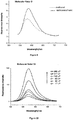
- the fluorescence emission spectra at different viscosities were shown in Figures 1 , 4 , 7 , 10 , 13 , and 16 .
- Emission wavelengths of the molecular rotors were 555 nm, 590 nm, 610 nm, 570 nm, 559 nm, and 675 nm, respectively.
- the fluorescence intensities of the molecular rotors with the same concentration increase at different viscosities, which indicates that the fluorescence intensities of the molecular rotors increase with the increase in the ambient viscosity, and that the relationship between the logarithm of fluorescence intensity and the logarithm of solvent viscosity is consistent with the Huffman equation, that is, having a very good linear relationship and having a high slope (as shown in Figures 2 , 5 , 8 , 11 , 14 , and 17 ).
- This demonstrates that the molecular rotors are sensitive to viscosity and can be used for viscosity testing of unknown samples.
- Molecular Rotors 1, 2, 3, 22, 57, 63 were added to dichloromethane and methanol respectively to prepare a solution with a final concentration of 1 ⁇ 10 -5 M. Then, the solution was excited individually by excitation wavelengths of 480 nm, 480 nm and 500 nm at 25°C to detect their fluorescence emission intensities in two different polar solvents. As shown in Fig. 3 , Fig. 6 , Fig. 9 , Fig. 12 , Fig. 15 and Fig.
- the fluorescence emission intensities of the molecular rotors in the solution are weak, and the fluorescence intensities do not change much in the strong polar and strong non-polar solvents, which indicates that the molecular rotors of the present invention are weak in background fluorescence of the fluorescence intensities, and insensitive to the polarity change.
- probe 1 The effect of probe 1 on the fluorescence monitoring of carbonic anhydrase was investigated by using Hela cells as an example.
- HeLa cells with high expression of carbonic anhydrase and Hela-WT cells (Hela archecytes) without expression of carbonic anhydrase were planted in a 14 mm glass bottom 96-well cell culture plate and stabilized for 10 hours.
- Probe 1 was added to the medium with the concentration thereof set to 5 ⁇ M. The cells were incubated for 2 hours in a carbon dioxide incubator at 37°C, and the fluorescence changes of the labeled cells were imaged and detected with a Leica TPS-8 confocal microscope.
- FIG. 19Aa show that after the addition of probe 1 to the medium, the corresponding fluorescent signal is not detected in Hela-WT cells, indicating that the probe fluorescence is not affected by the intracellular environment; however, in Fig. 19Ba , a strong fluorescent signal can be detected in the Hela cells expressing carbonic anhydrase protein, and the fluorescence signal is enhanced by nearly 300-fold in comparison with the Hela-WT cells. It is indicated that the probe of the present invention can specifically label the intracellular carbonic anhydrase protein to achieve fluorescence-specific illumination, and at the same time, the probe fluorescence is not affected by the intracellular environment.
- ethoxzolamide which is more interactive with carbonic anhydrase in comparison to probe 1
- concentration was increased to 10 ⁇ M.
- the cells were placed in a carbon dioxide incubator at 37°C again and incubated for 1 hour.
- the fluorescence changes of the labeled cells were imaged and detected with a Leica TPS-8 confocal microscope.
- the fluorescence intensity of the cells in Fig. 19Bb is only 8% of that of the cells in Fig. 19Ba , which shows that the fluorescence intensity of the cells decreases drastically, and indicates that the reason for the fluorescence illumination is that the molecular conformation is restricted after the interaction between probe 1 and carbonic anhydrase.
- the fluorescent dye of the present invention is suitable for specific binding to a corresponding antibody, aptamer or amyloid, or developing a series of fluorogenic probes for the fluorescence labeling, quantification or monitoring of proteins, enzymes or nucleic acids by means of bonding a ligand or inhibitor to a protein tag or enzyme and introducing molecular rotors into the lumen of the enzyme and the like.
Landscapes
- Chemical & Material Sciences (AREA)
- Organic Chemistry (AREA)
- Health & Medical Sciences (AREA)
- Life Sciences & Earth Sciences (AREA)
- Engineering & Computer Science (AREA)
- Immunology (AREA)
- Molecular Biology (AREA)
- General Health & Medical Sciences (AREA)
- Physics & Mathematics (AREA)
- Analytical Chemistry (AREA)
- Proteomics, Peptides & Aminoacids (AREA)
- Urology & Nephrology (AREA)
- Biomedical Technology (AREA)
- Hematology (AREA)
- Biochemistry (AREA)
- Biotechnology (AREA)
- Microbiology (AREA)
- Zoology (AREA)
- Wood Science & Technology (AREA)
- General Physics & Mathematics (AREA)
- Pathology (AREA)
- Food Science & Technology (AREA)
- Cell Biology (AREA)
- Medicinal Chemistry (AREA)
- Materials Engineering (AREA)
- General Engineering & Computer Science (AREA)
- Biophysics (AREA)
- Genetics & Genomics (AREA)
- Bioinformatics & Cheminformatics (AREA)
- Epidemiology (AREA)
- Animal Behavior & Ethology (AREA)
- Public Health (AREA)
- Veterinary Medicine (AREA)
- Chemical Kinetics & Catalysis (AREA)
- Nuclear Medicine, Radiotherapy & Molecular Imaging (AREA)
- Optics & Photonics (AREA)
- Plural Heterocyclic Compounds (AREA)
- Heterocyclic Carbon Compounds Containing A Hetero Ring Having Oxygen Or Sulfur (AREA)
- Measuring Or Testing Involving Enzymes Or Micro-Organisms (AREA)
- Peptides Or Proteins (AREA)
Abstract
Description
- The present invention relates to the technical field of fluorescent dyes, particularly a long-wavelength-emitting viscosity-responsive fluorescent dye and a preparation method and use thereof.
- Recently, a fluorescence method has been developed as an important means to test microscopic viscosity. Compared with other methods, fluorescence detection is unique in its sensitivity, in situ, real-time, visuality and the like. The method effectively utilizes the characteristic that the fluorescence intensity of some dye probes is sensitive to the viscosity of the surrounding medium, and implements effectively monitoring of the viscosity of the medium by observing changes in fluorescence intensity. Currently, such viscosity-responsive fluorescent probes are often named as molecular rotors. They distort the molecules after photoexcitation to form charge transfer states in the TICT molecule, and excited state energy is mainly emitted in the non-radiation form. When the viscosity responsive dye is in a microenvironment with higher viscosity or rigidity, molecular distortion of such viscosity responsive dyes becomes difficult, and molecular conformation is limited; at this time, the excited state energy of the dye is expressed mainly in the form of radiation, in other words, radiation is fluorescence. Therefore, the fluorescence intensity of the molecular rotor directly reflects the viscosity of the surrounding medium.
- Importantly, in addition to viscosity detection, molecular rotors are also widely used in the design of fluorogenic probes based on the restriction of molecular conformation to activate fluorescence. For example, a molecular rotor with a thiazole orange structure is a typical nuclear dyeing reagent. After the dye enters the nucleus and binds to DNA, the molecular conformation is limited (equivalent to a sharp increase in viscosity), and the fluorescence is lightened up, but the dye does not have any fluorescence in other parts of the cell, achieving a no-wash, low background nuclear dyeing effect. As another example, bound to the antibody protein, the probe achieves background-free labeling of the cell surface protein (S. G. Christopher. et. al. Nat. Biotechnol. 2008, 26, 235-240.); bound to the aptamer, the probe lightens up the labeling of the DNA (J. S. Paige et. al. Science. 2011, 333, 642-646.); in addition, if bound to amyloid, the probe lightens up the molecular rotor fluorescence to realize the research of Alzheimer's disease; additionally, by binding a ligand or an inhibitor to a protein tag or an enzyme and by introducing a molecular rotor into the lumen of the enzyme, specific fluorescence-activated tags of proteins or recognition, detection and quantification of enzymes can be achieved.
- However, viscosity-responsive molecular rotor dyes that are sensitive and responsive to long-wavelength emission such as yellow or red or even near-infrared spectrums are very scarce. Although thiazole orange and analogues thereof have been widely used, these dyes have a dominant cationic structure and are combined easily with negative charged biomacromolecules such as DNA, which may cause false positives in viscosity increase or a high background in imaging applications. In addition, there are few reported long-wavelength viscosity-responsive fluorescent probes, most of which have characteristics of non-specific responses, especially polar responses.
- Provided is a fluorescent dye with a novel structure, having the capability of long wavelength emission.
- Therefore, a fluorescent dye is provided, the structure of which is shown in formula (I),

- D- is X0O- or N(X1)(X2)-; X0, X1, and X2 are each independently selected from the group consisting of hydrogen, an alkyl group and a modified alkyl group; X1 and X2 are optionally linked to each other to form a saturated or unsaturated alicyclic heterocyclic ring;
- the ring B is selected from at least one consisting of an aromatic ring and an aromatic heterocyclic ring;
- in the structure of the following formula (I-2) formed by condensing the ring B with a thiophene ring, each hydrogen atom contained therein is optionally replaced independently with a substituent selected from the group consisting of a halogen atom, a nitro group, a hydrophilic group, an alkyl group, and a modified alkyl group, the substituents being optionally linked to each other to form a saturated or unsaturated alicyclic or alicyclic heterocyclic ring;

- R1 is selected from the group consisting of hydrogen, a halogen atom, a nitro group, an alkyl group, an aryl group, a heteroaryl group, a hydrophilic group, or a modified alkyl group;
- R2 is selected from the group consisting of cyano, carboxyl, a keto group, an ester group, an amide group, a phosphonic acid group, a phosphonate group, a sulfonic group, a sulfonate group, a sulfone group, a sulfoxide group, an aryl group, a heteroaryl group, an alkyl group, or a modified alkyl group;
- R3 is a cyano group;
- wherein, Ra and Rb are selected independently from the group consisting of hydrogen, an alkyl group, and a modified alkyl group, and Ra and Rb are optionally bonded to each other to form an alicyclic or alicyclic heterocyclic ring;
- Rc and Rd are selected independently from the group consisting of hydrogen, a halogen atom, nitro, an alkyl group, an aryl group, a hydrophilic group, and a modified alkyl group;
- Y1 is selected from the groups consisting of -O-, -S-, -(S=O)-, and -(NRi)-, wherein Ri is selected from the group consisting of hydrogen, an alkyl group, and a modified alkyl group;
- Y2 is selected from the group consisting of =O, =S, =S=O, and =NRi, wherein Ri is selected from the group consisting of hydrogen, an alkyl group, and a modified alkyl group;
- Y3 is selected from the group consisting of =O, =S, =S=O, and =NRi, wherein Ri is selected from the groups consisting of hydrogen, an alkyl group, and a modified alkyl group, or
- Y3 is =C(Re)(CN);
- Re is selected from the group consisting of cyano, carboxyl, a keto group, an ester group, an amide group, a phosphonic acid group, a phosphonate group, a sulfonic group, a sulfonate group, a sulfone group, a sulfoxide group, an aryl group, a heteroaryl group, an alkyl group, or a modified alkyl group;
- when R2 or Re is an aryl group or a heteroaryl group, the hydrogen atom on the ring is optionally replaced independently with a substituent selected from the group consisting of a halogen atom, nitro, a hydrophilic group, an alkyl group or a modified alkyl group; optionally, the substituents being linked to each other to form a saturated or unsaturated alicyclic or alicyclic heterocyclic ring;
wherein, - the alkyl group is a saturated aliphatic linear or branched alkyl group having 1 to 10 carbon atoms;
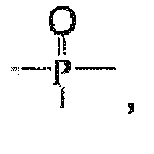
- the modified alkyl group is a group obtained by replacing any carbon atom of the alkyl group with at least one group selected from the group consisting of a halogen atom, -O-, - OH, -CO-, -NO2, -CN, -S-, -SO2-, -(S=O)-,
- the alicyclic ring is a four to ten-membered monocyclic or polycyclic alicyclic ring;
- the alicyclic heteroalicyclic ring is a four to ten-membered monocyclic or polycyclic alicyclic heteroalicyclic ring with at least one heteroatom selected from the group consisting of N, O, S and Si on the ring; when the alicyclic heteroalicyclic ring contains an S atom, it is optionally -SO- or -SO2-; the alicyclic heterocyclic ring is optionally substituted with a halogen atom, nitro, an alkyl group, an aryl group, a hydrophilic group, and a modified alkyl group;
- the aryl group or the aromatic ring is a five to ten-membered monocyclic or condensed bicyclic ring;
- the heteroaryl or the aromatic heterocyclic ring is a five to ten-membered monocyclic or condensed bicyclic ring with at least one heteroatom selected from the group consisting of N, O, S and Si on the ring;
- the halogen atoms are each independently selected from the group consisting of F, Cl, Br, and I;
- the hydrophilic group is hydroxyl, a sulfonic group, a sulphuric acid group, a phosphonic acid group, a primary amino group, a secondary amino group or a tertiary amino group and substituendum thereof;
- the monocyclic cyclohydrocarbylene group is a four to seven-membered monocyclic cyclohydrocarbylene group;
- the bicyclic cyclohydrocarbylene group is a five to seven-membered bicyclic cyclohydrocarbylene group;
- the bridged alicyclic heterocyclic ring is a five to twenty-membered bridged alicyclic heterocyclic ring having at least one heteroatom selected from the group consisting of N, O, and S on the ring.
- Optionally, in the above-mentioned fluorescent dye, the modified alkyl group is a group containing at least one group selected from -OH, -O-, ethylene glycol units, monosaccharide units, disaccharide units, polysaccharide units, -O-CO-, -NH-CO-, -SO2-O-, -SO-, -SO2-NH-, -SS-, -CH=CH-, -C≡C-, a halogen atom, cyano, nitro, a phosphate group and a phosphonate group.
- Optionally, in the above-mentioned fluorescent dye, the alicyclic heterocyclic ring is selected from the group consisting of azetidine, pyrrolidine, piperidine, tetrahydrofuran, tetrahydropyran, morpholine, and thiomorpholine ring.
- Optionally, in the above-mentioned fluorescent dye, the heteroaryl ring is selected from the group consisting of thiophene, furan, and pyrrole ring.
- Optionally, in the above-mentioned fluorescent dye, the X1 and X2 are independently a C1-50 linear or branched alkyl group optionally substituted by one or more groups selected from the group consisting of hydroxyl, cyano, a halogen atom, carboxyl, and a quaternary ammonium group; or a C2-50 ether chain group having 1 to 10 oxygen atoms and optionally substituted by one or more groups selected from the group consisting of a sulfonic acid group or carboxyl; or N(X1)(X2)- forms any group selected from the the group consisting of the following formulae (1-1-1) to (I-1-4):

- Alternatively, in the foregoing fluorescent dye, the two adjacent substituents in the structure of the formula (I-2) are bonded to each other to form a saturated or unsaturated alicyclic or alicyclic heterocyclic ring;
optionally, H of CH in the ring B is substituted with a halogen atom, nitro, a hydrophilic group, an alkyl group or a modified alkyl group;
optionally, the ring B contains NH; optionally, H of the NH is substituted with an alkyl group or a modified alkyl group;
optionally, the structure of the formula (I-2) is selected from the structures of the following formulae (I-2-1) to (I-2-17):


- Alternatively, in the aforesaid fluorescent dye, Ra and Rb of the formula (I-3-a) form the following structure together with the carbon atom bonded:
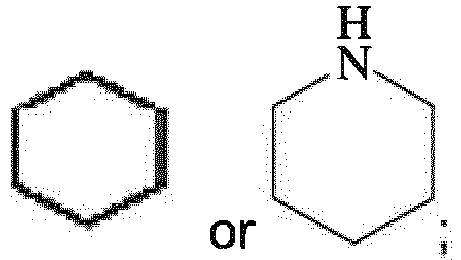


or, R2 and Re are independently modified alkyl groups comprising: a keto group, an ester group or an amide group, and being linked to the alkenyl carbon of formula (I-3) or (I-3-a) via the carbonyl group in the keto group, the ester group or the amide group;
optionally, the structure of the formula (I-3) is one of the following formulae (I-3-1) to (I-3-18):


- Alternatively, the above-mentioned fluorescent dye is characterized in that the fluorescent dye is selected from the group consisting of the compounds of the following formulae:


- In another aspect, further provided is a process for preparing the aforesaid fluorescent dye, comprising the step of conducting an aldol condensation reaction of a compound of the formula (II) with a compound of the formula (III).

- In another aspect, further provided is use of the above fluorescent dye in viscosity testing, fluorescent labeling of a protein, fluorescent labeling of a nucleic acid, quantification or detection of a protein, or quantification or detection of a nucleic acid.
- In another aspect, further provided is a fluorogenic probe, comprising a fluorescent dye.
- In another aspect, further provided is use of the above fluorogenic probe in fluorescent labeling of a protein, fluorescent labeling of a nucleic acid, quantification or detection of a protein, or quantification or detection of a nucleic acid.
- According to one aspect of the embodiment, the fluorescent dye has a long wavelength emission (> 500 nm). According to another aspect of the embodiment, the fluorescence intensity of the resulting fluorescent dye increases with increasing of environmental viscosity, the logarithm of fluorescence intensity and the logarithm of solvent viscosity have a good linear relationship. The relationship between fluorescence intensity and viscosity is in accordance with the Huffman equation and has a high slope, which indicates that the fluorescent dye is sensitive to viscosity and has a high activation multiple. According to yet another aspect of the embodiment, the fluorescent dye has good specificity to viscosity response and is insensitive to polarity changes.
- According to one aspect of the embodiment, a fluorescent dye can be used to determine the viscosity of the sample, such as suitable for a test of microscopic viscosity. According to another aspect of the embodiment, the obtained fluorescent dye can specifically bind to a corresponding antibody, aptamer or amyloid and so on, or bond to a protein tag or enzyme via a ligand or inhibitor to obtain a series of fluorogenic probes for use in fluorescent labeling, quantification or monitoring of proteins, enzymes or nucleic acids.
-
-
Figure 1 is a diagram for the fluorescence emission intensity of molecular rotor 1 (1 × 10⁻⁵ M) at different viscosities; -
Figure 2 is a diagram for a linear relationship between the viscosity condition and the fluorescence intensity of the molecular rotor 1 (1 × 10⁻⁵ M); -
Figure 3 is a diagram for the fluorescence emission intensity of molecular rotor 1 (1 × 10⁻⁵ M) in methanol and dichloromethane; -
Figure 4 is a diagram for the fluorescence emission intensity of molecular rotor 2(1 × 10⁻⁵ M) at different viscosities; -
Figure 5 a diagram for a linear relationship between the viscosity condition and the fluorescence intensity of the molecular rotor 2(1 × 10⁻⁵ M); -
Figure 6 is a diagram for the fluorescence emission intensity of molecular rotor 2(1 × 10⁻⁵ M) in methanol and dichloromethane; -
Figure 7 a diagram for the fluorescence emission intensity of molecular rotor 3(1 × 10⁻⁵ M) at different viscosities; -
Figure 8 a diagram for a linear relationship between the viscosity condition and the fluorescence intensity of the molecular rotor 3(1 × 10⁻⁵ M); -
Figure 9 is a diagram for the fluorescence emission intensity of molecular rotor 3(1 × 10⁻⁵ M) in methanol and dichloromethane; -
Figure 10 a diagram for the fluorescence emission intensity of molecular rotor 22 (1 × 10⁻⁵ M) at different viscosities; -
Figure 11 a diagram for a linear relationship between the viscosity condition and the fluorescence intensity of the molecular rotor 22 (1 × 10⁻⁵ M); -
Figure 12 is a diagram for the fluorescence emission intensity of molecular rotor 22 (1 × 10⁻⁵ M) in methanol and dichloromethane; -
Figure 13 a diagram for the fluorescence emission intensity of molecular rotor 57 (1 × 10⁻⁵ M) at different viscosities; -
Figure 14 a diagram for a linear relationship between the viscosity condition and the fluorescence intensity of the molecular rotor 57 (1 × 10⁻⁵ M); -
Figure 15 is a diagram for the fluorescence emission intensity of molecular rotor 57 (1 × 10⁻⁵ M) in methanol and dichloromethane; -
Figure 16 a diagram for the fluorescence emission intensity of molecular rotor 63 (1 × 10⁻⁵ M) at different viscosities; -
Figure 17 a diagram for a linear relationship between the viscosity condition and the fluorescence intensity of the molecular rotor 63 (1 × 10⁻⁵ M); -
Figure 18 is a diagram for the fluorescence emission intensity of molecular rotor 63 (1 × 10⁻⁵ M) in methanol and dichloromethane; -
Figure 19 shows fluorescence imaging pictures ofprobe 1 for intracellular carbonic anhydrase detection, wherein A is an unexpressed carbonic anhydrase cell and B is an expressed carbonic anhydrase cell. - The embodiments of the present invention are described in detail below. These embodiments are implemented on the premise of the technical solution of the present invention. Detailed embodiments and specific operation processes are provided, but the scope of protection of the present invention is not limited to the embodiments described below.
- The term "molecular rotor" described in the following examples is an abbreviation for the long-wavelength-emitting viscosity-responsive fluorescent dye of the present invention.
-

- Compound 1 (0.438 g, 2 mmol) was dissolved in 15 mL of a solution of dimethylamine in toluene, to which copper powder (6.4 mg, 0.01 mmol), cuprous iodide (19 mg, 0.01 mmol) and tripotassium phosphate (0.850 g, 4 mmol) were added, and then the mixture was heated overnight in an oil bath at 80°C under Ar atmosphere. Upon completion of the reaction, the resultant was cooled at room temperature. The system was poured into 50 mL of water, wherein 3 × 50 mL was extracted with dichloromethane, and the organic phases were combined and dried by rotary evaporation to give a crude product for direct use in the next step without purification.
- The residue was dissolved in 15 mL of dimethylformamide. Phosphorus oxychloride (0.94 ml, 10 mmol) was slowly added under the condition of an ice bath, and then the ice bath was removed. The system was slowly returned to room temperature. After the reaction was completed, 5 ml of water was carefully added to quench this reaction, and then the system was poured into 50 mL of water, wherein 3x50 mL was extracted with dichloromethane, and the organic phases were combined and dried by rotary evaporation, followed by column chromatography to obtain a pale brown pure compound (0.317 g, 75%). 1H-NMR(400 MHz, DMSO-d6): δ=9.78 (s, 1H), 8.21 (s, 1H), 8.05 (s, 1H), 3.15 (s, 6H).
- Compound 2 (0.211 g, 1.0 mmol) and tert-butyl cyanoacetate (0.169 g, 1.2 mmol) were dissolved in 20 mL of absolute ethanol, to which anhydrous piperidine was added in a catalytic amount, and the mixture was heated in an oil bath for 2 h under Ar atmosphere. After completion of the reaction, the resultant was cooled at room temperature, and a part of the solvent was removed by rotary evaporation. A large amount of solid was precipitated from the system, and the system was filtered. The filter cake was washed twice with cold ethanol and dried in vacuo to give a red pure compound (0.310 g, 85%). 1H-NMR (400 MHz, DMSO-d6): δ=8.22 (s, 1H), 8.02 (s, 1H), 6.43 (s, 1H), 3.15 (s, 6H), 1.48 (s, 9H).
-

- It was synthesized according to the synthesis of
Compound 2, with a yield of 75%. 1H-NMR(400 MHz, CDCl3): δ=9.78 (s, 1H), 8.21 (s, 1H), 8.05 (s, 1H), 3.32 (t, 4H, J =8.20 Hz), 1.64 (m, 32H), 0.93 (t, 6H, J =8.00 Hz). - Compound 3 (0.463 g, 1.0 mmol) and 2-benzoxazole acetonitrile (0.189 g, 1.2 mmol) were dissolved in 35 mL of absolute ethanol, to which anhydrous piperidine was added in a catalytic amount, and the mixture was heated in an oil bath for 2 h under Ar atmosphere. After completion of the reaction, the resultant was cooled at room temperature, and a part of the solvent was removed by rotary evaporation. A large amount of solid was precipitated from the system, and the system was filtered. The filter cake was washed twice with cold ethanol and dried in vacuo to give a red pure compound (0.495 g, 82%). 1H-NMR(400 MHz, DMSO-d6): δ=8.49 (s, 1H), 8.07 (s, 1H), 7.68-7.71 (m, 2H), 7.35-7.38 (m, 2H), 6.46 (s, 1H), 3.32 (t, 6H, J = 8.20 Hz), 1.66 (m, 32H), 0.99 (t, 6H, J = 8.00 Hz).
-

- Compound 4 was synthesized according to the synthesis of
Compound 2, with a yield of 75%. 1H-NMR (400 MHz, DMSO-d6): δ=9.78 (s, 1H), 8.21 (s, 1H), 8.05 (s, 1H), 3.59 (t, 2H, J = 5.60 Hz), 3.48 (t, 2H, J = 5.60 Hz), 3.15 (s, 3H). - Compound 4 (0.241 g, 1.0 mmol) and 2-benzothiazole acetonitrile (0.209 g, 1.2 mmol) were dissolved in 35 mL absolute ethanol, to which anhydrous piperidine was added in a catalytic amount, and the mixture was heated in an oil bath for 2 h under Ar atmosphere. After completion of the reaction, the resultant was cooled at room temperature, and a part of the solvent was removed by rotary evaporation. A large amount of solid was precipitated from the system, and the system was filtered. The filter cake was washed twice with cold ethanol and dried in vacuo to produce a red pure compound (0.318 g, 87%). 1H-NMR (400 MHz, DMSO-d6): δ=8.45 (s, 1H), 8.09 (d, 1H, J =8.00 Hz), 8.07 (s, 1H), 7.94 (d, 1H, J = 8.00 Hz), 7.51 (m, 1H), 7.41 (m, 1H), 6.45 (s, 1H), 4.92 (t, 1H, J = 5.60 Hz), 3.67(t, 2H, J = 5.60 Hz), 3.49 (t, 2H, J = 5.60 Hz), 3.13 (s, 3H).
-

- Compound 4 (0.482 g, 2.0 mmol) was dissolved in a 50 ml round bottom flask by adding 25 ml of anhydrous DMF, and 60% NaH (0.12 g, 2.5 mmol) was added at 0°C under Ar atmosphere, followed by stirring for 30 min, and 0.5 ml of propane sultone was then added. The system gradually returned to room temperature. After the reaction was completed, 2 ml of water was added to quench the reaction. To the resultant 100 ml of water was added, and the resultant was extracted thrice with isopropyl alcohol:dichloromethane of 1:1, and the organic phases were combined. The system was dried over Na2SO4, filtered to remove Na2SO4, and subjected to rotary evaporation. The residue was separated by reversed-phase column to get a pale yellow solid (0.62 g, 85%). 1H-NMR (400 MHz, DMSO-d6): δ=9.78 (s, 1H), 8.21 (s, 1H), 8.05 (s, 1H), 3.68 (m, 4H), 3.55 (m, 2H), 3.35 (m, 2H), 3.11 (s, 3H), 2.42 (m, 2H).
- Compound 5 (0.363 g, 1.0 mmol) and malononitrile (0.079 g, 1.2 mmol) were dissolved in 20 mL of absolute ethanol, to which anhydrous piperidine was added in a catalytic amount, and the mixture was heated in an oil bath for 2 h under Ar atmosphere. After completion of the reaction, the resultant was cooled at room temperature, and a part of the solvent was removed by rotary evaporation. A large amount of solid was precipitated from the system, and the system was filtered. The filter cake was washed twice with cold ethanol and dried in vacuo to produce a red pure compound (0.310 g, 85%). 1H-NMR (400 MHz, CDCl3): 8.21 (s, 1H), 8.05 (s, 1H), 3.68 (m, 4H), 3.55 (m, 2H), 3.35 (m, 2H), 3.11 (s, 3H), 2.42 (m, 2H).
-

- It was synthesized according to the synthesis of
Compound 2, with a yield of 58%. 1H-NMR(400 MHz, CDCl3): δ=9.81 (s, 1H), 8.21 (s, 1H), 8.05 (s, 1H), 3.18 (s, 3H). - Compound 6 (0.200 g, 1.0 mmol) and cyanoacetic acid (0.101 g, 1.2 mmol) were dissolved in 20 mL of absolute ethanol, to which anhydrous piperidine was added in a catalytic amount, and the mixture was heated in an oil bath for 2 h under Ar atmosphere. After completion of the reaction, the resultant was cooled at room temperature, and a part of the solvent was removed by rotary evaporation. A large amount of solid was precipitated from the system, and the system was filtered. The filter cake was washed twice with cold ethanol and dried in vacuo to produce a red pure compound (0.24 g, 91%). 1H-NMR(400 MHz, DMSO-d6): δ=11.22 (s, 1H), δ=8.22 (s, 1H), 8.02 (s, 1H), 6.43 (s, 1H), 3.16 (s, 3H).
-

- Compound 6 (1.0 g, 5 mmol) was dissolved in 100 mL of acetonitrile, to which potassium carbonate (1.4 g, 10 mmol) was added. under Ar atmosphere, Compound 7 (2.47 g, 6 mol) was refluxed overnight in an oil bath. After the reaction was completed, the resultant was cooled at room temperature and filtered, and the solvent is subjected to rotary evaporation. The residue was dissolved in methylene chloride, washed three times with water, dried over anhydrous sodium sulfate, filtered to remove Na2SO4, subjected to column chromatography after rotary evaporation to generate a pale brown pure compound (1.29 g, 59%). 1H-NMR (400 MHz, CDCl3): δ=9.78 (s, 1H), 8.21 (s, 1H), 8.05 (s, 1H), 3.52-3.65 (m, 20 H), 3.37 (s, 3H), 2.97 (s, 3H).
- Compound 8 (0.43 g, 1 mmol) was dissolved in 50 ml of absolute ethanol, to which Compound 9 (Ref. Method disclosed in the document: LX Wu, K. Burgess, J. Am. Chem. Soc. 2008, 130, 4089-4096) (0.11 g, 1.2 mmol), and 2 drops of piperidine were added, and the mixture was refluxed in an oil bath under Ar atmosphere. After completion of the reaction, the resultant was cooled at room temperature, and subjected to column chromatography after rotary evaporation to obtain a pale brown pure compound (0.436 g, 83%). 1H-NMR(400 MHz, CDCl3): δ=8.22 (s, 1H), 8.02 (s, 1H), 6.43 (s, 1H), 3.52-3.65 (m, 20 H), 3.37 (s, 3H), 2.97 (s, 3H).
-

- Compound 6 (1.0 g, 5 mmol) was dissolved in 100 mL of hexafluoroisopropanol, acrylonitrile (0.53 g, 10 mmol) was added, and the mixture was stirred at room temperature under Ar atmosphere. The reaction was completed, and the resultant was then chromatographed after rotary evaporation to obtain a bronzing solid (1.15 g, 92%). 1H-NMR (400 MHz, CDCl3): δ=9.95 (s, 1 H), 8.22 (s, 1H), 8.02 (s, 1H), 3.72(t, J=6.9 Hz, 2 H), 3.03(s, 3 H), 2.57(t, J=6.9 Hz, 2 H).
- Compound 10 (0.25 g, 1 mmol) was dissolved in 25 ml of absolute ethanol, to which compound 11 (see the method disclosed in
WO 2004020412 (A1 ),2004.03.11 -

-
Compound 12 was synthesized according to the synthesis ofCompound 2, with a yield of 51%. 1H-NMR(400 MHz, CDCl3):δ=9.95 (s, 1 H), 8.22 (s, 1H), 8.02 (s, 1H), 3.12-3.09(t, J=7.5 Hz, 2 H), 1059-1.65(m, 14 H), 0.89(t, J=7.5 Hz, 3 H). - The synthesis was carried out according to the method disclosed by the literature L. X. Wu et. al. J. Am. Chem. Soc. 2008, 130, 4089-4096. 1H-NMR(400 MHz, CDCI): δ=7.63-7.48(m, 5 H), 4.27(s, 2H), 3.13(s, 3 H).
-
Molecular Rotor 8 was synthesized according to the synthesis ofMolecular Rotor 6, with a yield of 88%. 1H-NMR (400 MHz, CDCl3): δ=8.25 (s, 1H), 8.09 (s, 1H), 7.63-7.48 (m, 5 H), 6.43 (s, 1H), 3.19 (s, 3 H)3.12-3.09 (t, J=7.5 Hz, 2 H), 1059-1.65 (m, 14 H), 0.89 (t, J=7.5 Hz, 3 H). -

-
Compound 14 was synthesized according to the synthesis ofCompound 8, with a yield of 56%. 1H-NMR (400 MHz, CDCl3): δ=9.95 (s, 1 H), 8.22 (s, 1H), 8.02 (s, 1H), 3.52-3.65 (m, 20 H), 3.37 (s, 3 H), 3.12-3.09 (t, J=7.5 Hz, 2 H), 1.59-1.65 (m, 14 H), 0.89 (t, J=7.5 Hz, 3 H). - Compound 15 was synthesized according to the synthesis of
Molecular Rotor 6, with a yield of 89%. 1H-NMR (400 MHz, CDCl3): δ=8.22 (s, 1H), 8.02 (s, 1H), 6.8 (s, 1H), 3.52-3.65 (m, 20 H), 3.37 (s, 3 H), 3.12-3.09 (t, J=7.5 Hz, 2 H), 3.01 (s, 3 H), 2.15 (s, 3 H), 1.59-1.65 (m, 14 H), 0.89 (t, J=7.5 Hz, 3 H). - Compound 15 (0.652 g, 1 mmol) was dissolved in 150 ml of anhydrous toluene, to which benzaldehyde (0.212 g, 2 mmol) and a catalytic amount of ZnCl2 were added, and the mixture was refluxed in an oil bath for 24 h under Ar atmosphere, and then cooled at room temperature. The system was poured into 300 ml of brine and extracted with EtOAc trice, and the organic phases were combined, and dried over anhydrous sodium sulfate. The system was filtered to remove Na2SO4, and subjected to column chromatography after rotary evaporation to obtain an atropurpureus solid (0.259 g, 39%). 1H-NMR(400 MHz, CDCl3): δ=8.22 (s, 1H), 8.02 (s, 1H), 7.64(d, J=8.10 Hz, 1 H), 7.21(d, J=8.10 Hz, 1 H), 7.19-7.11(m, 5 H), 6.8 (s, 1H), 3.52-3.65 (m, 20 H), 3.37(s, 3 H), 3.12-3.09(t, J=7.5 Hz, 2 H), 3.01(s, 3 H), 2.15(s, 3 H), 1.59-1.65(m, 14 H), 0.89(t, J=7.5 Hz, 3 H).
-

- Thieno[3,2-b]thiophene (1.40 g, 10 mmol) was dissolved in 120 ml of anhydrous tetrahydrofuran, and the mixture was cooled to -30°C, in which 1.6 M n-butyllithium (7.5 ml, 12 mmol) was slowly added dropwise under Ar atmosphere. After the mixture was stirred for 30 min, 5 ml of trimethyl borate was slowly added. The system was slowly warmed to room temperature and stirred overnight. The resultant was quenched by water the next day. The system was poured into 100 ml of saturated brine to separate organic phases. The organic phases were extracted twice with dichloromethane, and then combined. The organic phases were dried over anhydrous sodium sulfate, and Na2SO4 was removed by filtration. The organic phases were subjected to column chromatography after rotary evaporation to produce a while powder solid (1.72 g, 81%). 1H-NMR(400 MHz, CDCl3): δ=7.92(s, 1 H), 7.63(d, J=5.1 Hz), 7.31(d, J=5.3 Hz, 1 H), 3.51(s, 6 H).
- Compound 16 (2.12 g, 10 mmol) was dissolved in 50 ml of anhydrous tetrahydrofuran, and the mixture was cooled at -78°C, in which 1.6 M n-butyllithium (7.5 ml, 12 mmol) was slowly added dropwise under Ar atmosphere. The mixture was stirred for 2 h, and Compound 18 was added (refer to the method disclosed in the literature: FH Wang et. al. Organmetallics, 2015, 34, 86-93) (3.14 g, 20 mmol). The mixture was stirred at -78°C for 30 min, then slowly warmed to room temperature, and stirred overnight, followed by acidifying the system until it reached pH3.5 with dilute hydrochloric acid. The system was poured into 200 ml of saturated brine to separate organic phases. The organic phases were extracted with ethyl acetate, and then combined. The organic phases were dried over anhydrous sodium sulfate, and Na2SO4 was removed by filtration. The organic phases were subjected to column chromatography after rotary evaporation to yield a pale yellow solid (1.48 g, 61%). 1H-NMR(400 MHz, CDCl3): δ=7.92(s, 1 H), 7.63(d, J=5.1 Hz), 7.31(d, J=5.3 Hz, 1 H), 3.51(s, 6 H), 1.31(s, 6 H).
- Compound 18 (1.21 g, 5 mmol) was dissolved in anhydrous methanol, to which sodium methoxide (1.35 g, 25 mmol) and malononitrile (1.65 g, 25 ml) were added, the mixture was heated in an oil bath at 60°C for 5 h. Upon completion of the reaction, the system was cooled at room temperature, quenched with water, poured into 150 ml of water, and acidified with dilute hydrochloric acid to pH2.0. The system was extracted with dichloromethane. The organic phases were combined, dried over anhydrous sodium sulfate, and Na2SO4 was removed by filtration. The organic phases were subjected to column chromatography after rotary evaporation to produce a pale yellow solid (0.45 g, 31%). 1H-NMR(400 MHz, CDCl3): δ=7.92(s, 1 H), 7.63(d, J=5.1 Hz), 7.31(d, J=5.3 Hz, 1 H), 3.51(s, 6 H), 1.34(s, 6 H).
- Synthesis of 6-(2-cyano-2-tert-butyl formate vinyl)-2-dimethylamino-thieno[3,2-B:2',3'-D]thiophene (Molecular Rotor 11):
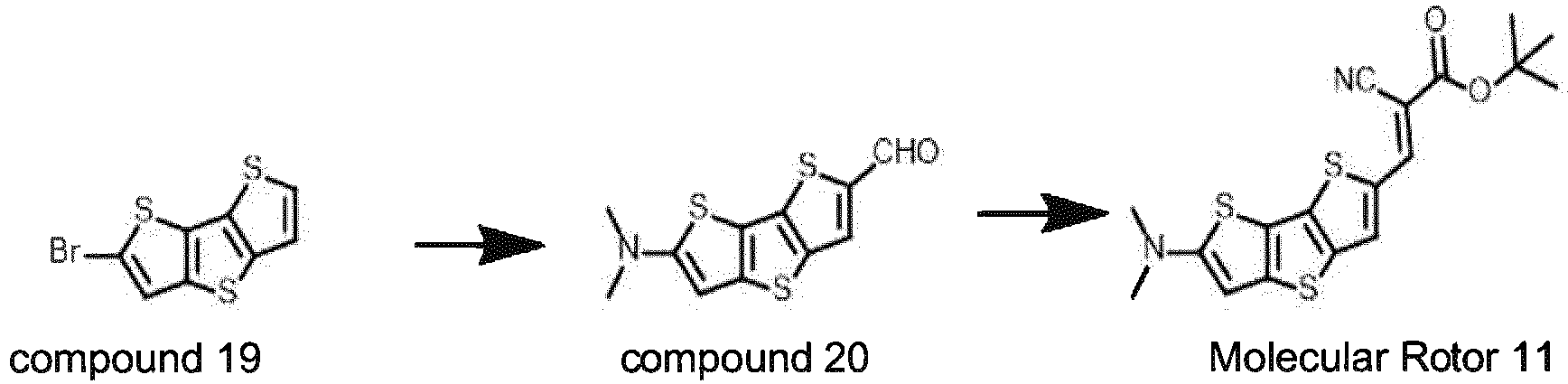
- The synthesis was carried out by the method disclosed in
WO2009152165(A2), 2009.12.17 . 1H-NMR(400 MHz, DMSO-d6): δ=7.84 (s, 1H), 7.37 (s, 1H), 7.24 (s, 1H), 3.15 (s, 6H). - It was synthesized according to the synthesis of
Compound 2, with a yield of 51%. 1H-NMR(400 MHz, DMSO-d6): δ=10.04 (s, 1H), 7.84 (s, 1H), 7.24 (s, 1H), 3.15 (s, 6H). - With reference to the synthesis of
Molecular Rotor 1, the yield was 85%. 1H-NMR(400 MHz, DMSO-d6): δ=8.45 (s, 1H), 7.85 (s, 1H), 6.45 (s, 1H), 3.15 (s, 6H), 1.48 (s, 9H). -

- Compound 21 was synthesized according to the synthesis of
Compound 2, with a yield of 67%. 1H-NMR(400 MHz, DMSO-d6): δ=10.0 (s, 1H), 7.84 (s, 1H), 7.24 (s, 1H), 3.82 (t, 2H, J=7.8 Hz), (t, 2H, J=7.8 Hz), 3.15 (s, 6 H). - Compound 21 (0.648 g, 2.0 mmol) was placed in a 100 ml round bottom flask, in which 60 ml of anhydrous acetone solvent and then 1 ml of methyl iodide were added, and the mixture was stirred at room temperature under Ar atmosphere. After completion of the reaction, the supernatant was decanted. The precipitate was purified by reverse chromatography to give a solid (0.75 g, 80%). 1H-NMR(400 MHz, DMSO-d6): δ=10.1 (s, 1H), 7.84 (s, 1H), 7.24 (s, 1H), 4.03 (t, 2H, J=7.8 Hz), (t, 2H, J=7.8 Hz), 3.29 (s, 6 H), 3.19 (s, 5 H), 2.52(m, 2 H).
- With reference to the synthesis of
Molecular Rotor 2, the yield was 81%. 1H-NMR(400 MHz, DMSO-de): δ=8.49 (s, 1H), 7.85 (s, 1H), 7.68-7.71 (m, 2H), 7.35-7.38 (m, 2H), 6.46 (s, 1H), 7.84 (s, 1H), 7.24 (s, 1H), 4.03 (t, 2H, J=7.8 Hz), (t, 2H, J=7.8 Hz), 3.29 (s, 6 H), 3.19 (s, 5H), 2.41(m, 2 H). -

- Compound 23 was synthesized according to the synthesis of
Compound 2, with a yield of 41%. 1H-NMR(400 MHz, DMSO-d6): δ=10.04 (s, 1H), 7.84 (s, 1H), 7.24 (s, 1H), 4.12 (s, 2H), 3.15 (s, 3H). - It was synthesized according to the synthesis of
Molecular Rotor 3, with a yield of 78%. 1H-NMR(400 MHz, DMSO-d6): δ=8.09 (d, 1H, J =8.00 Hz), 7.94 (d, 1H, J =8.00 Hz), 7.84 (s, 1H), 7.57 (s, 1H), 7.51 (m, 1H), 7.41 (m, 1H), 6.45 (s, 1H), 4.92 (t, 1H, J =5.60 Hz), 4.12 (s, 2H), 3.15 (s, 3H). -

- Synthesis of 6-[2-cyano-2-(1,3-benzothiazol-2-yl)-vinyl]-2-dimethylamino-thieno[3,2-B:2',3'-D]thiophene:
It was synthesized according to the synthesis of Molecular Rotor 4, with a yield of 87%. 1H-NMR(400 MHz, DMSO-d6): δ=7.84 (s, 1H), 7.24 (s, 1H), 6.45 (s, 1H), 3.15 (s, 6H). -

- Please refer to the method for the synthesis of Compound 2: 1H-NMR(400 MHz, DMSO-d6): δ=9.97 (s, 1H), 7.85 (s, 1H), 7.24 (s, 1H), 3.41 (t, J=5.5 Hz, 4 H), 2.12(t, J=5.5 Hz, 4 H).
- Molecular Rotor 15 was synthesized according to the synthesis of Molecular Rotor 7, with a yield of 91%. 1H-NMR(400 MHz, DMSO-d6): δ=7.85 (s, 1H), 7.24 (s, 1H), 6.94(s, 1 H), 6.50(s, 1 H), 3.48-3.52(m, 4 H), 3.41 (t, J=5.5 Hz, 4 H), 3.38(s, 3H), 2.12(t, J=5.5 Hz, 4 H).
-

- Please refer to the synthesis method disclosed by the literature: H. Wang et. al. Tetrahedron Letters. 2007, 48, 3471-3474. 1H-NMR(400 MHz, DMSO-d6): δ=4.56-4.14 (m, 4H), 3.91-3.37 (m, 8H), 3.19 (s, 3H).
- Please refer to the synthesis method of Compound 2: 1H-NMR(400 MHz, DMSO-d6): δ=7.84 (s, 1H), 7.24 (s, 1H), 6.42 (s, 1H), 6.02 (d, 1H), 4.56-4.14 (m, 4H), 3.91-3.37 (m, 8H), 3.19 (s, 3H).
- Please refer to the synthesis method of Molecular Rotor 5: 1H-NMR(400 MHz, DMSO-d6): δ=11.01 (s, 1H), δ=7.84 (s, 1H), 7.24 (s, 1H), 6.42 (s, 1H), 6.02 (d, 1H), 4.56-4.14 (m, 4H), 3.91-3.37 (m, 8H), 3.19 (s, 3H).
-

- Please refer to the synthesis method of Compound 2: 1H-NMR(400 MHz, DMSO-de): δ=7.84 (s, 1H), 7.24 (s, 1H), 6.42 (s, 1H), 4.14 (s, 4H).
- Please refer to the synthesis method of Molecular Rotor 1: 1H-NMR(400 MHz, CDCl3): δ=7.84 (s, 1H), 7.24 (s, 1H), 6.42 (s, 1H), 4.14 (s, 4H), 4.01 (s, 3H).
-

- Please refer to the synthesis method of Compound 2: 1H-NMR(400 MHz, CDCl3): δ=9.95(s, 1 H), 7.84 (s, 1H), 7.24 (s, 1H), 3.52-3.65(m, 60 H), 3.37(s, 3H).
- Molecular Rotor 18 was synthesized according to the synthesis of
Molecular Rotor 6, with a yield of 90%, 1H-NMR(400 MHz, CDCl3): δ=7.84 (s, 1H), 7.24 (s, 1H), 6.98(s, 1 H), 3.52-3.65(m, 60 H), 3.37(s, 3H), 3.0(s, 3 H), 2.15(s, 3 H). -

- Compound 29 was synthesized according to the synthesis of
Compound 2, with a yield of 54%. 1H-NMR(400 MHz, CDCl3): δ=9.95(s, 1 H), 7.84 (s, 1H), 7.24 (s, 1H), 3.59 (t, 4 H, J =5.60 Hz), 3.48 (t, 4 H, J =5.60 Hz). - Molecular Rotor 19 was synthesized according to the synthesis of
Molecular Rotor 8, with a yield of 89%. 1H-NMR(400 MHz, CDCl3): δ=7.84 (s, 1H), 7.63-7.58(m, 5 H), 7.24 (s, 1H), 3.59 (t, 4 H, J =5.60 Hz), 3.48 (t, 4 H, J =5.60 Hz), 3.13(s, 3 H). -
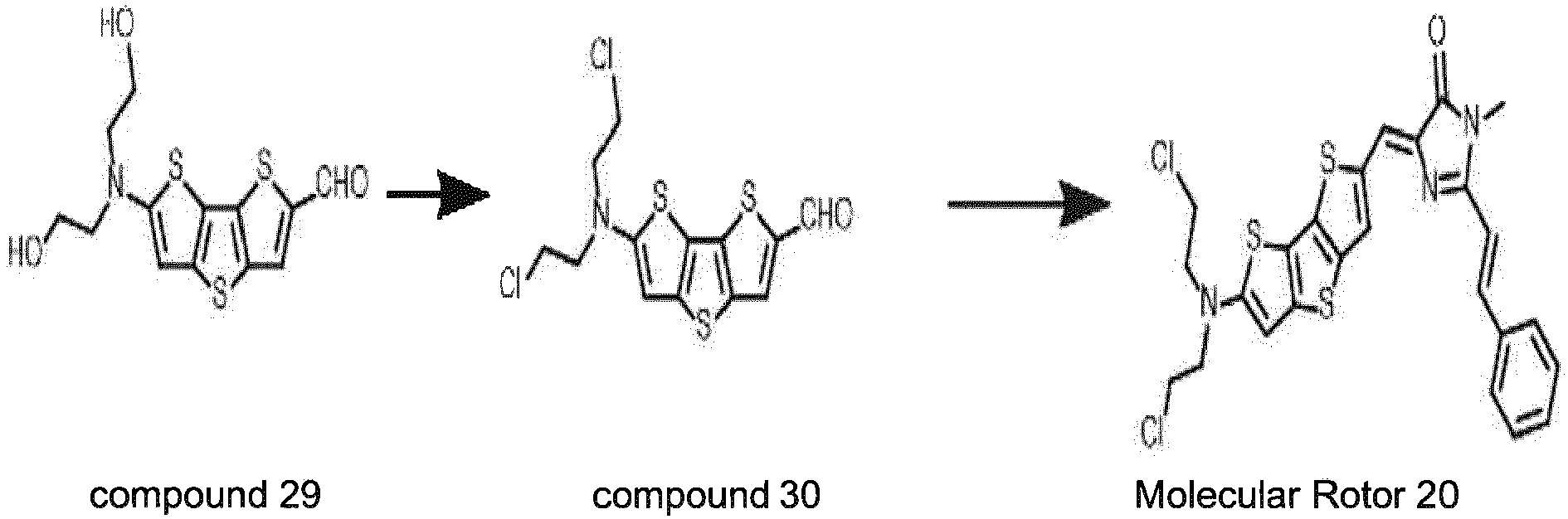
- Compound 29 (0.327 g, 1 mmol) was dissolved in 25 mL anhydrous dichloromethane. After the system was cooled at 0°C, a solution of thionyl chloride (0.22 ml, 3 mmol) in 5 ml of anhydrous dichloromethane was slowly added dropwise under Ar atmosphere, and then the system was slowly warmed at room temperature, stirred for 2 h, and subjected to rotary evaporation to remove the solvent. The residue was dissolved in dichloromethane, and washed trice with saturated brine. The organic phases were dried over anhydrous sodium sulfate, filtered to remove Na2SO4, and subjected to column chromatography after rotary evaporation to obtain an atropurpureus solid (0.298 g, 82%). 1H-NMR(400 MHz, CDCl3): δ=9.95(s, 1 H), 7.84 (s, 1H), 7.24 (s, 1H), 3.69 (t, 4 H, J =5.60 Hz), 3.28 (t, 4 H, J =5.60 Hz).
- Molecular Rotor 20 was synthesized according to the synthesis of Molecular Rotor 9, with a yield of 41%. 1H-NMR(400 MHz, CDCl3): δ=8.0 (d, J=16.0 Hz, 1 H), 7.91 (d, J=8.5 Hz, 2 H), 7.84 (s, 1H), 7.38-7.45(m, 3 H), 7.24 (s, 1H), 7.15 (d, J=16.0 Hz, 1 H), 6.98 (s, 1 H), 3.69 (t, 4 H, J =5.60 Hz), 3.28 (t, 4 H, J =5.60 Hz), 3.13 (s, 3 H).
-

- Compound 31 was synthesized according to the synthesis of
Compound 2, with a yield of 61%. 1H-NMR (400 MHz, CDCl3): δ=9.95 (s, 1 H), 7.84 (s, 1H), 7.24 (s, 1H), 3.94-3.76 (m, 4 H), 3.42-3.26 (m, 4 H). - The Molecular Rotor 21 was synthesized in accordance with the synthesis method of the
Molecular Rotor 1, with a yield of 92%. 1H-NMR(400 MHz, CDCl3): δ=7.84 (s, 1H), 7.24 (s, 1H), 6.98(s, 1 H), 3.71(q, J=5.80 Hz, 2 H), 3.59 (t, 4 H, J =5.60 Hz), 3.48 (t, 4 H, J =5.60 Hz), 1.25(t, J=5.80 Hz, 3 H). -

- Compound 33 was synthesized according to the synthesis of
Compound 2, with a yield of 47%. 1H-NMR(400 MHz, CDCl3): δ=9.92 (s, 1H), 7.81 (s, 1H), 7.68 (d, J = 9.0 Hz, 1H), 6.92 (d, J = 2.0 Hz, 1H), 6.82 (d, J = 9.1, 2.3 Hz, 1H), 3.21 (s, 6H). -
Molecular Rotor 22 was synthesized according to the synthesis ofMolecular Rotor 1, with a yield of 91%. 1H-NMR(400 MHz, CDCl3): δ=8.20 (s, 1H), 7.81 (s, 1H), 7.68 (d, J = 9.0 Hz, 1H), 6.92 (d, J = 2.0 Hz, 1H), 6.82 (d, J = 9.1, 2.3 Hz, 1H), 3.21 (s, 6H), 1.51 (s, 9H). -

- Please refer to the synthesis method of Compound 2: 1H-NMR(400 MHz, CDCl3): δ=9.92 (s, 1H), 7.81 (s, 1H), 7.68 (d, J = 9.0 Hz, 1H), 6.92 (d, J = 2.0 Hz, 1H), 6.82 (d, J = 9.1, 2.3 Hz, 1H), 3.61 (t, J = 8.0 Hz, 3H), 3.34 (t, J = 8.0 Hz, 3H), 3.21 (s, 3H).
- Molecular Rotor 23 was synthesized according to the synthesis of
Molecular Rotor 2, with a yield of 93%. 1H-NMR(400 MHz, DMSO-d6): δ=8.45 (s, 1H), 8.09 (d, J =8.00 Hz, 2H), 8.07 (s, 1H), 7.94 (d, J =8.00 Hz, 2H), 7.51 (m, 1H), 7.41 (m, 1H), 6.45 (s, 1H), 3.61 (t, 3H, J = 8.0 Hz), 3.34 (t, J = 8.0 Hz, 3H), 3.21 (s, 3H). -

- Please refer to the synthesis method of Compound 2: 1H-NMR(400 MHz, CDCl3): δ=9.92 (s, 1H), 7.81 (s, 1H), 7.68 (d, J = 9.0 Hz, 1H), 6.92 (d, J = 2.0 Hz, 1H), 6.82 (d, J = 9.1, 2.3 Hz, 1H), 3.63 (t, J = 8.0 Hz, 4H), 3.37 (t, J = 8.0 Hz, 4H).
- Molecular Rotor 24 was synthesized according to the synthesis of
Molecular Rotor 3, with a yield of 91%. 1H-NMR(400 MHz, DMSO-d6): δ=8.09 (d, 1H, J=8.00 Hz), 7.94 (d, 1H, J =8.00 Hz), 7.81 (s, 1H), 7.68 (d, J = 9.0 Hz, 1H), 7.51 (m, 1H), 7.41 (m, 1H), 6.92 (d, J = 2.0 Hz, 1H), 6.82 (d, J = 9.1, 2.3 Hz, 1H), 6.45 (s, 1H), 3.63 (t, J = 8.0 Hz, 4H), 3.37 (t, J = 8.0 Hz, 4H). -

- Compound 36 was synthesized according to the synthesis of
Compound 2, with a yield of 31%. 1H-NMR(400 MHz, CDCl3): δ=9.92 (s, 1H), 7.81 (s, 1H), 7.68 (d, J = 9.0 Hz, 1H), 6.92 (d, J = 2.0 Hz, 1H), 6.82 (d, J = 9.1, 2.3 Hz, 1H), 3.32 (t, 4H, J =8.20 Hz), 1.64 (m, 32H), 0.93 (t, 6H, J =8.00 Hz). - Molecular Rotor 25 was synthesized according to the synthesis of Molecular Rotor 4, with a yield of 88%. 1H-NMR(400 MHz, CDCl3): δ=7.81 (s, 1H), 7.68 (d, J = 9.0 Hz, 1H), 7.31(s, 1 H), 6.92 (d, J = 2.0 Hz, 1H), 6.82 (d, J = 9.1, 2.3 Hz, 1H), 3.32 (t, 4H, J =8.20 Hz), 1.64 (m, 32H), 0.93 (t, 6H, J =8.00 Hz).
-

- Compound 34 (0.235 g, 1 mmol) was dissolved in 25 ml of anhydrous dimethylformamide, and 60% sodium hydride (0.06 g, 1.5 mmol) in ice bath was added and stirred for 30 min, to which β-propiotactone was added. The system was slowly warmed at room temperature. After completion of the reaction, the system was quenched with water, and then dried by rotary evaporation following column chromatography to give a pale yellow solid (0.24 g, 78%). 1H-NMR(400 MHz, DMSO-de): δ=9.92 (s, 1H), 7.81 (s, 1H), 7.68 (d, J = 9.0 Hz, 1H), 6.92 (d, J = 2.0 Hz, 1H), 6.82 (d, J = 9.1, 2.3 Hz, 1H), 3.82(t, J=5.7 Hz, 2 H), 3.54(t, J=7.2 Hz, 2 H), 3.42(t, J=7.2 Hz, 2 H), 2.65(t, J=5.7 Hz, 2 H).
- Molecular Rotor 26 was synthesized according to the synthesis of
Molecular Rotor 8, with a yield of 88%. 1H-NMR(400 MHz, DMSO-de): δ=7.81 (s, 1H), 7.68 (d, J = 9.0 Hz, 1H), 7.63-7.48(m, 5 H), 6.92 (d, J = 2.0 Hz, 1H), 6.82 (d, J = 9.1, 2.3 Hz, 1H), 3.82(t, J=5.7 Hz, 2 H), 3.54(t, J=7.2 Hz, 2 H), 3.42(t, J=7.2 Hz, 2 H), 3.13(s, 3 H), 2.65(t, J=5.7 Hz, 2 H). -

- Please refer to the literature: H. Wang et. al. Tetrahedron letters. 2007. 48. 3471-3474. 1H-NMR(400 MHz, CDCl3): δ=9.92 (s, 1H), 7.81 (s, 1H), 7.68 (d, J = 9.0 Hz, 1H), 6.92 (d, J = 2.0 Hz, 1H), 6.82 (d, J = 9.1, 2.3 Hz, 1H), 4.09 (m, 1H), 3.83 (m, 1H), 3.66-3.52 (m, 5H), 3.00 (s, 3H), 2.21 (s, 3H), 1.86 (s, 6H), 1.67 (m, 2H), 1.42 (m, 2H), 1.02 (t, J=5.0 Hz, 3H).
- Compound 38 (0.205 g, 1.0 mmol) was put in a 50 ml round bottom flask, to which Compound 9 (Ref. The method disclosed in the literature: LX Wu, K. Burgess, J. Am. Chem. Soc. 2008, 130, 4089-4096) (0.11 g, 1.2 mmol) and a catalytic amount of anhydrous zinc chloride were added, and the solid mixture was dissolved by adding 20 ml of absolute ethanol. The system was refluxed in an oil bath under Ar atmosphere. After completion of the reaction, the resultant was cooled at room temperature, and subjected to rotary evaporation to remove part of solvent. The residue was filtered, the filter cake was washed with cold ethanol and dried in vacuo to obtain a product (0.24 g, 80%). 1H-NMR(400 MHz, CDCl3): δ=7.81 (s, 1H), 7.68 (d, J = 9.0 Hz, 1H), 6.92 (d, J = 2.0 Hz, 1H), 6.82 (d, J = 9.1, 2.3 Hz, 1H), 4.09 (m, 1H), 3.83 (m, 1H), 3.66-3.52 (m, 5H), 3.00 (s, 3H), 2.21 (s, 3H), 1.86 (s, 6H), 1.67 (m, 2H), 1.42 (m, 2H), 1.02 (t, J=5.0 Hz, 3H).
-

- Please refer to the literature: H. Wang et. al. Tetrahedron letters. 2007. 48. 3471-3474. 1H-NMR(400 MHz, CDCl3): δ=9.92 (s, 1H), 7.81 (s, 1H), 7.68 (d, J = 9.0 Hz, 1H), 6.92 (d, J = 2.0 Hz, 1H), 6.82 (d, J = 9.1, 2.3 Hz, 1H), 3.63 (t, J = 8.0 Hz, 2H), 3.37 (t, J = 8.0 Hz, 2H), 3.00 (s, 3H), 2.21 (s, 3H), 1.86 (s, 6H), 1.67 (m, 2H), 1.42 (m, 2H), 1.02 (t, J=5.0 Hz, 3H).
- The Molecular Rotor 28 was synthesized in accordance with the synthesis method of the Molecular Rotor 9, and achieved a yield of 29%. 1H-NMR(400 MHz, CDCl3): δ=8.00 (d, J=16.0 Hz, 1 H), 7.85(d, J=8.0 Hz, 2 H), 7.81 (s, 1H), 7.68 (d, J = 9.0 Hz, 1H), 7.38-7.45(m, 3 H), 7.24(d, J=16.0 Hz, 1 H), 6.92 (d, J = 2.0 Hz, 1H), 6.82 (d, J = 9.1, 2.3 Hz, 1H), 3.63 (t, J = 8.0 Hz, 2H), 3.37 (t, J = 8.0 Hz, 2H), 3.00 (s, 3H), 2.21 (s, 3H), 1.86 (s, 6H), 1.67 (m, 2H), 1.42 (m, 2H), 1.02 (t, J=5.0 Hz, 3H).
-

- Compound 40 was synthesized by the method disclosed in the literature: K. T. Arun et. al. J. Phys. Chem. A. 2005, 109, 5571-5578. 1H-NMR(400 MHz, CDCl3): δ=9.92 (s, 1H), 7.81 (s, 1H), 7.68 (d, J = 9.0 Hz, 1H), 6.92 (d, J = 2.0 Hz, 1H), 6.82 (d, J = 9.1, 2.3 Hz, 1H), 3.52-3.65 (m, 20H), 3.37 (s, 3 H), 2.97(s, 3 H).
- Synthesized according to the synthesis method of the Molecular Rotor 5, the Molecular Rotor 29 achieved a yield of 81%. 1H-NMR(400 MHz, CDCl3): δ=7.81 (s, 1H), 7.68 (d, J = 9.0 Hz, 1H), 7.05 (s, 1H), 6.92 (d, J = 2.0 Hz, 1H), 6.82 (d, J = 9.1, 2.3 Hz, 1H), 3.52-3.65 (m, 20H), 3.37 (s, 3 H), 2.97(s, 3 H).
-

- By referring to the synthesis method of
Molecular Rotor 2, Compound 42 was synthsized and had a yield of 79%. 1H-NMR(400 MHz, CDCl3): δ=9.92 (s, 1H), 7.81 (s, 1H), 7.68 (d, J = 9.0 Hz, 1H), 6.92 (d, J = 2.0 Hz, 1H), 6.82 (d, J = 9.1, 2.3 Hz, 1H), 3.55(s, 3 H). -
Molecular Rotor 30 was synthesized according to the synthesis of Molecular Rotor 7, with a yield of 89%. 1H-NMR(400 MHz, CDCl3): δ=7.81 (s, 1H), 7.68 (d, J = 9.0 Hz, 1H), 6.92 (d, J = 2.0 Hz, 1H), 6.82 (d, J = 9.1, 2.3 Hz, 1H), 3.55(s, 3 H), 3.38(s, 3 H), 3.48-3.52(m, 4 H). -

- Compound 42 (0.38 g, 2 mmol) was dissolved in 25 ml of anhydrous dichloromethane. The system was cooled at -78°C, to which 2 ml of 1 M boron trichloride solution in diethyl ether was added, and then the system was stirred for 2 h and slowly warmed at room temperature. After the reaction was completed, the system was quenched with water. The system was poured into 100 ml of saturated brine and extracted three times with dichloromethane. The organic phases were combined, dried over anhydrous sodium sulfate, filtered to remove Na2SO4, and subjected to column chromatography after rotary evaporation to afford white crystals (0.34 g, 88%). 1H-NMR(400 MHz, CDCl3): δ=9.92 (s, 1H), 7.81 (s, 1H), 7.68 (d, J = 9.0 Hz, 1H), 6.92 (d, J = 2.0 Hz, 1H), 6.82 (d, J = 9.1, 2.3 Hz, 1H).
- Synthesized with reference to the synthesis of
Molecular Rotor 1, the Molecular Rotor 31 had a yield of 91%. 1H-NMR(400 MHz, CDCl3): δ=7.81 (s, 1H), 7.68 (d, J = 9.0 Hz, 1H), 7.01 (s, 1H), 6.92 (d, J = 2.0 Hz, 1H), 6.82 (d, J = 9.1, 2.3 Hz, 1H), 3.61 (s, 3 H), 3.55 (s, 3 H). -

- Compound 44 (0.40 g, 2 mmol) was dissolved in 100 ml of dry methylene chloride. The mixture was cooled at -78°C, NBS (0.36 g, 2 mmol) was added in portions, and the mixture was stirred for 2 h under Ar. The mixture was then restored to room temperature. After stirring overnight, the reaction was completed. The system was quenched with water (10 ml) and filtered, and the organic phases were washed with saturated brine, combined, and dried over Na2SO4. The organic phases were dried by rotary evaporation and chromatographed to yield a pale yellow solid (0.45 g, 80%). 1H-NMR(400 MHz, CDCl3): δ=6.57 (s, 1H), 4.28 (s, 3H), 3.93 (s, 3H).
- Compound 46 was synthesized according to the synthesis of
Compound 2, with a yield of 25%. 1H-NMR(400 MHz, CDCl3): δ=10.0 (s, 1H), 6.54 (s, 1H), 4.28 (s, 3H), 3.87 (s, 3H), 3.12 (s, 6H). - Molecular Rotor 32 was synthesized according to the synthesis of
Molecular Rotor 1, with a yield of 86%. 1H-NMR(400 MHz, CDCl3): δ=6.55 (s, 1H), 4.29 (s, 3H), 3.88 (s, 3H), 3.13(s, 6H), 1.51(s, 9H). -
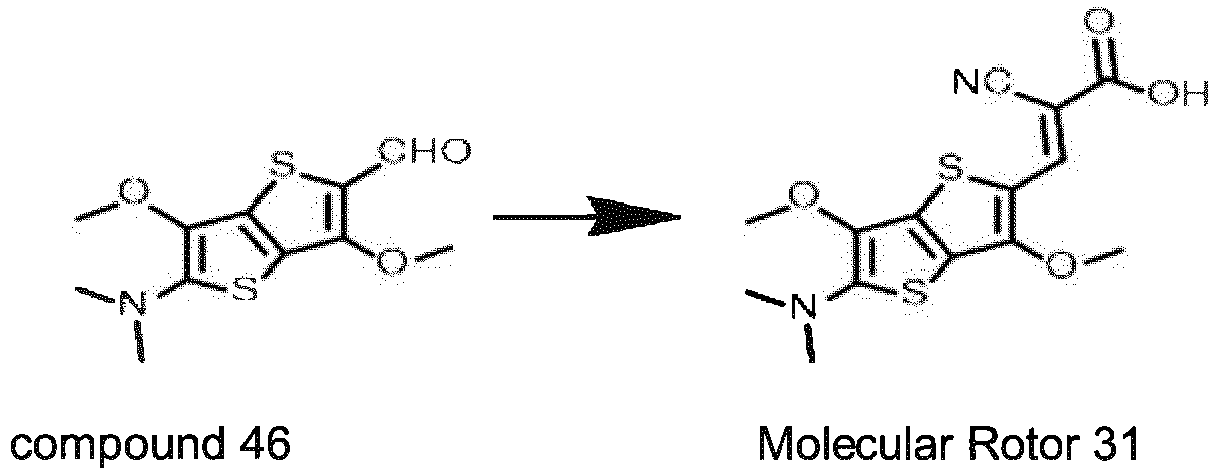
- Compound 46 (0.27 g, 1 mmol) was placed in a 50 mL round bottom flask, to which cyanoacetic acid (0.102 g, 1.2 mmol) was added, followed by the addition of 30 mL of absolute ethanol to dissolve the mixture, and anhydrous zinc chloride at a catalytic amount. The system was heated to reflux in an oil bath under Ar atmosphere. After the reaction was completed and the system was cooled at room temperature, a portion of the solvent was evaporated to give an amount of solid, which was filtered. The filter cake was washed with ice ethanol and dried in vacuo to give a product (0.28 g, 92%). 1H-NMR(400 MHz, CDCl3): δ=6.55 (s, 1H), 4.29 (s, 3H), 3.88 (s, 3H), 3.13 (s, 6H).
-

- Compound 32 (0.43 g, 2 mmol) was dissolved in 50 ml of dry dihalomethane, in which potassium acetate (0.4 g, 4 mmol) was added, and bromine (0.32 g, 2 mmol) was added in an ice bath. The mixture was slowly warmed at room temperature. After the completion of the reaction, 100 ml of saturated sodium thiosulfate solution was added so that the organic phases were separated, and the aqueous phase was extracted three times with dichloromethane. The organic phases were combined, and then subjected to column chromatography after rotary evaporation to obtain a product (0.64 g, 81%). 1H-NMR(400 MHz, CDCl3): δ=7.81 (s, 1H), 7.68 (d, J = 9.0 Hz, 1H), 6.92 (d, J = 2.0 Hz, 1H).
- Compound 47 (1.27 g, 3.43 mmol) was dissolved in 50 ml of dry triethylamine, and Bis(triphenylphosphine)palladium Dichloride (120.2 mg, 0.171 mmol), cuprous iodide (65.2 mg, 0.343 mmol) and trimethylsilylacetylene (344 mg, 3.43 mmol) were added. The mixture was heated in an oil bath for 24 h under Ar atmosphere. After the reaction was completed, 5 ml of water was added to quench the reaction, and the solvent was dried by rotary evaporation. The residue was dissolved in diethyl ether, filtered and dried by rotary evaporation to give a crude product used directly in the next step without purification.
- The crude product was dissolved in 30 ml of NMP, and then sodium sulfide nonahydrate (0.87 g, 3.63 mmol) was added. The mixture was heated in an oil bath at 190°C for 12 h under Ar atmosphere, and cooled at room temperature. With the addition of 20 ml of a saturated ammonium chloride solution, the mixture was extracted thrice with methylene chloride. The organic phases were combined, dried over Na2SO4, filtered to remove Na2SO4, and chromatographed following rotary evaporation to yield a white solid (0.85 g, 49%). 1H-NMR (400 MHz, CDCl3): δ=7.87 (m, 1H), 7.71 (m, 1H), 7.51 (d, J = 5.4 Hz, 1H), 7.41 (m, 1H), 7.32 (d, J = 5.4 Hz, 1H).
- Compound 49 was synthesized according to the synthesis of
Compound 2, with a yield of 44%. 1H-NMR (400 MHz, CDCl3): δ=9.71 (s, 1 H), 7.87 (m, 1H), 7.71 (m, 1H), 7.51 (d, J = 5.4 Hz, 1H), 7.32 (d, J = 5.4 Hz, 1H), 3.01 (s, 6 H). - Molecular Rotor 34 was synthesized according to the synthesis of Molecular Rotor 4, with a yield of 95%. 1H-NMR (400 MHz, CDCl3): δ=7.87 (m, 1H), 7.71 (m, 1H), 7.51 (d, J = 5.4 Hz, 1H), 7.32 (d, J = 5.4 Hz, 1H), 7.01 (s, 1 H).
-

- Compound 50 was synthesized according to the synthesis of Compound 4, with a yield of 78%. 1H-NMR (400 MHz, CDCl3): δ=9.71 (s, 1 H), 7.87 (m, 1H), 7.71 (m, 1H), 7.51 (d, J = 5.4 Hz, 1H), 7.32 (d, J = 5.4 Hz, 1H), 3.59 (t, 2H, J =5.60 Hz), 3.48 (t, 2H, J =5.60 Hz), 3.15 (s, 3H).
- Molecular Rotor 35 was synthesized according to the synthesis of
Molecular Rotor 1, with a yield of 78%. 1H-NMR (400 MHz, CDCl3): δ=7.87 (m, 1H), 7.71 (m, 1H), 7.51 (d, J = 5.4 Hz, 1H), 7.32 (d, J = 5.4 Hz, 1H), 7.01 (s, 1 H), 3.59 (t, 2H, J =5.60 Hz), 3.48 (t, 2H, J =5.60 Hz), 3.15 (s, 3H), 1.49 (s, 9 H). -

- Compound 51 was synthesized according to the synthesis of
Compound 2, with a yield of 51%. 1H-NMR(400 MHz, CDCl3): δ=9.71(s, 1 H), 7.87 (m, 1H), 7.71 (m, 1H), 7.51 (d, J = 5.4 Hz, 1H), 7.32 (d, J = 5.4 Hz, 1H), 3.55 (t, 4H, J =5.60 Hz), 3.46 (t, 4H, J =5.60 Hz). - Molecular Rotor 36 was synthesized according to the synthesis of Molecular Rotor 7, with a yield of 89%. 1H-NMR(400 MHz, CDCl3): δ=7.87 (m, 1H), 7.71 (m, 1H), 7.51 (d, J = 5.4 Hz, 1H), 7.32 (d, J = 5.4 Hz, 1H), 7.03(s, 1 H), 3.55 (t, 4H, J =5.60 Hz), 3.46-3.52(m, 4 H), 3.46 (t, 4H, J =5.60 Hz), 3.38 (s, 3 H).
-

- Compound 52 was synthesized according to the synthesis of
Compound 2, with a yield of 21%. 1H-NMR(400 MHz, CDCl3): δ=9.71 (s, 1 H), 7.87 (m, 1H), 7.71 (m, 1H), 7.51 (d, J = 5.4 Hz, 1H), 7.32 (d, J = 5.4 Hz, 1H), 3.18 (s, 3H). - Molecular Rotor 37 was synthesized according to the synthesis of Molecular Rotor 5, with a yield of 93%. 1H-NMR(400 MHz, CDCl3): δ=7.87 (m, 1H), 7.71 (m, 1H), 7.51 (d, J = 5.4 Hz, 1H), 7.32 (d, J = 5.4 Hz, 1H), 7.03(s, 1 H)3.18 (s, 3 H).
-

- Compound 53 was synthesized according to the synthesis of
Compound 8, with a yield of 75%. 1H-NMR (400 MHz, CDCl3): δ=9.71(s, 1 H), 7.87 (m, 1H), 7.71 (m, 1H), 7.51 (d, J = 5.4 Hz, 1H), 7.32 (d, J = 5.4 Hz, 1H), 3.52-3.65 (m, 20 H), 3.37 (s, 3H), 2.97 (s, 3H). - Synthesized according to the synthesis of
Molecule Rotor 2, Molecular Rotor 38 had a yield of 91%. 1H-NMR(400 MHz, DMSO-d6): δ=8.49 (s, 1H), 8.07 (s, 1H), 7.68-7.71 (m, 2H), 7.35-7.38 (m, 2H), 6.46 (s, 1H), 3.52-3.65 (m, 20 H), 3.37 (s, 3H), 2.97 (s, 3H). -
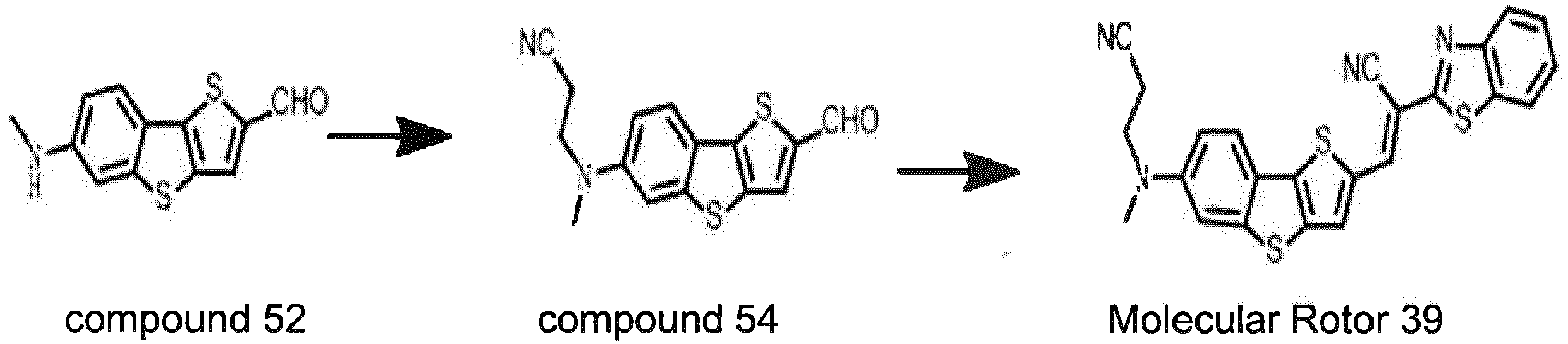
- Compound 54 was synthesized according to the synthesis of
Compound 10, with a yield of 86%. 1H-NMR(400 MHz, CDCl3): δ=9.71(s, 1 H), 7.87 (m, 1H), 7.71 (m, 1H), 7.51 (d, J = 5.4 Hz, 1H), 7.32 (d, J = 5.4 Hz, 1H), 3.72 (t, J=6.9 Hz, 2 H), 3.03 (s, 3 H), 2.57 (t, J=6.9 Hz, 2 H). - Molecular Rotor 39 was synthesized according to the synthesis of
Molecular Rotor 3, with a yield of 86%. 1H-NMR (400 MHz, DMSO-d6): δ=7.87 (m, 1H), 7.75 (m, 1H), 7.68-7.71 (m, 2H), 7.51 (d, J = 5.4 Hz, 1H), 7.35-7.38 (m, 2H), 7.32 (d, J = 5.4 Hz, 1H), 6.96 (s, 1H), 3.72 (t, J=6.9 Hz, 2 H), 3.03 (s, 3 H), 2.57 (t, J=6.9 Hz, 2 H). -

- Please refer to the synthesis of Compound 39: 1H-NMR(400 MHz, CDCl3): δ=9.77(s, 1 H), 7.87 (m, 1H), 7.71 (m, 1H), 7.51 (d, J = 5.4 Hz, 1H), 7.32 (d, J = 5.4 Hz, 1H), 3.63 (t, J = 8.0 Hz, 2H), 3.37 (t, J = 8.0 Hz, 2H), 3.00 (s, 3H), 2.21 (s, 3H), 1.86 (s, 6H), 1.67 (m, 2H), 1.42 (m, 2H), 1.02 (t, J=5.0 Hz, 3H).
- Molecular Rotor 40 was synthesized according to the synthesis of
Molecular Rotor 8, with a yield of 88%. 1H-NMR(400 MHz, CDCl3): δ=7.87 (m, 1H), 7.71 (m, 1H), 7.63-7.48 (m, 6 H), 7.32 (d, J = 5.4 Hz, 1H), 7.03 (s, 1 H), 3.63 (t, J = 8.0 Hz, 2H), 3.37 (t, J = 8.0 Hz, 2H), 3.13 (s, 3 H), 3.00 (s, 3H), 2.21 (s, 3H), 1.86 (s, 6H), 1.67 (m, 2H), 1.42 (m, 2H), 1.02 (t, J=5.0 Hz, 3H). -

- Please refer to the method disclosed in the literature:
WO2013142841(A1), 2013.09.26 . 1H-NMR(400 MHz, CDCl3): δ= 7.87 (s, 2 H), 7.54 (s, 1H), 7.42 (d, J=5.6 Hz, 1 H), 7.39 (d, J=5.6 Hz, 1 H). -
Compound 57 was synthesized according to the synthesis ofCompound 2, with a yield of 41%. 1H-NMR(400 MHz, CDCl3): δ= 9.99(s, 1 H), 7.89 (s, 2 H), 7.59 (s, 1H), 7.27 (s, 1 H), 3.09 (s, 6 H). - Molecular Rotor 41 was synthesized according to the synthesis of Molecular Rotor 4, with a yield of 81%. 1H-NMR(400 MHz, CDCl3): δ= 7.89 (s, 2 H), 7.59 (s, 1H), 7.27 (s, 1 H), 7.02(s, 1 H), 3.09(s, 6 H).
-

- Compound 58 was synthesized according to the synthesis of
Compound 3, with a yield of 55%. 1H-NMR(400 MHz, CDCl3): δ=9.99 (s, 1 H), 7.89 (s, 2 H), 7.59 (s, 1H), 7.27 (s, 1 H), 3.32 (t, 4H, J =8.20 Hz), 1.64 (m, 32H), 0.93 (t, 6H, J =8.00 Hz). - Molecular Rotor 24 was synthesized according to the synthesis of
Compound 1, with a yield of 96%. 1H-NMR(400 MHz, CDCl3): δ=7.89 (s, 2 H), 7.59 (s, 1H), 7.27 (s, 1 H), 7.05(s, 1 H), 3.32 (t, 4H, J =8.20 Hz), 1.64 (m, 32H), 1.49(s, 9 H), 0.93 (t, 6H, J =8.00 Hz). -

- Compound 59 was synthesized according to the synthesis of Compound 4, with a yield of 65%. 1H-NMR(400 MHz, CDCl3): δ=9.99 (s, 1 H), 7.89 (s, 2 H), 7.59 (s, 1H), 7.27 (s, 1 H), 3.59 (t, 2H, J =5.60 Hz), 3.48 (t, 2H, J =5.60 Hz), 3.15 (s, 3H).
- Molecular Rotor 43 was synthesized according to the synthesis of
Molecular Rotor 2, with a yield of 88%. 1H-NMR(400 MHz, CDCl3): δ=7.89 (s, 2 H), 7.74 (d, 1 H, J=4.0 Hz), 7.59 (s, 1H), 7.55 (d, 1 H, J=4.0 Hz), 7.36-7.42 (m, 2 H), 7.27 (s, 1 H), 7.00 (s, 1 H), 3.59 (t, 2H, J =5.60 Hz), 3.48 (t, 2H, J =5.60 Hz), 3.15 (s, 3H). -

- Compound 60 was synthesized according to the synthesis of
Compound 6, with a yield of 55%. 1H-NMR(400 MHz, CDCl3): δ=10.00(s, 1 H), 7.88 (s, 2 H), 7.60 (s, 1H), 7.28 (s, 1 H), 3.11 (s, 3H). - Molecular Rotor 44 was synthesized according to the synthesis of
Molecular Rotor 3, with a yield of 81%.1H-NMR(400 MHz, CDCl3): δ=8.04 (d, 1 H, J=8.0 Hz), 7.91 (d, 1 H, J=8.0 Hz), 7.88 (s, 2 H), 7.60 (s, 1H), 7.53 (t, 1 H, J=8.0 Hz), 7.45 (t, 1 H, J=8.0 Hz), 7.28 (s, 1 H), 7.01 (s, 1 H), 3.11 (s, 3H). -

- Compound 61 was synthesized according to the synthesis of
Compound 8, with a yield of 76%. 1H-NMR(400 MHz, CDCl3): δ=10.00 (s, 1H), 7.88 (s, 2H), 7.60 (s, 1H), 7.28 (s, 1H), 3.52-3.65 (m, 20H), 3.37 (s, 3H), 2.97 (s, 3H). - Molecular Rotor 45 was synthesized according to the synthesis of
Molecular Rotor 6, with a yield of 85%. 1H-NMR(400 MHz, CDCl3): δ=7.87 (s, 2 H), 7.61 (s, 1H), 7.28 (s, 1 H), 7.02 (s, 1 H), 3.98 (s, 3 H), 3.52-3.65 (m, 20 H), 3.37 (s, 3H), 3.01 (s, 3 H), 2.97 (s, 3H). -

- Compound 62 was synthesized according to the synthesis of Compound 24, with a yield of 66%. 1H-NMR(400 MHz, CDCl3): δ=10.01 (s, 1H), 7.86 (s, 2H), 7.61 (s, 1H), 7.27 (s, 1H), 3.41 (t, 4H, J=5.5 Hz), 2.21 (t, 4H, J=5.5 Hz).
- Molecular Rotor 46 was synthesized according to the synthesis of Molecular Rotor 7, with a yield of 85%. 1H-NMR(400 MHz, CDCl3): δ=7.86 (s, 2H), 7.61 (s, 1H), 7.27 (s, 1H), 7.03 (s, 1H), 3.48-3.52 (m, 4H), 3.41 (t, 4H, J=5.5 Hz), 3.38 (s, 3H), 2.21 (t, 4H, J=5.5 Hz).
-

-
Compound 63 was synthesized according to the synthesis ofCompound 10, with a yield of 76%. 1H-NMR(400 MHz, CDCl3): δ=10.02 (s, 1H), 7.86 (s, 2H), 7.61 (s, 1H), 7.27 (s, 1H), 3.72 (t, 2H, J=8.0 Hz), 3.11 (s, 3H), 2.57 (t, 2H, J=8.0 Hz). - Molecular Rotor 47 was synthesized according to the synthesis of Molecular Rotor 5, with a yield of 91%. 1H-NMR(400 MHz, CDCl3): δ=7.88 (s, 2 H), 7.60 (s, 1H), 7.28 (s, 1 H), 6.99 (s, 1 H), 3.72 (t, 2 H, J=8.0 Hz), 3.11 (s, 3 H), 2.57 (t, 2 H, J=8.0 Hz).
-

- Compound 64 was synthesized according to the method disclosed in the literature (Riger Ralph et al. Chem. Mater. 2000, 22, 5314-4318.). 1H-NMR(400 MHz, CDCl3): δ=8.38 (s, 1H), 8.28 (s, 1H), 7.47 (d, 2H, J=5.6 Hz), 7.42 (d, 2H, J=5.6 Hz).
-
Compound 65 was synthesized according to the synthesis ofCompound 1, with a yield of 55%. 1H-NMR(400 MHz, CDCl3): δ=8.38 (s, 1H), 8.21 (s, 1H), 7.41 (m, 1H), 7.38 (d, 1H, J=5.6 Hz). - Compound 66 was synthesized according to the synthesis of Compound 4, with a yield of 55%. 1H-NMR(400 MHz, CDCl3): δ=9.99 (s, 1H), 8.39 (s, 1H), 8.22 (s, 1H), 7.42 (m, 1H), 7.38 (d, 1H, J=5.6 Hz), 3.59 (t, 2H, J =5.60 Hz), 3.48 (t, 2H, J =5.60 Hz), 3.15 (s, 3H).
- Molecular Rotor 48 was synthesized according to the synthesis of Molecular Rotor 4, with a yield of 95%. 1H-NMR(400 MHz, CDCl3): δ=8.38 (s, 1H), 8.23 (s, 1H), 7.42 (m, 1H), 7.38 (d, 1H, J=5.6 Hz), 7.05 (s, 1H), 3.59 (t, 2H, J =5.60 Hz), 3.48 (t, 2H, J =5.60 Hz), 3.15 (s, 3H).
-

- Compound 67 was synthesized according to the synthesis of Compound 5, with a yield of 76%. 1H-NMR(400 MHz, CDCl3): δ=9.99 (s, 1H), 8.39 (s, 1H), 8.22 (s, 1H), 7.42 (m, 1H), 7.38 (d, 1H, J=5.6 Hz), 3.68 (m, 4H), 3.55 (m, 2H), 3.35 (m, 2H), 3.11 (s, 3H), 2.42 (m, 2H).
- Molecular Rotor 49 was synthesized according to the synthesis of
Molecular Rotor 1, with a yield of 90%. 1H-NMR(400 MHz, CDCl3): δ=8.36 (s, 1H), 8.23 (s, 1H), 7.42 (m, 1H), 7.38 (d, 1H, J=5.6 Hz), 7.02 (s, 1H), 3.68 (m, 4H), 3.55 (m, 2H), 3.35 (m, 2H), 3.11 (s, 3H), 2.42 (m, 2H). -
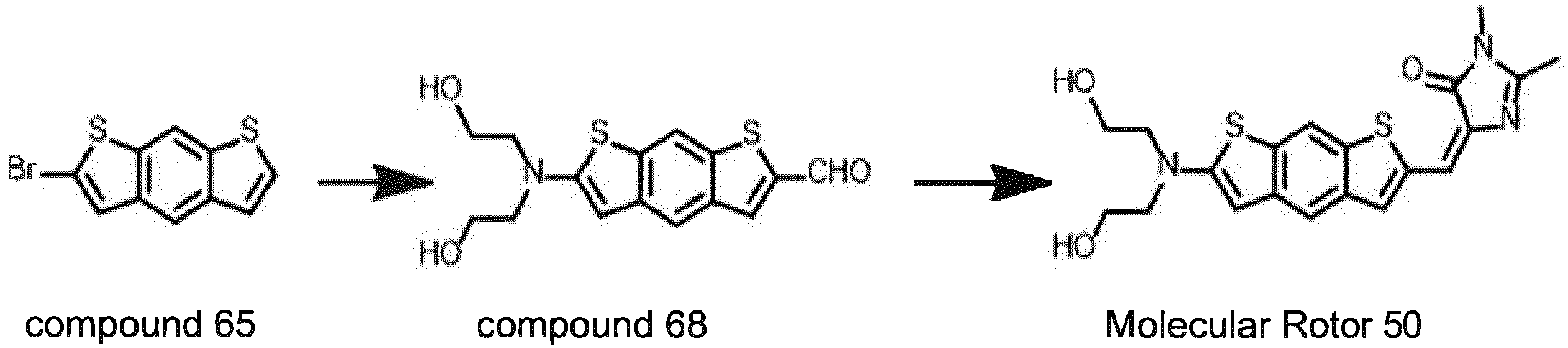
- Compound 68 was synthesized according to the synthesis of Compound 29, with a yield of 58%. 1H-NMR(400 MHz, CDCl3): δ=10.01 (s, 1H), 8.39 (s, 1H), 8.22 (s, 1H), 7.42 (m, 1H), 7.38 (d, 1H, J=5.6 Hz), 3.59 (t, 4H, J =5.60 Hz), 3.48 (t, 4H, J =5.60 Hz).
- Molecular Rotor 50 was synthesized according to the synthesis of
Molecular Rotor 6, with a yield of 87%. 1H-NMR(400 MHz, CDCl3): δ=8.38 (s, 1H), 8.20 (s, 1H), 7.41 (m, 1H), 7.37 (d, 1H, J=5.6 Hz), 7.00 (s, 1H), 3.59 (t, 4H, J =5.60 Hz), 3.48 (t, 4H, J =5.60 Hz), 3.0 (s, 3H), 2.15 (s, 3H). -

- Compound 69 was synthesized according to the synthesis of
Compound 6, with a yield of 54%. 1H-NMR(400 MHz, CDCl3): δ=10.00 (s, 1H), 8.38 (s, 1H), 8.23 (s, 1H), 7.63-7.48 (m, 5H), 7.42 (m, 1H), 7.38 (d, 1H, J=5.6 Hz), 7.00 (s, 1H), 3.18 (s, 3H), 3.07 (s, 3H). - Molecular Rotor 51 was synthesized according to the synthesis of Molecular Rotor 54, with a yield of 89%. 1H-NMR(400 MHz, CDCl3): δ=8.38 (s, 1H), 8.23 (s, 1H), 7.42 (m, 2H), 7.38 (d, 1H, J=5.6 Hz), 3.18.
-

- Compound 70 was synthesized according to the synthesis of
Compound 8, with a yield of 66%. 1H-NMR(400 MHz, CDCl3): δ=10.00 (s, 1H), 8.38 (s, 1H), 8.23 (s, 1H), 7.42 (m, 1H), 7.38 (d, 1H, J=5.6 Hz), 3.52-3.65 (m, 20H), 3.37 (s, 3H), 2.97 (s, 3H). - Molecular Rotor 52 was synthesized according to the synthesis of
Molecular Rotor 2, with a yield of 86%. 1H-NMR(400 MHz, CDCl3): δ=8.38 (s, 1H), 8.23 (s, 1H), 7.74 (d, 1H, J=4.0 Hz), 7.55 (d, 1H, J=4.0 Hz), 7.38-7.42 (m, 3H), 7.38 (d, 1H, J=5.6 Hz), 6.95 (s, 1H), 3.52-3.65 (m, 20H), 3.37 (s, 3H), 2.97 (s, 3H). -

- Compound 71 was synthesized according to the synthesis of
Compound 10, with a yield of 69%. 1H-NMR(400 MHz, CDCl3): δ=10.01 (s, 1H), 8.39 (s, 1H), 8.21 (s, 1H), 7.41 (m, 1H), 7.37 (d, 1H, J=5.6 Hz), 3.72 (t, 2H, J=6.9 Hz), 3.03 (s, 3H), 2.57 (t, 3H, J=6.9 Hz). -

- Compound 72 was synthesized according to the synthesis of
Compound 12, with a yield of 61%. 1H-NMR(400 MHz, CDCl3): δ=10.01 (s, 1H), 8.39 (s, 1H), 8.21 (s, 1H), 7.41 (m, 1H), 7.37 (d, 1H, J=5.6 Hz), 3.09-3.12 (m, 5H), 1.59-1.66 (m, 2H), 1.27-1.41 (m, 14H), 0.89 (t, 3H, J=7.0 Hz). - Molecular Rotor 54 was synthesized according to the synthesis of Molecular Rotor 5, with a yield of 86%. 1H-NMR(400 MHz, CDCl3): δ=8.38 (s, 1H), 8.22 (s, 1H), 7.42 (m, 1H), 7.38 (d, 1H, J=5.6 Hz), 7.01 (s, 1H), 3.09-3.12 (m, 5H), 1.59-1.66 (m, 2H), 1.27-1.41 (m, 14H), 0.89 (t, 3H, J=7.0 Hz).
-

- Compound 73 was synthesized according to the synthesis of Compound 21, with a yield of 69%. 1H-NMR(400 MHz, CDCl3): δ=10.01 (s, 1H), 8.39 (s, 1H), 8.21 (s, 1H), 7.41 (m, 1 H), 7.37 (d, 1 H, J=5.6 Hz), 3.94-3.76 (m, 4 H), 3.42-3.26 (m, 4 H).
- Molecular Rotor 55 was synthesized according to the synthesis of Molecular Rotor 7, with a yield of 93%. 1H-NMR(400 MHz, CDCl3): δ=8.39 (s, 1 H), 8.21 (s, 1 H), 7.41 (m, 1 H), 7.37 (d, 1 H, J=5.6 Hz), 6.99 (s, 1 H), 3.94-3.76 (m, 4 H), 3.49-3.52 (m, 2 H), 3.42-3.26 (m, 4 H), 3.39 (s, 3 H).
-

- The synthesis was carried out according to the method disclosed in the literature: Kureya, Takeshi et al. Jpn. Kokai Tokkyo Koho,
2013194039.30 Sep. 2013 - Compound 74 (0.4 g, 1.8 mmol) was dissolved in 100 ml of anhydrous tetrahydrofuran, and the system was cooled at -30°C. After the addition of N-bromodibutylimide, the system was stirred under Ar atmosphere for 2 h, followed by adding 5 ml of water to quench the reaction, and the resultant was allowed to return to room temperature and dried by rotary evaporation to remove the solvent. The residue was dissolved in 100 ml of dichloromethane, and washed thrice with water, wherein the organic phases were dried over Na2SO4, filtered to remove Na2SO4, and subjected to column chromatography after rotary evaporation to obtain a white solid (0.31 g, 57%). 1H-NMR(400 MHz, CDCl3): δ=7.73(s, 1 H), 7.42(d, 1 H, J=4.8 Hz), 7.15(d, 1 H, J=4.8 Hz), 0.46(s, 6 H).
- Compound 76 was synthesized according to the synthesis of
Compound 2, with a yield of 51%. 1H-NMR(400 MHz, CDCl3): δ=9.87(s, 1 H), 7.83(s, 1 H), 7.10(s, 1 H), 3.1(s, 6 H), 0.46(s, 6 H). - Molecular Rotor 56 was synthesized according to the synthesis of Molecular Rotor 4, with a yield of 95%. 1H-NMR(400 MHz, CDCl3): δ=7.83 (s, 1 H), 7.10 (s, 1 H), 7.01 (s, 1 H), 3.1 (s, 6 H), 0.46 (s, 6 H).
-

- Compound 77 was synthesized according to the synthesis method of Compound 4 in a yield of 42%. 1H-NMR(400 MHz, CDCl3): δ=9.88(s, 1 H), 7.83(s, 1 H), 7.10(s, 1 H), 3.59 (t, 2H, J =5.60 Hz), 3.48 (t, 2H, J =5.60 Hz), 3.15 (s, 3H), 0.46(s, 6 H).
-
Molecular Rotor 57 was synthesized according to the synthesis ofMolecular Rotor 1, with a yield of 96%. 1H-NMR(400 MHz, CDCl3): δ=7.84 (s, 1H), 7.11 (s, 1H), 7.03(s, 1H), 3.59 (t, 2H, J =5.60 Hz), 3.48 (t, 2H, J =5.60 Hz), 3.15 (s, 3H), 1.50 (s, 9H), 0.46 (s, 6H). -

- The synthesis was carried out according to the synthesis of Compound 35, in yield of 43%. 1H-NMR(400 MHz, CDCl3): δ=9.89(s, 1 H), 7.83(s, 1 H), 7.10(s, 1 H), 3.63 (t, J = 8.0 Hz, 4H), 3.37 (t, J = 8.0 Hz, 4H), 0.46(s, 6 H).
- Molecular Rotor 58 was synthesized according to the synthesis of Molecular Rotor 5, with a yield of 97%. 1H-NMR(400 MHz, CDCl3): δ=7.83 (s, 1H), 7.10 (s, 1H), 6.99 (s, 1H), 3.63 (t, J = 8.0 Hz, 4H), 3.37 (t, J = 8.0 Hz, 4H), 0.46 (s, 6H).
-

- The synthesis was carried out by the method disclosed in the literature: Huang Hui et al. Chemistry of Materials, 2011, 23(8), 2185-2200. 1H-NMR(400 MHz, CDCl3): δ=7.24(d, 2 H, J=5.0 Hz), 7.19(d, 2 H, J=5.0 Hz), 2.39(t, 4 H, J=9.0 Hz), 1.6(t, 4 H, J=9.0 Hz).
- The synthesis was carried out according to the synthesis of Compound 75 in a yield of 51%. 1H-NMR(400 MHz, CDCl3): 6=7.70(s, 1 H), 7.40(d, 1 H, J=4.8 Hz), 7.16(d, 1 H, J=4.8 Hz), 2.39(t, 4 H, J=9.0 Hz), 1.6(t, 4 H, J=9.0 Hz).
- The synthesis was carried out with reference to the synthesis method of
Compound 2, with a yield of 45%. 1H-NMR(400 MHz, CDCl3): δ=9.88(s, 1 H), 7.83(s, 1 H), 7.10(s, 1 H), 3.1(s, 6 H), 2.39(t, 4 H, J=9.0 Hz), 1.6(t, 4 H, J=9.0 Hz). - Molecular Rotor 59 was synthesized according to the synthesis of Molecular Rotor 4, with a yield of 91%. 1H-NMR(400 MHz, CDCl3): δ=9.88 (s, 1H), 7.83 (s, 1H), 7.10 (s, 1H), 3.1 (s, 6H), 2.39 (t, 4H, J=9.0 Hz), 1.6(t, 4H, J=9.0 Hz).
-

- The synthesis was carried out with reference to the synthesis of
Compound 6, in a yield of 71%. 1H-NMR(400 MHz, CDCl3): δ=9.87(s, 1 H), 7.85(s, 1 H), 7.11(s, 1 H), 3.15(s, 3H), 2.39(t, 4 H, J=9.0 Hz), 1.6(t, 4 H, J=9.0 Hz). - The synthesis was carried out by referring to the synthesis method of
Molecular Rotor 1, and the yield was 95%. 1H-NMR(400 MHz, CDCl3): δ=7.85 (s, 1H), 7.11 (s, 1H), 7.03 (s, 1H), 3.15 (s, 3H), 2.39 (t, 4H, J=9.0 Hz), 1.6 (t, 4H, J=9.0 Hz), 1.49 (s, 9H). -

- Compound 83 was synthesized according to the synthesis method of
Compound 10 in a yield of 90%. 1H-NMR(400 MHz, CDCl3): δ=9.87(s, 1 H), 7.85(s, 1 H), 7.11(s, 1 H), 3.72(t, J=6.9 Hz, 2 H), 3.03(s, 3 H), 2.57(t, J=6.9 Hz, 2 H), 2.39(t, 4 H, J=9.0 Hz), 1.6(t, 4 H, J=9.0 Hz). - Molecular Rotor 61 was synthesized according to the synthesis of
Molecular Rotor 2, with a yield of 89%. 1H-NMR(400 MHz, CDCl3): δ=7.85 (s, 1H), 7.74 (d, 1H, J=4.0 Hz), 7.55 (d, 1H, J=4.0 Hz), 7.36-7.42 (m, 2H), 7.11 (s, 1H), 7.01 (s, 1H), 3.72 (t, J=6.9 Hz, 2H), 3.03 (s, 3H), 2.57 (t, J=6.9 Hz, 2H), 2.39 (t, 4H, J=9.0 Hz), 1.6 (t, 4H, J=9.0 Hz). -

- Compound 84 was synthesized according to the synthesis method of Compound 4 in a yield of 61%. 1H-NMR(400 MHz, CDCl3): δ=9.88(s, 1 H), 7.85(s, 1 H), 7.11(s, 1 H), 3.59 (t, 2H, J =5.60 Hz), 3.48 (t, 2H, J =5.60 Hz), 3.14 (s, 3H), 2.39(t, 4 H, J=9.0 Hz), 1.6(t, 4 H, J=9.0 Hz).
- Molecular Rotor 62 was synthesized according to the synthesis of
Molecular Rotor 3, with a yield of 95%. 1H-NMR(400 MHz, CDCl3): δ=8.00 (d, 1H, J=8.0 Hz), 7.90 (d, 1H, J=8.0 Hz), 7.85 (s, 1H), 7.53 (t, 1H, J=8.0 Hz), 7.45 (t, 1H, J=8.0 Hz), 7.11 (s, 1H), 6.99 (s, 1H), 3.59 (t, 2H, J =5.60 Hz), 3.48 (t, 2H, J =5.60 Hz), 3.14 (s, 3H), 2.39 (t, 4H, J=9.0 Hz), 1.6 (t, 4H, J=9.0 Hz). -

- Compound 85 was synthesized by the method disclosed in the literature (H. G. Jeong et al. Macromol. Chem. Phys. 2011, 212, 2308-2318): 1H-NMR(400 MHz, CDCl3): δ=7.75(d, J=5.2 Hz, 2 H), 7.02(d, J=5.2 Hz, 2 H), 3.90(s, 3 H).
- Compound 86 was synthesized according to the synthesis method of Compound 19:
1H-NMR(400 MHz, CDCl3): δ=7.83(s, 1 H), 7.75(d, J=5.2 Hz, 1 H), 7.02(d, J=5.2 Hz, 1 H), 3.90(s, 3 H). - Compound 87 was synthesized according to the synthesis method of Compound 20. 1H-NMR(400 MHz, CDCl3): δ=9.98(s, 1 H), 7.63(s, 1 H), 7.52(s, J=5.2 Hz, 1 H), 3.90(s, 3 H), 3.03(s, 6 H).
- Please refer to the synthesis of Molecular Rotor 2: 1H-NMR(400 MHz, CDCl3): δ=7.63 (s, 1H), 7.52 (s, 1H), 7.03 (s, 1H), 3.90 (s, 3H), 3.03 (s, 6H), 1.51 (s, 9H).
-
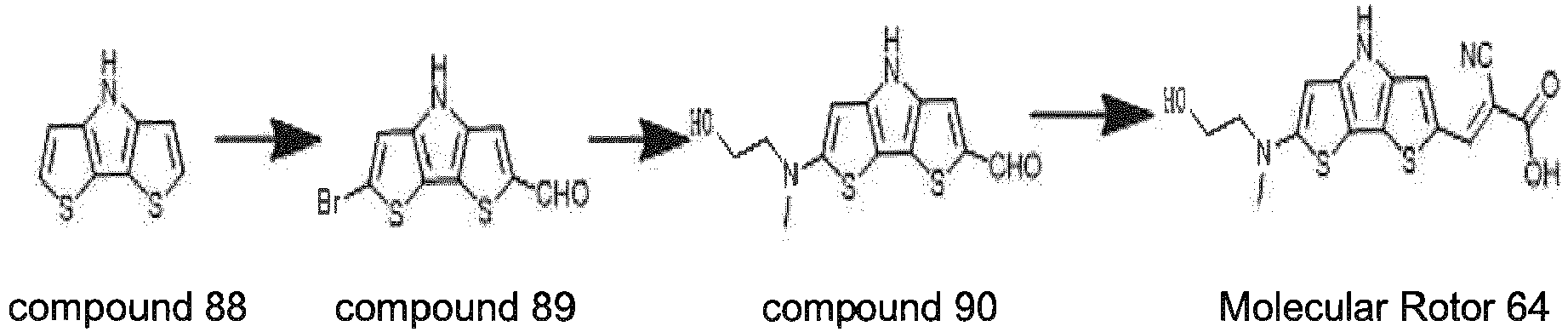
- Compound 85 was synthesized by the method disclosed in the literature (H. G. Jeong et al. Macromol. Chem. Phys. 2011, 212, 2308-2318). 1H-NMR(400 MHz, CDCl3): δ=7.78(d, J=5.6 Hz, 2 H), 7.09(d, J=5.6 Hz, 2 H).
- Compound 89 was synthesized according to the synthesis of Compound 19:
1H-NMR(400 MHz, CDCl3): δ=7.89(s, 1 H), 7.79(d, J=5.6 Hz, 1 H), 7.12(d, J=5.6 Hz, 1 H). - Compound 90 was synthesized with reference to the synthesis method of Compound 20: 1H-NMR(400 MHz, CDCl3): δ=9.95(s, 1 H), 7.69(s, 1 H), 7.59(s, J=5.2 Hz, 1 H), 3.59 (t, 2H, J =5.60 Hz), 3.48 (t, 2H, J =5.60 Hz), 3.15 (s, 3H).
- Please refer to the synthesis of Molecular Rotor 5: 1H-NMR(400 MHz, CDCl3): δ=7.69 (s, 1H), 7.58 (s, 1H), 7.01 (s, 1H), 3.59 (t, 2H, J =5.60 Hz), 3.48 (t, 2H, J =5.60 Hz), 3.15 (s, 3H), 1.51 (s, 9H).
-

- The synthesis was carried out by the method disclosed in the literature (Ping Yan. et al. J. Org. Chem. 2008, 73, 6587-6594.). 1H-NMR(400 MHz, CDCl3): δ= 7.18(s, 1 H), 6.96(d, 2 H, J=5.6 Hz), 1.50(s, 6 H).
- Compound 92 was synthesized according to the synthesis method of
Compound 22 in a yield of 66%. 1H-NMR(400 MHz, CDCl3): δ= 9.89(s, 1 H), 7.18(s, 1 H), 6.96(d, 2 H, J=5.6 Hz), 3.10(s, 6 H), 1.50(s, 6 H). -
Molecular Rotor 65 was synthesized according to the synthesis ofMolecular Rotor 1, with a yield of 98%. 1H-NMR(400 MHz, CDCl3): δ= 7.89 (s, 1H), 7.18 (s, 1H), 6.96 (d, 2H, J=5.6 Hz), 3.10 (s, 6H), 1.50 (m, 15H). -

- Molecular Rotor 66 was synthesized according to the synthesis of
Molecular Rotor 2, with a yield of 66%. 1H-NMR(400 MHz, CDCl3): δ= 7.89 (s, 1H), 7.74 (d, 1H, J=4.0 Hz), 7.55 (d, 1H, J=4.0 Hz), 7.36-7.42 (m, 2H), 7.18(s, 1H), 6.96 (d, 2H, J=5.6 Hz), 3.10 (s, 6H), 1.50 (s, 6H). -

- Compound 93 was synthesized according to the synthesis method of
Compound 2 in a yield of 36%. 1H-NMR(400 MHz, CDCl3): δ= 9.89(s, 1 H), 7.18(s, 1 H), 6.96(d, 2 H, J=5.6 Hz), 3.85 (t, 2H, J=5.6 Hz), 3.60(t, 2 H, J=5.6 Hz), 3.10(s, 3 H), 1.50(s, 6 H). - Molecular Rotor 67 was synthesized according to the synthesis of
Compound 1, with a yield of 98%. 1H-NMR(400 MHz, CDCl3): δ=8.04 (d, 1H, J=8.0 Hz), 7.93 (d, 1H, J=8.0 Hz), 7.89 (s, 1H), 7.53 (t, 1H, J=8.0 Hz), 7.45 (t, 1H, J=8.0 Hz), 7.18 (s, 1H), 6.96 (d, 2H, J=5.6 Hz), 4.24 (s, 2H), 3.85 (t, 2H, J=5.6 Hz), 3.60 (t, 2H, J=5.6 Hz), 3.10 (s, 3H), 1.50 (s, 6H). -

- Molecular Rotor 68 was synthesized according to the synthesis of
Compound 2, with a yield of 36%. 1H-NMR(400 MHz, CDCl3): δ= 7.89 (s, 1H), 7.18 (s, 1H), 6.96 (d, 2H, J=5.6 Hz), 3.10 (s, 6H), 1.50 (m, 6H). -

- Molecular Rotor 3 (0.199 g, 0.5 mmol) and 4-dimethylaminopyridine (0.073 g, 0.6 mmol) were dissolved in 20 mL of anhydrous dichloromethane, to which a phenyl p-nitrochloroformate (0.121 g, 0.6 mmol) solution in 10 mL of anhydrous dichloromethane was slowly added dropwise under Ar atmosphere, and then the mixture was stirred at room temperature for 1 h. After completion of the reaction, the resultant was dried by rotary evaporation to remove the solvent, and the residue was dissolved in 10 mL of anhydrous N,N-dimethylformamide, followed by adding a compound 4-aminomethylbenzenesulfonamide (0.11 g, 0.60 mmol) and anhydrous triethylamine (0.08 mL, 0.6 mmol) in turn. The mixture was stirred at room temperature for 30 min under argon atmosphere. After completion of the reaction, the resultant was dried by rotary evaporation to remove the solvent, and the residue undergone column separation to give a pure compound (0.225 g, 65%). 1H-NMR(400 MHz, DMSO-d6): δ=8.45 (s, 1H), 8.17(t, 1H, J =6.60 Hz), 8.09 (d, 1H, J =8.00 Hz), 8.07 (s, 1H), 7.94 (d, 1H, J=8.00 Hz), 7.80 (d, 1H, J =8.10 Hz), 7.51 (m, 1H), 7.41 (m, 3H), 7.30 (s, 2H), 6.45 (s, 1H), 4.92 (t, 1H, J =5.60 Hz), 4.32 (d, 1H, J =6.00 Hz), 3.67(t, 2H, J =5.60 Hz), 3.49 (t, 2H, J =5.60 Hz), 3.13 (s, 3H).
- The fluorescent dyes (molecular rotors) prepared in Examples 1-68 were separately dissolved in dimethyl sulfoxide to prepare respectively a mother liquor having a concentration of 1×10⁻² M, and each of the mother liquors was added individually to glycerin and methanol, and mixed uniformly, thereby solutions of a final concentration of 1×10⁻⁵ M were prepared individually. According to the different fluorescent dyes, the fluorescence emission spectra of the fluorescent dyes were detected with the maximum excitation wavelengths of respective fluorescent dyes successively under the same conditions. The results were shown in Table 1. It indicates that the fluorescent dyes of the present invention have long-wavelength fluorescence emission and is sensitive to viscosity changes.
Table 1. Emission Wavelength of Each Molecular Rotor and Its Ratio of Fluorescence Intensities in Glycerol to Methanol Solution Name of Compound Maximum Emission Wavelength (nm) Fluorescence Intensity Ratios in Glycerol/Methanol Molecular Rotor 1 555 790 Molecular Rotor 2 590 1183 Molecular Rotor 3 610 1455 Molecular Rotor 4 557 892 Molecular Rotor 5 555 1980 Molecular Rotor 6 585 1453 Molecular Rotor 7 555 1877 Molecular Rotor 8 570 456 Molecular Rotor 9 630 320 Molecular Rotor 10 520 851 Molecular Rotor 11 620 568 Molecular Rotor 12 655 655 Molecular Rotor 13 690 352 Molecular Rotor 14 620 681 Molecular Rotor 15 620 799 Molecular Rotor 16 620 951 Molecular Rotor 17 618 888 Molecular Rotor 18 630 678 Molecular Rotor 19 650 791 Molecular Rotor 20 690 536 Molecular Rotor 21 620 544 Molecular Rotor 22 570 989 Molecular Rotor 23 608 568 Molecular Rotor 24 608 912 Molecular Rotor 25 570 615 Molecular Rotor 26 610 712 Molecular Rotor 27 600 601 Molecular Rotor 28 650 569 Molecular Rotor 29 570 515 Molecular Rotor 30 520 513 Molecular Rotor 31 535 572 Molecular Rotor 32 570 612 Molecular Rotor 33 565 531 Molecular Rotor 34 626 1012 Molecular Rotor 35 626 476 Molecular Rotor 36 628 901 Molecular Rotor 37 627 879 Molecular Rotor38 650 623 Molecular rotor 39 667 541 Molecular Rotor 40 659 652 Molecular Rotor 41 558 875 Molecular Rotor 42 558 924 Molecular Rotor 43 582 816 Molecular Rotor 44 603 631 Molecular Rotor 45 585 Molecular Rotor 46 563 712 Molecular Rotor 47 561 912 Molecular Rotor 48 562 608 Molecular Rotor 49 559 612 Molecular Rotor 50 587 777 Molecular Rotor 51 599 535 Molecular Rotor 52 578 680 Molecular Rotor 53 599 915 Molecular Rotor 54 563 722 Molecular Rotor 55 562 466 Molecular Rotor 56 655 591 Molecular Rotor 57 659 884 Molecular Rotor 58 656 683 Molecular Rotor 59 655 750 Molecular Rotor 60 637 812 Molecular Rotor 61 691 816 Molecular Rotor 62 715 759 Molecular Rotor 63 675 516 Molecular Rotor 64 655 682 Molecular Rotor 65 645 591 Molecular Rotor 66 670 623 Molecular Rotor 67 690 789 Molecular Rotor 68 648 953 -
Molecular Rotors Figures 1 ,4 ,7 ,10 ,13 , and16 . Emission wavelengths of the molecular rotors were 555 nm, 590 nm, 610 nm, 570 nm, 559 nm, and 675 nm, respectively. The fluorescence intensities of the molecular rotors with the same concentration increase at different viscosities, which indicates that the fluorescence intensities of the molecular rotors increase with the increase in the ambient viscosity, and that the relationship between the logarithm of fluorescence intensity and the logarithm of solvent viscosity is consistent with the Huffman equation, that is, having a very good linear relationship and having a high slope (as shown inFigures 2 ,5 ,8 ,11 ,14 , and17 ). This demonstrates that the molecular rotors are sensitive to viscosity and can be used for viscosity testing of unknown samples. -
Molecular Rotors Fig. 3 ,Fig. 6 ,Fig. 9 ,Fig. 12 ,Fig. 15 andFig. 18 , the fluorescence emission intensities of the molecular rotors in the solution are weak, and the fluorescence intensities do not change much in the strong polar and strong non-polar solvents, which indicates that the molecular rotors of the present invention are weak in background fluorescence of the fluorescence intensities, and insensitive to the polarity change. - The effect of
probe 1 on the fluorescence monitoring of carbonic anhydrase was investigated by using Hela cells as an example. HeLa cells with high expression of carbonic anhydrase and Hela-WT cells (Hela archecytes) without expression of carbonic anhydrase were planted in a 14 mm glass bottom 96-well cell culture plate and stabilized for 10 hours.Probe 1 was added to the medium with the concentration thereof set to 5 µM. The cells were incubated for 2 hours in a carbon dioxide incubator at 37°C, and the fluorescence changes of the labeled cells were imaged and detected with a Leica TPS-8 confocal microscope. The results inFigure 19Aa show that after the addition ofprobe 1 to the medium, the corresponding fluorescent signal is not detected in Hela-WT cells, indicating that the probe fluorescence is not affected by the intracellular environment; however, inFig. 19Ba , a strong fluorescent signal can be detected in the Hela cells expressing carbonic anhydrase protein, and the fluorescence signal is enhanced by nearly 300-fold in comparison with the Hela-WT cells. It is indicated that the probe of the present invention can specifically label the intracellular carbonic anhydrase protein to achieve fluorescence-specific illumination, and at the same time, the probe fluorescence is not affected by the intracellular environment. In order to prove that the increased fluorescence results from the interaction ofprobe 1 and carbonic anhydrase, ethoxzolamide, which is more interactive with carbonic anhydrase in comparison to probe 1, was further added, and its concentration was increased to 10 µM. The cells were placed in a carbon dioxide incubator at 37°C again and incubated for 1 hour. The fluorescence changes of the labeled cells were imaged and detected with a Leica TPS-8 confocal microscope. The fluorescence intensity of the cells inFig. 19Bb is only 8% of that of the cells inFig. 19Ba , which shows that the fluorescence intensity of the cells decreases drastically, and indicates that the reason for the fluorescence illumination is that the molecular conformation is restricted after the interaction betweenprobe 1 and carbonic anhydrase. - This example demonstrates that the fluorescent dye of the present invention is suitable for specific binding to a corresponding antibody, aptamer or amyloid, or developing a series of fluorogenic probes for the fluorescence labeling, quantification or monitoring of proteins, enzymes or nucleic acids by means of bonding a ligand or inhibitor to a protein tag or enzyme and introducing molecular rotors into the lumen of the enzyme and the like.


Claims (10)
- A fluorescent dye, having a structure represented by formula (I):
 D- is X0O- or N(X1)(X2)-; X0, X1, and X2 are each independently selected from the group consisting of hydrogen, an alkyl group and a modified alkyl group; X1 and X2 are optionally linked to each other to form a saturated or unsaturated alicyclic heterocyclic ring;the ring B is selected from at least one consisting of an aromatic ring and an aromatic heterocyclic ring;in the structure of the following formula (I-2) formed by condensing the ring B with a thiophene ring, each hydrogen atom contained therein is optionally replaced independently with a substituent selected from the group consisting of a halogen atom, a nitro group, a hydrophilic group, an alkyl group, and a modified alkyl group, the substituents being optionally linked to each other to form a saturated or unsaturated alicyclic or alicyclic heterocyclic ring;
 R1 is selected from the group consisting of hydrogen, a halogen atom, a nitro group, an alkyl group, an aryl group, a heteroaryl group, a hydrophilic group, or a modified alkyl group;R2 is selected from the group consisting of cyano, carboxyl, a keto group, an ester group, an amide group, a phosphonic acid group, a phosphonate group, a sulfonic group, a sulfonate group, a sulfone group, a sulfoxide group, an aryl group, a heteroaryl group, an alkyl group, or a modified alkyl group;R3 is a cyano group; the structural moiety of the following formula (I-3) in the formula (I):
 wherein, Ra and Rb are selected independently from the group consisting of hydrogen, an alkyl group, and a modified alkyl group, and Ra and Rb are optionally bonded to each other to form an alicyclic or alicyclic heterocyclic ring;Rc and Rd are selected independently from the group consisting of hydrogen, a halogen atom, nitro, an alkyl group, an aryl group, a hydrophilic group, and a modified alkyl group;Y1 is selected from the groups consisting of -O-, -S-, -(S=O)-, and -(NRi)-, wherein Ri is selected from the group consisting of hydrogen, an alkyl group, and a modified alkyl group;Y2 is selected from the group consisting of =O, =S, =S=O, and =NRi, wherein Ri is selected from the group consisting of hydrogen, an alkyl group, and a modified alkyl group;Y3 is selected from the group consisting of =O, =S, =S=O, and =NRi, wherein Ri is selected from the groups consisting of hydrogen, an alkyl group, and a modified alkyl group,Y3 is =C(Re)(CN);Re is selected from the group consisting of cyano, carboxyl, a keto group, an ester group, an amide group, a phosphonic acid group, a phosphonate group, asulfonic group, a sulfonate group, a sulfone group, a sulfoxide group, an aryl group, a heteroaryl group, an alkyl group, or a modified alkyl group;when R2 or Re is an aryl group or a heteroaryl group, the hydrogen atom on the ring is optionally replaced independently with a substituent selected from the group consisting of a halogen atom, nitro, a hydrophilic group, an alkyl group or a modified alkyl group; optionally, the substituents being linked to each other to form a saturated or unsaturated alicyclic or alicyclic heterocyclic ring;wherein,the alkyl group is a saturated aliphatic linear or branched alkyl group having 1 to 10 carbon atoms;the modified alkyl group is a group obtained by replacing any carbon atom of the alkyl group with at least one group selected from the group consisting of a halogen atom, -O- , -OH, -CO-, -NO2, -CN, -S-, -SO2-, -(S=O)-,
 the alicyclic ring is a four to ten-membered monocyclic or polycyclic alicyclic ring;the alicyclic heteroalicyclic ring is a four to ten-membered monocyclic or polycyclic alicyclic heteroalicyclic ring with at least one heteroatom selected from the group consisting of N, O, S and Si on the ring; when the alicyclic heteroalicyclic ring contains an S atom, it is optionally -SO- or -SO2-; the alicyclic heterocyclic ring is optionally substituted with a halogen atom, nitro, an alkyl group, an aryl group, a hydrophilic group, and a modified alkyl group;the aryl group or the aromatic ring is a five to ten-membered monocyclic or condensed bicyclic ring;the heteroaryl or the aromatic heterocyclic ring is a five to ten-membered monocyclic or condensed bicyclic ring with at least one heteroatom selected from the group consisting of N, O, S and Si on the ring;the halogen atoms are each independently selected from the group consisting of F, Cl, Br, and I;the hydrophilic group is hydroxyl, a sulfonic group, a sulphuric acid group, a phosphonic acid group, a primary amino group, a secondary amino group or a tertiary amino group and substituendum thereof;the monocyclic cyclohydrocarbylene group is a four to seven-membered monocyclic cyclohydrocarbylene group;the bicyclic cyclohydrocarbylene group is a five to seven-membered bicyclic cyclohydrocarbylene group;the bridged alicyclic heterocyclic ring is a five to twenty-membered bridged alicyclic heterocyclic ring having at least one heteroatom selected from the group consisting of N, O, and S on the ring.
 - The fluorescent dye according to claim 1, wherein:the modified alkyl group is a group containing at least one group selected from -OH, -O-, ethylene glycol units, monosaccharide units, disaccharide units, polysaccharide units, -O-CO-, -NH-CO-, -SO2-O-, -SO-, -SO2-NH-, -SS-, -CH=CH, -C≡C-, a halogen atom, cyano, nitro, a phosphate group and a phosphonate group;the alicyclic heterocyclic ring is selected from the group consisting of azetidine, pyrrolidine, piperidine, tetrahydrofuran, tetrahydropyran, morpholine, and thiomorpholine ring;the heteroaryl ring is selected from the group consisting of thiophene, furan, and pyrrole ring.
- The fluorescent dye according to claim 1, wherein X1 and X2 are independently a C1-50 linear or branched alkyl group optionally substituted by one or more groups selected from the group consisting of hydroxyl, cyano, a halogen atom, carboxyl, and a quaternary ammonium group; or a C2-50 ether chain group having 1 to 10 oxygen atoms and optionally substituted by one or more groups selected from the group consisting of a sulfonic acid group or carboxyl; or N(X1)(X2)- forms any group selected from the the group consisting of the following formulae (I-1-1) to (I-1-4) :

- The fluorescent dye according to any one of claims 1 to 3, wherein the two adjacent substituents in the structure of the formula (I-2) are bonded to each other to form a saturated or unsaturated alicyclic or alicyclic heterocyclic ring;
optionally, H of CH in the ring B is substituted with a halogen atom, nitro, a hydrophilic group, an alkyl group or a modified alkyl group;
optionally, the ring B contains NH; optionally, H of the NH is substituted with an alkyl group or a modified alkyl group;
optionally, the structure of the formula (I-2) is selected from the structures of the following formulae (I-2-1) to (I-2-17):


- The fluorescent dye according to any one of claims 1 to 4, wherein Ra and Rb of the formula (I-3-a) form the following structure together with the carbon atom bonded:


or, R2 and Re are independently modified alkyl groups comprising: a keto group, an ester group or an amide group, and being linked to the alkenyl carbon of formula (I-3) or (I-3-a) via the carbonyl group in the keto group, the ester group or the amide group;
optionally, the structure of the formula (I-3) is one of the following formulae (I-3-1) to (I-3-18):


- The fluorescent dye according to any one of claims 1 to 5, wherein the fluorescent dye is selected from the group consisting of the compounds of the following formulae:


- A process for preparing the fluorescent dye according to any one of claims 1 to 6, comprising the step of conducting an aldol condensation reaction of a compound of the formula (II) with a compound of the formula (III);

- Use of the fluorescent dye according to any of claims 1 to 6 in viscosity testing, fluorescent labeling of a protein, fluorescent labeling of a nucleic acid, quantification or detection of a protein, or quantification or detection of a nucleic acid.
- A fluorogenic probe, comprising the fluorescent dye according to any one of claims 1 to 6.
- Use of the fluorogenic probe according to claim 9 in fluorescent labeling of a protein, fluorescent labeling of a nucleic acid, quantification or detection of a protein, or quantification or detection of a nucleic acid.
Applications Claiming Priority (2)
| Application Number | Priority Date | Filing Date | Title |
|---|---|---|---|
| CN201610573970.XA CN107663384B (en) | 2016-07-20 | 2016-07-20 | A kind of fluorescent dye and its preparation method and use |
| PCT/CN2017/093270 WO2018014820A1 (en) | 2016-07-20 | 2017-07-18 | Fluorescent dye and preparation method and use thereof |
Publications (2)
| Publication Number | Publication Date |
|---|---|
| EP3489323A1 true EP3489323A1 (en) | 2019-05-29 |
| EP3489323A4 EP3489323A4 (en) | 2020-05-06 |
Family
ID=60991947
Family Applications (1)
| Application Number | Title | Priority Date | Filing Date |
|---|---|---|---|
| EP17830454.9A Pending EP3489323A4 (en) | 2016-07-20 | 2017-07-18 | FLUORESCENT DYE, PREPARATION METHOD THEREOF AND USE THEREOF |
Country Status (5)
| Country | Link |
|---|---|
| US (1) | US11365203B2 (en) |
| EP (1) | EP3489323A4 (en) |
| JP (1) | JP7186448B2 (en) |
| CN (1) | CN107663384B (en) |
| WO (1) | WO2018014820A1 (en) |
Families Citing this family (13)
| Publication number | Priority date | Publication date | Assignee | Title |
|---|---|---|---|---|
| CN109574880B (en) | 2017-09-29 | 2022-06-17 | 纳莹(上海)生物科技有限公司 | Fluorescent probe and preparation method and application thereof |
| CN108300456B (en) * | 2018-01-26 | 2020-08-18 | 华南理工大学 | Application of fluorescent compound with aggregation-induced emission property in organic amine detection |
| CN110498799B (en) * | 2018-05-18 | 2022-07-05 | 纳莹(上海)生物科技有限公司 | Fluorescent probe and preparation method and application thereof |
| CN111592472B (en) * | 2019-04-28 | 2022-10-21 | 纳莹(上海)生物科技有限公司 | Fluorescent dye and preparation method and application thereof |
| CN111593052A (en) * | 2019-04-28 | 2020-08-28 | 华东理工大学 | A method for RNA detection and quantification |
| CN110437219A (en) * | 2019-07-09 | 2019-11-12 | 济南大学 | A kind of detection viscosity and the difunctional fluorescence probe of sulfur dioxide |
| CN112538482A (en) * | 2019-09-23 | 2021-03-23 | 华东理工大学 | RNA detection and quantification method |
| CN110702653B (en) * | 2019-10-16 | 2020-11-24 | 华中科技大学 | Application of an aggregation-induced fluorescent probe in fingerprint fluorescence imaging |
| CN113501790B (en) * | 2020-03-23 | 2025-10-03 | 纳莹(上海)生物科技有限公司 | A fluorescent dye and its preparation method and use |
| CN112876496B (en) * | 2021-03-16 | 2022-01-28 | 南京邮电大学 | Organic small-molecule optical diagnosis and treatment probe and preparation method and application thereof |
| CN115703771B (en) * | 2021-08-06 | 2025-04-04 | 纳莹(上海)生物科技有限公司 | A fluorescent dye and its preparation method and use |
| CN113754603B (en) * | 2021-08-12 | 2022-04-19 | 浙江工业大学 | Application of an isoxazole compound as a viscosity fluorescent probe |
| CN114605376A (en) * | 2022-04-21 | 2022-06-10 | 济南大学 | A bifunctional fluorescent probe for detecting cysteine and viscosity and its preparation |
Family Cites Families (21)
| Publication number | Priority date | Publication date | Assignee | Title |
|---|---|---|---|---|
| DE3622136A1 (en) * | 1986-07-02 | 1988-01-07 | Basf Ag | THIENOTHIOPHENE DYES |
| US5436246A (en) * | 1992-09-17 | 1995-07-25 | Merrell Dow Pharmaceuticals Inc. | Serotonin receptor agents |
| GB0219896D0 (en) | 2002-08-27 | 2002-10-02 | Bayer Ag | Dihydropyridine derivatives |
| US8153446B2 (en) | 2008-05-23 | 2012-04-10 | Kent State University | Fluorogenic compounds converted to fluorophores by photochemical or chemical means and their use in biological systems |
| WO2009152165A2 (en) | 2008-06-09 | 2009-12-17 | Plextronics, Inc. | Sulfonated polythiophenes comprising fused ring repeat units |
| ES2307462B1 (en) * | 2008-06-30 | 2009-10-14 | Fundacion Universitaria San Pablo Ceu (70%) | DERIVATIVES OF NAFTOFURAN AND NAFTOTIOPHENE AS ANTIPROLIFERATIVE AGENTS OF CANCER DE PANCREAS AND COLON. |
| WO2010074326A1 (en) | 2008-12-25 | 2010-07-01 | Canon Kabushiki Kaisha | Probe for a biological specimen and labelling method and screening method using the probe |
| CN102803924A (en) * | 2009-06-05 | 2012-11-28 | 丹尼斯科美国公司 | High-throughput molecular rotor viscometry assay |
| JP5945905B2 (en) | 2009-08-24 | 2016-07-05 | 国立研究開発法人情報通信研究機構 | Second-order nonlinear optical compound and nonlinear optical element including the same |
| KR101985184B1 (en) * | 2011-01-28 | 2019-06-03 | 주식회사 동진쎄미켐 | Novel organic dye and preparation thereof |
| CN102146215B (en) | 2011-01-31 | 2014-04-02 | 大连理工大学 | Pentamethylcyanine fluorescent dye and preparation method and application thereof |
| US8889887B2 (en) | 2011-01-31 | 2014-11-18 | Dalian University Of Technology | Pentamethine cyanine fluorescent dyes, preparation methods and uses thereof |
| US8841409B2 (en) | 2012-03-22 | 2014-09-23 | Polyera Corporation | Conjugated polymers and their use in optoelectronic devices |
| JP2013194039A (en) | 2012-03-22 | 2013-09-30 | Nippon Shokubai Co Ltd | Boron-including compound and process for production thereof |
| CN102757659B (en) | 2012-07-24 | 2014-05-21 | 大连理工大学 | A Class of Carbazole Semicyanine Fluorescent Dye and Its Application |
| WO2014051521A1 (en) | 2012-09-26 | 2014-04-03 | Agency For Science, Technology And Research | Fluorescent molecular rotors |
| CN108219509A (en) * | 2012-12-28 | 2018-06-29 | 株式会社艾迪科 | For the new compound of carrying body |
| KR101718867B1 (en) * | 2014-06-02 | 2017-03-22 | 한국과학기술연구원 | Biocompatible Fluorescence Nanoparticles and Uses Thereof |
| CN105062465B (en) | 2015-07-31 | 2018-06-15 | 山东大学 | The α of a kind of environment sensitive type1Adrenergic receptor near-infrared fluorescent ligand and its application |
| CN105566942A (en) * | 2015-10-13 | 2016-05-11 | 华东理工大学 | Preparation method of large emission wavelength fluorescent dye |
| CN113444046B (en) | 2016-07-20 | 2023-10-27 | 纳莹(上海)生物科技有限公司 | Fluorescent probe and preparation method and application thereof |
-
2016
- 2016-07-20 CN CN201610573970.XA patent/CN107663384B/en active Active
-
2017
- 2017-07-18 WO PCT/CN2017/093270 patent/WO2018014820A1/en not_active Ceased
- 2017-07-18 JP JP2019502739A patent/JP7186448B2/en active Active
- 2017-07-18 US US16/318,762 patent/US11365203B2/en active Active
- 2017-07-18 EP EP17830454.9A patent/EP3489323A4/en active Pending
Also Published As
| Publication number | Publication date |
|---|---|
| JP7186448B2 (en) | 2022-12-09 |
| JP2019527279A (en) | 2019-09-26 |
| CN107663384B (en) | 2020-05-12 |
| EP3489323A4 (en) | 2020-05-06 |
| CN107663384A (en) | 2018-02-06 |
| US11365203B2 (en) | 2022-06-21 |
| WO2018014820A1 (en) | 2018-01-25 |
| US20190241584A1 (en) | 2019-08-08 |
Similar Documents
| Publication | Publication Date | Title |
|---|---|---|
| US11365203B2 (en) | Fluorescent dye and preparation method and use thereof | |
| EP3489324A1 (en) | Fluorescent probe and preparation method and use thereof | |
| JP7227741B2 (en) | Carboxy X rhodamine analog | |
| EP3690002A1 (en) | Fluorescent probe, preparation method therefor and use thereof | |
| CN104262378B (en) | Silicon-based rhodamine derivative, preparation method and applications thereof | |
| CN104910139B (en) | The heteroaryl of mitochondria fluorescent dye 3 substitutes the preparation and application of 2H indazole analog derivatives | |
| EP3798221A1 (en) | Fluorescent probe and preparation method and use thereof | |
| CN108690032A (en) | A kind of fluorescent dye and its synthetic method of azophenlyene fused structure | |
| CN108864056B (en) | Near infrared fluorescent compound and its preparation method and application with AIE performance | |
| CN116217576B (en) | A near-infrared emitting fluorescent molecule based on purine skeleton and its preparation method and application | |
| EP3865544A1 (en) | Fluorescent rhodamine dyes with enhanced cell permeability | |
| CN112920195A (en) | Ratio type viscosity fluorescent probe and preparation method and application thereof | |
| CN108191880B (en) | A kind of preparation method and application of fluorescent dye with carbazole-rhodamine hybrid structure | |
| CN107090191B (en) | A kind of rhodamine fluorescent dyes and preparation method thereof | |
| Uno et al. | Benzene-fused bis (acenaphthoBODIPY) s, stable near-infrared-selective dyes | |
| CN102627636B (en) | Preparation method for naphthyl substituted rhodamine B oxadiazole compound and application thereof | |
| CN111621289B (en) | Light-operated double-channel fluorescent dye and preparation method and application thereof | |
| CN102627637A (en) | Preparation method and application of substituted phenyl rhodamine oxadiazole compounds | |
| CN116239893B (en) | Quaternary ammonium salt modified cyanine fluorescent dye and its synthesis and application | |
| US20250250613A1 (en) | Discovery of bacterial aiegen that lights up specific g-quadruplexes | |
| CN110452686A (en) | A kind of cytoplasmic protein-assisted enhanced anthocyanin-like fluorescent dye and preparation method thereof | |
| CN102633788B (en) | P-methylphenyl rhodamine oxadiazole as well as preparation method and application thereof | |
| CN121824333A (en) | 7-Aryl-10- (4-fluorophenyl) -5-phenylbenzo [ b ] fluorenone luminescent material and preparation method and application thereof | |
| CN119707852A (en) | Nile red derivative fluorescent imaging probe molecule with high lipid droplet specificity and photostability and its application in cell lipid droplet fluorescence imaging | |
| CN119899202A (en) | Cyanine near-infrared fluorescent probe based on naphthalene imide and its application |
Legal Events
| Date | Code | Title | Description |
|---|---|---|---|
| STAA | Information on the status of an ep patent application or granted ep patent |
Free format text: STATUS: THE INTERNATIONAL PUBLICATION HAS BEEN MADE |
|
| PUAI | Public reference made under article 153(3) epc to a published international application that has entered the european phase |
Free format text: ORIGINAL CODE: 0009012 |
|
| STAA | Information on the status of an ep patent application or granted ep patent |
Free format text: STATUS: REQUEST FOR EXAMINATION WAS MADE |
|
| 17P | Request for examination filed |
Effective date: 20190220 |
|
| AK | Designated contracting states |
Kind code of ref document: A1 Designated state(s): AL AT BE BG CH CY CZ DE DK EE ES FI FR GB GR HR HU IE IS IT LI LT LU LV MC MK MT NL NO PL PT RO RS SE SI SK SM TR |
|
| AX | Request for extension of the european patent |
Extension state: BA ME |
|
| DAV | Request for validation of the european patent (deleted) | ||
| DAX | Request for extension of the european patent (deleted) | ||
| RIN1 | Information on inventor provided before grant (corrected) |
Inventor name: YANG, LIPENG Inventor name: ZHANG, DASHENG Inventor name: CHEN, XIANJUN Inventor name: ZHU, LINYONG Inventor name: LI, YAN Inventor name: BAO, BINGKUN Inventor name: YANG, YI Inventor name: DU, ZENGMIN Inventor name: BAO, CHUNYAN Inventor name: LIN, QIUNING |
|
| A4 | Supplementary search report drawn up and despatched |
Effective date: 20200403 |
|
| RIC1 | Information provided on ipc code assigned before grant |
Ipc: C07D 333/60 20060101ALI20200330BHEP Ipc: C07D 495/04 20060101ALI20200330BHEP Ipc: C07D 333/78 20060101ALI20200330BHEP Ipc: C09K 11/06 20060101AFI20200330BHEP Ipc: A61K 49/00 20060101ALI20200330BHEP |
|
| RIN1 | Information on inventor provided before grant (corrected) |
Inventor name: LIN, QIUNING Inventor name: CHEN, XIANJUN Inventor name: ZHANG, DASHENG Inventor name: LI, YAN Inventor name: YANG, YI Inventor name: YANG, LIPENG Inventor name: BAO, BINGKUN Inventor name: BAO, CHUNYAN Inventor name: ZHU, LINYONG Inventor name: DU, ZENGMIN |
|
| RAP1 | Party data changed (applicant data changed or rights of an application transferred) |
Owner name: SHANGHAI GLORY CAPITAL MANAGEMENT., LTD |
|
| RAP1 | Party data changed (applicant data changed or rights of an application transferred) |
Owner name: FLUORESCENCE DIAGNOSIS (SHANGHAI) BIOTECH COMPANY LTD. |
|
| STAA | Information on the status of an ep patent application or granted ep patent |
Free format text: STATUS: EXAMINATION IS IN PROGRESS |
|
| 17Q | First examination report despatched |
Effective date: 20220621 |
|
| GRAP | Despatch of communication of intention to grant a patent |
Free format text: ORIGINAL CODE: EPIDOSNIGR1 |
|
| STAA | Information on the status of an ep patent application or granted ep patent |
Free format text: STATUS: GRANT OF PATENT IS INTENDED |