EP3489322B1 - Light-modulating material, light-modulating film, and light-modulating laminate - Google Patents
Light-modulating material, light-modulating film, and light-modulating laminate Download PDFInfo
- Publication number
- EP3489322B1 EP3489322B1 EP17831132.0A EP17831132A EP3489322B1 EP 3489322 B1 EP3489322 B1 EP 3489322B1 EP 17831132 A EP17831132 A EP 17831132A EP 3489322 B1 EP3489322 B1 EP 3489322B1
- Authority
- EP
- European Patent Office
- Prior art keywords
- light
- graphene
- modulating
- group
- carbon material
- Prior art date
- Legal status (The legal status is an assumption and is not a legal conclusion. Google has not performed a legal analysis and makes no representation as to the accuracy of the status listed.)
- Active
Links
Images


Classifications
-
- C—CHEMISTRY; METALLURGY
- C09—DYES; PAINTS; POLISHES; NATURAL RESINS; ADHESIVES; COMPOSITIONS NOT OTHERWISE PROVIDED FOR; APPLICATIONS OF MATERIALS NOT OTHERWISE PROVIDED FOR
- C09K—MATERIALS FOR MISCELLANEOUS APPLICATIONS, NOT PROVIDED FOR ELSEWHERE
- C09K9/00—Tenebrescent materials, i.e. materials for which the range of wavelengths for energy absorption is changed as a result of excitation by some form of energy
- C09K9/02—Organic tenebrescent materials
-
- B—PERFORMING OPERATIONS; TRANSPORTING
- B32—LAYERED PRODUCTS
- B32B—LAYERED PRODUCTS, i.e. PRODUCTS BUILT-UP OF STRATA OF FLAT OR NON-FLAT, e.g. CELLULAR OR HONEYCOMB, FORM
- B32B17/00—Layered products essentially comprising sheet glass, or glass, slag, or like fibres
- B32B17/06—Layered products essentially comprising sheet glass, or glass, slag, or like fibres comprising glass as the main or only constituent of a layer, next to another layer of a specific material
-
- B—PERFORMING OPERATIONS; TRANSPORTING
- B32—LAYERED PRODUCTS
- B32B—LAYERED PRODUCTS, i.e. PRODUCTS BUILT-UP OF STRATA OF FLAT OR NON-FLAT, e.g. CELLULAR OR HONEYCOMB, FORM
- B32B7/00—Layered products characterised by the relation between layers; Layered products characterised by the relative orientation of features between layers, or by the relative values of a measurable parameter between layers, i.e. products comprising layers having different physical, chemical or physicochemical properties; Layered products characterised by the interconnection of layers
- B32B7/04—Interconnection of layers
- B32B7/05—Interconnection of layers the layers not being connected over the whole surface, e.g. discontinuous connection or patterned connection
-
- C—CHEMISTRY; METALLURGY
- C01—INORGANIC CHEMISTRY
- C01B—NON-METALLIC ELEMENTS; COMPOUNDS THEREOF; METALLOIDS OR COMPOUNDS THEREOF NOT COVERED BY SUBCLASS C01C
- C01B32/00—Carbon; Compounds thereof
- C01B32/15—Nano-sized carbon materials
- C01B32/182—Graphene
- C01B32/184—Preparation
- C01B32/19—Preparation by exfoliation
-
- C—CHEMISTRY; METALLURGY
- C01—INORGANIC CHEMISTRY
- C01B—NON-METALLIC ELEMENTS; COMPOUNDS THEREOF; METALLOIDS OR COMPOUNDS THEREOF NOT COVERED BY SUBCLASS C01C
- C01B32/00—Carbon; Compounds thereof
- C01B32/15—Nano-sized carbon materials
- C01B32/182—Graphene
- C01B32/194—After-treatment
-
- C—CHEMISTRY; METALLURGY
- C01—INORGANIC CHEMISTRY
- C01B—NON-METALLIC ELEMENTS; COMPOUNDS THEREOF; METALLOIDS OR COMPOUNDS THEREOF NOT COVERED BY SUBCLASS C01C
- C01B32/00—Carbon; Compounds thereof
- C01B32/15—Nano-sized carbon materials
- C01B32/182—Graphene
- C01B32/198—Graphene oxide
-
- E—FIXED CONSTRUCTIONS
- E06—DOORS, WINDOWS, SHUTTERS, OR ROLLER BLINDS IN GENERAL; LADDERS
- E06B—FIXED OR MOVABLE CLOSURES FOR OPENINGS IN BUILDINGS, VEHICLES, FENCES OR LIKE ENCLOSURES IN GENERAL, e.g. DOORS, WINDOWS, BLINDS, GATES
- E06B3/00—Window sashes, door leaves, or like elements for closing wall or like openings; Layout of fixed or moving closures, e.g. windows in wall or like openings; Features of rigidly-mounted outer frames relating to the mounting of wing frames
- E06B3/66—Units comprising two or more parallel glass or like panes permanently secured together
- E06B3/67—Units comprising two or more parallel glass or like panes permanently secured together characterised by additional arrangements or devices for heat or sound insulation or for controlled passage of light
- E06B3/6715—Units comprising two or more parallel glass or like panes permanently secured together characterised by additional arrangements or devices for heat or sound insulation or for controlled passage of light specially adapted for increased thermal insulation or for controlled passage of light
- E06B3/6722—Units comprising two or more parallel glass or like panes permanently secured together characterised by additional arrangements or devices for heat or sound insulation or for controlled passage of light specially adapted for increased thermal insulation or for controlled passage of light with adjustable passage of light
-
- E—FIXED CONSTRUCTIONS
- E06—DOORS, WINDOWS, SHUTTERS, OR ROLLER BLINDS IN GENERAL; LADDERS
- E06B—FIXED OR MOVABLE CLOSURES FOR OPENINGS IN BUILDINGS, VEHICLES, FENCES OR LIKE ENCLOSURES IN GENERAL, e.g. DOORS, WINDOWS, BLINDS, GATES
- E06B9/00—Screening or protective devices for wall or similar openings, with or without operating or securing mechanisms; Closures of similar construction
- E06B9/24—Screens or other constructions affording protection against light, especially against sunshine; Similar screens for privacy or appearance; Slat blinds
-
- G—PHYSICS
- G02—OPTICS
- G02F—OPTICAL DEVICES OR ARRANGEMENTS FOR THE CONTROL OF LIGHT BY MODIFICATION OF THE OPTICAL PROPERTIES OF THE MEDIA OF THE ELEMENTS INVOLVED THEREIN; NON-LINEAR OPTICS; FREQUENCY-CHANGING OF LIGHT; OPTICAL LOGIC ELEMENTS; OPTICAL ANALOGUE/DIGITAL CONVERTERS
- G02F1/00—Devices or arrangements for the control of the intensity, colour, phase, polarisation or direction of light arriving from an independent light source, e.g. switching, gating or modulating; Non-linear optics
- G02F1/01—Devices or arrangements for the control of the intensity, colour, phase, polarisation or direction of light arriving from an independent light source, e.g. switching, gating or modulating; Non-linear optics for the control of the intensity, phase, polarisation or colour
- G02F1/15—Devices or arrangements for the control of the intensity, colour, phase, polarisation or direction of light arriving from an independent light source, e.g. switching, gating or modulating; Non-linear optics for the control of the intensity, phase, polarisation or colour based on an electrochromic effect
-
- G—PHYSICS
- G02—OPTICS
- G02F—OPTICAL DEVICES OR ARRANGEMENTS FOR THE CONTROL OF LIGHT BY MODIFICATION OF THE OPTICAL PROPERTIES OF THE MEDIA OF THE ELEMENTS INVOLVED THEREIN; NON-LINEAR OPTICS; FREQUENCY-CHANGING OF LIGHT; OPTICAL LOGIC ELEMENTS; OPTICAL ANALOGUE/DIGITAL CONVERTERS
- G02F1/00—Devices or arrangements for the control of the intensity, colour, phase, polarisation or direction of light arriving from an independent light source, e.g. switching, gating or modulating; Non-linear optics
- G02F1/01—Devices or arrangements for the control of the intensity, colour, phase, polarisation or direction of light arriving from an independent light source, e.g. switching, gating or modulating; Non-linear optics for the control of the intensity, phase, polarisation or colour
- G02F1/15—Devices or arrangements for the control of the intensity, colour, phase, polarisation or direction of light arriving from an independent light source, e.g. switching, gating or modulating; Non-linear optics for the control of the intensity, phase, polarisation or colour based on an electrochromic effect
- G02F1/1514—Devices or arrangements for the control of the intensity, colour, phase, polarisation or direction of light arriving from an independent light source, e.g. switching, gating or modulating; Non-linear optics for the control of the intensity, phase, polarisation or colour based on an electrochromic effect characterised by the electrochromic material, e.g. by the electrodeposited material
- G02F1/1516—Devices or arrangements for the control of the intensity, colour, phase, polarisation or direction of light arriving from an independent light source, e.g. switching, gating or modulating; Non-linear optics for the control of the intensity, phase, polarisation or colour based on an electrochromic effect characterised by the electrochromic material, e.g. by the electrodeposited material comprising organic material
-
- B—PERFORMING OPERATIONS; TRANSPORTING
- B32—LAYERED PRODUCTS
- B32B—LAYERED PRODUCTS, i.e. PRODUCTS BUILT-UP OF STRATA OF FLAT OR NON-FLAT, e.g. CELLULAR OR HONEYCOMB, FORM
- B32B2250/00—Layers arrangement
- B32B2250/02—2 layers
-
- B—PERFORMING OPERATIONS; TRANSPORTING
- B32—LAYERED PRODUCTS
- B32B—LAYERED PRODUCTS, i.e. PRODUCTS BUILT-UP OF STRATA OF FLAT OR NON-FLAT, e.g. CELLULAR OR HONEYCOMB, FORM
- B32B2255/00—Coating on the layer surface
- B32B2255/20—Inorganic coating
-
- B—PERFORMING OPERATIONS; TRANSPORTING
- B32—LAYERED PRODUCTS
- B32B—LAYERED PRODUCTS, i.e. PRODUCTS BUILT-UP OF STRATA OF FLAT OR NON-FLAT, e.g. CELLULAR OR HONEYCOMB, FORM
- B32B2255/00—Coating on the layer surface
- B32B2255/28—Multiple coating on one surface
-
- B—PERFORMING OPERATIONS; TRANSPORTING
- B32—LAYERED PRODUCTS
- B32B—LAYERED PRODUCTS, i.e. PRODUCTS BUILT-UP OF STRATA OF FLAT OR NON-FLAT, e.g. CELLULAR OR HONEYCOMB, FORM
- B32B2307/00—Properties of the layers or laminate
- B32B2307/20—Properties of the layers or laminate having particular electrical or magnetic properties, e.g. piezoelectric
- B32B2307/202—Conductive
-
- B—PERFORMING OPERATIONS; TRANSPORTING
- B32—LAYERED PRODUCTS
- B32B—LAYERED PRODUCTS, i.e. PRODUCTS BUILT-UP OF STRATA OF FLAT OR NON-FLAT, e.g. CELLULAR OR HONEYCOMB, FORM
- B32B2313/00—Elements other than metals
- B32B2313/04—Carbon
-
- B—PERFORMING OPERATIONS; TRANSPORTING
- B32—LAYERED PRODUCTS
- B32B—LAYERED PRODUCTS, i.e. PRODUCTS BUILT-UP OF STRATA OF FLAT OR NON-FLAT, e.g. CELLULAR OR HONEYCOMB, FORM
- B32B2315/00—Other materials containing non-metallic inorganic compounds not provided for in groups B32B2311/00 - B32B2313/04
- B32B2315/08—Glass
-
- B—PERFORMING OPERATIONS; TRANSPORTING
- B32—LAYERED PRODUCTS
- B32B—LAYERED PRODUCTS, i.e. PRODUCTS BUILT-UP OF STRATA OF FLAT OR NON-FLAT, e.g. CELLULAR OR HONEYCOMB, FORM
- B32B2419/00—Buildings or parts thereof
-
- B—PERFORMING OPERATIONS; TRANSPORTING
- B82—NANOTECHNOLOGY
- B82Y—SPECIFIC USES OR APPLICATIONS OF NANOSTRUCTURES; MEASUREMENT OR ANALYSIS OF NANOSTRUCTURES; MANUFACTURE OR TREATMENT OF NANOSTRUCTURES
- B82Y30/00—Nanotechnology for materials or surface science, e.g. nanocomposites
-
- C—CHEMISTRY; METALLURGY
- C01—INORGANIC CHEMISTRY
- C01B—NON-METALLIC ELEMENTS; COMPOUNDS THEREOF; METALLOIDS OR COMPOUNDS THEREOF NOT COVERED BY SUBCLASS C01C
- C01B2204/00—Structure or properties of graphene
- C01B2204/04—Specific amount of layers or specific thickness
-
- C—CHEMISTRY; METALLURGY
- C01—INORGANIC CHEMISTRY
- C01B—NON-METALLIC ELEMENTS; COMPOUNDS THEREOF; METALLOIDS OR COMPOUNDS THEREOF NOT COVERED BY SUBCLASS C01C
- C01B2204/00—Structure or properties of graphene
- C01B2204/20—Graphene characterized by its properties
- C01B2204/22—Electronic properties
-
- C—CHEMISTRY; METALLURGY
- C01—INORGANIC CHEMISTRY
- C01P—INDEXING SCHEME RELATING TO STRUCTURAL AND PHYSICAL ASPECTS OF SOLID INORGANIC COMPOUNDS
- C01P2004/00—Particle morphology
- C01P2004/54—Particles characterised by their aspect ratio, i.e. the ratio of sizes in the longest to the shortest dimension
-
- C—CHEMISTRY; METALLURGY
- C01—INORGANIC CHEMISTRY
- C01P—INDEXING SCHEME RELATING TO STRUCTURAL AND PHYSICAL ASPECTS OF SOLID INORGANIC COMPOUNDS
- C01P2006/00—Physical properties of inorganic compounds
- C01P2006/60—Optical properties, e.g. expressed in CIELAB-values
-
- C—CHEMISTRY; METALLURGY
- C09—DYES; PAINTS; POLISHES; NATURAL RESINS; ADHESIVES; COMPOSITIONS NOT OTHERWISE PROVIDED FOR; APPLICATIONS OF MATERIALS NOT OTHERWISE PROVIDED FOR
- C09K—MATERIALS FOR MISCELLANEOUS APPLICATIONS, NOT PROVIDED FOR ELSEWHERE
- C09K2211/00—Chemical nature of organic luminescent or tenebrescent compounds
- C09K2211/10—Non-macromolecular compounds
- C09K2211/1018—Heterocyclic compounds
-
- E—FIXED CONSTRUCTIONS
- E06—DOORS, WINDOWS, SHUTTERS, OR ROLLER BLINDS IN GENERAL; LADDERS
- E06B—FIXED OR MOVABLE CLOSURES FOR OPENINGS IN BUILDINGS, VEHICLES, FENCES OR LIKE ENCLOSURES IN GENERAL, e.g. DOORS, WINDOWS, BLINDS, GATES
- E06B9/00—Screening or protective devices for wall or similar openings, with or without operating or securing mechanisms; Closures of similar construction
- E06B9/24—Screens or other constructions affording protection against light, especially against sunshine; Similar screens for privacy or appearance; Slat blinds
- E06B2009/2464—Screens or other constructions affording protection against light, especially against sunshine; Similar screens for privacy or appearance; Slat blinds featuring transparency control by applying voltage, e.g. LCD, electrochromic panels
-
- Y—GENERAL TAGGING OF NEW TECHNOLOGICAL DEVELOPMENTS; GENERAL TAGGING OF CROSS-SECTIONAL TECHNOLOGIES SPANNING OVER SEVERAL SECTIONS OF THE IPC; TECHNICAL SUBJECTS COVERED BY FORMER USPC CROSS-REFERENCE ART COLLECTIONS [XRACs] AND DIGESTS
- Y10—TECHNICAL SUBJECTS COVERED BY FORMER USPC
- Y10T—TECHNICAL SUBJECTS COVERED BY FORMER US CLASSIFICATION
- Y10T428/00—Stock material or miscellaneous articles
- Y10T428/30—Self-sustaining carbon mass or layer with impregnant or other layer
Definitions
- the present invention relates to an electrochromic light-modulating material useful for controlling the light transmittance of windows of buildings, automobiles, airplanes, etc., and a light-modulating film and a light-modulating laminate using the same.
- Electrochromic light-modulating materials which are capable of controlling the transmittance of light in a specific wavelength region, block light of specific wavelength, and are thus used for controlling the transmittance or for controlling the color.
- the light-modulating materials are used in various fields such as interior components, building components, and electronic components.
- Patent Literature 1 and Patent Literature 2 each disclose a light-modulating laminate comprising a three-layer laminate consisting of an inorganic oxide-containing electrochromic layer, an ion-conducting layer, and an inorganic oxide-containing electrochromic layer that are sequentially laminated so as to be sandwiched between two conductive substrates.
- Patent Literature 3 and Patent Literature 4 each disclose a light-modulating laminate comprising an organic electrochromic material-containing electrochromic layer and an electrolyte layer that are sandwiched between a pair of electrode substrates facing each other.
- Patent Literature 5 a polyacetylene compound having a specific structure is described as such an organic electrochromic material.
- the polyacetylene compound described in Patent Literature 5 allows the transmittance in a wide wavelength region to be controlled by chemical or electrical stimulation, or by physical stimulation such as change in the pressure or temperature.
- the polyacetylene compound described in Patent Literature 5 transmits infrared light when blocking visible light, which causes the problem of difficulty in use during the hot season of summer. Although many light-modulating materials other than polyacetylene have been examined, the problems of insufficient light-modulating, poor long-term stability, and the like remain in any case.
- An object of the present invention is to provide a light-modulating material capable of controlling the light transmittance in a wide region from the visible light to the infrared light by voltage application.
- Another object of the present invention is to provide a light-modulating film and a light-modulating laminate that comprise the light-modulating material.
- the light-modulating material of the present invention comprises a graphene-like carbon material having an aspect ratio of 3 or more and 330 or less, wherein the surface of the graphene-like carbon material is modified with an organic functional group represented by the following Formula 14, wherein R 1 and R 2 each are carbon of the aromatic ring in the graphene-like carbon material, R 3 to R 5 each are carbon of an aromatic ring or a heterocyclic ring in a group having an aromatic ring or a heterocyclic ring, n is 0 or 1, and m is the number of the organic functional groups.
- the graphene-like carbon material has a dimension of 1 nm or more and 100 nm or less in the plane direction.
- the organic functional group is a functional group represented by the following Formula 15. wherein R 1 and R 2 each are carbon of the aromatic ring in the graphene-like carbon material, R 6 is a hydrogen atom, an alkyl group having 1 to 20 carbon atoms, an alkoxy group (having an alkyl group having 1 to 20 carbon atoms), a cyano group, a nitro group, an amino group, or an acylamino group, and m is the number of organic functional groups.
- the organic functional group is a functional group represented by the following Formula 18. wherein R 1 and R 2 each are carbon of the aromatic ring in the graphene-like carbon material, R 7 and R 8 each are a hydrogen atom, an alkyl group having 1 to 20 carbon atoms, an alkoxy group (having an alkyl group having 1 to 20 carbon atoms), a cyano group, a nitro group, an amino group, or an acylamino group, and m is the number of organic functional groups.
- R 1 and R 2 each are carbon of the aromatic ring in the graphene-like carbon material
- R 7 and R 8 each are a hydrogen atom, an alkyl group having 1 to 20 carbon atoms, an alkoxy group (having an alkyl group having 1 to 20 carbon atoms), a cyano group, a nitro group, an amino group, or an acylamino group
- m is the number of organic functional groups.
- the modification ratio by the functional groups is 5% or more.
- a light-modulating film of the present invention comprises the light-modulating material configured according to the present invention.
- a light-modulating laminate of the present invention comprises a first support, a first conductive film disposed on the first support, a light-modulating film disposed on the first conductive film, which is configured according to the present invention, a second conductive film disposed on the light-modulating film, and a second support disposed on the second conductive film.
- an electrolyte layer is disposed between the light-modulating film and the second conductive film.
- the first and the second supports are glass substrates.
- a light-modulating material capable of controlling the light transmittance in a wide region from visible light to infrared light by voltage application can be provided with excellent long-term stability.
- a light-modulating film and a light-modulating laminate which comprise the light-modulating material can be provided.
- Figure 1 is a schematic front sectional view of a light-modulating laminate in a first embodiment of the present invention.
- a light-modulating laminate 1 has a first and a second support 2A and 2B.
- the light-modulating laminate 1 has a structure having a light-modulating film 5 sandwiched between the first and second substrates 2A and 2B.
- the first and second supports 2A and 2B are glass substrates.
- the first and second supports 2A and 2B may be made from an appropriate material having high transparency other than glass.
- a first conductive film 3A is disposed on the first support 2A.
- a transparent electrode made of, for example, ITO may be used as the first conductive film 3A.
- the first support 2A and the first conductive film 3A constitute a first substrate 4A with a conductive film.
- a second conductive film 3B is disposed on the second support 2B.
- the second support 2B and the second conductive layer 3B constitute a second substrate 4B with a conductive film.
- the second conductive film 3B is made of the material similar to that of the first conductive film 3A.
- a light-modulating film 5 is disposed on the first conductive film 3A.
- an electrolyte layer 6 is disposed on the light-modulating film 5.
- a supporting component 7 is disposed to surround the electrolyte layer 6.
- the second substrate 4B with a conductive film is disposed such that the electrolyte layer 6 is sealed.
- the second conductive layer 3B is located on the side of the supporting component 7 and the electrode layer 6.
- the first and second conductive films 3A and 3B are opposed electrodes of the light-modulating laminate 1.
- an electrolyte solution is enclosed in a space surrounded by the light-modulating film 5, the second conductive film 3B, and the supporting component 7, an electrolyte solution is enclosed.
- the electrolyte solution is not specifically limited, and, for example, an electrolyte solution that includes LiPF 6 or the like in a solvent such as ethylene carbonate (EC) or dimethyl carbonate (DMC) can be used.
- EC ethylene carbonate
- DMC dimethyl carbonate
- Applying a voltage to the light-modulating laminate 1 configured as described above changes the light transmittance at each wavelength.
- the electrolyte layer 6 is not necessarily provided. Nevertheless, when the electrolyte layer 6 is provided as in the present embodiment, the light transmittance can be effectively changed.
- the light modulating material in the light-modulating film 5 comprises a graphene-like carbon material.
- a graphene or a graphene laminate can be used as the graphene-like carbon material.
- the graphene laminate is a laminate of graphene sheets.
- the graphene laminate is one which is obtained by exfoliation of graphite such as exfoliated graphite.
- the number of the laminated graphene sheets in a graphene laminate is preferably two or more and 30 or less, more preferably three or more and 20 or less, though not particularly limited.
- the graphene-like carbon material may be one which is oxidized such as a graphene oxide or a graphene oxide laminate.
- the graphene-like carbon material is, for example, in a sheet form or in a ribbon shape elongated in the plane direction.
- the light-modulating material of the present embodiment is an electrochromic light-modulating material.
- the surface of the graphene-like carbon material is modified by an organic functional group represented by the Formula 14 described hereinbelow.
- the graphene structure is thereby constructed. Since graphene or the like for use in a graphene-like carbon material has excellent chemical stability, the light-modulating material and the light-modulating film 5 comprising the same are excellent in long-term stability.
- Examples of the graphene-like carbon material in a light-modulating material are shown in the following Formula 1.
- Formula 1 and the following chemical formulas and drawings the double bond in the aromatic ring constituting graphene and polycyclic aromatic hydrocarbons may be omitted in some cases.
- R represents the organic functional group described above.
- Each of the dendrimers described in Reference Embodiments is shown in the following Formulas 2 to 4.
- Formula 2 represents 3,5-bis(benzyloxy)benzyl.
- Formula 3 represents 3,5-bis (3,5-bis(benzyloxy)benzyloxy)benzyl.
- Formula 4 represents 3,5-bis(3,5-bis(3,5-bis(benzyloxy)benzyloxy)benzyloxy)benzyl.
- the following functional groups represented by Reference Embodiment of Formulas 2 to 4 correspond to R in Formula 1, being connected to the graphene-like carbon material represented by Formula 1 at the position indicated by a broken line.
- Polyhedral oligomeric silsesquioxane is shown in the following Reference Embodiment of Formula 6.
- the functional group shown in the following Formula 6 corresponds to R in Formula 1, being connected to the graphene-like carbon material represented by Formula 1 at the position indicated by a broken line.
- the end of the functional group of a graphene-like carbon material may be an alkyne as shown in the following Reference Embodiment of Formula 7.
- the graphene-like carbon materials shown in the Formula 1 and Formula 7 may be manufactured, for example, by the method disclosed in Japanese Patent Laid-Open No. 2015-134702 .
- the graphene-like carbon materials can be obtained by the reaction scheme shown in Figure 2 .
- graphite shown in Formula 8 in Figure 2 as an example is added to a mixed solution of concentrated sulfuric acid and nitric acid so as to be oxidized.
- a carboxyl group as an oxygen-containing functional group is thereby introduced to an end face of graphite, so that the graphene-like carbon material having an oxidized end face as shown in Formula 9 can be obtained.
- the graphene-like carbon material shown in Formula 9 is then dissolved in oxalyl chloride, and N,N-dimethylformamide is added to the resulting solution so as to synthesize a carboxylic acid chloride. After removal of the oxalyl chloride, the residue was dissolved in N,N-dimethylformamide, and 4-propynyloxy benzylamine, N,N-dimethyl-4-aminopyridine, and trimethylamine are added to the solution. The carboxylic acid chloride is thereby reacted with 4-propynyloxy benzylamine, so that the graphene-like carbon material shown in Formula 7 can be obtained.
- the graphene-like carbon material shown in Formula 7 can be purified by column chromatography with use of a particle-packed column, using a mixed solvent of dichloromethane and ethyl acetate (polar solvent) as the mobile phase.
- a column packed with high-purity silica gel (silica gel containing an extremely small amount of metal impurities) can be used (e.g., trade name "Silica gel for chromatography PSQ-100B” manufactured by Fuji Silysia Chemical Ltd.).
- graphene-like carbon materials are soluble only in a polar solvent such as water
- the graphene-like carbon material represented by Formula 7 can be dissolved in a common organic solvent such as ethyl acetate, acetone, 1,2-dichloroethane, dichloromethane, tetrahydrofuran, and acetonitrile.
- the shape of the end face of graphene-like carbon materials can be a type of "armchair” or a type of "zigzag"
- the graphene-like carbon material of the present invention mainly has an armchair-type end face.
- the end face has a five-membered ring phthalimide structure.
- the graphene-like carbon material represented by Formula 7 and an acid azide as a nitrogen compound having the R group represented by Formula 2 to Formula 6 are then dissolved in chloroform so as to obtain a solution.
- triphenylphosphine copper bromide (CuBr(PPh 3 ) 3 ) acting as a catalyst is added to perform a Huisgen cycloaddition reaction (cyclization reaction of an alkyne and a nitrogen compound).
- the graphene-like carbon material represented by the Formula 1 can be thereby obtained.
- the graphene-like carbon material shown in Formula 1 can be purified by column chromatography with use of a particle-packed column, using acetone or hexane as the mobile phase.
- the structural identification of each graphene-like carbon material may be performed by using 1 H-NMR and IR spectra in comparison with a model compound having a similar structure.
- the exchange of electrons between the functional group described above and the graphene-like carbon material allows the electron density to be greatly changed.
- the light transmittance can be therefore controlled in a wide region from visible light to infrared light.
- an excellent long-term stability can be obtained.
- the graphene-like carbon material is modified by an organic functional group.
- Examples of the graphene-like carbon material of which the surface is modified with a functional group having a cyclic imide group include the graphene-like carbon material represented by the following Formula 10 (Reference Embodiment). wherein R' is, for example, a group represented by the following Formula 11 or 12. wherein X is a hydrogen atom (H), a methoxy group (CH 3 ), or a trifluoromethyl group (CF 3 ).
- the specific examples of the graphene-like carbon material represented by the Formula 10 may be a compound represented by the following Formula 13 (Reference Embodiment).
- OMe is a methoxy group.
- the surface of the polycyclic aromatic hydrocarbon as the graphene-like carbon material is modified by an organic functional group represented by the following Formula 14.
- R 1 and R 2 each are carbon derived from the aromatic ring in a polycyclic aromatic hydrocarbon.
- R 1 and R 2 are therefore not included in a functional group, and it means that a polycyclic aromatic hydrocarbon comprising R 1 and R 2 is provided.
- R 3 to R 5 each are carbon derived from an aromatic ring or a heterocyclic ring in a group having an aromatic ring or a heterocyclic ring.
- n is 0 or 1. Accordingly, R 5 may be present or absent.
- m means the number of functional groups.
- the number m of functional groups is preferably 20 or more and 40 or less, more preferably 30 or more and 50 or less.
- the density of electrons can be further greatly changed by the exchange of electrons between the functional group and the polycyclic aromatic hydrocarbon.
- the exchange of electrons hardly occurs and the band gap is further widened.
- examples of the functional group represented by Formula 14 include a functional group represented by the following Formula 15. wherein R 1 and R 2 each are carbon derived from the aromatic ring in a polycyclic aromatic hydrocarbon as described above.
- R 6 is a hydrogen atom, an alkyl group having 1 to 20 carbon atoms, an alkoxy group (having alkyl group having 1 to 20 carbon atoms), a cyano group, a nitro group, an amino group, or an acylamino group.
- m is the number of functional groups.
- the functional group is a [d]9H-9-oxo-benzo[4,5]imidazo[2,1-a]pyrro group.
- the graphene-like carbon material is represented by the following Formula 16.
- the graphene-like carbon material is represented by the following Formula 17.
- examples of the functional group represented by Formula 14 include a functional group represented by the following Formula 18.
- R 1 and R 2 each are carbon derived from the aromatic ring in a polycyclic aromatic hydrocarbon as described above.
- Each of R 7 and R 8 is a hydrogen atom, an alkyl group having 1 to 20 carbon atoms, an alkoxy group (having alkyl group having 1 to 20 carbon atoms), a cyano group, a nitro group, an amino group, or an acylamino group.
- m is the number of functional groups.
- the functional group is a [d]11H-11-oxo-perimidino[2,1-a]pyrro group.
- the graphene-like carbon material is represented by the following Formula 19.
- the number of aromatic rings in the polycyclic aromatic hydrocarbon is preferably 2 or more and 10000 or less, more preferably 50 or more and 100 or less.
- polycyclic aromatic hydrocarbon examples include pentacene, pentaphene, benzopyrene, perylene, dibenzophenanthrene, picene, coronene, ovalene, anthanthrene, circulene, dicoronylene, helicene, kekulene, zethrene, trinaphthylene, heptaphene, and heptacene. These may be used singly or in combination of two or more.
- the polycyclic aromatic hydrocarbon may be the graphene or graphene oxide described above.
- the polycyclic aromatic hydrocarbon may be an exfoliated graphite or an oxidized exfoliated graphite, which is a laminate of graphene sheets.
- the exchange of electrons between the polycyclic aromatic hydrocarbon and the functional group represented by the Formula 14 allows the electron density to be greatly changed.
- the light transmittance can be therefore controlled in a wide region from visible light to infrared light.
- an excellent long-term stability can be obtained.
- the graphene-like carbon material modified by a functional group represented by the Formula 14 can be obtained, for example, according to the reaction scheme shown in Figure 3 .
- the graphene-like carbon material represented by Formula 17 is described as an example.
- a polycyclic aromatic hydrocarbon comprising an aromatic ring having two carboxyl groups is provided.
- the two carboxyl groups are provided at the ortho positions of the aromatic ring.
- the polycyclic aromatic hydrocarbon comprising an aromatic ring having two carboxyl groups may be obtained, for example, by hydrolysis of the acid anhydride of a polycyclic aromatic hydrocarbon.
- a graphene oxide or an oxidized exfoliated graphite may be used.
- the graphene oxide or the oxidized exfoliated graphite may undergo oxidative scission before use.
- the graphene oxide or the oxidized exfoliated graphite can be manufactured, for example, by a conventionally known manufacturing method such as Hummers method.
- the polycyclic aromatic hydrocarbon comprising an aromatic ring having two carboxyl groups may be a hydrolysate of the acid anhydride of a condensed polycyclic aromatic hydrocarbon having a plurality of condensed aromatic rings.
- a graphene oxide or an oxidized exfoliated graphite or a product of oxidative scission thereof may be used.
- a compound having one or more aromatic or heterocyclic rings substituted with at least two amino groups is provided.
- a single aromatic or heterocyclic ring is substituted with least two amino groups, or two or more aromatic or heterocyclic rings are substituted with at least two amino groups as a whole.
- Examples of the compound for use include a diamine such as 1,2-diaminobenzene, 4-methoxy-1,2-diaminobenzene, 4-cyano-1,2-diaminobenzene, 4-nitro-1,2-diaminobenzene, naphthalene-1,8-diamine, phenanthrene-9,10-diamine and pyrene-4,5-diamine, 2,4-diaminopyridine, and 3,4-diaminothiophene.
- a diamine such as 1,2-diaminobenzene, 4-methoxy-1,2-diaminobenzene, 4-cyano-1,2-diaminobenzene, 4-nitro-1,2-diaminobenzene, naphthalene-1,8-diamine, phenanthrene-9,10-diamine and pyrene-4,5-diamine, 2,4-diaminopyridine, and 3,4-diamino
- a polycyclic aromatic hydrocarbon comprising an aromatic ring having two carboxyl groups is reacted with a compound having one or more aromatic or heterocyclic rings substituted with at least two amino groups.
- the graphene-like carbon material described above can be thereby obtained.
- the reaction can be performed in the presence of oxalyl chloride, dimethyl sulfoxide, trimethylamine, or the like, as illustrated in the following Example.
- a polycyclic aromatic hydrocarbon comprising an aromatic ring having two carboxyl groups and oxalyl chloride are heated at 60°C for 4 days. On this occasion, a catalytic amount of N,N-dimethylformamide is added thereto. After removal of the oxalyl chloride, a polycyclic aromatic hydrocarbon comprising an aromatic ring having an acid chlorinated carboxyl group is dissolved in N,N-dimethylformamide, and triethylamine and a catalytic amount of N,N-dimethyl-4-aminopyridine are added thereto. A compound having one or more aromatic or heterocyclic rings substituted with at least two amino groups is then added thereto.
- the resulting solution is stirred at 80°C for 4 days. After removal of the solvent, the product is purified with bio-beads with use of tetrahydrofuran as a developing solvent so as to obtain a desired graphene-like carbon material.
- the generation of a graphene-like carbon material can be confirmed, for example, by using a Fourier transform infrared spectrophotometer (FT-IR) or a nuclear magnetic resonance (NMR) apparatus.
- FT-IR Fourier transform infrared spectrophotometer
- NMR nuclear magnetic resonance
- the modification ratio by functional groups in a graphene-like carbon material is preferably 5% or more, more preferably 10% or more, still more preferably 20% or more. Thereby, the density of electrons can be effectively changed.
- the modification ratio in the present invention can be determined by the measurement of infrared absorption spectrum (FT-IR). Specifically, the intensity of each of the absorption peaks of the FT-IR spectra of a graphene-like carbon material before and after modification is measured, and the modification ratio is determined from the intensity of the absorption peak corresponding to the carboxyl group (-COOH) (1735cm -1 ) using the following expression.
- Modification ratio % I before ⁇ I after / I before ⁇ 100 wherein I before is a peak intensity corresponding to the carboxyl group (-COOH) before modification, and I after is a peak intensity corresponding to the carboxyl group (-COOH) after modification.
- the dimension of a graphene-like carbon material in the plane direction is preferably 1 nm or more and 100 nm or less, more preferably 2 nm or more and 80 nm or less, still more preferably 3 nm or more and 50 nm or less.
- the driving voltage is liable to increase due to an increased band gap. The energy efficiency is therefore liable to decrease.
- the change in the density of electrons is liable to decrease.
- the plane direction is the direction along the principal face of the graphene.
- the aspect ratio of a graphene-like carbon material is defined as the dimension in the plane direction/thickness.
- the aspect ratio of the graphene-like carbon material is 3 or more and 330 or less.
- the aspect ratio is preferably 5 or more and 300 or less, more preferably 7 or more and 270 or less.
- the dimension in the plane direction can be further decreased, the change in the density of electrons can be further increased, and the increase in the driving voltage can be further suppressed.
- the dimension in the plane direction means the maximum dimension in the plane direction, unless otherwise noted.
- a graphene laminate For a small aspect ratio, use of a graphene laminate is preferred.
- the number of layers of a graphene laminate is 2 or more and 100 or less.
- a graphene-like carbon material may have a slender ribbon shape in the plane direction.
- the aspect ratio of the graphene-like carbon material is b/c wherein the dimensions in the plane direction are a and b (a>b) and the thickness is c.
- the aspect ratio can be determined, for example, by measurement of the dimensions in the plane direction and the thickness of a graphene-like carbon material with use of an electron microscope or a scanning probe microscope (SPM).
- SPM scanning probe microscope
- the light-modulating laminate 1 is capable of controlling the light transmittance in a wide region from visible light to infrared light by voltage application, with excellent long-term stability.
- a graphene-like carbon material was synthesized.
- 7.50 g of graphite described in Formula 8 was added to a mixed solution of concentrated sulfuric acid (360 ml) and nitric acid (120 ml).
- the solution was ultrasonicated for 3 hours and stirred at 120°C for 24 hours.
- the mixture was cooled to room temperature (20°C), diluted with deionized water, and neutralized (pH 5 to 6) with use of potassium carbonate.
- the solution was filtered through a polytetrafluoroethylene (PTFE) membrane of 0.2 ⁇ m. Thereafter, dialysis was performed for several days with use of a dialysis bag (2000 dalton) so as to obtain the graphene-like carbon material shown in Formula 9 (yield: 3.78 g).
- PTFE polytetrafluoroethylene
- the graphene-like carbon material (aspect ratio: 50, dimension in plane direction: 20) modified by the 3,4,5-tri(hexadecyloxy)benzyl group shown in the Formula 5 prepared as described above, which is shown in the Formula 1, was added at a concentration of 1 wt% to toluene. Subsequently, ultrasonic irradiation was performed for 30 minutes so as to disperse the graphene-like carbon material in toluene. Thereby a dispersion liquid was obtained.
- two substrates with a conductive film were prepared, each of which having a conductive film of ITO disposed on a glass substrate.
- the dispersion liquid was applied by spin coating.
- toluene was removed and the graphene-like carbon material was dried on the substrate with a conductive film.
- a light-modulating film disposed on the substrate with a conductive film was obtained.
- a supporting component was disposed on the light-modulating film.
- the other substrate with a conductive film of the two substrates with a conductive film was then disposed on the supporting component.
- the dimension in the plane direction and the aspect ratio of a graphene-like carbon material were measured with use of an atomic force microscope (AFM, trade name "PICOPLUS 5100" manufactured by Agilent Technology Co., Ltd.). Specifically, a dispersion liquid obtained by dispersing 0.002 g of the obtained graphene-like carbon material in 10 ml of dichloromethane (solvent) was thinly applied to the surface of mica and dried. The dried sample was observed with an AFM so as to calculate the dimension in the plane direction from the AFM image. Also, the thickness thereof was calculated from the AFM height profile shown as an example in Figure 4 . X shown in Figure 4 represents the length in the plane direction. The thickness was determined from the difference between the highest position and the lowest position in the height profile shown in Figure 4 . The dimension in the plane direction and the thickness represent the average values of 50 samples, respectively. The aspect ratio was calculated as the ratio between the dimension in the plane direction and the thickness.
- AFM atomic force microscope
- a graphene-like carbon material was obtained in the same manner as in Example 1, except that 3,5-bis(3,5-bis(3,5-bis(benzyloxy)benzyloxy)benzyl azide was used instead of 3,4,5-tri(hexadecyloxy)benzyl azide in Example 1.
- a light-modulating laminate was prepared in the same manner as in Example 1, except that a graphene-like carbon material (aspect ratio: 3.5, dimension in plane direction: 1.5 nm) shown in Formula 7 was used instead of the graphene-like carbon material shown in Formula 1 in Example 1.
- a graphene-like carbon material shown in Formula 7 one obtained in the middle of the synthesis of the graphene-like carbon material shown in Formula 1 in Example 1 was used.
- graphene oxide was prepared by a method described in literature ( J. J. Zhu, P. M. Ajayan, et al., Nano Lett., 2012, 12, 844-849 ).
- the reaction product obtained was diluted with 2 L of deionized water. Thereafter, neutralization was performed using sodium carbonate until the pH of the diluted solution reached close to 8, so that a neutralized solution was obtained.
- the neutralized solution was put into a dialysis bag so as to be dialyzed for 3 days. After removal of neutralized salts and the like, the treatment liquid was dried. Thereby 2.5 g of graphene oxide was obtained.
- a graphene-like carbon material shown in the Formula 13 was synthesized from the thus prepared graphene oxide.
- a stirrer chip was put into a 50-mL eggplant-shaped flask having a three-way cock and baked with a heat gun with argon gas flowing. After cooling, 152 mg of graphene oxide thus prepared was weighed in the eggplant-shaped flask in a dry box. After weighing, to the eggplant-shaped flask taken out from the dry box, 5 mL of oxalyl chloride (manufactured by Sigma-Aldrich) was added by a syringe under argon stream, and 0.1 mL of dried N,N-dimethylformamide (DMF, manufactured by Sigma-Aldrich) was further added thereto.
- oxalyl chloride manufactured by Sigma-Aldrich
- the mixed liquid of graphene oxide, oxalyl chloride, and DMF in the eggplant-shaped flask was sonicated for 3 hours by an ultrasonic treatment apparatus (product No. "US-103", manufactured by SND Co., Ltd.). Thereafter, heating operation with warm water at 60°C while stirring with a stirrer was performed for 4 days to react the mixed liquid. After the reaction, 5 mL of dried DMF, 5 mL of triethylamine, and 2 mg of 4-methoxybenzylamine were further added to the eggplant-shaped flask, and the reaction was further continued with warm water at 80°C under an argon atmosphere for 4 days.
- an ultrasonic treatment apparatus product No. "US-103", manufactured by SND Co., Ltd.
- the resulting reaction product was separated by a separating funnel with a chloroform/saturated NaCl aqueous solution so as to collect the chloroform recovery liquid.
- chloroform recovery liquid was dried with mirabilite for 12 hours, chloroform was removed by an evaporator.
- the product was purified with bio-beads (Bio-BeadsTM S-X1 manufactured by Bio-Rad Laboratories, Inc.) with use of tetrahydrofuran as a developing solvent. Thereby 215 mg of a graphene-like carbon material shown in the Formula 13 was obtained.
- a light-modulating laminate was prepared in the same manner as in Example 1, except that the thus obtained graphene-like carbon material shown in the Formula 13 (aspect ratio: 5, dimension in plane direction: 15 nm) was used.
- graphene oxide was prepared by a method described in literature ( J. J. Zhu, P. M. Ajayan, et al., Nano Lett., 2012, 12, 844-849 ).
- the reaction product obtained was diluted with 2 L of deionized water. Thereafter, neutralization was performed using sodium carbonate until the pH of the diluted solution reached close to 8, so that a neutralized solution was obtained.
- the neutralized solution was put into a dialysis bag so as to be dialyzed for 3 days. After removal of neutralized salts and the like, the treatment liquid was dried. Thereby 2.5 g of graphene oxide was obtained.
- a graphene-like carbon material shown in the Formula 16 was synthesized from the thus prepared graphene oxide.
- a stirrer chip was put into a 50 mL eggplant-shaped flask having a three-way cock and baked with a heat gun with argon gas flowing. After cooling, 189 mg of graphene oxide thus prepared was weighed in the eggplant-shaped flask in a dry box. After weighing, to the eggplant-shaped flask taken out from the dry box, 5 mL of oxalyl chloride (manufactured by Sigma-Aldrich) was added by a syringe under argon stream, and 0.2 mL of dried N,N-dimethylformamide (DMF, manufactured by Sigma-Aldrich) was further added thereto.
- oxalyl chloride manufactured by Sigma-Aldrich
- the mixed liquid of graphene oxide, oxalyl chloride, and DMF in the eggplant-shaped flask was sonicated for 3 hours by an ultrasonic treatment apparatus (product No. "US-103", manufactured by SND Co., Ltd.). Thereafter, heating operation with warm water at 60°C while stirring with a stirrer was performed for 3 days. After the reaction, 8 mL of dried pyridine and 451 mg of 1,2-diaminobenzene were further added to the eggplant-shaped flask, and the reaction was further continued with warm water at 80°C under an argon atmosphere for 4 days.
- an ultrasonic treatment apparatus product No. "US-103", manufactured by SND Co., Ltd.
- the resulting reaction product was separated by a separating funnel with a chloroform/saturated NaCl aqueous solution so as to collect the chloroform recovery liquid.
- chloroform recovery liquid was dried with mirabilite for 12 hours, chloroform was removed by an evaporator.
- the product was purified with bio-beads (Bio-BeadsTM S-X1 manufactured by Bio-Rad Laboratories, Inc.) with use of tetrahydrofuran as a developing solvent, so that 111 mg of a graphene-like carbon material shown in the Formula 16 was obtained.
- a light-modulating laminate was prepared in the same manner as in Example 1, except that the thus obtained graphene-like carbon material shown in Formula 16 (aspect ratio: 20, dimension in plane direction: 45 nm) was used.
- Example 6 graphene oxide was prepared in the same manner as in Example 5.
- a graphene-like carbon material shown in the Formula 19 was synthesized from the thus prepared graphene oxide.
- a stirrer chip was put into a 50 mL eggplant-shaped flask having a three-way cock and baked with a heat gun with argon gas flowing. After cooling, 159 mg of graphene oxide prepared in the same way as in Example 1 was weighed in the eggplant-shaped flask in a dry box. After weighing, to the eggplant-shaped flask taken out from the dry box, 6 mL of oxalyl chloride (manufactured by Sigma-Aldrich) was added by a syringe under argon stream, and 0.2 mL of dried N,N-dimethylformamide (DMF, manufactured by Sigma-Aldrich) was further added thereto.
- oxalyl chloride manufactured by Sigma-Aldrich
- the mixed liquid of graphene oxide, oxalyl chloride, and DMF in the eggplant-shaped flask was sonicated for 3 hours by an ultrasonic treatment apparatus (product No. "US-103", manufactured by SND Co., Ltd.). Thereafter, heating operation with warm water at 60°C while stirring with a stirrer was performed for 4 days. After the reaction, oxalyl chloride was removed. Then, 10 mL of dried DMF, 4 mL of triethylamine, and 457 mg of naphthalene-1,8-diamine were added to the eggplant-shaped flask, and the reaction was further continued with warm water at 80°C under an argon atmosphere for 4 days.
- an ultrasonic treatment apparatus product No. "US-103", manufactured by SND Co., Ltd.
- the resulting reaction product was separated by a separating funnel with a chloroform/saturated NaCl aqueous solution so as to collect the chloroform recovery liquid.
- chloroform recovery liquid was dried with mirabilite for 12 hours, chloroform was removed by an evaporator.
- the product was purified with bio-beads (Bio-BeadsTM S-X1 manufactured by Bio-Rad Laboratories, Inc.) with use of tetrahydrofuran as a developing solvent, so that 162 mg of a graphene-like carbon material was obtained.
- Figure 5 is a chart showing the FT-IR spectrum of the graphene-like carbon material obtained in Example 6.
- the FT-IR spectra of a compound shown in the following Formula 20 and an unmodified graphene oxide are also shown for comparison.
- shoulder peaks were observed near 1600 to 1700 cm -1 for the obtained graphene-like carbon material in addition to the peaks derived from graphene oxide.
- the shoulder peaks are present at approximately the same position as the peaks of the compound shown in Formula 20, and the peaks are not observed for an unmodified graphene oxide. It was, therefore, confirmed that the same substituent as the compound shown in Formula 20 was introduced into the obtained graphene-like carbon material.
- Figure 6 is a chart showing the 1 H-NMR spectrum of a graphene-like carbon material obtained in Example 6. As shown in Figure 6 , signals derived from an aromatic ring were observed near 6.5 ppm to 8.0 ppm for the observed 1 H-NMR spectrum.
- a light-modulating laminate was prepared by the same method as in Example 1, except that the thus obtained graphene-like carbon material shown in Formula 19 (aspect ratio: 200, dimension in plane direction: 60 nm) was used.
- a DC voltage of 3 V was applied to a light-modulating laminate so as to evaluate the change in the light transmittance.
- the change in the light transmittance was measured by a spectrometer manufactured by JASCO Corporation (model number: V-670). In addition, the change in color was inspected by visual observation.
- the light transmittance decreased over the whole region of visible light and an infrared region after voltage application.
- the light transmittance was greatly changed from 80% before voltage application to 55% after voltage application near 500 nm.
- the difference in the light transmittance was 25% in Example 1.
- the light transmittance decreased over the whole region of visible light and an infrared region after voltage application.
- the light transmittance was greatly changed from 79% before voltage application to 60% after voltage application near 500 nm.
- the difference in the light transmittance was 19% in Example 2.
Landscapes
- Chemical & Material Sciences (AREA)
- Engineering & Computer Science (AREA)
- Physics & Mathematics (AREA)
- Organic Chemistry (AREA)
- Nonlinear Science (AREA)
- Materials Engineering (AREA)
- Structural Engineering (AREA)
- Optics & Photonics (AREA)
- General Physics & Mathematics (AREA)
- Nanotechnology (AREA)
- Inorganic Chemistry (AREA)
- Civil Engineering (AREA)
- Architecture (AREA)
- Carbon And Carbon Compounds (AREA)
- Electrochromic Elements, Electrophoresis, Or Variable Reflection Or Absorption Elements (AREA)
Description
- The present invention relates to an electrochromic light-modulating material useful for controlling the light transmittance of windows of buildings, automobiles, airplanes, etc., and a light-modulating film and a light-modulating laminate using the same.
- Electrochromic light-modulating materials, which are capable of controlling the transmittance of light in a specific wavelength region, block light of specific wavelength, and are thus used for controlling the transmittance or for controlling the color. The light-modulating materials are used in various fields such as interior components, building components, and electronic components.
- In recent years, energy-saving type light-modulating materials capable of controlling the transmittance in the infrared region also have attracted attention and various examinations thereof have been made. For example, in order to control the temperature of the interior of automobiles or the like, a laminated glass having a light-modulating film that comprises light-modulating material as an intermediate layer has been proposed. A laminated glass with a light-modulating film and an electrolyte layer sandwiched between a pair of transparent electrode substrates facing each other has been proposed. It is believed that the transmittance of the laminated glass can be thereby controlled.
- For example,
Patent Literature 1 and Patent Literature 2 each disclose a light-modulating laminate comprising a three-layer laminate consisting of an inorganic oxide-containing electrochromic layer, an ion-conducting layer, and an inorganic oxide-containing electrochromic layer that are sequentially laminated so as to be sandwiched between two conductive substrates. Also, Patent Literature 3 and Patent Literature 4 each disclose a light-modulating laminate comprising an organic electrochromic material-containing electrochromic layer and an electrolyte layer that are sandwiched between a pair of electrode substrates facing each other. - For example, in
Patent Literature 5, a polyacetylene compound having a specific structure is described as such an organic electrochromic material. The polyacetylene compound described inPatent Literature 5 allows the transmittance in a wide wavelength region to be controlled by chemical or electrical stimulation, or by physical stimulation such as change in the pressure or temperature. -
- Patent Literature 1: Japanese Patent Laid-Open No.
2004-062030 - Patent Literature 2: Japanese Patent Laid-Open No.
2005-062772 - Patent Literature 3: National Publication of International Patent Application No.
2002-526801 - Patent Literature 4: National Publication of International Patent Application No.
2004-531770 - Patent Literature 5: International Publication No.
WO 2007/061061 - In addition, background art related to the present invention is provided by the following (1) to (6):
- (1)
EP 2 851 341 A1 - (2)
US 2016/060503 A1 - (3) YIZHUO LI ET AL, "Highly stable nanofluid based on polyhedral oligomeric silsesquioxane-decorated graphene oxide nanosheets and its enhanced electro-responsive behavior", NANOTECHNOLOGY, IOP, BRISTOL, GB, vol. 27, (2016), no. 19, page 195702
- (4)
JP 2015 134702 A1 - (5)
US 2016/033839 A1 - (6) CHANGSHENG SHAN ET AL, "Polyethyleneimine-functionalized graphene and its layer-by-layer assembly with Prussian blue", THIN SOLID FILMS, NL, (2013), vol. 534, pages 572 - 576
- The polyacetylene compound described in
Patent Literature 5, however, transmits infrared light when blocking visible light, which causes the problem of difficulty in use during the hot season of summer. Although many light-modulating materials other than polyacetylene have been examined, the problems of insufficient light-modulating, poor long-term stability, and the like remain in any case. - An object of the present invention is to provide a light-modulating material capable of controlling the light transmittance in a wide region from the visible light to the infrared light by voltage application.
- Another object of the present invention is to provide a light-modulating film and a light-modulating laminate that comprise the light-modulating material.
- The light-modulating material of the present invention comprises a graphene-like carbon material having an aspect ratio of 3 or more and 330 or less, wherein the surface of the graphene-like carbon material is modified with an organic functional group represented by the following Formula 14,

- In a specific aspect of the light-modulating material of the present invention, the graphene-like carbon material has a dimension of 1 nm or more and 100 nm or less in the plane direction.
- In yet another specific aspect of the light-modulating material of the present invention, the organic functional group is a functional group represented by the following Formula 15.

- In yet another specific aspect of the light-modulating material of the present invention, the organic functional group is a functional group represented by the following Formula 18.


- In yet another specific aspect of the light-modulating material of the present invention, the modification ratio by the functional groups is 5% or more.
- A light-modulating film of the present invention comprises the light-modulating material configured according to the present invention.
- A light-modulating laminate of the present invention comprises a first support, a first conductive film disposed on the first support, a light-modulating film disposed on the first conductive film, which is configured according to the present invention, a second conductive film disposed on the light-modulating film, and a second support disposed on the second conductive film.
- In a specific aspect of the light-modulating laminate of the present invention, an electrolyte layer is disposed between the light-modulating film and the second conductive film.
- In another specific aspect of the light-modulating laminate of the present invention, the first and the second supports are glass substrates.
- According to the present invention, a light-modulating material capable of controlling the light transmittance in a wide region from visible light to infrared light by voltage application can be provided with excellent long-term stability.
- Also, according to the present invention, a light-modulating film and a light-modulating laminate which comprise the light-modulating material can be provided.
-
- [
Figure 1] Figure 1 is a schematic front sectional view of a light-modulating laminate in a first embodiment of the present invention. - [
Figure 2] Figure 2 is a diagram showing a reaction scheme for explaining an example of a method for manufacturing graphene-like carbon materials represented by Formula 1 and Formula 7. - [
Figure 3] Figure 3 is a diagram showing a reaction scheme for explaining an example of a method for manufacturing a graphene-like carbon material modified by a functional group represented by Formula 14. - [
Figure 4] Figure 4 is a graph showing the height profile for explaining a method for measuring the thickness of a graphene-like carbon material. - [
Figure 5] Figure 5 is a chart showing the FT-IR spectrum of a graphene-like carbon material obtained in Example 6. - [
Figure 6] Figure 6 is a chart showing the 1H-NMR spectrum of a graphene-like carbon material obtained in Example 6. - With reference to attached drawings, the present invention will be described by way of specific embodiments thereof.
-
Figure 1 is a schematic front sectional view of a light-modulating laminate in a first embodiment of the present invention. - A light-modulating
laminate 1 has a first and asecond support laminate 1 has a structure having a light-modulatingfilm 5 sandwiched between the first andsecond substrates second supports second supports - On the
first support 2A, a firstconductive film 3A is disposed. As the firstconductive film 3A, a transparent electrode made of, for example, ITO may be used. Thefirst support 2A and the firstconductive film 3A constitute afirst substrate 4A with a conductive film. In the same manner, on thesecond support 2B, a secondconductive film 3B is disposed. Thesecond support 2B and the secondconductive layer 3B constitute asecond substrate 4B with a conductive film. The secondconductive film 3B is made of the material similar to that of the firstconductive film 3A. - On the first
conductive film 3A, a light-modulatingfilm 5 is disposed. On the light-modulatingfilm 5, anelectrolyte layer 6 is disposed. More specifically, on the light-modulatingfilm 5, a supportingcomponent 7 is disposed to surround theelectrolyte layer 6. On the supportingcomponent 7, thesecond substrate 4B with a conductive film is disposed such that theelectrolyte layer 6 is sealed. - In the
second substrate 4B with a conductive film, the secondconductive layer 3B is located on the side of the supportingcomponent 7 and theelectrode layer 6. The first and secondconductive films laminate 1. - In a space surrounded by the light-modulating
film 5, the secondconductive film 3B, and the supportingcomponent 7, an electrolyte solution is enclosed. The electrolyte solution is not specifically limited, and, for example, an electrolyte solution that includes LiPF6 or the like in a solvent such as ethylene carbonate (EC) or dimethyl carbonate (DMC) can be used. Theelectrolyte layer 6 is thereby provided. - Applying a voltage to the light-modulating
laminate 1 configured as described above changes the light transmittance at each wavelength. Theelectrolyte layer 6 is not necessarily provided. Nevertheless, when theelectrolyte layer 6 is provided as in the present embodiment, the light transmittance can be effectively changed. - The details of the light-modulating
film 5 and the light-modulating material comprised in the light-modulatingfilm 5 will be described below. - The light modulating material in the light-modulating
film 5 comprises a graphene-like carbon material. As the graphene-like carbon material, for example, a graphene or a graphene laminate can be used. Note that the graphene laminate is a laminate of graphene sheets. Preferably, the graphene laminate is one which is obtained by exfoliation of graphite such as exfoliated graphite. The number of the laminated graphene sheets in a graphene laminate is preferably two or more and 30 or less, more preferably three or more and 20 or less, though not particularly limited. The graphene-like carbon material may be one which is oxidized such as a graphene oxide or a graphene oxide laminate. The graphene-like carbon material is, for example, in a sheet form or in a ribbon shape elongated in the plane direction. - The light-modulating material of the present embodiment is an electrochromic light-modulating material. In the present invention, the surface of the graphene-like carbon material is modified by an organic functional group represented by the Formula 14 described hereinbelow. Preferably, the graphene structure is thereby constructed. Since graphene or the like for use in a graphene-like carbon material has excellent chemical stability, the light-modulating material and the light-modulating
film 5 comprising the same are excellent in long-term stability. - Examples of the graphene-like carbon material in a light-modulating material are shown in the following
Formula 1. InFormula 1 and the following chemical formulas and drawings, the double bond in the aromatic ring constituting graphene and polycyclic aromatic hydrocarbons may be omitted in some cases.
Formula 1, being connected to the graphene-like carbon material represented byFormula 1 at the position indicated by a broken line.


- In the following Reference Embodiment of
Formula 5, 3,4,5-tri(hexadecyloxy)benzyl is shown. The functional group in the followingFormula 5 corresponds to R inFormula 1, being connected to the graphene-like carbon material represented byFormula 1 at the position indicated by a broken line.
- Polyhedral oligomeric silsesquioxane is shown in the following Reference Embodiment of
Formula 6. The functional group shown in the followingFormula 6 corresponds to R inFormula 1, being connected to the graphene-like carbon material represented byFormula 1 at the position indicated by a broken line.
- Alternatively, the end of the functional group of a graphene-like carbon material may be an alkyne as shown in the following Reference Embodiment of
Formula 7.
- The graphene-like carbon materials shown in the
Formula 1 andFormula 7 may be manufactured, for example, by the method disclosed in Japanese Patent Laid-Open No.2015-134702 - Specifically, the graphene-like carbon materials can be obtained by the reaction scheme shown in
Figure 2 . In order to obtain the graphene-like carbon materials represented byFormula 1 andFormula 7, first, graphite shown inFormula 8 inFigure 2 as an example is added to a mixed solution of concentrated sulfuric acid and nitric acid so as to be oxidized. A carboxyl group as an oxygen-containing functional group is thereby introduced to an end face of graphite, so that the graphene-like carbon material having an oxidized end face as shown inFormula 9 can be obtained. - The graphene-like carbon material shown in
Formula 9 is then dissolved in oxalyl chloride, and N,N-dimethylformamide is added to the resulting solution so as to synthesize a carboxylic acid chloride. After removal of the oxalyl chloride, the residue was dissolved in N,N-dimethylformamide, and 4-propynyloxy benzylamine, N,N-dimethyl-4-aminopyridine, and trimethylamine are added to the solution. The carboxylic acid chloride is thereby reacted with 4-propynyloxy benzylamine, so that the graphene-like carbon material shown inFormula 7 can be obtained. - The graphene-like carbon material shown in
Formula 7 can be purified by column chromatography with use of a particle-packed column, using a mixed solvent of dichloromethane and ethyl acetate (polar solvent) as the mobile phase. - As the particle-packed column, for example, a column packed with high-purity silica gel (silica gel containing an extremely small amount of metal impurities) can be used (e.g., trade name "Silica gel for chromatography PSQ-100B" manufactured by Fuji Silysia Chemical Ltd.).
- Although, in general, graphene-like carbon materials are soluble only in a polar solvent such as water, the graphene-like carbon material represented by
Formula 7 can be dissolved in a common organic solvent such as ethyl acetate, acetone, 1,2-dichloroethane, dichloromethane, tetrahydrofuran, and acetonitrile. - By reacting the graphene-like carbon material represented by
Formula 9 with 4-propynyloxy benzylamine, a portion of the end face is covered with a 4-propynyloxy benzyl group. It is believed that the moiety of 4-propynyloxy benzyl group prevents self-aggregation by the π-π stacking interaction, achieving a stereoscopic protection of the carbon surface of SP2. - Although the shape of the end face of graphene-like carbon materials can be a type of "armchair" or a type of "zigzag", the graphene-like carbon material of the present invention mainly has an armchair-type end face. As a result, the end face has a five-membered ring phthalimide structure.
- The graphene-like carbon material represented by
Formula 7 and an acid azide as a nitrogen compound having the R group represented by Formula 2 to Formula 6 (e.g., in the case of Formula 2, 3,5-bis(benzyloxy)benzyl azide) are then dissolved in chloroform so as to obtain a solution. To the solution, triphenylphosphine copper bromide (CuBr(PPh3)3) acting as a catalyst is added to perform a Huisgen cycloaddition reaction (cyclization reaction of an alkyne and a nitrogen compound). The graphene-like carbon material represented by theFormula 1 can be thereby obtained. - The graphene-like carbon material shown in
Formula 1 can be purified by column chromatography with use of a particle-packed column, using acetone or hexane as the mobile phase. The structural identification of each graphene-like carbon material may be performed by using 1H-NMR and IR spectra in comparison with a model compound having a similar structure. - The exchange of electrons between the functional group described above and the graphene-like carbon material allows the electron density to be greatly changed. In response to chemical stimuli, electrical stimuli, or physical stimuli such as pressure and temperature, the light transmittance can be therefore controlled in a wide region from visible light to infrared light. In addition, an excellent long-term stability can be obtained. Thus, the graphene-like carbon material is modified by an organic functional group.
- Examples of the graphene-like carbon material of which the surface is modified with a functional group having a cyclic imide group include the graphene-like carbon material represented by the following Formula 10 (Reference Embodiment).


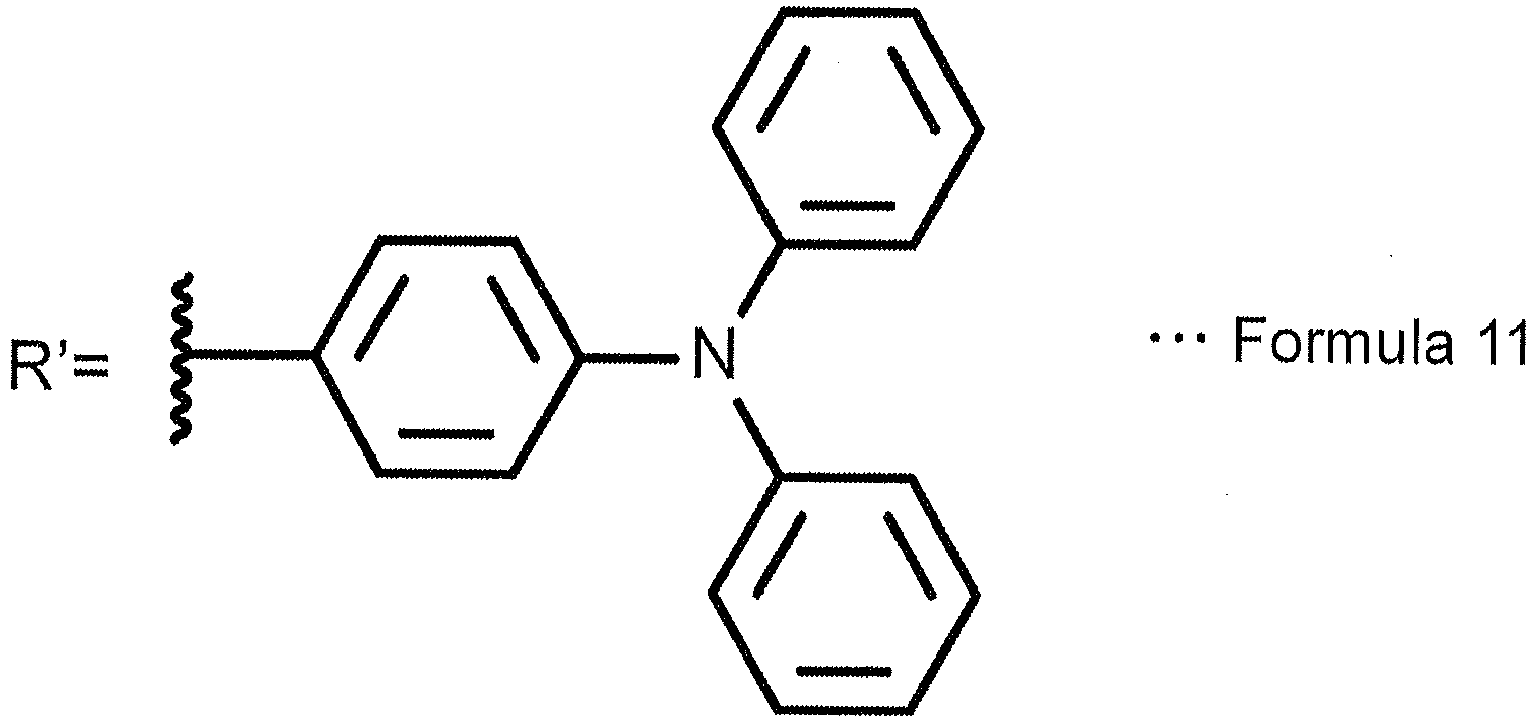

- The specific examples of the graphene-like carbon material represented by the
Formula 10 may be a compound represented by the following Formula 13 (Reference Embodiment). In the Formula 13, OMe is a methoxy group.
- The surface of the polycyclic aromatic hydrocarbon as the graphene-like carbon material is modified by an organic functional group represented by the following Formula 14.


- In the case where n=0, examples of the functional group represented by Formula 14 include a functional group represented by the following Formula 15.

- Specifically, in the case where R6 is a hydrogen atom, the functional group is a [d]9H-9-oxo-benzo[4,5]imidazo[2,1-a]pyrro group. Specifically, the graphene-like carbon material is represented by the following Formula 16.

- In the case where R6 is a methoxy group (OCH3), the graphene-like carbon material is represented by the following Formula 17.


- In the case where n=1, examples of the functional group represented by Formula 14 include a functional group represented by the following Formula 18.

- Specifically, in the case where R7 and R8 are hydrogen atoms, the functional group is a [d]11H-11-oxo-perimidino[2,1-a]pyrro group. In other words, the graphene-like carbon material is represented by the following Formula 19.

- The number of aromatic rings in the polycyclic aromatic hydrocarbon is preferably 2 or more and 10000 or less, more preferably 50 or more and 100 or less.
- Examples of the polycyclic aromatic hydrocarbon include pentacene, pentaphene, benzopyrene, perylene, dibenzophenanthrene, picene, coronene, ovalene, anthanthrene, circulene, dicoronylene, helicene, kekulene, zethrene, trinaphthylene, heptaphene, and heptacene. These may be used singly or in combination of two or more.
- The polycyclic aromatic hydrocarbon may be the graphene or graphene oxide described above. Alternatively, the polycyclic aromatic hydrocarbon may be an exfoliated graphite or an oxidized exfoliated graphite, which is a laminate of graphene sheets.
- The exchange of electrons between the polycyclic aromatic hydrocarbon and the functional group represented by the Formula 14 allows the electron density to be greatly changed. In response to chemical stimuli, electrical stimuli, or physical stimuli such as pressure and temperature, the light transmittance can be therefore controlled in a wide region from visible light to infrared light. In addition, an excellent long-term stability can be obtained.
- The graphene-like carbon material modified by a functional group represented by the Formula 14 can be obtained, for example, according to the reaction scheme shown in
Figure 3 . Here, the graphene-like carbon material represented by Formula 17 is described as an example. As shown inFigure 3 , first, a polycyclic aromatic hydrocarbon comprising an aromatic ring having two carboxyl groups is provided. Preferably, the two carboxyl groups are provided at the ortho positions of the aromatic ring. The polycyclic aromatic hydrocarbon comprising an aromatic ring having two carboxyl groups may be obtained, for example, by hydrolysis of the acid anhydride of a polycyclic aromatic hydrocarbon. Alternatively, a graphene oxide or an oxidized exfoliated graphite may be used. The graphene oxide or the oxidized exfoliated graphite may undergo oxidative scission before use. The graphene oxide or the oxidized exfoliated graphite can be manufactured, for example, by a conventionally known manufacturing method such as Hummers method. In this manner, the polycyclic aromatic hydrocarbon comprising an aromatic ring having two carboxyl groups may be a hydrolysate of the acid anhydride of a condensed polycyclic aromatic hydrocarbon having a plurality of condensed aromatic rings. Alternatively, a graphene oxide or an oxidized exfoliated graphite or a product of oxidative scission thereof may be used. - Meanwhile, a compound having one or more aromatic or heterocyclic rings substituted with at least two amino groups is provided. In the case where the compound has a plurality of aromatic or heterocyclic rings, a single aromatic or heterocyclic ring is substituted with least two amino groups, or two or more aromatic or heterocyclic rings are substituted with at least two amino groups as a whole.
- Examples of the compound for use include a diamine such as 1,2-diaminobenzene, 4-methoxy-1,2-diaminobenzene, 4-cyano-1,2-diaminobenzene, 4-nitro-1,2-diaminobenzene, naphthalene-1,8-diamine, phenanthrene-9,10-diamine and pyrene-4,5-diamine, 2,4-diaminopyridine, and 3,4-diaminothiophene.
- Subsequently, as shown in
Figure 3 , a polycyclic aromatic hydrocarbon comprising an aromatic ring having two carboxyl groups is reacted with a compound having one or more aromatic or heterocyclic rings substituted with at least two amino groups. The graphene-like carbon material described above can be thereby obtained. The reaction can be performed in the presence of oxalyl chloride, dimethyl sulfoxide, trimethylamine, or the like, as illustrated in the following Example. - For example, a polycyclic aromatic hydrocarbon comprising an aromatic ring having two carboxyl groups and oxalyl chloride are heated at 60°C for 4 days. On this occasion, a catalytic amount of N,N-dimethylformamide is added thereto. After removal of the oxalyl chloride, a polycyclic aromatic hydrocarbon comprising an aromatic ring having an acid chlorinated carboxyl group is dissolved in N,N-dimethylformamide, and triethylamine and a catalytic amount of N,N-dimethyl-4-aminopyridine are added thereto. A compound having one or more aromatic or heterocyclic rings substituted with at least two amino groups is then added thereto. The resulting solution is stirred at 80°C for 4 days. After removal of the solvent, the product is purified with bio-beads with use of tetrahydrofuran as a developing solvent so as to obtain a desired graphene-like carbon material.
- The generation of a graphene-like carbon material can be confirmed, for example, by using a Fourier transform infrared spectrophotometer (FT-IR) or a nuclear magnetic resonance (NMR) apparatus.
- The modification ratio by functional groups in a graphene-like carbon material is preferably 5% or more, more preferably 10% or more, still more preferably 20% or more. Thereby, the density of electrons can be effectively changed. The modification ratio in the present invention can be determined by the measurement of infrared absorption spectrum (FT-IR). Specifically, the intensity of each of the absorption peaks of the FT-IR spectra of a graphene-like carbon material before and after modification is measured, and the modification ratio is determined from the intensity of the absorption peak corresponding to the carboxyl group (-COOH) (1735cm-1) using the following expression.

wherein Ibefore is a peak intensity corresponding to the carboxyl group (-COOH) before modification, and Iafter is a peak intensity corresponding to the carboxyl group (-COOH) after modification. - The dimension of a graphene-like carbon material in the plane direction is preferably 1 nm or more and 100 nm or less, more preferably 2 nm or more and 80 nm or less, still more preferably 3 nm or more and 50 nm or less. With an excessively small dimension in the plane direction, the driving voltage is liable to increase due to an increased band gap. The energy efficiency is therefore liable to decrease. With an excessively large dimension in the plane direction, the change in the density of electrons is liable to decrease. In the case where a graphene or a graphene laminate is used as the graphene-like carbon material, the plane direction is the direction along the principal face of the graphene.
- Here, the aspect ratio of a graphene-like carbon material is defined as the dimension in the plane direction/thickness. On this occasion, the aspect ratio of the graphene-like carbon material is 3 or more and 330 or less. The aspect ratio is preferably 5 or more and 300 or less, more preferably 7 or more and 270 or less. With an aspect ratio in the range, the dimension in the plane direction can be further decreased, the change in the density of electrons can be further increased, and the increase in the driving voltage can be further suppressed. The dimension in the plane direction means the maximum dimension in the plane direction, unless otherwise noted.
- For a small aspect ratio, use of a graphene laminate is preferred. Preferably, the number of layers of a graphene laminate is 2 or more and 100 or less.
- A graphene-like carbon material may have a slender ribbon shape in the plane direction. In this case, the aspect ratio of the graphene-like carbon material is b/c wherein the dimensions in the plane direction are a and b (a>b) and the thickness is c.
- Here, the aspect ratio can be determined, for example, by measurement of the dimensions in the plane direction and the thickness of a graphene-like carbon material with use of an electron microscope or a scanning probe microscope (SPM).
- Due to having the configuration described above, the light-modulating
laminate 1 is capable of controlling the light transmittance in a wide region from visible light to infrared light by voltage application, with excellent long-term stability. - With reference to the following examples, the present invention will be described in more detail.
- According to the reaction scheme shown in
Figure 2 , a graphene-like carbon material was synthesized. First, 7.50 g of graphite described inFormula 8 was added to a mixed solution of concentrated sulfuric acid (360 ml) and nitric acid (120 ml). The solution was ultrasonicated for 3 hours and stirred at 120°C for 24 hours. Subsequently, the mixture was cooled to room temperature (20°C), diluted with deionized water, and neutralized (pH 5 to 6) with use of potassium carbonate. Subsequently, the solution was filtered through a polytetrafluoroethylene (PTFE) membrane of 0.2 µm. Thereafter, dialysis was performed for several days with use of a dialysis bag (2000 dalton) so as to obtain the graphene-like carbon material shown in Formula 9 (yield: 3.78 g). - Subsequently, to a solution of the graphene-like carbon material shown in Formula 9 (0.40 g) dissolved in oxalyl chloride (5 ml), N,N-dimethylformamide (20 µl) was added. The solution was then ultrasonicated for 3 hours, and stirred at 60°C for 3 days.
- Subsequently, the mixture was cooled to room temperature, and after removal of the oxalyl chloride under reduced pressure, the residue was dissolved in N,N-dimethylformamide (10 ml). To the solution, 4-propynyloxy benzylamine (0.60 g, 3.7 mmol), N,N-dimethyl-4-aminopyridine (4.5 mg, 0.038 mmol), and triethylamine (3 ml) were added.
- Subsequently, the solution was stirred at 100°C for 3 days, and then cooled to room temperature, to which dichloromethane was added. After removing precipitates by filtration, the solvent was evaporated.
- Subsequently, after the residue was dissolved in dichloromethane, the solution was washed with deionized water and concentrated in vacuum. The reaction mixture was purified by column chromatography with use of a column packed with silica gel (trade name "silica gel for chromatography PSQ-100B" manufactured by Fuji Silysia Chemical Ltd.,). (A solution of dichloromethane:ethyl acetate=4:1 was used as the mobile phase). Thereby the graphene-like carbon material shown in
Formula 7 was obtained (yield: 0.10 g). - Subsequently, a solution of the graphene-like carbon material shown in Formula 7 (21 mg) and 3,4,5-tri(hexadecyloxy)benzyl azide having a 3,4,5-tri(hexadecyloxy)benzyl group shown in Formula 5 (248 mg, 290 µmol) dissolved in chloroform (5 ml) was prepared. To the solution, 12 mg (13 µmol) of triphenylphosphine copper bromide (CuBr(PPh3)3) was added, and the solution was stirred at 20°C for 108 hours.
- Subsequently, after the solvent was removed in vacuum, the reaction mixture was purified by column chromatography with use of a column packed with silica gel (trade name "silica gel for chromatography PSQ-100B" manufactured by Fuji Silysia Chemical Ltd.). (Acetone was used as the mobile phase). Thereby the graphene-like carbon material shown in
Formula 1 was obtained (yield: 37 mg). - The graphene-like carbon material (aspect ratio: 50, dimension in plane direction: 20) modified by the 3,4,5-tri(hexadecyloxy)benzyl group shown in the
Formula 5 prepared as described above, which is shown in theFormula 1, was added at a concentration of 1 wt% to toluene. Subsequently, ultrasonic irradiation was performed for 30 minutes so as to disperse the graphene-like carbon material in toluene. Thereby a dispersion liquid was obtained. - Here, two substrates with a conductive film were prepared, each of which having a conductive film of ITO disposed on a glass substrate. To one of the substrate with a conductive film, the dispersion liquid was applied by spin coating. Subsequently, by heating at 85°C for 1 hour, toluene was removed and the graphene-like carbon material was dried on the substrate with a conductive film. Thereby a light-modulating film disposed on the substrate with a conductive film was obtained.
- Subsequently, a supporting component was disposed on the light-modulating film. The other substrate with a conductive film of the two substrates with a conductive film was then disposed on the supporting component. Into a space surrounded by the light-modulating film, the supporting component, and the substrate with a conductive film, an electrolyte solution (1 mol/L of LiPF6, solvent including EC:DMC=1:2 (volume ratio)) was injected to be sealed. Thereby a light-modulating laminate was obtained.
- In Examples and Comparative Examples, the dimension in the plane direction and the aspect ratio of a graphene-like carbon material were measured with use of an atomic force microscope (AFM, trade name "PICOPLUS 5100" manufactured by Agilent Technology Co., Ltd.). Specifically, a dispersion liquid obtained by dispersing 0.002 g of the obtained graphene-like carbon material in 10 ml of dichloromethane (solvent) was thinly applied to the surface of mica and dried. The dried sample was observed with an AFM so as to calculate the dimension in the plane direction from the AFM image. Also, the thickness thereof was calculated from the AFM height profile shown as an example in
Figure 4 . X shown inFigure 4 represents the length in the plane direction. The thickness was determined from the difference between the highest position and the lowest position in the height profile shown inFigure 4 . The dimension in the plane direction and the thickness represent the average values of 50 samples, respectively. The aspect ratio was calculated as the ratio between the dimension in the plane direction and the thickness. - A graphene-like carbon material was obtained in the same manner as in Example 1, except that 3,5-bis(3,5-bis(3,5-bis(benzyloxy)benzyloxy)benzyloxy)benzyl azide was used instead of 3,4,5-tri(hexadecyloxy)benzyl azide in Example 1.
- The thus obtained graphene-like carbon material (aspect ratio: 320, dimension in plane direction: 98) shown in the
Formula 1 modified by 3,5-bis(3,5-bis(3,5-bis(benzyloxy)benzyloxy)benzyloxy)benzyl shown in Formula 4 was used. In every other respect, a light-modulating laminate was prepared in the same manner as in Example 1. - A light-modulating laminate was prepared in the same manner as in Example 1, except that a graphene-like carbon material (aspect ratio: 3.5, dimension in plane direction: 1.5 nm) shown in
Formula 7 was used instead of the graphene-like carbon material shown inFormula 1 in Example 1. As the graphene-like carbon material shown inFormula 7, one obtained in the middle of the synthesis of the graphene-like carbon material shown inFormula 1 in Example 1 was used. - First, graphene oxide was prepared by a method described in literature (J. J. Zhu, P. M. Ajayan, et al., Nano Lett., 2012, 12, 844-849).
- Specifically, 1600 ml of a mixed acid (concentrated sulfuric acid:nitric acid=3:1 (volume ratio)) was put into a 5-L three-necked flask, and 6.3 g of powdered graphite (particle diameter<20 µm, manufactured by Sigma-Aldrich) was further fed thereto. Subsequently, a Dimroth condenser was mounted on one of the necks of the three-necked flask, and three-way cocks in a closed state were provided on the remaining necks. With cooling water flowing in this state, the contents were heated at 120°C with an oil bath while being stirred by a magnetic stirrer under air atmosphere so as to perform a reaction for 24 hours. The reaction product obtained was diluted with 2 L of deionized water. Thereafter, neutralization was performed using sodium carbonate until the pH of the diluted solution reached close to 8, so that a neutralized solution was obtained. The neutralized solution was put into a dialysis bag so as to be dialyzed for 3 days. After removal of neutralized salts and the like, the treatment liquid was dried. Thereby 2.5 g of graphene oxide was obtained.
- A graphene-like carbon material shown in the Formula 13 was synthesized from the thus prepared graphene oxide.
- Specifically, a stirrer chip was put into a 50-mL eggplant-shaped flask having a three-way cock and baked with a heat gun with argon gas flowing. After cooling, 152 mg of graphene oxide thus prepared was weighed in the eggplant-shaped flask in a dry box. After weighing, to the eggplant-shaped flask taken out from the dry box, 5 mL of oxalyl chloride (manufactured by Sigma-Aldrich) was added by a syringe under argon stream, and 0.1 mL of dried N,N-dimethylformamide (DMF, manufactured by Sigma-Aldrich) was further added thereto. Subsequently, the mixed liquid of graphene oxide, oxalyl chloride, and DMF in the eggplant-shaped flask was sonicated for 3 hours by an ultrasonic treatment apparatus (product No. "US-103", manufactured by SND Co., Ltd.). Thereafter, heating operation with warm water at 60°C while stirring with a stirrer was performed for 4 days to react the mixed liquid. After the reaction, 5 mL of dried DMF, 5 mL of triethylamine, and 2 mg of 4-methoxybenzylamine were further added to the eggplant-shaped flask, and the reaction was further continued with warm water at 80°C under an argon atmosphere for 4 days. The resulting reaction product was separated by a separating funnel with a chloroform/saturated NaCl aqueous solution so as to collect the chloroform recovery liquid. After the chloroform recovery liquid was dried with mirabilite for 12 hours, chloroform was removed by an evaporator. The product was purified with bio-beads (Bio-Beads™ S-X1 manufactured by Bio-Rad Laboratories, Inc.) with use of tetrahydrofuran as a developing solvent. Thereby 215 mg of a graphene-like carbon material shown in the Formula 13 was obtained.
- A light-modulating laminate was prepared in the same manner as in Example 1, except that the thus obtained graphene-like carbon material shown in the Formula 13 (aspect ratio: 5, dimension in plane direction: 15 nm) was used.
- First, graphene oxide was prepared by a method described in literature (J. J. Zhu, P. M. Ajayan, et al., Nano Lett., 2012, 12, 844-849).
- Specifically, 1600 ml of a mixed acid (concentrated sulfuric acid:nitric acid=3:1 (volume ratio)) was put into a 5-L three-necked flask, and 6.3 g of powdered graphite (particle diameter<20 µm, manufactured by Sigma-Aldrich) was further fed thereto. Subsequently, a Dimroth condenser was mounted on one of the necks of the three-necked flask, and three-way cocks in a closed state were provided on the remaining necks. With cooling water flowing in this state, the contents were heated at 120°C with an oil bath while being stirred by a magnetic stirrer under air atmosphere so as to perform a reaction for 24 hours. The reaction product obtained was diluted with 2 L of deionized water. Thereafter, neutralization was performed using sodium carbonate until the pH of the diluted solution reached close to 8, so that a neutralized solution was obtained. The neutralized solution was put into a dialysis bag so as to be dialyzed for 3 days. After removal of neutralized salts and the like, the treatment liquid was dried. Thereby 2.5 g of graphene oxide was obtained.
- A graphene-like carbon material shown in the Formula 16 was synthesized from the thus prepared graphene oxide.
- Specifically, a stirrer chip was put into a 50 mL eggplant-shaped flask having a three-way cock and baked with a heat gun with argon gas flowing. After cooling, 189 mg of graphene oxide thus prepared was weighed in the eggplant-shaped flask in a dry box. After weighing, to the eggplant-shaped flask taken out from the dry box, 5 mL of oxalyl chloride (manufactured by Sigma-Aldrich) was added by a syringe under argon stream, and 0.2 mL of dried N,N-dimethylformamide (DMF, manufactured by Sigma-Aldrich) was further added thereto. Subsequently, the mixed liquid of graphene oxide, oxalyl chloride, and DMF in the eggplant-shaped flask was sonicated for 3 hours by an ultrasonic treatment apparatus (product No. "US-103", manufactured by SND Co., Ltd.). Thereafter, heating operation with warm water at 60°C while stirring with a stirrer was performed for 3 days. After the reaction, 8 mL of dried pyridine and 451 mg of 1,2-diaminobenzene were further added to the eggplant-shaped flask, and the reaction was further continued with warm water at 80°C under an argon atmosphere for 4 days. The resulting reaction product was separated by a separating funnel with a chloroform/saturated NaCl aqueous solution so as to collect the chloroform recovery liquid. After the chloroform recovery liquid was dried with mirabilite for 12 hours, chloroform was removed by an evaporator. The product was purified with bio-beads (Bio-Beads™ S-X1 manufactured by Bio-Rad Laboratories, Inc.) with use of tetrahydrofuran as a developing solvent, so that 111 mg of a graphene-like carbon material shown in the Formula 16 was obtained.
- A light-modulating laminate was prepared in the same manner as in Example 1, except that the thus obtained graphene-like carbon material shown in Formula 16 (aspect ratio: 20, dimension in plane direction: 45 nm) was used.
- Similarly, in Example 6, graphene oxide was prepared in the same manner as in Example 5.
- A graphene-like carbon material shown in the Formula 19 was synthesized from the thus prepared graphene oxide.
- Specifically, a stirrer chip was put into a 50 mL eggplant-shaped flask having a three-way cock and baked with a heat gun with argon gas flowing. After cooling, 159 mg of graphene oxide prepared in the same way as in Example 1 was weighed in the eggplant-shaped flask in a dry box. After weighing, to the eggplant-shaped flask taken out from the dry box, 6 mL of oxalyl chloride (manufactured by Sigma-Aldrich) was added by a syringe under argon stream, and 0.2 mL of dried N,N-dimethylformamide (DMF, manufactured by Sigma-Aldrich) was further added thereto. Subsequently, the mixed liquid of graphene oxide, oxalyl chloride, and DMF in the eggplant-shaped flask was sonicated for 3 hours by an ultrasonic treatment apparatus (product No. "US-103", manufactured by SND Co., Ltd.). Thereafter, heating operation with warm water at 60°C while stirring with a stirrer was performed for 4 days. After the reaction, oxalyl chloride was removed. Then, 10 mL of dried DMF, 4 mL of triethylamine, and 457 mg of naphthalene-1,8-diamine were added to the eggplant-shaped flask, and the reaction was further continued with warm water at 80°C under an argon atmosphere for 4 days. The resulting reaction product was separated by a separating funnel with a chloroform/saturated NaCl aqueous solution so as to collect the chloroform recovery liquid. After the chloroform recovery liquid was dried with mirabilite for 12 hours, chloroform was removed by an evaporator. The product was purified with bio-beads (Bio-Beads™ S-X1 manufactured by Bio-Rad Laboratories, Inc.) with use of tetrahydrofuran as a developing solvent, so that 162 mg of a graphene-like carbon material was obtained.
-
Figure 5 is a chart showing the FT-IR spectrum of the graphene-like carbon material obtained in Example 6. InFigure 5 , the FT-IR spectra of a compound shown in the followingFormula 20 and an unmodified graphene oxide are also shown for comparison.
- As shown in
Figure 5 , shoulder peaks were observed near 1600 to 1700 cm-1 for the obtained graphene-like carbon material in addition to the peaks derived from graphene oxide. The shoulder peaks are present at approximately the same position as the peaks of the compound shown inFormula 20, and the peaks are not observed for an unmodified graphene oxide. It was, therefore, confirmed that the same substituent as the compound shown inFormula 20 was introduced into the obtained graphene-like carbon material. -
Figure 6 is a chart showing the 1H-NMR spectrum of a graphene-like carbon material obtained in Example 6. As shown inFigure 6 , signals derived from an aromatic ring were observed near 6.5 ppm to 8.0 ppm for the observed 1H-NMR spectrum. - From
Figures 5 and 6 , it was therefore confirmed that the graphene-like carbon material shown in the Formula 19 was produced. - A light-modulating laminate was prepared by the same method as in Example 1, except that the thus obtained graphene-like carbon material shown in Formula 19 (aspect ratio: 200, dimension in plane direction: 60 nm) was used.
- Using ultrasonic waves, 100 mg of graphene oxide (NiSiNa Materials, Exfoliated GO) was dispersed in 70 ml of N,N-dimethylformamide (DMF). In addition, the dispersion was treated at 200°C for 24 hours in an autoclave container having an internal cylinder of polytetrafluoroethylene, so that a graphene-like carbon material having an aspect ratio of 340 and a dimension in the plane direction of 115 nm was obtained. For other points, a light-modulating laminate was prepared by the same method as in Example 1.
- In 10 ml of decahydronaphthalene, 0.005 g of 3,4,9,10-perylenetetracarboxylic diimide (manufactured by Tokyo Chemical Industry Co., Ltd.) was dissolved, and the solution was deposited on an ITO glass by spin coating. The deposited film was heated at 150°C for 1 hour. By AFM measurement of the film, it was confirmed that the film was made of a graphene-like carbon material having an aspect ratio of 2 and a dimension in the plane direction of 0.7.
- A DC voltage of 3 V was applied to a light-modulating laminate so as to evaluate the change in the light transmittance. The change in the light transmittance was measured by a spectrometer manufactured by JASCO Corporation (model number: V-670). In addition, the change in color was inspected by visual observation.
- In Reference Example 1, the light transmittance decreased over the whole region of visible light and an infrared region after voltage application. In particular, the light transmittance was greatly changed from 80% before voltage application to 55% after voltage application near 500 nm. The difference in the light transmittance was 25% in Example 1.
- Also in Reference Example 2, the light transmittance decreased over the whole region of visible light and an infrared region after voltage application. In particular, the light transmittance was greatly changed from 79% before voltage application to 60% after voltage application near 500 nm. The difference in the light transmittance was 19% in Example 2.
- In Reference Examples 1 and 2, the change in color was confirmed by visual observation. More specifically, the transparency before voltage application was changed to a thick brown color after voltage application.
- The electrochromic properties of the light-modulating laminates obtained in Reference Examples 3 and 4, Examples 5 and 6 and Comparative Examples 1 to 2 were also evaluated in the same manner. In Reference Examples 3 and 4 and Examples 5 and 6, it was confirmed that the light transmittance can be controlled over the whole region of visible light and an infrared region after voltage application as in Reference Examples 1 and 2. In particular, the results on the difference in light transmittance (%) at a wavelength of 500 nm and the change in color (visual observation) before and after voltage application are described in the following Table 1. In the evaluation on the change in color (visual observation) in Table 1, "good" indicates that the transparency before voltage application changed into a thick brown color after voltage application. On the other hand, "poor" indicates that the change in color was not observed.
[Table 1] Graphene-like carbon material Evaluation on electrochromic properties Aspect ratio Dimension in plane direction (nm) Structural formula of graphene-like carbon material Difference in transmittance at wavelength of 500 nm (%) Change in color before and after voltage application (visual observation) Ex. 1 50 20 Formula 1 (modified with R in Formula 5) 25 Good Ex. 2 320 98 Formula 1 (modified with R in Formula 4) 19 Good Ex. 3 3.5 1.5 Formula 730 Good Ex. 4 5 15 Formula 13 45 Good Ex. 5 20 45 Formula 16 36 Good Ex. 6 200 60 Formula 19 25 Good Comp. Ex. 1 340 115 Formula 1 (modified with R in Formula 5) 1.5 Poor Comp. Ex. 2 2 0.7 Modification with amide group 0.9 Poor - Examples 1-4 in Table 1 are Reference Examples
-
- 1: LIGHT-MODULATING LAMINATE
- 2A and 2B: FIRST AND SECOND SUPPORTS
- 3A and 3B: FIRST AND SECOND CONDUCTIVE FILMS
- 4A and 4B: FIRST AND SECOND SUBSTRATES WITH CONDUCTIVE FILM
- 5: LIGHT-MODULATING FILM
- 6: ELECTROLYTE LAYER
- 7: SUPPORTING COMPONENT
Claims (9)
- A light-modulating material comprising a graphene-like carbon material having an aspect ratio of 3 or more and 330 or less,
wherein the surface of the graphene-like carbon material is modified with an organic functional group represented by the following Formula 14,
- The light-modulating material according to claim 1,
wherein the graphene-like carbon material has a dimension of 1 nm or more and 100 nm or less in the plane direction. - The light-modulating material according to claim 1 or 2, wherein the organic functional group is a functional group represented by the following Formula 15,

- The light-modulating material according to claim 1 or 2, wherein the organic functional group is a functional group represented by the following Formula 18,


- The light-modulating material according to any one of claims 1 to 4, wherein the modification ratio by the organic functional groups is 5% or more.
- A light-modulating film comprising the light-modulating material according to any one of claims 1 to 5.
- A light-modulating laminate comprising:a first support,a first conductive film disposed on the first support,the light-modulating film according to claim 6 disposed on the first conductive film,a second conductive film disposed on the light-modulating film, anda second support disposed on the second conductive film.
- The light-modulating laminate according to claim 7, having an electrolyte layer disposed between the light-modulating film and the second conductive film.
- The light-modulating laminate according to claim 7 or 8 wherein the first and the second supports are glass substrates.
Applications Claiming Priority (2)
| Application Number | Priority Date | Filing Date | Title |
|---|---|---|---|
| JP2016144052 | 2016-07-22 | ||
| PCT/JP2017/026425 WO2018016616A1 (en) | 2016-07-22 | 2017-07-21 | Light-modulating material, light-modulating film, and light-modulating laminate |
Publications (3)
| Publication Number | Publication Date |
|---|---|
| EP3489322A1 EP3489322A1 (en) | 2019-05-29 |
| EP3489322A4 EP3489322A4 (en) | 2020-01-29 |
| EP3489322B1 true EP3489322B1 (en) | 2020-12-30 |
Family
ID=60992642
Family Applications (1)
| Application Number | Title | Priority Date | Filing Date |
|---|---|---|---|
| EP17831132.0A Active EP3489322B1 (en) | 2016-07-22 | 2017-07-21 | Light-modulating material, light-modulating film, and light-modulating laminate |
Country Status (7)
| Country | Link |
|---|---|
| US (1) | US11479716B2 (en) |
| EP (1) | EP3489322B1 (en) |
| JP (1) | JP6958814B2 (en) |
| KR (1) | KR20190031423A (en) |
| CN (1) | CN109072066B (en) |
| TW (1) | TW201821589A (en) |
| WO (1) | WO2018016616A1 (en) |
Families Citing this family (6)
| Publication number | Priority date | Publication date | Assignee | Title |
|---|---|---|---|---|
| JP7064196B2 (en) * | 2017-07-21 | 2022-05-10 | 積水化学工業株式会社 | Graphene or graphene oxide derivatives, fluorescent materials, phosphorescent materials, and dimming materials |
| CN113646263A (en) | 2019-03-27 | 2021-11-12 | 国立大学法人大阪大学 | Method for producing carbon allotrope surface modified substance, method for producing substance having functional group introduced into carbon allotrope surface, method for producing grid for cryo-electron microscope, organic substance, grid for cryo-electron microscope |
| US20230324666A1 (en) * | 2020-08-20 | 2023-10-12 | Osaka University | Graphene grid, method for producing graphene grid, and method for analyzing structural analysis target substance |
| KR20220097574A (en) * | 2020-12-30 | 2022-07-08 | 현대자동차주식회사 | Polymer composition for electrochromic device, ion conductive composition and electrochromic device comprising the same |
| JP2022149441A (en) * | 2021-03-25 | 2022-10-06 | 積水化学工業株式会社 | Light adjusting material, light adjusting film, and light adjusting laminate body |
| CN115933264A (en) * | 2023-01-03 | 2023-04-07 | 精一门(常州)光学薄膜有限公司 | A long-cycle nanoscale electrochromic device |
Family Cites Families (19)
| Publication number | Priority date | Publication date | Assignee | Title |
|---|---|---|---|---|
| DE19845881A1 (en) | 1998-10-06 | 2000-04-13 | Bayer Ag | Arrangement based on poly (3,4, -dioxythiophene) derivatives that are electrochromically switched with protons |
| US7450290B2 (en) | 2001-06-25 | 2008-11-11 | University Of Washington | Electropolymerization of enhanced electrochromic (EC) polymer film |
| EP1412812A4 (en) | 2001-06-25 | 2009-07-22 | Univ Washington | SYNTHESIS OF ELECTROCHROMIC ORGANIC POLYMERS AND DEVICES USING THESE ELECTROCHROMIC ORGANIC POLYMERS |
| US7256923B2 (en) | 2001-06-25 | 2007-08-14 | University Of Washington | Switchable window based on electrochromic polymers |
| US7826124B2 (en) | 2001-06-25 | 2010-11-02 | University Of Washington Through Its Center For Commercialization | Flexible panel based on electrochromic polymers |
| US7808691B2 (en) | 2002-06-25 | 2010-10-05 | University Of Washington | Green electrochromic materials |
| US7298541B2 (en) | 2002-06-25 | 2007-11-20 | University Of Washington | Green electrochromic (EC) material and device |
| JP2004062030A (en) | 2002-07-31 | 2004-02-26 | Nippon Oil Corp | Electrochromic light control device |
| JP2005062772A (en) | 2003-08-20 | 2005-03-10 | Olympus Corp | Electrochromic element |
| CN108425170B (en) | 2004-11-09 | 2021-02-26 | 得克萨斯大学体系董事会 | Manufacture and use of nanofiber yarns, tapes and sheets |
| BRPI0618886A2 (en) | 2005-11-25 | 2011-09-13 | Sekisui Chemical Co Ltd | light control material and light control film |
| CN101573404B (en) | 2006-10-11 | 2014-07-09 | 佛罗里达大学研究基金公司 | Electroactive polymers containing pendant pi-interacting/binding substituents, their carbon nanotube composites, and processes to form the same |
| JP5472299B2 (en) | 2009-06-24 | 2014-04-16 | コニカミノルタ株式会社 | Transparent electrode, method for purifying conductive fiber used for transparent electrode, and organic electroluminescence device |
| JP2012224526A (en) | 2011-04-21 | 2012-11-15 | Hiroshima Univ | Method for producing graphene |
| JP5856423B2 (en) | 2011-09-30 | 2016-02-09 | 株式会社東芝 | Conductive material and electric element using the same |
| CN104136369A (en) * | 2012-05-14 | 2014-11-05 | 积水化学工业株式会社 | Method for producing modified-graphene-like carbon material, modified-graphene-like carbon material, and resin composite material containing modified-graphene-like carbon material |
| US9809740B2 (en) * | 2012-10-10 | 2017-11-07 | Baker Hughes, A Ge Company, Llc | Nanoparticle modified fluids and methods of manufacture thereof |
| JP6366479B2 (en) * | 2013-12-20 | 2018-08-01 | 国立大学法人広島大学 | Graphene structure |
| KR101534313B1 (en) * | 2014-08-04 | 2015-07-06 | 성균관대학교산학협력단 | Electrochromic device including carbon-based material and viologen-based compound, and method for producing the same |
-
2017
- 2017-07-21 TW TW106124500A patent/TW201821589A/en unknown
- 2017-07-21 EP EP17831132.0A patent/EP3489322B1/en active Active
- 2017-07-21 WO PCT/JP2017/026425 patent/WO2018016616A1/en not_active Ceased
- 2017-07-21 JP JP2017541410A patent/JP6958814B2/en active Active
- 2017-07-21 US US16/316,336 patent/US11479716B2/en active Active
- 2017-07-21 CN CN201780027764.1A patent/CN109072066B/en active Active
- 2017-07-21 KR KR1020187017444A patent/KR20190031423A/en not_active Withdrawn
Non-Patent Citations (1)
| Title |
|---|
| None * |
Also Published As
| Publication number | Publication date |
|---|---|
| CN109072066B (en) | 2022-05-24 |
| TW201821589A (en) | 2018-06-16 |
| US11479716B2 (en) | 2022-10-25 |
| KR20190031423A (en) | 2019-03-26 |
| EP3489322A1 (en) | 2019-05-29 |
| JPWO2018016616A1 (en) | 2019-05-16 |
| EP3489322A4 (en) | 2020-01-29 |
| JP6958814B2 (en) | 2021-11-02 |
| WO2018016616A1 (en) | 2018-01-25 |
| US20190292444A1 (en) | 2019-09-26 |
| CN109072066A (en) | 2018-12-21 |
Similar Documents
| Publication | Publication Date | Title |
|---|---|---|
| EP3489322A1 (en) | Light-modulating material, light-modulating film, and light-modulating laminate | |
| Sun et al. | Fine-tuned nanostructures assembled from l-lysine-functionalized perylene bisimides | |
| CN103623741B (en) | Graphene dispersing agent, preparation method thereof and preparation method of graphene | |
| Roy et al. | A bolaamphiphilic amino acid appended photo-switching supramolecular gel and tuning of photo-switching behaviour | |
| Govindaraj et al. | Synthesis and characterization of polyimide/polyhedral oligomeric silsesquioxane nanocomposites containing quinolyl moiety | |
| KR100858090B1 (en) | Carbon nanotube composites and birefringent thin films prepared therefrom | |
| Funahashi | Anisotropic electrical conductivity of n-doped thin films of polymerizable liquid-crystalline perylene bisimide bearing a triethylene oxide chain and cyclotetrasiloxane rings | |
| Dinari et al. | In situ thermal synthesis of novel polyimide nanocomposite films containing organo-modified layered double hydroxide: morphological, thermal and mechanical properties | |
| Sun et al. | The effect of N-doped quantum dots on the properties of in situ prepared colorless polyimide nanocomposite films | |
| Prabhu et al. | Novel polyaniline–halloysite nanoclay hybrid composites: Synthesis, physico-chemical, thermal and electrical properties | |
| EP3656773B1 (en) | Polycyclic aromatic hydrocarbon derivative, fluorescent material, phosphorescent material, and light-modulating material | |
| EP1640402B1 (en) | Diamine having quinoxaline unit, polyimide precursor, polyimide and use thereof | |
| Rafiee et al. | Polyimide nanocomposite films containing α-Fe2O3 nanoparticles | |
| Zhi‐Qiang et al. | Novel polyimide/graphene oxide composite films with ultralow dielectric constants | |
| CN112409315A (en) | Diamine monomer containing spirofluorene functional group, preparation method thereof and polyimide with low dielectric constant | |
| JP2022149441A (en) | Light adjusting material, light adjusting film, and light adjusting laminate body | |
| CN113087702B (en) | Multifunctional perchloroethylene derivative and preparation method and application thereof | |
| Luo et al. | Responsive gels with the polymer containing alternating naphthalene diimide and fluorinated alkyl chains: Gel formation and responsiveness as well as electrical conductivity of polymer thin films | |
| Balaji et al. | Influence of graphene oxide on thermal, electrical, and morphological properties of new achiral polyimide | |
| CN102558033B (en) | Organic-inorganic composite material based on 4, 4'-bipyridyl and preparation method and application thereof | |
| Wang et al. | Preparation of a Li+ intercalated organic derivative of the Ruddlesden–Popper phase H2CaTa2O7 | |
| He et al. | Molecular design and synthesis of branched bichromophore-attached linear fluorinated polyimides for nonlinear optical applications | |
| CN100340558C (en) | N,N-dipyridyl 3,4,9,10-tetraformyl diimine derirative and its synthesis method | |
| CN110305023B (en) | [60] fullerene cyclopentane derivative and preparation method and application thereof | |
| CN116283641A (en) | Preparation method and application of high-purity N,N'-bis-(4-amino-2-chlorophenyl)-terephthalamide |
Legal Events
| Date | Code | Title | Description |
|---|---|---|---|
| STAA | Information on the status of an ep patent application or granted ep patent |
Free format text: STATUS: THE INTERNATIONAL PUBLICATION HAS BEEN MADE |
|
| PUAI | Public reference made under article 153(3) epc to a published international application that has entered the european phase |
Free format text: ORIGINAL CODE: 0009012 |
|
| STAA | Information on the status of an ep patent application or granted ep patent |
Free format text: STATUS: REQUEST FOR EXAMINATION WAS MADE |
|
| 17P | Request for examination filed |
Effective date: 20190115 |
|
| AK | Designated contracting states |
Kind code of ref document: A1 Designated state(s): AL AT BE BG CH CY CZ DE DK EE ES FI FR GB GR HR HU IE IS IT LI LT LU LV MC MK MT NL NO PL PT RO RS SE SI SK SM TR |
|
| AX | Request for extension of the european patent |
Extension state: BA ME |
|
| DAV | Request for validation of the european patent (deleted) | ||
| DAX | Request for extension of the european patent (deleted) | ||
| A4 | Supplementary search report drawn up and despatched |
Effective date: 20200108 |
|
| RIC1 | Information provided on ipc code assigned before grant |
Ipc: C09K 9/02 20060101AFI20191220BHEP Ipc: C01B 32/15 20170101ALI20191220BHEP Ipc: G02F 1/15 20190101ALI20191220BHEP |
|
| GRAP | Despatch of communication of intention to grant a patent |
Free format text: ORIGINAL CODE: EPIDOSNIGR1 |
|
| STAA | Information on the status of an ep patent application or granted ep patent |
Free format text: STATUS: GRANT OF PATENT IS INTENDED |
|
| RIC1 | Information provided on ipc code assigned before grant |
Ipc: C01B 32/19 20170101ALI20200730BHEP Ipc: C01B 32/15 20170101ALI20200730BHEP Ipc: C01B 32/198 20170101ALI20200730BHEP Ipc: C09K 9/02 20060101AFI20200730BHEP Ipc: G02F 1/1516 20190101ALI20200730BHEP |
|
| INTG | Intention to grant announced |
Effective date: 20200814 |
|
| GRAS | Grant fee paid |
Free format text: ORIGINAL CODE: EPIDOSNIGR3 |
|
| GRAA | (expected) grant |
Free format text: ORIGINAL CODE: 0009210 |
|
| STAA | Information on the status of an ep patent application or granted ep patent |
Free format text: STATUS: THE PATENT HAS BEEN GRANTED |
|
| AK | Designated contracting states |
Kind code of ref document: B1 Designated state(s): AL AT BE BG CH CY CZ DE DK EE ES FI FR GB GR HR HU IE IS IT LI LT LU LV MC MK MT NL NO PL PT RO RS SE SI SK SM TR |
|
| REG | Reference to a national code |
Ref country code: GB Ref legal event code: FG4D |
|
| REG | Reference to a national code |
Ref country code: AT Ref legal event code: REF Ref document number: 1349927 Country of ref document: AT Kind code of ref document: T Effective date: 20210115 |
|
| REG | Reference to a national code |
Ref country code: DE Ref legal event code: R096 Ref document number: 602017030676 Country of ref document: DE |
|
| REG | Reference to a national code |
Ref country code: IE Ref legal event code: FG4D |
|
| PG25 | Lapsed in a contracting state [announced via postgrant information from national office to epo] |
Ref country code: GR Free format text: LAPSE BECAUSE OF FAILURE TO SUBMIT A TRANSLATION OF THE DESCRIPTION OR TO PAY THE FEE WITHIN THE PRESCRIBED TIME-LIMIT Effective date: 20210331 Ref country code: NO Free format text: LAPSE BECAUSE OF FAILURE TO SUBMIT A TRANSLATION OF THE DESCRIPTION OR TO PAY THE FEE WITHIN THE PRESCRIBED TIME-LIMIT Effective date: 20210330 Ref country code: RS Free format text: LAPSE BECAUSE OF FAILURE TO SUBMIT A TRANSLATION OF THE DESCRIPTION OR TO PAY THE FEE WITHIN THE PRESCRIBED TIME-LIMIT Effective date: 20201230 Ref country code: FI Free format text: LAPSE BECAUSE OF FAILURE TO SUBMIT A TRANSLATION OF THE DESCRIPTION OR TO PAY THE FEE WITHIN THE PRESCRIBED TIME-LIMIT Effective date: 20201230 |
|
| REG | Reference to a national code |
Ref country code: AT Ref legal event code: MK05 Ref document number: 1349927 Country of ref document: AT Kind code of ref document: T Effective date: 20201230 |
|
| PG25 | Lapsed in a contracting state [announced via postgrant information from national office to epo] |
Ref country code: SE Free format text: LAPSE BECAUSE OF FAILURE TO SUBMIT A TRANSLATION OF THE DESCRIPTION OR TO PAY THE FEE WITHIN THE PRESCRIBED TIME-LIMIT Effective date: 20201230 Ref country code: LV Free format text: LAPSE BECAUSE OF FAILURE TO SUBMIT A TRANSLATION OF THE DESCRIPTION OR TO PAY THE FEE WITHIN THE PRESCRIBED TIME-LIMIT Effective date: 20201230 Ref country code: BG Free format text: LAPSE BECAUSE OF FAILURE TO SUBMIT A TRANSLATION OF THE DESCRIPTION OR TO PAY THE FEE WITHIN THE PRESCRIBED TIME-LIMIT Effective date: 20210330 |
|
| REG | Reference to a national code |
Ref country code: NL Ref legal event code: MP Effective date: 20201230 |
|
| PG25 | Lapsed in a contracting state [announced via postgrant information from national office to epo] |
Ref country code: HR Free format text: LAPSE BECAUSE OF FAILURE TO SUBMIT A TRANSLATION OF THE DESCRIPTION OR TO PAY THE FEE WITHIN THE PRESCRIBED TIME-LIMIT Effective date: 20201230 |
|
| REG | Reference to a national code |
Ref country code: LT Ref legal event code: MG9D |
|
| PG25 | Lapsed in a contracting state [announced via postgrant information from national office to epo] |
Ref country code: CZ Free format text: LAPSE BECAUSE OF FAILURE TO SUBMIT A TRANSLATION OF THE DESCRIPTION OR TO PAY THE FEE WITHIN THE PRESCRIBED TIME-LIMIT Effective date: 20201230 Ref country code: EE Free format text: LAPSE BECAUSE OF FAILURE TO SUBMIT A TRANSLATION OF THE DESCRIPTION OR TO PAY THE FEE WITHIN THE PRESCRIBED TIME-LIMIT Effective date: 20201230 Ref country code: LT Free format text: LAPSE BECAUSE OF FAILURE TO SUBMIT A TRANSLATION OF THE DESCRIPTION OR TO PAY THE FEE WITHIN THE PRESCRIBED TIME-LIMIT Effective date: 20201230 Ref country code: PT Free format text: LAPSE BECAUSE OF FAILURE TO SUBMIT A TRANSLATION OF THE DESCRIPTION OR TO PAY THE FEE WITHIN THE PRESCRIBED TIME-LIMIT Effective date: 20210430 Ref country code: SK Free format text: LAPSE BECAUSE OF FAILURE TO SUBMIT A TRANSLATION OF THE DESCRIPTION OR TO PAY THE FEE WITHIN THE PRESCRIBED TIME-LIMIT Effective date: 20201230 Ref country code: RO Free format text: LAPSE BECAUSE OF FAILURE TO SUBMIT A TRANSLATION OF THE DESCRIPTION OR TO PAY THE FEE WITHIN THE PRESCRIBED TIME-LIMIT Effective date: 20201230 |
|
| PG25 | Lapsed in a contracting state [announced via postgrant information from national office to epo] |
Ref country code: PL Free format text: LAPSE BECAUSE OF FAILURE TO SUBMIT A TRANSLATION OF THE DESCRIPTION OR TO PAY THE FEE WITHIN THE PRESCRIBED TIME-LIMIT Effective date: 20201230 Ref country code: AT Free format text: LAPSE BECAUSE OF FAILURE TO SUBMIT A TRANSLATION OF THE DESCRIPTION OR TO PAY THE FEE WITHIN THE PRESCRIBED TIME-LIMIT Effective date: 20201230 |
|
| PG25 | Lapsed in a contracting state [announced via postgrant information from national office to epo] |
Ref country code: IS Free format text: LAPSE BECAUSE OF FAILURE TO SUBMIT A TRANSLATION OF THE DESCRIPTION OR TO PAY THE FEE WITHIN THE PRESCRIBED TIME-LIMIT Effective date: 20210430 |
|
| REG | Reference to a national code |
Ref country code: DE Ref legal event code: R097 Ref document number: 602017030676 Country of ref document: DE |
|
| PG25 | Lapsed in a contracting state [announced via postgrant information from national office to epo] |
Ref country code: AL Free format text: LAPSE BECAUSE OF FAILURE TO SUBMIT A TRANSLATION OF THE DESCRIPTION OR TO PAY THE FEE WITHIN THE PRESCRIBED TIME-LIMIT Effective date: 20201230 Ref country code: IT Free format text: LAPSE BECAUSE OF FAILURE TO SUBMIT A TRANSLATION OF THE DESCRIPTION OR TO PAY THE FEE WITHIN THE PRESCRIBED TIME-LIMIT Effective date: 20201230 |
|
| PLBE | No opposition filed within time limit |
Free format text: ORIGINAL CODE: 0009261 |
|
| STAA | Information on the status of an ep patent application or granted ep patent |
Free format text: STATUS: NO OPPOSITION FILED WITHIN TIME LIMIT |
|
| PG25 | Lapsed in a contracting state [announced via postgrant information from national office to epo] |
Ref country code: DK Free format text: LAPSE BECAUSE OF FAILURE TO SUBMIT A TRANSLATION OF THE DESCRIPTION OR TO PAY THE FEE WITHIN THE PRESCRIBED TIME-LIMIT Effective date: 20201230 |
|
| 26N | No opposition filed |
Effective date: 20211001 |
|
| PG25 | Lapsed in a contracting state [announced via postgrant information from national office to epo] |
Ref country code: ES Free format text: LAPSE BECAUSE OF FAILURE TO SUBMIT A TRANSLATION OF THE DESCRIPTION OR TO PAY THE FEE WITHIN THE PRESCRIBED TIME-LIMIT Effective date: 20201230 |
|
| PG25 | Lapsed in a contracting state [announced via postgrant information from national office to epo] |
Ref country code: SI Free format text: LAPSE BECAUSE OF FAILURE TO SUBMIT A TRANSLATION OF THE DESCRIPTION OR TO PAY THE FEE WITHIN THE PRESCRIBED TIME-LIMIT Effective date: 20201230 |
|
| REG | Reference to a national code |
Ref country code: CH Ref legal event code: PL |
|
| GBPC | Gb: european patent ceased through non-payment of renewal fee |
Effective date: 20210721 |
|
| PG25 | Lapsed in a contracting state [announced via postgrant information from national office to epo] |
Ref country code: MC Free format text: LAPSE BECAUSE OF FAILURE TO SUBMIT A TRANSLATION OF THE DESCRIPTION OR TO PAY THE FEE WITHIN THE PRESCRIBED TIME-LIMIT Effective date: 20201230 |
|
| REG | Reference to a national code |
Ref country code: BE Ref legal event code: MM Effective date: 20210731 |
|
| PG25 | Lapsed in a contracting state [announced via postgrant information from national office to epo] |
Ref country code: LI Free format text: LAPSE BECAUSE OF NON-PAYMENT OF DUE FEES Effective date: 20210731 Ref country code: GB Free format text: LAPSE BECAUSE OF NON-PAYMENT OF DUE FEES Effective date: 20210721 Ref country code: CH Free format text: LAPSE BECAUSE OF NON-PAYMENT OF DUE FEES Effective date: 20210731 |
|
| PG25 | Lapsed in a contracting state [announced via postgrant information from national office to epo] |
Ref country code: IS Free format text: LAPSE BECAUSE OF FAILURE TO SUBMIT A TRANSLATION OF THE DESCRIPTION OR TO PAY THE FEE WITHIN THE PRESCRIBED TIME-LIMIT Effective date: 20210430 Ref country code: LU Free format text: LAPSE BECAUSE OF NON-PAYMENT OF DUE FEES Effective date: 20210721 Ref country code: FR Free format text: LAPSE BECAUSE OF NON-PAYMENT OF DUE FEES Effective date: 20210731 |
|
| PG25 | Lapsed in a contracting state [announced via postgrant information from national office to epo] |
Ref country code: IE Free format text: LAPSE BECAUSE OF NON-PAYMENT OF DUE FEES Effective date: 20210721 Ref country code: BE Free format text: LAPSE BECAUSE OF NON-PAYMENT OF DUE FEES Effective date: 20210731 |
|
| PG25 | Lapsed in a contracting state [announced via postgrant information from national office to epo] |
Ref country code: NL Free format text: LAPSE BECAUSE OF NON-PAYMENT OF DUE FEES Effective date: 20201230 Ref country code: CY Free format text: LAPSE BECAUSE OF FAILURE TO SUBMIT A TRANSLATION OF THE DESCRIPTION OR TO PAY THE FEE WITHIN THE PRESCRIBED TIME-LIMIT Effective date: 20201230 |
|
| PG25 | Lapsed in a contracting state [announced via postgrant information from national office to epo] |
Ref country code: SM Free format text: LAPSE BECAUSE OF FAILURE TO SUBMIT A TRANSLATION OF THE DESCRIPTION OR TO PAY THE FEE WITHIN THE PRESCRIBED TIME-LIMIT Effective date: 20201230 Ref country code: HU Free format text: LAPSE BECAUSE OF FAILURE TO SUBMIT A TRANSLATION OF THE DESCRIPTION OR TO PAY THE FEE WITHIN THE PRESCRIBED TIME-LIMIT; INVALID AB INITIO Effective date: 20170721 |
|
| PG25 | Lapsed in a contracting state [announced via postgrant information from national office to epo] |
Ref country code: MK Free format text: LAPSE BECAUSE OF FAILURE TO SUBMIT A TRANSLATION OF THE DESCRIPTION OR TO PAY THE FEE WITHIN THE PRESCRIBED TIME-LIMIT Effective date: 20201230 |
|
| PG25 | Lapsed in a contracting state [announced via postgrant information from national office to epo] |
Ref country code: TR Free format text: LAPSE BECAUSE OF FAILURE TO SUBMIT A TRANSLATION OF THE DESCRIPTION OR TO PAY THE FEE WITHIN THE PRESCRIBED TIME-LIMIT Effective date: 20201230 |
|
| PG25 | Lapsed in a contracting state [announced via postgrant information from national office to epo] |
Ref country code: MT Free format text: LAPSE BECAUSE OF FAILURE TO SUBMIT A TRANSLATION OF THE DESCRIPTION OR TO PAY THE FEE WITHIN THE PRESCRIBED TIME-LIMIT Effective date: 20201230 |
|
| PGFP | Annual fee paid to national office [announced via postgrant information from national office to epo] |
Ref country code: DE Payment date: 20250528 Year of fee payment: 9 |