EP3489249A1 - Organometallic compound and organic light-emitting device including the same - Google Patents
Organometallic compound and organic light-emitting device including the same Download PDFInfo
- Publication number
- EP3489249A1 EP3489249A1 EP18205634.1A EP18205634A EP3489249A1 EP 3489249 A1 EP3489249 A1 EP 3489249A1 EP 18205634 A EP18205634 A EP 18205634A EP 3489249 A1 EP3489249 A1 EP 3489249A1
- Authority
- EP
- European Patent Office
- Prior art keywords
- group
- substituted
- unsubstituted
- formula
- deuterium
- Prior art date
- Legal status (The legal status is an assumption and is not a legal conclusion. Google has not performed a legal analysis and makes no representation as to the accuracy of the status listed.)
- Granted
Links
- 0 CC1=C(*=I)C(*)=C(*)*2*=C(*)*(*)*12 Chemical compound CC1=C(*=I)C(*)=C(*)*2*=C(*)*(*)*12 0.000 description 14
- JNTQZENVTXREEF-UHFFFAOYSA-N CC1(c2ccccc2)N=C(C(C)=CC=C2)N2N1 Chemical compound CC1(c2ccccc2)N=C(C(C)=CC=C2)N2N1 JNTQZENVTXREEF-UHFFFAOYSA-N 0.000 description 1
- CRWUWCXSDFMRAZ-VGSWGCGISA-N C[C@H]([C@H]1N(C2=C3C=CN=CC2)c2ccccc2)[N]13c1c(C)cccc1 Chemical compound C[C@H]([C@H]1N(C2=C3C=CN=CC2)c2ccccc2)[N]13c1c(C)cccc1 CRWUWCXSDFMRAZ-VGSWGCGISA-N 0.000 description 1
Images
Classifications
-
- C—CHEMISTRY; METALLURGY
- C09—DYES; PAINTS; POLISHES; NATURAL RESINS; ADHESIVES; COMPOSITIONS NOT OTHERWISE PROVIDED FOR; APPLICATIONS OF MATERIALS NOT OTHERWISE PROVIDED FOR
- C09K—MATERIALS FOR MISCELLANEOUS APPLICATIONS, NOT PROVIDED FOR ELSEWHERE
- C09K11/00—Luminescent materials, e.g. electroluminescent or chemiluminescent
- C09K11/06—Luminescent materials, e.g. electroluminescent or chemiluminescent containing organic luminescent materials
-
- C—CHEMISTRY; METALLURGY
- C07—ORGANIC CHEMISTRY
- C07F—ACYCLIC, CARBOCYCLIC OR HETEROCYCLIC COMPOUNDS CONTAINING ELEMENTS OTHER THAN CARBON, HYDROGEN, HALOGEN, OXYGEN, NITROGEN, SULFUR, SELENIUM OR TELLURIUM
- C07F15/00—Compounds containing elements of Groups 8, 9, 10 or 18 of the Periodic Table
- C07F15/0006—Compounds containing elements of Groups 8, 9, 10 or 18 of the Periodic Table compounds of the platinum group
- C07F15/0033—Iridium compounds
-
- H—ELECTRICITY
- H05—ELECTRIC TECHNIQUES NOT OTHERWISE PROVIDED FOR
- H05B—ELECTRIC HEATING; ELECTRIC LIGHT SOURCES NOT OTHERWISE PROVIDED FOR; CIRCUIT ARRANGEMENTS FOR ELECTRIC LIGHT SOURCES, IN GENERAL
- H05B33/00—Electroluminescent light sources
- H05B33/12—Light sources with substantially two-dimensional [2D] radiating surfaces
- H05B33/14—Light sources with substantially two-dimensional [2D] radiating surfaces characterised by the chemical or physical composition or the arrangement of the electroluminescent material, or by the simultaneous addition of the electroluminescent material in or onto the light source
-
- H—ELECTRICITY
- H10—SEMICONDUCTOR DEVICES; ELECTRIC SOLID-STATE DEVICES NOT OTHERWISE PROVIDED FOR
- H10K—ORGANIC ELECTRIC SOLID-STATE DEVICES
- H10K85/00—Organic materials used in the body or electrodes of devices covered by this subclass
- H10K85/30—Coordination compounds
- H10K85/341—Transition metal complexes, e.g. Ru(II)polypyridine complexes
- H10K85/342—Transition metal complexes, e.g. Ru(II)polypyridine complexes comprising iridium
-
- H—ELECTRICITY
- H10—SEMICONDUCTOR DEVICES; ELECTRIC SOLID-STATE DEVICES NOT OTHERWISE PROVIDED FOR
- H10K—ORGANIC ELECTRIC SOLID-STATE DEVICES
- H10K2101/00—Properties of the organic materials covered by group H10K85/00
- H10K2101/10—Triplet emission
-
- H—ELECTRICITY
- H10—SEMICONDUCTOR DEVICES; ELECTRIC SOLID-STATE DEVICES NOT OTHERWISE PROVIDED FOR
- H10K—ORGANIC ELECTRIC SOLID-STATE DEVICES
- H10K50/00—Organic light-emitting devices
- H10K50/10—OLEDs or polymer light-emitting diodes [PLED]
- H10K50/11—OLEDs or polymer light-emitting diodes [PLED] characterised by the electroluminescent [EL] layers
Definitions
- One or more embodiments relate to an organometallic compound and an organic light-emitting device including the same.
- Organic light-emitting devices are self-emission devices that produce full-color images, and also have wide viewing angles, high contrast ratios, short response times, and excellent characteristics in terms of brightness, driving voltage, and response speed, compared to devices in the art.
- an organic light-emitting device includes an anode, a cathode, and an organic layer between the anode and the cathode, wherein the organic layer includes an emission layer.
- a hole transport region may be between the anode and the emission layer, and an electron transport region may be between the emission layer and the cathode.
- Holes provided from the anode may move toward the emission layer through the hole transport region, and electrons provided from the cathode may move toward the emission layer through the electron transport region.
- the holes and the electrons recombine in the emission layer to produce excitons. These excitons transit from an excited state to a ground state, thereby generating light.
- aspects of the present disclosure provide a novel organometallic compound and an organic light-emitting device including the same.
- An aspect provides an organometallic compound represented by Formula 1: ⁇ Formula 1> M 11 (L 11 ) n11 (L 12 ) n12 .
- Formula 1 An aspect provides an organometallic compound represented by Formula 1: ⁇ Formula 1> M 11 (L 11 ) n11 (L 12 ) n12 .
- an organic light-emitting device including: a first electrode; a second electrode; an organic layer between the first electrode and the second electrode and including an emission layer, wherein the organic layer includes the organometallic compound described above.
- the organometallic compound may act as a dopant in the emission layer.
- An organometallic compound according to an embodiment is represented by Formula 1: ⁇ Formula 1> M 11 (L 11 ) n11 (L 12 ) n12 .
- M 11 may be a transition metal
- M 11 may be selected from platinum (Pt), palladium (Pd), copper (Cu), silver (Ag), gold (Au), rhodium (Rh), iridium (Ir), ruthenium (Ru), osmium (Os), titanium (Ti), zirconium (Zr), hafnium (Hf), europium (Eu), terbium (Tb), and thulium (Tm), but embodiments of the present disclosure are not limited thereto.
- M 11 may be selected from Ir, Os, and Pt, but embodiments of the present disclosure are not limited thereto.
- M 11 may be Ir, but embodiments of the present disclosure are not limited thereto.
- L 11 may be selected from a group represented by Formula 1A:
- a 11 may be C 1 -C 30 heterocyclic group
- a 12 may be C 5 -C 30 carbocyclic group or C 1 -C 30 heterocyclic group.
- a 11 may be selected from a pyridine group, a pyrimidine group, a pyrazine group, a pyridazine group, a triazine group,, a quinoline group, an isoquinoline group, a benzoquinoline group, a benzoisoquinoline group, a phthalazine group, a naphthyridine group, a quinoxaline group, a benzoquinoxaline group, a quinazoline group and a benzoquinazoline group.
- a 12 may be selected from a benzene group, a naphthalene group, a fluorene group, a carbazole group, a dibenzofuran group, a dibenzothiophene group, a pyridine group, a pyrimidine group, a pyrazine group, a pyridazine group, a triazine group,, a quinoline group, an isoquinoline group, a benzoquinoline group, a benzoisoquinoline group, a phthalazine group, a naphthyridine group, a quinoxaline group, a benzoquinoxaline group, a quinazoline group and a benzoquinazoline group.
- a bond between Z 11 and N, a bond between Z 11 and W 11 , a bond between W 11 and Y 11 , a bond between Y 11 and Y 12 , and a bond between N and Y 12 may each independently be a single bond or a double bond.
- W 11 may be selected from N and N(R 11 ), and R 11 may be the same as described herein.
- W 11 may be N, but embodiments of the present disclosure are not limited thereto.
- a bond between Z 11 and W 11 may be a double bond; or a bond between Y 11 and W 11 may be a double bond, but embodiments of the present disclosure are not limited thereto.
- Y 11 and Y 12 may each independently be selected from N and C, wherein at least one selected from Y 11 and Y 12 may be N.
- Y 11 may be N, and Y 12 may be C; Y 11 may be C, and Y 12 may be N; or Y 11 may be N, and Y 12 may be N, but embodiments of the present disclosure are not limited thereto.
- Y 11 may be N, and Y 12 may be C; Y 11 may be C, and Y 12 may be N, but embodiments of the present disclosure are not limited thereto.
- a bond between Y 11 and Y 12 may be a double bond, but embodiments of the present disclosure are not limited thereto.
- Z 11 and Z 13 may each independently be C.
- two bonds selected from a bond between Z 11 and N, a bond between Z 11 and W 11 , a bond between W 11 and Y 11 , a bond between Y 11 and Y 12 , and a bond between N and Y 12 may each be a double bond, and the others thereof may each be a single bond, but embodiments of the present disclosure are not limited thereto.
- a moiety represented by may be represented by Formula 1A-1, and a moiety represented by may be represented by Formula 1A-2, but embodiments of the present disclosure are not limited thereto: In Formulae 1A-1 and 1A-2,
- a bond between Y 12 and X 15 , a bond between X 15 and X 14 , a bond between X 13 and X 14 , a bond between X 12 and X 13 , a bond between Y 11 and X 12 , a bond between Z 12 and Z 13 , a bond between Z 13 and X 16 , a bond between X 16 and X 17 , a bond between X 17 and X 18 , a bond between X 18 and X 19 , and a bond between X 19 and Z 12 may each independently be a single bond or a double bond.
- X 12 may be selected from N and C(R 12a ), X 13 may be selected from N and C(R 13a ), X 14 may be selected from N and C(R 14a ), X 15 may be selected from N and C(R 15a ), X 16 may be selected from N and C(R 16a ), X 17 may be selected from N and C(R 17a ), X 18 may be selected from N and C(R 18a ), and X 19 may be selected from N and C(R 19a ), but embodiments of the present disclosure are not limited thereto.
- X 12 may be C(R 12a ), X 13 may be C(R 13a ), X 14 may be C(R 14a ), and X 15 may be C(R 15a ), but embodiments of the present disclosure are not limited thereto.
- At least one selected from X 12 to X 15 may be selected from O and S, but embodiments of the present disclosure are not limited thereto.
- X 16 may be N, X 17 may be C(R 17a ), X 18 may be C(R 18a ), and X 19 may be C(R 19a ); X 16 may be C(R 16a ), X 17 may be N, X 18 may be C(R 18a ), and X 19 may be C(R 19a ); X 16 may be C(R 16a ), X 17 may be C(R 17a ), X 18 may be N, and X 19 may be C(R 19a ); X 16 may be C(R 16a ), X 17 may be C(R 17a ), X 18 may be C(R 18a ), and X 19 may be N; or X 16 may be C(R 16a ), X 17 may be C(R 17a ), X 18 may be C(R 18a ), and X 19 may be C(R 19a ), but embodiments of the present disclosure are not limited thereto.
- three bonds selected from a bond between Y 11 and Y 12 , a bond between Y 12 and X 15 , a bond between X 15 and X 14 , a bond between X 13 and X 14 , a bond between X 12 and X 13 , and a bond between Y 11 and X 12 may each be a double bond, and the others thereof may each be a single bond, but embodiments of the present disclosure are not limited thereto.
- three bonds selected from a bond between Z 12 and Z 13 , a bond between Z 13 and X 16 , a bond between X 16 and X 17 , a bond between X 17 and X 18 , a bond between X 18 and X 19 , and a bond between X 19 and Z 12 may each be a double bond, and the others thereof may each be a single bond, but embodiments of the present disclosure are not limited thereto.
- a moiety represented by may be represented by one selected from Formulae 2-1 to 2-15, but embodiments of the present disclosure are not limited thereto: In Formulae 2-1 to 2-15,
- a moiety represented by may be represented by one selected from Formulae 2-1 and 2-2, but embodiments of the present disclosure are not limited thereto.
- a moiety represented by may be represented by Formula 2-1, but embodiments of the present disclosure are not limited thereto.
- a moiety represented by may be represented by one selected from Formulae 3-1 to 3-8, but embodiments of the present disclosure are not limited thereto: In Formulae 3-1 to 3-8,
- a moiety represented by may be represented by one selected from Formulae 3-1 to 3-5, but embodiments of the present disclosure are not limited thereto.
- a moiety represented by may be represented by Formula 3-1, but embodiments of the present disclosure are not limited thereto.
- R 1 , R 2 , and R 11 may each independently be selected from hydrogen, deuterium, -F, -Cl, -Br, -I, -SF 5 , a hydroxyl group, a cyano group, a nitro group, an amino group, an amidino group, a hydrazine group, a hydrazone group, a carboxylic acid group or a salt thereof, a sulfonic acid group or a salt thereof, a phosphoric acid group or a salt thereof, a substituted or unsubstituted C 1 -C 60 alkyl group, a substituted or unsubstituted C 2 -C 60 alkenyl group, a substituted or unsubstituted C 2 -C 60 alkynyl group, a substituted or unsubstituted C 1 -C 60 alkoxy group, a substituted or unsubstituted C 3 -C 10 cycloalkyl group
- R 1 , R 2 , and R 11 may each independently be selected from:
- R 1 , R 2 , and R 11 may each independently be selected from:
- Q 1 to Q 9 may each independently be selected from:
- * indicates a binding site to a neighboring atom
- i-Pr indicates an isopropyl group
- t-Bu indicates a t-butyl group
- Ph indicates a phenyl group
- 1-Nph indicates a 1-naphthyl group
- 2-Nph indicates a 2-naphthyl group
- 2-Pyr indicates a 2-pyridyl group
- 3-Pyr indicates a 3-pyridyl group
- 4-Pyr indicates a 4-pyridyl group
- TMS indicates a trimethylsilyl group.
- R 1 , R 2 , and R 11 may each independently be selected from hydrogen, deuterium, -F, a cyano group, a nitro group, -SF 5 , -CH 3 ,-CF 3 , groups represented by Formulae 9-1 to 9-13, and groups represented by Formulae 10-17 to 10-79, but embodiments of the present disclosure are not limited thereto:
- * indicates a binding site to a neighboring atom
- i-Pr indicates an isopropyl group
- t-Bu indicates a t-butyl group
- Ph indicates a phenyl group
- TMS indicates a trimethylsilyl group.
- R 1 , R 2 , and R 11 may be selected from deuterium, a substituted or unsubstituted C 1 -C 60 alkyl group, a substituted or unsubstituted C 2 -C 60 alkenyl group, a substituted or unsubstituted C 2 -C 60 alkynyl group, a substituted or unsubstituted C 1 -C 60 alkoxy group, a substituted or unsubstituted C 3 -C 10 cycloalkyl group, a substituted or unsubstituted C 1 -C 10 heterocycloalkyl group, a substituted or unsubstituted C 3 -C 10 cycloalkenyl group, a substituted or unsubstituted C 1 -C 10 heterocycloalkenyl group, a substituted or unsubstituted C 6 -C 60 aryl group, a substituted or unsubuterium, a substituted or unsubstitute
- two, three, or four selected from a plurality of neighboring R 1 , R 2 , and R 11 may optionally be linked to form a four-coordinate, six-coordinate, or eight-coordinate ligand.
- two neighboring R 12a (s) may optionally be linked to form a tetradentate ligand, but embodiments of the present disclosure are not limited thereto.
- two neighboring R 13a (s) may optionally be linked to form a tetradentate ligand, but embodiments of the present disclosure are not limited thereto.
- two neighboring R 14a (s) may optionally be linked to form a tetradentate ligand, but embodiments of the present disclosure are not limited thereto.
- two neighboring R 15a (s) may optionally be linked to form a tetradentate ligand, but embodiments of the present disclosure are not limited thereto.
- two neighboring R 16a (s) may optionally be linked to form a tetradentate ligand, but embodiments of the present disclosure are not limited thereto.
- two neighboring R 17a (s) may optionally be linked to form a tetradentate ligand, but embodiments of the present disclosure are not limited thereto.
- two neighboring R 18a (s) may optionally be linked to form a tetradentate ligand, but embodiments of the present disclosure are not limited thereto.
- two neighboring R 19a (s) may optionally be linked to form a tetradentate ligand, but embodiments of the present disclosure are not limited thereto.
- three neighboring R 12a (s) may optionally be linked to form a tetradentate ligand, but embodiments of the present disclosure are not limited thereto.
- three neighboring R 13a (s) may optionally be linked to form a tetradentate ligand, but embodiments of the present disclosure are not limited thereto.
- three neighboring R 14a (s) may optionally be linked to form a tetradentate ligand, but embodiments of the present disclosure are not limited thereto.
- three neighboring R 15a (s) may optionally be linked to form a tetradentate ligand, but embodiments of the present disclosure are not limited thereto.
- three neighboring R 16a (s) may optionally be linked to form a tetradentate ligand, but embodiments of the present disclosure are not limited thereto.
- three neighboring R 17a (s) may optionally be linked to form a tetradentate ligand, but embodiments of the present disclosure are not limited thereto.
- three neighboring R 18a (s) may optionally be linked to form a tetradentate ligand, but embodiments of the present disclosure are not limited thereto.
- three neighboring R 19a (s) may optionally be linked to form a tetradentate ligand, but embodiments of the present disclosure are not limited thereto.
- n11 may be selected from 1, 2, 3, and 4, wherein, when n11 is 2 or more, 2 or more L 11 (s) are the same or different from each other.
- n11 may be selected from 1, 2 and 3, but embodiments of the present disclosure are not limited thereto.
- L 12 may be selected from a one-coordinate ligand, a two-coordinate ligand, and a three-coordinate ligand.
- L 12 may be selected from one-coordinate ligands, for example, I - , Br - , Cl - , sulfide, nitrate, azide, hydroxide, cyanate, isocyanate, thiocyanate, water, acetonitrile, pyridine, ammonia, carbon monoxide, P(Ph) 3 , P(Ph) 2 CH 3 , PPh(CH 3 ) 2 , and P(CH 3 ) 3 , but embodiments of the present disclosure are not limited thereto.
- one-coordinate ligands for example, I - , Br - , Cl - , sulfide, nitrate, azide, hydroxide, cyanate, isocyanate, thiocyanate, water, acetonitrile, pyridine, ammonia, carbon monoxide, P(Ph) 3 , P(Ph) 2 CH 3 , PPh(CH 3 ) 2 , and P
- L 12 may be selected from two-coordinate ligands, for example, oxalate, acetylacetonate, picolinic acid, 1,2-bis(diphenylphosphino)ethane, 1,1-bis(diphenylphosphino)methane, glycinate, and ethylenediamine, but embodiments of the present disclosure are not limited thereto.
- L 12 may be a ligand represented by one selected from Formulae 7-1 to 7-11, but embodiments of the present disclosure are not limited thereto: In Formulae 7-1 to 7-11,
- a 71 may be selected from a benzene group, a naphthalene group, an imidazole group, a benzimidazole group, a pyridine group, a pyrimidine group, a triazine group, a quinoline group, and an isoquinoline group, but embodiments of the present disclosure are not limited thereto.
- X 71 and X 72 may each independently be N, but embodiments of the present disclosure are not limited thereto.
- X 73 may be C(Q 73 ), X 74 may be C(Q 74 ), X 75 may be C(Q 75 ), X 76 may be C(Q 76 ), and X 77 may be C(Q 77 ), but embodiments of the present disclosure are not limited thereto.
- X 78 may be N(Q 78 ), and X 79 may be N(Q 79 ), but embodiments of the present disclosure are not limited thereto.
- Y 71 and Y 72 may each independently be selected from a substituted or unsubstituted methylene group and a substituted or unsubstituted phenylene group, but embodiments of the present disclosure are not limited thereto.
- Z 71 and Z 72 may each independently be O, but embodiments of the present disclosure are not limited thereto.
- Z 73 may be P, but embodiments of the present disclosure are not limited thereto.
- R 71 to R 80 and Q 73 to Q 79 may each independently be selected from:
- L 12 may be a ligand represented by one selected from Formulae 5-1 to 5-116 and Formulae 8-1 to 8-43, but embodiments of the present disclosure are not limited thereto:
- R 51 to R 53 may each independently be selected from:
- n12 may be selected from 0, 1, 2, 3, and 4, wherein, when n12 is 2 or more, 2 or more L 12 (s) are the same or different from each other.
- n12 may be selected from 0, 1 and 2, but embodiments of the present disclosure are not limited thereto.
- M 11 may be Ir, n11 may be selected from 2 and 3, and n12 may be selected from 0, 1, and 2, but embodiments of the present disclosure are not limited thereto.
- L 11 and L 12 may be different from each other.
- the organometallic compound represented by Formula 1 may be represented by one selected from Formulae 1-1 and 1-2, but embodiments of the present disclosure are not limited thereto: In Formulae 1-1 and 1-2,
- X 12 may be selected from N and C(R 12a ), X 13 may be selected from N and C(R 13a ), X 14 may be selected from N and C(R 14a ), X 15 may be selected from N and C(R 15a ), X 16 may be selected from N and C(R 16a ), X 17 may be selected from N and C(R 17a ), X 18 may be selected from N and C(R 18a ), and X 19 may be selected from N and C(R 19a ), but embodiments of the present disclosure are not limited thereto.
- a bond between N and X 12 , a bond between X 13 and X 14 , and a bond between X 15 and C may each be a single bond, and a bond between X 12 and X 13 and a bond between X 14 and X 15 may each be a double bond, but embodiments of the present disclosure are not limited thereto.
- a bond between C and X 12 , a bond between X 13 and X 14 , and a bond between X 15 and N may each be a single bond, and a bond between X 12 and X 13 and a bond between X 14 and X 15 may each be a double bond, but embodiments of the present disclosure are not limited thereto.
- X 12 may be C(R 12a ), X 13 may be C(R 13a ), X 14 may be C(R 14a ), and X 15 may be C(R 15a ), but embodiments of the present disclosure are not limited thereto.
- a bond between N and X 12 , a bond between X 13 and X 14 , and a bond between X 15 and C may each be a single bond, and a bond between X 12 and X 13 and a bond between X 14 and X 15 may each be a double bond, but embodiments of the present disclosure are not limited thereto.
- a bond between C and X 12 , a bond between X 13 and X 14 , and a bond between X 15 and N may each be a single bond, and a bond between X 12 and X 13 and a bond between X 14 and X 15 may each be a double bond, but embodiments of the present disclosure are not limited thereto.
- at least one selected from X 12 to X 15 may be selected from O and S, but embodiments of the present disclosure are not limited thereto.
- X 16 may be N, X 17 may be C(R 17a ), X 18 may be C(R 18a ), and X 19 may be C(R 19a ); X 16 may be C(R 16a ), X 17 may be N, X 18 may be C(R 18a ), and X 19 may be C(R 19a ); X 16 may be C(R 16a ), X 17 may be C(R 17a ), X 18 may be N, and X 19 may be C(R 19a ); X 16 may be C(R 16a ), X 17 may be C(R 17a ), X 18 may be C(R 18a ), and X 19 may be N; or X 16 may be C(R 16a ), X 17 may be C(R 17a ), X 18 may be C(R 18a ), and X 19 may be C(R 19a ), but embodiments of the present disclosure are not limited thereto.
- a bond between X 16 and X 17 and a bond between X 18 and X 19 may each be a double bond, and a bond between C and X 16 , a bond between C and X 19 , and a bond between X 17 and X 18 may each be a single bond, but embodiments of the present disclosure are not limited thereto.
- the organometallic compound represented by Formula 1 may be represented by one selected from Formulae 1-11 and 1-12, but embodiments of the present disclosure are not limited thereto: In Formulae 1-11 and 1-12,
- the organometallic compound represented by Formula 1 may be selected from Compounds 1 to 16, but embodiments of the present disclosure are not limited thereto:
- the organometallic compound represented by Formula 1 may have a maximum emission wavelength (actually measured value) of about 400 nm to 520 nm, for example, about 440 nm to about 480 nm.
- a maximum emission wavelength (actually measured value) of about 400 nm to 520 nm, for example, about 440 nm to about 480 nm.
- an organic light-emitting device that emits deep blue light may be provided.
- the organometallic compound represented by Formula 1 essentially includes a 6-membered ring having Y 11 , Y 12 , and X 12 to X 15 , a conjugated system increases as compared with a relatively unstable triazole 5-membered ring, thereby improving electrochemical stability.
- N nitrogen atom
- an organic light-emitting device including the organometallic compound represented by Formula 1 may improve a lifespan while maintaining a high T 1 energy level.
- the organometallic compound represented by Formula 1 does not include the 6-membered ring having Y 11 , Y 12 , and X 12 to X 15 and includes the triazole 5-membered ring as a main ligand, a low T 1 energy level of not a blue range but a green range is exhibited.
- acetylacetonate (acac) having a weak bonding force is used as an auxiliary ligand, electrochemical and physical stability becomes poor.
- an organic light-emitting device including the organometallic compound represented by Formula 1 may increase a lifespan while maintaining a high T 1 energy level.
- the organometallic compound represented by Formula 1 since W 11 is selected from N and N(R 11 ), chemical and/or physical stability of the organometallic compound represented by Formula 1 may be improved. Therefore, the lifespan of the organic light-emitting device including the organometallic compound represented by Formula 1 may be improved.
- the organometallic compound represented by Formula 1 when the organometallic compound represented by Formula 1 further includes an additional substituent in the 6-membered ring having Y 11 , Y 12 , and X 12 to X 15 and/or the 6-membered ring having Z 12 , Z 13 , and X 16 to X 19 , blue light may be provided.
- the organometallic compound represented by Formula 1 further includes the additional substituent, the organometallic compound may have a high triplet energy level due to a wider band gap, thereby providing deep blue light.
- the organometallic compound represented by Formula 1 may have a triplet energy level suitable for blue light and have improved chemical and/or physical stability. Therefore, the organic light-emitting device including the organometallic compound represented by Formula 1 may provide improved color purity and lifespan.
- HOMO energy level, LUMO energy level, and T1 energy level of some Compounds and Compounds A to C in the organometallic compound represented by Formula 1 were evaluated by using Gaussian 09 program accompanying a molecular structure optimization by a B3LYP-based density functional theory (DFT) (structurally optimized at a level of B3LYP, 6-31G(d,p)), and results thereof are shown in Table 1.
- DFT density functional theory
- the organometallic compound represented by Formula 1 has such electric characteristics that are suitable for use in an electric device, for example, for use as a dopant for an organic light-emitting device.
- Synthesis methods of the organometallic compound represented by Formula 1 may be recognizable by one of ordinary skill in the art by referring to Synthesis Examples provided.
- the organometallic compound represented by Formula 1 is suitable for use in an organic layer of an organic light-emitting device, for example, for use as a dopant in an emission layer of the organic layer.
- an organic light-emitting device that includes: a first electrode; a second electrode; and an organic layer that is disposed between the first electrode and the second electrode and includes an emission layer; and the organic layer includes at least one organometallic compound represented by Formula 1.
- the organic light-emitting device may have, due to the inclusion of an organic layer including the organometallic compound represented by Formula 1, a low driving voltage, high efficiency, high power, high quantum efficiency, a long lifespan, a low roll-off ratio, and excellent color purity.
- the organometallic compound of Formula 1 may be used between a pair of electrodes of an organic light-emitting device.
- the organometallic compound represented by Formula 1 may be included in the emission layer.
- the organometallic compound may act as a dopant
- the emission layer may further include a host (that is, an amount of the organometallic compound represented by Formula 1 is smaller than an amount of the host).
- the dopant may emit blue light.
- (an organic layer) includes at least one organometallic compound used herein may include a case in which "(an organic layer) includes identical compounds represented by Formula 1" and a case in which "(an organic layer) includes two or more different organometallic compounds represented by Formula 1.”
- the organic layer may include, as the organometallic compound, only Compound 1.
- Compound 1 may exist in an emission layer of the organic light-emitting device.
- the organic layer may include, as the organometallic compound, Compound 1 and Compound 2.
- Compound 1 and Compound 2 may exist in an identical layer (for example, Compound 1 and Compound 2 all may exist in an emission layer).
- the first electrode may be an anode, which is a hole injection electrode, and the second electrode may be a cathode, which is an electron injection electrode; or the first electrode may be a cathode, which is an electron injection electrode, and the second electrode may be an anode, which is a hole injection electrode.
- the first electrode is an anode
- the second electrode is a cathode
- the organic layer further includes a hole transport region between the first electrode and the emission layer and an electron transport region between the emission layer and the second electrode
- the hole transport region includes at least one selected from a hole injection layer, a hole transport layer, and an electron blocking layer
- the electron transport region includes at least one selected from a hole blocking layer, an electron transport layer, and an electron injection layer.
- organic layer refers to a single layer and/or a plurality of layers between the first electrode and the second electrode of the organic light-emitting device.
- the “organic layer” may include, in addition to an organic compound, an organometallic compound including metal.
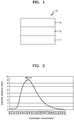
- FIG. 1 is a schematic view of an organic light-emitting device 10 according to an embodiment.
- the organic light-emitting device 10 includes a first electrode 11, an organic layer 15, and a second electrode 19, which are sequentially stacked.
- a substrate may be additionally disposed under the first electrode 11 or above the second electrode 19.
- the substrate any substrate that is used in general organic light-emitting devices may be used, and the substrate may be a glass substrate or a transparent plastic substrate, each having excellent mechanical strength, thermal stability, transparency, surface smoothness, ease of handling, and water resistance.
- the first electrode 11 may be formed by depositing or sputtering a material for forming the first electrode 11 on the substrate.
- the first electrode 11 may be an anode.
- the material for forming the first electrode 11 may be selected from materials with a high work function to facilitate hole injection.
- the first electrode 11 may be a reflective electrode, a semi-transmissive electrode, or a transmissive electrode.
- the material for forming the first electrode 11 may be indium tin oxide (ITO), indium zinc oxide (IZO), tin oxide (SnO 2 ), or zinc oxide (ZnO).
- the material for forming the first electrode 11 may be metal, such as magnesium (Mg), aluminum (Al), aluminum-lithium (Al-Li), calcium (Ca), magnesium-indium (Mg-In), or magnesium-silver (Mg-Ag).
- metal such as magnesium (Mg), aluminum (Al), aluminum-lithium (Al-Li), calcium (Ca), magnesium-indium (Mg-In), or magnesium-silver (Mg-Ag).
- the first electrode 11 may have a single-layered structure or a multi-layered structure including two or more layers.
- the first electrode 11 may have a three-layered structure of ITO/Ag/ITO, but the structure of the first electrode 11 is not limited thereto.
- the organic layer 15 is disposed on the first electrode 11.
- the organic layer 15 may include a hole transport region, an emission layer, and an electron transport region.
- the hole transport region may be disposed between the first electrode 11 and the emission layer.
- the hole transport region may include at least one selected from a hole injection layer, a hole transport layer, an electron blocking layer, and a buffer layer.
- the hole transport region may include only either a hole injection layer or a hole transport layer.
- the hole transport region may have a hole injection layer/hole transport layer structure or a hole injection layer/hole transport layer/electron blocking layer structure, which are sequentially stacked in this stated order from the first electrode 11.
- the hole injection layer may be formed on the first electrode 11 by using one or more suitable methods, for example, vacuum deposition, spin coating, casting, and/or Langmuir-Blodgett (LB) deposition.
- suitable methods for example, vacuum deposition, spin coating, casting, and/or Langmuir-Blodgett (LB) deposition.
- the deposition conditions may vary according to a material that is used to form the hole injection layer, and the structure and thermal characteristics of the hole injection layer.
- the deposition conditions may include a deposition temperature of about 100 ⁇ to about 500 ⁇ , a vacuum pressure of about 10 -8 to about 10 -3 torr, and a deposition rate of about 0.01 ⁇ /sec to about 100 ⁇ /sec.
- the deposition conditions are not limited thereto.
- coating conditions may vary according to the material used to form the hole injection layer, and the structure and thermal properties of the hole injection layer.
- a coating speed may be from about 2,000 rpm to about 5,000 rpm
- a temperature at which a heat treatment is performed to remove a solvent after coating may be from about 80 ⁇ to about 200 ⁇ .
- the coating conditions are not limited thereto.
- Conditions for forming a hole transport layer and an electron blocking layer may be understood by referring to conditions for forming the hole injection layer.
- the hole transport region may include at least one selected from m-MTDATA, TDATA, 2-TNATA, NPB, ⁇ -NPB, TPD, Spiro-TPD, Spiro-NPB, methylated-NPB, TAPC, HMTPD, 4,4',4"-tris(N-carbazolyl)triphenylamine (TCTA), polyaniline/dodecylbenzenesulfonic acid (PANI/DBSA), poly(3,4-ethylenedioxythiophene)/poly(4-styrenesulfonate) (PEDOT/PSS), polyaniline/camphor sulfonicacid (PANI/CSA), polyaniline/poly(4-styrenesulfonate) (PANI/PSS), a compound represented by Formula 201, and a compound represented by Formula 202:
- Ar 101 and Ar 102 in Formula 201 may each independently be selected from:
- xa and xb may each independently be an integer from 0 to 5, or 0, 1 or 2.
- xa may be 1 and xb may be 0, but xa and xb are not limited thereto.
- R 101 to R 108 , R 111 to R 119 , and R 121 to R 124 may each independently be selected from:
- R 109 may be selected from:
- the compound represented by Formula 201 may be represented by Formula 201A, but embodiments of the present disclosure are not limited thereto:
- R 101 , R 111 , R 112 , and R 109 may each independently be defined the same as described above.
- the compound represented by Formula 201 and the compound represented by Formula 202 may include compounds HT1 to HT20 illustrated, but are not limited thereto.
- a thickness of the hole transport region may be in a range of about 100 ⁇ to about 10,000 ⁇ , for example, about 100 ⁇ to about 1,000 ⁇ .
- a thickness of the hole injection layer may be in a range of about 100 ⁇ to about 10,000 ⁇ , for example, about 100 ⁇ to about 1,000 ⁇
- a thickness of the hole transport layer may be in a range of about 50 ⁇ to about 2,000 ⁇ , for example about 100 ⁇ to about 1,500 ⁇ .
- the hole transport region may further include, in addition to these materials, a charge-generation material for the improvement of conductive properties.
- the charge-generation material may be homogeneously or non-homogeneously dispersed in the hole transport region.
- the charge-generation material may be, for example, a p-dopant.
- the p-dopant may be one selected from a quinone derivative, a metal oxide, and a cyano group-containing compound, but embodiments of the present disclosure are not limited thereto.
- Non-limiting examples of the p-dopant are a quinone derivative, such as tetracyanoquinonedimethane (TCNQ) or 2,3,5,6-tetrafluoro-tetracyano-1,4-benzoquinonedimethane (F4-TCNQ); a metal oxide, such as a tungsten oxide or a molybdenium oxide; and a cyano group-containing compound, such as Compound HT-D1 or Compound HT-D2, but are not limited thereto.
- a quinone derivative such as tetracyanoquinonedimethane (TCNQ) or 2,3,5,6-tetrafluoro-tetracyano-1,4-benzoquinonedimethane (F4-TCNQ)
- a metal oxide such as a tungsten oxide or a molybdenium oxide
- a cyano group-containing compound such as Compound HT-D1 or Compound HT-
- the hole transport region may include a buffer layer.
- the buffer layer may compensate for an optical resonance distance according to a wavelength of light emitted from the emission layer, and thus, efficiency of a formed organic light-emitting device may be improved.
- an emission layer may be formed on the hole transport region by vacuum deposition, spin coating, casting, LB deposition, or the like.
- the deposition or coating conditions may be similar to those applied in forming the hole injection layer although the deposition or coating conditions may vary according to a compound that is used to form the emission layer.
- a material for the electron blocking layer may be selected from materials for the hole transport region described above and materials for a host to be explained later.
- the material for the electron blocking layer is not limited thereto.
- a material for the electron blocking layer may be mCP, which will be explained later.
- the emission layer may include a host and a dopant, and the dopant may include the organometallic compound represented by Formula 1.
- the host may include at least one selected from TPBi, TBADN, ADN (also referred to as "DNA”), CBP, CDBP, TCP, mCP, Compound H50, to Compound H52:
- the host may further include a compound represented by Formula 301.
- Ar 111 and Ar 112 in Formula 301 may each independently be selected from:
- Ar 113 to Ar 116 in Formula 301 may each independently be selected from:
- g, h, i, and j may each independently be an integer from 0 to 4, and may be, for example, 0, 1, or 2.
- Ar 113 and Ar 116 may each independently be selected from:
- the host may include a compound represented by Formula 302:
- Ar 122 to Ar 125 may each independently be defined the same as Ar 113 in Formula 301.
- Ar 126 and Ar 127 may each independently be a C 1 -C 10 alkyl group (for example, a methyl group, an ethyl group, or a propyl group).
- k and I may each independently be an integer from 0 to 4.
- k and I may be 0, 1, or 2.
- the compound represented by Formula 301 and the compound represented by Formula 302 may include Compounds H1 to H42, but are not limited thereto.
- the emission layer may be patterned into a red emission layer, a green emission layer, and a blue emission layer.
- the emission layer may emit white light.
- an amount of the dopant may be typically in a range of about 0.01 parts by weight to about 15 parts by weight based on 100 parts by weight of the host, but embodiments of the present disclosure are not limited thereto.
- the dopant may include at least one of organometallic compounds represented by Formula 1.
- a thickness of the emission layer may be in a range of about 100 ⁇ to about 1,000 ⁇ , for example, about 200 ⁇ to about 600 ⁇ . When the thickness of the emission layer is within this range, excellent light-emission characteristics may be obtained without a substantial increase in driving voltage.
- an electron transport region may be disposed on the emission layer.
- the electron transport region may include at least one selected from a hole blocking layer, an electron transport layer, and an electron injection layer.
- the electron transport region may have a hole blocking layer/electron transport layer/electron injection layer structure or an electron transport layer/electron injection layer structure, but the structure of the electron transport region is not limited thereto.
- the electron transport layer may have a single-layered structure or a multi-layered structure including two or more different materials.
- Conditions for forming the hole blocking layer, the electron transport layer, and the electron injection layer which constitute the electron transport region may be understood by referring to the conditions for forming the hole injection layer.
- the hole blocking layer may include, for example, at least one of BCP, Bphen, and BAlq but embodiments of the present disclosure are not limited thereto.
- a thickness of the hole blocking layer may be in a range of about 20 ⁇ to about 1,000 ⁇ , for example, about 30 ⁇ to about 300 ⁇ . When the thickness of the hole blocking layer is within these ranges, the hole blocking layer may have excellent hole blocking characteristics without a substantial increase in driving voltage.
- the electron transport layer may further include, in addition to the organometallic compound represented by Formula 1, at least one selected from BCP, Bphen, Alq 3 , BAlq, TAZ, and NTAZ.
- the electron transport layer may include at least one of ET1 to ET25, but are not limited thereto:
- a thickness of the electron transport layer may be in a range of about 100 ⁇ to about 1,000 ⁇ , for example, about 150 ⁇ to about 500 ⁇ . When the thickness of the electron transport layer is within the range described above, the electron transport layer may have satisfactory electron transport characteristics without a substantial increase in driving voltage.
- the electron transport layer may further include, in addition to the materials described above, a metal-containing material.
- the metal-containing material may include a Li complex.
- the Li complex may include, for example, Compound ET-D1 (lithium quinolate, LiQ) or ET-D2.
- the electron transport region may include an electron injection layer (EIL) that promotes flow of electrons from the second electrode 19 thereinto.
- EIL electron injection layer
- the electron injection layer may include at least one selected from LiF, NaCl, CsF, Li 2 O, and BaO.
- a thickness of the electron injection layer may be in a range of about 1 ⁇ to about 100 ⁇ , for example, about 3 ⁇ to about 90 ⁇ . When the thickness of the electron injection layer is within the range described above, the electron injection layer may have satisfactory electron injection characteristics without a substantial increase in driving voltage.
- the second electrode 19 is disposed on the organic layer 15.
- the second electrode 19 may be a cathode.
- a material for forming the second electrode 19 may be metal, an alloy, an electrically conductive compound, or a combination thereof, which have a relatively low work function.
- lithium (Li), magnesium (Mg), aluminum (Al), aluminum-lithium (Al-Li), calcium (Ca), magnesium-indium (Mg-In), or magnesium-silver (Mg-Ag) may be formed as the material for forming the second electrode 19.
- a transmissive electrode formed using ITO or IZO may be used as the second electrode 19.
- first-row transition metal of the Periodic Table of Elements refers to an element of the Period 4 of the Periodic Table of Elements and belonging to a d-block, and examples thereof include scandium (Sc), titanium (Ti), vanadium (V), chromium (Cr), manganese (Mn), iron (Fe), cobalt (Co), nickel (Ni), copper (Cu), and zinc (Zn).
- second-row transition metal of the Periodic Table of Elements refers to an element of the Period 5 of the Periodic Table of Elements and belonging to a d-block, and examples thereof include yttrium (Y), zirconium (Zr), niobium (Nb), molybdenum (Mo), technetium (Tc), ruthenium (Ru), rhodium (Rh), palladium (Pd), silver (Ag), and cadmium (Cd).
- third-row transition metal of the Periodic Table of Elements refers to an element of the Period 6 and belonging to a d-block, and examples thereof include lanthanum (La), samarium (Sm), europium (Eu), terbium (Tb), thulium (Tm), ytterbium (Yb), lutetium (Lu), hafnium (Hf), tantalum (Ta), tungsten(W), rhenium (Re), osmium (Os), iridium (Ir), platinum (Pt), gold (Au), and mercury (Hg).
- La lanthanum
- Sm samarium
- Eu europium
- Tb terbium
- Tm thulium
- Yb ytterbium
- Lu hafnium
- Ta tantalum
- Os osmium
- Ir iridium
- platinum platinum
- C 1 -C 60 alkyl group refers to a linear or branched saturated aliphatic hydrocarbon monovalent group having 1 to 60 carbon atoms, and examples thereof include a methyl group, an ethyl group, a propyl group, an isobutyl group, a sec-butyl group, a tert-butyl group, a pentyl group, an isoamyl group, and a hexyl group.
- C 1 -C 60 alkylene group refers to a divalent group having the same structure as the C 1 -C 60 alkyl group.
- C 1 -C 60 alkoxy group refers to a monovalent group represented by -OA 101 (wherein A 101 is the C 1 -C 60 alkyl group), and examples thereof include a methoxy group, an ethoxy group, and an isopropyloxy group.
- C 2 -C 60 alkenyl group refers to a hydrocarbon group having at least one carbon-carbon double bond in the middle or at the terminus of the C 2 -C 60 alkyl group, and examples thereof include an ethenyl group, a propenyl group, and a butenyl group.
- C 2 -C 60 alkenylene group refers to a divalent group having the same structure as the C 2 -C 60 alkenyl group.
- C 2 -C 60 alkynyl group refers to a hydrocarbon group having at least one carbon-carbon triple bond in the middle or at the terminus of the C 2 -C 60 alkyl group, and examples thereof include an ethynyl group, and a propynyl group.
- C 2 -C 60 alkynylene group refers to a divalent group having the same structure as the C 2 -C 60 alkynyl group.
- C 3 -C 10 cycloalkyl group refers to a monovalent saturated hydrocarbon monocyclic group having 3 to 10 carbon atoms, and examples thereof include a cyclopropyl group, a cyclobutyl group, a cyclopentyl group, a cyclohexyl group, and a cycloheptyl group.
- C 3 -C 10 cycloalkylene group refers to a divalent group having the same structure as the C 3 -C 10 cycloalkyl group.
- C 1 -C 10 heterocycloalkyl group refers to a monovalent saturated monocyclic group having at least one heteroatom selected from N, O, P, Si and S as a ring-forming atom and 1 to 10 carbon atoms, and non-limiting examples thereof include a tetrahydrofuranyl group, and a tetrahydrothiophenyl group.
- C 1 -C 10 heterocycloalkylene group refers to a divalent group having the same structure as the C 1 -C 10 heterocycloalkyl group.
- C 3 -C 10 cycloalkenyl group refers to a monovalent monocyclic group that has 3 to 10 carbon atoms and at least one carbon-carbon double bond in the ring thereof and no aromaticity, and non-limiting examples thereof include a cyclopentenyl group, a cyclohexenyl group, and a cycloheptenyl group.
- C 3 -C 10 cycloalkenylene group refers to a divalent group having the same structure as the C 3 -C 10 cycloalkenyl group.
- C 1 -C 10 heterocycloalkenyl group refers to a monovalent monocyclic group that has at least one heteroatom selected from N, O, P, Si, and S as a ring-forming atom, 1 to 10 carbon atoms, and at least one carbon-carbon double bond in its ring.
- Examples of the C 1 -C 10 heterocycloalkenyl group are a 2,3-dihydrofuranyl group, and a 2,3-dihydrothiophenyl group.
- C 1 -C 10 heterocycloalkenylene group refers to a divalent group having the same structure as the C 1 -C 10 heterocycloalkenyl group.
- C 6 -C 60 aryl group refers to a monovalent group having a carbocyclic aromatic system having 6 to 60 carbon atoms
- C 6 -C 60 arylene group refers to a divalent group having a carbocyclic aromatic system having 6 to 60 carbon atoms.
- Examples of the C 6 -C 60 aryl group are a phenyl group, a naphthyl group, an anthracenyl group, a phenanthrenyl group, a pyrenyl group, and a chrysenyl group.
- the C 6 -C 60 aryl group and the C 6 -C 60 arylene group each include two or more rings, the rings may be fused to each other.
- C 1 -C 60 heteroaryl group refers to a monovalent group having a cyclic aromatic system that has at least one heteroatom selected from N, O, P, Si, and S as a ring-forming atom, in addition to 1 to 60 carbon atoms.
- C 1 -C 60 heteroarylene group refers to a divalent group having a heterocyclic aromatic system that has at least one heteroatom selected from N, O, P, Si, and S as a ring-forming atom, in addition to 1 to 60 carbon atoms.
- Examples of the C 1 -C 60 heteroaryl group are a pyridinyl group, a pyrimidinyl group, a pyrazinyl group, a pyridazinyl group, a triazinyl group, a quinolinyl group, and an isoquinolinyl group.
- the C 1 -C 60 heteroaryl group and the C 1 -C 60 heteroarylene group each include two or more rings, the rings may be fused to each other.
- a C 6 -C 60 aryloxy group used herein indicates -OA 102 (wherein A 102 is the C 6 -C60 aryl group), and a C 6 -C 60 arylthio group indicates -SA 103 (wherein A 103 is the C 6 -C 60 aryl group).
- monovalent non-aromatic condensed polycyclic group refers to a monovalent group (for example, having 8 to 60 carbon atoms) having two or more rings condensed to each other, only carbon atoms as ring-forming atoms, and no aromaticity in its entire molecular structure.
- monovalent non-aromatic condensed polycyclic group include a fluorenyl group.
- divalent non-aromatic condensed polycyclic group refers to a divalent group having the same structure as the monovalent non-aromatic condensed polycyclic group.
- the term "monovalent non-aromatic condensed heteropolycyclic group” as used herein refers to a monovalent group (for example, having 2 to 60 carbon atoms) having two or more rings condensed to each other, a heteroatom selected from N, O, P, Si, and S, other than carbon atoms, as a ring-forming atom, and no aromaticity in its entire molecular structure.
- Non-limiting examples of the monovalent non-aromatic condensed heteropolycyclic group include a carbazolyl group.
- divalent non-aromatic condensed heteropolycyclic group refers to a divalent group having the same structure as the monovalent non-aromatic condensed heteropolycyclic group.
- C 5 -C 30 carbocyclic group refers to a saturated or unsaturated cyclic group having, as a ring-forming atom, 5 to 30 carbon atoms only.
- C 5 -C 30 carbocyclic group refers to a monocyclic group or a polycyclic group, and, according to its chemical structure, a monovalent, divalent, trivalent, tetravalent, pentavalent, or hexavalent group.
- C 1 -C 30 heterocyclic group refers to a saturated or unsaturated cyclic group having at least one heteroatom selected from N, O, Si, P, and S other than 1 to 30 carbon atoms, as a ring-forming atom.
- C 1 -C 30 heterocyclic group refers to a monocyclic group or a polycyclic group, and, according to its chemical structure, a monovalent, divalent, trivalent, tetravalent, pentavalent, or hexavalent group.
- 5-membered aromatic heteroring refers to an aromatic ring having, as a ring-forming atom, at least one heteroatom selected from N, O, P, Si, and S other than 3 to 5 carbon atoms.
- 5-membered non-aromatic ring refers to a saturated or unsaturated ring having, as a ring-forming atom, 3 to 5 carbon atoms.
- 5-membered non-aromatic heteroring refers to a saturated or unsaturated ring having at least one heteroatom selected from N, O, P, Si, and S other than 3 to 5 carbon atoms, as a ring-forming atom.
- Evaluation Example 1 Evaluation of HOMO, LUMO, and triplet (T 1 ) energy levels
- HOMO energy level evaluation method A voltage-current (V-A) graph of each Compound was obtained by using a cyclic voltammetry (CV) (electrolyte: 0.1 M Bu 4 NClO 4 / solvent: CH 2 Cl 2 / electrode: 3-electrode system (work electrode: GC, reference electrode: Ag/AgCl, auxiliary electrode: Pt)), and a HOMO energy level of each Compound was calculated from reduction onset of the graph.
- CV cyclic voltammetry
- LUMO energy level evaluation method Each compound was diluted at a concentration of 1x10 -5 M in CHCl 3 , and a UV absorption spectrum thereof was measured at room temperature by using a Shimadzu UV-350 spectrometer, and a LUMO energy level thereof was calculated by using an optical band gap (Eg) from an edge of the absorption spectrum.
- T 1 energy level evaluation method A mixture of toluene and each compound (each compound was dissolved in an amount of 1 mg in 3 mL of toluene) was loaded into a quartz cell, and then, the resultant quartz cell was loaded into liquid nitrogen (77 K).
- a photoluminescence (PL) spectrum thereof was measured by using a photoluminescence measurement device, and the obtained spectrum was compared with a PL spectrum measured at room temperature, and peaks observed only at low temperature were analyzed to calculate a T 1 energy level.
- PL photoluminescence
- Compound 5 has electric characteristics suitable for use as a material for an organic light-emitting device.
- the PL spectrum of Compound 5 was evaluated so as to evaluate the light-emitting characteristics of each Compound.
- Compound 5 was diluted at a concentration of 10 mM in CHCl 3 , and the PL spectrum thereof was measured at room temperature by using ISC PC1 Spectrofluorometer equipped with a xenon lamp.
- the maximum wavelength of the PL spectrum of Compound 5 is shown in Table 4 and FIG. 2 . [Table 4] Compound No. ⁇ max (nm) 5 484
- Compound 5 has PL characteristics suitable for emission of deep blue light.
- sonification washing was performed by using a solvent, such as isopropyl alcohol, acetone, or methanol.
- the result was dried and then transferred to a plasma washer, and the resultant substrate was washed with oxygen plasma for 5 minutes and then, transferred to a vacuum depositing device.
- Compound HT3 and Compound HT-D1 were co-deposited on the ITO electrode of the glass substrate to form a hole injection layer having a thickness of 100 ⁇ , Compound HT3 was deposited on the hole injection layer to form a hole transport layer having a thickness of 1,300 ⁇ , and TAPC was deposited on the hole transport layer to form an electron blocking layer having a thickness of 100 ⁇ , thereby forming a hole transport region.
- Compound H52 (host) and Compound 5 (dopant, 7 wt%) were co-deposited on the hole transport region to form an emission layer having a thickness of 300 ⁇ .
- BCP was vacuum-deposited on the emission layer to form a hole blocking layer having a thickness of 250 ⁇
- Compound ET3 and ET-D1 (LiQ) were co-deposited on the hole blocking layer to form an electron transport layer having a thickness of 300 ⁇
- ET-D1 (LiQ) was deposited on the electron transport layer to form an electron injection layer having a thickness of 10 ⁇
- Al was deposited on the electron injection layer to form an Al second electrode (cathode) having a thickness of 1,200 ⁇ , thereby completing the manufacture of an organic light-emitting device.
- Organic light-emitting devices were manufactured in the same manner as in Example 1, except that Compounds shown in Table 5 were each used instead of Compound 5 as a dopant in forming an emission layer.
- the EL spectrum, change in current density according to a voltage, change in luminance according to a voltage, efficiency, conversion efficiency, external quantum efficiency, lifespan, and CIE color coordinates of the organic light-emitting devices manufactured according to Example 1 and Comparative Examples 1 to 3 were measured.
- a specific measuring method is as follows and results thereof are shown in Table 5.
- the EL spectrum of the manufactured organic light-emitting device was measured at a luminance of 500 cd/m 2 by using a luminance meter (Minolta Cs-1000A).
- the current value flowing through a unit element in the manufactured organic light-emitting device was measured by using a current-voltage meter (Keithley 2400) while increasing a voltage from 0 V to 10 V, and the result was obtained by dividing the measured current value by an area.
- the luminance of the manufactured organic light-emitting device was measured by using a luminance meter (Minolta Cs-1000A) while increasing a voltage from 0 V to 10 V.
- the current efficiency (cd/A) of the same current density (10 mA/cm 2 ) was calculated by using the luminance and the current density and the luminance measured in (2) and (3) and the voltage. Then, the conversion efficiency was calculated by dividing the current efficiency by the y value of the CIE color coordinates measured in (6).
- the organic light-emitting device of Example 1 has excellent efficiency, external quantum efficiency, and lifespan characteristics, as compared with the organic light-emitting devices of Comparative Examples 1 to 3, and also enables deep blue light to be emitted.
- an organic light-emitting device including the organometallic compound may have improved lifespan and color purity characteristics.
Landscapes
- Chemical & Material Sciences (AREA)
- Organic Chemistry (AREA)
- Engineering & Computer Science (AREA)
- Materials Engineering (AREA)
- Crystallography & Structural Chemistry (AREA)
- Inorganic Chemistry (AREA)
- Electroluminescent Light Sources (AREA)
Abstract
Description
- One or more embodiments relate to an organometallic compound and an organic light-emitting device including the same.
- Organic light-emitting devices are self-emission devices that produce full-color images, and also have wide viewing angles, high contrast ratios, short response times, and excellent characteristics in terms of brightness, driving voltage, and response speed, compared to devices in the art.
- In an example, an organic light-emitting device includes an anode, a cathode, and an organic layer between the anode and the cathode, wherein the organic layer includes an emission layer. A hole transport region may be between the anode and the emission layer, and an electron transport region may be between the emission layer and the cathode. Holes provided from the anode may move toward the emission layer through the hole transport region, and electrons provided from the cathode may move toward the emission layer through the electron transport region. The holes and the electrons recombine in the emission layer to produce excitons. These excitons transit from an excited state to a ground state, thereby generating light.
- Aspects of the present disclosure provide a novel organometallic compound and an organic light-emitting device including the same.
- Additional aspects will be set forth in part in the description which follows and, in part, will be apparent from the description, or may be learned by practice of the presented embodiments.
- An aspect provides an organometallic compound represented by Formula 1:
<Formula 1> M11(L11)n11(L12)n12.
In Formula 1, - M11 may be a transition metal,
- L11 may be selected from a group represented by Formula 1A,
- n11 may be selected from 1, 2, 3, and 4, wherein, when n11 is 2 or more, 2 or more L11(s) are the same or different from each other,
- L12 may be selected from a one-coordinate ligand, a two-coordinate ligand, and a three-coordinate ligand,
- n12 may be selected from 0, 1, 2, 3, and 4, wherein, when n12 is 2 or more, 2 or more L12(s) are the same or different from each other,
- L11 and L12 may be different from each other,

- A11 may be a C1-C30 heterocyclic group,
- A12 may be a C5-C30 carbocyclic group or a C1-C30 heterocyclic group,
- W11 may be selected from N and N(R11),
- Y11 and Y12 may each independently be selected from N and C, wherein at least one selected from Y11 and Y12 is N,
- Z11 and Z13 may be each C,
- R1, R2, and R11 may each independently be selected from hydrogen, deuterium, -F, -Cl, -Br, -I, -SF5, a hydroxyl group, a cyano group, a nitro group, an amino group, an amidino group, a hydrazine group, a hydrazone group, a carboxylic acid group or a salt thereof, a sulfonic acid group or a salt thereof, a phosphoric acid group or a salt thereof, a substituted or unsubstituted C1-C60 alkyl group, a substituted or unsubstituted C2-C60 alkenyl group, a substituted or unsubstituted C2-C60 alkynyl group, a substituted or unsubstituted C1-C60 alkoxy group, a substituted or unsubstituted C3-C10 cycloalkyl group, a substituted or unsubstituted C1-C10 heterocycloalkyl group, a substituted or unsubstituted C3-C10 cycloalkenyl group, a substituted or unsubstituted C1-C10 heterocycloalkenyl group, a substituted or unsubstituted C6-C60 aryl group, a substituted or unsubstituted C6-C60 aryloxy group, a substituted or unsubstituted C6-C60 arylthio group, a substituted or unsubstituted C1-C60 heteroaryl group, a substituted or unsubstituted monovalent non-aromatic condensed polycyclic group, a substituted or unsubstituted monovalent non-aromatic condensed heteropolycyclic group, -N(Q1)(Q2), -Si(Q3)(Q4)(Q5), -B(Q6)(Q7), and-P(=O)(Q8)(Q9),
- two or more selected from R1, R2, and R11 may optionally be linked to each other to form a ring,
- two, three, or four selected from a plurality of neighboring R1, R2, and R11 may optionally be linked to form a four-coordinate ligand, a six-coordinate ligand, or an eight-coordinate ligand,
- Q1 to Q9 may each independently be selected from hydrogen, deuterium, -F,-Cl, -Br, -I, a hydroxyl group, a cyano group, a nitro group, an amidino group, a hydrazine group, a hydrazone group, a carboxylic acid group or a salt thereof, a sulfonic acid group or a salt thereof, a phosphoric acid group or a salt thereof, a C1-C60 alkyl group, a C1-C60 alkyl group substituted with at least one selected from deuterium, a C1-C60 alkyl group, and a C6-C60 aryl group, a C2-C60 alkenyl group, a C2-C60 alkynyl group, a C1-C60 alkoxy group, a C3-C10 cycloalkyl group, a C1-C10 heterocycloalkyl group, a C3-C10 cycloalkenyl group, a C1-C10 heterocycloalkenyl group, a C6-C60 aryl group, a C6-C60 aryl group substituted with at least one selected from deuterium, a C1-C60 alkyl group, and a C6-C60 aryl group, a C6-C60 aryloxy group, a C6-C60 arylthio group, a C1-C60 heteroaryl group, a monovalent non-aromatic condensed polycyclic group, and a monovalent non-aromatic condensed heteropolycyclic group, and
- the following compound may be excluded from the organometallic compound represented by Formula 1:

- Another aspect provides an organic light-emitting device including: a first electrode; a second electrode; an organic layer between the first electrode and the second electrode and including an emission layer,
wherein the organic layer includes the organometallic compound described above. - The organometallic compound may act as a dopant in the emission layer.
- These and/or other aspects will become apparent and more readily appreciated from the following description of the embodiments, taken in conjunction with the accompanying drawings in which:
-
FIG. 1 is a schematic view of an organic light-emitting device according to an embodiment; and -
FIG. 2 is a graph showing a photoluminescence spectrum of Compound 5. - Reference will now be made in detail to embodiments, examples of which are illustrated in the accompanying drawings, wherein like reference numerals refer to like elements throughout. In this regard, the present embodiments may have different forms and should not be construed as being limited to the descriptions set forth herein. Accordingly, the embodiments are merely described below, by referring to the figures, to explain aspects of the present description. As used herein, the term "and/or" includes any and all combinations of one or more of the associated listed items. Expressions such as "at least one of," when preceding a list of elements, modify the entire list of elements and do not modify the individual elements of the list.
- An organometallic compound according to an embodiment is represented by Formula 1:
<Formula 1> M11(L11)n11(L12)n12.
- In Formula 1, M11 may be a transition metal.
- For example, in Formula 1, M11 may be selected from platinum (Pt), palladium (Pd), copper (Cu), silver (Ag), gold (Au), rhodium (Rh), iridium (Ir), ruthenium (Ru), osmium (Os), titanium (Ti), zirconium (Zr), hafnium (Hf), europium (Eu), terbium (Tb), and thulium (Tm), but embodiments of the present disclosure are not limited thereto.
- In one embodiment, in Formula 1, M11 may be selected from Ir, Os, and Pt, but embodiments of the present disclosure are not limited thereto.
- In one embodiment, in Formula 1, M11 may be Ir, but embodiments of the present disclosure are not limited thereto.
- In Formula 1, L11 may be selected from a group represented by Formula 1A:

- The description of Formula 1A may be the same as described herein.
- In Formula 1A, A11 may be C1-C30 heterocyclic group, A12 may be C5-C30 carbocyclic group or C1-C30 heterocyclic group.
- For example, in Formula 1A, A11 may be selected from a pyridine group, a pyrimidine group, a pyrazine group, a pyridazine group, a triazine group,, a quinoline group, an isoquinoline group, a benzoquinoline group, a benzoisoquinoline group, a phthalazine group, a naphthyridine group, a quinoxaline group, a benzoquinoxaline group, a quinazoline group and a benzoquinazoline group.
- For example, in Formula 1A, A12 may be selected from a benzene group, a naphthalene group, a fluorene group, a carbazole group, a dibenzofuran group, a dibenzothiophene group, a pyridine group, a pyrimidine group, a pyrazine group, a pyridazine group, a triazine group,, a quinoline group, an isoquinoline group, a benzoquinoline group, a benzoisoquinoline group, a phthalazine group, a naphthyridine group, a quinoxaline group, a benzoquinoxaline group, a quinazoline group and a benzoquinazoline group.
- In Formula 1A, a bond between Z11 and N, a bond between Z11 and W11, a bond between W11 and Y11, a bond between Y11 and Y12, and a bond between N and Y12 may each independently be a single bond or a double bond.
- In Formula 1A, W11 may be selected from N and N(R11), and R11 may be the same as described herein.
- For example, in Formula 1A, W11 may be N, but embodiments of the present disclosure are not limited thereto.
- In this case, in Formula 1A, a bond between Z11 and W11 may be a double bond; or a bond between Y11 and W11 may be a double bond, but embodiments of the present disclosure are not limited thereto.
- In Formula 1A, Y11 and Y12 may each independently be selected from N and C, wherein at least one selected from Y11 and Y12 may be N.
- For example, in Formula 1A, Y11 may be N, and Y12 may be C; Y11 may be C, and Y12 may be N; or Y11 may be N, and Y12 may be N, but embodiments of the present disclosure are not limited thereto.
- In one embodiment, in Formula 1A, Y11 may be N, and Y12 may be C; Y11 may be C, and Y12 may be N, but embodiments of the present disclosure are not limited thereto. In this case, a bond between Y11 and Y12 may be a double bond, but embodiments of the present disclosure are not limited thereto.
- In Formula 1A, Z11 and Z13 may each independently be C.
- For example, in Formula 1A, two bonds selected from a bond between Z11 and N, a bond between Z11 and W11, a bond between W11 and Y11, a bond between Y11 and Y12, and a bond between N and Y12 may each be a double bond, and the others thereof may each be a single bond, but embodiments of the present disclosure are not limited thereto.
- In one embodiment, in Formula 1A, a moiety represented by


- Y11, Y12, W11, Z11 and Z13 may each independently be the same as defined in Formula 1A;
- X12 may be selected from N, N(R12a), O, S, C(R12a), and C(R12a)(R12b), X13 may be selected from N, N(R13a), O, S, C(R13a), and C(R13a)(R13b), X14 may be selected from N, N(R14a), O, S, C(R14a), and C(R14a)(R14b), X15 may be selected from N, N(R15a), O, S, C(R15a), and C(R15a)(R15b), X16 may be selected from N, N(R16a), O, S, C(R16a), and C(R16a)(R16b), X17 may be selected from N, N(R17a), O, S, C(R17a), and C(R17a)(R17b), X18 may be selected from N, N(R18a), O, S, C(R18a), and C(R18a)(R18b), and X19 may be selected from N, N(R19a), O, S, C(R19a), and C(R19a)(R19b),
- R12a, R12b, R13a, R13b, R14a, R14b, R15a, R15b, R16a, R16b, R17a, R17b, R18a, R18b, R19a, and R19b may each independently be defined the same as R1 in Formula 1A,
- in Formulae 1A-1, * may be a binding site to M11 of Formula 1, and *' may be a binding site to a neighboring atom, and
- in Formulae 1A-2, *' may be a binding site to M11 of Formula 1, and * may be a binding site to a neighboring atom.
- In Formulae 1A-1 and 1A-2, a bond between Y12 and X15, a bond between X15 and X14, a bond between X13 and X14, a bond between X12 and X13, a bond between Y11 and X12, a bond between Z12 and Z13, a bond between Z13 and X16, a bond between X16 and X17, a bond between X17 and X18, a bond between X18 and X19, and a bond between X19 and Z12 may each independently be a single bond or a double bond.
- In one embodiment, in Formulae 1A-1 and 1A-2, X12 may be selected from N and C(R12a), X13 may be selected from N and C(R13a), X14 may be selected from N and C(R14a), X15 may be selected from N and C(R15a), X16 may be selected from N and C(R16a), X17 may be selected from N and C(R17a), X18 may be selected from N and C(R18a), and X19 may be selected from N and C(R19a), but embodiments of the present disclosure are not limited thereto.
- In one embodiment, in Formula 1A-1, X12 may be C(R12a), X13 may be C(R13a), X14 may be C(R14a), and X15 may be C(R15a), but embodiments of the present disclosure are not limited thereto.
- In one embodiment, in Formula 1A-1, at least one selected from X12 to X15 may be selected from O and S, but embodiments of the present disclosure are not limited thereto.
- In one embodiment, in Formula 1A-2, X16 may be N, X17 may be C(R17a), X18 may be C(R18a), and X19 may be C(R19a); X16 may be C(R16a), X17 may be N, X18 may be C(R18a), and X19 may be C(R19a); X16 may be C(R16a), X17 may be C(R17a), X18 may be N, and X19 may be C(R19a); X16 may be C(R16a), X17 may be C(R17a), X18 may be C(R18a), and X19 may be N; or X16 may be C(R16a), X17 may be C(R17a), X18 may be C(R18a), and X19 may be C(R19a), but embodiments of the present disclosure are not limited thereto.
- In one embodiment, in Formula 1A-1, three bonds selected from a bond between Y11 and Y12, a bond between Y12 and X15, a bond between X15 and X14, a bond between X13 and X14, a bond between X12 and X13, and a bond between Y11 and X12 may each be a double bond, and the others thereof may each be a single bond, but embodiments of the present disclosure are not limited thereto.
- In one embodiment, in Formula 1A-2, three bonds selected from a bond between Z12 and Z13, a bond between Z13 and X16, a bond between X16 and X17, a bond between X17 and X18, a bond between X18 and X19, and a bond between X19 and Z12 may each be a double bond, and the others thereof may each be a single bond, but embodiments of the present disclosure are not limited thereto.
- In one embodiment, in Formula 1A, a moiety represented by


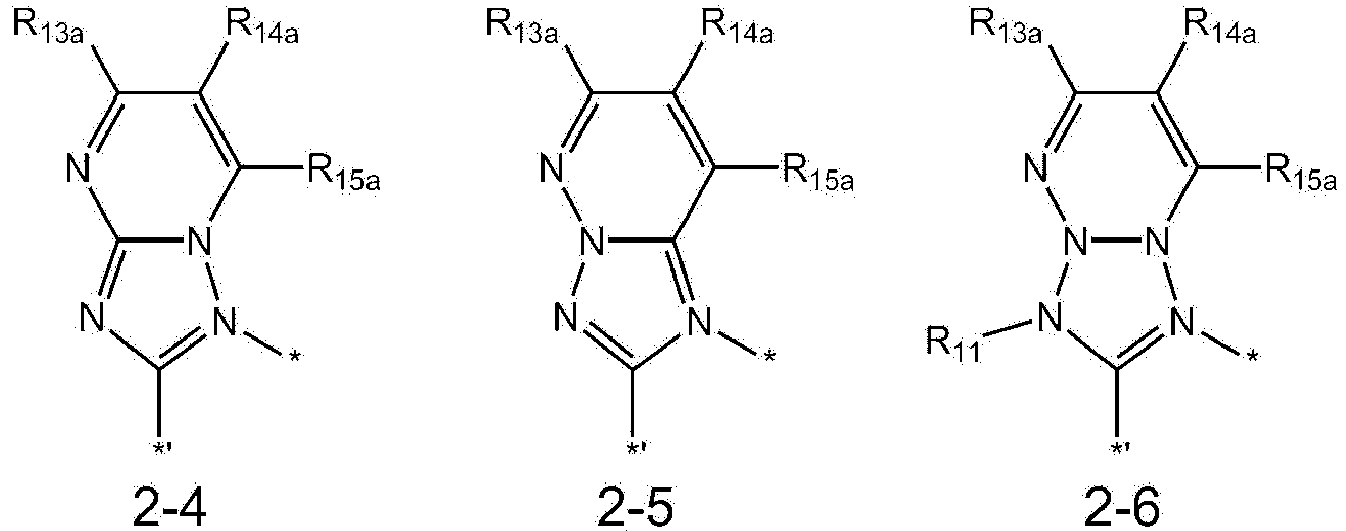


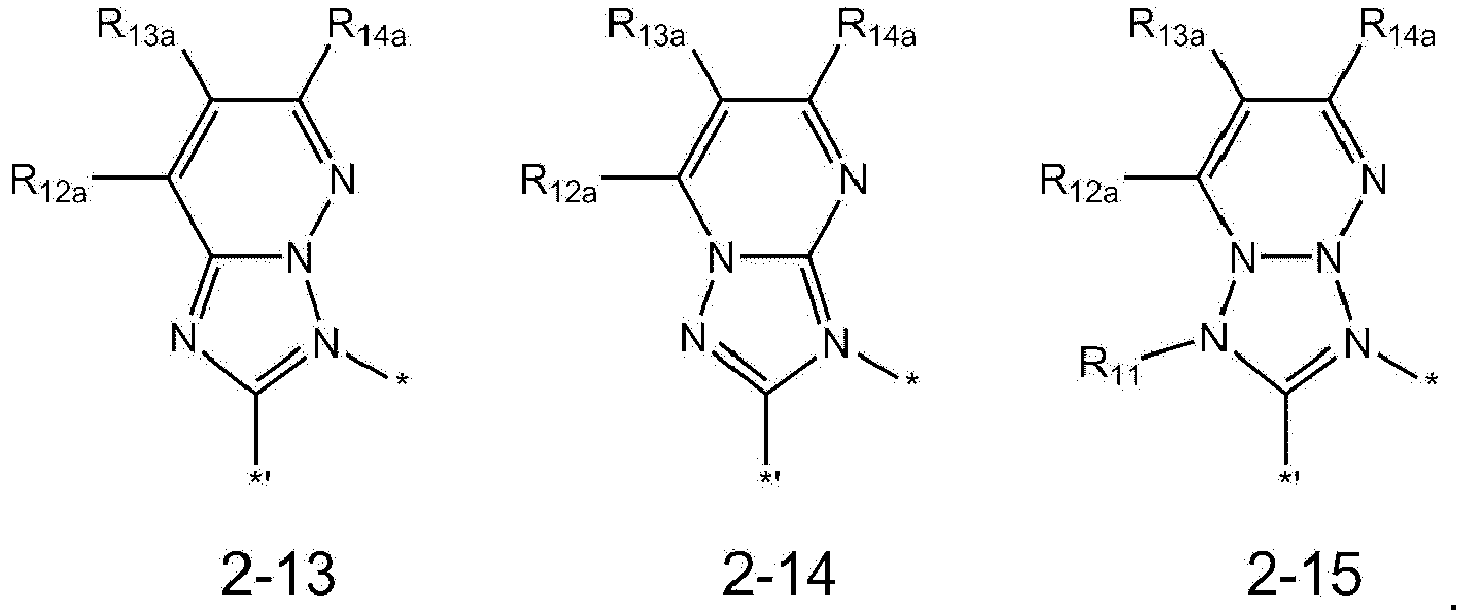
- R11 may be the same as described in Formula 1,
- R12a, R13a, R14a, and R15a may each independently be defined the same as R1 in Formula 1A; and
- * and *' each indicate a binding site to a neighboring atom.
- In one or more embodiments, in Formula 1A, a moiety represented by

- In one or more embodiments, in Formula 1A, a moiety represented by

- In one embodiment, in Formula 1A, a moiety represented by


- R16a, R17a, R18a, and R19a may each independently be the same as R2 described in Formula 1, and
- * and * each indicate a binding site to a neighboring atom.
- In one or more embodiments, in Formula 1A, a moiety represented by

- In one or more embodiments, in Formula 1A, a moiety represented by

- In Formula 1A, R1, R2, and R11 may each independently be selected from hydrogen, deuterium, -F, -Cl, -Br, -I, -SF5, a hydroxyl group, a cyano group, a nitro group, an amino group, an amidino group, a hydrazine group, a hydrazone group, a carboxylic acid group or a salt thereof, a sulfonic acid group or a salt thereof, a phosphoric acid group or a salt thereof, a substituted or unsubstituted C1-C60 alkyl group, a substituted or unsubstituted C2-C60 alkenyl group, a substituted or unsubstituted C2-C60 alkynyl group, a substituted or unsubstituted C1-C60 alkoxy group, a substituted or unsubstituted C3-C10 cycloalkyl group, a substituted or unsubstituted C1-C10 heterocycloalkyl group, a substituted or unsubstituted C3-C10 cycloalkenyl group, a substituted or unsubstituted C1-C10 heterocycloalkenyl group, a substituted or unsubstituted C6-C60 aryl group, a substituted or unsubstituted C6-C60 aryloxy group, a substituted or unsubstituted C6-C60 arylthio group, a substituted or unsubstituted C1-C60 heteroaryl group, a substituted or unsubstituted monovalent non-aromatic condensed polycyclic group, a substituted or unsubstituted monovalent non-aromatic condensed heteropolycyclic group, -N(Q1)(Q2), -Si(Q3)(Q4)(Q5),-B(Q6)(Q7), and -P(=O)(Q8)(Q9),
two or more selected from R1, R2, and R11 may optionally be linked to each other to form a ring, and
Q1 to Q9 may each independently be selected from hydrogen, deuterium, -F,-Cl, -Br, -I, a hydroxyl group, a cyano group, a nitro group, an amidino group, a hydrazine group, a hydrazone group, a carboxylic acid group or a salt thereof, a sulfonic acid group or a salt thereof, a phosphoric acid group or a salt thereof, a C1-C60 alkyl group, a C1-C60 alkyl group substituted with at least one selected from deuterium, a C1-C60 alkyl group, and a C6-C60 aryl group, a C2-C60 alkenyl group, a C2-C60 alkynyl group, a C1-C60 alkoxy group, a C3-C10 cycloalkyl group, a C1-C10 heterocycloalkyl group, a C3-C10 cycloalkenyl group, a C1-C10 heterocycloalkenyl group, a C6-C60 aryl group, a C6-C60 aryl group substituted with at least one selected from deuterium, a C1-C60 alkyl group, and a C6-C60 aryl group, a C6-C60 aryloxy group, a C6-C60 arylthio group, a C1-C60 heteroaryl group, a monovalent non-aromatic condensed polycyclic group, and a monovalent non-aromatic condensed heteropolycyclic group. - For example, in Formula 1A, R1, R2, and R11 may each independently be selected from:
- hydrogen, deuterium, -F, -Cl, -Br, -I, a hydroxyl group, a cyano group, a nitro group, an amino group, an amidino group, a hydrazine group, a hydrazone group, a carboxylic acid group or a salt thereof, a sulfonic acid group or a salt thereof, a phosphoric acid group or a salt thereof, -SF5, C1-C20 alkyl group, and a C1-C20 alkoxy group;
- a C1-C20 alkyl group and a C1-C20 alkoxy group, each substituted with at least one selected from deuterium, -F, -Cl, -Br, -I, -CD3, -CD2H, -CDH2, -CF3, -CF2H,-CFH2, a hydroxyl group, a cyano group, a nitro group, an amino group, an amidino group, a hydrazine group, a hydrazone group, a carboxylic acid group or a salt thereof, a sulfonic acid group or a salt thereof, a phosphoric acid group or a salt thereof, a C1-C10 alkyl group, a cyclopentyl group, a cyclopentyl group substituted with deuterium, a cyclohexyl group, a cyclohexyl group substituted with deuterium, a cycloheptyl group, a cycloheptyl group substituted with deuterium, a cycloctyl group, a cycloctyl group substituted with deuterium, a bicyclo[2.2.1]heptanyl group, an adamantanyl group, a norbornanyl group, a norbornenyl group, a cyclopentenyl group, a cyclohexenyl group, a cycloheptenyl group, a phenyl group, a naphthyl group, a pyridinyl group, and a pyrimidinyl group;
- a cyclopentyl group, a cyclohexyl group, a cycloheptyl group, a cycloctyl group, a bicyclo[2.2.1]heptanyl group, an adamantanyl group, a norbornanyl group, a norbornenyl group, a cyclopentenyl group, a cyclohexenyl group, a cycloheptenyl group, a phenyl group, a naphthyl group, a fluorenyl group, a phenanthrenyl group, an anthracenyl group, a fluoranthenyl group, a triphenylenyl group, a pyrenyl group, a chrysenyl group, a pyrrolyl group, a thiophenyl group, a furanyl group, an imidazolyl group, a pyrazolyl group, a thiazolyl group, an isothiazolyl group, an oxazolyl group, an isoxazolyl group, a pyridinyl group, a pyrazinyl group, a pyrimidinyl group, a pyridazinyl group, an isoindolyl group, an indolyl group, an indazolyl group, a purinyl group, a quinolinyl group, an isoquinolinyl group, a benzoquinolinyl group, a quinoxalinyl group, a quinazolinyl group, a cinnolinyl group, a carbazolyl group, a phenanthrolinyl group, a benzimidazolyl group, a benzofuranyl group, a benzothiophenyl group, an isobenzothiazolyl group, a benzoxazolyl group, an isobenzoxazolyl group, a triazolyl group, a tetrazolyl group, an oxadiazolyl group, a triazinyl group, a dibenzofuranyl group, a dibenzothiophenyl group, a dibenzosilolyl group, a benzocarbazolyl group, a dibenzocarbazolyl group, an imidazopyridinyl group, and an imidazopyrimidinyl group;
- a cyclopentyl group, a cyclohexyl group, a cycloheptyl group, a cycloctyl group, a bicyclo[2.2.1]heptanyl group, an adamantanyl group, a norbornanyl group, a norbornenyl group, a cyclopentenyl group, a cyclohexenyl group, a cycloheptenyl group, a phenyl group, a naphthyl group, a fluorenyl group, a phenanthrenyl group, an anthracenyl group, a fluoranthenyl group, a triphenylenyl group, a pyrenyl group, a chrysenyl group, a pyrrolyl group, a thiophenyl group, a furanyl group, an imidazolyl group, a pyrazolyl group, a thiazolyl group, an isothiazolyl group, an oxazolyl group, an isoxazolyl group, a pyridinyl group, a pyrazinyl group, a pyrimidinyl group, a pyridazinyl group, an isoindolyl group, an indolyl group, an indazolyl group, a purinyl group, a quinolinyl group, an isoquinolinyl group, a benzoquinolinyl group, a quinoxalinyl group, a quinazolinyl group, a cinnolinyl group, a carbazolyl group, a phenanthrolinyl group, a benzimidazolyl group, a benzofuranyl group, a benzothiophenyl group, an isobenzothiazolyl group, a benzoxazolyl group, an isobenzoxazolyl group, a triazolyl group, a tetrazolyl group, an oxadiazolyl group, a triazinyl group, a dibenzofuranyl group, a dibenzothiophenyl group, a dibenzosilolyl group, a benzocarbazolyl group, a dibenzocarbazolyl group, an imidazopyridinyl group, and an imidazopyrimidinyl group, each substituted with at least one selected from deuterium, -F, -Cl, -Br, -I, -CD3, -CD2H, -CDH2, -CF3, -CF2H, -CFH2, a hydroxyl group, a cyano group, a nitro group, an amino group, an amidino group, a hydrazine group, a hydrazone group, a carboxylic acid group or a salt thereof, a sulfonic acid group or a salt thereof, a phosphoric acid group or a salt thereof, a C1-C20 alkyl group, a C1-C20 alkoxy group, a cyclopentyl group, a cyclopentyl group substituted with deuterium, a cyclohexyl group, a cyclohexyl group substituted with deuterium, a cycloheptyl group, a cycloheptyl group substituted with deuterium, a cycloctyl group, a cycloctyl group substituted with deuterium, a bicyclo[2.2.1]heptanyl group, an adamantanyl group, a norbornanyl group, a norbornenyl group, a cyclopentenyl group, a cyclohexenyl group, a cycloheptenyl group, a phenyl group, a naphthyl group, a fluorenyl group, a phenanthrenyl group, an anthracenyl group, a fluoranthenyl group, a triphenylenyl group, a pyrenyl group, a chrysenyl group, a pyrrolyl group, a thiophenyl group, a furanyl group, an imidazolyl group, a pyrazolyl group, a thiazolyl group, an isothiazolyl group, an oxazolyl group, an isoxazolyl group, a pyridinyl group, a pyrazinyl group, a pyrimidinyl group, a pyridazinyl group, an isoindolyl group, an indolyl group, an indazolyl group, a purinyl group, a quinolinyl group, an isoquinolinyl group, a benzoquinolinyl group, a quinoxalinyl group, a quinazolinyl group, a cinnolinyl group, a carbazolyl group, a phenanthrolinyl group, a benzimidazolyl group, a benzofuranyl group, a benzothiophenyl group, an isobenzothiazolyl group, a benzoxazolyl group, an isobenzoxazolyl group, a triazolyl group, a tetrazolyl group, an oxadiazolyl group, a triazinyl group, a dibenzofuranyl group, a dibenzothiophenyl group, a dibenzosilolyl group, a benzocarbazolyl group, a dibenzocarbazolyl group, an imidazopyridinyl group, an imidazopyrimidinyl group and -Si(Q33)(Q34)(Q35); and
- -N(Q1)(Q2), -Si(Q3)(Q4)(Q5), -B(Q6)(Q7), and -P(=O)(Q8)(Q9), and
- Q1 to Q9 and Q33 to Q35 may each independently be selected from:
- -CH3, -CD3, -CD2H, -CDH2, -CH2CH3, -CH2CD3, -CH2CD2H, -CH2CDH2,-CHDCH3, -CHDCD2H, -CHDCDH2, -CHDCD3, -CD2CD3, -CD2CD2H, and -CD2CDH2;
- an n-propyl group, an isopropyl group, an n-butyl group, an isobutyl group, a sec-butyl group, a tert-butyl group, an n-pentyl group, an isopentyl group, a sec-pentyl group, a tert-pentyl group, a phenyl group, and a naphthyl group; and
- an n-propyl group, an isopropyl group, an n-butyl group, an isobutyl group, a sec-butyl group, a tert-butyl group, an n-pentyl group, an isopentyl group, a sec-pentyl group, a tert-pentyl group, a phenyl group, and a naphthyl group, each substituted with at least one selected from deuterium, a C1-C10 alkyl group, and a phenyl group, but embodiments of the present disclosure are not limited thereto.
- In one embodiment, in Formula 1A, R1, R2, and R11 may each independently be selected from:
- hydrogen, deuterium, -F, a cyano group, a nitro group, -SF5, a methyl group, an ethyl group, an n-propyl group, an isopropyl group, an n-butyl group, an isobutyl group, a sec-butyl group, a tert-butyl group, an n-pentyl group, an isopentyl group, a sec-pentyl group, a tert-pentyl group, an n-hexyl group, an isohexyl group, a sec-hexyl group, a tert-hexyl group, an n-heptyl group, an isoheptyl group, a sec-heptyl group, a tert-heptyl group, an n-octyl group, an isooctyl group, a sec-octyl group, a tert-octyl group, an n-nonyl group, an isononyl group, a sec-nonyl group, a tert-nonyl group, an n-decyl group, an isodecyl group, a sec-decyl group, a tert-decyl group, a methoxy group, an ethoxy group, a propoxy group, a butoxy group, a pentoxy group, a cyclopentyl group, a cyclohexyl group, a cycloheptyl group, a cycloctyl group, a bicyclo[2.2.1]heptanyl group, an adamantanyl group, a norbornanyl group, a norbornenyl group, a cyclopentenyl group, a cyclohexenyl group, a cycloheptenyl group, a phenyl group, a naphthyl group, a pyridinyl group, a pyrimidinyl group, a fluorenyl group, a carbazolyl group, a dibenzofuranyl group, a dibenzothiophenyl group, and a dibenzosilolyl group;
- a methyl group, an ethyl group, an n-propyl group, an isopropyl group, an n-butyl group, an isobutyl group, a sec-butyl group, a tert-butyl group, an n-pentyl group, an isopentyl group, a sec-pentyl group, a tert-pentyl group, an n-hexyl group, an isohexyl group, a sec-hexyl group, a tert-hexyl group, an n-heptyl group, an isoheptyl group, a sec-heptyl group, a tert-heptyl group, an n-octyl group, an isooctyl group, a sec-octyl group, a tert-octyl group, an n-nonyl group, an isononyl group, a sec-nonyl group, a tert-nonyl group, an n-decyl group, an isodecyl group, a sec-decyl group, a tert-decyl group, a methoxy group, an ethoxy group, a propoxy group, a butoxy group, a pentoxy group, a cyclopentyl group, a cyclohexyl group, a cycloheptyl group, a cycloctyl group, a bicyclo[2.2.1]heptanyl group, an adamantanyl group, a norbornanyl group, a norbornenyl group, a cyclopentenyl group, a cyclohexenyl group, a cycloheptenyl group, a phenyl group, a naphthyl group, a pyridinyl group, a pyrimidinyl group, a fluorenyl group, a carbazolyl group, a dibenzofuranyl group, a dibenzothiophenyl group, and a dibenzosilolyl group, each substituted with at least one selected from deuterium, -F, -CD3, -CD2H, -CDH2, -CF3, -CF2H, -CFH2, a cyano group, a nitro group, a C1-C10 alkyl group, a C1-C10 alkoxy group, a cyclopentyl group, a cyclopentyl group substituted with deuterium, a cyclohexyl group, a cyclohexyl group substituted with deuterium, a cycloheptyl group, a cycloheptyl group substituted with deuterium, a cycloctyl group, a cycloctyl group substituted with deuterium, a bicyclo[2.2.1]heptanyl group, an adamantanyl group, a norbornanyl group, a norbornenyl group, a cyclopentenyl group, a cyclohexenyl group, a cycloheptenyl group, a phenyl group, a naphthyl group, a pyridinyl group, a pyrimidinyl group, a fluorenyl group, a carbazolyl group, a dibenzofuranyl group, a dibenzothiophenyl group, a dibenzosilolyl group, and-Si(Q33)(Q34)(Q35); and
- -N(Q1)(Q2), -Si(Q3)(Q4)(Q5), -B(Q6)(Q7), and -P(=O)(Q8)(Q9), and
- Q1 to Q9 and Q33 to Q35 may each independently be selected from -CH3, -CD3, -CD2H, -CDH2, -CH2CH3, -CH2CD3, -CH2CD2H, -CH2CDH2, -CHDCH3, -CHDCD2H,-CHDCDH2, -CHDCD3, -CD2CD3, -CD2CD2H and -CD2CDH2; an n-propyl group, an isopropyl group, an n-butyl group, an isobutyl group, a sec-butyl group, a tert-butyl group, an n-pentyl group, an isopentyl group, a sec-pentyl group, a tert-pentyl group, a phenyl group, and a naphthyl group; and
- an n-propyl group, an isopropyl group, an n-butyl group, an isobutyl group, a sec-butyl group, a tert-butyl group, an n-pentyl group, an isopentyl group, a sec-pentyl group, a tert-pentyl group, a phenyl group, and a naphthyl group, each substituted with at least one selected from deuterium, a C1-C10 alkyl group, and a phenyl group,
- but embodiments of the present disclosure are not limited thereto.
- in one embodiment, in Formula 1A, R1, R2, and R11 may each independently be selected from hydrogen, deuterium, -F, a cyano group, a nitro group, -SF5, -CH3,-CD3, -CD2H, -CDH2, -CF3, -CF2H, -CFH2, groups represented by Formulae 9-1 to 9-21, groups represented by Formulae 10-1 to 10-246, -N(Q1)(Q2), -Si(Q3)(Q4)(Q5),-B(Q6)(Q7), and -P(=O)(Q8)(Q9), but embodiments of the present disclosure are not limited thereto:




- Q1 to Q9 may each independently be selected from:
- -CH3, -CD3, -CD2H, -CDH2, -CH2CH3, -CH2CD3, -CH2CD2H, -CH2CDH2,-CHDCH3, -CHDCD2H, -CHDCDH2, -CHDCD3, -CD2CD3, -CD2CD2H, and -CD2CDH2;
- an n-propyl group, an isopropyl group, an n-butyl group, an isobutyl group, a sec-butyl group, a tert-butyl group, an n-pentyl group, an isopentyl group, a sec-pentyl group, a tert-pentyl group, a phenyl group, and a naphthyl group; and
- an n-propyl group, an isopropyl group, an n-butyl group, an isobutyl group, a sec-butyl group, a tert-butyl group, an n-pentyl group, an isopentyl group, a sec-pentyl group, a tert-pentyl group, a phenyl group, and a naphthyl group, each substituted with at least one selected from deuterium, a C1-C10 alkyl group, and a phenyl group.
- In Formulae 9-1 to 9-21 and 10-1 to 10-246,
* indicates a binding site to a neighboring atom,
i-Pr indicates an isopropyl group,
t-Bu indicates a t-butyl group,
Ph indicates a phenyl group,
1-Nph indicates a 1-naphthyl group,
2-Nph indicates a 2-naphthyl group,
2-Pyr indicates a 2-pyridyl group,
3-Pyr indicates a 3-pyridyl group,
4-Pyr indicates a 4-pyridyl group, and
TMS indicates a trimethylsilyl group. - In one embodiment, in Formula 1A, R1, R2, and R11 may each independently be selected from hydrogen, deuterium, -F, a cyano group, a nitro group, -SF5, -CH3,-CF3, groups represented by Formulae 9-1 to 9-13, and groups represented by Formulae 10-17 to 10-79, but embodiments of the present disclosure are not limited thereto:


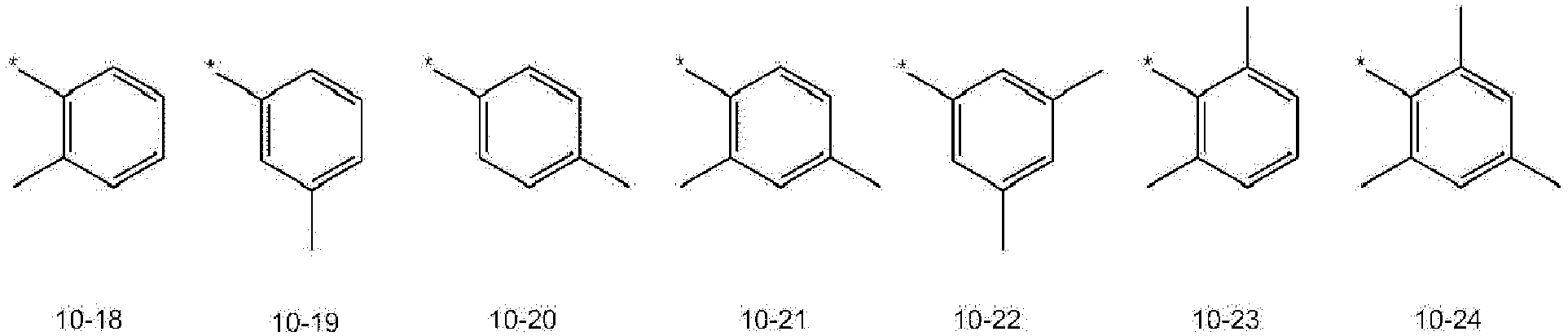
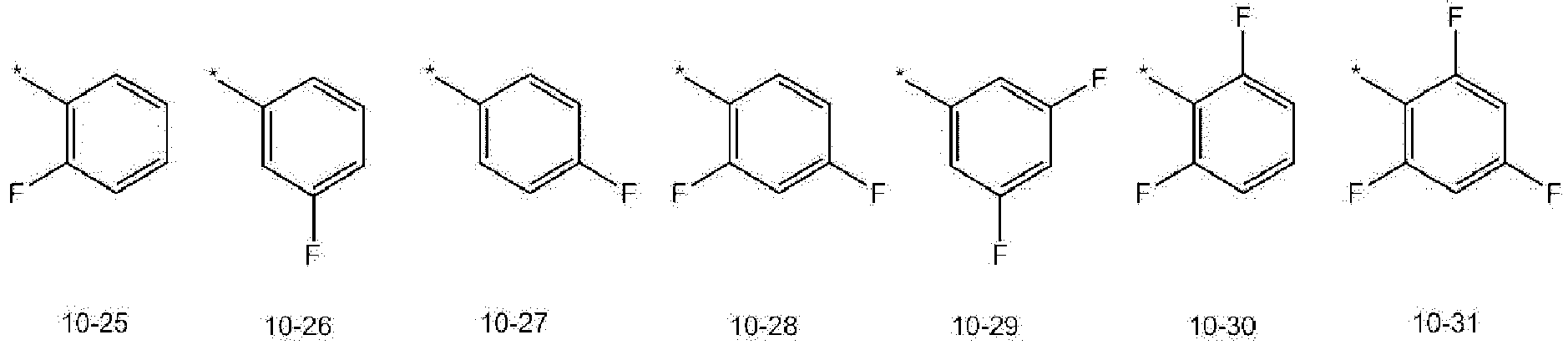


- In Formulae 9-1 to 9-13 and 10-17 to 10-79,
* indicates a binding site to a neighboring atom,i-Pr indicates an isopropyl group, and t-Bu indicates a t-butyl group,
Ph indicates a phenyl group, and
TMS indicates a trimethylsilyl group. - In one embodiment, in Formula 1A, at least one selected from R1, R2, and R11 may be selected from deuterium, a substituted or unsubstituted C1-C60 alkyl group, a substituted or unsubstituted C2-C60 alkenyl group, a substituted or unsubstituted C2-C60 alkynyl group, a substituted or unsubstituted C1-C60 alkoxy group, a substituted or unsubstituted C3-C10 cycloalkyl group, a substituted or unsubstituted C1-C10 heterocycloalkyl group, a substituted or unsubstituted C3-C10 cycloalkenyl group, a substituted or unsubstituted C1-C10 heterocycloalkenyl group, a substituted or unsubstituted C6-C60 aryl group, a substituted or unsubstituted C6-C60 aryloxy group, a substituted or unsubstituted C6-C60 arylthio group, a substituted or unsubstituted C1-C60 heteroaryl group, a substituted or unsubstituted monovalent non-aromatic condensed polycyclic group, a substituted or unsubstituted monovalent non-aromatic condensed heteropolycyclic group, -N(Q1)(Q2), -Si(Q3)(Q4)(Q5), -B(Q6)(Q7), and-P(=O)(Q8)(Q9), but embodiments of the present disclosure are not limited thereto.
- In Formula 1A, two, three, or four selected from a plurality of neighboring R1, R2, and R11 may optionally be linked to form a four-coordinate, six-coordinate, or eight-coordinate ligand.
- For example, in Formula 1A-1, two neighboring R12a(s) may optionally be linked to form a tetradentate ligand, but embodiments of the present disclosure are not limited thereto.
- In one embodiment, in Formula 1A-1, two neighboring R13a(s) may optionally be linked to form a tetradentate ligand, but embodiments of the present disclosure are not limited thereto.
- In one embodiment, in Formula 1A-1, two neighboring R14a(s) may optionally be linked to form a tetradentate ligand, but embodiments of the present disclosure are not limited thereto.
- In one embodiment, in Formula 1A-1, two neighboring R15a(s) may optionally be linked to form a tetradentate ligand, but embodiments of the present disclosure are not limited thereto.
- In one embodiment, in Formula 1A-2, two neighboring R16a(s) may optionally be linked to form a tetradentate ligand, but embodiments of the present disclosure are not limited thereto.
- In one embodiment, in Formula 1A-2, two neighboring R17a(s) may optionally be linked to form a tetradentate ligand, but embodiments of the present disclosure are not limited thereto.
- In one embodiment, in Formula 1A-2, two neighboring R18a(s) may optionally be linked to form a tetradentate ligand, but embodiments of the present disclosure are not limited thereto.
- In one embodiment, in Formula 1A-2, two neighboring R19a(s) may optionally be linked to form a tetradentate ligand, but embodiments of the present disclosure are not limited thereto.
- For example, in Formula 1A-1, three neighboring R12a(s) may optionally be linked to form a tetradentate ligand, but embodiments of the present disclosure are not limited thereto.
- In one embodiment, in Formula 1A-1, three neighboring R13a(s) may optionally be linked to form a tetradentate ligand, but embodiments of the present disclosure are not limited thereto.
- In one embodiment, in Formula 1A-1, three neighboring R14a(s) may optionally be linked to form a tetradentate ligand, but embodiments of the present disclosure are not limited thereto.
- In one embodiment, in Formula 1A-1, three neighboring R15a(s) may optionally be linked to form a tetradentate ligand, but embodiments of the present disclosure are not limited thereto.
- In one embodiment, in Formula 1A-2, three neighboring R16a(s) may optionally be linked to form a tetradentate ligand, but embodiments of the present disclosure are not limited thereto.
- In one embodiment, in Formula 1A-2, three neighboring R17a(s) may optionally be linked to form a tetradentate ligand, but embodiments of the present disclosure are not limited thereto.
- In one embodiment, in Formula 1A-2, three neighboring R18a(s) may optionally be linked to form a tetradentate ligand, but embodiments of the present disclosure are not limited thereto.
- In one embodiment, in Formula 1A-2, three neighboring R19a(s) may optionally be linked to form a tetradentate ligand, but embodiments of the present disclosure are not limited thereto.
- In Formula 1, n11 may be selected from 1, 2, 3, and 4, wherein, when n11 is 2 or more, 2 or more L11(s) are the same or different from each other.
- For example, In Formula 1, n11 may be selected from 1, 2 and 3, but embodiments of the present disclosure are not limited thereto.
- In Formula 1, L12 may be selected from a one-coordinate ligand, a two-coordinate ligand, and a three-coordinate ligand.
- For example, in Formula 1, L12 may be selected from one-coordinate ligands, for example, I-, Br-, Cl-, sulfide, nitrate, azide, hydroxide, cyanate, isocyanate, thiocyanate, water, acetonitrile, pyridine, ammonia, carbon monoxide, P(Ph)3, P(Ph)2CH3, PPh(CH3)2, and P(CH3)3, but embodiments of the present disclosure are not limited thereto.
- In one embodiment, in Formula 1, L12 may be selected from two-coordinate ligands, for example, oxalate, acetylacetonate, picolinic acid, 1,2-bis(diphenylphosphino)ethane, 1,1-bis(diphenylphosphino)methane, glycinate, and ethylenediamine, but embodiments of the present disclosure are not limited thereto.
- In one embodiment, in Formula 1, L12 may be a ligand represented by one selected from Formulae 7-1 to 7-11, but embodiments of the present disclosure are not limited thereto:
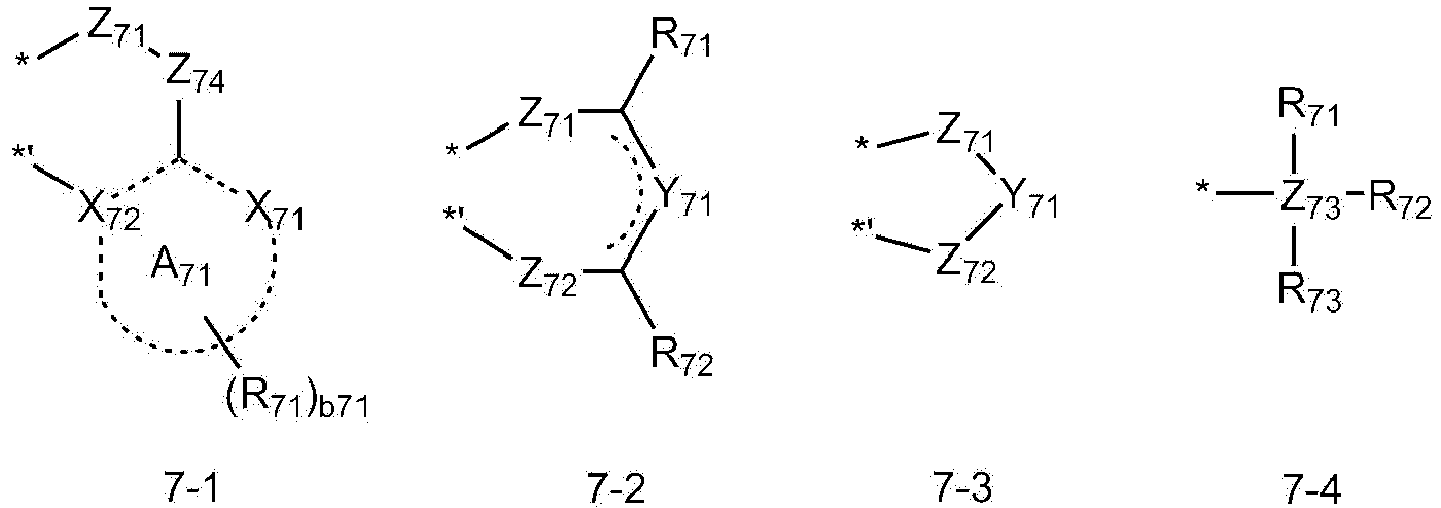
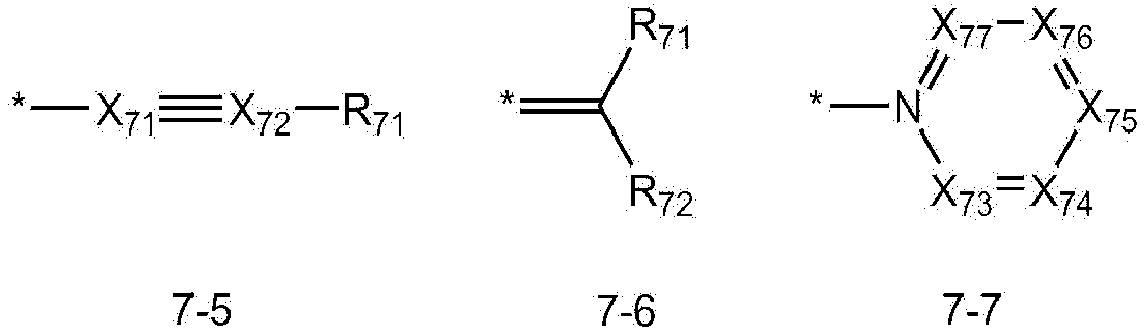


- A71 and A72 may each independently be selected from a C5-C20 carbocyclic group and a C1-C20 heterocyclic group,
- X71 and X72 may each independently be selected from C and N,
- X73 may be N or C(Q73); X74 may be N or C(Q74); X75 may be N or C(Q75); X76 may be N or C(Q76); and X77 may be N or C(Q77),
- X78 may be O, S, or N(Q78); and X79 may be O, S, or N(Q79),
- Y71 and Y72 may each independently be selected from a single bond, a double bond, a substituted or unsubstituted C1-C5 alkylene group, a substituted or unsubstituted C2-C5 alkenylene group, and a substituted or unsubstituted C6-C10 arylene group,
- Z71 and Z72 may each independently be selected from N, O, N(R75), P(R75)(R76), and As(R75)(R76),
- Z73 may be selected from P and As,
- Z74 may be selected from CO and CH2,
- R71 to R80 and Q73 to Q79 may each independently be selected from hydrogen, deuterium, -F, -Cl, -Br, -I, a hydroxyl group, a cyano group, a nitro group, an amino group, an amidino group, a hydrazine group, a hydrazone group, a carboxylic acid group or a salt thereof, a sulfonic acid group or a salt thereof, a phosphoric acid group or a salt thereof, a substituted or unsubstituted C1-C60 alkyl group, a substituted or unsubstituted C2-C60 alkenyl group, a substituted or unsubstituted C2-C60 alkynyl group, a substituted or unsubstituted C1-C60 alkoxy group, a substituted or unsubstituted C3-C10 cycloalkyl group, a substituted or unsubstituted C1-C10 heterocycloalkyl group, a substituted or unsubstituted C3-C10 cycloalkenyl group, a substituted or unsubstituted C1-C10 heterocycloalkenyl group, a substituted or unsubstituted C6-C60 aryl group, a substituted or unsubstituted C6-C60 aryloxy group, a substituted or unsubstituted C6-C60 arylthio group, a substituted or unsubstituted C1-C60 heteroaryl group, a substituted or unsubstituted monovalent non-aromatic condensed polycyclic group, and a substituted or unsubstituted monovalent non-aromatic condensed heteropolycyclic group; R71 and R72 may optionally be linked to each other to form a ring; R77 and R78 may optionally be linked to each other to form a ring; R78 and R79 may optionally be linked to each other to form a ring; and R79 and R80 may optionally be linked to each other to form a ring,
- b71 and b72 may each independently be selected from 1, 2, and 3, and
- * and *' each indicate a binding site to a neighboring atom.
- For example, in Formula 7-1, A71 may be selected from a benzene group, a naphthalene group, an imidazole group, a benzimidazole group, a pyridine group, a pyrimidine group, a triazine group, a quinoline group, and an isoquinoline group, but embodiments of the present disclosure are not limited thereto.
- For example, in Formula 7-1, X71 and X72 may each independently be N, but embodiments of the present disclosure are not limited thereto.
- For example, in Formula 7-7,
X73 may be C(Q73),
X74 may be C(Q74),
X75 may be C(Q75),
X76 may be C(Q76), and
X77 may be C(Q77), but embodiments of the present disclosure are not limited thereto. - For example, in Formula 7-8,
X78 may be N(Q78), and
X79 may be N(Q79), but embodiments of the present disclosure are not limited thereto. - For example, in Formulae 7-2, 7-3, and 7-8, Y71 and Y72 may each independently be selected from a substituted or unsubstituted methylene group and a substituted or unsubstituted phenylene group, but embodiments of the present disclosure are not limited thereto.
- For example, in Formulae 7-1 and 7-2, Z71 and Z72 may each independently be O, but embodiments of the present disclosure are not limited thereto.
- For example, in Formula 7-4, Z73 may be P, but embodiments of the present disclosure are not limited thereto.
- For example, in Formulae 7-1 to 7-11, R71 to R80 and Q73 to Q79 may each independently be selected from:
- hydrogen, deuterium, -F, -Cl, -Br, -I, a hydroxyl group, a cyano group, a nitro group, an amino group, an amidino group, a hydrazine group, a hydrazone group, a carboxylic acid group or a salt thereof, a sulfonic acid group or a salt thereof, a phosphoric acid group or a salt thereof, a C1-C20 alkyl group, and a C1-C20 alkoxy group;
- a C1-C20 alkyl group and a C1-C20 alkoxy group, each substituted with at least one selected from deuterium, -F, -Cl, -Br, -I, a hydroxyl group, a cyano group, a nitro group, an amino group, an amidino group, a hydrazine group, a hydrazone group, a carboxylic acid group or a salt thereof, a sulfonic acid group or a salt thereof, a phosphoric acid group or a salt thereof, a phenyl group, a naphthyl group, a pyridinyl group, and a pyrimidinyl group;
- a phenyl group, a naphthyl group, a fluorenyl group, a phenanthrenyl group, an anthracenyl group, a fluoranthenyl group, a triphenylenyl group, a pyrenyl group, a chrysenyl group, a pyrrolyl group, a thiophenyl group, a furanyl group, an imidazolyl group, a pyrazolyl group, a thiazolyl group, an isothiazolyl group, an oxazolyl group, an isoxazolyl group, a pyridinyl group, a pyrazinyl group, a pyrimidinyl group, a pyridazinyl group, an isoindolyl group, an indolyl group, an indazolyl group, a purinyl group, a quinolinyl group, an isoquinolinyl group, a benzoquinolinyl group, a quinoxalinyl group, a quinazolinyl group, a cinnolinyl group, a carbazolyl group, a phenanthrolinyl group, a benzimidazolyl group, a benzofuranyl group, a benzothiophenyl group, an isobenzothiazolyl group, a benzoxazolyl group, an isobenzoxazolyl group, a triazolyl group, a tetrazolyl group, an oxadiazolyl group, a triazinyl group, a dibenzofuranyl group, a dibenzothiophenyl group, a benzocarbazolyl group, a dibenzocarbazolyl group, and an imidazopyridinyl group; and
- a phenyl group, a naphthyl group, a fluorenyl group, a phenanthrenyl group, an anthracenyl group, a fluoranthenyl group, a triphenylenyl group, a pyrenyl group, a chrysenyl group, a pyrrolyl group, a thiophenyl group, a furanyl group, an imidazolyl group, a pyrazolyl group, a thiazolyl group, an isothiazolyl group, an oxazolyl group, an isoxazolyl group, a pyridinyl group, a pyrazinyl group, a pyrimidinyl group, a pyridazinyl group, an isoindolyl group, an indolyl group, an indazolyl group, a purinyl group, a quinolinyl group, an isoquinolinyl group, a benzoquinolinyl group, a quinoxalinyl group, a quinazolinyl group, a cinnolinyl group, a carbazolyl group, a phenanthrolinyl group, a benzimidazolyl group, a benzofuranyl group, a benzothiophenyl group, an isobenzothiazolyl group, a benzoxazolyl group, an isobenzoxazolyl group, a triazolyl group, a tetrazolyl group, an oxadiazolyl group, a triazinyl group, a dibenzofuranyl group, a dibenzothiophenyl group, a benzocarbazolyl group, a dibenzocarbazolyl group, and an imidazopyridinyl group, each substituted with at least one selected from deuterium, -F, -Cl, -Br, -I, -CD3,-CD2H, -CDH2, -CF3, -CF2H, -CFH2, a hydroxyl group, a cyano group, a nitro group, an amino group, an amidino group, a hydrazine group, a hydrazone group, a carboxylic acid group or a salt thereof, a sulfonic acid group or a salt thereof, a phosphoric acid group or a salt thereof, a C1-C20 alkyl group, a C1-C20 alkoxy group, a phenyl group, a naphthyl group, a fluorenyl group, a phenanthrenyl group, an anthracenyl group, a fluoranthenyl group, a triphenylenyl group, a pyrenyl group, a chrysenyl group, a pyrrolyl group, a thiophenyl group, a furanyl group, an imidazolyl group, a pyrazolyl group, a thiazolyl group, an isothiazolyl group, an oxazolyl group, an isoxazolyl group, a pyridinyl group, a pyrazinyl group, a pyrimidinyl group, a pyridazinyl group, an isoindolyl group, an indolyl group, an indazolyl group, a purinyl group, a quinolinyl group, an isoquinolinyl group, a benzoquinolinyl group, a quinoxalinyl group, a quinazolinyl group, a cinnolinyl group, a carbazolyl group, a phenanthrolinyl group, a benzimidazolyl group, a benzofuranyl group, a benzothiophenyl group, an isobenzothiazolyl group, a benzoxazolyl group, an isobenzoxazolyl group, a triazolyl group, a tetrazolyl group, an oxadiazolyl group, a triazinyl group, a dibenzofuranyl group, a dibenzothiophenyl group, a benzocarbazolyl group, a dibenzocarbazolyl group, and an imidazopyridinyl group, but embodiments of the present disclosure are not limited thereto.
- In one or more embodiments, in Formula 1, L12 may be a ligand represented by one selected from Formulae 5-1 to 5-116 and Formulae 8-1 to 8-43, but embodiments of the present disclosure are not limited thereto:


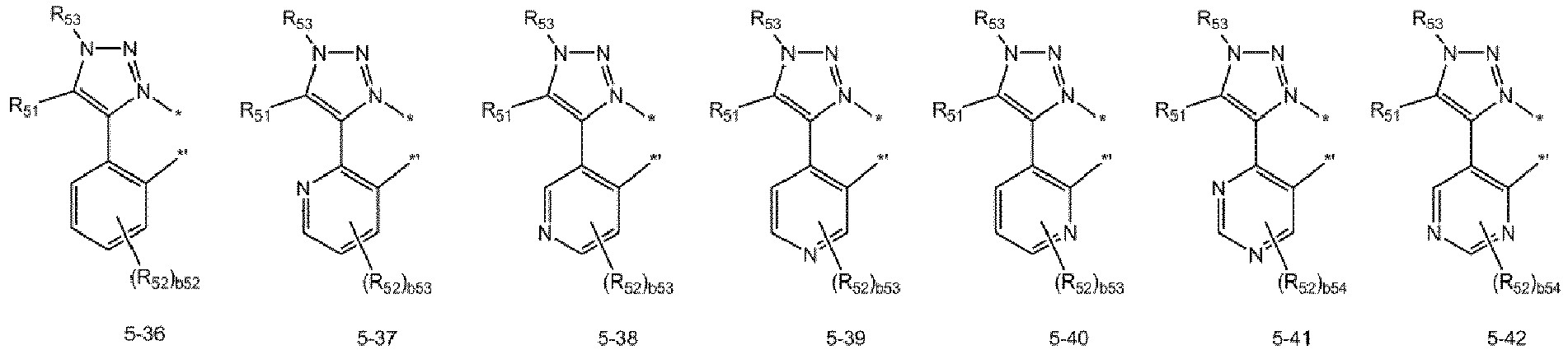

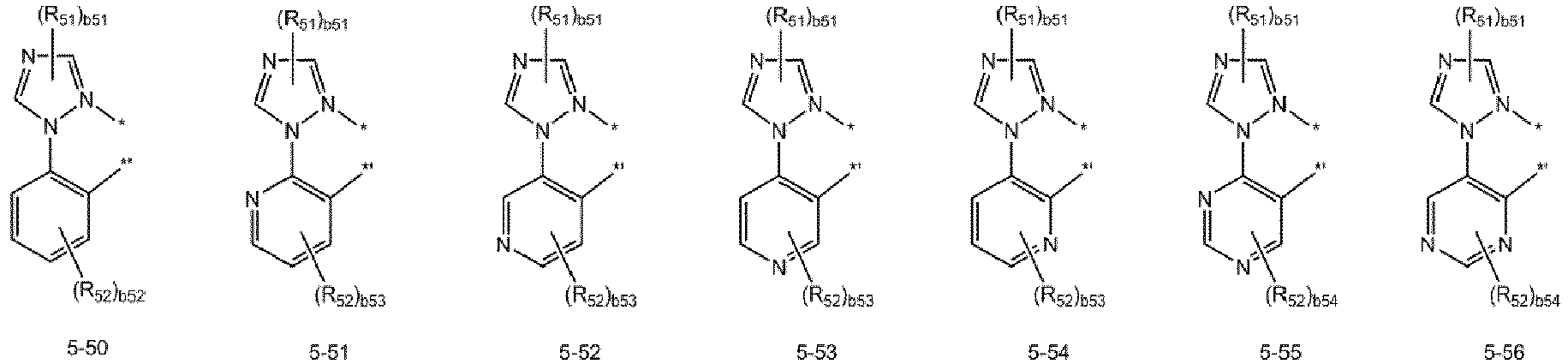

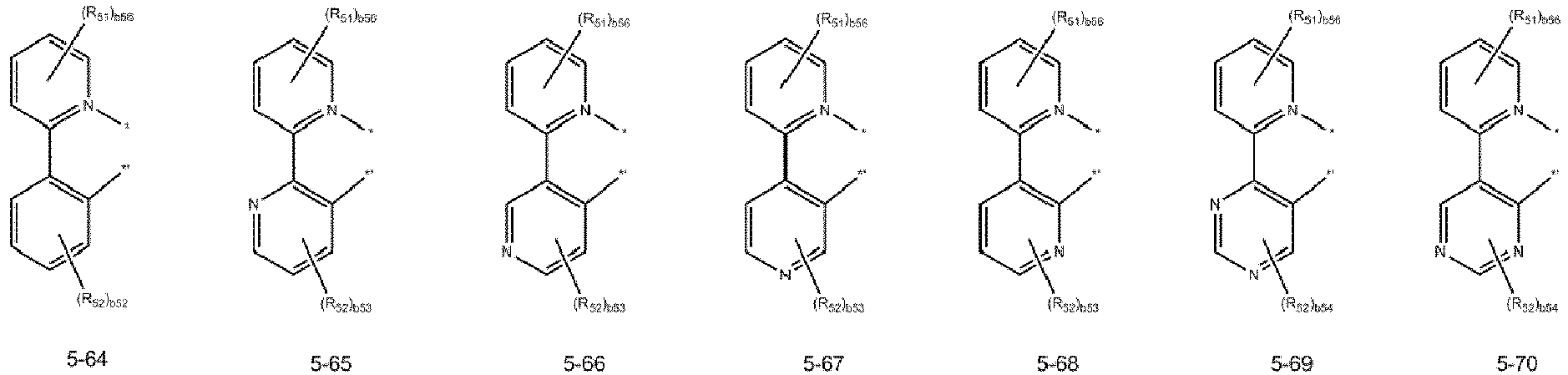


- In Formulae 5-1 to 5-116 and 8-1 to 8-43,
- R51 to R53 may each independently be selected from:
- hydrogen, -F, a cyano group, a nitro group, a methyl group, an ethyl group, a propyl group, an n-butyl group, an isobutyl group, a sec-butyl group, a tert-butyl group, an n-pentyl group, an isopentyl group, a sec-pentyl group, a tert-pentyl group, an n-hexyl group, an isohexyl group, a sec-hexyl group, a tert-hexyl group, an n-heptyl group, an isoheptyl group, a sec-heptyl group, a tert-heptyl group, an n-octyl group, an isooctyl group, a sec-octyl group, a tert-octyl group, an n-nonyl group, an isononyl group, a sec-nonyl group, a tert-nonyl group, an n-decanyl group, an isodecanyl group, a sec-decanyl group, a tert-decanyl group, a methoxy group, an ethoxy group, a propoxy group, a butoxy group, a pentoxy group, a phenyl group, a naphthyl group, a pyridinyl group, a pyrimidinyl group, a triazinyl group, a dibenzofuranyl group, and a dibenzothiophenyl group; and
- a methyl group, an ethyl group, a propyl group, an n-butyl group, an isobutyl group, a sec-butyl group, a tert-butyl group, an n-pentyl group, an isopentyl group, a sec-pentyl group, a tert-pentyl group, an n-hexyl group, an isohexyl group, a sec-hexyl group, a tert-hexyl group, an n-heptyl group, an isoheptyl group, a sec-heptyl group, a tert-heptyl group, an n-octyl group, an isooctyl group, a sec-octyl group, a tert-octyl group, an n-nonyl group, an isononyl group, a sec-nonyl group, a tert-nonyl group, an n-decanyl group, an isodecanyl group, a sec-decanyl group, a tert-decanyl group, a methoxy group, an ethoxy group, a propoxy group, a butoxy group, a pentoxy group, a phenyl group, a naphthyl group, a pyridinyl group, a pyrimidinyl group, a triazinyl group, a dibenzofuranyl group, and a dibenzothiophenyl group, each substituted with at least one selected from -F, a cyano group, and a nitro group,
- b51 and b54 may each independently be selected from 1 and 2,
- b53 and b55 may each independently be selected from 1, 2, and 3,
- b52 may be selected from 1, 2, 3, and 4,
- Ph indicates a phenyl group,
- Ph-d5 indicates a phenyl group in which all hydrogen atoms are each independently substituted with deuterium, and
- * and *' each independently indicates a binding site to a neighboring atom.
- In Formula 1, n12 may be selected from 0, 1, 2, 3, and 4, wherein, when n12 is 2 or more, 2 or more L12(s) are the same or different from each other.
- For example, in Formula 1, n12 may be selected from 0, 1 and 2, but embodiments of the present disclosure are not limited thereto.
- In one embodiment, in Formula 1, M11 may be Ir, n11 may be selected from 2 and 3, and n12 may be selected from 0, 1, and 2, but embodiments of the present disclosure are not limited thereto.
- In Formula 1, L11 and L12 may be different from each other.
- In the organometallic compound represented by Formula 1, the following compound is excluded:

- In Compound A, since an -F substituent is decomposed at high temperature, stable device lifespan may not be implemented.
- In one embodiment, the organometallic compound represented by Formula 1 may be represented by one selected from Formulae 1-1 and 1-2, but embodiments of the present disclosure are not limited thereto:

- M11, n11, n12, and L12 may each independently be the same as described in Formula 1,
- X12 may be selected from N, N(R12a), O, S, C(R12a), and C(R12a)(R12b), X13 may be selected from N, N(R13a), O, S, C(R13a), and C(R13a)(R13b), X14 may be selected from N, N(R14a), O, S, C(R14a), and C(R14a)(R14b), X15 may be selected from N, N(R15a), O, S, C(R15a), and C(R15a)(R15b), X16 may be selected from N, N(R16a), O, S, C(R16a), and C(R16a)(R16b), X17 may be selected from N, N(R17a), O, S, C(R17a), and C(R17a)(R17b), X18 may be selected from N, N(R18a), O, S, C(R18a), and C(R18a)(R18b), and X19 may be selected from N, N(R19a), O, S, C(R19a), and C(R19a)(R19b), and
- R12a, R12b, R13a, R13b, R14a, R14b, R15a, R15b, R16a, R16b, R17a, R17b, R18a, R18b, R19a, and R19b may each independently be the same as described in connection with R1 in Formula 1A.
- For example, in Formulae 1-1 and 1-2, X12 may be selected from N and C(R12a), X13 may be selected from N and C(R13a), X14 may be selected from N and C(R14a), X15 may be selected from N and C(R15a), X16 may be selected from N and C(R16a), X17 may be selected from N and C(R17a), X18 may be selected from N and C(R18a), and X19 may be selected from N and C(R19a), but embodiments of the present disclosure are not limited thereto. In this case, in Formula 1-1, a bond between N and X12, a bond between X13 and X14, and a bond between X15 and C may each be a single bond, and a bond between X12 and X13 and a bond between X14 and X15 may each be a double bond, but embodiments of the present disclosure are not limited thereto. In this case, in Formula 1-2, a bond between C and X12, a bond between X13 and X14, and a bond between X15 and N may each be a single bond, and a bond between X12 and X13 and a bond between X14 and X15 may each be a double bond, but embodiments of the present disclosure are not limited thereto. In one embodiment, in Formulae 1-1 and 1-2, X12 may be C(R12a), X13 may be C(R13a), X14 may be C(R14a), and X15 may be C(R15a), but embodiments of the present disclosure are not limited thereto. In this case, in Formula 1-1, a bond between N and X12, a bond between X13 and X14, and a bond between X15 and C may each be a single bond, and a bond between X12 and X13 and a bond between X14 and X15 may each be a double bond, but embodiments of the present disclosure are not limited thereto. In this case, in Formula 1-2, a bond between C and X12, a bond between X13 and X14, and a bond between X15 and N may each be a single bond, and a bond between X12 and X13 and a bond between X14 and X15 may each be a double bond, but embodiments of the present disclosure are not limited thereto. In one embodiment, in Formulae 1-1 and 1-2, at least one selected from X12 to X15 may be selected from O and S, but embodiments of the present disclosure are not limited thereto.
- For example, in Formulae 1-1 and 1-2, X16 may be N, X17 may be C(R17a), X18 may be C(R18a), and X19 may be C(R19a); X16 may be C(R16a), X17 may be N, X18 may be C(R18a), and X19 may be C(R19a); X16 may be C(R16a), X17 may be C(R17a), X18 may be N, and X19 may be C(R19a); X16 may be C(R16a), X17 may be C(R17a), X18 may be C(R18a), and X19 may be N; or X16 may be C(R16a), X17 may be C(R17a), X18 may be C(R18a), and X19 may be C(R19a), but embodiments of the present disclosure are not limited thereto. In this case, in Formulae 1-1 and 1-2, a bond between X16 and X17 and a bond between X18 and X19 may each be a double bond, and a bond between C and X16, a bond between C and X19, and a bond between X17 and X18 may each be a single bond, but embodiments of the present disclosure are not limited thereto.
- In one embodiment, the organometallic compound represented by Formula 1 may be represented by one selected from Formulae 1-11 and 1-12, but embodiments of the present disclosure are not limited thereto:
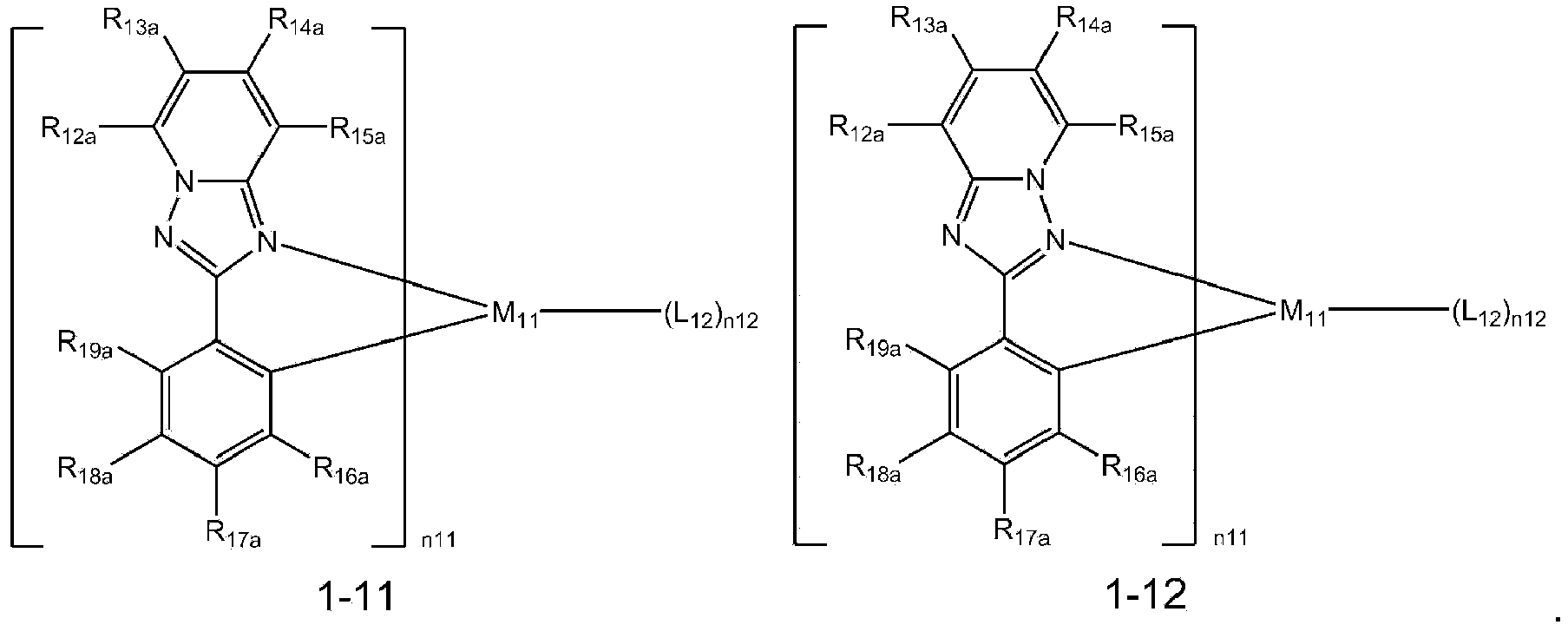
- M11, n11, n12, and L12 may each independently be the same as described in Formula 1, and
- R12a, R13a, R14a, R15a, R16a, R17a, R18a, and R19a may each independently be defined the same as R1 in Formula 1A.
- The organometallic compound represented by Formula 1 may be selected from Compounds 1 to 16, but embodiments of the present disclosure are not limited thereto:


- The organometallic compound represented by Formula 1 may have a maximum emission wavelength (actually measured value) of about 400 nm to 520 nm, for example, about 440 nm to about 480 nm. When the maximum emission wavelength is about 440 nm to about 480 nm, an organic light-emitting device that emits deep blue light may be provided.
- Since the organometallic compound represented by Formula 1 essentially includes a 6-membered ring having Y11, Y12, and X12 to X15, a conjugated system increases as compared with a relatively unstable triazole 5-membered ring, thereby improving electrochemical stability. In addition, it is general that, when the conjugated system increases, a T1 energy level is reduced. However, when a nitrogen atom (N) is introduced at a specific position, stability increases while a high T1 energy level is maintained. Therefore, an organic light-emitting device including the organometallic compound represented by Formula 1 may improve a lifespan while maintaining a high T1 energy level.
- On the other hand, for example, when the organometallic compound represented by Formula 1 does not include the 6-membered ring having Y11, Y12, and X12 to X15 and includes the triazole 5-membered ring as a main ligand, a low T1 energy level of not a blue range but a green range is exhibited. For example, when acetylacetonate (acac) having a weak bonding force is used as an auxiliary ligand, electrochemical and physical stability becomes poor.
- In contrast, the organometallic compound represented by Formula 1 exhibits a high T1 energy level of a blue range by introducing the nitrogen atom (N) as described above, and has an effect of increasing electrochemical and physical stability due to the increased conjugated system. Therefore, an organic light-emitting device including the organometallic compound represented by Formula 1 may increase a lifespan while maintaining a high T1 energy level.
- In addition, in the organometallic compound represented by Formula 1, since W11 is selected from N and N(R11), chemical and/or physical stability of the organometallic compound represented by Formula 1 may be improved. Therefore, the lifespan of the organic light-emitting device including the organometallic compound represented by Formula 1 may be improved.
- In addition, when the organometallic compound represented by Formula 1 further includes an additional substituent in the 6-membered ring having Y11, Y12, and X12 to X15 and/or the 6-membered ring having Z12, Z13, and X16 to X19, blue light may be provided. When the organometallic compound represented by Formula 1 further includes the additional substituent, the organometallic compound may have a high triplet energy level due to a wider band gap, thereby providing deep blue light.
- Therefore, the organometallic compound represented by Formula 1 may have a triplet energy level suitable for blue light and have improved chemical and/or physical stability. Therefore, the organic light-emitting device including the organometallic compound represented by Formula 1 may provide improved color purity and lifespan.
- The HOMO energy level, LUMO energy level, and T1 energy level of some Compounds and Compounds A to C in the organometallic compound represented by Formula 1 were evaluated by using Gaussian 09 program accompanying a molecular structure optimization by a B3LYP-based density functional theory (DFT) (structurally optimized at a level of B3LYP, 6-31G(d,p)), and results thereof are shown in Table 1.
[Table 1] Compound No. HOMO (eV) LUMO (eV) T1(eV) 1 -4.89 -1.36 2.76 A -5.30 -1.68 2.69 B -4.36 -0.76 2.65 C -4.49 -1.16 2.44 
- From Table 1, it is confirmed that the organometallic compound represented by Formula 1 has such electric characteristics that are suitable for use in an electric device, for example, for use as a dopant for an organic light-emitting device.
- Synthesis methods of the organometallic compound represented by Formula 1 may be recognizable by one of ordinary skill in the art by referring to Synthesis Examples provided.
- The organometallic compound represented by Formula 1 is suitable for use in an organic layer of an organic light-emitting device, for example, for use as a dopant in an emission layer of the organic layer. Thus, another aspect provides an organic light-emitting device that includes: a first electrode; a second electrode; and an organic layer that is disposed between the first electrode and the second electrode and includes an emission layer; and the organic layer includes at least one organometallic compound represented by Formula 1.
- The organic light-emitting device may have, due to the inclusion of an organic layer including the organometallic compound represented by Formula 1, a low driving voltage, high efficiency, high power, high quantum efficiency, a long lifespan, a low roll-off ratio, and excellent color purity.
- The organometallic compound of Formula 1 may be used between a pair of electrodes of an organic light-emitting device. For example, the organometallic compound represented by Formula 1 may be included in the emission layer. In this regard, the organometallic compound may act as a dopant, and the emission layer may further include a host (that is, an amount of the organometallic compound represented by Formula 1 is smaller than an amount of the host). In this regard, the dopant may emit blue light.
- The expression "(an organic layer) includes at least one organometallic compound" used herein may include a case in which "(an organic layer) includes identical compounds represented by Formula 1" and a case in which "(an organic layer) includes two or more different organometallic compounds represented by Formula 1."
- For example, the organic layer may include, as the organometallic compound, only Compound 1. In this regard, Compound 1 may exist in an emission layer of the organic light-emitting device. In one or more embodiments, the organic layer may include, as the organometallic compound, Compound 1 and Compound 2. In this regard, Compound 1 and Compound 2 may exist in an identical layer (for example, Compound 1 and Compound 2 all may exist in an emission layer).
- The first electrode may be an anode, which is a hole injection electrode, and the second electrode may be a cathode, which is an electron injection electrode; or the first electrode may be a cathode, which is an electron injection electrode, and the second electrode may be an anode, which is a hole injection electrode.
- In one embodiment, in the organic light-emitting device, the first electrode is an anode, and the second electrode is a cathode, and the organic layer further includes a hole transport region between the first electrode and the emission layer and an electron transport region between the emission layer and the second electrode, and the hole transport region includes at least one selected from a hole injection layer, a hole transport layer, and an electron blocking layer, and the electron transport region includes at least one selected from a hole blocking layer, an electron transport layer, and an electron injection layer.
- The term "organic layer" as used herein refers to a single layer and/or a plurality of layers between the first electrode and the second electrode of the organic light-emitting device. The "organic layer" may include, in addition to an organic compound, an organometallic compound including metal.
-
FIG. 1 is a schematic view of an organic light-emittingdevice 10 according to an embodiment. Hereinafter, the structure of an organic light-emitting device according to an embodiment and a method of manufacturing an organic light-emitting device according to an embodiment will be described in connection withFIG. 1 . The organic light-emittingdevice 10 includes afirst electrode 11, anorganic layer 15, and asecond electrode 19, which are sequentially stacked. - A substrate may be additionally disposed under the
first electrode 11 or above thesecond electrode 19. For use as the substrate, any substrate that is used in general organic light-emitting devices may be used, and the substrate may be a glass substrate or a transparent plastic substrate, each having excellent mechanical strength, thermal stability, transparency, surface smoothness, ease of handling, and water resistance. - In one or more embodiments, the
first electrode 11 may be formed by depositing or sputtering a material for forming thefirst electrode 11 on the substrate. Thefirst electrode 11 may be an anode. The material for forming thefirst electrode 11 may be selected from materials with a high work function to facilitate hole injection. Thefirst electrode 11 may be a reflective electrode, a semi-transmissive electrode, or a transmissive electrode. The material for forming thefirst electrode 11 may be indium tin oxide (ITO), indium zinc oxide (IZO), tin oxide (SnO2), or zinc oxide (ZnO). In one or more embodiments, the material for forming thefirst electrode 11 may be metal, such as magnesium (Mg), aluminum (Al), aluminum-lithium (Al-Li), calcium (Ca), magnesium-indium (Mg-In), or magnesium-silver (Mg-Ag). - The
first electrode 11 may have a single-layered structure or a multi-layered structure including two or more layers. For example, thefirst electrode 11 may have a three-layered structure of ITO/Ag/ITO, but the structure of thefirst electrode 11 is not limited thereto. - The
organic layer 15 is disposed on thefirst electrode 11. - The
organic layer 15 may include a hole transport region, an emission layer, and an electron transport region. - The hole transport region may be disposed between the
first electrode 11 and the emission layer. - The hole transport region may include at least one selected from a hole injection layer, a hole transport layer, an electron blocking layer, and a buffer layer.
- The hole transport region may include only either a hole injection layer or a hole transport layer. In one or more embodiments, the hole transport region may have a hole injection layer/hole transport layer structure or a hole injection layer/hole transport layer/electron blocking layer structure, which are sequentially stacked in this stated order from the
first electrode 11. - When the hole transport region includes a hole injection layer, the hole injection layer may be formed on the
first electrode 11 by using one or more suitable methods, for example, vacuum deposition, spin coating, casting, and/or Langmuir-Blodgett (LB) deposition. - When a hole injection layer is formed by vacuum deposition, the deposition conditions may vary according to a material that is used to form the hole injection layer, and the structure and thermal characteristics of the hole injection layer. For example, the deposition conditions may include a deposition temperature of about 100 □ to about 500 □, a vacuum pressure of about 10-8 to about 10-3 torr, and a deposition rate of about 0.01 Å/sec to about 100 Å/sec. However, the deposition conditions are not limited thereto.
- When the hole injection layer is formed using spin coating, coating conditions may vary according to the material used to form the hole injection layer, and the structure and thermal properties of the hole injection layer. For example, a coating speed may be from about 2,000 rpm to about 5,000 rpm, and a temperature at which a heat treatment is performed to remove a solvent after coating may be from about 80□ to about 200□. However, the coating conditions are not limited thereto.
- Conditions for forming a hole transport layer and an electron blocking layer may be understood by referring to conditions for forming the hole injection layer.
- The hole transport region may include at least one selected from m-MTDATA, TDATA, 2-TNATA, NPB, β-NPB, TPD, Spiro-TPD, Spiro-NPB, methylated-NPB, TAPC, HMTPD, 4,4',4"-tris(N-carbazolyl)triphenylamine (TCTA), polyaniline/dodecylbenzenesulfonic acid (PANI/DBSA), poly(3,4-ethylenedioxythiophene)/poly(4-styrenesulfonate) (PEDOT/PSS), polyaniline/camphor sulfonicacid (PANI/CSA), polyaniline/poly(4-styrenesulfonate) (PANI/PSS), a compound represented by Formula 201, and a compound represented by Formula 202:


- Ar101 and Ar102 in Formula 201 may each independently be selected from:
- a phenylene group, a pentalenylene group, an indenylene group, a naphthylene group, an azulenylene group, a heptalenylene group, an acenaphthylene group, a fluorenylene group, a phenalenylene group, a phenanthrenylene group, an anthracenylene group, a fluoranthenylene group, a triphenylenylene group, a pyrenylene group, a chrysenylene group, a naphthacenylene group, a picenylene group, a perylenylene group, and a pentacenylene group; and
- a phenylene group, a pentalenylene group, an indenylene group, a naphthylene group, an azulenylene group, a heptalenylene group, an acenaphthylene group, a fluorenylene group, a phenalenylene group, a phenanthrenylene group, an anthracenylene group, a fluoranthenylene group, a triphenylenylene group, a pyrenylene group, a chrysenylene group, a naphthacenylene group, a picenylene group, a perylenylene group, and a pentacenylene group, each substituted with at least one selected from deuterium, -F, -CI, -Br, -I, a hydroxyl group, a cyano group, a nitro group, an amino group, an amidino group, a hydrazine group, a hydrazone group, a carboxylic acid group or a salt thereof, a sulfonic acid group or a salt thereof, a phosphoric acid group or a salt thereof, a C1-C60 alkyl group, a C2-C60 alkenyl group, a C2-C60 alkynyl group, a C1-C60 alkoxy group, a C3-C10 cycloalkyl group, a C3-C10 cycloalkenyl group, a C1-C10 heterocycloalkyl group, a C1-C10 heterocycloalkenyl group, a C6-C60 aryl group, a C6-C60 aryloxy group, a C6-C60 arylthio group, a C1-C60 heteroaryl group, a monovalent non-aromatic condensed polycyclic group, and a monovalent non-aromatic condensed heteropolycyclic group.
- In Formula 201, xa and xb may each independently be an integer from 0 to 5, or 0, 1 or 2. For example, xa may be 1 and xb may be 0, but xa and xb are not limited thereto.
- In Formulae 201 and 202, R101 to R108, R111 to R119, and R121 to R124 may each independently be selected from:
- hydrogen, deuterium, -F, -Cl, -Br, -I, a hydroxyl group, a cyano group, a nitro group, an amino group, an amidino group, a hydrazine group, a hydrazone group, a carboxylic acid group or a salt thereof, a sulfonic acid group or a salt thereof, a phosphoric acid group or a salt thereof, a C1-C10 alkyl group (for example, a methyl group, an ethyl group, a propyl group, a butyl group, a pentyl group, a hexyl group, and the like), and a C1-C10 alkoxy group (for example, a methoxy group, an ethoxy group, a propoxy group, a butoxy group, a pentoxy group, and the like);
- a C1-C10 alkyl group and a C1-C10 alkoxy group, each substituted with at least one selected from deuterium, -F, -Cl, -Br, -I, a hydroxyl group, a cyano group, a nitro group, an amino group, an amidino group, a hydrazine group, a hydrazone group, a carboxylic acid group or a salt thereof, a sulfonic acid group or a salt thereof, and a phosphoric acid group or a salt thereof;
- a phenyl group, a naphthyl group, an anthracenyl group, a fluorenyl group, or a pyrenyl group; or
- a phenyl group, a naphthyl group, an anthracenyl group, a fluorenyl group, and a pyrenyl group, each substituted with at least one selected from deuterium, -F,-Cl, -Br, -I, a hydroxyl group, a cyano group, a nitro group, an amino group, an amidino group, a hydrazine group, a hydrazone group, a carboxylic acid group or a salt thereof, a sulfonic acid group or a salt thereof, a phosphoric acid group or a salt thereof, a C1-C10 alkyl group, and a C1-C10 alkoxy group, but embodiments of the present disclosure are not limited thereto.
- In Formula 201, R109 may be selected from:
- a phenyl group, a naphthyl group, an anthracenyl group, and a pyridinyl group; and
- a phenyl group, a naphthyl group, an anthracenyl group, and a pyridinyl group, each substituted with at least one selected from deuterium, -F, -Cl, -Br, -I, a hydroxyl group, a cyano group, a nitro group, an amino group, an amidino group, a hydrazine group, a hydrazone group, a carboxylic acid group or a salt thereof, a sulfonic acid group or a salt thereof, a phosphoric acid group or a salt thereof, a C1-C20 alkyl group, a C1-C20 alkoxy group, a phenyl group, a naphthyl group, an anthracenyl group, and a pyridinyl group.
- In one embodiment, the compound represented by Formula 201 may be represented by Formula 201A, but embodiments of the present disclosure are not limited thereto:

- In Formula 201A, R101, R111, R112, and R109 may each independently be defined the same as described above.
- For example, the compound represented by Formula 201, and the compound represented by Formula 202 may include compounds HT1 to HT20 illustrated, but are not limited thereto.


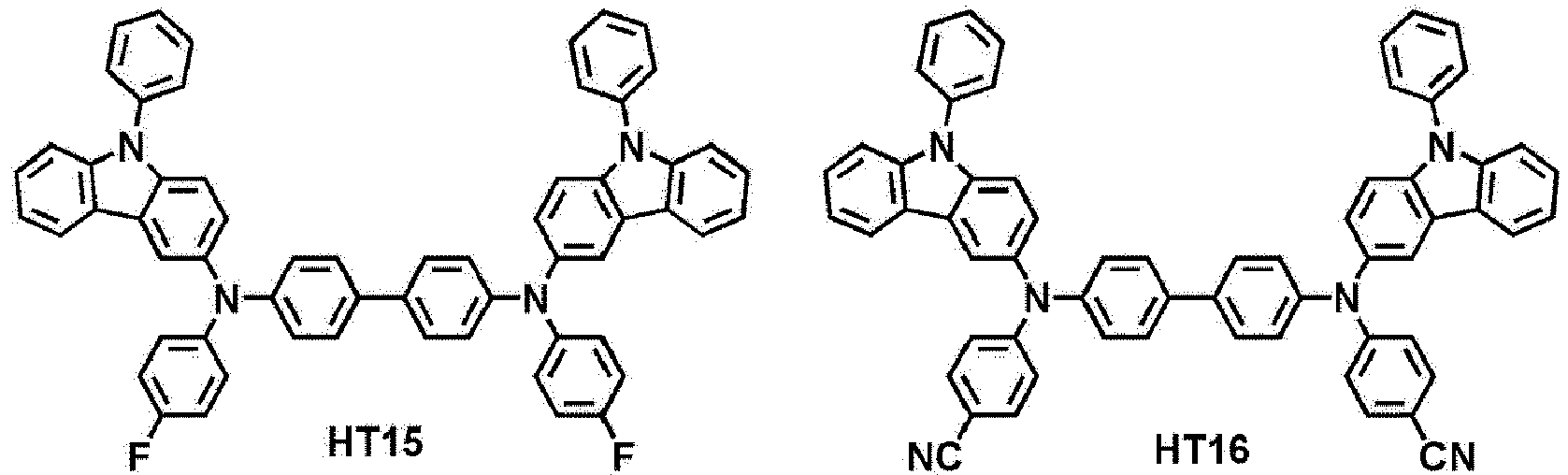


- A thickness of the hole transport region may be in a range of about 100 Å to about 10,000 Å, for example, about 100 Å to about 1,000 Å. When the hole transport region includes both a hole injection layer and a hole transport layer, a thickness of the hole injection layer may be in a range of about 100 Å to about 10,000 Å, for example, about 100 Å to about 1,000 Å, and a thickness of the hole transport layer may be in a range of about 50 Å to about 2,000 Å, for example about 100 Å to about 1,500 Å. When the thicknesses of the hole transport region, the hole injection layer, and the hole transport layer are within these ranges, satisfactory hole transporting characteristics may be obtained without a substantial increase in driving voltage.
- The hole transport region may further include, in addition to these materials, a charge-generation material for the improvement of conductive properties. The charge-generation material may be homogeneously or non-homogeneously dispersed in the hole transport region.
- The charge-generation material may be, for example, a p-dopant. The p-dopant may be one selected from a quinone derivative, a metal oxide, and a cyano group-containing compound, but embodiments of the present disclosure are not limited thereto. Non-limiting examples of the p-dopant are a quinone derivative, such as tetracyanoquinonedimethane (TCNQ) or 2,3,5,6-tetrafluoro-tetracyano-1,4-benzoquinonedimethane (F4-TCNQ); a metal oxide, such as a tungsten oxide or a molybdenium oxide; and a cyano group-containing compound, such as Compound HT-D1 or Compound HT-D2, but are not limited thereto.


- The hole transport region may include a buffer layer.
- Also, the buffer layer may compensate for an optical resonance distance according to a wavelength of light emitted from the emission layer, and thus, efficiency of a formed organic light-emitting device may be improved.
- Then, an emission layer may be formed on the hole transport region by vacuum deposition, spin coating, casting, LB deposition, or the like. When the emission layer is formed by vacuum deposition or spin coating, the deposition or coating conditions may be similar to those applied in forming the hole injection layer although the deposition or coating conditions may vary according to a compound that is used to form the emission layer.
- Meanwhile, when the hole transport region includes an electron blocking layer, a material for the electron blocking layer may be selected from materials for the hole transport region described above and materials for a host to be explained later. However, the material for the electron blocking layer is not limited thereto. For example, when the hole transport region includes an electron blocking layer, a material for the electron blocking layer may be mCP, which will be explained later. The emission layer may include a host and a dopant, and the dopant may include the organometallic compound represented by Formula 1.
- The host may include at least one selected from TPBi, TBADN, ADN (also referred to as "DNA"), CBP, CDBP, TCP, mCP, Compound H50, to Compound H52:


- In one or more embodiments, the host may further include a compound represented by Formula 301.

- Ar111 and Ar112 in Formula 301 may each independently be selected from:
- a phenylene group, a naphthylene group, a phenanthrenylene group, and a pyrenylene group; and
- a phenylene group, a naphthylene group, a phenanthrenylene group, and a pyrenylene group, each substituted with at least one selected from a phenyl group, a naphthyl group, and an anthracenyl group.
- Ar113 to Ar116 in Formula 301 may each independently be selected from:
- a C1-C10 alkyl group, a phenyl group, a naphthyl group, a phenanthrenyl group, and a pyrenyl group; and
- a phenyl group, a naphthyl group, a phenanthrenyl group, and a pyrenyl group, each substituted with at least one selected from a phenyl group, a naphthyl group, and an anthracenyl group.
- In Formula 301, g, h, i, and j may each independently be an integer from 0 to 4, and may be, for example, 0, 1, or 2.
- In Formula 301, Ar113 and Ar116 may each independently be selected from:
- a C1-C10 alkyl group substituted with at least one selected from a phenyl group, a naphthyl group, and an anthracenyl group;
- a phenyl group, a naphthyl group, an anthracenyl group, a pyrenyl, a phenanthrenyl group, and a fluorenyl group;
- a phenyl group, a naphthyl group, an anthracenyl group, a pyrenyl group, a phenanthrenyl group, and a fluorenyl group, each substituted with at least one selected from deuterium, -F, -Cl, -Br, -I, a hydroxyl group, a cyano group, a nitro group, an amino group, an amidino group, a hydrazine group, a hydrazone group, a carboxylic acid group or a salt thereof, a sulfonic acid group or a salt thereof, a phosphoric acid group or a salt thereof, a C1-C60 alkyl group, a C2-C60 alkenyl group, a C2-C60 alkynyl group, a C1-C60 alkoxy group, a phenyl group, a naphthyl group, an anthracenyl group, a pyrenyl group, a phenanthrenyl group, and a fluorenyl group; and
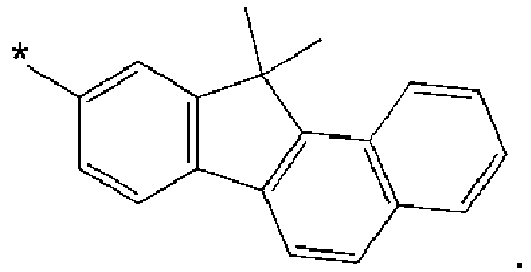
- In one or more embodiments, the host may include a compound represented by Formula 302:

- In Formula 302, Ar122 to Ar125 may each independently be defined the same as Ar113 in Formula 301.
- lin Formula 302, Ar126 and Ar127 may each independently be a C1-C10 alkyl group (for example, a methyl group, an ethyl group, or a propyl group).
- In Formula 302, k and I may each independently be an integer from 0 to 4. For example, k and I may be 0, 1, or 2.
- The compound represented by Formula 301 and the compound represented by Formula 302 may include Compounds H1 to H42, but are not limited thereto.


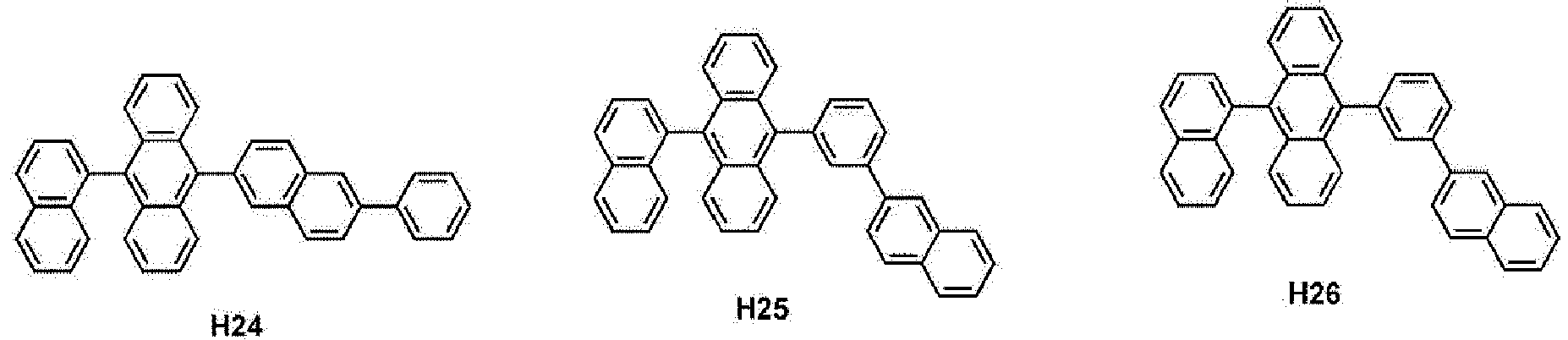


- When the organic light-emitting device is a full-color organic light-emitting device, the emission layer may be patterned into a red emission layer, a green emission layer, and a blue emission layer. In one or more embodiments, due to a stacked structure including a red emission layer, a green emission layer, and/or a blue emission layer, the emission layer may emit white light.
- When the emission layer includes a host and a dopant, an amount of the dopant may be typically in a range of about 0.01 parts by weight to about 15 parts by weight based on 100 parts by weight of the host, but embodiments of the present disclosure are not limited thereto.
- The dopant may include at least one of organometallic compounds represented by Formula 1.
- A thickness of the emission layer may be in a range of about 100 Å to about 1,000 Å, for example, about 200 Å to about 600 Å. When the thickness of the emission layer is within this range, excellent light-emission characteristics may be obtained without a substantial increase in driving voltage.
- Then, an electron transport region may be disposed on the emission layer.
- The electron transport region may include at least one selected from a hole blocking layer, an electron transport layer, and an electron injection layer.
- For example, the electron transport region may have a hole blocking layer/electron transport layer/electron injection layer structure or an electron transport layer/electron injection layer structure, but the structure of the electron transport region is not limited thereto. The electron transport layer may have a single-layered structure or a multi-layered structure including two or more different materials.
- Conditions for forming the hole blocking layer, the electron transport layer, and the electron injection layer which constitute the electron transport region may be understood by referring to the conditions for forming the hole injection layer.
- When the electron transport region includes a hole blocking layer, the hole blocking layer may include, for example, at least one of BCP, Bphen, and BAlq but embodiments of the present disclosure are not limited thereto.

- A thickness of the hole blocking layer may be in a range of about 20 Å to about 1,000 Å, for example, about 30 Å to about 300 Å. When the thickness of the hole blocking layer is within these ranges, the hole blocking layer may have excellent hole blocking characteristics without a substantial increase in driving voltage.
- The electron transport layer may further include, in addition to the organometallic compound represented by Formula 1, at least one selected from BCP, Bphen, Alq3, BAlq, TAZ, and NTAZ.


- In one or more embodiments, the electron transport layer may include at least one of ET1 to ET25, but are not limited thereto:


- A thickness of the electron transport layer may be in a range of about 100 Å to about 1,000 Å, for example, about 150 Å to about 500 Å. When the thickness of the electron transport layer is within the range described above, the electron transport layer may have satisfactory electron transport characteristics without a substantial increase in driving voltage.
- Also, the electron transport layer may further include, in addition to the materials described above, a metal-containing material.
- The metal-containing material may include a Li complex. The Li complex may include, for example, Compound ET-D1 (lithium quinolate, LiQ) or ET-D2.

- The electron transport region may include an electron injection layer (EIL) that promotes flow of electrons from the
second electrode 19 thereinto. - The electron injection layer may include at least one selected from LiF, NaCl, CsF, Li2O, and BaO.
- A thickness of the electron injection layer may be in a range of about 1 Å to about 100 Å, for example, about 3 Å to about 90 Å. When the thickness of the electron injection layer is within the range described above, the electron injection layer may have satisfactory electron injection characteristics without a substantial increase in driving voltage.
- The
second electrode 19 is disposed on theorganic layer 15. Thesecond electrode 19 may be a cathode. A material for forming thesecond electrode 19 may be metal, an alloy, an electrically conductive compound, or a combination thereof, which have a relatively low work function. For example, lithium (Li), magnesium (Mg), aluminum (Al), aluminum-lithium (Al-Li), calcium (Ca), magnesium-indium (Mg-In), or magnesium-silver (Mg-Ag) may be formed as the material for forming thesecond electrode 19. To manufacture a top-emission type light-emitting device, a transmissive electrode formed using ITO or IZO may be used as thesecond electrode 19. - Hereinbefore, the organic light-emitting device has been described with reference to
FIG. 1 , but embodiments of the present disclosure are not limited thereto. - The term "first-row transition metal of the Periodic Table of Elements" as used herein refers to an element of the Period 4 of the Periodic Table of Elements and belonging to a d-block, and examples thereof include scandium (Sc), titanium (Ti), vanadium (V), chromium (Cr), manganese (Mn), iron (Fe), cobalt (Co), nickel (Ni), copper (Cu), and zinc (Zn).
- The term "second-row transition metal of the Periodic Table of Elements" as used herein refers to an element of the Period 5 of the Periodic Table of Elements and belonging to a d-block, and examples thereof include yttrium (Y), zirconium (Zr), niobium (Nb), molybdenum (Mo), technetium (Tc), ruthenium (Ru), rhodium (Rh), palladium (Pd), silver (Ag), and cadmium (Cd).
- The term "third-row transition metal of the Periodic Table of Elements" as used herein refers to an element of the Period 6 and belonging to a d-block, and examples thereof include lanthanum (La), samarium (Sm), europium (Eu), terbium (Tb), thulium (Tm), ytterbium (Yb), lutetium (Lu), hafnium (Hf), tantalum (Ta), tungsten(W), rhenium (Re), osmium (Os), iridium (Ir), platinum (Pt), gold (Au), and mercury (Hg).
- The term "C1-C60 alkyl group" as used herein refers to a linear or branched saturated aliphatic hydrocarbon monovalent group having 1 to 60 carbon atoms, and examples thereof include a methyl group, an ethyl group, a propyl group, an isobutyl group, a sec-butyl group, a tert-butyl group, a pentyl group, an isoamyl group, and a hexyl group. The term "C1-C60 alkylene group" as used herein refers to a divalent group having the same structure as the C1-C60 alkyl group.
- The term "C1-C60 alkoxy group" as used herein refers to a monovalent group represented by -OA101 (wherein A101 is the C1-C60 alkyl group), and examples thereof include a methoxy group, an ethoxy group, and an isopropyloxy group.
- The term "C2-C60 alkenyl group" as used herein refers to a hydrocarbon group having at least one carbon-carbon double bond in the middle or at the terminus of the C2-C60 alkyl group, and examples thereof include an ethenyl group, a propenyl group, and a butenyl group. The term "C2-C60 alkenylene group" as used herein refers to a divalent group having the same structure as the C2-C60 alkenyl group.
- The term "C2-C60 alkynyl group" as used herein refers to a hydrocarbon group having at least one carbon-carbon triple bond in the middle or at the terminus of the C2-C60 alkyl group, and examples thereof include an ethynyl group, and a propynyl group. The term "C2-C60 alkynylene group" as used herein refers to a divalent group having the same structure as the C2-C60 alkynyl group.
- The term "C3-C10 cycloalkyl group" as used herein refers to a monovalent saturated hydrocarbon monocyclic group having 3 to 10 carbon atoms, and examples thereof include a cyclopropyl group, a cyclobutyl group, a cyclopentyl group, a cyclohexyl group, and a cycloheptyl group. The term "C3-C10 cycloalkylene group" as used herein refers to a divalent group having the same structure as the C3-C10 cycloalkyl group.
- The term "C1-C10 heterocycloalkyl group" as used herein refers to a monovalent saturated monocyclic group having at least one heteroatom selected from N, O, P, Si and S as a ring-forming atom and 1 to 10 carbon atoms, and non-limiting examples thereof include a tetrahydrofuranyl group, and a tetrahydrothiophenyl group. The term "C1-C10 heterocycloalkylene group" as used herein refers to a divalent group having the same structure as the C1-C10 heterocycloalkyl group.
- The term "C3-C10 cycloalkenyl group" as used herein refers to a monovalent monocyclic group that has 3 to 10 carbon atoms and at least one carbon-carbon double bond in the ring thereof and no aromaticity, and non-limiting examples thereof include a cyclopentenyl group, a cyclohexenyl group, and a cycloheptenyl group. The term "C3-C10 cycloalkenylene group," used herein, refers to a divalent group having the same structure as the C3-C10 cycloalkenyl group.
- The term "C1-C10 heterocycloalkenyl group" as used herein refers to a monovalent monocyclic group that has at least one heteroatom selected from N, O, P, Si, and S as a ring-forming atom, 1 to 10 carbon atoms, and at least one carbon-carbon double bond in its ring. Examples of the C1-C10 heterocycloalkenyl group are a 2,3-dihydrofuranyl group, and a 2,3-dihydrothiophenyl group. The term "C1-C10 heterocycloalkenylene group," used herein, refers to a divalent group having the same structure as the C1-C10 heterocycloalkenyl group.
- The term "C6-C60 aryl group" as used herein refers to a monovalent group having a carbocyclic aromatic system having 6 to 60 carbon atoms, and the term "C6-C60 arylene group" as used herein refers to a divalent group having a carbocyclic aromatic system having 6 to 60 carbon atoms. Examples of the C6-C60 aryl group are a phenyl group, a naphthyl group, an anthracenyl group, a phenanthrenyl group, a pyrenyl group, and a chrysenyl group. When the C6-C60 aryl group and the C6-C60 arylene group each include two or more rings, the rings may be fused to each other.
- The term "C1-C60 heteroaryl group" as used herein refers to a monovalent group having a cyclic aromatic system that has at least one heteroatom selected from N, O, P, Si, and S as a ring-forming atom, in addition to 1 to 60 carbon atoms. The term "C1-C60 heteroarylene group" as used herein refers to a divalent group having a heterocyclic aromatic system that has at least one heteroatom selected from N, O, P, Si, and S as a ring-forming atom, in addition to 1 to 60 carbon atoms. Examples of the C1-C60 heteroaryl group are a pyridinyl group, a pyrimidinyl group, a pyrazinyl group, a pyridazinyl group, a triazinyl group, a quinolinyl group, and an isoquinolinyl group. When the C1-C60 heteroaryl group and the C1-C60 heteroarylene group each include two or more rings, the rings may be fused to each other.
- A C6-C60 aryloxy group used herein indicates -OA102 (wherein A102 is the C6-C60 aryl group), and a C6-C60 arylthio group indicates -SA103 (wherein A103 is the C6-C60 aryl group).
- The term "monovalent non-aromatic condensed polycyclic group" as used herein refers to a monovalent group (for example, having 8 to 60 carbon atoms) having two or more rings condensed to each other, only carbon atoms as ring-forming atoms, and no aromaticity in its entire molecular structure. Examples of the monovalent non-aromatic condensed polycyclic group include a fluorenyl group. The term "divalent non-aromatic condensed polycyclic group" as used herein refers to a divalent group having the same structure as the monovalent non-aromatic condensed polycyclic group.
- The term "monovalent non-aromatic condensed heteropolycyclic group" as used herein refers to a monovalent group (for example, having 2 to 60 carbon atoms) having two or more rings condensed to each other, a heteroatom selected from N, O, P, Si, and S, other than carbon atoms, as a ring-forming atom, and no aromaticity in its entire molecular structure. Non-limiting examples of the monovalent non-aromatic condensed heteropolycyclic group include a carbazolyl group. The term "divalent non-aromatic condensed heteropolycyclic group" as used herein refers to a divalent group having the same structure as the monovalent non-aromatic condensed heteropolycyclic group.
- The term "C5-C30 carbocyclic group" as used herein refers to a saturated or unsaturated cyclic group having, as a ring-forming atom, 5 to 30 carbon atoms only. The term "C5-C30 carbocyclic group" as used herein refers to a monocyclic group or a polycyclic group, and, according to its chemical structure, a monovalent, divalent, trivalent, tetravalent, pentavalent, or hexavalent group.
- The term "C1-C30 heterocyclic group" as used herein refers to a saturated or unsaturated cyclic group having at least one heteroatom selected from N, O, Si, P, and S other than 1 to 30 carbon atoms, as a ring-forming atom. The term "C1-C30 heterocyclic group" as used herein refers to a monocyclic group or a polycyclic group, and, according to its chemical structure, a monovalent, divalent, trivalent, tetravalent, pentavalent, or hexavalent group.
- The term "5-membered aromatic heteroring" as used herein refers to an aromatic ring having, as a ring-forming atom, at least one heteroatom selected from N, O, P, Si, and S other than 3 to 5 carbon atoms.
- The term "5-membered non-aromatic ring" as used herein refers to a saturated or unsaturated ring having, as a ring-forming atom, 3 to 5 carbon atoms.
- The term "5-membered non-aromatic heteroring" as used herein refers to a saturated or unsaturated ring having at least one heteroatom selected from N, O, P, Si, and S other than 3 to 5 carbon atoms, as a ring-forming atom.
- At least one substituent of the substituted C5-C30 carbocyclic group, the substituted C1-C30 heterocyclic group, the substituted C1-C60 alkyl group, the substituted C2-C60 alkenyl group, the substituted C2-C60 alkynyl group, the substituted C1-C60 alkoxy group, the substituted C3-C10 cycloalkyl group, the substituted C1-C10 heterocycloalkyl group, the substituted C3-C10 cycloalkenyl group, the substituted C1-C10 heterocycloalkenyl group, the substituted C6-C60 aryl group, the substituted C6-C60 aryloxy group, the substituted C6-C60 arylthio group, the substituted C1-C60 heteroaryl group, the substituted monovalent non-aromatic condensed polycyclic group, and the substituted monovalent non-aromatic condensed heteropolycyclic group may be selected from:
- deuterium, -F, -Cl, -Br, -I, -CD3, -CD2H, -CDH2, -CF3, -CF2H, -CFH2, a hydroxyl group, a cyano group, a nitro group, an amino group, an amidino group, a hydrazine group, a hydrazone group, a carboxylic acid group or a salt thereof, a sulfonic acid group or a salt thereof, a phosphoric acid group or a salt thereof, a C1-C60 alkyl group, a C2-C60 alkenyl group, a C2-C60 alkynyl group, and a C1-C60 alkoxy group;
- a C1-C60 alkyl group, a C2-C60 alkenyl group, a C2-C60 alkynyl group, and a C1-C60 alkoxy group, each substituted with at least one selected from deuterium, -F, -Cl, -Br, -I, -CD3, -CD2H, -CDH2, -CF3, -CF2H, -CFH2, a hydroxyl group, a cyano group, a nitro group, an amino group, an amidino group, a hydrazine group, a hydrazone group, a carboxylic acid group or a salt thereof, a sulfonic acid group or a salt thereof, a phosphoric acid group or a salt thereof, a C3-C10 cycloalkyl group, a C1-C10 heterocycloalkyl group, a C3-C10 cycloalkenyl group, a C1-C10 heterocycloalkenyl group, a C6-C60 aryl group, a C6-C60 aryloxy group, a C6-C60 arylthio group, a C1-C60 heteroaryl group, a monovalent non-aromatic condensed polycyclic group, a monovalent non-aromatic condensed heteropolycyclic group, -N(Q11)(Q12),-Si(Q13)(Q14)(Q15), -B(Q16)(Q17), and -P(=O)(Q18)(Q19);
- a C3-C10 cycloalkyl group, a C1-C10 heterocycloalkyl group, a C3-C10 cycloalkenyl group, a C1-C10 heterocycloalkenyl group, a C6-C60 aryl group, a C6-C60 aryloxy group, a C6-C60 arylthio group, a C1-C60 heteroaryl group, a monovalent non-aromatic condensed polycyclic group, and a monovalent non-aromatic condensed heteropolycyclic group;
- a C3-C10 cycloalkyl group, a C1-C10 heterocycloalkyl group, a C3-C10 cycloalkenyl group, a C1-C10 heterocycloalkenyl group, a C6-C60 aryl group, a C6-C60 aryloxy group, a C6-C60 arylthio group, a C1-C60 heteroaryl group, a monovalent non-aromatic condensed polycyclic group, and a monovalent non-aromatic condensed heteropolycyclic group, each substituted with at least one selected from deuterium,-F, -Cl, -Br, -I, -CD3, -CD2H, -CDH2, -CF3, -CF2H, -CFH2, a hydroxyl group, a cyano group, a nitro group, an amino group, an amidino group, a hydrazine group, a hydrazone group, a carboxylic acid group or a salt thereof, a sulfonic acid group or a salt thereof, a phosphoric acid group or a salt thereof, a C1-C60 alkyl group, a C2-C60 alkenyl group, a C2-C60 alkynyl group, a C1-C60 alkoxy group, a C3-C10 cycloalkyl group, a C1-C10 heterocycloalkyl group, a C3-C10 cycloalkenyl group, a C1-C10 heterocycloalkenyl group, a C6-C60 aryl group, a C6-C60 aryloxy group, a C6-C60 arylthio group, a C1-C60 heteroaryl group, a monovalent non-aromatic condensed polycyclic group, a monovalent non-aromatic condensed heteropolycyclic group,-N(Q21)(Q22), -Si(Q23)(Q24)(Q25), -B(Q26)(Q27), and -P(=O)(Q28)(Q29); and
- -N(Q31)(Q32), -Si(Q33)(Q34)(Q35), -B(Q36)(Q37), and -P(=O)(Q38)(Q39), and
- Q1 to Q9, Q11 to Q19, Q21 to Q29, and Q31 to Q39 may each independently be selected from hydrogen, deuterium, -F, -Cl, -Br, -I, a hydroxyl group, a cyano group, a nitro group, an amino group, an amidino group, a hydrazine group, a hydrazone group, a carboxylic acid group or a salt thereof, a sulfonic acid group or a salt thereof, a phosphoric acid group or a salt thereof, a C1-C60 alkyl group, a C2-C60 alkenyl group, a C2-C60 alkynyl group, a C1-C60 alkoxy group, a C3-C10 cycloalkyl group, a C1-C10 heterocycloalkyl group, a C3-C10 cycloalkenyl group, a C1-C10 heterocycloalkenyl group, a C6-C60 aryl group, a C6-C60 aryl group substituted with at least one selected from a C1-C60 alkyl group, and a C6-C60 aryl group, a C6-C60 aryloxy group, a C6-C60 arylthio group, a C1-C60 heteroaryl group, a monovalent non-aromatic condensed polycyclic group, and a monovalent non-aromatic condensed heteropolycyclic group.
- Hereinafter, a compound and an organic light-emitting device according to embodiments are described in detail with reference to Synthesis Example and Examples. However, the organic light-emitting device is not limited thereto. The wording "'B' was used instead of 'A' " used in describing Synthesis Examples means that a molar equivalent of 'A' was identical to a molar equivalent of 'B'.
-

- Ir(COD)2BF4 (5.32 mmol), a ligand (26.58 mmol), and N-methyl-2-pyrrolidone were added to a reaction container and refluxed for 12 hours in a nitrogen atmosphere. After the reaction was completed, the reaction product was cooled to room temperature and an organic layer was extracted therefrom by using dichloromethane and distilled water. The collected organic layer was washed twice by using distilled water and dried by using MgSO4, and a solvent was removed therefrom. A crude product obtained therefrom was purified by silica gel column chromatography (eluent: dichloromethane and n-hexane) to obtain Compound 5 (0.32 mmol, yield: 6 %).
- MALDI-TOF(m/z): 817.23 [M]+.
- A HOMO energy level a LUMO energy level, and T1 energy level of Compound 5 were evaluated according to the methods of Table 2, and results thereof are shown in Table 3.
[Table 2] HOMO energy level evaluation method A voltage-current (V-A) graph of each Compound was obtained by using a cyclic voltammetry (CV) (electrolyte: 0.1 M Bu4NClO4 / solvent: CH2Cl2 / electrode: 3-electrode system (work electrode: GC, reference electrode: Ag/AgCl, auxiliary electrode: Pt)), and a HOMO energy level of each Compound was calculated from reduction onset of the graph. LUMO energy level evaluation method Each compound was diluted at a concentration of 1x10⁻⁵ M in CHCl3, and a UV absorption spectrum thereof was measured at room temperature by using a Shimadzu UV-350 spectrometer, and a LUMO energy level thereof was calculated by using an optical band gap (Eg) from an edge of the absorption spectrum. T1 energy level evaluation method A mixture of toluene and each compound (each compound was dissolved in an amount of 1 mg in 3 mL of toluene) was loaded into a quartz cell, and then, the resultant quartz cell was loaded into liquid nitrogen (77 K). A photoluminescence (PL) spectrum thereof was measured by using a photoluminescence measurement device, and the obtained spectrum was compared with a PL spectrum measured at room temperature, and peaks observed only at low temperature were analyzed to calculate a T1 energy level. [Table 3] Compound No. HOMO (eV) LUMO (eV) T1 (eV) 5 -5.38 -2.54 2.58 - Referring to Table 3, it is confirmed that Compound 5 has electric characteristics suitable for use as a material for an organic light-emitting device.
- The PL spectrum of Compound 5 was evaluated so as to evaluate the light-emitting characteristics of each Compound. Compound 5 was diluted at a concentration of 10 mM in CHCl3, and the PL spectrum thereof was measured at room temperature by using ISC PC1 Spectrofluorometer equipped with a xenon lamp. The maximum wavelength of the PL spectrum of Compound 5 is shown in Table 4 and
FIG. 2 .[Table 4] Compound No. λmax (nm) 5 484 - Referring to Table 4, it is confirmed that Compound 5 has PL characteristics suitable for emission of deep blue light.
- A glass substrate, on which a 1,500 Å ITO electrode (first electrode, anode) was formed, was washed with distilled water ultrasonic waves. When the washing with distilled water was completed, sonification washing was performed by using a solvent, such as isopropyl alcohol, acetone, or methanol. The result was dried and then transferred to a plasma washer, and the resultant substrate was washed with oxygen plasma for 5 minutes and then, transferred to a vacuum depositing device.
- Compound HT3 and Compound HT-D1 were co-deposited on the ITO electrode of the glass substrate to form a hole injection layer having a thickness of 100 Å, Compound HT3 was deposited on the hole injection layer to form a hole transport layer having a thickness of 1,300 Å, and TAPC was deposited on the hole transport layer to form an electron blocking layer having a thickness of 100 Å, thereby forming a hole transport region.
- Compound H52 (host) and Compound 5 (dopant, 7 wt%) were co-deposited on the hole transport region to form an emission layer having a thickness of 300 Å.
- BCP was vacuum-deposited on the emission layer to form a hole blocking layer having a thickness of 250 Å, Compound ET3 and ET-D1 (LiQ) were co-deposited on the hole blocking layer to form an electron transport layer having a thickness of 300 Å, ET-D1 (LiQ) was deposited on the electron transport layer to form an electron injection layer having a thickness of 10 Å, and Al was deposited on the electron injection layer to form an Al second electrode (cathode) having a thickness of 1,200 Å, thereby completing the manufacture of an organic light-emitting device.


- Organic light-emitting devices were manufactured in the same manner as in Example 1, except that Compounds shown in Table 5 were each used instead of Compound 5 as a dopant in forming an emission layer.
- The EL spectrum, change in current density according to a voltage, change in luminance according to a voltage, efficiency, conversion efficiency, external quantum efficiency, lifespan, and CIE color coordinates of the organic light-emitting devices manufactured according to Example 1 and Comparative Examples 1 to 3 were measured. A specific measuring method is as follows and results thereof are shown in Table 5.
- The EL spectrum of the manufactured organic light-emitting device was measured at a luminance of 500 cd/m2 by using a luminance meter (Minolta Cs-1000A).
- The current value flowing through a unit element in the manufactured organic light-emitting device was measured by using a current-voltage meter (Keithley 2400) while increasing a voltage from 0 V to 10 V, and the result was obtained by dividing the measured current value by an area.
- The luminance of the manufactured organic light-emitting device was measured by using a luminance meter (Minolta Cs-1000A) while increasing a voltage from 0 V to 10 V.
- The current efficiency (cd/A) of the same current density (10 mA/cm2) was calculated by using the luminance and the current density and the luminance measured in (2) and (3) and the voltage. Then, the conversion efficiency was calculated by dividing the current efficiency by the y value of the CIE color coordinates measured in (6).
- The time taken until the luminance measured in (3) (initial luminance was set to 100 %) decreased to 80 % (T80) was calculated.
- The CIE color coordinates were obtained by measuring the EL spectrum of the manufactured organic light-emitting device when the luminance was 500 cd/m2 by using a luminance meter (Minolta Cs-1000A).
[Table 5] No. Dopant Driving voltage (V) Lumina nce (cd/m2) Efficiency (cd/A) EQE (%) EL (nm) T80 (hr) Color coordinates (x, y) Example 1 Compound 5 3.8 500 45.2 20 484 300 0.16 0.31 Comparative Example 1 Compound A 4.5 500 14.1 6 480 1 0.15 0.30 Comparative Example 2 Compound B 4.1 500 28.7 12 482 100 0.22 0.48 Comparative Example 3 Compound C 5.6 500 30 14 520 150 0.42 0.57 
- Referring to Table 5, it is confirmed that the organic light-emitting device of Example 1 has excellent efficiency, external quantum efficiency, and lifespan characteristics, as compared with the organic light-emitting devices of Comparative Examples 1 to 3, and also enables deep blue light to be emitted.
- Since the organometallic compound has improved electric characteristics and/or thermal stability, an organic light-emitting device including the organometallic compound may have improved lifespan and color purity characteristics.
- It should be understood that embodiments described herein should be considered in a descriptive sense only and not for purposes of limitation. Descriptions of features or aspects within each embodiment should typically be considered as available for other similar features or aspects in other embodiments.
- While one or more embodiments have been described with reference to the figures, it will be understood by those of ordinary skill in the art that various changes in form and details may be made therein without departing from the scope as defined by the following claims.
Claims (15)
- An organometallic compound represented by Formula 1:
<Formula 1> M11(L11)n11(L12)n12,
wherein, in Formula 1,M11 is a transition metal,L11 is selected from a group represented by Formula 1A,n11 is selected from 1, 2, 3, and 4, wherein, when n11 is 2 or more, 2 or more L11(s) are the same or different from each other,L12 is selected from a one-coordinate ligand, a two-coordinate ligand, and a three-coordinate ligand,n12 is selected from 0, 1, 2, 3, and 4, wherein, when n12 is 2 or more, 2 or more L12(s) are the same or different from each other,L11 and L12 are different from each otherwherein, in Formula 1A, A11 is a C1-C30 heterocyclic group, A12 is a C5-C30 carbocyclic group or a C1-C30 heterocyclic group,W11 is selected from N and N(R11),Y11 and Y12 are each independently selected from N and C, wherein at least one selected from Y11 and Y12 is N,Z11 and Z13 are each C,R1, R2, and R11 are each independently selected from hydrogen, deuterium, - F, -Cl, -Br, -I, -SF5, a hydroxyl group, a cyano group, a nitro group, an amino group, an amidino group, a hydrazine group, a hydrazone group, a carboxylic acid group or a salt thereof, a sulfonic acid group or a salt thereof, a phosphoric acid group or a salt thereof, a substituted or unsubstituted C1-C60 alkyl group, a substituted or unsubstituted C2-C60 alkenyl group, a substituted or unsubstituted C2-C60 alkynyl group, a substituted or unsubstituted C1-C60 alkoxy group, a substituted or unsubstituted C3-C10 cycloalkyl group, a substituted or unsubstituted C1-C10 heterocycloalkyl group, a substituted or unsubstituted C3-C10 cycloalkenyl group, a substituted or unsubstituted C1-C10 heterocycloalkenyl group, a substituted or unsubstituted C6-C60 aryl group, a substituted or unsubstituted C6-C60 aryloxy group, a substituted or unsubstituted C6-C60 arylthio group, a substituted or unsubstituted C1-C60 heteroaryl group, a substituted or unsubstituted monovalent non-aromatic condensed polycyclic group, a substituted or unsubstituted monovalent non-aromatic condensed heteropolycyclic group, -N(Q1)(Q2), -Si(Q3)(Q4)(Q5), -B(Q6)(Q7), and - P(=O)(Q8)(Q9),two or more selected from R1, R2, and R11 are optionally linked to each other to form a ring,two, three, or four selected from a plurality of neighboring R1, R2, and R11 are optionally linked to each other to form a four-coordinate ligand, a six-coordinate ligand, or an eight-coordinate ligand,Q1 to Q9 are each independently selected from hydrogen, deuterium, -F, -CI, - Br, -I, a hydroxyl group, a cyano group, a nitro group, an amidino group, a hydrazine group, a hydrazone group, a carboxylic acid group or a salt thereof, a sulfonic acid group or a salt thereof, a phosphoric acid group or a salt thereof, a C1-C60 alkyl group, a C1-C60 alkyl group substituted with at least one selected from deuterium, a C1-C60 alkyl group, and a C6-C60 aryl group, a C2-C60 alkenyl group, a C2-C60 alkynyl group, a C1-C60 alkoxy group, a C3-C10 cycloalkyl group, a C1-C10 heterocycloalkyl group, a C3-C10 cycloalkenyl group, a C1-C10 heterocycloalkenyl group, a C6-C60 aryl group, a C6-C60 aryl group substituted with at least one selected from deuterium, a C1-C60 alkyl group, and a C6-C60 aryl group, a C6-C60 aryloxy group, a C6-C60 arylthio group, a C1-C60 heteroaryl group, a monovalent non-aromatic condensed polycyclic group, and a monovalent non-aromatic condensed heteropolycyclic group, andthe following compound is excluded from the organometallic compound represented by Formula 1:
- The organometallic compound of claim 1, wherein
M11 is selected from platinum (Pt), palladium (Pd), copper (Cu), silver (Ag), gold (Au), rhodium (Rh), iridium (Ir), ruthenium (Ru), osmium (Os), titanium (Ti), zirconium (Zr), hafnium (Hf), europium (Eu), terbium (Tb), and thulium (Tm);
preferably wherein
M11 is selected from Ir, Os, and Pt. - The organometallic compound of claims 1 or 2, wherein
a moiety represented by
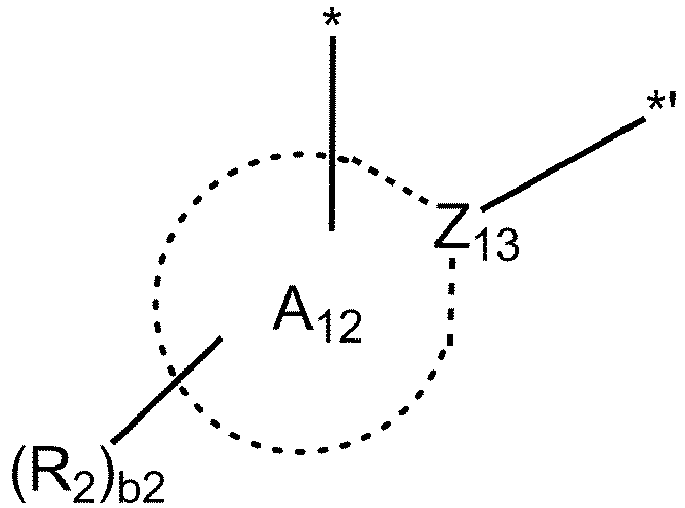

 Y11, Y12, W11, Z11, and Z13 are each independently the same as described in Formula 1A;X12 is selected from N, N(R12a), O, S, C(R12a), and C(R12a)(R12b), X13 is selected from N, N(R13a), O, S, C(R13a), and C(R13a)(R13b), X14 is selected from N, N(R14a), O, S, C(R14a), and C(R14a)(R14b), X15 is selected from N, N(R15a), O, S, C(R15a), and C(R15a)(R15b), X16 is selected from N, N(R16a), O, S, C(R16a), and C(R16a)(R16b), X17 is selected from N, N(R17a), O, S, C(R17a), and C(R17a)(R17b), X18 is selected from N, N(R18a), O, S, C(R18a), and C(R18a)(R18b), and X19 is selected from N, N(R19a), O, S, C(R19a), and C(R19a)(R19b),R12a, R12b, R13a, R13b, R14a, R14b, R15a, R15b, R16a, R16b, R17a, R17b, R18a, R18b, R19a, and R19b are each independently defined the same as R1 in Formula 1A;in Formulae 1A-1, * indicates a binding site to M11 of Formula 1, and *' indicates a binding site to a neighboring atom, andin Formulae 1A-2, *' indicates a binding site to M11 of Formula 1, and * indicates a binding site to a neighboring atom.
 - The organometallic compound of claim 3, whereini) X12 is selected from N and C(R12a), X13 is selected from N and C(R13a), X14 is selected from N and C(R14a), X15 is selected from N and C(R15a), X16 is selected from N and C(R16a), X17 is selected from N and C(R17a), X18 is selected from N and C(R18a), and X19 is selected from N and C(R19a); andii) X16 is N, X17 is C(R17a), X18 is C(R18a), and X19 is C(R19a); X16 is C(R16a), X17 is N, X18 is C(R18a), and X19 is C(R19a); X16 is C(R16a), X17 is C(R17a), X18 is N, and X19 is C(R19a); X16 is C(R16a), X17 is C(R17a), X18 is C(R18a), and X19 is N; or X16 is C(R16a), X17 is C(R17a), X18 is C(R18a), and X19 is C(R19a).
- The organometallic compound of any of claims 1-4, wherein
Y11 is N, and Y12 is C;
Y11 is C, and Y12 is N; or
Y11 is N, and Y12 is N. - The organometallic compound of any of claims 1-5, wherein
a moiety represented by


 R11 is the same as described in Formula 1A,R12a, R13a, R14a, and R15a are each independently defined the same as R1 in Formula 1A; and* and *' each indicate a binding site to a neighboring atom; and/or
whereina moiety represented bywherein, in Formulae 3-1 to 3-8,


 R16a, R17a, R18a, and R19a are each independently defined the same as R2 in Formula 1A;, and* and *' each indicate a binding site to a neighboring atom.
 - The organometallic compound of any of claims 1-6, wherein
R1, R2, and R11 are each independently selected from:hydrogen, deuterium, -F, -Cl, -Br, -I, a hydroxyl group, a cyano group, a nitro group, an amino group, an amidino group, a hydrazine group, a hydrazone group, a carboxylic acid group or a salt thereof, a sulfonic acid group or a salt thereof, a phosphoric acid group or a salt thereof, -SF5, C1-C20 alkyl group, and a C1-C20 alkoxy group;a C1-C20 alkyl group and a C1-C20 alkoxy group, each substituted with at least one selected from deuterium, -F, -Cl, -Br, -I, -CD3, -CD2H, -CDH2, -CF3, -CF2H,-CFH2, a hydroxyl group, a cyano group, a nitro group, an amino group, an amidino group, a hydrazine group, a hydrazone group, a carboxylic acid group or a salt thereof, a sulfonic acid group or a salt thereof, a phosphoric acid group or a salt thereof, a C1-C10 alkyl group, a cyclopentyl group, a cyclopentyl group substituted with deuterium, a cyclohexyl group, a cyclohexyl group substituted with deuterium, a cycloheptyl group, a cycloheptyl group substituted with deuterium, a cycloctyl group, a cycloctyl group substituted with deuterium, a bicyclo[2.2.1]heptanyl group, an adamantanyl group, a norbornanyl group, a norbornenyl group, a cyclopentenyl group, a cyclohexenyl group, a cycloheptenyl group, a phenyl group, a naphthyl group, a pyridinyl group, and a pyrimidinyl group;a cyclopentyl group, a cyclohexyl group, a cycloheptyl group, a cycloctyl group, a bicyclo[2.2.1]heptanyl group, an adamantanyl group, a norbornanyl group, a norbornenyl group, a cyclopentenyl group, a cyclohexenyl group, a cycloheptenyl group, a phenyl group, a naphthyl group, a fluorenyl group, a phenanthrenyl group, an anthracenyl group, a fluoranthenyl group, a triphenylenyl group, a pyrenyl group, a chrysenyl group, a pyrrolyl group, a thiophenyl group, a furanyl group, an imidazolyl group, a pyrazolyl group, a thiazolyl group, an isothiazolyl group, an oxazolyl group, an isoxazolyl group, a pyridinyl group, a pyrazinyl group, a pyrimidinyl group, a pyridazinyl group, an isoindolyl group, an indolyl group, an indazolyl group, a purinyl group, a quinolinyl group, an isoquinolinyl group, a benzoquinolinyl group, a quinoxalinyl group, a quinazolinyl group, a cinnolinyl group, a carbazolyl group, a phenanthrolinyl group, a benzimidazolyl group, a benzofuranyl group, a benzothiophenyl group, an isobenzothiazolyl group, a benzoxazolyl group, an isobenzoxazolyl group, a triazolyl group, a tetrazolyl group, an oxadiazolyl group, a triazinyl group, a dibenzofuranyl group, a dibenzothiophenyl group, a dibenzosilolyl group, a benzocarbazolyl group, a dibenzocarbazolyl group, an imidazopyridinyl group, and an imidazopyrimidinyl group;a cyclopentyl group, a cyclohexyl group, a cycloheptyl group, a cycloctyl group, a bicyclo[2.2.1]heptanyl group, an adamantanyl group, a norbornanyl group, a norbornenyl group, a cyclopentenyl group, a cyclohexenyl group, a cycloheptenyl group, a phenyl group, a naphthyl group, a fluorenyl group, a phenanthrenyl group, an anthracenyl group, a fluoranthenyl group, a triphenylenyl group, a pyrenyl group, a chrysenyl group, a pyrrolyl group, a thiophenyl group, a furanyl group, an imidazolyl group, a pyrazolyl group, a thiazolyl group, an isothiazolyl group, an oxazolyl group, an isoxazolyl group, a pyridinyl group, a pyrazinyl group, a pyrimidinyl group, a pyridazinyl group, an isoindolyl group, an indolyl group, an indazolyl group, a purinyl group, a quinolinyl group, an isoquinolinyl group, a benzoquinolinyl group, a quinoxalinyl group, a quinazolinyl group, a cinnolinyl group, a carbazolyl group, a phenanthrolinyl group, a benzimidazolyl group, a benzofuranyl group, a benzothiophenyl group, an isobenzothiazolyl group, a benzoxazolyl group, an isobenzoxazolyl group, a triazolyl group, a tetrazolyl group, an oxadiazolyl group, a triazinyl group, a dibenzofuranyl group, a dibenzothiophenyl group, a dibenzosilolyl group, a benzocarbazolyl group, a dibenzocarbazolyl group, an imidazopyridinyl group, and an imidazopyrimidinyl group, each substituted with at least one selected from deuterium, -F, -Cl, -Br, -I, -CD3, -CD2H, -CDH2, -CF3, -CF2H, -CFH2, a hydroxyl group, a cyano group, a nitro group, an amino group, an amidino group, a hydrazine group, a hydrazone group, a carboxylic acid group or a salt thereof, a sulfonic acid group or a salt thereof, a phosphoric acid group or a salt thereof, a C1-C20 alkyl group, a C1-C20 alkoxy group, a cyclopentyl group, a cyclopentyl group substituted with deuterium, a cyclohexyl group, a cyclohexyl group substituted with deuterium, a cycloheptyl group, a cycloheptyl group substituted with deuterium, a cycloctyl group, a cycloctyl group substituted with deuterium, a bicyclo[2.2.1]heptanyl group, an adamantanyl group, a norbornanyl group, a norbornenyl group, a cyclopentenyl group, a cyclohexenyl group, a cycloheptenyl group, a phenyl group, a naphthyl group, a fluorenyl group, a phenanthrenyl group, an anthracenyl group, a fluoranthenyl group, a triphenylenyl group, a pyrenyl group, a chrysenyl group, a pyrrolyl group, a thiophenyl group, a furanyl group, an imidazolyl group, a pyrazolyl group, a thiazolyl group, an isothiazolyl group, an oxazolyl group, an isoxazolyl group, a pyridinyl group, a pyrazinyl group, a pyrimidinyl group, a pyridazinyl group, an isoindolyl group, an indolyl group, an indazolyl group, a purinyl group, a quinolinyl group, an isoquinolinyl group, a benzoquinolinyl group, a quinoxalinyl group, a quinazolinyl group, a cinnolinyl group, a carbazolyl group, a phenanthrolinyl group, a benzimidazolyl group, a benzofuranyl group, a benzothiophenyl group, an isobenzothiazolyl group, a benzoxazolyl group, an isobenzoxazolyl group, a triazolyl group, a tetrazolyl group, an oxadiazolyl group, a triazinyl group, a dibenzofuranyl group, a dibenzothiophenyl group, a dibenzosilolyl group, a benzocarbazolyl group, a dibenzocarbazolyl group, an imidazopyridinyl group, an imidazopyrimidinyl group, and -Si(Q33)(Q34)(Q35); and-N(Q1)(Q2), -Si(Q3)(Q4)(Q5), -B(Q6)(Q7), and -P(=O)(Q8)(Q9), andQ1 to Q9 and Q33 to Q35 are each independently selected from:
-CH3, -CD3, -CD2H, -CDH2, -CH2CH3, -CH2CD3, -CH2CD2H, -CH2CDH2,-CHDCH3, -CHDCD2H, -CHDCDH2, -CHDCD3, -CD2CD3, -CD2CD2H, and -CD2CDH2;an n-propyl group, an isopropyl group, an n-butyl group, an isobutyl group, a sec-butyl group, a tert-butyl group, an n-pentyl group, an isopentyl group, a sec-pentyl group, a tert-pentyl group, a phenyl group, and a naphthyl group; andan n-propyl group, an isopropyl group, an n-butyl group, an isobutyl group, a sec-butyl group, a tert-butyl group, an n-pentyl group, an isopentyl group, a sec-pentyl group, a tert-pentyl group, a phenyl group, and a naphthyl group, each substituted with at least one selected from deuterium, a C1-C10 alkyl group, and a phenyl group. - The organometallic compound of any of claims 1-7, wherein
R1, R2, and R11 are each independently selected from:hydrogen, deuterium, -F, a cyano group, a nitro group, -SF5, a methyl group, an ethyl group, an n-propyl group, an isopropyl group, an n-butyl group, an isobutyl group, a sec-butyl group, a tert-butyl group, an n-pentyl group, an isopentyl group, a sec-pentyl group, a tert-pentyl group, an n-hexyl group, an isohexyl group, a sec-hexyl group, a tert-hexyl group, an n-heptyl group, an isoheptyl group, a sec-heptyl group, a tert-heptyl group, an n-octyl group, an isooctyl group, a sec-octyl group, a tert-octyl group, an n-nonyl group, an isononyl group, a sec-nonyl group, a tert-nonyl group, an n-decyl group, an isodecyl group, a sec-decyl group, a tert-decyl group, a methoxy group, an ethoxy group, a propoxy group, a butoxy group, a pentoxy group, a cyclopentyl group, a cyclohexyl group, a cycloheptyl group, a cycloctyl group, a bicyclo[2.2.1]heptanyl group, an adamantanyl group, a norbornanyl group, a norbornenyl group, a cyclopentenyl group, a cyclohexenyl group, a cycloheptenyl group, a phenyl group, a naphthyl group, a pyridinyl group, a pyrimidinyl group, a fluorenyl group, a carbazolyl group, a dibenzofuranyl group, a dibenzothiophenyl group, and a dibenzosilolyl group;a methyl group, an ethyl group, an n-propyl group, an isopropyl group, an n-butyl group, an isobutyl group, a sec-butyl group, a tert-butyl group, an n-pentyl group, an isopentyl group, a sec-pentyl group, a tert-pentyl group, an n-hexyl group, an isohexyl group, a sec-hexyl group, a tert-hexyl group, an n-heptyl group, an isoheptyl group, a sec-heptyl group, a tert-heptyl group, an n-octyl group, an isooctyl group, a sec-octyl group, a tert-octyl group, an n-nonyl group, an isononyl group, a sec-nonyl group, a tert-nonyl group, an n-decyl group, an isodecyl group, a sec-decyl group, a tert-decyl group, a methoxy group, an ethoxy group, a propoxy group, a butoxy group, a pentoxy group, a cyclopentyl group, a cyclohexyl group, a cycloheptyl group, a cycloctyl group, a bicyclo[2.2.1]heptanyl group, an adamantanyl group, a norbornanyl group, a norbornenyl group, a cyclopentenyl group, a cyclohexenyl group, a cycloheptenyl group, a phenyl group, a naphthyl group, a pyridinyl group, a pyrimidinyl group, a fluorenyl group, a carbazolyl group, a dibenzofuranyl group, a dibenzothiophenyl group, and a dibenzosilolyl group, each substituted with at least one selected from deuterium, -F, -CD3, -CD2H, -CDH2, -CF3, -CF2H, -CFH2, a cyano group, a nitro group, a C1-C10 alkyl group, a C1-C10 alkoxy group, a cyclopentyl group, a cyclopentyl group substituted with deuterium, a cyclohexyl group, a cyclohexyl group substituted with deuterium, a cycloheptyl group, a cycloheptyl group substituted with deuterium, a cycloctyl group, a cycloctyl group substituted with deuterium, a bicyclo[2.2.1]heptanyl group, an adamantanyl group, a norbornanyl group, a norbornenyl group, a cyclopentenyl group, a cyclohexenyl group, a cycloheptenyl group, a phenyl group, a naphthyl group, a pyridinyl group, a pyrimidinyl group, a fluorenyl group, a carbazolyl group, a dibenzofuranyl group, a dibenzothiophenyl group, a dibenzosilolyl group, and - Si(Q33)(Q34)(Q35); and-N(Q1)(Q2), -Si(Q3)(Q4)(Q5), -B(Q6)(Q7), and -P(=O)(Q8)(Q9), andQ1 to Q9 and Q33 to Q35 are each independently selected from:
-CH3, -CD3, -CD2H, -CDH2, -CH2CH3, -CH2CD3, -CH2CD2H, -CH2CDH2,-CHDCH3, -CHDCD2H, -CHDCDH2, -CHDCD3, -CD2CD3, -CD2CD2H, and -CD2CDH2;an n-propyl group, an isopropyl group, an n-butyl group, an isobutyl group, a sec-butyl group, a tert-butyl group, an n-pentyl group, an isopentyl group, a sec-pentyl group, a tert-pentyl group, a phenyl group, and a naphthyl group; andan n-propyl group, an isopropyl group, an n-butyl group, an isobutyl group, a sec-butyl group, a tert-butyl group, an n-pentyl group, an isopentyl group, a sec-pentyl group, a tert-pentyl group, a phenyl group, and a naphthyl group, each substituted with at least one selected from deuterium, a C1-C10 alkyl group, and a phenyl group. - The organometallic compound of any of claims 1-8, wherein
at least one selected from R1, R2, and R11 is selected from deuterium, a substituted or unsubstituted C1-C60 alkyl group, a substituted or unsubstituted C2-C60 alkenyl group, a substituted or unsubstituted C2-C60 alkynyl group, a substituted or unsubstituted C1-C60 alkoxy group, a substituted or unsubstituted C3-C10 cycloalkyl group, a substituted or unsubstituted C1-C10 heterocycloalkyl group, a substituted or unsubstituted C3-C10 cycloalkenyl group, a substituted or unsubstituted C1-C10 heterocycloalkenyl group, a substituted or unsubstituted C6-C60 aryl group, a substituted or unsubstituted C6-C60 aryloxy group, a substituted or unsubstituted C6-C60 arylthio group, a substituted or unsubstituted C1-C60 heteroaryl group, a substituted or unsubstituted monovalent non-aromatic condensed polycyclic group, a substituted or unsubstituted monovalent non-aromatic condensed heteropolycyclic group, -N(Q1)(Q2), -Si(Q3)(Q4)(Q5), -B(Q6)(Q7), and -P(=O)(Q8)(Q9). - The organometallic compound of any of claims 1-9, wherein
n11 is selected from 1, 2, and 3, and n12 is selected from 0, 1, and 2; preferably wherein
M11 is Ir, n11 is selected from 2 and 3, and n12 is selected from 0, 1, and 2. - The organometallic compound of any of claims 1-10, wherein
L12 is represented by one selected from Formulae 7-1 to 7-11:


 A71 and A72 are each independently selected from a C5-C20 carbocyclic group and a C1-C20 heterocyclic group,X71 and X72 are each independently selected from C and N,X73 is N or C(Q73); X74 is N or C(Q74); X75 is N or C(Q75); X76 is N or C(Q76); and X77 is N or C(Q77),X78 is O, S, or N(Q78); and X79 is O, S, or N(Q79),Y71 and Y72 are each independently selected from a single bond, a double bond, a substituted or unsubstituted C1-C5 alkylene group, a substituted or unsubstituted C2-C5 alkenylene group, and a substituted or unsubstituted C6-C10 arylene group,Z71 and Z72 are each independently selected from N, O, N(R75), P(R75)(R76), and As(R75)(R76),Z73 is selected from P and As,Z74 is selected from CO and CH2,R71 to R80 and Q73 to Q79 are each independently selected from hydrogen, deuterium, -F, -Cl, -Br, -I, a hydroxyl group, a cyano group, a nitro group, an amino group, an amidino group, a hydrazine group, a hydrazone group, a carboxylic acid group or a salt thereof, a sulfonic acid group or a salt thereof, a phosphoric acid group or a salt thereof, a substituted or unsubstituted C1-C60 alkyl group, a substituted or unsubstituted C2-C60 alkenyl group, a substituted or unsubstituted C2-C60 alkynyl group, a substituted or unsubstituted C1-C60 alkoxy group, a substituted or unsubstituted C3-C10 cycloalkyl group, a substituted or unsubstituted C1-C10 heterocycloalkyl group, a substituted or unsubstituted C3-C10 cycloalkenyl group, a substituted or unsubstituted C1-C10 heterocycloalkenyl group, a substituted or unsubstituted C6-C60 aryl group, a substituted or unsubstituted C6-C60 aryloxy group, a substituted or unsubstituted C6-C60 arylthio group, a substituted or unsubstituted C1-C60 heteroaryl group, a substituted or unsubstituted monovalent non-aromatic condensed polycyclic group, and a substituted or unsubstituted monovalent non-aromatic condensed heteropolycyclic group; R71 and R72 are optionally linked to each other to form a ring; R77 and R78 are optionally linked to each other to form a ring; R78 and R79 are optionally linked to each other to form a ring; and R79 and R80 are optionally linked to each other to form a ring,b71 and b72 are each independently selected from 1, 2, and 3, and* and *' each indicate a binding site to a neighboring atom.
 - The organometallic compound of any of claims 1-11, wherein
the organometallic compound represented by Formula 1 is represented by one selected from Formulae 1-1 and 1-2: M11, n11, n12, and L12 are each independently the same as described in Formula 1,X12 is selected from N, N(R12a), O, S, C(R12a), and C(R12a)(R12b), X13 is selected from N, N(R13a), O, S, C(R13a), and C(R13a)(R13b), X14 is selected from N, N(R14a), O, S, C(R14a), and C(R14a)(R14b), X15 is selected from N, N(R15a), O, S, C(R15a), and C(R15a)(R15b), X16 is selected from N, N(R16a), O, S, C(R16a), and C(R16a)(R16b), X17 is selected from N, N(R17a), O, S, C(R17a), and C(R17a)(R17b), X18 is selected from N, N(R18a), O, S, C(R18a), and C(R18a)(R18b), and X19 is selected from N, N(R19a), O, S, C(R19a), and C(R19a)(R19b), andR12a, R12b, R13a, R13b, R14a, R14b, R15a, R15b, R16a, R16b, R17a, R17b, R18a, R18b, R19a, and R19b are each independently defined the same as R1 in Formula 1A.
 - The organometallic compound of claim 1, wherein
the organometallic compound represented by Formula 1 is selected from Compounds 1 to 16:


- The organometallic compound of any of claims 1-13, wherein the organometallic compound emits blue light having a maximum emission wavelength of 400 nm to 520 nm.
- An organic light-emitting device comprising:a first electrode,a second electrode, andan organic layer between the first electrode and the second electrode and comprising an emission layer,wherein the organic layer comprises the organometallic compound of any of claims 1-14;
preferably wherein
the emission layer comprises the organometallic compound;
preferably wherein
the emission layer further comprises a host, and an amount of the host is larger than an amount of the organometallic compound.
Applications Claiming Priority (2)
| Application Number | Priority Date | Filing Date | Title |
|---|---|---|---|
| KR20170157499 | 2017-11-23 | ||
| KR1020180135417A KR102664398B1 (en) | 2017-11-23 | 2018-11-06 | Organometallic compound and organic light emitting device including the same |
Publications (2)
| Publication Number | Publication Date |
|---|---|
| EP3489249A1 true EP3489249A1 (en) | 2019-05-29 |
| EP3489249B1 EP3489249B1 (en) | 2021-06-09 |
Family
ID=64277553
Family Applications (1)
| Application Number | Title | Priority Date | Filing Date |
|---|---|---|---|
| EP18205634.1A Active EP3489249B1 (en) | 2017-11-23 | 2018-11-12 | Organometallic compound and organic light-emitting device including the same |
Country Status (1)
| Country | Link |
|---|---|
| EP (1) | EP3489249B1 (en) |
Citations (2)
| Publication number | Priority date | Publication date | Assignee | Title |
|---|---|---|---|---|
| JP2009102533A (en) * | 2007-10-24 | 2009-05-14 | Konica Minolta Holdings Inc | ORGANIC ELECTROLUMINESCENT ELEMENT MATERIAL, ORGANIC ELECTROLUMINESCENT ELEMENT, DISPLAY DEVICE AND LIGHTING DEVICE |
| US20140158992A1 (en) * | 2012-12-07 | 2014-06-12 | Universal Display Corporation | Carbazole Compounds For Delayed Fluorescence |
-
2018
- 2018-11-12 EP EP18205634.1A patent/EP3489249B1/en active Active
Patent Citations (2)
| Publication number | Priority date | Publication date | Assignee | Title |
|---|---|---|---|---|
| JP2009102533A (en) * | 2007-10-24 | 2009-05-14 | Konica Minolta Holdings Inc | ORGANIC ELECTROLUMINESCENT ELEMENT MATERIAL, ORGANIC ELECTROLUMINESCENT ELEMENT, DISPLAY DEVICE AND LIGHTING DEVICE |
| US20140158992A1 (en) * | 2012-12-07 | 2014-06-12 | Universal Display Corporation | Carbazole Compounds For Delayed Fluorescence |
Non-Patent Citations (6)
| Title |
|---|
| ABRAMOV PAVEL A ET AL: "Emission tuning in Re(I) complexes: Expanding heterocyclic ligands and/or introduction of perfluorinated ligands", POLYHEDRON, vol. 137, 5 September 2017 (2017-09-05), pages 231 - 237, XP085208753, ISSN: 0277-5387, DOI: 10.1016/J.POLY.2017.08.046 * |
| ALEXEY N GUSEV ET AL: "New Zn complexes based on 1,2,4-triazoles: Synthesis, structure and luminescence", INORGANICA CHIMICA ACTA, ELSEVIER BV, NL, vol. 376, no. 1, 11 July 2011 (2011-07-11), pages 509 - 514, XP028292937, ISSN: 0020-1693, [retrieved on 20110723], DOI: 10.1016/J.ICA.2011.07.009 * |
| ALEXEY N GUSEV ET AL: "Structural and photophysical studies of europium complexes containing triazole ligands", INORGANICA CHIMICA ACTA, ELSEVIER BV, NL, vol. 387, 10 February 2012 (2012-02-10), pages 321 - 326, XP028418069, ISSN: 0020-1693, [retrieved on 20120223], DOI: 10.1016/J.ICA.2012.02.016 * |
| DATABASE WPI Week 200934, Derwent World Patents Index; AN 2009-J24211, XP002789059 * |
| GUSEV A N ET AL: "Adducts of lanthanide acetylacetonates with 5-phenyl-2-(2-pyridyl)-7,8-benzo-6,5-dihydro-1,3,6-triazaindolizine: structure and photoluminescence", RUSSIAN CHEMICAL BULLETIN, SPRINGER NEW YORK LLC, US, vol. 63, no. 7, 7 March 2015 (2015-03-07), pages 1493 - 1497, XP035464630, ISSN: 1066-5285, [retrieved on 20150307], DOI: 10.1007/S11172-014-0625-4 * |
| GUSEV ALEXEY N ET AL: "Structural and photophysical studies on ternary Sm(III), Nd(III), Yb(III), Er(III) complexes containing pyridyltriazole ligands", POLYHEDRON, vol. 47, no. 1, 2012, pages 37 - 45, XP028951963, ISSN: 0277-5387, DOI: 10.1016/J.POLY.2012.08.034 * |
Also Published As
| Publication number | Publication date |
|---|---|
| EP3489249B1 (en) | 2021-06-09 |
Similar Documents
| Publication | Publication Date | Title |
|---|---|---|
| EP3348562B1 (en) | Organometallic compound, composition containing the organometallic compound, and organic light-emitting device | |
| KR102395780B1 (en) | Organometallic compound, organic light emitting device including the same | |
| EP3514163A1 (en) | Organometallic compound, organic light-emitting device including the same, and diagnostic composition including the organometallic compound | |
| EP3960747A1 (en) | Organometallic compound and organic light-emitting device including the same | |
| EP3560940B1 (en) | Organometallic compound, organic light-emitting device with the organometallic compound, and diagnostic composition including the organometallic compound | |
| EP3205659A1 (en) | Organometallic compound, organic light-emitting device including the organometallic compound, and diagnosis composition including the organometallic compound | |
| EP3000815A1 (en) | Organometallic compound and organic light-emitting device including the same | |
| EP3392258B1 (en) | Organometallic compound, organic light-emitting device including the organometallic compound, and diagnostic composition including the organometallic compound | |
| EP3432381A1 (en) | Organometallic compound and organic light-emitting device including the same | |
| KR102390378B1 (en) | Organometallic compound, organic light emitting device including the same and a composition for diagnosing including the same | |
| EP3626724A1 (en) | Organometallic compound, organic light-emitting device including the same, and diagnostic compostion including the organometallic compound | |
| EP3053986B1 (en) | Organometallic compound, composition containing the organometallic compound, and organic light-emitting device including the organometallic compound or composition | |
| KR20240041893A (en) | Organometallic compound, composition including organometallic compound and organic light emitting device | |
| KR102824584B1 (en) | Organometallic compound, organic light emitting device including the same and a composition for diagnosing including the same | |
| EP4122999B1 (en) | Organometallic compound, organic light-emitting device including the same, and electronic apparatus including the organic light-emitting device | |
| EP3617216A1 (en) | Organometallic compound, organic light-emitting device including the same, and diagnostic composition including the organometallic compound | |
| EP3770166B1 (en) | Organometallic compound and organic light-emitting device including the same | |
| KR102531713B1 (en) | Organometallic compound and organic light-emitting device including the same | |
| EP3670520A1 (en) | Organometallic compound, organic light-emitting device including the organometallic compound, and diagnostic composition including the organometallic compound | |
| EP4273206A1 (en) | Organometallic compound, organic light-emitting device including the same, and electronic apparatus including the organic light-emitting device | |
| KR102452950B1 (en) | Organometallic compound and organic light emitting device including the same | |
| KR102409384B1 (en) | Organometallic compound and organic light emitting device including the same | |
| EP3489249B1 (en) | Organometallic compound and organic light-emitting device including the same | |
| KR102558005B1 (en) | Organometallic compound and organic light emitting device including the same | |
| KR102664398B1 (en) | Organometallic compound and organic light emitting device including the same |
Legal Events
| Date | Code | Title | Description |
|---|---|---|---|
| PUAI | Public reference made under article 153(3) epc to a published international application that has entered the european phase |
Free format text: ORIGINAL CODE: 0009012 |
|
| STAA | Information on the status of an ep patent application or granted ep patent |
Free format text: STATUS: THE APPLICATION HAS BEEN PUBLISHED |
|
| AK | Designated contracting states |
Kind code of ref document: A1 Designated state(s): AL AT BE BG CH CY CZ DE DK EE ES FI FR GB GR HR HU IE IS IT LI LT LU LV MC MK MT NL NO PL PT RO RS SE SI SK SM TR |
|
| AX | Request for extension of the european patent |
Extension state: BA ME |
|
| STAA | Information on the status of an ep patent application or granted ep patent |
Free format text: STATUS: REQUEST FOR EXAMINATION WAS MADE |
|
| 17P | Request for examination filed |
Effective date: 20191129 |
|
| RBV | Designated contracting states (corrected) |
Designated state(s): AL AT BE BG CH CY CZ DE DK EE ES FI FR GB GR HR HU IE IS IT LI LT LU LV MC MK MT NL NO PL PT RO RS SE SI SK SM TR |
|
| GRAP | Despatch of communication of intention to grant a patent |
Free format text: ORIGINAL CODE: EPIDOSNIGR1 |
|
| STAA | Information on the status of an ep patent application or granted ep patent |
Free format text: STATUS: GRANT OF PATENT IS INTENDED |
|
| INTG | Intention to grant announced |
Effective date: 20210118 |
|
| GRAS | Grant fee paid |
Free format text: ORIGINAL CODE: EPIDOSNIGR3 |
|
| GRAA | (expected) grant |
Free format text: ORIGINAL CODE: 0009210 |
|
| STAA | Information on the status of an ep patent application or granted ep patent |
Free format text: STATUS: THE PATENT HAS BEEN GRANTED |
|
| AK | Designated contracting states |
Kind code of ref document: B1 Designated state(s): AL AT BE BG CH CY CZ DE DK EE ES FI FR GB GR HR HU IE IS IT LI LT LU LV MC MK MT NL NO PL PT RO RS SE SI SK SM TR |
|
| REG | Reference to a national code |
Ref country code: GB Ref legal event code: FG4D |
|
| REG | Reference to a national code |
Ref country code: CH Ref legal event code: EP Ref country code: AT Ref legal event code: REF Ref document number: 1400426 Country of ref document: AT Kind code of ref document: T Effective date: 20210615 |
|
| REG | Reference to a national code |
Ref country code: DE Ref legal event code: R096 Ref document number: 602018018311 Country of ref document: DE |
|
| REG | Reference to a national code |
Ref country code: IE Ref legal event code: FG4D |
|
| REG | Reference to a national code |
Ref country code: LT Ref legal event code: MG9D |
|
| PG25 | Lapsed in a contracting state [announced via postgrant information from national office to epo] |
Ref country code: FI Free format text: LAPSE BECAUSE OF FAILURE TO SUBMIT A TRANSLATION OF THE DESCRIPTION OR TO PAY THE FEE WITHIN THE PRESCRIBED TIME-LIMIT Effective date: 20210609 Ref country code: HR Free format text: LAPSE BECAUSE OF FAILURE TO SUBMIT A TRANSLATION OF THE DESCRIPTION OR TO PAY THE FEE WITHIN THE PRESCRIBED TIME-LIMIT Effective date: 20210609 Ref country code: LT Free format text: LAPSE BECAUSE OF FAILURE TO SUBMIT A TRANSLATION OF THE DESCRIPTION OR TO PAY THE FEE WITHIN THE PRESCRIBED TIME-LIMIT Effective date: 20210609 Ref country code: BG Free format text: LAPSE BECAUSE OF FAILURE TO SUBMIT A TRANSLATION OF THE DESCRIPTION OR TO PAY THE FEE WITHIN THE PRESCRIBED TIME-LIMIT Effective date: 20210909 |
|
| REG | Reference to a national code |
Ref country code: AT Ref legal event code: MK05 Ref document number: 1400426 Country of ref document: AT Kind code of ref document: T Effective date: 20210609 |
|
| REG | Reference to a national code |
Ref country code: NL Ref legal event code: MP Effective date: 20210609 |
|
| PG25 | Lapsed in a contracting state [announced via postgrant information from national office to epo] |
Ref country code: LV Free format text: LAPSE BECAUSE OF FAILURE TO SUBMIT A TRANSLATION OF THE DESCRIPTION OR TO PAY THE FEE WITHIN THE PRESCRIBED TIME-LIMIT Effective date: 20210609 Ref country code: NO Free format text: LAPSE BECAUSE OF FAILURE TO SUBMIT A TRANSLATION OF THE DESCRIPTION OR TO PAY THE FEE WITHIN THE PRESCRIBED TIME-LIMIT Effective date: 20210909 Ref country code: RS Free format text: LAPSE BECAUSE OF FAILURE TO SUBMIT A TRANSLATION OF THE DESCRIPTION OR TO PAY THE FEE WITHIN THE PRESCRIBED TIME-LIMIT Effective date: 20210609 Ref country code: SE Free format text: LAPSE BECAUSE OF FAILURE TO SUBMIT A TRANSLATION OF THE DESCRIPTION OR TO PAY THE FEE WITHIN THE PRESCRIBED TIME-LIMIT Effective date: 20210609 Ref country code: GR Free format text: LAPSE BECAUSE OF FAILURE TO SUBMIT A TRANSLATION OF THE DESCRIPTION OR TO PAY THE FEE WITHIN THE PRESCRIBED TIME-LIMIT Effective date: 20210910 |
|
| PG25 | Lapsed in a contracting state [announced via postgrant information from national office to epo] |
Ref country code: CZ Free format text: LAPSE BECAUSE OF FAILURE TO SUBMIT A TRANSLATION OF THE DESCRIPTION OR TO PAY THE FEE WITHIN THE PRESCRIBED TIME-LIMIT Effective date: 20210609 Ref country code: AT Free format text: LAPSE BECAUSE OF FAILURE TO SUBMIT A TRANSLATION OF THE DESCRIPTION OR TO PAY THE FEE WITHIN THE PRESCRIBED TIME-LIMIT Effective date: 20210609 Ref country code: RO Free format text: LAPSE BECAUSE OF FAILURE TO SUBMIT A TRANSLATION OF THE DESCRIPTION OR TO PAY THE FEE WITHIN THE PRESCRIBED TIME-LIMIT Effective date: 20210609 Ref country code: PT Free format text: LAPSE BECAUSE OF FAILURE TO SUBMIT A TRANSLATION OF THE DESCRIPTION OR TO PAY THE FEE WITHIN THE PRESCRIBED TIME-LIMIT Effective date: 20211011 Ref country code: NL Free format text: LAPSE BECAUSE OF FAILURE TO SUBMIT A TRANSLATION OF THE DESCRIPTION OR TO PAY THE FEE WITHIN THE PRESCRIBED TIME-LIMIT Effective date: 20210609 Ref country code: ES Free format text: LAPSE BECAUSE OF FAILURE TO SUBMIT A TRANSLATION OF THE DESCRIPTION OR TO PAY THE FEE WITHIN THE PRESCRIBED TIME-LIMIT Effective date: 20210609 Ref country code: EE Free format text: LAPSE BECAUSE OF FAILURE TO SUBMIT A TRANSLATION OF THE DESCRIPTION OR TO PAY THE FEE WITHIN THE PRESCRIBED TIME-LIMIT Effective date: 20210609 Ref country code: SK Free format text: LAPSE BECAUSE OF FAILURE TO SUBMIT A TRANSLATION OF THE DESCRIPTION OR TO PAY THE FEE WITHIN THE PRESCRIBED TIME-LIMIT Effective date: 20210609 Ref country code: SM Free format text: LAPSE BECAUSE OF FAILURE TO SUBMIT A TRANSLATION OF THE DESCRIPTION OR TO PAY THE FEE WITHIN THE PRESCRIBED TIME-LIMIT Effective date: 20210609 |
|
| PG25 | Lapsed in a contracting state [announced via postgrant information from national office to epo] |
Ref country code: PL Free format text: LAPSE BECAUSE OF FAILURE TO SUBMIT A TRANSLATION OF THE DESCRIPTION OR TO PAY THE FEE WITHIN THE PRESCRIBED TIME-LIMIT Effective date: 20210609 |
|
| REG | Reference to a national code |
Ref country code: DE Ref legal event code: R097 Ref document number: 602018018311 Country of ref document: DE |
|
| PLBE | No opposition filed within time limit |
Free format text: ORIGINAL CODE: 0009261 |
|
| STAA | Information on the status of an ep patent application or granted ep patent |
Free format text: STATUS: NO OPPOSITION FILED WITHIN TIME LIMIT |
|
| PG25 | Lapsed in a contracting state [announced via postgrant information from national office to epo] |
Ref country code: DK Free format text: LAPSE BECAUSE OF FAILURE TO SUBMIT A TRANSLATION OF THE DESCRIPTION OR TO PAY THE FEE WITHIN THE PRESCRIBED TIME-LIMIT Effective date: 20210609 |
|
| 26N | No opposition filed |
Effective date: 20220310 |
|
| PG25 | Lapsed in a contracting state [announced via postgrant information from national office to epo] |
Ref country code: AL Free format text: LAPSE BECAUSE OF FAILURE TO SUBMIT A TRANSLATION OF THE DESCRIPTION OR TO PAY THE FEE WITHIN THE PRESCRIBED TIME-LIMIT Effective date: 20210609 |
|
| PG25 | Lapsed in a contracting state [announced via postgrant information from national office to epo] |
Ref country code: MC Free format text: LAPSE BECAUSE OF FAILURE TO SUBMIT A TRANSLATION OF THE DESCRIPTION OR TO PAY THE FEE WITHIN THE PRESCRIBED TIME-LIMIT Effective date: 20210609 |
|
| REG | Reference to a national code |
Ref country code: CH Ref legal event code: PL |
|
| PG25 | Lapsed in a contracting state [announced via postgrant information from national office to epo] |
Ref country code: LU Free format text: LAPSE BECAUSE OF NON-PAYMENT OF DUE FEES Effective date: 20211112 Ref country code: IT Free format text: LAPSE BECAUSE OF FAILURE TO SUBMIT A TRANSLATION OF THE DESCRIPTION OR TO PAY THE FEE WITHIN THE PRESCRIBED TIME-LIMIT Effective date: 20210609 Ref country code: BE Free format text: LAPSE BECAUSE OF NON-PAYMENT OF DUE FEES Effective date: 20211130 |
|
| REG | Reference to a national code |
Ref country code: BE Ref legal event code: MM Effective date: 20211130 |
|
| PG25 | Lapsed in a contracting state [announced via postgrant information from national office to epo] |
Ref country code: LI Free format text: LAPSE BECAUSE OF NON-PAYMENT OF DUE FEES Effective date: 20211130 Ref country code: CH Free format text: LAPSE BECAUSE OF NON-PAYMENT OF DUE FEES Effective date: 20211130 |
|
| PG25 | Lapsed in a contracting state [announced via postgrant information from national office to epo] |
Ref country code: IE Free format text: LAPSE BECAUSE OF NON-PAYMENT OF DUE FEES Effective date: 20211112 |
|
| PG25 | Lapsed in a contracting state [announced via postgrant information from national office to epo] |
Ref country code: CY Free format text: LAPSE BECAUSE OF FAILURE TO SUBMIT A TRANSLATION OF THE DESCRIPTION OR TO PAY THE FEE WITHIN THE PRESCRIBED TIME-LIMIT Effective date: 20210609 |
|
| P01 | Opt-out of the competence of the unified patent court (upc) registered |
Effective date: 20230530 |
|
| PG25 | Lapsed in a contracting state [announced via postgrant information from national office to epo] |
Ref country code: HU Free format text: LAPSE BECAUSE OF FAILURE TO SUBMIT A TRANSLATION OF THE DESCRIPTION OR TO PAY THE FEE WITHIN THE PRESCRIBED TIME-LIMIT; INVALID AB INITIO Effective date: 20181112 |
|
| PG25 | Lapsed in a contracting state [announced via postgrant information from national office to epo] |
Ref country code: MK Free format text: LAPSE BECAUSE OF FAILURE TO SUBMIT A TRANSLATION OF THE DESCRIPTION OR TO PAY THE FEE WITHIN THE PRESCRIBED TIME-LIMIT Effective date: 20210609 |
|
| PG25 | Lapsed in a contracting state [announced via postgrant information from national office to epo] |
Ref country code: MT Free format text: LAPSE BECAUSE OF FAILURE TO SUBMIT A TRANSLATION OF THE DESCRIPTION OR TO PAY THE FEE WITHIN THE PRESCRIBED TIME-LIMIT Effective date: 20210609 |
|
| PG25 | Lapsed in a contracting state [announced via postgrant information from national office to epo] |
Ref country code: TR Free format text: LAPSE BECAUSE OF FAILURE TO SUBMIT A TRANSLATION OF THE DESCRIPTION OR TO PAY THE FEE WITHIN THE PRESCRIBED TIME-LIMIT Effective date: 20210609 |
|
| PGFP | Annual fee paid to national office [announced via postgrant information from national office to epo] |
Ref country code: DE Payment date: 20251022 Year of fee payment: 8 |
|
| PGFP | Annual fee paid to national office [announced via postgrant information from national office to epo] |
Ref country code: GB Payment date: 20251016 Year of fee payment: 8 |
|
| PGFP | Annual fee paid to national office [announced via postgrant information from national office to epo] |
Ref country code: FR Payment date: 20251023 Year of fee payment: 8 |