EP3488697A1 - Preparation of (s,s)-secoisolariciresinol diglucoside and (r,r)-secoisolariciresinol diglucoside - Google Patents
Preparation of (s,s)-secoisolariciresinol diglucoside and (r,r)-secoisolariciresinol diglucoside Download PDFInfo
- Publication number
- EP3488697A1 EP3488697A1 EP18183923.4A EP18183923A EP3488697A1 EP 3488697 A1 EP3488697 A1 EP 3488697A1 EP 18183923 A EP18183923 A EP 18183923A EP 3488697 A1 EP3488697 A1 EP 3488697A1
- Authority
- EP
- European Patent Office
- Prior art keywords
- compound
- formula
- reacting
- prepare
- sdg
- Prior art date
- Legal status (The legal status is an assumption and is not a legal conclusion. Google has not performed a legal analysis and makes no representation as to the accuracy of the status listed.)
- Withdrawn
Links
- 0 *c1cc(C[C@@](C*[Th])[C@@](C*[Th])Cc2ccc(*=*)c(*)c2)ccc1C(F)(F)F Chemical compound *c1cc(C[C@@](C*[Th])[C@@](C*[Th])Cc2ccc(*=*)c(*)c2)ccc1C(F)(F)F 0.000 description 4
- GWIHOXIGTZJTAM-UXBLZVDNSA-N COC(C/C(/C(OC)=O)=C\c(cc1OC)ccc1O)=O Chemical compound COC(C/C(/C(OC)=O)=C\c(cc1OC)ccc1O)=O GWIHOXIGTZJTAM-UXBLZVDNSA-N 0.000 description 4
- CXEXMGIUNZDVDB-HZPDHXFCSA-N COC([C@H](Cc(cc1)cc(OC)c1O)[C@@H](Cc(cc1)cc(OC)c1O)C(OC)=O)=O Chemical compound COC([C@H](Cc(cc1)cc(OC)c1O)[C@@H](Cc(cc1)cc(OC)c1O)C(OC)=O)=O CXEXMGIUNZDVDB-HZPDHXFCSA-N 0.000 description 4
- YXGHNSBLWHNVJA-CKOAPEAFSA-N COC(/C(/C(/C(OC)=O)=C/c(cc1OC)ccc1O)=C/c(cc1OC)ccc1O)=O Chemical compound COC(/C(/C(/C(OC)=O)=C/c(cc1OC)ccc1O)=C/c(cc1OC)ccc1O)=O YXGHNSBLWHNVJA-CKOAPEAFSA-N 0.000 description 3
- LRVHYMVCXKYVMP-LOYHVIPDSA-N COC([C@H](Cc(cc1)cc(OC)c1OCc1ccccc1)[C@@H](Cc(cc1)cc(OC)c1OCc1ccccc1)C(OC)=O)=O Chemical compound COC([C@H](Cc(cc1)cc(OC)c1OCc1ccccc1)[C@@H](Cc(cc1)cc(OC)c1OCc1ccccc1)C(OC)=O)=O LRVHYMVCXKYVMP-LOYHVIPDSA-N 0.000 description 2
- SOOBCMWSIKFRSG-DJPGWERESA-N COc(cc(C[C@H](CO[C@@H]([C@@H]([C@H]1O)O)O[C@H](CO)C1O)[C@H](Cc(cc1OC)ccc1O)CO[C@@H](C([C@H]1O)=O)O[C@H](CO)[C@H]1O)cc1)c1O Chemical compound COc(cc(C[C@H](CO[C@@H]([C@@H]([C@H]1O)O)O[C@H](CO)C1O)[C@H](Cc(cc1OC)ccc1O)CO[C@@H](C([C@H]1O)=O)O[C@H](CO)[C@H]1O)cc1)c1O SOOBCMWSIKFRSG-DJPGWERESA-N 0.000 description 1
Images


Classifications
-
- C—CHEMISTRY; METALLURGY
- C07—ORGANIC CHEMISTRY
- C07H—SUGARS; DERIVATIVES THEREOF; NUCLEOSIDES; NUCLEOTIDES; NUCLEIC ACIDS
- C07H15/00—Compounds containing hydrocarbon or substituted hydrocarbon radicals directly attached to hetero atoms of saccharide radicals
- C07H15/18—Acyclic radicals, substituted by carbocyclic rings
-
- A—HUMAN NECESSITIES
- A61—MEDICAL OR VETERINARY SCIENCE; HYGIENE
- A61P—SPECIFIC THERAPEUTIC ACTIVITY OF CHEMICAL COMPOUNDS OR MEDICINAL PREPARATIONS
- A61P17/00—Drugs for dermatological disorders
- A61P17/18—Antioxidants, e.g. antiradicals
-
- A—HUMAN NECESSITIES
- A61—MEDICAL OR VETERINARY SCIENCE; HYGIENE
- A61P—SPECIFIC THERAPEUTIC ACTIVITY OF CHEMICAL COMPOUNDS OR MEDICINAL PREPARATIONS
- A61P39/00—General protective or antinoxious agents
- A61P39/06—Free radical scavengers or antioxidants
-
- C—CHEMISTRY; METALLURGY
- C07—ORGANIC CHEMISTRY
- C07C—ACYCLIC OR CARBOCYCLIC COMPOUNDS
- C07C41/00—Preparation of ethers; Preparation of compounds having groups, groups or groups
- C07C41/01—Preparation of ethers
- C07C41/18—Preparation of ethers by reactions not forming ether-oxygen bonds
-
- C—CHEMISTRY; METALLURGY
- C07—ORGANIC CHEMISTRY
- C07C—ACYCLIC OR CARBOCYCLIC COMPOUNDS
- C07C67/00—Preparation of carboxylic acid esters
- C07C67/30—Preparation of carboxylic acid esters by modifying the acid moiety of the ester, such modification not being an introduction of an ester group
- C07C67/303—Preparation of carboxylic acid esters by modifying the acid moiety of the ester, such modification not being an introduction of an ester group by hydrogenation of unsaturated carbon-to-carbon bonds
-
- C—CHEMISTRY; METALLURGY
- C07—ORGANIC CHEMISTRY
- C07C—ACYCLIC OR CARBOCYCLIC COMPOUNDS
- C07C67/00—Preparation of carboxylic acid esters
- C07C67/30—Preparation of carboxylic acid esters by modifying the acid moiety of the ester, such modification not being an introduction of an ester group
- C07C67/31—Preparation of carboxylic acid esters by modifying the acid moiety of the ester, such modification not being an introduction of an ester group by introduction of functional groups containing oxygen only in singly bound form
-
- C—CHEMISTRY; METALLURGY
- C07—ORGANIC CHEMISTRY
- C07C—ACYCLIC OR CARBOCYCLIC COMPOUNDS
- C07C67/00—Preparation of carboxylic acid esters
- C07C67/30—Preparation of carboxylic acid esters by modifying the acid moiety of the ester, such modification not being an introduction of an ester group
- C07C67/333—Preparation of carboxylic acid esters by modifying the acid moiety of the ester, such modification not being an introduction of an ester group by isomerisation; by change of size of the carbon skeleton
- C07C67/343—Preparation of carboxylic acid esters by modifying the acid moiety of the ester, such modification not being an introduction of an ester group by isomerisation; by change of size of the carbon skeleton by increase in the number of carbon atoms
-
- C—CHEMISTRY; METALLURGY
- C07—ORGANIC CHEMISTRY
- C07H—SUGARS; DERIVATIVES THEREOF; NUCLEOSIDES; NUCLEOTIDES; NUCLEIC ACIDS
- C07H1/00—Processes for the preparation of sugar derivatives
-
- C—CHEMISTRY; METALLURGY
- C07—ORGANIC CHEMISTRY
- C07H—SUGARS; DERIVATIVES THEREOF; NUCLEOSIDES; NUCLEOTIDES; NUCLEIC ACIDS
- C07H15/00—Compounds containing hydrocarbon or substituted hydrocarbon radicals directly attached to hetero atoms of saccharide radicals
- C07H15/20—Carbocyclic rings
- C07H15/203—Monocyclic carbocyclic rings other than cyclohexane rings; Bicyclic carbocyclic ring systems
-
- C—CHEMISTRY; METALLURGY
- C07—ORGANIC CHEMISTRY
- C07B—GENERAL METHODS OF ORGANIC CHEMISTRY; APPARATUS THEREFOR
- C07B2200/00—Indexing scheme relating to specific properties of organic compounds
- C07B2200/07—Optical isomers
Definitions
- the invention relates to processes for preparing ( S,S )-secoisolariciresinol diglucoside and ( R,R )-secoisolariciresinol diglucoside, as well as compositions comprising the same.
- Ionizing radiation produces a wide range of deleterious effects in living organisms. Humans are exposed to radiation during diagnostic and therapeutic radiographic procedures, when using electron devices, from background radiation of nuclear accidents, and during sir and space travel. Current global developments have additionally established terrorism as dangerous means by which potentially large numbers of people can be exposed to lethal amounts of radiation. It is, therefore, of high importance to identify radioprotective agents that can be administered both before exposure to radiation, and as treatment after radioactive exposure.
- the present invention provides a process for preparing a compound of formula ((S,S)-SDG-1) (( S,S )-secoisolariciresinol diglucosides-1) the process comprising:
- the present invention provides a process for preparing a compound of formula (( S,S )-SDG-1) the process comprising:
- the present invention further provides a process for preparing a compound of formula (( S,S )-SDG-1), the process comprising:
- the present invention further provides a process for preparing a compound of formula (( R,R )-SDG-2))( R,R )-secoisolariciresinol diglucosides-2) the process comprising:
- the present invention further provides a process for preparing a compound of formula ((R,R)-SDG-2), the process comprising:
- the present invention further provides a process for preparing a compound of formula ((R,R)-SDG-2), the process comprising:
- the present invention further provides a process for preparing a compound of formula (6), the process comprising reacting a compound of formula (S2) with a reducing agent to prepare the compound of formula (6).
- the present invention further provides a process for preparing a compound of formula ((S,S)-S3), the process comprising reacting a compound of formula (6) with a compound of formula (7) to prepare the compound of formula ((S,S)-S3).
- the present invention further provides a process for preparing a compound of formula ((S,S)-8), the process comprising:
- the present invention provides a process for preparing a compound of formula (( R,R )-S4), the process comprising reacting a compound of formula (6) with a compound of formula (7) to prepare a compound of formula ((R,R)-S4)
- the present invention provides a process for preparing a compound of formula (( R,R )-9), the process comprising:
- the present invention further provides a composition, such as a pharmaceutical composition, comprising a compound of formula (( S,S )-SDG-1).
- the present invention further provides a composition, such as a pharmaceutical composition, comprising a compound of formula (( R,R )-SDG-2).
- the present invention provides a process for preparing a compound of formula (( S,S )-SDG-1) the process comprising:
- said reacting is carried out in the presence of a Lewis acid.
- said Lewis acid is TMSOTf.
- said reacting is carried out in the presence of activated molecular sieves.
- said cleaving is carried out in MeOH in the presence of H 2 and Pd/C.
- said separation procedure is carried out using preparative thin layer chromatography.
- said deprotecting is carried out in a solution of NaOMe and MeOH.
- said compound of formula (6) is prepared by the process comprising reacting a compound of formula (S2) with a reducing agent to prepare the compound of formula (6).
- said reducing agent is lithium aluminum hydride (LAH) in THF.
- said compound of formula (S2) is prepared by the process comprising reacting a compound of formula (S1) with a benzylating agent to prepare the compound of formula (S2).
- said benzylating agent is BnBr and NaH.
- said compound of formula (S1) is prepared by the process comprising reacting a compound of formula (5) with a reducing agent to prepare the compound of formula (S1).
- said reducing agent is H 2 and Pd/C.
- said compound of formula (5) is prepared by the process comprising reacting a compound of formula (4) with vanillin by a Stobbe condensation reaction, followed by an esterification reaction to prepare the compound of formula (5).
- said Stobbe condensation reaction is carried out in MeOH and in the presence of lithium (e.g., lithium wires).
- said esterification reaction is carried out with MeOH in the presence of H 2 SO 4 .
- said compound of formula (4) is prepared by the process comprising reacting vanillin with methyl succinate via a Stobbe condensation reaction, followed by an esterification reaction.
- said Stobbe condensation reaction is carried out in MeOH and in the presence of lithium wires.
- said esterification reaction is carried out with MeOH in the presence of H 2 SO 4 .
- the present invention provides a process for preparing a compound of formula (( S,S )-SDG-1) the process comprising:
- step (a) said reacting of step (a) is carried out in the presence of TMSOTf. In some embodiments, said reacting of step (a) is carried out in the presence of activated molecular sieves.
- said cleaving is carried out in the presence H 2 and Pd/C in MeOH.
- said separation procedure is carried out using preparative thin layer chromatography.
- said deprotecting is carried out in a solution of NaOMe and MeOH.
- said reducing agent is lithium aluminum hydride (LAH) in THF.
- said compound of formula (S2) is prepared by the process comprising reacting a compound of formula (S1) with a benzylating agent to form the compound of formula (S2).
- said benzylating agent is BnBr and NaH.
- said compound of formula (S1) is prepared by the process comprising reacting a compound of formula (5) with a reducing agent to prepare the compound of formula (S1).
- said reducing agent is H 2 and Pd/C.
- said compound of formula (5) is prepared by the process comprising reacting a compound of formula (4) with vanillin by a Stobbe condensation reaction, followed by an esterification reaction to prepare the compound of formula (5).
- said Stobbe condensation reaction is carried out in MeOH and in the presence of lithium wires.
- said esterification reaction is carried out with MeOH in the presence of H 2 SO 4 .
- said compound of formula (4) is prepared by the process comprising reacting vanillin with methyl succinate via a Stobbe condensation reaction, followed by an esterification reaction.
- said Stobbe condensation reaction is carried out in MeOH and in the presence of lithium wires.
- said esterification reaction is carried out with MeOH in the presence of H 2 SO 4 .
- the present invention provides a process for preparing a compound of formula (( S,S )-SDG-1) the process comprising:
- said compound of formula (5) is prepared by the process comprising reacting a compound of formula (4) with vanillin by a Stobbe condensation reaction, followed by an esterification reaction to prepare the compound of formula (5).
- the present invention provides a process for preparing a compound of formula ((R,R)- SDG-2) the process comprising:
- said reacting is carried out in the presence of a Lewis acid.
- said Lewis acid is TMSOTf.
- said reacting is carried out in the presence of activated molecular sieves.
- said cleaving is carried out in the presence of H 2 and Pd/C in MeOH.
- said separation procedure is carried out using preparative thin layer chromatography.
- said deprotecting is carried out in a solution of NaOMe and MeOH.
- said compound of formula (6) is prepared by the process comprising reacting a compound of formula (S2) with a reducing agent to prepare the compound of formula (6).
- said reducing agent is lithium aluminum hydride (LAH) in THF.
- said compound of formula (S2) is prepared by the process comprising reacting a compound of formula (S1) with a benzylating agent to prepare the compound of formula (S2).
- said benzylating agent is BnBr and NaH.
- said compound of formula (S1) is prepared by the process comprising reacting a compound of formula (5) with a reducing agent to prepare the compound of formula (S1).
- said reducing agent is H 2 and Pd/C.
- said compound of formula (5) is prepared by the process comprising reacting a compound of formula (4) with vanillin by a Stobbe condensation reaction, followed by an esterification reaction to prepare the compound of formula (5).
- said Stobbe condensation reaction is carried out in MeOH and in the presence of lithium (e.g., lithium wires).
- said esterification reaction is carried out with MeOH in the presence of H 2 SO 4 .
- said compound of formula (4) is prepared by the process comprising reacting vanillin with methyl succinate via a Stobbe condensation reaction, followed by an esterification reaction.
- said Stobbe condensation reaction is carried out in MeOH and in the presence of lithium wires.
- said esterification reaction is carried out with MeOH in the presence of H 2 SO 4 .
- the present invention provides a process for preparing a compound of formula (( R,R )-SDG-2) the process comprising:
- step (a) said reacting of step (a) is carried out in the presence of TMSOTf. In some embodiments, said reacting of step (a) is carried out in the presence of activated molecular sieves.
- said cleaving is carried out in the presence H 2 and Pd/C in MeOH.
- said separation procedure is carried out using preparative thin layer chromatography.
- said deprotecting is carried out in a solution of NaOMe and MeOH.
- said reducing agent is lithium aluminum hydride (LAH) in THF.
- said compound of formula (S2) is prepared by the process comprising reacting a compound of formula (S1) with a benzylating agent to form the compound of formula (S2).
- said benzylating agent is BnBr and NaH.
- said compound of formula (S1) is prepared by the process comprising reacting a compound of formula (5) with a reducing agent to prepare the compound of formula (S1).
- said reducing agent is H 2 and Pd/C.
- said compound of formula (5) is prepared by the process comprising reacting a compound of formula (4) with vanillin by a Stobbe condensation reaction, followed by an esterification reaction to prepare the compound of formula (5).
- said Stobbe condensation reaction is carried out in MeOH and in the presence of lithium wires.
- said esterification reaction is carried out with MeOH in the presence of H 2 SO 4 .
- said compound of formula (4) is prepared by the process comprising reacting vanillin with methyl succinate via a Stobbe condensation reaction, followed by an esterification reaction.
- said Stobbe condensation reaction is carried out in MeOH and in the presence of lithium wires.
- said esterification reaction is carried out with MeOH in the presence of H 2 SO 4 .
- the present invention provides a process for preparing a compound of formula ((R,R)- SDG-2) the process comprising:
- said compound of formula (5) is prepared by the process comprising reacting a compound of formula (4) with vanillin by a Stobbe condensation reaction, followed by an esterification reaction to prepare the compound of formula (5).
- the present invention provides a process for preparing a compound of formula (6) the process comprising reacting a compound of formula (S2) with a reducing agent to prepare the compound of formula (6).
- said reducing agent is lithium aluminum hydride (LAH) in THF.
- said compound of formula (S2) is prepared by the process comprising reacting a compound of formula (S1) with a benzylating agent to prepare the compound of formula (S2).
- said benzylating agent is BnBr and NaH.
- said compound of formula (S1) is prepared by the process comprising reacting a compound of formula (5) with a reducing agent to prepare the compound of formula (S1).
- said reducing agent is H 2 and Pd/C.
- said compound of formula (5) is prepared by the process comprising reacting a compound of formula (4) with vanillin by a Stobbe condensation reaction, followed by an esterification reaction to prepare the compound of formula (5).
- said Stobbe condensation reaction is carried out in MeOH and in the presence of lithium wires.
- said esterification reaction is carried out with MeOH in the presence of H 2 SO 4 .
- said compound of formula (4) is prepared by the process comprising reacting vanillin with methyl succinate via a Stobbe condensation reaction, followed by an esterification reaction.
- said Stobbe condensation reaction is carried out in MeOH and in the presence of lithium wires.
- said esterification reaction is carried out with MeOH in the presence of H 2 SO 4 .
- the present invention provides a process for preparing a compound of formula (( S,S )-S3) the process comprising reacting a compound of formula (6) with a compound of formula (7) to prepare the compound of formula ((S,S)-S3).
- said reacting is carried out in the presence of a Lewis acid.
- said Lewis acid is TMSOTf.
- said reacting is carried out in the presence of activated molecular sieves.
- said compound of formula (6) is prepared by the process comprising reacting a compound of formula (S2) with a reducing agent to prepare the compound of formula (6).
- said reducing agent is lithium aluminum hydride (LAH) in THF.
- said compound of formula (S2) is prepared by the process comprising reacting a compound of formula (S1) with a benzylating agent to prepare the compound of formula (S2).
- said benzylating agent is BnBr and NaH.
- said compound of formula (S1) is prepared by the process comprising reacting a compound of formula (5) with a reducing agent to prepare the compound of formula (S1).
- said reducing agent is H 2 and Pd/C.
- said compound of formula (5) is prepared by the process comprising reacting a compound of formula (4) with vanillin by a Stobbe condensation reaction, followed by an esterification reaction to prepare the compound of formula (5).
- said Stobbe condensation reaction is carried out in MeOH and in the presence of lithium wires.
- said esterification reaction is carried out with MeOH in the presence of H 2 SO 4 .
- said compound of formula (4) is prepared by the process comprising reacting vanillin with methyl succinate via a Stobbe condensation reaction, followed by an esterification reaction.
- said Stobbe condensation reaction is carried out in MeOH and in the presence of lithium wires.
- said esterification reaction is carried out with MeOH in the presence of H 2 SO 4 .
- the present invention provides a process for preparing a compound of formula (( S,S )-8) the process comprising:
- reacting is carried out in the presence of TMSOTf.
- reacting is carried out in the presence of activated molecular sieves.
- said cleaving is carried out in the presence of H 2 and Pd/C in MeOH.
- said separation procedure is carried out using preparative thin layer chromatography.
- said compound of formula (6) is prepared by the process comprising reacting a compound of formula (S2) with a reducing agent to prepare the compound of formula (6).
- said reducing agent is lithium aluminum hydride (LAH) in THF.
- said compound of formula (S2) is prepared by the process comprising reacting a compound of formula (S1) with a benzylating agent to prepare the compound of formula (S2).
- said benzylating agent is BnBr and NaH.
- said compound of formula (S1) is prepared by the process comprising reacting a compound of formula (5) with a reducing agent to prepare the compound of formula (S1).
- said reducing agent is H 2 and Pd/C.
- said compound of formula (5) is prepared by the process comprising reacting a compound of formula (4) with vanillin by a Stobbe condensation reaction, followed by an esterification reaction to prepare the compound of formula (5).
- said Stobbe condensation reaction is carried out in MeOH and in the presence of lithium wires.
- said esterification reaction is carried out with MeOH in the presence of H 2 SO 4 .
- said compound of formula (4) is prepared by the process comprising reacting vanillin with methyl succinate via a Stobbe condensation reaction, followed by an esterification reaction.
- said Stobbe condensation reaction is carried out in MeOH and in the presence of lithium wires.
- said esterification reaction is carried out with MeOH in the presence of H 2 SO 4 .
- the present invention provides a process for preparing a compound of formula (( R,R )-S4) the process comprising:
- said reacting is carried out in the presence of TMSOTf.
- said reacting is carried out in the presence of activated molecular sieves.
- said compound of formula (6) is prepared by the process comprising reacting a compound of formula (S2) with a reducing agent to prepare the compound of formula (6).
- said reducing agent is lithium aluminum hydride (LAH) in THF.
- said compound of formula (S2) is prepared by the process comprising reacting a compound of formula (S1) with a benzylating agent to prepare the compound of formula (S2).
- said benzylating agent is BnBr and NaH.
- said compound of formula (S1) is prepared by the process comprising reacting a compound of formula (5) with a reducing agent to prepare the compound of formula (S1).
- said reducing agent is H 2 and Pd/C.
- said compound of formula (5) is prepared by the process comprising reacting a compound of formula (4) with vanillin by a Stobbe condensation reaction, followed by an esterification reaction to prepare the compound of formula (5).
- said Stobbe condensation reaction is carried out in MeOH and in the presence of lithium wires.
- said esterification reaction is carried out with MeOH in the presence of H 2 SO 4 .
- said compound of formula (4) is prepared by the process comprising reacting vanillin with methyl succinate via a Stobbe condensation reaction, followed by an esterification reaction.
- said Stobbe condensation reaction is carried out in MeOH and in the presence of lithium wires.
- said esterification reaction is carried out with MeOH in the presence of H 2 SO 4 .
- the present invention provides a process for preparing a compound of formula ((R,R)- 9) the process comprising:
- said reacting is carried out in the presence of TMSOTf. In some embodiments, said reacting is carried out in the presence of activated molecular sieves. In some embodiments, said cleaving is carried out in the presence of H 2 and Pd/C in MeOH. In some embodiments, said separation procedure is carried out using preparative thin layer chromatography.
- said compound of formula (6) is prepared by the process comprising reacting a compound of formula (S2) with a reducing agent to prepare the compound of formula (6).
- said reducing agent is lithium aluminum hydride (LAH) in THF.
- said compound of formula (S2) is prepared by the process comprising reacting a compound of formula (S1) with a benzylating agent to prepare the compound of formula (S2).
- said benzylating agent is BnBr and NaH.
- said compound of formula (S1) is prepared by the process comprising reacting a compound of formula (5) with a reducing agent to prepare the compound of formula (S1).
- said reducing agent is H 2 and Pd/C.
- said compound of formula (5) is prepared by the process comprising reacting a compound of formula (4) with vanillin by a Stobbe condensation reaction, followed by an esterification reaction to prepare the compound of formula (5).
- said Stobbe condensation reaction is carried out in MeOH and in the presence of lithium wires.
- said esterification reaction is carried out with MeOH in the presence of H 2 SO 4 .
- said compound of formula (4) is prepared by the process comprising reacting vanillin with methyl succinate via a Stobbe condensation reaction, followed by an esterification reaction.
- said Stobbe condensation reaction is carried out in MeOH and in the presence of lithium wires.
- said esterification reaction is carried out with MeOH in the presence of H 2 SO 4 .
- reacting is meant to refer to the bringing together of the indicated reagents in such a way as to allow their molecular interaction and chemical transformation according to the thermodynamics and kinetics of the chemical system. Reacting can be facilitated, particularly for solid reagents, by using an appropriate solvent or mixture of solvents in which at least one of the reagents is at least partially soluble. Reacting is typically carried out for a suitable time and under conditions suitable to bring about the desired chemical transformation.
- the processes described herein may include other suitable starting materials through the synthetic routes set forth above.
- the processes described herein may also include additional steps before or after the steps described above, to add or remove suitable protecting groups.
- various synthetic steps may be performed in an alternate sequence or order to give the desired compounds.
- the present invention provides a concise route for the preparation of both ( S,S )-secoisolariciresinol diglucoside (( S,S )-SDG-1) and ( R,R )-secoisolariciresinol diglucoside (( R,R )-SDG-2) starting from commercially available compounds, e.g., vanillin.
- the compounds (( S,S )-SDG-1) and (( R,R )-SDG-2) are bioactive ingredients in flaxseed. Both compounds possess strong reducing power and high free radical scavenging activity for hydroxyl, peroxyl, and DPPH (2,2-diphenyl-1-picrylhydrazyl) free readicals.
- the processes of the present invention can yield substantially pure compound (S,S)-secoisolariciresinol diglucoside (( S,S )-SDG-1) and compound ( R,R )-secoisolariciresinol diglucoside (( R,R )-SDG-2).
- substantially pure is meant that compound (( S,S )-SDG-1) is at least substantially separated from the environment in which it was formed or detected.
- Substantial purity can include compositions containing at least about 80.0%, or at least about 85.0%, or at least about 90.0%, or at least about 95.0%, or at least about 97.0%, or at least about 98.0%, or at least about 99.0%, or at least about 99.2%, or at least about 99.4%, or at least about 99.6%, or at least about 99.8%, or at least about 99.9%, or even about 100% by weight of the compound.
- (( R,R )-SDG-2) by “substantially pure” is meant that compound (( R,R )-SDG-2) is at least substantially separated from the environment in which it was formed or detected.
- Substantial purity can include compositions containing at least about 80.0%, or at least about 85.0%, or at least about 90.0%, or at least about 95.0%, or at least about 97.0%, or at least about 98.0%, or at least about 99.0%, or at least about 99.2%, or at least about 99.4%, or at least about 99.6%, or at least about 99.8%, or at least about 99.9%, or even about 100% by weight of the compound.
- a "pharmaceutical composition” is a formulation containing compounds in a form suitable for administration to a subject.
- the pharmaceutical composition is in bulk or in unit dosage form.
- the unit dosage form is any of a variety of forms, including, for example, a capsule, an IV bag, a tablet, a single pump on an aerosol inhaler, or a vial.
- the quantity of active ingredient (e.g., a formulation of a compound of the invention or a salt, solvate, polymorph, or prodrug thereof) in a unit dose of composition is an effective amount and is varied according to the particular treatment involved.
- active ingredient e.g., a formulation of a compound of the invention or a salt, solvate, polymorph, or prodrug thereof
- the dosage will also depend on the route of administration.
- routes including oral, pulmonary, rectal, parenteral, transdermal, subcutaneous, intravenous, intramuscular, intraperitoneal, inhalational, buccal, sublingual, intrapleural, intrathecal, intranasal, and the like.
- Dosage forms for the topical or transdermal administration of a compound of the invention include powders, sprays, ointments, pastes, creams, lotions, gels, solutions, patches and inhalants.
- the active compound is mixed under sterile conditions with a pharmaceutically acceptable carrier, and with any preservatives, buffers, or propellants that are required.
- a "subject” includes mammals, e.g., humans, companion animals (e.g., dogs, cats, birds, and the like), farm animals (e.g., cows, sheep, pigs, horses, fowl, and the like) and laboratory animals (e.g. , rats, mice, guinea pigs, birds, and the like). In some embodiments, the subject is human.
- companion animals e.g., dogs, cats, birds, and the like
- farm animals e.g., cows, sheep, pigs, horses, fowl, and the like
- laboratory animals e.g. , rats, mice, guinea pigs, birds, and the like.
- the subject is human.
- the phrase "pharmaceutically acceptable” refers to those compounds, materials, compositions, carriers, and/or dosage forms which are, within the scope of sound medical judgment, suitable for use in contact with the tissues of human beings and animals without excessive toxicity, irritation, allergic response, or other problem or complication, commensurate with a reasonable benefit/risk ratio.
- “Pharmaceutically acceptable excipient” means an excipient that is useful in preparing a pharmaceutical composition that is generally safe, non-toxic and neither biologically nor otherwise undesirable, and includes an excipient that is acceptable for veterinary use as well as human pharmaceutical use.
- a "pharmaceutically acceptable excipient” as used herein includes both one and more than one such excipient.
- Embodiments of the invention also include compositions comprising ( S,S )-secoisolariciresinol diglucoside (( S,S )-SDG-1).
- these compositions are pharmaceutical compositions comprising ( S,S )-secoisolariciresinol diglucoside (( S,S )-SDG-1) and at least one pharmaceutically acceptable excipient.
- the compositions and pharmaceutical compositions may be prepared with substantially pure (S,S)- secoisolariciresinol diglucoside (( S,S )-SDG-1).
- the compositions and pharmaceutical compositions have a diasteriomeric excess (DE) of at least 90% DE, preferably at least 95% DE, more preferably at least 98% DE, and even more preferably at least 99% DE and most preferably about 100% DE.
- DE diasteriomeric excess
- the compositions and pharmaceutical compositions may also be prepared as mixture of the diasteriomeric forms of the compounds (e.g., as a racemic mixture or as a mixture with a ratio of 60:40, 70:30, 80:20 or 90:10 of (( S,S )-SDG-1) relative to (( R,R )-SDG-2)).
- Embodiments of the invention also include compositions comprising (R,R)-secoisolariciresinol diglucoside (( R,R )-SDG-2).
- these compositions are pharmaceutical compositions comprising ( R,R )-secoisolariciresinol diglucoside (( R,R )-SDG-2) and at least one pharmaceutically acceptable excipient.
- the compositions and pharmaceutical compositions may be prepared with substantially pure ( R,R )-secoisolariciresinol diglucoside (( R,R )-SDG-2).
- the compositions and pharmaceutical compositions have a diasteriomeric excess (DE) of at least 90% DE, preferably at least 95% DE, more preferably at least 98% DE, and even more preferably at least 99% DE and most preferably about 100% DE.
- DE diasteriomeric excess
- the compositions and pharmaceutical compositions may also be prepared as mixture of the diasteriomeric forms of the compounds (e.g., as a racemic mixture or as a mixture with a ratio of 60:40, 70:30, 80:20 or 90:10 of (( R,R )-SDG-2) relative to (( S,S )-SDG-1)).
- compositions are described as having, including, or comprising specific components, it is contemplated that compositions also consist essentially of, or consist of, the recited components.
- processes are described as having, including, or comprising specific process steps, the processes also consist essentially of, or consist of, the recited processing steps.
- order of steps or order for performing certain actions are immaterial so long as the invention remains operable.
- two or more steps or actions may be conducted simultaneously.
- Merck silica gel plates (60F-254) using UV light as visualizing agent and an ethanolic solution of phosphomolybdic acid and cerium sulfate, and heat as developing agents.
- E. Merck silica gel (60, particle size 0.040-0.063 mm) was used for flash column chromatography. Preparative thin-layer chromatography (PTLC) separations were carried out on 0.25 or 0.50 mm E. Merck silica gel plates (60F-254) unless otherwise noted.
- NMR spectra were recorded on a Bruker DRX-600 instrument and calibrated using residual undeuterated solvent as an internal reference.
- Scheme 1 shows a reaction route that was used in the synthesis of compound (6), an intermediate compound for the preparation of ( S,S )-secoisolariciresinol diglucosides and ( R,R )-secoisolariciresinol diglucosides.
- EtOAc 1000 mL was added and the solution was washed with a 2 M aq. HCl solution (700 mL), H 2 O (3 ⁇ 1000 mL), then brine (200 mL). The organics layer was then dried (MgSO 4 ), filtered and concentrated. The crude was dissolved in MeOH (230 ml), H 2 SO 4 (1 mL) was added, and the solution was heated at reflux overnight. Upon cooling the next morning, NaHCO 3 (3.0 g) was added to quench H 2 SO 4 and the solution was mostly concentrated by rotavap. EtOAc (500 ml) was added and the solution was washed with H 2 O (2 ⁇ 200 mL), then brine (100 mL).
- Scheme 2 shows a reaction route that was used in the synthesis of (S,S)- secoisolariciresinol diglucosides and ( R,R )-secoisolariciresinol diglucosides, starting from compound (6).
- the resulting solid was purified by preparative thin-layer chromatography (silica, 2 mm, 9:1 ⁇ 7:3 CH 2 Cl 2 :MeOH, then 5:5 CH 2 Cl 2 :MeOH half of plate length) and then passed through a small plug of reversed phase silica (100 ⁇ , C 18 ) to provide ( S,S )-SDG- 1 (0.017 g, 0.025 mmol, 88% yield) as an off-white solid.
- the resulting solid was purified by preparative thin-layer chromatography (silica, 2 mm, 9:1 ⁇ 7:3 CH 2 Cl 2 :MeOH, then 5:5 CH 2 Cl 2 :MeOH half of plate length) and then passed through a small plug of reversed phase silica (100 ⁇ C 18 , washing with MeOH) to provide (R,R)-SDG- 2 (0.015 g, 0.022 mmol, 81% yield) as an off-white solid.
- HORAC Assay kit (#TA30) was purchased from Oxford Biomedical Research. ORAC Assay kit (#STA345) was obtained from Cell Biolab, San Diego, CA. SDG standard was purchased from Chromadex Inc., San Diego, CA.
- Reducing power assay determines the reducing potential of the test compound which reacts with potassium ferricyanide (Fe +3 ) to form potassium ferrocyanide (Fe +2 ), which subsequently reacts with ferric chloride to produce a ferric-ferrous complex that has maximum absorption at 700 nm.
- Various concentrations (1-500 ⁇ M) of test compounds were taken in sodium phosphate buffer (0.1 M, pH 6.6) in 96-well microplates and mixed with potassium ferricyanide (1%). Samples were incubated at 50°C and equal volume of 10% trichloroacetic acid was added.
- the upper layer was mixed with deionized water (1:1:2) and ferric chloride (0.1%).
- the absorbance was read at 700 nm on a Bio-Rad microplate reader (Bio-Rad, Hercules, CA). The increase in absorbance indicates increase in reducing power.
- SDGs SDGs to scavenge peroxyl radicals in a chemical system were evaluated using an ORAC assay kit (#STA345) obtained from Cell Biolab (San Diego, CA). Peroxyl radicals were generated by AAPH (2,2'-azobis(2-amidinopropanedihydrochloride). Oxidation of fluorescein was measured using a fluorescence microplate reader. Antioxidants inhibit fluorescein oxidation. Trolox was used as a standard for calibration curve. Calculations used SDG concentrations that fit the linear part of the calibration curve. SDG concentrations were used in the range of 8 ⁇ M-1mM. Antioxidant capacity against peroxyl radicals was expressed as Trolox equivalent (TE).
- TE Trolox equivalent
- the reducing powers of synthetic ( S,S )-SDG- 1 , synthetic ( R,R )-SDG- 2 , natural (S,S)- SDG-1, ascorbic acid, and ⁇ -tocopherol were determined by the reduction of K 3 FeCN 6 in the presence of FeCl 3 , as measured by the absorbance of the resulting ferric-ferrous complex ( Figure 2 ).
- Example 12 Free Radical Scavenging Activities of ( S,S )-SDG-1 and ( R,R )-SDG-2
- the free radical scavenging activities of synthetic ( S,S )-SDG- 1 and ( R,R )-SDG- 2 were determined using a 2,2-diphenyl-1-picrylhydrazyl (DPPH) free radical scavenging assay and was compared to those of natural ( S,S )-SDG- 1 , ascorbic acid, and ⁇ -tocopherol ( Figure 4 ).
- DPPH 2,2-diphenyl-1-picrylhydrazyl
- PCT/US2014/041636 ( WO 2014/200964 A1 ) as published, include the following:
Landscapes
- Chemical & Material Sciences (AREA)
- Organic Chemistry (AREA)
- Health & Medical Sciences (AREA)
- Life Sciences & Earth Sciences (AREA)
- Biochemistry (AREA)
- General Health & Medical Sciences (AREA)
- Engineering & Computer Science (AREA)
- Biotechnology (AREA)
- Molecular Biology (AREA)
- Genetics & Genomics (AREA)
- Chemical Kinetics & Catalysis (AREA)
- General Chemical & Material Sciences (AREA)
- Nuclear Medicine, Radiotherapy & Molecular Imaging (AREA)
- Public Health (AREA)
- Veterinary Medicine (AREA)
- Animal Behavior & Ethology (AREA)
- Medicinal Chemistry (AREA)
- Pharmacology & Pharmacy (AREA)
- Toxicology (AREA)
- Dermatology (AREA)
- Bioinformatics & Cheminformatics (AREA)
- Organic Low-Molecular-Weight Compounds And Preparation Thereof (AREA)
- Low-Molecular Organic Synthesis Reactions Using Catalysts (AREA)
- Saccharide Compounds (AREA)
- Pharmaceuticals Containing Other Organic And Inorganic Compounds (AREA)
- Steroid Compounds (AREA)
Abstract
Description
- This invention was made, in part, with US government support under Grant Numbers R01 CA133470 and RC1AI081251, both awarded by the National Institutes of Health. The US government has certain rights in the invention.
- The invention relates to processes for preparing (S,S)-secoisolariciresinol diglucoside and (R,R)-secoisolariciresinol diglucoside, as well as compositions comprising the same.
- Ionizing radiation produces a wide range of deleterious effects in living organisms. Humans are exposed to radiation during diagnostic and therapeutic radiographic procedures, when using electron devices, from background radiation of nuclear accidents, and during sir and space travel. Current global developments have additionally established terrorism as dangerous means by which potentially large numbers of people can be exposed to lethal amounts of radiation. It is, therefore, of high importance to identify radioprotective agents that can be administered both before exposure to radiation, and as treatment after radioactive exposure.
- Natural products and their analogs are increasingly considered as promising leads for the discovery and development of radioprotectors. Both (2R,3R)- and (2S,3S)]- enantiomers of secoisolariciresinol and meso-secoisolariciresinol have been detected in plants, but only the (2R,3R)-[(-)secoisolariciresinol]-isomer occurs abundantly. Although this compound is available by extraction from flaxseed, the necessary subsequent purification is a non-trivial and tedious process. Accordingly, there exists a need to develop a short and enantioselective synthesis to prepare enantiopure secoisolariciresinol from readily available commercial materials.
- The present invention provides a process for preparing a compound of formula ((S,S)-SDG-1) ((S,S)-secoisolariciresinol diglucosides-1)

- a) reacting a compound of formula (6)


- (b) cleaving benzyl ethers of the compound of formula ((S,S)-S3), followed by a separation procedure to prepare a compound of formula ((S,S)-8)

- (c) deprotecting the compound of formula ((S,S)-8) to prepare the compound of formula ((S,S)-SDG-1).
- The present invention provides a process for preparing a compound of formula ((S,S)-SDG-1)

- (a) reacting a compound of formula (5)


- (b) reacting the compound of formula (S1) with a benzylating agent to prepare a compound of formula (S2)

- (c) reacting the compound of formula (S2) with a reducing agent to prepare a compound of formula (6);
- (d) reacting the compound of formula (6) with a compound of formula (7) to prepare a compound of formula ((S,S)-S3);
- (e) cleaving benzyl ethers of the compound of formula ((S,S)-S3), followed by a separation procedure to prepare a compound of formula ((S,S)-8); and
- (f) deprotecting the compound of formula ((S,S)-8) to prepare the compound of formula ((S,S)-SDG-1).
- The present invention further provides a process for preparing a compound of formula ((S,S)-SDG-1), the process comprising:
- (a) reacting a compound of formula (S2) with a reducing agent to prepare a compound of formula (6);
- (b) reacting the compound of formula (6) with a compound of formula (7) to prepare a compound of formula ((S,S)-S3);
- (c) cleaving benzyl ethers of the compound of formula ((S,S)-S3), followed by a separation procedure to prepare a compound of formula ((S,S)-8); and
- (d) deprotecting the compound of formula ((S,S)-8) to prepare the compound of formula ((S,S)-SDG-1).
- The present invention further provides a process for preparing a compound of formula ((R,R)-SDG-2))(R,R)-secoisolariciresinol diglucosides-2)
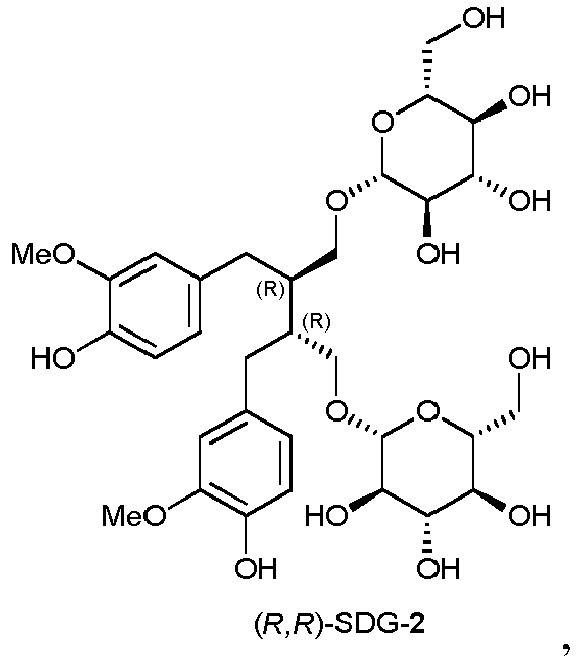
- b) reacting a compound of formula (6) with a compound of formula (7) to prepare a compound of formula ((R,R)-S4)

- (a) cleaving benzyl ethers of the compound of formula ((R,R)-S4), followed by a separation procedure to prepare a compound of formula ((R,R)-9)

- (c) deprotecting the compound of formula ((R,R)-9) to prepare the compound of formula ((R,R)-SDG-2).
- The present invention further provides a process for preparing a compound of formula ((R,R)-SDG-2), the process comprising:
- (a) reacting a compound of formula (5) with a reducing agent to prepare a compound of formula (S1);
- (b) reacting the compound of formula (S1), with a benzylating agent to prepare a compound of formula (S2);
- (c) reacting the compound of formula (S2) with a reducing agent to prepare a compound of formula (6);
- (d) reacting the compound of formula (6) with a compound of formula (7) to prepare a compound of formula ((R,R)-S4);
- (e) cleaving benzyl ethers of the compound of formula ((R,R)-S3), followed by a separation procedure to prepare a compound of formula ((R,R)-9); and
- (f) deprotecting the compound of formula ((R,R)-9) to prepare the compound of formula ((R,R)-SDG-2).
- The present invention further provides a process for preparing a compound of formula ((R,R)-SDG-2), the process comprising:
- (a) reacting a compound of formula (S2), with a reducing agent to prepare a compound of formula (6),
- (b) reacting the compound of formula (6) with a compound of formula (7) to prepare a compound of formula ((R,R)-S4);
- (c) cleaving benzyl ethers of the compound of formula ((R,R)-S4), followed by a separation procedure to prepare a compound of formula ((R,R)-9); and
- (d) deprotecting the compound of formula ((R,R)-9) to prepare the compound of formula ((R,R)-SDG-2).
- The present invention further provides a process for preparing a compound of formula (6), the process comprising reacting a compound of formula (S2) with a reducing agent to prepare the compound of formula (6).
- The present invention further provides a process for preparing a compound of formula ((S,S)-S3), the process comprising reacting a compound of formula (6) with a compound of formula (7) to prepare the compound of formula ((S,S)-S3).
- The present invention further provides a process for preparing a compound of formula ((S,S)-8), the process comprising:
- (a) reacting a compound of formula (6) with a compound of formula (7) to prepare a compound of formula ((S,S)-S3);
- (b) cleaving benzyl ethers of the compound of formula ((S,S)-S3), followed by a separation procedure to prepare the compound of formula ((S,S)-8).
- The present invention provides a process for preparing a compound of formula ((R,R)-S4), the process comprising reacting a compound of formula (6) with a compound of formula (7) to prepare a compound of formula ((R,R)-S4)
- The present invention provides a process for preparing a compound of formula ((R,R)-9), the process comprising:
- (a) reacting a compound of formula (6) with a compound of formula (7) to prepare a compound of formula ((R,R)-S4);
- (b) cleaving benzyl ethers of the compound of formula ((R,R)-S4), followed by a separation procedure to prepare a compound of formula ((R,R)-9).
- The present invention further provides a composition, such as a pharmaceutical composition, comprising a compound of formula ((S,S)-SDG-1).
- The present invention further provides a composition, such as a pharmaceutical composition, comprising a compound of formula ((R,R)-SDG-2).
- Other features and advantages of the present invention will become apparent from the following detailed description examples and figures. It should be understood, however, that the detailed description and the specific examples while indicating preferred embodiments of the invention are given by way of illustration only, since various changes and modifications within the spirit and scope of the invention will become apparent to those skilled in the art from this detailed description.
-
-
Figure 1 depicts an ORTEP representation ofdihydroxy compound 6. -
Figure 2 illustrates the reducing power of synthetic (S,S)-SDG-1 and (R,R)-SDG-2. The increase in absorbance at 700nm indicates increase in reducing power. The results are presented as mean ± standard deviation (n = 3). *p < 0.05 significantly lower than natural (S,S)-SDG-1, synthetic (R,R)-SDG-2, and synthetic (S,S)-SDG-1; **p < 0.05 significantly higher than synthetic (R,R)-SDG-2, synthetic (S,S)-SDG-1, ascorbic acid and α-tocopherol. -
Figure 3 illustrates the reducing power of synthetic (S,S)-SDG-1 and (R,R)-SDG-2. The rate of reaction is linear in the concentration range of 1-100 µM. Equation of the linear regression was used to determine EC50. The results are presented as mean ± standard deviation (n = 3). Natural (S,S)-SDG-1, synthetic (R,R)-SDG-2, and synthetic (S,S)-SDG-1 were not significantly different from each other. *p < 0.05 significantly higher than natural (S,S)-SDG-1, synthetic (R,R)-SDG-2, and synthetic (S,S)-SDG-1. -
Figure 4 depicts DPPH free radical scavenging activity of natural (S,S)-SDG-1, synthetic (S,S)-SDG-1 and (R,R)-SDG-2, ascorbic acid, and α-tocopherol. The radical scavenging activity was measured as a decrease in the absorbance of DPPH at 517 nm. The results are presented as mean ± standard deviation (n = 3). *p < 0.05 significantly lower than all other compounds, **p < 0.05 significantly lower than natural (S,S)-SDG-1. -
Figure 5 depicts DPPH free radical scavenging activity of natural (S,S)-SDG-1, synthetic (S,S)-SDG-1 and (R,R)-SDG-2, ascorbic acid, and α-tocopherol. Equation of the linear regression was used to determine EC50. The rate of reaction is linear in the concentration range of 1-100 µM. The results are presented as mean ± standard deviation (n = 3). Natural (S,S)-SDG-1, synthetic (R,R)-SDG-2, synthetic (S,S)-SDG-1, and α-tocopherol were not significantly different. *p < 0.05 significantly higher than natural (S,S)-SDG-1, synthetic (R,R)-SDG-2, synthetic (S,S)-SDG-1, and α-tocopherol. -
Figure 6 shows 1H NMR (600 MHz, CDCl3) and 13C NMR (150 MHz, CDCl3) spectra ofcompound 4. -
Figure 7 shows 1H NMR (600 MHz, CDCl3) and 13C NMR (150 MHz, CDCl3) spectra ofcompound 5. -
Figure 8 shows 1H NMR (600 MHz, CDCl3) and 13C NMR (150 MHz, CDCl3) spectra of compound S1. -
Figure 9 shows 1H NMR (600 MHz, CDCl3) and 13C NMR (150 MHz, CDCl3) spectra of compound S2. -
Figure 10 shows 1H NMR (600 MHz, CDCl3) and 13C NMR (150 MHz, CDCl3) spectra ofcompound 6. -
Figure 11 shows 1H NMR (600 MHz, CDCl3) and 13C NMR (150 MHz, CDCl3) spectra of 1:1 (S,S)- S3/ (R,R)- S4 . -
Figure 12 shows 1H NMR (600 MHz, CDCl3) and 13C NMR (150 MHz, CDCl3) spectra of compound (S,S)-8. -
Figure 13 shows 1H NMR (600 MHz, CDCl3) and 13C NMR (150 MHz, CDCl3) spectra of compound (R,R)-9. -
Figure 14 shows 1H NMR (600 MHz, CD3OD) and 13C NMR (150 MHz, CD3OD) spectra of compound (S,S)-SDG-1. -
Figure 15 shows 1H NMR (600 MHz, CD3OD) and 13C NMR (150 MHz, CD3OD) spectra of compound (R,R)-SDG-2. - The present invention provides a process for preparing a compound of formula ((S,S)-SDG-1)

- c) reacting a compound of formula (6)


- (b) cleaving benzyl ethers of the compound of formula ((S,S)-S3), followed by a separation procedure to prepare a compound of formula ((S,S)-8)

- (c) deprotecting the compound of formula ((S,S)-8) to prepare the compound of formula ((S,S)-SDG-1).
- In some embodimetns, said reacting is carried out in the presence of a Lewis acid. In certain embodiments, said Lewis acid is TMSOTf. In some embodiments, said reacting is carried out in the presence of activated molecular sieves.
- In some embodiments, said cleaving is carried out in MeOH in the presence of H2 and Pd/C.
- In some embodiments, said separation procedure is carried out using preparative thin layer chromatography.
- In some embodiments, said deprotecting is carried out in a solution of NaOMe and MeOH.
- In some embodiments, said compound of formula (6) is prepared by the process comprising reacting a compound of formula (S2)

- In some embodiments, said compound of formula (S2) is prepared by the process comprising reacting a compound of formula (S1)

- In some embodiments, said compound of formula (S1) is prepared by the process comprising reacting a compound of formula (5)

- In some embodiments, said compound of formula (5) is prepared by the process comprising reacting a compound of formula (4)

- In some embodiments, said compound of formula (4) is prepared by the process comprising reacting vanillin with methyl succinate via a Stobbe condensation reaction, followed by an esterification reaction. In some embodiments, said Stobbe condensation reaction is carried out in MeOH and in the presence of lithium wires. In some embodiments, said esterification reaction is carried out with MeOH in the presence of H2SO4.
- The present invention provides a process for preparing a compound of formula ((S,S)-SDG-1)

- (a) reacting a compound of formula (S2)


- (b) reacting the compound of formula (6) with a compound of formula (7)


- (c) cleaving benzyl ethers of the compound of formula ((S,S)-S3), followed by a separation procedure to prepare a compound of formula ((S,S)-8)

- (d) deprotecting the compound of formula ((S,S)-8) to prepare the compound of formula ((S,S)-SDG-1).
- In some embodiments, said reacting of step (a) is carried out in the presence of TMSOTf. In some embodiments, said reacting of step (a) is carried out in the presence of activated molecular sieves.
- In some embodiments, said cleaving is carried out in the presence H2 and Pd/C in MeOH.
- In some embodiments, said separation procedure is carried out using preparative thin layer chromatography.
- In some embodiments, said deprotecting is carried out in a solution of NaOMe and MeOH.
- In some embodiments, said reducing agent is lithium aluminum hydride (LAH) in THF.
- In some embodiments, said compound of formula (S2) is prepared by the process comprising reacting a compound of formula (S1)

- In some embodiments, said compound of formula (S1) is prepared by the process comprising reacting a compound of formula (5)

- In some embodiments, said compound of formula (5) is prepared by the process comprising reacting a compound of formula (4)

- In some embodiments, said Stobbe condensation reaction is carried out in MeOH and in the presence of lithium wires.
- In some embodiments, In some embodiments, said esterification reaction is carried out with MeOH in the presence of H2SO4.
- In some embodiments, said compound of formula (4) is prepared by the process comprising reacting vanillin with methyl succinate via a Stobbe condensation reaction, followed by an esterification reaction.
- In some embodiments, said Stobbe condensation reaction is carried out in MeOH and in the presence of lithium wires. In some embodiments, said esterification reaction is carried out with MeOH in the presence of H2SO4.
- The present invention provides a process for preparing a compound of formula ((S,S)-SDG-1)

- (a) reacting a compound of formula (5)


- (b) reacting the compound of formula (S1)


- (c) reacting the compound of formula (S2) with a reducing agent to prepare a compound of formula (6)

- (d) reacting the compound of formula (6) with a compound of formula (7)


- (e) cleaving benzyl ethers of the compound of formula ((S,S)-S3), followed by a separation procedure to prepare a compound of formula ((S,S)-8)

- (f) deprotecting the compound of formula ((S,S)-8) to prepare the compound of formula ((S,S)-SDG-1).
- In some embodiments, In some embodiments, said compound of formula (5) is prepared by the process comprising reacting a compound of formula (4)

- The present invention provides a process for preparing a compound of formula ((R,R)-SDG-2)

- (a) reacting a compound of formula (6)


- (b) cleaving benzyl ethers of the compound of formula ((R,R)-S4), followed by a separation procedure to prepare a compound of formula ((R,R)-9)

- (c) deprotecting the compound of formula ((S,S)-9) to prepare the compound of formula ((R,R)-SDG-2).
- In some embodiments, said reacting is carried out in the presence of a Lewis acid. In certain embodiments, said Lewis acid is TMSOTf.
- In some embodiments, said reacting is carried out in the presence of activated molecular sieves.
- In some embodiment, said cleaving is carried out in the presence of H2 and Pd/C in MeOH. In some embodiments, said separation procedure is carried out using preparative thin layer chromatography.
- In some embodiments, said deprotecting is carried out in a solution of NaOMe and MeOH.
- In some embodiments, said compound of formula (6) is prepared by the process comprising reacting a compound of formula (S2)

- In some embodiments, said reducing agent is lithium aluminum hydride (LAH) in THF.
- In some embodiments, said compound of formula (S2) is prepared by the process comprising reacting a compound of formula (S1)

- In some embodiments, said compound of formula (S1) is prepared by the process comprising reacting a compound of formula (5)

- In some embodiments, said compound of formula (5) is prepared by the process comprising reacting a compound of formula (4)

- In some embodiments, said Stobbe condensation reaction is carried out in MeOH and in the presence of lithium (e.g., lithium wires).
- In some embodiments, said esterification reaction is carried out with MeOH in the presence of H2SO4.
- In some embodiments, said compound of formula (4) is prepared by the process comprising reacting vanillin with methyl succinate via a Stobbe condensation reaction, followed by an esterification reaction.
- In some embodiments, said Stobbe condensation reaction is carried out in MeOH and in the presence of lithium wires.
- In some embodiments, said esterification reaction is carried out with MeOH in the presence of H2SO4.
- The present invention provides a process for preparing a compound of formula ((R,R)-SDG-2)

- (a) reacting a compound of formula (S2)


- (b) reacting the compound of formula (6) with a compound of formula (7)


- (c) cleaving benzyl ethers of the compound of formula ((R,R)-S4), followed by a separation procedure to prepare a compound of formula ((R,R)-9)

- (d) deprotecting the compound of formula ((R,R)-9) to prepare the compound of formula ((R,R)-SDG-2).
- In some embodiments, said reacting of step (a) is carried out in the presence of TMSOTf. In some embodiments, said reacting of step (a) is carried out in the presence of activated molecular sieves.
- In some embodiments, said cleaving is carried out in the presence H2 and Pd/C in MeOH. In some embodiments, said separation procedure is carried out using preparative thin layer chromatography.
- In some embodiments, said deprotecting is carried out in a solution of NaOMe and MeOH.
- In some embodiments, said reducing agent is lithium aluminum hydride (LAH) in THF.
- In some embodiments, said compound of formula (S2) is prepared by the process comprising reacting a compound of formula (S1)

- In some embodiments, said benzylating agent is BnBr and NaH.
- In some embodiments, said compound of formula (S1) is prepared by the process comprising reacting a compound of formula (5)

- In some embodiments, said reducing agent is H2 and Pd/C.
- In some embodiments, said compound of formula (5) is prepared by the process comprising reacting a compound of formula (4)

- In some embodiments, said compound of formula (4) is prepared by the process comprising reacting vanillin with methyl succinate via a Stobbe condensation reaction, followed by an esterification reaction. In some embodiments, said Stobbe condensation reaction is carried out in MeOH and in the presence of lithium wires. In some embodiments, said esterification reaction is carried out with MeOH in the presence of H2SO4.
- The present invention provides a process for preparing a compound of formula ((R,R)-SDG-2)

- (a) reacting a compound of formula (5)


- (b) reacting the compound of formula (S1)


- (c) reacting the compound of formula (S2) with a reducing agent to prepare a compound of formula (6)

- (d) reacting the compound of formula (6) with a compound of formula (7)


- (e) cleaving benzyl ethers of the compound of formula ((R,R)-S3), followed by a separation procedure to prepare a compound of formula ((R,R)-9)

- (f) deprotecting the compound of formula ((R,R)-9) to prepare the compound of formula ((R,R)-SDG-2).
- In some embodiments, said compound of formula (5) is prepared by the process comprising reacting a compound of formula (4)

- The present invention provides a process for preparing a compound of formula (6)


- In some embodiments, said compound of formula (S2) is prepared by the process comprising reacting a compound of formula (S1)
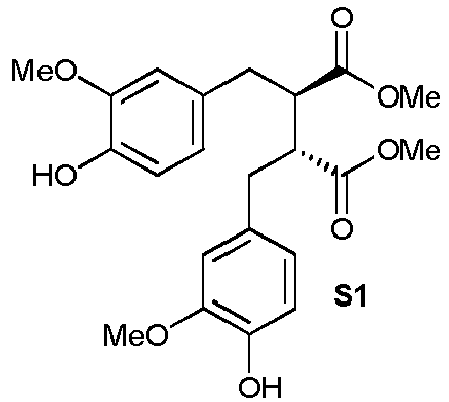
- In some embodiments, said compound of formula (S1) is prepared by the process comprising reacting a compound of formula (5)

- In some embodiments, said compound of formula (5) is prepared by the process comprising reacting a compound of formula (4)

- In some embodiments, said compound of formula (4) is prepared by the process comprising reacting vanillin with methyl succinate via a Stobbe condensation reaction, followed by an esterification reaction. In some embodiments, said Stobbe condensation reaction is carried out in MeOH and in the presence of lithium wires. In some embodiments, said esterification reaction is carried out with MeOH in the presence of H2SO4.
- The present invention provides a process for preparing a compound of formula ((S,S)-S3)


- In some embodiments, said reacting is carried out in the presence of a Lewis acid. In some embodiments, said Lewis acid is TMSOTf. In some embodiments, said reacting is carried out in the presence of activated molecular sieves.
- In some embodiments, said compound of formula (6) is prepared by the process comprising reacting a compound of formula (S2)

- In some embodiments, said compound of formula (S2) is prepared by the process comprising reacting a compound of formula (S1)

- In some embodiments, said compound of formula (S1) is prepared by the process comprising reacting a compound of formula (5)

- In some embodiments, said compound of formula (5) is prepared by the process comprising reacting a compound of formula (4)

- In some embodiments, said compound of formula (4) is prepared by the process comprising reacting vanillin with methyl succinate via a Stobbe condensation reaction, followed by an esterification reaction. In some embodiments, said Stobbe condensation reaction is carried out in MeOH and in the presence of lithium wires. In some embodiments, said esterification reaction is carried out with MeOH in the presence of H2SO4.
- The present invention provides a process for preparing a compound of formula ((S,S)-8)

- (a) reacting a compound of formula (6)


- (b) cleaving benzyl ethers of the compound of formula ((S,S)-S3), followed by a separation procedure to prepare the compound of formula ((S,S)-8).
- In some said reacting is carried out in the presence of TMSOTf. In some embodiments, reacting is carried out in the presence of activated molecular sieves. In some embodiments, said cleaving is carried out in the presence of H2 and Pd/C in MeOH. In some embodiments, said separation procedure is carried out using preparative thin layer chromatography.
- In some embodiments, said compound of formula (6) is prepared by the process comprising reacting a compound of formula (S2)

- In some embodiments, said compound of formula (S2) is prepared by the process comprising reacting a compound of formula (S1)

- In some embodiments, said compound of formula (S1) is prepared by the process comprising reacting a compound of formula (5)

- In some embodiments, said compound of formula (5) is prepared by the process comprising reacting a compound of formula (4)

- In some embodiments, said compound of formula (4) is prepared by the process comprising reacting vanillin with methyl succinate via a Stobbe condensation reaction, followed by an esterification reaction. In some embodiments, said Stobbe condensation reaction is carried out in MeOH and in the presence of lithium wires. In some embodiments, said esterification reaction is carried out with MeOH in the presence of H2SO4.
- The present invention provides a process for preparing a compound of formula ((R,R)-S4)

- (a) reacting a compound of formula (6)


- In some embodiments, said reacting is carried out in the presence of TMSOTf.
- In some embodiments, said reacting is carried out in the presence of activated molecular sieves.
- In some embodiments, said compound of formula (6) is prepared by the process comprising reacting a compound of formula (S2)

- In some embodiments, said compound of formula (S2) is prepared by the process comprising reacting a compound of formula (S1)

- In some embodiments, said compound of formula (S1) is prepared by the process comprising reacting a compound of formula (5)

- In some embodiments, said compound of formula (5) is prepared by the process comprising reacting a compound of formula (4)

- In some embodiments, said compound of formula (4) is prepared by the process comprising reacting vanillin with methyl succinate via a Stobbe condensation reaction, followed by an esterification reaction. In some embodiments, said Stobbe condensation reaction is carried out in MeOH and in the presence of lithium wires. In some embodiments, said esterification reaction is carried out with MeOH in the presence of H2SO4.
- The present invention provides a process for preparing a compound of formula ((R,R)-9)

- (a) reacting a compound of formula (6)


- (b) cleaving benzyl ethers of the compound of formula ((R,R)-S4), followed by a separation procedure to prepare a compound of formula ((R,R)-9)
- In some embodiments, said reacting is carried out in the presence of TMSOTf. In some embodiments, said reacting is carried out in the presence of activated molecular sieves. In some embodiments, said cleaving is carried out in the presence of H2 and Pd/C in MeOH. In some embodiments, said separation procedure is carried out using preparative thin layer chromatography.
- In some embodiments, said compound of formula (6) is prepared by the process comprising reacting a compound of formula (S2)
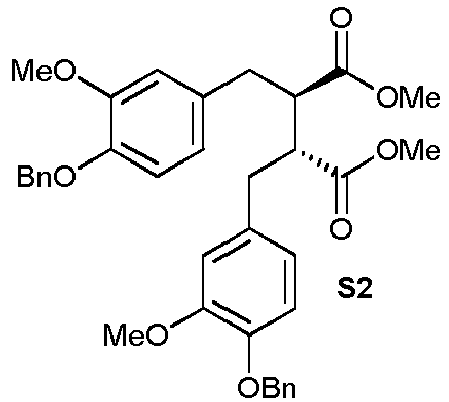
- In some embodiments, said compound of formula (S2) is prepared by the process comprising reacting a compound of formula (S1)
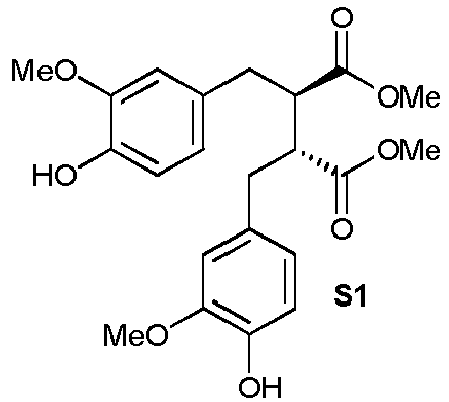
- In some embodiments, said compound of formula (S1) is prepared by the process comprising reacting a compound of formula (5)

- In some embodiments, said compound of formula (5) is prepared by the process comprising reacting a compound of formula (4)

- In some embodiments, said compound of formula (4) is prepared by the process comprising reacting vanillin with methyl succinate via a Stobbe condensation reaction, followed by an esterification reaction. In some embodiments, said Stobbe condensation reaction is carried out in MeOH and in the presence of lithium wires. In some embodiments, said esterification reaction is carried out with MeOH in the presence of H2SO4.
- The term "reacting" is meant to refer to the bringing together of the indicated reagents in such a way as to allow their molecular interaction and chemical transformation according to the thermodynamics and kinetics of the chemical system. Reacting can be facilitated, particularly for solid reagents, by using an appropriate solvent or mixture of solvents in which at least one of the reagents is at least partially soluble. Reacting is typically carried out for a suitable time and under conditions suitable to bring about the desired chemical transformation.
- The processes described herein may include other suitable starting materials through the synthetic routes set forth above. In some embodiments, the processes described herein may also include additional steps before or after the steps described above, to add or remove suitable protecting groups. In addition, various synthetic steps may be performed in an alternate sequence or order to give the desired compounds.
- In one aspect, the present invention provides a concise route for the preparation of both (S,S)-secoisolariciresinol diglucoside ((S,S)-SDG-1) and (R,R)-secoisolariciresinol diglucoside ((R,R)-SDG-2) starting from commercially available compounds, e.g., vanillin. The compounds ((S,S)-SDG-1) and ((R,R)-SDG-2) are bioactive ingredients in flaxseed. Both compounds possess strong reducing power and high free radical scavenging activity for hydroxyl, peroxyl, and DPPH (2,2-diphenyl-1-picrylhydrazyl) free readicals.
- The processes of the present invention can yield substantially pure compound (S,S)-secoisolariciresinol diglucoside ((S,S)-SDG-1) and compound (R,R)-secoisolariciresinol diglucoside ((R,R)-SDG-2). For ((S,S)-SDG-1), by "substantially pure" is meant that compound ((S,S)-SDG-1) is at least substantially separated from the environment in which it was formed or detected. Substantial purity can include compositions containing at least about 80.0%, or at least about 85.0%, or at least about 90.0%, or at least about 95.0%, or at least about 97.0%, or at least about 98.0%, or at least about 99.0%, or at least about 99.2%, or at least about 99.4%, or at least about 99.6%, or at least about 99.8%, or at least about 99.9%, or even about 100% by weight of the compound. For ((R,R)-SDG-2), by "substantially pure" is meant that compound ((R,R)-SDG-2) is at least substantially separated from the environment in which it was formed or detected. Substantial purity can include compositions containing at least about 80.0%, or at least about 85.0%, or at least about 90.0%, or at least about 95.0%, or at least about 97.0%, or at least about 98.0%, or at least about 99.0%, or at least about 99.2%, or at least about 99.4%, or at least about 99.6%, or at least about 99.8%, or at least about 99.9%, or even about 100% by weight of the compound.
- A "pharmaceutical composition" is a formulation containing compounds in a form suitable for administration to a subject. In some embodiments, the pharmaceutical composition is in bulk or in unit dosage form. The unit dosage form is any of a variety of forms, including, for example, a capsule, an IV bag, a tablet, a single pump on an aerosol inhaler, or a vial. The quantity of active ingredient (e.g., a formulation of a compound of the invention or a salt, solvate, polymorph, or prodrug thereof) in a unit dose of composition is an effective amount and is varied according to the particular treatment involved. One skilled in the art will appreciate that it is sometimes necessary to make routine variations to the dosage depending on the age and condition of the patient. The dosage will also depend on the route of administration. A variety of routes are contemplated, including oral, pulmonary, rectal, parenteral, transdermal, subcutaneous, intravenous, intramuscular, intraperitoneal, inhalational, buccal, sublingual, intrapleural, intrathecal, intranasal, and the like. Dosage forms for the topical or transdermal administration of a compound of the invention include powders, sprays, ointments, pastes, creams, lotions, gels, solutions, patches and inhalants. In some embodiments, the active compound is mixed under sterile conditions with a pharmaceutically acceptable carrier, and with any preservatives, buffers, or propellants that are required.
- A "subject" includes mammals, e.g., humans, companion animals (e.g., dogs, cats, birds, and the like), farm animals (e.g., cows, sheep, pigs, horses, fowl, and the like) and laboratory animals (e.g. , rats, mice, guinea pigs, birds, and the like). In some embodiments, the subject is human.
- As used herein, the phrase "pharmaceutically acceptable" refers to those compounds, materials, compositions, carriers, and/or dosage forms which are, within the scope of sound medical judgment, suitable for use in contact with the tissues of human beings and animals without excessive toxicity, irritation, allergic response, or other problem or complication, commensurate with a reasonable benefit/risk ratio.
- "Pharmaceutically acceptable excipient" means an excipient that is useful in preparing a pharmaceutical composition that is generally safe, non-toxic and neither biologically nor otherwise undesirable, and includes an excipient that is acceptable for veterinary use as well as human pharmaceutical use. A "pharmaceutically acceptable excipient" as used herein includes both one and more than one such excipient.
- Embodiments of the invention also include compositions comprising (S,S)-secoisolariciresinol diglucoside ((S,S)-SDG-1). Preferably, these compositions are pharmaceutical compositions comprising (S,S)-secoisolariciresinol diglucoside ((S,S)-SDG-1) and at least one pharmaceutically acceptable excipient. In some embodiments, the compositions and pharmaceutical compositions may be prepared with substantially pure (S,S)-secoisolariciresinol diglucoside ((S,S)-SDG-1). In some embodiments, the compositions and pharmaceutical compositions have a diasteriomeric excess (DE) of at least 90% DE, preferably at least 95% DE, more preferably at least 98% DE, and even more preferably at least 99% DE and most preferably about 100% DE. The compositions and pharmaceutical compositions may also be prepared as mixture of the diasteriomeric forms of the compounds (e.g., as a racemic mixture or as a mixture with a ratio of 60:40, 70:30, 80:20 or 90:10 of ((S,S)-SDG-1) relative to ((R,R)-SDG-2)).
- Embodiments of the invention also include compositions comprising (R,R)-secoisolariciresinol diglucoside ((R,R)-SDG-2). Preferably, these compositions are pharmaceutical compositions comprising (R,R)-secoisolariciresinol diglucoside ((R,R)-SDG-2) and at least one pharmaceutically acceptable excipient. In some embodiments, the compositions and pharmaceutical compositions may be prepared with substantially pure (R,R)-secoisolariciresinol diglucoside ((R,R)-SDG-2). In some embodiments, the compositions and pharmaceutical compositions have a diasteriomeric excess (DE) of at least 90% DE, preferably at least 95% DE, more preferably at least 98% DE, and even more preferably at least 99% DE and most preferably about 100% DE. The compositions and pharmaceutical compositions may also be prepared as mixture of the diasteriomeric forms of the compounds (e.g., as a racemic mixture or as a mixture with a ratio of 60:40, 70:30, 80:20 or 90:10 of ((R,R)-SDG-2) relative to ((S,S)-SDG-1)).
- Throughout the description, where compositions are described as having, including, or comprising specific components, it is contemplated that compositions also consist essentially of, or consist of, the recited components. Similarly, where processes are described as having, including, or comprising specific process steps, the processes also consist essentially of, or consist of, the recited processing steps. Further, it should be understood that the order of steps or order for performing certain actions are immaterial so long as the invention remains operable. Moreover, two or more steps or actions may be conducted simultaneously.
- The following examples are presented in order to more fully illustrate the preferred embodiments of the invention. They should in no way be construed, however, as limiting the broad scope of the invention.
- All reactions were carried out under an argon atmosphere with dry solvents under anhydrous conditions, unless otherwise noted. Dry tetrahydrofuran (THF), dimethylformamide (DMF), and methylene chloride (CH2Cl2) were obtained by passing commercially available predried, oxygen-free formulations through activated alumina columns. Yields refer to chromatographically and spectroscopically (1H NMR) homogeneous materials, unless otherwise stated. Reagents were purchased at the highest commercial quality and used without further purification, unless otherwise stated. Reactions were monitored by thin-layer chromatography (TLC) carried out on 0.25 mm E. Merck silica gel plates (60F-254) using UV light as visualizing agent and an ethanolic solution of phosphomolybdic acid and cerium sulfate, and heat as developing agents. E. Merck silica gel (60, particle size 0.040-0.063 mm) was used for flash column chromatography. Preparative thin-layer chromatography (PTLC) separations were carried out on 0.25 or 0.50 mm E. Merck silica gel plates (60F-254) unless otherwise noted. NMR spectra were recorded on a Bruker DRX-600 instrument and calibrated using residual undeuterated solvent as an internal reference. The following abbreviations were used to explain the multiplicities: s = singlet, d = doublet, t = triplet, m = multiplet. IR spectra were recorded on a Perkin-
Elmer Spectrum 100 FT-IR spectrometer. High-resolution mass spectra (HR-MS) were recorded on a VG ZAB-ZSE mass spectrometer using ESI (electrospray ionization). -
Scheme 1 shows a reaction route that was used in the synthesis of compound (6), an intermediate compound for the preparation of (S,S)-secoisolariciresinol diglucosides and (R,R)-secoisolariciresinol diglucosides.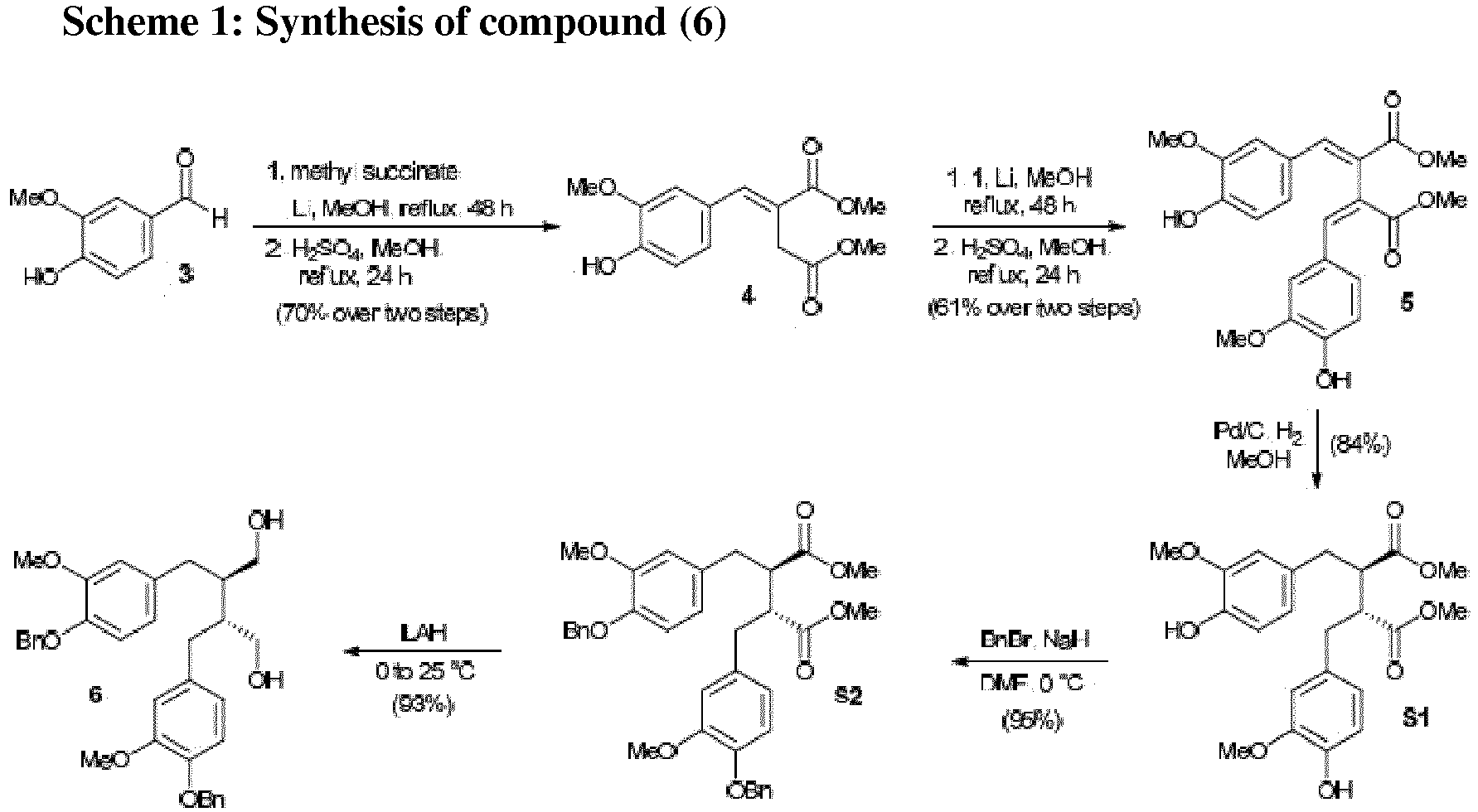
-

- To a solution of vanillin 3 (14.0 g, 92.1 mmol, 1 equiv) and dimethyl succinate (12.13 mL, 92.1 mmol, 1 equiv) in MeOH (450 mL), lithium wire (1.79 g, 257.9 mmol, 2.8 equiv) was added slowly piecewise with an ice bath to control the exotherm. After the initial lithium had fully dissolved, more lithium (1.98 g, 285.5 mmol, 3.1 equiv) was added slowly piecewise and stirred until fully dissolved. The reaction mixture was then heated at reflux for 48 h. After cooling the solution to room temperature, most of the methanol was removed by concentration on rotavap. EtOAc (1000 mL) was added and the solution was washed with a 2 M aq. HCl solution (700 mL), H2O (3 × 1000 mL), then brine (200 mL). The organics layer was then dried (MgSO4), filtered and concentrated. The crude was dissolved in MeOH (230 ml), H2SO4 (1 mL) was added, and the solution was heated at reflux overnight. Upon cooling the next morning, NaHCO3 (3.0 g) was added to quench H2SO4 and the solution was mostly concentrated by rotavap. EtOAc (500 ml) was added and the solution was washed with H2O (2 × 200 mL), then brine (100 mL). The organics layer was then dried (MgSO4), filtered and concentrated to a brown oil. Dissolution in a small amount of CH2Cl2 and then flash column chromatography (silica, 1:9 → 2:8 → 3:7 → 4:6 → 5:5 ether:hexane) provided 4 (18.0 g, 64.2 mmol, 70% yield, unassigned olefin geometry) as an off-white solid. 4: R f = 0.17 (silica, ether:hexanes 1:1); IR (film): vmax = 3422, 1702, 1514, 1434, 1258, 1195 1159, 1093, 1030, 924, 821 770, 729 cm-1; 1H NMR (600 MHz, CDCl3) δ = 7.79 (s, 1 H), 6.90-6.85 (m, 3 H), 6.19 (s, 1 H), 3.82 (s, 3 H), 3.78 (s, 3H), 3.69 (s, 3H), 3.57 (s, 2H) ppm; 13C NMR (150 MHz, CDCl3) δ = 171.94, 168.13, 146.80, 146.61, 142.38, 126.96, 123.39, 123.31, 114.76, 111.80, 55.85, 52.24, 52.20, 33.61 ppm; HRMS (ESI-TOF): calcd for C14H16O6 [M + H+]: 280.102, found 281.1022.
-

- To a solution of diester 4 (15.00 g, 53.52 mmol, 1 equiv) and vanillin3 (8.14 g, 53.52 mmol, 1 equiv) in MeOH (200 mL), lithium wire (2.6 g, 374.6 mmol, 7 equiv) was added slowly piecewise with an ice bath to control the exotherm and stirred until fully dissolved. The reaction mixture was then heated at reflux for 48 h. After cooling the solution to room temperature, most of the methanol was removed by concentration on rotavap. EtOAc (200 mL) was added, the solution was acidified with 2 M aq. HCl solution (500 mL), and then extracted with EtOAc (2 × 200 mL). The combined organics were washed with H2O (2 × 200 mL), then brine (200 mL), and dried (MgSO4), filtered and concentrated. The residue was dissolved in MeOH (300 mL), conc. H2SO4 (1 mL) was added, and the solution was heated at reflux overnight. Upon cooling the next morning, NaHCO3 (3.0 g) was added to quench H2SO4 and the solution was mostly concentrated by rotavap. EtOAc (400 ml) was added and the solution was washed with H2O (2 × 200 mL), then brine (100 mL). The organics layer was then dried (MgSO4), filtered and concentrated. Dissolution in a small amount of CH2Cl2 and then flash column chromatography (silica, 2:1:7 → 3:1:6 → 4:1:5 EtOAc:CH2Cl2:hexanes) provided 5 (13.6 g, 32.8 mmol, 61% yield, unassigned olefin geometry) as a yellow-orange solid. 5: R f = 0.28 (silica, EtOAc:hexanes 1:1); IR (film): vmax = 3388, 1696, 1588, 1509, 1431, 1209, 1157, 1029, 817, 733 cm-1; 1H NMR (600 MHz, CDCl3) δ = 7.86 (s, 2 H), 7.11 (d, J = 1.64 Hz, 2 H), 7.04 (dd, J = 8.48, 1.72 Hz, 2 H), 6.82 (d, J = 8.38 Hz, 2 H), 6.08 (s, 2 H), 3.7 (s, 6 H), 3.69 (s, 6 H) ppm; 13C NMR (150 MHz, CDCl3) δ = 168.00, 147.59, 146.54, 142.64, 127.10, 125.38, 124.06, 114.71, 111.52, 55.77, 52.51 ppm; HRMS (ESI-TOF): calcd for C22H22O8 [M + H+]: 415.1387, found 415.1378.
-

- A solution of 5 (5.00 g, 12.07 mmol, 1 equiv) in MeOH (120 mL) was saturated with an argon atmosphere by briefly exposing to vacuum and backfilling with argon several times. Palladium on carbon (10% Pd by weight, 0.500 g) was added and the solution was saturated with H2atmosphere by vacuum/backfill H2. The solution was stirred overnight. The next morning the solution was put under an argon atmosphere, CH2Cl2 (400 mL) was added, and the solution was allowed to stir for 1 h. The mixture was then filtered through a pad of Celite (1.5 in, washing with MeOH and CH2Cl2), and the filtratewas concentrated. The resulting solid was dissolved in a small amount of CH2Cl2 and purified by flash column chromatography (2:8:1 → 3:7:1 → 4:6:1 EtOAc:hexanes:CH2Cl2) to give S1 (4.24 g, 10.1 mmol, 84%) as an off-white solid. S1: R f = 0.24 (silica, EtOAc:hexanes:CH2Cl2 4:6:1); IR (film): vmax = 3440, 2951, 1726, 1514, 1432, 1267, 1198, 1151, 1121, 1029, 817, 797 cm-1; 1H NMR (600 MHz, CDCl3) δ = 6.78 (d, J = 8.09 Hz, 2 H), 6.58 (d, J = 8.09 Hz, 2 H), 6.45 (s, 2 H), 5.65 (s, 2 H), 3.75 (s, 6 H), 3.64 (s, 6 H), 3.00-2.94 (m, 2 H), 2.92-2.82 (m, 4 H) ppm; 13C NMR (150 MHz, CDCl3) δ = 174.03, 146.49, 144.21, 130.41, 121.88, 114.18, 111.26, 55.73, 51.86, 47.67, 35.38 ppm; HRMS (ESI-TOF): calcd for C22H26O8 [M + H+]: 419.17, found 419.1700.
-

- To a solution of S1 (1.00 g, 2.39 mmol, 1 equiv) in DMF (24 mL) cooled to 0 °C with an ice bath, NaH (0.201 g, 5.02 mmol, 60% dispersion, 2.1 equiv) was added slowly and the solution was stirred at 0 °C for 1 h. BnBr (910 µL, 7.65 mmol, 3.2 equiv) was added over 1 min, and the solution was stirred at 0 °C for 4 h. The reaction mixture was then poured into H2O (300 mL) and EtOAc (100 mL). The organic layer was washed with H2O (3 × 200 mL) and brine (1 × 50 mL), dried (MgSO4), filtered and concentrated. The resulting solid was dissolved in a small amount of CH2Cl2 and purified by flash column chromatography (silica, 9:1:1 → 8:2:1 hexanes:EtOAc:CH2Cl2) to give S2 (1.36 g, 2.27, 95% yield) as a white solid. S2: R f = 0.23 (silica, EtOAc:hexanes 3:7); IR (film): vmax = 2949, 1730, 1512, 1453, 1253, 1225, 1138, 1023, 733 cm-1; 1H NMR (600 MHz, CDCl3) δ = 7.45-7.40 (m, 4 H), 7.38-7.33 (m, 4H), 7.31-7.27 (m, 2H), 6.74 (d, J = 8.12 Hz, 2 H), 6.59 (d, J = 1.69 Hz, 2 H), 6.53 (dd, J = 8.12, 1.69 Hz, 2 H), 5.12 (s, 4H), 3.80 (s, 6 H), 3.61 (s, 6 H), 3.03-2.85 (m, 6 H) ppm; 13C NMR (150 MHz, CDCl3) δ = 174.00, 149.58, 146.87, 137.37, 131.74, 128.65, 127.93, 127.37, 121.09, 114.05, 112.73, 71.14, 56.00, 51.91, 47.91, 35.32 ppm; HRMS (ESI-TOF): calcd for C36H38O8 [M + H+]: 599.2639, found 599.2651.
-

- To a solution of S2 (0.341 g, 0.570 mmol, 1 equiv) in THF (6 mL) at 0 °C, lithium aluminum hydride (1 M soln in THF, 1.14 mL, 1.14 mmol, 2 equiv) was added dropwise. The solution was allowed to come to 25 °C overnight. The resulting mixture was poured into a flask containing H2O (200 mL) and EtOAc (100 mL). Then 50 mL of an aq. sat. soln of Rochelle's salt was added and the mixture was stirred until the layers were readily separable. The organic layer was then washed with H2O (2 × 100 mL) and brine (1 × 50 mL), and dried (MgSO4), filtered and concentrated. The resulting solid was dissolved in a small amount of CH2Cl2 and purified by flash column chromatography (silica, 5:5:1 → 7:3:1 → 8:2:1 EtOAc:hexanes:CH2Cl2) to give diol 6 (0.286 g, 0.527 mmol, 93% yield) as a white solid. 6: R f = 0.2 (silica, 6:4 EtOAc:hexanes); IR (film): vmax = 3287, 2933, 1510, 1453, 1259, 1223, 1137, 1009, 733, 695 cm-1; 1H NMR (600 MHz, CDCl3) δ = 7.47-7.42 (m, 4 H), 7.40-7.34 (m, 4 H), 7.33-7.28 (m, 2 H), 6.78 (d, J = 8.15 Hz, 2 H), 6.69 (s, 2 H), 6.62 (d, J = 8.15 Hz, 2 H), 5.11 (s, 4 H), 4.09 (s, 2 H), 3.82 (s, 6 H), 3.78 (d, J = 11.07 Hz, 2 H), 3.49 (d, J = 11.07 Hz, 2 H), 2.80-2.72 (m, 2 H), 2.69-2.62 (m, 2 H), 1.86 (s, 2 H) ppm; 13C NMR (150 MHz, CDCl3) δ 149.47, 146.38, 137.29, 133.87, 128.51, 127.80, 127.28, 121.02, 114.02, 112.79, 71.12, 60.19, 55.96, 43.79, 35.81 ppm; HRMS (ESI-TOF): calcd for C34H38O6 [M + H+]: 543.2741, found 543.2741.
-
Scheme 2 shows a reaction route that was used in the synthesis of (S,S)-secoisolariciresinol diglucosides and (R,R)-secoisolariciresinol diglucosides, starting from compound (6).
-

- A flask was charged with diol 6 (0.408 g, 0.751 mmol, 1 equiv) and trichloroacetimidate 7 3 (1.67 g, 2.25 mmol, 3 equiv) and dried by benzene azeotrope (3 × 10 mL). Activated 4 Å molecular sieves (0.800 g) and CH2Cl2 (7.5 mL) were added and the solution was stirred for 1 h. After cooling to -40 °C, TMSOTf (54 µL, 0.300 mmol, 0.4 equiv) was added dropwise and the reaction mixture was allowed to warm to 25 °C overnight. The next morning, NEt3 (200 µL) was added and the mixture was filtered through a silica pad (1 in, washing with EtOAc) and concentrated. The resulting crude was purified by flash column chromatography (silica, 9:1:1 → 8:2:1 → 7:2:2 hexanes:EtOAc:CH2Cl2) to give a 1:1 inseparable mixture of diastereomers (S,S)-S3 and (R,R)-S4 (1.128 g, 0.664 mmol, 88% yield). (S,S)- S3/(R,R)-S4: R f = 0.22 (silica, 7:2:1 hexanes:EtOAc:CH2Cl2); IR (film): vmax = 2941, 1727, 1601, 1511, 1451, 1262, 1092, 1026, 708 cm-1; 1H NMR (600 MHz, CDCl3) δ = 8.04 (d, J = 7.70 Hz, 4H), 8.01 (d, J = 7.62 Hz, 4 H), 7.98-7.91 (m, 12 H), 7.87-7.81 (m, 12 H), 7.57-7.26 (m, 68 H), 6.61 (d, J = 8.26 Hz, 2 H), 6.49 (s, 2 H), 6.44 (d, J = 8.0 Hz, 2 H), 6.42-6.38 (m, 4 H), 6.23 (d, J = 8.14 Hz, 2 H), 5.93 (t, J = 10.07 Hz, 2 H), 5.81 (t, J = 9.68 Hz, 2 H), 5.72 (t, J = 10.07 Hz, 2 H), 5.67 (t, J = 9.68 Hz, 2 H), 5.56 (t, J = 7.72 Hz, 2 H), 5.45 (t, J = 8.24 Hz, 2 H), 5.08 (s, 8 H), 4.72 (dd, J = 12.19, 2.70 Hz, 2 H), 4.66 (d, J = 8.22 Hz, 2 H), 4.61 (dd, J = 12.19, 3.08 Hz, 2 H), 4.49-4.42 (m, 4 H), 4.39 (d, J = 7.70 Hz, 2 H), 4.14-4.08 (m, 2 H), 3.98-3.93 (m, 2 H), 3.92-3.87 (m, 2 H), 3.74 (s, 6 H), 3.70 (s, 6 H), 3.65-3.61 (m, 2 H), 3.40-3.34 (m, 2 H), 3.24-3.18 (m, 2 H), 2.56-2.45 (m, 6 H), 2.41-2.34 (m, 2 H), 1.85 (s, 2 H), 1.73 (s, 2 H) ppm; 13C NMR (150 MHz, CDCl3) δ = 166.20, 166.19, 165.93, 165.90, 165.29, 165.16, 164.98, 149.38, 149.35, 146.32, 146.20, 137.56, 133.73, 133.66, 133.56, 133.53, 133.45, 133.37, 133.34, 133.28, 129.93, 129.91, 129.86, 129.84, 129.76, 129.66, 129.64, 129.38, 129.30, 128.95, 128.92, 128.91, 128.60, 128.58, 128.55, 128.53, 128.42, 127.83, 127.81, 127.39, 127.32, 121.38, 121.19, 113.61, 112.70, 112.51, 101.31, 101.23, 73.06, 72.93, 72.12, 72.10, 72.06, 71.99, 71.05, 71.00, 69.89, 69.81, 69.61, 69.32, 63.07, 62.98, 55.94, 55.93, 41.00, 40.78, 35.35, 35.14 ppm; HRMS (ESI-TOF): calcd for C102H90O24 [M + H+]: 1699.5895, found 1699.5917.
-

- The 1:1 mixture of (S,S)-S3 and (R,R)-S4 (0.612 g, 0.360 mmol, 1 equiv) in EtOAc (3.6 mL) was saturated with an argon atmosphere by briefly exposing to vacuum and backfilling with argon several times. Palladium on carbon (10% Pd by weight, 0.120 g) was added and the solution was saturated with H2 by vacuum/backfill H2. After stirring at 25 °C for 36 h, the solution was put under an argon atmosphere, filtered through a pad of Celite (1.5 in, washing with EtOAc and CH2Cl2), and the filtrate concentrated. The resulting solid was dissolved in a small amount of CH2Cl2 and purified by flash column chromatography (silica, 3:7 → 4:6 → 5:5 EtOAc:hexanes) to give the debenzylated glycoside (0.470 g, 0.309 mmol, 86% yield) as a 1:1 mixture of diastereomers. The diastereomers could be separated by preparative thin-layer chromatography (silica, 2 mm, multiple plates, 7:20 EtOAc:hexanes, >10 elution runs) to give (S,S)- 8 and (R,R)-9as off-white solids. (S,S)-8: R f = 0.10 (4:6 EtOAc:hexanes); [α]D 32 = +1.2 (EtOAc, c = 4.3); IR (film): vmax = 3460, 2938, 1729, 1514, 1451, 1265, 1023, 1061, 1027, 709 cm-1; 1H NMR (600 MHz, CDCl3) δ = 8.03 (d, J = 8.42 Hz, 4 H), 7.92 (d, J = 8.22 Hz, 4 H), 7.83 (d, J = 7.48 Hz, 8 H), 7.58-7.46 (m, 6 H), 7.45-7.27 (m, 18 H), 6.62 (d, J = 7.90 Hz, 2 H), 6.43 (dd, J = 7.90, 1.16 Hz, 2 H), 6.38 (d, J = 1.16 Hz, 2 H), 5.80 (t, J = 9.57 Hz, 2 H), 5.64 (t, J = 9.57 Hz, 2 H), 5.44 (t, J = 9.74 Hz, 2 H), 5.40 (s, 2 H), 4.62 (dd, J = 12.09, 2.98 Hz, 2 H), 4.44 (dd, J = 12.09, 5.17 Hz, 2 H), 4.41 (d, J = 8.03 Hz, 2 H), 3.96 (m, 2 H), 3.69 (s, 6 H), 3.64 (dd, J = 9.38, 2.82 Hz, 2 H), 3.21 (dd, J = 9.43, 4.13 Hz, 2 H), 2.48 (d, J = 6.8 Hz, 4 H), 1.71 (s, 2 H) ppm; 13C NMR (150 MHz, CDCl3) δ = 166.26, 165.92, 165.35, 165.05, 146.27, 143.64, 133.60, 133.49, 133.38, 133.37, 132.41, 129.95, 129.88, 129.85, 129.78, 129.67, 129.30, 128.94, 128.60, 128.57, 128.45, 122.01, 113.83, 111.49, 101.37, 72.96, 72.15, 72.00, 69.89, 69.54, 63.16, 55.82, 40.87, 35.26 ppm; HRMS (ESI-TOF): calcd for C88H78O24 [M + H+]: 1519.4956, found 1519.4937. (R,R)-9: R f = 0.10 (4:6 EtOAc:hexanes); [α]D 32 = +4.8 (EtOAc, c = 4.1); IR (film): vmax = 3457, 2942, 1726, 1262, 1026, 707 cm-1; 1H NMR (600 MHz, CDCl3) δ = 8.00 (d, J = 7.62 Hz, 4 H), 7.97 (d, J = 7.71 Hz, 4 H), 7.93 (d, J = 7.98 Hz, 4 H), 7.62 (d, J = 7.71 Hz, 4 H), 7.56-7.27 (m, 24 H), 6.45 (d, J = 7.95 Hz, 2 H), 6.29 (s, 2 H), 6.24 (d, J = 7.95 Hz, 2 H), 5.91 (t, J = 9.82 Hz, 2 H), 5.70 (t, J = 9.67 Hz, 2 H), 5.54 (t, J = 9.23 Hz, 2 H), 5.40 (s, 2 H), 4.71 (dd, J = 11.87, 3.29 Hz, 2 H), 4.62 (d, J = 7.92 Hz, 2 H), 4.42 (dd, J = 12.14, 4.72 Hz, 2 H), 4.11-4.06 (m, 2 H), 3.85 (dd, J = 9.53, 3.46 Hz, 2 H), 3.65 (s, 6 H), 3.34 (dd, J = 9.70, 4.68 Hz, 2 H), 2.47-2.40 (m, 2 H), 2.37-2.30 (m, 2 H), 1.82 (s, 2 H) ppm; 13C NMR (150 MHz, CDCl3) δ = 166.23, 165.95, 165.34, 165.21, 146.33, 143.54, 133.56, 133.50, 133.36, 133.30, 132.44, 129.96, 129.92, 129.87, 129.65, 129.42, 128.98, 128.66, 128.55, 128.44, 121.98, 113.66, 111.12, 101.25, 73.07, 72.15, 72.08, 69.88, 69.78, 62.97, 55.78, 40.67, 35.50 ppm; HRMS (ESI-TOF): calcd forC36H38O8[M + H+]: 1519.4956, found 1519.4947.
-

- To a flask containing dry (S,S)-8 (0.043 g, 0.028 mmol, 1 equiv), a freshly prepared solution of NaOMe in MeOH (0.4 M, 2 mL, 28 equiv) was added and the solution was stirred for 60 h at 25 °C. The solution was then filtered through a pad of silica (0.5 in, washing with MeOH) and the filtrate was concentrated. The resulting solid was purified by preparative thin-layer chromatography (silica, 2 mm, 9:1 → 7:3 CH2Cl2:MeOH, then 5:5 CH2Cl2:MeOH half of plate length) and then passed through a small plug of reversed phase silica (100 Å, C18) to provide (S,S)-SDG-1 (0.017 g, 0.025 mmol, 88% yield) as an off-white solid. (S,S)-SDG-1: R f = 0.57 (silica, 1:1 CH2Cl2:MeOH); [α]D 32= -0.3 (MeOH, c = 1.2); IR (film): vmax = 3340, 2950, 1601, 1515, 1372, 1270, 1070, 1015, 798 cm-1;1H NMR (600 MHz, CDCl3) δ = 6.65 (d, J = 8.05 Hz, 2 H), 6.59 (d, J = 1.31 Hz, 2 H), 6.56 (dd, J = 8.05, 1.31 Hz, 2 H), 4.24 (d, J = 7.42 Hz, 2 H), 4.08 (dd, J = 10.09, 5.58 Hz, 2 H), 3.85 (dd, J = 12.00, 2.43 Hz, 2 H), 3.73 (s, 6 H), 3.69 (dd, J = 11.85, 5.55 Hz, 2 H), 3.50-3.45 (m, 2 H), 3.38-3.28 (m, 4 H), 3.27-3.19 (m, 4 H), 2.69 (dd, J = 13.82, 6.72 Hz, 2 H), 2.61 (dd, J = 13.82, 7.98 Hz, 2 H), 2.12 (m, 2 H) ppm; 13C NMR (150 MHz, CDCl3) δ = 148.69, 145.35, 133.93, 122.89, 115.63, 113.51, 104.77, 78.16, 77.89, 75.25, 71.69, 71.18, 62.79, 56.25, 41.20, 35.60 ppm; HRMS (ESI-TOF): calcd forC32H46O16 [M + H+]: 687.2858, found 687.2856.
-

- To a flask containing dry (R,R)-9 (0.041 g, 0.027 mmol, 1 equiv), a freshly prepared solution of NaOMe in MeOH (0.4 M, 2 mL, 28 equiv) was added and the solution stirred for 60 h at 25 °C. The solution was then filtered through a pad of silica (0.5 in, washing with MeOH) and the filtrate concentrated. The resulting solid was purified by preparative thin-layer chromatography (silica, 2 mm, 9:1 → 7:3 CH2Cl2:MeOH, then 5:5 CH2Cl2:MeOH half of plate length) and then passed through a small plug of reversed phase silica (100 Å C18, washing with MeOH) to provide (R,R)-SDG-2 (0.015 g, 0.022 mmol, 81% yield) as an off-white solid. (R,R)-SDG-2: R f = 0.50 (silica, 1:1 CH2Cl2:MeOH); [α]D 32 = -22.2 (MeOH, c = 1.0); IR (film): vmax = 3336, 2949, 1651, 1409, 1014 cm-1; 1H NMR (600 MHz, CDCl3) δ = 6.66 (d, J = 8.06 Hz, 2 H), 6.64 (d, J = 1.63 Hz, 2 H), 6.59 (dd, J = 8.06, 1.63 Hz, 2 H), 4.21 (d, J = 7.82 Hz, 2 H), 3.91 (dd, J = 10.11, 5.69 Hz, 2 H), 3.87 (dd, J = 12.01, 2.01 Hz, 2 H), 3.75 (s, 6 H), 3.67 (dd, J = 12.02, 5.47 Hz, 2 H), 3.58 (dd, J = 9.90, 5.36 Hz, 2 H), 3.38-3.18 (m, 8 H), 2.76-2.62 (m, 4 H), 2.14-2.07 (m, 2 H) ppm; 13C NMR (150 MHz, CDCl3) δ = 148.77, 145.37, 134.05, 122.83, 115.70, 113.56, 104.59, 78.19, 77.93, 75.19, 71.70, 70.62, 62.79, 56.32, 41.63, 35.62 ppm; HRMS (ESI-TOF): calcd forC32H46O16 [M + H+]: 687.2858, found 687.2856.
- HORAC Assay kit (#TA30) was purchased from Oxford Biomedical Research. ORAC Assay kit (#STA345) was obtained from Cell Biolab, San Diego, CA. SDG standard was purchased from Chromadex Inc., San Diego, CA.
- The determination of reducing power was performed as described by Yen and Der (J. Am. Oil Chem. Soc. 1993, 70, 383). Reducing power assay determines the reducing potential of the test compound which reacts with potassium ferricyanide (Fe+3) to form potassium ferrocyanide (Fe+2), which subsequently reacts with ferric chloride to produce a ferric-ferrous complex that has maximum absorption at 700 nm. Various concentrations (1-500 µM) of test compounds were taken in sodium phosphate buffer (0.1 M, pH 6.6) in 96-well microplates and mixed with potassium ferricyanide (1%). Samples were incubated at 50°C and equal volume of 10% trichloroacetic acid was added. The upper layer was mixed with deionized water (1:1:2) and ferric chloride (0.1%). The absorbance was read at 700 nm on a Bio-Rad microplate reader (Bio-Rad, Hercules, CA). The increase in absorbance indicates increase in reducing power.
- The ability of SDGs to scavenge hydroxyl radicals in a chemical system was evaluated using HORAC Assay kit (#TA30) obtained from Oxford Biomedical Research. Hydroxyl radicals were generated from hydrogen peroxide by Fenton reaction. Oxidation of fluorescein was measured on a fluorescence microplate reader. Antioxidants inhibit fluorescein oxidation. Gallic acid was used as a standard for calibration curve. Calculations used SDG concentration that fit the linear part of the calibration curve. SDG concentrations were used in the range of 8µM-1mM. Antioxidant capacity against hydroxyl radicals was expressed as gallic acid equivalent (GAE).
- The ability of SDGs to scavenge peroxyl radicals in a chemical system was evaluated using an ORAC assay kit (#STA345) obtained from Cell Biolab (San Diego, CA). Peroxyl radicals were generated by AAPH (2,2'-azobis(2-amidinopropanedihydrochloride). Oxidation of fluorescein was measured using a fluorescence microplate reader. Antioxidants inhibit fluorescein oxidation. Trolox was used as a standard for calibration curve. Calculations used SDG concentrations that fit the linear part of the calibration curve. SDG concentrations were used in the range of 8µM-1mM. Antioxidant capacity against peroxyl radicals was expressed as Trolox equivalent (TE).
- The ability of the SDGs to scavenge DPPH radicals was assessed as described by Moree et al. (Free Rad. Antiox.2011, 1, 31) with minor modifications for use in microplates. Briefly, different concentrations of SDG isomers and other test compounds were incubated with 200 µL medium in 96-well microplates containing 0.1 M Tris buffer (pH 7.4) and 250µM DPPH solution, and kept in the dark for 20 min. The absorbance was read at 517 nm in a Bio-Rad microplate reader. Ascorbic acid and α-tocopherol were used as known antioxidants for comparison. The radical scavenging activity was measured as a decrease in the absorbance of DPPH and calculated using the following equation: Percentage inhibition = [O.D.control - O.D. treated / O.D.control] × 100.
- The reducing powers of synthetic (S,S)-SDG-1, synthetic (R,R)-SDG-2, natural (S,S)-SDG-1, ascorbic acid, and α-tocopherol were determined by the reduction of K3FeCN6 in the presence of FeCl3, as measured by the absorbance of the resulting ferric-ferrous complex (
Figure 2 ). The reducing power of synthetic (S,S)-SDG-1, synthetic (R,R)-SDG-2, and natural (S,S)- SDG-1 were significantly concentration dependent at higher concentrations; however, at all concentrations tested the SDGs had comparable or higher reducing power than known antioxidants ascorbic acid and α-tocopherol, with a notable increase in potency in the 200-500 µM range. A linear relationship between reducing power and substrate concentration was observed at lower concentrations (1-100 µM), allowing regression line equations to be established for the five compounds. This allowed the half maximal effective concentration (EC50) for reducing power to be calculated (Figure 3 ). The EC50 (mean ± std. dev.) values for (S,S)-SDG-1 and (R,R)-SDG-2 were 292.17 ± 27.71 µM and 331.94 ± 21.21 µM, respectively. These values were comparable to that of natural (S,S)-SDG-1 (EC50 = 275.24 ± 13.15 µM) but approximately three-fold higher than that exhibited by ascorbic acid (EC50 = 1129.32 ± 88.79 µM) and α-tocopherol (EC50 = 944.62 ± 148.00 µM). - The ability of synthetic (S,S)-SDG-1 and (R,R)-SDG-2 to scavenge hydroxyl and peroxyl radicals as manifested by their inhibition of the oxidation of fluorescein was assessed by the hydroxyl radical averting capacity (HORAC, gallic acid standard) and peroxyl radical absorbance capacity assays (ORAC, trolox standard), respectively (Table 1). Fluorescein oxidation by hydroxyl radicals was decreased by synthetic (S,S)- SDG-1 and synthetic (R,R)-SDG-2 in a concentration-dependent manner and was found to be two-fold higher than gallic acid. However, synthetic (S,S)-SDG-1 activity differed from natural (S,S)-SDG-1, likely due to trace impurities. Fluorescein oxidation by peroxyl radicals generated using 2,2'-azobis(2-amidinopropane) dihydrochloride (AAPH) was greatly reduced in the presence of synthetic (S,S)-SDG-1, (R,R)-SDG-2 and natural (S,S)-SDG-1, with a two-fold increase in potency over the trolox standard (Table 1).
Table 1: Antioxidant Capacity of Synthetic and Natural SDGs Entry Antioxidant Against Hydroxyla Radicals (GAE)C Against Peroxylb Radicals (TE)d 1. natural (S,S)-SDG-1 3.68±0.27 2.55±0.11 2. synthetic (R,R)-SDG-2 1.96±0.27 2.20±0.10 3. synthetic (S,S)-SDG-1 2.09±0.16 3.03±0.04 a Determined by HORAC Assay; b Determined by ORAC Assay; c Gallic acid equivalent; d Trolox equivalents. - In Table 1, hydroxyl radicals were generated from hydrogen peroxide by Fenton reaction. Peroxyl radicals were generated by AAPH (2,2'-azobis(2-amidinopropane) dihydrochloride). Oxidation of fluorescein was measured. Calculations used SDG concentrations that fitted the linear part of the calibration curve. The results are presented as mean ± standard deviation (n = 3).
- The free radical scavenging activities of synthetic (S,S)-SDG-1 and (R,R)-SDG-2 were determined using a 2,2-diphenyl-1-picrylhydrazyl (DPPH) free radical scavenging assay and was compared to those of natural (S,S)-SDG-1, ascorbic acid, and α-tocopherol (
Figure 4 ). At low (5-25 µM) and mid-concentration (50-100 µM) ranges, the SDGs exhibited similar scavenging potentials; however at higher concentrations (250-500 µM), the inhibition by synthetic (S,S)-SDG-1 was significantly lower than those exerted by (R,R)-SDG-2 and natural (S,S)-SDG-1. Establishing regression lines for the potentials at low- and mid- concentration ranges (5-100 µM) allowed the free radical EC50 scavenging activity of these compounds to be determined. As shown inFigure 5 , synthetic (R,R)-SDG-2 (123.63 ± 8.67 µM) and synthetic (S,S)-SDG-1 (157.54 ± 21.3 µM) were not significantly different. These values were similar to those exhibited by natural (S,S)-SDG-1 (83.94± 2.80 µM) and α-tocopherol (132.81 ± 12.57 µM) but considerably lower than that shown by ascorbic acid (439.56 ± 11.81 µM). These results are comparable to those reported for SDG (Moree, S.; Khanum, S.A.; Rajesha, J. Free Rad. Antiox. 2011, 1, 31). - It will be appreciated by those skilled in the art that changes could be made to the embodiments described above without departing from the broad inventive concept thereof. It is understood, therefore, that this invention is not limited to the particular embodiments disclosed, but it is intended to cover modifications that are within the spirit and scope of the invention, as defined by the appended claims.
-
PCT/US2014/041636 (WO 2014/200964 A1 ) as published, include the following: - 1. A process for preparing a compound of formula ((S,S)-SDG-1)

- (a) reacting a compound of formula (6)


- (b) cleaving benzyl ethers of the compound of formula ((S,S)-S3), followed by a separation procedure to prepare a compound of formula ((S,S)-8)

- (c) deprotecting the compound of formula ((S,S)-8) to prepare the compound of formula ((S,S)-SDG-1).
- (a) reacting a compound of formula (6)
- 2. The process of
embodiment 1, wherein said reacting is carried out in the presence of a Lewis acid. - 3. The process of
embodiment 2, wherein said Lewis acid is TMSOTf. - 4. The process of embodiment 3, wherein said reacting is carried out in the presence of activated molecular sieves.
- 5. The process of
embodiment 1, wherein said cleaving is carried out in the presence of H2 and Pd/C in MeOH. - 6. The process of
embodiment 1, wherein said separation procedure is carried out using preparative thin layer chromatography. - 7. The process of
embodiment 1, wherein said deprotecting is carried out in a solution of NaOMe and MeOH. - 8. The process of
embodiment 1, wherein said compound of formula (6) is prepared by the process comprising reacting a compound of formula (S2)
- 9. The process of
embodiment 8, wherein said reducing agent is lithium aluminum hydride (LAH) in THF. - 10. The process of
embodiment 8, wherein said compound of formula (S2) is prepared by the process comprising reacting a compound of formula (S1)
- 11. The process of
embodiment 10, wherein said benzylating agent is BnBr and NaH. - 12. The process of
embodiment 10, wherein said compound of formula (S1) is prepared by the process comprising reacting a compound of formula (5)
- 13. The process of embodiment 12, wherein said reducing agent is H2 and Pd/C.
- 14. The process of embodiment 12, wherein said compound of formula (5) is prepared by the process comprising reacting a compound of formula (4)

- 15. The process of embodiment 14, wherein said Stobbe condensation reaction is carried out in MeOH and in the presence of lithium.
- 16. The process of embodiment 15, wherein said lithium is in the form of lithium wires.
- 17. The process of embodiment 14, wherein said esterification reaction is carried out with MeOH in the presence of H2SO4.
- 18. The process of embodiment 14, wherein said compound of formula (4) is prepared by the process comprising reacting vanillin with methyl succinate via a Stobbe condensation reaction, followed by an esterification reaction.
- 19. The process of embodiment 18, wherein said Stobbe condensation reaction is carried out in MeOH and in the presence of lithium wires.
- 20. The process of embodiment 18, wherein said esterification reaction is carried out with MeOH in the presence of H2SO4.
- 21. A process for preparing a compound of formula ((S,S)-SDG-1)

- (a) reacting a compound of formula (S2)
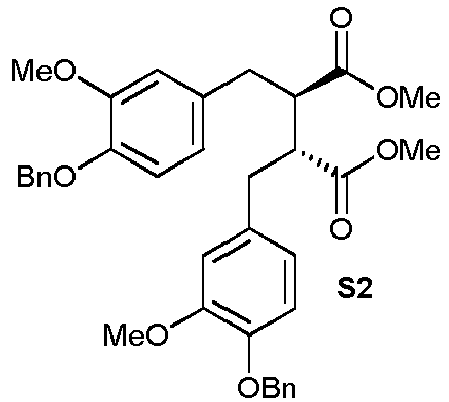

- (b) reacting the compound of formula (6) with a compound of formula (7)


- (c) cleaving benzyl ethers of the compound of formula ((S,S)-S3), followed by a separation procedure to prepare a compound of formula ((S,S)-8)

- (d) deprotecting the compound of formula ((S,S)-8) to prepare the compound of formula ((S,S)-SDG-1).
- (a) reacting a compound of formula (S2)
- 22. The process of embodiment 21, wherein said reacting of step (a) is carried out in the presence of TMSOTf.
- 23. The process of embodiment 22, wherein said reacting of step (a) is carried out in the presence of activated molecular sieves.
- 24. The process of embodiment 21, wherein said cleaving is carried out in the presence H2 and Pd/C in MeOH.
- 25. The process of embodiment 21, wherein said separation procedure is carried out using preparative thin layer chromatography.
- 26. The process of embodiment 21, wherein said deprotecting is carried out in a solution of NaOMe and MeOH.
- 27. The process of embodiment 21, wherein said reducing agent is lithium aluminum hydride (LAH) in THF.
- 28. The process of embodiment 21, wherein said compound of formula (S2) is prepared by the process comprising reacting a compound of formula (S1)

- 29. The process of embodiment 28, wherein said benzylating agent is BnBr and NaH.
- 30. The process of embodiment 28, wherein said compound of formula (S1) is prepared by the process comprising reacting a compound of formula (5)

- 31. The process of
embodiment 30, wherein said reducing agent is H2 and Pd/C. - 32. The process of
embodiment 30, wherein said compound of formula (5) is prepared by the process comprising reacting a compound of formula (4)
- 33. The process of embodiment 32, wherein said Stobbe condensation reaction is carried out in MeOH and in the presence of lithium wires.
- 34. The process of embodiment 32, wherein said esterification reaction is carried out with MeOH in the presence of H2SO4.
- 35. The process of embodiment 32, wherein said compound of formula (4) is prepared by the process comprising reacting vanillin with methyl succinate via a Stobbe condensation reaction, followed by an esterification reaction.
- 36. The process of embodiment 34, wherein said Stobbe condensation reaction is carried out in MeOH and in the presence of lithium wires.
- 37. The process of embodiment 34, wherein said esterification reaction is carried out with MeOH in the presence of H2SO4.
- 38. A process for preparing a compound of formula ((S,S)-SDG-1)

- (a) reacting a compound of formula (5)
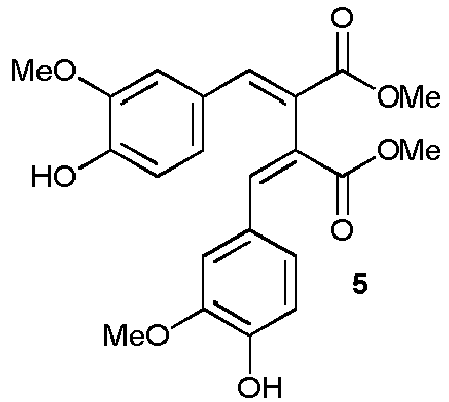

- (b) reacting the compound of formula (S1)


- (c) reacting the compound of formula (S2) with a reducing agent to prepare a compound of formula (6)

- (d) reacting the compound of formula (6) with a compound of formula (7)

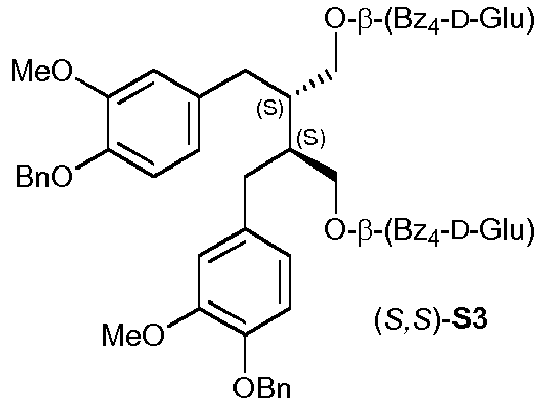
- (e) cleaving benzyl ethers of the compound of formula ((S,S)-S3), followed by a separation procedure to prepare a compound of formula ((S,S)-8)

- (f) deprotecting the compound of formula ((S,S)-8) to prepare the compound of formula ((S,S)-SDG-1).
- (a) reacting a compound of formula (5)
- 39. The process of embodiment 38, wherein said compound of formula (5) is prepared by the process comprising reacting a compound of formula (4)

- 40. A process for preparing a compound of formula ((R,R)-SDG-2)

- (a) reacting a compound of formula (6)


- (b) cleaving benzyl ethers of the compound of formula ((R,R)-S4), followed by a separation procedure to prepare a compound of formula ((R,R)-9)

- (c) deprotecting the compound of formula ((R,R)-9) to prepare the compound of formula ((R,R)-SDG-2).
- (a) reacting a compound of formula (6)
- 41. The process of
embodiment 40, wherein said reacting is carried out in the presence of TMSOTf. - 42. The process of
embodiment 40, wherein said reacting is carried out in the presence of activated molecular sieves. - 43. The process of
embodiment 40, wherein said cleaving is carried out in the presence of H2 and Pd/C in MeOH. - 44. The process of
embodiment 40, wherein said separation procedure is carried out using preparative thin layer chromatography. - 45. The process of
embodiment 40, wherein said deprotecting is carried out in a solution of NaOMe and MeOH. - 46. The process of
embodiment 40, wherein said compound of formula (6) is prepared by the process comprising reacting a compound of formula (S2)
- 47. The process of embodiment 46, wherein said reducing agent is lithium aluminum hydride (LAH) in THF.
- 48. The process of embodiment 46, wherein said compound of formula (S2) is prepared by the process comprising reacting a compound of formula (S1)

- 49. The process of embodiment 48, wherein said benzylating agent is BnBr and NaH.
- 50. The process of embodiment 48, wherein said compound of formula (S1) is prepared by the process comprising reacting a compound of formula (5)

- 51. The process of
embodiment 50, wherein said reducing agent is H2 and Pd/C. - 52. The process of
embodiment 50, wherein said compound of formula (5) is prepared by the process comprising reacting a compound of formula (4)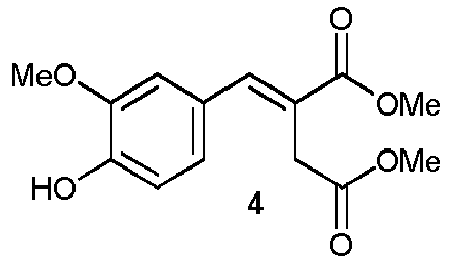
- 53. The process of embodiment 52, wherein said Stobbe condensation reaction is carried out in MeOH and in the presence of lithium.
- 54. The process of embodiment 52, wherein said lithium is in the form of lithium wires.
- 55. The process of embodiment 52, wherein said esterification reaction is carried out with MeOH in the presence of H2SO4.
- 56. The process of embodiment 52, wherein said compound of formula (4) is prepared by the process comprising reacting vanillin with methyl succinate via a Stobbe condensation reaction, followed by an esterification reaction.
- 57. The process of embodiment 56, wherein said Stobbe condensation reaction is carried out in MeOH and in the presence of lithium wires.
- 58. The process of embodiment 56, wherein said esterification reaction is carried out with MeOH in the presence of H2SO4.
- 59. A process for preparing a compound of formula ((R,R)-SDG-2)

- (a) reacting a compound of formula (S2)


- (b) reacting the compound of formula (6) with a compound of formula (7)


- (c) cleaving benzyl ethers of the compound of formula ((R,R)-S4), followed by a separation procedure to prepare a compound of formula ((R,R)-9)

- (d) deprotecting the compound of formula ((R,R)-9) to prepare the compound of formula ((R,R)-SDG-2).
- (a) reacting a compound of formula (S2)
- 60. The process of embodiment 59, wherein said reacting of step (a) is carried out in the presence of TMSOTf.
- 61. The process of embodiment 59, wherein said reacting of step (a) is carried out in the presence of activated molecular sieves.
- 62. The process of embodiment 59, wherein said cleaving is carried out in the presence H2 and Pd/C in MeOH.
- 63. The process of embodiment 59, wherein said separation procedure is carried out using preparative thin layer chromatography.
- 64. The process of embodiment 59, wherein said deprotecting is carried out in a solution of NaOMe and MeOH.
- 65. The process of embodiment 59, wherein said reducing agent is lithium aluminum hydride (LAH) in THF.
- 66. The process of embodiment 59, wherein said compound of formula (S2) is prepared by the process comprising reacting a compound of formula (S1)

- 67. The process of embodiment 66, wherein said benzylating agent is BnBr and NaH.
- 68. The process of embodiment 66, wherein said compound of formula (S1) is prepared by the process comprising reacting a compound of formula (5)

- 69. The process of embodiment 68, wherein said reducing agent is H2 and Pd/C.
- 70. The process of embodiment 68, wherein said compound of formula (5) is prepared by the process comprising reacting a compound of formula (4)

- 71. The process of
embodiment 70, wherein said Stobbe condensation reaction is carried out in MeOH and in the presence of lithium wires. - 72. The process of
embodiment 70, wherein said esterification reaction is carried out with MeOH in the presence of H2SO4. - 73. The process of
embodiment 70, wherein said compound of formula (4) is prepared by the process comprising reacting vanillin with methyl succinate via a Stobbe condensation reaction, followed by an esterification reaction. - 74. The process of embodiment 73, wherein said Stobbe condensation reaction is carried out in MeOH and in the presence of lithium wires.
- 75. The process of embodiment 73, wherein said esterification reaction is carried out with MeOH in the presence of H2SO4.
- 76. A process for preparing a compound of formula ((R,R)-SDG-2)
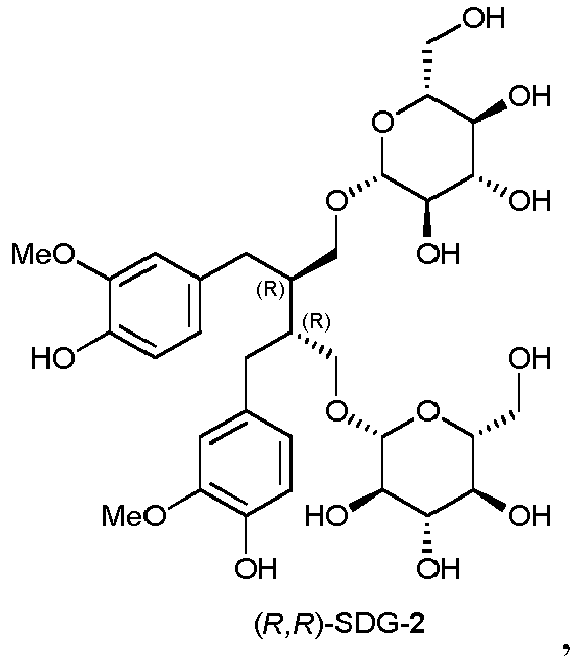
- (a) reacting a compound of formula (5)

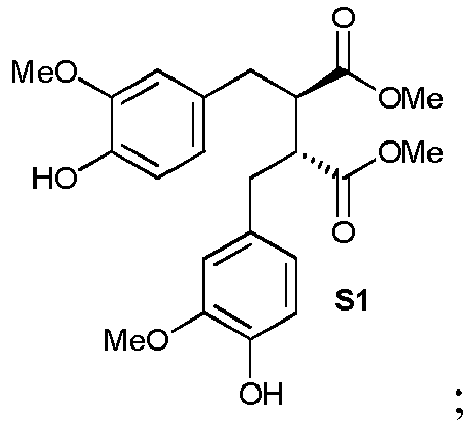
- (b) reacting the compound of formula (S1)

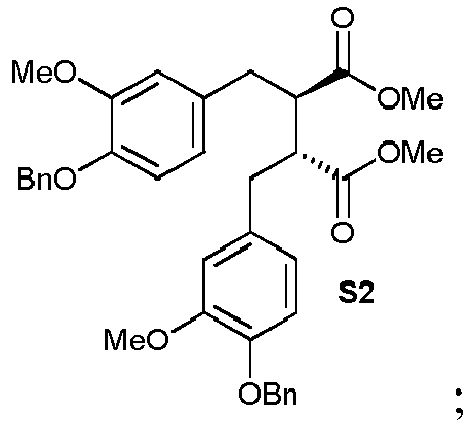
- (c) reacting the compound of formula (S2) with a reducing agent to prepare a compound of formula (6)

- (d) reacting the compound of formula (6) with a compound of formula (7)


- (e) cleaving benzyl ethers of the compound of formula ((R,R)-S3), followed by a separation procedure to prepare a compound of formula ((R,R)-9)

- (f) deprotecting the compound of formula ((R,R)-9) to prepare the compound of formula ((R,R)-SDG-2).
- (a) reacting a compound of formula (5)
- 77. The process of embodiment 76, wherein said compound of formula (5) is prepared by the process comprising reacting a compound of formula (4)

- 78. A process for preparing a compound of formula (6)


- 79. The process of embodiment 78, wherein said reducing agent is lithium aluminum hydride (LAH) in THF.
- 80. The process of embodiment 78, wherein said compound of formula (S2) is prepared by the process comprising reacting a compound of formula (S1)

- 81. The process of
embodiment 80, wherein said benzylating agent is BnBr and NaH. - 82. The process of
embodiment 80, wherein said compound of formula (S1) is prepared by the process comprising reacting a compound of formula (5)
- 83. The process of embodiment 82, wherein said reducing agent is H2 and Pd/C.
- 84. The process of embodiment 82, wherein said compound of formula (5) is prepared by the process comprising reacting a compound of formula (4)

- 85. The process of embodiment 84, wherein said Stobbe condensation reaction is carried out in MeOH and in the presence of lithium wires.
- 86. The process of embodiment 84, wherein said esterification reaction is carried out with MeOH in the presence of H2SO4.
- 87. The process of embodiment 84, wherein said compound of formula (4) is prepared by the process comprising reacting vanillin with methyl succinate via a Stobbe condensation reaction, followed by an esterification reaction.
- 88. The process of embodiment 87, wherein said Stobbe condensation reaction is carried out in MeOH and in the presence of lithium wires.
- 89. The process of embodiment 87, wherein said esterification reaction is carried out with MeOH in the presence of H2SO4.
- 90. A process for preparing a compound of formula ((S,S)-S3)
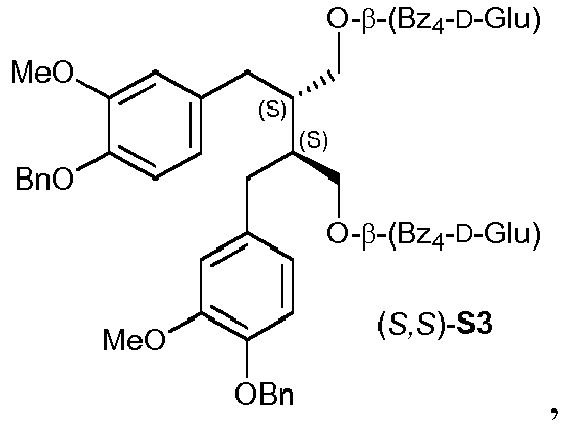


- 91. The process of
embodiment 90, wherein said reacting is carried out in the presence of TMSOTf. - 92. The process of
embodiment 90, wherein said reacting is carried out in the presence of activated molecular sieves. - 93. The process of
embodiment 90, wherein said compound of formula (6) is prepared by the process comprising reacting a compound of formula (S2)
- 94. The process of embodiment 93, wherein said reducing agent is lithium aluminum hydride (LAH) in THF.
- 95. The process of embodiment 93, wherein said compound of formula (S2) is prepared by the process comprising reacting a compound of formula (S1)

- 96. The process of embodiment 95, wherein said benzylating agent is BnBr and NaH.
- 97. The process of embodiment 95, wherein said compound of formula (S1) is prepared by the process comprising reacting a compound of formula (5)

- 98. The process of embodiment 97, wherein said reducing agent is H2 and Pd/C.
- 99. The process of embodiment 97, wherein said compound of formula (5) is prepared by the process comprising reacting a compound of formula (4)

- 100. The process of embodiment 99, wherein said Stobbe condensation reaction is carried out in MeOH and in the presence of lithium wires.
- 101. The process of embodiment 99, wherein said esterification reaction is carried out with MeOH in the presence of H2SO4.
- 102. The process of embodiment 99, wherein said compound of formula (4) is prepared by the process comprising reacting vanillin with methyl succinate via a Stobbe condensation reaction, followed by an esterification reaction.
- 103. The process of embodiment 102, wherein said Stobbe condensation reaction is carried out in MeOH and in the presence of lithium wires.
- 104. The process of embodiment 102, wherein said esterification reaction is carried out with MeOH in the presence of H2SO4.
- 105. A process for preparing a compound of formula ((S,S)-8)

- (a) reacting a compound of formula (6)


- (b) cleaving benzyl ethers of the compound of formula ((S,S)-S3), followed by a separation procedure to prepare the compound of formula ((S,S)-8).
- (a) reacting a compound of formula (6)
- 106. The process of embodiment 105, wherein said reacting is carried out in the presence of TMSOTf.
- 107. The process of embodiment 105, wherein said reacting is carried out in the presence of activated molecular sieves.
- 108. The process of embodiment 105, wherein said cleaving is carried out in the presence of H2 and Pd/C in MeOH.
- 109. The process of embodiment 105, wherein said separation procedure is carried out using preparative thin layer chromatography.
- 110. The process of embodiment 105, wherein said compound of formula (6) is prepared by the process comprising reacting a compound of formula (S2)

- 111. The process of
embodiment 110, wherein said reducing agent is lithium aluminum hydride (LAH) in THF. - 112. The process of
embodiment 110, wherein said compound of formula (S2) is prepared by the process comprising reacting a compound of formula (S1)
- 113. The process of embodiment 112, wherein said benzylating agent is BnBr and NaH.
- 114. The process of embodiment 112, wherein said compound of formula (S1) is prepared by the process comprising reacting a compound of formula (5)

- 115. The process of embodiment 114, wherein said reducing agent is H2 and Pd/C.
- 116. The process of embodiment 114, wherein said compound of formula (5) is prepared by the process comprising reacting a compound of formula (4)

- 117. The process of embodiment 116, wherein said Stobbe condensation reaction is carried out in MeOH and in the presence of lithium wires.
- 118. The process of embodiment 116, wherein said esterification reaction is carried out with MeOH in the presence of H2SO4.
- 119. The process of embodiment 116, wherein said compound of formula (4) is prepared by the process comprising reacting vanillin with methyl succinate via a Stobbe condensation reaction, followed by an esterification reaction.
- 120. The process of embodiment 119, wherein said Stobbe condensation reaction is carried out in MeOH and in the presence of lithium wires.
- 121. The process of embodiment 117, wherein said esterification reaction is carried out with MeOH in the presence of H2SO4.
- 122. A process for preparing a compound of formula ((R,R)-S4)

- (a) reacting a compound of formula (6)


- (a) reacting a compound of formula (6)
- 123. The process of embodiment 122, wherein said reacting is carried out in the presence of TMSOTf.
- 124. The process of embodiment 122, wherein said reacting is carried out in the presence of activated molecular sieves.
- 125. The process of embodiment 122, wherein said compound of formula (6) is prepared by the process comprising reacting a compound of formula (S2)

- 126. The process of embodiment 125, wherein said reducing agent is lithium aluminum hydride (LAH) in THF.
- 127. The process of embodiment 125, wherein said compound of formula (S2) is prepared by the process comprising reacting a compound of formula (S1)

- 128. The process of embodiment 127, wherein said benzylating agent is BnBr and NaH.
- 129. The process of embodiment 127, wherein said compound of formula (S1) is prepared by the process comprising reacting a compound of formula (5)

- 130. The process of embodiment 129, wherein said reducing agent is H2 and Pd/C.
- 131. The process of embodiment 129, wherein said compound of formula (5) is prepared by the process comprising reacting a compound of formula (4)

- 132. The process of embodiment 131, wherein said Stobbe condensation reaction is carried out in MeOH and in the presence of lithium wires.
- 133. The process of embodiment 131, wherein said esterification reaction is carried out with MeOH in the presence of H2SO4.
- 134. The process of embodiment 131, wherein said compound of formula (4) is prepared by the process comprising reacting vanillin with methyl succinate via a Stobbe condensation reaction, followed by an esterification reaction.
- 135. The process of embodiment 134, wherein said Stobbe condensation reaction is carried out in MeOH and in the presence of lithium wires.
- 136. The process of embodiment 134, wherein said esterification reaction is carried out with MeOH in the presence of H2SO4.
- 137. A process for preparing a compound of formula ((R,R)-9)

- (a) reacting a compound of formula (6)


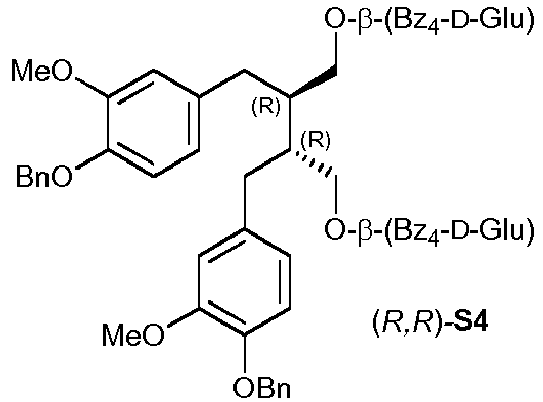
- (b) cleaving benzyl ethers of the compound of formula ((R,R)-S4), followed by a separation procedure to prepare a compound of formula ((R,R)-9)
- (a) reacting a compound of formula (6)
- 138. The process of embodiment 137, wherein said reacting is carried out in the presence of TMSOTf.
- 139. The process of embodiment 137, wherein said reacting is carried out in the presence of activated molecular sieves.
- 140. The process of embodiment 137, wherein said cleaving is carried out in the presence of H2 and Pd/C in MeOH.
- 141. The process of embodiment 137, wherein said separation procedure is carried out using preparative thin layer chromatography.
- 142. The process of embodiment 137, wherein said compound of formula (6) is prepared by the process comprising reacting a compound of formula (S2)

- 143. The process of embodiment 142, wherein said reducing agent is lithium aluminum hydride (LAH) in THF.
- 144. The process of embodiment 142, wherein said compound of formula (S2) is prepared by the process comprising reacting a compound of formula (S1)

- 145. The process of embodiment 144, wherein said benzylating agent is BnBr and NaH.
- 146. The process of embodiment 144, wherein said compound of formula (S1) is prepared by the process comprising reacting a compound of formula (5)

- 147. The process of embodiment 146, wherein said reducing agent is H2 and Pd/C.
- 148. The process of embodiment 146, wherein said compound of formula (5) is prepared by the process comprising reacting a compound of formula (4)

- 149. The process of embodiment 148, wherein said Stobbe condensation reaction is carried out in MeOH and in the presence of lithium wires.
- 150. The process of embodiment 148, wherein said esterification reaction is carried out with MeOH in the presence of H2SO4.
- 151. The process of embodiment 148, wherein said compound of formula (4) is prepared by the process comprising reacting vanillin with methyl succinate via a Stobbe condensation reaction, followed by an esterification reaction.
- 152. The process of embodiment 151, wherein said Stobbe condensation reaction is carried out in MeOH and in the presence of lithium wires.
- 153. The process of embodiment 151, wherein said esterification reaction is carried out with MeOH in the presence of H2SO4.
Claims (16)
- A compound of formula ((S,S)-SDG-1) or a compound of formula (R,R)-SDG-2
 (a) reacting a compound of formula (4)
 (b) reacting the compound of formula (5) with a reducing agent to prepare a compound of formula (S1)
 (c) reacting the compound of formula (S1) with a benzylating agent to prepare a compound of formula (S2)
 (d) reacting the compound of formula (S2) with a reducing agent to prepare a compound of formula (6)
 (e) reacting the compound of formula (6) with a compound of formula (7)
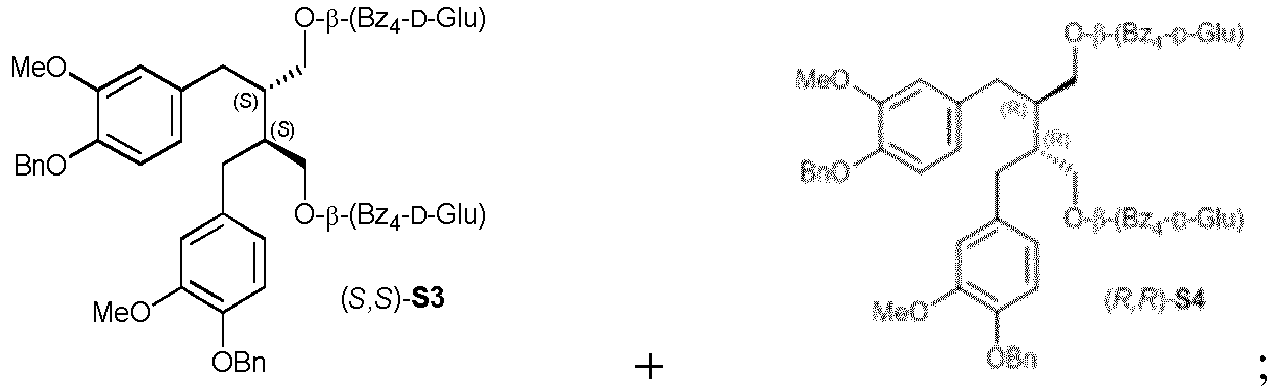 (f) cleaving benzyl ethers of the compound of formula ((S,S)-S3) and benzyl ethers of the compound of formula ((R,R)-S4), followed by a separation procedure to prepare a compound of formula ((S,S)-8) or a compound of formula ((R,R)-9), respectively,
 (g) deprotecting the compound of formula ((S,S)-8) or the compound of formula ((R,R)-9) to prepare the compound of formula ((S,S)-SDG-1) or the compound of formula ((R,R)-SDG-2), respectively.
 - The compound of claim 1, wherein said reacting of step (e) is carried out in the presence of a Lewis acid, such as TMSOTf.
- The compound of any of claims 1-2, wherein said reacting of step (e) is carried out in the presence of activated molecular sieves.
- The compound of claim 1, wherein said cleaving is carried out in the presence of H2 and Pd/C in MeOH.
- The compound of claim 1, wherein said separation procedure is carried out using preparative thin layer chromatography.
- The compound of claim 1, wherein said deprotecting of step (g) is carried out in a solution of NaOMe and MeOH.
- The compound of claim 1, wherein said Stobbe condensation reaction is carried out in MeOH and in the presence of lithium.
- The compound of claim 7, wherein said lithium is in the form of lithium wires.
- The compound of claim 1, wherein said compound of formula (4) is prepared by the process comprising reacting vanillin with methyl succinate via a Stobbe condensation reaction, followed by an esterification reaction.
- The compound of claim 9, wherein said Stobbe condensation reaction is carried out in MeOH and in the presence of lithium wires.
- A pharmaceutical composition comprising a compound of any of claims 1-10, and at least one pharmaceutically acceptable excipient.
- A pharmaceutical composition comprising a compound of formula (S,S)-SDG-1),

a compound of formula (R,R)-SDG-2,
- The pharmaceutical composition of claim 11 or claim 12, comprising a racemic mixture of ((S,S)-SDG-1) and ((R,R)-SDG-2).
- The composition of any of claims 11-13 for use as a medicament.
- The composition of any of claims 11-13 for use in scavenging a radical in a subject.
- The composition for use according to claim 15, wherein said radical is a free radical, a hydroxyl radical or a peroxyl radical.
Applications Claiming Priority (3)
| Application Number | Priority Date | Filing Date | Title |
|---|---|---|---|
| US201361833258P | 2013-06-10 | 2013-06-10 | |
| EP14811683.3A EP3007557B1 (en) | 2013-06-10 | 2014-06-10 | Preparation of (s,s)-secoisolariciresinol diglucoside and (r,r)-secoisolariciresinol diglucoside |
| PCT/US2014/041636 WO2014200964A1 (en) | 2013-06-10 | 2014-06-10 | Preparation of (s,s)-secoisolariciresinol diglucoside and (r,r)-secoisolariciresinol diglucoside |
Related Parent Applications (1)
| Application Number | Title | Priority Date | Filing Date |
|---|---|---|---|
| EP14811683.3A Division EP3007557B1 (en) | 2013-06-10 | 2014-06-10 | Preparation of (s,s)-secoisolariciresinol diglucoside and (r,r)-secoisolariciresinol diglucoside |
Publications (1)
| Publication Number | Publication Date |
|---|---|
| EP3488697A1 true EP3488697A1 (en) | 2019-05-29 |
Family
ID=52022698
Family Applications (2)
| Application Number | Title | Priority Date | Filing Date |
|---|---|---|---|
| EP18183923.4A Withdrawn EP3488697A1 (en) | 2013-06-10 | 2014-06-10 | Preparation of (s,s)-secoisolariciresinol diglucoside and (r,r)-secoisolariciresinol diglucoside |
| EP14811683.3A Active EP3007557B1 (en) | 2013-06-10 | 2014-06-10 | Preparation of (s,s)-secoisolariciresinol diglucoside and (r,r)-secoisolariciresinol diglucoside |
Family Applications After (1)
| Application Number | Title | Priority Date | Filing Date |
|---|---|---|---|
| EP14811683.3A Active EP3007557B1 (en) | 2013-06-10 | 2014-06-10 | Preparation of (s,s)-secoisolariciresinol diglucoside and (r,r)-secoisolariciresinol diglucoside |
Country Status (21)
| Country | Link |
|---|---|
| US (2) | US10030040B2 (en) |
| EP (2) | EP3488697A1 (en) |
| JP (3) | JP6321788B2 (en) |
| KR (1) | KR102270124B1 (en) |
| CN (2) | CN107955046A (en) |
| AU (1) | AU2014278362B2 (en) |
| CA (1) | CA2920346A1 (en) |
| CY (1) | CY1120759T1 (en) |
| DK (1) | DK3007557T3 (en) |
| ES (1) | ES2691845T3 (en) |
| HR (1) | HRP20181663T1 (en) |
| HU (1) | HUE040022T2 (en) |
| IL (2) | IL243029B (en) |
| LT (1) | LT3007557T (en) |
| PL (1) | PL3007557T3 (en) |
| PT (1) | PT3007557T (en) |
| RS (1) | RS57846B1 (en) |
| SI (1) | SI3007557T1 (en) |
| SM (1) | SMT201800575T1 (en) |
| TR (1) | TR201815423T4 (en) |
| WO (1) | WO2014200964A1 (en) |
Families Citing this family (9)
| Publication number | Priority date | Publication date | Assignee | Title |
|---|---|---|---|---|
| CA2920346A1 (en) | 2013-06-10 | 2014-12-18 | The Trustees Of The University Of Pennsylvania | Preparation of (s,s)-secoisolariciresinol diglucoside and (r,r)-secoisolariciresinol diglucoside |
| CN107155304A (en) * | 2014-05-30 | 2017-09-12 | 宾夕法尼亚大学董事会 | Use of secoisolaricine diglucoside (SDG) and related compounds for protection against radiation and chemical damage |
| US20170258821A1 (en) | 2014-05-30 | 2017-09-14 | The Trustees Of The University Of Pennsylvania | USE OF SECOISOLARICIRESINOL DIGLUCOSIDES (SDGs) AND RELATED COMPOUNDS FOR PROTECTION AGAINST RADIATION AND CHEMICAL DAMAGE |
| US11197876B2 (en) | 2014-05-30 | 2021-12-14 | The Trusiees Of The University Of Pennsylvania | Effects of LGM2605 on a primate model of asthma |
| AU2016315952A1 (en) * | 2015-09-01 | 2018-04-05 | The Trustees Of The University Of Pennsylvania | Use of secoisolariciresinol diglucosides (SDGs) and related compounds for protection against radiation damage |
| ES2969209T3 (en) | 2016-06-07 | 2024-05-17 | Univ Pennsylvania | Compositions and methods for protecting organs from ischemia/reperfusion injury associated with transplantation |
| CA3065386A1 (en) * | 2017-06-12 | 2018-12-20 | Lignamed, Llc | Process for the preparation of (s,s)-secoisolariciresinol diglucoside and (r,r)-secoisolariciresinol diglucoside |
| CN110283218A (en) * | 2019-06-24 | 2019-09-27 | 暨南大学 | Improve the oil-soluble method of modifying of lignan |
| CN111233944B (en) * | 2020-03-25 | 2023-02-28 | 宝鸡市辰光生物科技有限公司 | High performance liquid phase method for simultaneously preparing and separating four lignans components |
Citations (1)
| Publication number | Priority date | Publication date | Assignee | Title |
|---|---|---|---|---|
| WO2014200964A1 (en) | 2013-06-10 | 2014-12-18 | The Trustees Of The University Of Pennsylvania | Preparation of (s,s)-secoisolariciresinol diglucoside and (r,r)-secoisolariciresinol diglucoside |
Family Cites Families (14)
| Publication number | Priority date | Publication date | Assignee | Title |
|---|---|---|---|---|
| JP3065925B2 (en) * | 1996-01-30 | 2000-07-17 | 日清製油株式会社 | Active oxygen species scavenger and anti-fading agent |
| AU3760699A (en) * | 1998-04-24 | 1999-11-16 | Washington State University Research Foundation | Recombinant secoisolariciresinol dehydrogenase, and methods of use |
| FI110868B (en) * | 2001-01-22 | 2003-04-15 | Maa Ja Elintarviketalouden Tut | Procedure for the separation and purification of secoisolarisiresinol diglycoside (SDG) from flax seeds |
| US20030060420A1 (en) * | 2001-09-14 | 2003-03-27 | Rick Heintzman | Process for extraction and stabilization of phytoestrogens from flaxseed and product therefrom |
| US6806356B2 (en) * | 2002-04-02 | 2004-10-19 | Wiley Organics, Inc. | Process for recovering secoisolariciresinol diglycoside from de-fatted flaxseed |
| JP2006347978A (en) * | 2005-06-17 | 2006-12-28 | Nippon Flour Mills Co Ltd | Anti-obesity agent, food containing the same and pet food |
| JP2007308469A (en) * | 2005-11-11 | 2007-11-29 | Nippon Flour Mills Co Ltd | Male anti-obesity agent containing lignan as active ingredient |
| CN100395253C (en) * | 2006-05-12 | 2008-06-18 | 中国科学院山西煤炭化学研究所 | A method for preparing secoisolaricresinol diglucoside from flaxseed |
| CN101117641B (en) | 2007-07-27 | 2011-05-11 | 大连医诺生物有限公司 | Method for preparing secoisolariciresinol diglucoside |
| JP2010057367A (en) * | 2008-09-01 | 2010-03-18 | Nitto Boseki Co Ltd | Browning inhibitor for fish, and browning inhibiting method for fish |
| CN102050848A (en) * | 2009-11-01 | 2011-05-11 | 桂林莱茵生物科技股份有限公司 | Method for preparing secoisolariciresinol diglucoside |
| ES2362065B1 (en) * | 2009-12-15 | 2012-05-18 | Consejo Superior De Investigaciones Cient�?Ficas (Csic) | COMPOUNDS WITH ANTI-INFLAMMATORY ACTIVITY. |
| US20130203688A1 (en) * | 2010-08-20 | 2013-08-08 | Fédération Des Producteurs Acéri-Coles Du Québec | Sugar plant derived by-products and methods of production thereof |
| CN102558252A (en) * | 2010-12-31 | 2012-07-11 | 西安天一生物技术有限公司 | Production process of secoisolariciresinol diglucoside |
-
2014
- 2014-06-10 CA CA2920346A patent/CA2920346A1/en not_active Abandoned
- 2014-06-10 PT PT14811683T patent/PT3007557T/en unknown
- 2014-06-10 DK DK14811683.3T patent/DK3007557T3/en active
- 2014-06-10 EP EP18183923.4A patent/EP3488697A1/en not_active Withdrawn
- 2014-06-10 JP JP2016519582A patent/JP6321788B2/en not_active Expired - Fee Related
- 2014-06-10 HU HUE14811683A patent/HUE040022T2/en unknown
- 2014-06-10 CN CN201711326022.7A patent/CN107955046A/en active Pending
- 2014-06-10 HR HRP20181663TT patent/HRP20181663T1/en unknown
- 2014-06-10 ES ES14811683.3T patent/ES2691845T3/en active Active
- 2014-06-10 PL PL14811683T patent/PL3007557T3/en unknown
- 2014-06-10 AU AU2014278362A patent/AU2014278362B2/en not_active Ceased
- 2014-06-10 CN CN201480041131.2A patent/CN105705018B/en active Active
- 2014-06-10 LT LTEP14811683.3T patent/LT3007557T/en unknown
- 2014-06-10 SI SI201430924T patent/SI3007557T1/en unknown
- 2014-06-10 US US14/897,181 patent/US10030040B2/en active Active
- 2014-06-10 KR KR1020167000483A patent/KR102270124B1/en active Active
- 2014-06-10 RS RS20181236A patent/RS57846B1/en unknown
- 2014-06-10 WO PCT/US2014/041636 patent/WO2014200964A1/en not_active Ceased
- 2014-06-10 SM SM20180575T patent/SMT201800575T1/en unknown
- 2014-06-10 TR TR2018/15423T patent/TR201815423T4/en unknown
- 2014-06-10 EP EP14811683.3A patent/EP3007557B1/en active Active
-
2015
- 2015-12-10 IL IL243029A patent/IL243029B/en active IP Right Grant
-
2018
- 2018-04-04 JP JP2018072178A patent/JP6513853B2/en not_active Expired - Fee Related
- 2018-07-23 US US16/042,866 patent/US10870670B2/en active Active
- 2018-10-16 CY CY181101054T patent/CY1120759T1/en unknown
-
2019
- 2019-04-10 JP JP2019074548A patent/JP6785335B2/en active Active
- 2019-09-24 IL IL26962219A patent/IL269622A/en unknown
Patent Citations (1)
| Publication number | Priority date | Publication date | Assignee | Title |
|---|---|---|---|---|
| WO2014200964A1 (en) | 2013-06-10 | 2014-12-18 | The Trustees Of The University Of Pennsylvania | Preparation of (s,s)-secoisolariciresinol diglucoside and (r,r)-secoisolariciresinol diglucoside |
Non-Patent Citations (5)
| Title |
|---|
| CHRISTOFIDOU-SOLOMIDOU MELPO ET AL: "Radioprotective role in lung of the flaxseed lignan complex enriched in the phenolic secoisolariciresinol diglucoside (SDG)", MEDLINE, US NATIONAL LIBRARY OF MEDICINE (NLM), BETHESDA, MD, US, 1 December 2012 (2012-12-01), XP002776406, DOI: 10.1667/RR2980.1 * |
| HOSSEINIAN FARAH S ET AL: "AAPH-mediated antioxidant reaction of secoisolariciresinol and SDG", ORGANIC & BIOMOLECULAR CHEMISTRY, ROYAL SOCIETY OF CHEMISTRY, vol. 5, no. 4, 1 January 2007 (2007-01-01), pages 644 - 654, XP002566060, ISSN: 1477-0520, [retrieved on 20070123], DOI: 10.1039/B617426D * |
| JOSHUA D. FORD ET AL: "Biosynthetic Pathway to the Cancer Chemopreventive Secoisolariciresinol Diglucoside-Hydroxymethyl Glutaryl Ester-Linked Lignan Oligomers in Flax ( Linum u sitatissimum) Seed +", JOURNAL OF NATURAL PRODUCTS., vol. 64, no. 11, 1 November 2001 (2001-11-01), US, pages 1388 - 1397, XP055328804, ISSN: 0163-3864, DOI: 10.1021/np010367x * |
| MISHRA OM P ET AL: "Synthesis and antioxidant evaluation of (S,S)- and (R,R)-secoisolariciresinol diglucosides (SDGs)", BIOORGANIC & MEDICINAL CHEMISTRY LETTERS, vol. 23, no. 19, 2 August 2013 (2013-08-02), pages 5325 - 5328, XP028707940, ISSN: 0960-894X, DOI: 10.1016/J.BMCL.2013.07.062 * |
| SADIQ S MOREE ET AL: "Investigation of in vitro and in vivo antioxidant potential of secoisolariciresinol diglucoside", MOLECULAR AND CELLULAR BIOCHEMISTRY, KLUWER ACADEMIC PUBLISHERS, BO, vol. 373, no. 1 - 2, 30 October 2012 (2012-10-30), pages 179 - 187, XP035154071, ISSN: 1573-4919, DOI: 10.1007/S11010-012-1487-4 * |
Also Published As
Similar Documents
| Publication | Publication Date | Title |
|---|---|---|
| US10870670B2 (en) | Preparation of (S,S)-secoisolariciresinol diglucoside and (R,R)-secoisolariciresinol diglucoside | |
| EP3790867B1 (en) | Kdm1a inhibitors for the treatment of disease | |
| EP4406953A1 (en) | 2,6-piperidinedione compound and application thereof | |
| DD299178A5 (en) | 24-HOMO-VITAMIN-D DERIVATIVES, METHOD FOR THE PRODUCTION THEREOF, PHARMACEUTICAL PREPARATES CONTAINING SUCH DERIVATIVES AND THEIR USE AS MEDICAMENTS | |
| Formánek et al. | Synthesis and migrastatic activity of cytochalasin analogues lacking a macrocyclic moiety | |
| EP3252039B1 (en) | Compound containing indoleacetic acid core structure and use thereof | |
| JP2004536132A (en) | Novel anti-tumor derivatives of ET-743 | |
| JPH0912538A (en) | Ester and amide of 9(z)-retinoic acid | |
| HK40009219A (en) | Preparation of (s,s)-secoisolariciresinol diglucoside and (r,r)-secoisolariciresinol diglucoside | |
| CN111533776A (en) | A kind of 11-O-mogrosinol oxime ester derivative and preparation method thereof | |
| US20050171211A1 (en) | Gingerol analogues and use thereof | |
| KR102469368B1 (en) | Benzenesulfonamide derivatives and radiation protective composition comprising the same as active ingredients | |
| WO2025086855A1 (en) | Azide prodrug compound, preparation method therefor and use thereof | |
| HK40070404A (en) | Compound containing an indoleacetic acid core structure and use thereof | |
| HK1223792B (en) | Preparation of (s,s)-secoisolariciresinol diglucoside and (r,r)-secoisolariciresinol diglucoside | |
| WO2025097160A1 (en) | Methods of enhancing levodopa therapeutic efficacy | |
| JP3065819B2 (en) | UV-induced mutation inhibitor | |
| HK1241872A1 (en) | Compound containing indoleacetic acid core structure and use thereof |
Legal Events
| Date | Code | Title | Description |
|---|---|---|---|
| PUAI | Public reference made under article 153(3) epc to a published international application that has entered the european phase |
Free format text: ORIGINAL CODE: 0009012 |
|
| STAA | Information on the status of an ep patent application or granted ep patent |
Free format text: STATUS: THE APPLICATION HAS BEEN PUBLISHED |
|
| AC | Divisional application: reference to earlier application |
Ref document number: 3007557 Country of ref document: EP Kind code of ref document: P |
|
| AK | Designated contracting states |
Kind code of ref document: A1 Designated state(s): AL AT BE BG CH CY CZ DE DK EE ES FI FR GB GR HR HU IE IS IT LI LT LU LV MC MK MT NL NO PL PT RO RS SE SI SK SM TR |
|
| AX | Request for extension of the european patent |
Extension state: BA ME |
|
| RIN1 | Information on inventor provided before grant (corrected) |
Inventor name: HERETSCH, PHILIPP, M. Inventor name: NICOLAOU, KYRIACOS, C. Inventor name: SIMMONS, NICHOLAS Inventor name: VALIULIN, ROMAN, A. Inventor name: CHRISTOFIDOU-SOLOMIDOU, MELPO |
|
| STAA | Information on the status of an ep patent application or granted ep patent |
Free format text: STATUS: REQUEST FOR EXAMINATION WAS MADE |
|
| 17P | Request for examination filed |
Effective date: 20191128 |
|
| RBV | Designated contracting states (corrected) |
Designated state(s): AL AT BE BG CH CY CZ DE DK EE ES FI FR GB GR HR HU IE IS IT LI LT LU LV MC MK MT NL NO PL PT RO RS SE SI SK SM TR |
|
| REG | Reference to a national code |
Ref country code: HK Ref legal event code: DE Ref document number: 40009219 Country of ref document: HK |
|
| STAA | Information on the status of an ep patent application or granted ep patent |
Free format text: STATUS: EXAMINATION IS IN PROGRESS |
|
| 17Q | First examination report despatched |
Effective date: 20201223 |
|
| STAA | Information on the status of an ep patent application or granted ep patent |
Free format text: STATUS: THE APPLICATION IS DEEMED TO BE WITHDRAWN |
|
| 18D | Application deemed to be withdrawn |
Effective date: 20210703 |