EP3487837B1 - Process for the preparation of spiroheterocyclic pyrrolidine dione herbicides by means of the intermediate compound 2-(4-chloro-2,6-dimethyl-phenyl)acetic acid - Google Patents
Process for the preparation of spiroheterocyclic pyrrolidine dione herbicides by means of the intermediate compound 2-(4-chloro-2,6-dimethyl-phenyl)acetic acid Download PDFInfo
- Publication number
- EP3487837B1 EP3487837B1 EP17745158.0A EP17745158A EP3487837B1 EP 3487837 B1 EP3487837 B1 EP 3487837B1 EP 17745158 A EP17745158 A EP 17745158A EP 3487837 B1 EP3487837 B1 EP 3487837B1
- Authority
- EP
- European Patent Office
- Prior art keywords
- formula
- compound
- preparation
- phenyl
- malononitrile
- Prior art date
- Legal status (The legal status is an assumption and is not a legal conclusion. Google has not performed a legal analysis and makes no representation as to the accuracy of the status listed.)
- Active
Links
Classifications
-
- C—CHEMISTRY; METALLURGY
- C07—ORGANIC CHEMISTRY
- C07C—ACYCLIC OR CARBOCYCLIC COMPOUNDS
- C07C253/00—Preparation of carboxylic acid nitriles
- C07C253/30—Preparation of carboxylic acid nitriles by reactions not involving the formation of cyano groups
-
- C—CHEMISTRY; METALLURGY
- C07—ORGANIC CHEMISTRY
- C07C—ACYCLIC OR CARBOCYCLIC COMPOUNDS
- C07C255/00—Carboxylic acid nitriles
- C07C255/01—Carboxylic acid nitriles having cyano groups bound to acyclic carbon atoms
- C07C255/32—Carboxylic acid nitriles having cyano groups bound to acyclic carbon atoms having cyano groups bound to acyclic carbon atoms of a carbon skeleton containing at least one six-membered aromatic ring
- C07C255/33—Carboxylic acid nitriles having cyano groups bound to acyclic carbon atoms having cyano groups bound to acyclic carbon atoms of a carbon skeleton containing at least one six-membered aromatic ring with cyano groups linked to the six-membered aromatic ring, or to the condensed ring system containing that ring, by saturated carbon chains
-
- C—CHEMISTRY; METALLURGY
- C07—ORGANIC CHEMISTRY
- C07C—ACYCLIC OR CARBOCYCLIC COMPOUNDS
- C07C255/00—Carboxylic acid nitriles
- C07C255/01—Carboxylic acid nitriles having cyano groups bound to acyclic carbon atoms
- C07C255/32—Carboxylic acid nitriles having cyano groups bound to acyclic carbon atoms having cyano groups bound to acyclic carbon atoms of a carbon skeleton containing at least one six-membered aromatic ring
- C07C255/35—Carboxylic acid nitriles having cyano groups bound to acyclic carbon atoms having cyano groups bound to acyclic carbon atoms of a carbon skeleton containing at least one six-membered aromatic ring the carbon skeleton being further substituted by halogen atoms, or by nitro or nitroso groups
-
- C—CHEMISTRY; METALLURGY
- C07—ORGANIC CHEMISTRY
- C07C—ACYCLIC OR CARBOCYCLIC COMPOUNDS
- C07C51/00—Preparation of carboxylic acids or their salts, halides or anhydrides
- C07C51/08—Preparation of carboxylic acids or their salts, halides or anhydrides from nitriles
-
- C—CHEMISTRY; METALLURGY
- C07—ORGANIC CHEMISTRY
- C07C—ACYCLIC OR CARBOCYCLIC COMPOUNDS
- C07C53/00—Saturated compounds having only one carboxyl group bound to an acyclic carbon atom or hydrogen
- C07C53/132—Saturated compounds having only one carboxyl group bound to an acyclic carbon atom or hydrogen containing rings
- C07C53/134—Saturated compounds having only one carboxyl group bound to an acyclic carbon atom or hydrogen containing rings monocyclic
-
- B—PERFORMING OPERATIONS; TRANSPORTING
- B01—PHYSICAL OR CHEMICAL PROCESSES OR APPARATUS IN GENERAL
- B01J—CHEMICAL OR PHYSICAL PROCESSES, e.g. CATALYSIS OR COLLOID CHEMISTRY; THEIR RELEVANT APPARATUS
- B01J2231/00—Catalytic reactions performed with catalysts classified in B01J31/00
- B01J2231/40—Substitution reactions at carbon centres, e.g. C-C or C-X, i.e. carbon-hetero atom, cross-coupling, C-H activation or ring-opening reactions
- B01J2231/44—Allylic alkylation, amination, alkoxylation or analogues
-
- B—PERFORMING OPERATIONS; TRANSPORTING
- B01—PHYSICAL OR CHEMICAL PROCESSES OR APPARATUS IN GENERAL
- B01J—CHEMICAL OR PHYSICAL PROCESSES, e.g. CATALYSIS OR COLLOID CHEMISTRY; THEIR RELEVANT APPARATUS
- B01J2531/00—Additional information regarding catalytic systems classified in B01J31/00
- B01J2531/80—Complexes comprising metals of Group VIII as the central metal
- B01J2531/82—Metals of the platinum group
- B01J2531/824—Palladium
-
- B—PERFORMING OPERATIONS; TRANSPORTING
- B01—PHYSICAL OR CHEMICAL PROCESSES OR APPARATUS IN GENERAL
- B01J—CHEMICAL OR PHYSICAL PROCESSES, e.g. CATALYSIS OR COLLOID CHEMISTRY; THEIR RELEVANT APPARATUS
- B01J31/00—Catalysts comprising hydrides, coordination complexes or organic compounds
- B01J31/16—Catalysts comprising hydrides, coordination complexes or organic compounds containing coordination complexes
- B01J31/24—Phosphines, i.e. phosphorus bonded to only carbon atoms, or to both carbon and hydrogen atoms, including e.g. sp2-hybridised phosphorus compounds such as phosphabenzene, phosphole or anionic phospholide ligands
Definitions
- the present invention relates to a process for the preparation of certain phenyl acetic acid derivatives, to intermediate dinitrile compounds useful in the process for the preparation of certain phenyl acetic acid derivatives, and to a process for the preparation of the intermediate dinitrile compounds.
- Phenyl acetic acid derivatives have been disclosed in WO 97/002243 and WO 2015/007640 as intermediates in the preparation of spiroheterocyclic pyrrolidine diones, which are useful for combating and controlling pests such as insect, acarine, mollusc and nematode pests. Improved processes for the preparation of phenyl acetic acid derivatives, in particular, halogenated (eg, mono- or dichlorinated) phenyl acetic acid derivatives, have subsequently been sought.
- WO 00/78712 and WO 2004/050607 disclose the preparation of phenylmalonic acid dinitriles.
- a process for the preparation of the compound of Formula (III) comprising reacting the compound of Formula (I) with an acid in the presence of water, wherein the the compound of Formula (I) is prepared by a process comprising the reaction of a compound of Formula (II) with malononitrile in the presence of a base and a palladium catalyst, wherein L is a leaving group.
- Compounds of Formula (III) may find utility in the so-called Ugi multi-component reaction (Ugi-MCR) which is a one-pot condensation of a carboxylic acid (eg, compound according to Formula (III)), another carbonyl-containing moiety, an isocyanide and an amine (eg, an alkylamine such as methyl amine), each of which may be introduced simultaneously or in any sequence to a reaction vessel to form a diamide compound (eg, see WO 2015/007640 ).
- Ugi-MCR Ugi multi-component reaction
- Such diamide compounds may be ring-closed to yield a spirone compound (which may be derivatised with the addition of a latentiating group), such as those which are useful for combating and controlling pests such as insect, acarine, mollusc and nematode pests (eg, see WO 2010/066780 ).
- a latentiating group such as those which are useful for combating and controlling pests such as insect, acarine, mollusc and nematode pests (eg, see WO 2010/066780 ).
- the process for the preparation of a compound of Formula (I) comprises steps (i) and (ii), wherein:
- Y is a leaving group.
- the leaving group may be selected from halogen, RS(O) 2 O- wherein R is C 1-4 alkyl, preferably methyl, C 1-4 haloalkyl, preferably halomethyl or n-C 4 F 9 -, aryl, preferably phenyl, or phenyl substituted from one to three times by halogen, methyl or by halomethyl; and mono-, di- and tri-arylmethoxy.
- aryl radicals of the mono-, di- and tri-arylmethoxy groups are preferably phenyl radicals, which may be substituted, for example, from one to three times by methyl, the substituents preferably being in the 2-, 4- and/or 6-positions of the phenyl ring.
- Examples of such leaving groups are methylsulfonyloxy (mesylate), trifluoromethylsulfonyloxy (triflate), p-tolylsulfonyloxy (tosylate), CF 3 (CF 2 ) 3 S(O) 2 O- (nonaflate), diphenylmethoxy, di (methylphenyl)methoxy, triphenylmethoxy (trityl) and tri(methylphenyl)methoxy.
- Y is a halogen, and most preferably bromo.
- the diluents (eg, solvents, suspending agents) suitable for the preparation of a compound of Formula (I) according to the present invention include aliphatic, cycloaliphatic and aromatic hydrocarbons, for example pentane, hexane, petroleum ether, cyclohexane, methylcyclohexane, benzene, toluene or xylenes, aliphatic halohydrocarbons, for example, methylene chloride, chloroform, or di- or tetra-chloroethane, nitriles, for example acetonitrile, propionitrile or benzonitrile, ethers, for example diethyl ether, dibutyl ether, tert-butyl methyl ether, ethylene glycol dimethyl ether, ethylene glycol diethyl ether, diethylene glycol dimethyl ether, tetrahydrofuran or dioxane, alcohols, for example
- Water may also be used as a component of a biphasic mixture.
- the process for the preparation of a compound of Formula (I) is carried out in the presence of a dipolar aprotic diluent, such as N,N-dimethylformamide, dimethyl sulfoxide, N-methyl-2-pyrrolidone, N,N-dimethylacetamide, N,N'-dimethylethyleneurea.
- a dipolar aprotic diluent such as N,N-dimethylformamide, dimethyl sulfoxide, N-methyl-2-pyrrolidone, N,N-dimethylacetamide, N,N'-dimethylethyleneurea.
- N-methyl-2-pyrrolidone is most preferred.
- the process for the preparation of compounds of Formula (I) generally proceeds via two steps, firstly involving the generation of a malononitrile anion generated by reacting malononitrile with a base (eg, hydroxide), and, secondly, reaction of the malononitrile anion ( in situ ) with the compound of Formula (II) to carbon couple the anion to the phenyl ring of the compound of Formula (II), with loss of the leaving group L (eg, bromo).
- the process is performed at a temperature of 50 to 200 °C, more preferably at 80 to 170 °C, and most preferably at 110 to 150 °C. In some embodiments, increased pressure may be applied to the reaction conditions.
- inorganic or organic bases may be used.
- alkali metal hydroxides or mixtures of alkali metal hydroxides, alkali metal alkoxides or carbonates eg, potassium carbonate, sodium carbonate, calcium carbonate, cesium carbonate
- Hydroxides of alkali metals or mixtures of hydroxides of alkali metals are preferred.
- Sodium and potassium hydroxide (and mixtures thereof) are preferred, and especially sodium hydroxide.
- the base is used from a molar equivalent to an excess of 10 equivalents in relation to malononitrile. More preferably, the base is used in amounts of 2 to 5 equivalents, or 2 to 4 equivalents in relation to malononitrile.
- the process for the preparation of a compound of Formula (I) is carried out in the presence of a palladium catalyst, ie, to catalyse the carbon coupling reaction of the malononitrile anion.
- the palladium catalysts which may be useful for the carbon coupling anion are generally palladium (II) or palladium (0) complexes, for example palladium (II) dihalides, palladium (II) acetate, palladium (II) sulfate, bis(triphenylphosphine) palladium (II) dichloride, bis-(tricyclopentylphosphine) palladium (II) dichloride, bis(tricyclohexylphosphine) palladium (II) dichloride, bis(dibenzylideneacetone) palladium (0) or tetrakis(triphenylphosphine) palladium (0).
- the palladium catalyst is prepared in situ from palla
- ligands examples include trimethylphosphine, triethylphosphine, tris(tert-butyl)phosphine, tricyclopentylphosphine, tricyclohexylphosphine (PCy 3 ), tri(methylcyclohexyl)phosphine, methyl(tetramethylene)phosphine, tert-butyl(pentamethylene) phosphine, triphenylphosphine (PPh 3 ), tri(methylphenyl)phosphine, 1,2-diphenylphosphinecyclohexane, 1,2-diphenylphosphinecyclopentane, 2,2'-(diphenylphosphine)-biphenyl, 1,2-bis(diphenylphosphine)ethane, 1,3-bis(diphenylphosphine) propane, 1,4-bis(diphenylphosphine)butane, 3,4-bis(diphene)
- the palladium catalyst used in the preparation of a compound of Formula (I) is present in an effective catalytic amount, which may for example be at a molar ratio to the compound of Formula (II) of 1:100 to 1:500, and preferably 1:200 to 1:400.
- the process for the preparation of compounds of Formula (III) relates to the acid hydrolysis of the nitrile groups of the compounds of Formula (I).
- An inorganic acid may be used.
- the acid is hydrochloric acid or sulphuric acid, and more preferably sulphuric acid.
- the acid is present in at least two molar equivalents to the compound of Formula (I). More preferably, the acid is present at 2 to 5 molar equivalents, and even more preferably 3 to 4 molar equivalents to the compound of Formula (I).
- the process for the preparation of a compound of Formula (III) is carried out in the presence of water (preferably, at least 4 molar equivalents) and optionally a further diluent.
- the acid will be present in aqueous form and the compound of Formula (I) as a solution in a hydrocarbon solvent, such as benzene, toluene, xylene, mesitylene, and preferably, toluene or xylene.
- the reaction may be carried out in a water/toluene or water/xylene azeotrope under distillation conditions to reduce toluene/xylene and enrich water content in the reaction mixture.
- the process for the preparation of a compound according to Formula (III) is performed at a temperature of 100 to 180 °C, more preferably at 110 to 160 °C, and most preferably at 120 to 155 °C.
- increased pressure may be applied to the reaction conditions.
- Compounds of Formula (II) may be prepared from methods known in the literature, eg, WO 2010/102761 and WO 2006/084663 .
- Table 1 This table discloses compounds 1.1 to 1.6 according to Formula (I) (not according to the present invention), wherein X, Y and Z are defined in the following table.
- Compound no. X Y Z 1.1 CH 3 F CH 3 1.2 CH 3 Cl CH 3 1.3 F CH 3 CH 3 1.4 Cl CH 3 CH 3 1.5 F F CH 3 1.6 Cl Cl CH 3
- the compound of Formula (I) used in accordance with present invention is 2-(4-chloro-2,6-dimethyl-phenyl)propanedinitrile.
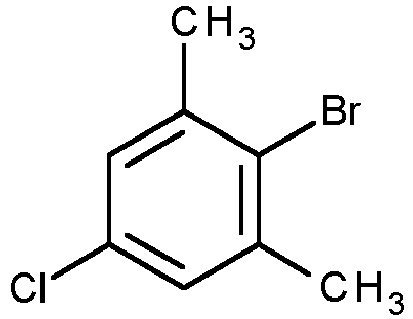
- the compound of Formula (II) is 2-bromo-5-chloro-1,3-dimethyl-benzene.
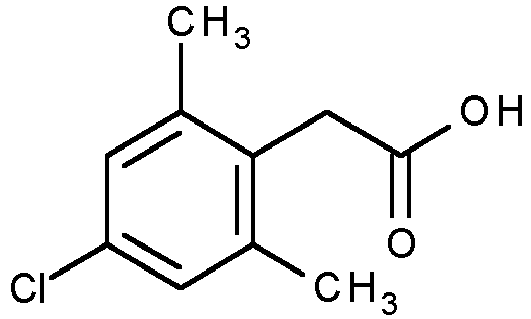
- the compound of Formula (III) used in accordance with present invention is 2-(4-chloro-2,6-dimethyl-phenyl)acetic acid.
- NMP 1-Methyl-2-pyrrolidone
- 137 g 1-Methyl-2-pyrrolidone
- NMP 137 g
- a solution of malononitrile (N ⁇ C-CH 2 -C ⁇ N) (6.6 g, 0.10 mol) in NMP (8.9 g) is added through the dropping funnel over 10 - 15 minutes maintaining the temperature at 10 - 15 °C.
- the reaction mixture is then heated to 100 °C and a vacuum (30 mbar) applied, upon which solvent (40 g) is distilled off.
- 2-Bromo-5-chloro-1,3-dimethyl-benzene (20 g, 0.089 mol) is then added through the dropping funnel over 5 - 10 minutes, whilst maintaining the temperature at 100 - 110 °C.
- a mixture containing palladium (II) chloride (0.19 g, solution in conc. hydrochloric acid, assay 20% Pd, 0.36 mmol), triphenylphosphine (0.45 g, 1.6 mmol) and NMP (18 g) is then added through the dropping funnel over a 5 - 10 minute period. The temperature is allowed to rise to 124 °C and the reaction mixture stirred at this temperature for 2 - 3 hours. Conversion is monitored by pulling samples and subsequent HPLC analysis.
- the resulting mixture is extracted with tert-butyl-methyl ether (2 x 110 g).
- the organic phases are washed with water (2 x 50g) and the combined organic phases evaporated to dryness.
- the resulting solid residue is recrystallized from iso-propanol (63 g) and the resulting crystals filtered, washed with cold iso-propanol (5 g) and dried under vacuum to yield 2-(4-chloro-2,6-dimethyl-phenyl)propanedinitrile (melting point (m.p.) 145 - 147 °C).
- NMP 1-Methyl-2-pyrrolidone
- 682 g 1-Methyl-2-pyrrolidone
- a solution of malononitrile (49.2 g, 0.736 mol) in NMP (65 g) is added via a pump over 15 - 20 minutes while maintaining the temperature at 10 - 14 °C.
- a vacuum (30 mbar) is applied and the resulting mixture is heated to 100 - 110°C until solvent (198 g) is distilled off. The mixture is then heated to 130 °C and a stream of nitrogen (4.5 litres/hour) is passed through.
- reaction mixture is maintained at 130 °C for a further 3 hours.
- a vacuum (20 - 30 mbar) is applied and solvent (603 g) is distilled off.
- solvent (603 g) is distilled off.
- the resulting residue is cooled below 100°C and water (450 g) is added.
- the resulting mixture is cooled to 40°C.
- Hydrochloric acid (180 g, assay 32%,1.58 mol) is added in order to reduce the pH from 13.1 to 2.0.
- Toluene (535 g) is added for extraction of the product.
- the two phase mixture is filtered through hyflo (ca. 15 g) and the filter-cake washed with toluene (45 g).
- the combined filtrates are transferred to a separation funnel, the aqueous phase separated and the organic phase washed with water (400 g). All aqueous phases are re-extracted with toluene (360 g) and all organic phases combined and evaporated to dryness.
- the solid residue is recrystallized with iso-propanol (650 g).
- the resulting crystals are filtered and washed with iso-propanol (55 g) and dried under vacuum to yield 2-(4-chloro-2,6-dimethyl-phenyl)propanedinitrile (m.p. 145 - 147 °C).
- solid sodium hydroxide (3.9 g, 0.10 mol, microprills with 0.5 -1 mm diameter) is charged under an inert atmosphere.
- NMP 1-Methyl-2-pyrrolidone
- NMP 68 g
- a solution of malononitrile (N ⁇ C-CH 2 -C ⁇ N) (2.27 g, 0.034 mol) in NMP (2.7 g) is added through the dropping funnel over 5 minutes maintaining the temperature at 10 - 15 °C.
- the reaction mixture is then heated to 100 °C and a vacuum (30 mbar) applied, upon which solvent (32 g) is distilled off.
- the mixture is then heated to 130 °C and a stream of nitrogen is passed through.
- 2-lodo-5-chloro-1,3-dimethyl-benzene (9.0 g, 95% purity, 0.032 mol) is then added through the dropping funnel over 5 minutes at 130 °C.
- a mixture containing palladium (II) chloride (0.150 g, solution in conc. hydrochloric acid, assay 20% Pd, 0.281 mmol), triphenylphosphine (0.186 g, 0.709 mmol) and NMP (13.7 g) is then added through the dropping funnel over a 2-minute period. The temperature is allowed to rise to 130 °C and the reaction mixture stirred at this temperature for 80 min. Conversion is monitored by pulling samples and subsequent HPLC analysis.
- the mixture is stirred and heated to 120 - 130 °C, and a solution of 2-(4-chloro-2,6-dimethylphenyl)propanedinitrile (assay 92.8%, 91.5 g, 0.415 mol) in toluene (1070 g) dosed in over 2 hours.
- the solvent toluene/water azeotrope
- the resulting reaction mass is heated to 140 °C for an additional 4 hours. Conversion is monitored by sampling and HPLC-analysis.
- reaction mass is cooled to 60 °C and introduced into well-agitated water (900 g).
- 900 g The resulting mixture, a suspension, is cooled to 25 °C and filtered.
- the filter-cake, the desired product is washed with water (2 x 220 g) and dried under vacuum.
- Crude 2-(4-chloro-2,6-dimethyl-phenyl)acetic acid is obtained, which is recrystallized from toluene (608 g) affording pure 2-(4-chloro-2,6-dimethyl-phenyl)acetic acid (m.p. 187 - 189 °C).
Landscapes
- Chemical & Material Sciences (AREA)
- Organic Chemistry (AREA)
- Engineering & Computer Science (AREA)
- Chemical Kinetics & Catalysis (AREA)
- Oil, Petroleum & Natural Gas (AREA)
- Inorganic Chemistry (AREA)
- Materials Engineering (AREA)
- Organic Low-Molecular-Weight Compounds And Preparation Thereof (AREA)
- Low-Molecular Organic Synthesis Reactions Using Catalysts (AREA)
Description
- The present invention relates to a process for the preparation of certain phenyl acetic acid derivatives, to intermediate dinitrile compounds useful in the process for the preparation of certain phenyl acetic acid derivatives, and to a process for the preparation of the intermediate dinitrile compounds.
- Phenyl acetic acid derivatives have been disclosed in
WO 97/002243 WO 2015/007640 as intermediates in the preparation of spiroheterocyclic pyrrolidine diones, which are useful for combating and controlling pests such as insect, acarine, mollusc and nematode pests. Improved processes for the preparation of phenyl acetic acid derivatives, in particular, halogenated (eg, mono- or dichlorinated) phenyl acetic acid derivatives, have subsequently been sought. -
WO 00/78712 WO 2004/050607 disclose the preparation of phenylmalonic acid dinitriles. - According to the present invention, there is provided a process for the preparation of the compound of Formula (III):


- It has been found that the processes according to the invention result in high yielding syntheses of the compounds according to Formulae (I) and (III). Furthermore, the processes according to the invention may provide accelerated reaction rates. Additionally, the processes according to the invention are suitable for the large-scale preparation of compounds according to Formulae (I) and (III).
- Compounds of Formula (III) may find utility in the so-called Ugi multi-component reaction (Ugi-MCR) which is a one-pot condensation of a carboxylic acid (eg, compound according to Formula (III)), another carbonyl-containing moiety, an isocyanide and an amine (eg, an alkylamine such as methyl amine), each of which may be introduced simultaneously or in any sequence to a reaction vessel to form a diamide compound (eg, see
WO 2015/007640 ). Such diamide compounds may be ring-closed to yield a spirone compound (which may be derivatised with the addition of a latentiating group), such as those which are useful for combating and controlling pests such as insect, acarine, mollusc and nematode pests (eg, seeWO 2010/066780 ). - Preferably, the process for the preparation of a compound of Formula (I), comprises steps (i) and (ii), wherein:
- (i) malononitrile is reacted with base to form a malononitrile anion ([NCCHCN]-); and
- (ii) the compound of Formula (II) is reacted with the malononitrile anion of step (i) in the presence of palladium catalyst to form a compound of Formula (I).
- In the compounds of Formula (II), Y is a leaving group. The leaving group may be selected from halogen, RS(O)2O- wherein R is C1-4alkyl, preferably methyl, C1-4haloalkyl, preferably halomethyl or n-C4F9-, aryl, preferably phenyl, or phenyl substituted from one to three times by halogen, methyl or by halomethyl; and mono-, di- and tri-arylmethoxy. The aryl radicals of the mono-, di- and tri-arylmethoxy groups are preferably phenyl radicals, which may be substituted, for example, from one to three times by methyl, the substituents preferably being in the 2-, 4- and/or 6-positions of the phenyl ring. Examples of such leaving groups are methylsulfonyloxy (mesylate), trifluoromethylsulfonyloxy (triflate), p-tolylsulfonyloxy (tosylate), CF3(CF2)3S(O)2O- (nonaflate), diphenylmethoxy, di (methylphenyl)methoxy, triphenylmethoxy (trityl) and tri(methylphenyl)methoxy. Preferably, Y is a halogen, and most preferably bromo.
- The diluents (eg, solvents, suspending agents) suitable for the preparation of a compound of Formula (I) according to the present invention include aliphatic, cycloaliphatic and aromatic hydrocarbons, for example pentane, hexane, petroleum ether, cyclohexane, methylcyclohexane, benzene, toluene or xylenes, aliphatic halohydrocarbons, for example, methylene chloride, chloroform, or di- or tetra-chloroethane, nitriles, for example acetonitrile, propionitrile or benzonitrile, ethers, for example diethyl ether, dibutyl ether, tert-butyl methyl ether, ethylene glycol dimethyl ether, ethylene glycol diethyl ether, diethylene glycol dimethyl ether, tetrahydrofuran or dioxane, alcohols, for example methanol, ethanol, propanol, butanol, ethylene glycol, diethylene glycol, ethylene glycol monomethyl or monoethyl ether or diethylene glycol monomethyl or monoethyl ether, ketones, for example acetone or methyl isobutyl ketone, esters or lactones, for example, ethyl or methyl acetate or valerolactone, N-substituted lactams, for example N-methyl-2-pyrrolidone (NMP or 1-methyl-2-pyrrolidone), amides, for example N,N-dimethylformamide (DMF) or dimethylacetamide (DMA), acyclic ureas, for example N,N'dimethylethyleneurea (DMI), sulfoxides, for example dimethyl sulfoxide (DMSO), or mixtures of such diluents. Water may also be used as a component of a biphasic mixture. Preferably, the process for the preparation of a compound of Formula (I) is carried out in the presence of a dipolar aprotic diluent, such as N,N-dimethylformamide, dimethyl sulfoxide, N-methyl-2-pyrrolidone, N,N-dimethylacetamide, N,N'-dimethylethyleneurea. N-methyl-2-pyrrolidone is most preferred.
- The process for the preparation of compounds of Formula (I) generally proceeds via two steps, firstly involving the generation of a malononitrile anion generated by reacting malononitrile with a base (eg, hydroxide), and, secondly, reaction of the malononitrile anion (in situ) with the compound of Formula (II) to carbon couple the anion to the phenyl ring of the compound of Formula (II), with loss of the leaving group L (eg, bromo). Preferably, the process is performed at a temperature of 50 to 200 °C, more preferably at 80 to 170 °C, and most preferably at 110 to 150 °C. In some embodiments, increased pressure may be applied to the reaction conditions.
- For the preparation of the malononitrile anion, inorganic or organic bases may be used. In particular, alkali metal hydroxides or mixtures of alkali metal hydroxides, alkali metal alkoxides or carbonates (eg, potassium carbonate, sodium carbonate, calcium carbonate, cesium carbonate) may be used. Hydroxides of alkali metals or mixtures of hydroxides of alkali metals are preferred. Sodium and potassium hydroxide (and mixtures thereof) are preferred, and especially sodium hydroxide. Preferably, the base is used from a molar equivalent to an excess of 10 equivalents in relation to malononitrile. More preferably, the base is used in amounts of 2 to 5 equivalents, or 2 to 4 equivalents in relation to malononitrile.
- The process for the preparation of a compound of Formula (I) is carried out in the presence of a palladium catalyst, ie, to catalyse the carbon coupling reaction of the malononitrile anion. The palladium catalysts which may be useful for the carbon coupling anion are generally palladium (II) or palladium (0) complexes, for example palladium (II) dihalides, palladium (II) acetate, palladium (II) sulfate, bis(triphenylphosphine) palladium (II) dichloride, bis-(tricyclopentylphosphine) palladium (II) dichloride, bis(tricyclohexylphosphine) palladium (II) dichloride, bis(dibenzylideneacetone) palladium (0) or tetrakis(triphenylphosphine) palladium (0). Preferably, the palladium catalyst is prepared in situ from palladium (II) or palladium (0) compounds by complexing with phosphine ligands.
- Examples of such ligands, include trimethylphosphine, triethylphosphine, tris(tert-butyl)phosphine, tricyclopentylphosphine, tricyclohexylphosphine (PCy3), tri(methylcyclohexyl)phosphine, methyl(tetramethylene)phosphine, tert-butyl(pentamethylene) phosphine, triphenylphosphine (PPh3), tri(methylphenyl)phosphine, 1,2-diphenylphosphinecyclohexane, 1,2-diphenylphosphinecyclopentane, 2,2'-(diphenylphosphine)-biphenyl, 1,2-bis(diphenylphosphine)ethane, 1,3-bis(diphenylphosphine) propane, 1,4-bis(diphenylphosphine)butane, 3,4-bis(diphenylphosphine)pyrrolidine, 2,2'-(diphenylphosphine)-bisnaphthyl (Binap), 1,1'-bis(diphenylphosphine)-ferrocene, 1,1'-bis (di-tert-butylphosphine) ferrocene, diphenyl ether bisdiphenylphosphine

- The palladium catalyst used in the preparation of a compound of Formula (I) is present in an effective catalytic amount, which may for example be at a molar ratio to the compound of Formula (II) of 1:100 to 1:500, and preferably 1:200 to 1:400.
- The process for the preparation of compounds of Formula (III) relates to the acid hydrolysis of the nitrile groups of the compounds of Formula (I). An inorganic acid may be used. Preferably, the acid is hydrochloric acid or sulphuric acid, and more preferably sulphuric acid. Additionally, preferably, the acid is present in at least two molar equivalents to the compound of Formula (I). More preferably, the acid is present at 2 to 5 molar equivalents, and even more preferably 3 to 4 molar equivalents to the compound of Formula (I).
- The process for the preparation of a compound of Formula (III) is carried out in the presence of water (preferably, at least 4 molar equivalents) and optionally a further diluent. In some embodiments, the acid will be present in aqueous form and the compound of Formula (I) as a solution in a hydrocarbon solvent, such as benzene, toluene, xylene, mesitylene, and preferably, toluene or xylene. The reaction may be carried out in a water/toluene or water/xylene azeotrope under distillation conditions to reduce toluene/xylene and enrich water content in the reaction mixture.
- Preferably, the process for the preparation of a compound according to Formula (III) is performed at a temperature of 100 to 180 °C, more preferably at 110 to 160 °C, and most preferably at 120 to 155 °C. In some embodiments, increased pressure may be applied to the reaction conditions.
- Compounds of Formula (II) may be prepared from methods known in the literature, eg,
WO 2010/102761 andWO 2006/084663 .

Table 1: This table discloses compounds 1.1 to 1.6 according to Formula (I) (not according to the present invention), wherein X, Y and Z are defined in the following table. 
Compound no. X Y Z 1.1 CH3 F CH3 1.2 CH3 Cl CH3 1.3 F CH3 CH3 1.4 Cl CH3 CH3 1.5 F F CH3 1.6 Cl Cl CH3 - The compound of Formula (I) used in accordance with present invention is 2-(4-chloro-2,6-dimethyl-phenyl)propanedinitrile.

- Preferably, the compound of Formula (II) is 2-bromo-5-chloro-1,3-dimethyl-benzene.
- The compound of Formula (III) used in accordance with present invention is 2-(4-chloro-2,6-dimethyl-phenyl)acetic acid.

- The processes of the present invention may be used in the preparation of any of the compounds of Formulae (IV), (VII) or (VIII) according to steps (i) to (v) as follows (and with reference in particular to the disclosure and examples of
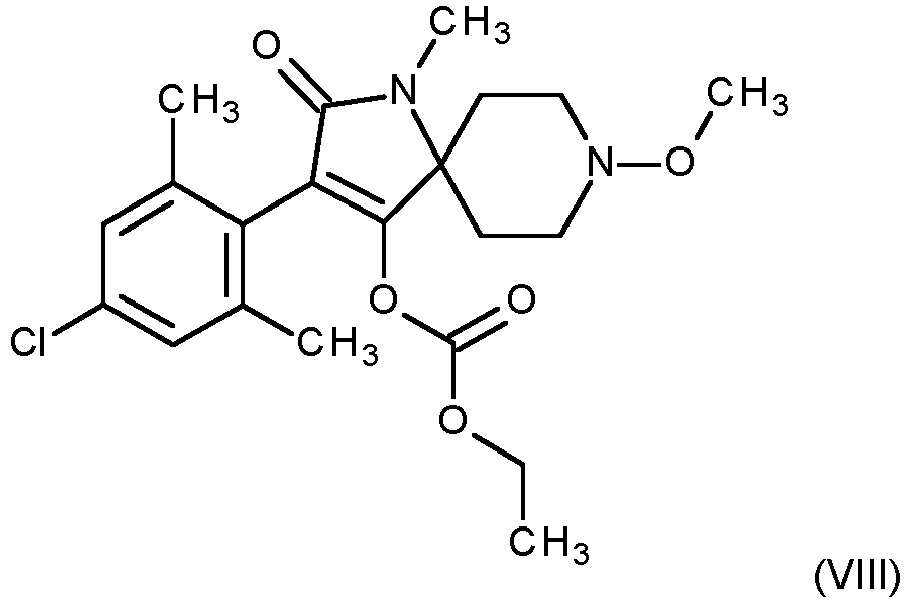
WO 2009/049851 ,WO 2010/066780 andWO 2015/007640 ): - In particular, according to the invention there is also provided a process for the preparation of the compound according to Formula (VIII),

- (i) the preparation of the compound of Formula (I)


- (ii) reacting the compound of Formula (I) with an acid in the presence of water, and optionally a further diluent, to form the compound of Formula (III),

- (iii) the preparation of a compound of Formula (IV)

- comprising reacting the compound of Formula (III) with a compound of Formula (V),

- a compound of Formula (VI)

- CH3-NH2;
- comprising reacting the compound of Formula (III) with a compound of Formula (V),
- (iv) the preparation of the compound of Formula (VII)

- (v) the preparation of the compound of Formula (VIII)
- The Examples which follow serve to illustrate the present invention.
- Compounds of Formula (I) are prepared using malononitrile (N≡C-CH2-C≡N), which is commercially available. Other reagents used in accordance with the preparation examples are also commercially available. 2-Bromo-5-chloro-1,3-dimethyl-benzene and 2-iodo-5-chloro-1,3-dimethylbenzene may be prepared according to literature methods as described in, eg,
WO 2006/084663 . -

- To a 400 mL vessel equipped with a mechanical stirrer, thermometer, distillation head and dropping funnel, solid sodium hydroxide (10.9 g, 0.27 mol, microprills with 0.5 - 1 mm diameter) is charged under an inert atmosphere.
- 1-Methyl-2-pyrrolidone (NMP, 137 g) is added to the vessel in one portion through the dropping funnel and the reaction mixture cooled to 10 - 15 °C while stirring. A solution of malononitrile (N≡C-CH2-C≡N) (6.6 g, 0.10 mol) in NMP (8.9 g) is added through the dropping funnel over 10 - 15 minutes maintaining the temperature at 10 - 15 °C. The reaction mixture is then heated to 100 °C and a vacuum (30 mbar) applied, upon which solvent (40 g) is distilled off.
- 2-Bromo-5-chloro-1,3-dimethyl-benzene (20 g, 0.089 mol) is then added through the dropping funnel over 5 - 10 minutes, whilst maintaining the temperature at 100 - 110 °C. A mixture containing palladium (II) chloride (0.19 g, solution in conc. hydrochloric acid, assay 20% Pd, 0.36 mmol), triphenylphosphine (0.45 g, 1.6 mmol) and NMP (18 g) is then added through the dropping funnel over a 5 - 10 minute period. The temperature is allowed to rise to 124 °C and the reaction mixture stirred at this temperature for 2 - 3 hours. Conversion is monitored by pulling samples and subsequent HPLC analysis.
- When conversion is complete, a vacuum (20 - 40 mbar) is applied and solvent (90 g) is distilled off. The resulting residue is cooled below 100 °C and water (95 g) is added. After cooling to room temperature, the resulting mixture is filtered through hyflo (Hyflo® SuperCel® diatomaceous earth, ca. 10 g) and the filter cake washed with water (20 g). To the combined filtrates, hydrochloric acid (20.6 g, assay 32%, 0.18 mol) is added to adjust the pH from 13.3 to 2.7.
- The resulting mixture is extracted with tert-butyl-methyl ether (2 x 110 g). The organic phases are washed with water (2 x 50g) and the combined organic phases evaporated to dryness. The resulting solid residue is recrystallized from iso-propanol (63 g) and the resulting crystals filtered, washed with cold iso-propanol (5 g) and dried under vacuum to yield 2-(4-chloro-2,6-dimethyl-phenyl)propanedinitrile (melting point (m.p.) 145 - 147 °C).
- 1H-NMR (CDCl3) δ(ppm): 2.6 (s), 6H; 5.3 (s), 1H; 7.2 (s), 2H.
- To a 1 litre vessel equipped with mechanical stirrer, thermometer, distillation head, joints for dosing liquids by pump, and gas inlet tube (below surface) solid sodium hydroxide (87.1 g, 2.18 mol, microprills with 0.5 - 1 mm diameter) is charged under an inert atmosphere.
- 1-Methyl-2-pyrrolidone (NMP, 682 g) is added in one portion while stirring and the resulting mixture cooled to 10 - 14°C. A solution of malononitrile (49.2 g, 0.736 mol) in NMP (65 g) is added via a pump over 15 - 20 minutes while maintaining the temperature at 10 - 14 °C. A vacuum (30 mbar) is applied and the resulting mixture is heated to 100 - 110°C until solvent (198 g) is distilled off. The mixture is then heated to 130 °C and a stream of nitrogen (4.5 litres/hour) is passed through.
- A mixture containing palladium (II) chloride (1.15 g, solution in conc. hydrochloric acid; assay 20% Pd, 2.17 mmol), triphenylphosphine (1.50 g; 5.72 mmol) and NMP (147g) is dosed in via a pump within a 70 minute period. After 20 minutes feeding the aforementioned mixture, 2-bromo-5-chloro-1,3-dimethyl-benzene (160 g, 0.715 mol) is also dosed in in parallel via a pump within 50 minutes.
- After both additions have been completed, the reaction mixture is maintained at 130 °C for a further 3 hours. A vacuum (20 - 30 mbar) is applied and solvent (603 g) is distilled off. The resulting residue is cooled below 100°C and water (450 g) is added. The resulting mixture is cooled to 40°C. Hydrochloric acid (180 g, assay 32%,1.58 mol) is added in order to reduce the pH from 13.1 to 2.0. Toluene (535 g) is added for extraction of the product.
- The two phase mixture is filtered through hyflo (ca. 15 g) and the filter-cake washed with toluene (45 g). The combined filtrates are transferred to a separation funnel, the aqueous phase separated and the organic phase washed with water (400 g). All aqueous phases are re-extracted with toluene (360 g) and all organic phases combined and evaporated to dryness. The solid residue is recrystallized with iso-propanol (650 g). The resulting crystals are filtered and washed with iso-propanol (55 g) and dried under vacuum to yield 2-(4-chloro-2,6-dimethyl-phenyl)propanedinitrile (m.p. 145 - 147 °C).
- To a 250 mL vessel equipped with a mechanical stirrer, thermometer, distillation head and dropping funnel, solid sodium hydroxide (3.9 g, 0.10 mol, microprills with 0.5 -1 mm diameter) is charged under an inert atmosphere.
- 1-Methyl-2-pyrrolidone (NMP, 68 g) is added to the vessel in one portion through the dropping funnel and the reaction mixture cooled to 10 - 15 °C while stirring. A solution of malononitrile (N≡C-CH2-C≡N) (2.27 g, 0.034 mol) in NMP (2.7 g) is added through the dropping funnel over 5 minutes maintaining the temperature at 10 - 15 °C. The reaction mixture is then heated to 100 °C and a vacuum (30 mbar) applied, upon which solvent (32 g) is distilled off. The mixture is then heated to 130 °C and a stream of nitrogen is passed through.
- 2-lodo-5-chloro-1,3-dimethyl-benzene (9.0 g, 95% purity, 0.032 mol) is then added through the dropping funnel over 5 minutes at 130 °C. A mixture containing palladium (II) chloride (0.150 g, solution in conc. hydrochloric acid, assay 20% Pd, 0.281 mmol), triphenylphosphine (0.186 g, 0.709 mmol) and NMP (13.7 g) is then added through the dropping funnel over a 2-minute period. The temperature is allowed to rise to 130 °C and the reaction mixture stirred at this temperature for 80 min. Conversion is monitored by pulling samples and subsequent HPLC analysis. A second portion of a mixture containing palladium (II) chloride (0.103 g, solution in conc. hydrochloric acid, assay 20% Pd, 0.194 mmol), triphenylphosphine (0.132 g, 0.504 mmol) and NMP (9.76 g) is then added through the dropping funnel over a 2-minute period and the reaction mixture stirred at 130 °C for 40 min.
- When conversion is complete, a vacuum (20 - 40 mbar) is applied and solvent (38 g) is distilled off. The resulting residue is cooled to 80 °C and water (30 g) is added. After cooling to room temperature, the resulting mixture is filtered through a filter paper and the filter cake washed with water (10 g). To the combined filtrates, hydrochloric acid (9.6 g, assay 32%, 0.084 mol) is added to adjust the pH from 13.3 to 1.3.
- The resulting mixture is extracted with toluene (50 g). The organic phase is washed with water (2 x 20g) and evaporated to dryness. The resulting solid residue is recrystallized from 1-pentanol (17 g) and the resulting crystals filtered, washed with 1-pentanol (4 g) and dried under vacuum to yield 2-(4-chloro-2,6-dimethyl-phenyl)propanedinitrile (melting point (m.p.) 145 - 147 °C).
-
- To a 500 mL reaction vessel equipped with thermometer, mechanical stirrer, distillation head with water trap and dropping funnel is added water (100 g) and concentrated sulphuric acid (assay 98%, 179g, 1.79 mol).
- The mixture is stirred and heated to 120 - 130 °C, and a solution of 2-(4-chloro-2,6-dimethylphenyl)propanedinitrile (assay 92.8%, 91.5 g, 0.415 mol) in toluene (1070 g) dosed in over 2 hours. The solvent (toluene/water azeotrope) is distilled off, and the water separated in the water trap is transferred back to the reaction mixture. After all of the organic solvent has been distilled off, the resulting reaction mass is heated to 140 °C for an additional 4 hours. Conversion is monitored by sampling and HPLC-analysis.
- After complete conversion, the reaction mass is cooled to 60 °C and introduced into well-agitated water (900 g). The resulting mixture, a suspension, is cooled to 25 °C and filtered. The filter-cake, the desired product, is washed with water (2 x 220 g) and dried under vacuum. Crude 2-(4-chloro-2,6-dimethyl-phenyl)acetic acid is obtained, which is recrystallized from toluene (608 g) affording pure 2-(4-chloro-2,6-dimethyl-phenyl)acetic acid (m.p. 187 - 189 °C).
- 1H-NMR (CDCl3) δ(ppm): 2.2 (s), 6H; 3.6 (s), 2H; 7.0 (s), 2H.
- To a 300 mL reaction vessel equipped with thermometer, mechanical stirrer and reflux condenser is added water (41 g) and concentrated sulphuric acid (assay 98%, 72 g, 0.72 mol). The mixture is stirred and heated to 140 °C.
- Solid 2-(4-chloro-2,6-dimethyl-phenyl)propanedinitrile (assay 98.4%, 50 g, 0.24 mol) is added over a 70 minute period in 10 equal portions while maintaining the temperature at 140 °C. The reaction mixture is stirred at 140 °C for another 2 - 3 hours and conversion is controlled by sampling and HPLC-analysis. When conversion is complete, the resulting mixture, a suspension, is cooled to room temperature. Water (100 g) is added and the suspension is filtered. The filter-cake, the desired product, is washed with water (2 x 50g) and dried under vacuum. Crude 2-(4-chloro-2,6-dimethyl-phenyl)acetic acid is obtained.
Claims (8)
- A process for the preparation of the compound of Formula (III):


- The process according to claim 1, wherein the process for preparing the compound of Formula (I) comprises steps (i) and (ii), wherein:(i) malononitrile is reacted with base to form a malononitrile anion ([NCCHCN]-); and(ii) the compound of Formula (II) is reacted with the malononitrile anion of step (i) in the presence of palladium catalyst to form the compound of Formula (I).
- The process according to claim 1 or claim 2, wherein L is bromo.
- The process according to any one of claims 1 to 3, wherein the base is an alkali metal hydroxide, preferably sodium hydroxide.
- The process according to any one of claims 1 to 4, wherein the palladium catalyst is prepared in situ from palladium (II) or palladium (0) compounds by complexing with phosphine ligands.
- The process according to any one of claims 1 to 5, wherein the process for preparing the compound of Formula (I) is carried out in the presence of a dipolar aprotic solvent, preferably N-methyl-2-pyrrolidone.
- The process according to any one of claims 1 to 6, wherein the process for preparing the compound of Formula (I) is carried out at 110 to 150 °C.
- A process for the preparation of the compound according to Formula (VIII),
 (i) the preparation of the compound of Formula (I)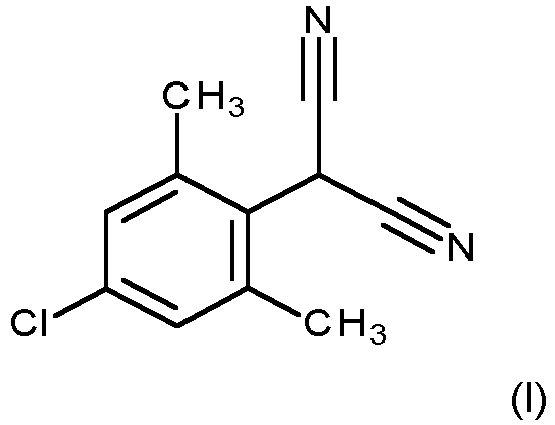
 (ii) reacting the compound of Formula (I) with an acid in the presence of water, and optionally a further diluent, to form the compound of Formula (III),
 (iii) the preparation of a compound of Formula (IV)
comprising reacting the compound of Formula (III) with a compound of Formula (V),

CH3-NH2;(iv) the preparation of the compound of Formula (VII)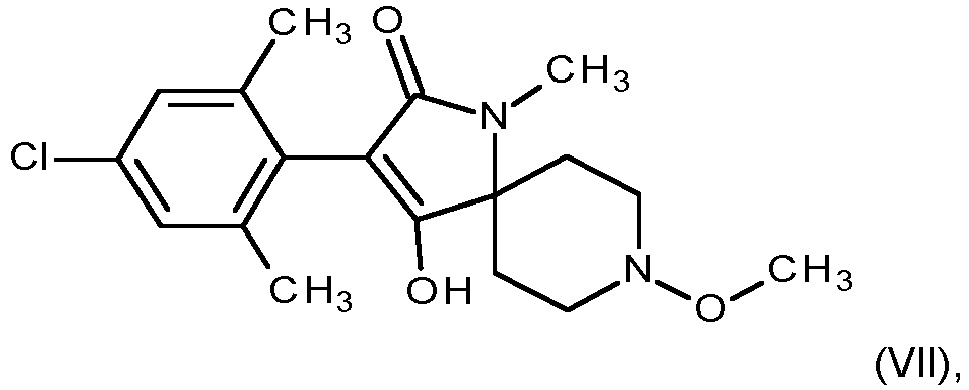 (v) the preparation of the compound of Formula (VIII)
Applications Claiming Priority (2)
| Application Number | Priority Date | Filing Date | Title |
|---|---|---|---|
| EP16180827 | 2016-07-22 | ||
| PCT/EP2017/068345 WO2018015489A1 (en) | 2016-07-22 | 2017-07-20 | Process for the preparation of phenylmalonic acid dinitriles |
Publications (2)
| Publication Number | Publication Date |
|---|---|
| EP3487837A1 EP3487837A1 (en) | 2019-05-29 |
| EP3487837B1 true EP3487837B1 (en) | 2022-08-17 |
Family
ID=56507536
Family Applications (1)
| Application Number | Title | Priority Date | Filing Date |
|---|---|---|---|
| EP17745158.0A Active EP3487837B1 (en) | 2016-07-22 | 2017-07-20 | Process for the preparation of spiroheterocyclic pyrrolidine dione herbicides by means of the intermediate compound 2-(4-chloro-2,6-dimethyl-phenyl)acetic acid |
Country Status (12)
| Country | Link |
|---|---|
| US (3) | US10759742B2 (en) |
| EP (1) | EP3487837B1 (en) |
| JP (1) | JP7046050B2 (en) |
| CN (1) | CN109476588A (en) |
| BR (1) | BR112019000963B1 (en) |
| DK (1) | DK3487837T3 (en) |
| ES (1) | ES2928635T3 (en) |
| HU (1) | HUE060023T2 (en) |
| IL (1) | IL263688B (en) |
| MX (1) | MX2019000753A (en) |
| WO (1) | WO2018015489A1 (en) |
| ZA (1) | ZA201900032B (en) |
Families Citing this family (4)
| Publication number | Priority date | Publication date | Assignee | Title |
|---|---|---|---|---|
| MX2019000753A (en) * | 2016-07-22 | 2019-06-03 | Syngenta Participations Ag | Process for the preparation of phenylmalonic acid dinitriles. |
| WO2018210616A1 (en) | 2017-05-15 | 2018-11-22 | Bayer Cropscience Aktiengesellschaft | Process for producing (4-halogeno-2,6-dialkylphenyl)malononitriles |
| KR102706151B1 (en) | 2018-04-10 | 2024-09-13 | 바이엘 악티엔게젤샤프트 | Method for producing 2,6-dialkylphenylacetic acid |
| CN109096146B (en) * | 2018-09-03 | 2020-11-10 | 杭州中美华东制药有限公司 | Synthesis method of anastrozole key intermediate |
Family Cites Families (12)
| Publication number | Priority date | Publication date | Assignee | Title |
|---|---|---|---|---|
| TR199701740T1 (en) | 1995-06-30 | 1998-04-21 | Bayer Ag. | Dialkyl phenyl halide substituted ketoenols for use as herbicides and pesticides. |
| JP3652986B2 (en) * | 1998-03-13 | 2005-05-25 | シンジェンタ パーティシペーションズ アクチェンゲゼルシャフト | Herbicidally active 3-hydroxy-4-aryl-5-oxopyrazoline derivatives |
| CA2368827A1 (en) | 1999-06-16 | 2000-12-28 | Syngenta Participations Ag | New intermediates |
| US20040092750A1 (en) * | 2001-03-01 | 2004-05-13 | Tomoyuki Hasegawa | 2-methylindole-4-acetic acid, process for producing the same, and process for producing intermediate therefor |
| AR042282A1 (en) | 2002-12-05 | 2005-06-15 | Syngenta Participations Ag | PROCESS FOR THE PREPARATION OF PHENYLMALONIC ACID DINITRILS |
| DE102004053191A1 (en) * | 2004-11-04 | 2006-05-11 | Bayer Cropscience Ag | 2,6-diethyl-4-methyl-phenyl substituted tetramic acid derivatives |
| WO2006084663A1 (en) | 2005-02-09 | 2006-08-17 | Syngenta Participations Ag | Process for the preparation of intermediates |
| GB0720126D0 (en) | 2007-10-15 | 2007-11-28 | Syngenta Participations Ag | Chemical compounds |
| TWI466634B (en) * | 2008-12-12 | 2015-01-01 | Syngenta Participations Ag | Chemical compounds |
| DK2406205T3 (en) | 2009-03-12 | 2017-02-27 | Bayer Ip Gmbh | PROCEDURE FOR MANUFACTURING CHLOR AND BROMAROMATS |
| MX376945B (en) * | 2013-07-19 | 2025-03-04 | Syngenta Participations Ag | NOVEL PROCESS FOR THE PREPARATION OF SPIROHETEROCYCLIC PYRROLIDINE DIONES. |
| MX2019000753A (en) * | 2016-07-22 | 2019-06-03 | Syngenta Participations Ag | Process for the preparation of phenylmalonic acid dinitriles. |
-
2017
- 2017-07-20 MX MX2019000753A patent/MX2019000753A/en unknown
- 2017-07-20 JP JP2019502626A patent/JP7046050B2/en active Active
- 2017-07-20 CN CN201780044592.9A patent/CN109476588A/en active Pending
- 2017-07-20 US US16/319,304 patent/US10759742B2/en active Active
- 2017-07-20 ES ES17745158T patent/ES2928635T3/en active Active
- 2017-07-20 DK DK17745158.0T patent/DK3487837T3/en active
- 2017-07-20 EP EP17745158.0A patent/EP3487837B1/en active Active
- 2017-07-20 HU HUE17745158A patent/HUE060023T2/en unknown
- 2017-07-20 BR BR112019000963-9A patent/BR112019000963B1/en active IP Right Grant
- 2017-07-20 WO PCT/EP2017/068345 patent/WO2018015489A1/en not_active Ceased
-
2018
- 2018-12-13 IL IL263688A patent/IL263688B/en unknown
-
2019
- 2019-01-03 ZA ZA2019/00032A patent/ZA201900032B/en unknown
-
2020
- 2020-05-27 US US16/884,231 patent/US11136289B2/en active Active
-
2021
- 2021-06-03 US US17/337,615 patent/US20210284602A1/en not_active Abandoned
Also Published As
| Publication number | Publication date |
|---|---|
| US20190263752A1 (en) | 2019-08-29 |
| US11136289B2 (en) | 2021-10-05 |
| JP2019521165A (en) | 2019-07-25 |
| US20200283374A1 (en) | 2020-09-10 |
| BR112019000963A2 (en) | 2019-04-30 |
| MX2019000753A (en) | 2019-06-03 |
| JP7046050B2 (en) | 2022-04-01 |
| IL263688A (en) | 2019-03-31 |
| BR112019000963B1 (en) | 2022-07-12 |
| ZA201900032B (en) | 2019-09-25 |
| DK3487837T3 (en) | 2022-10-31 |
| ES2928635T3 (en) | 2022-11-21 |
| US10759742B2 (en) | 2020-09-01 |
| IL263688B (en) | 2022-02-01 |
| US20210284602A1 (en) | 2021-09-16 |
| WO2018015489A1 (en) | 2018-01-25 |
| CN109476588A (en) | 2019-03-15 |
| EP3487837A1 (en) | 2019-05-29 |
| HUE060023T2 (en) | 2023-01-28 |
Similar Documents
| Publication | Publication Date | Title |
|---|---|---|
| US11136289B2 (en) | Process and intermediate | |
| RU2324678C2 (en) | Method of phenylmalonic acid dinitriles production | |
| JP3746801B2 (en) | Alkoxymethylation of pyrrole | |
| CA2368827A1 (en) | New intermediates | |
| JP6067228B2 (en) | Improved process for the preparation of etoroxixib intermediate, 1- (6-methylpyridin-3-yl) -2- [4- (methylsulfonyl) phenyl] ethanone | |
| US10125082B2 (en) | Method for coupling a first compound to a second compound | |
| US20190177265A1 (en) | Method for coupling a first compound to a second compound | |
| TWI585069B (en) | Preparing 2-amino-5-cyano-n,3-dimethylbenzamide | |
| JP5516567B2 (en) | Process for producing 4-amino-2-alkylthio-5-pyrimidinecarbaldehyde | |
| US8030512B2 (en) | Polycyclic pentafluorosulfanylbenzene compound and process for producing the compound | |
| ES2328517T3 (en) | PROCEDURE FOR THE PRODUCTION OF ANILINES. | |
| KR101554539B1 (en) | Development of Method for Amide Bond Formation via Metal-Free Aerobic Oxidative Amination of Aldehydes | |
| JP2001316377A (en) | Production of 2-methyl-4-amino-5-aminomethylpyrimidine | |
| JP2017014131A (en) | Method for producing isobutylaniline | |
| TW201904936A (en) | Process for preparing (4-halo-2,6-dialkylphenyl) malononitriles | |
| US20190077744A1 (en) | Method for coupling a first compound to a second compound | |
| MXPA00003690A (en) | Process for preparing a 1,1,1-trifluoro-2-aminoalkane | |
| MX2008009034A (en) | Process for preparing substituted biphenyls |
Legal Events
| Date | Code | Title | Description |
|---|---|---|---|
| STAA | Information on the status of an ep patent application or granted ep patent |
Free format text: STATUS: UNKNOWN |
|
| STAA | Information on the status of an ep patent application or granted ep patent |
Free format text: STATUS: THE INTERNATIONAL PUBLICATION HAS BEEN MADE |
|
| PUAI | Public reference made under article 153(3) epc to a published international application that has entered the european phase |
Free format text: ORIGINAL CODE: 0009012 |
|
| STAA | Information on the status of an ep patent application or granted ep patent |
Free format text: STATUS: REQUEST FOR EXAMINATION WAS MADE |
|
| 17P | Request for examination filed |
Effective date: 20190222 |
|
| AK | Designated contracting states |
Kind code of ref document: A1 Designated state(s): AL AT BE BG CH CY CZ DE DK EE ES FI FR GB GR HR HU IE IS IT LI LT LU LV MC MK MT NL NO PL PT RO RS SE SI SK SM TR |
|
| AX | Request for extension of the european patent |
Extension state: BA ME |
|
| DAV | Request for validation of the european patent (deleted) | ||
| DAX | Request for extension of the european patent (deleted) | ||
| RAP1 | Party data changed (applicant data changed or rights of an application transferred) |
Owner name: SYNGENTA PARTICIPATIONS AG |
|
| STAA | Information on the status of an ep patent application or granted ep patent |
Free format text: STATUS: EXAMINATION IS IN PROGRESS |
|
| 17Q | First examination report despatched |
Effective date: 20201117 |
|
| REG | Reference to a national code |
Ref country code: DE Ref legal event code: R079 Ref document number: 602017060751 Country of ref document: DE Free format text: PREVIOUS MAIN CLASS: C07C0253300000 Ipc: C07C0255350000 |
|
| GRAP | Despatch of communication of intention to grant a patent |
Free format text: ORIGINAL CODE: EPIDOSNIGR1 |
|
| STAA | Information on the status of an ep patent application or granted ep patent |
Free format text: STATUS: GRANT OF PATENT IS INTENDED |
|
| RIC1 | Information provided on ipc code assigned before grant |
Ipc: C07C 53/134 20060101ALI20220207BHEP Ipc: C07C 51/08 20060101ALI20220207BHEP Ipc: C07C 253/30 20060101ALI20220207BHEP Ipc: C07C 255/35 20060101AFI20220207BHEP |
|
| INTG | Intention to grant announced |
Effective date: 20220302 |
|
| GRAS | Grant fee paid |
Free format text: ORIGINAL CODE: EPIDOSNIGR3 |
|
| GRAA | (expected) grant |
Free format text: ORIGINAL CODE: 0009210 |
|
| STAA | Information on the status of an ep patent application or granted ep patent |
Free format text: STATUS: THE PATENT HAS BEEN GRANTED |
|
| AK | Designated contracting states |
Kind code of ref document: B1 Designated state(s): AL AT BE BG CH CY CZ DE DK EE ES FI FR GB GR HR HU IE IS IT LI LT LU LV MC MK MT NL NO PL PT RO RS SE SI SK SM TR |
|
| REG | Reference to a national code |
Ref country code: CH Ref legal event code: EP |
|
| REG | Reference to a national code |
Ref country code: DE Ref legal event code: R096 Ref document number: 602017060751 Country of ref document: DE |
|
| REG | Reference to a national code |
Ref country code: IE Ref legal event code: FG4D |
|
| REG | Reference to a national code |
Ref country code: AT Ref legal event code: REF Ref document number: 1512094 Country of ref document: AT Kind code of ref document: T Effective date: 20220915 |
|
| REG | Reference to a national code |
Ref country code: DK Ref legal event code: T3 Effective date: 20221027 |
|
| REG | Reference to a national code |
Ref country code: NO Ref legal event code: T2 Effective date: 20220817 |
|
| REG | Reference to a national code |
Ref country code: SE Ref legal event code: TRGR |
|
| REG | Reference to a national code |
Ref country code: NL Ref legal event code: FP |
|
| REG | Reference to a national code |
Ref country code: ES Ref legal event code: FG2A Ref document number: 2928635 Country of ref document: ES Kind code of ref document: T3 Effective date: 20221121 |
|
| REG | Reference to a national code |
Ref country code: LT Ref legal event code: MG9D |
|
| REG | Reference to a national code |
Ref country code: HU Ref legal event code: AG4A Ref document number: E060023 Country of ref document: HU |
|
| PG25 | Lapsed in a contracting state [announced via postgrant information from national office to epo] |
Ref country code: RS Free format text: LAPSE BECAUSE OF FAILURE TO SUBMIT A TRANSLATION OF THE DESCRIPTION OR TO PAY THE FEE WITHIN THE PRESCRIBED TIME-LIMIT Effective date: 20220817 Ref country code: PT Free format text: LAPSE BECAUSE OF FAILURE TO SUBMIT A TRANSLATION OF THE DESCRIPTION OR TO PAY THE FEE WITHIN THE PRESCRIBED TIME-LIMIT Effective date: 20221219 Ref country code: LV Free format text: LAPSE BECAUSE OF FAILURE TO SUBMIT A TRANSLATION OF THE DESCRIPTION OR TO PAY THE FEE WITHIN THE PRESCRIBED TIME-LIMIT Effective date: 20220817 Ref country code: LT Free format text: LAPSE BECAUSE OF FAILURE TO SUBMIT A TRANSLATION OF THE DESCRIPTION OR TO PAY THE FEE WITHIN THE PRESCRIBED TIME-LIMIT Effective date: 20220817 |
|
| PG25 | Lapsed in a contracting state [announced via postgrant information from national office to epo] |
Ref country code: PL Free format text: LAPSE BECAUSE OF FAILURE TO SUBMIT A TRANSLATION OF THE DESCRIPTION OR TO PAY THE FEE WITHIN THE PRESCRIBED TIME-LIMIT Effective date: 20220817 Ref country code: IS Free format text: LAPSE BECAUSE OF FAILURE TO SUBMIT A TRANSLATION OF THE DESCRIPTION OR TO PAY THE FEE WITHIN THE PRESCRIBED TIME-LIMIT Effective date: 20221217 Ref country code: HR Free format text: LAPSE BECAUSE OF FAILURE TO SUBMIT A TRANSLATION OF THE DESCRIPTION OR TO PAY THE FEE WITHIN THE PRESCRIBED TIME-LIMIT Effective date: 20220817 Ref country code: GR Free format text: LAPSE BECAUSE OF FAILURE TO SUBMIT A TRANSLATION OF THE DESCRIPTION OR TO PAY THE FEE WITHIN THE PRESCRIBED TIME-LIMIT Effective date: 20221118 |
|
| REG | Reference to a national code |
Ref country code: GB Ref legal event code: 732E Free format text: REGISTERED BETWEEN 20230202 AND 20230208 |
|
| PG25 | Lapsed in a contracting state [announced via postgrant information from national office to epo] |
Ref country code: SM Free format text: LAPSE BECAUSE OF FAILURE TO SUBMIT A TRANSLATION OF THE DESCRIPTION OR TO PAY THE FEE WITHIN THE PRESCRIBED TIME-LIMIT Effective date: 20220817 Ref country code: RO Free format text: LAPSE BECAUSE OF FAILURE TO SUBMIT A TRANSLATION OF THE DESCRIPTION OR TO PAY THE FEE WITHIN THE PRESCRIBED TIME-LIMIT Effective date: 20220817 |
|
| REG | Reference to a national code |
Ref country code: DE Ref legal event code: R097 Ref document number: 602017060751 Country of ref document: DE |
|
| PG25 | Lapsed in a contracting state [announced via postgrant information from national office to epo] |
Ref country code: SK Free format text: LAPSE BECAUSE OF FAILURE TO SUBMIT A TRANSLATION OF THE DESCRIPTION OR TO PAY THE FEE WITHIN THE PRESCRIBED TIME-LIMIT Effective date: 20220817 Ref country code: EE Free format text: LAPSE BECAUSE OF FAILURE TO SUBMIT A TRANSLATION OF THE DESCRIPTION OR TO PAY THE FEE WITHIN THE PRESCRIBED TIME-LIMIT Effective date: 20220817 |
|
| PLBE | No opposition filed within time limit |
Free format text: ORIGINAL CODE: 0009261 |
|
| STAA | Information on the status of an ep patent application or granted ep patent |
Free format text: STATUS: NO OPPOSITION FILED WITHIN TIME LIMIT |
|
| PG25 | Lapsed in a contracting state [announced via postgrant information from national office to epo] |
Ref country code: AL Free format text: LAPSE BECAUSE OF FAILURE TO SUBMIT A TRANSLATION OF THE DESCRIPTION OR TO PAY THE FEE WITHIN THE PRESCRIBED TIME-LIMIT Effective date: 20220817 |
|
| 26N | No opposition filed |
Effective date: 20230519 |
|
| PG25 | Lapsed in a contracting state [announced via postgrant information from national office to epo] |
Ref country code: SI Free format text: LAPSE BECAUSE OF FAILURE TO SUBMIT A TRANSLATION OF THE DESCRIPTION OR TO PAY THE FEE WITHIN THE PRESCRIBED TIME-LIMIT Effective date: 20220817 |
|
| PG25 | Lapsed in a contracting state [announced via postgrant information from national office to epo] |
Ref country code: MC Free format text: LAPSE BECAUSE OF FAILURE TO SUBMIT A TRANSLATION OF THE DESCRIPTION OR TO PAY THE FEE WITHIN THE PRESCRIBED TIME-LIMIT Effective date: 20220817 |
|
| PG25 | Lapsed in a contracting state [announced via postgrant information from national office to epo] |
Ref country code: MC Free format text: LAPSE BECAUSE OF FAILURE TO SUBMIT A TRANSLATION OF THE DESCRIPTION OR TO PAY THE FEE WITHIN THE PRESCRIBED TIME-LIMIT Effective date: 20220817 |
|
| PG25 | Lapsed in a contracting state [announced via postgrant information from national office to epo] |
Ref country code: LU Free format text: LAPSE BECAUSE OF NON-PAYMENT OF DUE FEES Effective date: 20230720 |
|
| PG25 | Lapsed in a contracting state [announced via postgrant information from national office to epo] |
Ref country code: LU Free format text: LAPSE BECAUSE OF NON-PAYMENT OF DUE FEES Effective date: 20230720 |
|
| REG | Reference to a national code |
Ref country code: IE Ref legal event code: MM4A |
|
| PG25 | Lapsed in a contracting state [announced via postgrant information from national office to epo] |
Ref country code: IE Free format text: LAPSE BECAUSE OF NON-PAYMENT OF DUE FEES Effective date: 20230720 |
|
| PG25 | Lapsed in a contracting state [announced via postgrant information from national office to epo] |
Ref country code: IE Free format text: LAPSE BECAUSE OF NON-PAYMENT OF DUE FEES Effective date: 20230720 |
|
| PG25 | Lapsed in a contracting state [announced via postgrant information from national office to epo] |
Ref country code: BG Free format text: LAPSE BECAUSE OF FAILURE TO SUBMIT A TRANSLATION OF THE DESCRIPTION OR TO PAY THE FEE WITHIN THE PRESCRIBED TIME-LIMIT Effective date: 20220817 |
|
| PG25 | Lapsed in a contracting state [announced via postgrant information from national office to epo] |
Ref country code: BG Free format text: LAPSE BECAUSE OF FAILURE TO SUBMIT A TRANSLATION OF THE DESCRIPTION OR TO PAY THE FEE WITHIN THE PRESCRIBED TIME-LIMIT Effective date: 20220817 |
|
| PG25 | Lapsed in a contracting state [announced via postgrant information from national office to epo] |
Ref country code: CY Free format text: LAPSE BECAUSE OF FAILURE TO SUBMIT A TRANSLATION OF THE DESCRIPTION OR TO PAY THE FEE WITHIN THE PRESCRIBED TIME-LIMIT; INVALID AB INITIO Effective date: 20170720 |
|
| PGFP | Annual fee paid to national office [announced via postgrant information from national office to epo] |
Ref country code: HU Payment date: 20250709 Year of fee payment: 9 |
|
| PGFP | Annual fee paid to national office [announced via postgrant information from national office to epo] |
Ref country code: NL Payment date: 20250724 Year of fee payment: 9 |
|
| PGFP | Annual fee paid to national office [announced via postgrant information from national office to epo] |
Ref country code: FI Payment date: 20250724 Year of fee payment: 9 Ref country code: ES Payment date: 20250811 Year of fee payment: 9 |
|
| PGFP | Annual fee paid to national office [announced via postgrant information from national office to epo] |
Ref country code: DE Payment date: 20250728 Year of fee payment: 9 Ref country code: DK Payment date: 20250725 Year of fee payment: 9 |
|
| PGFP | Annual fee paid to national office [announced via postgrant information from national office to epo] |
Ref country code: NO Payment date: 20250718 Year of fee payment: 9 |
|
| PGFP | Annual fee paid to national office [announced via postgrant information from national office to epo] |
Ref country code: TR Payment date: 20250701 Year of fee payment: 9 Ref country code: IT Payment date: 20250721 Year of fee payment: 9 |
|
| PGFP | Annual fee paid to national office [announced via postgrant information from national office to epo] |
Ref country code: GB Payment date: 20250722 Year of fee payment: 9 Ref country code: BE Payment date: 20250724 Year of fee payment: 9 |
|
| PGFP | Annual fee paid to national office [announced via postgrant information from national office to epo] |
Ref country code: FR Payment date: 20250725 Year of fee payment: 9 Ref country code: AT Payment date: 20250718 Year of fee payment: 9 |
|
| PGFP | Annual fee paid to national office [announced via postgrant information from national office to epo] |
Ref country code: CH Payment date: 20250801 Year of fee payment: 9 Ref country code: SE Payment date: 20250725 Year of fee payment: 9 |
|
| PGFP | Annual fee paid to national office [announced via postgrant information from national office to epo] |
Ref country code: CZ Payment date: 20250707 Year of fee payment: 9 |
|
| REG | Reference to a national code |
Ref country code: AT Ref legal event code: PC Ref document number: 1512094 Country of ref document: AT Kind code of ref document: T Owner name: SYNGENTA CROP PROTECTION AG, CH Effective date: 20260114 |
|
| REG | Reference to a national code |
Ref country code: DE Ref legal event code: R081 Ref document number: 602017060751 Country of ref document: DE Owner name: SYNGENTA CROP PROTECTION AG, CH Free format text: FORMER OWNER: SYNGENTA PARTICIPATIONS AG, BASEL, CH |
|
| REG | Reference to a national code |
Ref country code: NL Ref legal event code: PD Owner name: SYNGENTA CROP PROTECTION AG; CH Free format text: DETAILS ASSIGNMENT: CHANGE OF OWNER(S), MERGE; FORMER OWNER NAME: SYNGENTA PARTICIPATIONS AG Effective date: 20260206 |
|
| REG | Reference to a national code |
Ref country code: CH Ref legal event code: R14 Free format text: ST27 STATUS EVENT CODE: U-0-0-R10-R14 (AS PROVIDED BY THE NATIONAL OFFICE) Effective date: 20260323 |
|
| REG | Reference to a national code |
Ref country code: FI Ref legal event code: PCE Owner name: SYNGENTA CROP PROTECTION AG |