EP3487261A1 - Controlling power to a heated surface - Google Patents
Controlling power to a heated surface Download PDFInfo
- Publication number
- EP3487261A1 EP3487261A1 EP18205736.4A EP18205736A EP3487261A1 EP 3487261 A1 EP3487261 A1 EP 3487261A1 EP 18205736 A EP18205736 A EP 18205736A EP 3487261 A1 EP3487261 A1 EP 3487261A1
- Authority
- EP
- European Patent Office
- Prior art keywords
- power
- heater
- vehicle
- aircraft
- response
- Prior art date
- Legal status (The legal status is an assumption and is not a legal conclusion. Google has not performed a legal analysis and makes no representation as to the accuracy of the status listed.)
- Granted
Links
Images


Classifications
-
- H—ELECTRICITY
- H05—ELECTRIC TECHNIQUES NOT OTHERWISE PROVIDED FOR
- H05B—ELECTRIC HEATING; ELECTRIC LIGHT SOURCES NOT OTHERWISE PROVIDED FOR; CIRCUIT ARRANGEMENTS FOR ELECTRIC LIGHT SOURCES, IN GENERAL
- H05B1/00—Details of electric heating devices
- H05B1/02—Automatic switching arrangements specially adapted to apparatus ; Control of heating devices
- H05B1/0227—Applications
- H05B1/023—Industrial applications
- H05B1/0236—Industrial applications for vehicles
-
- B—PERFORMING OPERATIONS; TRANSPORTING
- B60—VEHICLES IN GENERAL
- B60S—SERVICING, CLEANING, REPAIRING, SUPPORTING, LIFTING, OR MANOEUVRING OF VEHICLES, NOT OTHERWISE PROVIDED FOR
- B60S1/00—Cleaning of vehicles
- B60S1/02—Cleaning windscreens, windows or optical devices
- B60S1/023—Cleaning windscreens, windows or optical devices including defroster or demisting means
- B60S1/026—Cleaning windscreens, windows or optical devices including defroster or demisting means using electrical means
-
- B—PERFORMING OPERATIONS; TRANSPORTING
- B64—AIRCRAFT; AVIATION; COSMONAUTICS
- B64D—EQUIPMENT FOR FITTING IN OR TO AIRCRAFT; FLIGHT SUITS; PARACHUTES; ARRANGEMENT OR MOUNTING OF POWER PLANTS OR PROPULSION TRANSMISSIONS IN AIRCRAFT
- B64D15/00—De-icing or preventing icing on exterior surfaces of aircraft
- B64D15/20—Means for detecting icing or initiating de-icing
-
- H—ELECTRICITY
- H05—ELECTRIC TECHNIQUES NOT OTHERWISE PROVIDED FOR
- H05B—ELECTRIC HEATING; ELECTRIC LIGHT SOURCES NOT OTHERWISE PROVIDED FOR; CIRCUIT ARRANGEMENTS FOR ELECTRIC LIGHT SOURCES, IN GENERAL
- H05B1/00—Details of electric heating devices
- H05B1/02—Automatic switching arrangements specially adapted to apparatus ; Control of heating devices
- H05B1/0227—Applications
- H05B1/023—Industrial applications
-
- H—ELECTRICITY
- H05—ELECTRIC TECHNIQUES NOT OTHERWISE PROVIDED FOR
- H05B—ELECTRIC HEATING; ELECTRIC LIGHT SOURCES NOT OTHERWISE PROVIDED FOR; CIRCUIT ARRANGEMENTS FOR ELECTRIC LIGHT SOURCES, IN GENERAL
- H05B3/00—Ohmic-resistance heating
- H05B3/84—Heating arrangements specially adapted for transparent or reflecting areas, e.g. for demisting or de-icing windows, mirrors or vehicle windshields
-
- H—ELECTRICITY
- H05—ELECTRIC TECHNIQUES NOT OTHERWISE PROVIDED FOR
- H05B—ELECTRIC HEATING; ELECTRIC LIGHT SOURCES NOT OTHERWISE PROVIDED FOR; CIRCUIT ARRANGEMENTS FOR ELECTRIC LIGHT SOURCES, IN GENERAL
- H05B2203/00—Aspects relating to Ohmic resistive heating covered by group H05B3/00
- H05B2203/035—Electrical circuits used in resistive heating apparatus
Definitions
- a typical windscreen installed on an aircraft uses an embedded heater to keep the windscreen free of ice and fog.
- Aircraft windscreens use an embedded temperature sensor to monitor the temperature of the windscreen and provide feedback to a heater controller as part of a closed loop system.
- the temperature sensor(s) of an aircraft windscreen is damaged or otherwise compromised, the whole windscreen typically must be replaced to maintain an adequately functioning windscreen heating system.
- a surface heating system of an external surface of a vehicle system comprises a heater and a heater controller.
- the heater is configured to provide heat to the external surface.
- the heater controller is configured to control a heater power of the heater based upon an air temperature of air external to the vehicle, a liquid water content of the air, and a speed of the vehicle.
- a method comprises receiving data, using one or more communication devices, corresponding to an external air temperature of a vehicle, a liquid water content of air, and a speed of the vehicle; determining, in response to receiving the data, a power to maintain a temperature of a surface of the vehicle based upon the received data using one or more processors; adjusting, in response to determining the power, a heater power based upon the determined power using a power supply.
- Apparatus, systems, and associated methods relate to heating an exterior surface of a vehicle.
- Using the apparatus, systems, and associated methods herein, allows for the control of an exterior surface heater without an embedded temperature sensor.
- the heater is controlled based upon parameters including one or more of an external air temperature, a liquid water content of the external air, and a speed of the vehicle. In this way, there is no embedded temperature sensor to get damaged or fail and require the exterior surface to need replacing.
- FIG. 1 is a block diagram of exterior surface heater control system 10 including heater controller 12, device(s) 14, and heater 16.
- Heater controller 12 includes processor(s) 18, power supply 20, communication device(s) 22, and memory 24.
- Device(s) 14 is configured to aggregate and transmit sensed parameters to heater controller 12.
- Device(s) 14 can include aircraft condition monitoring systems, a sensor network, a vehicle monitoring and control unit, or other computing system.
- Device(s) 14 can communicate using a network interface card, such as an Ethernet card, an optical transceiver, a radio frequency transceiver, or any other type of device that can send and receive information.
- network interfaces can include Bluetooth, 3G, 4G, and WiFi radio computing devices, as well as Universal Serial Bus (USB).
- Heater 16 is configured to heat an exterior surface of a vehicle. Heater 16 can be embedded in the surface or in contact with the surface. Heater 16 is configured to receive heater power from heater controller 12. Heater controller 12 is configured to control the heater power of heater 16 based upon sensed parameters. The sensed parameters can include, for example, an air temperature, a liquid water content of the air, and a speed of the vehicle. Heater controller 12 is configured to adjust the heater power inversely with the air temperature. As the air temperature increases, heater controller 12 is configured to decrease the heater power. As the air temperature decreases, heater controller 12 is configured to increase the heater power. Heater controller 12 is configured to adjust the heater power proportionally to the liquid water content. As the liquid water content increases, heater controller 12 is configured to increase the heater power.
- heater controller 12 is configured to decrease the heater power. Heater controller 12 is configured to adjust the heater power proportionally with the speed of the vehicle.
- the vehicle is an aircraft and heater controller 12 is further configured to control the heater power based upon an altitude of the aircraft. Heater controller 12 is configured to adjust the heater power proportionally with the altitude of the aircraft.
- the exterior surface is a windscreen of the aircraft.
- Heater controller 12 includes communication device(s) 22 to communicate with external device(s) 14 via one or more wired or wireless networks, or both.
- Communication device(s) 22 can include a network interface card, such as an Ethernet card, an optical transceiver, a radio frequency transceiver, or any other type of device that can send and receive information.
- network interfaces can include Bluetooth, 3G, 4G, and WiFi radio computing devices, as well as Universal Serial Bus (USB).
- communication device(s) 22 are configured to receive data corresponding to sensed parameters of vehicle sensors from device(s) 14. Data received by communication device(s) 22 includes the air temperature, the liquid water content of the air, the speed of the vehicle, and the altitude of the vehicle.
- Processor(s) 18, in one example, are configured to implement functionality and/or process instructions for execution within heater controller 12.
- processor(s) 18 can be capable of processing instructions stored in memory of processor(s) 18.
- Examples of processor(s) 18 can include any one or more of a microprocessor, a controller, a digital signal processor (DSP), an application specific integrated circuit (ASIC), a field-programmable gate array (FPGA), or other equivalent discrete or integrated logic circuitry.
- processor(s) 18 are configured to receive data corresponding to the sensed one or more parameters and translate the data for transmission by communication device(s) 22.
- processor(s) 18 are configured to determine a power to maintain a temperature of an exterior surface based upon parameters such as the air temperature, the liquid water content of the air, and the speed of the vehicle. Processors(s) 18 are further configured to control power supply 20 to adjust the heater power supplied to heater 16 based upon the determined power.
- Computer-readable memory 24 can be configured to store information within heater controller 12 during operation.
- Computer-readable memory 24, in some examples, is described as a computer-readable storage medium.
- a computer-readable storage medium can include a non-transitory medium.
- the term "non-transitory" can indicate that the storage medium is not embodied in a carrier wave or a propagated signal.
- a non-transitory storage medium can store data that can, over time, change (e.g., in RAM or cache).
- computer-readable memory 24 is a temporary memory, meaning that a primary purpose of computer-readable memory 24 is not long-term storage.
- Computer-readable memory 24, in some examples, is described as a volatile memory, meaning that computer-readable memory 24 does not maintain stored contents when power to heater controller 12 is removed. Examples of volatile memories can include random access memories (RAM), dynamic random access memories (DRAM), static random access memories (SRAM), and other forms of volatile memories.
- computer-readable memory 24 is used to store program instructions for execution by processor(s) 18.
- Computer-readable memory 24, in certain examples, is used by processing applications running on heater controller 12 to temporarily store information during program execution, such as controlling the heater power supplied to heater 16, determining the power needed to maintain a temperature of the exterior surface, and/or transmitting and receiving data using communication device(s) 22.
- Computer-readable memory 24 can be configured to store larger amounts of information than volatile memory. Computer-readable memory 24 can further be configured for long-term storage of information.
- computer-readable memory 24 include non-volatile storage elements. Examples of non-volatile storage elements can include magnetic hard discs, optical discs, floppy discs, flash memories, or forms of electrically programmable memories (EPROM) or electrically erasable and programmable (EEPROM) memories.
- EPROM electrically programmable memories
- EEPROM electrically erasable and programmable
- computer-readable memory 24 is configured to store data including a look up table of parameters or surface area of the exterior surface.
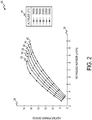
- FIG. 2 is graph 26 depicting the power per square inch needed to maintain a temperature of an exterior surface using an exterior surface heater control system as a function of the mass flow of the exterior surface.
- Graph 26 includes y-axis 28; x-axis 30; curves 32, 34, 36, 38, 40, and 42; and legend 44.
- Y-axis 28 represents the power needed to maintain a temperature of an exterior surface in watts per square inch.
- X-axis 30 represents the Reynolds number, which is dimensionless, at the exterior surface.
- mass flow or any other parameter that correlates with forced convection could be used.
- Curves 32, 34, 36, 38, 40, and 42 depict the power to maintain the temperature as a function of mass flow at altitudes of 14,000; 16,000; 18,000; 20,000; 22,000; and 24,000 feet respectively as shown in legend 44.
- Q is the power needed to maintain the wall temperature, Tw.
- the convection coefficient, h is primarily a function of the Reynolds number, or the mass flow. That is, h increases with increasing mass flow. It is relatively straight-forward to determine the value of h from computational fluid dynamics analysis or based on wind tunnel data. Therefore, based on air data parameters, it is possible to provide a good estimate of the heater power required for a given surface area, A, to maintain the desired Tw in dry air. The last two terms in the equation account for liquid in the air, such as in a cloud or fog.
- the aircraft velocity, V and the static temperature, Ts can be determined from aircraft air data, while the collection efficiency can be determined from computational fluid dynamics analysis.
- a droplet size measurement may improve the estimate of required heater power if collection efficiency changes significantly with droplet size.
- a measurement of Liquid Water Content (LWC) is used to estimate the required heater power to maintain a given wall temperature in cloud.
- mevap is the evaporated mass flux of water and is primarily a function of Tw, Ts and the aircraft altitude.
- the latent heat of vaporization, Lv can be considered to be constant or known. It is possible to add additional terms to Equation 1 to account for other physics. An example would be including the heat transfer from water run-back if the entire wall is not maintained at a uniform temperature or including transient thermal effects.
- FIG. 3 is a flow diagram depicting process 46 for maintaining a temperature of an exterior surface of a vehicle. For purposes of clarity and ease of discussion, the example operations are described below within the context of exterior surface heater control system 10 of FIG. 1 .
- step 48 data corresponding to an external air temperature of the vehicle, liquid water content of the air, and a speed of the vehicle is received using one or more communication device(s) 22.
- the data received from one or more device(s) 14 includes an exterior air temperature, a liquid water content of the air, and a speed of the vehicle. In one example, the data further includes an altitude of the vehicle.
- a power to maintain the temperature of the exterior surface is determined, in response to receiving the data, using one or more processors 18 based upon the received data. Determining the power includes the power being inversely related to the air temperature, positively related to the liquid water content, and positively related to the speed of the vehicle. In one example, determining the power includes the power being positively related to the altitude of the vehicle. In a further example, the determining the power includes the power being positively related to a surface area of the exterior surface.
- a heater power is adjusted, in response to determining the power, based upon the determined power using power supply 20.
- an exterior surface heater can be controlled without a temperature sensor.
- a surface can be heated in a controlled manner without embedded temperature sensors which add a point of failure for the surface. This lowers the likelihood of the surface failing and needing to be replaced.
- a surface heating system of an external surface of a vehicle can comprise a heater configured to provide heat to the external surface; a heater controller configured to control a heater power of the heater based upon an air temperature of air external to the vehicle, a liquid water content of the air, and a speed of the vehicle.
- the surface heating system of the preceding paragraph can optionally include, additionally and/or alternatively, any one or more of the following features, configurations and/or additional components:
- the heater controller can be configured to increase the heater power in response to the air temperature decreasing; and the heater controller can be configured to decrease the heater power in response to the air temperature increasing.
- the heater controller can be configured to increase the heater power in response to the liquid water content of the air increasing; and the heater controller can be configured to decrease the heater power in response to the liquid water content of the air decreasing.
- the heater controller can be configured to increase the heater power in response to the speed of the vehicle increasing; and the heater controller can be configured to decrease the heater power in response to the speed of the vehicle decreasing.
- the heater controller can be further configured to control the heater power based upon an altitude of the aircraft.
- the surface of the vehicle can be a windscreen of the aircraft.
- the heater controller can be configured to increase the heater power in response to the altitude of the aircraft increasing; and the heater controller can be configured to decrease the heater power in response to the altitude of the aircraft decreasing.
- the heater controller can be further configured to receive the air temperature, the liquid water content, and the speed of the vehicle from a condition monitoring system of the aircraft.
- the heater controller can be further configured to control the heater power based upon a surface area of the external surface.
- a method comprising: receiving data, using one or more communication devices, corresponding to an external air temperature of a vehicle, a liquid water content of air, and a speed of the vehicle; determining, in response to receiving the data, a power to maintain a temperature of a surface of the vehicle based upon the received data using one or more processors; adjusting, in response to determining the power, a heater power based upon the determined power using a power supply.
- Determining the power includes the power being inversely related to the external air temperature.
- Determining the power includes the power being positively related to the liquid water content of the air.
- the determining the power includes the power being positively related to the speed of the vehicle.
- the vehicle can be an aircraft.
- Receiving data further includes receiving data corresponding to an altitude of the aircraft.
- the surface of the vehicle can be a windscreen of the aircraft.
- Determining the power can be further based upon the altitude of the aircraft.
- Determining the power includes the power being positively related to the altitude of the vehicle.
- Determining the power can be further based upon a surface area of the external surface.
Landscapes
- Engineering & Computer Science (AREA)
- Aviation & Aerospace Engineering (AREA)
- Mechanical Engineering (AREA)
- Air-Conditioning For Vehicles (AREA)
Abstract
Description
- A typical windscreen installed on an aircraft uses an embedded heater to keep the windscreen free of ice and fog. Aircraft windscreens use an embedded temperature sensor to monitor the temperature of the windscreen and provide feedback to a heater controller as part of a closed loop system. When the temperature sensor(s) of an aircraft windscreen is damaged or otherwise compromised, the whole windscreen typically must be replaced to maintain an adequately functioning windscreen heating system.
- In one example, a surface heating system of an external surface of a vehicle system comprises a heater and a heater controller. The heater is configured to provide heat to the external surface. The heater controller is configured to control a heater power of the heater based upon an air temperature of air external to the vehicle, a liquid water content of the air, and a speed of the vehicle.
- In one example, a method comprises receiving data, using one or more communication devices, corresponding to an external air temperature of a vehicle, a liquid water content of air, and a speed of the vehicle; determining, in response to receiving the data, a power to maintain a temperature of a surface of the vehicle based upon the received data using one or more processors; adjusting, in response to determining the power, a heater power based upon the determined power using a power supply.
-
-
FIG. 1 is a block diagram of an exterior surface heater control system. -
FIG. 2 is a graph depicting the power per square inch needed to maintain a temperature of an exterior surface using an exterior surface heater control system as a function of the mass flow of the exterior surface. -
FIG. 3 is a flow diagram depicting a process for maintaining the temperature of an exterior surface using a heater controller of an exterior surface heater control system. - Apparatus, systems, and associated methods relate to heating an exterior surface of a vehicle. Using the apparatus, systems, and associated methods herein, allows for the control of an exterior surface heater without an embedded temperature sensor. The heater is controlled based upon parameters including one or more of an external air temperature, a liquid water content of the external air, and a speed of the vehicle. In this way, there is no embedded temperature sensor to get damaged or fail and require the exterior surface to need replacing.
-
FIG. 1 is a block diagram of exterior surfaceheater control system 10 includingheater controller 12, device(s) 14, andheater 16.Heater controller 12 includes processor(s) 18,power supply 20, communication device(s) 22, andmemory 24. - Device(s) 14 is configured to aggregate and transmit sensed parameters to
heater controller 12. Device(s) 14 can include aircraft condition monitoring systems, a sensor network, a vehicle monitoring and control unit, or other computing system. Device(s) 14 can communicate using a network interface card, such as an Ethernet card, an optical transceiver, a radio frequency transceiver, or any other type of device that can send and receive information. Other examples of such network interfaces can include Bluetooth, 3G, 4G, and WiFi radio computing devices, as well as Universal Serial Bus (USB). -
Heater 16 is configured to heat an exterior surface of a vehicle.Heater 16 can be embedded in the surface or in contact with the surface.Heater 16 is configured to receive heater power fromheater controller 12.Heater controller 12 is configured to control the heater power ofheater 16 based upon sensed parameters. The sensed parameters can include, for example, an air temperature, a liquid water content of the air, and a speed of the vehicle.Heater controller 12 is configured to adjust the heater power inversely with the air temperature. As the air temperature increases,heater controller 12 is configured to decrease the heater power. As the air temperature decreases,heater controller 12 is configured to increase the heater power.Heater controller 12 is configured to adjust the heater power proportionally to the liquid water content. As the liquid water content increases,heater controller 12 is configured to increase the heater power. As the liquid water content decreases,heater controller 12 is configured to decrease the heater power.Heater controller 12 is configured to adjust the heater power proportionally with the speed of the vehicle. In one example, the vehicle is an aircraft andheater controller 12 is further configured to control the heater power based upon an altitude of the aircraft.Heater controller 12 is configured to adjust the heater power proportionally with the altitude of the aircraft. In a further example the exterior surface is a windscreen of the aircraft. -
Heater controller 12 includes communication device(s) 22 to communicate with external device(s) 14 via one or more wired or wireless networks, or both. Communication device(s) 22 can include a network interface card, such as an Ethernet card, an optical transceiver, a radio frequency transceiver, or any other type of device that can send and receive information. Other examples of such network interfaces can include Bluetooth, 3G, 4G, and WiFi radio computing devices, as well as Universal Serial Bus (USB). In one example, communication device(s) 22 are configured to receive data corresponding to sensed parameters of vehicle sensors from device(s) 14. Data received by communication device(s) 22 includes the air temperature, the liquid water content of the air, the speed of the vehicle, and the altitude of the vehicle. - Processor(s) 18, in one example, are configured to implement functionality and/or process instructions for execution within
heater controller 12. For instance, processor(s) 18 can be capable of processing instructions stored in memory of processor(s) 18. Examples of processor(s) 18 can include any one or more of a microprocessor, a controller, a digital signal processor (DSP), an application specific integrated circuit (ASIC), a field-programmable gate array (FPGA), or other equivalent discrete or integrated logic circuitry. In one example, processor(s) 18 are configured to receive data corresponding to the sensed one or more parameters and translate the data for transmission by communication device(s) 22. In one example, processor(s) 18 are configured to determine a power to maintain a temperature of an exterior surface based upon parameters such as the air temperature, the liquid water content of the air, and the speed of the vehicle. Processors(s) 18 are further configured to controlpower supply 20 to adjust the heater power supplied toheater 16 based upon the determined power. - Computer-
readable memory 24 can be configured to store information withinheater controller 12 during operation. Computer-readable memory 24, in some examples, is described as a computer-readable storage medium. In some examples, a computer-readable storage medium can include a non-transitory medium. The term "non-transitory" can indicate that the storage medium is not embodied in a carrier wave or a propagated signal. In certain examples, a non-transitory storage medium can store data that can, over time, change (e.g., in RAM or cache). In some examples, computer-readable memory 24 is a temporary memory, meaning that a primary purpose of computer-readable memory 24 is not long-term storage. Computer-readable memory 24, in some examples, is described as a volatile memory, meaning that computer-readable memory 24 does not maintain stored contents when power toheater controller 12 is removed. Examples of volatile memories can include random access memories (RAM), dynamic random access memories (DRAM), static random access memories (SRAM), and other forms of volatile memories. In some examples, computer-readable memory 24 is used to store program instructions for execution by processor(s) 18. Computer-readable memory 24, in certain examples, is used by processing applications running onheater controller 12 to temporarily store information during program execution, such as controlling the heater power supplied toheater 16, determining the power needed to maintain a temperature of the exterior surface, and/or transmitting and receiving data using communication device(s) 22. - Computer-
readable memory 24, in some examples, also includes one or more computer-readable storage media. Computer-readable memory 24 can be configured to store larger amounts of information than volatile memory. Computer-readable memory 24 can further be configured for long-term storage of information. In some examples, computer-readable memory 24 include non-volatile storage elements. Examples of non-volatile storage elements can include magnetic hard discs, optical discs, floppy discs, flash memories, or forms of electrically programmable memories (EPROM) or electrically erasable and programmable (EEPROM) memories. In one example, computer-readable memory 24 is configured to store data including a look up table of parameters or surface area of the exterior surface. -
FIG. 2 isgraph 26 depicting the power per square inch needed to maintain a temperature of an exterior surface using an exterior surface heater control system as a function of the mass flow of the exterior surface.Graph 26 includes y-axis 28;x-axis 30;curves legend 44. - Y-
axis 28 represents the power needed to maintain a temperature of an exterior surface in watts per square inch.X-axis 30 represents the Reynolds number, which is dimensionless, at the exterior surface. Alternatively, mass flow or any other parameter that correlates with forced convection could be used.Curves legend 44.FIG. 2 is for a constant static temperature. In the simplest form,FIG. 2 may be generalized to all conditions, including the presence of cloud, with the equation:
- Q is the power needed to maintain the wall temperature, Tw. The convection coefficient, h, is primarily a function of the Reynolds number, or the mass flow. That is, h increases with increasing mass flow. It is relatively straight-forward to determine the value of h from computational fluid dynamics analysis or based on wind tunnel data. Therefore, based on air data parameters, it is possible to provide a good estimate of the heater power required for a given surface area, A, to maintain the desired Tw in dry air. The last two terms in the equation account for liquid in the air, such as in a cloud or fog. The aircraft velocity, V and the static temperature, Ts, can be determined from aircraft air data, while the collection efficiency can be determined from computational fluid dynamics analysis. The addition of a droplet size measurement may improve the estimate of required heater power if collection efficiency changes significantly with droplet size. Additionally, a measurement of Liquid Water Content (LWC) is used to estimate the required heater power to maintain a given wall temperature in cloud. In the last term, mevap is the evaporated mass flux of water and is primarily a function of Tw, Ts and the aircraft altitude. The latent heat of vaporization, Lv, can be considered to be constant or known. It is possible to add additional terms to Equation 1 to account for other physics. An example would be including the heat transfer from water run-back if the entire wall is not maintained at a uniform temperature or including transient thermal effects.
-
FIG. 3 is a flowdiagram depicting process 46 for maintaining a temperature of an exterior surface of a vehicle. For purposes of clarity and ease of discussion, the example operations are described below within the context of exterior surfaceheater control system 10 ofFIG. 1 . - At
step 48, data corresponding to an external air temperature of the vehicle, liquid water content of the air, and a speed of the vehicle is received using one or more communication device(s) 22. The data received from one or more device(s) 14 includes an exterior air temperature, a liquid water content of the air, and a speed of the vehicle. In one example, the data further includes an altitude of the vehicle. Atstep 50, a power to maintain the temperature of the exterior surface is determined, in response to receiving the data, using one ormore processors 18 based upon the received data. Determining the power includes the power being inversely related to the air temperature, positively related to the liquid water content, and positively related to the speed of the vehicle. In one example, determining the power includes the power being positively related to the altitude of the vehicle. In a further example, the determining the power includes the power being positively related to a surface area of the exterior surface. Atstep 52, a heater power is adjusted, in response to determining the power, based upon the determined power usingpower supply 20. - Accordingly, implementing techniques of this disclosure, an exterior surface heater can be controlled without a temperature sensor. Using the exterior surface heating system described herein, a surface can be heated in a controlled manner without embedded temperature sensors which add a point of failure for the surface. This lowers the likelihood of the surface failing and needing to be replaced.
- The following are non-exclusive descriptions of possible embodiments of the present invention.
- A surface heating system of an external surface of a vehicle, the system can comprise a heater configured to provide heat to the external surface; a heater controller configured to control a heater power of the heater based upon an air temperature of air external to the vehicle, a liquid water content of the air, and a speed of the vehicle.
- The surface heating system of the preceding paragraph can optionally include, additionally and/or alternatively, any one or more of the following features, configurations and/or additional components:
The heater controller can be configured to increase the heater power in response to the air temperature decreasing; and the heater controller can be configured to decrease the heater power in response to the air temperature increasing. - The heater controller can be configured to increase the heater power in response to the liquid water content of the air increasing; and the heater controller can be configured to decrease the heater power in response to the liquid water content of the air decreasing.
- The heater controller can be configured to increase the heater power in response to the speed of the vehicle increasing; and the heater controller can be configured to decrease the heater power in response to the speed of the vehicle decreasing.
- The heater controller can be further configured to control the heater power based upon an altitude of the aircraft.
- The surface of the vehicle can be a windscreen of the aircraft.
- The heater controller can be configured to increase the heater power in response to the altitude of the aircraft increasing; and the heater controller can be configured to decrease the heater power in response to the altitude of the aircraft decreasing.
- The heater controller can be further configured to receive the air temperature, the liquid water content, and the speed of the vehicle from a condition monitoring system of the aircraft.
- The heater controller can be further configured to control the heater power based upon a surface area of the external surface.
- A method comprising: receiving data, using one or more communication devices, corresponding to an external air temperature of a vehicle, a liquid water content of air, and a speed of the vehicle; determining, in response to receiving the data, a power to maintain a temperature of a surface of the vehicle based upon the received data using one or more processors; adjusting, in response to determining the power, a heater power based upon the determined power using a power supply.
- Determining the power includes the power being inversely related to the external air temperature.
- Determining the power includes the power being positively related to the liquid water content of the air.
- The determining the power includes the power being positively related to the speed of the vehicle.
- The vehicle can be an aircraft.
- Receiving data further includes receiving data corresponding to an altitude of the aircraft.
- The surface of the vehicle can be a windscreen of the aircraft.
- Determining the power can be further based upon the altitude of the aircraft.
- Determining the power includes the power being positively related to the altitude of the vehicle.
- Determining the power can be further based upon a surface area of the external surface.
- While the invention has been described with reference to an exemplary embodiment(s), it will be understood by those skilled in the art that various changes may be made and equivalents may be substituted for elements thereof without departing from the scope of the invention. In addition, many modifications may be made to adapt a particular situation or material to the teachings of the invention without departing from the essential scope thereof. Therefore, it is intended that the invention not be limited to the particular embodiment(s) disclosed, but that the invention will include all embodiments falling within the scope of the appended claims.
Claims (15)
- A surface heating system of an external surface of a vehicle, the system comprising:a heater configured to provide heat to the external surface;a heater controller configured to control a heater power of the heater based upon an air temperature of air external to the vehicle, a liquid water content of the air, and a speed of the vehicle.
- The surface heating system of claim 1, wherein:the heater controller is configured to increase the heater power in response to the air temperature decreasing; andthe heater controller is configured to decrease the heater power in response to the air temperature increasing.
- The surface heating system of claim 1 or 2, wherein:the heater controller is configured to increase the heater power in response to the liquid water content of the air increasing; andthe heater controller is configured to decrease the heater power in response to the liquid water content of the air decreasing.
- The surface heating system of claim 1, 2 or 3, wherein:the heater controller is configured to increase the heater power in response to the speed of the vehicle increasing; andthe heater controller is configured to decrease the heater power in response to the speed of the vehicle decreasing.
- The surface heating system of any preceding claim, wherein the vehicle is an aircraft, and wherein the heater controller is further configured to control the heater power based upon an altitude of the aircraft, wherein, optionally, the surface of the vehicle is a windscreen of the aircraft.
- The surface heating system of claim 5, wherein:the heater controller is configured to increase the heater power in response to the altitude of the aircraft increasing; andthe heater controller is configured to decrease the heater power in response to the altitude of the aircraft decreasing.
- The surface heating system of claim 5 or 6, wherein the heater controller is further configured to receive the air temperature, the liquid water content, and the speed of the vehicle from a condition monitoring system of the aircraft,
wherein, optionally, the heater controller is further configured to control the heater power based upon a surface area of the external surface. - A method comprising:receiving data, using one or more communication devices, corresponding to an external air temperature of a vehicle, a liquid water content of air, and a speed of the vehicle;determining, in response to receiving the data, a power to maintain a temperature of a surface of the vehicle based upon the received data using one or more processors;adjusting, in response to determining the power, a heater power based upon the determined power using a power supply.
- The method of claim 8, wherein determining the power includes the power being inversely related to the external air temperature.
- The method of claim 8 or 9, wherein determining the power includes the power being positively related to the liquid water content of the air.
- The method of claim 8, 9 or 10, wherein determining the power includes the power being positively related to the speed of the vehicle.
- The method of any of claims 8 to 11, wherein the vehicle is an aircraft, and wherein receiving data further includes receiving data corresponding to an altitude of the aircraft,
wherein, optionally, the surface of the vehicle is a windscreen of the aircraft. - The method of claim 12, wherein determining the power is further based upon the altitude of the aircraft.
- The method of claim 12 or 13, wherein determining the power includes the power being positively related to the altitude of the vehicle.
- The method of any of claims 8 to 14, wherein determining the power is further based upon a surface area of the external surface.
Applications Claiming Priority (1)
| Application Number | Priority Date | Filing Date | Title |
|---|---|---|---|
| US15/813,458 US20190143945A1 (en) | 2017-11-15 | 2017-11-15 | Controlling power to a heated surface |
Publications (2)
| Publication Number | Publication Date |
|---|---|
| EP3487261A1 true EP3487261A1 (en) | 2019-05-22 |
| EP3487261B1 EP3487261B1 (en) | 2021-05-05 |
Family
ID=64277609
Family Applications (1)
| Application Number | Title | Priority Date | Filing Date |
|---|---|---|---|
| EP18205736.4A Active EP3487261B1 (en) | 2017-11-15 | 2018-11-12 | Controlling power to a heated surface |
Country Status (2)
| Country | Link |
|---|---|
| US (1) | US20190143945A1 (en) |
| EP (1) | EP3487261B1 (en) |
Families Citing this family (3)
| Publication number | Priority date | Publication date | Assignee | Title |
|---|---|---|---|---|
| JP7180305B2 (en) * | 2018-11-19 | 2022-11-30 | トヨタ自動車株式会社 | window glass heating device |
| US11459112B2 (en) | 2019-07-19 | 2022-10-04 | Rosemount Aerospace Inc. | Active aircraft probe heat monitor and method of use |
| CN114043853B (en) * | 2021-11-01 | 2023-05-30 | 电子科技大学 | Air layer introducing device for preventing solid surface from being wetted and application thereof |
Citations (2)
| Publication number | Priority date | Publication date | Assignee | Title |
|---|---|---|---|---|
| US20100123044A1 (en) * | 2008-11-17 | 2010-05-20 | Botura Galdemir C | Aircraft Ice Protection System |
| WO2016027184A1 (en) * | 2014-08-22 | 2016-02-25 | Bombardier Inc. | Apparatus and method for controlled heating of a vehicle window |
Family Cites Families (1)
| Publication number | Priority date | Publication date | Assignee | Title |
|---|---|---|---|---|
| US9409649B2 (en) * | 2012-12-14 | 2016-08-09 | Safe Flight Instrument Corporation | Detection of icing conditions on an aircraft |
-
2017
- 2017-11-15 US US15/813,458 patent/US20190143945A1/en not_active Abandoned
-
2018
- 2018-11-12 EP EP18205736.4A patent/EP3487261B1/en active Active
Patent Citations (2)
| Publication number | Priority date | Publication date | Assignee | Title |
|---|---|---|---|---|
| US20100123044A1 (en) * | 2008-11-17 | 2010-05-20 | Botura Galdemir C | Aircraft Ice Protection System |
| WO2016027184A1 (en) * | 2014-08-22 | 2016-02-25 | Bombardier Inc. | Apparatus and method for controlled heating of a vehicle window |
Also Published As
| Publication number | Publication date |
|---|---|
| US20190143945A1 (en) | 2019-05-16 |
| EP3487261B1 (en) | 2021-05-05 |
Similar Documents
| Publication | Publication Date | Title |
|---|---|---|
| US10132824B2 (en) | Air data sensing probe with icing condition detector | |
| EP3487261B1 (en) | Controlling power to a heated surface | |
| Dong et al. | A review of smart building sensing system for better indoor environment control | |
| CN102052979B (en) | Total air temperature probe and method for reducing de-icing/anti-icing heater error | |
| US9719234B1 (en) | System and method for preventing water pipe freeze using internet of things (IOT) | |
| US9636997B2 (en) | System, methods, and apparatus for engine cooling system management | |
| US9631831B2 (en) | Method for controlling the opening of an HVAC valve based on the energy-per-flow gradient | |
| EP3677509B1 (en) | Aircraft ice protection control system preheat logic | |
| EP2163475B1 (en) | Propeller deicing system | |
| US20150260749A1 (en) | Airspeed calculation system for an aircraft | |
| WO2017071483A1 (en) | Room-level air-conditioning adjustment method and apparatus, and controller | |
| WO2019082537A1 (en) | Water temperature control method and system | |
| Planche et al. | The continuous melting process in a cloud‐scale model using a bin microphysics scheme | |
| EP4215442A1 (en) | Ice protection modulation with atmospheric conditions | |
| Orchard et al. | Development of a supercooled large droplet environment within the NRC altitude icing wind tunnel | |
| CN106951010A (en) | It is a kind of can continuous alternating temperature constant temperature system and constant temperature method | |
| US20170113510A1 (en) | Smart Chip | |
| US12313593B2 (en) | Method and device for determining antifreeze content in a fluid of an HVAC system | |
| TR201815894T4 (en) | System and method for temperature control supported by weather data of railway trusses. | |
| US11021042B2 (en) | Air-conditioning control system and control method for air-conditioning control apparatus | |
| EP3448014A1 (en) | Image optimization by aircraft exterior camera system | |
| US10724753B2 (en) | System and method for operating a variable speed compressor | |
| CN114017905B (en) | Air conditioner control method and device, air conditioner and storage medium | |
| US11193791B2 (en) | Operational flight envelope management system | |
| US20190248500A1 (en) | Reduced-wiring controller for aircraft use |
Legal Events
| Date | Code | Title | Description |
|---|---|---|---|
| PUAI | Public reference made under article 153(3) epc to a published international application that has entered the european phase |
Free format text: ORIGINAL CODE: 0009012 |
|
| STAA | Information on the status of an ep patent application or granted ep patent |
Free format text: STATUS: THE APPLICATION HAS BEEN PUBLISHED |
|
| AK | Designated contracting states |
Kind code of ref document: A1 Designated state(s): AL AT BE BG CH CY CZ DE DK EE ES FI FR GB GR HR HU IE IS IT LI LT LU LV MC MK MT NL NO PL PT RO RS SE SI SK SM TR |
|
| AX | Request for extension of the european patent |
Extension state: BA ME |
|
| STAA | Information on the status of an ep patent application or granted ep patent |
Free format text: STATUS: REQUEST FOR EXAMINATION WAS MADE |
|
| 17P | Request for examination filed |
Effective date: 20191121 |
|
| RBV | Designated contracting states (corrected) |
Designated state(s): AL AT BE BG CH CY CZ DE DK EE ES FI FR GB GR HR HU IE IS IT LI LT LU LV MC MK MT NL NO PL PT RO RS SE SI SK SM TR |
|
| GRAP | Despatch of communication of intention to grant a patent |
Free format text: ORIGINAL CODE: EPIDOSNIGR1 |
|
| STAA | Information on the status of an ep patent application or granted ep patent |
Free format text: STATUS: GRANT OF PATENT IS INTENDED |
|
| INTG | Intention to grant announced |
Effective date: 20201215 |
|
| GRAS | Grant fee paid |
Free format text: ORIGINAL CODE: EPIDOSNIGR3 |
|
| GRAA | (expected) grant |
Free format text: ORIGINAL CODE: 0009210 |
|
| STAA | Information on the status of an ep patent application or granted ep patent |
Free format text: STATUS: THE PATENT HAS BEEN GRANTED |
|
| AK | Designated contracting states |
Kind code of ref document: B1 Designated state(s): AL AT BE BG CH CY CZ DE DK EE ES FI FR GB GR HR HU IE IS IT LI LT LU LV MC MK MT NL NO PL PT RO RS SE SI SK SM TR |
|
| REG | Reference to a national code |
Ref country code: GB Ref legal event code: FG4D |
|
| REG | Reference to a national code |
Ref country code: CH Ref legal event code: EP |
|
| REG | Reference to a national code |
Ref country code: AT Ref legal event code: REF Ref document number: 1391490 Country of ref document: AT Kind code of ref document: T Effective date: 20210515 |
|
| REG | Reference to a national code |
Ref country code: IE Ref legal event code: FG4D |
|
| REG | Reference to a national code |
Ref country code: DE Ref legal event code: R096 Ref document number: 602018016563 Country of ref document: DE |
|
| REG | Reference to a national code |
Ref country code: LT Ref legal event code: MG9D |
|
| REG | Reference to a national code |
Ref country code: AT Ref legal event code: MK05 Ref document number: 1391490 Country of ref document: AT Kind code of ref document: T Effective date: 20210505 |
|
| PG25 | Lapsed in a contracting state [announced via postgrant information from national office to epo] |
Ref country code: FI Free format text: LAPSE BECAUSE OF FAILURE TO SUBMIT A TRANSLATION OF THE DESCRIPTION OR TO PAY THE FEE WITHIN THE PRESCRIBED TIME-LIMIT Effective date: 20210505 Ref country code: HR Free format text: LAPSE BECAUSE OF FAILURE TO SUBMIT A TRANSLATION OF THE DESCRIPTION OR TO PAY THE FEE WITHIN THE PRESCRIBED TIME-LIMIT Effective date: 20210505 Ref country code: LT Free format text: LAPSE BECAUSE OF FAILURE TO SUBMIT A TRANSLATION OF THE DESCRIPTION OR TO PAY THE FEE WITHIN THE PRESCRIBED TIME-LIMIT Effective date: 20210505 Ref country code: AT Free format text: LAPSE BECAUSE OF FAILURE TO SUBMIT A TRANSLATION OF THE DESCRIPTION OR TO PAY THE FEE WITHIN THE PRESCRIBED TIME-LIMIT Effective date: 20210505 Ref country code: BG Free format text: LAPSE BECAUSE OF FAILURE TO SUBMIT A TRANSLATION OF THE DESCRIPTION OR TO PAY THE FEE WITHIN THE PRESCRIBED TIME-LIMIT Effective date: 20210805 |
|
| PG25 | Lapsed in a contracting state [announced via postgrant information from national office to epo] |
Ref country code: RS Free format text: LAPSE BECAUSE OF FAILURE TO SUBMIT A TRANSLATION OF THE DESCRIPTION OR TO PAY THE FEE WITHIN THE PRESCRIBED TIME-LIMIT Effective date: 20210505 Ref country code: SE Free format text: LAPSE BECAUSE OF FAILURE TO SUBMIT A TRANSLATION OF THE DESCRIPTION OR TO PAY THE FEE WITHIN THE PRESCRIBED TIME-LIMIT Effective date: 20210505 Ref country code: PL Free format text: LAPSE BECAUSE OF FAILURE TO SUBMIT A TRANSLATION OF THE DESCRIPTION OR TO PAY THE FEE WITHIN THE PRESCRIBED TIME-LIMIT Effective date: 20210505 Ref country code: LV Free format text: LAPSE BECAUSE OF FAILURE TO SUBMIT A TRANSLATION OF THE DESCRIPTION OR TO PAY THE FEE WITHIN THE PRESCRIBED TIME-LIMIT Effective date: 20210505 Ref country code: NO Free format text: LAPSE BECAUSE OF FAILURE TO SUBMIT A TRANSLATION OF THE DESCRIPTION OR TO PAY THE FEE WITHIN THE PRESCRIBED TIME-LIMIT Effective date: 20210805 Ref country code: PT Free format text: LAPSE BECAUSE OF FAILURE TO SUBMIT A TRANSLATION OF THE DESCRIPTION OR TO PAY THE FEE WITHIN THE PRESCRIBED TIME-LIMIT Effective date: 20210906 Ref country code: IS Free format text: LAPSE BECAUSE OF FAILURE TO SUBMIT A TRANSLATION OF THE DESCRIPTION OR TO PAY THE FEE WITHIN THE PRESCRIBED TIME-LIMIT Effective date: 20210905 Ref country code: GR Free format text: LAPSE BECAUSE OF FAILURE TO SUBMIT A TRANSLATION OF THE DESCRIPTION OR TO PAY THE FEE WITHIN THE PRESCRIBED TIME-LIMIT Effective date: 20210806 |
|
| REG | Reference to a national code |
Ref country code: NL Ref legal event code: MP Effective date: 20210505 |
|
| PG25 | Lapsed in a contracting state [announced via postgrant information from national office to epo] |
Ref country code: NL Free format text: LAPSE BECAUSE OF FAILURE TO SUBMIT A TRANSLATION OF THE DESCRIPTION OR TO PAY THE FEE WITHIN THE PRESCRIBED TIME-LIMIT Effective date: 20210505 |
|
| PG25 | Lapsed in a contracting state [announced via postgrant information from national office to epo] |
Ref country code: EE Free format text: LAPSE BECAUSE OF FAILURE TO SUBMIT A TRANSLATION OF THE DESCRIPTION OR TO PAY THE FEE WITHIN THE PRESCRIBED TIME-LIMIT Effective date: 20210505 Ref country code: ES Free format text: LAPSE BECAUSE OF FAILURE TO SUBMIT A TRANSLATION OF THE DESCRIPTION OR TO PAY THE FEE WITHIN THE PRESCRIBED TIME-LIMIT Effective date: 20210505 Ref country code: SM Free format text: LAPSE BECAUSE OF FAILURE TO SUBMIT A TRANSLATION OF THE DESCRIPTION OR TO PAY THE FEE WITHIN THE PRESCRIBED TIME-LIMIT Effective date: 20210505 Ref country code: SK Free format text: LAPSE BECAUSE OF FAILURE TO SUBMIT A TRANSLATION OF THE DESCRIPTION OR TO PAY THE FEE WITHIN THE PRESCRIBED TIME-LIMIT Effective date: 20210505 Ref country code: CZ Free format text: LAPSE BECAUSE OF FAILURE TO SUBMIT A TRANSLATION OF THE DESCRIPTION OR TO PAY THE FEE WITHIN THE PRESCRIBED TIME-LIMIT Effective date: 20210505 Ref country code: DK Free format text: LAPSE BECAUSE OF FAILURE TO SUBMIT A TRANSLATION OF THE DESCRIPTION OR TO PAY THE FEE WITHIN THE PRESCRIBED TIME-LIMIT Effective date: 20210505 Ref country code: RO Free format text: LAPSE BECAUSE OF FAILURE TO SUBMIT A TRANSLATION OF THE DESCRIPTION OR TO PAY THE FEE WITHIN THE PRESCRIBED TIME-LIMIT Effective date: 20210505 |
|
| REG | Reference to a national code |
Ref country code: DE Ref legal event code: R097 Ref document number: 602018016563 Country of ref document: DE |
|
| PLBE | No opposition filed within time limit |
Free format text: ORIGINAL CODE: 0009261 |
|
| STAA | Information on the status of an ep patent application or granted ep patent |
Free format text: STATUS: NO OPPOSITION FILED WITHIN TIME LIMIT |
|
| 26N | No opposition filed |
Effective date: 20220208 |
|
| PG25 | Lapsed in a contracting state [announced via postgrant information from national office to epo] |
Ref country code: IS Free format text: LAPSE BECAUSE OF FAILURE TO SUBMIT A TRANSLATION OF THE DESCRIPTION OR TO PAY THE FEE WITHIN THE PRESCRIBED TIME-LIMIT Effective date: 20210905 Ref country code: AL Free format text: LAPSE BECAUSE OF FAILURE TO SUBMIT A TRANSLATION OF THE DESCRIPTION OR TO PAY THE FEE WITHIN THE PRESCRIBED TIME-LIMIT Effective date: 20210505 |
|
| PG25 | Lapsed in a contracting state [announced via postgrant information from national office to epo] |
Ref country code: MC Free format text: LAPSE BECAUSE OF FAILURE TO SUBMIT A TRANSLATION OF THE DESCRIPTION OR TO PAY THE FEE WITHIN THE PRESCRIBED TIME-LIMIT Effective date: 20210505 |
|
| REG | Reference to a national code |
Ref country code: CH Ref legal event code: PL |
|
| PG25 | Lapsed in a contracting state [announced via postgrant information from national office to epo] |
Ref country code: LU Free format text: LAPSE BECAUSE OF NON-PAYMENT OF DUE FEES Effective date: 20211112 Ref country code: IT Free format text: LAPSE BECAUSE OF FAILURE TO SUBMIT A TRANSLATION OF THE DESCRIPTION OR TO PAY THE FEE WITHIN THE PRESCRIBED TIME-LIMIT Effective date: 20210505 Ref country code: BE Free format text: LAPSE BECAUSE OF NON-PAYMENT OF DUE FEES Effective date: 20211130 |
|
| REG | Reference to a national code |
Ref country code: BE Ref legal event code: MM Effective date: 20211130 |
|
| PG25 | Lapsed in a contracting state [announced via postgrant information from national office to epo] |
Ref country code: LI Free format text: LAPSE BECAUSE OF NON-PAYMENT OF DUE FEES Effective date: 20211130 Ref country code: CH Free format text: LAPSE BECAUSE OF NON-PAYMENT OF DUE FEES Effective date: 20211130 |
|
| PG25 | Lapsed in a contracting state [announced via postgrant information from national office to epo] |
Ref country code: IE Free format text: LAPSE BECAUSE OF NON-PAYMENT OF DUE FEES Effective date: 20211112 |
|
| PG25 | Lapsed in a contracting state [announced via postgrant information from national office to epo] |
Ref country code: CY Free format text: LAPSE BECAUSE OF FAILURE TO SUBMIT A TRANSLATION OF THE DESCRIPTION OR TO PAY THE FEE WITHIN THE PRESCRIBED TIME-LIMIT Effective date: 20210505 |
|
| PG25 | Lapsed in a contracting state [announced via postgrant information from national office to epo] |
Ref country code: HU Free format text: LAPSE BECAUSE OF FAILURE TO SUBMIT A TRANSLATION OF THE DESCRIPTION OR TO PAY THE FEE WITHIN THE PRESCRIBED TIME-LIMIT; INVALID AB INITIO Effective date: 20181112 |
|
| PG25 | Lapsed in a contracting state [announced via postgrant information from national office to epo] |
Ref country code: MK Free format text: LAPSE BECAUSE OF FAILURE TO SUBMIT A TRANSLATION OF THE DESCRIPTION OR TO PAY THE FEE WITHIN THE PRESCRIBED TIME-LIMIT Effective date: 20210505 |
|
| PG25 | Lapsed in a contracting state [announced via postgrant information from national office to epo] |
Ref country code: MT Free format text: LAPSE BECAUSE OF FAILURE TO SUBMIT A TRANSLATION OF THE DESCRIPTION OR TO PAY THE FEE WITHIN THE PRESCRIBED TIME-LIMIT Effective date: 20210505 |
|
| PG25 | Lapsed in a contracting state [announced via postgrant information from national office to epo] |
Ref country code: TR Free format text: LAPSE BECAUSE OF FAILURE TO SUBMIT A TRANSLATION OF THE DESCRIPTION OR TO PAY THE FEE WITHIN THE PRESCRIBED TIME-LIMIT Effective date: 20210505 |
|
| PGFP | Annual fee paid to national office [announced via postgrant information from national office to epo] |
Ref country code: DE Payment date: 20251022 Year of fee payment: 8 |
|
| PGFP | Annual fee paid to national office [announced via postgrant information from national office to epo] |
Ref country code: GB Payment date: 20251022 Year of fee payment: 8 |
|
| PGFP | Annual fee paid to national office [announced via postgrant information from national office to epo] |
Ref country code: FR Payment date: 20251022 Year of fee payment: 8 |
|
| P01 | Opt-out of the competence of the unified patent court (upc) registered |
Free format text: CASE NUMBER: UPC_APP_0017912_3487261/2025 Effective date: 20251217 |