EP3486838A1 - System and method for semi-supervised conditional generative modeling using adversarial networks - Google Patents
System and method for semi-supervised conditional generative modeling using adversarial networks Download PDFInfo
- Publication number
- EP3486838A1 EP3486838A1 EP18205548.3A EP18205548A EP3486838A1 EP 3486838 A1 EP3486838 A1 EP 3486838A1 EP 18205548 A EP18205548 A EP 18205548A EP 3486838 A1 EP3486838 A1 EP 3486838A1
- Authority
- EP
- European Patent Office
- Prior art keywords
- data
- supervised
- data object
- attribute label
- discriminator
- Prior art date
- Legal status (The legal status is an assumption and is not a legal conclusion. Google has not performed a legal analysis and makes no representation as to the accuracy of the status listed.)
- Withdrawn
Links
Images




Classifications
-
- G—PHYSICS
- G06—COMPUTING OR CALCULATING; COUNTING
- G06N—COMPUTING ARRANGEMENTS BASED ON SPECIFIC COMPUTATIONAL MODELS
- G06N3/00—Computing arrangements based on biological models
- G06N3/02—Neural networks
- G06N3/08—Learning methods
- G06N3/0895—Weakly supervised learning, e.g. semi-supervised or self-supervised learning
-
- G—PHYSICS
- G06—COMPUTING OR CALCULATING; COUNTING
- G06F—ELECTRIC DIGITAL DATA PROCESSING
- G06F18/00—Pattern recognition
- G06F18/20—Analysing
- G06F18/24—Classification techniques
- G06F18/241—Classification techniques relating to the classification model, e.g. parametric or non-parametric approaches
- G06F18/2413—Classification techniques relating to the classification model, e.g. parametric or non-parametric approaches based on distances to training or reference patterns
-
- G—PHYSICS
- G06—COMPUTING OR CALCULATING; COUNTING
- G06N—COMPUTING ARRANGEMENTS BASED ON SPECIFIC COMPUTATIONAL MODELS
- G06N3/00—Computing arrangements based on biological models
- G06N3/02—Neural networks
- G06N3/04—Architecture, e.g. interconnection topology
- G06N3/045—Combinations of networks
-
- G—PHYSICS
- G06—COMPUTING OR CALCULATING; COUNTING
- G06N—COMPUTING ARRANGEMENTS BASED ON SPECIFIC COMPUTATIONAL MODELS
- G06N3/00—Computing arrangements based on biological models
- G06N3/02—Neural networks
- G06N3/04—Architecture, e.g. interconnection topology
- G06N3/0464—Convolutional networks [CNN, ConvNet]
-
- G—PHYSICS
- G06—COMPUTING OR CALCULATING; COUNTING
- G06N—COMPUTING ARRANGEMENTS BASED ON SPECIFIC COMPUTATIONAL MODELS
- G06N3/00—Computing arrangements based on biological models
- G06N3/02—Neural networks
- G06N3/04—Architecture, e.g. interconnection topology
- G06N3/047—Probabilistic or stochastic networks
-
- G—PHYSICS
- G06—COMPUTING OR CALCULATING; COUNTING
- G06N—COMPUTING ARRANGEMENTS BASED ON SPECIFIC COMPUTATIONAL MODELS
- G06N3/00—Computing arrangements based on biological models
- G06N3/02—Neural networks
- G06N3/04—Architecture, e.g. interconnection topology
- G06N3/0475—Generative networks
-
- G—PHYSICS
- G06—COMPUTING OR CALCULATING; COUNTING
- G06N—COMPUTING ARRANGEMENTS BASED ON SPECIFIC COMPUTATIONAL MODELS
- G06N3/00—Computing arrangements based on biological models
- G06N3/02—Neural networks
- G06N3/08—Learning methods
- G06N3/088—Non-supervised learning, e.g. competitive learning
-
- G—PHYSICS
- G06—COMPUTING OR CALCULATING; COUNTING
- G06N—COMPUTING ARRANGEMENTS BASED ON SPECIFIC COMPUTATIONAL MODELS
- G06N3/00—Computing arrangements based on biological models
- G06N3/02—Neural networks
- G06N3/08—Learning methods
- G06N3/094—Adversarial learning
-
- G—PHYSICS
- G06—COMPUTING OR CALCULATING; COUNTING
- G06V—IMAGE OR VIDEO RECOGNITION OR UNDERSTANDING
- G06V10/00—Arrangements for image or video recognition or understanding
- G06V10/40—Extraction of image or video features
- G06V10/44—Local feature extraction by analysis of parts of the pattern, e.g. by detecting edges, contours, loops, corners, strokes or intersections; Connectivity analysis, e.g. of connected components
- G06V10/443—Local feature extraction by analysis of parts of the pattern, e.g. by detecting edges, contours, loops, corners, strokes or intersections; Connectivity analysis, e.g. of connected components by matching or filtering
- G06V10/449—Biologically inspired filters, e.g. difference of Gaussians [DoG] or Gabor filters
- G06V10/451—Biologically inspired filters, e.g. difference of Gaussians [DoG] or Gabor filters with interaction between the filter responses, e.g. cortical complex cells
-
- G—PHYSICS
- G06—COMPUTING OR CALCULATING; COUNTING
- G06V—IMAGE OR VIDEO RECOGNITION OR UNDERSTANDING
- G06V10/00—Arrangements for image or video recognition or understanding
- G06V10/70—Arrangements for image or video recognition or understanding using pattern recognition or machine learning
- G06V10/764—Arrangements for image or video recognition or understanding using pattern recognition or machine learning using classification, e.g. of video objects
-
- G—PHYSICS
- G06—COMPUTING OR CALCULATING; COUNTING
- G06V—IMAGE OR VIDEO RECOGNITION OR UNDERSTANDING
- G06V10/00—Arrangements for image or video recognition or understanding
- G06V10/70—Arrangements for image or video recognition or understanding using pattern recognition or machine learning
- G06V10/82—Arrangements for image or video recognition or understanding using pattern recognition or machine learning using neural networks
Definitions
- This disclosure is generally related to developing a conditional generative model. More specifically, this disclosure is related to a system and method for semi-supervised conditional generative modeling using adversarial networks.
- GANs Generative adversarial networks
- GANs are a recent technique for learning generative models for high-dimensional unstructured data (e.g., images).
- GANs employ two networks: a generator G which produces samples from a data distribution; and a discriminator D which aims to distinguish real samples from the samples produced by G.
- the two networks alternatively try to best each other, ultimately resulting in the generator G converging to the true data distribution.
- C-GAN conditional GAN
- AC-GAN auxiliary classifier GAN
- One embodiment facilitates generating synthetic data objects using a semi-supervised generative adversarial network.
- the system synthesizes, by a generator module, a data object x G derived from a noise vector z and an attribute label y.
- the system passes, to an unsupervised discriminator module, the data object x G and a set of training objects x T and x U which are obtained from a training data set.
- the system calculates, by the unsupervised discriminator module, a value indicating a probability that the data object x G is real.
- the system calculates, by the unsupervised discriminator module, a latent feature representation h(x G ) of the data object x G .
- the system passes the latent feature representation h(x G ) to a supervised discriminator module.
- the system passes the attribute label y to the supervised discriminator module.
- the system calculates, by the supervised discriminator module, a value indicating a probability that the attribute label y given the data object x G is real.
- the system performs the aforementioned steps iteratively until the generator module produces data objects with a given attribute label which the unsupervised and supervised discriminator modules can no longer identify as fake.
- determining the probability that the data object x G is real further comprises determining that the data object x G is obtained from the training data set.
- the training data set includes a first number of data objects which do not have a corresponding attribute label and a second number of data objects which do have a corresponding attribute label, and the first number is greater by a predetermined ratio than the second number.
- the generator module, the unsupervised discriminator module, and the supervised discriminator module are deep neural networks.
- the generator module, the unsupervised discriminator module, and the supervised discriminator module comprise a model based on the semi-supervised generative adversarial network which: learns a first probability that data objects are real based on data objects which have a corresponding attribute label and data objects which do not have a corresponding attribute label; and learns a second probability that pairs comprised of a data object and a corresponding attribute label are real based on data objects which only have a corresponding attribute label.
- the model subsequently uses a partially labeled given data set to determine a dependency between a given data object and a given attribute label of the given data set, and subsequently generates a specific data object given a specific attribute label that satisfies the dependency between the given data object and the given attribute label.
- a data object and a corresponding attribute label are one or more of: an image and an attribute for the image; an audio file and an attribute for the audio file; and a first set of data and a tag for the first set of data.
- a data object is an image of a face
- a corresponding attribute label for the data object pertains to a presence or an absence of one or more of sunglasses, wrinkles, and facial cosmetics.
- a data object is an image of an alphanumeric character, and a corresponding attribute label for the data object pertains uniquely to the alphanumeric character.
- the embodiments described herein solve the problem of utilizing the efficiencies gained for a semi-supervised setting in a GAN by providing a system which extends a conditional GAN into the semi-supervised setting by using a "stacked" discriminator.
- the system partitions the discriminator's task of evaluating if the joint samples of data and labels (e.g., images and attributes) are real or fake into two separate tasks: (i) evaluating if the images are real or fake; and (ii) evaluating if the attributes given an image are real or fake.
- the system uses all the labeled and unlabeled data to assist the discriminator with the first task, and uses only the labeled data for the second task. Note that task (i) (the "marginal distribution" of the images) is much harder to model relative to task (ii) (the "conditional distribution" of the attributes given an image).
- GANs Generative adversarial networks
- GANs are a recent technique for learning generative models for high-dimensional unstructured data (e.g., images).
- GANs employ two networks: a generator G which produces samples from a data distribution; and a discriminator D which aims to distinguish real samples from the samples produced by G.
- the two networks alternatively try to best each other, ultimately resulting in the generator G converging to the true data distribution.
- C-GAN conditional GAN
- AC-GAN auxiliary classifier GAN
- the embodiments described herein provide a system which efficiently addresses and improves the cost issue by developing a conditional GAN in a semi-supervised setting (SS-GAN).
- the system extends the C-GAN architecture to the semi-supervised setting and can utilize the unlabeled data, thus overcoming the cost of providing large quantities of labeled data to the discriminator.
- the system improves the technology of machine learning by utilizing a data set which can include a large amount of unlabeled data (which is much less expensive to obtain than labeled data) along with a much smaller amount of labeled data (which, as described above, can be expensive).
- the system can thus learn a full conditional model of data objects given attribute labels from a large volume of unlabeled data objects, supplemented by very few labeled data objects.
- the system can improve the technologies of machine learning (e.g., providing computers with the ability to learn without being explicitly programmed) and data analytics (e.g., data mining, including inspecting, cleansing, transforming, and modeling data in order to discover useful information).
- data set refers to a plurality of "data objects.”
- data object can refer to an image, an audio file, a three-dimensional image, or any grouping of information or data.
- label data can refer to a data object which has a corresponding label or attribute label.
- unlabeled data can refer to a data object which does not have a corresponding label or attribute label.
- the data set X is comprised of n + m images, where the first n images are accompanied by attributes Y.
- Each X i is assumed to be of dimension p x ⁇ p y ⁇ p c , where p c is the number of channels.
- the joint distribution of images and attributes can be denoted by p ( x, y ), the marginal distribution of images by p ( x ), and the conditional distribution of attributes given images by p ( y
- the goal of the SS-GAN is to learn a generative model G ( z, y ) that can sample from p(x
- a discriminator D u ( x; ⁇ u ) is trained jointly.
- the unsupervised GAN model is described below in relation to FIG. 1A .
- FIG. 1A illustrates an exemplary architecture 100 of an unsupervised GAN 100, in accordance with the prior art.
- Unsupervised GAN 100 can include a generator 102 (which corresponds to G u as previously described), a discriminator 104 (which corresponds to D u as previously described), and training data 106 (which includes unlabeled data x U ).
- Discriminator 104 takes as input both x G from generator 102 (communication 114) and x U from training data 106 (communication 116), and calculates D ( x ) to determine an output 112 (e.g., whether the x is real or fake).
- Generator 102 and discriminator 104 continue to iterate through the training process until generator 102 learns how to produce data (e.g., images) which look so real that discriminator 104 can no longer tell the difference (e.g., identify an image as fake).
- the goal is to learn a generative model G s (z, y; ⁇ s ) that samples from the conditional image distribution p(x
- y) , by transforming vectors of noise z as x G s ( z,y; ⁇ s ) . That is, the goal is to learn whether a given ( x, y ) pair (e.g., (data, label) or (image, attribute)) is real or fake. In the case of handwritten digits, it is not sufficient for the generator to simply produce handwritten digits which look like realistic handwritten digits.
- the generator must also ensure that if the attribute y is "0,” then the produced handwritten digit x is also a "0.” Thus, both x and y together as a pair must be correct.
- a system can learn a model using GAN to ensure both that x is correct and that the ( x , y ) pair is correct.
- Two exemplary approaches to solving this problem are the conditional GAN (C-GAN) and the auxiliary-classifier GAN (AC-GAN).
- a discriminator D s (x, y; ⁇ s ) is trained jointly.
- the goal of the discriminator is to distinguish whether the joint samples ( x, y ) are samples from the data or produced by the generator.
- the conditional GAN model is described below in relation to FIG. 1B .
- FIG. 1B illustrates an exemplary architecture of a conditional GAN (C-GAN) 120 for the supervised setting, in accordance with the prior art.
- C-GAN 120 can include a generator 122 (which corresponds to G s as previously described), a discriminator 124 (which corresponds to D s as previously described), and training data 126 (which includes labeled data ( x T , y T )) .
- Discriminator 124 takes as input both x G from generator 102 (communication 134) and attribute 130 y (communication 138), as well as ( x T , y T ) from training data 126 (communication 136), and calculates D ( x, y ) to determine an output 132 (e.g., whether the ( x, y ) pair is real or fake).
- the system only supplies the images x to the discriminator, and the discriminator additionally recovers the true attribute information y.
- the discriminator D a ( x ; ⁇ a ) produces two outputs: (i) D a ( rf ) ( x; ⁇ a ) , which is the probability of x being real or fake; and (ii) D a ( a ) ( x,y; ⁇ a ) , which is the estimated conditional probability of y given x .
- the generator and discriminator are jointly trained to recover the true attributes for any given images in X.
- FIG. 1C illustrates an exemplary architecture of an auxiliary classifier GAN (AC-GAN) 140 for the supervised and the unsupervised setting, in accordance with the prior art.
- AC-GAN 140 can include a generator 142 (which corresponds to G a as previously described), a discriminator 144 (which corresponds to D a as previously described), and training data 146 (which includes both unlabeled data x U and labeled data ( x T , y T )) .
- Discriminator 144 takes as input both x G from generator 142 (communication 156) and unlabeled data x U and labeled data ( x T , y T ) from training data 146 (communication 158), and calculates D ( x ) to determine both an output 152 (e.g., whether the x is real or fake) and an output 154 (e.g., to predict y ).
- C-GAN The key difference between C-GAN and AC-GAN is that in AC-GAN, the discriminator estimates the probability distribution of the attribute given the image, while in C-GAN, the discriminator D s is supplied with both ( x, y ) and then estimates the probability that ( x, y ) is consistent with the true joint distribution p ( x, y ) .
- C-GAN typically outperforms AC-GAN in performance.
- C-GAN In the semi-supervised setting, some of the data is labeled (i.e., m > 0), and typically there is much more unlabeled data than labeled data (i.e., n ⁇ m ). Both C-GAN and AC-GAN can be applied to the semi-supervised setting. Because C-GAN requires the attribute information to be fed to the discriminator, the semi-supervised setting for C-GAN can be applied by trivially training it only on the labeled data, and throwing away the unlabeled data. This model is referred to as "SC-GAN.”
- AC-GAN can be applied to this semi-supervised setting in a more useful manner.
- the adversarial loss terms L d u D a G a and L g u D a G a are evaluated over all the images in X, while the attribute estimation loss term L a a D a G a is evaluated over only the n real images with attributes.
- This model is referred to as "SA-GAN.”
- SA-GAN is illustrated above in relation to FIG. 1C .
- the embodiments described herein provide a system which includes a new model (SS-GAN) for learning conditional generator models in a semi-supervised setting.
- the system extends the C-GAN architecture to the semi-supervised setting and can utilize the unlabeled data, by overcoming the difficulty of having to provide side information to the discriminator. This addresses the cost associated with having to provide large quantities of labeled data to the discriminator.
- the system uses a stacked discriminator architecture which includes a pair of discriminators D u (“unsupervised discriminator”) and D s ("supervised discriminator”), where D u is responsible for distinguishing real and fake images x , and D s is responsible for distinguishing real and fake (image, attribute) pairs ( x , y ).
- D u can separately estimate the probability that x is real using both the labeled and unlabeled data
- D s can separately estimate the probability that y given x is real using only the labeled data.
- the marginal distribution p ( x ) is much harder to model relative to the conditional distribution p(y
- D ss ( x , y; ⁇ ss ) denote the discriminator, which is comprised of two stacked discriminators: (i) D s ( x ; ⁇ ss ), which outputs the probability that the marginal image x is real or fake, and (ii) D u ( x , y; ⁇ ss ), which outputs the probability that the conditional attribute y given the image x is real or fake.
- the generator G ss ( z, y ; ⁇ ss ) is identical to the generator in C-GAN and AC-GAN.
- D ss ( u ) ( x ; ⁇ ss ) depends only on the x argument, and produces an intermediate output (last but one layer of unsupervised discriminator) h ( x ) , to which the argument y is subsequently appended and fed to the supervised discriminator to produce the probability D ss ( s ) ( x ; ⁇ ss ) that the joint samples ( x, y ) are real or fake.
- the semi-supervised GAN model is described below in relation to FIG. 1D .
- SS-GAN which supplies x to D ss ( s ) via the features learned by D ss ( u ) , over directly providing the x argument to D ss ( s ) is that D ss ( s ) cannot overfit to the few labeled examples, and instead must rely on the features general to the whole population in order to uncover the dependency between x and y.
- conditional face generation where one of the attributes of interest is eye-glasses.
- one style of eye-glasses e.g., glasses with thick rims
- the conditional discriminator can learn features specific to rims to detect glasses if the entire image x is available to the supervised discriminator.
- the features h ( x ) learned by the unsupervised discriminator would have to generalize over all kinds of eyeglasses and not just rimmed eyeglasses specifically.
- the supervised discriminator can now generalize to all different types of eyeglasses when assessing the conditional fit of the glasses attribute.
- FIG. 1D illustrates an exemplary architecture of a semi-supervised stacked GAN (SS-GAN) 160, in accordance with an embodiment of the present invention.
- SS-GAN 160 can include a generator 162 (which corresponds to G ss as previously described), a pair of discriminators 164 and 165, and training data 166 (which includes both unlabeled data x U and labeled data ( x T , y T )) .
- Unsupervised discriminator 164 corresponds to D u as previously described
- supervised discriminator 165 corresponds to D s as previously described.
- Unsupervised discriminator 164 takes as input x G from generator 162 (communication 176) and the unlabeled data x U and the labeled x T (of labeled data ( x T , y T ) from training data 166 (communication 178). Unsupervised discriminator 164 then calculates D u ( x ) to determine output 172 (e.g., whether the x is real or fake).
- unsupervised discriminator 164 determines which of the data or images are produced by generator 162 (i.e., the x G fake images) and which of the data or images are from the training data (i.e., the x U and the x T real images).
- discriminator 164 learns which of the data or images is real or fake, generator 162 continues to produce data or images to confuse discriminator 164, such that generator 162 improves in producing data or images x G which look more and more realistic. At the same time, discriminator 164 continues to iterate through the training process, improving its own ability to distinguish between a real image and a fake image, until generator 162 learns to produce data or images x G which look so real that discriminator 164 can no longer tell the difference (e.g., identify an image as fake).
- Unsupervised discriminator 164 produces an intermediate output h ( x ) (communication 180), which indicates a feature representation of the data. For example, if x is an image, h ( x ) can indicate a 100-dimentional vector which encodes useful or interesting features about the image, where the features may be used to determine an attribute of the image (e.g., the type of handwritten digit). A dimension can indicate, e.g., whether there is a vertical line, whether there is a 40-degree angle, etc.
- supervised discriminator 165 takes as input pairs of values to determine an output 186. That is, supervised discriminator takes as input ( h (x) ,y ) pairs from generator 162 (e.g., h ( x G ) from communication 180, and y from communication 182), and also takes as input ( h ( x ) ,y ) pairs from training data 166 (e.g., h ( x T ) via communications 178 and 180, and y T from communication 184). Supervised discriminator 165 then calculates D s ( h ( x ) ,y ) to determine output 186 (e.g., whether the ( x, y ) pair is real or fake).
- supervised discriminator 165 determines which of the (data, label) pairs are produced by generator 162 (i.e., the ( x G , y ) fake pairs) and which of the (data, label) pairs are part of the training data (i.e., the ( x T , y T ) real pairs).
- generator 162 i.e., the ( x G , y ) fake pairs
- the (data, label) pairs are part of the training data (i.e., the ( x T , y T ) real pairs).
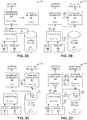
- FIG. 2A illustrates an exemplary architecture of a semi-supervised stacked GAN (SS-GAN) 200, including operations involving the unsupervised discriminator, in accordance with an embodiment of the present invention.
- Unsupervised discriminator 164 takes as input x G from generator 162 (communication 202) and the unlabeled data x U and the labeled x T (of labeled data ( x T , y T ) from training data 166) (communication 204).
- the semi-supervised setting includes both labeled data and unlabeled data, and that there is typically much more unlabeled data than labeled data.
- the number of unlabeled data objects is greater by a predetermined ratio or threshold than the number of labeled data objects.
- Unsupervised discriminator 164 then calculates D u ( x ) to determine an output 206 (e.g., D u (x G ), D u ( x U ) , and D u ( x T ) to determine whether the data or image x is real or fake). That is, unsupervised discriminator 164 determines which of the data or images are produced by generator 162 (i.e., the x G fake images) and which of the data or images are part of training data 166 (i.e., the x U and the x T real images).
- FIG. 2B illustrates an exemplary architecture of an SS-GAN 220, including operations involving the generator, the unsupervised discriminator, and the supervised discriminator, in accordance with an embodiment of the present invention.
- Supervised discriminator 165 takes as input ( h (x),y) pairs produced by generator 162. That is, supervised discriminator 165 takes h ( x G ) (communication 224) and y (communication 226), and calculates D s ( h ( x G ),y) to determine an output 228 (e.g., whether the ( x,y ) pair is real or fake).
- FIG. 2C illustrates an exemplary architecture of an SS-GAN 240, including operations involving the unsupervised discriminator and the supervised discriminator, in accordance with an embodiment of the present invention.
- Unsupervised discriminator 165 takes as input x T (via communication 242), calculates D u ( x T ), and outputs the intermediate value h(x T ).
- Supervised discriminator 165 then takes as input ( h ( x ) ,y ) pairs from training data 166.
- supervised discriminator 165 takes as input h ( x T ) (communication 244) and y T (communication 246), and calculates D s ( h(x T ), y T ) to determine an output 248 (e.g., whether the ( x, y ) pair is real or fake).
- supervised discriminator 165 determines which of the (data, label) pairs are produced by generator 162 (i.e., the ( x G , y ) fake pairs) and which of the (data, label) pairs are part of the training data (i.e., the ( x T , y T ) real pairs).
- FIG. 2D illustrates an exemplary architecture of an SS-GAN 260, including the operations described above in relation to FIGs. 2B and 2C , in accordance with an embodiment of the present invention.
- FIG. 2D depicts both communication 204 (i.e., x U and x T ) and communication 242 (i.e., x T )
- x T can be fed or transmitted from training data 166 to unsupervised discriminator 164 only as part of communication 204. That is, communication 242 is depicted for the sake of illustration.
- Architecture 260 of FIG. 2D is similar to architecture 160 of FIG. 1D .
- the distribution of the samples provided by the generator can be denoted as p' ( x, y ) .
- D u ( x ; ⁇ ss ) will converge to p ( x )/( p ( x ) + p' ( x ))) , and consequently, the generator will adapt its output so that p '(x) will converge to p ( x ) .
- n is finite and typically small, it cannot be similarly guaranteed that D s ( x,y; ⁇ ss ) will converge to p ( x, y )/( p ( x, y) + p '( x , y ))), and that consequently, the generator will adapt its output that so p' ( x, y ) will converge to p ( x, y ) .
- D s ( x , y; ⁇ ss ) will equivalently look to converge to p ( y
- FIG. 3 illustrates an exemplary environment 300 that facilitates generating synthetic data objects using a semi-supervised GAN, in accordance with an embodiment of the present invention.
- Environment 100 can include: a device 304 and an associated user 314; a device 306; and a device 308.
- Devices 304, 306, and 308 can communicate with each other via a network 302.
- devices 304, 306, and 308 are part of separate networks, and can be defined as "networks" or network components which communicate or interact with each other as part of a generative adversarial network.
- Device 304 can include training data 320.
- Device 306 can include a generator 330 module or unit.
- Device 308 can include an unsupervised discriminator 340 module or unit as well as a supervised discriminator 350 module or unit.
- training data 320, generator 330, and discriminators 340 and 350 are depicted in FIG. 3 as associated with, respectively, devices 304, 306, and 308, which communicate over network 302.
- the modules are only depicted in this manner for the sake of illustration, and are not tied to any specific hardware or network implementation.
- user 314 (or device 304) can send training data 322 via network 302 to device 308.
- device 306 can send generated data 332 via network 302 to device 308.
- Unsupervised discriminator 340 can take as input data objects such as x G from generated data 332 as well as data objects x U and x T from training data 322, and determine an output 342.
- Device 308 can send output 342 to user 314 (or device 304) as a marginal distribution 342 (e.g., a probability of whether a given data object x is real or fake).
- Unsupervised discriminator 340 can also calculate or produce an intermediate output 344 based on a given input data object x G , x U , or x T (e.g., h ( x G ), h ( x U ) , or h ( x T )) .
- Supervised discriminator 350 can take as input ( x, y ) pairs of (data object, attribute), such as: (1) an intermediate output calculated based on the generated data 332 from generator 306, and an attribute y of the generated data 332 from generator 306 (e.g., ( h(x G ), y )) ; and (2) an intermediate output calculated based on training data 322 and a corresponding attribute y T (e.g., ( h ( x T ) ,y T )). Based on these inputs, supervised discriminator 350 can determine an output 352.
- Device 308 can send output 352 to user 314 (or device 304) as a conditional distribution 352 (e.g., a probability of whether a given ( x, y ) pair is real or fake, that is, a probability of whether a given y is real or fake given an x ).
- a conditional distribution 352 e.g., a probability of whether a given ( x, y ) pair is real or fake, that is, a probability of whether a given y is real or fake given an x ).
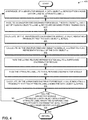
- FIG. 4 presents a flow chart 400 illustrating a method which facilitates generating synthetic data objects using a semi-supervised GAN, in accordance with an embodiment of the present invention.
- the system synthesizes, by a generator module, a data object x G derived from a noise vector z and an attribute label y (operation 402).
- the system passes, to an unsupervised discriminator module, the data object x G and a set of training objects x T and x U which are obtained from a training data set (operation 404).
- the system calculates, by the unsupervised discriminator module, a value indicating a probability that the data object x G is real (operation 406).
- the system calculates, by the unsupervised discriminator module, a latent feature representation h(x G ) of the data object x G (operation 408).
- the system passes the latent feature representation h(x G ) to a supervised discriminator module (operation 410).
- the system passes the attribute label y to the supervised discriminator module (operation 412).
- the system calculates, by the supervised discriminator module, a value indicating a probability that the attribute label y given the data object x G is real (operation 414).
- the system determines whether the generator module has produced a data object with a given attribute label which the supervised and unsupervised discriminator modules can no longer identify as fake (i.e., synthetic or as synthesized by the generator module) (decision 416).
- the operation returns. If it has, the operation returns. If it has not, the system iterates through the aforementioned steps (e.g., operations 402-414) until the generator module produces data objects with a given attribute label which the unsupervised and supervised discriminator modules can no longer identify as fake.
- a standard GAN model applied to the full data set i.e., C-GAN, as described above in relation to FIG.1B
- a standard GAN model applied to only the labeled data set i.e., SC-GAN, as described above in the section titled "Semi-Supervised GANs" and also in relation to FIG. 1B
- SC-GAN labeled data set
- a supervised auxiliary classifier GAN model applied to the full data set i.e., AC-GAN, as described above in relation to FIG. 1C
- a semi-supervised AC-GAN model i.e., SA-GAN, as described above in the section titled "Semi-Supervised GANs” and also in relation to FIG. 1C ).
- Exemplary data sets include the Modified National Institute of Standards and Technology (MNIST) data set, the CelebFaces Attribute data set (CelebA), and the Canadian Institute for Advanced Research (CIFAR)-10 data set.
- MNIST is a large database of 60,000 handwritten and labeled images of digits.
- CelebA is a large-scale face attributes data set with more than 200,000 celebrity images, each with 40 attribute annotations (e.g., bald, eyeglasses, smiling, brown hair, etc.).
- the CIFAR-10 data set consists of 60,000 32x32 color images in 10 classes, with 6,000 images per class.
- the 60,000 images include 50,000 training images and 10,000 test images,
- the results herein pertain to trial results based on the MNIST data set.
- the trial uses the DCGAN architecture proposed in Radford, et al., "Unsupervised representation learning with deep convolutional generative adversarial networks," arXiv preprint arXiv:1511.06434, 2015 , with slight modifications to the generator and discriminator to accommodate the different variants described in Radford. These modifications primarily include: (i) concatenating the inputs ( x, y ) and ( z, y ) for the supervised discriminator and generator respectively; (ii) adding an additional output layer to the discriminator in the case of AC-GAN; and (iii) connecting the last but one layer of D u to D s in the SS-GAN.
- C-GAN C-GAN
- AC-GAN AC-GAN
- SC-GAN SC-GAN
- SA-GAN SA-GAN
- the trial performs semi-supervised training with a small randomly picked fraction of the 60,000 MNIST images, and considers setups with 10, 20, and 40 labeled examples. Each setup has a balanced number of examples from each class. The remaining training images are provided without labels.
- row 522 corresponds to C-GAN
- row 524 corresponds to AC-GAN
- row 526 corresponds to SC-GAN
- row 528 corresponds to SA-GAN
- row 530 corresponds to SS-GAN. Note that in both FIGs. 5A and 5B , SS-GAN's performance is close to the supervised models (C-GAN and AC-GAN). SA-GAN gets certain digit associations wrong, while SC-GAN generates copies of digits from the labeled set.
- FIGs. 6A-6D illustrate more detailed results for this case with 20 labeled examples (two examples per digit). Each row corresponds to a particular digit.
- SS-GAN both produces diverse digits while also being accurate.
- the performance of SS-GAN closely matches the performance of the fully supervised C-GAN and AC-GAN models.
- Tables 1-3 above show the fraction of incorrectly classified points for each source, the reconstruction error, the sample diversity metric, and the discriminator error.
- SS-GAN comfortably outperforms SA-GAN with respect to classification accuracy, and comfortably beats SC-GAN with respect to reconstruction error (due to the limited sample diversity of SC-GAN).
- the sample diversity metric for SS-GAN is slightly worse compared to SA-GAN, but significantly better than SC-GAN.
- FIG. 7 illustrates an exemplary distributed computer and communication system that facilitates development of a semi-supervised stacked generative adversarial network, in accordance with an embodiment of the present invention.
- Computer system 702 includes a processor 704, a memory 706, and a storage device 708.
- Memory 706 can include a volatile memory (e.g., RAM) that serves as a managed memory, and can be used to store one or more memory pools.
- computer system 702 can be coupled to a display device 710, a keyboard 712, and a pointing device 714.
- Storage device 708 can store an operating system 716, a content-processing system 718, and data 730.
- Content-processing system 718 can include instructions, which when executed by computer system 702, can cause computer system 702 to perform methods and/or processes described in this disclosure. Specifically, content-processing system 718 may include instructions for sending and/or receiving/obtaining data packets to/from other network nodes across a computer network (communication module 720).
- a data packet can include a data object and/or a label, such as an image and/or an attribute for the image.
- a data packet can also include a value which is an output or an intermediate output.
- a data packet can also include a probability, such as a marginal distribution or a conditional distribution.
- Content-processing system 718 can include instructions for synthesizing, by a generator module, a data object x G derived from a noise vector z and an attribute label y (data object-generating module 722).
- Content-processing system 718 can include instructions for passing, to an unsupervised discriminator module, the data object x G and a set of training objects x T and x U which are obtained from a training data set (communication module 720).
- Content-processing system 718 can include instructions for calculating, by the unsupervised discriminator module, a value indicating a probability that the data object x G is real (marginal distribution-calculating module 724).
- Content-processing system 718 can include instructions for calculating, by the unsupervised discriminator module, a latent feature representation h(x G ) of the data object x G (intermediate output-calculating module 728). Content-processing system 718 can include instructions for passing the latent feature representation h(x G ) and the attribute label y to a supervised discriminator module (communication module 720). Content-processing system 718 can include instructions for calculating, by the supervised discriminator module, a value indicating a probability that the attribute label y given the data object x G is real (conditional distribution-calculating module 726). Content-processing system 718 can include instructions for performing the aforementioned steps iteratively until the generator module produces data objects with a given attribute label which the unsupervised and supervised discriminator modules can no longer identify as fake (data object-generating module 722).
- Data 730 can include any data that is required as input or that is generated as output by the methods and/or processes described in this disclosure.
- data 730 can store at least: data; a data set; a data distribution; a data object; an image; a label; an attribute; a pair which includes data and a corresponding label; a pair which includes an image and an attribute for the image; a value calculated based on a data object; a probability; an indicator that data, a data object, or a pair is real or fake; a marginal distribution; a conditional distribution; features for a data object; an intermediate output; an output; an output which is a probability; a number of data objects; a number of unlabeled or labeled data objects; a dependency between a data object and a label; and a predetermined ratio or threshold.
- the data structures and code described in this detailed description are typically stored on a computer-readable storage medium, which may be any device or medium that can store code and/or data for use by a computer system.
- the computer-readable storage medium includes, but is not limited to, volatile memory, non-volatile memory, magnetic and optical storage devices such as disk drives, magnetic tape, CDs (compact discs), DVDs (digital versatile discs or digital video discs), or other media capable of storing computer-readable media now known or later developed.
- the methods and processes described in the detailed description section can be embodied as code and/or data, which can be stored in a computer-readable storage medium as described above.
- a computer system reads and executes the code and/or data stored on the computer-readable storage medium, the computer system performs the methods and processes embodied as data structures and code and stored within the computer-readable storage medium.
- the methods and processes described above can be included in hardware modules or apparatus.
- the hardware modules or apparatus can include, but are not limited to, application-specific integrated circuit (ASIC) chips, field-programmable gate arrays (FPGAs), dedicated or shared processors that execute a particular software module or a piece of code at a particular time, and other programmable-logic devices now known or later developed.
- ASIC application-specific integrated circuit
- FPGA field-programmable gate arrays
- dedicated or shared processors that execute a particular software module or a piece of code at a particular time
- other programmable-logic devices now known or later developed.
Landscapes
- Engineering & Computer Science (AREA)
- Theoretical Computer Science (AREA)
- Physics & Mathematics (AREA)
- General Physics & Mathematics (AREA)
- Evolutionary Computation (AREA)
- Artificial Intelligence (AREA)
- Health & Medical Sciences (AREA)
- General Health & Medical Sciences (AREA)
- Life Sciences & Earth Sciences (AREA)
- Software Systems (AREA)
- Computing Systems (AREA)
- Data Mining & Analysis (AREA)
- Biomedical Technology (AREA)
- General Engineering & Computer Science (AREA)
- Molecular Biology (AREA)
- Mathematical Physics (AREA)
- Biophysics (AREA)
- Computational Linguistics (AREA)
- Computer Vision & Pattern Recognition (AREA)
- Multimedia (AREA)
- Databases & Information Systems (AREA)
- Medical Informatics (AREA)
- Bioinformatics & Cheminformatics (AREA)
- Bioinformatics & Computational Biology (AREA)
- Evolutionary Biology (AREA)
- Biodiversity & Conservation Biology (AREA)
- Probability & Statistics with Applications (AREA)
- Image Analysis (AREA)
Abstract
One embodiment facilitates generating synthetic data objects using a semi-supervised GAN. During operation, a generator module synthesizes a data object derived from a noise vector and an attribute label. The system passes, to an unsupervised discriminator module, the data object and a set of training objects which are obtained from a training data set. The unsupervised discriminator module calculates: a value indicating a probability that the data object is real; and a latent feature representation of the data object. The system passes the latent feature representation and the attribute label to a supervised discriminator module. The supervised discriminator module calculates a value indicating a probability that the attribute label given the data object is real. The system performs the aforementioned steps iteratively until the generator module produces data objects with a given attribute label which the unsupervised and supervised discriminator modules can no longer identify as fake.
Description
- This disclosure is generally related to developing a conditional generative model. More specifically, this disclosure is related to a system and method for semi-supervised conditional generative modeling using adversarial networks.
- Generative adversarial networks (GANs) are a recent technique for learning generative models for high-dimensional unstructured data (e.g., images). GANs employ two networks: a generator G which produces samples from a data distribution; and a discriminator D which aims to distinguish real samples from the samples produced by G. The two networks alternatively try to best each other, ultimately resulting in the generator G converging to the true data distribution.
- Many of the current GAN techniques are focused on the unsupervised setting, where the data is unlabeled (i.e., images with no attributes). Some current GAN techniques are also focused on the supervised setting, where all the data is labeled (e.g., images with attributes). For example, one approach in the supervised setting is a conditional GAN (C-GAN), which builds a conditional model that can generate images given a particular attribute. Another approach in the supervised setting is an auxiliary classifier GAN (AC-GAN), in which side information can be reconstructed by the discriminator.
- However, it can be expensive to obtain a data set in which all the data is labeled, as in the supervised setting. One solution to address this cost is to employ the semi-supervised setting, where only a small fraction of the data is labeled. Some work has been performed using GANs in the semi-supervised setting. However, the current work does not efficiently address building conditional models in the semi-supervised setting.
- One embodiment facilitates generating synthetic data objects using a semi-supervised generative adversarial network. During operation, the system synthesizes, by a generator module, a data object xG derived from a noise vector z and an attribute label y. The system passes, to an unsupervised discriminator module, the data object xG and a set of training objects xT and xU which are obtained from a training data set. The system calculates, by the unsupervised discriminator module, a value indicating a probability that the data object xG is real. The system calculates, by the unsupervised discriminator module, a latent feature representation h(xG) of the data object xG. The system passes the latent feature representation h(xG) to a supervised discriminator module. The system passes the attribute label y to the supervised discriminator module. The system calculates, by the supervised discriminator module, a value indicating a probability that the attribute label y given the data object xG is real. The system performs the aforementioned steps iteratively until the generator module produces data objects with a given attribute label which the unsupervised and supervised discriminator modules can no longer identify as fake.
- In some embodiments, determining the probability that the data object xG is real further comprises determining that the data object xG is obtained from the training data set.
- In some embodiments, the training data set includes a first number of data objects which do not have a corresponding attribute label and a second number of data objects which do have a corresponding attribute label, and the first number is greater by a predetermined ratio than the second number.
- In some embodiments, the generator module, the unsupervised discriminator module, and the supervised discriminator module are deep neural networks.
- In some embodiments, the generator module, the unsupervised discriminator module, and the supervised discriminator module comprise a model based on the semi-supervised generative adversarial network which: learns a first probability that data objects are real based on data objects which have a corresponding attribute label and data objects which do not have a corresponding attribute label; and learns a second probability that pairs comprised of a data object and a corresponding attribute label are real based on data objects which only have a corresponding attribute label. The model subsequently uses a partially labeled given data set to determine a dependency between a given data object and a given attribute label of the given data set, and subsequently generates a specific data object given a specific attribute label that satisfies the dependency between the given data object and the given attribute label.
- In some embodiments, a data object and a corresponding attribute label are one or more of: an image and an attribute for the image; an audio file and an attribute for the audio file; and a first set of data and a tag for the first set of data.
- In some embodiments, a data object is an image of a face, and a corresponding attribute label for the data object pertains to a presence or an absence of one or more of sunglasses, wrinkles, and facial cosmetics.
- In some embodiments, a data object is an image of an alphanumeric character, and a corresponding attribute label for the data object pertains uniquely to the alphanumeric character.
-
-
FIG. 1A illustrates an exemplary architecture of an unsupervised GAN, in accordance with the prior art. -
FIG. 1B illustrates an exemplary architecture of a conditional GAN (C-GAN) for the supervised setting, in accordance with the prior art. -
FIG. 1C illustrates an exemplary architecture of an auxiliary classifier GAN (AC-GAN) for the supervised and the unsupervised setting, in accordance with the prior art. -
FIG. 1D illustrates an exemplary architecture of a semi-supervised stacked GAN (SS-GAN), in accordance with an embodiment of the present invention. -
FIG. 2A illustrates an exemplary architecture of a semi-supervised stacked GAN (SS-GAN), including operations involving the unsupervised discriminator, in accordance with an embodiment of the present invention. -
FIG. 2B illustrates an exemplary architecture of an SS-GAN, including operations involving the generator, the unsupervised discriminator, and the supervised discriminator, in accordance with an embodiment of the present invention. -
FIG. 2C illustrates an exemplary architecture of an SS-GAN, including operations involving the unsupervised discriminator and the supervised discriminator, in accordance with an embodiment of the present invention. -
FIG. 2D illustrates an exemplary architecture of an SS-GAN, including the operations described above in relation toFIGs. 2B and 2C , in accordance with an embodiment of the present invention. -
FIG. 3 illustrates an exemplary environment that facilitates generating synthetic data objects using a semi-supervised GAN, in accordance with an embodiment of the present invention. -
FIG. 4 presents a flow chart illustrating a method which facilitates generating synthetic data objects using a semi-supervised GAN, in accordance with an embodiment of the present invention. -
FIG. 5A illustrates a first set of representative samples from the five different models for the case with n = 20 labeled examples. -
FIG. 5B illustrates a second set of representative samples from the five different models for the case with n = 20 labeled examples. -
FIG. 6A illustrates digits generated by the C-GAN model in the fully supervised setting, where n = 60,000 and m = 0. -
FIG. 6B illustrates digits generated by the AC-GAN model in the fully supervised setting, where n = 60,000 and m = 0. -
FIG. 6C illustrates digits generated by the SC-GAN model in the small label supervised setting, where n = 20 and m = 0. -
FIG. 6D illustrates digits generated by the SA-GAN model in the semi-supervised setting, where n = 20 and m = 60,000. -
FIG. 6E illustrates digits generated by the SS-GAN model in the semi-supervised setting, where n = 20 and m = 60,000. -
FIG. 7 illustrates an exemplary distributed computer and communication system that facilitates generating synthetic data objects using a semi-supervised GAN, in accordance with an embodiment of the present invention. - In the figures, like reference numerals refer to the same figure elements.
- The following description is presented to enable any person skilled in the art to make and use the embodiments, and is provided in the context of a particular application and its requirements. Various modifications to the disclosed embodiments will be readily apparent to those skilled in the art, and the general principles defined herein may be applied to other embodiments and applications without departing from the spirit and scope of the present disclosure. Thus, the present invention is not limited to the embodiments shown, but is to be accorded the widest scope consistent with the principles and features disclosed herein.
- The embodiments described herein solve the problem of utilizing the efficiencies gained for a semi-supervised setting in a GAN by providing a system which extends a conditional GAN into the semi-supervised setting by using a "stacked" discriminator. The system partitions the discriminator's task of evaluating if the joint samples of data and labels (e.g., images and attributes) are real or fake into two separate tasks: (i) evaluating if the images are real or fake; and (ii) evaluating if the attributes given an image are real or fake. The system uses all the labeled and unlabeled data to assist the discriminator with the first task, and uses only the labeled data for the second task. Note that task (i) (the "marginal distribution" of the images) is much harder to model relative to task (ii) (the "conditional distribution" of the attributes given an image).
- Generative adversarial networks (GANs) are a recent technique for learning generative models for high-dimensional unstructured data (e.g., images). GANs employ two networks: a generator G which produces samples from a data distribution; and a discriminator D which aims to distinguish real samples from the samples produced by G. The two networks alternatively try to best each other, ultimately resulting in the generator G converging to the true data distribution.
- Many of the current GAN techniques are focused on the unsupervised setting, where the data is unlabeled (i.e., images with no attributes). Some current GAN techniques are also focused on the supervised setting, where all the data is labeled (e.g., images with attributes). For example, one approach in the supervised setting is a conditional GAN (C-GAN), which builds a conditional model that can generate images given a particular attribute. Another approach in the supervised setting is an auxiliary classifier GAN (AC-GAN), in which side information can be reconstructed by the discriminator.
- However, it can be expensive to obtain a data set in which all the data is labeled, as in the supervised setting. One solution to address this cost is to employ the semi-supervised setting, where only a small fraction of the data is labeled. Some work has been performed using GANs in the semi-supervised setting. However, the current work does not efficiently address building conditional models in the semi-supervised setting.
- The embodiments described herein provide a system which efficiently addresses and improves the cost issue by developing a conditional GAN in a semi-supervised setting (SS-GAN). The system extends the C-GAN architecture to the semi-supervised setting and can utilize the unlabeled data, thus overcoming the cost of providing large quantities of labeled data to the discriminator. For example, the system improves the technology of machine learning by utilizing a data set which can include a large amount of unlabeled data (which is much less expensive to obtain than labeled data) along with a much smaller amount of labeled data (which, as described above, can be expensive). The system can thus learn a full conditional model of data objects given attribute labels from a large volume of unlabeled data objects, supplemented by very few labeled data objects. By learning the full conditional model using the embodiments described herein, the system can improve the technologies of machine learning (e.g., providing computers with the ability to learn without being explicitly programmed) and data analytics (e.g., data mining, including inspecting, cleansing, transforming, and modeling data in order to discover useful information).
- Because SS-GAN builds on the existing GANs, an overview of unsupervised GANs, supervised GANs, and semi-supervised GANs is provided herein. Results from trials are also described herein, illustrating the performance of SS-GAN over the existing GAN approaches.
- The term "data set" refers to a plurality of "data objects." The term "data object" can refer to an image, an audio file, a three-dimensional image, or any grouping of information or data.
- The term "labeled data" can refer to a data object which has a corresponding label or attribute label. The term "unlabeled data" can refer to a data object which does not have a corresponding label or attribute label.
- Assume that the data set X is comprised of n + m images, where the first n images are accompanied by attributes Y. For example:

- Each Xi is assumed to be of dimension px × py × pc, where pc is the number of channels. The attribute tags Yi are assumed to be discrete variables of dimension {0,1,...,K - 1} d, i.e., each attribute is assumed to be d-dimensional and each individual dimension of an attribute tag can belong to one of K different classes. This can accommodate class variables (d = 1) and binary attributes (K = 2). Furthermore, the joint distribution of images and attributes can be denoted by p(x, y), the marginal distribution of images by p(x), and the conditional distribution of attributes given images by p(y|x). The goal of the SS-GAN is to learn a generative model G(z, y) that can sample from p(x|y) for a given y by exploiting information from both the labeled and unlabeled sets.
- In the unsupervised setting where the data is comprised solely of unlabeled data (i.e., n = 0), the goal is to learn a generative model Gu (z; θu ) that samples from the marginal image distribution p(x) by transforming vectors of noise z as x = Gu (z; θu ). That is, the goal is to learn whether a given data (e.g., image) x is real or fake. In order for Gu ( ) to learn this marginal distribution, a discriminator Du (x; φu ) is trained jointly. The unsupervised loss functions for the generator and discriminator, respectively, are as follows:


FIG. 1A . -
FIG. 1A illustrates anexemplary architecture 100 of anunsupervised GAN 100, in accordance with the prior art.Unsupervised GAN 100 can include a generator 102 (which corresponds to Gu as previously described), a discriminator 104 (which corresponds to Du as previously described), and training data 106 (which includes unlabeled data x U ). During operation,generator 102 takes as input a noise 108 z, and produces data xG based on z , i.e., G(z) = xG.Discriminator 104 takes as input both xG from generator 102 (communication 114) and xU from training data 106 (communication 116), and calculates D(x) to determine an output 112 (e.g., whether the x is real or fake).Generator 102 anddiscriminator 104 continue to iterate through the training process untilgenerator 102 learns how to produce data (e.g., images) which look so real thatdiscriminator 104 can no longer tell the difference (e.g., identify an image as fake). - In the supervised setting where all of the data is labeled (i.e., m = 0), the goal is to learn a generative model Gs(z, y; θs ) that samples from the conditional image distribution p(x|y), by transforming vectors of noise z as x = Gs (z,y;θs). That is, the goal is to learn whether a given (x, y) pair (e.g., (data, label) or (image, attribute)) is real or fake. In the case of handwritten digits, it is not sufficient for the generator to simply produce handwritten digits which look like realistic handwritten digits. The generator must also ensure that if the attribute y is "0," then the produced handwritten digit x is also a "0." Thus, both x and y together as a pair must be correct. In the supervised setting, because all data is labeled, a system can learn a model using GAN to ensure both that x is correct and that the (x, y) pair is correct. Two exemplary approaches to solving this problem are the conditional GAN (C-GAN) and the auxiliary-classifier GAN (AC-GAN).
- In one exemplary conditional GAN model, in order for Gs ( ) to learn the conditional distribution, a discriminator Ds(x, y; φs ) is trained jointly. The goal of the discriminator is to distinguish whether the joint samples (x, y) are samples from the data or produced by the generator. The supervised loss functions for the generator and discriminator, respectively, for conditional GAN (C-GAN) are as follows:


FIG. 1B . -
FIG. 1B illustrates an exemplary architecture of a conditional GAN (C-GAN) 120 for the supervised setting, in accordance with the prior art. C-GAN 120 can include a generator 122 (which corresponds to Gs as previously described), a discriminator 124 (which corresponds to Ds as previously described), and training data 126 (which includes labeled data (xT, yT )). During operation,generator 122 takes as input a noise 108 z and an attribute 130 y, and produces data xG based on z and y, i.e., G(z, y) = xG.Discriminator 124 takes as input both xG from generator 102 (communication 134) and attribute 130 y (communication 138), as well as (xT, yT ) from training data 126 (communication 136), and calculates D(x, y) to determine an output 132 (e.g., whether the (x, y) pair is real or fake). - In another exemplary conditional GAN model, the system only supplies the images x to the discriminator, and the discriminator additionally recovers the true attribute information y. In particular, the discriminator Da (x;φa ) produces two outputs: (i) D a(rf)(x;φa ), which is the probability of x being real or fake; and (ii) D a(a)(x,y;φa ), which is the estimated conditional probability of y given x. In addition to the unsupervised loss functions, the generator and discriminator are jointly trained to recover the true attributes for any given images in X. The attribute loss function can be defined as:


-
FIG. 1C illustrates an exemplary architecture of an auxiliary classifier GAN (AC-GAN) 140 for the supervised and the unsupervised setting, in accordance with the prior art. AC-GAN 140 can include a generator 142 (which corresponds to Ga as previously described), a discriminator 144 (which corresponds to Da as previously described), and training data 146 (which includes both unlabeled data xU and labeled data (xT, yT )). During operation,generator 142 takes as input a noise 148 z and an attribute 150 y, and produces data xG based on z and y, i.e., G(z, y) = xG.Discriminator 144 takes as input both xG from generator 142 (communication 156) and unlabeled data xU and labeled data (xT, yT ) from training data 146 (communication 158), and calculates D(x) to determine both an output 152 (e.g., whether the x is real or fake) and an output 154 (e.g., to predict y). - The key difference between C-GAN and AC-GAN is that in AC-GAN, the discriminator estimates the probability distribution of the attribute given the image, while in C-GAN, the discriminator Ds is supplied with both (x, y) and then estimates the probability that (x, y) is consistent with the true joint distribution p(x, y). In comparing the performance of C-GAN and AC-GAN using qualitative and quantitative experiments on a collection of data sets, and through analysis (as described below), it can be seen that C-GAN typically outperforms AC-GAN in performance.
- In the semi-supervised setting, some of the data is labeled (i.e., m > 0), and typically there is much more unlabeled data than labeled data (i.e., n << m). Both C-GAN and AC-GAN can be applied to the semi-supervised setting. Because C-GAN requires the attribute information to be fed to the discriminator, the semi-supervised setting for C-GAN can be applied by trivially training it only on the labeled data, and throwing away the unlabeled data. This model is referred to as "SC-GAN."
- On the other hand, AC-GAN can be applied to this semi-supervised setting in a more useful manner. In particular, the adversarial loss terms

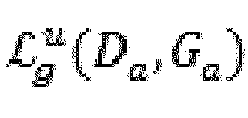

FIG. 1C . - The embodiments described herein provide a system which includes a new model (SS-GAN) for learning conditional generator models in a semi-supervised setting. The system extends the C-GAN architecture to the semi-supervised setting and can utilize the unlabeled data, by overcoming the difficulty of having to provide side information to the discriminator. This addresses the cost associated with having to provide large quantities of labeled data to the discriminator.
- Specifically, the system uses a stacked discriminator architecture which includes a pair of discriminators Du ("unsupervised discriminator") and Ds ("supervised discriminator"), where Du is responsible for distinguishing real and fake images x, and Ds is responsible for distinguishing real and fake (image, attribute) pairs (x, y). Unlike in C-GAN, Du can separately estimate the probability that x is real using both the labeled and unlabeled data, and Ds can separately estimate the probability that y given x is real using only the labeled data. Note that the marginal distribution p(x) is much harder to model relative to the conditional distribution p(y|x), and by separately evaluating the marginal and conditional samples, the system can exploit the larger unlabeled pool to accurately estimate the marginal distribution.
- Let Dss (x, y; φss ) denote the discriminator, which is comprised of two stacked discriminators: (i) Ds (x; φss ), which outputs the probability that the marginal image x is real or fake, and (ii) Du (x, y; φss ), which outputs the probability that the conditional attribute y given the image x is real or fake. The generator Gss (z, y; θss ) is identical to the generator in C-GAN and AC-GAN. The loss functions for the generator and the pair of discriminators are as follows:


- D ss(u)(x;φss ) depends only on the x argument, and produces an intermediate output (last but one layer of unsupervised discriminator) h(x), to which the argument y is subsequently appended and fed to the supervised discriminator to produce the probability D ss(s)(x;φss ) that the joint samples (x, y) are real or fake. The semi-supervised GAN model is described below in relation to
FIG. 1D . - One advantage of SS-GAN, which supplies x to D ss(s) via the features learned by D ss(u) , over directly providing the x argument to D ss(s) is that D ss(s) cannot overfit to the few labeled examples, and instead must rely on the features general to the whole population in order to uncover the dependency between x and y.
- As an example, consider the problem of conditional face generation where one of the attributes of interest is eye-glasses. Assume that in the limited set of labeled images, only one style of eye-glasses (e.g., glasses with thick rims) is encountered. In this case, the conditional discriminator can learn features specific to rims to detect glasses if the entire image x is available to the supervised discriminator. On the other hand, the features h(x) learned by the unsupervised discriminator would have to generalize over all kinds of eyeglasses and not just rimmed eyeglasses specifically. In the stacked model, by restricting the supervised discriminator to access the image x through the features h(x) learned by the unsupervised discriminator, it the supervised discriminator can now generalize to all different types of eyeglasses when assessing the conditional fit of the glasses attribute.
-
FIG. 1D illustrates an exemplary architecture of a semi-supervised stacked GAN (SS-GAN) 160, in accordance with an embodiment of the present invention. SS-GAN 160 can include a generator 162 (which corresponds to Gss as previously described), a pair ofdiscriminators Unsupervised discriminator 164 corresponds to Du as previously described, andsupervised discriminator 165 corresponds to Ds as previously described. - During operation,
generator 162 takes as input a noise 168 z and an attribute 170 y, and produces data xG based on z and y, i.e., G(z, y) = xG.Unsupervised discriminator 164 takes as input xG from generator 162 (communication 176) and the unlabeled data xU and the labeled xT (of labeled data (xT, yT ) from training data 166 (communication 178).Unsupervised discriminator 164 then calculates Du (x) to determine output 172 (e.g., whether the x is real or fake). That is,unsupervised discriminator 164 determines which of the data or images are produced by generator 162 (i.e., the xG fake images) and which of the data or images are from the training data (i.e., the xU and the xT real images). - As
discriminator 164 learns which of the data or images is real or fake,generator 162 continues to produce data or images to confusediscriminator 164, such thatgenerator 162 improves in producing data or images xG which look more and more realistic. At the same time,discriminator 164 continues to iterate through the training process, improving its own ability to distinguish between a real image and a fake image, untilgenerator 162 learns to produce data or images xG which look so real thatdiscriminator 164 can no longer tell the difference (e.g., identify an image as fake). - At this point,
generator 162 has learned to produce the correct data xG, butgenerator 162 has not yet learned the mapping between the data and the label (e.g., whether the (x, y) pair is correct).Unsupervised discriminator 164 produces an intermediate output h(x) (communication 180), which indicates a feature representation of the data. For example, if x is an image, h(x) can indicate a 100-dimentional vector which encodes useful or interesting features about the image, where the features may be used to determine an attribute of the image (e.g., the type of handwritten digit). A dimension can indicate, e.g., whether there is a vertical line, whether there is a 40-degree angle, etc. - Subsequently,
supervised discriminator 165 takes as input pairs of values to determine anoutput 186. That is, supervised discriminator takes as input (h(x),y) pairs from generator 162 (e.g., h(xG ) fromcommunication 180, and y from communication 182), and also takes as input (h(x),y) pairs from training data 166 (e.g., h(xT ) viacommunications Supervised discriminator 165 then calculates Ds (h(x),y) to determine output 186 (e.g., whether the (x, y) pair is real or fake). That is,supervised discriminator 165 determines which of the (data, label) pairs are produced by generator 162 (i.e., the (xG, y) fake pairs) and which of the (data, label) pairs are part of the training data (i.e., the (xT, yT ) real pairs). An exemplary communication in an SS-GAN model is described below in relation toFIGs. 2A-2D . -
FIG. 2A illustrates an exemplary architecture of a semi-supervised stacked GAN (SS-GAN) 200, including operations involving the unsupervised discriminator, in accordance with an embodiment of the present invention. During operation,generator 162 takes as input a noise 168 z and an attribute 170 y, and produces data xG based on z and y, i.e., G(z, y) = xG.Unsupervised discriminator 164 takes as input xG from generator 162 (communication 202) and the unlabeled data xU and the labeled xT (of labeled data (xT, yT ) from training data 166) (communication 204). Recall that the semi-supervised setting includes both labeled data and unlabeled data, and that there is typically much more unlabeled data than labeled data. In some embodiments, in a training data set or in a given data set to be classified after the SS-GAN model is trained, the number of unlabeled data objects is greater by a predetermined ratio or threshold than the number of labeled data objects. -
Unsupervised discriminator 164 then calculates Du (x) to determine an output 206 (e.g., Du(xG), Du (xU ), and Du (xT ) to determine whether the data or image x is real or fake). That is,unsupervised discriminator 164 determines which of the data or images are produced by generator 162 (i.e., the xG fake images) and which of the data or images are part of training data 166 (i.e., the xU and the xT real images). -
FIG. 2B illustrates an exemplary architecture of an SS-GAN 220, including operations involving the generator, the unsupervised discriminator, and the supervised discriminator, in accordance with an embodiment of the present invention.Supervised discriminator 165 takes as input (h(x),y) pairs produced bygenerator 162. That is,supervised discriminator 165 takes h(xG ) (communication 224) and y (communication 226), and calculates Ds (h(xG ),y) to determine an output 228 (e.g., whether the (x,y) pair is real or fake). -
FIG. 2C illustrates an exemplary architecture of an SS-GAN 240, including operations involving the unsupervised discriminator and the supervised discriminator, in accordance with an embodiment of the present invention.Unsupervised discriminator 165 takes as input xT (via communication 242), calculates Du (xT ), and outputs the intermediate value h(xT).Supervised discriminator 165 then takes as input (h(x),y) pairs fromtraining data 166. That is,supervised discriminator 165 takes as input h(xT ) (communication 244) and yT (communication 246), and calculates Ds (h(xT ),yT ) to determine an output 248 (e.g., whether the (x, y) pair is real or fake). - Thus, as described above in relation to FIG. ID,
supervised discriminator 165 determines which of the (data, label) pairs are produced by generator 162 (i.e., the (xG, y) fake pairs) and which of the (data, label) pairs are part of the training data (i.e., the (xT, yT ) real pairs). -
FIG. 2D illustrates an exemplary architecture of an SS-GAN 260, including the operations described above in relation toFIGs. 2B and 2C , in accordance with an embodiment of the present invention. Note that whileFIG. 2D depicts both communication 204 (i.e., xU and xT ) and communication 242 (i.e., xT ), xT can be fed or transmitted fromtraining data 166 tounsupervised discriminator 164 only as part ofcommunication 204. That is,communication 242 is depicted for the sake of illustration.Architecture 260 ofFIG. 2D is similar toarchitecture 160 ofFIG. 1D . - The distribution of the samples provided by the generator can be denoted as p'(x, y). Assuming that the discriminator has sufficient modeling power, as long as there is sufficient data x and the discriminator is trained to convergence, Du (x;φss ) will converge to p(x)/(p(x) + p'(x))), and consequently, the generator will adapt its output so that p'(x) will converge to p(x).
- Because n is finite and typically small, it cannot be similarly guaranteed that Ds (x,y;φss ) will converge to p(x, y)/(p(x, y) + p'(x, y))), and that consequently, the generator will adapt its output that so p'(x, y) will converge to p(x, y). However, note that because p'(x) will converge to p(x) through the use of Du, Ds (x, y; φss ) will equivalently look to converge to p(y | x)/(p(y | x)+ p'(y | x)). Because these distributions are discrete, low-dimensional distributions, Ds (x,y;φss ) will likely approach p(y | x)/(p(y | x) + p'(y | x)) even when n is small. Thus, the joint use of Du and Ds can ensure that the joint distribution p'(x, y) will converge to the true distribution p(x, y).
-
FIG. 3 illustrates anexemplary environment 300 that facilitates generating synthetic data objects using a semi-supervised GAN, in accordance with an embodiment of the present invention.Environment 100 can include: adevice 304 and an associated user 314; adevice 306; and adevice 308.Devices network 302. In some embodiments,devices Device 304 can includetraining data 320.Device 306 can include agenerator 330 module or unit.Device 308 can include anunsupervised discriminator 340 module or unit as well as asupervised discriminator 350 module or unit. Note thattraining data 320,generator 330, anddiscriminators FIG. 3 as associated with, respectively,devices network 302. However, the modules are only depicted in this manner for the sake of illustration, and are not tied to any specific hardware or network implementation. - During operation, user 314 (or device 304) can send
training data 322 vianetwork 302 todevice 308.Generator 330 can generate data (e.g., G(z, y) = xG ), anddevice 306 can send generateddata 332 vianetwork 302 todevice 308.Unsupervised discriminator 340 can take as input data objects such as xG from generateddata 332 as well as data objects xU and xT fromtraining data 322, and determine anoutput 342.Device 308 can sendoutput 342 to user 314 (or device 304) as a marginal distribution 342 (e.g., a probability of whether a given data object x is real or fake). -
Unsupervised discriminator 340 can also calculate or produce anintermediate output 344 based on a given input data object xG, xU , or xT (e.g., h(xG ), h(xU ), or h(xT )).Supervised discriminator 350 can take as input (x, y) pairs of (data object, attribute), such as: (1) an intermediate output calculated based on the generateddata 332 fromgenerator 306, and an attribute y of the generateddata 332 from generator 306 (e.g., (h(xG ),y)); and (2) an intermediate output calculated based ontraining data 322 and a corresponding attribute yT (e.g., (h(xT ),yT )). Based on these inputs,supervised discriminator 350 can determine anoutput 352.Device 308 can sendoutput 352 to user 314 (or device 304) as a conditional distribution 352 (e.g., a probability of whether a given (x, y) pair is real or fake, that is, a probability of whether a given y is real or fake given an x). -
FIG. 4 presents aflow chart 400 illustrating a method which facilitates generating synthetic data objects using a semi-supervised GAN, in accordance with an embodiment of the present invention. During operation, the system synthesizes, by a generator module, a data object xG derived from a noise vector z and an attribute label y (operation 402). The system passes, to an unsupervised discriminator module, the data object xG and a set of training objects xT and xU which are obtained from a training data set (operation 404). The system calculates, by the unsupervised discriminator module, a value indicating a probability that the data object xG is real (operation 406). The system calculates, by the unsupervised discriminator module, a latent feature representation h(xG) of the data object xG (operation 408). The system passes the latent feature representation h(xG) to a supervised discriminator module (operation 410). The system passes the attribute label y to the supervised discriminator module (operation 412). The system calculates, by the supervised discriminator module, a value indicating a probability that the attribute label y given the data object xG is real (operation 414). The system determines whether the generator module has produced a data object with a given attribute label which the supervised and unsupervised discriminator modules can no longer identify as fake (i.e., synthetic or as synthesized by the generator module) (decision 416). If it has, the operation returns. If it has not, the system iterates through the aforementioned steps (e.g., operations 402-414) until the generator module produces data objects with a given attribute label which the unsupervised and supervised discriminator modules can no longer identify as fake. - The results from a trial performed on the SS-GAN model are compared to four other models: 1) A standard GAN model applied to the full data set (i.e., C-GAN, as described above in relation to
FIG.1B ); 2) A standard GAN model applied to only the labeled data set (i.e., SC-GAN, as described above in the section titled "Semi-Supervised GANs" and also in relation toFIG. 1B ); 3) A supervised auxiliary classifier GAN model applied to the full data set (i.e., AC-GAN, as described above in relation toFIG. 1C ); and4 ) A semi-supervised AC-GAN model (i.e., SA-GAN, as described above in the section titled "Semi-Supervised GANs" and also in relation toFIG. 1C ). - Exemplary data sets include the Modified National Institute of Standards and Technology (MNIST) data set, the CelebFaces Attribute data set (CelebA), and the Canadian Institute for Advanced Research (CIFAR)-10 data set. MNIST is a large database of 60,000 handwritten and labeled images of digits. CelebA is a large-scale face attributes data set with more than 200,000 celebrity images, each with 40 attribute annotations (e.g., bald, eyeglasses, smiling, brown hair, etc.). The CIFAR-10 data set consists of 60,000 32x32 color images in 10 classes, with 6,000 images per class. The 60,000 images include 50,000 training images and 10,000 test images,
- For purposes of illustration, the results herein pertain to trial results based on the MNIST data set. The trial uses the DCGAN architecture proposed in Radford, et al., "Unsupervised representation learning with deep convolutional generative adversarial networks," arXiv preprint arXiv:1511.06434, 2015, with slight modifications to the generator and discriminator to accommodate the different variants described in Radford. These modifications primarily include: (i) concatenating the inputs (x, y) and (z, y) for the supervised discriminator and generator respectively; (ii) adding an additional output layer to the discriminator in the case of AC-GAN; and (iii) connecting the last but one layer of Du to Ds in the SS-GAN.
- Several different evaluation criteria are used to contrast SS-GAN to the four models listed earlier (i.e., C-GAN, AC-GAN, SC-GAN, and SA-GAN), including:
- 1) Visual inspection of samples: The trial visually displays a large collection of samples from each of the models and highlights differences in samples from the different models.
- 2) Reconstruction error: The trial optimizes the inputs to the generator to reconstruct the original samples in the data set with respect to squared reconstruction error. Given the drawbacks of reconstruction loss, the trial also computes the structural similarity metric (SSIM) in addition to the reconstruction error, as in Wang, et al., "Image quality assessment: from error visibility to structural similarity," IEEE transactions on image processing, 13(4):600-612, 2004.
- 3) Attribute/class prediction from pre-trained classifier (for generator): The trial pre-trains an attribute/class predictor from the entire training data set, applies this predictor to the samples generated from the different models, and reports the accuracy (RMSE for attribute prediction, 0-1 loss for class prediction).
- 4) Supervised learning error (for discriminator): The trial uses the features from the discriminator, builds classifiers on these features to predict attributes, and reports the accuracy.
- 5) Sample diversity: To ensure that the samples being produced are representative of the entire population, and not just the labeled samples, the trial first trains a classifier that can distinguish between the labeled samples (class label 0) and the unlabeled samples (class label 1). The trial then applies this classifier to the samples generated by each of the generators, and computes the mean probability of the samples belonging to
class 0. The closer this number is to 0, the better the unlabeled samples are represented. - The trial performs semi-supervised training with a small randomly picked fraction of the 60,000 MNIST images, and considers setups with 10, 20, and 40 labeled examples. Each setup has a balanced number of examples from each class. The remaining training images are provided without labels.
-
FIGs. 5A and 5B illustrate representative samples from the five different models for the case with n = 20 labeled examples. Each row corresponds to samples from each of the five models.FIG. 5A illustrates a first set of representative samples from the five different models for the case with n = 20 labeled examples. Row 502 corresponds to C-GAN,row 504 corresponds to AC-GAN, row 506 corresponds to SC-GAN, row 508 corresponds to SA-GAN, androw 510 corresponds to SS-GAN.FIG. 5B illustrates a second set of representative samples from the five different models for the case with n = 20 labeled examples. Similar to the rows inFIG. 5A ,row 522 corresponds to C-GAN,row 524 corresponds to AC-GAN,row 526 corresponds to SC-GAN,row 528 corresponds to SA-GAN, androw 530 corresponds to SS-GAN. Note that in bothFIGs. 5A and 5B , SS-GAN's performance is close to the supervised models (C-GAN and AC-GAN). SA-GAN gets certain digit associations wrong, while SC-GAN generates copies of digits from the labeled set. -
FIGs. 6A-6D illustrate more detailed results for this case with 20 labeled examples (two examples per digit). Each row corresponds to a particular digit.FIG. 6A illustrates digits generated by the C-GAN model in the fully supervised setting, where n = 60,000 and m = 0.FIG. 6B illustrates digits generated by the AC-GAN model in the fully supervised setting, where n = 60,000 and m = 0. Note that both C-GAN and AC-GAN successfully learn to model both the digits and the association between the digits and their class label. -
FIG. 6C illustrates digits generated by the SC-GAN model in the small label supervised setting, where n = 20 and m = 0.FIG. 6D illustrates digits generated by the SA-GAN model in the semi- supervised setting, where n = 20 and m = 60,000.FIG. 6E illustrates digits generated by the SS-GAN model in the semi- supervised setting, where n = 20 and m = 60,000. Based onFIG. 6C , it is clear that SC-GAN learns to predict only the digit styles of each digit made available in the labeled set. Based onFIG. 6D , while SA-GAN produces a greater diversity of samples, SA-GAN suffers in producing the correct digits for each label. - In contrast, based on
FIG. 6E , SS-GAN both produces diverse digits while also being accurate. In particular, the performance of SS-GAN closely matches the performance of the fully supervised C-GAN and AC-GAN models. Tables 1-3 below show the quantitative results for, respectively, n = 10, n = 20, and n = 40:Table 1 (quantitative results for MNIST data set for n = 10) Samples source Class pred. error Recon. error Sample diversity Discrim. error True samples 0.0327 N/A 0.992 N/A Fake samples N/A N/A 1.14e-05 N/A C-GAN 0.0153 0.0144 1.42e-06 0.1015 AC-GAN 0.0380 0.0149 1.49e-06 0.1140 SC-GAN 0.0001 0.1084 0.999 0.095 SA-GAN 0.3091 0.0308 8.62e-06 0.1062 SS-GAN 0.1084 0.0320 0.0833 0.1024 Table 2 (quantitative results for MNIST data set for n = 20) Samples source Class pred. error Recon. error Sample diversity Discrim. error True samples 0.0390 N/A 0.994 N/A Fake samples N/A N/A 2.86e-05 N/A C-GAN 0.0148 0.01289 8.74e-06 0.1031 AC-GAN 0.0189 0.01398 9.10e-06 0.1031 SC-GAN 0.0131 0.0889 0.998 0.1080 SA-GAN 0.2398 0.02487 2.18e-05 0.1010 SS-GAN 0.1044 0.0160 2.14e-05 0.1014 Table 3 (quantitative results for MNIST data set for n = 40) Samples source Class pred. error Recon. error Sample diversity Discrim. error True samples 0.0390 N/A 0.993 N/A Fake samples N/A N/A 1.63e-05 N/A C-GAN 0.0186 0.0131 1.36e-05 0.1023 AC-GAN 0.0141 0.0139 6.84e-06 0.1054 SC-GAN 0.0228 0.080 0.976 0.1100 SA-GAN 0.1141 0.00175 1.389e-05 0.1076 SS-GAN 0.0492 0.0135 3.54e-05 0.1054 - Tables 1-3 above show the fraction of incorrectly classified points for each source, the reconstruction error, the sample diversity metric, and the discriminator error. Note that SS-GAN comfortably outperforms SA-GAN with respect to classification accuracy, and comfortably beats SC-GAN with respect to reconstruction error (due to the limited sample diversity of SC-GAN). The sample diversity metric for SS-GAN is slightly worse compared to SA-GAN, but significantly better than SC-GAN. Taken together, in conjunction with the visual analysis of the samples, these results demonstrate that SS-GAN performs better than SA-GAN and SC-GAN in the semi-supervised setting.
- Furthermore, from the three sets of quantitative results in Tables 1-3 for the different labeled sample sizes (n = 10, n = 20, and n = 40), note that the performance of all the models increases smoothly with increasing sample size, but SS-GAN continues to outperform the other two semi-supervised models (SC-GAN and SA-GAN) for each of the settings for the number of labeled samples.
- An additional trial is run for MNIST. The trial draws samples from the various generators, trains a classifier using each set of samples, and records the test error performance of this classifier. Given 20 labeled examples in MNIST, Table 4 shows the accuracy of classifiers trained using samples generated from different models using MNIST:
Table 4 (classifier accuracy using generated samples) Samples source 10-fold 0-1 error C-GAN 5.1 AC-GAN 5.2 SC-GAN 12.9 SA-GAN 24.3 SS-GAN 5.4 - The results in Table 4 demonstrate that SS-GAN is performs close to the supervised models. In particular, these results are the state-of-the-art for MNIST given just 20 labeled examples. However, the performance as the number of labeled examples increases remains fairly stationary, and furthermore is not very effective for more complex datasets such as CIFAR-10 and CelebA, indicating that this approach of using samples from GANs to train classifiers should be restricted to very low sample settings for simpler data sets like MNIST. Thus, SS-GAN performs better than SA-GAN and SC-GAN in the semi-supervised setting.
-
FIG. 7 illustrates an exemplary distributed computer and communication system that facilitates development of a semi-supervised stacked generative adversarial network, in accordance with an embodiment of the present invention.Computer system 702 includes aprocessor 704, amemory 706, and astorage device 708.Memory 706 can include a volatile memory (e.g., RAM) that serves as a managed memory, and can be used to store one or more memory pools. Furthermore,computer system 702 can be coupled to adisplay device 710, akeyboard 712, and apointing device 714.Storage device 708 can store anoperating system 716, a content-processing system 718, anddata 730. - Content-
processing system 718 can include instructions, which when executed bycomputer system 702, can causecomputer system 702 to perform methods and/or processes described in this disclosure. Specifically, content-processing system 718 may include instructions for sending and/or receiving/obtaining data packets to/from other network nodes across a computer network (communication module 720). A data packet can include a data object and/or a label, such as an image and/or an attribute for the image. A data packet can also include a value which is an output or an intermediate output. A data packet can also include a probability, such as a marginal distribution or a conditional distribution. - Content-
processing system 718 can include instructions for synthesizing, by a generator module, a data object xG derived from a noise vector z and an attribute label y (data object-generating module 722). Content-processing system 718 can include instructions for passing, to an unsupervised discriminator module, the data object xG and a set of training objects xT and xU which are obtained from a training data set (communication module 720). Content-processing system 718 can include instructions for calculating, by the unsupervised discriminator module, a value indicating a probability that the data object xG is real (marginal distribution-calculating module 724). Content-processing system 718 can include instructions for calculating, by the unsupervised discriminator module, a latent feature representation h(xG) of the data object xG (intermediate output-calculating module 728). Content-processing system 718 can include instructions for passing the latent feature representation h(xG) and the attribute label y to a supervised discriminator module (communication module 720). Content-processing system 718 can include instructions for calculating, by the supervised discriminator module, a value indicating a probability that the attribute label y given the data object xG is real (conditional distribution-calculating module 726). Content-processing system 718 can include instructions for performing the aforementioned steps iteratively until the generator module produces data objects with a given attribute label which the unsupervised and supervised discriminator modules can no longer identify as fake (data object-generating module 722). -
Data 730 can include any data that is required as input or that is generated as output by the methods and/or processes described in this disclosure. Specifically,data 730 can store at least: data; a data set; a data distribution; a data object; an image; a label; an attribute; a pair which includes data and a corresponding label; a pair which includes an image and an attribute for the image; a value calculated based on a data object; a probability; an indicator that data, a data object, or a pair is real or fake; a marginal distribution; a conditional distribution; features for a data object; an intermediate output; an output; an output which is a probability; a number of data objects; a number of unlabeled or labeled data objects; a dependency between a data object and a label; and a predetermined ratio or threshold. - The data structures and code described in this detailed description are typically stored on a computer-readable storage medium, which may be any device or medium that can store code and/or data for use by a computer system. The computer-readable storage medium includes, but is not limited to, volatile memory, non-volatile memory, magnetic and optical storage devices such as disk drives, magnetic tape, CDs (compact discs), DVDs (digital versatile discs or digital video discs), or other media capable of storing computer-readable media now known or later developed.
- The methods and processes described in the detailed description section can be embodied as code and/or data, which can be stored in a computer-readable storage medium as described above. When a computer system reads and executes the code and/or data stored on the computer-readable storage medium, the computer system performs the methods and processes embodied as data structures and code and stored within the computer-readable storage medium.
- Furthermore, the methods and processes described above can be included in hardware modules or apparatus. The hardware modules or apparatus can include, but are not limited to, application-specific integrated circuit (ASIC) chips, field-programmable gate arrays (FPGAs), dedicated or shared processors that execute a particular software module or a piece of code at a particular time, and other programmable-logic devices now known or later developed. When the hardware modules or apparatus are activated, they perform the methods and processes included within them.
- The foregoing descriptions of embodiments of the present invention have been presented for purposes of illustration and description only. They are not intended to be exhaustive or to limit the present invention to the forms disclosed. Accordingly, many modifications and variations will be apparent to practitioners skilled in the art. Additionally, the above disclosure is not intended to limit the present invention. The scope of the present invention is defined by the appended claims.
Claims (16)
- A computer-implemented method for generating synthetic data objects using a semi-supervised generative adversarial network, the method comprising:synthesizing, by a generator module, a data object xG derived from a noise vector z and an attribute label y;passing, to an unsupervised discriminator module, the data object xG and a set of training objects xT and xU which are obtained from a training data set;calculating, by the unsupervised discriminator module, a value indicating a probability that the data object xG is real;calculating, by the unsupervised discriminator module, a latent feature representation h(xG) of the data object xG;passing the latent feature representation h(xG) to a supervised discriminator module;passing the attribute label y to the supervised discriminator module;calculating, by the supervised discriminator module, a value indicating a probability that the attribute label y given the data object xG is real; andperforming the aforementioned steps iteratively until the generator module produces data objects with a given attribute label which the unsupervised and supervised discriminator modules can no longer identify as fake.
- The method of claim 1, wherein determining the probability that the data object xG is real further comprises determining that the data object xG is obtained from the training data set.
- The method of claim 1, wherein the training data set includes a first number of data objects which do not have a corresponding attribute label and a second number of data objects which do have a corresponding attribute label, and wherein the first number is greater by a predetermined ratio than the second number.
- The method of claim 1, wherein the generator module, the unsupervised discriminator module, and the supervised discriminator module are deep neural networks.
- The method of claim 1, wherein the generator module, the unsupervised discriminator module, and the supervised discriminator module comprise a model based on the semi-supervised generative adversarial network which:learns a first probability that data objects are real based on data objects which have a corresponding attribute label and data objects which do not have a corresponding attribute label; andlearns a second probability that pairs comprised of a data object and a corresponding attribute label are real based on data objects which only have a corresponding attribute label; andwherein the model subsequently uses a partially labeled given data set to determine a dependency between a given data object and a given attribute label of the given data set; andsubsequently generates a specific data object given a specific attribute label that satisfies the dependency between the given data object and the given attribute label.
- The method of claim 1, wherein a data object and a corresponding attribute label are one or more of:an image and an attribute for the image;an audio file and an attribute for the audio file; anda first set of data and a tag for the first set of data.
- The method of claim 1, wherein a data object is an image of a face, and a corresponding attribute label for the data object pertains to a presence or an absence of one or more of sunglasses, wrinkles, and facial cosmetics.
- The method of claim 1, wherein a data object is an image of an alphanumeric character, and a corresponding attribute label for the data object pertains uniquely to the alphanumeric character.
- A computer system for generating synthetic data objects using a semi-supervised generative adversarial network, the system comprising:a processor; anda storage device storing instructions that when executed by the processor cause the processor to perform a method, the method comprising:synthesizing, by a generator module, a data object xG derived from a noise vector z and an attribute label y;passing, to an unsupervised discriminator module, the data object xG and a set of training objects xT and xU which are obtained from a training data set;calculating, by the unsupervised discriminator module, , a value indicating a probability that the data object xG is real;calculating, by the unsupervised discriminator module, a latent feature representation h(xG) of the data object xG;passing the latent feature representation h(xG) to a supervised discriminator module;passing the attribute label y to the supervised discriminator module;calculating, by the supervised discriminator module, a value indicating a probability that the attribute label y given the data object xG is real; andperforming the aforementioned steps iteratively until the generator module produces data objects with a given attribute label which the unsupervised and the supervised discriminator modules can no longer identify as fake.
- The computer system of claim 9, wherein determining the probability that the data object xG is real further comprises determining that the data object xG is obtained from the training data set.
- The computer system of claim 9, wherein the training data set includes a first number of data objects which do not have a corresponding attribute label and a second number of data objects which do have a corresponding attribute label, and wherein the first number is greater by a predetermined ratio than the second number.
- The computer system of claim 9, wherein the generator module, the unsupervised discriminator module, and the supervised discriminator module are deep neural networks.
- The computer system of claim 9, wherein the generator module, the unsupervised discriminator module, and the supervised discriminator module comprise a model based on the semi-supervised generative adversarial network which:learns a first probability that data objects are real based on data objects which have a corresponding attribute label and data objects which do not have a corresponding attribute label; andlearns a second probability that pairs comprised of a data object and a corresponding attribute label are real based on data objects which only have a corresponding attribute label; andwherein the model subsequently uses a partially labeled given data set to determine a dependency between a given data object and a given attribute label of the given data set; andsubsequently generates a specific data object given a specific attribute label that satisfies the dependency between the given data object and the given attribute label.
- The computer system of claim 9, wherein a data object and a corresponding attribute label are one or more of:an image and an attribute for the image;an audio file and an attribute for the audio file; anda first set of data and a tag for the first set of data.
- The computer system of claim 9, wherein a data object is an image of a face, and a corresponding attribute label for the data object pertains to a presence or an absence of one or more of sunglasses, wrinkles, and facial cosmetics.
- The computer system of claim 9, wherein a data object is an image of an alphanumeric character, and a corresponding attribute label for the data object pertains uniquely to the alphanumeric character.
Applications Claiming Priority (2)
| Application Number | Priority Date | Filing Date | Title |
|---|---|---|---|
| US201762586786P | 2017-11-15 | 2017-11-15 | |
| US15/826,613 US11741693B2 (en) | 2017-11-15 | 2017-11-29 | System and method for semi-supervised conditional generative modeling using adversarial networks |
Publications (1)
| Publication Number | Publication Date |
|---|---|
| EP3486838A1 true EP3486838A1 (en) | 2019-05-22 |
Family
ID=64277511
Family Applications (1)
| Application Number | Title | Priority Date | Filing Date |
|---|---|---|---|
| EP18205548.3A Withdrawn EP3486838A1 (en) | 2017-11-15 | 2018-11-09 | System and method for semi-supervised conditional generative modeling using adversarial networks |
Country Status (3)
| Country | Link |
|---|---|
| US (1) | US11741693B2 (en) |
| EP (1) | EP3486838A1 (en) |
| JP (1) | JP2019091440A (en) |
Cited By (2)
| Publication number | Priority date | Publication date | Assignee | Title |
|---|---|---|---|---|
| CN110617966A (en) * | 2019-09-23 | 2019-12-27 | 江南大学 | Bearing fault diagnosis method based on semi-supervised generation countermeasure network |
| CN111046673A (en) * | 2019-12-17 | 2020-04-21 | 湖南大学 | Countermeasure generation network for defending text malicious samples and training method thereof |
Families Citing this family (60)
| Publication number | Priority date | Publication date | Assignee | Title |
|---|---|---|---|---|
| US11797864B2 (en) * | 2018-06-18 | 2023-10-24 | Fotonation Limited | Systems and methods for conditional generative models |
| US11403521B2 (en) * | 2018-06-22 | 2022-08-02 | Insilico Medicine Ip Limited | Mutual information adversarial autoencoder |
| US11468206B2 (en) * | 2018-08-20 | 2022-10-11 | Sri International | Machine learning system for building renderings and building information modeling data |
| WO2020114921A1 (en) | 2018-12-03 | 2020-06-11 | British Telecommunications Public Limited Company | Detecting vulnerability change in software systems |
| WO2020114923A1 (en) | 2018-12-03 | 2020-06-11 | British Telecommunications Public Limited Company | Remediating software vulnerabilities |
| EP3891636B1 (en) | 2018-12-03 | 2025-06-11 | British Telecommunications public limited company | Detecting vulnerable software systems |
| US12118473B2 (en) * | 2018-12-03 | 2024-10-15 | Clover Health | Statistically-representative sample data generation |
| WO2020114922A1 (en) * | 2018-12-03 | 2020-06-11 | British Telecommunications Public Limited Company | Detecting anomalies in computer networks |
| US10839208B2 (en) * | 2018-12-10 | 2020-11-17 | Accenture Global Solutions Limited | System and method for detecting fraudulent documents |
| CN110276377B (en) * | 2019-05-17 | 2021-04-06 | 杭州电子科技大学 | Confrontation sample generation method based on Bayesian optimization |
| ES3004560T3 (en) * | 2019-05-24 | 2025-03-12 | Google Llc | Image extension neural networks |
| US11842283B2 (en) | 2019-06-17 | 2023-12-12 | Axell Corporation | Learning method, computer program, classifier, generator, and processing system |
| CN110298331B (en) * | 2019-07-05 | 2021-04-06 | 中国计量大学 | A method of witness comparison |
| CN110490230A (en) * | 2019-07-16 | 2019-11-22 | 西北工业大学 | Underwater Acoustic Target Recognition Method Based on Deep Convolutional Generative Adversarial Network |
| CN110414526B (en) * | 2019-07-31 | 2022-04-08 | 达闼科技(北京)有限公司 | Training method, training device, server and storage medium for semantic segmentation network |
| CN111626317B (en) * | 2019-08-14 | 2022-01-07 | 广东省科学院智能制造研究所 | Semi-supervised hyperspectral data analysis method based on double-flow conditional countermeasure generation network |
| US11989829B2 (en) | 2019-09-12 | 2024-05-21 | Schlumberger Technology Corporation | Generating geological facies models with fidelity to the diversity and statistics of training images using improved generative adversarial networks |
| CN112529025B (en) * | 2019-09-17 | 2025-09-12 | 华为技术有限公司 | Data processing method and device |
| US11481623B2 (en) * | 2019-09-25 | 2022-10-25 | International Business Machines Corporation | Systems and methods for training a model using a few-shot classification process |
| US11475608B2 (en) | 2019-09-26 | 2022-10-18 | Apple Inc. | Face image generation with pose and expression control |
| CN110941829B (en) * | 2019-11-27 | 2023-03-10 | 北京电子科技学院 | Large-scale hardware Trojan horse library generation system and method based on generation countermeasure network |
| CN111243620B (en) * | 2020-01-07 | 2022-07-19 | 腾讯科技(深圳)有限公司 | Voice separation model training method and device, storage medium and computer equipment |
| US12462544B2 (en) * | 2020-01-23 | 2025-11-04 | Telefonaktiebolaget Lm Ericsson (Publ) | Method and apparatus for image classification |
| JP7364026B2 (en) * | 2020-02-14 | 2023-10-18 | 日本電気株式会社 | information processing circuit |
| US11087215B1 (en) * | 2020-07-25 | 2021-08-10 | Sas Institute Inc. | Machine learning classification system |
| KR102359345B1 (en) * | 2020-04-01 | 2022-02-07 | 주식회사 아톰소프트 | Deep learning based Computer-Aided Engineering analysis result generation method, and computer program therefor |
| US11368289B1 (en) | 2020-04-06 | 2022-06-21 | Bank Of America Corporation | Video registration and authentication using blockchain |
| US10945051B1 (en) | 2020-04-06 | 2021-03-09 | Bank Of America Corporation | System and method for intentionally distorting digital media to reduce the accuracy of generative machine learning algorithms |
| US11482049B1 (en) | 2020-04-14 | 2022-10-25 | Bank Of America Corporation | Media verification system |
| US11575519B1 (en) | 2020-05-21 | 2023-02-07 | Bank Of America Corporation | System and method for authenticating media using barcodes and hash values |
| US20230215151A1 (en) | 2020-05-27 | 2023-07-06 | Sony Group Corporation | Information processing apparatus, information processing method, information processing system, and a program |
| CN111754478B (en) * | 2020-06-22 | 2025-07-25 | 武汉易知鸟科技有限公司 | Unsupervised domain adaptation system and method based on generation of countermeasure network |
| CN112164125B (en) * | 2020-09-15 | 2022-07-26 | 华南理工大学 | Method for generating supervision-controllable human face multi-attribute separation |
| WO2022085129A1 (en) * | 2020-10-21 | 2022-04-28 | 日本電信電話株式会社 | Learning device, estimation device, learning method, estimation method, and program |
| CN112865866B (en) * | 2021-01-20 | 2022-04-05 | 重庆邮电大学 | Visible light PAM system nonlinear compensation method based on GSN |
| US11594032B1 (en) | 2021-02-17 | 2023-02-28 | Bank Of America Corporation | Media player and video verification system |
| US11527106B1 (en) | 2021-02-17 | 2022-12-13 | Bank Of America Corporation | Automated video verification |
| US11928187B1 (en) | 2021-02-17 | 2024-03-12 | Bank Of America Corporation | Media hosting system employing a secured video stream |
| US11790694B1 (en) | 2021-02-17 | 2023-10-17 | Bank Of America Corporation | Video player for secured video stream |
| CN113095352B (en) * | 2021-03-01 | 2024-08-13 | 中国石油化工股份有限公司 | Semi-supervised learning reservoir oil and gas evaluation method for fracture-cavity reservoirs integrating static and dynamic features |
| US11468713B2 (en) | 2021-03-02 | 2022-10-11 | Bank Of America Corporation | System and method for leveraging a time-series of microexpressions of users in customizing media presentation based on users# sentiments |
| US11361062B1 (en) | 2021-03-02 | 2022-06-14 | Bank Of America Corporation | System and method for leveraging microexpressions of users in multi-factor authentication |
| US11755688B2 (en) * | 2021-03-30 | 2023-09-12 | Singulos Research Inc. | Apparatus and method for generating training data for a machine learning system |
| CN113324758B (en) * | 2021-05-27 | 2022-08-09 | 西安交通大学 | Bearing fault diagnosis method based on semi-supervised countermeasure network |
| US11526548B1 (en) | 2021-06-24 | 2022-12-13 | Bank Of America Corporation | Image-based query language system for performing database operations on images and videos |
| US11941051B1 (en) | 2021-06-24 | 2024-03-26 | Bank Of America Corporation | System for performing programmatic operations using an image-based query language |
| US12028319B1 (en) | 2021-07-06 | 2024-07-02 | Bank Of America Corporation | Image-based firewall for synthetic media prevention |
| US11784975B1 (en) | 2021-07-06 | 2023-10-10 | Bank Of America Corporation | Image-based firewall system |
| CN113592016B (en) * | 2021-08-09 | 2023-12-01 | 哈尔滨工程大学 | Self-supervised novelty detection method based on mutual information enhancement |
| CN114358019B (en) * | 2021-12-31 | 2025-07-01 | 思必驰科技股份有限公司 | Training method and system for intention prediction model |
| CN114357301B (en) * | 2021-12-31 | 2024-09-10 | 腾讯科技(深圳)有限公司 | Data processing method, device and readable storage medium |
| CN114418096B (en) * | 2022-01-26 | 2025-10-28 | Oppo广东移动通信有限公司 | Sample learning method, data labeling device, electronic device and medium |
| US12418696B1 (en) | 2022-03-08 | 2025-09-16 | Bank Of America Corporation | Action oriented detection of synthetic media objects |
| CN114757342B (en) * | 2022-06-14 | 2022-09-09 | 南昌大学 | Electronic data information evidence-obtaining method based on confrontation training |
| CN115099855B (en) * | 2022-06-23 | 2024-09-24 | 广州华多网络科技有限公司 | Method for preparing advertising copywriting model and its device, equipment, medium and product |
| CN116319038B (en) * | 2023-03-28 | 2025-02-07 | 南京邮电大学 | An automatic detection method for unknown anomalies in power grid data stream |
| CN116346217B (en) * | 2023-05-25 | 2023-08-08 | 北京理工大学 | Deep learning-based optical communication system channel construction method |
| CN117333758B (en) * | 2023-12-01 | 2024-02-13 | 博创联动科技股份有限公司 | Land route identification system based on big data analysis |
| US20250200192A1 (en) * | 2023-12-13 | 2025-06-19 | The Florida State University Research Foundation, Inc. | Systems and methods for assessing the vulnerability of cyber-physical systems |
| CN117994536A (en) * | 2023-12-15 | 2024-05-07 | 哈尔滨工程大学 | GAN-based interrupt track connection association system and method |
-
2017
- 2017-11-29 US US15/826,613 patent/US11741693B2/en active Active
-
2018
- 2018-10-31 JP JP2018204722A patent/JP2019091440A/en active Pending
- 2018-11-09 EP EP18205548.3A patent/EP3486838A1/en not_active Withdrawn
Non-Patent Citations (3)
| Title |
|---|
| KUMAR SRICHARAN ET AL: "Semi-supervised Conditional GANs", 18 August 2017 (2017-08-18), XP055572567, Retrieved from the Internet <URL:https://arxiv.org/pdf/1708.05789.pdf> * |
| RADFORD ET AL., UNSUPERVISED REPRESENTATION LEARNING WITH DEEP CONVOLUTIONAL GENERATIVE ADVERSARIAL NETWORKS, 2015 |
| WANG ET AL.: "Image quality assessment: from error visibility to structural similarity", IEEE TRANSACTIONS ON IMAGE PROCESSING, vol. 13, no. 4, 2004, pages 600 - 612, XP011110418, DOI: doi:10.1109/TIP.2003.819861 |
Cited By (2)
| Publication number | Priority date | Publication date | Assignee | Title |
|---|---|---|---|---|
| CN110617966A (en) * | 2019-09-23 | 2019-12-27 | 江南大学 | Bearing fault diagnosis method based on semi-supervised generation countermeasure network |
| CN111046673A (en) * | 2019-12-17 | 2020-04-21 | 湖南大学 | Countermeasure generation network for defending text malicious samples and training method thereof |
Also Published As
| Publication number | Publication date |
|---|---|
| JP2019091440A (en) | 2019-06-13 |
| US20190147333A1 (en) | 2019-05-16 |
| US11741693B2 (en) | 2023-08-29 |
Similar Documents
| Publication | Publication Date | Title |
|---|---|---|
| US11741693B2 (en) | System and method for semi-supervised conditional generative modeling using adversarial networks | |
| US10885383B2 (en) | Unsupervised cross-domain distance metric adaptation with feature transfer network | |
| US12524677B2 (en) | Generating unsupervised adversarial examples for machine learning | |
| Sricharan et al. | Semi-supervised conditional gans | |
| US8843492B2 (en) | Record linkage based on a trained blocking scheme | |
| EP3754549A1 (en) | A computer vision method for recognizing an object category in a digital image | |
| US20190294970A1 (en) | Systems and methods for polygon object annotation and a method of training an object annotation system | |
| US11630989B2 (en) | Mutual information neural estimation with Eta-trick | |
| US8121967B2 (en) | Structural data classification | |
| Weber et al. | Certifying out-of-domain generalization for blackbox functions | |
| Globerson et al. | How hard is inference for structured prediction? | |
| Bradley et al. | Learning tree conditional random fields | |
| US20240127153A1 (en) | Systems and methods for automated risk assessment in machine learning | |
| Le et al. | Exploring the asynchronous of the frequency spectra of gan-generated facial images | |
| CN104978569B (en) | A kind of increment face identification method based on rarefaction representation | |
| CN105528620A (en) | Joint robustness principal component feature learning and visual classification method and system | |
| Tian et al. | BAN, a barcode accurate detection network | |
| CN114596209A (en) | Fingerprint image restoration method, system, equipment and storage medium | |
| Zhang et al. | Disentangling the spatial structure and style in conditional vae | |
| Zeng et al. | Improved Naive Bayes with mislabeled data | |
| CN110768864B (en) | Method and device for generating images in batches through network traffic | |
| CN116912480B (en) | Domain self-adaptive target detection method based on graph matching | |
| EP4303769B1 (en) | Method and system for identifying and mitigating bias while training deep learning models | |
| Li et al. | Joint machine learning and human learning design with sequential active learning and outlier detection for linear regression problems | |
| Pelhan et al. | Generalized-Scale Object Counting with Gradual Query Aggregation |
Legal Events
| Date | Code | Title | Description |
|---|---|---|---|
| PUAI | Public reference made under article 153(3) epc to a published international application that has entered the european phase |
Free format text: ORIGINAL CODE: 0009012 |
|
| AK | Designated contracting states |
Kind code of ref document: A1 Designated state(s): AL AT BE BG CH CY CZ DE DK EE ES FI FR GB GR HR HU IE IS IT LI LT LU LV MC MK MT NL NO PL PT RO RS SE SI SK SM TR |
|
| AX | Request for extension of the european patent |
Extension state: BA ME |
|
| STAA | Information on the status of an ep patent application or granted ep patent |
Free format text: STATUS: THE APPLICATION IS DEEMED TO BE WITHDRAWN |
|
| 18D | Application deemed to be withdrawn |
Effective date: 20191123 |