EP3486440A1 - Heat recovery steam generator, method for generating steam for a steam turbine and system comprising a steam turbine and a heat recovery steam generator - Google Patents
Heat recovery steam generator, method for generating steam for a steam turbine and system comprising a steam turbine and a heat recovery steam generator Download PDFInfo
- Publication number
- EP3486440A1 EP3486440A1 EP17202789.8A EP17202789A EP3486440A1 EP 3486440 A1 EP3486440 A1 EP 3486440A1 EP 17202789 A EP17202789 A EP 17202789A EP 3486440 A1 EP3486440 A1 EP 3486440A1
- Authority
- EP
- European Patent Office
- Prior art keywords
- heat recovery
- steam
- steam generator
- section
- recovery steam
- Prior art date
- Legal status (The legal status is an assumption and is not a legal conclusion. Google has not performed a legal analysis and makes no representation as to the accuracy of the status listed.)
- Granted
Links
Images

Classifications
-
- F—MECHANICAL ENGINEERING; LIGHTING; HEATING; WEAPONS; BLASTING
- F01—MACHINES OR ENGINES IN GENERAL; ENGINE PLANTS IN GENERAL; STEAM ENGINES
- F01K—STEAM ENGINE PLANTS; STEAM ACCUMULATORS; ENGINE PLANTS NOT OTHERWISE PROVIDED FOR; ENGINES USING SPECIAL WORKING FLUIDS OR CYCLES
- F01K23/00—Plants characterised by more than one engine delivering power external to the plant, the engines being driven by different fluids
- F01K23/02—Plants characterised by more than one engine delivering power external to the plant, the engines being driven by different fluids the engine cycles being thermally coupled
- F01K23/06—Plants characterised by more than one engine delivering power external to the plant, the engines being driven by different fluids the engine cycles being thermally coupled combustion heat from one cycle heating the fluid in another cycle
- F01K23/10—Plants characterised by more than one engine delivering power external to the plant, the engines being driven by different fluids the engine cycles being thermally coupled combustion heat from one cycle heating the fluid in another cycle with exhaust fluid of one cycle heating the fluid in another cycle
-
- F—MECHANICAL ENGINEERING; LIGHTING; HEATING; WEAPONS; BLASTING
- F01—MACHINES OR ENGINES IN GENERAL; ENGINE PLANTS IN GENERAL; STEAM ENGINES
- F01K—STEAM ENGINE PLANTS; STEAM ACCUMULATORS; ENGINE PLANTS NOT OTHERWISE PROVIDED FOR; ENGINES USING SPECIAL WORKING FLUIDS OR CYCLES
- F01K23/00—Plants characterised by more than one engine delivering power external to the plant, the engines being driven by different fluids
- F01K23/02—Plants characterised by more than one engine delivering power external to the plant, the engines being driven by different fluids the engine cycles being thermally coupled
- F01K23/06—Plants characterised by more than one engine delivering power external to the plant, the engines being driven by different fluids the engine cycles being thermally coupled combustion heat from one cycle heating the fluid in another cycle
- F01K23/10—Plants characterised by more than one engine delivering power external to the plant, the engines being driven by different fluids the engine cycles being thermally coupled combustion heat from one cycle heating the fluid in another cycle with exhaust fluid of one cycle heating the fluid in another cycle
- F01K23/106—Plants characterised by more than one engine delivering power external to the plant, the engines being driven by different fluids the engine cycles being thermally coupled combustion heat from one cycle heating the fluid in another cycle with exhaust fluid of one cycle heating the fluid in another cycle with water evaporated or preheated at different pressures in exhaust boiler
-
- F—MECHANICAL ENGINEERING; LIGHTING; HEATING; WEAPONS; BLASTING
- F01—MACHINES OR ENGINES IN GENERAL; ENGINE PLANTS IN GENERAL; STEAM ENGINES
- F01K—STEAM ENGINE PLANTS; STEAM ACCUMULATORS; ENGINE PLANTS NOT OTHERWISE PROVIDED FOR; ENGINES USING SPECIAL WORKING FLUIDS OR CYCLES
- F01K27/00—Plants for converting heat or fluid energy into mechanical energy, not otherwise provided for
- F01K27/005—Plants for converting heat or fluid energy into mechanical energy, not otherwise provided for by means of hydraulic motors
Definitions
- the invention is directed to a heat recovery steam generator for generating steam for a steam turbine by recovering heat energy out of a flow of exhaust gas, comprising a first pressure section for producing steam at a first pressure. Further, the invention is directed to a method for generating steam for a steam turbine in a heat recovery steam generator. Additionally, the invention is directed to a system, comprising a steam turbine and a heat recovery steam generator, the heat recovery steam generator providing steam for the steam turbine.
- heat recovery steam generators which are recovering thermal energy of an exhaust gas to generate steam.
- the exhaust gas can for instance be produced by a gas turbine.
- the steam generated by the heat recovery steam generator can further on be used in a steam turbine to produce for instance electrical energy.
- a commonly used solution is an evaporation of steam in tubes which are in direct contact with the exhaust gas.
- the steam generation in the known heat recovery steam generators are often divided in several sections, for instance a low pressure section, an intermediate pressure section and a high pressure section.
- Each section comprises an economiser to preheat a fluid, preferably water, to be turned into steam, an evaporator to generate the steam out of the fluid and often a superheater section to superheat the produced steam.
- an objective of the present invention to provide an improved heat recovery steam generator, an improved method for generating steam for a steam turbine and an improved system comprising a steam turbine and a heat recovery steam generator which do not have the aforementioned drawbacks of the state of the art. It is especially an object of the present invention to provide a heat recovery steam generator, a method for generating steam for a steam turbine and a system comprising a steam turbine and a heat recovery steam generator that are more simple in the structural setup and additionally have improved energy efficiency and can provide steam at different pressures especially in the low pressure regime.
- a heat recovery steam generator for generating steam for a steam turbine by recovering heat energy out of a flow of exhaust gas, comprising at least a first pressure section for producing steam at a first pressure.
- a heat recovery steam generator according to the invention is characterised in that the first pressure section comprises a first economiser section thermally coupled to the exhaust gas to heat a feeding fluid and at least one flash vessel to generate steam out of the feeding fluid by flash evaporation.
- a heat recovery steam generator according to the invention can be used to generate steam based on the waste heat in an exhaust gas.
- the exhaust gas can be provided for instance by a gas turbine.
- a heat recovery steam generator according to the invention comprises at least a first pressure section to produce steam at a first pressure. This first pressure can be preferably low, for instance between 2bar and 35bar.
- even more pressure sections can be present, for instance and preferably a second pressure section to produce steam at a high pressure, for instance at pressures beyond 70bar.
- a third pressure section to produce steam at an intermediate pressure or even more pressure sections can be present.
- the second pressure section and, if present, all other additional pressure sections, comprise an economiser section, an evaporator section and a superheater section. These sections are sequentially arranged to be flown through by a heating fluid, starting by the economiser section, then the evaporator section and then the superheater section. Preferably, water is used as heating fluid. Further, these sections are arranged thermally coupled to a flow of exhaust gas, wherein the flow direction of the exhaust gas is vice versa to the general flow direction of the heating fluid that means the exhaust gas first is in thermal contact to the superheater section, then the evaporator section and then the economiser section. This arrangement ensures a very efficient thermal energy transfer out of the exhaust gas into the steam produced especially in the second, e.g. high pressure section.
- the first pressure section which can be the only present pressure section, has a different set-up than the pressure sections known in the state of the art.
- an economiser is used to transfer thermal energy from the exhaust gas into the feeding fluid used in the first pressure section.
- water is used preferably. If additional pressure sections are present it is especially preferred that the heating fluid and the feeding fluid share a common reservoir.
- a flash vessel is used to generate steam out of the feeding fluid by flash evaporation.
- Flash evaporation occurs, when the feeding fluid undergoes a reduction in pressure by passing a throttling device, for instance already when the feeding fluid enters the flash vessel via a small opening like a fixed orifice or a hole pattern in a plate or cage. Also a valve can be used.
- a transport of the heat recovered from the exhaust gas is provided by the feeding fluid.
- the feeding fluid as a liquid has a much higher density than steam. Therefore, the pipes to transport the feeding fluid can be dimensioned much smaller compared to pipes needed to transport steam.
- a space needed to set up the first pressure section can therefore be massively reduced, especially if the flash vessel is located in vicinity to the steam turbine. This and also a reduction of the number of needed heat exchange modules, especially the avoidance of steam drums, lead to a simplification of the structural setup to the heat recovery steam generator.
- a mass flow of feeding fluid can be chosen matched to a mass flow of the exhaust gas in a way that at least the same exergy utilisation can be achieved from the exhaust gas to the produced steam in the first pressure section according to the invention compared to a pressure section, especially a low pressure section, according to the state of the art.
- a first pressure section and therefore a heat recovery steam generator according to the invention provides an alternative and equally capable set-up of a low pressure section of a heat recovery steam generator.
- a heat recovery steam generator according to the invention can be characterised in that the first pressure section comprises at least two or more flash vessels, especially three flash vessels, preferably four flash vessels, to generate steam out of the feeding fluid by flash evaporation at different pressure levels.
- the first pressure section comprises at least two or more flash vessels, especially three flash vessels, preferably four flash vessels, to generate steam out of the feeding fluid by flash evaporation at different pressure levels.
- the first pressure section comprises at least two or more flash vessels, especially three flash vessels, preferably four flash vessels, to generate steam out of the feeding fluid by flash evaporation at different pressure levels.
- the first pressure section comprises at least two or more flash vessels, especially three flash vessels, preferably four flash vessels, to generate steam out of the feeding fluid by flash evaporation at different pressure levels.
- an even improved energy transfer between the exhaust gas and the produced steam can be achieved.
- steam at several, especially low, pressure levels can be provided. Therefore, in addition to the reduced energy losses regarding the thermal energy not extracted from the exhaust gas, an even better performance of the
- a heat recovery steam generator can be characterised in that the at least two or more flash vessels are sequentially arranged in respect to the flow direction of the feeding fluid. Therefore, feeding fluid not turned into steam in one of the flash vessels can be transported into the sequentially arranged next flash vessel and so on.
- Each flash vessel can be constructed such that the respective flash vessel is directed to a certain steam pressure.
- the order of the flash vessels in respect to the flow direction of the feeding fluid is reverse to the pressures and temperatures respectively of the produced steam in the flash vessels.
- the pressure of the steam produced in the respective flash vessels can therefore be easily adjusted by the design of the flash vessels and/or their connection to the steam turbine.
- a heat recovery steam generator can be characterised in that the at least one flash vessel comprises a pressure reducing device, especially a throttle valve, to generate steam of the feeding fluid by flash evaporation.
- a flash vessel steam is produced by flash evaporation that means that a sudden decrease of pressure, for instance induced by a sudden increase in available volume, for the flow of feeding fluid resolves at least partly in a transformation of the feeding fluid into steam.
- This can be provided especially easily by using a pressure reducing device, preferably by using a throttle valve.
- a heat recovery steam generator can be characterised in that the first pressure section comprises a mechanical pressure reducing device, preferably a water turbine, arranged in the flow of feeding fluid in the flow direction of the feeding fluid before the at least one flash vessel to deliver feeding fluid to the at least one flash vessel and to generate power out of the flow of feeding fluid.
- a mechanical pressure reducing device is used to improve the energy efficiency of the heat recovery steam generator according to the invention.
- the mechanical pressure reducing device preferably the water turbine, can additionally recover work out of the flow of feeding fluid and thereby increase the energy efficiency of the heat recovery steam generator according to the invention.
- the mechanical work can for instance be used to generate electricity or used directly to drive pumps or other devices of the heat recovery steam generator according to the invention.
- a heat recovery steam generator can be characterised in that the at least two or more flash vessels are sequentially arranged in respect to the flow direction of the feeding fluid and that the mechanical device comprises at least two stages, wherein at least one of the stages of the mechanical device comprises a feeding pipe to deliver feeding fluid to one of the flash vessels and a transfer pipe to transfer feeding fluid not used to generate steam in this flash vessel to the next stage of the mechanical device.
- a water turbine is the preferred embodiment of the mechanical device.
- other suitable mechanical devices can be used. In the following, all descriptions related to a water turbine can be transferred to all suitable mechanical devices. The water turbine is used to provide feeding fluid to several flash vessels.
- the water turbine comprises at least two stages, preferably the water turbine comprises a dedicated stage for each flash vessel.
- the water turbine can be preferably constructed such that each flash vessel is provided with feeding fluid at a different pressure.
- feeding pipes are used to transport the feeding fluid from a first stage of the water turbine into a flash vessel, wherein the feeding fluid is turned into steam at least partly by flash evaporation. Feeding fluid not turned into steam can flow back via a transfer pipe into the sequentially arranged next stage of the water turbine and further on transported by the water turbine via the next feeding pipe into the sequentially next flash vessel.
- This recirculation of the feeding fluid allows an even better heat recovery out of the exhaust gas via the feeding fluid into the steam produced in the several flash vessels. The energy efficiency and the energy exploitation respectively can therefore be improved.
- a heat recovery steam generator can be characterised in that the first pressure section comprises at least one first superheater section to superheat steam generated in the at least one flash vessel.
- the temperature of the steam produced by the first pressure section can be risen further. This can be used to equalise the temperature of the steam and the temperature of the respective steam turbine section. A wear of the steam turbine can thereby be reduced. Further, an improvement of the efficiency of the steam turbine, to which the steam generated in the flash vessel, can be provided. An even better heat recovery and energy exploitation out of the exhaust gas into the produced steam to drive the steam turbine can therefore be achieved.
- a heat recovery steam generator can be characterised in that the heat recovery steam generator comprises at least a second pressure section and that the at least one first superheater section is thermally coupled to the second pressure section, especially that the at least one first superheater section is constructed to at least partly use heating fluid of the second pressure section.
- heating fluid out of the second pressure section is used as thermal coupling to superheat the steam produced in the first pressure section.
- the second pressure section of the heat recovery steam generator according to the invention uses heating fluid on a much higher temperature level than the feeding fluid used in the first pressure section. By using this very hot heating fluid of the second pressure section a superheating of the steam produced in the first pressure section can be provided especially easily. No external heating unit is necessary to provide a superheater section for the first pressure section.
- the heat recovery steam generator is characterised in that the heat recovery steam generator comprises at least a second pressure section and that the first economiser section of the first pressure section is a part of the second economiser section of the second pressure section.
- this common part of the economiser sections can be arranged and thermally coupled to a downstream part of the exhaust gas pipe.
- the first economiser section is included in the second economiser section, the amount of space needed for the set-up for a heat recovery steam generator according to the invention can be reduced.
- a method for generating steam for a steam turbine in a heat recovery steam generator according to the first aspect of the invention is characterised in that steam for the steam turbine is at least partly generated by flash evaporation.
- All advantages described in detail in respect to a heat recovery steam generator according to the first aspect of the invention can therefore be achieved by a method for generating steam for a steam turbine in a heat recovery steam generator which is constructed according to the first aspect of the invention. All of these advantages can especially be provided by the fact that steam for the steam turbine is at least partly generated by flash evaporation, especially in a first pressure section of the heat recovery steam generator.
- this first pressure section is a low pressure section which provides steam at a low pressure, for instance between 2bar and 35bar.
- the method can be characterised in that a mass flow of the feeding fluid is matched to a mass flow of the exhaust gas, especially that the mass flow feeding fluid times the thermal capacity of the feeding fluid equals or at least roughly equals the mass flow of the exhaust gas times the thermal capacity of the exhaust gas.
- This matching of the mass flows of the exhaust gas and the feeding fluid used in the first pressure section of the heat recovery steam generator according to the first aspect of the invention provides an especially good replacement of a low pressure section of a heat recovery steam generator according to the state of the art. If a common economiser of two or more pressure sections, for instance of the first, e.g. low, pressure section and a second, e.g.
- the total flow of feeding and heating fluid can preferably be matched to the flow of the exhaust gas. Especially at least the same heat recovery and therefore energy efficiency can be provided by matching the mass flow of the feeding fluid to a mass flow of the exhaust gas. If water is used as feeding fluid the thermal capacity preferably equals 4.2. As a preferable value for the thermal capacity of an exhaust gas 1.07 can be used.
- a system comprising a steam turbine and a heat recovery steam generator, the heat recovery steam generator providing steam for the steam turbine.
- a system according to the invention is characterised in that the heat recovery steam generator is constructed according to the first aspect of the invention. All advantages described in detail in respect to a heat recovery steam generator according to the first aspect of the invention can therefore be achieved by a system according to the third aspect of the invention, which comprises a heat recovery steam generator according to the first aspect of the invention.
- the heat recovery steam generator of the system according to the third aspect of the invention can also carry out a method according to the second aspect of the invention. All of the advantages described in respect to a method according to the second aspect of the invention can therefore be achieved by a system according to the third aspect of the invention which comprises a heat recovery steam generator capable of carrying out a method according to the second aspect of the invention.
- a system according to the invention can be characterised in that at least the at least one flash vessel of the first pressure section of the heat recovery steam generator is arranged in vicinity to the steam turbine.
- an especial short distance between the flash vessel of the heat recovery steam generator and the steam turbine can be provided.
- steam at a preferably low pressure for the low pressure section of the steam turbine is produced.
- FIG. 1 shows a system 1 comprising a steam turbine 2 and a heat recovery steam generator 3 according to the state of the art.
- the steam turbine 2 is used to drive an electric generator 4 to produce electric energy.
- the heat recovery steam generator 3 comprises three sections, a second pressure section 10 to provide high pressure steam, an third pressure section 30 to provide intermediate pressure steam and a first pressure section 20 to provide steam at a low pressure.
- the different units of the sections 10, 20, 30 are arranged along a stream of exhaust gas 40.
- Pumps 5 are used to convey heating fluid 41 through the first pressure section 20, the third pressure section 30 and the second pressure section 10.
- the different branches of the heating fluid 41 share a common reservoir and preferably water is used for the heating fluid 41.
- the heat recovery steam generator 3 starts with a common arrangement of the first economiser section 23 of the first pressure section 20 and the second and third economiser section 13, 33 of the third pressure section 30 and the second pressure section 10 respectively.
- the first evaporator section 22 of the first pressure section 20 which is further upstream in respect to the flow of exhaust gas 40 followed by a first superheater section 21 of the first pressure section 20.
- the low pressure steam 50 is then conveyed to the low pressure section of the steam turbine 2.
- further units of the third pressure section 30 and the second pressure section 10 are sequentially arranged along the flow of exhaust gas 40.
- the third pressure section 30 as well as the second pressure section 10 comprise several economiser sections 13, 33 and one evaporator section 12, 33 each. Also several superheater sections 11, 31 are part of the third pressure section 30 and the second pressure section 10 of the heat recovery steam generator 3 according to the state of the art as well.
- the steam 50 at a high pressure level generated in the second pressure section 10 is afterwards provided to the steam turbine 2 on its high pressure end.
- the steam 50 at an intermediate pressure level generated in the third pressure section 30 is provided to an intermediate point in the steam turbine 2.
- the heat recovery steam generator 3 according to the state of the art only provides low pressure steam 50 at one single pressure level.
- the position of the steam generation of the first pressure section 20 is determined by the flow of exhaust gas 40. Consequently, long distances between this position and the steam turbine 2 cannot be avoided, causing a huge dimensional requirement in regard to setup space for the pipes to transport the low pressure steam 50.
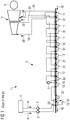
- FIG. 2 a system 1 according to the invention is shown.
- this system 1 comprises a heat recovery steam generator 3 according to the invention and a steam turbine 2.
- the second pressure section 10 and the third pressure section 30 of the heat recovery steam generator 3 are in general constructed as the respective sections 10, 30 of a heat recovery steam generator 3 according to the state of the art.
- Differences arise especially in the first pressure section 20. It starts with a common economiser 13, 23, 33 of all three pressure sections 10, 20, 30.
- feeding fluid 42, preferably water, of the first pressure section 20 is provided to a first flash vessel 24 comprising a pressure reducing device, especially a throttle valve 25.
- steam 50 is generated by flash evaporation, wherein the throttle valve 25 can be used to regulate and adjust the properties of the steam 50 produced in this flash vessel 24.
- Feeding fluid 42 not converted into steam 50 is provided to the next flash vessel 24, again providing a throttle valve 25. This is done in a cascading way four times, e.g. there are four flash vessels 24 with a throttle valve 25 each. Still not converted feeding fluid 42 is returned and recirculated.
- the four flash vessels 24 are therefore sequentially arranged in the flow of feeding fluid 42 and the different flash vessels 24 are constructed such that the pressure of steam 50 produced by flash evaporation in the respective flash vessel 24 is different. Therefore, the low pressure section of the steam turbine 2 can be fed with low pressure steam 50 at different pressure levels.
- a system 1 according to the invention comprising a heat recovery steam generator 3 according to the invention can provide several levels of low pressure steam 50 especially easy. Further, if the flash vessels 24 are placed in the vicinity of the steam turbine 2, the pipes used to convey the steam 50 produced in the flash vessels 24 to the steam turbine 2 can be constructed short.
- a mass flow of feeding fluid 42 and a mass flow of the exhaust gas 40 can be matched, especially by using the respective thermal capacities as matching constants. This allows providing at least the same transfer of thermal energy between the exhaust gas 40 and the produced steam 50 in the first pressure section 20 regardless whether a heat recovery steam generator 3 according to the state of the art or a heat recovery steam generator 3 according to the invention is used.
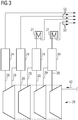
- FIG. 3 shows a part of an alternative embodiment of a heat recovery steam generator 3.
- a mechanical pressure reducing device, especially a water turbine 26, which is used to convey feeding fluid 42 into several flash vessels 24 is depicted. All features described below in respect to the water turbine 26 can also be related to a suitable mechanical pressure reducing device.
- the water turbine 26 replaces the throttle valves 25 (not shown).
- the feeding fluid 42 enters the first stage of the water turbine 26 and is conveyed via a feeding pipe 28 into the first flash vessel 24. In this flash vessel 24, part of the feeding fluid 42 is converted into steam 50 by flash evaporation. A superheating of the produced steam 50 in an additional first superheater section 21 is possible.
- Feeding fluid 42 not converted into steam 50 is conveyed via a transfer pipe 29 into the next stage of the water turbine 26. This is done sequentially three times.
- the pressure of the feeding fluid 42 conveyed by the water turbine 26 into the different flash vessels 24 is decreasing for each stage of the water turbine 26. Therefore, also the pressure of the steam 50 produced in the respective flash vessel 24 gets lower and lower and consequently steam 50 in the low pressure regime at different levels can be provided to the steam turbine 2 (not shown).
- the water turbine 26 used as mechanical pressure reducing device is used to generate power out of the flow of feeding fluid 42.
- the mechanical work can for instance be used to generate electricity or used directly to drive pumps 5 (not shown) or other devices of the heat recovery steam generator 3 according to the invention.
Landscapes
- Engineering & Computer Science (AREA)
- Chemical & Material Sciences (AREA)
- Combustion & Propulsion (AREA)
- Mechanical Engineering (AREA)
- General Engineering & Computer Science (AREA)
- Engine Equipment That Uses Special Cycles (AREA)
Abstract
Description
- The invention is directed to a heat recovery steam generator for generating steam for a steam turbine by recovering heat energy out of a flow of exhaust gas, comprising a first pressure section for producing steam at a first pressure. Further, the invention is directed to a method for generating steam for a steam turbine in a heat recovery steam generator. Additionally, the invention is directed to a system, comprising a steam turbine and a heat recovery steam generator, the heat recovery steam generator providing steam for the steam turbine.
- In modern technology it is widely known to use heat recovery steam generators which are recovering thermal energy of an exhaust gas to generate steam. The exhaust gas can for instance be produced by a gas turbine. The steam generated by the heat recovery steam generator can further on be used in a steam turbine to produce for instance electrical energy. Overall, by producing steam based on waste heat in an exhaust gas the energy efficiency of the whole system can be increased.
- In heat recovery steam generators according to the state of the art a commonly used solution is an evaporation of steam in tubes which are in direct contact with the exhaust gas. The steam generation in the known heat recovery steam generators are often divided in several sections, for instance a low pressure section, an intermediate pressure section and a high pressure section. Each section comprises an economiser to preheat a fluid, preferably water, to be turned into steam, an evaporator to generate the steam out of the fluid and often a superheater section to superheat the produced steam. Especially in the low pressure regime of the produced steam, a division in several stages, providing different steam pressures, is normally considered too costly, especially since the steam piping needed from the heat recovery steam generator to the steam turbine grows at these low pressures in dimensions with the decrease of the steam pressure and density respectively. In this low density and pressure regime of the produced steam therefore on the one hand the energy efficiency is reduced and on the other hand a variety of different low pressure steams cannot be provided by heat recovery steam generators known in the state of the art.
- Therefore, it is an objective of the present invention to provide an improved heat recovery steam generator, an improved method for generating steam for a steam turbine and an improved system comprising a steam turbine and a heat recovery steam generator which do not have the aforementioned drawbacks of the state of the art. It is especially an object of the present invention to provide a heat recovery steam generator, a method for generating steam for a steam turbine and a system comprising a steam turbine and a heat recovery steam generator that are more simple in the structural setup and additionally have improved energy efficiency and can provide steam at different pressures especially in the low pressure regime.
- This objective is solved by the patent claims. In particular, this objective is solved by a heat recovery steam generator according to claim 1, by a method for generating steam for a steam turbine according to
claim 11 and by a system comprising a steam turbine and a heat recovery steam generator according toclaim 13. The dependent claims describe preferred embodiments of the invention. - According to a first aspect of the invention, the objective is solved by a heat recovery steam generator for generating steam for a steam turbine by recovering heat energy out of a flow of exhaust gas, comprising at least a first pressure section for producing steam at a first pressure. A heat recovery steam generator according to the invention is characterised in that the first pressure section comprises a first economiser section thermally coupled to the exhaust gas to heat a feeding fluid and at least one flash vessel to generate steam out of the feeding fluid by flash evaporation.
- A heat recovery steam generator according to the invention can be used to generate steam based on the waste heat in an exhaust gas. The exhaust gas can be provided for instance by a gas turbine. A heat recovery steam generator according to the invention comprises at least a first pressure section to produce steam at a first pressure. This first pressure can be preferably low, for instance between 2bar and 35bar. In preferred embodiments of a heat recovery steam generator according to the invention, even more pressure sections can be present, for instance and preferably a second pressure section to produce steam at a high pressure, for instance at pressures beyond 70bar. Also a third pressure section to produce steam at an intermediate pressure or even more pressure sections can be present. The second pressure section, and, if present, all other additional pressure sections, comprise an economiser section, an evaporator section and a superheater section. These sections are sequentially arranged to be flown through by a heating fluid, starting by the economiser section, then the evaporator section and then the superheater section. Preferably, water is used as heating fluid. Further, these sections are arranged thermally coupled to a flow of exhaust gas, wherein the flow direction of the exhaust gas is vice versa to the general flow direction of the heating fluid that means the exhaust gas first is in thermal contact to the superheater section, then the evaporator section and then the economiser section. This arrangement ensures a very efficient thermal energy transfer out of the exhaust gas into the steam produced especially in the second, e.g. high pressure section.
- According to the invention, the first pressure section, which can be the only present pressure section, has a different set-up than the pressure sections known in the state of the art. Also in the first pressure section, an economiser is used to transfer thermal energy from the exhaust gas into the feeding fluid used in the first pressure section. Also for the feeding fluid water is used preferably. If additional pressure sections are present it is especially preferred that the heating fluid and the feeding fluid share a common reservoir. In contrast to an evaporator used in a pressure section of a heat recovery steam generator according to the state of the art, in a first pressure section of a heat recovery steam generator according to the invention a flash vessel is used to generate steam out of the feeding fluid by flash evaporation. Flash evaporation occurs, when the feeding fluid undergoes a reduction in pressure by passing a throttling device, for instance already when the feeding fluid enters the flash vessel via a small opening like a fixed orifice or a hole pattern in a plate or cage. Also a valve can be used.
- This bears several advantages. For instance, a transport of the heat recovered from the exhaust gas is provided by the feeding fluid. Naturally, the feeding fluid as a liquid has a much higher density than steam. Therefore, the pipes to transport the feeding fluid can be dimensioned much smaller compared to pipes needed to transport steam. A space needed to set up the first pressure section can therefore be massively reduced, especially if the flash vessel is located in vicinity to the steam turbine. This and also a reduction of the number of needed heat exchange modules, especially the avoidance of steam drums, lead to a simplification of the structural setup to the heat recovery steam generator. Preferably, a mass flow of feeding fluid can be chosen matched to a mass flow of the exhaust gas in a way that at least the same exergy utilisation can be achieved from the exhaust gas to the produced steam in the first pressure section according to the invention compared to a pressure section, especially a low pressure section, according to the state of the art. In this embodiment a first pressure section and therefore a heat recovery steam generator according to the invention provides an alternative and equally capable set-up of a low pressure section of a heat recovery steam generator.
- Preferably, a heat recovery steam generator according to the invention can be characterised in that the first pressure section comprises at least two or more flash vessels, especially three flash vessels, preferably four flash vessels, to generate steam out of the feeding fluid by flash evaporation at different pressure levels. In this especially preferred embodiment of a heat recovery steam generator according to the invention an even improved energy transfer between the exhaust gas and the produced steam can be achieved. Especially, steam at several, especially low, pressure levels can be provided. Therefore, in addition to the reduced energy losses regarding the thermal energy not extracted from the exhaust gas, an even better performance of the steam cycle, especially of a low pressure section of the steam turbine, by providing steam at several low pressure levels can be achieved. In summary, in this preferred embodiment of a heat recovery steam generator according to the invention, the extraction of thermal energy out of the exhaust gas can be improved and further on the efficiency of the performance of the steam turbine can also be improved.
- In a further improvement a heat recovery steam generator according to the invention can be characterised in that the at least two or more flash vessels are sequentially arranged in respect to the flow direction of the feeding fluid. Therefore, feeding fluid not turned into steam in one of the flash vessels can be transported into the sequentially arranged next flash vessel and so on. Each flash vessel can be constructed such that the respective flash vessel is directed to a certain steam pressure. Preferably, the order of the flash vessels in respect to the flow direction of the feeding fluid is reverse to the pressures and temperatures respectively of the produced steam in the flash vessels. The pressure of the steam produced in the respective flash vessels can therefore be easily adjusted by the design of the flash vessels and/or their connection to the steam turbine.
- Further on, a heat recovery steam generator according to the invention can be characterised in that the at least one flash vessel comprises a pressure reducing device, especially a throttle valve, to generate steam of the feeding fluid by flash evaporation. In a flash vessel steam is produced by flash evaporation that means that a sudden decrease of pressure, for instance induced by a sudden increase in available volume, for the flow of feeding fluid resolves at least partly in a transformation of the feeding fluid into steam. This can be provided especially easily by using a pressure reducing device, preferably by using a throttle valve.
- In an alternative embodiment a heat recovery steam generator according to the invention can be characterised in that the first pressure section comprises a mechanical pressure reducing device, preferably a water turbine, arranged in the flow of feeding fluid in the flow direction of the feeding fluid before the at least one flash vessel to deliver feeding fluid to the at least one flash vessel and to generate power out of the flow of feeding fluid. Other possible mechanical pressure reducing devices are for instance a piston machine or a screw expander. In this alternative embodiment a mechanical pressure reducing device is used to improve the energy efficiency of the heat recovery steam generator according to the invention. The mechanical pressure reducing device, preferably the water turbine, can additionally recover work out of the flow of feeding fluid and thereby increase the energy efficiency of the heat recovery steam generator according to the invention. The mechanical work can for instance be used to generate electricity or used directly to drive pumps or other devices of the heat recovery steam generator according to the invention.
- Additionally, a heat recovery steam generator according to the invention can be characterised in that the at least two or more flash vessels are sequentially arranged in respect to the flow direction of the feeding fluid and that the mechanical device comprises at least two stages, wherein at least one of the stages of the mechanical device comprises a feeding pipe to deliver feeding fluid to one of the flash vessels and a transfer pipe to transfer feeding fluid not used to generate steam in this flash vessel to the next stage of the mechanical device. In this preferred embodiment of a heat recovery steam generator according to the invention, again a water turbine is the preferred embodiment of the mechanical device. Nevertheless, also other suitable mechanical devices can be used. In the following, all descriptions related to a water turbine can be transferred to all suitable mechanical devices. The water turbine is used to provide feeding fluid to several flash vessels. Especially, the water turbine comprises at least two stages, preferably the water turbine comprises a dedicated stage for each flash vessel. The water turbine can be preferably constructed such that each flash vessel is provided with feeding fluid at a different pressure. In this preferred embodiment further a recirculation of the feeding fluid between the flash vessels and the water turbine is possible. Therefore, feeding pipes are used to transport the feeding fluid from a first stage of the water turbine into a flash vessel, wherein the feeding fluid is turned into steam at least partly by flash evaporation. Feeding fluid not turned into steam can flow back via a transfer pipe into the sequentially arranged next stage of the water turbine and further on transported by the water turbine via the next feeding pipe into the sequentially next flash vessel. This recirculation of the feeding fluid allows an even better heat recovery out of the exhaust gas via the feeding fluid into the steam produced in the several flash vessels. The energy efficiency and the energy exploitation respectively can therefore be improved.
- Further, a heat recovery steam generator according to the invention can be characterised in that the first pressure section comprises at least one first superheater section to superheat steam generated in the at least one flash vessel. By doing so, the temperature of the steam produced by the first pressure section can be risen further. This can be used to equalise the temperature of the steam and the temperature of the respective steam turbine section. A wear of the steam turbine can thereby be reduced. Further, an improvement of the efficiency of the steam turbine, to which the steam generated in the flash vessel, can be provided. An even better heat recovery and energy exploitation out of the exhaust gas into the produced steam to drive the steam turbine can therefore be achieved.
- Additionally, a heat recovery steam generator according to the invention can be characterised in that the heat recovery steam generator comprises at least a second pressure section and that the at least one first superheater section is thermally coupled to the second pressure section, especially that the at least one first superheater section is constructed to at least partly use heating fluid of the second pressure section. In this especially preferred embodiment heating fluid out of the second pressure section is used as thermal coupling to superheat the steam produced in the first pressure section. The second pressure section of the heat recovery steam generator according to the invention uses heating fluid on a much higher temperature level than the feeding fluid used in the first pressure section. By using this very hot heating fluid of the second pressure section a superheating of the steam produced in the first pressure section can be provided especially easily. No external heating unit is necessary to provide a superheater section for the first pressure section.
- According to another preferred embodiment of a heat recovery steam generator according to the invention the heat recovery steam generator is characterised in that the heat recovery steam generator comprises at least a second pressure section and that the first economiser section of the first pressure section is a part of the second economiser section of the second pressure section. For instance, this common part of the economiser sections can be arranged and thermally coupled to a downstream part of the exhaust gas pipe. By doing so, the flow of exhaust gas has already a lower temperature and can provide the beginning of the heating of the heating fluid for the high pressure section and simultaneously provide sufficient heating for the feeding fluid of the first pressure section. By combining the first economiser section as a part of the second economiser section, in other words the first economiser section is included in the second economiser section, the amount of space needed for the set-up for a heat recovery steam generator according to the invention can be reduced.
- According to a second aspect of the invention the objective in solved by a method for generating steam for a steam turbine in a heat recovery steam generator according to the first aspect of the invention. A method according to the invention is characterised in that steam for the steam turbine is at least partly generated by flash evaporation. All advantages described in detail in respect to a heat recovery steam generator according to the first aspect of the invention can therefore be achieved by a method for generating steam for a steam turbine in a heat recovery steam generator which is constructed according to the first aspect of the invention. All of these advantages can especially be provided by the fact that steam for the steam turbine is at least partly generated by flash evaporation, especially in a first pressure section of the heat recovery steam generator. Preferably, this first pressure section is a low pressure section which provides steam at a low pressure, for instance between 2bar and 35bar.
- In a preferred embodiment of a method according to the invention the method can be characterised in that a mass flow of the feeding fluid is matched to a mass flow of the exhaust gas, especially that the mass flow feeding fluid times the thermal capacity of the feeding fluid equals or at least roughly equals the mass flow of the exhaust gas times the thermal capacity of the exhaust gas. This matching of the mass flows of the exhaust gas and the feeding fluid used in the first pressure section of the heat recovery steam generator according to the first aspect of the invention provides an especially good replacement of a low pressure section of a heat recovery steam generator according to the state of the art. If a common economiser of two or more pressure sections, for instance of the first, e.g. low, pressure section and a second, e.g. high, pressure section, is used, the total flow of feeding and heating fluid can preferably be matched to the flow of the exhaust gas. Especially at least the same heat recovery and therefore energy efficiency can be provided by matching the mass flow of the feeding fluid to a mass flow of the exhaust gas. If water is used as feeding fluid the thermal capacity preferably equals 4.2. As a preferable value for the thermal capacity of an exhaust gas 1.07 can be used.
- According to a third aspect of the invention the objective is solved by a system comprising a steam turbine and a heat recovery steam generator, the heat recovery steam generator providing steam for the steam turbine. A system according to the invention is characterised in that the heat recovery steam generator is constructed according to the first aspect of the invention. All advantages described in detail in respect to a heat recovery steam generator according to the first aspect of the invention can therefore be achieved by a system according to the third aspect of the invention, which comprises a heat recovery steam generator according to the first aspect of the invention. Preferably, the heat recovery steam generator of the system according to the third aspect of the invention can also carry out a method according to the second aspect of the invention. All of the advantages described in respect to a method according to the second aspect of the invention can therefore be achieved by a system according to the third aspect of the invention which comprises a heat recovery steam generator capable of carrying out a method according to the second aspect of the invention.
- Additionally, a system according to the invention can be characterised in that at least the at least one flash vessel of the first pressure section of the heat recovery steam generator is arranged in vicinity to the steam turbine. In this embodiment an especial short distance between the flash vessel of the heat recovery steam generator and the steam turbine can be provided. In the at least one flash vessel steam at a preferably low pressure for the low pressure section of the steam turbine is produced. By arranging the at least one flash vessel in vicinity to the steam turbine the distance between the production position of the steam and the steam turbine can be minimised. Especially little space is needed for the pipes to transport the, especially low pressure, steam from the flash vessel into the steam turbine.
- The present invention is further described hereinafter with the reference to illustrate the embodiments shown in the accompanying drawings. Elements of the same function are specified throughout the figures with the same labels. The drawings show in a schematic way:
- FIG. 1
- a system comprising a steam turbine and a heat recovery steam generator according to the state of the art,
- FIG. 2
- a system comprising a steam turbine and a heat recovery steam generator according to the invention, and
- FIG. 3
- a part of a first pressure section of a heat recovery steam generator according to the invention.
-
FIG. 1 shows a system 1 comprising asteam turbine 2 and a heatrecovery steam generator 3 according to the state of the art. Thesteam turbine 2 is used to drive anelectric generator 4 to produce electric energy. In this embodiment, the heatrecovery steam generator 3 comprises three sections, asecond pressure section 10 to provide high pressure steam, anthird pressure section 30 to provide intermediate pressure steam and afirst pressure section 20 to provide steam at a low pressure. The different units of thesections exhaust gas 40.Pumps 5 are used to conveyheating fluid 41 through thefirst pressure section 20, thethird pressure section 30 and thesecond pressure section 10. The different branches of theheating fluid 41 share a common reservoir and preferably water is used for theheating fluid 41. In flow direction of theheating fluid 41, and therefore against the flow direction of the flow ofexhaust gas 40, the heatrecovery steam generator 3 starts with a common arrangement of thefirst economiser section 23 of thefirst pressure section 20 and the second andthird economiser section 13, 33 of thethird pressure section 30 and thesecond pressure section 10 respectively. Next follows thefirst evaporator section 22 of thefirst pressure section 20 which is further upstream in respect to the flow ofexhaust gas 40 followed by afirst superheater section 21 of thefirst pressure section 20. Thelow pressure steam 50 is then conveyed to the low pressure section of thesteam turbine 2. Along the flow ofexhaust gas 40 further units of thethird pressure section 30 and thesecond pressure section 10 are sequentially arranged along the flow ofexhaust gas 40. Thethird pressure section 30 as well as thesecond pressure section 10 compriseseveral economiser sections 13, 33 and oneevaporator section 12, 33 each. Alsoseveral superheater sections third pressure section 30 and thesecond pressure section 10 of the heatrecovery steam generator 3 according to the state of the art as well. Thesteam 50 at a high pressure level generated in thesecond pressure section 10 is afterwards provided to thesteam turbine 2 on its high pressure end. Thesteam 50 at an intermediate pressure level generated in thethird pressure section 30 is provided to an intermediate point in thesteam turbine 2. Clearly visible in this system 1 according to the state of the art is that the heatrecovery steam generator 3 according to the state of the art only provideslow pressure steam 50 at one single pressure level. Further, the position of the steam generation of thefirst pressure section 20 is determined by the flow ofexhaust gas 40. Consequently, long distances between this position and thesteam turbine 2 cannot be avoided, causing a huge dimensional requirement in regard to setup space for the pipes to transport thelow pressure steam 50. - In
FIG. 2 a system 1 according to the invention is shown. Especially this system 1 comprises a heatrecovery steam generator 3 according to the invention and asteam turbine 2. Thesecond pressure section 10 and thethird pressure section 30 of the heatrecovery steam generator 3 are in general constructed as therespective sections recovery steam generator 3 according to the state of the art. For details, seeFig. 1 and the according description respectively. Differences arise especially in thefirst pressure section 20. It starts with acommon economiser pressure sections fluid 42, preferably water, of thefirst pressure section 20 is provided to afirst flash vessel 24 comprising a pressure reducing device, especially a throttle valve 25. In thisflash vessel 24steam 50 is generated by flash evaporation, wherein the throttle valve 25 can be used to regulate and adjust the properties of thesteam 50 produced in thisflash vessel 24. Feedingfluid 42 not converted intosteam 50 is provided to thenext flash vessel 24, again providing a throttle valve 25. This is done in a cascading way four times, e.g. there are fourflash vessels 24 with a throttle valve 25 each. Still not converted feedingfluid 42 is returned and recirculated. The fourflash vessels 24 are therefore sequentially arranged in the flow of feedingfluid 42 and thedifferent flash vessels 24 are constructed such that the pressure ofsteam 50 produced by flash evaporation in therespective flash vessel 24 is different. Therefore, the low pressure section of thesteam turbine 2 can be fed withlow pressure steam 50 at different pressure levels. It is even possible to superheat at least parts of the produced steams 50 in additionalfirst superheater sections 21, which can preferably be connected to thesecond pressure section 10 to use theheating fluid 41 in thesecond pressure section 10 as a thermal coupling 43 to superheat thesteam 50 produced in thefirst pressure section 20. A better matching between the temperature of the providedsteam 50 and the temperature within thesteam turbine 2 can therefore be achieved. In summary, a system 1 according to the invention comprising a heatrecovery steam generator 3 according to the invention can provide several levels oflow pressure steam 50 especially easy. Further, if theflash vessels 24 are placed in the vicinity of thesteam turbine 2, the pipes used to convey thesteam 50 produced in theflash vessels 24 to thesteam turbine 2 can be constructed short. Less space is therefore needed to set up a system 1 according to the invention and an overall simplification of the setup of the heatrecovery steam generator 3 and the complete system 1 can be provided. To improve the ability to replace a heatrecovery steam generator 3 according to the state of the art with a heatrecovery steam generator 3 according to the invention, a mass flow of feedingfluid 42 and a mass flow of theexhaust gas 40 can be matched, especially by using the respective thermal capacities as matching constants. This allows providing at least the same transfer of thermal energy between theexhaust gas 40 and the producedsteam 50 in thefirst pressure section 20 regardless whether a heatrecovery steam generator 3 according to the state of the art or a heatrecovery steam generator 3 according to the invention is used. -
FIG. 3 shows a part of an alternative embodiment of a heatrecovery steam generator 3. A mechanical pressure reducing device, especially awater turbine 26, which is used to convey feedingfluid 42 intoseveral flash vessels 24 is depicted. All features described below in respect to thewater turbine 26 can also be related to a suitable mechanical pressure reducing device. Thewater turbine 26 replaces the throttle valves 25 (not shown). The feedingfluid 42 enters the first stage of thewater turbine 26 and is conveyed via afeeding pipe 28 into thefirst flash vessel 24. In thisflash vessel 24, part of the feedingfluid 42 is converted intosteam 50 by flash evaporation. A superheating of the producedsteam 50 in an additionalfirst superheater section 21 is possible. Feedingfluid 42 not converted intosteam 50 is conveyed via atransfer pipe 29 into the next stage of thewater turbine 26. This is done sequentially three times. The pressure of the feedingfluid 42 conveyed by thewater turbine 26 into thedifferent flash vessels 24 is decreasing for each stage of thewater turbine 26. Therefore, also the pressure of thesteam 50 produced in therespective flash vessel 24 gets lower and lower and consequently steam 50 in the low pressure regime at different levels can be provided to the steam turbine 2 (not shown). In addition, thewater turbine 26 used as mechanical pressure reducing device is used to generate power out of the flow of feedingfluid 42. The mechanical work can for instance be used to generate electricity or used directly to drive pumps 5 (not shown) or other devices of the heatrecovery steam generator 3 according to the invention. -
- 1
- system
- 2
- steam turbine
- 3
- heat recovery steam generator
- 4
- electric generator
- 5
- pump
- 10
- second pressure section
- 11
- second superheater section
- 12
- second evaporator section
- 13
- second economiser section
- 20
- first pressure section
- 21
- first superheater section
- 22
- first evaporator section
- 23
- first economiser section
- 24
- flash vessel
- 25
- throttle valve
- 26
- water turbine
- 27
- stage
- 28
- feeding pipe
- 29
- transfer pipe
- 30
- third pressure section
- 31
- third superheater section
- 32
- third evaporator section
- 33
- third economiser section
- 40
- exhaust gas
- 41
- heating fluid
- 42
- feeding fluid
- 43
- thermal coupling
- 50
- steam
Claims (13)
- Heat recovery steam generator (3) for generating steam (50) for a steam turbine (2) by recovering heat energy out of a flow of exhaust gas (40), comprising at least a first pressure section (20) for producing steam (50) at a first pressure,
characterised in
that the first pressure section (20) comprises a first economiser section (23) thermally coupled to the exhaust gas to heat a feeding fluid (42) and at least one flash vessel (24) to generate steam (50) out of the feeding fluid (42) by flash evaporation. - Heat recovery steam generator (3) according claim 1,
characterised in
that the first pressure section (20) comprises at least two or more flash vessels (24), especially three flash vessels (24), preferably four flash vessels (24), to generate steam (50) out of the feeding fluid (42) by flash evaporation at different pressure levels. - Heat recovery steam generator (3) according claim 2,
characterised in
that the at least two or more flash vessels (24) are sequentially arranged in respect to the flow direction of the feeding fluid (42). - Heat recovery steam generator (3) according one of the preceding claims,
characterised in
that the at least one flash vessel (24) comprises a pressure reducing device, especially a throttle valve (25), to generate steam (50) out of the feeding fluid (42) by flash evaporation. - Heat recovery steam generator (3) according one of the preceding claims 1 to 3,
characterised in
that the first pressure section (20) comprises a mechanical pressure reducing device, preferably a water turbine (26), arranged in the flow of feeding fluid (42) in flow direction of the feeding fluid (42) before the at least one flash vessel (24) to deliver feeding fluid (42) to the at least one flash vessel (24) and to generate power out of the flow of feeding fluid (42). - Heat recovery steam generator (3) according claim 2 and 5,
characterised in
that the at least two or more flash vessels (24) are sequentially arranged in respect to the flow direction of the feeding fluid (42) and that the mechanical device comprises at least two stages (27), wherein at least one of the stages (27) of the mechanical device comprises a feeding pipe (28) to deliver feeding fluid (42) to one of the flash vessels (24) and a transfer pipe (29) to transfer feeding fluid (42) not used to generate steam (50) in this flash vessel (24) to the next stage (27) of the mechanical device. - Heat recovery steam generator (3) according one of the preceding claims,
characterised in
that the first pressure section (20) comprises at least one first superheater section (21) to superheat steam (50) generated in the at least one flash vessel (24). - Heat recovery steam generator (3) according claim 7,
characterised in
that the heat recovery steam generator (3) comprises at least a second pressure section (10) and that the at least one first superheater section (21) is thermally coupled to the second pressure section (10), especially that the at least one first superheater section (21) is constructed to at least partly use heating fluid (41) of the second pressure section (10). - Heat recovery steam generator (3) according one of the preceding claims,
characterised in
that the heat recovery steam generator (3) comprises at least a second pressure section (10) and that the first economiser section (23) of the first pressure section (20) is a part of the second economiser section (13) of the second pressure section (10). - Method for generating steam (50) for a steam turbine (2) in a heat recovery steam generator (3) according to one of the preceding claims,
characterised in
that steam (50) for the steam turbine (2) is at least partly generated by flash evaporation. - Method according claim 10,
characterised in
that a mass flow of the feeding fluid (42) is matched to a mass flow of the exhaust gas, especially that the mass flow of the feeding fluid (42) times the thermal capacity of the feeding fluid (42) equals or at least roughly equals the mass flow of the exhaust gas (40) times the thermal capacity of the exhaust gas (40). - System (1) comprising a steam turbine (2) and a heat recovery steam generator (3), the heat recovery steam generator (3) providing steam (50) for the steam turbine (2),
characterised in
that the heat recovery steam generator (3) is constructed according to one of the claims 1 to 9. - System (1) according to claim 12,
characterised in
that at least the at least one flash vessel (24) of the first pressure section (20) of the heat recovery steam generator (3) is arranged in vicinity to the steam turbine (2).
Priority Applications (2)
| Application Number | Priority Date | Filing Date | Title |
|---|---|---|---|
| PL17202789.8T PL3486440T3 (en) | 2017-11-21 | 2017-11-21 | Heat recovery steam generator, method for generating steam for a steam turbine and system comprising a steam turbine and a heat recovery steam generator |
| EP17202789.8A EP3486440B1 (en) | 2017-11-21 | 2017-11-21 | Heat recovery steam generator, method for generating steam for a steam turbine and system comprising a steam turbine and a heat recovery steam generator |
Applications Claiming Priority (1)
| Application Number | Priority Date | Filing Date | Title |
|---|---|---|---|
| EP17202789.8A EP3486440B1 (en) | 2017-11-21 | 2017-11-21 | Heat recovery steam generator, method for generating steam for a steam turbine and system comprising a steam turbine and a heat recovery steam generator |
Publications (2)
| Publication Number | Publication Date |
|---|---|
| EP3486440A1 true EP3486440A1 (en) | 2019-05-22 |
| EP3486440B1 EP3486440B1 (en) | 2022-11-09 |
Family
ID=60450444
Family Applications (1)
| Application Number | Title | Priority Date | Filing Date |
|---|---|---|---|
| EP17202789.8A Active EP3486440B1 (en) | 2017-11-21 | 2017-11-21 | Heat recovery steam generator, method for generating steam for a steam turbine and system comprising a steam turbine and a heat recovery steam generator |
Country Status (2)
| Country | Link |
|---|---|
| EP (1) | EP3486440B1 (en) |
| PL (1) | PL3486440T3 (en) |
Cited By (1)
| Publication number | Priority date | Publication date | Assignee | Title |
|---|---|---|---|---|
| EP4067738A4 (en) * | 2019-11-28 | 2023-01-18 | Mitsubishi Heavy Industries, Ltd. | STEAM GENERATOR AND WASTE HEAT RECOVERY PLANT |
Citations (6)
| Publication number | Priority date | Publication date | Assignee | Title |
|---|---|---|---|---|
| US3611718A (en) * | 1970-05-05 | 1971-10-12 | Treadwell Corp | Waste heat steam generating cycle |
| EP0636779A1 (en) * | 1993-07-08 | 1995-02-01 | Oy Wärtsilä Diesel International Ltd. | Thermal power engine and its operating method |
| EP0789134A2 (en) * | 1996-02-09 | 1997-08-13 | Asea Brown Boveri Ag | Process for operating a power plant |
| US20150113939A1 (en) * | 2013-10-31 | 2015-04-30 | Alstom Technology Ltd | Combined cycle power plant with improved efficiency |
| US20160138428A1 (en) * | 2014-11-13 | 2016-05-19 | General Electric Company | System and method for heat recovery and steam generation in combined cycle systems |
| US20170051636A1 (en) * | 2015-08-19 | 2017-02-23 | Kabushiki Kaisha Toshiba | Combined cycle power system, and a method of operating a combined cycle power system |
-
2017
- 2017-11-21 EP EP17202789.8A patent/EP3486440B1/en active Active
- 2017-11-21 PL PL17202789.8T patent/PL3486440T3/en unknown
Patent Citations (6)
| Publication number | Priority date | Publication date | Assignee | Title |
|---|---|---|---|---|
| US3611718A (en) * | 1970-05-05 | 1971-10-12 | Treadwell Corp | Waste heat steam generating cycle |
| EP0636779A1 (en) * | 1993-07-08 | 1995-02-01 | Oy Wärtsilä Diesel International Ltd. | Thermal power engine and its operating method |
| EP0789134A2 (en) * | 1996-02-09 | 1997-08-13 | Asea Brown Boveri Ag | Process for operating a power plant |
| US20150113939A1 (en) * | 2013-10-31 | 2015-04-30 | Alstom Technology Ltd | Combined cycle power plant with improved efficiency |
| US20160138428A1 (en) * | 2014-11-13 | 2016-05-19 | General Electric Company | System and method for heat recovery and steam generation in combined cycle systems |
| US20170051636A1 (en) * | 2015-08-19 | 2017-02-23 | Kabushiki Kaisha Toshiba | Combined cycle power system, and a method of operating a combined cycle power system |
Cited By (2)
| Publication number | Priority date | Publication date | Assignee | Title |
|---|---|---|---|---|
| EP4067738A4 (en) * | 2019-11-28 | 2023-01-18 | Mitsubishi Heavy Industries, Ltd. | STEAM GENERATOR AND WASTE HEAT RECOVERY PLANT |
| US11834968B2 (en) | 2019-11-28 | 2023-12-05 | Mitsubishi Heavy Industries, Ltd. | Steam generation apparatus and exhaust gas heat recovery plant |
Also Published As
| Publication number | Publication date |
|---|---|
| PL3486440T3 (en) | 2023-03-13 |
| EP3486440B1 (en) | 2022-11-09 |
Similar Documents
| Publication | Publication Date | Title |
|---|---|---|
| US11085334B2 (en) | Exhaust steam waste heat recovering and supplying system of air-cooling units in large thermal power plants | |
| EP3054155B1 (en) | Electrical energy storage and discharge system | |
| CN102405349B (en) | Steam power plant with solar collectors | |
| US7874162B2 (en) | Supercritical steam combined cycle and method | |
| EP3081770A1 (en) | Energy storage system and method | |
| EP2580435B1 (en) | Orc plant with a system for improving the heat exchange between the source of hot fluid and the working fluid | |
| US20130047611A1 (en) | Solar power plant part of a solar thermal power plant and solar thermal power plant provided with solar collector surfaces for a heat transfer medium and working medium | |
| EP2584157B1 (en) | Heat recovery steam generator and methods of coupling same to a combined cycle power plant | |
| CN101109298A (en) | Steam turbine and power station having such a steam turbine | |
| JPWO2019087657A1 (en) | Solar thermal power generation system | |
| CN107466353A (en) | Fused salt leads directly to steam generator | |
| EP3077632B1 (en) | Combined cycle system | |
| US6052996A (en) | Heat-work cycle for steam cycle electric power generation plants | |
| KR20190052118A (en) | Heat exchange systems, cooling systems and cooling methods for gas turbines and gas turbine systems | |
| EP3486440B1 (en) | Heat recovery steam generator, method for generating steam for a steam turbine and system comprising a steam turbine and a heat recovery steam generator | |
| CN104422202A (en) | heat exchanger, heat engine circulation system and control method thereof | |
| US10208630B2 (en) | Method for operating a steam power plant and steam power plant for conducting said method | |
| CN116658889B (en) | Heating device based on nuclear power plant two-loop heat supply mode and control method thereof | |
| CN102510932A (en) | Steam power plant | |
| TW201520500A (en) | Heat exchanger with preheating and evaporating functions and heat cycle system and method using the same | |
| EP4158161B1 (en) | Cascade organic rankine cycle plant | |
| EP3135871B1 (en) | Back-pressure steam turbine and a system for combined production of electrical and thermal energy | |
| US11802494B2 (en) | Optimized cascade organic Rankine cycle | |
| EP3078817A1 (en) | Energy storage system and method | |
| CN106460574A (en) | Arrangement system with multiple heat transmitters and method for evaporating a working medium |
Legal Events
| Date | Code | Title | Description |
|---|---|---|---|
| PUAI | Public reference made under article 153(3) epc to a published international application that has entered the european phase |
Free format text: ORIGINAL CODE: 0009012 |
|
| STAA | Information on the status of an ep patent application or granted ep patent |
Free format text: STATUS: THE APPLICATION HAS BEEN PUBLISHED |
|
| AK | Designated contracting states |
Kind code of ref document: A1 Designated state(s): AL AT BE BG CH CY CZ DE DK EE ES FI FR GB GR HR HU IE IS IT LI LT LU LV MC MK MT NL NO PL PT RO RS SE SI SK SM TR |
|
| AX | Request for extension of the european patent |
Extension state: BA ME |
|
| STAA | Information on the status of an ep patent application or granted ep patent |
Free format text: STATUS: REQUEST FOR EXAMINATION WAS MADE |
|
| 17P | Request for examination filed |
Effective date: 20191018 |
|
| RBV | Designated contracting states (corrected) |
Designated state(s): AL AT BE BG CH CY CZ DE DK EE ES FI FR GB GR HR HU IE IS IT LI LT LU LV MC MK MT NL NO PL PT RO RS SE SI SK SM TR |
|
| RAP1 | Party data changed (applicant data changed or rights of an application transferred) |
Owner name: SIEMENS ENERGY GLOBAL GMBH & CO. KG |
|
| GRAP | Despatch of communication of intention to grant a patent |
Free format text: ORIGINAL CODE: EPIDOSNIGR1 |
|
| STAA | Information on the status of an ep patent application or granted ep patent |
Free format text: STATUS: GRANT OF PATENT IS INTENDED |
|
| INTG | Intention to grant announced |
Effective date: 20220627 |
|
| GRAS | Grant fee paid |
Free format text: ORIGINAL CODE: EPIDOSNIGR3 |
|
| GRAA | (expected) grant |
Free format text: ORIGINAL CODE: 0009210 |
|
| STAA | Information on the status of an ep patent application or granted ep patent |
Free format text: STATUS: THE PATENT HAS BEEN GRANTED |
|
| AK | Designated contracting states |
Kind code of ref document: B1 Designated state(s): AL AT BE BG CH CY CZ DE DK EE ES FI FR GB GR HR HU IE IS IT LI LT LU LV MC MK MT NL NO PL PT RO RS SE SI SK SM TR |
|
| REG | Reference to a national code |
Ref country code: GB Ref legal event code: FG4D |
|
| REG | Reference to a national code |
Ref country code: CH Ref legal event code: EP Ref country code: AT Ref legal event code: REF Ref document number: 1530509 Country of ref document: AT Kind code of ref document: T Effective date: 20221115 |
|
| REG | Reference to a national code |
Ref country code: DE Ref legal event code: R096 Ref document number: 602017063478 Country of ref document: DE |
|
| REG | Reference to a national code |
Ref country code: IE Ref legal event code: FG4D |
|
| REG | Reference to a national code |
Ref country code: LT Ref legal event code: MG9D |
|
| REG | Reference to a national code |
Ref country code: NL Ref legal event code: MP Effective date: 20221109 |
|
| REG | Reference to a national code |
Ref country code: AT Ref legal event code: MK05 Ref document number: 1530509 Country of ref document: AT Kind code of ref document: T Effective date: 20221109 |
|
| PG25 | Lapsed in a contracting state [announced via postgrant information from national office to epo] |
Ref country code: SE Free format text: LAPSE BECAUSE OF FAILURE TO SUBMIT A TRANSLATION OF THE DESCRIPTION OR TO PAY THE FEE WITHIN THE PRESCRIBED TIME-LIMIT Effective date: 20221109 Ref country code: PT Free format text: LAPSE BECAUSE OF FAILURE TO SUBMIT A TRANSLATION OF THE DESCRIPTION OR TO PAY THE FEE WITHIN THE PRESCRIBED TIME-LIMIT Effective date: 20230309 Ref country code: NO Free format text: LAPSE BECAUSE OF FAILURE TO SUBMIT A TRANSLATION OF THE DESCRIPTION OR TO PAY THE FEE WITHIN THE PRESCRIBED TIME-LIMIT Effective date: 20230209 Ref country code: LT Free format text: LAPSE BECAUSE OF FAILURE TO SUBMIT A TRANSLATION OF THE DESCRIPTION OR TO PAY THE FEE WITHIN THE PRESCRIBED TIME-LIMIT Effective date: 20221109 Ref country code: FI Free format text: LAPSE BECAUSE OF FAILURE TO SUBMIT A TRANSLATION OF THE DESCRIPTION OR TO PAY THE FEE WITHIN THE PRESCRIBED TIME-LIMIT Effective date: 20221109 Ref country code: ES Free format text: LAPSE BECAUSE OF FAILURE TO SUBMIT A TRANSLATION OF THE DESCRIPTION OR TO PAY THE FEE WITHIN THE PRESCRIBED TIME-LIMIT Effective date: 20221109 Ref country code: AT Free format text: LAPSE BECAUSE OF FAILURE TO SUBMIT A TRANSLATION OF THE DESCRIPTION OR TO PAY THE FEE WITHIN THE PRESCRIBED TIME-LIMIT Effective date: 20221109 |
|
| PG25 | Lapsed in a contracting state [announced via postgrant information from national office to epo] |
Ref country code: RS Free format text: LAPSE BECAUSE OF FAILURE TO SUBMIT A TRANSLATION OF THE DESCRIPTION OR TO PAY THE FEE WITHIN THE PRESCRIBED TIME-LIMIT Effective date: 20221109 Ref country code: LV Free format text: LAPSE BECAUSE OF FAILURE TO SUBMIT A TRANSLATION OF THE DESCRIPTION OR TO PAY THE FEE WITHIN THE PRESCRIBED TIME-LIMIT Effective date: 20221109 Ref country code: IS Free format text: LAPSE BECAUSE OF FAILURE TO SUBMIT A TRANSLATION OF THE DESCRIPTION OR TO PAY THE FEE WITHIN THE PRESCRIBED TIME-LIMIT Effective date: 20230309 Ref country code: HR Free format text: LAPSE BECAUSE OF FAILURE TO SUBMIT A TRANSLATION OF THE DESCRIPTION OR TO PAY THE FEE WITHIN THE PRESCRIBED TIME-LIMIT Effective date: 20221109 Ref country code: GR Free format text: LAPSE BECAUSE OF FAILURE TO SUBMIT A TRANSLATION OF THE DESCRIPTION OR TO PAY THE FEE WITHIN THE PRESCRIBED TIME-LIMIT Effective date: 20230210 |
|
| PG25 | Lapsed in a contracting state [announced via postgrant information from national office to epo] |
Ref country code: NL Free format text: LAPSE BECAUSE OF FAILURE TO SUBMIT A TRANSLATION OF THE DESCRIPTION OR TO PAY THE FEE WITHIN THE PRESCRIBED TIME-LIMIT Effective date: 20221109 |
|
| REG | Reference to a national code |
Ref country code: CH Ref legal event code: PL |
|
| REG | Reference to a national code |
Ref country code: BE Ref legal event code: MM Effective date: 20221130 |
|
| PG25 | Lapsed in a contracting state [announced via postgrant information from national office to epo] |
Ref country code: SM Free format text: LAPSE BECAUSE OF FAILURE TO SUBMIT A TRANSLATION OF THE DESCRIPTION OR TO PAY THE FEE WITHIN THE PRESCRIBED TIME-LIMIT Effective date: 20221109 Ref country code: RO Free format text: LAPSE BECAUSE OF FAILURE TO SUBMIT A TRANSLATION OF THE DESCRIPTION OR TO PAY THE FEE WITHIN THE PRESCRIBED TIME-LIMIT Effective date: 20221109 Ref country code: LI Free format text: LAPSE BECAUSE OF NON-PAYMENT OF DUE FEES Effective date: 20221130 Ref country code: EE Free format text: LAPSE BECAUSE OF FAILURE TO SUBMIT A TRANSLATION OF THE DESCRIPTION OR TO PAY THE FEE WITHIN THE PRESCRIBED TIME-LIMIT Effective date: 20221109 Ref country code: DK Free format text: LAPSE BECAUSE OF FAILURE TO SUBMIT A TRANSLATION OF THE DESCRIPTION OR TO PAY THE FEE WITHIN THE PRESCRIBED TIME-LIMIT Effective date: 20221109 Ref country code: CH Free format text: LAPSE BECAUSE OF NON-PAYMENT OF DUE FEES Effective date: 20221130 |
|
| REG | Reference to a national code |
Ref country code: DE Ref legal event code: R097 Ref document number: 602017063478 Country of ref document: DE |
|
| PG25 | Lapsed in a contracting state [announced via postgrant information from national office to epo] |
Ref country code: SK Free format text: LAPSE BECAUSE OF FAILURE TO SUBMIT A TRANSLATION OF THE DESCRIPTION OR TO PAY THE FEE WITHIN THE PRESCRIBED TIME-LIMIT Effective date: 20221109 Ref country code: LU Free format text: LAPSE BECAUSE OF NON-PAYMENT OF DUE FEES Effective date: 20221121 Ref country code: AL Free format text: LAPSE BECAUSE OF FAILURE TO SUBMIT A TRANSLATION OF THE DESCRIPTION OR TO PAY THE FEE WITHIN THE PRESCRIBED TIME-LIMIT Effective date: 20221109 |
|
| PLBE | No opposition filed within time limit |
Free format text: ORIGINAL CODE: 0009261 |
|
| STAA | Information on the status of an ep patent application or granted ep patent |
Free format text: STATUS: NO OPPOSITION FILED WITHIN TIME LIMIT |
|
| 26N | No opposition filed |
Effective date: 20230810 |
|
| GBPC | Gb: european patent ceased through non-payment of renewal fee |
Effective date: 20230209 |
|
| PG25 | Lapsed in a contracting state [announced via postgrant information from national office to epo] |
Ref country code: IE Free format text: LAPSE BECAUSE OF NON-PAYMENT OF DUE FEES Effective date: 20221121 |
|
| PG25 | Lapsed in a contracting state [announced via postgrant information from national office to epo] |
Ref country code: SI Free format text: LAPSE BECAUSE OF FAILURE TO SUBMIT A TRANSLATION OF THE DESCRIPTION OR TO PAY THE FEE WITHIN THE PRESCRIBED TIME-LIMIT Effective date: 20221109 Ref country code: BE Free format text: LAPSE BECAUSE OF NON-PAYMENT OF DUE FEES Effective date: 20221130 |
|
| PG25 | Lapsed in a contracting state [announced via postgrant information from national office to epo] |
Ref country code: GB Free format text: LAPSE BECAUSE OF NON-PAYMENT OF DUE FEES Effective date: 20230209 |
|
| PG25 | Lapsed in a contracting state [announced via postgrant information from national office to epo] |
Ref country code: GB Free format text: LAPSE BECAUSE OF NON-PAYMENT OF DUE FEES Effective date: 20230209 |
|
| PG25 | Lapsed in a contracting state [announced via postgrant information from national office to epo] |
Ref country code: HU Free format text: LAPSE BECAUSE OF FAILURE TO SUBMIT A TRANSLATION OF THE DESCRIPTION OR TO PAY THE FEE WITHIN THE PRESCRIBED TIME-LIMIT; INVALID AB INITIO Effective date: 20171121 |
|
| PG25 | Lapsed in a contracting state [announced via postgrant information from national office to epo] |
Ref country code: CY Free format text: LAPSE BECAUSE OF FAILURE TO SUBMIT A TRANSLATION OF THE DESCRIPTION OR TO PAY THE FEE WITHIN THE PRESCRIBED TIME-LIMIT Effective date: 20221109 |
|
| PG25 | Lapsed in a contracting state [announced via postgrant information from national office to epo] |
Ref country code: MK Free format text: LAPSE BECAUSE OF FAILURE TO SUBMIT A TRANSLATION OF THE DESCRIPTION OR TO PAY THE FEE WITHIN THE PRESCRIBED TIME-LIMIT Effective date: 20221109 |
|
| PG25 | Lapsed in a contracting state [announced via postgrant information from national office to epo] |
Ref country code: MC Free format text: LAPSE BECAUSE OF FAILURE TO SUBMIT A TRANSLATION OF THE DESCRIPTION OR TO PAY THE FEE WITHIN THE PRESCRIBED TIME-LIMIT Effective date: 20221109 |
|
| PG25 | Lapsed in a contracting state [announced via postgrant information from national office to epo] |
Ref country code: TR Free format text: LAPSE BECAUSE OF FAILURE TO SUBMIT A TRANSLATION OF THE DESCRIPTION OR TO PAY THE FEE WITHIN THE PRESCRIBED TIME-LIMIT Effective date: 20221109 Ref country code: MC Free format text: LAPSE BECAUSE OF FAILURE TO SUBMIT A TRANSLATION OF THE DESCRIPTION OR TO PAY THE FEE WITHIN THE PRESCRIBED TIME-LIMIT Effective date: 20221109 |
|
| PG25 | Lapsed in a contracting state [announced via postgrant information from national office to epo] |
Ref country code: BG Free format text: LAPSE BECAUSE OF FAILURE TO SUBMIT A TRANSLATION OF THE DESCRIPTION OR TO PAY THE FEE WITHIN THE PRESCRIBED TIME-LIMIT Effective date: 20221109 |
|
| PG25 | Lapsed in a contracting state [announced via postgrant information from national office to epo] |
Ref country code: MT Free format text: LAPSE BECAUSE OF FAILURE TO SUBMIT A TRANSLATION OF THE DESCRIPTION OR TO PAY THE FEE WITHIN THE PRESCRIBED TIME-LIMIT Effective date: 20221109 |
|
| PGFP | Annual fee paid to national office [announced via postgrant information from national office to epo] |
Ref country code: DE Payment date: 20251126 Year of fee payment: 9 |
|
| PGFP | Annual fee paid to national office [announced via postgrant information from national office to epo] |
Ref country code: IT Payment date: 20251121 Year of fee payment: 9 |
|
| PGFP | Annual fee paid to national office [announced via postgrant information from national office to epo] |
Ref country code: FR Payment date: 20251124 Year of fee payment: 9 |
|
| PGFP | Annual fee paid to national office [announced via postgrant information from national office to epo] |
Ref country code: CZ Payment date: 20251111 Year of fee payment: 9 |
|
| PGFP | Annual fee paid to national office [announced via postgrant information from national office to epo] |
Ref country code: PL Payment date: 20251028 Year of fee payment: 9 |