EP3486237B1 - Triazinone derivative containing sulfonyl structure and preparation method therefor, and insecticidal and bactericidal uses thereof - Google Patents
Triazinone derivative containing sulfonyl structure and preparation method therefor, and insecticidal and bactericidal uses thereof Download PDFInfo
- Publication number
- EP3486237B1 EP3486237B1 EP17892064.1A EP17892064A EP3486237B1 EP 3486237 B1 EP3486237 B1 EP 3486237B1 EP 17892064 A EP17892064 A EP 17892064A EP 3486237 B1 EP3486237 B1 EP 3486237B1
- Authority
- EP
- European Patent Office
- Prior art keywords
- substituted
- unsubstituted
- formula
- triazinone
- alkyl
- Prior art date
- Legal status (The legal status is an assumption and is not a legal conclusion. Google has not performed a legal analysis and makes no representation as to the accuracy of the status listed.)
- Active
Links
- 0 CC(CN1N)=NNC1=* Chemical compound CC(CN1N)=NNC1=* 0.000 description 12
- SDWYPAPFCIUIST-UHFFFAOYSA-N CC(CN1N(S(C)(=O)=O)S(C)(=O)=O)=NNC1=O Chemical compound CC(CN1N(S(C)(=O)=O)S(C)(=O)=O)=NNC1=O SDWYPAPFCIUIST-UHFFFAOYSA-N 0.000 description 1
- SBJSRIGZOQOMKM-UHFFFAOYSA-N CC(CN1NS(c2ccc(C(F)(F)F)cc2)(=O)=O)=NNC1O Chemical compound CC(CN1NS(c2ccc(C(F)(F)F)cc2)(=O)=O)=NNC1O SBJSRIGZOQOMKM-UHFFFAOYSA-N 0.000 description 1
- YTUWTASSNUUNLL-UHFFFAOYSA-N CCS(N(N(CC(C)=NN1)C1=O)S(CC)(=O)=O)(=O)=O Chemical compound CCS(N(N(CC(C)=NN1)C1=O)S(CC)(=O)=O)(=O)=O YTUWTASSNUUNLL-UHFFFAOYSA-N 0.000 description 1
- GPYOMRBKIGMZEC-UHFFFAOYSA-N C[n]1cnc(S(C)(=O)=O)c1 Chemical compound C[n]1cnc(S(C)(=O)=O)c1 GPYOMRBKIGMZEC-UHFFFAOYSA-N 0.000 description 1
- KFPMLWUKHQMEBU-UHFFFAOYSA-N Cc1cccc(S(Cl)(=O)=O)c1 Chemical compound Cc1cccc(S(Cl)(=O)=O)c1 KFPMLWUKHQMEBU-UHFFFAOYSA-N 0.000 description 1
- JWHSRWUHRLYAPM-UHFFFAOYSA-N O=S(c1ccc2OCCOc2c1)(Cl)=O Chemical compound O=S(c1ccc2OCCOc2c1)(Cl)=O JWHSRWUHRLYAPM-UHFFFAOYSA-N 0.000 description 1
- CSKNSYBAZOQPLR-UHFFFAOYSA-N O=S(c1ccccc1)(Cl)=O Chemical compound O=S(c1ccccc1)(Cl)=O CSKNSYBAZOQPLR-UHFFFAOYSA-N 0.000 description 1
Classifications
-
- C—CHEMISTRY; METALLURGY
- C07—ORGANIC CHEMISTRY
- C07D—HETEROCYCLIC COMPOUNDS
- C07D253/00—Heterocyclic compounds containing six-membered rings having three nitrogen atoms as the only ring hetero atoms, not provided for by group C07D251/00
- C07D253/02—Heterocyclic compounds containing six-membered rings having three nitrogen atoms as the only ring hetero atoms, not provided for by group C07D251/00 not condensed with other rings
- C07D253/06—1,2,4-Triazines
-
- A—HUMAN NECESSITIES
- A01—AGRICULTURE; FORESTRY; ANIMAL HUSBANDRY; HUNTING; TRAPPING; FISHING
- A01N—PRESERVATION OF BODIES OF HUMANS OR ANIMALS OR PLANTS OR PARTS THEREOF; BIOCIDES, e.g. AS DISINFECTANTS, AS PESTICIDES OR AS HERBICIDES; PEST REPELLANTS OR ATTRACTANTS; PLANT GROWTH REGULATORS
- A01N43/00—Biocides, pest repellants or attractants, or plant growth regulators containing heterocyclic compounds
- A01N43/64—Biocides, pest repellants or attractants, or plant growth regulators containing heterocyclic compounds having rings with three nitrogen atoms as the only ring hetero atoms
- A01N43/707—1,2,3- or 1,2,4-triazines; Hydrogenated 1,2,3- or 1,2,4-triazines
-
- A—HUMAN NECESSITIES
- A01—AGRICULTURE; FORESTRY; ANIMAL HUSBANDRY; HUNTING; TRAPPING; FISHING
- A01N—PRESERVATION OF BODIES OF HUMANS OR ANIMALS OR PLANTS OR PARTS THEREOF; BIOCIDES, e.g. AS DISINFECTANTS, AS PESTICIDES OR AS HERBICIDES; PEST REPELLANTS OR ATTRACTANTS; PLANT GROWTH REGULATORS
- A01N43/00—Biocides, pest repellants or attractants, or plant growth regulators containing heterocyclic compounds
- A01N43/72—Biocides, pest repellants or attractants, or plant growth regulators containing heterocyclic compounds having rings with nitrogen atoms and oxygen or sulfur atoms as ring hetero atoms
- A01N43/80—Biocides, pest repellants or attractants, or plant growth regulators containing heterocyclic compounds having rings with nitrogen atoms and oxygen or sulfur atoms as ring hetero atoms five-membered rings with one nitrogen atom and either one oxygen atom or one sulfur atom in positions 1,2
-
- C—CHEMISTRY; METALLURGY
- C07—ORGANIC CHEMISTRY
- C07D—HETEROCYCLIC COMPOUNDS
- C07D401/00—Heterocyclic compounds containing two or more hetero rings, having nitrogen atoms as the only ring hetero atoms, at least one ring being a six-membered ring with only one nitrogen atom
- C07D401/14—Heterocyclic compounds containing two or more hetero rings, having nitrogen atoms as the only ring hetero atoms, at least one ring being a six-membered ring with only one nitrogen atom containing three or more hetero rings
-
- C—CHEMISTRY; METALLURGY
- C07—ORGANIC CHEMISTRY
- C07D—HETEROCYCLIC COMPOUNDS
- C07D403/00—Heterocyclic compounds containing two or more hetero rings, having nitrogen atoms as the only ring hetero atoms, not provided for by group C07D401/00
- C07D403/02—Heterocyclic compounds containing two or more hetero rings, having nitrogen atoms as the only ring hetero atoms, not provided for by group C07D401/00 containing two hetero rings
- C07D403/12—Heterocyclic compounds containing two or more hetero rings, having nitrogen atoms as the only ring hetero atoms, not provided for by group C07D401/00 containing two hetero rings linked by a chain containing hetero atoms as chain links
-
- C—CHEMISTRY; METALLURGY
- C07—ORGANIC CHEMISTRY
- C07D—HETEROCYCLIC COMPOUNDS
- C07D405/00—Heterocyclic compounds containing both one or more hetero rings having oxygen atoms as the only ring hetero atoms, and one or more rings having nitrogen as the only ring hetero atom
- C07D405/02—Heterocyclic compounds containing both one or more hetero rings having oxygen atoms as the only ring hetero atoms, and one or more rings having nitrogen as the only ring hetero atom containing two hetero rings
- C07D405/12—Heterocyclic compounds containing both one or more hetero rings having oxygen atoms as the only ring hetero atoms, and one or more rings having nitrogen as the only ring hetero atom containing two hetero rings linked by a chain containing hetero atoms as chain links
-
- C—CHEMISTRY; METALLURGY
- C07—ORGANIC CHEMISTRY
- C07D—HETEROCYCLIC COMPOUNDS
- C07D409/00—Heterocyclic compounds containing two or more hetero rings, at least one ring having sulfur atoms as the only ring hetero atoms
- C07D409/02—Heterocyclic compounds containing two or more hetero rings, at least one ring having sulfur atoms as the only ring hetero atoms containing two hetero rings
- C07D409/12—Heterocyclic compounds containing two or more hetero rings, at least one ring having sulfur atoms as the only ring hetero atoms containing two hetero rings linked by a chain containing hetero atoms as chain links
-
- C—CHEMISTRY; METALLURGY
- C07—ORGANIC CHEMISTRY
- C07D—HETEROCYCLIC COMPOUNDS
- C07D413/00—Heterocyclic compounds containing two or more hetero rings, at least one ring having nitrogen and oxygen atoms as the only ring hetero atoms
- C07D413/02—Heterocyclic compounds containing two or more hetero rings, at least one ring having nitrogen and oxygen atoms as the only ring hetero atoms containing two hetero rings
- C07D413/12—Heterocyclic compounds containing two or more hetero rings, at least one ring having nitrogen and oxygen atoms as the only ring hetero atoms containing two hetero rings linked by a chain containing hetero atoms as chain links
Definitions
- the present invention belongs to the technical field of pesticides, particularly relates to sulfonyl-structure-containing triazinone derivatives, their preparation methods, and their uses in insect killing and/or bacterium killing.
- Pymetrozine is a new heterocyclic insecticide discovered by Ciba-Geigy in 1988, whose characteristics including unique action, high selectivity, free of cross-resistance compared with conventional insecticides, and environmental safety, etc., and can attain a unique prevention and control effect against pests with piercing-sucking mouthpart, especially against aphides. Therefore, since pymetrozine emerged, it has been widely applied in prevention and control of aphides, whiteflies, and black-tailed leafhoppers for field crops and ornamental plants.
- the object of the present invention is to provide sulfonyl-structure-containing triazinone derivatives, their preparation methods, and their uses in insect killing and/or bacterium killing.
- the sulfonyl-structure-containing triazinone derivatives in this patent application exhibit outstanding insecticidal activity as well as bactericidal activity.
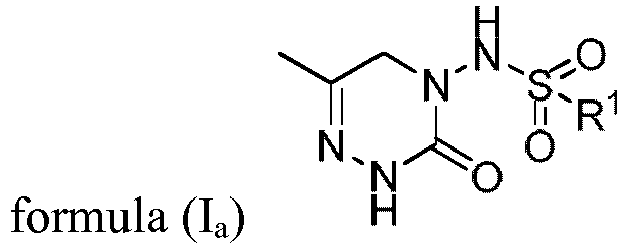
- the present invention provides a sulfonyl-structure-containing triazinone derivative, which is a compound represented by formula (I a ): wherein R 1 is C1-C12 alkyl, C3-C6 cycloalkyl, substituted or unsubstituted phenyl, substituted or unsubstituted naphthyl, substituted or unsubstituted benzyl, substituted or unsubstituted phenethyl, substituted or unsubstituted phenylpropyl, substituted or unsubstituted phenylbutyl, nitrogen-containing heterocycle containing 1-10 carbon atoms, oxygen-containing heterocycle containing 1-10 carbon atoms, or sulfur-containing heterocycle containing 1-10 carbon atoms; the substituents of the substituted phenyl, the substituted naphthyl, the substituted benzyl, the substituted phenethyl, the substituted phenylpropy
- the present invention provides a preparation method of the above-mentioned triazinone derivative, which comprises: controlling amino-triazinone represented by formula (II) and sulfonyl chloride compound represented by formula (III) to have a substitution reaction in an organic solvent in the presence of an acid binding agent to obtain a compound represented by formula (I a );
- the present invention provides a sulfonyl-structure-containing triazinone derivative, which is a compound represented by formula (I b ): wherein each R 1 is respectively and independently selected from the group consisted of C1-C2 alkyl, C3-C6 cycloalkyl, substituted or unsubstituted phenyl, substituted or unsubstituted naphthyl, substituted or unsubstituted benzyl, substituted or unsubstituted phenethyl, substituted or unsubstituted phenylpropyl, substituted or unsubstituted phenylbutyl, nitrogen-containing heterocycle containing 1-10 carbon atoms, oxygen-containing heterocycle containing 1-10 carbon atoms, and sulfur-containing heterocycle containing 1-10 carbon atoms; the substituents of the substituted phenyl, the substituted naphthyl, the substituted benzyl, the substituted phenethy
- the present invention provides a preparation method of the above-mentioned triazinone derivative, which comprises: controlling amino-triazinone represented by formula (II) and sulfonyl chloride compound represented by formula (III) to have a substitution reaction in an organic solvent in the presence of an acid binding agent to obtain a compound represented by formula (I b );
- the present invention provides a use of the above-mentioned triazinone derivative in insect killing.
- the present invention provides a use of the above-mentioned triazinone derivative in bacterium killing.
- the triazinone derivatives provided in the present invention exhibit outstanding insecticidal activity as well as bactericidal activity.
- any value in the ranges disclosed in the present invention are not limited to the exact ranges or values; instead, those ranges or values shall be comprehended as encompassing values that are close to those ranges or values.
- the end points of the ranges, the end points of the ranges and the discrete point values, and the discrete point values may be combined to obtain one or more new numeric ranges, which shall be deemed as having been disclosed specifically in this document.
- the present invention provides a sulfonyl-structure-containing triazinone derivative, which is a compound represented by formula (I a ): wherein R 1 is C1-C12 alkyl, C3-C6 cycloalkyl, substituted or unsubstituted phenyl, substituted or unsubstituted naphthyl, substituted or unsubstituted benzyl, substituted or unsubstituted phenethyl, substituted or unsubstituted phenylpropyl, substituted or unsubstituted phenylbutyl, nitrogen-containing heterocycle containing 1-10 carbon atoms, oxygen-containing heterocycle containing 1-10 carbon atoms, or sulfur-containing heterocycle containing 1-10 carbon atoms; the substituents of the substituted phenyl, the substituted naphthyl, the substituted benzyl, the substituted phenethyl, the substituted phenylpropy
- the sulfonyl-structure-containing triazinone derivatives provided in the first aspect and third aspect of the present invention may be generally represented by the following formula (I):
- examples of the C1-C12 alkyl may include methyl, ethyl, n-propyl, isopropyl, n-butyl, isobutyl, sec-butyl, tert-butyl, n-pentyl, n-hexyl, n-heptyl, n-octyl, n-nonyl, n-decyl, n-hendecyl, and n-dodecyl, etc.
- the C1-C6 alkyl and the C1-C4 alkyl may be selected from the above-mentioned examples of alkyls, as long as they meet the corresponding criteria.
- the C1-C6 alkoxy may be an alkoxy formed by an example of alkyl that meets the criterion of 1-6 carbon atoms.
- the examples of the C3-C6 cycloalkyl may be etc., for example.
- the nitrogen-containing heterocycle containing 1-10 carbon atoms may be an unsaturated nitrogen-containing heterocycle or a saturated nitrogen-containing heterocycle, as long as the ring structure of the heterocycle employs nitrogen as a structural atom and the heterocycle has 1-10 carbon atoms.
- the nitrogen-containing heterocycle containing 1-10 carbon atoms may be selected from the group consisted of unsubstituted pyrrole or pyrrole substituted by C1-C6 alkyl, unsubstituted pyrroline or pyrroline substituted by C1-C6 alkyl, unsubstituted imidazole or imidazole substituted by C1-C7 alkyl, unsubstituted imidazoline or imidazoline substituted by C1-C7 alkyl, unsubstituted pyridine or pyridine substituted by C1-C5 alkyl, unsubstituted pyridinoline or pyridinoline substituted by C1-C5 alkyl, unsubstituted parazole or parazole substituted by C1-C7 alkyl, unsubstituted pyrazolinone or pyrazolinone substituted by C1-C7 alkyl, unsubstituted thiazo
- the oxygen-containing heterocycle containing 1-10 carbon atoms may be an unsaturated oxygen-containing heterocycle or a saturated oxygen-containing heterocycle, as long as the ring structure of the heterocycle employs oxygen as a structural atom and the heterocycle has 1-10 carbon atoms.
- the oxygen-containing heterocycle containing 1-10 carbon atoms may be selected from the group consisted of unsubstituted furan or furan substituted by C1-C6 alkyl, unsubstituted tetrahedrafuran or tetrahedrafuran substituted by C1-C6 alkyl, unsubstituted oxazole or oxazole substituted by C1-C7 alkyl, unsubstituted oxazoline or oxazoline substituted by C1-C7 alkyl, unsubstituted 1,3-benzodioxole or 1,3-benzodioxole substituted by C1-C3 alkyl, and unsubstituted 1,4-benzodioxine or 1,4-benzodioxine substituted by C1-C2 alkyl, etc.
- the sulfur-containing heterocycle containing 1-10 carbon atoms may be an unsaturated sulfur-containing heterocycle or a saturated sulfur-containing heterocycle, as long as the ring structure of the heterocycle employs sulfur as a structural atom and the heterocycle has 1-10 carbon atoms.
- the sulfur-containing heterocycle containing 1-10 carbon atoms may be selected from the group consisted of unsubstituted thiophene or thiophene substituted by C1-C6 alkyl, unsubstituted tetrahedrathiophene or tetrahedrathiophene substituted by C1-C6 alkyl, unsubstituted thiazole or thiazole substituted by C1-C7 alkyl, and unsubstituted thiazoline or thiazoline substituted by C1-C7 alkyl, etc.
- R 1 is C1-C8 alkyl, C3-C6 cycloalkyl, substituted or unsubstituted phenyl, substituted or unsubstituted naphthyl, substituted or unsubstituted benzyl, substituted or unsubstituted phenethyl, substituted or unsubstituted phenylpropyl, substituted or unsubstituted phenylbutyl, nitrogen-containing heterocycle containing 2-8 carbon atoms, oxygen-containing heterocycle containing 2-8 carbon atoms, or sulfur-containing heterocycle containing 2-8 carbon atoms; the substituents of the substituted phenyl, the substituted naphthyl, the substituted benzyl, the substituted phenethyl, the substituted phenylpropyl, and the substituted phenylbutyl are one or more substituents respectively and independently selected from the group consisted of hydroxyl, F, Cl, Br, I,
- the compound represented by formula (I a ) is at least one of the compounds represented by the following formulae: I a -1 I a -2 I a -3 I a -4 I a -5 I a -6 I a -7 I a -8 I a -9 I a -10 I a -11 I a -12 I a -13 I a -14 I a -15 I a -16 I a -17 I a -18 I a -19 I a -20 I a -21 I a -22 I a -23 I a -24 I a -25 I a -26 I a -27 I a -28 I a -29 I a -30 I a -31 I a -32 I a -33 I a -34
- the present invention provides a preparation method of the above-mentioned triazinone derivative, which comprises: controlling amino-triazinone represented by formula (II) and sulfonyl chloride compound represented by formula (III) to have a substitution reaction in an organic solvent in the presence of an acid binding agent to obtain a compound represented by formula (I a );
- the preparation procedure may be expressed by the following route I: route I:
- the compound represented by formula (III) may be selected specifically according to the required formula (I a ), and the R 1 in the formula has been described above and will not be further detailed.
- the molar ratio of the amino-triazinone represented by formula (II) to the sulfonyl chloride compound represented by formula (III) is 1:0.8-1.2, preferably is 1:1-1.1.
- the acid binding agent is at least one of the agents selected from the group consisted of sodium carbonate, potassium carbonate, cesium carbonate, triethylamine, and pyridine.
- the dosage of the acid binding agent may vary within a wide range.
- the molar ratio of the amino-triazinone represented by formula (II) to the acid binding agent may be 1:0.08-0.5, preferably is 1:0.1-0.3.
- the pyridine may also be used as the solvent in the above-mentioned method. To that end, when pyridine is used as a solvent, the dose of pyridine is not limited to the dose specified above, as long as the requirement for the dose of the solvent is met.
- the organic solvent is at least one of the solvents selected from the group consisted of methanol, ethanol, pyridine, N,N-dimethyl formamide and dimethyl sulfoxide.
- the organic solvent is dosed so that the concentration of the amino-triazinone represented by formula (II) is 0.05-0.5 mmol/mL.
- the conditions of the substitution reaction include: temperature: 15-40°C (preferably 20-35°C); time: 4-12 h.
- the present invention provides a sulfonyl-structure-containing triazinone derivative, which is a compound represented by formula (I b ): wherein each R 1 is respectively and independently selected from the group consisted of C1-C2 alkyl, C3-C6 cycloalkyl, substituted or unsubstituted phenyl, substituted or unsubstituted naphthyl, substituted or unsubstituted benzyl, substituted or unsubstituted phenethyl, substituted or unsubstituted phenylpropyl, substituted or unsubstituted phenylbutyl, nitrogen-containing heterocycle containing 1-10 carbon atoms, oxygen-containing heterocycle containing 1-10 carbon atoms, or sulfur-containing heterocycle containing 1-10 carbon atoms; the substituents of the substituted phenyl, the substituted naphthyl, the substituted benzyl, the substituted phenethy
- the R 1 in the present invention may be selected from the group consisted of C1-C12 alkyl, C3-C6 cycloalkyl, phenyl, benzyl, phenethyl, phenylpropyl, phenylbutyl, C1-C10 nitrogen-containing heterocycle, C1-C10 oxygen-containing heterocycle, C1-C10 sulfur-containing heterocycle, or substituted phenyl (wherein the substituent may be hydrogen, hydroxyl, halogen, cyano, nitro, ester, fluorine, trifluoromethyl, trifluoromethoxy, amido, C1-C5 alkyl, C1-C6 alkoxy, C1-C4 alkyl carbonyloxy, or C1-C4 alkoxy carbonyloxy; and may contain 2-3 substituents described above at the same time).
- R 1 in the formula (I b ) may be the same or different, and may be selected respectively and independently; wherein the R 1 in the formula (I b ) may be selected from relevant groups in the formula (I a ) described above, and there is no further restriction on it in the present invention.
- each R 1 is respectively and independently selected from the group consisted of C1-C8 alkyl, C3-C6 cycloalkyl, substituted or unsubstituted phenyl, substituted or unsubstituted naphthyl, substituted or unsubstituted benzyl, substituted or unsubstituted phenethyl, substituted or unsubstituted phenylpropyl, substituted or unsubstituted phenylbutyl, nitrogen-containing heterocycle containing 2-8 carbon atoms, oxygen-containing heterocycle containing 2-8 carbon atoms, and sulfur-containing heterocycle containing 2-8 carbon atoms; the substituents of the substituted phenyl, the substituted naphthyl, the substituted benzyl, the substituted phenethyl, the substituted phenylpropyl, and the substituted phenylbutyl are one or more substituents respectively and independently selected from the group consisted of
- the compound represented by formula (I b ) is at least one of the compounds represented by the following formulae: I b -1 I b -2 I b -3 I b -4 I b -5 I b -6 I b -7 I b -8 I b -9
- the present invention provides a preparation method of the above-mentioned triazinone derivative, which comprises: controlling amino-triazinone represented by formula (II) and sulfonyl chloride compound represented by formula (III) to have a substitution reaction in an organic solvent in the presence of an acid binding agent to obtain a compound represented by formula (I b );
- the method may be generally summarized as the following route: triazinone (II) reacts with different sulfonyl chlorides to obtain the compound I b ; route II: wherein the compound represented by formula (III) may be specifically selected according to the required formula (I b ), and the R 1 in the formula has been described above, and will not be further detailed here.
- the molar ratio of the amino-triazinone represented by formula (II) to the sulfonyl chloride compound represented by formula (III) is 1:1.8-2.5, preferably is 1:2-2.4.
- the acid binding agent is at least one of the agents selected from the group consisted of sodium carbonate, potassium carbonate, cesium carbonate, triethylamine, and pyridine.
- the dosage of the acid binding agent may vary within a wide range.
- the molar ratio of the amino-triazinone represented by formula (II) to the acid binding agent may be 1:0.08-0.5, preferably is 1:0.1-0.3.
- the pyridine may also be used as the solvent in the above-mentioned method. To that end, when pyridine is used as a solvent, the dose of pyridine is not limited to the dose specified above, as long as the requirement for the dose of the solvent is met.
- the organic solvent is at least one of the solvents selected from the group consisted of methanol, ethanol, pyridine, N,N-dimethyl formamide and dimethyl sulfoxide.
- the organic solvent is dosed so that the concentration of the amino-triazinone represented by formula (II) is 0.05-0.5 mmol/mL.
- the conditions of the substitution reaction include: temperature: 15-40°C (preferably 20-35°C); time: 4-12 h.
- the present invention provides a use of the above-mentioned triazinone derivative in insect killing.
- the triazinone derivatives provided in the present invention have relatively high insecticidal activity, and have relatively high insecticidal activity especially against aphides, mosquito larvae, cotton bollworms, maize borers, and armyworms.
- the sulfonyl-structure-containing triazinone derivative in the present invention is at least one of the following compounds:
- the sulfonyl-structure-containing triazinone derivatives in the present invention exhibit outstanding insecticidal activity against aphides, wherein the compounds I a -10, I a -11, I a -12, I a -13, I a -14 and I a -15 exhibit insecticidal activity with mortalities of 25%, 15%, 30%, 10%, 35%, and 10% respectively at a concentration of 2.5 mg/kg, while pymetrozine has no insecticidal activity at the same concentration.
- the compounds exhibit satisfactory insecticidal activity against mosquito larvae, wherein at a concentration of 1 mg/kg, the compounds I a -19, I a -23 and I a -26 exhibit insecticidal activity with mortalities of 60%, 30% and 20% against mosquito larvae; especially, the compound I a -22 exhibits insecticidal activity with a mortality of 40% against mosquito larvae at a concentration of 0.5 mg/kg.
- all of the compounds exhibit insecticidal activity against cotton bollworms, maize borers, and armyworms.
- the present invention further provides an insecticidal method that utilizes the above-mentioned triazinone derivative as an insecticide.
- the present invention provides a use of the above-mentioned triazinone derivative in bacterium killing.
- the triazinone derivatives provided in the present invention have high insecticidal activity, especially against at least one of the pathogenic bacteria that may cause tomato early blight, wheat head blight, potato late blight, capsicum phytophthora blight, sclerotinia rot of colza, cucumber gray mold, rice sheath blight, cucumber fusarium wilt, cercospora brown spot of peanut, apple ring rot, wheat sheath blight, corn southern leaf blight, watermelon anthracnose, and rice bakanae disease.
- the sulfonyl-structure-containing triazinone derivative in the present invention is at least one of the following compounds: 2-methyl-N-(6-methyl-3-oxo-2,3-dihydro-1,2,4-triazin-4(5H)-yl)benzenesulfonamide (I a -10); 3-methyl-N-(6-methyl-3-oxo-2,3-dihydro-1,2,4-triazin-4(5H)-yl)benzenesulfonamide (I a -11); 4-methyl-N-(6-methyl-3-oxo-2,3-dihydro-1,2,4-triazin-4(5H)-yl)benzenesulfonamide (I a- 12); 2,4,6-trimethyl-N-(6-methyl-3-oxo-2,3-dihydro-1,2,4-triazin-4(5H)-yl)benzenesulfonamide (I a- 12); 2,4,6-
- the present invention further provides a bactericidal method that utilizes the above-mentioned triazinone derivative as a bactericide.
- Example 3 Test of insecticidal activity against aphides, through the following testing procedure:
- the insecticidal activity against aphides is tested through the following steps: the tested aphides are bean aphides (Aphis laburni Kaltenbach), a normal colony fed with broad bean leaves in a laboratory.
- the pesticide is weighed, 1mL DMF is added to dissolve the pesticide, then two drops of emulsifier, Tween-20 are added, and distilled water is added in an appropriate amount; the mixture is stirred to a homogeneous state to prepare pesticide solution at required concentration (see the following table for the specific concentration).
- the compounds I a -10, I a -11, I a -12, I a -13, I a -14, and I a -15 still exhibit insecticidal activity with mortalities of 25%, 15%, 30%, 10%, 35%, and 10% respectively at a concentration of 2.5mg/kg, while pymetrozine has no insecticidal activity at the same concentration.
- Example 4 Test of insecticidal activity against mosquito larvae, through the following testing procedure:
- Method of testing against mosquito larvae the tested mosquito larvae are Culer pipiens pallens, a normal colony fed indoor. About 5mg compound to be tested is weighed and loaded into a penicillin vial, 5mL acetone (or an appropriate solvent) is added into the vial, and the vial is oscillated to dissolve the compound; thus, 1,000ppm mother liquid is obtained. 1mL mother liquid is weighed and added into a 100mL beaker filled with 89mL water, 10 mosquito larvae in the early stage of the 4 th instar together with 10mL feeding solution are poured into the beaker; thus, the concentration of the pesticide solution is 10ppm (the pesticide solutions with other concentrations are attained by diluting the mother liquid by corresponding times).
- the compounds I a -19, I a -22, I a -23 and I a -26 exhibit relatively high insecticidal activity against mosquito larvae.
- the compounds I a -19, I a -23 and I a -26 exhibit insecticidal activity with mortalities of 60%, 30% and 20% respectively against mosquito larvae.
- the compound I a -22 exhibits insecticidal activity with a mortality of 40% against mosquito larvae at a concentration of 0.5mg/kg.
- Example 5 Test of insecticidal activity against cotton bollworms, maize borers, and armyworms, through the following testing procedure:
- the pesticide is mixed into the feedstuff, i.e., 3mL prepared solution is added into about 27g freshly prepared feedstuff; thus, required concentration is obtained by diluting by 10 times.
- the mixture is poured uniformly into a clean 24-orifice plate and cooled, then 24 third-instar cotton bollworms are inoculated into the 24-orifice plate; the result is checked after observation for 3-4 days.
- Method for testing against maize borers a leaf immersion method is used, i.e., after the solution is prepared to a required concentration, leaves with diameters of about 5-6cm are immersed in the solution for 5-6s, taken out, and dried on absorbent papers, and then loaded into a specified culture dish; 10 third-instar larvae are inoculated into the culture dish, the culture dish is placed in an insectary at 27 ⁇ 1 °C, and the result is checked after observation for 3-4 days.
- Method of testing against armyworms a leaf immersion method is used, i.e., after the solution is prepared to a required concentration, leaves with diameters of about 5-6cm are immersed in the solution for 5-6s, taken out, and dried on absorbent papers, and then loaded into a specified culture dish; 10 third-instar larvae are inoculated into the culture dish, the culture dish is placed in an insectary at 27 ⁇ 1 °C, and the result is checked after observation for 3-4 days.
- Table 3 Test Results of Insecticidal Activity of Pymetrozine and the Sulfonyl-Structure-Containing Triazinone Derivatives against Cotton Bollworms, Maize Borers, and Armyworms No.
- Example 6 Test of bactericidal activity against fungi, through the following testing procedure:
- test is described in an example of alternaria solani; it can be replaced by other fungi.
Landscapes
- Organic Chemistry (AREA)
- Chemical & Material Sciences (AREA)
- Life Sciences & Earth Sciences (AREA)
- Dentistry (AREA)
- Health & Medical Sciences (AREA)
- Engineering & Computer Science (AREA)
- Plant Pathology (AREA)
- General Health & Medical Sciences (AREA)
- Wood Science & Technology (AREA)
- Zoology (AREA)
- Environmental Sciences (AREA)
- Pest Control & Pesticides (AREA)
- Agronomy & Crop Science (AREA)
- Plural Heterocyclic Compounds (AREA)
Description
- The present invention belongs to the technical field of pesticides, particularly relates to sulfonyl-structure-containing triazinone derivatives, their preparation methods, and their uses in insect killing and/or bacterium killing.
- Pymetrozine is a new heterocyclic insecticide discovered by Ciba-Geigy in 1988, whose characteristics including unique action, high selectivity, free of cross-resistance compared with conventional insecticides, and environmental safety, etc., and can attain a unique prevention and control effect against pests with piercing-sucking mouthpart, especially against aphides. Therefore, since pymetrozine emerged, it has been widely applied in prevention and control of aphides, whiteflies, and black-tailed leafhoppers for field crops and ornamental plants. However, owing to the unique action of pymetrozine, there are only three commercial insecticide products in this category up to now, i.e., pymetrozine, R-768 and pyrifluquinazon. Summarized on the basis of literatures, it is found that the researches on these insecticides mainly focus on triazinone ring and pyridine ring; however, there is no report on utilization of sulfone or sulfoxide as common active groups in the molecular designs of medicines and pesticides. As more and more attentions are paid to environmental protection all over the world, it is an urgent task to develop efficient, low-toxic, and environmentally friendly insecticides in the pymetrozine category in present agricultural production.
- The object of the present invention is to provide sulfonyl-structure-containing triazinone derivatives, their preparation methods, and their uses in insect killing and/or bacterium killing. The sulfonyl-structure-containing triazinone derivatives in this patent application exhibit outstanding insecticidal activity as well as bactericidal activity.
- In a first aspect, the present invention provides a sulfonyl-structure-containing triazinone derivative, which is a compound represented by formula (Ia):
- In a second aspect, the present invention provides a preparation method of the above-mentioned triazinone derivative, which comprises: controlling amino-triazinone represented by formula (II) and sulfonyl chloride compound represented by formula (III) to have a substitution reaction in an organic solvent in the presence of an acid binding agent to obtain a compound represented by formula (Ia);


- In a third aspect, the present invention provides a sulfonyl-structure-containing triazinone derivative, which is a compound represented by formula (Ib):

- In a fourth aspect, the present invention provides a preparation method of the above-mentioned triazinone derivative, which comprises: controlling amino-triazinone represented by formula (II) and sulfonyl chloride compound represented by formula (III) to have a substitution reaction in an organic solvent in the presence of an acid binding agent to obtain a compound represented by formula (Ib);


- In a fifth aspect, the present invention provides a use of the above-mentioned triazinone derivative in insect killing.
- In a sixth aspect, the present invention provides a use of the above-mentioned triazinone derivative in bacterium killing.
- The triazinone derivatives provided in the present invention exhibit outstanding insecticidal activity as well as bactericidal activity.
- The end points and any value in the ranges disclosed in the present invention are not limited to the exact ranges or values; instead, those ranges or values shall be comprehended as encompassing values that are close to those ranges or values. For numeric ranges, the end points of the ranges, the end points of the ranges and the discrete point values, and the discrete point values may be combined to obtain one or more new numeric ranges, which shall be deemed as having been disclosed specifically in this document.
- In a first aspect, the present invention provides a sulfonyl-structure-containing triazinone derivative, which is a compound represented by formula (Ia):

- According to the present invention, the sulfonyl-structure-containing triazinone derivatives provided in the first aspect and third aspect of the present invention may be generally represented by the following formula (I):

- In the present invention, examples of the C1-C12 alkyl may include methyl, ethyl, n-propyl, isopropyl, n-butyl, isobutyl, sec-butyl, tert-butyl, n-pentyl, n-hexyl, n-heptyl, n-octyl, n-nonyl, n-decyl, n-hendecyl, and n-dodecyl, etc.
- The C1-C6 alkyl and the C1-C4 alkyl may be selected from the above-mentioned examples of alkyls, as long as they meet the corresponding criteria.
- The C1-C6 alkoxy may be an alkoxy formed by an example of alkyl that meets the criterion of 1-6 carbon atoms.
- The examples of the C3-C6 cycloalkyl may be

- The nitrogen-containing heterocycle containing 1-10 carbon atoms may be an unsaturated nitrogen-containing heterocycle or a saturated nitrogen-containing heterocycle, as long as the ring structure of the heterocycle employs nitrogen as a structural atom and the heterocycle has 1-10 carbon atoms. For example, the nitrogen-containing heterocycle containing 1-10 carbon atoms may be selected from the group consisted of unsubstituted pyrrole or pyrrole substituted by C1-C6 alkyl, unsubstituted pyrroline or pyrroline substituted by C1-C6 alkyl, unsubstituted imidazole or imidazole substituted by C1-C7 alkyl, unsubstituted imidazoline or imidazoline substituted by C1-C7 alkyl, unsubstituted pyridine or pyridine substituted by C1-C5 alkyl, unsubstituted pyridinoline or pyridinoline substituted by C1-C5 alkyl, unsubstituted parazole or parazole substituted by C1-C7 alkyl, unsubstituted pyrazolinone or pyrazolinone substituted by C1-C7 alkyl, unsubstituted thiazole or thiazole substituted by C1-C7 alkyl, unsubstituted thiazoline or thiazoline substituted by C1-C7 alkyl, unsubstituted oxazole or oxazole substituted by C1-C7 alkyl, and unsubstituted oxazoline or oxazoline substituted by C1-C7 alkyl, etc. Wherein the alkyl that serves as a substituent may be selected appropriately from the examples of alkyls described above, and the alkyl substitution may be a single-site substitution or a multi-site substitution. There is no particular restriction on the substitution in the present invention.
- The oxygen-containing heterocycle containing 1-10 carbon atoms may be an unsaturated oxygen-containing heterocycle or a saturated oxygen-containing heterocycle, as long as the ring structure of the heterocycle employs oxygen as a structural atom and the heterocycle has 1-10 carbon atoms. For example, the oxygen-containing heterocycle containing 1-10 carbon atoms may be selected from the group consisted of unsubstituted furan or furan substituted by C1-C6 alkyl, unsubstituted tetrahedrafuran or tetrahedrafuran substituted by C1-C6 alkyl, unsubstituted oxazole or oxazole substituted by C1-C7 alkyl, unsubstituted oxazoline or oxazoline substituted by C1-C7 alkyl, unsubstituted 1,3-benzodioxole or 1,3-benzodioxole substituted by C1-C3 alkyl, and unsubstituted 1,4-benzodioxine or 1,4-benzodioxine substituted by C1-C2 alkyl, etc.
- The sulfur-containing heterocycle containing 1-10 carbon atoms may be an unsaturated sulfur-containing heterocycle or a saturated sulfur-containing heterocycle, as long as the ring structure of the heterocycle employs sulfur as a structural atom and the heterocycle has 1-10 carbon atoms. For example, the sulfur-containing heterocycle containing 1-10 carbon atoms may be selected from the group consisted of unsubstituted thiophene or thiophene substituted by C1-C6 alkyl, unsubstituted tetrahedrathiophene or tetrahedrathiophene substituted by C1-C6 alkyl, unsubstituted thiazole or thiazole substituted by C1-C7 alkyl, and unsubstituted thiazoline or thiazoline substituted by C1-C7 alkyl, etc.
- Preferably, R1 is C1-C8 alkyl, C3-C6 cycloalkyl, substituted or unsubstituted phenyl, substituted or unsubstituted naphthyl, substituted or unsubstituted benzyl, substituted or unsubstituted phenethyl, substituted or unsubstituted phenylpropyl, substituted or unsubstituted phenylbutyl, nitrogen-containing heterocycle containing 2-8 carbon atoms, oxygen-containing heterocycle containing 2-8 carbon atoms, or sulfur-containing heterocycle containing 2-8 carbon atoms; the substituents of the substituted phenyl, the substituted naphthyl, the substituted benzyl, the substituted phenethyl, the substituted phenylpropyl, and the substituted phenylbutyl are one or more substituents respectively and independently selected from the group consisted of hydroxyl, F, Cl, Br, I, cyano, nitro, -COOCH3, -COOCH2CH3, trifluoromethyl, trifluoromethoxy, -NH-CO-CH3, -NH-CO-CH2CH3, methyl, ethyl, n-propyl, isopropyl, n-butyl, isobutyl, sec-butyl, tert-butyl, n-pentyl, methoxy, ethoxy, n-propoxy, isopropoxy, n-butoxy, isobutoxy, sec-butoxy, tert-butoxy, n-pentyloxy, C1-C5 alkyl, C1-C5 alkoxy, -O-CO-CH3, -O-CO-CH2CH3, -O-CO-O-CH3, and -O-CO-O-CH2CH3.
- In a preferred embodiment of the present invention, the compound represented by formula (Ia) is at least one of the compounds represented by the following formulae:
Ia-1 
Ia-2 
Ia-3 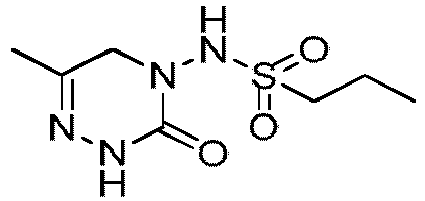
Ia-4 
Ia-5 
Ia-6 
Ia-7 
Ia-8 
Ia-9 
Ia-10 
Ia-11 
Ia-12 
Ia-13 
Ia-14 
Ia-15 
Ia-16 
Ia-17 
Ia-18 
Ia-19 
Ia-20 
Ia-21 
Ia-22 
Ia-23 
Ia-24 
Ia-25 
Ia-26 
Ia-27 
Ia-28 
Ia-29 
Ia-30 
Ia-31 
Ia-32 
Ia-33 
Ia-34 
- In a second aspect, the present invention provides a preparation method of the above-mentioned triazinone derivative, which comprises: controlling amino-triazinone represented by formula (II) and sulfonyl chloride compound represented by formula (III) to have a substitution reaction in an organic solvent in the presence of an acid binding agent to obtain a compound represented by formula (Ia);


- The preparation procedure may be expressed by the following route I:
route I:
- According to the present invention, the compound represented by formula (III) may be selected specifically according to the required formula (Ia), and the R1 in the formula has been described above and will not be further detailed.
- Preferably, the molar ratio of the amino-triazinone represented by formula (II) to the sulfonyl chloride compound represented by formula (III) is 1:0.8-1.2, preferably is 1:1-1.1.
- Preferably, the acid binding agent is at least one of the agents selected from the group consisted of sodium carbonate, potassium carbonate, cesium carbonate, triethylamine, and pyridine.
- The dosage of the acid binding agent may vary within a wide range. For example, the molar ratio of the amino-triazinone represented by formula (II) to the acid binding agent may be 1:0.08-0.5, preferably is 1:0.1-0.3. The pyridine may also be used as the solvent in the above-mentioned method. To that end, when pyridine is used as a solvent, the dose of pyridine is not limited to the dose specified above, as long as the requirement for the dose of the solvent is met.
- Preferably, the organic solvent is at least one of the solvents selected from the group consisted of methanol, ethanol, pyridine, N,N-dimethyl formamide and dimethyl sulfoxide.
- Preferably, the organic solvent is dosed so that the concentration of the amino-triazinone represented by formula (II) is 0.05-0.5 mmol/mL.
- Preferably, the conditions of the substitution reaction include: temperature: 15-40°C (preferably 20-35°C); time: 4-12 h.
- In a third aspect, the present invention provides a sulfonyl-structure-containing triazinone derivative, which is a compound represented by formula (Ib):

- In an embodiment of the present invention, the R1 in the present invention may be selected from the group consisted of C1-C12 alkyl, C3-C6 cycloalkyl, phenyl, benzyl, phenethyl, phenylpropyl, phenylbutyl, C1-C10 nitrogen-containing heterocycle, C1-C10 oxygen-containing heterocycle, C1-C10 sulfur-containing heterocycle, or substituted phenyl (wherein the substituent may be hydrogen, hydroxyl, halogen, cyano, nitro, ester, fluorine, trifluoromethyl, trifluoromethoxy, amido, C1-C5 alkyl, C1-C6 alkoxy, C1-C4 alkyl carbonyloxy, or C1-C4 alkoxy carbonyloxy; and may contain 2-3 substituents described above at the same time).
- Wherein the two R1 in the formula (Ib) may be the same or different, and may be selected respectively and independently; wherein the R1 in the formula (Ib) may be selected from relevant groups in the formula (Ia) described above, and there is no further restriction on it in the present invention. Preferably, each R1 is respectively and independently selected from the group consisted of C1-C8 alkyl, C3-C6 cycloalkyl, substituted or unsubstituted phenyl, substituted or unsubstituted naphthyl, substituted or unsubstituted benzyl, substituted or unsubstituted phenethyl, substituted or unsubstituted phenylpropyl, substituted or unsubstituted phenylbutyl, nitrogen-containing heterocycle containing 2-8 carbon atoms, oxygen-containing heterocycle containing 2-8 carbon atoms, and sulfur-containing heterocycle containing 2-8 carbon atoms; the substituents of the substituted phenyl, the substituted naphthyl, the substituted benzyl, the substituted phenethyl, the substituted phenylpropyl, and the substituted phenylbutyl are one or more substituents respectively and independently selected from the group consisted of hydroxyl, F, Cl, Br, I, cyano, nitro, -COOCH3, -COOCH2CH3, trifluoromethyl, trifluoromethoxy, -NH-CO-CH3, -NH-CO-CH2CH3, methyl, ethyl, n-propyl, isopropyl, n-butyl, isobutyl, sec-butyl, tert-butyl, n-pentyl, methoxy, ethoxy, n-propoxy, isopropoxy, n-butoxy, isobutoxy, sec-butoxy, tert-butoxy, n-pentyloxy, C1-C5 alkyl, C1-C5 alkoxy, -O-CO-CH3, -O-CO-CH2CH3, -O-CO-O-CH3, and -O-CO-O-CH2CH3.
- In a preferred embodiment of the present invention, the compound represented by formula (Ib) is at least one of the compounds represented by the following formulae:
Ib-1 
Ib-2 
Ib-3 
Ib-4 
Ib-5 
Ib-6 
Ib-7 
Ib-8 
Ib-9 
- In a fourth aspect, the present invention provides a preparation method of the above-mentioned triazinone derivative, which comprises: controlling amino-triazinone represented by formula (II) and sulfonyl chloride compound represented by formula (III) to have a substitution reaction in an organic solvent in the presence of an acid binding agent to obtain a compound represented by formula (Ib);


- The method may be generally summarized as the following route: triazinone (II) reacts with different sulfonyl chlorides to obtain the compound Ib;
route II:
- Preferably, the molar ratio of the amino-triazinone represented by formula (II) to the sulfonyl chloride compound represented by formula (III) is 1:1.8-2.5, preferably is 1:2-2.4.
- Preferably, the acid binding agent is at least one of the agents selected from the group consisted of sodium carbonate, potassium carbonate, cesium carbonate, triethylamine, and pyridine.
- The dosage of the acid binding agent may vary within a wide range. For example, the molar ratio of the amino-triazinone represented by formula (II) to the acid binding agent may be 1:0.08-0.5, preferably is 1:0.1-0.3. The pyridine may also be used as the solvent in the above-mentioned method. To that end, when pyridine is used as a solvent, the dose of pyridine is not limited to the dose specified above, as long as the requirement for the dose of the solvent is met.
- Preferably, the organic solvent is at least one of the solvents selected from the group consisted of methanol, ethanol, pyridine, N,N-dimethyl formamide and dimethyl sulfoxide.
- Preferably, the organic solvent is dosed so that the concentration of the amino-triazinone represented by formula (II) is 0.05-0.5 mmol/mL.
- Preferably, the conditions of the substitution reaction include: temperature: 15-40°C (preferably 20-35°C); time: 4-12 h.
- In a fifth aspect, the present invention provides a use of the above-mentioned triazinone derivative in insect killing.
- The triazinone derivatives provided in the present invention have relatively high insecticidal activity, and have relatively high insecticidal activity especially against aphides, mosquito larvae, cotton bollworms, maize borers, and armyworms.
- For the purpose of obtaining relatively high insecticidal activity, preferably, the sulfonyl-structure-containing triazinone derivative in the present invention is at least one of the following compounds:
- 2-methyl-N-(6-methyl-3-oxo-2,3-dihydro-1,2,4-triazin-4(5H)-yl)benzenesulfonamide (Ia-10);
- 3-methyl-N-(6-methyl-3-oxo-2,3-dihydro-1,2,4-triazin-4(5H)-yl)benzenesulfonamide (Ia-11);
- 4-methyl-N-(6-methyl-3-oxo-2,3-dihydro-1,2,4-triazin-4(5H)-yl)benzenesulfonamide (Ia-12);
- 2,4,6-trimethyl-N-(6-methyl-3-oxo-2,3-dihydro-1,2,4-triazin-4(5H)-yl)benzenesulfonamide (Ia-13);
- 4-methoxy-N-(6-methyl-3-oxo-2,3-dihydro-1,2,4-triazin-4(5H)-yl)benzenesulfonamide (Ia-14);
- 4-tert-butyl-N-(6-methyl-3-oxo-2,3-dihydro-1,2,4-triazin-4(5H)-yl)benzenesulfonamide (Ia-15);
- 4-bromo-N-(6-methyl-3-oxo-2,3-dihydro-1,2,4-triazin-4(5H)-yl)benzenesulfonamide (Ia-22).
- Particularly, the sulfonyl-structure-containing triazinone derivatives in the present invention exhibit outstanding insecticidal activity against aphides, wherein the compounds Ia-10, Ia-11, Ia-12, Ia-13, Ia-14 and Ia-15 exhibit insecticidal activity with mortalities of 25%, 15%, 30%, 10%, 35%, and 10% respectively at a concentration of 2.5 mg/kg, while pymetrozine has no insecticidal activity at the same concentration. Besides, some of the compounds exhibit satisfactory insecticidal activity against mosquito larvae, wherein at a concentration of 1 mg/kg, the compounds Ia-19, Ia-23 and Ia-26 exhibit insecticidal activity with mortalities of 60%, 30% and 20% against mosquito larvae; especially, the compound Ia-22 exhibits insecticidal activity with a mortality of 40% against mosquito larvae at a concentration of 0.5 mg/kg. In addition, all of the compounds exhibit insecticidal activity against cotton bollworms, maize borers, and armyworms.
- The present invention further provides an insecticidal method that utilizes the above-mentioned triazinone derivative as an insecticide.
- In a sixth aspect, the present invention provides a use of the above-mentioned triazinone derivative in bacterium killing.
- The triazinone derivatives provided in the present invention have high insecticidal activity, especially against at least one of the pathogenic bacteria that may cause tomato early blight, wheat head blight, potato late blight, capsicum phytophthora blight, sclerotinia rot of colza, cucumber gray mold, rice sheath blight, cucumber fusarium wilt, cercospora brown spot of peanut, apple ring rot, wheat sheath blight, corn southern leaf blight, watermelon anthracnose, and rice bakanae disease.
- For the purpose of obtaining higher bactericidal activity, preferably, the sulfonyl-structure-containing triazinone derivative in the present invention is at least one of the following compounds: 2-methyl-N-(6-methyl-3-oxo-2,3-dihydro-1,2,4-triazin-4(5H)-yl)benzenesulfonamide (Ia-10); 3-methyl-N-(6-methyl-3-oxo-2,3-dihydro-1,2,4-triazin-4(5H)-yl)benzenesulfonamide (Ia-11); 4-methyl-N-(6-methyl-3-oxo-2,3-dihydro-1,2,4-triazin-4(5H)-yl)benzenesulfonamide (Ia-12); 2,4,6-trimethyl-N-(6-methyl-3-oxo-2,3-dihydro-1,2,4-triazin-4(5H)-yl)benzenesulfonamide (Ia-13); 4-methoxy-N-(6-methyl-3-oxo-2,3-dihydro-1,2,4-triazin-4(5H)-yl)benzenesulfonamide (Ia-14); 4-tert-butyl-N-(6-methyl-3-oxo-2,3-dihydro-1,2,4-triazin-4(5H)-yl)benzenesulfonamide (Ia-15); 4-bromo-N-(6-methyl-3-oxo-2,3-dihydro-1,2,4-triazin-4(5H)-yl)benzenesulfonamide (Ia-22). Wherein especially the compounds Ia-4, Ia-12 and Ib-5 exhibit outstanding bactericidal activity against a variety of pathogenic bacteria at a concentration of 50 mg/kg.
- The present invention further provides a bactericidal method that utilizes the above-mentioned triazinone derivative as a bactericide.
- The following examples and biological test results can be used to further illustrate the present invention, but not mean to constitute any limitation to the present invention.
-

- Amino-triazinone (0.26g, 2mmol, from TCI (Shanghai) Development Co., Ltd.) and pyridine (20mL) are added into a 100mL single-neck flask and stirred to dissolve, then methylsulfonyl chloride (0.24g, 2.1mmol, from Energy Chemical Co., Ltd.) is added into the flask, and the mixture is stirred and held overnight at room temperature, the reaction is monitored with a TLC till it is finished. After desolvation of the reaction liquid under reduced pressure, water is added to the mixture and the product is extracted with methylene chloride and then washed twice with saturated sodium chloride solution and dried with sodium sulfate; next, the product is treated by chromatography in a silica-gel column with methylene chloride/methanol (150:1-100:1); thus, 0.32g white solid is obtained, the yield is 78%, and the melting point of the white solid is 191-192°C. 1H NMR (300 MHz, DMSO-d6 ) δ 10.00 (s, 1H, NH), 9.83 (s, 1H, NH), 4.15 (s, 2H, CH2), 3.01 (s, 3H, CH3), 1.86 (s, 3H, CH3); 13C NMR (100 MHz, DMSO-d6 ) δ 151.4, 146.0, 53.9, 41.1, 20.1. ESI-HRMS(m/z): Calcd. for C5H11N4O3S [M+H]+ 207.0546; found 207.0548.
- Except:
- In the preparation of the compound Ia-2, the methylsulfonyl chloride is replaced with ethylsulfonyl chloride (from Energy Chemical Co., Ltd.) in the same molar mass;
- In the preparation of the compound Ia-3, the methylsulfonyl chloride is replaced with n-propylsulfonyl chloride (from Beijing Innochem Science & Technology Co., Ltd.) in the same molar mass;
- In the preparation of the compound Ia-4, the methylsulfonyl chloride is replaced with n-butylsulfonyl chloride (from Beijing Innochem Science & Technology Co., Ltd.) in the same molar mass;
- In the preparation of the compound Ia-5, the methylsulfonyl chloride is replaced with

- In the preparation of the compound Ia-6, the methylsulfonyl chloride is replaced with

- In the preparation of the compound Ia-7, the methylsulfonyl chloride is replaced with

- In the preparation of the compound Ia-8, the methylsulfonyl chloride is replaced with

- In the preparation of the compound Ia-9, the methylsulfonyl chloride is replaced with

- In the preparation of the compound Ia-10, the methylsulfonyl chloride is replaced with

- In the preparation of the compound Ia-11, the methylsulfonyl chloride is replaced with

- In the preparation of the compound Ia-12, the methylsulfonyl chloride is replaced with

- In the preparation of the compound Ia-13, the methylsulfonyl chloride is replaced with

- In the preparation of the compound Ia-14, the methylsulfonyl chloride is replaced with

- In the preparation of the compound Ia-15, the methylsulfonyl chloride is replaced with

- In the preparation of the compound Ia-16, the methylsulfonyl chloride is replaced with

- In the preparation of the compound Ia-17, the methylsulfonyl chloride is replaced with

- In the preparation of the compound Ia-18, the methylsulfonyl chloride is replaced with

- In the preparation of the compound Ia-19, the methylsulfonyl chloride is replaced with

- In the preparation of the compound Ia-20, the methylsulfonyl chloride is replaced with

- In the preparation of the compound Ia-21, the methylsulfonyl chloride is replaced with

- In the preparation of the compound Ia-22, the methylsulfonyl chloride is replaced with

- In the preparation of the compound Ia-23, the methylsulfonyl chloride is replaced with

- In the preparation of the compound Ia-24, the methylsulfonyl chloride is replaced with

- In the preparation of the compound Ia-25, the methylsulfonyl chloride is replaced with

- In the preparation of the compound Ia-26, the methylsulfonyl chloride is replaced with

- In the preparation of the compound Ia-27, the methylsulfonyl chloride is replaced with
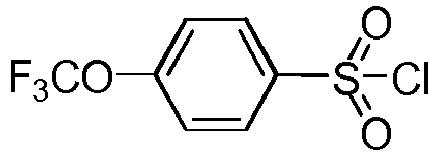
- In the preparation of the compound Ia-28, the methylsulfonyl chloride is replaced with

- In the preparation of the compound Ia-29, the methylsulfonyl chloride is replaced with

- In the preparation of the compound Ia-30, the methylsulfonyl chloride is replaced with

- In the preparation of the compound Ia-31, the methylsulfonyl chloride is replaced with

- In the preparation of the compound Ia-32, the methylsulfonyl chloride is replaced with

- In the preparation of the compound Ia-33, the methylsulfonyl chloride is replaced with

- In the preparation of the compound Ia-34, the methylsulfonyl chloride is replaced with
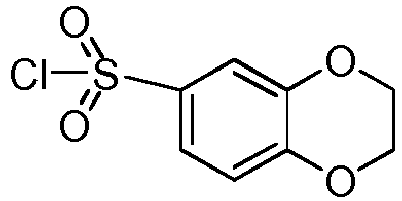
- The obtained compounds are characterized as follows:
- N-(6-methyl-3-oxo-2,3-dihydro-1,2,4-triazin-4(5H)-yl)-ethylsulfonamide (Ia-2)
White solid, yield 76%, melting point 206-208°C. 1H NMR (300 MHz, DMSO-d6 ) δ 9.98 (s, 1H, NH), 9.79 (s, 1H, NH), 4.15 (s, 2H, CH2), 3.10 (q, J = 7.2 Hz, 2H, CH2 CH3), 1.85 (s, 3H, CH3), 1.27 (t, J = 7.2 Hz, 3H, CH2 CH3 ); 13C NMR (100 MHz, DMSO-d6 ) δ 151.2, 145.7, 53.8, 46.7, 19.8, 7.9. ESI-HRMS(m/z): Calcd. for C6H13N4O3S [M+H]+ 221.0703; found 221.0701. - N-(6-methyl-3-oxo-2,3-dihydro-1,2,4-triazin-4(5H)-yl)-n-propylsulfonamide (Ia-3)
White solid, yield is 73%, melting point is 177-178°C. 1H NMR (300 MHz, DMSO-d6 ) δ 9.98 (s, 1H, NH), 9.81 (s, 1H, NH), 4.15 (s, 2H, CH2), 3.07 (t, J = 7.5 Hz,2H, CH2 CH2CH3), 1.85 (s, 3H, CH3), 1.73-1.80 (m, 2H, CH2 CH2 CH3), 0.95 (t, J = 7.5 Hz, 3H, CH2CH2 CH3 ); 13C NMR (100 MHz, DMSO-d6 ) δ 151.2, 145.6, 53.8, 19.8, 16.7, 12.8. ESI-HRMS(m/z): Calcd. for C7H15N4O3S [M+H]+ 235.0859; found 235.0856. - N-(6-methyl-3-oxo-2,3-dihydro-1,2,4-triazin-4(5H)-yl)-n-butylsulfonamide (Ia-4)
White solid, yield is 71%, melting point is 167-169°C. 1H NMR (300 MHz, DMSO-d6 ) δ 9.99 (s, 1H, NH), 9.81 (s, 1H, NH), 4.15 (s, 2H, CH2), 3.10 (t, J = 7.5 Hz,2H, CH2 CH2CH2CH3), 1.85 (s, 3H, CH3), 1.67-1.77 (m, 2H, CH2 CH2 CH2CH3), 1.30-1.40 (m, 2H, CH2CH2 CH2 CH3), 0.87 (t, J = 7.2 Hz,3H, CH2CH2CH2 CH3 ); 13C NMR (100 MHz, DMSO-d6 ) δ 151.2, 145.7, 53.8, 51.9, 24.9, 20.9, 19.8, 13.5. ESI-HRMS(m/z): Calcd. for C8H17N4O3S [M+H]+ 249.1016; found 249.1018. - N-(6-methyl-3-oxo-2,3-dihydro-1,2,4-triazin-4(5H)-yl)-cyclopropylsulfonamide (Ia-5)
White solid, yield is 64%, melting point is 146-148°C. 1H NMR (400 MHz, DMSO-d6 ) δ 9.96 (s, 1H, NH), 9.79 (s, 1H, NH),4.13 (s, 2H, CH2), 2.57-2.63 (m, 1H, CH(CH2)2), 1.86 (s, 3H, CH3), 0.93-0.98 (m, 4H, CH(CH2 )2); 13C NMR (100 MHz, DMSO-d6 ) δ 151.3, 145.6, 53.3, 29.9, 19.8, 5.4. ESI-HRMS(m/z): Calcd. for C7H13N4O3S [M+H]+ 233.0703;found 233.0703. - N-(6-methyl-3-oxo-2,3-dihydro-1,2,4-triazin-4(5H)-yl)-cyclohexylsulfonamide (Ia-6)
White solid, yield is 43%, melting point is 166-168°C. 1H NMR (400 MHz, DMSO-d6 ) δ 9.95 (s, 1H, NH), 9.73 (s, 1H, NH), 4.14 (s, 2H, CH2), 2.99-3.06 (m, 1H), 1.85 (s, 3H, CH3), 1.76-1.79 (m, 2H), 1.28-1.37 (m, 3H), 1.07-1.25 (m, 5H); 13C NMR (100 MHz, DMSO-d6 ) δ 151.3, 145.6, 59.8, 53.9, 25.8, 24.8, 24.7, 19.8. ESI-HRMS(m/z): Calcd. for C10H18N4O3S [M+H]+ 275.1172; found 275.1170. - N-(6-methyl-3-oxo-2,3-dihydro-1,2,4-triazin-4(5H)-yl)-phenylmethylsulfonamide (Ia-7)
White solid, yield is 78%, melting point is 189-190°C. 1H NMR (300 MHz, DMSO-d6 ) δ 10.04 (s, 1H, NH), 9.86 (s, 1H, NH), 7.46-7.50 (m, 2H, Ar-H), 7.33-7.40 (m, 3H, Ar-H),4.46 (s, 2H, CH2), 4.13 (s, 2H, CH2),1.86 (s, 3H, CH3); 13C NMR (100 MHz, DMSO-d6 ) δ 151.3, 145.6, 131.2, 129.4, 128.4, 128.2, 58.7, 53.8, 19.8. ESI-HRMS(m/z): Calcd. for C11H15N4O3S [M+H]+ 283.0859; found 283.0860. - N-(6-methyl-3-oxo-2,3-dihydro-1,2,4-triazin-4(5H)-yl)-naphthyl-1-sulfonamide (Ia-8)
White solid, yield is 72%, melting point is 174-175°C. 1H NMR (400 MHz, CDCl3) δ 8.71 (d, J = 8.4 Hz, 1H), 8.27 (d, J = 7.2 Hz, 1H), 8.11 (d, J = 8.4 Hz, 1H), 7.93 (d, J = 8.0 Hz, 1H), 7.68 (t, J = 7.2 Hz, 1H), 7.60 (t, J = 8.0 Hz, 1H), 7.54 (t, J = 7.6 Hz, 1H), 4.24 (s, 2H, CH2), 1.98 (s, 3H, CH3); 13C NMR (100 MHz, CDCl3) δ 150.9, 146.7, 135.7, 134.1, 132.1, 131.4, 129.4, 129.1, 128.6, 127.0, 124.3, 124.1, 52.5, 20.5. ESI-HRMS(m/z): Calcd. for C14H14N4O3S [M+H]+ 319.0859; found 319.0860. - N-(6-methyl-3-oxo-2,3-dihydro-1,2,4-triazin-4(5H)-yl)-benzenesulfonamide (Ia-9)
White solid, yield is 77%, melting point is 206-208°C. 1H NMR (400 MHz, DMSO-d6 ) δ 10.23 (s, 1H, NH), 9.81 (s, 1H, NH), 7.80-7.82 (m, 2H, Ar-H), 7.64-7.67 (m, 1H, Ar-H), 7.54-7.58 (m, 2H, Ar-H), 4.05 (s, 2H, CH2), 1.83 (s, 3H, CH3); 13C NMR (100 MHz, DMSO-d6 ) δ 150.7, 145.6, 138.8, 133.2, 128.9, 127.7, 52.7, 19.9. ESI-HRMS(m/z): Calcd. for C10H13N4O3S [M+H]+ 269.0703; found 269.0704. - 2-methyl-N-(6-methyl-3-oxo-2,3-dihydro-1,2,4-triazin-4(5H)-yl)-benzenesulfonamide (Ia-10);
White solid, yield is 59%, melting point is 240-241°C. 1H NMR (400 MHz, DMSO-d6 ) δ 10.15 (s, 1H, NH), 9.76 (s, 1H, NH), 7.84 (d, J = 7.6 Hz, 1H, Ar-H), 7.51 (t, J = 6.8 Hz,1H, Ar-H), 7.31-7.37 (m, 2H, Ar-H), 4.03 (s, 2H, CH2), 2.65 (s, 3H, CH3), 1.81 (s, 3H, CH3); 13C NMR (100 MHz, DMSO-d6 ) δ 150.9, 145.6, 138.4, 136.9, 133.2, 132.2, 129.6, 125.8, 52.7, 20.2, 19.8. ESI-HRMS(m/z): Calcd. for C11H1sN4O3S [M+H]+ 283.0859; found 283.0859. - 3-methyl-N-(6-methyl-3-oxo-2,3-dihydro-1,2,4-triazin-4(5H)-yl)-benzenesulfonamide (Ia-11)
White solid, yield is 82%, melting point is 150-151°C. 1H NMR (400 MHz, DMSO-d6 ) δ 10.16 (s, 1H, NH), 9.79 (s, 1H, NH), 7.60-7.63 (m, 2H, Ar-H), 7.42-7.46 (m, 2H, Ar-H), 4.03 (s, 2H, CH2), 2.37 (s, 3H, CH3), 1.82 (s, 3H, CH3); 13C NMR (100 MHz, DMSO-d6 ) δ 150.7, 145.6, 138.8, 138.5, 133.8, 128.7, 127.8, 124.9, 52.7, 20.8, 19.8. ESI-HRMS(m/z): Calcd. for C11H15N4O3S [M+H]+ 283.0859; found 283.0858. - 4-methyl-N-(6-methyl-3-oxo-2,3-dihydro-1,2,4-triazin-4(5H)-yl)-benzenesulfonamide (Ia-12)
White solid, yield is 68%, melting point is 199-200°C. 1H NMR (300 MHz, DMSO-d6 ) δ 10.10 (s, 1H, NH), 9.79 (s, 1H, NH), 7.69 (d, J = 8.4 Hz, 2H, Ar-H), 7.36 (d, J = 8.1 Hz, 2H, Ar-H), 4.05 (s, 2H, CH2), 2.38 (s, 3H, CH3), 1.83 (s, 3H, CH3); 13C NMR (100 MHz, DMSO-d6 ) δ 150.7, 145.7, 143.5, 135.9, 129.4, 127.8, 52.7, 21.1, 19.9. ESI-HRMS(m/z): Calcd. for C11H15N4O3S [M+H]+ 283.0859; found 283.0863. - 2,4,6-trimethyl-N-(6-methyl-3-oxo-2,3-dihydro-1,2,4-triazin-4(5H)-yl)-benzenesulfonamide (Ia-13)
White solid, yield is 67%, melting point is 224-226°C. 1H NMR (400 MHz, DMSO-d6 ) δ 9.91 (s, 1H, NH), 9.80 (s, 1H, NH), 6.99 (s, 2H, Ar-H),4.01 (s, 2H, CH2), 2.54 (s, 3H, CH3), 2.24 (s, 3H, CH3), 1.82 (s, 3H, CH3); 13C NMR (100 MHz, DMSO-d6 ) δ 151.2, 145.9, 142.2, 139.8, 133.0, 131.4, 52.3, 22.7, 20.5, 19.9. ESI-HRMS(m/z): Calcd. for C13H19N4O3S [M+H]+ 311.1172;found 311.1172. - 4-methoxy-N-(6-methyl-3-oxo-2,3-dihydro-1,2,4-triazin-4(5H)-yl)-benzenesulfonamide (Ia-14)
White solid, yield is 68%, melting point is 245-246°C. 1H NMR (400 MHz, DMSO-d6 ) δ 9.99 (s, 1H, NH), 9.78 (s, 1H, NH),7.73 (d, J = 8.8 Hz, 2H, Ar-H), 7.06 (d, J = 8.8 Hz, 2H, Ar-H), 4.04 (s, 2H, CH2), 3.82 (s, 3H, OCH3), 1.83 (s, 3H, CH3); 13C NMR (100 MHz, DMSO-d6 ) δ 162.8, 150.7, 145.6, 130.1, 130.0, 114.1, 55.7, 52.6, 19.9. ESI-HRMS(m/z): Calcd. for C11H15N4O4S [M+H]+ 299.0809; found 299.0807. - 4-tert-butyl-N-(6-methyl-3-oxo-2,3-dihydro-1,2,4-triazin-4(5H)-yl)-benzenesulfonamide (Ia-15)
White solid, yield is 59%, melting point is 240-241°C. 1H NMR (400 MHz, DMSO-d6 ) δ 10.08 (s, 1H, NH), 9.85 (s, 1H, NH),7.74 (d, J = 8.0 Hz, 2H, Ar-H), 7.59 (d, J = 8.0 Hz, 2H, Ar-H), 3.98 (s, 2H, CH2), 1.80 (s, 3H, CH3), 1.29 (s, 9H, C(CH3)3); 13C NMR (100 MHz, DMSO-d6 ) δ 156.2, 150.9, 145.6, 136.2, 127.6, 125.8, 52.6, 34.9, 30.8, 19.8. ESI-HRMS(m/z): Calcd. for C14H21N4O3S [M+H]+ 325.1329; found 325.1329. - 2-fluoro-N-(6-methyl-3-oxo-2,3-dihydro-1,2,4-triazin-4(5H)-yl)-benzenesulfonamide (Ia-16)
White solid, yield is 73%, melting point is 206-208°C. 1H NMR (400 MHz, DMSO-d6 ) δ 10.49 (s, 1H, NH), 9.80 (s, 1H, NH),7.79 (t, J = 6.8 Hz, 1H, Ar-H), 7.67-7.72 (m, 1H, Ar-H), 7.39 (t, J = 9.6 Hz, 1H, Ar-H), 7.33 (t, J = 7.6 Hz, 1H, Ar-H),4.13 (s, 2H, CH2), 1.85 (s, 3H, CH3); 13C NMR (100 MHz, DMSO-d6 ) δ 159.2 (d, J = 254.0 Hz), 150.6, 145.5, 135.9 (d, J = 8.7 Hz), 130.2, 127.1 (d, J = 14 Hz), 124.3 (d, J = 3.2 Hz), 117.0 (d, J = 20.9 Hz), 53.2, 19.8. ESI-HRMS(m/z): Calcd. for C10H12FN4O3S [M+H]+ 287.0609; found 287.0609. - 3-fluoro-N-(6-methyl-3-oxo-2,3-dihydro-1,2,4-triazin-4(5H)-yl)-benzenesulfonamide (Ia-17)
White solid, yield is 81%, melting point is 180-181°C. 1H NMR (400 MHz, DMSO-d6 ) δ 10.45 (s, 1H, NH), 9.83 (s, 1H, NH),7.66 (d, J = 8.0 Hz, 1H, Ar-H), 7.59-7.63 (m, 2H, Ar-H), 7.53 (t, J = 8.4 Hz, 1H, Ar-H), 4.11 (s, 2H, CH2), 1.85 (s, 3H, CH3); 13C NMR (100 MHz, DMSO-d6 ) δ 161.5 (d, J = 246.1 Hz), 150.5, 145.6, 141.0 (d, J = 7.0 Hz), 131.1 (d, J = 7.7 Hz), 124.0 (d, J = 2.7 Hz), 120.3 (d, J = 20.9 Hz), 114.7 (d, J = 24.3 Hz), 53.0, 19.8. ESI-HRMS(m/z): Calcd. for C10H12FN4O3S [M+H]+ 287.0609; found 287.0605. - 4-fluoro-N-(6-methyl-3-oxo-2,3-dihydro-1,2,4-triazin-4(5H)-yl)-benzenesulfonamide (Ia-18)
White solid, yield is 65%, melting point is 216-217°C. 1H NMR (400 MHz, DMSO-d6 ) δ 10.29 (s, 1H, NH), 9.81 (s, 1H, NH), 7.85-7.89 (m, 2H, Ar-H), 7.40 (t, J = 8.8 Hz, 2H, Ar-H), 4.11 (s, 2H, CH2), 1.85 (s, 3H, CH3); 13C NMR (100 MHz, DMSO-d6 ) δ 164.7 (d, J = 249.9 Hz), 150.6, 145.7, 135.1 (d, J = 2.7 Hz), 130.9 (d, J = 9.7 Hz), 116.0 (d, J = 22.6 Hz), 52.9, 19.9.ESI-HRMS(m/z): Calcd. for C10H12FN4O3S [M+H]+ 287.0609;found 287.0606. - 2,4-difluoro-N-(6-methyl-3-oxo-2,3-dihydro-1,2,4-triazin-4(5H)-yl)-benzenesulfonamide (Ia-19)
White solid, yield is 77%, melting point is 211-213°C. 1H NMR (400 MHz, DMSO-d6 ) δ 10.59 (s, 1H, NH), 9.82 (s, 1H, NH),7.81-7.87 (m, 1H, Ar-H), 7.50 (t, J = 10.0 Hz, 1H, Ar-H), 7.21 (t, J = 8.4 Hz, 1H, Ar-H),4.14 (s, 2H, CH2), 1.85 (s, 3H, CH3); 13C NMR (100 MHz, DMSO-d6 ) δ 165.5 (dd, J = 12.5, 12.5 Hz), 160.2 (dd, J = 14.1, 14.2 Hz), 150.6, 145.5, 132.4 (d, J = 10.8 Hz), 123.9 (dd, J = 4.4, 4.7 Hz), 111.7 (dd, J = 4.1, 3.6 Hz), 105.7 (t, J = 25.7 Hz), 53.3, 19.8. ESI-HRMS(m/z): Calcd. for C10H11F2N4O3S [M+H]+ 305.0514;found 305.0511. - 2,3,4-trifluoro-N-(6-methyl-3-oxo-2,3-dihydro-1,2,4-triazin-4(5H)-yl)-benzenesulfonamide (Ia-20)
White solid, yield is 71%, melting point is 214-216°C. 1H NMR (400 MHz, DMSO-d6 ) δ 10.88 (s, 1H, NH), 9.89 (s, 1H, NH),7.66-7.71 (m, 1H, Ar-H), 7.45-7.51 (m, 1H, Ar-H), 4.18 (s, 2H, CH2), 1.87 (s, 3H, CH3); 13C NMR (100 MHz, DMSO-d6 ) δ 153.6 (dd, J = 10.6, 9.5 Hz), 150.7, 148.9 (dd, J = 8.5, 8.1 Hz), 145.7, 140.8 (t, J = 15.6 Hz), 138.3 (t, J = 15.3 Hz), 125.3 (m), 112.6 (dd, J = 2.6, 2.6 Hz), 53.4, 19.8. ESI-HRMS(m/z): Calcd. for C10H10F3N4O3S [M+H]+ 323.0420;found 323.0414. - 4-chloro-N-(6-methyl-3-oxo-2,3-dihydro-1,2,4-triazin-4(5H)-yl)-benzenesulfonamide (Ia-21)
White solid, yield is 74%, melting point is 214-215 °C. 1H NMR (400 MHz, DMSO-d6 ) δ 10.38 (s, 1H, NH), 9.82 (s, 1H, NH), 7.80 (d, J = 8.4 Hz, 2H, Ar-H), 7.63 (d, J = 8.4 Hz, 2H, Ar-H), 4.12 (s, 2H, CH2), 1.85 (s, 3H, CH3); 13C NMR (100 MHz, DMSO-d6 ) δ 150.5, 145.6, 138.1, 137.7, 129.7, 129.0, 53.0, 19.9. ESI-HRMS(m/z): Calcd. for C10H12ClN4O3S [M+H]+ 303.0313; found 303.0316. - 4-bromo-N-(6-methyl-3-oxo-2,3-dihydro-1,2,4-triazin-4(5H)-yl)-benzenesulfonamide (Ia-22)
White solid, yield is 75%, melting point is 230-232°C. 1H NMR (400 MHz, DMSO-d6 ) δ 10.40 (s, 1H, NH), 9.84 (s, 1H, NH), 7.79 (d, J = 8.4 Hz, 2H, Ar-H), 7.73 (d, J = 8.4 Hz, 2H, Ar-H), 4.13 (s, 2H, CH2), 1.86 (s, 3H, CH3); 13C NMR (100 MHz, DMSO-d6 ) δ 150.6, 145.7, 138.1, 132.0, 129.8, 127.2, 53.0, 19.9. ESI-HRMS(m/z): Calcd. for C10H12BrN4O3S [M+H]+ 346.9808; found 346.9804. - 4-iodo-N-(6-methyl-3-oxo-2,3-dihydro-1,2,4-triazin-4(5H)-yl)-benzenesulfonamide (Ia-23)
White solid, yield is 81%, melting point is 241-243°C. 1H NMR (400 MHz, DMSO-d6 ) δ 10.36 (s, 1H, NH), 9.84 (s, 1H, NH), 7.95 (d, J = 8.4 Hz, 2H, Ar-H), 7.56 (d, J = 8.4 Hz, 2H, Ar-H), 4.11 (s, 2H, CH2), 1.85 (s, 3H, CH3); 13C NMR (100 MHz, DMSO-d6 ) δ 150.5, 145.6, 138.5, 137.7, 129.4, 101.5, 52.9, 19.8. ESI-HRMS(m/z): Calcd. for C10H12IN4O3S [M+H]+ 394.9669; found 394.9666. - N-(4-(N-(6-methyl-3-oxo-2,3-dihydro-1,2,4-triazin-4(5H)-yl)sulfamyl)phenyl)acetamide (Ia-24)
White solid, yield is 65%, melting point is 255-257°C. 1H NMR (300 MHz, DMSO-d6 ) δ 10.32 (s, 1H, NH), 10.02 (s, 1H, NH), 9.77 (s, 1H, NH), 7.72 (brs, 4H), 4.05 (s, 2H, CH2), 2.08 (s, 3H, CH3), 1.83 (s, 3H, CH3); 13C NMR (100 MHz, DMSO-d6 ) δ 169.1, 150.7, 145.6, 143.5, 132.0, 129.0, 118.2, 52.6, 24.2, 19.9. ESI-HRMS(m/z): Calcd. for C12H16N5O4S [M+H]+ 326.0918; found 326.0921. - 4-cyano-N-(6-methyl-3-oxo-2,3-dihydro-1,2,4-triazin-4(5H)-yl)-benzenesulfonamide (Ia-25)
White solid, yield is 65%, melting point is 256-257°C. 1H NMR (400 MHz, DMSO-d6 ) δ 10.66 (s, 1H, NH), 9.85 (s, 1H, NH), 8.06 (d, J = 8.0 Hz, 2H, Ar-H), 7.97 (d, J = 8.0 Hz, 2H, Ar-H), 4.15 (s, 2H, CH2), 1.86 (s, 3H, CH3); 13C NMR (100 MHz, DMSO-d6 ) δ 150.5, 145.7, 143.2, 132.9, 128.5, 117.7, 115.4, 53.2, 19.8. ESI-HRMS(m/z): Calcd. for C11H12IN5O3S [M+H]+ 294.0655; found 294.0659. - N-(6-methyl-3-oxo-2,3-dihydro-1,2,4-triazin-4(5H)-yl)-4-(trifluoromethyl)-benzenesulfonamide (Ia-26)
White solid, yield is 74%, melting point is 243-244°C. 1H NMR (400 MHz, DMSO-d6 ) δ 10.59 (s, 1H, NH), 9.86 (s, 1H, NH),8.02 (d, J = 8.4 Hz, 2H, Ar-H), 7.95 (d, J = 8.4 Hz, 2H, Ar-H), 4.15 (s, 2H, CH2), 1.86 (s, 3H, CH3); 13C NMR (100 MHz, DMSO-d6 ) δ 150.6, 145.7, 143.0, 132.7 (q, J = 32 Hz), 128.8, 126.0 (q, J = 4.3 Hz), 123.6 (q, J = 271.2 Hz), 53.2, 19.9. ESI-HRMS(m/z): Calcd. for C11H12F3N4O3S [M+H]+ 337.0577; found 337.0577. - N-(6-methyl-3-oxo-2,3-dihydro-1,2,4-triazin-4(5H)-yl)-4-(trifluoromethoxy)-benzenesulfonamide (Ia-27)
White solid, yield is 70%, melting point is 215-216°C. 1H NMR (400 MHz, DMSO-d6 ) δ 10.43 (s, 1H, NH), 9.85 (s, 1H, NH), 7.94 (d, J = 8.4 Hz, 2H, Ar-H), 7.55 (d, J = 8.4 Hz, 2H, Ar-H), 4.12 (s, 2H, CH2), 1.85 (s, 3H, CH3); 13C NMR (100 MHz, DMSO-d6 ) δ 151.4, 150.6, 145.7, 137.9, 130.5, 120.9, 119.9 (q, J = 257.7 Hz), 53.1, 19.8. ESI-HRMS(m/z): Calcd. for C11H12F3N4O4S [M+H]+ 353.0526; found 353.0525. - N-(6-methyl-3-oxo-2,3-dihydro-1,2,4-triazin-4(5H)-yl)-thienyl-2-sulfonamide (Ia-28)
White solid, yield is 69%, melting point is 191-193°C. 1H NMR (400 MHz, DMSO-d6 ) δ 10.33 (s, 1H, NH), 9.87 (s, 1H, NH), 7.99 (d, J = 5.2 Hz, 1H, Ar-H), 7.63 (d, J = 3.6 Hz, 1H, Ar-H), 7.17 (t, J = 4.0 Hz, 1H, Ar-H), 4.04 (s, 2H, CH2), 1.84 (s, 3H, CH3); 13C NMR (100 MHz, DMSO-d6 ) δ 150.8, 145.7, 138.7, 134.5, 133.7, 127.7, 52.6, 20.0. ESI-HRMS(m/z): Calcd. for C8H11N4O3S2[M+H]+ 275.0267;found 275.0262. - N-(6-methyl-3-oxo-2,3-dihydro-1,2,4-triazin-4(5H)-yl)-thienyl-3-sulfonamide (Ia-29)
White solid, yield is 42%, melting point is 214-215°C. 1H NMR (400 MHz, DMSO-d6 ) δ 10.14 (s, 1H, NH), 9.85 (s, 1H, NH), 8.25 (s, 1H, Het-H), 7.71 (d, J = 2.4 Hz, 1H, Het-H), 7.31 (d, J = 4.8 Hz, 1H, Het-H), 4.03 (s, 2H, CH2), 1.83 (s, 3H, CH3); 13C NMR (100 MHz, DMSO-d6 ) δ 150.8, 145.6, 141.0, 138.4, 132.7, 128.5, 126.1, 52.6, 19.9. ESI-HRMS(m/z): Calcd. for C8H10N4O3S2 [M+H]+ 275.0267; found 275.0272. - 3,5-dimethyl-N-(6-methyl-3-oxo-2,3-dihydro-1,2,4-triazin-4(5H)-yl)-isoxazolyl-4-sulfonamide (Ia-30)
Colorless oily liquid, yield is 35%. 1H NMR (400 MHz, DMSO-d6 ) δ 10.55 (s, 1H, NH), 9.96 (s, 1H, NH), 4.17 (s, 2H, CH2), 2.53 (s, 3H, CH3), 2.32 (s, 3H, CH3), 1.88 (s, 3H, CH3); 13C NMR (100 MHz, DMSO-d6 ) δ 173.8, 157.9, 150.7, 146.1, 114.7, 52.9, 19.9, 12.2, 10.5. ESI-HRMS(m/z): Calcd. for C9H13N5O4S [M+H]+ 288.0761; found 288.0759. - 1-methyl-N-(6-methyl-3-oxo-2,3-dihydro-1,2,4-triazin-4(5H)-yl)-1H-imidazolyl-4-sulfonamide (Ia-31)
Yellow solid, yield is 43%, melting point is 188-190°C. 1H NMR (400 MHz, DMSO-d6 ) δ 9.85 (s, 1H, NH), 9.84 (s, 1H, NH), 7.88 (s, 1H, Het-H), 7.85 (s, 1H, Het-H), 3.98 (s, 2H, CH2), 3.75 (s, 3H, CH3), 1.84 (s, 3H, CH3); 13C NMR (100 MHz, DMSO-d6 ) δ 151.2, 145.3, 139.8, 137.9, 125.9, 52.1, 33.5, 19.7. ESI-HRMS(m/z): Calcd. for C8H12N6O3S [M+H]+ 273.0764; found 273.0766. - 1,2-dimethyl-N-(6-methyl-3-oxo-2,3-dihydro-1,2,4-triazin-4(5H)-yl)-1H-imidazolyl-4-sulfonamide (Ia-32)
Yellow solid, yield is 47%, melting point is 180-182°C. 1H NMR (400 MHz, DMSO-d6 ) δ 10.55 (s, 1H, NH), 9.95 (s, 1H, NH), 8.14 (s, 1H, Het-H), 4.08 (s, 2H, CH2), 3.71 (s, 3H, CH3), 3.16 (s, 3H, CH3), 1.84 (s, 3H, CH3); 13C NMR (100 MHz, DMSO-d6 ) δ 151.1, 147.7, 145.7, 127.0, 120.4, 52.9, 34.0, 19.9, 11.4. ESI-HRMS(m/z): Calcd. for C9H14N6O3S [M+H]+ 287.0921; found 287.0927. - N-(6-methyl-3-oxo-2,3-dihydro-1,2,4-triazin-4(5H)-yl)-2,3-dihydrobenzofuran-5-sulfonamide (Ia-33)
White solid, yield is 43%, melting point is 263-264°C. 1H NMR (400 MHz, DMSO-d6 ) δ 9.95 (s, 1H, NH), 9.80 (s, 1H, NH), 7.65 (s, 1H, Ar-H), 7.56 (d, J = 8.4 Hz, 1H, Ar-H), 6.88 (d, J = 8.4 Hz, 1H, Ar-H), 4.64 (t, J = 8.4 Hz, 2H), 4.04 (s, 2H, CH2), 3.22 (t, J = 8.8 Hz, 2H), 1.83 (s, 3H, CH3); 13C NMR (100 MHz, DMSO-d6 ) δ 163.6, 150.8, 145.6, 130.0, 129.4, 128.3, 125.2, 108.8, 72.2, 52.6, 28.4, 19.9. ESI-HRMS(m/z): Calcd. for C12H14N4O4S [M+H]+ 311.0809; found 331.0812. - N-(6-methyl-3-oxo-2,3-dihydro-1,2,4-triazin-4(5H)-yl)-2,3-dihydrobenzo[b][1,4]dioxin-6-sulfonamide (Ia-34)
White solid, yield is 36%, melting point is 213-214°C. 1H NMR (400 MHz, DMSO-d6 ) δ 10.06 (s, 1H, NH), 9.83 (s, 1H, NH), 7.27 (q, J = 2.0 Hz, 1H, Ar-H), 7.25 (d, J = 2.0 Hz, 1H, Ar-H), 7.00 (d, J = 8.4 Hz, 1H, Ar-H), 4.32 (d, J = 5.2 Hz, 2H, OCH2), 4.29 (d, J = 5.2 Hz, 2H, OCH2), 4.03 (s, 2H, CH2), 1.83 (s, 3H, CH3); 13C NMR (100 MHz, DMSO-d6 ) δ 150.7, 147.5, 145.6, 143.0, 131.0, 121.5, 117.3, 116.9, 64.5, 64.0, 52.6, 19.9. ESI-HRMS(m/z): Calcd. for C12H14N4O5S [M+H]+ 327.0758; found 327.0760. -

- Amino-triazinone (0.26g, 2mmol) and pyridine (30mL) are added into a 100mL single-neck flask, and are stirred to dissolve, then methylsulfonyl chloride (0.55g, 4.8mmol) is added into the flask, and the mixture is stirred and held overnight at room temperature, the reaction is monitored with a TLC till it is finished. After desolvation of the reaction liquid under reduced pressure, water is added to the mixture and the product is extracted with methylene chloride and then washed twice with saturated sodium chloride solution and dried with sodium sulfate; next, the product is treated by chromatography in a silica-gel column with methylene chloride/methanol (150:1-130:1); thus, 0.48g white solid is obtained, the yield is 85%, and the melting point of the white solid is 220-222°C. 1H NMR (400 MHz, DMSO-d6 ) δ 10.34 (s, 1H, NH), 4.39 (s, 2H, CH2), 3.56 (s, 6H, CH3), 1.89 (s, 3H, CH3); 13C NMR (100 MHz, DMSO-d6 ) δ 149.9, 146.0, 54.3, 44.8, 19.7. ESI-HRMS(m/z): Calcd. for C6H13N4O5S2[M+H]+ 285.0322; found 285.0323.
-
- In the preparation of the compound Ib-2, the methylsulfonyl chloride is replaced with ethylsulfonyl chloride (from Energy Chemical Co., Ltd.) in the same molar mass;
- In the preparation of the compound Ib-3, the methylsulfonyl chloride is replaced with n-propylsulfonyl chloride (from Beijing Innochem Science & Technology Co., Ltd.) in the same molar mass;
- In the preparation of the compound Ib-4, the methylsulfonyl chloride is replaced with n-butylsulfonyl chloride (from Beijing Innochem Science & Technology Co., Ltd.) in the same molar mass;
- In the preparation of the compound Ib-5, the methylsulfonyl chloride is replaced with

- In the preparation of the compound Ib-6, the methylsulfonyl chloride is replaced with

- In the preparation of the compound Ib-7, the methylsulfonyl chloride is replaced with

- In the preparation of the compound Ib-8, the methylsulfonyl chloride is replaced with

- In the preparation of the compound Ib-9, the methylsulfonyl chloride is replaced with

- n-(ethylsulfonyl)-N-(6-methyl-3-oxo-2,3-dihydro-1,2,4-triazin-4(5H)-yl)-ethylsulfonamide (Ib-2)
White solid, yield is 74%, melting point is 183-184°C. 1H NMR (300 MHz, DMSO-d6 ) δ 10.33 (s, 1H, NH),4.31 (s, 2H, CH2), 3.64 (q, J = 7.5 Hz, 4H, CH2 CH3),1.89 (s, 3H, CH3), 1.33 (t, J = 9.6 Hz, 6H, CH2 CH3 ); 13C NMR (100 MHz, DMSO-d6 ) δ 150.1, 146.1, 54.0, 51.3, 19.8, 7.6. ESI-HRMS(m/z): Calcd. for C8H17N4O5S2[M+H]+ 313.0635; found 313.0633. - N-(6-methyl-3-oxo-2,3-dihydro-1,2,4-triazin-4(5H)-yl)-N-(n-propylsulfonyl)propyl-1-sulfonamide (Ib-3)
White solid, yield is 84%, melting point is 177-178°C. 1H NMR (300 MHz, DMSO-d6 ) δ 10.32 (s, 1H, NH),4.33 (s, 2H, CH2), 3.54-3.69 (m 4H, CH2 CH2 CH3), 1.89 (s, 3H, CH3), 1.77-1.86 (m, 4H, CH2 CH2 CH3), 1.00 (t, J = 7.5 Hz, 6H, CH2CH2 CH3 ); 13C NMR (100 MHz, DMSO-d6 ) δ 150.1, 146.0, 58.2, 54.1, 19.8, 16.5, 12.5. ESI-HRMS(m/z): Calcd. for C10H21N4O5S2[M+H]+ 341.0948; found 341.0946. - N-(n-butylsulfonyl)-N-(6-methyl-3-oxo-2,3-dihydro-1,2,4-triazin-4(5H)-yl)-butyl-1-sulfonamide (Ib-4)
White solid, yield is 85%, melting point is 157-158°C. 1H NMR (300 MHz, DMSO-d6 ) δ 10.33 (s, 1H, NH), 4.33 (s, 2H, CH2), 3.56-3.72 (m, 4H, CH2 CH2CH2H3), 1.90 (s, 3H, CH3), 1.71-1.83 (m, 4H, CH2 CH2 CH2H3),1.38-1.46 (m, 4H, CH2CH2 CH2 H3), 0.9 (t, J = 7.2 Hz, 6H, CH2CH2CH2 CH3 ); 13C NMR (100 MHz, DMSO-d6 ) δ 150.1, 146.0, 56.4, 54.1, 24.5, 20.7, 19.8, 13.3. ESI-HRMS(m/z): Calcd. for C12H25N4O5S2[M+H]+ 369.1261; found 369.1263. - N-(6-methyl-3-oxo-2,3-dihydro-1,2,4-triazin-4(5H)-yl)-N-(benzenesulfonyl)-benzenesulfonamide (Ib-5)
White solid, yield is 83%, melting point is 227∼228°C. 1H NMR (400 MHz, DMSO-d6 ) δ 10.25 (s, 1H, NH),7.90 (d, J = 7.5 Hz, 4H, Ar-H), 7.83 (t, J = 7.5 Hz, 2H, Ar-H), 7.68 (t, J = 7.8 Hz, 4H, Ar-H), 4.22 (s, 2H, CH2),1.87 (s, 3H, CH3); 13C NMR (100 MHz, DMSO-d6 ) δ 149.5, 146.3, 137.6, 135.1, 129.5, 128.6, 53.1, 19.9. ESI-HRMS(m/z): Calcd. for C16H17N4O5S2[M+H]+ 409.0635; found 409.0639. - 4-methyl-N-(6-methyl-3-oxo-2,3-dihydro-1,2,4-triazin-4(5H)-yl)-N-(4-methylbenzenesulfonyl) benzenesulfonamide (Ib-6)
Straw yellow solid, yield is =81%, melting point is 219-220°C. 1H NMR (300 MHz, DMSO-d6 ) δ 10.22 (s, 1H, NH), 7.77 (d, J = 8.1 Hz, 4H, Ar-H), 7.47 (d, J = 8.1 Hz, 4H, Ar-H),4.20 (s, 2H, CH2),2.44 (s, 6H, CH3),1.87 (s, 3H, CH3); 13C NMR (100 MHz, DMSO-d6 ) δ 149.5, 146.3, 145.9, 134.8, 129.8, 128.7, 53.0, 21.2, 19.9. ESI-HRMS(m/z): Calcd. for C18H21N4O5S2[M+H]+ 437.0948; found 437.0947. - N-(6-methyl-3-oxo-2,3-dihydro-1,2,4-triazin-4(5H)-yl)-4-nitro-N-(4-nitrobenzenesulfonyl)-benzen esulfonamide (Ib-7)Straw yellow solid, yield is 79%, melting point is 239-240°C. 1H NMR (300 MHz, DMSO-d6 ) δ 10.37 (s, 1H, NH), 8.49 (d, J = 9.0 Hz, 4H, Ar-H), 8.20 (d, J = 9.0 Hz, 4H, Ar-H),4.41 (s, 2H, CH2),1.93 (s, 3H, CH3); 13C NMR (100 MHz, DMSO-d6 ) δ 151.1, 149.1, 146.4, 142.3, 130.6, 124.8, 53.6, 19.9. ESI-HRMS(m/z): Calcd. for C16H15N6O9S2[M+H]+499.0336; found 499.0329.
- 4-acetamido-N-(6-methyl-3-oxo-2,3-dihydro-1,2,4-triazin-4(5H)-yl)-N-(4-acetamidobenzenesulfo nyl)-benzenesulfonamide (Ib-8)
Straw yellow solid, yield is 78%, melting point is 188-190°C. 1H NMR (300 MHz, DMSO-d6 ) δ 10.51 (s, 2H, NH), 10.18 (s, 1H, NH), 7.80 (s, 8H, Ar-H),4.20(s, 2H, CH2), 2.12 (s, 6H, CH3), 1.87 (s, 3H, CH3); 13C NMR (100 MHz, DMSO-d6 ) δ 169.4, 149.5, 146.2, 144.9, 130.6, 130.1, 118.3, 53.1, 24.3, 19.9. ESI-HRMS(m/z): Calcd. for C20H23N6O7S2[M+H]+ 540.1330; found 540.1332. - N-(6-methyl-3-oxo-2,3-dihydro-1,2,4-triazin-4(5H)-yl)-N-(pyrid-3-yl-sulfonyl)pyridyl-3-sulfonam ide (Ib-9)
White solid, yield is 42%, melting point is 213-214°C. 1H NMR (400 MHz, CDCl3) δ 9.05 (s, 2H, Py-H), 8.90 (d, J = 4 Hz, 2H, Py-H), 8.18-8.21 (m, 2H, Py-H), 7.51 (s, 1H, NH), 7.49 (d, J = 3 Hz, 2H, Py-H), 4.47 (s, 2H, CH23), 2.03 (s, 3H, CH3); 13C NMR (100 MHz, CDCl3) δ 155.2, 149.9, 149.4, 146.5, 137.1, 134.5, 123.8, 54.8, 20.4. ESI-HRMS(m/z): Calcd. for C14H14N6O5S2 [M+H]+ 411.0540; found 411.0534. - The insecticidal activity against aphides is tested through the following steps: the tested aphides are bean aphides (Aphis laburni Kaltenbach), a normal colony fed with broad bean leaves in a laboratory. The pesticide is weighed, 1mL DMF is added to dissolve the pesticide, then two drops of emulsifier, Tween-20 are added, and distilled water is added in an appropriate amount; the mixture is stirred to a homogeneous state to prepare pesticide solution at required concentration (see the following table for the specific concentration). Broad bean leaves with aphides (about 60 aphides) are immersed in the reagent for 5s, and then are taken out and swung gently to dry them, the residual reagent is absorbed with filter papers, then the broad bean twigs are inserted into a piece of water absorption sponge, and covered in a glass cover, and the opening is sealed with gauze; the result is checked after 96h; the operations are repeated for 3 times for each compound. In a control group, only emulsifier and solvent are added into distilled water, and the mixture is stirred to a homogeneous state.
Table 1. Test Results of Insecticidal Activity of Pymetrozine and the Sulfonyl-Structure-Containing Triazinone Derivatives against Aphides No. Mortalities (%) 600mg/kg 100mg/kg 10mg/kg 5mg/kg 2.5mg/kg Pymetrozine 100 100 90 30 0 Ia-1 100 100 100 25 - Ia-2 100 90 50 - - Ia-3 95 75 40 - - Ia-4 85 70 20 - - Ia-5 100 85 30 - - Ia-6 85 45 - - - Ia-7 100 75 20 - - Ia-8 90 85 25 - - Ia-9 100 100 100 30 - Ia-10 100 100 100 90 25 Ia-11 100 100 100 80 15 Ia-12 100 100 100 100 30 Ia-13 100 100 100 60 10 Ia-14 100 100 100 100 35 Ia-15 100 100 100 85 10 Ia-16 100 100 90 30 - Ia-17 100 100 85 35 - Ia-18 100 100 100 45 - Ia-19 100 100 85 25 - Ia-20 100 100 70 10 - Ia-21 100 100 85 35 - Ia-22 100 100 100 40 - Ia-23 100 100 100 45 - Ia-24 100 95 75 10 - Ia-25 100 100 85 20 - Ia-26 100 100 100 30 - Ia-27 100 100 100 35 - Ia-28 100 100 65 - - Ia-29 95 85 30 - - Ia-30 95 45 - - - Ia-31 100 100 35 - - Ia-32 100 100 30 - - Ia-33 90 40 - - - Ia-34 90 35 - - - Ib-1 100 100 100 20 - Ib-2 85 - - - - Ib-3 75 - - - - Ib-4 90 - - - - Ib-5 100 90 50 10 - Ib-6 100 80 30 - - Ib-7 100 85 25 - - Ib-8 90 50 - - - Ib-9 95 80 20 - - a- not measured. - As seen from Table 1: at a concentration of 10mg/kg, a portion of the sulfonyl-structure-containing triazinone derivatives exhibit outstanding insecticidal activity against aphides, whose mortality is up to 100%. At a concentration of 5mg/kg, Ia-1, Ia-9, Ia-16, Ia-17, Ia-18, Ia-19, Ia-21, Ia-22, Ia-23, Ia-25, Ia-26, Ia-27, and Ib-1 exhibit insecticidal activity equivalent to the insecticidal activity of pymetrozine against aphides respectively. Especially, the compounds Ia-10, Ia-11, Ia-12, Ia-13, Ia-14, and Ia-15 still exhibit insecticidal activity with mortalities of 25%, 15%, 30%, 10%, 35%, and 10% respectively at a concentration of 2.5mg/kg, while pymetrozine has no insecticidal activity at the same concentration.
- Method of testing against mosquito larvae: the tested mosquito larvae are Culer pipiens pallens, a normal colony fed indoor. About 5mg compound to be tested is weighed and loaded into a penicillin vial, 5mL acetone (or an appropriate solvent) is added into the vial, and the vial is oscillated to dissolve the compound; thus, 1,000ppm mother liquid is obtained. 1mL mother liquid is weighed and added into a 100mL beaker filled with 89mL water, 10 mosquito larvae in the early stage of the 4th instar together with 10mL feeding solution are poured into the beaker; thus, the concentration of the pesticide solution is 10ppm (the pesticide solutions with other concentrations are attained by diluting the mother liquid by corresponding times). The pesticide solution is placed in a standard treatment chamber, and the result is checked after 24h. Water solution that contains 0.5mL test solvent is used as a blank sample.
Table 2. Test Results of Insecticidal Activity of Pymetrozine and the Sulfonyl-Structure-Containing Triazinone Derivatives against Mosquito Larvae No. Mortalities (%) 10mg/kg 5mg/kg 2mg/kg 1mg/kg 0.5mg/kg Pymetrozine 100 40 - - - Ia-1 55 - - - - Ia-2 20 - - - - Ia-3 55 - - - - Ia-4 20 - - - - Ia-5 10 - - - - Ia-6 70 - - - - Ia-7 70 - - - - Ia-8 15 - - - - Ia-9 100 80 10 - - Ia-10 100 100 40 - - Ia-11 100 100 20 - - Ia-12 100 100 10 - - Ia-13 100 100 20 - - Ia-14 100 95 10 - - Ia-15 100 100 40 - - Ia-16 100 100 30 - - Ia-17 100 100 60 - - Ia-18 100 100 40 - - Ia-19 100 100 100 60 - Ia-20 100 100 20 - - Ia-21 100 100 40 - - Ia-22 100 100 100 100 40 Ia-23 100 100 100 30 - Ia-24 100 45 - - - Ia-25 100 100 40 - - Ia-26 100 100 100 20 - Ia-27 100 90 20 - - Ia-28 100 20 - - - Ia-29 35 - - - - Ia-30 35 - - - - Ia-31 60 - - - - Ia-32 20 - - - - Ia-33 85 - - - - Ia-34 15 - - - - Ib-1 35 - - - - Ib-2 15 - - - - Ib-3 25 - - - - Ib-4 75 - - - - Ib-5 60 - - - - Ib-6 35 - - - - Ib-7 60 - - - - Ib-8 30 - - - - Ib-9 10 - - - - a- not measured. - As seen from Table 2: most of the sulfonyl-structure-containing triazinone derivatives exhibit insecticidal activity against mosquito larvae. Especially, the compounds Ia-19, Ia-22, Ia-23 and Ia-26 exhibit relatively high insecticidal activity against mosquito larvae. At a concentration of 1mg/kg, the compounds Ia-19, Ia-23 and Ia-26 exhibit insecticidal activity with mortalities of 60%, 30% and 20% respectively against mosquito larvae. Particularly, the compound Ia-22 exhibits insecticidal activity with a mortality of 40% against mosquito larvae at a concentration of 0.5mg/kg.
- Method of testing against cotton bollworms: the pesticide is mixed into the feedstuff, i.e., 3mL prepared solution is added into about 27g freshly prepared feedstuff; thus, required concentration is obtained by diluting by 10 times. After the mixture is mixed to a homogeneous state, the mixture is poured uniformly into a clean 24-orifice plate and cooled, then 24 third-instar cotton bollworms are inoculated into the 24-orifice plate; the result is checked after observation for 3-4 days.
- Method for testing against maize borers: a leaf immersion method is used, i.e., after the solution is prepared to a required concentration, leaves with diameters of about 5-6cm are immersed in the solution for 5-6s, taken out, and dried on absorbent papers, and then loaded into a specified culture dish; 10 third-instar larvae are inoculated into the culture dish, the culture dish is placed in an insectary at 27±1 °C, and the result is checked after observation for 3-4 days.
- Method of testing against armyworms: a leaf immersion method is used, i.e., after the solution is prepared to a required concentration, leaves with diameters of about 5-6cm are immersed in the solution for 5-6s, taken out, and dried on absorbent papers, and then loaded into a specified culture dish; 10 third-instar larvae are inoculated into the culture dish, the culture dish is placed in an insectary at 27±1 °C, and the result is checked after observation for 3-4 days.
Table 3. Test Results of Insecticidal Activity of Pymetrozine and the Sulfonyl-Structure-Containing Triazinone Derivatives against Cotton Bollworms, Maize Borers, and Armyworms No. Mortalities (%) / 600mg/kg Cotton bollworms Maize borers Armyworms Pymetrozine 20 35 50 Ia-1 40 0 5 Ia-2 5 15 10 Ia-3 10 20 25 Ia-4 0 5 5 Ia-5 15 10 10 Ia-6 30 40 50 Ia-7 35 0 0 Ia-8 0 0 10 Ia-9 30 25 35 Ia-10 50 40 40 Ia-11 20 15 20 Ia-12 30 10 15 Ia-13 30 45 65 Ia-14 0 0 0 Ia-15 40 45 60 Ia-16 10 15 10 Ia-17 5 10 5 Ia-18 0 25 50 Ia-19 20 20 25 Ia-20 20 50 65 Ia-21 50 60 75 Ia-22 100/80a 100/65a 100/70a Ia-23 30 20 25 Ia-24 50 5 5 Ia-25 35 25 10 Ia-26 0 40 45 Ia-27 25 15 5 Ia-28 10 5 5 Ia-29 20 15 10 Ia-30 25 15 20 Ia-31 5 15 10 Ia-32 0 0 5 Ia-33 0 0 5 Ia-34 10 10 15 Ib-1 30 10 15 Ib-2 25 5 5 Ib-3 5 10 10 Ib-4 45 10 15 Ib-5 20 25 40 Ib-6 15 15 15 Ib-7 40 15 20 Ib-8 15 15 20 Ib-9 5 10 15 a- mortality at a concentration of 200mg/kg. - As seen from Table 3: most of the sulfonyl-structure-containing triazinone derivatives exhibit insecticidal activity against cotton bollworms, maize borers, and armyworms. Especially, the compound Ia-22, at a concentration of 200mg/kg, exhibits insecticidal activity with mortalities of 80%, 65% and 70% respectively against cotton bollworms, maize borers, and armyworms.
- Here, the test is described in an example of alternaria solani; it can be replaced by other fungi.
- In vitro testing method: alternaria solani is inoculated to a PDA culture medium and cultured for 7 days, a fungus dish with a diameter of 4cm is prepared on the periphery of the colony with a punch and inoculated to a PDA culture medium that contains pesticide at a concentration of 50mg/kg and a PDA culture medium that doesn't contain the pesticide, and are cultured for 4 days respectively; then, the colony diameters are measured, and the inhibition percentages of the pesticides are calculated by comparing with the control sample.
Table 4. Test Results of Bactericidal Activity of the Sulfonyl-Structure-Containing Triazinone Derivatives No. Bactericidal activity (%) / 50mg/kg Cucumber fusarium wilt Cercospora brown spot of peanut Apple ring rot Tomato early blight Wheat head blight Rice bakanae disease Sclerotinia rot of colza Capsicum phytophthora blight Wheat sheath blight Corn southern leaf blight Watermelon anthracnose Potato late blight Rice sheath blight Carbendazim <50 <50 <50 <50 100 <50 100 <50 100 100 100 100 100 Chlorothalonil 100 73.3 100 73.3 <50 100 <50 100 100 91.3 91.3 86.4 100 Ia-1 0.0 26.3 31.0 9.5 13.3 27.8 31.7 46.9 63.6 20.8 20.8 33.3 11.1 Ia-2 5.0 15.8 20.7 33.3 20.0 50.0 56.7 36.7 63.6 29.2 33.3 22.2 34.9 Ia-3 0.0 26.3 0.0 0.0 3.3 16.7 35.0 24.5 47.7 16.7 12.5 22.2 14.3 Ia-4 0.0 15.8 31.0 14.3 6.7 38.9 48.3 46.9 70.5 33.3 25.0 40.7 34.9 Ia-5 8.8 8.0 10.8 14.9 10.8 20.7 21.0 5.6 8.7 18.7 16.4 64.5 19.8 Ia-6 20.6 13.0 39.2 12.9 10.9 12.5 31.6 18.8 30.9 7.7 12.5 3.1 11.6 Ia-7 0.0 15.8 41.4 33.3 30.0 38.9 31.7 36.7 63.6 20.8 20.8 33.3 30.2 Ia-8 20.5 19.2 0.0 20.0 33.3 7.4 16.7 26.9 30.2 8.3 0.0 28.6 17.9 Ia-9 0.0 15.8 24.1 9.5 0.0 22.2 40.0 26.5 40.9 12.5 12.5 22.2 50.8 Ia-10 5.9 4.0 10.8 9.0 13.5 13.8 21.0 9.4 14.3 37.5 39.2 18.7 17.4 Ia-11 8.8 8.0 6.8 1.5 2.7 10.3 26.3 27.8 14.3 18.7 36.1 9.3 16.3 Ia-12 25.0 42.1 41.4 33.3 13.3 27.8 70.0 40.8 72.7 33.3 33.3 29.6 27.0 Ia-13 0.0 12.0 10.8 9.0 16.2 13.8 21.0 22.2 4.3 28.1 24.6 25.0 11.6 Ia-14 8.8 12.0 33.8 13.4 16.2 10.3 15.8 13.9 21.7 9.3 26.2 3.1 11.6 Ia-15 8.8 12.0 16.2 20.9 13.5 24.1 15.8 5.6 9.3 9.3 14.7 9.7 17.4 Ia-16 2.9 8.0 17.6 13.4 10.8 27.6 15.8 13.9 14.3 0.0 8.2 3.1 11.6 Ia-17 5.9 16.0 10.8 13.4 35.1 13.8 21.0 13.9 14.3 0.0 8.2 3.1 20.9 Ia-18 14.7 12.0 8.1 11.9 2.7 20.7 21.0 5.6 4.3 3.1 14.7 18.7 22.1 Ia-19 11.8 12.0 24.3 19.4 5.4 17.2 15.8 5.6 0.0 18.7 16.4 25.0 11.6 Ia-20 0.0 12.0 4.1 16.4 5.4 10.3 15.8 0 17.4 3.1 13.1 18.7 9.3 Ia-21 5.9 12.0 8.1 6.0 16.2 24.1 26.3 25.0 14.3 15.6 24.6 18.7 11.6 Ia-22 14.7 16.0 37.8 6.0 16.2 17.2 21.0 27.8 8.7 3.1 56.3 25.0 23.2 Ia-23 8.8 28.0 25.7 19.4 10.8 20.7 31.6 38.9 21.7 25.0 68.4 34.3 29.1 Ia-24 0.0 15.8 13.8 23.8 6.7 27.8 40.0 24.5 52.3 25.0 12.5 22.2 50.8 Ia-25 8.8 12.0 4.1 16.4 5.4 17.2 26.3 22.2 14.3 0.0 24.6 18.7 13.9 Ia-26 2.9 12.0 23.0 13.4 13.5 17.2 15.8 27.8 0.0 6.3 34.4 34.3 20.9 Ia-27 0.0 12.0 24.3 16.4 16.2 17.2 15.8 27.8 4.3 15.6 16.4 28.1 17.4 Ia-28 0.0 12.0 0.0 23.9 8.1 17.2 15.8 25.0 8.7 18.7 0.0 0.0 17.4 Ia-29 12.8 19.2 52.4 25.0 21.2 3.7 12.5 23.1 20.8 13.9 18.8 23.8 35.7 Ia-30 23.1 19.2 23.8 20.0 12.1 14.8 12.5 11.5 7.5 19.4 25.0 14.3 14.3 Ia-31 14.7 13.0 29.4 16.1 17.2 12.5 31.6 18.8 47.1 2.6 28.1 18.8 5.8 Ia-32 8.8 26.1 43.1 16.1 12.5 18.8 15.8 9.4 30.9 7.7 18.8 18.8 10.5 Ia-33 5.1 11.5 9.5 15.0 33.3 3.7 12.5 19.2 9.4 11.1 0.0 19.0 10.7 Ia-34 8.8 13.0 39.2 16.1 10.9 12.5 6.6 18.8 36.8 10.3 18.8 3.1 4.7 Ib-1 0.0 15.8 20.7 23.8 6.7 44.4 36.7 26.5 56.8 12.5 20.8 29.6 34.9 Ib-2 10.0 15.8 58.6 33.3 13.3 27.8 48.3 38.8 61.4 16.7 12.5 18.5 27.0 Ib-3 0.0 15.8 17.2 0.0 10.0 38.9 40.0 26.5 52.3 20.8 25.0 22.2 38.1 Ib-4 20.0 15.8 27.6 19.0 3.3 50.0 43.3 34.7 65.5 20.8 29.2 33.3 27.0 Ib-5 15.0 36.8 44.8 38.1 10.0 22.2 40.0 42.9 68.2 25.0 20.8 22.2 27.0 Ib-6 0.0 15.8 27.6 23.8 13.3 22.2 15.0 26.5 56.8 16.7 29.2 22.2 50.8 Ib-7 5.0 21.1 0.0 23.8 23.3 44.4 30.0 36.7 59.1 12.5 20.8 25.9 27.0 Ib-8 0.0 15.8 27.6 23.8 0.0 22.2 33.3 20.4 45.5 16.7 12.5 29.6 27.0 Ib-9 7.7 19.2 21.4 25.0 21.2 0.0 12.5 11.5 15.1 5.6 3.1 14.3 26.8 Pymetrozine 5.0 15.8 27.6 23.8 13.3 33.3 31.7 36.7 63.6 16.7 16.7 22.2 19.0 - As seen from Table 4: most of the sulfonyl-structure-containing triazinone derivatives exhibit satisfactory bactericidal activity against 13 strains of pathogenic bacteria; especially, the compounds Ia-4, Ia-12 and Ib-5 exhibit outstanding bactericidal activity against a variety of pathogenic bacteria at a concentration of 50mg/kg.
Claims (14)
- A sulfonyl-structure-containing triazinone derivative, which is a compound represented by formula (Ia):

- The triazinone derivative according to claim 1, wherein the R1 is C1-C8 alkyl, C3-C6 cycloalkyl, substituted or unsubstituted phenyl, substituted or unsubstituted naphthyl, substituted or unsubstituted benzyl, substituted or unsubstituted phenethyl, substituted or unsubstituted phenylpropyl, substituted or unsubstituted phenylbutyl, nitrogen-containing heterocycle containing 2-8 carbon atoms, oxygen-containing heterocycle containing 2-8 carbon atoms, or sulfur-containing heterocycle containing 2-8 carbon atoms; the substituents of the substituted phenyl, the substituted naphthyl, the substituted benzyl, the substituted phenethyl, the substituted phenylpropyl, and the substituted phenylbutyl are one or more substituents respectively and independently selected from the group consisted of hydroxyl, F, Cl, Br, I, cyano, nitro, -COOCH3, -COOCH2CH3, trifluoromethyl, trifluoromethoxy, -NH-CO-CH3, -NH-CO-CH2CH3, methyl, ethyl, n-propyl, isopropyl, n-butyl, isobutyl, sec-butyl, tert-butyl, n-pentyl, methoxy, ethoxy, n-propoxy, isopropoxy, n-butoxy, isobutoxy, sec-butoxy, tert-butoxy, n-pentyloxy, C1-C5 alkyl, C1-C5 alkoxy, -O-CO-CH3, -O-CO-CH2CH3, -O-CO-O-CH3, and -O-CO-O-CH2CH3.
- The triazinone derivative according to claim 1 or 2, wherein the compound represented by formula (Ia) is at least one of the compounds represented by the following formulae:
Ia-1 
Ia-2 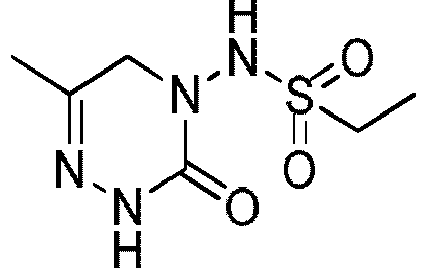
Ia-3 
Ia-4 
Ia-5 
Ia-6 
Ia-7 
Ia-8 
Ia-9 
Ia-10 
Ia-11 
Ia-12 
Ia-13 
Ia-14 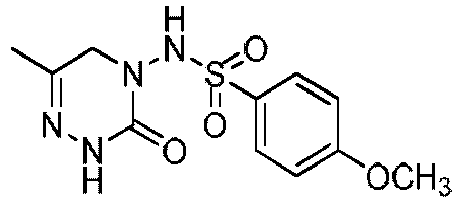
Ia-15 
Ia-16 
Ia-17 
Ia-18 
Ia-19 
Ia-20 
Ia-21 
Ia-22 
Ia-23 
Ia-24 
Ia-25 
Ia-26 
Ia-27 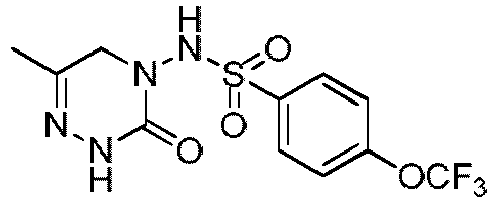
Ia-28 
Ia-29 
Ia-30 
Ia-31 
Ia-32 
Ia-33 
Ia-34 
- A method for preparing the triazinone derivative according to any of claims 1-3, comprising: controlling amino-triazinone represented by formula (II) and sulfonyl chloride compound represented by formula (III) to have a substitution reaction in an organic solvent in the presence of an acid binding agent to obtain a compound represented by formula (Ia);
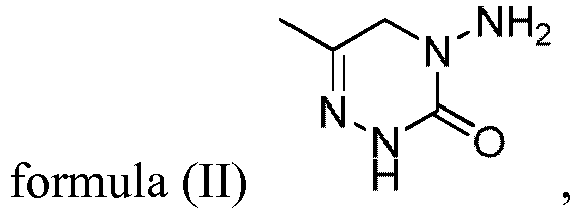

- The method according to claim 4, wherein the molar ratio of the amino-triazinone represented by formula (II) to the sulfonyl chloride compound represented by formula (III) is 1:0.8-1.2, preferably is 1:1-1.1;
preferably, the acid binding agent is at least one of the agents selected from the group consisted of sodium carbonate, potassium carbonate, cesium carbonate, triethylamine, and pyridine;
preferably, the organic solvent is at least one of the solvents selected from the group consisted of methanol, ethanol, pyridine, N,N-dimethyl formamide and dimethyl sulfoxide;
preferably, the organic solvent is dosed so that the concentration of the amino-triazinone represented by formula (II) is 0.05-0.5mmol/mL. - The method according to claim 4 or 5, wherein the conditions of the substitution reaction include: temperature: 15-40°C; time: 4-12h.
- A sulfonyl-structure-containing triazinone derivative, which is a compound represented by formula (Ib):

- The triazinone derivative according to claim 7, wherein each R1 is respectively and independently selected from the group consisted of C1-C8 alkyl, C3-C6 cycloalkyl, substituted or unsubstituted phenyl, substituted or unsubstituted naphthyl, substituted or unsubstituted benzyl, substituted or unsubstituted phenethyl, substituted or unsubstituted phenylpropyl, substituted or unsubstituted phenylbutyl, nitrogen-containing heterocycle containing 2-8 carbon atoms, oxygen-containing heterocycle containing 2-8 carbon atoms, and sulfur-containing heterocycle containing 2-8 carbon atoms; the substituents of the substituted phenyl, the substituted naphthyl, the substituted benzyl, the substituted phenethyl, the substituted phenylpropyl, and the substituted phenylbutyl are one or more substituents respectively and independently selected from the group consisted of hydroxyl, F, Cl, Br, I, cyano, nitro, -COOCH3, -COOCH2CH3, trifluoromethyl, trifluoromethoxy, -NH-CO-CH3, -NH-CO-CH2CH3, methyl, ethyl, n-propyl, isopropyl, n-butyl, isobutyl, sec-butyl, tert-butyl, n-pentyl, methoxy, ethoxy, n-propoxy, isopropoxy, n-butoxy, isobutoxy, sec-butoxy, tert-butoxy, n-pentyloxy, C1-C5 alkyl, C1-C5 alkoxy, -O-CO-CH3, -O-CO-CH2CH3, -O-CO-O-CH3, and -O-CO-O-CH2CH3.
- The triazinone derivative according to claim 7 or 8, wherein the compound represented by formula (Ib) is at least one of the compounds represented by the following formulae:
Ib-1 
Ib-2 
Ib-3 
Ib-4 
Ib-5 
Ib-6 
Ib-7 
Ib-8 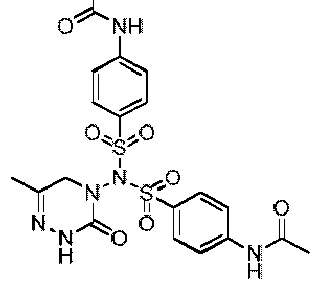
Ib-9 
- A method for preparing the triazinone derivative according to any of claims 7-9, comprising: controlling amino-triazinone represented by formula (II) and sulfonyl chloride compound represented by formula (III) to have a substitution reaction in an organic solvent in the presence of an acid binding agent to obtain a compound represented by formula (Ib);
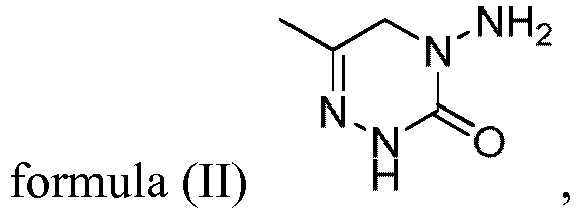

- The method according to claim 10, wherein the molar ratio of the amino-triazinone represented by formula (II) to the sulfonyl chloride compound represented by formula (III) is 1:1.8-2.5, preferably is 1:2-2.4;
preferably, the acid binding agent is at least one of the agents selected from the group consisted of sodium carbonate, potassium carbonate, cesium carbonate, triethylamine, and pyridine;
preferably, the organic solvent is at least one of the solvents selected from the group consisted of methanol, ethanol, pyridine, N,N-dimethyl formamide and dimethyl sulfoxide;
preferably, the organic solvent is dosed so that the concentration of the amino-triazinone represented by formula (II) is 0.05-0.5mmol/mL. - The method according to claim 10 or 11, wherein the conditions of the substitution reaction include: temperature: 15-40°C; time: 4-12h.
- Use of the triazinone derivative according to any of claims 1-3 and 7-9 in insect killing and/or bacterium killing.
- The use according to claim 13, wherein the insect is at least one of aphides, mosquito larvae, cotton bollworms, maize borers, and armyworms;
and wherein the bacterium is at least one of the pathogenic bacteria that may cause tomato early blight, wheat head blight, potato late blight, capsicum phytophthora blight, sclerotinia rot of colza, cucumber gray mold, rice sheath blight, cucumber fusarium wilt, cercospora brown spot of peanut, apple ring rot, wheat sheath blight, corn southern leaf blight, watermelon anthracnose, and rice bakanae disease.
Applications Claiming Priority (1)
| Application Number | Priority Date | Filing Date | Title |
|---|---|---|---|
| PCT/CN2017/102600 WO2019056246A1 (en) | 2017-09-21 | 2017-09-21 | Triazinone derivative containing sulfonyl structure and preparation method therefor, and insecticidal and bactericidal uses thereof |
Publications (3)
| Publication Number | Publication Date |
|---|---|
| EP3486237A1 EP3486237A1 (en) | 2019-05-22 |
| EP3486237A4 EP3486237A4 (en) | 2019-05-22 |
| EP3486237B1 true EP3486237B1 (en) | 2019-12-11 |
Family
ID=65810934
Family Applications (1)
| Application Number | Title | Priority Date | Filing Date |
|---|---|---|---|
| EP17892064.1A Active EP3486237B1 (en) | 2017-09-21 | 2017-09-21 | Triazinone derivative containing sulfonyl structure and preparation method therefor, and insecticidal and bactericidal uses thereof |
Country Status (3)
| Country | Link |
|---|---|
| US (1) | US11203577B2 (en) |
| EP (1) | EP3486237B1 (en) |
| WO (1) | WO2019056246A1 (en) |
Families Citing this family (1)
| Publication number | Priority date | Publication date | Assignee | Title |
|---|---|---|---|---|
| CN111892549B (en) * | 2019-05-06 | 2023-10-27 | 南开大学 | A method for preparing monosulfonyl-substituted triazone compounds under catalytic conditions |
Family Cites Families (4)
| Publication number | Priority date | Publication date | Assignee | Title |
|---|---|---|---|---|
| ES2070861T3 (en) | 1987-10-16 | 1995-06-16 | Ciba Geigy Ag | ANTIPARASITIC COMPOUNDS. |
| PH12012501955A1 (en) | 2010-06-29 | 2013-02-04 | Fmc Corp | 6-acyl-1,2,4-triazine-3-5-dione derivative and herbicides |
| US20140106968A1 (en) | 2012-10-15 | 2014-04-17 | E I Du Pont De Nemours And Company | Substituted 1,2,4-triazine-3,5-diones as herbicides |
| CN107266378B (en) | 2016-04-06 | 2020-08-21 | 南开大学 | Triazinone derivative containing sulfonyl structure and its preparation method and application in insecticide and sterilization |
-
2017
- 2017-09-21 EP EP17892064.1A patent/EP3486237B1/en active Active
- 2017-09-21 WO PCT/CN2017/102600 patent/WO2019056246A1/en not_active Ceased
- 2017-09-21 US US16/073,214 patent/US11203577B2/en active Active
Non-Patent Citations (1)
| Title |
|---|
| None * |
Also Published As
| Publication number | Publication date |
|---|---|
| EP3486237A1 (en) | 2019-05-22 |
| US11203577B2 (en) | 2021-12-21 |
| US20210206731A1 (en) | 2021-07-08 |
| EP3486237A4 (en) | 2019-05-22 |
| WO2019056246A1 (en) | 2019-03-28 |
Similar Documents
| Publication | Publication Date | Title |
|---|---|---|
| CS196415B2 (en) | Fungicide and process for preparing effective compounds | |
| US4561880A (en) | 1H[1,2,4]-Triazolo[1,2-a]pyridazine-1,3-diones useful as herbicides | |
| CZ400788A3 (en) | Substituted triazolinones, process of their preparation and use as herbicides | |
| JPS63287764A (en) | N-3-cyanobenzyl-heterocyclic compound and insecticide | |
| US2779788A (en) | Trichloromethane sulphenic acid derivatives | |
| CN107266378B (en) | Triazinone derivative containing sulfonyl structure and its preparation method and application in insecticide and sterilization | |
| US11203577B2 (en) | Sulfonyl-structure-containing triazinone derivatives, their preparation methods and their uses in insect killing and/or bacterium killing | |
| KR20040111382A (en) | Cyclic compound, process for producing the same, and pest control agent | |
| HU198436B (en) | Fungicide compositions containing benzamide derivatives and process for producing the active components | |
| US4107323A (en) | Fungicidal 3-(N-acyl-N-arylamino) lactones and lactams | |
| HU200894B (en) | Fungicixe compositions containing benzothiazinone derivatives as active components and process for producing these compounds | |
| CZ28796A3 (en) | /1,3,4/oxadiazoles and thiadiazoles as well as herbicidal agents based thereon | |
| CN108059614A (en) | Pyrazol acid amide compounds and its application | |
| EP0301613B1 (en) | Thiazole compounds having fungicidal activity | |
| JPH05310712A (en) | Diphenyltriazole deritative and insecticidal and miticidal agent | |
| Zhang et al. | Synthesis and antifungal activity of novel 2, 5-disubstituted-1, 3, 4-oxadiazoles containing benzimidazole moiety | |
| EP0354297B1 (en) | Thiadiazines, process for production thereof, and insecticidal and acaricidal agents comprising the thiadiazines | |
| US4049820A (en) | Substituted urazole and thiourazole compounds as agricultural fungicidal agents | |
| US4226873A (en) | 5-Substituted-3-fluorosulfonyl-4H-1,2,4-triazoles and use as insecticides and miticides | |
| RU2755982C1 (en) | Substituted 5-(4-pyridinyl)-4,5-dihydro-1,2-oxazoles | |
| WO1997038973A1 (en) | Hydrazine compounds, process for the preparation thereof, and insecticides for agricultural and horticultural use | |
| US3953447A (en) | Esterified 2-amino pyrimidine derivatives | |
| RU2826642C2 (en) | Picolinamide derivatives suitable as agricultural fungicides | |
| CN117603140A (en) | A kind of pyrazole acylurea or thiourea compound containing substituted biphenyl structure and its preparation method and application | |
| JPH01311069A (en) | 1-dimethylcarbamoyl-3-substituted-5-substituted- 1h-1, 2, 4-triazole |
Legal Events
| Date | Code | Title | Description |
|---|---|---|---|
| STAA | Information on the status of an ep patent application or granted ep patent |
Free format text: STATUS: UNKNOWN |
|
| STAA | Information on the status of an ep patent application or granted ep patent |
Free format text: STATUS: THE INTERNATIONAL PUBLICATION HAS BEEN MADE |
|
| PUAI | Public reference made under article 153(3) epc to a published international application that has entered the european phase |
Free format text: ORIGINAL CODE: 0009012 |
|
| STAA | Information on the status of an ep patent application or granted ep patent |
Free format text: STATUS: REQUEST FOR EXAMINATION WAS MADE |
|
| 17P | Request for examination filed |
Effective date: 20180724 |
|
| A4 | Supplementary search report drawn up and despatched |
Effective date: 20181203 |
|
| AK | Designated contracting states |
Kind code of ref document: A1 Designated state(s): AL AT BE BG CH CY CZ DE DK EE ES FI FR GB GR HR HU IE IS IT LI LT LU LV MC MK MT NL NO PL PT RO RS SE SI SK SM TR |
|
| AX | Request for extension of the european patent |
Extension state: BA ME |
|
| GRAP | Despatch of communication of intention to grant a patent |
Free format text: ORIGINAL CODE: EPIDOSNIGR1 |
|
| STAA | Information on the status of an ep patent application or granted ep patent |
Free format text: STATUS: GRANT OF PATENT IS INTENDED |
|
| DAV | Request for validation of the european patent (deleted) | ||
| DAX | Request for extension of the european patent (deleted) | ||
| INTG | Intention to grant announced |
Effective date: 20190726 |
|
| GRAS | Grant fee paid |
Free format text: ORIGINAL CODE: EPIDOSNIGR3 |
|
| GRAA | (expected) grant |
Free format text: ORIGINAL CODE: 0009210 |
|
| STAA | Information on the status of an ep patent application or granted ep patent |
Free format text: STATUS: THE PATENT HAS BEEN GRANTED |
|
| AK | Designated contracting states |
Kind code of ref document: B1 Designated state(s): AL AT BE BG CH CY CZ DE DK EE ES FI FR GB GR HR HU IE IS IT LI LT LU LV MC MK MT NL NO PL PT RO RS SE SI SK SM TR |
|
| REG | Reference to a national code |
Ref country code: GB Ref legal event code: FG4D |
|
| REG | Reference to a national code |
Ref country code: CH Ref legal event code: EP |
|
| REG | Reference to a national code |
Ref country code: AT Ref legal event code: REF Ref document number: 1212062 Country of ref document: AT Kind code of ref document: T Effective date: 20191215 |
|
| REG | Reference to a national code |
Ref country code: DE Ref legal event code: R096 Ref document number: 602017009687 Country of ref document: DE |
|
| REG | Reference to a national code |
Ref country code: IE Ref legal event code: FG4D |
|
| REG | Reference to a national code |
Ref country code: CH Ref legal event code: NV Representative=s name: OFFICE ERNEST T. FREYLINGER S.A., CH |
|
| REG | Reference to a national code |
Ref country code: NL Ref legal event code: MP Effective date: 20191211 |
|
| REG | Reference to a national code |
Ref country code: LT Ref legal event code: MG4D |
|
| PG25 | Lapsed in a contracting state [announced via postgrant information from national office to epo] |
Ref country code: LT Free format text: LAPSE BECAUSE OF FAILURE TO SUBMIT A TRANSLATION OF THE DESCRIPTION OR TO PAY THE FEE WITHIN THE PRESCRIBED TIME-LIMIT Effective date: 20191211 Ref country code: NO Free format text: LAPSE BECAUSE OF FAILURE TO SUBMIT A TRANSLATION OF THE DESCRIPTION OR TO PAY THE FEE WITHIN THE PRESCRIBED TIME-LIMIT Effective date: 20200311 Ref country code: BG Free format text: LAPSE BECAUSE OF FAILURE TO SUBMIT A TRANSLATION OF THE DESCRIPTION OR TO PAY THE FEE WITHIN THE PRESCRIBED TIME-LIMIT Effective date: 20200311 Ref country code: GR Free format text: LAPSE BECAUSE OF FAILURE TO SUBMIT A TRANSLATION OF THE DESCRIPTION OR TO PAY THE FEE WITHIN THE PRESCRIBED TIME-LIMIT Effective date: 20200312 Ref country code: SE Free format text: LAPSE BECAUSE OF FAILURE TO SUBMIT A TRANSLATION OF THE DESCRIPTION OR TO PAY THE FEE WITHIN THE PRESCRIBED TIME-LIMIT Effective date: 20191211 Ref country code: LV Free format text: LAPSE BECAUSE OF FAILURE TO SUBMIT A TRANSLATION OF THE DESCRIPTION OR TO PAY THE FEE WITHIN THE PRESCRIBED TIME-LIMIT Effective date: 20191211 Ref country code: FI Free format text: LAPSE BECAUSE OF FAILURE TO SUBMIT A TRANSLATION OF THE DESCRIPTION OR TO PAY THE FEE WITHIN THE PRESCRIBED TIME-LIMIT Effective date: 20191211 |
|
| PG25 | Lapsed in a contracting state [announced via postgrant information from national office to epo] |
Ref country code: RS Free format text: LAPSE BECAUSE OF FAILURE TO SUBMIT A TRANSLATION OF THE DESCRIPTION OR TO PAY THE FEE WITHIN THE PRESCRIBED TIME-LIMIT Effective date: 20191211 Ref country code: HR Free format text: LAPSE BECAUSE OF FAILURE TO SUBMIT A TRANSLATION OF THE DESCRIPTION OR TO PAY THE FEE WITHIN THE PRESCRIBED TIME-LIMIT Effective date: 20191211 |
|
| PG25 | Lapsed in a contracting state [announced via postgrant information from national office to epo] |
Ref country code: AL Free format text: LAPSE BECAUSE OF FAILURE TO SUBMIT A TRANSLATION OF THE DESCRIPTION OR TO PAY THE FEE WITHIN THE PRESCRIBED TIME-LIMIT Effective date: 20191211 |
|
| PG25 | Lapsed in a contracting state [announced via postgrant information from national office to epo] |
Ref country code: PT Free format text: LAPSE BECAUSE OF FAILURE TO SUBMIT A TRANSLATION OF THE DESCRIPTION OR TO PAY THE FEE WITHIN THE PRESCRIBED TIME-LIMIT Effective date: 20200506 Ref country code: ES Free format text: LAPSE BECAUSE OF FAILURE TO SUBMIT A TRANSLATION OF THE DESCRIPTION OR TO PAY THE FEE WITHIN THE PRESCRIBED TIME-LIMIT Effective date: 20191211 Ref country code: NL Free format text: LAPSE BECAUSE OF FAILURE TO SUBMIT A TRANSLATION OF THE DESCRIPTION OR TO PAY THE FEE WITHIN THE PRESCRIBED TIME-LIMIT Effective date: 20191211 Ref country code: EE Free format text: LAPSE BECAUSE OF FAILURE TO SUBMIT A TRANSLATION OF THE DESCRIPTION OR TO PAY THE FEE WITHIN THE PRESCRIBED TIME-LIMIT Effective date: 20191211 Ref country code: CZ Free format text: LAPSE BECAUSE OF FAILURE TO SUBMIT A TRANSLATION OF THE DESCRIPTION OR TO PAY THE FEE WITHIN THE PRESCRIBED TIME-LIMIT Effective date: 20191211 Ref country code: RO Free format text: LAPSE BECAUSE OF FAILURE TO SUBMIT A TRANSLATION OF THE DESCRIPTION OR TO PAY THE FEE WITHIN THE PRESCRIBED TIME-LIMIT Effective date: 20191211 |
|
| PG25 | Lapsed in a contracting state [announced via postgrant information from national office to epo] |
Ref country code: SM Free format text: LAPSE BECAUSE OF FAILURE TO SUBMIT A TRANSLATION OF THE DESCRIPTION OR TO PAY THE FEE WITHIN THE PRESCRIBED TIME-LIMIT Effective date: 20191211 Ref country code: IS Free format text: LAPSE BECAUSE OF FAILURE TO SUBMIT A TRANSLATION OF THE DESCRIPTION OR TO PAY THE FEE WITHIN THE PRESCRIBED TIME-LIMIT Effective date: 20200411 Ref country code: SK Free format text: LAPSE BECAUSE OF FAILURE TO SUBMIT A TRANSLATION OF THE DESCRIPTION OR TO PAY THE FEE WITHIN THE PRESCRIBED TIME-LIMIT Effective date: 20191211 |
|
| REG | Reference to a national code |
Ref country code: DE Ref legal event code: R097 Ref document number: 602017009687 Country of ref document: DE |
|
| REG | Reference to a national code |
Ref country code: AT Ref legal event code: MK05 Ref document number: 1212062 Country of ref document: AT Kind code of ref document: T Effective date: 20191211 |
|
| PLBE | No opposition filed within time limit |
Free format text: ORIGINAL CODE: 0009261 |
|
| STAA | Information on the status of an ep patent application or granted ep patent |
Free format text: STATUS: NO OPPOSITION FILED WITHIN TIME LIMIT |
|
| PG25 | Lapsed in a contracting state [announced via postgrant information from national office to epo] |
Ref country code: DK Free format text: LAPSE BECAUSE OF FAILURE TO SUBMIT A TRANSLATION OF THE DESCRIPTION OR TO PAY THE FEE WITHIN THE PRESCRIBED TIME-LIMIT Effective date: 20191211 |
|
| 26N | No opposition filed |
Effective date: 20200914 |
|
| PG25 | Lapsed in a contracting state [announced via postgrant information from national office to epo] |
Ref country code: AT Free format text: LAPSE BECAUSE OF FAILURE TO SUBMIT A TRANSLATION OF THE DESCRIPTION OR TO PAY THE FEE WITHIN THE PRESCRIBED TIME-LIMIT Effective date: 20191211 |
|
| PG25 | Lapsed in a contracting state [announced via postgrant information from national office to epo] |
Ref country code: IT Free format text: LAPSE BECAUSE OF FAILURE TO SUBMIT A TRANSLATION OF THE DESCRIPTION OR TO PAY THE FEE WITHIN THE PRESCRIBED TIME-LIMIT Effective date: 20191211 |
|
| PG25 | Lapsed in a contracting state [announced via postgrant information from national office to epo] |
Ref country code: PL Free format text: LAPSE BECAUSE OF FAILURE TO SUBMIT A TRANSLATION OF THE DESCRIPTION OR TO PAY THE FEE WITHIN THE PRESCRIBED TIME-LIMIT Effective date: 20191211 |
|
| REG | Reference to a national code |
Ref country code: BE Ref legal event code: MM Effective date: 20200930 |
|
| PG25 | Lapsed in a contracting state [announced via postgrant information from national office to epo] |
Ref country code: LU Free format text: LAPSE BECAUSE OF NON-PAYMENT OF DUE FEES Effective date: 20200921 |
|
| PG25 | Lapsed in a contracting state [announced via postgrant information from national office to epo] |
Ref country code: BE Free format text: LAPSE BECAUSE OF NON-PAYMENT OF DUE FEES Effective date: 20200930 Ref country code: IE Free format text: LAPSE BECAUSE OF NON-PAYMENT OF DUE FEES Effective date: 20200921 |
|
| PG25 | Lapsed in a contracting state [announced via postgrant information from national office to epo] |
Ref country code: TR Free format text: LAPSE BECAUSE OF FAILURE TO SUBMIT A TRANSLATION OF THE DESCRIPTION OR TO PAY THE FEE WITHIN THE PRESCRIBED TIME-LIMIT Effective date: 20191211 Ref country code: MT Free format text: LAPSE BECAUSE OF FAILURE TO SUBMIT A TRANSLATION OF THE DESCRIPTION OR TO PAY THE FEE WITHIN THE PRESCRIBED TIME-LIMIT Effective date: 20191211 Ref country code: CY Free format text: LAPSE BECAUSE OF FAILURE TO SUBMIT A TRANSLATION OF THE DESCRIPTION OR TO PAY THE FEE WITHIN THE PRESCRIBED TIME-LIMIT Effective date: 20191211 |
|
| PG25 | Lapsed in a contracting state [announced via postgrant information from national office to epo] |
Ref country code: MK Free format text: LAPSE BECAUSE OF FAILURE TO SUBMIT A TRANSLATION OF THE DESCRIPTION OR TO PAY THE FEE WITHIN THE PRESCRIBED TIME-LIMIT Effective date: 20191211 Ref country code: MC Free format text: LAPSE BECAUSE OF FAILURE TO SUBMIT A TRANSLATION OF THE DESCRIPTION OR TO PAY THE FEE WITHIN THE PRESCRIBED TIME-LIMIT Effective date: 20191211 |
|
| PG25 | Lapsed in a contracting state [announced via postgrant information from national office to epo] |
Ref country code: SI Free format text: LAPSE BECAUSE OF FAILURE TO SUBMIT A TRANSLATION OF THE DESCRIPTION OR TO PAY THE FEE WITHIN THE PRESCRIBED TIME-LIMIT Effective date: 20191211 |
|
| REG | Reference to a national code |
Ref country code: CH Ref legal event code: U11 Free format text: ST27 STATUS EVENT CODE: U-0-0-U10-U11 (AS PROVIDED BY THE NATIONAL OFFICE) Effective date: 20251001 |
|
| PGFP | Annual fee paid to national office [announced via postgrant information from national office to epo] |
Ref country code: DE Payment date: 20250916 Year of fee payment: 9 |
|
| PGFP | Annual fee paid to national office [announced via postgrant information from national office to epo] |
Ref country code: GB Payment date: 20250919 Year of fee payment: 9 |
|
| PGFP | Annual fee paid to national office [announced via postgrant information from national office to epo] |
Ref country code: FR Payment date: 20250929 Year of fee payment: 9 |
|
| PGFP | Annual fee paid to national office [announced via postgrant information from national office to epo] |
Ref country code: CH Payment date: 20251001 Year of fee payment: 9 |