EP3484837B1 - Cohesive granular material - Google Patents
Cohesive granular material Download PDFInfo
- Publication number
- EP3484837B1 EP3484837B1 EP16741601.5A EP16741601A EP3484837B1 EP 3484837 B1 EP3484837 B1 EP 3484837B1 EP 16741601 A EP16741601 A EP 16741601A EP 3484837 B1 EP3484837 B1 EP 3484837B1
- Authority
- EP
- European Patent Office
- Prior art keywords
- granular material
- granules
- cohesive granular
- cohesive
- substance
- Prior art date
- Legal status (The legal status is an assumption and is not a legal conclusion. Google has not performed a legal analysis and makes no representation as to the accuracy of the status listed.)
- Active
Links
Images


Classifications
-
- C—CHEMISTRY; METALLURGY
- C04—CEMENTS; CONCRETE; ARTIFICIAL STONE; CERAMICS; REFRACTORIES
- C04B—LIME, MAGNESIA; SLAG; CEMENTS; COMPOSITIONS THEREOF, e.g. MORTARS, CONCRETE OR LIKE BUILDING MATERIALS; ARTIFICIAL STONE; CERAMICS; REFRACTORIES; TREATMENT OF NATURAL STONE
- C04B38/00—Porous mortars, concrete, artificial stone or ceramic ware; Preparation thereof
- C04B38/0038—Porous mortars, concrete, artificial stone or ceramic ware; Preparation thereof by superficial sintering or bonding of particulate matter
- C04B38/0041—Porous mortars, concrete, artificial stone or ceramic ware; Preparation thereof by superficial sintering or bonding of particulate matter the particulate matter having preselected particle sizes
-
- B—PERFORMING OPERATIONS; TRANSPORTING
- B01—PHYSICAL OR CHEMICAL PROCESSES OR APPARATUS IN GENERAL
- B01D—SEPARATION
- B01D39/00—Filtering material for liquid or gaseous fluids
- B01D39/14—Other self-supporting filtering material ; Other filtering material
- B01D39/16—Other self-supporting filtering material ; Other filtering material of organic material, e.g. synthetic fibres
- B01D39/1638—Other self-supporting filtering material ; Other filtering material of organic material, e.g. synthetic fibres the material being particulate
- B01D39/1653—Other self-supporting filtering material ; Other filtering material of organic material, e.g. synthetic fibres the material being particulate of synthetic origin
- B01D39/1661—Other self-supporting filtering material ; Other filtering material of organic material, e.g. synthetic fibres the material being particulate of synthetic origin sintered or bonded
-
- B—PERFORMING OPERATIONS; TRANSPORTING
- B01—PHYSICAL OR CHEMICAL PROCESSES OR APPARATUS IN GENERAL
- B01D—SEPARATION
- B01D39/00—Filtering material for liquid or gaseous fluids
- B01D39/14—Other self-supporting filtering material ; Other filtering material
- B01D39/20—Other self-supporting filtering material ; Other filtering material of inorganic material, e.g. asbestos paper, metallic filtering material of non-woven wires
- B01D39/2068—Other inorganic materials, e.g. ceramics
- B01D39/2072—Other inorganic materials, e.g. ceramics the material being particulate or granular
- B01D39/2079—Other inorganic materials, e.g. ceramics the material being particulate or granular otherwise bonded, e.g. by resins
-
- B—PERFORMING OPERATIONS; TRANSPORTING
- B01—PHYSICAL OR CHEMICAL PROCESSES OR APPARATUS IN GENERAL
- B01D—SEPARATION
- B01D69/00—Semi-permeable membranes for separation processes or apparatus characterised by their form, structure or properties; Manufacturing processes specially adapted therefor
- B01D69/14—Dynamic membranes
- B01D69/141—Heterogeneous membranes, e.g. containing dispersed material; Mixed matrix membranes
- B01D69/148—Organic/inorganic mixed matrix membranes
-
- B—PERFORMING OPERATIONS; TRANSPORTING
- B01—PHYSICAL OR CHEMICAL PROCESSES OR APPARATUS IN GENERAL
- B01D—SEPARATION
- B01D71/00—Semi-permeable membranes for separation processes or apparatus characterised by the material; Manufacturing processes specially adapted therefor
- B01D71/02—Inorganic material
-
- B—PERFORMING OPERATIONS; TRANSPORTING
- B01—PHYSICAL OR CHEMICAL PROCESSES OR APPARATUS IN GENERAL
- B01D—SEPARATION
- B01D71/00—Semi-permeable membranes for separation processes or apparatus characterised by the material; Manufacturing processes specially adapted therefor
- B01D71/06—Organic material
- B01D71/70—Polymers having silicon in the main chain, with or without sulfur, nitrogen, oxygen or carbon only
- B01D71/701—Polydimethylsiloxane
-
- C—CHEMISTRY; METALLURGY
- C04—CEMENTS; CONCRETE; ARTIFICIAL STONE; CERAMICS; REFRACTORIES
- C04B—LIME, MAGNESIA; SLAG; CEMENTS; COMPOSITIONS THEREOF, e.g. MORTARS, CONCRETE OR LIKE BUILDING MATERIALS; ARTIFICIAL STONE; CERAMICS; REFRACTORIES; TREATMENT OF NATURAL STONE
- C04B38/00—Porous mortars, concrete, artificial stone or ceramic ware; Preparation thereof
- C04B38/0038—Porous mortars, concrete, artificial stone or ceramic ware; Preparation thereof by superficial sintering or bonding of particulate matter
-
- C—CHEMISTRY; METALLURGY
- C08—ORGANIC MACROMOLECULAR COMPOUNDS; THEIR PREPARATION OR CHEMICAL WORKING-UP; COMPOSITIONS BASED THEREON
- C08K—Use of inorganic or non-macromolecular organic substances as compounding ingredients
- C08K3/00—Use of inorganic substances as compounding ingredients
- C08K3/40—Glass
-
- C—CHEMISTRY; METALLURGY
- C04—CEMENTS; CONCRETE; ARTIFICIAL STONE; CERAMICS; REFRACTORIES
- C04B—LIME, MAGNESIA; SLAG; CEMENTS; COMPOSITIONS THEREOF, e.g. MORTARS, CONCRETE OR LIKE BUILDING MATERIALS; ARTIFICIAL STONE; CERAMICS; REFRACTORIES; TREATMENT OF NATURAL STONE
- C04B2111/00—Mortars, concrete or artificial stone or mixtures to prepare them, characterised by specific function, property or use
- C04B2111/00241—Physical properties of the materials not provided for elsewhere in C04B2111/00
- C04B2111/00284—Materials permeable to liquids
-
- C—CHEMISTRY; METALLURGY
- C04—CEMENTS; CONCRETE; ARTIFICIAL STONE; CERAMICS; REFRACTORIES
- C04B—LIME, MAGNESIA; SLAG; CEMENTS; COMPOSITIONS THEREOF, e.g. MORTARS, CONCRETE OR LIKE BUILDING MATERIALS; ARTIFICIAL STONE; CERAMICS; REFRACTORIES; TREATMENT OF NATURAL STONE
- C04B2111/00—Mortars, concrete or artificial stone or mixtures to prepare them, characterised by specific function, property or use
- C04B2111/00241—Physical properties of the materials not provided for elsewhere in C04B2111/00
- C04B2111/00293—Materials impermeable to liquids
-
- C—CHEMISTRY; METALLURGY
- C04—CEMENTS; CONCRETE; ARTIFICIAL STONE; CERAMICS; REFRACTORIES
- C04B—LIME, MAGNESIA; SLAG; CEMENTS; COMPOSITIONS THEREOF, e.g. MORTARS, CONCRETE OR LIKE BUILDING MATERIALS; ARTIFICIAL STONE; CERAMICS; REFRACTORIES; TREATMENT OF NATURAL STONE
- C04B2111/00—Mortars, concrete or artificial stone or mixtures to prepare them, characterised by specific function, property or use
- C04B2111/00474—Uses not provided for elsewhere in C04B2111/00
- C04B2111/00793—Uses not provided for elsewhere in C04B2111/00 as filters or diaphragms
-
- C—CHEMISTRY; METALLURGY
- C04—CEMENTS; CONCRETE; ARTIFICIAL STONE; CERAMICS; REFRACTORIES
- C04B—LIME, MAGNESIA; SLAG; CEMENTS; COMPOSITIONS THEREOF, e.g. MORTARS, CONCRETE OR LIKE BUILDING MATERIALS; ARTIFICIAL STONE; CERAMICS; REFRACTORIES; TREATMENT OF NATURAL STONE
- C04B2111/00—Mortars, concrete or artificial stone or mixtures to prepare them, characterised by specific function, property or use
- C04B2111/00474—Uses not provided for elsewhere in C04B2111/00
- C04B2111/00793—Uses not provided for elsewhere in C04B2111/00 as filters or diaphragms
- C04B2111/00801—Membranes; Diaphragms
Definitions
- the present invention relates to a cohesive granular material comprising granules made of a stiff substance and having a grain size in the range from 55 ⁇ m to 2.0 mm, and a further substance connecting the granules.
- the properties, particularly the physical properties of such a cohesive granular material are dependent on the properties of the granules, on the properties of the further substance, and on the relative amount of the further substance.
- Stone paper also known as rock paper or mineral paper, is a paper-like cohesive granular material manufactured from about 80 % calcium carbonate bonded with about 20 % high-density polyethylene (HDPE).
- HDPE high-density polyethylene
- cemented aggregates grains or granules of various stiff materials are connected via a cement which also becomes stiff during manufacture of the aggregates.
- Klimentos, T. & Parker, A. The preparation (by an epoxy-resin method) and physical properties of artificial sandstones. Sedimentary Geology 59, 307 - 312 (1988 ) describe the production of artificial porous sandstones by mixing glass beads and epoxy-resin. This kind of cohesive granular material is fragile, fragile meaning a failure of the material even in case of small deformations. Further, there are little options of tuning the physical properties of cemented aggregates, i.e. adapting their mechanical properties as desired.
- kinetic sand is a toy made of sand mixed with a low fraction of non-drying and nonvolatile silicon oil. This granular material is used to mimic the properties of wet sand. Kinetic sand has no dimensional stability.
- porous sintered materials In porous sintered materials, granules of a stiff substance, like for example metal or ceramics, are sintered together at their contact points. Thus, they are connected via bridges which are as stiff as the granules themselves. As a result, porous sintered materials are brittle and fragile.
- porous open-cell solid foams may be tuned by varying the type of the material of the foam matrix.
- the foam matrix may be made of metals, ceramics, various polymers, including fiber re-enforced polymers and elastomers.
- porous solid open-cell foams can collapse for large deformation or for large differential pressures, resulting in a loss of porosity.
- porous cohesive granular material comprising granules made of a stiff substance and a further substance connecting the granules whose properties are adjustable in a wide range and which is not prone to failures for deformations.
- WO 2007/104354 A1 discloses a packing composition for a fluidic device to be used in liquid chromatography.
- the packing composition comprises a packing material for separating different components of a fluid and an elastic network in which the packing material is embedded.
- the packing composition has a Young's modulus in the range between 1,500 and 3,000 MPa.
- the packing material comprises beads which are at least partially permeable for the fluid.
- the beads may comprise polystyrene, zeolite, polyvinylalcohol, polytetrafluorethylene, glass, polymeric powder, silicon dioxide or silica gel.
- the elastic network may comprise an organic material, an inorganic material, a polymer, a rubber, caoutchouc, polytetrafluorethylene, expanded polypropylene, an elastomer, silica gel, graphite, porous carbon, carbon clad inorganic oxide materials or zirconia dioxide.
- a weight percentage of the elastic network is in a range between 5 % and 20 %. Pores are formed between the elastic network and the packing material.
- US 2002/0114941 A1 discloses a lightweight material with lightweight granules, in particular mineral foam granules, and an organic binder.
- the granules are packed as tightly as possible and the organic binder is used to fill any interspaces left between the granules in order to form an almost pore-free matrix, substantially completely embedding the granules.
- the resulting material is intended to have high strength.
- the granules may consist of alkali silicates, alkali/alkaline-earth silicates, alumosilicates, borosilicates, and further variants in combination with the system CaO-SiO 2 -Al 2 O 3 plus metal oxides.
- the binder may consist of an elastomer.
- the grains are at least approximately spherical. The granules count for 55 % to 90 % by vol. of the lightweight material.
- US 5,445,732 A discloses a porous solid matrix to be employed in chromatographic applications.
- the surfaces of the matrix are coated with a polymer network in order to inactivate innate groups of the matrix in order to minimize or substantially eliminate undesirable non-specific interactions of the matrix with biological molecules.
- the present invention provides a cohesive granular material comprising granules made of a stiff substance and having a grain size in the range from 55 ⁇ m to 2.0 mm, an elastomeric substance connecting the granules, a Young's modulus of the elastomeric substance being at maximum 0.5 times a Young's modulus of the stiff substance, and voids between the granules, the voids being interconnected and providing a fluid permeability to the cohesive granular material.
- the present invention provides a fluid filter and a membrane made of the cohesive granular material.
- the granules are made of a stiff substance and have a grain size in the range from 55 ⁇ m to 2.0 mm. This range of grain sizes corresponds to the definition of sand.
- the granules are not restricted to sand, neither with regard to the substance of the granules, i.e. their chemical composition, nor with regard to the shape of the granules.
- the elastomeric substance of the cohesive granular material according to the present invention is elastic and its Young's modulus is not more than 0.5 times the Young's modulus of the stiff substance. Typically, the difference in Young's modulus is much higher.
- the elastomeric substance elastically connects the granules, particularly with regard to a tensile or a shear load but also with regard to a pressure load on the cohesive granular material.
- the physical properties also strongly depend on the properties of the stiff substance.
- the granules of the stiff material abutting against each other provide for a high stability of the cohesive granular material.
- the elastomeric substance protects against failure for deformations of the cohesive granular material. Further, by means of modifying the Young's modulus of the elastomeric substance, the deformability's of the cohesive granular material under tensile and shear loads and even under pressure loads can be varied over a wide range.
- the voids between the granules of the cohesive granular material according to the invention are interconnected and provide for a fluid permeability of the cohesive granular material. Additionally, the connected voids have an influence on the mechanical properties of the cohesive granular material. Connected voids in the cohesive granular material mean that the granules are only locally connected by bridges. This may be described as local connections between neighboring granules via elastomeric bands and clearly differs from the granules being embedded in a matrix of the elastomeric substance.
- the voids between the granules of the cohesive granular material according to the present invention do not only provide for a fluid permeability, this fluid permeability may be of particular interest.
- the fluid permeability can be tuned by the grain size of the granules and the relative amount of the elastomeric substance to, for example, provide filters and membranes of a defined pore size and porosity.
- the granules of the stiff material may all have the same grain size.
- the granules typically do not comprise a big grain size and a small grain size, the granules of the small grain size fitting in and filling the free spaces left between the granules of the big grain size abutting against each other. Instead, these free spaces are left as a basis for the voids of the cohesive granular material according to the present invention. Typically, these free spaces are only filled by the elastomeric substance connecting the granules to a small extent.
- the cohesive granular material according to the present invention essentially all of the granules have the same shape. This, for example, means that there are no two different shapes of granules, wherein the granules of the one shapes fill free spaces left between the granules of the other shape.
- the granules may be spherical, cubic, tetrahedral, pyramidal, multiangular or sand-shaped.
- the shape of the granules has an influence on the physical properties of the cohesive granular material, particularly with regard to a shear load on the cohesive granular material.
- the arrangement of the granules in the cohesive granular material corresponds to a bulk of the granules. I.e., typically, they are not densely packed. Thus, even non-spherical granules only make up 55 % to 65 % of the volume of the cohesive granular material according to the invention, leaving 45 to 35 % free space between the granules which is only partially filled by the elastomeric substance.
- the stiff substance of which the granules are made may be selected from ceramic, stone, glass, sand, metal, hard plastic and hard organic substances.
- the stiff substances may be selected according to the maximum pressure load which will be exerted on the cohesive granular material and according to the chemical surroundings in which the cohesive granular material will be used.
- the substance should ensure that there is no relevant deformation of the granules under the maximum pressure load. I.e. the substance may be selected such that there is no compression of the granules in the direction of the pressure of more than 5, more than 3, more than 1 or more than 0.5 %.
- the stiff substance should be inert. This means that it should not - or only to a limited extent - chemically react with any chemical components present in these chemical surroundings.
- the elastomeric substance is preferably uniformly distributed over those areas of the cohesive granular material in which the granules abut against each other. With a low relative amount of the elastomeric substance, the elastomeric substance will only form local bridges between the neighboring granules. With an increasing relative amount of the elastomeric substance, these bridges will also extend over areas in which the granules are arranged at some distance. However, the elastomeric substance will still leave the interconnected voids between the granules.
- the bridges of the elastomeric substance connecting the granules elastically couple the granules in a defined relative arrangement of the individual granules.
- the elasticity of this elastic coupling - besides the relative amount of the elastomeric substance - particularly depends on the Young's modulus of the elastomeric substance.
- this Young's modulus is at maximum 0.1 times or even at maximum 0.01 times or even at maximum 0.001 times or even at maximum 0.0001 times the Young's modulus of the stiff substance, i.e. the Young's moduli of the stiff substance and the elastomeric substance preferably differ by at least one or even several orders of magnitude.
- the Young's modulus of the elastomeric substance may be in a range from 1 kPa to 1.5 MPa.
- the elastomeric substance may be selected from polymeric substances, at least partially crosslinked polymeric substances, chemically inert polymeric substances or, particularly, polydimethylsiloxane (PDMS).
- PDMS polydimethylsiloxane
- the selection of the elastomeric substance should be made dependent on the chemical surroundings in which the cohesive granular material is to be used.
- the elastomeric substance is inert with regard to the chemical surroundings in which the cohesive granular material is used. This means that the elastomeric substance does not - or only to a very limited extent - react with any chemical component with which the cohesive granular material may get into contact.
- PDMS is particularly well suited for the cohesive granular material according to the present invention as its Young's modulus may be fine-tuned by means of adding crosslinker in different amounts, as it is inert in most chemical surroundings, and as it is particularly safe when getting into contact with foodstuff.
- the elastomeric substance does not fill up the free space left between the granules in the cohesive granular material but that the elastomeric substance leaves voids between the granules, which are interconnected. More particularly, the elastomeric substance makes up not more than about 25 % of a partial volume of the cohesive granular material which is not filled by the granules. With regard to the volume of the overall cohesive granular material according to the present invention, the elastomeric substance may make up 0.3 % to 9 % or 1 to 6 % or 2 to 3 %. The particular amount of the cohesive granular material defines the extension of the bridges of the polymeric substance between the granules and thus both the physical properties and the pore size and porosity of the cohesive granular material.
- a porosity and a permeability of the granular material may be tuned by the grain size of the granules and by the relative amount of the elastomeric material in a range from 30 % to 45 %, and in a range from 2 x 10 -12 m 2 to 4 x 10 -10 m 2 , respectively.
- a diameter of the voids in the granular material is in a typical range from10 ⁇ m to 450 ⁇ m.
- the cohesive granular material according to the present invention may particularly be used in a filter for a fluid.
- the fluid may be a gas or a liquid, and it may pass through the interconnected voids in the cohesive granular material, whereas the cohesive granular material retains any bigger sized contaminations of the fluid.
- the cohesive granular material according to the present invention may be shaped into a membrane. Due to the elastic coupling between the granules, this membrane is bendable without the danger of failure. Shaping the cohesive granular material according to the present invention is easily achieved prior to curing the elastomeric substance up to its desired Young's modulus. After curing this shape is fixed.
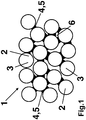
- the cohesive granular material 1 depicted in Fig. 1 consists of granules 2 made of a stiff substance 3, which are connected via bridges 4 of an elastomeric substance 5, and of voids 6 remaining unfilled by the elastomeric substance 5 between the granules 2.
- the granules 2 make up about 60 % of the volume of the cohesive granular material 1, and the voids 6 in this volume are interconnected.
- the cohesive granular material 1 is permeable to fluids. Its permeability depends on the pore size, i. e. on the size of the voids 6, and on the porosity of the cohesive granular material 1 due to the overall free space between the granules 2 not filled up with the elastomeric substance 5.
- the bridges 4 are rings around contact points at which the granules 2 abut against each other, or short bands locally connecting the granules 2 where they show their shortest free distances.
- This distribution of the elastomeric substance 5 connecting the granules 2 is typically found with cohesive granular material 1 comprising not more than 2.7 % by volume elastomeric substance 5 as compared to its overall volume.
- the Young's modulus strongly increases with the volumetric content of the elastomeric substance 5.
- the voids 6 between the granules 2 not filled with the elastomeric substance 5 are interconnected and provide for a fluid permeability.
- the pore size and the porosity decreases with increasing volumetric content of the elastomeric substance 5.
- the Young's modulus of the overall cohesive granular material 1 further depends of the Young's modulus of the elastomeric substance 5 in that both Young's moduli increase in parallel. This both applies under the pendular and the funicular regime.
- the Young's modulus of the stiff substance 3 being one or more orders of magnitude higher than the Young's modulus of the elastomeric substance 5 only has an influence on the Young's modulus of the overall cohesive granular material 1 with larger deformations.
- glass beads have been mixed with a curable polymer, particularly polydimethylsiloxane (PDMS), with different amounts of crosslinker resulting in different Young's moduli of the polymer in a range of about 1 kPa to 1.5 MPa. Even at the upper limit of this range of 1.5 MPa the Young's modulus of the polymeric material was several orders of magnitudes smaller than the Young's modulus of the beads of about 60 GPa.
- PDMS polydimethylsiloxane
- the volumetric content of the polymeric substance has been varied between 0.3 and 8.2 %. Additionally, the diameter of the beads and the volume fraction have been varied between 55 ⁇ m and 2.0 mm, and between 0.53 vol-% to 0.59 vol-%, respectively.
- the Young's modulus of the overall cohesive granular material increased with increasing content of PDMS strongly under the pendular regime and only slowly above about 2.7 vol-% under the funicular regime. Further, the Young's modulus of the overall cohesive granular material strongly dropped with increasing diameter of the beads.
- the cohesive granular material according to the present invention may be easily shaped into various forms.
- the granules are simply mixed with a precursor of the elastomeric substance, like for example PDMS with a certain amount of crosslinker. Then, the cohesive granular material is brought into the desired shape, before the elastomeric substance is cured or crosslinked to the desired extent. The resulting cohesive granular material will keep the desired shape.
- Fig. 3 schematically depicts a membrane 7 made of the cohesive granular material 1 and Fig. 4 depicts a filter 8 made of the cohesive granular material 1 in a cross-section.
- the permeability depends strongly on the grain or bead size of the granules 2 or beads, but can also be finely tuned with the PDMS fraction. To sum up the results, permeability can be tuned from 2 x 10 -12 m 2 to 4 x 10 -10 m 2 .
- the porosity of the cohesive granular material 1 depends on the packing of the granules 2 or beads and on the amount of the PDMS.
- the maximal porosity one could get with a loose packing of beads and a tiny fraction of the PDMS is be about 45% (maximal value which has been measured).
- the porosity can be tuned down to 0% by adding more PDMS. With the maximum fraction of the PDMS tested of 8.2% and with a dense packing of the granules up to a volume fraction of 60%, a porosity of 31.8% has been reached.
- porosities between 31.8 % and 45 % have been measured, but one could easily decrease the porosity by adding more PDMS.
- the pore size distribution of the cohesive granular material 1 has not been measured, but it can be estimated by considering the maximum size of a interstitial sphere in a tetrahedral site.
- the diameter of the sphere inscribed in the pore is then 0.225 times the diameter of the spheres.
- the pores characteristic size would then vary from a diameter of 10 microns to 450 microns for samples made of beads of 55 microns to 2.0 mm microns in diameter.
Landscapes
- Chemical & Material Sciences (AREA)
- Engineering & Computer Science (AREA)
- Ceramic Engineering (AREA)
- Chemical Kinetics & Catalysis (AREA)
- Organic Chemistry (AREA)
- Materials Engineering (AREA)
- Structural Engineering (AREA)
- Inorganic Chemistry (AREA)
- Geology (AREA)
- Life Sciences & Earth Sciences (AREA)
- Health & Medical Sciences (AREA)
- Medicinal Chemistry (AREA)
- Polymers & Plastics (AREA)
- Dispersion Chemistry (AREA)
- Filtering Materials (AREA)
- Compositions Of Macromolecular Compounds (AREA)
- Civil Engineering (AREA)
- Adhesives Or Adhesive Processes (AREA)
- Manufacture Of Porous Articles, And Recovery And Treatment Of Waste Products (AREA)
Description
- The present invention relates to a cohesive granular material comprising granules made of a stiff substance and having a grain size in the range from 55 µm to 2.0 mm, and a further substance connecting the granules.
- The properties, particularly the physical properties of such a cohesive granular material are dependent on the properties of the granules, on the properties of the further substance, and on the relative amount of the further substance.
- Stone paper, also known as rock paper or mineral paper, is a paper-like cohesive granular material manufactured from about 80 % calcium carbonate bonded with about 20 % high-density polyethylene (HDPE).
- In cemented aggregates, grains or granules of various stiff materials are connected via a cement which also becomes stiff during manufacture of the aggregates. Klimentos, T. & Parker, A. The preparation (by an epoxy-resin method) and physical properties of artificial sandstones. Sedimentary Geology 59, 307 - 312 (1988) describe the production of artificial porous sandstones by mixing glass beads and epoxy-resin. This kind of cohesive granular material is fragile, fragile meaning a failure of the material even in case of small deformations. Further, there are little options of tuning the physical properties of cemented aggregates, i.e. adapting their mechanical properties as desired.
- So-called "kinetic sand" is a toy made of sand mixed with a low fraction of non-drying and nonvolatile silicon oil. This granular material is used to mimic the properties of wet sand. Kinetic sand has no dimensional stability.
- In porous sintered materials, granules of a stiff substance, like for example metal or ceramics, are sintered together at their contact points. Thus, they are connected via bridges which are as stiff as the granules themselves. As a result, porous sintered materials are brittle and fragile.
- The mechanical properties of porous open-cell solid foams may be tuned by varying the type of the material of the foam matrix. For example, the foam matrix may be made of metals, ceramics, various polymers, including fiber re-enforced polymers and elastomers. However, porous solid open-cell foams can collapse for large deformation or for large differential pressures, resulting in a loss of porosity.
- There still is a need of porous cohesive granular material comprising granules made of a stiff substance and a further substance connecting the granules whose properties are adjustable in a wide range and which is not prone to failures for deformations.
-
WO 2007/104354 A1 discloses a packing composition for a fluidic device to be used in liquid chromatography. The packing composition comprises a packing material for separating different components of a fluid and an elastic network in which the packing material is embedded. The packing composition has a Young's modulus in the range between 1,500 and 3,000 MPa. The packing material comprises beads which are at least partially permeable for the fluid. The beads may comprise polystyrene, zeolite, polyvinylalcohol, polytetrafluorethylene, glass, polymeric powder, silicon dioxide or silica gel. The elastic network may comprise an organic material, an inorganic material, a polymer, a rubber, caoutchouc, polytetrafluorethylene, expanded polypropylene, an elastomer, silica gel, graphite, porous carbon, carbon clad inorganic oxide materials or zirconia dioxide. A weight percentage of the elastic network is in a range between 5 % and 20 %. Pores are formed between the elastic network and the packing material. -
US 2002/0114941 A1 discloses a lightweight material with lightweight granules, in particular mineral foam granules, and an organic binder. The granules are packed as tightly as possible and the organic binder is used to fill any interspaces left between the granules in order to form an almost pore-free matrix, substantially completely embedding the granules. The resulting material is intended to have high strength. The granules may consist of alkali silicates, alkali/alkaline-earth silicates, alumosilicates, borosilicates, and further variants in combination with the system CaO-SiO2-Al2O3 plus metal oxides. The binder may consist of an elastomer. The grains are at least approximately spherical. The granules count for 55 % to 90 % by vol. of the lightweight material. -
US 5,445,732 A discloses a porous solid matrix to be employed in chromatographic applications. The surfaces of the matrix are coated with a polymer network in order to inactivate innate groups of the matrix in order to minimize or substantially eliminate undesirable non-specific interactions of the matrix with biological molecules. - The present invention provides a cohesive granular material comprising granules made of a stiff substance and having a grain size in the range from 55 µm to 2.0 mm, an elastomeric substance connecting the granules, a Young's modulus of the elastomeric substance being at maximum 0.5 times a Young's modulus of the stiff substance, and voids between the granules, the voids being interconnected and providing a fluid permeability to the cohesive granular material.
- Further, the present invention provides a fluid filter and a membrane made of the cohesive granular material.
- Other features and advantages of the present invention will become apparent to one with skill in the art upon examination of the following drawings and the detailed description. It is intended that all such additional features and advantages be included herein within the scope of the present invention, as defined by the claims.
- In a cohesive granular material according to the present invention, the granules are made of a stiff substance and have a grain size in the range from 55 µm to 2.0 mm. This range of grain sizes corresponds to the definition of sand. However, the granules are not restricted to sand, neither with regard to the substance of the granules, i.e. their chemical composition, nor with regard to the shape of the granules.
- The elastomeric substance of the cohesive granular material according to the present invention is elastic and its Young's modulus is not more than 0.5 times the Young's modulus of the stiff substance. Typically, the difference in Young's modulus is much higher. The elastomeric substance elastically connects the granules, particularly with regard to a tensile or a shear load but also with regard to a pressure load on the cohesive granular material. Already with regard to a shear load and particularly with regard to a pressure load on the cohesive granular material, the physical properties also strongly depend on the properties of the stiff substance. With regard to a pressure load, the granules of the stiff material abutting against each other provide for a high stability of the cohesive granular material. With regard to tensile and shear loads, the elastomeric substance protects against failure for deformations of the cohesive granular material. Further, by means of modifying the Young's modulus of the elastomeric substance, the deformability's of the cohesive granular material under tensile and shear loads and even under pressure loads can be varied over a wide range.
- The voids between the granules of the cohesive granular material according to the invention are interconnected and provide for a fluid permeability of the cohesive granular material. Additionally, the connected voids have an influence on the mechanical properties of the cohesive granular material. Connected voids in the cohesive granular material mean that the granules are only locally connected by bridges. This may be described as local connections between neighboring granules via elastomeric bands and clearly differs from the granules being embedded in a matrix of the elastomeric substance.
- Although the voids between the granules of the cohesive granular material according to the present invention do not only provide for a fluid permeability, this fluid permeability may be of particular interest. The fluid permeability can be tuned by the grain size of the granules and the relative amount of the elastomeric substance to, for example, provide filters and membranes of a defined pore size and porosity.
- In the cohesive granular material according to the invention, the granules of the stiff material may all have the same grain size. This particularly means that the granules typically do not comprise a big grain size and a small grain size, the granules of the small grain size fitting in and filling the free spaces left between the granules of the big grain size abutting against each other. Instead, these free spaces are left as a basis for the voids of the cohesive granular material according to the present invention. Typically, these free spaces are only filled by the elastomeric substance connecting the granules to a small extent.
- Further, in the cohesive granular material according to the present invention, essentially all of the granules have the same shape. This, for example, means that there are no two different shapes of granules, wherein the granules of the one shapes fill free spaces left between the granules of the other shape.
- For example, the granules may be spherical, cubic, tetrahedral, pyramidal, multiangular or sand-shaped. The shape of the granules has an influence on the physical properties of the cohesive granular material, particularly with regard to a shear load on the cohesive granular material.
- The arrangement of the granules in the cohesive granular material corresponds to a bulk of the granules. I.e., typically, they are not densely packed. Thus, even non-spherical granules only make up 55 % to 65 % of the volume of the cohesive granular material according to the invention, leaving 45 to 35 % free space between the granules which is only partially filled by the elastomeric substance.
- In the cohesive granular material according to the invention, the stiff substance of which the granules are made may be selected from ceramic, stone, glass, sand, metal, hard plastic and hard organic substances. Particularly, the stiff substances may be selected according to the maximum pressure load which will be exerted on the cohesive granular material and according to the chemical surroundings in which the cohesive granular material will be used. Particularly, the substance should ensure that there is no relevant deformation of the granules under the maximum pressure load. I.e. the substance may be selected such that there is no compression of the granules in the direction of the pressure of more than 5, more than 3, more than 1 or more than 0.5 %. In the chemical surroundings in which the cohesive granular material according to the present invention is used, the stiff substance should be inert. This means that it should not - or only to a limited extent - chemically react with any chemical components present in these chemical surroundings.
- In the cohesive granular material according to the invention, the elastomeric substance is preferably uniformly distributed over those areas of the cohesive granular material in which the granules abut against each other. With a low relative amount of the elastomeric substance, the elastomeric substance will only form local bridges between the neighboring granules. With an increasing relative amount of the elastomeric substance, these bridges will also extend over areas in which the granules are arranged at some distance. However, the elastomeric substance will still leave the interconnected voids between the granules.
- The bridges of the elastomeric substance connecting the granules elastically couple the granules in a defined relative arrangement of the individual granules. The elasticity of this elastic coupling - besides the relative amount of the elastomeric substance - particularly depends on the Young's modulus of the elastomeric substance. Preferably, this Young's modulus is at maximum 0.1 times or even at maximum 0.01 times or even at maximum 0.001 times or even at maximum 0.0001 times the Young's modulus of the stiff substance, i.e. the Young's moduli of the stiff substance and the elastomeric substance preferably differ by at least one or even several orders of magnitude.
- In absolute terms, the Young's modulus of the elastomeric substance may be in a range from 1 kPa to 1.5 MPa. There are some elastomeric substances, available, whose Young's modulus, for example by the addition of different amounts of crosslinker, may be varied in this range of 1 kPa to 1.5 MPa. If these elastomeric substances are used for the cohesive granular material according to the present invention, the physical properties of the overall cohesive granular material may be tuned in a wide range.
- Particularly, the elastomeric substance may be selected from polymeric substances, at least partially crosslinked polymeric substances, chemically inert polymeric substances or, particularly, polydimethylsiloxane (PDMS). Besides the desired physical properties of the cohesive granular material, the selection of the elastomeric substance should be made dependent on the chemical surroundings in which the cohesive granular material is to be used. Preferably, the elastomeric substance is inert with regard to the chemical surroundings in which the cohesive granular material is used. This means that the elastomeric substance does not - or only to a very limited extent - react with any chemical component with which the cohesive granular material may get into contact. PDMS is particularly well suited for the cohesive granular material according to the present invention as its Young's modulus may be fine-tuned by means of adding crosslinker in different amounts, as it is inert in most chemical surroundings, and as it is particularly safe when getting into contact with foodstuff.
- It has already been pointed out above more than once that the elastomeric substance does not fill up the free space left between the granules in the cohesive granular material but that the elastomeric substance leaves voids between the granules, which are interconnected. More particularly, the elastomeric substance makes up not more than about 25 % of a partial volume of the cohesive granular material which is not filled by the granules. With regard to the volume of the overall cohesive granular material according to the present invention, the elastomeric substance may make up 0.3 % to 9 % or 1 to 6 % or 2 to 3 %. The particular amount of the cohesive granular material defines the extension of the bridges of the polymeric substance between the granules and thus both the physical properties and the pore size and porosity of the cohesive granular material.
- A porosity and a permeability of the granular material may be tuned by the grain size of the granules and by the relative amount of the elastomeric material in a range from 30 % to 45 %, and in a range from 2 x 10-12 m2 to 4 x 10⁻¹⁰ m2, respectively. With the granules having a grain size in the range form 55 µm to 2.0 mm, a diameter of the voids in the granular material is in a typical range from10 µm to 450 µm.
- The cohesive granular material according to the present invention may particularly be used in a filter for a fluid. The fluid may be a gas or a liquid, and it may pass through the interconnected voids in the cohesive granular material, whereas the cohesive granular material retains any bigger sized contaminations of the fluid.
- For making such a filter or for other uses, the cohesive granular material according to the present invention may be shaped into a membrane. Due to the elastic coupling between the granules, this membrane is bendable without the danger of failure. Shaping the cohesive granular material according to the present invention is easily achieved prior to curing the elastomeric substance up to its desired Young's modulus. After curing this shape is fixed.
- In the following, the invention is further explained and described with respect to preferred exemplary embodiments illustrated in the drawings.
- Fig. 1
- illustrates one embodiment of the cohesive granular material according to the present invention,
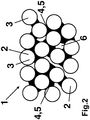
- Fig. 2
- illustrates another embodiment of the cohesive granular material.
- Fig. 3
- illustrates a membrane made of the cohesive granular material,
- Fig. 4
- illustrates a filter made of the cohesive granular material in a top view (a) and in a sectional view (b).
- The cohesive
granular material 1 depicted inFig. 1 consists ofgranules 2 made of astiff substance 3, which are connected via bridges 4 of an elastomeric substance 5, and ofvoids 6 remaining unfilled by the elastomeric substance 5 between thegranules 2. Thegranules 2 make up about 60 % of the volume of the cohesivegranular material 1, and thevoids 6 in this volume are interconnected. Thus, the cohesivegranular material 1 is permeable to fluids. Its permeability depends on the pore size, i. e. on the size of thevoids 6, and on the porosity of the cohesivegranular material 1 due to the overall free space between thegranules 2 not filled up with the elastomeric substance 5. - In the embodiment of the cohesive
granular material 1 according toFig. 1 the bridges 4 are rings around contact points at which thegranules 2 abut against each other, or short bands locally connecting thegranules 2 where they show their shortest free distances. This distribution of the elastomeric substance 5 connecting thegranules 2 is typically found with cohesivegranular material 1 comprising not more than 2.7 % by volume elastomeric substance 5 as compared to its overall volume. - With a relative content of the elastomeric substance 5 beyond 2.7 % by volume of the overall cohesive
granular material 1, some of the bridges 4 according toFig. 1 merge to form extended bridges. This is depicted inFig. 2 . Whereas the connection of the granules according toFig. 1 via the elastomeric substance 5 may be called pendular, the connection according toFig. 2 is funicular. This difference in connecting of thegranules 2 by means of the bridges 4 made of the elastomeric substance 5 results in a different dependencies of the Young's modulus of the overall cohesivegranular material 1 on the volumetric content of the elastomeric substance 5. Under the pendular regime, the Young's modulus strongly increases with the volumetric content of the elastomeric substance 5. Under the funicular regime it only increases slowly. Even under the funicular regime, thevoids 6 between thegranules 2 not filled with the elastomeric substance 5 are interconnected and provide for a fluid permeability. The pore size and the porosity, however decreases with increasing volumetric content of the elastomeric substance 5. - The Young's modulus of the overall cohesive
granular material 1 further depends of the Young's modulus of the elastomeric substance 5 in that both Young's moduli increase in parallel. This both applies under the pendular and the funicular regime. The Young's modulus of thestiff substance 3 being one or more orders of magnitude higher than the Young's modulus of the elastomeric substance 5 only has an influence on the Young's modulus of the overall cohesivegranular material 1 with larger deformations. - In working examples of the cohesive granular material according to the invention, glass beads have been mixed with a curable polymer, particularly polydimethylsiloxane (PDMS), with different amounts of crosslinker resulting in different Young's moduli of the polymer in a range of about 1 kPa to 1.5 MPa. Even at the upper limit of this range of 1.5 MPa the Young's modulus of the polymeric material was several orders of magnitudes smaller than the Young's modulus of the beads of about 60 GPa.
- Further, the volumetric content of the polymeric substance has been varied between 0.3 and 8.2 %. Additionally, the diameter of the beads and the volume fraction have been varied between 55 µm and 2.0 mm, and between 0.53 vol-% to 0.59 vol-%, respectively. The Young's modulus of the overall cohesive granular material increased with increasing content of PDMS strongly under the pendular regime and only slowly above about 2.7 vol-% under the funicular regime. Further, the Young's modulus of the overall cohesive granular material strongly dropped with increasing diameter of the beads.
- The cohesive granular material according to the present invention may be easily shaped into various forms. The granules are simply mixed with a precursor of the elastomeric substance, like for example PDMS with a certain amount of crosslinker. Then, the cohesive granular material is brought into the desired shape, before the elastomeric substance is cured or crosslinked to the desired extent. The resulting cohesive granular material will keep the desired shape.
-
Fig. 3 schematically depicts amembrane 7 made of the cohesivegranular material 1 andFig. 4 depicts afilter 8 made of the cohesivegranular material 1 in a cross-section. - The permeability of the cohesive
granular material 1 has been measured for four bead sizes and two volume fractions of the PDMS. the results are Listed In Table 1. -
Table 1: Errors on the permeabilities correspond to standard deviation after 3 different measurements on the same sample. Bead diameter (µm) Volume fraction beads Vol. frac. PDMS Porosity Permeability (m2) 55 60.6 % 2.4 % 37.0 % (3.33±0.03)×10-12 55 59.1 % 5.0% 35.9 % (2.23 ±0.01)×10-12 210 61.2 % 2.4 % 36.3 % (3.54±0.01)×10-11 210 60.2 % 5.2 % 34.5 % (3.45±0.02) × 10-11 365 59.1 % 2.4 % 38.6 % (1.41±0.01)×10-10 365 58.8 % 5.1 % 36.1 % (1.26÷0.02) × 10-10 2040 60.6 % 2.5 % 37.0 % (6.2±0.5) × 10-10 2040 60.2 % 5.4 % 34.5 % (3.7±0.6) × 10-10 - As expected, the permeability depends strongly on the grain or bead size of the
granules 2 or beads, but can also be finely tuned with the PDMS fraction. To sum up the results, permeability can be tuned from 2 x 10-12 m2 to 4 x 10⁻¹⁰ m2. - The porosity of the cohesive
granular material 1 depends on the packing of thegranules 2 or beads and on the amount of the PDMS. The maximal porosity one could get with a loose packing of beads and a tiny fraction of the PDMS is be about 45% (maximal value which has been measured). Generally, the porosity can be tuned down to 0% by adding more PDMS. With the maximum fraction of the PDMS tested of 8.2% and with a dense packing of the granules up to a volume fraction of 60%, a porosity of 31.8% has been reached. To summarize, porosities between 31.8 % and 45 % have been measured, but one could easily decrease the porosity by adding more PDMS. - The pore size distribution of the cohesive
granular material 1 has not been measured, but it can be estimated by considering the maximum size of a interstitial sphere in a tetrahedral site. The diameter of the sphere inscribed in the pore is then 0.225 times the diameter of the spheres. The pores characteristic size would then vary from a diameter of 10 microns to 450 microns for samples made of beads of 55 microns to 2.0 mm microns in diameter.
Claims (15)
- A cohesive granular material comprising,- granules made of a stiff substance and having a grain size in the range from 55 µm to 2.0 mm,- an elastomeric substance connecting the granules and- voids between the granules, the voids being interconnected and providing a fluid permeability to the cohesive granular material,characterised in that- a Young's modulus of the elastomeric substance is at maximum 0.1 times a Young's modulus of the stiff substance and not more than 10 MPa.
- The cohesive granular material of claim 1, wherein essentially all of the granules have the same grain size.
- The cohesive granular material of claim 1 or 2, wherein essentially all of the granules have the same shape.
- The cohesive granular material of any of the preceding claims, wherein the granules are selected from spherical, cubic, tetrahedral, pyramidal and multiangular granules.
- The cohesive granular material of any of the preceding claims, wherein the granules make up 55 % to 65 % of the volume of the cohesive granular material.
- The cohesive granular material of any of the preceding claims, wherein the stiff substance is selected from ceramic, stone, glass, sand, metal, hard plastic and hard organic substances.
- The cohesive granular material of any of the preceding claims, wherein the elastomeric substance is uniformly distributed over those areas of the cohesive granular material in which the granules are abutting against each other.
- The cohesive granular material of any of the preceding claims, wherein the elastomeric substance forms local bridges elastically connecting neighboring granules.
- The cohesive granular material of any of the preceding claims, wherein the Young's modulus of the elastomeric substance is at maximum 0.01 times or at maximum 0.001 times or at maximum 0.0001 times the Young's modulus of the stiff substance.
- The cohesive granular material of any of the preceding claims, wherein the Young's modulus of the elastomeric substance is in a range from 1 kPa to 1.5 MPa.
- The cohesive granular material of any of the preceding claims, wherein the elastomeric substance is selected from polymeric substances, at least partially crosslinked polymeric substances, chemically inert polymeric substances or polydimethylsiloxane (PDMS).
- The cohesive granular material of any of the preceding claims, wherein the elastomeric substance makes up not more than 25 % of a partial volume of the cohesive granular material which is not filled by the granules and/or the elastomeric substance makes up 0.3 % to 9 % or 1 % to 6 % or 2% to 3% of the volume of the cohesive granular material.
- The cohesive granular material of any of the preceding claims, wherein a porosity of the granular material is in a range from 30 % to 45 % and/or a diameter of the voids in the granular material is in a range from 10 µm to 450 µm and/or a permeability of the granular material is in a range from 2 x 10-12 m2 to 4 x 10⁻¹⁰ m2.
- A fluid filter made of the cohesive granular material of any of the preceding claims.
- A membrane made of the cohesive granular material of any of the preceding claims 1 to 12.
Applications Claiming Priority (1)
| Application Number | Priority Date | Filing Date | Title |
|---|---|---|---|
| PCT/EP2016/067079 WO2018014935A1 (en) | 2016-07-18 | 2016-07-18 | Cohesive granular material |
Publications (2)
| Publication Number | Publication Date |
|---|---|
| EP3484837A1 EP3484837A1 (en) | 2019-05-22 |
| EP3484837B1 true EP3484837B1 (en) | 2020-05-27 |
Family
ID=56507588
Family Applications (1)
| Application Number | Title | Priority Date | Filing Date |
|---|---|---|---|
| EP16741601.5A Active EP3484837B1 (en) | 2016-07-18 | 2016-07-18 | Cohesive granular material |
Country Status (4)
| Country | Link |
|---|---|
| US (1) | US10941081B2 (en) |
| EP (1) | EP3484837B1 (en) |
| CN (1) | CN109476557B (en) |
| WO (1) | WO2018014935A1 (en) |
Family Cites Families (8)
| Publication number | Priority date | Publication date | Assignee | Title |
|---|---|---|---|---|
| US5445732A (en) * | 1992-06-19 | 1995-08-29 | Sepracor Inc. | Passivated porous polymer supports and methods for the preparation and use of same |
| DE10046298B4 (en) * | 2000-09-19 | 2008-11-20 | Technum Gmbh | Use of a lightweight material for crash protection |
| CN1137198C (en) * | 2001-03-21 | 2004-02-04 | 中科纳米技术工程中心有限公司 | Nano composite polymer-montmorillonoid material and its prepn. |
| US20060166158A1 (en) * | 2005-01-25 | 2006-07-27 | Norbert Abels | Laser shaping of green metal body to yield an orthodontic bracke |
| WO2007104354A1 (en) * | 2006-03-13 | 2007-09-20 | Agilent Technologies, Inc | Elastic porous column material |
| CN101554758B (en) * | 2009-04-09 | 2011-02-02 | 上海交通大学 | Method for producing hot molding die with nano material modified PDMS |
| WO2012030984A2 (en) * | 2010-08-31 | 2012-03-08 | Living Proof, Inc. | Skin compositions and methods of use thereof |
| US20150243404A1 (en) | 2014-02-23 | 2015-08-27 | Nano And Advanced Materials Institute Limited | Polydimethylsiloxane (PDMS) Based Composite and Synthesis Method Thereof |
-
2016
- 2016-07-18 CN CN201680087797.0A patent/CN109476557B/en not_active Expired - Fee Related
- 2016-07-18 WO PCT/EP2016/067079 patent/WO2018014935A1/en not_active Ceased
- 2016-07-18 EP EP16741601.5A patent/EP3484837B1/en active Active
-
2019
- 2019-01-16 US US16/249,092 patent/US10941081B2/en not_active Expired - Fee Related
Non-Patent Citations (1)
| Title |
|---|
| None * |
Also Published As
| Publication number | Publication date |
|---|---|
| CN109476557A (en) | 2019-03-15 |
| CN109476557B (en) | 2021-08-31 |
| US20190144344A1 (en) | 2019-05-16 |
| US10941081B2 (en) | 2021-03-09 |
| EP3484837A1 (en) | 2019-05-22 |
| WO2018014935A1 (en) | 2018-01-25 |
Similar Documents
| Publication | Publication Date | Title |
|---|---|---|
| US11225000B2 (en) | Periodic structured composite and articles therefrom | |
| Zhu et al. | Recent progress in fabrication and application of polydimethylsiloxane sponges | |
| Colombo | Conventional and novel processing methods for cellular ceramics | |
| San Manley et al. | New insights into the relationship between internal phase level of emulsion templates and gas–liquid permeability of interconnected macroporous polymers | |
| US9663708B2 (en) | Synthetic proppants and monodispersed proppants and methods of making the same | |
| MX2011012219A (en) | Film coated particles for oil exploitation and oil exploitation method using the same. | |
| US20090014176A1 (en) | Proppant and methods of use | |
| Yin et al. | Strength of cemented grains | |
| Ha et al. | The fabrication and characterization of sintered diatomite for potential microfiltration applications | |
| EP3012238A1 (en) | Cement compositions containing flexible beads | |
| RU2475623C2 (en) | Low-permeable systems of cement for field of application of water vapour injection | |
| CN102753286A (en) | Polycrystalline diamond structure | |
| WO1995012633A1 (en) | Thermoplastic syntactic foams and their preparation | |
| CN115837174A (en) | Organogel or liquid chromatography | |
| JPH04187237A (en) | Separation material and separator | |
| US10941081B2 (en) | Cohesive granular material | |
| Feda | Mechanisms of collapse of soil structure | |
| Ikem et al. | Liquid screen: A novel method to produce an in-situ gravel pack | |
| KR101876434B1 (en) | Water-permeable Pavement Composition Using Polymer, Water-permeable Road Pavement, And Construction Method thereof | |
| KR102471100B1 (en) | Air purification aggregate coated with zeolite and coconut shell powder activated carbon, method of the same and concrete water permeable block by using the same | |
| Ganesh et al. | A novel colloidal processing route to alumina ceramics | |
| CN106693519A (en) | Filter element and method for the production thereof | |
| KR101877551B1 (en) | Method of measuring permeability of porous material | |
| de Mello Innocentini et al. | Physical, fluid dynamic and mechanical properties of alumina gel-cast foams manufactured using agarose or ovalbumin as gelling agents | |
| Chon et al. | Bio-particle separation using microfluidic porous plug for environmental monitoring |
Legal Events
| Date | Code | Title | Description |
|---|---|---|---|
| STAA | Information on the status of an ep patent application or granted ep patent |
Free format text: STATUS: THE INTERNATIONAL PUBLICATION HAS BEEN MADE |
|
| PUAI | Public reference made under article 153(3) epc to a published international application that has entered the european phase |
Free format text: ORIGINAL CODE: 0009012 |
|
| STAA | Information on the status of an ep patent application or granted ep patent |
Free format text: STATUS: REQUEST FOR EXAMINATION WAS MADE |
|
| 17P | Request for examination filed |
Effective date: 20190118 |
|
| AK | Designated contracting states |
Kind code of ref document: A1 Designated state(s): AL AT BE BG CH CY CZ DE DK EE ES FI FR GB GR HR HU IE IS IT LI LT LU LV MC MK MT NL NO PL PT RO RS SE SI SK SM TR |
|
| AX | Request for extension of the european patent |
Extension state: BA ME |
|
| RIN1 | Information on inventor provided before grant (corrected) |
Inventor name: GOEHRING, LUCAS Inventor name: HERMINGHAUS, STEPHAN Inventor name: HEMMERLE, ARNAUD Inventor name: SCHROETER, MATTHIAS |
|
| DAV | Request for validation of the european patent (deleted) | ||
| DAX | Request for extension of the european patent (deleted) | ||
| GRAP | Despatch of communication of intention to grant a patent |
Free format text: ORIGINAL CODE: EPIDOSNIGR1 |
|
| STAA | Information on the status of an ep patent application or granted ep patent |
Free format text: STATUS: GRANT OF PATENT IS INTENDED |
|
| INTG | Intention to grant announced |
Effective date: 20191106 |
|
| GRAS | Grant fee paid |
Free format text: ORIGINAL CODE: EPIDOSNIGR3 |
|
| GRAJ | Information related to disapproval of communication of intention to grant by the applicant or resumption of examination proceedings by the epo deleted |
Free format text: ORIGINAL CODE: EPIDOSDIGR1 |
|
| GRAL | Information related to payment of fee for publishing/printing deleted |
Free format text: ORIGINAL CODE: EPIDOSDIGR3 |
|
| STAA | Information on the status of an ep patent application or granted ep patent |
Free format text: STATUS: REQUEST FOR EXAMINATION WAS MADE |
|
| GRAJ | Information related to disapproval of communication of intention to grant by the applicant or resumption of examination proceedings by the epo deleted |
Free format text: ORIGINAL CODE: EPIDOSDIGR1 |
|
| GRAP | Despatch of communication of intention to grant a patent |
Free format text: ORIGINAL CODE: EPIDOSNIGR1 |
|
| INTC | Intention to grant announced (deleted) | ||
| GRAR | Information related to intention to grant a patent recorded |
Free format text: ORIGINAL CODE: EPIDOSNIGR71 |
|
| STAA | Information on the status of an ep patent application or granted ep patent |
Free format text: STATUS: GRANT OF PATENT IS INTENDED |
|
| GRAA | (expected) grant |
Free format text: ORIGINAL CODE: 0009210 |
|
| STAA | Information on the status of an ep patent application or granted ep patent |
Free format text: STATUS: THE PATENT HAS BEEN GRANTED |
|
| AK | Designated contracting states |
Kind code of ref document: B1 Designated state(s): AL AT BE BG CH CY CZ DE DK EE ES FI FR GB GR HR HU IE IS IT LI LT LU LV MC MK MT NL NO PL PT RO RS SE SI SK SM TR |
|
| INTG | Intention to grant announced |
Effective date: 20200420 |
|
| REG | Reference to a national code |
Ref country code: GB Ref legal event code: FG4D |
|
| REG | Reference to a national code |
Ref country code: CH Ref legal event code: EP |
|
| REG | Reference to a national code |
Ref country code: AT Ref legal event code: REF Ref document number: 1274403 Country of ref document: AT Kind code of ref document: T Effective date: 20200615 |
|
| REG | Reference to a national code |
Ref country code: DE Ref legal event code: R096 Ref document number: 602016037052 Country of ref document: DE |
|
| REG | Reference to a national code |
Ref country code: LT Ref legal event code: MG4D |
|
| PG25 | Lapsed in a contracting state [announced via postgrant information from national office to epo] |
Ref country code: PT Free format text: LAPSE BECAUSE OF FAILURE TO SUBMIT A TRANSLATION OF THE DESCRIPTION OR TO PAY THE FEE WITHIN THE PRESCRIBED TIME-LIMIT Effective date: 20200928 Ref country code: IS Free format text: LAPSE BECAUSE OF FAILURE TO SUBMIT A TRANSLATION OF THE DESCRIPTION OR TO PAY THE FEE WITHIN THE PRESCRIBED TIME-LIMIT Effective date: 20200927 Ref country code: NO Free format text: LAPSE BECAUSE OF FAILURE TO SUBMIT A TRANSLATION OF THE DESCRIPTION OR TO PAY THE FEE WITHIN THE PRESCRIBED TIME-LIMIT Effective date: 20200827 Ref country code: GR Free format text: LAPSE BECAUSE OF FAILURE TO SUBMIT A TRANSLATION OF THE DESCRIPTION OR TO PAY THE FEE WITHIN THE PRESCRIBED TIME-LIMIT Effective date: 20200828 Ref country code: LT Free format text: LAPSE BECAUSE OF FAILURE TO SUBMIT A TRANSLATION OF THE DESCRIPTION OR TO PAY THE FEE WITHIN THE PRESCRIBED TIME-LIMIT Effective date: 20200527 Ref country code: SE Free format text: LAPSE BECAUSE OF FAILURE TO SUBMIT A TRANSLATION OF THE DESCRIPTION OR TO PAY THE FEE WITHIN THE PRESCRIBED TIME-LIMIT Effective date: 20200527 Ref country code: FI Free format text: LAPSE BECAUSE OF FAILURE TO SUBMIT A TRANSLATION OF THE DESCRIPTION OR TO PAY THE FEE WITHIN THE PRESCRIBED TIME-LIMIT Effective date: 20200527 |
|
| REG | Reference to a national code |
Ref country code: NL Ref legal event code: MP Effective date: 20200527 |
|
| PG25 | Lapsed in a contracting state [announced via postgrant information from national office to epo] |
Ref country code: BG Free format text: LAPSE BECAUSE OF FAILURE TO SUBMIT A TRANSLATION OF THE DESCRIPTION OR TO PAY THE FEE WITHIN THE PRESCRIBED TIME-LIMIT Effective date: 20200827 Ref country code: HR Free format text: LAPSE BECAUSE OF FAILURE TO SUBMIT A TRANSLATION OF THE DESCRIPTION OR TO PAY THE FEE WITHIN THE PRESCRIBED TIME-LIMIT Effective date: 20200527 Ref country code: LV Free format text: LAPSE BECAUSE OF FAILURE TO SUBMIT A TRANSLATION OF THE DESCRIPTION OR TO PAY THE FEE WITHIN THE PRESCRIBED TIME-LIMIT Effective date: 20200527 Ref country code: RS Free format text: LAPSE BECAUSE OF FAILURE TO SUBMIT A TRANSLATION OF THE DESCRIPTION OR TO PAY THE FEE WITHIN THE PRESCRIBED TIME-LIMIT Effective date: 20200527 |
|
| REG | Reference to a national code |
Ref country code: AT Ref legal event code: MK05 Ref document number: 1274403 Country of ref document: AT Kind code of ref document: T Effective date: 20200527 |
|
| PG25 | Lapsed in a contracting state [announced via postgrant information from national office to epo] |
Ref country code: AL Free format text: LAPSE BECAUSE OF FAILURE TO SUBMIT A TRANSLATION OF THE DESCRIPTION OR TO PAY THE FEE WITHIN THE PRESCRIBED TIME-LIMIT Effective date: 20200527 Ref country code: NL Free format text: LAPSE BECAUSE OF FAILURE TO SUBMIT A TRANSLATION OF THE DESCRIPTION OR TO PAY THE FEE WITHIN THE PRESCRIBED TIME-LIMIT Effective date: 20200527 |
|
| PG25 | Lapsed in a contracting state [announced via postgrant information from national office to epo] |
Ref country code: AT Free format text: LAPSE BECAUSE OF FAILURE TO SUBMIT A TRANSLATION OF THE DESCRIPTION OR TO PAY THE FEE WITHIN THE PRESCRIBED TIME-LIMIT Effective date: 20200527 Ref country code: ES Free format text: LAPSE BECAUSE OF FAILURE TO SUBMIT A TRANSLATION OF THE DESCRIPTION OR TO PAY THE FEE WITHIN THE PRESCRIBED TIME-LIMIT Effective date: 20200527 Ref country code: RO Free format text: LAPSE BECAUSE OF FAILURE TO SUBMIT A TRANSLATION OF THE DESCRIPTION OR TO PAY THE FEE WITHIN THE PRESCRIBED TIME-LIMIT Effective date: 20200527 Ref country code: IT Free format text: LAPSE BECAUSE OF FAILURE TO SUBMIT A TRANSLATION OF THE DESCRIPTION OR TO PAY THE FEE WITHIN THE PRESCRIBED TIME-LIMIT Effective date: 20200527 Ref country code: CZ Free format text: LAPSE BECAUSE OF FAILURE TO SUBMIT A TRANSLATION OF THE DESCRIPTION OR TO PAY THE FEE WITHIN THE PRESCRIBED TIME-LIMIT Effective date: 20200527 Ref country code: EE Free format text: LAPSE BECAUSE OF FAILURE TO SUBMIT A TRANSLATION OF THE DESCRIPTION OR TO PAY THE FEE WITHIN THE PRESCRIBED TIME-LIMIT Effective date: 20200527 Ref country code: SM Free format text: LAPSE BECAUSE OF FAILURE TO SUBMIT A TRANSLATION OF THE DESCRIPTION OR TO PAY THE FEE WITHIN THE PRESCRIBED TIME-LIMIT Effective date: 20200527 Ref country code: DK Free format text: LAPSE BECAUSE OF FAILURE TO SUBMIT A TRANSLATION OF THE DESCRIPTION OR TO PAY THE FEE WITHIN THE PRESCRIBED TIME-LIMIT Effective date: 20200527 |
|
| PG25 | Lapsed in a contracting state [announced via postgrant information from national office to epo] |
Ref country code: MC Free format text: LAPSE BECAUSE OF FAILURE TO SUBMIT A TRANSLATION OF THE DESCRIPTION OR TO PAY THE FEE WITHIN THE PRESCRIBED TIME-LIMIT Effective date: 20200527 Ref country code: SK Free format text: LAPSE BECAUSE OF FAILURE TO SUBMIT A TRANSLATION OF THE DESCRIPTION OR TO PAY THE FEE WITHIN THE PRESCRIBED TIME-LIMIT Effective date: 20200527 Ref country code: PL Free format text: LAPSE BECAUSE OF FAILURE TO SUBMIT A TRANSLATION OF THE DESCRIPTION OR TO PAY THE FEE WITHIN THE PRESCRIBED TIME-LIMIT Effective date: 20200527 |
|
| REG | Reference to a national code |
Ref country code: CH Ref legal event code: PL |
|
| REG | Reference to a national code |
Ref country code: DE Ref legal event code: R097 Ref document number: 602016037052 Country of ref document: DE |
|
| PLBE | No opposition filed within time limit |
Free format text: ORIGINAL CODE: 0009261 |
|
| STAA | Information on the status of an ep patent application or granted ep patent |
Free format text: STATUS: NO OPPOSITION FILED WITHIN TIME LIMIT |
|
| REG | Reference to a national code |
Ref country code: BE Ref legal event code: MM Effective date: 20200731 |
|
| PG25 | Lapsed in a contracting state [announced via postgrant information from national office to epo] |
Ref country code: LU Free format text: LAPSE BECAUSE OF NON-PAYMENT OF DUE FEES Effective date: 20200718 Ref country code: LI Free format text: LAPSE BECAUSE OF NON-PAYMENT OF DUE FEES Effective date: 20200731 Ref country code: CH Free format text: LAPSE BECAUSE OF NON-PAYMENT OF DUE FEES Effective date: 20200731 |
|
| 26N | No opposition filed |
Effective date: 20210302 |
|
| PG25 | Lapsed in a contracting state [announced via postgrant information from national office to epo] |
Ref country code: BE Free format text: LAPSE BECAUSE OF NON-PAYMENT OF DUE FEES Effective date: 20200731 Ref country code: SI Free format text: LAPSE BECAUSE OF FAILURE TO SUBMIT A TRANSLATION OF THE DESCRIPTION OR TO PAY THE FEE WITHIN THE PRESCRIBED TIME-LIMIT Effective date: 20200527 |
|
| PG25 | Lapsed in a contracting state [announced via postgrant information from national office to epo] |
Ref country code: IE Free format text: LAPSE BECAUSE OF NON-PAYMENT OF DUE FEES Effective date: 20200718 |
|
| PG25 | Lapsed in a contracting state [announced via postgrant information from national office to epo] |
Ref country code: TR Free format text: LAPSE BECAUSE OF FAILURE TO SUBMIT A TRANSLATION OF THE DESCRIPTION OR TO PAY THE FEE WITHIN THE PRESCRIBED TIME-LIMIT Effective date: 20200527 Ref country code: MT Free format text: LAPSE BECAUSE OF FAILURE TO SUBMIT A TRANSLATION OF THE DESCRIPTION OR TO PAY THE FEE WITHIN THE PRESCRIBED TIME-LIMIT Effective date: 20200527 Ref country code: CY Free format text: LAPSE BECAUSE OF FAILURE TO SUBMIT A TRANSLATION OF THE DESCRIPTION OR TO PAY THE FEE WITHIN THE PRESCRIBED TIME-LIMIT Effective date: 20200527 |
|
| PG25 | Lapsed in a contracting state [announced via postgrant information from national office to epo] |
Ref country code: MK Free format text: LAPSE BECAUSE OF FAILURE TO SUBMIT A TRANSLATION OF THE DESCRIPTION OR TO PAY THE FEE WITHIN THE PRESCRIBED TIME-LIMIT Effective date: 20200527 |
|
| PGFP | Annual fee paid to national office [announced via postgrant information from national office to epo] |
Ref country code: GB Payment date: 20220726 Year of fee payment: 7 Ref country code: DE Payment date: 20220727 Year of fee payment: 7 |
|
| PGFP | Annual fee paid to national office [announced via postgrant information from national office to epo] |
Ref country code: FR Payment date: 20220721 Year of fee payment: 7 |
|
| P01 | Opt-out of the competence of the unified patent court (upc) registered |
Effective date: 20230528 |
|
| REG | Reference to a national code |
Ref country code: DE Ref legal event code: R119 Ref document number: 602016037052 Country of ref document: DE |
|
| GBPC | Gb: european patent ceased through non-payment of renewal fee |
Effective date: 20230718 |
|
| PG25 | Lapsed in a contracting state [announced via postgrant information from national office to epo] |
Ref country code: DE Free format text: LAPSE BECAUSE OF NON-PAYMENT OF DUE FEES Effective date: 20240201 Ref country code: GB Free format text: LAPSE BECAUSE OF NON-PAYMENT OF DUE FEES Effective date: 20230718 |
|
| PG25 | Lapsed in a contracting state [announced via postgrant information from national office to epo] |
Ref country code: FR Free format text: LAPSE BECAUSE OF NON-PAYMENT OF DUE FEES Effective date: 20230731 |