EP3484198A1 - A method for a service provider to launch a targeted service implemented by an application belonging to a security domain of an euicc - Google Patents
A method for a service provider to launch a targeted service implemented by an application belonging to a security domain of an euicc Download PDFInfo
- Publication number
- EP3484198A1 EP3484198A1 EP17306557.4A EP17306557A EP3484198A1 EP 3484198 A1 EP3484198 A1 EP 3484198A1 EP 17306557 A EP17306557 A EP 17306557A EP 3484198 A1 EP3484198 A1 EP 3484198A1
- Authority
- EP
- European Patent Office
- Prior art keywords
- euicc
- profile
- command
- security domain
- service provider
- Prior art date
- Legal status (The legal status is an assumption and is not a legal conclusion. Google has not performed a legal analysis and makes no representation as to the accuracy of the status listed.)
- Withdrawn
Links
- 238000000034 method Methods 0.000 title claims abstract description 25
- 238000004891 communication Methods 0.000 claims abstract description 38
- 238000012545 processing Methods 0.000 claims description 3
- 238000004590 computer program Methods 0.000 claims description 2
- 238000003860 storage Methods 0.000 claims description 2
- 238000007726 management method Methods 0.000 description 5
- 230000008901 benefit Effects 0.000 description 3
- 230000003213 activating effect Effects 0.000 description 1
- 230000004913 activation Effects 0.000 description 1
- 230000005540 biological transmission Effects 0.000 description 1
- 230000008859 change Effects 0.000 description 1
- QVFWZNCVPCJQOP-UHFFFAOYSA-N chloralodol Chemical compound CC(O)(C)CC(C)OC(O)C(Cl)(Cl)Cl QVFWZNCVPCJQOP-UHFFFAOYSA-N 0.000 description 1
- 238000013481 data capture Methods 0.000 description 1
- 238000013500 data storage Methods 0.000 description 1
- 238000010586 diagram Methods 0.000 description 1
- 230000000694 effects Effects 0.000 description 1
- 238000005516 engineering process Methods 0.000 description 1
- 230000000977 initiatory effect Effects 0.000 description 1
- 238000009434 installation Methods 0.000 description 1
- 238000004519 manufacturing process Methods 0.000 description 1
- 230000007246 mechanism Effects 0.000 description 1
- 238000012544 monitoring process Methods 0.000 description 1
- 238000002360 preparation method Methods 0.000 description 1
- 230000008569 process Effects 0.000 description 1
Images
Classifications
-
- H—ELECTRICITY
- H04—ELECTRIC COMMUNICATION TECHNIQUE
- H04W—WIRELESS COMMUNICATION NETWORKS
- H04W4/00—Services specially adapted for wireless communication networks; Facilities therefor
- H04W4/60—Subscription-based services using application servers or record carriers, e.g. SIM application toolkits
-
- H—ELECTRICITY
- H04—ELECTRIC COMMUNICATION TECHNIQUE
- H04W—WIRELESS COMMUNICATION NETWORKS
- H04W4/00—Services specially adapted for wireless communication networks; Facilities therefor
- H04W4/50—Service provisioning or reconfiguring
-
- H—ELECTRICITY
- H04—ELECTRIC COMMUNICATION TECHNIQUE
- H04W—WIRELESS COMMUNICATION NETWORKS
- H04W12/00—Security arrangements; Authentication; Protecting privacy or anonymity
- H04W12/08—Access security
- H04W12/086—Access security using security domains
-
- H—ELECTRICITY
- H04—ELECTRIC COMMUNICATION TECHNIQUE
- H04W—WIRELESS COMMUNICATION NETWORKS
- H04W12/00—Security arrangements; Authentication; Protecting privacy or anonymity
- H04W12/60—Context-dependent security
- H04W12/69—Identity-dependent
- H04W12/71—Hardware identity
-
- H—ELECTRICITY
- H04—ELECTRIC COMMUNICATION TECHNIQUE
- H04W—WIRELESS COMMUNICATION NETWORKS
- H04W8/00—Network data management
- H04W8/22—Processing or transfer of terminal data, e.g. status or physical capabilities
- H04W8/24—Transfer of terminal data
- H04W8/245—Transfer of terminal data from a network towards a terminal
-
- H—ELECTRICITY
- H04—ELECTRIC COMMUNICATION TECHNIQUE
- H04W—WIRELESS COMMUNICATION NETWORKS
- H04W12/00—Security arrangements; Authentication; Protecting privacy or anonymity
- H04W12/60—Context-dependent security
- H04W12/69—Identity-dependent
- H04W12/72—Subscriber identity
-
- H—ELECTRICITY
- H04—ELECTRIC COMMUNICATION TECHNIQUE
- H04W—WIRELESS COMMUNICATION NETWORKS
- H04W4/00—Services specially adapted for wireless communication networks; Facilities therefor
- H04W4/70—Services for machine-to-machine communication [M2M] or machine type communication [MTC]
-
- H—ELECTRICITY
- H04—ELECTRIC COMMUNICATION TECHNIQUE
- H04W—WIRELESS COMMUNICATION NETWORKS
- H04W8/00—Network data management
- H04W8/18—Processing of user or subscriber data, e.g. subscribed services, user preferences or user profiles; Transfer of user or subscriber data
-
- H—ELECTRICITY
- H04—ELECTRIC COMMUNICATION TECHNIQUE
- H04W—WIRELESS COMMUNICATION NETWORKS
- H04W8/00—Network data management
- H04W8/18—Processing of user or subscriber data, e.g. subscribed services, user preferences or user profiles; Transfer of user or subscriber data
- H04W8/20—Transfer of user or subscriber data
- H04W8/205—Transfer to or from user equipment or user record carrier
Definitions
- the present invention relates to a method for a service provider to launch a targeted service implemented by an application belonging to a security domain of an eUICC. It is applicable to the technical domain aiming at providing connectivity for communication devices.
- the GSM association has provided in June 2017 the 3.2 version of an embedded SIM specification called "Remote Provisioning Architecture for Embedded UICC Technical Specification”.
- This specification provides a de-facto standard mechanism for the remote provisioning and management of machine to machine (M2M) connections for the Internet of Things, allowing the "over the air” provisioning of an initial operator subscription, and the subsequent change of subscription from one operator to another.
- M2M machine to machine
- MSISDN Mobile Station International Subscriber Directory Numbers
- the GSMA defines a profile as combination of a file structure, data and applications to be provisioned onto, or present on, an eUICC and which allows, when enabled, the access to a specific mobile network infrastructure.
- An embedded Universal Integrated Circuit Card also called embedded SIM (eSIM) refers to a secure element designed to remotely manage multiple mobile network operator subscriptions. It is available in various form factors, either plugged-in or soldered and is manufactured by a eUICC manufacturer (EUM). A eUICC is therefore easy to integrate in any kind of device.
- the Internet of things is defined as a global infrastructure for the information society, enabling advanced services by interconnecting physical and virtual things based on existing and evolving interoperable information and communication technologies.
- a thing is an object of the physical world (physical things) or the information world (virtual things), which is capable of being identified and integrated into communication networks.
- IoT is generally applied in fields such as security surveillance, automatic vending machines, public traffic systems, vehicle monitoring and management, industry process automatization, motor machineries, city informationalization.
- loT device refers to a piece of equipment with communication capabilities and optionally capacity of data capture, sensing, data storage, sensing and/or data processing.
- An IoT device comprises for example a wireless communication module also called Machine Type Communication (MTC) or Machine to Machine (M2M) module allowing transmission of data from one loT device to another or exchange of data between machines through UMTS/HSDPA, CDMA/EVDO, LTE, 5G, LoRa or other networks.
- MTC Machine Type Communication
- M2M Machine to Machine
- Gemalto provides a solution for allowing applications implemented in a eUICC to be used whichever profile is active.
- a specific security domain different from the ones used for the profiles (ISD-P) hosts one or several applications providing one or several services.
- This type of application is called transversal application as it can be executed independently of the profile which is activated.
- a service provider associated to a transversal application implemented in a given eUICC embedded in an loT device would like to remotely launch a service provided by said application, he uses data such as an MSISDN to establish a communication channel with the eUICC.
- data memorized by the service provider to establish this communication channel may not correspond to the profile which is currently active in the eUICC. In that case, the service provider will not be able to establish a communication channel with the eUICC and therefore, it will not be able to launch remotely a service provided by a transversal application implemented on this eUICC.
- the invention relates to a method for a service provider to launch a targeted service implemented by an application belonging to a security domain of an eUICC embedded into a communication device, said security domain and application being respectively called transversal security domain and transversal application, the eUICC comprising a set of at least one profile allowing the communication device to access to a specific mobile network infrastructure, one profile being activated at a time, the method comprising the following steps:
- the method also comprises the step of sending an ES5 failure notification to the server operated by the service provider after having interpreted the command for enabling a profile as a command for transmitting a subscription address.
- the subscription address is a Mobile Station ISDN (MSISDN).
- MSISDN Mobile Station ISDN
- the subscription address is an International Mobile Subscriber Identity (IMSI).
- IMSI International Mobile Subscriber Identity
- the subscription address is a SIP-URI.
- the invention also relates to an eUICC configured to be embedded in a communication device and comprising at least a security domain and an application belonging to this security domain, said security domain and application being respectively called transversal security domain and transversal application, the eUICC being further configured for a service provider to launch remotely a targeted service implemented by the transversal application, the eUICC comprising a set of at least one profile allowing the communication device to access to a specific mobile network infrastructure, one profile being activated at a time.
- the eUICC is further configured to:
- the eUICC is further configured to send an ES5 failure notification to the server operated by the service provider after having interpreted the command for enabling a profile as a command for transmitting a subscription address.
- the subscription address is a Mobile Station ISDN (MSISDN).
- MSISDN Mobile Station ISDN
- the subscription address is an International Mobile Subscriber Identity (IMSI).
- IMSI International Mobile Subscriber Identity
- the subscription address is a SIP-URI.
- the invention also relates to a computer program product comprising instructions which, when the program is executed by a computer, cause the computer to carry out the steps of the method described above.
- the invention also relates to a data processing system comprising means for carrying out the steps of the method described above.
- the invention also relates to a computer-readable storage medium comprising instructions which, when executed by a computer, cause the computer to carry out the steps of the method described above.
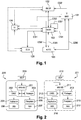
- Figure 1 illustrates schematically the architecture of a eUICC remote provisioning system.
- the eUICC remote provisioning system is comprises several components 100-105.
- An eUICC 100 is represented and is able to communicate with the other components of the system using standard interfaces.
- the SM-DP 102 is the "Subscription Manager - Data Preparation”. Its role is to prepare the profiles and to manage the secure download and installation of these profiles onto the eUICC.
- the SM-SR 103 is the "Subscription Manager - Secure Routing" server. Its role is to securely perform functions of Platform Management commands and the transport of Profile Management commands.
- the CI entity 104 refers to the certificate issuer and the EUM 105 to the eUICC manufacturer.
- the MNO 101 refers to the Mobile network Operator.
- ES5-8 interfaces allow the eUICC 100 to exchange data respectively with the SM-SR 103, the MNO 101 and the SM-DP 102.
- the already existing interface ES5 is re-used in order to request the eUICC to transmit the MSISDN associated to its activated subscription profile.
- an activated profile also called enabled profile, refers to a profile having its files and/or applications selectable over the UICC-Terminal interface.
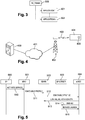
- Figure 2 is an example where two profiles are installed on a given eUICC.
- ISD-P Issuer Security Domain Profiles
- Security domains divide the eUICC into independent private spaces.
- a service provider has its own security domain and maintains full control over it. No other service provider can access it or "eavesdrop" on its activities.
- a the subscription profile comprises a security domain MNO-SD 201, 211 owned by a given mobile network operator and providing a secured channel to said MNO's over-the-air (OTA) platform with the aim of managing the content of a profile once the Profile is enabled.
- OTA over-the-air
- a profile also contains a Controlling Authority Security Domain (CASD) 202, 212 associated to one or several packages 203, 213.
- a profile can also comprise one or several applications 204, 214, a filesystem 205, 215, one or several supplementary security domains SSD 206, 216 and a Network Access Application (NAA) 207, 217.
- CSD Controlling Authority Security Domain
- NAA Network Access Application
- the other one 221 is deactivated (disabled) as only one profile can be activated at the same time.
- One of the consequences is that the applications 214 contained in the non-activated profile 210 cannot be executed. Only the applications 204 of the activated profile 200 can be executed.
- FIG. 3 illustrates an example in which transversal applications are implemented.
- a specific security domain 300 is installed in parallel with the one or several profiles installed on the eUICC such as those described in Figure 2 .
- This transversal security domain 300 is not associated to a profile allowing the access to a specific mobile network infrastructure. It comprises one or several applications 301-302 called transversal application provided one or several services.
- One crucial advantage of implementing a transversal security domain in parallel to the one which are associated to a profile is that when several standard profiles are implemented on a given eUICC, the one or several transversal applications of the transversal security domain can be executed whichever standard profile is activated.
- the transversal security domain and its one or several transversal applications can be identified using an application identifier AID generally used for identifying an ISD-P (ISD-P-AID). Therefore, the use of the ISD-P AID is in that case diverted.
- Figure 4 is a simplified representation of a communication initiated by a service provider to execute a function of a transversal application installed on a given eUICC.
- the service provider wants a push notification handled by a traversal application implemented in the eUICC 405 of an loT device 404 to be displayed on its screen.
- a server 400 belonging to the service provider will send a message comprising the content of the push notification to the loT device 404. It is needed for the server to know a subscription address of the active profile.
- the subscription address is a unique network address of a mobile Subscription within a mobile network, such as a Mobile Station ISDN (MSISDN), an International Mobile Subscriber Identity (IMSI) or a Uniform Resource Identifier (URI) for the Session Initiation Protocol (SIP) also referred as a SIP-URI. It is used to route messages, for example SMS, to the eUICC.
- MSISDN Mobile Station ISDN
- IMSI International Mobile Subscriber Identity
- URI Uniform Resource Identifier
- SIP Session Initiation Protocol
- the notification is transmitted to the network 402 of a mobile network operator via one or several communication networks, for example via internet. Then, the mobile network 402 which is represented in a very simplified manner on Figure 4 routes 403 the notification to the loT device 404 and the notification is then processed by the appropriate transversal application installed in the eUICC 405.
- the service provider may be aware of a subscription address corresponding to a profile installed on the eUICC but which is not the active one. This can happen for example in case a given transversal application is set up and installed in the eUICC while a first profile is activated and when a second profile later becomes the active profile instead of the first one. In that case, the server of the service provider will be aware of subscription address of the first profile and will use it to communicate with a given transversal application installed on the eUICC. This will not work as the first profile is now deactivated.
- Figure 5 is an example of sequence diagram allowing a service provider to launch a service of a eUICC whichever profile is activated.
- the service provider 500 and a server 503 operated by the service provider are represented.
- a mobile network operator 501, an SM-SR server 502 and the eUICC 504 implementing the service to be launched are also represented.
- a service provider 500 decided to launch a service provided by a given traversal application installed on a eUICC 504.
- This transversal application belongs to a transversal security domain which has been installed in the eUICC, for example during the manufacturing phase.
- a transversal security domain can be generated by an SM-SR and identified using an application identifier AID.
- This AID can be an ISD-P-AID despite the fact that it is not referring to a profile, but to a transversal application.
- An identifier of the service to be launched is transmitted by the service provided 500 to the mobile network operator 501 in the service activation request 510.
- the mobile network operator can initiate a profile enable procedure using ES4 interface.
- This procedure is designed for the MNO to request a Profile Enabling to the SM-SR in charge of the management of a targeted eUICC.
- the profile enabling procedure is here used for a different purpose.
- An ES4-EnableProfileRequest message is transmitted by the mobile network operator 501 to the SM-SR server 502.
- This request comprises an identifier EID of the eUICC 504 and an identifier which is generally used for identifying the profile called Integrated Circuit Card ID (ICCID).
- ICCID Integrated Circuit Card ID
- the SM-SR server 502 retrieves the ISD-P application identifier (ISD-P-AID) associated to the identifier, for example the ICCID, comprised in the ES4-EnableProfileRequest message and corresponding to the targeted traversal application.
- ISD-P-AID ISD-P application identifier
- the profile enabling procedure is then continued on the ES5 interface.
- the SM-SR server 508 sends an ES5 profile enabling command 512 to the eUICC 504.
- This command message 512 comprises the ISD-P-AID identifying the transversal security domain implementing the targeted transversal application.
- the eUICC is configured to recognize the ISD-P-AID as the one associated to a transversal application. Therefore, the command request 512 is not interpreted by the eUICC as a request for activating a given subscription profile. Instead, it is interpreted as a request to inform the service provider associated to the target application of the MSISDN used by the subscription profile which is currently activated.
- a failure notification is transmitted 513 by the eUICC 504 to the SM-SR server 502 on the ES5 interface.
- This ES5 failure message 513 allows to terminate the ES5 profile enabling procedure and to inform the SM-SR server 502 that the activated subscription profile is unchanged. The advantage of sending this ES5 failure message is that potential SM-SR switch is avoided.
- SMS-MO mobile originated short message
- This SMS-MO comprises a subscription address such as a MSISDN or an IMSI which is associated to the subscription profile which is currently activated.
- the service provider server 503 is aware of a valid subscription address corresponding to the profile activated in the eUICC 504. It is therefore able to launch a given service handled by the target transversal application. For that purpose, a communication channel can be established between the service provider server 503 and the eUICC 505 for the sever 515 to send a service launch command 515.
- This command message 515 comprises for example data needed by the transversal application to launch the service. If the service is a push notification, the content of the message to be displayed for the user of the loT device embedding the eUICC 504 can be transmitted.
Landscapes
- Engineering & Computer Science (AREA)
- Computer Networks & Wireless Communication (AREA)
- Signal Processing (AREA)
- Computer Security & Cryptography (AREA)
- Databases & Information Systems (AREA)
- Mobile Radio Communication Systems (AREA)
- Telephone Function (AREA)
- Telephonic Communication Services (AREA)
Abstract
This invention related to a method for a service provider to launch a targeted service implemented by an application belonging to a security domain of an eUICC (504) embedded into a communication device, said security domain and application being respectively called transversal security domain and transversal application, the eUICC (504) comprising a set of at least one profile allowing the communication device to access to a specific mobile network infrastructure, one profile being activated at a time, the method comprising the following steps: receiving by the eUICC (504) from an SM-SR server (502) on a communication interface (E5) a command (512) for enabling a profile, said command comprising an identifier of the transversal security domain; interpreting by the eUICC (504) the command for enabling a profile as a command for transmitting a subscription address associated to the profile which is activated in the eUICC; sending (514) an SMS message comprising a subscription address associated to the profile which is currently active; establishing between the server operated by the service provider (503) and the eUICC (515) a communication channel, this establishment being initiated by the server operated by the service provider (504) using the subscription address transmitted by SMS; receiving (515) by the eUICC (504) on said communication channel a command for launching the targeted service; launching by the eUICC (504) the targeted service.
Description
- The present invention relates to a method for a service provider to launch a targeted service implemented by an application belonging to a security domain of an eUICC. It is applicable to the technical domain aiming at providing connectivity for communication devices.
- The GSM association (GSMA) has provided in June 2017 the 3.2 version of an embedded SIM specification called "Remote Provisioning Architecture for Embedded UICC Technical Specification". This specification provides a de-facto standard mechanism for the remote provisioning and management of machine to machine (M2M) connections for the Internet of Things, allowing the "over the air" provisioning of an initial operator subscription, and the subsequent change of subscription from one operator to another.
- In a M2M eSIM context, several profiles can be downloaded in an eUICC, each of them being associated with at least a different subscription address such as a Mobile Station International Subscriber Directory Numbers (MSISDN). As only one subscription profile can be activated at the same time, only the MSISDN that is associated to the activated subscription can be used to contact the loT device embedded this eUICC.
- The GSMA defines a profile as combination of a file structure, data and applications to be provisioned onto, or present on, an eUICC and which allows, when enabled, the access to a specific mobile network infrastructure.
- An embedded Universal Integrated Circuit Card (eUICC) also called embedded SIM (eSIM) refers to a secure element designed to remotely manage multiple mobile network operator subscriptions. It is available in various form factors, either plugged-in or soldered and is manufactured by a eUICC manufacturer (EUM). A eUICC is therefore easy to integrate in any kind of device.
- According to the Recommendation ITU-T Y.2060 provided by the International Telecommunication institute, the Internet of things (loT) is defined as a global infrastructure for the information society, enabling advanced services by interconnecting physical and virtual things based on existing and evolving interoperable information and communication technologies. A thing is an object of the physical world (physical things) or the information world (virtual things), which is capable of being identified and integrated into communication networks. At present, IoT is generally applied in fields such as security surveillance, automatic vending machines, public traffic systems, vehicle monitoring and management, industry process automatization, motor machineries, city informationalization.
- In this description, the expression loT device refers to a piece of equipment with communication capabilities and optionally capacity of data capture, sensing, data storage, sensing and/or data processing. An IoT device comprises for example a wireless communication module also called Machine Type Communication (MTC) or Machine to Machine (M2M) module allowing transmission of data from one loT device to another or exchange of data between machines through UMTS/HSDPA, CDMA/EVDO, LTE, 5G, LoRa or other networks.
- According to the aforementioned GSMA specification, several profiles can be implemented on a given eUICC but only one of them can be activated at the same time. This means that the services provided by an application implemented in a non-activated profile cannot be used.
- Gemalto (trademark) provides a solution for allowing applications implemented in a eUICC to be used whichever profile is active. For that purpose, a specific security domain different from the ones used for the profiles (ISD-P) hosts one or several applications providing one or several services. This type of application is called transversal application as it can be executed independently of the profile which is activated.
- When a service provider associated to a transversal application implemented in a given eUICC embedded in an loT device would like to remotely launch a service provided by said application, he uses data such as an MSISDN to establish a communication channel with the eUICC. However, data memorized by the service provider to establish this communication channel may not correspond to the profile which is currently active in the eUICC. In that case, the service provider will not be able to establish a communication channel with the eUICC and therefore, it will not be able to launch remotely a service provided by a transversal application implemented on this eUICC.
- The invention relates to a method for a service provider to launch a targeted service implemented by an application belonging to a security domain of an eUICC embedded into a communication device, said security domain and application being respectively called transversal security domain and transversal application, the eUICC comprising a set of at least one profile allowing the communication device to access to a specific mobile network infrastructure, one profile being activated at a time, the method comprising the following steps:
- receiving by the eUICC from an SM-SR server on a communication interface a command for enabling a profile, said command comprising an identifier of the transversal security domain;
- interpreting by the eUICC thanks to the identifier of the transversal security domain the command for enabling a profile as a command for transmitting a subscription address associated to the profile which is activated in the eUICC;
- sending by the eUICC to a server operated by the service provider an SMS message comprising a subscription address associated to the profile which is currently active;
- establishing between the server operated by the service provider and the eUICC a communication channel, this establishment being initiated by the server operated by the service provider using the subscription address transmitted by SMS;
- receiving by the eUICC on said communication channel a command for launching the targeted service;
- launching by the eUICC the targeted service.
- According to an example, the method also comprises the step of sending an ES5 failure notification to the server operated by the service provider after having interpreted the command for enabling a profile as a command for transmitting a subscription address.
- According to an example, the subscription address is a Mobile Station ISDN (MSISDN).
- According to an example, the subscription address is an International Mobile Subscriber Identity (IMSI).
- According to an example, the subscription address is a SIP-URI.
- The invention also relates to an eUICC configured to be embedded in a communication device and comprising at least a security domain and an application belonging to this security domain, said security domain and application being respectively called transversal security domain and transversal application, the eUICC being further configured for a service provider to launch remotely a targeted service implemented by the transversal application, the eUICC comprising a set of at least one profile allowing the communication device to access to a specific mobile network infrastructure, one profile being activated at a time. The eUICC is further configured to:
- receive from an SM-SR server on a communication interface a command for enabling a profile, said command comprising an identifier of the transversal security domain;
- interpret thanks to the identifier of the transversal security domain the command for enabling a profile as a command for transmitting a subscription address associated to the profile which is activated in the eUICC;
- send to a server operated by the service provider an SMS message comprising a subscription address associated to the profile which is currently active;
- establish with the server operated by the service provider a communication channel, this establishment being initiated by the server operated by the service provider using the subscription address transmitted by SMS;
- receive by the eUICC on said communication channel a command for launching the targeted service;
- launch the targeted service.
- According to an example, the eUICC is further configured to send an ES5 failure notification to the server operated by the service provider after having interpreted the command for enabling a profile as a command for transmitting a subscription address.
- According to an example, the subscription address is a Mobile Station ISDN (MSISDN).
- According to an example, the subscription address is an International Mobile Subscriber Identity (IMSI).
- According to an example, the subscription address is a SIP-URI.
- The invention also relates to a computer program product comprising instructions which, when the program is executed by a computer, cause the computer to carry out the steps of the method described above.
- The invention also relates to a data processing system comprising means for carrying out the steps of the method described above.
- The invention also relates to a computer-readable storage medium comprising instructions which, when executed by a computer, cause the computer to carry out the steps of the method described above.
- Additional features and advantages of the invention will be more clearly understandable after reading a detailed description of one preferred embodiment of the invention, given as an indicative and non-limitative example, in conjunction with the following drawings:
-
Figure 1 illustrates schematically the architecture of an eUICC remote provisioning system; -
Figure 2 is an example where two profiles installed on a given eUICC; -
Figure 3 illustrates an example in which transversal applications are implemented; -
Figure 4 is a simplified representation of a communication initiated by a service provider to execute a function of a transversal application installed on a given eUICC. -
Figure 1 illustrates schematically the architecture of a eUICC remote provisioning system. - This architecture in provided in the GSMA specification "Remote Provisioning Architecture for Embedded UICC Technical Specification". An overview of the components of the system is provided hereafter. For a full description, one can refer to the aforementioned specification.
- The eUICC remote provisioning system is comprises several components 100-105.
- An eUICC 100 is represented and is able to communicate with the other components of the system using standard interfaces.
- The SM-
DP 102 is the "Subscription Manager - Data Preparation". Its role is to prepare the profiles and to manage the secure download and installation of these profiles onto the eUICC. - The SM-
SR 103 is the "Subscription Manager - Secure Routing" server. Its role is to securely perform functions of Platform Management commands and the transport of Profile Management commands. - The
CI entity 104 refers to the certificate issuer and theEUM 105 to the eUICC manufacturer. TheMNO 101 refers to the Mobile network Operator. - These components are able to communicate using standard interfaces ES1-8. In particular, ES5, ES6 and ES8 interfaces allow the
eUICC 100 to exchange data respectively with the SM-SR 103, theMNO 101 and the SM-DP 102. - According to an important aspect of the invention, the already existing interface ES5 is re-used in order to request the eUICC to transmit the MSISDN associated to its activated subscription profile.
- In this description, an activated profile, also called enabled profile, refers to a profile having its files and/or applications selectable over the UICC-Terminal interface.
-
Figure 2 is an example where two profiles are installed on a given eUICC. - Several profiles can be installed on the same eUICC. According to this example, two
profiles - Security domains divide the eUICC into independent private spaces. A service provider has its own security domain and maintains full control over it. No other service provider can access it or "eavesdrop" on its activities.
- A the subscription profile comprises a security domain MNO-
SD - A profile also contains a Controlling Authority Security Domain (CASD) 202, 212 associated to one or
several packages several applications filesystem security domains SSD - When the
profile 220 is activated (enabled), theother one 221 is deactivated (disabled) as only one profile can be activated at the same time. One of the consequences is that theapplications 214 contained in thenon-activated profile 210 cannot be executed. Only theapplications 204 of the activatedprofile 200 can be executed. -
Figure 3 illustrates an example in which transversal applications are implemented. - According to this example, a
specific security domain 300 is installed in parallel with the one or several profiles installed on the eUICC such as those described inFigure 2 . Thistransversal security domain 300 is not associated to a profile allowing the access to a specific mobile network infrastructure. It comprises one or several applications 301-302 called transversal application provided one or several services. One crucial advantage of implementing a transversal security domain in parallel to the one which are associated to a profile is that when several standard profiles are implemented on a given eUICC, the one or several transversal applications of the transversal security domain can be executed whichever standard profile is activated. - The transversal security domain and its one or several transversal applications can be identified using an application identifier AID generally used for identifying an ISD-P (ISD-P-AID). Therefore, the use of the ISD-P AID is in that case diverted.
-
Figure 4 is a simplified representation of a communication initiated by a service provider to execute a function of a transversal application installed on a given eUICC. - For example, the service provider wants a push notification handled by a traversal application implemented in the
eUICC 405 of anloT device 404 to be displayed on its screen. For that purpose, aserver 400 belonging to the service provider will send a message comprising the content of the push notification to theloT device 404. It is needed for the server to know a subscription address of the active profile. - The subscription address is a unique network address of a mobile Subscription within a mobile network, such as a Mobile Station ISDN (MSISDN), an International Mobile Subscriber Identity (IMSI) or a Uniform Resource Identifier (URI) for the Session Initiation Protocol (SIP) also referred as a SIP-URI. It is used to route messages, for example SMS, to the eUICC.
- The notification is transmitted to the
network 402 of a mobile network operator via one or several communication networks, for example via internet. Then, themobile network 402 which is represented in a very simplified manner onFigure 4 routes 403 the notification to theloT device 404 and the notification is then processed by the appropriate transversal application installed in theeUICC 405. - However the service provider may be aware of a subscription address corresponding to a profile installed on the eUICC but which is not the active one. This can happen for example in case a given transversal application is set up and installed in the eUICC while a first profile is activated and when a second profile later becomes the active profile instead of the first one. In that case, the server of the service provider will be aware of subscription address of the first profile and will use it to communicate with a given transversal application installed on the eUICC. This will not work as the first profile is now deactivated.
-
Figure 5 is an example of sequence diagram allowing a service provider to launch a service of a eUICC whichever profile is activated. - According to this example, several entities are involved. The
service provider 500 and aserver 503 operated by the service provider are represented. Amobile network operator 501, an SM-SR server 502 and theeUICC 504 implementing the service to be launched are also represented. - According to this example, a
service provider 500 decided to launch a service provided by a given traversal application installed on aeUICC 504. This transversal application belongs to a transversal security domain which has been installed in the eUICC, for example during the manufacturing phase. - A transversal security domain can be generated by an SM-SR and identified using an application identifier AID. This AID can be an ISD-P-AID despite the fact that it is not referring to a profile, but to a transversal application.
- An identifier of the service to be launched is transmitted by the service provided 500 to the
mobile network operator 501 in theservice activation request 510. - Then, the mobile network operator can initiate a profile enable procedure using ES4 interface. This procedure is designed for the MNO to request a Profile Enabling to the SM-SR in charge of the management of a targeted eUICC. According to this example, the profile enabling procedure is here used for a different purpose.
- An ES4-EnableProfileRequest message is transmitted by the
mobile network operator 501 to the SM-SR server 502. This request comprises an identifier EID of theeUICC 504 and an identifier which is generally used for identifying the profile called Integrated Circuit Card ID (ICCID). - Then, the SM-
SR server 502 retrieves the ISD-P application identifier (ISD-P-AID) associated to the identifier, for example the ICCID, comprised in the ES4-EnableProfileRequest message and corresponding to the targeted traversal application. - The profile enabling procedure is then continued on the ES5 interface. For that purpose, the SM-SR server 508 sends an ES5
profile enabling command 512 to theeUICC 504. Thiscommand message 512 comprises the ISD-P-AID identifying the transversal security domain implementing the targeted transversal application. - The eUICC is configured to recognize the ISD-P-AID as the one associated to a transversal application. Therefore, the
command request 512 is not interpreted by the eUICC as a request for activating a given subscription profile. Instead, it is interpreted as a request to inform the service provider associated to the target application of the MSISDN used by the subscription profile which is currently activated. - According to an example, once the ISD-P-AID is received by the
eUICC 504 and interpreted as associated to a transversal security domain, a failure notification is transmitted 513 by theeUICC 504 to the SM-SR server 502 on the ES5 interface. ThisES5 failure message 513 allows to terminate the ES5 profile enabling procedure and to inform the SM-SR server 502 that the activated subscription profile is unchanged. The advantage of sending this ES5 failure message is that potential SM-SR switch is avoided. - Then, the
eUICC 504 sends a mobile originated short message SMS-MO 514 to theservice provider server 503 controlling the target transversal application. This SMS-MO comprises a subscription address such as a MSISDN or an IMSI which is associated to the subscription profile which is currently activated. - At this stage, the
service provider server 503 is aware of a valid subscription address corresponding to the profile activated in theeUICC 504. It is therefore able to launch a given service handled by the target transversal application. For that purpose, a communication channel can be established between theservice provider server 503 and the eUICC 505 for thesever 515 to send aservice launch command 515. Thiscommand message 515 comprises for example data needed by the transversal application to launch the service. If the service is a push notification, the content of the message to be displayed for the user of the loT device embedding theeUICC 504 can be transmitted.
Claims (13)
- A method for a service provider to launch a targeted service implemented by an application belonging to a security domain of an eUICC (504) embedded into a communication device, said security domain and application being respectively called transversal security domain and transversal application, the eUICC (504) comprising a set of at least one profile allowing the communication device to access to a specific mobile network infrastructure, one profile being activated at a time, the method comprising the following steps:- receiving by the eUICC (504) from an SM-SR server (502) on a communication interface (E5) a command (512) for enabling a profile, said command comprising an identifier of the transversal security domain;- interpreting by the eUICC (504) thanks to the identifier of the transversal security domain the command for enabling a profile as a command for transmitting a subscription address associated to the profile which is activated in the eUICC;- sending (514) by the eUICC to a server (503) operated by the service provider an SMS message comprising a subscription address associated to the profile which is currently active;- establishing between the server operated by the service provider (503) and the eUICC (515) a communication channel, this establishment being initiated by the server operated by the service provider (504) using the subscription address transmitted by SMS;- receiving (515) by the eUICC (504) on said communication channel a command for launching the targeted service;- launching by the eUICC (504) the targeted service.
- The method according to claim 1, comprising the step of sending (513) an ES5 failure notification to the server operated by the service provider after having interpreted the command for enabling a profile as a command for transmitting a subscription address.
- The method according to any of the preceding claims, wherein the subscription address is a Mobile Station ISDN (MSISDN).
- The method according to claim 1 or 2, wherein the subscription address is an International Mobile Subscriber Identity (IMSI).
- The method according to claim 1 or 2, wherein the subscription address is a SIP-URI.
- A eUICC (504) configured to be embedded in a communication device and comprising at least a security domain and an application belonging to this security domain, said security domain and application being respectively called transversal security domain and transversal application, the eUICC being further configured for a service provider to launch remotely a targeted service implemented by the transversal application, the eUICC (504) comprising a set of at least one profile allowing the communication device to access to a specific mobile network infrastructure, one profile being activated at a time, the eUICC being further configured to:- receive from an SM-SR server (502) on a communication interface (E5) a command (512) for enabling a profile, said command comprising an identifier of the transversal security domain;- interpret thanks to the identifier of the transversal security domain the command for enabling a profile as a command for transmitting a subscription address associated to the profile which is activated in the eUICC;- send (514) to a server (503) operated by the service provider an SMS message comprising a subscription address associated to the profile which is currently active;- establish with the server operated by the service provider (503) a communication channel, this establishment being initiated by the server operated by the service provider (504) using the subscription address transmitted by SMS;- receive (515) by the eUICC (504) on said communication channel a command for launching the targeted service;- launch the targeted service.
- The eUICC (504) according to claim 6, further configured to send (513) an ES5 failure notification to the server operated by the service provider after having interpreted the command for enabling a profile as a command for transmitting a subscription address.
- The eUICC (504) according to claim 6 or 7, wherein the subscription address is a Mobile Station ISDN (MSISDN).
- The eUICC (504) according to claim 6 or 7, wherein the subscription address is an International Mobile Subscriber Identity (IMSI).
- The eUICC (504) according to claim 6 or 7, wherein the subscription address is a SIP-URI.
- A computer program product comprising instructions which, when the program is executed by a computer, cause the computer to carry out the steps of the method of any of claims 1 to 5.
- A data processing system comprising means for carrying out the steps of the method according to any of claims 1 to 5.
- A computer-readable storage medium comprising instructions which, when executed by a computer, cause the computer to carry out the steps of the method of any of claims 1 to 5
Priority Applications (5)
| Application Number | Priority Date | Filing Date | Title |
|---|---|---|---|
| EP17306557.4A EP3484198A1 (en) | 2017-11-09 | 2017-11-09 | A method for a service provider to launch a targeted service implemented by an application belonging to a security domain of an euicc |
| PCT/EP2018/078299 WO2019091723A1 (en) | 2017-11-09 | 2018-10-16 | A method for a service provider to launch a targeted service implemented by an application belonging to a security domain of an euicc |
| JP2020525867A JP6935590B2 (en) | 2017-11-09 | 2018-10-16 | A way for a service provider to launch a target service implemented by an application that belongs to the security domain of EUICC. |
| US16/759,448 US11064327B2 (en) | 2017-11-09 | 2018-10-16 | Method for a service provider to launch a targeted service implemented by an application belonging to a security domain of an eUICC |
| EP18785379.1A EP3707922B8 (en) | 2017-11-09 | 2018-10-16 | A method for a service provider to launch a targeted service implemented by an application belonging to a security domain of an euicc |
Applications Claiming Priority (1)
| Application Number | Priority Date | Filing Date | Title |
|---|---|---|---|
| EP17306557.4A EP3484198A1 (en) | 2017-11-09 | 2017-11-09 | A method for a service provider to launch a targeted service implemented by an application belonging to a security domain of an euicc |
Publications (1)
| Publication Number | Publication Date |
|---|---|
| EP3484198A1 true EP3484198A1 (en) | 2019-05-15 |
Family
ID=61167855
Family Applications (2)
| Application Number | Title | Priority Date | Filing Date |
|---|---|---|---|
| EP17306557.4A Withdrawn EP3484198A1 (en) | 2017-11-09 | 2017-11-09 | A method for a service provider to launch a targeted service implemented by an application belonging to a security domain of an euicc |
| EP18785379.1A Active EP3707922B8 (en) | 2017-11-09 | 2018-10-16 | A method for a service provider to launch a targeted service implemented by an application belonging to a security domain of an euicc |
Family Applications After (1)
| Application Number | Title | Priority Date | Filing Date |
|---|---|---|---|
| EP18785379.1A Active EP3707922B8 (en) | 2017-11-09 | 2018-10-16 | A method for a service provider to launch a targeted service implemented by an application belonging to a security domain of an euicc |
Country Status (4)
| Country | Link |
|---|---|
| US (1) | US11064327B2 (en) |
| EP (2) | EP3484198A1 (en) |
| JP (1) | JP6935590B2 (en) |
| WO (1) | WO2019091723A1 (en) |
Cited By (1)
| Publication number | Priority date | Publication date | Assignee | Title |
|---|---|---|---|---|
| EP4054223A1 (en) | 2021-03-04 | 2022-09-07 | Giesecke+Devrient Mobile Security GmbH | Subscriber identity module with or set up for application |
Families Citing this family (3)
| Publication number | Priority date | Publication date | Assignee | Title |
|---|---|---|---|---|
| GB202002663D0 (en) * | 2020-02-25 | 2020-04-08 | Csl Dualcom Ltd | Autonomous and resilient integrated circuit device |
| JP2022180105A (en) * | 2021-05-24 | 2022-12-06 | エヌ・ティ・ティ・コミュニケーションズ株式会社 | Communication apparatus, device, communication system, and application writing method |
| CN113490211B (en) * | 2021-06-17 | 2023-03-24 | 中国联合网络通信集团有限公司 | Auxiliary security domain establishing method, SM-SR and system |
Citations (2)
| Publication number | Priority date | Publication date | Assignee | Title |
|---|---|---|---|---|
| US20150350916A1 (en) * | 2013-11-19 | 2015-12-03 | Telefonaktiebolaget L M Ericsson (Publ) | Profile Integration Management |
| EP3242407A1 (en) * | 2015-01-04 | 2017-11-08 | Huawei Technologies Co. Ltd. | Data updating method and apparatus, and embedded universal integrated circuit card |
Family Cites Families (5)
| Publication number | Priority date | Publication date | Assignee | Title |
|---|---|---|---|---|
| CN101911652B (en) * | 2007-11-30 | 2015-11-25 | 意大利电信股份公司 | Strengthen ENUM fail safe |
| KR102133450B1 (en) * | 2013-05-30 | 2020-07-13 | 삼성전자 주식회사 | Method and apparatus for setting profile |
| US9713006B2 (en) * | 2014-05-01 | 2017-07-18 | At&T Intellectual Property I, Lp | Apparatus and method for managing security domains for a universal integrated circuit card |
| FR3028705B1 (en) * | 2014-11-14 | 2018-03-02 | Oberthur Technologies | EUICC CARD STORING SHORT NUMBERS PER SUBSCRIBER PROFILE TO NOTIFY SUBSCRIPTION MANAGEMENT SERVER |
| US10939279B2 (en) * | 2015-03-25 | 2021-03-02 | Samsung Electronics Co., Ltd. | Method and apparatus for downloading profile in wireless communication system |
-
2017
- 2017-11-09 EP EP17306557.4A patent/EP3484198A1/en not_active Withdrawn
-
2018
- 2018-10-16 US US16/759,448 patent/US11064327B2/en active Active
- 2018-10-16 WO PCT/EP2018/078299 patent/WO2019091723A1/en not_active Ceased
- 2018-10-16 JP JP2020525867A patent/JP6935590B2/en active Active
- 2018-10-16 EP EP18785379.1A patent/EP3707922B8/en active Active
Patent Citations (2)
| Publication number | Priority date | Publication date | Assignee | Title |
|---|---|---|---|---|
| US20150350916A1 (en) * | 2013-11-19 | 2015-12-03 | Telefonaktiebolaget L M Ericsson (Publ) | Profile Integration Management |
| EP3242407A1 (en) * | 2015-01-04 | 2017-11-08 | Huawei Technologies Co. Ltd. | Data updating method and apparatus, and embedded universal integrated circuit card |
Non-Patent Citations (1)
| Title |
|---|
| GSM ASSOCIATION: "Remote Provisioning Architecture for Embedded UICC - Technical Specification - Version 3.1", 27 May 2016 (2016-05-27), XP055322069, Retrieved from the Internet <URL:http://www.gsma.com/newsroom/wp-content/uploads//SGP.02_v3.1.pdf> [retrieved on 20161123] * |
Cited By (2)
| Publication number | Priority date | Publication date | Assignee | Title |
|---|---|---|---|---|
| EP4054223A1 (en) | 2021-03-04 | 2022-09-07 | Giesecke+Devrient Mobile Security GmbH | Subscriber identity module with or set up for application |
| DE102021001158A1 (en) | 2021-03-04 | 2022-09-08 | Giesecke+Devrient Mobile Security Gmbh | Subscriber identity module with or set up for application |
Also Published As
| Publication number | Publication date |
|---|---|
| WO2019091723A1 (en) | 2019-05-16 |
| US11064327B2 (en) | 2021-07-13 |
| EP3707922A1 (en) | 2020-09-16 |
| US20200288290A1 (en) | 2020-09-10 |
| EP3707922B1 (en) | 2021-12-01 |
| JP6935590B2 (en) | 2021-09-15 |
| JP2021502757A (en) | 2021-01-28 |
| EP3707922B8 (en) | 2022-02-16 |
Similar Documents
| Publication | Publication Date | Title |
|---|---|---|
| US11039300B2 (en) | Method for an eUICC embedded into a machine type communication device to trigger the download of a subscription profile | |
| KR102745187B1 (en) | Method, and associated parameter for routing initial access request message of terminal in mobile communication | |
| CN111373779B (en) | Method for temporarily allocating subscriptions to a certificate container | |
| US10623944B2 (en) | Method and apparatus for profile download of group devices | |
| CN110036656B (en) | ESIM profile switching without SMS | |
| US9204416B2 (en) | Gateway apparatus, control method therefor and computer program | |
| US11064327B2 (en) | Method for a service provider to launch a targeted service implemented by an application belonging to a security domain of an eUICC | |
| EP3550892B1 (en) | Method for network slice selection, user equipment, and network device | |
| CN115136731A (en) | Apparatus and method for providing service according to wireless communication network type in edge computing system | |
| EP2983399B1 (en) | Method, device, and system for proximity service authorization | |
| EP3358871A1 (en) | A method for an euicc embedded into a machine type communication device to trigger the download of a subscription profile | |
| US20160285493A1 (en) | Methods for performing a remote management of a multi-subscription sim module, and corresponding sim module and computer program product | |
| WO2012172388A1 (en) | Provisioning connectivity service data in a telecommunications network | |
| US20240422527A1 (en) | Method for managing at least one euicc information set (eis) of a euicc and intermediate buffer proxy |
Legal Events
| Date | Code | Title | Description |
|---|---|---|---|
| PUAI | Public reference made under article 153(3) epc to a published international application that has entered the european phase |
Free format text: ORIGINAL CODE: 0009012 |
|
| STAA | Information on the status of an ep patent application or granted ep patent |
Free format text: STATUS: THE APPLICATION HAS BEEN PUBLISHED |
|
| AK | Designated contracting states |
Kind code of ref document: A1 Designated state(s): AL AT BE BG CH CY CZ DE DK EE ES FI FR GB GR HR HU IE IS IT LI LT LU LV MC MK MT NL NO PL PT RO RS SE SI SK SM TR |
|
| AX | Request for extension of the european patent |
Extension state: BA ME |
|
| STAA | Information on the status of an ep patent application or granted ep patent |
Free format text: STATUS: THE APPLICATION IS DEEMED TO BE WITHDRAWN |
|
| 18D | Application deemed to be withdrawn |
Effective date: 20191116 |