EP3483233A1 - Lubricant base oil compositions of mono-unsaturated dibasic acid esters with branched alcohols - Google Patents
Lubricant base oil compositions of mono-unsaturated dibasic acid esters with branched alcohols Download PDFInfo
- Publication number
- EP3483233A1 EP3483233A1 EP17200996.1A EP17200996A EP3483233A1 EP 3483233 A1 EP3483233 A1 EP 3483233A1 EP 17200996 A EP17200996 A EP 17200996A EP 3483233 A1 EP3483233 A1 EP 3483233A1
- Authority
- EP
- European Patent Office
- Prior art keywords
- formula
- lubricant
- composition
- use according
- dibasic
- Prior art date
- Legal status (The legal status is an assumption and is not a legal conclusion. Google has not performed a legal analysis and makes no representation as to the accuracy of the status listed.)
- Withdrawn
Links
- 239000000203 mixture Substances 0.000 title claims abstract description 103
- 150000002148 esters Chemical class 0.000 title claims abstract description 97
- 239000000314 lubricant Substances 0.000 title claims abstract description 74
- 150000001298 alcohols Chemical class 0.000 title claims abstract description 22
- 239000002253 acid Substances 0.000 title claims abstract description 15
- 239000002199 base oil Substances 0.000 title 1
- -1 dibasic ester compound Chemical class 0.000 claims abstract description 130
- OKKJLVBELUTLKV-UHFFFAOYSA-N Methanol Chemical compound OC OKKJLVBELUTLKV-UHFFFAOYSA-N 0.000 claims abstract description 33
- LFQSCWFLJHTTHZ-UHFFFAOYSA-N Ethanol Chemical compound CCO LFQSCWFLJHTTHZ-UHFFFAOYSA-N 0.000 claims abstract description 23
- 125000004432 carbon atom Chemical group C* 0.000 claims abstract description 20
- 150000002149 estolides Chemical class 0.000 claims abstract description 10
- 229920006395 saturated elastomer Polymers 0.000 claims abstract description 10
- 239000000470 constituent Substances 0.000 claims abstract description 7
- 150000007513 acids Chemical class 0.000 claims abstract description 6
- 235000013305 food Nutrition 0.000 claims abstract description 6
- 239000000654 additive Substances 0.000 claims description 36
- QYMFNZIUDRQRSA-UHFFFAOYSA-N dimethyl butanedioate;dimethyl hexanedioate;dimethyl pentanedioate Chemical class COC(=O)CCC(=O)OC.COC(=O)CCCC(=O)OC.COC(=O)CCCCC(=O)OC QYMFNZIUDRQRSA-UHFFFAOYSA-N 0.000 claims description 26
- 239000012530 fluid Substances 0.000 claims description 25
- 230000000996 additive effect Effects 0.000 claims description 19
- 239000010705 motor oil Substances 0.000 claims description 17
- 125000002496 methyl group Chemical group [H]C([H])([H])* 0.000 claims description 16
- 238000006243 chemical reaction Methods 0.000 claims description 12
- 125000001189 phytyl group Chemical group [H]C([*])([H])/C([H])=C(C([H])([H])[H])/C([H])([H])C([H])([H])C([H])([H])[C@@](C([H])([H])[H])([H])C([H])([H])C([H])([H])C([H])([H])[C@@](C([H])([H])[H])([H])C([H])([H])C([H])([H])C([H])([H])C(C([H])([H])[H])([H])C([H])([H])[H] 0.000 claims description 12
- 150000001875 compounds Chemical class 0.000 claims description 10
- XLYOFNOQVPJJNP-UHFFFAOYSA-N water Substances O XLYOFNOQVPJJNP-UHFFFAOYSA-N 0.000 claims description 8
- 238000005260 corrosion Methods 0.000 claims description 7
- 230000007797 corrosion Effects 0.000 claims description 7
- 238000005872 self-metathesis reaction Methods 0.000 claims description 7
- 239000003879 lubricant additive Substances 0.000 claims description 6
- 238000005809 transesterification reaction Methods 0.000 claims description 6
- 239000003963 antioxidant agent Substances 0.000 claims description 5
- 125000001495 ethyl group Chemical group [H]C([H])([H])C([H])([H])* 0.000 claims description 5
- 239000003112 inhibitor Substances 0.000 claims description 5
- RYGMFSIKBFXOCR-UHFFFAOYSA-N Copper Chemical compound [Cu] RYGMFSIKBFXOCR-UHFFFAOYSA-N 0.000 claims description 4
- 230000003078 antioxidant effect Effects 0.000 claims description 4
- 229910052802 copper Inorganic materials 0.000 claims description 4
- 239000010949 copper Substances 0.000 claims description 4
- 230000000994 depressogenic effect Effects 0.000 claims description 4
- 229920001971 elastomer Polymers 0.000 claims description 4
- 239000000806 elastomer Substances 0.000 claims description 4
- 239000003795 chemical substances by application Substances 0.000 claims description 3
- 239000013530 defoamer Substances 0.000 claims description 3
- 239000003599 detergent Substances 0.000 claims description 3
- 150000005690 diesters Chemical class 0.000 claims description 3
- 239000002270 dispersing agent Substances 0.000 claims description 3
- 239000003607 modifier Substances 0.000 claims description 3
- 239000004094 surface-active agent Substances 0.000 claims description 3
- 239000002562 thickening agent Substances 0.000 claims description 3
- CRDAMVZIKSXKFV-FBXUGWQNSA-N (2-cis,6-cis)-farnesol Chemical compound CC(C)=CCC\C(C)=C/CC\C(C)=C/CO CRDAMVZIKSXKFV-FBXUGWQNSA-N 0.000 claims description 2
- 239000000260 (2E,6E)-3,7,11-trimethyldodeca-2,6,10-trien-1-ol Substances 0.000 claims description 2
- 230000003115 biocidal effect Effects 0.000 claims description 2
- 239000003139 biocide Substances 0.000 claims description 2
- 239000006172 buffering agent Substances 0.000 claims description 2
- 125000000113 cyclohexyl group Chemical group [H]C1([H])C([H])([H])C([H])([H])C([H])(*)C([H])([H])C1([H])[H] 0.000 claims description 2
- 229940043259 farnesol Drugs 0.000 claims description 2
- 229930002886 farnesol Natural products 0.000 claims description 2
- 239000003205 fragrance Substances 0.000 claims description 2
- 239000003595 mist Substances 0.000 claims description 2
- CRDAMVZIKSXKFV-UHFFFAOYSA-N trans-Farnesol Natural products CC(C)=CCCC(C)=CCCC(C)=CCO CRDAMVZIKSXKFV-UHFFFAOYSA-N 0.000 claims description 2
- ZQPPMHVWECSIRJ-KTKRTIGZSA-N oleic acid Chemical compound CCCCCCCC\C=C/CCCCCCCC(O)=O ZQPPMHVWECSIRJ-KTKRTIGZSA-N 0.000 description 63
- HEDRZPFGACZZDS-MICDWDOJSA-N Trichloro(2H)methane Chemical compound [2H]C(Cl)(Cl)Cl HEDRZPFGACZZDS-MICDWDOJSA-N 0.000 description 28
- 230000015572 biosynthetic process Effects 0.000 description 22
- 238000003786 synthesis reaction Methods 0.000 description 16
- YXFVVABEGXRONW-UHFFFAOYSA-N Toluene Chemical compound CC1=CC=CC=C1 YXFVVABEGXRONW-UHFFFAOYSA-N 0.000 description 15
- 230000001590 oxidative effect Effects 0.000 description 15
- 229920013639 polyalphaolefin Polymers 0.000 description 12
- 239000010409 thin film Substances 0.000 description 12
- 230000003647 oxidation Effects 0.000 description 11
- 238000007254 oxidation reaction Methods 0.000 description 11
- 238000012360 testing method Methods 0.000 description 11
- 239000007788 liquid Substances 0.000 description 10
- 238000000034 method Methods 0.000 description 10
- 239000000243 solution Substances 0.000 description 10
- 238000005160 1H NMR spectroscopy Methods 0.000 description 9
- 239000010408 film Substances 0.000 description 9
- 239000000047 product Substances 0.000 description 9
- YIWUKEYIRIRTPP-UHFFFAOYSA-N 2-ethylhexan-1-ol Chemical compound CCCCC(CC)CO YIWUKEYIRIRTPP-UHFFFAOYSA-N 0.000 description 8
- 238000006731 degradation reaction Methods 0.000 description 8
- YMWUJEATGCHHMB-UHFFFAOYSA-N dichloromethane Natural products ClCCl YMWUJEATGCHHMB-UHFFFAOYSA-N 0.000 description 8
- 238000005649 metathesis reaction Methods 0.000 description 8
- 229920000642 polymer Polymers 0.000 description 8
- 238000007711 solidification Methods 0.000 description 8
- 230000008023 solidification Effects 0.000 description 8
- 238000001644 13C nuclear magnetic resonance spectroscopy Methods 0.000 description 7
- 125000003158 alcohol group Chemical group 0.000 description 7
- 230000015556 catabolic process Effects 0.000 description 7
- 230000032050 esterification Effects 0.000 description 7
- 238000009472 formulation Methods 0.000 description 7
- 238000005461 lubrication Methods 0.000 description 7
- 239000002480 mineral oil Substances 0.000 description 7
- 239000003921 oil Substances 0.000 description 7
- 235000019198 oils Nutrition 0.000 description 7
- 239000007787 solid Substances 0.000 description 7
- 239000003039 volatile agent Substances 0.000 description 7
- KDLHZDBZIXYQEI-UHFFFAOYSA-N Palladium Chemical compound [Pd] KDLHZDBZIXYQEI-UHFFFAOYSA-N 0.000 description 6
- 238000005886 esterification reaction Methods 0.000 description 6
- 238000010438 heat treatment Methods 0.000 description 6
- 229910052500 inorganic mineral Inorganic materials 0.000 description 6
- 125000001972 isopentyl group Chemical group [H]C([H])([H])C([H])(C([H])([H])[H])C([H])([H])C([H])([H])* 0.000 description 6
- 238000005259 measurement Methods 0.000 description 6
- 239000011707 mineral Substances 0.000 description 6
- 235000019484 Rapeseed oil Nutrition 0.000 description 5
- 239000000539 dimer Substances 0.000 description 5
- 239000002904 solvent Substances 0.000 description 5
- 238000003860 storage Methods 0.000 description 5
- 239000000126 substance Substances 0.000 description 5
- 238000009834 vaporization Methods 0.000 description 5
- 235000015112 vegetable and seed oil Nutrition 0.000 description 5
- 239000008158 vegetable oil Substances 0.000 description 5
- VYPSYNLAJGMNEJ-UHFFFAOYSA-N Silicium dioxide Chemical compound O=[Si]=O VYPSYNLAJGMNEJ-UHFFFAOYSA-N 0.000 description 4
- 125000003178 carboxy group Chemical group [H]OC(*)=O 0.000 description 4
- HGGLIXDRUINGBB-UHFFFAOYSA-N dimethyl octadec-9-enedioate Chemical compound COC(=O)CCCCCCCC=CCCCCCCCC(=O)OC HGGLIXDRUINGBB-UHFFFAOYSA-N 0.000 description 4
- PHTQWCKDNZKARW-UHFFFAOYSA-N isoamylol Chemical compound CC(C)CCO PHTQWCKDNZKARW-UHFFFAOYSA-N 0.000 description 4
- SJWFXCIHNDVPSH-UHFFFAOYSA-N octan-2-ol Chemical compound CCCCCCC(C)O SJWFXCIHNDVPSH-UHFFFAOYSA-N 0.000 description 4
- 239000010690 paraffinic oil Substances 0.000 description 4
- 238000006116 polymerization reaction Methods 0.000 description 4
- 241000579895 Chlorostilbon Species 0.000 description 3
- XEKOWRVHYACXOJ-UHFFFAOYSA-N Ethyl acetate Chemical compound CCOC(C)=O XEKOWRVHYACXOJ-UHFFFAOYSA-N 0.000 description 3
- HEMHJVSKTPXQMS-UHFFFAOYSA-M Sodium hydroxide Chemical compound [OH-].[Na+] HEMHJVSKTPXQMS-UHFFFAOYSA-M 0.000 description 3
- 230000000052 comparative effect Effects 0.000 description 3
- 238000000354 decomposition reaction Methods 0.000 description 3
- ICLPOBSSOHJOFZ-UHFFFAOYSA-N dioctan-2-yl octadec-9-enedioate Chemical compound C(CCCCCCCC=CCCCCCCCC(=O)OC(CCCCCC)C)(=O)OC(CCCCCC)C ICLPOBSSOHJOFZ-UHFFFAOYSA-N 0.000 description 3
- 229910052876 emerald Inorganic materials 0.000 description 3
- 239000010976 emerald Substances 0.000 description 3
- 238000000855 fermentation Methods 0.000 description 3
- 230000004151 fermentation Effects 0.000 description 3
- 229930195733 hydrocarbon Natural products 0.000 description 3
- 150000002430 hydrocarbons Chemical class 0.000 description 3
- 230000007774 longterm Effects 0.000 description 3
- 238000004519 manufacturing process Methods 0.000 description 3
- 239000000463 material Substances 0.000 description 3
- 229910052751 metal Inorganic materials 0.000 description 3
- 239000002184 metal Substances 0.000 description 3
- PSHKMPUSSFXUIA-UHFFFAOYSA-N n,n-dimethylpyridin-2-amine Chemical compound CN(C)C1=CC=CC=N1 PSHKMPUSSFXUIA-UHFFFAOYSA-N 0.000 description 3
- VLKZOEOYAKHREP-UHFFFAOYSA-N n-Hexane Chemical compound CCCCCC VLKZOEOYAKHREP-UHFFFAOYSA-N 0.000 description 3
- 150000002894 organic compounds Chemical class 0.000 description 3
- 239000011541 reaction mixture Substances 0.000 description 3
- 239000000741 silica gel Substances 0.000 description 3
- 229910002027 silica gel Inorganic materials 0.000 description 3
- JOXIMZWYDAKGHI-UHFFFAOYSA-N toluene-4-sulfonic acid Chemical compound CC1=CC=C(S(O)(=O)=O)C=C1 JOXIMZWYDAKGHI-UHFFFAOYSA-N 0.000 description 3
- FRPZMMHWLSIFAZ-UHFFFAOYSA-N 10-undecenoic acid Chemical compound OC(=O)CCCCCCCCC=C FRPZMMHWLSIFAZ-UHFFFAOYSA-N 0.000 description 2
- CSCPPACGZOOCGX-UHFFFAOYSA-N Acetone Chemical compound CC(C)=O CSCPPACGZOOCGX-UHFFFAOYSA-N 0.000 description 2
- XKRFYHLGVUSROY-UHFFFAOYSA-N Argon Chemical compound [Ar] XKRFYHLGVUSROY-UHFFFAOYSA-N 0.000 description 2
- QOSSAOTZNIDXMA-UHFFFAOYSA-N Dicylcohexylcarbodiimide Chemical compound C1CCCCC1N=C=NC1CCCCC1 QOSSAOTZNIDXMA-UHFFFAOYSA-N 0.000 description 2
- UFHFLCQGNIYNRP-UHFFFAOYSA-N Hydrogen Chemical compound [H][H] UFHFLCQGNIYNRP-UHFFFAOYSA-N 0.000 description 2
- KFZMGEQAYNKOFK-UHFFFAOYSA-N Isopropanol Chemical compound CC(C)O KFZMGEQAYNKOFK-UHFFFAOYSA-N 0.000 description 2
- OYHQOLUKZRVURQ-HZJYTTRNSA-N Linoleic acid Chemical compound CCCCC\C=C/C\C=C/CCCCCCCC(O)=O OYHQOLUKZRVURQ-HZJYTTRNSA-N 0.000 description 2
- SBLKVIQSIHEQOF-UPHRSURJSA-N Octadec-9-ene-1,18-dioic-acid Chemical compound OC(=O)CCCCCCC\C=C/CCCCCCCC(O)=O SBLKVIQSIHEQOF-UPHRSURJSA-N 0.000 description 2
- CDBYLPFSWZWCQE-UHFFFAOYSA-L Sodium Carbonate Chemical compound [Na+].[Na+].[O-]C([O-])=O CDBYLPFSWZWCQE-UHFFFAOYSA-L 0.000 description 2
- 230000008901 benefit Effects 0.000 description 2
- LTXUYVXODGPWRX-UHFFFAOYSA-N bis(2-butyloctyl) octadec-9-enedioate Chemical compound C(CCCCCCCC=CCCCCCCCC(=O)OCC(CCCCCC)CCCC)(=O)OCC(CCCCCC)CCCC LTXUYVXODGPWRX-UHFFFAOYSA-N 0.000 description 2
- IJBPKVDVYCCYSR-UHFFFAOYSA-N bis(2-ethylhexyl) octadecanedioate Chemical compound CCCCC(CC)COC(=O)CCCCCCCCCCCCCCCCC(=O)OCC(CC)CCCC IJBPKVDVYCCYSR-UHFFFAOYSA-N 0.000 description 2
- UMXVBAOASUPOCK-UHFFFAOYSA-N bis(2-propylheptyl) octadec-9-enedioate Chemical compound C(CCCCCCCC=CCCCCCCCC(=O)OCC(CCCCC)CCC)(=O)OCC(CCCCC)CCC UMXVBAOASUPOCK-UHFFFAOYSA-N 0.000 description 2
- WAYJEHCEFKDXOP-UHFFFAOYSA-N bis(3,3,5-trimethylhexyl) octadec-9-enedioate Chemical compound C(CCCCCCCC=CCCCCCCCC(=O)OCCC(CC(C)C)(C)C)(=O)OCCC(CC(C)C)(C)C WAYJEHCEFKDXOP-UHFFFAOYSA-N 0.000 description 2
- BEUURQHFTVUNMN-UHFFFAOYSA-N bis(3-methylbutyl) octadec-9-enedioate Chemical compound C(CCCCCCCC=CCCCCCCCC(=O)OCCC(C)C)(=O)OCCC(C)C BEUURQHFTVUNMN-UHFFFAOYSA-N 0.000 description 2
- KHAVLLBUVKBTBG-UHFFFAOYSA-N caproleic acid Natural products OC(=O)CCCCCCCC=C KHAVLLBUVKBTBG-UHFFFAOYSA-N 0.000 description 2
- 230000008859 change Effects 0.000 description 2
- 238000012512 characterization method Methods 0.000 description 2
- 238000005686 cross metathesis reaction Methods 0.000 description 2
- 239000007857 degradation product Substances 0.000 description 2
- 235000014113 dietary fatty acids Nutrition 0.000 description 2
- 125000005442 diisocyanate group Chemical group 0.000 description 2
- ZWYBHHGHFHKCEI-UHFFFAOYSA-N dioctan-2-yl octadecanedioate Chemical compound C(CCCCCCCCCCCCCCCCC(=O)OC(CCCCCC)C)(=O)OC(CCCCCC)C ZWYBHHGHFHKCEI-UHFFFAOYSA-N 0.000 description 2
- 239000000194 fatty acid Substances 0.000 description 2
- 229930195729 fatty acid Natural products 0.000 description 2
- 150000004665 fatty acids Chemical class 0.000 description 2
- IPCSVZSSVZVIGE-UHFFFAOYSA-N hexadecanoic acid Chemical compound CCCCCCCCCCCCCCCC(O)=O IPCSVZSSVZVIGE-UHFFFAOYSA-N 0.000 description 2
- 239000001257 hydrogen Substances 0.000 description 2
- 229910052739 hydrogen Inorganic materials 0.000 description 2
- 150000002632 lipids Chemical class 0.000 description 2
- 230000005499 meniscus Effects 0.000 description 2
- 235000010446 mineral oil Nutrition 0.000 description 2
- BDJRBEYXGGNYIS-UHFFFAOYSA-N nonanedioic acid Chemical compound OC(=O)CCCCCCCC(O)=O BDJRBEYXGGNYIS-UHFFFAOYSA-N 0.000 description 2
- 229940116918 octadecenedioic acid Drugs 0.000 description 2
- 238000010525 oxidative degradation reaction Methods 0.000 description 2
- 238000012856 packing Methods 0.000 description 2
- 239000012071 phase Substances 0.000 description 2
- KJFMBFZCATUALV-UHFFFAOYSA-N phenolphthalein Chemical compound C1=CC(O)=CC=C1C1(C=2C=CC(O)=CC=2)C2=CC=CC=C2C(=O)O1 KJFMBFZCATUALV-UHFFFAOYSA-N 0.000 description 2
- 239000004014 plasticizer Substances 0.000 description 2
- 229920002635 polyurethane Polymers 0.000 description 2
- 239000004814 polyurethane Substances 0.000 description 2
- 239000002244 precipitate Substances 0.000 description 2
- 238000002360 preparation method Methods 0.000 description 2
- 150000003138 primary alcohols Chemical class 0.000 description 2
- 230000008569 process Effects 0.000 description 2
- 238000012552 review Methods 0.000 description 2
- 239000000344 soap Substances 0.000 description 2
- 239000007858 starting material Substances 0.000 description 2
- 238000004809 thin layer chromatography Methods 0.000 description 2
- 238000004448 titration Methods 0.000 description 2
- 229960002703 undecylenic acid Drugs 0.000 description 2
- 235000021122 unsaturated fatty acids Nutrition 0.000 description 2
- 150000004670 unsaturated fatty acids Chemical class 0.000 description 2
- 230000008016 vaporization Effects 0.000 description 2
- 238000011179 visual inspection Methods 0.000 description 2
- WRIDQFICGBMAFQ-UHFFFAOYSA-N (E)-8-Octadecenoic acid Natural products CCCCCCCCCC=CCCCCCCC(O)=O WRIDQFICGBMAFQ-UHFFFAOYSA-N 0.000 description 1
- HXQHRUJXQJEGER-UHFFFAOYSA-N 1-methylbenzotriazole Chemical compound C1=CC=C2N(C)N=NC2=C1 HXQHRUJXQJEGER-UHFFFAOYSA-N 0.000 description 1
- NPSJHQMIVNJLNN-UHFFFAOYSA-N 2-ethylhexyl 4-nitrobenzoate Chemical compound CCCCC(CC)COC(=O)C1=CC=C([N+]([O-])=O)C=C1 NPSJHQMIVNJLNN-UHFFFAOYSA-N 0.000 description 1
- 239000004808 2-ethylhexylester Substances 0.000 description 1
- LQJBNNIYVWPHFW-UHFFFAOYSA-N 20:1omega9c fatty acid Natural products CCCCCCCCCCC=CCCCCCCCC(O)=O LQJBNNIYVWPHFW-UHFFFAOYSA-N 0.000 description 1
- CMGDVUCDZOBDNL-UHFFFAOYSA-N 4-methyl-2h-benzotriazole Chemical compound CC1=CC=CC2=NNN=C12 CMGDVUCDZOBDNL-UHFFFAOYSA-N 0.000 description 1
- QSBYPNXLFMSGKH-UHFFFAOYSA-N 9-Heptadecensaeure Natural products CCCCCCCC=CCCCCCCCC(O)=O QSBYPNXLFMSGKH-UHFFFAOYSA-N 0.000 description 1
- 244000188595 Brassica sinapistrum Species 0.000 description 1
- 235000004977 Brassica sinapistrum Nutrition 0.000 description 1
- WKBOTKDWSSQWDR-UHFFFAOYSA-N Bromine atom Chemical compound [Br] WKBOTKDWSSQWDR-UHFFFAOYSA-N 0.000 description 1
- VGGSQFUCUMXWEO-UHFFFAOYSA-N Ethene Chemical compound C=C VGGSQFUCUMXWEO-UHFFFAOYSA-N 0.000 description 1
- 239000005977 Ethylene Substances 0.000 description 1
- 229940123457 Free radical scavenger Drugs 0.000 description 1
- 239000005909 Kieselgur Substances 0.000 description 1
- 229910001209 Low-carbon steel Inorganic materials 0.000 description 1
- 241001465754 Metazoa Species 0.000 description 1
- 239000007832 Na2SO4 Substances 0.000 description 1
- CTQNGGLPUBDAKN-UHFFFAOYSA-N O-Xylene Chemical compound CC1=CC=CC=C1C CTQNGGLPUBDAKN-UHFFFAOYSA-N 0.000 description 1
- 239000005642 Oleic acid Substances 0.000 description 1
- ZQPPMHVWECSIRJ-UHFFFAOYSA-N Oleic acid Natural products CCCCCCCCC=CCCCCCCCC(O)=O ZQPPMHVWECSIRJ-UHFFFAOYSA-N 0.000 description 1
- 235000011449 Rosa Nutrition 0.000 description 1
- PMZURENOXWZQFD-UHFFFAOYSA-L Sodium Sulfate Chemical compound [Na+].[Na+].[O-]S([O-])(=O)=O PMZURENOXWZQFD-UHFFFAOYSA-L 0.000 description 1
- 229910000831 Steel Inorganic materials 0.000 description 1
- 230000002378 acidificating effect Effects 0.000 description 1
- WNLRTRBMVRJNCN-UHFFFAOYSA-N adipic acid Chemical class OC(=O)CCCCC(O)=O WNLRTRBMVRJNCN-UHFFFAOYSA-N 0.000 description 1
- 125000001931 aliphatic group Chemical group 0.000 description 1
- 125000000217 alkyl group Chemical group 0.000 description 1
- 239000007866 anti-wear additive Substances 0.000 description 1
- 239000007864 aqueous solution Substances 0.000 description 1
- 229910052786 argon Inorganic materials 0.000 description 1
- 239000012298 atmosphere Substances 0.000 description 1
- 230000009286 beneficial effect Effects 0.000 description 1
- MTPSFISGWJGUGN-UHFFFAOYSA-N bis(2-ethylhexyl) dodecanedioate Chemical compound CCCCC(CC)COC(=O)CCCCCCCCCCC(=O)OCC(CC)CCCC MTPSFISGWJGUGN-UHFFFAOYSA-N 0.000 description 1
- ZDWGXBPVPXVXMQ-UHFFFAOYSA-N bis(2-ethylhexyl) nonanedioate Chemical compound CCCCC(CC)COC(=O)CCCCCCCC(=O)OCC(CC)CCCC ZDWGXBPVPXVXMQ-UHFFFAOYSA-N 0.000 description 1
- GFOJYVDSZKMSTR-UHFFFAOYSA-N bis(2-ethylhexyl) octadec-9-enedioate Chemical compound C(CCCCCCCC=CCCCCCCCC(=O)OCC(CCCC)CC)(=O)OCC(CCCC)CC GFOJYVDSZKMSTR-UHFFFAOYSA-N 0.000 description 1
- GDTBXPJZTBHREO-UHFFFAOYSA-N bromine Substances BrBr GDTBXPJZTBHREO-UHFFFAOYSA-N 0.000 description 1
- 229910052794 bromium Inorganic materials 0.000 description 1
- 239000006227 byproduct Substances 0.000 description 1
- DKVNPHBNOWQYFE-UHFFFAOYSA-N carbamodithioic acid Chemical compound NC(S)=S DKVNPHBNOWQYFE-UHFFFAOYSA-N 0.000 description 1
- 239000003054 catalyst Substances 0.000 description 1
- 210000001072 colon Anatomy 0.000 description 1
- 239000000356 contaminant Substances 0.000 description 1
- 238000001816 cooling Methods 0.000 description 1
- 239000008367 deionised water Substances 0.000 description 1
- 229910021641 deionized water Inorganic materials 0.000 description 1
- 230000001419 dependent effect Effects 0.000 description 1
- 230000001627 detrimental effect Effects 0.000 description 1
- 150000001991 dicarboxylic acids Chemical class 0.000 description 1
- 238000006471 dimerization reaction Methods 0.000 description 1
- NAGJZTKCGNOGPW-UHFFFAOYSA-K dioxido-sulfanylidene-sulfido-$l^{5}-phosphane Chemical compound [O-]P([O-])([S-])=S NAGJZTKCGNOGPW-UHFFFAOYSA-K 0.000 description 1
- 239000012990 dithiocarbamate Substances 0.000 description 1
- 239000003480 eluent Substances 0.000 description 1
- 125000004494 ethyl ester group Chemical group 0.000 description 1
- 238000011156 evaluation Methods 0.000 description 1
- 238000001704 evaporation Methods 0.000 description 1
- 230000008020 evaporation Effects 0.000 description 1
- 230000002349 favourable effect Effects 0.000 description 1
- 239000012467 final product Substances 0.000 description 1
- 239000006260 foam Substances 0.000 description 1
- 238000005187 foaming Methods 0.000 description 1
- 239000000446 fuel Substances 0.000 description 1
- 239000013538 functional additive Substances 0.000 description 1
- 238000002290 gas chromatography-mass spectrometry Methods 0.000 description 1
- 125000000623 heterocyclic group Chemical group 0.000 description 1
- IPCSVZSSVZVIGE-UHFFFAOYSA-M hexadecanoate Chemical compound CCCCCCCCCCCCCCCC([O-])=O IPCSVZSSVZVIGE-UHFFFAOYSA-M 0.000 description 1
- 125000004051 hexyl group Chemical group [H]C([H])([H])C([H])([H])C([H])([H])C([H])([H])C([H])([H])C([H])([H])* 0.000 description 1
- BHEPBYXIRTUNPN-UHFFFAOYSA-N hydridophosphorus(.) (triplet) Chemical class [PH] BHEPBYXIRTUNPN-UHFFFAOYSA-N 0.000 description 1
- 238000005984 hydrogenation reaction Methods 0.000 description 1
- 230000007062 hydrolysis Effects 0.000 description 1
- 238000006460 hydrolysis reaction Methods 0.000 description 1
- 230000005764 inhibitory process Effects 0.000 description 1
- 238000006317 isomerization reaction Methods 0.000 description 1
- QXJSBBXBKPUZAA-UHFFFAOYSA-N isooleic acid Natural products CCCCCCCC=CCCCCCCCCC(O)=O QXJSBBXBKPUZAA-UHFFFAOYSA-N 0.000 description 1
- 230000007246 mechanism Effects 0.000 description 1
- OJURWUUOVGOHJZ-UHFFFAOYSA-N methyl 2-[(2-acetyloxyphenyl)methyl-[2-[(2-acetyloxyphenyl)methyl-(2-methoxy-2-oxoethyl)amino]ethyl]amino]acetate Chemical compound C=1C=CC=C(OC(C)=O)C=1CN(CC(=O)OC)CCN(CC(=O)OC)CC1=CC=CC=C1OC(C)=O OJURWUUOVGOHJZ-UHFFFAOYSA-N 0.000 description 1
- 150000004702 methyl esters Chemical class 0.000 description 1
- 230000000813 microbial effect Effects 0.000 description 1
- 238000002156 mixing Methods 0.000 description 1
- 235000021281 monounsaturated fatty acids Nutrition 0.000 description 1
- 125000001117 oleyl group Chemical group [H]C([*])([H])C([H])([H])C([H])([H])C([H])([H])C([H])([H])C([H])([H])C([H])([H])C([H])([H])/C([H])=C([H])\C([H])([H])C([H])([H])C([H])([H])C([H])([H])C([H])([H])C([H])([H])C([H])([H])C([H])([H])[H] 0.000 description 1
- KJIFKLIQANRMOU-UHFFFAOYSA-N oxidanium;4-methylbenzenesulfonate Chemical compound O.CC1=CC=C(S(O)(=O)=O)C=C1 KJIFKLIQANRMOU-UHFFFAOYSA-N 0.000 description 1
- 230000020477 pH reduction Effects 0.000 description 1
- 229910052763 palladium Inorganic materials 0.000 description 1
- 230000037361 pathway Effects 0.000 description 1
- 150000002978 peroxides Chemical class 0.000 description 1
- 239000003209 petroleum derivative Substances 0.000 description 1
- 125000002467 phosphate group Chemical class [H]OP(=O)(O[H])O[*] 0.000 description 1
- 238000001556 precipitation Methods 0.000 description 1
- 238000000197 pyrolysis Methods 0.000 description 1
- 239000002516 radical scavenger Substances 0.000 description 1
- 230000009467 reduction Effects 0.000 description 1
- 230000001105 regulatory effect Effects 0.000 description 1
- 238000001223 reverse osmosis Methods 0.000 description 1
- 238000000518 rheometry Methods 0.000 description 1
- 150000003333 secondary alcohols Chemical class 0.000 description 1
- 238000007086 side reaction Methods 0.000 description 1
- 229910000029 sodium carbonate Inorganic materials 0.000 description 1
- 159000000000 sodium salts Chemical class 0.000 description 1
- 229910052938 sodium sulfate Inorganic materials 0.000 description 1
- 239000007790 solid phase Substances 0.000 description 1
- 230000003381 solubilizing effect Effects 0.000 description 1
- 238000007655 standard test method Methods 0.000 description 1
- 239000010959 steel Substances 0.000 description 1
- 150000005846 sugar alcohols Polymers 0.000 description 1
- 230000009897 systematic effect Effects 0.000 description 1
- 238000010998 test method Methods 0.000 description 1
- 235000013311 vegetables Nutrition 0.000 description 1
- 238000005406 washing Methods 0.000 description 1
- 239000008096 xylene Substances 0.000 description 1
Images




Classifications
-
- C—CHEMISTRY; METALLURGY
- C10—PETROLEUM, GAS OR COKE INDUSTRIES; TECHNICAL GASES CONTAINING CARBON MONOXIDE; FUELS; LUBRICANTS; PEAT
- C10M—LUBRICATING COMPOSITIONS; USE OF CHEMICAL SUBSTANCES EITHER ALONE OR AS LUBRICATING INGREDIENTS IN A LUBRICATING COMPOSITION
- C10M105/00—Lubricating compositions characterised by the base-material being a non-macromolecular organic compound
- C10M105/08—Lubricating compositions characterised by the base-material being a non-macromolecular organic compound containing oxygen
- C10M105/32—Esters
- C10M105/36—Esters of polycarboxylic acids
-
- C—CHEMISTRY; METALLURGY
- C10—PETROLEUM, GAS OR COKE INDUSTRIES; TECHNICAL GASES CONTAINING CARBON MONOXIDE; FUELS; LUBRICANTS; PEAT
- C10M—LUBRICATING COMPOSITIONS; USE OF CHEMICAL SUBSTANCES EITHER ALONE OR AS LUBRICATING INGREDIENTS IN A LUBRICATING COMPOSITION
- C10M2207/00—Organic non-macromolecular hydrocarbon compounds containing hydrogen, carbon and oxygen as ingredients in lubricant compositions
- C10M2207/28—Esters
- C10M2207/282—Esters of (cyclo)aliphatic oolycarboxylic acids
- C10M2207/2825—Esters of (cyclo)aliphatic oolycarboxylic acids used as base material
-
- C—CHEMISTRY; METALLURGY
- C10—PETROLEUM, GAS OR COKE INDUSTRIES; TECHNICAL GASES CONTAINING CARBON MONOXIDE; FUELS; LUBRICANTS; PEAT
- C10M—LUBRICATING COMPOSITIONS; USE OF CHEMICAL SUBSTANCES EITHER ALONE OR AS LUBRICATING INGREDIENTS IN A LUBRICATING COMPOSITION
- C10M2207/00—Organic non-macromolecular hydrocarbon compounds containing hydrogen, carbon and oxygen as ingredients in lubricant compositions
- C10M2207/28—Esters
- C10M2207/287—Partial esters
- C10M2207/288—Partial esters containing free carboxyl groups
-
- C—CHEMISTRY; METALLURGY
- C10—PETROLEUM, GAS OR COKE INDUSTRIES; TECHNICAL GASES CONTAINING CARBON MONOXIDE; FUELS; LUBRICANTS; PEAT
- C10M—LUBRICATING COMPOSITIONS; USE OF CHEMICAL SUBSTANCES EITHER ALONE OR AS LUBRICATING INGREDIENTS IN A LUBRICATING COMPOSITION
- C10M2209/00—Organic macromolecular compounds containing oxygen as ingredients in lubricant compositions
- C10M2209/02—Macromolecular compounds obtained by reactions only involving carbon-to-carbon unsaturated bonds
- C10M2209/08—Macromolecular compounds obtained by reactions only involving carbon-to-carbon unsaturated bonds containing monomers having an unsaturated radical bound to a carboxyl radical, e.g. acrylate type
- C10M2209/084—Acrylate; Methacrylate
-
- C—CHEMISTRY; METALLURGY
- C10—PETROLEUM, GAS OR COKE INDUSTRIES; TECHNICAL GASES CONTAINING CARBON MONOXIDE; FUELS; LUBRICANTS; PEAT
- C10M—LUBRICATING COMPOSITIONS; USE OF CHEMICAL SUBSTANCES EITHER ALONE OR AS LUBRICATING INGREDIENTS IN A LUBRICATING COMPOSITION
- C10M2215/00—Organic non-macromolecular compounds containing nitrogen as ingredients in lubricant Compositions
- C10M2215/22—Heterocyclic nitrogen compounds
- C10M2215/223—Five-membered rings containing nitrogen and carbon only
-
- C—CHEMISTRY; METALLURGY
- C10—PETROLEUM, GAS OR COKE INDUSTRIES; TECHNICAL GASES CONTAINING CARBON MONOXIDE; FUELS; LUBRICANTS; PEAT
- C10M—LUBRICATING COMPOSITIONS; USE OF CHEMICAL SUBSTANCES EITHER ALONE OR AS LUBRICATING INGREDIENTS IN A LUBRICATING COMPOSITION
- C10M2219/00—Organic non-macromolecular compounds containing sulfur, selenium or tellurium as ingredients in lubricant compositions
- C10M2219/06—Thio-acids; Thiocyanates; Derivatives thereof
- C10M2219/062—Thio-acids; Thiocyanates; Derivatives thereof having carbon-to-sulfur double bonds
- C10M2219/066—Thiocarbamic type compounds
-
- C—CHEMISTRY; METALLURGY
- C10—PETROLEUM, GAS OR COKE INDUSTRIES; TECHNICAL GASES CONTAINING CARBON MONOXIDE; FUELS; LUBRICANTS; PEAT
- C10M—LUBRICATING COMPOSITIONS; USE OF CHEMICAL SUBSTANCES EITHER ALONE OR AS LUBRICATING INGREDIENTS IN A LUBRICATING COMPOSITION
- C10M2223/00—Organic non-macromolecular compounds containing phosphorus as ingredients in lubricant compositions
- C10M2223/02—Organic non-macromolecular compounds containing phosphorus as ingredients in lubricant compositions having no phosphorus-to-carbon bonds
- C10M2223/04—Phosphate esters
- C10M2223/043—Ammonium or amine salts thereof
-
- C—CHEMISTRY; METALLURGY
- C10—PETROLEUM, GAS OR COKE INDUSTRIES; TECHNICAL GASES CONTAINING CARBON MONOXIDE; FUELS; LUBRICANTS; PEAT
- C10M—LUBRICATING COMPOSITIONS; USE OF CHEMICAL SUBSTANCES EITHER ALONE OR AS LUBRICATING INGREDIENTS IN A LUBRICATING COMPOSITION
- C10M2223/00—Organic non-macromolecular compounds containing phosphorus as ingredients in lubricant compositions
- C10M2223/02—Organic non-macromolecular compounds containing phosphorus as ingredients in lubricant compositions having no phosphorus-to-carbon bonds
- C10M2223/04—Phosphate esters
- C10M2223/047—Thioderivatives not containing metallic elements
-
- C—CHEMISTRY; METALLURGY
- C10—PETROLEUM, GAS OR COKE INDUSTRIES; TECHNICAL GASES CONTAINING CARBON MONOXIDE; FUELS; LUBRICANTS; PEAT
- C10N—INDEXING SCHEME ASSOCIATED WITH SUBCLASS C10M RELATING TO LUBRICATING COMPOSITIONS
- C10N2020/00—Specified physical or chemical properties or characteristics, i.e. function, of component of lubricating compositions
- C10N2020/01—Physico-chemical properties
- C10N2020/011—Cloud point
-
- C—CHEMISTRY; METALLURGY
- C10—PETROLEUM, GAS OR COKE INDUSTRIES; TECHNICAL GASES CONTAINING CARBON MONOXIDE; FUELS; LUBRICANTS; PEAT
- C10N—INDEXING SCHEME ASSOCIATED WITH SUBCLASS C10M RELATING TO LUBRICATING COMPOSITIONS
- C10N2020/00—Specified physical or chemical properties or characteristics, i.e. function, of component of lubricating compositions
- C10N2020/01—Physico-chemical properties
- C10N2020/02—Viscosity; Viscosity index
-
- C—CHEMISTRY; METALLURGY
- C10—PETROLEUM, GAS OR COKE INDUSTRIES; TECHNICAL GASES CONTAINING CARBON MONOXIDE; FUELS; LUBRICANTS; PEAT
- C10N—INDEXING SCHEME ASSOCIATED WITH SUBCLASS C10M RELATING TO LUBRICATING COMPOSITIONS
- C10N2020/00—Specified physical or chemical properties or characteristics, i.e. function, of component of lubricating compositions
- C10N2020/01—Physico-chemical properties
- C10N2020/067—Unsaturated Compounds
-
- C—CHEMISTRY; METALLURGY
- C10—PETROLEUM, GAS OR COKE INDUSTRIES; TECHNICAL GASES CONTAINING CARBON MONOXIDE; FUELS; LUBRICANTS; PEAT
- C10N—INDEXING SCHEME ASSOCIATED WITH SUBCLASS C10M RELATING TO LUBRICATING COMPOSITIONS
- C10N2030/00—Specified physical or chemical properties which is improved by the additive characterising the lubricating composition, e.g. multifunctional additives
- C10N2030/02—Pour-point; Viscosity index
-
- C—CHEMISTRY; METALLURGY
- C10—PETROLEUM, GAS OR COKE INDUSTRIES; TECHNICAL GASES CONTAINING CARBON MONOXIDE; FUELS; LUBRICANTS; PEAT
- C10N—INDEXING SCHEME ASSOCIATED WITH SUBCLASS C10M RELATING TO LUBRICATING COMPOSITIONS
- C10N2030/00—Specified physical or chemical properties which is improved by the additive characterising the lubricating composition, e.g. multifunctional additives
- C10N2030/10—Inhibition of oxidation, e.g. anti-oxidants
-
- C—CHEMISTRY; METALLURGY
- C10—PETROLEUM, GAS OR COKE INDUSTRIES; TECHNICAL GASES CONTAINING CARBON MONOXIDE; FUELS; LUBRICANTS; PEAT
- C10N—INDEXING SCHEME ASSOCIATED WITH SUBCLASS C10M RELATING TO LUBRICATING COMPOSITIONS
- C10N2030/00—Specified physical or chemical properties which is improved by the additive characterising the lubricating composition, e.g. multifunctional additives
- C10N2030/64—Environmental friendly compositions
-
- C—CHEMISTRY; METALLURGY
- C10—PETROLEUM, GAS OR COKE INDUSTRIES; TECHNICAL GASES CONTAINING CARBON MONOXIDE; FUELS; LUBRICANTS; PEAT
- C10N—INDEXING SCHEME ASSOCIATED WITH SUBCLASS C10M RELATING TO LUBRICATING COMPOSITIONS
- C10N2030/00—Specified physical or chemical properties which is improved by the additive characterising the lubricating composition, e.g. multifunctional additives
- C10N2030/74—Noack Volatility
-
- C—CHEMISTRY; METALLURGY
- C10—PETROLEUM, GAS OR COKE INDUSTRIES; TECHNICAL GASES CONTAINING CARBON MONOXIDE; FUELS; LUBRICANTS; PEAT
- C10N—INDEXING SCHEME ASSOCIATED WITH SUBCLASS C10M RELATING TO LUBRICATING COMPOSITIONS
- C10N2040/00—Specified use or application for which the lubricating composition is intended
- C10N2040/08—Hydraulic fluids, e.g. brake-fluids
-
- C—CHEMISTRY; METALLURGY
- C10—PETROLEUM, GAS OR COKE INDUSTRIES; TECHNICAL GASES CONTAINING CARBON MONOXIDE; FUELS; LUBRICANTS; PEAT
- C10N—INDEXING SCHEME ASSOCIATED WITH SUBCLASS C10M RELATING TO LUBRICATING COMPOSITIONS
- C10N2040/00—Specified use or application for which the lubricating composition is intended
- C10N2040/25—Internal-combustion engines
Definitions
- the present invention relates to the use of a dibasic ester composition comprising specific monounsaturated ⁇ - ⁇ dibasic ester compounds, as a main component in a lubricant ("basestock”) or an additive in lubricant compositions, the lubricant composition resulting from such a use, its related uses. More particularly, said composition is used in lubricant basestocks which are issued from renewable resources and which are degradable in the environment ("biodegradable” may be used in the present invention with same meaning).
- biodegradable may be used in the present invention with same meaning.
- the said dibasic ester compositions and compounds are issued from linear monounsaturated ⁇ - ⁇ dicarboxylic acids ("fatty diacids") and do not contain either branched isomers or estolide compounds derived from fatty diacids.
- fatty diacids linear monounsaturated ⁇ - ⁇ dicarboxylic acids
- estolide compounds derived from fatty diacids.
- detrimental are estolides, representing products of addition of the carboxy group of one fatty diacid on the unsaturation of anotherfatty diacid with a resulting middle-chain esterfunction.
- estolide compounds if present in the linear monounsaturated fatty diacids used for preparing the dibasic ester compositions of the present invention are in a content of less than 1% w/w more preferably of less than 0.1% or less than 0.05% and even more preferably, the content is 0% of estolides with respect to the weight of said dibasic ester composition.
- the absence of estolide in the case of the present invention is verified by 13 C NMR by the absence of a characteristic peak at 71 ppm corresponding to estolides.
- the disclosed products are compositions of various C 22 -dimer esters, containing dibasic esters from mostly branched monounsaturated ⁇ - ⁇ diacids (over 50%), only with some linear monounsaturated ⁇ - ⁇ homologues as well as branched estolide compounds and other pyrolysis / esterification products of 10-undecenoic acid.
- Abundance of branched isomers in reported C 22 -dimer esters is admitted by authors in this reference and it is also obvious to a person skilled-in-art from low solidification temperatures and Viscosity Index values that branched structures are involved.
- Significant presence of C 22 estolides in addition to identified ⁇ - ⁇ diacids is evident from much lower acidity than expected theoretically.
- estolide compounds For a formulated mixture exposed to metal surfaces and to degradation products, a significant estolide fraction will tend to be present in a separate phase from that of linear C 22 -dimer esters, which fact is harmful for the lubricant, because the functional additives do migrate to the different phases and consequently do perform inefficiently or negatively. This causes wear, corrosion, foaming, haziness and other problems, which jeopardize lubricant performance.
- the abundance of branched C 22 -dimer esters also has some negative implications, particularly due to faster viscosity reduction with heating, as expressed by Viscosity Index (VI).
- Vegetable oils, fatty derivatives and synthetic esters of petrochemical origin, such as adipate esters or esters of polyhydric alcohols are used as biodegradable basestocks in lubricant formulation for transport, agriculture and industrial applications.
- the basestock usually comprises around 80-100% w/w of lubricant with remaining 0-20% taken up by additives to impart necessary rheology, low friction, anti-wear properties, low temperature fluidity, corrosion resistance, elastomer compatibility, oxidative stability, water rejection, foam inhibition, air release, microbial resistance, odor, color and many other characteristics.
- additives usually comprises around 80-100% w/w of lubricant with remaining 0-20% taken up by additives to impart necessary rheology, low friction, anti-wear properties, low temperature fluidity, corrosion resistance, elastomer compatibility, oxidative stability, water rejection, foam inhibition, air release, microbial resistance, odor, color and many other characteristics.
- esters so far have targeted the applications as plasticizers, where the issues of volatility, oxidative stability or viscosity are less problematic than in lubricants.
- the global lubricant market comprises nearly 50-60 MMT (millions of metric tons), out of which nearly 40 MMT can be considered the global volume of basestocks for engine oils and hydraulic fluids.
- these basestocks are produced from mineral oils, with synthetic and biobased basestocks comprising less than 10%.
- Synthetic hydraulic fluids usually fall into ISO VG 46 viscosity grade and to a lesser extent into ISO VG 32. Their kinematic viscosities at 40°C must fall into the intervals of 42-50 mm 2 /s and 28.8-35.2 mm 2 /s respectively.
- Most engine oils belong to SAE 30 specifications, such as SAE 5W-30 or SAE 10W-30.
- Viscosities at 100°C must fall into the interval of 9.3 - 12.5 mm 2 /s with good low temperature fluidity at -35°C and -30°C respectively.
- SAE 40 and SAE 20 are also quite widespread (viscosities at 100°C within 12.5 - 16.3 mm 2 /s and 5.6 - 9.3 mm 2 /s respectively).
- engine oils 3 MMT or so are made from non-mineral basestocks, the majority of which belongs to poly alpha-olefins (poly ⁇ -olefins), produced petrochemically from ethylene (C 2 H 4 ).
- the basestocks from vegetable or animal sources comprise about 1 MMT globally. However, their proportion can increase at the expense of poly ⁇ -olefins, if manufacture costs and technical properties become favorable.
- Viscosity Index is another important parameter. It defines how fast viscosity of a lubricant goes down viscosity with increasing temperature [ASTM D2270 "Standard Practice for Calculating Viscosity Index from Kinematic Viscosity at 40 °C and 100 °C"]. High VI is usually very desirable for engine oils, hydraulic fluids and other lubricants, since their films are more effective in protecting moving surfaces from wear when heated.
- Performance of lubricants at high temperatures is also dictated by their volatility, because with sizeable losses of any lubricant component the properties of the residual liquid change significantly. This is especially evident in mineral basestocks, which contain significant portion of lower mol. wt. fractions. Volatility losses are less appreciable in synthetic basestocks, constituting a significant performance benefit.
- lubricant basestocks must retain their fluidity at low temperatures in order to assure reliable performance in winter or cold conditions.
- Final lubricant formulations are tested using several protocols for low temperature fluidity, such as extended storage, cold cranking and similar. Pour point is considered as a very important parameter for describing the low temperature properties of the basestock.
- Typical lubricant additives such as Anti-Wear (AW) agent, antioxidant, corrosion inhibitor, friction modifier, alkalinity carrier, water demulsifier, dispersant, detergent, elastomer conditioner, dye, copper passivator, pour point depressant, tackifier, thickener, viscosity index improver, surfactant, defoamer or similar could dissolve in basestocks.
- Affinity of esters towards above additives is usually better than that of hydrocarbons.
- the first subject-matter of the present invention relates to the use of a composition of specific dibasic esters of monounsaturated linear ⁇ , ⁇ - diacids as a lubricant basestock or constituent.
- a second subject-matter relates to a lubricant composition issued from the said use.
- a third subject-matter relates to the use of said lubricant composition for engine oils and hydraulic fluids in transport, agriculture, food and industrial applications.
- the total number of carbon atoms in the diester compound according to formula (I) as defined above can vary from 34 to 42 and preferably from 38 to 42 carbon atoms.
- Predominant component as b1) means in the present case to represent more than 60% of the mixture b1) + b2) and preferably at least 70% and more preferably at least 80% of the mixture b1) + b2).
- the said branch of said branched alcohols is in C 2 to C 6 or in C 1 in case of a multiple branches meaning at least 2 branches present.
- the presence of a C 1 branch is preferred when at least another additional branch in C 1 or in C 2 to C 6 is present, with a total number of branches (multiple number) of at least 2 branches with at least one in C 1 and another one in C 2 to C 6 or at least two in C 1 or more particularly at least 3 branches with at least one in C 1 and two others in C 2 to C 6 or at least 2 in C 1 and one in C 2 to C 6 or at least 3 in C 1 .
- Said branched alcohols R'1OH and R'2OH may be primary or secondary alcohols and preferably primary alcohols.
- the chain length (in carbon atoms) of these branched alcohols does not include the number of carbon atoms of the branches.
- the chain length is in C 6 , with one branch in C 2 in position 2 of the hexyl main chain (longer linear chain).
- branched alcohol R'1OH and R'2OH a branch or the branch in position 2 (with respect to the -OH functionality), said branch being in C 2 to C 6 and possibly in C 1 under the provision that there are at least 2 branches, at least one being in C 1 , preferably at least 3 branches with at least one in C 1 .
- the number of carbon atoms of R1 or R2 is from 5 to 26 (C 5 to C 26 ) and more preferably from 5 to 22 (C 5 to C 22 ).
- x + y in formula (I) ranges from 10 to 16.
- x is from 6 to 9.
- the ethylenic unsaturation is preferably located in position from 7 to 10.
- R1 or R2 are residues of branched alcohols selected from the group consisting of : 2-ethylhexyl, 2-butyl octyl, 2-propyl heptyl, phytyl (3,7,11,15-tetramethyl-2-hexadecenyl), 1-methyl heptyl (from 2-octanol), 3,5,5-trimethyl hexyl (isononyl) residue of terpenic alcohols, residue of farnesol, including their partially hydrogenated homologues, isocetyl, isostearyl, isooctyl (2,4,4-trimethylpentyl), cyclohexyl, abietyl and of their mixtures, preferably at least one of : 2-butyl octyl, 2-propyl heptyl, phytyl (3,7,11,15-tetramethyl-2-hexadecenyl), 3,5,5-tri
- dibasic ester is the 2-ethylhexyl diester of 9-octadecenedioic diacid, having the ethylenic unsaturation in position 9 with 2-ethyl hexanol as branched alcohol.
- the double bond (ethylenic unsaturation) can be cis or trans or a mixture of both.
- the proportion may be about 75% mol/mol trans and 25% cis but predominant or near 100% cis is more preferred over trans since the cold flow properties are better.
- the proportion of cis is at least of 15% mol.mol, preferably of at least 20%.
- the at least one monounsaturated ⁇ - ⁇ dibasic ester compound of Formula (I) of said dibasic ester composition can be a blend of at least two different compounds of Formula (I).
- the said at least two different compounds of Formula (I) may be different in :
- R1 and R2 are different and are residues of a blend of different branched alcohols.
- Said dibasic ester of Formula (II) can be issued by the esterification of the corresponding diacid.
- Said diacid can be obtained either by a metathesis route from the corresponding fatty monoacid or obtained by the hydrolysis of a mixture of other diesters of said diacid or by the fermentation route of a fatty monoacid.
- the dibasic esters can be formed starting from monounsaturated fatty diacids which comprise either 18 carbon atoms by molecule 9-octadecenedioic or 22 carbon atoms by molecule 11-docosenedioic.
- monounsaturated fatty diacids which comprise either 18 carbon atoms by molecule 9-octadecenedioic or 22 carbon atoms by molecule 11-docosenedioic.
- the preparation of such fatty diacids is disclosed in Ngo, H.L. et al. in "Metathesis of Unsaturated Fatty Acids: Synthesis of Long Chain Unsaturated- ⁇ , ⁇ - Dicarboxylic Acids", published in JAOCS J. of Am. Org. Chem. Soc. 2006, 83 (7), 629-634 .
- the dibasic esters used within the framework of the invention can be either symmetrical, with the alcohol used for esterification being the same one for the two carboxy acid functions or asymmetrical with two different alcohols.
- Transesterification of light alcohol esters (such as methyl and/or ethyl esters) of said fatty diacids with heavier alcohols as defined according to the present invention can be used for the preparation of the specific dibasic esters used in the present invention. More particularly, the said fatty diacid can be issued from a self-metathesis reaction of a fatty monounsaturated monoacid or said dibasic ester of Formula (II) is issued from a self-metathesis of a fatty monounsaturated monoacid ester. Diacid can also be obtained from fermentation of monounsaturated fatty acid (especially for the C 18 ).
- the dibasic ester can be formed by self-metathesis reaction from unsaturated monoesters, such a reaction can be either the main reaction or a side reaction during a cross-metathesis reaction.
- the fatty diacid can also be produced by fermentation of the corresponding fatty mono acid.
- the said composition is a mixture as defined above according to option b). More particularly, said mixture as defined above according to option b) comprises up to 99.9% w/w with respect to said mixture of b1) selected from at least one dibasic ester compound as defined above according to Formula (I) and at least 0.1% w/w of b2) at least one dibasic ester compound as defined according to Formula (II).
- the second subject of the invention relates to a lubricant composition which results from the use as a lubricant constituent (or additive having same meaning) of at least one dibasic ester composition as defined above according to the present invention. More particularly, the weight ratio of b1)/b2) can vary from 0.85/0.15 to 0.99/0.01.
- a second subject of the invention relates to a lubricant composition which results from the use as a lubricant constituent, of at least one dibasic ester composition as defined above according to the present invention.
- Said lubricant composition in addition to said dibasic ester composition at a content of at least 80% w/w, preferably from 90 to 99.7% with respect to the total weight of said lubricant composition, can further comprise up to 20%, preferably from 0.3 to 10% w/w of other additives selected from the group consisting of another lubricant additive, antiwear agent, antioxidant, corrosion inhibitor, friction modifier, alkalinity carrier, biocide, buffering agent, chelating additive, coupler, water demulsifier, dispersant, detergent, elastomer conditioner, dye, mist suppressant, odorant, copper passivator, pour point depressant, tackifier, thickener, viscosity index improver, surfactant or defoamer.
- additives selected from the group consisting of another lubricant additive, antiwear agent, antioxidant, corrosion inhibitor, friction modifier, alkalinity carrier, biocide, buffering agent, chelating additive, coupler, water demulsifier, dispersant,
- Said lubricant composition is preferably a lubricant basestock composition. More particularly, said lubricant basestock composition is issued from renewable resources and it is biodegradable. More particularly, said lubricant composition is a lubricant basestock composition. Said lubricant basestock composition is particularly issued from renewable resources and it is a biodegradable lubricant basestock.
- the present invention also covers the use of the said lubricant composition as engine oils or as hydraulic fluids in transport, agriculture, food and industrial applications.
- Colloquial lipid terminology i.e. lipid number
- Table 1 The list of moiety denominations, compound codes and IUPAC names is provided in Table 1. Table 1.
- the codes of dibasic esters are assigned mostly based on the segment lengths of the alcohol and diacid moieties in the compound molecule.
- the branches of the alcohol moiety are encoded based on the number of C atoms in the IUPAC name of the alcohol.
- 2-ethyl hexanol contains two branches of C 2 and C 6 , hence a prefix "26" is assigned.
- isoalkyl, oleyl and mixed esters do not follow this rule strictly.
- a suffix letter is inserted to indicate, whether the fatty diacid moiety is fully saturated ("S") or unsaturated ("U").
- the rest of the code denotes the chain length of the fatty diacid moiety.
- azelaic acid ⁇ , ⁇ C9:0
- ⁇ - ⁇ C18:1 fatty diacid is denoted "18”.
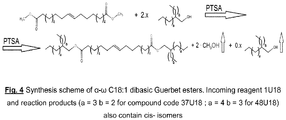
- Most of the latter esters were synthesized in-house by Arkema or CPST by transesterifying 1U18, which was produced in-house by metathesis. However, it must be pointed out that other production pathways for 1U18 are also possible (see Fig. 1 with a scheme of production of 1U18 by self-metathesis).
- Poly ⁇ -olefin (code "PAO8") was received from Ineos Oligomers as Durasyn 168 with reported density of 0.832 g/mL at 15°C, average molecular weight (avg mol Wt) of 629 g/mol, viscosities of 47 mm 2 /s (cSt) and 0.00078 cm 2 /s 7.8 mm 2 /s (cSt) at 40°C and 100°C respectively, pour point below -50°C, flash point above 245°C, bromine number below 4 mg Br/g and water contents below 25 ppm.
- PEO8 Poly ⁇ -olefin
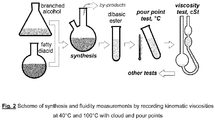
- Cloud points were determined during the same run by visual inspection of the sample appearance at low temperature. The samples were removed from the freezer every 3°C for visual inspection and, if cloudy, meniscus movement with inversion. The pour point resembled the last measurement, at which the meniscus boundary was still moving within 5 seconds of horizontal inversion. All samples were tested in duplicate. If the recorded values did not match at 3°C replicates, more measurements were carried out until a statistically reliable result was obtained.
- the mixture was evacuated with mild heating to remove excess alcohol and resultant methanol.
- other types of branched alcohols were also utilized for synthesis, such as isononyl or isoamyl.
- the esters were synthesized directly from a free ⁇ - ⁇ C18:1 dibasic acid by esterifying it with a respective alcohol in the presence of dimethyl aminopyridine (DMAP). Details of both syntheses are described below. Further details for the synthesis can be found in Hojabri, L. et al. in "Fatty acid-derived diisocyanate and biobased polyurethane produced from vegetable oil: synthesis, polymerization, and characterization” published in Biomacromolecules, 2009, 10 (4), 884-891, American Chemical Society Edition .
- reaction mixture was cooled to r.t (room temperature) and dissolved in toluene (300 ml). The solution was washed with 10% w/w Na 2 CO 3 aqueous solution (200 ml) and with water (200 ml). After desiccation with Na 2 SO 4 , a solution was eluted (toluene 2 L) through a pad of silica gel (5 cm height). Solvent was evaporated on rotary evaporator and residual volatiles were removed under reduced pressure (0-1 mmHg).
- Viscosity is the most important property of nearly any lubricant basestock. Viscosities for hydraulic fluids and engine oils are regulated by several specifications, see Table 2. Table 2. The most widespread viscosity specifications for hydraulic fluids (VG - Viscosity Grade) and engine oils (SAE - Soc.
- the most appealing viscosities belong to the dibasic esters, whose molecular weight falls into the interval from 500 to 700 g/mol, such as 2-propylheptyl ester of ⁇ - ⁇ C18:1 fatty diacid (code 37U18) of 593 g/mol recording 28.7 mm 2 /s at 40°C. It can be expected that 2-ethyl hexyl ester of ⁇ - ⁇ C24:1 fatty diacid would demonstrate the viscosity of ISO VG 32 or SAE 0W-20 specification, due to mol. wt. of 621 g/mol.
- Viscosity can be increased by adding polymers and this is often utilized in lubricant formulations.
- polymers are degraded by mechanical shear, which brings down the viscosity.
- it is better to use the basestock whose volatility is lower, i.e. flash points are higher.
- Lower viscosity of basestock usually means more problematic flash points, while polymer additives do not affect volatility significantly.
- Table 3 Viscosities of saturated and mono-unsaturated ⁇ - ⁇ dibasic esters.
- Viscosities in Table 3 show that many dibasic esters of ⁇ - ⁇ C18:1 fatty diacid have VI of approximately 200. Such value is considered very beneficial for lubricants.
- Polymer additives so called VI Improvers, are often used in final lubricant formulations to increase VI. Consequently, esters of ⁇ - ⁇ dibasic acids might need lower proportions of VI Improvers additives. Even more importantly, VI improvers tend to degrade in hydraulic pumps due to mechanical shear, which leads to increased temperature of the hydraulic system. Consequently, more rapid wear and higher energy losses are observed. Therefore, basestocks with inherently high VI, such as dibasic esters of linear monounsaturated fatty diacids, will command a distinct advantage in hydraulic fluid formulations.
- low temperature fluidity is primarily determined by pour points [ASTM D97]. Generally, pour points below -30°C are considered sufficient. Some polymer additives, e.g. "Pour Point Depressants” (PPD), are able to improve low temperature fluidity. It must be noted that esters without PPD additives, which demonstrate pour points below -30°C, usually meet the requirements of cold storage, pumpability and cold cranking tests. Therefore, initially pour points and cloud points [ASTM D2500 "Standard Test Method for Cloud Point of Petroleum Products and Liquid Fuels"] of ⁇ - ⁇ dibasic esters were evaluated and shown in Table 4.
- Isononyl dibasic ester 9U18 which contains 3 methyl branches on each alcohol moiety, shows an acceptable pour point of -33°C. Even better pour point of -66°C is demonstrated by the mixed dibasic ester 2026U18, whose monounsaturated phytyl moiety contains 4 methyl branches.
- Hydrogenated dibasic esters 17S18 and 26S18 showed very problematic low temperature fluidity. Since the moieties trans-double bonds might often engage into the same molecular packing structures as saturated moieties, it is important that monounsaturated dibasic esters contain some cis-isomers, preferably in excess of 15% mol/mol.
- the above method accounts for longer term decomposition reactions due to exposure to metal surfaces and oxidation, which is prevalent in hydraulic applications. Therefore, using the thin-film method short-term vapor losses were measured after 16 hrs and decomposition trends were compared after 36 hrs of testing. Heating temperature of 120°C was selected to compare thin films of ⁇ , ⁇ dibasic esters with commercial basestocks. Table 5.
- Table 5 shows that despite lower viscosity, monounsaturated ⁇ - ⁇ dibasic esters have similar volatility to that of conventional synthetic basestock PAO8. It must be noted that all monounsaturated ⁇ - ⁇ dibasic esters were prepared in the laboratory, which made it difficult to avoid contaminants and byproducts of volatile nature. Their absence was one reason, why commercially produced ⁇ - ⁇ dibasic ester 26S12 showed much lower volatility. Reaction on the double bond site is another reason of decomposition processes in monounsaturated ⁇ - ⁇ dibasic esters, which increases the rates of long-term vaporization. Volatility of LEAR appears similar to 48U18 initially, but later its film solidifies and the volatile emissions cannot be reliably measured.
- Lubricants often degrade during field use because of oxidation and exposure to high temperatures. Although oxidative degradation can be controlled to some extent by using free radical scavengers, peroxide decomposers, metal passivators and other types of antioxidants, lubricant basestock plays a key role on the oxidation rate. The presence of double bonds accelerates oxidation significantly. Consequently, monounsaturated ⁇ , ⁇ dibasic esters might oxidize faster than poly ⁇ -olefin (“PAO8”) or other commercial basestocks.
- PAO8 poly ⁇ -olefin
- Oxidation can be monitored by using a number of techniques, which usually address degradation reactions, primarily viscosity increase due to oxidative polymerization. Formation of oxypolymers might not only increase the viscosity, but may also result in formation of insoluble residues or even solidification of the whole lubricant.
- the thin-film method determines how resistant oil is against formation of insoluble residues during oxidation. Degradation durations until initial formation of solid residues and complete solidification directly relate to oxidative stability. Test results are listed in Table 6. Table 6. Durations until initial formation of insoluble residues were observed in 500 ⁇ m thick films of ⁇ - ⁇ dibasic esters at 120°C Vapor losses at test duration when full film solidification was observed are also listed Code Alcohol moiety Remainder Initial residues observed Full solidification observed Vapor loss at solidification hrs hrs % w/w Dibasic esters as Exhibits 26U18 2-ethylhexyl ⁇ , ⁇ C18:1 248 320 57% 37U18 2-propylheptyl ⁇ , ⁇ C18:1 248 324 54% 48U18 2-butyloctyl ⁇ , ⁇ C18:1 248 320 47% 4826U18 2-butyloctyl: 2-ethylhexyl ⁇ , ⁇ C18:1 248
- rapeseed oil produces insolubles in just 26 hrs, which is much faster than any other sample.
- LEAR rapeseed oil
- oxidative stability of monounsaturated ⁇ - ⁇ dibasic esters is more similar to that of PAO8 than to LEAR.
- the intermediate character of resistance to oxidation is fully sufficient for monounsaturated ⁇ - ⁇ dibasic esters to function as hydraulic fluids.
- the additives were selected to represent different chemical categories: soaps, heterocycles, phosphorous derivatives, polymers, etc. Most of these additives are designed to be dissolved in paraffinic mineral oils and synthetic lubricants with some heating. It is often thought that esters are better solvents than mineral oils or synthetic hydrocarbons like poly ⁇ -olefins. Therefore, the tested concentrations were much higher than additive proportions for hydraulic fluids, as recommended by the additive manufacturers.
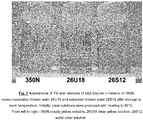
- Additives did not show any problems when blending in with ⁇ - ⁇ dibasic esters 26U18 and 26S12. Initial solution appearance was bright and clear. The appearance of stored solutions after 1 week at room temperature remained unchanged. Presence of monounsaturation did not affect additive solubility negatively. Since tested concentrations were so much higher than recommended additive proportions, additive solubility does not present any problem. All tested additives stayed dissolved in mineral oil 350N as well, except tolyl triazole, which is widely used in hydraulic fluids as corrosion inhibitor. Initially, it fully dissolved at 1% w/w concentration in 350N with heating. However, after some storage at room temperature significant portion precipitated out and made the formulation cloudy, see Fig. 7 . This demonstrates that solubilizing power of dibasic esters is better compared to mineral oils and paraffinic hydrocarbons.
Landscapes
- Chemical & Material Sciences (AREA)
- Health & Medical Sciences (AREA)
- Emergency Medicine (AREA)
- Chemical Kinetics & Catalysis (AREA)
- General Chemical & Material Sciences (AREA)
- Oil, Petroleum & Natural Gas (AREA)
- Organic Chemistry (AREA)
- Lubricants (AREA)
- Organic Low-Molecular-Weight Compounds And Preparation Thereof (AREA)
Abstract
The present invention relates to the use of a composition of dibasic esters of monounsaturated linear α, ω-diacids as a lubricant constituent, said composition comprising from 60 to 100% by weight:
according to option a) of at least one monounsaturated α-ω dibasic ester compound of Formula (I) :
R1-OOC-(CH2)x-CH=CH-(CH2)y-COO-R2
with
x + y being an integer in the range from 10 to 22,
and with R1 and R2 being identical or different and being selected from the residues of branched alcohols with at least 5 carbon atoms (in C5) with said branched alcohols being either saturated or mono unsaturated and bearing at least one branch in C1 to C6 or according to option b) of a mixture comprising :
b1) at least one monounsaturated α-ω dibasic ester compound of Formula (I) as defined above in option a) and
b2) at least one monounsaturated α-ω dibasic ester compound of Formula (II) :
R'1-OOC-(CH2)x-CH=CH-(CH2)y-COO-R'2 (II)
with
x + y being as defined in Formula (I) above ;
and with R'1 and R'2 being identical or different and selected from the residues of methanol or ethanol,
said composition having a weight content in estolides of the corresponding mono unsaturated acids of less than 1% w/w.
according to option a) of at least one monounsaturated α-ω dibasic ester compound of Formula (I) :
R1-OOC-(CH2)x-CH=CH-(CH2)y-COO-R2
with
x + y being an integer in the range from 10 to 22,
and with R1 and R2 being identical or different and being selected from the residues of branched alcohols with at least 5 carbon atoms (in C5) with said branched alcohols being either saturated or mono unsaturated and bearing at least one branch in C1 to C6 or according to option b) of a mixture comprising :
b1) at least one monounsaturated α-ω dibasic ester compound of Formula (I) as defined above in option a) and
b2) at least one monounsaturated α-ω dibasic ester compound of Formula (II) :
R'1-OOC-(CH2)x-CH=CH-(CH2)y-COO-R'2 (II)
with
x + y being as defined in Formula (I) above ;
and with R'1 and R'2 being identical or different and selected from the residues of methanol or ethanol,
said composition having a weight content in estolides of the corresponding mono unsaturated acids of less than 1% w/w.
The invention further relates to a lubricant composition issued from said use and its use in transport, agriculture, food and industrial applications.
Description
- The present invention relates to the use of a dibasic ester composition comprising specific monounsaturated α-ω dibasic ester compounds, as a main component in a lubricant ("basestock") or an additive in lubricant compositions, the lubricant composition resulting from such a use, its related uses. More particularly, said composition is used in lubricant basestocks which are issued from renewable resources and which are degradable in the environment ("biodegradable" may be used in the present invention with same meaning). These compositions present specific improved performances with respect to prior art known lubricant components, in particular improved fluidity at low temperatures (with respect to cold storage), excellent resistance to viscosity change with temperature ("Viscosity Index") and improved non-volatility.
- More particularly, the said dibasic ester compositions and compounds are issued from linear monounsaturated α-ω dicarboxylic acids ("fatty diacids") and do not contain either branched isomers or estolide compounds derived from fatty diacids. Particularly, detrimental are estolides, representing products of addition of the carboxy group of one fatty diacid on the unsaturation of anotherfatty diacid with a resulting middle-chain esterfunction. Preferably, estolide compounds, if present in the linear monounsaturated fatty diacids used for preparing the dibasic ester compositions of the present invention are in a content of less than 1% w/w more preferably of less than 0.1% or less than 0.05% and even more preferably, the content is 0% of estolides with respect to the weight of said dibasic ester composition. The absence of estolide in the case of the present invention is verified by 13C NMR by the absence of a characteristic peak at 71 ppm corresponding to estolides. Such a content is possible by using metathesis reaction route for preparing the said linear monounsaturated fatty diacids or esters from which are issued the dibasic ester compounds and related compositions of the present invention (see scheme in
Fig. 1 ). In fact, the only prior art where lubricant application of dibasic esters from monounsaturated linear α-ω fatty diacids is mentioned is Yasa, S.R. et al. "Synthesis of 10-undecenoic acid based C22-dimer acid esters and their evaluation as potential lubricant basestocks", published in "Industrial Crops & Products", 2017, 103, 141-151, Elsevier Edition. However, the disclosed products are compositions of various C22-dimer esters, containing dibasic esters from mostly branched monounsaturated α-ω diacids (over 50%), only with some linear monounsaturated α-ω homologues as well as branched estolide compounds and other pyrolysis / esterification products of 10-undecenoic acid. Abundance of branched isomers in reported C22-dimer esters is admitted by authors in this reference and it is also obvious to a person skilled-in-art from low solidification temperatures and Viscosity Index values that branched structures are involved. Significant presence of C22 estolides in addition to identified α-ω diacids is evident from much lower acidity than expected theoretically. One of the drawbacks of the presence of significant amounts of estolide compounds is that for a formulated mixture exposed to metal surfaces and to degradation products, a significant estolide fraction will tend to be present in a separate phase from that of linear C22-dimer esters, which fact is harmful for the lubricant, because the functional additives do migrate to the different phases and consequently do perform inefficiently or negatively. This causes wear, corrosion, foaming, haziness and other problems, which jeopardize lubricant performance. The abundance of branched C22-dimer esters also has some negative implications, particularly due to faster viscosity reduction with heating, as expressed by Viscosity Index (VI). Other disadvantages of branched esters, compared with the linear ones, which are well known to a person skilled-in-art, include reduced biodegradability, poorer molecular packing properties and other factors, not-considered in the above report. In conclusion, depending on the origin of the linear mono unsaturated fatty diacids and consequently, depending on the presence or absence of branched fatty diacid isomers and estolides, the lubricants performances will be significantly different between the esterified compounds of the present invention and the compounds as disclosed by the cited prior art (presence of significant amounts of branched α-ω diacids and estolides as a major part or component of said C22 diacids composition prepared by dimerization). - Vegetable oils, fatty derivatives and synthetic esters of petrochemical origin, such as adipate esters or esters of polyhydric alcohols are used as biodegradable basestocks in lubricant formulation for transport, agriculture and industrial applications. The basestock usually comprises around 80-100% w/w of lubricant with remaining 0-20% taken up by additives to impart necessary rheology, low friction, anti-wear properties, low temperature fluidity, corrosion resistance, elastomer compatibility, oxidative stability, water rejection, foam inhibition, air release, microbial resistance, odor, color and many other characteristics. Although many parameters are highly sensitive to the additive use, some key properties, such as low volatility, long term cold storage and biodegradability cannot be improved by using additives. Many other properties are mostly defined by the basestock with only limited capability of the additives to improve them. Viscosimetric properties, low temperature fluidity, volatility, oxidative stability and solvency of the lubricants are primarily determined by the basestock.
- In the recent prior art, a fair amount of attention has been given to metathesis as having potential for producing new types of biobased fluids. Mono-unsaturated α-ω dibasic acids represent one of notable materials, which can be obtained via metathesis, see Ngo, H.L. et al. in "Metathesis of Unsaturated Fatty Acids: Synthesis of Long Chain Unsaturated-α,ω- Dicarboxylic Acids", published in JAOCS, Journal of the American Oil Chemists' Society 2006, 83 (7), 629 - 634, Springer Edition.
- Esterification of the carboxyls (rather than double bonds) in mono-unsaturated α,ω dibasic acids has already been attempted, as described in
US 020150259505 WO 2016/083746A1 .US 9,267,013 US 020150259505 WO 2016/083746A1 discloses unsaturated α-ω dibasic esters for the same use. However, use of pure unsaturated α-ω dibasic esters (or in predominant proportions, from 60 to 100% w/w preferably from 80 to 100%) as lubricant basestocks has not been reported or suggested. The present invention is not readily obvious to those skilled in the art, because dibasic esters are perceived as : - low viscosity materials, while medium viscosity is essential for lubricants
- materials with excessive volatility, while low volatility is important for lubricants
- in case of unsaturated esters, they are usually associated with poor oxidative stability, while low degradation is important (required) for lubricants
- higher viscosity saturated dibasic esters, especially those from linear fatty diacids, show problems in low temperature fluidity.
- Consequently, these esters so far have targeted the applications as plasticizers, where the issues of volatility, oxidative stability or viscosity are less problematic than in lubricants.
- The global lubricant market comprises nearly 50-60 MMT (millions of metric tons), out of which nearly 40 MMT can be considered the global volume of basestocks for engine oils and hydraulic fluids. Mostly, these basestocks are produced from mineral oils, with synthetic and biobased basestocks comprising less than 10%. Synthetic hydraulic fluids usually fall into ISO VG 46 viscosity grade and to a lesser extent into ISO VG 32. Their kinematic viscosities at 40°C must fall into the intervals of 42-50 mm2/s and 28.8-35.2 mm2/s respectively. Most engine oils belong to SAE 30 specifications, such as SAE 5W-30 or SAE 10W-30. Viscosities at 100°C must fall into the interval of 9.3 - 12.5 mm2/s with good low temperature fluidity at -35°C and -30°C respectively. In engine oils, SAE 40 and SAE 20 are also quite widespread (viscosities at 100°C within 12.5 - 16.3 mm2/s and 5.6 - 9.3 mm2/s respectively). Out of all, engine oils 3 MMT or so are made from non-mineral basestocks, the majority of which belongs to poly alpha-olefins (poly α-olefins), produced petrochemically from ethylene (C2H4). The basestocks from vegetable or animal sources comprise about 1 MMT globally. However, their proportion can increase at the expense of poly α-olefins, if manufacture costs and technical properties become favorable.
- In addition to viscosity itself, Viscosity Index (VI) is another important parameter. It defines how fast viscosity of a lubricant goes down viscosity with increasing temperature [ASTM D2270 "Standard Practice for Calculating Viscosity Index from Kinematic Viscosity at 40 °C and 100 °C"]. High VI is usually very desirable for engine oils, hydraulic fluids and other lubricants, since their films are more effective in protecting moving surfaces from wear when heated.
- Performance of lubricants at high temperatures is also dictated by their volatility, because with sizeable losses of any lubricant component the properties of the residual liquid change significantly. This is especially evident in mineral basestocks, which contain significant portion of lower mol. wt. fractions. Volatility losses are less appreciable in synthetic basestocks, constituting a significant performance benefit.
- As evident from engine oil nomenclature and many other examples, lubricant basestocks must retain their fluidity at low temperatures in order to assure reliable performance in winter or cold conditions. Final lubricant formulations are tested using several protocols for low temperature fluidity, such as extended storage, cold cranking and similar. Pour point is considered as a very important parameter for describing the low temperature properties of the basestock.
- One more critical property in the two most wide-spread lubricant applications, i.e. engine oils and hydraulic fluids, is oxidative stability, see Cvitkovic, E. et al. in "A Thin Film Test for Measurement of the Oxidation and Evaporation of Ester-Type Lubricants", published in ASLE Trans. (American Society of Lubrication Engineers Transactions), 1979, 22 (4), 395-401, Taylor and Francis Edition. It is important to establish how rapidly the solid phase can start forming, if lubricant basestock is exposed to severe oxidation. In mineral oils, the solid oxidation products often appear as semi-solid residues (hereafter called oxidative polymer), which might dissolve back into liquid with some heating. Increased levels of polar degradation products in fact might even help in keeping the oxidative polymers dissolved. However, precipitation of residues and deposits becomes more likely with further oxidation. In synthetic basestocks and vegetable oils, the oxidative polymerization can often lead to sudden solidification of the whole fluid. Therefore, particular attention must be devoted to oxidative stability and the formation mechanism of insoluble residues or solids.
- It is also important that typical lubricant additives, such as Anti-Wear (AW) agent, antioxidant, corrosion inhibitor, friction modifier, alkalinity carrier, water demulsifier, dispersant, detergent, elastomer conditioner, dye, copper passivator, pour point depressant, tackifier, thickener, viscosity index improver, surfactant, defoamer or similar could dissolve in basestocks. Affinity of esters towards above additives is usually better than that of hydrocarbons.
- The first subject-matter of the present invention relates to the use of a composition of specific dibasic esters of monounsaturated linear α, ω- diacids as a lubricant basestock or constituent.
- A second subject-matter relates to a lubricant composition issued from the said use.
- A third subject-matter relates to the use of said lubricant composition for engine oils and hydraulic fluids in transport, agriculture, food and industrial applications.
- So, the first subject-matter of the invention relates to the use of a composition of dibasic esters of monounsaturated α, ω-diacids as a lubricant constituent, wherein said composition comprises from 60 to 100% w/w, preferably 80 to 100% by weight: according to option a) of at least one monounsaturated α-ω dibasic ester compound of Formula (I) :
R1-OOC-(CH2)x-(CH=CH-(CH2)y-COO-R2 (I)
with - X + y being an integer in the range from 10 to 22, preferably from 10 to 16 ;
- and with R1 and R2 being identical or different and being selected from the residues of branched alcohols with at least 5 carbon atoms (in C5), preferably from 5 to 36 carbon atoms (in C5 to C36), more preferably from 5 to 26 carbon atoms (in C5 to C26), even more preferably from 5 to 22 carbon atoms (in C5 to C22) with said branched alcohols being either saturated or mono unsaturated and bearing at least one branch in C1 to C6, preferably in C2 to C6 or in C1 in case of multiple branches (at least two) or
- according to option b) of a mixture comprising :
- b1) as predominant component at least one monounsaturated α-ω dibasic ester compound of Formula (I) as defined above in option a) and
- b2) at least one monounsaturated α-ω dibasic ester compound of Formula (II) :
R'1-OOC-(CH2)x-CH=CH-(CH2)y-COO-R'2 (II)
with- x + y being as defined in formula (I) above ;
- and with R'1 and R'2 being identical or different and selected from the residues of methanol (residue : methyl) or ethanol (residue : ethyl), preferably being identical and being the residues of methanol (residue : methyl),
- and wherein, said composition has a weight content in estolides of the corresponding mono unsaturated acids of less than 1% w/w, preferably less than 0.1% or less than 0.05% w/w and more preferably 0% w/w.
- According to a particular option, the total number of carbon atoms in the diester compound according to formula (I) as defined above can vary from 34 to 42 and preferably from 38 to 42 carbon atoms.
- Predominant component as b1) means in the present case to represent more than 60% of the mixture b1) + b2) and preferably at least 70% and more preferably at least 80% of the mixture b1) + b2).
- More particularly, the said branch of said branched alcohols is in C2 to C6 or in C1 in case of a multiple branches meaning at least 2 branches present. In fact, the presence of a C1 branch is preferred when at least another additional branch in C1 or in C2 to C6 is present, with a total number of branches (multiple number) of at least 2 branches with at least one in C1 and another one in C2 to C6 or at least two in C1 or more particularly at least 3 branches with at least one in C1 and two others in C2 to C6 or at least 2 in C1 and one in C2 to C6 or at least 3 in C1. Said branched alcohols R'1OH and R'2OH may be primary or secondary alcohols and preferably primary alcohols. The chain length (in carbon atoms) of these branched alcohols does not include the number of carbon atoms of the branches. For example, for 2-ethyl hexanol the chain length is in C6, with one branch in C2 in
position 2 of the hexyl main chain (longer linear chain). - More particularly, it is preferred to have in said branched alcohol R'1OH and R'2OH a branch or the branch in position 2 (with respect to the -OH functionality), said branch being in C2 to C6 and possibly in C1 under the provision that there are at least 2 branches, at least one being in C1, preferably at least 3 branches with at least one in C1.
- Preferably, the number of carbon atoms of R1 or R2 is from 5 to 26 (C5 to C26) and more preferably from 5 to 22 (C5 to C22).
- According to a particular option of the present invention, x + y in formula (I) ranges from 10 to 16. In a preferred option, x + y is 14 and more preferably with x = 7 and y = 7.
- According to another particular embodiment, x is from 6 to 9. The ethylenic unsaturation is preferably located in position from 7 to 10.
- More particularly, R1 or R2 are residues of branched alcohols selected from the group consisting of : 2-ethylhexyl, 2-butyl octyl, 2-propyl heptyl, phytyl (3,7,11,15-tetramethyl-2-hexadecenyl), 1-methyl heptyl (from 2-octanol), 3,5,5-trimethyl hexyl (isononyl) residue of terpenic alcohols, residue of farnesol, including their partially hydrogenated homologues, isocetyl, isostearyl, isooctyl (2,4,4-trimethylpentyl), cyclohexyl, abietyl and of their mixtures, preferably at least one of : 2-butyl octyl, 2-propyl heptyl, phytyl (3,7,11,15-tetramethyl-2-hexadecenyl), 3,5,5-trimethyl hexyl (isononyl).
- According to a more preferred selection, said dibasic ester of formula (I) corresponds to x = y = 7 with x + y = 14 and with R1 and R2 selected from the group consisting of at least one of: 2-ethylhexyl or 2-butyl octyl, 2-propylheptyl, phytyl (3,7,11,15-tetramethyl-2-hexadecenyl), 1-methylheptyl or 3,5,5-trimethylhexyl and of their mixtures. One specific example of dibasic ester according to the present invention is the 2-ethylhexyl diester of 9-octadecenedioic diacid, having the ethylenic unsaturation in position 9 with 2-ethyl hexanol as branched alcohol. The double bond (ethylenic unsaturation) can be cis or trans or a mixture of both. For example, the proportion may be about 75% mol/mol trans and 25% cis but predominant or near 100% cis is more preferred over trans since the cold flow properties are better. Preferably, according to the present invention, the proportion of cis is at least of 15% mol.mol, preferably of at least 20%.
- The at least one monounsaturated α-ω dibasic ester compound of Formula (I) of said dibasic ester composition can be a blend of at least two different compounds of Formula (I).
- The said at least two different compounds of Formula (I) may be different in :
- x and/or y,
- x + y and/or
- R1 and/or R2 or
- all binary or ternary combinations of the above-cited differences (vs interest of blends).
- More particularly, said at least one dibasic ester compound of Formula (I) may be a blend of a dibasic ester compound of Formula (I) with x = y = 7 and x + y = 14 at a content higher than 60% w/w with respect to said blend, with at least another different dibasic ester compound of Formula (I) with x + y from 16 to 22, preferably with x + y selected to be 16, 18, 20 or 22.
- Another possible option is that R1 and R2 are different and are residues of a blend of different branched alcohols.
- Concerning the composition of dibasic esters of monounsaturated α-ω diacids, it is preferably issued from the transesterification by said branched alcohols as defined above, of an α-ω dialkyl dibasic ester of Formula (II) :
R'1-OOC-(CH2)x-CH=CH-(CH2)y-COO-R'2 (II)
with R'1 and R'2 being identical or different and selected from a methyl or an ethyl, preferably being identical and being a methyl,
x, y being as defined above according to the present invention. - Said dibasic ester of Formula (II) can be issued by the esterification of the corresponding diacid. Said diacid can be obtained either by a metathesis route from the corresponding fatty monoacid or obtained by the hydrolysis of a mixture of other diesters of said diacid or by the fermentation route of a fatty monoacid.
- For example, the dibasic esters can be formed starting from monounsaturated fatty diacids which comprise either 18 carbon atoms by molecule 9-octadecenedioic or 22 carbon atoms by molecule 11-docosenedioic. The preparation of such fatty diacids is disclosed in Ngo, H.L. et al. in "Metathesis of Unsaturated Fatty Acids: Synthesis of Long Chain Unsaturated-α,ω- Dicarboxylic Acids", published in JAOCS J. of Am. Org. Chem. Soc. 2006, 83 (7), 629-634.
- The dibasic esters used within the framework of the invention can be either symmetrical, with the alcohol used for esterification being the same one for the two carboxy acid functions or asymmetrical with two different alcohols. Transesterification of light alcohol esters (such as methyl and/or ethyl esters) of said fatty diacids with heavier alcohols as defined according to the present invention can be used for the preparation of the specific dibasic esters used in the present invention. More particularly, the said fatty diacid can be issued from a self-metathesis reaction of a fatty monounsaturated monoacid or said dibasic ester of Formula (II) is issued from a self-metathesis of a fatty monounsaturated monoacid ester. Diacid can also be obtained from fermentation of monounsaturated fatty acid (especially for the C18).
- The dibasic ester can be formed by self-metathesis reaction from unsaturated monoesters, such a reaction can be either the main reaction or a side reaction during a cross-metathesis reaction. In a reaction A-CH=CH-B + R1-CH=CH-R2, several reactions will take place and lead to the following products A-CH=CH-A, B-CH=CH-B, R1-CH=CH-R1, R2-CH=CH-R2, A-CH=CH-R1, A-CH=CH-R2, B-CH=CH-R1, B-CH=CH-R2. Among those, there are products of self-metathesis reactions characterized by both end groups being identical. This demonstrates that self-metathesis reaction also occurs during the cross metathesis reaction.
- The fatty diacid can also be produced by fermentation of the corresponding fatty mono acid.
- More particularly, in the said use according to the present invention of said composition of dibasic esters, the said composition is a mixture as defined above according to option b). More particularly, said mixture as defined above according to option b) comprises up to 99.9% w/w with respect to said mixture of b1) selected from at least one dibasic ester compound as defined above according to Formula (I) and at least 0.1% w/w of b2) at least one dibasic ester compound as defined according to Formula (II).The second subject of the invention relates to a lubricant composition which results from the use as a lubricant constituent (or additive having same meaning) of at least one dibasic ester composition as defined above according to the present invention. More particularly, the weight ratio of b1)/b2) can vary from 0.85/0.15 to 0.99/0.01.
- A second subject of the invention relates to a lubricant composition which results from the use as a lubricant constituent, of at least one dibasic ester composition as defined above according to the present invention.
- Said lubricant composition, in addition to said dibasic ester composition at a content of at least 80% w/w, preferably from 90 to 99.7% with respect to the total weight of said lubricant composition, can further comprise up to 20%, preferably from 0.3 to 10% w/w of other additives selected from the group consisting of another lubricant additive, antiwear agent, antioxidant, corrosion inhibitor, friction modifier, alkalinity carrier, biocide, buffering agent, chelating additive, coupler, water demulsifier, dispersant, detergent, elastomer conditioner, dye, mist suppressant, odorant, copper passivator, pour point depressant, tackifier, thickener, viscosity index improver, surfactant or defoamer. Said lubricant composition is preferably a lubricant basestock composition. More particularly, said lubricant basestock composition is issued from renewable resources and it is biodegradable. More particularly, said lubricant composition is a lubricant basestock composition. Said lubricant basestock composition is particularly issued from renewable resources and it is a biodegradable lubricant basestock.
- Finally, the present invention also covers the use of the said lubricant composition as engine oils or as hydraulic fluids in transport, agriculture, food and industrial applications.
- Some experimental examples are presented below for the purpose of illustrating the present invention and its performances and these examples given for such an illustration do not at all limit the covering of the present invention.
- The conditions of synthesis of said mono-unsaturated α-ω dibasic esters is described here-below in the experimental part. Obtained liquids have also been evaluated to compare their viscosimetric properties, low temperature fluidity, volatility, oxidative stability and solvency with as references poly α-olefins and low-erucic rapeseed oil. The former represents the most widespread non-mineral basestock in engine oil formulations, while rapeseed oil is often used as hydraulic fluid basestock.
- Colloquial lipid terminology (i.e. lipid number) denominations are used to describe the aliphatic portion by listing the number of C atoms and the number of C=C double bonds, separated by colon. For example, instead of writing "hexadecanoate and octadecedienoate", the denominations "C16:0 and C18:2" can be used to indicate palmitate and linoleate moieties respectively. These rules are extended to indicate the positions of carboxyls, such as α-ω C18:0 dibasic ester, position and type of C=C double bonds, such as C18:1 9Z for oleic acid and so on. The list of moiety denominations, compound codes and IUPAC names is provided in Table 1.
Table 1. List of codes and systematic nomenclature for tested structures In the supplier list "Arkema" and "CPST" mean home-made (synthesis described below). Code Alcohol moiety Remainder IUPAC name or trade name Supplier Single-alcohol α,ω dibasic esters 1U18 methyl α,ω C18:1 1,18-dimethyl octadec-9-enedioate Arkema 17S18 methyl heptyl (from 2-octanol) α,ω C18:0 1,18-di(1-methylheptyl) octadecanedioate CPST 17U18 methyl heptyl α-ω C18:1 1,18-di(1-methylheptyl) octadec-9-enedioate CPST 26S9 2-ethylhexyl α,ω C9:0 1,9-di(2-ethylhexyl) nonanedioate TCI 26S12 2-ethylhexyl α,ω C12:0 1,12-di(2-ethylhexyl) dodecanedioate TCI 26S18 2-ethylhexyl α,ω C18:0 1,18-di(2-ethylhexyl) octadecanedioate CPST 26U18 2-ethylhexyl α,ω C18:1 1,18-di(2-ethylhexyl) octadec-9-enedioate Arkema 37U18 2-propyl heptyl α,ω C18:1 1,18-di(2-propylheptyl) octadec-9-enedioate CPST 48U18 2-butyloctyl α,ω C18:1 1,18-di(2-butyloctyl) octadec-9-enedioate CPST 5U18 isoamyl α,ω C18:1 1,18-di(3-methylbutyl) octadec-9-enedioate CPST 9U18 isononyl α-ω C18:1 1,18-di(3,3,5-trimethylhexyl) octadec-9-enedioate CPST Mixed alcohol α,ω dibasic esters 2026U18 phytyl:2-ethylhexyl at 1:1 mix α,ω C18:1 1-(3,7,11,15-tetra methyl-2-hexadecenyl) - 18-(2-ethylhexyl) octadec-9-enedioate CPST 4826U18 2-butyloctyl: 2-ethylhexyl at 1:1 mix α,ω C18:1 1-(2-butyloctyl)-18-(2-ethylhexyl)octadec-9-enedioate CPST Commercial basestocks for comparison 350N paraffinic mineral oil HVI 350 Shell LEAR 60% C18:1 9Z Low erucic rapeseed oil, food grade Inex OY PAO8 poly α-olefin Durasyn 168 Ineos - The codes of dibasic esters are assigned mostly based on the segment lengths of the alcohol and diacid moieties in the compound molecule. As a prefix, the branches of the alcohol moiety are encoded based on the number of C atoms in the IUPAC name of the alcohol. For example, 2-ethyl hexanol contains two branches of C2 and C6, hence a prefix "26" is assigned. Admittedly, isoalkyl, oleyl and mixed esters do not follow this rule strictly. In the middle of the code, a suffix letter is inserted to indicate, whether the fatty diacid moiety is fully saturated ("S") or unsaturated ("U"). The rest of the code denotes the chain length of the fatty diacid moiety. For example, azelaic acid (α,ω C9:0) is denoted "9", while α-ω C18:1 fatty diacid is denoted "18". Most of the latter esters were synthesized in-house by Arkema or CPST by transesterifying 1U18, which was produced in-house by metathesis. However, it must be pointed out that other production pathways for 1U18 are also possible (see
Fig. 1 with a scheme of production of 1U18 by self-metathesis). - Several fluids were acquired from third parties for comparison purposes. Two esters 26S9 and 26S12, manufactured commercially for hydraulic fluid applications, were purchased from TCI Chemicals (Japan). Low-erucic acid rapeseed (LEAR) oil, food grade was purchased in the retail store Prisma with indicated manufacturer Inex Partners OY (Finland) and the origin country of Belgium. Viscosity and acidity measurements were performed at CPST and recorded values were typical of rapeseed oil. Poly α-olefin (code "PAO8") was received from Ineos Oligomers as Durasyn 168 with reported density of 0.832 g/mL at 15°C, average molecular weight (avg mol Wt) of 629 g/mol, viscosities of 47 mm2/s (cSt) and 0.00078 cm2/s 7.8 mm2/s (cSt) at 40°C and 100°C respectively, pour point below -50°C, flash point above 245°C, bromine number below 4 mg Br/g and water contents below 25 ppm.
- Laboratory grade acetone, isopropanol and xylene (Avsista, Lithuania) were used for washing and titrations. KOH and phenolphthalein (Avsista, Lithuania) were used for acidity determinations. The coupons for degradation tests were manufactured in-house from low carbon steel (98.8% w/w. Fe, 0.8% Mn and 0.4% Si) and represented the cylinders of 17 ± 1 mm in diameter. Deionized water for humidity chamber operation and acidity titrations was produced in-house by reverse
osmosis system Demiwa 10 Rosa (Watek, Czech), resulting in conductivity below 1 µS/cm. Most used percentages were calculated on weight-to-weight basis, unless indicated otherwise. - The exact procedure, used here, has been described in detail by Stoncius, A. et al. in "Volatiles from Thin Film Degradation of Bio-based, Synthetic and Mineral Basestocks", published in Industrial Lubrication & Tribology, 2013, 65 (3) 209-215, 2013, Emerald Group Publishing Edition or by Brazinskiene, D. et al. in "Ester Basestock Vaporisation from Thin Oil Films", published in Lubrication Science, DOI: 10.1002/ls.1372, pp 1-17, 2017, Wiley Edition.
- Briefly, an oil film of 500 µm thickness was coated on steel coupon and heated at given temperature for specific duration in a forced-draft oven. Afterwards, the volatile losses and insoluble residues were measured gravimetrically.
- Kinematic viscosities at 40°C and 100°C were measured using capillary Cannon-Fenske viscometers per ASTM D455. Viscosity Index (the value, describing the rate of thinning with increasing temperature) was calculated per ASTM D2270.
- Pour points and cloud points were determined using the same thermal cooling regime, as instructed by ASTM D97. The sample sizes were 5 to 15 mL during the measurements.
- Cloud points were determined during the same run by visual inspection of the sample appearance at low temperature. The samples were removed from the freezer every 3°C for visual inspection and, if cloudy, meniscus movement with inversion. The pour point resembled the last measurement, at which the meniscus boundary was still moving within 5 seconds of horizontal inversion. All samples were tested in duplicate. If the recorded values did not match at 3°C replicates, more measurements were carried out until a statistically reliable result was obtained.
- Most investigated compounds were synthesized by transesterifying a dimethyl ester (code 1U18) of linear α-ω C18:1 fatty diacid. The starting material 1U18 was produced by metathesis as described in
WO 2014/106724 A1 . In some cases, as a starting material a linear linear α-ω C18:1 fatty diacid was used for direct esterification. After a given dibasic ester was synthesized, its pour point and viscosities were measured, as shown inFig. 2 (showing a scheme for synthesis and fluidity testing of dibasic esters). - Transesterification of methyl dibasic ester of α-ω C18:1 dibasic acid (code 1U18) for the most part followed the procedures, as described elsewhere, see Hojabri, L. et al. in "Fatty acid-derived diisocyanate and biobased polyurethane produced from vegetable oil: synthesis, polymerization, and characterization" Published in Biomacromolecules, 2009, 10 (4), 884-891, American Chemical Society Edition. A mixture of cis- and trans- isomers of α-ω C18:1 dibasic acid was used in this synthesis Its methyl ester was analyzed on 1H NMR and GC-MS in order to establish the quantitative ratio between 9E and 9Z (trans- and cis-respectively), see
Fig. 3 . - Many properties, important for lubricant basestocks, are strongly dependent on trans- or cis- isomerization, especially low temperature fluidity. Therefore, it would not be correct to assume that any obtained unsaturated ester represented a single organic compound. Saturated esters, synthesized for this report, can be considered as unique organic compounds. However, saturated esters are not the scope of this invention and are used as Comparative Examples.
- The transesterification of 1 U 18 into monounsaturated α-ω C18:1 dibasic esters was performed using excess alcohol in the presence of para-toluene sulfonic acid (PTSA), as shown for the synthesis scheme of Guerbet esters in
Fig. 4 . - After the reaction, the mixture was evacuated with mild heating to remove excess alcohol and resultant methanol. In addition to Guerbet, other types of branched alcohols were also utilized for synthesis, such as isononyl or isoamyl. In some cases the esters were synthesized directly from a free α-ω C18:1 dibasic acid by esterifying it with a respective alcohol in the presence of dimethyl aminopyridine (DMAP). Details of both syntheses are described below. Further details for the synthesis can be found in Hojabri, L. et al. in "Fatty acid-derived diisocyanate and biobased polyurethane produced from vegetable oil: synthesis, polymerization, and characterization" published in Biomacromolecules, 2009, 10 (4), 884-891, American Chemical Society Edition.
- Also, synthesis of fully saturated α-ω C18:0 dibasic esters was performed (as comparative reference) by hydrogenating the respective monounsaturated esters over a Palladium catalyst, see
Fig. 5 and § 3.4. - A mixture of dimethyl octadec-9-enedioate ("1U18", 17.0 g; 50 mmol), corresponding alcohol (105 mmol) and PTSA (ParaToluene Sulfonic Acid) monohydrate (0.67 g; 3.5 mmol) was heated at 100°C under reduced pressure (approximately 20 mmHg) for 2 to 12 h. Reaction progress was monitored by Thin Layer Chromatography (eluent - DCM). Upon reaction completion, Hickman head was attached and reaction was furthermore heated at 100°C under vacuum (0-1 mmHg). Condensed liquid was occasionally removed and the process was continued until no more drops have formed in Hickman head. Then, reaction mixture was cooled to r.t (room temperature) and dissolved in toluene (300 ml). The solution was washed with 10% w/w Na2CO3 aqueous solution (200 ml) and with water (200 ml). After desiccation with Na2SO4, a solution was eluted (toluene 2 L) through a pad of silica gel (5 cm height). Solvent was evaporated on rotary evaporator and residual volatiles were removed under reduced pressure (0-1 mmHg).
- Di(oct-2-yl) octadec-9-enedioate also noted as Di (methyl heptyl) octadec-9-enedioate (code "17U18") :
- Yield : 19.55 g (72%). 1H NMR (CDCl3, 400 MHz): 0.85 - 0.93 (m, 6H); 1.18 - 1.40 (m, 38H); 1.44 - 1.53 (m, 2H); 1.53 - 1.71 (m, 6H), 1.94 - 2.04 (m, 4H); 2.28 (t, 4H, J = 7.2 Hz); 4.92 (s, 2H, J = 6.8 Hz); 5.28 - 5.46 (m, 2H).
- 13C NMR (CDCl3, 100 MHz): 14.0, 20.0, 22.6, 25.1, 29.0, 29.0, 29.1, 29.1, 29.6, 29.7, 31.8, 32.6, 34.8, 36.0, 70.7, 129.8, 130.3, 173.5.
- Di(2-propylheptyl) octadec-9-enedioate (code "37U18") :
- Yield : 21.1 g (81%). 1H NMR (CDCl3, 400 MHz): 0.84 - 0.95 (m, 12H); 1.10 - 1.40 (m, 40H); 1.55 - 1.70 (m, 6H), 1.92 - 2.08 (m, 4H); 2.31 (t, 4H, J = 7.2 Hz); 3.99 (d, 4H, J = 6.0 Hz); 5.11 - 5.43 (m, 2H).
- 13C NMR (CDCl3, 100 MHz): 14.1, 14.4, 19.9, 22.6, 25.1, 26.4, 27.2, 29.0, 29.1, 29.6, 31.2, 32.2, 32.6, 33.6, 34.4, 37.1, 67.0, 129.8, 130.3, 174.1.
- Di(2-butyloctyl) octadec-9-enedioate (code "48U18") :
- Yield: 23.2 g (71%). 1H NMR (CDCl3, 400 MHz): 0.83-0.93 (m, 12H); 1.08- 1.42 (m, 48H); 1.56 - 1.68 (m, 6H), 1.92 - 2.09 (m, 4H); 2.30 (t, 4H, J = 7.2 Hz); 4.01 (d, 4H, J = 6.0 Hz); 5.12 - 5.45 (m, 2H).
- 13C NMR (CDCl3, 100 MHz): 14.0, 14.1, 22.7, 23.0, 25.1, 26.7, 27.2, 28.9, 29.0, 29.2, 29.2, 29.6, 31.0, 31.3, 31.8, 32.6, 34.5, 37.3, 67.0, 129.8, 130.3, 174.1.
- Di(3-methylbutyl) octadec-9-enedioate (code "5U18") :
- A mixture of dimethyl octadec-9-enedioate (20.0 g; 58.5 mmol), isoamyl alcohol (25.9 g; 294 mmol) and PTSA monohydrate (0.78 g; 4.1 mmol) was heated at 90°C in open vessel. Occasionally (once in an hour), vacuum was applied to remove methanol vapors. Reaction was continued for 12 hours (progress was monitored by TLC). Then, isoamyl alcohol was removed under reduced pressure. The residue was dissolved in toluene (200 ml) and a solution was eluted (toluene 2 L) through a pad of silica gel (5 cm height). Solvent was evaporated on rotary evaporator and residual volatiles were removed under reduced pressure (0 - 1 mmHg).
Yield : 19.8 g (74%). 1H NMR (CDCl3, 400 MHz): 0.87 - 0.98 (m, 12H); 1.14 - 1.48 (m, 20H); 1.53 (q, 4H, J = 7.2 Hz); 1.58 - 1.75 (m, 6H), 1.92 - 2.06 (m, 4H); 2.30 (t, 4H, J = 7.2 Hz); 3.85 - 4.01 (m, 1 H); 4.11 (s, 3H, J = 7.2 Hz); 5.30 - 5.42 (m, 2H).
13C NMR (CDCl3, 100 MHz): 22.5, 25.0, 25.0, 27.2, 29.0, 29.2, 32.5, 34.4, 37.4, 62.9, 68.9, 129.8, 130.3, 174.0. - A mixture of dimethyl octadec-9-enedioate - C18:1 dibasic ester - (20 g; 58.5 mmol) and methanol was stirred and heated to 65 - 70°C until clear solution was obtained. Then, NaOH (2.5 M) solution (60 ml) was added. Precipitate have formed soon. The mixture was heated at 65 - 70°C for 30 min. Then, water (600 ml) was added in portions (precipitate dissolves) and the mixture was kept at 70°C for five more hours. Then, HCl solution (approximately 2 M) was added until product have precipitated and pH was acidic. Product was filtered and dried at 60°C.
Yield : 18.3 g (99 %). m.p. 94 - 96°C. 1H NMR (CDCl3, 400 MHz): 1.15 - 1.45 (m, 16H); 1.45 - 1.56 (m, 4H), 1.83 - 2.03 (m, 4H); 2.18 (t, 4H, J = 7.2 Hz); 5.25 - 5.45 (m, 2H); 11.7 - 12.3 (br s, 2H). - To a solution of octadecenedioic acid (14 g; 45 mmol), corresponding alcohol (94 mmol) and 4-N,N-dimethyl amino pyridine ("DMAP", 0.27 g; 2.2 mmol) in dichloro methane ("DCM", 300 ml), dicyclohexyl carbodiimide ("DCC", 18.7 g; 91 mmol) was added. Reaction mixture was stirred for 3 hours at room temperature. Precipitated solid was filtered off, DCM was removed under reduced pressure. Residue was dissolved in hexane (200 ml) and solution was eluted (toluene 2 L) through a pad of silica gel (5 cm height). Solvent was evaporated on rotary evaporator, and residual volatiles were removed under reduced pressure (0 - 1 mmHg).
- Di(3,3,5-trimethylhexyl) octadec-9-enedioate (code "9U18") :
- Yield : 19.4 g (77%). 1H NMR (CDCl3, 400 MHz): 0.90 (s, 18H); 0.96 (d, 6H, J = 7.2 Hz); 1.09 (dd, 2H, 2 J = 14, 3 J =5.6); 1.21 - 1.38 (m, 18H); 1.41 - 1.52 (m, 2H); 1.56 - 1.69 (m, 8H), 1.91 - 2.05 (m, 4H); 2.29 (t, 4H, J = 7.2 Hz); 4.09 (t, 4H, J = 7.2 Hz); 5.33 - 5.41 (m, 2H).
- 13C NMR (CDCl3, 100 MHz): 22.6, 25.0, 26.2, 29.0, 29.1, 29.6, 29.7, 29.9, 31.1, 32.6, 34.4, 37.9, 51.0, 62.8, 129.8, 130.3, 173.9.
- A mixture of octadec-9-enedioic acid ester (20 g) and Pd/C (10% w/w Pd/C, 0.5 g) in ethyl acetate (200 ml) was stirred overnight at room temperature under hydrogen atmosphere. Then, hydrogen was removed, reaction vessel was flushed with Argon and reaction mixture was filtrated through the diatomaceous earth (Celite™, Sigma-Aldrich). Solvent was evaporated on rotary evaporator, and residual volatiles were removed under reduced pressure (0 - 1 mmHg).
- Di(oct-2-yl) octadecanedioate (code "17S18") :
- Yield : 19.1 g (95%). 1H NMR (CDCl3, 400 MHz): 0.86 (t, 6H, J = 7.2 Hz); 1.13 - 1.35 (m, 46H); 1.38 - 1.49 (m, 2H); 1.50 - 1.64 (m, 6H), 2.25 (t, 4H, J = 7.2 Hz); 4.88 (s, 2H, J = 6.4 Hz).
- 13C NMR (CDCl3, 100 MHz): 14.0, 20.0, 22.6, 25.1, 25.4, 29.1, 29.1, 29.3, 29.5, 29.6, 29.6, 29.7, 31.7, 34.7, 36.0, 70.7, 173.5.
- Di(2-ethylhexyl) octadecanedioate (code "26S18"):
- Yield : 19.8 g (98%). 1H NMR (CDCl3, 400 MHz): 0.90 (t, 6H, J = 7.2 Hz); 1.22 - 1.41 (m, 40H); 1.53 - 1.67 (m, 6H), 2.31 (t, 4H, J = 7.2 Hz); 3.95 - 4.04 (m, 4H).
- Viscosity is the most important property of nearly any lubricant basestock. Viscosities for hydraulic fluids and engine oils are regulated by several specifications, see Table 2.
Table 2. The most widespread viscosity specifications for hydraulic fluids (VG - Viscosity Grade) and engine oils (SAE - Soc. of Automotive Engineers), shown as intervals, along with the predicted kinematic viscosity values at 40°C and 100°C, shown as single numbers, assuming VI = 200 Viscosity Specification Range at 40°C mm2/s Range at 100°C mm2/s ISO VG 22 19.8 - 24.2 5.5 ISO VG 32 28.8 - 35.2 7.2 ISO VG 46 41.4 - 50.6 9.6 SAE 3054 9.3 - 12.5 SAE 2033 5.6 - 9.3 SAE 16 31 6.1 - 8.2 SAE 12 25 5 - 7.1 SAE 8 20 4 - 6.1 - Some minor complication can occur when comparing viscosity requirements for engine oils and hydraulic fluids, because their viscosity margins are set at different temperatures, 100°C and 40°C respectively. Since most of tested α-ω dibasic esters have Viscosity Index close to 200, this value was selected to convert the viscosities between the two temperatures. Viscosities of chemically similar organic compounds strongly depend on molecular weight. The correlation of measured values at 40°C for several synthesized compounds is quite evident from
Fig. 6 . - Good correlation between measured viscosities and molecular weights indicates that the dibasic esters were synthesized properly and the amounts of partial esters are negligible.
- The most appealing viscosities belong to the dibasic esters, whose molecular weight falls into the interval from 500 to 700 g/mol, such as 2-propylheptyl ester of α-ω C18:1 fatty diacid (code 37U18) of 593 g/mol recording 28.7 mm2/s at 40°C. It can be expected that 2-ethyl hexyl ester of α-ω C24:1 fatty diacid would demonstrate the viscosity of ISO VG 32 or SAE 0W-20 specification, due to mol. wt. of 621 g/mol.
- In principle, viscosity can be increased by adding polymers and this is often utilized in lubricant formulations. However, with long-term usage polymers are degraded by mechanical shear, which brings down the viscosity. Also, it is better to use the basestock, whose volatility is lower, i.e. flash points are higher. Lower viscosity of basestock usually means more problematic flash points, while polymer additives do not affect volatility significantly.
Table 3. Viscosities of saturated and mono-unsaturated α-ω dibasic esters. Those, which also serve as comparative examples, are marked with "(comp)" Code Alcohol moiety Remainder Viscosity, mm2/s at 40°C Viscosity, mm2/s at 100°C Viscosity Index Dibasic esters as Exhibits 26U18 2-ethylhexyl α,ω C18:1 22.74 5.53 197 37U18 2-propylheptyl α,ω C18:1 28.74 6.39 174 48U18 2-butyloctyl α,ω C18:1 36.09 7.09 163 4826U18 2-butyloctyl: 2-ethylhexyl α,ω C18:1 28.97 6.78 205 9U18 isononyl α,ω C18:1 28.8 6.7 202 Other pertinent dibasic esters 1U18 (comp) methyl α,ω C18:1 8.68 2.85 204 17U18 methylheptyl α,ω C18:1 21.2 5.35 205 17S18 methylheptyl α,ω C18:0 22.7 5.31 180 26S18 2-ethylhexyl α,ω C18:0 23.9 5.71 194 26S9 (comp) 2-ethylhexyl α,ω C9:0 10.5 2.8 111 26S12 (comp) 2-ethylhexyl α,ω C12:0 14.72 3.72 147 5U18 isoamyl α,ω C18:1 12.93 3.73 196 2026U18 phytyl: 2-ethylhexyl α,ω C18:1 42.54 8.3 175 Pertinent commercial basestocks 350N (comp) paraffinic oil 61.4 8.46 109 LEAR (comp) 60% C18:1 46.76 10.68 222 PAO8 (comp) poly α-olefin 50.48 8.2 135 - Viscosities in Table 3 show that many dibasic esters of α-ω C18:1 fatty diacid have VI of approximately 200. Such value is considered very beneficial for lubricants. Polymer additives, so called VI Improvers, are often used in final lubricant formulations to increase VI. Consequently, esters of α-ω dibasic acids might need lower proportions of VI Improvers additives. Even more importantly, VI improvers tend to degrade in hydraulic pumps due to mechanical shear, which leads to increased temperature of the hydraulic system. Consequently, more rapid wear and higher energy losses are observed. Therefore, basestocks with inherently high VI, such as dibasic esters of linear monounsaturated fatty diacids, will command a distinct advantage in hydraulic fluid formulations.
- In engine oils and hydraulic fluids, low temperature fluidity is primarily determined by pour points [ASTM D97]. Generally, pour points below -30°C are considered sufficient. Some polymer additives, e.g. "Pour Point Depressants" (PPD), are able to improve low temperature fluidity. It must be noted that esters without PPD additives, which demonstrate pour points below -30°C, usually meet the requirements of cold storage, pumpability and cold cranking tests. Therefore, initially pour points and cloud points [ASTM D2500 "Standard Test Method for Cloud Point of Petroleum Products and Liquid Fuels"] of α-ω dibasic esters were evaluated and shown in Table 4.
- Testing shows that pour points or cloud points do not correlate to molecular weight. For α-ω dibasic esters, ethyl or larger branches and the presence of C=C double bond assure pour points significantly below -30°C. Linear α-ω dibasic esters, such as 1U18 or esters with few methyl branches only, such as 17U18, show much poorer low temperature fluidity. The influence of molecular weight (mol. wt.) is significant, but by no means direct. Lower molecular weight esters tend to show better low temperature fluidity, but the presence of C=C double bonds and ethyl branches is not less important. This makes it very likely that 2-ethylhexyl esters of α-ω C24:1 dibasic acid would demonstrate pour points below -30°C.
Table 4. Low temperature fluidity of α-ω dibasic esters and commercial basestocks Code Alcohol moiety Remainder Pour point, °C Cloud point, °C Mol. wt. g/mol Dibasic esters as Exhibits 26U18 2-ethylhexyl α-ω C18:1 -57 -36 536.9 37U18 2-propylheptyl α-ω C18:1 -51 -51 593 48U18 2-butyloctyl α-ω C18:1 -54 -48 649.1 4826U18 2-butyloctyl: 2-ethylhexyl α-ω C18:1 -51 -51 593 9U18 isononyl α-ω C18:1 -33 -33 565 Other pertinent dibasic esters 1U18 methyl α-ω C18:1 > +15 > +15 340.4 17S18 methylheptyl α-ω C18:0 +9 +9 536.9 17U18 methylheptyl α-ω C18:1 -21 -18 536.9 26S18 2-ethylhexyl α-ω C18:0 -9 -9 536.9 26S9 2-ethylhexyl α-ω C9:0 -57 -38 413 26S12 2-ethylhexyl α-ω C12:0 -48 -30 454.5 5U18 isoamyl α-ω C18:1 -24 -24 451.4 2026U18 phytyl: 2-ethylhexyl α-ω C18:1 -66 -63 704 Pertinent commercial basestocks 350N paraffinic oil -15 -15 LEAR 60% C18:1 -24 -18 890 PAO8 poly α-olefin < -66 < -66 629 - In case of multiple methyl branches, sufficiently low pour points can be achieved. Isononyl dibasic ester 9U18, which contains 3 methyl branches on each alcohol moiety, shows an acceptable pour point of -33°C. Even better pour point of -66°C is demonstrated by the mixed dibasic ester 2026U18, whose monounsaturated phytyl moiety contains 4 methyl branches. Despite the abundance of trans- isomers, monounsaturation in fatty diacids of C18 or longer chain lengths is essential for good low temperature performance. Hydrogenated dibasic esters 17S18 and 26S18 showed very problematic low temperature fluidity. Since the moieties trans-double bonds might often engage into the same molecular packing structures as saturated moieties, it is important that monounsaturated dibasic esters contain some cis-isomers, preferably in excess of 15% mol/mol.
- Fully formulated engine oils and hydraulic fluids must address a long series of performance criteria and therefore must be tested for many properties. In case of lubricant basestock, it is not reasonable to screen any candidate for the full set of final product properties. As discussed in prior art review, the most important parameters for lubricant basestocks are viscosity, low temperature fluidity, high temperature volatility, resistance to oxidative degradation and additive compatibility. These properties are discussed below in the same order.
- As discussed in the prior-art review, volatility can be successfully evaluated in a thin film test as described by Stoncius, A. et al. in "Volatiles from Thin Film Degradation of Bio-based, Synthetic and Mineral Basestocks" published in Industrial Lubrication & Tribology, 2013, 65 (3) 209-215, Emerald Group Publishing Edition or by Brazinskiene, D. et al. in "Ester Basestock Vaporisation from Thin Oil Films" published in Lubrication Science, DOI: 10.1002/ls.1372, pp 1-17, 2017, Wiley Edition. This thin-film method is much better suited for hydraulic fluid applications than NOACK or other tests, which employ 250°C or similar temperatures, related to engine oil applications. Also, the above method accounts for longer term decomposition reactions due to exposure to metal surfaces and oxidation, which is prevalent in hydraulic applications. Therefore, using the thin-film method short-term vapor losses were measured after 16 hrs and decomposition trends were compared after 36 hrs of testing. Heating temperature of 120°C was selected to compare thin films of α,ω dibasic esters with commercial basestocks.
Table 5. Volatile emissions, % w/w from 500 µm thick films of α-ω dibasic esters and commercial basestocks at 120°C Code Alcohol moiety Remainder 16 hrs 36 hrs % w/w % w/w Dibasic esters as Exhibits 26U18 2-ethylhexyl α-ω C18:1 5.5 10.7 37U18 2-propylheptyl α-ω C18:1 3.5 10.6 48U18 2-butyloctyl α-ω C18:1 1.7 9.8 9U18 isononyl α-ω C18:1 5 13.9 4826U18 2-butyloctyl: 2-ethylhexyl α-ω C18:1 3.8 10.1 Other pertinent dibasic esters 1U18 methyl α-ω C18:1 9.4 25.6 17U18 methylheptyl α-ω C18:1 0.87 7 26S9 2-ethylhexyl α-ω C9:0 2.65 4.7 26S12 2-ethylhexyl α-ω C12:0 0.8 1.75 5U18 isoamyl α-ω C18:1 12.6 23.7 2026U18 phytyl: 2-ethylhexyl α-ω C18:1 6.7 13.4 Pertinent commercial basestocks 350N paraffinic oil 3.1 4.6 LEAR 60% C18:1 1.2 4 (solid) PAO8 poly α- olefin 2 7.7 - Table 5 shows that despite lower viscosity, monounsaturated α-ω dibasic esters have similar volatility to that of conventional synthetic basestock PAO8. It must be noted that all monounsaturated α-ω dibasic esters were prepared in the laboratory, which made it difficult to avoid contaminants and byproducts of volatile nature. Their absence was one reason, why commercially produced α-ω dibasic ester 26S12 showed much lower volatility. Reaction on the double bond site is another reason of decomposition processes in monounsaturated α-ω dibasic esters, which increases the rates of long-term vaporization. Volatility of LEAR appears similar to 48U18 initially, but later its film solidifies and the volatile emissions cannot be reliably measured. When compared to α-ω C18:1 dibasic esters, the vaporization of PAO8 is not dramatically different. Therefore, it can be concluded that volatility of α-ω dibasic esters with C18 or longer chain lengths of fatty diacids is comparable to that of conventional vegetable oils and synthetic basestocks, while low temperature fluidity and viscosimetric properties are superior with some other specific performances good enough or improved, as shown below.
- Lubricants often degrade during field use because of oxidation and exposure to high temperatures. Although oxidative degradation can be controlled to some extent by using free radical scavengers, peroxide decomposers, metal passivators and other types of antioxidants, lubricant basestock plays a key role on the oxidation rate. The presence of double bonds accelerates oxidation significantly. Consequently, monounsaturated α,ω dibasic esters might oxidize faster than poly α-olefin ("PAO8") or other commercial basestocks.
- Oxidation can be monitored by using a number of techniques, which usually address degradation reactions, primarily viscosity increase due to oxidative polymerization. Formation of oxypolymers might not only increase the viscosity, but may also result in formation of insoluble residues or even solidification of the whole lubricant.
- Therefore, thin films of commercial basestocks and α-ω dibasic esters were compared by exposing their thin films to 120°C as described by Stoncius, A. et al. in "Volatiles from Thin Film Degradation of Bio-based, Synthetic and Mineral Basestocks" published in Industrial Lubrication & Tribology, 2013, 65 (3), 209-215, Emerald Group Publishing Edition or by Brazinskiene, D. et al. in "Ester Basestock Vaporisation from Thin Oil Films" published in Lubrication Science, DOI: 10.1002/ls.1372, pp 1-17, 2017, Wiley Edition.
- The thin-film method determines how resistant oil is against formation of insoluble residues during oxidation. Degradation durations until initial formation of solid residues and complete solidification directly relate to oxidative stability. Test results are listed in Table 6.
Table 6. Durations until initial formation of insoluble residues were observed in 500 µm thick films of α-ω dibasic esters at 120°C Vapor losses at test duration when full film solidification was observed are also listed Code Alcohol moiety Remainder Initial residues observed Full solidification observed Vapor loss at solidification hrs hrs % w/w Dibasic esters as Exhibits 26U18 2-ethylhexyl α,ω C18:1 248 320 57% 37U18 2-propylheptyl α,ω C18:1 248 324 54% 48U18 2-butyloctyl α,ω C18:1 248 320 47% 4826U18 2-butyloctyl: 2-ethylhexyl α,ω C18:1 248 325 57% 9U18 isononyl α,ω C18:1 344 367 71% Other pertinent dibasic esters 1U18 methyl α,ω C18:1 248 344 17U18 methylheptyl α,ω C18:1 343 463 63% 26S9 2-ethylhexyl α,ω C9:0 367 553 92% 26S12 2-ethylhexyl α,ω C12:0 583 655 86% 5U18 isoamyl α,ω C18:1 152 225 66% 2026U18 phytyl: 2-ethylhexyl α-ω C18:1 152 176 39% Pertinent commercial basestocks 350N paraffinic oil > 722 > 722 LEAR 60% C18:1 20 26 3% PAO8 poly α-olefin 722 > 722 55% - The degradation results show that rapeseed oil ("LEAR") produces insolubles in just 26 hrs, which is much faster than any other sample. Despite somewhat shorter durations of full solidification, oxidative stability of monounsaturated α-ω dibasic esters is more similar to that of PAO8 than to LEAR. The intermediate character of resistance to oxidation is fully sufficient for monounsaturated α-ω dibasic esters to function as hydraulic fluids.
- Several typical lubricant additives have been tested for solubility in α-ω dibasic esters of 2-ethyl hexanol 26U18 and 26S12 as well as
commercial basestock 350N. The additives were mixed in at temperatures of 50°C or lower and held for longer than a week at room temperature. Additive descriptions are listed in Table 7.Table 7. Solubility of lubricant additives, dissolved in α-ω dibasic esters and commercial basestocks Additive concentration & tradename 1% w/w Cobratec TT-100 1% w/ w Irgalube ML605A 1% w/w Vanlube 7611 M 1% w/w Vanlube 7723 2% w/w Vanlube RI- A 5% w/w Viscoplex 10-310 Chemical category Tolyl triazole Amine and phosphate derivatives Phos-phoro dithioate Alkyl dithiocarbamate Soap and ester derivatives Poly alkyl methacrylate Additive function Corrosion inhibitor, copper passivator Additive package for ashless hydraulic fluids Antioxidant, lubricity additive Anti-Wear additive Lubricity additive for hydraulic fluids Pour point depressant Additive appearance Light brown solid flakes Yellow liquid Yellow liquid Yellow liquid Yellow liquid Yellow liquid Recommended concentration in hydraulic fluids 0.05% - 0.2% 0.2%-1.0% 0.1% - 0.5% 0.1% - 0.5% 0.1% - 0.5% 0.5% - 2% 26S12 soluble soluble soluble soluble soluble soluble 26U18 soluble soluble soluble soluble soluble soluble LEAR soluble soluble soluble soluble soluble soluble 350N cloudy soluble soluble soluble soluble soluble - The additives were selected to represent different chemical categories: soaps, heterocycles, phosphorous derivatives, polymers, etc. Most of these additives are designed to be dissolved in paraffinic mineral oils and synthetic lubricants with some heating. It is often thought that esters are better solvents than mineral oils or synthetic hydrocarbons like poly α-olefins. Therefore, the tested concentrations were much higher than additive proportions for hydraulic fluids, as recommended by the additive manufacturers.
- Additives did not show any problems when blending in with α-ω dibasic esters 26U18 and 26S12. Initial solution appearance was bright and clear. The appearance of stored solutions after 1 week at room temperature remained unchanged. Presence of monounsaturation did not affect additive solubility negatively. Since tested concentrations were so much higher than recommended additive proportions, additive solubility does not present any problem. All tested additives stayed dissolved in
mineral oil 350N as well, except tolyl triazole, which is widely used in hydraulic fluids as corrosion inhibitor. Initially, it fully dissolved at 1% w/w concentration in 350N with heating. However, after some storage at room temperature significant portion precipitated out and made the formulation cloudy, seeFig. 7 . This demonstrates that solubilizing power of dibasic esters is better compared to mineral oils and paraffinic hydrocarbons. - Most other lubricant properties can be successfully controlled by additives, as long as the basestock shows acceptable viscosity, low temperature fluidity, volatility, oxidative stability and additive compatibility. A number of synthesized monounsaturated α-ω dibasic esters, presented as Exhibits, demonstrate all the key properties, necessary for the basestock to function successfully in most lubricant applications as claimed below.
Claims (24)
- Use of a composition of dibasic esters of monounsaturated α, ω-diacids as a lubricant constituent, wherein said composition comprises from 60 to 100%, preferably 80 to 100% by weight:according to option a) of at least one monounsaturated α-ω dibasic ester compound of Formula (I) :
R1-OOC-(CH2)xCH=CH-(CH2)y-COO-R2
withX + y being an integer in the range from 10 to 22, preferably from 10 to 16 ;and with R1 and R2 being identical or different and being selected from the residues of branched alcohols with at least 5 carbon atoms (in C5), preferably from 5 to 36 carbon atoms (in C5 to C36), more preferably from 5 to 26 carbon atoms (in C5 to C26), even more preferably from 5 to 22 carbon atoms (in C5 to C22) with said branched alcohols being either saturated or mono unsaturated and bearing at least one branch in C1 to C6, preferably in C2 to C6 or in C1 in case of multiple branches (at least two) oraccording to option b) of a mixture comprising :b1) as predominant component at least one monounsaturated α-ω dibasic ester compound of Formula (I) as defined above in option a) andb2) at least one monounsaturated α-ω dibasic ester compound of Formula (II) :
R'1-OOC-(CH2)x-CH=CH-(CH2)y-COO-R'2 (II)
withx + y being as defined in Formula (I) above ;and with R'1 and R'2 being identical or different and selected from the residues of methanol or ethanol, preferably being identical and being the residues of methanol,and wherein, said composition has a weight content in estolides of the corresponding mono unsaturated acids of less than 1% w/w, preferably less than 0.1% w/w or less than 0.05% w/w and more preferably 0% w/w. - The use according to claim 1, wherein said branch is in C2 to C6 or in C1 in case of a multiple branches (at least 2 branches present).
- The use according to claim 1 or 2, wherein R1 and R2 have a number of carbon atoms varying from 5 to 22 (in C5 to C22).
- The use according to any one of claims 1 to 3, wherein x + y ranges from 10 to 16.
- The use according to any one of claims 1 to 4, wherein x + y is 14, preferably with x = 7 and y = 7.
- The use according to any one of claims 1 to 5, wherein x is from 6 to 9.
- The use according to any one of claims 1 to 6, wherein R1 or R2 are residues of branched alcohols selected from the group consisting of : 2-ethylhexyl, 2-butyl octyl, 2-propyl heptyl, phytyl (3,7,11,15-tetramethyl-2-hexadecenyl), 1-methyl heptyl, 3,5,5-trimethyl hexyl, residues of terpenic alcohols, residue of farnesol, including their partially hydrogenated homologues, isocetyl, isostearyl, isooctyl (2,4,4-trimethylpentyl), cyclohexyl, abietyl and of their mixtures, preferably at least one of: 2-butyl octyl, 2-propyl heptyl, phytyl (3,7,11,15-tetramethyl-2-hexadecenyl), 3,5,5-trimethyl hexyl (isononyl) and of their mixtures.
- The use according to any one of claims 1 to 7, wherein the said at least one monounsaturated α-ω dibasic ester compound of Formula (I) is selected from diesters with x + y = 14 with x = y = 7 and with R1 and R2 selected from the group consisting of at least one of : 2-ethylhexyl or 2-butyl octyl, 2-propylheptyl, phytyl (3,7,11,15-tetramethyl-2-hexadecenyl), 1-methylheptyl or 3,5,5-trimethylhexyl and of their mixtures.
- The use according to any one of claims 1 to 8, wherein said at least one monounsaturated α-ω dibasic ester compound of Formula (I) is a blend (mixture) of at least two different dibasic ester compounds of Formula (I).
- The use according to claim 9, wherein the at least two different compounds of Formula (I) are different in :- x and/or y,- x + y and/or- R1 and/or R2 or- in all possible binary or ternary combinations of the above-cited differences.
- The use according to claims 9 or 10, wherein said blend is a blend of : a dibasic ester compound of Formula (I) having x = y = 7 and x + y = 14 at a content higher than 60% w/w with respect to the said blend, with at least another different dibasic ester compound of Formula (I) with x + y from 16 to 22, preferably with x + y of 16, 18, 20 or 22.
- The use according to any one of claims 1 to 11, wherein R1 and R2 are different and are residues of a blend of different branched alcohols.
- The use according to any one of claims 1 to 12, wherein said composition of dibasic esters of monounsaturated α-ω diacids is issued from the transesterification by said branched alcohols as defined in any one of claims 1 to 3, 7 or 8, of an α-ω dialkyl dibasic ester of Formula (II) :
R'1-OOC-(CH2)x-CH=CH-(CH2)y-COO-R'2 (II)
with R'1 and R'2 being identical or different and selected from a methyl or an ethyl, preferably being identical and being a methyl and
x, y being as defined in any one of claims 1, 4, 5, 10 or 11. - The use according to claim 13, wherein said diacid is issued from a self-methathesis reaction of a fatty mono unsaturated monoacid or said dibasic ester of Formula (II) is issued from a self-metathesis of a fatty mono unsaturated monoacid ester.
- The use according to anyone of claims 1 to 14, wherein said composition comprises a mixture according to option b).
- The use according to claim 15, wherein said mixture according to option b) comprises up to 99.9% by weight of b1) selected from at least one dibasic ester compound according to Formula (I) and at least 0.1% w/w of at least one dibasic ester compound according to Formula (II) which is a diester of methanol or of ethanol or of a mixture of methanol and ethanol, preferably of methanol.
- The use according to claim 15 or 16, wherein the ratio in weight of b1)/b2) varies from 0.85/0.15 to 0.99/0.01.
- The use according to any one of claims 1 to 17, wherein the total number of carbon atoms in said diester compound as defined according to Formula (I) varies from 34 to 42 and preferably from 38 to 42.
- The use according to any one of claims 1 to 18, wherein the said branch of said branched alcohol is in position 2 of said alcohol.
- A lubricant composition, wherein it results from the use as a lubricant constituent, of at least one dibasic ester composition as defined according to any one of claims 1 to 19.
- The lubricant composition according to claim 20, wherein in addition to said dibasic ester composition comprised at a content of at least 80%, preferably from 90 to 99.7% w/w with respect to the total weight of said lubricant composition, it further comprises up to 20%, preferably from 0.3 to 10% w/w of other additives selected from the group consisting of other lubricant additive, antiwear agent, antioxidant, corrosion inhibitor, friction modifier, alkalinity carrier, biocide, buffering agent, chelating additive, coupler, water demulsifier, dispersant, detergent, elastomer conditioner, dye, mist suppressant, odorant, copper passivator, pour point depressant, tackifier, thickener, viscosity index improver, surfactant or defoamer.
- The lubricant composition according to claim 20 or 21, wherein it is a lubricant basestock composition.
- The lubricant composition according claim 22, wherein said lubricant basestock composition is issued from renewable resources and it is a biodegradable lubricant composition.
- Use of the lubricant composition according to any one of claims 20 to 23, wherein it is as engine oils or as hydraulic fluids in transport, agriculture, food and industrial applications.
Priority Applications (2)
| Application Number | Priority Date | Filing Date | Title |
|---|---|---|---|
| EP17200996.1A EP3483233A1 (en) | 2017-11-10 | 2017-11-10 | Lubricant base oil compositions of mono-unsaturated dibasic acid esters with branched alcohols |
| PCT/EP2018/079169 WO2019091786A1 (en) | 2017-11-10 | 2018-10-24 | Lubricant base oil compositions of mono-unsaturated dibasic acid esters with branched alcohols |
Applications Claiming Priority (1)
| Application Number | Priority Date | Filing Date | Title |
|---|---|---|---|
| EP17200996.1A EP3483233A1 (en) | 2017-11-10 | 2017-11-10 | Lubricant base oil compositions of mono-unsaturated dibasic acid esters with branched alcohols |
Publications (1)
| Publication Number | Publication Date |
|---|---|
| EP3483233A1 true EP3483233A1 (en) | 2019-05-15 |
Family
ID=60301876
Family Applications (1)
| Application Number | Title | Priority Date | Filing Date |
|---|---|---|---|
| EP17200996.1A Withdrawn EP3483233A1 (en) | 2017-11-10 | 2017-11-10 | Lubricant base oil compositions of mono-unsaturated dibasic acid esters with branched alcohols |
Country Status (2)
| Country | Link |
|---|---|
| EP (1) | EP3483233A1 (en) |
| WO (1) | WO2019091786A1 (en) |
Cited By (1)
| Publication number | Priority date | Publication date | Assignee | Title |
|---|---|---|---|---|
| CN116854922A (en) * | 2023-06-12 | 2023-10-10 | 中国科学院化学研究所 | A high-temperature-resistant boron- and imide-containing tackifier for silicone rubber and its preparation method and application |
Citations (5)
| Publication number | Priority date | Publication date | Assignee | Title |
|---|---|---|---|---|
| US6018063A (en) * | 1998-11-13 | 2000-01-25 | The United States Of America As Represented By The Secretary Of Agriculture | Biodegradable oleic estolide ester base stocks and lubricants |
| WO2012106238A2 (en) * | 2011-01-31 | 2012-08-09 | Rhodia Operations | Hydraulic fluids containing dibasic esters and methods for use |
| WO2014106724A1 (en) | 2013-01-07 | 2014-07-10 | Arkema France | Cross metathesis process |
| US20150259505A1 (en) | 2014-03-17 | 2015-09-17 | Elevance Renewable Sciences, Inc. | Dibasic Esters and the Use Thereof in Plasticizer Compositions |
| WO2016083746A1 (en) | 2014-11-27 | 2016-06-02 | Arkema France | Elastomer compositions containing at least one plasticiser formed by an unsaturated, preferably monounsaturated, fatty diacid ester |
Family Cites Families (1)
| Publication number | Priority date | Publication date | Assignee | Title |
|---|---|---|---|---|
| EA201590377A1 (en) * | 2012-10-09 | 2015-08-31 | Эливенс Риньюэбл Сайенсиз, Инк. | METHODS OF PROCESSING OF ORIGINAL MATERIALS BASED ON NATURAL OILS AND THE MANUFACTURE OF BILATERAL ACIDS AND COMPLEX ESTERS OF ACIDS |
-
2017
- 2017-11-10 EP EP17200996.1A patent/EP3483233A1/en not_active Withdrawn
-
2018
- 2018-10-24 WO PCT/EP2018/079169 patent/WO2019091786A1/en not_active Ceased
Patent Citations (6)
| Publication number | Priority date | Publication date | Assignee | Title |
|---|---|---|---|---|
| US6018063A (en) * | 1998-11-13 | 2000-01-25 | The United States Of America As Represented By The Secretary Of Agriculture | Biodegradable oleic estolide ester base stocks and lubricants |
| WO2012106238A2 (en) * | 2011-01-31 | 2012-08-09 | Rhodia Operations | Hydraulic fluids containing dibasic esters and methods for use |
| WO2014106724A1 (en) | 2013-01-07 | 2014-07-10 | Arkema France | Cross metathesis process |
| US20150259505A1 (en) | 2014-03-17 | 2015-09-17 | Elevance Renewable Sciences, Inc. | Dibasic Esters and the Use Thereof in Plasticizer Compositions |
| US9267013B2 (en) | 2014-03-17 | 2016-02-23 | Elevance Renewable Sciences, Inc. | Dibasic esters and the use thereof in plasticizer compositions |
| WO2016083746A1 (en) | 2014-11-27 | 2016-06-02 | Arkema France | Elastomer compositions containing at least one plasticiser formed by an unsaturated, preferably monounsaturated, fatty diacid ester |
Non-Patent Citations (10)
Cited By (1)
| Publication number | Priority date | Publication date | Assignee | Title |
|---|---|---|---|---|
| CN116854922A (en) * | 2023-06-12 | 2023-10-10 | 中国科学院化学研究所 | A high-temperature-resistant boron- and imide-containing tackifier for silicone rubber and its preparation method and application |
Also Published As
| Publication number | Publication date |
|---|---|
| WO2019091786A1 (en) | 2019-05-16 |
Similar Documents
| Publication | Publication Date | Title |
|---|---|---|
| US6228820B1 (en) | Method for using thermally stable esters in a lubricating oil for a refrigerating machine | |
| EP3013925B1 (en) | Lubricating compositions containing isoprene based components | |
| CA2838272C (en) | Turbine oil comprising a di -or tri-ester component | |
| US6018063A (en) | Biodegradable oleic estolide ester base stocks and lubricants | |
| WO1994021759A1 (en) | Refrigerator lubricant and refrigerant composition containing the same | |
| JP6795401B2 (en) | Lubricant | |
| JPWO1994021759A1 (en) | Lubricant for refrigerator and refrigerant composition using same | |
| US9523058B2 (en) | Mixed ester | |
| US20130029893A1 (en) | Process for Preparing a Turbine Oil Comprising an Ester Component | |
| JP2001501989A (en) | Blends of complex alcohol esters with other basestocks and two-cycle engine oils produced therefrom | |
| CN103923725A (en) | Expanding oil composition | |
| JP7587496B2 (en) | Oil additive and oil composition | |
| AU2010290010B2 (en) | Multi-grade engine oil formulations comprising a bio-derived ester component | |
| JP5793756B2 (en) | Automotive lubricant | |
| WO2019091786A1 (en) | Lubricant base oil compositions of mono-unsaturated dibasic acid esters with branched alcohols | |
| JP2004162067A (en) | High temperature stable lubricant composition containing short chain acid and method for producing the same | |
| KR101265478B1 (en) | Components of Lubricity Improver | |
| JP2012201833A (en) | Ester synthetic oil | |
| TW201305323A (en) | Tetraester of pentaerythritol | |
| JP5351428B2 (en) | Rolling oil composition | |
| JP5357603B2 (en) | Rolling oil composition | |
| EP3555248B1 (en) | Ether-based lubricant compositions, methods and uses | |
| EP3555250B1 (en) | Ether-based lubricant composition and its use | |
| TW201309789A (en) | Tetraester of pentaerythritol | |
| JPH09100481A (en) | Lubricant |
Legal Events
| Date | Code | Title | Description |
|---|---|---|---|
| PUAI | Public reference made under article 153(3) epc to a published international application that has entered the european phase |
Free format text: ORIGINAL CODE: 0009012 |
|
| STAA | Information on the status of an ep patent application or granted ep patent |
Free format text: STATUS: THE APPLICATION HAS BEEN PUBLISHED |
|
| AK | Designated contracting states |
Kind code of ref document: A1 Designated state(s): AL AT BE BG CH CY CZ DE DK EE ES FI FR GB GR HR HU IE IS IT LI LT LU LV MC MK MT NL NO PL PT RO RS SE SI SK SM TR |
|
| AX | Request for extension of the european patent |
Extension state: BA ME |
|
| STAA | Information on the status of an ep patent application or granted ep patent |
Free format text: STATUS: THE APPLICATION IS DEEMED TO BE WITHDRAWN |
|
| 18D | Application deemed to be withdrawn |
Effective date: 20191116 |