EP3483160B1 - Method for producing a 11c-labelled o6-benzylguanine - Google Patents
Method for producing a 11c-labelled o6-benzylguanine Download PDFInfo
- Publication number
- EP3483160B1 EP3483160B1 EP17823918.2A EP17823918A EP3483160B1 EP 3483160 B1 EP3483160 B1 EP 3483160B1 EP 17823918 A EP17823918 A EP 17823918A EP 3483160 B1 EP3483160 B1 EP 3483160B1
- Authority
- EP
- European Patent Office
- Prior art keywords
- labeled
- benzylguanine
- compound
- group
- reaction
- Prior art date
- Legal status (The legal status is an assumption and is not a legal conclusion. Google has not performed a legal analysis and makes no representation as to the accuracy of the status listed.)
- Active
Links
Images


Classifications
-
- C—CHEMISTRY; METALLURGY
- C07—ORGANIC CHEMISTRY
- C07D—HETEROCYCLIC COMPOUNDS
- C07D473/00—Heterocyclic compounds containing purine ring systems
- C07D473/02—Heterocyclic compounds containing purine ring systems with oxygen, sulphur, or nitrogen atoms directly attached in positions 2 and 6
- C07D473/18—Heterocyclic compounds containing purine ring systems with oxygen, sulphur, or nitrogen atoms directly attached in positions 2 and 6 one oxygen and one nitrogen atom, e.g. guanine
-
- A—HUMAN NECESSITIES
- A61—MEDICAL OR VETERINARY SCIENCE; HYGIENE
- A61K—PREPARATIONS FOR MEDICAL, DENTAL OR TOILETRY PURPOSES
- A61K51/00—Preparations containing radioactive substances for use in therapy or testing in vivo
-
- A—HUMAN NECESSITIES
- A61—MEDICAL OR VETERINARY SCIENCE; HYGIENE
- A61K—PREPARATIONS FOR MEDICAL, DENTAL OR TOILETRY PURPOSES
- A61K51/00—Preparations containing radioactive substances for use in therapy or testing in vivo
- A61K51/02—Preparations containing radioactive substances for use in therapy or testing in vivo characterised by the carrier, i.e. characterised by the agent or material covalently linked or complexing the radioactive nucleus
- A61K51/04—Organic compounds
- A61K51/041—Heterocyclic compounds
- A61K51/044—Heterocyclic compounds having nitrogen as a ring hetero atom, e.g. guanethidine, rifamycins
- A61K51/0453—Heterocyclic compounds having nitrogen as a ring hetero atom, e.g. guanethidine, rifamycins having five-membered rings with two or more ring hetero atoms, at least one of which being nitrogen, e.g. tetrazole
-
- C—CHEMISTRY; METALLURGY
- C07—ORGANIC CHEMISTRY
- C07B—GENERAL METHODS OF ORGANIC CHEMISTRY; APPARATUS THEREFOR
- C07B59/00—Introduction of isotopes of elements into organic compounds ; Labelled organic compounds per se
-
- C—CHEMISTRY; METALLURGY
- C07—ORGANIC CHEMISTRY
- C07B—GENERAL METHODS OF ORGANIC CHEMISTRY; APPARATUS THEREFOR
- C07B61/00—Other general methods
Definitions
- the present invention relates to a production method of a 11 C-labeled O 6 -benzylguanine, to be used as a PET probe capable of visualizing O 6 -Methyl Guanine Methyl-Transferase activity.
- MGMT O 6 -methylguanine-DNA-transferase
- Temodar when Temodar is prescribed as a remedy for malignant brain tumor overexpressing MGMT which is a demethylase, it may show drug resistance (reaction to the left side in the lower reaction of formula above) and it hindered the treatment. It has also been clarified that the difference in sensitivity / insensitivity of brain tumor cells to Temodar is due to the expression level of MGMT (Non-Patent Document 1 and Non-Patent Document 2). Therefore, in the treatment method using Temodar in malignant brain tumor as an anticancer agent, it is indispensable to quantify MGMT in the tumor by biopsy.
- Non-Patent Document 3 an MGMT inhibitor
- Non-Patent Document 5 it is known that O 6 -benzylguanine irreversibly benzylates a thiol at a cysteine site for performing a demethylation reaction by MGMT, thereby inhibiting the demethylation reaction. Therefore, if the benzyl group of O 6 -benzylguanine is labeled, it is considered that the labeled benzyl group irreversibly binds to MGMT and can be imaged with a PET apparatus.
- Non-Patent Document 3 O 6 -benzylguanine in which the benzene ring has been labeled by [ 18 F] fluorination has been synthesized
- Non-Patent Document 4 O 6 -benzylguanine in which the benzene ring is labeled with [ 11 C] methoxy group has been synthesized
- the 18 F labeled compound is synthesized via a complicated process consisted by multiple stages even after labeling, and the 11 C labeling method lacks the reaction selectivity of the labeled site, and the obtained 11 C labeled body is metabolically unstable in vivo.
- there have been no reports of PET images regarding to MGMT of these labeled probes Patent Document 1, Non-Patent Document 7, Non-Patent Document 8).
- Patent Document
- Patent Document 1 WO2010-074272A1
- the present invention has been made in view of the above conventional problems.
- the present invention can be said to be the ideal type of radioactive compound synthesis method.
- the present invention is a high-efficiency synthesis method in which a labeling reaction is incorporated into the final step of synthesis by a one-pot operation.
- the present invention provides a method for producing a 11 C-labeled O 6 -benzylguanine having sufficient radioactivity for PET imaging.
- the present inventor has planned labeling of benzyl group of O 6 -benzylguanine with [ 11 C] CH 3 . Since the 11 C-labeled position by the carbon- [ 11 C] carbon bond is metabolically very stable, it is considered that a highly reliable PET image can be obtained. In addition, since the methyl group is the smallest nonpolar substituent, it can be expected that the inhibitory effect of O 6 -benzylguanine on MGMT is not significantly affected by [ 11 C] methylation.
- the 11 C-labeled O 6 -benzylguanine produced by the production method according to the present invention is characterized by being represented by the following chemical formula (a).
- the present inventors have synthesized the compound of the above chemical formula (a) and have confirmed from the measurement of its radioactivity that PET probes are sufficiently usable. So, MGMT imaging becomes possible by imaging PET images by administering PET probes containing the compound of the above chemical formula (a) administered to a living body. This is because this PET probe binds irreversibly to MGMT.
- the claimed method for producing the 11 C-labeled O 6 -benzylguanine of the present invention comprises:
- the phosphine ligand is sterically coordinated to the palladium complex in an unsaturated manner to create an active reaction field.
- Methyl iodide labeled with 11 C is oxidatively added to the palladium complex to which the phosphine ligand is coordinated, whereby a palladium complex in which the phosphine ligand is coordinated to [ 11 C] CH 3 PdI is formed.
- the organotin compound (b) becomes an organic copper compound rich in nucleophilicity through a metal exchange reaction with cuprous halide.
- R 2 and R 3 are eliminated by a base in the desorption step, and the target 11 C-labeled O 6 -benzylguanine (a) is produced.
- R 2 and R 3 are not particularly limited as long as they are leaving groups which can be eliminated with a base.
- R 2 includes a trifluoroacetyl group, a tert-butoxycarbonyl group, a trityl group and the like, and particularly preferred is a trifluoroacetyl group.
- R 3 include a tert-butoxycarbonyl group, a trifluoroacetyl group, a benzyloxycarbonyl group, a trityl group and the like, and a tert-butoxycarbonyl group is particularly preferable.
- an aprotic lactam As a solvent in the coupling step, an aprotic lactam is used.
- the aprotic lactam refers to a cyclic amide (ie, a lactam) which does not have a hydrogen directly bonded to nitrogen.
- the preferred aprotic lactam is N-alkyl-2-pyrrolidinone, and the alkyl group preferably has 1 to 6 carbon atoms, more preferably 1 to 3 carbon atoms.
- a carbonate salt, a fluoride of an alkali metal, and an alkali metal salt of ascorbic acid in the coupling step.
- trialkyltin halide produced as a by-product in the coupling step reacts with at least one of a carbonate, a fluoride of an alkali metal, and an alkali metal salt of ascorbic acid and is excluded from the reaction system by neutralization or precipitation (in the case of carbonate, it precipitates as trialkylstannyl carbonate, in the case of alkali metal fluoride, it precipitates as trialkylstannyl fluoride, in the case of the alkali metal salt of ascorbic acid, it precipitates as ascorbic acid). Therefore, the metal exchange reaction from Sn to Cu is promoted, and the yield can also be increased.
- the 11 C-labeled O 6 -benzylguanine obtained by the production method of the present invention has sufficient radioactivity to obtain a PET image and can be used as a PET probe.
- the 11 C-labeled O 6 -benzylguanine produced by the production method according to the present invention the 11 C -labeled benzyl moiety is irreversibly bonded to MGMT and the MGMT concentration is quantified from the radioactivity concentration (SUV value corrected by dose and body weight) of the target site obtained from PET imaging.
- the method for producing 11 C-labeled O 6 -benzylguanine of the present invention since the 11 C -labeled position is metabolically stable, a PET probe having high reproducibility and high quality is provided.
- the deprotection step after the coupling step proceeds quickly and easily, it is possible to carry out label synthesis by using a general radiopharmaceutical automatic synthesizer.
- Non-Patent Document 3 18 F-labeled O 6 -benzyl Guanine is synthesized by carrying out multistage synthesis of benzylation of 6-chloro-2-amino-9H-purine (or 2-amino-6-trimethylamino-9H-purine hydrochloride) with [ 18 F] fluorobenzyl alcohol reduced from 18 F-labeled benzaldehyde as a pro- setting group. Since this reaction involves a complicated operation, it is difficult to perform the reaction using a general automatic synthesizer.
- Non-Patent Document 4 11 C-labeled O 6 -benzylguanine in which the benzene ring is labeled with [ 11 C] methoxy group is synthesized by O-[ 11 C] methylation reaction of O 6 - (hydroxymethyl) benzylguanine with highly reactive [ 11 C] methyl triflate. In this reaction, [ 11 C] methylated form of the guanine moiety due to [ 11 C] methylation (N- [ 11 C] methylation) of a highly nucleophilic amine is by-produced, so the yield of the target label is low.
- an organotin compound 7 in which the amino group at the 2-position of O 6 -benzylguanine was protected with a TFA group and the amino group at the 9-position was protected with a tert-butoxycarbonyl (BOC) group was prepared and deprotected with a strong base, O 6- (3-methylbenzyl) guanine (2) labeled with the objective 11 C-labeled compound was obtained with high HPLC analysis yield of 97 ⁇ 1% (see FIG. 6 ).
- the total time for synthesis and purification in this case is 47 minutes, the total radiation is 1.34 GBq, the specific activity is 95-99 GBq / mmol, the disintegration-corrected yield is 19%, the chemical purity is 99% or more, the radiochemical purity is 99% or more, which was found to be sufficiently usable as a PET probe.
- the total time for synthesis and purification in this case is 47 minutes, the total radiation is 1.34 GBq, the specific activity is 95-99 GBq / mmol, the disintegration-corrected yield is 19%, the chemical purity is 99% or more, the radiochemical purity is 99% or more, which was found to be sufficiently usable as a PET probe.
- [ 11 C] methylation reactions were performed remotely in a draft shielded with lead.
- [ 11 C] CO 2 was produced by a 14 N (p, a) 11 C nuclear reaction using a CYPRIS HM-18 cyclotron (manufactured by Sumitomo Heavy Industries, Ltd.). Heating, dilution of the reaction mixture, injection of sample into HPLC, collection and concentration of fractions were carried out by a radiopharmaceutical automatic synthesizer to obtain 11 C-labeled compound. Radioactivity was quantified with ATOMLAB TM 500 dose calibrator (Biodex Medical Systems, Inc.).
- the synthesized [ 11 C] methylated compound was analyzed by Shimadzu HPLC system combining bias supply 925-SCINT (AMETEK Co., Ltd.) and linear count rate meter 7131-1 (Ohyo Koken Kogyo Co., Ltd.).
- the Shimadzu HPLC system consists of system controller (SPD - 10 Avp), online degasser (DGU - 12 A), solvent delivery unit (LC - 10 ATvp), column oven (CTO - 10 A), photodiode array detector (SCL - 10 Avp) and software (LC-solution).
- Triethylamine (53 ⁇ L, 37 mg, 0.38 mmol) was added to a solution (5 mL) of Compound 5 (192 mg, 0.363 mmol) in dry dichloromethane, and the mixture was cooled to 0 °C.
- Trifluoroacetic anhydride (53 ⁇ L, 80 mg, 0.38 mmol) was added to the mixture and the mixture was stirred for 2 hours.
- the reaction mixture solution was poured into 10 ml of water and extracted three times with 10 ml of dichloromethane and then the organic layer was combined and washed with 15 ml of water and 15 ml of brine and dried with anhydrous sodium sulfate. After filtration, concentration was carried out.
- Trimethylamine (153 ⁇ L, 101 mg, 962 ⁇ mol) was added to a dry dichloromethane (5 mL) solution of Compound 12 (629 mg, 0.998 mmol), after cooling the mixed solution to 0 °C, trifluoroacetic anhydride (153 ⁇ L, 231 mg, 1.10 mmol) was added and the mixture was stirred for 2 hours.
- the reaction solution was poured into about 10 ml of water and extracted with dichloromethane (15 ml ⁇ 3). The organic layers were combined, washed with water (15 mL) and brine (15 mL), and then dried over anhydrous sodium sulfate.
- [ 11 C]CH 3 I was prepared from [ 11 C]CO 2 by the conventionally known LiAlH 4 method, and in the state where cooling was stopped, [ 11 C]CH 3 I gas was introduced into the reaction solution containing palladium, and rapidly heated to 100 °C, the reaction solution was bubbled with nitrogen gas for 2 minutes after 2 minutes. After bubbling, the reaction solution was cooled for 10 seconds, 0.5 M LiOH (600 ⁇ L) was added to the mixture, and bubbling with nitrogen at 100 °C for 3 minutes was performed.
- reaction solution was diluted with a CH 3 CN/H 2 O (35:65 v/v, 600 pL) solution containing sodium ascorbate (2.2 mg, 11 ⁇ mol), then passed through a fine filter F (F 162, Forte Grow Medical co., Ltd.) filled with quartz glass wool (Tosho co., Ltd.) and separated by HPLC (mobile phase, CH 3 CN / 20 mM sodium phosphate (pH 4.9) 5: 95 and 35: 65 column, CAPCELL PAK C 18 MG 120 20 (id) ⁇ 250 mm flow rate 10 ml / min UV detection 280 nm retention time 21 min).
- a fine filter F F 162, Forte Grow Medical co., Ltd.
- quartz glass wool Tosho co., Ltd.
- the fraction containing the desired product was placed in a flask and the organic solvent was removed under reduced pressure.
- the residue was dissolved in physiological saline (3.0 mL) in which 0.25% polysorbate was dissolved, and a formulation for intravenous administration was prepared.
- the chemical purity measured at 280 nm wavelength was> 92% and the radiochemical purity was> 97%. Higher radioactive formulations tended to have lower radiochemical purity.
- reaction solution was cooled for 10 seconds, 0.5 M LiOH (600 pL) was added to the mixture, and bubbling with nitrogen at 100 °C for 3 minutes was performed. Then the reaction solution was diluted with a CH 3 CN/H 2 O (35:65 v/v, 600 pL) solution containing sodium ascorbate (2.2 mg, 11 ⁇ mol), then passed through a fine filter F (F 162, Forte Grow Medical co., Ltd.) filled with quartz glass wool (Tosho co., Ltd.) and separated by HPLC (mobile phase, CH 3 CN / 20 mM sodium phosphate (pH 4.9) 5: 95 and 35: 65 column, CAPCELL PAK C 18 MG 120 20 (id) ⁇ 250 mm flow rate 10 ml / min UV detection 280 nm retention time 21 min).
- CH 3 CN/H 2 O 35:65 v/v, 600 pL
- quartz glass wool Tosho co., Ltd.
- the fraction containing the desired product was placed in a flask and the organic solvent was removed under reduced pressure.
- the residue was dissolved in physiological saline (3.0 mL) in which 0.25% polysorbate was dissolved, and a formulation for intravenous administration was prepared.
- the chemical purity measured at 280 nm wavelength was> 97% and the radiochemical purity was> 93%.
- HPLC micro g/mL] x [volume of brain homogenate (mL)]/[brain weight (g)].
- the specific gravity of brain is set to 1, and micro g/g is converted to micro g/mL.
- d Plasma sample was collected from another rat different from brain sample.
- e Average ( n 5) of the plasma concentration 30 min after i.v. administration (10 mg/kg) of 2 in rat under anaesthesia and fasting.
- f Average ( n 3) of the plasma concentration 30 min after i.v. administration (10 mg/kg) of 2 in rat under nonanaesthesia and fasting.
- g Average ( n 3) of the plasma concentration 30 min after i.v. administration (10 mg/kg) of 3 in rat under anaesthesia and fasting.
- h Brain/Plasma ratio was calculated from [conc. brain (micro g/mL)]/[conc. plasma (micro g/mL)].
- the results of collecting samples of brain tissue and blood 30 minutes after administration of Compound (2) (or Compound (3)) are shown in Table 1.
- the amount of the compound in the brain is calculated from the brain weight and the brain concentration in Table 1, from the ratio of the amount of the compound in the brain to the dose, the concentration of the compound in the brain of the compound (2) and the compound (3) were calculated to be 0.1% based on the total dose. In addition, the ratio to the concentration in the plasma was 0.3. From the above results, it was evaluated that the compound (2) and the compound (3) are substances having blood-brain barrier permeability.
- O 6 -(3-methylbenzyl)guanine (2) and O 6 -(4-methylbenzyl)guanine (3) are substances with blood-brain barrier permeability and are accumulated in the brain. Since these compounds have the property of binding to MGMT in the brain, O 6 -benzylguanine produced by the production method according to the present invention labeled with 11 C of these compounds is useful as a PET probe, and it became possible to image MGMT in the brain.
- the 11 C-labeled O 6 -benzylguanine produced by the production method according to the present invention can be used for imaging of MGMT using a PET apparatus, it can be used for research on in vivo dynamics of MGMT, cancer diagnosis in brain cancer, and the like.
Landscapes
- Chemical & Material Sciences (AREA)
- Organic Chemistry (AREA)
- Health & Medical Sciences (AREA)
- Life Sciences & Earth Sciences (AREA)
- Medicinal Chemistry (AREA)
- Optics & Photonics (AREA)
- Pharmacology & Pharmacy (AREA)
- Epidemiology (AREA)
- Physics & Mathematics (AREA)
- Animal Behavior & Ethology (AREA)
- General Health & Medical Sciences (AREA)
- Public Health (AREA)
- Veterinary Medicine (AREA)
- Proteomics, Peptides & Aminoacids (AREA)
- Medicines Containing Antibodies Or Antigens For Use As Internal Diagnostic Agents (AREA)
- Organic Low-Molecular-Weight Compounds And Preparation Thereof (AREA)
- Low-Molecular Organic Synthesis Reactions Using Catalysts (AREA)
Description
- The present invention relates to a production method of a 11C-labeled O6 -benzylguanine, to be used as a PET probe capable of visualizing O6 -Methyl Guanine Methyl-Transferase activity.
- In recent years, along with the progress of molecular biology, epigenetic research in genes has progressed, and the mechanisms of various diseases caused by dysregulation in gene transcription and translation have been elucidated.
- Transcription of a gene encoding O6-methylguanine-DNA-transferase (MGMT), a DNA repair enzyme in the brain, has been found to be regulated by methylation of its promoter site. In malignant brain tumors, Temodar has been developed as an anticancer agent that inhibits this regulatory function. Temodar generates methyldiazonium ions in vivo by the following reaction mechanism, and this methyldiazonium ion methylates DNA including the promoter site of MGMT, thereby functioning as an anticancer agent (see the following reaction formula).


- However, when Temodar is prescribed as a remedy for malignant brain tumor overexpressing MGMT which is a demethylase, it may show drug resistance (reaction to the left side in the lower reaction of formula above) and it hindered the treatment. It has also been clarified that the difference in sensitivity / insensitivity of brain tumor cells to Temodar is due to the expression level of MGMT (Non-Patent
Document 1 and Non-Patent Document 2). Therefore, in the treatment method using Temodar in malignant brain tumor as an anticancer agent, it is indispensable to quantify MGMT in the tumor by biopsy. - However, in order to quantify MGMT in the tumor, there is no other means other than to excise the tumor out of the body by surgical operation and quantify the expression level of MGMT by a biochemical method. The surgical operation was a heavy burden on the patient.
- In order to solve this problem, attempts have been made to PET probe O6-benzylamine, an MGMT inhibitor (Non-Patent
Document 3 and Non-Patent Document 4). The principle is as follows. - That is, it is known that O6 -benzylguanine irreversibly benzylates a thiol at a cysteine site for performing a demethylation reaction by MGMT, thereby inhibiting the demethylation reaction (Non-Patent Document 5). Therefore, if the benzyl group of O6 -benzylguanine is labeled, it is considered that the labeled benzyl group irreversibly binds to MGMT and can be imaged with a PET apparatus. Based on these principles, O6-benzylguanine in which the benzene ring has been labeled by [18F] fluorination has been synthesized (Non-Patent
Document 3, Non-Patent Document 4), and O6-benzylguanine in which the benzene ring is labeled with [11C] methoxy group has been synthesized (Non-Patent Document 4, Non-Patent Document 6). However, the 18F labeled compound is synthesized via a complicated process consisted by multiple stages even after labeling, and the 11C labeling method lacks the reaction selectivity of the labeled site, and the obtained 11C labeled body is metabolically unstable in vivo. In addition, there have been no reports of PET images regarding to MGMT of these labeled probes (Patent Document 1, Non-PatentDocument 7, Non-Patent Document 8). - Patent Document 1:
WO2010-074272A1 -
- Non-Patent Document 1: A. Natsume, D. Ishii, T. Wakabayasi, T. Tsuno, H. Hatano, M. Mizuno, J. Yashida, Cancer Res. 2005, 65, 7573-7579.
- Non-Patent Document 2: A. Natsume, T. Wakabayashi, D. Ishii H. Maruta, M. Fujii, S. Shimoto, M. Ito, J. Yoshida, Cancer Chemother. Pharmacol. 2008, 61, 653-659.
- Non-Patent Document 3: G. Vaidyanathan, D. J. Affleck, C. M. Cavazos. S. P. Johnson, S. Shankar, H. S. Friedman, M. O. Colvin, M. R. Zalutsky, Bioconjugate Chem. 2000, 11, 868-875.
- Non-Patent Document 4: X. Liu, Q.-H. Zheng, X, Fei, J.-Q. Wang, D. W. Ohannesian, L. C. Erickson, K. L. Stone, G. D. Hutchins, Bioorg. Med. Chem. Lett. 2003, 13, 641-644.
- Non-Patent Document 5: A. Keppler, S. Gendreizing, T. Gronemeyer, H. Pick, H. Vogel, K. Johnsson, Nature Biol. 2003, 21, 86-89.
- Non-Patent Document 6: J.-Q. Wang, E. L. Kreklau, B. J. Bailey, L. C. Erickson, Q.-H. Zheng, Bioorganic & Medicinal Chemistry, vol. 13, 2005, pages 5779-5786
- Non-Patent Document 7: M. Suzuki, M. Takashima-Hirano, H. Koyama, T. Yamaoka, K. Sumi, H. Nagata, H. Hidaka, H. Doi, Tetrahedron, vol. 68, no. 10, 2012, pages 2336-2341
- Non-Patent Document 8: G. T. Pauly, N. A. Loktionova, Q. Fang, S. L. Vankayala, W. C. Guida, & A. E. Pegg, Journal of Medicinal Chemistry, vol. 51 no. 22, 2008, pages 7144-7153
- The present invention has been made in view of the above conventional problems. The present invention can be said to be the ideal type of radioactive compound synthesis method. The present invention is a high-efficiency synthesis method in which a labeling reaction is incorporated into the final step of synthesis by a one-pot operation. The present invention provides a method for producing a 11C-labeled O6 -benzylguanine having sufficient radioactivity for PET imaging.
- The object of the present invention is solved by the subject-matter as defined in
claim 1. Advantageous embodiments of the present invention are subject-matter of the dependent claims. - In order to solve the above problem, the present inventor has planned labeling of benzyl group of O6 -benzylguanine with [11C] CH3. Since the 11C-labeled position by the carbon- [11C] carbon bond is metabolically very stable, it is considered that a highly reliable PET image can be obtained. In addition, since the methyl group is the smallest nonpolar substituent, it can be expected that the inhibitory effect of O6 -benzylguanine on MGMT is not significantly affected by [11C] methylation.
- However, since half-life of 11C is as short as 20 minutes, it must be separated and purified rapidly after the reaction, administered to the living body, and measured with a PET apparatus. Therefore, the present inventors tried to apply the coupling reaction (Patent Document 1) of a radionuclide-containing iodinated [11C] methyl and a tin compound having a heteroaromatic ring developed.
- However, even if the method of
Patent Document 1 is carried out as it is, 11C-labeled O6 -benzylguanine having sufficient radioactivity could not be obtained to obtain a PET image, because unprotected O6 -benzylguanine has an amino group which inhibits the reaction via palladium in the molecule. For this reason, as a result of more intensive research, we successfully synthesized 11C-labeled O6 -benzylguanine capable of solving this problem, and we have completed the present invention. - That is, the 11C-labeled O6 -benzylguanine produced by the production method according to the present invention is characterized by being represented by the following chemical formula (a).

- The present inventors have synthesized the compound of the above chemical formula (a) and have confirmed from the measurement of its radioactivity that PET probes are sufficiently usable. So, MGMT imaging becomes possible by imaging PET images by administering PET probes containing the compound of the above chemical formula (a) administered to a living body. This is because this PET probe binds irreversibly to MGMT.
- The claimed method for producing the 11C-labeled O6 -benzylguanine of the present invention comprises:
- a coupling step of cross-coupling a methyl iodide labeled with 11C and the following organotin compound (b) (R1 represents an alkyl group, and R2 and R3 represent a leaving group which can be eliminated with a base.) in the presence of a palladium complex, a phosphine ligand, and cuprous halide in the aprotic lactam, and
- a desorption step of desorbing the leaving groups R2 and R3 of the coupling product obtained by the coupling step with a base.
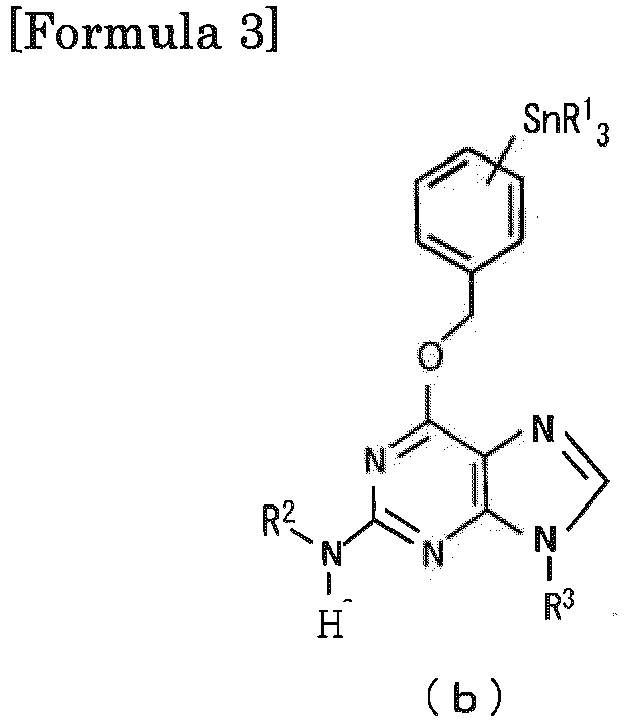
- In the coupling step of this production method, the phosphine ligand is sterically coordinated to the palladium complex in an unsaturated manner to create an active reaction field. Methyl iodide labeled with 11C is oxidatively added to the palladium complex to which the phosphine ligand is coordinated, whereby a palladium complex in which the phosphine ligand is coordinated to [11C] CH3 PdI is formed.
- On the other hand, the organotin compound (b) becomes an organic copper compound rich in nucleophilicity through a metal exchange reaction with cuprous halide.
- Then, the palladium complex in which the phosphine ligand is coordinated to [11C] CH3 PdI and the organic copper compound undergo a substitution reaction, further the reductive elimination takes place, and the coupling reaction of [11C] CH3 is completed.
- R2 and R3 are eliminated by a base in the desorption step, and the target 11C-labeled O6 -benzylguanine (a) is produced.
- The substituents R2 and R3 are not particularly limited as long as they are leaving groups which can be eliminated with a base. For example, R2 includes a trifluoroacetyl group, a tert-butoxycarbonyl group, a trityl group and the like, and particularly preferred is a trifluoroacetyl group. For example, R3 include a tert-butoxycarbonyl group, a trifluoroacetyl group, a benzyloxycarbonyl group, a trityl group and the like, and a tert-butoxycarbonyl group is particularly preferable.
- As a solvent in the coupling step, an aprotic lactam is used. the aprotic lactam refers to a cyclic amide (ie, a lactam) which does not have a hydrogen directly bonded to nitrogen. The preferred aprotic lactam is N-alkyl-2-pyrrolidinone, and the alkyl group preferably has 1 to 6 carbon atoms, more preferably 1 to 3 carbon atoms.
- It is also preferable to add at least one of a carbonate salt, a fluoride of an alkali metal, and an alkali metal salt of ascorbic acid in the coupling step. In this case, trialkyltin halide produced as a by-product in the coupling step reacts with at least one of a carbonate, a fluoride of an alkali metal, and an alkali metal salt of ascorbic acid and is excluded from the reaction system by neutralization or precipitation (in the case of carbonate, it precipitates as trialkylstannyl carbonate, in the case of alkali metal fluoride, it precipitates as trialkylstannyl fluoride, in the case of the alkali metal salt of ascorbic acid, it precipitates as ascorbic acid). Therefore, the metal exchange reaction from Sn to Cu is promoted, and the yield can also be increased.
- The 11C-labeled O6 -benzylguanine obtained by the production method of the present invention has sufficient radioactivity to obtain a PET image and can be used as a PET probe. In the 11C-labeled O6 -benzylguanine produced by the production method according to the present invention, the 11C -labeled benzyl moiety is irreversibly bonded to MGMT and the MGMT concentration is quantified from the radioactivity concentration (SUV value corrected by dose and body weight) of the target site obtained from PET imaging. Further, in the method for producing 11C-labeled O6 -benzylguanine of the present invention, since the 11C -labeled position is metabolically stable, a PET probe having high reproducibility and high quality is provided. In addition, since the deprotection step after the coupling step proceeds quickly and easily, it is possible to carry out label synthesis by using a general radiopharmaceutical automatic synthesizer.
- On the contrary, in
Non-Patent Document 3, 18F-labeled O6 -benzyl Guanine is synthesized by carrying out multistage synthesis of benzylation of 6-chloro-2-amino-9H-purine (or 2-amino-6-trimethylamino-9H-purine hydrochloride) with [18F] fluorobenzyl alcohol reduced from 18F-labeled benzaldehyde as a pro- setting group. Since this reaction involves a complicated operation, it is difficult to perform the reaction using a general automatic synthesizer. - In Non-Patent Document 4, 11C-labeled O6 -benzylguanine in which the benzene ring is labeled with [11C] methoxy group is synthesized by O-[11C] methylation reaction of O6 - (hydroxymethyl) benzylguanine with highly reactive [11C] methyl triflate. In this reaction, [11C] methylated form of the guanine moiety due to [11C] methylation (N- [11C] methylation) of a highly nucleophilic amine is by-produced, so the yield of the target label is low.
-
- [
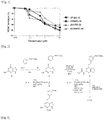
Fig. 1] Fig. 1 is a graph showing the MGMT inhibitory effect of the compounds (1) to (4). - [
Fig. 2] Fig. 2 is a diagram showing a synthetic route of methylation oforganotin compound 5 having no protecting group for amino group and organotin compound 6 having amino group protected with trifluoro group by [11C] CH3 I. - [
Fig. 3] Fig. 3 is a labeling synthesis reaction formula and an HPLC chart in the case where theorganotin compound 5 not protected with an amino group is methylated by [11C] CH3 I. - [
Fig. 4] Fig. 4 is a labeling synthesis reaction formula and an HPLC chart in the case where the organotin compound 6 having the amino group at the 2-position protected with a trifluoroacetyl group is methylated by [11C] CH3 I. - [
Fig. 5] Fig. 5 is a labeling synthesis reaction formula and an HPLC chart in the case where anorganotin compound 7 in which the amino group at the 2-position is protected with a trifluoroacetyl group and the amino group at the 9-position is protected with a tert-butoxycarbonyl (BOC) group is methylated by [11C] CH3 I (An added base is sodium ascorbate). - [
Fig. 6] Fig. 6 is a labeling synthesis reaction formula and an HPLC chart in the case where anorganotin compound 7 in which the amino group at the 2-position is protected with a trifluoroacetyl group and the amino group at the 9-position is protected with a tert-butoxycarbonyl (BOC) group is methylated by [11C] CH3 I (K2CO3 is added as a base). - [
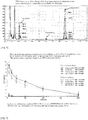
Fig. 7] Fig. 7 is an HPLC chart showing changes in blood concentration after administration of pMeBG (3) to SD rats. - [
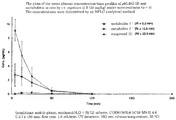
Fig. 8] Fig. 8 is a graph showing the time course of the average plasma concentration of mMeBG (2) and its metabolites after administration ofCompound 2 to rats. - [
Fig. 9] Fig. 9 is a graph showing the time course of the mean plasma concentration of pMeBG (3) and its metabolites after administration ofCompound 3 to rats. - Study on methylation of O6 -benzylguanine

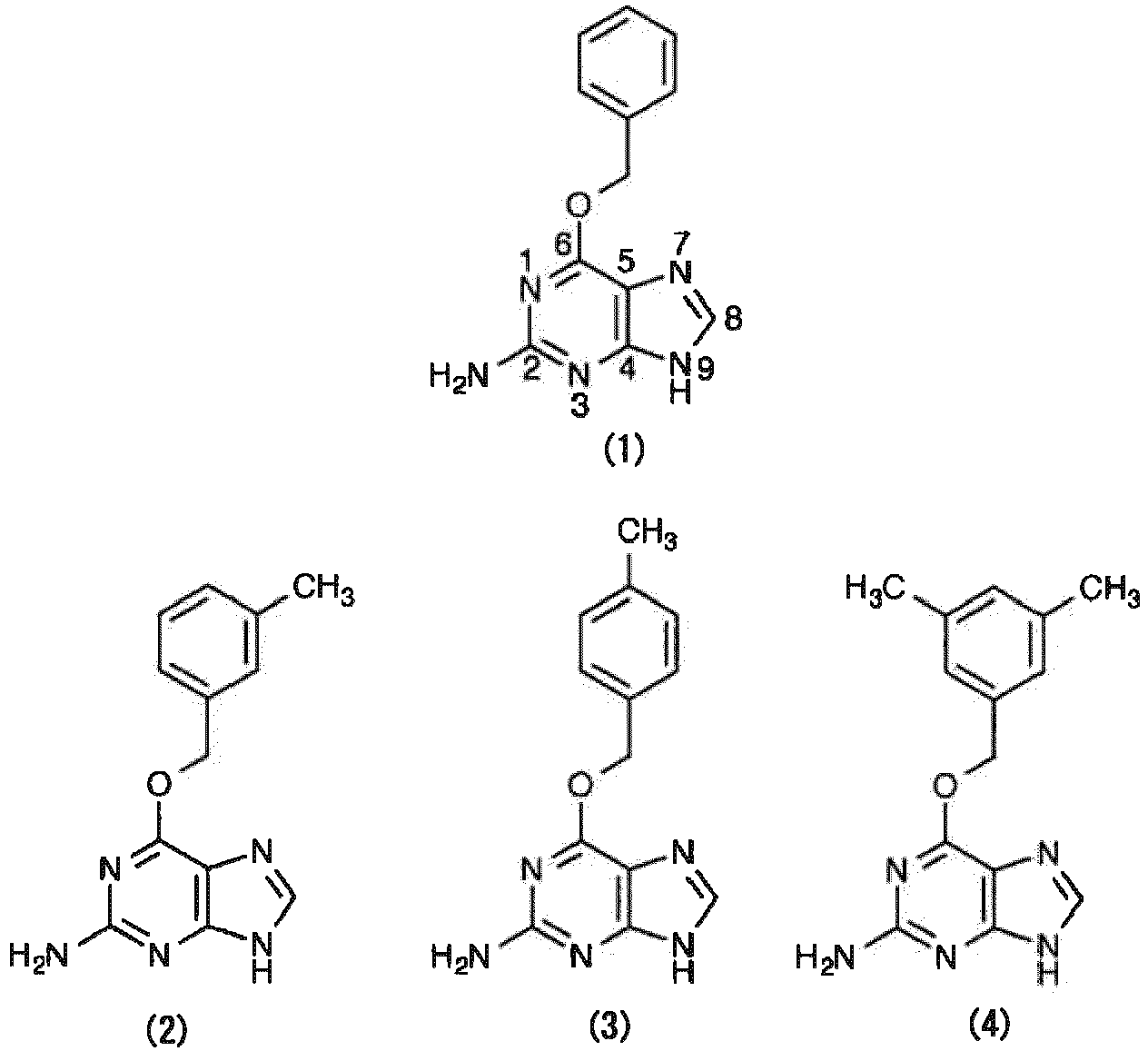
- The introduction position of the [11C] methyl group of the benzene ring present in the above-mentioned O6 -benzylguanine (1) was investigated. For this purpose, unlabeled O6 - (3 - methylbenzyl) guanine (2), O6 - (4 - methylbenzyl) guanine (3) and O6 - (3,5 - dimethylbenzyl) guanine (4) were synthesized by reaction of corresponding alcohols with 2-amino-6-chloropurine according to the method described in the following literature of Liu et al. Then, the inhibitory activity of these MGMTs was investigated.
X. Liu, Q.-H. Zheng, G. D. Hutchins, X. Fei, L. C. Erickson, K. D. Miller, B. H. Mock, B. E. Glick-Wilsob, W. L. Winkel, K. L. Stone, K. A. Carlson, Synth. Commun. 2003, 33, 941-952. - The enzyme inhibitory activity against MGMT of O 6 - (3 - methylbenzyl) guanine (2), O 6 - (4 - methylbenzyl) guanine (3) and O 6 - (3,5 - dimethylbenzyl) guanine (4), were investigated using fluorescent quantitatively labeled oligonucleotide substrates with DNA damage specific to MGMT for quantification. As a result, these three compounds all had MGMT inhibitory effect similar to O6 -benzylguanine (1), particularly O6 - (3 - methylbenzyl) guanine (2) and O6 - (4 - methylbenzyl) guanine 3) had a slightly higher inhibitory activity than O6 - BG (1) (see
FIG. 1 ). Based on this result, the inventors used O6 - (3 - methylbenzyl) guanine (2) as a target for labeling by 11C. - Specifically, we decided to utilize the sp3-sp2 (heteroaromatic ring) type cross-coupling reaction between [11C] CH3 I and the heteroaromatic ring organotin compound using the Pd0 catalyst we have already developed (Patent document 1). In consideration of the effect of using bulky phosphine ligand in excess on the Pd0 complex, the effect of using an aprotic polar solvent, and the effect of addition of copper ions and base to prevent progress of tinning reaction by acidic protons, the reaction was carried out under the condition of [Pd2 (dba)3] / P (o - CH3C6H4)3 / CuCl / K2CO3 / NMP solvent. However, almost no desired 11C-labeled O6 -benzylguanine was obtained (see
Route 1 inFIG. 2 and FIG. 3 ). Therefore, a two-step synthesis method was tried in which the amino group contained in the guanine structure was protected with trifluoroacetate with trifluoroacetic anhydride and deprotection reaction was carried out after the reaction. Then, introduction of the protecting group occurred only at the 2-amino group of O6 -benzylguanine, and an organotin compound 6 was obtained. This compound was subjected to [11C] CH3 conversion under the same conditions and deprotected with lithium hydroxide, whereby O6 - (3 - methylbenzyl) guanine (2) labeled with 11C was obtained with 72% HPLC analysis yield (See Route 2 inFIG. 2 andFIG. 4 ). - Furthermore, an
organotin compound 7 in which the amino group at the 2-position of O6 -benzylguanine was protected with a TFA group and the amino group at the 9-position was protected with a tert-butoxycarbonyl (BOC) group was prepared and deprotected with a strong base, O6- (3-methylbenzyl) guanine (2) labeled with the objective 11C-labeled compound was obtained with high HPLC analysis yield of 97 ± 1% (seeFIG. 6 ). The total time for synthesis and purification in this case is 47 minutes, the total radiation is 1.34 GBq, the specific activity is 95-99 GBq / mmol, the disintegration-corrected yield is 19%, the chemical purity is 99% or more, the radiochemical purity is 99% or more, which was found to be sufficiently usable as a PET probe.
Hereinafter, embodiments of the present invention will be described in detail. - 1H, 13C, 19F NMR was measured by ECS 400 manufactured by JEOL Ltd. The chemical shift was set to 0.00 ppm when TMS was used as a standard, this was set to 7.26 for 1H NMR and 77.0 for 13C NMR when CHCl3 was used as a standard, and was set at -76.55 ppm for 19F NMR with CF3COOH as a standard. Also, the abbreviations s, d, t, q and m represent singlet, doublet, triplet, quartet, and multiplet, respectively. For high resolution mass spectrometry (HRMS), PE Biosystems, Mariner system or JEOL JMS-700/GI was used. All [11C] methylation reactions were performed remotely in a draft shielded with lead. [11C] CO2 was produced by a 14N (p, a) 11C nuclear reaction using a CYPRIS HM-18 cyclotron (manufactured by Sumitomo Heavy Industries, Ltd.). Heating, dilution of the reaction mixture, injection of sample into HPLC, collection and concentration of fractions were carried out by a radiopharmaceutical automatic synthesizer to obtain 11C-labeled compound. Radioactivity was quantified with ATOMLAB ™ 500 dose calibrator (Biodex Medical Systems, Inc.). The synthesized [11C] methylated compound was analyzed by Shimadzu HPLC system combining bias supply 925-SCINT (AMETEK Co., Ltd.) and linear count rate meter 7131-1 (Ohyo Koken Kogyo Co., Ltd.). The Shimadzu HPLC system consists of system controller (SPD - 10 Avp), online degasser (DGU - 12 A), solvent delivery unit (LC - 10 ATvp), column oven (CTO - 10 A), photodiode array detector (SCL - 10 Avp) and software (LC-solution).
-

- 3-(Tributylstannyl)benzyl alcohol (8.5 g, 21 mmol) was placed in a 30 mL round bottom flask and heated to 130 ° C. Then, under a nitrogen stream, sodium (197 mg, 8.6 mmol) was added. After confirming that all the sodium was dissolved, the temperature was lowered to 115 ° C. and 2-amino-6-chloropurine (8, 1.2 g, 7.1 mmol) was added under an argon stream. And the mixture was stirred at the same temperature overnight. The obtained solution was cooled to room temperature, the undissolved solid was removed by filtration, the filtrate was concentrated under reduced pressure, and the resulting material was subjected to silica gel column chromatography using a mixed solution of dichloromethane: methanol = 9: 1 as an eluent, 51.15 g (2.17 mmol, 30.4%) of the compound was obtained as a pale yellow solid.
δ H(400 MHz; CDCl3) 0.86 (9H, t, J = 7.4 Hz, CH 3), 0.95-1.11 (6H, m, CH 2), 1.26-1.35 (6H, m, CH 2), 1.48-1.56 (6H, m, CH 2), 5.02 (2H, s, NH 2), 5.54 (2H, s, CH 2), 7.28-7.64 (4H, m, Ph), 7.70 (1H, s, NCH), 11.4-12.3 (1H, brs, NH); δ C (100 MHz; CDCl3) 9.6 (3C), 13.7 (3C), 27.4 (3C), 29.1 (3C), 68.7, 128.0, 128.3, 128.7, 135.5, 136.4, 136.5, 142.3, 159.2). -

- Triethylamine (53 µL, 37 mg, 0.38 mmol) was added to a solution (5 mL) of Compound 5 (192 mg, 0.363 mmol) in dry dichloromethane, and the mixture was cooled to 0 °C. Trifluoroacetic anhydride (53 µL, 80 mg, 0.38 mmol) was added to the mixture and the mixture was stirred for 2 hours. The reaction mixture solution was poured into 10 ml of water and extracted three times with 10 ml of dichloromethane and then the organic layer was combined and washed with 15 ml of water and 15 ml of brine and dried with anhydrous sodium sulfate. After filtration, concentration was carried out. The obtained crude product was purified by column chromatography (silica gel (50 g), dichloromethane : methanol = 20: 1), Compound 6 (125 mg, 0.201 mmol, 55.3%) was obtained.
δ H (400 MHz; CDCl3) 0.87 (9H, t, J = 7.4 Hz, CH 3), 0.97-1.11 (6H, m, CH 2), 1.25-1.34 (6H, m, CH 2), 1.48-1.56 (6H, m, CH 2), 5.66 (2H, s, CH 2), 7.33-7.56 (4H, m, Ph), 8.33 (1H, s, NCH), 8.62 (1H, s, NHCOCF3), 12.7 (1H, s, NH);
δ C (100 MHz; CDCl3) 9.5 (3C), 13.6 (3C), 27.3 (3C), 27.9 (3C), 29.0 (3C), 70.1, 87.6, 120.1, 128.0, 128.9, 134.5, 136.7, 137.0, 141.0, 142.5, 145.8, 151.3, 152.0, 153.5 (q, 1 J(13C-19F) = 38.3 Hz), Ph 161.4, 153.171.1; δ F (MHz; CDCl3) -76.80 (s, CF3). -

- O 6- (3-Bromobenzyl) guanine (10, 1.41 g, 4.42 mmol) was added to a solution of potassium tert-butoxide (496 mg, 4.42 mmol) in ethanol (5 mL) at 0 °C under an argon stream. After 30 minutes, ethanol was removed under reduced pressure. The residue was dissolved in DMF (5 mL) and brought to 0 C, and a solution DMF (2 mL) of (Boc)2 O (978 µL, 964 mg, 4.42 mmol) was added. The mixture was stirred overnight at room temperature, quenched with water and extracted with ethyl acetate. The crude product was purified by column chromatography (silica gel (50 g), dichloromethane : methanol = 20: 1), Compound 11 (125 mg, 0.201 mmol, 55.3%) as a pale yellow solid was obtained.
δ H (400 MHz; CDCl3) 1.67 (9H, s, CH3), 5.16 (2H, s, NH2), 5.51 (2H, s, CH2), 7.23 (1H, t, J = 8.8 Hz, Ph), 7.41 (1H, d, J = 8.8 Hz, Ph), 7.47 (1H, d, J = 8.8 Hz, Ph), 7.64 (1H, s, Ph), 8.01 (1H, s, NCH); δ c (100 MHz; CDCl3) 28.0 (3C), 67.2, 86.3, 115.9, 122.5, 130.0, 131.2 (2C), 137.8, 138.4, 146.1, 153.9, 160.5, 161.0. -

- Compound 11 (576 mg, 1.36 mmol), hexabutyl distannane (2.0 mL, 2.4 g, 4.1 mmol), tetrakis (triphenylphosphine) palladium (0) (157 mg, 0.136 mmol) was added to a dried 50 ml Schlenk tube in an argon atmosphere, and freshly distilled 1,4-dioxane (10 mL) was added. The mixture was heated to 80 °C, stirred overnight, then cooled to room temperature and a palladium component was removed by passing the reaction through celite. The filtrate was concentrated in vacuo and the residue was purified by silica gel column chromatography using an eluent of hexane: ethyl acetate = 3: 1, 629 mg (73% yield) of Compound 12 as a pale yellow solid was obtained.
δ H (400 MHz; CDCl3) 0.87 (9H, t, J = 7.4 Hz, CH3), 0.98-1.11 (6H, m, CH2), 1.27-1.36 (6H, m, CH2), 1.49-1.57 (6H, m, CH2), 1.66 (9H, s, CH3), 5.14 (2H, s, NH2), 5.55 (2H, s, CH2), 7.32 (1H, t, J = 7.3 Hz, Ph), 7.41 (1H, d, J = 7.3 Hz, Ph), 7.45 (1H, d, J = 7.3 Hz, Ph), 7.54 (1H, s, Ph), 8.00 (1H, s, NCH);
δ C (100 MHz; CDCl3) 9.6 (3C), 13.6 (3C), 27.3 (3C), 28.0 (3C), 29.0 (3C), 68.7, 86.2, 116.0, 127.9, 128.4, 135.3, 136.3, 136.6, 137.5, 142.2, 146.2, 153.8, 160.5, 161.4. -


- Trimethylamine (153 µL, 101 mg, 962 µmol) was added to a dry dichloromethane (5 mL) solution of Compound 12 (629 mg, 0.998 mmol), after cooling the mixed solution to 0 °C, trifluoroacetic anhydride (153 µL, 231 mg, 1.10 mmol) was added and the mixture was stirred for 2 hours. The reaction solution was poured into about 10 ml of water and extracted with dichloromethane (15 ml × 3). The organic layers were combined, washed with water (15 mL) and brine (15 mL), and then dried over anhydrous sodium sulfate. The crude product obtained by filtration and concentration of the solution was purified by column chromatography (silica gel (5 g), hexane / acetone = 3: 1), Compound 7 (330 mg, 0.454 mmol, 45.5%) as a colorless solid was obtained.
δH (400 MHz; CDCl3) 0.87 (9H, t, J = 7.4 Hz, CH3), 0.98-1.11 (6H, m, CH2), 1.26-1.34 (6H, m, CH2), 1.48-1.54 (6H, m, CH2), 1.71 (9H, s, CH3), 5.69 (2H, s, CH2), 7.33 (1H, t, J = 7.3 Hz, Ph), 7.43 (1H, d, J = 7.3 Hz, Ph), 7.53 (1H, d, J = 7.3 Hz, Ph), 7.63 (1H, s, Ph), 8.31 (1H, s, NCH), 8.61 (1H, s, NH); δC (100 MHz; CDCl3) 9.5 (3C), 13.6 (3C), 27.3 (3C), 27.9 (3C), 29.0 (3C), 70.1, 87.6, 120.1, 128.0, 128.9, 134.5, 136.7, 137.0, 141.0, 142.5, 145.8, 151.3, 152.0, 153.5 (q, 1 J(13C-19F) = 38.3 Hz), Ph 161.4, 153.171.1; δF (MHz; CDCl3) -76.75 (s, CF3).
HRMS (ESI) m/z :
[M + H]+ calcd for C31H45F3N5O4 120Sn 728.2446; found 728.2464
[M + Na]+ calcd for C31H45F3N5O4 120Sn 750.2265; found 750.2267 -


- [Pd2(dba)3] (1.0 mg, 1.1 µmol), P(o-tolyl)3 (5.4 mg, 18 µmol), CuCl (0.4 mg, 4 pmol),and K2CO3 (0.8 mg, 5 µmol) were added to a 1 mL Schlenk tube filled with dried argon gas. A NMP (300 pL) solution of organotin compound 7 (8.7 mg, 12 µmol) was introduced into a Schlenk tube cooled to -10 °C through a stainless steel cannula. Further, after adding a methyl iodide solution (12 µL, 0.10 M in DMF, 1.2 µmol), the mixture was reacted at 80 °C for 4 minutes. Then, a 1.0 M LiOH aqueous solution (600 µL) was added and after stirring at 80 °C for 3 minutes, the reaction solution was quickly cooled in an ice bath. The mixture obtained was introduced into a short column of silica gel (1 g), eluted with acetonitrile (2 mL), and a naphthalene solution (0.10 M DMF, 10 µL, 1.0 µmol) was added as an internal standard. The solution obtained was analyzed by HPLC (mobile phase, acetonitrile / 20 mM sodium dihydrogenphosphate = 40: 60; column, CAPCELL
PAK C18 MG 5 µm, 4.6 (id) × 250mm flow rate 1 mL / min UV detection 280 nm Retention time 3.4 min). As a result, the yield ofCompound 2 was 100%. Identification ofcompound 2, using organotin compound 7 (8.7 mg, 12 µmol) and methyl iodide (120 µL, 0.10 M in DMF, 12 µmol) [Pd2(dba)3] /P(o-CH3C6H4)3/CuCl/ K2CO3 (1:16:2:5 molar ratio) and reacted at 80 ° C, was carried out by 1H NMR.
1H NMR (DMSO-d 6) δ = 2.32 (s, 3H, CH3), 5.44 (s, 2H, CH2), 6.26 (s, 2H, NH2), 7.16-7.29 (m, 4H, Ar), 7.82 (s, 1H, guanine H8), 12.51 (broad s, 1H, guanine H9). - A mixture of [Pd2(dba)3] (1.0 mg, 1.1 µmol), P(o-tolyl)3 (3.4 mg, 11 µmol), CuCl (0.4 mg, 4 µmol), K2CO3 (1.4 mg, 11 µmol), and Organotin Compound 7 (0.8 mg, 1.1 µmol) dissolved in NMP (300 pL) was cooled to keep the temperature below -10 °C until [11C]CH3I was prepared. [11C]CH3I was prepared from [11C]CO2 by the conventionally known LiAlH4 method, and in the state where cooling was stopped, [11C]CH3I gas was introduced into the reaction solution containing palladium, and rapidly heated to 100 °C, the reaction solution was bubbled with nitrogen gas for 2 minutes after 2 minutes. After bubbling, the reaction solution was cooled for 10 seconds, 0.5 M LiOH (600 µL) was added to the mixture, and bubbling with nitrogen at 100 °C for 3 minutes was performed. Then the reaction solution was diluted with a CH3CN/H2O (35:65 v/v, 600 pL) solution containing sodium ascorbate (2.2 mg, 11 µmol), then passed through a fine filter F (F 162, Forte Grow Medical co., Ltd.) filled with quartz glass wool (Tosho co., Ltd.) and separated by HPLC (mobile phase, CH3CN / 20 mM sodium phosphate (pH 4.9) 5: 95 and 35: 65 column, CAPCELL PAK C 18
MG 120 20 (id) × 250mm flow rate 10 ml / min UV detection 280 nm retention time 21 min). From the peak area in radio-HPLC, the HPLC analysis yield was 97 ± 1% (n = 3) (seeFIG. 6 ). The fraction containing the desired product was placed in a flask and the organic solvent was removed under reduced pressure. The residue was dissolved in physiological saline (3.0 mL) in which 0.25% polysorbate was dissolved, and a formulation for intravenous administration was prepared. Total synthesis time from completion of irradiation to preparation of injection containing purification by preparative HPLC totaled 47 minutes. After completion of the synthesis, the radioactivity was 1.76 ± 0.42 GBq (n = 2), and the specific activity was 95 to 99 GBq / µmol (n = 2). The disintegration-corrected yield calculated on the trapped [11C]CH3I was 20 ± 1% (n = 2). 11C labeledCompound 2 was confirmed by co-injection ofunlabeled Compound 2 on HPLC (mobile phase, CH3CN and 20 mM sodium phosphate = 40: 60,CAPCELL PAK C 120, 20 (id) × 250mm flow rate 1 ml / min, UV detection 280 nm, retention time 6.1 min). The chemical purity measured at 280 nm wavelength was> 92% and the radiochemical purity was> 97%. Higher radioactive formulations tended to have lower radiochemical purity. - A mixture of [Pd2(dba)3] (1.0 mg, 1.1 µmol), P(o-tolyl)3 (3.4 mg, 11 µmol), CuCl (0.4 mg, 4 µmol), sodium ascorbate (2.2 mg, 11 µmol), and Organotin Compound 7 (0.8 mg, 1.1 µmol) dissolved in NMP (300 pL) was cooled to keep the temperature below -10 °C until [11C]CH3I was prepared. [11C]CH3I gas was introduced into the reaction solution and rapidly heated to 100 °C, then bubbled with nitrogen gas for 2 minutes after 2 minutes. After bubbling, the reaction solution was cooled for 10 seconds, 0.5 M LiOH (600 pL) was added to the mixture, and bubbling with nitrogen at 100 °C for 3 minutes was performed. Then the reaction solution was diluted with a CH3CN/H2O (35:65 v/v, 600 pL) solution containing sodium ascorbate (2.2 mg, 11 µmol), then passed through a fine filter F (F 162, Forte Grow Medical co., Ltd.) filled with quartz glass wool (Tosho co., Ltd.) and separated by HPLC (mobile phase, CH3CN / 20 mM sodium phosphate (pH 4.9) 5: 95 and 35: 65 column, CAPCELL PAK C 18
MG 120 20 (id) × 250mm flow rate 10 ml / min UV detection 280 nm retention time 21 min). From the peak area in radio-HPLC, the HPLC analysis yield was 86 ± 9% (n = 3) (seeFIG. 5 ). The fraction containing the desired product was placed in a flask and the organic solvent was removed under reduced pressure. The residue was dissolved in physiological saline (3.0 mL) in which 0.25% polysorbate was dissolved, and a formulation for intravenous administration was prepared. Total synthesis time from completion of irradiation to preparation of injection containing purification by preparative HPLC totaled 48 to 51 minutes. After completion of the synthesis, the radioactivity was 0.92 ± 0.32 GBq (n = 3), and the specific activity was 74 to 76 GBq / µmol (n = 3). The disintegration-corrected yield calculated on the trapped [11C]CH3I was 15 ± 8% (n = 3). 11C labeledCompound 2 was confirmed by co-injection ofunlabeled Compound 2 on HPLC (mobile phase, CH3CN and 20 mM sodium phosphate = 40: 60,CAPCELL PAK C 120, 20 (id) × 250mm flow rate 1 ml / min, UV detection 280 nm, retention time 6.1 min). The chemical purity measured at 280 nm wavelength was> 97% and the radiochemical purity was> 93%. - In the 11C-labeled O6 -benzylguanine of the above example, a methyl group labeled with 11C was bonded to the meta position of the benzene ring, but it is also possible to bind a methyl group labeled with 11C to the ortho position or the para position of the benzene ring by changing the bonding position of the organotin substituent in the organotin compound as a raw material.
- Regarding O6 - (3 - methylbenzyl) guanine (2) and O6 - (4 - methylbenzyl) guanine (3) not labeled with 11C synthesized by the above method (that is, cold), brain permeability was evaluated by the following method.
- After intravenous administration (10 mg / kg) of O6 - (3 - methylbenzyl) guanine (2) or O6 - (4 - methylbenzyl) guanine (3) to Sprague - Dawley rats, blood and brain tissues were collected after a predetermined time, and analyzed by HPLC. The results are shown in Table 1 and
Figures 1 to 3 .[Table 1] Concentration in the brain and brain / plasma ratio after intravenous administration (10 mg/kg) of mMeBG (2) (or pMeBG (3)) to rats Time a Conc. HPLC b Brain Weight Conc. brain c Conc. Plasm++a d Brain / Plasma ratio h min µg/mL g µg/mL µg/mL mMeBG (2) Under anaesthesia, fasting 30 0.507 1.860 1.325 4.450 e 0.298 0.568 Avc. S.D. 1.940 Avc. S.D. 1.495 Avc. S.D. 4.450 0.336 Avc. S.D. 0.464 0.513 0.052 1.835 1.845 0.013 1.223 1.348 0.137 4.450 0.275 0.303 0.031 Under nonanaes thesia, fasting 30 0.536 1.861 1.400 5.192 f 0.270 0.635 1.909 1.634 5.192 0.315 0.474 1.677 1.323 5.192 0.255 0.481 1.785 1.291 5.192 0.249 0.454 Avc. S.D. 1.854 Avc. S.D. 1.188 Avc. S.D. 5.192 0.229 Ave. S.D. 0.555 0.523 0.067 1.888 1.829 0.086 1.436 1.379 0.152 5.192 0.277 0.265 0.029 Under anaesthesia, nonfastin g 30 0.784 2.121 1.893 4.450 e 0.425 0.684 Ave. S.D. 1.885 Ave. S.D. 1.772 Ave. S.D. 4.450 0.398 Ave. S.D. 0.522 0.663 0.132 1.970 1.992 0.120 1.318 1.661 0.303 4.450 0.296 0.373 0.068 pMeBG (3) Under anaesthesia, fasting 44 0.118 2.020 0.470 2.481 g 0.189 32 0.231 1.900 0.959 2481 0.386 Abbreviations: average (Ave.), standard deviation (S.D.)
a Time is blood removal time after i.v. administration.
b Conc. HPLC is concentration (micro g/mL) of compound in brain homogenate determined by HPLC analysis.
c Conc. brain (micro g/mL) was calculated from [conc. HPLC (micro g/mL)] x [volume of brain homogenate (mL)]/[brain weight (g)]. Here, the specific gravity of brain is set to 1, and micro g/g is converted to micro g/mL.
d Plasma sample was collected from another rat different from brain sample.
e Average (n = 5) of theplasma concentration 30 min after i.v. administration (10 mg/kg) of 2 in rat under anaesthesia and fasting.
f Average (n = 3) of theplasma concentration 30 min after i.v. administration (10 mg/kg) of 2 in rat under nonanaesthesia and fasting.
g Average (n = 3) of theplasma concentration 30 min after i.v. administration (10 mg/kg) of 3 in rat under anaesthesia and fasting.
h Brain/Plasma ratio was calculated from [conc. brain (micro g/mL)]/[conc. plasma (micro g/mL)]. - The results of collecting samples of brain tissue and
blood 30 minutes after administration of Compound (2) (or Compound (3)) are shown in Table 1. The amount of the compound in the brain is calculated from the brain weight and the brain concentration in Table 1, from the ratio of the amount of the compound in the brain to the dose, the concentration of the compound in the brain of the compound (2) and the compound (3) were calculated to be 0.1% based on the total dose. In addition, the ratio to the concentration in the plasma was 0.3. From the above results, it was evaluated that the compound (2) and the compound (3) are substances having blood-brain barrier permeability. - Compound (2) and compound (3) stably exist in the plasma, but as shown in
FIG. 7 andFIG. 9 , compound (3) is quickly metabolized to unknown, more polar compounds within 240 minutes after intravenous administration to rats, as shown inFIG. 8 , it was found that the compound (2) was more stable than the compound (3) and was present for a long time. - it was clarified by the above body pharmacokinetics test that O6-(3-methylbenzyl)guanine (2) and O6-(4-methylbenzyl)guanine (3) are substances with blood-brain barrier permeability and are accumulated in the brain. Since these compounds have the property of binding to MGMT in the brain, O6-benzylguanine produced by the production method according to the present invention labeled with 11C of these compounds is useful as a PET probe, and it became possible to image MGMT in the brain.
- Since the 11C-labeled O6 -benzylguanine produced by the production method according to the present invention can be used for imaging of MGMT using a PET apparatus, it can be used for research on in vivo dynamics of MGMT, cancer diagnosis in brain cancer, and the like.
Claims (5)
- A method for producing a 11C-labeled O6 -benzylguanine represented by the following chemical formula (a)
 a coupling step of cross-coupling a methyl iodide labeled with 11C and the following organotin compound (b), wherein R1 represents an alkyl group, and R2 and R3 represent a leaving group which can be eliminated with a base, in the presence of a palladium complex, a phosphine ligand, and cuprous halide in an aprotic lactam, anda desorption step of desorbing the leaving groups R2 and R3 of the coupling product obtained by the coupling step with a base.
- The method for producing the 11C-labeled O6 -benzylguanine according to claim 1,
wherein SnR13 is bonded to a meta position of a benzene ring. - The method for producing the 11C-labeled O6 -benzylguanine according to either claim 1 or claim 2,
wherein R2 is a trifluoroacetyl group and R3 is a tert-butoxycarbonyl group. - The method for producing the 11C-labeled O6 -benzylguanine according to any one of claims 1 to 3,
wherein the aprotic lactam is N-alkyl-2-pyrrolidinone. - The method for producing the 11C-labeled O6 -benzylguanine according to any one of claims 1 to 4,
wherein in the coupling step, at least one of a carbonate salt, a fluoride of an alkali metal and an alkali metal salt of ascorbic acid is added.
Applications Claiming Priority (2)
| Application Number | Priority Date | Filing Date | Title |
|---|---|---|---|
| JP2016134187 | 2016-07-06 | ||
| PCT/JP2017/020728 WO2018008311A1 (en) | 2016-07-06 | 2017-06-03 | 11c-labelled o6-benzylguanine, positron emission tomography (pet) probe capable of visualizing o6-methyl guanine methyl-transferase activity, and production methods therefor |
Publications (3)
| Publication Number | Publication Date |
|---|---|
| EP3483160A1 EP3483160A1 (en) | 2019-05-15 |
| EP3483160A4 EP3483160A4 (en) | 2020-01-01 |
| EP3483160B1 true EP3483160B1 (en) | 2020-11-18 |
Family
ID=60912579
Family Applications (1)
| Application Number | Title | Priority Date | Filing Date |
|---|---|---|---|
| EP17823918.2A Active EP3483160B1 (en) | 2016-07-06 | 2017-06-03 | Method for producing a 11c-labelled o6-benzylguanine |
Country Status (5)
| Country | Link |
|---|---|
| US (1) | US10981913B2 (en) |
| EP (1) | EP3483160B1 (en) |
| JP (1) | JP6754923B2 (en) |
| CN (1) | CN109415364A (en) |
| WO (1) | WO2018008311A1 (en) |
Families Citing this family (2)
| Publication number | Priority date | Publication date | Assignee | Title |
|---|---|---|---|---|
| JP7655479B2 (en) * | 2020-11-20 | 2025-04-02 | 国立研究開発法人国立長寿医療研究センター | [11C]-labeled acyclic retinoids, central nervous system activators and methods for their preparation. |
| WO2025211076A1 (en) * | 2024-04-01 | 2025-10-09 | 国立研究開発法人量子科学技術研究開発機構 | Method for producing compound for pet probe and method for producing intermediate thereof |
Family Cites Families (1)
| Publication number | Priority date | Publication date | Assignee | Title |
|---|---|---|---|---|
| JP5696281B2 (en) | 2008-12-26 | 2015-04-08 | 独立行政法人理化学研究所 | Fast methylation method of heteroaromatic aryl and method for producing tracer for PET |
-
2017
- 2017-06-03 EP EP17823918.2A patent/EP3483160B1/en active Active
- 2017-06-03 CN CN201780041589.1A patent/CN109415364A/en active Pending
- 2017-06-03 WO PCT/JP2017/020728 patent/WO2018008311A1/en not_active Ceased
- 2017-06-03 US US16/315,437 patent/US10981913B2/en not_active Expired - Fee Related
- 2017-06-03 JP JP2018525981A patent/JP6754923B2/en not_active Expired - Fee Related
Non-Patent Citations (1)
| Title |
|---|
| None * |
Also Published As
| Publication number | Publication date |
|---|---|
| US10981913B2 (en) | 2021-04-20 |
| EP3483160A4 (en) | 2020-01-01 |
| EP3483160A1 (en) | 2019-05-15 |
| US20190308974A1 (en) | 2019-10-10 |
| JP6754923B2 (en) | 2020-09-16 |
| WO2018008311A1 (en) | 2018-01-11 |
| CN109415364A (en) | 2019-03-01 |
| JPWO2018008311A1 (en) | 2019-04-18 |
Similar Documents
| Publication | Publication Date | Title |
|---|---|---|
| US20210386873A1 (en) | Precursor compound of radioactive halogen-labeled organic compound | |
| EP2230229B1 (en) | Process for production of radioactive-fluorine-labeled organic compound | |
| EP3687980B1 (en) | Radiolabeled darapladib, analogs thereof and their use as imaging compounds | |
| US10981913B2 (en) | 11C -labeled 06 -benzylguanine, pet probe capable of visualizing 06-methyl guanine methyl-transferase activity, and production method of the same | |
| EP1889834B1 (en) | Novel organic compound and method for producing radioactive halogen-labeled organic compound using the same | |
| US20110263849A1 (en) | Method for rapidly methylating heteroaromatic arene and method for producing tracer for use in pet | |
| EP2619172A2 (en) | Novel radiotracer | |
| CN120957982A (en) | Ligands targeting fibroblast activation proteins | |
| CN100506822C (en) | [*F] fluoraro-marked purine compound, its production and use | |
| US9186424B2 (en) | Aryloxyanilide imaging agents | |
| US20230202944A1 (en) | Methods for Rapid Formation of Chemicals Including Positron Emission Tomography Biomarkers | |
| EP2619171A2 (en) | Novel precursor | |
| Palma et al. | A pyrazolylamine‐phosphonate monoester chelator for the fac‐[M (CO) 3]+ core (M= Re, 99mTc): synthesis, coordination properties and biological assessment | |
| JP4792393B2 (en) | Ligand | |
| CN114276352B (en) | A carbon-11 labeled Larotrectinib compound and its preparation method | |
| JP7531822B2 (en) | Compound or its salt | |
| Franck | Radiofluorinated cyclobutyl group for increased metabolic stability using tyrosine derivatives as model system | |
| HK1196006A (en) | Radiolabelled octreotate analogues as pet tracers |
Legal Events
| Date | Code | Title | Description |
|---|---|---|---|
| STAA | Information on the status of an ep patent application or granted ep patent |
Free format text: STATUS: THE INTERNATIONAL PUBLICATION HAS BEEN MADE |
|
| PUAI | Public reference made under article 153(3) epc to a published international application that has entered the european phase |
Free format text: ORIGINAL CODE: 0009012 |
|
| STAA | Information on the status of an ep patent application or granted ep patent |
Free format text: STATUS: REQUEST FOR EXAMINATION WAS MADE |
|
| 17P | Request for examination filed |
Effective date: 20190111 |
|
| AK | Designated contracting states |
Kind code of ref document: A1 Designated state(s): AL AT BE BG CH CY CZ DE DK EE ES FI FR GB GR HR HU IE IS IT LI LT LU LV MC MK MT NL NO PL PT RO RS SE SI SK SM TR |
|
| AX | Request for extension of the european patent |
Extension state: BA ME |
|
| RIN1 | Information on inventor provided before grant (corrected) |
Inventor name: ITO, KENGO Inventor name: NATSUME, ATSUSHI Inventor name: KOYAMA, HIROKO Inventor name: SUZUKI, MASAAKI Inventor name: IKENUMA, HIROSHI |
|
| DAV | Request for validation of the european patent (deleted) | ||
| DAX | Request for extension of the european patent (deleted) | ||
| A4 | Supplementary search report drawn up and despatched |
Effective date: 20191128 |
|
| RIC1 | Information provided on ipc code assigned before grant |
Ipc: C07B 59/00 20060101ALI20191122BHEP Ipc: A61K 51/00 20060101ALI20191122BHEP Ipc: C07B 61/00 20060101ALI20191122BHEP Ipc: C07D 473/18 20060101AFI20191122BHEP |
|
| STAA | Information on the status of an ep patent application or granted ep patent |
Free format text: STATUS: EXAMINATION IS IN PROGRESS |
|
| 17Q | First examination report despatched |
Effective date: 20200414 |
|
| GRAP | Despatch of communication of intention to grant a patent |
Free format text: ORIGINAL CODE: EPIDOSNIGR1 |
|
| STAA | Information on the status of an ep patent application or granted ep patent |
Free format text: STATUS: GRANT OF PATENT IS INTENDED |
|
| INTG | Intention to grant announced |
Effective date: 20200727 |
|
| RIN1 | Information on inventor provided before grant (corrected) |
Inventor name: ITO, KENGO Inventor name: NATSUME, ATSUSHI Inventor name: IKENUMA, HIROSHI Inventor name: SUZUKI, MASAAKI Inventor name: KOYAMA, HIROKO |
|
| GRAS | Grant fee paid |
Free format text: ORIGINAL CODE: EPIDOSNIGR3 |
|
| GRAA | (expected) grant |
Free format text: ORIGINAL CODE: 0009210 |
|
| STAA | Information on the status of an ep patent application or granted ep patent |
Free format text: STATUS: THE PATENT HAS BEEN GRANTED |
|
| AK | Designated contracting states |
Kind code of ref document: B1 Designated state(s): AL AT BE BG CH CY CZ DE DK EE ES FI FR GB GR HR HU IE IS IT LI LT LU LV MC MK MT NL NO PL PT RO RS SE SI SK SM TR |
|
| REG | Reference to a national code |
Ref country code: GB Ref legal event code: FG4D |
|
| REG | Reference to a national code |
Ref country code: CH Ref legal event code: NV Representative=s name: KELLER SCHNEIDER PATENT- UND MARKENANWAELTE AG, CH Ref country code: CH Ref legal event code: EP |
|
| REG | Reference to a national code |
Ref country code: DE Ref legal event code: R096 Ref document number: 602017027971 Country of ref document: DE |
|
| REG | Reference to a national code |
Ref country code: IE Ref legal event code: FG4D |
|
| REG | Reference to a national code |
Ref country code: AT Ref legal event code: REF Ref document number: 1335629 Country of ref document: AT Kind code of ref document: T Effective date: 20201215 |
|
| REG | Reference to a national code |
Ref country code: AT Ref legal event code: MK05 Ref document number: 1335629 Country of ref document: AT Kind code of ref document: T Effective date: 20201118 |
|
| REG | Reference to a national code |
Ref country code: NL Ref legal event code: MP Effective date: 20201118 |
|
| PG25 | Lapsed in a contracting state [announced via postgrant information from national office to epo] |
Ref country code: GR Free format text: LAPSE BECAUSE OF FAILURE TO SUBMIT A TRANSLATION OF THE DESCRIPTION OR TO PAY THE FEE WITHIN THE PRESCRIBED TIME-LIMIT Effective date: 20210219 Ref country code: NO Free format text: LAPSE BECAUSE OF FAILURE TO SUBMIT A TRANSLATION OF THE DESCRIPTION OR TO PAY THE FEE WITHIN THE PRESCRIBED TIME-LIMIT Effective date: 20210218 Ref country code: FI Free format text: LAPSE BECAUSE OF FAILURE TO SUBMIT A TRANSLATION OF THE DESCRIPTION OR TO PAY THE FEE WITHIN THE PRESCRIBED TIME-LIMIT Effective date: 20201118 Ref country code: PT Free format text: LAPSE BECAUSE OF FAILURE TO SUBMIT A TRANSLATION OF THE DESCRIPTION OR TO PAY THE FEE WITHIN THE PRESCRIBED TIME-LIMIT Effective date: 20210318 Ref country code: RS Free format text: LAPSE BECAUSE OF FAILURE TO SUBMIT A TRANSLATION OF THE DESCRIPTION OR TO PAY THE FEE WITHIN THE PRESCRIBED TIME-LIMIT Effective date: 20201118 |
|
| PG25 | Lapsed in a contracting state [announced via postgrant information from national office to epo] |
Ref country code: BG Free format text: LAPSE BECAUSE OF FAILURE TO SUBMIT A TRANSLATION OF THE DESCRIPTION OR TO PAY THE FEE WITHIN THE PRESCRIBED TIME-LIMIT Effective date: 20210218 Ref country code: LV Free format text: LAPSE BECAUSE OF FAILURE TO SUBMIT A TRANSLATION OF THE DESCRIPTION OR TO PAY THE FEE WITHIN THE PRESCRIBED TIME-LIMIT Effective date: 20201118 Ref country code: IS Free format text: LAPSE BECAUSE OF FAILURE TO SUBMIT A TRANSLATION OF THE DESCRIPTION OR TO PAY THE FEE WITHIN THE PRESCRIBED TIME-LIMIT Effective date: 20210318 Ref country code: PL Free format text: LAPSE BECAUSE OF FAILURE TO SUBMIT A TRANSLATION OF THE DESCRIPTION OR TO PAY THE FEE WITHIN THE PRESCRIBED TIME-LIMIT Effective date: 20201118 Ref country code: SE Free format text: LAPSE BECAUSE OF FAILURE TO SUBMIT A TRANSLATION OF THE DESCRIPTION OR TO PAY THE FEE WITHIN THE PRESCRIBED TIME-LIMIT Effective date: 20201118 Ref country code: AT Free format text: LAPSE BECAUSE OF FAILURE TO SUBMIT A TRANSLATION OF THE DESCRIPTION OR TO PAY THE FEE WITHIN THE PRESCRIBED TIME-LIMIT Effective date: 20201118 |
|
| REG | Reference to a national code |
Ref country code: LT Ref legal event code: MG9D |
|
| PG25 | Lapsed in a contracting state [announced via postgrant information from national office to epo] |
Ref country code: HR Free format text: LAPSE BECAUSE OF FAILURE TO SUBMIT A TRANSLATION OF THE DESCRIPTION OR TO PAY THE FEE WITHIN THE PRESCRIBED TIME-LIMIT Effective date: 20201118 |
|
| PG25 | Lapsed in a contracting state [announced via postgrant information from national office to epo] |
Ref country code: LT Free format text: LAPSE BECAUSE OF FAILURE TO SUBMIT A TRANSLATION OF THE DESCRIPTION OR TO PAY THE FEE WITHIN THE PRESCRIBED TIME-LIMIT Effective date: 20201118 Ref country code: CZ Free format text: LAPSE BECAUSE OF FAILURE TO SUBMIT A TRANSLATION OF THE DESCRIPTION OR TO PAY THE FEE WITHIN THE PRESCRIBED TIME-LIMIT Effective date: 20201118 Ref country code: EE Free format text: LAPSE BECAUSE OF FAILURE TO SUBMIT A TRANSLATION OF THE DESCRIPTION OR TO PAY THE FEE WITHIN THE PRESCRIBED TIME-LIMIT Effective date: 20201118 Ref country code: SM Free format text: LAPSE BECAUSE OF FAILURE TO SUBMIT A TRANSLATION OF THE DESCRIPTION OR TO PAY THE FEE WITHIN THE PRESCRIBED TIME-LIMIT Effective date: 20201118 Ref country code: RO Free format text: LAPSE BECAUSE OF FAILURE TO SUBMIT A TRANSLATION OF THE DESCRIPTION OR TO PAY THE FEE WITHIN THE PRESCRIBED TIME-LIMIT Effective date: 20201118 Ref country code: SK Free format text: LAPSE BECAUSE OF FAILURE TO SUBMIT A TRANSLATION OF THE DESCRIPTION OR TO PAY THE FEE WITHIN THE PRESCRIBED TIME-LIMIT Effective date: 20201118 |
|
| REG | Reference to a national code |
Ref country code: DE Ref legal event code: R097 Ref document number: 602017027971 Country of ref document: DE |
|
| PG25 | Lapsed in a contracting state [announced via postgrant information from national office to epo] |
Ref country code: DK Free format text: LAPSE BECAUSE OF FAILURE TO SUBMIT A TRANSLATION OF THE DESCRIPTION OR TO PAY THE FEE WITHIN THE PRESCRIBED TIME-LIMIT Effective date: 20201118 |
|
| PLBE | No opposition filed within time limit |
Free format text: ORIGINAL CODE: 0009261 |
|
| STAA | Information on the status of an ep patent application or granted ep patent |
Free format text: STATUS: NO OPPOSITION FILED WITHIN TIME LIMIT |
|
| 26N | No opposition filed |
Effective date: 20210819 |
|
| PG25 | Lapsed in a contracting state [announced via postgrant information from national office to epo] |
Ref country code: IT Free format text: LAPSE BECAUSE OF FAILURE TO SUBMIT A TRANSLATION OF THE DESCRIPTION OR TO PAY THE FEE WITHIN THE PRESCRIBED TIME-LIMIT Effective date: 20201118 Ref country code: AL Free format text: LAPSE BECAUSE OF FAILURE TO SUBMIT A TRANSLATION OF THE DESCRIPTION OR TO PAY THE FEE WITHIN THE PRESCRIBED TIME-LIMIT Effective date: 20201118 Ref country code: NL Free format text: LAPSE BECAUSE OF FAILURE TO SUBMIT A TRANSLATION OF THE DESCRIPTION OR TO PAY THE FEE WITHIN THE PRESCRIBED TIME-LIMIT Effective date: 20201118 |
|
| PG25 | Lapsed in a contracting state [announced via postgrant information from national office to epo] |
Ref country code: SI Free format text: LAPSE BECAUSE OF FAILURE TO SUBMIT A TRANSLATION OF THE DESCRIPTION OR TO PAY THE FEE WITHIN THE PRESCRIBED TIME-LIMIT Effective date: 20201118 |
|
| PG25 | Lapsed in a contracting state [announced via postgrant information from national office to epo] |
Ref country code: ES Free format text: LAPSE BECAUSE OF FAILURE TO SUBMIT A TRANSLATION OF THE DESCRIPTION OR TO PAY THE FEE WITHIN THE PRESCRIBED TIME-LIMIT Effective date: 20201118 Ref country code: MC Free format text: LAPSE BECAUSE OF FAILURE TO SUBMIT A TRANSLATION OF THE DESCRIPTION OR TO PAY THE FEE WITHIN THE PRESCRIBED TIME-LIMIT Effective date: 20201118 |
|
| REG | Reference to a national code |
Ref country code: BE Ref legal event code: MM Effective date: 20210630 |
|
| PG25 | Lapsed in a contracting state [announced via postgrant information from national office to epo] |
Ref country code: LU Free format text: LAPSE BECAUSE OF NON-PAYMENT OF DUE FEES Effective date: 20210603 |
|
| PG25 | Lapsed in a contracting state [announced via postgrant information from national office to epo] |
Ref country code: IE Free format text: LAPSE BECAUSE OF NON-PAYMENT OF DUE FEES Effective date: 20210603 |
|
| PG25 | Lapsed in a contracting state [announced via postgrant information from national office to epo] |
Ref country code: IS Free format text: LAPSE BECAUSE OF FAILURE TO SUBMIT A TRANSLATION OF THE DESCRIPTION OR TO PAY THE FEE WITHIN THE PRESCRIBED TIME-LIMIT Effective date: 20210318 |
|
| PG25 | Lapsed in a contracting state [announced via postgrant information from national office to epo] |
Ref country code: BE Free format text: LAPSE BECAUSE OF NON-PAYMENT OF DUE FEES Effective date: 20210630 |
|
| PG25 | Lapsed in a contracting state [announced via postgrant information from national office to epo] |
Ref country code: CY Free format text: LAPSE BECAUSE OF FAILURE TO SUBMIT A TRANSLATION OF THE DESCRIPTION OR TO PAY THE FEE WITHIN THE PRESCRIBED TIME-LIMIT Effective date: 20201118 |
|
| PG25 | Lapsed in a contracting state [announced via postgrant information from national office to epo] |
Ref country code: HU Free format text: LAPSE BECAUSE OF FAILURE TO SUBMIT A TRANSLATION OF THE DESCRIPTION OR TO PAY THE FEE WITHIN THE PRESCRIBED TIME-LIMIT; INVALID AB INITIO Effective date: 20170603 |
|
| PGFP | Annual fee paid to national office [announced via postgrant information from national office to epo] |
Ref country code: FR Payment date: 20230630 Year of fee payment: 7 Ref country code: DE Payment date: 20230615 Year of fee payment: 7 |
|
| PGFP | Annual fee paid to national office [announced via postgrant information from national office to epo] |
Ref country code: GB Payment date: 20230629 Year of fee payment: 7 Ref country code: CH Payment date: 20230702 Year of fee payment: 7 |
|
| PG25 | Lapsed in a contracting state [announced via postgrant information from national office to epo] |
Ref country code: MK Free format text: LAPSE BECAUSE OF FAILURE TO SUBMIT A TRANSLATION OF THE DESCRIPTION OR TO PAY THE FEE WITHIN THE PRESCRIBED TIME-LIMIT Effective date: 20201118 |
|
| PG25 | Lapsed in a contracting state [announced via postgrant information from national office to epo] |
Ref country code: MT Free format text: LAPSE BECAUSE OF FAILURE TO SUBMIT A TRANSLATION OF THE DESCRIPTION OR TO PAY THE FEE WITHIN THE PRESCRIBED TIME-LIMIT Effective date: 20201118 |
|
| REG | Reference to a national code |
Ref country code: DE Ref legal event code: R119 Ref document number: 602017027971 Country of ref document: DE |
|
| REG | Reference to a national code |
Ref country code: CH Ref legal event code: PL |
|
| GBPC | Gb: european patent ceased through non-payment of renewal fee |
Effective date: 20240603 |
|
| PG25 | Lapsed in a contracting state [announced via postgrant information from national office to epo] |
Ref country code: DE Free format text: LAPSE BECAUSE OF NON-PAYMENT OF DUE FEES Effective date: 20250101 |
|
| PG25 | Lapsed in a contracting state [announced via postgrant information from national office to epo] |
Ref country code: CH Free format text: LAPSE BECAUSE OF NON-PAYMENT OF DUE FEES Effective date: 20240630 |
|
| PG25 | Lapsed in a contracting state [announced via postgrant information from national office to epo] |
Ref country code: FR Free format text: LAPSE BECAUSE OF NON-PAYMENT OF DUE FEES Effective date: 20240630 |
|
| PG25 | Lapsed in a contracting state [announced via postgrant information from national office to epo] |
Ref country code: GB Free format text: LAPSE BECAUSE OF NON-PAYMENT OF DUE FEES Effective date: 20240603 |
|
| PG25 | Lapsed in a contracting state [announced via postgrant information from national office to epo] |
Ref country code: TR Free format text: LAPSE BECAUSE OF FAILURE TO SUBMIT A TRANSLATION OF THE DESCRIPTION OR TO PAY THE FEE WITHIN THE PRESCRIBED TIME-LIMIT Effective date: 20201118 |