EP3481008A1 - Information processing system, battery module, control method, and program - Google Patents
Information processing system, battery module, control method, and program Download PDFInfo
- Publication number
- EP3481008A1 EP3481008A1 EP17819602.8A EP17819602A EP3481008A1 EP 3481008 A1 EP3481008 A1 EP 3481008A1 EP 17819602 A EP17819602 A EP 17819602A EP 3481008 A1 EP3481008 A1 EP 3481008A1
- Authority
- EP
- European Patent Office
- Prior art keywords
- battery module
- identifier
- notification
- identifier information
- communication network
- Prior art date
- Legal status (The legal status is an assumption and is not a legal conclusion. Google has not performed a legal analysis and makes no representation as to the accuracy of the status listed.)
- Granted
Links
Images







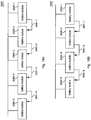
Classifications
-
- H—ELECTRICITY
- H04—ELECTRIC COMMUNICATION TECHNIQUE
- H04L—TRANSMISSION OF DIGITAL INFORMATION, e.g. TELEGRAPHIC COMMUNICATION
- H04L12/00—Data switching networks
- H04L12/28—Data switching networks characterised by path configuration, e.g. LAN [Local Area Networks] or WAN [Wide Area Networks]
- H04L12/40—Bus networks
- H04L12/40169—Flexible bus arrangements
-
- H—ELECTRICITY
- H02—GENERATION; CONVERSION OR DISTRIBUTION OF ELECTRIC POWER
- H02J—ELECTRIC POWER NETWORKS; CIRCUIT ARRANGEMENTS OR SYSTEMS FOR SUPPLYING OR DISTRIBUTING ELECTRIC POWER; SYSTEMS FOR STORING ELECTRIC ENERGY
- H02J7/00—Circuit arrangements for charging or discharging batteries or for supplying loads from batteries
- H02J7/34—Parallel operation in networks using both storage and other DC sources, e.g. providing buffering
-
- H—ELECTRICITY
- H01—ELECTRIC ELEMENTS
- H01M—PROCESSES OR MEANS, e.g. BATTERIES, FOR THE DIRECT CONVERSION OF CHEMICAL ENERGY INTO ELECTRICAL ENERGY
- H01M10/00—Secondary cells; Manufacture thereof
- H01M10/42—Methods or arrangements for servicing or maintenance of secondary cells or secondary half-cells
- H01M10/425—Structural combination with electronic components, e.g. electronic circuits integrated to the outside of the casing
-
- H—ELECTRICITY
- H01—ELECTRIC ELEMENTS
- H01M—PROCESSES OR MEANS, e.g. BATTERIES, FOR THE DIRECT CONVERSION OF CHEMICAL ENERGY INTO ELECTRICAL ENERGY
- H01M10/00—Secondary cells; Manufacture thereof
- H01M10/60—Heating or cooling; Temperature control
- H01M10/63—Control systems
- H01M10/633—Control systems characterised by algorithms, flow charts, software details or the like
-
- H—ELECTRICITY
- H02—GENERATION; CONVERSION OR DISTRIBUTION OF ELECTRIC POWER
- H02J—ELECTRIC POWER NETWORKS; CIRCUIT ARRANGEMENTS OR SYSTEMS FOR SUPPLYING OR DISTRIBUTING ELECTRIC POWER; SYSTEMS FOR STORING ELECTRIC ENERGY
- H02J7/00—Circuit arrangements for charging or discharging batteries or for supplying loads from batteries
- H02J7/40—Circuit arrangements for charging or discharging batteries or for supplying loads from batteries characterised by the exchange of charge or discharge related data
- H02J7/44—Circuit arrangements for charging or discharging batteries or for supplying loads from batteries characterised by the exchange of charge or discharge related data between battery management systems and power sources
-
- H—ELECTRICITY
- H02—GENERATION; CONVERSION OR DISTRIBUTION OF ELECTRIC POWER
- H02J—ELECTRIC POWER NETWORKS; CIRCUIT ARRANGEMENTS OR SYSTEMS FOR SUPPLYING OR DISTRIBUTING ELECTRIC POWER; SYSTEMS FOR STORING ELECTRIC ENERGY
- H02J7/00—Circuit arrangements for charging or discharging batteries or for supplying loads from batteries
- H02J7/50—Circuit arrangements for charging or discharging batteries or for supplying loads from batteries acting upon multiple batteries simultaneously or sequentially
-
- H—ELECTRICITY
- H02—GENERATION; CONVERSION OR DISTRIBUTION OF ELECTRIC POWER
- H02J—ELECTRIC POWER NETWORKS; CIRCUIT ARRANGEMENTS OR SYSTEMS FOR SUPPLYING OR DISTRIBUTING ELECTRIC POWER; SYSTEMS FOR STORING ELECTRIC ENERGY
- H02J7/00—Circuit arrangements for charging or discharging batteries or for supplying loads from batteries
- H02J7/90—Regulation of charging or discharging current or voltage
-
- H—ELECTRICITY
- H01—ELECTRIC ELEMENTS
- H01M—PROCESSES OR MEANS, e.g. BATTERIES, FOR THE DIRECT CONVERSION OF CHEMICAL ENERGY INTO ELECTRICAL ENERGY
- H01M10/00—Secondary cells; Manufacture thereof
- H01M10/42—Methods or arrangements for servicing or maintenance of secondary cells or secondary half-cells
- H01M10/425—Structural combination with electronic components, e.g. electronic circuits integrated to the outside of the casing
- H01M2010/4271—Battery management systems including electronic circuits, e.g. control of current or voltage to keep battery in healthy state, cell balancing
-
- H—ELECTRICITY
- H01—ELECTRIC ELEMENTS
- H01M—PROCESSES OR MEANS, e.g. BATTERIES, FOR THE DIRECT CONVERSION OF CHEMICAL ENERGY INTO ELECTRICAL ENERGY
- H01M10/00—Secondary cells; Manufacture thereof
- H01M10/42—Methods or arrangements for servicing or maintenance of secondary cells or secondary half-cells
- H01M10/425—Structural combination with electronic components, e.g. electronic circuits integrated to the outside of the casing
- H01M2010/4278—Systems for data transfer from batteries, e.g. transfer of battery parameters to a controller, data transferred between battery controller and main controller
-
- H—ELECTRICITY
- H02—GENERATION; CONVERSION OR DISTRIBUTION OF ELECTRIC POWER
- H02J—ELECTRIC POWER NETWORKS; CIRCUIT ARRANGEMENTS OR SYSTEMS FOR SUPPLYING OR DISTRIBUTING ELECTRIC POWER; SYSTEMS FOR STORING ELECTRIC ENERGY
- H02J7/00—Circuit arrangements for charging or discharging batteries or for supplying loads from batteries
- H02J7/40—Circuit arrangements for charging or discharging batteries or for supplying loads from batteries characterised by the exchange of charge or discharge related data
- H02J7/443—Circuit arrangements for charging or discharging batteries or for supplying loads from batteries characterised by the exchange of charge or discharge related data using passive battery identification means, e.g. resistors or capacitors
- H02J7/445—Circuit arrangements for charging or discharging batteries or for supplying loads from batteries characterised by the exchange of charge or discharge related data using passive battery identification means, e.g. resistors or capacitors in response to measured battery parameters, e.g. voltage, current or temperature profile
-
- H—ELECTRICITY
- H04—ELECTRIC COMMUNICATION TECHNIQUE
- H04L—TRANSMISSION OF DIGITAL INFORMATION, e.g. TELEGRAPHIC COMMUNICATION
- H04L12/00—Data switching networks
- H04L12/28—Data switching networks characterised by path configuration, e.g. LAN [Local Area Networks] or WAN [Wide Area Networks]
- H04L12/40—Bus networks
- H04L2012/40208—Bus networks characterized by the use of a particular bus standard
- H04L2012/40215—Controller Area Network CAN
-
- Y—GENERAL TAGGING OF NEW TECHNOLOGICAL DEVELOPMENTS; GENERAL TAGGING OF CROSS-SECTIONAL TECHNOLOGIES SPANNING OVER SEVERAL SECTIONS OF THE IPC; TECHNICAL SUBJECTS COVERED BY FORMER USPC CROSS-REFERENCE ART COLLECTIONS [XRACs] AND DIGESTS
- Y02—TECHNOLOGIES OR APPLICATIONS FOR MITIGATION OR ADAPTATION AGAINST CLIMATE CHANGE
- Y02E—REDUCTION OF GREENHOUSE GAS [GHG] EMISSIONS, RELATED TO ENERGY GENERATION, TRANSMISSION OR DISTRIBUTION
- Y02E60/00—Enabling technologies; Technologies with a potential or indirect contribution to GHG emissions mitigation
- Y02E60/10—Energy storage using batteries
Definitions
- the present invention relates to an information processing system, a battery module, a control method, and a program.
- Storage batteries have been used in various situations.
- a storage battery is used for storing electric power that is acquired by electric power generation using renewable energy such as sunlight.
- the storage battery includes one or more battery modules.
- the battery module includes one or more secondary batteries such as lithium ion batteries.
- the battery module contains a controller for exchanging control information or the like with other battery modules.
- the controller is called a battery management unit (BMU).
- BMU battery management unit
- Communication between battery modules is performed through a communication network such as a controller area network (CAN).
- CAN controller area network
- an identifier is needed in order to identify each battery module.
- One of methods for setting the identifier in the battery module is a method in which a manager or the like of the battery module manually sets the identifier.
- an identifier setting circuit such as a DIP switch is disposed in the battery module. Then, the manager changes the DIP switch or the like of the battery module to a desired setting in order to set a desired identifier.
- Patent Documents 1 to 3 a technique for automatically setting the identifier of the battery module is disclosed.
- battery modules are connected in series.
- each battery module is assigned an identifier corresponding to its position. For example, an identifier of "1" is assigned to the battery module at the head.
- a master battery module decides the identifiers of other battery modules, and those identifiers are assigned to the other battery modules.
- a unique identifier is set in the battery module.
- an identifier may be duplicate between battery modules.
- the same identifier may be set in different battery modules.
- the identifier set in the battery module may be a duplicate of the identifier of another battery module included in the migration destination network.
- An object of the present invention is to provide a technique for efficiently detecting duplication of an identifier between battery modules.
- An information processing system of the present invention includes a plurality of battery modules. Each battery module is communicable with all of other battery modules through a first communication network. Each battery module is communicable with another battery module through a second communication network constituting a linear topology.
- the battery module includes (1) an identifier information transmission unit that transmits identifier information to all of other battery modules through the first communication network.
- the identifier information indicates a first identifier on the first communication network that is set in the battery module, or indicating a fact that the first identifier is not set in the battery module.
- the battery module includes (2) an identifier information reception unit that receives the identifier information transmitted by the other battery module, (3) a first notification execution unit that performs first notification through the second communication network for the other battery module adjacent in a first direction on the second communication network, (4) a first notification detection unit that detects the first notification performed by the other battery module adjacent in a second direction on the second communication network, and (5) a determination unit that determines whether or not the first identifier of the battery module is a duplicate of the first identifier of each of other battery modules using the identifier information received from each of the other battery modules in response to a fact that the identifier information is transmitted by the identifier information transmission units of all of the plurality of battery modules.
- the identifier information transmission unit of a first battery module transmits the identifier information in response to a predetermined event other than detection of the first notification by the first notification detection unit of the first battery module.
- the identifier information transmission unit of each battery module other than the first battery module transmits the identifier information in response to a fact that the first notification is detected by the first notification detection unit.
- a battery module of the present invention is the battery module included in the information processing system of the present invention.
- a control method of the present invention is a control method that is executed by an information processing system including a plurality of battery modules. Each battery module is communicable with all of other battery modules through a first communication network. Each battery module is communicable with another battery module through a second communication network constituting a linear topology.
- the control method includes (1) an identifier information transmission step in which the battery module transmits identifier information to all of the other battery modules through the first communication network by the battery module.
- the identifier information indicates a first identifier on the first communication network that is set in the battery module, or indicating a fact that the first identifier is not set in the battery module.
- control method includes (2) an identifier information reception step in which the battery module receives the identifier information transmitted by the other battery module, (3) a first notification execution step in which the battery module performs first notification through the second communication network for the other battery module adjacent in a first direction on the second communication network, (4) a first notification detection step in which the battery module detects the first notification performed by the other battery module adjacent in a second direction on the second communication network, and (5) a determination step in which the battery module determines whether or not the first identifier of the battery module is a duplicate of the first identifier of each of other battery modules using the identifier information received from each of the other battery modules in response to a fact that the identifier information is transmitted by the identifier information transmission step of all of the plurality of battery modules.
- the identifier information transmission step of a first battery module the identifier information is transmitted in response to a predetermined event other than detection of the first notification in the first notification detection step of the first battery module.
- the identifier information transmission step of each battery module other than the first battery module the identifier information is transmitted in response to a fact that the first notification is detected in the first notification detection step.
- a program of the present invention causes a computer to execute each step included in the control method of the present invention.
- a technique for efficiently detecting duplication of an identifier between battery modules is provided.
- Fig. 1 is a block diagram illustrating an information processing system 3000 according to Example Embodiment 1.
- each block does not represent a configuration of hardware units but represents a configuration of function units.
- the information processing system 3000 includes a first communication network 3020, a second communication network 3040, and a plurality of battery modules 2000.
- the first communication network 3020 is a communication network that communicably connects the battery modules 2000 to each other.
- Each battery module 2000 can communicate with another battery module 2000 included in the information processing system 3000 through the first communication network 3020.
- the second communication network 3040 is a communication network that is configured in a linear topology.
- Each battery module 2000 can communicate with another adjacent battery module 2000 on the second communication network 3040.
- the battery modules 2000 that are adjacent to each other are connected through a signal line 3041.
- a battery module 2000-1 can communicate with a battery module 2000-2 through a signal line 3041-1.
- the battery module 2000-2 can communicate with a battery module 2000-3 through a signal line 3041-2.
- the topology of the first communication network 3020 may be any topology in which the battery modules 2000 communicate with each other.
- the topology of the first communication network 3020 is a bus topology.
- an identifier is set to be used in communication through the first communication network 3020.
- the identifier will be called a first identifier.
- the battery module 2000 has a function of determining whether or not the first identifier of the battery module 2000 is a duplicate of the first identifier of another battery module 2000. To do so, the battery module 2000 includes an identifier information transmission unit 2020, an identifier information reception unit 2040, a first notification execution unit 2060, a first notification detection unit 2080, and a determination unit 2100.
- the identifier information transmission unit 2020 transmits identifier information to all of the other battery modules 2000 through the first communication network 3020.
- the identifier information transmitted by a certain battery module 2000 (1) indicates the first identifier set in the battery module 2000 or (2) indicates the fact that the first identifier is not set in the battery module 2000.
- the identifier information reception unit 2040 receives the identifier information transmitted by another battery module 2000 through the first communication network 3020.
- the first notification execution unit 2060 performs first notification through the second communication network 3040.
- the first notification is notification of transmission of the identifier information by the identifier information transmission unit 2020 of the battery module 2000.
- the first notification execution unit 2060 performs the first notification for another battery module 2000 that is adjacent to the battery module 2000 in a first direction 3042 on the second communication network 3040.
- the first notification detection unit 2080 detects the first notification through the second communication network 3040.
- the first notification is notification performed by another battery module 2000 that is adjacent to the battery module 2000 in a second direction 3044 on the second communication network 3040.
- the first direction 3042 and the second direction 3044 are directions that are opposite to each other. For example, from the viewpoint of the battery module 2000-1 that is adjacent to the battery module 2000-2 in the second direction 3044 on the second communication network 3040, the battery module 2000-2 is positioned in the first direction 3042 in the second communication network 3040.
- the determination unit 2100 determines whether or not the first identifier of the battery module 2000 is a duplicate of the first identifier of another battery module 2000. The determination is executed in response to that the identifier information is transmitted by all battery modules 2000. In addition, the determination uses the identifier information received from another battery module 2000.
- the identifier information transmission unit 2020 of a particular battery module 2000 transmits the identifier information based on a predetermined event other than detection of the first notification by the first notification detection unit 2080 of the battery module 2000.
- this battery module 2000 will be called a starter battery module.
- the identifier information transmission unit 2020 of the battery module 2000 other than the starter battery module transmits the identifier information based on the fact that the first notification is detected by the first notification detection unit 2080 of the battery module 2000.
- the first direction 3042 described above is a direction away from the starter battery module.
- the second direction 3044 is a direction toward the starter battery module.
- the starter battery module does not have the adjacent battery module 2000 in the second direction 3044 in the second communication network 3040.
- the battery module 2000-1 is the starter battery module.
- any of directions from the battery module 2000-1 toward the battery module 2000-2 and directions from the battery module 2000-2 toward the battery module 2000-3 are the first direction 3042.
- any of directions from the battery module 2000-3 toward the battery module 2000-2 and directions from the battery module 2000-2 toward the battery module 2000-1 are the second direction 3044.
- the battery module 2000-1 will also be referred to as the starter battery module 2000-1.
- Fig. 2 is a flowchart illustrating a flow of process in the information processing system 3000 of Example Embodiment 1.
- the battery module 2000-1 being the starter battery module, transmits the identifier information (S104) in response to its start-up (S102).
- the battery module 2000-2 and the battery module 2000-3 receive the identifier information transmitted by the battery module 2000-1 (S106).
- the battery module 2000-1 performs the first notification for the battery module 2000-2 through the signal line 3041-1 (S108).
- the battery module 2000-2 transmits the identifier information (S112) based on the fact that the first notification is detected (S110).
- the battery module 2000-1 and the battery module 2000-3 receive the identifier information transmitted by the battery module 2000-2 (S114).
- the battery module 2000-2 performs the first notification for the battery module 2000-3 through the signal line 3041-2 (S116).
- the battery module 2000-3 transmits the identifier information (S120) based on the fact that the first notification is detected (S118).
- the battery module 2000-1 and the battery module 2000-2 receive the identifier information transmitted by the battery module 2000-3 (S122).
- Each battery module 2000 determines whether or not its first identifier is a duplicate of the first identifier of another battery module 2000 (S124).
- a determination as to whether or not duplication of the identifier occurs between the battery modules 2000 is automatically performed using the identifier information transmitted from each battery module 2000.
- duplication of the identifier between the battery modules 2000 can be efficiently detected.
- Each functional configuration unit of the battery module 2000 may be implemented by hardware (example: a hardwired electronic circuit) that implements each functional configuration unit, or may be implemented by a combination of hardware and software (example: a combination of an electronic circuit and a program controlling the electronic circuit).
- hardware example: a hardwired electronic circuit
- software example: a combination of an electronic circuit and a program controlling the electronic circuit.
- Fig. 3 is a diagram illustrating a hardware configuration of the battery module 2000.
- the battery module 2000 includes a controller 1000 and a battery cell 10.
- the battery cell 10 is a secondary battery such as a lithium ion battery.
- the controller 1000 is a device that controls charging or discharging of the battery cell 10 or exchanges control information with the controller 1000 included in another battery module 2000.
- the controller 1000 is a battery management unit (BMU).
- BMU battery management unit
- the controller 1000 includes a bus 1020, a processor 1040, a memory 1060, a storage 1080, an input-output interface 1100, a first network interface 1120, and a second network interface 1140.
- the bus 1020 is a data transfer path for transmitting and receiving data among the processor 1040, the memory 1060, the storage 1080, the input-output interface 1100, and the first network interface 1120.
- a method of connecting the processor 1040 and the like is not limited to bus connection.
- the processor 1040 is a processor such as a micro processing unit (MPU) or a central processing unit (CPU).
- the memory 1060 is a memory such as a random access memory (RAM) or a read only memory (ROM).
- the storage 1080 is a storage device such as a flash memory.
- the input-output interface 1100 is an interface for connecting the controller 1000 and input-output devices.
- the first network interface 1120 is an interface that connects the controller 1000 and the first communication network 3020.
- the identifier information transmission unit 2020 realizes transmission of the identifier information by outputting the identifier information to the first network interface 1120.
- the identifier information transmission unit 2020 realizes reception of the identifier information by acquiring the identifier information received by the first network interface 1120.
- the second network interface 1140 is an interface that connects the controller 1000 and the second communication network 3040. A method of realizing transmission notification will be described below.
- the storage 1080 stores a program module that implements each functional configuration unit of the battery module 2000.
- the processor 1040 implements each function corresponding to the program module by reading each program module into the memory 1060 and executing the program module.
- the hardware configuration of the controller 1000 is not limited to the configuration illustrated in Fig. 3 .
- each program module may be stored in the memory 1060.
- the controller 1000 may not include the storage 1080.
- the identifier information transmitted by the identifier information transmission unit 2020 of the battery module 2000 represents the identifier of the battery module 2000 in the first communication network 3020.
- the identifier information represents an identifier (ID) in the CAN communication network.
- ID in the CAN communication network will be referred to as a CAN-ID.
- Fig. 4 is a diagram illustrating a data structure of the identifier information in the CAN communication network.
- the identifier information in Fig. 4 is 8-byte data.
- the 0th byte to the 3rd byte of the identifier information indicate a manufacturing number of the battery module 2000.
- the 4th byte of the identifier information indicates the CAN-ID (first identifier) of the battery module 2000.
- the 5th byte of the identifier information indicates status data of the battery module 2000.
- Data included in the 6th byte and the 7th byte of the identifier information is arbitrary.
- the status data of the identifier information transmitted by the starter battery module 2000 is set to indicate whether or not the transmission destination of the identifier information is the starter battery module 2000.
- the 0th bit of the status data is used as a flag that indicates whether or not the transmission destination is the starter battery module 2000.
- the status data of the identifier information transmitted by the battery module 2000 (hereinafter, the terminal battery module 2000) that is at a terminal position in the first direction 3042 in the second communication network 3040 is set to indicate whether or not the transmission destination of the identifier information is the terminal battery module 2000.
- the 1st bit of the status data is used as a flag that indicates whether or not the transmission source is the starter battery module 2000. Note that in Fig. 1 , the terminal battery module 2000 is the battery module 2000-3.
- the data structure of the identifier information illustrated in Fig. 4 can also be employed in a case where the first communication network 3020 is a communication network other than the CAN communication network.
- the size or the like of the first identifier varies depending on a communication protocol used in the communication network.
- the data size of the identifier information is appropriately set in accordance with the communication protocol.
- the identifier information transmission unit 2020 transmits the identifier information in the first communication network 3020.
- a well-known technique can be used for a technique for transmitting information through the CAN communication network or the like.
- the identifier information transmission unit 2020 of the battery module 2000 other than the starter battery module transmits the identifier information based on the fact that the first notification is detected by the first notification detection unit 2080.
- the identifier information transmission unit 2020 may transmit the identifier information at a time point at which the first notification is detected by the first notification detection unit 2080, or may transmit the identifier information at an arbitrary time point other than the time point at which the first notification is detected by the first notification detection unit 2080.
- an arbitrary time point after detection of the first notification is a time point being a predetermined time period after detecting the first notification.
- the predetermined time period may be set in the identifier information transmission unit 2020 or may be stored in a storage device that can be accessed from the identifier information transmission unit 2020.
- the starter battery module transmits the identifier information based on a predetermined event other than the event that the first notification is detected by the first notification detection unit 2080.
- the predetermined event is an event that the starter battery module is started up. That is, in this case, the starter battery module transmits the identifier information at the time of start-up.
- the starter battery module transmits the identifier information based on its start-up.
- the start-up of the starter battery module may be a normal start-up caused by an operation such as turning on a power supply switch, or may be start-up caused by a recovery from a malfunction such as a power outage.
- the starter battery module transmits the identifier information after various kinds of initial setting are performed after start-up.
- the starter battery module may transmit the identifier information after a predetermined time period elapses from the initial setting.
- a timing at which the battery module 2000 other than the starter battery module is started up may be later than a timing at which the starter battery module is started up. In this case, in a case where the identifier information is transmitted immediately after the initial setting of the starter battery module is completed, there is a possibility that the initial setting of another battery module 2000 is not completed, and the other battery module 2000 does not correctly receive the identifier information.
- the predetermined event is completion of charging of the battery cell 10 in the starter battery module. That is, in this case, the starter battery module transmits the identifier information based on the fact that charging of the battery cell 10 in the starter battery module is completed. Note that, a well-known technique can be uses for a method of detecting completion of charging of the battery cell 10.
- the predetermined event is an event that a new battery module 2000 is added to the information processing system 3000.
- the battery module 2000 is newly added to the information processing system 3000 after a series of processes (for example, the series of processes in Fig. 2 ) for determining duplication of the first identifier is performed once in the information processing system 3000.
- a series of processes for example, the series of processes in Fig. 2
- duplication of the first identifier needs to be determined again in the information processing system 3000.
- the starter battery module transmits the identifier information based on the fact that the new battery module 2000 is added to the information processing system 3000.
- the remaining processes for example, the processes after S106 in Fig. 2 ) needed for determining duplication of the first identifier are performed in order. Consequently, duplication of the first identifier is determined by each of all battery modules 2000 included in the information processing system 3000 including the newly added battery module 2000. Note that the operation of the information processing system 3000 in a case where the new battery module 2000 is added to the information processing system 3000 will be described in detail below.
- each battery module 2000 determines whether or not the battery module 2000 is the starter battery module. Then, the identifier information is transmitted from the identifier information transmission unit 2020 of the battery module 2000 that has determined that it is the starter battery module.
- the predetermined timing is a timing of transmission of the identifier information by the starter battery module (at the time of start-up or the like), or a timing before the timing of transmission.
- the predetermined timing may be set in advance in the battery module 2000 or may be stored in a storage device that can be accessed from the battery module 2000.
- the battery module 2000 determines whether or not the battery module 2000 is the starter battery module based on a connection state between the battery module 2000 and another battery module 2000.
- a port to which the signal line 3041 linking the battery module 2000 and the adjacent battery module 2000 in the first direction 3042 in the second communication network 3040 is connected is called a first port.
- a port to which the signal line 3041 linking the battery module 2000 and the adjacent battery module 2000 in the second direction 3044 in the second communication network 3040 is connected is called a second port.
- a port to which the signal line 3041-2 is connected is the first port
- a port to which the signal line 3041-1 is connected is the second port.
- the battery module 2000 determines whether or not the battery module 2000 is the starter battery module in a case where the signal line 3041 is not connected to the second port, or in a case where the signal line 3041 connected to the second port is not conducted.
- the identifier information reception unit 2040 receives the identifier information.
- a well-known technique can be used for a technique for receiving information transmitted through the CAN communication network or the like.
- the identifier information reception unit 2040 writes the received identifier information into a storage device.
- the storage device in which the identifier information is stored will be called an identifier information storage unit.
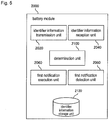
- Fig. 5 is a block diagram illustrating the battery module 2000 including the identifier information storage unit.
- An identifier information storage unit 2120 is implemented by, for example, the memory 1060 or the storage 1080.
- the first notification execution unit 2060 performs the first notification in response to the fact that the identifier information is transmitted by the battery module 2000.
- the first notification is performed using the second communication network 3040.
- the first notification is any notification that enables the battery module 2000 connected to the battery module 2000 through the second communication network 3040 to recognize that the identifier information is transmitted by the battery module 2000.
- the first notification execution unit 2060 performs the first notification by changing the voltage of the signal line 3041 connecting the battery module 2000 and the battery module 2000 of the notification destination (the battery module 2000 adjacent to the battery module 2000 in the first direction 3042 in the second communication network 3040).
- the first notification execution unit 2060 performs the first notification by switching the voltage of the signal line 3041 between a relatively lower value (hereinafter, a low value) and a relatively higher value (hereinafter, a high value).
- each battery module 2000 sets the voltage of the signal line 3041 to the high value after start-up.
- the first notification execution unit 2060 performs the first notification by changing the voltage of the signal line 3041 to the low value.
- a well-known technique can be used for a method of changing the value of the voltage of the signal line 3041.
- the high value and the low value can be set to any value, provided that the high value is greater than the low value, and that there is enough difference between those voltages to distinguished them.
- the voltage of the signal line 3041 before the first notification is performed may be set to the low value, and the first notification may be performed by changing the voltage of the signal line 3041 to the high value.
- the first notification detection unit 2080 detects the first notification that is performed by the adjacent battery module 2000 in the second direction 3044 in the second communication network 3040. More specifically, the first notification detection unit 2080 detects the first notification using the signal line 3041 that connects the battery module 2000 and the adjacent battery module 2000 in the second direction 3044 in the second communication network 3040.
- the first notification is performed by changing the voltage of the signal line 3041 from the high value to the low value.
- the first notification detection unit 2080 detects the first notification by detecting a change in the voltage of the signal line 3041 connecting the battery module 2000 and another adjacent battery module 2000 in the second direction 3044 in the second communication network 3040 from the high value to the low value.
- a well-known technique can be used for a method of detecting a change in the value of the voltage of the signal line 3041.
- the determination unit 2100 determines whether or not the identifier of the battery module 2000 is a duplicate of the first identifier of another battery module 2000 using the identifier information received from each of the other battery modules 2000. Specifically, in a case where the identifier information that indicates the same first identifier as the battery module 2000 is present in the identifier information stored in the identifier information storage unit 2120, the determination unit 2100 determines that there is duplication of the first identifier between the battery module 2000 and the battery module 2000 corresponding to that identifier information.
- the determination unit 2100 determines that the first identifier of the battery module 2000 is not a duplicate of the first identifier of any of the other battery modules 2000.
- the determination unit 2100 determines duplication between the first identifier of the battery module 2000 and the first identifier of another battery module 2000 in response to the fact that the identifier information is transmitted by all battery modules 2000. There are various methods for the determination unit 2100 to recognize transmission of the identifier information by all battery modules 2000. Hereinafter, several recognition methods will be illustrated.
- the determination unit 2100 of the terminal battery module recognizes transmission of the identifier information by all battery modules 2000 in response to the fact that the identifier information is transmitted by the identifier information transmission unit 2020 of the terminal battery module.
- the determination unit 2100 of the battery module 2000 other than the terminal battery module recognizes transmission of the identifier information by all battery modules 2000 in response to the fact that the identifier information transmitted by the terminal battery module is received.
- the identifier information includes the flag that indicates whether or not the transmission source of the identifier information is the terminal battery module. Therefore, in the identifier information transmitted by the identifier information transmission unit 2020 of the terminal battery module, the value of the flag is set to 1. On the other hand, in the identifier information transmitted by the identifier information transmission unit 2020 of the battery module 2000 other than the terminal battery module, the value of the flag is set to 0.
- the determination unit 2100 of the battery module 2000 other than the terminal battery module 2000 recognizes transmission of the identifier information by all battery modules 2000 based on the fact that the identifier information in which the flag is equal to 1 is received.
- the number of battery modules 2000 included in the information processing system 3000 is predetermined.
- the determination unit 2100 recognizes transmission of the identifier information by all battery modules 2000 in a case where the number of pieces of identifier information received by the identifier information reception unit 2040 is equal to the number (the total number of battery modules 2000 except the own battery module 2000) acquired by subtracting 1 from the number of battery modules 2000 included in the information processing system 3000.
- the total number of battery modules 2000 except the own battery module 2000 may be set in advance in the determination unit 2100 or may be stored in a storage device that can be accessed from the determination unit 2100.
- Fig. 6 is a block diagram illustrating the information processing system 3000 including the second signal line 3046.
- an internal configuration of the battery module 2000 is not illustrated for easy understanding of the drawing.
- the signal line 3041 is used in order for each battery module 2000 to perform notification (first notification) for another adjacent battery module 2000 in the first direction 3042 in the second communication network 3040.
- the second signal line 3046 used in order for each battery module 2000 to perform notification for another adjacent battery module 2000 in the second direction 3044 in the second communication network 3040.
- the battery module 2000 (in Fig. 6 , a battery module 2000-4) that does not have the adjacent battery module 2000 in the first direction 3042 in the second communication network 3040 performs notification through the second signal line 3046 after transmitting the identifier information.
- This notification is called second notification.
- the second notification is notification that represents transmission of the identifier information by the battery module 2000 at a terminal position in the first direction 3042 in the second communication network 3040.
- the second notification is notification that represents transmission of the identifier information by all battery modules 2000.
- the battery module 2000 can recognize transmission of the identifier information by all battery modules 2000.
- the battery module 2000 that detects the second notification performed by the adjacent battery module 2000 in the first direction 3042 also performs the second notification for the adjacent battery module 2000 in the second direction 3044.
- the second notification is performed for the battery module 2000-3 from the battery module 2000-4
- the second notification is performed for the battery module 2000-2 from the battery module 2000-3
- the second notification is performed for the battery module 2000-1 from the battery module 2000-2. Consequently, all battery modules 2000 except the battery module 2000 at a terminal position in the first direction 3042 receive the second notification.
- all battery modules 2000 can recognize transmission of the identifier information by all battery modules 2000.
- a method of performing the second notification using the second signal line 3046, and a method of detecting the second notification are the same as the method of performing the first notification through the signal line 3041, and the method of detecting the first notification, respectively.
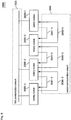
- Fig. 7 is a block diagram illustrating the battery module 2000 having a function of executing and detecting the second notification.
- a second notification execution unit 2180 performs the second notification for another adjacent battery module 2000 in the second direction 3044 in the second communication network 3040.
- a second notification detection unit 2200 detects the second notification that is performed by another adjacent battery module 2000 in the first direction 3042 in the second communication network 3040.
- the determination unit 2100 may estimate "transmission of the identifier information by all battery modules 2000" in a case where a predetermined time period elapses from a timing at which the first identifier information is received by the identifier information reception unit 2040, or in a case where a predetermined time period elapses from a timing at which the first notification is detected by the first notification detection unit 2080.
- the predetermined time period may be set in advance in the determination unit 2100 or may be stored in a storage device that can be accessed from the determination unit 2100.
- the starter battery module transmits the identifier information in response to the fact that the new battery module 2000 is added to the information processing system 3000.
- duplication of the first identifier is determined by each of all battery modules 2000 included in the information processing system 3000 including the added battery module 2000.
- the operation of the information processing system 3000 in a case where the battery module 2000 is newly added will be specifically described.
- Each battery module 2000 repeatedly monitors the voltage of the second port (the port to which the signal line 3041 connecting the battery module 2000 and the battery module 2000 positioned in the second direction 3044 when seen from the battery module 2000 is connected).
- the battery module 2000 that detects a change in the voltage from the low value to the high value (a change that is opposite to the change caused by the first notification) transmits a predetermined request through the first communication network 3020. Note that the initial value of the voltage of the second port is the low value.
- the starter battery module transmits the identifier information with reception of the predetermined request as a trigger. The predetermined request will be described below.
- Fig. 8 to Fig. 10 are diagrams illustrating a state where the new battery module 2000 is added.
- a battery module 2000-5 battery module 2000 filled with dot
- the determination about duplication of the first identifier has already been performed for the battery module 2000-1 to the battery module 2000-4.
- Fig. 8 is a diagram representing a case where the battery module 2000 is added as a new terminal battery module.
- the first notification execution unit 2060 of the terminal battery module does not execute the first notification after transmitting the identifier information.
- the battery module 2000-1 to the battery module 2000-3 execute the first notification, but the battery module 2000-4 does not execute the first notification.
- the voltage of a signal line 3041-4 is at the high value while the voltages of the signal line 3041-1 to a signal line 3041-3 are at the low value.
- the battery module 2000-5 detects a change in the voltage of the second port from the low value to the high value in response to connection of the battery module 2000-4 and the battery module 2000-5 through the signal line 3041-4. Thus, the battery module 2000-5 transmits the predetermined request.
- Fig. 9 is a diagram representing a case where the battery module 2000 is added as a new starter battery module.
- the voltages of the signal line 3041-1 to the signal line 3041-3 are changed to the low value by the first notification.
- the voltage of the signal line 3041-4 is at the high value.
- the battery module 2000-1 (the previous starter battery module) detects a change in the voltage of the second port from the low value to the high value in response to connection of the battery module 2000-1 and the battery module 2000-5 through the signal line 3041-4. Thus, the battery module 2000-1 transmits the predetermined request.
- Fig. 10 is a diagram representing a case where the added battery module 2000 is neither a new terminal battery module nor a new starter battery module. Even in the case in Fig. 10 , the voltage of the signal line 3041-4 is at the high value while the voltages of the signal line 3041-1 to the signal line 3041-3 are changed to the low value.
- the battery module 2000-3 detects a change in the voltage of the second port from the low value to the high value in response to connection of the battery module 2000-3 and the battery module 2000-5 through the signal line 3041-4. Thus, the battery module 2000-3 transmits the predetermined request.
- the battery module 2000 that transmits the predetermined request is the battery module 2000 that is positioned in the first direction 3042 when seen from the added battery module 2000.
- the battery module 2000 that transmits the predetermined request is the added battery module 2000.
- the predetermined request is data (hereinafter, request data) that is transmitted through the first communication network 3020.
- the request data is data that has the same data structure as the identifier information illustrated in Fig. 4 .
- a predetermined bit for example, the 2nd bit
- the starter battery module detects addition of the new battery module 2000 by receiving the data (request data) in which the bit is set to 1.
- Fig. 11 is a block diagram illustrating the information processing system 3000 of Modification Example 1.
- a plurality of the battery modules 2000 are connected to the starter battery module 2000-1.
- the function of the battery module 2000 of Modification Example 1 is the same as the function of the battery module 2000 of Example Embodiment 1 except for the points described below.
- the battery module 2000-2 and the battery module 2000-3 are collectively called a group 1
- the battery module 2000-4 and the battery module 2000-5 are collectively called a group 2.
- the first notification execution unit 2060 of the starter battery module 2000-1 performs the first notification using any signal line 3041 after transmission of the identifier information is completed. For example, the first notification execution unit 2060 performs the first notification for the battery module 2000-2 at a timing at which transmission of the identifier information is completed. In this case, the starter battery module 2000-1 also performs the first notification for the battery module 2000-4 at a timing different from the timing at which the first notification is performed for the battery module 2000-2.
- the first notification execution unit 2060 of the starter battery module 2000-1 performs the first notification for the battery module 2000-3 after transmission of the identifier information by all battery modules 2000 included in the group 1 is completed.
- a method of recognizing completion of transmission of the identifier information by all battery modules 2000 included in the group 1 is the same as the method of recognizing transmission of the identifier information by all battery modules 2000 in Example Embodiment 1.
- the first notification execution unit 2060 of the starter battery module 2000-1 recognizes transmission of the identifier information by all battery modules 2000 included in the group 1 in a case where the number of pieces of identifier information received by the identifier information reception unit 2040 becomes equal to the number of battery modules 2000 included in the group 1.
- the first notification execution unit 2060 of the starter battery module 2000-1 recognizes transmission of the identifier information by all battery modules 2000 included in the group 1 by receiving the second notification from the battery module 2000-2.
- the first notification execution unit 2060 of the starter battery module 2000-1 may estimate "transmission of the identifier information by all battery modules 2000 included in the group 1" in a case where a predetermined time period elapses from a timing at which the first identifier information is received by the identifier information reception unit 2040, or in a case where a predetermined time period elapses from a timing at which the first notification by the battery module 2000-2 is detected by the first notification detection unit 2080.
- the determination unit 2100 determines duplication of the first identifier in response to the fact that transmission of the identifier information by all battery modules 2000 included in the group is completed.
- the starter battery module 2000-1 can recognize transmission of the identifier information by all battery modules 2000 included in a certain group using the above various methods.
- the determination unit 2100 of the starter battery module 2000-1 determines duplication of the first identifier in a case where transmission of the identifier information by the battery module 2000 included in the group is recognized for all groups using the above various methods.
- the determination unit 2100 of the battery module 2000 other than the starter battery module 2000-1 determines duplication of the first identifier in response to (1) the number of pieces of received identifier information or (2) an elapse of a predetermined time period.
- the determination unit 2100 determines duplication of the first identifier in response to the fact that the number of pieces of identifier information received by the identifier information reception unit 2040 becomes equal to a value acquired by subtracting 1 from the total number of battery modules 2000 included in the information processing system 3000.
- the determination unit 2100 determines duplication of the first identifier in response to the fact that a predetermined time period elapses from the timing at which the first identifier information is received by the identifier information reception unit 2040, or the fact that a predetermined time period elapses from the timing at which the first notification is detected by the first notification detection unit 2080.
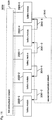
- Fig. 12 is a block diagram illustrating the battery module 2000 according to Example Embodiment 2.
- the battery module 2000 of Example Embodiment 2 has the same function as the battery module 2000 of Example Embodiment 1 except for the points described below.
- the battery module 2000 of Example Embodiment 2 includes a first identifier decision unit 2140.
- the first identifier decision unit 2140 performs a process of deciding the first identifier to be set in the battery module 2000 in a case where the first identifier of the battery module 2000 is a duplicate of the first identifier of another battery module 2000. By doing so, the first identifier of the battery module 2000 does not become a duplicate of the first identifier of the other battery module 2000.
- the information processing system 3000 includes both the battery module 2000 whose first identifier is a duplicate of any other battery modules 2000, and the battery module 2000 whose first identifier is not a duplicate of any other battery modules 2000.
- the first identifier decision unit 2140 of the battery module 2000 whose first identifier is not a duplicate of any other battery modules 2000 may decide the first identifier or may not decide the first identifier.
- the first identifier of the battery module 2000 whose first identifier is not a duplicate of any other battery modules 2000 is changed.
- the first identifier of the battery module 2000 whose first identifier is not a duplicate of any other battery modules 2000 is not changed.
- the first identifier decision unit 2140 of the battery module 2000 in which the first identifier is not set decides the first identifier in the same manner as the first identifier decision unit 2140 of the battery module 2000 whose first identifier is a duplicate of another battery module 2000.
- the predetermined rule is any rule that enables the first identifier of the battery module 2000 to be decided using an indicator which enables the plurality of battery modules 2000 included in the information processing system 3000 to be distinguished from each other.
- a predetermined rule is any rule that enables the first identifier of the battery module 2000 to be decided using an indicator which enables the plurality of battery modules 2000 included in the information processing system 3000 to be distinguished from each other.
- Predetermined Rule 1 is a rule for deciding the first identifier with a timing of transmission of the identifier information of each battery module 2000 as the indicator.
- the battery modules 2000 included in the information processing system 3000 transmit the identifier information at different timings.
- the battery modules 2000 can be distinguished from each other based on the timing of transmission of the identifier information.
- the determination unit 2100 determines the ordinal number at which the battery module 2000 transmits the identifier information among the battery modules 2000 included in the information processing system 3000. Specifically, the determination unit 2100 determines the number of battery modules 2000 from which the identifier information is received before the battery module 2000 transmits the identifier information. For example, the identifier information reception unit 2040 of the battery module 2000 receives two pieces of identifier information before a time point at which the battery module 2000 transmits the identifier information. In this case, the battery module 2000 is the third battery module 2000 that transmits the identifier information.
- a time point (for example, a reception time) at which the identifier information is received is stored in association with the identifier information in the identifier information storage unit 2120.
- the time point at which the battery module 2000 transmits the identifier information is stored in any storage device.
- the battery module 2000 may determine the order of the time point at which the battery module 2000 transmits the identifier information, and may store the order in the storage device. Specifically, as the order of the time point at which the identifier information is transmitted, the battery module 2000 stores the number that is acquired by adding 1 to the number of pieces of identifier information received before the identifier information is transmitted.
- the identifier of the battery module 2000 is associated with the order of the time point at which the identifier information is transmitted.
- the first identifier that can be associated with the order at which the identifier information is transmitted is different between (1) a case where the first identifier of the battery module 2000 whose first identifier is not a duplicate of any other battery modules 2000 is not changed, and (2) a case where the first identifier of the battery module 2000 whose first identifier is not a duplicate of any other battery modules 2000 is changed.
- the first identifier decision unit 2140 of the battery module 2000 whose first identifier is not a duplicate of another battery module 2000 does not decide the first identifier.
- the first identifier decision unit 2140 of each of all battery modules 2000 decides the first identifier.
- the first identifier (the first identifier that is set in only one battery module 2000) that keeps being used without change needs to be excluded from candidates of the first identifier newly set by the other battery module 2000.
- the first identifier is decided as follows.
- the first identifier decision unit 2140 determines the first identifier that is used by only one battery module 2000. Specifically, the first identifier decision unit 2140 determines the first identifier that is not a duplicate of another first identifier, from the first identifier of the battery module 2000 and the first identifier indicated in each identifier information stored in the identifier information storage unit 2120.
- the first identifier decision unit 2140 generates a set (hereinafter, a candidate set) excluding the first identifier that is not a duplicate of the other first identifier, from a set of all first identifiers that can be set in the battery module 2000.
- the first identifier is represented by a 1-byte value, and it is determined that 0x00 and 0xFF are not used as the first identifier.
- the first identifier 0x02 is set in only the battery module 2000-2
- the first identifier 0x04 is set in only the battery module 2000-3.
- the first identifier decision unit 2140 decides the first identifier of the battery module 2000 from the first identifiers included in the candidate set based on the order of the time point at which the battery module 2000 transmits the identifier information. For example, the first identifier decision unit 2140 performs calculation such that the "order at which the battery module 2000 transmits the identifier information is 3". In this case, the first identifier decision unit 2140 decides the third first identifier (in the candidate set C, 0x05) in the candidate set as the first identifier of the battery module 2000.
- Fig. 13 is a first diagram illustrating association between the time point at which the identifier information is transmitted and the candidate set C.
- the case of (2) is a case where the first identifier of the battery module 2000 whose first identifier is not a duplicate of any other battery modules 2000 is changed.
- the first identifier decision unit 2140 sets a set of identifiers that can be set in the battery module 2000.
- the set S in the above example is the candidate set.
- the first identifier decision unit 2140 decides the first identifier of the battery module 2000 from the first identifiers included in the candidate set based on the order of the time point at which the battery module 2000 transmits the identifier information. For example, the battery module 2000 transmits the identifier information after receiving two pieces of identifier information from other battery modules 2000. In this case, the first identifier decision unit 2140 decides the third first identifier (in the set S, 0x03) in the candidate set S as the first identifier of the battery module 2000.
- Fig. 14 is a second diagram illustrating the association between the time point at which the identifier information is transmitted and the candidate set C.
- Predetermined Rule 2 is a rule for deciding the first identifier with the manufacturing number of each battery module 2000 as the indicator.
- the manufacturing number of the battery module 2000 is an identifier that is uniquely assigned to the battery module 2000 when the battery module 2000 is manufactured.
- each battery module 2000 included in the information processing system 3000 can be distinguished by the manufacturing number.
- the first identifier decision unit 2140 determines the order of the battery module 2000 in a case where the battery modules 2000 included in the information processing system 3000 are arranged in an ascending order of the manufacturing number.
- the first identifier decision unit 2140 decides the first identifier of the battery module 2000 based on the order of the manufacturing number of the battery module 2000.
- a method of deciding the first identifier of the battery module 2000 based on the order of the manufacturing number of the battery module 2000 in Predetermined Rule 2 is the same as the method of deciding the first identifier of the battery module 2000 based on the order of the time point at which the battery module 2000 transmits the identifier information in Predetermined Rule 1.
- Figs. 15 are diagrams illustrating association between the manufacturing number of the battery module 2000 and the candidate set.
- Fig. 15A the first identifier of the battery module 2000 whose first identifier is not a duplicate of any other battery modules 2000 is not changed.
- 0x02 and 0x04 are excluded from the candidate set in the same manner as Fig. 13 .
- Fig. 15B the first identifier of the battery module 2000 whose first identifier is not a duplicate of any other battery modules 2000 is changed.
- each program module stored in the storage 1080 includes a program that realizes each function of the battery module 2000 of the present example embodiment.
- the first identifier is automatically changed such that duplication of the first identifier is resolved in a case where there is duplication of the first identifier between the battery modules 2000.
- duplication of the first identifier is resolved in a case where there is duplication of the first identifier between the battery modules 2000.
- the first identifier decision unit 2140 of each battery module 2000 individually decides the first identifier.
- concentration of a process load on one battery module 2000 can be prevented.
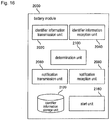
- Fig. 16 is a block diagram illustrating the battery module 2000 according to Example Embodiment 3.
- the battery module 2000 of Example Embodiment 3 has the same function as the battery module 2000 of Example Embodiment 1 except for the points described below.
- the battery module 2000 of Example Embodiment 3 includes an alert unit 2160.
- the alert unit 2160 outputs an alert in a case where it is determined that the first identifier of the battery module 2000 is a duplicate of the first identifier of another battery module 2000.
- the alert is an alert for notifying a user (the manager or the like of the battery module 2000) that the first identifier of the battery module 2000 is a duplicate of the first identifier of another battery module 2000.
- the alert unit 2160 outputs the alert by turning on a light emitting diode (LED) lamp.
- the alert unit 2160 may output the alert by causing a buzzer or a speaker to output sound.
- the battery module 2000 of Example Embodiment 3 is implemented using the controller 1000 in the same manner as Example Embodiment 1 (refer to Fig. 3 ). Furthermore, the battery module 2000 of Example Embodiment 3 is connected to hardware (LED lamp or the like) for implementing the output of the alert by the alert unit 2160 through the input-output interface 1100.
- each program module stored in the storage 1080 includes a program that realizes each function of the battery module 2000 of the present example embodiment.
- the alert is output in a case where the first identifier of a certain battery module 2000 is a duplicate of the first identifier of another battery module 2000.
- the manager or the like of the battery module 2000 can recognize that the first identifier of the battery module 2000 is a duplicate of another first identifier. Consequently, duplication of the first identifier between the battery modules 2000 can be resolved by taking a measure such that the manager or the like of the battery module 2000 manually changes the first identifier of the battery module 2000.
- the method of outputting the alert in a case where the first identifier is duplicate between the battery modules 2000 as in the present example embodiment is particularly useful in a case where the battery module 2000 is operated under an operation policy in which automatically changing the first identifier of the battery module 2000 is not desired.
- Fig. 17 is a block diagram illustrating the battery module 2000 according to Example Embodiment 4.
- the battery module 2000 of Example Embodiment 4 has the same function as the battery module 2000 of Example Embodiment 2 except for the points described below.
- the battery module 2000 of Example Embodiment 4 has a function of detecting detachment of any battery module 2000 from the information processing system 3000. To do so, the battery module 2000 of Example Embodiment 4 includes a detachment detection unit 2220.
- the detachment detection unit 2220 operates in a state where the first identifier that is not a duplicate of other battery modules 2000 is set in the battery module 2000. Specifically, the detachment detection unit 2220 operates after the determination unit 2100 determines that the first identifier of the battery module 2000 is not a duplicate of other battery modules 2000, or after the first identifier decided by the first identifier decision unit 2140 is set in the battery module 2000.
- the detachment detection unit 2220 operates in a state where the first identifier that is not a duplicate of other battery modules 2000 is set in the battery module 2000. Specifically, the detachment detection unit 2220 operates after the determination unit 2100 determines that the first identifier of the battery module 2000 is not a duplicate of other battery modules 2000, or after the first identifier decided by the first identifier decision unit 2140 is set in the battery module 2000.
- a specific operation of the detachment detection unit 2220 will be illustrated.
- the detachment detection unit 2220 causes the identifier information transmission unit 2020 to periodically transmit the identifier information.
- the battery module 2000 sets a timer process for operating the detachment detection unit 2220 after a predetermined time period when the determination unit 2100 determines that the first identifier of that battery module 2000 is not a duplicate of other battery modules 2000, or when the first identifier decided by the first identifier decision unit 2140 is set in that battery module 2000.
- the battery module 2000 sets the same timer process again.
- the predetermined time period may be set in advance in the battery module 2000 or may be stored in a storage device that can be accessed from the battery module 2000.
- the detachment detection unit 2220 of each of the other battery modules 2000 causes the identifier information transmission unit 2020 to transmit the identifier information in response to the fact that the identifier information that satisfies a predetermined condition is received.
- the predetermined condition is a condition such that the "first identifier that is smaller than the first identifier of the own battery module 2000 and is most similar to the first identifier of the own battery module 2000 is indicated".
- the detachment detection unit 2220 of the battery module 2000 whose first identifier is the largest after the first identifier indicated by the identifier information operates.
- the identifier information is transmitted in order by all battery modules 2000.
- the detachment detection unit 2220 in the battery module 2000 whose first identifier is the largest after the certain battery module 2000 does not operate because the identifier information satisfying the predetermined condition is not received. Therefore, the detachment detection unit 2220 is configured to "transmit the identifier information at a predetermined timing in a case where the identifier information satisfying the predetermined condition is not received". By doing so, the identifier information is transmitted from all battery modules 2000 other than the battery module 2000 detached from the information processing system 3000.
- the predetermined timing is a timing that is a predetermined time period after from a time point of reception of the identifier information that is most recently received. The predetermined time period may be set in advance in the battery module 2000 or may be stored in a storage device that can be accessed from the battery module 2000.
- the detachment detection unit 2220 compares the first identifier indicated in the identification information received from each battery module 2000 with a list of first identifiers of the battery modules 2000 included in the information processing system 3000 (a method of creating the list will be described below). In a case where the first identifier that is not indicated in any received identification information is present among the first identifiers included in the list, the detachment detection unit 2220 determines that the battery module 2000 having the first identifier is detached from the information processing system 3000. By doing so, each battery module 2000 detects detachment of the battery module 2000 from the information processing system 3000 and furthermore, finds the first identifier of the detached battery module 2000.
- Figs. 18 are diagrams illustrating a configuration example of the information processing system 3000 in the specific example.
- the information processing system 3000 includes the battery module 2000-1 to the battery module 2000-5.
- the first identifiers 0x01, 0x02, 0x03, 0x04, and 0x05 are set in this order in the battery module 2000-1 to the battery module 2000-5.
- each battery module 2000 stores a list of first identifiers indicating 0x01 to 0x05.
- the identifier information is transmitted in order from the battery module 2000-1.
- each first identifier indicated in the list of first identifiers is indicated in any identifier information.
- the detachment detection unit 2220 of each battery module 2000 determines that there is no battery module 2000 detached from the information processing system 3000.
- the battery module 2000-3 is detached from the information processing system 3000 in Figs. 18 .
- This situation is illustrated in Fig. 18B .
- the identifier information is transmitted in order of the battery module 2000-1 and the battery module 2000-2.
- the identifier information is not transmitted from the battery module 2000-3.
- the identifier information that is to be transmitted by the battery module 2000-3 is the identifier information that indicates 0x03 as the first identifier.
- This identifier information is the identifier information that satisfies the predetermined condition for the battery module 2000-4.
- the detachment detection unit 2220 of the battery module 2000-4 transmits the identifier information at a predetermined timing.
- the battery module 2000-5 transmits the identifier information based on the fact that the identifier information transmitted by the battery module 2000-4 is received.
- the detachment detection unit 2220 of each battery module 2000 After each identifier information transmitted by the battery module other than the battery module 2000-3 is received, the detachment detection unit 2220 of each battery module 2000 compares the first identifier indicated in the received identification information with the list of first identifiers of the battery modules 2000 included in the information processing system 3000. Consequently, it is found that the identifier information indicating the first identifier 0x03 is not received. Accordingly, the detachment detection unit 2220 of each battery module 2000 detects detachment of the battery module 2000-3 from the information processing system 3000.
- each battery module 2000 has the list indicating the first identifier set in each battery module 2000 included in the information processing system 3000.
- This list is created by the first identifier decision unit 2140 described in Example Embodiment 2. Note that the list does not need to indicate association between the first identifier and the battery module 2000, provided that the list indicates a list of first identifiers.
- each battery module 2000 receives the identifier information from each of the other battery modules 2000 in a series of processes for deciding the first identifier.
- the first identifier decision unit 2140 can calculate the number of battery modules 2000 included in the information processing system 3000 as the number acquired by adding 1 to the number of pieces of received identifier information (the total number of battery modules 2000 except the own battery module 2000). That is, the first identifier decision unit 2140 can recognize the total number of battery modules 2000 included in the information processing system 3000.
- the first identifier decision unit 2140 creates a list indicating the first identifiers corresponding in number to the total number from the head of the first identifiers included in the candidate set that is sorted in an ascending order of the first identifier.
- detachment of the battery module 2000 from the information processing system 3000 can be automatically recognized.
Landscapes
- Engineering & Computer Science (AREA)
- Power Engineering (AREA)
- General Chemical & Material Sciences (AREA)
- Manufacturing & Machinery (AREA)
- Chemical & Material Sciences (AREA)
- Chemical Kinetics & Catalysis (AREA)
- Electrochemistry (AREA)
- Microelectronics & Electronic Packaging (AREA)
- Automation & Control Theory (AREA)
- Signal Processing (AREA)
- Computer Networks & Wireless Communication (AREA)
- Charge And Discharge Circuits For Batteries Or The Like (AREA)
- Small-Scale Networks (AREA)
- Secondary Cells (AREA)
Abstract
Description
- The present invention relates to an information processing system, a battery module, a control method, and a program.
- Storage batteries have been used in various situations. For example, a storage battery is used for storing electric power that is acquired by electric power generation using renewable energy such as sunlight.
- The storage battery includes one or more battery modules. The battery module includes one or more secondary batteries such as lithium ion batteries. Furthermore, the battery module contains a controller for exchanging control information or the like with other battery modules. The controller is called a battery management unit (BMU). Communication between battery modules is performed through a communication network such as a controller area network (CAN).
- In a case where the control information or the like is exchanged through the communication network, an identifier is needed in order to identify each battery module. One of methods for setting the identifier in the battery module is a method in which a manager or the like of the battery module manually sets the identifier. For example, an identifier setting circuit such as a DIP switch is disposed in the battery module. Then, the manager changes the DIP switch or the like of the battery module to a desired setting in order to set a desired identifier.
- In
Patent Documents 1 to 3, a technique for automatically setting the identifier of the battery module is disclosed. In the invention ofPatent Document 1, battery modules are connected in series. In this invention, each battery module is assigned an identifier corresponding to its position. For example, an identifier of "1" is assigned to the battery module at the head. InPatent Documents -
- [Patent Document 1] Japanese Patent Application Publication No.
2012-244794 - [Patent Document 2] Japanese Patent Application Publication No.
2013-109628 - [Patent Document 3] PCT Japanese Translation Patent Publication No.
2015-507451 - In a case where there is duplication of identifiers between different battery modules, it is necessary to detect this duplication. It is because the existence of multiple battery modules having the same identifier in one network causes collision of communications, and therefore make correct communications impossible.
- Typically, a unique identifier is set in the battery module. However, in reality, an identifier may be duplicate between battery modules. For example, as a result of an erroneous identifier setting operation performed by the manager of the battery module, the same identifier may be set in different battery modules. In addition, for example, in a case where a battery module that is included in a certain network is migrated to another network, the identifier set in the battery module may be a duplicate of the identifier of another battery module included in the migration destination network.
- In the above related documents, duplication of the identifier set in the battery module is not mentioned.
- The present invention is conceived in view of the above problem. An object of the present invention is to provide a technique for efficiently detecting duplication of an identifier between battery modules.
- An information processing system of the present invention includes a plurality of battery modules. Each battery module is communicable with all of other battery modules through a first communication network. Each battery module is communicable with another battery module through a second communication network constituting a linear topology. The battery module includes (1) an identifier information transmission unit that transmits identifier information to all of other battery modules through the first communication network. The identifier information indicates a first identifier on the first communication network that is set in the battery module, or indicating a fact that the first identifier is not set in the battery module. The battery module includes (2) an identifier information reception unit that receives the identifier information transmitted by the other battery module, (3) a first notification execution unit that performs first notification through the second communication network for the other battery module adjacent in a first direction on the second communication network, (4) a first notification detection unit that detects the first notification performed by the other battery module adjacent in a second direction on the second communication network, and (5) a determination unit that determines whether or not the first identifier of the battery module is a duplicate of the first identifier of each of other battery modules using the identifier information received from each of the other battery modules in response to a fact that the identifier information is transmitted by the identifier information transmission units of all of the plurality of battery modules. The identifier information transmission unit of a first battery module transmits the identifier information in response to a predetermined event other than detection of the first notification by the first notification detection unit of the first battery module. The identifier information transmission unit of each battery module other than the first battery module transmits the identifier information in response to a fact that the first notification is detected by the first notification detection unit.
- A battery module of the present invention is the battery module included in the information processing system of the present invention.
- A control method of the present invention is a control method that is executed by an information processing system including a plurality of battery modules. Each battery module is communicable with all of other battery modules through a first communication network. Each battery module is communicable with another battery module through a second communication network constituting a linear topology. The control method includes (1) an identifier information transmission step in which the battery module transmits identifier information to all of the other battery modules through the first communication network by the battery module. The identifier information indicates a first identifier on the first communication network that is set in the battery module, or indicating a fact that the first identifier is not set in the battery module. Furthermore, the control method includes (2) an identifier information reception step in which the battery module receives the identifier information transmitted by the other battery module, (3) a first notification execution step in which the battery module performs first notification through the second communication network for the other battery module adjacent in a first direction on the second communication network, (4) a first notification detection step in which the battery module detects the first notification performed by the other battery module adjacent in a second direction on the second communication network, and (5) a determination step in which the battery module determines whether or not the first identifier of the battery module is a duplicate of the first identifier of each of other battery modules using the identifier information received from each of the other battery modules in response to a fact that the identifier information is transmitted by the identifier information transmission step of all of the plurality of battery modules. In the identifier information transmission step of a first battery module, the identifier information is transmitted in response to a predetermined event other than detection of the first notification in the first notification detection step of the first battery module. In the identifier information transmission step of each battery module other than the first battery module, the identifier information is transmitted in response to a fact that the first notification is detected in the first notification detection step.
- A program of the present invention causes a computer to execute each step included in the control method of the present invention.
- According to the present invention, a technique for efficiently detecting duplication of an identifier between battery modules is provided.
- The above object and other objects, features, and advantages will become more apparent from example embodiments set forth below and the following drawings appended thereto.
-
-
Fig. 1 is a block diagram illustrating an information processing system according toExample Embodiment 1. -
Fig. 2 is a flowchart illustrating a flow of process in the information processing system ofExample Embodiment 1. -
Fig. 3 is a diagram illustrating a hardware configuration of a battery module. -
Fig. 4 is a diagram illustrating a data structure of identifier information in a CAN communication network. -
Fig. 5 is a block diagram illustrating the battery module including an identifier information storage unit. -
Fig. 6 is a block diagram illustrating the information processing system including a second signal line. -
Fig. 7 is a block diagram illustrating abattery module 2000 having a function of executing and detecting second notification. -
Fig. 8 is a diagram representing a case where the battery module is added as a new terminal battery module. -
Fig. 9 is a diagram representing a case where the battery module is added as a new starter battery module. -
Fig. 10 is a diagram representing a case where the battery module that is added is neither a new terminal battery module nor a new starter battery module. -
Fig. 11 is a block diagram illustrating an information processing system of Modification Example 1. -
Fig. 12 is a block diagram illustrating a battery module according toExample Embodiment 2. -
Fig. 13 is a first diagram illustrating association between a time point at which the identifier information is transmitted and a candidate set C. -
Fig. 14 is a second diagram illustrating the association between the time point at which the identifier information is transmitted and the candidate set C. -
Figs. 15 are diagrams illustrating association between a manufacturing number of the battery module and a candidate set. -
Fig. 16 is a block diagram illustrating a battery module according toExample Embodiment 3. -
Fig. 17 is a block diagram illustrating a battery module according toExample Embodiment 4. -
Figs. 18 are diagrams illustrating a configuration example of an information processing system in a specific example. - Hereinafter, example embodiments of the present invention will be described using the drawings. Note that the same constituents will be designated by the same reference signs in all of the drawings, and descriptions of such constituents will not be repeated.
-
Fig. 1 is a block diagram illustrating aninformation processing system 3000 according toExample Embodiment 1. InFig. 1 , each block does not represent a configuration of hardware units but represents a configuration of function units. - The
information processing system 3000 includes afirst communication network 3020, asecond communication network 3040, and a plurality ofbattery modules 2000. Thefirst communication network 3020 is a communication network that communicably connects thebattery modules 2000 to each other. Eachbattery module 2000 can communicate with anotherbattery module 2000 included in theinformation processing system 3000 through thefirst communication network 3020. - The
second communication network 3040 is a communication network that is configured in a linear topology. Eachbattery module 2000 can communicate with anotheradjacent battery module 2000 on thesecond communication network 3040. Thebattery modules 2000 that are adjacent to each other are connected through a signal line 3041. InFig. 1 , a battery module 2000-1 can communicate with a battery module 2000-2 through a signal line 3041-1. In addition, the battery module 2000-2 can communicate with a battery module 2000-3 through a signal line 3041-2. - Note that the topology of the
first communication network 3020 may be any topology in which thebattery modules 2000 communicate with each other. For example, the topology of thefirst communication network 3020 is a bus topology. - In the
battery module 2000, an identifier is set to be used in communication through thefirst communication network 3020. Hereinafter, the identifier will be called a first identifier. Thebattery module 2000 has a function of determining whether or not the first identifier of thebattery module 2000 is a duplicate of the first identifier of anotherbattery module 2000. To do so, thebattery module 2000 includes an identifierinformation transmission unit 2020, an identifierinformation reception unit 2040, a firstnotification execution unit 2060, a firstnotification detection unit 2080, and adetermination unit 2100. - The identifier
information transmission unit 2020 transmits identifier information to all of theother battery modules 2000 through thefirst communication network 3020. The identifier information transmitted by a certain battery module 2000 (1) indicates the first identifier set in thebattery module 2000 or (2) indicates the fact that the first identifier is not set in thebattery module 2000. - The identifier
information reception unit 2040 receives the identifier information transmitted by anotherbattery module 2000 through thefirst communication network 3020. - The first
notification execution unit 2060 performs first notification through thesecond communication network 3040. The first notification is notification of transmission of the identifier information by the identifierinformation transmission unit 2020 of thebattery module 2000. The firstnotification execution unit 2060 performs the first notification for anotherbattery module 2000 that is adjacent to thebattery module 2000 in afirst direction 3042 on thesecond communication network 3040. - The first
notification detection unit 2080 detects the first notification through thesecond communication network 3040. The first notification is notification performed by anotherbattery module 2000 that is adjacent to thebattery module 2000 in asecond direction 3044 on thesecond communication network 3040. Thefirst direction 3042 and thesecond direction 3044 are directions that are opposite to each other. For example, from the viewpoint of the battery module 2000-1 that is adjacent to the battery module 2000-2 in thesecond direction 3044 on thesecond communication network 3040, the battery module 2000-2 is positioned in thefirst direction 3042 in thesecond communication network 3040. - The
determination unit 2100 determines whether or not the first identifier of thebattery module 2000 is a duplicate of the first identifier of anotherbattery module 2000. The determination is executed in response to that the identifier information is transmitted by allbattery modules 2000. In addition, the determination uses the identifier information received from anotherbattery module 2000. - In the
information processing system 3000, the identifierinformation transmission unit 2020 of aparticular battery module 2000 transmits the identifier information based on a predetermined event other than detection of the first notification by the firstnotification detection unit 2080 of thebattery module 2000. Hereinafter, thisbattery module 2000 will be called a starter battery module. On the other hand, the identifierinformation transmission unit 2020 of thebattery module 2000 other than the starter battery module transmits the identifier information based on the fact that the first notification is detected by the firstnotification detection unit 2080 of thebattery module 2000. - The
first direction 3042 described above is a direction away from the starter battery module. On the other hand, thesecond direction 3044 is a direction toward the starter battery module. Thus, the starter battery module does not have theadjacent battery module 2000 in thesecond direction 3044 in thesecond communication network 3040. For example, inFig. 1 , the battery module 2000-1 is the starter battery module. Thus, any of directions from the battery module 2000-1 toward the battery module 2000-2 and directions from the battery module 2000-2 toward the battery module 2000-3 are thefirst direction 3042. On the other hand, any of directions from the battery module 2000-3 toward the battery module 2000-2 and directions from the battery module 2000-2 toward the battery module 2000-1 are thesecond direction 3044. Note that hereinafter, the battery module 2000-1 will also be referred to as the starter battery module 2000-1. -
Fig. 2 is a flowchart illustrating a flow of process in theinformation processing system 3000 ofExample Embodiment 1. The battery module 2000-1, being the starter battery module, transmits the identifier information (S104) in response to its start-up (S102). The battery module 2000-2 and the battery module 2000-3 receive the identifier information transmitted by the battery module 2000-1 (S106). The battery module 2000-1 performs the first notification for the battery module 2000-2 through the signal line 3041-1 (S108). - The battery module 2000-2 transmits the identifier information (S112) based on the fact that the first notification is detected (S110). The battery module 2000-1 and the battery module 2000-3 receive the identifier information transmitted by the battery module 2000-2 (S114). The battery module 2000-2 performs the first notification for the battery module 2000-3 through the signal line 3041-2 (S116).
- The battery module 2000-3 transmits the identifier information (S120) based on the fact that the first notification is detected (S118). The battery module 2000-1 and the battery module 2000-2 receive the identifier information transmitted by the battery module 2000-3 (S122).
- Each
battery module 2000 determines whether or not its first identifier is a duplicate of the first identifier of another battery module 2000 (S124). - Note that the flow of process performed by the
information processing system 3000 is not limited to the flow illustrated inFig. 2 . Other flows of process will be described below. - According to the
information processing system 3000 of the present example embodiment, a determination as to whether or not duplication of the identifier occurs between thebattery modules 2000 is automatically performed using the identifier information transmitted from eachbattery module 2000. Thus, duplication of the identifier between thebattery modules 2000 can be efficiently detected. - Hereinafter, the present example embodiment will be described in further detail.
- Each functional configuration unit of the
battery module 2000 may be implemented by hardware (example: a hardwired electronic circuit) that implements each functional configuration unit, or may be implemented by a combination of hardware and software (example: a combination of an electronic circuit and a program controlling the electronic circuit). Hereinafter, a case where each functional configuration unit of thebattery module 2000 is implemented by a combination of hardware and software will be further described. -
Fig. 3 is a diagram illustrating a hardware configuration of thebattery module 2000. Thebattery module 2000 includes acontroller 1000 and abattery cell 10. Thebattery cell 10 is a secondary battery such as a lithium ion battery. Thecontroller 1000 is a device that controls charging or discharging of thebattery cell 10 or exchanges control information with thecontroller 1000 included in anotherbattery module 2000. For example, thecontroller 1000 is a battery management unit (BMU). - The
controller 1000 includes abus 1020, aprocessor 1040, amemory 1060, astorage 1080, an input-output interface 1100, afirst network interface 1120, and asecond network interface 1140. Thebus 1020 is a data transfer path for transmitting and receiving data among theprocessor 1040, thememory 1060, thestorage 1080, the input-output interface 1100, and thefirst network interface 1120. A method of connecting theprocessor 1040 and the like is not limited to bus connection. Theprocessor 1040 is a processor such as a micro processing unit (MPU) or a central processing unit (CPU). Thememory 1060 is a memory such as a random access memory (RAM) or a read only memory (ROM). Thestorage 1080 is a storage device such as a flash memory. The input-output interface 1100 is an interface for connecting thecontroller 1000 and input-output devices. - The
first network interface 1120 is an interface that connects thecontroller 1000 and thefirst communication network 3020. The identifierinformation transmission unit 2020 realizes transmission of the identifier information by outputting the identifier information to thefirst network interface 1120. The identifierinformation transmission unit 2020 realizes reception of the identifier information by acquiring the identifier information received by thefirst network interface 1120. Thesecond network interface 1140 is an interface that connects thecontroller 1000 and thesecond communication network 3040. A method of realizing transmission notification will be described below. - The
storage 1080 stores a program module that implements each functional configuration unit of thebattery module 2000. Theprocessor 1040 implements each function corresponding to the program module by reading each program module into thememory 1060 and executing the program module. - The hardware configuration of the
controller 1000 is not limited to the configuration illustrated inFig. 3 . For example, each program module may be stored in thememory 1060. In this case, thecontroller 1000 may not include thestorage 1080. - The identifier information transmitted by the identifier
information transmission unit 2020 of thebattery module 2000 represents the identifier of thebattery module 2000 in thefirst communication network 3020. For example, in a case where thefirst communication network 3020 is a CAN communication network, the identifier information represents an identifier (ID) in the CAN communication network. Hereinafter, the ID in the CAN communication network will be referred to as a CAN-ID. -
Fig. 4 is a diagram illustrating a data structure of the identifier information in the CAN communication network. The identifier information inFig. 4 is 8-byte data. The 0th byte to the 3rd byte of the identifier information indicate a manufacturing number of thebattery module 2000. The 4th byte of the identifier information indicates the CAN-ID (first identifier) of thebattery module 2000. The 5th byte of the identifier information indicates status data of thebattery module 2000. Data included in the 6th byte and the 7th byte of the identifier information is arbitrary. - There are various methods of using the status data of the identifier information. For example, the status data of the identifier information transmitted by the
starter battery module 2000 is set to indicate whether or not the transmission destination of the identifier information is thestarter battery module 2000. For example, the 0th bit of the status data is used as a flag that indicates whether or not the transmission destination is thestarter battery module 2000. - In addition, for example, the status data of the identifier information transmitted by the battery module 2000 (hereinafter, the terminal battery module 2000) that is at a terminal position in the
first direction 3042 in thesecond communication network 3040 is set to indicate whether or not the transmission destination of the identifier information is theterminal battery module 2000. For example, the 1st bit of the status data is used as a flag that indicates whether or not the transmission source is thestarter battery module 2000. Note that inFig. 1 , theterminal battery module 2000 is the battery module 2000-3. - Note that the data structure of the identifier information illustrated in
Fig. 4 can also be employed in a case where thefirst communication network 3020 is a communication network other than the CAN communication network. However, the size or the like of the first identifier varies depending on a communication protocol used in the communication network. In this case, the data size of the identifier information is appropriately set in accordance with the communication protocol. - The identifier
information transmission unit 2020 transmits the identifier information in thefirst communication network 3020. A well-known technique can be used for a technique for transmitting information through the CAN communication network or the like. - The identifier
information transmission unit 2020 of thebattery module 2000 other than the starter battery module transmits the identifier information based on the fact that the first notification is detected by the firstnotification detection unit 2080. In this case, the identifierinformation transmission unit 2020 may transmit the identifier information at a time point at which the first notification is detected by the firstnotification detection unit 2080, or may transmit the identifier information at an arbitrary time point other than the time point at which the first notification is detected by the firstnotification detection unit 2080. For example, an arbitrary time point after detection of the first notification is a time point being a predetermined time period after detecting the first notification. The predetermined time period may be set in the identifierinformation transmission unit 2020 or may be stored in a storage device that can be accessed from the identifierinformation transmission unit 2020. - On the other hand, the starter battery module transmits the identifier information based on a predetermined event other than the event that the first notification is detected by the first
notification detection unit 2080. For example, the predetermined event is an event that the starter battery module is started up. That is, in this case, the starter battery module transmits the identifier information at the time of start-up. In the flowchart ofFig. 2 described above, the starter battery module transmits the identifier information based on its start-up. The start-up of the starter battery module may be a normal start-up caused by an operation such as turning on a power supply switch, or may be start-up caused by a recovery from a malfunction such as a power outage. - Note that the time of start-up referred hereto does not need to be immediately after start-up. For example, the starter battery module transmits the identifier information after various kinds of initial setting are performed after start-up. In addition, for example, the starter battery module may transmit the identifier information after a predetermined time period elapses from the initial setting. A timing at which the
battery module 2000 other than the starter battery module is started up may be later than a timing at which the starter battery module is started up. In this case, in a case where the identifier information is transmitted immediately after the initial setting of the starter battery module is completed, there is a possibility that the initial setting of anotherbattery module 2000 is not completed, and theother battery module 2000 does not correctly receive the identifier information. In a case where transmission of the identifier information is delayed until a predetermined time period elapses from completion of the initial setting in the starter battery module, a time period in which theother battery module 2000 performs the initial setting is secured, and the probability of theother battery module 2000 being able to correctly receive the identifier information is increased. - In addition, for example, the predetermined event is completion of charging of the
battery cell 10 in the starter battery module. That is, in this case, the starter battery module transmits the identifier information based on the fact that charging of thebattery cell 10 in the starter battery module is completed. Note that, a well-known technique can be uses for a method of detecting completion of charging of thebattery cell 10. - In addition, for example, the predetermined event is an event that a
new battery module 2000 is added to theinformation processing system 3000. For example, thebattery module 2000 is newly added to theinformation processing system 3000 after a series of processes (for example, the series of processes inFig. 2 ) for determining duplication of the first identifier is performed once in theinformation processing system 3000. In this case, there is a possibility that the first identifier of the newly addedbattery module 2000 is a duplicate of the first identifier of anotherbattery module 2000. Thus, duplication of the first identifier needs to be determined again in theinformation processing system 3000. - Therefore, the starter battery module transmits the identifier information based on the fact that the
new battery module 2000 is added to theinformation processing system 3000. In addition, the remaining processes (for example, the processes after S106 inFig. 2 ) needed for determining duplication of the first identifier are performed in order. Consequently, duplication of the first identifier is determined by each of allbattery modules 2000 included in theinformation processing system 3000 including the newly addedbattery module 2000. Note that the operation of theinformation processing system 3000 in a case where thenew battery module 2000 is added to theinformation processing system 3000 will be described in detail below. - At a predetermined timing, each
battery module 2000 determines whether or not thebattery module 2000 is the starter battery module. Then, the identifier information is transmitted from the identifierinformation transmission unit 2020 of thebattery module 2000 that has determined that it is the starter battery module. The predetermined timing is a timing of transmission of the identifier information by the starter battery module (at the time of start-up or the like), or a timing before the timing of transmission. The predetermined timing may be set in advance in thebattery module 2000 or may be stored in a storage device that can be accessed from thebattery module 2000. - There are various methods of determining whether or not the
battery module 2000 is the starter battery module. For example, thebattery module 2000 determines whether or not thebattery module 2000 is the starter battery module based on a connection state between thebattery module 2000 and anotherbattery module 2000. A port to which the signal line 3041 linking thebattery module 2000 and theadjacent battery module 2000 in thefirst direction 3042 in thesecond communication network 3040 is connected is called a first port. A port to which the signal line 3041 linking thebattery module 2000 and theadjacent battery module 2000 in thesecond direction 3044 in thesecond communication network 3040 is connected is called a second port. For example, in the case of the battery module 2000-2, a port to which the signal line 3041-2 is connected is the first port, and a port to which the signal line 3041-1 is connected is the second port. In this case, thebattery module 2000 determines whether or not thebattery module 2000 is the starter battery module in a case where the signal line 3041 is not connected to the second port, or in a case where the signal line 3041 connected to the second port is not conducted. - The identifier
information reception unit 2040 receives the identifier information. A well-known technique can be used for a technique for receiving information transmitted through the CAN communication network or the like. - For example, the identifier
information reception unit 2040 writes the received identifier information into a storage device. Hereinafter, the storage device in which the identifier information is stored will be called an identifier information storage unit.Fig. 5 is a block diagram illustrating thebattery module 2000 including the identifier information storage unit. An identifierinformation storage unit 2120 is implemented by, for example, thememory 1060 or thestorage 1080. - The first
notification execution unit 2060 performs the first notification in response to the fact that the identifier information is transmitted by thebattery module 2000. The first notification is performed using thesecond communication network 3040. The first notification is any notification that enables thebattery module 2000 connected to thebattery module 2000 through thesecond communication network 3040 to recognize that the identifier information is transmitted by thebattery module 2000. - For example, the first
notification execution unit 2060 performs the first notification by changing the voltage of the signal line 3041 connecting thebattery module 2000 and thebattery module 2000 of the notification destination (thebattery module 2000 adjacent to thebattery module 2000 in thefirst direction 3042 in the second communication network 3040). - More specifically, the first
notification execution unit 2060 performs the first notification by switching the voltage of the signal line 3041 between a relatively lower value (hereinafter, a low value) and a relatively higher value (hereinafter, a high value). In this case, eachbattery module 2000 sets the voltage of the signal line 3041 to the high value after start-up. Then, the firstnotification execution unit 2060 performs the first notification by changing the voltage of the signal line 3041 to the low value. A well-known technique can be used for a method of changing the value of the voltage of the signal line 3041. - Note that the high value and the low value can be set to any value, provided that the high value is greater than the low value, and that there is enough difference between those voltages to distinguished them. In addition, the voltage of the signal line 3041 before the first notification is performed may be set to the low value, and the first notification may be performed by changing the voltage of the signal line 3041 to the high value.
- The first
notification detection unit 2080 detects the first notification that is performed by theadjacent battery module 2000 in thesecond direction 3044 in thesecond communication network 3040. More specifically, the firstnotification detection unit 2080 detects the first notification using the signal line 3041 that connects thebattery module 2000 and theadjacent battery module 2000 in thesecond direction 3044 in thesecond communication network 3040. - For example, as described above, the first notification is performed by changing the voltage of the signal line 3041 from the high value to the low value. In this case, the first
notification detection unit 2080 detects the first notification by detecting a change in the voltage of the signal line 3041 connecting thebattery module 2000 and anotheradjacent battery module 2000 in thesecond direction 3044 in thesecond communication network 3040 from the high value to the low value. A well-known technique can be used for a method of detecting a change in the value of the voltage of the signal line 3041. - The
determination unit 2100 determines whether or not the identifier of thebattery module 2000 is a duplicate of the first identifier of anotherbattery module 2000 using the identifier information received from each of theother battery modules 2000. Specifically, in a case where the identifier information that indicates the same first identifier as thebattery module 2000 is present in the identifier information stored in the identifierinformation storage unit 2120, thedetermination unit 2100 determines that there is duplication of the first identifier between thebattery module 2000 and thebattery module 2000 corresponding to that identifier information. On the other hand, in a case where the identifier information that indicates the same first identifier as thebattery module 2000 is not present in the identifier information stored in the identifierinformation storage unit 2120, thedetermination unit 2100 determines that the first identifier of thebattery module 2000 is not a duplicate of the first identifier of any of theother battery modules 2000. - The
determination unit 2100 determines duplication between the first identifier of thebattery module 2000 and the first identifier of anotherbattery module 2000 in response to the fact that the identifier information is transmitted by allbattery modules 2000. There are various methods for thedetermination unit 2100 to recognize transmission of the identifier information by allbattery modules 2000. Hereinafter, several recognition methods will be illustrated. - The
determination unit 2100 of the terminal battery module recognizes transmission of the identifier information by allbattery modules 2000 in response to the fact that the identifier information is transmitted by the identifierinformation transmission unit 2020 of the terminal battery module. On the other hand, thedetermination unit 2100 of thebattery module 2000 other than the terminal battery module recognizes transmission of the identifier information by allbattery modules 2000 in response to the fact that the identifier information transmitted by the terminal battery module is received. - As described above, for example, the identifier information includes the flag that indicates whether or not the transmission source of the identifier information is the terminal battery module. Therefore, in the identifier information transmitted by the identifier
information transmission unit 2020 of the terminal battery module, the value of the flag is set to 1. On the other hand, in the identifier information transmitted by the identifierinformation transmission unit 2020 of thebattery module 2000 other than the terminal battery module, the value of the flag is set to 0. - The
determination unit 2100 of thebattery module 2000 other than theterminal battery module 2000 recognizes transmission of the identifier information by allbattery modules 2000 based on the fact that the identifier information in which the flag is equal to 1 is received. - The number of
battery modules 2000 included in theinformation processing system 3000 is predetermined. In this case, thedetermination unit 2100 recognizes transmission of the identifier information by allbattery modules 2000 in a case where the number of pieces of identifier information received by the identifierinformation reception unit 2040 is equal to the number (the total number ofbattery modules 2000 except the own battery module 2000) acquired by subtracting 1 from the number ofbattery modules 2000 included in theinformation processing system 3000. The total number ofbattery modules 2000 except theown battery module 2000 may be set in advance in thedetermination unit 2100 or may be stored in a storage device that can be accessed from thedetermination unit 2100. - In this method, it is assumed that the
second communication network 3040 includes a second signal line 3046 in addition to the signal line 3041.Fig. 6 is a block diagram illustrating theinformation processing system 3000 including the second signal line 3046. InFig. 6 , an internal configuration of thebattery module 2000 is not illustrated for easy understanding of the drawing. - As described above, the signal line 3041 is used in order for each
battery module 2000 to perform notification (first notification) for anotheradjacent battery module 2000 in thefirst direction 3042 in thesecond communication network 3040. To the contrary, the second signal line 3046 used in order for eachbattery module 2000 to perform notification for anotheradjacent battery module 2000 in thesecond direction 3044 in thesecond communication network 3040. Hereinafter, a detailed description will be provided. - The battery module 2000 (in
Fig. 6 , a battery module 2000-4) that does not have theadjacent battery module 2000 in thefirst direction 3042 in thesecond communication network 3040 performs notification through the second signal line 3046 after transmitting the identifier information. This notification is called second notification. The second notification is notification that represents transmission of the identifier information by thebattery module 2000 at a terminal position in thefirst direction 3042 in thesecond communication network 3040. In other words, the second notification is notification that represents transmission of the identifier information by allbattery modules 2000. By detecting the second notification, thebattery module 2000 can recognize transmission of the identifier information by allbattery modules 2000. - The
battery module 2000 that detects the second notification performed by theadjacent battery module 2000 in thefirst direction 3042 also performs the second notification for theadjacent battery module 2000 in thesecond direction 3044. By doing so, for example, inFig. 6 , the second notification is performed for the battery module 2000-3 from the battery module 2000-4, the second notification is performed for the battery module 2000-2 from the battery module 2000-3, and the second notification is performed for the battery module 2000-1 from the battery module 2000-2. Consequently, allbattery modules 2000 except thebattery module 2000 at a terminal position in thefirst direction 3042 receive the second notification. Thus, allbattery modules 2000 can recognize transmission of the identifier information by allbattery modules 2000. - Note that a method of performing the second notification using the second signal line 3046, and a method of detecting the second notification are the same as the method of performing the first notification through the signal line 3041, and the method of detecting the first notification, respectively.
-
Fig. 7 is a block diagram illustrating thebattery module 2000 having a function of executing and detecting the second notification. A secondnotification execution unit 2180 performs the second notification for anotheradjacent battery module 2000 in thesecond direction 3044 in thesecond communication network 3040. A secondnotification detection unit 2200 detects the second notification that is performed by anotheradjacent battery module 2000 in thefirst direction 3042 in thesecond communication network 3040. - The
determination unit 2100 may estimate "transmission of the identifier information by allbattery modules 2000" in a case where a predetermined time period elapses from a timing at which the first identifier information is received by the identifierinformation reception unit 2040, or in a case where a predetermined time period elapses from a timing at which the first notification is detected by the firstnotification detection unit 2080. The predetermined time period may be set in advance in thedetermination unit 2100 or may be stored in a storage device that can be accessed from thedetermination unit 2100. - As described above, the starter battery module transmits the identifier information in response to the fact that the
new battery module 2000 is added to theinformation processing system 3000. By doing so, duplication of the first identifier is determined by each of allbattery modules 2000 included in theinformation processing system 3000 including the addedbattery module 2000. Hereinafter, the operation of theinformation processing system 3000 in a case where thebattery module 2000 is newly added will be specifically described. - Each
battery module 2000 repeatedly monitors the voltage of the second port (the port to which the signal line 3041 connecting thebattery module 2000 and thebattery module 2000 positioned in thesecond direction 3044 when seen from thebattery module 2000 is connected). Thebattery module 2000 that detects a change in the voltage from the low value to the high value (a change that is opposite to the change caused by the first notification) transmits a predetermined request through thefirst communication network 3020. Note that the initial value of the voltage of the second port is the low value. The starter battery module transmits the identifier information with reception of the predetermined request as a trigger. The predetermined request will be described below. - The operation of the
information processing system 3000 will be described in further detail using the drawings.Fig. 8 to Fig. 10 are diagrams illustrating a state where thenew battery module 2000 is added. In any of the examples in the drawings, a battery module 2000-5 (battery module 2000 filled with dot) is the addedbattery module 2000. The determination about duplication of the first identifier has already been performed for the battery module 2000-1 to the battery module 2000-4. -
Fig. 8 is a diagram representing a case where thebattery module 2000 is added as a new terminal battery module. The firstnotification execution unit 2060 of the terminal battery module does not execute the first notification after transmitting the identifier information. For example, in the example inFig. 8 , in a case where duplication of the first identifier is determined in the battery module 2000-1 to the battery module 2000-4, the battery module 2000-1 to the battery module 2000-3 execute the first notification, but the battery module 2000-4 does not execute the first notification. Thus, in the example inFig. 8 , the voltage of a signal line 3041-4 is at the high value while the voltages of the signal line 3041-1 to a signal line 3041-3 are at the low value. - Thus, the battery module 2000-5 detects a change in the voltage of the second port from the low value to the high value in response to connection of the battery module 2000-4 and the battery module 2000-5 through the signal line 3041-4. Thus, the battery module 2000-5 transmits the predetermined request.
-
Fig. 9 is a diagram representing a case where thebattery module 2000 is added as a new starter battery module. In the case inFig. 9 , the voltages of the signal line 3041-1 to the signal line 3041-3 are changed to the low value by the first notification. On the other hand, the voltage of the signal line 3041-4 is at the high value. - Thus, the battery module 2000-1 (the previous starter battery module) detects a change in the voltage of the second port from the low value to the high value in response to connection of the battery module 2000-1 and the battery module 2000-5 through the signal line 3041-4. Thus, the battery module 2000-1 transmits the predetermined request.
-
Fig. 10 is a diagram representing a case where the addedbattery module 2000 is neither a new terminal battery module nor a new starter battery module. Even in the case inFig. 10 , the voltage of the signal line 3041-4 is at the high value while the voltages of the signal line 3041-1 to the signal line 3041-3 are changed to the low value. - Thus, the battery module 2000-3 detects a change in the voltage of the second port from the low value to the high value in response to connection of the battery module 2000-3 and the battery module 2000-5 through the signal line 3041-4. Thus, the battery module 2000-3 transmits the predetermined request.
- Note that in any of the example in
Fig. 9 or the example inFig. 10 , thebattery module 2000 that transmits the predetermined request is thebattery module 2000 that is positioned in thefirst direction 3042 when seen from the addedbattery module 2000. On the other hand, in the example inFig. 8 , thebattery module 2000 that transmits the predetermined request is the addedbattery module 2000. - For example, the predetermined request is data (hereinafter, request data) that is transmitted through the
first communication network 3020. For example, the request data is data that has the same data structure as the identifier information illustrated inFig. 4 . However, a predetermined bit (for example, the 2nd bit) of the status data in the request data is set to 1, while the bit of the status data in the identifier information is set to 0. The starter battery module detects addition of thenew battery module 2000 by receiving the data (request data) in which the bit is set to 1. -
Fig. 11 is a block diagram illustrating theinformation processing system 3000 of Modification Example 1. In the present modification example, it is assumed a plurality of thebattery modules 2000 are connected to the starter battery module 2000-1. Note that the function of thebattery module 2000 of Modification Example 1 is the same as the function of thebattery module 2000 ofExample Embodiment 1 except for the points described below. - In
Fig. 11 , in order to simplify the following description, the battery module 2000-2 and the battery module 2000-3 are collectively called agroup 1, and the battery module 2000-4 and the battery module 2000-5 are collectively called agroup 2. - The first
notification execution unit 2060 of the starter battery module 2000-1 performs the first notification using any signal line 3041 after transmission of the identifier information is completed. For example, the firstnotification execution unit 2060 performs the first notification for the battery module 2000-2 at a timing at which transmission of the identifier information is completed. In this case, the starter battery module 2000-1 also performs the first notification for the battery module 2000-4 at a timing different from the timing at which the first notification is performed for the battery module 2000-2. - Specifically, the first
notification execution unit 2060 of the starter battery module 2000-1 performs the first notification for the battery module 2000-3 after transmission of the identifier information by allbattery modules 2000 included in thegroup 1 is completed. A method of recognizing completion of transmission of the identifier information by allbattery modules 2000 included in thegroup 1 is the same as the method of recognizing transmission of the identifier information by allbattery modules 2000 inExample Embodiment 1. For example, the firstnotification execution unit 2060 of the starter battery module 2000-1 recognizes transmission of the identifier information by allbattery modules 2000 included in thegroup 1 in a case where the number of pieces of identifier information received by the identifierinformation reception unit 2040 becomes equal to the number ofbattery modules 2000 included in thegroup 1. In addition, for example, the firstnotification execution unit 2060 of the starter battery module 2000-1 recognizes transmission of the identifier information by allbattery modules 2000 included in thegroup 1 by receiving the second notification from the battery module 2000-2. In addition, for example, the firstnotification execution unit 2060 of the starter battery module 2000-1 may estimate "transmission of the identifier information by allbattery modules 2000 included in thegroup 1" in a case where a predetermined time period elapses from a timing at which the first identifier information is received by the identifierinformation reception unit 2040, or in a case where a predetermined time period elapses from a timing at which the first notification by the battery module 2000-2 is detected by the firstnotification detection unit 2080. - The
determination unit 2100 determines duplication of the first identifier in response to the fact that transmission of the identifier information by allbattery modules 2000 included in the group is completed. The starter battery module 2000-1 can recognize transmission of the identifier information by allbattery modules 2000 included in a certain group using the above various methods. Thus, thedetermination unit 2100 of the starter battery module 2000-1 determines duplication of the first identifier in a case where transmission of the identifier information by thebattery module 2000 included in the group is recognized for all groups using the above various methods. - On the other hand, the
determination unit 2100 of thebattery module 2000 other than the starter battery module 2000-1 determines duplication of the first identifier in response to (1) the number of pieces of received identifier information or (2) an elapse of a predetermined time period. In the case of (1), more specifically, thedetermination unit 2100 determines duplication of the first identifier in response to the fact that the number of pieces of identifier information received by the identifierinformation reception unit 2040 becomes equal to a value acquired by subtracting 1 from the total number ofbattery modules 2000 included in theinformation processing system 3000. In the case of (2), more specifically, thedetermination unit 2100 determines duplication of the first identifier in response to the fact that a predetermined time period elapses from the timing at which the first identifier information is received by the identifierinformation reception unit 2040, or the fact that a predetermined time period elapses from the timing at which the first notification is detected by the firstnotification detection unit 2080. -
Fig. 12 is a block diagram illustrating thebattery module 2000 according toExample Embodiment 2. Thebattery module 2000 ofExample Embodiment 2 has the same function as thebattery module 2000 ofExample Embodiment 1 except for the points described below. - The
battery module 2000 ofExample Embodiment 2 includes a firstidentifier decision unit 2140. The firstidentifier decision unit 2140 performs a process of deciding the first identifier to be set in thebattery module 2000 in a case where the first identifier of thebattery module 2000 is a duplicate of the first identifier of anotherbattery module 2000. By doing so, the first identifier of thebattery module 2000 does not become a duplicate of the first identifier of theother battery module 2000. - The
information processing system 3000 includes both thebattery module 2000 whose first identifier is a duplicate of anyother battery modules 2000, and thebattery module 2000 whose first identifier is not a duplicate of anyother battery modules 2000. In this case, the firstidentifier decision unit 2140 of thebattery module 2000 whose first identifier is not a duplicate of anyother battery modules 2000 may decide the first identifier or may not decide the first identifier. In the former case, the first identifier of thebattery module 2000 whose first identifier is not a duplicate of anyother battery modules 2000 is changed. On the other hand, in the latter case, the first identifier of thebattery module 2000 whose first identifier is not a duplicate of anyother battery modules 2000 is not changed. - Note that the first
identifier decision unit 2140 of thebattery module 2000 in which the first identifier is not set decides the first identifier in the same manner as the firstidentifier decision unit 2140 of thebattery module 2000 whose first identifier is a duplicate of anotherbattery module 2000. - Decision of the first identifier by the first
identifier decision unit 2140 is performed in accordance with a predetermined rule. The predetermined rule is any rule that enables the first identifier of thebattery module 2000 to be decided using an indicator which enables the plurality ofbattery modules 2000 included in theinformation processing system 3000 to be distinguished from each other. Hereinafter, several predetermined rules will be illustrated. -
Predetermined Rule 1 is a rule for deciding the first identifier with a timing of transmission of the identifier information of eachbattery module 2000 as the indicator. As described inExample Embodiment 1, thebattery modules 2000 included in theinformation processing system 3000 transmit the identifier information at different timings. Thus, thebattery modules 2000 can be distinguished from each other based on the timing of transmission of the identifier information. - For example, the
determination unit 2100 determines the ordinal number at which thebattery module 2000 transmits the identifier information among thebattery modules 2000 included in theinformation processing system 3000. Specifically, thedetermination unit 2100 determines the number ofbattery modules 2000 from which the identifier information is received before thebattery module 2000 transmits the identifier information. For example, the identifierinformation reception unit 2040 of thebattery module 2000 receives two pieces of identifier information before a time point at which thebattery module 2000 transmits the identifier information. In this case, thebattery module 2000 is thethird battery module 2000 that transmits the identifier information. - Note that in order to determine an order (the ordinal number at which the identifier information is transmitted) at the time point at which the identifier information is transmitted, a time point (for example, a reception time) at which the identifier information is received is stored in association with the identifier information in the identifier
information storage unit 2120. In addition, the time point at which thebattery module 2000 transmits the identifier information is stored in any storage device. - In addition, for example, in a case where the
battery module 2000 transmits the identifier information, thebattery module 2000 may determine the order of the time point at which thebattery module 2000 transmits the identifier information, and may store the order in the storage device. Specifically, as the order of the time point at which the identifier information is transmitted, thebattery module 2000 stores the number that is acquired by adding 1 to the number of pieces of identifier information received before the identifier information is transmitted. - In
Predetermined Rule 1, the identifier of thebattery module 2000 is associated with the order of the time point at which the identifier information is transmitted. The first identifier that can be associated with the order at which the identifier information is transmitted is different between (1) a case where the first identifier of thebattery module 2000 whose first identifier is not a duplicate of anyother battery modules 2000 is not changed, and (2) a case where the first identifier of thebattery module 2000 whose first identifier is not a duplicate of anyother battery modules 2000 is changed. Hereinafter, each case will be described. Note that in the case of (1), the firstidentifier decision unit 2140 of thebattery module 2000 whose first identifier is not a duplicate of anotherbattery module 2000 does not decide the first identifier. On the other hand, in the case of (2), the firstidentifier decision unit 2140 of each of allbattery modules 2000 decides the first identifier. - In the case of (1), the first identifier (the first identifier that is set in only one battery module 2000) that keeps being used without change needs to be excluded from candidates of the first identifier newly set by the
other battery module 2000. To do so, for example, the first identifier is decided as follows. - First, the first
identifier decision unit 2140 determines the first identifier that is used by only onebattery module 2000. Specifically, the firstidentifier decision unit 2140 determines the first identifier that is not a duplicate of another first identifier, from the first identifier of thebattery module 2000 and the first identifier indicated in each identifier information stored in the identifierinformation storage unit 2120. - Furthermore, the first
identifier decision unit 2140 generates a set (hereinafter, a candidate set) excluding the first identifier that is not a duplicate of the other first identifier, from a set of all first identifiers that can be set in thebattery module 2000. For example, the first identifier is represented by a 1-byte value, and it is determined that 0x00 and 0xFF are not used as the first identifier. In this case, a set S of the first identifiers that can be set in thebattery module 2000 is S = {0x01, 0x02, ..., 0xFE}. - In addition, the first identifier 0x02 is set in only the battery module 2000-2, and the first identifier 0x04 is set in only the battery module 2000-3. In this case, a candidate set C is set C = {0x01, 0x03, 0x05, ..., 0xFE} acquired by excluding 0x02 and 0x04 from the set S.
- The first
identifier decision unit 2140 decides the first identifier of thebattery module 2000 from the first identifiers included in the candidate set based on the order of the time point at which thebattery module 2000 transmits the identifier information. For example, the firstidentifier decision unit 2140 performs calculation such that the "order at which thebattery module 2000 transmits the identifier information is 3". In this case, the firstidentifier decision unit 2140 decides the third first identifier (in the candidate set C, 0x05) in the candidate set as the first identifier of thebattery module 2000.Fig. 13 is a first diagram illustrating association between the time point at which the identifier information is transmitted and the candidate set C. - Note that in the case of (2), in a case where the first identifier decided by the first
identifier decision unit 2140 is the same as the first identifier that has been already set in thebattery module 2000, a process of changing the first identifier of thatbattery module 2000 does not need to be performed. - The case of (2) is a case where the first identifier of the
battery module 2000 whose first identifier is not a duplicate of anyother battery modules 2000 is changed. In this case, as the candidate set, the firstidentifier decision unit 2140 sets a set of identifiers that can be set in thebattery module 2000. For example, the set S in the above example is the candidate set. - The first
identifier decision unit 2140 decides the first identifier of thebattery module 2000 from the first identifiers included in the candidate set based on the order of the time point at which thebattery module 2000 transmits the identifier information. For example, thebattery module 2000 transmits the identifier information after receiving two pieces of identifier information fromother battery modules 2000. In this case, the firstidentifier decision unit 2140 decides the third first identifier (in the set S, 0x03) in the candidate set S as the first identifier of thebattery module 2000.Fig. 14 is a second diagram illustrating the association between the time point at which the identifier information is transmitted and the candidate set C. -
Predetermined Rule 2 is a rule for deciding the first identifier with the manufacturing number of eachbattery module 2000 as the indicator. The manufacturing number of thebattery module 2000 is an identifier that is uniquely assigned to thebattery module 2000 when thebattery module 2000 is manufactured. Thus, eachbattery module 2000 included in theinformation processing system 3000 can be distinguished by the manufacturing number. - For example, the first
identifier decision unit 2140 determines the order of thebattery module 2000 in a case where thebattery modules 2000 included in theinformation processing system 3000 are arranged in an ascending order of the manufacturing number. The firstidentifier decision unit 2140 decides the first identifier of thebattery module 2000 based on the order of the manufacturing number of thebattery module 2000. Note that a method of deciding the first identifier of thebattery module 2000 based on the order of the manufacturing number of thebattery module 2000 in PredeterminedRule 2 is the same as the method of deciding the first identifier of thebattery module 2000 based on the order of the time point at which thebattery module 2000 transmits the identifier information inPredetermined Rule 1. -
Figs. 15 are diagrams illustrating association between the manufacturing number of thebattery module 2000 and the candidate set. InFig. 15A , the first identifier of thebattery module 2000 whose first identifier is not a duplicate of anyother battery modules 2000 is not changed. Thus, 0x02 and 0x04 are excluded from the candidate set in the same manner asFig. 13 . On the other hand, inFig. 15B , the first identifier of thebattery module 2000 whose first identifier is not a duplicate of anyother battery modules 2000 is changed. - The
battery module 2000 ofExample Embodiment 2 is implemented using thecontroller 1000 in the same manner as Example Embodiment 1 (refer toFig. 3 ). In the present example embodiment, each program module stored in thestorage 1080 includes a program that realizes each function of thebattery module 2000 of the present example embodiment. - In a case where the manager or the like manually sets the identifier of the
battery module 2000, a problem occurs in that duplication of the identifier is caused by a setting mistake, or the workload of the manager or the like is increased. Furthermore, in a case where a switch circuit for manually setting the identifier is disposed in thebattery module 2000, a problem occurs in that the circuit scale of thebattery module 2000 is increased. - To the contrary, according to the
information processing system 3000 of the present example embodiment, the first identifier is automatically changed such that duplication of the first identifier is resolved in a case where there is duplication of the first identifier between thebattery modules 2000. Thus, various problems that occurs in the case of the manual setting can be avoided. - Furthermore, in the
information processing system 3000 of the present example embodiment, the firstidentifier decision unit 2140 of eachbattery module 2000 individually decides the first identifier. Thus, unlike a method in which certain onebattery module 2000 decides the first identifier of anotherbattery module 2000, concentration of a process load on onebattery module 2000 can be prevented. -
Fig. 16 is a block diagram illustrating thebattery module 2000 according toExample Embodiment 3. Thebattery module 2000 ofExample Embodiment 3 has the same function as thebattery module 2000 ofExample Embodiment 1 except for the points described below. - The
battery module 2000 ofExample Embodiment 3 includes analert unit 2160. Thealert unit 2160 outputs an alert in a case where it is determined that the first identifier of thebattery module 2000 is a duplicate of the first identifier of anotherbattery module 2000. The alert is an alert for notifying a user (the manager or the like of the battery module 2000) that the first identifier of thebattery module 2000 is a duplicate of the first identifier of anotherbattery module 2000. - There are various methods for the
alert unit 2160 to output the alert. For example, thealert unit 2160 outputs the alert by turning on a light emitting diode (LED) lamp. In addition, for example, thealert unit 2160 may output the alert by causing a buzzer or a speaker to output sound. - The
battery module 2000 ofExample Embodiment 3 is implemented using thecontroller 1000 in the same manner as Example Embodiment 1 (refer toFig. 3 ). Furthermore, thebattery module 2000 ofExample Embodiment 3 is connected to hardware (LED lamp or the like) for implementing the output of the alert by thealert unit 2160 through the input-output interface 1100. In addition, in the present example embodiment, each program module stored in thestorage 1080 includes a program that realizes each function of thebattery module 2000 of the present example embodiment. - According to the
information processing system 3000 of the present example embodiment, the alert is output in a case where the first identifier of acertain battery module 2000 is a duplicate of the first identifier of anotherbattery module 2000. Thus, the manager or the like of thebattery module 2000 can recognize that the first identifier of thebattery module 2000 is a duplicate of another first identifier. Consequently, duplication of the first identifier between thebattery modules 2000 can be resolved by taking a measure such that the manager or the like of thebattery module 2000 manually changes the first identifier of thebattery module 2000. Note that the method of outputting the alert in a case where the first identifier is duplicate between thebattery modules 2000 as in the present example embodiment is particularly useful in a case where thebattery module 2000 is operated under an operation policy in which automatically changing the first identifier of thebattery module 2000 is not desired. -
Fig. 17 is a block diagram illustrating thebattery module 2000 according toExample Embodiment 4. Thebattery module 2000 ofExample Embodiment 4 has the same function as thebattery module 2000 ofExample Embodiment 2 except for the points described below. - The
battery module 2000 ofExample Embodiment 4 has a function of detecting detachment of anybattery module 2000 from theinformation processing system 3000. To do so, thebattery module 2000 ofExample Embodiment 4 includes adetachment detection unit 2220. - The
detachment detection unit 2220 operates in a state where the first identifier that is not a duplicate ofother battery modules 2000 is set in thebattery module 2000. Specifically, thedetachment detection unit 2220 operates after thedetermination unit 2100 determines that the first identifier of thebattery module 2000 is not a duplicate ofother battery modules 2000, or after the first identifier decided by the firstidentifier decision unit 2140 is set in thebattery module 2000. Hereinafter, a specific operation of thedetachment detection unit 2220 will be illustrated. - First, in the
battery module 2000 that has the smallest first identifier among the first identifiers of thebattery modules 2000 included in theinformation processing system 3000, thedetachment detection unit 2220 causes the identifierinformation transmission unit 2020 to periodically transmit the identifier information. - For example, the
battery module 2000 sets a timer process for operating thedetachment detection unit 2220 after a predetermined time period when thedetermination unit 2100 determines that the first identifier of thatbattery module 2000 is not a duplicate ofother battery modules 2000, or when the first identifier decided by the firstidentifier decision unit 2140 is set in thatbattery module 2000. In addition, after thedetachment detection unit 2220 is operated by the timer process, thebattery module 2000 sets the same timer process again. The predetermined time period may be set in advance in thebattery module 2000 or may be stored in a storage device that can be accessed from thebattery module 2000. - The
detachment detection unit 2220 of each of theother battery modules 2000 causes the identifierinformation transmission unit 2020 to transmit the identifier information in response to the fact that the identifier information that satisfies a predetermined condition is received. The predetermined condition is a condition such that the "first identifier that is smaller than the first identifier of theown battery module 2000 and is most similar to the first identifier of theown battery module 2000 is indicated". In other words, in a case where certain identifier information is transmitted, thedetachment detection unit 2220 of thebattery module 2000 whose first identifier is the largest after the first identifier indicated by the identifier information operates. Thus, in a case where anybattery module 2000 is not detached from theinformation processing system 3000, the identifier information is transmitted in order by allbattery modules 2000. - On the other hand, in a case where a
certain battery module 2000 is detached from theinformation processing system 3000, thedetachment detection unit 2220 in thebattery module 2000 whose first identifier is the largest after thecertain battery module 2000 does not operate because the identifier information satisfying the predetermined condition is not received. Therefore, thedetachment detection unit 2220 is configured to "transmit the identifier information at a predetermined timing in a case where the identifier information satisfying the predetermined condition is not received". By doing so, the identifier information is transmitted from allbattery modules 2000 other than thebattery module 2000 detached from theinformation processing system 3000. For example, the predetermined timing is a timing that is a predetermined time period after from a time point of reception of the identifier information that is most recently received. The predetermined time period may be set in advance in thebattery module 2000 or may be stored in a storage device that can be accessed from thebattery module 2000. - The
detachment detection unit 2220 compares the first identifier indicated in the identification information received from eachbattery module 2000 with a list of first identifiers of thebattery modules 2000 included in the information processing system 3000 (a method of creating the list will be described below). In a case where the first identifier that is not indicated in any received identification information is present among the first identifiers included in the list, thedetachment detection unit 2220 determines that thebattery module 2000 having the first identifier is detached from theinformation processing system 3000. By doing so, eachbattery module 2000 detects detachment of thebattery module 2000 from theinformation processing system 3000 and furthermore, finds the first identifier of thedetached battery module 2000. - Hereinafter, the operation of the
battery module 2000 of the present example embodiment will be described using a specific example.Figs. 18 are diagrams illustrating a configuration example of theinformation processing system 3000 in the specific example. InFig. 18A , theinformation processing system 3000 includes the battery module 2000-1 to the battery module 2000-5. The first identifiers 0x01, 0x02, 0x03, 0x04, and 0x05 are set in this order in the battery module 2000-1 to the battery module 2000-5. In addition, eachbattery module 2000 stores a list of first identifiers indicating 0x01 to 0x05. - In a case where all of the battery module 2000-1 to the battery module 2000-5 are included in the information processing system 3000 (refer to
Fig. 18A ), the identifier information is transmitted in order from the battery module 2000-1. Thus, each first identifier indicated in the list of first identifiers is indicated in any identifier information. Thus, thedetachment detection unit 2220 of eachbattery module 2000 determines that there is nobattery module 2000 detached from theinformation processing system 3000. - On the other hand, the battery module 2000-3 is detached from the
information processing system 3000 inFigs. 18 . This situation is illustrated inFig. 18B . In this case, first, the identifier information is transmitted in order of the battery module 2000-1 and the battery module 2000-2. However, the identifier information is not transmitted from the battery module 2000-3. - The identifier information that is to be transmitted by the battery module 2000-3 is the identifier information that indicates 0x03 as the first identifier. This identifier information is the identifier information that satisfies the predetermined condition for the battery module 2000-4. Thus, the
detachment detection unit 2220 of the battery module 2000-4 transmits the identifier information at a predetermined timing. Furthermore, the battery module 2000-5 transmits the identifier information based on the fact that the identifier information transmitted by the battery module 2000-4 is received. - After each identifier information transmitted by the battery module other than the battery module 2000-3 is received, the
detachment detection unit 2220 of eachbattery module 2000 compares the first identifier indicated in the received identification information with the list of first identifiers of thebattery modules 2000 included in theinformation processing system 3000. Consequently, it is found that the identifier information indicating the first identifier 0x03 is not received. Accordingly, thedetachment detection unit 2220 of eachbattery module 2000 detects detachment of the battery module 2000-3 from theinformation processing system 3000. - In the present example embodiment, it is assumed that each
battery module 2000 has the list indicating the first identifier set in eachbattery module 2000 included in theinformation processing system 3000. This list is created by the firstidentifier decision unit 2140 described inExample Embodiment 2. Note that the list does not need to indicate association between the first identifier and thebattery module 2000, provided that the list indicates a list of first identifiers. - As described in
Example Embodiment 1, eachbattery module 2000 receives the identifier information from each of theother battery modules 2000 in a series of processes for deciding the first identifier. The firstidentifier decision unit 2140 can calculate the number ofbattery modules 2000 included in theinformation processing system 3000 as the number acquired by adding 1 to the number of pieces of received identifier information (the total number ofbattery modules 2000 except the own battery module 2000). That is, the firstidentifier decision unit 2140 can recognize the total number ofbattery modules 2000 included in theinformation processing system 3000. - Therefore, as the list, the first
identifier decision unit 2140 creates a list indicating the first identifiers corresponding in number to the total number from the head of the first identifiers included in the candidate set that is sorted in an ascending order of the first identifier. - According to the
information processing system 3000 of the present example embodiment, detachment of thebattery module 2000 from theinformation processing system 3000 can be automatically recognized. - While example embodiments of the present invention have been described thus far with reference to the drawings, the example embodiments are illustrations of the present invention, and combinations of the example embodiments or various configurations other than those described above can be employed.
- This application claims the benefit of priority from Japanese Patent Application No.
2016-129617 filed on June 30, 2016
Claims (14)
- An information processing system comprising a plurality of battery modules,wherein each battery module is communicable with all of other battery modules through a first communication network,each battery module is communicable with another battery module through a second communication network constituting a linear topology,the battery module includes:an identifier information transmission unit that transmits identifier information to all of other battery modules through the first communication network, the identifier information indicating a first identifier on the first communication network that is set in the battery module, or indicating a fact that the first identifier is not set in the battery module;an identifier information reception unit that receives the identifier information transmitted by the other battery module;a first notification execution unit that performs first notification through the second communication network for the other battery module adjacent in a first direction on the second communication network;a first notification detection unit that detects the first notification performed by the other battery module adjacent in a second direction on the second communication network; anda determination unit that determines whether or not the first identifier of the battery module is a duplicate of the first identifier of each of the other battery modules using the identifier information received from each of other battery modules in response to a fact that the identifier information is transmitted by the identifier information transmission units of all of the plurality of battery modules,the identifier information transmission unit of a first battery module transmits the identifier information in response to a predetermined event other than detection of the first notification by the first notification detection unit of the first battery module, andthe identifier information transmission unit of each battery module other than the first battery module transmits the identifier information in response to a fact that the first notification is detected by the first notification detection unit.
- The information processing system according to claim 1,
wherein the battery module includes a first identifier decision unit that, in a case where it is determined that the first identifier of the battery module is a duplicate of the first identifier of an other battery module, decides the first identifier of the battery module to be a value not a duplicate of the other battery module in accordance with a predetermined rule. - The information processing system according to claim 2,
wherein the predetermined rule is a rule for deciding the first identifier to be set in the battery module based on a time point at which the battery module transmits the identifier information or a manufacturing number of the battery module. - The information processing system according to claim 2 or 3,wherein the battery module includes:a second notification execution unit that performs second notification through the second communication network for the other battery module adjacent in the second direction on the second communication network; anda second notification detection unit that detects the second notification performed by the other battery module adjacent in the first direction on the second communication network,a second battery module that is at a terminal position in the first direction in the second communication network performs the determination by the determination unit and the second notification by the second notification execution unit after transmitting the identifier information, andthe battery module other than the second battery module performs the determination by the determination unit and the second notification by the second notification execution unit in response to a fact that the second notification is detected by the second notification detection unit.
- The information processing system according to claim 1,
wherein the battery module includes a changing unit that outputs an alert in a case where it is determined that the first identifier of the battery module is a duplicate of the first identifier of the other battery module. - The information processing system according to any one of claims 1 to 5,wherein the first notification detection unit writes the received identifier information into an identifier information storage unit, andthe determination unit uses the identifier information stored in the identifier information storage unit.
- A battery module included in the information processing system according to any one of claims 1 to 6.
- A control method that is executed by an information processing system including a plurality of battery modules,wherein each battery module is communicable with all of other battery modules through a first communication network,each battery module is communicable with another battery module through a second communication network constituting a linear topology,the control method comprises:an identifier information transmission step in which the battery module transmits identifier information to all of other battery modules through the first communication network, the identifier information indicating a first identifier on the first communication network that is set in the battery module, or indicating a fact that the first identifier is not set in the battery module;an identifier information reception step in which the battery module receives the identifier information transmitted by the other battery module;a first notification execution step in which the battery module performs first notification through the second communication network for the other battery module adjacent in a first direction on the second communication network;a first notification detection step in which the battery module detects the first notification performed by the other battery module adjacent in a second direction on the second communication network; anda determination step in which the battery module determines whether or not the first identifier of the battery module is a duplicate of the first identifier of each of other battery modules using the identifier information received from each of the other battery modules in response to a fact that the identifier information is transmitted by the identifier information transmission step of all of the plurality of battery modules,wherein in the identifier information transmission step of a first battery module, the identifier information is transmitted in response to a predetermined event other than detection of the first notification in the first notification detection step of the first battery module, andin the identifier information transmission step performed by each battery module other than the first battery module, the identifier information is transmitted in response to a fact that the first notification is detected in the first notification detection step.
- The control method according to claim 8, further comprising:
a first identifier decision step in which, in a case where it is determined that the first identifier of the battery module is a duplicate of the first identifier of an other battery module, the battery module decides the first identifier of the battery module to be a value not a duplicate of the other battery module in accordance with a predetermined rule. - The control method according to claim 9,
wherein the predetermined rule is a rule for deciding the first identifier to be set in the battery module based on a time point at which the battery module transmits the identifier information or a manufacturing number of the battery module. - The control method according to claim 9 or 10, further comprising:a second notification execution step in which the battery module performs second notification through the second communication network by the battery module for the other battery module adjacent in the second direction on the second communication network; anda second notification detection step in which the battery module detects the second notification performed by the other battery module adjacent in the first direction on the second communication network,wherein a second battery module that is at a terminal position in the first direction in the second communication network performs the determination by the determination step and the second notification by the second notification execution step after transmitting the identifier information, andthe battery module other than the second battery module performs the determination by the determination step and the second notification by the second notification execution step in response to a fact that the second notification is detected by the second notification detection step.
- The control method according to claim 8, further comprising:
a changing step in which the battery module outputs an alert in a case where it is determined that the first identifier of the battery module is a duplicate of the first identifier of the other battery module. - The control method according to any one of claims 8 to 12,wherein in the first notification detection step, the received identifier information is written into an identifier information storage unit, andin the determination step, the identifier information stored in the identifier information storage unit is used.
- A program that causes a computer to execute each step of the control method according to any one of claims 8 to 13.
Applications Claiming Priority (2)
| Application Number | Priority Date | Filing Date | Title |
|---|---|---|---|
| JP2016129617A JP6654518B2 (en) | 2016-06-30 | 2016-06-30 | Information processing system, battery module, control method, and program |
| PCT/JP2017/015115 WO2018003234A1 (en) | 2016-06-30 | 2017-04-13 | Information processing system, battery module, control method, and program |
Publications (3)
| Publication Number | Publication Date |
|---|---|
| EP3481008A1 true EP3481008A1 (en) | 2019-05-08 |
| EP3481008A4 EP3481008A4 (en) | 2019-11-27 |
| EP3481008B1 EP3481008B1 (en) | 2021-10-20 |
Family
ID=60786024
Family Applications (1)
| Application Number | Title | Priority Date | Filing Date |
|---|---|---|---|
| EP17819602.8A Active EP3481008B1 (en) | 2016-06-30 | 2017-04-13 | Information processing system, battery module, control method, and program |
Country Status (5)
| Country | Link |
|---|---|
| US (1) | US10886773B2 (en) |
| EP (1) | EP3481008B1 (en) |
| JP (1) | JP6654518B2 (en) |
| CN (1) | CN109417498B (en) |
| WO (1) | WO2018003234A1 (en) |
Families Citing this family (7)
| Publication number | Priority date | Publication date | Assignee | Title |
|---|---|---|---|---|
| JP6906326B2 (en) * | 2017-02-23 | 2021-07-21 | 株式会社東芝 | Battery device and control method of battery device |
| KR102259970B1 (en) * | 2017-10-13 | 2021-06-02 | 주식회사 엘지에너지솔루션 | Apparatus for scheduling of data input |
| CN111976537B (en) * | 2019-05-24 | 2022-06-24 | 北京车和家信息技术有限公司 | Battery management circuit, battery management system, control method of battery management system and electric vehicle |
| KR102705897B1 (en) | 2019-08-05 | 2024-09-12 | 주식회사 엘지에너지솔루션 | Automatic id assignment system and method for battery module |
| CN111327626B (en) * | 2020-03-03 | 2022-07-22 | 英华达(上海)科技有限公司 | Method and system for verifying and exchanging battery data |
| JP2023141947A (en) * | 2022-03-24 | 2023-10-05 | いすゞ自動車株式会社 | battery management device |
| JP2023141950A (en) * | 2022-03-24 | 2023-10-05 | いすゞ自動車株式会社 | battery management device |
Family Cites Families (12)
| Publication number | Priority date | Publication date | Assignee | Title |
|---|---|---|---|---|
| JP5266702B2 (en) * | 2007-09-28 | 2013-08-21 | 三菱自動車工業株式会社 | Electric vehicle power management device |
| JP2010061939A (en) * | 2008-09-03 | 2010-03-18 | Omron Corp | Multi-cell battery system and method for applying management number |
| CN101667665B (en) * | 2009-09-22 | 2011-11-30 | 惠州市亿能电子有限公司 | Battery management system capable of meeting fast switching sub-box charging mode |
| JP2012222527A (en) * | 2011-04-06 | 2012-11-12 | Toyota Motor Corp | In-vehicle network, management node, and number assignment method |
| JP5561239B2 (en) | 2011-05-20 | 2014-07-30 | 三菱自動車工業株式会社 | Automatic numbering device |
| KR101386080B1 (en) * | 2011-09-05 | 2014-04-17 | 주식회사 엘지화학 | Method and system for identifier allowcation of multi-slave in battery pack |
| JP2013102574A (en) * | 2011-11-07 | 2013-05-23 | Sony Corp | Charge controlling method and discharge controlling method, charging apparatus controller and discharging apparatus controller, and charge controlling program and discharge controlling program |
| JP5838756B2 (en) | 2011-11-22 | 2016-01-06 | 株式会社Gsユアサ | ID assigning system and ID assigning method |
| KR101561885B1 (en) * | 2011-11-25 | 2015-10-21 | 주식회사 엘지화학 | System and method for identifier allowcation of multi-bms |
| KR101539689B1 (en) | 2012-02-20 | 2015-07-27 | 주식회사 엘지화학 | System and method for identifier allowcation of multi-bms |
| KR102210890B1 (en) | 2013-06-05 | 2021-02-02 | 삼성에스디아이 주식회사 | Battery management system, and method of managing the same |
| KR20150019902A (en) * | 2013-08-16 | 2015-02-25 | 삼성에스디아이 주식회사 | Battery system, method for controlling battery system and energy storage system including the same |
-
2016
- 2016-06-30 JP JP2016129617A patent/JP6654518B2/en active Active
-
2017
- 2017-04-13 WO PCT/JP2017/015115 patent/WO2018003234A1/en not_active Ceased
- 2017-04-13 CN CN201780040356.XA patent/CN109417498B/en active Active
- 2017-04-13 EP EP17819602.8A patent/EP3481008B1/en active Active
- 2017-04-13 US US16/311,864 patent/US10886773B2/en active Active
Also Published As
| Publication number | Publication date |
|---|---|
| CN109417498B (en) | 2021-06-01 |
| WO2018003234A1 (en) | 2018-01-04 |
| EP3481008A4 (en) | 2019-11-27 |
| US20190207413A1 (en) | 2019-07-04 |
| CN109417498A (en) | 2019-03-01 |
| EP3481008B1 (en) | 2021-10-20 |
| JP6654518B2 (en) | 2020-02-26 |
| JP2018006940A (en) | 2018-01-11 |
| US10886773B2 (en) | 2021-01-05 |
Similar Documents
| Publication | Publication Date | Title |
|---|---|---|
| EP3481008B1 (en) | Information processing system, battery module, control method, and program | |
| CN106797260B (en) | Method and system for assigning communication IDs for battery management modules | |
| CN110999023B (en) | Method and apparatus for balancing states of charge of individual cells of a battery system | |
| US10101398B2 (en) | Cell monitoring device, method, and computer program product | |
| CN105074486A (en) | Battery-monitoring system and identifying-information setting method | |
| CN104670031A (en) | Device and method for monitoring batteries of electric vehicle | |
| WO2024066323A1 (en) | Lithium-ion battery pack wireless control method, system, and vehicle | |
| US9172269B2 (en) | Device and method using a keyboard controller and voltage detection circuitry for battery charging | |
| US11108589B2 (en) | Battery module, control method, program, and information processing system | |
| KR102589362B1 (en) | Apparatus and method for monitoring Battery Management System | |
| CN111030592A (en) | Photovoltaic group string loss warning method and device | |
| EP4064415B1 (en) | System and method for detecting a defective battery using wireless communications | |
| CN112219306B (en) | BMS identification system and method | |
| US12184113B2 (en) | Charge method for battery, storage medium, and terminal | |
| CN115561648A (en) | Method and device for judging and processing disconnection of fuel cell voltage inspection module | |
| CN117007981A (en) | Method, device, equipment and medium for determining thermal runaway of lithium ion storage battery | |
| CN115550151A (en) | Electric power energy Internet data processing method and system | |
| US20240348060A1 (en) | Method for charging accumulators of devices of a wired security system, the wired security system and a control unit of the wired security system which are configured to charge the accumulators of the devices according to the method | |
| HK40049950A (en) | Data processing device, system, board, method, electronic equipment, and storage medium | |
| KR20250101045A (en) | Charge/discharge control device for parallel expansion operation of secondary battery cycle | |
| CN116845384A (en) | Battery module positioning method, device and storage medium of battery system | |
| CN116540111A (en) | A cloud platform-based battery monitoring method and system for an energy storage system | |
| CN121282398A (en) | Battery pack, battery energy storage system and management method of battery energy storage system | |
| EP4683213A1 (en) | Solar module control device, solar module management device, and control method thereof | |
| CN116647002A (en) | Control method, energy storage device and battery pack of multi-battery pack system |
Legal Events
| Date | Code | Title | Description |
|---|---|---|---|
| STAA | Information on the status of an ep patent application or granted ep patent |
Free format text: STATUS: THE INTERNATIONAL PUBLICATION HAS BEEN MADE |
|
| PUAI | Public reference made under article 153(3) epc to a published international application that has entered the european phase |
Free format text: ORIGINAL CODE: 0009012 |
|
| STAA | Information on the status of an ep patent application or granted ep patent |
Free format text: STATUS: REQUEST FOR EXAMINATION WAS MADE |
|
| 17P | Request for examination filed |
Effective date: 20190119 |
|
| AK | Designated contracting states |
Kind code of ref document: A1 Designated state(s): AL AT BE BG CH CY CZ DE DK EE ES FI FR GB GR HR HU IE IS IT LI LT LU LV MC MK MT NL NO PL PT RO RS SE SI SK SM TR |
|
| AX | Request for extension of the european patent |
Extension state: BA ME |
|
| RAP1 | Party data changed (applicant data changed or rights of an application transferred) |
Owner name: NEC ENERGY DEVICES, INC. Owner name: ENVISION AESC ENERGY DEVICES LTD. |
|
| RAP1 | Party data changed (applicant data changed or rights of an application transferred) |
Owner name: ENVISION AESC ENERGY DEVICES LTD. |
|
| DAV | Request for validation of the european patent (deleted) | ||
| DAX | Request for extension of the european patent (deleted) | ||
| A4 | Supplementary search report drawn up and despatched |
Effective date: 20191030 |
|
| RIC1 | Information provided on ipc code assigned before grant |
Ipc: H04L 12/40 20060101AFI20191018BHEP Ipc: H02J 7/34 20060101ALI20191018BHEP |
|
| STAA | Information on the status of an ep patent application or granted ep patent |
Free format text: STATUS: EXAMINATION IS IN PROGRESS |
|
| 17Q | First examination report despatched |
Effective date: 20200625 |
|
| REG | Reference to a national code |
Ref country code: DE Ref legal event code: R079 Ref document number: 602017047994 Country of ref document: DE Free format text: PREVIOUS MAIN CLASS: H04L0012280000 Ipc: H04L0012400000 |
|
| GRAP | Despatch of communication of intention to grant a patent |
Free format text: ORIGINAL CODE: EPIDOSNIGR1 |
|
| STAA | Information on the status of an ep patent application or granted ep patent |
Free format text: STATUS: GRANT OF PATENT IS INTENDED |
|
| RIC1 | Information provided on ipc code assigned before grant |
Ipc: H04L 12/40 20060101AFI20210406BHEP |
|
| INTG | Intention to grant announced |
Effective date: 20210421 |
|
| GRAJ | Information related to disapproval of communication of intention to grant by the applicant or resumption of examination proceedings by the epo deleted |
Free format text: ORIGINAL CODE: EPIDOSDIGR1 |
|
| STAA | Information on the status of an ep patent application or granted ep patent |
Free format text: STATUS: EXAMINATION IS IN PROGRESS |
|
| GRAS | Grant fee paid |
Free format text: ORIGINAL CODE: EPIDOSNIGR3 |
|
| STAA | Information on the status of an ep patent application or granted ep patent |
Free format text: STATUS: GRANT OF PATENT IS INTENDED |
|
| GRAP | Despatch of communication of intention to grant a patent |
Free format text: ORIGINAL CODE: EPIDOSNIGR1 |
|
| INTC | Intention to grant announced (deleted) | ||
| RIN1 | Information on inventor provided before grant (corrected) |
Inventor name: KATAYAMA KEIJI Inventor name: UENO HIROAKI |
|
| GRAA | (expected) grant |
Free format text: ORIGINAL CODE: 0009210 |
|
| STAA | Information on the status of an ep patent application or granted ep patent |
Free format text: STATUS: THE PATENT HAS BEEN GRANTED |
|
| INTG | Intention to grant announced |
Effective date: 20210826 |
|
| RAP1 | Party data changed (applicant data changed or rights of an application transferred) |
Owner name: ENVISION AESC JAPAN LTD. |
|
| AK | Designated contracting states |
Kind code of ref document: B1 Designated state(s): AL AT BE BG CH CY CZ DE DK EE ES FI FR GB GR HR HU IE IS IT LI LT LU LV MC MK MT NL NO PL PT RO RS SE SI SK SM TR |
|
| REG | Reference to a national code |
Ref country code: GB Ref legal event code: FG4D |
|
| REG | Reference to a national code |
Ref country code: CH Ref legal event code: EP |
|
| REG | Reference to a national code |
Ref country code: IE Ref legal event code: FG4D |
|
| REG | Reference to a national code |
Ref country code: DE Ref legal event code: R096 Ref document number: 602017047994 Country of ref document: DE |
|
| REG | Reference to a national code |
Ref country code: AT Ref legal event code: REF Ref document number: 1440845 Country of ref document: AT Kind code of ref document: T Effective date: 20211115 |
|
| REG | Reference to a national code |
Ref country code: LT Ref legal event code: MG9D |
|
| REG | Reference to a national code |
Ref country code: NL Ref legal event code: MP Effective date: 20211020 |
|
| REG | Reference to a national code |
Ref country code: AT Ref legal event code: MK05 Ref document number: 1440845 Country of ref document: AT Kind code of ref document: T Effective date: 20211020 |
|
| PG25 | Lapsed in a contracting state [announced via postgrant information from national office to epo] |
Ref country code: RS Free format text: LAPSE BECAUSE OF FAILURE TO SUBMIT A TRANSLATION OF THE DESCRIPTION OR TO PAY THE FEE WITHIN THE PRESCRIBED TIME-LIMIT Effective date: 20211020 Ref country code: LT Free format text: LAPSE BECAUSE OF FAILURE TO SUBMIT A TRANSLATION OF THE DESCRIPTION OR TO PAY THE FEE WITHIN THE PRESCRIBED TIME-LIMIT Effective date: 20211020 Ref country code: FI Free format text: LAPSE BECAUSE OF FAILURE TO SUBMIT A TRANSLATION OF THE DESCRIPTION OR TO PAY THE FEE WITHIN THE PRESCRIBED TIME-LIMIT Effective date: 20211020 Ref country code: BG Free format text: LAPSE BECAUSE OF FAILURE TO SUBMIT A TRANSLATION OF THE DESCRIPTION OR TO PAY THE FEE WITHIN THE PRESCRIBED TIME-LIMIT Effective date: 20220120 Ref country code: AT Free format text: LAPSE BECAUSE OF FAILURE TO SUBMIT A TRANSLATION OF THE DESCRIPTION OR TO PAY THE FEE WITHIN THE PRESCRIBED TIME-LIMIT Effective date: 20211020 |
|
| PG25 | Lapsed in a contracting state [announced via postgrant information from national office to epo] |
Ref country code: IS Free format text: LAPSE BECAUSE OF FAILURE TO SUBMIT A TRANSLATION OF THE DESCRIPTION OR TO PAY THE FEE WITHIN THE PRESCRIBED TIME-LIMIT Effective date: 20220220 Ref country code: SE Free format text: LAPSE BECAUSE OF FAILURE TO SUBMIT A TRANSLATION OF THE DESCRIPTION OR TO PAY THE FEE WITHIN THE PRESCRIBED TIME-LIMIT Effective date: 20211020 Ref country code: PT Free format text: LAPSE BECAUSE OF FAILURE TO SUBMIT A TRANSLATION OF THE DESCRIPTION OR TO PAY THE FEE WITHIN THE PRESCRIBED TIME-LIMIT Effective date: 20220221 Ref country code: PL Free format text: LAPSE BECAUSE OF FAILURE TO SUBMIT A TRANSLATION OF THE DESCRIPTION OR TO PAY THE FEE WITHIN THE PRESCRIBED TIME-LIMIT Effective date: 20211020 Ref country code: NO Free format text: LAPSE BECAUSE OF FAILURE TO SUBMIT A TRANSLATION OF THE DESCRIPTION OR TO PAY THE FEE WITHIN THE PRESCRIBED TIME-LIMIT Effective date: 20220120 Ref country code: NL Free format text: LAPSE BECAUSE OF FAILURE TO SUBMIT A TRANSLATION OF THE DESCRIPTION OR TO PAY THE FEE WITHIN THE PRESCRIBED TIME-LIMIT Effective date: 20211020 Ref country code: LV Free format text: LAPSE BECAUSE OF FAILURE TO SUBMIT A TRANSLATION OF THE DESCRIPTION OR TO PAY THE FEE WITHIN THE PRESCRIBED TIME-LIMIT Effective date: 20211020 Ref country code: HR Free format text: LAPSE BECAUSE OF FAILURE TO SUBMIT A TRANSLATION OF THE DESCRIPTION OR TO PAY THE FEE WITHIN THE PRESCRIBED TIME-LIMIT Effective date: 20211020 Ref country code: GR Free format text: LAPSE BECAUSE OF FAILURE TO SUBMIT A TRANSLATION OF THE DESCRIPTION OR TO PAY THE FEE WITHIN THE PRESCRIBED TIME-LIMIT Effective date: 20220121 Ref country code: ES Free format text: LAPSE BECAUSE OF FAILURE TO SUBMIT A TRANSLATION OF THE DESCRIPTION OR TO PAY THE FEE WITHIN THE PRESCRIBED TIME-LIMIT Effective date: 20211020 |
|
| REG | Reference to a national code |
Ref country code: DE Ref legal event code: R097 Ref document number: 602017047994 Country of ref document: DE |
|
| PG25 | Lapsed in a contracting state [announced via postgrant information from national office to epo] |
Ref country code: SM Free format text: LAPSE BECAUSE OF FAILURE TO SUBMIT A TRANSLATION OF THE DESCRIPTION OR TO PAY THE FEE WITHIN THE PRESCRIBED TIME-LIMIT Effective date: 20211020 Ref country code: SK Free format text: LAPSE BECAUSE OF FAILURE TO SUBMIT A TRANSLATION OF THE DESCRIPTION OR TO PAY THE FEE WITHIN THE PRESCRIBED TIME-LIMIT Effective date: 20211020 Ref country code: RO Free format text: LAPSE BECAUSE OF FAILURE TO SUBMIT A TRANSLATION OF THE DESCRIPTION OR TO PAY THE FEE WITHIN THE PRESCRIBED TIME-LIMIT Effective date: 20211020 Ref country code: EE Free format text: LAPSE BECAUSE OF FAILURE TO SUBMIT A TRANSLATION OF THE DESCRIPTION OR TO PAY THE FEE WITHIN THE PRESCRIBED TIME-LIMIT Effective date: 20211020 Ref country code: DK Free format text: LAPSE BECAUSE OF FAILURE TO SUBMIT A TRANSLATION OF THE DESCRIPTION OR TO PAY THE FEE WITHIN THE PRESCRIBED TIME-LIMIT Effective date: 20211020 Ref country code: CZ Free format text: LAPSE BECAUSE OF FAILURE TO SUBMIT A TRANSLATION OF THE DESCRIPTION OR TO PAY THE FEE WITHIN THE PRESCRIBED TIME-LIMIT Effective date: 20211020 |
|
| PLBE | No opposition filed within time limit |
Free format text: ORIGINAL CODE: 0009261 |
|
| STAA | Information on the status of an ep patent application or granted ep patent |
Free format text: STATUS: NO OPPOSITION FILED WITHIN TIME LIMIT |
|
| 26N | No opposition filed |
Effective date: 20220721 |
|
| PG25 | Lapsed in a contracting state [announced via postgrant information from national office to epo] |
Ref country code: AL Free format text: LAPSE BECAUSE OF FAILURE TO SUBMIT A TRANSLATION OF THE DESCRIPTION OR TO PAY THE FEE WITHIN THE PRESCRIBED TIME-LIMIT Effective date: 20211020 |
|
| PG25 | Lapsed in a contracting state [announced via postgrant information from national office to epo] |
Ref country code: SI Free format text: LAPSE BECAUSE OF FAILURE TO SUBMIT A TRANSLATION OF THE DESCRIPTION OR TO PAY THE FEE WITHIN THE PRESCRIBED TIME-LIMIT Effective date: 20211020 |
|
| REG | Reference to a national code |
Ref country code: CH Ref legal event code: PL |
|
| REG | Reference to a national code |
Ref country code: BE Ref legal event code: MM Effective date: 20220430 |
|
| PG25 | Lapsed in a contracting state [announced via postgrant information from national office to epo] |
Ref country code: MC Free format text: LAPSE BECAUSE OF FAILURE TO SUBMIT A TRANSLATION OF THE DESCRIPTION OR TO PAY THE FEE WITHIN THE PRESCRIBED TIME-LIMIT Effective date: 20211020 Ref country code: LU Free format text: LAPSE BECAUSE OF NON-PAYMENT OF DUE FEES Effective date: 20220413 Ref country code: LI Free format text: LAPSE BECAUSE OF NON-PAYMENT OF DUE FEES Effective date: 20220430 Ref country code: CH Free format text: LAPSE BECAUSE OF NON-PAYMENT OF DUE FEES Effective date: 20220430 |
|
| PG25 | Lapsed in a contracting state [announced via postgrant information from national office to epo] |
Ref country code: BE Free format text: LAPSE BECAUSE OF NON-PAYMENT OF DUE FEES Effective date: 20220430 |
|
| PG25 | Lapsed in a contracting state [announced via postgrant information from national office to epo] |
Ref country code: IE Free format text: LAPSE BECAUSE OF NON-PAYMENT OF DUE FEES Effective date: 20220413 |
|
| PG25 | Lapsed in a contracting state [announced via postgrant information from national office to epo] |
Ref country code: IT Free format text: LAPSE BECAUSE OF FAILURE TO SUBMIT A TRANSLATION OF THE DESCRIPTION OR TO PAY THE FEE WITHIN THE PRESCRIBED TIME-LIMIT Effective date: 20211020 |
|
| P01 | Opt-out of the competence of the unified patent court (upc) registered |
Effective date: 20230428 |
|
| PG25 | Lapsed in a contracting state [announced via postgrant information from national office to epo] |
Ref country code: HU Free format text: LAPSE BECAUSE OF FAILURE TO SUBMIT A TRANSLATION OF THE DESCRIPTION OR TO PAY THE FEE WITHIN THE PRESCRIBED TIME-LIMIT; INVALID AB INITIO Effective date: 20170413 |
|
| PG25 | Lapsed in a contracting state [announced via postgrant information from national office to epo] |
Ref country code: MK Free format text: LAPSE BECAUSE OF FAILURE TO SUBMIT A TRANSLATION OF THE DESCRIPTION OR TO PAY THE FEE WITHIN THE PRESCRIBED TIME-LIMIT Effective date: 20211020 Ref country code: CY Free format text: LAPSE BECAUSE OF FAILURE TO SUBMIT A TRANSLATION OF THE DESCRIPTION OR TO PAY THE FEE WITHIN THE PRESCRIBED TIME-LIMIT Effective date: 20211020 |
|
| PG25 | Lapsed in a contracting state [announced via postgrant information from national office to epo] |
Ref country code: TR Free format text: LAPSE BECAUSE OF FAILURE TO SUBMIT A TRANSLATION OF THE DESCRIPTION OR TO PAY THE FEE WITHIN THE PRESCRIBED TIME-LIMIT Effective date: 20211020 |
|
| PG25 | Lapsed in a contracting state [announced via postgrant information from national office to epo] |
Ref country code: MT Free format text: LAPSE BECAUSE OF FAILURE TO SUBMIT A TRANSLATION OF THE DESCRIPTION OR TO PAY THE FEE WITHIN THE PRESCRIBED TIME-LIMIT Effective date: 20211020 |
|
| PGFP | Annual fee paid to national office [announced via postgrant information from national office to epo] |
Ref country code: DE Payment date: 20250225 Year of fee payment: 9 |
|
| PGFP | Annual fee paid to national office [announced via postgrant information from national office to epo] |
Ref country code: GB Payment date: 20260325 Year of fee payment: 10 |
|
| PGFP | Annual fee paid to national office [announced via postgrant information from national office to epo] |
Ref country code: FR Payment date: 20260323 Year of fee payment: 10 |