EP3480734A1 - Generalized one-class support vector machines with jointly optimized hyperparameters thereof - Google Patents
Generalized one-class support vector machines with jointly optimized hyperparameters thereof Download PDFInfo
- Publication number
- EP3480734A1 EP3480734A1 EP18160972.8A EP18160972A EP3480734A1 EP 3480734 A1 EP3480734 A1 EP 3480734A1 EP 18160972 A EP18160972 A EP 18160972A EP 3480734 A1 EP3480734 A1 EP 3480734A1
- Authority
- EP
- European Patent Office
- Prior art keywords
- steadiness
- new
- hyperparameters
- steady
- matrix
- Prior art date
- Legal status (The legal status is an assumption and is not a legal conclusion. Google has not performed a legal analysis and makes no representation as to the accuracy of the status listed.)
- Granted
Links
Images


Classifications
-
- G—PHYSICS
- G06—COMPUTING OR CALCULATING; COUNTING
- G06N—COMPUTING ARRANGEMENTS BASED ON SPECIFIC COMPUTATIONAL MODELS
- G06N20/00—Machine learning
- G06N20/10—Machine learning using kernel methods, e.g. support vector machines [SVM]
-
- G—PHYSICS
- G06—COMPUTING OR CALCULATING; COUNTING
- G06F—ELECTRIC DIGITAL DATA PROCESSING
- G06F17/00—Digital computing or data processing equipment or methods, specially adapted for specific functions
- G06F17/10—Complex mathematical operations
- G06F17/16—Matrix or vector computation, e.g. matrix-matrix or matrix-vector multiplication, matrix factorization
-
- G—PHYSICS
- G06—COMPUTING OR CALCULATING; COUNTING
- G06F—ELECTRIC DIGITAL DATA PROCESSING
- G06F17/00—Digital computing or data processing equipment or methods, specially adapted for specific functions
- G06F17/10—Complex mathematical operations
- G06F17/18—Complex mathematical operations for evaluating statistical data, e.g. average values, frequency distributions, probability functions, regression analysis
-
- G—PHYSICS
- G06—COMPUTING OR CALCULATING; COUNTING
- G06F—ELECTRIC DIGITAL DATA PROCESSING
- G06F18/00—Pattern recognition
- G06F18/20—Analysing
- G06F18/24—Classification techniques
- G06F18/241—Classification techniques relating to the classification model, e.g. parametric or non-parametric approaches
- G06F18/2411—Classification techniques relating to the classification model, e.g. parametric or non-parametric approaches based on the proximity to a decision surface, e.g. support vector machines
-
- G—PHYSICS
- G06—COMPUTING OR CALCULATING; COUNTING
- G06F—ELECTRIC DIGITAL DATA PROCESSING
- G06F18/00—Pattern recognition
- G06F18/20—Analysing
- G06F18/24—Classification techniques
- G06F18/243—Classification techniques relating to the number of classes
- G06F18/2433—Single-class perspective, e.g. one-against-all classification; Novelty detection; Outlier detection
-
- G—PHYSICS
- G06—COMPUTING OR CALCULATING; COUNTING
- G06N—COMPUTING ARRANGEMENTS BASED ON SPECIFIC COMPUTATIONAL MODELS
- G06N20/00—Machine learning
Definitions
- the embodiments herein generally relate to binary classification, and more particularly to systems and methods for constructing generalized one-class support vector machines with jointly optimized hyperparameters thereof.
- testing phase may involve unknown number of classes. This is a typical problem faced when performing smart analytics, where positive examples (non-anomalous samples) are provided during learning and at the testing phase, negative or anomalous samples are required to be separated out.
- Embodiments of the present disclosure present technological improvements as solutions to one or more of the above-mentioned technical problems recognized by the inventors in conventional systems.
- a processor implemented method comprising: jointly optimizing hyperparameters (i) kernel co-efficient ⁇ and (ii) rejection rate hyperparameter ⁇ , corresponding to a maximum performance max of a one-class support vector machine (OC-SVM), wherein max is identified from a matrix of combinational values of the hyperparameters; and obtaining an optimal non-linear decision boundary based on the jointly optimized hyperparameters ( ⁇ opt and ⁇ opt ) for binary classification.
- OC-SVM one-class support vector machine
- a system comprising: one or more data storage devices operatively coupled to the one or more processors and configured to store instructions configured for execution by the one or more processors to: jointly optimize hyperparameters (i) kernel co-efficient ⁇ and (ii) rejection rate hyperparameter ⁇ , corresponding to a maximum performance max of a one-class support vector machine (OC-SVM), wherein max is identified from a matrix of combinational values of the hyperparameters; and obtain an optimal non-linear decision boundary based on the jointly optimized hyperparameters ( ⁇ opt and ⁇ opt ) for binary classification.
- hyperparameters i) kernel co-efficient ⁇ and (ii) rejection rate hyperparameter ⁇ , corresponding to a maximum performance max of a one-class support vector machine (OC-SVM), wherein max is identified from a matrix of combinational values of the hyperparameters; and obtain an optimal non-linear decision boundary based on the jointly optimized hyperparameters ( ⁇ opt and ⁇ opt ) for binary classification.
- a computer program product comprising a non-transitory computer readable medium having a computer readable program embodied therein, wherein the computer readable program, when executed on a computing device, causes the computing device to: jointly optimize hyperparameters (i) kernel co-efficient ⁇ and (ii) rejection rate hyperparameter ⁇ , corresponding to a maximum performance max of a one-class support vector machine (OC-SVM), wherein max is identified from a matrix of combinational values of the hyperparameters; and obtain an optimal non-linear decision boundary based on the jointly optimized hyperparameters ( ⁇ opt and ⁇ opt ) for binary classification.
- OC-SVM one-class support vector machine
- the one or more hardware processors are further configured to jointly optimize the hyperparameters by: (i) eliminating outliers in the matrix to obtain a steadiness matrix steady ; (ii) computing a steadiness parameter steady based on maximum performance and standard deviation associated with the steadiness matrix steady ; (iii) diversifying the steadiness parameter steady by forming a plurality of matrices new representing a plurality of regions comprising the steadiness matrix steady for analyzing new steadiness parameter corresponding to each of the four matrices new ; (iv) iteratively computing new steadiness parameter based on step (ii) until a stopping criterion is satisfied, wherein the stopping criterion is a ratio of the steadiness parameter steady and the new steadiness parameter less than or equal to ⁇ , wherein ⁇ represents a deviation coefficient tending to 1; (v) selecting a new steadiness matrix P new steady corresponding to the new steadiness parameter that meets the stopping criterion; and (vi) determining a pair opt
- any block diagram herein represent conceptual views of illustrative systems embodying the principles of the present subject matter.
- any flow charts, flow diagrams, state transition diagrams, pseudo code, and the like represent various processes which may be substantially represented in computer readable medium and so executed by a computing device or processor, whether or not such computing device or processor is explicitly shown.
- FIGS. 1 through 4 where similar reference characters denote corresponding features consistently throughout the figures, there are shown preferred embodiments and these embodiments are described in the context of the following exemplary system and method.
- FIG.1 illustrates an exemplary block diagram of a system 100 for constructing generalized one-class support vector machines with jointly optimized hyperparameters thereof, in accordance with an embodiment of the present disclosure.
- the system 100 includes one or more processors 104, communication interface device(s) or input/output (I/O) interface(s) 106, and one or more data storage devices or memory 102 operatively coupled to the one or more processors 104.
- the one or more processors 104 that are hardware processors can be implemented as one or more microprocessors, microcomputers, microcontrollers, digital signal processors, central processing units, state machines, graphics controllers, logic circuitries, and/or any devices that manipulate signals based on operational instructions.
- the processor(s) are configured to fetch and execute computer-readable instructions stored in the memory.
- the system 100 can be implemented in a variety of computing systems, such as laptop computers, notebooks, hand-held devices, workstations, mainframe computers, servers, a network cloud and the like.
- the I/O interface device(s) 106 can include a variety of software and hardware interfaces, for example, a web interface, a graphical user interface, and the like and can facilitate multiple communications within a wide variety of networks N/W and protocol types, including wired networks, for example, LAN, cable, etc., and wireless networks, such as WLAN, cellular, or satellite.
- the I/O interface device(s) can include one or more ports for connecting a number of devices to one another or to another server.
- the memory 102 may include any computer-readable medium known in the art including, for example, volatile memory, such as static random access memory (SRAM) and dynamic random access memory (DRAM), and/or non-volatile memory, such as read only memory (ROM), erasable programmable ROM, flash memories, hard disks, optical disks, and magnetic tapes.
- volatile memory such as static random access memory (SRAM) and dynamic random access memory (DRAM)
- non-volatile memory such as read only memory (ROM), erasable programmable ROM, flash memories, hard disks, optical disks, and magnetic tapes.
- ROM read only memory
- erasable programmable ROM erasable programmable ROM
- the system 100 comprises one or more data storage devices or memory 102 operatively coupled to the one or more processors 104 and is configured to store instructions configured for execution of steps of the method 200 by the one or more processors 104.
- FIG.2 illustrates an exemplary high-level flow chart
- FIG.3 is an exemplary flow diagram illustrating a computer implemented method for constructing generalized one-class support vector machines with jointly optimized hyperparameters thereof, in accordance with an embodiment of the present disclosure.
- the steps of the method 200 will now be explained in detail with reference to the components of the system 100 of FIG. and the high-level flow chart of FIG.2 .
- Variance of Radial Basis Function is determined by the kernel co-efficient ⁇ .
- ⁇ Radial Basis Function
- narrower would be the kernel and the corresponding hypersurface is spiky, which means it is zero almost everywhere except at the support vectors, while low value of ⁇ corresponds to larger RBF bandwidth and the hypersurface is very flat.
- the rejection rate hyperparameter ⁇ represents a lower bound on the support vector and higher bound on number of outliers. Accordingly, OC-SVM has high sensitivity with both ⁇ and ⁇ . Isolated attempts of optimizing performances of the two hyperparameters in the past have resulted in sub-optimal performance of the OC-SVM.
- the methods and systems of the present disclosure facilitate joint optimization of the two hyperparameters for robust detection of anomalous events to solve the class imbalance problem. It ensures that the decision boundary of the OC-SVM is not biased for positive examples or known classes, thereby enabling construction of a generic application independent classifier.
- the present disclosure aims to find optimal hyperparameters of OC- SVM such that a smooth non-linear decision boundary can be formed.
- the OC-SVM is very sensitive to the hyperparameters and thus hyperparameters impact the decision making process of the classifier.
- ⁇ be the vector perpendicular to the decision boundary of the OC-SVM and ⁇ be a bias that parameterizes a hypersurface in the feature space and k be the associated kernel function and be a reproducing kernel Hilbert space.
- a non-linear function ⁇ : x ⁇ F maps vector from input vector spaces to feature space and ⁇ i is the i th positive slack variable that penalizes the objective function, but allows few of the points to lie on the other side of the decision boundary f ( x ) .
- ⁇ ( x i ) [ f 1 ( x i ) ,f 2 ( x i ),...,] T containing the features f i ( x i ) from and rejection rate hyperparameter ⁇ ⁇ (0,1).
- ⁇ is a trade-off parameter that has a significant role in anomaly detection. It is to be noted that without an optimal choice of ⁇ , number of anomaly detection may suffer; ⁇ is an upper bound on the fraction of training vectors external to the constructed decision boundary.
- the decision of anomaly detection by the decision function f may be sub-optimal and misclassification rate may be high, when It means that when ⁇ is not close to what is supposed to be the optimal ⁇ ( ⁇ optimal ), then either high false positive error or high false negative error are reported. If, v optimal v ⁇ 1 , some sure anomalies are rejected and when v optimal v ⁇ 1 , some normal /non-anomalous samples are detected as anomalies.
- ⁇ be the Lagrangian multipliers.
- RBF Radial Basis Function
- the present disclosure provides joint optimization of the hyperparameters ⁇ , ⁇ to find opt that is steady with non-spurious maximum consistent performance over the learning set learn .
- ⁇ ⁇ and ⁇ ⁇ be the quantization level of ⁇ , ⁇ respectively
- ⁇ v 1 ⁇ v
- ⁇ be the performance parameter which may be F1-score, accuracy, sensitivity, specificity, geometric mean of sensitivity and specificity, the more common F1-score being considered in the present disclosure.
- a matrix of dimension ⁇ ⁇ ⁇ ⁇ ⁇ is formed, where each element corresponds to the performance of OC-SVM on learn in terms of ⁇ .
- the divide-conquer algorithm to find the max and corresponding is explained hereinafter.
- the one or more processors 104 are configured to jointly optimize, at step 202, hyperparameters (i) kernel co-efficient ⁇ and (ii) rejection rate hyperparameter ⁇ , corresponding to a maximum performance max a one-class support vector machine (OC-SVM), wherein max is identified from a matrix of combinational values of the hyperparameters.
- hyperparameters i) kernel co-efficient ⁇ and (ii) rejection rate hyperparameter ⁇ , corresponding to a maximum performance max a one-class support vector machine (OC-SVM), wherein max is identified from a matrix of combinational values of the hyperparameters.
- O-SVM one-class support vector machine
- the step 202 of jointly optimizing the hyperparameters firstly comprises eliminating outliers in the matrix to obtain a steadiness matrix steady (step 202a).
- outliers or inconsistent points are eliminated from the training set of consistent points (represented by empty circles) training set.
- a Density-Based Algorithm for Discovering Clusters in Large Spatial Databases with Noise may be employed.
- DBSCAN algorithm two parameters ⁇ , are to be tuned, where ⁇ , are the distance and density parameters respectively, where ⁇ is defined the furthest distance for which a point is density-reachable and is the minimum number of points required to form a density cluster.
- a steadiness parameter steady is computed based on maximum performance and standard deviation associated with the steadiness matrix steady (step 202b). Accordingly, ensures that the maximum performance parameter reported in the steady is simultaneously not too deviated from the mean performance of steady .
- the steadiness parameter steady is determined, it is diversified by forming a plurality of matrices new representing a plurality of regions comprising the steadiness matrix steady for analyzing new steadiness parameter corresponding to each of the plurality of matrices new (step 202c). For instance, four new matrices may be formed from the steadiness matrix steady as represented in the high-level flow chart of FIG.2 .
- new steadiness parameter is iteratively computed as explained above until a stopping criterion is satisfied, wherein the stopping criterion is a ratio of the steadiness parameter steady and the new steadiness parameter less than or equal to ⁇ , wherein ⁇ represents a deviation coefficient tending to 1 (step 202d).
- a new steadiness matrix P new steady corresponding to the new steadiness parameter that meets the stopping criterion is selected (step 202e).
- a pair opt of optimal hyperparameters kernel co-efficient ⁇ opt and optimal rejection rate hyperparameter ⁇ opt corresponding to a maximum performance element of the selected new steadiness matrix P new steady is then determined (step 202f). Incremental optimization may be performed to derive F1- score may be considered as the performance of merit for the optimization.
- the objective of discovering opt for a given unbalanced training set is to find that ⁇ ⁇ , ⁇ ⁇ which is in that center of white region of a heat-map visualization, where in both X-Y direction, boundary of the white region is maximum, which is probable through joint optimization of ⁇ , ⁇
- FIG.4 illustrates a graphical illustration for anomaly detection performance comparison between hyperparameters derived in accordance with an embodiment of the present disclosure and hyperparameters derived by methods known in the art.
- PCG Phonocardiogram
- MIT Physionet Challenge 2016 database were chosen. It may be noted from FIG.4 that derived in accordance with the present disclosure outclasses anomaly detection performance over the other methods known in the art.
- the joint optimization of hyperparameters of one-class classifiers can augment clinical utility of automated cardiac condition screening.
- one class classification is an effective method to tackle class imbalance and improve clinical decision making outcomes.
- the optimality of parameters of the one-class learner kernel plays a deterministic role on the performance of the learner model of the OC-SVM.
- Hyperparameters, viz., kernel co-efficient ⁇ and rejection rate hyperparameter ⁇ are responsible for the OC-SVM to form a non-linear boundary with training vectors (positive examples).
- Optimizing the hyperparameters such that steadiness is achieved ensures that one-off incident of excellent performance that can result in over-fitting can be ignored, thereby making the OC-SVM decision boundary smooth and unperturbed by outlier training examples. Since the methods of the present disclosure are independent of the class of the class of training set, the present disclosure facilitates constructing generalized one-class support vector machines.
- the hardware device can be any kind of device which can be programmed including e.g. any kind of computer like a server or a personal computer, or the like, or any combination thereof.
- the device may also include means which could be e.g. hardware means like e.g. an application-specific integrated circuit (ASIC), a field-programmable gate array (FPGA), or a combination of hardware and software means, e.g.
- ASIC application-specific integrated circuit
- FPGA field-programmable gate array
- the means can include both hardware means and software means.
- the method embodiments described herein could be implemented in hardware and software.
- the device may also include software means.
- the embodiments of the present disclosure may be implemented on different hardware devices, e.g. using a plurality of CPUs.
- the embodiments herein can comprise hardware and software elements.
- the embodiments that are implemented in software include but are not limited to, firmware, resident software, microcode, etc.
- the functions performed by various modules comprising the system of the present disclosure and described herein may be implemented in other modules or combinations of other modules.
- a computer-usable or computer readable medium can be any apparatus that can comprise, store, communicate, propagate, or transport the program for use by or in connection with the instruction execution system, apparatus, or device.
- the various modules described herein may be implemented as software and/or hardware modules and may be stored in any type of non-transitory computer readable medium or other storage device.
- Some nonlimiting examples of non-transitory computer-readable media include CDs, DVDs, BLU-RAY, flash memory, and hard disk drives.
Landscapes
- Engineering & Computer Science (AREA)
- Physics & Mathematics (AREA)
- Theoretical Computer Science (AREA)
- Data Mining & Analysis (AREA)
- General Physics & Mathematics (AREA)
- Mathematical Physics (AREA)
- General Engineering & Computer Science (AREA)
- Software Systems (AREA)
- Computational Mathematics (AREA)
- Mathematical Analysis (AREA)
- Evolutionary Computation (AREA)
- Pure & Applied Mathematics (AREA)
- Artificial Intelligence (AREA)
- Mathematical Optimization (AREA)
- Computer Vision & Pattern Recognition (AREA)
- Life Sciences & Earth Sciences (AREA)
- Bioinformatics & Computational Biology (AREA)
- Bioinformatics & Cheminformatics (AREA)
- Evolutionary Biology (AREA)
- Computing Systems (AREA)
- Algebra (AREA)
- Databases & Information Systems (AREA)
- Medical Informatics (AREA)
- Operations Research (AREA)
- Probability & Statistics with Applications (AREA)
- Information Retrieval, Db Structures And Fs Structures Therefor (AREA)
- Measurement And Recording Of Electrical Phenomena And Electrical Characteristics Of The Living Body (AREA)
Abstract
Description
- The present application claims priority from: Indian Patent Application No.
201721028487, filed on 10th August, 2017 - The embodiments herein generally relate to binary classification, and more particularly to systems and methods for constructing generalized one-class support vector machines with jointly optimized hyperparameters thereof.
- It is seen that in many real-life applications, only single labeled training class is available to learn and classify, whereas testing phase may involve unknown number of classes. This is a typical problem faced when performing smart analytics, where positive examples (non-anomalous samples) are provided during learning and at the testing phase, negative or anomalous samples are required to be separated out.
- With wide-spread adoption of Internet of Things (IoT), data explosion has rendered active domain expert involvement a massively costly affair. Labeling and annotation of training datasets by domain experts in many applications are not feasible in many scenarios. For example, in medical applications, anomaly detection is seemingly the most vital analytics decision. Yet, computational methodology cannot be completely dependent on labeling efforts made by the experts. Many bio-medical applications require sensor signal analysis. For example, Electrocardiogram (ECG) and phonocardiogram (PCG) are required to identify cardio-vascular abnormality. However, in most cases clinically normal training of PCG, ECG signals are much higher than clinically abnormal PCG, ECG signals. Such imbalance problem renders the classification task difficult. Thus, clinical decision making in data-driven computational methods is a challenging task due to scarcity of negative examples.
- Embodiments of the present disclosure present technological improvements as solutions to one or more of the above-mentioned technical problems recognized by the inventors in conventional systems.
- In an aspect, there is provided a processor implemented method comprising: jointly optimizing hyperparameters (i) kernel co-efficient γ and (ii) rejection rate hyperparameter ν, corresponding to a maximum performancemax of a one-class support vector machine (OC-SVM), wherein
 max is identified from a matrix
 of combinational values of the hyperparameters; and obtaining an optimal non-linear decision boundary based on the jointly optimized hyperparameters (γopt and νopt ) for binary classification.
- In another aspect, there is provided a system comprising: one or more data storage devices operatively coupled to the one or more processors and configured to store instructions configured for execution by the one or more processors to: jointly optimize hyperparameters (i) kernel co-efficient γ and (ii) rejection rate hyperparameter ν, corresponding to a maximum performancemax of a one-class support vector machine (OC-SVM), wherein
 max is identified from a matrix
 of combinational values of the hyperparameters; and obtain an optimal non-linear decision boundary based on the jointly optimized hyperparameters (γopt and νopt ) for binary classification.
- In yet another aspect, there is provided a computer program product comprising a non-transitory computer readable medium having a computer readable program embodied therein, wherein the computer readable program, when executed on a computing device, causes the computing device to: jointly optimize hyperparameters (i) kernel co-efficient γ and (ii) rejection rate hyperparameter ν, corresponding to a maximum performancemax of a one-class support vector machine (OC-SVM), wherein
 max is identified from a matrix
 of combinational values of the hyperparameters; and obtain an optimal non-linear decision boundary based on the jointly optimized hyperparameters (γopt and νopt ) for binary classification.
- In an embodiment of the present disclosure, the one or more hardware processors are further configured to jointly optimize the hyperparameters by: (i) eliminating outliers in the matrixto obtain a steadiness matrix
 steady ; (ii) computing a steadiness parameter
 steady based on maximum performance and standard deviation associated with the steadiness matrix
 steady ; (iii) diversifying the steadiness parameter
 steady by forming a plurality of matrices
 new representing a plurality of regions comprising the steadiness matrix
 steady for analyzing new steadiness parameter
 new ; (iv) iteratively computing new steadiness parameter
 steady and the new steadiness parameter


 opt of optimal kernel co-efficient γopt and optimal rejection rate hyperparameter νopt corresponding to a maximum performance element of selected new steadiness matrix

- It is to be understood that both the foregoing general description and the following detailed description are exemplary and explanatory only and are not restrictive of the embodiments of the present disclosure, as claimed.
- The embodiments herein will be better understood from the following detailed description with reference to the drawings, in which:
-
FIG.1 illustrates an exemplary block diagram of a system for constructing generalized one-class support vector machines with jointly optimized hyperparameters thereof, in accordance with an embodiment of the present disclosure; -
FIG.2 illustrates an exemplary high-level flow chart illustrating a method for constructing generalized one-class support vector machines with jointly optimized hyperparameters thereof, in accordance with an embodiment of the present disclosure; -
FIG.3 is an exemplary flow diagram illustrating a computer implemented method for constructing generalized one-class support vector machines with jointly optimized hyperparameters thereof, in accordance with an embodiment of the present disclosure; and -
FIG.4 illustrates a graphical illustration for anomaly detection performance comparison between hyperparameters derived in accordance with an embodiment of the present disclosure and hyperparameters derived by methods known in the art. - It should be appreciated by those skilled in the art that any block diagram herein represent conceptual views of illustrative systems embodying the principles of the present subject matter. Similarly, it will be appreciated that any flow charts, flow diagrams, state transition diagrams, pseudo code, and the like represent various processes which may be substantially represented in computer readable medium and so executed by a computing device or processor, whether or not such computing device or processor is explicitly shown.
- Exemplary embodiments are described with reference to the accompanying drawings. In the figures, the left-most digit(s) of a reference number identifies the figure in which the reference number first appears. Wherever convenient, the same reference numbers are used throughout the drawings to refer to the same or like parts. While examples and features of disclosed principles are described herein, modifications, adaptations, and other implementations are possible without departing from the spirit and scope of the disclosed embodiments. It is intended that the following detailed description be considered as exemplary only, with the true scope and spirit being indicated by the following claims.
- Before setting forth the detailed explanation, it is noted that all of the discussion below, regardless of the particular implementation being described, is exemplary in nature, rather than limiting.
- Traditional classification problem discriminates binary classes. In reality, there exist problems where the discrimination is between one class from any other class(es), particularly, when only a positive example set is available for reliable training. De-corruption of physiological signals like phonocardiogram (PCG) is one of such application cases. For ensuring clinical inference from such signals without human intervention, appropriate de-corruption is of utmost importance. It may be noted that corrupted PCG signals have very less information for appropriate clinical analytics. In fact, contaminated signals may render high mi-classification which is undesirable for clinical inference purposes. Noise or corruption as part of signal space as well as class noise leads to poor classification outcome independent of the power of machine learning techniques employed.
- In order to identify noisy PCG signals, learner models have to be adequately trained by both clean and noisy examples. However, training sets mainly contain clean signals only and it is impractical to train with corrupted signals as corrupted signal universe can rarely be captured through a smaller set of negative examples. In such a scenario, optimal decision boundary construction plays a major role in reducing misclassification errors. Accordingly, systems and methods of the present disclosure kernel-optimize one-class support vector machine (OC-SVM) by finding optimal kernel co-efficient γopt and rejection rate hyperparameter νopt .
- Referring now to the drawings, and more particularly to
FIGS. 1 through 4 , where similar reference characters denote corresponding features consistently throughout the figures, there are shown preferred embodiments and these embodiments are described in the context of the following exemplary system and method. -
FIG.1 illustrates an exemplary block diagram of asystem 100 for constructing generalized one-class support vector machines with jointly optimized hyperparameters thereof, in accordance with an embodiment of the present disclosure. In an embodiment, thesystem 100 includes one ormore processors 104, communication interface device(s) or input/output (I/O) interface(s) 106, and one or more data storage devices ormemory 102 operatively coupled to the one ormore processors 104. The one ormore processors 104 that are hardware processors can be implemented as one or more microprocessors, microcomputers, microcontrollers, digital signal processors, central processing units, state machines, graphics controllers, logic circuitries, and/or any devices that manipulate signals based on operational instructions. Among other capabilities, the processor(s) are configured to fetch and execute computer-readable instructions stored in the memory. In an embodiment, thesystem 100 can be implemented in a variety of computing systems, such as laptop computers, notebooks, hand-held devices, workstations, mainframe computers, servers, a network cloud and the like. - The I/O interface device(s) 106 can include a variety of software and hardware interfaces, for example, a web interface, a graphical user interface, and the like and can facilitate multiple communications within a wide variety of networks N/W and protocol types, including wired networks, for example, LAN, cable, etc., and wireless networks, such as WLAN, cellular, or satellite. In an embodiment, the I/O interface device(s) can include one or more ports for connecting a number of devices to one another or to another server.
- The
memory 102 may include any computer-readable medium known in the art including, for example, volatile memory, such as static random access memory (SRAM) and dynamic random access memory (DRAM), and/or non-volatile memory, such as read only memory (ROM), erasable programmable ROM, flash memories, hard disks, optical disks, and magnetic tapes. In an embodiment, one or more modules (not shown) of thesystem 100 can be stored in thememory 102. - In an embodiment, the
system 100 comprises one or more data storage devices ormemory 102 operatively coupled to the one ormore processors 104 and is configured to store instructions configured for execution of steps of themethod 200 by the one ormore processors 104. -
FIG.2 illustrates an exemplary high-level flow chart andFIG.3 is an exemplary flow diagram illustrating a computer implemented method for constructing generalized one-class support vector machines with jointly optimized hyperparameters thereof, in accordance with an embodiment of the present disclosure. The steps of themethod 200 will now be explained in detail with reference to the components of thesystem 100 of FIG. and the high-level flow chart ofFIG.2 . - Variance of Radial Basis Function (RBF) is determined by the kernel co-efficient γ. For larger γ, narrower would be the kernel and the corresponding hypersurface is spiky, which means it is zero almost everywhere except at the support vectors, while low value of γ corresponds to larger RBF bandwidth and the hypersurface is very flat. The rejection rate hyperparameter ν represents a lower bound on the support vector and higher bound on number of outliers. Accordingly, OC-SVM has high sensitivity with both γ and ν. Isolated attempts of optimizing performances of the two hyperparameters in the past have resulted in sub-optimal performance of the OC-SVM. The methods and systems of the present disclosure facilitate joint optimization of the two hyperparameters for robust detection of anomalous events to solve the class imbalance problem. It ensures that the decision boundary of the OC-SVM is not biased for positive examples or known classes, thereby enabling construction of a generic application independent classifier.
- The present disclosure aims to find optimal hyperparameters of OC- SVM such that a smooth non-linear decision boundary can be formed. The OC-SVM is very sensitive to the hyperparameters and thus hyperparameters impact the decision making process of the classifier. Let, ω be the vector perpendicular to the decision boundary of the OC-SVM and ρ be a bias that parameterizes a hypersurface in the feature spaceand k be the associated kernel function and
 be a reproducing kernel Hilbert space. It is assumed that k(x, ·) be bounded for


 be the input training vector space. The constraint objective function of OC-SVM as known is:


 from input vector spaces
 to feature space
 and ξi is the ith positive slack variable that penalizes the objective function, but allows few of the points to lie on the other side of the decision boundary f(x).φ(xi ) = [f 1(xi ),f 2(xi ),...,] T containing the features fi (xi ) from
 and rejection rate hyperparameter ν ∈ (0,1). ν is a trade-off parameter that has a significant role in anomaly detection. It is to be noted that without an optimal choice of ν, number of anomaly detection may suffer; ν is an upper bound on the fraction of training vectors external to the constructed decision boundary. The decision of anomaly detection by the decision function f may be sub-optimal and misclassification rate may be high, when


- Let, α be the Lagrangian multipliers. The solution of
equation 1, 2 is equivalent to Lagrange duality form and its Wolfe dual representation form:


- In the present disclosure, Radial Basis Function (RBF) kernel has been chosen, where the samples are linearly dependent in the feature space, k(xi,xj ) = e(-γ∥x i-xj ∥2), γ > 0, γ denotes the kernel bandwidth. For larger γ, the narrower would be the kernel and the corresponding hypersurface is spiky, which means it is zero in almost everywhere except at the support vectors, while low value of γ corresponds to larger RBF bandwidth and the hypersurface is very flat. It is conclude that in order to achieve optimal OC-SVM decision boundary, dual optimization of γ and ν is required. Subsequently, it is demonstrated that optimal or near-optimal hyperparameters (γopt , νopt ) would sufficiently induce less misclassification error.

Let train ,
 learn for training and model learning respectively, where
 opt that is steady with non-spurious maximum consistent performance over the learning set
 learn.
The range of ν = (0,1) and typically the range of γ: (γ low = 2-4, γhigh = 25). Let, Δ ν and Δ γ be the quantization level of ν, γ respectively,

 learn. Thus, a matrix
 of dimension θ ν × θ γ is formed, where each element corresponds to the performance of OC-SVM on
 learn in terms of ρ. The objective of the present disclosure is to find the ν, γ corresponding to
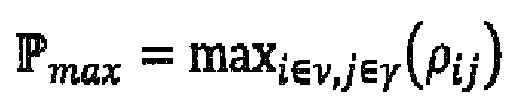 max is not inconsistent with its vicinity. In accordance with the present disclosure, the divide-conquer algorithm to find the
 max and corresponding


- In accordance with an embodiment of the present disclosure, the one or
more processors 104 are configured to jointly optimize, atstep 202, hyperparameters (i) kernel co-efficient γ and (ii) rejection rate hyperparameter ν, corresponding to a maximum performancemax a one-class support vector machine (OC-SVM), wherein max is identified from a matrix
 of combinational values of the hyperparameters.
- Input:
 consists of all the possible combination of γ, ν within the range with the dimension θ ν × θ γ .
- In an embodiment, the
step 202 of jointly optimizing the hyperparameters firstly comprises eliminating outliers in the matrixto obtain a steadiness matrix steady (step 202a). As represented in the high-level flow chart of
FIG.2 , outliers or inconsistent points (represented by bold dots) are eliminated from the training set of consistent points (represented by empty circles) training set. In an embodiment, a Density-Based Algorithm for Discovering Clusters in Large Spatial Databases with Noise (DBSCAN) may be employed. In DBSCAN algorithm, two parametersω ,are to be tuned, where
ω ,are the distance and density parameters respectively, where
ω is defined the furthest distance for which a point is density-reachable andis the minimum number of points required to form a density cluster.
- In the present disclosure,is chosen as:

 stems from the fact that
 should vary in inverse polynomial for smaller number of elements in the cluster and in negative exponential for larger number of elements in the density cluster.
- In accordance with the present disclosure,
ω = ┌3σ┐, σ= standard deviation (), which is determined intuitively considering the quasi-homogeneity in the pattern.
- Then a steadiness parametersteady is computed based on maximum performance and standard deviation associated with the steadiness matrix
 steady (step 202b).
Accordingly, ensures that the maximum performance parameter reported in the
 steady is simultaneously not too deviated from the mean performance of
 steady.
- Once the steadiness parametersteady is determined, it is diversified by forming a plurality of matrices
 new representing a plurality of regions comprising the steadiness matrix
 steady for analyzing new steadiness parameter
 new (step 202c). For instance, four
 new matrices may be formed from the steadiness matrix
 steady as represented in the high-level flow chart of
FIG.2 . - In accordance with the present disclosure, for each of the fournew matrices, new steadiness parameter

 steady and the new steadiness parameter

- In accordance with an embodiment of the present disclosure, a new steadiness matrix

 opt of optimal hyperparameters kernel co-efficient γopt and optimal rejection rate hyperparameter νopt corresponding to a maximum performance element of the selected new steadiness matrix


 opt for a given unbalanced training set is to find that {γ, ν} which is in that center of white region of a heat-map visualization, where in both X-Y direction, boundary of the white region is maximum, which is probable through joint optimization of γ, ν The method of the present disclosure for finding

-
FIG.4 illustrates a graphical illustration for anomaly detection performance comparison between hyperparameters derived in accordance with an embodiment of the present disclosure and hyperparameters derived by methods known in the art. For the purpose of experimentation PCG (Phonocardiogram) signals from MIT Physionet Challenge 2016 database were chosen. It may be noted fromFIG.4 that
- Thus in accordance with the present disclosure, the joint optimization of hyperparameters of one-class classifiers can augment clinical utility of automated cardiac condition screening. In the absence of negative examples, one class classification is an effective method to tackle class imbalance and improve clinical decision making outcomes. However, the optimality of parameters of the one-class learner kernel plays a deterministic role on the performance of the learner model of the OC-SVM. Hyperparameters, viz., kernel co-efficient γ and rejection rate hyperparameter ν are responsible for the OC-SVM to form a non-linear boundary with training vectors (positive examples). Optimizing the hyperparameters such that steadiness is achieved ensures that one-off incident of excellent performance that can result in over-fitting can be ignored, thereby making the OC-SVM decision boundary smooth and unperturbed by outlier training examples. Since the methods of the present disclosure are independent of the class of the class of training set, the present disclosure facilitates constructing generalized one-class support vector machines.
- The written description describes the subject matter herein to enable any person skilled in the art to make and use the embodiments of the present disclosure. The scope of the subject matter embodiments defined here may include other modifications that occur to those skilled in the art. Such other modifications are intended to be within the scope if they have similar elements that do not differ from the literal language of the claims or if they include equivalent elements with insubstantial differences from the literal language.
- The scope of the subject matter embodiments defined here may include other modifications that occur to those skilled in the art. Such other modifications are intended to be within the scope if they have similar elements that do not differ from the literal language of the claims or if they include equivalent elements with insubstantial differences from the literal language.
- It is, however to be understood that the scope of the protection is extended to such a program and in addition to a computer-readable means having a message therein; such computer-readable storage means contain program-code means for implementation of one or more steps of the method, when the program runs on a server or mobile device or any suitable programmable device. The hardware device can be any kind of device which can be programmed including e.g. any kind of computer like a server or a personal computer, or the like, or any combination thereof. The device may also include means which could be e.g. hardware means like e.g. an application-specific integrated circuit (ASIC), a field-programmable gate array (FPGA), or a combination of hardware and software means, e.g. an ASIC and an FPGA, or at least one microprocessor and at least one memory with software modules located therein. Thus, the means can include both hardware means and software means. The method embodiments described herein could be implemented in hardware and software. The device may also include software means. Alternatively, the embodiments of the present disclosure may be implemented on different hardware devices, e.g. using a plurality of CPUs.
- The embodiments herein can comprise hardware and software elements. The embodiments that are implemented in software include but are not limited to, firmware, resident software, microcode, etc. The functions performed by various modules comprising the system of the present disclosure and described herein may be implemented in other modules or combinations of other modules. For the purposes of this description, a computer-usable or computer readable medium can be any apparatus that can comprise, store, communicate, propagate, or transport the program for use by or in connection with the instruction execution system, apparatus, or device. The various modules described herein may be implemented as software and/or hardware modules and may be stored in any type of non-transitory computer readable medium or other storage device. Some nonlimiting examples of non-transitory computer-readable media include CDs, DVDs, BLU-RAY, flash memory, and hard disk drives.
- Further, although process steps, method steps, techniques or the like may be described in a sequential order, such processes, methods and techniques may be configured to work in alternate orders. In other words, any sequence or order of steps that may be described does not necessarily indicate a requirement that the steps be performed in that order. The steps of processes described herein may be performed in any order practical. Further, some steps may be performed simultaneously.
- The illustrated steps are set out to explain the exemplary embodiments shown, and it should be anticipated that ongoing technological development will change the manner in which particular functions are performed. These examples are presented herein for purposes of illustration, and not limitation. Further, the boundaries of the functional building blocks have been arbitrarily defined herein for the convenience of the description. Alternative boundaries can be defined so long as the specified functions and relationships thereof are appropriately performed. Alternatives (including equivalents, extensions, variations, deviations, etc., of those described herein) will be apparent to persons skilled in the relevant art(s) based on the teachings contained herein. Such alternatives fall within the scope and spirit of the disclosed embodiments. Also, the words "comprising," "having," "containing," and "including," and other similar forms are intended to be equivalent in meaning and be open ended in that an item or items following any one of these words is not meant to be an exhaustive listing of such item or items, or meant to be limited to only the listed item or items. It must also be noted that as used herein and in the appended claims, the singular forms "a," "an," and "the" include plural references unless the context clearly dictates otherwise.
- It is intended that the disclosure and examples be considered as exemplary only, with a true scope and spirit of disclosed embodiments being indicated by the following claims.
Claims (5)
- A processor implemented method (200) comprising:jointly optimizing hyperparameters (i) kernel co-efficient γ and (ii) rejection rate hyperparameter ν, corresponding to a maximum performancemax of a one-class support vector machine (OC-SVM), wherein
 max is identified from a matrix
 of combinational values of the hyperparameters (202); and
 obtaining an optimal non-linear decision boundary based on the jointly optimized hyperparameters (γopt and νopt ) for binary classification (204).
 - The processor implemented method of claim 1, wherein the step of jointly optimizing the hyperparameters comprises:(i) eliminating outliers in the matrix P to obtain a steadiness matrixsteady (202a);
 (ii) computing a steadiness parametersteady based on maximum performance and standard deviation associated with the steadiness matrix
 steady (202b);
 (iii) diversifying the steadiness parametersteady by forming a plurality of matrices
 new representing a plurality of regions comprising the steadiness matrix
 steady for analyzing new steadiness parameter
 new (202c);
 (iv) iteratively computing new steadiness parameter
 steady and the new steadiness parameter
 (v) selecting a new steadiness matrix
 (vi) determining a pairopt of optimal kernel co-efficient γopt and optimal rejection rate hyperparameter νopt corresponding to a maximum performance element of selected new steadiness matrix

- A system (100) comprising:
one or more data storage devices (102) operatively coupled to one or more hardware processors (104) and configured to store instructions configured for execution by the one or more hardware processors to:jointly optimize hyperparameters (i) kernel co-efficient γ and (ii) rejection rate hyperparameter ν, corresponding to a maximum performancemax of a one-class support vector machine (OC-SVM), wherein max is identified from a matrix
 of combinational values of the hyperparameters; and
 obtain an optimal non-linear decision boundary based on the jointly optimized hyperparameters (γopt and νopt ) for binary classification.
 - The system of claim 3, wherein the one or more hardware processors are further configured to jointly optimize the hyperparameters by:(i) eliminating outliers in the matrixto obtain a steadiness matrix
 steady ;
 (ii) computing a steadiness parametersteady based on maximum performance and standard deviation associated with the steadiness matrix
 steady ;
 (iii) diversifying the steadiness parametersteady by forming a plurality of matrices
 new representing a plurality of regions comprising the steadiness matrix
 steady for analyzing new steadiness parameter
 new ;
new ; (iv) iteratively computing new steadiness parameter
 steady and the new steadiness parameter
 (v) selecting a new steadiness matrix
 (vi) determining a pairopt of optimal kernel co-efficient γopt and optimal rejection rate hyperparameter νopt corresponding to a maximum performance element of selected new steadiness matrix

- A computer program product comprising a non-transitory computer readable medium having a computer readable program embodied therein, wherein the computer readable program, when executed on a computing device, causes the computing device to:jointly optimize hyperparameters (i) kernel co-efficient γ and (ii) rejection rate hyperparameter ν, corresponding to a maximum performancemax of a one-class support vector machine (OC-SVM), wherein
 max is identified from a matrix
 of combinational values of the hyperparameters; and
 obtain an optimal non-linear decision boundary based on the jointly optimized hyperparameters (γopt and νopt ) for binary classification.
Applications Claiming Priority (1)
| Application Number | Priority Date | Filing Date | Title |
|---|---|---|---|
| IN201721028487 | 2017-08-10 |
Publications (3)
| Publication Number | Publication Date |
|---|---|
| EP3480734A1 true EP3480734A1 (en) | 2019-05-08 |
| EP3480734B1 EP3480734B1 (en) | 2024-02-07 |
| EP3480734C0 EP3480734C0 (en) | 2024-02-07 |
Family
ID=61691638
Family Applications (1)
| Application Number | Title | Priority Date | Filing Date |
|---|---|---|---|
| EP18160972.8A Active EP3480734B1 (en) | 2017-08-10 | 2018-03-09 | Generalized one-class support vector machines with jointly optimized hyperparameters thereof |
Country Status (2)
| Country | Link |
|---|---|
| US (1) | US20190050690A1 (en) |
| EP (1) | EP3480734B1 (en) |
Families Citing this family (4)
| Publication number | Priority date | Publication date | Assignee | Title |
|---|---|---|---|---|
| WO2021014029A1 (en) * | 2019-07-22 | 2021-01-28 | Telefónica Iot & Big Data Tech, S.A. | Method for detecting anomalies in data communications |
| US11423698B2 (en) | 2020-10-26 | 2022-08-23 | Mitsubishi Electric Research Laboratories, Inc. | Anomaly detector for detecting anomaly using complementary classifiers |
| FR3124938B1 (en) * | 2021-07-09 | 2024-02-23 | Substrate Hd | Atrial tachycardia analysis module providing a scalable pattern of tachycardia events |
| US20230196029A1 (en) * | 2021-12-20 | 2023-06-22 | Intuit Inc. | Signal processing and reporting |
-
2018
- 2018-03-09 EP EP18160972.8A patent/EP3480734B1/en active Active
- 2018-03-15 US US15/922,435 patent/US20190050690A1/en not_active Abandoned
Non-Patent Citations (2)
| Title |
|---|
| CHETANYA PURI ET AL: "Classification of Normal and Abnormal Heart Sound Recordings through Robust Feature Selection", 2016 COMPUTING IN CARDIOLOGY CONFERENCE (CINC), 11-14 SEPTEMBER 2016, vol. 43, 11 September 2016 (2016-09-11), pages 1 - 4, XP055540949, ISSN: 2325-887X, ISBN: 978-1-5090-0895-7, DOI: 10.22489/CinC.2016.322-363 * |
| ZHUANG L ET AL: "Parameter optimization of kernel-based one-class classifier on imbalance learning", JOURNAL OF COMPUTERS, vol. 1, no. 7, October 2006 (2006-10-01), pages 32 - 40, XP055528245, Retrieved from the Internet <URL:http://citeseerx.ist.psu.edu/viewdoc/download?doi=10.1.1.542.7536&rep=rep1&type=pdf> [retrieved on 20181128] * |
Also Published As
| Publication number | Publication date |
|---|---|
| US20190050690A1 (en) | 2019-02-14 |
| EP3480734B1 (en) | 2024-02-07 |
| EP3480734C0 (en) | 2024-02-07 |
Similar Documents
| Publication | Publication Date | Title |
|---|---|---|
| US11178161B2 (en) | Detecting anomalies during operation of a computer system based on multimodal data | |
| EP3480734B1 (en) | Generalized one-class support vector machines with jointly optimized hyperparameters thereof | |
| EP3594859A1 (en) | Failed and censored instances based remaining useful life (rul) estimation of entities | |
| JP7388078B2 (en) | Accessible machine learning backend | |
| US10743821B2 (en) | Anomaly detection by self-learning of sensor signals | |
| US20200065292A1 (en) | Systems and methods for improved anomaly detection in attributed networks | |
| US20210326765A1 (en) | Adaptive filter based learning model for time series sensor signal classification on edge devices | |
| US20260106883A1 (en) | Anomaly detection and mitigation using device subpopulation partitioning | |
| US20240242083A1 (en) | Anomaly detection for tabular data with internal contrastive learning | |
| US10885593B2 (en) | Hybrid classification system | |
| EP4060542B1 (en) | System and method for data anonymization using optimization techniques | |
| US12260176B2 (en) | System and method for extracting issues based on trouble ticket mining | |
| Chakir et al. | An explainable machine learning-based web attack detection system for industrial IoT web application security | |
| US20200012941A1 (en) | Method and system for generation of hybrid learning techniques | |
| KR20230154601A (en) | Method and device for obtaining pixel information of table | |
| WO2022265800A1 (en) | Computer security using activity and content segregation | |
| US20240265268A1 (en) | Federated learning with single-round convergence | |
| US9978392B2 (en) | Noisy signal identification from non-stationary audio signals | |
| EP3361416A1 (en) | Statistical modeling techniques based neural network models for generating intelligence reports | |
| US11531830B2 (en) | Synthetic rare class generation by preserving morphological identity | |
| EP3961510A1 (en) | Method and system for matched and balanced causal inference for multiple treatments | |
| KR102283885B1 (en) | Method for image registration | |
| US20240112085A1 (en) | Methods and systems for estimating and evaluating model performance in production | |
| US12585993B2 (en) | Machine learning apparatus, machine learning system, machine learning method, and program | |
| WO2023279186A1 (en) | Methods and systems for extracting text and symbols from documents |
Legal Events
| Date | Code | Title | Description |
|---|---|---|---|
| PUAI | Public reference made under article 153(3) epc to a published international application that has entered the european phase |
Free format text: ORIGINAL CODE: 0009012 |
|
| STAA | Information on the status of an ep patent application or granted ep patent |
Free format text: STATUS: THE APPLICATION HAS BEEN PUBLISHED |
|
| AK | Designated contracting states |
Kind code of ref document: A1 Designated state(s): AL AT BE BG CH CY CZ DE DK EE ES FI FR GB GR HR HU IE IS IT LI LT LU LV MC MK MT NL NO PL PT RO RS SE SI SK SM TR |
|
| AX | Request for extension of the european patent |
Extension state: BA ME |
|
| STAA | Information on the status of an ep patent application or granted ep patent |
Free format text: STATUS: REQUEST FOR EXAMINATION WAS MADE |
|
| 17P | Request for examination filed |
Effective date: 20191108 |
|
| RBV | Designated contracting states (corrected) |
Designated state(s): AL AT BE BG CH CY CZ DE DK EE ES FI FR GB GR HR HU IE IS IT LI LT LU LV MC MK MT NL NO PL PT RO RS SE SI SK SM TR |
|
| STAA | Information on the status of an ep patent application or granted ep patent |
Free format text: STATUS: EXAMINATION IS IN PROGRESS |
|
| 17Q | First examination report despatched |
Effective date: 20210929 |
|
| REG | Reference to a national code |
Ref legal event code: R079 Ipc: G06F0018241100 Ref country code: DE Ref legal event code: R079 Ref document number: 602018064882 Country of ref document: DE Free format text: PREVIOUS MAIN CLASS: G06K0009620000 Ipc: G06F0018241100 |
|
| GRAP | Despatch of communication of intention to grant a patent |
Free format text: ORIGINAL CODE: EPIDOSNIGR1 |
|
| STAA | Information on the status of an ep patent application or granted ep patent |
Free format text: STATUS: GRANT OF PATENT IS INTENDED |
|
| RIC1 | Information provided on ipc code assigned before grant |
Ipc: G06F 17/18 20060101ALI20230803BHEP Ipc: G06N 20/10 20190101ALI20230803BHEP Ipc: G06F 18/2433 20230101ALI20230803BHEP Ipc: G06F 18/2411 20230101AFI20230803BHEP |
|
| INTG | Intention to grant announced |
Effective date: 20230823 |
|
| GRAS | Grant fee paid |
Free format text: ORIGINAL CODE: EPIDOSNIGR3 |
|
| GRAA | (expected) grant |
Free format text: ORIGINAL CODE: 0009210 |
|
| STAA | Information on the status of an ep patent application or granted ep patent |
Free format text: STATUS: THE PATENT HAS BEEN GRANTED |
|
| AK | Designated contracting states |
Kind code of ref document: B1 Designated state(s): AL AT BE BG CH CY CZ DE DK EE ES FI FR GB GR HR HU IE IS IT LI LT LU LV MC MK MT NL NO PL PT RO RS SE SI SK SM TR |
|
| REG | Reference to a national code |
Ref country code: GB Ref legal event code: FG4D |
|
| REG | Reference to a national code |
Ref country code: CH Ref legal event code: EP |
|
| REG | Reference to a national code |
Ref country code: DE Ref legal event code: R096 Ref document number: 602018064882 Country of ref document: DE |
|
| REG | Reference to a national code |
Ref country code: IE Ref legal event code: FG4D |
|
| U01 | Request for unitary effect filed |
Effective date: 20240207 |
|
| U07 | Unitary effect registered |
Designated state(s): AT BE BG DE DK EE FI FR IT LT LU LV MT NL PT SE SI Effective date: 20240212 |
|
| U20 | Renewal fee for the european patent with unitary effect paid |
Year of fee payment: 7 Effective date: 20240326 |
|
| PG25 | Lapsed in a contracting state [announced via postgrant information from national office to epo] |
Ref country code: IS Free format text: LAPSE BECAUSE OF FAILURE TO SUBMIT A TRANSLATION OF THE DESCRIPTION OR TO PAY THE FEE WITHIN THE PRESCRIBED TIME-LIMIT Effective date: 20240607 |
|
| PG25 | Lapsed in a contracting state [announced via postgrant information from national office to epo] |
Ref country code: GR Free format text: LAPSE BECAUSE OF FAILURE TO SUBMIT A TRANSLATION OF THE DESCRIPTION OR TO PAY THE FEE WITHIN THE PRESCRIBED TIME-LIMIT Effective date: 20240508 |
|
| PG25 | Lapsed in a contracting state [announced via postgrant information from national office to epo] |
Ref country code: RS Free format text: LAPSE BECAUSE OF FAILURE TO SUBMIT A TRANSLATION OF THE DESCRIPTION OR TO PAY THE FEE WITHIN THE PRESCRIBED TIME-LIMIT Effective date: 20240507 Ref country code: HR Free format text: LAPSE BECAUSE OF FAILURE TO SUBMIT A TRANSLATION OF THE DESCRIPTION OR TO PAY THE FEE WITHIN THE PRESCRIBED TIME-LIMIT Effective date: 20240207 |
|
| PG25 | Lapsed in a contracting state [announced via postgrant information from national office to epo] |
Ref country code: ES Free format text: LAPSE BECAUSE OF FAILURE TO SUBMIT A TRANSLATION OF THE DESCRIPTION OR TO PAY THE FEE WITHIN THE PRESCRIBED TIME-LIMIT Effective date: 20240207 |
|
| PG25 | Lapsed in a contracting state [announced via postgrant information from national office to epo] |
Ref country code: RS Free format text: LAPSE BECAUSE OF FAILURE TO SUBMIT A TRANSLATION OF THE DESCRIPTION OR TO PAY THE FEE WITHIN THE PRESCRIBED TIME-LIMIT Effective date: 20240507 Ref country code: NO Free format text: LAPSE BECAUSE OF FAILURE TO SUBMIT A TRANSLATION OF THE DESCRIPTION OR TO PAY THE FEE WITHIN THE PRESCRIBED TIME-LIMIT Effective date: 20240507 Ref country code: IS Free format text: LAPSE BECAUSE OF FAILURE TO SUBMIT A TRANSLATION OF THE DESCRIPTION OR TO PAY THE FEE WITHIN THE PRESCRIBED TIME-LIMIT Effective date: 20240607 Ref country code: HR Free format text: LAPSE BECAUSE OF FAILURE TO SUBMIT A TRANSLATION OF THE DESCRIPTION OR TO PAY THE FEE WITHIN THE PRESCRIBED TIME-LIMIT Effective date: 20240207 Ref country code: GR Free format text: LAPSE BECAUSE OF FAILURE TO SUBMIT A TRANSLATION OF THE DESCRIPTION OR TO PAY THE FEE WITHIN THE PRESCRIBED TIME-LIMIT Effective date: 20240508 Ref country code: ES Free format text: LAPSE BECAUSE OF FAILURE TO SUBMIT A TRANSLATION OF THE DESCRIPTION OR TO PAY THE FEE WITHIN THE PRESCRIBED TIME-LIMIT Effective date: 20240207 |
|
| PG25 | Lapsed in a contracting state [announced via postgrant information from national office to epo] |
Ref country code: PL Free format text: LAPSE BECAUSE OF FAILURE TO SUBMIT A TRANSLATION OF THE DESCRIPTION OR TO PAY THE FEE WITHIN THE PRESCRIBED TIME-LIMIT Effective date: 20240207 |
|
| PG25 | Lapsed in a contracting state [announced via postgrant information from national office to epo] |
Ref country code: PL Free format text: LAPSE BECAUSE OF FAILURE TO SUBMIT A TRANSLATION OF THE DESCRIPTION OR TO PAY THE FEE WITHIN THE PRESCRIBED TIME-LIMIT Effective date: 20240207 |
|
| PG25 | Lapsed in a contracting state [announced via postgrant information from national office to epo] |
Ref country code: SM Free format text: LAPSE BECAUSE OF FAILURE TO SUBMIT A TRANSLATION OF THE DESCRIPTION OR TO PAY THE FEE WITHIN THE PRESCRIBED TIME-LIMIT Effective date: 20240207 |
|
| PG25 | Lapsed in a contracting state [announced via postgrant information from national office to epo] |
Ref country code: CZ Free format text: LAPSE BECAUSE OF FAILURE TO SUBMIT A TRANSLATION OF THE DESCRIPTION OR TO PAY THE FEE WITHIN THE PRESCRIBED TIME-LIMIT Effective date: 20240207 |
|
| PG25 | Lapsed in a contracting state [announced via postgrant information from national office to epo] |
Ref country code: SK Free format text: LAPSE BECAUSE OF FAILURE TO SUBMIT A TRANSLATION OF THE DESCRIPTION OR TO PAY THE FEE WITHIN THE PRESCRIBED TIME-LIMIT Effective date: 20240207 |
|
| PG25 | Lapsed in a contracting state [announced via postgrant information from national office to epo] |
Ref country code: SM Free format text: LAPSE BECAUSE OF FAILURE TO SUBMIT A TRANSLATION OF THE DESCRIPTION OR TO PAY THE FEE WITHIN THE PRESCRIBED TIME-LIMIT Effective date: 20240207 Ref country code: SK Free format text: LAPSE BECAUSE OF FAILURE TO SUBMIT A TRANSLATION OF THE DESCRIPTION OR TO PAY THE FEE WITHIN THE PRESCRIBED TIME-LIMIT Effective date: 20240207 Ref country code: RO Free format text: LAPSE BECAUSE OF FAILURE TO SUBMIT A TRANSLATION OF THE DESCRIPTION OR TO PAY THE FEE WITHIN THE PRESCRIBED TIME-LIMIT Effective date: 20240207 Ref country code: CZ Free format text: LAPSE BECAUSE OF FAILURE TO SUBMIT A TRANSLATION OF THE DESCRIPTION OR TO PAY THE FEE WITHIN THE PRESCRIBED TIME-LIMIT Effective date: 20240207 |
|
| REG | Reference to a national code |
Ref country code: DE Ref legal event code: R097 Ref document number: 602018064882 Country of ref document: DE |
|
| PG25 | Lapsed in a contracting state [announced via postgrant information from national office to epo] |
Ref country code: MC Free format text: LAPSE BECAUSE OF FAILURE TO SUBMIT A TRANSLATION OF THE DESCRIPTION OR TO PAY THE FEE WITHIN THE PRESCRIBED TIME-LIMIT Effective date: 20240207 |
|
| PG25 | Lapsed in a contracting state [announced via postgrant information from national office to epo] |
Ref country code: MC Free format text: LAPSE BECAUSE OF FAILURE TO SUBMIT A TRANSLATION OF THE DESCRIPTION OR TO PAY THE FEE WITHIN THE PRESCRIBED TIME-LIMIT Effective date: 20240207 |
|
| PLBE | No opposition filed within time limit |
Free format text: ORIGINAL CODE: 0009261 |
|
| STAA | Information on the status of an ep patent application or granted ep patent |
Free format text: STATUS: NO OPPOSITION FILED WITHIN TIME LIMIT |
|
| 26N | No opposition filed |
Effective date: 20241108 |
|
| PG25 | Lapsed in a contracting state [announced via postgrant information from national office to epo] |
Ref country code: IE Free format text: LAPSE BECAUSE OF NON-PAYMENT OF DUE FEES Effective date: 20240309 |
|
| PG25 | Lapsed in a contracting state [announced via postgrant information from national office to epo] |
Ref country code: IE Free format text: LAPSE BECAUSE OF NON-PAYMENT OF DUE FEES Effective date: 20240309 |
|
| U20 | Renewal fee for the european patent with unitary effect paid |
Year of fee payment: 8 Effective date: 20250325 |
|
| PGFP | Annual fee paid to national office [announced via postgrant information from national office to epo] |
Ref country code: CH Payment date: 20250401 Year of fee payment: 8 |
|
| PG25 | Lapsed in a contracting state [announced via postgrant information from national office to epo] |
Ref country code: CY Free format text: LAPSE BECAUSE OF FAILURE TO SUBMIT A TRANSLATION OF THE DESCRIPTION OR TO PAY THE FEE WITHIN THE PRESCRIBED TIME-LIMIT; INVALID AB INITIO Effective date: 20180309 |
|
| PG25 | Lapsed in a contracting state [announced via postgrant information from national office to epo] |
Ref country code: HU Free format text: LAPSE BECAUSE OF FAILURE TO SUBMIT A TRANSLATION OF THE DESCRIPTION OR TO PAY THE FEE WITHIN THE PRESCRIBED TIME-LIMIT; INVALID AB INITIO Effective date: 20180309 |
|
| PG25 | Lapsed in a contracting state [announced via postgrant information from national office to epo] |
Ref country code: TR Free format text: LAPSE BECAUSE OF FAILURE TO SUBMIT A TRANSLATION OF THE DESCRIPTION OR TO PAY THE FEE WITHIN THE PRESCRIBED TIME-LIMIT Effective date: 20240207 |
|
| REG | Reference to a national code |
Ref country code: CH Ref legal event code: U11 Free format text: ST27 STATUS EVENT CODE: U-0-0-U10-U11 (AS PROVIDED BY THE NATIONAL OFFICE) Effective date: 20260401 |
|
| PGFP | Annual fee paid to national office [announced via postgrant information from national office to epo] |
Ref country code: GB Payment date: 20260304 Year of fee payment: 9 |
|
| U20 | Renewal fee for the european patent with unitary effect paid |
Year of fee payment: 9 Effective date: 20260323 |