EP3480713A1 - Data processing method and apparatus - Google Patents
Data processing method and apparatus Download PDFInfo
- Publication number
- EP3480713A1 EP3480713A1 EP17836297.6A EP17836297A EP3480713A1 EP 3480713 A1 EP3480713 A1 EP 3480713A1 EP 17836297 A EP17836297 A EP 17836297A EP 3480713 A1 EP3480713 A1 EP 3480713A1
- Authority
- EP
- European Patent Office
- Prior art keywords
- trend
- article
- publishing time
- chart
- trend chart
- Prior art date
- Legal status (The legal status is an assumption and is not a legal conclusion. Google has not performed a legal analysis and makes no representation as to the accuracy of the status listed.)
- Withdrawn
Links
Images



Classifications
-
- G—PHYSICS
- G06—COMPUTING OR CALCULATING; COUNTING
- G06F—ELECTRIC DIGITAL DATA PROCESSING
- G06F16/00—Information retrieval; Database structures therefor; File system structures therefor
- G06F16/90—Details of database functions independent of the retrieved data types
- G06F16/95—Retrieval from the web
- G06F16/958—Organisation or management of web site content, e.g. publishing, maintaining pages or automatic linking
-
- G—PHYSICS
- G06—COMPUTING OR CALCULATING; COUNTING
- G06F—ELECTRIC DIGITAL DATA PROCESSING
- G06F16/00—Information retrieval; Database structures therefor; File system structures therefor
- G06F16/90—Details of database functions independent of the retrieved data types
- G06F16/95—Retrieval from the web
- G06F16/955—Retrieval from the web using information identifiers, e.g. uniform resource locators [URL]
- G06F16/9558—Details of hyperlinks; Management of linked annotations
-
- G—PHYSICS
- G06—COMPUTING OR CALCULATING; COUNTING
- G06F—ELECTRIC DIGITAL DATA PROCESSING
- G06F16/00—Information retrieval; Database structures therefor; File system structures therefor
-
- G—PHYSICS
- G06—COMPUTING OR CALCULATING; COUNTING
- G06F—ELECTRIC DIGITAL DATA PROCESSING
- G06F16/00—Information retrieval; Database structures therefor; File system structures therefor
- G06F16/90—Details of database functions independent of the retrieved data types
- G06F16/901—Indexing; Data structures therefor; Storage structures
- G06F16/9024—Graphs; Linked lists
-
- G—PHYSICS
- G06—COMPUTING OR CALCULATING; COUNTING
- G06F—ELECTRIC DIGITAL DATA PROCESSING
- G06F16/00—Information retrieval; Database structures therefor; File system structures therefor
- G06F16/90—Details of database functions independent of the retrieved data types
- G06F16/904—Browsing; Visualisation therefor
-
- G—PHYSICS
- G06—COMPUTING OR CALCULATING; COUNTING
- G06F—ELECTRIC DIGITAL DATA PROCESSING
- G06F16/00—Information retrieval; Database structures therefor; File system structures therefor
- G06F16/90—Details of database functions independent of the retrieved data types
- G06F16/95—Retrieval from the web
- G06F16/954—Navigation, e.g. using categorised browsing
-
- G—PHYSICS
- G06—COMPUTING OR CALCULATING; COUNTING
- G06F—ELECTRIC DIGITAL DATA PROCESSING
- G06F16/00—Information retrieval; Database structures therefor; File system structures therefor
- G06F16/90—Details of database functions independent of the retrieved data types
- G06F16/95—Retrieval from the web
- G06F16/955—Retrieval from the web using information identifiers, e.g. uniform resource locators [URL]
- G06F16/9566—URL specific, e.g. using aliases, detecting broken or misspelled links
-
- G—PHYSICS
- G06—COMPUTING OR CALCULATING; COUNTING
- G06F—ELECTRIC DIGITAL DATA PROCESSING
- G06F16/00—Information retrieval; Database structures therefor; File system structures therefor
- G06F16/90—Details of database functions independent of the retrieved data types
- G06F16/95—Retrieval from the web
- G06F16/957—Browsing optimisation, e.g. caching or content distillation
-
- G—PHYSICS
- G06—COMPUTING OR CALCULATING; COUNTING
- G06F—ELECTRIC DIGITAL DATA PROCESSING
- G06F16/00—Information retrieval; Database structures therefor; File system structures therefor
- G06F16/90—Details of database functions independent of the retrieved data types
- G06F16/95—Retrieval from the web
- G06F16/957—Browsing optimisation, e.g. caching or content distillation
- G06F16/9574—Browsing optimisation, e.g. caching or content distillation of access to content, e.g. by caching
-
- G—PHYSICS
- G06—COMPUTING OR CALCULATING; COUNTING
- G06F—ELECTRIC DIGITAL DATA PROCESSING
- G06F40/00—Handling natural language data
- G06F40/10—Text processing
- G06F40/166—Editing, e.g. inserting or deleting
- G06F40/169—Annotation, e.g. comment data or footnotes
Definitions
- the present invention relates to the technical field of the Internet, particularly to a data processing method and apparatus.
- the present invention provides data processing methods and apparatus, which enable a user to quickly obtain the trend situation of a matter since an article is published when the user browses the article.
- the present invention provides a data processing method, comprising: Obtaining, after receiving a link request sent by a client, a trend chart corresponding to a matter name carried in the link request, wherein the link request is generated after a link in an article is triggered and is used for requesting a trend chart of a matter described in the article;
- the present invention provides a data processing apparatus, comprising:
- the data processing method and apparatus provided by the present invention can set a link in an article for viewing the trend of a matter.
- a server receives a link request sent by a client, it first obtains a trend chart corresponding to a matter name carried in the link request, then obtains the publishing time of the article, and lastly annotates information related to the publishing time in the trend chart, and sends the processed trend chart to the client.
- the present invention not only can provide users with a link for viewing the trend chart of a matter, but also can annotate, in the trend chart, information related to the publishing time of an article.
- the user can quickly obtain the trend situation of the matter since the article was published, hence raising the efficiency of the user in analysis of the article.
- the embodiments of the present invention provide a data processing method, which is mainly applied on the server side, as shown in FIG. 1 , and mainly comprises: 101. After receiving a link request sent by a client, obtaining a trend chart corresponding to a matter name carried in the link request.
- the user may click on a link in the article for requesting a trend chart.
- the client may obtain the matter name of a matter to be requested and the publishing time of the article at first, and then send the link request carrying the matter name and publishing time to a server.
- the server After the server receives the link request sent by the client, it may obtain the matter name from the link request, and then search in the database for a trend chart corresponding to the matter name so as to proceed to steps 102-103 based on this trend chart subsequently.
- a client may obtain the publishing time of an article by the following method: (1) As most articles will indicate the publishing time of the article in the starting part and the ending part, the publishing time may be extracted from the starting part of the article or the ending part of the article. (2) Ordinary URLs (Uniform Resource Locator) will carry a web page creation time, and the web page creation time is the publishing time of the article, so the publishing time may be extracted from the URL of the web page where the article is located.
- Ordinary URLs Uniform Resource Locator
- the trend charts corresponding to different time periods may be arranged in a trend detail page, so when trend charts are fed back to a client, the annotated trend charts may be fed back to the client by themselves, or the trend detail page containing the annotated trend charts may be fed back to the client so that the user not only may intuitively view the trend situation of the matter since the publishing time but also may view the trend situations in other time periods.
- the data processing method provided by the embodiments of the present invention can set a link in an article for viewing the trend of a matter.
- a server receives a link request sent by a client, it first obtains a trend chart corresponding to a matter name carried in the link request, then obtains a publishing time of the article, and lastly annotates information related to the publishing time in the trend chart, and sends the processed trend chart to the client.
- the present invention not only can provide users with a link for viewing the trend chart of a matter, but also can annotate, in the trend chart, information related to the publishing time of an article.
- the user can quickly obtain the trend situation of the matter since the article was published, hence raising the efficiency of the user in analysis of the article.
- another embodiment of the present invention further provides a data processing method, as shown in FIG. 2 .
- the method mainly comprises: 201. After receiving a link request sent by a client, obtaining a trend chart corresponding to a matter name carried in the link request.
- the server may annotate the trend point corresponding to the publishing time in the trend charts that contain the publishing time.
- the curve before the trend point and the curve after the trend point may be processed in a differentiating manner.
- the curve after the trend point is thickened, colorized, or given a different grayscale so that the user can quickly obtain the trend chart of the matter after the publishing time of the article.
- this embodiment of the present invention makes the following modification to the foregoing solution: the server may first determine the trend point corresponding to the publishing time in the trend chart that contains the publishing time and the trend point corresponding to the most recent point of time in the current trend chart, and then annotate the degree of difference between the trend point corresponding to the publishing time and the trend point corresponding to the most recent point of time in the current trend chart.
- the degree of difference may be the difference value obtained by subtracting the trend corresponding to the latest time in the current trend chart from the trend corresponding to the publishing time, or a percentage difference calculated based on the difference value between the two.
- the degree of difference between the two may be calculated according to other formulae for calculating difference.
- an arrow standing for up or down may be annotated when the degree of difference is annotated.
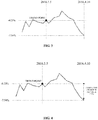
- FIG. 3 is changed into FIG. 4 , a user can directly and quickly know that the cumulative net value has fallen 7.31% from the publishing time of the article to the present without having to find the net value corresponding to January 05, 2016 and the net value corresponding to April 10, 2016 in the chart first, and then calculate the difference and obtain the change in net value.
- this embodiment of the present invention makes the following modification to the foregoing solution: in the trend detail page, the server may add a link for going back to the article in a trend chart containing the publishing time, or may add a link for going back to the article in a trend chart not containing the publishing time, or may add a link for going back to the article in an area of a trend detail page not for a trend chart.
- the trend charts that are displayed first by default may be trend charts not containing the publishing time.
- a corresponding button needs to be pressed in order to display the trend chart.
- the operation is relatively tedious.
- the server sends a trend detail page for displaying processed trend charts with priority to the client, i.e., the server first adjusts the page data first displayed in the trend detail page based on annotated trend charts, and then feeds back the adjusted trend detail page to the client so that the user can quickly obtain the trend situation of the matter since the publishing time.
- any of them may be selected as a trend chart displayed first in the trend detail page, or a trend chart with the shortest time period may be selected as a trend chart displayed first in the trend detail page.
- the page first displayed to a user may be as shown in FIG. 5 , i.e., the trend chart first displayed is an annotated trend chart, rather than a trend chart not annotated and corresponding to time period "past month" at the leftmost of the trend detail page.
- another embodiment of the present invention further provides a data processing apparatus, as shown in FIG. 6 , mainly comprising: an obtaining unit 31, a determining unit 32, a processing unit 33, and a sending unit 34.
- obtaining unit 31, for obtaining, after receiving a link request sent by a client, a trend chart corresponding to a matter name carried in the link request, wherein the link request is generated after a link in an article is triggered and is used for requesting a trend chart of a matter described in the article;
- determining unit 32 for determining a publishing time of the article; processing unit 33, for annotating information related to the publishing time in the trend chart; sending unit 34, for sending the processed trend chart to the client.
- the processing unit 33 comprises: a first annotating module 331, for annotating a trend point corresponding to the publishing time in the trend chart.
- the processing unit 33 further comprises: a second annotating module 332, for annotating a degree of difference between the trend point corresponding to the publishing time and the trend point corresponding to the most recent point of time in the trend chart.
- the apparatus further comprises: an adding unit 35, for adding a link for going back to the article in the trend chart after annotation of the information related to the publishing time.
- the sending unit 34 is used to send a trend detail page for displaying processed trend charts with priority to the client when trend charts are included in the trend detail page, and the trend charts corresponding to the matter name include trend charts containing the publishing time and trend charts not containing the publishing time.
- modules in a device in an embodiment may be subject to adaptive changes and arranged in one or a plurality of devices different from the embodiment.
- the modules or units or components in an embodiment may be combined into a module, unit, or component, and further, they may be divided into a plurality of submodules, or subunits, or subcomponents.
- any combination may be adopted to combine all the features disclosed in the specification (including the accompanying claims, abstract, and drawings) as well as all the processes or units of any method or device thus disclosed.
- the embodiments of the components of the present invention may be achieved by hardware, or by a software module operated on one or a plurality of processors, or by their combinations.
- DSP digital signal processors
- the present invention may further achieve some or all device or apparatus programs (such as computer programs and computer program products) for performing the method described herein.
- Such programs for achieving the present invention may be stored on computer-readable media, or may have a form of one or a plurality of signals. Such signals may be obtained through downloading from the Internet, or provided on carrier signals, or provided in any other form.
Landscapes
- Engineering & Computer Science (AREA)
- Theoretical Computer Science (AREA)
- Databases & Information Systems (AREA)
- General Engineering & Computer Science (AREA)
- General Physics & Mathematics (AREA)
- Physics & Mathematics (AREA)
- Data Mining & Analysis (AREA)
- Software Systems (AREA)
- Radar, Positioning & Navigation (AREA)
- Remote Sensing (AREA)
- General Health & Medical Sciences (AREA)
- Computational Linguistics (AREA)
- Audiology, Speech & Language Pathology (AREA)
- Artificial Intelligence (AREA)
- Health & Medical Sciences (AREA)
- Information Transfer Between Computers (AREA)
- Management, Administration, Business Operations System, And Electronic Commerce (AREA)
- User Interface Of Digital Computer (AREA)
- Information Retrieval, Db Structures And Fs Structures Therefor (AREA)
Abstract
Description
- The present application claims priority from Chinese patent application with an application number
201610630555.3 - The present invention relates to the technical field of the Internet, particularly to a data processing method and apparatus.
- With the development of Internet technology, more and more users publish their comments on specific matters through networks, such as a newspaper reporter commenting on a ball game and a financial enthusiast commenting on a stock market.
- Many of the articles commenting on a matter are articles predicting the future trend of a matter. Therefore, from these articles, users not only can obtain the summary of the authors on the present situation of a matter but also can know the judgments of the authors on the future development situation of the matter. However, when a user browses some articles that have been published for some time, if the user wants to know whether the prediction of an author is correct or whether the mentioned situation has changed, the user needs to spend a lot of time in searching for the trend chart of the matter commented on by the author on the current website or on other websites, find the point corresponding to the publishing time of the article in the trend chart, and view the subsequent trend situation based on this point, thus determining whether the prediction published by the author is correct or whether the matter has changed since the article was published. The operation is very tedious. Therefore, how to quickly obtain the trend situation of a matter since an article was published while browsing the article is a major difficulty at present.
- In light of the above, the present invention provides data processing methods and apparatus, which enable a user to quickly obtain the trend situation of a matter since an article is published when the user browses the article.
- In one aspect, the present invention provides a data processing method, comprising:
Obtaining, after receiving a link request sent by a client, a trend chart corresponding to a matter name carried in the link request, wherein the link request is generated after a link in an article is triggered and is used for requesting a trend chart of a matter described in the article; - determining a publishing time of the article;
- annotating information related to the publishing time in the trend chart;
- sending the processed trend chart to the client.
- In another aspect, the present invention provides a data processing apparatus, comprising:
- an obtaining unit, for obtaining, after receiving a link request sent by a client, a trend chart corresponding to a matter name carried in the link request, wherein the link request is generated after a link in an article is triggered and is used for requesting a trend chart of a matter described in the article;
- a determining unit, for determining a publishing time of the article;
- a processing unit, for annotating information related to the publishing time in the trend chart;
- a sending unit, for sending the processed trend chart to the client.
- By dint of the foregoing technical solutions, the data processing method and apparatus provided by the present invention can set a link in an article for viewing the trend of a matter. After a server receives a link request sent by a client, it first obtains a trend chart corresponding to a matter name carried in the link request, then obtains the publishing time of the article, and lastly annotates information related to the publishing time in the trend chart, and sends the processed trend chart to the client. Thus it can be seen, compared with current technologies, the present invention not only can provide users with a link for viewing the trend chart of a matter, but also can annotate, in the trend chart, information related to the publishing time of an article. Thus when a user browses the article, the user can quickly obtain the trend situation of the matter since the article was published, hence raising the efficiency of the user in analysis of the article.
- The foregoing descriptions are only summary of the technical solutions of the present invention. In order to more clearly understand the technical means of the present invention for implementation according to the content of the specification and to make the foregoing and other objectives, features, and advantages evident and easy to understand, the present invention will now be described below by referring to embodiments of the invention.
- The reading of the following detailed description of the preferred implementation manners will make all other advantages and benefits of the present invention evident to those skilled in the art. The accompanying drawings are intended to illustrate the objectives of the preferred implementation manners only and not to limit the present invention. In all the accompanying drawings, same reference symbols are used to stand for same components. In the drawings:
-
FIG. 1 shows a flow chart of a data processing method according to some embodiments of the present invention. -
FIG. 2 shows a flow chart of an alternative data processing method according to some embodiments of the present invention. -
FIG. 3 shows a schematic diagram of a trend chart according to some embodiments of the present invention. -
FIG. 4 shows a schematic diagram of an alternative trend chart according to some embodiments of the present invention. -
FIG. 5 shows a schematic diagram of a trend detail page according to some embodiments of the present invention. -
FIG. 6 shows a block diagram of the composition of a data processing apparatus according to some embodiments of the present invention. -
FIG. 7 shows a block diagram of the composition of an alternative data processing apparatus according to some embodiments of the present invention. - Below exemplary embodiments of the present disclosure will be described in more detail by referring to accompanying drawings. Although the accompanying drawings display the exemplary embodiments of the present disclosure, it should be understood that the present disclosure may be achieved in various forms and should not be limited by the embodiments described herein. Conversely, the provision of these embodiments is for enabling a clearer understanding of the present disclosure and the complete conveyance of the scope of the present disclosure to those skilled in the art.
- The embodiments of the present invention provide a data processing method, which is mainly applied on the server side, as shown in
FIG. 1 , and mainly comprises:
101. After receiving a link request sent by a client, obtaining a trend chart corresponding to a matter name carried in the link request. - Here, the link request is generated after a link in an article is triggered and is used for requesting a trend chart of a matter described in the article. The matter name may be a stock code, financial product code, sports team code, TV code, and other name codes in various fields. Here, an article containing a TV name may be comments on the audience ratings of a TV channel or TV content, and the corresponding trend chart may be audience ratings trends.
- For example, when a user browses an article based on a client, in order to obtain the actual development situation of a matter since the publishing time of the article, the user may click on a link in the article for requesting a trend chart. After the link for requesting the trend chart is triggered, the client may obtain the matter name of a matter to be requested and the publishing time of the article at first, and then send the link request carrying the matter name and publishing time to a server. After the server receives the link request sent by the client, it may obtain the matter name from the link request, and then search in the database for a trend chart corresponding to the matter name so as to proceed to steps 102-103 based on this trend chart subsequently.
- It should be noted that a matter name may correspond to one or a plurality of trend charts. When a matter name corresponds to a plurality of trend charts, these trend charts may be used to describe the trend situation of a matter in different time periods. For example, there are four trend charts of a stock, namely: a trend chart for the past month, a trend chart for the past three months, a trend chart for the past six months, and a trend chart for the past year.
- 102. Determining a publishing time of the article.
- The
above step 101 mentions that after a client becomes aware that a link for requesting a trend chart has been triggered, the client can send a link request carrying the matter name and publishing time to a server. Therefore, after the server receives the link request, it may determine that the time carried in the link request is the publishing time of the article. - Further, a client may obtain the publishing time of an article by the following method: (1) As most articles will indicate the publishing time of the article in the starting part and the ending part, the publishing time may be extracted from the starting part of the article or the ending part of the article. (2) Ordinary URLs (Uniform Resource Locator) will carry a web page creation time, and the web page creation time is the publishing time of the article, so the publishing time may be extracted from the URL of the web page where the article is located.
- 103. Annotating information related to the publishing time in the trend chart.
- If the matter name corresponds to a plurality of trend charts, after a server obtains the trend charts and publishing time of the article, the server may select trend charts containing the publishing time by filtering the obtained trend charts, and then annotate information related to the publishing time in these trend charts respectively so that the subsequent users may intuitively obtain, from the trend charts, information related to the publishing time as well as the trend situation of the matter since the publishing time. Here, information related to the publishing time includes without limitation: a trend point corresponding to the publishing time and the cumulative change in the trend of the matter during a period from the publishing time to a most recent point of time.
- 104. Sending the processed trend chart to the client.
- In actual application, the trend charts corresponding to different time periods may be arranged in a trend detail page, so when trend charts are fed back to a client, the annotated trend charts may be fed back to the client by themselves, or the trend detail page containing the annotated trend charts may be fed back to the client so that the user not only may intuitively view the trend situation of the matter since the publishing time but also may view the trend situations in other time periods.
- The data processing method provided by the embodiments of the present invention can set a link in an article for viewing the trend of a matter. After a server receives a link request sent by a client, it first obtains a trend chart corresponding to a matter name carried in the link request, then obtains a publishing time of the article, and lastly annotates information related to the publishing time in the trend chart, and sends the processed trend chart to the client. Thus it can be seen, compared with current technologies, the present invention not only can provide users with a link for viewing the trend chart of a matter, but also can annotate, in the trend chart, information related to the publishing time of an article. Thus when a user browses the article, the user can quickly obtain the trend situation of the matter since the article was published, hence raising the efficiency of the user in analysis of the article.
- Further, according to the foregoing embodiment, another embodiment of the present invention further provides a data processing method, as shown in
FIG. 2 . The method mainly comprises:
201. After receiving a link request sent by a client, obtaining a trend chart corresponding to a matter name carried in the link request. - 202. Determining a publishing time of the article.
- 203. Annotating information related to the publishing time in the trend chart.
- To enable a user, when viewing a trend chart, to intuitively see which coordinate point in the chart is the trend point corresponding to the publishing time, and thus quickly look up, in the trend chart, which part pertains to the trend of a matter since the publishing time of the article, the server may annotate the trend point corresponding to the publishing time in the trend charts that contain the publishing time.
- As an example, when a user browses an article about comments on fund A on a finance website, the user learns from the article that fund A has been in a constant falling trend recently and the author of the article predicts that fund A will continue to fall. Now, if the user wants to know the actual development situation of fund A since the article was published, the user may click on a link in the article for viewing a trend chart. For example, the link is arranged in the ending part of the article and the name of the link is "Trend Chart of Fund A". Then the server will return a trend detail page to the user, and the trend detail page contains a trend chart as shown in
FIG. 3 (or the server only returns the trend chart). FromFIG. 3 , the user may intuitively know which point the publishing time of the article (i.e., January 05, 2016) corresponds to in the curve, thus quickly obtaining the trend of fund A after January 05, 2016. After checking the trend chart from January 05, 2016 to April 10, 2016, the user may know that fund A was not in a downward trend all the time, but had an ascending period, thus determining that the prediction of the author is not absolutely correct. Hence the user may consider whether to buy fund A. - Further, to enable a user to more intuitively obtain from the trend chart the trend situation of a matter since the publishing time of an article, after the trend point corresponding to the publishing time is found, the curve before the trend point and the curve after the trend point may be processed in a differentiating manner. For example, the curve after the trend point is thickened, colorized, or given a different grayscale so that the user can quickly obtain the trend chart of the matter after the publishing time of the article.
- Further, in actual application, a user often needs to know the difference from the publishing time of an article to the latest time, but in order to know the difference between the two, the user first needs to find the trend point corresponding to the publishing time and the trend point corresponding to the most recent point of time in the trend chart, and then needs to calculate the difference value between the two, thus obtaining the difference between the two. The operation is very tedious. Therefore, to enable a user to quickly obtain the difference from the publishing time of an article to the most recent time, this embodiment of the present invention makes the following modification to the foregoing solution: the server may first determine the trend point corresponding to the publishing time in the trend chart that contains the publishing time and the trend point corresponding to the most recent point of time in the current trend chart, and then annotate the degree of difference between the trend point corresponding to the publishing time and the trend point corresponding to the most recent point of time in the current trend chart.
- Here, the degree of difference may be the difference value obtained by subtracting the trend corresponding to the latest time in the current trend chart from the trend corresponding to the publishing time, or a percentage difference calculated based on the difference value between the two. The degree of difference between the two may be calculated according to other formulae for calculating difference. Further, to enable a user to quickly know whether the cumulative change from the publishing time to the latest time is upwards or downwards, an arrow standing for up or down may be annotated when the degree of difference is annotated.
- For example, if
FIG. 3 is changed intoFIG. 4 , a user can directly and quickly know that the cumulative net value has fallen 7.31% from the publishing time of the article to the present without having to find the net value corresponding to January 05, 2016 and the net value corresponding to April 10, 2016 in the chart first, and then calculate the difference and obtain the change in net value. - 204. In the trend chart, adding a link for going back to the article.
- In actual application, it often happens that a user closes a previously opened article by accident after the user enters a trend chart or a trend detail page. In this case, if the user wants to return and continue to browse the article, the user needs to re-find this article through site search or search by search engine. It is time consuming. In order to solve the foregoing technical problem, this embodiment of the present invention makes the following modification to the foregoing solution: in the trend detail page, the server may add a link for going back to the article in a trend chart containing the publishing time, or may add a link for going back to the article in a trend chart not containing the publishing time, or may add a link for going back to the article in an area of a trend detail page not for a trend chart.
- Here, the name of a link for going back to the article may be the title of the article, or may be other text. There is no limitation to its content.
- 205. Sending the processed trend chart to the client.
- The foregoing embodiment mentions that a matter name may correspond to one or a plurality of trend charts. When a matter name corresponds to a plurality of trend charts, these trend charts may be arranged at a trend detail page, and the entire trend detail page is fed back to the client, for the reference of the user if needed. When only some of the trend charts at the trend detail page contain the publishing time, there is the case that information related to the publishing time is annotated in only some of the trend charts. However, in actual application, the trend charts in a trend detail page often are not displayed on the same page, and are viewed by pressing corresponding buttons, and the trend charts displayed first are the trend charts corresponding to a default time period. However, the trend charts that are displayed first by default may be trend charts not containing the publishing time. In this case, when a user wants to view a trend chart containing the publishing time, a corresponding button needs to be pressed in order to display the trend chart. The operation is relatively tedious. In order that the trend charts seen by a user first are processed trend charts (i.e., trend charts containing the publishing time), the following modification may be made based on step 205: the server sends a trend detail page for displaying processed trend charts with priority to the client, i.e., the server first adjusts the page data first displayed in the trend detail page based on annotated trend charts, and then feeds back the adjusted trend detail page to the client so that the user can quickly obtain the trend situation of the matter since the publishing time.
- When there are a plurality of trend charts containing the publishing time, any of them may be selected as a trend chart displayed first in the trend detail page, or a trend chart with the shortest time period may be selected as a trend chart displayed first in the trend detail page. There is no limitation to this. For example, if there are a plurality of corresponding trend detail pages in the foregoing example about fund A, the page first displayed to a user may be as shown in
FIG. 5 , i.e., the trend chart first displayed is an annotated trend chart, rather than a trend chart not annotated and corresponding to time period "past month" at the leftmost of the trend detail page. - Further, based on the foregoing method embodiment, another embodiment of the present invention further provides a data processing apparatus, as shown in
FIG. 6 , mainly comprising: an obtainingunit 31, a determiningunit 32, aprocessing unit 33, and a sendingunit 34. Here,
obtainingunit 31, for obtaining, after receiving a link request sent by a client, a trend chart corresponding to a matter name carried in the link request, wherein the link request is generated after a link in an article is triggered and is used for requesting a trend chart of a matter described in the article;
determiningunit 32, for determining a publishing time of the article;
processingunit 33, for annotating information related to the publishing time in the trend chart;
sendingunit 34, for sending the processed trend chart to the client. - The data processing apparatus provided by embodiments of the present invention can set a link in an article for viewing the trend of a matter. After the server receives a link request sent by a client, it first obtains a trend chart corresponding to a matter name carried in the link request, then obtains a publishing time of the article, and lastly annotates information related to the publishing time in the trend chart, and sends the processed trend chart to the client. Thus it can be seen, compared with current technologies, the present invention not only can provide users with a link for viewing the trend chart of a matter, but also can annotate, in the trend chart, information related to the publishing time of an article. Thus when a user browses the article, the user can quickly obtain the trend situation of the matter since the article was published, hence raising the efficiency of the user in analysis of the article.
- Further, as shown in
FIG. 7 , theprocessing unit 33 comprises:
afirst annotating module 331, for annotating a trend point corresponding to the publishing time in the trend chart. - Further, as shown in
FIG. 7 , theprocessing unit 33 further comprises:
asecond annotating module 332, for annotating a degree of difference between the trend point corresponding to the publishing time and the trend point corresponding to the most recent point of time in the trend chart. - Further, as shown in
FIG. 7 , the apparatus further comprises:
an addingunit 35, for adding a link for going back to the article in the trend chart after annotation of the information related to the publishing time. - Further, the sending
unit 34 is used to send a trend detail page for displaying processed trend charts with priority to the client when trend charts are included in the trend detail page, and the trend charts corresponding to the matter name include trend charts containing the publishing time and trend charts not containing the publishing time. - Of the foregoing embodiments, different embodiments have different emphases of description and the part not described in an embodiment may be seen in relevant descriptions of other embodiments.
- It may be understood that the features of the foregoing method and apparatus may be mutually referred to. "First", "second", etc. in the foregoing embodiments are for differentiating the embodiments and do not represent the order of superiority of the embodiments.
- Those skilled in the art may clearly understand that for the convenience and concision of description, the working processes of the apparatus and units described above may refer to the corresponding processes in the foregoing method embodiments and will not be described again.
- The algorithms and displays provided herein are not inherently correlated to any specific computer, virtual system, or other equipment. Various kinds of general systems may also be used together with the teaching herein. According to the above description, the structure required to constitute such a system is obvious. Further, the present invention is not specific to any specific programming language. It should be understood that various programming languages may be used to achieve the content of the present invention described herein, and the foregoing description on specific languages is for disclosing optimum implementation manner of the present invention.
- The specification provided herein describes many details. However, it can be understood that the embodiments of the present invention can be practiced in absence of these details. In some examples, known methods, structures, and technologies are not shown in detail in order not to blur the understanding of this specification.
- Similarly, it should be understood that in order to simplify the present disclosure and help understand one or a plurality of invention aspects, in the foregoing descriptions on exemplary embodiments of the present invention, the features of the present invention sometimes are grouped to a single embodiment, diagram, or its description. However, the method disclosed should not be interpreted as reflecting the following intention: the present invention to be protected has more features than the features expressly recorded in every claim. More exactly speaking, as reflected in the following claims, the features the invention may include are fewer than all the features of all the individual embodiments disclosed above. Therefore, the claims of implementation manners are hence expressly included in the implementation manner, and every claim per se is a separate embodiment of the present invention.
- Those skilled in the art may understand that the modules in a device in an embodiment may be subject to adaptive changes and arranged in one or a plurality of devices different from the embodiment. The modules or units or components in an embodiment may be combined into a module, unit, or component, and further, they may be divided into a plurality of submodules, or subunits, or subcomponents. Unless at least some of such features and / or processes or units are mutually exclusive, any combination may be adopted to combine all the features disclosed in the specification (including the accompanying claims, abstract, and drawings) as well as all the processes or units of any method or device thus disclosed. Unless otherwise expressly stated, every feature disclosed in this specification (including the accompanying claims, abstract, and drawings) may be replaced with alternative features providing a same, equivalent or similar object.
- Further, those skilled in the art can understand that although some embodiments described herein include some features included in other embodiments but not other features, the combinations of the features of different embodiments mean that they are within the scope of the present invention and form different embodiments. For example, in the following claims, any of the embodiments claimed for protection may be used in any combined manner.
- The embodiments of the components of the present invention may be achieved by hardware, or by a software module operated on one or a plurality of processors, or by their combinations. Those skilled in the art should understand that in practice, microprocessors or digital signal processors (DSP) may be used to achieve some or all of the functions of some or all components of the data processing method and apparatus according to the embodiments of the present invention. The present invention may further achieve some or all device or apparatus programs (such as computer programs and computer program products) for performing the method described herein. Such programs for achieving the present invention may be stored on computer-readable media, or may have a form of one or a plurality of signals. Such signals may be obtained through downloading from the Internet, or provided on carrier signals, or provided in any other form.
- It should be noted that the foregoing embodiments are intended to illustrate the present invention and not to limit the present invention, and those skilled in the art may design alternative embodiments under the condition of not departing from the scope of the accompanying claims. In claims, no reference symbol between brackets should constitute a limitation to a claim. Word "include" or "comprise" does not exclude the existence of elements or steps not set out in the claims. Word "one" in front of an element does not exclude the existence of a plurality of elements. The present invention may be achieved with the help of hardware comprising a number of different elements and an appropriately programmed computer. In the claims enumerating several units of the apparatus, the several units may be achieved through a same hardware. The use of words "first", "second", "third", etc. do not stand for any sequence. These words may be interpreted as names.
Claims (10)
- A data processing method, wherein the method comprises:obtaining, after receiving a link request sent by a client, a trend chart corresponding to a matter name carried in the link request, wherein the link request is generated after a link in an article is triggered and is used for requesting a trend chart of a matter described in the article;determining a publishing time of the article;annotating information related to the publishing time in the trend chart;sending the processed trend chart to the client.
- The method according to claim 1, wherein annotating the information related to the publishing time in the trend chart comprises:
annotating a trend point corresponding to the publishing time in the trend chart. - The method according to claim 2, wherein annotating the information related to the publishing time in the trend chart further comprises:
annotating a degree of difference between the trend point corresponding to the publishing time and a trend point corresponding to a most recent point of time in the trend chart. - The method according to claim 1, wherein after annotating the information related to the publishing time, the method further comprises:
adding a link for going back to the article in the trend chart. - The method according to any of claim 1 ∼ claim 4, wherein if trend charts are included in trend detail pages, and trend charts corresponding to the matter name include trend charts containing the publishing time and trend charts not containing the publishing time, then sending the processed trend chart to the client comprises:
sending a trend detail page for displaying a processed trend chart with priority to the client. - A data processing apparatus, wherein the apparatus comprises:an obtaining unit, for obtaining, after receiving a link request sent by a client, a trend chart corresponding to a matter name carried in the link request, wherein the link request is generated after a link in an article is triggered and is used for requesting a trend chart of a matter described in the article;a determining unit, for determining a publishing time of the article;a processing unit, for annotating information related to the publishing time in the trend chart;a sending unit, for sending the processed trend chart to the client.
- The apparatus according to claim 6, wherein the processing unit comprises:
a first annotating module, for annotating a trend point corresponding to the publishing time in the trend chart. - The apparatus according to claim 7, wherein the processing unit further comprises:
a second annotating module, for annotating a degree of difference between the trend point corresponding to the publishing time and a trend point corresponding to a most recent point of time in the trend chart. - The apparatus according to claim 6, wherein the apparatus further comprises:
an adding unit, for adding a link for going back to the article in the trend chart after annotating the information related to the publishing time. - The apparatus according to any of claim 6 to claim 9, wherein the sending unit is used for sending a trend detail page for displaying a processed trend chart with priority to the client if trend charts are included in trend detail pages, and trend charts corresponding to the matter name include trend charts containing the publishing time and trend charts not containing the publishing time.
Applications Claiming Priority (2)
| Application Number | Priority Date | Filing Date | Title |
|---|---|---|---|
| CN201610630555.3A CN106897346A (en) | 2016-08-04 | 2016-08-04 | The method and device of data processing |
| PCT/CN2017/093775 WO2018024115A1 (en) | 2016-08-04 | 2017-07-21 | Data processing method and apparatus |
Publications (2)
| Publication Number | Publication Date |
|---|---|
| EP3480713A1 true EP3480713A1 (en) | 2019-05-08 |
| EP3480713A4 EP3480713A4 (en) | 2020-03-11 |
Family
ID=59190924
Family Applications (1)
| Application Number | Title | Priority Date | Filing Date |
|---|---|---|---|
| EP17836297.6A Withdrawn EP3480713A4 (en) | 2016-08-04 | 2017-07-21 | DATA PROCESSING METHOD AND DEVICE |
Country Status (10)
| Country | Link |
|---|---|
| US (1) | US10878054B2 (en) |
| EP (1) | EP3480713A4 (en) |
| JP (1) | JP6733041B2 (en) |
| KR (1) | KR102196806B1 (en) |
| CN (1) | CN106897346A (en) |
| MY (1) | MY182171A (en) |
| PH (1) | PH12019500244A1 (en) |
| SG (1) | SG11201900854PA (en) |
| TW (1) | TW201805834A (en) |
| WO (1) | WO2018024115A1 (en) |
Families Citing this family (1)
| Publication number | Priority date | Publication date | Assignee | Title |
|---|---|---|---|---|
| CN106897346A (en) * | 2016-08-04 | 2017-06-27 | 阿里巴巴集团控股有限公司 | The method and device of data processing |
Family Cites Families (46)
| Publication number | Priority date | Publication date | Assignee | Title |
|---|---|---|---|---|
| JP3300256B2 (en) * | 1997-05-20 | 2002-07-08 | 株式会社日立国際電気 | Information terminal system |
| US6421675B1 (en) | 1998-03-16 | 2002-07-16 | S. L. I. Systems, Inc. | Search engine |
| US20010047397A1 (en) * | 2000-02-18 | 2001-11-29 | Jameson David H. | Method and system for using pervasive device to access webpages |
| WO2002008948A2 (en) | 2000-07-24 | 2002-01-31 | Vivcom, Inc. | System and method for indexing, searching, identifying, and editing portions of electronic multimedia files |
| US7155157B2 (en) | 2000-09-21 | 2006-12-26 | Iq Consulting, Inc. | Method and system for asynchronous online distributed problem solving including problems in education, business, finance, and technology |
| WO2002084590A1 (en) | 2001-04-11 | 2002-10-24 | Applied Minds, Inc. | Knowledge web |
| JP4907806B2 (en) * | 2001-09-27 | 2012-04-04 | 富士通株式会社 | Information processing device |
| WO2003067497A1 (en) | 2002-02-04 | 2003-08-14 | Cataphora, Inc | A method and apparatus to visually present discussions for data mining purposes |
| US20050154628A1 (en) * | 2004-01-13 | 2005-07-14 | Illumen, Inc. | Automated management of business performance information |
| US7822620B2 (en) | 2005-05-03 | 2010-10-26 | Mcafee, Inc. | Determining website reputations using automatic testing |
| US7765481B2 (en) | 2005-05-03 | 2010-07-27 | Mcafee, Inc. | Indicating website reputations during an electronic commerce transaction |
| US8438499B2 (en) | 2005-05-03 | 2013-05-07 | Mcafee, Inc. | Indicating website reputations during user interactions |
| US7761436B2 (en) | 2006-01-03 | 2010-07-20 | Yahoo! Inc. | Apparatus and method for controlling content access based on shared annotations for annotated users in a folksonomy scheme |
| US7653582B2 (en) * | 2006-02-24 | 2010-01-26 | Google Inc. | Interactive financial charting and related news correlation |
| US7720835B2 (en) | 2006-05-05 | 2010-05-18 | Visible Technologies Llc | Systems and methods for consumer-generated media reputation management |
| US9547648B2 (en) * | 2006-08-03 | 2017-01-17 | Excalibur Ip, Llc | Electronic document information extraction |
| JP2008117322A (en) * | 2006-11-08 | 2008-05-22 | Hitachi Ltd | Information providing system and information providing method |
| US20080155037A1 (en) * | 2006-12-20 | 2008-06-26 | Yahoo! Inc. | Providing real time information in a visual information unit |
| US20080288477A1 (en) | 2007-05-17 | 2008-11-20 | Sang-Heun Kim | Method and system of generating an aggregate website search database using smart indexes for searching |
| US8209214B2 (en) * | 2007-06-26 | 2012-06-26 | Richrelevance, Inc. | System and method for providing targeted content |
| US7921097B1 (en) * | 2007-08-30 | 2011-04-05 | Pranav Dandekar | Systems and methods for generating a descriptive uniform resource locator (URL) |
| US8126882B2 (en) | 2007-12-12 | 2012-02-28 | Google Inc. | Credibility of an author of online content |
| TW200949744A (en) | 2008-05-16 | 2009-12-01 | Systex Corp | System and System and method of building correlation with specific news on the moving-trend diagram of financial product |
| US8078974B2 (en) | 2008-06-27 | 2011-12-13 | Microsoft Corporation | Relating web page change with revisitation patterns |
| TW201013572A (en) | 2008-09-22 | 2010-04-01 | Systex Corp | System and method for providing financial products with comprehensive evaluation data |
| JP2010073076A (en) * | 2008-09-22 | 2010-04-02 | Hitachi Software Eng Co Ltd | Timely disclosure relevant information distribution system |
| CN101504648A (en) * | 2008-11-14 | 2009-08-12 | 北京搜狗科技发展有限公司 | Method and apparatus for showing web page resources |
| US8335732B2 (en) * | 2009-05-27 | 2012-12-18 | Joshua Farzad Dayanim | Security pricing method and system |
| TW201118589A (en) | 2009-06-09 | 2011-06-01 | Ebh Entpr Inc | Methods, apparatus and software for analyzing the content of micro-blog messages |
| US8380582B2 (en) * | 2009-08-12 | 2013-02-19 | Google Inc. | Annotating content |
| US20110246388A1 (en) * | 2010-04-05 | 2011-10-06 | Kalengo Llc | System and method for providing financial asset pricing chart with aggregated, ranked and filtered articles |
| WO2011127206A2 (en) * | 2010-04-06 | 2011-10-13 | Right90, Inc. | Trust rating metric for future event prediction of an outcome |
| US8756224B2 (en) | 2010-06-16 | 2014-06-17 | Rallyverse, Inc. | Methods, systems, and media for content ranking using real-time data |
| US8600979B2 (en) | 2010-06-28 | 2013-12-03 | Yahoo! Inc. | Infinite browse |
| CN102467541B (en) * | 2010-11-11 | 2016-06-15 | 深圳市世纪光速信息技术有限公司 | A kind of Situational searching method and system |
| CN102609877A (en) * | 2011-01-25 | 2012-07-25 | 腾讯科技(深圳)有限公司 | Method for jointly displaying quotation and negotiable securities information and system thereof |
| US8185448B1 (en) | 2011-06-10 | 2012-05-22 | Myslinski Lucas J | Fact checking method and system |
| US11257161B2 (en) * | 2011-11-30 | 2022-02-22 | Refinitiv Us Organization Llc | Methods and systems for predicting market behavior based on news and sentiment analysis |
| CN102880985A (en) | 2012-09-17 | 2013-01-16 | 沈文策 | Prompt message generation method and device |
| US9264391B2 (en) * | 2012-11-01 | 2016-02-16 | Salesforce.Com, Inc. | Computer implemented methods and apparatus for providing near real-time predicted engagement level feedback to a user composing a social media message |
| CN104423779A (en) * | 2013-08-26 | 2015-03-18 | 鸿合科技有限公司 | Interactive display implementation method and device |
| US10552903B2 (en) * | 2014-06-19 | 2020-02-04 | Fidessa Trading Uk Limited | Systems and methods for displaying order performance metrics |
| JP2016071093A (en) * | 2014-09-29 | 2016-05-09 | 直也 坂井 | Display method for displaying advertisement on web browser screen |
| CN104571862B (en) * | 2014-12-30 | 2018-10-09 | 北京奇虎科技有限公司 | The method and apparatus of display data in a kind of mobile terminal page |
| CN104732567B (en) * | 2015-04-03 | 2017-10-27 | 深圳云财经大数据技术有限公司 | The data visualization method that stock information is labeled in K line charts, Time Index Chart |
| CN106897346A (en) * | 2016-08-04 | 2017-06-27 | 阿里巴巴集团控股有限公司 | The method and device of data processing |
-
2016
- 2016-08-04 CN CN201610630555.3A patent/CN106897346A/en active Pending
-
2017
- 2017-06-12 TW TW106119489A patent/TW201805834A/en unknown
- 2017-07-21 WO PCT/CN2017/093775 patent/WO2018024115A1/en not_active Ceased
- 2017-07-21 KR KR1020197006050A patent/KR102196806B1/en active Active
- 2017-07-21 MY MYPI2019000482A patent/MY182171A/en unknown
- 2017-07-21 SG SG11201900854PA patent/SG11201900854PA/en unknown
- 2017-07-21 EP EP17836297.6A patent/EP3480713A4/en not_active Withdrawn
- 2017-07-21 JP JP2019506124A patent/JP6733041B2/en active Active
-
2019
- 2019-01-29 US US16/260,849 patent/US10878054B2/en active Active
- 2019-02-01 PH PH12019500244A patent/PH12019500244A1/en unknown
Also Published As
| Publication number | Publication date |
|---|---|
| PH12019500244A1 (en) | 2019-10-28 |
| WO2018024115A1 (en) | 2018-02-08 |
| TW201805834A (en) | 2018-02-16 |
| JP2019527896A (en) | 2019-10-03 |
| EP3480713A4 (en) | 2020-03-11 |
| US20190155866A1 (en) | 2019-05-23 |
| MY182171A (en) | 2021-01-18 |
| US10878054B2 (en) | 2020-12-29 |
| KR102196806B1 (en) | 2020-12-31 |
| JP6733041B2 (en) | 2020-07-29 |
| SG11201900854PA (en) | 2019-02-27 |
| CN106897346A (en) | 2017-06-27 |
| KR20190035825A (en) | 2019-04-03 |
Similar Documents
| Publication | Publication Date | Title |
|---|---|---|
| US8095534B1 (en) | Selection and sharing of verified search results | |
| JP6117452B1 (en) | System and method for optimizing content layout using behavioral metric | |
| US8745067B2 (en) | Presenting comments from various sources | |
| US9304979B2 (en) | Authorized syndicated descriptions of linked web content displayed with links in user-generated content | |
| US10503803B2 (en) | Animated snippets for search results | |
| US20090313100A1 (en) | System and method for previewing search results | |
| US20150067476A1 (en) | Title and body extraction from web page | |
| CA2918840C (en) | Presenting fixed format documents in reflowed format | |
| US20120290909A1 (en) | Methods and apparatus of accessing related content on a web-page | |
| JP2014029701A (en) | Document processing for mobile devices | |
| US10061806B2 (en) | Presenting previously selected search results | |
| US10146559B2 (en) | In-application recommendation of deep states of native applications | |
| US20130155463A1 (en) | Method for selecting user desirable content from web pages | |
| US9411786B2 (en) | Method and apparatus for determining the relevancy of hyperlinks | |
| US20160042080A1 (en) | Methods, Systems, and Apparatuses for Searching and Sharing User Accessed Content | |
| US20160275572A1 (en) | Information processing apparatus, information processing method, and non-transitory computer readable storage medium | |
| US9979774B2 (en) | Debugging and formatting feeds for presentation based on elements and content items | |
| CN102004729A (en) | Method and system for showing website webpage and website server | |
| WO2015140922A1 (en) | Information processing system, information processing method, and information processing program | |
| US10878054B2 (en) | Data processing method and apparatus | |
| US20150135324A1 (en) | Hyperlink data presentation | |
| US20150169177A1 (en) | Classifying particular images as primary images | |
| CN106202160A (en) | A kind of Webpage display process and device | |
| US20210407630A1 (en) | Clinical Trial Protocol Portal | |
| US9081832B2 (en) | Providing leaf page sublinks in response to a search query |
Legal Events
| Date | Code | Title | Description |
|---|---|---|---|
| STAA | Information on the status of an ep patent application or granted ep patent |
Free format text: STATUS: THE INTERNATIONAL PUBLICATION HAS BEEN MADE |
|
| PUAI | Public reference made under article 153(3) epc to a published international application that has entered the european phase |
Free format text: ORIGINAL CODE: 0009012 |
|
| STAA | Information on the status of an ep patent application or granted ep patent |
Free format text: STATUS: REQUEST FOR EXAMINATION WAS MADE |
|
| 17P | Request for examination filed |
Effective date: 20190130 |
|
| AK | Designated contracting states |
Kind code of ref document: A1 Designated state(s): AL AT BE BG CH CY CZ DE DK EE ES FI FR GB GR HR HU IE IS IT LI LT LU LV MC MK MT NL NO PL PT RO RS SE SI SK SM TR |
|
| AX | Request for extension of the european patent |
Extension state: BA ME |
|
| DAV | Request for validation of the european patent (deleted) | ||
| DAX | Request for extension of the european patent (deleted) | ||
| REG | Reference to a national code |
Ref country code: DE Ref legal event code: R079 Free format text: PREVIOUS MAIN CLASS: G06F0017300000 Ipc: G06F0016958000 |
|
| A4 | Supplementary search report drawn up and despatched |
Effective date: 20200212 |
|
| RIC1 | Information provided on ipc code assigned before grant |
Ipc: G06F 16/958 20190101AFI20200206BHEP |
|
| RAP1 | Party data changed (applicant data changed or rights of an application transferred) |
Owner name: ADVANCED NEW TECHNOLOGIES CO., LTD. |
|
| STAA | Information on the status of an ep patent application or granted ep patent |
Free format text: STATUS: EXAMINATION IS IN PROGRESS |
|
| 17Q | First examination report despatched |
Effective date: 20210930 |
|
| P01 | Opt-out of the competence of the unified patent court (upc) registered |
Effective date: 20230512 |
|
| STAA | Information on the status of an ep patent application or granted ep patent |
Free format text: STATUS: THE APPLICATION HAS BEEN WITHDRAWN |
|
| 18W | Application withdrawn |
Effective date: 20230912 |