EP3480687A1 - Image forming apparatus and recording medium - Google Patents
Image forming apparatus and recording medium Download PDFInfo
- Publication number
- EP3480687A1 EP3480687A1 EP18204143.4A EP18204143A EP3480687A1 EP 3480687 A1 EP3480687 A1 EP 3480687A1 EP 18204143 A EP18204143 A EP 18204143A EP 3480687 A1 EP3480687 A1 EP 3480687A1
- Authority
- EP
- European Patent Office
- Prior art keywords
- rendering
- rendering core
- core
- display list
- data analysis
- Prior art date
- Legal status (The legal status is an assumption and is not a legal conclusion. Google has not performed a legal analysis and makes no representation as to the accuracy of the status listed.)
- Granted
Links
Images


Classifications
-
- G—PHYSICS
- G06—COMPUTING OR CALCULATING; COUNTING
- G06F—ELECTRIC DIGITAL DATA PROCESSING
- G06F3/00—Input arrangements for transferring data to be processed into a form capable of being handled by the computer; Output arrangements for transferring data from processing unit to output unit, e.g. interface arrangements
- G06F3/12—Digital output to print unit, e.g. line printer, chain printer
- G06F3/1201—Dedicated interfaces to print systems
- G06F3/1202—Dedicated interfaces to print systems specifically adapted to achieve a particular effect
- G06F3/1211—Improving printing performance
- G06F3/1212—Improving printing performance achieving reduced delay between job submission and print start
- G06F3/1213—Improving printing performance achieving reduced delay between job submission and print start at an intermediate node or at the final node
-
- G—PHYSICS
- G06—COMPUTING OR CALCULATING; COUNTING
- G06K—GRAPHICAL DATA READING; PRESENTATION OF DATA; RECORD CARRIERS; HANDLING RECORD CARRIERS
- G06K15/00—Arrangements for producing a permanent visual presentation of the output data, e.g. computer output printers
- G06K15/02—Arrangements for producing a permanent visual presentation of the output data, e.g. computer output printers using printers
- G06K15/18—Conditioning data for presenting it to the physical printing elements
- G06K15/1801—Input data handling means
- G06K15/1822—Analysing the received data before processing
-
- G—PHYSICS
- G06—COMPUTING OR CALCULATING; COUNTING
- G06F—ELECTRIC DIGITAL DATA PROCESSING
- G06F3/00—Input arrangements for transferring data to be processed into a form capable of being handled by the computer; Output arrangements for transferring data from processing unit to output unit, e.g. interface arrangements
- G06F3/12—Digital output to print unit, e.g. line printer, chain printer
- G06F3/1201—Dedicated interfaces to print systems
- G06F3/1223—Dedicated interfaces to print systems specifically adapted to use a particular technique
- G06F3/1237—Print job management
- G06F3/1244—Job translation or job parsing, e.g. page banding
- G06F3/1247—Job translation or job parsing, e.g. page banding by conversion to printer ready format
-
- G—PHYSICS
- G06—COMPUTING OR CALCULATING; COUNTING
- G06K—GRAPHICAL DATA READING; PRESENTATION OF DATA; RECORD CARRIERS; HANDLING RECORD CARRIERS
- G06K15/00—Arrangements for producing a permanent visual presentation of the output data, e.g. computer output printers
- G06K15/02—Arrangements for producing a permanent visual presentation of the output data, e.g. computer output printers using printers
- G06K15/18—Conditioning data for presenting it to the physical printing elements
- G06K15/1801—Input data handling means
- G06K15/181—Receiving print data characterized by its formatting, e.g. particular page description languages
- G06K15/1811—Receiving print data characterized by its formatting, e.g. particular page description languages including high level document description only
-
- G—PHYSICS
- G06—COMPUTING OR CALCULATING; COUNTING
- G06K—GRAPHICAL DATA READING; PRESENTATION OF DATA; RECORD CARRIERS; HANDLING RECORD CARRIERS
- G06K15/00—Arrangements for producing a permanent visual presentation of the output data, e.g. computer output printers
- G06K15/02—Arrangements for producing a permanent visual presentation of the output data, e.g. computer output printers using printers
- G06K15/18—Conditioning data for presenting it to the physical printing elements
- G06K15/1801—Input data handling means
- G06K15/181—Receiving print data characterized by its formatting, e.g. particular page description languages
- G06K15/1811—Receiving print data characterized by its formatting, e.g. particular page description languages including high level document description only
- G06K15/1813—Page description language recognition
-
- G—PHYSICS
- G06—COMPUTING OR CALCULATING; COUNTING
- G06K—GRAPHICAL DATA READING; PRESENTATION OF DATA; RECORD CARRIERS; HANDLING RECORD CARRIERS
- G06K15/00—Arrangements for producing a permanent visual presentation of the output data, e.g. computer output printers
- G06K15/02—Arrangements for producing a permanent visual presentation of the output data, e.g. computer output printers using printers
- G06K15/18—Conditioning data for presenting it to the physical printing elements
- G06K15/1848—Generation of the printable image
- G06K15/1849—Generation of the printable image using an intermediate representation, e.g. a list of graphical primitives
-
- G—PHYSICS
- G06—COMPUTING OR CALCULATING; COUNTING
- G06K—GRAPHICAL DATA READING; PRESENTATION OF DATA; RECORD CARRIERS; HANDLING RECORD CARRIERS
- G06K15/00—Arrangements for producing a permanent visual presentation of the output data, e.g. computer output printers
- G06K15/02—Arrangements for producing a permanent visual presentation of the output data, e.g. computer output printers using printers
- G06K15/18—Conditioning data for presenting it to the physical printing elements
- G06K15/1848—Generation of the printable image
- G06K15/1856—Generation of the printable image characterized by its workflow
- G06K15/1857—Generation of the printable image characterized by its workflow involving parallel processing in the same printing apparatus
-
- G—PHYSICS
- G06—COMPUTING OR CALCULATING; COUNTING
- G06K—GRAPHICAL DATA READING; PRESENTATION OF DATA; RECORD CARRIERS; HANDLING RECORD CARRIERS
- G06K15/00—Arrangements for producing a permanent visual presentation of the output data, e.g. computer output printers
- G06K15/40—Details not directly involved in printing, e.g. machine management, management of the arrangement as a whole or of its constitutive parts
- G06K15/408—Handling exceptions, e.g. faults
Definitions
- the present disclosure relates to an image forming apparatus and recording medium suitable for an image forming process based on PDL (Page Description Language).
- PDL Peage Description Language
- an image forming process based on printing information indicated by PDL is performed.
- the printing information indicated by the PDL includes vector data, text data, image data, and the like.
- a PDL analysis process and rendering process are performed. In other words, in the analysis process, printing information indicated by PDL is analyzed, and in the rendering process, rendering information for executing a printout and the like is generated based on the analyzed information.
- vector rendering commands are counted by a counting unit.
- a count-number-determining unit determines whether or not the count number by the counting unit is equal to or greater than a threshold value. In the case where the count-number-determining unit determines that the count number is equal to or greater than the threshold value, a rendering-process-executing unit executes a number of vector rendering commands matching the count number counted by the counting unit. After the rendering-process-executing unit executes the rendering commands, a count-number-reset unit resets the count number counted by the counting unit. There is such a rendering process apparatus.
- the image forming apparatus includes a first rendering core, a second rendering core and a third rendering core.
- the first rendering core executes data analysis of an object of PDL format printing information.
- the second rendering core starts a speculative process for generating a Display List for the object before the data analysis is completed.
- the third rendering core executes a rendering process based on the Display List generated by the second rendering core.
- the data analysis by the first rendering core and the speculative process by the second rendering core are executed in parallel processing.
- the recording medium is a non-transitory computer-readable recording medium for storing an image forming program executable on a computer of an image forming apparatus.
- the computer executes the image forming program
- the computer executes data analysis of an object of PDL format printing information.
- the computer by a second rendering core, starts a speculative process for generating a Display List for the object before the data analysis is completed.
- the computer by a third rendering core executes a rendering process based on the Display List generated by the second rendering core.
- the data analysis by the first rendering core and the speculative process by the second rendering core are executed in parallel processing.
- MFP multifunction peripheral
- a printing function for example, is a complex peripheral apparatus equipped with a printing function, a copying function, a FAX function, a data transmitting/receiving function via a network, and the like.
- the MFP 100 includes a control unit 110 that controls operations of a scanner unit 101, a printer unit 102, a facsimile (FAX) unit 103, an I/F (interface) 104, a panel unit 105, and an HDD 106.
- a control unit 110 that controls operations of a scanner unit 101, a printer unit 102, a facsimile (FAX) unit 103, an I/F (interface) 104, a panel unit 105, and an HDD 106.
- FAX facsimile
- I/F interface
- the scanner unit 101 is a device that converts an image of a document read by an image sensor into digital image data and inputs the digital image data to the control unit 110.
- the printer unit 102 is a device that prints an image on paper or the like based on printing data that is outputted from the control unit 110.
- the FAX unit 103 is a device that transmits data outputted from the control unit 110 to a facsimile of another party through a telephone line, and receives data from a facsimile of another party and inputs that data to the control unit 110.
- the I/F 104 is responsible for communication with other MFPs, user terminals, and the like via a network.
- the I/F 104 may also be responsible for communication with a content server, a web server, or the like.
- the panel unit 105 is a device having a touch panel and hardware keys that, for example, performs a display for a printing function, a copying function, a FAX function, a data transmitting/receiving function via the network, and for various settings of the MFP 100.
- the HDD 106 is a storage device that stores application programs and the like for providing the various functions of the MFP 100. Moreover, the HDD 106 has a user box for storing printing jobs registered from the user terminal side.
- the control unit 110 is a processor that controls the overall operation of the MFP 100 by executing an application program such as an authentication program or the like, an image forming program, a control program, and the like.
- the control unit 110 includes a scanner-control unit 111, a printer-control unit 112, a FAX-control unit 113, a communication-control unit 114, a random access memory (RAM) 115, an electrically erasable and programmable read-only memory (EEPROM) 116, a rendering core module 117, a panel-operation-control unit 118, an HDD-control unit 119, and a system-control unit 120.
- these units are connected to a data bus 121.
- the scanner-control unit 111 controls the reading operation of the scanner unit 101.
- the printer-control unit 112 controls the printing operation of the printer unit 102.
- the FAX-control unit 113 controls the data transmitting/receiving operation by the FAX unit 103.
- the communication-control unit 114 via the I/F 104, controls transmission and reception of data and the like via the network.
- the RAM 115 is a work memory for executing a program.
- the RAM 115 stores a Display List generated by the rendering core module 117 as intermediate data.
- the RAM 115 stores printing data that has undergone image processing (rasterization) by the rendering core module 117.
- the EEPROM 116 stores a control program for checking the operation of each unit and generating a startup sequence, and the like.
- the rendering core module 117 performs an image forming process based on printing information indicated by PDL (Page Description Language), for example, and has a first rendering core 117A, a second rendering core 117B, and a third rendering core 117C.
- PDL format printing information includes vector data, text data, compressed image data, image data, and the like.
- PDL format printing information is vector data.
- image bit mapping is performed through a scan line conversion process.
- text data image bit mapping is performed by outlining the text and performing the scan line conversion of the outline.
- compressed image data processing as image data is performed through an expansion process corresponding to the compression format.
- a color matching process, a CMYK (Cyan, Magenta, Yellow, Key) conversion process, and a total amount control process are executed.
- the first rendering core 117A executes data analysis of PDL format printing information (vector data).
- the second rendering core 117B by a speculative process, executes generation of Display Lists A to D of graphics objects a to d (hereinafter simply referred to as objects a to d) indicated by PDL format printing information illustrated in FIG. 2 to be described later.
- the second rendering core 117B stores the generated Display Lists A to D in the RAM 115 as intermediate data.
- the third rendering core 117C executes a rendering process for a printout or display output based on the Display Lists generated by the second rendering core 117B.
- data analysis by the first rendering core 117A and generation of Display Lists A to D by the second rendering core 117B are executed in parallel processing.
- the panel-operation-control unit 118 controls the display operation of the panel unit 105.
- the panel-operation-control unit 118 via the panel unit 105, receives settings such as for printing, copying, FAX, data transmission and reception via the network and the like.
- the HDD-control unit 119 controls reading and writing of data to and from the HDD 106.
- the system-control unit 120 instructs the rendering core module 117 to perform image processing.
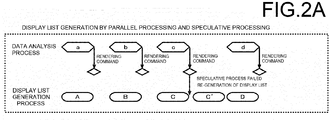
- FIG. 2A illustrates generation of Display Lists by parallel processing and speculative processing by the rendering core module 117.
- the first rendering core 117A and the second rendering core 117B of the rendering core module 117 each executes parallel processing.
- the processing assignment of the first rendering core 117A and the second rendering core 117B may be set via the panel unit 105 or may be set as default.
- the first rendering core 117A executes a data analysis process on PDL format printing information.
- the first rendering core 117A by executing the data analysis process, acquires rendering commands for the objects a to d.
- the first rendering core 117A acquires the paths of the objects a to d included in the rendering command, and acquires graphics attributes related to smoothing, pen width, joining, dash patterns, coordinate conversion, and clipping.
- the first rendering core 117A executes a data analysis process on the object a of the PDL format printing information.
- the first rendering core 117A sends a rendering request for the object a to the second rendering core 117B and executes a data analysis process for the object b following the object a.
- the first rendering core 117A sends a rendering request for the object b to the second rendering core 117B and executes a data analysis process for the object c following the object b.
- the first rendering core 117A sends a rendering request for the object c to the second rendering core 117B and executes a data analysis process for the object d following the object c.
- the second rendering core 117B executes generation of Display Lists on the objects a to d by a speculative process to generate Display Lists A to D.
- the second rendering core 117B stores the respective Display Lists A to D in the RAM 115 as intermediate data.
- the second rendering core 117B references the intermediate data stored in the RAM 115.
- the second rendering core 117B executes generation of the Display List for the object c again to generate a Display List C'.
- the second rendering core 117B generates a Display List D for the object d, and ends the process.
- the second rendering core 117B executes a pipeline process depending on the contents of the respective objects a to d.
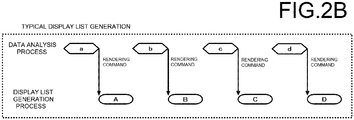
- FIG. 2B illustrates generation of Display Lists by a typical rendering module.
- a typical rendering module a data analysis process is executed on object a of PDL format printing information. Then, after acquisition of a rendering command for the object a is completed, the Display List A is generated for the object a in accordance with a rendering request for the object a, and the Display List A is stored in the RAM 115.
- a Display List B for object b is generated and stored in RAM 115.
- a Display List C for object c is generated and stored in RAM 115.
- a Display List D for object d is generated and stored in RAM 115.
- a data analysis process for objects a to d of PDL format printing information and generation of Display Lists A to D for objects a to d are executed in a series of flows. Therefore, generation of Display Lists A to D is not executed until a rendering command is acquired.
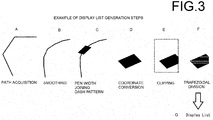
- FIG. 3 is an image of the generation step of Display List A.
- the second rendering core 117B acquires data indicating the path of the object a.
- the path includes data indicating, for example, an anchor point, a segment, and a handle (direction line).
- the second rendering core 117B smoothes the figure indicated by the path.
- the second rendering core 117 B acquires data indicating the pen width, joining, and the dash pattern from the object a, after which, as illustrated in element D, the second rendering core 117B acquires data from the object a indicating coordinate conversion.
- the second rendering core 117B acquires data from the object a indicating clipping.
- the second rendering core 117B acquires data from the object a indicating trapezoidal division. Then, as illustrated in element G, the second rendering core 117B generates a Display List for the object a. Note that the Display List for object a is executed by a pipeline process.
- the first rendering core 117A of the rendering core module 117 performs data analysis of the PDL format printing information.
- the second rendering core 117B executes generation of Display Lists A to D of the objects a to d indicated by the PDL format printing information of FIG. 2A by a speculative process.
- the generated Display Lists A to D are stored in the RAM 115 as intermediate data.
- the third rendering core 117C executes a rendering process for a printout or display output based on the Display Lists A to D generated by the second rendering core 117B. Moreover, in the following explanation, it is presumed that PDL format printing information is transmitted from a user terminal and acquired via the I/F 104.
- the first rendering core 117A selects the object a from the PDL format printing information.
- the second rendering core 117B selects the object a from the PDL format printing information.
- the second rendering core 117B selects the object a simultaneously with the selection of the object a by the first rendering core 117A.
- the second rendering core 117B may select the object a before the selection of the object a by the first rendering core 117A.
- the first rendering core 117A starts data analysis of the object a.
- the second rendering core 117B starts generation of the Display List A for the object a.
- the second rendering core 117B starts the generation of the Display List A for the object a at the same time as the start of data analysis of the object a by the first rendering core 117A.
- the second rendering core 117B executes a speculative process for generating the Display List A using a default setting value for each graphics attribute.
- the second rendering core 117B may start generation of the Display List A for the object a before the start of the data analysis of the object a by the first rendering core 117A.
- the first rendering core 117A acquires a rendering command of the object a.
- the first rendering core 117A completes acquisition of the rendering command of the object a, and sends a rendering request to the second rendering core 117B.
- the second rendering core 117B receives a rendering request from the first rendering core 117A.
- the second rendering core 117B determines whether or not the generation of the Display List A is success.
- the second rendering core 117B determines that the generation of the Display List A is failure (step S106: NO).
- the setting value of the graphics attribute is acquired from the printing information by the first rendering core 117A based on the rendering request. Whether or not the setting value differs from the default setting value is determined during or after the process of generating the Display List A for the object a. Being different from the default setting value is a case where the graphics attribute used for generating the Display List A is different from the graphics attribute based on the rendering command of the object a.
- the second rendering core 117B returns to step S104 and performs generation of the Display List A for the object a again using the setting value of the graphics attribute based on the rendering command of the object a acquired by the first rendering core 117A.
- the second rendering core 117B notifies the first rendering core 117A that the generation of the Display List A is failure.
- the second rendering core 117B may store the Display List A that is generated just before the failure in the RAM 115.
- the second rendering core 117B may store the Display List A that is generated just before the failure in the RAM 115.
- step S106 determines that the generation of the Display List A is successful (step S106: YES), and the process moves to step S108.
- the second rendering core 117B notifies the first rendering core 117A that the generation of the Display List A is successful.
- the first rendering core 117A determines whether or not the generation of the Display List A is success.
- the first rendering core 117A determines that the generation of the Display List A is not successful (step S107: NO), and waits.
- step S107 determines that the generation of the Display List A is successful (step S109).
- the second rendering core 117B stores the Display List A in the RAM 115 as intermediate data.
- the first rendering core 117A selects the next object b from the PDL format printing information.
- the second rendering core 117B selects the object b from the PDL format printing information.
- the second rendering core 117B may select the object b simultaneously with the selection of the object b by the first rendering core 117A. Moreover, the second rendering core 117B may select the object b before the selection of the object b by the first rendering core 117A.
- the first rendering core 117A starts data analysis for the object b.
- the second rendering core 117B starts the generation of the Display List B for the object b in the same manner as in step S104.
- the second rendering core 117B may start the generation of the Display List B for the object b simultaneously with the start of the data analysis for the object b by the first rendering core 117A.
- the second rendering core 117B may start the generation of the Display List B for the object b before the start of the data analysis for the object b by the first rendering core 117A.
- the first rendering core 117A acquires a rendering command for the object b.
- the first rendering core 117A can move to the data analysis for the next object c.
- the second rendering core 117B determines whether or not the generation of the Display List B is success.
- the second rendering core 117B determines that the generation of the Display List B is failure (step S 114: NO).
- the graphics attribute is acquired from the printing information by the first rendering core 117A. Determining whether or not the graphics attribute differs from the default setting value is performed during or after the process of generating the Display List B for object b. Being different from the default setting value is a case where the graphics attribute used for generating the Display List B is different from the graphics attribute based on the rendering command of the object b.
- the second rendering core 117B returns to step S112 and performs generation of the Display List B for the object b again using the setting value of the graphics attribute based on the rendering command for the object b acquired by the first rendering core 117A.
- the second rendering core 117B notifies the first rendering core 117 A that the generation of the Display List B is failure.
- the second rendering core 117B may store the Display List B just before the failure in the RAM 115.
- the second rendering core 117B may store the Display List B just before the failure in the RAM 115.
- step S114 determines that the generation of the Display List B is successful (step S114: YES), and the process moves to step S116.
- the second rendering core 117B notifies the first rendering core 117A that the generation of the Display List B is successful.
- the first rendering core 117A determines whether or not the generation of the Display List B is success.
- the first rendering core 117A determines that the generation of the Display List B is not success (step S115: NO), and waits.
- step S115 determines that the generation of the Display List B is success (step S115: YES), and the process moves to step S117.
- the second rendering core 117B stores the Display List B in the RAM 115 as intermediate data.
- the first rendering core 117A determines whether or not data analysis for all objects a to d has been completed.
- the first rendering core 117A returns to the step S109 in the case where data analysis of all the objects a to d of the PDL format printing information has not been completed (step S117: NO), and continues data analysis for the remaining objects a to d.
- the first rendering core 117A ends the process in the case where data analysis for all the objects a to d in the PDL format printing information is completed (step S117: YES).
- the second rendering core 117B determines whether or not generation of Display Lists A to D for all of the objects a to d has been completed.
- the second rendering core 117B returns to the step S110 in the case where the generation of Display Lists A to D for all of the objects a to d of PDL format printing information has not been completed (step S118: NO). Then the second rendering core 117B continues generation of the Display Lists A to D for the remaining objects a to d.
- the second rendering core 117B ends the process in the case where generation of the Display Lists A to D for all of the objects a to d of PDL format printing information is completed (step S118: YES).
- the third rendering core 117C generates rendering information based on the Display Lists A to D stored in the RAM 115.
- the third rendering core 117C sequentially generates rendering information for a printout or display output based on the Display Lists A to D at a timing when the Display Lists A to D are sequentially stored in the RAM 115.
- the third rendering core 117C determines whether or not the generation of rendering information based on the Display Lists A to D for all the objects a to d has been completed.
- the third rendering core 117C returns to step S201 in the case where the generation of rendering information based on the Display Lists A to D for all the objects a to d in the PDL format printing information has not been completed (step S 202: NO). Then, the third rendering core 117C continues the generation of rendering information based on the Display Lists A to D for the remaining objects a to d.
- the third rendering core 117C ends the process when the generation of rendering information based on the Display Lists A to D for all the objects a to d in the PDL format printing information has been completed (step S202: YES).
- the third rendering core 117C deletes the Display Lists A to D stored in the RAM 115 in the case where the generation of rendering information based on the Display Lists A to D is completed.
- the PDL format printing information is vector data, however, the PDL format printing information may be text data, compressed image data, image data, or the like. Similarly, data analysis and the generation of Display Lists by speculative processing may be executed in parallel processing.
- the first rendering core 117A of the rendering core module 117 executes data analysis of the objects of PDL format printing information.
- the second rendering core 117B executes a speculative process for the generation of Display Lists A to D for the objects a to d.
- the third rendering core 117C executes a rendering process for a printout or display output based on the Display Lists A to D generated by the second rendering core 117B.
- data analysis by the first rendering core 117A and the speculative process by the second rendering core 117B are executed in parallel processing.
- the second rendering core 117B can generate the Display Lists A to D by a speculative process even without receiving a rendering command from the first rendering core 117A, it is possible to further speed up the image forming process.
- the image forming apparatus is applied to a MFP 100, however, the present invention is not limited to this, and may be applied to other image forming apparatuses such as a multifunction printer or the like, or may be applied to electronic equipment such as a personal computer (PC) or the like.
- PC personal computer
- the above-described rendering process in an image forming process based on PDL includes a Display List generation process and a rendering process based on Display Lists.
- the Display List generation process is executed after receiving a rendering command in the PDL analysis process.
- the rendering processing apparatus of a typical technique collectively executes a number of vector rendering commands equal to or larger than a threshold value. Therefore, it is not possible to generate a Display List based on the next rendering command until after receiving the next rendering command after generating the Display List based on the previous rendering command. As a result, it is not possible to further speed up of the image forming process.
- the second rendering core can execute the generation of a Display List by a speculative process even without receiving a rendering command from the first rendering core, so the second rendering core can further speed up the image forming process.
Landscapes
- Engineering & Computer Science (AREA)
- Theoretical Computer Science (AREA)
- General Engineering & Computer Science (AREA)
- Physics & Mathematics (AREA)
- General Physics & Mathematics (AREA)
- Computational Linguistics (AREA)
- Human Computer Interaction (AREA)
- Record Information Processing For Printing (AREA)
- Image Generation (AREA)
Abstract
Description
- The present disclosure relates to an image forming apparatus and recording medium suitable for an image forming process based on PDL (Page Description Language).
- For example, in an image forming apparatus such as a multifunction peripheral (MFP) or the like, an image forming process based on printing information indicated by PDL (Page Description Language), for example, is performed. Incidentally, the printing information indicated by the PDL includes vector data, text data, image data, and the like. Moreover, in an image forming process based on printing information indicated by PDL, a PDL analysis process and rendering process are performed. In other words, in the analysis process, printing information indicated by PDL is analyzed, and in the rendering process, rendering information for executing a printout and the like is generated based on the analyzed information.
- Regarding an image forming process based on such PDL, in a typical technique, vector rendering commands are counted by a counting unit. A count-number-determining unit determines whether or not the count number by the counting unit is equal to or greater than a threshold value. In the case where the count-number-determining unit determines that the count number is equal to or greater than the threshold value, a rendering-process-executing unit executes a number of vector rendering commands matching the count number counted by the counting unit. After the rendering-process-executing unit executes the rendering commands, a count-number-reset unit resets the count number counted by the counting unit. There is such a rendering process apparatus.
- The image forming apparatus according to the present disclosure includes a first rendering core, a second rendering core and a third rendering core. The first rendering core executes data analysis of an object of PDL format printing information. The second rendering core starts a speculative process for generating a Display List for the object before the data analysis is completed. The third rendering core executes a rendering process based on the Display List generated by the second rendering core. The data analysis by the first rendering core and the speculative process by the second rendering core are executed in parallel processing.
- The recording medium according to the present disclosure is a non-transitory computer-readable recording medium for storing an image forming program executable on a computer of an image forming apparatus. When the computer executes the image forming program, the computer, by a first rendering core, executes data analysis of an object of PDL format printing information. The computer, by a second rendering core, starts a speculative process for generating a Display List for the object before the data analysis is completed. The computer, by a third rendering core executes a rendering process based on the Display List generated by the second rendering core. Moreover, the data analysis by the first rendering core and the speculative process by the second rendering core are executed in parallel processing.
-
-
FIG. 1 is a diagram for explaining an embodiment in the case where an image forming apparatus according to the present disclosure is applied to an MFP. -
FIG. 2A is a diagram explaining an example of image processing by the rendering core module inFIG. 1 , and illustrates the generation of a Display List by parallel processing and speculative processing by a first rendering core and a second rendering core of the rendering core module. -
FIG. 2B is a diagram explaining an example of image processing by the rendering core module ofFIG. 1 , and illustrates typical generation of a Display List. -
FIG. 3 is a diagram illustrating an example as an image of a step of generating a Display List for an object by the second rendering core of the rendering core module ofFIG. 1 . -
FIG. 4 is a flowchart for explaining an image forming process by the rendering core module inFIG. 1 . - In the following, an embodiment of the image forming apparatus according to the present disclosure will be described with reference to
FIG. 1 to FIG. 4 . Incidentally, as an example of the image forming apparatus in the following explanation is a multifunction peripheral (MFP) that, for example, is a complex peripheral apparatus equipped with a printing function, a copying function, a FAX function, a data transmitting/receiving function via a network, and the like. - First, as illustrated in
FIG. 1 , the MFP 100 includes acontrol unit 110 that controls operations of ascanner unit 101, aprinter unit 102, a facsimile (FAX)unit 103, an I/F (interface) 104, apanel unit 105, and anHDD 106. - The
scanner unit 101 is a device that converts an image of a document read by an image sensor into digital image data and inputs the digital image data to thecontrol unit 110. Theprinter unit 102 is a device that prints an image on paper or the like based on printing data that is outputted from thecontrol unit 110. TheFAX unit 103 is a device that transmits data outputted from thecontrol unit 110 to a facsimile of another party through a telephone line, and receives data from a facsimile of another party and inputs that data to thecontrol unit 110. - The I/F 104 is responsible for communication with other MFPs, user terminals, and the like via a network. The I/F 104 may also be responsible for communication with a content server, a web server, or the like. The
panel unit 105 is a device having a touch panel and hardware keys that, for example, performs a display for a printing function, a copying function, a FAX function, a data transmitting/receiving function via the network, and for various settings of theMFP 100. The HDD 106 is a storage device that stores application programs and the like for providing the various functions of theMFP 100. Moreover, the HDD 106 has a user box for storing printing jobs registered from the user terminal side. - The
control unit 110 is a processor that controls the overall operation of the MFP 100 by executing an application program such as an authentication program or the like, an image forming program, a control program, and the like. Thecontrol unit 110 includes a scanner-control unit 111, a printer-control unit 112, a FAX-control unit 113, a communication-control unit 114, a random access memory (RAM) 115, an electrically erasable and programmable read-only memory (EEPROM) 116, a renderingcore module 117, a panel-operation-control unit 118, an HDD-control unit 119, and a system-control unit 120. In addition, these units are connected to adata bus 121. - The scanner-
control unit 111 controls the reading operation of thescanner unit 101. The printer-control unit 112 controls the printing operation of theprinter unit 102. The FAX-control unit 113 controls the data transmitting/receiving operation by theFAX unit 103. The communication-control unit 114, via the I/F 104, controls transmission and reception of data and the like via the network. TheRAM 115 is a work memory for executing a program. In addition, theRAM 115, as will be described in detail later, stores a Display List generated by the renderingcore module 117 as intermediate data. Moreover, theRAM 115 stores printing data that has undergone image processing (rasterization) by the renderingcore module 117. The EEPROM 116 stores a control program for checking the operation of each unit and generating a startup sequence, and the like. - The rendering
core module 117 performs an image forming process based on printing information indicated by PDL (Page Description Language), for example, and has a first renderingcore 117A, a second renderingcore 117B, and a third renderingcore 117C. Note that PDL format printing information includes vector data, text data, compressed image data, image data, and the like. However, in the present embodiment, for convenience of explanation, it is presumed that PDL format printing information is vector data. Incidentally, in the case of vector data, image bit mapping is performed through a scan line conversion process. In the case of text data, image bit mapping is performed by outlining the text and performing the scan line conversion of the outline. In the case of compressed image data, processing as image data is performed through an expansion process corresponding to the compression format. In the case of image data, a color matching process, a CMYK (Cyan, Magenta, Yellow, Key) conversion process, and a total amount control process are executed. - The first rendering
core 117A executes data analysis of PDL format printing information (vector data). The second renderingcore 117B, by a speculative process, executes generation of Display Lists A to D of graphics objects a to d (hereinafter simply referred to as objects a to d) indicated by PDL format printing information illustrated inFIG. 2 to be described later. Then, the second renderingcore 117B stores the generated Display Lists A to D in theRAM 115 as intermediate data. The third renderingcore 117C executes a rendering process for a printout or display output based on the Display Lists generated by the second renderingcore 117B. Incidentally, data analysis by thefirst rendering core 117A and generation of Display Lists A to D by thesecond rendering core 117B are executed in parallel processing. - The panel-operation-
control unit 118 controls the display operation of thepanel unit 105. In addition, the panel-operation-control unit 118, via thepanel unit 105, receives settings such as for printing, copying, FAX, data transmission and reception via the network and the like. The HDD-control unit 119 controls reading and writing of data to and from theHDD 106. When there is a print instruction based on the PDL, for example, the system-control unit 120 instructs therendering core module 117 to perform image processing. - Next, an example of image processing by the
rendering core module 117 will be described with reference toFIG. 2A andFIG. 2B . First,FIG. 2A illustrates generation of Display Lists by parallel processing and speculative processing by therendering core module 117. Thefirst rendering core 117A and thesecond rendering core 117B of therendering core module 117 each executes parallel processing. Here, it is presumed, for example, that thefirst rendering core 117A is in charge of a data analysis process and thesecond rendering core 117B is in charge of a Display List generation process. Incidentally, the processing assignment of thefirst rendering core 117A and thesecond rendering core 117B may be set via thepanel unit 105 or may be set as default. - In other words, the
first rendering core 117A executes a data analysis process on PDL format printing information. Thefirst rendering core 117A, by executing the data analysis process, acquires rendering commands for the objects a to d. As a result, thefirst rendering core 117A acquires the paths of the objects a to d included in the rendering command, and acquires graphics attributes related to smoothing, pen width, joining, dash patterns, coordinate conversion, and clipping. In this case, thefirst rendering core 117A executes a data analysis process on the object a of the PDL format printing information. Moreover, after the acquisition of the rendering command for the object a is completed, thefirst rendering core 117A sends a rendering request for the object a to thesecond rendering core 117B and executes a data analysis process for the object b following the object a. After the acquisition of the rendering command for the object b is completed, thefirst rendering core 117A sends a rendering request for the object b to thesecond rendering core 117B and executes a data analysis process for the object c following the object b. After the acquisition of the rendering command for the object c is completed, thefirst rendering core 117A sends a rendering request for the object c to thesecond rendering core 117B and executes a data analysis process for the object d following the object c. - On the other hand, although the details will be described later, the
second rendering core 117B, after registering paths, executes generation of Display Lists on the objects a to d by a speculative process to generate Display Lists A to D. In addition, thesecond rendering core 117B stores the respective Display Lists A to D in theRAM 115 as intermediate data. Moreover, in the case where generation of the Display List for the object c fails, for example, thesecond rendering core 117B references the intermediate data stored in theRAM 115. Thesecond rendering core 117B executes generation of the Display List for the object c again to generate a Display List C'. Then, thesecond rendering core 117B generates a Display List D for the object d, and ends the process. Incidentally, when generating the Display Lists A to D, thesecond rendering core 117B executes a pipeline process depending on the contents of the respective objects a to d. - On the other hand,
FIG. 2B illustrates generation of Display Lists by a typical rendering module. In other words, in a typical rendering module, a data analysis process is executed on object a of PDL format printing information. Then, after acquisition of a rendering command for the object a is completed, the Display List A is generated for the object a in accordance with a rendering request for the object a, and the Display List A is stored in theRAM 115. In addition, in the rendering module, after Display List A is successfully generated, a Display List B for object b is generated and stored inRAM 115. Moreover, in the rendering module, after Display List B is successfully generated, a Display List C for object c is generated and stored inRAM 115. Furthermore, in the rendering module, after Display List C is successfully generated, a Display List D for object d is generated and stored inRAM 115. In other words, in the case of generating a Display List by a typical rendering module, a data analysis process for objects a to d of PDL format printing information and generation of Display Lists A to D for objects a to d are executed in a series of flows. Therefore, generation of Display Lists A to D is not executed until a rendering command is acquired. - Next, referring to
FIG. 3 , an example of the step of generating the Display List A for the object a by thesecond rendering core 117B will be explained. Note thatFIG. 3 is an image of the generation step of Display List A. - First, as illustrated in the element A, the
second rendering core 117B acquires data indicating the path of the object a. Incidentally, the path includes data indicating, for example, an anchor point, a segment, and a handle (direction line). Next, as illustrated by the element B, thesecond rendering core 117B smoothes the figure indicated by the path. Next, as illustrated in element C, thesecond rendering core 117 B acquires data indicating the pen width, joining, and the dash pattern from the object a, after which, as illustrated in element D, thesecond rendering core 117B acquires data from the object a indicating coordinate conversion. In addition, as illustrated in Element E, thesecond rendering core 117B acquires data from the object a indicating clipping. Moreover, as illustrated in element F, thesecond rendering core 117B acquires data from the object a indicating trapezoidal division. Then, as illustrated in element G, thesecond rendering core 117B generates a Display List for the object a. Note that the Display List for object a is executed by a pipeline process. - Next, referring to
FIG. 4 , an image forming process by therendering core module 117 will be explained. Incidentally, in the following description, it is presumed that the data of the PDL format printing information is a vector. In addition, in the following, the example below will be explained. Thefirst rendering core 117A of therendering core module 117 performs data analysis of the PDL format printing information. Thesecond rendering core 117B executes generation of Display Lists A to D of the objects a to d indicated by the PDL format printing information ofFIG. 2A by a speculative process. The generated Display Lists A to D are stored in theRAM 115 as intermediate data. Thethird rendering core 117C executes a rendering process for a printout or display output based on the Display Lists A to D generated by thesecond rendering core 117B. Moreover, in the following explanation, it is presumed that PDL format printing information is transmitted from a user terminal and acquired via the I/F 104. - The
first rendering core 117A selects the object a from the PDL format printing information. - The
second rendering core 117B selects the object a from the PDL format printing information. - In this case, the
second rendering core 117B selects the object a simultaneously with the selection of the object a by thefirst rendering core 117A. Incidentally, thesecond rendering core 117B may select the object a before the selection of the object a by thefirst rendering core 117A. - The
first rendering core 117A starts data analysis of the object a. - The
second rendering core 117B starts generation of the Display List A for the object a. - In this case, the
second rendering core 117B starts the generation of the Display List A for the object a at the same time as the start of data analysis of the object a by thefirst rendering core 117A. At this time, since the data analysis of the object a by thefirst rendering core 117A is not yet completed, thesecond rendering core 117B executes a speculative process for generating the Display List A using a default setting value for each graphics attribute. Incidentally, thesecond rendering core 117B may start generation of the Display List A for the object a before the start of the data analysis of the object a by thefirst rendering core 117A. - The
first rendering core 117A acquires a rendering command of the object a. - In this case, the
first rendering core 117A completes acquisition of the rendering command of the object a, and sends a rendering request to thesecond rendering core 117B. As a result, data analysis for object a is completed and it is possible to move on to data analysis for the next object b. At this time, thesecond rendering core 117B receives a rendering request from thefirst rendering core 117A. - The
second rendering core 117B determines whether or not the generation of the Display List A is success. - In this case, when it is determined that the setting value of the graphics attribute is different from the default setting value, the
second rendering core 117B determines that the generation of the Display List A is failure (step S106: NO). The setting value of the graphics attribute is acquired from the printing information by thefirst rendering core 117A based on the rendering request. Whether or not the setting value differs from the default setting value is determined during or after the process of generating the Display List A for the object a. Being different from the default setting value is a case where the graphics attribute used for generating the Display List A is different from the graphics attribute based on the rendering command of the object a. At this time, thesecond rendering core 117B returns to step S104 and performs generation of the Display List A for the object a again using the setting value of the graphics attribute based on the rendering command of the object a acquired by thefirst rendering core 117A. In addition, thesecond rendering core 117B notifies thefirst rendering core 117A that the generation of the Display List A is failure. - Incidentally, in the case where the
second rendering core 117B is failure to generate the Display List A for the object a, thesecond rendering core 117B may store the Display List A that is generated just before the failure in theRAM 115. By doing so, when returning to the step S104 and performing generation of the Display List A for the object a again, it is possible to execute only the generation of the Display List A of the failed part by confirming the data up to the point immediately before the failure of the Display List A. As a result, the time for regeneration of the Display List A can be shortened. - On the other hand, in the case where the process for generating the Display List A for the object a progresses to the end, the
second rendering core 117B determines that the generation of the Display List A is successful (step S106: YES), and the process moves to step S108. - At this time, the
second rendering core 117B notifies thefirst rendering core 117A that the generation of the Display List A is successful. - The
first rendering core 117A determines whether or not the generation of the Display List A is success. - In this case, when a notification indicating that the generation of the Display List A is failure is received from the
second rendering core 117B, thefirst rendering core 117A determines that the generation of the Display List A is not successful (step S107: NO), and waits. - On the other hand, when a notification indicating that the generation of the Display List A is successful is received from the
second rendering core 117B, thefirst rendering core 117A determines that the generation of the Display List A is successful (step S107: YES), and the process moves to step S109. - The
second rendering core 117B stores the Display List A in theRAM 115 as intermediate data. - The
first rendering core 117A selects the next object b from the PDL format printing information. - The
second rendering core 117B selects the object b from the PDL format printing information. - In this case, the
second rendering core 117B may select the object b simultaneously with the selection of the object b by thefirst rendering core 117A. Moreover, thesecond rendering core 117B may select the object b before the selection of the object b by thefirst rendering core 117A. - The
first rendering core 117A starts data analysis for the object b. - The
second rendering core 117B starts the generation of the Display List B for the object b in the same manner as in step S104. - In this case, the
second rendering core 117B may start the generation of the Display List B for the object b simultaneously with the start of the data analysis for the object b by thefirst rendering core 117A. Thesecond rendering core 117B may start the generation of the Display List B for the object b before the start of the data analysis for the object b by thefirst rendering core 117A. - The
first rendering core 117A acquires a rendering command for the object b. - In this case, by acquiring the rendering command for the object b, the
first rendering core 117A can move to the data analysis for the next object c. - The
second rendering core 117B determines whether or not the generation of the Display List B is success. - In this case, when the graphics attribute is determined to be different from the default setting value, the
second rendering core 117B determines that the generation of the Display List B is failure (step S 114: NO). The graphics attribute is acquired from the printing information by thefirst rendering core 117A. Determining whether or not the graphics attribute differs from the default setting value is performed during or after the process of generating the Display List B for object b. Being different from the default setting value is a case where the graphics attribute used for generating the Display List B is different from the graphics attribute based on the rendering command of the object b. At this time, thesecond rendering core 117B returns to step S112 and performs generation of the Display List B for the object b again using the setting value of the graphics attribute based on the rendering command for the object b acquired by thefirst rendering core 117A. In addition, thesecond rendering core 117B notifies thefirst rendering core 117 A that the generation of the Display List B is failure. - Incidentally, in the case where the
second rendering core 117B is failure to generate the Display List B for the object b, as described above, thesecond rendering core 117B may store the Display List B just before the failure in theRAM 115. By doing so, when returning to the step S112 and performing generation of the Display List B for the object b again, it is possible to execute only the generation of the Display List B of the failed part by confirming the data up to the point immediately before the failure of the Display List B. As a result, the time for regeneration of the Display List B can be shortened. - On the other hand, in the case where the process for generating the Display List B for the object b progresses to the end, the
second rendering core 117B determines that the generation of the Display List B is successful (step S114: YES), and the process moves to step S116. - At this time, the
second rendering core 117B notifies thefirst rendering core 117A that the generation of the Display List B is successful. - The
first rendering core 117A determines whether or not the generation of the Display List B is success. - In this case, when a notification indicating that the generation of the Display List B is failure is received from the
second rendering core 117B, thefirst rendering core 117A determines that the generation of the Display List B is not success (step S115: NO), and waits. - On the other hand, when a notification indicating that the generation of the Display List B is success is received from the
second rendering core 117B, thefirst rendering core 117A determines that the generation of the Display List B is success (step S115: YES), and the process moves to step S117. - The
second rendering core 117B stores the Display List B in theRAM 115 as intermediate data. - The
first rendering core 117A determines whether or not data analysis for all objects a to d has been completed. - In this case, the
first rendering core 117A returns to the step S109 in the case where data analysis of all the objects a to d of the PDL format printing information has not been completed (step S117: NO), and continues data analysis for the remaining objects a to d. - On the other hand, the
first rendering core 117A ends the process in the case where data analysis for all the objects a to d in the PDL format printing information is completed (step S117: YES). - The
second rendering core 117B determines whether or not generation of Display Lists A to D for all of the objects a to d has been completed. - In this case, the
second rendering core 117B returns to the step S110 in the case where the generation of Display Lists A to D for all of the objects a to d of PDL format printing information has not been completed (step S118: NO). Then thesecond rendering core 117B continues generation of the Display Lists A to D for the remaining objects a to d. - On the other hand, the
second rendering core 117B ends the process in the case where generation of the Display Lists A to D for all of the objects a to d of PDL format printing information is completed (step S118: YES). - The
third rendering core 117C generates rendering information based on the Display Lists A to D stored in theRAM 115. - In this case, the
third rendering core 117C sequentially generates rendering information for a printout or display output based on the Display Lists A to D at a timing when the Display Lists A to D are sequentially stored in theRAM 115. - The
third rendering core 117C determines whether or not the generation of rendering information based on the Display Lists A to D for all the objects a to d has been completed. - In this case, the
third rendering core 117C returns to step S201 in the case where the generation of rendering information based on the Display Lists A to D for all the objects a to d in the PDL format printing information has not been completed (step S 202: NO). Then, thethird rendering core 117C continues the generation of rendering information based on the Display Lists A to D for the remaining objects a to d. - On the other hand, the
third rendering core 117C ends the process when the generation of rendering information based on the Display Lists A to D for all the objects a to d in the PDL format printing information has been completed (step S202: YES). - In addition, the
third rendering core 117C deletes the Display Lists A to D stored in theRAM 115 in the case where the generation of rendering information based on the Display Lists A to D is completed. - Incidentally, in the above explanation, the PDL format printing information is vector data, however, the PDL format printing information may be text data, compressed image data, image data, or the like. Similarly, data analysis and the generation of Display Lists by speculative processing may be executed in parallel processing.
- As described above, in the present embodiment, the
first rendering core 117A of therendering core module 117 executes data analysis of the objects of PDL format printing information. Thesecond rendering core 117B executes a speculative process for the generation of Display Lists A to D for the objects a to d. Thethird rendering core 117C executes a rendering process for a printout or display output based on the Display Lists A to D generated by thesecond rendering core 117B. In addition, data analysis by thefirst rendering core 117A and the speculative process by thesecond rendering core 117B are executed in parallel processing. - As a result, since the
second rendering core 117B can generate the Display Lists A to D by a speculative process even without receiving a rendering command from thefirst rendering core 117A, it is possible to further speed up the image forming process. - Incidentally, in this embodiment, the image forming apparatus is applied to a
MFP 100, however, the present invention is not limited to this, and may be applied to other image forming apparatuses such as a multifunction printer or the like, or may be applied to electronic equipment such as a personal computer (PC) or the like. - In the rendering processing apparatus of the typical technique described above, since rendering commands of a number of vectors equal to or larger than a threshold value are collectively executed, it is possible to perform high-speed processing of printing data in which many vector rendering commands are used consecutively.
- Incidentally, the above-described rendering process in an image forming process based on PDL includes a Display List generation process and a rendering process based on Display Lists. In addition, the Display List generation process is executed after receiving a rendering command in the PDL analysis process.
- For this reason, the rendering processing apparatus of a typical technique collectively executes a number of vector rendering commands equal to or larger than a threshold value. Therefore, it is not possible to generate a Display List based on the next rendering command until after receiving the next rendering command after generating the Display List based on the previous rendering command. As a result, it is not possible to further speed up of the image forming process.
- With the image forming apparatus and the recording medium according to the present disclosure, the second rendering core can execute the generation of a Display List by a speculative process even without receiving a rendering command from the first rendering core, so the second rendering core can further speed up the image forming process.
Claims (4)
- An image forming apparatus characterized in that includes:a first rendering core (117A) for executing data analysis of an object of PDL format printing information;a second rendering core (117B) for starting a speculative process for generating a Display List (A to D) for the object (a to d) before the data analysis is completed; anda third rendering core (117C) for executing a rendering process based on the Display List (A to D) generated by the second rendering core (117B); whereinthe data analysis by the first rendering core (117A) and the speculative process by the second rendering core (117B) are executed in parallel processing.
- The image forming apparatus according to Claim 1, characterized in that
the second rendering core (117B), in the case where the speculative process for generating the Display List (A to D) is failure, generates the Display List (A to D) based on a result of the data analysis after the data analysis of the object (a to d) by the first rendering core (117A) is completed. - The image forming apparatus according to Claim 2, further characterized in that includes
a storage device for storing the Display List (A to D); wherein
the second rendering core (117B), in the case where the speculative process for generating the Display List (A to D) is failure, causes the storage device to store the Display List (A to D) up to the point immediately before the failure, checks data up to the point immediately before failure of the Display List (A to D) stored in the storage device, and executes generation of the failed portion of the Display List (A to D). - A recording medium that is a non-transitory computer-readable recording medium for storing an image forming program executable on a computer of an image forming apparatus, characterized in that when the computer executes the image forming program:a first rendering core (117A) executes data analysis of an object of PDL format printing information;a second rendering core (117B) starts a speculative process for generating a Display List (A to D) for the object (a to d) before the data analysis is completed; anda third rendering core (117C) executes a rendering process based on the Display List (A to D) generated by the second rendering core (117B); whereinthe data analysis by the first rendering core (117A) and the speculative process by the second rendering core (117B) are executed in parallel processing.
Applications Claiming Priority (1)
| Application Number | Priority Date | Filing Date | Title |
|---|---|---|---|
| JP2017214575A JP7039935B2 (en) | 2017-11-07 | 2017-11-07 | Image forming device and image forming program |
Publications (2)
| Publication Number | Publication Date |
|---|---|
| EP3480687A1 true EP3480687A1 (en) | 2019-05-08 |
| EP3480687B1 EP3480687B1 (en) | 2021-07-21 |
Family
ID=64308483
Family Applications (1)
| Application Number | Title | Priority Date | Filing Date |
|---|---|---|---|
| EP18204143.4A Active EP3480687B1 (en) | 2017-11-07 | 2018-11-02 | Image forming apparatus and recording medium |
Country Status (4)
| Country | Link |
|---|---|
| US (1) | US10643114B2 (en) |
| EP (1) | EP3480687B1 (en) |
| JP (1) | JP7039935B2 (en) |
| CN (1) | CN109753250B (en) |
Families Citing this family (1)
| Publication number | Priority date | Publication date | Assignee | Title |
|---|---|---|---|---|
| JP7006173B2 (en) * | 2017-11-22 | 2022-01-24 | コニカミノルタ株式会社 | Image forming device and program |
Citations (2)
| Publication number | Priority date | Publication date | Assignee | Title |
|---|---|---|---|---|
| EP1435591A1 (en) * | 2001-09-26 | 2004-07-07 | Pioneer Corporation | Image creation apparatus and method,; electronic device and computer program |
| US20110043855A1 (en) * | 2009-08-21 | 2011-02-24 | Canon Kabushiki Kaisha | Print data processing apparatus, print data processing method, and storage medium |
Family Cites Families (8)
| Publication number | Priority date | Publication date | Assignee | Title |
|---|---|---|---|---|
| US7583397B2 (en) | 2003-09-30 | 2009-09-01 | Canon Kabushiki Kaisha | Method for generating a display list |
| JP4378492B2 (en) * | 2007-04-20 | 2009-12-09 | シャープ株式会社 | Print control apparatus, print control method, and program |
| JP2012081711A (en) | 2010-10-14 | 2012-04-26 | Ricoh Co Ltd | Image forming apparatus and image processing method |
| JP2012200934A (en) * | 2011-03-24 | 2012-10-22 | Fuji Xerox Co Ltd | Image data processing system |
| JP6115217B2 (en) * | 2012-04-18 | 2017-04-19 | 株式会社リコー | Print control apparatus, print control system, print control method, and program |
| JP6381311B2 (en) * | 2013-07-04 | 2018-08-29 | キヤノン株式会社 | Image forming apparatus, image forming method, and program |
| JP6158735B2 (en) | 2014-03-28 | 2017-07-05 | 京セラドキュメントソリューションズ株式会社 | Image forming apparatus, drawing processing method, and program |
| US10198674B2 (en) * | 2016-12-22 | 2019-02-05 | Canon Kabushiki Kaisha | Method, apparatus and system for rendering a graphical representation within limited memory |
-
2017
- 2017-11-07 JP JP2017214575A patent/JP7039935B2/en not_active Expired - Fee Related
-
2018
- 2018-11-02 CN CN201811299419.6A patent/CN109753250B/en not_active Expired - Fee Related
- 2018-11-02 EP EP18204143.4A patent/EP3480687B1/en active Active
- 2018-11-07 US US16/182,613 patent/US10643114B2/en active Active
Patent Citations (2)
| Publication number | Priority date | Publication date | Assignee | Title |
|---|---|---|---|---|
| EP1435591A1 (en) * | 2001-09-26 | 2004-07-07 | Pioneer Corporation | Image creation apparatus and method,; electronic device and computer program |
| US20110043855A1 (en) * | 2009-08-21 | 2011-02-24 | Canon Kabushiki Kaisha | Print data processing apparatus, print data processing method, and storage medium |
Also Published As
| Publication number | Publication date |
|---|---|
| US20190138863A1 (en) | 2019-05-09 |
| US10643114B2 (en) | 2020-05-05 |
| JP2019084749A (en) | 2019-06-06 |
| JP7039935B2 (en) | 2022-03-23 |
| EP3480687B1 (en) | 2021-07-21 |
| CN109753250A (en) | 2019-05-14 |
| CN109753250B (en) | 2022-03-22 |
Similar Documents
| Publication | Publication Date | Title |
|---|---|---|
| US12254229B2 (en) | Non-transitory computer-readable recording medium storing computer-executable instructions for information processing device, and method of controlling information processing device | |
| KR101377468B1 (en) | Image processing apparatus, control method of image processing apparatus, and recording medium storing computer program | |
| US7916953B2 (en) | Removable medium device, medium for controlling removable medium device, and medium for controlling network device | |
| JP6454213B2 (en) | Image output system, image processing apparatus, image output apparatus, method and program therefor | |
| JP5782970B2 (en) | Image forming system, image forming apparatus, and processing server | |
| US8817313B2 (en) | Image forming apparatus and control method of image forming apparatus | |
| JP5655590B2 (en) | Image forming apparatus, image forming apparatus control method, and image forming apparatus control program | |
| US7127715B2 (en) | Image outputting apparatus, control method for the image outputting apparatus, image outputting system, and storage medium product | |
| US9207896B2 (en) | Printing apparatus, method and computer-readable storage medium having a data request to a server before reception of a print instruction | |
| EP3480687B1 (en) | Image forming apparatus and recording medium | |
| US10133518B2 (en) | Image forming apparatus and recording medium suitable for test copy | |
| US20100073722A1 (en) | Image forming system and image forming method | |
| US9069507B2 (en) | Print server, printing system, and computer program product configured to send print data to an image forming apparatus based on obtained designation of the image forming apparatus | |
| US8824019B2 (en) | Image processing apparatus, charging system, charging method, and program | |
| US9342263B2 (en) | Information processing apparatus, method, and program creating rendering data using a setting information set converted according to a selected scheme | |
| US10079957B2 (en) | Image reading apparatus, image forming apparatus, and non-transitory computer readable medium | |
| US10027840B2 (en) | Printer and non-transitory storage medium storing instructions executable by the printer | |
| JP2013107257A (en) | Image forming apparatus, and method and program for controlling the same | |
| US8520241B2 (en) | Image processing apparatus and control method thereof | |
| JP2018206311A (en) | Printing system, server, and control method and program therefor | |
| JP2015225535A (en) | Information processing apparatus and authentication print system using the same | |
| US8988719B2 (en) | Printing apparatus and log recording method | |
| US11720307B2 (en) | Image processing apparatus and non-transitory computer-readable recording medium therefor | |
| JP7176426B2 (en) | Image forming apparatus, information processing method and program | |
| US20240201913A1 (en) | Printing device connectivity manager for a digital front end |
Legal Events
| Date | Code | Title | Description |
|---|---|---|---|
| PUAI | Public reference made under article 153(3) epc to a published international application that has entered the european phase |
Free format text: ORIGINAL CODE: 0009012 |
|
| STAA | Information on the status of an ep patent application or granted ep patent |
Free format text: STATUS: THE APPLICATION HAS BEEN PUBLISHED |
|
| AK | Designated contracting states |
Kind code of ref document: A1 Designated state(s): AL AT BE BG CH CY CZ DE DK EE ES FI FR GB GR HR HU IE IS IT LI LT LU LV MC MK MT NL NO PL PT RO RS SE SI SK SM TR |
|
| AX | Request for extension of the european patent |
Extension state: BA ME |
|
| STAA | Information on the status of an ep patent application or granted ep patent |
Free format text: STATUS: REQUEST FOR EXAMINATION WAS MADE |
|
| 17P | Request for examination filed |
Effective date: 20191022 |
|
| RBV | Designated contracting states (corrected) |
Designated state(s): AL AT BE BG CH CY CZ DE DK EE ES FI FR GB GR HR HU IE IS IT LI LT LU LV MC MK MT NL NO PL PT RO RS SE SI SK SM TR |
|
| GRAP | Despatch of communication of intention to grant a patent |
Free format text: ORIGINAL CODE: EPIDOSNIGR1 |
|
| STAA | Information on the status of an ep patent application or granted ep patent |
Free format text: STATUS: GRANT OF PATENT IS INTENDED |
|
| INTG | Intention to grant announced |
Effective date: 20210210 |
|
| GRAS | Grant fee paid |
Free format text: ORIGINAL CODE: EPIDOSNIGR3 |
|
| GRAA | (expected) grant |
Free format text: ORIGINAL CODE: 0009210 |
|
| STAA | Information on the status of an ep patent application or granted ep patent |
Free format text: STATUS: THE PATENT HAS BEEN GRANTED |
|
| AK | Designated contracting states |
Kind code of ref document: B1 Designated state(s): AL AT BE BG CH CY CZ DE DK EE ES FI FR GB GR HR HU IE IS IT LI LT LU LV MC MK MT NL NO PL PT RO RS SE SI SK SM TR |
|
| REG | Reference to a national code |
Ref country code: GB Ref legal event code: FG4D |
|
| REG | Reference to a national code |
Ref country code: CH Ref legal event code: EP |
|
| REG | Reference to a national code |
Ref country code: DE Ref legal event code: R096 Ref document number: 602018020354 Country of ref document: DE |
|
| REG | Reference to a national code |
Ref country code: AT Ref legal event code: REF Ref document number: 1413198 Country of ref document: AT Kind code of ref document: T Effective date: 20210815 |
|
| REG | Reference to a national code |
Ref country code: IE Ref legal event code: FG4D |
|
| REG | Reference to a national code |
Ref country code: LT Ref legal event code: MG9D |
|
| REG | Reference to a national code |
Ref country code: NL Ref legal event code: MP Effective date: 20210721 |
|
| REG | Reference to a national code |
Ref country code: AT Ref legal event code: MK05 Ref document number: 1413198 Country of ref document: AT Kind code of ref document: T Effective date: 20210721 |
|
| PG25 | Lapsed in a contracting state [announced via postgrant information from national office to epo] |
Ref country code: NL Free format text: LAPSE BECAUSE OF FAILURE TO SUBMIT A TRANSLATION OF THE DESCRIPTION OR TO PAY THE FEE WITHIN THE PRESCRIBED TIME-LIMIT Effective date: 20210721 Ref country code: PT Free format text: LAPSE BECAUSE OF FAILURE TO SUBMIT A TRANSLATION OF THE DESCRIPTION OR TO PAY THE FEE WITHIN THE PRESCRIBED TIME-LIMIT Effective date: 20211122 Ref country code: NO Free format text: LAPSE BECAUSE OF FAILURE TO SUBMIT A TRANSLATION OF THE DESCRIPTION OR TO PAY THE FEE WITHIN THE PRESCRIBED TIME-LIMIT Effective date: 20211021 Ref country code: LT Free format text: LAPSE BECAUSE OF FAILURE TO SUBMIT A TRANSLATION OF THE DESCRIPTION OR TO PAY THE FEE WITHIN THE PRESCRIBED TIME-LIMIT Effective date: 20210721 Ref country code: BG Free format text: LAPSE BECAUSE OF FAILURE TO SUBMIT A TRANSLATION OF THE DESCRIPTION OR TO PAY THE FEE WITHIN THE PRESCRIBED TIME-LIMIT Effective date: 20211021 Ref country code: AT Free format text: LAPSE BECAUSE OF FAILURE TO SUBMIT A TRANSLATION OF THE DESCRIPTION OR TO PAY THE FEE WITHIN THE PRESCRIBED TIME-LIMIT Effective date: 20210721 Ref country code: SE Free format text: LAPSE BECAUSE OF FAILURE TO SUBMIT A TRANSLATION OF THE DESCRIPTION OR TO PAY THE FEE WITHIN THE PRESCRIBED TIME-LIMIT Effective date: 20210721 Ref country code: RS Free format text: LAPSE BECAUSE OF FAILURE TO SUBMIT A TRANSLATION OF THE DESCRIPTION OR TO PAY THE FEE WITHIN THE PRESCRIBED TIME-LIMIT Effective date: 20210721 Ref country code: ES Free format text: LAPSE BECAUSE OF FAILURE TO SUBMIT A TRANSLATION OF THE DESCRIPTION OR TO PAY THE FEE WITHIN THE PRESCRIBED TIME-LIMIT Effective date: 20210721 Ref country code: FI Free format text: LAPSE BECAUSE OF FAILURE TO SUBMIT A TRANSLATION OF THE DESCRIPTION OR TO PAY THE FEE WITHIN THE PRESCRIBED TIME-LIMIT Effective date: 20210721 Ref country code: HR Free format text: LAPSE BECAUSE OF FAILURE TO SUBMIT A TRANSLATION OF THE DESCRIPTION OR TO PAY THE FEE WITHIN THE PRESCRIBED TIME-LIMIT Effective date: 20210721 |
|
| PG25 | Lapsed in a contracting state [announced via postgrant information from national office to epo] |
Ref country code: PL Free format text: LAPSE BECAUSE OF FAILURE TO SUBMIT A TRANSLATION OF THE DESCRIPTION OR TO PAY THE FEE WITHIN THE PRESCRIBED TIME-LIMIT Effective date: 20210721 Ref country code: LV Free format text: LAPSE BECAUSE OF FAILURE TO SUBMIT A TRANSLATION OF THE DESCRIPTION OR TO PAY THE FEE WITHIN THE PRESCRIBED TIME-LIMIT Effective date: 20210721 Ref country code: GR Free format text: LAPSE BECAUSE OF FAILURE TO SUBMIT A TRANSLATION OF THE DESCRIPTION OR TO PAY THE FEE WITHIN THE PRESCRIBED TIME-LIMIT Effective date: 20211022 |
|
| REG | Reference to a national code |
Ref country code: DE Ref legal event code: R097 Ref document number: 602018020354 Country of ref document: DE |
|
| PG25 | Lapsed in a contracting state [announced via postgrant information from national office to epo] |
Ref country code: DK Free format text: LAPSE BECAUSE OF FAILURE TO SUBMIT A TRANSLATION OF THE DESCRIPTION OR TO PAY THE FEE WITHIN THE PRESCRIBED TIME-LIMIT Effective date: 20210721 |
|
| PLBE | No opposition filed within time limit |
Free format text: ORIGINAL CODE: 0009261 |
|
| STAA | Information on the status of an ep patent application or granted ep patent |
Free format text: STATUS: NO OPPOSITION FILED WITHIN TIME LIMIT |
|
| PG25 | Lapsed in a contracting state [announced via postgrant information from national office to epo] |
Ref country code: SM Free format text: LAPSE BECAUSE OF FAILURE TO SUBMIT A TRANSLATION OF THE DESCRIPTION OR TO PAY THE FEE WITHIN THE PRESCRIBED TIME-LIMIT Effective date: 20210721 Ref country code: SK Free format text: LAPSE BECAUSE OF FAILURE TO SUBMIT A TRANSLATION OF THE DESCRIPTION OR TO PAY THE FEE WITHIN THE PRESCRIBED TIME-LIMIT Effective date: 20210721 Ref country code: RO Free format text: LAPSE BECAUSE OF FAILURE TO SUBMIT A TRANSLATION OF THE DESCRIPTION OR TO PAY THE FEE WITHIN THE PRESCRIBED TIME-LIMIT Effective date: 20210721 Ref country code: EE Free format text: LAPSE BECAUSE OF FAILURE TO SUBMIT A TRANSLATION OF THE DESCRIPTION OR TO PAY THE FEE WITHIN THE PRESCRIBED TIME-LIMIT Effective date: 20210721 Ref country code: CZ Free format text: LAPSE BECAUSE OF FAILURE TO SUBMIT A TRANSLATION OF THE DESCRIPTION OR TO PAY THE FEE WITHIN THE PRESCRIBED TIME-LIMIT Effective date: 20210721 Ref country code: AL Free format text: LAPSE BECAUSE OF FAILURE TO SUBMIT A TRANSLATION OF THE DESCRIPTION OR TO PAY THE FEE WITHIN THE PRESCRIBED TIME-LIMIT Effective date: 20210721 |
|
| 26N | No opposition filed |
Effective date: 20220422 |
|
| PG25 | Lapsed in a contracting state [announced via postgrant information from national office to epo] |
Ref country code: MC Free format text: LAPSE BECAUSE OF FAILURE TO SUBMIT A TRANSLATION OF THE DESCRIPTION OR TO PAY THE FEE WITHIN THE PRESCRIBED TIME-LIMIT Effective date: 20210721 |
|
| REG | Reference to a national code |
Ref country code: CH Ref legal event code: PL |
|
| PG25 | Lapsed in a contracting state [announced via postgrant information from national office to epo] |
Ref country code: LU Free format text: LAPSE BECAUSE OF NON-PAYMENT OF DUE FEES Effective date: 20211102 Ref country code: IT Free format text: LAPSE BECAUSE OF FAILURE TO SUBMIT A TRANSLATION OF THE DESCRIPTION OR TO PAY THE FEE WITHIN THE PRESCRIBED TIME-LIMIT Effective date: 20210721 Ref country code: BE Free format text: LAPSE BECAUSE OF NON-PAYMENT OF DUE FEES Effective date: 20211130 |
|
| REG | Reference to a national code |
Ref country code: BE Ref legal event code: MM Effective date: 20211130 |
|
| PG25 | Lapsed in a contracting state [announced via postgrant information from national office to epo] |
Ref country code: LI Free format text: LAPSE BECAUSE OF NON-PAYMENT OF DUE FEES Effective date: 20211130 Ref country code: CH Free format text: LAPSE BECAUSE OF NON-PAYMENT OF DUE FEES Effective date: 20211130 |
|
| PG25 | Lapsed in a contracting state [announced via postgrant information from national office to epo] |
Ref country code: IE Free format text: LAPSE BECAUSE OF NON-PAYMENT OF DUE FEES Effective date: 20211102 |
|
| PG25 | Lapsed in a contracting state [announced via postgrant information from national office to epo] |
Ref country code: FR Free format text: LAPSE BECAUSE OF NON-PAYMENT OF DUE FEES Effective date: 20211130 |
|
| PGFP | Annual fee paid to national office [announced via postgrant information from national office to epo] |
Ref country code: DE Payment date: 20221020 Year of fee payment: 5 |
|
| P01 | Opt-out of the competence of the unified patent court (upc) registered |
Effective date: 20230420 |
|
| PG25 | Lapsed in a contracting state [announced via postgrant information from national office to epo] |
Ref country code: CY Free format text: LAPSE BECAUSE OF FAILURE TO SUBMIT A TRANSLATION OF THE DESCRIPTION OR TO PAY THE FEE WITHIN THE PRESCRIBED TIME-LIMIT Effective date: 20210721 |
|
| GBPC | Gb: european patent ceased through non-payment of renewal fee |
Effective date: 20221102 |
|
| PG25 | Lapsed in a contracting state [announced via postgrant information from national office to epo] |
Ref country code: HU Free format text: LAPSE BECAUSE OF FAILURE TO SUBMIT A TRANSLATION OF THE DESCRIPTION OR TO PAY THE FEE WITHIN THE PRESCRIBED TIME-LIMIT; INVALID AB INITIO Effective date: 20181102 |
|
| PG25 | Lapsed in a contracting state [announced via postgrant information from national office to epo] |
Ref country code: GB Free format text: LAPSE BECAUSE OF NON-PAYMENT OF DUE FEES Effective date: 20221102 |
|
| PG25 | Lapsed in a contracting state [announced via postgrant information from national office to epo] |
Ref country code: MK Free format text: LAPSE BECAUSE OF FAILURE TO SUBMIT A TRANSLATION OF THE DESCRIPTION OR TO PAY THE FEE WITHIN THE PRESCRIBED TIME-LIMIT Effective date: 20210721 |
|
| REG | Reference to a national code |
Ref country code: DE Ref legal event code: R119 Ref document number: 602018020354 Country of ref document: DE |
|
| PG25 | Lapsed in a contracting state [announced via postgrant information from national office to epo] |
Ref country code: TR Free format text: LAPSE BECAUSE OF FAILURE TO SUBMIT A TRANSLATION OF THE DESCRIPTION OR TO PAY THE FEE WITHIN THE PRESCRIBED TIME-LIMIT Effective date: 20210721 |
|
| PG25 | Lapsed in a contracting state [announced via postgrant information from national office to epo] |
Ref country code: MT Free format text: LAPSE BECAUSE OF FAILURE TO SUBMIT A TRANSLATION OF THE DESCRIPTION OR TO PAY THE FEE WITHIN THE PRESCRIBED TIME-LIMIT Effective date: 20210721 |
|
| PG25 | Lapsed in a contracting state [announced via postgrant information from national office to epo] |
Ref country code: DE Free format text: LAPSE BECAUSE OF NON-PAYMENT OF DUE FEES Effective date: 20240601 |
|
| PG25 | Lapsed in a contracting state [announced via postgrant information from national office to epo] |
Ref country code: DE Free format text: LAPSE BECAUSE OF NON-PAYMENT OF DUE FEES Effective date: 20240601 |