EP3480254A1 - Reversible crosslinking reactant composition - Google Patents
Reversible crosslinking reactant composition Download PDFInfo
- Publication number
- EP3480254A1 EP3480254A1 EP18204154.1A EP18204154A EP3480254A1 EP 3480254 A1 EP3480254 A1 EP 3480254A1 EP 18204154 A EP18204154 A EP 18204154A EP 3480254 A1 EP3480254 A1 EP 3480254A1
- Authority
- EP
- European Patent Office
- Prior art keywords
- group
- formula
- structure represented
- integer
- furan
- Prior art date
- Legal status (The legal status is an assumption and is not a legal conclusion. Google has not performed a legal analysis and makes no representation as to the accuracy of the status listed.)
- Withdrawn
Links
- 0 CNCC*=C* Chemical compound CNCC*=C* 0.000 description 3
- ROFBULGCXLYXLQ-UHFFFAOYSA-N C=CC1=C=CCC1 Chemical compound C=CC1=C=CCC1 ROFBULGCXLYXLQ-UHFFFAOYSA-N 0.000 description 1
- CTMHWPIWNRWQEG-UHFFFAOYSA-N CC1=CCCCC1 Chemical compound CC1=CCCCC1 CTMHWPIWNRWQEG-UHFFFAOYSA-N 0.000 description 1
- MHIRRFYTMFZXHD-UHFFFAOYSA-N CCCCC1=CCCC1 Chemical compound CCCCC1=CCCC1 MHIRRFYTMFZXHD-UHFFFAOYSA-N 0.000 description 1
Classifications
-
- C—CHEMISTRY; METALLURGY
- C07—ORGANIC CHEMISTRY
- C07D—HETEROCYCLIC COMPOUNDS
- C07D307/00—Heterocyclic compounds containing five-membered rings having one oxygen atom as the only ring hetero atom
- C07D307/02—Heterocyclic compounds containing five-membered rings having one oxygen atom as the only ring hetero atom not condensed with other rings
- C07D307/34—Heterocyclic compounds containing five-membered rings having one oxygen atom as the only ring hetero atom not condensed with other rings having two or three double bonds between ring members or between ring members and non-ring members
- C07D307/38—Heterocyclic compounds containing five-membered rings having one oxygen atom as the only ring hetero atom not condensed with other rings having two or three double bonds between ring members or between ring members and non-ring members with substituted hydrocarbon radicals attached to ring carbon atoms
- C07D307/40—Radicals substituted by oxygen atoms
- C07D307/42—Singly bound oxygen atoms
-
- C—CHEMISTRY; METALLURGY
- C07—ORGANIC CHEMISTRY
- C07D—HETEROCYCLIC COMPOUNDS
- C07D307/00—Heterocyclic compounds containing five-membered rings having one oxygen atom as the only ring hetero atom
- C07D307/02—Heterocyclic compounds containing five-membered rings having one oxygen atom as the only ring hetero atom not condensed with other rings
- C07D307/34—Heterocyclic compounds containing five-membered rings having one oxygen atom as the only ring hetero atom not condensed with other rings having two or three double bonds between ring members or between ring members and non-ring members
- C07D307/38—Heterocyclic compounds containing five-membered rings having one oxygen atom as the only ring hetero atom not condensed with other rings having two or three double bonds between ring members or between ring members and non-ring members with substituted hydrocarbon radicals attached to ring carbon atoms
- C07D307/52—Radicals substituted by nitrogen atoms not forming part of a nitro radical
-
- C—CHEMISTRY; METALLURGY
- C07—ORGANIC CHEMISTRY
- C07D—HETEROCYCLIC COMPOUNDS
- C07D407/00—Heterocyclic compounds containing two or more hetero rings, at least one ring having oxygen atoms as the only ring hetero atoms, not provided for by group C07D405/00
- C07D407/02—Heterocyclic compounds containing two or more hetero rings, at least one ring having oxygen atoms as the only ring hetero atoms, not provided for by group C07D405/00 containing two hetero rings
- C07D407/06—Heterocyclic compounds containing two or more hetero rings, at least one ring having oxygen atoms as the only ring hetero atoms, not provided for by group C07D405/00 containing two hetero rings linked by a carbon chain containing only aliphatic carbon atoms
-
- C—CHEMISTRY; METALLURGY
- C08—ORGANIC MACROMOLECULAR COMPOUNDS; THEIR PREPARATION OR CHEMICAL WORKING-UP; COMPOSITIONS BASED THEREON
- C08F—MACROMOLECULAR COMPOUNDS OBTAINED BY REACTIONS ONLY INVOLVING CARBON-TO-CARBON UNSATURATED BONDS
- C08F267/00—Macromolecular compounds obtained by polymerising monomers on to polymers of unsaturated polycarboxylic acids or derivatives thereof as defined in group C08F22/00
- C08F267/04—Macromolecular compounds obtained by polymerising monomers on to polymers of unsaturated polycarboxylic acids or derivatives thereof as defined in group C08F22/00 on to polymers of anhydrides
-
- C—CHEMISTRY; METALLURGY
- C08—ORGANIC MACROMOLECULAR COMPOUNDS; THEIR PREPARATION OR CHEMICAL WORKING-UP; COMPOSITIONS BASED THEREON
- C08F—MACROMOLECULAR COMPOUNDS OBTAINED BY REACTIONS ONLY INVOLVING CARBON-TO-CARBON UNSATURATED BONDS
- C08F277/00—Macromolecular compounds obtained by polymerising monomers on to polymers of carbocyclic or heterocyclic monomers as defined respectively in group C08F32/00 or in group C08F34/00
-
- C—CHEMISTRY; METALLURGY
- C08—ORGANIC MACROMOLECULAR COMPOUNDS; THEIR PREPARATION OR CHEMICAL WORKING-UP; COMPOSITIONS BASED THEREON
- C08F—MACROMOLECULAR COMPOUNDS OBTAINED BY REACTIONS ONLY INVOLVING CARBON-TO-CARBON UNSATURATED BONDS
- C08F283/00—Macromolecular compounds obtained by polymerising monomers on to polymers provided for in subclass C08G
- C08F283/06—Macromolecular compounds obtained by polymerising monomers on to polymers provided for in subclass C08G on to polyethers, polyoxymethylenes or polyacetals
- C08F283/08—Macromolecular compounds obtained by polymerising monomers on to polymers provided for in subclass C08G on to polyethers, polyoxymethylenes or polyacetals on to polyphenylene oxides
-
- C—CHEMISTRY; METALLURGY
- C08—ORGANIC MACROMOLECULAR COMPOUNDS; THEIR PREPARATION OR CHEMICAL WORKING-UP; COMPOSITIONS BASED THEREON
- C08F—MACROMOLECULAR COMPOUNDS OBTAINED BY REACTIONS ONLY INVOLVING CARBON-TO-CARBON UNSATURATED BONDS
- C08F283/00—Macromolecular compounds obtained by polymerising monomers on to polymers provided for in subclass C08G
- C08F283/10—Macromolecular compounds obtained by polymerising monomers on to polymers provided for in subclass C08G on to polymers containing more than one epoxy radical per molecule
-
- C—CHEMISTRY; METALLURGY
- C08—ORGANIC MACROMOLECULAR COMPOUNDS; THEIR PREPARATION OR CHEMICAL WORKING-UP; COMPOSITIONS BASED THEREON
- C08F—MACROMOLECULAR COMPOUNDS OBTAINED BY REACTIONS ONLY INVOLVING CARBON-TO-CARBON UNSATURATED BONDS
- C08F299/00—Macromolecular compounds obtained by interreacting polymers involving only carbon-to-carbon unsaturated bond reactions, in the absence of non-macromolecular monomers
- C08F299/02—Macromolecular compounds obtained by interreacting polymers involving only carbon-to-carbon unsaturated bond reactions, in the absence of non-macromolecular monomers from unsaturated polycondensates
- C08F299/022—Macromolecular compounds obtained by interreacting polymers involving only carbon-to-carbon unsaturated bond reactions, in the absence of non-macromolecular monomers from unsaturated polycondensates from polycondensates with side or terminal unsaturations
-
- C—CHEMISTRY; METALLURGY
- C08—ORGANIC MACROMOLECULAR COMPOUNDS; THEIR PREPARATION OR CHEMICAL WORKING-UP; COMPOSITIONS BASED THEREON
- C08G—MACROMOLECULAR COMPOUNDS OBTAINED OTHERWISE THAN BY REACTIONS ONLY INVOLVING UNSATURATED CARBON-TO-CARBON BONDS
- C08G18/00—Polymeric products of isocyanates or isothiocyanates
- C08G18/02—Polymeric products of isocyanates or isothiocyanates of isocyanates or isothiocyanates only
- C08G18/022—Polymeric products of isocyanates or isothiocyanates of isocyanates or isothiocyanates only the polymeric products containing isocyanurate groups
-
- C—CHEMISTRY; METALLURGY
- C08—ORGANIC MACROMOLECULAR COMPOUNDS; THEIR PREPARATION OR CHEMICAL WORKING-UP; COMPOSITIONS BASED THEREON
- C08G—MACROMOLECULAR COMPOUNDS OBTAINED OTHERWISE THAN BY REACTIONS ONLY INVOLVING UNSATURATED CARBON-TO-CARBON BONDS
- C08G18/00—Polymeric products of isocyanates or isothiocyanates
- C08G18/06—Polymeric products of isocyanates or isothiocyanates with compounds having active hydrogen
- C08G18/83—Chemically modified polymers
- C08G18/831—Chemically modified polymers by oxygen-containing compounds inclusive of carbonic acid halogenides, carboxylic acid halogenides and epoxy halides
-
- C—CHEMISTRY; METALLURGY
- C08—ORGANIC MACROMOLECULAR COMPOUNDS; THEIR PREPARATION OR CHEMICAL WORKING-UP; COMPOSITIONS BASED THEREON
- C08G—MACROMOLECULAR COMPOUNDS OBTAINED OTHERWISE THAN BY REACTIONS ONLY INVOLVING UNSATURATED CARBON-TO-CARBON BONDS
- C08G61/00—Macromolecular compounds obtained by reactions forming a carbon-to-carbon link in the main chain of the macromolecule
- C08G61/02—Macromolecular compounds containing only carbon atoms in the main chain of the macromolecule, e.g. polyxylylenes
- C08G61/04—Macromolecular compounds containing only carbon atoms in the main chain of the macromolecule, e.g. polyxylylenes only aliphatic carbon atoms
-
- C—CHEMISTRY; METALLURGY
- C08—ORGANIC MACROMOLECULAR COMPOUNDS; THEIR PREPARATION OR CHEMICAL WORKING-UP; COMPOSITIONS BASED THEREON
- C08G—MACROMOLECULAR COMPOUNDS OBTAINED OTHERWISE THAN BY REACTIONS ONLY INVOLVING UNSATURATED CARBON-TO-CARBON BONDS
- C08G61/00—Macromolecular compounds obtained by reactions forming a carbon-to-carbon link in the main chain of the macromolecule
- C08G61/02—Macromolecular compounds containing only carbon atoms in the main chain of the macromolecule, e.g. polyxylylenes
- C08G61/10—Macromolecular compounds containing only carbon atoms in the main chain of the macromolecule, e.g. polyxylylenes only aromatic carbon atoms, e.g. polyphenylenes
-
- C—CHEMISTRY; METALLURGY
- C08—ORGANIC MACROMOLECULAR COMPOUNDS; THEIR PREPARATION OR CHEMICAL WORKING-UP; COMPOSITIONS BASED THEREON
- C08G—MACROMOLECULAR COMPOUNDS OBTAINED OTHERWISE THAN BY REACTIONS ONLY INVOLVING UNSATURATED CARBON-TO-CARBON BONDS
- C08G61/00—Macromolecular compounds obtained by reactions forming a carbon-to-carbon link in the main chain of the macromolecule
- C08G61/12—Macromolecular compounds containing atoms other than carbon in the main chain of the macromolecule
- C08G61/122—Macromolecular compounds containing atoms other than carbon in the main chain of the macromolecule derived from five- or six-membered heterocyclic compounds, other than imides
- C08G61/123—Macromolecular compounds containing atoms other than carbon in the main chain of the macromolecule derived from five- or six-membered heterocyclic compounds, other than imides derived from five-membered heterocyclic compounds
- C08G61/124—Macromolecular compounds containing atoms other than carbon in the main chain of the macromolecule derived from five- or six-membered heterocyclic compounds, other than imides derived from five-membered heterocyclic compounds with a five-membered ring containing one nitrogen atom in the ring
-
- C—CHEMISTRY; METALLURGY
- C08—ORGANIC MACROMOLECULAR COMPOUNDS; THEIR PREPARATION OR CHEMICAL WORKING-UP; COMPOSITIONS BASED THEREON
- C08G—MACROMOLECULAR COMPOUNDS OBTAINED OTHERWISE THAN BY REACTIONS ONLY INVOLVING UNSATURATED CARBON-TO-CARBON BONDS
- C08G65/00—Macromolecular compounds obtained by reactions forming an ether link in the main chain of the macromolecule
- C08G65/02—Macromolecular compounds obtained by reactions forming an ether link in the main chain of the macromolecule from cyclic ethers by opening of the heterocyclic ring
- C08G65/32—Polymers modified by chemical after-treatment
- C08G65/329—Polymers modified by chemical after-treatment with organic compounds
- C08G65/331—Polymers modified by chemical after-treatment with organic compounds containing oxygen
- C08G65/3311—Polymers modified by chemical after-treatment with organic compounds containing oxygen containing a hydroxy group
- C08G65/3318—Polymers modified by chemical after-treatment with organic compounds containing oxygen containing a hydroxy group heterocyclic
-
- C—CHEMISTRY; METALLURGY
- C08—ORGANIC MACROMOLECULAR COMPOUNDS; THEIR PREPARATION OR CHEMICAL WORKING-UP; COMPOSITIONS BASED THEREON
- C08G—MACROMOLECULAR COMPOUNDS OBTAINED OTHERWISE THAN BY REACTIONS ONLY INVOLVING UNSATURATED CARBON-TO-CARBON BONDS
- C08G65/00—Macromolecular compounds obtained by reactions forming an ether link in the main chain of the macromolecule
- C08G65/34—Macromolecular compounds obtained by reactions forming an ether link in the main chain of the macromolecule from hydroxy compounds or their metallic derivatives
- C08G65/38—Macromolecular compounds obtained by reactions forming an ether link in the main chain of the macromolecule from hydroxy compounds or their metallic derivatives derived from phenols
- C08G65/40—Macromolecular compounds obtained by reactions forming an ether link in the main chain of the macromolecule from hydroxy compounds or their metallic derivatives derived from phenols from phenols (I) and other compounds (II), e.g. OH-Ar-OH + X-Ar-X, where X is halogen atom, i.e. leaving group
-
- C—CHEMISTRY; METALLURGY
- C08—ORGANIC MACROMOLECULAR COMPOUNDS; THEIR PREPARATION OR CHEMICAL WORKING-UP; COMPOSITIONS BASED THEREON
- C08G—MACROMOLECULAR COMPOUNDS OBTAINED OTHERWISE THAN BY REACTIONS ONLY INVOLVING UNSATURATED CARBON-TO-CARBON BONDS
- C08G65/00—Macromolecular compounds obtained by reactions forming an ether link in the main chain of the macromolecule
- C08G65/34—Macromolecular compounds obtained by reactions forming an ether link in the main chain of the macromolecule from hydroxy compounds or their metallic derivatives
- C08G65/38—Macromolecular compounds obtained by reactions forming an ether link in the main chain of the macromolecule from hydroxy compounds or their metallic derivatives derived from phenols
- C08G65/44—Macromolecular compounds obtained by reactions forming an ether link in the main chain of the macromolecule from hydroxy compounds or their metallic derivatives derived from phenols by oxidation of phenols
-
- C—CHEMISTRY; METALLURGY
- C08—ORGANIC MACROMOLECULAR COMPOUNDS; THEIR PREPARATION OR CHEMICAL WORKING-UP; COMPOSITIONS BASED THEREON
- C08G—MACROMOLECULAR COMPOUNDS OBTAINED OTHERWISE THAN BY REACTIONS ONLY INVOLVING UNSATURATED CARBON-TO-CARBON BONDS
- C08G73/00—Macromolecular compounds obtained by reactions forming a linkage containing nitrogen with or without oxygen or carbon in the main chain of the macromolecule, not provided for in groups C08G12/00 - C08G71/00
- C08G73/06—Polycondensates having nitrogen-containing heterocyclic rings in the main chain of the macromolecule
- C08G73/0622—Polycondensates containing six-membered rings, not condensed with other rings, with nitrogen atoms as the only ring hetero atoms
- C08G73/0638—Polycondensates containing six-membered rings, not condensed with other rings, with nitrogen atoms as the only ring hetero atoms with at least three nitrogen atoms in the ring
- C08G73/065—Preparatory processes
- C08G73/0655—Preparatory processes from polycyanurates
-
- C—CHEMISTRY; METALLURGY
- C08—ORGANIC MACROMOLECULAR COMPOUNDS; THEIR PREPARATION OR CHEMICAL WORKING-UP; COMPOSITIONS BASED THEREON
- C08G—MACROMOLECULAR COMPOUNDS OBTAINED OTHERWISE THAN BY REACTIONS ONLY INVOLVING UNSATURATED CARBON-TO-CARBON BONDS
- C08G73/00—Macromolecular compounds obtained by reactions forming a linkage containing nitrogen with or without oxygen or carbon in the main chain of the macromolecule, not provided for in groups C08G12/00 - C08G71/00
- C08G73/06—Polycondensates having nitrogen-containing heterocyclic rings in the main chain of the macromolecule
- C08G73/10—Polyimides; Polyester-imides; Polyamide-imides; Polyamide acids or similar polyimide precursors
- C08G73/12—Unsaturated polyimide precursors
- C08G73/126—Unsaturated polyimide precursors the unsaturated precursors being wholly aromatic
-
- C—CHEMISTRY; METALLURGY
- C08—ORGANIC MACROMOLECULAR COMPOUNDS; THEIR PREPARATION OR CHEMICAL WORKING-UP; COMPOSITIONS BASED THEREON
- C08L—COMPOSITIONS OF MACROMOLECULAR COMPOUNDS
- C08L101/00—Compositions of unspecified macromolecular compounds
- C08L101/02—Compositions of unspecified macromolecular compounds characterised by the presence of specified groups, e.g. terminal or pendant functional groups
- C08L101/06—Compositions of unspecified macromolecular compounds characterised by the presence of specified groups, e.g. terminal or pendant functional groups containing oxygen atoms
-
- C—CHEMISTRY; METALLURGY
- C08—ORGANIC MACROMOLECULAR COMPOUNDS; THEIR PREPARATION OR CHEMICAL WORKING-UP; COMPOSITIONS BASED THEREON
- C08L—COMPOSITIONS OF MACROMOLECULAR COMPOUNDS
- C08L71/00—Compositions of polyethers obtained by reactions forming an ether link in the main chain; Compositions of derivatives of such polymers
-
- C—CHEMISTRY; METALLURGY
- C08—ORGANIC MACROMOLECULAR COMPOUNDS; THEIR PREPARATION OR CHEMICAL WORKING-UP; COMPOSITIONS BASED THEREON
- C08L—COMPOSITIONS OF MACROMOLECULAR COMPOUNDS
- C08L71/00—Compositions of polyethers obtained by reactions forming an ether link in the main chain; Compositions of derivatives of such polymers
- C08L71/08—Polyethers derived from hydroxy compounds or from their metallic derivatives
- C08L71/10—Polyethers derived from hydroxy compounds or from their metallic derivatives from phenols
- C08L71/12—Polyphenylene oxides
- C08L71/126—Polyphenylene oxides modified by chemical after-treatment
-
- C—CHEMISTRY; METALLURGY
- C08—ORGANIC MACROMOLECULAR COMPOUNDS; THEIR PREPARATION OR CHEMICAL WORKING-UP; COMPOSITIONS BASED THEREON
- C08F—MACROMOLECULAR COMPOUNDS OBTAINED BY REACTIONS ONLY INVOLVING CARBON-TO-CARBON UNSATURATED BONDS
- C08F2500/00—Characteristics or properties of obtained polyolefins; Use thereof
- C08F2500/02—Low molecular weight, e.g. <100,000 Da.
-
- C—CHEMISTRY; METALLURGY
- C08—ORGANIC MACROMOLECULAR COMPOUNDS; THEIR PREPARATION OR CHEMICAL WORKING-UP; COMPOSITIONS BASED THEREON
- C08F—MACROMOLECULAR COMPOUNDS OBTAINED BY REACTIONS ONLY INVOLVING CARBON-TO-CARBON UNSATURATED BONDS
- C08F2810/00—Chemical modification of a polymer
- C08F2810/40—Chemical modification of a polymer taking place solely at one end or both ends of the polymer backbone, i.e. not in the side or lateral chains
-
- C—CHEMISTRY; METALLURGY
- C08—ORGANIC MACROMOLECULAR COMPOUNDS; THEIR PREPARATION OR CHEMICAL WORKING-UP; COMPOSITIONS BASED THEREON
- C08G—MACROMOLECULAR COMPOUNDS OBTAINED OTHERWISE THAN BY REACTIONS ONLY INVOLVING UNSATURATED CARBON-TO-CARBON BONDS
- C08G2261/00—Macromolecular compounds obtained by reactions forming a carbon-to-carbon link in the main chain of the macromolecule
- C08G2261/10—Definition of the polymer structure
- C08G2261/14—Side-groups
- C08G2261/149—Side-chains having heteroaromatic units
-
- C—CHEMISTRY; METALLURGY
- C08—ORGANIC MACROMOLECULAR COMPOUNDS; THEIR PREPARATION OR CHEMICAL WORKING-UP; COMPOSITIONS BASED THEREON
- C08G—MACROMOLECULAR COMPOUNDS OBTAINED OTHERWISE THAN BY REACTIONS ONLY INVOLVING UNSATURATED CARBON-TO-CARBON BONDS
- C08G2261/00—Macromolecular compounds obtained by reactions forming a carbon-to-carbon link in the main chain of the macromolecule
- C08G2261/10—Definition of the polymer structure
- C08G2261/16—End groups
- C08G2261/164—End groups comprising organic end groups
- C08G2261/1646—End groups comprising organic end groups comprising aromatic or heteroaromatic end groups
Definitions
- the technical field relates to a reversible crosslinking reactant composition.
- PCBs printed circuit boards
- CO 2 emissions e.g. over 100000kg CO 2 /10000m 2 PCB.
- the conventional method of recycling a waste PCB is to crush it and then purifying or burying the metal and plastic in a landfill.
- the recycling ratio is usually lower than 3%. Therefore, in practice, waste PCBs still get incinerated, which may produce a lot of CO 2 and contribute to the greenhouse effect.
- PCB contains about 54.5% of plastic, which is the major CO 2 emission source.
- the plastic in a PCB includes insulation resin and glass fiber cloth. All the conventional resin systems for PCBs belong to thermosetting polymer, which has stable properties and is therefore difficult to recycle. Although decomposable thermoplastic polymer is provided, the glass transfer temperature, the thermal cracking temperature, and the flame resistance of the thermoplastic polymer should be improved even further, in order to achieve the properties of the conventional insulation resin in PCB.
- the disclosure provides a reversible crosslinking reactant composition.
- the reversible crosslinking reactant composition includes at least one furan-group-containing oligomer having a structure represented by Formula (I) and a bismaleimide compound having a structure represented by Formula (II): , wherein the equivalent ratio of the furan group of the furan-group-containing oligomer having a structure represented by Formula (I) to the maleimide group of the bismaleimide compound having a structure represented by Formula (II) is from 0.5:1 to 1:0.5.
- x is an integer of 1 to 5
- A is a repeating unit containing amine group, amide group, imide group, ester group, phenyl ether group, or enol ether group
- G is a bonding, -O-, -NH-, -Ar-NH-(CH 2 ) b -, -Ar-O-(CH 2 ) b -, -Ar-O-(CH 2 ) a -NH-(CH 2 ) b -, -(CH 2 ) a -NH-(CH 2 ) b -, -(CH 2 ) a -O-(CH 2 ) b -, or -(CH 2 ) a -CH(OH)-(CH 2 ) b -NH-
- Ar is substituted or unsubstituted arylene group
- a is an integer of 1 to 5
- b is an integer of 0 to 5.
- E is substituted or unsubstituted C 6 -C 25 arylene group, C 7 -C 25 alkyl aryl group, C 7 -C 25 arylalkyl group, C 6 -C 25 heteroarylene group, C 7 -C 25 acylaryl group, C 7 -C 25 alkoxyaryl group, C 7 -C 25 acyloxyaryl group, C 6 -C 25 arylene ether group, or C 6 -C 25 arylene ether group.
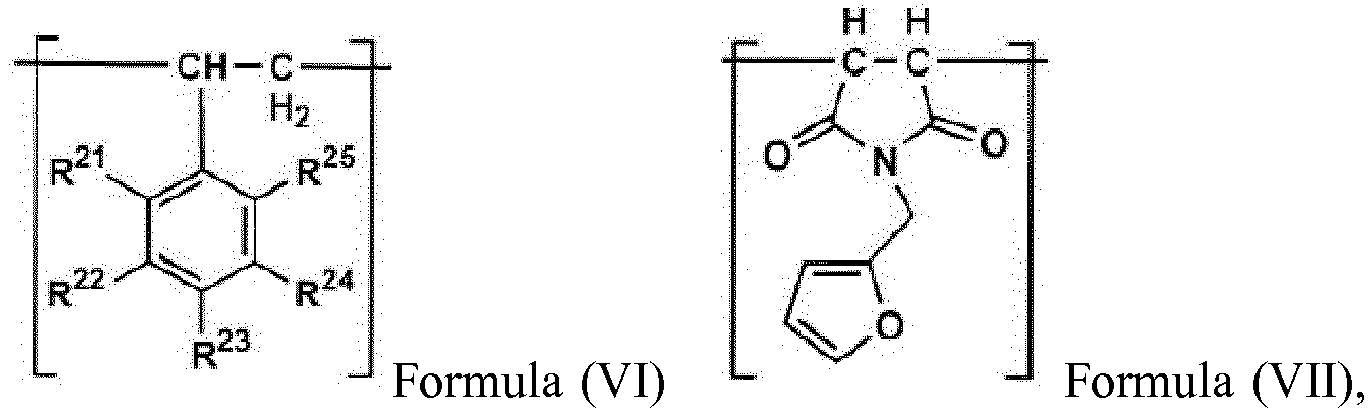
- the disclosure provides a reversible crosslinking reactant composition, including an oligomer, wherein the oligomer has a number average molecular weight of 1000 to 12000, wherein the oligomer is an oligomer having a structure represented by Formula (IV), an oligomer having a structure represented by Formula (V), or an oligomer having a first repeating unit and a second repeating unit, wherein the first repeating unit has a structure represented by Formula (VI), the second repeating unit has a structure represented by Formula (VII), and the first repeating unit and the second repeating unit are arranged randomly or in blocks, wherein each of R 1 , R 2 , R 3 , R 4 , R 5 , R 6 , R 7 , R 8 , R 9 , R 10 , R 11 , and R 12 is independently hydrogen, C 1-6 alkyl group, C 1-6 alkoxy group, or halogen; each of R 13 , R 14 , R 15 ,
- Embodiments of the disclosure provide a reversible crosslinking reactant composition.
- the furan group of the oligomer and the maleimide group of the bismaleimide compound in the composition will crosslink through 1,2-addition at a suitable temperature.
- the crosslink bonding will be broken by reverse reaction at another suitable temperature, such that the bridge between the furan-group-containing oligomer/compound and the bismaleimide compound is broken.
- the furan-group-containing oligomer/compound and the bismaleimide compound are recovered back to original non-cross-linked state, thereby being beneficial to recycle and reuse the composition.
- the furan-group-containing oligomer has a specific structure, it will be cross-linked with the bismaleimide compound at a temperature of 80°C to 150°C.
- the cross-linked composition will reverse to non-cross-linked state through a reverse crosslinking reaction when the temperature is larger than 200°C. Accordingly, the composition can be applied as a raw material related to photoelectric or communication products requiring high-temperature processes.
- the disclosure provides a reversible crosslinking reactant composition.
- the reversible crosslinking reactant composition includes at least one furan-group-containing oligomer having a structure represented by Formula (I) and a bismaleimide compound having a structure represented by Formula (II).
- the equivalent ratio of the furan group of the furan-group-containing oligomer having a structure represented by Formula (I) to the maleimide group of the bismaleimide compound having a structure represented by Formula (II) is from 0.5:1 to 1:0.5.
- x is an integer of 1 to 5
- A is a repeating unit containing amine group, amide group, imide group, ester group, phenyl ether group, or enol ether group
- G is a bonding, -O-, -NH-, -Ar-NH-(CH 2 ) b -, -Ar-O-(CH 2 ) b -, -Ar-O-(CH 2 ) a -NH-(CH 2 ) b -, -(CH 2 ) a -NH-(CH 2 ) b -, -(CH 2 ) a -O-(CH 2 ) b -, or -(CH 2 ) a -CH(OH)-(CH 2 ) b -NH-
- Ar is substituted or unsubstituted arylene group
- a is an integer of 1 to 5
- b is an integer of 0 to 5.
- E is substituted or unsubstituted C 6 -C 25 arylene group, C 7 -C 25 alkyl aryl group, C 7 -C 25 arylalkyl group, C 6 -C 25 heteroarylene group, C 7 -C 25 acylaryl group, C 7 -C 25 alkoxyaryl group, C 7 -C 25 acyloxyaryl group, C 6 -C 25 arylene ether group, or C 6 -C 25 arylene ether group.
- Ar is substituted or unsubstituted phenylene group, biphenylene group, naphthylene group, thienylene group, indolylene group, phenanthrenylene, indenylene group, anthracenylene group, or fluorenylene group. More specifically, Ar is phenylene group, biphenylene group, naphthylene group, thienylene group, indolylene group, phenanthrenylene, indenylene group, anthracenylene group, or fluorenylene group with substitution groups of one to four C 1 -C 6 alkyl groups.
- A is in which the repeating unit and the repeating unit are arranged in order or random, wherein A is connected to G by the location represented by *, m is an integer of 7 to 200, n is an integer of 7 to 200, each of p, r, and s is an integer of 1 to 5, q is an integer of 5 to 50, z is an integer of 5 to 20, each of R 1 , R 2 , R 3 , and R 4 is independently C 1 -C 5 alkyl group, T 1 is a bonding, C 1 -C 12 linear or branched alkyl group, -O-, -S-, or -NH-, Q is wherein each of R 9 , R 10 , and R 11 is independently CH 3 or C 2 H 5 , T 2 is C 1 -C 12 linear or branched alkyl group, and each of I, j, and k is an integer of 1 to 5.
- E in Formula (II) is wherein each of u, v, and w is an integer of 1 to 5, each of R 5 , R 6 , and R 7 is independently C 1 -C 5 alkyl group, M is a bonding, -O-, -S-, or C 1 -C 12 linear or branched alkyl group, and p is an integer of 1 to 4.
- the reversible crosslinking reactant composition further includes a furan-group-containing compound having a structure represented by Formula (III):
- y is an integer of 1 to 5
- B is a group containing ketone group, amide group, imide group, amine group, imine group, phenyl ether group, or enol ether group
- D is a bonding, -O-, -NH-, -Ar 2 -NH-(CH 2 ) d -, -Ar 2 -O-(CH 2 ) b -, -Ar 2 -O-(CH 2 ) c -NH-(CH 2 ) d -, -(CH 2 ) c -NH-(CH 2 ) d -, -(CH 2 ) c -O-(CH 2 ) d -, or -(CH 2 ) c -CH(OH)-(CH 2 ) d -NH-
- Ar 2 is substituted or unsubstituted arylene group
- c is an integer of 1 to 5
- d is an integer of
- Ar 2 is substituted or unsubstituted phenylene group, biphenylene group, naphthylene group, thienylene group, indolylene group, phenanthrenylene, indenylene group, anthracenylene group, or fluorenylene group. More specifically, Ar 2 can be phenylene group, biphenylene group, naphthylene group, thienylene group, indolylene group, phenanthrenylene, indenylene group, anthracenylene group, or fluorenylene group with substitution groups of one to four C 1 -C 6 alkyl groups.
- B can be R is hydrogen, halogen, C 1 -C 8 alkyl group, C 1 -C 8 haloalkyl group, C 5 -C 10 cycloalkyl group, or C 6 -C 12 aryl group, and B is connected to D by the location represented by *. More specifically, B can be B is connected to D by the location represented by *, wherein R 8 is CH 3 or C 2 H 5 , t is an integer of 1 to 5, and e is an integer of 1 to 5.
- the furan-group-containing oligomer having a structure represented by Formula (I) and the furan-group-containing compound having a structure represented by Formula (III) in the composition may have a weight ratio of 20:80 to 80:20.
- the equivalent ratio of the total number of furan groups of the at least one furan-group-containing oligomer having a structure represented by Formula (I) and the furan-group-containing compound having a structure represented by Formula (III) to the maleimide group of the bismaleimide compound having a structure represented by Formula (II) is from 0.7:1 to 1:0.5.
- One embodiment of the disclosure further provides a reversible crosslinking reactant composition, including (a) oligomer, wherein (a) oligomer has a number average molecular weight of 1000 to 12000, wherein (a) oligomer is an oligomer having a structure represented by Formula (IV), an oligomer having a structure represented by Formula (V), or an oligomer having a first repeating unit and a second repeating unit, wherein the first repeating unit has a structure represented by Formula (VI), the second repeating unit has a structure represented by Formula (VII), and the first repeating unit and the second repeating unit are arranged randomly or in blocks, wherein each of R 1 , R 2 , R 3 , R 4 , R 5 , R 6 , R 7 , R 8 , R 9 , R 10 , R 11 , and R 12 is independently hydrogen, C 1-6 alkyl group, C 1-6 alkoxy group, or halogen; each of R 13 , R 14 , R
- E in Formula (II) is or wherein each of u, v, and w is an integer of 1 to 5, each of R 5 , R 6 , and R 7 is independently C 1 -C 5 alkyl group, M is a bonding, -O-, -S-, C 1 -C 12 linear or branched alkyl group, and p is an integer of 1 to 4.
- the reversible crosslinking reactant composition further includes (c) furan-group-containing compound having a structure represented by Formula (III): y is an integer of 1 to 5, B is a group containing ketone group, amide group, imide group, amine group, imine group, phenyl ether group, or enol ether group, D is a bonding, -O-, -NH-, -Ar 2 -NH-(CH 2 ) d -, -Ar 2 -O-(CH 2 ) b -, -Ar 2 -O-(CH 2 ) c -NH-(CH 2 ) d -, -(CH 2 ) c -NH-(CH 2 ) d -, -(CH 2 ) c -O-(CH 2 ) d -, or -(CH 2 ) c -CH(OH)-(CH 2 ) d -NH-
- Ar 2 is substituted or unsubstituted phenylene group, biphenylene group, naphthylene group, thienylene group, indolylene group, phenanthrenylene, indenylene group, anthracenylene group, or fluorenylene group.
- B is R is hydrogen, halogen, C 1 -C 8 alkyl group, C 1 -C 8 haloalkyl group, C 5 -C 10 cycloalkyl group, or C 6 -C 12 aryl group, and B is connected to D by the location represented by *.
- B is or B is connected to D by the location represented by *, wherein R 8 is CH 3 or C 2 H 5 , t is an integer of 1 to 5, and e is an integer of 1 to 5.
- (a) oligomer and (c) furan-group-containing compound having a structure represented by Formula (III) have a weight ratio of 20:80 to 80:20.
- the equivalent ratio of the total number of furan groups of (a) oligomer and (b) furan-group-containing compound having a structure represented by Formula (III) to the maleimide group of (b) bismaleimide compound having a structure represented by Formula (II) is from 0.7:1 to 1:0.5.
- the composition of the disclosure can be used in copper clad laminate or PCB process.
- the composition of the disclosure can be used as adhesive, coating, package, composite, or functional film, and further used in several optical and electronic product.
- the oligomer having a structure represented by Formula (I-1) (m was 7 ⁇ 200, n was 7 ⁇ 200, and the oligomer had a number average molecular weight of 2000 ⁇ 12000)
- styrene maleic anhydride SMA, commercially available from Polyscope, weight average molecular weight (Mw):7500
- DMAc dimethylacetamide
- FA furfurylamine
- styrene maleic anhydride SMA, commercially available from Polyscope, weight average molecular weight (Mw):9000
- DMAc dimethylacetamide
- F furfurylamine
- SMA styrene maleic anhydride
- DMAc dimethylacetamide
- F furfurylamine
- the oligomers prepared in Examples 1 to 3 were analyzed by reflection IR spectroscopy (Spectrum One-54415, PERLIN ELMER) to measure their IR spectra.
- the -CO 2 NH character peaks of 1701cm -1 and 1776cm -1 mean that the furfurylamine was grafted on the styrene maleic anhydride to form the maleimide functional group.
- the oligomers prepared in Examples 1 to 3 were analyzed by differential scanning calorimeter (Q10, TA Instrument Co., Ltd.) under the standard IPC-TM-650.2.4.24 to measure their glass transfer temperature (Tg), as tabulated in Table 1.
- the oligomers prepared in Examples 1 to 3 were also analyzed by gel permeation chromatography (RI 830, JASCO) to measure their weight average molecular weight (Mw), as tabulated in Table 1.
- the oligomer having a structure represented by Formula (I-2) (x was 5 ⁇ 47, and the oligomer had a number average molecular weight of 1000 ⁇ 6000)
- the oligomers prepared in Examples 4 and 5 were analyzed by reflection IR spectroscopy (Spectrum One-54415, PERLIN ELMER) to measure their IR spectra.
- the NH character peak of 3200cm -1 to 3400cm -1 means that the furfurylamine was grafted on the polyphenylene ether.
- the oligomers prepared in Examples 4 and 5 were analyzed by differential scanning calorimeter (Q10, TA Instrument Co., Ltd.) under the standard IPC-TM-650.2.4.24 to measure their glass transfer temperature (Tg), as tabulated in Table 2.
- the oligomers prepared in Examples 4 and 5 were also analyzed by gel permeation chromatography (RI 830, JASCO) to measure their weight average molecular weight (Mw), as tabulated in Table 2.
- the oligomer having a structure represented by Formula (I ⁇ 3) (z was 5 ⁇ 20 and the oligomer had a number average molecular weight of 900 ⁇ 3000)
- the oligomer prepared in Example 6 was analyzed by reflection IR spectroscopy (Spectrum One-54415, PERLIN ELMER) to measure its IR spectrum.
- the NH character peak of 3200cm -1 to 3400cm -1 means that the furfurylamine was grafted on the epoxy acrylate oligomer.
- Example 6 the oligomer prepared in Example 6 was analyzed by differential scanning calorimeter (Q10, TA Instrument Co., Ltd.) under the standard IPC-TM-650.2.4.24 to measure its glass transfer temperature (Tg), as tabulated in Table 3.
- the oligomer prepared in Example 6 was also analyzed by gel permeation chromatography (RI 830, JASCO) to measure its weight average molecular weight (Mw), as tabulated in Table 3.
- Table 3 Composition Properties Epoxy acrylate oligomer FA (g) Tg (°C) Mw Mn (g) Example 6 ⁇ 850 60 8.5 125.3 ⁇ 850
- T was -CH 2 -CH(OH)- group (e.g. T was connected to N through CH 2 ) or -CH 2 -CH 2 - group)
- TAIC triallyl isocyanurate
- DMAc dimethylacetamide
- FA furfurylamine
- TPIC tris(2,3-epoxy propyl) isocyanurate
- DMAc dimethylacetamide
- FA furfurylamine
- the compounds prepared in Examples 7 and 8 were analyzed by reflection IR spectroscopy (Spectrum One-54415, PERLIN ELMER) to measure their IR spectra.
- the NH character peak of 3200cm -1 to 3400cm -1 means that the furfurylamine was grafted on the triallyl isocyanurate or the tris(2,3-epoxy propyl) isocyanurate.
- compositions including only one type of furan-group-containing oligomer
- the cross-linked compositions I to VI prepared in Examples 9 to 14 were analyzed by reflection IR spectroscopy (Spectrum One-54415, PERLIN ELMER) to measure their IR spectra.
- IR spectra data the original BMI-1000 character peak of 822cm -1 disappeared after the reaction, and the signal intensity of the C-O-C character peak on the furan group of 1068cm -1 was obviously lowered, which means that the cross-linked products were formed.
- the cross-linked compositions I to VI prepared in Examples 9 to 14 were analyzed by differential scanning calorimeter (Q10, TA Instrument Co., Ltd.) under the standard IPC-TM-650.2.4.24 to measure their glass transfer temperature (Tg), as tabulated in Table 5.
- the cross-linked compositions I to VI prepared in Examples 9 to 14 were respectively sampled as 5mg and analyzed by differential scanning calorimeter (Q10, TA Instrument Co., Ltd.), in which each of the samples was heated to 350°C at a heating rate of 5°C/min to measure the reversible crosslinking temperature (Tr) of the cross-linked compositions I to VI prepared in Examples 9 to 14, as tabulated in Table 5.
- Tr reversible crosslinking temperature
- the cross-linked compositions in Examples could be stable at a high temperature of at least 160°C.
- compositions including a plurality types of furan-group-containing oligomers/compounds
- the cross-linked compositions VII to X prepared in Examples 15 to 18 were analyzed by reflection IR spectroscopy (Spectrum One-54415, PERLIN ELMER) to measure their IR spectra.
- reflection IR spectroscopy Spectrum One-54415, PERLIN ELMER
- cross-linked compositions VII to X prepared in Examples 15 to 18 were analyzed by differential scanning calorimeter (Q10, TA Instrument Co., Ltd.) under the standard IPC-TM-650.2.4.24 to measure their glass transfer temperature (Tg), as tabulated in Table 6.
- the cross-linked compositions VII to X prepared in Examples 15 to 18 were respectively sampled as 5mg and analyzed by differential scanning calorimeter (Q10, TA Instrument Co., Ltd.), in which each of the samples was heated to 350 °C at a heating rate of 5°C/min to measure the reversible crosslinking temperature (Tr) of the cross-linked compositions VII to X prepared in Examples 15 to 18, as tabulated in Table 6.
- the cross-linked compositions I to X prepared in Examples 9 to 18 were crushed.
- the cross-linked compositions were heated to about 250°C ⁇ 300°C to crack the crosslinking bondings and reverse back to varnish state, and then cooled to 60°C ⁇ 80°C to further harden to bulks.
- the bulks were analyzed by reflection IR spectroscopy (Spectrum One-54415, PERLIN ELMER) to measure their IR spectra.
- the two maleimide groups of the bismaleimide compound could react with the furan groups of two furan group-containing oligomer or compound through the 1,2-addition reaction.
- the bondings formed from the 1,2-addition reaction would be cracked, thereby breaking the bridge between the furan group-containing oligomer/compound and the bismaleimide compound for recovering back to original reactants.
- the above properties are beneficial to recycle and reuse the compositions.
- the reversible crosslinking reactant compositions of the disclosure had a stable structure, high thermal resistance, and high reversible temperature, which were beneficial for use in high-temperature processes.
- the composition serving as the insulation resin material for PCB should be intact during the reflow process, such that the reversible temperature of the composition was preferably higher than or equal to 250°C.
- Epoxy resin 828 (BE-188, commercially available from Chang Chun Chemical Co., Ltd.), 5 phr of dicyandiamide (commercially available from Echo Chemical Co., Ltd), and 500ppm of 2-methylimidazole (2-MI, commercially available from Echo Chemical Co., Ltd.) were added to methyl ethyl ketone (MEK, commercially available from Echo Chemical Co., Ltd) to prepare a varnish with a solid content of 70%.
- MEK methyl ethyl ketone
- the prepregs were laminated with copper foil to form copper clad laminate.
- the lamination process was performed at a temperature of 170°C ⁇ 190°C for 1 hours to 2 hours under a pressure of 350psi ⁇ 450psi.
- the prepared copper clad laminate was FR-4 plate for general PCB.
- the copper clad laminates in Examples 19 and Comparative Example were analyzed by differential scanning calorimeter (Q10, TA Instrument Co., Ltd.) under the standard IPC-TM-650.2.4.24 to measure their glass transfer temperature (Tg), as tabulated in Table 7.
- the copper clad laminates in Examples 19 and Comparative Example were analyzed by thermomechanical analyzer (Q400, TA Instrument Co., Ltd.) under the standard IPC-TM-650.2.4.24 to measure their coefficient of thermal expansion (CTE), as tabulated in Table 7.
- the copper clad laminates in Examples 19 and Comparative Example were analyzed by thermogravimetric analysis (Q500, TA Instrument Co., Ltd.) under the standard IPC-TM-650 2.3.40 to measure their degradation temperature (Td), as tabulated in Table 7.
- the copper clad laminates in Examples 19 and Comparative Example were respectively sampled as 5mg and analyzed by differential scanning calorimeter (Q10, TA Instrument Co., Ltd.), in which each of the samples was heated to 350°C at a heating rate of 5 °C /min to measure the reversible crosslinking temperature (Tr) of the copper clad laminates in Examples 19 and Comparative Example, as tabulated in Table 7.
- the copper clad laminates in Examples 19 and Comparative Example were analyzed by resonant cavity type microwave dielectrometer (AET company, Japan) under the standard JIS-compliant 1641to measure their dielectric constant (Dk) and dissipation factor (Df), as tabulated in Table 7. As shown in Table 7, the copper clad laminates in Example 19 and Comparative Example had similar dielectric constant and similar dissipation factor. Compared to Comparative Example, the copper clad laminate in Example 19 had a reversible crosslinking temperature of 300°C.
- the resin in the copper clad laminate in Example 19 can be reversible cross-linked by heating to about 300°C, thereby forming the furan-group-containing oligomer and/or compound and the bismaleimide compound for being recycled.
- Table 6 Tg (°C) XY-CTE (ppm/°C) Td (°C) Tr (°C) Dk Df
- Example 19 180 ⁇ 212 16 ⁇ 20 360 300 3.75 0.012 Comparative Example 140 30 350 none 4.2 0.015
- the copper clad laminate in Example 19 was etched to remove the copper foils, and then put into a solution of about 250°C to 300°C to dissolve and recycle the composition.
- the recycled resin composition was collected and analyzed by reflection IR spectroscopy (Spectrum One-54415, PERLIN ELMER) to measure its IR spectrum.
- the recycled resin composition was cured again, and the cured resin composition had the same Tg as that of the cured original resin composition (Example 18). It further proves that the composite material in Example 19 can be recycled to be reused.
- the composites prepared by methods of Examples included reversible crosslinking reactant compositions, thereby increasing the recycling ratio of the composites.
- utilizing the compositions with a reversible crosslinking temperature higher than or equal to 250°C may improve the recycling ratio of PCB, therefore reducing the CO 2 emission amounts.
- the recycled compositions can be repeatedly used as the insulation resin during fabricating PCB or sub-quality raw material for achieving the circular economy.
Landscapes
- Chemical & Material Sciences (AREA)
- Organic Chemistry (AREA)
- Health & Medical Sciences (AREA)
- Chemical Kinetics & Catalysis (AREA)
- Medicinal Chemistry (AREA)
- Polymers & Plastics (AREA)
- General Chemical & Material Sciences (AREA)
- Plural Heterocyclic Compounds (AREA)
- Polyethers (AREA)
- Macromolecular Compounds Obtained By Forming Nitrogen-Containing Linkages In General (AREA)
- Polyoxymethylene Polymers And Polymers With Carbon-To-Carbon Bonds (AREA)
- Furan Compounds (AREA)
- Epoxy Resins (AREA)
- Addition Polymer Or Copolymer, Post-Treatments, Or Chemical Modifications (AREA)
- Other Resins Obtained By Reactions Not Involving Carbon-To-Carbon Unsaturated Bonds (AREA)
- Compositions Of Macromolecular Compounds (AREA)
- Reinforced Plastic Materials (AREA)
- Processes Of Treating Macromolecular Substances (AREA)
- Polyurethanes Or Polyureas (AREA)
Abstract

Description
- The technical field relates to a reversible crosslinking reactant composition.
- In end of 2015, European union published Circular Economy Package (CEP). The compositions and components of products in future should meet the requirements of being repairable, durable, and recyclable to achieve circular economy. In addition, the Paris Agreement in 2016 proposed to reduce greenhouse gas emission and keeping a global average temperature below 2°C above pre-industrial levels.
- Of the elements of conventional electronic products, printed circuit boards (PCBs) are responsible for the most CO2 emissions, e.g. over 100000kg CO2/10000m2 PCB. As such, the related industries are encountering the challenges of efficiently recycling waste PCBs to lower CO2 emissions, while simultaneously obeying the energy related ecodesign directives. The conventional method of recycling a waste PCB is to crush it and then purifying or burying the metal and plastic in a landfill. However, the recycling ratio is usually lower than 3%. Therefore, in practice, waste PCBs still get incinerated, which may produce a lot of CO2 and contribute to the greenhouse effect. The skill of purifying metal has matured in recent years, and 130 kg of copper, 19kg of tin, and about 16 ounce of gold can be refined from 1 ton of PCBs today. However, a PCB contains about 54.5% of plastic, which is the major CO2 emission source. The plastic in a PCB includes insulation resin and glass fiber cloth. All the conventional resin systems for PCBs belong to thermosetting polymer, which has stable properties and is therefore difficult to recycle. Although decomposable thermoplastic polymer is provided, the glass transfer temperature, the thermal cracking temperature, and the flame resistance of the thermoplastic polymer should be improved even further, in order to achieve the properties of the conventional insulation resin in PCB.
- Not only the PCB, the resin composition used in other products that need to withstand high temperatures during process or use also encounters the similar challenge when the demands of recycling wastes is increased.
- According to embodiments of the disclosure, the disclosure provides a reversible crosslinking reactant composition. The reversible crosslinking reactant composition includes at least one furan-group-containing oligomer having a structure represented by Formula (I) and a bismaleimide compound having a structure represented by Formula (II):

- In Formula (I), x is an integer of 1 to 5, A is a repeating unit containing amine group, amide group, imide group, ester group, phenyl ether group, or enol ether group, G is a bonding, -O-, -NH-, -Ar-NH-(CH2)b-, -Ar-O-(CH2)b-, -Ar-O-(CH2)a-NH-(CH2)b-, -(CH2)a-NH-(CH2)b-, -(CH2)a-O-(CH2)b-, or -(CH2)a-CH(OH)-(CH2)b-NH-, Ar is substituted or unsubstituted arylene group, a is an integer of 1 to 5, and b is an integer of 0 to 5. The furan-group-containing oligomer having a structure represented by Formula (I) has a number average molecular weight from 1000 to 12000.
- In Formula (II), E is substituted or unsubstituted C6-C25 arylene group, C7-C25 alkyl aryl group, C7-C25 arylalkyl group, C6-C25 heteroarylene group, C7-C25 acylaryl group, C7-C25 alkoxyaryl group, C7-C25 acyloxyaryl group, C6-C25 arylene ether group, or C6-C25 arylene ether group.
- According to embodiments of the disclosure, the disclosure provides a reversible crosslinking reactant composition, including an oligomer, wherein the oligomer has a number average molecular weight of 1000 to 12000, wherein the oligomer is an oligomer having a structure represented by Formula (IV), an oligomer having a structure represented by Formula (V), or an oligomer having a first repeating unit and a second repeating unit, wherein the first repeating unit has a structure represented by Formula (VI), the second repeating unit has a structure represented by Formula (VII), and the first repeating unit and the second repeating unit are arranged randomly or in blocks,



- A detailed description is given in the following embodiments.
- Embodiments of the disclosure provide a reversible crosslinking reactant composition.
- The furan group of the oligomer and the maleimide group of the bismaleimide compound in the composition will crosslink through 1,2-addition at a suitable temperature. The crosslink bonding will be broken by reverse reaction at another suitable temperature, such that the bridge between the furan-group-containing oligomer/compound and the bismaleimide compound is broken. As such, the furan-group-containing oligomer/compound and the bismaleimide compound are recovered back to original non-cross-linked state, thereby being beneficial to recycle and reuse the composition. If the furan-group-containing oligomer has a specific structure, it will be cross-linked with the bismaleimide compound at a temperature of 80°C to 150°C. Furthermore, the cross-linked composition will reverse to non-cross-linked state through a reverse crosslinking reaction when the temperature is larger than 200°C. Accordingly, the composition can be applied as a raw material related to photoelectric or communication products requiring high-temperature processes.
- According to embodiments of the disclosure, the disclosure provides a reversible crosslinking reactant composition. The reversible crosslinking reactant composition includes at least one furan-group-containing oligomer having a structure represented by Formula (I) and a bismaleimide compound having a structure represented by

- In Formula (I), x is an integer of 1 to 5, A is a repeating unit containing amine group, amide group, imide group, ester group, phenyl ether group, or enol ether group, G is a bonding, -O-, -NH-, -Ar-NH-(CH2)b-, -Ar-O-(CH2)b-, -Ar-O-(CH2)a-NH-(CH2)b-, -(CH2)a-NH-(CH2)b-, -(CH2)a-O-(CH2)b-, or -(CH2)a-CH(OH)-(CH2)b-NH-, Ar is substituted or unsubstituted arylene group, a is an integer of 1 to 5, and b is an integer of 0 to 5. The furan-group-containing oligomer having a structure represented by Formula (I) has a number average molecular weight of 1000 to 12000.
- In Formula (II), E is substituted or unsubstituted C6-C25 arylene group, C7-C25 alkyl aryl group, C7-C25 arylalkyl group, C6-C25 heteroarylene group, C7-C25 acylaryl group, C7-C25 alkoxyaryl group, C7-C25 acyloxyaryl group, C6-C25 arylene ether group, or C6-C25 arylene ether group.
- In some embodiments of the disclosure, Ar is substituted or unsubstituted phenylene group, biphenylene group, naphthylene group, thienylene group, indolylene group, phenanthrenylene, indenylene group, anthracenylene group, or fluorenylene group. More specifically, Ar is phenylene group, biphenylene group, naphthylene group, thienylene group, indolylene group, phenanthrenylene, indenylene group, anthracenylene group, or fluorenylene group with substitution groups of one to four C1-C6 alkyl groups.
- In some embodiments of the disclosure, A is


- In some embodiments of the disclosure, E in Formula (II) is


- In some embodiments of the disclosure, the reversible crosslinking reactant composition further includes a furan-group-containing compound having a structure represented by Formula (III):

- In Formula (III), y is an integer of 1 to 5, B is a group containing ketone group, amide group, imide group, amine group, imine group, phenyl ether group, or enol ether group, D is a bonding, -O-, -NH-, -Ar2-NH-(CH2)d-, -Ar2-O-(CH2)b-, -Ar2-O-(CH2)c-NH-(CH2)d-, -(CH2)c-NH-(CH2)d-, -(CH2)c-O-(CH2)d-, or -(CH2)c-CH(OH)-(CH2)d-NH-, Ar2 is substituted or unsubstituted arylene group, c is an integer of 1 to 5, and d is an integer of 0 to 5.
- In some embodiments of the disclosure, Ar2 is substituted or unsubstituted phenylene group, biphenylene group, naphthylene group, thienylene group, indolylene group, phenanthrenylene, indenylene group, anthracenylene group, or fluorenylene group. More specifically, Ar2 can be phenylene group, biphenylene group, naphthylene group, thienylene group, indolylene group, phenanthrenylene, indenylene group, anthracenylene group, or fluorenylene group with substitution groups of one to four C1-C6 alkyl groups.
- In some embodiments of the disclosure, B can be


- In some embodiments, the furan-group-containing oligomer having a structure represented by Formula (I) and the furan-group-containing compound having a structure represented by Formula (III) in the composition may have a weight ratio of 20:80 to 80:20.
- In some embodiments, the equivalent ratio of the total number of furan groups of the at least one furan-group-containing oligomer having a structure represented by Formula (I) and the furan-group-containing compound having a structure represented by Formula (III) to the maleimide group of the bismaleimide compound having a structure represented by Formula (II) is from 0.7:1 to 1:0.5.
- One embodiment of the disclosure further provides a reversible crosslinking reactant composition, including (a) oligomer, wherein (a) oligomer has a number average molecular weight of 1000 to 12000, wherein (a) oligomer is an oligomer having a structure represented by Formula (IV), an oligomer having a structure represented by Formula (V), or an oligomer having a first repeating unit and a second repeating unit, wherein the first repeating unit has a structure represented by Formula (VI), the second repeating unit has a structure represented by Formula (VII), and the first repeating unit and the second repeating unit are arranged randomly or in blocks,


- In some embodiments of the disclosure, E in Formula (II) is


- In some embodiments of the disclosure, the reversible crosslinking reactant composition further includes (c) furan-group-containing compound having a structure represented by Formula (III):

- In some embodiments of the disclosure, Ar2 is substituted or unsubstituted phenylene group, biphenylene group, naphthylene group, thienylene group, indolylene group, phenanthrenylene, indenylene group, anthracenylene group, or fluorenylene group.
- In some embodiments of the disclosure, B is
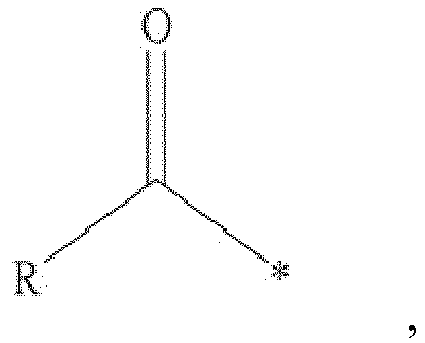


- In some embodiments of the disclosure, B is


- In some embodiments, (a) oligomer and (c) furan-group-containing compound having a structure represented by Formula (III) have a weight ratio of 20:80 to 80:20.
- In some embodiments, the equivalent ratio of the total number of furan groups of (a) oligomer and (b) furan-group-containing compound having a structure represented by Formula (III) to the maleimide group of (b) bismaleimide compound having a structure represented by Formula (II) is from 0.7:1 to 1:0.5.
- According to embodiments of the disclosure, the composition of the disclosure can be used in copper clad laminate or PCB process. The composition of the disclosure can be used as adhesive, coating, package, composite, or functional film, and further used in several optical and electronic product.
- Below, exemplary embodiments will be described in detail so as to be easily realized by a person having ordinary knowledge in the art. The inventive concept may be embodied in various forms without being limited to the exemplary embodiments set forth herein. Descriptions of well-known parts are omitted for clarity.
- Preparation Examples of furan-group-containing oligomer
- The oligomer having a structure represented by Formula (I-1) (m was 7∼200, n was 7∼200, and the oligomer had a number average molecular weight of 2000∼12000)
-

- 60g of styrene maleic anhydride (SMA, commercially available from Polyscope, weight average molecular weight (Mw):7500) was put into 80g of dimethylacetamide (DMAc, commercially available from Echo Chemical Co., Ltd) to be pre-dissolved. 29.6g of furfurylamine (FA, commercially available from Aldrich) was then added into DMAc and SMA, and then heated to 100°C∼160°C and stirred to react. After completing the reaction, the temperature was cooled to room temperature to obtain an oligomer having a structure represented by Formula (I-1). Subsequently, the physical properties of the oligomer were measured, as shown in Table 1.
- 60g of styrene maleic anhydride (SMA, commercially available from Polyscope, weight average molecular weight (Mw):9000) was put into 80g of dimethylacetamide (DMAc) to be pre-dissolved. 22.33g of furfurylamine (FA, commercially available from Aldrich) was then added into DMAc and SMA, and then heated to 100°C∼160°C and stirred to react. After completing the reaction, the temperature was cooled to room temperature to obtain an oligomer having a structure represented by Formula (I-1). Subsequently, the physical properties of the oligomer were measured, as shown in Table 1.
- 83g of styrene maleic anhydride (SMA, commercially available from Polyscope, weight average molecular weight (Mw):10000) was put into 115g of dimethylacetamide (DMAc) to be pre-dissolved. 40g of furfurylamine (FA, commercially available from Aldrich) was then added into DMAc and SMA, and then heated to 100°C∼160°C and stirred to react. After completing the reaction, the temperature was cooled to room temperature to obtain an oligomer having a structure represented by Formula (I-1). Subsequently, the physical properties of the oligomer were measured, as shown in Table 1.
- The oligomers prepared in Examples 1 to 3 were analyzed by reflection IR spectroscopy (Spectrum One-54415, PERLIN ELMER) to measure their IR spectra. In the IR spectra data, the -CO2NH character peaks of 1701cm-1 and 1776cm-1 mean that the furfurylamine was grafted on the styrene maleic anhydride to form the maleimide functional group. The C-O-C character peaks of 1006cm-1 and 1068cm-1 and the C=C character peak of 1491cm-1 mean the signals of furan group in the furfurylamine. In addition, the oligomers prepared in Examples 1 to 3 were analyzed by differential scanning calorimeter (Q10, TA Instrument Co., Ltd.) under the standard IPC-TM-650.2.4.24 to measure their glass transfer temperature (Tg), as tabulated in Table 1. The oligomers prepared in Examples 1 to 3 were also analyzed by gel permeation chromatography (RI 830, JASCO) to measure their weight average molecular weight (Mw), as tabulated in Table 1.
Table 1 Composition Properties SMA FA (g) Tg (°C) Mw Mw (g) Example 1 7,500 (m:40,n:20) 60 29.6 121 8,700 Example 2 9,000 (m40,n:30) 60 22.33 112 10,500 Example 3 10,000 (m:30,n:40) 83 40 103 11,800 - The oligomer having a structure represented by Formula (I-2) (x was 5∼47, and the oligomer had a number average molecular weight of 1000∼6000)

- 60g of polyphenylene ether (PPE, commercially available from Sabic, Mn:1600) was put into 60g of dimethylacetamide (DMAc) to be pre-dissolved. 6.9g of furfurylamine (FA, commercially available from Aldrich) was then added into DMAc and PPE, and then heated to 100°C∼160°C and stirred to react. After completing the reaction, the temperature was cooled to room temperature to obtain an oligomer having a structure represented by Formula (I-2). Subsequently, the physical properties of the oligomer were measured, as shown in Table 2.
- 60g of polyphenylene ether (PPE, commercially available from Sabic, Mn:2350) was put into 60g of dimethylacetamide (DMAc) to be pre-dissolved. 8g of furfurylamine (FA, commercially available from Aldrich) was then added into DMAc and PPE, and then heated to 100°C∼160°C and stirred to react. After completing the reaction, the temperature was cooled to room temperature to obtain an oligomer having a structure represented by Formula (I-2). Subsequently, the physical properties of the oligomer were measured, as shown in Table 2.
- The oligomers prepared in Examples 4 and 5 were analyzed by reflection IR spectroscopy (Spectrum One-54415, PERLIN ELMER) to measure their IR spectra. In the IR spectra data, the NH character peak of 3200cm-1 to 3400cm-1 means that the furfurylamine was grafted on the polyphenylene ether. The C-O-C character peaks of 1006cm-1 and 1068cm-1 and the C=C character peak of 1491cm-1 mean the signals of furan group in the furfurylamine. In addition, the oligomers prepared in Examples 4 and 5 were analyzed by differential scanning calorimeter (Q10, TA Instrument Co., Ltd.) under the standard IPC-TM-650.2.4.24 to measure their glass transfer temperature (Tg), as tabulated in Table 2. The oligomers prepared in Examples 4 and 5 were also analyzed by gel permeation chromatography (RI 830, JASCO) to measure their weight average molecular weight (Mw), as tabulated in Table 2.
Table 2 Composition Properties PPE FA (g) Tg (°C) Mw Mw (g) Example 4 1,600 60 6.9 142 3,850 Example 5 2,350 60 8 152 5,210 - The oligomer having a structure represented by Formula (I∼3) (z was 5∼20 and the oligomer had a number average molecular weight of 900∼3000)

- 50g of epoxy acrylate oligomer (DOUNLEMER1730, commercially available from Double Bond Chemical) was put into 60g of dimethylacetamide (DMAc). 10g of furfurylamine (FA, commercially available from Aldrich) was then added into DMAc and DOUNLEMER1730, and then heated to 100 °C ∼ 140 °C and stirred to react. After completing the reaction, the temperature was cooled to room temperature to obtain an oligomer having a structure represented by Formula (1-3). Subsequently, the physical properties of the oligomer were measured, as shown in Table 3.
- The oligomer prepared in Example 6 was analyzed by reflection IR spectroscopy (Spectrum One-54415, PERLIN ELMER) to measure its IR spectrum. In the IR spectrum data, the NH character peak of 3200cm-1 to 3400cm-1 means that the furfurylamine was grafted on the epoxy acrylate oligomer. The C-O-C character peaks of 1006cm-1 and 1068cm-1 and the C=C character peak of 1491cm-1 mean the signals of furan group in the furfurylamine. In addition, the oligomer prepared in Example 6 was analyzed by differential scanning calorimeter (Q10, TA Instrument Co., Ltd.) under the standard IPC-TM-650.2.4.24 to measure its glass transfer temperature (Tg), as tabulated in Table 3. The oligomer prepared in Example 6 was also analyzed by gel permeation chromatography (RI 830, JASCO) to measure its weight average molecular weight (Mw), as tabulated in Table 3.
Table 3 Composition Properties Epoxy acrylate oligomer FA (g) Tg (°C) Mw Mn (g) Example 6 ∼850 60 8.5 125.3 ∼850 - The compound having a structure represented by Formula (III-1) (T was -CH2-CH(OH)- group (e.g. T was connected to N through CH2) or -CH2-CH2- group)

- 50g of triallyl isocyanurate (TAIC, commercially available from Aldrich) was put into 60g of dimethylacetamide (DMAc). 19.48g of furfurylamine (FA, commercially available from Aldrich) was then added into DMAc and TAIC, and then heated to 100°C ∼160°C and stirred to react. After completing the reaction, the temperature was cooled to room temperature to obtain an oligomer having a structure represented by Formula (III-1). Subsequently, the physical properties of the compound were measured, as shown in Table 4.
- 50g of tris(2,3-epoxy propyl) isocyanurate (TEPIC, commercially available from Nissan Chemical) was put into 60g of dimethylacetamide (DMAc). 23g of furfurylamine (FA, commercially available from Aldrich) was then added into DMAc and TEPIC, and then heated to 100°C∼160°C and stirred to react. After completing the reaction, the temperature was cooled to room temperature to obtain an oligomer having a structure represented by Formula (III-1). Subsequently, the physical properties of the compound were measured, as shown in Table 4.
- The compounds prepared in Examples 7 and 8 were analyzed by reflection IR spectroscopy (Spectrum One-54415, PERLIN ELMER) to measure their IR spectra. In the IR spectra data, the NH character peak of 3200cm-1 to 3400cm-1 means that the furfurylamine was grafted on the triallyl isocyanurate or the tris(2,3-epoxy propyl) isocyanurate. The C-O-C character peaks of 1006cm-1 and 1068cm-1 and the C=C character peak of 1491cm-1 mean the signals of furan group in the furfurylamine. In addition, the compounds prepared in Examples 7 and 8 were analyzed by differential scanning calorimeter (Q10, TA Instrument Co., Ltd.) under the standard IPC-TM-650.2.4.24 to measure their glass transfer temperature (Tg), as tabulated in Table 4.
Table 4 Composition Properties TAIC(g) TEPIC(g) FA (g) Tg (°C) Example 7 50 0 19.48 143.17 Example 8 0 50 23 152 - Preparation Examples of reversible crosslinking reactant composition
Compositions including only one type of furan-group-containing oligomer - 100.47g of the oligomer having a structure represented by Formula (I-1) synthesized in Example 1 and 50g of the bismaleimide compound BMI-1000 (commercially available from K.I. Chemical Industry, molecular weight:358.35) were reacted at 50°C∼60°C for 30 minutes to form varnish (reversible crosslinking reactant composition). The varnish was put in an oven and reacted at 170°C∼190°C to obtain cross-linked composition I.
- 271.2g of the oligomer having a structure represented by Formula (1-2) synthesized in Example 4 and 50g of the bismaleimide compound BMI-1000 (commercially available from K.I. Chemical Industry) were reacted at 50°C∼60°C for 30 minutes to form varnish (reversible crosslinking reactant composition). The varnish was put in an oven and reacted at 170°C ∼ 190°C to obtain cross-linked composition II.
- 40.18g of the oligomer having a structure represented by Formula (I-1) synthesized in Example 1 and 10g of the bismaleimide compound BMI-1000 (commercially available from K.I. Chemical Industry) were reacted at 50°C∼60°C for 30 minutes to form varnish (reversible crosslinking reactant composition). The varnish was put in an oven and reacted at 170°C ∼ 190°C to obtain cross-linked composition III.
- 108.4g of the oligomer having a structure represented by Formula (1-2) synthesized in Example 4 and 10g of the bismaleimide compound BMI-1000 (commercially available from K.I. Chemical Industry) were reacted at 50°C∼60°C for 30 minutes to form varnish (reversible crosslinking reactant composition). The varnish was put in an oven and reacted at 170°C∼190°C to obtain cross-linked composition IV.
- 50.24g of the oligomer having a structure represented by Formula (I-1) synthesized in Example 1 and 50g of the bismaleimide compound BMI-1000 (commercially available from K.I. Chemical Industry) were reacted at 50°C∼60°C for 30 minutes to form varnish (reversible crosslinking reactant composition). The varnish was put in an oven and reacted at 170°C ∼ 190°C to obtain cross-linked composition V.
- 135.6g of the oligomer having a structure represented by Formula (1-2) synthesized in Example 4 and 50g of the bismaleimide compound BMI-1000 (commercially available from K.I. Chemical Industry) were reacted at 50°C∼60°C for 30 minutes to form varnish (reversible crosslinking reactant composition). The varnish was put in an oven and reacted at 170°C ∼ 190°C to obtain cross-linked composition VI.
- The cross-linked compositions I to VI prepared in Examples 9 to 14 were analyzed by reflection IR spectroscopy (Spectrum One-54415, PERLIN ELMER) to measure their IR spectra. In the IR spectra data, the original BMI-1000 character peak of 822cm-1 disappeared after the reaction, and the signal intensity of the C-O-C character peak on the furan group of 1068cm-1 was obviously lowered, which means that the cross-linked products were formed. In addition, the cross-linked compositions I to VI prepared in Examples 9 to 14 were analyzed by differential scanning calorimeter (Q10, TA Instrument Co., Ltd.) under the standard IPC-TM-650.2.4.24 to measure their glass transfer temperature (Tg), as tabulated in Table 5. The cross-linked compositions I to VI prepared in Examples 9 to 14 were respectively sampled as 5mg and analyzed by differential scanning calorimeter (Q10, TA Instrument Co., Ltd.), in which each of the samples was heated to 350°C at a heating rate of 5°C/min to measure the reversible crosslinking temperature (Tr) of the cross-linked compositions I to VI prepared in Examples 9 to 14, as tabulated in Table 5. As seen in the reversible crosslinking temperature (Tr) in Table 5, the cross-linked compositions in Examples could be stable at a high temperature of at least 160°C.
Table 5 Composition Properties (a) furan-group-containing oligomer (g) (b)bismaleimide (g) (a)/(b) molar ratio Tg (°C) Tr (°C) Formula (I-1) Formula (I-2) BMI-1000 Example 9 100.47 50 1/1 168 230 Example 10 271.2 50 1/1 154 230 Example 11 40.18 10 2/1 175 220 Example 12 108.4 10 2/1 168 230 Example 13 50.24 50 1/2 145 180 Example 14 135.6 50 1/2 132 161 - 54.24g of the oligomer having a structure represented by Formula (I-1) synthesized in Example 1, 135.6g of the oligomer having a structure represented by Formula (1-2) synthesized in Example 4, and 50g of the bismaleimide compound BMI-1000 (commercially available from K.I. Chemical Industry) were reacted at 50°C∼60°C for 30 minutes to form varnish (reversible crosslinking reactant composition). The varnish was put in an oven and reacted at 170°C ∼ 190°C to obtain cross-linked composition VII.
- 54.24g of the oligomer having a structure represented by Formula (I-1) synthesized in Example 1, 42.38g of the compound having a structure represented by Formula (III-1) synthesized in Example 7, and 50g of the bismaleimide compound BMI-1000 (commercially available from K.I. Chemical Industry) were reacted at 50°C∼60°C for 30 minutes to form varnish (reversible crosslinking reactant composition). The varnish was put in an oven and reacted at 170°C ∼ 190°C to obtain cross-linked composition VIII.
- 135.6g of the oligomer having a structure represented by Formula (1-2) synthesized in Example 4, 42.38g of the compound having a structure represented by Formula (III-1) synthesized in Example 7, and 50g of the bismaleimide compound BMI-1000 (commercially available from K.I. Chemical Industry) were reacted at 50°C∼60°C for 30 minutes to form varnish (reversible crosslinking reactant composition). The varnish was put in an oven and reacted at 170°C ∼ 190°C to obtain cross-linked composition IX.
- 33.5g of the oligomer having a structure represented by Formula (I-1) synthesized in Example 1, 90.4g of the oligomer having a structure represented by Formula (I-2) synthesized in Example 4, 28.3g of the compound having a structure represented by Formula (III-1) synthesized in Example 7, and 50g of the bismaleimide compound BMI-1000 (commercially available from K.I. Chemical Industry) were reacted at 50°C∼60°C for 30 minutes to form varnish (reversible crosslinking reactant composition). The varnish was put in an oven and reacted at 170°C ∼ 190°C to obtain cross-linked composition X.
- The cross-linked compositions VII to X prepared in Examples 15 to 18 were analyzed by reflection IR spectroscopy (Spectrum One-54415, PERLIN ELMER) to measure their IR spectra. In the IR spectra data, the original C=C character peak on BMI-1000 of 822cm-1 disappeared after the reaction, and the signal intensity of the C-O-C character peak on the furan group of 1068cm-1 was obviously lowered, which means that the cross-linked products were formed. In addition, the cross-linked compositions VII to X prepared in Examples 15 to 18 were analyzed by differential scanning calorimeter (Q10, TA Instrument Co., Ltd.) under the standard IPC-TM-650.2.4.24 to measure their glass transfer temperature (Tg), as tabulated in Table 6. The cross-linked compositions VII to X prepared in Examples 15 to 18 were respectively sampled as 5mg and analyzed by differential scanning calorimeter (Q10, TA Instrument Co., Ltd.), in which each of the samples was heated to 350 °C at a heating rate of 5°C/min to measure the reversible crosslinking temperature (Tr) of the cross-linked compositions VII to X prepared in Examples 15 to 18, as tabulated in Table 6. As seen in the reversible crosslinking temperature (Tr) of Table 6, the cross-linked compositions in Examples could be stable at a high temperature of at least 160°C.
Table 6 Composition Properties (a) furan-group-containing oligomer (g) (b)bismaleimide (g) (a)/(b) molar ratio Tg (°C) Tr (°C) Formula (I-1) Formula (I-2) Formula (III-1) BMI-1000 Example 15 54.24 135.6 50 1/1 185 200 Example 16 54.24 42.38 50 1/1 169 250 Example 17 135.6 42.38 50 1/1 251 300 Example 18 33.5 90.4 28.3 50 1/1 237 290 - The cross-linked compositions I to X prepared in Examples 9 to 18 were crushed. The cross-linked compositions were heated to about 250°C∼300°C to crack the crosslinking bondings and reverse back to varnish state, and then cooled to 60°C∼80°C to further harden to bulks. The bulks were analyzed by reflection IR spectroscopy (Spectrum One-54415, PERLIN ELMER) to measure their IR spectra. In the IR spectra data, the original C=C character peak on BMI-1000 of 822cm-1 reappeared, and the signal intensity of the C-O-C character peak on the furan group of 1068cm-1 was obviously enhanced, which means that the crosslinking bondings of the cross-linked compositions were cracked, thereby recovering back to the compositions of furan group-containing oligomer and/or compound and BMI-1000.
- For the reversible crosslinking reactant compositions in Examples, the two maleimide groups of the bismaleimide compound could react with the furan groups of two furan group-containing oligomer or compound through the 1,2-addition reaction. When the steric structure achieved a specific temperature, the bondings formed from the 1,2-addition reaction would be cracked, thereby breaking the bridge between the furan group-containing oligomer/compound and the bismaleimide compound for recovering back to original reactants. The above properties are beneficial to recycle and reuse the compositions. According to the result of the Examples, the reversible crosslinking reactant compositions of the disclosure had a stable structure, high thermal resistance, and high reversible temperature, which were beneficial for use in high-temperature processes. For example, the composition serving as the insulation resin material for PCB should be intact during the reflow process, such that the reversible temperature of the composition was preferably higher than or equal to 250°C.
- 33.5g of the oligomer having a structure represented by Formula (I-1) synthesized in Example 1, 90.4g of the oligomer having a structure represented by Formula (1-2) synthesized in Example 4, 28.3g of the compound having a structure represented by Formula (III-1) synthesized in Example 7, and 50g of the bismaleimide compound BMI-1000 (commercially available from K.I. Chemical Industry) were added to 75g of dimethylacetamide (DMAc), and reacted at 50°C∼60°C for 30 minutes to form varnish (reversible crosslinking reactant composition). A glass fiber cloth was impregnated in the varnish, and then backed at 140°C∼170°C to prepare a prepreg. The prepregs were laminated with copper foil to form copper clad laminate.
- 100wt% of Epoxy resin 828 (BE-188, commercially available from Chang Chun Chemical Co., Ltd.), 5 phr of dicyandiamide (commercially available from Echo Chemical Co., Ltd), and 500ppm of 2-methylimidazole (2-MI, commercially available from Echo Chemical Co., Ltd.) were added to methyl ethyl ketone (MEK, commercially available from Echo Chemical Co., Ltd) to prepare a varnish with a solid content of 70%. A glass fiber cloth was impregnated in the varnish, and then backed at 170°C to prepare a prepreg. The prepregs were laminated with copper foil to form copper clad laminate. The lamination process was performed at a temperature of 170°C∼190°C for 1 hours to 2 hours under a pressure of 350psi∼450psi. The prepared copper clad laminate was FR-4 plate for general PCB.
- The copper clad laminates in Examples 19 and Comparative Example were analyzed by differential scanning calorimeter (Q10, TA Instrument Co., Ltd.) under the standard IPC-TM-650.2.4.24 to measure their glass transfer temperature (Tg), as tabulated in Table 7. The copper clad laminates in Examples 19 and Comparative Example were analyzed by thermomechanical analyzer (Q400, TA Instrument Co., Ltd.) under the standard IPC-TM-650.2.4.24 to measure their coefficient of thermal expansion (CTE), as tabulated in Table 7. The copper clad laminates in Examples 19 and Comparative Example were analyzed by thermogravimetric analysis (Q500, TA Instrument Co., Ltd.) under the standard IPC-TM-650 2.3.40 to measure their degradation temperature (Td), as tabulated in Table 7. The copper clad laminates in Examples 19 and Comparative Example were respectively sampled as 5mg and analyzed by differential scanning calorimeter (Q10, TA Instrument Co., Ltd.), in which each of the samples was heated to 350°C at a heating rate of 5 °C /min to measure the reversible crosslinking temperature (Tr) of the copper clad laminates in Examples 19 and Comparative Example, as tabulated in Table 7. The copper clad laminates in Examples 19 and Comparative Example were analyzed by resonant cavity type microwave dielectrometer (AET company, Japan) under the standard JIS-compliant 1641to measure their dielectric constant (Dk) and dissipation factor (Df), as tabulated in Table 7. As shown in Table 7, the copper clad laminates in Example 19 and Comparative Example had similar dielectric constant and similar dissipation factor. Compared to Comparative Example, the copper clad laminate in Example 19 had a reversible crosslinking temperature of 300°C. The resin in the copper clad laminate in Example 19 can be reversible cross-linked by heating to about 300°C, thereby forming the furan-group-containing oligomer and/or compound and the bismaleimide compound for being recycled.
Table 6 Tg (°C) XY-CTE (ppm/°C) Td (°C) Tr (°C) Dk Df Example 19 180∼212 16∼20 360 300 3.75 0.012 Comparative Example 140 30 350 none 4.2 0.015 - The copper clad laminate in Example 19 was etched to remove the copper foils, and then put into a solution of about 250°C to 300°C to dissolve and recycle the composition. The recycled resin composition was collected and analyzed by reflection IR spectroscopy (Spectrum One-54415, PERLIN ELMER) to measure its IR spectrum. In the IR spectrum data, the C=C character peak on BMI-1000 of 822cm-1 reappeared, and the signal intensity of the C-O-C character peak on the furan group of 1068cm-1 was obviously enhanced, which means that the crosslinking bondings of the resin compositions were cracked, thereby recovering back to the original furan group-containing oligomer or compound and BMI-1000. In addition, the recycled resin composition was cured again, and the cured resin composition had the same Tg as that of the cured original resin composition (Example 18). It further proves that the composite material in Example 19 can be recycled to be reused.
- The composites prepared by methods of Examples included reversible crosslinking reactant compositions, thereby increasing the recycling ratio of the composites. For example, utilizing the compositions with a reversible crosslinking temperature higher than or equal to 250°C may improve the recycling ratio of PCB, therefore reducing the CO2 emission amounts. In addition, the recycled compositions can be repeatedly used as the insulation resin during fabricating PCB or sub-quality raw material for achieving the circular economy.
- It will be apparent to those skilled in the art that various modifications and variations can be made to the disclosed methods and materials. It is intended that the specification and examples be considered as exemplary only, with the true scope of the disclosure being indicated by the following claims and their equivalents.
Claims (15)
- A reversible crosslinking reactant composition, comprising:at least one furan-group-containing oligomer having a structure represented by Formula (I) and;a bismaleimide compound having a structure represented by Formula (II):

 wherein the equivalent ratio of the furan group of the furan-group-containing oligomer having a structure represented by Formula (I) to the maleimide group of the bismaleimide compound having a structure represented by Formula (II) is from 0.5:1 to 1:0.5,wherein x is an integer of 1 to 5, A is a repeating unit containing amine group, amide group, imide group, ester group, phenyl ether group, or enol ether group, G is a bonding, -O-, -NH-, -Ar-NH-(CH2)b-, -Ar-O-(CH2)b-, -Ar-O-(CH2)a-NH-(CH2)b-,-(CH2)a-NH-(CH2)b-, -(CH2)a-O-(CH2)b-, or -(CH2)a-CH(OH)-(CH2)b-NH-, Ar is substituted or unsubstituted arylene group, a is an integer of 1 to 5, b is an integer of 0 to 5, and the furan-group-containing oligomer having a structure represented by Formula (I) has a number average molecular weight of 1000 to 12000,wherein E is substituted or unsubstituted C6-C25 arylene group, C7-C25 alkyl aryl group, C7-C25 arylalkyl group, C6-C25 heteroarylene group, C7-C25 acylaryl group, C7-C25 alkoxyaryl group, C7-C25 acyloxyaryl group, C6-C25 arylene ether group, or C6-C25 arylene ether group.
 - The reversible crosslinking reactant composition as claimed in claim 1, wherein Ar is substituted or unsubstituted phenylene group, biphenylene group, naphthylene group, thienylene group, indolylene group, phenanthrenylene, indenylene group, anthracenylene group, or fluorenylene group.
- The reversible crosslinking reactant composition as claimed in claim 1, wherein Ar is phenylene group, biphenylene group, naphthylene group, thienylene group, indolylene group, phenanthrenylene, indenylene group, anthracenylene group, or fluorenylene group with substitution groups of one to four C1-C6 alkyl groups.
- The reversible crosslinking reactant composition as claimed in claim 1, wherein A is


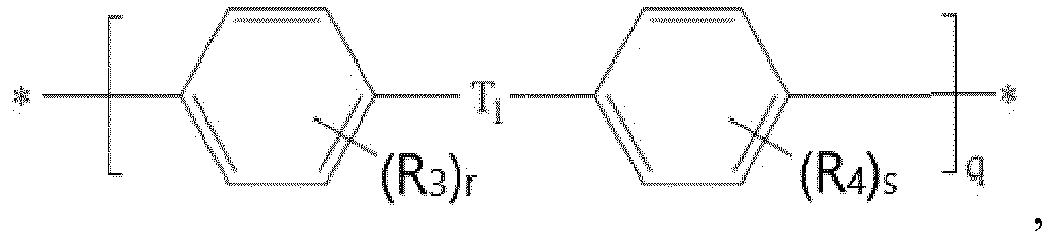


- The reversible crosslinking reactant composition as claimed in claim 1, wherein E is


- The reversible crosslinking reactant composition as claimed in claim 1, further comprising a furan-group-containing compound having a structure represented by Formula (III):

- The reversible crosslinking reactant composition as claimed in claim 6, wherein Ar2 is substituted or unsubstituted phenylene group, biphenylene group, naphthylene group, thienylene group, indolylene group, phenanthrenylene, indenylene group, anthracenylene group, or fluorenylene group.
- The reversible crosslinking reactant composition as claimed in claim 6, wherein Ar2 is phenylene group, biphenylene group, naphthylene group, thienylene group, indolylene group, phenanthrenylene, indenylene group, anthracenylene group, or fluorenylene group with substitution groups of one to four C1-C6 alkyl groups.
- The reversible crosslinking reactant composition as claimed in claim 6, wherein B is


- The reversible crosslinking reactant composition as claimed in claim 6, wherein B is

- The reversible crosslinking reactant composition as claimed in claim 6, wherein the at least one furan-group-containing oligomer having a structure represented by Formula (I) and the furan-group-containing compound having a structure represented by Formula (III) have a weight ratio of 20:80 to 80:20.
- The reversible crosslinking reactant composition as claimed in claim 6, wherein the equivalent ratio of the total number of furan groups of the at least one furan-group-containing oligomer having a structure represented by Formula (I) and the furan-group-containing compound having a structure represented by Formula (III) to the maleimide group of the bismaleimide compound having a structure represented by Formula (II) is from 0.7:1 to 1:0.5.
- The reversible crosslinking reactant composition as claimed in claim 1, wherein the furan-group-containing oligomer having a structure represented by Formula (I) is an oligomer having a structure represented by Formula (IV)

- The reversible crosslinking reactant composition as claimed in claim 1, wherein the furan-group-containing oligomer having a structure represented by Formula (I) is an oligomer having a structure represented by Formula (V)

- The reversible crosslinking reactant composition as claimed in claim 1, wherein the furan-group-containing oligomer having a structure represented by Formula (I) is an oligomer having a first repeating unit and a second repeating unit, wherein the first repeating unit has a structure represented by Formula (VI), the second repeating unit has a structure represented by Formula (VII), and the first repeating unit and the second repeating unit are arranged randomly or in blocks,

Applications Claiming Priority (1)
| Application Number | Priority Date | Filing Date | Title |
|---|---|---|---|
| US201762580483P | 2017-11-02 | 2017-11-02 |
Publications (1)
| Publication Number | Publication Date |
|---|---|
| EP3480254A1 true EP3480254A1 (en) | 2019-05-08 |
Family
ID=64899157
Family Applications (1)
| Application Number | Title | Priority Date | Filing Date |
|---|---|---|---|
| EP18204154.1A Withdrawn EP3480254A1 (en) | 2017-11-02 | 2018-11-02 | Reversible crosslinking reactant composition |
Country Status (5)
| Country | Link |
|---|---|
| US (2) | US10858471B2 (en) |
| EP (1) | EP3480254A1 (en) |
| JP (3) | JP6869936B2 (en) |
| CN (2) | CN109749328B (en) |
| TW (2) | TWI701244B (en) |
Families Citing this family (7)
| Publication number | Priority date | Publication date | Assignee | Title |
|---|---|---|---|---|
| US10858471B2 (en) | 2017-11-02 | 2020-12-08 | Industrial Technology Research Institute | Reversible crosslinking reactant composition |
| US11247978B2 (en) | 2017-11-02 | 2022-02-15 | Industrial Technology Research Institute | Reversible crosslinking reactant composition |
| CN110317428A (en) * | 2019-07-16 | 2019-10-11 | 中北大学 | A kind of heat-and corrosion-resistant strong mechanical performance co-curing bismaleimide/furane resins |
| CN113388108B (en) * | 2021-06-30 | 2022-05-31 | 宁波长阳科技股份有限公司 | Polyimide resin with self-repairing function, polyimide film, preparation method of polyimide film and flexible foldable display screen cover plate base film |
| TWI880520B (en) * | 2023-12-14 | 2025-04-11 | 聯茂電子股份有限公司 | Resin composition |
| TWI880521B (en) * | 2023-12-14 | 2025-04-11 | 聯茂電子股份有限公司 | Prepreg, laminates, and printed circuit board using the same |
| CN120682547B (en) * | 2025-08-22 | 2025-12-26 | 杭州中策橡胶循环科技有限公司 | High-dispersion composite resorcinol master batch and preparation method thereof |
Citations (2)
| Publication number | Priority date | Publication date | Assignee | Title |
|---|---|---|---|---|
| US3435003A (en) * | 1966-06-01 | 1969-03-25 | Du Pont | Cross-linked thermally reversible polymers produced from condensation polymers with pendant furan groups cross-linked with maleimides |
| EP0357110A1 (en) * | 1988-08-05 | 1990-03-07 | Akzo N.V. | Two component coating curable at ambient temperature via a Diels-Alder reaction |
Family Cites Families (17)
| Publication number | Priority date | Publication date | Assignee | Title |
|---|---|---|---|---|
| US5844020A (en) * | 1997-03-31 | 1998-12-01 | Xerox Corporation | Phase change ink compositions |
| AU2002326949A1 (en) * | 2001-09-18 | 2003-05-12 | The Board Of Regents Of The University Of Nebraska | Method for the inhibition of methanogenesis |
| US6933361B2 (en) * | 2002-07-12 | 2005-08-23 | The Regents Of The University Of California | Thermally re-mendable cross-linked polymers |
| JP2006335861A (en) | 2005-06-01 | 2006-12-14 | Nippon Zeon Co Ltd | Adhesive, adhesive film, semiconductor component package, and method of manufacturing semiconductor component package |
| GB2453112B (en) * | 2007-09-25 | 2010-12-22 | Schlumberger Holdings | Reversible polymeric gelation for oilfield applications |
| AU2010260018B2 (en) * | 2009-06-11 | 2015-04-09 | Henkel Corporation | Thermally reversible hot melt adhesive composition containing multifunctional diene and dienophile compounds |
| US9884944B2 (en) | 2010-05-19 | 2018-02-06 | Drexel University | Remendable interfaces for polymer composites |
| US9012127B2 (en) | 2010-11-29 | 2015-04-21 | The Regents Of The University Of Colorado, A Body Corporate | Thermoreversible network scaffolds and methods of preparing same |
| US9631049B2 (en) | 2010-11-30 | 2017-04-25 | Connora Technologies, Inc. | Agents for reworkable epoxy resins |
| US8511369B2 (en) | 2011-04-18 | 2013-08-20 | International Business Machines Corporation | Thermally reversible crosslinked polymer modified particles and methods for making the same |
| DE102011087226A1 (en) * | 2011-11-28 | 2013-05-29 | Evonik Degussa Gmbh | Pseudo-thermoplastic, self-crosslinking composites |
| WO2014025986A2 (en) | 2012-08-10 | 2014-02-13 | The University Of Akron | Novel polyisobutylene-based thermoplastic elastomers |
| US9085719B2 (en) | 2013-03-18 | 2015-07-21 | International Business Machines Corporation | Thermally reversible thermal interface materials with improved moisture resistance |
| CN103408684B (en) * | 2013-07-12 | 2015-12-02 | 中山大学 | A kind of thermal reversion crosslinking polymer thin film and preparation method thereof |
| CN104045810B (en) | 2014-06-18 | 2016-08-31 | 中国科学院化学研究所 | A kind of two amine additives cross-linking agent, its preparation method and prepare thermal reversion cross-linked epoxy resin and composite thereof |
| CN107075072A (en) * | 2014-07-31 | 2017-08-18 | 路博润先进材料公司 | Thermal reversion cross-linked polyurethane |
| US10858471B2 (en) * | 2017-11-02 | 2020-12-08 | Industrial Technology Research Institute | Reversible crosslinking reactant composition |
-
2018
- 2018-11-02 US US16/179,170 patent/US10858471B2/en active Active
- 2018-11-02 CN CN201811301767.2A patent/CN109749328B/en active Active
- 2018-11-02 JP JP2018207712A patent/JP6869936B2/en active Active
- 2018-11-02 CN CN201811299735.3A patent/CN109748998B/en active Active
- 2018-11-02 TW TW107138936A patent/TWI701244B/en active
- 2018-11-02 EP EP18204154.1A patent/EP3480254A1/en not_active Withdrawn
- 2018-11-02 TW TW107138967A patent/TWI709602B/en active
- 2018-11-02 US US16/179,296 patent/US10894853B2/en active Active
- 2018-11-02 JP JP2018207798A patent/JP2019085409A/en active Pending
-
2020
- 2020-02-26 JP JP2020030500A patent/JP6978107B2/en active Active
Patent Citations (2)
| Publication number | Priority date | Publication date | Assignee | Title |
|---|---|---|---|---|
| US3435003A (en) * | 1966-06-01 | 1969-03-25 | Du Pont | Cross-linked thermally reversible polymers produced from condensation polymers with pendant furan groups cross-linked with maleimides |
| EP0357110A1 (en) * | 1988-08-05 | 1990-03-07 | Akzo N.V. | Two component coating curable at ambient temperature via a Diels-Alder reaction |
Non-Patent Citations (1)
| Title |
|---|
| MITSUHIRO SHIBATA ET AL: "High-performance hybrid materials prepared by the thermo-reversible Diels-Alder polymerization of furfuryl ester-terminated butylene succinate oligomers and maleimide compounds", POLYMER JOURNAL, vol. 43, no. 5, 2 March 2011 (2011-03-02), JP, pages 455 - 463, XP055574239, ISSN: 0032-3896, DOI: 10.1038/pj.2011.14 * |
Also Published As
| Publication number | Publication date |
|---|---|
| JP6869936B2 (en) | 2021-05-12 |
| JP2020079310A (en) | 2020-05-28 |
| CN109748998A (en) | 2019-05-14 |
| JP2019108524A (en) | 2019-07-04 |
| JP6978107B2 (en) | 2021-12-08 |
| TW201918517A (en) | 2019-05-16 |
| TWI701244B (en) | 2020-08-11 |
| TWI709602B (en) | 2020-11-11 |
| US20190153139A1 (en) | 2019-05-23 |
| CN109749328B (en) | 2021-04-06 |
| CN109749328A (en) | 2019-05-14 |
| JP2019085409A (en) | 2019-06-06 |
| TW201918481A (en) | 2019-05-16 |
| CN109748998B (en) | 2021-08-31 |
| US10894853B2 (en) | 2021-01-19 |
| US10858471B2 (en) | 2020-12-08 |
| US20190144410A1 (en) | 2019-05-16 |
Similar Documents
| Publication | Publication Date | Title |
|---|---|---|
| US10894853B2 (en) | Furan-modified compound and oligomer | |
| KR101576108B1 (en) | Resin composition, prepreg and uses thereof | |
| EP2133384B1 (en) | Bismaleamic acid, bismaleimide and cured product thereof | |
| KR20210056996A (en) | Maleimide resin, curable resin composition and cured product thereof | |
| EP0729995A1 (en) | Polyimide and high-temperature adhesive of polyimide | |
| US20090018303A1 (en) | Process for Producing Low-Molecular Polyphenylene Ether | |
| WO2022004583A1 (en) | Isocyanate-modified polyimide resin, resin composition and cured product of same | |
| CN103547602A (en) | Halogen free thermoset resin system for low dielectric loss at high frequency applications | |
| US11247978B2 (en) | Reversible crosslinking reactant composition | |
| KR102816815B1 (en) | Substituted polyphenylene sulfide resin | |
| CA1280540C (en) | Thermoset polymers of styrene terminated tetrakis phenols | |
| KR102420710B1 (en) | Low dielectric resin composite | |
| JP3525745B2 (en) | Epoxy resin composition and insulating substrate using this epoxy resin composition | |
| JP7527577B2 (en) | Substituted polyphenylene sulfide resin | |
| KR102613586B1 (en) | Low Tan-delta resin composite | |
| EP4678682A1 (en) | Phenylene sulfide-phenylene oxide copolymer | |
| Furutani et al. | Novel soluble ethynyl-terminated ester-imide prepolymers: their syntheses and characteristics | |
| EP0406959A2 (en) | Maleimide composition | |
| JPH06298864A (en) | Novel curable aspartimide resin composition | |
| JPH06306165A (en) | Low-permittivity thermosetting resin composition | |
| JPH05320314A (en) | Thermosetting resin composition of low dielectric constant | |
| HK1192895A (en) | Halogen free thermoset resin system for low dielectric loss at high frequency applications |
Legal Events
| Date | Code | Title | Description |
|---|---|---|---|
| PUAI | Public reference made under article 153(3) epc to a published international application that has entered the european phase |
Free format text: ORIGINAL CODE: 0009012 |
|
| STAA | Information on the status of an ep patent application or granted ep patent |
Free format text: STATUS: THE APPLICATION HAS BEEN PUBLISHED |
|
| AK | Designated contracting states |
Kind code of ref document: A1 Designated state(s): AL AT BE BG CH CY CZ DE DK EE ES FI FR GB GR HR HU IE IS IT LI LT LU LV MC MK MT NL NO PL PT RO RS SE SI SK SM TR |
|
| AX | Request for extension of the european patent |
Extension state: BA ME |
|
| STAA | Information on the status of an ep patent application or granted ep patent |
Free format text: STATUS: REQUEST FOR EXAMINATION WAS MADE |
|
| 17P | Request for examination filed |
Effective date: 20191007 |
|
| RBV | Designated contracting states (corrected) |
Designated state(s): AL AT BE BG CH CY CZ DE DK EE ES FI FR GB GR HR HU IE IS IT LI LT LU LV MC MK MT NL NO PL PT RO RS SE SI SK SM TR |
|
| STAA | Information on the status of an ep patent application or granted ep patent |
Free format text: STATUS: EXAMINATION IS IN PROGRESS |
|
| 17Q | First examination report despatched |
Effective date: 20220922 |
|
| STAA | Information on the status of an ep patent application or granted ep patent |
Free format text: STATUS: THE APPLICATION IS DEEMED TO BE WITHDRAWN |
|
| 18D | Application deemed to be withdrawn |
Effective date: 20250819 |