EP3480193B1 - Pyrazole derivatives as alk5 inhibitors and uses thereof - Google Patents
Pyrazole derivatives as alk5 inhibitors and uses thereof Download PDFInfo
- Publication number
- EP3480193B1 EP3480193B1 EP17820566.2A EP17820566A EP3480193B1 EP 3480193 B1 EP3480193 B1 EP 3480193B1 EP 17820566 A EP17820566 A EP 17820566A EP 3480193 B1 EP3480193 B1 EP 3480193B1
- Authority
- EP
- European Patent Office
- Prior art keywords
- pyrazole
- methylpyridin
- carboxyamide
- benzo
- thiazol
- Prior art date
- Legal status (The legal status is an assumption and is not a legal conclusion. Google has not performed a legal analysis and makes no representation as to the accuracy of the status listed.)
- Active
Links
Classifications
-
- C—CHEMISTRY; METALLURGY
- C07—ORGANIC CHEMISTRY
- C07D—HETEROCYCLIC COMPOUNDS
- C07D471/00—Heterocyclic compounds containing nitrogen atoms as the only ring hetero atoms in the condensed system, at least one ring being a six-membered ring with one nitrogen atom, not provided for by groups C07D451/00 - C07D463/00
- C07D471/02—Heterocyclic compounds containing nitrogen atoms as the only ring hetero atoms in the condensed system, at least one ring being a six-membered ring with one nitrogen atom, not provided for by groups C07D451/00 - C07D463/00 in which the condensed system contains two hetero rings
- C07D471/04—Ortho-condensed systems
-
- C—CHEMISTRY; METALLURGY
- C07—ORGANIC CHEMISTRY
- C07D—HETEROCYCLIC COMPOUNDS
- C07D401/00—Heterocyclic compounds containing two or more hetero rings, having nitrogen atoms as the only ring hetero atoms, at least one ring being a six-membered ring with only one nitrogen atom
- C07D401/14—Heterocyclic compounds containing two or more hetero rings, having nitrogen atoms as the only ring hetero atoms, at least one ring being a six-membered ring with only one nitrogen atom containing three or more hetero rings
-
- A—HUMAN NECESSITIES
- A61—MEDICAL OR VETERINARY SCIENCE; HYGIENE
- A61K—PREPARATIONS FOR MEDICAL, DENTAL OR TOILETRY PURPOSES
- A61K31/00—Medicinal preparations containing organic active ingredients
- A61K31/33—Heterocyclic compounds
- A61K31/395—Heterocyclic compounds having nitrogen as a ring hetero atom, e.g. guanethidine or rifamycins
- A61K31/41—Heterocyclic compounds having nitrogen as a ring hetero atom, e.g. guanethidine or rifamycins having five-membered rings with two or more ring hetero atoms, at least one of which being nitrogen, e.g. tetrazole
- A61K31/415—1,2-Diazoles
- A61K31/4155—1,2-Diazoles non condensed and containing further heterocyclic rings
-
- A—HUMAN NECESSITIES
- A61—MEDICAL OR VETERINARY SCIENCE; HYGIENE
- A61K—PREPARATIONS FOR MEDICAL, DENTAL OR TOILETRY PURPOSES
- A61K31/00—Medicinal preparations containing organic active ingredients
- A61K31/33—Heterocyclic compounds
- A61K31/395—Heterocyclic compounds having nitrogen as a ring hetero atom, e.g. guanethidine or rifamycins
- A61K31/41—Heterocyclic compounds having nitrogen as a ring hetero atom, e.g. guanethidine or rifamycins having five-membered rings with two or more ring hetero atoms, at least one of which being nitrogen, e.g. tetrazole
- A61K31/425—Thiazoles
- A61K31/428—Thiazoles condensed with carbocyclic rings
-
- A—HUMAN NECESSITIES
- A61—MEDICAL OR VETERINARY SCIENCE; HYGIENE
- A61K—PREPARATIONS FOR MEDICAL, DENTAL OR TOILETRY PURPOSES
- A61K31/00—Medicinal preparations containing organic active ingredients
- A61K31/33—Heterocyclic compounds
- A61K31/395—Heterocyclic compounds having nitrogen as a ring hetero atom, e.g. guanethidine or rifamycins
- A61K31/435—Heterocyclic compounds having nitrogen as a ring hetero atom, e.g. guanethidine or rifamycins having six-membered rings with one nitrogen as the only ring hetero atom
- A61K31/47—Quinolines; Isoquinolines
- A61K31/472—Non-condensed isoquinolines, e.g. papaverine
- A61K31/4725—Non-condensed isoquinolines, e.g. papaverine containing further heterocyclic rings
-
- A—HUMAN NECESSITIES
- A61—MEDICAL OR VETERINARY SCIENCE; HYGIENE
- A61P—SPECIFIC THERAPEUTIC ACTIVITY OF CHEMICAL COMPOUNDS OR MEDICINAL PREPARATIONS
- A61P1/00—Drugs for disorders of the alimentary tract or the digestive system
- A61P1/16—Drugs for disorders of the alimentary tract or the digestive system for liver or gallbladder disorders, e.g. hepatoprotective agents, cholagogues, litholytics
-
- A—HUMAN NECESSITIES
- A61—MEDICAL OR VETERINARY SCIENCE; HYGIENE
- A61P—SPECIFIC THERAPEUTIC ACTIVITY OF CHEMICAL COMPOUNDS OR MEDICINAL PREPARATIONS
- A61P11/00—Drugs for disorders of the respiratory system
-
- A—HUMAN NECESSITIES
- A61—MEDICAL OR VETERINARY SCIENCE; HYGIENE
- A61P—SPECIFIC THERAPEUTIC ACTIVITY OF CHEMICAL COMPOUNDS OR MEDICINAL PREPARATIONS
- A61P11/00—Drugs for disorders of the respiratory system
- A61P11/06—Antiasthmatics
-
- A—HUMAN NECESSITIES
- A61—MEDICAL OR VETERINARY SCIENCE; HYGIENE
- A61P—SPECIFIC THERAPEUTIC ACTIVITY OF CHEMICAL COMPOUNDS OR MEDICINAL PREPARATIONS
- A61P13/00—Drugs for disorders of the urinary system
- A61P13/12—Drugs for disorders of the urinary system of the kidneys
-
- A—HUMAN NECESSITIES
- A61—MEDICAL OR VETERINARY SCIENCE; HYGIENE
- A61P—SPECIFIC THERAPEUTIC ACTIVITY OF CHEMICAL COMPOUNDS OR MEDICINAL PREPARATIONS
- A61P15/00—Drugs for genital or sexual disorders; Contraceptives
- A61P15/10—Drugs for genital or sexual disorders; Contraceptives for impotence
-
- A—HUMAN NECESSITIES
- A61—MEDICAL OR VETERINARY SCIENCE; HYGIENE
- A61P—SPECIFIC THERAPEUTIC ACTIVITY OF CHEMICAL COMPOUNDS OR MEDICINAL PREPARATIONS
- A61P17/00—Drugs for dermatological disorders
-
- A—HUMAN NECESSITIES
- A61—MEDICAL OR VETERINARY SCIENCE; HYGIENE
- A61P—SPECIFIC THERAPEUTIC ACTIVITY OF CHEMICAL COMPOUNDS OR MEDICINAL PREPARATIONS
- A61P19/00—Drugs for skeletal disorders
- A61P19/02—Drugs for skeletal disorders for joint disorders, e.g. arthritis, arthrosis
-
- A—HUMAN NECESSITIES
- A61—MEDICAL OR VETERINARY SCIENCE; HYGIENE
- A61P—SPECIFIC THERAPEUTIC ACTIVITY OF CHEMICAL COMPOUNDS OR MEDICINAL PREPARATIONS
- A61P19/00—Drugs for skeletal disorders
- A61P19/08—Drugs for skeletal disorders for bone diseases, e.g. rachitism, Paget's disease
- A61P19/10—Drugs for skeletal disorders for bone diseases, e.g. rachitism, Paget's disease for osteoporosis
-
- A—HUMAN NECESSITIES
- A61—MEDICAL OR VETERINARY SCIENCE; HYGIENE
- A61P—SPECIFIC THERAPEUTIC ACTIVITY OF CHEMICAL COMPOUNDS OR MEDICINAL PREPARATIONS
- A61P25/00—Drugs for disorders of the nervous system
-
- A—HUMAN NECESSITIES
- A61—MEDICAL OR VETERINARY SCIENCE; HYGIENE
- A61P—SPECIFIC THERAPEUTIC ACTIVITY OF CHEMICAL COMPOUNDS OR MEDICINAL PREPARATIONS
- A61P25/00—Drugs for disorders of the nervous system
- A61P25/28—Drugs for disorders of the nervous system for treating neurodegenerative disorders of the central nervous system, e.g. nootropic agents, cognition enhancers, drugs for treating Alzheimer's disease or other forms of dementia
-
- A—HUMAN NECESSITIES
- A61—MEDICAL OR VETERINARY SCIENCE; HYGIENE
- A61P—SPECIFIC THERAPEUTIC ACTIVITY OF CHEMICAL COMPOUNDS OR MEDICINAL PREPARATIONS
- A61P27/00—Drugs for disorders of the senses
- A61P27/02—Ophthalmic agents
-
- A—HUMAN NECESSITIES
- A61—MEDICAL OR VETERINARY SCIENCE; HYGIENE
- A61P—SPECIFIC THERAPEUTIC ACTIVITY OF CHEMICAL COMPOUNDS OR MEDICINAL PREPARATIONS
- A61P3/00—Drugs for disorders of the metabolism
- A61P3/08—Drugs for disorders of the metabolism for glucose homeostasis
- A61P3/10—Drugs for disorders of the metabolism for glucose homeostasis for hyperglycaemia, e.g. antidiabetics
-
- A—HUMAN NECESSITIES
- A61—MEDICAL OR VETERINARY SCIENCE; HYGIENE
- A61P—SPECIFIC THERAPEUTIC ACTIVITY OF CHEMICAL COMPOUNDS OR MEDICINAL PREPARATIONS
- A61P35/00—Antineoplastic agents
-
- A—HUMAN NECESSITIES
- A61—MEDICAL OR VETERINARY SCIENCE; HYGIENE
- A61P—SPECIFIC THERAPEUTIC ACTIVITY OF CHEMICAL COMPOUNDS OR MEDICINAL PREPARATIONS
- A61P35/00—Antineoplastic agents
- A61P35/04—Antineoplastic agents specific for metastasis
-
- A—HUMAN NECESSITIES
- A61—MEDICAL OR VETERINARY SCIENCE; HYGIENE
- A61P—SPECIFIC THERAPEUTIC ACTIVITY OF CHEMICAL COMPOUNDS OR MEDICINAL PREPARATIONS
- A61P43/00—Drugs for specific purposes, not provided for in groups A61P1/00-A61P41/00
-
- A—HUMAN NECESSITIES
- A61—MEDICAL OR VETERINARY SCIENCE; HYGIENE
- A61P—SPECIFIC THERAPEUTIC ACTIVITY OF CHEMICAL COMPOUNDS OR MEDICINAL PREPARATIONS
- A61P7/00—Drugs for disorders of the blood or the extracellular fluid
- A61P7/02—Antithrombotic agents; Anticoagulants; Platelet aggregation inhibitors
-
- A—HUMAN NECESSITIES
- A61—MEDICAL OR VETERINARY SCIENCE; HYGIENE
- A61P—SPECIFIC THERAPEUTIC ACTIVITY OF CHEMICAL COMPOUNDS OR MEDICINAL PREPARATIONS
- A61P9/00—Drugs for disorders of the cardiovascular system
-
- A—HUMAN NECESSITIES
- A61—MEDICAL OR VETERINARY SCIENCE; HYGIENE
- A61P—SPECIFIC THERAPEUTIC ACTIVITY OF CHEMICAL COMPOUNDS OR MEDICINAL PREPARATIONS
- A61P9/00—Drugs for disorders of the cardiovascular system
- A61P9/10—Drugs for disorders of the cardiovascular system for treating ischaemic or atherosclerotic diseases, e.g. antianginal drugs, coronary vasodilators, drugs for myocardial infarction, retinopathy, cerebrovascula insufficiency, renal arteriosclerosis
-
- A—HUMAN NECESSITIES
- A61—MEDICAL OR VETERINARY SCIENCE; HYGIENE
- A61P—SPECIFIC THERAPEUTIC ACTIVITY OF CHEMICAL COMPOUNDS OR MEDICINAL PREPARATIONS
- A61P9/00—Drugs for disorders of the cardiovascular system
- A61P9/12—Antihypertensives
-
- C—CHEMISTRY; METALLURGY
- C07—ORGANIC CHEMISTRY
- C07D—HETEROCYCLIC COMPOUNDS
- C07D233/00—Heterocyclic compounds containing 1,3-diazole or hydrogenated 1,3-diazole rings, not condensed with other rings
- C07D233/54—Heterocyclic compounds containing 1,3-diazole or hydrogenated 1,3-diazole rings, not condensed with other rings having two double bonds between ring members or between ring members and non-ring members
- C07D233/56—Heterocyclic compounds containing 1,3-diazole or hydrogenated 1,3-diazole rings, not condensed with other rings having two double bonds between ring members or between ring members and non-ring members with only hydrogen atoms or radicals containing only hydrogen and carbon atoms, attached to ring carbon atoms
- C07D233/58—Heterocyclic compounds containing 1,3-diazole or hydrogenated 1,3-diazole rings, not condensed with other rings having two double bonds between ring members or between ring members and non-ring members with only hydrogen atoms or radicals containing only hydrogen and carbon atoms, attached to ring carbon atoms with only hydrogen atoms or radicals containing only hydrogen and carbon atoms, attached to ring nitrogen atoms
-
- C—CHEMISTRY; METALLURGY
- C07—ORGANIC CHEMISTRY
- C07D—HETEROCYCLIC COMPOUNDS
- C07D401/00—Heterocyclic compounds containing two or more hetero rings, having nitrogen atoms as the only ring hetero atoms, at least one ring being a six-membered ring with only one nitrogen atom
- C07D401/02—Heterocyclic compounds containing two or more hetero rings, having nitrogen atoms as the only ring hetero atoms, at least one ring being a six-membered ring with only one nitrogen atom containing two hetero rings
- C07D401/04—Heterocyclic compounds containing two or more hetero rings, having nitrogen atoms as the only ring hetero atoms, at least one ring being a six-membered ring with only one nitrogen atom containing two hetero rings directly linked by a ring-member-to-ring-member bond
-
- C—CHEMISTRY; METALLURGY
- C07—ORGANIC CHEMISTRY
- C07D—HETEROCYCLIC COMPOUNDS
- C07D403/00—Heterocyclic compounds containing two or more hetero rings, having nitrogen atoms as the only ring hetero atoms, not provided for by group C07D401/00
- C07D403/02—Heterocyclic compounds containing two or more hetero rings, having nitrogen atoms as the only ring hetero atoms, not provided for by group C07D401/00 containing two hetero rings
- C07D403/04—Heterocyclic compounds containing two or more hetero rings, having nitrogen atoms as the only ring hetero atoms, not provided for by group C07D401/00 containing two hetero rings directly linked by a ring-member-to-ring-member bond
-
- C—CHEMISTRY; METALLURGY
- C07—ORGANIC CHEMISTRY
- C07D—HETEROCYCLIC COMPOUNDS
- C07D403/00—Heterocyclic compounds containing two or more hetero rings, having nitrogen atoms as the only ring hetero atoms, not provided for by group C07D401/00
- C07D403/14—Heterocyclic compounds containing two or more hetero rings, having nitrogen atoms as the only ring hetero atoms, not provided for by group C07D401/00 containing three or more hetero rings
-
- C—CHEMISTRY; METALLURGY
- C07—ORGANIC CHEMISTRY
- C07D—HETEROCYCLIC COMPOUNDS
- C07D405/00—Heterocyclic compounds containing both one or more hetero rings having oxygen atoms as the only ring hetero atoms, and one or more rings having nitrogen as the only ring hetero atom
- C07D405/14—Heterocyclic compounds containing both one or more hetero rings having oxygen atoms as the only ring hetero atoms, and one or more rings having nitrogen as the only ring hetero atom containing three or more hetero rings
-
- C—CHEMISTRY; METALLURGY
- C07—ORGANIC CHEMISTRY
- C07D—HETEROCYCLIC COMPOUNDS
- C07D413/00—Heterocyclic compounds containing two or more hetero rings, at least one ring having nitrogen and oxygen atoms as the only ring hetero atoms
- C07D413/14—Heterocyclic compounds containing two or more hetero rings, at least one ring having nitrogen and oxygen atoms as the only ring hetero atoms containing three or more hetero rings
-
- C—CHEMISTRY; METALLURGY
- C07—ORGANIC CHEMISTRY
- C07D—HETEROCYCLIC COMPOUNDS
- C07D417/00—Heterocyclic compounds containing two or more hetero rings, at least one ring having nitrogen and sulfur atoms as the only ring hetero atoms, not provided for by group C07D415/00
- C07D417/14—Heterocyclic compounds containing two or more hetero rings, at least one ring having nitrogen and sulfur atoms as the only ring hetero atoms, not provided for by group C07D415/00 containing three or more hetero rings
-
- C—CHEMISTRY; METALLURGY
- C07—ORGANIC CHEMISTRY
- C07D—HETEROCYCLIC COMPOUNDS
- C07D495/00—Heterocyclic compounds containing in the condensed system at least one hetero ring having sulfur atoms as the only ring hetero atoms
- C07D495/02—Heterocyclic compounds containing in the condensed system at least one hetero ring having sulfur atoms as the only ring hetero atoms in which the condensed system contains two hetero rings
- C07D495/04—Ortho-condensed systems
-
- A—HUMAN NECESSITIES
- A61—MEDICAL OR VETERINARY SCIENCE; HYGIENE
- A61P—SPECIFIC THERAPEUTIC ACTIVITY OF CHEMICAL COMPOUNDS OR MEDICINAL PREPARATIONS
- A61P17/00—Drugs for dermatological disorders
- A61P17/02—Drugs for dermatological disorders for treating wounds, ulcers, burns, scars, keloids, or the like
-
- A—HUMAN NECESSITIES
- A61—MEDICAL OR VETERINARY SCIENCE; HYGIENE
- A61P—SPECIFIC THERAPEUTIC ACTIVITY OF CHEMICAL COMPOUNDS OR MEDICINAL PREPARATIONS
- A61P19/00—Drugs for skeletal disorders
- A61P19/04—Drugs for skeletal disorders for non-specific disorders of the connective tissue
-
- Y—GENERAL TAGGING OF NEW TECHNOLOGICAL DEVELOPMENTS; GENERAL TAGGING OF CROSS-SECTIONAL TECHNOLOGIES SPANNING OVER SEVERAL SECTIONS OF THE IPC; TECHNICAL SUBJECTS COVERED BY FORMER USPC CROSS-REFERENCE ART COLLECTIONS [XRACs] AND DIGESTS
- Y02—TECHNOLOGIES OR APPLICATIONS FOR MITIGATION OR ADAPTATION AGAINST CLIMATE CHANGE
- Y02A—TECHNOLOGIES FOR ADAPTATION TO CLIMATE CHANGE
- Y02A50/00—TECHNOLOGIES FOR ADAPTATION TO CLIMATE CHANGE in human health protection, e.g. against extreme weather
- Y02A50/30—Against vector-borne diseases, e.g. mosquito-borne, fly-borne, tick-borne or waterborne diseases whose impact is exacerbated by climate change
Definitions
- the present disclosure relates to a nevel pyrazole derivative compound and use thereof, and in particular, to a pyrazole derivative having an ALK5 activity inhibiting effect, or a pharmaceutically acceptable salt thereof, a pharmaceutical composition including such a compound as an active ingredient, and use thereof.
- TGF- ⁇ transforming growth factor- ⁇
- a transforming growth factor- ⁇ (TGF- ⁇ ) signal regulates a developmental stage and cell activity in various ways, and thereby regulates various cell responses such as cell proliferation, differentiation, cell migration and cell death.
- TGF- ⁇ has at least 3 isoforms called TGF- ⁇ 1, TGF- ⁇ 2 and TGF- ⁇ 3, and TGF- ⁇ 1 may be divided into two well-preserved single membrane serine/threonine kinase type I (ALK5) and formulation TGF- ⁇ receptor.
- ALK5 well-preserved single membrane serine/threonine kinase type I
- the formulation receptor induces activation of ALK5 by hyperphosphorylating serine/threonine residues of ALK5 and producing Smad protein bonding sites.
- ALK5 Activated ALK5 phosphorylates Smad2 and Smad3 to form a complex with Smad4, and migrates into the nucleus to regulate gene expression ( Pennison, M. Pasche, B., Curr Opin Oncol (2007) 19, 579-85 , Attisano, L., Wrana, JL. Science (2002) 296, 1646-47 ). Accordingly, abnormality in the TGF- ⁇ signaling function causes a number of human diseases (for example, deposition of extracellular matrix, inflammatory response, fibrotic dysfunction and advanced cancer).
- TGF- ⁇ responds to cancer formation in an early stage of cancer, and facilitates metastasis formation in cancer growing and late tumor stages.
- TGF- ⁇ facilitates proliferation, epithelial mesenchymal transition (EMT), penetration and metastasis, acts as a major regulator of autocrine and paracrine between a cancer and microenvironments around the cancer, and acts on changes in the microenvironment, neovascularization and immunosuppression, which is effective in inhibiting tumor proliferation and cancer metastasis.
- EMT epithelial mesenchymal transition
- An important role played by TGF- ⁇ in facilitating cancer growth also indicates a correlation between potent TGF- ⁇ expression and poor prognosis.
- fibrosis of organs and tissues is considered to be well-known as a relation between the TGF- ⁇ and diseases.
- EMT activity has been known to be a main mechanism causing fibrosis to date.
- An inhibitor of intercellular signaling pathways is a useful therapeutic for fibroplasia. It is known to be centrally related to fibrosis of organs such as kidney, liver, lung, heart, bone marrow and skin. From such a point, it has become clear that inhibiting TGF- ⁇ is useful for preventing and treating all diseases accompanying fibrosis including chronic renal disease.
- CN 101062916A discloses trisubstituted pyrazole compounds having an ALK5 inhibitor activity.
- a compound according to the present disclosure and a salt thereof have been found to have very important pharmacological properties while being highly tolerant. Particularly, these exhibit TGF- ⁇ receptor I kinase (ALK5)-inhibiting properties. Accordingly, for signaling pathway ingredients of the TGF- ⁇ family, development of inhibitors in treating or preventing diseases associated with an abnormal behavior of this signaling pathway has been required.
- the present disclosure is also directed to providing a pharmaceutical composition including the compound as an active ingredient.
- the present disclosure is also directed to providing a pharmaceutical composition capable of, by including the compound as an active ingredient, selectively and effectively inhibiting ALK5 and/or ALK4 and thereby preventing or treating various diseases mediated thereby, as specified hereinbelow.
- the present invention provides a compound or a pharmaceutically acceptable salt thereof as specified in claim 1.
- the present invention provides a pharmaceutical composition of the second aspect, which is for use in the treatment or prevention of metastasis of cancer cells.
- the present invention provides a pharmaceutical composition of the second aspect, which is for use in the treatment of carcinoma mediated by overexpression of TGF- ⁇ .
- the present invention provides a pharmaceutical composition of the second aspect, which is for use in preventing or treating a cancer or a tumor.
- the present invention provides a pharmaceutical composition of the second aspect, which is for use in preventing or treating a disease selected from the group consisting of kidney-, liver- or lung-fibrosis, glomerulonephritis, diabetic renal disease, erythematous nephritis, hypertension-induced renal disease, kidney interstitial fibrosis, kidney fibrosis derived from drug exposure complications, HIV-related renal disease, organ transplantation gangrene, liver fibrosis caused by all diseases, hepatic dysfunction caused by infection, alcohol-induced hepatitis, biliary disorder, pulmonary fibrosis, acute lung injury, adult respiratory pain syndrome, idiopathic pulmonary fibrosis, chronic obstructive pulmonary disease, pulmonary fibrosis caused by infection or toxic factors, cardiac fibrosis after myocardial infarction, congestive heart failure, dilated cardiomyopathy, myocarditis, vascular stenosis, restenosis, atherosclerosis,
- a disease
- a novel pyrazole derivative according to the present disclosure is capable of selectively or simultaneously inhibiting various diseases mediated by TGF- ⁇ , particularly ALK5 and/or ALK4. Accordingly, the novel derivative according to the present invention is useful in treating or preventing fibrotic diseases (for example, scleroderma, lupus nephritis, connective tissue disease, wound healing, surgical trauma, spinal trauma, CNS injury, acute lung injury, idiopathic pulmonary fibrosis, chronic obstructive pulmonary disease, adult respiratory distress syndrome, acute lung injury, drug-induced lung injury, glomerulonephritis, diabetic renal disorder, hypertension-induced renal disorder, liver or biliary fibrosis, liver cirrhosis, primary biliary sclerosis, fatty liver disease, primary sclerogenous cholangitis, recurrent stenosis, cardiac fibrosis, ocular damage, fibrosclerosis, fibrous cancer, fibromyoma, fibroma, fibro
- ⁇ halogen used in the present specification means, unless mentioned otherwise, any one of fluorine, chlorine, bromine, iodine, or all of these.
- alkyl' used in the present specification refers to, unless mentioned otherwise, a saturated linear or branched hydrocarbon radical expressed by C n H 2n+1 , and specifically, refers to a saturated linear or branched hydrocarbon radical each including carbon atoms between 1 to 6, 1 to 8, 1 to 10, or 1 to 20.
- these radicals include methyl, ethyl, propyl, isopropyl, n-butyl, tert-butyl, neopentyl, n-hexyl, heptyl and octyl radicals, but are not limited thereto.
- alkenyl' used in the present specification refers to, unless mentioned otherwise, a monovalent group derived from an unsaturated linear or branched hydrocarbon moiety having at least one carbon-carbon double bond, and specifically, refers to an unsaturated linear or branched monovalent group each including carbon atoms between 2 to 6, 2 to 8, 2 to 10, or 2 to 20. Examples thereof include ethenyl, propenyl, butenyl, 1-methyl-2-buten-1-yl, heptenyl and octenyl radicals, but are not limited thereto.
- 'cycloalkyl' used in the present specification refers to, unless mentioned otherwise, a monovalent group derived from a monocyclic or polycyclic saturated or partially unsaturated carbocyclic ring compound.
- examples of C3-C8-cycloalkyl include, but are not limited to, cyclopropyl, cyclobutyl, cyclopentyl, cyclohexyl, cyclopentyl and cyclooctyl
- examples of C3-C12-cycloalkyl include, but are not limited to, cyclopropyl, cyclobutyl, cyclopentyl, cyclohexyl, bicyclo [2.2.1]heptyl, and bicyclo[2.2.2]octyl.
- a monovalent group derived from a monocyclic or polycyclic carbocyclic ring compound having at least one carbon-carbon double bond obtained by removing a single hydrogen atom is also considered.
- Examples of such a group include, but are not limited to, cyclopropenyl, cyclobutenyl, cyclopentenyl, cyclohexenyl and cycloheptenyl, cyclooctenyl and the like.
- 'cycloalkenyl' used in the present specification refers to, unless mentioned otherwise, a partially unsaturated carbocyclic ring containing 3 to 6 carbon atoms and having a carbon-carbon double bond in the ring. Examples of such a group include, but are not limited to, cyclopentenyl, cyclohexenyl and the like.
- 'aryl' used in the present specification refers to, unless mentioned otherwise, a mono- or poly-cyclic carbocyclic ring system having fused or non-fused one or more aromatic rings, and although not limited thereto, includes phenyl, naphthyl, tetrahydronaphthyl, indenyl, idenyl and the like.
- heterocycloalkyl refers to, unless mentioned otherwise, a saturated or partially unsaturated 3-membered to 10-membered monocyclic or polycyclic substituent containing one or more, for example, 1 to 4 heteroatoms selected from among N, O and S.
- monocyclic heterocycloalkyl may include piperidinyl, morpholinyl, thiamorpholinyl, pyrrolidinyl, imidazolidinyl, tetrahydrofuranyl, piperazinyl and groups similar thereto, but are not limited thereto.
- heteroaryl used in the present specification means, unless mentioned otherwise, a 5-membered to 12-membered monocyclic, or bicyclic or higher aromatic group containing one or more, for example, 1 to 4 heteroatoms selected from among O, N and S.
- Examples of the monocyclic heteroaryl may include thiazolyl, oxazolyl, thiophenyl, furanyl, pyrrolyl, imidazolyl, isoxazolyl, pyrazolyl, triazolyl, thiadiazolyl, tetrazolyl, oxadiazolyl, pyridinyl, pyridazinyl, pyrimidinyl, pyrazinyl and groups similar thereto, but are not limited thereto.
- bicyclic heteroaryl may include indolyl, benzothiophenyl, benzofuranyl, benzimidazolyl, benzoxazolyl, benzisoxazolyl, benzothiazolyl, benzothiadiazolyl, benzotriazolyl, quinolinyl, isoquinolinyl, furinyl, furopyridinyl and groups similar thereto, but are not limited thereto.
- non-aromatic fused heteropolycyclic ring used in the present specification means a group having two or more rings fused to each other, including a heteroatom selected from among N, O and S as a ring-forming atom other than carbon, and having the whole molecule exhibiting non-aromacity (for example, having 5 to 10 nuclear atoms).
- examples of the non-aromatic fused heteropolycyclic ring may include benzo[d][1,3]dioxol and the like, but are not limited thereto.
- the compound of the first aspect of the present disclosure is a compound of Chemical Formula 1 selected from the group consisting of the following compounds:
- the compound of Chemical Formula 1 according to the present disclosure may be prepared using a method representatively illustrated in the following Reaction Formula 1:
- Reaction Formula 1 R 1 , R 2 , R 3 , A, l, m and n each have the same definitions as in Chemical Formula 1.
- an acetyl compound having R 2 , diethyl oxalate and ethoxysodium solution are refluxed in an organic solvent (for example, ethanol) to obtain Compound (4).
- Compound (4) is refluxed with a hydrazinyl material having an (Ri)i group and the like to obtain Compound (3), and this may be stirred under 1,4-dioxane and lithium hydroxide to obtain Intermediate Compound (2).
- Compound (2) may be reacted with an aniline derivative having an R 3 group together with HATU and DIPEA in N,N- dimethylformamide to obtain a target compound of Chemical Formula 1 of the present disclosure.
- the compound of Chemical Formula 1 may be prepared to a pharmaceutically acceptable salt form having an inorganic acid or an organic acid added thereto, and herein, examples of the preferred salts may include salts derived from hydrochloric acid, hydrobromic acid, sulfuric acid, phosphoric acid, nitric acid, acetic acid, glycolic acid, lactic acid, pyruvic acid, malonic acid, succinic acid, glutaric acid, fumaric acid, malic acid, mandelic acid, tartaric acid, citric acid, ascorbic acid, palmitic acid, maleic acid, hydroxymaleic acid, benzoic acid, hydroxybenzoic acid, phenylacetic acid, cinnamic acid, salicylic acid, methanesulfonic acid, benzenesulfonic acid, toluenesulfonic acid or the like.
- the pharmaceutically acceptable salt according to the present disclosure may be prepared by dissolving the compound of Chemical Formula 1 in an organic solvent such as acetone, methanol, ethanol or acetonitrile, adding an organic acid or an inorganic acid thereto, and filtering crystals precipitated therefrom.
- the pharmaceutically acceptable salt may be prepared by vacuuming a solvent or excess acid in an acid-added reaction mixture to dry the residue, or prepared by filtering a salt precipitated from adding other organic solvents.
- the compound of Chemical Formula 1 or a pharmaceutically acceptable salt thereof according to the present disclosure may have a form of a hydrate or solvate.
- the compound of Chemical Formula 1 or a pharmaceutically acceptable salt thereof according to the present disclosure may effectively inhibit protein kinase.
- the compound of the present disclosure may effectively prevent or treat diseases mediated by the ALK5 receptor or the ALK4 receptor, or both the ALK5 receptor and the ALK4 receptor.
- the disease may be selected from the group consisting of kidney-, liver- or lung-fibrosis, glomerulonephritis, diabetic renal disease, erythematous nephritis, hypertension-induced renal disease, kidney interstitial fibrosis, kidney fibrosis derived from drug exposure complications, HIV-related renal disease, organ transplantation gangrene, liver fibrosis caused by all diseases, hepatic dysfunction caused by infection, alcohol-induced hepatitis, biliary disorder, pulmonary fibrosis, acute lung injury, adult respiratory pain syndrome, idiopathic pulmonary fibrosis, chronic obstructive pulmonary disease, pulmonary fibrosis caused by infection or toxic factors, cardiac fibrosis after myocardial infarction, congestive heart failure, dilated cardiomyopathy, myocarditis, vascular stenosis, restenosis, atherosclerosis, visual impairment, corneal injury, proliferative vitreoretinopathy, excessive or exacerbated scar
- the compound of Chemical Formula 1 or a pharmaceutically acceptable salt thereof may prevent or treat fibrotic diseases or fibrotic conditions.
- the fibrotic disease or the fibrotic condition may be selected from the group consisting of liver fibrosis, kidney fibrosis, pulmonary fibrosis, irritable pneumonia, interstitial fibrosis, systematic sclerodermie, macular degeneration, pancreas fibrosis, splenic fibrosis, cardiac fibrosis, species septic fibrosis, bone marrow fibrosis, vascular fibrosis, skin fibrosis, eye fibrosis, joint fibrosis, muscle fibrosis, thyroid fibrosis, endocardial myocardial fibrosis, peritoneal fibrosis, after peritoneal fibrosis, progressive congenital trophoblastic fibrosis, allogeneic systematic fibrosis, fibrotic complications of surgery and infection fibrosis, but is not limited thereto.
- the compound of Chemical Formula 1 or a pharmaceutically acceptable salt thereof may effectively prevent or treat a carcinoma mediated by overexpression of TGF ⁇ .
- the carcinoma may be selected from the group consisting of carcinomas of lung, breast, liver, biliary, gastrointestinal tract, head and neck, pancreas, prostate and cervix, multiple myeloma, melanoma, glioma and glioblastoma, but is not limited thereto.
- a hydrazine hydrate (60 mL) was added to 2-bromo-6-methylpyridine (10.0 g, 58.1 mmol), and the result was heated under reflux for 4 hours. After terminating the reaction, the result was extracted with ethyl acetate, and the obtained organic layer was vacuum concentrated, and acidified with 4 N-hydrochloric acid/dioxane (30 mL). The produced solids were filtered, and the obtained solids were dried to obtain a target compound (9.3 g).
- a target compound (1.2 g) was obtained through the methods of Step 1 to Step 3 of Preparation Example 4 using benzo[ d ]oxazole-6-carboxylic acid instead of quinoline-4-carboxylic acid of Step 1.
- Step 4 Preparation of ethyl 5-(3-(1-(2-(( t -butyldimethylsilyl)oxy)ethyl)-1 H -pyrazol-4-yl)-4-fluorophenyl)-1-(6-methylpyridin-2-yl)-1 H -pyrazole-3-carboxylate
- Step 1 5-(Benzo[ d ]thiazol-6-yl)- N -(3)-(( tert butyldimethylsilyl)oxy)phenyl)-1-(6-methylpyridin-2-yl)-1 H -pyrazole-3-carboxyamide
- a target compound (140 mg) was obtained in the same manner as in Example 1 except that 3-(( tert -butyldimethylsilyl)oxy)aniline was used instead of p- anisidine.
- Step 1 Tert -bulyl(4-(5-(benzo[ d ]thiazol-6-yl))-1-(6-methylpyidin-2-yl)-1 H -pyrazole-3-carboxyamido)phenyl)(bulyl)-carbamate
- a target compound (110 mg) was obtained in the same manner as in Example 1 except that tert -butyl(4-aminophenyl)(butyl)carbamate was used instead of p- anisidine.
- Example Number Structure Compound Name 1 H NMR Spectrum (300 MHz, CDCl 3 ) ⁇ MS (ES) Actual Measurement Value [M+H] + / Required Value 88 5-(benzo[ d ]thiazol-6-yl)-N-(4-(cyclopropylamino)phenyl)-1-(6-methylpyridin-2-yl)-1H-pyrazole-3-carboxyamide 9.04(s, 1H), 8.67(s, 1H), 8.05(d, 1H), 7.98(d, 1H), 7.66(t, 1H), 7.53(d, 2H), 7.37(d, 1H), 7.36(t, 3H), 6.80(d, 2H), 2.46-2.43(m, 4H), 0.75-0.70(m, 2H), 0.54-0.51(m, 2H) 467.2/466.2
- Step 1 Ethyl-((4-(5-(benzo[ d ]thiazol-6-yl))-1-(6-methylpyridin-2-yl)-1 H- pyrazole-3-carboxyamido(phenyl((methyl)(oxo)- ⁇ 6 -sulfanylidine)carbamate
- a target compound (50 mg) was obtained in the same manner as in Example 1 except that ethyl ((4-aminophenyl)(methyl)(oxo)- ⁇ 6 -sulfanylidine)carbamate was used instead of p -anisidine.
- Step 2 5-(Benzo[ d ]
- a target compound (3 mg) was obtained in the same manner as in Example 160 except that phenylhydrazine was used instead of 2-hydrazinyl-6-methylpyridine hydrochloric acid in Step 3 of Preparation Example 3, and 2-fluoroaniline was used instead of p -anisidine of Example 160.
- a single tablet for oral administration containing each of the compounds prepared in Examples 1 to 227 as an active compound was prepared using ingredients of the following Table 9 in amounts corresponding thereto.
- Table 9 Ingredient Amount per Tablet Active Compound 100 mg Corn Starch 80 mg Lactose 80 mg Magnesium Stearate 5 mg
- a hard gelatin capsule for oral administration containing each of the compounds prepared in Examples 1 to 227 as an active compound was prepared using ingredients of the following Table 10 in amounts corresponding thereto.
- Table 10 Ingredient Amount per Capsule Active Compound 100 mg Corn Starch 80 mg Lactose 80 mg Crystalline Cellulose 80 mg Magnesium Stearate 5 mg
- a formulation for injection containing each of the compounds prepared in Examples 1 to 227 as an active compound was prepared using ingredients of the following Table 11 in amounts corresponding thereto. However, a pH was not adjusted when using a salt of the compound of Chemical Formula 1 as the active compound.
- Table 11 Ingredient Amount per Formulation for Injection Active Compound 20 mg 5% Glucose Solution 10 mL HCl (1 N) Suitable Amount to Make pH to 4
- a formulation for injection containing each of the compounds prepared in Examples 1 to 227 as an active compound was prepared using ingredients of the following Table 12 in amounts corresponding thereto.
- Table 12 Ingredient Amount per Formulation for Injection Active Compound 20 mg Polyethylene Glycol 400 2 mL Sterilized Water 8 mL
- ALK5 kinase, a kinase buffer, a kinase tracer 178, and a LanthaScreen Eu-GST binding antibody were all purchased from Thermo Fisher Scientific Solutions.
- Each of the compounds was made into a 10 mM DMSO solution, and diluted by 1/10 to a concentration of 1 ⁇ M to 0.0001 ⁇ M with an aqueous solution containing 4% DMSO.
- the test was performed in 384 well plates (well polystyrene low volume round-bottomed plates).
- a phosphorylate rate was calculated from 0% to 100% with respect to a control group according to the protocol included in the kit, and a 50% inhibitory concentration (IC 50 ) value was calculated by obtaining the x-axis concentration in the region where 50% activity was inhibited.
- the IC 50 results for each of the compounds are shown in the following Table 13.
Landscapes
- Chemical & Material Sciences (AREA)
- Health & Medical Sciences (AREA)
- Organic Chemistry (AREA)
- Medicinal Chemistry (AREA)
- General Health & Medical Sciences (AREA)
- Animal Behavior & Ethology (AREA)
- Life Sciences & Earth Sciences (AREA)
- Public Health (AREA)
- Pharmacology & Pharmacy (AREA)
- Veterinary Medicine (AREA)
- Engineering & Computer Science (AREA)
- General Chemical & Material Sciences (AREA)
- Nuclear Medicine, Radiotherapy & Molecular Imaging (AREA)
- Chemical Kinetics & Catalysis (AREA)
- Bioinformatics & Cheminformatics (AREA)
- Epidemiology (AREA)
- Physical Education & Sports Medicine (AREA)
- Diabetes (AREA)
- Heart & Thoracic Surgery (AREA)
- Pulmonology (AREA)
- Rheumatology (AREA)
- Cardiology (AREA)
- Orthopedic Medicine & Surgery (AREA)
- Neurosurgery (AREA)
- Neurology (AREA)
- Biomedical Technology (AREA)
- Hematology (AREA)
- Endocrinology (AREA)
- Urology & Nephrology (AREA)
- Oncology (AREA)
- Gynecology & Obstetrics (AREA)
- Obesity (AREA)
- Immunology (AREA)
- Psychiatry (AREA)
- Hospice & Palliative Care (AREA)
- Vascular Medicine (AREA)
- Ophthalmology & Optometry (AREA)
- Reproductive Health (AREA)
- Dermatology (AREA)
- Gastroenterology & Hepatology (AREA)
Description
- The present disclosure relates to a nevel pyrazole derivative compound and use thereof, and in particular, to a pyrazole derivative having an ALK5 activity inhibiting effect, or a pharmaceutically acceptable salt thereof, a pharmaceutical composition including such a compound as an active ingredient, and use thereof.
- A transforming growth factor-β (TGF-β) signal regulates a developmental stage and cell activity in various ways, and thereby regulates various cell responses such as cell proliferation, differentiation, cell migration and cell death. TGF-β has at least 3 isoforms called TGF-β1, TGF-β2 and TGF-β3, and TGF-β1 may be divided into two well-preserved single membrane serine/threonine kinase type I (ALK5) and formulation TGF-β receptor. When oligomerization is induced by a ligand, the formulation receptor induces activation of ALK5 by hyperphosphorylating serine/threonine residues of ALK5 and producing Smad protein bonding sites. Activated ALK5 phosphorylates Smad2 and Smad3 to form a complex with Smad4, and migrates into the nucleus to regulate gene expression (Pennison, M. Pasche, B., Curr Opin Oncol (2007) 19, 579-85, Attisano, L., Wrana, JL. Science (2002) 296, 1646-47). Accordingly, abnormality in the TGF-β signaling function causes a number of human diseases (for example, deposition of extracellular matrix, inflammatory response, fibrotic dysfunction and advanced cancer).
- Meanwhile, TGF-β responds to cancer formation in an early stage of cancer, and facilitates metastasis formation in cancer growing and late tumor stages. For cancer cells, TGF-β facilitates proliferation, epithelial mesenchymal transition (EMT), penetration and metastasis, acts as a major regulator of autocrine and paracrine between a cancer and microenvironments around the cancer, and acts on changes in the microenvironment, neovascularization and immunosuppression, which is effective in inhibiting tumor proliferation and cancer metastasis. An important role played by TGF-β in facilitating cancer growth also indicates a correlation between potent TGF-β expression and poor prognosis.
- In addition, fibrosis of organs and tissues is considered to be well-known as a relation between the TGF-β and diseases. EMT activity has been known to be a main mechanism causing fibrosis to date. An inhibitor of intercellular signaling pathways is a useful therapeutic for fibroplasia. It is known to be centrally related to fibrosis of organs such as kidney, liver, lung, heart, bone marrow and skin. From such a point, it has become clear that inhibiting TGF-β is useful for preventing and treating all diseases accompanying fibrosis including chronic renal disease.
-
CN 101062916A discloses trisubstituted pyrazole compounds having an ALK5 inhibitor activity. - A compound according to the present disclosure and a salt thereof have been found to have very important pharmacological properties while being highly tolerant. Particularly, these exhibit TGF-β receptor I kinase (ALK5)-inhibiting properties. Accordingly, for signaling pathway ingredients of the TGF-β family, development of inhibitors in treating or preventing diseases associated with an abnormal behavior of this signaling pathway has been required.
- The present disclosure is directed to providing a compound capable of selectively and effectively inhibiting ALK5 and/or ALK4, or a pharmaceutically acceptable salt thereof.
- The present disclosure is also directed to providing a pharmaceutical composition including the compound as an active ingredient.
- The present disclosure is also directed to providing a pharmaceutical composition capable of, by including the compound as an active ingredient, selectively and effectively inhibiting ALK5 and/or ALK4 and thereby preventing or treating various diseases mediated thereby, as specified hereinbelow.
- The present invention is defined by the appended claims.
- In a first aspect, the present invention provides a compound or a pharmaceutically acceptable salt thereof as specified in claim 1.
- In a second, the present invention provides a pharmaceutical composition comprising the compound of the first aspect or pharmaceutically acceptable salt thereof in a pharmaceutically effective amount.
- In a third aspect, the present invention provides a pharmaceutical composition of the second aspect, which is for use in the treatment or prevention of metastasis of cancer cells.
- In a fourth aspect, the present invention provides a pharmaceutical composition of the second aspect, which is for use in the treatment of carcinoma mediated by overexpression of TGF-β.
- In a fifth aspect, the present invention provides a pharmaceutical composition of the second aspect, which is for use in preventing or treating a fibrotic disease or a fibrotic condition.
- In a sixth aspect, the present invention provides a pharmaceutical composition of the second aspect, which is for use in preventing or treating a cancer or a tumor.
- In a seventh aspect, the present invention provides a pharmaceutical composition of the second aspect, which is for use in preventing or treating a disease selected from the group consisting of kidney-, liver- or lung-fibrosis, glomerulonephritis, diabetic renal disease, erythematous nephritis, hypertension-induced renal disease, kidney interstitial fibrosis, kidney fibrosis derived from drug exposure complications, HIV-related renal disease, organ transplantation gangrene, liver fibrosis caused by all diseases, hepatic dysfunction caused by infection, alcohol-induced hepatitis, biliary disorder, pulmonary fibrosis, acute lung injury, adult respiratory pain syndrome, idiopathic pulmonary fibrosis, chronic obstructive pulmonary disease, pulmonary fibrosis caused by infection or toxic factors, cardiac fibrosis after myocardial infarction, congestive heart failure, dilated cardiomyopathy, myocarditis, vascular stenosis, restenosis, atherosclerosis, visual impairment, corneal injury, proliferative vitreoretinopathy, excessive or exacerbated scar or keloid formation in the dermis occurring during wound healing from trauma or surgical wounds, peritoneum and subcutaneous adhesion, skin sclerosis, fibrosclerosis, progressive systemic sclerosis, dermatomyositis, multiple myositis, arthritis, osteoporosis, ulcer, impaired nerve function, male impotence, Alzheimer's disease, Raynaud's disease, fibrous cancer, metastasis growth of tumors, radiation-induced fibrosis and thrombosis.
- A novel pyrazole derivative according to the present disclosure is capable of selectively or simultaneously inhibiting various diseases mediated by TGF-β, particularly ALK5 and/or ALK4. Accordingly, the novel derivative according to the present invention is useful in treating or preventing fibrotic diseases (for example, scleroderma, lupus nephritis, connective tissue disease, wound healing, surgical trauma, spinal trauma, CNS injury, acute lung injury, idiopathic pulmonary fibrosis, chronic obstructive pulmonary disease, adult respiratory distress syndrome, acute lung injury, drug-induced lung injury, glomerulonephritis, diabetic renal disorder, hypertension-induced renal disorder, liver or biliary fibrosis, liver cirrhosis, primary biliary sclerosis, fatty liver disease, primary sclerogenous cholangitis, recurrent stenosis, cardiac fibrosis, ocular damage, fibrosclerosis, fibrous cancer, fibromyoma, fibroma, fibroadenoma, fibrosarcoma, grafted arterial disorder, and keloid); dehydration of nerve multiple sclerosis; Alzheimer's disease; great sinus vasculophathy; and tumor cells (for example, squamous cell carcinoma, multiple myeloma, melanoma, glioma, glioblastoma, leukemia, and carcinomas of lung, breast, ovary, cervix, liver, biliary duck, gastrointestinal tract, pancreas, prostate, and head and neck).
- Definitions listed below are definitions of various terms used for describing the present disclosure. These definitions are used throughout the specification individually or as a part of terms including these unless limited otherwise.
- The term `halogen' used in the present specification means, unless mentioned otherwise, any one of fluorine, chlorine, bromine, iodine, or all of these.
- The term 'alkyl' used in the present specification refers to, unless mentioned otherwise, a saturated linear or branched hydrocarbon radical expressed by CnH2n+1, and specifically, refers to a saturated linear or branched hydrocarbon radical each including carbon atoms between 1 to 6, 1 to 8, 1 to 10, or 1 to 20. Examples of these radicals include methyl, ethyl, propyl, isopropyl, n-butyl, tert-butyl, neopentyl, n-hexyl, heptyl and octyl radicals, but are not limited thereto.
- The term `alkenyl' used in the present specification refers to, unless mentioned otherwise, a monovalent group derived from an unsaturated linear or branched hydrocarbon moiety having at least one carbon-carbon double bond, and specifically, refers to an unsaturated linear or branched monovalent group each including carbon atoms between 2 to 6, 2 to 8, 2 to 10, or 2 to 20. Examples thereof include ethenyl, propenyl, butenyl, 1-methyl-2-buten-1-yl, heptenyl and octenyl radicals, but are not limited thereto.
- The term 'cycloalkyl' used in the present specification refers to, unless mentioned otherwise, a monovalent group derived from a monocyclic or polycyclic saturated or partially unsaturated carbocyclic ring compound. For example, examples of C3-C8-cycloalkyl include, but are not limited to, cyclopropyl, cyclobutyl, cyclopentyl, cyclohexyl, cyclopentyl and cyclooctyl; and examples of C3-C12-cycloalkyl include, but are not limited to, cyclopropyl, cyclobutyl, cyclopentyl, cyclohexyl, bicyclo [2.2.1]heptyl, and bicyclo[2.2.2]octyl. A monovalent group derived from a monocyclic or polycyclic carbocyclic ring compound having at least one carbon-carbon double bond obtained by removing a single hydrogen atom is also considered. Examples of such a group include, but are not limited to, cyclopropenyl, cyclobutenyl, cyclopentenyl, cyclohexenyl and cycloheptenyl, cyclooctenyl and the like.
- The term 'cycloalkenyl' used in the present specification refers to, unless mentioned otherwise, a partially unsaturated carbocyclic ring containing 3 to 6 carbon atoms and having a carbon-carbon double bond in the ring. Examples of such a group include, but are not limited to, cyclopentenyl, cyclohexenyl and the like.
- The term 'aryl' used in the present specification refers to, unless mentioned otherwise, a mono- or poly-cyclic carbocyclic ring system having fused or non-fused one or more aromatic rings, and although not limited thereto, includes phenyl, naphthyl, tetrahydronaphthyl, indenyl, idenyl and the like.
- The term `heterocycloalkyl' used in the present specification refers to, unless mentioned otherwise, a saturated or partially unsaturated 3-membered to 10-membered monocyclic or polycyclic substituent containing one or more, for example, 1 to 4 heteroatoms selected from among N, O and S. Examples of the monocyclic heterocycloalkyl may include piperidinyl, morpholinyl, thiamorpholinyl, pyrrolidinyl, imidazolidinyl, tetrahydrofuranyl, piperazinyl and groups similar thereto, but are not limited thereto.
- The term `heteroaryl' used in the present specification means, unless mentioned otherwise, a 5-membered to 12-membered monocyclic, or bicyclic or higher aromatic group containing one or more, for example, 1 to 4 heteroatoms selected from among O, N and S. Examples of the monocyclic heteroaryl may include thiazolyl, oxazolyl, thiophenyl, furanyl, pyrrolyl, imidazolyl, isoxazolyl, pyrazolyl, triazolyl, thiadiazolyl, tetrazolyl, oxadiazolyl, pyridinyl, pyridazinyl, pyrimidinyl, pyrazinyl and groups similar thereto, but are not limited thereto. Examples of the bicyclic heteroaryl may include indolyl, benzothiophenyl, benzofuranyl, benzimidazolyl, benzoxazolyl, benzisoxazolyl, benzothiazolyl, benzothiadiazolyl, benzotriazolyl, quinolinyl, isoquinolinyl, furinyl, furopyridinyl and groups similar thereto, but are not limited thereto.
- The term 'non-aromatic fused heteropolycyclic ring' used in the present specification means a group having two or more rings fused to each other, including a heteroatom selected from among N, O and S as a ring-forming atom other than carbon, and having the whole molecule exhibiting non-aromacity (for example, having 5 to 10 nuclear atoms). Examples of the non-aromatic fused heteropolycyclic ring may include benzo[d][1,3]dioxol and the like, but are not limited thereto.
- Hereinafter, the present disclosure will be described in more detail. Any references to methods of treatment in the subsequent paragraphs of this description are to be interpreted as references to the compounds and/or pharmaceutical compositions of the present invention for use in such methods, as specified in, e.g., the third to seventh aspects of the present invention.
- Described herein is a compound of the following Chemical Formula 1, or a pharmaceutically acceptable salt thereof:

- in Chemical Formula 1,
- X is N or CH;
- a ring A is C3-6 cycloalkylene, C6-10 arylene, C5-10 heteroarylene containing 1 to 4 heteroatoms selected from among N, O and S atoms, or a non-aromatic fused heteropolycyclic ring containing 1 to 4 heteroatoms selected from among N, O and S;
- Ris are each independently hydrogen, halogen, or linear or branched C1-6 alkyl, or halo C1-6 alkyl, and when there are a plurality of Ris, these are the same as or different from each other;
- R2S are each independently


- R3 is hydrogen, halogen, linear or branched C1-6 alkyl, linear or branched halo C1-6 alkyl, C3-10 cycloalkyl, C3-10 heterocycloalkyl unsubstituted or substituted with R4, C6-10 heterobicycloalkyl, linear or branched C2-6 alkenyl, C2-6 alkynyl, -(CH2)a-R4, -(CH2)a-OR4, -(CH2)a-O-(CH2)a-R4, -(CH2)a-S-(CH2)a-R4, -(CH2)a-O-(CH2)a-OR4, -(CH2)a-NR4R5, -(CH2)a-NO2, -(CH2)a-CN, -(CH2)a-COR4, -(CH2)a-CO2R4, -(CH2)a-CONR4R5, -(CH2)a-NHCOR4, -(CH2)a-SR4, -(CH2)a-NHSO2R4, -(CH2)aSOR6, -(CH2)a-SO2R6, -(CH2)a-SO2NHR6, -(CH2)a-SO(NH)R6 or -(CH2)a-SO2NR4R5, or when there are a plurality of R3s and they are adjacent to each other, they may be linked to each other to form a 5-membered or 6-membered ring with the ring A, one or more heteroatoms selected from among N, O and S atoms may be included in the ring, and the heteroatoms may be further oxidized;
- R4 and R5 are each independently hydrogen, linear or branched C1-6 alkyl, linear or branched halo C1-6 alkyl, C3-10 cycloalkyl, C3-6 cycloalkenyl, C1-6 carbonyl, C6-12 aryl, -(CH2)b-NR6R7, or saturated or partially unsaturated 5-membered to 10-membered monocyclic or bicyclic heterocycloalkyl or heteroaryl containing 1 to 4 heteroatoms selected from among N, O and S;
- R6 and R7 are each independently hydrogen, hydroxy, C1-6 alkyl, halo C1-6 alkyl or C3-6 cycloalkyl;
- a and b are an integer of 0 to 4; and
- l, m and n are each independently an integer of 0 to 4.
- The compound of the first aspect of the present disclosure is a compound of Chemical Formula 1 selected from the group consisting of the following compounds:
- (1) 5-(benzo[d]thiazol-6-yl)-N (4-methoxyphenyl)-1-(6-methylpyridin-2-yl)-1H-pyrazole-3-carboxyamide;
- (2) 5-(benzo[d]thiazol-6-yl)-N (4-ethoxyphenyl)-1-(6-methylpyridin-2-yl)-1H-pyrazole-3-carboxyamide;
- (3) 5-(benzo[d]thiazol-6-yl)-N-(4-(cyclopropylmethoxy)phenyl)-1-(6-methylpyridin-2-yl)-1H-pyrazole-3-carboxyamide;
- (4) 5-(benzo[d]thiazol-6-yl)-N-(4-(2-methoxyethoxy)phenyl)-1-(6-methylpyridin-2-yl)-1H-pyrazole-3-carboxyamide;
- (6) 5-(benzo[d]thiazol-6-yl)-N-(4-(benzyloxy)phenyl)-1-(6-methylpyridin-2-yl)-1H-pyrazole-3-carboxyamide;
- (8) 5-(benzo[d]thiazol-6-yl)-N-(4-fluoro-3-methoxyphenyl)-1-(6-methylpyridin-2-yl)-1H-pyrazole-3-carboxyamide;
- (9) 5-(benzo[d]thiazol-6-yl)-N-(2-fluoro-4-methoxyphenyl)-1-(6-methylpyridin-2-yl)-1H-pyrazole-3-carboxyamide;
- (10) 5-(benzo[d]thiazol-6-yl)-N-(3-fluoro-4-methoxyphenyl)-1-(6-methylpyridin-2-yl)-1H-pyrazole-3-carboxyamide;
- (11) 5-(benzo[d]thiazol-6-yl)-N-(3-aminophenyl)-1-(6-methylpyridin-2-yl)-1H-pyrazole-3-carboxyamide;
- (12) 5-(benzo[d]thiazol-6-yl)-N-(3-(methylamino)phenyl)-1-(6-methylpyridin-2-yl)-1H-pyrazole-3-carboxyamide;
- (14) 5-(benzo[d]thiazol-6-yl)-1-(6-methylpyridin-2-yl)-N-(4-nitrophenyl)-1H-pyrazole-3-carboxyamide;
- (15) 5-(benzo[d]thiazol-6-yl)-N-(4-((2-(dimethylamino)ethyl)(methyl)-amino)phenyl)-1-(6-methylpyridin-2-yl)-1H-pyrazole-3-carboxyamide;
- (16) 5-(benzo[d]thiazol-6-yl)-N-(4-(3-(dimethylamino)pyrrolidin-1-yl)phenyl)-1-(6-methylpyridin-2-yl)-1H-pyrazole-3-carboxyamide;
- (17) 5-(benzo[d]thiazol-6-yl)-N-(3-chloro-4-(octahydro-6H-pyrrolo[3,4-b]pyridin-6-yl)phenyl)-1-(6-methylpyridin-2-yl)-1H-pyrazole-3-carboxyamide;
- (23) 5-(benzo[d]thiazol-6-yl)-N-(3-acetylphenyl)-1-(6-methylpyridin-2-yl)-1H-pyrazole-3-carboxyamide;
- (25) 5-(benzo[d]thiazol-6-yl)-N-(4-(methylcarbamoyl)phenyl)-1-(6-methylpyridin-2-yl)-1H-pyrazole-3-carboxyamide;
- (27) 5-(benzo[d]thiazol-6-yl)-N-(2-fluorophenyl)-1-(6-methylpyridin-2-yl)-1H-pyrazole-3-carboxyamide;
- (28) 5-(benzo[d]thiazol-6-yl)-N-(3-fluorophenyl)-1-(6-methylpyridin-2-yl)-1H-pyrazole-3-carboxyamide;
- (29) 5-(benzo[d]thiazol-6-yl)-N-(4-fluorophenyl)-1-(6-methylpyridin-2-yl)-1H-pyrazole-3-carboxyamide;
- (30) 5-(benzo[d]thiazol-6-yl)-N-(3,4-difluorophenyl)-1-(6-methylpyridin-2-yl)-1H-pyrazole-3-carboxyamide;
- (36) 5-(benzo[d]thiazol-6-yl)-1-(6-methylpyridin-2-yl)-N-(4-(methylthio)phenyl)-1H-pyrazole-3-carboxy amide;
- (38) 5-(benzo[d]thiazol-6-yl)-1-(6-methylpyridin-2-yl)-N-(3-(methylsulfinyl)phenyl)-1H-pyrazole-3-carboxyamide;
- (39) 5-(benzo[d]thiazol-6-yl)-1-(6-methylpyridin-2-yl)-N-(4-(methylsulfinyl)phenyl)-1H-pyrazole-3-carboxyamide;
- (40) 5-(benzo[d]thiazol-6-yl)-1-(6-methylpyridin-2-yl)-N-(3-(methylsulfonyl)phenyl)-1H-pyrazole-3-carboxyamide;
- (41) 5-(benzo[d]thiazol-6-yl)-1-(6-methylpyridin-2-yl)-N-(4-(methylsulfonyl)phenyl)-1H-pyrazole-3-carboxyamide;
- (42) 5-(benzo[d]thiazol-6-yl)-1-(6-methylpyridin-2-yl)-N-(4-(propylsulfonyl)phenyl)-1H-pyrazole-3-carboxyamide;
- (43) 5-(benzo[d]thiazol-6-yl)-N-(4-(cyclopropylsulfonyl)phenyl)-1-(6-methylpyridin-2-yl)-1H-pyrazole-3-carboxyamide;
- (44) 5-(benzo[d]thiazol-6-yl)-N-(2-fluoro-4-(methylsulfonyl)phenyl)-1-(6-methylpyridin-2-yl)-1H-pyrazole-3-carboxy amide;
- (45) 5-(benzo[d]thiazol-6-yl)-1-(6-methylpyridin-2-yl)-N-(3-sulfamoylphenyl)-1H-pyrazole-3-carboxyamide;
- (46) 5-(benzo[d]thiazol-6-yl)-1-(6-methylpyridin-2-yl)-N-(4-sulfamoylphenyl)-1H-pyrazole-3-carboxyamide;
- (47) 5-(benzo[d]thiazol-6-yl)-1-(6-methylpyridin-2-yl)-N-(3-(N-methylsulfamoyl)phenyl)-1H-pyrazole-3-carboxyamide;
- (48) 5-(benzo[d]thiazol-6-yl)-1-(6-methylpyri din-2-yl)-N-(4-(N-methylsulfamoyl)phenyl)-1H-pyrazole-3-carboxyamide;
- (49) 5-(benzo[d]thiazol-6-yl)-N-(3-(N-cyclopropylsulfamoyl)phenyl)-1-(6-methylpyridin-2-yl)-1H-pyrazole-3-carboxyamide;
- (50) 5-(benzo[d]thiazol-6-yl)-N-(4-(N-cyclopropylsulfamoyl)phenyl)-1-(6-methylpyridin-2-yl)-1H-pyrazole-3-carboxyamide;
- (51) 5-(benzo[d]thiazol-6-yl)-N-(3-(N,N-dimethylsulfamoyl)phenyl)-1-(6-methylpyridin-2-yl)-1H-pyrazole-3-carboxyamide;
- (52) 5-(benzo[d]thiazol-6-yl)-N-(4-(N,N-dimethylsulfamoyl)phenyl)-1-(6-methylpyridin-2-yl)-1H-pyrazole-3-carboxyamide;
- (53) 5-(benzo[d]thiazol-6-yl)-1-(6-methylpyridin-2-yl)-N-(3-(methylsulfonamido)phenyl)-1H-pyrazole-3-carboxyamide;
- (54) 5-(benzo[d]thiazol-6-yl)-N-(3-(cyclopropanesulfonamido)phenyl)-1-(6-methylpyridin-2-yl)-1H-pyrazole-3-carboxyamide;
- (55) 5-(benzo[d]thiazol-6-yl)-N-(4-(cyclopropanesulfonamido)phenyl)-1-(6-methylpyridin-2-yl)-1H-pyrazole-3-carboxyamide;
- (56) 4-(5-(benzo[d]thiazol-6-yl)-1-(6-methylpyridin-2-yl)-1H-pyrazole-3-carboxyamido)benzenesulfonic acid;
- (58) 5-(benzo[d]thiazol-6-yl)-1-(6-methylpyridin-2-yl)-N-(4-(N-(2,2,2-trifluoroethyl)sulfamoyl)phenyl)-1H-pyrazole-3-carboxyamide;
- (59) 5-(benzo[d]thiazol-6-yl)-1-(6-methylpyridin-2-yl)-N-(4-((methylsulfonyl)methyl)phenyl)-1H-pyrazole-3-carboxyamide;
- (60) 5-(benzo[d]thiazol-6-yl)-1-(6-methylpyridin-2-yl)-N-(3-(sulfamoylmethyl)phenyl)-1H-pyrazole-3-carboxyamide;
- (62) 5-(benzo[d]thiazol-6-yl)-N-(4-fluoro-3-(sulfamoylmethyl)phenyl)-1-(6-methylpyridin-2-yl)-1H-pyrazole-3-carboxyamide;
- (63) 5-(benzo[d]thiazol-6-yl)-N-(4-((1,1-dioxidotetrahydrothiophen-3-yl)amino)phenyl)-1-(6-methylpyridin-2-yl)-1H-pyrazole-3-carboxyamide;
- (64) 5-(benzo[d]thiazol-6-yl)-1-(6-methylpyridin-2-yl)-N-(pyridin-4-yl)-1H-pyrazole-3-carboxyamide;
- (65) 5-(benzo[d]thiazol-6-yl)-N-(6-methoxypyridin-3-yl)-1-(6-methylpyridin-2-yl)-1H-pyrazole-3-carboxyamide;
- (66) 5-(benzo[d]thiazol-6-yl)-N-(2-methoxypyridin-4-yl)-1-(6-methylpyridin-2-yl)-1H-pyrazole-3-carboxyamide;
- (67) 5-(benzo[d]thiazol-6-yl)-N-(6-(methylthio)pyridin-3-yl)-1-(6-methylpyridin-2-yl)-1H-pyrazole-3-carboxyamide;
- (69) 5-(benzo[d]thiazol-6-yl)-N-(6-(methylsulfonyl)pyridin-3-yl)-1-(6-methylpyridin-2-yl)-1H-pyrazole-3-carboxyamide;
- (70) 5-(benzo[d]thiazol-6-yl)-1-(6-methylpyridin-2-yl)-N-(2-(methylsulfonyl)pyridin-4-yl)-1H-pyrazole-3-carboxyamide;
- (71) 5-(benzo[d]thiazol-6-yl)-N-(6-fluoropyridin-3-yl)-1-(6-methylpyridin-2-yl)-1H-pyrazole-3-carboxyamide;
- (72) 5-(benzo[d]thiazol-6-yl)-N-(2-fluoropyridin-4-yl)-1-(6-methylpyridin-2-yl)-1H-pyrazole-3-carboxyamide;
- (73) 5-(benzo[d]thiazol-6-yl)-N-(6-chloropyridin-3-yl)-1-(6-methylpyridin-2-yl)-1H-pyrazole-3-carboxyamide;
- (74) 5-(benzo[d]thiazol-6-yl)-N-(2-chloropyridin-4-yl)-1-(6-methylpyridin-2-yl)-1H-pyrazole-3-carboxyamide;
- (75) 5-(benzo[d]thiazol-6-yl)-1-(6-methylpyridin-2-yl)-N-(thiazol-2-yl)-1H-pyrazol e- 3 -carboxyami de;
- (76) 5-(benzo[d]thiazol-6-yl)-N-benzyl-1-(6-methylpyridin-2-yl)-1H-pyrazole-3-carboxyamide;
- (77) 5-(benzo[d]thiazol-6-yl)-N-(2-fluorobenzyl)-1-(6-methylpyridin-2-yl)-1H-pyrazole-3-carboxyamide;
- (78) 5-(benzo[d]thiazol-6-yl)-N-(3-fluorobenzyl)-1-(6-methylpyridin-2-yl)-1H-pyrazole-3-carboxyamide;
- (79) 5-(benzo[d]thiazol-6-yl)-N-(4-fluorobenzyl)-1-(6-methylpyridin-2-yl)-1H-pyrazole-3-carboxyamide;
- (80) 5-(benzo[d]thiazol-6-yl)-1-(6-methylpyridin-2-yl)-N-(1-(methylsulfonyl)-1H-pyrazol-4-yl)-1H-pyrazole-3-carboxyamide;
- (81) 5-(benzo[d]thiazol-6-yl)-N-(1-(cyclopropylsulfonyl)-1H-pyrazol-4-yl)-1-(6-methylpyridin-2-yl)-1H-pyrazole-3-carboxyamide;
- (82) 5-(benzo[d]thiazol-6-yl)-N-(3-hydroxyphenyl)-1-(6-methylpyridin-2-yl)-1H-pyrazole-3-carboxyamide;
- (83) 5-(benzo[d]thiazol-6-yl)-N-(4-hydroxyphenyl)-1-(6-methylpyridin-2-yl)-1H-pyrazole-3-carboxyamide;
- (84) 5-(benzo[d]thiazol-6-yl)-N-(3-(hydroxymethyl)phenyl)-1-(6-methylpyridin-2-yl)-1H-pyrazole-3-carboxyamide;
- (85) 5-(benzo[d]thiazol-6-yl)-N-(4-(hydroxymethyl)phenyl)-1-(6-methylpyridin-2-yl)-1H-pyrazole-3-carboxyamide;
- (86) N-(4-aminophenyl)-5-(benzo[d]thiazol-6-yl)-1-(6-methylpyridin-2-yl)-1H-pyrazole-3-carboxyamide;
- (87) 5-(benzo[d]thiazol-6-yl)-N-(4-(butylamino)phenyl)-1-(6-methylpyridin-2-yl)-1H-pyrazole-3-carboxyamide;
- (88) 5-(benzo[d]thiazol-6-yl)-N-(4-(cyclopropylamino)phenyl)-1-(6-methylpyridin-2-yl)-1H-pyrazole-3-carboxyamide;
- (89) 5-(benzo[d]thiazol-6-yl)-1-(6-methylpyridin-2-yl)-N-(4-(S-methylsulfonimidoyl)phenyl)-1H-pyrazole-3-carboxyamide;
- (90) 5-([1,2,4]triazolo[1,5-α]pyridin-6-yl)-N-(2-methoxyphenyl)-1-(6-methylpyridin-2-yl)-1H-pyrazole-3-carboxyamide;
- (93) 5-([1,2,4]triazolo[1,5-α]pyridin-6-yl)-N-(4-hydroxyphenyl)-1-(6-methylpyridin-2-yl)-1H-pyrazole-3-carboxyamide;
- (94) 5-([1,2,4]triazolo[1,5-α]pyridin-6-yl)-N-(4-isopropylphenyl)-1-(6-methylpyridin-2-yl)-1H-pyrazole-3-carboxyamide;
- (95) 5-([1,2,4]triazolo[1,5-α]pyridin-6-yl)-N-(4-(2-methoxyethoxy)phenyl)-1-(6-methylpyridin-2-yl)-1H-pyrazole-3-carboxyamide;
- (98) 5-([1,2,4]triazolo[1,5-α]pyridin-6-yl)-N-(3-fluoro-4-methoxyphenyl)-1-(6-methylpyridin-2-yl)-1H-pyrazole-3-carboxyamide;
- (99) 5-([1,2,4]triazolo[1,5-α]pyridin-6-yl)-1-(6-methylpyridin-2-yl)-N-(2-(trifluoromethoxy)phenyl)-1H-pyrazole-3-carboxyamide;
- (103) 5-([1,2,4]triazolo[1,5-α]pyridin-6-yl)-N-(4-aminophenyl)-1-(6-methylpyridin-2-yl)-1H-pyrazole-3-carboxyamide;
- (104) 5-([1,2,4]triazolo[1,5-α]pyridin-6-yl)-N-(4-(dimethylamino)phenyl)-1-(6-methylpyridin-2-yl)-1-H-pyrazole-3-carboxyamide;
- (105) 5-([1,2,4]triazolo[1,5-α]pyridin-6-yl)-N-(4-(pyrrolidin-1-yl)phenyl) 1-(6-methylpyridin-2-yl)-1H-pyrazole-3-carboxyamide;
- (106) 5-([1,2,4]triazolo[1,5-α]pyridin-6-N-(4-((2-(dimethylamino) ethyl)(methyl)amino)phenyl)-1-(6-methylpyridin-2-yl)-1H-pyrazole-3-carboxyamide;
- (108) 5-([1,2,4]triazolo[1,5-α]pyridin-6-yl)-N-(4-(4-acetylpiperazin-1-yl)phenyl)-1-(6-methylpyridin-2-yl)-1H-pyrazole-3-carboxyamide;
- (109) 5-([1,2,4]triazolo[1,5-α]pyridin-6-yl)-N-(4-((1,1-dioxidotetrahydro-thiophen-3-yl)amino)phenyl)-1-(6-methylpyridin-2-yl)-1H-pyrazole-3-carboxyamide;
- (114) 5-([1,2,4]triazolo[1,5-α]pyridin-6-yl)-1-(6-methylpyridin-2-yl)-N-phenyl-1H-pyrazole-3-carboxyamide;
- (116) 5-([1,2,4]triazolo[1,5-α]pyridin-6-yl)-1-(6-methylpyridin-2-yl)-N-(m-tolyl)-1H-pyrazole-3-carboxyamide;
- (119) 5-([1,2,4]triazolo[1,5-α]pyridin-6-yl)-1-(6-methylpyridin-2-yl)-N-(4-vinylphenyl)-1H-pyrazole-3-carboxyamide;
- (126) 5-([1,2,4]triazolo[1,5-α]pyridin-6-yl)-N-(4-fluorophenyl)-1-(6-methylpyridin-2-yl)-1H-pyrazole-3-carboxyamide;
- (132) 5-([1,2,4]triazolo[1,5-α]pyridin-6-yl)-N-(4-bromophenyl)-1-(6-methylpyridin-2-yl)-1H-pyrazole-3-carboxyamide;
- (136) 5-([1,2,4]triazolo[1,5-α]pyridin-6-yl)-N-(3,4-difluorophenyl)-1-(6-methylpyridin-2-yl)-1H-pyrazole-3-carboxyamide;
- (140) 5-([1,2,4]triazolo[1,5-α]pyridin-6-yl)-N-(3-chloro-4-fluorophenyl)-1-(6-methylpyridin-2-yl)-1H-pyrazole-3-carboxyamide;
- (143) 5-([1,2,4]triazolo[1,5-α]pyridin-6-yl)-N-(3-(methoxythio)phenyl)-1-(6-methylpyridin-2-yl)-1H-pyrazole-3-carboxyamide;
- (145) 5-([1,2,4]triazolo[1,5-α]pyridin-6-yl)-N-(3-(methylsulfinyl)phenyl)-1-(6-methylpyridin-2-yl)-1H-pyrazole-3-carboxyamide;
- (146) 5-([1,2,4]triazolo[1,5-α]pyridin-6-yl)-N-(4-(methylsulfinyl)phenyl)-1-(6-methylpyridin-2-yl)-1H-pyrazole-3-carboxyamide;
- (147) 5-([1,2,4]triazolo[1,5-α]pyridin-6-yl)-N-(4-(methylsulfonyl)phenyl)-1-(6-methylpyridin-2-yl)-1H-pyrazole-3-carboxyamide;
- (148) 5-([1,2,4]triazolo[1,5-α]pyridin-6-yl)-N-(4-sulfamoylphenyl)-1-(6-methylpyridin-2-yl)-1H-pyrazole-3-carboxyamide;
- (149) 5-([1,2,4]triazolo[1,5-α]pyridin-6-yl)-N-(4-(S-methylsulfonimidoyl)phenyl)-1-(6-methylpyridin-2-yl)-1H-pyrazole-3-carboxyamide;
- (150) 5-([1,2,4]triazolo[1,5-α]pyridin-6-yl)-N-(4-(propylsulfonyl)phenyl)-1-(6-methylpyridin-2-yl)-1H-pyrazole-3-carboxyamide;
- (151) 5-([1,2,4]triazolo[1,5-a]pyridin-6-yl)-N-(4-(propylsulfonyl)phenyl)-1-(6-methylpyridin-2-yl)-1H-pyrazole-3-carboxyamide;
- (152) 5-([1,2,4]triazolo[1,5-α]pyridin-6-yl)-N-(6-fluoropyridin-3-yl)-1-(6-methylpyridin-2-yl)-1H-pyrazole-3-carboxyamide;
- (153) 5-([1,2,4]triazolo[1,5-α]pyridin-6-yl)-N-(6-chloropyridin-3-yl)-1-(6-methylpyridin-2-yl)-1H-pyrazole-3-carboxyamide;
- (154) 5-([1,2,4]triazolo[1,5-α]pyridin-6-yl)-N-(6-methoxypyridin-3-yl)-1-(6-methylpyridin-2-yl)-1H-pyrazole-3-carboxyamide;
- (155) 5-([1,2,4]triazolo[1,5-α]pyridin-6-yl)-N-(2-fluorobenzyl)-1-(6-methylpyridin-2-yl)-1H-pyrazole-3-carboxyamide;
- (156) 5-([1,2,4]triazolo[1,5-α]pyridin-6-yl)-N-(3-fluorobenzyl)-1-(6-methylpyridin-2-yl)-1H-pyrazole-3-carboxyamide;
- (162) 5-([1,2,4]triazolo[1,5- α]pyridin-6-yl)-1-(6-methylpyridin-2-yl)-N-(1-(methylsulfonyl)-1H-pyrazol-4-yl)-1H-pyrazole-3-carboxyamide;
- (163) 5-([1,2,4]triazolo[1,5- α]pyridin-6-yl)-N-(1-cyclopropyl sulfonyl)-1H-pyrazol-4-yl)-1-(6-methylpyridin-2-yl)-1H-pyrazole-3-carboxyamide;
- (164) N-(4-methoxyphenyl)-1-(6-methylpyridin-2-yl)-5-(quinoxalin-6-yl)-1H-pyrazole-3-carboxyamide;
- (165) N-(3-methoxyphenyl)-1-(6-methylpyridin-2-yl)-5-(quinoxalin-6-yl)-1H-pyrazole-3-carboxyamide;
- (211) 1-(6-methylpyridin-2-yl)-N-(4-(methylsulfonyl)phenyl)-5-(quinolin-4-yl)-1H-pyrazole-3-carboxyamide;
- (213) N-(6-chloropyridin-3-yl)-1-(6-methylpyridin-2-yl)-5-(quinolin-4-yl)-1H-pyrazole-3-carboxyamide; and
- (217) N-(4-(2-methoxyethoxy)phenyl)-1-(6-methylpyridin-2-yl)-5-(quinolin-4-yl)-1H-pyrazole-3-carboxyamide.
- The compound of Chemical Formula 1 according to the present disclosure, e.g., the compounds of the first aspect, may be prepared using a method representatively illustrated in the following Reaction Formula 1:

R1, R2, R3, A, l, m and n each have the same definitions as in Chemical Formula 1. - When describing the reaction in more detail with reference to Reaction Formula 1, an acetyl compound having R2, diethyl oxalate and ethoxysodium solution are refluxed in an organic solvent (for example, ethanol) to obtain Compound (4). Compound (4) is refluxed with a hydrazinyl material having an (Ri)i group and the like to obtain Compound (3), and this may be stirred under 1,4-dioxane and lithium hydroxide to obtain Intermediate Compound (2). Next, Compound (2) may be reacted with an aniline derivative having an R3 group together with HATU and DIPEA in N,N-dimethylformamide to obtain a target compound of Chemical Formula 1 of the present disclosure.
- The compound of Chemical Formula 1 according to the present disclosure may be prepared to a pharmaceutically acceptable salt form having an inorganic acid or an organic acid added thereto, and herein, examples of the preferred salts may include salts derived from hydrochloric acid, hydrobromic acid, sulfuric acid, phosphoric acid, nitric acid, acetic acid, glycolic acid, lactic acid, pyruvic acid, malonic acid, succinic acid, glutaric acid, fumaric acid, malic acid, mandelic acid, tartaric acid, citric acid, ascorbic acid, palmitic acid, maleic acid, hydroxymaleic acid, benzoic acid, hydroxybenzoic acid, phenylacetic acid, cinnamic acid, salicylic acid, methanesulfonic acid, benzenesulfonic acid, toluenesulfonic acid or the like.
- Specifically, the pharmaceutically acceptable salt according to the present disclosure may be prepared by dissolving the compound of Chemical Formula 1 in an organic solvent such as acetone, methanol, ethanol or acetonitrile, adding an organic acid or an inorganic acid thereto, and filtering crystals precipitated therefrom. Alternatively, the pharmaceutically acceptable salt may be prepared by vacuuming a solvent or excess acid in an acid-added reaction mixture to dry the residue, or prepared by filtering a salt precipitated from adding other organic solvents.
- The compound of Chemical Formula 1 or a pharmaceutically acceptable salt thereof according to the present disclosure may have a form of a hydrate or solvate.
- The compound of Chemical Formula 1 or a pharmaceutically acceptable salt thereof according to the present disclosure may effectively inhibit protein kinase. In one embodiment, the compound of the present disclosure may effectively prevent or treat diseases mediated by the ALK5 receptor or the ALK4 receptor, or both the ALK5 receptor and the ALK4 receptor. Specifically, the disease may be selected from the group consisting of kidney-, liver- or lung-fibrosis, glomerulonephritis, diabetic renal disease, erythematous nephritis, hypertension-induced renal disease, kidney interstitial fibrosis, kidney fibrosis derived from drug exposure complications, HIV-related renal disease, organ transplantation gangrene, liver fibrosis caused by all diseases, hepatic dysfunction caused by infection, alcohol-induced hepatitis, biliary disorder, pulmonary fibrosis, acute lung injury, adult respiratory pain syndrome, idiopathic pulmonary fibrosis, chronic obstructive pulmonary disease, pulmonary fibrosis caused by infection or toxic factors, cardiac fibrosis after myocardial infarction, congestive heart failure, dilated cardiomyopathy, myocarditis, vascular stenosis, restenosis, atherosclerosis, visual impairment, corneal injury, proliferative vitreoretinopathy, excessive or exacerbated scar or keloid formation in the dermis occurring during wound healing from trauma or surgical wounds, peritoneum and subcutaneous adhesion, skin sclerosis, fibrosclerosis, progressive systemic sclerosis, dermatomyositis, multiple myositis, arthritis, osteoporosis, ulcer, impaired nerve function, male impotence, Alzheimer's disease, Raynaud's disease, fibrous cancer, metastasis growth of tumors, radiation-induced fibrosis and thrombosis, but is not limited thereto.
- The compound of Chemical Formula 1 or a pharmaceutically acceptable salt thereof may prevent or treat fibrotic diseases or fibrotic conditions. Herein, the fibrotic disease or the fibrotic condition may be selected from the group consisting of liver fibrosis, kidney fibrosis, pulmonary fibrosis, irritable pneumonia, interstitial fibrosis, systematic sclerodermie, macular degeneration, pancreas fibrosis, splenic fibrosis, cardiac fibrosis, species septic fibrosis, bone marrow fibrosis, vascular fibrosis, skin fibrosis, eye fibrosis, joint fibrosis, muscle fibrosis, thyroid fibrosis, endocardial myocardial fibrosis, peritoneal fibrosis, after peritoneal fibrosis, progressive congenital trophoblastic fibrosis, allogeneic systematic fibrosis, fibrotic complications of surgery and infection fibrosis, but is not limited thereto.
- The compound of Chemical Formula 1 or a pharmaceutically acceptable salt thereof may effectively prevent or treat cancers or tumors, and may further effectively inhibit cancer cell metastasis as well. Herein, the cancer may be selected from the group consisting of liver cancer, hepatocellular carcinoma, thyroid cancer, colorectal cancer, testicular cancer, bone cancer, oral cancer, basal cell carcinoma, ovarian cancer, brain tumor, gallbladder carcinoma, biliary tract cancer, head and neck cancer, colorectal cancer, vesical carcinoma, tongue cancer, esophageal cancer, glioma, glioblastoma, renal cancer, malignant melanoma, gastric cancer, breast cancer, sarcoma, pharynx carcinoma, uterine cancer, cervical cancer, prostate cancer, rectal cancer, pancreatic cancer, lung cancer, skin cancer and other solid cancers, but is not limited thereto.
- The compound of Chemical Formula 1 or a pharmaceutically acceptable salt thereof may effectively prevent or treat a carcinoma mediated by overexpression of TGFβ. Herein, the carcinoma may be selected from the group consisting of carcinomas of lung, breast, liver, biliary, gastrointestinal tract, head and neck, pancreas, prostate and cervix, multiple myeloma, melanoma, glioma and glioblastoma, but is not limited thereto.
- The compound of Chemical Formula 1 or a pharmaceutically acceptable salt thereof according to the present disclosure may strengthen therapeutic effects by being co-administered with other drugs for treating fibrotic diseases, cancers or tumors, inflammatory diseases, autoimmune diseases, proliferative diseases, hyperproliferative diseases or immunologically-mediated diseases.
- Examples of the other drugs for treating cancers or tumors may include drugs such as cell signaling inhibitors (gleevec, iressa, tarceva and the like), mitotic inhibitors (vincristine, vinblastine and the like), alkylating agents (cyclophosphamide, thiotepa, busulfan and the like), anti-metabolites (tergaflor-based, methotrexate, gemcitabine and the like), topoisomerase inhibitors (irinotecan, topotecan, amsacrine, etoposide, teniposide and the like), immunotherapeutic agents (interferon α, β, γ, interleukin and the like) or anti-hormones (tamoxifen, leuprorelin, anastrozole and the like), but are not limited thereto, and one or more drugs selected from among these may be included in the pharmaceutical composition of the present disclosure.
- Examples of the other drugs for treating inflammatory diseases, autoimmune diseases, proliferative diseases, hyperproliferative diseases or immunologically-mediated diseases may include drugs such as steroid drugs (prednisone, prednisolone, methylprednisolone, cortisone, hydroxycortisone, betamethasone, dexamethasone and the like), methotrexate, leflunomide, anti-TNFα drugs (etanercept, infliximab, adalimumab and the like), calcineurin inhibitors (tacrolimus, pimecrolimus and the like) and antihistamine drugs (diphenhydramine, hydroxygene, loratadine, avastin, ketotifen, cetirizine, levocetirizine, fexofenadine and the like), but are not limited thereto, and one or more drugs selected from among these may be included in the pharmaceutical composition of the present disclosure.
- The compound of Chemical Formula 1, or a pharmaceutically acceptable salt thereof may be administered to a subject to prevent or treat the above-mentioned diseases. Herein, the dosage may vary depending on the subject to be treated, the severity of disease or condition, the rate of administration and the judgement of prescribing physician, however, the compound of Chemical Formula 1 may be commonly administered to a person as an active ingredient via an oral or parenteral route 1 to 4 times a day or on an on/off schedule with an amount of 0.1 mg to 2,000 mg and preferably 1 mg to 1,000 mg per day based on a body weight of 70 kg. In some cases, dosage less than the above-mentioned range may be more suited, and more dosage may be used without causing harmful side effects. More dosage may be dispensed in several smaller dosage over a day.
- The pharmaceutical composition according to the present disclosure may be formulated using common methods, and may be prepared in various oral administration forms such as tablets, pills, powders, capsules, syrups, emulsions or microemulsions, or parenteral administration forms such as intramuscular, intravenous or subcutaneous administration.
- When the pharmaceutical composition according to the present disclosure is prepared in the form of oral formulation, examples of a carrier to be used may include cellulose, calcium silicate, corn starch, lactose, sucrose, dextrose, calcium phosphate, stearic acid, magnesium stearate, calcium stearate, gelatin, talc, a surfactant, a suspension, an emulsifier, a diluent and the like. When the pharmaceutical composition according to the present disclosure is prepared in the form of an injection, water, a saline solution, an aqueous glucose solution, an aqueous pseudo-sugar solution, alcohol, glycol, ether (for example: polyethylene glycol 400), oil, fatty acid, fatty acid ester, glyceride, a surfactant, a suspension, an emulsifier and the like may be used as the carrier.
- The compound of Chemical Formula 1 of the present disclosure may be used in studies on kinases for biological and pathological phenomena, studies on intracellular signaling pathways mediated by kinases, and comparative evaluations on novel kinase inhibitors.
- Hereinafter, the present disclosure will be described in detail with reference to examples. Those compounds which are not encompassed by the claims are given for comparative purposes only.


- After adding benzothiazole-6-carboxylic acid (5.0 g, 27.9 mmol), HATU (15.9 g, 41.9 mmol) and DIPEA (11.7 mL, 83.7 mmol) to dichloromethane (87 mL) and N,N-dimethylformamide (22 mL), the result was stirred for 30 minutes. To the reaction solution, an N,O-dimethylhydroxylamine salt (3.0 g, 30.7 mmol) was introduced, and the result was stirred for 12 hours at room temperature. After terminating the reaction, the reaction solution was removed, and ethyl acetate was added thereto. The result was washed with water and saline, then dried using anhydrous magnesium sulfate, and filtered. The filtrate was concentrated and purified using column chromatography to obtain a target compound (6.2 g).
- 1H NMR spectrum (300 MHz, CDCl3) δ 9.13(s, 1H), 8.36(d, 1H), 8.16(d, 1H), 7.87(dd, 1H), 3.57(s, 3H), 3.42(s, 3H).
- After dissolving N-methoxy-N-methylbenzo[d]thiazole-6-carboxyamide (6.2 g, 27.9 mmol) synthesized in Step 1 in anhydrous tetrahydrofuran (84 mL) under argon, 3 M methyl magnesium bromide (13.9 mL, 41.8 mmol) dissolved in diethyl ether was added dropwise thereto at 0°C. The reaction solution was warmed to room temperature and stirred for 12 hours. After terminating the reaction by introducing a saturated ammonium chloride solution thereto, ethyl acetate was introduced thereto, and the result was extracted. The organic layer was dried using anhydrous magnesium sulfate, and then filtered. The filtrate was concentrated and then purified using column chromatography to obtain a target compound (3.1 g).
- 1H NMR spectrum (300 MHz, CDCl3) δ 9.17(s, 1H), 8.62(s, 1H), 8.16(q, 2H), 2.71(s, 3H).
- After dissolving 1-(benzo[d]thiazol-6-yl)ethan-1-one (1.0 g, 5.6 mmol) synthesized in Step 2 and diethyl oxalate (1.5 mL, 11.3 mmol) in ethanol (2 mL), a 2 M ethoxysodium solution (5.6 mL, 11.3 mmol) was slowly added dropwise thereto at 50°C, and the result was refluxed for 2 hours. After cooling the result to room temperature, the solvent was vacuum concentrated, and the result was acidified by adding 2 M HCl dropwise thereto. Dichloromethane was introduced thereto for extraction, and the organic layer was dried using anhydrous magnesium sulfate and then filtered. The filtrate was concentrated and purified using column chromatography to obtain a target compound (597 mg).
- 1H NMR spectrum (300 MHz, CDCl3) δ 9.19(s, 1H), 8.68(s, 1H), 8.20(q, 2H), 7.17(s, 1H), 4.43(q, 2H), 1.43(t, 3H).
- After dissolving ethyl (Z)-4-(benzo[d]thiazol-6-yl)-4-hydroxy-2-oxo-3-butenoate (580 mg, 2.1 mmol) synthesized in Step 3 and 2-hydrazinyl-6-methylpyridine hydrochloric acid (350 mg, 2.2 mmol) in ethanol (10 mL), the result was refluxed for 2 hours. After terminating the reaction, the reaction solution was removed under vacuum, and ethyl acetate was added thereto. The organic layer was washed with saline and then dried using anhydrous magnesium sulfate, and after filtering, the filtrate was concentrated. The filtrate was purified using column chromatography to obtain a target compound (525 mg).
- 1H NMR spectrum (300 MHz, CDCl3) δ 9.04(s, 1H), 8.04(d, 1H), 7.97(d, 1H), 7.67(t, 1H), 7.41-7.33(m, 2H), 7.14-7.10(m, 2H), 7.47(q, 2H), 2.32(s, 3H), 1.43(t, 3H).
- After dissolving ethyl 5-(benzo[d]thiazol-6-yl)-1-(6-methylpyridin-2-yl)-1H-pyrazole-3-carboxylate (520 mg, 1.4 mmol) synthesized in Step 4 in 1,4-dioxane (11 mL), a 2 N lithium hydroxide solution dissolved in water was introduced thereto, and the result was stirred for 2 hours at 70°C. After terminating the reaction, the reaction solution was removed under vacuum. The result was acidified by adding 12 N hydrochloric acid thereto, and then extracted by introducing chloroform/isopropanol (3:1) thereto. The organic layer was dried using anhydrous magnesium sulfate, and after filtering, the filtrate was concentrated. The filtrate was purified using column chromatography to obtain Intermediate 1 (394 mg).
- 1H NMR spectrum (300 MHz, CDCl3) δ 9.34(s, 1H), 8.09(d, 1H), 8.05(s, 1H), 7.75(t, 1H), 7.44-7.39(m, 2H), 7.21(d, 1H), 7.13(s, 1H), 2.36(s, 3H).


- A hydrazine hydrate (60 mL) was added to 2-bromo-6-methylpyridine (10.0 g, 58.1 mmol), and the result was heated under reflux for 4 hours. After terminating the reaction, the result was extracted with ethyl acetate, and the obtained organic layer was vacuum concentrated, and acidified with 4 N-hydrochloric acid/dioxane (30 mL). The produced solids were filtered, and the obtained solids were dried to obtain a target compound (9.3 g).
- 1H NMR (300 MHz, DMSO-d6) δ 9.65 (brs, 3H), 7.60 (t, 1H), 6.75 (d, 1H), 6.69 (d, 1H), 2.41 (s, 3H).
- MS (ESI+): m/z 124 [M+H]+
- After dissolving 1-bromo-[1,2,4]triazolo[1,5-α]pyridine (1.1 g, 5.6 mmol) in N,N-dimethylformamide (15 mL) in a sealed tube, n-butyl vinyl ether (3.6 mL, 27.8 mmol), 1,3-bis(diphenylphosphino)propane (161 mg, 0.4 mmol), palladium(II) acetate (37 mg, 0.2 mmol), potassium carbonate (922 mg, 6.7 mmol) and water (1.6 mL) were added thereto, and the result was heated under reflux for 16 hours. After lowering the temperature to room temperature, an aqueous 2 N-hydrochloric acid solution (10 mL) was added thereto, and the result was stirred for 30 minutes at room temperature. After terminating the reaction, the result was extracted with ethyl acetate, and the obtained organic layer was dried using anhydrous magnesium sulfate and then filtered. The filtrate was concentrated and purified using column chromatography to obtain a target compound (410 mg).
- 1H NMR (300 MHz, CDCl3) δ 9.23 (s, 1H), 8.46 (s, 1H), 8.09 (d, 1H), 7.81 (d, 1H), 2.67 (s, 3H).
- MS (ESI+): m/z 162 [M+H]+
- After adding diethyl oxalate (1.3 mL, 9.9 mmol) to a 2 M ethoxysodium solution (5.0 mL, 9.9 mmol), a solution dissolving 1-([1,2,4]triazolo[1,5-α]pyridin-6-yl)ethan-1-one (400 mg, 2.5 mmol) synthesized in Step 1 in ethanol (3 mL) was added thereto, and the result was stirred for 2 hours at room temperature. The result was vacuum concentrated, and acidified by adding an aqueous 2 N hydrochloric acid solution dropwise thereto at 0°C. The result was extracted with ethyl acetate, and the obtained organic layer was dried using anhydrous magnesium sulfate and then filtered. The filtrate was concentrated and recrystallized with ether to obtain a target compound (444 mg).
- 1H NMR (300 MHz, DMSO-d6) δ 9.95 (s, 1H), 8.69 (s, 1H), 8.16 (d, 1H), 7.95 (d, 1H), 7.30 (brs, 1H), 4.30 (q, 2H), 1.31 (t, 3H).
- MS (ESI+): m/z 262 [M+H]+
- After dissolving (Z)-ethyl-4-([1,2,4]triazolo[1,5-α]pyridin-6-yl)-2-hydroxy-4-oxo-2-butenoate (440 mg, 1.7 mmol) synthesized in Step 3 and the 2-hydrazinyl-6-methylpyridine hydrochloric acid salt (268 mg, 1.7 mmol) synthesized in Step 1 in ethanol (6 mL), the result was stirred for 2 hours at 50°C. The result was vacuum concentrated, extracted with ethyl acetate, and the obtained organic layer was dried using anhydrous magnesium sulfate and then filtered. The filtrate was concentrated and purified using column chromatography to obtain a target compound (446 mg).
- 1H NMR (300 MHz, CDCl3) δ 8.73 (s, 1H), 8.39 (s, 1H), 7.77-7.67 (m, 3H), 7.47 (d, 1H), 7.18-7.09 (m, 2H), 4.46 (q, 2H), 2.26 (s, 3H), 1.45 (t, 3H).
- MS (ESI+): m/z 349 [M+H]+
- After adding an aqueous 50% ethanol solution (5 mL) to ethyl-5-([1,2,4]triazolo[1,5-α]pyridin-6-yl)-1-(6-methylpyridin-2-yl)-1H-pyrazole-3-carboxylate (440 mg, 1.3 mmol) synthesized in Step 4, the result was stirred for 1 hour at 50°C. The result was vacuum concentrated and acidified with an aqueous 2 N hydrochloric acid solution, and produced solids were filtered and dried to obtain Intermediate 2 (386 mg).
- 1H NMR (300 MHz, DMSO-d6) δ 13.2 (brs, 1H), 9.15 (s, 1H), 8.52 (s, 1H), 7.91 (t, 1H), 7.78 (d, 1H), 7.73 (d, 1H), 7.29 (d, 1H), 2.13 (s, 3H).
- MS (ESI+): m/z 321 [M+H]+


- After adding 6-bromoquinoxaline (3.8 g, 18.2 mmol), n-butyl vinyl ether (12.3 mL, 95.2 mmol), potassium carbonate (3.1 g, 22.8 mmol), 1,3-bis(diphenylphosphino)propane (504 mg, 1.3 mmol) and palladium(II) acetate (124 mg, 0.5 mmol) to N,N-dimethylformamide (47 mL) and water (6 mL), the result was stirred and refluxed for 6 hours. After terminating the reaction, the result was cooled to room temperature, 2 N hydrochloric acid was added thereto, and the result was stirred for 0.5 hours. Ethyl acetate was added thereto, the organic layer was washed with water and sodium bicarbonate, dried using anhydrous magnesium sulfate, and filtered. The filtrate was concentrated and purified using column chromatography to obtain a target compound (2.4 g).
- 1H NMR spectrum (300 MHz, DMSO-d6) δ 10.05(d, 1H), 9.73(t, 1H), 8.71(s, 1H), 7.97(d, 1H), 3.16(s, 3H).
- After dissolving 6-(quinoxalin-6-yl)ethan-1-one (4.6 g, 27.0 mmol) synthesized in Step 1 and diethyl oxalate (7.3 mL, 53.9 mmol) in ethanol (9 mL), a 2 M ethoxysodium solution (26.9 mL, 53.9 mmol) was slowly added dropwise thereto at 50°C, and the result was refluxed for 2 hours. After cooling the result to room temperature, the solvent was vacuum concentrated, and the result was acidified by adding 2 M HCl dropwise thereto. Dichloromethane was introduced thereto for extraction, and the organic layer was dried using anhydrous magnesium sulfate and then filtered. The filtrate was concentrated and purified using column chromatography to obtain a target compound (6.7 g).
- 1H NMR spectrum (300 MHz, CDCl3) δ 8.96(s, 2H), 8.78(s, 1H), 8.35(dd, 1H), 8.24(d, 1H), 7.27(s, 1H), 4.44(q, 2H), 1.45(t, 3H).
- After dissolving (Z)-4-hydroxy-2-oxo-4-(quinoxalin-6-yl)-3-butenoate (2.7 g, 10.1 mmol) synthesized in Step 2 and 2-hydrazinyl-6-methylpyridine hydrochloric acid (1.3 g, 10.6 mmol) in ethanol, the result was refluxed for 2 hours. After terminating the reaction, the reaction solution was removed under vacuum, and ethyl acetate was added thereto. The organic layer was washed with sodium bicarbonate, dried using anhydrous magnesium sulfate, and filtered. The filtrate was concentrated and purified using column chromatography to obtain a target compound (2.7 g).
- 1H NMR spectrum (300 MHz, CDCl3) δ 8.86(s, 2H), 8.09(d, 1H), 8.01(d, 1H), 7.73-7.62(m, 1H), 7.55(d, 1H), 7.20(s, 1H), 7.13(d, 1H), 4.48(q, 2H), 2.24(s, 3H), 1.45(s, 3H).
- After dissolving ethyl 1-(6-methylpyridin-2-yl)-5-(quinoxalin-6-yl)-1H-pyrazole-3-carboxylate (2.6 g, 7.2 mmol) synthesized in Step 3 in 1,4-dioxane (40 mL), a 2 N lithium hydroxide solution dissolved in water was introduced thereto, and the result was stirred for 3 hours at 70°C. After terminating the reaction, the reaction solution was removed under vacuum, and water was added thereto. Ethyl acetate was introduced thereto for extraction, the water layer was acidified to a pH of 2 to 3, and the result was stirred for 1 hour at room temperature. Produced solids were filtered, washed with water, and dried to obtain Intermediate 3 (2.3 g).
- 1H NMR spectrum (300 MHz, DMSO-d6) δ 13.17(br, 1H), 8.96(s, 2H), 8.06-7.92(m, 3H), 7.72(dd, 1H), 7.60(d, 1H), 7.35-7.32(m, 2H), 2.15(s, 3H).

- After adding quinoline-4-carboxylic acid (2.2 g, 12.8 mmol), HATU (5.8 g, 15.3 mmol) and DIPEA (6.7 mL, 38.4 mmol) to dichloromethane (25 mL), the result was stirred for 30 minutes. To the reaction solution, an N,O-dimethylhydroxylamine salt (1.9 g, 19.2 mmol) was introduced, and the result was stirred for 12 hours at room temperature. After terminating the reaction, the reaction solution was removed, and ethyl acetate was added thereto. The result was washed with water and saline, then dried using anhydrous magnesium sulfate, and filtered. The filtrate was concentrated and purified using column chromatography to obtain a target compound (2.8 g).
- 1H NMR spectrum (300 MHz, CDCl3) δ 8.96(d, 1H), 8.15(d, 1H), 7.86(d, 1H), 7.76(t, 1H), 7.59(t, 1H), 7.39(d, 1H), 3.48-3.40(m, 6H).
- After dissolving N-methoxy-N-methylquinoline-4-carboxyamide (2.8 g, 12.9 mmol) synthesized in Step 1 in anhydrous tetrahydrofuran (100 mL) under argon, 3 M methyl magnesium bromide (6.5 mL, 19.4 mmol) dissolved in diethyl ether was added dropwise thereto at 0°C. The reaction solution was warmed to room temperature, and stirred for 3 hours. 3M methyl magnesium bromide (3.0 mL, 9.0 mmol) dissolved in diethyl ether was further added dropwise thereto at 0°C. The reaction solution was warmed to room temperature and stirred for 12 hours. After terminating the reaction by introducing a saturated ammonium chloride solution thereto, ethyl acetate was introduced thereto, and the result was extracted. The organic layer was dried using anhydrous magnesium sulfate, and then filtered. The filtrate was concentrated and then purified using column chromatography to obtain a target compound (1.8 g).
- 1H NMR spectrum (300 MHz, CDCl3) δ 9.03(d, 1H), 8.46(d, 1H), 8.17(d, 1H), 7.77(t, 1H), 7.67-7.61(m, 2H), 2.75(s, 3H).
- After dissolving 1-(quinolin-4-yl)ethan-1-one (1.0 g, 5.8 mmol) synthesized in Step 2 and diethyl oxalate (1.6 mL, 11.7 mmol) in ethanol (3 mL), a 2 M ethoxysodium solution (5.8 mL, 11.7 mmol) was slowly added dropwise thereto at 50°C, and the result was refluxed for 1 hour. After cooling the result to room temperature, the solvent was vacuum concentrated, and the result was acidified by adding 2 M hydrochloric acid dropwise thereto. Dichloromethane was introduced thereto for extraction, and the organic layer was dried using anhydrous magnesium sulfate, and then filtered. The filtrate was concentrated and then crystallized using a 1:1 mixed solution of hexane and ether to obtain a target compound (1.1 g).
- 1H NMR spectrum (300 MHz, CDCl3) δ 9.06(d, 1H), 8.40(d, 1H), 8.20(d, 1H), 7.81(t, 1H), 7.70-7.63(m, 2H), 6.95(s, 1H), 4.42(q, 2H), 1.41(t, 3H).
- After dissolving ethyl (Z)-2-hydroxy-4-oxo-4-(quinolin-4-yl)but-2-enoate (1.1 g, 4.2 mmol) synthesized in Step 3 and 2-hydrazinyl-6-methylpyridine hydrochloric acid (677 mg, 4.2 mmol) in ethanol (12 mL), the result was refluxed for 3 hours. After terminating the reaction, the reaction solution was removed under vacuum, and ethyl acetate was added thereto. The organic layer was washed with water and saline, then dried using anhydrous magnesium sulfate, and after filtering, the filtrate was concentrated. The filtrate was purified using column chromatography to obtain a target compound (1.1 g).
- 1H NMR spectrum (300 MHz, CDCl3) δ 8.92(d, 1H), 8.13(d, 1H), 7.70-7.56(m, 4H), 7.39(t, 1H), 7.31(t, 1H), 7. 13(s, 1H), 6.89(d, 1H), 4.50(q, 2H), 1.79(s, 3H), 1.46(t, 3H).
- After dissolving ethyl 1-(6-methylpyridin-2-yl)-5-(quinolin-4-yl)-1H-pyrazole-3-carboxylate (1.1 g, 3.2 mmol) synthesized in Step 4 in 1,4-dioxane (11 mL), a 2 N lithium hydroxide solution (4.8 mL, 9.5 mmol) dissolved in water was introduced thereto, and the result was stirred for 2 hours at 45°C. After terminating the reaction, the reaction solution was removed under vacuum, and the result was acidified to a pH of 2 to 3 by adding 2 N hydrochloric acid thereto, and then stirred for 1 hour at room temperature. The result was vacuum filtered to obtain Intermediate 4 (960 mg).
- 1H NMR spectrum (300 MHz, DMSO-d6) δ 13.0(bs, 1H), 8.92(d, 1H), 8.07(d, 1H), 7.81(t, 1H), 7.71-7.65(m, 2H), 7.50-7.44(m, 3H), 7.06(s, 1H), 7.05(d, 1H), 1.64(t, 3H).

- Intermediate 5 (30 mg) was obtained through the methods of Step 1 to Step 5 of Preparation Example 4 using benzo[c][1,2,5]oxadiazole-5-carboxylic acid instead of quinoline-4-carboxylic acid of Step 1.
- 1H NMR spectrum (300 MHz, DMSO-d6) δ 8.14(s, 1H), 7.97-7.92(m, 2H), 7.71(d, 1H), 7.40(d, 1H), 7.31-7.28(m, 2H), 2.10(s, 3H).


- A target compound (1.2 g) was obtained through the methods of Step 1 to Step 3 of Preparation Example 4 using benzo[d]oxazole-6-carboxylic acid instead of quinoline-4-carboxylic acid of Step 1.
- 1H NMR spectrum (300 MHz, CDCl3) δ 8.28-8.26(m, 2H), 8.06(d, 1H), 7.90(d, 1H), 7.27(s, 1H), 7.14(s, 1H), 4.42(q, 2H), 1.44(t, 3H).
- After dissolving ethyl (Z)-4-(benzo[d]oxazol-6-yl)-2-hydroxy-4-oxobut-2-enoate (1.2 g, 4.8 mmol) synthesized in Step 3 and 2-hydrazinyl-6-methylpyridine hydrochloric acid (915 mg, 5.7 mmol) in ethanol (15 mL), the result was refluxed for 2 hours. After terminating the reaction, the reaction solution was removed under vacuum, and a saturated sodium bicarbonate solution was added thereto. The result was stirred for 1 hour at room temperature, and then vacuum filtered. Obtained solids were crystallized with dichloromethane and vacuum filtered to obtain a target compound (1.5 g).
- 1H NMR spectrum (300 MHz, DMSO-d6) δ 9.11(s, 1H), 7.84(t, 1H), 7.37(d, 1H), 7.20(d, 1H), 6.83(s, 1H), 6.49-6.41(m, 3H), 4.79(bs, 2H), 4.31(q, 2H), 1.33(t, 3H).
- After dissolving ethyl 5-(4-amino-3-hydroxyphenyl)-1-(6-methylpyridin-2-yl)-1H-pyrazole-3-carboxylate (1.0 g, 3.0 mmol) synthesized in Step 4 in trimethyl orthoformate (1.5 mL), the result was stirred for 2 hours at 100°C. After terminating the reaction, the reaction solution was removed under vacuum, and the result was purified using column chromatography to obtain a target compound (930 mg).
- 1H NMR spectrum (300 MHz, CDCl3) δ 8.12(s, 1H), 7.72-7.63(m, 2H), 7.55(d, 1H), 7.36(d, 1H), 7.25(m, 1H), 7.13(d, 1H), 7.07(s, 1H), 4.46(q, 2H), 2.33(s, 3H), 1.43(t, 3H).
- After dissolving ethyl 5-(benzo[d]oxazol-6-yl)-1-(6-methylpyridin-2-yl)-1H-pyrazole-3-carboxylate (300 mg, 0.9 mmol) synthesized in Step 5 in 1,4-dioxane (3 mL), a 1 N lithium hydroxide solution (1.5 mL, 1.5 mmol) dissolved in water was introduced thereto, and the result was stirred for 2 hours at room temperature. After terminating the reaction, the reaction solution was removed under vacuum, and the result was acidified to a pH of 2 to 3 by adding 1 N hydrochloric acid thereto, and then stirred for 1 hour at room temperature. The result was vacuum filtered and then purified using column chromatography to obtain Intermediate 6 (100 mg).
- 1H NMR spectrum (300 MHz, DMSO-d6) δ 8.75(s, 1H), 7.85(t, 1H), 7.72-7.68(m, 2H), 7.45(d, 1H), 7.24-7. 17(m, 2H), 6.84(s, 1H), 2.14(s, 3H).

- After dissolving 1-(3-bromo-4-fluorophenyl)ethan-1-one (1.0 g, 4.6 mmol) in 1,4-dioxane (20 mL) and water (4 mL), t-butyl 4-(4,4,5,5-tetramethyl-1,3,2-dioxaboran-2-yl)-1H-pyrazole-1-carboxylate (2.0 g, 6.9 mmol), tripotassium phosphate (2.0 g, 9.2 mmol) and XPhos (156 mg, 0.2 mmol) were added thereto under nitrogen, and the result was heated under reflux for 5 hours at 100°C. The result was cooled to room temperature, then extracted with ethyl acetate, dried and concentrated. The result was purified using column chromatography to obtain a target compound (960 mg).
- 1H NMR (300 MHz, CDCl3) δ 8.51 (s, 1H), 8.21 (d, 1H), 8.14 (s, 1H), 7.23 (d, 1H), 2.64 (s, 3H), 1.70 (s, 9H).
- MS (ESI+): [M+H]+m/z 305
- After adding ethanol (15 mL) to diethyl oxalate (1.7 mL, 12.6 mmol), a 2 M ethoxysodium solution (6.3 mL, 12.6 mmol) was added thereto. t-Butyl 4-(5-acetyl-2-fluorophenyl)-1H-pyrazole-1-carboxylate (1.0 g, 4.6 mmol) was slowly added thereto, and the result was stirred for 3 hours at room temperature. The solvent was vacuum concentrated, and the result was acidified by adding 2 N hydrochloric acid dropwise thereto. The result was extracted with ethyl acetate, the organic layer was dried using anhydrous magnesium sulfate and then filtered. The filtrate was concentrated to obtain a target compound (958 mg).
- 1H NMR (300 MHz, CDCl3) δ 8.24 (d, 1H), 8.07 (s, 2H), 7.90-7.84 (m, 1H), 7.29-7.23 (m, 1H), 7.07 (s, 1H), 4.42 (q, 2H), 1.43 (t, 3H).
- MS (ESI+): [M+H]+m/z 305
- After dissolving ethyl-4-(4-fluoro-3-(1H-pyrazol-4-yl)phenyl)-2-hydroxy-4-oxobute-2-noate (955 mg, 3.1 mmol) and a 2-hydrazinyl-6-methylpyridine hydrochloric acid salt (751 mg, 4.7 mmol) in ethanol (15 mL), the result was stirred for 2 hours at 50°C. After terminating the reaction, the reaction solution was removed under vacuum. The result was extracted with ethyl acetate, dried using anhydrous magnesium sulfate, and then filtered. The filtrate was concentrated and purified using column chromatography to obtain a target compound (658 mg).
- 1H NMR (300 MHz, CDCl3) δ 7.90 (s, 2H), 7.72 (t, 1H), 7.53 (d, 1H), 7.40 (d, 1H), 7.18 (d, 1H), 7.12-7.09 (m, 3H), 4.49 (q, 2H), 2.42 (s, 3H), 1.46 (t, 3H).
- MS (ESI+): [M+H]+m/z 392
- After dissolving ethyl 5-(4-fluoro-3-(1H-pyrazol-4-yl)phenyl)-1-(6-methylpyridin-2-yl)-1H-pyrazole-3-carboxylate (650 mg, 1.7 mmol), (2-bromoethoxy)(t-butyl)dimethylsilane (477 mg, 2.0 mmol) and potassium carbonate (688 mg, 5.0 mmol) in N,N-dimethylformamide (15 mL), the result was stirred for 16 hours at 80°C. The result was cooled to room temperature, then extracted with ethyl acetate, dried using anhydrous magnesium sulfate, and filtered. The filtrate was concentrated and purified using column chromatography to obtain a target compound (740 mg).
- 1H NMR (300 MHz, CDCl3) δ 7.88 (s, 1H), 7.75-7.70 (m, 2H), 7.51 (d, 1H), 7.41 (d, 1H), 7.19 (d, 1H), 7.11-7.08 (m, 3H), 4.51 (q, 2H), 4.29 (t, 2H), 4.00 (t, 2H), 2.44 (s, 3H), 1.47 (t, 3H), 0.88 (s, 9H), 0.02 (s, 6H).
- MS (ESI+): [M+H]+m/z 550
- After adding an aqueous 50% ethanol solution (8 mL) to ethyl 5-(3-(1-(2-((t-butyldimethylsilyl)oxy)ethyl)-1H-pyrazol-4-yl)-4-fluorophenyl)-1-(6-methylpyridin-2-yl)-1H-pyrazole-3-carboxylate (700 mg, 1.3 mmol), the result was stirred for 2 hours at 50°C. The result was vacuum concentrated and acidified with 2 N hydrochloric acid, and then produced solids were filtered and dried to obtain Intermediate 7 (460 mg).
- 1H NMR (300 MHz, CDCl3) δ 7.84 (s, 1H), 7.74-7.69 (m, 2H), 7.50 (d, 1H), 7.40 (d, 1H), 7.18 (d, 1H), 7.08-7.05 (m, 3H), 4.32 (t, 2H), 4.06 (t, 2H), 2.40 (s, 3H).
- MS (ESI+): m/z 408 [M+H]+


- After dissolving 4-chloronicotinic acid (7.0 g, 44.4 mmol) in tetrahydrofuran (500 mL), lithium aluminum hydride (1.68 g, 44.4 mmol) was introduced thereto, and the result was stirred for 1 hour at room temperature. After terminating the reaction, the reaction solution was removed under vacuum, and the result was extracted by introducing ethyl acetate and water thereto. The organic layer was dried using anhydrous magnesium sulfate, and after filtering, the filtrate was concentrated. The filtrate was purified using column chromatography to obtain an intermediate (2.6 g).
- 1H NMR spectrum (300 MHz, CDCl3) δ 8.62(s, 1H), 8.42(s, 1H), 7.48(s, 1H), 7.53(s, 2H).
- After dissolving (4-chloropyridin-3-yl)methanol (2.6 g, 18.0 mmol) synthesized in Step 1 in dichloromethane (26 mL), manganese(IV) oxide (23.5 g, 270.5 mmol) was introduced thereto, and the result was stirred for 12 hours at 50°C. After terminating the reaction, the result was extracted by introducing water thereto. The organic layer was dried using anhydrous magnesium sulfate, and after filtering, the filtrate was concentrated. The filtrate was purified using column chromatography to obtain an intermediate (1.37 g).
- 1H NMR spectrum (300 MHz, CDCl3) δ 10.51(s, 1H), 9.05(s, 1H), 8.67(s, 1H), 7.42(s, 1H).
- After dissolving 4-chloronicotinaldehyde (3.3 g, 23.3 mmol) synthesized in Step 2 in N,N-dimethylformamide (33 mL) and water (3.3 mL), potassium carbonate (3.1 g, 23.3 mmol) was introduced thereto, and the result was stirred for 5 minutes at room temperature. After adding ethyl 2-mercaptoacetate (2.8 g, 23.3 mmol) dropwise thereto, the result was stirred for 12 hours at 50°C. After the reaction was completed, water was added dropwise thereto, the result was stirred for 1 hour, and solids were filtered to obtain an intermediate (2.3 g).
- 1H NMR spectrum (300 MHz, CDCl3) δ 9.26(s, 1H), 8.54(s, 1H), 8.32(s, 1H), .13(s, 1H), 4.39(q, 2H), 1.33(t, 3H).
- After dissolving ethylthieno[3,2,c]pyridine-2-carboxylate (2.3 g, 11.0 mmol) synthesized in Step 3 in methanol (25 mL), a 2 N lithium hydroxide solution dissolved in water was introduced thereto, and the result was stirred for 2 hours at 70°C. After terminating the reaction, the reaction solution was removed under vacuum. The result was acidified by adding 12 N hydrochloric acid thereto, and then extracted by introducing chloroform/isopropanol (3:1) thereto. The organic layer was dried using anhydrous magnesium sulfate, and after filtering, the filtrate was concentrated. The filtrate was purified using column chromatography to obtain an intermediate (1.89 g).
- 1H NMR spectrum (300 MHz, CDCl3) δ 9.24(s, 1H), 8.52(s, 1H), 8.23(s, 1H), 8.10(s, 1H).
- After adding thieno[3,2-c]pyridine-2-carboxylic acid (1.9 g, 10.5 mmol), HATU (6.0 g, 15.8 mmol) and TEA (3.2 g, 31.6 mmol) to dichloromethane (38 mL) and N,N-dimethylformamide (7.5 mL), the result was stirred for 30 minutes. To the reaction solution, an N,O-dimethylhydroxylamine salt (1.1 g, 11.6 mmol) was introduced, and the result was stirred for 12 hours at room temperature. After terminating the reaction, the reaction solution was removed, and ethyl acetate was added thereto. The result was washed with water and saline, then dried using anhydrous magnesium sulfate, and filtered. The filtrate was concentrated and purified using column chromatography to obtain a target compound (1.4 g).
- 1H NMR spectrum (300 MHz, CDCl3) δ 9.19(s, 1H), 8.50(s, 1H), 8.27(s, 1H), 7.80(s, 1H), 3.83(s, 3H), 3.42(s, 3H).
- After dissolving N-methoxy-N-methylthieno[3,2-c]pyridine-2-carboxyamide (0.4 g, 1.7 mmol) synthesized in Step 5 in anhydrous tetrahydrofuran (5.1 mL) under argon, 3 M methyl magnesium bromide (2.8 mL, 2.5 mmol) dissolved in diethyl ether was added dropwise thereto at 0°C. After terminating the reaction by introducing a saturated ammonium chloride solution thereto, ethyl acetate was introduced thereto, and the result was extracted. The organic layer was dried using anhydrous magnesium sulfate, and then filtered. The filtrate was concentrated and then purified using column chromatography to obtain a target compound (250 mg).
- 1H NMR spectrum (300 MHz, CDCl3) δ 9.19(s, 1H), 8.54(s, 1H), 7.80(s, 1H), 7.78(s, 1H), 2.68(s, 3H).
- After dissolving 1-(thieno[3,2-c]pyridin-2-yl)ethan-1-one (0.3 g, 1.4 mmol) synthesized in Step 6 and diethyl oxalate (0.8 g, 5.6 mmol) in ethanol (2.5 mL), ethoxysodium (0.4 g, 5.6 mmol) was slowly added dropwise thereto at 50°C, and the result was refluxed for 2 hours. After cooling the result to room temperature, the solvent was vacuum concentrated, and the result was acidified by adding 2 M hydrochloric acid dropwise thereto. Dichloromethane was introduced thereto for extraction, and the organic layer was dried using anhydrous magnesium sulfate, and then filtered. The filtrate was concentrated and purified using column chromatography to obtain a target compound (0.2 g).
- 1H NMR spectrum (300 MHz, CDCl3) δ 9.51(s, 1H), 8.43(s, 1H), 8.16(s, 1H), 7.38(s, 1H), 7.38 (s, 1H), 4.23(q, 2H), 1.21(t, 3H).
- After dissolving (Z)-ethyl 2-hydroxy-4-oxo-4-(thieno[3,2-c]pyridin-2-yl)2-butenoate (0.2 g, 0.6 mmol) synthesized in Step 7 and 2-hydrazinyl-6-methylpyridine hydrochloric acid (0.1 g, 0.6 mmol) in ethanol (1.5 mL), the result was refluxed for 2 hours. After terminating the reaction, the reaction solution was removed under vacuum, and ethyl acetate was added thereto. The organic layer was washed with saline and then dried using anhydrous magnesium sulfate, and after filtering, the filtrate was concentrated. The filtrate was purified using column chromatography to obtain a target compound (98 mg).
- 1H NMR spectrum (300 MHz, CDCl3) δ 9.02(s, 1H), 8.45(s, 1H), 7.84-7.70(m, 2H), 7.61(t, 1H), 7.52(s, 1H), 7.39-7.20(m, 2H), 4.50(q, 2H), 2.32(s, 3H), 1.43(t, 3H).
- After dissolving ethyl 1-(6-methylpyridin-2-yl)-5-(thieno[3,2,c]pyridin-2-yl)-1H-pyrazole-3-carboxylate (98 mg, 0.3 mmol) synthesized in Step 8 in 1,4-dioxane (1 mL), a 2 N lithium hydroxide solution dissolved in water was introduced thereto, and the result was stirred for 2 hours at 70°C. After terminating the reaction, the reaction solution was removed under vacuum. The result was acidified by adding 12 N hydrochloric acid thereto, and then extracted by introducing chloroform/isopropanol (3:1) thereto. The organic layer was dried using anhydrous magnesium sulfate, and after filtering, the filtrate was concentrated. The filtrate was purified using column chromatography to obtain Intermediate 8 (82 mg).
- 1H NMR spectrum (300 MHz, CDCl3) δ 9.50(s, 1H), 8.69(d, 2H), 8.06(s, 1H), 7.99(t, 1H), 7.64-7.61(m, 2H), 7.43 (d, 1H), 2.37(s, 3H).
-

- After dissolving 1-(6-methylpyridin-2-yl)-5-(quinoxalin-6-yl)-1H-pyrazole-3-carboxylic acid (40 mg, 0.1 mmol) synthesized in Step 5 of Preparation Example 1 in dichloromethane, HATU (54 mg, 0.1 mmol) and DIPEA (60 µL, 0.4 mmol) were introduced thereto, and the result was stirred for 20 minutes at room temperature. To the reaction solution, p-anisidine (16 mg, 0.1 mmol) was introduced, and the result was stirred for 12 hours at room temperature. After terminating the reaction, ethyl acetate was added thereto. The result was washed with sodium bicarbonate, then dried using anhydrous magnesium sulfate, and after filtering, the filtrate was concentrated. The filtrate was purified using column chromatography to obtain a target compound (22 mg).
- 1H NMR spectrum (300 MHz, CDCl3) δ 9.05(s, 1H), 8.76(s, 1H), 8.05(d, 1H), 7.98(d, 1H), 7.66-7.63(m, 3H), 7.35(dd, 1H), 7.20(t, 3H), 7.20(dd, 2H), 3.82(s, 3H), 2.43(s, 3H).
- MS (ESI+): [M+H]+ m/z 442.1
- Compounds of Examples 2 to 79 listed in the following Table 1 were obtained in the same manner as in Step 1) of Example 1 using various amine derivatives instead of p-anisidine.
Table 1 Example Number Structure Compound Name 1H NMR Spectrum (300 MHz, CDCl3)δ MS (ES) Actual Measurement Value [M+H]+/ Required Value 2 
5 -(benzo [d]thiazol-6-yl)-N-(4-ethoxyphenyl)-1-(6-methylpyridin-2-yl)-1H-pyrazole-3-carboxyamide 9.04(s, 1H), 8.73(s, 1H), 8.06(d, 1H), 7.98(d, 1H), 7.69-7.60(m, 3H), 7.36(dd, 1H), 7.19(t, 3H), 6.90 (d, 2H), 4.04(q, 2H), 2.42(s, 3H), 1.41(t, 3H) 456.1/455.1 3 
5 -(benzo [d]thiazol-6-yl)-N-(4-(cyclopropylmethoxy)ph enyl)-1-(6-methylpyridin-2-yl)-1H-pyrazole-3-carboxyamide 9.05(s, 1H), 8.74(s, 1H), 8.05(d, 1H), 7.98(d, 1H), 7.69-7.61(m, 3H), 7.36(dd, 1H), 7.22(t, 3H), 6.92(d, 2H), 3.80(d, 2H), 2.44(s, 3H), 1.28-1.21(m, 1H), 0.66(q, 2H), 0.36(q, 2H) 482.2/481.2 4 
5 -(benzo [d]thiazol-6-yl)-N-(4-(2-methoxyethoxy)phenyl)-1-(6-methylpyridin-2-yl)-1H-pyrazole-3-carboxyamide 9.04(s, 1H), 8.77(s, 1H), 8.05(d, 1H), 7.98(d, 1H), 7.68-7.61(m, 3H), 7.36(dd, 1H), 7.20(t, 3H), 6.95(d, 2H), 4.14-4.11(m, 2H), 3.77-3.73(m, 2H), 3.46(s, 3H), 2.42(s, 3H) 486.2/485.2 5 
5 -(benzo [d]thiazol-6-yl)-1-(6-methylpyridin-2-yl)-N-(4-(trifluoromethoxy)pheny 1)-1H-pyrazole-3-carboxyamide 9.05(s, 1H), 8.88(s, 1H), 8.05(d, 1H), 7.98(d, 1H), 7.76(d, 2H), 7.67(t, 1H), 7.36(dd, 1H), 7.25-7.19(m, 5H), 2.45(s, 3H) 496.1/495.1 6 
5-(benzo[d]thiazol-6-yl)-N-(4-(benzyloxy)phenyl)-1-(6-methylpyridin-2-yl)-1H-pyrazole-3-carboxyamide (300 MHz, DMSO-d6)δ 10.15(s, 1H), 9.44(s, 1H), 8.26(d, 1H), 8.03(d, 1H), 7.92(t, 1H), 7.73(d, 2H), 7.61(d, 1H), 7.47-7.32(m, 6H), 7.20(s, 1H), 7.00(d, 2H), 5.10(s, 2H), 2.22(s, 3H) 518.2/517.2 7 
N-(benzo[d][1,3]dioxol-5-yl)-5-(benzo[d]thiazol-6-yl)-1-(6-methylpyridin-2-yl)-1-H-pyrazole-3-carboxyamide 9.05(s, 1H), 8.75(s, 1H), 8.05(d, 1H), 7.98(d, 1H), 7.66(t, 1H), 7.45(d, 1H), 7.34(dd, 1H), 7.18(t, 3H), 7.00(d, 1H), 6.70(d, 1H), 5.97(s, 2H), 2.44(s, 3H) 456.1/455.1 8 
5 -(benzo[d]thiazol-6-yl)-N-(4-fluoro-3-methoxyphenyl)-1-(6-methylpyridin-2-yl)-1H-pyrazole-3-carboxyamide 9.05(s, 1H), 8.81(s, 1H), 8.05(d, 1H), 7.98(d, 1H), 7.74-7.64(m, 2H), 7.35(dd, 1H), 7.22(t, 3H), 7.02(d, 2H), 3.94(s, 3H), 2.44(s, 3H). 460.1/459.1 9 
5 -(benzo[d]thiazol-6-yl)-N-(2-fluoro-4-methoxyphenyl)-1-(6-methylpyridin-2-yl)-1H-pyrazole-3-carboxyamide 9.04(s, 1H), 8.88(s, 1H), 8.30(t, 1H), 8.05(d, 1H), 7.99(d, 1H), 7.69(t, 1H), 7.35(t, 2H), 7.18-7.15(m, 2H), 6.70(d, 2H), 3.80(s, 3H), 2.36(s, 3H) 460.1/459.1 10 
5-(benzo[d]thiazol-6-yl)-N-(3-fluoro-4-methoxyphenyl)-1-(6-methylpyridin-2-yl)-1H-pyrazole-3-carboxyamide 9.04(s, 1H), 8.77(s, 1H), 8.05(d, 1H), 7.98(d, 1H), 7.69-7.63(m, 2H), 7.35(d, 2H), 7.19(t, 3H), 6.95(t, 1H), 3.89(s, 3H), 2.43(s, 3H) 460.1/459.1 11 
5-(benzo[d]thiazol-6-yl)-N-(3-aminophenyl)-1- (6-methylpyridin-2-yl)-1H-pyrazole-3-carboxyamide (300 MHz, DMSO-d6) δ 10.50(s, 1H), 9.41(s, 1H), 8.25(s, 1H), 8.02(m, 1H), 7.91(t, 1H), 7.68(d, 1H), 7.59(d, 1H), 7.43-7.32(m, 4H), 7.03(d, 1H), 2.22(s, 3H) 427.1/426.1 12 
5-(benzo[d]thiazol-6-yl)-N-(3-(methylamino)phenyl)-1-(6-methylpyridin-2-yl)-1H-pyrazole-3-carboxyamide (300 MHz, MeOD) δ 9.30(s, 1H), 8.11(s, 1H), 8.02(d, 1H), 7.80(t, 1H), 7.42-7.37(m, 2H), 7.31(d, 1H), 7.17(s, 1H), 7.14-7.09(m, 2H), 7.00(d, 1H), 6.45(d, 1H), 2.80(d, 3H), 2.36(s, 3H) 441.1/440.1 13 
5-(benzo[d]thiazol-6-yl)-N-(4-(dimethylamino)phenyl) -1-(6-methylpyridin-2-yl)-1H-pyrazole-3-carboxyamide 9.04(s, 1H), 8.71(s, 1H), 8.05(d, 1H), 7.98(d, 1H), 7.66(t, 1H), 7.59(d, 2H), 7.36(dd, 1H), 7.23-7.16(m, 3H), 6.76(d, 2H), 2.95(s, 6H), 2.05(s, 3H) 455.2/454.2 14 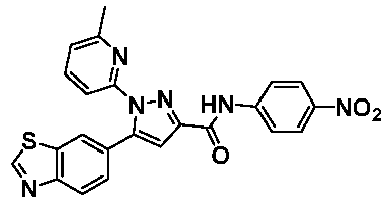
5-(benzo[d]thiazol-6-yl)-1-(6-methylpyridin-2-yl)-N-(4-nitrophenyl)-1H-pyrazole-3-carboxyamide (300 MHz, DMSO-d6)δ 10.90(s, 1H), 9.45(s, 1H), 8.29-8.26(m, 3H), 8.15(d, 2H), 8.05(d, 1H), 7.93(t, 1H), 7.61(d, 1H), 7.38-7.34(m, 2H), 7.31(s, 1H), 2.27(s, 3H) 457.1/456.1 15 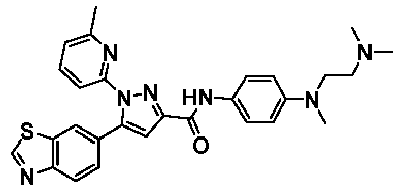
5-(benzo[d]thiazol-6-yl)-N-(4-((2-(dimethylamino)ethyl)( methyl)amino)phenyl)-1-(6-methylpyridin-2-yl)-1H-pyrazole-3-carboxyamide 9.04(s, 1H), 8.68(s, 1H), 8.04(d, 1H), 7.98(d, 1H), 7.66(t, 1H), 7.56(d, 2H), 7.35(d, 1H), 7.20(t, 3H), 6.74(d, 2H), 3.48(t, 2H), 2.96(s, 3H), 2.55(t, 2H), 2.43(s, 3H), 2.35(s, 6H) 490.1/489.1 16 
5-(benzo[d]thiazol-6-yl)-N-(4-(3-(dimethylamino)pyrrolid in-1-yl)phenyl)-1-(6-methylpyridin-2-yl)-1H-pyrazole-3-carboxyamide 9.05(s, 1H), 8.67(s, 1H), 8.07(d, 1H), 7.99(s, 1H), 7.67(t, 1H), 7.59(d, 2H), 7.38(d, 1H), 7.35-7.17(m, 3H), 6.58(d, 2H), 3.55-3.41(m,2H), 3.37-3.34(m, 1H), 3.20(t, 1H), 2.93-2.91(m, 1H), 2.43(s, 3H), 2.36(s, 6H), 2.24-2.22(m,1H) 524.2/523.2 17 
5-(benzo[d]thiazol-6-yl)-N-(3-chloro-4-(octahydro-6H-pyrrolo[3,4-b]pyridin-6-yl)phenyl)-1-(6-methylpyridin-2-yl)-1H-pyrazole-3-carboxyamide 9.04(s, 1H), 8.70(s, 1H), 8.04(d, 1H), 7.97(s, 1H), 7.74(s, 1H), 7.60(t, 1H), 7.44(d, 1H), 7.34(d, 1H), 7.24-7.15(m, 3H), 6.86(d, 1H), 3.80-3.70(m,2H), 3.47-3.45(m,3 H), 3.30-3.06(m, 2H), 2.70(t, 1H), 2.41(s, 3H), 2.39-2.36(m, 1 H), 1.77-1.73(m,3H) 570.1/569.1 18 
5-(benzo[d]thiazol-6-yl)-1-(6-methylpyridin-2-yl)-N-phenyl-1H-pyrazole-3-carboxyamide 9.08(s, 1H), 8.89(s, 1H), 8.05(d, 1H), 7.98(d, 1H), 7.74(d, 2H), 7.66(t, 1H), 7.38-7.35(m, 3H), 7.22-7.17(m, 4H), 2.43(s, 3H) 412.1/411.1 19 
5 -(benzo[d]thiazol-6-yl)-N-(3-tolyl)-1-(6-methylpyridin-2-yl)-1H-pyrazole-3-carboxyamide (300 MHz, MeOD) δ 9.28(s, 1H), 8.06(s, 1H), 7.98(d, 1H), 7.76(t, 1H), 7.56-7.53(m, 2H), 7.36(d, 2H), 7.30-7.20(m, 2H), 7.13(s, 1H), 6.96(d, 1H), 2.34(s, 3H), 2.33(s, 3H) 426.1/425.1 20 
5-(benzo[d]thiazol-6-yl)-1-(6-methylpyridin-2-yl)-N-(3-vinylphenyl)-1H-pyrazole-3-carboxyamide 9.05(s, 1H), 8.85(s, 1H), 8.05(d, 1H), 7.99(d, 1H), 7.90(s, 1H), 7.70-7.62(m, 2H), 7.34(d, 2H), 7.21(t, 3H), 6.73(dd, 1H), 5.80(d, 1H), 5.28(d, 1H), 2.43(s, 3H) 438.1/437.1 21 
5-(benzo[d]thiazol-6-yl)-N-(3-(trifluoromethyl)phenyl) -1-(6-methylpyridin-2-yl)-1H-pyrazole-3-carboxyamide 9.06(s, 1H), 9.01(s, 1H), 8.08-8.05(m, 2H), 8.00-7.94(m, 2H), 7.68(t, 1H), 7.50(t, 1H), 7.41-7.34(m, 2H), 7.28-7.19(m, 3H), 2.45(s, 3H) 480.1/479.1 22 
5-(benzo[d]thiazol-6-yl)-N-(3-(cyanophenyl)-1- (6-methylpyridin-2-yl)-1H-pyrazole-3-carboxyamide 9.06(s, 1H), 8.95(s, 1H), 8.15(d, 1H), 8.06(d, 1H), 7.99(d, 1H), 7.80(dd, 1H), 7.68(t, 1H), 7.47-7.43(m, 2H), 7.37(dd, 1H), 7.21-7.18(m, 3H), 2.45(s, 3H) 437.1/436.1 23 
5-(benzo[d]thiazol-6-yl)-N-(3-acetylphenyl)-1-(6-methylpyridin-2-yl)-1H-pyrazole-3-carboxyamide 9.07(s, 1H), 9.01(s, 1H), 8.27(s, 1H), 8.26-8.06(m, 2H), 8.00(s, 1H), 7.74-7.67(m, 2H), 7.50(t, 1H), 7.38(d, 1H), 7.25-7.20(m, 2H), 2.66(s, 3H), 2.45(s, 3H) 454.1/453.1 24 
ethyl 3-(5-(benzo[d]thiazol-6-yl)-1-(6-methylpyridin-2-yl)-1H-pyrazole-3-carboxyamido)benzoate 9.05(s, 1H), 8.95(s, 1H), 8.21(s, 1H), 8.16(d, 1H), 8.06(d, 1H), 7.99(d, 1H), 7.83(d, 1H), 7.66(t, 1H), 7.46(t, 1H), 7.37(dd, 1H), 7.21 (t, 3H), 4.40(q, 2H), 2.43(s, 3H), 4.41(t, 3H) 484.1/483.1 25 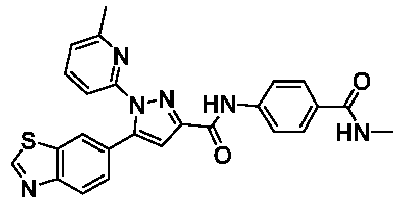
5-(benzo[d]thiazol-6-yl)-N-(4-(methylcarbamoyl)phen yl)-1-(6-methylpyridin-2-yl)-1H-pyrazole-3-carboxyamide 9.05(s, 1H), 8.98(s, 1H), 8.07(d, 1H), 7.99(d, 1H), 7.80(s, 4H), 7.68(t, 1H), 7.35(dd, 1H), 7.21 (t, 3H), 6.10(s, 1H), 3.03(d, 3H), 2.44(s, 3H) 469.1/468.1 26 
5-(benzo[d]thiazol-6-yl)-N-(4-acetoamidophenyl)-1-(6-methylpyridin-2-yl)-1H-pyrazole-3-carboxyamide (300 MHz, DMSO-d6) δ 10.16(s, 1H), 9.90(s, 1H), 9.42(s, 1H), 8.85(d, 1H), 8.39(d, 1H), 8.25(s, 1H), 8.25-8.00(m, 2H), 7.90(t, 1H), 7.73(d, 2H), 7.60(d, 1H), 7.53(d, 2H), 7.34(t, 2H), 7.19(s, 1H), 2.21(s, 3H), 2.01(s, 3H) 469.1/468.1 27 
5-(benzo[d]thiazol-6-yl)-N-(2-fluorophenyl)-1-(6-methylpyridin-2-yl)-1H-pyrazole-3-carboxyamide 9.10(br, 1H), 9.05(s, 1H), 8.52(t, 1H), 8.06(d, 1H), 8.00(d, 1H), 7.70(t, 1H), 7.39-7.35(m, 2H), 7.20-7.09(m, 5H), 2.35(s, 3H) 430.1/429.1 28 
5-(benzo[d]thiazol-6-yl)-N-(3-fluorophenyl)-1-(6-methylpyridin-2-yl)-1H-pyrazole-3-carboxyamide 9.05(s, 1H), 8.91(s, 1H), 8.06(d, 1H), 7.98(d, 1H), 7.79-7.65(m, 2H), 7.37-7.30(m, 3H), 7.23-7.18(m, 3H), 6.84(t, 1H), 2.44(s, 3H) 430.1/429.1 29 
5-(benzo[d]thiazol-6-yl)-N-(4-fluorophenyl)-1-(6-methylpyridin-2-yl)-1H-pyrazole-3-carboxyamide 9.05(s, 1H), 8.84(s, 1H), 8.06(d, 1H), 7.98(d, 1H), 7.72-7.67(m, 3H), 7.36(d, 1H), 7.22-7.18(m, 3H), 7.07(t, 2H), 2.44(s, 3H) 430.1 /429.1 30 
5-(benzo[d]thiazol-6-yl)-N-(3,4-difluorophenyl)-1-(6-methylpyridin-2-yl)-1H-pyrazole-3-carboxyamide 9.06(s, 1H), 8.86(s, 1H), 8.06(d, 1H), 7.98(d, 1H), 7.82-7.78(m, 1H), 7.67(t, 1H), 7.35(d, 1H), 7.30-7.28(m, 1H), 7.21-7.13(m, 4H), 2.45(s, 3H) 448.1/447.1 31 
5-(benzo[d]thiazol-6-yl)-N-(2-chlorophenyl)-1-(6-methylpyridin-2-yl)-1H-pyrazole-3-carboxyamide 9.49(s, 1H), 9.05(s, 1H), 8.60(d, 1H), 8.05(d, 1H), 8.01(d, 1H), 7.73(t, 1H), 7.46-7.34(m, 4H), 7.19(s, 1H), 7.15 (d, 1H), 7.07(t, 1H), 2.30(s, 3H) 446.1/445.1 32 
5-(benzo[d]thiazol-6-yl)-N-(3-chlorophenyl)-1- (6-methylpyridin-2-yl)-1H-pyrazole-3-carboxyamide 9.05(s, 1H), 8.85(s, 1H), 8.05(d, 1H), 7.98(d, 1H), 7.86(s, 1H), 7.67(t, 1H), 7.57(d, 1H), 7.36-7.30(m, 2H), 7.21-7.10(m, 4H), 2.44(s, 3H) 446.1/445.1 33 
5-(benzo[d]thiazol-6-yl)-N-(4-chlorophenyl)-1-(6-methylpyridin-2-yl)-1H-pyrazole-3-carboxyamide 9.05(s, 1H), 8.84(s, 1H), 8.05(d, 1H), 7.98(d, 1H), 7.70-7.64(m, 3H), 7.36-7.30(m, 3H), 7.21-7.18(m, 3H), 2.44(s, 3H) 446.1/445.1 34 
5-(benzo[d]thiazol-6-yl)-N-(4-bromophenyl)-1-(6-methylpyridin-2-yl)-1H-pyrazole-3-carboxyamide 9.05(s, 1H), 8.83(s, 1H), 8.05(d, 1H), 7.98(d, 1H), 7.69-7.62(m, 3H), 7.48(d, 2H), 7.34(d, 1H), 7.21-7.18(m, 3H), 2.44(s, 3H) 490.0/489.0 35 
5-(benzo[d]thiazol-6-yl)-1-(6-methylpyridin-2-yl)-N-(3-(methylthio)phenyl)-1H-pyrazole-3-carboxyamide 9.04(s, 1H), 8.84(s, 1H), 8.05(d, 1H), 7.98(d, 1H), 7.74(m, 1H), 7.67(t, 1H), 7.40(dd, 1H), 7.35(d, 1H), 7.27-7.17(m, 4H), 7.01(d, 1H), 2.52(s, 3H), 2.43(s, 3H) 458.1/457.1 36 
5-(benzo[d]thiazol-6-yl)-1-(6-methylpyridin-2-yl)-N-(4-(methylthio)phenyl)-1H-pyrazole-3-carboxyamide 9.05(s, 1H), 8.84(s, 1H), 8.05(d, 1H), 7.98(d, 1H), 7.69-7.64(m, 3H), 7.36-7.27(m, 4H), 7.21-7.18(m, 2H), 2.49(s, 3H), 2.44(s, 3H) 458.1/457.1 37 
5-(benzo[d]thiazol-6-yl)-N-(4-(cyclopropylthio)phenyl) -1-(6-methylpyridin-2-yl)-1H-pyrazole-3-carboxyamide 9.04(s, 1H), 8.80(s, 1H), 8.05(d, 1H), 7.98(d, 1H), 7.69-7.64(m, 3H), 7.40-7.34(m, 4H), 7.26-7.17(m, 2H), 2.43(s, 3H), 2.23-2.19(m, 1H), 1.08-1.03(m, 2H), 0.73-0.69(m, 2H) 38 
5-(benzo[d]thiazol-6-yl)-1-(6-methylpyridin-2-yl)-N-(3-(methylsulfinyl)phenyl)-1H-pyrazole-3-carboxyamide 9.09(s, 1H), 9.05(s, 1H), 8.07-7.98(m, 4H), 7.69(t, 1H), 7.54(t, 1H), 7.43-7.34(m, 2H), 7.20-7.18(m, 3H), 2.77(s, 3H), 2.42(s, 3H) 474.1/473.1 39 
5-(benzo[d]thiazol-6-yl)-1-(6-methylpyridin-2-yl)-N-(4-(methylsulfinyl)phenyl)-1H-pyrazole-3-carboxyamide 9.08(s, 1H), 9.06(s, 1H), 8.06(d, 1H), 7.98(d, 1H), 7.93(d, 2H), 7.69-7.64(m, 3H), 7.36(d, 1H), 7.22-7.17(m, 3H), 2.74(s, 3H), 2.46(s, 3H) 474.1/473.1 40 
5-(benzo[d]thiazol-6-yl)-1-(6-methylpyridin-2-yl)-N-(3-(methylsulfonyl)phenyl) -1H-pyrazole-3-carboxyamide 9.07(m, 2H), 8.24(s, 1H), 8.15(d, 1H), 8.06(d, 1H), 7.99(d, 1H), 7.69(t, 2H), 7.59(t, 1H), 7.36(d, 1H), 7.22-7.19(m, 3H), 3.10(s, 3H), 2.44(s, 3H) 490.1/489.1 41 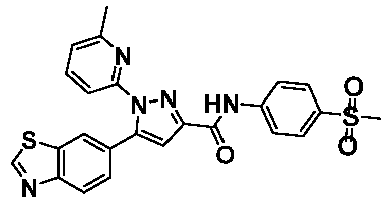
5-(benzo[d]thiazol-6-yl)-1-(6-methylpyridin-2-yl)-N-(4-(methylsulfonyl)phenyl) -1H-pyrazole-3-carboxyamide 9.12(s, 1H), 9.06(s, 1H), 8.06(d, 1H), 7.98-7.95(m, 5H), 7.67(t, 1H), 7.35(d, 1H), 7.22-7.18(m, 3H), 3.07(s, 3H), 2.46(s, 3H) 490.1/489.1 42 
5-(benzo[d]thiazol-6-yl)-1-(6-methylpyridin-2-yl)-N-(4-(propylsulfonyl)phenyl)-1H-pyrazole-3-carboxyamide 9.10(s, 1H), 9.06(s, 1H), 8.06(d, 1H), 7.99-7.89(m, 5H), 7.68(t, 1H), 7.35(d, 1H), 7.23-7.17(m, 3H), 3.10-3.05(m, 2H), 2.46(s, 3H), 1.80-1.72(m, 2H), 1.01(t, 3H) 518.1/517.1 43 
5-(benzo[d]thiazol-6-yl)-N-(4-(cyclopropylsulfonyl)ph enyl)-1-(6-methylpyridin-2-yl)-1H-pyrazole-3-carboxyamide 9.08(s, 1H), 9.06(s, 1H), 8.06(d, 1H), 7.98(d, 1H), 7.95-7.91(m, 4H), 7.68(t, 1H), 7.35(d, 1H), 7.22-7.18(m, 3H), 2.49-2.46(m, 4H), 1.37-1.35(m, 2H), 1.06-1.02(m, 2H) 516.1/515.1 44 
5-(benzo[d]thiazol-6-yl)-N-(2-fluoro-4-(methylsulfonyl)phenyl) -1-(6-methylpyridin-2-yl)-1H-pyrazole-3-carboxyamide 9.36(s, 1H), 9.07(s, 1H), 8.86(t, 1H), 8.07(d, 1H), 8.01(s, 1H), 7.82-7.70(m, 3H), 7.39-7.32(m, 3H), 7.22-7.20(m, 2H), 3.09(s, 3H), 2.39(s, 3H) 508.0/507.0 45 
5-(benzo[d]thiazol-6-yl)-1-(6-methylpyridin-2-yl)-N-(3-sulfamoylphenyl)-1H-pyrazole-3-carboxyamide 9.12(s, 1H), 8.34(m, 1H), 8.08(d, 1H), 8.02(d, 1H), 7.98(d, 1H), 7.70-7.60(m, 2H), 7.52(t, 1H), 7.37(d, 1H), 7.24(d, 1H), 7.20(s, 2H), 6.98(d, 1H), 2.56(s, 3H) 491.1/490.1 46 
5-(benzo[d]thiazol-6-yl)-1-(6-methylpyridin-2-yl)-N-(4-sulfamoylphenyl)- 1H-pyrazole-3-carboxyamide 9.12(s, 1H), 8.07(d, 1H), 8.01(d, 1H), 7.93(s, 4H), 7.64(t, 1H), 7.39-7.26(m, 2H), 7.24(d, 1H), 7.21(s, 1H), 7.00(d, 1H), 2.56(s, 3H) 491.1/490.1 47 
5-(benzo[d]thiazol-6-yl)-1-(6-methylpyridin-2-yl)-N-(3-(N- methylsulfamoyl)phenyl)-1H-pyrazole-3-carboxyamide 9.06-7.05(m, 2H), 8.18(d, 1H), 8.05(d, 2H), 7.99(d, 1H), 7.71-7.54(m, 3H), 7.35(d, 1H), 7.24-7.20(m, 3H), 4.41-4.39(bs, 1H), 2.73(s, 3H), 2.44(s, 3H) 505.1/504.1 48 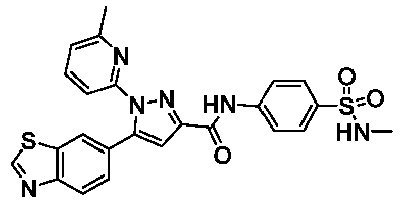
5-(benzo[d]thiazol-6-yl)-1-(6-methylpyridin-2-yl)-N-(4-(N- methylsulfamoyl)phenyl )-1H-pyrazole-3-carboxyamide 9.06 (m, 2H), 8.06(d, 1H), 7.99(d, 1H), 7.93-7.85(m, 3H), 7.68(t, 1H), 7.35(d, 1H), 7.22-7.18(m, 3H), 4.21-4.19(bs, 1H), 2.69(s, 3H), 2.46(s, 3H) 505.1/504.1 49 
5-(benzo[d]thiazol-6-yl)-N-(3-(N-cyclopropylsulfamoyl)p henyl)-1-(6-methylpyridin-2-yl)-1H-pyrazole-3-carboxyamide 9.06(s, 1H), 9.05(s, 1H), 8.19(d, 1H), 8.08(t, 2H), 7.99(d, 1H), 7.70-7.66(m, 2H), 7.55(t, 1H), 7.35(d, 1H), 7.22-7.19(m, 3H), 4.91(s, 1H), 2.44(s, 3H), 2.35-2.28(m, 1H), 0.68-0.64(m, 4H) 531.1/530.1 50 
5-(benzo[d]thiazol-6-yl)-N-(4-(N-cyclopropylsulfamoyl)p henyl)-1-(6-methylpyridin-2-yl)-1H-pyrazole-3-carboxyamide 9.13(s, 1H), 9.06(s, 1H), 8.07(d, 1H), 8.00(d, 1H), 7.85(d, 2H), 7.71(t, 1H), 7.42-7.34(m, 2H), 7.21-7.17(m, 4H), 4.90(s, 1H), 2.34(s, 3H), 2.25-2.22(m, 1H), 0.60-0.57(m, 4H) 531.1/530.1 51 
5-(benzo[d]thiazol-6-yl)-N-(3-(N,N- dimethylsulfamoyl)phen yl)-1-(6-methylpyridin-2-yl)-1H-pyrazole-3-carboxyamide 9.08(s, 1H), 9.06(s, 1H), 8.10-8.05(m, 3H), 7.98(d, 1H), 7.68(t, 1H), 7.56-7.54(m, 2H), 7.35(d, 1H), 7.25-7.19(m, 3H), 2.76(s, 6H), 2.44(s, 3H) 519.1/518.1 52 
5-(benzo[d]thiazol-6-yl)-N-(4-(N, N-dimethylsulfamoyl)phen yl)-1-(6-methylpyridin-2-yl)-1H-pyrazole-3-carboxyamide (300 MHz, DMSO-d6) δ 10.50(s, 1H), 9.23(s, 1H), 8.46(s, 1H), 8.02(m, 1H), 7.96(d, 2H), 7.89-7.85(m, 3H), 7.60(d, 2H), 7.34-7.29 (m, 1H), 7.25-7.22(m, 1H), 2.66(s, 6H), 2.51(s, 3H) 519.1/518.1 53 
5-(benzo[d]thiazol-6-yl)-1-(6-methylpyridin-2-yl)-N-(3-(methylsulfonamide)phe nyl)-1H-pyrazole-3-carboxyamide 9.05(s, 1H), 8.90(s, 1H), 8.05(d, 1H), 7.98(d, 1H), 7.77(d, 1H), 7.68(t, 1H), 7.48(d, 1H), 7.38-7.34(m, 2H), 7.23-7.18(m, 3H), 7.00(d, 1H), 6.40(s, 1H), 3.06(s, 3H), 2.43(s, 3H) 505.1/504.1 54 
5-(benzo[d]thiazol-6-yl)-N-(3-(cyclopropanesulfonami do)phenyl)-1-(6-methylpyridin-2-yl)-1H-pyrazole-3-carboxyamide 9.05(s, 1H), 8.89(s, 1H), 8.05(d, 1H), 7.98(d, 1H), 7.80(d, 1H), 7.67(t, 1H), 7.48(d, 1H), 7.35(d, 2H), 7.23-7.18(m, 3H), 7.06(d, 1H), 6.32(s, 1H), 2.56-2.54(m, 1H), 2.43(s, 3H), 1.28-1.21(m, 2H), 1.04-0.99(m, 2H) 531.1/530.1 55 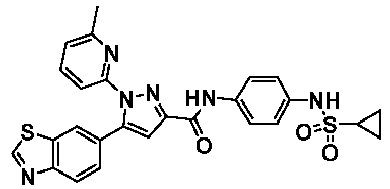
5-(benzo[d]thiazol-6-yl)-N-(4-(cyclopropanesulfonami do)phenyl)-1-(6-methylpyridin-2-yl)-1H-pyrazole-3-carboxyamide 9.06(s, 1H), 8.87(s, 1H), 8.05(d, 1H), 7.98(d, 1H), 7.72(d, 2H), 7.67(t, 1H), 7.35(d, 1H), 7.30(d, 2H), 7.23-7.18(m, 3H), 6.32(s, 1H), 2.49-2.44(s, 4H), 1.18-1.15(m, 2H), 1.00-0.95(m, 2H) 531.1/530.1 56 
4-(5-(benzo[d]thiazol-6-yl)-1-(6-methylpyridin-2-yl)-1H-pyrazole-3-carboxyamido)benzenes ulfonic acid (300 MHz, DMSO-d6)δ 10.30(s, 1H), 9.44(s, 1H), 8.27(d, 1H), 8.03(d, 1H), 7.93(t, 1H), 7.77(d, 2H), 7.65(d, 1H), 7.56(d, 2H), 7.34(t, 2H), 7.23(s, 1H), 2.08(s, 3H) 492.1/491.1 57 
5-(benzo[d]thiazol-6-yl)-1-(6-methylpyridin-2-yl)-N-(4-((trifluoromethyl)sulfonyl)phenyl)-1H-pyrazole-3-carboxyamide 9.23(s, 1H), 9.06(s, 1H), 8.08-8.04(m, 5H), 7.99(d, 1H), 7.68(t, 1H), 7.35(d, 1H), 7.24-7.17(m, 3H), 2.47(s, 3H) 544.1/543.1 58 
5-(benzo[d]thiazol-6-yl)-1-(6-methylpyridin-2-yl)-N-(4-(N-(2,2,2-trifluoroethyl)sulfamoyl) phenyl)-1H-pyrazole-3-carboxyamide 9.09(s, 1H), 9.06(s, 1H), 8.06(d, 1H), 7.98(d, 1H), 7.89(dd, 4H), 7.68(t, 1H), 7.36(d, 1H), 7.22-7.19(m, 3H), 4.97(t, 1H), 3.73-3.65(m, 2H), 2.45(s, 3H) 59 
5-(benzo[d]thiazol-6-yl)-1-(6-methylpyridin-2-yl)-N-(4-((methylsulfonyl)methyl )phenyl)-1H-pyrazole-3-carboxyamide 9.05(s, 1H), 8.93(s, 1H), 8.06(d, 1H), 7.99(d, 1H), 7.85(d, 1H), 7.75(d, 1H), 7.68(t, 1H), 7.43(t, 2H), 7.37(d, 1H), 7.23-7.18(m, 3H), 4.27(s, 2H), 2.81(s, 3H), 2.43(s, 3H) 504.1/503.1 60 
5-(benzo[d]thiazol-6-yl)-1-(6-methylpyridin-2-yl)-N-(3-(sulfamoylmethyl)pheny 1)-1H-pyrazole-3-carboxyamide (300 MHz, DMSO-d6)δ 10.31(s, 1H), 9.45(s, 1H), 8.27(d, 1H), 8.03(d, 1H), 7.95-7.84(m, 3H), 7.64(d, 1H), 7.39-7.33(m, 3H), 7.24(s, 1H), 7.12(d, 1H), 6.88(s, 2H), 4.25(s, 2H), 2.22(s, 3H) 505.1/504.1 61 
5-(benzo[d]thiazol-6-yl)-1-(6-methylpyridin-2-yl)-N-(4-(sulfamoylmethyl)pheny 1)-1H-pyrazole-3-carboxyamide (300 MHz, DMSO-d6)δ 10.32(s, 1H), 9.45(s, 1H), 8.27(d, 1H), 8.03(d, 1H), 7.92(t, 1H), 7.84(d, 2H), 7.61(d, 1H), 7.35-7.33(m, 4H), 7.24(s, 1H), 6.83(s, 2H), 4.23(s, 2H), 2.23(s, 3H) 505.1/504.1 62 
5-(benzo[d]thiazol-6-yl)-N-(4-fluoro-3-(sulfamoylmethyl)pheny 1)-1-(6-methylpyridin-2-yl)-1H-pyrazole-3-carboxyamide (300 MHz, DMSO-d6)δ 10.40(s, 1H), 9.45(s, 1H), 8.27(d, 1H), 8.03(d, 1H), 7.97-7.90(m, 3H), 7.62(d, 1H), 7.35(dd, 2H), 7.23(dd, 2H), 7.06(s, 2H), 4.30(s, 2H), 2.23(s, 3H) 523.1/522.1 63 
5-(benzo[d]thiazol-6-yl)-N-(4-((1,1-dioxidotetrahydrothioph en-3-yl)amino)phenyl)-1-(6-methylpyridin-2-yl)-1H-pyrazole-3-carboxyamide 9.05(s, 1H), 8.85(s, 1H), 8.05(d, 1H), 7.98(d, 1H), 7.68(t, 1H), 7.62(d, 2H), 7.37(d, 1H), 7.23-7.18(m, 3H), 6.70(d, 2H), 4.25(s, 1H), 3.45-2.98(m, 5H), 2.55-2.50(m, 1H), 2.43(s, 3H), 2.33-2.30(m, 1H) 545.1/544.1 64 
5-(benzo[d]thiazol-6-yl)-1-(6-methylpyridin-2-yl)-N-(pyridin-4-yl)-1H-pyrazole-3-carboxyamide 9.05(s, 1H), 8.96(s, 1H), 8.55(d, 2H), 8.05(d, 1H), 7.98(d, 1H), 7.70-7.65(m, 3H), 7.35(d, 1H), 7.22-7.19(m, 3H), 2.44(s, 3H) 413.1/412.1 65 
5-(benzo[d]thiazol-6-yl)-N-(6-methoxypyridin-3-yl)-1-(6-methylpyridin-2-yl)-1H-pyrazole-3-carboxyamide 9.05(s, 1H), 8.74(s, 1H), 8.38(d, 1H), 8.13(dd, 1H), 8.06(d, 1H), 7.98(d, 1H), 7.66(t, 1H), 7.35(d, 1H), 7.21(s, 2H), 7.18(dd, 1H), 6.79(d, 1H), 3.94(s, 3H), 2.45(s, 3H) 443.1/442.1 66 
5-(benzo[d]thiazol-6-yl)-N-(2-methoxypyridin-4-yl)-1-(6-methylpyridin-2-yl)-1H-pyrazole-3-carboxyamide 9.06(s, 1H), 8.95(s, 1H), 8.11-8.04(m, 2H), 7.97(d, 1H), 7.67(t, 1H), 7.34(d, 1H), 7.22-7.17(m, 5H), 3.95(s, 3H), 2.45(s, 3H) 443.1/442.1 67 
5-(benzo[d]thiazol-6-yl)-N-(6-(methylthio)pyridin-3 - yl)-1-(6-methylpyridin-2-yl)-1H-pyrazole-3-carboxyamide 9.07(s, 1H), 8.83(s, 1H), 8.67(s, 1H), 8.18(d, 1H), 8.07(d, 1H), 7.99(s, 1H), 7.68(t, 1H), 7.36(d, 1H), 7.24-7.20(m,4H), 2.59(s, 3H), 2.46(s, 3H) 459.1/458.1 68 
5-(benzo[d]thiazol-6-yl)-1-(6-methylpyridin-2-yl)-N-(6-(methylsulfonyl)pyridin-2-yl)-1H-pyrazole-3-carboxyamide 9.64(s, 1H), 9.06(s, 1H), 8.68(d, 1H), 8.08-7.99(m, 3H), 7.84(d, 1H), 7.73(t, 1H), 7.35(d, 2H), 7.22-7.13(m, 2H), 3.22(s, 3H), 2.32(s, 3H) 491.1/490.1 69 
5-(benzo[d]thiazol-6-yl)-N-(6-(methylsulfonyl)pyridin-3-yl)-1-(6-methylpyridin-2-yl)-1H-pyrazole-3-carboxyamide 9.16(s, 1H), 9.06(s, 1H), 8.92(s, 1H), 8.60(d, 1H), 8.12-8.05(m, 2H), 7.98(s, 1H), 7.67(t, 1H), 7.34(d, 1H), 7.23-7.16(m, 3H), 3.22(s, 3H), 2.46(s, 3H) 491.1/490.1 70 
5-(benzo[d]thiazol-6-yl)-1-(6-methylpyridin-2-yl)-N-(2-(methylsulfonyl)pyridin-4-yl)-1H-pyrazole-3-carboxyamide 9.30(s, 1H), 9.06(s, 1H), 8.66(d, 1H), 8.22(d, 1H), 8.17(d, 1H), 8.06(d, 1H), 7.98(d, 1H), 7.70(t, 1H), 7.35(d, 1H), 7.24-7.20(m, 3H), 3.24(s, 3H), 2.43(s, 3H) 491.1/490.1 71 
5-(benzo[d]thiazol-6-yl)-N-(6-fluoropyridin-3-yl)-1-(6-methylpyridin-2-yl)-1H-pyrazole-3-carboxyamide (300 MHz, DMSO-d6)δ 10.67(s, 1H), 9.45(s, 1H), 8.67(d, 1H), 8.38(t, 1H), 8.27(d, 1H), 8.03(d, 1H), 7.93(t, 1H), 7.57(d, 1H), 7.37-7.32(m, 2H), 7.26-7.20(m, 2H), 2.25(s, 3H) 431.1/430.1 72 
5-(benzo[d]thiazol-6-yl)-N-(2-fluoropyridin-4-yl)-1-(6-methylpyridin-2-yl)-1H-pyrazole-3-carboxyamide 9.15(s, 1H), 9.06(s, 1H), 8.16(d, 1H), 8.07(d, 1H), 7.98(d, 1H), 7.67(t, 1H), 7.52(d, 1H), 7.34(d, 1H), 7.30(d, 1H), 7.23-7.16(m, 3H), 2.46(s, 3H) 431.1/430.1 73 
5-(benzo[d]thiazol-6-yl)-N-(6-chloropyridin-3-yl)-1-(6-methylpyridin-2-yl)-1H-pyrazole-3-carboxyamide 9.05(s, 1H), 8.92(s, 1H), 8.58(d, 1H), 8.36(dd, 1H), 8.06(d, 1H), 7.98(d, 1H), 7.67(t, 1H), 7.35(d, 2H), 7.22-7.19(m, 3H), 2.44(s, 3H) 447.1/446.1 74 
5-(benzo[d]thiazol-6-yl)-N-(2-chloropyridin-4-yl)-1-(6-methylpyridin-2-yl)-1H-pyrazole-3-carboxyamide 9.09(s, 1H), 9.06(s, 1H), 8.31(d, 1H), 8.06(d, 1H), 7.98(d, 1H), 7.83(d, 1H), 7.67(t, 1H), 7.56(dd, 1H), 7.34(d, 1H), 7.23-7.16(m, 3H), 2.46(s, 3H) 447.1/446.1 75 
5-(benzo[d]thiazol-6-yl)-1-(6-methylpyridin-2-yl)-N-(thiazol-2-yl)-1H-pyrazole-3-carboxyamide 10.28(s, 1H), 9.05(s, 1H), 8.06(d, 1H), 8.00(d, 1H), 7.71(t, 1H), 7.51(d, 1H), 7.35(t, 2H), 7.21(s, 1H), 7.20(d, 1H), 7.03(d, 1H), 2.34(s, 3H) 419.1/418.1 76 
5-(benzo[d]thiazol-6-yl)-N-benzyl-1-(6-methylpyridin-2-yl)-1H-pyrazole-3-carboxyamide 9.03(s, 1H), 8.04(d, 1H), 7.95(d, 1H), 7.61(t, 1H), 7.40-7.30(m, 7H), 4.67(d, 3H), 2.38(s, 3H) 426.1/425.1 77 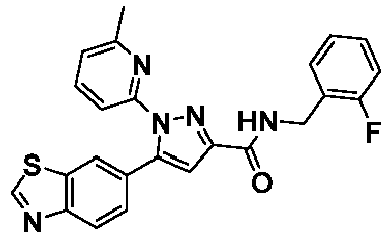
5-(benzo[d]thiazol-6-yl)-N-(2-fluorobenzyl)-1-(6-methylpyridin-2-yl)-1H-pyrazole-3-carboxyamide 9.03(s, 1H), 8.03(d, 1H), 7.95(d, 1H), 7.63(t, 1H), 7.48-7.44(m, 2H), 7.34(dd, 1H), 7.20-7.09(m, 5H), 4.72(d, 2H), 2.38(s, 3H) 444.2/443.1 78 
5-(benzo[d]thiazol-6-yl)-N-(3-fluorobenzyl)-1-(6-methylpyridin-2-yl)-1H-pyrazole-3-carboxyamide 9.04(s, 1H), 8.04(d, 1H), 7.96(d, 1H), 7.62(t, 1H), 7.45(t, 1H), 7.35-7.30(m, 2H), 7.19-7.13(m, 5H), 6.97(t, 1H), 4.66(d, 2H), 2.39(s, 3H) 444.1/443.1 79 
5-(benzo[d]thiazol-6-yl)-N-(4-fluorobenzyl)-1-(6-methylpyridin-2-yl)-1H-pyrazole-3-carboxyamide 9.04(s, 1H), 8.04(d, 1H), 7.95(d, 1H), 7.61(t, 1H), 7.38-7.31(m, 4H), 7.17-7.13(m, 3H), 7.03(t, 2H), 4.63(d, 2H), 2.39(s, 3H) 444.1/443.1 80 
5-(benzo[d]thiazol-6-yl)-1-(6-methylpyridin-2-yl)-N-(1-(methylsulfonyl)-1H-pyrazol-4-yl)-1H-pyrazole-3-carboxyamide 9.06(s, 1H), 8.90(s, 1H), 8.61(s, 1H), 8.06(d, 1H), 7.99-7.97(m, 2H), 7.66(t, 1H), 7.35(d, 1H), 7.21-7.14(m, 3H), 3.49(s, 3H), 2.46(s, 3H) 480.1/479.1 81 
5-(benzo[d]thiazol-6-yl)-N-(1-(cyclopropylsulfonyl)-1H-pyrazol-4-yl)-1-(6-methylpyridin-2-yl)-1H-pyrazole-3-carboxyamide 9.05(s, 1H), 8.85(s, 1H), 8.58(s, 1H), 8.06(d, 1H), 7.97(m, 2H), 7.66(t, 1H), 7.36-7.33(m, 1H), 7.21-7.16(m, 3H), 2.79-2.74(m, 1H), 2.45(s, 3H), 1.54-1.49(m, 2H), 1.23-1.16(m, 2H) 506.1/505.1 -

- A target compound (140 mg) was obtained in the same manner as in Example 1 except that 3-((tert-butyldimethylsilyl)oxy)aniline was used instead of p-anisidine.
- 1H NMR spectrum (300 MHz, CDCl3) δ 9.04(s, 1H), 8.79(s, 1H), 8.05(d, 1H), 7.97(d, 1H), 7.66(t, 1H), 7.40(d, 1H), 7.34(d, 1H), 7.26-7.17(m, 5H), 6.64-6.61(m, 1H), 2.43(s, 3H), 1.01(s, 9H), 0.25(S, 6H).
- After dissolving 5-(benzo[d]thiazol-6-yl)-N-(3-((tertbutyldimethylsilyl)oxy)phenyl)-1-(6-methylpyridin-2-yl)-1H-pyrazole-3-carboxyamide (140 mg, 0.26 mmol) synthesized in Step 1 in tetrahydrofuran (2.5 mL), 1.0 M TBAF (0.78 mL, 0.78 mmol) was added dropwise thereto at room temperature, and the reaction solution was stirred for 1 hour. The reaction solution was removed under vacuum, and then ethyl acetate was added thereto. The organic layer was washed with sodium bicarbonate, and then dried using anhydrous magnesium sulfate, and after filtering, the filtrate was vacuum concentrated. The filtrate was purified using column chromatography to obtain a target compound (23 mg).
- 1H NMR spectrum (300 MHz, CDCl3) δ 9.06(s, 1H), 8.93(s, 1H), 8.05(d, 1H), 8.00(d, 2H), 7.67(t, 1H), 7.38-7.18(m, 5H), 6.90(d, 1H), 6.68(d, 1H), 2.44(s, 3H).
- MS (ESI+): [M+H]+ m/z 428.1
- Compounds of Examples 83 to 85 listed in the following Table 2 were obtained in the same manner as in Step 2) of Example 82.
Table 2 Example Number Structure Compound Name 1H NMR Spectrum (300 MHz, CDCl3)δ MS (ES) Actual Measurement Value [M+H]+/Required Value 83 
5-(benzo[d]thiazol-6-yl)-N-(4-hydroxyphenyl)-1-(6-methylpyridin-2-yl)-1H-pyrazole-3-carboxyamide 9.04(s, 1H), 8.71(s, 1H), 8.05(d, 1H), 7.98(d, 1H), 7.66(t, 1H), 7.57(d, 2H), 7.37(d, 1H), 7.19(t, 3H), 6.85(d, 2H), 4.93(s, 1H), 2.44(s, 3H) 428.1/427.1 84 
5-(benzo[d]thiazol-6-yl)-N-(3-(hydroxymethyl)phenyl) -1-(6-methylpyridin-2-yl)-1H-pyrazole-3-carboxyamide 9.05(s, 1H), 8.89(s, 1H), 8.05(d, 1H), 7.99(d, 1H), 7.77(s, 1H), 7.67(t, 2H), 7.37(t, 2H), 7.26-7.14(m, 4H), 7.43(d, 2H), 2.43(s, 3H), 1.80(s, 1H) 442.1/441.1 85 
5-(benzo[d]thiazol-6-yl)-N-(4-(hydroxymethyl)phenyl) -1-(6-methylpyridin-2-yl)-1H-pyrazole-3-carboxyamide 9.05(s, 1H), 8.88(s, 1H), 8.05(d, 1H), 7.98(d, 1H), 7.73(d, 2H), 7.67(t, 1H), 7.36(td, 3H), 7.20(t, 3H), 4.69(d, 2H), 2.44(s, 3H) 442.1/441.1 - After dissolving 5-(benzo[d]thiazol-6-yl) -1-(6-methylpylidin-2-yl)-N-(4-nitrophenyl)-1H-pyrazole-3-carboxyamide (65 mg, 0.14 mmol) synthesized in Example 14 in ethanol (1.5 mL) and dichloromethane (3mL), 20% PdOH/C (20 mg, 30% w/w) was added thereto at room temperature, and the reaction solution was stirred for 13 hours under hydrogen gas. The reaction solution was vacuum filtered through celite, and the solvent was vacuum concentrated. The result was purified using column chromatography to obtain a target compound (20 mg).
- 1H NMR spectrum (300 MHz, CDCl3) δ 9.09(s, 1H), 8.05(d, 1H), 8.00(d, 1H), 7.63(t, 1H), 7.52(d, 2H), 7.36(d, 1H), 7.21(d, 1H), 7.18(s, 1H), 7.05(d, 1H), 6.74(d, 2H), 3.38(s, 2H), 2.51(s, 3H).
- MS (ESI+): [M+H]+ m/z 427.1
-

- A target compound (110 mg) was obtained in the same manner as in Example 1 except that tert-butyl(4-aminophenyl)(butyl)carbamate was used instead of p-anisidine.
- 1H NMR spectrum (300 MHz, CDCl3) δ 9.05(s, 1H), 8.85(s, 1H), 8.05(d, 1H), 7.98(d, 1H), 7.71-7.64(m, 3H), 7.36(d, 1H), 7.20(td, 5H), 3.61(t, 2H), 2.44(s, 3H), 1.56-1.50(m, 2H), 1.43(s, 9H), 1.37-1.25(m, 2H), 0.90(t, 3H).
- After dissolving tert-butyl(4-(5-(benzo[d]thiazol-6-yl))-1-(6-methylpyridin-2-yl)-1H-pyrazole-3-carboxyamido)phenyl)(butyl)-carbamate (110 mg, 0.19 mmol) synthesized in Step 1 in dichloromethane (1.5 mL), a 4.0 M hydrochloric acid 1,4-dioxane solution (0.28 mL, 1.13 mmol) was added dropwise thereto at room temperature, and the reaction solution was stirred for 13 hours at room temperature. After adding dichloromethane to the reaction solution, the organic layer was washed with sodium bicarbonate, dried using anhydrous magnesium sulfate, and after filtering, the filtrate was vacuum concentrated. The filtrate was purified using column chromatography to obtain a target compound (70 mg).
- 1H NMR spectrum (300 MHz, CDCl3) δ 9.05(s, 1H), 8.67(s, 1H), 8.06(d, 1H), 7.99(d, 1H), 7.67(t, 1H), 7.53(d, 2H), 7.36(d, 1H), 7.20(t, 3H), 6.64(d, 2H), 3.13(t, 2H), 2.44(s, 3H), 1.65-1.51(m, 2H), 1.51-1.41(m, 2H), 0.98(t, 3H).
- MS (ESI+): [M+H]+ m/z 483.2
- A compound of Example 88 listed in the following Table 3 was obtained in the same manner as in Step 2) of Example 87.
Table 3 Example Number Structure Compound Name 1H NMR Spectrum (300 MHz, CDCl3)δ MS (ES) Actual Measurement Value [M+H]+/ Required Value 88 
5-(benzo[d]thiazol-6-yl)-N-(4-(cyclopropylamino)phenyl)-1-(6-methylpyridin-2-yl)-1H-pyrazole-3-carboxyamide 9.04(s, 1H), 8.67(s, 1H), 8.05(d, 1H), 7.98(d, 1H), 7.66(t, 1H), 7.53(d, 2H), 7.37(d, 1H), 7.36(t, 3H), 6.80(d, 2H), 2.46-2.43(m, 4H), 0.75-0.70(m, 2H), 0.54-0.51(m, 2H) 467.2/466.2 -

- A target compound (50 mg) was obtained in the same manner as in Example 1 except that ethyl ((4-aminophenyl)(methyl)(oxo)-λ6-sulfanylidine)carbamate was used instead of p-anisidine.
- 1H NMR spectrum (300 MHz, CDCl3) δ 9.16(s, 1H), 9.06(s, 1H), 8.06(d, 1H), 8.00-7.98(m, 5H), 7.67(t, 1H), 7.35(d, 1H), 7.23-7.17(m, 3H), 4.15-4.07(m, 2H), 3.33(s, 3H), 2.46(s, 3H), 1.24(t, 3H).
- After dissolving ethyl-((4-(5-(benzo[d]thiazol-6-yl))-1-(6-methylpyridin-2-yl)-1H-pyrazole-3-carboxyamido)phenyl)(methyl)(oxo)-λ6-sulfanylidine)carbamate (50 mg, 0.09 mmol) synthesized in Step 1 in ethanol (1.0 mL), a 1.5 M sodium ethoxide ethanol solution (0.30 mL, 0.45 mmol) was added dropwise thereto at room temperature, and the reaction solution was stirred for 5 hours at 60°C. After adding saline to the reaction solution, the result was extracted using a mixed solution of dichloromethane and methanol. The organic layer was dried using anhydrous magnesium sulfate, and after filtering, the filtrate was vacuum concentrated. The filtrate was purified using column chromatography to obtain a target compound (10 mg).
- 1H NMR spectrum (300 MHz, CDCl3) δ 9.16(s, 1H), 9.06(s, 1H), 8.08-7.92(m, 6H), 7.67(t, 1H), 7.35(d, 1H), 7.23-7.15(m, 3H), 3.13(t, 2H), 2.47(s, 3H).
- MS (ESI+): [M+H]+ m/z 489.1
-

- After dissolving 5-([1,2,4]triazolo[1,5-α]pyridin-6-yl)-1-(6-methylpyridin-2-yl)-1H-pyrazole-3-carboxylic acid (30 mg, 0.09 mmol) synthesized in Step 4) of Preparation Example 2 in N,N-dimethylformamide (1 mL), HATU (42 mg, 0.11 mmol) and DIPEA (34 µL, 0.28 mmol) were introduced thereto, and the result was stirred for 30 minutes at room temperature. To the reaction solution, p-anisidine (11 µL, 0.09 mmol) was introduced, and the result was stirred for 12 hours at room temperature. The result was extracted with ethyl acetate, and the obtained organic layer was dried using anhydrous magnesium sulfate and then filtered. The filtrate was concentrated and purified using column chromatography to obtain a target compound (20 mg, 50%).
- 1H NMR (300 MHz, DMSO-d6) δ 10.17 (s, 1H), 9.18 (s, 1H), 8.56 (s, 1H), 7.96 (m, 1H), 7.83-7.72 (m, 3H), 7.54 (m, 1H), 7.32 (br, 2H), 6.96 (d, 2H), 3.76 (s, 3H), 2.17 (s, 3H).
- MS (ESI+): m/z 426 [M+H]+.
- Compounds of Examples 91 to 163 listed in the following Table 4 were obtained in the same manner as in Step 1) of Example 1 using various amine derivatives instead of p-anisidine.
Table 4 Example Structural Formula Compound Name Analysis Data 91 
5-([1,2,4]triazolo[1,5-α]pyridin-6-yl)-N-(3-methoxyphenyl)-1-(6-methylpyridin-2-yl)-1H-pyrazole-3-carboxyamide 1H NMR(300 MHz, CDCl3) δ 8.79 (brs, 1H), 8.72 (s, 1H), 8.38 (s, 1H), 7.76-7.69 (m, 2H), 7.57-7.47 (m, 3H), 7.27-7.15 (m, 4H), 6.72 (d, J = 8.1 Hz, 1H), 3.84 (s, 3H), 2.31 (s, 3H). MS (ESI+): m/z 426 [M+H]+. 92 
5-([1,2,4]triazolo[1,5-α]pyridin-6-yl)-N-(2-methoxyphenyl)-1-(6-methylpyridin-2-yl)-1H-pyrazole-3-carboxyamide 1H NMR (300 MHz, CDCl3) δ 9.42 (brs, 1H), 8.73 (s, 1H), 8.54 (d, J = 7.8 Hz, 1H), 8.39 (s, 1H), 7.80-7.64 (m, 3H), 7.49 (d, J = 9.0 Hz, 1H), 7.19 (s, 1H), 7.15-7.02 (m, 3H), 6.94 (d, J = 7.8 Hz, 1H), 3.95 (s, 3H), 2.26 (s, 3H). MS (ESI+): m/z 426 [M+H]+. 93 
5-([1,2,4]triazolo[1,5-α]pyridin-6-yl)-N-(4-hydroxyphenyl)-1-(6-methylpyridin-2-yl)-1H-pyrazole-3-carboxyamide 1H NMR (300 MHz, DMSO-d6) δ 10.0(s, 1H), 9.28(s, 1H), 9.18(s, 1H), 8.56(s, 1H), 7.98-7.93(m, 1H), 7.79(m, 2H), 7.61-7.51(m, 3H), 7.32(d, 1H), 7.29(d, 1H), 6.77(d, 2H), 2.27(s, 3H). MS (ESI+): m/z 412 [M+H]+. 94 
5-([1,2,4]triazolo[1,5-α]pyridin-6-yl)-N-(4-isopropylphenyl)-1-(6-methylpyridin-2-yl)-1H-pyrazole-3-carboxyamide 1H NMR(300 MHz, CDCl3) δ 8.71 (brs, 1H), 8.37 (s, 1H), 7.74-7.68 (m, 2H), 7.61-7.53 (m, 3H), 7.46 (d, J = 9.3 Hz, 1H), 7.18-7.13 (m, 2H), 6.90 (d, J = 8.1 Hz, 2H), 4.52 (q, J = 6.0 Hz, 1H), 2.29 (s, 3H), 1.33 (d, J = 6.0 Hz, 6H). MS (ESI+): m/z 454 [M+H]+. 95 
5-([1,2,4]triazolo[1,5-α]pyridin-6-yl)-N-(4-(2-methoxyethoxy)phenyl)-1-(6-methylpyridin-2-yl)-1H-pyrazole-3-carboxyamide 1H NMR(300 MHz, CDCl3) δ 8.71 (brs, 1H), 8.37 (s, 1H), 7.74-7.68 (m, 2H), 7.62 (d, J = 9.0 Hz, 2H), 7.55 (d, J = 8.4 Hz, 1H), 7.46 (d, J = 9.3 Hz, 1H), 7.18-7.13 (m, 2H), 6.96 (d, J = 9.0 Hz, 2H), 4.12 (t, J = 4.8 Hz, 2H), 3.75 (t, J = 4.8 Hz, 2H), 3.45 (s, 3H), 2.29 (s, 3H). MS (ESI+): m/z 454 [M+H]+. 96 
5-([1,2,4]triazolo[1,5-α]pyridin-6-yl)-N-(benzo[d] [1,3]dioxol-5-yl)-1-(6-methylpyridin-2-yl)-1H-pyrazole-3-carboxyamide 1H NMR(300 MHz, CDCl3) δ 8.72 (brs, 1H), 8.39 (s, 1H), 7.76-7.69 (m, 2H), 7.56-7.44 (m, 3H), 7.19-7.15 (m, 2H), 7.00 (d, J = 8.1 Hz, 1H), 6.81 (d, J = 7.8 Hz, 1H), 5.98 (s, 2H), 2.31 (s, 3H). MS (ESI+): m/z 440 [M+H]+. 97 
5-([1,2,4]triazolo[1,5-α]pyridin-6-yl)-N-(2-fluoro-4-methoxyphenyl)-1-(6-methylpyridin-2-yl)-1H-pyrazole-3-carboxyamide 1H NMR(300 MHz, CDCl3) δ 8.86 (brs, 1H), 8.73 (m, 1H), 8.39 (s, 1H), 8.31 (t, 1H), 7.80-7.69 (m, 2H), 7.63 (d, 1H), 7.48 (d, 1H), 7.19 (s, 1H), 7.15 (d, 1H), 6.76-6.72 (m, 2H), 3.81 (s, 3H), 2.27 (s, 3H). MS (ESI+): m/z 444.2 [M+H]+ 98 
5-([1,2,4]triazolo[1,5-α]pyridin-6-yl)-N-(3-fluoro-4-methoxyphenyl)-1- (6-methylpyridin-2-yl)-1H-pyrazole-3-carboxyamide 1H NMR (300 MHz, CDCl3) δ 8.72-8.70 (m, 2H), 8.39 (s, 1H), 7.76-7.70 (m, 2H), 7.63 (d, 1H), 7.54 (d, 1H), 7.46 (d, 1H), 7.34 (d, 1H), 7.20-7.16 (m, 2H), 6.97 (t, 1H), 3.90 (s, 3H), 2.32 (s, 3H). MS (ESI+): m/z 444.2 [M+H]+ 99 
5-([1,2,4]triazolo[1,5-α]pyridin-6-yl)-1-(6-methylpyridin-2-yl)-N-(2-(trifluoromethoxy)phenyl)-1H-pyrazole-3-carboxyamide 1H NMR (300 MHz, CDCl3) δ 9.33 (s, 1H), 8.75 (m, 1H), 8.60 (d, 1H), 8.39 (s, 1H), 7.79-7.68 (m, 3H), 7.50 (d, 1H), 7.40-7.32 (m, 2H), 7.18 (s, 2H), 7.13 (d, 1H), 2.23 (s, 3H). MS (ESI+): m/z 480.1 [M+H]+ 100 
5-([1,2,4]triazolo[1,5-α]pyridin-6-yl)-1-(6-methylpyridin-2-yl)-N-(3-(trifluoromethoxy)phenyl)-1H-pyrazole-3-carboxyamide 1H NMR (300 MHz, CDCl3) δ 8.86 (s, 1H), 8.73 (s, 1H), 8.39 (s, 1H), 7.80-7.70 (m, 3H), 7.62 (d, 1H), 7.55 (d, 1H), 7.46 (d, 1H), 7.39 (t, 1H), 7.21 (s, 1H), 7.18 (d, 1H), 7.03(d, 1H), 2.32 (s, 3H). MS (ESI+): m/z 480.1 [M+H]+ 101 
5-([1,2,4]triazolo[1,5-α]pyridin-6-yl)-1-(6-methylpyridin-2-yl)-N-(4-(trifluoromethoxy)phenyl)-1H-pyrazole-3-carboxyamide 1H NMR (300 MHz, CDCl3) δ 8.86 (s, 1H), 8.73 (m, 1H), 8.39 (s, 1H), 7.80-7.70 (m, 4H), 7.54 (d, 1H), 7.46 (d, 1H), 7.23-7.17 (m, 4H), 2.32 (s, 3H). MS (ESI+): m/z 480.1 [M+H]+ 102 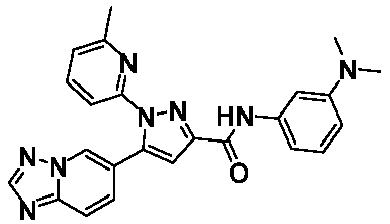
5-([1,2,4]triazolo[1,5-α]pyridin-6-yl)-N-(3-(dimethylamino)phenyl)-1-(6-methylpyridin-2-yl)-1H-pyrazole-3-carboxyamide 1H NMR (300 MHz, CDCl3) δ 8.74 (s, 1H), 8.72 (m, 1H), 8.39 (s, 1H), 7.76-7.69 (m, 2H), 7.58 (d, 1H), 7.46 (d, 1H), 7.31-7.15 (m, 4H), 6.96 (d, 1H), 6.55 (d, 1H), 2.99 (s, 6H), 2.31 (s, 3H). MS (ESI+): m/z 439.2 [M+H]+ 103 
5-([1,2,4]triazolo[1,5-α]pyridin-6-yl)-N-(4-aminophenyl)-1-(6-methylpyridin-2-yl)-1H-pyrazole-3-carboxyamide 1H NMR (300 MHz, DMSO-d6) δ 9.91(s, 1H), 9.18(s, 1H), 8.56(s, 1H), 7.97(t, 1H), 7.82-7.79(m, 2H), 7.54(d, 1H), 7.45(d, 2H), 7.31(d, 1H), 7.24(s, 1H), 6.54(d, 2H), 4.95(br, -NH2), 2.16(s, 3H) MS (ESI+): m/z 411 [M+H]+. 104 
5-([1,2,4]triazolo[1,5-α]pyridin-6-yl)-N-(4-(dimethylamino)phenyl)-1-(6-methylpyridin-2-yl)-1-H-pyrazole-3-carboxyamide 1H NMR (300 MHz, DMSO-d6) δ 9.99(s, 1H), 9.17(s, 1H), 8.55(s, 1H), 7.95(m, 1H), 7.95-7.93(m, 2H), 7.78(d, 2H), 7.53(d, 1H), 7.30-7.25(m, 2H), 6.72(d, 2H), 2.87(s, 6H), 2.16(s, 3H). MS (ESI+): m/z 439 [M+H]+. 105 
5-([1,2,4]triazolo[1,5-α]pyridin-6-yl)-N-(4-(pyrrolidin-1-yl)phenyl)1-(6-methylpyridin-2-yl)- - 1H-pyrazole-3-carboxyamide 1H NMR (300 MHz, CDCl3) δ 8.72 (s, 1H), 8.60 (s, 1H), 8.38 (s, 1H), 7.75-7.69 (m, 2H), 7.58-7.53 (m, 3H), 7.47 (d, 1H), 7.19 (s, 1H), 7.15 (d, 1H), 6.57 (d, 2H), 3.32-3.27(m, 4H), 2.30 (s, 3H), 2.03-1.99 (m, 4H). MS (ESI+): m/z 465.2 [M+H]+ 106 
5-([1,2,4]triazolo[1,5-α]pyridin-6-yl)-N-(4-((2-(dimethylamino)ethyl)(met hyl)amino)phenyl)-1-(6-methylpyridin-2-yl)-1H-pyrazole-3-carboxyamide 1H NMR(300 MHz, CDCl3) δ 8.71 (brs, 1H), 8.64 (s, 1H), 7.78-7.69 (m, 2H), 7.57-7.55 (m, 3H), 7.46 (d, J = 9.3 Hz, 1H), 7.19-7.14 (m, 2H), 6.74 (d, J = 9.0 Hz, 2H), 3.51 (t, J = 7.5 Hz, 2H), 3.96 (s, 3H), 2.57 (t, J = 7.2 Hz, 2H), 2.36 (s, 6H), 2.30 (s, 3H). MS (ESI+): m/z 496 [M+H]+. 107 
5-([1,2,4]triazolo[1,5-α]pyridin-6-yl)-N-(4-(4-methylpiperazin-1- yl)phenyl)-1-(6-methylpyridin-2-yl)-1H-pyrazole-3-carboxyamide 1H NMR (300 MHz, CDCl3) δ 8.72 (s, 1H), 8.70 (s, 1H), 8.38 (s, 1H), 7.77-7.69 (m, 2H), 7.62-7.54 (m, 3H), 7.47 (d, 1H), 7.19-7.14 (m, 2H), 6.95 (d, 2H), 3.21 (m, 4H), 2.60 (m, 4H), 2.36 (s, 3H), 2.31 (s, 3H). MS (ESI+): m/z 494.2 [M+H]+ 108 
5-([1,2,4]triazolo[1,5-α]pyridin-6-yl)-N-(4-(4-acetylpiperazin-1-yl)phenyl)-1-(6-methylpyridin-2-yl)-1H-pyrazole-3-carboxyamide 1H NMR (300 MHz, CDCl3) δ 8.72 (s, 1H), 8.70 (s, 1H), 8.39 (s, 1H), 7.79-7.69 (m, 2H), 7.63 (d, 2H), 7.55 (d, 1H), 7.47 (d, 1H), 7.20-7.15 (m, 2H), 6.95 (d, 2H), 3.80-3.77 (m, 2H), 3.65-3.62 (m, 2H), 3.19-3.12 (m, 4H), 2.31 (s, 3H), 2.15 (s, 3H). MS (ESI+): m/z 522.2 [M+H]+ 109 
5-([1,2,4]triazolo[1,5-α]pyridin-6-yl)-N-(4-((1,1-dioxidotetrahydrothiophen-3-yl)amino)phenyl)-1-(6-methylpyridin-2-yl)-1H-pyrazole-3-carboxyamide 1H NMR(300 MHz, CDCl3) δ 8.72 (brs, 1H), 8.66 (s, 1H), 8.39 (s, 1H), 7.79-7.69 (m, 2H), 7.58-7.54 (m, 3H), 7.46 (d, J = 9.0 Hz, 1H), 7.19-7.15 (m, 2H), 6.66 (d, J = 9.0 Hz, 2H), 4.41-4.36 (m, 1H), 4.01-3.98 (m, 1H), 3.76-3.69 (m, 1H), 3.303.28 (m, 1H), 3.04-3.00 (m, 1H), 2.70-2.50 (m, 1H), 2.36-2.31 (m, 1H), 2.31 (s, 3H). MS (ESI+): m/z 496 [M+H]+. 110 
5-([1,2,4]triazolo[1,5-α]pyridin-6-yl)-N-(4-acetamidophenyl)-1-(6-methylpyridin-2-yl)-1H-pyrazole-3-carboxyamide 1H NMR (300 MHz, DMSO-d6) δ 10.22 (brs, 1H), 9.93 (s, 1H), 9.19 (s, 1H), 8.56 (s, 1H), 7.96 (d, J = 7.8 Hz, 1H), 7.84-7.73 (m, 4H), 7.57-7.50 (m, 3H), 7.32-7.29 (m, 2H), 2.17 (s, 3H), 2.03 (s, 3H). MS (ESI+): m/z 453 [M+H]+. 111 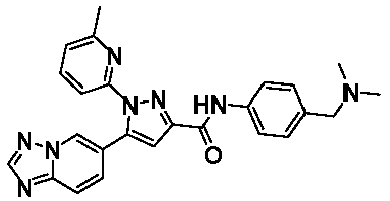
5-([1,2,4]triazolo[1,5-α]pyridin-6-yl)-N-(4-((dimethylamino)methyl)ph enyl)-1-(6-methylpyridin-2-yl)-1H-pyrazole-3-carboxyamide 1H NMR (300 MHz, CDCl3) δ 8.82 (s, 1H), 8.73 (s, 1H), 8.39 (s, 1H), 7.79-7.69 (m, 4H), 7.56 (d, 1H), 7.47 (d, 1H), 7.35 (d, 2H), 7.21 (s, 1H), 7.17 (d, 1H), 3.50 (s, 2H), 2.31 (s, 9H). MS (ESI+): m/z 453.2 [M+H]+ 112 
5-([1,2,4]triazolo[1,5-α]pyridin-6-yl)-N-(2-(methylcarbamoyl)phenyl)-1-(6-methylpyridin-2-yl)-1H-pyrazole-3-carboxyamide 1H NMR (300 MHz, DMSO-d6) δ 12.66 (brs, 1H), 9.21 (s, 1H), 8.77 (brs, 1H), 8.65 (d, J = 8.1 Hz, 1H), 8.57 (s, 1H), 8.01 (t, J = 8.1 Hz, 1H), 7.83-7.77 (m, 3H), 7.59-7.53 (m, 2H), 7.34-7.31 (m, 2H), 7.23-7.18 (m, 1H), 2.83 (s, 3H), 2.15 (s, 3H). MS (ESI+): m/z 453 [M+H]+. 113 
5-([1,2,4]triazolo[1,5-α]pyridin-6-yl)-N-(4-(methylcarbamoyl)phenyl)-1-(6-methylpyridin-2-yl)-1H-pyrazole-3-carboxyamide 1H NMR (300 MHz, DMSO-d6) δ 10.46 (brs, 1H), 9.18 (s, 1H), 8.55 (s, 1H), 8.35 (brs, 1H), 7.98-7.91 (m, 3H), 7.84-7.78 (m, 4H), 7.51 (d, J = 9.3 Hz, 1H), 7.32-7.29 (m, 2H), 2.77 (s, 3H), 2.16 (s, 3H). MS (ESI+): m/z 453 [M+H]+. 114 
5-([1,2,4]triazolo[1,5-α]pyridin-6-yl)-1-(6-methylpyridin-2-yl)-N-phenyl-1H-pyrazole-3-carboxyamide 1H NMR (300 MHz, DMSO-d6) δ 10.29(s, 1H), 9.20(s, 1H), 8.57(s, 1H), 7.95(t, 1H), 7.86-7.80(m, 4H), 7.54(d, 1H), 7.40-7.31(m, 4H), 7.12(t, 1H), 2.18(s, 3H). MS (ESI+): m/z 396 [M+H]+. 115 
5-([1,2,4]triazolo[1,5-α]pyridin-6-yl)-1-(6-methylpyridin-2-yl)-N-(o-tolyl)-1H-pyrazole-3-carboxyamide 1H NMR (300 MHz, CDCl3) δ 8.77 (s, 1H), 8.73 (s, 1H), 8.48 (m, 1H), 8.39 (s, 1H), 8.14-8.11 (m, 3H), 7.77-7.70 (m, 2H), 7.61 (d, 1H), 7.56 (d, 1H), 7.23-7.14 (m, 2H), 2.40 (s, 3H), 2.27 (s, 3H). MS (ESI+): m/z 410.2 [M+H]+ 116 
5-([1,2,4]triazolo[1,5-α]pyridin-6-yl)-1-(6-methylpyridin-2-yl)-N-(m-tolyl)-1H-pyrazole-3-carboxyamide 1H NMR (300 MHz, CDCl3) δ 8.74 (s, 1H), 8.73 (s, 1H), 8.39 (s, 1H), 7.76-7.69 (m, 2H), 7.59-7.45 (m, 4H), 7.29-7.25 (m, 1H), 7.20 (s, 1H), 7.16 (d, 1H), 6.99 (s, 1H), 2.39 (s, 3H), 2.30 (s, 3H). MS (ESI+): m/z 410.2 [M+H]+ 117 
5-([1,2,4]triazolo[1,5-α]pyridin-6-yl)-1-(6-methylpyridin-2-yl)-N-(p-tolyl)-1H-pyrazole-3-carboxyamide 1H NMR (300 MHz, CDCl3) δ 8.72 (s, 2H), 8.38 (s, 1H), 7.78-7.69 (m, 2H), 7.61-7.55 (m, 3H), 7.46 (dd, 1H), 7.19-7.14 (m, 4H), 2.34 (s, 3H), 2.30 (s, 3H). MS (ESI+): m/z 410.2 [M+H]+ 118 
5-([1,2,4]triazolo[1,5-α]pyridin-6-yl)-1-(6-methylpyridin-2-yl)-N-(3-(trifluoromethyl)phenyl)-1H-pyrazole-3-carboxyamide 1H NMR (300 MHz, CDCl3) δ 8.91 (s, 1H), 8.73 (s, 1H), 8.39 (s, 1H), 8.00-7.96 (m, 2H), 7.78-7.70 (m, 2H), 7.58-7.40 (m, 4H), 7.21 (s, 1H), 7.18 (d, 1H), 2.32 (s, 3H). MS (ESI+): m/z 464.1 [M+H]+ 119 
5-([1,2,4]triazolo[1,5-α]pyridin-6-yl)-1-(6-methylpyridin-2-yl)-N-(4-vinylphenyl)-1H-pyrazole-3-carboxyamide 1H NMR (300 MHz, CDCl3) δ 8.80 (s, 1H), 8.73 (s, 1H), 8.39 (s, 1H), 7.80-7.70 (m, 4H), 7.61-7.56 (m, 2H), 7.46 (d, 1H), 7.34 (t, 1H), 7.22-7.15 (m, 2H), 6.73 (dd, 1H), 5.80 (d, 1H), 5.29 (d, 1H), 2.31 (s, 3H). MS (ESI+): m/z 422.2 [M+H]+ 120 
5-([1,2,4]triazolo[1,5-α]pyridin-6-yl)-N-(3-cyanophenyl)-1-(6-methylpyridin-2-yl)-1H-pyrazole-3-carboxyamide 1H NMR (300 MHz, CDCl3) δ 8.90 (s, 1H), 8.73 (s, 1H), 8.40 (s, 1H), 8.12 (m, 1H), 7.95 (d, 1H), 7.78-7.71 (m, 2H), 7.55-7.44 (m, 4H), 7.22 (s, 1H), 7.20 (d, 1H), 2.33 (s, 3H). MS (ESI+): m/z 421.1 [M+H]+ 121 
5-([1,2,4]triazolo[1,5-α]pyridin-6-yl)-N-(4-cyanophenyl)-1-(6-methylpyridin-2-yl)-1-H-pyrazole-3-carboxyamide 1H NMR (300 MHz, DMSO-d6) δ 10.70(s, 1H), 9.18(s, 1H), 8.55(s, 1H), 8.08-8.05(m, 2H), 7.95-7.92(m, 2H), 7.84-7.78(m, 3H), 7.52(d, 1H), 7.35-7.30(m, 2H), 2.25(s, 3H). MS (ESI+): m/z 421 [M+H]+. 122 
5-([1,2,4]triazolo[1,5-α]pyridin-6-yl)-N-(3-acetylphenyl)-1-(6-methylpyridin-2-yl)-1H-pyrazole-3-carboxyamide 1H NMR (300 MHz, DMSO-d6) δ 10.50(s, 1H), 9.18(s, 1H), 8.55(s, 1H), 8.43(s, 1H), 8.12(d, 1H), 7.98-7.93(m,1H), 7.84-7.73(m,2H), 7.73(d, 1H), 7.70-7.52(m, 2H), 7.32(br,2H), 2.58(s, 3H), 2.16(s, 3H). MS (ESI+): m/z 438 [M+H]+. 123 
5-([1,2,4]triazolo[1,5-α]pyridin-6-yl)-N-(4-acetylphenyl)-1-(6-methylpyridin-2-yl)-1H-pyrazole-3-carboxyamide 1H NMR (300 MHz, DMSO-d6) δ 10.59(s, 1H), 9.18(s, 1H), 8.55(s, 1H), 7.99-7.95(m, 5H), 7.83-7.78(m,2H), 7.53(d, 1H), 7.34(br,2H), 2.54(s, 3H), 2.25(s, 3H). MS (ESI+): m/z 438 [M+H]+. 124 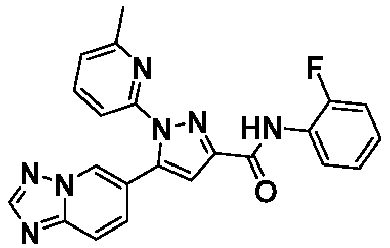
5-([1,2,4]triazolo[1,5-α]pyridin-6-yl)-N-(2-fluorophenyl)-1-(6-methylpyridin-2-yl)-1H-pyrazole-3-carboxyamide 1H NMR (300 MHz, DMSO-d6) δ 10.0(s, 1H), 9.20(s, 1H), 8.57(s, 1H), 7.96(t, 1H), 7.83-7.78(m, 3H), 7.54(d, 1H),7.33-725(m, 5H),2.18(s, 3H). MS (ESI+): m/z 414 [M+H]+. 125 
5-([1,2,4]triazolo[1,5-α]pyridin-6-yl)-N-(3-fluorophenyl)-1-(6-methylpyridin-2-yl)-1H-pyrazole-3-carboxyamide 1H NMR (300 MHz, DMSO-d6) δ 10.48(s, 1H), 9.18(s, 1H), 8.55(s, 1H), 7.98(t, 1H), 7.81-7.78(m, 3H), 7.66(d, 1H), 7.52(d, 1H), 7.48-6.97(m, 3H), 6.91(t, 1H), 2.18(s, 3H). MS (ESI+): m/z 414 [M+H]+. 126 
5-([1,2,4]triazolo[1,5-α]pyridin-6-yl)-N-(4-fluorophenyl)-1-(6-methylpyridin-2-yl)-1H-pyrazole-3-carboxyamide 1H NMR (300 MHz, DMSO-d6) δ 10.37(s, 1H), 9.17(s, 1H), 8.56(s, 1H), 7.98-7.79(m, 5H), 7.52(d, 1H), 7.31-7.17(m, 4H), 2.25(s, 3H). MS (ESI+): m/z 414 [M+H]+. 127 
5-([1,2,4]triazolo[1,5-α]pyridin-6-yl)-N-(2-chlorophenyl)-1-(6-methylpyridin-2-yl)-1H-pyrazole-3-carboxyamide 1H NMR (300 MHz, DMSO-d6) δ 10.00(s, 1H), 9.34(s, 1H), 8.57(s, 1H), 7.97(m, 2H), 7.80(m, 2H), 7.58(m, 3H), 7.42-7.35(m, 3H), 2.17(s, 3H). MS (ESI+): m/z 430 [M+H]+. 128 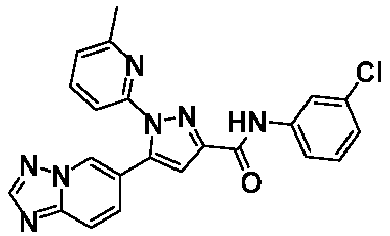
5-([1,2,4]triazolo[1,5-α]pyridin-6-yl)-N-(3-chlorophenyl)-1-(6-methylpyridin-2-yl)-1H-pyrazole-3-carboxyamide 1H NMR (300 MHz, DMSO-d6) δ 10.45(s, 1H), 9.18(s, 1H), 8.55(s, 1H), 8.16(s, 1H), 7.98(t, 1H), 7.86-7.79(m, 3H), 7.50(d, 1H), 7.32(br, 4H), 2.17(s, 3H). MS (ESI+): m/z 430 [M+H]+. 129 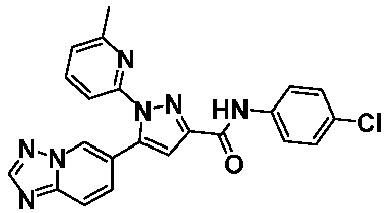
5-([1,2,4]triazolo[1,5-α]pyridin-6-yl)-N-(4-chlorophenyl)-1-(6-methylpyridin-2-yl)-1H-pyrazole-3-carboxyamide 1H NMR (300 MHz, DMSO-d6) δ 10.45(s, 1H), 9.19(s, 1H), 8.57(s, 1H), 7.99-7.80(m, 5H), 7.53(d, 1H), 7.44(m, 2H), 7.31(br, 2H), 2.25(s, 3H). MS (ESI+): m/z 430 [M+H]+. 130 
5-([1,2,4]triazolo[1,5-α]pyridin-6-yl)-N-(2-bromophenyl)-1-(6-methylpyridin-2-yl)-1H-pyrazole-3-carboxyamide 1H NMR (300 MHz, DMSO-d6) δ 9.87(s, 1H), 9.18(s, 1H), 8.56(s, 1H), 7.96-7.93(m, 2H), 7.82-7.74(m, 2H), 7.54-7.43(m, 3H), 7.33(br, 2H), 7.16(t, 1H), 2.16(s, 3H). MS (ESI+): m/z 474 [M+H]+. 131 
5-([1,2,4]triazolo[1,5-α]pyridin-6-yl)-N-(3-bromophenyl)-1-(6-methylpyridin-2-yl)-1H-pyrazole-3-carboxyamide 1H NMR (300 MHz, DMSO-d6) δ 10.45(s, 1H), 9.18(s, 1H), 8.55(s, 1H), 8.16(s, 1H), 7.98(t, 1H), 7.86-7.79(m, 3H), 7.50(d, 1H), 7.32(br, 4H), 2.17(s, 3H). MS (ESI+): m/z 474 [M+H]+. 132 
5-([1,2,4]triazolo[1,5-α]pyridin-6-yl)-N-(4-bromophenyl)-1-(6-methylpyridin-2-yl)-1H-pyrazole-3-carboxyamide 1H NMR (300 MHz, DMSO-d6) δ 10.44(s, 1H), 9.19(s, 1H), 8.57(s, 1H), 7.99(t, 1H), 7.86-7.79(m, 2H), 7.57-7.50(m, 4H), 7.31(br, 3H), 2.25(s, 3H). MS (ESI+): m/z 474 [M+H]+. 133 
5-([1,2,4]triazolo[1,5-α]pyridin-6-yl)-N-(2,3-difluorophenyl)-1-(6-methylpyridin-2-yl)-1H-pyrazole-3-carboxyamide 1H NMR (300 MHz, DMSO-d6) δ 10.27(s, 1H), 9.18(s, 1H), 8.55(s, 1H), 7.97(t, 1H), 7.78(t, 2H), 7.48(d, 2H), 7.31-7.21(m, 4H), 2.16(s, 3H). MS (ESI+): m/z 432 [M+H]+. 134 
5-([1,2,4]triazolo[1,5-α]pyridin-6-yl)-N-(2,4-difluorophenyl)-1-(6-methylpyridin-2-yl)-1H-pyrazole-3-carboxyamide 1H NMR (300 MHz, DMSO-d6) δ 10.08(s, 1H), 9.18(s, 1H), 8.55(s, 1H), 7.97(t, 1H), 7.78(t, 2H), 7.68-7.66(m, 1H), 7.52(d, 1H), 7.37-7.29(m, 3H), 7.13(t, 1H), 2.06(s, 3H). MS (ESI+): m/z 432 [M+H]+. 135 
5-([1,2,4]triazolo[1,5-α]pyridin-6-yl)-N-(2,5-difluorophenyl)-1-(6-methylpyridin-2-yl)-1H-pyrazole-3-carboxyamide 1H NMR (300 MHz, DMSO-d6) δ 10.04(s, 1H), 9.18(s, 1H), 8.55(s, 1H), 7.95(t, 1H), 7.81-7.71(m, 3H), 7.52(d, 1H), 7.41-7.33(br, 3H), 7.13-7.09(m, 1H), 2.17(s, 3H). MS (ESI+): m/z 432 [M+H]+. 136 
5-([1,2,4]triazolo[1,5-α]pyridin-6-yl)-N-(3,4-difluorophenyl)-1-(6-methylpyridin-2-yl)-1H-pyrazole-3-carboxyamide 1H NMR (300 MHz, DMSO-d6) δ 10.64(s, 1H), 9.20(s, 1H), 8.55(s, 1H), 7.95(t, 2H), 7.65(br, 2H), 7.49(br, 1H), 7.49-7.39(m, 2H), 7.32(br, 2H), 2.25(s, 3H). MS (ESI+): m/z 432 [M+H]+. 137 
5-([1,2,4]triazolo[1,5-α]pyridin-6-yl)-N-(3,5-difluorophenyl)-1-(6-methylpyridin-2-yl)-1H-pyrazole-3-carboxyamide 1H NMR(300 MHz, CDCl3) δ 9.19(s, 1H), 8.98(s, 1H), 8.24(s, 1H), 7.80-7.73(m, 2H), 7.70-7.60(m, 3H, 7.55-7.44(m, 3H), 6.64-6.57(m, 1H), 2.25(s, 3H). MS (ESI+): m/z 432 [M+H]+. 138 
5-([1,2,4]triazolo[1,5-α]pyridin-6-yl)-N-(3-chloro-2-fluorophenyl)-1- (6-methylpyridin-2-yl)-1H-pyrazole-3-carboxyamide 1H NMR (300 MHz, DMSO-d6) δ 10.24(s, 1H), 9.18(s, 1H), 8.55(s, 1H), 7.94(t, 2H), 7.78(t, 2H), 7.66(m, 1H), 7.51-7.43(m, 2H), 7.31-7.25(m, 3H), 2.16(s, 3H). MS (ESI+): m/z 448 [M+H]+. 139 
5-([1,2,4]triazolo[1,5-α]pyridin-6-yl)-N-(4-chloro-2-fluorophenyl)-1- (6-methylpyridin-2-yl)-1H-pyrazole-3-carboxyamide 1H NMR (300 MHz, DMSO-d6) δ 10.33(s, 1H), 9.44(s, 1H), 8.56(s, 1H), 7.83(t, 1H), 7.79-7.73(m, 3H), 7.65-7.50(m, 3H), 7.32(br, 2H), 2.18(s, 3H). MS (ESI+): m/z 448 [M+H]+. 140 
5-([1,2,4]triazolo[1,5-α]pyridin-6-yl)-N-(3-chloro-4-fluorophenyl)-1- (6-methylpyridin-2-yl)-1H-pyrazole-3-carboxyamide 1H NMR (300 MHz, DMSO-d6) δ 10.52(s, 1H), 9.18(s, 1H), 8.55(s, 1H), 8.12(d, 2H), 7.95(t, 1H), 7.80-7.78(br, 2H), 7.52-7.40(m, 2H), 7.32(br, 2H), 2.17(s, 3H). MS (ESI+): m/z 448 [M+H]+. 141 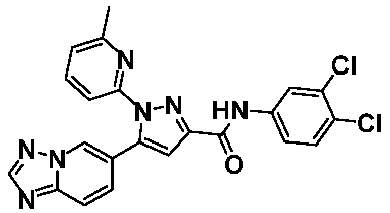
5-([1,2,4]triazolo[1,5-α]pyridin-6-yl)-N-(3,4-dichlorophenyl)-1-(6-methylpyridin-2-yl)-1H-pyrazole-3-carboxyamide 1H NMR (300 MHz, DMSO-d6) δ 10.59(s, 1H), 9.18(s, 1H), 8.55(s, 1H), 7.98(s, 1H), 7.98-7.78(m, 4H), 7.64(d, 1H), 7.61(d, 1H), 7.21(br, 2H), 2.17(s, 3H). MS (ESI+): m/z 464 [M+H]+. 142 
5-([1,2,4]triazolo[1,5-α]pyridin-6-yl)-N-(2-bromo-4-fluorophenyl)-1- (6-methylpyridin-2-yl)-1H-pyrazole-3-carboxyamide 1H NMR (300 MHz, DMSO-d6) δ 10.17(s, 1H), 9.14(s, 1H), 8.49(s, 1H), 7.96(t, 1H), 7.85-7.70(m, 4H), 7.51(m, 1H), 7.32(br, 3H), 2.17(s, 3H). MS (ESI+): m/z 492 [M+H]+. 143 
5-([1,2,4]triazolo[1,5-α]pyridin-6-yl)-N-(3-(methoxythio)phenyl)-1-(6-methylpyridin-2-yl)-1H-pyrazole-3-carboxyamide 1H NMR (300 MHz, CDCl3) δ 8.80 (brs, 1H), 8.73 (s, 1H), 8.39 (s, 1H), 7.76-7.70 (m, 3H), 7.57 (d, J = 7.8 Hz, 1H), 7.48-7.43 (m, 2H), 7.28 (t, J = 7.8 Hz, 1H), 7.19-7.15 (m, 2H), 7.04 (d, J = 8.1 Hz, 1H), 2.52 (s, 3H), 2.19 (s, 3H). MS (ESI+): m/z 442 [M+H]+. 144 
5-([1,2,4]triazolo[1,5-α]pyridin-6-yl)-N-(4-(methoxythio)phenyl)-1-(6-methylpyridin-2-yl)-1H-pyrazole-3-carboxyamide 1H NMR(300 MHz, CDCl3) δ 8.77 (brs, 1H), 8.72 (s, 1H), 8.39 (s, 1H), 7.77-7.66 (m, 4H), 7.56 (d, J = 7.8 Hz, 1H), 7.47 (d, J = 7.8 Hz, 1H), 7.32-7.29 (m, 2H), 7.18-7.16 (m, 2H), 2.50 (s, 3H), 2.32 (s, 3H). MS (ESI+): m/z 442 [M+H]+. 145 
5-([1,2,4]triazolo[1,5-α]pyridin-6-yl)-N-(3-(methylsulfinyl)phenyl)-1-(6-methylpyridin-2-yl)-1H-pyrazole-3-carboxyamide 1H NMR (300 MHz, CDCl3) δ 9.03 (brs, 1H), 8.73 (s, 1H), 8.39 (s, 1H), 8.01-7.98 (m, 2H), 7.78-7.70 (m, 2H), 7.60-7.37 (m, 4H), 7.20-7.16 (m, 2H), 2.77 (s, 3H), 2.30 (s, 3H). MS (ESI+): m/z 458 [M+H]+. 146 
5-([1,2,4]triazolo[1,5-α]pyridin-6-yl)-N-(4-(methylsulfinyl)phenyl)-1-(6-methylpyridin-2-yl)-1H-pyrazole-3-carboxyamide 1H NMR(300 MHz, CDCl3) δ 8.98 (brs, 1H), 8.73 (s, 1H), 8.39 (s, 1H), 7.92 (d, J = 8.4 Hz, 2H), 7.79-7.66 (m, 4H), 7.55 (d, J= 7.8 Hz, 1H), 7.46 (d, J = 9.3 Hz, 1H), 7.21-7.17 (m, 2H), 2.74 (s, 3H), 2.32 (s, 3H). MS (ESI+): m/z 458 [M+H]+. 147 
5-([1,2,4]triazolo[1,5-α]pyridin-6-yl)-N-(4-(methylsulfonyl)phenyl)-1-(6-methylpyridin-2-yl)-1H-pyrazole-3-carboxyamide 1H NMR(300 MHz, CDCl3) δ 9.06 (brs, 1H), 8.75 (s, 1H), 8.41 (s, 1H), 7.97 (m, 4H), 7.82-7.72 (m, 2H), 7.55 (d, J= 8.1 Hz, 1H), 7.48 (d, J = 9.3 Hz, 1H), 7.24-7.20 (m, 2H), 3.09 (s, 3H), 2.35 (s, 3H). MS (ESI+): m/z 474 [M+H]+. 148 
5-([1,2,4]triazolo[1,5-α]pyridin-6-yl)-N-(4-sulfomoylphenyl)-1-(6-methylpyridin-2-yl)-1H-pyrazole-3-carboxyamide 1H NMR (300 MHz, DMSO-d6) δ 10.63 (brs, 1H), 9.21 (s, 1H), 8.57 (s, 1H), 8.04-7.94 (m, 3H), 7.83-7.80 (m, 4H), 7.53 (d, J = 9.3 Hz, 1H), 7.35-7.30 (m, 4H), 2.19 (s, 3H). MS (ESI+): m/z 475 [M+H]+. 149 
5-([1,2,4]triazolo[1,5-α]pyridin-6-yl)-N-(4-(S-methylsulfonimidoyl)pheny 1)-1-(6-methylpyridin-2-yl)-1H-pyrazole-3-carboxyamide 1H NMR(300 MHz, CDCl3) δ 9.05 (brs, 1H), 8.73 (s, 1H), 8.39 (s, 1H), 7.04-7.91 (m, 4H), 7.77-7.70 (m, 2H), 7.53 (d, J= 7.8 Hz, 1H), 7.46 (d, J = 9.3 Hz, 1H), 7.22-7.18 (m, 2H), 3.12 (s, 3H), 2.33 (s, 3H). MS (ESI+): m/z 473 [M+H]+. 150 
5-([1,2,4]triazolo[1,5-α]pyridin-6-yl)-N-(4-(propylsulfonyl)phenyl)-1-(6-methylpyridin-2-yl)-1H-pyrazole-3-carboxyamide 1H NMR (300 MHz, CDCl3) δ 9.06 (brs, 1H), 8.75 (s, 1H), 8.41 (d, J = 6.9 Hz, 2H), 7.80-7.48 (m, 4H), 7.24-7.20 (m, 2H), 7.07 (d, J = 7.2 Hz, 1H), 6.84 (s, 1H), 3.12-3.07 (m, 1H), 2.20 (s, 3H), 1.81-1.71 (m, 2H), 1.02 (t, J = 7.5 Hz, 3H). MS (ESI+): m/z 502 [M+H]+. 151 
5-([1,2,4]triazolo[1,5-α]pyridin-6-yl)-N-(4-(propylsulfonyl)phenyl)-1-(6-methylpyridin-2-yl)-1H-pyrazole-3-carboxyamide 1H NMR (300 MHz, CDCl3) δ 9.04 (brs, 1H), 8.73 (s, 1H), 8.39 (s, 1H), 7.95-7.88 (m, 4H), 7.80-7.70 (m, 2H), 7.54 (d, J = 8.1 Hz, 1H), 7.45 (d, J = 9.3 Hz, 1H), 7.43-7.18 (m, 2H), 2.50-2.44 (m, 1H), 2.33 (s, 3H), 1.38-1.32 (m, 2H), 1.07-1.00 (m, 3H). MS (ESI+): m/z 502 [M+H]+. 152 
5-([1,2,4]triazolo[[1,5-α]pyridin-6-yl)-N-(6-fluoropyridin-3-yl)-1-(6-methylpyridin-2-yl)-1H-pyrazole-3-carboxyamide 1H NMR (300 MHz, DMSO-d6) δ 10.68 (brs, 1H), 9.21 (s, 1H), 8.67 (s, 1H), 8.57 (s, 1H), 8.40 (t, J = 6.9 Hz, 1H), 7.97 (t, J = 7.8 Hz, 1H), 7.83-7.78 (m, 2H), 7.51 (d, J= 9.3 Hz, 1H), 7.35-7.33 (m, 2H), 7.24 (d, J = 8.7 Hz, 1H), 2.20 (s, 3H). MS (ESI+): m/z 415 [M+H]+. 153 
5-([1,2,4]triazolo[1,5-α]pyridin-6-yl)-N-(6-chloropyridin-3-yl)-1-(6-methylpyridin-2-yl)-1H-pyrazole-3-carboxyamide 1H NMR (300 MHz, DMSO-d6) δ 9.42(s, 1H), 8.74(s, 1H), 8.49(br, 2H), 7.91(t, 1H), 7.75(d, 1H), 7.64(d, 2H), 7.50-7.48(m, 2H), 7.37(d, 1H), 7.27(s, 1H), 2.13(s, 3H). MS (ESI+): m/z 431 [M+H]+. 154 
5-([1,2,4]triazolo[1,5-α]pyridin-6-yl)-N-(6-methoxypyridin-3-yl)-1-(6-methylpyridin-2-yl)-1H-pyrazole-3-carboxyamide 1H NMR(300 MHz, CDCl3) δ 8.72 (brs, 1H), 8.71 (s, 1H), 8.68-8.36 (m, 2H), 8.11 (d, J = 9.0 Hz, 1H), 7.76-7.69 (m, 2H), 7.54 (d, J = 7.8 Hz, 1H0, 7.45 (d, J = 9.0 Hz, 1H), 7.24-7.15 (m, 2H), 6.79 (d, J = 9.0 Hz, 1H), 3.94 (s, 3H), 2.32 (s, 3H). MS (ESI+): m/z 427 [M+H]+. 155 
5-([1,2,4]triazolo[1,5-α]pyridin-6-yl)-N-(2-fluorobenzyl)-1-(6-methylpyridin-2-yl)-1H-pyrazole-3-carboxyamide 1H NMR (300 MHz, DMSO-d6) δ 9.25(s, 1H), 9.01(t, 1H), 8.54(s, 1H), 7.89(t, 1H), 7.77(d, 1H), 7.70(d, 1H), 7.51(d, 1H), 7.38-7.27(m, 3H), 7.14(br, 2H), 4.54(d, 2H), 2.15(s, 3H). MS (ESI+): m/z 428 [M+H]+. 156 
5-([1,2,4]triazolo[1,5-α]pyridin-6-yl)-N-(3-fluorobenzyl)-1-(6-methylpyridin-2-yl)-1H-pyrazole-3-carboxyamide 1H NMR (300 MHz, DMSO-d6) δ 9.15(s, 1H), 9.00(t, 1H), 7.95(s, 1H), 7.81(t, 1H), 7.78(d, 1H), 7.71(d, 1H), 7.52(d, 1H), 7.48-7.28(m, 3H), 7.15(br, 2H), 4.55(d, 2H), 2.15(s, 3H). MS (ESI+): m/z 428 [M+H]+. 157 
5-([1,2,4]triazolo[1,5-α]pyridin-6-yl)-N-(4-fluorobenzyl)-1-(6-methylpyridin-2-yl)-1H-pyrazole-3-carboxyamide 1H NMR (300 MHz, DMSO-d6) δ 9.21(s, 1H), 9.10(t, 1H), 8.61(s, 1H), 7.87(t, 1H), 7.83(d, 1H), 7.75(d, 1H), 7.57(d, 1H), 7.46-7.42(m, 2H), 7.33(d, 1H), 7.18(br, 3H), 4.53(d, 2H), 2.22(s, 3H). MS (ESI+): m/z 428 [M+H]+. 158 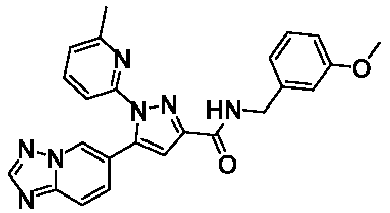
5-([1,2,4]triazolo[1,5-α]pyridin-6-yl)-N-(3-methoxybenzyl)-1-(6-methylpyridin-2-yl)-1H-pyrazole-3-carboxyamide 1H NMR(300 MHz, CDCl3) δ 8.71 (brs, 1H), 8.39 (s, 1H), 7.72-7.69 (m, 2H), 7.52-7.45 (m, 2H), 7.31-7.11 (m, 3H), 6.99-6.87 (m, 3H), 4.66 (d, J = 4.0 Hz, 2H), 3.82 (s, 3H), 2.28 (s, 3H). MS (ESI+): m/z 440 [M+H]+. 159 
5-([1,2,4]triazolo[1,5-α]pyridin-6-yl)-N-(4-methoxybenzyl)-1-(6-methylpyridin-2-yl)-1H-pyrazole-3-carboxyamide 1H NMR(300 MHz, CDCl3) δ 8.71 (brs, 1H), 8.39 (s, 1H), 7.72-7.68 (m, 2H), 7.51-7.44 (m, 2H), 7.33 (d, J = 8.7 Hz, 2H), 7.15-7.11 (m, 2H), 6.91 (d, J = 8.7 Hz, 2H), 4.62 (d, J = 4.0 Hz, 2H), 3.82 (s, 3H), 2.28 (s, 3H). MS (ESI+): m/z 440 [M+H]+. 160 
5-([1,2,4]triazolo[1,5-α]pyridin-6-yl)-N-(4-(dimethylamino)benzyl)-1- (6-methylpyridin-2-yl)-1H-pyrazole-3-carboxyamide 1H NMR (300 MHz, CDCl3) δ 8.70 (s, 1H), 8.37 (s, 1H), 7.70-7.66 (m, 2H), 7.47 (dd, 2H), 7.28-7.25 (m, 3H), 7.13 (s, 1H), 7.10 (d, 1H), 6.73 (d, 2H), 4.57 (d, 2H), 2.94 (s, 6H), 2.25 (s, 3H). MS (ESI+): m/z 453.2 [M+H]+ 161 
5-([1,2,4]triazolo[1,5-α]pyridin-6-yl)-N-(-acetamidobenzyl)-1-(6-methylpyridin-2-yl)-1H-pyrazole-3-carboxyamide 1H NMR (300 MHz, DMSO-d6) δ 8.90 (brs, 1H), 9.15 (s, 1H), 8.99 (t, 1H), 8.55 (s, 1H), 7.91 (t, J = 8.1 Hz, 1H), 7.80 (d, J = 9.3 Hz, 1H), 7.72 (d, J = 8.1 Hz, 1H), 7.53-7.47 (m, 3H), 7.29-7.24 (m, 3H), 7.18 (s, 1H), 4.42 (d, J = 4.0 Hz, 2H), 2.15 (s, 3H), 2.01 (s, 3H). MS (ESI+): m/z 467 [M+H]+. 162 
5-([1,2,4]triazolo[1,5-α]pyridin-6-yl)-1-(6-methylpyridin-2-yl)-N-(1-(methylsulfonyl)-1H-pyrazol-4-yl)-1H-pyrazole-3-carboxyamide 1H NMR (300 MHz, DMSO-d6) δ 8.76(s, 1H), 8.73(s, 1H), 8.62(s, 1H), 8.39(s, 1H), 8.01(s, 1H), 7.79-7.70(m, 2H), 7.53(d, 1H), 7.45(d, 1H), 7.20-7.17(m, 2H), 3.33(s, 3H), 2.33(s, 3H). MS (ESI+): m/z 464.1 [M+H]+. 163 
5-([1,2,4]triazolo[1,5-α]pyridin-6-yl)-N-(1-cyclopropylsulfonyl)-1H-pyrazol-4-yl)-1-(6-methylpyridin-2-yl)-1H-pyrazole-3-carboxyamide 1H NMR (300 MHz, DMSO-d6) δ 8.78(s, 1H), 8.73(s, 1H), 8.59(s, 1H), 8.40(s, 1H), 7.99(s, 1H), 7.79-7.71(m, 2H), 7.53(d, 1H), 7.45(d, 1H), 7.20-7.17(m, 2H), 2.80-2.75(m, 1H), 2.33(s, 3H), 1.57-1.50(m, 2H), 1.19-1.14(m, 2H). MS (ESI+): m/z 506.1 [M+H]+. -

- After dissolving Intermediate 3 (50 mg, 0.15 mmol) in N,N-dimethylformamide, HATU (69 mg, 0.18 mmol) and DIPEA (79 µL, 0.45 mmol) were introduced thereto, and the result was stirred for 30 minutes at room temperature. To the reaction solution, p-anisidine (20 mg, 0.17 mmol) was introduced, and the result was stirred for 12 hours at room temperature. Produced solids were filtered, washed with ethyl acetate, and then vacuum dried to obtain a target compound (42 mg).
- 1H NMR spectrum (300 MHz, DMSO-d6) δ 10.1(s, 1H), 8.96(s, 2H), 8.07-7.93(m, 3H), 7.78-7.73(m, 4H), 7.37(br, 2H), 6.92(d, 2H), 3.75(s, 3H), 2.17(s, 3H).
- MS (ESI+): [M+H] + m/z 437.1
- Compounds of Examples 161 to 198 listed in the following Table 5 were obtained in the same manner as in Example 160 using various amine derivatives instead of p-anisidine.
Table 5 Example Number Structure Compound Name 1H NMR Spectrum (300 MHz, CDCl3)δ MS (ES) Actual Measurement Value [M+H]+/ Required Value 165 
N-(3-methoxyphenyl)-1-(6-methylpyridin-2-yl)-5-(quinoxalin-6-yl)-1H-pyrazole-3-carboxyamide 10.2(s, 1H), 8.96(s, 2H), 8.07-8.03(m, 2H), 7.96(t, 1H), 7.75(t, 2H), 7.53-7.46(m, 2H), 7.40-7.34(m, 2H), 7.26(t, 1H), 6.69(d, 1H), 3.76(s, 3H), 2.17(s, 3H) 437.1/436.1 166 
N-(2-methoxyphenyl)-1-(6-methylpyridin-2-yl)-5-(quinoxalin-6-yl)-1H-pyrazole-3-carboxyamide 9.43(s, 1H), 8.97(s, 2H), 8.28(d, 1H), 8.07-7.95(m, 3H), 7.78(dd, 2H), 7.43(s, 1H), 7.39(d, 1H), 7.15(br, 2H), 7.13(m, 1H), 3.91(s, 3H), 2.19(s, 3H) 437.1/436.1 167 
N-(4-(2-methoxyethoxy)phenyl)-1-(6-methylpyridin-2-yl)-5-(quinoxalin-6-yl)-1H-pyrazole-3-carboxyamide 8.87(s, 2H), 8.78(s, 1H), 8.09-8.03(m, 2H), 7.70-7.63(m, 4H), 7.37(d, 1H), 7.29(s, 1H), 7.17(d, 1H), 6.95(d, 2H), 4.14(q, 2H), 3.76(q, 2H), 3.46(s, 3H), 2.34(s, 3H) 481.2/480.2 168 
N-(benzo[d][1,3]dioxol-5-yl)-1-(6-methylpyridin-2-yl)-5-(quinoxalin-6-yl)-1H-pyrazole-3-carboxyamide 10.19(s, 1H), 8.95(s, 2H), 8.06-8.00(m, 2H), 7.94(t, 1H), 7.76-7.68(m, 2H), 7.48(d, 1H), 6.89(d, 1H), 5.99(s, 2H), 2.16(s, 3H) 450.1/451.1 169 
N-(2,3-dihydrobenzo[b][1,4]dio xin-6-yl)-1-(6-methylpyridin-2-yl)-5-(quinoxalin-6-yl)-1H-pyrazole-3-carboxyamide 8.87(s, 2H), 8.71(s, 1H), 8.08-8.03(m, 2H), 7.70-7.64(m, 2H), 7.39-7.36(m, 2H), 7.29(s, 1H), 7.18-7.10(m, 2H), 6.86(d, 1H), 4.29-4.25(m, 4H), 2.34(s, 3H) 465.2/464.2 170 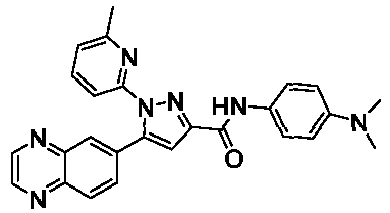
N-(4-(dimethylamino)phenyl) -1-(6-methylpyridin-2-yl)-5-(quinoxalin-6-yl)-1H-pyrazole-3-carboxyamide 9.97(s, 1H), 8.95(s, 2H), 8.05-7.91(m, 3H), 7.76-7.60(m, 4H), 7.33(br, 2H), 6.79-6.70(m, 3H), 2.86(s, 6H), 2.06(s, 3H) 450.2/449.2 171 
1-(6-methylpyridin-2-yl)-N-(4-morpholinophenyl)-5-(quinoxalin-6-yl)-1H-pyrazole-3-carboxyamide 8.87(s, 2H), 8.75(s, 1H), 8.09-8.04(m, 2H), 7.71-7.63(m, 4H), 7.38(d, 1H), 7.30(s, 1H), 7.18(d, 1H), 6.94(d, 2H), 3.88(t, 4H), 3.16(t, 4H), 2.35(s, 3H) 492.2/491.2 172 
N-(4-(4-methylpiperazin-1- yl)phenyl)-1-(6-methylpyridin-2-yl)-5-(quinoxalin-6-yl)-1H-pyrazole-3-carboxyamide (300 MHz, DMSO-d6) δ 10.07(s, 1H), 8.97(s, 2H), 8.07-8.03(m, 2H), 7.96(t, 1H), 7.78-7.66(m, 4H), 7.36(s, 2H), 6.93(d, 2H), 3.31(s, 3H), 3.12-3.11(m, 4H), 2.25-2.22(m, 4H), 2.17(s, 3H) 505.2/504.2 173 
N-(4-(4-acetylpiperazin-1-yl)phenyl)-1-(6-methylpyridin-2-yl)-5-(quinoxalin-6-yl)-1H-pyrazole-3-carboxyamide 8.91(s, 2H), 8.74(s, 1H), 8.08-8.03(m, 2H), 7.73-7.63(m, 4H), 7.37(d, 1H), 7.29(s, 1H), 7.17(d, 1H), 6.96(d, 2H), 3.80-3.79(m, 2H), 3.65-3.63(m, 2H), 3.19-3.14(m, 4H), 2.35(s, 3H), 2.15(s, 3H) 533.3/532.3 174 
N-(4-cyanophenyl)-1-(6-methylpyridin-2-yl)-5-(quinoxalin-6-yl)-1H-pyrazole-3-carboxyamide 9.05(s, 1H), 8.88(s, 2H), 8.09-8.05(m, 2H), 7.88(d, 2H), 7.75-7.64(m, 4H), 7.35(d, 1H), 7.31(s, 1H), 7.21(d, 1H), 2.38(s, 3H) 432.2/431.1 175 
N-(3-cyanophenyl)-1-(6-methylpyridin-2-yl)-5-(quinoxalin-6-yl)-1H-pyrazole-3-carboxyamide 8.97(s, 1H), 8.88(s, 2H), 8.15(s, 1H), 8.09-8.05(m, 2H), 7.96(d, 1H), 7.72-7.65(m, 2H), 7.49-7.44(m, 2H), 7.36(d, 1H), 7.31(s, 1H), 7.20(d, 1H), 2.37(s, 3H) 432.2/431.1 176 
N-(2-cyanophenyl)-1-(6-methylpyridin-2-yl)-5 - (quinoxalin-6-yl)-1H-pyrazole-3-carboxyamide 9.56(s, 1H), 8.88(s, 2H), 8.66(d, 1H), 8.13(d, 1H), 8.05(d, 1H), 7.78(t, 1H), 7.71-7.64(m, 4H), 7.28(s, 1H), 7.21(t, 1H), 7.13(d, 1H), 2.19(s, 3H) 432.2/431.1 177 
1-(6-methylpyridin-2-yl)-N-(4-(morpholinomethyl)phen yl)-5-(quinoxalin-6-yl)-1H-pyrazole-3-carboxyamide 8.87(s, 3H), 8.09-8.04(m, 2H), 7.73-7.64(m, 4H), 7.38-7.30(m, 4H), 7.18(d, 1H), 3.76-3.71(m,4H), 3.50(s, 2H), 2.48-2.45(m, 4H), 2.36(s, 3H) 506.2/505.2 178 
N-(4-acetylphenyl)-1-(6-methylpyridin-2-yl)-5-(quinoxalin-6-yl)-1H-pyrazole-3-carboxyamide 9.04(s, 1H), 8.88(s, 2H), 8.10-8.00(m, 4H), 7.85(d, 2H), 7.75-7.65(m, 2H), 7.38(d, 1H), 7.32(s, 1H), 7.21(d, 1H), 2.61(s, 3H), 2.37(s, 3H) 449.2/448.2 179 
N-(3-acetylphenyl)-1-(6-methylpyridin-2-yl)-5-(quinoxalin-6-yl)-1H-pyrazole-3-carboxyamide (300 MHz, DMSO-d6) 10.5(s, 1H), 8.97(s, 2H), 8.46(br, 1H), 8.17(d, 1H), 8.07-8.04(m, 2H), 7.97(t, 1H), 7.79-7.76(m, 3H), 7.56(t, 1H), 7.37(s, 1H), 7.35(d,1H), 2.59(s, 3H), 2.18(s, 3H) 449.1/ 448.1 180 
1-(6-methylpyridin-2-yl)-5-(quinoxalin-6-yl)-N-(4-(trifluoromethyl)phenyl) -1H-pyrazole-3-carboxyamide (300 MHz, DMSO-d6) 10.6(s, 1H), 8.96(s, 2H), 8.11-7.93(m, 4H), 7.78-7.72(m, 3H), 7.44(s, 1H), 7.35(d, 1H), 2.07(s, 3H) 475.1/474.1 181 
1-(6-methylpyridin-2-yl)-5-(quinoxalin-6-yl)-N-(3-(trifluoromethyl)phenyl) -1H-pyrazole-3-carboxyamide (300 MHz, DMSO-d6) 10.6(s, 1H), 8.97(s, 2H), 8.33(br, 1H), 8.15(d, 1H), 8.08-8.00(m, 2H), 7.94(t, 1H), 7.79-7.74(m, 2H), 7.72(t, 1H), 7.43(d,1H), 7.38(s, 1H), 7.35(d, 1H), 2.08(s, 3H) 475.1/474.1 182 
N-(4-(methylcarbamoyl)phenyl)-1-(6-methylpyridin-2-yl)-5-(quinoxalin-6-yl)-1H-pyrazole-3-carboxyamide (300 MHz, DMSO-d6) 10.4(s, 1H), 8.94(s, 2H), 8.34(br, 1H), 8.06-7.91(m, 5H), 7.83-7.70(m, 4H), 7.40(s, 1H), 7.33(d, 1H), 2.77(s, 3H), 2.05(s, 3H) 464.1/ 463.1 183 
N-(4-fluorophenyl)-1-(6-methylpyridin-2-yl)-5-(quinoxalin-6-yl)-1H-pyrazole-3-carboxyamide 8.87-8.85(m, 3H), 8.08-8.04(m, 2H), 7.73-7.64(m, 4H), 7.35(d, 1H), 7.30(s, 1H), 7.18(d, 1H), 7.07(t, 2H), 2.36(s, 3H) 425.1/424.1 184 
N-(3-fluorophenyl)-1-(6-methylpyridin-2-yl)-5-(quinoxalin-6-yl)-1H-pyrazole-3-carboxyamide 10.50(s, 1H), 8.97(s, 2H), 8.08-7.94(m, 3H), 7.84-7.68(m, 4H), 7.42(s, 1H), 7.38-7.35(m, 2H), 6.95(t, 1H), 2.12(s, 3H) 425.2/421.1 185 
N-(2-fluorophenyl)-1-(6-methylpyridin-2-yl)-5-(quinoxalin-6-yl)-1H-pyrazole-3-carboxyamide 9.11(s, 1H), 8.87(s, 2H), 8.53(t, 1H), 8.11-8.04(m, 2H), 7.77-7.66(m, 2H), 7.51(d, 1H), 7.29(s, 1H), 7.20-7.11(m, 4H), 2.28(s, 3H) 425.2/424.1 186 
N-(3,4-difluorophenyl)-1-(6-methylpyridin-2-yl)-5-(quinoxalin-6-yl)-1H-pyrazole-3-carboxyamide 8.87(s, 2H), 8.83(s, 1H), 8.08-8.04(m, 2H), 7.84-7.80(m, 1H), 7.71-7.63(m, 2H), 7.35(d, 1H), 7.28(s, 2H), 7.25-7.17(m, 2H), 2.36(s, 3H) 443.1/442.1 187 
N-(2,4-difluorophenyl)-1-(6-methylpyridin-2-yl)-5-(quinoxalin-6-yl)-1H-pyrazole-3-carboxyamide 8.98(s, 1H), 8.87(s, 2H), 8.48-8.45(m, 1H), 8.10(d, 1H), 8.05(d, 1H), 7.74(t, 1H), 7.66(dd, 1H), 7.48(d, 1H), 7.28(s, 1H), 7.16(d, 1H), 6.96-6.91(m, 2H), 2.28(s, 3H) 443.1/442.1 188 
N-(2,3-difluorophenyl)-1-(6-methylpyridin-2-yl)-5-(quinoxalin-6-yl)-1H-pyrazole-3-carboxyamide 9.13(s, 1H), 8.88(s, 2H), 8.30(t, 1H), 8.11-8.04(m, 2H), 7.75(t, 1H), 7.67(dd, 1H), 7.50(d, 1H), 7.29(s, 1H), 7.19-7.12(m, 2H), 6.94(q, 1H), 2.28(s, 3H) 443.1/442.1 189 
N-(4-chlorophcnyl)-1-(6-methylpyridin-2-yl)-5-(quinoxalin-6-yl)-1H-pyrazole-3-carboxyamide 8.87(s, 3H), 8.08-8.04(m, 2H), 7.73-7.63(m, 4H), 7.36-7.29(m, 4H), 7.18(d, 1H), 2.36(s, 3H) 441.1/440.1 190 
N-(2-chlorophenyl)-1-(6-methylpyridin-2-yl)-5-(quinoxalin-6-yl)-1H-pyrazole-3-carboxyamide 9.51(s, 1H), 8.87(s, 2H), 8.61(d, 1H), 8.12(d, 1H), 8.05(d, 1H), 7.77(t, 1H), 7.69(dd, 1H), 7.59(d, 1H), 7.43(dd, 1H), 7.34(t, 1H), 7.29(s, 1H), 7.15(d, 1H), 7.09(t, 1H), 2.23(s, 1H) 441.1/440.1 191 
N-(4-bromophenyl)-1-(6-methylpyridin-2-yl)-5-(quinoxalin-6-yl)-1H-pyrazole-3-carboxyamide (300 MHz, DMSO-d6) δ 10.44 (s, 1H), 8.97(s, 2H), 8.08-8.04(m, 2H), 7.96(t, 1H), 7.84(d, 2H), 7.78-7.71(m, 2H), 7.55(s, 2H), 7.41(s, 1H), 7.36(d, 1H), 2.18(s, 3H) 485.1/484.1 192 
N-(6-methoxypyridin-3-yl)-1-(6-methylpyridin-2-yl)-5-(quinoxalin-6-yl)-1H-pyrazole-3-carboxyamide (300 MHz, DMSO-d6) δ 10.40 (s, 1H), 8.96(s, 2H), 8.59(d, 1H), 8.14-8.03(m, 3H), 7.96(t, 1H), 7.77(d, 1H), 7.70(d, 1H), 7.40(s, 1H), 7.36(d, 1H), 6.85(d, 1H), 3.85(s, 3H), 2.19(s, 3H) 438.2/437.2 193 
N-(4-methoxybenzyl)-1-(6-methylpyridin-2-yl)-5-(quinoxalin-6-yl)-1H-pyrazole-3-carboxyamide 8.86(s, 2H), 8.06-8.02(m, 2H), 7.65(t, 2H), 7.33-7.24(m, 5H), 7.12(d, 1H), 6.89(d, 2H), 4.61(d, 2H), 3.81(s, 3H), 2.29(s, 3H) 451.2/450.2 194 
N-(4-cyanobenzyl)-1-(6-methylpyridin-2-yl)-5-(quinoxalin-6-yl)-1H-pyrazole-3-carboxyamide 8.87(s, 2H), 8.06(d, 1H), 8.03(s, 1H), 7.69-7.62(m, 4H), 7.51-7.49(m, 3H), 7.30(d, 1H), 7.25(s, 1H), 7.16(d, 1H), 4.74(d, 2H), 2.33(s, 3H) 446.2/445.2 195 
N-(3-acetylbenzyl)-1-(6-methylpyridin-2-yl)-5-(quinoxalin-6-yl)-1H-pyrazole-3-carboxyamide 8.86(s, 2H), 8.07-8.02(m, 2H), 7.97(s, 1H), 7.88(d, 1H), 7.66-7.61(m, 3H), 7.49-7.44(m, 2H), 7.32(d, 1H), 7.25(s, 1H), 7.14(d, 1H), 4.74(d, 2H), 2.62(s, 3H), 2.31(s, 3H) 463.2/462.2 196 
N-(4-fluorobenzyl)-1-(6-methylpyridin-2-yl)-5-(quinoxalin-6-yl)-1H-pyrazole-3-carboxyamide 8.86(s, 2H), 8.06-8.02(m, 2H), 7.65-7.62(m, 2H), 7.38-7.29(m, 4H), 7.25(s, 1H), 7.14(d, 1H), 7.04(t, 2H), 4.65(d, 2H), 2.31(s, 3H) 439.2/438.2 197 
N-(3 -fluorobenzyl)-1 -(6-methylpyridin-2-yl)-5-(quinoxalin-6-yl)-1H-pyrazole-3-carboxyamide 8.86(s, 2H), 8.07-8.03(m, 2H), 7.66-7.63(m, 2H), 7.42(t, 1H), 7.34-7.30(m, 2H), 7.25(s, 1H), 7.18-7.13(m, 3H), 6.98(t, 1H), 4.68(d, 2H), 2.31(s, 3H) 439.2/438.2 198 
N-(2-fluorobenzyl)-1-(6-methylpyridin-2-yl)-5-(quinoxalin-6-yl)-1H-pyrazole-3-carboxyamide 8.86(s, 2H), 8.06-8.02(m, 2H), 7.67-7.62(m, 2H), 7.49-7.33(m, 3H), 7.23(s, 1H), 7.15-7.04(m, 3H), 4.74(d, 2H), 2.30(s, 3H) 439.2/438.2 199 
N-(4-chlorobenzyl)-1-(6-methylpyridin-2-yl)-5-(quinoxalin-6-yl)-1H-pyrazole-3-carboxyamide 8.86(s, 2H), 8.06-8.02(m, 2H), 7.68-7.62(m, 2H), 7.40(t, 1H), 7.32-7.30(m, 3H), 7.25(d, 2H), 7.14(d, 1H), 4.65(d, 2H), 2.31(s, 3H) 455.1/454.1 200 
N-(3-chlorobenzyl)-1-(6-methylpyridin-2-yl)-5-(quinoxalin-6-yl)-1H-pyrazole-3-carboxyamide 8.84(s, 2H), 8.05-8.01(m, 2H), 7.67-7.61(m, 2H), 7.36(s, 1H), 7.25-7.23(m, 5H), 7.13(d, 1H), 4.63(d, 2H), 2.78(s, 3H) 455.1/454.1 201 
N-(2-chlorobenzyl)-1-(6-methylpyridin-2-yl)-5-(quinoxalin-6-yl)-1H-pyrazole-3-carboxyamide 8.86(s, 2H), 8.06-8.02(m, 2H), 7.67-7.62(m, 2H), 7.51-7.49(m, 2H), 7.37-7.34(m, 2H), 7.26-7.23(m 2H), 7.14(d, 2H), 4.78(d, 2H), 2.80(s, 3H) 455.1/454.1 -

- A target compound (3 mg) was obtained in the same manner as in Example 160 except that phenylhydrazine was used instead of 2-hydrazinyl-6-methylpyridine hydrochloric acid in Step 3 of Preparation Example 3, and 2-fluoroaniline was used instead of p-anisidine of Example 160.
- 1H NMR spectrum (300 MHz, CDCl3) δ 9.08(s, 1H), 8.87(s, 2H), 8.53(t, 1H), 8.07-8.03(m, 2H), 7.59(dd, 1H), 7.32(s, 2H), 7.24-7.07(m, 6H), 2.37(s, 3H).
- MS (ESI+): [M+H]+ m/z 424.2
- Compounds of Examples 203 to 208 listed in the following Table 6 were obtained in the same manner as in Example 202.
Table 6 Example Number Structure Compound Name 1H NMR Spectrum (300 MHz, CDCl3)δ MS (ES) Actual Measurement Value [M+H]+ /Required Value 203 
1-(5-chloro-2-fluorophenyl)-N (4-methoxyphenyl)-5-(quinoxalin-6-yl)-1H-pyrazole-3-carboxyamide 8.87-8.85(m, 2H), 8.67(s, 1H), 8.10(d, 1H), 7.97(d, 1H), 7.71-7.62(m, 4H), 7.40-7.35(m, 1H), 7.33(s, 1H), 7.04(t, 1H), 6.92(d, 2H), 3.82(s, 3H) 474.1/473.1 204 
1-(5-chloro-2-fluorophenyl)-N-(4-(dimethylamino)phenyl) -5-(quinoxalin-6-yl)-1H-pyrazole-3-carboxyamide 8.86-8.85(m, 2H), 8.60(s, 1H), 8.10(d, 1H), 7.97(d, 1H), 7.71-7.68(m, 2H), 7.57(d, 2H), 7.43-7.40(m, 1H), 7.32(s, 1H), 7.03(t, 1H), 6.75(d, 2H), 2.95(s, 3H) 487.1/486.1 205 
N-(4-methoxyphenyl)-5-(quinoxalin-6-yl)-1-(6-trifluoromethyl)pyridin-2-yl)-1H-pyrazole-3-carboxyamide 8.89-8.86(m, 2H), 8.73(s, 1H), 8.14-8.02(m, 4H), 7.73(d, 1H), 7.65(d, 2H), 7.60(d, 1H), 6.93(d, 2H), 3.82(s, 3H) 491.1/490.1 206 
N-(4-(dimethylamino)phenyl) -5-(quinoxalin-6-yl)-1-(6-trifluoromethyl)pyridin-2-yl)-1H-pyrazole-3-carboxyamide 8.89-8.86(m, 2H), 8.65(s, 1H), 8.15-8.03(m, 4H), 7.74(d, 1H), 7.61-7.58(m, 3H), 6.77(d, 2H), 2.96(s, 6H) 504.2/503.2 207 
1-(6-bromopyridin-2-yl)-N-(4-methoxyphenyl)-5-(quinoxalin-6-yl)-1H-pyrazole-3-carboxyamide 8.89(s, 2H), 8.75(s, 1H), 8.13-8.10(m, 2H), 7.72-7.63(m, 5H), 7.46-7.44(m, 1H), 6.93(d, 2H), 3.82(s, 3H) 501.1/500.1 208 
1-(6-bromopyridin-2-yl)-N-(4-(dimethylamino)phenyl) -5-(quinoxalin-6-yl)-1H-pyrazole-3-carboxyamide 8.88(s, 2H), 8.65(s, 1H), 8.12-8.09(m, 2H), 7.70(dd, 3H), 7.59(d, 2H), 7.44(d, 1H), 6.77(d, 2H), 2.95(s, 6H) 514.1/513.1 -

- After dissolving 1-(6-methylpyridin-2-yl)-5-(quinolin-4-yl)-1H-pyrazole-3-carboxylic acid (40 mg, 0.1 mmol) synthesized in Step 5 of Preparation Example 4 in dichloromethane, HATU (55 mg, 0.1 mmol) and DIPEA (47 µL, 0.4 mmol) were introduced thereto, and the result was stirred for 20 minutes at room temperature. To the reaction solution, 2-fluoroaniline (13 mg, 0.1 mmol) was introduced, and the result was stirred for 12 hours at room temperature. After terminating the reaction, ethyl acetate was added thereto. The result was washed with sodium bicarbonate, then dried using anhydrous magnesium sulfate, and after filtering, the filtrate was concentrated. The filtrate was purified using column chromatography to obtain a target compound (16 mg).
- 1H NMR spectrum (300 MHz, CDCl3) δ 9.17(s, 1H), 8.93(d, 1H), 8.55(t, 1H), 8.15(d, 1H), 7.69-7.60(m, 4H), 7.41(t, 1H), 7.33(d, 1H), 7.25-7.12(m, 4H), 6.95(d, 1H), 1.83(s, 3H).
- MS (ESI+): [M+H]+ m/z 424.2
- Compounds of Examples 210 to 217 listed in the following Table 7 were obtained in the same manner as in Example 209 using various amine derivatives instead of 2-fluoroaniline.
Table 7 Example Structure Compound Name Material Information 210 
N (4-methoxyphenyl)-1-(6-methylpyridin-2-yl)-5-(quinolin-4-yl)-1H-pyrazole-3-carboxyamide 1H NMR (300 MHz, CDCl3) δ 8.92(d, 1H), 8.78(s, 1H), 8.15(d, 1H), 7.72-7.57(m, 5H), 7.48-7.40(m, 2H), 7.32(d, 1H), 7.26(s, 1H), 6.95(d, 3H), 3.83(s, 3H), 1.92(s, 3H). MS (ESI+): [M+H]+ m/z 436 211 
1-(6-methylpyridin-2-yl)-N-(4-(methylsulfonyl)phenyl) -5-(quinolin-4-yl)-1H-pyrazole-3-carboxyamide 1H NMR (300 MHz, CDCl3) δ 9.13(s, 1H), 8.93(d, 1H), 8.16(d, 1H), 7.98(s, 4H), 7.71(t, 1H), 7.65-7.58(m, 2H), 7.44(d, 2H), 7.33-7.28(m, 2H), 6.98(d, 1H), 3.08(s, 3H), 1.96(s, 3H). MS (ESI+): [M+H]+ m/z 484 212 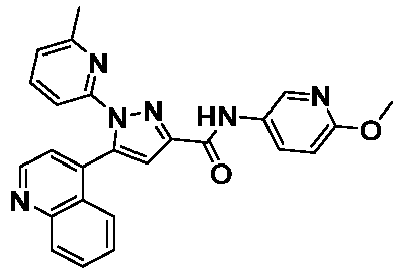
N-(6-methoxypyridin-3-yl)-1-(6-methylpyridin-2-yl)-5-(quinolin-4-yl)-1H-pyrazole-3-carboxyamide 1H NMR (300 MHz, CDCl3) δ 8.92(d, 1H), 8.81(s, 1H), 8.41(d, 1H), 8.17-8.13(m, 2H), 7.70-7.57(m, 3H), 7.45-7.41(m, 2H), 7.31(d, 1H), 7.26(s, 1H), 6.96(d, 1H), 6.81(d, 1H), 3.96(s, 3H), 1.95(s, 3H). MS (ESI+): [M+H]+ m/z 437 213 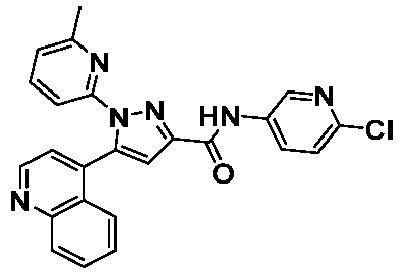
N-(6-chloropyridin-3-yl)-1-(6-methylpyridin-2-yl)-5-(quinolin-4-yl)-1H-pyrazole-3-carboxyamide 1H NMR (300 MHz, CDCl3) δ 8.99(s, 1H), 8.92(d, 1H), 8.62(d, 1H), 8.40(d, 1H), 8.15(d, 1H), 7.70-7.58(m, 3H), 7.45-7.26(m, 5H), 6.97(d, 1H), 1.95(s, 3H). MS (ESI+): [M+H]+ m/z 441 214 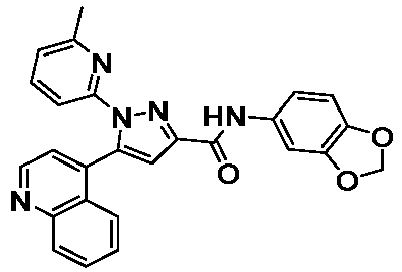
N-(benzo[d][1,3]dioxol-5-yl)-1-(6-methylpyridin-2-yl)-5-(quinolin-4-yl)-1H-pyrazole-3-carboxyamide 1H NMR (300 MHz, CDCl3) δ 8.92(d, 1H), 8.80(s, 1H), 8.15(d, 1H), 7.69-7.56(m, 3H), 7.49-7.42(m, 3H), 7.31(d, 1H), 7.24(s, 1H), 7.05(d, 1H), 6.94(d, 1H), 6.81(d, 1H), 5.99(s, 2H), 1.95(s, 3H). MS (ESI+): [M+H]+ m/z 450 215 
N-(3-fluoro-4-methoxyphenyl)-1-(6-methylpyridin-2-yl)-5-(quinolin-4-yl)-1H-pyrazole-3-carboxyamide 1H NMR (300 MHz, CDCl3) δ 8.90(d, 1H), 8.85(s, 1H), 8.15(d, 1H), 7.70-7.59(m, 4H), 7.46-7.41(m, 3H), 7.32-7.24(m, 2H), 6.97-6.93(m, 2H), 3.93(s, 3H), 1.95(s, 3H). MS (ESI+): [M+H]+ m/z 454 216 
N-(2-fluoro-4-methoxyphenyl)-1-(6-methylpyridin-2-yl)-5-(quinolin-4-yl)-1H-pyrazole-3-carboxyamide 1H NMR (300 MHz, CDCl3) δ 8.94-8.92(m, 2H), 8.34(t, 1H), 8.15(d, 1H), 7.69-7.59(m, 4H), 7.41(t, 1H), 7.31(d, 1H), 7.23(s, 1H), 6.92(d, 1H), 6.76(d, 2H), 3.82(s, 3H), 1.83(s, 3H). MS (ESI+): [M+H]+ m/z 454 217 
N-(4-(2-methoxyethoxy)phenyl)-1-(6-methylpyridin-2-yl)-5-(quinolin-4-yl)-1H-pyrazole-3-carboxyamide 1H NMR (300 MHz, CDCl3) δ 8.92(d, 1H), 8.84(s, 1H), 8.15(d, 1H), 7.70-7.55(m, 5H), 7.48-7.41(m, 2H), 7.32-1H NMR (300 MHz, CDCl3) δ 7.24(m, 2H), 6.98-6.91(m, 3H), 4.15-4.10(m, 2H), 3.78-3.75(m, 2H), 3.46(s, 3H), 1.90(s, 3H). MS (ESI+): [M+H]+ m/z 480 -

- After dissolving 5-(benzo[c][1,2,5]oxadiazol-5-yl)-1-(6-methylpyridin-2-yl)-1H-pyrazole-3-carboxylic acid (30 mg, 0.1 mmol) synthesized in Step 5 of Preparation Example 5 in dichloromethane, HATU (43 mg, 0.1 mmol) and DIPEA (48 µL, 0.3 mmol) were introduced thereto, and the result was stirred for 20 minutes at room temperature. To the reaction solution, 4-(cyclopropylsulfonyl)aniline (21 mg, 0.1 mmol) was introduced, and the result was stirred for 12 hours at room temperature. After terminating the reaction, ethyl acetate was added thereto. The result was washed with sodium bicarbonate, then dried using anhydrous magnesium sulfate, and after filtering, the filtrate was concentrated. The filtrate was purified using column chromatography to obtain a target compound (5 mg).
- 1H NMR spectrum (300 MHz, CDCl3) δ 9.02(s, 1H), 7.93(s, 4H), 7.84-7.75(m, 3H), 7.60(s, 1H), 7.31-7.26(m, 2H), 7.18(d, 1H), 2.50-2.45(m, 1H), 2.28(s, 3H), 1.39-1.34(m, 2H), 1.06-1.03(m, 2H).
- MS (ESI+): [M+H]+ m/z 501
-

- After dissolving 5-(benzo[d]oxazol-6-yl)-1-(6-methylpyridin-2-yl)-1H-pyrazole-3-carboxylic acid (50 mg, 0.2 mmol) synthesized in Step 6 of Preparation Example 6 in dichloromethane, HATU (71 mg, 0.2 mmol) and DIPEA (81 µL, 0.5 mmol) were introduced thereto, and the result was stirred for 20 minutes at room temperature. To the reaction solution, 2-fluoroaniline (17 mg, 0.2 mmol) was introduced, and the result was stirred for 12 hours at room temperature. After terminating the reaction, ethyl acetate was added thereto. The result was washed with sodium bicarbonate, then dried using anhydrous magnesium sulfate, and after filtering, the filtrate was concentrated. The filtrate was purified using column chromatography to obtain a target compound (29 mg).
- 1H NMR spectrum (300 MHz, CDCl3) δ 9.09(s, 1H), 8.51(t, 1H), 8.13(s, 1H), 7.74-7.70(m, 2H), 7.58(d, 1H), 7.34-7.26(m, 2H), 7.18-7.11(m, 5H), 2.37(s, 3H).
- MS (ESI+): [M+H]+ m/z 414
- Using compounds prepared in the preparation examples, compounds of Examples 220 to 227 listed in the following Table 8 were obtained in the same manner as in Example 219 using various amines instead of 2-fluoroaniline.
Table 8 Example Structure Compound Name Material Information 220 
5-(benzo[d]oxazol-6-yl)-N-(4-(cyclopropylsulfonyl)phenyl)-1-(6-methylpyridin-2-yl)-1H-pyrazole-3-carboxyamide 1H NMR (300 MHz, CDCl3) δ 9.10(s, 1H), 8.14(s, 1H), 7.95-7.90(m, 4H), 7.75-7.65(m, 2H), 7.57(s, 1H), 7.29-7.15(m, 4H), 2.50-2.45(m, 4H), 1.37-1.35(m, 2H), 1.05-1.02(m, 2H). MS (ESI+): [M+H]+ m/z 500 221 
N-cyclopropyl-5-(4-fluoro-3 - (1-(2-hydroxyethyl)-1H-pyrazol-4-yl)phenyl)-1-(6-methylpyridin-2-yl)-1H-pyrazole-3-carboxyamide 1H NMR (300 MHz, CDCl3) δ 7.82 (s, 1H), 7.69-7.64 (m, 2H), 7.45 (d, 1H), 7.20-7.15 (m, 3H), 7.05-7.02 (m, 3H), 4.28 (t, 2H), 4.03 (t, 2H), 2.70 (q, 1H), 2.47 (s, 3H), 0.88 (q, 2H), 0.69 (q, 2H). MS (ESI+): [M+H]+ m/z 447 222 
N-(1H-pyrazol-4-yl)-5-(4-fluoro-3-(1-(2-hydroxyethyl)-1H-pyrazol-4-yl)phenyl)-1-(6-methylpyridin-2-yl)-1H-pyrazole-3 -carboxyamide 1H NMR (300 MHz, MeOD) δ 8.52 (s, 2H), 8.20 (s, 1H), 8.00 (s, 1H), 7.94 (t, 1H), 7.69 (d, 1H), 7.53 (d, 1H), 7.40 (d, 1H), 7.21-7.18 (m, 3H), 4.35 (t, 2H), 3.94 (t, 2H), 2.43 (s, 3H). MS (ESI+): [M+H]+ m/z 473 223 
N-(1-methyl-1H-pyrazol-4-yl)-5-(4-fluoro-3-(1-(2-hydroxyethyl)-1H-pyrazol-4-yl)phenyl)-1-(6-methylpyridin-2-yl)-1H-pyrazole-3-carboxyamide 1H NMR (300 MHz, MeOD) δ 8.80 (s, 1H), 8.03 (s, 1H), 7.81 (s, 1H), 7.72-7.64 (m, 2H), 7.50-7.44 (m, 2H), 7.19-7.03 (m, 5H), 4.26 (t, 2H), 4.04 (t, 2H), 3.89 (s, 3H), 2.48 (s, 3H). MS (ESI+): [M+H]+ m/z 487 224 
N-(1-(methylsulfonyl)-1H-pyrazol-4-yl)-5-(4-fluoro-3-(1-(2-hydroxyethyl)-1H-pyrazol-4-yl)phenyl)-1-(6-methylpyridin-2-yl)-1H-pyrazole-3 -carboxyamide 1H NMR (300 MHz, CDCl3) δ 9.04 (s, 1H), 8.60 (s, 1H), 7.99 (s, 1H), 7.83 (s, 1H), 7.71-7.66 (m, 2H), 7.46 (d, 1H), 7.24-7.05 (m, 5H), 4.30 (t, 2H), 4.05 (t, 2H), 3.33 (s, 3H), 2.51 (s, 3H). MS (ESI+): [M+H]+ m/z 551 225 
N-(4-chlorophenyl)-5-(4-fluoro-3-(1-(2-hydroxyethyl)-1H-pyrazol-4-yl)phenyl)-1-(6-methylpyridin-2-yl)-1H-pyrazole-3-carboxyamide 1H NMR (300 MHz, CDCl3) δ 8.89 (s, 1H), 7.84 (s, 1H), 7.74-7.69 (m, 3H), 7.52 (d, 1H), 7.35 (d, 2H), 7.25-7.16 (m, 2H), 7.09 (d, 2H), 4.31 (t, 2H), 4.06 (t, 2H), 3.33 (s, 3H), 2.52 (s, 3H). MS (ESI+): [M+H]+ m/z 517 226 
N-(4-(methylsulfonyl)phenyl)-5-(4-fluoro-3-(1-(2-hydroxyethyl)-1H-pyrazol-4-yl)phenyl)-1-(6-methylpyridin-2-yl)-1H-pyrazole-3-carboxyamide 1H NMR (300 MHz, CDCl3) δ 9.13 (s, 1H), 7.96 (s, 3H), 7.84 (s, 1H), 7.75-7.70 (m, 2H), 7.50 (d, 1H), 7.24-6.77 (m, 6H), 4.31 (t, 2H), 4.06 (t, 2H), 3.08 (s, 3H), 2.53 (s, 3H). MS (ESI+): [M+H]+ m/z 561 227 
N-(2-fluorophenyl)-5-(thieno[3,2,c]pyridin-2-yl)-1-(m-tolyl)-1H-pyrazole-3-carboxyamide 1H NMR (300 MHz, CDCl3) δ 9.98(s, 1H), 9.1 1(s, 1H), 8.41(s, 1H), 7.95(d, 2H), 7.80(s, 1H), 7.80(s, 2H), 7.70(d, 1H), 7.50(d, 1H), 7.28-7.23(m, 4H), 2.42(s, 3H) MS (ESI+): [M+H]+ m/z 429 - In accordance with common methods, a single tablet for oral administration containing each of the compounds prepared in Examples 1 to 227 as an active compound was prepared using ingredients of the following Table 9 in amounts corresponding thereto.
Table 9 Ingredient Amount per Tablet Active Compound 100 mg Corn Starch 80 mg Lactose 80 mg Magnesium Stearate 5 mg - In accordance with common methods, a hard gelatin capsule for oral administration containing each of the compounds prepared in Examples 1 to 227 as an active compound was prepared using ingredients of the following Table 10 in amounts corresponding thereto.
Table 10 Ingredient Amount per Capsule Active Compound 100 mg Corn Starch 80 mg Lactose 80 mg Crystalline Cellulose 80 mg Magnesium Stearate 5 mg - In accordance with common methods, a formulation for injection containing each of the compounds prepared in Examples 1 to 227 as an active compound was prepared using ingredients of the following Table 11 in amounts corresponding thereto. However, a pH was not adjusted when using a salt of the compound of Chemical Formula 1 as the active compound.
Table 11 Ingredient Amount per Formulation for Injection Active Compound 20 mg 5% Glucose Solution 10 mL HCl (1 N) Suitable Amount to Make pH to 4 - In accordance with common methods, a formulation for injection containing each of the compounds prepared in Examples 1 to 227 as an active compound was prepared using ingredients of the following Table 12 in amounts corresponding thereto.
Table 12 Ingredient Amount per Formulation for Injection Active Compound 20 mg Polyethylene Glycol 400 2 mL Sterilized Water 8 mL - For each of the compounds obtained in Examples 1 to 227, inhibitory activity against ALK5 kinase was measured.
- For this, a LanthaScreen Eu binding kinase assay method was used, and ALK5 kinase, a kinase buffer, a kinase tracer 178, and a LanthaScreen Eu-GST binding antibody were all purchased from Thermo Fisher Scientific Solutions. Each of the compounds was made into a 10 mM DMSO solution, and diluted by 1/10 to a concentration of 1 µM to 0.0001 µM with an aqueous solution containing 4% DMSO. The test was performed in 384 well plates (well polystyrene low volume round-bottomed plates). First, 5 µL of the diluted compound solution was added, then 5 µL of the kinase/antibody mixture solution was introduced thereto, and 5 µL of the tracer was introduced thereto. Herein, these were added to each well so that the final kinase concentration became 5 nM, the final Eu-GST binding antibody concentration 2 nM, and the kinase tracer 178 concentration 10 nM, and the result was reacted in a stirrer for 60 minutes at room temperature. Then a fluorescence value was measured using a fluorescence meter (molecular device) (620 nm excitation filter, 665 nm emission filter). Herein, as for the degree of compound activity to inhibit the kinase reaction, a phosphorylate rate was calculated from 0% to 100% with respect to a control group according to the protocol included in the kit, and a 50% inhibitory concentration (IC50) value was calculated by obtaining the x-axis concentration in the region where 50% activity was inhibited. The IC50 results for each of the compounds are shown in the following Table 13.


Claims (11)
- A compound or a pharmaceutically acceptable salt thereof, wherein the compound is a compound selected from the group consisting of the following compounds:(1) 5-(benzo[d]thiazol-6-yl)-N-(4-methoxyphenyl)-1-(6-methylpyridin-2-yl)-1H-pyrazole-3-carboxyamide;(2) 5-(benzo[d]thiazol-6-yl)-N-(4-ethoxyphenyl)-1-(6-methylpyridin-2-yl)-1H-pyrazole-3-carboxyamide;(3) 5-(benzo[d]thiazol-6-yl)-N-(4-(cyclopropylmethoxy)phenyl)-1-(6-methylpyridin-2-yl)-1H-pyrazole-3-carboxyamide;(4) 5-(benzo[d]thiazol-6-yl)-N-(4-(2-methoxyethoxy)phenyl)-1-(6-methylpyridin-2-yl)-1H-pyrazole-3-carboxyamide;(6) 5-(benzo[d]thiazol-6-yl)-N-(4-(benzyloxy)phenyl)-1-(6-methylpyridin-2-yl)-1H-pyrazole-3-carboxyamide;(8) 5-(benzo[d]thiazol-6-yl)-N-(4-fluoro-3-methoxyphenyl)-1-(6-methylpyridin-2-yl)-1H-pyrazole-3-carboxyamide;(9) 5-(benzo[d]thiazol-6-yl)-N-(2-fluoro-4-methoxyphenyl)-1-(6-methylpyridin-2-yl)-1H-pyrazole-3-carboxyamide;(10) 5-(benzo[d]thiazol-6-yl)-N-(3-fluoro-4-methoxyphenyl)-1-(6-methylpyridin-2-yl)-1H-pyrazole-3-carboxyamide;(11) 5-(benzo[d]thiazol-6-yl)-N-(3-aminophenyl)-1-(6-methylpyridin-2-yl)-1H-pyrazole-3-carboxyamide;(12) 5-(benzo[d]thiazol-6-yl)-N-(3-(methylamino)phenyl)-1-(6-methylpyridin-2-yl)-1H-pyrazole-3-carboxyamide;(14) 5-(benzo[d]thiazol-6-yl)-1-(6-methylpyridin-2-yl)-N-(4-nitrophenyl)-1H-pyrazole-3-carboxyamide;(15) 5-(benzo[d]thiazol-6-yl)-N-(4-((2-(dimethylamino)ethyl)(methyl)amino) phenyl)-1-(6-methylpyridin-2-yl)-1H-pyrazole-3-carboxyamide;(16) 5-(benzo[d]thiazol-6-yl)-N-(4-(3-(dimethylamino)pyrrolidin-1-yl)phenyl)-1-(6-methylpyridin-2-yl)-1H-pyrazole-3-carboxyamide;(17) 5-(benzo[d]thiazol-6-yl)-N-(3-chloro-4-(octahydro-6H-pyrrolo[3,4-b]pyridin-6-yl)phenyl)-1-(6-methylpyridin-2-yl)-1H-pyrazole-3-carboxyamide;(23) 5-(benzo[d]thiazol-6-yl)-N-(3-acetylphenyl)-1-(6-methylpyridin-2-yl)-1H-pyrazole-3-carboxyamide;(25) 5-(benzo[d]thiazol-6-yl)-N-(4-(methylcarbamoyl)phenyl)-1-(6-methylpyridin-2-yl)-1H-pyrazole-3-carboxyamide;(27) 5-(benzo[d]thiazol-6-yl)-N-(2-fluorophenyl)-1-(6-methylpyridin-2-yl)-1H-pyrazole-3-carboxyamide;(28) 5-(benzo[d]thiazol-6-yl)-N-(3-fluorophenyl)-1-(6-methylpyridin-2-yl)-1H-pyrazole-3-carboxyamide;(29) 5-(benzo[d]thiazol-6-yl)-N-(4-fluorophenyl)-1-(6-methylpyridin-2-yl)-1H-pyrazole-3-carboxyamide;(30) 5-(benzo[d]thiazol-6-yl)-N-(3,4-difluorophenyl)-1-(6-methylpyridin-2-yl)-1H-pyrazole-3-carboxyamide;(36) 5-(benzo[d]thiazol-6-yl)-1-(6-methylpyridin-2-yl)-N-(4-(methylthio)phenyl)-1H-pyrazole-3-carboxyamide;(38) 5-(benzo[d]thiazol-6-yl)-1-(6-methylpyridin-2-yl)-N-(3-(methylsulfinyl)phenyl)-1H-pyrazole-3-carboxyamide;(39) 5-(benzo[d]thiazol-6-yl)-1-(6-methylpyridin-2-yl)-N-(4-(methylsulfinyl)phenyl)-1H-pyrazole-3-carboxyamide;(40) 5-(benzo[d]thiazol-6-yl)-1-(6-methylpyridin-2-yl)-N-(3-(methylsulfonyl)phenyl)-1H-pyrazole-3-carboxyamide;(41) 5-(benzo[d]thiazol-6-yl)-1-(6-methylpyridin-2-yl)-N-(4-(methylsulfonyl)phenyl)-1H-pyrazole-3-carboxyamide;(42) 5-(benzo[d]thiazol-6-yl)-1-(6-methylpyridin-2-yl)-N-(4-(propylsulfonyl)phenyl)-1H-pyrazole-3-carboxyamide;(43) 5-(benzo[d]thiazol-6-yl)-N-(4-(cyclopropylsulfonyl)phenyl)-1-(6-methylpyridin-2-yl)-1H-pyrazole-3-carboxyamide;(44) 5-(benzo[d]thiazol-6-yl)-N-(2-fluoro-4-(methylsulfonyl)phenyl)-1-(6-methylpyridin-2-yl)-1H-pyrazole-3-carboxyamide;(45) 5-(benzo[d]thiazol-6-yl)-1-(6-methylpyridin-2-yl)-N-(3-sulfamoylphenyl)-1H-pyrazole-3-carboxyamide;(46) 5-(benzo[d]thiazol-6-yl)-1-(6-methylpyridin-2-yl)-N-(4-sulfamoylphenyl)-1H-pyrazole-3-carboxyamide;(47) 5-(benzo[d]thiazol-6-yl)-1-(6-methylpyridin-2-yl)-N-(3-(N-methylsulfamoyl)phenyl)-1H-pyrazole-3-carboxyamide;(48) 5-(benzo[d]thiazol-6-yl)-1-(6-methylpyridin-2-yl)-N-(4-(N-methylsulfamoyl)phenyl)-1H-pyrazole-3-carboxyamide;(49) 5-(benzo[d]thiazol-6-yl)-N-(3-(N-cyclopropylsulfamoyl)phenyl)-1-(6-methylpyridin-2-yl)-1H-pyrazole-3-carboxyamide;(50) 5-(benzo[d]thiazol-6-yl)-N-(4-(N-cyclopropylsulfamoyl)phenyl)-1-(6-methylpyridin-2-yl)-1H-pyrazole-3-carboxyamide;(51) 5-(benzo[d]thiazol-6-yl)-N-(3-(N,N-dimethylsulfamoyl)phenyl)-1-(6-methylpyridin-2-yl)-1H-pyrazole-3-carboxyamide;(52) 5-(benzo[d]thiazol-6-yl)-N-(4-(N,N-dimethylsulfamoyl)phenyl)-1-(6-methylpyridin-2-yl)-1H-pyrazole-3-carboxyamide;(53) 5-(benzo[d]thiazol-6-yl)-1-(6-methylpyridin-2-yl)-N-(3-(methylsulfonamido)phenyl)-1H-pyrazole-3-carboxyamide;(54) 5-(benzo[d]thiazol-6-yl)-N-(3-(cyclopropanesulfonamido)phenyl)-1-(6-methylpyridin-2-yl)-1H-pyrazole-3-carboxyamide;(55) 5-(benzo[d]thiazol-6-yl)-N-(4-(cyclopropanesulfonamido)phenyl)-1-(6-methylpyridin-2-yl)-1H-pyrazole-3-carboxyamide;(56) 4-(5-(benzo[d]thiazol-6-yl)-1-(6-methylpyridin-2-yl)-1H-pyrazole-3-carboxyamido)benzenesulfonic acid;(58) 5-(benzo[d]thiazol-6-yl)-1-(6-methylpyridin-2-yl)-N-(4-(N-(2,2,2-trifluoroethyl)sulfamoyl)phenyl)-1H-pyrazole-3-carboxyamide;(59) 5-(benzo[d]thiazol-6-yl)-1-(6-methylpyridin-2-yl)-N-(4-((methylsulfonyl)methyl)phenyl)-1H-pyrazole-3-carboxyamide;(60) 5-(benzo[d]thiazol-6-yl)-1-(6-methylpyridin-2-yl)-N-(3-(sulfamoylmethyl)phenyl)-1H-pyrazole-3-carboxyamide;(62) 5-(benzo[d]thiazol-6-yl)-N-(4-fluoro-3-(sulfamoylmethyl)phenyl)-1-(6-methylpyridin-2-yl)-1H-pyrazole-3-carboxyamide;(63) 5-(benzo[d]thiazol-6-yl)-N-(4-((1,1-dioxidotetrahydrothiophen-3-yl)amino)phenyl)-1-(6-methylpyridin-2-yl)-1H-pyrazole-3-carboxyamide;(64) 5-(benzo[d]thiazol-6-yl)-1-(6-methylpyridin-2-yl)-N-(pyridin-4-yl)-1H-pyrazole-3-carboxyamide;(65) 5-(benzo[d]thiazol-6-yl)-N-(6-methoxypyridin-3-yl)-1-(6-methylpyridin-2-yl)-1H-pyrazole-3-carboxyamide;(66) 5-(benzo[d]thiazol-6-yl)-N-(2-methoxypyridin-4-yl)-1-(6-methylpyridin-2-yl)-1H-pyrazole-3-carboxyamide;(67) 5-(benzo[ d ]thiazol-6-yl)-N-(6-(methylthio)pyridin-3-yl)-1-(6-methylpyridin-2-yl)-1H-pyrazole-3-carboxyamide;(69) 5-(benzo[d]thiazol-6-yl)-N-(6-(methylsulfonyl)pyridin-3-yl)-1-(6-methylpyridin-2-yl)-1H-pyrazole-3-carboxyamide;(70) 5-(benzo[d]thiazol-6-yl)-1-(6-methylpyridin-2-yl)-N-(2-(methylsulfonyl)pyridin-4-yl)-1H-pyrazole-3-carboxyamide;(71) 5-(benzo[d]thiazol-6-yl)-N-(6-fluoropyridin-3-yl)-1-(6-methylpyridin-2-yl)-1H-pyrazole-3-carboxyamide;(72) 5-(benzo[d]thiazol-6-yl)-N-(2-fluoropyridin-4-yl)-1-(6-methylpyridin-2-yl)-1H-pyrazole-3-carboxyamide;(73) 5-(benzo[d]thiazol-6-yl)-N-(6-chloropyridin-3-yl)-1-(6-methylpyridin-2-yl)-1H-pyrazole-3-carboxyamide;(74) 5-(benzo[d]thiazol-6-yl)-N-(2-chloropyridin-4-yl)-1-(6-methylpyridin-2-yl)-1H-pyrazole-3-carboxyamide;(75) 5-(benzo[d]thiazol-6-yl)-1-(6-methylpyridin-2-yl)-N-(thiazol-2-yl)-1H-pyrazole-3-carboxyamide;(76) 5-(benzo[d]thiazol-6-yl)-N-benzyl-1-(6-methylpyridin-2-yl)-1H-pyrazole-3-carboxyamide;(77) 5-(benzo[d]thiazol-6-yl)-N-(2-fluorobenzyl)-1-(6-methylpyridin-2-yl)-1H-pyrazole-3-carboxyamide;(78) 5-(benzo[d]thiazol-6-yl)-N-(3-fluorobenzyl)-1-(6-methylpyridin-2-yl)-1H-pyrazole-3-carboxyamide;(79) 5-(benzo[d]thiazol-6-yl)-N-(4-fluorobenzyl)-1-(6-methylpyridin-2-yl)-1H-pyrazole-3-carboxyamide;(80) 5-(benzo[d]thiazol-6-yl)-1-(6-methylpyridin-2-yl)-N-(1-(methylsulfonyl)-1H-pyrazol-4-yl)-1H-pyrazole-3-carboxyamide;(81) 5-(benzo[d]thiazol-6-yl)-N-(1-(cyclopropylsulfonyl)-1H-pyrazol-4-yl)-1-(6-methylpyridin-2-yl)-1H-pyrazole-3-carboxyamide;(82) 5-(benzo[d]thiazol-6-yl)-N-(3-hydroxyphenyl)-1-(6-methylpyridin-2-yl)-1H-pyrazole-3-carboxyamide;(83) 5-(benzo[d]thiazol-6-yl)-N-(4-hydroxyphenyl)-1-(6-methylpyridin-2-yl)-1H-pyrazole-3-carboxyamide;(84) 5-(benzo[d]thiazol-6-yl)-N-(3-(hydroxymethyl)phenyl)-1-(6-methylpyridin-2-yl)-1H-pyrazole-3-carboxyamide;(85) 5-(benzo[d]thiazol-6-yl)-N-(4-(hydroxymethyl)phenyl)-1-(6-methylpyridin-2-yl)-1H-pyrazole-3-carboxyamide;(86) N-(4-aminophenyl)-5-(benzo[d]thiazol-6-yl)-1-(6-methylpyridin-2-yl)-1H-pyrazole-3-carboxyamide;(87) 5-(benzo[d]thiazol-6-yl)-N-(4-(butylamino)phenyl)-1-(6-methylpyridin-2-yl)-1H-pyrazole-3-carboxyamide;(88) 5-(benzo[d]thiazol-6-yl)-N-(4-(cyclopropylamino)phenyl)-1-(6-methylpyridin-2-yl)-1H-pyrazole-3-carboxyamide;(89) 5-(benzo[d]thiazol-6-yl)-1-(6-methylpyridin-2-yl)-N-(4-(5-methylsulfonimidoyl)phenyl)-1H-pyrazole-3-carboxyamide;(90) 5-([1,2,4]triazolo[1,5-α]pyridin-6-yl)-N-(2-methoxyphenyl)-1-(6-methylpyridin-2-yl)-1H-pyrazole-3-carboxyamide;(93) 5-([1,2,4] triazolo [1,5-α]pyridin-6-yl)-N-(4-hydroxyphenyl)-1-(6-methylpyridin-2-yl)-1H-pyrazole-3-carboxyamide;(94) 5-([1,2,4]triazolo[1,5-α]pyridin-6-yl)-N-(4-isopropylphenyl)-1-(6-methylpyridin-2-yl)-1H-pyrazole-3-carboxyamide;(95) 5-([1,2,4]triazolo[1,5-α]pyridin-6-yl)-N-(4-(2-methoxyethoxy)phenyl)-1-(6-methylpyridin-2-yl)-1H-pyrazole-3-carboxyamide;(98) 5-([1,2,4]triazolo[1,5-α]pyridin-6-yl)-N-(3-fluoro-4-methoxyphenyl)-1-(6-methylpyridin-2-yl)-1H-pyrazole-3-carboxy amide;(99) 5-([1,2,4]triazolo[1,5-α]pyridin-6-yl)-1-(6-methylpyridin-2-yl)-N (2-(trifluoromethoxy)phenyl)-1H-pyrazole-3-carboxyamide;(103) 5-([1,2,4]triazolo[1,5-α]pyridin-6-yl)-N-(4-aminophenyl)-1-(6-methylpyridin-2-yl)-1H-pyrazole-3-carboxyamide;(104) 5-([1,2,4]triazolo[1,5-α]pyridin-6-yl)-N-(4-(dimethylamino)phenyl)-1-(6-methylpyridin-2-yl)-1-H-pyrazole-3-carboxyamide;(105) 5-([1,2,4]triazolo[1,5-α]pyridin-6-yl)-N-(4-(pyrrolidin-1-yl)phenyl)1-(6-methylpyridin-2-yl)-1H-pyrazole-3-carboxyamide;(106) 5-([1,2,4]triazolo[1,5-α]pyridin-6-yl)-N-(4-((2-(dimethylamino)ethyl)(methyl)amino)phenyl)-1-(6-methylpyridin-2-yl)-1H-pyrazole-3-carboxyamide;(108) 5-([1,2,4]triazolo[1,5-α]pyridin-6-yl)-N-(4-(4-acetylpiperazin-1-yl)phenyl)-1-(6-methylpyridin-2-yl)-1H-pyrazole-3-carboxyamide;(109) 5-([1,2,4]triazolo[1,5-α]pyridin-6-yl)-N-(4-((1,1-dioxidotetrahydrothiophen-3-yl)amino)phenyl)-1-(6-methylpyridin-2-yl)-1H-pyrazole-3-carboxyamide;(114) 5-([1,2,4]triazolo[1,5-α]pyridin-6-yl)-1-(6-methylpyridin-2-yl)-N-phenyl-1H-pyrazole-3-carboxyamide;(116) 5-([1,2,4]triazolo[1,5-α]pyridin-6-yl)-1-(6-methylpyridin-2-yl)-N-(m-tolyl)-1H-pyrazole-3-carboxyamide;(119) 5-([1,2,4]triazolo[1,5-α]pyridin-6-yl)-1-(6-methylpyridin-2-yl)-N-(4-vinylphenyl)-1H-pyrazole-3-carboxyamide;(126) 5-([1,2,4]triazolo[1,5-α]pyridin-6-yl)-N-(4-fluorophenyl)-1-(6-methylpyridin-2-yl)-1H-pyrazole-3-carboxyamide;(132) 5-([1,2,4]triazolo[1,5-α]pyridin-6-yl)-N-(4-bromophenyl)-1-(6-methylpyridin-2-yl)-1H-pyrazole-3-carboxyamide;(136) 5-([1,2,4]triazolo[1,5-α]pyridin-6-yl)-N-(3,4-difluorophenyl)-1-(6-methylpyridin-2-yl)-1H-pyrazole-3-carboxyamide;(140) 5-([1,2,4]triazolo[1,5-α]pyridin-6-yl)-N-(3-chloro-4-fluorophenyl)-1-(6-methylpyridin-2-yl)-1H-pyrazole-3-carboxyamide;(143) 5-([1,2,4]triazolo[1,5-α]pyridin-6-yl)-N-(3-(methoxythio)phenyl)-1-(6-methylpyridin-2-yl)-1H-pyrazole-3-carboxyamide;(145) 5-([1,2,4]triazolo[1,5-α]pyridin-6-yl)-N-(3-(methylsulfinyl)phenyl)-1-(6-methylpyridin-2-yl)-1H-pyrazole-3-carboxyamide;(146) 5-([1,2,4]triazolo[1,5-α]pyridin-6-yl)-N-(4-(methylsulfinyl)phenyl)-1-(6-methylpyridin-2-yl)-1H-pyrazole-3-carboxyamide;(147) 5-([1,2,4]triazolo[1,5-α]pyridin-6-yl)-N-(4-(methylsulfonyl)phenyl)-1-(6-methylpyridin-2-yl)-1H-pyrazole-3-carboxyamide;(148) 5-([1,2,4]triazolo[1,5-α]pyridin-6-yl)-N-(4-sulfamoylphenyl)-1-(6-methylpyridin-2-yl)-1H-pyrazole-3-carboxyamide;(149) 5-([1,2,4]triazolo[1,5-α]pyridin-6-yl)-N-(4-(S-methylsulfonimidoyl)phenyl)-1-(6-methylpyridin-2-yl)-1H-pyrazole-3-carboxyamide;(150) 5-([1,2,4]triazolo[1,5-α]pyridin-6-yl)-N-(4-(propylsulfonyl)phenyl)-1-(6-methylpyridin-2-yl)-1H-pyrazole-3-carboxyamide;(151) 5-([1,2,4]triazolo[1,5-α]pyridin-6-yl)-N-(4-(propylsulfonyl)phenyl)-1-(6-methylpyridin-2-yl)-1H-pyrazole-3-carboxyamide;(152) 5-([1,2,4]triazolo[1,5-α]pyridin-6-yl)-N-(6-fluoropyridin-3-yl)-1-(6-methylpyridin-2-yl)-1H-pyrazole-3-carboxyamide;(153) 5-([1,2,4]triazolo[1,5-α]pyridin-6-yl)-N-(6-chloropyridin-3-yl)-1-(6-methylpyridin-2-yl)-1H-pyrazole-3-carboxyamide;(154) 5-([1,2,4]triazolo[1,5-α]pyridin-6-yl)-N-(6-methoxypyridin-3-yl)-1-(6-methylpyridin-2-yl)-1H-pyrazole-3-carboxyamide;(155) 5-([1,2,4]triazolo[1,5-α]pyridin-6-yl)-N-(2-fluorobenzyl)-1-(6-methylpyridin-2-yl)-1H-pyrazole-3-carboxyamide;(156) 5-([1,2,4]triazolo[1,5-α]pyridin-6-yl)-N-(3-fluorobenzyl)-1-(6-methylpyridin-2-yl)-1H-pyrazole-3-carboxyamide;(162) 5-([1,2,4]triazolo[1,5-α]pyridin-6-yl)-1-(6-methylpyridin-2-yl)-N-(1-(methylsulfonyl)-1H-pyrazol-4-yl)-1H-pyrazole-3-carboxyamide;(163) 5-([1,2,4]triazolo[1,5-α]pyridin-6-yl)-N-(1-cyclopropyl sulfonyl)-1H-pyrazol-4-yl)-1-(6-methylpyridin-2-yl)-1H-pyrazole-3-carboxyamide;(164) N-(4-methoxyphenyl)-1-(6-methylpyridin-2-yl)-5-(quinoxalin-6-yl)-1H-pyrazole-3-carboxyamide;(165) N-(3-methoxyphenyl)-1-(6-methylpyridin-2-yl)-5-(quinoxalin-6-yl)-1H-pyrazole-3-carboxyamide;(211) 1-(6-methylpyridin-2-yl)-N-(4-(methylsulfonyl)phenyl)-5-(quinolin-4-yl)-1H-pyrazole-3-carboxyamide;(213) N-(6-chloropyridin-3 -yl)-1-(6-methylpyridin-2-yl)-5-(quinolin-4-yl)-1H-pyrazole-3-carboxyamide; and(217) N-(4-(2-methoxyethoxy)phenyl)-1-(6-methylpyridin-2-yl)-5-(quinolin-4-yl)-1H-pyrazole-3-carboxyamide.
- A pharmaceutical composition comprising the compound of Claim 1 or pharmaceutically acceptable salt thereof in a pharmaceutically effective amount.
- The pharmaceutical composition of Claim 2, which is for use in the treatment or prevention of metastasis of cancer cells.
- The pharmaceutical composition of Claim 2, which is for use in the treatment of carcinoma mediated by overexpression of TGF-β.
- The pharmaceutical composition for use of Claim 4, wherein the carcinoma is selected from the group consisting of carcinomas of lung, breast, liver, biliary, gastrointestinal tract, head and neck, pancreas, prostate and cervix, multiple myeloma, melanoma, glioma and glioblastoma.
- The pharmaceutical composition of Claim 2, which is for use in preventing or treating a fibrotic disease or a fibrotic condition.
- The pharmaceutical composition for use of Claim 6, wherein the fibrotic disease or the fibrotic condition includes one or more diseases selected from the group consisting of liver fibrosis, kidney fibrosis, pulmonary fibrosis, irritable pneumonia, interstitial fibrosis, systematic sclerodermie, macular degeneration, pancreas fibrosis, splenic fibrosis, cardiac fibrosis, species septic fibrosis, bone marrow fibrosis, vascular fibrosis, skin fibrosis, eye fibrosis, joint fibrosis, muscle fibrosis, thyroid fibrosis, endocardial myocardial fibrosis, peritoneal fibrosis, after peritoneal fibrosis, progressive congenital trophoblastic fibrosis, allogeneic systematic fibrosis, fibrosis complications of surgery and infection fibrosis.
- The pharmaceutical composition of Claim 2, which is for use in preventing or treating a cancer or a tumor.
- The pharmaceutical composition for use of Claim 8, wherein the cancer is selected from the group consisting of liver cancer, hepatocellular carcinoma, thyroid cancer, colorectal cancer, testicular cancer, bone cancer, oral cancer, basal cell carcinoma, ovarian cancer, brain tumor, gallbladder carcinoma, biliary tract cancer, head and neck cancer, colorectal cancer, vesical carcinoma, tongue cancer, esophageal cancer, glioma, glioblastoma, renal cancer, malignant melanoma, gastric cancer, breast cancer, sarcoma, pharynx carcinoma, uterine cancer, cervical cancer, prostate cancer, rectal cancer, pancreatic cancer, lung cancer, skin cancer and other solid cancers.
- The pharmaceutical composition of Claim 2, which is for use in preventing or treating a disease selected from the group consisting of kidney-, liver- or lung-fibrosis, glomerulonephritis, diabetic renal disease, erythematous nephritis, hypertension-induced renal disease, kidney interstitial fibrosis, kidney fibrosis derived from drug exposure complications, HIV-related renal disease, organ transplantation gangrene, liver fibrosis caused by all diseases, hepatic dysfunction caused by infection, alcohol-induced hepatitis, biliary disorder, pulmonary fibrosis, acute lung injury, adult respiratory pain syndrome, idiopathic pulmonary fibrosis, chronic obstructive pulmonary disease, pulmonary fibrosis caused by infection or toxic factors, cardiac fibrosis after myocardial infarction, congestive heart failure, dilated cardiomyopathy, myocarditis, vascular stenosis, restenosis, atherosclerosis, visual impairment, corneal injury, proliferative vitreoretinopathy, excessive or exacerbated scar or keloid formation in the dermis occurring during wound healing from trauma or surgical wounds, peritoneum and subcutaneous adhesion, skin sclerosis, fibrosclerosis, progressive systemic sclerosis, dermatomyositis, multiple myositis, arthritis, osteoporosis, ulcer, impaired nerve function, male impotence, Alzheimer's disease, Raynaud's disease, fibrous cancer, metastasis growth of tumors, radiation-induced fibrosis and thrombosis.
- The pharmaceutical composition for use of Claim 6, wherein the fibrotic disease or fibrotic condition is selected from the group consisting of scleroderma, idiopathic pulmonary fibrosis, glomerulonephritis, diabetic nephrosis, lupus nephrosis, hypertension-induced nephrosis, eye scar, corneal scar, liver fibrosis, biliary duct fibrosis, pulmonary fibrosis, acute lung injury, postinfarction cardiac fibrosis, fibrosclerosis, fibrous cancer, fibroid, fibroma, fibroadenoma or fibrosarcoma.
Applications Claiming Priority (4)
| Application Number | Priority Date | Filing Date | Title |
|---|---|---|---|
| KR20160082824 | 2016-06-30 | ||
| KR20160180401 | 2016-12-27 | ||
| KR1020170082868A KR102434226B1 (en) | 2016-06-30 | 2017-06-29 | Novel substituted pyrazole derivatives as a alk5 inhibitors and use thereof |
| PCT/KR2017/006940 WO2018004290A1 (en) | 2016-06-30 | 2017-06-30 | Novel pyrazole derivative as alk5 inhibitor and uses thereof |
Publications (4)
| Publication Number | Publication Date |
|---|---|
| EP3480193A1 EP3480193A1 (en) | 2019-05-08 |
| EP3480193A4 EP3480193A4 (en) | 2020-04-08 |
| EP3480193B1 true EP3480193B1 (en) | 2024-05-29 |
| EP3480193C0 EP3480193C0 (en) | 2024-05-29 |
Family
ID=61000232
Family Applications (1)
| Application Number | Title | Priority Date | Filing Date |
|---|---|---|---|
| EP17820566.2A Active EP3480193B1 (en) | 2016-06-30 | 2017-06-30 | Pyrazole derivatives as alk5 inhibitors and uses thereof |
Country Status (9)
| Country | Link |
|---|---|
| US (1) | US10954232B2 (en) |
| EP (1) | EP3480193B1 (en) |
| JP (1) | JP6921877B2 (en) |
| KR (1) | KR102434226B1 (en) |
| CN (1) | CN109415346A (en) |
| AU (1) | AU2017289021B2 (en) |
| CA (1) | CA3029175C (en) |
| IL (1) | IL263930A (en) |
| ZA (1) | ZA201900606B (en) |
Families Citing this family (10)
| Publication number | Priority date | Publication date | Assignee | Title |
|---|---|---|---|---|
| US11583593B2 (en) | 2016-01-14 | 2023-02-21 | Synthis Therapeutics, Inc. | Antibody-ALK5 inhibitor conjugates and their uses |
| AR114465A1 (en) * | 2018-04-04 | 2020-09-09 | Japan Tobacco Inc | PIRAZOLE COMPOUNDS SUBSTITUTED WITH HETEROARYL AND THEIR PHARMACEUTICAL USE |
| EP4051388A1 (en) * | 2019-11-01 | 2022-09-07 | Bristol-Myers Squibb Company | Substituted pyrazole compounds as toll receptor inhibitors |
| PH12022551177A1 (en) * | 2019-11-28 | 2024-02-05 | Agomab Spain S L U | Benzylamide derivatives as inhibitors of transforming growth factor-beta receptor i/alk5 |
| EP4087657A1 (en) * | 2020-01-08 | 2022-11-16 | Synthis Therapeutics, Inc. | Alk5 inhibitor conjugates and uses thereof |
| CN116249692B (en) | 2020-09-28 | 2024-08-23 | 四川科伦博泰生物医药股份有限公司 | Pyrazole compound as well as preparation method and application thereof |
| CN113274391B (en) * | 2021-06-01 | 2022-07-05 | 苏州大学 | Application of pyrazole derivatives in the preparation of P2Y6R-related drugs for the treatment of atherosclerosis and anti-inflammatory |
| CN117715892A (en) * | 2021-07-06 | 2024-03-15 | 豪夫迈·罗氏有限公司 | Quaternary ammonium cation substituted compounds for the treatment of bacterial infections |
| CN113876769A (en) * | 2021-09-30 | 2022-01-04 | 延边大学 | Application of pyrazole derivative containing pyridine structure in preparation of anti-hepatic fibrosis drugs |
| WO2026002036A1 (en) * | 2024-06-26 | 2026-01-02 | 北京双鹤润创科技有限公司 | Compound and use thereof |
Family Cites Families (14)
| Publication number | Priority date | Publication date | Assignee | Title |
|---|---|---|---|---|
| US8084467B2 (en) * | 1999-10-18 | 2011-12-27 | University Of Connecticut | Pyrazole derivatives as cannabinoid receptor antagonists |
| CO5271680A1 (en) | 2000-02-21 | 2003-04-30 | Smithkline Beecham Corp | COMPOUNDS |
| CL2004000234A1 (en) | 2003-02-12 | 2005-04-15 | Biogen Idec Inc | DERIVATIVE COMPOUNDS 3- (PIRIDIN-2-IL) -4-HETEROARIL-PIRAZOL SUBSTITUTED, ANTAGONISTS OF AIK5 AND / OR AIK4; PHARMACEUTICAL COMPOSITION AND USE OF THE COMPOUND IN THE TREATMENT OF FIBROTIC DISORDERS AS SCLERODERMIA, LUPUS NEFRITICO, CICATRIZACION DE HERID |
| GB0313914D0 (en) | 2003-06-16 | 2003-07-23 | Smithkline Beecham Corp | Compounds |
| US7678810B2 (en) * | 2004-03-05 | 2010-03-16 | Taisho Pharmaceutical Co., Ltd | Thiazole derivative |
| KR100749566B1 (en) | 2004-04-21 | 2007-08-16 | 이화여자대학교 산학협력단 | 2-pyridyldisubstituted imidazole derivatives effective as ALX5 and / or ALX4 inhibitors |
| CA2576734C (en) | 2004-07-29 | 2010-03-16 | Schering-Plough Ltd. | Use of alk 5 inhibitors to modulate or inhibit myostatin activity leading to increased lean tissue accretion in animals |
| CA2594477C (en) | 2005-01-21 | 2016-07-12 | Astex Therapeutics Limited | Pharmaceutical compounds |
| WO2007070866A2 (en) | 2005-12-16 | 2007-06-21 | Alcon, Inc. | Control of intraocular pressure using alk5 modulation agents |
| CN101062916B (en) * | 2006-04-29 | 2012-12-26 | 中国人民解放军军事医学科学院毒物药物研究所 | Three-substituted 1H-pyrromonazole compound, preparation method, medicament composition and pharmacy use thereof |
| KR20090066297A (en) * | 2006-10-16 | 2009-06-23 | 화이자 프로덕츠 인크. | Therapeutic pyrazolyl thienopyridine |
| CN101544631B (en) | 2008-03-26 | 2012-05-23 | 中国科学院上海药物研究所 | Pyrazole 5-lipoxygenase small molecule inhibitors, preparation method, pharmaceutical composition and application thereof |
| AU2009288158B2 (en) * | 2008-09-05 | 2014-09-11 | Engineering Fitness International Corp. | Adjustable user support platform for an inclinable exercise device and method of use |
| US8080568B1 (en) | 2010-06-29 | 2011-12-20 | Ewha University - Industry Collaboration Foundation | 2-pyridyl substituted imidazoles as therapeutic ALK5 and/or ALK4 inhibitors |
-
2017
- 2017-06-29 KR KR1020170082868A patent/KR102434226B1/en active Active
- 2017-06-30 CN CN201780041502.0A patent/CN109415346A/en active Pending
- 2017-06-30 JP JP2018568418A patent/JP6921877B2/en active Active
- 2017-06-30 US US16/313,948 patent/US10954232B2/en active Active
- 2017-06-30 EP EP17820566.2A patent/EP3480193B1/en active Active
- 2017-06-30 AU AU2017289021A patent/AU2017289021B2/en not_active Ceased
- 2017-06-30 CA CA3029175A patent/CA3029175C/en not_active Expired - Fee Related
-
2018
- 2018-12-24 IL IL263930A patent/IL263930A/en unknown
-
2019
- 2019-01-29 ZA ZA2019/00606A patent/ZA201900606B/en unknown
Also Published As
| Publication number | Publication date |
|---|---|
| EP3480193A1 (en) | 2019-05-08 |
| US20190194198A1 (en) | 2019-06-27 |
| IL263930A (en) | 2019-01-31 |
| CA3029175A1 (en) | 2018-01-04 |
| CA3029175C (en) | 2021-01-05 |
| KR20180003470A (en) | 2018-01-09 |
| AU2017289021A1 (en) | 2019-01-31 |
| AU2017289021B2 (en) | 2020-06-25 |
| ZA201900606B (en) | 2020-05-27 |
| NZ749951A (en) | 2020-03-27 |
| CN109415346A (en) | 2019-03-01 |
| JP2019520366A (en) | 2019-07-18 |
| JP6921877B2 (en) | 2021-08-18 |
| US10954232B2 (en) | 2021-03-23 |
| KR102434226B1 (en) | 2022-08-19 |
| EP3480193A4 (en) | 2020-04-08 |
| EP3480193C0 (en) | 2024-05-29 |
Similar Documents
| Publication | Publication Date | Title |
|---|---|---|
| US10954232B2 (en) | Pyrazole derivative as ALK5 inhibitor and uses thereof | |
| KR102007056B1 (en) | Substituted benzylindazoles for use as bub1 kinase inhibitors in the treatment of hyperproliferative diseases | |
| ES2316546T3 (en) | 2-ARYLAMINE-PYRIMIDINS FOR THE TREATMENT OF ASSOCIATED DISORDERS TO GSK3. | |
| EP2358698B1 (en) | Tetrasubstituted pyridazine as hedgehog pathway antagonists | |
| RU2378267C2 (en) | Novel pyrimidine amide derivatives and use thereof | |
| JP5490137B2 (en) | Bicyclic pyrazoles as protein kinase inhibitors | |
| HK1217482A1 (en) | Enzyme modulators and treatments | |
| MX2011006171A (en) | Carbazole carboxamide compounds useful as kinase inhibitors. | |
| US20160166575A1 (en) | Pyrrolo[2,3-d]pyrimidine derivatives, process for their preparation and their use as kinase inhibitors | |
| JP2010524974A (en) | Kinase inhibitors useful for the treatment of myeloproliferative disorders and other proliferative disorders | |
| JP2014520858A (en) | Novel 2-piperidin-1-yl-acetamide compounds for use as tankyrase inhibitors | |
| EA012119B1 (en) | Triazolopyridinylsulfanyl derivatives as p38 map kinase inhibitors | |
| KR102195348B1 (en) | Novel compound as a protein kinase inhibitor, and the pharmaceutical composition comprising thereof | |
| CN115703761A (en) | Compound as WWP1 inhibitor and application thereof | |
| TW202229273A (en) | Fused heteroaryl compounds and their use as camkii inhibitors | |
| CA2944370A1 (en) | Amido-substituted azole compounds | |
| CA3248820A1 (en) | Compounds and methods for yap/tead modulation and indications therefor | |
| JP2022515309A (en) | Substituted aryl compounds, their production methods and uses | |
| CN101360711A (en) | L-phenylalanine derivatives and their use as integrin antagonists | |
| JP7233130B2 (en) | Novel tricyclic compounds as IRAK4 inhibitors | |
| JP2019001715A (en) | Tricyclic compound | |
| TW202417429A (en) | Novel heterobicyclic compound for inhibiting yap-tead interaction and pharmaceutical composition comprising same | |
| NZ749951B (en) | Novel pyrazole derivative as alk5 inhibitor and uses thereof | |
| HK40005144A (en) | Novel pyrazole derivative as alk5 inhibitor and uses thereof | |
| KR20260067130A (en) | Pyridinyl pyrazole derivative compounds or pharmaceutically acceptable salts thereof, and pharmaceutical composition containing same as active ingredient |
Legal Events
| Date | Code | Title | Description |
|---|---|---|---|
| STAA | Information on the status of an ep patent application or granted ep patent |
Free format text: STATUS: THE INTERNATIONAL PUBLICATION HAS BEEN MADE |
|
| PUAI | Public reference made under article 153(3) epc to a published international application that has entered the european phase |
Free format text: ORIGINAL CODE: 0009012 |
|
| STAA | Information on the status of an ep patent application or granted ep patent |
Free format text: STATUS: REQUEST FOR EXAMINATION WAS MADE |
|
| 17P | Request for examination filed |
Effective date: 20190129 |
|
| AK | Designated contracting states |
Kind code of ref document: A1 Designated state(s): AL AT BE BG CH CY CZ DE DK EE ES FI FR GB GR HR HU IE IS IT LI LT LU LV MC MK MT NL NO PL PT RO RS SE SI SK SM TR |
|
| AX | Request for extension of the european patent |
Extension state: BA ME |
|
| DAV | Request for validation of the european patent (deleted) | ||
| DAX | Request for extension of the european patent (deleted) | ||
| RIC1 | Information provided on ipc code assigned before grant |
Ipc: C07D 233/58 20060101ALI20200128BHEP Ipc: C07D 403/14 20060101ALI20200128BHEP Ipc: A61K 31/4725 20060101ALI20200128BHEP Ipc: C07D 401/04 20060101ALI20200128BHEP Ipc: C07D 401/14 20060101AFI20200128BHEP Ipc: C07D 417/14 20060101ALI20200128BHEP Ipc: A61K 31/428 20060101ALI20200128BHEP Ipc: A61K 31/4155 20060101ALI20200128BHEP Ipc: C07D 403/04 20060101ALI20200128BHEP |
|
| A4 | Supplementary search report drawn up and despatched |
Effective date: 20200306 |
|
| RIC1 | Information provided on ipc code assigned before grant |
Ipc: C07D 403/14 20060101ALI20200302BHEP Ipc: A61K 31/428 20060101ALI20200302BHEP Ipc: A61K 31/4725 20060101ALI20200302BHEP Ipc: A61K 31/4155 20060101ALI20200302BHEP Ipc: C07D 403/04 20060101ALI20200302BHEP Ipc: C07D 401/04 20060101ALI20200302BHEP Ipc: C07D 401/14 20060101AFI20200302BHEP Ipc: C07D 417/14 20060101ALI20200302BHEP Ipc: C07D 233/58 20060101ALI20200302BHEP |
|
| STAA | Information on the status of an ep patent application or granted ep patent |
Free format text: STATUS: EXAMINATION IS IN PROGRESS |
|
| 17Q | First examination report despatched |
Effective date: 20220202 |
|
| GRAP | Despatch of communication of intention to grant a patent |
Free format text: ORIGINAL CODE: EPIDOSNIGR1 |
|
| STAA | Information on the status of an ep patent application or granted ep patent |
Free format text: STATUS: GRANT OF PATENT IS INTENDED |
|
| INTG | Intention to grant announced |
Effective date: 20231220 |
|
| GRAS | Grant fee paid |
Free format text: ORIGINAL CODE: EPIDOSNIGR3 |
|
| GRAA | (expected) grant |
Free format text: ORIGINAL CODE: 0009210 |
|
| STAA | Information on the status of an ep patent application or granted ep patent |
Free format text: STATUS: THE PATENT HAS BEEN GRANTED |
|
| AK | Designated contracting states |
Kind code of ref document: B1 Designated state(s): AL AT BE BG CH CY CZ DE DK EE ES FI FR GB GR HR HU IE IS IT LI LT LU LV MC MK MT NL NO PL PT RO RS SE SI SK SM TR |
|
| REG | Reference to a national code |
Ref country code: CH Ref legal event code: EP |
|
| REG | Reference to a national code |
Ref country code: IE Ref legal event code: FG4D |
|
| REG | Reference to a national code |
Ref country code: DE Ref legal event code: R096 Ref document number: 602017082315 Country of ref document: DE |
|
| U01 | Request for unitary effect filed |
Effective date: 20240619 |
|
| U07 | Unitary effect registered |
Designated state(s): AT BE BG DE DK EE FI FR IT LT LU LV MT NL PT SE SI Effective date: 20240628 |
|
| U20 | Renewal fee for the european patent with unitary effect paid |
Year of fee payment: 8 Effective date: 20240625 |
|
| PG25 | Lapsed in a contracting state [announced via postgrant information from national office to epo] |
Ref country code: IS Free format text: LAPSE BECAUSE OF FAILURE TO SUBMIT A TRANSLATION OF THE DESCRIPTION OR TO PAY THE FEE WITHIN THE PRESCRIBED TIME-LIMIT Effective date: 20240929 |
|
| PG25 | Lapsed in a contracting state [announced via postgrant information from national office to epo] |
Ref country code: HR Free format text: LAPSE BECAUSE OF FAILURE TO SUBMIT A TRANSLATION OF THE DESCRIPTION OR TO PAY THE FEE WITHIN THE PRESCRIBED TIME-LIMIT Effective date: 20240529 |
|
| PG25 | Lapsed in a contracting state [announced via postgrant information from national office to epo] |
Ref country code: GR Free format text: LAPSE BECAUSE OF FAILURE TO SUBMIT A TRANSLATION OF THE DESCRIPTION OR TO PAY THE FEE WITHIN THE PRESCRIBED TIME-LIMIT Effective date: 20240830 |
|
| PG25 | Lapsed in a contracting state [announced via postgrant information from national office to epo] |
Ref country code: ES Free format text: LAPSE BECAUSE OF FAILURE TO SUBMIT A TRANSLATION OF THE DESCRIPTION OR TO PAY THE FEE WITHIN THE PRESCRIBED TIME-LIMIT Effective date: 20240529 |
|
| PG25 | Lapsed in a contracting state [announced via postgrant information from national office to epo] |
Ref country code: PL Free format text: LAPSE BECAUSE OF FAILURE TO SUBMIT A TRANSLATION OF THE DESCRIPTION OR TO PAY THE FEE WITHIN THE PRESCRIBED TIME-LIMIT Effective date: 20240529 |
|
| PG25 | Lapsed in a contracting state [announced via postgrant information from national office to epo] |
Ref country code: PL Free format text: LAPSE BECAUSE OF FAILURE TO SUBMIT A TRANSLATION OF THE DESCRIPTION OR TO PAY THE FEE WITHIN THE PRESCRIBED TIME-LIMIT Effective date: 20240529 Ref country code: NO Free format text: LAPSE BECAUSE OF FAILURE TO SUBMIT A TRANSLATION OF THE DESCRIPTION OR TO PAY THE FEE WITHIN THE PRESCRIBED TIME-LIMIT Effective date: 20240829 Ref country code: IS Free format text: LAPSE BECAUSE OF FAILURE TO SUBMIT A TRANSLATION OF THE DESCRIPTION OR TO PAY THE FEE WITHIN THE PRESCRIBED TIME-LIMIT Effective date: 20240929 Ref country code: HR Free format text: LAPSE BECAUSE OF FAILURE TO SUBMIT A TRANSLATION OF THE DESCRIPTION OR TO PAY THE FEE WITHIN THE PRESCRIBED TIME-LIMIT Effective date: 20240529 Ref country code: GR Free format text: LAPSE BECAUSE OF FAILURE TO SUBMIT A TRANSLATION OF THE DESCRIPTION OR TO PAY THE FEE WITHIN THE PRESCRIBED TIME-LIMIT Effective date: 20240830 Ref country code: ES Free format text: LAPSE BECAUSE OF FAILURE TO SUBMIT A TRANSLATION OF THE DESCRIPTION OR TO PAY THE FEE WITHIN THE PRESCRIBED TIME-LIMIT Effective date: 20240529 Ref country code: RS Free format text: LAPSE BECAUSE OF FAILURE TO SUBMIT A TRANSLATION OF THE DESCRIPTION OR TO PAY THE FEE WITHIN THE PRESCRIBED TIME-LIMIT Effective date: 20240829 |
|
| PG25 | Lapsed in a contracting state [announced via postgrant information from national office to epo] |
Ref country code: CZ Free format text: LAPSE BECAUSE OF FAILURE TO SUBMIT A TRANSLATION OF THE DESCRIPTION OR TO PAY THE FEE WITHIN THE PRESCRIBED TIME-LIMIT Effective date: 20240529 |
|
| PG25 | Lapsed in a contracting state [announced via postgrant information from national office to epo] |
Ref country code: RO Free format text: LAPSE BECAUSE OF FAILURE TO SUBMIT A TRANSLATION OF THE DESCRIPTION OR TO PAY THE FEE WITHIN THE PRESCRIBED TIME-LIMIT Effective date: 20240529 Ref country code: SK Free format text: LAPSE BECAUSE OF FAILURE TO SUBMIT A TRANSLATION OF THE DESCRIPTION OR TO PAY THE FEE WITHIN THE PRESCRIBED TIME-LIMIT Effective date: 20240529 |
|
| PG25 | Lapsed in a contracting state [announced via postgrant information from national office to epo] |
Ref country code: SM Free format text: LAPSE BECAUSE OF FAILURE TO SUBMIT A TRANSLATION OF THE DESCRIPTION OR TO PAY THE FEE WITHIN THE PRESCRIBED TIME-LIMIT Effective date: 20240529 |
|
| PG25 | Lapsed in a contracting state [announced via postgrant information from national office to epo] |
Ref country code: SM Free format text: LAPSE BECAUSE OF FAILURE TO SUBMIT A TRANSLATION OF THE DESCRIPTION OR TO PAY THE FEE WITHIN THE PRESCRIBED TIME-LIMIT Effective date: 20240529 Ref country code: SK Free format text: LAPSE BECAUSE OF FAILURE TO SUBMIT A TRANSLATION OF THE DESCRIPTION OR TO PAY THE FEE WITHIN THE PRESCRIBED TIME-LIMIT Effective date: 20240529 Ref country code: RO Free format text: LAPSE BECAUSE OF FAILURE TO SUBMIT A TRANSLATION OF THE DESCRIPTION OR TO PAY THE FEE WITHIN THE PRESCRIBED TIME-LIMIT Effective date: 20240529 Ref country code: CZ Free format text: LAPSE BECAUSE OF FAILURE TO SUBMIT A TRANSLATION OF THE DESCRIPTION OR TO PAY THE FEE WITHIN THE PRESCRIBED TIME-LIMIT Effective date: 20240529 |
|
| REG | Reference to a national code |
Ref country code: CH Ref legal event code: PL |
|
| PG25 | Lapsed in a contracting state [announced via postgrant information from national office to epo] |
Ref country code: MC Free format text: LAPSE BECAUSE OF FAILURE TO SUBMIT A TRANSLATION OF THE DESCRIPTION OR TO PAY THE FEE WITHIN THE PRESCRIBED TIME-LIMIT Effective date: 20240529 |
|
| PLBE | No opposition filed within time limit |
Free format text: ORIGINAL CODE: 0009261 |
|
| STAA | Information on the status of an ep patent application or granted ep patent |
Free format text: STATUS: NO OPPOSITION FILED WITHIN TIME LIMIT |
|
| PG25 | Lapsed in a contracting state [announced via postgrant information from national office to epo] |
Ref country code: IE Free format text: LAPSE BECAUSE OF NON-PAYMENT OF DUE FEES Effective date: 20240630 |
|
| GBPC | Gb: european patent ceased through non-payment of renewal fee |
Effective date: 20240829 |
|
| PG25 | Lapsed in a contracting state [announced via postgrant information from national office to epo] |
Ref country code: CH Free format text: LAPSE BECAUSE OF NON-PAYMENT OF DUE FEES Effective date: 20240630 |
|
| 26N | No opposition filed |
Effective date: 20250303 |
|
| PG25 | Lapsed in a contracting state [announced via postgrant information from national office to epo] |
Ref country code: GB Free format text: LAPSE BECAUSE OF NON-PAYMENT OF DUE FEES Effective date: 20240829 |
|
| U20 | Renewal fee for the european patent with unitary effect paid |
Year of fee payment: 9 Effective date: 20250624 |
|
| PG25 | Lapsed in a contracting state [announced via postgrant information from national office to epo] |
Ref country code: CY Free format text: LAPSE BECAUSE OF FAILURE TO SUBMIT A TRANSLATION OF THE DESCRIPTION OR TO PAY THE FEE WITHIN THE PRESCRIBED TIME-LIMIT; INVALID AB INITIO Effective date: 20170630 |
|
| PG25 | Lapsed in a contracting state [announced via postgrant information from national office to epo] |
Ref country code: HU Free format text: LAPSE BECAUSE OF FAILURE TO SUBMIT A TRANSLATION OF THE DESCRIPTION OR TO PAY THE FEE WITHIN THE PRESCRIBED TIME-LIMIT; INVALID AB INITIO Effective date: 20170630 |