EP3480188B1 - Method for preparing urate transporter 1 inhibitor - Google Patents
Method for preparing urate transporter 1 inhibitor Download PDFInfo
- Publication number
- EP3480188B1 EP3480188B1 EP17819194.6A EP17819194A EP3480188B1 EP 3480188 B1 EP3480188 B1 EP 3480188B1 EP 17819194 A EP17819194 A EP 17819194A EP 3480188 B1 EP3480188 B1 EP 3480188B1
- Authority
- EP
- European Patent Office
- Prior art keywords
- product
- reaction
- solvent
- temperature
- base
- Prior art date
- Legal status (The legal status is an assumption and is not a legal conclusion. Google has not performed a legal analysis and makes no representation as to the accuracy of the status listed.)
- Active
Links
- 0 O=CNNC(NC*(cc1)c(cccc2)c2c1Br)=S Chemical compound O=CNNC(NC*(cc1)c(cccc2)c2c1Br)=S 0.000 description 5
- FHXASJKBBLIBAQ-UHFFFAOYSA-N BrCc(c1ccccc11)ccc1Br Chemical compound BrCc(c1ccccc11)ccc1Br FHXASJKBBLIBAQ-UHFFFAOYSA-N 0.000 description 2
- QNBGOEIQJGBJPZ-UHFFFAOYSA-N Cc(cc1)cc2c1c(Br)ccc2CN(C=NN1)C1=S Chemical compound Cc(cc1)cc2c1c(Br)ccc2CN(C=NN1)C1=S QNBGOEIQJGBJPZ-UHFFFAOYSA-N 0.000 description 2
- LVBIDTYBTJQDHZ-UHFFFAOYSA-N S=C=NCc(c1c2cccc1)ccc2Br Chemical compound S=C=NCc(c1c2cccc1)ccc2Br LVBIDTYBTJQDHZ-UHFFFAOYSA-N 0.000 description 2
- IBGUDZMIAZLJNY-UHFFFAOYSA-N Brc(c1c2cccc1)ccc2Br Chemical compound Brc(c1c2cccc1)ccc2Br IBGUDZMIAZLJNY-UHFFFAOYSA-N 0.000 description 1
- WISXFSXDJOEWSZ-UHFFFAOYSA-N C=[Br]c1ccc(CN=C=S)c2c1cccc2 Chemical compound C=[Br]c1ccc(CN=C=S)c2c1cccc2 WISXFSXDJOEWSZ-UHFFFAOYSA-N 0.000 description 1
- BTCILYXBYQMJNY-UHFFFAOYSA-N CC(C=CC=C1)C1=C Chemical compound CC(C=CC=C1)C1=C BTCILYXBYQMJNY-UHFFFAOYSA-N 0.000 description 1
- UNMZISMLLFSCQD-UHFFFAOYSA-N COC(CSc([n]1Cc(c2c3cccc2)ccc3Br)nnc1Br)=O Chemical compound COC(CSc([n]1Cc(c2c3cccc2)ccc3Br)nnc1Br)=O UNMZISMLLFSCQD-UHFFFAOYSA-N 0.000 description 1
- MEIIOCYSWQMGLV-UHFFFAOYSA-N COC(CSc1nnc[n]1Cc(c1c2cccc1)ccc2Br)=O Chemical compound COC(CSc1nnc[n]1Cc(c1c2cccc1)ccc2Br)=O MEIIOCYSWQMGLV-UHFFFAOYSA-N 0.000 description 1
- IDRVLLRKAAHOBP-UHFFFAOYSA-N Cc(c1c2cccc1)ccc2Br Chemical compound Cc(c1c2cccc1)ccc2Br IDRVLLRKAAHOBP-UHFFFAOYSA-N 0.000 description 1
- QPUYECUOLPXSFR-UHFFFAOYSA-N Cc1cccc2ccccc12 Chemical compound Cc1cccc2ccccc12 QPUYECUOLPXSFR-UHFFFAOYSA-N 0.000 description 1
- ITKIWUNXKKMMSE-UHFFFAOYSA-N N#Cc(c1c2cccc1)ccc2Br Chemical compound N#Cc(c1c2cccc1)ccc2Br ITKIWUNXKKMMSE-UHFFFAOYSA-N 0.000 description 1
- PMFKFFYEQAYJDO-UHFFFAOYSA-N NCc(c1c2cccc1)ccc2Br Chemical compound NCc(c1c2cccc1)ccc2Br PMFKFFYEQAYJDO-UHFFFAOYSA-N 0.000 description 1
- QBOYAYIXUAMBMI-UHFFFAOYSA-N O=CNNC(NCc(c1c2cccc1)ccc2Br)=S Chemical compound O=CNNC(NCc(c1c2cccc1)ccc2Br)=S QBOYAYIXUAMBMI-UHFFFAOYSA-N 0.000 description 1
- IOPFQLZRRJLMJK-UHFFFAOYSA-N OC(CSc([n]1Cc(c2c3cccc2)ccc3Br)nnc1Br)O Chemical compound OC(CSc([n]1Cc(c2c3cccc2)ccc3Br)nnc1Br)O IOPFQLZRRJLMJK-UHFFFAOYSA-N 0.000 description 1
- VYZVYTDCXKOPHI-UHFFFAOYSA-N OCC(C=O)Sc([n]1Cc(c2c3cccc2)ccc3Br)nnc1Br Chemical compound OCC(C=O)Sc([n]1Cc(c2c3cccc2)ccc3Br)nnc1Br VYZVYTDCXKOPHI-UHFFFAOYSA-N 0.000 description 1
Classifications
-
- C—CHEMISTRY; METALLURGY
- C07—ORGANIC CHEMISTRY
- C07D—HETEROCYCLIC COMPOUNDS
- C07D249/00—Heterocyclic compounds containing five-membered rings having three nitrogen atoms as the only ring hetero atoms
- C07D249/02—Heterocyclic compounds containing five-membered rings having three nitrogen atoms as the only ring hetero atoms not condensed with other rings
- C07D249/08—1,2,4-Triazoles; Hydrogenated 1,2,4-triazoles
- C07D249/10—1,2,4-Triazoles; Hydrogenated 1,2,4-triazoles with hetero atoms or with carbon atoms having three bonds to hetero atoms with at the most one bond to halogen, e.g. ester or nitrile radicals, directly attached to ring carbon atoms
- C07D249/12—Oxygen or sulfur atoms
-
- A—HUMAN NECESSITIES
- A61—MEDICAL OR VETERINARY SCIENCE; HYGIENE
- A61K—PREPARATIONS FOR MEDICAL, DENTAL OR TOILETRY PURPOSES
- A61K31/00—Medicinal preparations containing organic active ingredients
- A61K31/33—Heterocyclic compounds
- A61K31/395—Heterocyclic compounds having nitrogen as a ring hetero atom, e.g. guanethidine or rifamycins
- A61K31/41—Heterocyclic compounds having nitrogen as a ring hetero atom, e.g. guanethidine or rifamycins having five-membered rings with two or more ring hetero atoms, at least one of which being nitrogen, e.g. tetrazole
- A61K31/4196—1,2,4-Triazoles
-
- A—HUMAN NECESSITIES
- A61—MEDICAL OR VETERINARY SCIENCE; HYGIENE
- A61P—SPECIFIC THERAPEUTIC ACTIVITY OF CHEMICAL COMPOUNDS OR MEDICINAL PREPARATIONS
- A61P19/00—Drugs for skeletal disorders
- A61P19/06—Antigout agents, e.g. antihyperuricemic or uricosuric agents
-
- C—CHEMISTRY; METALLURGY
- C07—ORGANIC CHEMISTRY
- C07C—ACYCLIC OR CARBOCYCLIC COMPOUNDS
- C07C25/00—Compounds containing at least one halogen atom bound to a six-membered aromatic ring
- C07C25/18—Polycyclic aromatic halogenated hydrocarbons
- C07C25/22—Polycyclic aromatic halogenated hydrocarbons with condensed rings
-
- C—CHEMISTRY; METALLURGY
- C07—ORGANIC CHEMISTRY
- C07C—ACYCLIC OR CARBOCYCLIC COMPOUNDS
- C07C331/00—Derivatives of thiocyanic acid or of isothiocyanic acid
- C07C331/02—Thiocyanates
- C07C331/04—Thiocyanates having sulfur atoms of thiocyanate groups bound to acyclic carbon atoms
-
- C—CHEMISTRY; METALLURGY
- C07—ORGANIC CHEMISTRY
- C07C—ACYCLIC OR CARBOCYCLIC COMPOUNDS
- C07C337/00—Derivatives of thiocarbonic acids containing functional groups covered by groups C07C333/00 or C07C335/00 in which at least one nitrogen atom of these functional groups is further bound to another nitrogen atom not being part of a nitro or nitroso group
- C07C337/06—Compounds containing any of the groups, e.g. thiosemicarbazides
-
- C—CHEMISTRY; METALLURGY
- C07—ORGANIC CHEMISTRY
- C07D—HETEROCYCLIC COMPOUNDS
- C07D249/00—Heterocyclic compounds containing five-membered rings having three nitrogen atoms as the only ring hetero atoms
- C07D249/02—Heterocyclic compounds containing five-membered rings having three nitrogen atoms as the only ring hetero atoms not condensed with other rings
- C07D249/08—1,2,4-Triazoles; Hydrogenated 1,2,4-triazoles
Definitions
- the present invention belongs to pharmaceutical field.
- the present invention relates to a method for preparing a urate transporter 1 (URAT1) inhibitor, 2-((5-bromo-4-((4-bromonaphthalen-1-yl)methyl)-4H-1,2,4-triazol-3-yl)thio)acetic acid (ZXS-BR), which has a therapeutic effect on gout and hyperuricemia.
- URAT1 urate transporter 1
- ZXS-BR 2-((5-bromo-4-((4-bromonaphthalen-1-yl)methyl)-4H-1,2,4-triazol-3-yl)thio)acetic acid
- Gout is an inflammatory disease caused by deposition of monosodium urate (MSU) at joints and the surrounding tissues thereof, which is characterized by periodic joint swelling and pain. Without treatment, it could cause joint deformation and nephrolithiasis, even renal failure, and has serious impacts on the patients' life quality and health.
- MSU monosodium urate
- hyperuricemia is a disease state in which the concentration of serum uric acid (SUA) exceeds the solubility limit of uric acid (6.8 mg/dL, 404 ⁇ m ⁇ l/L) in body fluid at physiological conditions (pH 7.4, temperature 37°C). At physiological pH, 98% of uric acid is present in the form of ion. Because of the high concentration of extracellular Na + , uric acid is mainly present in human body in the form of monosodium urate. Due to an evolutionary reason (uricase deficiency), urate is the end product of purine metabolism in human body.
- SUA serum uric acid
- hyperuricemia About one-third of urate produced by metabolisom is excreted through gastrointestinal tract, and the remaining two-thirds are excreted through kidneys. There are two causes of hyperuricemia: one is too much urate produced, and the other is too little urate excreted through kidneys. About 10% of the patients with hyperuricemia produce too much urate, and 90% of the patients have too little urate excreted through kidneys. Sustained hyperuricemia can cause gout. In Europe and the United States, the incidence of hyperuricemia is about 20-30%, and the incidence of gout is about 3%; in China, the incidence of hyperuricemia is about 10%, and the incidence of gout is about 1%. The epidemiological surveys in recent years have shown that the incidences of both hyperuricemia and gout continue to rise.
- drugs for the treatment of gout can be classified mainly into four types: the first type is anti-inflammatory analgesic drugs which can control the symptoms of acute gout attack, such as colchicine, steroidal anti-inflammatory drugs and nonsteroidal anti-inflammatory drugs; the second type is drugs that inhibit the production of urate, and thus can be used for the treatment of chronic gout and hyperuricemia, mainly including a xanthine oxidase inhibitor (XOI), such as allopurinol, febuxostat and topiroxosta; the third type is drugs that increase the excretion of urate, and thus can be used for the treatment of chronic gout and hyperuricemia, mainly including a urate transporter 1 (URAT1) inhibitor, such as probenecid, sulphinpyrazone, benzbromarone and the newly markted lesinurad.
- URAT1 urate transporter 1
- Some drugs having special structures that are originally used for other indications also have effect on the excretion of urate, such as losartan for the treatment of hypertension and atorvastatin for the treatment of hyperlipidemia; the fourth type is uricase, which can be used to treat chronic gout that does not respond to traditional therapies or to reduce serum uric acid during an acute attack of gout.
- colchicine which is used to control an acute attack of gout, can cause diarrhea, vomiting, crampy abdominal pain and other common adverse effects, which are the first indications of its toxicity, with a therapeutically effective dose being close to the dose at which it causes gastrointestinal symptoms, and the incidence of side effects being extremely high (sometimes 100%). It had not been approved by the FDA in the United States until 2009.
- Other anti-inflammatory analgesic drugs to control an acute attack of gout can only control symptoms, but not ameliorate or treat gout itself.
- the clinical response rates of xanthine oxidase inhibitors are very low, most of which the effective rates are only about 40%-60%.
- probenecid has weak effect and poor selectivity (the inhibition strengths of URAT1, OAT1, OAT3 and OAT4 are similar); sulphinpyrazone and benzbromarone have severe side effects (the former inhibits platelets and bone marrow, and the latter has hepatotoxicity) and are not sold in the United States; benzbromarone was withdrawn from the market in Europe in 2003 and is now used in only a few countries; the disadvantages of newly approved lesinurad are weak efficacy and high dosage (200 mg), and the dosage for use and that causing side effects are very close to each other (obvious nephrolithiasis occurs at 400 mg, and renal failure is significantly aggravated compared to that at 200 mg); the disadvantage of uricase is that its use will result
- Urate transporter 1 which is responsible for the reabsorption, is a transporter discovered in 2002 ( Enomoto A, Kimura H, Chairoungdua A, et al. Molecular identification of a renal urate anion exchanger that regulates blood urate levels. Nature 2002, 417 (6887), 447-452 ).
- a URAT1 inhibitor can reduce the concentration of serum urate by inhibiting the reabsorption of urate by URAT1 in kidneys so as to increase excretion of urate in urine, and thus can be used in the treatment of gout and hyperuricemia.
- PCT/CN2016/080468 disclosed a URAT1 inhibitor, 2-((5-bromo-4-((4-bromonaphthalen-1-yl)methyl)-4H-1,2,4-triazol-3-yl)thio)-acetic acid and a pharmaceutically acceptable salt thereof, which can be used in the treatment of gout and hyperuricemia (Example 51 of PCT/CN2016/080468 , the structure of which is shown in the following formula; the compound is named "ZXS-BR" for convenience in the present invention).
- PCT/CN2016/080468 also disclosed a method for the preparation of ZXS-BR as described above, i.e., a preparation process according to Example 1 in PCT/CN2016/080468 (see the description in the table included in Example 51, the third column of the first line).
- an object of the present invention is to overcome the disadvantages and deficiencies of the prior art and to provide a method for preparing a URAT1 inhibitor ZXS-BR, which is of low cost, ease of handling, ease of quality control, and applicable to a large-scale industrial operation.
- the invention provides a method for preparing a urate transporter 1 inhibitor, 2-((5-bromo-4-((4-bromonaphthalen-1-yl)methyl)-4H-1,2,4-triazol-3-yl)thio)acetic acid represented by the formula ZXS-BR, comprising the following steps:
- reaction equation for the preparation method is shown below: wherein, the method comprises the following steps:
- the present invention also provides a compound represented by the following formula H': wherein, R is selected from C 1 -C 10 alkyl or C 3 -C 6 cycloalkyl; preferably, R is selected from C 1 -C 4 alkyl; more preferably, R is selected from methyl or ethyl.
- the present invention also provides a compound represented by the following formula G': wherein, R is selected from C 1 -C 10 alkyl or C 3 -C 6 cycloalkyl; preferably, R is selected from C 1 -C 4 alkyl; more preferably, R is selected from methyl or ethyl.
- the present invention also provides the compounds represented by the following formulas D, E, and F, respectively:
- the preparation method provided by the present application has the following advantages:
- the preparation method provided by the present invention is of low cost, ease of handling, ease of quality control, and applicable to industrialization as compared with the prior art.
- the reaction mixture was cooled to room temperature and transferred to a 5 L flask.
- Ethyl acetate (1.8 L) was added, and the resulting mixture was stirred at room temperature for 2-3 hours to give a grayish brown slurry.
- the slurry was filtered by suction, and the filtrate was collected.
- the filter cake was washed with a small amount of ethyl acetate, and the washing liquid was combined into the filtrate.
- the filtrate was washed with water (1 L ⁇ 5), dried over anhydrous sodium sulfate, and evaporated on a rotary evaporator to remove the solvent.
- reaction mixture was evaporated on a rotary evaporator to dryness, the resulting residue, i.e., a crude product of E, was dissolved in DMF (80 mL), and solid K 2 CO 3 (3.46 g, 25 mol) was added. The reaction mixture was stirred at 50°C until the reaction was completed (usually 5 hours).
- the organic phases were combined, washed with 5% saline solution (200 mL), and dried over anhydrous Na 2 SO 4 .
- the dried organic phase was evaporated on a rotary evaporator to remove the solvent, and the resulting residue was purified by column chromatography to give product F as a white solid.
- 1 H NMR showed that about 5% debromination by-product was contained therein.
- reaction mixture was poured into ice water (400 mL), stirred, and extracted with CH 2 Cl 2 (100 mL ⁇ 5).
- the organic phases were combined, washed with 5% saline solution (200 mL), and dried over anhydrous Na 2 SO 4 .
- the dried organic phase was evaporated on a rotary evaporator to remove the solvent, and the resulting residue was purified by column chromatography to give product G as a white solid, 7.37 g; yield: 94%; m.p.: 112.5-114°C.
- reaction mixture was poured into ice water (200 mL), stirred, and extracted with CH 2 Cl 2 (100 mL ⁇ 3).
- the organic phases were combined, and washed with a saturated Na 2 CO 3 solution (100 mL ⁇ 3) and 5% saline solution (200 mL) sequentially, and dried over anhydrous Na 2 SO 4 .
- the dried organic phase was evaporated on a rotary evaporator to remove the solvent, and the resulting residue was purified by column chromatography to give product H as a white solid, 3.49 g; m.p.: 141-143°C; yield: 74%.
- the organic phases were combined, washed with 5% saline solution (200 mL), and dried over anhydrous Na 2 SO 4 .
- the dried organic phase was evaporated on a rotary evaporator to remove the solvent, and the resulting residue was purified by column chromatography to give product ZXS-BR as a white solid, 2.82 g; yield: 88%; m.p.: 169.5-171.5°C.
- free radical halogenation at the benzylic position of an aralkyl group is generally carried out by heating in a solvent such as CCl 4 with NBS (N-bromosuccinimide) or NCS (N-chlorosuccinimide) as a halogenating agent, BPO or azodiisobutyronitrile (AIBN) and the like as a radical initiator.
- a solvent such as CCl 4 with NBS (N-bromosuccinimide) or NCS (N-chlorosuccinimide) as a halogenating agent, BPO or azodiisobutyronitrile (AIBN) and the like as a radical initiator.
- the inventors of the present invention had found that the reaction proceeds unsmoothly in a solvent recognized by a person skilled in the art such as CCl 4 , and thus carried out a intensive and delicate optimization and screening of the main reaction conditions of the reaction, that is, the halogenating agent, the radical initiator and the reaction solvent, and finally found that n-hexane is the most appropriate solvent, BPO is the optimal radical initiator, and NBS is the best halogenating reagent for this reaction.
- Reaction operations to a dry 250 mL round bottom flask was added a solvent to be screened (40 mL) at room temperature. B' (3.54 g, 16 mmol), a radical initiator (0.32 mmol), and NBS or NCS (19.2 mmol) was added with stirring, and warmed to an indicated temperature while stirring, and the reaction was monitored by TLC. After the reaction started, 0.32 mmol radical initiator was added once every 8 hours, until TLC showed that the reaction was self-terminated (B' disappeared) or aborted (no reaction occurred after 72 hours).
- the reaction did not need to be treated; if C'/C" was generated, the reaction was processed in accordance with the following steps: after the reaction was completed, the system was cooled to room temperature, and the reaction mixture was concentrated to 1/3 volume on a rotary evaporator, poured into water (200 mL), stirred, and extracted with CH 2 Cl 2 (50 mL ⁇ 3). The extract phases were combined, washed with a saturated NaHCO 3 solution (50 mL ⁇ 3) and 5% saline solution (50 mL) sequentially, dried over anhydrous Na 2 SO 4 and filtered by suction to remove the desiccant.
- a saturated NaHCO 3 solution 50 mL ⁇ 3
- 5% saline solution 50 mL
- the actual reflux temperatures of several solvents described in the above table are also around their boiling points.
- the boiling point of CCl 4 is 76.8°C; the boiling point of CHCl 3 is 61°C; the boiling point of CH 2 Cl 2 is 39.8°C; the boiling point of acetone is 56.5°C; the boiling point of MeCN is 81°C; the boiling point of THF is 65°C; the boiling point of n-hexane is 69°C; the boiling point of cyclohexaneis 80°C; the boiling point of n-pentane is 36°C; the boiling point of cyclopentane is 49°C; the boiling point of n-heptane is 98.5°C; the boiling point of cycloheptane is 118.5°C (a reasonable moderate reflux rate was achieved at about 120°C in this experiment); petroleum ether fraction at 30-60°C is moderately refluxed at about 35°C; petroleum ether fraction at 60-90°C is moderately refluxed
- NBS is the optimal halogenating reagent in this step, and the reaction is too slow when using NCS; the optimal initiator is BPO, and the effect of AIBN is average; among all solvents to be tested, C 5 -C 17 alkane and cycloalkane and petroleum ether fraction at 30-150°C are optimal; and the reaction temperature is in a range of from about 36°C (the reflux temperature of n-pentane) to 120°C (the reflux temperature of cycloheptane).
- reaction operations to a dry 250 mL round bottom flask was added compound C' (3.00 g, 10 mmol), which was dissolved in a dry solvent (30 mL), and then warmed to an indicated temperature with stirring. A thiocyanate MSCN (12 mmol) was added in three portions within 1 minute. After the addition was completed, the reaction mixture was further stirred at the indicated temperature for 1 hour, and at this point the reaction was completed. The reaction mixture was cooled to room temperature, and then poured into stirring ice water (200 mL), stirred and extracted with CH 2 Cl 2 (50 mL ⁇ 3). The organic phases were combined, washed with 5% saline solution (50 mL ⁇ 5), and dried over anhydrous Na 2 SO 4 .
- the reflux temperatures of several solvents described in the above table are also around their boiling points.
- the boiling point of MeOH is 65°C; the boiling point of EtOH is 78°C; the boiling point of acetone is 56.5°C; the boiling point of EtOAc is 77°C; the boiling point of MeCN is 81°C; and the boiling point of THF is 65°C.
- reaction mixture was cooled to room temperature, poured into ice water (3 L), and extracted with dichloromethane (500 mL ⁇ 3).
- the extracted phases were combined, washed with 5% aqueous solution of Na 2 CO 3 (500 mL ⁇ 5), 10% aqueous solution of Na 2 S 2 O 3 (500 mL) and 5% saline solution (500 mL) sequentially, and dried over anhydrous Na 2 SO 4 .
- the dried organic phase was evaporated on a rotary evaporator to remove the solvent, and the resulting residue was purified by column chromatography to give product B' as a colorless oil, 39.80 g; yield: 90%.
- reaction mixture was cooled to room temperature, then poured into stirring ice water (2000 mL), stirred and extracted with CH 2 Cl 2 (300 mL ⁇ 3).
- the organic phases were combined, washed with 5% saline solution (200 mL ⁇ 5), and dried over anhydrous Na 2 SO 4 .
- the dried organic phase was evaporated on a rotary evaporator to remove the solvent, and the resulting residue was purified by column chromatography to give product D as a white solid, 25.59 g; yield: 92%; m.p.: 94.5-97.5°C.
- reaction mixture was evaporated on a rotary evaporator to dryness, the resulting residue, i.e., a crude product of E, was dissolved in DMF (80 mL), and a solution made by solid K 2 CO 3 (3.46 g, 25 mol) and water (10 mL) was added. The reaction mixture was stirred at 50°C until the reaction was completed (usually 5 hours).
- the organic phases were combined, washed with 5% saline solution (200 mL), and dried over anhydrous Na 2 SO 4 .
- the dried organic phase was evaporated on a rotary evaporator to remove the solvent, and the resulting residue was purified by column chromatography to give product F as a white solid.
- 1 H NMR showed that about 5% debromination by-product was contained therin.
- reaction mixture was poured into ice water (400 mL), stirred, and extracted with CH 2 Cl 2 (100 mL ⁇ 5).
- the organic phases were combined, washed with 5% saline solution (200 mL), and dried over anhydrous Na 2 SO 4 .
- the dried organic phase was evaporated on a rotary evaporator to remove the solvent, and the resulting residue was purified by column chromatography to give product G as a white solid, 7.37 g; yield: 94%; m.p.: 112.5-114°C.
- reaction mixture was poured into ice water (200 mL), stirred, and extracted with CH 2 Cl 2 (100 mL ⁇ 3).
- the organic phases were combined, and washed with a saturated aqueous solution of Na 2 CO 3 (100 mL ⁇ 3) and 5% saline solution (200 mL) sequentially, and dried over anhydrous Na 2 SO 4 .
- the dried organic phase was evaporated on a rotary evaporator to remove the solvent, and the resulting residue was purified by column chromatography to give product H as a white solid, 3.49 g; m.p.: 141-143°C; yield: 74%.
- the organic phases were combined, washed with 5% saline solution (200 mL), and dried over anhydrous Na 2 SO 4 .
- the dried organic phase was evaporated on a rotary evaporator to remove the solvent, and the resulting residue was purified by column chromatography to give product ZXS-BR as a white solid, 2.82 g; yield: 88%; m.p.: 169.5-171.5°C.
- reaction mixture was cooled to room temperature, poured into ice water (5 L), and extracted with dichloromethane (500 mL ⁇ 3).
- the extracted phases were combined, washed with 5% aqueous solution of Na 2 CO 3 (500 mL ⁇ 5), 10% aqueous solution of Na 2 S 2 O 3 (500 mL) and 5% saline solution (500 mL) sequentially, and dried over anhydrous Na 2 SO 4 .
- the dried organic phase was evaporated on a rotary evaporator to remove the solvent, and the resulting residue was purified by column chromatography to give product B' as a colorless oil, 39.80 g; yield: 90%.
- reaction mixture was cooled to room temperature, poured into stirring ice water (2000 mL), stirred and extracted with CH 2 Cl 2 (300 mL ⁇ 3).
- the organic phases were combined, washed with 5% saline solution (200 mL ⁇ 5), and dried over anhydrous Na 2 SO 4 .
- the dried organic phase was evaporated on a rotary evaporator to remove the solvent, and the resulting residue was purified by column chromatography to give product D as a white solid, 25.59 g; yield: 92%; m.p.: 94.5-97.5°C.
- reaction mixture was evaporated on a rotary evaporator to dryness, the resulting residue, i.e., a crude product of E, was dissolved in DMF (80 mL), and a mixture made by solid Na 2 CO 3 (2.65 g, 25 mol) and water (10 mL) was added. The reaction mixture was stirred at 50°C until the reaction was completed (usually 5 hours).
- the organic phases were combined, washed with 5% saline solution (200 mL), and dried over anhydrous Na 2 SO 4 .
- the dried organic phase was evaporated on a rotary evaporator to remove the solvent, and the resulting residue was purified by column chromatography to give product F as a white solid.
- 1 H NMR showed that about 5% debromination by-product was contained therein.
- the organic phases were combined, washed with 5% saline solution (200 mL), and dried over anhydrous Na 2 SO 4 .
- the dried organic phase was evaporated on a rotary evaporator to remove the solvent, and the resulting residue was purified by column chromatography to give product ZXS-BR as a white solid, 2.82 g; yield: 88%; m.p.: 169.5-171.5°C.
- reaction mixture was cooled to room temperature, poured into ice water (5 L), and extracted with dichloromethane (500 mL ⁇ 3).
- the extracted phases were combined, washed with 5% aqueous solution of Na 2 CO 3 (500 mL ⁇ 5), 10% aqueous solution of Na 2 S 2 O 3 (500 mL) and 5% saline solution (500 mL) sequentially, and dried over anhydrous Na 2 SO 4 .
- the dried organic phase was evaporated on a rotary evaporator to remove the solvent, and the resulting residue was purified by column chromatography to give product B' as a colorless oil, 39.80 g; yield: 90%.
- reaction mixture was cooled to room temperature, then poured into stirring ice water (2000 mL), stirred and extracted with CH 2 Cl 2 (300 mL ⁇ 3).
- the organic phases were combined, washed with 5% saline solution (200 mL ⁇ 5), and dried over anhydrous Na 2 SO 4 .
- the dried organic phase was evaporated on a rotary evaporator to remove the solvent, and the resulting residue was purified by column chromatography to give product D as a white solid, 25.59 g; yield: 92%; m.p.: 94.5-97.5°C.
- reaction mixture was evaporated on a rotary evaporator to dryness, the resulting residue, i.e., a crude product of E, was dissolved in DMF (80 mL), and a mixture made by solid NaOH (1.00 g, 25 mol) and water (5 mL) was added. The reaction mixture was stirred at 50°C until the reaction was completed (usually 5 hours).
- the organic phases were combined, washed with 5% saline solution (200 mL), and dried over anhydrous Na 2 SO 4 .
- the dried organic phase was evaporated on a rotary evaporator to remove the solvent, and the resulting residue was purified by column chromatography to give product F as a white solid.
- 1 H NMR showed that about 5% debromination by-product was contained therein.
- the organic phases were combined, washed with 5% saline solution (200 mL), and dried over anhydrous Na 2 SO 4 .
- the dried organic phase was evaporated on a rotary evaporator to remove the solvent, and the resulting residue was purified by column chromatography to give product ZXS-BR as a white solid, 2.82 g; yield: 88%; m.p.: 169.5-171.5°C.
Landscapes
- Chemical & Material Sciences (AREA)
- Organic Chemistry (AREA)
- Health & Medical Sciences (AREA)
- Veterinary Medicine (AREA)
- Public Health (AREA)
- General Health & Medical Sciences (AREA)
- Animal Behavior & Ethology (AREA)
- Life Sciences & Earth Sciences (AREA)
- Pharmacology & Pharmacy (AREA)
- Medicinal Chemistry (AREA)
- Physical Education & Sports Medicine (AREA)
- Nuclear Medicine, Radiotherapy & Molecular Imaging (AREA)
- General Chemical & Material Sciences (AREA)
- Chemical Kinetics & Catalysis (AREA)
- Bioinformatics & Cheminformatics (AREA)
- Engineering & Computer Science (AREA)
- Rheumatology (AREA)
- Pain & Pain Management (AREA)
- Epidemiology (AREA)
- Organic Low-Molecular-Weight Compounds And Preparation Thereof (AREA)
- Pharmaceuticals Containing Other Organic And Inorganic Compounds (AREA)
Description
- The present invention belongs to pharmaceutical field. In particular, the present invention relates to a method for preparing a urate transporter 1 (URAT1) inhibitor, 2-((5-bromo-4-((4-bromonaphthalen-1-yl)methyl)-4H-1,2,4-triazol-3-yl)thio)acetic acid (ZXS-BR), which has a therapeutic effect on gout and hyperuricemia.
- Gout is an inflammatory disease caused by deposition of monosodium urate (MSU) at joints and the surrounding tissues thereof, which is characterized by periodic joint swelling and pain. Without treatment, it could cause joint deformation and nephrolithiasis, even renal failure, and has serious impacts on the patients' life quality and health.
- As a casue of gout attack, hyperuricemia is a disease state in which the concentration of serum uric acid (SUA) exceeds the solubility limit of uric acid (6.8 mg/dL, 404 µmοl/L) in body fluid at physiological conditions (pH 7.4, temperature 37°C). At physiological pH, 98% of uric acid is present in the form of ion. Because of the high concentration of extracellular Na+, uric acid is mainly present in human body in the form of monosodium urate. Due to an evolutionary reason (uricase deficiency), urate is the end product of purine metabolism in human body. About one-third of urate produced by metabolisom is excreted through gastrointestinal tract, and the remaining two-thirds are excreted through kidneys. There are two causes of hyperuricemia: one is too much urate produced, and the other is too little urate excreted through kidneys. About 10% of the patients with hyperuricemia produce too much urate, and 90% of the patients have too little urate excreted through kidneys. Sustained hyperuricemia can cause gout. In Europe and the United States, the incidence of hyperuricemia is about 20-30%, and the incidence of gout is about 3%; in China, the incidence of hyperuricemia is about 10%, and the incidence of gout is about 1%. The epidemiological surveys in recent years have shown that the incidences of both hyperuricemia and gout continue to rise.
- Currently, drugs for the treatment of gout can be classified mainly into four types: the first type is anti-inflammatory analgesic drugs which can control the symptoms of acute gout attack, such as colchicine, steroidal anti-inflammatory drugs and nonsteroidal anti-inflammatory drugs; the second type is drugs that inhibit the production of urate, and thus can be used for the treatment of chronic gout and hyperuricemia, mainly including a xanthine oxidase inhibitor (XOI), such as allopurinol, febuxostat and topiroxosta; the third type is drugs that increase the excretion of urate, and thus can be used for the treatment of chronic gout and hyperuricemia, mainly including a urate transporter 1 (URAT1) inhibitor, such as probenecid, sulphinpyrazone, benzbromarone and the newly markted lesinurad. Some drugs having special structures that are originally used for other indications also have effect on the excretion of urate, such as losartan for the treatment of hypertension and atorvastatin for the treatment of hyperlipidemia; the fourth type is uricase, which can be used to treat chronic gout that does not respond to traditional therapies or to reduce serum uric acid during an acute attack of gout.
- There are many disadvantages in existing therapeutic drugs for gout. For example, some drugs have severe side effects. By way of example, colchicine, which is used to control an acute attack of gout, can cause diarrhea, vomiting, crampy abdominal pain and other common adverse effects, which are the first indications of its toxicity, with a therapeutically effective dose being close to the dose at which it causes gastrointestinal symptoms, and the incidence of side effects being extremely high (sometimes 100%). It had not been approved by the FDA in the United States until 2009. Other anti-inflammatory analgesic drugs to control an acute attack of gout can only control symptoms, but not ameliorate or treat gout itself. The clinical response rates of xanthine oxidase inhibitors are very low, most of which the effective rates are only about 40%-60%. In addition, allopurinol has severe allergic reactions, and the allergic reactions sometimes are lethal. Traditional drugs for the excretion of urate, such as probenecid, sulphinpyrazone and benzbromarone, also have many problems. Among them, probenecid has weak effect and poor selectivity (the inhibition strengths of URAT1, OAT1, OAT3 and OAT4 are similar); sulphinpyrazone and benzbromarone have severe side effects (the former inhibits platelets and bone marrow, and the latter has hepatotoxicity) and are not sold in the United States; benzbromarone was withdrawn from the market in Europe in 2003 and is now used in only a few countries; the disadvantages of newly approved lesinurad are weak efficacy and high dosage (200 mg), and the dosage for use and that causing side effects are very close to each other (obvious nephrolithiasis occurs at 400 mg, and renal failure is significantly aggravated compared to that at 200 mg); the disadvantage of uricase is that its use will result in generation of an antibody in human body (about 25% of patients will generate an antibody), resulting in a low efficiency (about 50%), a decreased efficacy during long-term use and infusion reactions. Therefore, it is of clinical value to develop a safe and effective therapeutic drug.
- The urate in blood is filtered in glomerulus, and then about 90% is reabsorbed back into blood at renal proximal tubules. Urate transporter 1, which is responsible for the reabsorption, is a transporter discovered in 2002 (Enomoto A, Kimura H, Chairoungdua A, et al. Molecular identification of a renal urate anion exchanger that regulates blood urate levels. Nature 2002, 417 (6887), 447-452). A URAT1 inhibitor can reduce the concentration of serum urate by inhibiting the reabsorption of urate by URAT1 in kidneys so as to increase excretion of urate in urine, and thus can be used in the treatment of gout and hyperuricemia.
-
PCT/CN2016/080468 PCT/CN2016/080468 
-
PCT/CN2016/080468 PCT/CN2016/080468 
- Accordingly, an object of the present invention is to overcome the disadvantages and deficiencies of the prior art and to provide a method for preparing a URAT1 inhibitor ZXS-BR, which is of low cost, ease of handling, ease of quality control, and applicable to a large-scale industrial operation.
- In the present invention, unless otherwise specified, the formulas A', B', C', D, E, F, G', H' and ZXS-BR represent the compounds represented by the following formulas, respectively:

- In one aspect, the invention provides a method for preparing a urate transporter 1 inhibitor, 2-((5-bromo-4-((4-bromonaphthalen-1-yl)methyl)-4H-1,2,4-triazol-3-yl)thio)acetic acid represented by the formula ZXS-BR, comprising the following steps:
- 1) performing a bromination reaction of N-bromosuccinimide (NBS) and starting material A' (1-methylnaphthalene) to obtain product B';
preferably, the solvent of the reaction is acetonitrile (MeCN), and the reaction temperature is from 30 to 40°C; - 2) reacting product B' obtained from step 1) with N-bromosuccinimide in the presence of a radical initiator to obtain product C';
wherein, the radical initiator is benzoyl peroxide (BPO) or azodiisobutyronitrile (AIBN);
preferably, the solvent of the reaction is selected from C5-C17 alkane or cycloalkane, or a petroleum ether fraction at 30-150°C; more preferably, C5-C17 alkane or cycloalkane is n-pentane, cyclopentane, n-hexane, cyclohexane or n-heptane;
preferably, the temperature of the reaction is from 36°C to 120°C; more preferably, the temperature of the reaction is the reflux temperature of the solvent; - 3) reacting product C' obtained from step 2) with a thiocyanate (MSCN) at a temperature no lower than 100°C to obtain product D;
wherein, the thiocyanate is a thiocyanate of alkali metal, alkaline earth metal or ammonium; preferably, the thiocyanate is sodium thiocyanate, potassium thiocyanate, or ammonium thiocyanate;
preferably, the solvent of the reaction is an aprotic dipolar solvent; more preferably, the aprotic dipolar solvent is selected from dimethylformamide (DMF), N,N-dimethylacetamide (DMA), dimethyl sulfoxide (DMSO), N-methylpyrrolidone (NMP), or hexamethylphosphoramide (HMPA);
preferably, the temperature of the reaction is from 100°C to the reflux temperature of the solvent; more preferably, the temperature of the reaction is from 120°C to 140°C; - 4) reacting product D obtained from step 3) with formylhydrazine to obtain product E;
preferably, the solvent of the reaction is tetrahydrofuran (THF); - 5) performing a ring closure reaction of product E obtained from step 4) in the presence of a base to obtain product F;
preferably, the base is an alkali metal carbonate or an alkali metal hydroxide, more preferably, Na2CO3, K2CO3, NaOH or KOH; - 6) reacting product F obtained from step 5) with XCH2CO2R in the presence of a base to obtain product G';
wherein, X is selected from Cl, Br or I, R is selected from C1-C10 alkyl or C3-C6 cycloalkyl; preferably, R is selected from C1-C4 alkyl; more preferably, R is selected from methyl or ethyl; - 7) reacting product G' obtained from step 6) with NBS to obtain product H';
- 8) hydrolyzing product H' obtained from step 7) in the presence of a base to obtain ZXS-BR;
preferably, the base is selected from an alkali metal hydroxide; more preferably, the base is selected from LiOH, NaOH or KOH. - The reaction equation for the above preparation method is shown below:

- In a preferred embodiment, the reaction equation for the preparation method is shown below:

- 1) brominating starting material A' (1-methylnaphthalene) with N-bromosuccinimide (NBS) in MeCN as a solvent at a temperature of 30-40 °C to obtain product B';
- 2) heating product B' obtained from step 1), NBS and BPO in n-hexane to reflux to obtain product C';
- 3) reacting product C' obtained from step 2) with KSCN in DMF as a solvent at a temperature of 140°C to obtain product D;
- 4) reacting product D obtained from step 3) with formylhydrazine in THF as a solvent at room temperature to obtain product E;
- 5) performing a ring closure reaction of product E obtained from step 4) with a base to obtain product F;
preferably, the base is an alkali metal carbonate or an alkali metal hydroxide, more preferably, Na2CO3, K2CO3, NaOH or KOH; - 6) reacting product F obtained from step 5) with XCH2CO2R in the presence of a base to obtain product G';
wherein, X is selected from Cl, Br or I, R is selected from C1-C10 alkyl or C3-C6 cycloalkyl;
preferably, R is selected from C1-C4 alkyl;
more preferably, R is selected from methyl or ethyl; - 7) reacting product G' obtained from step 6) with NBS to obtain product H' ;
- 8) hydrolyzing product H' obtained from step 7) with a base to obtain ZXS-BR;
preferably, the base is an alkali metal hydroxide;
more preferably, the base is LiOH, NaOH or KOH. - In another aspect, the present invention also provides a compound represented by the following formula H':

- In another aspect, the present invention also provides a compound represented by the following formula G':

- In still another aspect, the present invention also provides the compounds represented by the following formulas D, E, and F, respectively:

- Compared with the prior art, the preparation method provided by the present application has the following advantages:
- 1) starting material A' (1-methylnaphthalene) is inexpensive, resulting a significant decrease in cost as compared with that of A (1,4-dibromonaphthalene) in the prior process;
- 2) there are no expensive reagents;
- 3) there are no hazardous reagents such as LiAlH4, thiophosgene, and etc, which are unfavorable for large-scale industrial production, and therefore it is easier for handling and quality control;
- 4) the reaction yield of A'→B'→C'→D is high, and there is no unfavorable reaction factors such as A→B, B→C and etc, resulting in a low yield and difficulties in quality control of the intermediates in a similar prior process.
- In summary, the preparation method provided by the present invention is of low cost, ease of handling, ease of quality control, and applicable to industrialization as compared with the prior art.
- The present invention will be further described in detail in connection with the specific embodiments thereof. The examples are given only to illustrate the invention and not intented to limit the scope of the invention.
-

- To a dry 1 L round bottom flask were added compound A (1,4-dibromonaphthalene, 57.19 g, 200 mmol), CuCN (10.75 g, 120 mmol) and DMF (600 mL), and the resulting mixture was stirred at 130°C under nitrogen atmosphere for 12 hours.
- The reaction mixture was cooled to room temperature and transferred to a 5 L flask. Ethyl acetate (1.8 L) was added, and the resulting mixture was stirred at room temperature for 2-3 hours to give a grayish brown slurry. The slurry was filtered by suction, and the filtrate was collected. The filter cake was washed with a small amount of ethyl acetate, and the washing liquid was combined into the filtrate. The filtrate was washed with water (1 L × 5), dried over anhydrous sodium sulfate, and evaporated on a rotary evaporator to remove the solvent. To the resulting yellow solid was added ethyl acetate-petroleum ether (400 mL, a volume ratio of 1:3), and the resulting mixture was warmed to 70°C and stirred to give a clear solution. After the solution was cooled slowly with stirring to room temperature, a yellow slurry was obtained. The slurry was filtered by suction, the filtrate was collected which was evaporated to dryness on a rotary evaporator, and the resulting residue was purified by silica gel column chromatography, and eluted with ethyl acetate-petroleum ether (1:50→1:30) to obtain a pure product of B as a white solid, 12.53 g; yield: 27%; m.p.: 103-104°C; 1H NMR (DMSO-d6, 400 MHz), δ 8.26-8.31 (m, 1H, Ar-H), 8.13-8.18 (m, 1H, Ar-H), 8.07 (s, 2H, Ar-H), 7.85-7.92 (m, 3H, Ar-H).
- Compound B (11.60 g, 50 mmol) was dissolved in dry THF (200 mL) and stirred, and LiAlH4 (2.77 g, 73 mmol) was added slowly in portions with cooling in an ice-water bath. After completion of the addition, the reaction mixture was stirred in the ice-water bath for another 2 hours.
- The reaction mixture was carefully and slowly poured into stirring ice water (400 mL), stirred, and extracted with CH2Cl2 (200 mL × 3). The extracted organic phases were combined, washed with 5% saline solution (200 mL), and dried over anhydrous Na2SO4. The dried organic phase was evaporated on a rotary evaporator to remove the solvent, and the resulting residue was purified by column chromatography to give product C as a colorless oil. 1H NMR showed that about 30% debromination by-product (i.e., naphthalene-1-methylamine) was contained therein and a further purification was difficult, and therefore the mixture was used for the next reation directly.
- The crude compound C (calculated as 50 mmol) prepared in the above step 2 and diisopropylethylamine (DIPEA, 19.39 g, 150 mmol) were dissolved in dry CH2Cl2 (200 mL), and the resulting solution was stirred with cooling in an ice-water bath. Then CSCl2 (6.90 g, 60 mmol) was slowly added dropwise, and after the dropwise addition was completed, the resulting solution was stirred at room temperature for another 1 hour. At this point the reaction was checked for completion by TLC.
- The reaction mixture was carefully and slowly poured into stirring ice water (400 mL) and stirred, the organic phase was separated, and the aqueous phase was extracted with CH2Cl2 (150 mL×2). The organic phases were combined, washed with 2% dilute hydrochloric acid (300 mL) and 5% saline solution (200 mL) sequentially, and dried over anhydrous Na2SO4. The dried organic phase was evaporated on a rotary evaporator to remove the solvent, and the resulting residue was purified by column chromatography to give product D as a white solid, 8.21 g; yield: 59%. 1H NMR showed that about 8% debromination by-product was contained therein and a further purification was difficult, and therefore the residue was used for the next reation directly. A small amount of the above-described crude D was subjected to three column chromatographies and two recrystallizations consecutively to give a sample of pure product D as a white solid for structural characterization; m.p.: 94.5-97.5°C. 1H NM R (DMSO-d6, 400 MHz), δ 8.21-8.24 (m, 1H), 8.11-8.14 (m, 1H), 7.92 (d, 1H, J = 7.6 Hz), 7.73-7.78 (m, 2H), 7.52 (d, 1H, J = 8.0 Hz), 5.41 (s, 2H).
- The above-described crude compound D (6.95 g, calculated as 25 mmol) was dissolved in THF (100 mL), and stirred at room temperature. Formylhydrazine (1.80 g, 30 mmol) was added, and then the stirring was continued overnight. At this point the reaction was detected for completion by TLC.
- The reaction mixture was evaporated on a rotary evaporator to dryness, the resulting residue, i.e., a crude product of E, was dissolved in DMF (80 mL), and solid K2CO3 (3.46 g, 25 mol) was added. The reaction mixture was stirred at 50°C until the reaction was completed (usually 5 hours).
- The reaction mixture was cooled to room temperature, poured into ice water (400 mL), stirred, adjusted with hydrochloric acid to pH = 5-6, and extracted with CH2Cl2 (150 mL × 5). The organic phases were combined, washed with 5% saline solution (200 mL), and dried over anhydrous Na2SO4. The dried organic phase was evaporated on a rotary evaporator to remove the solvent, and the resulting residue was purified by column chromatography to give product F as a white solid. 1H NMR showed that about 5% debromination by-product was contained therein. The crude F was crystallized twice with ethyl acetate to give a pure product of F, 6.96 g; yield: 87% (D→F); m.p.: 243-244°C. 1H NMR (DMSO-d6, 400 MHz), δ 13.88 (brs, 1H), 8.37 (s, 1H), 8.22 (d, 2H, J = 7.6 Hz), 7.90 (d, 1H, J = 7.2 Hz), 7.72 (m, 2H), 7.18 (d, 1H, J = 7.2 Hz), 5.61 (s, 2H).
- Compound F (6.40 g, 20 mmol) was dissolved in DMF (100 mL) and stirred at room temperature, and solid K2CO3 (8.29 g, 60 mmol) and methyl bromoacetate (3.67 g, 24 mmol) were added. The resulting reaction mixture was stirred continuously at room temperature until the completion of the reaction was found by TLC determination (usually within 5 hours).
- The reaction mixture was poured into ice water (400 mL), stirred, and extracted with CH2Cl2 (100 mL × 5). The organic phases were combined, washed with 5% saline solution (200 mL), and dried over anhydrous Na2SO4. The dried organic phase was evaporated on a rotary evaporator to remove the solvent, and the resulting residue was purified by column chromatography to give product G as a white solid, 7.37 g; yield: 94%; m.p.: 112.5-114°C. 1H NMR (DMSO-d6, 400 MHz), δ 8.67 (s, 1H), 8.22-8.25 (m, 1H), 8.15-8.17 (m, 1H), 7.88 (d, 1H, J = 7.6 Hz), 7.72-7.79 (m, 2H), 6.92 (d, 1H, J = 7.6 Hz), 5.72 (s, 2H), 4.07 (s, 2H), 3.62 (s, 3H).
- Compound G (3.92 g, 10 mmol) was dissolved in acetonitrile (50 mL) and stirred at room temperature. NBS (2.14 g, 12 mmol) was added, and the stirring was continued at room temperature until the completion of the reaction was found by TLC determination (usually within 12 hours).
- The reaction mixture was poured into ice water (200 mL), stirred, and extracted with CH2Cl2 (100 mL × 3). The organic phases were combined, and washed with a saturated Na2CO3 solution (100 mL × 3) and 5% saline solution (200 mL) sequentially, and dried over anhydrous Na2SO4. The dried organic phase was evaporated on a rotary evaporator to remove the solvent, and the resulting residue was purified by column chromatography to give product H as a white solid, 3.49 g; m.p.: 141-143°C; yield: 74%. 1H NMR (DMSO-d6, 400 MHz), δ 8.21-8.26 (m, 2H), 7.84 (d, 1H, J = 8.0 Hz), 7.76-7.82 (m, 2H), 6.49 (d, 1H, J = 7.6 Hz), 5.74 (s, 2H), 4.08 (s, 2H), 3.61 (s, 3H).
- Compound H (3.30 g, 7 mmol) was added into methanol (50 mL) and stirred at room temperature. A solution made by LiOH·H2O (0.84 g, 20 mmol) and water (3 mL) was added, and then stirred at room temperature until the completion of the reaction was found by TLC determination (usually 2 hours).
- The reaction mixture was poured into ice water (200 mL), stirred, adjusted with hydrochloric acid to pH = 2-3, and extracted with CH2Cl2 (100 mL × 4). The organic phases were combined, washed with 5% saline solution (200 mL), and dried over anhydrous Na2SO4. The dried organic phase was evaporated on a rotary evaporator to remove the solvent, and the resulting residue was purified by column chromatography to give product ZXS-BR as a white solid, 2.82 g; yield: 88%; m.p.: 169.5-171.5°C. 1H NMR (DMSO-d6, 400 MHz), δ 12.97 (brs, 1H), 8.22-8.26 (m, 2H), 7.83 (d, 1H, J = 8.0 Hz), 7.76-7.81 (m, 2H), 6.51 (d, 1H, J = 8.0 Hz), 5.73 (s, 2H), 4.01 (s, 2H).
-

- It is recognized by one of ordinary skill in the art that free radical halogenation at the benzylic position of an aralkyl group is generally carried out by heating in a solvent such as CCl4 with NBS (N-bromosuccinimide) or NCS (N-chlorosuccinimide) as a halogenating agent, BPO or azodiisobutyronitrile (AIBN) and the like as a radical initiator. However, the inventors of the present invention had found that the reaction proceeds unsmoothly in a solvent recognized by a person skilled in the art such as CCl4, and thus carried out a intensive and delicate optimization and screening of the main reaction conditions of the reaction, that is, the halogenating agent, the radical initiator and the reaction solvent, and finally found that n-hexane is the most appropriate solvent, BPO is the optimal radical initiator, and NBS is the best halogenating reagent for this reaction.
- Reaction operations: to a dry 250 mL round bottom flask was added a solvent to be screened (40 mL) at room temperature. B' (3.54 g, 16 mmol), a radical initiator (0.32 mmol), and NBS or NCS (19.2 mmol) was added with stirring, and warmed to an indicated temperature while stirring, and the reaction was monitored by TLC. After the reaction started, 0.32 mmol radical initiator was added once every 8 hours, until TLC showed that the reaction was self-terminated (B' disappeared) or aborted (no reaction occurred after 72 hours). If no reaction was found by TLC, or C'/C" was not generated, the reaction did not need to be treated; if C'/C" was generated, the reaction was processed in accordance with the following steps: after the reaction was completed, the system was cooled to room temperature, and the reaction mixture was concentrated to 1/3 volume on a rotary evaporator, poured into water (200 mL), stirred, and extracted with CH2Cl2 (50 mL × 3). The extract phases were combined, washed with a saturated NaHCO3 solution (50 mL × 3) and 5% saline solution (50 mL) sequentially, dried over anhydrous Na2SO4 and filtered by suction to remove the desiccant. Then the filtrate was evaporated to dryness on a rotary evaporator, and the residue was purified by column chromatography to give a pure product of C'/C". The yields are calculated, and the reaction conditions and the results are shown in Table 1.
Table 1 Reaction conditions and results Experiment No. Halogenating reagent Radical initiator Solvent Reaction temperature* Conclusion 1 NBS BPO CCl4 reflux temperature of CCl4 raw material B' disappeared, the yield of C' was 8% 2 NBS BPO CHCl3 reflux temperature of CHCl3 raw material B' disappeared, the yield of C' was 2% 3 NBS BPO CH2Cl2 reflux temperature of CH2Cl2 raw material B' did not react within 72 hours 4 NBS BPO acetone reflux temperature of acetone raw material B' disappeared, the yield of C' was 0% 5 NBS BPO DMF 100°C raw material B' disappeared, the yield of C' was 0% 6 NBS BPO MeCN reflux temperature of MeCN raw material B' disappeared, the yield of C' was 0% 7 NBS AIBN MeCN reflux temperature of MeCN raw material B' disappeared, the yield of C' was 4% 8 NBS BPO THF reflux temperature of THF raw material B' disappeared, the yield of C' was 0% 9 NBS AIBN THF reflux temperature of THF raw material B' disappeared, the yield of C' was 6% 10 NBS BPO n-hexane reflux temperature of n-hexane raw material B' disappeared, the yield of C' was 72% 11 NBS AIBN n-hexane reflux temperature of n-hexane raw material B' disappeared, the yield of C' was 41% 12 NBS BPO cyclohexane reflux temperature of cyclohexane raw material B' disappeared, the yield of C' was 67% 13 NBS BPO n-pentane reflux temperature of n-pentane raw material B' disappeared, the yield of C' was 61% 14 NBS BPO cyclopentane reflux temperature of cyclopentane raw material B' disappeared, the yield of C' was 69% 15 NBS BPO n-heptane 70-80°C raw material B' disappeared, the yield of C' was 62% 16 NBS BPO cycloheptane 70-80°C raw material B' disappeared, the yield of C' was 54% 17 NBS BPO n-heptane reflux temperature of n-heptane raw material B' disappeared, the yield of C' was 61% 18 NBS BPO cycloheptane reflux temperature of cycloheptane raw material B' disappeared, the yield of C' was 55% 19 NBS BPO n-octane 70-80°C raw material B' disappeared, the yield of C' was 64% 20 NBS BPO n-nonane 70-80°C raw material B' disappeared, the yield of C' was 59% 21 NBS BPO n-decane 70-80°C raw material B' disappeared, the yield of C' was 58% 22 NBS BPO n-undecane 70-80°C raw material B' disappeared, the yield of C' was 67% 23 NBS BPO n-dodecane 70-80°C raw material B' disappeared, the yield of C' was 51% 24 NBS BPO n-tridecane 70-80°C raw material B' disappeared, the yield of C' was 59% 25 NBS BPO n-tetradecane 70-80°C raw material B' disappeared, the yield of C' was 55% 26 NBS BPO n-pentadecane 70-80°C raw material B' disappeared, the yield of C' was 61% 27 NBS BPO n-hexadecane 70-80°C raw material B' disappeared, the yield of C' was 62% 28 NBS BPO n-heptadecane 70-80°C raw material B' disappeared, the yield of C' was 63% 29 NBS BPO petroleum ether fraction at 30-60°C reflux temperature raw material B' disappeared, the yield of C' was 53% 30 NBS BPO petroleum ether fraction at 60-90°C reflux temperature raw material B' disappeared, the yield of C' was 56% 31 NBS BPO petroleum ether fraction at 90-120°C 70-80°C raw material B' disappeared, the yield of C' was 53% 32 NBS BPO petroleum ether fraction at 120-150°C 70-80°C raw material B' disappeared, the yield of C' was 55% 33 NCS BPO n-hexane reflux temperature of n-hexane most of raw material B' was recovered, the yield of C" was 9% *Note: the boiling temperature of a solvent under a pressure of 760 mmHg is the boiling point of the solvent, but it is a common knowledge of those of ordinary skill in the art that under actual experimental conditions, the actual boiling temperature of a solvent is affected by many factors (such as the altitude of experiment site and the types and concentrations of solutes dissolved in the solvent) and may fluctuate around its standard boiling point. The actual reflux temperatures of several solvents described in the above table are also around their boiling points. The boiling point of CCl4 is 76.8°C; the boiling point of CHCl3 is 61°C; the boiling point of CH2Cl2 is 39.8°C; the boiling point of acetone is 56.5°C; the boiling point of MeCN is 81°C; the boiling point of THF is 65°C; the boiling point of n-hexane is 69°C; the boiling point of cyclohexaneis 80°C; the boiling point of n-pentane is 36°C; the boiling point of cyclopentane is 49°C; the boiling point of n-heptane is 98.5°C; the boiling point of cycloheptane is 118.5°C (a reasonable moderate reflux rate was achieved at about 120°C in this experiment); petroleum ether fraction at 30-60°C is moderately refluxed at about 35°C; petroleum ether fraction at 60-90°C is moderately refluxed at about 65°C; petroleum ether fraction at 90-120°C is moderately refluxed at about 95°C; and petroleum ether fraction at 120-150°C is moderately refluxed at about 125°C. - Conclusion: as can be seen from Table 1, NBS is the optimal halogenating reagent in this step, and the reaction is too slow when using NCS; the optimal initiator is BPO, and the effect of AIBN is average; among all solvents to be tested, C5-C17 alkane and cycloalkane and petroleum ether fraction at 30-150°C are optimal; and the reaction temperature is in a range of from about 36°C (the reflux temperature of n-pentane) to 120°C (the reflux temperature of cycloheptane).
-
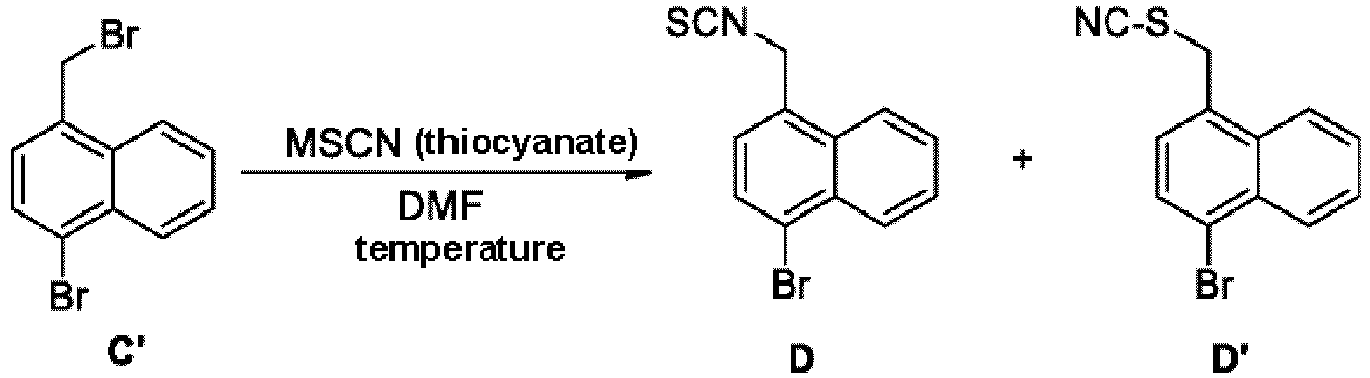
- It is recognized by one of ordinary skill in the art that the reaction of an aromatic benzyl halide with a thiocyanate is relatively easy. Since the reaction can generally be carried out at a lower temperature, there is generally no motivation to operate at a higher temperature (for the sake of saving energy and power consumption). Therefore, when trying to react C' with KSCN in DMF at room temperature, we found that the reaction was very rapid (completed within 0.5 hours), and a single product was obtained. But after separation and structural identification, it was found that the product was not the desired D (an isothiocyanate), but its isomer D' (a thiocyanate), with the latter being a product of the reaction of S-terminal of thiocyanate ion in KSCN with C'. To this end, we carried out a detailed and intensive study on the types of thiocyanate and the temperatures of the reaction, and finally found that the reaction needed to be carried out within a specific range of higher temperatures so as to ensure the selectivity of N-terminal of thiocyanate ion to C' in the reaction.
- Reaction operations: to a dry 250 mL round bottom flask was added compound C' (3.00 g, 10 mmol), which was dissolved in a dry solvent (30 mL), and then warmed to an indicated temperature with stirring. A thiocyanate MSCN (12 mmol) was added in three portions within 1 minute. After the addition was completed, the reaction mixture was further stirred at the indicated temperature for 1 hour, and at this point the reaction was completed. The reaction mixture was cooled to room temperature, and then poured into stirring ice water (200 mL), stirred and extracted with CH2Cl2 (50 mL × 3). The organic phases were combined, washed with 5% saline solution (50 mL × 5), and dried over anhydrous Na2SO4. The dried organic phase was evaporated on a rotary evaporator to remove the solvent, and the resulting residue was purified and isolated by column chromatography to give products D and D'. The yields are calculated respectively, and the experimental conditions and the results are shown in Table 2.
Table 2 Experimental conditions and results Experiment No. Solvent Temperature (°C) MSCN Yield of D (%) Yield of D' (%) 1 DMF 25 KSCN 0 90 2 DMF 40 KSCN 1 89 3 DMF 50 KSCN 1 91 4 DMF 60 KSCN 2 90 5 DMF 70 KSCN 3 87 6 DMF 80 KSCN 3 88 7 DMF 90 KSCN 14 64 8 DMF 100 KSCN 45 40 9 DMF 110 KSCN 78 12 10 DMF 120 KSCN 92 2 11 DMF 130 KSCN 93 2 12 DMF 140 90 1 13 DMF reflux temperature of DMF* KSCN 90 2 14 DMF 120 NaSCN 92 3 15 DMF 140 NaSCN 91 1 16 DMF reflux temperature of DMF* NaSCN 91 1 17 DMF 120 NH4SCN 90 2 18 DMF 140 NH4SCN 90 2 19 DMF reflux temperature of DMF* NH4SCN 91 1 20 N,N-dimethyl acetamide (DMA) 140 KSCN 85 1 21 DMSO 140 KSCN 87 1 22 N-methyl pyrrolidone (NMP) 140 KSCN 80 3 23 hexamethyl phosphoramide (HMPA) 140 KSCN 84 2 24 MeOH reflux temperature of MeOH* KSCN 0 65 25 EtOH reflux temperature of EtOH* KSCN 0 33 26 acetone reflux temperature of acetone* KSCN 1 61 27 EtOAc reflux temperature of EtOAc* KSCN 0 49 28 MeCN reflux temperature of MeCN* KSCN 0 64 29 THF reflux temperature of THF* KSCN 0 54 *Note: the boiling point of DMF under a pressure of 760 mmHg is 153°C, but it is a common knowledge of those of ordinary skill in the art that under actual experimental conditions, the actual boiling temperature of DMF is affected by many factors (such as the altitude of experiment site and the types and concentrations of solutes dissolved in DMF) and may fluctuate around 153°C. Similarly, the reflux temperatures of several solvents described in the above table are also around their boiling points. The boiling point of MeOH is 65°C; the boiling point of EtOH is 78°C; the boiling point of acetone is 56.5°C; the boiling point of EtOAc is 77°C; the boiling point of MeCN is 81°C; and the boiling point of THF is 65°C. - Conclusion: as can be seen from Table 2, in contrast to what recognized by those of ordinary skill in the art, the reaction between compound C' and a thiocyanate was very rapid and can be rapidly completed at room temperature. However, the distribution of the products is obviously temperature dependent. At a higher temperature, it tends to be produce D which is desired in the present invention, but at a lower temperature, the products are primarily isomer D'. The temperature at which D/D' tendency can be reversed is about 100°C. At the same time, the reaction proceeds well in an aprotic dipolar solvent such as DMF, DMA, DMSO, NMP, and HMPA, but does not proceeds well in other solvents.
-

- To a dry 1 L round bottom flask were added compound A' (1-methylnaphthalene, 28.44 g, 200 mmol), NBS (42.72 g, 240 mmol) and MeCN (700 mL), and the resulting mixture was stirred at 30°C-40°C for 12 hours.
- The reaction mixture was cooled to room temperature, poured into ice water (3 L), and extracted with dichloromethane (500 mL × 3). The extracted phases were combined, washed with 5% aqueous solution of Na2CO3 (500 mL × 5), 10% aqueous solution of Na2S2O3 (500 mL) and 5% saline solution (500 mL) sequentially, and dried over anhydrous Na2SO4. The dried organic phase was evaporated on a rotary evaporator to remove the solvent, and the resulting residue was purified by column chromatography to give product B' as a colorless oil, 39.80 g; yield: 90%. 1H NMR (DMSO-d6, 400 MHz), δ 8.14-8.16 (m, 1H), 8.07-8.09 (m, 1H), 7.76 (d, 1H, J = 7.6 Hz), 7.66-7.70 (m, 2H), 7.30 (d, 1H, J = 7.6 Hz), 2.63 (s, 3H).
- To a dry 1 L round bottom flask was added n-hexane (400 mL) at room temperature, and B' (35.37 g, 160 mmol), benzoyl peroxide (BPO, 0.775 g, 3.2 mmol) and NBS (34.17 g, 192 mmol) were added with stirring. The resulting mixture was stirred and heated to reflux, until TLC indicated that the reaction was completed (0.775 g BPO was added once every 8 hours after the start of the reaction; the reaction was usually completed within 36 hours).
- After the reaction was completed, the system was cooled to room temperature, stirred for 2 hours, and then filtered by suction. The filter cake was added into 800 mL water, stirred at room temperature for 1 hour and filtered by suction, and the filtrate was discarded. The filter cake was added into 800 mL water again, stirred at room temperature for 1 hour and filtered by suction, and the filtrate was discarded. The resulting filter cake was pulped by stirring in 800 mL n-hexane for 2 hours and filtered by suction. The filter cake was dried to give a pure product of C' as a white solid, 34.56 g; yield: 72%; m.p.: 104.0-105.5°C. 1H NMR (DMSO-d6, 400 MHz), δ 8.20-8.26 (m, 2H), 7.86 (d, 1H, J = 8.0 Hz), 7.72-7.78 (m, 2H), 7.62 (d, 1H, J = 7.6 Hz), 5.21 (s, 2H).
- To a dry 1 L round bottom flask was added compound C' (30.00 g, 100 mmol), dissolved in dry DMF (300 mL), and then heated to 140°C with stirring. KSCN (11.66 g, 120 mmol) was added in three portions within 1 minute. After the addition was completed, the reaction mixture was further stirred at 140°C for 1 hour.
- The reaction mixture was cooled to room temperature, then poured into stirring ice water (2000 mL), stirred and extracted with CH2Cl2 (300 mL × 3). The organic phases were combined, washed with 5% saline solution (200 mL × 5), and dried over anhydrous Na2SO4. The dried organic phase was evaporated on a rotary evaporator to remove the solvent, and the resulting residue was purified by column chromatography to give product D as a white solid, 25.59 g; yield: 92%; m.p.: 94.5-97.5°C. 1H NMR (DMSO-d6, 400 MHz), δ 8.21-8.24 (m, 1H), 8.11-8.14 (m, 1H), 7.92 (d, 1H, J = 7.6 Hz), 7.73-7.78 (m, 2H), 7.52 (d, 1H, J = 8.0 Hz), 5.41 (s, 2H).
- The above-described crude compound D (6.95 g, calculated as 25 mmol) was dissolved in THF (100 mL), and stirred at room temperature. Formylhydrazine (1.80 g, 30 mmol) was added, and then the stirring was continued overnight. At this point the reaction was detected for completion by TLC.
- The reaction mixture was evaporated on a rotary evaporator to dryness, the resulting residue, i.e., a crude product of E, was dissolved in DMF (80 mL), and a solution made by solid K2CO3 (3.46 g, 25 mol) and water (10 mL) was added. The reaction mixture was stirred at 50°C until the reaction was completed (usually 5 hours).
- The reaction mixture was cooled to room temperature, poured into ice water (400 mL), stirred, adjusted with hydrochloric acid to pH = 5-6, and extracted with CH2Cl2 (150 mL × 5). The organic phases were combined, washed with 5% saline solution (200 mL), and dried over anhydrous Na2SO4. The dried organic phase was evaporated on a rotary evaporator to remove the solvent, and the resulting residue was purified by column chromatography to give product F as a white solid. 1H NMR showed that about 5% debromination by-product was contained therin. The crude F was crystallized twice with ethyl acetate to give a pure product of F, 6.96 g; yield: 87% (D→F); m.p.: 243-244°C. 1H NMR (DMSO-d6, 400 MHz), δ 13.88 (brs, 1H), 8.37 (s, 1H), 8.22 (d, 2H, J = 7.6 Hz), 7.90 (d, 1H, J = 7.2 Hz), 7.72 (m, 2H), 7.18 (d, 1H, J = 7.2 Hz), 5.61 (s, 2H).
- Compound F (6.40 g, 20 mmol) was dissolved in DMF (100 mL) and stirred at room temperature, and solid K2CO3 (8.29 g, 60 mmol) and methyl bromoacetate (3.67 g, 24 mmol) were added. The resulting reaction mixture was stirred continuously at room temperature until the completion of the reaction was found by TLC determination (usually within 5 hours).
- The reaction mixture was poured into ice water (400 mL), stirred, and extracted with CH2Cl2 (100 mL × 5). The organic phases were combined, washed with 5% saline solution (200 mL), and dried over anhydrous Na2SO4. The dried organic phase was evaporated on a rotary evaporator to remove the solvent, and the resulting residue was purified by column chromatography to give product G as a white solid, 7.37 g; yield: 94%; m.p.: 112.5-114°C. 1H NMR (DMSO-d6, 400 MHz), δ 8.67 (s, 1H), 8.22-8.25 (m, 1H), 8.15-8.17 (m, 1H), 7.88 (d, 1H, J = 7.6 Hz), 7.72-7.79 (m, 2H), 6.92 (d, 1H, J = 7.6 Hz), 5.72 (s, 2H), 4.07 (s, 2H), 3.62 (s, 3H).
- Compound G (3.92 g, 10 mmol) was dissolved in acetonitrile (50 mL) and stirred at room temperature. NBS (2.14 g, 12 mmol) was added, and the stirring was continued at room temperature until the completion of the reaction was found by TLC determination (usually within 12 hours).
- The reaction mixture was poured into ice water (200 mL), stirred, and extracted with CH2Cl2 (100 mL × 3). The organic phases were combined, and washed with a saturated aqueous solution of Na2CO3 (100 mL × 3) and 5% saline solution (200 mL) sequentially, and dried over anhydrous Na2SO4. The dried organic phase was evaporated on a rotary evaporator to remove the solvent, and the resulting residue was purified by column chromatography to give product H as a white solid, 3.49 g; m.p.: 141-143°C; yield: 74%. 1H NMR (DMSO-d6, 400 MHz), δ 8.21-8.26 (m, 2H), 7.84 (d, 1H, J = 8.0 Hz), 7.76-7.82 (m, 2H), 6.49 (d, 1H, J = 7.6 Hz), 5.74 (s, 2H), 4.08 (s, 2H), 3.61 (s, 3H).
- Compound H (3.30 g, 7 mmol) was added into methanol (50 mL) and stirred at room temperature. A solution made by LiOH·H2O (0.84 g, 20 mmol) and water (3 mL) was added, and then stirred at room temperature until the completion of the reaction was found by TLC determination (usually 2 hours).
- The reaction mixture was poured into ice water (200 mL), stirred, adjusted with hydrochloric acid to pH = 2-3, and extracted with CH2Cl2 (100 mL × 4). The organic phases were combined, washed with 5% saline solution (200 mL), and dried over anhydrous Na2SO4. The dried organic phase was evaporated on a rotary evaporator to remove the solvent, and the resulting residue was purified by column chromatography to give product ZXS-BR as a white solid, 2.82 g; yield: 88%; m.p.: 169.5-171.5°C. 1H NMR (DMSO-d6, 400 MHz), δ 12.97 (brs, 1H), 8.22-8.26 (m, 2H), 7.83 (d, 1H, J = 8.0 Hz), 7.76-7.81 (m, 2H), 6.51 (d, 1H, J = 8.0 Hz), 5.73 (s, 2H), 4.01 (s, 2H).
-

- To a dry 1 L round bottom flask were added compound A' (1-methylnaphthalene, 28.44 g, 200 mmol), NBS (42.72 g, 240 mmol) and MeCN (700 mL), and the resulting mixture was stirred at 30°C-40°C for 12 hours.
- The reaction mixture was cooled to room temperature, poured into ice water (5 L), and extracted with dichloromethane (500 mL × 3). The extracted phases were combined, washed with 5% aqueous solution of Na2CO3 (500 mL × 5), 10% aqueous solution of Na2S2O3 (500 mL) and 5% saline solution (500 mL) sequentially, and dried over anhydrous Na2SO4. The dried organic phase was evaporated on a rotary evaporator to remove the solvent, and the resulting residue was purified by column chromatography to give product B' as a colorless oil, 39.80 g; yield: 90%. 1H NMR (DMSO-d6, 400 MHz), δ 8.14-8.16 (m, 1H), 8.07-8.09 (m, 1H), 7.76 (d, 1H, J = 7.6 Hz), 7.66-7.70 (m, 2H), 7.30 (d, 1H, J = 7.6 Hz), 2.63 (s, 3H).
- To a dry 1 L round bottom flask was added n-hexane (400 mL) at room temperature, and B' (35.37 g, 160 mmol), benzoyl peroxide (BPO, 0.775 g, 3.2 mmol) and NBS (34.17 g, 192 mmol) were added with stirring. The resulting mixture was stirred and heated to reflux, until TLC indicated that the reaction was completed (0.775 g BPO was added once every 8 hours after the start of the reaction; the reaction was usually completed within 36 hours).
- After the reaction was completed, the system was cooled to room temperature, stirred for 2 hours, and then filtered by suction. The filter cake was added into 800 mL water, stirred at room temperature for 1 hour and filtered by suction, and the filtrate was discarded. The filter cake was added into 800 mL water again, stirred at room temperature for 1 hour and filtered by suction, and the filtrate was discarded. The resulting filter cake was pulped by stirring in 800 mL n-hexane for 2 hours and filtered by suction. The filter cake was dried to give a pure product of C' as a white solid, 34.56 g; yield: 72%; m.p.: 104.0-105.5°C. 1H NMR (DMSO-d6, 400 MHz), δ 8.20-8.26 (m, 2H), 7.86 (d, 1H, J = 8.0 Hz), 7.72-7.78 (m, 2H), 7.62 (d, 1H, J = 7.6 Hz), 5.21 (s, 2H).
- To a dry 1 L round bottom flask was added compound C' (30.00 g, 100 mmol), dissolved in dry DMF (300 mL), and then heated to 140°C with stirring. KSCN (11.66 g, 120 mmol) was added in three portions within 1 minute. After the addition was completed, the reaction mixture was further stirred at 140°C for 1 hour.
- The reaction mixture was cooled to room temperature, poured into stirring ice water (2000 mL), stirred and extracted with CH2Cl2 (300 mL × 3). The organic phases were combined, washed with 5% saline solution (200 mL × 5), and dried over anhydrous Na2SO4. The dried organic phase was evaporated on a rotary evaporator to remove the solvent, and the resulting residue was purified by column chromatography to give product D as a white solid, 25.59 g; yield: 92%; m.p.: 94.5-97.5°C. 1H NMR (DMSO-d6, 400 MHz), δ 8.21-8.24 (m, 1H), 8.11-8.14 (m, 1H), 7.92 (d, 1H, J = 7.6 Hz), 7.73-7.78 (m, 2H), 7.52 (d, 1H, J = 8.0 Hz), 5.41 (s, 2H).
- The above-described crude compound D (6.95 g, calculated as 25 mmol) was dissolved in THF (100 mL), and stirred at room temperature. Formylhydrazine (1.80 g, 30 mmol) was added, and then the stirring was continued overnight. At this point the reaction was detected for completion by TLC.
- The reaction mixture was evaporated on a rotary evaporator to dryness, the resulting residue, i.e., a crude product of E, was dissolved in DMF (80 mL), and a mixture made by solid Na2CO3 (2.65 g, 25 mol) and water (10 mL) was added. The reaction mixture was stirred at 50°C until the reaction was completed (usually 5 hours).
- The reaction mixture was cooled to room temperature, poured into ice water (400 mL), stirred, adjusted with hydrochloric acid to pH = 5-6, and extracted with CH2Cl2 (150 mL × 5). The organic phases were combined, washed with 5% saline solution (200 mL), and dried over anhydrous Na2SO4. The dried organic phase was evaporated on a rotary evaporator to remove the solvent, and the resulting residue was purified by column chromatography to give product F as a white solid. 1H NMR showed that about 5% debromination by-product was contained therein. The crude F was crystallized twice with ethyl acetate to give a pure product of F, 6.80 g; yield: 85% (D→F); m.p.: 243-244°C. 1H NMR (DMSO-d6, 400 MHz), δ 13.88 (brs, 1H), 8.37 (s, 1H), 8.22 (d, 2H, J = 7.6 Hz), 7.90 (d, 1H, J = 7.2 Hz), 7.72 (m, 2H), 7.18 (d, 1H, J = 7.2 Hz), 5.61 (s, 2H).
- Compound F (6.40 g, 20 mmol) was dissolved in DMF (100 mL) and stirred at room temperature, and solid K2CO3 (8.29 g, 60 mmol) and ethyl chloroacetate (2.94 g, 24 mmol) were added. The resulting reaction mixture was stirred continuously at room temperature until the completion of the reaction was found by TLC determination (usually within 10 hours).
- The reaction mixture was poured into ice water (400 mL), stirred, and extracted with CH2Cl2 (100 mL × 5). The organic phases were combined, washed with 5% saline solution (200 mL), and dried over anhydrous Na2SO4. The dried organic phase was evaporated on a rotary evaporator to remove the solvent, and the resulting residue was purified by column chromatography to give product G'-1 as a white solid, 7.72 g; yield: 95%. ESI-MS, m/z = 406, 408 ([M+H]+).
- Compound G'-1 (4.06 g, 10 mmol) was dissolved in acetonitrile (50 mL) and stirred at room temperature. NBS (2.14 g, 12 mmol) was added, and the stirring was continued at room temperature until the completion of the reaction was found by TLC determination (usually within 12 hours).
- The reaction mixture was poured into ice water (200 mL), stirred, and extracted with CH2Cl2 (100 mL × 3). The organic phases were combined, and washed with a saturated Na2CO3 solution (100 mL × 3) and 5% saline solution (200 mL) sequentially, and dried over anhydrous Na2SO4. The dried organic phase was evaporated on a rotary evaporator to remove the solvent, and the resulting residue was purified by column chromatography to give product H'-1 as a white solid, 3.69 g; yield: 76%. ESI-MS, m/z = 486 ([M+H]+).
- Compound H'-1 (3.40 g, 7 mmol) was added into methanol (40 mL) and stirred at room temperature. A solution made by NaOH (0.8 g, 20 mmol) and water (1 mL) was added, and then stirred at room temperature until the completion of the reaction was found by TLC determination (usually 2 hours).
- The reaction mixture was poured into ice water (200 mL), stirred, adjusted with hydrochloric acid to pH = 2-3, and extracted with CH2Cl2 (100 mL × 4). The organic phases were combined, washed with 5% saline solution (200 mL), and dried over anhydrous Na2SO4. The dried organic phase was evaporated on a rotary evaporator to remove the solvent, and the resulting residue was purified by column chromatography to give product ZXS-BR as a white solid, 2.82 g; yield: 88%; m.p.: 169.5-171.5°C. 1H NMR (DMSO-d6, 400 MHz), δ 12.97 (brs, 1H), 8.22-8.26 (m, 2H), 7.83 (d, 1H, J = 8.0 Hz), 7.76-7.81 (m, 2H), 6.51 (d, 1H, J = 8.0 Hz), 5.73 (s, 2H), 4.01 (s, 2H).
-

- To a dry 1 L round bottom flask were added compound A' (1-methylnaphthalene, 28.44 g, 200 mmol), NBS (42.72 g, 240 mmol) and MeCN (700 mL), and the resulting mixture was stirred at 30°C-40°C for 12 hours.
- The reaction mixture was cooled to room temperature, poured into ice water (5 L), and extracted with dichloromethane (500 mL × 3). The extracted phases were combined, washed with 5% aqueous solution of Na2CO3 (500 mL × 5), 10% aqueous solution of Na2S2O3 (500 mL) and 5% saline solution (500 mL) sequentially, and dried over anhydrous Na2SO4. The dried organic phase was evaporated on a rotary evaporator to remove the solvent, and the resulting residue was purified by column chromatography to give product B' as a colorless oil, 39.80 g; yield: 90%. 1H NMR (DMSO-d6, 400 MHz), δ 8.14-8.16 (m, 1H), 8.07-8.09 (m, 1H), 7.76 (d, 1H, J = 7.6 Hz), 7.66-7.70 (m, 2H), 7.30 (d, 1H, J = 7.6 Hz), 2.63 (s, 3H).
- To a dry 1 L round bottom flask was added n-hexane (400 mL) at room temperature, and B' (35.37 g, 160 mmol), benzoyl peroxide (BPO, 0.775 g, 3.2 mmol) and NBS (34.17 g, 192 mmol) were added with stirring. The resulting mixture was stirred and heated to reflux, until TLC indicated that the reaction was completed (0.775 g BPO was added once every 8 hours after the start of the reaction; the reaction was usually completed within 36 hours).
- After the reaction was completed, the system was cooled to room temperature, stirred for 2 hours, and then filtered by suction. The filter cake was added into 800 mL water, stirred at room temperature for 1 hour and filtered by suction, and the filtrate was discarded. The filter cake was added into 800 mL water again, stirred at room temperature for 1 hour and filtered by suction, and the filtrate was discarded. The resulting filter cake was pulped with stirring in 800 mL n-hexane for 2 hours and filtered by suction. The filter cake was dried to give a pure product of C' as a white solid, 34.56 g; yield: 72%; m.p.: 104.0-105.5°C. 1H NMR (DMSO-d6, 400 MHz), δ 8.20-8.26 (m, 2H), 7.86 (d, 1H, J = 8.0 Hz), 7.72-7.78 (m, 2H), 7.62 (d, 1H, J = 7.6 Hz), 5.21 (s, 2H).
- Compound C' (30.00 g, 100 mmol) was added to a dry 1 L round bottom flask, dissolved in dry DMF (300 mL), and then heated to 140°C with stirring. KSCN (11.66 g, 120 mmol) was added in three portions within 1 minute. After the addition was completed, the reaction mixture was further stirred at 140°C for 1 hour.
- The reaction mixture was cooled to room temperature, then poured into stirring ice water (2000 mL), stirred and extracted with CH2Cl2 (300 mL × 3). The organic phases were combined, washed with 5% saline solution (200 mL × 5), and dried over anhydrous Na2SO4. The dried organic phase was evaporated on a rotary evaporator to remove the solvent, and the resulting residue was purified by column chromatography to give product D as a white solid, 25.59 g; yield: 92%; m.p.: 94.5-97.5°C. 1H NMR (DMSO-d6, 400 MHz), δ 8.21-8.24 (m, 1H), 8.11-8.14 (m, 1H), 7.92 (d, 1H, J = 7.6 Hz), 7.73-7.78 (m, 2H), 7.52 (d, 1H, J = 8.0 Hz), 5.41 (s, 2H).
- The above-described crude compound D (6.95 g, calculated as 25 mmol) was dissolved in THF (100 mL), and stirred at room temperature. Formylhydrazine (1.80 g, 30 mmol) was added, and then the stirring was continued overnight. At this point the reaction was detected for completion by TLC.
- The reaction mixture was evaporated on a rotary evaporator to dryness, the resulting residue, i.e., a crude product of E, was dissolved in DMF (80 mL), and a mixture made by solid NaOH (1.00 g, 25 mol) and water (5 mL) was added. The reaction mixture was stirred at 50°C until the reaction was completed (usually 5 hours).
- The reaction mixture was cooled to room temperature, poured into ice water (400 mL), stirred, adjusted with hydrochloric acid to pH = 5-6, and extracted with CH2Cl2 (150 mL × 5). The organic phases were combined, washed with 5% saline solution (200 mL), and dried over anhydrous Na2SO4. The dried organic phase was evaporated on a rotary evaporator to remove the solvent, and the resulting residue was purified by column chromatography to give product F as a white solid. 1H NMR showed that about 5% debromination by-product was contained therein. The crude F was crystallized twice with ethyl acetate to give a pure product of F, 6.64 g; yield: 83% (D→F); m.p.: 243-244°C. 1H NMR (DMSO-d6, 400 MHz), δ 13.88 (brs, 1H), 8.37 (s, 1H), 8.22 (d, 2H, J = 7.6 Hz), 7.90 (d, 1H, J = 7.2 Hz), 7.72 (m, 2H), 7.18 (d, 1H, J = 7.2 Hz), 5.61 (s, 2H).
- Compound F (6.40 g, 20 mmol) was dissolved in DMF (100 mL) and stirred at room temperature, and solid K2CO3 (8.29 g, 60 mmol) and ethyl chloroacetate (2.94 g, 24 mmol) were added. The resulting reaction mixture was stirred continuously at room temperature until the completion of the reaction was found by TLC determination (usually within 10 hours).
- The reaction mixture was poured into ice water (400 mL), stirred, and extracted with CH2Cl2 (100 mL × 5). The organic phases were combined, washed with 5% saline solution (200 mL), and dried over anhydrous Na2SO4. The dried organic phase was evaporated on a rotary evaporator to remove the solvent, and the resulting residue was purified by column chromatography to give product G'-1 as a white solid, 7.72 g; yield: 95%. ESI-MS, m/z = 406, 408 ([M+H]+).
- Compound G'-1 (4.06 g, 10 mmol) was dissolved in acetonitrile (50 mL) and stirred at room temperature. NBS (2.14 g, 12 mmol) was added, and the stirring was continued at room temperature until the completion of the reaction was found by TLC determination (usually within 12 hours).
- The reaction mixture was poured into ice water (200 mL), stirred, and extracted with CH2Cl2 (100 mL × 3). The organic phases were combined, and washed with a saturated Na2CO3 solution (100 mL × 3) and 5% saline solution (200 mL) sequentially, and dried over anhydrous Na2SO4. The dried organic phase was evaporated on a rotary evaporator to remove the solvent, and the resulting residue was purified by column chromatography to give product H'-1 as a white solid, 3.69 g; yield: 76%. ESI-MS, m/z = 486 ([M+H]+).
- Compound H'-1 (3.40 g, 7 mmol) was added into methanol (40 mL) and stirred at room temperature. A solution made by KOH (1.12 g, 20 mmol) and water (1 mL) was added, and then stirred at room temperature until the completion of the reaction was found by TLC determination (usually 2 hours).
- The reaction mixture was poured into ice water (200 mL), stirred, adjusted with hydrochloric acid to pH = 2-3, and extracted with CH2Cl2 (100 mL × 4). The organic phases were combined, washed with 5% saline solution (200 mL), and dried over anhydrous Na2SO4. The dried organic phase was evaporated on a rotary evaporator to remove the solvent, and the resulting residue was purified by column chromatography to give product ZXS-BR as a white solid, 2.82 g; yield: 88%; m.p.: 169.5-171.5°C. 1H NMR (DMSO-d6, 400 MHz), δ 12.97 (brs, 1H), 8.22-8.26 (m, 2H), 7.83 (d, 1H, J = 8.0 Hz), 7.76-7.81 (m, 2H), 6.51 (d, 1H, J = 8.0 Hz), 5.73 (s, 2H), 4.01 (s, 2H).
Claims (10)
- A method for preparing a urate transporter 1 inhibitor, 2-((5-bromo-4-((4-bromonaphthalen-1-yl)methyl)-4H-1,2,4-triazol-3-yl)thio) acetic acid represented by the formula ZXS-BR, comprising the following steps:1) performing a bromination reaction of N-bromosuccinimide and starting material A' to obtain product B';
preferably, the solvent for the reaction is acetonitrile, and the reaction temperature is from 30 to 40°C;2) reacting product B' obtained from step 1) with N-bromosuccinimide in the presence of a radical initiator to obtain product C';3) reacting product C' obtained from step 2) with a thiocyanate at a temperature no lower than 100°C to obtain product D;4) reacting product D obtained from step 3) with formylhydrazine to obtain product E;
preferably, the solvent for the reaction is tetrahydrofuran;5) performing a ring closure reaction of product E obtained from step 4) in the presence of a base to obtain product F;
preferably, the base is an alkali metal carbonate or an alkali metal hydroxide, more preferably, Na2CO3, K2CO3, NaOH or KOH;6) reacting product F obtained from step 5) with XCH2CO2R in the presence of a base to obtain product G';
wherein, X is selected from Cl, Br or I, R is selected from C1-C10 alkyl or C3-C6 cycloalkyl; preferably, R is selected from C1-C4 alkyl; more preferably, R is selected from methyl or ethyl;7) reacting product G' obtained from step 6) with N-bromosuccinimide to obtain product H';8) hydrolyzing product H' obtained from step 7) in the presence of a base to obtain ZXS-BR;
preferably, the base is selected from an alkali metal hydroxide; more preferably, the base is selected from LiOH, NaOH or KOH;
wherein, the formulas A', B', C', D, E, F, G', H' and ZXS-BR represent the compounds represented by the following formulas, respectively:
- The method of claim 1, wherein in step 2), the radical initiator is benzoyl peroxide or azodiisobutyronitrile.
- The method of claim 1, wherein in step 2), the solvent of the reaction is selected from C5-C17 alkane or cycloalkane, or petroleum ether fraction at 30-150°C; preferably, C5-C17 alkane or cycloalkane is n-pentane, cyclopentane, n-hexane, cyclohexane, or n-heptane.
- The method of claim 1, wherein in step 2), the temperature of the reaction is from 36°C to 120°C; preferably, the temperature of the reation is the reflux temperature of the solvent.
- The method of claim 1, wherein in step 3), the thiocyanate is a thiocyanate of alkali metal, alkaline earth metal or ammonium; preferably, the thiocyanate is sodium thiocyanate, potassium thiocyanate or ammonium thiocyanate.
- The method of claim 1, wherein in step 3), the solvent of the reaction is an aprotic dipolar solvent; preferably, the aprotic dipolar solvent is selected from dimethylformamide, N,N-dimethylacetamide, dimethyl sulfoxide, N-methylpyrrolidone, or hexamethylphosphoramide.
- The method of claim 1, wherein in step 3), the temperature of the reaction is from 100°C to the reflux temperature of the solvent; more preferably, the temperature of the reaction is from 120°C to 140°C.
- The method of any one of claims 1 to 7, wherein the method comprises the following steps:1) performing a bromination reaction of N-bromosuccinimide and starting material A' in acetonitrile as a solvent at a temperature of 30-40°C to obtain product B';2) heating product B' obtained from step 1), N-bromosuccinimide and benzoyl peroxide in n-hexane to reflux to obtain product C';3) reacting product C' obtained from step 2) with potassium thiocyanate in dimethylformamide as a solvent at a temperature of 140°C to obtain product D;4) reacting product D obtained from step 3) with formylhydrazine in tetrahydrofuran as a solvent at room temperature to obtain product E;5) performing a ring closure rection of product E obtained from step 4) with a base to obtain product F;
preferably, the base is an alkali metal carbonate or an alkali metal hydroxide, more preferably, Na2CO3, K2CO3, NaOH or KOH;6) reacting product F obtained from step 5) with XCH2CO2R in the presence of a base to obtain product G';
wherein, X is selected from Cl, Br or I, R is selected from C1-C10 alkyl or C3-C6 cycloalkyl;
preferably, R is selected from C1-C4 alkyl;
more preferably, R is selected from methyl or ethyl;7) reacting product G' obtained from step 6) with N-bromosuccinimide to obtain product H';8) hydrolyzing product H' obtained from step 7) with a base to obtain ZXS-BR;
preferably, the base is an alkali metal hydroxide;
more preferably, the base is LiOH, NaOH or KOH. - A compound represented by the following formula H' or G' respectively:
 wherein, R is selected from C1-C10 alkyl or C3-C6 cycloalkyl;preferably, R is selected from C1-C4 alkyl;more preferably, R is selected from methyl or ethyl.
 - A compound represented by the following formula D, E or F respectively:

Applications Claiming Priority (2)
| Application Number | Priority Date | Filing Date | Title |
|---|---|---|---|
| CN201610506171.0A CN107540619B (en) | 2016-06-29 | 2016-06-29 | A kind of preparation method of 1 inhibitor of uric acid transporter body |
| PCT/CN2017/089993 WO2018001197A1 (en) | 2016-06-29 | 2017-06-26 | Method for preparing urate-anion exchanger 1 inhibitor |
Publications (3)
| Publication Number | Publication Date |
|---|---|
| EP3480188A1 EP3480188A1 (en) | 2019-05-08 |
| EP3480188A4 EP3480188A4 (en) | 2019-12-25 |
| EP3480188B1 true EP3480188B1 (en) | 2021-05-05 |
Family
ID=60786582
Family Applications (1)
| Application Number | Title | Priority Date | Filing Date |
|---|---|---|---|
| EP17819194.6A Active EP3480188B1 (en) | 2016-06-29 | 2017-06-26 | Method for preparing urate transporter 1 inhibitor |
Country Status (8)
| Country | Link |
|---|---|
| US (1) | US11091448B2 (en) |
| EP (1) | EP3480188B1 (en) |
| KR (1) | KR102326829B1 (en) |
| CN (1) | CN107540619B (en) |
| AU (1) | AU2017290931B2 (en) |
| ES (1) | ES2878598T3 (en) |
| MY (1) | MY190118A (en) |
| WO (1) | WO2018001197A1 (en) |
Families Citing this family (3)
| Publication number | Priority date | Publication date | Assignee | Title |
|---|---|---|---|---|
| CN110128359B (en) * | 2018-02-02 | 2021-09-03 | 天津药物研究院有限公司 | Crystal of uric acid transporter 1 inhibitor and preparation method and application thereof |
| CN108467332A (en) * | 2018-04-26 | 2018-08-31 | 山东海益化工科技有限公司 | Free agent causes the method that propylene high-temperature chlorination prepares chloropropene |
| EP4251393A4 (en) * | 2020-11-25 | 2025-04-30 | Ravel Holdings, Inc. | MODULAR TEXTILE RECYCLING SYSTEM AND PROCESSES |
Family Cites Families (3)
| Publication number | Priority date | Publication date | Assignee | Title |
|---|---|---|---|---|
| CN101348537B (en) * | 2008-08-18 | 2010-09-15 | 苏州大学 | Triphenylamine-naphthalene branched molecules with two-photon polymerization initiation properties |
| CN102186832B (en) * | 2008-09-04 | 2014-04-02 | 亚德生化公司 | Compounds, compositions and methods of use for modulating uric acid levels |
| CN106187926B (en) * | 2015-04-30 | 2018-11-27 | 天津药物研究院有限公司 | Carboxylic acids URAT1 inhibitor, preparation method and its purposes in hyperuricemia and gout treatment of the structure containing diarylmethanes |
-
2016
- 2016-06-29 CN CN201610506171.0A patent/CN107540619B/en active Active
-
2017
- 2017-06-26 AU AU2017290931A patent/AU2017290931B2/en active Active
- 2017-06-26 KR KR1020197002228A patent/KR102326829B1/en active Active
- 2017-06-26 WO PCT/CN2017/089993 patent/WO2018001197A1/en not_active Ceased
- 2017-06-26 MY MYPI2018002985A patent/MY190118A/en unknown
- 2017-06-26 US US16/312,164 patent/US11091448B2/en active Active
- 2017-06-26 ES ES17819194T patent/ES2878598T3/en active Active
- 2017-06-26 EP EP17819194.6A patent/EP3480188B1/en active Active
Also Published As
| Publication number | Publication date |
|---|---|
| KR102326829B1 (en) | 2021-11-15 |
| MY190118A (en) | 2022-03-29 |
| CN107540619B (en) | 2019-08-16 |
| US11091448B2 (en) | 2021-08-17 |
| WO2018001197A1 (en) | 2018-01-04 |
| EP3480188A4 (en) | 2019-12-25 |
| ES2878598T3 (en) | 2021-11-19 |
| CN107540619A (en) | 2018-01-05 |
| EP3480188A1 (en) | 2019-05-08 |
| AU2017290931A1 (en) | 2019-01-24 |
| KR20190022719A (en) | 2019-03-06 |
| AU2017290931B2 (en) | 2021-07-15 |
| US20190233381A1 (en) | 2019-08-01 |
Similar Documents
| Publication | Publication Date | Title |
|---|---|---|
| FI108434B (en) | Process for the preparation of pharmacologically active benzimidazole derivatives | |
| TWI461195B (en) | Novel phenol derivatives | |
| HUT64041A (en) | Process for producing imidazole derivatives comprising (biphenylsulfonyl)-urea or (biphenylsulfonyl)-urethane derivative side chain, as well as pharmaceutical compositions comprising such compounds | |
| EP2197860B1 (en) | New compounds as adenosine a1 receptor antagonists | |
| US20110282069A1 (en) | High-purity febuxostat and the method for preparation | |
| CN112430221B (en) | Compound for preventing, treating or relieving hyperuricemia or gout and application thereof | |
| CN116262736B (en) | Novel oxo-pyridine compound and preparation method and application thereof | |
| US11091448B2 (en) | Method for preparing urate transporter 1 inhibitor | |
| US20220371987A1 (en) | Process for manufacture of amantadine nitrate derivatives | |
| KR20170103803A (en) | Bifunctional compounds and use for reducing uric acid levels | |
| EP2927219B1 (en) | 2-aryl selenazole compound and pharmaceutical composition thereof | |
| CN105566237B (en) | A kind of preparation method for the triazole mercapto phenylacetic acid compound for treating gout | |
| JP2003505367A (en) | 3-arylsulfonyl-2- (substituted methyl) propanoic acid derivatives as matrix metalloproteinase inhibitors | |
| CN108997315B (en) | N- (3-azolylphenyl) isonicotinamide compound and preparation method and application thereof | |
| Bosin et al. | Routes of functionalized guanidines. Synthesis of guanidino diesters | |
| CN103351346A (en) | Preparation method of impurity HP1 in bendamustine hydrochloride | |
| CN111417632B (en) | Thiazole-5-carboxylic acid derivative and its preparation method and application | |
| AU675035B2 (en) | Benzene derivatives and pharmaceutical composition | |
| CN108218777A (en) | A kind of sulphur substituted phenyl pyrazole class XOR inhibitor and preparation and application | |
| CN111116501B (en) | Synthesis method of Ravinard intermediate capable of effectively reducing impurity content | |
| CN110078668A (en) | A kind of phenylimidazole class XOR inhibitor and preparation and application | |
| CN111320588B (en) | A method of purifying Lesinurad | |
| CN112920170B (en) | N-(indol-5-yl) aromatic heterocyclic amide compounds and their preparation method and use | |
| CN114621136B (en) | Pyridinothioic acid compound, preparation method, pharmaceutical derivative or formulation and application thereof | |
| WO2011082623A1 (en) | Method for preparing febuxostat |
Legal Events
| Date | Code | Title | Description |
|---|---|---|---|
| STAA | Information on the status of an ep patent application or granted ep patent |
Free format text: STATUS: THE INTERNATIONAL PUBLICATION HAS BEEN MADE |
|
| PUAI | Public reference made under article 153(3) epc to a published international application that has entered the european phase |
Free format text: ORIGINAL CODE: 0009012 |
|
| STAA | Information on the status of an ep patent application or granted ep patent |
Free format text: STATUS: REQUEST FOR EXAMINATION WAS MADE |
|
| 17P | Request for examination filed |
Effective date: 20190104 |
|
| AK | Designated contracting states |
Kind code of ref document: A1 Designated state(s): AL AT BE BG CH CY CZ DE DK EE ES FI FR GB GR HR HU IE IS IT LI LT LU LV MC MK MT NL NO PL PT RO RS SE SI SK SM TR |
|
| AX | Request for extension of the european patent |
Extension state: BA ME |
|
| DAV | Request for validation of the european patent (deleted) | ||
| DAX | Request for extension of the european patent (deleted) | ||
| A4 | Supplementary search report drawn up and despatched |
Effective date: 20191127 |
|
| RIC1 | Information provided on ipc code assigned before grant |
Ipc: C07D 249/12 20060101AFI20191119BHEP Ipc: C07D 249/08 20060101ALI20191119BHEP |
|
| GRAP | Despatch of communication of intention to grant a patent |
Free format text: ORIGINAL CODE: EPIDOSNIGR1 |
|
| STAA | Information on the status of an ep patent application or granted ep patent |
Free format text: STATUS: GRANT OF PATENT IS INTENDED |
|
| RIC1 | Information provided on ipc code assigned before grant |
Ipc: A61P 19/06 20060101ALI20201008BHEP Ipc: A61K 31/496 20060101ALI20201008BHEP Ipc: C07D 249/12 20060101AFI20201008BHEP Ipc: C07D 249/08 20060101ALI20201008BHEP |
|
| INTG | Intention to grant announced |
Effective date: 20201109 |
|
| GRAS | Grant fee paid |
Free format text: ORIGINAL CODE: EPIDOSNIGR3 |
|
| GRAA | (expected) grant |
Free format text: ORIGINAL CODE: 0009210 |
|
| STAA | Information on the status of an ep patent application or granted ep patent |
Free format text: STATUS: THE PATENT HAS BEEN GRANTED |
|
| AK | Designated contracting states |
Kind code of ref document: B1 Designated state(s): AL AT BE BG CH CY CZ DE DK EE ES FI FR GB GR HR HU IE IS IT LI LT LU LV MC MK MT NL NO PL PT RO RS SE SI SK SM TR |
|
| REG | Reference to a national code |
Ref country code: GB Ref legal event code: FG4D |
|
| REG | Reference to a national code |
Ref country code: CH Ref legal event code: EP |
|
| REG | Reference to a national code |
Ref country code: AT Ref legal event code: REF Ref document number: 1389681 Country of ref document: AT Kind code of ref document: T Effective date: 20210515 |
|
| REG | Reference to a national code |
Ref country code: IE Ref legal event code: FG4D |
|
| REG | Reference to a national code |
Ref country code: DE Ref legal event code: R096 Ref document number: 602017038276 Country of ref document: DE |
|
| REG | Reference to a national code |
Ref country code: LT Ref legal event code: MG9D |
|
| REG | Reference to a national code |
Ref country code: GR Ref legal event code: EP Ref document number: 20210402000 Country of ref document: GR Effective date: 20210915 |
|
| REG | Reference to a national code |
Ref country code: AT Ref legal event code: MK05 Ref document number: 1389681 Country of ref document: AT Kind code of ref document: T Effective date: 20210505 |
|
| PG25 | Lapsed in a contracting state [announced via postgrant information from national office to epo] |
Ref country code: FI Free format text: LAPSE BECAUSE OF FAILURE TO SUBMIT A TRANSLATION OF THE DESCRIPTION OR TO PAY THE FEE WITHIN THE PRESCRIBED TIME-LIMIT Effective date: 20210505 Ref country code: LT Free format text: LAPSE BECAUSE OF FAILURE TO SUBMIT A TRANSLATION OF THE DESCRIPTION OR TO PAY THE FEE WITHIN THE PRESCRIBED TIME-LIMIT Effective date: 20210505 Ref country code: HR Free format text: LAPSE BECAUSE OF FAILURE TO SUBMIT A TRANSLATION OF THE DESCRIPTION OR TO PAY THE FEE WITHIN THE PRESCRIBED TIME-LIMIT Effective date: 20210505 Ref country code: BG Free format text: LAPSE BECAUSE OF FAILURE TO SUBMIT A TRANSLATION OF THE DESCRIPTION OR TO PAY THE FEE WITHIN THE PRESCRIBED TIME-LIMIT Effective date: 20210805 Ref country code: AT Free format text: LAPSE BECAUSE OF FAILURE TO SUBMIT A TRANSLATION OF THE DESCRIPTION OR TO PAY THE FEE WITHIN THE PRESCRIBED TIME-LIMIT Effective date: 20210505 |
|
| REG | Reference to a national code |
Ref country code: ES Ref legal event code: FG2A Ref document number: 2878598 Country of ref document: ES Kind code of ref document: T3 Effective date: 20211119 |
|
| PG25 | Lapsed in a contracting state [announced via postgrant information from national office to epo] |
Ref country code: IS Free format text: LAPSE BECAUSE OF FAILURE TO SUBMIT A TRANSLATION OF THE DESCRIPTION OR TO PAY THE FEE WITHIN THE PRESCRIBED TIME-LIMIT Effective date: 20210905 Ref country code: PL Free format text: LAPSE BECAUSE OF FAILURE TO SUBMIT A TRANSLATION OF THE DESCRIPTION OR TO PAY THE FEE WITHIN THE PRESCRIBED TIME-LIMIT Effective date: 20210505 Ref country code: LV Free format text: LAPSE BECAUSE OF FAILURE TO SUBMIT A TRANSLATION OF THE DESCRIPTION OR TO PAY THE FEE WITHIN THE PRESCRIBED TIME-LIMIT Effective date: 20210505 Ref country code: PT Free format text: LAPSE BECAUSE OF FAILURE TO SUBMIT A TRANSLATION OF THE DESCRIPTION OR TO PAY THE FEE WITHIN THE PRESCRIBED TIME-LIMIT Effective date: 20210906 Ref country code: NO Free format text: LAPSE BECAUSE OF FAILURE TO SUBMIT A TRANSLATION OF THE DESCRIPTION OR TO PAY THE FEE WITHIN THE PRESCRIBED TIME-LIMIT Effective date: 20210805 Ref country code: SE Free format text: LAPSE BECAUSE OF FAILURE TO SUBMIT A TRANSLATION OF THE DESCRIPTION OR TO PAY THE FEE WITHIN THE PRESCRIBED TIME-LIMIT Effective date: 20210505 Ref country code: RS Free format text: LAPSE BECAUSE OF FAILURE TO SUBMIT A TRANSLATION OF THE DESCRIPTION OR TO PAY THE FEE WITHIN THE PRESCRIBED TIME-LIMIT Effective date: 20210505 |
|
| REG | Reference to a national code |
Ref country code: NL Ref legal event code: MP Effective date: 20210505 |
|
| PG25 | Lapsed in a contracting state [announced via postgrant information from national office to epo] |
Ref country code: NL Free format text: LAPSE BECAUSE OF FAILURE TO SUBMIT A TRANSLATION OF THE DESCRIPTION OR TO PAY THE FEE WITHIN THE PRESCRIBED TIME-LIMIT Effective date: 20210505 |
|
| PG25 | Lapsed in a contracting state [announced via postgrant information from national office to epo] |
Ref country code: RO Free format text: LAPSE BECAUSE OF FAILURE TO SUBMIT A TRANSLATION OF THE DESCRIPTION OR TO PAY THE FEE WITHIN THE PRESCRIBED TIME-LIMIT Effective date: 20210505 Ref country code: CZ Free format text: LAPSE BECAUSE OF FAILURE TO SUBMIT A TRANSLATION OF THE DESCRIPTION OR TO PAY THE FEE WITHIN THE PRESCRIBED TIME-LIMIT Effective date: 20210505 Ref country code: DK Free format text: LAPSE BECAUSE OF FAILURE TO SUBMIT A TRANSLATION OF THE DESCRIPTION OR TO PAY THE FEE WITHIN THE PRESCRIBED TIME-LIMIT Effective date: 20210505 Ref country code: EE Free format text: LAPSE BECAUSE OF FAILURE TO SUBMIT A TRANSLATION OF THE DESCRIPTION OR TO PAY THE FEE WITHIN THE PRESCRIBED TIME-LIMIT Effective date: 20210505 Ref country code: SK Free format text: LAPSE BECAUSE OF FAILURE TO SUBMIT A TRANSLATION OF THE DESCRIPTION OR TO PAY THE FEE WITHIN THE PRESCRIBED TIME-LIMIT Effective date: 20210505 Ref country code: SM Free format text: LAPSE BECAUSE OF FAILURE TO SUBMIT A TRANSLATION OF THE DESCRIPTION OR TO PAY THE FEE WITHIN THE PRESCRIBED TIME-LIMIT Effective date: 20210505 |
|
| REG | Reference to a national code |
Ref country code: DE Ref legal event code: R097 Ref document number: 602017038276 Country of ref document: DE |
|
| REG | Reference to a national code |
Ref country code: BE Ref legal event code: MM Effective date: 20210630 |
|
| PLBE | No opposition filed within time limit |
Free format text: ORIGINAL CODE: 0009261 |
|
| STAA | Information on the status of an ep patent application or granted ep patent |
Free format text: STATUS: NO OPPOSITION FILED WITHIN TIME LIMIT |
|
| PG25 | Lapsed in a contracting state [announced via postgrant information from national office to epo] |
Ref country code: MC Free format text: LAPSE BECAUSE OF FAILURE TO SUBMIT A TRANSLATION OF THE DESCRIPTION OR TO PAY THE FEE WITHIN THE PRESCRIBED TIME-LIMIT Effective date: 20210505 Ref country code: LU Free format text: LAPSE BECAUSE OF NON-PAYMENT OF DUE FEES Effective date: 20210626 |
|
| 26N | No opposition filed |
Effective date: 20220208 |
|
| PG25 | Lapsed in a contracting state [announced via postgrant information from national office to epo] |
Ref country code: IE Free format text: LAPSE BECAUSE OF NON-PAYMENT OF DUE FEES Effective date: 20210626 |
|
| PG25 | Lapsed in a contracting state [announced via postgrant information from national office to epo] |
Ref country code: IS Free format text: LAPSE BECAUSE OF FAILURE TO SUBMIT A TRANSLATION OF THE DESCRIPTION OR TO PAY THE FEE WITHIN THE PRESCRIBED TIME-LIMIT Effective date: 20210905 Ref country code: AL Free format text: LAPSE BECAUSE OF FAILURE TO SUBMIT A TRANSLATION OF THE DESCRIPTION OR TO PAY THE FEE WITHIN THE PRESCRIBED TIME-LIMIT Effective date: 20210505 |
|
| PG25 | Lapsed in a contracting state [announced via postgrant information from national office to epo] |
Ref country code: BE Free format text: LAPSE BECAUSE OF NON-PAYMENT OF DUE FEES Effective date: 20210630 |
|
| PGFP | Annual fee paid to national office [announced via postgrant information from national office to epo] |
Ref country code: IT Payment date: 20220615 Year of fee payment: 6 |
|
| PG25 | Lapsed in a contracting state [announced via postgrant information from national office to epo] |
Ref country code: IT Free format text: LAPSE BECAUSE OF NON-PAYMENT OF DUE FEES Effective date: 20210626 |
|
| PG25 | Lapsed in a contracting state [announced via postgrant information from national office to epo] |
Ref country code: CY Free format text: LAPSE BECAUSE OF FAILURE TO SUBMIT A TRANSLATION OF THE DESCRIPTION OR TO PAY THE FEE WITHIN THE PRESCRIBED TIME-LIMIT Effective date: 20210505 |
|
| P01 | Opt-out of the competence of the unified patent court (upc) registered |
Effective date: 20230530 |
|
| PG25 | Lapsed in a contracting state [announced via postgrant information from national office to epo] |
Ref country code: HU Free format text: LAPSE BECAUSE OF FAILURE TO SUBMIT A TRANSLATION OF THE DESCRIPTION OR TO PAY THE FEE WITHIN THE PRESCRIBED TIME-LIMIT; INVALID AB INITIO Effective date: 20170626 |
|
| PG25 | Lapsed in a contracting state [announced via postgrant information from national office to epo] |
Ref country code: MK Free format text: LAPSE BECAUSE OF FAILURE TO SUBMIT A TRANSLATION OF THE DESCRIPTION OR TO PAY THE FEE WITHIN THE PRESCRIBED TIME-LIMIT Effective date: 20210505 |
|
| PG25 | Lapsed in a contracting state [announced via postgrant information from national office to epo] |
Ref country code: MT Free format text: LAPSE BECAUSE OF FAILURE TO SUBMIT A TRANSLATION OF THE DESCRIPTION OR TO PAY THE FEE WITHIN THE PRESCRIBED TIME-LIMIT Effective date: 20210505 |
|
| PGFP | Annual fee paid to national office [announced via postgrant information from national office to epo] |
Ref country code: ES Payment date: 20250718 Year of fee payment: 9 |
|
| PGFP | Annual fee paid to national office [announced via postgrant information from national office to epo] |
Ref country code: CH Payment date: 20250701 Year of fee payment: 9 |
|
| PG25 | Lapsed in a contracting state [announced via postgrant information from national office to epo] |
Ref country code: TR Free format text: LAPSE BECAUSE OF FAILURE TO SUBMIT A TRANSLATION OF THE DESCRIPTION OR TO PAY THE FEE WITHIN THE PRESCRIBED TIME-LIMIT Effective date: 20210505 |
|
| REG | Reference to a national code |
Ref country code: CH Ref legal event code: U11 Free format text: ST27 STATUS EVENT CODE: U-0-0-U10-U11 (AS PROVIDED BY THE NATIONAL OFFICE) Effective date: 20260701 |
|
| PGFP | Annual fee paid to national office [announced via postgrant information from national office to epo] |
Ref country code: GB Payment date: 20260525 Year of fee payment: 10 |
|
| PGFP | Annual fee paid to national office [announced via postgrant information from national office to epo] |
Ref country code: GR Payment date: 20260618 Year of fee payment: 10 |
|
| PGFP | Annual fee paid to national office [announced via postgrant information from national office to epo] |
Ref country code: DE Payment date: 20260623 Year of fee payment: 10 |
|
| PGFP | Annual fee paid to national office [announced via postgrant information from national office to epo] |
Ref country code: FR Payment date: 20260526 Year of fee payment: 10 |