EP3480171A1 - Food wastewater treatment system and operation method of the same - Google Patents
Food wastewater treatment system and operation method of the same Download PDFInfo
- Publication number
- EP3480171A1 EP3480171A1 EP18160763.1A EP18160763A EP3480171A1 EP 3480171 A1 EP3480171 A1 EP 3480171A1 EP 18160763 A EP18160763 A EP 18160763A EP 3480171 A1 EP3480171 A1 EP 3480171A1
- Authority
- EP
- European Patent Office
- Prior art keywords
- food wastewater
- sewage
- cod
- inlet
- tank
- Prior art date
- Legal status (The legal status is an assumption and is not a legal conclusion. Google has not performed a legal analysis and makes no representation as to the accuracy of the status listed.)
- Withdrawn
Links
Images

Classifications
-
- C—CHEMISTRY; METALLURGY
- C02—TREATMENT OF WATER, WASTE WATER, SEWAGE, OR SLUDGE
- C02F—TREATMENT OF WATER, WASTE WATER, SEWAGE, OR SLUDGE
- C02F9/00—Multistage treatment of water, waste water or sewage
-
- C—CHEMISTRY; METALLURGY
- C02—TREATMENT OF WATER, WASTE WATER, SEWAGE, OR SLUDGE
- C02F—TREATMENT OF WATER, WASTE WATER, SEWAGE, OR SLUDGE
- C02F3/00—Biological treatment of water, waste water, or sewage
- C02F3/30—Aerobic and anaerobic processes
-
- C—CHEMISTRY; METALLURGY
- C02—TREATMENT OF WATER, WASTE WATER, SEWAGE, OR SLUDGE
- C02F—TREATMENT OF WATER, WASTE WATER, SEWAGE, OR SLUDGE
- C02F11/00—Treatment of sludge; Devices therefor
- C02F11/02—Biological treatment
- C02F11/04—Anaerobic treatment; Production of methane by such processes
-
- C—CHEMISTRY; METALLURGY
- C02—TREATMENT OF WATER, WASTE WATER, SEWAGE, OR SLUDGE
- C02F—TREATMENT OF WATER, WASTE WATER, SEWAGE, OR SLUDGE
- C02F3/00—Biological treatment of water, waste water, or sewage
- C02F3/02—Aerobic processes
- C02F3/12—Activated sludge processes
- C02F3/1205—Particular type of activated sludge processes
- C02F3/1215—Combinations of activated sludge treatment with precipitation, flocculation, coagulation and separation of phosphates
-
- C—CHEMISTRY; METALLURGY
- C02—TREATMENT OF WATER, WASTE WATER, SEWAGE, OR SLUDGE
- C02F—TREATMENT OF WATER, WASTE WATER, SEWAGE, OR SLUDGE
- C02F3/00—Biological treatment of water, waste water, or sewage
- C02F3/28—Anaerobic digestion processes
- C02F3/2853—Anaerobic digestion processes using anaerobic membrane bioreactors
-
- C—CHEMISTRY; METALLURGY
- C02—TREATMENT OF WATER, WASTE WATER, SEWAGE, OR SLUDGE
- C02F—TREATMENT OF WATER, WASTE WATER, SEWAGE, OR SLUDGE
- C02F3/00—Biological treatment of water, waste water, or sewage
- C02F3/28—Anaerobic digestion processes
- C02F3/2866—Particular arrangements for anaerobic reactors
- C02F3/2893—Particular arrangements for anaerobic reactors with biogas recycling
-
- C—CHEMISTRY; METALLURGY
- C02—TREATMENT OF WATER, WASTE WATER, SEWAGE, OR SLUDGE
- C02F—TREATMENT OF WATER, WASTE WATER, SEWAGE, OR SLUDGE
- C02F2103/00—Nature of the water, waste water, sewage or sludge to be treated
- C02F2103/32—Nature of the water, waste water, sewage or sludge to be treated from the food or foodstuff industry, e.g. brewery waste waters
-
- C—CHEMISTRY; METALLURGY
- C02—TREATMENT OF WATER, WASTE WATER, SEWAGE, OR SLUDGE
- C02F—TREATMENT OF WATER, WASTE WATER, SEWAGE, OR SLUDGE
- C02F2209/00—Controlling or monitoring parameters in water treatment
- C02F2209/08—Chemical Oxygen Demand [COD]; Biological Oxygen Demand [BOD]
-
- C—CHEMISTRY; METALLURGY
- C02—TREATMENT OF WATER, WASTE WATER, SEWAGE, OR SLUDGE
- C02F—TREATMENT OF WATER, WASTE WATER, SEWAGE, OR SLUDGE
- C02F2209/00—Controlling or monitoring parameters in water treatment
- C02F2209/28—CH4
-
- C—CHEMISTRY; METALLURGY
- C02—TREATMENT OF WATER, WASTE WATER, SEWAGE, OR SLUDGE
- C02F—TREATMENT OF WATER, WASTE WATER, SEWAGE, OR SLUDGE
- C02F3/00—Biological treatment of water, waste water, or sewage
- C02F3/02—Aerobic processes
-
- C—CHEMISTRY; METALLURGY
- C02—TREATMENT OF WATER, WASTE WATER, SEWAGE, OR SLUDGE
- C02F—TREATMENT OF WATER, WASTE WATER, SEWAGE, OR SLUDGE
- C02F3/00—Biological treatment of water, waste water, or sewage
- C02F3/28—Anaerobic digestion processes
-
- Y—GENERAL TAGGING OF NEW TECHNOLOGICAL DEVELOPMENTS; GENERAL TAGGING OF CROSS-SECTIONAL TECHNOLOGIES SPANNING OVER SEVERAL SECTIONS OF THE IPC; TECHNICAL SUBJECTS COVERED BY FORMER USPC CROSS-REFERENCE ART COLLECTIONS [XRACs] AND DIGESTS
- Y02—TECHNOLOGIES OR APPLICATIONS FOR MITIGATION OR ADAPTATION AGAINST CLIMATE CHANGE
- Y02E—REDUCTION OF GREENHOUSE GAS [GHG] EMISSIONS, RELATED TO ENERGY GENERATION, TRANSMISSION OR DISTRIBUTION
- Y02E50/00—Technologies for the production of fuel of non-fossil origin
- Y02E50/30—Fuel from waste, e.g. synthetic alcohol or diesel
-
- Y—GENERAL TAGGING OF NEW TECHNOLOGICAL DEVELOPMENTS; GENERAL TAGGING OF CROSS-SECTIONAL TECHNOLOGIES SPANNING OVER SEVERAL SECTIONS OF THE IPC; TECHNICAL SUBJECTS COVERED BY FORMER USPC CROSS-REFERENCE ART COLLECTIONS [XRACs] AND DIGESTS
- Y02—TECHNOLOGIES OR APPLICATIONS FOR MITIGATION OR ADAPTATION AGAINST CLIMATE CHANGE
- Y02W—CLIMATE CHANGE MITIGATION TECHNOLOGIES RELATED TO WASTEWATER TREATMENT OR WASTE MANAGEMENT
- Y02W10/00—Technologies for wastewater treatment
- Y02W10/10—Biological treatment of water, waste water, or sewage
Definitions
- the present disclosure relates to a food wastewater treatment system and an operating method thereof, and more particularly, to a food wastewater treatment system which generates biogas while increasing a food wastewater treatment quantity as compared with the related art using an existing sewage treatment process to improve an efficiency of new and renewable energy and an operating method thereof.
- a food wastewater is a wastewater which is eliminated and leached from wastes discharged from home or restaurants during a pre-treatment process of food wastes and has a high concentration of salinity and floating matters as compared with the existing sewage. Further, when the food wastewater is dried, since an organic material content of the food wastewater is considerably high to be 83.7 to 90.5%, biological oxygen demand (BOD) and chemical oxygen demand (COD) are 500 times higher than the sewage. Therefore, in the food wastewater treatment, a concentration of an organic material is high and a concentration of the salinity and the floating material is high as compared with a normal sewage treatment so that a separate process which is different from the sewage treatment process is necessary.
- the food wastewater is treated as it is during a normal sewage treatment process and thus there is a limitation in treating a large amount of food wastewater due to a high level of concentrations of an organic material, a salinity, and a floating material as described above.
- the normal sewage treatment process of the related art is configured by an aerobic activated sludge process rather than an anaerobic activated sludge process so that a large amount of organic materials included in the food wastewater cannot be treated. Further, due to the limited treatment amount, there is a limitation in increasing an amount of produced biogas.
- the food wastewater includes more organic materials than a normal sewage so that when the organic materials are hydrolyzed under anaerobic conditions, after generating volatile fatty acids such as acetic acid, propionic acid, and butyric acid, finally, a process of gasification with methane, carbon dioxide, ammonia, and hydrogen sulfide may be performed.
- An amount of biological sludge generated per unit organic material during this process is considerably smaller than that of aerobic digestion but methane which may be used as fuel is included in discharged digestion gas at a high proportion.
- the biogas which is configured with methane gas as a major component is a material which is getting the spotlight as an alternative clean energy source for fossil fuels which cause global warming and is a useful resource which is recognized as an extremely useful value.
- the sewage treatment process of the related art is mainly configured by an aerobic activated sludge process so as not to be optimized for a process of decomposing a high level of organic material to produce methane gas.
- some of existing sewage treatment processes overcome the above-mentioned drawback to treat the sludge and the food wastewater together at the time of anaerobic digestion.
- the amount of treated food wastewater is lower than 0.01% of a sewage inflow amount so that the treatment efficiency is insufficient.
- a system for recycling food wastewater disclosed in Korean Registered Patent No. 10-1611436 uses a process of pre-treating the food wastewater and then centrifuging the food wastewater to use a solid as a raw material for a fertilizer, and using the pretreatment liquid as a liquid fertilizer after performing aerobic fermentation, agglutination reaction, and dehydration treatment on a pretreatment liquid or mixing the pretreatment liquid with food wastewater to reduce salinity and BOD.
- a purpose of the treated food wastewater is limited to the fertilizer so that there is a disadvantage in that it is difficult to expect an additional effect such as production of biogas for reducing greenhouse gasses which are currently attracting attention as a social issue.
- An object to be achieved by the present disclosure is to provide a food wastewater treatment system which is capable of treating a high level of organic materials, a salinity, and floating matters to simultaneously perform a food wastewater treatment and an energizing process during an existing sewage treatment process.
- Another object to be achieved by the present invention is to provide an efficient process which not only simultaneously treats the food wastewater and sewage but also exceeds 1% of the food wastewater treatment capacity with respect to the sewage of the related art.
- Another object to be achieved by the present disclosure is to provide an eco-friendly food wastewater treatment system which generates biogas during the process of simultaneously treating the food wastewater and sewage based on a high concentration of organic material to improve an energy efficiency.
- a food wastewater treatment system including: a first inlet into which a sewage flows, a second inlet into which a food wastewater flows; a mixture equalization tank in which a predetermined amount of sewage flowing from the first inlet is mixed with the food wastewater flowing from the second inlet and the food wastewater with respect to sewage is 0.5% or higher; a precipitation tank and an aerobic tank located at a rear end of the first inlet; and an anaerobic biofilm reactor and a biogas purifying unit located at a rear end of the second inlet, in which a biogas which generates a more amount of energy than a power required to treat the food wastewater and the sewage flowing at the time of operation of the system is produced.
- a methane gas when the biogas is produced in the anaerobic biofilmreaction tank via the first mixture equalization tank, a methane gas may be 10% or lower than COD/COD, and the dissolved methane gas is a ratio (%, COD dissolved methane /COD mixture solution ) obtained when methane gas dissolved in the water is converted into a COD with respect to a total organic material concentration (COD) in the mixture solution and COD dissolved methane is a value obtained by converting the dissolved methane gas of various products treated through the anaerobic biofilm reactor into a COD, and COD mixture solution is a total COD value of mixture solution in which the food wastewater and the sewage are mixed.
- the mixture ratio of the food wastewater with respect to the sewage and the amount of produced methane may have the relationship as represented in the following Equation 1.
- Equation 1 Y refers to an amount of produced methane (m3 methane/total volume of m3 food wastewater and sewage) and X refers to a mixture ratio of a food wastewater with respect to a sewage (% V food wastewater/V sewage).
- an operating method of a food wastewater treatment system including: a first step of flowing a sewage into a first inlet and flowing a food wastewater into a second inlet; a second step of mixing the sewage flowing into the first inlet and the food wastewater flowing into the second inlet in a first mixture equalization tank in which the food wastewater with respect to the sewage in a mixture volume is 0.5% or more; a third step of flowing the sewage and food wastewater mixed in the first mixture equalization tank into an anaerobic biofilm reactor to produce methane gas; and a fourth step of transferring a treatment water of the anaerobic biofilm reactor into a front end of the precipitation tank to be treated in an aerobic reaction tank and then discharged through a secondary precipitation tank and performing a dehydration process on a sludge of the anaerobic biofilm reactor and then discarding the sludge, and collecting gas after purifying the gas including methane produced in the anaerobic biofilm reactor
- a methane gas dissolved in the reaction tank is 10% or lower than COD
- the dissolved methane gas is a ratio (%, COD dissolved methane /COD mixture solution) obtained when methane gas dissolved in the water is converted into a COD with respect to a total organic material concentration (COD) in the mixture solution
- COD dissolved methane is a value obtained by converting the dissolved methane gas of various products treated through the anaerobic biofilm reactor into a COD
- COD mixture solution is a total COD value of a mixture solution in which the food wastewater and the sewage are mixed.
- inlets of a sewage and food wastewater are separately provided so that a predetermined amount of sewage is mixed with the food wastewater to be treated. Therefore, a large amount of food wastewater which cannot be treated during the existing sewage treatment process can be treated and energized.
- the food wastewater treatment system of the present disclosure not only the food wastewater and sewage are simultaneously treated, but also the food wastewater treatment capacity with respect to the sewage may exceed 0.5% (50 times or higher as compared with 0.01% of the related art).
- the food wastewater treatment system of the present disclosure generates biogas during the process of simultaneously treating food wastewater and sewage to improve an energy efficiency.
- FIG. 1 is a diagram of an overall configuration of a food wastewater treatment system according to the present disclosure.
- the food wastewater treatment system of the present disclosure includes a sewage inlet 1 100, a food wastewater inlet 2 200, a first mixture equalization tank 300 of sewage and food wastewater, an anaerobic biofilm reactor 400, a dehydration tank 600, a disposal tank 700, a biogas collecting unit 800, a purification tank 900, a biogas usage destination 1000, a primary precipitation tank 110, an aerobic tank 120, a secondary precipitation tank 130, a treatment water 140, a second mixture equalization tank 150, a sludge thickener 160, and an anaerobic digestion tank 170.
- the food wastewater treatment system of the present disclosure includes a first inlet 100 into which a sewage flows and a second inlet 200 into which a food wastewater flows.
- a predetermined amount of sewage flowing through the first inlet 100 is mixed with the food wastewater flowing through the second inlet 200 and in the above mixture volume, the food wastewater with respect to the sewage is 0.5% or higher.
- the precipitation tank and the aerobic tank 120 are located and at a rear end of the second inlet 200, the anaerobic biofilm reactor 400 and the biogas purifying unit are located.
- the wastewater treated in the anaerobic biofilm reactor 400 is transferred to a front end of the precipitation tank.
- a sewage is a portion where domestic sewage and sanitary drain collected from local areas and wastewater of factories are collected and the first inlet 100 is located therein.
- the second inlet 200 is located for the food wastewater and the food wastewater refers to wastewater which is eliminated and leached from wastes discharged from home or restaurants during a pre-treatment process of food wastes.
- Some of the sewage is sent to the first mixture equalization tank 300 to be mixed with the food wastewater but most of the sewage flows into the primary precipitation tank 110.
- the sewage flowing into the primary precipitation tank 110 precipitates contaminated materials having a large mass by the gravity using a specific gravity difference.
- the sewage is separated into a sludge which is a sunk solid and supernatant which is a liquid part of an upper portion after the sludge sinks and this function is performed by the primary precipitation tank 110.
- the precipitated sludge is referred to as a primary sludge and the primary sludge is sent to the second mixture equalization tank 150 together with a secondary sludge to be precipitated in the secondary precipitation tank 130 located at a rear end of the aerobic tank 120 and is transferred to the anaerobic digestion tank 170 via the sludge thickener 160.
- the aerobic tank 120 is located at the rear end of the primary precipitation tank 110 and at the front end of the secondary precipitation tank 130 and aerates the liquid supernatant corresponding to the upper portion after the sludge transferred from the primary precipitation tank 110 is sunk to remove the remaining organic material which is not sunk in the primary precipitation tank 110 using aerobe.
- the secondary precipitation tank 130 is located at the rear end of the aerobic tank 120 and separates the organic material into the supernatant and the sludge using a specific gravity difference again after decomposing a part of organic material by aerobe in the aerobic tank 120. During this process, the organic material is removed from the wastewater.
- the secondary precipitation tank 130 is normally a circular structure and a skimmer which collects the precipitated sludge rotates at a lower portion and a weir is provided at an upper portion to overflow the supernatant.
- a part of sludge to be precipitated is returned to the aerobic tank 120 and the remaining thereof is stored in the second mixture equalization tank 150 together with the primary sludge to be subjected to the mixing process and then is transmitted to the anaerobic digestion tank 170 by reducing a volume of sludge through a concentration process which lowers moisture and increases a concentration of the sludge in the sludge thickener 160.
- a portion corresponding to the supernatant overflowing in the secondary precipitation tank 130 is completely treated and separated to be transferred and stored to the treatment water 140.
- the food wastewater which is eliminated and leached from wastes discharged from home or restaurants during a pre-treatment process of food wastes flows through the second inlet 200 and is mixed with a predetermined amount of sewage flowing through the first inlet 100 in the first mixture equalization tank 300.
- Two mixed solutions are transferred to the anaerobic biofilm reactor 400 located at the rear end of the first mixture equalization tank 300.
- the first mixture equalization tank 300 is a water tank in which the food wastewater flowing through the second inlet 200 for the food wastewater and a predetermined amount of sewage flowing through the first inlet 100 for the sewage are mixed and is located at the rear end of the sewage and the food wastewater.
- methane gas which passes through the first mixture equalization tank 300 to be dissolved in the anaerobic biofilm reaction tank may be maintained to be 10% or lower than COD.
- the dissolved methane gas ratio refers to a ratio obtained by converting the methane gas dissolved in various produced materials treated through the anaerobic biofilm reactor 400 into a COD (COD dissolved methane ) and then dividing the COD by a total COD (COD mixture solution ) of the mixture solution in which the food wastewater and sewage are mixed.
- a COD is a chemical oxygen demand and is a representative contamination index indicating a degree of contamination of wastewater and sewage together with biochemical oxygen demand (BOD) and is expressed by an amount of oxygen corresponding to an amount of an oxidizing agent consumed to oxidize an organic material when a solution such as potassium permanganate (KMnO4) or potassium dichromate (K2Cr2O7) is injected as an oxidizing agent and is represented in the unit of mg/L or ppm.
- a solution such as potassium permanganate (KMnO4) or potassium dichromate (K2Cr2O7)
- the anaerobic biofilm reactor 400 hydrolyzes organic materials existing in the wastewater using a carrier with anaerobe or a separation membrane, similarly to a chemical reaction occurring in the body of microorganism, and produces volatile fatty acid such as acetic acid, propionic acid, and butyric acid and performs gasification treatment by methane, carbon dioxide, ammonia, and hydrogen sulfide.
- a concentration of microorganism in the reaction tank may be maintained to be high using a physical property of the carrier or the separation membrane without using the sewage thicker tank 160 or the precipitation tank of the related art.
- the anaerobic biofilm reactor 400 advantageously reduces the amount of generated sludge and is stably operated due to high impact load for the inflow of raw water with a low temperature and high concentration in the winter season.
- a treatment capacity of the food wastewater with respect to the sewage is very important. According to the related art, it is difficult to treat 0.01% or more but according to the present disclosure, it is possible to treat 0.5% or more which is 50 times higher than the related art. As a result, an amount of produced methane gas and the content of dissolved methane gas in the anaerobic biofilm reaction tank of the entire system configuration are drastically increased and reduced. Further, the food wastewater treatment system according to the present disclosure treats the food wastewater including organic materials having a concentration of 500 times higher than that of the sewage to produce a large amount of methane gas so that a larger amount of power required to operate the food wastewater treatment system according to the present disclosure may be generated.
- the food wastewater flowing through a food wastewater inlet was mixed with 0% to 3% of food wastewater with respect to the amount of sewage flowing into the first mixture equalization tank 300 (V food wastewater/V sewage amount) in the first mixture equalization tank 300.
- the sludge of the anaerobic biofilm reactor 400 was subjected to the dehydration (600) process and then discarded (700).
- the biogas produced in the reactor was purified (900) and then used.
- a concentration of dissolved methane gas 80 mL of the treatment water 140 discharged from the anaerobic biofilm reactor 400 was immediately put into a 160 mL of serum bottle which was purged by nitrogen gas in advance to be sealed. Next, thereafter, the treatment water and the gas were thoroughly mixed for five minutes and kept in a 35°C oven for 24 hours to reach a liquid-gas phase equilibrium state. Thereafter, a concentration of methane gas in a head space of the serum bottle was measured using GC-TCD. As the concentration of methane gas, a COD concentration of the methane gas dissolved in the treatment water 140 was calculated based on the following equations.
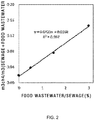
- FIG. 2 is a graph illustrating an amount of generated methane gas according to a mixture ratio (%) of food wastewater with respect to a sewage according to the present disclosure and in the graph, the mixture ratio of the food wastewater with respect to the sewage and the amount of produced methane have the relationship as represented in the following Equation 1.
- Y 0.0423 X + 0.0168 (Here, Y is an amount of produced methane (m3 methane/m3 food wastewater and sewage) and X is a mixture ratio of food wastewater with respect to sewage (% V food wastewater/V sewage))
- a COD concentration of the treatment water 140 discharged from the secondary percipient tank 130 was measured.
- a total organic material concentration (COD) of the final treatment water 140 is 37 mg/L and when the mixture ratios are 0.5%, 1.5%, and 3%, the COD concentrations of the final treatment water 140 are 37, 31, and 49 mg/L, respectively, which are very low so that there is no significant change. Therefore, it is confirmed that even when the ratio of the food wastewater with respect to the sewage flowing into the first mixture equalization tank 300 is increased up to 3%, the sewage and the food wastewater are normally purified.
Landscapes
- Life Sciences & Earth Sciences (AREA)
- Chemical & Material Sciences (AREA)
- Engineering & Computer Science (AREA)
- Microbiology (AREA)
- Water Supply & Treatment (AREA)
- Hydrology & Water Resources (AREA)
- Environmental & Geological Engineering (AREA)
- Organic Chemistry (AREA)
- Biodiversity & Conservation Biology (AREA)
- Analytical Chemistry (AREA)
- Chemical Kinetics & Catalysis (AREA)
- General Chemical & Material Sciences (AREA)
- Oil, Petroleum & Natural Gas (AREA)
- Health & Medical Sciences (AREA)
- Molecular Biology (AREA)
- Sustainable Development (AREA)
- Purification Treatments By Anaerobic Or Anaerobic And Aerobic Bacteria Or Animals (AREA)
Abstract
Description
- This application claims the priority of Korean Patent Application No.
10-2017-0145910 filed on November 3, 2017 - The present disclosure relates to a food wastewater treatment system and an operating method thereof, and more particularly, to a food wastewater treatment system which generates biogas while increasing a food wastewater treatment quantity as compared with the related art using an existing sewage treatment process to improve an efficiency of new and renewable energy and an operating method thereof.
- A food wastewater is a wastewater which is eliminated and leached from wastes discharged from home or restaurants during a pre-treatment process of food wastes and has a high concentration of salinity and floating matters as compared with the existing sewage. Further, when the food wastewater is dried, since an organic material content of the food wastewater is considerably high to be 83.7 to 90.5%, biological oxygen demand (BOD) and chemical oxygen demand (COD) are 500 times higher than the sewage. Therefore, in the food wastewater treatment, a concentration of an organic material is high and a concentration of the salinity and the floating material is high as compared with a normal sewage treatment so that a separate process which is different from the sewage treatment process is necessary. However, in the related art, the food wastewater is treated as it is during a normal sewage treatment process and thus there is a limitation in treating a large amount of food wastewater due to a high level of concentrations of an organic material, a salinity, and a floating material as described above. The normal sewage treatment process of the related art is configured by an aerobic activated sludge process rather than an anaerobic activated sludge process so that a large amount of organic materials included in the food wastewater cannot be treated. Further, due to the limited treatment amount, there is a limitation in increasing an amount of produced biogas. As described above, since the food wastewater includes more organic materials than a normal sewage so that when the organic materials are hydrolyzed under anaerobic conditions, after generating volatile fatty acids such as acetic acid, propionic acid, and butyric acid, finally, a process of gasification with methane, carbon dioxide, ammonia, and hydrogen sulfide may be performed. An amount of biological sludge generated per unit organic material during this process is considerably smaller than that of aerobic digestion but methane which may be used as fuel is included in discharged digestion gas at a high proportion. The biogas which is configured with methane gas as a major component is a material which is getting the spotlight as an alternative clean energy source for fossil fuels which cause global warming and is a useful resource which is recognized as an extremely useful value. However, as described above, the sewage treatment process of the related art is mainly configured by an aerobic activated sludge process so as not to be optimized for a process of decomposing a high level of organic material to produce methane gas. Further, some of existing sewage treatment processes overcome the above-mentioned drawback to treat the sludge and the food wastewater together at the time of anaerobic digestion. However, the amount of treated food wastewater is lower than 0.01% of a sewage inflow amount so that the treatment efficiency is insufficient. As such a food wastewater treatment system, for example, a system for recycling food wastewater disclosed in Korean Registered Patent No.
10-1611436 -
- (Patent Document 1) Korean Registered Patent No.
10-1611436 - (Patent Document 2) Korean Registered Patent No.
10-1189615 - (Patent Document 3) Korean Registered Patent No.
10-1599424 - (Patent Document 4) Korean Registered Patent No.
10-1213533 - An object to be achieved by the present disclosure is to provide a food wastewater treatment system which is capable of treating a high level of organic materials, a salinity, and floating matters to simultaneously perform a food wastewater treatment and an energizing process during an existing sewage treatment process.
- Further, another object to be achieved by the present invention is to provide an efficient process which not only simultaneously treats the food wastewater and sewage but also exceeds 1% of the food wastewater treatment capacity with respect to the sewage of the related art.
- Furthermore, another object to be achieved by the present disclosure is to provide an eco-friendly food wastewater treatment system which generates biogas during the process of simultaneously treating the food wastewater and sewage based on a high concentration of organic material to improve an energy efficiency.
- According to an aspect of the present disclosure, there is provided a food wastewater treatment system, including: a first inlet into which a sewage flows, a second inlet into which a food wastewater flows; a mixture equalization tank in which a predetermined amount of sewage flowing from the first inlet is mixed with the food wastewater flowing from the second inlet and the food wastewater with respect to sewage is 0.5% or higher; a precipitation tank and an aerobic tank located at a rear end of the first inlet; and an anaerobic biofilm reactor and a biogas purifying unit located at a rear end of the second inlet, in which a biogas which generates a more amount of energy than a power required to treat the food wastewater and the sewage flowing at the time of operation of the system is produced.
- Here, when the biogas is produced in the anaerobic biofilmreaction tank via the first mixture equalization tank, a methane gas may be 10% or lower than COD/COD, and the dissolved methane gas is a ratio (%, CODdissolved methane/CODmixture solution) obtained when methane gas dissolved in the water is converted into a COD with respect to a total organic material concentration (COD) in the mixture solution and CODdissolved methane is a value obtained by converting the dissolved methane gas of various products treated through the anaerobic biofilm reactor into a COD, and CODmixture solution is a total COD value of mixture solution in which the food wastewater and the sewage are mixed.
- Further, the mixture ratio of the food wastewater with respect to the sewage and the amount of produced methane may have the relationship as represented in the following
Equation 1.
- In
Equation 1, Y refers to an amount of produced methane (m3 methane/total volume of m3 food wastewater and sewage) and X refers to a mixture ratio of a food wastewater with respect to a sewage (% V food wastewater/V sewage). - According to another aspect of the present disclosure, there is provided an operating method of a food wastewater treatment system, including: a first step of flowing a sewage into a first inlet and flowing a food wastewater into a second inlet; a second step of mixing the sewage flowing into the first inlet and the food wastewater flowing into the second inlet in a first mixture equalization tank in which the food wastewater with respect to the sewage in a mixture volume is 0.5% or more; a third step of flowing the sewage and food wastewater mixed in the first mixture equalization tank into an anaerobic biofilm reactor to produce methane gas; and a fourth step of transferring a treatment water of the anaerobic biofilm reactor into a front end of the precipitation tank to be treated in an aerobic reaction tank and then discharged through a secondary precipitation tank and performing a dehydration process on a sludge of the anaerobic biofilm reactor and then discarding the sludge, and collecting gas after purifying the gas including methane produced in the anaerobic biofilm reactor in which a biogas which generates a more amount of energy than a power required to treat the food wastewater and the sewage flowing at the time of operation of the system is produced.
- Here, when the biogas is produced in the anaerobic biofilm reaction tank via the first mixture equalization tank, a methane gas dissolved in the reaction tank is 10% or lower than COD, and the dissolved methane gas is a ratio (%, CODdissolved methane/COD mixture solution) obtained when methane gas dissolved in the water is converted into a COD with respect to a total organic material concentration (COD) in the mixture solution and CODdissolved methane is a value obtained by converting the dissolved methane gas of various products treated through the anaerobic biofilm reactor into a COD, and CODmixture solution is a total COD value of a mixture solution in which the food wastewater and the sewage are mixed.
- According to the food wastewater treatment system and an operating method thereof of the present disclosure, inlets of a sewage and food wastewater are separately provided so that a predetermined amount of sewage is mixed with the food wastewater to be treated. Therefore, a large amount of food wastewater which cannot be treated during the existing sewage treatment process can be treated and energized.
- Further, according to the food wastewater treatment system of the present disclosure, not only the food wastewater and sewage are simultaneously treated, but also the food wastewater treatment capacity with respect to the sewage may exceed 0.5% (50 times or higher as compared with 0.01% of the related art).
- Furthermore, the food wastewater treatment system of the present disclosure generates biogas during the process of simultaneously treating food wastewater and sewage to improve an energy efficiency.
- The above and other aspects, features and other advantages of the present disclosure will be more clearly understood from the following detailed description taken in conjunction with the accompanying drawings, in which:
-
FIG. 1 is a diagram of an overall configuration of a food wastewater treatment system according to the present disclosure; and -
FIG. 2 is a graph illustrating an amount of generated methane gas according to a mixture ratio (%) of food wastewater with respect to a sewage according to the present disclosure. - Hereinafter, a technical configuration of a food wastewater treatment system according to the present disclosure and an operating method thereof will be described with reference to the accompanying drawings.
- In the present application, it will be appreciated that terms "including", "having" or "comprise" are intended to designate the existence of characteristics, numbers, steps, constituent elements, and components described in the specification or a combination thereof, and do not exclude a possibility of the existence or addition of one or more other specific characteristics, numbers, steps, operations, constituent elements, and components, or a combination thereof in advance.
- If it is not contrarily defined, all terms used herein including technological or scientific terms have the same meaning as those generally understood by a person with ordinary skill in the art. Terms which are defined in a generally used dictionary should be interpreted to have the same meaning as the meaning in the context of the related art but are not interpreted as an ideally or excessively formal meaning if it is not clearly defined in the present invention.
-
FIG. 1 is a diagram of an overall configuration of a food wastewater treatment system according to the present disclosure. Referring toFIG. 1 , the food wastewater treatment system of the present disclosure includes asewage inlet 1 100, afood wastewater inlet 2 200, a firstmixture equalization tank 300 of sewage and food wastewater, ananaerobic biofilm reactor 400, adehydration tank 600, adisposal tank 700, abiogas collecting unit 800, apurification tank 900, abiogas usage destination 1000, aprimary precipitation tank 110, anaerobic tank 120, asecondary precipitation tank 130, atreatment water 140, a secondmixture equalization tank 150, asludge thickener 160, and ananaerobic digestion tank 170. - The food wastewater treatment system of the present disclosure includes a
first inlet 100 into which a sewage flows and asecond inlet 200 into which a food wastewater flows. A predetermined amount of sewage flowing through thefirst inlet 100 is mixed with the food wastewater flowing through thesecond inlet 200 and in the above mixture volume, the food wastewater with respect to the sewage is 0.5% or higher. At a rear end of thefirst inlet 100, the precipitation tank and theaerobic tank 120 are located and at a rear end of thesecond inlet 200, theanaerobic biofilm reactor 400 and the biogas purifying unit are located. The wastewater treated in theanaerobic biofilm reactor 400 is transferred to a front end of the precipitation tank. - A sewage is a portion where domestic sewage and sanitary drain collected from local areas and wastewater of factories are collected and the
first inlet 100 is located therein. - The
second inlet 200 is located for the food wastewater and the food wastewater refers to wastewater which is eliminated and leached from wastes discharged from home or restaurants during a pre-treatment process of food wastes. - Some of the sewage is sent to the first
mixture equalization tank 300 to be mixed with the food wastewater but most of the sewage flows into theprimary precipitation tank 110. The sewage flowing into theprimary precipitation tank 110 precipitates contaminated materials having a large mass by the gravity using a specific gravity difference. In this case, the sewage is separated into a sludge which is a sunk solid and supernatant which is a liquid part of an upper portion after the sludge sinks and this function is performed by theprimary precipitation tank 110. Here, the precipitated sludge is referred to as a primary sludge and the primary sludge is sent to the secondmixture equalization tank 150 together with a secondary sludge to be precipitated in thesecondary precipitation tank 130 located at a rear end of theaerobic tank 120 and is transferred to theanaerobic digestion tank 170 via thesludge thickener 160. - The
aerobic tank 120 is located at the rear end of theprimary precipitation tank 110 and at the front end of thesecondary precipitation tank 130 and aerates the liquid supernatant corresponding to the upper portion after the sludge transferred from theprimary precipitation tank 110 is sunk to remove the remaining organic material which is not sunk in theprimary precipitation tank 110 using aerobe. Thesecondary precipitation tank 130 is located at the rear end of theaerobic tank 120 and separates the organic material into the supernatant and the sludge using a specific gravity difference again after decomposing a part of organic material by aerobe in theaerobic tank 120. During this process, the organic material is removed from the wastewater. Thesecondary precipitation tank 130 is normally a circular structure and a skimmer which collects the precipitated sludge rotates at a lower portion and a weir is provided at an upper portion to overflow the supernatant. Here, a part of sludge to be precipitated is returned to theaerobic tank 120 and the remaining thereof is stored in the secondmixture equalization tank 150 together with the primary sludge to be subjected to the mixing process and then is transmitted to theanaerobic digestion tank 170 by reducing a volume of sludge through a concentration process which lowers moisture and increases a concentration of the sludge in thesludge thickener 160. A portion corresponding to the supernatant overflowing in thesecondary precipitation tank 130 is completely treated and separated to be transferred and stored to thetreatment water 140. - The food wastewater which is eliminated and leached from wastes discharged from home or restaurants during a pre-treatment process of food wastes flows through the
second inlet 200 and is mixed with a predetermined amount of sewage flowing through thefirst inlet 100 in the firstmixture equalization tank 300. Two mixed solutions are transferred to theanaerobic biofilm reactor 400 located at the rear end of the firstmixture equalization tank 300. - The first
mixture equalization tank 300 is a water tank in which the food wastewater flowing through thesecond inlet 200 for the food wastewater and a predetermined amount of sewage flowing through thefirst inlet 100 for the sewage are mixed and is located at the rear end of the sewage and the food wastewater. When the food wastewater flows into the firstmixture equalization tank 300 at a ratio of 0.5% or higher with respect with the sewage, methane gas which passes through the firstmixture equalization tank 300 to be dissolved in the anaerobic biofilm reaction tank may be maintained to be 10% or lower than COD. Here, the dissolved methane gas ratio (%, CODdissolved methane/CODmixture solution) refers to a ratio obtained by converting the methane gas dissolved in various produced materials treated through theanaerobic biofilm reactor 400 into a COD (CODdissolved methane) and then dividing the COD by a total COD (CODmixture solution) of the mixture solution in which the food wastewater and sewage are mixed. - A COD is a chemical oxygen demand and is a representative contamination index indicating a degree of contamination of wastewater and sewage together with biochemical oxygen demand (BOD) and is expressed by an amount of oxygen corresponding to an amount of an oxidizing agent consumed to oxidize an organic material when a solution such as potassium permanganate (KMnO4) or potassium dichromate (K2Cr2O7) is injected as an oxidizing agent and is represented in the unit of mg/L or ppm.
- The
anaerobic biofilm reactor 400 hydrolyzes organic materials existing in the wastewater using a carrier with anaerobe or a separation membrane, similarly to a chemical reaction occurring in the body of microorganism, and produces volatile fatty acid such as acetic acid, propionic acid, and butyric acid and performs gasification treatment by methane, carbon dioxide, ammonia, and hydrogen sulfide. During this process, a concentration of microorganism in the reaction tank may be maintained to be high using a physical property of the carrier or the separation membrane without using the sewagethicker tank 160 or the precipitation tank of the related art. As a result, theanaerobic biofilm reactor 400 advantageously reduces the amount of generated sludge and is stably operated due to high impact load for the inflow of raw water with a low temperature and high concentration in the winter season. - In the food wastewater treatment system according to the present disclosure, a treatment capacity of the food wastewater with respect to the sewage is very important. According to the related art, it is difficult to treat 0.01% or more but according to the present disclosure, it is possible to treat 0.5% or more which is 50 times higher than the related art. As a result, an amount of produced methane gas and the content of dissolved methane gas in the anaerobic biofilm reaction tank of the entire system configuration are drastically increased and reduced. Further, the food wastewater treatment system according to the present disclosure treats the food wastewater including organic materials having a concentration of 500 times higher than that of the sewage to produce a large amount of methane gas so that a larger amount of power required to operate the food wastewater treatment system according to the present disclosure may be generated.
- After flowing 200 L/d of sewage therein, when 20 L/d which was 10% thereof flowed into the first mixture equalization tank, the food wastewater flowing through a food wastewater inlet was mixed with 0% to 3% of food wastewater with respect to the amount of sewage flowing into the first mixture equalization tank 300 (V food wastewater/V sewage amount) in the first
mixture equalization tank 300. The mixture solution flowed into theanaerobic biofilm reactor 400 to be treated for 12 hours of a retention time at a temperature of 35°C and thetreatment water 140 discharged from theanaerobic biofilm reactor 400 was transferred to the aerobic reaction tank to be treated and then discharged via thesecondary precipitation tank 130. The sludge of theanaerobic biofilm reactor 400 was subjected to the dehydration (600) process and then discarded (700). The biogas produced in the reactor was purified (900) and then used. - Individual reaction tanks operated under the following operating conditions.
- Primary precipitation tank 110: 2.5 hours of hydraulic retention time (HRT)
- Secondary precipitation tank 130: 2.5 hours of HRT
- Aerobic reaction tank: 15 degrees of operating temperature, 8 hours of HRT, 10 days of solid retention time (SRT)
- Anaerobic digestion tank 170: 35 degrees of operating temperature, 30 days of HRT/SRT
- Anaerobic biofilm reactor 400: 35 degrees of operating temperature, 12 hours of HRT
- Sludge thickener tank 160: 5 days of HRT
- In order to measure a concentration of dissolved methane gas, 80 mL of the
treatment water 140 discharged from theanaerobic biofilm reactor 400 was immediately put into a 160 mL of serum bottle which was purged by nitrogen gas in advance to be sealed. Next, thereafter, the treatment water and the gas were thoroughly mixed for five minutes and kept in a 35°C oven for 24 hours to reach a liquid-gas phase equilibrium state. Thereafter, a concentration of methane gas in a head space of the serum bottle was measured using GC-TCD. As the concentration of methane gas, a COD concentration of the methane gas dissolved in thetreatment water 140 was calculated based on the following equations.

- CODdissolved methane = Dissolved methane concentration in the sample (gCOD/L)
- Vs= Volume of liquid sample (L)
- Vr= Volume of bottle (L)
- Cg,eq = Methane concentration in gas under equilibrium (mol/L)
- Cw,eq = Methane concentration in water under equilibrium (mol/L)
- 64 = Conversion factor between mole of CH4 and g CH4-COD
- H = Henry's Law constant (mol/L·atm)
- R = ideal gas constant (0.0821 L·atm/mol·K)
- T = Temperature (K)
- It is confirmed that when the mixture ratio of the food wastewater with respect to the sewage flowing into the first
mixture equalization tank 300 was 0%, a ratio (%, CODdissolved methane/CODmixture solution) of the COD of the methane gas dissolved in the water with respect to the total organic material concentration (COD) in the mixture solution of sewage and food wastewater was 45%, but when the mixture ratio was 0.5%, 1.5%, and 3%, the ratio was lowered to 8%, 3%, and 2%, respectively. - Further, in order to continuously measure an amount of methane gas produced through the food wastewater treatment system according to the present disclosure together with the COD concentration of the methane gas, a product of wet-type gas meter produced by Ritter Apparatebau GmbH & Co. KG was used and an amount of methane was measured based on the change of the content of food wastewater in the sewage.
FIG. 2 is a graph illustrating an amount of generated methane gas according to a mixture ratio (%) of food wastewater with respect to a sewage according to the present disclosure and in the graph, the mixture ratio of the food wastewater with respect to the sewage and the amount of produced methane have the relationship as represented in the followingEquation 1.
- Further, when the food wastewater treatment system according to the present disclosure is added not only to measure the amount of produced methane gas, but also to measure a change of water quality of the final effluence, a COD concentration of the
treatment water 140 discharged from the secondarypercipient tank 130 was measured. When the mixture ratio of food wastewater with respect to the sewage flowing into the firstmixture equalization tank 300 is 0%, a total organic material concentration (COD) of thefinal treatment water 140 is 37 mg/L and when the mixture ratios are 0.5%, 1.5%, and 3%, the COD concentrations of thefinal treatment water 140 are 37, 31, and 49 mg/L, respectively, which are very low so that there is no significant change. Therefore, it is confirmed that even when the ratio of the food wastewater with respect to the sewage flowing into the firstmixture equalization tank 300 is increased up to 3%, the sewage and the food wastewater are normally purified. - Although the exemplary embodiment of the present disclosure has been mainly described above, various modifications and changes may be made by those skilled in the art. As long as the modifications and changes do not depart from the scope of the technical spirit of the present disclosure, it is understood that the modifications and changes fall within the scope of the present disclosure. Therefore, the scope of the present disclosure should be construed based on the following claims.
Claims (5)
- A food wastewater treatment system, comprising:a first inlet 100 into which a sewage flows, a second inlet 200 into which food wastewater flows;a mixture equalization tank in which a predetermined amount of sewage flowing from the first inlet 100 is mixed with the food wastewater flowing from the second inlet 200 and the food wastewater with respect to sewage is 0.5% or higher;a precipitation tank and an aerobic tank located at a rear end of the first inlet 100; andan anaerobic separation membrane biological reactor and a biogas purifying unit located at a rear end of the second inlet 200,wherein a biogas which generates a more amount of energy than a power required to treat the food wastewater and the sewage flowing at the time of operation of the system is produced.
- The food wastewater treatment system according to claim 1, wherein when the biogas is produced in the anaerobic biofilm reaction tank via the first mixture equalization tank 300, a methane gas dissolved in the reaction tank is 10% or lower than COD.
(Here, the dissolved methane gas is a ratio (%, CODdissolved methane/CODmixture solution) obtained when methane gas dissolved in the water is converted into a COD with respect to a total organic material concentration (COD) in the mixture solution and CODdissolved methane is a value obtained by converting the dissolved methane gas of various products treated through the anaerobic biofilm reactor 400 into COD, and CODmixture solution is a total COD value of mixture solution in which the food wastewater and the sewage are mixed). - The food wastewater treatment system according to claim 1, wherein the mixture ratio of the food wastewater with respect to the sewage and the amount of produced methane have the relationship as represented in the following Equation 1.

- An operating method of a food wastewater treatment system, the operating method comprising:a first step of flowing a sewage into a first inlet 100 and flowing a food wastewater into a second inlet 200;a second step of mixing the sewage flowing into the first inlet 100 and the food wastewater flowing into the second inlet 200 in a first mixture equalization tank in which the food wastewater with respect to the sewage in a mixture volume is 0.5% or more;a third step of flowing the sewage and food wastewater mixed in the first mixture equalization tank into an anaerobic biofilm reactor 400 to produce methane gas; anda fourth step of transferring a treatment water 140 of the anaerobic biofilm reactor 400 into a front end of the precipitation tank to be treated in an aerobic reaction tank and then discharged through a secondary precipitation tank 130 and performing a dehydration (600) process on a sludge of the anaerobic biofilm reactor 400 and then discarding the sludge, and collecting gas after purifying the gas including methane produced in the anaerobic biofilm reactor 400.
- The operating method according to claim 4, wherein when the biogas is produced in the anaerobic biofilm reaction tank via the first mixture equalization tank 300, a methane gas dissolved in the reaction tank is 10% or lower than COD.
(Here, the dissolved methane gas is a ratio (%, CODdissolved methane/CODmixture solution) obtained when methane gas dissolved in the water is converted into a COD with respect to a total organic material concentration (COD) in the mixture solution and CODdissolved methane is a value obtained by converting the dissolved methane gas of various products treated through the anaerobic biofilm reactor 400 into a COD, and CODmixture solution is a total COD value of a mixture solution in which the food wastewater and the sewage are mixed).
Applications Claiming Priority (1)
| Application Number | Priority Date | Filing Date | Title |
|---|---|---|---|
| KR1020170145910A KR20190050477A (en) | 2017-11-03 | 2017-11-03 | Food wastewater treatment system and operation method of the same |
Publications (1)
| Publication Number | Publication Date |
|---|---|
| EP3480171A1 true EP3480171A1 (en) | 2019-05-08 |
Family
ID=61616842
Family Applications (1)
| Application Number | Title | Priority Date | Filing Date |
|---|---|---|---|
| EP18160763.1A Withdrawn EP3480171A1 (en) | 2017-11-03 | 2018-03-08 | Food wastewater treatment system and operation method of the same |
Country Status (2)
| Country | Link |
|---|---|
| EP (1) | EP3480171A1 (en) |
| KR (1) | KR20190050477A (en) |
Families Citing this family (5)
| Publication number | Priority date | Publication date | Assignee | Title |
|---|---|---|---|---|
| KR102295805B1 (en) | 2019-04-02 | 2021-08-31 | 주식회사 마키나락스 | Method for managing training data |
| KR20230049970A (en) | 2021-10-07 | 2023-04-14 | 나민수 | Food wastewater treatment system |
| KR102452517B1 (en) | 2021-10-25 | 2022-10-06 | 나민수 | Biogas production system using mixture of dry feed and anaerobic digestate |
| KR102619461B1 (en) | 2023-07-24 | 2023-12-28 | 나민수 | Biogas production system by organic waste |
| KR102779933B1 (en) | 2024-05-17 | 2025-03-18 | 대전광역시 | Apparatus and Method for treating wastewater containing high concentration of nitrogen using the Foodwaste leachate |
Citations (7)
| Publication number | Priority date | Publication date | Assignee | Title |
|---|---|---|---|---|
| US6982035B1 (en) * | 2004-03-29 | 2006-01-03 | O'keefe David M | Biphase orbicular biodigester |
| KR101189615B1 (en) | 2012-04-17 | 2012-10-10 | 코리아워터텍 주식회사 | System for treating waste water and food waste, and method for treating waste water and food waste using the same |
| KR101213533B1 (en) | 2012-06-25 | 2012-12-20 | 김종오 | Treatment apparatus for sewage sludge and food leakage water |
| WO2013169091A1 (en) * | 2012-05-11 | 2013-11-14 | Ronser Bio-Tech Sdn Bhd | Zero discharge treatment system of palm oil mill effluent (pome) |
| US20140027373A1 (en) * | 2012-07-26 | 2014-01-30 | Anaergia Inc. | Partially divided anaerobic treatment system |
| KR101599424B1 (en) | 2014-10-30 | 2016-03-14 | 정광오 | System for bio gasification and drying of food waste |
| KR101611436B1 (en) | 2014-07-09 | 2016-04-12 | 백종학 | Recycling system of food waste effluent |
-
2017
- 2017-11-03 KR KR1020170145910A patent/KR20190050477A/en not_active Ceased
-
2018
- 2018-03-08 EP EP18160763.1A patent/EP3480171A1/en not_active Withdrawn
Patent Citations (7)
| Publication number | Priority date | Publication date | Assignee | Title |
|---|---|---|---|---|
| US6982035B1 (en) * | 2004-03-29 | 2006-01-03 | O'keefe David M | Biphase orbicular biodigester |
| KR101189615B1 (en) | 2012-04-17 | 2012-10-10 | 코리아워터텍 주식회사 | System for treating waste water and food waste, and method for treating waste water and food waste using the same |
| WO2013169091A1 (en) * | 2012-05-11 | 2013-11-14 | Ronser Bio-Tech Sdn Bhd | Zero discharge treatment system of palm oil mill effluent (pome) |
| KR101213533B1 (en) | 2012-06-25 | 2012-12-20 | 김종오 | Treatment apparatus for sewage sludge and food leakage water |
| US20140027373A1 (en) * | 2012-07-26 | 2014-01-30 | Anaergia Inc. | Partially divided anaerobic treatment system |
| KR101611436B1 (en) | 2014-07-09 | 2016-04-12 | 백종학 | Recycling system of food waste effluent |
| KR101599424B1 (en) | 2014-10-30 | 2016-03-14 | 정광오 | System for bio gasification and drying of food waste |
Non-Patent Citations (1)
| Title |
|---|
| JEONG YEONGMI ET AL: "Treatment of food waste recycling wastewater using anaerobic ceramic membrane bioreactor for biogas production in mainstream treatment process of domestic wastewater", WATER RESEARCH, ELSEVIER, AMSTERDAM, NL, vol. 123, 19 June 2017 (2017-06-19), pages 86 - 95, XP085179544, ISSN: 0043-1354, DOI: 10.1016/J.WATRES.2017.06.049 * |
Also Published As
| Publication number | Publication date |
|---|---|
| KR20190050477A (en) | 2019-05-13 |
Similar Documents
| Publication | Publication Date | Title |
|---|---|---|
| Ji et al. | Important effects of temperature on treating real municipal wastewater by a submerged anaerobic membrane bioreactor: Removal efficiency, biogas, and microbial community | |
| Monfet et al. | Nutrient removal and recovery from digestate: a review of the technology | |
| CA2788873C (en) | Simultaneous anoxic biological phosphorus and nitrogen removal with energy recovery | |
| Qiao et al. | Long-term stability of thermophilic co-digestion submerged anaerobic membrane reactor encountering high organic loading rate, persistent propionate and detectable hydrogen in biogas | |
| CN103641272B (en) | High concentrated organic wastewater and percolate zero-discharge treatment system | |
| Kim et al. | Anaerobic co-digestion of sewage sludge and food waste using temperature-phased anaerobic digestion process | |
| Gupta et al. | Managing dissolved methane gas in anaerobic effluents using microbial resource management-based strategies | |
| Yan et al. | Efficient ammonia-nitrogen removal and recovery from wastewater via the continuous flat-sheet gas-permeable membranes reactor pretreatment | |
| Makisha | Waste water and biogas–ecology and economy | |
| KR20190050477A (en) | Food wastewater treatment system and operation method of the same | |
| CN104211252B (en) | Percolate short-cut nitrification and denitrification denitrification process | |
| Zhao et al. | A full-scale survey of sludge landfill: sludge properties, leachate characteristics and microbial community structure | |
| KR20190050474A (en) | Food wastewater treatment system | |
| Xing et al. | Mainstream partial Anammox for improving nitrogen removal from municipal wastewater after organic recovery via magnetic separation | |
| Zhang et al. | Treating leachate mixture with anaerobic ammonium oxidation technology | |
| Zhang | Anaerobic treatment of municipal wastewater in a UASB-Digester system: temperature effect on system performance, hydrolysis and methanogenesis | |
| Yuan et al. | Influence of COD/sulfate ratios on the integrated reactor system for simultaneous removal of carbon, sulfur and nitrogen | |
| Qachach et al. | Biological treatment of fuel wastewater generated from a thermal power plant by continuous and discontinuous aeration | |
| Hao et al. | The pathway of in-situ ammonium removal from aerated municipal solid waste bioreactor: nitrification/denitrification or air stripping? | |
| JP6154250B2 (en) | Organic waste treatment method and organic waste treatment facility | |
| Mise et al. | Treatment of distillery spent wash by anaerobic digestion process | |
| Emana et al. | Tannery wastewater treatment using two-stage anaerobic sequence batch reactor (ASBR) at mesophilic and thermophilic phase | |
| GYOBU et al. | Energy content of organics in municipal wastewater treatment streams at Tsumori wastewater treatment plant | |
| Li et al. | The effect of anaerobic co-substrate on removal of COD, phenol and methane production in coal gasification wastewater treatment | |
| Melidis et al. | Anaerobic treatment of domestic wastewater using an anaerobic fixed-bed loop reactor |
Legal Events
| Date | Code | Title | Description |
|---|---|---|---|
| PUAI | Public reference made under article 153(3) epc to a published international application that has entered the european phase |
Free format text: ORIGINAL CODE: 0009012 |
|
| STAA | Information on the status of an ep patent application or granted ep patent |
Free format text: STATUS: REQUEST FOR EXAMINATION WAS MADE |
|
| 17P | Request for examination filed |
Effective date: 20180308 |
|
| AK | Designated contracting states |
Kind code of ref document: A1 Designated state(s): AL AT BE BG CH CY CZ DE DK EE ES FI FR GB GR HR HU IE IS IT LI LT LU LV MC MK MT NL NO PL PT RO RS SE SI SK SM TR |
|
| AX | Request for extension of the european patent |
Extension state: BA ME |
|
| STAA | Information on the status of an ep patent application or granted ep patent |
Free format text: STATUS: EXAMINATION IS IN PROGRESS |
|
| 17Q | First examination report despatched |
Effective date: 20210127 |
|
| STAA | Information on the status of an ep patent application or granted ep patent |
Free format text: STATUS: THE APPLICATION IS DEEMED TO BE WITHDRAWN |
|
| 18D | Application deemed to be withdrawn |
Effective date: 20210608 |