EP3477953A1 - Method and device for processing data - Google Patents
Method and device for processing data Download PDFInfo
- Publication number
- EP3477953A1 EP3477953A1 EP17819111.0A EP17819111A EP3477953A1 EP 3477953 A1 EP3477953 A1 EP 3477953A1 EP 17819111 A EP17819111 A EP 17819111A EP 3477953 A1 EP3477953 A1 EP 3477953A1
- Authority
- EP
- European Patent Office
- Prior art keywords
- rate
- live data
- terminal device
- server
- recovery time
- Prior art date
- Legal status (The legal status is an assumption and is not a legal conclusion. Google has not performed a legal analysis and makes no representation as to the accuracy of the status listed.)
- Granted
Links
Images


Classifications
-
- H—ELECTRICITY
- H04—ELECTRIC COMMUNICATION TECHNIQUE
- H04N—PICTORIAL COMMUNICATION, e.g. TELEVISION
- H04N5/00—Details of television systems
- H04N5/76—Television signal recording
- H04N5/78—Television signal recording using magnetic recording
- H04N5/782—Television signal recording using magnetic recording on tape
- H04N5/783—Adaptations for reproducing at a rate different from the recording rate
-
- H—ELECTRICITY
- H04—ELECTRIC COMMUNICATION TECHNIQUE
- H04N—PICTORIAL COMMUNICATION, e.g. TELEVISION
- H04N21/00—Selective content distribution, e.g. interactive television or video on demand [VOD]
- H04N21/20—Servers specifically adapted for the distribution of content, e.g. VOD servers; Operations thereof
- H04N21/21—Server components or server architectures
- H04N21/218—Source of audio or video content, e.g. local disk arrays
- H04N21/2187—Live feed
-
- H—ELECTRICITY
- H04—ELECTRIC COMMUNICATION TECHNIQUE
- H04N—PICTORIAL COMMUNICATION, e.g. TELEVISION
- H04N21/00—Selective content distribution, e.g. interactive television or video on demand [VOD]
- H04N21/20—Servers specifically adapted for the distribution of content, e.g. VOD servers; Operations thereof
- H04N21/23—Processing of content or additional data; Elementary server operations; Server middleware
- H04N21/238—Interfacing the downstream path of the transmission network, e.g. adapting the transmission rate of a video stream to network bandwidth; Processing of multiplex streams
- H04N21/23805—Controlling the feeding rate to the network, e.g. by controlling the video pump
-
- H—ELECTRICITY
- H04—ELECTRIC COMMUNICATION TECHNIQUE
- H04N—PICTORIAL COMMUNICATION, e.g. TELEVISION
- H04N21/00—Selective content distribution, e.g. interactive television or video on demand [VOD]
- H04N21/20—Servers specifically adapted for the distribution of content, e.g. VOD servers; Operations thereof
- H04N21/23—Processing of content or additional data; Elementary server operations; Server middleware
- H04N21/238—Interfacing the downstream path of the transmission network, e.g. adapting the transmission rate of a video stream to network bandwidth; Processing of multiplex streams
-
- H—ELECTRICITY
- H04—ELECTRIC COMMUNICATION TECHNIQUE
- H04N—PICTORIAL COMMUNICATION, e.g. TELEVISION
- H04N21/00—Selective content distribution, e.g. interactive television or video on demand [VOD]
- H04N21/20—Servers specifically adapted for the distribution of content, e.g. VOD servers; Operations thereof
- H04N21/23—Processing of content or additional data; Elementary server operations; Server middleware
- H04N21/24—Monitoring of processes or resources, e.g. monitoring of server load, available bandwidth, upstream requests
-
- H—ELECTRICITY
- H04—ELECTRIC COMMUNICATION TECHNIQUE
- H04N—PICTORIAL COMMUNICATION, e.g. TELEVISION
- H04N21/00—Selective content distribution, e.g. interactive television or video on demand [VOD]
- H04N21/20—Servers specifically adapted for the distribution of content, e.g. VOD servers; Operations thereof
- H04N21/23—Processing of content or additional data; Elementary server operations; Server middleware
- H04N21/24—Monitoring of processes or resources, e.g. monitoring of server load, available bandwidth, upstream requests
- H04N21/2407—Monitoring of transmitted content, e.g. distribution time, number of downloads
-
- H—ELECTRICITY
- H04—ELECTRIC COMMUNICATION TECHNIQUE
- H04N—PICTORIAL COMMUNICATION, e.g. TELEVISION
- H04N21/00—Selective content distribution, e.g. interactive television or video on demand [VOD]
- H04N21/40—Client devices specifically adapted for the reception of or interaction with content, e.g. set-top-box [STB]; Operations thereof
- H04N21/43—Processing of content or additional data, e.g. demultiplexing additional data from a digital video stream; Elementary client operations, e.g. monitoring of home network or synchronising decoder's clock; Client middleware
- H04N21/442—Monitoring of processes or resources, e.g. detecting the failure of a recording device, monitoring the downstream bandwidth, the number of times a movie has been viewed, the storage space available from the internal hard disk
-
- H—ELECTRICITY
- H04—ELECTRIC COMMUNICATION TECHNIQUE
- H04N—PICTORIAL COMMUNICATION, e.g. TELEVISION
- H04N21/00—Selective content distribution, e.g. interactive television or video on demand [VOD]
- H04N21/60—Network structure or processes for video distribution between server and client or between remote clients; Control signalling between clients, server and network components; Transmission of management data between server and client, e.g. sending from server to client commands for recording incoming content stream; Communication details between server and client
- H04N21/65—Transmission of management data between client and server
- H04N21/654—Transmission by server directed to the client
- H04N21/6547—Transmission by server directed to the client comprising parameters, e.g. for client setup
-
- H—ELECTRICITY
- H04—ELECTRIC COMMUNICATION TECHNIQUE
- H04N—PICTORIAL COMMUNICATION, e.g. TELEVISION
- H04N21/00—Selective content distribution, e.g. interactive television or video on demand [VOD]
- H04N21/80—Generation or processing of content or additional data by content creator independently of the distribution process; Content per se
- H04N21/83—Generation or processing of protective or descriptive data associated with content; Content structuring
- H04N21/845—Structuring of content, e.g. decomposing content into time segments
-
- H—ELECTRICITY
- H04—ELECTRIC COMMUNICATION TECHNIQUE
- H04N—PICTORIAL COMMUNICATION, e.g. TELEVISION
- H04N5/00—Details of television systems
- H04N5/76—Television signal recording
- H04N5/765—Interface circuits between an apparatus for recording and another apparatus
- H04N5/775—Interface circuits between an apparatus for recording and another apparatus between a recording apparatus and a television receiver
Definitions
- the present application relates to the field of computer technologies, and in particular, to a method and a device for processing data.
- a data live broadcast is widely applied (the data live broadcast is real-time display of data). Users can learn of corresponding information on time through the data live broadcast.
- a passenger flow volume in the Spring Festival transportation peak time can be displayed during the live TV, and therefore, a user who watches the live TV can learn of the corresponding passenger flow volume in the Spring Festival transportation peak time.
- access traffic, a sales volume, etc. of a shopping website can be displayed on the website, and therefore, a user who accesses the shopping website can learn of the access traffic and the sales volume on a corresponding page.
- the live display of data is usually implemented by a live data service (the live data service runs on a corresponding server) on the server (or a server cluster).
- the live data service obtains data from a data source in real time, performs corresponding statistics processing to obtain live data, and sends the live data to a terminal device for display.
- an actual data live display process is essentially a delay live broadcast. To be specific, there is a time difference between data displayed by the terminal device and data generated by the server, in other words, the live data displayed by the terminal device is usually generated by the server n seconds before.
- an exception may occur when the live data service runs (e.g., counting error or lagging), and corresponding service staff need to perform troubleshooting and recovery.
- the server switches to a backup live data service to replace the abnormal live data service.
- a "jump" or a rollback may occur in real-time data in the method of switching to the backup service for the following reason:
- the live data service running on the server buffers real-time data obtained from the data source, to perform corresponding statistics processing. If an exception occurs in the live data service and the live data service is replaced with the backup live data service, the real-time data stored in a buffer of the live data service is cleared, and the backup live data service buffers the real-time data again to perform statistics processing after the backup live data service runs. In this case, data statistics processing is repeatedly performed, and therefore, a rollback occurs in the data live broadcast.
- an original live data service buffers real-time data a 900 to a 960 obtained from the data source, and performs statistics processing on the 60 pieces of data to generate access traffic data 900 to 960.
- the live data server generates access traffic data 930 to 950 based on real-time data a 930 to a 950 , and sends the access traffic data to the terminal device for display.
- access traffic currently displayed by the terminal device based on the access traffic data sent by the server is 935.
- the server stops the abnormal live data service, and enables a backup live data service to replace the abnormal live data service.
- the backup live data service runs, the data buffered by the original live data service is cleared, and the backup live data service buffers the real-time data a 900 to a 960 again to perform statistics processing, generates access traffic data 900 to 920, and sends the access traffic data to the terminal device for display.
- the terminal device displays access traffic 950 based on the access traffic data received previously (as shown in FIG. 1b )
- access traffic is rolled back to 900 based on the access traffic data 900 to 920 received recently, and the terminal device performs display starting from 900, as shown in FIG. 1c . It can be seen that this is the data rollback.
- Implementations of the present application provide a method for processing data, to reduce jumps, rollbacks, etc. caused by an exception in live data in the existing technology.
- Implementations of the present application provide a device for processing data, to reduce jumps, rollbacks, etc. caused by an exception in live data in the existing technology.
- An implementation of the present application provides a method for processing data, including the following: monitoring, by a server, a running status of a live data service; determining predicted recovery time when it is detected that an exception occurs in the running status; calculating a first rate based on the predicted recovery time; and sending the calculated first rate to a terminal device, so that the terminal device displays live data based on the first rate.
- An implementation of the present application further provides a method for processing data, including the following: receiving, by a terminal device, a first rate sent by a server, where the first rate is calculated by the server based on predicted recovery time that is determined by the server when the server detects that an exception occurs in a running status; and displaying live data based on the first rate.
- An implementation of the present application provides a device for processing data, including the following: a monitoring module, configured to monitor a running status of a live data service; a prediction module, configured to determine predicted recovery time when it is detected that an exception occurs in the running status; a calculation module, configured to calculate a first rate based on the predicted recovery time; and a sending module, configured to send the calculated first rate to a terminal device, so that the terminal device displays live data based on the first rate.
- An implementation of the present application further provides a device for processing data, including the following: a receiving module, configured to receive a first rate sent by a server, where the first rate is calculated by the server based on predicted recovery time that is determined by the server when the server detects that an exception occurs in a running status; and a display module, configured to display live data based on the first rate.
- a receiving module configured to receive a first rate sent by a server, where the first rate is calculated by the server based on predicted recovery time that is determined by the server when the server detects that an exception occurs in a running status
- a display module configured to display live data based on the first rate.
- the server determines the predicted recovery time, calculates the first rate based on the predicted recovery time, and sends the first rate to the terminal device.
- the first rate can be used to control a display rate of displaying the live data by the terminal device.
- the display rate of displaying the live data by the terminal device can be decreased with the first rate, and the terminal device decreases the rate of displaying the live data based on the first rate. Therefore, it takes more time for the terminal device to display locally stored live data that is to be displayed.
- service staff have enough time to perform troubleshooting and recovery on the live data service running on the server.
- the original live data service can be reserved (no service switching is performed) in the method of the present application.
- the live data service further performs statistics processing based on real-time data buffered by the live data service.
- the real-time data buffered by the live data service is not cleared if no live data service switching is performed. As such, no exceptions such as a live data rollback and a live data jump occur.
- an end user is not significantly aware of a change such as a jump, a rollback, or stagnancy of the live data.
- live data generated by a server is constantly sent to a terminal device, so that the terminal device can perform data live display based on the live data.
- the server switches to a backup service, which causes a change such as a data rollback or a data jump in the data live broadcast process, thereby affecting normal running of the data live broadcast.
- the implementations of the present application provide a method for processing data, so that no data rollback or data jump occurs even when an exception occurs in a live data service on a server, thereby ensuring normal running of a data live broadcast.
- the server can be a server that can provide a live data service, including but not limited to a website server, a data center server, etc.
- the server can work independently (only one server provides a live data service), or can work in a cluster.
- the terminal device can be a terminal device of a user with a data display function, for example, a mobile phone, a tablet computer, a smart TV, or a computer.
- the terminal device can be a large display device (e.g., a device with a large screen in a live hall).
- the terminal device is not limited here in the present application.
- the live data service on the server usually generates live data in batches in a process of performing statistics processing to generate live data.
- the live data service generates a certain amount of live data at a very short time interval.
- the live data service generates current 2000 pieces of live data after 15 ms of the last generation of live data.
- a time interval of generating live data by the live data service each time and an amount of live data generated each time are related to real-time data of a data source and running load of the server. Implementations are not limited in the present application.
- the terminal device interacts with the server to obtain live data.
- the terminal device periodically obtains the live data from the server at a very short time interval. For example, the terminal device obtains the live data from the server every 0.5s. In this method, the terminal device actively obtains the data from the server. In practice, this method is applicable to scenarios that the server provides a data live service for many terminal devices.
- the terminal device keeps a persistent connection to the server. After the live data service on the server generates live data each time, the server sends the newly generated live data to the terminal device through the persistent connection established between the server and the terminal device.
- the method of establishing a persistent connection between the terminal device and the server is more applicable to scenarios such as a data live hall and a centralized data live broadcast.
- work load of the server can be significantly increased if the server keeps a persistent connection to each terminal device.
- the method of establishing a persistent connection can also be used in the case of many terminal devices. Implementations are not limited in the present application.
- the terminal device After obtaining the live data, the terminal device displays the live data.
- the live data obtained by the terminal device is a batch of live data (the batch of live data includes a plurality of pieces of data) generated by the data live service.
- the terminal device After obtaining the live data, the terminal device locally buffers the live data, and displays the live data based on a rate specified by the server. For example, in a data live broadcast process of website access traffic, a batch of access traffic data obtained by the terminal device from the server includes access traffic data 300 to 350, and the server specifies that a display rate of the access traffic data is to change every 1s (to increase five pieces of data each time). In this case, if the terminal device displays access traffic 300 at 08:01:10, access traffic displayed by the terminal device at 08:01:11 is 305.
- FIG. 2a illustrates a data processing process in the implementations of the present application, and the process specifically includes the following steps.
- a server monitors a running status of a live data service.
- the live data service runs on the server.
- the live data service obtains real-time data from a data source, and performs corresponding statistics processing to generate live data for display.
- the live data service processes lots of data. Therefore, in a running process, there may be a back end call conflict, or operation may be choppy because of many operations, resulting in abnormal running of the live data service. It can be understood that, after an exception occurs in the live data service, live data generated by the live data service is abnormal.
- the server monitors the running status of the live data service, to take corresponding measures when an exception occurs in the live data service, thereby reducing exceptions such as an obvious jump or rollback of live data displayed by a terminal device.
- the server determines duration (the predicted recovery time) between occurrence of an exception in the live data service and a predicted recovery time.
- the first rate in this implementation of the present application can be a change rate of the live data.
- the live data changes every ns.
- the first rate can be a magnitude of each change of the live data. For example, n pieces of live data are increased once or n pieces of live data are decreased once.
- the first rate can be a time lapse rate.
- an actual time is used as a reference, and the first rate is determined by multiplying a rate coefficient by a unit time.
- the optional methods of the first rate do not constitute a limitation on the present application.
- the terminal device displays the live data
- the terminal device displays the live data obtained by the terminal device based on the display rate specified by the server. Therefore, when an exception occurs in the live data service on the server, if the display rate of the live data is decreased for the terminal device, the service staff can have more time to perform troubleshooting or recovery on the live data service.
- the terminal device locally stores access traffic data 300 to 350, and the terminal device performs live display by updating live data every 1s (assume that five pieces of access traffic data are increased once), duration of 10s is usually needed for displaying the access traffic 300 to 350 by the terminal device. If an exception occurs in the live data service on the server, and the server learns of the first rate through calculation based on the predicted recovery time: to change every 2s (to increase five pieces of access traffic data), duration of 20s is needed for displaying the access traffic 300 to 350 by the terminal device based on the first rate.
- the display duration of displaying the live data is 10s more than that in a normal state.
- the back end service staff have 10s to perform troubleshooting or recovery on the live data service.
- the previous example merely describes a function of the first rate.
- the first rate can be predicted based on the predicted recovery time. Implementations are not limited in the present application.
- the server After obtaining the first rate as described above, the server sends the first rate to the terminal device, so that the terminal device displays the live data obtained by the terminal device based on the first rate.
- the terminal device displays the live data obtained by the terminal device based on the first rate.
- the server determines the predicted recovery time, calculates the first rate based on the predicted recovery time, and sends the first rate to the terminal device.
- the first rate can be used to control the display rate of displaying the live data by the terminal device.
- the display rate of displaying the live data by the terminal device can be decreased with the first rate, and the terminal device decreases the rate of displaying the live data based on the first rate. Therefore, it takes more time for the terminal device to display locally stored live data that is to be displayed.
- the service staff have enough time to perform troubleshooting and recovery on the live data service running on the server.
- the original live data service can be reserved (no service switching is performed) in the method of the present application.
- the live data service further performs statistics processing based on real-time data buffered by the live data service.
- the real-time data buffered by the live data service is not cleared if no live data service switching is performed. As such, no exceptions such as a live data rollback and a live data jump occur.
- the corresponding service staff determine predicted recovery time.
- the server provides a corresponding diagnosis interface, and the interface provides an option of the predicted recovery time.
- the service staff can enter the corresponding predicted recovery time in the option.
- the determining predicted recovery time specifically includes the following: determining a predicted recovery time; determining a time when an exception occurs in the running status of the live data service; and determining the predicted recovery time based on the determined predicted recovery time and the determined time.
- the predicted recovery time is 38s.
- the first time lapse rate can be further calculated. Specifically, a time of stopping displaying the live data by the terminal device when an exception occurs in the running status of the live data service is determined, and the first rate is determined based on the determined time of stopping displaying the live data by the terminal device and the predicted recovery time.
- T yu Longer predicted recovery time indicates a lower first rate.
- T yu the predicted recovery time is referred to as T yu below.
- the server stops sending live data to the terminal device, and the terminal device displays local live data at the original display rate. It can be understood after a period of time, the terminal device can complete displaying local live data that is not displayed. Therefore, the terminal device stops updating live data after displaying the last live data (because in this case, the terminal device has displayed all live data locally buffered, and has not obtained new live data provided by the server), which is represented as follows: the live data displayed by the terminal device stops at a value. For example, access traffic displayed by the terminal device stops at 500.
- the server determines duration between a current time and the time of stopping updating the live data by the terminal device (for ease of description, duration between occurrence of an exception in the live data service and stopping updating the live data by the terminal device is referred to as T c1 below).
- T c1 duration between occurrence of an exception in the live data service and stopping updating the live data by the terminal device.
- the server can determine a time of generating live data that is sent to the terminal device last time, and therefore, the server can determine an amount of live data stored in the terminal device. It can be understood that both the amount of live data stored in the terminal device and the display rate are known, and therefore, the server can determine T c1 .
- T c1 can be considered as time duration for displaying the live data by the terminal device when the display rate is unchanged, but after T c1 , the terminal device stops updating the live data, which causes a display exception to the data live broadcast. Because T yu is the time duration that the back end service staff may need to perform recovery, in this implementation of the present application, the first rate is determined based on T c1 and T yu , so that T c1 is prolonged with the first rate.
- a display rate of displaying access traffic data of a website by the terminal device is to increase 10 pieces of data every second, and access traffic data obtained by the terminal device from the server currently includes 1000 to 1200. If an exception occurs in the live data service running on the server when the display displays the access traffic 1000, the terminal device cannot continue to obtain access traffic data from the server. It can be seen that, duration T c1 of 20s is needed for displaying the access traffic 1000 to the access traffic 1200 by the terminal device at the display rate. However, because the predicted recovery time T yu is 40s, the current display rate of the terminal device needs to be adjusted to reduce data stagnancy after 20s.
- the first rate is to increase five pieces of data every second.
- duration needed for displaying the access traffic 1000 to the access traffic 1200 by the terminal device based on the first rate is 40s, and the original display duration is prolonged.
- the previous method is a description of a case that the first rate indicates a change to an amount of live data. If the first rate is a time lapse rate, the first rate can be calculated in the following way:
- First rate (time lapse rate of the client) [(time difference between the server and the client*client time)/T yu ]+original time lapse rate of the client.
- the previously described content is a process of adjusting the display rate of the terminal device when an exception occurs in the live data service. Specifically, as shown in FIG. 2b , in the previous process, the display rate of the terminal device is essentially decreased based on the calculated first rate.
- the live data service normally performs statistics processing on real-time data to generate corresponding live data, and sends the live data to the terminal device.
- the terminal device displays the live data at a relatively low display rate based on the first rate. After the terminal device can normally receive live data sent by the server, the terminal device can increase the display rate to adapt to new live data.
- the service staff predicts a time (the predicted recovery time) when the live data service can be recovered.
- a time difference may exist between an actual recovery time of the live data service and the recovery time predicted by the service staff. For example, if the recovery time predicted by the service staff is 12:08:40, and the live data service is actually recovered at 12:07:50, a time difference of 50s exists between the two times.
- the first rate is determined based on the predicted recovery time
- an increment in the display rate of the terminal device needs to be determined based on the time difference, that is, a second rate is determined.
- the method further includes the following: determining a recovery time difference when it is detected that the running status of the live data service returns to normal; calculating a second rate based on the recovery time difference; and sending the calculated second time lapse rate to the terminal device, so that the terminal device displays the live data based on the second rate.
- the determining a recovery time difference specifically includes the following: determining a time when the running status of the live data service returns to normal; and determining the recovery time difference based on the time when the running status of the live data service returns to normal and the predicted recovery time.
- the terminal device has 100 pieces of access traffic data that is not displayed.
- the server needs to adjust the current display rate (the first rate) of the terminal device so that the terminal device can adapt to new access traffic data generated by the live data service after the live data service normally runs. In this case, the terminal device accelerates display of remaining access traffic data (in other words, the second rate is generated).
- the previous method is a description of a case that the second rate indicates a change to an amount of live data. If the second rate is a time lapse rate, the second rate can be calculated in the following way:
- Second rate (time lapse rate of the client) [(actual recovery time-client time)*T yu /actual recovery time difference]+first rate.
- the server sends a normal rate to the terminal device again, so that the terminal device displays live data based on the normal rate. This process is shown in FIG. 2d .
- the actual recovery time of the live data service can be later than the predicted recovery time. For example, if an exception occurs in the live data service at 12:01:00, and the predicted recovery time is 12:01:40, but the live data service actually returns to normal at 12:02:20.
- the terminal device displays live data only based on the first rate calculated in the previous method, live data display may still be stopped. Therefore, in this implementation of the present application, the first rate can be dynamically adjusted to reduce such cases. In other words, a plurality of first rates can be calculated and sent to the terminal device.
- a first rate generated the first time is to increase five pieces of access traffic data every second, and the live data service is still not recovered after 10s (in this case, access traffic displayed by the terminal device is 1150, and 150 pieces of access traffic data are left and can be all displayed in 30s). Therefore, the server can calculate a new first rate (which is used to prolong display duration of the terminal device). If the new first rate is to increase two pieces of access traffic data every second, the display duration of the terminal device can be prolonged to 75s.
- the server when an exception occurs in the live data service on the server, the server can decrease a current display rate of the terminal device, and prolong troubleshooting or recovery time of the back end staff, without making an end user significantly aware of a change such as a jump, a rollback, or stagnancy of the live data.
- the display rate of the terminal device can be increased, so that the terminal device can adapt to new live data sent by the server.
- the present application provides a method for processing data. Specifically, when an exception occurs in a live data service on a server, the method includes the following steps.
- Step 1 A terminal device receives a first rate sent by the server, where the first rate is calculated by the server based on predicted recovery time that is determined by the server when the server detects that an exception occurs in a running status.
- Step 2 Display live data based on the first rate.
- the method further includes the following: receiving, by the terminal device, a second rate sent by the server, where the second rate is calculated by the server based on a recovery time difference that is determined by the server when the server detects that the running status of a live data service returns to normal; and displaying the live data based on the second rate.
- an implementation of the present application further provides a device for processing data.
- the device for processing data is disposed on a server side, and the device includes the following: a monitoring module 301, configured to monitor a running status of a live data service; a prediction module 302, configured to determine predicted recovery time when it is detected that an exception occurs in the running status; a calculation module 303, configured to calculate a first rate based on the predicted recovery time; and a sending module 304, configured to send the calculated first rate to a terminal device, so that the terminal device displays live data based on the first rate.
- a monitoring module 301 configured to monitor a running status of a live data service
- a prediction module 302 configured to determine predicted recovery time when it is detected that an exception occurs in the running status
- a calculation module 303 configured to calculate a first rate based on the predicted recovery time
- a sending module 304 configured to send the calculated first rate to a terminal device, so that the terminal device displays live data based on the first rate.
- the prediction module 302 determines a predicted recovery time, determines a time when an exception occurs in the running status of the live data service, and determines the predicted recovery time based on the determined predicted recovery time and the determined time.
- the prediction module 302 determines a time of stopping updating the live data by the terminal device when an exception occurs in the running status of the live data service, and determines the first rate based on the determined time of stopping displaying the live data by the terminal device and the predicted recovery time.
- the device further includes the following: a recovery module 305, configured to determine a recovery time difference when it is detected that the running status of the live data service returns to normal; calculate a second rate based on the recovery time difference; and send the calculated second time lapse rate to the terminal device, so that the terminal device displays the live data based on the second rate.
- a recovery module 305 configured to determine a recovery time difference when it is detected that the running status of the live data service returns to normal; calculate a second rate based on the recovery time difference; and send the calculated second time lapse rate to the terminal device, so that the terminal device displays the live data based on the second rate.
- the recovery module 305 determines a time when the running status of the live data service returns to normal; and determines the recovery time difference based on the time when the running status of the live data service returns to normal and the predicted recovery time.
- the calculation module 303 determines the second rate based on the recovery time difference and the first rate.
- a smaller recovery time difference indicates a higher second rate.
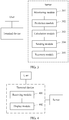
- an implementation of the present application further provides a device for processing data, disposed on a terminal device side, and the device includes the following: a receiving module 401, configured to receive a first rate sent by a server, where the first rate is calculated by the server based on predicted recovery time that is determined by the server when the server detects that an exception occurs in a running status; and a display module 402, configured to display live data based on the first rate.
- a receiving module 401 configured to receive a first rate sent by a server, where the first rate is calculated by the server based on predicted recovery time that is determined by the server when the server detects that an exception occurs in a running status
- a display module 402 configured to display live data based on the first rate.
- the server further sends a second rate to the terminal device, and the receiving module 401 receives the second rate sent by the server.
- the second rate is calculated by the server based on a recovery time difference that is determined by the server when the server detects that the running status of the live data service returns to normal.
- the display module 402 displays the live data based on the second rate.
- the implementations of the present disclosure can be provided as a method, a system, or a computer program product. Therefore, the present disclosure can use a form of hardware only implementations, software only implementations, or implementations with a combination of software and hardware. In addition, the present disclosure can use a form of a computer program product that is implemented on one or more computer-usable storage media (including but not limited to a magnetic disk storage, a CD-ROM, an optical memory, etc.) that include computer-usable program code.
- computer-usable storage media including but not limited to a magnetic disk storage, a CD-ROM, an optical memory, etc.
- These computer program instructions can be provided for a general-purpose computer, a dedicated computer, an embedded processor, or a processor of another programmable data processing device to generate a machine, so that the instructions executed by the computer or the processor of the another programmable data processing device generate an apparatus for implementing a specific function in one or more processes in the flowcharts and/or in one or more blocks in the block diagrams.
- These computer program instructions can be stored in a computer readable memory that can instruct the computer or the another programmable data processing device to work in a specific method, so that the instructions stored in the computer readable memory generate an artifact that includes an instruction apparatus.
- the instruction apparatus implements a specific function in one or more processes in the flowcharts and/or in one or more blocks in the block diagrams.
- a computing device includes one or more processors (CPU), an input/output interface, a network interface, and a memory.
- the memory can include a non-persistent memory, a random access memory (RAM), a nonvolatile memory, and/or another form in a computer readable medium, for example, a read-only memory (ROM) or a flash memory.
- RAM random access memory
- ROM read-only memory
- flash memory any type of non-volatile memory
- the memory is an example of the computer readable medium.
- the computer readable medium includes persistent, non-persistent, movable, and unmovable media that can implement information storage by using any method or technology.
- Information can be a computer readable instruction, a data structure, a program module, or other data.
- the computer storage medium includes but is not limited to a phase-change random access memory (PRAM), a static random access memory (SRAM), a dynamic random access memory (DRAM), a random access memory (RAM) of another type, a read-only memory, an electrically erasable programmable read-only memory (EEPROM), a flash memory or another memory technology, a compact disc read-only memory (CD-ROM), a digital versatile disc (DVD), or another optical storage, a cassette, a cassette magnetic disk storage, or another magnetic storage device or any other non-transmission medium.
- the computer storage medium can be configured to store information that can be accessed by the computing device. Based on the definition in the present specification, the computer readable medium does not include transitory computer-readable media, for example,
- the implementations of the present application can be provided as a method, a system, or a computer program product. Therefore, the present application can use a form of hardware only implementations, software only implementations, or implementations with a combination of software and hardware. In addition, the present application can use a form of a computer program product that is implemented on one or more computer-usable storage media (including but not limited to a magnetic disk storage, a CD-ROM, an optical memory, etc.) that include computer-usable program code.
- computer-usable storage media including but not limited to a magnetic disk storage, a CD-ROM, an optical memory, etc.
Landscapes
- Engineering & Computer Science (AREA)
- Multimedia (AREA)
- Signal Processing (AREA)
- Databases & Information Systems (AREA)
- Computer Networks & Wireless Communication (AREA)
- Two-Way Televisions, Distribution Of Moving Picture Or The Like (AREA)
- Retry When Errors Occur (AREA)
- Information Transfer Between Computers (AREA)
- Computer And Data Communications (AREA)
- Telephonic Communication Services (AREA)
- Debugging And Monitoring (AREA)
Abstract
Description
- The present application claims priority to Chinese Patent Application No.
201610490808.1 - The present application relates to the field of computer technologies, and in particular, to a method and a device for processing data.
- Currently, in scenarios such as live streaming and live TV, a data live broadcast is widely applied (the data live broadcast is real-time display of data). Users can learn of corresponding information on time through the data live broadcast.
- For example, a passenger flow volume in the Spring Festival transportation peak time can be displayed during the live TV, and therefore, a user who watches the live TV can learn of the corresponding passenger flow volume in the Spring Festival transportation peak time. For another example, access traffic, a sales volume, etc. of a shopping website can be displayed on the website, and therefore, a user who accesses the shopping website can learn of the access traffic and the sales volume on a corresponding page.
- The live display of data is usually implemented by a live data service (the live data service runs on a corresponding server) on the server (or a server cluster). The live data service obtains data from a data source in real time, performs corresponding statistics processing to obtain live data, and sends the live data to a terminal device for display. It is worthwhile to note that an actual data live display process is essentially a delay live broadcast. To be specific, there is a time difference between data displayed by the terminal device and data generated by the server, in other words, the live data displayed by the terminal device is usually generated by the server n seconds before.
- However, in actual application scenarios, an exception may occur when the live data service runs (e.g., counting error or lagging), and corresponding service staff need to perform troubleshooting and recovery.
- In the existing technology, when an exception occurs in the live data service, the server switches to a backup live data service to replace the abnormal live data service.
- However, a "jump" or a rollback may occur in real-time data in the method of switching to the backup service for the following reason: The live data service running on the server buffers real-time data obtained from the data source, to perform corresponding statistics processing. If an exception occurs in the live data service and the live data service is replaced with the backup live data service, the real-time data stored in a buffer of the live data service is cleared, and the backup live data service buffers the real-time data again to perform statistics processing after the backup live data service runs. In this case, data statistics processing is repeatedly performed, and therefore, a rollback occurs in the data live broadcast.
- Using access traffic data as an example, an original live data service buffers real-time data a900 to a960 obtained from the data source, and performs statistics processing on the 60 pieces of data to generate
access traffic data 900 to 960. Assume that the live data server generates access traffic data 930 to 950 based on real-time data a930 to a950, and sends the access traffic data to the terminal device for display. As shown inFIG. 1a , access traffic currently displayed by the terminal device based on the access traffic data sent by the server is 935. - If an exception occurs when the live data service generates access traffic data 955, the server stops the abnormal live data service, and enables a backup live data service to replace the abnormal live data service. After the backup live data service runs, the data buffered by the original live data service is cleared, and the backup live data service buffers the real-time data a900 to a960 again to perform statistics processing, generates
access traffic data 900 to 920, and sends the access traffic data to the terminal device for display. In this case, after the terminal device displaysaccess traffic 950 based on the access traffic data received previously (as shown inFIG. 1b ), access traffic is rolled back to 900 based on theaccess traffic data 900 to 920 received recently, and the terminal device performs display starting from 900, as shown inFIG. 1c . It can be seen that this is the data rollback. - Apparently, such a method affects the live data displayed by the terminal device.
- Implementations of the present application provide a method for processing data, to reduce jumps, rollbacks, etc. caused by an exception in live data in the existing technology.
- Implementations of the present application provide a device for processing data, to reduce jumps, rollbacks, etc. caused by an exception in live data in the existing technology.
- The following technical solutions are used in the implementations of the present application:
- An implementation of the present application provides a method for processing data, including the following: monitoring, by a server, a running status of a live data service; determining predicted recovery time when it is detected that an exception occurs in the running status; calculating a first rate based on the predicted recovery time; and sending the calculated first rate to a terminal device, so that the terminal device displays live data based on the first rate.
- An implementation of the present application further provides a method for processing data, including the following: receiving, by a terminal device, a first rate sent by a server, where the first rate is calculated by the server based on predicted recovery time that is determined by the server when the server detects that an exception occurs in a running status; and displaying live data based on the first rate.
- An implementation of the present application provides a device for processing data, including the following: a monitoring module, configured to monitor a running status of a live data service; a prediction module, configured to determine predicted recovery time when it is detected that an exception occurs in the running status; a calculation module, configured to calculate a first rate based on the predicted recovery time; and a sending module, configured to send the calculated first rate to a terminal device, so that the terminal device displays live data based on the first rate.
- An implementation of the present application further provides a device for processing data, including the following: a receiving module, configured to receive a first rate sent by a server, where the first rate is calculated by the server based on predicted recovery time that is determined by the server when the server detects that an exception occurs in a running status; and a display module, configured to display live data based on the first rate.
- The at least one technical solution used in the implementations of the present application can achieve the following beneficial effects:
- When detecting that an exception occurs in the live data service, the server determines the predicted recovery time, calculates the first rate based on the predicted recovery time, and sends the first rate to the terminal device. The first rate can be used to control a display rate of displaying the live data by the terminal device. In other words, the display rate of displaying the live data by the terminal device can be decreased with the first rate, and the terminal device decreases the rate of displaying the live data based on the first rate. Therefore, it takes more time for the terminal device to display locally stored live data that is to be displayed. As such, on a server side, service staff have enough time to perform troubleshooting and recovery on the live data service running on the server.
- In comparison with a method of switching to a backup live data service in the existing technology, the original live data service can be reserved (no service switching is performed) in the method of the present application. After the live data service returns to normal, the live data service further performs statistics processing based on real-time data buffered by the live data service. In other words, the real-time data buffered by the live data service is not cleared if no live data service switching is performed. As such, no exceptions such as a live data rollback and a live data jump occur.
- In addition, an end user is not significantly aware of a change such as a jump, a rollback, or stagnancy of the live data.
- The accompanying drawings here are used to provide further understanding of the present application, and constitute a part of the present application. Example implementations of the present application and descriptions of the implementations are used to explain the present application, and do not constitute an improper limitation on the present application. In the accompanying drawings:
-
FIG. 1a to FIG. 1c are schematic diagrams illustrating a data live broadcast in the existing technology; -
FIG. 2a is a schematic diagram illustrating a data processing process, according to an implementation of the present application; -
FIG. 2b to FIG. 2d are schematic diagrams illustrating a process of adjusting a display rate of a terminal device by a server, according to an implementation of the present application; -
FIG. 3 is a schematic structural diagram illustrating a device for processing data on a server side, according to an implementation of the present application; and -
FIG. 4 is a schematic structural diagram illustrating a device for processing data on a terminal device side, according to an implementation of the present application. - To make the objectives, technical solutions, and advantages of the present application clearer, the following clearly and comprehensively describes the technical solutions of the present application with reference to the specific implementations and the corresponding accompanying drawings of the present application. Apparently, the described implementations are some rather than all of the implementations of the present application. All other implementations obtained by a person of ordinary skill in the art based on the implementations of the present application without creative efforts shall fall within the protection scope of the present application.
- As described above, in a data live broadcast scenario, live data generated by a server is constantly sent to a terminal device, so that the terminal device can perform data live display based on the live data. However, after an exception occurs in a live data service on a server side, the server switches to a backup service, which causes a change such as a data rollback or a data jump in the data live broadcast process, thereby affecting normal running of the data live broadcast.
- In view of this, a method for reducing data rollbacks or data jumps in a data live broadcast process is needed. Therefore, the implementations of the present application provide a method for processing data, so that no data rollback or data jump occurs even when an exception occurs in a live data service on a server, thereby ensuring normal running of a data live broadcast.
- In the implementations of the present application, the server can be a server that can provide a live data service, including but not limited to a website server, a data center server, etc. The server can work independently (only one server provides a live data service), or can work in a cluster. The terminal device can be a terminal device of a user with a data display function, for example, a mobile phone, a tablet computer, a smart TV, or a computer. In some actual application scenarios, the terminal device can be a large display device (e.g., a device with a large screen in a live hall). The terminal device is not limited here in the present application.
- In addition, it is worthwhile to note that, the live data service on the server usually generates live data in batches in a process of performing statistics processing to generate live data. In other words, the live data service generates a certain amount of live data at a very short time interval. For example, the live data service generates current 2000 pieces of live data after 15 ms of the last generation of live data. Certainly, in practice, a time interval of generating live data by the live data service each time and an amount of live data generated each time are related to real-time data of a data source and running load of the server. Implementations are not limited in the present application.
- When the live data service on the server runs normally, a process of displaying live data by the terminal device is detailed as follows:
- First, the terminal device interacts with the server to obtain live data.
- In a method of the implementations of the present application, the terminal device periodically obtains the live data from the server at a very short time interval. For example, the terminal device obtains the live data from the server every 0.5s. In this method, the terminal device actively obtains the data from the server. In practice, this method is applicable to scenarios that the server provides a data live service for many terminal devices.
- In another method, the terminal device keeps a persistent connection to the server. After the live data service on the server generates live data each time, the server sends the newly generated live data to the terminal device through the persistent connection established between the server and the terminal device. Certainly, in practice, the method of establishing a persistent connection between the terminal device and the server is more applicable to scenarios such as a data live hall and a centralized data live broadcast. When there are many terminal devices, work load of the server can be significantly increased if the server keeps a persistent connection to each terminal device. Certainly, in practice, if the server can bear enough work load, the method of establishing a persistent connection can also be used in the case of many terminal devices. Implementations are not limited in the present application.
- After obtaining the live data, the terminal device displays the live data.
- Based on the previously described content, the live data obtained by the terminal device is a batch of live data (the batch of live data includes a plurality of pieces of data) generated by the data live service. After obtaining the live data, the terminal device locally buffers the live data, and displays the live data based on a rate specified by the server. For example, in a data live broadcast process of website access traffic, a batch of access traffic data obtained by the terminal device from the server includes access traffic data 300 to 350, and the server specifies that a display rate of the access traffic data is to change every 1s (to increase five pieces of data each time). In this case, if the terminal device displays access traffic 300 at 08:01:10, access traffic displayed by the terminal device at 08:01:11 is 305.
- The technical solutions provided in the implementations of the present application are described in detail below with reference to the previously described content.
-
FIG. 2a illustrates a data processing process in the implementations of the present application, and the process specifically includes the following steps. - S201. A server monitors a running status of a live data service.
- The live data service runs on the server. The live data service obtains real-time data from a data source, and performs corresponding statistics processing to generate live data for display. In practice, the live data service processes lots of data. Therefore, in a running process, there may be a back end call conflict, or operation may be choppy because of many operations, resulting in abnormal running of the live data service. It can be understood that, after an exception occurs in the live data service, live data generated by the live data service is abnormal.
- Therefore, the server monitors the running status of the live data service, to take corresponding measures when an exception occurs in the live data service, thereby reducing exceptions such as an obvious jump or rollback of live data displayed by a terminal device.
- S202. Determine predicted recovery time when it is detected that an exception occurs in the running status.
- In practice, if an exception occurs in the live data service, corresponding service staff can perform operations such as troubleshooting and recovery. It takes some time to perform the troubleshooting or recovery operation. Therefore, the server determines duration (the predicted recovery time) between occurrence of an exception in the live data service and a predicted recovery time.
- S203. Calculate a first rate based on the predicted recovery time.
- It is worthwhile to note that the first rate in this implementation of the present application can be a change rate of the live data. For example, the live data changes every ns.
- Alternatively, the first rate can be a magnitude of each change of the live data. For example, n pieces of live data are increased once or n pieces of live data are decreased once.
- Alternatively, the first rate can be a time lapse rate. To be specific, an actual time is used as a reference, and the first rate is determined by multiplying a rate coefficient by a unit time. For example, it can be specified that 1s for the first rate=1.5*1s in the actual time. In other words, 1s in the terminal device is 1.5s in the actual time with the first rate. Certainly, the optional methods of the first rate do not constitute a limitation on the present application.
- Considering the previously described content, when the terminal device displays the live data, because a display rate is specified by the server, the terminal device displays the live data obtained by the terminal device based on the display rate specified by the server. Therefore, when an exception occurs in the live data service on the server, if the display rate of the live data is decreased for the terminal device, the service staff can have more time to perform troubleshooting or recovery on the live data service.
- For example, if normally the terminal device locally stores access traffic data 300 to 350, and the terminal device performs live display by updating live data every 1s (assume that five pieces of access traffic data are increased once), duration of 10s is usually needed for displaying the access traffic 300 to 350 by the terminal device. If an exception occurs in the live data service on the server, and the server learns of the first rate through calculation based on the predicted recovery time: to change every 2s (to increase five pieces of access traffic data), duration of 20s is needed for displaying the access traffic 300 to 350 by the terminal device based on the first rate.
- It can be seen from the previous example that, with the first rate, the display duration of displaying the live data is 10s more than that in a normal state. In the case, the back end service staff have 10s to perform troubleshooting or recovery on the live data service. Certainly, the previous example merely describes a function of the first rate. In practice, the first rate can be predicted based on the predicted recovery time. Implementations are not limited in the present application.
- S204. Send the calculated first time lapse rate to a terminal device, so that the terminal device displays live data based on the first rate.
- After obtaining the first rate as described above, the server sends the first rate to the terminal device, so that the terminal device displays the live data obtained by the terminal device based on the first rate. For details, references can be made to the previous example.
- In the previous steps, when detecting that an exception occurs in the live data service, the server determines the predicted recovery time, calculates the first rate based on the predicted recovery time, and sends the first rate to the terminal device. The first rate can be used to control the display rate of displaying the live data by the terminal device. In other words, the display rate of displaying the live data by the terminal device can be decreased with the first rate, and the terminal device decreases the rate of displaying the live data based on the first rate. Therefore, it takes more time for the terminal device to display locally stored live data that is to be displayed. As such, on a server side, the service staff have enough time to perform troubleshooting and recovery on the live data service running on the server.
- In comparison with a method of switching to a backup live data service in the existing technology, the original live data service can be reserved (no service switching is performed) in the method of the present application. After the live data service returns to normal, the live data service further performs statistics processing based on real-time data buffered by the live data service. In other words, the real-time data buffered by the live data service is not cleared if no live data service switching is performed. As such, no exceptions such as a live data rollback and a live data jump occur.
- It is worthwhile to note that the steps in the method provided in the previous implementation can be performed by one device, specifically, the server.
- The following describes in detail a case when an exception occurs in the live data service.
- It is worthwhile to note that, in practice, when an exception occurs in the live data service, troubleshooting or recovery is usually performed on the abnormal live data service manually. In this process, the corresponding service staff determine predicted recovery time. Certainly, in an optional method, the server provides a corresponding diagnosis interface, and the interface provides an option of the predicted recovery time. When performing troubleshooting or recovery, the service staff can enter the corresponding predicted recovery time in the option.
- In this implementation of the present application, the determining predicted recovery time specifically includes the following: determining a predicted recovery time; determining a time when an exception occurs in the running status of the live data service; and determining the predicted recovery time based on the determined predicted recovery time and the determined time.
- For example, if the time when an exception occurs in the live data service is 12:08:02, and the recovery time predicted by the service staff is 12:08:40, the predicted recovery time is 38s.
- After the predicted recovery time is determined, the first time lapse rate can be further calculated. Specifically, a time of stopping displaying the live data by the terminal device when an exception occurs in the running status of the live data service is determined, and the first rate is determined based on the determined time of stopping displaying the live data by the terminal device and the predicted recovery time.
- Longer predicted recovery time indicates a lower first rate. For ease of description, the predicted recovery time is referred to as Tyu below.
- It is worthwhile to note that, when an exception occurs in the live data service, the server stops sending live data to the terminal device, and the terminal device displays local live data at the original display rate. It can be understood after a period of time, the terminal device can complete displaying local live data that is not displayed. Therefore, the terminal device stops updating live data after displaying the last live data (because in this case, the terminal device has displayed all live data locally buffered, and has not obtained new live data provided by the server), which is represented as follows: the live data displayed by the terminal device stops at a value. For example, access traffic displayed by the terminal device stops at 500.
- Therefore, in this implementation of the present application, when an exception occurs in the running status of the live data service, the server determines duration between a current time and the time of stopping updating the live data by the terminal device (for ease of description, duration between occurrence of an exception in the live data service and stopping updating the live data by the terminal device is referred to as Tc1 below). Certainly, in an optional method of this implementation of the present application, the display rate of displaying the live data by the terminal device is specified by the server, and therefore, the server can learn of the display rate of the terminal device. In addition, because a time when the live data service on the server performs statistics processing to generate live data each time is recorded (e.g., in a corresponding data log), and an amount of live data corresponding to the time is also recorded, the server can determine a time of generating live data that is sent to the terminal device last time, and therefore, the server can determine an amount of live data stored in the terminal device. It can be understood that both the amount of live data stored in the terminal device and the display rate are known, and therefore, the server can determine Tc1.
- Tc1 can be considered as time duration for displaying the live data by the terminal device when the display rate is unchanged, but after Tc1, the terminal device stops updating the live data, which causes a display exception to the data live broadcast. Because Tyu is the time duration that the back end service staff may need to perform recovery, in this implementation of the present application, the first rate is determined based on Tc1 and Tyu, so that Tc1 is prolonged with the first rate.
- Assume that a display rate of displaying access traffic data of a website by the terminal device is to increase 10 pieces of data every second, and access traffic data obtained by the terminal device from the server currently includes 1000 to 1200. If an exception occurs in the live data service running on the server when the display displays the access traffic 1000, the terminal device cannot continue to obtain access traffic data from the server. It can be seen that, duration Tc1 of 20s is needed for displaying the access traffic 1000 to the access traffic 1200 by the terminal device at the display rate. However, because the predicted recovery time Tyu is 40s, the current display rate of the terminal device needs to be adjusted to reduce data stagnancy after 20s.
- In this example, first rate=Tc1/Tyu*current display rate=0.5*10=5.
- In other words, the first rate is to increase five pieces of data every second. Apparently, duration needed for displaying the access traffic 1000 to the access traffic 1200 by the terminal device based on the first rate is 40s, and the original display duration is prolonged.
- Certainly, the previous method is a description of a case that the first rate indicates a change to an amount of live data. If the first rate is a time lapse rate, the first rate can be calculated in the following way:
- First rate (time lapse rate of the client)=[(time difference between the server and the client*client time)/Tyu]+original time lapse rate of the client.
- The previously described content is a process of adjusting the display rate of the terminal device when an exception occurs in the live data service. Specifically, as shown in
FIG. 2b , in the previous process, the display rate of the terminal device is essentially decreased based on the calculated first rate. In actual application scenarios, after the back end service staff recover the live data service, the live data service normally performs statistics processing on real-time data to generate corresponding live data, and sends the live data to the terminal device. The terminal device displays the live data at a relatively low display rate based on the first rate. After the terminal device can normally receive live data sent by the server, the terminal device can increase the display rate to adapt to new live data. - The following describes in detail a process after the live data service is recovered.
- In the previous recovery process, the service staff predicts a time (the predicted recovery time) when the live data service can be recovered. In actual application scenarios, a time difference may exist between an actual recovery time of the live data service and the recovery time predicted by the service staff. For example, if the recovery time predicted by the service staff is 12:08:40, and the live data service is actually recovered at 12:07:50, a time difference of 50s exists between the two times.
- In practice, because the first rate is determined based on the predicted recovery time, if a time difference exists between the actual recovery time of the live data service and the predicted recovery time, an increment in the display rate of the terminal device needs to be determined based on the time difference, that is, a second rate is determined.
- Therefore, after the live data service is recovered, the method further includes the following: determining a recovery time difference when it is detected that the running status of the live data service returns to normal; calculating a second rate based on the recovery time difference; and sending the calculated second time lapse rate to the terminal device, so that the terminal device displays the live data based on the second rate.
- Certainly, it can be seen from the previously described content that the determining a recovery time difference specifically includes the following: determining a time when the running status of the live data service returns to normal; and determining the recovery time difference based on the time when the running status of the live data service returns to normal and the predicted recovery time.
- In the previous example, if an exception occurs in the live data service at 12:01:00, the predicted recovery time is 12:01:40 because the predicted recovery time is 40s, but the actual recovery time of the live data service is 12:01:20 (new access traffic data is generated at this time). In other words, the live data service is recovered 20s earlier than the predicted recovery time. In this case, the terminal device has 100 pieces of access traffic data that is not displayed. After the live data service normally runs, the server needs to adjust the current display rate (the first rate) of the terminal device so that the terminal device can adapt to new access traffic data generated by the live data service after the live data service normally runs. In this case, the terminal device accelerates display of remaining access traffic data (in other words, the second rate is generated).
- Certainly, it can be understood that a smaller recovery time difference indicates a higher second rate.
- Likewise, the previous method is a description of a case that the second rate indicates a change to an amount of live data. If the second rate is a time lapse rate, the second rate can be calculated in the following way:
- Second rate (time lapse rate of the client)=[(actual recovery time-client time)*Tyu/actual recovery time difference]+first rate.
- The process of adjusting the display rate of the terminal device when the live data service returns to normal is described above. A detailed process is shown in
FIG. 2c . - Certainly, after the terminal device accelerates display of remaining live data (and receives new live data), the server sends a normal rate to the terminal device again, so that the terminal device displays live data based on the normal rate. This process is shown in
FIG. 2d . - In addition, it is worthwhile to note that in actual application scenarios, the actual recovery time of the live data service can be later than the predicted recovery time. For example, if an exception occurs in the live data service at 12:01:00, and the predicted recovery time is 12:01:40, but the live data service actually returns to normal at 12:02:20. Apparently, in this case, if the terminal device displays live data only based on the first rate calculated in the previous method, live data display may still be stopped. Therefore, in this implementation of the present application, the first rate can be dynamically adjusted to reduce such cases. In other words, a plurality of first rates can be calculated and sent to the terminal device.
- For example, continuing with the previous example about the first rate, it can be seen from the previous example that a first rate generated the first time is to increase five pieces of access traffic data every second, and the live data service is still not recovered after 10s (in this case, access traffic displayed by the terminal device is 1150, and 150 pieces of access traffic data are left and can be all displayed in 30s). Therefore, the server can calculate a new first rate (which is used to prolong display duration of the terminal device). If the new first rate is to increase two pieces of access traffic data every second, the display duration of the terminal device can be prolonged to 75s.
- Certainly, the previous example is merely a possible method for actual application scenarios in this implementation of the present application, and does not constitute a limitation on the present application.
- In the previously described content, when an exception occurs in the live data service on the server, the server can decrease a current display rate of the terminal device, and prolong troubleshooting or recovery time of the back end staff, without making an end user significantly aware of a change such as a jump, a rollback, or stagnancy of the live data. Correspondingly, after the live data service is recovered, the display rate of the terminal device can be increased, so that the terminal device can adapt to new live data sent by the server.
- Certainly, on a terminal device side, the present application provides a method for processing data. Specifically, when an exception occurs in a live data service on a server, the method includes the following steps.
- Step 1: A terminal device receives a first rate sent by the server, where the first rate is calculated by the server based on predicted recovery time that is determined by the server when the server detects that an exception occurs in a running status.
- Step 2: Display live data based on the first rate.
- When the live data service on the server returns to normal, the method further includes the following: receiving, by the terminal device, a second rate sent by the server, where the second rate is calculated by the server based on a recovery time difference that is determined by the server when the server detects that the running status of a live data service returns to normal; and displaying the live data based on the second rate.
- For an implementation process that the terminal device side obtains the live data and displays the live data based on different rates, references can be made to the previously described content. Details are omitted here.
- The method for processing data provided in the implementations of the present application is described above. Based on the same idea, an implementation of the present application further provides a device for processing data.
- As shown in
FIG. 3 , the device for processing data is disposed on a server side, and the device includes the following: amonitoring module 301, configured to monitor a running status of a live data service; aprediction module 302, configured to determine predicted recovery time when it is detected that an exception occurs in the running status; acalculation module 303, configured to calculate a first rate based on the predicted recovery time; and a sendingmodule 304, configured to send the calculated first rate to a terminal device, so that the terminal device displays live data based on the first rate. - Specifically, the
prediction module 302 determines a predicted recovery time, determines a time when an exception occurs in the running status of the live data service, and determines the predicted recovery time based on the determined predicted recovery time and the determined time. - Further, the
prediction module 302 determines a time of stopping updating the live data by the terminal device when an exception occurs in the running status of the live data service, and determines the first rate based on the determined time of stopping displaying the live data by the terminal device and the predicted recovery time. - Longer predicted recovery time indicates a lower first rate.
- The device further includes the following: a
recovery module 305, configured to determine a recovery time difference when it is detected that the running status of the live data service returns to normal; calculate a second rate based on the recovery time difference; and send the calculated second time lapse rate to the terminal device, so that the terminal device displays the live data based on the second rate. - Further, the
recovery module 305 determines a time when the running status of the live data service returns to normal; and determines the recovery time difference based on the time when the running status of the live data service returns to normal and the predicted recovery time. - Based on this, the
calculation module 303 determines the second rate based on the recovery time difference and the first rate. - A smaller recovery time difference indicates a higher second rate.
- As shown in
FIG. 4 , an implementation of the present application further provides a device for processing data, disposed on a terminal device side, and the device includes the following: a receivingmodule 401, configured to receive a first rate sent by a server, where the first rate is calculated by the server based on predicted recovery time that is determined by the server when the server detects that an exception occurs in a running status; and adisplay module 402, configured to display live data based on the first rate. - Certainly, after a live data service is recovered, the server further sends a second rate to the terminal device, and the receiving
module 401 receives the second rate sent by the server. The second rate is calculated by the server based on a recovery time difference that is determined by the server when the server detects that the running status of the live data service returns to normal. - The
display module 402 displays the live data based on the second rate. - A person skilled in the art should understand that the implementations of the present disclosure can be provided as a method, a system, or a computer program product. Therefore, the present disclosure can use a form of hardware only implementations, software only implementations, or implementations with a combination of software and hardware. In addition, the present disclosure can use a form of a computer program product that is implemented on one or more computer-usable storage media (including but not limited to a magnetic disk storage, a CD-ROM, an optical memory, etc.) that include computer-usable program code.
- The present disclosure is described with reference to the flowcharts and/or block diagrams of the method, the device (system), and the computer program product according to the implementations of the present disclosure. It should be understood that computer program instructions can be used to implement each process and/or each block in the flowcharts and/or the block diagrams and a combination of a process and/or a block in the flowcharts and/or the block diagrams. These computer program instructions can be provided for a general-purpose computer, a dedicated computer, an embedded processor, or a processor of another programmable data processing device to generate a machine, so that the instructions executed by the computer or the processor of the another programmable data processing device generate an apparatus for implementing a specific function in one or more processes in the flowcharts and/or in one or more blocks in the block diagrams.
- These computer program instructions can be stored in a computer readable memory that can instruct the computer or the another programmable data processing device to work in a specific method, so that the instructions stored in the computer readable memory generate an artifact that includes an instruction apparatus. The instruction apparatus implements a specific function in one or more processes in the flowcharts and/or in one or more blocks in the block diagrams.
- These computer program instructions can be loaded onto the computer or the another programmable data processing device, so that a series of operations and steps are performed on the computer or the another programmable device, thereby generating computer-implemented processing. Therefore, the instructions executed on the computer or the another programmable device provide steps for implementing a specific function in one or more processes in the flowcharts and/or in one or more blocks in the block diagrams.
- In a typical configuration, a computing device includes one or more processors (CPU), an input/output interface, a network interface, and a memory.
- The memory can include a non-persistent memory, a random access memory (RAM), a nonvolatile memory, and/or another form in a computer readable medium, for example, a read-only memory (ROM) or a flash memory. The memory is an example of the computer readable medium.
- The computer readable medium includes persistent, non-persistent, movable, and unmovable media that can implement information storage by using any method or technology. Information can be a computer readable instruction, a data structure, a program module, or other data. The computer storage medium includes but is not limited to a phase-change random access memory (PRAM), a static random access memory (SRAM), a dynamic random access memory (DRAM), a random access memory (RAM) of another type, a read-only memory, an electrically erasable programmable read-only memory (EEPROM), a flash memory or another memory technology, a compact disc read-only memory (CD-ROM), a digital versatile disc (DVD), or another optical storage, a cassette, a cassette magnetic disk storage, or another magnetic storage device or any other non-transmission medium. The computer storage medium can be configured to store information that can be accessed by the computing device. Based on the definition in the present specification, the computer readable medium does not include transitory computer-readable media, for example, a modulated data signal and carrier.
- It is worthwhile to further note that the term "include", "contain", or any other variant thereof is intended to cover a non-exclusive inclusion, so that a process, a method, an article, or a device that includes a list of elements not only includes those elements but also includes other elements which are not expressly listed, or further includes elements inherent to such a process, method, article, or device. An element preceded by "includes a..." does not, without more constraints, preclude the existence of additional identical elements in the process, method, article, or device that includes the element.
- A person skilled in the art should understand that the implementations of the present application can be provided as a method, a system, or a computer program product. Therefore, the present application can use a form of hardware only implementations, software only implementations, or implementations with a combination of software and hardware. In addition, the present application can use a form of a computer program product that is implemented on one or more computer-usable storage media (including but not limited to a magnetic disk storage, a CD-ROM, an optical memory, etc.) that include computer-usable program code.
- The previous descriptions are merely implementations of the present application, and are not intended to limit the present application. For a person skilled in the art, the present application can have various modifications and changes. Any modifications, equivalent substitutions, improvements, etc. made in the spirit and principle of the present application shall fall within the scope of the claims in the present application.
Claims (10)
- A method for processing data, comprising:monitoring, by a server, a running status of a live data service;determining predicted recovery time when it is detected that an exception occurs in the running status;calculating a first rate based on the predicted recovery time; andsending the calculated first rate to a terminal device, so that the terminal device displays live data based on the first rate.
- The method according to claim 1, wherein the determining predicted recovery time specifically comprises:determining a predicted recovery time;determining a time when an exception occurs in the running status of the live data service; anddetermining the predicted recovery time based on the determined predicted recovery time and the determined time.
- The method according to claim 2, wherein the calculating a first rate based on the predicted recovery time specifically comprises:determining a time of stopping updating the live data by the terminal device when an exception occurs in the running status of the live data service; anddetermining the first rate based on the determined time of stopping displaying the live data by the terminal device and the predicted recovery time; whereinlonger predicted recovery time indicates a lower first rate.
- The method according to claim 3, further comprising:determining a recovery time difference when it is detected that the running status of the live data service returns to normal;calculating a second rate based on the recovery time difference; andsending the calculated second time lapse rate to the terminal device, so that the terminal device displays the live data based on the second rate.
- The method according to claim 4, wherein the determining a recovery time difference specifically comprises:determining a time when the running status of the live data service returns to normal; anddetermining the recovery time difference based on the time when the running status of the live data service returns to normal and the predicted recovery time.
- The method according to claim 5, wherein the calculating a second time lapse rate based on the recovery time difference specifically comprises:determining the second rate based on the recovery time difference and the first rate; whereina smaller recovery time difference indicates a higher second rate.
- A method for processing data, comprising:receiving, by a terminal device, a first rate sent by a server, wherein the first rate is calculated by the server based on predicted recovery time that is determined by the server when the server detects that an exception occurs in a running status; anddisplaying live data based on the first rate.
- The method according to claim 7, further comprising:receiving, by the terminal device, a second rate sent by the server, wherein the second rate is calculated by the server based on a recovery time difference that is determined by the server when the server detects that the running status of a live data service returns to normal; anddisplaying the live data based on the second rate.
- A device for processing data, comprising:a monitoring module, configured to monitor a running status of a live data service;a prediction module, configured to determine predicted recovery time when it is detected that an exception occurs in the running status;a calculation module, configured to calculate a first rate based on the predicted recovery time; anda sending module, configured to send the calculated first rate to a terminal device, so that the terminal device displays live data based on the first rate.
- A device for processing data, comprising:a receiving module, configured to receive a first rate sent by a server, wherein the first rate is calculated by the server based on predicted recovery time that is determined by the server when the server detects that an exception occurs in a running status; anda display module, configured to display live data based on the first rate.
Applications Claiming Priority (2)
| Application Number | Priority Date | Filing Date | Title |
|---|---|---|---|
| CN201610490808.1A CN106899863B (en) | 2016-06-28 | 2016-06-28 | A data processing method and device |
| PCT/CN2017/088547 WO2018001114A1 (en) | 2016-06-28 | 2017-06-16 | Method and device for processing data |
Publications (3)
| Publication Number | Publication Date |
|---|---|
| EP3477953A4 EP3477953A4 (en) | 2019-05-01 |
| EP3477953A1 true EP3477953A1 (en) | 2019-05-01 |
| EP3477953B1 EP3477953B1 (en) | 2023-09-06 |
Family
ID=59190573
Family Applications (1)
| Application Number | Title | Priority Date | Filing Date |
|---|---|---|---|
| EP17819111.0A Active EP3477953B1 (en) | 2016-06-28 | 2017-06-16 | Method and device for processing data |
Country Status (10)
| Country | Link |
|---|---|
| US (1) | US10694220B2 (en) |
| EP (1) | EP3477953B1 (en) |
| JP (1) | JP6703147B2 (en) |
| KR (1) | KR102145137B1 (en) |
| CN (1) | CN106899863B (en) |
| MY (1) | MY189664A (en) |
| PH (1) | PH12019500008B1 (en) |
| SG (1) | SG11201811568VA (en) |
| TW (1) | TW201800963A (en) |
| WO (1) | WO2018001114A1 (en) |
Families Citing this family (2)
| Publication number | Priority date | Publication date | Assignee | Title |
|---|---|---|---|---|
| CN112752109B (en) * | 2019-10-30 | 2022-05-17 | 上海哔哩哔哩科技有限公司 | Video playing control method and system |
| CN114860370B (en) * | 2022-05-17 | 2024-03-29 | 聚好看科技股份有限公司 | Display equipment, server and software development kit switching method |
Family Cites Families (21)
| Publication number | Priority date | Publication date | Assignee | Title |
|---|---|---|---|---|
| US7660512B2 (en) * | 2003-10-16 | 2010-02-09 | Microsoft Corporation | Systems and methods for managing frame rates during multimedia playback |
| CN101166322B (en) * | 2006-10-19 | 2010-10-27 | 华为技术有限公司 | A dual-mode mobile receiving device and a method for realizing reception on the device |
| US8958486B2 (en) * | 2007-07-31 | 2015-02-17 | Cisco Technology, Inc. | Simultaneous processing of media and redundancy streams for mitigating impairments |
| CN101472143A (en) * | 2007-12-27 | 2009-07-01 | 华为技术有限公司 | Method and system for implementing stream medium service |
| JP2010074726A (en) * | 2008-09-22 | 2010-04-02 | Nec Personal Products Co Ltd | Portable television receiver and program for the same |
| JP2011066817A (en) * | 2009-09-18 | 2011-03-31 | Honda Motor Co Ltd | Digital broadcast receiving apparatus for vehicle |
| JP5812634B2 (en) * | 2011-03-17 | 2015-11-17 | キヤノン株式会社 | Transmission device, transmission method, and program |
| CN102421034A (en) * | 2011-12-19 | 2012-04-18 | 中山爱科数字科技股份有限公司 | A video playing method formed by live video or video surveillance |
| US9386058B2 (en) * | 2012-02-27 | 2016-07-05 | Qualcomm Incorporated | DASH client and receiver with playback rate selection |
| US8683542B1 (en) * | 2012-03-06 | 2014-03-25 | Elemental Technologies, Inc. | Concealment of errors in HTTP adaptive video sets |
| TWI520590B (en) * | 2012-12-17 | 2016-02-01 | 財團法人工業技術研究院 | Media streaming method, device therewith and device for providing the media streaming |
| US9204201B2 (en) * | 2012-12-27 | 2015-12-01 | Echostar Technologies L.L.C. | Enhanced reliability for satellite data delivery |
| TWI562625B (en) | 2012-12-28 | 2016-12-11 | Ind Tech Res Inst | Methods and systems for event-driven adaptive streaming |
| CN104079955B (en) * | 2013-03-26 | 2017-12-15 | 华为技术有限公司 | More push up OTT live method, apparatus and system |
| CN104010232B (en) | 2014-05-23 | 2017-12-12 | 惠州Tcl移动通信有限公司 | A kind of intelligence plays method, system, player and the mobile terminal of Online Video |
| CN104065982B (en) * | 2014-06-19 | 2015-12-30 | 腾讯科技(深圳)有限公司 | The method and apparatus of live streaming media |
| TW201601528A (en) | 2014-06-21 | 2016-01-01 | Jyt Inc | Fluent video playback method |
| CN104080006B (en) * | 2014-07-10 | 2017-10-27 | 福州瑞芯微电子股份有限公司 | A kind of video process apparatus and method |
| US9788071B2 (en) * | 2014-11-03 | 2017-10-10 | Microsoft Technology Licensing, Llc | Annotating and indexing broadcast video for searchability |
| CN105100876B (en) * | 2015-08-28 | 2019-04-12 | 北京奇艺世纪科技有限公司 | A kind of playback method and device of Streaming Media |
| US9973816B2 (en) * | 2015-11-18 | 2018-05-15 | At&T Intellectual Property I, L.P. | Media content distribution |
-
2016
- 2016-06-28 CN CN201610490808.1A patent/CN106899863B/en active Active
-
2017
- 2017-04-14 TW TW106112619A patent/TW201800963A/en unknown
- 2017-06-16 JP JP2018568894A patent/JP6703147B2/en active Active
- 2017-06-16 EP EP17819111.0A patent/EP3477953B1/en active Active
- 2017-06-16 MY MYPI2018002941A patent/MY189664A/en unknown
- 2017-06-16 SG SG11201811568VA patent/SG11201811568VA/en unknown
- 2017-06-16 PH PH1/2019/500008A patent/PH12019500008B1/en unknown
- 2017-06-16 WO PCT/CN2017/088547 patent/WO2018001114A1/en not_active Ceased
- 2017-06-16 KR KR1020197002803A patent/KR102145137B1/en active Active
-
2018
- 2018-12-27 US US16/234,430 patent/US10694220B2/en active Active
Also Published As
| Publication number | Publication date |
|---|---|
| EP3477953B1 (en) | 2023-09-06 |
| US20190132615A1 (en) | 2019-05-02 |
| KR20190021458A (en) | 2019-03-05 |
| TW201800963A (en) | 2018-01-01 |
| PH12019500008B1 (en) | 2023-04-26 |
| SG11201811568VA (en) | 2019-01-30 |
| PH12019500008A1 (en) | 2019-10-14 |
| JP2019522292A (en) | 2019-08-08 |
| MY189664A (en) | 2022-02-23 |
| EP3477953A4 (en) | 2019-05-01 |
| WO2018001114A1 (en) | 2018-01-04 |
| CN106899863A (en) | 2017-06-27 |
| CN106899863B (en) | 2019-10-25 |
| US10694220B2 (en) | 2020-06-23 |
| KR102145137B1 (en) | 2020-08-18 |
| JP6703147B2 (en) | 2020-06-03 |
Similar Documents
| Publication | Publication Date | Title |
|---|---|---|
| US10516730B2 (en) | Distributing application traffic to servers based on dynamic service response time | |
| US9832716B2 (en) | Switching between networks based on quality of available networks | |
| US11113276B2 (en) | Querying a database | |
| US10424036B2 (en) | Maintaining data for use with a transport service during connectivity loss between systems | |
| US11418550B1 (en) | Service-mesh session prioritization | |
| EP3489877A1 (en) | Risk identification method, client device, and risk identification system | |
| US10860280B2 (en) | Display method and device | |
| US11055148B2 (en) | Systems and methods for overload protection for real-time computing engines | |
| EP3895011A1 (en) | Memory crash prevention for a computing device | |
| US20220043732A1 (en) | Method, device, and program product for managing computing resource in storage system | |
| CN112965823A (en) | Call request control method and device, electronic equipment and storage medium | |
| EP3477953A1 (en) | Method and device for processing data | |
| CN114938353A (en) | Asynchronous notification current limiting method and system based on stream computing | |
| US20170243256A1 (en) | Method and device for controlling displaying of media object and media object display system | |
| CN106487561A (en) | The method and system that a kind of server service updates | |
| CN111629399A (en) | Message processing method, device and terminal | |
| CN118170372A (en) | Data element dynamic display method, device, terminal equipment and storage medium | |
| US20190342615A1 (en) | Method and device for obtaining popularity of information stream | |
| CN116091232A (en) | Transaction processing method, device, equipment and storage medium | |
| CN116233128A (en) | Service processing method, node and system of distributed system | |
| CN117527699A (en) | Network traffic forwarding method, device, equipment and storage medium | |
| CN117793185A (en) | Information stream processing method and device | |
| HK40013105A (en) | Service processing method and device and electronic equipment | |
| JP2015023504A (en) | Paging control device and paging control method |
Legal Events
| Date | Code | Title | Description |
|---|---|---|---|
| STAA | Information on the status of an ep patent application or granted ep patent |
Free format text: STATUS: THE INTERNATIONAL PUBLICATION HAS BEEN MADE |
|
| PUAI | Public reference made under article 153(3) epc to a published international application that has entered the european phase |
Free format text: ORIGINAL CODE: 0009012 |
|
| STAA | Information on the status of an ep patent application or granted ep patent |
Free format text: STATUS: REQUEST FOR EXAMINATION WAS MADE |
|
| 17P | Request for examination filed |
Effective date: 20190122 |
|
| A4 | Supplementary search report drawn up and despatched |
Effective date: 20190327 |
|
| AK | Designated contracting states |
Kind code of ref document: A1 Designated state(s): AL AT BE BG CH CY CZ DE DK EE ES FI FR GB GR HR HU IE IS IT LI LT LU LV MC MK MT NL NO PL PT RO RS SE SI SK SM TR |
|
| AX | Request for extension of the european patent |
Extension state: BA ME |
|
| DAV | Request for validation of the european patent (deleted) | ||
| DAX | Request for extension of the european patent (deleted) | ||
| RAP1 | Party data changed (applicant data changed or rights of an application transferred) |
Owner name: ADVANCED NEW TECHNOLOGIES CO., LTD. |
|
| STAA | Information on the status of an ep patent application or granted ep patent |
Free format text: STATUS: EXAMINATION IS IN PROGRESS |
|
| 17Q | First examination report despatched |
Effective date: 20210216 |
|
| RIC1 | Information provided on ipc code assigned before grant |
Ipc: H04N 5/775 20060101ALI20220203BHEP Ipc: H04N 5/783 20060101ALI20220203BHEP Ipc: H04N 21/24 20110101ALI20220203BHEP Ipc: H04N 21/238 20110101AFI20220203BHEP |
|
| GRAP | Despatch of communication of intention to grant a patent |
Free format text: ORIGINAL CODE: EPIDOSNIGR1 |
|
| STAA | Information on the status of an ep patent application or granted ep patent |
Free format text: STATUS: GRANT OF PATENT IS INTENDED |
|
| INTG | Intention to grant announced |
Effective date: 20221214 |
|
| GRAJ | Information related to disapproval of communication of intention to grant by the applicant or resumption of examination proceedings by the epo deleted |
Free format text: ORIGINAL CODE: EPIDOSDIGR1 |
|
| STAA | Information on the status of an ep patent application or granted ep patent |
Free format text: STATUS: EXAMINATION IS IN PROGRESS |
|
| GRAP | Despatch of communication of intention to grant a patent |
Free format text: ORIGINAL CODE: EPIDOSNIGR1 |
|
| STAA | Information on the status of an ep patent application or granted ep patent |
Free format text: STATUS: GRANT OF PATENT IS INTENDED |
|
| INTC | Intention to grant announced (deleted) | ||
| INTG | Intention to grant announced |
Effective date: 20230324 |
|
| RIN1 | Information on inventor provided before grant (corrected) |
Inventor name: JI, WENJIE |
|
| P01 | Opt-out of the competence of the unified patent court (upc) registered |
Effective date: 20230526 |
|
| GRAS | Grant fee paid |
Free format text: ORIGINAL CODE: EPIDOSNIGR3 |
|
| GRAA | (expected) grant |
Free format text: ORIGINAL CODE: 0009210 |
|
| STAA | Information on the status of an ep patent application or granted ep patent |
Free format text: STATUS: THE PATENT HAS BEEN GRANTED |
|
| AK | Designated contracting states |
Kind code of ref document: B1 Designated state(s): AL AT BE BG CH CY CZ DE DK EE ES FI FR GB GR HR HU IE IS IT LI LT LU LV MC MK MT NL NO PL PT RO RS SE SI SK SM TR |
|
| REG | Reference to a national code |
Ref country code: GB Ref legal event code: FG4D |
|
| REG | Reference to a national code |
Ref country code: CH Ref legal event code: EP |
|
| REG | Reference to a national code |
Ref country code: IE Ref legal event code: FG4D |
|
| REG | Reference to a national code |
Ref country code: DE Ref legal event code: R096 Ref document number: 602017073867 Country of ref document: DE |
|
| REG | Reference to a national code |
Ref country code: LT Ref legal event code: MG9D |
|
| REG | Reference to a national code |
Ref country code: NL Ref legal event code: MP Effective date: 20230906 |
|
| PG25 | Lapsed in a contracting state [announced via postgrant information from national office to epo] |
Ref country code: GR Free format text: LAPSE BECAUSE OF FAILURE TO SUBMIT A TRANSLATION OF THE DESCRIPTION OR TO PAY THE FEE WITHIN THE PRESCRIBED TIME-LIMIT Effective date: 20231207 |
|
| PG25 | Lapsed in a contracting state [announced via postgrant information from national office to epo] |
Ref country code: SE Free format text: LAPSE BECAUSE OF FAILURE TO SUBMIT A TRANSLATION OF THE DESCRIPTION OR TO PAY THE FEE WITHIN THE PRESCRIBED TIME-LIMIT Effective date: 20230906 Ref country code: RS Free format text: LAPSE BECAUSE OF FAILURE TO SUBMIT A TRANSLATION OF THE DESCRIPTION OR TO PAY THE FEE WITHIN THE PRESCRIBED TIME-LIMIT Effective date: 20230906 Ref country code: NO Free format text: LAPSE BECAUSE OF FAILURE TO SUBMIT A TRANSLATION OF THE DESCRIPTION OR TO PAY THE FEE WITHIN THE PRESCRIBED TIME-LIMIT Effective date: 20231206 Ref country code: LV Free format text: LAPSE BECAUSE OF FAILURE TO SUBMIT A TRANSLATION OF THE DESCRIPTION OR TO PAY THE FEE WITHIN THE PRESCRIBED TIME-LIMIT Effective date: 20230906 Ref country code: LT Free format text: LAPSE BECAUSE OF FAILURE TO SUBMIT A TRANSLATION OF THE DESCRIPTION OR TO PAY THE FEE WITHIN THE PRESCRIBED TIME-LIMIT Effective date: 20230906 Ref country code: HR Free format text: LAPSE BECAUSE OF FAILURE TO SUBMIT A TRANSLATION OF THE DESCRIPTION OR TO PAY THE FEE WITHIN THE PRESCRIBED TIME-LIMIT Effective date: 20230906 Ref country code: GR Free format text: LAPSE BECAUSE OF FAILURE TO SUBMIT A TRANSLATION OF THE DESCRIPTION OR TO PAY THE FEE WITHIN THE PRESCRIBED TIME-LIMIT Effective date: 20231207 Ref country code: FI Free format text: LAPSE BECAUSE OF FAILURE TO SUBMIT A TRANSLATION OF THE DESCRIPTION OR TO PAY THE FEE WITHIN THE PRESCRIBED TIME-LIMIT Effective date: 20230906 |
|
| REG | Reference to a national code |
Ref country code: AT Ref legal event code: MK05 Ref document number: 1610116 Country of ref document: AT Kind code of ref document: T Effective date: 20230906 |
|
| PG25 | Lapsed in a contracting state [announced via postgrant information from national office to epo] |
Ref country code: NL Free format text: LAPSE BECAUSE OF FAILURE TO SUBMIT A TRANSLATION OF THE DESCRIPTION OR TO PAY THE FEE WITHIN THE PRESCRIBED TIME-LIMIT Effective date: 20230906 |
|
| PG25 | Lapsed in a contracting state [announced via postgrant information from national office to epo] |
Ref country code: IS Free format text: LAPSE BECAUSE OF FAILURE TO SUBMIT A TRANSLATION OF THE DESCRIPTION OR TO PAY THE FEE WITHIN THE PRESCRIBED TIME-LIMIT Effective date: 20240106 |
|
| PG25 | Lapsed in a contracting state [announced via postgrant information from national office to epo] |
Ref country code: AT Free format text: LAPSE BECAUSE OF FAILURE TO SUBMIT A TRANSLATION OF THE DESCRIPTION OR TO PAY THE FEE WITHIN THE PRESCRIBED TIME-LIMIT Effective date: 20230906 |
|
| PG25 | Lapsed in a contracting state [announced via postgrant information from national office to epo] |
Ref country code: ES Free format text: LAPSE BECAUSE OF FAILURE TO SUBMIT A TRANSLATION OF THE DESCRIPTION OR TO PAY THE FEE WITHIN THE PRESCRIBED TIME-LIMIT Effective date: 20230906 |
|
| PG25 | Lapsed in a contracting state [announced via postgrant information from national office to epo] |
Ref country code: SM Free format text: LAPSE BECAUSE OF FAILURE TO SUBMIT A TRANSLATION OF THE DESCRIPTION OR TO PAY THE FEE WITHIN THE PRESCRIBED TIME-LIMIT Effective date: 20230906 Ref country code: RO Free format text: LAPSE BECAUSE OF FAILURE TO SUBMIT A TRANSLATION OF THE DESCRIPTION OR TO PAY THE FEE WITHIN THE PRESCRIBED TIME-LIMIT Effective date: 20230906 Ref country code: IS Free format text: LAPSE BECAUSE OF FAILURE TO SUBMIT A TRANSLATION OF THE DESCRIPTION OR TO PAY THE FEE WITHIN THE PRESCRIBED TIME-LIMIT Effective date: 20240106 Ref country code: ES Free format text: LAPSE BECAUSE OF FAILURE TO SUBMIT A TRANSLATION OF THE DESCRIPTION OR TO PAY THE FEE WITHIN THE PRESCRIBED TIME-LIMIT Effective date: 20230906 Ref country code: EE Free format text: LAPSE BECAUSE OF FAILURE TO SUBMIT A TRANSLATION OF THE DESCRIPTION OR TO PAY THE FEE WITHIN THE PRESCRIBED TIME-LIMIT Effective date: 20230906 Ref country code: CZ Free format text: LAPSE BECAUSE OF FAILURE TO SUBMIT A TRANSLATION OF THE DESCRIPTION OR TO PAY THE FEE WITHIN THE PRESCRIBED TIME-LIMIT Effective date: 20230906 Ref country code: AT Free format text: LAPSE BECAUSE OF FAILURE TO SUBMIT A TRANSLATION OF THE DESCRIPTION OR TO PAY THE FEE WITHIN THE PRESCRIBED TIME-LIMIT Effective date: 20230906 Ref country code: SK Free format text: LAPSE BECAUSE OF FAILURE TO SUBMIT A TRANSLATION OF THE DESCRIPTION OR TO PAY THE FEE WITHIN THE PRESCRIBED TIME-LIMIT Effective date: 20230906 Ref country code: PT Free format text: LAPSE BECAUSE OF FAILURE TO SUBMIT A TRANSLATION OF THE DESCRIPTION OR TO PAY THE FEE WITHIN THE PRESCRIBED TIME-LIMIT Effective date: 20240108 |
|
| PG25 | Lapsed in a contracting state [announced via postgrant information from national office to epo] |
Ref country code: PL Free format text: LAPSE BECAUSE OF FAILURE TO SUBMIT A TRANSLATION OF THE DESCRIPTION OR TO PAY THE FEE WITHIN THE PRESCRIBED TIME-LIMIT Effective date: 20230906 Ref country code: IT Free format text: LAPSE BECAUSE OF FAILURE TO SUBMIT A TRANSLATION OF THE DESCRIPTION OR TO PAY THE FEE WITHIN THE PRESCRIBED TIME-LIMIT Effective date: 20230906 |
|
| REG | Reference to a national code |
Ref country code: DE Ref legal event code: R097 Ref document number: 602017073867 Country of ref document: DE |
|
| PG25 | Lapsed in a contracting state [announced via postgrant information from national office to epo] |
Ref country code: DK Free format text: LAPSE BECAUSE OF FAILURE TO SUBMIT A TRANSLATION OF THE DESCRIPTION OR TO PAY THE FEE WITHIN THE PRESCRIBED TIME-LIMIT Effective date: 20230906 |
|
| PLBE | No opposition filed within time limit |
Free format text: ORIGINAL CODE: 0009261 |
|
| STAA | Information on the status of an ep patent application or granted ep patent |
Free format text: STATUS: NO OPPOSITION FILED WITHIN TIME LIMIT |
|
| PG25 | Lapsed in a contracting state [announced via postgrant information from national office to epo] |
Ref country code: DK Free format text: LAPSE BECAUSE OF FAILURE TO SUBMIT A TRANSLATION OF THE DESCRIPTION OR TO PAY THE FEE WITHIN THE PRESCRIBED TIME-LIMIT Effective date: 20230906 Ref country code: SI Free format text: LAPSE BECAUSE OF FAILURE TO SUBMIT A TRANSLATION OF THE DESCRIPTION OR TO PAY THE FEE WITHIN THE PRESCRIBED TIME-LIMIT Effective date: 20230906 |
|
| 26N | No opposition filed |
Effective date: 20240607 |
|
| PG25 | Lapsed in a contracting state [announced via postgrant information from national office to epo] |
Ref country code: BG Free format text: LAPSE BECAUSE OF FAILURE TO SUBMIT A TRANSLATION OF THE DESCRIPTION OR TO PAY THE FEE WITHIN THE PRESCRIBED TIME-LIMIT Effective date: 20230906 |
|
| PG25 | Lapsed in a contracting state [announced via postgrant information from national office to epo] |
Ref country code: BG Free format text: LAPSE BECAUSE OF FAILURE TO SUBMIT A TRANSLATION OF THE DESCRIPTION OR TO PAY THE FEE WITHIN THE PRESCRIBED TIME-LIMIT Effective date: 20230906 |
|
| PG25 | Lapsed in a contracting state [announced via postgrant information from national office to epo] |
Ref country code: MC Free format text: LAPSE BECAUSE OF FAILURE TO SUBMIT A TRANSLATION OF THE DESCRIPTION OR TO PAY THE FEE WITHIN THE PRESCRIBED TIME-LIMIT Effective date: 20230906 |
|
| REG | Reference to a national code |
Ref country code: CH Ref legal event code: PL |
|
| PG25 | Lapsed in a contracting state [announced via postgrant information from national office to epo] |
Ref country code: LU Free format text: LAPSE BECAUSE OF NON-PAYMENT OF DUE FEES Effective date: 20240616 |
|
| GBPC | Gb: european patent ceased through non-payment of renewal fee |
Effective date: 20240616 |
|
| PG25 | Lapsed in a contracting state [announced via postgrant information from national office to epo] |
Ref country code: IE Free format text: LAPSE BECAUSE OF NON-PAYMENT OF DUE FEES Effective date: 20240616 |
|
| PG25 | Lapsed in a contracting state [announced via postgrant information from national office to epo] |
Ref country code: BE Free format text: LAPSE BECAUSE OF NON-PAYMENT OF DUE FEES Effective date: 20240630 Ref country code: CH Free format text: LAPSE BECAUSE OF NON-PAYMENT OF DUE FEES Effective date: 20240630 |
|
| PG25 | Lapsed in a contracting state [announced via postgrant information from national office to epo] |
Ref country code: FR Free format text: LAPSE BECAUSE OF NON-PAYMENT OF DUE FEES Effective date: 20240630 |
|
| PG25 | Lapsed in a contracting state [announced via postgrant information from national office to epo] |
Ref country code: GB Free format text: LAPSE BECAUSE OF NON-PAYMENT OF DUE FEES Effective date: 20240616 |
|
| REG | Reference to a national code |
Ref country code: BE Ref legal event code: MM Effective date: 20240630 |
|
| PGFP | Annual fee paid to national office [announced via postgrant information from national office to epo] |
Ref country code: DE Payment date: 20250402 Year of fee payment: 9 |
|
| PG25 | Lapsed in a contracting state [announced via postgrant information from national office to epo] |
Ref country code: CY Free format text: LAPSE BECAUSE OF FAILURE TO SUBMIT A TRANSLATION OF THE DESCRIPTION OR TO PAY THE FEE WITHIN THE PRESCRIBED TIME-LIMIT; INVALID AB INITIO Effective date: 20170616 |
|
| PG25 | Lapsed in a contracting state [announced via postgrant information from national office to epo] |
Ref country code: HU Free format text: LAPSE BECAUSE OF FAILURE TO SUBMIT A TRANSLATION OF THE DESCRIPTION OR TO PAY THE FEE WITHIN THE PRESCRIBED TIME-LIMIT; INVALID AB INITIO Effective date: 20170616 |