EP3477888A1 - Protecting ecc against fault attacks - Google Patents
Protecting ecc against fault attacks Download PDFInfo
- Publication number
- EP3477888A1 EP3477888A1 EP18188642.5A EP18188642A EP3477888A1 EP 3477888 A1 EP3477888 A1 EP 3477888A1 EP 18188642 A EP18188642 A EP 18188642A EP 3477888 A1 EP3477888 A1 EP 3477888A1
- Authority
- EP
- European Patent Office
- Prior art keywords
- group
- curve
- points
- mod
- combined
- Prior art date
- Legal status (The legal status is an assumption and is not a legal conclusion. Google has not performed a legal analysis and makes no representation as to the accuracy of the status listed.)
- Granted
Links
Images
Classifications
-
- H—ELECTRICITY
- H04—ELECTRIC COMMUNICATION TECHNIQUE
- H04L—TRANSMISSION OF DIGITAL INFORMATION, e.g. TELEGRAPHIC COMMUNICATION
- H04L9/00—Cryptographic mechanisms or cryptographic arrangements for secret or secure communications; Network security protocols
- H04L9/002—Countermeasures against attacks on cryptographic mechanisms
- H04L9/004—Countermeasures against attacks on cryptographic mechanisms for fault attacks
-
- H—ELECTRICITY
- H04—ELECTRIC COMMUNICATION TECHNIQUE
- H04L—TRANSMISSION OF DIGITAL INFORMATION, e.g. TELEGRAPHIC COMMUNICATION
- H04L9/00—Cryptographic mechanisms or cryptographic arrangements for secret or secure communications; Network security protocols
- H04L9/14—Cryptographic mechanisms or cryptographic arrangements for secret or secure communications; Network security protocols using a plurality of keys or algorithms
-
- H—ELECTRICITY
- H04—ELECTRIC COMMUNICATION TECHNIQUE
- H04L—TRANSMISSION OF DIGITAL INFORMATION, e.g. TELEGRAPHIC COMMUNICATION
- H04L9/00—Cryptographic mechanisms or cryptographic arrangements for secret or secure communications; Network security protocols
- H04L9/30—Public key, i.e. encryption algorithm being computationally infeasible to invert or user's encryption keys not requiring secrecy
- H04L9/3006—Public key, i.e. encryption algorithm being computationally infeasible to invert or user's encryption keys not requiring secrecy underlying computational problems or public-key parameters
- H04L9/302—Public key, i.e. encryption algorithm being computationally infeasible to invert or user's encryption keys not requiring secrecy underlying computational problems or public-key parameters involving the integer factorization problem, e.g. RSA or quadratic sieve [QS] schemes
-
- H—ELECTRICITY
- H04—ELECTRIC COMMUNICATION TECHNIQUE
- H04L—TRANSMISSION OF DIGITAL INFORMATION, e.g. TELEGRAPHIC COMMUNICATION
- H04L9/00—Cryptographic mechanisms or cryptographic arrangements for secret or secure communications; Network security protocols
- H04L9/30—Public key, i.e. encryption algorithm being computationally infeasible to invert or user's encryption keys not requiring secrecy
- H04L9/3066—Public key, i.e. encryption algorithm being computationally infeasible to invert or user's encryption keys not requiring secrecy involving algebraic varieties, e.g. elliptic or hyper-elliptic curves
-
- H—ELECTRICITY
- H04—ELECTRIC COMMUNICATION TECHNIQUE
- H04L—TRANSMISSION OF DIGITAL INFORMATION, e.g. TELEGRAPHIC COMMUNICATION
- H04L2209/00—Additional information or applications relating to cryptographic mechanisms or cryptographic arrangements for secret or secure communication H04L9/00
- H04L2209/26—Testing cryptographic entity, e.g. testing integrity of encryption key or encryption algorithm
Definitions
- Various exemplary embodiments disclosed herein relate generally to protecting elliptic curve cryptography (ECC) implementations against fault attacks.
- ECC elliptic curve cryptography
- BOS Blomer-Otto-Seifert
- Various embodiments relate to a method for protecting against faults in a computation of a point multiplication
- Elliptic curve cryptography is an interesting alternative to Rivest-Shamir-Adleman (RSA) cryptography because the keys are much shorter for a same conjectured security level.
- the basic operation includes computing the scalar multiplication [ k ] P, that is, P ⁇ P ⁇ ... ⁇ P ( k times) where ⁇ denotes the group operation on E .
- the goal of an attacker is to recover the value of k (or a part thereof) by inducing faults.
- Shamir's countermeasure For RSA cryptographic systems, Shamir's countermeasure was developed. Shamir's countermeasure generalizes to elliptic curve scalar multiplication and is known as the Blomer-Otto-Seifert (BOS) countermeasure.
- BOS countermeasure method is as follows.
- prime r, curve E' and point P' are precomputed so that the order of point P' on E' , ord E' ( P' ), is maximal.
- Step 5 In order to avoid a single point of failure, infective computation is preferred to implement the final test of Step 5 of the BOS countermeasure method. For example, for Step 5, one could perform the following steps instead:
- the BOS fault countermeasure method requires the prior generation and storage of a prime r, an elliptic curve E' over , and a point P' on E' of large order.
- the order n of P' should also be pre-stored.
- E' is chosen as the subgroup of points on an elliptic curve over that reduce to O modulo r.
- E' is chosen as the group of points on a degenerate curve over .
- Neves-Tibouchi The combined curve in Neves-Tibouchi is defined over where r is prime.
- most elliptic curve models do not have an additive degeneration: they either degenerate to the ( r - 1)-order multiplicative group F r * or to the ( r + 1)-order multiplicative subgroup of elements of norm 1 in F r 2 * - it is noted that unlike Joye, Neves-Tibouchi assumes that r is prime.
- the multiplicative degeneration has two drawbacks. First, the shortcut function translates into an exponentiation modulo r (degeneration to F r * ) or into the evaluation of Lucas sequences modulo r (degeneration to ).
- the idea of the embodiment is to replace the combined curve ⁇ in the BOS countermeasure by the group E F p ⁇ G ′ ⁇ E F p ⁇ Z / r Z + which is isomorphic to the cross product of the groups and and where the group is represented with elements having a group law that coincides (i.e., is compatible) with the group law used in the representation for .
- This method is fully generic and can readily be adapted to any elliptic curve model and corresponding addition formulas. Also, although focusing on protecting elliptic curve computations over prime fields for the sake of concreteness, this method can be generalized to elliptic curve computations over arbitrary rings, including over binary fields.
- the method 100 forms the combined group E F p ⁇ G ′ ⁇ E F p ⁇ Z / r Z + which is isomorphic to the cross product of the groups and 115.
- the method 100 calculates k ⁇ in 135.
- the method ends at 155.
- One elliptic curve to consider is a normal form for elliptic curves in a twisted form that is referred to as the twisted Edwards form.
- the above embodiments list unified addition formulas; that is, the formulas remain valid when the input points are equal (point doubling). Depending on certain conditions (e.g., field characteristic or curve parameters), the formulas are even complete; that is, they can be used without any exception. It is worth noting that in all the previous embodiments the addition formulas are complete in .
- the methods described above may be implemented in software which includes instructions for execution by a processor stored on a non-transitory machine-readable storage medium.
- the processor may include a memory that stores the instructions for execution by the processor.
- non-transitory machine-readable storage medium will be understood to exclude a transitory propagation signal but to include all forms of volatile and non-volatile memory.
- processor will be understood to encompass a variety of devices such as microprocessors, field-programmable gate arrays (FPGAs), application-specific integrated circuits (ASICs), and other similar processing devices. When software is implemented on the processor, the combination becomes a single specific machine.
Landscapes
- Engineering & Computer Science (AREA)
- Computer Security & Cryptography (AREA)
- Computer Networks & Wireless Communication (AREA)
- Signal Processing (AREA)
- Theoretical Computer Science (AREA)
- Computing Systems (AREA)
- General Physics & Mathematics (AREA)
- Mathematical Analysis (AREA)
- Mathematical Optimization (AREA)
- Mathematical Physics (AREA)
- Pure & Applied Mathematics (AREA)
- Algebra (AREA)
- Physics & Mathematics (AREA)
- Complex Calculations (AREA)
- Apparatus For Radiation Diagnosis (AREA)
Abstract






Description
- Various exemplary embodiments disclosed herein relate generally to protecting elliptic curve cryptography (ECC) implementations against fault attacks.
- Techniques such as Blomer-Otto-Seifert (BOS) method have been developed for combating fault attacks in ECC systems. The BOS system does add significant additional processing to ECC systems though.
- A brief summary of various exemplary embodiments is presented below. Some simplifications and omissions may be made in the following summary, which is intended to highlight and introduce some aspects of the various exemplary embodiments, but not to limit the scope of the invention. Detailed descriptions of an exemplary embodiment adequate to allow those of ordinary skill in the art to make and use the inventive concepts will follow in later sections.
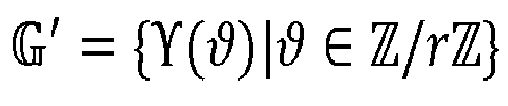
- Various embodiments relate to a method for protecting against faults in a computation of a point multiplication Q = [k]P on an elliptic curve E defined over a prime field, including: defining an integer r and a group

 and isomorphic to an additive group
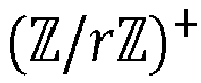
 through isomorphism Y; forming a combined group
 and
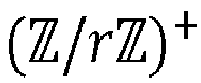
and ; selecting an element ϑ in
 and defining an element P' = Υ(ϑ) in group
 ; forming a combined element P̂ = CRT (P, P') in the group
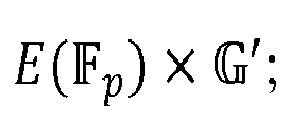
 ; and checking whether Q̂ ≡ Q' (mod r) where Q' = Υ(kϑ).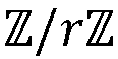
- Further various embodiments relate to a non-transitory machine-readable storage medium encoded with instructions for protecting against faults in a computation of a point multiplication Q = [k]P on an elliptic curve E defined over a prime field, including: instructions for defining an integer r and a group

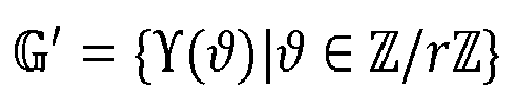 and isomorphic to an additive group
 through isomorphism Υ; instructions for forming a combined group
 and
and ; instructions for selecting an element ϑ in
 and defining an element P' = Υ(ϑ) in group
 ; instructions for forming a combined element P̂ = CRT (P, P') in the group

 ; and instructions for checking whether Q̂ ≡ Q'(mod r) where Q' = Υ(kϑ).
- Further various embodiments relate to device for protecting against faults in a computation of a point multiplication Q = [k]P on an elliptic curve E defined over a prime field, including: a memory; and a processor in communication with the memory, the processor configured to: define an integer r and a group

 and isomorphic to an additive group
 through isomorphism Υ; form a combined group
 and
and ; select an element ϑ in
 and defining an element P' = Υ(ϑ) in group
 ; form a combined element P̂ = CRT (P, P') in the group

 ; and check whether Q̂ ≡ Q' (mod r) where Q' = Υ(kϑ).
- Various embodiments are described, wherein when Q̂ = Q' (mod r) output Q = Q̂ mod p and otherwise return an error.
- Various embodiments are described, whereinis a set of points (ϑ, 1) on a twisted Edwards curve.

- Various embodiments are described, whereinis a set of points (ϑ, 1) on a Jacobi quartic curve.

- Various embodiments are described, whereinis a set of points (ϑ, 1, 1) on a Jacobi quadratics intersection curve.

- Various embodiments are described, whereinis a set of points (ϑ, -1) on a Hessian curve. Various embodiments are described, wherein
 is a set of points (ϑ,
c ϑ) on a Huff curve, wherec is any value in.
- Various embodiments are described, whereinis a set of points (ϑ: 1: ϑ 3) on a Weierstrass curve.

- In order to better understand various exemplary embodiments, reference is made to the accompanying drawings, wherein:
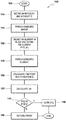
FIG. 1 illustrates a method for protecting against faults in the computation of a point multiplication Q = [k]P on an elliptic curve E defined over the prime field.
- To facilitate understanding, identical reference numerals have been used to designate elements having substantially the same or similar structure and/or substantially the same or similar function.
- The description and drawings illustrate the principles of the invention. It will thus be appreciated that those skilled in the art will be able to devise various arrangements that, although not explicitly described or shown herein, embody the principles of the invention and are included within its scope. Furthermore, all examples recited herein are principally intended expressly to be for pedagogical purposes to aid the reader in understanding the principles of the invention and the concepts contributed by the inventor(s) to furthering the art, and are to be construed as being without limitation to such specifically recited examples and conditions. Additionally, the term, "or," as used herein, refers to a non-exclusive or (i.e., and/or), unless otherwise indicated (e.g., "or else" or "or in the alternative"). Also, the various embodiments described herein are not necessarily mutually exclusive, as some embodiments can be combined with one or more other embodiments to form new embodiments.
- Elliptic curve cryptography (ECC) is an interesting alternative to Rivest-Shamir-Adleman (RSA) cryptography because the keys are much shorter for a same conjectured security level. Given a point P on an elliptic curve E and an integer k, the basic operation includes computing the scalar multiplication [k]P, that is, P ⊕ P ⊕ ... ⊕ P (k times) where ⊕ denotes the group operation on E. The goal of an attacker is to recover the value of k (or a part thereof) by inducing faults.
- For RSA cryptographic systems, Shamir's countermeasure was developed. Shamir's countermeasure generalizes to elliptic curve scalar multiplication and is known as the Blomer-Otto-Seifert (BOS) countermeasure. The BOS countermeasure method is as follows.
- Suppose one has to compute Q = [k]P on an elliptic curve E defined over the prime fieldand given by the Weierstraß equation y 2 = x 3 + ax + b.

- 1. For a (small) prime r, define an elliptic curve E' over and a point P' on E';

- 2. Form the combined curve Ê = CRT (E,E') over and the combined point P̂ = CRT (P, P') (where CRT is the Chinese remainder theorem; whose application is defined below);

- 3. Compute Q̂ = [k]P̂ on Ê;
- 4. Compute Q' = [k]P' on E';
- 5. Check whether Q̂ = Q' (mod r), and
if so, output Q = Q̂ mod p;
if not, return error. - The following observations of the BOS countermeasure method are noted. If y 2 = x 3 + a'x + b' is the equation defining the elliptic curve E' over, CRT(E,E') denotes the elliptic curve over
 given by the equation y 2 = x 3 + âx + b̂ where â = CRT(a(mod p), a'(mod r)) and b̂ = CRT(b(mod p), b'(mod r)); i.e., such that â ≡ a(mod p) and â ≡ a'(mod r), and the same for b̂. Point P̂ is defined similarly from the coordinates of points P and P'.
- In a concrete implementation, prime r, curve E' and point P' are precomputed so that the order of point P' on E', ord E' (P'), is maximal. The value of n:=ord E' (P') together with r, the curve parameters, and point P' may be stored in non-volatile memory. This presents the further advantage in that the calculation of Q' in Step 4 of the BOS countermeasure method may be performed more efficiently as Q' = [k mod n]P'.
- In order to avoid a single point of failure, infective computation is preferred to implement the final test of Step 5 of the BOS countermeasure method. For example, for Step 5, one could perform the following steps instead:
- 5.1. compute cx = (x(Q̂)+1-x(Q')) mod r and cy = (y(Q̂)+1-y(Q')) mod r, where x(Q̂) and y(Q̂) respectively denote the x- and y-coordinate of point Q̂ and similarly for point Q';
- 5.2. Choose a κ-bit random integer ρ and compute

- 5.3. return Q = [γ]R on E where R = Q̂ (mod p).
- It can be checked that when Q̂ ≡ Q' (mod r), cx and cy are both equal to 1, which leads to γ = 1. Otherwise, γ is a random value and the returned point Q is a random point.
- As discussed above, the BOS fault countermeasure method requires the prior generation and storage of a prime r, an elliptic curve E' over, and a point P' on E' of large order. For better performance, the order n of P' should also be pre-stored.

- Another countermeasure is presented in Y.-J. Baek and I. Vasyltsov, "How to prevent DPA and fault attacks in a unified way for ECC scalar multiplication: Ring extension method," in E. Dawson and D. Wong, editors, Information Security Practice and Experience - ISPEC 2007, volume 4464 of LNCS, pages 225-237. Springer, Heidelberg, 2006. Compared to J. Blömer, M. Otto, and J.-P. Seifert, "Sign change fault attacks on elliptic curve cryp-tosystems, in L. Breveglieri et al., editors, Fault Diagnosis and Tolerance in Cryptography-FDTC 2006, volume 4236 of LNCS, pages 36-52. Springer, Heidelberg, 2006, Baek-Vasyltsov does not require pre-computed values and does not assume that the randomizer r is a prime integer. Numerical experiments conducted in M. Joye, "On the security of a unified countermeasure," in L. Breveglieri et al., editors, 5th Workshop on Fault Diagnosis and Tolerance in Cryptography (FDTC 2008), pages 87-91. IEEE Computer Society, 2008, however show that a non-negligible proportion of faults is undetected and that larger bit-lengths for r should be used.
- More effective countermeasures are given in M. Joye, "Edwards curves and fault attack," presented at the rump session of CRYPTO 2012, Santa Barbara, USA, Aug. 21, 2012, available at http://crypto.2012.rump.cr.yp.to/ and S. Neves and M. Tibouchi, "Degenerate curve attacks - extending invalid curve attacks to Edwards curves and other models, in C.-M. Cheng, K.-M. Chung, G. Persiano, and B.-Y. Yang, editors, PKC 2016, Part II, volume 9615 of LNCS, pages 19-35, Springer, Heidelberg, Mar. 2016. They essentially follow the same approach. The idea is to rely on a shortcut for the evaluation of Q' = [k]P' on E' by an appropriate choice for E'. In Joye, E' is chosen as the subgroup of points on an elliptic curve overthat reduce to O modulo r. In Neves-Tibouchi, E' is chosen as the group of points on a degenerate curve over
 .
.
- The method in Joye presents the disadvantage that fault attacks whose detection probability depends on the order of point P' implies a twice longer value for r. Indeed, the subgroup of points considered in Joye for E' has order r whereas the corresponding curve is defined modulo r 2. In turn, the combined curve Ê is defined over, which is more demanding for the evaluation of Q̂ on Ê.

- The combined curve in Neves-Tibouchi is defined overwhere r is prime. However, most elliptic curve models (the Weierstraß model is a notable exception) do not have an additive degeneration: they either degenerate to the (r - 1)-order multiplicative group

 of elements of norm 1 in

 ). Second, whereas it is easy to obtain a generator of the additive group
 , for
, for
 , the respective factorization of r - 1 or of r + 1 is required. An easy fix is to increase the size of r so as to increase the probability that the order of P' as an element of the degenerate curve E' is large. The limitation on r being a (large) prime incurs computational complexity as r needs to be tested for primality.
- Embodiments for more efficiently implementing a countermeasure method against faults for ECC versus the BOS countermeasure method will now be described. As aforementioned, obtaining a generator of the additive groupis fairly easy: any non-zero integer co-prime to r generates
 . Two possible strategies are:
- 1. Take 1 as a generator or fix a prime g larger that the maximum value for r. Then


- 2. Select r as a prime number. Then any non-zero integer 0 < g < r is a generator of
- The idea of the embodiment is to replace the combined curve Ê in the BOS countermeasure by the group
 and
and and where the group
 is represented with elements having a group law that coincides (i.e., is compatible) with the group law used in the representation for
 . Such a representation for


- Becauseis selected such that Υ(ϑ 1) ⊕ Υ(ϑ 2) = Υ(ϑ 1 + ϑ 2), this means that kΥ(ϑ) = Υ(kϑ) = kP'. This means that instead of calculating kP' as a series of point additions on an elliptic curve as in the BOS method, the verification for the presence of faults can be performed from the calculation of kϑ. Because calculating kϑ is a simple arithmetic multiplication modulo integer r, it is a much more efficient calculation versus the point multiplication in the BOS method. Accordingly, Step 4 of the BOS method may be replaced by a much more efficient operation.

- This method is fully generic and can readily be adapted to any elliptic curve model and corresponding addition formulas. Also, although focusing on protecting elliptic curve computations over prime fields for the sake of concreteness, this method can be generalized to elliptic curve computations over arbitrary rings, including over binary fields.
-
FIG. 1 illustrates a method for protecting against faults in the computation of a point multiplication Q = [k]P on an elliptic curve E defined over the prime field. The
method 100 starts 105, and then defines an integer r and a group and isomorphic to the additive group
 through isomorphism Υ. Next, the
method 100 forms the combined group and
and 115. Then the
method 100 selects an element ϑ inand defines the element P' = Υ(ϑ) in
group 120. Next, the
method 100 forms the combined element P̂ = CRT (P, P') in the group
method 100 then calculates Q̂ = [k]P̂ in the combined group
method 100, calculates kϑ in135. The method then checks whether Q̂ ≡ Q' (mod r) where Q' = Υ(kϑ) 140, and if so, output Q =
Q̂ mod p 145, and if not, return anerror 150. The method then ends at 155. - Application of the above method will now be described for various elliptic curves that are used as the basis for ECC.
- One elliptic curve to consider is a normal form for elliptic curves in a twisted form that is referred to as the twisted Edwards form. The twisted Edwards form, is given by the equation:

- The neutral element for this curve is 0 = (0,1). The addition law is unified. Given two points (x 1,y 1) and (x 2,y 2), their sum (x 3,y 3) = (x 1,y 1) ⊕ (x 2,y 2) is given by:

- Applying the general method above to the twisted Edwards form results in:

- In more detail, the groupis viewed as the set
 of points (x, 1) on an Edwards curve (1) with parameters a = d = 0, over the ring
 , equipped with the above addition law. When a = d = 0, it is easily verified that:


- Another elliptic curve to consider is the Jacobi quartic model. The (extended) Jacobi quartic model assumes an element of order 2. Its equation is given by:


- The original Jacobi quartics correspond to the case d = k 2 and -2a = 1 + k 2 for some k. Applying the general method above using the Jacobi quartic model results in:

- As it was for the Edwards model, it is readily verified for the Jacobi quartic model that Y(0) = (0,1) = 0 and, when a = d = 0, that Υ(ϑ 1) ⊕ Υ(ϑ 2) = (ϑ 1, 1) ⊕ (ϑ 2, 1) =

- Another elliptic curve to consider is the Jacobi quadratics intersection model which represents an elliptic curve as the intersection of two quadrics in. The most general form is as follows:


- The neutral element is O = (0,1,1). The unified sum of two points (x 1, y 1, z 1) and (x 2, y 2, z 2) is given by (x 3, y 2, z 3) = (x 1, y 1, z 1) ⊕ (x 2, y 2, z 2) where:

- Applying the general method above using the Jacobi quadrics intersection model results in:

- A simple calculation shows that Υ(0) = (0,1,1) = 0 and, when a = b = 0, that Υ(ϑ 1) ⊕

- Another elliptic curve to consider are the Hessian curves. Hessian curves have been generalized, modified, and extended for cryptographic applications. Using for the neutral element the point O = (0, -1), the curve equation is:

- The unified sum (x 3, y 3) = (x 1, y 1) ⊕ (x 2, y 2) of two affine points (x 1, y 1) and (x 2, y 2) is given by:

- Applying the general method above using the Hessian curve above results in:

- Again, it can be verified that Υ(0) = (0, -1) = 0 and that the addition law when a = d = 0 yields

- Another elliptic curve to consider are the Huff curves. The most general form is given by the equation:


- Applying the general method above using the Huff curve above and by fixing


- The correctness is verified by observing that Υ(0) = (0,0) = 0 and, when (a, c, d) = (0,
c , 0), the addition law leads to Υ(ϑ 1) ⊕ Υ(ϑ 2) = (ϑ 1,c · ϑ 1) ⊕ (ϑ 2,c · ϑ 2) = (ϑ 1 + ϑ 2,c · ϑ 1 +c · ϑ 2) = Υ(ϑ 1 + ϑ 2) as desired. - The Weierstrass model is the most common way to represent an elliptic curve. It is given by the equation:


- The neutral element is the point at infinity O = (0: 1: 0). Unified addition formulas are given by

- Applying the general method above using the Hessian curve above results in:

- Here again, it can be verified that Υ(0) = (0: 1: 0) = 0 and, when a = b = 0, that the above addition formulas yield Υ(ϑ 1) ⊕ Υ(ϑ 2) = (ϑ 1: 1: ϑ 1 3) ⊕ (ϑ 2: 1: ϑ 2 3) = (ϑ 1 + ϑ2: 1: (ϑ 1 + ϑ 2)3ϑ 1 ϑ 2 + ϑ 1 3 + ϑ 2 3) = (ϑ 1 + ϑ 2: 1: (ϑ 1 + ϑ 2)3) = Υ(ϑ 1 + ϑ 2) as desired.
- The above embodiments list unified addition formulas; that is, the formulas remain valid when the input points are equal (point doubling). Depending on certain conditions (e.g., field characteristic or curve parameters), the formulas are even complete; that is, they can be used without any exception. It is worth noting that in all the previous embodiments the addition formulas are complete in. The identity Υ(ϑ 1) ⊕ Υ(ϑ 2) = Υ(ϑ 1 + ϑ 2) is always verified. This implies that randomizer r can be used freely in the proposed method; in particular, it is not required to be prime.

- The methods described above may be implemented in software which includes instructions for execution by a processor stored on a non-transitory machine-readable storage medium. The processor may include a memory that stores the instructions for execution by the processor.
- Any combination of specific software running on a processor to implement the embodiments of the invention, constitute a specific dedicated machine.
- As used herein, the term "non-transitory machine-readable storage medium" will be understood to exclude a transitory propagation signal but to include all forms of volatile and non-volatile memory. Further, as used herein, the term "processor" will be understood to encompass a variety of devices such as microprocessors, field-programmable gate arrays (FPGAs), application-specific integrated circuits (ASICs), and other similar processing devices. When software is implemented on the processor, the combination becomes a single specific machine.
- It should be appreciated by those skilled in the art that any block diagrams herein represent conceptual views of illustrative circuitry embodying the principles of the invention. Although the various exemplary embodiments have been described in detail with particular reference to certain exemplary aspects thereof, it should be understood that the invention is capable of other embodiments and its details are capable of modifications in various obvious respects. As is readily apparent to those skilled in the art, variations and modifications can be effected while remaining within the spirit and scope of the invention. Accordingly, the foregoing disclosure, description, and figures are for illustrative purposes only and do not in any way limit the invention, which is defined only by the claims.

Claims (15)
- A method for protecting against faults in a computation of a point multiplication Q = [k]P on an elliptic curve E defined over a prime field, comprising:
 - defining an integer r and a group
 and isomorphic to an additive group
 through isomorphism Υ;
 - forming a combined group
 and
and ;
; - selecting an element ϑ inand defining an element P' = Υ(ϑ) in group
 ;
; - forming a combined element P̂ = CRT (P, P') in the group
 - calculating Q̂ = [k]P̂ in the combined group
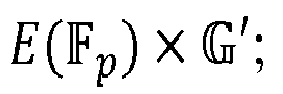 - calculating kϑ in; and
 - checking whether Q̂ ≡ Q' (mod r) where Q' = Υ(kϑ).
 - The method of claim 1, wherein when Q̂ = Q' (mod r) output Q = Q̂ mod p and otherwise return an error.
- The method of claim 1 or 2, whereinis a set of points (ϑ,1) on a twisted Edwards curve.

- The method of claim 1 or 2, whereinis a set of points (ϑ,1) on a Jacobi quartic curve.

- The method of claim 1 or 2, whereinis a set of points (ϑ,1,1) on a Jacobi quadratics intersection curve.

- The method of claim 1 or 2, whereinis a set of points (ϑ,-1) on a Hessian curve.

- The method of claim 1 or 2, whereinis a set of points (ϑ,c̅ϑ) on a Huff curve, where

c is any value in.
- The method of claim 1 or 2, whereinis a set of points (ϑ:1:ϑ 3) on a Weierstrass curve.

- A non-transitory machine-readable storage medium encoded with instructions for protecting against faults in a computation of a point multiplication Q = [k]P on an elliptic curve E defined over a prime field, wherein said instructions, when executed, carry out the method of any preceding claim.

- A device for protecting against faults in a computation of a point multiplication Q = [k]P on an elliptic curve E defined over a prime field, comprising:
 - a memory; and- a processor in communication with the memory, the processor configured to:check whether Q̂ ≡ Q' (mod r) where Q' = Υ(kϑ).define an integer r and a group
 and isomorphic to an additive group
 through isomorphism Υ;
 form a combined group
 and
and ;
; select an element ϑ inand defining an element P' = Υ(ϑ) in group
 ;
; form a combined element P̂ = CRT (P, P') in the group
 calculate Q̂ = [k]P in the combined group
 calculate kϑ in; and
- The device of claim 10, wherein when Q = Q' (mod r) output Q = Q̂ mod p and otherwise return an error.
- The device of claim 10 or 11, whereinis a set of points (ϑ,1) on a twisted Edwards curve.

- The device of claim 10 or 11, whereinis a set of points (ϑ,1) on a Jacobi quartic curve.

- The device of claim 10 or 11, whereinis a set of points (ϑ,1,1) on a Jacobi quadratics intersection curve.

- The device of claim 10 or 11, whereinis a set of points (ϑ,-1) on a Hessian curve.

Applications Claiming Priority (1)
| Application Number | Priority Date | Filing Date | Title |
|---|---|---|---|
| US15/795,103 US10601578B2 (en) | 2017-10-26 | 2017-10-26 | Protecting ECC against fault attacks |
Publications (2)
| Publication Number | Publication Date |
|---|---|
| EP3477888A1 true EP3477888A1 (en) | 2019-05-01 |
| EP3477888B1 EP3477888B1 (en) | 2020-12-02 |
Family
ID=63244448
Family Applications (1)
| Application Number | Title | Priority Date | Filing Date |
|---|---|---|---|
| EP18188642.5A Not-in-force EP3477888B1 (en) | 2017-10-26 | 2018-08-13 | Protecting ecc against fault attacks |
Country Status (2)
| Country | Link |
|---|---|
| US (1) | US10601578B2 (en) |
| EP (1) | EP3477888B1 (en) |
Families Citing this family (3)
| Publication number | Priority date | Publication date | Assignee | Title |
|---|---|---|---|---|
| EP3503459B1 (en) * | 2017-12-22 | 2021-04-21 | Secure-IC SAS | Device and method for protecting execution of a cryptographic operation |
| CN110798305B (en) * | 2019-09-24 | 2023-05-30 | 瓦戈科技有限公司 | A fault analysis and defense method, electronic equipment, and readable storage medium |
| DE102022108756A1 (en) | 2021-04-16 | 2022-10-20 | Samsung Electronics Co., Ltd. | Encryption device and authentication method and signature generation method of a system comprising the same |
Family Cites Families (8)
| Publication number | Priority date | Publication date | Assignee | Title |
|---|---|---|---|---|
| JP3950638B2 (en) * | 2001-03-05 | 2007-08-01 | 株式会社日立製作所 | Tamper resistant modular processing method |
| KR100850202B1 (en) * | 2006-03-04 | 2008-08-04 | 삼성전자주식회사 | Encryption method corresponding to DFA using ECC Fast Mongolian power ladder algorithm |
| KR101527867B1 (en) * | 2007-07-11 | 2015-06-10 | 삼성전자주식회사 | Method of countering side-channel attacks in elliptic curve cryptosystem |
| CA2701573C (en) * | 2007-10-30 | 2014-05-20 | Blackberry Limited | Fault detection in exponentiation and point multiplication operations using a montgomery ladder |
| JP2010164904A (en) * | 2009-01-19 | 2010-07-29 | Fujitsu Ltd | Elliptic curve arithmetic processing unit and elliptic curve arithmetic processing program and method |
| EP2228715A1 (en) * | 2009-03-13 | 2010-09-15 | Thomson Licensing | Fault-resistant calculcations on elliptic curves |
| TWI406138B (en) * | 2010-04-01 | 2013-08-21 | Ind Tech Res Inst | Sequential galois field multiplication architecture and method |
| FR3024808B1 (en) * | 2014-08-05 | 2016-07-29 | Inside Secure | ELLIPTICAL CURVED CRYPTOGRAPHY METHOD COMPRISING ERROR DETECTION |
-
2017
- 2017-10-26 US US15/795,103 patent/US10601578B2/en not_active Expired - Fee Related
-
2018
- 2018-08-13 EP EP18188642.5A patent/EP3477888B1/en not_active Not-in-force
Non-Patent Citations (8)
| Title |
|---|
| J. BLOMER; M. OTTO; J.-P. SEIFERT ET AL.: "Fault Diagnosis and Tolerance in Cryptography - FDTC 2006, volume 4236 of LNCS", vol. 4236, 2006, SPRINGER, article "Sign change fault attacks on elliptic curve cryp-tosystems", pages: 36 - 52 |
| M. JOYE ET AL.: "5th Workshop on Fault Diagnosis and Tolerance in Cryptography (FDTC 2008)", 2008, IEEE COMPUTER SOCIETY, article "On the security of a unified countermeasure", pages: 87 - 91 |
| M. JOYE: "Edwards curves and fault attack", CRYPTO 2012, 21 August 2012 (2012-08-21), Retrieved from the Internet <URL:http://crypto.2012.rump.cr.yp.to/> |
| MARC JOYE: "Elliptic Curve Cryptosystems in the Presence of Faults", 2013 WORKSHOP ON FAULT DIAGNOSIS AND TOLERANCE IN CRYPTOGRAPHY, 1 August 2013 (2013-08-01), pages 73 - 73, XP055555194, ISBN: 978-0-7695-5059-6, DOI: 10.1109/FDTC.2013.10 * |
| MARGAUX DUGARDIN ET AL: "Using Modular Extension to Provably Protect Edwards Curves Against Fault Attacks", INTERNATIONAL ASSOCIATION FOR CRYPTOLOGIC RESEARCH,, vol. 20160814:122545, 14 August 2016 (2016-08-14), pages 1 - 18, XP061021466 * |
| NEVES SAMUEL ET AL: "Degenerate Curve Attacks", 18 February 2016, INTERNATIONAL CONFERENCE ON SIMULATION, MODELING, AND PROGRAMMING FOR AUTONOMOUS ROBOTS,SIMPAR 2010; [LECTURE NOTES IN COMPUTER SCIENCE; LECT.NOTES COMPUTER], SPRINGER, BERLIN, HEIDELBERG, PAGE(S) 19 - 35, ISBN: 978-3-642-17318-9, XP047335802 * |
| S. NEVES; M. TIBOUCHI: "PKC 2016, Part //, volume 9615 of LNCS", vol. 9615, March 2016, SPRINGER, article "Degenerate curve attacks - extending invalid curve attacks to Edwards curves and other models", pages: 19 - 35 |
| Y.-J. BAEK; I. VASYLTSOV: "Information Security Practice and Experience - ISPEC 2007, volume 4464 of LNCS", vol. 4464, 2006, SPRINGER, article "How to prevent DPA and fault attacks in a unified way for ECC scalar multiplication: Ring extension method", pages: 225 - 237 |
Also Published As
| Publication number | Publication date |
|---|---|
| EP3477888B1 (en) | 2020-12-02 |
| US20190132114A1 (en) | 2019-05-02 |
| US10601578B2 (en) | 2020-03-24 |
Similar Documents
| Publication | Publication Date | Title |
|---|---|---|
| Joye et al. | Protections against differential analysis for elliptic curve cryptography—an algebraic approach— | |
| CN107040362B (en) | Modular multiplication apparatus and method | |
| US8817974B2 (en) | Finite field cryptographic arithmetic resistant to fault attacks | |
| US8457303B2 (en) | Fault-resistant calculcations on elliptic curves | |
| Boscher et al. | CRT RSA algorithm protected against fault attacks | |
| Vigilant | RSA with CRT: A new cost-effective solution to thwart fault attacks | |
| KR20100113130A (en) | Countermeasure method and devices for asymmetric cryptography | |
| CA2701573C (en) | Fault detection in exponentiation and point multiplication operations using a montgomery ladder | |
| EP3477888B1 (en) | Protecting ecc against fault attacks | |
| EP3242202A1 (en) | Countermeasure to safe-error fault injection attacks on cryptographic exponentiation algorithms | |
| Campos et al. | Trouble at the CSIDH: protecting CSIDH with dummy-operations against fault injection attacks | |
| KR20100117589A (en) | Countermeasure method and devices for asymmetrical cryptography with signature diagram | |
| EP3503459A1 (en) | Device and method for protecting execution of a cryptographic operation | |
| Campos et al. | Patient zero & patient six: Zero-value and correlation attacks on CSIDH and SIKE | |
| Bajard et al. | Multi-fault attack detection for RNS cryptographic architecture | |
| EP2779521B1 (en) | A method and a device for fault-resistant exponentiation in cryptographic systems | |
| Joye | A Method for Preventing" Skipping" Attacks | |
| EP2293185A1 (en) | Exponentiation method resistant against skipping attacks and apparatus for performing the method | |
| Liu et al. | A CRT-RSA algorithm secure against hardware fault attacks | |
| Barbu et al. | Combined attack on CRT-RSA: why public verification must not be public? | |
| El Mrabet et al. | Failure of the point blinding countermeasure against fault attack in pairing-based cryptography | |
| Tunstall et al. | Boolean exponent splitting | |
| Okeya et al. | On the importance of protecting Δ in SFLASH against side channel attacks | |
| Joye | On the security of a unified countermeasure | |
| US20190327264A1 (en) | Apparatus and method for performing operation being secure against side channel attack |
Legal Events
| Date | Code | Title | Description |
|---|---|---|---|
| PUAI | Public reference made under article 153(3) epc to a published international application that has entered the european phase |
Free format text: ORIGINAL CODE: 0009012 |
|
| STAA | Information on the status of an ep patent application or granted ep patent |
Free format text: STATUS: THE APPLICATION HAS BEEN PUBLISHED |
|
| AK | Designated contracting states |
Kind code of ref document: A1 Designated state(s): AL AT BE BG CH CY CZ DE DK EE ES FI FR GB GR HR HU IE IS IT LI LT LU LV MC MK MT NL NO PL PT RO RS SE SI SK SM TR |
|
| AX | Request for extension of the european patent |
Extension state: BA ME |
|
| STAA | Information on the status of an ep patent application or granted ep patent |
Free format text: STATUS: REQUEST FOR EXAMINATION WAS MADE |
|
| STAA | Information on the status of an ep patent application or granted ep patent |
Free format text: STATUS: EXAMINATION IS IN PROGRESS |
|
| 17P | Request for examination filed |
Effective date: 20191104 |
|
| RBV | Designated contracting states (corrected) |
Designated state(s): AL AT BE BG CH CY CZ DE DK EE ES FI FR GB GR HR HU IE IS IT LI LT LU LV MC MK MT NL NO PL PT RO RS SE SI SK SM TR |
|
| 17Q | First examination report despatched |
Effective date: 20191129 |
|
| GRAJ | Information related to disapproval of communication of intention to grant by the applicant or resumption of examination proceedings by the epo deleted |
Free format text: ORIGINAL CODE: EPIDOSDIGR1 |
|
| GRAP | Despatch of communication of intention to grant a patent |
Free format text: ORIGINAL CODE: EPIDOSNIGR1 |
|
| GRAP | Despatch of communication of intention to grant a patent |
Free format text: ORIGINAL CODE: EPIDOSNIGR1 |
|
| STAA | Information on the status of an ep patent application or granted ep patent |
Free format text: STATUS: GRANT OF PATENT IS INTENDED |
|
| INTG | Intention to grant announced |
Effective date: 20200716 |
|
| RIN1 | Information on inventor provided before grant (corrected) |
Inventor name: JOYE, MARC |
|
| GRAS | Grant fee paid |
Free format text: ORIGINAL CODE: EPIDOSNIGR3 |
|
| GRAA | (expected) grant |
Free format text: ORIGINAL CODE: 0009210 |
|
| STAA | Information on the status of an ep patent application or granted ep patent |
Free format text: STATUS: THE PATENT HAS BEEN GRANTED |
|
| AK | Designated contracting states |
Kind code of ref document: B1 Designated state(s): AL AT BE BG CH CY CZ DE DK EE ES FI FR GB GR HR HU IE IS IT LI LT LU LV MC MK MT NL NO PL PT RO RS SE SI SK SM TR |
|
| REG | Reference to a national code |
Ref country code: GB Ref legal event code: FG4D |
|
| REG | Reference to a national code |
Ref country code: CH Ref legal event code: EP Ref country code: AT Ref legal event code: REF Ref document number: 1342113 Country of ref document: AT Kind code of ref document: T Effective date: 20201215 |
|
| REG | Reference to a national code |
Ref country code: IE Ref legal event code: FG4D |
|
| REG | Reference to a national code |
Ref country code: DE Ref legal event code: R096 Ref document number: 602018010311 Country of ref document: DE |
|
| PG25 | Lapsed in a contracting state [announced via postgrant information from national office to epo] |
Ref country code: NO Free format text: LAPSE BECAUSE OF FAILURE TO SUBMIT A TRANSLATION OF THE DESCRIPTION OR TO PAY THE FEE WITHIN THE PRESCRIBED TIME-LIMIT Effective date: 20210302 Ref country code: GR Free format text: LAPSE BECAUSE OF FAILURE TO SUBMIT A TRANSLATION OF THE DESCRIPTION OR TO PAY THE FEE WITHIN THE PRESCRIBED TIME-LIMIT Effective date: 20210303 Ref country code: FI Free format text: LAPSE BECAUSE OF FAILURE TO SUBMIT A TRANSLATION OF THE DESCRIPTION OR TO PAY THE FEE WITHIN THE PRESCRIBED TIME-LIMIT Effective date: 20201202 Ref country code: RS Free format text: LAPSE BECAUSE OF FAILURE TO SUBMIT A TRANSLATION OF THE DESCRIPTION OR TO PAY THE FEE WITHIN THE PRESCRIBED TIME-LIMIT Effective date: 20201202 |
|
| REG | Reference to a national code |
Ref country code: NL Ref legal event code: MP Effective date: 20201202 |
|
| REG | Reference to a national code |
Ref country code: AT Ref legal event code: MK05 Ref document number: 1342113 Country of ref document: AT Kind code of ref document: T Effective date: 20201202 |
|
| PG25 | Lapsed in a contracting state [announced via postgrant information from national office to epo] |
Ref country code: SE Free format text: LAPSE BECAUSE OF FAILURE TO SUBMIT A TRANSLATION OF THE DESCRIPTION OR TO PAY THE FEE WITHIN THE PRESCRIBED TIME-LIMIT Effective date: 20201202 Ref country code: PL Free format text: LAPSE BECAUSE OF FAILURE TO SUBMIT A TRANSLATION OF THE DESCRIPTION OR TO PAY THE FEE WITHIN THE PRESCRIBED TIME-LIMIT Effective date: 20201202 Ref country code: LV Free format text: LAPSE BECAUSE OF FAILURE TO SUBMIT A TRANSLATION OF THE DESCRIPTION OR TO PAY THE FEE WITHIN THE PRESCRIBED TIME-LIMIT Effective date: 20201202 Ref country code: BG Free format text: LAPSE BECAUSE OF FAILURE TO SUBMIT A TRANSLATION OF THE DESCRIPTION OR TO PAY THE FEE WITHIN THE PRESCRIBED TIME-LIMIT Effective date: 20210302 |
|
| PG25 | Lapsed in a contracting state [announced via postgrant information from national office to epo] |
Ref country code: HR Free format text: LAPSE BECAUSE OF FAILURE TO SUBMIT A TRANSLATION OF THE DESCRIPTION OR TO PAY THE FEE WITHIN THE PRESCRIBED TIME-LIMIT Effective date: 20201202 Ref country code: NL Free format text: LAPSE BECAUSE OF FAILURE TO SUBMIT A TRANSLATION OF THE DESCRIPTION OR TO PAY THE FEE WITHIN THE PRESCRIBED TIME-LIMIT Effective date: 20201202 |
|
| REG | Reference to a national code |
Ref country code: LT Ref legal event code: MG9D |
|
| PG25 | Lapsed in a contracting state [announced via postgrant information from national office to epo] |
Ref country code: EE Free format text: LAPSE BECAUSE OF FAILURE TO SUBMIT A TRANSLATION OF THE DESCRIPTION OR TO PAY THE FEE WITHIN THE PRESCRIBED TIME-LIMIT Effective date: 20201202 Ref country code: CZ Free format text: LAPSE BECAUSE OF FAILURE TO SUBMIT A TRANSLATION OF THE DESCRIPTION OR TO PAY THE FEE WITHIN THE PRESCRIBED TIME-LIMIT Effective date: 20201202 Ref country code: SM Free format text: LAPSE BECAUSE OF FAILURE TO SUBMIT A TRANSLATION OF THE DESCRIPTION OR TO PAY THE FEE WITHIN THE PRESCRIBED TIME-LIMIT Effective date: 20201202 Ref country code: PT Free format text: LAPSE BECAUSE OF FAILURE TO SUBMIT A TRANSLATION OF THE DESCRIPTION OR TO PAY THE FEE WITHIN THE PRESCRIBED TIME-LIMIT Effective date: 20210405 Ref country code: SK Free format text: LAPSE BECAUSE OF FAILURE TO SUBMIT A TRANSLATION OF THE DESCRIPTION OR TO PAY THE FEE WITHIN THE PRESCRIBED TIME-LIMIT Effective date: 20201202 Ref country code: RO Free format text: LAPSE BECAUSE OF FAILURE TO SUBMIT A TRANSLATION OF THE DESCRIPTION OR TO PAY THE FEE WITHIN THE PRESCRIBED TIME-LIMIT Effective date: 20201202 Ref country code: LT Free format text: LAPSE BECAUSE OF FAILURE TO SUBMIT A TRANSLATION OF THE DESCRIPTION OR TO PAY THE FEE WITHIN THE PRESCRIBED TIME-LIMIT Effective date: 20201202 |
|
| PG25 | Lapsed in a contracting state [announced via postgrant information from national office to epo] |
Ref country code: AT Free format text: LAPSE BECAUSE OF FAILURE TO SUBMIT A TRANSLATION OF THE DESCRIPTION OR TO PAY THE FEE WITHIN THE PRESCRIBED TIME-LIMIT Effective date: 20201202 |
|
| REG | Reference to a national code |
Ref country code: DE Ref legal event code: R097 Ref document number: 602018010311 Country of ref document: DE |
|
| PG25 | Lapsed in a contracting state [announced via postgrant information from national office to epo] |
Ref country code: IS Free format text: LAPSE BECAUSE OF FAILURE TO SUBMIT A TRANSLATION OF THE DESCRIPTION OR TO PAY THE FEE WITHIN THE PRESCRIBED TIME-LIMIT Effective date: 20210402 |
|
| PLBE | No opposition filed within time limit |
Free format text: ORIGINAL CODE: 0009261 |
|
| STAA | Information on the status of an ep patent application or granted ep patent |
Free format text: STATUS: NO OPPOSITION FILED WITHIN TIME LIMIT |
|
| PG25 | Lapsed in a contracting state [announced via postgrant information from national office to epo] |
Ref country code: AL Free format text: LAPSE BECAUSE OF FAILURE TO SUBMIT A TRANSLATION OF THE DESCRIPTION OR TO PAY THE FEE WITHIN THE PRESCRIBED TIME-LIMIT Effective date: 20201202 Ref country code: IT Free format text: LAPSE BECAUSE OF FAILURE TO SUBMIT A TRANSLATION OF THE DESCRIPTION OR TO PAY THE FEE WITHIN THE PRESCRIBED TIME-LIMIT Effective date: 20201202 |
|
| 26N | No opposition filed |
Effective date: 20210903 |
|
| PG25 | Lapsed in a contracting state [announced via postgrant information from national office to epo] |
Ref country code: SI Free format text: LAPSE BECAUSE OF FAILURE TO SUBMIT A TRANSLATION OF THE DESCRIPTION OR TO PAY THE FEE WITHIN THE PRESCRIBED TIME-LIMIT Effective date: 20201202 Ref country code: DK Free format text: LAPSE BECAUSE OF FAILURE TO SUBMIT A TRANSLATION OF THE DESCRIPTION OR TO PAY THE FEE WITHIN THE PRESCRIBED TIME-LIMIT Effective date: 20201202 |
|
| PG25 | Lapsed in a contracting state [announced via postgrant information from national office to epo] |
Ref country code: ES Free format text: LAPSE BECAUSE OF FAILURE TO SUBMIT A TRANSLATION OF THE DESCRIPTION OR TO PAY THE FEE WITHIN THE PRESCRIBED TIME-LIMIT Effective date: 20201202 |
|
| REG | Reference to a national code |
Ref country code: CH Ref legal event code: PL |
|
| PG25 | Lapsed in a contracting state [announced via postgrant information from national office to epo] |
Ref country code: MC Free format text: LAPSE BECAUSE OF FAILURE TO SUBMIT A TRANSLATION OF THE DESCRIPTION OR TO PAY THE FEE WITHIN THE PRESCRIBED TIME-LIMIT Effective date: 20201202 |
|
| REG | Reference to a national code |
Ref country code: BE Ref legal event code: MM Effective date: 20210831 |
|
| PG25 | Lapsed in a contracting state [announced via postgrant information from national office to epo] |
Ref country code: LI Free format text: LAPSE BECAUSE OF NON-PAYMENT OF DUE FEES Effective date: 20210831 Ref country code: CH Free format text: LAPSE BECAUSE OF NON-PAYMENT OF DUE FEES Effective date: 20210831 |
|
| PG25 | Lapsed in a contracting state [announced via postgrant information from national office to epo] |
Ref country code: IS Free format text: LAPSE BECAUSE OF FAILURE TO SUBMIT A TRANSLATION OF THE DESCRIPTION OR TO PAY THE FEE WITHIN THE PRESCRIBED TIME-LIMIT Effective date: 20210402 Ref country code: LU Free format text: LAPSE BECAUSE OF NON-PAYMENT OF DUE FEES Effective date: 20210813 |
|
| PG25 | Lapsed in a contracting state [announced via postgrant information from national office to epo] |
Ref country code: IE Free format text: LAPSE BECAUSE OF NON-PAYMENT OF DUE FEES Effective date: 20210813 Ref country code: BE Free format text: LAPSE BECAUSE OF NON-PAYMENT OF DUE FEES Effective date: 20210831 |
|
| PGFP | Annual fee paid to national office [announced via postgrant information from national office to epo] |
Ref country code: GB Payment date: 20220721 Year of fee payment: 5 Ref country code: DE Payment date: 20220616 Year of fee payment: 5 |
|
| PGFP | Annual fee paid to national office [announced via postgrant information from national office to epo] |
Ref country code: FR Payment date: 20220721 Year of fee payment: 5 |
|
| PG25 | Lapsed in a contracting state [announced via postgrant information from national office to epo] |
Ref country code: CY Free format text: LAPSE BECAUSE OF FAILURE TO SUBMIT A TRANSLATION OF THE DESCRIPTION OR TO PAY THE FEE WITHIN THE PRESCRIBED TIME-LIMIT Effective date: 20201202 |
|
| PG25 | Lapsed in a contracting state [announced via postgrant information from national office to epo] |
Ref country code: HU Free format text: LAPSE BECAUSE OF FAILURE TO SUBMIT A TRANSLATION OF THE DESCRIPTION OR TO PAY THE FEE WITHIN THE PRESCRIBED TIME-LIMIT; INVALID AB INITIO Effective date: 20180813 |
|
| REG | Reference to a national code |
Ref country code: DE Ref legal event code: R119 Ref document number: 602018010311 Country of ref document: DE |
|
| GBPC | Gb: european patent ceased through non-payment of renewal fee |
Effective date: 20230813 |
|
| PG25 | Lapsed in a contracting state [announced via postgrant information from national office to epo] |
Ref country code: MK Free format text: LAPSE BECAUSE OF FAILURE TO SUBMIT A TRANSLATION OF THE DESCRIPTION OR TO PAY THE FEE WITHIN THE PRESCRIBED TIME-LIMIT Effective date: 20201202 |
|
| PG25 | Lapsed in a contracting state [announced via postgrant information from national office to epo] |
Ref country code: GB Free format text: LAPSE BECAUSE OF NON-PAYMENT OF DUE FEES Effective date: 20230813 |
|
| PG25 | Lapsed in a contracting state [announced via postgrant information from national office to epo] |
Ref country code: GB Free format text: LAPSE BECAUSE OF NON-PAYMENT OF DUE FEES Effective date: 20230813 Ref country code: FR Free format text: LAPSE BECAUSE OF NON-PAYMENT OF DUE FEES Effective date: 20230831 Ref country code: DE Free format text: LAPSE BECAUSE OF NON-PAYMENT OF DUE FEES Effective date: 20240301 |
|
| PG25 | Lapsed in a contracting state [announced via postgrant information from national office to epo] |
Ref country code: MT Free format text: LAPSE BECAUSE OF FAILURE TO SUBMIT A TRANSLATION OF THE DESCRIPTION OR TO PAY THE FEE WITHIN THE PRESCRIBED TIME-LIMIT Effective date: 20201202 |
|
| PG25 | Lapsed in a contracting state [announced via postgrant information from national office to epo] |
Ref country code: TR Free format text: LAPSE BECAUSE OF FAILURE TO SUBMIT A TRANSLATION OF THE DESCRIPTION OR TO PAY THE FEE WITHIN THE PRESCRIBED TIME-LIMIT Effective date: 20201202 |