EP3477591A1 - Avoiding catastrophic interference while training an artificial neural network on an additional task - Google Patents
Avoiding catastrophic interference while training an artificial neural network on an additional task Download PDFInfo
- Publication number
- EP3477591A1 EP3477591A1 EP17197899.2A EP17197899A EP3477591A1 EP 3477591 A1 EP3477591 A1 EP 3477591A1 EP 17197899 A EP17197899 A EP 17197899A EP 3477591 A1 EP3477591 A1 EP 3477591A1
- Authority
- EP
- European Patent Office
- Prior art keywords
- neural network
- segmentation
- task
- tasks
- training
- Prior art date
- Legal status (The legal status is an assumption and is not a legal conclusion. Google has not performed a legal analysis and makes no representation as to the accuracy of the status listed.)
- Granted
Links
Classifications
-
- G—PHYSICS
- G06—COMPUTING OR CALCULATING; COUNTING
- G06T—IMAGE DATA PROCESSING OR GENERATION, IN GENERAL
- G06T7/00—Image analysis
- G06T7/10—Segmentation; Edge detection
-
- G—PHYSICS
- G06—COMPUTING OR CALCULATING; COUNTING
- G06N—COMPUTING ARRANGEMENTS BASED ON SPECIFIC COMPUTATIONAL MODELS
- G06N3/00—Computing arrangements based on biological models
- G06N3/02—Neural networks
- G06N3/04—Architecture, e.g. interconnection topology
- G06N3/045—Combinations of networks
-
- G—PHYSICS
- G06—COMPUTING OR CALCULATING; COUNTING
- G06N—COMPUTING ARRANGEMENTS BASED ON SPECIFIC COMPUTATIONAL MODELS
- G06N3/00—Computing arrangements based on biological models
- G06N3/02—Neural networks
- G06N3/04—Architecture, e.g. interconnection topology
- G06N3/0464—Convolutional networks [CNN, ConvNet]
-
- G—PHYSICS
- G06—COMPUTING OR CALCULATING; COUNTING
- G06N—COMPUTING ARRANGEMENTS BASED ON SPECIFIC COMPUTATIONAL MODELS
- G06N3/00—Computing arrangements based on biological models
- G06N3/02—Neural networks
- G06N3/08—Learning methods
-
- G—PHYSICS
- G06—COMPUTING OR CALCULATING; COUNTING
- G06N—COMPUTING ARRANGEMENTS BASED ON SPECIFIC COMPUTATIONAL MODELS
- G06N3/00—Computing arrangements based on biological models
- G06N3/02—Neural networks
- G06N3/08—Learning methods
- G06N3/082—Learning methods modifying the architecture, e.g. adding, deleting or silencing nodes or connections
-
- G—PHYSICS
- G06—COMPUTING OR CALCULATING; COUNTING
- G06N—COMPUTING ARRANGEMENTS BASED ON SPECIFIC COMPUTATIONAL MODELS
- G06N3/00—Computing arrangements based on biological models
- G06N3/02—Neural networks
- G06N3/08—Learning methods
- G06N3/09—Supervised learning
-
- G—PHYSICS
- G06—COMPUTING OR CALCULATING; COUNTING
- G06T—IMAGE DATA PROCESSING OR GENERATION, IN GENERAL
- G06T7/00—Image analysis
- G06T7/0002—Inspection of images, e.g. flaw detection
- G06T7/0012—Biomedical image inspection
-
- G—PHYSICS
- G06—COMPUTING OR CALCULATING; COUNTING
- G06N—COMPUTING ARRANGEMENTS BASED ON SPECIFIC COMPUTATIONAL MODELS
- G06N3/00—Computing arrangements based on biological models
- G06N3/02—Neural networks
- G06N3/04—Architecture, e.g. interconnection topology
- G06N3/048—Activation functions
-
- G—PHYSICS
- G06—COMPUTING OR CALCULATING; COUNTING
- G06T—IMAGE DATA PROCESSING OR GENERATION, IN GENERAL
- G06T2207/00—Indexing scheme for image analysis or image enhancement
- G06T2207/20—Special algorithmic details
- G06T2207/20081—Training; Learning
-
- G—PHYSICS
- G06—COMPUTING OR CALCULATING; COUNTING
- G06T—IMAGE DATA PROCESSING OR GENERATION, IN GENERAL
- G06T2207/00—Indexing scheme for image analysis or image enhancement
- G06T2207/20—Special algorithmic details
- G06T2207/20084—Artificial neural networks [ANN]
Definitions
- the invention is situated in the field of artificial neural networks, which are computing systems inspired by the biological neural networks that constitute animal brains. More specifically, it is related to a method that prevents an artificial neural network that is trained to execute a segmentation task on medical images to forget its capability to accomplish an originally trained task when a new and different segmentation task is trained subsequently using the same network, but which targets the segmentation of a different object class or the same object class on a different modality or data with slightly different characteristics (e.g. data coming from a different hospital).
- artificial neural networks are computing systems inspired by the biological neural networks that constitute animal brains. More specifically, it is related to a method that prevents an artificial neural network that is trained to execute a segmentation task on medical images to forget its capability to accomplish an originally trained task when a new and different segmentation task is trained subsequently using the same network, but which targets the segmentation of a different object class or the same object class on a different modality or data with slightly different characteristics (e.g. data coming from a different hospital).
- Catastrophic interference also known as catastrophic forgetting
- Catastrophic interference is usually referred to as an inability of trained neural networks to remember previously learned information when training on a new task, following a previous task.
- This problem for connectionist networks was originally revealed in the works by Cohen et al. ( M. McCloskey and N. J. Cohen," Catastrophic interference in connectionist networks: The sequential learning problem," Psychology of learning and motivation, vol. 24, pp. 109-165, 1989 .) and Ratcliff et al. ( R. Ratcliff, "Connectionist models of recognition memory: Constraints imposed by learning and forgetting functions," Psychological review, vol. 97, no. 2, pp. 285-308, 1990 .).
- field catastrophic interference can occur when parameters of existing neural networks are transfer learnt to a new task or datasets with images are acquired in a different hospital with other imaging devices or protocols.
- the result of a segmentation task for a particular object class is a so-called ground truth mask, covering the positively identified surface in the image representing the sought anatomical structure.
- the resulting ground truth mask for a segmented object class of a particular medical image is represented as a binary image having pixel values of 0 or 1, the 1's representing the locations of the segmented structure in the image.
- the binary image thus serves as a mask that can be overlaid on the original image to identify the areas in the original image where the detected structure is present.
- pre-trained neural networks are not commonly used for segmentation purposes is that fully convolutional networks usually can be trained from scratch even without large sets of images. Therefore, joint-learning is a more common approach in segmentation networks, though fine-tuning and feature extraction can be used effectively too. This is true, provided that the new dataset is not completely different from the one on which the network was originally pre-trained.
- the network parameters could change significantly during the process of additionally training a new object class, so that the old task could potentially be partially (or completely) forgotten even if the new images belong to the same modality (e.g. CXR images).
- Root causes for this "forgetting" can be two-fold: the new segmentation task could be very different in comparison with the initial segmentation task (e.g. lung and clavicle segmentation), and the intensity distributions between datasets can differ significantly due to a different source imaging modality or different acquisition protocol. Both issues can lead to catastrophic interference in segmentation.
- Joint-training can be effectively used for segmentation in different datasets (e.g. coming from different data sources) on condition that the target objects for the joint-training are of the same type in all images of the dataset.
- this is not the case when different target objects of a very different nature are to be segmented on the same type of images and therefore the respective ground-truth masks for the target objects could cover very different areas in terms of type or size.
- the expected surface area of a ground-truth mask for the clavicles would be a lot smaller in comparison with the surface of the ground-truth of the lungs.
- problems could arise when some target objects would be present in ground-truth masks in a particular image for one class but absent for the other one(s).
- CXR images it could happen that in one task it would be required to segment both lungs at the same time as one class but in the other task as two classes separately.
- Another example could be that in one task the segmentation of clavicles is pursued within the lungs fields only, while in another one the complete clavicles are to be segmented within a full image.
- Another problem that can arise is that missing and overlapping target segmentation objects can make the building of the loss function that evaluates the quality of the segmentation a very challenging problem.
- training time increases when more images are added to the training set. In case of large 2D and 3D medical scans, and this time difference can be significant.
- This new task may comprise the capability of processing new image segmentation targets or processing new types of image datasets. This means that the newly trained neural network still is able to perform the old task next to the new task. Even when the target objects in the old and new tasks do not match or match only partially.
- the advantage of the described method is that the method is much more resource efficient in comparison to the case where individual neural networks would have to be trained in parallel to perform the different tasks independently. This effect comes from the fact that when an image segmentation neural network is trained for an additional task a number of new parameters has to be added increasing the complexity of the network. However, this number of new parameters added for each new task to the neural network is significantly smaller than the total number of parameters in the network.
- a convolutional neural network is a class of deep, feed-forward artificial neural networks that has successfully been applied to analysing visual imagery.
- Convolutional neural networks were inspired by biological processes in which the connectivity pattern between neurons is inspired by the organization of the animal visual cortex. Individual cortical neurons respond to stimuli only in a restricted region of the visual field known as the receptive field. The receptive fields of different neurons partially overlap such that they cover the entire visual field.
- a neural network consists of a number of so-called layers (in our case convolutional layers) and weights (or parameters), of which most of the layers are "hidden” layers for which there is no direct contact with the input or output of the data.
- An image segmentation task is the objective to be achieved by an image segmentation neural network, and consists in the identification of the parts within a certain image to be part of (or represent) a so-called segmentation class.
- An image segmentation network thus tries to identify those parts of an image that represent the parts of a so-called segmentation class.
- An example of such a segmentation task in a medical imaging context may be for instance the identification of the lungs or the identification of the vertebrae of the spine.
- classification networks Another type of neural networks are so-called classification networks, where it is the objective to identify parts of the image as a certain structure and as to positively identify or differentiate between multiple structures.
- the correct class for each record is known (this is termed supervised training), and the output nodes can therefore be assigned "correct" values -- "1" for the node corresponding to the correct class, and "0" for the others. It is thus possible to compare the network's calculated values for the output nodes to these "correct” values, and calculate an error term for each node. These error terms are then used to adjust the weights in the hidden layers so that, hopefully, the next time around the output values will be closer to the "correct” values. The adjustment of these weights comes down to minimizing a so-called loss function.
- the desired or reference outcome for the segmentation task is an annotated image marking the areas with the desired detectable segmentation classes.
- Such a result image is then represented as a so-called ground-truth mask.
- the present invention can be implemented as a computer program product adapted to carry out the steps as set out in the description.
- M ′ : M m 1 ⁇ m 2 0 , ... , n k denote the space of matrices m 1 ⁇ m 2 with values ⁇ 0, ... , n k ⁇ that correspond to the semantic labels of .
- the dataset S k is split into three non-overlapping sets, namely S TRAIN k , I VALID k and I TEST k .
- S TRAIN k small batches of images B k ⁇ Par k are passed consecutively onto the neural network, where Par k is a complete partition of the set I TRAIN k .
- C B k be the total pixel count over all images I i k ⁇ B k .
- the multiclass output of the neural network is calculated.
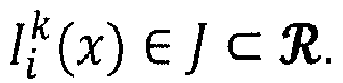
- the neural network can in other words be represented as a function: N k : S k ⁇ M ′ , N k I i k derives for each pixel x of I i k its semantic class l in a single step as a probability.
- ⁇ S k ⁇ M ′ ⁇ R , that estimates the deviation between the result generated by the neural network and the ground truth (or desired outcome).
- the calculated deviation ⁇ is subsequently used to update and optimize the neural network parameters w j in order to improve the performance of the network. This procedure is repeated until a defined set of stopping criteria are fulfilled, and is called the training of the neural network.
- the solving of the task T j is in other words the process of iteratively calculating the optimal parameters w j of the network N j .
- ⁇ is a chosen tolerance value
- p l ( x ) is the sigmoid activation function
- p l x : 1 1 + e ⁇ a l x and ⁇ l ( x ) indicates activation at the l -th feature channel and pixel x ⁇ I i k .
- a multi-class segmentation task has to be understood as a segmentation task that deals consecutively with the segmentation of different classes of segmentation targets.
- a simple image segmentation task is an image processing method that attempts to accurately determine the area in a digital image that comprises pixels that represent a particular "class".
- the so-called "class” refers to a structure, organ or feature that is the target of the segmentation algorithm.
- a multi-class segmentation task has thus to be understood as a series of sequentially executed segmentation tasks targeted to different classes.
- a neural network A neural network
- our method intends to further alleviate the problems of catastrophic interference by means of applying a sequence of multiclass segmentation tasks according to the following method steps:
- the calculated result masks for tasks T 1 , ..., T k are temporarily stored (in case of a computer implementation) as ground-truth segmentation masks G I k for the previously trained segmentation tasks T 1 , ...,T k .
- This aspect is a solution to the missing data of the result masks for the new set of images on which the new task is (manually) defined.
- the result masks for the previously trained tasks cannot be assumed to be calculated on the new image set, and therefore a calculation of all (previously trained) tasks on the new data set is assumed to render the best results to complete the entire data set with results for all known tasks.
- the above inventive method is preferably carried out by a computer program running on means which provide generic data processing functions.
- Such means can, for example, be embedded in a personal computer, smartphone, mainframe, etc.
- the trained convolutional neural network which is the result of the method explained above, can be captured and stored in a memory as a collection of data comprising the structure of the neural network and the parameters that have been calculated during the training step of said neural network. It can thus be envisaged that the resulting trained neural network model and data comprise the functional definition of the neural network which is capable of performing said classification tasks.
- This functional definition (which is in essence a set of weights and connections) may be copied and duplicated or propagated onto other computing means. It is also this functional definition that we seek to protect under this patent. Said neural network data may thus be transferable under the form of a collection of weights and connections.
- the above described method will provide an improved performance of the untreated neural network, but the trained neural network itself may be used to carry out tasks in an improved way in comparison with the untreated network. Therefore, the neural network trained using the newly disclosed method in this application may be used to perform segmentation tasks in an improved way.
Landscapes
- Engineering & Computer Science (AREA)
- Theoretical Computer Science (AREA)
- Physics & Mathematics (AREA)
- General Physics & Mathematics (AREA)
- General Health & Medical Sciences (AREA)
- Health & Medical Sciences (AREA)
- Computing Systems (AREA)
- Mathematical Physics (AREA)
- Data Mining & Analysis (AREA)
- Evolutionary Computation (AREA)
- Biophysics (AREA)
- Molecular Biology (AREA)
- Biomedical Technology (AREA)
- General Engineering & Computer Science (AREA)
- Artificial Intelligence (AREA)
- Computational Linguistics (AREA)
- Software Systems (AREA)
- Life Sciences & Earth Sciences (AREA)
- Computer Vision & Pattern Recognition (AREA)
- Medical Informatics (AREA)
- Nuclear Medicine, Radiotherapy & Molecular Imaging (AREA)
- Radiology & Medical Imaging (AREA)
- Quality & Reliability (AREA)
- Image Analysis (AREA)
Abstract
Description
- The invention is situated in the field of artificial neural networks, which are computing systems inspired by the biological neural networks that constitute animal brains. More specifically, it is related to a method that prevents an artificial neural network that is trained to execute a segmentation task on medical images to forget its capability to accomplish an originally trained task when a new and different segmentation task is trained subsequently using the same network, but which targets the segmentation of a different object class or the same object class on a different modality or data with slightly different characteristics (e.g. data coming from a different hospital).
- Catastrophic interference (also known as catastrophic forgetting) is usually referred to as an inability of trained neural networks to remember previously learned information when training on a new task, following a previous task. This problem for connectionist networks was originally revealed in the works by Cohen et al. (M. McCloskey and N. J. Cohen," Catastrophic interference in connectionist networks: The sequential learning problem," Psychology of learning and motivation, vol. 24, pp. 109-165, 1989.) and Ratcliff et al. (R. Ratcliff, "Connectionist models of recognition memory: Constraints imposed by learning and forgetting functions," Psychological review, vol. 97, no. 2, pp. 285-308, 1990.).
- In the context of artificial neural networks, there have been a number of works dedicated to this problem in the recent years. Jung et al. (H. Jung, J. Ju, M. Jung, and J. Kim, "Less-forgetting learning in deep neural networks" arXiv preprint arXiv: 1607.00122, 2016.) and Li et al. (Z. Li and D. Hoiem, "Learning without forgetting," in European Conference on Computer Vision. Springer, 2016, pp. 614-629.) presented methods to alleviate the catastrophic interference problem when applied to a number of classification tasks. Kirkpatrick et al. (J. Kirkpatrick, R. Pascanu, N. Rabinowitz, J. Veness, G. Desjardins, A. A. Rusu, K. Milan, J. Quan, T. Ramalho, A. Grabska-Barwinska etal., "Overcoming catastrophic forgetting in neural networks," Proceedings of the National Academy of Sciences, p. 201611835, 2017.) trained an artificial neural network able to learn sequentially both classification tasks and playing Atari games. In medical imaging, field catastrophic interference can occur when parameters of existing neural networks are transfer learnt to a new task or datasets with images are acquired in a different hospital with other imaging devices or protocols.
- In the development and research on classification networks, it is rather exceptional to train a neural network from scratch, it is more common to use a pre-trained network (for example, a pre-trained network that was trained on the ImageNet image database organized according to the WordNet_hierarchy (http://www.image-net.org/)) to further apply feature extraction or to experiment with fine-tuning. In segmentation networks however, and more particularly in the medical imaging domain, it is not very common to use such pre-trained neural networks due to the unavailability of such vast freely available datasets. Segmentation is the process of identifying and outlining structures in a medical image. The result of a segmentation task for a particular object class (or anatomical structure) is a so-called ground truth mask, covering the positively identified surface in the image representing the sought anatomical structure. The resulting ground truth mask for a segmented object class of a particular medical image is represented as a binary image having pixel values of 0 or 1, the 1's representing the locations of the segmented structure in the image. The binary image thus serves as a mask that can be overlaid on the original image to identify the areas in the original image where the detected structure is present.
- Another reason why pre-trained neural networks are not commonly used for segmentation purposes is that fully convolutional networks usually can be trained from scratch even without large sets of images. Therefore, joint-learning is a more common approach in segmentation networks, though fine-tuning and feature extraction can be used effectively too. This is true, provided that the new dataset is not completely different from the one on which the network was originally pre-trained.
- In the case of fine-tuning of segmentation networks, the network parameters could change significantly during the process of additionally training a new object class, so that the old task could potentially be partially (or completely) forgotten even if the new images belong to the same modality (e.g. CXR images). Root causes for this "forgetting" can be two-fold: the new segmentation task could be very different in comparison with the initial segmentation task (e.g. lung and clavicle segmentation), and the intensity distributions between datasets can differ significantly due to a different source imaging modality or different acquisition protocol. Both issues can lead to catastrophic interference in segmentation.
- Joint-training can be effectively used for segmentation in different datasets (e.g. coming from different data sources) on condition that the target objects for the joint-training are of the same type in all images of the dataset. However, this is not the case when different target objects of a very different nature are to be segmented on the same type of images and therefore the respective ground-truth masks for the target objects could cover very different areas in terms of type or size. E.g. consider the joint-segmentation of the clavicles and the lungs; the expected surface area of a ground-truth mask for the clavicles would be a lot smaller in comparison with the surface of the ground-truth of the lungs.
- Moreover, problems could arise when some target objects would be present in ground-truth masks in a particular image for one class but absent for the other one(s). As an example, in CXR images it could happen that in one task it would be required to segment both lungs at the same time as one class but in the other task as two classes separately. Another example could be that in one task the segmentation of clavicles is pursued within the lungs fields only, while in another one the complete clavicles are to be segmented within a full image.
- Another problem that can arise is that missing and overlapping target segmentation objects can make the building of the loss function that evaluates the quality of the segmentation a very challenging problem. In addition to the mentioned issues, training time increases when more images are added to the training set. In case of large 2D and 3D medical scans, and this time difference can be significant.
- It is the objective of our invention to extend an existing image segmentation neural network, which already has been trained on an old task, with the capability of performing a new task, and this without forgetting the old task. This new task may comprise the capability of processing new image segmentation targets or processing new types of image datasets. This means that the newly trained neural network still is able to perform the old task next to the new task. Even when the target objects in the old and new tasks do not match or match only partially.
- The advantage of the described method is that the method is much more resource efficient in comparison to the case where individual neural networks would have to be trained in parallel to perform the different tasks independently. This effect comes from the fact that when an image segmentation neural network is trained for an additional task a number of new parameters has to be added increasing the complexity of the network. However, this number of new parameters added for each new task to the neural network is significantly smaller than the total number of parameters in the network.
- In machine learning and in the context of this invention, a convolutional neural network is a class of deep, feed-forward artificial neural networks that has successfully been applied to analysing visual imagery. Convolutional neural networks were inspired by biological processes in which the connectivity pattern between neurons is inspired by the organization of the animal visual cortex. Individual cortical neurons respond to stimuli only in a restricted region of the visual field known as the receptive field. The receptive fields of different neurons partially overlap such that they cover the entire visual field.
- A neural network consists of a number of so-called layers (in our case convolutional layers) and weights (or parameters), of which most of the layers are "hidden" layers for which there is no direct contact with the input or output of the data. An image segmentation task is the objective to be achieved by an image segmentation neural network, and consists in the identification of the parts within a certain image to be part of (or represent) a so-called segmentation class. An image segmentation network thus tries to identify those parts of an image that represent the parts of a so-called segmentation class. An example of such a segmentation task in a medical imaging context may be for instance the identification of the lungs or the identification of the vertebrae of the spine.
- Another type of neural networks are so-called classification networks, where it is the objective to identify parts of the image as a certain structure and as to positively identify or differentiate between multiple structures. In the training phase of a classification neural network, the correct class for each record is known (this is termed supervised training), and the output nodes can therefore be assigned "correct" values -- "1" for the node corresponding to the correct class, and "0" for the others. It is thus possible to compare the network's calculated values for the output nodes to these "correct" values, and calculate an error term for each node. These error terms are then used to adjust the weights in the hidden layers so that, hopefully, the next time around the output values will be closer to the "correct" values. The adjustment of these weights comes down to minimizing a so-called loss function.
- A similar approach is chosen for the training of segmentation networks; the desired or reference outcome for the segmentation task is an annotated image marking the areas with the desired detectable segmentation classes. Such a result image is then represented as a so-called ground-truth mask.
- Further advantages and embodiments of the present invention will become apparent from the following description. The present invention can be implemented as a computer program product adapted to carry out the steps as set out in the description.
- In order to describe the invention, the multi-class segmentation approach is described mathematically as follows.
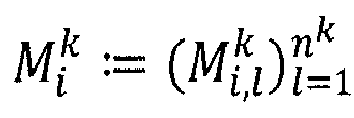
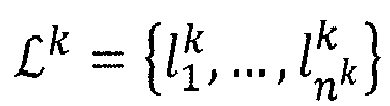
- For a given integer number k and segmentation task Tk, let Sk be a set of n images



- Let
 .
.
- Let g be a mapping of a ground truth sequence
 ,
,
 ,
,

- For a given image


 for the semantic class

- For training and evaluation purposes, the dataset Sk is split into three non-overlapping sets, namely


- Given a neural network N j with weight parameters wj , the calculated deviation Λ is subsequently used to update and optimize the neural network parameters wj in order to improve the performance of the network. This procedure is repeated until a defined set of stopping criteria are fulfilled, and is called the training of the neural network. The solving of the task Tj is in other words the process of iteratively calculating the optimal parameters wj of the network N j .
- Since in multi-class segmentation, the sizes of the targeted object classes may be very different, a higher contribution to the loss function may be expected by the object classes with larger expected sizes. This effect is not desirable as it can suppress the improvements to the neural network parameters during training on its performance for the smaller sized object classes. In order to compensate for this, weighting coefficients


- For a distance function


- The distance function d for the Dice coefficient for a training image


- Where


where ε is a chosen tolerance value, pl (x) is the sigmoid activation function
and αl (x) indicates activation at the l-th feature channel and pixel
- In the context of this invention, a multi-class segmentation task has to be understood as a segmentation task that deals consecutively with the segmentation of different classes of segmentation targets. A simple image segmentation task is an image processing method that attempts to accurately determine the area in a digital image that comprises pixels that represent a particular "class". The so-called "class" refers to a structure, organ or feature that is the target of the segmentation algorithm.
A multi-class segmentation task has thus to be understood as a series of sequentially executed segmentation tasks targeted to different classes. A neural network - Further to the methods disclosed in the art, our method intends to further alleviate the problems of catastrophic interference by means of applying a sequence of multiclass segmentation tasks according to the following method steps:
- applying the previously trained neural network N k-1 to said set of input images Sk to calculate the result masks

- defining a new neural network Nk by adding a new (1,1) convolutional layer in parallel to the existing output layers of the already trained neural network N k-1,
- initialize randomly the newly added parameters w̃k corresponding to said new (1,1) convolutional layer and subsequently train the new neural network Nk on said additional segmentation task Tk using the set of input images Sk and said previously calculated result masks


- One of the aspects of the solution proposed in our method is that the calculated result masks for tasks T 1, ..., Tk are temporarily stored (in case of a computer implementation) as ground-truth segmentation masks G
I k for the previously trained segmentation tasks T 1, ...,Tk. This aspect is a solution to the missing data of the result masks for the new set of images on which the new task is (manually) defined. The result masks for the previously trained tasks cannot be assumed to be calculated on the new image set, and therefore a calculation of all (previously trained) tasks on the new data set is assumed to render the best results to complete the entire data set with results for all known tasks. - The above inventive method is preferably carried out by a computer program running on means which provide generic data processing functions. Such means can, for example, be embedded in a personal computer, smartphone, mainframe, etc...
- The trained convolutional neural network which is the result of the method explained above, can be captured and stored in a memory as a collection of data comprising the structure of the neural network and the parameters that have been calculated during the training step of said neural network. It can thus be envisaged that the resulting trained neural network model and data comprise the functional definition of the neural network which is capable of performing said classification tasks. This functional definition (which is in essence a set of weights and connections) may be copied and duplicated or propagated onto other computing means. It is also this functional definition that we seek to protect under this patent. Said neural network data may thus be transferable under the form of a collection of weights and connections.
- The above described method will provide an improved performance of the untreated neural network, but the trained neural network itself may be used to carry out tasks in an improved way in comparison with the untreated network. Therefore, the neural network trained using the newly disclosed method in this application may be used to perform segmentation tasks in an improved way.
Claims (7)
- Method for training a previously trained neural network N k-1 to perform an additional segmentation task Tk in addition to i previously trained segmentation tasks Ti on said previously trained neural network N k-1 wherein i = 1, ..., k - 1, and k ≥ 2,
wherein said additional segmentation task Tk is defined by a set of input images Sk and their corresponding set of ground-truth segmentation masks GI k (Tk ) in terms of the desired result,
and wherein said previously trained neural network N k-1 is defined by parameters w̃ k-1 , a discrete number of convolution layers y, and a defined number of output layers z,
characterized in that,
said method comprises the steps of:- applying the previously trained neural network N k-1 to said set of input images Sk to calculate the result masks - defining a new neural network Nk by adding a new (1,1) convolutional layer in parallel to the existing output layers of the already trained neural network N k-1 ,- initialize randomly the newly added parameters w̃k corresponding to said new (1,1) convolutional layer and subsequently train the new neural network Nk on said additional segmentation task Tk using the set of input images Sk and said previously calculated result masks


- Method for training a neural network on a set of multi-class medical image segmentation tasks, according to the method of Claim 1.
- Method according to Claim 1, wherein the number of feature maps / corresponds to the number of target segmentation objects in the additional segmentation task Tk.
- A data processing apparatus comprising means for carrying out the steps of Claim 1, 2 or 3.
- The use of a trained neural network obtained from the method according to Claim 1, 2 or 3.
- Method for executing segmentation tasks Ti using the trained neural network Nk obtained through the method of Claim 1, 2 or 3, and wherein i = 1, ..., k.
- A computer program comprising instructions which, when the program is executed by a computer, cause the computer to carry out the method of Claim 1, 2, 3 or 6.
Priority Applications (4)
| Application Number | Priority Date | Filing Date | Title |
|---|---|---|---|
| EP17197899.2A EP3477591B1 (en) | 2017-10-24 | 2017-10-24 | Avoiding catastrophic interference while training an artificial neural network on an additional task |
| CN201880069398.0A CN111247556A (en) | 2017-10-24 | 2018-10-10 | Training artificial neural networks on additional tasks while avoiding catastrophic interference |
| PCT/EP2018/077589 WO2019081208A1 (en) | 2017-10-24 | 2018-10-10 | Avoiding catastrophic interference while training an artificial neural network on an additional task. |
| US16/757,438 US11210792B2 (en) | 2017-10-24 | 2018-10-10 | Avoiding catastrophic interference while training an artificial neural network on an additional task |
Applications Claiming Priority (1)
| Application Number | Priority Date | Filing Date | Title |
|---|---|---|---|
| EP17197899.2A EP3477591B1 (en) | 2017-10-24 | 2017-10-24 | Avoiding catastrophic interference while training an artificial neural network on an additional task |
Publications (2)
| Publication Number | Publication Date |
|---|---|
| EP3477591A1 true EP3477591A1 (en) | 2019-05-01 |
| EP3477591B1 EP3477591B1 (en) | 2020-05-27 |
Family
ID=60201827
Family Applications (1)
| Application Number | Title | Priority Date | Filing Date |
|---|---|---|---|
| EP17197899.2A Active EP3477591B1 (en) | 2017-10-24 | 2017-10-24 | Avoiding catastrophic interference while training an artificial neural network on an additional task |
Country Status (4)
| Country | Link |
|---|---|
| US (1) | US11210792B2 (en) |
| EP (1) | EP3477591B1 (en) |
| CN (1) | CN111247556A (en) |
| WO (1) | WO2019081208A1 (en) |
Cited By (1)
| Publication number | Priority date | Publication date | Assignee | Title |
|---|---|---|---|---|
| JP2023510837A (en) * | 2020-01-28 | 2023-03-15 | ディープ バイオ インク | A method and computing system for overcoming catastrophic forgetting through neuron-level plastic control |
Families Citing this family (1)
| Publication number | Priority date | Publication date | Assignee | Title |
|---|---|---|---|---|
| US12106225B2 (en) | 2019-05-30 | 2024-10-01 | The Research Foundation For The State University Of New York | System, method, and computer-accessible medium for generating multi-class models from single-class datasets |
Citations (4)
| Publication number | Priority date | Publication date | Assignee | Title |
|---|---|---|---|---|
| EP3166075A1 (en) * | 2015-11-05 | 2017-05-10 | Facebook, Inc. | Systems and methods for processing content using convolutional neural networks |
| US20170169315A1 (en) * | 2015-12-15 | 2017-06-15 | Sighthound, Inc. | Deeply learned convolutional neural networks (cnns) for object localization and classification |
| US20170200067A1 (en) * | 2016-01-08 | 2017-07-13 | Siemens Healthcare Gmbh | Deep Image-to-Image Network Learning for Medical Image Analysis |
| CN107123123A (en) * | 2017-05-02 | 2017-09-01 | 电子科技大学 | Image segmentation quality evaluating method based on convolutional neural networks |
Family Cites Families (9)
| Publication number | Priority date | Publication date | Assignee | Title |
|---|---|---|---|---|
| US10402690B2 (en) * | 2016-11-07 | 2019-09-03 | Nec Corporation | System and method for learning random-walk label propagation for weakly-supervised semantic segmentation |
| CN106780512B (en) * | 2016-11-30 | 2020-01-17 | 厦门美图之家科技有限公司 | Method, application and computing device for segmenting image |
| CN106709917B (en) * | 2017-01-03 | 2020-09-11 | 青岛海信医疗设备股份有限公司 | Neural network model training method, device and system |
| CN107103334A (en) * | 2017-04-26 | 2017-08-29 | 太原理工大学 | It is a kind of based on the Lung neoplasm sorting technique of convolutional neural networks and dictionary to study |
| CN110914836A (en) * | 2017-05-09 | 2020-03-24 | 纽拉拉股份有限公司 | System and method for implementing continuous memory bounded learning in artificial intelligence and deep learning for continuously running applications across networked computing edges |
| US11836611B2 (en) * | 2017-07-25 | 2023-12-05 | University Of Massachusetts | Method for meta-level continual learning |
| US11741354B2 (en) * | 2017-08-25 | 2023-08-29 | Ford Global Technologies, Llc | Shared processing with deep neural networks |
| KR102481885B1 (en) * | 2017-09-08 | 2022-12-28 | 삼성전자주식회사 | Method and device for learning neural network for recognizing class |
| US10055685B1 (en) * | 2017-10-16 | 2018-08-21 | Apprente, Inc. | Machine learning architecture for lifelong learning |
-
2017
- 2017-10-24 EP EP17197899.2A patent/EP3477591B1/en active Active
-
2018
- 2018-10-10 WO PCT/EP2018/077589 patent/WO2019081208A1/en not_active Ceased
- 2018-10-10 CN CN201880069398.0A patent/CN111247556A/en active Pending
- 2018-10-10 US US16/757,438 patent/US11210792B2/en active Active
Patent Citations (4)
| Publication number | Priority date | Publication date | Assignee | Title |
|---|---|---|---|---|
| EP3166075A1 (en) * | 2015-11-05 | 2017-05-10 | Facebook, Inc. | Systems and methods for processing content using convolutional neural networks |
| US20170169315A1 (en) * | 2015-12-15 | 2017-06-15 | Sighthound, Inc. | Deeply learned convolutional neural networks (cnns) for object localization and classification |
| US20170200067A1 (en) * | 2016-01-08 | 2017-07-13 | Siemens Healthcare Gmbh | Deep Image-to-Image Network Learning for Medical Image Analysis |
| CN107123123A (en) * | 2017-05-02 | 2017-09-01 | 电子科技大学 | Image segmentation quality evaluating method based on convolutional neural networks |
Non-Patent Citations (7)
| Title |
|---|
| H. JUNG; J. JU; M. JUNG; J. KIM: "Less-forgetting learning in deep neural networks", ARXIV PREPRINT ARXIV: 1607.00122, 2016 |
| ISIN ALI ET AL: "Review of MRI-based Brain Tumor Image Segmentation Using Deep Learning Methods", PROCEDIA COMPUTER SCIENCE, ELSEVIER, AMSTERDAM, NL, vol. 102, 25 October 2016 (2016-10-25), pages 317 - 324, XP029785194, ISSN: 1877-0509, DOI: 10.1016/J.PROCS.2016.09.407 * |
| J. KIRKPATRICK; R. PASCANU; N. RABINOWITZ; J. VENESS; G. DESJARDINS; A. A. RUSU; K. MILAN; J. QUAN; T. RAMALHO; A. GRABSKA-BARWINS: "Overcoming catastrophic forgetting in neural networks", PROCEEDINGS OF THE NATIONAL ACADEMY OF SCIENCES, 2017, pages 201611835 |
| M. MCCLOSKEY; N. J. COHEN: "Catastrophic interference in connectionist networks: The sequential learning problem", PSYCHOLOGY OF LEARNING AND MOTIVATION, vol. 24, 1989, pages 109 - 165 |
| R. RATCLIFF: "Connectionist models of recognition memory: Constraints imposed by learning and forgetting functions", PSYCHOLOGICAL REVIEW, vol. 97, no. 2, 1990, pages 285 - 308 |
| RONNEBERGER OLAF ET AL: "U-Net: Convolutional Networks for Biomedical Image Segmentation", 18 November 2015, NETWORK AND PARALLEL COMPUTING; [LECTURE NOTES IN COMPUTER SCIENCE; LECT.NOTES COMPUTER], SPRINGER INTERNATIONAL PUBLISHING, CHAM, PAGE(S) 234 - 241, ISBN: 978-3-642-01969-2, ISSN: 0302-9743, XP047337272 * |
| Z. LI; D. HOIEM: "European Conference on Computer Vision", 2016, SPRINGER, article "Learning without forgetting", pages: 614 - 629 |
Cited By (1)
| Publication number | Priority date | Publication date | Assignee | Title |
|---|---|---|---|---|
| JP2023510837A (en) * | 2020-01-28 | 2023-03-15 | ディープ バイオ インク | A method and computing system for overcoming catastrophic forgetting through neuron-level plastic control |
Also Published As
| Publication number | Publication date |
|---|---|
| CN111247556A (en) | 2020-06-05 |
| WO2019081208A1 (en) | 2019-05-02 |
| US11210792B2 (en) | 2021-12-28 |
| US20210073996A1 (en) | 2021-03-11 |
| EP3477591B1 (en) | 2020-05-27 |
Similar Documents
| Publication | Publication Date | Title |
|---|---|---|
| Priyadharshini et al. | A novel hybrid Extreme Learning Machine and Teaching–Learning-Based Optimization algorithm for skin cancer detection | |
| CN112001488B (en) | Training generation type antagonism network | |
| Fritscher et al. | Deep neural networks for fast segmentation of 3D medical images | |
| Kundu et al. | Vision transformer based deep learning model for monkeypox detection | |
| KR102370910B1 (en) | Method and apparatus for few-shot image classification based on deep learning | |
| Wiestler et al. | Deep learning for medical image analysis: a brief introduction | |
| Duan et al. | Separate or joint? Estimation of multiple labels from crowdsourced annotations | |
| CN110516537B (en) | A face age estimation method based on self-paced learning | |
| CN114067155B (en) | Image classification method, device, product and storage medium based on meta learning | |
| US20220284288A1 (en) | Learning from biological systems how to regularize machine-learning | |
| CN111160161B (en) | A Self-step Learning Face Age Estimation Method Based on Noise Removal | |
| CN118036706A (en) | A multi-task processing system for graph federated transfer learning based on graph subtree differences | |
| CN115984930A (en) | Micro-expression recognition method, device, and training method for micro-expression recognition model | |
| Abboud et al. | Sparse Bayesian networks: efficient uncertainty quantification in medical image analysis | |
| US11210792B2 (en) | Avoiding catastrophic interference while training an artificial neural network on an additional task | |
| CN116362322A (en) | Generative model transfer learning method, equipment and medium based on knowledge distillation | |
| Michalíková et al. | Classification of tire tread images by using neural networks | |
| Lahasan et al. | Recognizing faces prone to occlusions and common variations using optimal face subgraphs | |
| CN114936598A (en) | Cross-domain small sample learning method, learning system, electronic device and storage medium | |
| Hsu et al. | Class structure visualization with semi-supervised growing self-organizing maps | |
| EP4610900A1 (en) | Method for performing privacy-preserving federated learning in the framework of re-identification | |
| Andayani et al. | Identification of the tuberculosis (TB) disease based on XRay images using probabilistic neural network (PNN) | |
| Saxena et al. | Deep learning ensemble framework for multiclass diabetic retinopathy classification | |
| El-Henawy et al. | Muzzle Classification Using Neural Networks. | |
| US20230041614A1 (en) | Method and apparatus for training artificial intelligence based on episode memory |
Legal Events
| Date | Code | Title | Description |
|---|---|---|---|
| PUAI | Public reference made under article 153(3) epc to a published international application that has entered the european phase |
Free format text: ORIGINAL CODE: 0009012 |
|
| STAA | Information on the status of an ep patent application or granted ep patent |
Free format text: STATUS: THE APPLICATION HAS BEEN PUBLISHED |
|
| AK | Designated contracting states |
Kind code of ref document: A1 Designated state(s): AL AT BE BG CH CY CZ DE DK EE ES FI FR GB GR HR HU IE IS IT LI LT LU LV MC MK MT NL NO PL PT RO RS SE SI SK SM TR |
|
| AX | Request for extension of the european patent |
Extension state: BA ME |
|
| STAA | Information on the status of an ep patent application or granted ep patent |
Free format text: STATUS: REQUEST FOR EXAMINATION WAS MADE |
|
| 17P | Request for examination filed |
Effective date: 20191104 |
|
| RBV | Designated contracting states (corrected) |
Designated state(s): AL AT BE BG CH CY CZ DE DK EE ES FI FR GB GR HR HU IE IS IT LI LT LU LV MC MK MT NL NO PL PT RO RS SE SI SK SM TR |
|
| RIC1 | Information provided on ipc code assigned before grant |
Ipc: G06T 7/10 20170101AFI20191118BHEP Ipc: G06N 3/04 20060101ALI20191118BHEP Ipc: G06N 3/08 20060101ALI20191118BHEP |
|
| GRAP | Despatch of communication of intention to grant a patent |
Free format text: ORIGINAL CODE: EPIDOSNIGR1 |
|
| STAA | Information on the status of an ep patent application or granted ep patent |
Free format text: STATUS: GRANT OF PATENT IS INTENDED |
|
| INTG | Intention to grant announced |
Effective date: 20200116 |
|
| GRAS | Grant fee paid |
Free format text: ORIGINAL CODE: EPIDOSNIGR3 |
|
| GRAA | (expected) grant |
Free format text: ORIGINAL CODE: 0009210 |
|
| STAA | Information on the status of an ep patent application or granted ep patent |
Free format text: STATUS: THE PATENT HAS BEEN GRANTED |
|
| AK | Designated contracting states |
Kind code of ref document: B1 Designated state(s): AL AT BE BG CH CY CZ DE DK EE ES FI FR GB GR HR HU IE IS IT LI LT LU LV MC MK MT NL NO PL PT RO RS SE SI SK SM TR |
|
| REG | Reference to a national code |
Ref country code: GB Ref legal event code: FG4D |
|
| REG | Reference to a national code |
Ref country code: CH Ref legal event code: EP |
|
| REG | Reference to a national code |
Ref country code: AT Ref legal event code: REF Ref document number: 1275318 Country of ref document: AT Kind code of ref document: T Effective date: 20200615 |
|
| REG | Reference to a national code |
Ref country code: DE Ref legal event code: R096 Ref document number: 602017017220 Country of ref document: DE |
|
| REG | Reference to a national code |
Ref country code: LT Ref legal event code: MG4D |
|
| PG25 | Lapsed in a contracting state [announced via postgrant information from national office to epo] |
Ref country code: PT Free format text: LAPSE BECAUSE OF FAILURE TO SUBMIT A TRANSLATION OF THE DESCRIPTION OR TO PAY THE FEE WITHIN THE PRESCRIBED TIME-LIMIT Effective date: 20200928 Ref country code: IS Free format text: LAPSE BECAUSE OF FAILURE TO SUBMIT A TRANSLATION OF THE DESCRIPTION OR TO PAY THE FEE WITHIN THE PRESCRIBED TIME-LIMIT Effective date: 20200927 Ref country code: NO Free format text: LAPSE BECAUSE OF FAILURE TO SUBMIT A TRANSLATION OF THE DESCRIPTION OR TO PAY THE FEE WITHIN THE PRESCRIBED TIME-LIMIT Effective date: 20200827 Ref country code: GR Free format text: LAPSE BECAUSE OF FAILURE TO SUBMIT A TRANSLATION OF THE DESCRIPTION OR TO PAY THE FEE WITHIN THE PRESCRIBED TIME-LIMIT Effective date: 20200828 Ref country code: LT Free format text: LAPSE BECAUSE OF FAILURE TO SUBMIT A TRANSLATION OF THE DESCRIPTION OR TO PAY THE FEE WITHIN THE PRESCRIBED TIME-LIMIT Effective date: 20200527 Ref country code: SE Free format text: LAPSE BECAUSE OF FAILURE TO SUBMIT A TRANSLATION OF THE DESCRIPTION OR TO PAY THE FEE WITHIN THE PRESCRIBED TIME-LIMIT Effective date: 20200527 Ref country code: FI Free format text: LAPSE BECAUSE OF FAILURE TO SUBMIT A TRANSLATION OF THE DESCRIPTION OR TO PAY THE FEE WITHIN THE PRESCRIBED TIME-LIMIT Effective date: 20200527 |
|
| REG | Reference to a national code |
Ref country code: NL Ref legal event code: MP Effective date: 20200527 |
|
| PG25 | Lapsed in a contracting state [announced via postgrant information from national office to epo] |
Ref country code: BG Free format text: LAPSE BECAUSE OF FAILURE TO SUBMIT A TRANSLATION OF THE DESCRIPTION OR TO PAY THE FEE WITHIN THE PRESCRIBED TIME-LIMIT Effective date: 20200827 Ref country code: HR Free format text: LAPSE BECAUSE OF FAILURE TO SUBMIT A TRANSLATION OF THE DESCRIPTION OR TO PAY THE FEE WITHIN THE PRESCRIBED TIME-LIMIT Effective date: 20200527 Ref country code: LV Free format text: LAPSE BECAUSE OF FAILURE TO SUBMIT A TRANSLATION OF THE DESCRIPTION OR TO PAY THE FEE WITHIN THE PRESCRIBED TIME-LIMIT Effective date: 20200527 Ref country code: RS Free format text: LAPSE BECAUSE OF FAILURE TO SUBMIT A TRANSLATION OF THE DESCRIPTION OR TO PAY THE FEE WITHIN THE PRESCRIBED TIME-LIMIT Effective date: 20200527 |
|
| REG | Reference to a national code |
Ref country code: AT Ref legal event code: MK05 Ref document number: 1275318 Country of ref document: AT Kind code of ref document: T Effective date: 20200527 |
|
| PG25 | Lapsed in a contracting state [announced via postgrant information from national office to epo] |
Ref country code: AL Free format text: LAPSE BECAUSE OF FAILURE TO SUBMIT A TRANSLATION OF THE DESCRIPTION OR TO PAY THE FEE WITHIN THE PRESCRIBED TIME-LIMIT Effective date: 20200527 Ref country code: NL Free format text: LAPSE BECAUSE OF FAILURE TO SUBMIT A TRANSLATION OF THE DESCRIPTION OR TO PAY THE FEE WITHIN THE PRESCRIBED TIME-LIMIT Effective date: 20200527 |
|
| PG25 | Lapsed in a contracting state [announced via postgrant information from national office to epo] |
Ref country code: AT Free format text: LAPSE BECAUSE OF FAILURE TO SUBMIT A TRANSLATION OF THE DESCRIPTION OR TO PAY THE FEE WITHIN THE PRESCRIBED TIME-LIMIT Effective date: 20200527 Ref country code: DK Free format text: LAPSE BECAUSE OF FAILURE TO SUBMIT A TRANSLATION OF THE DESCRIPTION OR TO PAY THE FEE WITHIN THE PRESCRIBED TIME-LIMIT Effective date: 20200527 Ref country code: ES Free format text: LAPSE BECAUSE OF FAILURE TO SUBMIT A TRANSLATION OF THE DESCRIPTION OR TO PAY THE FEE WITHIN THE PRESCRIBED TIME-LIMIT Effective date: 20200527 Ref country code: CZ Free format text: LAPSE BECAUSE OF FAILURE TO SUBMIT A TRANSLATION OF THE DESCRIPTION OR TO PAY THE FEE WITHIN THE PRESCRIBED TIME-LIMIT Effective date: 20200527 Ref country code: RO Free format text: LAPSE BECAUSE OF FAILURE TO SUBMIT A TRANSLATION OF THE DESCRIPTION OR TO PAY THE FEE WITHIN THE PRESCRIBED TIME-LIMIT Effective date: 20200527 Ref country code: EE Free format text: LAPSE BECAUSE OF FAILURE TO SUBMIT A TRANSLATION OF THE DESCRIPTION OR TO PAY THE FEE WITHIN THE PRESCRIBED TIME-LIMIT Effective date: 20200527 Ref country code: SM Free format text: LAPSE BECAUSE OF FAILURE TO SUBMIT A TRANSLATION OF THE DESCRIPTION OR TO PAY THE FEE WITHIN THE PRESCRIBED TIME-LIMIT Effective date: 20200527 Ref country code: IT Free format text: LAPSE BECAUSE OF FAILURE TO SUBMIT A TRANSLATION OF THE DESCRIPTION OR TO PAY THE FEE WITHIN THE PRESCRIBED TIME-LIMIT Effective date: 20200527 |
|
| PG25 | Lapsed in a contracting state [announced via postgrant information from national office to epo] |
Ref country code: SK Free format text: LAPSE BECAUSE OF FAILURE TO SUBMIT A TRANSLATION OF THE DESCRIPTION OR TO PAY THE FEE WITHIN THE PRESCRIBED TIME-LIMIT Effective date: 20200527 Ref country code: PL Free format text: LAPSE BECAUSE OF FAILURE TO SUBMIT A TRANSLATION OF THE DESCRIPTION OR TO PAY THE FEE WITHIN THE PRESCRIBED TIME-LIMIT Effective date: 20200527 |
|
| REG | Reference to a national code |
Ref country code: DE Ref legal event code: R097 Ref document number: 602017017220 Country of ref document: DE |
|
| RAP2 | Party data changed (patent owner data changed or rights of a patent transferred) |
Owner name: VRVIS ZENTRUM FUER VIRTUAL REALITY UND VISUALISIERUNG Owner name: AGFA HEALTHCARE NV |
|
| PLBE | No opposition filed within time limit |
Free format text: ORIGINAL CODE: 0009261 |
|
| STAA | Information on the status of an ep patent application or granted ep patent |
Free format text: STATUS: NO OPPOSITION FILED WITHIN TIME LIMIT |
|
| 26N | No opposition filed |
Effective date: 20210302 |
|
| PG25 | Lapsed in a contracting state [announced via postgrant information from national office to epo] |
Ref country code: SI Free format text: LAPSE BECAUSE OF FAILURE TO SUBMIT A TRANSLATION OF THE DESCRIPTION OR TO PAY THE FEE WITHIN THE PRESCRIBED TIME-LIMIT Effective date: 20200527 |
|
| REG | Reference to a national code |
Ref country code: CH Ref legal event code: PL |
|
| PG25 | Lapsed in a contracting state [announced via postgrant information from national office to epo] |
Ref country code: LU Free format text: LAPSE BECAUSE OF NON-PAYMENT OF DUE FEES Effective date: 20201024 Ref country code: MC Free format text: LAPSE BECAUSE OF FAILURE TO SUBMIT A TRANSLATION OF THE DESCRIPTION OR TO PAY THE FEE WITHIN THE PRESCRIBED TIME-LIMIT Effective date: 20200527 |
|
| REG | Reference to a national code |
Ref country code: BE Ref legal event code: MM Effective date: 20201031 |
|
| PG25 | Lapsed in a contracting state [announced via postgrant information from national office to epo] |
Ref country code: CH Free format text: LAPSE BECAUSE OF NON-PAYMENT OF DUE FEES Effective date: 20201031 Ref country code: BE Free format text: LAPSE BECAUSE OF NON-PAYMENT OF DUE FEES Effective date: 20201031 Ref country code: LI Free format text: LAPSE BECAUSE OF NON-PAYMENT OF DUE FEES Effective date: 20201031 |
|
| PG25 | Lapsed in a contracting state [announced via postgrant information from national office to epo] |
Ref country code: IE Free format text: LAPSE BECAUSE OF NON-PAYMENT OF DUE FEES Effective date: 20201024 |
|
| PG25 | Lapsed in a contracting state [announced via postgrant information from national office to epo] |
Ref country code: TR Free format text: LAPSE BECAUSE OF FAILURE TO SUBMIT A TRANSLATION OF THE DESCRIPTION OR TO PAY THE FEE WITHIN THE PRESCRIBED TIME-LIMIT Effective date: 20200527 Ref country code: MT Free format text: LAPSE BECAUSE OF FAILURE TO SUBMIT A TRANSLATION OF THE DESCRIPTION OR TO PAY THE FEE WITHIN THE PRESCRIBED TIME-LIMIT Effective date: 20200527 Ref country code: CY Free format text: LAPSE BECAUSE OF FAILURE TO SUBMIT A TRANSLATION OF THE DESCRIPTION OR TO PAY THE FEE WITHIN THE PRESCRIBED TIME-LIMIT Effective date: 20200527 |
|
| PG25 | Lapsed in a contracting state [announced via postgrant information from national office to epo] |
Ref country code: MK Free format text: LAPSE BECAUSE OF FAILURE TO SUBMIT A TRANSLATION OF THE DESCRIPTION OR TO PAY THE FEE WITHIN THE PRESCRIBED TIME-LIMIT Effective date: 20200527 |
|
| PGFP | Annual fee paid to national office [announced via postgrant information from national office to epo] |
Ref country code: GB Payment date: 20250929 Year of fee payment: 9 |
|
| PGFP | Annual fee paid to national office [announced via postgrant information from national office to epo] |
Ref country code: FR Payment date: 20250915 Year of fee payment: 9 |
|
| PGFP | Annual fee paid to national office [announced via postgrant information from national office to epo] |
Ref country code: DE Payment date: 20251007 Year of fee payment: 9 |