EP3477550A1 - Vehicle license plate classification method and system based on deep learning, electronic apparatus, and storage medium - Google Patents
Vehicle license plate classification method and system based on deep learning, electronic apparatus, and storage medium Download PDFInfo
- Publication number
- EP3477550A1 EP3477550A1 EP17803763.6A EP17803763A EP3477550A1 EP 3477550 A1 EP3477550 A1 EP 3477550A1 EP 17803763 A EP17803763 A EP 17803763A EP 3477550 A1 EP3477550 A1 EP 3477550A1
- Authority
- EP
- European Patent Office
- Prior art keywords
- photograph
- category
- use information
- vehicle use
- recognition
- Prior art date
- Legal status (The legal status is an assumption and is not a legal conclusion. Google has not performed a legal analysis and makes no representation as to the accuracy of the status listed.)
- Withdrawn
Links
Images

Classifications
-
- G—PHYSICS
- G06—COMPUTING OR CALCULATING; COUNTING
- G06N—COMPUTING ARRANGEMENTS BASED ON SPECIFIC COMPUTATIONAL MODELS
- G06N3/00—Computing arrangements based on biological models
- G06N3/02—Neural networks
- G06N3/08—Learning methods
- G06N3/084—Backpropagation, e.g. using gradient descent
-
- G—PHYSICS
- G06—COMPUTING OR CALCULATING; COUNTING
- G06V—IMAGE OR VIDEO RECOGNITION OR UNDERSTANDING
- G06V10/00—Arrangements for image or video recognition or understanding
- G06V10/70—Arrangements for image or video recognition or understanding using pattern recognition or machine learning
- G06V10/74—Image or video pattern matching; Proximity measures in feature spaces
- G06V10/75—Organisation of the matching processes, e.g. simultaneous or sequential comparisons of image or video features; Coarse-fine approaches, e.g. multi-scale approaches; using context analysis; Selection of dictionaries
- G06V10/751—Comparing pixel values or logical combinations thereof, or feature values having positional relevance, e.g. template matching
-
- G—PHYSICS
- G06—COMPUTING OR CALCULATING; COUNTING
- G06F—ELECTRIC DIGITAL DATA PROCESSING
- G06F18/00—Pattern recognition
- G06F18/20—Analysing
- G06F18/21—Design or setup of recognition systems or techniques; Extraction of features in feature space; Blind source separation
- G06F18/214—Generating training patterns; Bootstrap methods, e.g. bagging or boosting
-
- G—PHYSICS
- G06—COMPUTING OR CALCULATING; COUNTING
- G06F—ELECTRIC DIGITAL DATA PROCESSING
- G06F18/00—Pattern recognition
- G06F18/20—Analysing
- G06F18/24—Classification techniques
- G06F18/241—Classification techniques relating to the classification model, e.g. parametric or non-parametric approaches
-
- G—PHYSICS
- G06—COMPUTING OR CALCULATING; COUNTING
- G06F—ELECTRIC DIGITAL DATA PROCESSING
- G06F18/00—Pattern recognition
- G06F18/20—Analysing
- G06F18/24—Classification techniques
- G06F18/241—Classification techniques relating to the classification model, e.g. parametric or non-parametric approaches
- G06F18/2413—Classification techniques relating to the classification model, e.g. parametric or non-parametric approaches based on distances to training or reference patterns
- G06F18/24133—Distances to prototypes
- G06F18/24137—Distances to cluster centroïds
- G06F18/2414—Smoothing the distance, e.g. radial basis function networks [RBFN]
-
- G—PHYSICS
- G06—COMPUTING OR CALCULATING; COUNTING
- G06N—COMPUTING ARRANGEMENTS BASED ON SPECIFIC COMPUTATIONAL MODELS
- G06N3/00—Computing arrangements based on biological models
- G06N3/02—Neural networks
- G06N3/04—Architecture, e.g. interconnection topology
- G06N3/045—Combinations of networks
-
- G—PHYSICS
- G06—COMPUTING OR CALCULATING; COUNTING
- G06N—COMPUTING ARRANGEMENTS BASED ON SPECIFIC COMPUTATIONAL MODELS
- G06N3/00—Computing arrangements based on biological models
- G06N3/02—Neural networks
- G06N3/04—Architecture, e.g. interconnection topology
- G06N3/0464—Convolutional networks [CNN, ConvNet]
-
- G—PHYSICS
- G06—COMPUTING OR CALCULATING; COUNTING
- G06N—COMPUTING ARRANGEMENTS BASED ON SPECIFIC COMPUTATIONAL MODELS
- G06N3/00—Computing arrangements based on biological models
- G06N3/02—Neural networks
- G06N3/08—Learning methods
- G06N3/09—Supervised learning
-
- G—PHYSICS
- G06—COMPUTING OR CALCULATING; COUNTING
- G06N—COMPUTING ARRANGEMENTS BASED ON SPECIFIC COMPUTATIONAL MODELS
- G06N5/00—Computing arrangements using knowledge-based models
- G06N5/04—Inference or reasoning models
- G06N5/046—Forward inferencing; Production systems
-
- G—PHYSICS
- G06—COMPUTING OR CALCULATING; COUNTING
- G06Q—INFORMATION AND COMMUNICATION TECHNOLOGY [ICT] SPECIALLY ADAPTED FOR ADMINISTRATIVE, COMMERCIAL, FINANCIAL, MANAGERIAL OR SUPERVISORY PURPOSES; SYSTEMS OR METHODS SPECIALLY ADAPTED FOR ADMINISTRATIVE, COMMERCIAL, FINANCIAL, MANAGERIAL OR SUPERVISORY PURPOSES, NOT OTHERWISE PROVIDED FOR
- G06Q10/00—Administration; Management
- G06Q10/10—Office automation; Time management
- G06Q10/103—Workflow collaboration or project management
-
- G—PHYSICS
- G06—COMPUTING OR CALCULATING; COUNTING
- G06V—IMAGE OR VIDEO RECOGNITION OR UNDERSTANDING
- G06V10/00—Arrangements for image or video recognition or understanding
- G06V10/70—Arrangements for image or video recognition or understanding using pattern recognition or machine learning
- G06V10/764—Arrangements for image or video recognition or understanding using pattern recognition or machine learning using classification, e.g. of video objects
-
- G—PHYSICS
- G06—COMPUTING OR CALCULATING; COUNTING
- G06V—IMAGE OR VIDEO RECOGNITION OR UNDERSTANDING
- G06V10/00—Arrangements for image or video recognition or understanding
- G06V10/70—Arrangements for image or video recognition or understanding using pattern recognition or machine learning
- G06V10/82—Arrangements for image or video recognition or understanding using pattern recognition or machine learning using neural networks
-
- G—PHYSICS
- G06—COMPUTING OR CALCULATING; COUNTING
- G06V—IMAGE OR VIDEO RECOGNITION OR UNDERSTANDING
- G06V20/00—Scenes; Scene-specific elements
- G06V20/60—Type of objects
- G06V20/62—Text, e.g. of license plates, overlay texts or captions on TV images
- G06V20/625—License plates
-
- G—PHYSICS
- G06—COMPUTING OR CALCULATING; COUNTING
- G06V—IMAGE OR VIDEO RECOGNITION OR UNDERSTANDING
- G06V20/00—Scenes; Scene-specific elements
- G06V20/60—Type of objects
- G06V20/62—Text, e.g. of license plates, overlay texts or captions on TV images
- G06V20/63—Scene text, e.g. street names
-
- G—PHYSICS
- G08—SIGNALLING
- G08G—TRAFFIC CONTROL SYSTEMS
- G08G1/00—Traffic control systems for road vehicles
- G08G1/01—Detecting movement of traffic to be counted or controlled
- G08G1/017—Detecting movement of traffic to be counted or controlled identifying vehicles
- G08G1/0175—Detecting movement of traffic to be counted or controlled identifying vehicles by photographing vehicles, e.g. when violating traffic rules
-
- G—PHYSICS
- G06—COMPUTING OR CALCULATING; COUNTING
- G06V—IMAGE OR VIDEO RECOGNITION OR UNDERSTANDING
- G06V2201/00—Indexing scheme relating to image or video recognition or understanding
- G06V2201/01—Solutions for problems related to non-uniform document background
-
- G—PHYSICS
- G06—COMPUTING OR CALCULATING; COUNTING
- G06V—IMAGE OR VIDEO RECOGNITION OR UNDERSTANDING
- G06V2201/00—Indexing scheme relating to image or video recognition or understanding
- G06V2201/08—Detecting or categorising vehicles
Definitions
- This disclosure relates generally to the technical field of data processing, and more particularly relates to a method, a system, an electronic device, and a computer-readable storage medium for classifying license plates based on deep learning.
- a method of classifying license plates based on deep learning is provided.
- the method may be applied to an electronic device and includes: acquiring at least one photograph sent by a terminal device, the photograph having license plate information of a corresponding vehicle; preprocessing the acquired at least one photograph such that the preprocessed at least one photograph matches input parameters of a pretrained recognition model; and inputting the preprocessed at least one photograph to the pretrained recognition model to recognize the vehicle use information corresponding to the at least one photograph, and sending the vehicle use information to the terminal device.
- a system for classifying license plates based on deep learning may operate in an electronic device and includes: an acquisition module configured for acquiring at least one photograph sent by a terminal device, the photograph having license plate information of a corresponding vehicle; a preprocessing module configured for preprocessing the acquired at least one photograph such that the preprocessed at least one photograph matches input parameters of a pretrained recognition model; and a recognition module configured for inputting the preprocessed at least one photograph to the pretrained recognition model to recognize the vehicle use information corresponding to the at least one photograph, and sending the vehicle use information to the terminal device.
- An electronic device including a processing device, a storage device, and a system for classifying license plates based on deep learning.
- the system is stored in the storage device and includes at least one computer-readable instruction executable by the processing device to perform the following operations: acquiring at least one photograph sent by a terminal device, the photograph having license plate information of a corresponding vehicle; preprocessing the acquired at least one photograph such that the preprocessed at least one photograph matches input parameters of a pretrained recognition model; and inputting the preprocessed at least one photograph to the pretrained recognition model to recognize the vehicle use information corresponding to the at least one photograph, and sending the vehicle use information to the terminal device.
- a computer-readable storage medium having stored thereon at least one computer-readable instruction executable by a processing device to perform the following operations: acquiring at least one photograph sent by a terminal device, the photograph having license plate information of a corresponding vehicle; preprocessing the acquired at least one photograph such that the preprocessed at least one photograph matches input parameters of a pretrained recognition model; and inputting the preprocessed at least one photograph to the pretrained recognition model to recognize the vehicle use information corresponding to the at least one photograph, and sending the vehicle use information to the terminal device.
- a preset algorithm may first be used to train a recognition model for recognizing the vehicle use information based on the license plate information so as to obtain a pretrained recognition model. Then each photograph is input into the pretrained recognition model to identify the vehicle use information corresponding to the photograph, and then the corresponding vehicle use information of each photograph is sent to the terminal device. Furthermore, based on the corresponding vehicle use information of each photograph, the photographs with the same vehicle use can be classified into the same category. Therefore, with the present disclosure, the uses of vehicles in the photographs can be automatically and accurately identified and further the photographs can be accurately classified, so that the accuracy as well as the efficiency can be improved.
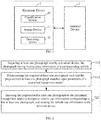
- FIG. 1 shows a schematic diagram of an application environment for an exemplary embodiment of a method of classifying license plates based on deep learning in accordance with this disclosure.
- the application environment may include an electronic device 1 and a terminal device 2.
- the electronic device 1 may perform data interaction with the terminal device 2 by using a suitable technology, such as a network or near field communications technology.
- the terminal device 2 may include but is not limited to any electronic product such as a personal computer, a tablet computer, a smart phone, a Personal Digital Assistant (PDA), a game console, an Internet Protocol Television (IPTV), a smart wearable device or the like that can interact with a user through a keyboard, a mouse, a remote controller, a touch pad, or a voice control device.
- the network in which the user equipment and the network device are located includes but is not limited to the Internet, a wide area network, a metropolitan area network, a local area network, a Virtual Private Network (VPN), or the like.
- VPN Virtual Private Network
- the electronic device 1 is a device capable of automatically performing numerical computations and/or information processing according to instructions set or stored in advance.
- the electronic device 1 may be a computer, or may also be a single web server, a server group consisting of multiple web servers, or a cloud formed by a large number of hosts or web servers based on cloud computing.
- the cloud computing is a type of distributed computing, giving rise to a super virtual computer made up of a set of loosely coupled computers.
- the electronic device 1 may include a system 10 for classifying license plates based on deep learning (hereinafter referred to as "classification system 10"), a storage device 11, a processing device 12, and the like.
- the processing device 12 serves to support the operation of the electronic device 1, and may include one or more microprocessors, digital processors, and the like.
- the storage device 11 is used for storing various types of data and computer-readable instructions, and may include one or more non-volatile memories such as ROMs, EPROMs, flash memories, or the like.
- the classification system 10 may first use a preset algorithm to train a recognition model which is used for recognizing the vehicle use information based on the license plate information, so as to obtain a pretrained recognition model. Then each photograph may be input to the pretrained recognition model to identify the corresponding vehicle use information of the photograph, and then the corresponding vehicle use information of each photograph may be sent to the terminal device 2. Furthermore, based on the corresponding vehicle use information of each photograph, the photographs with the same vehicle use information may be classified into one same category.
- the classification system 10 may be stored in the storage device 11, and may include at least one computer-readable instruction stored in the storage device 11 and executable by the processor device 12 to perform the license plate classification methods according to various embodiments of this application. As will be described later, the at least one computer-readable instruction may be divided into different logic modules by different functions performed by its parts.
- the uses of vehicles in the photographs can be automatically and accurately identified and further the photographs can be accurately classified, thereby improving the accuracy as well as the efficiency.
- FIG. 2 is an illustrative flowchart of an exemplary embodiment of a method of classifying license plates based on deep learning in accordance with the disclosure.
- the method according to this embodiment will not be limited to the steps shown in the flowchart, and some of these steps illustrated in the flowchart may be omitted or the order of these steps may be changed.
- the method may begin with step S10.
- the terminal device 2 may be configured to be capable of displaying a vehicle-use-recognition operation interface.
- the terminal device 2 may display the vehicle-use-recognition operation interface in response to a user's operation.
- the terminal device 2 may access the electronic device 1 through a browser system, and then the electronic device 1 may send the vehicle-use-recognition operation interface to the browser system for display.
- the classification system 10 may correspond to a client system installed in the terminal device 2, so that after running, the client system of the terminal device 2 may generate and display the vehicle-use-recognition operation interface.
- the vehicle-use-recognition operation interface may include a single-photograph recognition control and a multi-photograph recognition control.
- the single-photograph recognition control the user can issue to the electronic device 1 an instruction for recognizing the vehicle use information corresponding to a single photograph which has license plate information of a vehicle sent by the terminal device, and then upload a photograph containing license plate information.
- the multi-photograph recognition control the user can issue to the electronic device 1 an instruction for recognizing the vehicle use information corresponding to multiple photographs which have license plate information of multiple vehicles sent by the terminal device, and then upload multiple photographs. The method may then proceed to step S11.
- the acquired at least one photograph is preprocessed such that the preprocessed at least one photograph matches input parameters of a pretrained recognition model.
- the at least one photograph may be one or more photographs.
- Preprocessing the acquired at least one photograph such that the preprocessed at least one photograph matches the input parameters of the pretrained recognition model may include the following operations.
- the size of each of the adjusted photographs would be the same as the input dimensions of the pretrained recognition model.
- the input dimensions are actually the size of a picture, for example, a size of 256 ⁇ 256. If the size of each whitened photograph is larger than the input dimensions of the pretrained recognition model, then these whitened photographs may be reduced in size. If the size of each whitened photograph is smaller than the input dimensions of the pretrained recognition model, then these whitened photographs may be enlarged in size.
- the pretrained recognition model may be a trained deep convolutional neural network (CNN) model that may consist of 1 input layer, 20 convolutional layers, 6 pooling layers, 3 hidden layers, and 1 classification layer.
- CNN deep convolutional neural network
- Conv a-b (e.g., Conv 3-64) denotes that the dimensions of the convolutional kernels at this layer are a ⁇ a, while the number of convolutional kernels at this layer is b;
- Maxpool2 indicates the dimensions of the pooling kernel at this pooling layer are 2 ⁇ 2;
- FC-c (e.g., FC-6) indicates that there are a number of c output nodes at the hidden layer (i.e., fully connected layer);
- Soft-max indicates that the classification layer uses Softmax classifier to classify the input images.
- photograph samples may be used for training and learning in order to obtain the trained deep CNN model.
- the use of a vehicle in the photograph can be automatically and accurately determined.
- the training of the deep CNN model mainly includes the following process.
- the photograph sample sets under each photograph category may specifically be acquired by the following process.
- Each photograph sample in each photograph category is first whitened, with the whitened photograph sample having a pixel mean of 0 and a variance of 1, so that noise pixels in the photograph sample are filtered out.
- the at least one photograph may also be filtered by a filter, such as Gaussian low-pass filter, averaging filter, Gaussian filter, or the like, to filter out the noise pixels in the photograph.
- the size of each whitened photograph sample is adjusted, with the size of each adjusted photograph sample being the same as the input dimensions of the deep CNN model.
- the input dimensions are actually the size of a picture, for example, a size of 256 ⁇ 256.
- each photograph sample in each photograph category is rotated at intervals of a preset rotation angle (e.g., 30 degree), and the rotated photograph sample is subjected to perspective change processing at the corresponding angle to obtain a photograph sample set for each photograph sample at the various rotation angles, finally obtaining the photograph sample sets under each photograph category.
- a preset rotation angle e.g. 30 degree
- a first preset proportion e.g., 70%
- the photograph sample sets may then be used as the photograph sample sets to be tested under this photograph category.
- the photograph samples in the photograph sample sets to be trained under each photograph category are input sequentially into the deep CNN model, and the preset training algorithm is used to train the deep CNN which is used for recognizing the vehicle use information based on the license plate information, and further the trained deep CNN model is tested using the photograph samples of the photograph sample sets to be tested under this photograph category.
- the photograph samples of the photograph sample sets to be tested under each photograph category can be used to test the trained deep CNN model. If the recognition accuracy of the trained deep CNN model is higher than or equal to a preset threshold (e.g., 95%), then the training is completed and this trained deep CNN then can subsequently be used to accurately recognize the use of a vehicle in a photograph.
- a preset threshold e.g. 95%
- a reminder message may be issued to remind the user to increase the number of photograph samples containing license plate information and then retrain the deep CNN model according to the above steps (1) - (5).
- the training of the deep CNN model may adopt the parameters of the Cifar10 data classification task that comes with the third open source library (Convolutional Architecture for Fast Feature Embedding, Caffe).
- Caffe is a clear and efficient open source library for deep learning frameworks and can autonomously learn useful features from data, especially for some images, while CifarlO is a database in Caffe.
- the preset training algorithm may be an adaptive moment estimation (Adam) algorithm.
- the Adam algorithm is a stochastic optimization-based algorithm that has made improvements over the momentum (i.e., learning potential) based stochastic gradient descent (SGD) algorithm.
- SGD stochastic gradient descent
- the training process of the deep CNN model will always aim at minimizing the classification errors.
- M represents the classification model
- ⁇ ⁇ ( M ) is a regularization term
- ⁇ is a regularization weight that controls the regularization degree
- ⁇ ( M ) is a regularization function that controls how to regularize the error function
- the model may produce errors in the forward propagation, and then propagate the error gradient ⁇ f m backward and regularize the gradient ⁇ ( M ) so as to update the model parameters.
- the three parameters ⁇ 1 , ⁇ 2 , and ⁇ may assume their respective default values: 0.9, 0.999, and 10 -3 .
- the model can quickly converge and the ideal classification accuracy can be attained even when the collected sample dataset is small. The method may then continue to step S12.
- step S12 the preprocessed at least one photograph is input to the pretrained recognition model to recognize the vehicle use information corresponding to the at least one photograph, and the vehicle use information is then sent to the terminal device 2.
- the pretrained recognition model can identify the vehicle use information based on the license plate information.
- the preprocessed at least one photograph as the input to the pretrained recognition model, the corresponding vehicle use information of the at least one photograph can be accurately recognized.
- the at least one photograph is a single photograph, then the corresponding vehicle use information of this single photograph may be sent to the terminal device 2. Otherwise if the at least one photograph includes multiple photographs, then the title of each photograph as well as the corresponding vehicle use information of the photograph may be sent to the terminal device 2.
- the method may further include: when the at least one photograph includes multiple photographs, classifying the at least one photograph according to vehicle use information corresponding to the at least one photograph.
- the vehicle uses may include but are not limited to truck use, police use, private car use, and military use.
- the photograph categories may include but are not limited to truck-use photograph category, police-use photograph category, private-car-use photograph category, and military-use photograph category.
- the photographs corresponding to the same vehicle use may be classified into the same photograph category, while the photographs corresponding to different vehicle uses may be classified into different photograph categories, and further, the classified photograph categories, as well as the title of each photograph in each photograph category and the corresponding vehicle use information of the photograph may be sent to the terminal device 2.
- the program code of the classification system 10 may be divided into multiple functional modules depending on their different functions performed.
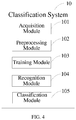
- the classification system 10 may include an acquisition module 100, a preprocessing module 102, a training module 103, a recognition module 104, and a classification module 105. Functions of these various modules will be described in greater detail in the following embodiments.
- the acquisition module 100 is configured for acquiring at least one photograph sent by a terminal device 2, the photograph having license plate information of a corresponding vehicle.
- the terminal device 2 may display a vehicle-use-recognition operation interface.
- the terminal device 2 may display the vehicle-use-recognition operation interface in response to a user's operation.
- the terminal device 2 may access the electronic device 1 through a browser system, and then the electronic device 1 may send the vehicle-use-recognition operation interface to the browser system for display.
- the classification system 10 may correspond to a client system installed in the terminal device 2, so that after running, the client system of the terminal device 2 may generate and display the vehicle-use-recognition operation interface.
- the vehicle-use-recognition operation interface may include a single-photograph recognition control and a multi-photograph recognition control.
- the single-photograph recognition control the user can issue to the electronic device 1 an instruction for recognizing the vehicle use information corresponding to a single photograph which has license plate information of a vehicle sent by the terminal device, and then upload a single photograph.
- the acquisition module may then acquire the instruction and then receive this photograph.
- the multi-photograph recognition control the user can issue to the electronic device 1 an instruction for recognizing the vehicle use information corresponding to multiple photographs which have license plate information of multiple vehicles sent by the terminal device, and then upload multiple photographs.
- the acquisition module 100 then may acquire the instruction and receive the multiple photographs.
- the preprocessing module 102 is configured for preprocessing the acquired at least one photograph such that the preprocessed at least one photograph matches input parameters of a pretrained recognition model.
- the at least one photograph may be one or more photographs.
- the preprocessing module 102 may preprocess the acquired at least one photograph by the following process in order that the preprocessed at least one photograph matches the input parameters of the pretrained recognition model.
- the size of each of the adjusted photographs would be the same as the input dimensions of the pretrained recognition model.
- the input dimensions are actually the size of a picture, for example, a size of 256 ⁇ 256. If the size of each whitened photograph is larger than the input dimensions of the pretrained recognition model, then these whitened photographs may be reduced in size. Otherwise if the size of each whitened photograph is smaller than the input dimensions of the pretrained recognition model, then these whitened photographs may be enlarged in size.
- the pretrained recognition model may be a trained deep convolutional neural network (CNN) model.
- the deep CNN model may consist of 1 input layer, 20 convolutional layers, 6 pooling layers, 3 hidden layers, and 1 classification layer.
- a model structure of the deep CNN model is illustrated in FIG.
- Conv a-b (e.g., Conv 3-64) denotes the dimensions of the convolutional kernels at this layer are a ⁇ a, while the number of convolutional kernels at this layer is b;
- Maxpool2 indicates the dimensions of the pooling kernel at the pooling layer are 2 ⁇ 2;
- FC-c (e.g., FC-6) indicates that there are a number of c output nodes at the hidden layer (i.e., fully connected layer);
- Soft-max indicates that the classification layer uses Softmax classifier to classify the input images.
- the training module 103 may be configured for using photograph samples for training and learning purposes in order to obtain the trained deep CNN model.
- photograph samples for training and learning purposes
- the use of a vehicle in the photograph can be automatically and accurately determined.
- the process of the training module 103 training the deep CNN model mainly includes the following.
- the photograph sample sets under each photograph category may be specifically acquired by the following process.
- Each photograph sample in each photograph category is first whitened, with the whitened photograph sample having a pixel mean of 0 and a variance of 1, so that noise pixels in the photograph sample are filtered out.
- the at least one photograph may also be filtered by a filter, such as Gaussian low-pass filter, averaging filter, Gaussian filter, or the like, to filter out the noise pixels in the photograph.
- each whitened photograph sample is adjusted, with the size of each adjusted photograph sample being the same as the input dimensions of the deep CNN model.
- the input dimensions are actually the size of a picture, for example, a size of 256 ⁇ 256.
- each photograph sample in each photograph category is rotated at intervals of a preset rotation angle (e.g., 30 degree), and the rotated photograph sample is subjected to perspective change processing at the corresponding angle to obtain a photograph sample set for each photograph sample at the various rotation angles, finally obtaining the photograph sample sets under each photograph category.
- a preset rotation angle e.g. 30 degree
- a first preset proportion e.g., 70%
- the photograph sample sets may then be used as the photograph sample sets to be tested under this photograph category.
- the photograph samples in the photograph sample sets to be trained under each photograph category are input sequentially into the deep CNN model, and the preset training algorithm is used to train the deep CNN which is used for recognizing the vehicle use information based on the license plate information, and further the trained deep CNN model is tested using the photograph samples of the photograph sample sets to be tested under this photograph category.
- the photograph samples of the photograph sample sets to be tested under each photograph category can be used to test the trained deep CNN model. If the recognition accuracy of the trained deep CNN model is higher than or equal to a preset threshold (e.g., 95%), then the training is completed and this trained deep CNN model can subsequently be used to accurately recognize the use of a vehicle in a photograph.
- a preset threshold e.g. 95%
- a reminder message may be issued to remind the user to increase the number of photograph samples containing license plate information and then retrain the deep CNN model according to the above steps (1) - (5).
- the training of the deep CNN model may adopt the parameters of the CifarlO data classification task that comes with the third open source library (Convolutional Architecture for Fast Feature Embedding, Caffe).
- Caffe is a clear and efficient open source library for deep learning frameworks and can autonomously learn useful features from data, especially for some images, while CifarlO is a database in Caffe.
- the preset training algorithm may be an adaptive moment estimation (Adam) algorithm.
- the Adam algorithm is a stochastic optimization-based algorithm that has made improvements over the momentum (i.e., learning potential) based stochastic gradient descent (SGD) algorithm.
- SGD stochastic gradient descent
- the training process of the deep CNN model will always aim at minimizing the classification errors.
- M represents the classification model
- ⁇ ⁇ ( M ) is a regularization term
- ⁇ is a regularization weight that controls the regularization degree
- ⁇ ( M ) is a regularization function that controls how to regularize the error function
- the model may produce errors in the forward propagation, and then propagate the error gradient ⁇ f m backward and regularize the gradient ⁇ ( M ) so as to update the model parameters.
- the three parameters ⁇ 1 , ⁇ 2 , and ⁇ may assume their respective default values: 0.9, 0.999, and 10 -6 .
- the model can quickly converge and the ideal classification accuracy can be attained even when the collected sample dataset is small.
- the recognition module 104 is configured for inputting the preprocessed at least one photograph to the pretrained recognition model to recognize the vehicle use information corresponding to the at least one photograph, and then sending the vehicle use information to the terminal device 2.
- the pretrained recognition model can identify the vehicle use information based on the license plate information.
- the preprocessed at least one photograph as the input to the pretrained recognition model, the corresponding vehicle use information of the at least one photograph can be accurately recognized.
- the recognition module 104 may send the corresponding vehicle use information of this single photograph to the terminal device 2. Otherwise if the at least one photograph includes multiple photographs, then the recognition module 104 may send the title of each photograph as well as the corresponding vehicle use information of this photograph to the terminal device 2.
- the classification module 105 may be configured for: when the at least one photograph includes multiple photographs, classifying the at least one photograph according to the vehicle use information corresponding to the at least one photograph.
- the vehicle uses may include but are not limited to truck use, police use, private car use, and military use.
- the photograph categories may include but are not limited to truck-use photograph category, police-use photograph category, private-car-use photograph category, and military-use photograph category.
- the photographs corresponding to the same vehicle use may be classified into the same photograph category, while the photographs corresponding to different vehicle uses may be classified into different photograph categories, and further, the classified photograph categories, as well as the title of each photograph in each photograph category and the corresponding vehicle use information of the photograph may be sent to the terminal device 2.
- various functional units described in the embodiments herein may be integrated into one processing unit or may be present as a number of physically separated units, and two or more units may be integrated into one.
- the above integrated units may be implemented by hardware or by hardware in combination with software functional modules.
Landscapes
- Engineering & Computer Science (AREA)
- Theoretical Computer Science (AREA)
- Physics & Mathematics (AREA)
- General Physics & Mathematics (AREA)
- Evolutionary Computation (AREA)
- Artificial Intelligence (AREA)
- Data Mining & Analysis (AREA)
- Software Systems (AREA)
- Computing Systems (AREA)
- Health & Medical Sciences (AREA)
- General Health & Medical Sciences (AREA)
- Computer Vision & Pattern Recognition (AREA)
- General Engineering & Computer Science (AREA)
- Life Sciences & Earth Sciences (AREA)
- Multimedia (AREA)
- Mathematical Physics (AREA)
- Computational Linguistics (AREA)
- Business, Economics & Management (AREA)
- Medical Informatics (AREA)
- Databases & Information Systems (AREA)
- Biophysics (AREA)
- Biomedical Technology (AREA)
- Molecular Biology (AREA)
- Strategic Management (AREA)
- Human Resources & Organizations (AREA)
- Bioinformatics & Computational Biology (AREA)
- Bioinformatics & Cheminformatics (AREA)
- Evolutionary Biology (AREA)
- Entrepreneurship & Innovation (AREA)
- Quality & Reliability (AREA)
- Marketing (AREA)
- Tourism & Hospitality (AREA)
- General Business, Economics & Management (AREA)
- Economics (AREA)
- Operations Research (AREA)
- Image Analysis (AREA)
- Traffic Control Systems (AREA)
Abstract
Description
- This application is based on the Paris Convention and claims the priority to China Patent Application No.
CN2016104709069 filed Jun. 24, 2016 - This disclosure relates generally to the technical field of data processing, and more particularly relates to a method, a system, an electronic device, and a computer-readable storage medium for classifying license plates based on deep learning.
- In the course of conducting the related auto insurance businesses (e.g., auto insurance claims business), insurance companies at present may acquire a large number of photographs of the vehicles claiming insurance. In order to effectively manage the photographs of these vehicles, it is the common practice for the insurance companies to manually determine the use of the related vehicle (e.g., truck use, police use, private car use, military use, etc.) in each vehicle photograph, and then manually classify the photographs of these vehicles by their respective vehicle uses. This however not only consumes a lot of manpower and resources but also is prone to error.
- In view of the above, there is a need to provide a method, a system, an electronic device as well as a medium for classifying license plates based on deep learning, which can automatically and accurately identify the use of a vehicle in a photograph and also can accurately classify the vehicle, thereby improving the accuracy and the efficiency.
- A method of classifying license plates based on deep learning is provided. The method may be applied to an electronic device and includes: acquiring at least one photograph sent by a terminal device, the photograph having license plate information of a corresponding vehicle; preprocessing the acquired at least one photograph such that the preprocessed at least one photograph matches input parameters of a pretrained recognition model; and inputting the preprocessed at least one photograph to the pretrained recognition model to recognize the vehicle use information corresponding to the at least one photograph, and sending the vehicle use information to the terminal device.
- A system for classifying license plates based on deep learning is provided. The system may operate in an electronic device and includes: an acquisition module configured for acquiring at least one photograph sent by a terminal device, the photograph having license plate information of a corresponding vehicle; a preprocessing module configured for preprocessing the acquired at least one photograph such that the preprocessed at least one photograph matches input parameters of a pretrained recognition model; and a recognition module configured for inputting the preprocessed at least one photograph to the pretrained recognition model to recognize the vehicle use information corresponding to the at least one photograph, and sending the vehicle use information to the terminal device.
- An electronic device is provided, the electronic device including a processing device, a storage device, and a system for classifying license plates based on deep learning. The system is stored in the storage device and includes at least one computer-readable instruction executable by the processing device to perform the following operations: acquiring at least one photograph sent by a terminal device, the photograph having license plate information of a corresponding vehicle; preprocessing the acquired at least one photograph such that the preprocessed at least one photograph matches input parameters of a pretrained recognition model; and inputting the preprocessed at least one photograph to the pretrained recognition model to recognize the vehicle use information corresponding to the at least one photograph, and sending the vehicle use information to the terminal device.
- According to a fourth aspect of this application, a computer-readable storage medium is provided, the computer-readable storage medium having stored thereon at least one computer-readable instruction executable by a processing device to perform the following operations: acquiring at least one photograph sent by a terminal device, the photograph having license plate information of a corresponding vehicle; preprocessing the acquired at least one photograph such that the preprocessed at least one photograph matches input parameters of a pretrained recognition model; and inputting the preprocessed at least one photograph to the pretrained recognition model to recognize the vehicle use information corresponding to the at least one photograph, and sending the vehicle use information to the terminal device.
- As can be seen from the above technical solutions according to this disclosure, a preset algorithm may first be used to train a recognition model for recognizing the vehicle use information based on the license plate information so as to obtain a pretrained recognition model. Then each photograph is input into the pretrained recognition model to identify the vehicle use information corresponding to the photograph, and then the corresponding vehicle use information of each photograph is sent to the terminal device. Furthermore, based on the corresponding vehicle use information of each photograph, the photographs with the same vehicle use can be classified into the same category. Therefore, with the present disclosure, the uses of vehicles in the photographs can be automatically and accurately identified and further the photographs can be accurately classified, so that the accuracy as well as the efficiency can be improved.
-
-
FIG. 1 is a schematic diagram of an application environment for an exemplary embodiment of a method of classifying license plates based on deep learning in accordance with the disclosure. -
FIG. 2 is an illustrative flowchart of an exemplary embodiment of a method of classifying license plates based on deep learning in accordance with the disclosure. -
FIG. 3 is a schematic diagram of a model structure of a deep convolutional neural network (CNN) model in accordance with the disclosure. -
FIG. 4 is an illustrative functional block diagram of a system for classifying license plates based on deep learning in accordance with the disclosure. -
FIG. 1 shows a schematic diagram of an application environment for an exemplary embodiment of a method of classifying license plates based on deep learning in accordance with this disclosure. The application environment may include an electronic device 1 and aterminal device 2. The electronic device 1 may perform data interaction with theterminal device 2 by using a suitable technology, such as a network or near field communications technology. - The
terminal device 2 may include but is not limited to any electronic product such as a personal computer, a tablet computer, a smart phone, a Personal Digital Assistant (PDA), a game console, an Internet Protocol Television (IPTV), a smart wearable device or the like that can interact with a user through a keyboard, a mouse, a remote controller, a touch pad, or a voice control device. The network in which the user equipment and the network device are located includes but is not limited to the Internet, a wide area network, a metropolitan area network, a local area network, a Virtual Private Network (VPN), or the like. - The electronic device 1 is a device capable of automatically performing numerical computations and/or information processing according to instructions set or stored in advance. The electronic device 1 may be a computer, or may also be a single web server, a server group consisting of multiple web servers, or a cloud formed by a large number of hosts or web servers based on cloud computing. The cloud computing is a type of distributed computing, giving rise to a super virtual computer made up of a set of loosely coupled computers.
- In this embodiment, the electronic device 1 may include a
system 10 for classifying license plates based on deep learning (hereinafter referred to as "classification system 10"), astorage device 11, aprocessing device 12, and the like. Theprocessing device 12 serves to support the operation of the electronic device 1, and may include one or more microprocessors, digital processors, and the like. Thestorage device 11 is used for storing various types of data and computer-readable instructions, and may include one or more non-volatile memories such as ROMs, EPROMs, flash memories, or the like. - The
classification system 10 may first use a preset algorithm to train a recognition model which is used for recognizing the vehicle use information based on the license plate information, so as to obtain a pretrained recognition model. Then each photograph may be input to the pretrained recognition model to identify the corresponding vehicle use information of the photograph, and then the corresponding vehicle use information of each photograph may be sent to theterminal device 2. Furthermore, based on the corresponding vehicle use information of each photograph, the photographs with the same vehicle use information may be classified into one same category. In one embodiment, theclassification system 10 may be stored in thestorage device 11, and may include at least one computer-readable instruction stored in thestorage device 11 and executable by theprocessor device 12 to perform the license plate classification methods according to various embodiments of this application. As will be described later, the at least one computer-readable instruction may be divided into different logic modules by different functions performed by its parts. - Therefore, with the present disclosure, the uses of vehicles in the photographs can be automatically and accurately identified and further the photographs can be accurately classified, thereby improving the accuracy as well as the efficiency.
-
FIG. 2 is an illustrative flowchart of an exemplary embodiment of a method of classifying license plates based on deep learning in accordance with the disclosure. The method according to this embodiment will not be limited to the steps shown in the flowchart, and some of these steps illustrated in the flowchart may be omitted or the order of these steps may be changed. The method may begin with step S10. - In S10, at least one photograph sent by a
terminal device 2 is acquired. - In this embodiment, the
terminal device 2 may be configured to be capable of displaying a vehicle-use-recognition operation interface. Theterminal device 2 may display the vehicle-use-recognition operation interface in response to a user's operation. For example, theterminal device 2 may access the electronic device 1 through a browser system, and then the electronic device 1 may send the vehicle-use-recognition operation interface to the browser system for display. Alternatively, theclassification system 10 may correspond to a client system installed in theterminal device 2, so that after running, the client system of theterminal device 2 may generate and display the vehicle-use-recognition operation interface. - The vehicle-use-recognition operation interface may include a single-photograph recognition control and a multi-photograph recognition control. With the single-photograph recognition control, the user can issue to the electronic device 1 an instruction for recognizing the vehicle use information corresponding to a single photograph which has license plate information of a vehicle sent by the terminal device, and then upload a photograph containing license plate information. With the multi-photograph recognition control, the user can issue to the electronic device 1 an instruction for recognizing the vehicle use information corresponding to multiple photographs which have license plate information of multiple vehicles sent by the terminal device, and then upload multiple photographs. The method may then proceed to step S11.
- In S11, the acquired at least one photograph is preprocessed such that the preprocessed at least one photograph matches input parameters of a pretrained recognition model.
- In this embodiment, the at least one photograph may be one or more photographs. Preprocessing the acquired at least one photograph such that the preprocessed at least one photograph matches the input parameters of the pretrained recognition model may include the following operations.
- (1) The at least one photograph is whitened to filter out noise pixels in the photograph, so that each whitened photograph has a pixel mean of 0 and a pixel variance of 1.
In other embodiments, the at least one photograph may also be filtered by a filter, such as Gaussian low-pass filter, averaging filter, Gaussian filter, or the like, to filter out noise pixels in the photograph,. - (2) The size of each whitened paragraph is adjusted based on input dimensions of the pretrained recognition model.
- In this embodiment, the size of each of the adjusted photographs would be the same as the input dimensions of the pretrained recognition model. The input dimensions are actually the size of a picture, for example, a size of 256×256. If the size of each whitened photograph is larger than the input dimensions of the pretrained recognition model, then these whitened photographs may be reduced in size. If the size of each whitened photograph is smaller than the input dimensions of the pretrained recognition model, then these whitened photographs may be enlarged in size.
- In this embodiment, the pretrained recognition model may be a trained deep convolutional neural network (CNN) model that may consist of 1 input layer, 20 convolutional layers, 6 pooling layers, 3 hidden layers, and 1 classification layer. A model structure of the deep CNN model is illustrated in
FIG. 3 , in which Conv a-b (e.g., Conv 3-64) denotes that the dimensions of the convolutional kernels at this layer are a×a, while the number of convolutional kernels at this layer is b; Maxpool2 indicates the dimensions of the pooling kernel at this pooling layer are 2×2; FC-c (e.g.,, FC-6) indicates that there are a number of c output nodes at the hidden layer (i.e., fully connected layer); Soft-max indicates that the classification layer uses Softmax classifier to classify the input images. - In this embodiment, photograph samples may be used for training and learning in order to obtain the trained deep CNN model. Thus, inputting a photograph to the trained deep CNN model, the use of a vehicle in the photograph can be automatically and accurately determined. The larger the size of the photograph samples, the higher the recognition rate of the trained deep CNN model.
- In this embodiment, the training of the deep CNN model mainly includes the following process.
- (1) A preset number (e.g., 500,000) of photograph samples having license plate information of a preset number of vehicles are first acquired. The license plate information may include a vehicle's license plate number and the like. For example, a police-purpose license plate may show a Chinese character ""-meaning "Police", a military-purpose license plate may show a Chinese character "
 "-meaning "Military", and so on.
- (2) The acquired photograph samples are then classified according to vehicle use information which corresponds to the acquired photograph samples, so as to obtain at least one photograph category.
In this embodiment, the vehicle uses may include but are not limited to truck use, police use, private car use, and military use. The photograph categories may include but are not limited to truck-use photograph category, police-use photograph category, private-car-use photograph category, and military-use photograph category.
In this embodiment, the photograph samples corresponding to the same vehicle use may be classified into the same photograph category, while the photograph samples corresponding to different vehicle uses may be classified into different photograph categories. - (3) Then each photograph sample in each photograph category is whitened, and the size of each whitened photograph sample is adjusted, and then each adjusted photograph sample is rotated to obtain photograph sample sets under each photograph category.
- In this embodiment, the photograph sample sets under each photograph category may specifically be acquired by the following process.
- Each photograph sample in each photograph category is first whitened, with the whitened photograph sample having a pixel mean of 0 and a variance of 1, so that noise pixels in the photograph sample are filtered out. In other embodiments, the at least one photograph may also be filtered by a filter, such as Gaussian low-pass filter, averaging filter, Gaussian filter, or the like, to filter out the noise pixels in the photograph. Then the size of each whitened photograph sample is adjusted, with the size of each adjusted photograph sample being the same as the input dimensions of the deep CNN model. The input dimensions are actually the size of a picture, for example, a size of 256 × 256.
- The each photograph sample in each photograph category is rotated at intervals of a preset rotation angle (e.g., 30 degree), and the rotated photograph sample is subjected to perspective change processing at the corresponding angle to obtain a photograph sample set for each photograph sample at the various rotation angles, finally obtaining the photograph sample sets under each photograph category.
- (4) Afterwards, from among the photograph sample sets under each photograph category, those photograph sample sets to be trained under this photograph category as well as those photograph sample sets to be tested under this photograph category are then selected.
- In this embodiment, from among the photograph sample sets under each photograph category, a first preset proportion (e.g., 70%) of photograph sample sets may be extracted as the photograph sample sets to be trained under this photograph category, while the photograph sample sets remained of this photograph category after the extraction may then be used as the photograph sample sets to be tested under this photograph category.
- (5) Thereafter, the photograph samples in the photograph sample sets to be trained under each photograph category are input sequentially into the deep CNN model, and the preset training algorithm is used to train the deep CNN which is used for recognizing the vehicle use information based on the license plate information, and further the trained deep CNN model is tested using the photograph samples of the photograph sample sets to be tested under this photograph category.
- In this embodiment, the photograph samples of the photograph sample sets to be tested under each photograph category can be used to test the trained deep CNN model. If the recognition accuracy of the trained deep CNN model is higher than or equal to a preset threshold (e.g., 95%), then the training is completed and this trained deep CNN then can subsequently be used to accurately recognize the use of a vehicle in a photograph.
- Otherwise, if the recognition accuracy of the trained deep CNN model is lower than the preset threshold (e.g., 95%), then a reminder message may be issued to remind the user to increase the number of photograph samples containing license plate information and then retrain the deep CNN model according to the above steps (1) - (5).
- In this embodiment, the principle of training the deep CNN model is disclosed as follows:
The training of the deep CNN model may adopt the parameters of the Cifar10 data classification task that comes with the third open source library (Convolutional Architecture for Fast Feature Embedding, Caffe). Caffe is a clear and efficient open source library for deep learning frameworks and can autonomously learn useful features from data, especially for some images, while CifarlO is a database in Caffe. - In this embodiment, the preset training algorithm may be an adaptive moment estimation (Adam) algorithm. The Adam algorithm is a stochastic optimization-based algorithm that has made improvements over the momentum (i.e., learning potential) based stochastic gradient descent (SGD) algorithm. By adaptively estimating the momentum term, the process of attaining the model training goal can be accelerated.
- The training process of the deep CNN model will always aim at minimizing the classification errors. Given a dataset D, the objective function that needs to be optimized during the training process is the average error L(m) of classifying various samples in the dataset:
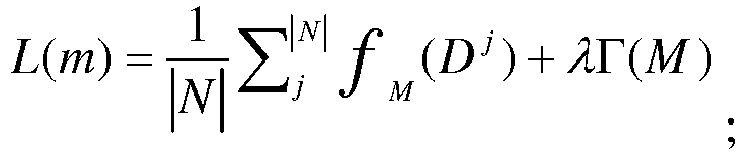
- M represents the classification model, λΓ(M) is a regularization term, λ is a regularization weight that controls the regularization degree, Γ(M) is a regularization function that controls how to regularize the error function, and |N| represents the total number of samples in the dataset. Due to the fact that the dataset can contain a very large number of samples, we use a sample subset to estimate the average error of the original dataset which is
L( M) :


- During the training process, the three parameters α 1, α 2 , and ε may assume their respective default values: 0.9, 0.999, and 10-3. With the smoothness and fast convergence ability of the Adam algorithm during the optimization process, the model can quickly converge and the ideal classification accuracy can be attained even when the collected sample dataset is small. The method may then continue to step S12.
- In step S12, the preprocessed at least one photograph is input to the pretrained recognition model to recognize the vehicle use information corresponding to the at least one photograph, and the vehicle use information is then sent to the
terminal device 2. - In this embodiment, as can be known from the above principle of training the pretrained recognition model, the pretrained recognition model can identify the vehicle use information based on the license plate information. Thus, by using the preprocessed at least one photograph as the input to the pretrained recognition model, the corresponding vehicle use information of the at least one photograph can be accurately recognized.
- In this embodiment, if the at least one photograph is a single photograph, then the corresponding vehicle use information of this single photograph may be sent to the
terminal device 2. Otherwise if the at least one photograph includes multiple photographs, then the title of each photograph as well as the corresponding vehicle use information of the photograph may be sent to theterminal device 2. - In other embodiments, the method may further include: when the at least one photograph includes multiple photographs, classifying the at least one photograph according to vehicle use information corresponding to the at least one photograph.
- In this embodiment, the vehicle uses may include but are not limited to truck use, police use, private car use, and military use. The photograph categories may include but are not limited to truck-use photograph category, police-use photograph category, private-car-use photograph category, and military-use photograph category.
- In this embodiment, the photographs corresponding to the same vehicle use may be classified into the same photograph category, while the photographs corresponding to different vehicle uses may be classified into different photograph categories, and further, the classified photograph categories, as well as the title of each photograph in each photograph category and the corresponding vehicle use information of the photograph may be sent to the
terminal device 2. - As illustrated in
FIG. 4 , the program code of theclassification system 10 may be divided into multiple functional modules depending on their different functions performed. In this embodiment, theclassification system 10 may include an acquisition module 100, apreprocessing module 102, atraining module 103, arecognition module 104, and aclassification module 105. Functions of these various modules will be described in greater detail in the following embodiments. - The acquisition module 100 is configured for acquiring at least one photograph sent by a
terminal device 2, the photograph having license plate information of a corresponding vehicle. - In this embodiment, the
terminal device 2 may display a vehicle-use-recognition operation interface. Theterminal device 2 may display the vehicle-use-recognition operation interface in response to a user's operation. For example, theterminal device 2 may access the electronic device 1 through a browser system, and then the electronic device 1 may send the vehicle-use-recognition operation interface to the browser system for display. Alternatively, theclassification system 10 may correspond to a client system installed in theterminal device 2, so that after running, the client system of theterminal device 2 may generate and display the vehicle-use-recognition operation interface. - The vehicle-use-recognition operation interface may include a single-photograph recognition control and a multi-photograph recognition control. With the single-photograph recognition control, the user can issue to the electronic device 1 an instruction for recognizing the vehicle use information corresponding to a single photograph which has license plate information of a vehicle sent by the terminal device, and then upload a single photograph. The acquisition module may then acquire the instruction and then receive this photograph. With the multi-photograph recognition control, the user can issue to the electronic device 1 an instruction for recognizing the vehicle use information corresponding to multiple photographs which have license plate information of multiple vehicles sent by the terminal device, and then upload multiple photographs. The acquisition module 100 then may acquire the instruction and receive the multiple photographs.
- The
preprocessing module 102 is configured for preprocessing the acquired at least one photograph such that the preprocessed at least one photograph matches input parameters of a pretrained recognition model. - In this embodiment, the at least one photograph may be one or more photographs. The
preprocessing module 102 may preprocess the acquired at least one photograph by the following process in order that the preprocessed at least one photograph matches the input parameters of the pretrained recognition model. - (1) The at least one photograph is first whitened to filter out noise pixels in the photograph, so that the each whitened photograph has a pixel mean of 0 and a pixel variance of 1.
In other embodiments, the at least one photograph may also be filtered by a filter, such as Gaussian low-pass filter, averaging filter, Gaussian filter, or the like, to filter out noise pixels in the photograph - (2) The size of each whitened paragraph is adjusted based on input dimensions of the pretrained recognition model.
- In this embodiment, the size of each of the adjusted photographs would be the same as the input dimensions of the pretrained recognition model. The input dimensions are actually the size of a picture, for example, a size of 256 × 256. If the size of each whitened photograph is larger than the input dimensions of the pretrained recognition model, then these whitened photographs may be reduced in size. Otherwise if the size of each whitened photograph is smaller than the input dimensions of the pretrained recognition model, then these whitened photographs may be enlarged in size.
- In this embodiment, the pretrained recognition model may be a trained deep convolutional neural network (CNN) model. The deep CNN model may consist of 1 input layer, 20 convolutional layers, 6 pooling layers, 3 hidden layers, and 1 classification layer. A model structure of the deep CNN model is illustrated in
FIG. 3 , in which Conv a-b (e.g., Conv 3-64) denotes the dimensions of the convolutional kernels at this layer are a×a, while the number of convolutional kernels at this layer is b; Maxpool2 indicates the dimensions of the pooling kernel at the pooling layer are 2×2; FC-c (e.g.,, FC-6) indicates that there are a number of c output nodes at the hidden layer (i.e., fully connected layer); Soft-max indicates that the classification layer uses Softmax classifier to classify the input images. - In this embodiment, the
training module 103 may be configured for using photograph samples for training and learning purposes in order to obtain the trained deep CNN model. Thus, inputting a photograph to the trained deep CNN model, the use of a vehicle in the photograph can be automatically and accurately determined. The larger the size of the photograph samples, the higher the recognition rate of the trained deep CNN model. - In this embodiment, the process of the
training module 103 training the deep CNN model mainly includes the following. - (1) A preset number (e.g., 500,000) of photograph samples having license plate information of a preset number of vehicles are first acquired. The license plate information may include a vehicle's license plate number and the like. For example, a police-purpose license plate may show a Chinese character ""-meaning "Police", a military-purpose license plate may show a Chinese character "
 "-meaning "Military", and so on.
- (2) The acquired photograph samples are then classified according to the vehicle use information which corresponds to the acquired photograph samples, so as to obtain at least one photograph category.
In this embodiment, the vehicle uses may include but are not limited to truck use, police use, private car use, and military use. The photograph categories may include but are not limited to truck-use photograph category, police-use photograph category, private-car-use photograph category, and military-use photograph category.
In this embodiment, the photograph samples corresponding to the same vehicle use may be classified into the same photograph category, while the photograph samples corresponding to different vehicle uses may be classified into different photograph categories. - (3) Then each photograph sample in each photograph category is whitened, and the size of each whitened photograph sample is adjusted, and then each adjusted photograph sample is rotated to obtain photograph sample sets under each photograph category.
- In this embodiment, the photograph sample sets under each photograph category may be specifically acquired by the following process.
- Each photograph sample in each photograph category is first whitened, with the whitened photograph sample having a pixel mean of 0 and a variance of 1, so that noise pixels in the photograph sample are filtered out. In other embodiments, the at least one photograph may also be filtered by a filter, such as Gaussian low-pass filter, averaging filter, Gaussian filter, or the like, to filter out the noise pixels in the photograph.
- Thereafter, the size of each whitened photograph sample is adjusted, with the size of each adjusted photograph sample being the same as the input dimensions of the deep CNN model. The input dimensions are actually the size of a picture, for example, a size of 256 × 256.
- The each photograph sample in each photograph category is rotated at intervals of a preset rotation angle (e.g., 30 degree), and the rotated photograph sample is subjected to perspective change processing at the corresponding angle to obtain a photograph sample set for each photograph sample at the various rotation angles, finally obtaining the photograph sample sets under each photograph category.
- (4) Afterwards, from among the photograph sample sets under each photograph category, those photograph sample sets to be trained under this photograph category as well as those photograph sample sets to be tested under this photograph category are then selected.
- In this embodiment, from among the photograph sample sets under each photograph category, a first preset proportion (e.g., 70%) of photograph sample sets may be extracted as the photograph sample sets to be trained under this photograph category, while the photograph sample sets remained of this photograph category after the extraction may then be used as the photograph sample sets to be tested under this photograph category.
- (5) Thereafter, the photograph samples in the photograph sample sets to be trained under each photograph category are input sequentially into the deep CNN model, and the preset training algorithm is used to train the deep CNN which is used for recognizing the vehicle use information based on the license plate information, and further the trained deep CNN model is tested using the photograph samples of the photograph sample sets to be tested under this photograph category.
- In this embodiment, the photograph samples of the photograph sample sets to be tested under each photograph category can be used to test the trained deep CNN model. If the recognition accuracy of the trained deep CNN model is higher than or equal to a preset threshold (e.g., 95%), then the training is completed and this trained deep CNN model can subsequently be used to accurately recognize the use of a vehicle in a photograph.
- Otherwise if the recognition accuracy of the trained deep CNN model is lower than the preset threshold (e.g., 95%), then a reminder message may be issued to remind the user to increase the number of photograph samples containing license plate information and then retrain the deep CNN model according to the above steps (1) - (5).
- In this embodiment, the principle of training the deep CNN model is disclosed as follows:
- The training of the deep CNN model may adopt the parameters of the CifarlO data classification task that comes with the third open source library (Convolutional Architecture for Fast Feature Embedding, Caffe). Caffe is a clear and efficient open source library for deep learning frameworks and can autonomously learn useful features from data, especially for some images, while CifarlO is a database in Caffe.
- In this embodiment, the preset training algorithm may be an adaptive moment estimation (Adam) algorithm. The Adam algorithm is a stochastic optimization-based algorithm that has made improvements over the momentum (i.e., learning potential) based stochastic gradient descent (SGD) algorithm. By adaptively estimating the momentum term, the process of attaining the model training goal can be accelerated.
- The training process of the deep CNN model will always aim at minimizing the classification errors. Given a dataset D, the objective function that needs to be optimized during the training process is the average error L(m) of classifying various samples in the dataset:

- M represents the classification model, λΓ(M) is a regularization term, λ is a regularization weight that controls the regularization degree, Γ(M) is a regularization function that controls how to regularize the error function, and |N| represents the total number of samples in the dataset. Due to the fact that the dataset can contain a very large number of samples, we use a sample subset to estimate the average error of the original dataset which is
L (M):


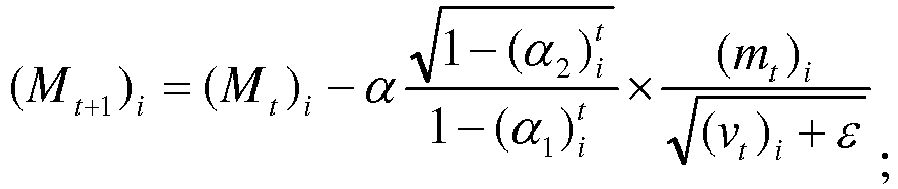
- During the training process, the three parameters α 1, α 2, and ε may assume their respective default values: 0.9, 0.999, and 10-6. With the smoothness and fast convergence ability of the Adam algorithm during the optimization process, the model can quickly converge and the ideal classification accuracy can be attained even when the collected sample dataset is small.
- The
recognition module 104 is configured for inputting the preprocessed at least one photograph to the pretrained recognition model to recognize the vehicle use information corresponding to the at least one photograph, and then sending the vehicle use information to theterminal device 2. - In this embodiment, as can be known from the above principle of training the pretrained recognition model, the pretrained recognition model can identify the vehicle use information based on the license plate information. Thus, by using the preprocessed at least one photograph as the input to the pretrained recognition model, the corresponding vehicle use information of the at least one photograph can be accurately recognized.
- In this embodiment, if the at least one photograph is a single photograph, then the
recognition module 104 may send the corresponding vehicle use information of this single photograph to theterminal device 2. Otherwise if the at least one photograph includes multiple photographs, then therecognition module 104 may send the title of each photograph as well as the corresponding vehicle use information of this photograph to theterminal device 2. - In other embodiments, the
classification module 105 may be configured for: when the at least one photograph includes multiple photographs, classifying the at least one photograph according to the vehicle use information corresponding to the at least one photograph. - In this embodiment, the vehicle uses may include but are not limited to truck use, police use, private car use, and military use. The photograph categories may include but are not limited to truck-use photograph category, police-use photograph category, private-car-use photograph category, and military-use photograph category.
- In this embodiment, the photographs corresponding to the same vehicle use may be classified into the same photograph category, while the photographs corresponding to different vehicle uses may be classified into different photograph categories, and further, the classified photograph categories, as well as the title of each photograph in each photograph category and the corresponding vehicle use information of the photograph may be sent to the
terminal device 2. - Additionally, various functional units described in the embodiments herein may be integrated into one processing unit or may be present as a number of physically separated units, and two or more units may be integrated into one. The above integrated units may be implemented by hardware or by hardware in combination with software functional modules.
- It will be apparent to those skilled in the art that this disclosure won't be limited to the details of the foregoing exemplary embodiments and may also be embodied in other specific forms without departing from the spirit or essential characteristics of the disclosure. Thus, the foregoing embodiments are to be regarded in all respects as illustrative and not restrictive, and the scope of the disclosure is defined by the appended claims rather than by the foregoing description. The present disclosure is therefore intended to embrace all changes that fall within the meanings and ranges of the equivalent elements of the claims. No reference sign shown in the accompanying drawings that are recited in a claim should be considered as a restriction on the claim involved. In addition, it is manifest that the term "comprising," or "including," does not exclude other elements or steps, and the singular form does not exclude the plural. A plurality of units or devices recited in the system claims may also be implemented by one unit or device through software or hardware. Terms such as "first," "second," (if any) are used to indicate names rather than any particular order.
- It will be appreciated that the foregoing embodiments are merely illustrative of the technical solutions of this disclosure and are not restrictive. Although the present disclosure has been described in detail in connection to some exemplary embodiments, those of ordinary skill in the art will understand that various modifications, changes, or equivalent substitutions can be made to the disclosure without departing from the spirit and scope of the technical solutions of the disclosure.
Claims (18)
- A method of classifying license plates based on deep learning, the method being applied to an electronic device and comprising:acquiring at least one photograph sent by a terminal device, the photograph having license plate information of a corresponding vehicle;preprocessing the acquired at least one photograph such that the preprocessed at least one photograph matches input parameters of a pretrained recognition model; andinputting the preprocessed at least one photograph to the pretrained recognition model to recognize vehicle use information which corresponds to the at least one photograph, and sending the vehicle use information to the terminal device.
- The method of claim 1, wherein the terminal device is configured to display a vehicle-use-recognition operation interface that comprises a single-photograph recognition control and a multi-photograph recognition control, the method further comprising:receiving an instruction, issued by a user through the single-photograph recognition control to the electronic device, for recognizing vehicle use information corresponding to a single photograph which has license plate information of a vehicle sent by the terminal device ; orreceiving an instruction, issued by a user through the multi-photograph recognition control to the electronic device, for recognizing vehicle use information corresponding to a plurality of photographs which have license plate information of a plurality of vehicles sent by the terminal device.
- The method of claim 1, wherein preprocessing the acquired at least one photograph such that the preprocessed at least one photograph matches the input parameters of the pretrained recognition model comprises:whitening the at least one photograph to filter out noise pixels in the at least one photograph, so that each whitened photograph has a pixel mean of 0 and a pixel variance of 1; andadjusting the size of each whitened paragraph according to input dimensions of the pretrained recognition model.
- The method of claim 1, wherein the pretrained recognition model is a trained deep convolutional neural network (CNN) model, and the deep CNN model is trained by the following processes:acquiring a preset number of photograph samples which have license plate information of a preset number of vehicles;classifying the acquired photograph samples according to vehicle use information which corresponds to the acquired photograph samples, so as to obtain at least one photograph category;whitening each photograph sample in each photograph category, adjusting the size of the whitened photograph sample, and rotating the adjusted photograph sample to obtain photograph sample sets under the photograph category;acquiring, from among the photograph sample sets under each photograph category, the photograph sample sets to be trained under the photograph category and the photograph sample sets to be tested under the photograph category; andinputting the photograph samples of the photograph sample sets to be trained under each photograph category sequentially into the deep CNN model, using a preset training algorithm to train the deep CNN model which is used for recognizing vehicle use information based on license plate information, and testing the trained deep CNN model using the photograph samples of the photograph sample sets to be tested under each photograph category.
- The method of claim 1, further comprising:
when the at least one photograph includes a plurality of photographs, classifying the at least one photograph according to vehicle use information corresponding to the at least one photograph, so that the photographs with the same vehicle use information are classified into a same photograph category, and the photographs with different vehicle use information are classified into different photograph categories. - A system for classifying license plates based on deep learning, the system operating in an electronic device and comprising:an acquisition module configured to acquire at least one photograph sent by a terminal device, the photograph having license plate information of a corresponding vehicle;a preprocessing module configured to preprocess the acquired at least one photograph such that the preprocessed at least one photograph matches input parameters of a pretrained recognition model; anda recognition module configured to input the preprocessed at least one photograph to the pretrained recognition model to recognize vehicle use information which corresponds to the at least one photograph, and sending the vehicle use information to the terminal device.
- The system of claim 6, wherein, a provision module, the terminal device is configured to display a vehicle-use-recognition operation interface that comprises a single-photograph recognition control and a multi-photograph recognition control; wherein the acquisition module is further configured to:receive an instruction, issued by a user through the single-photograph recognition control to the electronic device, for recognizing vehicle use information corresponding to a single photograph which has license plate information of a vehicle sent by the terminal device; orreceiving an instruction, issued by a user through the multi-photograph recognition control to the electronic device, for recognizing vehicle use information corresponding to a plurality of photographs which have license plate information of a plurality of vehicles sent by the terminal device.
- The system of claim 6, wherein preprocessing the at least one photograph such that the preprocessed at least one photograph matches the input parameters of the pretrained recognition model comprises:whitening the at least one photograph to filter out noise pixels in the at least one photograph, so that each whitened photograph has a pixel mean of 0 and a pixel variance of 1; andadjusting the size of each whitened paragraph according to input dimensions of the pretrained recognition model.
- The system of claim 6, wherein the pretrained recognition model is a trained deep convolutional neural network (CNN) model, and the deep CNN model is trained by the following processes:acquiring a preset number of photograph samples which have license plate information of a preset number of vehicles;classifying the acquired photograph samples according to vehicle use information which corresponds to the acquired photograph samples, so as to obtain at least one photograph category;whitening each photograph sample in each photograph category, adjusting the size of the whitened photograph sample, and rotating the adjusted photograph sample to obtain photograph sample sets under the photograph category;acquiring, from among the photograph sample sets under each photograph category, the photograph sample sets to be trained under the photograph category and the photograph sample sets to be tested under the photograph category;inputting the photograph samples of the photograph sample sets to be trained under each photograph category sequentially into the deep CNN model, using a preset training algorithm to train the deep CNN model which is used for recognizing the vehicle use information based on the license plate information, and testing the trained deep CNN model using the photograph samples of the photograph sample sets to be tested under each photograph category.
- The system of claim 6, further comprising:
a classification module configured to classify the at least one photograph by vehicle use information corresponding to the at least one photograph when the at least one photograph includes a plurality of photographs, so that the photographs with the same vehicle use information are classified into a same photograph category, and the photographs with different vehicle use information are classified into different photograph categories. - An electronic device comprising a processing device, a storage device, and a system for classifying license plates based on deep learning that is stored in the storage device and comprises at least one computer-readable instruction, the at least one computer-readable instruction being executable by the processing device to perform the following operations:acquiring at least one photograph sent by a terminal device, the photograph having license plate information of a corresponding vehicle;preprocessing the acquired at least one photograph such that the preprocessed at least one photograph matches input parameters of a pretrained recognition model; andinputting the preprocessed at least one photograph to the pretrained recognition model to recognize vehicle use information which corresponds to the at least one photograph, and sending the vehicle use information to the terminal device.
- The electronic device of claim 11, wherein the terminal device is configured to display a vehicle-use-recognition operation interface that comprises a single-photograph recognition control and a multi-photograph recognition control, and the at least one computer-readable instruction is executable by the processing device to further perform the following operations:receiving an instruction, issued by a user through the single-photograph recognition control to the electronic device, for recognizing vehicle use information corresponding to a single photograph which has license plate information of a vehicle sent by the terminal device; orreceiving an instruction, issued by a user through the multi-photograph recognition control to the electronic device, for recognizing vehicle use information corresponding to a plurality of photographs which have license plate information of a plurality of vehicles sent by the terminal device.
- The electronic device of claim 11, wherein preprocessing the acquired at least one photograph such that the preprocessed at least one photograph matches the input parameters of the pretrained recognition model comprises:whitening the at least one photograph to filter out noise pixels in the at least one photograph, so that each whitened photograph has a pixel mean of 0 and a pixel variance of 1; andadjusting the size of each whitened paragraph according to input dimensions of the pretrained recognition model.
- The electronic device of claim 11, wherein the pretrained recognition model is a trained deep convolutional neural network (CNN) model, and the deep CNN model is trained by the following processes:acquiring a preset number of photograph samples which have license plate information of a preset number of vehicles;classifying the acquired photograph samples according to vehicle use information which corresponds to the acquired photograph samples, so as to obtain at least one photograph category;whitening each photograph sample in each photograph category, adjusting the size of the whitened photograph sample, and rotating the adjusted photograph sample to obtain photograph sample sets under the photograph category;acquiring, from among the photograph sample sets under each photograph category, the photograph sample sets to be trained under the photograph category and the photograph sample sets to be tested under the photograph category; andinputting the photograph samples of the photograph sample sets to be trained under each photograph category sequentially into the deep CNN model, using a preset training algorithm to train the deep CNN model which used for recognizing vehicle use information based on license plate information, and testing the trained deep CNN model using the photograph samples of the photograph sample sets to be tested under each photograph category.
- The electronic device of claim 11, wherein the at least one computer-readable instruction is executable by the processing device to further perform the following operations:
when the at least one photograph includes a plurality of photographs, classifying the at least one photograph by vehicle use information corresponding to the at least one photograph, so that the photographs with the same vehicle use are classified into a same photograph category, and the photographs with different vehicle use information are classified into different photograph categories. - A computer-readable storage medium having stored thereon at least one computer-readable instruction executable by a processing device to perform the following operations:acquiring at least one photograph sent by a terminal device, the photograph having license plate information of a corresponding vehicle;preprocessing the acquired at least one photograph such that the preprocessed at least one photograph matches input parameters of a pretrained recognition model; andinputting the preprocessed at least one photograph to the pretrained recognition model to recognize vehicle use information which corresponds to the at least one photograph, and sending the vehicle use information to the terminal device.
- The computer-readable storage medium of claim 16, wherein the terminal device is configured to display a vehicle-use-recognition operation interface that comprises a single-photograph recognition control and a multi-photograph recognition control, and the at least one computer-readable instruction is configured to further perform the following operations:receiving an instruction, issued by a user through the single-photograph recognition control to the electronic device, for recognizing vehicle use information corresponding to a single photograph which has license plate information of a vehicle sent by the terminal device; orreceiving an instruction, issued by a user through the multi-photograph recognition control to the electronic device, for recognizing vehicle use information corresponding to a plurality of photographs which have license plate information of a plurality of vehicles sent by the terminal device.
- The computer-readable storage medium of claim 16, wherein preprocessing the acquired at least one photograph such that the preprocessed at least one photograph matches the input parameters of the pretrained recognition model comprises:whitening the at least one photograph to filter out noise pixels in the at least one photograph, so that each whitened photograph has a pixel mean of 0 and a pixel variance of 1; andadjusting the size of each whitened paragraph according to input dimensions of the pretrained recognition model.
Applications Claiming Priority (2)
| Application Number | Priority Date | Filing Date | Title |
|---|---|---|---|
| CN201610470906.9A CN106127248A (en) | 2016-06-24 | 2016-06-24 | Car plate sorting technique based on degree of depth study and system |
| PCT/CN2017/089875 WO2017220032A1 (en) | 2016-06-24 | 2017-06-23 | Vehicle license plate classification method and system based on deep learning, electronic apparatus, and storage medium |
Publications (2)
| Publication Number | Publication Date |
|---|---|
| EP3477550A1 true EP3477550A1 (en) | 2019-05-01 |
| EP3477550A4 EP3477550A4 (en) | 2020-04-01 |
Family
ID=57268929
Family Applications (1)
| Application Number | Title | Priority Date | Filing Date |
|---|---|---|---|
| EP17803763.6A Withdrawn EP3477550A4 (en) | 2016-06-24 | 2017-06-23 | METHOD AND SYSTEM FOR CLASSIFYING VEHICLE LICENSE PLATES BASED ON DEEP LEARNING, ELECTRONIC APPARATUS, AND STORAGE MEDIUM |
Country Status (8)
| Country | Link |
|---|---|
| US (1) | US10528841B2 (en) |
| EP (1) | EP3477550A4 (en) |
| JP (1) | JP6689972B2 (en) |
| KR (1) | KR102173610B1 (en) |
| CN (1) | CN106127248A (en) |
| AU (1) | AU2017272288B2 (en) |
| SG (1) | SG11201800370VA (en) |
| WO (1) | WO2017220032A1 (en) |
Families Citing this family (34)
| Publication number | Priority date | Publication date | Assignee | Title |
|---|---|---|---|---|
| CN106127248A (en) * | 2016-06-24 | 2016-11-16 | 平安科技(深圳)有限公司 | Car plate sorting technique based on degree of depth study and system |
| CN106599905B (en) * | 2016-11-25 | 2018-04-10 | 杭州中奥科技有限公司 | A kind of fake-licensed car analysis method based on deep learning |
| CN108957024A (en) * | 2017-05-22 | 2018-12-07 | 阿里巴巴集团控股有限公司 | A kind of method, apparatus and electronic equipment of tachometric survey |
| CN107610091A (en) * | 2017-07-31 | 2018-01-19 | 阿里巴巴集团控股有限公司 | Vehicle insurance image processing method, device, server and system |
| CN107483813B (en) * | 2017-08-08 | 2020-11-17 | 深圳市明日实业有限责任公司 | Method and device for tracking recording and broadcasting according to gestures and storage device |
| CN107526438B (en) * | 2017-08-08 | 2020-11-13 | 深圳市明日实业有限责任公司 | Method, device and storage device for tracking recording and broadcasting according to raising hand |
| CN108108746B (en) * | 2017-09-13 | 2021-04-09 | 湖南理工学院 | License plate character recognition method based on Caffe deep learning framework |
| CN108961328A (en) * | 2017-11-29 | 2018-12-07 | 北京猎户星空科技有限公司 | Singly take the photograph depth of field model generating method, generating means and electronic equipment |
| US10176405B1 (en) | 2018-06-18 | 2019-01-08 | Inception Institute Of Artificial Intelligence | Vehicle re-identification techniques using neural networks for image analysis, viewpoint-aware pattern recognition, and generation of multi- view vehicle representations |
| CN111666832B (en) * | 2018-07-27 | 2023-10-31 | 创新先进技术有限公司 | A detection method and device, a computing device and a storage medium |
| CN110569692B (en) * | 2018-08-16 | 2023-05-12 | 创新先进技术有限公司 | Multi-vehicle identification method, device and equipment |
| US12555024B2 (en) | 2019-01-30 | 2026-02-17 | Oracle International Corporation | Dynamic data selection for a machine learning model |
| CN110458287B (en) * | 2019-02-15 | 2024-05-07 | 平安科技(深圳)有限公司 | Parameter updating method, device, terminal and storage medium of neural network optimizer |
| CN111651410B (en) * | 2019-03-08 | 2023-04-18 | 上海铼锶信息技术有限公司 | Dynamic balance method and system for sample data |
| CN109978177B (en) * | 2019-03-19 | 2023-06-23 | 腾讯科技(深圳)有限公司 | Model training method, business processing method, device and related equipment |
| CN111723601A (en) * | 2019-03-19 | 2020-09-29 | 杭州海康威视数字技术股份有限公司 | Method and device for image processing |
| CN110097044B (en) * | 2019-05-13 | 2020-12-01 | 苏州大学 | One-stage license plate detection and recognition method based on deep learning |
| CN110427937B (en) * | 2019-07-18 | 2022-03-22 | 浙江大学 | A deep learning-based method for slanted license plate correction and indeterminate license plate recognition |
| CN110705847A (en) * | 2019-09-18 | 2020-01-17 | 中国南方电网有限责任公司超高压输电公司广州局 | Intelligent substation inspection method and system based on image recognition technology |
| KR20210067783A (en) | 2019-11-29 | 2021-06-08 | 삼성전자주식회사 | Electronic apparatus and control method thereof and system |
| CN111126469B (en) * | 2019-12-17 | 2024-02-06 | 合肥鼎盛锦业科技有限公司 | Downhole tool identification method, downhole tool identification device and electronic equipment |
| CN113569884B (en) * | 2020-04-29 | 2024-09-06 | 北京金山云网络技术有限公司 | Model training method, device, electronic equipment and computer readable storage medium |
| CN111860610B (en) * | 2020-06-29 | 2023-04-14 | 高新兴科技集团股份有限公司 | License plate overexposure and license plate vehicle identification method and device and computer storage medium |
| CN112148596B (en) * | 2020-09-15 | 2024-03-22 | 北京百度网讯科技有限公司 | Method and device for generating error reporting content of deep learning framework |
| KR102437309B1 (en) * | 2021-02-24 | 2022-08-30 | 주식회사 스톡폴리오 | Apparatus for classifying image category using deep learning and method thereof |
| CN113159159B (en) * | 2021-04-15 | 2023-09-29 | 东北大学 | A small sample image classification method based on improved CNN |
| CN113343970B (en) * | 2021-06-24 | 2024-03-08 | 中国平安人寿保险股份有限公司 | Text image detection method, device, equipment and storage medium |
| CN113569844A (en) * | 2021-06-29 | 2021-10-29 | 深圳市捷顺科技实业股份有限公司 | Method and device for license plate detection |
| CN113538735B (en) * | 2021-09-13 | 2021-12-07 | 蜂巢能源科技有限公司 | Vehicle use identification method and device |
| CN113962989A (en) * | 2021-12-08 | 2022-01-21 | 成都数之联科技有限公司 | Vehicle appearance assembly part identification method, system, device and medium |
| CN114758194A (en) * | 2022-04-28 | 2022-07-15 | 杭州费尔马科技有限责任公司 | Automatic aquatic product pricing method for intelligent electronic scale |
| CN115423865B (en) * | 2022-07-29 | 2026-04-17 | 深圳库犸科技有限公司 | Obstacle detection methods, devices, lawnmower robots, and storage media |
| CN116189168A (en) * | 2023-02-21 | 2023-05-30 | 上海东普信息科技有限公司 | Passage management method, device, equipment and storage medium for logistics vehicles |
| CN117576921A (en) * | 2023-10-27 | 2024-02-20 | 浙江交投高速公路运营管理有限公司 | Tunnel over-temperature vehicle identification method and system |
Family Cites Families (24)
| Publication number | Priority date | Publication date | Assignee | Title |
|---|---|---|---|---|
| JP3334807B2 (en) * | 1991-07-25 | 2002-10-15 | 株式会社日立製作所 | Pattern classification method and apparatus using neural network |
| CA2535402A1 (en) * | 2003-07-10 | 2005-02-17 | James Simon | Autonomous wide-angle license plate recognition |
| US20060204107A1 (en) * | 2005-03-04 | 2006-09-14 | Lockheed Martin Corporation | Object recognition system using dynamic length genetic training |
| JP4192931B2 (en) * | 2005-09-20 | 2008-12-10 | オムロン株式会社 | Vehicle inquiry system |
| US7787664B2 (en) | 2006-03-29 | 2010-08-31 | Eastman Kodak Company | Recomposing photographs from multiple frames |
| JP2007293438A (en) * | 2006-04-21 | 2007-11-08 | Omron Corp | Feature acquisition device |
| US8218822B2 (en) | 2007-05-14 | 2012-07-10 | Pips Technology, Inc. | Apparatus and method for recognizing the state of origin of a vehicle license plate |
| US8194938B2 (en) | 2009-06-02 | 2012-06-05 | George Mason Intellectual Properties, Inc. | Face authentication using recognition-by-parts, boosting, and transduction |
| US20140063237A1 (en) * | 2012-09-03 | 2014-03-06 | Transportation Security Enterprises, Inc.(TSE), a Delaware corporation | System and method for anonymous object identifier generation and usage for tracking |
| US9020200B2 (en) * | 2012-06-12 | 2015-04-28 | Xerox Corporation | Geometric pre-correction for automatic license plate recognition |
| US9208567B2 (en) * | 2013-06-04 | 2015-12-08 | Apple Inc. | Object landmark detection in images |
| CN103324920A (en) | 2013-06-27 | 2013-09-25 | 华南理工大学 | Method for automatically identifying vehicle type based on vehicle frontal image and template matching |
| US20150125042A1 (en) * | 2013-10-08 | 2015-05-07 | Smartlanes Technologies, Llc | Method and system for data collection using processed image data |
| CN104182769B (en) * | 2014-09-17 | 2018-04-27 | 深圳市捷顺科技实业股份有限公司 | A license plate detection method and system |
| CN104298976B (en) * | 2014-10-16 | 2017-09-26 | 电子科技大学 | Detection method of license plate based on convolutional neural networks |
| CN105184271A (en) * | 2015-09-18 | 2015-12-23 | 苏州派瑞雷尔智能科技有限公司 | Automatic vehicle detection method based on deep learning |
| CN105224956A (en) * | 2015-10-16 | 2016-01-06 | 深圳市捷顺科技实业股份有限公司 | A kind of car plate classification based on multi-feature fusion recognition methods and system |
| CN105488517B (en) | 2015-11-30 | 2019-03-26 | 杭州全实鹰科技有限公司 | A vehicle brand model recognition method based on deep learning |
| WO2017095948A1 (en) * | 2015-11-30 | 2017-06-08 | Pilot Ai Labs, Inc. | Improved general object detection using neural networks |
| CN105488532B (en) * | 2015-12-03 | 2019-03-05 | 深圳市捷顺科技实业股份有限公司 | A kind of license plate screening technique and device |
| CN105631470A (en) * | 2015-12-21 | 2016-06-01 | 深圳市捷顺科技实业股份有限公司 | Method and system for verifying license plate type |
| CN105590102A (en) * | 2015-12-30 | 2016-05-18 | 中通服公众信息产业股份有限公司 | Front car face identification method based on deep learning |
| CN105654066A (en) * | 2016-02-02 | 2016-06-08 | 北京格灵深瞳信息技术有限公司 | Vehicle identification method and device |
| CN106127248A (en) * | 2016-06-24 | 2016-11-16 | 平安科技(深圳)有限公司 | Car plate sorting technique based on degree of depth study and system |
-
2016
- 2016-06-24 CN CN201610470906.9A patent/CN106127248A/en active Pending
-
2017
- 2017-06-23 JP JP2018524727A patent/JP6689972B2/en not_active Expired - Fee Related
- 2017-06-23 EP EP17803763.6A patent/EP3477550A4/en not_active Withdrawn
- 2017-06-23 SG SG11201800370VA patent/SG11201800370VA/en unknown
- 2017-06-23 WO PCT/CN2017/089875 patent/WO2017220032A1/en not_active Ceased
- 2017-06-23 AU AU2017272288A patent/AU2017272288B2/en not_active Ceased
- 2017-06-23 KR KR1020187023718A patent/KR102173610B1/en active Active
- 2017-06-23 US US15/737,318 patent/US10528841B2/en active Active
Also Published As
| Publication number | Publication date |
|---|---|
| AU2017272288B2 (en) | 2019-06-13 |
| AU2017272288A1 (en) | 2018-01-18 |
| KR102173610B1 (en) | 2020-11-04 |
| US10528841B2 (en) | 2020-01-07 |
| JP6689972B2 (en) | 2020-04-28 |
| JP2018535492A (en) | 2018-11-29 |
| EP3477550A4 (en) | 2020-04-01 |
| CN106127248A (en) | 2016-11-16 |
| KR20190021187A (en) | 2019-03-05 |
| US20180253618A1 (en) | 2018-09-06 |
| WO2017220032A1 (en) | 2017-12-28 |
| SG11201800370VA (en) | 2018-02-27 |
Similar Documents
| Publication | Publication Date | Title |
|---|---|---|
| US10528841B2 (en) | Method, system, electronic device, and medium for classifying license plates based on deep learning | |
| CN109978893B (en) | Training method, device, equipment and storage medium of image semantic segmentation network | |
| US9432671B2 (en) | Method and apparatus for classifying machine printed text and handwritten text | |
| US20200272823A1 (en) | Weakly-Supervised Action Localization by Sparse Temporal Pooling Network | |
| CN108197652B (en) | Method and apparatus for generating information | |
| WO2019169688A1 (en) | Vehicle loss assessment method and apparatus, electronic device, and storage medium | |
| CN113239865B (en) | Lane line detection method based on deep learning | |
| WO2019174130A1 (en) | Bill recognition method, server, and computer readable storage medium | |
| WO2019200781A1 (en) | Receipt recognition method and device, and storage medium | |
| CN111279362A (en) | Capsule Neural Network | |
| EP3485396A1 (en) | Classifying images using machine learning models | |
| CN107945210B (en) | Target tracking method based on deep learning and environment self-adaption | |
| CN110717407A (en) | Human face recognition method, device and storage medium based on lip language password | |
| CN115294636A (en) | Face clustering method and device based on self-attention mechanism | |
| US20200320387A1 (en) | Independent and dependent reading using recurrent networks for natural language inference | |
| JP7188856B2 (en) | Dynamic image resolution evaluation | |
| CN114373212A (en) | Face recognition model construction method, face recognition method and related equipment | |
| Yang et al. | Convolutional neural network for smooth filtering detection | |
| US20250272546A1 (en) | Using diffusion model to generate graph data | |
| CN117011859A (en) | An image processing method and related devices | |
| CN116935368A (en) | Deep learning model training method, text line detection method, device and equipment | |
| CN114896067B (en) | Automatic generation method and device of task request information, computer equipment and medium | |
| US12530576B2 (en) | Accounting for long-tail training data through logit adjustment | |
| US20220343152A1 (en) | Energy based processes for exchangeable data | |
| CN114066664A (en) | Risk level assessment method, device, equipment and medium based on behavior portrait |
Legal Events
| Date | Code | Title | Description |
|---|---|---|---|
| STAA | Information on the status of an ep patent application or granted ep patent |
Free format text: STATUS: UNKNOWN |
|
| STAA | Information on the status of an ep patent application or granted ep patent |
Free format text: STATUS: THE INTERNATIONAL PUBLICATION HAS BEEN MADE |
|
| PUAI | Public reference made under article 153(3) epc to a published international application that has entered the european phase |
Free format text: ORIGINAL CODE: 0009012 |
|
| STAA | Information on the status of an ep patent application or granted ep patent |
Free format text: STATUS: REQUEST FOR EXAMINATION WAS MADE |
|
| 17P | Request for examination filed |
Effective date: 20171220 |
|
| AK | Designated contracting states |
Kind code of ref document: A1 Designated state(s): AL AT BE BG CH CY CZ DE DK EE ES FI FR GB GR HR HU IE IS IT LI LT LU LV MC MK MT NL NO PL PT RO RS SE SI SK SM TR |
|
| AX | Request for extension of the european patent |
Extension state: BA ME |
|
| DAV | Request for validation of the european patent (deleted) | ||
| DAX | Request for extension of the european patent (deleted) | ||
| A4 | Supplementary search report drawn up and despatched |
Effective date: 20200302 |
|
| RIC1 | Information provided on ipc code assigned before grant |
Ipc: G06K 9/62 20060101AFI20200225BHEP |
|
| STAA | Information on the status of an ep patent application or granted ep patent |
Free format text: STATUS: EXAMINATION IS IN PROGRESS |
|
| 17Q | First examination report despatched |
Effective date: 20210122 |
|
| STAA | Information on the status of an ep patent application or granted ep patent |
Free format text: STATUS: THE APPLICATION IS DEEMED TO BE WITHDRAWN |
|
| 18D | Application deemed to be withdrawn |
Effective date: 20210602 |