EP3477302A1 - Device, system and kit for measuring tension of sheet-like tissue containing cardiomyocytes - Google Patents
Device, system and kit for measuring tension of sheet-like tissue containing cardiomyocytes Download PDFInfo
- Publication number
- EP3477302A1 EP3477302A1 EP18201938.0A EP18201938A EP3477302A1 EP 3477302 A1 EP3477302 A1 EP 3477302A1 EP 18201938 A EP18201938 A EP 18201938A EP 3477302 A1 EP3477302 A1 EP 3477302A1
- Authority
- EP
- European Patent Office
- Prior art keywords
- gel
- holding member
- adapter holder
- sheet
- tension
- Prior art date
- Legal status (The legal status is an assumption and is not a legal conclusion. Google has not performed a legal analysis and makes no representation as to the accuracy of the status listed.)
- Granted
Links
Images



Classifications
-
- G—PHYSICS
- G01—MEASURING; TESTING
- G01N—INVESTIGATING OR ANALYSING MATERIALS BY DETERMINING THEIR CHEMICAL OR PHYSICAL PROPERTIES
- G01N33/00—Investigating or analysing materials by specific methods not covered by groups G01N1/00 - G01N31/00
- G01N33/48—Biological material, e.g. blood, urine; Haemocytometers
- G01N33/50—Chemical analysis of biological material, e.g. blood, urine; Testing involving biospecific ligand binding methods; Immunological testing
- G01N33/53—Immunoassay; Biospecific binding assay; Materials therefor
- G01N33/543—Immunoassay; Biospecific binding assay; Materials therefor with an insoluble carrier for immobilising immunochemicals
- G01N33/54366—Apparatus specially adapted for solid-phase testing
-
- G—PHYSICS
- G01—MEASURING; TESTING
- G01N—INVESTIGATING OR ANALYSING MATERIALS BY DETERMINING THEIR CHEMICAL OR PHYSICAL PROPERTIES
- G01N13/00—Investigating surface or boundary effects, e.g. wetting power; Investigating diffusion effects; Analysing materials by determining surface, boundary, or diffusion effects
- G01N13/02—Investigating surface tension of liquids
-
- A—HUMAN NECESSITIES
- A61—MEDICAL OR VETERINARY SCIENCE; HYGIENE
- A61B—DIAGNOSIS; SURGERY; IDENTIFICATION
- A61B5/00—Measuring for diagnostic purposes; Identification of persons
- A61B5/45—For evaluating or diagnosing the musculoskeletal system or teeth
- A61B5/4519—Muscles
-
- C—CHEMISTRY; METALLURGY
- C12—BIOCHEMISTRY; BEER; SPIRITS; WINE; VINEGAR; MICROBIOLOGY; ENZYMOLOGY; MUTATION OR GENETIC ENGINEERING
- C12N—MICROORGANISMS OR ENZYMES; COMPOSITIONS THEREOF; PROPAGATING, PRESERVING, OR MAINTAINING MICROORGANISMS; MUTATION OR GENETIC ENGINEERING; CULTURE MEDIA
- C12N5/00—Undifferentiated human, animal or plant cells, e.g. cell lines; Tissues; Cultivation or maintenance thereof; Culture media therefor
- C12N5/06—Animal cells or tissues; Human cells or tissues
- C12N5/0602—Vertebrate cells
- C12N5/0652—Cells of skeletal and connective tissues; Mesenchyme
- C12N5/0657—Cardiomyocytes; Heart cells
-
- B—PERFORMING OPERATIONS; TRANSPORTING
- B01—PHYSICAL OR CHEMICAL PROCESSES OR APPARATUS IN GENERAL
- B01L—CHEMICAL OR PHYSICAL LABORATORY APPARATUS FOR GENERAL USE
- B01L9/00—Supporting devices; Holding devices
- B01L9/52—Supports specially adapted for flat sample carriers, e.g. for plates, slides, chips
-
- C—CHEMISTRY; METALLURGY
- C12—BIOCHEMISTRY; BEER; SPIRITS; WINE; VINEGAR; MICROBIOLOGY; ENZYMOLOGY; MUTATION OR GENETIC ENGINEERING
- C12N—MICROORGANISMS OR ENZYMES; COMPOSITIONS THEREOF; PROPAGATING, PRESERVING, OR MAINTAINING MICROORGANISMS; MUTATION OR GENETIC ENGINEERING; CULTURE MEDIA
- C12N2533/00—Supports or coatings for cell culture, characterised by material
- C12N2533/50—Proteins
- C12N2533/56—Fibrin; Thrombin
-
- G—PHYSICS
- G01—MEASURING; TESTING
- G01N—INVESTIGATING OR ANALYSING MATERIALS BY DETERMINING THEIR CHEMICAL OR PHYSICAL PROPERTIES
- G01N13/00—Investigating surface or boundary effects, e.g. wetting power; Investigating diffusion effects; Analysing materials by determining surface, boundary, or diffusion effects
- G01N13/02—Investigating surface tension of liquids
- G01N2013/0283—Investigating surface tension of liquids methods of calculating surface tension
Definitions
- the presently disclosed subject matter relates to a device, a system and a kit for measuring the tension of a sheet-like tissue containing cardiomyocytes.
- the success rate of drug discovery is about 1/6000, and because of failure of development of many candidate drugs, the research and development cost for a pharmaceutical company or the like tends to increase. In general, it is also said that an investment of several tens of billion yen is required for developing one type of new drug.
- the main factor for the failure of new drug development is said to be derived from (I) a difference between an evaluation screening system using cells alone and an actual human biological tissue and (2) a difference between an experimental animal and a human. It has been demanded in the drug discovery and development field that these differences be eliminated to improve the success rate of drug discovery and reduce the research and development cost.
- pluripotent stem cells such as iPS cells having an ability to differentiate into various functional cells
- a conventionally used evaluation system uses cells alone, and does not reflect the state of a biological tissue. Therefore, it has been demanded that an evaluation system which mimics a biological tissue be developed from somatic cells differentiated and induced from pluripotent stem cells.
- Patent Document 1 As one of the methods for forming a cell sheet, there is a method using a cell culture dish (temperature responsive culture dish) coated with poly(N-isopropylacrylamide) (PIPAAm) (Patent Document 1). An arbitrary cell is cultured on a temperature responsive culture dish coated with PIPAAm, and after the cells become confluent, the temperature is decreased to 20°C which is lower than 32°C as the lower critical solution temperature (LCST) of PIPAAm, whereby cells in the form of a sheet (a cell sheet) are obtained noninvasively.
- LCST lower critical solution temperature
- Non-Patent Document 1 Haraguchi Y., et al., Scaffold-free tissue engineering using cell sheet technology, RSC Adv., 2012; 2: 2184-2190
- An object of the presently disclosed subject matter is to provide a device for measuring the tension of a sheet-like tissue containing cardiomyocytes, which enables quantitative measurement of muscle contraction and can be mass-produced, a system, and a kit.
- the present inventors carried out research and development in addition to investigation from various angles for achieving the above object. As a result, they arrived at the presently disclosed subject matter providing a device for measuring the tension of a sheet-like tissue containing cardiomyocytes, which enables quantitative measurement of muscle contraction and can be mass-produced, by contriving the form of the device for measuring the tension of a sheet-like tissue containing cardiomyocytes, a system, and a kit. That is, the presently disclosed subject matter is as follows.
- a device capable of simply measuring the tension of a sheet-like tissue containing cardiomyocytes, which was difficult to handle because of its thinness, is provided. Further, the device can be easily incorporated into a system for measuring the tension of a sheet-like tissue containing cardiomyocytes, and enables acquisition of data reproducibly and stably.
- the "sheet-like tissue containing cells” refers to a biological tissue collected from a living body or a thin film-like tissue containing cells.
- the sheet-like tissue containing cells may be a tissue collected from a living body as it is or a biological tissue obtained by processing a tissue collected from a living body into the form of a sheet.
- the sheet-like tissue containing cells may be a sheet-like tissue formed by mixing a suspension containing cells with a gel, and may also be a cell sheet.
- the sheet-like tissue containing cells may be a tissue formed by directly seeding a cell group on the upper face of a film-like gel, followed by culturing.
- the "cell sheet” refers to a cell group in the form of a sheet in one layer or a plurality of layers obtained by culturing a cell group containing a plurality of arbitrary cells on a cell culture substrate and exfoliating the cells from the cell culture substrate.
- a method for obtaining a cell sheet for example, a method in which cells are cultured on a stimulus-responsive culture substrate coated with a polymer which changes its molecular structure by a stimulus such as temperature, pH, or light, and the cells are exfoliated in sheets from the stimulus-responsive culture substrate while maintaining the cells in an adhered state by changing the conditions of the stimulus such as temperature, pH, or light so as to change the surface of the stimulus-responsive culture substrate, a method in which cells are cultured on an arbitrary culture substrate and the cultured cells are physically exfoliated using forceps or the like, whereby a cell sheet is obtained, and the like are exemplified.
- a temperature-responsive culture substrate in which the surface thereof is coated with a polymer which changes its hydration force within a temperature range of 0 to 80°C is known.
- cells are cultured in a temperature range in which the hydration force of the polymer is weak, and thereafter, the temperature of the culture solution is changed to a temperature at which the polymer becomes in a state where the hydration force is strong, whereby the cells can be exfoliated as a cell group in the form of a sheet.
- the temperature-responsive culture substrate to be used for obtaining a cell sheet is preferably a substrate which changes the hydration force of the surface thereof in a temperature range in which cells can be cultured.
- the temperature range is preferably a temperature at which cells are generally cultured, for example, from 33°C to 40°C.
- a temperature-responsive polymer to be coated on a culture substrate to be used for obtaining a cell sheet may be either a homopolymer or a copolymer. As such a polymer, for example, polymers described in JP-A-2-211865 are exemplified.
- poly (N-Isopropylacrylamide) is used as the stimulus-responsive polymer, particularly, as the temperature-responsive polymer will be described as an example (a temperature-responsive culture dish).
- Poly (N-Isopropylacrylamide) is known as a polymer having a lower critical solution temperature of 31°C, and when it is in a free state, dehydration occurs at a temperature of 31°C or higher in water to aggregate the polymer chains and cause white turbidity.
- the temperature is lower than 31°C, the polymer chains are hydrated and become in a state of being dissolved in water.
- this polymer is coated on the surface of a substrate such as a dish and fixed thereto.
- the polymer on the surface of the culture substrate is also dehydrated in the same manner, however, the polymer chains are fixed to the surface of the culture substrate, and therefore, the surface of the culture substrate comes to show hydrophobicity.
- the temperature is lower than 31°C, the polymer on the surface of the culture substrate is hydrated, however, the polymer chains are coated on the surface of the culture substrate, and therefore, the surface of the culture substrate comes to show hydrophilicity.
- the hydrophobic surface at this time is a moderate surface, to which cells are adhered and on which the cells can proliferate, and further, the hydrophilic surface becomes a surface to which cells cannot be adhered.
- the substrate when the substrate is cooled to a temperature lower than 31°C, the cells are exfoliated from the surface of the substrate. If the cells are cultured to confluence on the entire culture surface, a cell sheet can be recovered by cooling the substrate to a temperature lower than 31°C.
- the temperature-responsive culture substrate is not limited as long as it has the same effect, however, for example, UpCell (registered trademark) commercially available from CellSeed, Inc. (Tokyo, Japan), and the like are exemplified.
- the "sheet-like tissue containing cardiomyocytes” refers to a tissue containing at least cardiomyocytes at 10% or more of the number of cells contained in the sheet-like tissue containing cells described above, and the cardiomyocytes are contained therein at, for example, 15% or more, 20% or more, 25% or more, 30% or more, 35% or more, 40% or more, 45% or more, 50% or more, 55% or more, 60% or more, 65% or more, 70% or more, 75% or more, 80% or more, 85% or more, 90% or more, 95% or more, or 99% or more.
- the "sheet-like tissue containing cardiomyocytes" to be used in the presently disclosed subject matter is preferably beating cardiomyocytes.
- the cardiomyocytes which can be used in the presently disclosed subject matter may be any as long as the cells are derived from an animal, and for example, cardiomyocytes of a mammal, a bird, an amphibian, a reptile, or a fish can be used.
- the cardiomyocytes are preferably derived from a mammal, and for example, cardiomyocytes derived from a mammal such as a mouse, a rat, a human, a monkey, a pig, a dog, a sheep, a cat, a goat, or the like can be used.
- the cells which can be used in the presently disclosed subject matter may be primary cells collected from a biological tissue, or may be an established cell line, or may be cells differentiated and induced from pluripotent stem cells or tissue stem cells.
- pluripotent stem cells is intended to be a generic name for stem cells having an ability to differentiate into cells of every possible tissue (differentiation pluripotency).
- the pluripotent stem cells include, although not limited to, embryonic stem cells (ES cells), embryonic carcinoma cells (EC cells), trophoblast stem cells (TS cells), epiblast stem cells (EpiS cells), embryonic germ cells (EG cells), multipotent germline stem cells (mGS cells), induced pluripotent stem cells (iPS cells), Muse cells, and the like.
- ES cells or iPS cells are examples of ES cells or iPS cells.
- arbitrary known cells can be used, and for example, pluripotent stem cells described in WO 2009/123349 ( PCT/JP2009/057041 ) can be used.
- the cardiomyocytes which can be used in the presently disclosed subject matter may be cells differentiated and induced from pluripotent stem cells.
- a known method for differentiating pluripotent cells into cardiomyocytes a known method can be used (see, for example, Matsuura K., et al., Creation of human cardiac cell sheets using pluripotent stem cells, Biochem. Biophys. Res. Commun. 2012, Aug. 24; 425(2): 321-327 , or the like).
- the sheet-like tissue containing cardiomyocytes may contain cells other than cardiomyocytes.
- cells other than cardiomyocytes For example, cardiac myoblasts, myoblasts, mesenchymal stem cells, vascular endothelial cells, vascular endothelial progenitor cells, fibroblasts, or the like may be contained.
- the presently disclosed subject matter provides a device for measuring the tension of a sheet-like tissue containing cardiomyocytes, including:
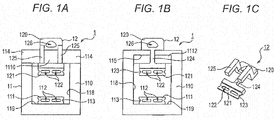
- FIGS. 1A to 1H show a tension measuring device 1 of an embodiment of the presently disclosed subject matter, and a substrate 13 and a gel forming lid body 14 which are used together with the tension measuring device 1.
- the tension measuring device 1 can include a first gel adapter holder 11 and a second gel adapter holder 12.
- the first gel adapter holder 11 can include a frame member 110, which is pierced in a rectangular form inside as shown in FIGS. 1A and 1B , and a first gel holding member 111, which is provided protruding toward a part of an inside face (a frame inside bottom face 119 in FIGS. 1A to 1H ) of the frame member 110 for fixing one end of a film-like gel G (described later).
- the frame member 110 plays a role in becoming a part of a mold frame when the gel G is formed, and also plays a role in preventing an arbitrary object from coming into contact with the gel G and a sheet-like tissue ST from the lateral side. Further, the tension measuring device 1 can be easily attached to a culture medium tank lid body 21 of a culture medium tank 2 (described later) while maintaining the shape of the gel G and the sheet-like tissue ST by the existence of the frame member 110.
- the first gel holding member 111 is provided in parallel with the thin film of the gel G to be formed.
- the first gel holding member 111 is provided with one or more first gel holding openings 112.
- a first gel holding recessed member 113 is further provided on both ends of the first gel holding member 111.
- the thickness of the frame member 110 is not limited, and may be any thickness as long as the sheet-like tissue containing cardiomyocytes can be adhered thereto and stably held thereon and the gel G does not impede the action of beating and contraction of the sheet-like tissue containing cardiomyocytes, and is a thickness of, for example, from 0.5 mm to 3.0 mm, from 0.5 mm to 2.5 mm, from 0.5 mm to 2.0 mm, from 0.5 mm to 1.5 mm, from 1.0 mm to 3.0 mm, from 1.0 mm to 2.5 mm, from 1.0 mm to 2.0 mm, or from 1.0 mm to 1.5 mm, preferably from 0.5 mm to 2.5 mm, more preferably from 0.5 mm to 1.5 mm.
- the thickness of the first gel holding member 111 is formed thinner than the thickness of the frame member 110. Further, the first gel holding member 111 is provided at an intermediate position in the thickness direction of the frame member 110 on the frame inside bottom face 119. Thereby, the gel G covers both the upper face and the bottom face of the first gel holding member 111, and thus the gel G is reliably held.
- the second gel adapter holder 12 has a second gel holding member 121 for fixing the other end of the gel G and a connection member 120 connected to the second gel holding member 121. As shown in FIG. 1C , the connection member 120 and the second gel holding member 121 are connected to each other through a T-shaped member 124.
- the second gel holding member 121 is provided in parallel with the gel G to be formed.
- the second gel holding member 121 is provided with one or more second gel holding openings 122. On both ends of the second gel holding member 121, a second gel holding recessed member 123 is further provided.
- the thickness of the second gel holding member 121 is formed thinner than the thickness of the T-shaped member 124, and preferably, the second gel holding member 121 has the same thickness as the first gel holding member 111. Further, the second gel holding member 121 is provided at an intermediate position in the thickness direction of the T-shaped member 124. Thereby, the gel G covers both the upper face and the bottom face of the second gel holding member 121, and thus the gel G is reliably held.
- connection member 120 is provided with a connection opening 126 for connecting a tension detection unit connector 3. Further, the connection member 120 is provided with one or more (in this embodiment, two) L-shaped members 125 for detachably attaching the second gel adapter holder 12 to the first gel adapter holder 11.
- the L-shaped member 125 is fitted in a first guide groove 1110 provided in a part of a frame upper member 114 of the first gel adapter holder 11. Further, in an upper part of the rear face of the frame member 110, a second guide groove 1111 for fitting a part of the T-shaped member 124 of the second gel adapter holder 12 therein is provided.
- the width of the second guide groove 1111 is designed so that a part of the T-shaped member 124 is fitted therein and the second gel adapter holder 12 is not precluded from sliding in the axial direction in which the first gel holding member and the second gel holding member are opposed to each other. Further, the depth of the second guide groove 1111 may be substantially the same as the thickness of the T-shaped member 124. Thereby, in the case where a part of the T-shaped member 124 is fitted in the second guide groove 1111, the rear face of the second gel adapter holder 12 and the rear face of the first gel adapter holder 11 are positioned on substantially the same plane (see FIG. 1E ).
- a frame upper part rear face 1112 of the first gel adapter holder 11 is recessed by one step from the frame member 110 and shares a plane with the second guide groove 1111. According to this, the second gel adapter holder 12 can slide up and down without the T-shaped member 124 being caught by the frame member 110 (see FIG. 1F ).
- the upper part (a stopper 115) of the frame member 110 comes into contact with the T-shaped member 124, and restricts the slidable range of the second gel adapter holder 12. Therefore, damage to the gel G and the sheet-like tissue ST containing cardiomyocytes is prevented.
- a gel poured into the first gel holding opening 112 and the second gel holding opening 122 plays a role in fixing one end of the film-like gel G to the first gel holding member 111 and the other end of the gel G to the second gel holding member 121 after it is solidified.
- the first gel holding recessed member 113 and the second gel holding recessed member 123 also achieves an effect of fixing the gel G after the gel is solidified.
- the number, shape, and size of first gel holding openings 112 and second gel holding openings 122 are determined as appropriate according to the size of the gel G to be formed, the viscosity, strength, and polymerization degree of the gel, and the like. For example, 1 to 10, 1 to 5, 2 to 5, or 2 to 4 first gel holding openings 112 and second gel holding openings 122 may be provided.
- the shape of the first gel holding member 111 and the second gel holding member 121 is preferably symmetric.
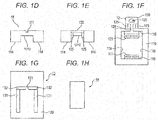
- the substrate 13 and the gel forming lid body 14 shown in FIGS. 1G to 1H are used.
- a pair of gel molding protruding members 131 to be fitted between the first gel holding member 111 and the second gel holding member 121, and the frame inside side face 118 are provided on a plane member 130 of the substrate 13.
- a gel forming protruding member upper part 132 to be fitted in the frame upper part rear face 1112 of the frame member 110 is provided.
- an L-shaped part fitting groove 133 is provided between a pair of gel forming protruding member upper parts 132. In the L-shaped part fitting groove 133, the T-shaped member 124 of the second gel adapter holder 12 is fitted.
- the width of the gel forming lid body 14 substantially coincides with the width of the inner face of the pair of gel molding protruding members 131 provided on the substrate 13. According to this, the gel forming lid body 14 is fitted between the pair of gel molding protruding members 131.
- the length of the gel forming lid body 14 of this embodiment may be any length as long as the gel forming lid body 14 covers the space where the gel G is formed.
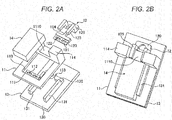
- FIG. 2A shows a view before assembling the first gel adapter holder 11, the second gel adapter holder 12, the substrate 13, and the gel forming lid body 14, and FIG. 2B shows a view after assembling these members.
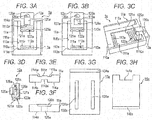
- FIGS. 3A to 4B are views showing a tension measuring device 1a (a first gel adapter holder 11a and a second gel adapter holder 12a), a substrate 13a, and a gel forming lid body 14a in another embodiment.
- the basic configuration and the concept of the invention are the same as the tension measuring device 1 (the first gel adapter holder 11 and the second gel adapter holder 12), the substrate 13, and the gel forming lid body 14, and the respective members provided therein of the first embodiment.
- a connection member 120a and a second gel holding member 121a are connected to each other through a second gel adapter holder main body 127a.
- the second gel adapter holder main body 127a is provided with a stopper opening 128a.
- a second guide groove 1111a for fitting the second gel adapter holder main body 127a therein is provided in an upper part of the rear face of a frame member 110a.
- the second guide groove 1111a is further provided with a stopper 115a (see FIG. 3E ).
- the stopper 115a comes into contact with the upper side or the lower side of the stopper opening 128a, and therefore, the width at which the second gel adapter holder 12a slides up and down can be restricted. Thereby, damage to a gel G and a sheet-like tissue ST containing cardiomyocytes is prevented.
- a pair of gel molding protruding members 131a to be fitted between a first gel holding member 111a and a second gel holding member 121a, and a frame inside side face 118a are provided on a plane member 130a of the substrate 13a.
- the width of the gel molding protruding member 131a is designed so as to fill a space to be formed between the first gel holding member 111a and the second gel holding member 121a, and the frame inside side face 118a.
- the height of the gel molding protruding member 131a is designed to be the same as the thickness of the frame member 110a. Further, the length of the gel molding protruding member 131a is designed to be the same as that of the frame inside side face 118a.
- a protruding member to become a substrate upper member 134a is provided in an upper part of the substrate 13a. By the substrate upper member 134a, the second gel adapter holder 12a can be prevented from sliding up when the gel G is formed.
- the first gel adapter holder 11a in this embodiment can include a surrounding member 116a vertically provided on the outer periphery of the frame member 110a.
- the gel forming lid body 14a is designed so as to be fitted in the surrounding member 116a (see FIG. 3H ).
- the gel forming lid body 14a is provided with a grip member 140a so as to facilitate the detachment of the gel forming lid body 14a from the surface of the gel G closely adhered thereto after the gel G is formed.
- FIG. 4A shows a state where the first gel adapter holder 11a, the second gel adapter holder 12a, and the substrate 13a are assembled
- FIG. 4B shows a state where the gel forming lid body 14a is further assembled with the assembly in FIG. 4A .
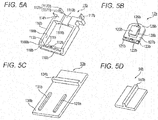
- FIGS. 5A and 6B are views showing a tension measuring device 1b (a first gel adapter holder 11b and a second gel adapter holder 12b), a substrate 13b, and a gel forming lid body 14b in another embodiment.
- the basic configuration and the concept of the invention are the same as the tension measuring device (1, 1a) (the first gel adapter holder (11, 11a) and the second gel adapter holder (12, 12a)), the substrate (13, 13a), and the gel forming lid body (14, 14a), and the respective members provided therein of the first embodiment and the second embodiment.
- a first gel holding opening 112b of the first gel adapter holder 11b is formed integrally with a frame inside bottom face 119b as shown in FIG. 5A . Further, a frame member 110b is formed integrally with a surrounding member 116b as shown in FIG. 5A .
- a pair of protruding members for attachment and detachment 117b for attaching and detaching the tension measuring device 1b is provided at a device installation opening 24 of a culture medium tank lid body 21 described later.
- the protruding member for attachment and detachment 117b is formed from a protruding member upper part 1170b and a protruding member lower part 1171b.
- the protruding member upper part 1170b is provided obliquely inward so as to be inserted into the device installation opening 24.
- the pair of protruding members for attachment and detachment 117b are bilaterally symmetrically provided in the frame upper member 114b.
- the pair of protruding members for attachment and detachment 117b are provided at an interval so that they can be attached to and detached from the device installation opening 24.
- the pair of protruding members for attachment and detachment 117b are inserted into the device installation opening 24 by being deformed inward due to its elasticity and fixed to the device installation opening 24 by being restored to the original shape due to the restoring force of the pair of protruding members for attachment and detachment 117b.
- a second gel holding opening 122b of the second gel adapter holder 12b is formed integrally with a second gel adapter holder main body 127b.
- FIG. 6A shows a state where the first gel adapter holder 11b, the second gel adapter holder 12b, and the substrate 13b are assembled.
- FIG. 6B shows a state where the gel forming lid body 14b is further assembled with the assembly in FIG. 6A .
- the tension measuring device (1, 1a, 1b) (the first gel adapter holder (11, 11a, 11b) and the second gel adapter holder (12, 12a, 12b)), the substrate (13, 13a, 13b), and the gel forming lid body (14, 14a, 14b), for example, polyethylene, polypropylene, polycarbonate, polystyrene, polyvinyl chloride, nylon, polyurethane, polyurea, polylactic acid, polyglycolic acid, polyvinyl alcohol, polyvinyl acetate, poly(meth)acrylate, a poly(meth)acrylate derivative, polyacrylonitrile, poly(meth)acrylamide, a poly(meth)acrylamide derivative, polysulfone, polycarbonate, cellulose, a cellulose derivative, polysilicone, a glass, a ceramic, a metal, and the like are exemplified.
- the presently disclosed subject matter provides a kit for forming a device for measuring the tension of a sheet-like tissue containing cardiomyocytes, including:
- the kit may be a kit including a gel for forming the film-like gel between the first gel holding member and the second gel holding member.
- any gel can be utilized as long as (1) the sheet-like tissue containing cardiomyocytes can adhere to the gel, (2) the gel has a strength capable of maintaining the form of a sheet, and (3) the gel does not adversely affect the growth of cells, the functional expression thereof, etc., that is, it is a biocompatible gel.
- the gel which can be used in the presently disclosed subject matter is, for example, a hydrogel.
- hydrogel which can be used in the presently disclosed subject matter, for example, a hydrogel in which a water-soluble, hydrophilic, or water-absorbing synthetic polymer such as polyacrylamide, polyacrylic acid, polyhydroxyethylmethacrylate, polyvinyl alcohol, polylactic acid, or polyglycolic acid, a polysaccharide, a protein, a nucleic acid, or the like is chemically crosslinked is exemplified.
- the polysaccharide include glycosaminoglycans such as hyaluronic acid and chondroitin sulfate, starch, glycogen, agarose, pectin, cellulose, and the like.
- examples of the protein include collagen, gelatin which is a hydrolysate thereof, proteoglycan, fibronectin, vitronectin, laminin, entactin, tenascin, thrombospondin, von Willebrand factor, osteopontin, fibrinogen (for example, a fibrin gel obtained by reacting fibrinogen with thrombin), and the like.
- These hydrogels may be used after being subjected to a crosslinking treatment using a known method to increase the strength thereof.
- the gel to be used in the presently disclosed subject matter is preferably a fibrin gel.
- the film-like gel may be a gel formed by mixing cells in advance.
- a method of using the kit for forming a device for measuring the tension of a sheet-like tissue containing cardiomyocytes will be described with reference to FIGS. 7A to 8B .
- the sheet-like tissue ST containing cardiomyocytes in a single layer may be adhered to the gel G or in a plurality of layers may be adhered thereto.
- a desired material is obtained.
- the sheet-like tissue ST containing cardiomyocytes is formed into the same shape as that of the gel G in advance before it is adhered to the gel G.
- a method for molding the sheet-like tissue ST into the same shape as that of the gel G for example, a method in which the cultured sheet-like cell group is cut using a surgical knife or the like, and a method in which cells are seeded by utilizing a mold M which limits the region where the cells are adhered to the shape of the gel G in advance are exemplified (see, for example, FIG. 8A ).
- the sheet-like tissue ST containing cardiomyocytes By adhering the lower face of the gel G onto the sheet-like tissue ST containing cardiomyocytes formed into the shape of the gel G, the sheet-like tissue ST containing cardiomyocytes can be simply adhered to the gel G without contraction of the sheet-like tissue ST containing cardiomyocytes (see FIG. 8B ).
- the sheet-like tissue ST containing cardiomyocytes may be formed by directly seeding the cell group containing cardiomyocytes on the upper face of the film-like gel G formed in the above-mentioned step (iii), followed by culturing the cells at 37°C until confluence or subconfluence is reached. By doing this, the film-like gel G to which the sheet-like tissue ST containing cardiomyocytes is adhered can be obtained.
- the tension measuring device 1 of the presently disclosed subject matter may be provided as a device in which the film-like gel G is formed in advance between the first gel holding member 111 and the second gel holding member 121 by the above-mentioned using method, and also may be provided as a device in which the sheet-like tissue ST containing cardiomyocytes is further adhered to the film-like gel G.
- the presently disclosed subject matter also provides a system for measuring the tension of a sheet-like tissue containing cardiomyocytes.
- the system for measuring the tension of a sheet-like tissue containing cardiomyocytes includes, for example, the following members:
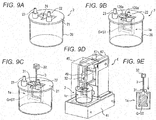
- the tension measuring device including a film-like gel and a sheet-like tissue containing cardiomyocytes adhered to the film-like gel is dipped in a culture medium tank 2.
- the culture medium tank 2 is composed of a culture medium tank main body 20 and a culture medium tank lid body 21.
- the culture medium tank lid body 21 includes a culture medium supply line connector 22 and a culture medium discharge line connector 23, which are connected to a culture medium supply line 42 and a culture medium discharge line 43, respectively. According to this, a culture medium in the culture medium tank 2 can be replaced.
- the culture medium tank lid body 21 is provided with a device installation opening 24. As shown in FIG.
- a tension measuring device (1, 1a, 1b) including a gel G and a sheet-like tissue ST containing cardiomyocytes is fitted in the device installation opening 24.
- a frame member (110, 110a) of the tension measuring device (1, 1a, 1b) may be provided with a protruding member so that the tension measuring device (1, 1a, 1b) does not fall from the device installation opening 24. For example, as described above, it may be fixed by the protruding member for attachment and detachment 117b.
- a hook 31 of a tension detection unit connector 3 is passed through a connection opening (126, 126a) of a second gel adapter holder (12, 12a, 12b), whereby the culture medium tank 2 is installed on a culture system 4.
- the culture system is provided with a tension detection unit 40.
- a tension detection unit connection member 32 of the tension detection unit connector 3 is connected to the tension detection unit 40.
- the tension detection unit connector 3 may be any as long as it has a function to connect the second gel adapter holder (12, 12a, 12b) to the tension detection unit 40, and may be a sandwiching unit (not shown) other than the hook 31.
- the culture medium tank lid body 21 may be further provided with a reagent supply opening although not shown in the drawing. By adding an arbitrary drug through the reagent supply opening, the effect of the drug on the cardiomyocytes can be examined.
- the drug may be supplied into the culture medium tank 2 by adding the drug to a culture medium reservoir tank (not shown) connected to the culture medium supply line 42.
- the culture medium is supplied to the culture medium tank 2 by, for example, a tube pump, and the culture medium is discharged by the same tube pump.
- the culture medium tank 2 may be further provided with a known pH sensor, a known dissolved oxygen sensor, a known temperature sensor, or the like.
- a culture control member 41 of the culture system 4 includes a heater so as to keep the temperature of the culture medium constant. Further, it may have a magnetic stirrer function. According to this, the culture medium in the culture medium tank 2 can be stirred.
- the culture system 4 is provided with a hood 44 so as to prevent a foreign substance from mixing into the culture medium tank 2.
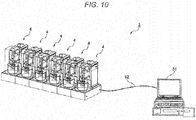
- FIG.10 shows a tension measuring system 5 of an embodiment of the presently disclosed subject matter.
- the tension detection unit 40 of the culture system 4 mounted with the tension measuring device (1, 1a, 1b) is electrically connected to an arithmetic unit 51 through a cable 52.
- a signal detected by the tension detection unit 40 is input to the arithmetic unit 51 through the cable 52, and the signal is arithmetically processed by the arithmetic unit 51, whereby the tension is calculated.
- the calculated result is displayed on an output unit, for example, a monitor or the like, electrically connected to the arithmetic unit 51.
Landscapes
- Health & Medical Sciences (AREA)
- Life Sciences & Earth Sciences (AREA)
- Engineering & Computer Science (AREA)
- Immunology (AREA)
- Biomedical Technology (AREA)
- Chemical & Material Sciences (AREA)
- General Health & Medical Sciences (AREA)
- Molecular Biology (AREA)
- Physics & Mathematics (AREA)
- Biotechnology (AREA)
- Pathology (AREA)
- Biochemistry (AREA)
- Hematology (AREA)
- Urology & Nephrology (AREA)
- General Physics & Mathematics (AREA)
- Analytical Chemistry (AREA)
- Microbiology (AREA)
- Cell Biology (AREA)
- Organic Chemistry (AREA)
- Rheumatology (AREA)
- Bioinformatics & Cheminformatics (AREA)
- Genetics & Genomics (AREA)
- Wood Science & Technology (AREA)
- Zoology (AREA)
- Medicinal Chemistry (AREA)
- Food Science & Technology (AREA)
- Cardiology (AREA)
- Medical Informatics (AREA)
- Dentistry (AREA)
- Oral & Maxillofacial Surgery (AREA)
- Orthopedic Medicine & Surgery (AREA)
- Biophysics (AREA)
- Heart & Thoracic Surgery (AREA)
- General Engineering & Computer Science (AREA)
- Surgery (AREA)
- Animal Behavior & Ethology (AREA)
- Public Health (AREA)
- Veterinary Medicine (AREA)
- Apparatus Associated With Microorganisms And Enzymes (AREA)
- Force Measurement Appropriate To Specific Purposes (AREA)
Abstract
Description
- The presently disclosed subject matter relates to a device, a system and a kit for measuring the tension of a sheet-like tissue containing cardiomyocytes.
- In drug discovery research, an in vitro study using cultured cells and an in vivo study using experimental animals for evaluating the safety and effectiveness of a developed drug are carried out. In the former study, an in vitro culture system for animal cells is used. In the latter study, evaluation is carried out by a system using experimental animals centered on rodent animals.
- In general, it is also said that the success rate of drug discovery is about 1/6000, and because of failure of development of many candidate drugs, the research and development cost for a pharmaceutical company or the like tends to increase. In general, it is also said that an investment of several tens of billion yen is required for developing one type of new drug. The main factor for the failure of new drug development is said to be derived from (I) a difference between an evaluation screening system using cells alone and an actual human biological tissue and (2) a difference between an experimental animal and a human. It has been demanded in the drug discovery and development field that these differences be eliminated to improve the success rate of drug discovery and reduce the research and development cost.
- In recent years, a drug discovery screening method utilizing pluripotent stem cells such as iPS cells having an ability to differentiate into various functional cells has been developed. However, a conventionally used evaluation system uses cells alone, and does not reflect the state of a biological tissue. Therefore, it has been demanded that an evaluation system which mimics a biological tissue be developed from somatic cells differentiated and induced from pluripotent stem cells.
- As an attempt to three-dimensionally construct cells, for example, a method in which cells are seeded in a three-dimensional structure called "scaffold", a method in which an organ or a tissue is decellularized, and cells are seeded in the remaining matrix to be formed into a three-dimensional shape, a method in which sheets of cells exfoliated in sheets are three-dimensionally stacked, etc. have been developed (for example, Patent Document I).
- As one of the methods for forming a cell sheet, there is a method using a cell culture dish (temperature responsive culture dish) coated with poly(N-isopropylacrylamide) (PIPAAm) (Patent Document 1). An arbitrary cell is cultured on a temperature responsive culture dish coated with PIPAAm, and after the cells become confluent, the temperature is decreased to 20°C which is lower than 32°C as the lower critical solution temperature (LCST) of PIPAAm, whereby cells in the form of a sheet (a cell sheet) are obtained noninvasively.
- By making full use of such a technique, research and development of an evaluation system to be utilized in drug discovery screening have been performed. As one of the evaluation systems, a myocardial tissue for evaluating the cardiotoxicity of a candidate drug has been tried to be constructed (for example,
Patent Documents 2 and 3). However, the construction of the evaluation system by such a method is very complicated, and is not suitable for mass production. Further, muscle contraction cannot be quantitatively measured. - The development of a new evaluation system which can be utilized in a drug discovery screening system, particularly, a cardiotoxicity screening test and also can be mass-produced, and employs a simple procedure has been awaited.
-
- Patent Document 1:
JP-A-02-211865 - Patent Document 2:
WO 2012/036224 - Patent Document 3:
WO 2012/036225 - Non-Patent Document 1: Haraguchi Y., et al., Scaffold-free tissue engineering using cell sheet technology, RSC Adv., 2012; 2: 2184-2190
- An object of the presently disclosed subject matter is to provide a device for measuring the tension of a sheet-like tissue containing cardiomyocytes, which enables quantitative measurement of muscle contraction and can be mass-produced, a system, and a kit.
- The present inventors carried out research and development in addition to investigation from various angles for achieving the above object. As a result, they arrived at the presently disclosed subject matter providing a device for measuring the tension of a sheet-like tissue containing cardiomyocytes, which enables quantitative measurement of muscle contraction and can be mass-produced, by contriving the form of the device for measuring the tension of a sheet-like tissue containing cardiomyocytes, a system, and a kit. That is, the presently disclosed subject matter is as follows.
- [1] A device which is a device for measuring the tension of a sheet-like tissue containing cardiomyocytes, including:
- a first gel adapter holder having a frame member and a first gel holding member protruding toward a part of an inside face of the frame member so as to fix one end of a film-like gel; and
- a second gel adapter holder having a second gel holding member for fixing the other end of the gel and a connection member connected to the second gel holding member,
- wherein the second gel adapter holder is attached to the first gel adapter holder so that the second gel holding member is opposed to the first gel holding member inside the frame member, and
- the second gel adapter holder has a mechanism for sliding in an axial direction in which the first gel holding member and the second gel holding member are opposed to each other.
- [2] The device according to [1], wherein the first gel holding member has one or more first gel holding openings and the second gel holding member has one or more second gel holding openings.
- [3] The device according to [2], wherein two to five first gel holding openings and two to five second gel holding openings are provided.
- [4] The device according to any one of [1] to [3], wherein the thicknesses of the first gel holding member and the second gel holding member are thinner than the thickness of the frame member.
- [5] The device according to any one of [1] to [4], wherein the thickness of the frame member is from 0.5 mm to 3.0 mm.
- [6] The device according to any one of [1] to [5], wherein the first gel adapter holder is provided with a stopper for restricting the slidable range of the second gel adapter holder.
- [7] The device according to any one of [1] to [6], wherein a film-like gel is provided between the first gel holding member and the second gel holding member.
- [8] The device according to [7], wherein the gel is a hydrogel.
- [9] The device according to [7] or [8], wherein the gel is a fibrin gel.
- [10] The device according to any one of [7] to [9], wherein a sheet-like tissue containing cardiomyocytes adhered to the film-like gel is provided.
- [11] The device according to [10], wherein the sheet-like tissue is a cell sheet.
- [12] A system for measuring the tension of a sheet-like tissue containing cardiomyocytes, including:
- the device according to [10] or [11],
- a culture medium tank for dipping the device;
- a tension detection unit which is connected to the connection member of the second gel adapter holder;
- an arithmetic unit which is connected to the tension detection unit, arithmetically processes a signal detected by the tension detection unit, and calculates the tension; and
- an output unit which displays the result calculated by the arithmetic unit.
- [13] The system according to [12], wherein the tension detection unit is a load cell.
- [14] A kit for forming the device according to any one of [1] to [9], including:
- a first gel adapter holder having a frame member and a first gel holding member provided protruding toward a part of an inside face of the frame member for fixing one end of a film-like gel;
- a second gel adapter holder having a second gel holding member for fixing the other end of the gel and a connection member connected to or integrated with the second gel holding member;
- a substrate having a pair of gel molding protruding members fitted along the inside face of the frame member; and
- a gel forming lid body having a face parallel to a gel contact face of the substrate for forming the upper face of the gel,
- wherein the second gel adapter holder is attached to the first gel adapter holder so that the second gel holding member is opposed to the first gel holding member inside the frame member, and
- the second gel adapter holder has a mechanism for sliding in an axial direction in which the first gel holding member and the second gel holding member are opposed to each other.
- [15] The kit according to [14], wherein the first gel holding member has one or more first gel holding openings and the second gel holding member has one or more second gel holding openings.
- [16] The kit according to [14] or [15], wherein the thicknesses of the first gel holding member and the second gel holding member are thinner than the thickness of the frame member.
- [17] The kit according to [16], further including a gel for forming the gel.
- According to the presently disclosed subject matter, a device capable of simply measuring the tension of a sheet-like tissue containing cardiomyocytes, which was difficult to handle because of its thinness, is provided. Further, the device can be easily incorporated into a system for measuring the tension of a sheet-like tissue containing cardiomyocytes, and enables acquisition of data reproducibly and stably.
-
-
FIGS. 1A to 1H are views illustrating a tension measuring device, a substrate, and a gel forming lid body of an embodiment of the presently disclosed subject matter; -
FIG. 1A is a front view of the tension measuring device; -
FIG. 1B is a rear view ofFIG. 1A ; -
FIG. 1C is a perspective view of a second gel adapter holder; -
FIG. 1D is a plan view of a first gel adapter holder; -
FIG. 1E is a plan view of the tension measuring device; -
FIG. 1F is a rear view of the tension measuring device in which the second gel adapter holder is slid up; -
FIG. 1G is a front view of the substrate; -
FIG. 1H is a front view of the gel forming lid body; -
FIGS. 2A and 2B are views of an assembly of the respective members inFIG. 1 ; -
FIG. 2A is a view before assembling the respective members inFIG. 1 ; -
FIG. 2B is a view after assembling the respective members inFIG. 1 ; -
FIGS. 3A to 3H are view illustrating a tension measuring device, a substrate, and a gel forming lid body of an embodiment of the presently disclosed subject matter; -
FIG. 3A is a front view of the tension measuring device; -
FIG. 3B is a rear view ofFIG. 3A ; -
FIG. 3C is a perspective view ofFIG. 3A ; -
FIG. 3D is a perspective view of a second gel adapter holder; -
FIG. 3E is a plan view of a first gel adapter holder; -
FIG. 3F is a plan view of the tension measuring device; -
FIG. 3G is a front view of the substrate; -
FIG. 3H is a front view of the gel forming lid body; -
FIGS. 4A and 4B are views of an assembly of the respective members inFIGS. 3A to 3H ; -
FIG. 4A illustrates a view after assembling the respective members inFIGS. 3A to 3H except for the gel forming lid body; -
FIG. 4B illustrates a view after assembling the gel forming lid body with the assembly inFIG. 4A ; -
FIGS. 5A to 5D are views illustrating a tension measuring device, a substrate, and a gel forming lid body of an embodiment of the presently disclosed subject matter; -
FIG. 5A is a perspective view of a first gel adapter holder; -
FIG. 5B is a perspective view of a second gel adapter holder; -
FIG. 5C is a perspective view of the substrate; -
FIG. 5D is a perspective view of the gel forming lid body; -
FIGS. 6A and 6B are views of an assembly of the respective members inFIGS. 5A to 5D ; -
FIG. 6A illustrates a view after assembling the respective members inFIGS. 5A to 5D except for the gel forming lid body; -
FIG. 6B illustrates a view after assembling the gel forming lid body with the assembly inFIG. 6A . -
FIGS. 7A to 7E are views showing a step of forming a tension measuring device using a kit for forming a tension measuring device of an embodiment of the presently disclosed subject matter; -
FIGS. 7A to 7D are steps of forming a tension measuring device; -
FIG. 7E is a cross-sectional view of the tension measuring device obtained inFIG. 7D -
FIGS. 8A and 8B are views showing a step of forming a tension measuring device of an embodiment of the presently disclosed subject matter; -
FIGS. 9A to 9E are views illustrating a tension measuring system of an embodiment of the presently disclosed subject matter; -
FIG. 9A is a view illustrating a culture medium tank; -
FIG. 9B is a view illustrating a culture medium tank mounted with a tension measuring device; -
FIG. 9C is a view illustrating the tension measuring device connected to a tension detection unit connector; -
FIG. 9D is a view illustrating a part of the tension measuring system; -
FIG. 9E is a view illustrating a state where a contracting cardiomyocyte sheet pulls the tension detection unit connector; and -
FIG. 10 is a view illustrating a tension measuring system of an embodiment of the presently disclosed subject matter. - Hereinafter, embodiments of the presently disclosed subject matter will be described with reference to the drawings as needed. The configurations of the embodiments are illustrative and the configuration of the presently disclosed subject matter is not limited to the specific configurations of the embodiments.
- In this specification, the "sheet-like tissue containing cells" refers to a biological tissue collected from a living body or a thin film-like tissue containing cells. The sheet-like tissue containing cells may be a tissue collected from a living body as it is or a biological tissue obtained by processing a tissue collected from a living body into the form of a sheet. Further, the sheet-like tissue containing cells may be a sheet-like tissue formed by mixing a suspension containing cells with a gel, and may also be a cell sheet. In addition, the sheet-like tissue containing cells may be a tissue formed by directly seeding a cell group on the upper face of a film-like gel, followed by culturing.
- In this specification, the "cell sheet" refers to a cell group in the form of a sheet in one layer or a plurality of layers obtained by culturing a cell group containing a plurality of arbitrary cells on a cell culture substrate and exfoliating the cells from the cell culture substrate. As a method for obtaining a cell sheet, for example, a method in which cells are cultured on a stimulus-responsive culture substrate coated with a polymer which changes its molecular structure by a stimulus such as temperature, pH, or light, and the cells are exfoliated in sheets from the stimulus-responsive culture substrate while maintaining the cells in an adhered state by changing the conditions of the stimulus such as temperature, pH, or light so as to change the surface of the stimulus-responsive culture substrate, a method in which cells are cultured on an arbitrary culture substrate and the cultured cells are physically exfoliated using forceps or the like, whereby a cell sheet is obtained, and the like are exemplified. As the stimulus-responsive culture substrate for obtaining a cell sheet, a temperature-responsive culture substrate in which the surface thereof is coated with a polymer which changes its hydration force within a temperature range of 0 to 80°C is known. On the temperature-responsive culture substrate, cells are cultured in a temperature range in which the hydration force of the polymer is weak, and thereafter, the temperature of the culture solution is changed to a temperature at which the polymer becomes in a state where the hydration force is strong, whereby the cells can be exfoliated as a cell group in the form of a sheet.
- The temperature-responsive culture substrate to be used for obtaining a cell sheet is preferably a substrate which changes the hydration force of the surface thereof in a temperature range in which cells can be cultured. The temperature range is preferably a temperature at which cells are generally cultured, for example, from 33°C to 40°C. A temperature-responsive polymer to be coated on a culture substrate to be used for obtaining a cell sheet may be either a homopolymer or a copolymer. As such a polymer, for example, polymers described in
JP-A-2-211865 - A case where poly (N-Isopropylacrylamide) is used as the stimulus-responsive polymer, particularly, as the temperature-responsive polymer will be described as an example (a temperature-responsive culture dish). Poly (N-Isopropylacrylamide) is known as a polymer having a lower critical solution temperature of 31°C, and when it is in a free state, dehydration occurs at a temperature of 31°C or higher in water to aggregate the polymer chains and cause white turbidity. On the other hand, when the temperature is lower than 31°C, the polymer chains are hydrated and become in a state of being dissolved in water. In the presently disclosed subject matter, this polymer is coated on the surface of a substrate such as a dish and fixed thereto. Therefore, if the temperature is 31°C or higher, the polymer on the surface of the culture substrate is also dehydrated in the same manner, however, the polymer chains are fixed to the surface of the culture substrate, and therefore, the surface of the culture substrate comes to show hydrophobicity. On the other hand, when the temperature is lower than 31°C, the polymer on the surface of the culture substrate is hydrated, however, the polymer chains are coated on the surface of the culture substrate, and therefore, the surface of the culture substrate comes to show hydrophilicity. The hydrophobic surface at this time is a moderate surface, to which cells are adhered and on which the cells can proliferate, and further, the hydrophilic surface becomes a surface to which cells cannot be adhered. Therefore, when the substrate is cooled to a temperature lower than 31°C, the cells are exfoliated from the surface of the substrate. If the cells are cultured to confluence on the entire culture surface, a cell sheet can be recovered by cooling the substrate to a temperature lower than 31°C. The temperature-responsive culture substrate is not limited as long as it has the same effect, however, for example, UpCell (registered trademark) commercially available from CellSeed, Inc. (Tokyo, Japan), and the like are exemplified.
- In this specification, the "sheet-like tissue containing cardiomyocytes" refers to a tissue containing at least cardiomyocytes at 10% or more of the number of cells contained in the sheet-like tissue containing cells described above, and the cardiomyocytes are contained therein at, for example, 15% or more, 20% or more, 25% or more, 30% or more, 35% or more, 40% or more, 45% or more, 50% or more, 55% or more, 60% or more, 65% or more, 70% or more, 75% or more, 80% or more, 85% or more, 90% or more, 95% or more, or 99% or more. The "sheet-like tissue containing cardiomyocytes" to be used in the presently disclosed subject matter is preferably beating cardiomyocytes. The cardiomyocytes which can be used in the presently disclosed subject matter may be any as long as the cells are derived from an animal, and for example, cardiomyocytes of a mammal, a bird, an amphibian, a reptile, or a fish can be used. The cardiomyocytes are preferably derived from a mammal, and for example, cardiomyocytes derived from a mammal such as a mouse, a rat, a human, a monkey, a pig, a dog, a sheep, a cat, a goat, or the like can be used.
- The cells which can be used in the presently disclosed subject matter may be primary cells collected from a biological tissue, or may be an established cell line, or may be cells differentiated and induced from pluripotent stem cells or tissue stem cells.
- In this specification, the term "pluripotent stem cells" is intended to be a generic name for stem cells having an ability to differentiate into cells of every possible tissue (differentiation pluripotency). The pluripotent stem cells include, although not limited to, embryonic stem cells (ES cells), embryonic carcinoma cells (EC cells), trophoblast stem cells (TS cells), epiblast stem cells (EpiS cells), embryonic germ cells (EG cells), multipotent germline stem cells (mGS cells), induced pluripotent stem cells (iPS cells), Muse cells, and the like. Preferred are ES cells or iPS cells. As the pluripotent stem cells, arbitrary known cells can be used, and for example, pluripotent stem cells described in
WO 2009/123349 (PCT/JP2009/057041 - The cardiomyocytes which can be used in the presently disclosed subject matter may be cells differentiated and induced from pluripotent stem cells. As a method for differentiating pluripotent cells into cardiomyocytes, a known method can be used (see, for example, Matsuura K., et al., Creation of human cardiac cell sheets using pluripotent stem cells, Biochem. Biophys. Res. Commun. 2012, Aug. 24; 425(2): 321-327, or the like).
- The sheet-like tissue containing cardiomyocytes may contain cells other than cardiomyocytes. For example, cardiac myoblasts, myoblasts, mesenchymal stem cells, vascular endothelial cells, vascular endothelial progenitor cells, fibroblasts, or the like may be contained.
- The presently disclosed subject matter provides a device for measuring the tension of a sheet-like tissue containing cardiomyocytes, including:
- a first gel adapter holder having a frame member and a first gel holding member provided protruding toward a part of an inside face of the frame member for fixing one end of a film-like gel; and
- a second gel adapter holder having a second gel holding member for fixing the other end of the gel and a connection member connected to the second gel holding member,
- wherein the second gel adapter holder is attached to the first gel adapter holder so that the second gel holding member is opposed to the first gel holding member inside the frame member, and
- the second gel adapter holder has a mechanism for sliding in an axial direction in which the first gel holding member and the second gel holding member are opposed to each other.
-
FIGS. 1A to 1H show a tension measuring device 1 of an embodiment of the presently disclosed subject matter, and asubstrate 13 and a gel forminglid body 14 which are used together with the tension measuring device 1. The tension measuring device 1 can include a firstgel adapter holder 11 and a secondgel adapter holder 12. The firstgel adapter holder 11 can include aframe member 110, which is pierced in a rectangular form inside as shown inFIGS. 1A and 1B , and a firstgel holding member 111, which is provided protruding toward a part of an inside face (a frame insidebottom face 119 inFIGS. 1A to 1H ) of theframe member 110 for fixing one end of a film-like gel G (described later). On both sides of the firstgel holding member 111, a space is provided between the firstgel holding member 111 and a frame insideside face 118, and in this space, a gelmolding protruding member 131 of thesubstrate 13 described later is fitted. Theframe member 110 plays a role in becoming a part of a mold frame when the gel G is formed, and also plays a role in preventing an arbitrary object from coming into contact with the gel G and a sheet-like tissue ST from the lateral side. Further, the tension measuring device 1 can be easily attached to a culture mediumtank lid body 21 of a culture medium tank 2 (described later) while maintaining the shape of the gel G and the sheet-like tissue ST by the existence of theframe member 110. - The first
gel holding member 111 is provided in parallel with the thin film of the gel G to be formed. The firstgel holding member 111 is provided with one or more firstgel holding openings 112. On both ends of the firstgel holding member 111, a first gel holding recessedmember 113 is further provided. - By changing the thickness of the
frame member 110, the thickness of the gel G can be changed as appropriate. The thickness of theframe member 110 is not limited, and may be any thickness as long as the sheet-like tissue containing cardiomyocytes can be adhered thereto and stably held thereon and the gel G does not impede the action of beating and contraction of the sheet-like tissue containing cardiomyocytes, and is a thickness of, for example, from 0.5 mm to 3.0 mm, from 0.5 mm to 2.5 mm, from 0.5 mm to 2.0 mm, from 0.5 mm to 1.5 mm, from 1.0 mm to 3.0 mm, from 1.0 mm to 2.5 mm, from 1.0 mm to 2.0 mm, or from 1.0 mm to 1.5 mm, preferably from 0.5 mm to 2.5 mm, more preferably from 0.5 mm to 1.5 mm. - The thickness of the first
gel holding member 111 is formed thinner than the thickness of theframe member 110. Further, the firstgel holding member 111 is provided at an intermediate position in the thickness direction of theframe member 110 on the frame insidebottom face 119. Thereby, the gel G covers both the upper face and the bottom face of the firstgel holding member 111, and thus the gel G is reliably held. - The second
gel adapter holder 12 has a secondgel holding member 121 for fixing the other end of the gel G and aconnection member 120 connected to the secondgel holding member 121. As shown inFIG. 1C , theconnection member 120 and the secondgel holding member 121 are connected to each other through a T-shapedmember 124. The secondgel holding member 121 is provided in parallel with the gel G to be formed. The secondgel holding member 121 is provided with one or more secondgel holding openings 122. On both ends of the secondgel holding member 121, a second gel holding recessedmember 123 is further provided. The thickness of the secondgel holding member 121 is formed thinner than the thickness of the T-shapedmember 124, and preferably, the secondgel holding member 121 has the same thickness as the firstgel holding member 111. Further, the secondgel holding member 121 is provided at an intermediate position in the thickness direction of the T-shapedmember 124. Thereby, the gel G covers both the upper face and the bottom face of the secondgel holding member 121, and thus the gel G is reliably held. - The
connection member 120 is provided with aconnection opening 126 for connecting a tensiondetection unit connector 3. Further, theconnection member 120 is provided with one or more (in this embodiment, two) L-shapedmembers 125 for detachably attaching the secondgel adapter holder 12 to the firstgel adapter holder 11. The L-shapedmember 125 is fitted in afirst guide groove 1110 provided in a part of a frameupper member 114 of the firstgel adapter holder 11. Further, in an upper part of the rear face of theframe member 110, asecond guide groove 1111 for fitting a part of the T-shapedmember 124 of the secondgel adapter holder 12 therein is provided. The width of thesecond guide groove 1111 is designed so that a part of the T-shapedmember 124 is fitted therein and the secondgel adapter holder 12 is not precluded from sliding in the axial direction in which the first gel holding member and the second gel holding member are opposed to each other. Further, the depth of thesecond guide groove 1111 may be substantially the same as the thickness of the T-shapedmember 124. Thereby, in the case where a part of the T-shapedmember 124 is fitted in thesecond guide groove 1111, the rear face of the secondgel adapter holder 12 and the rear face of the firstgel adapter holder 11 are positioned on substantially the same plane (seeFIG. 1E ). A frame upper partrear face 1112 of the firstgel adapter holder 11 is recessed by one step from theframe member 110 and shares a plane with thesecond guide groove 1111. According to this, the secondgel adapter holder 12 can slide up and down without the T-shapedmember 124 being caught by the frame member 110 (seeFIG. 1F ). In this embodiment, in the case where the secondgel adapter holder 12 slides up, the upper part (a stopper 115) of theframe member 110 comes into contact with the T-shapedmember 124, and restricts the slidable range of the secondgel adapter holder 12. Therefore, damage to the gel G and the sheet-like tissue ST containing cardiomyocytes is prevented. - A gel poured into the first
gel holding opening 112 and the secondgel holding opening 122 plays a role in fixing one end of the film-like gel G to the firstgel holding member 111 and the other end of the gel G to the secondgel holding member 121 after it is solidified. The first gel holding recessedmember 113 and the second gel holding recessedmember 123 also achieves an effect of fixing the gel G after the gel is solidified. The number, shape, and size of firstgel holding openings 112 and secondgel holding openings 122 are determined as appropriate according to the size of the gel G to be formed, the viscosity, strength, and polymerization degree of the gel, and the like. For example, 1 to 10, 1 to 5, 2 to 5, or 2 to 4 firstgel holding openings 112 and secondgel holding openings 122 may be provided. The shape of the firstgel holding member 111 and the secondgel holding member 121 is preferably symmetric. - In order to form the gel G in the tension measuring device 1, the
substrate 13 and the gel forminglid body 14 shown inFIGS. 1G to 1H are used. On aplane member 130 of thesubstrate 13, a pair of gelmolding protruding members 131 to be fitted between the firstgel holding member 111 and the secondgel holding member 121, and the frame insideside face 118 are provided. Further, on thesubstrate 13, a gel forming protruding memberupper part 132 to be fitted in the frame upper partrear face 1112 of theframe member 110 is provided. Moreover, on thesubstrate 13, an L-shaped partfitting groove 133 is provided between a pair of gel forming protruding memberupper parts 132. In the L-shaped partfitting groove 133, the T-shapedmember 124 of the secondgel adapter holder 12 is fitted. - The width of the gel forming
lid body 14 substantially coincides with the width of the inner face of the pair of gelmolding protruding members 131 provided on thesubstrate 13. According to this, the gel forminglid body 14 is fitted between the pair of gelmolding protruding members 131. The length of the gel forminglid body 14 of this embodiment may be any length as long as the gel forminglid body 14 covers the space where the gel G is formed. -
FIG. 2A shows a view before assembling the firstgel adapter holder 11, the secondgel adapter holder 12, thesubstrate 13, and the gel forminglid body 14, andFIG. 2B shows a view after assembling these members. -
FIGS. 3A to 4B are views showing atension measuring device 1a (a firstgel adapter holder 11a and a secondgel adapter holder 12a), asubstrate 13a, and a gel forminglid body 14a in another embodiment. The basic configuration and the concept of the invention are the same as the tension measuring device 1 (the firstgel adapter holder 11 and the second gel adapter holder 12), thesubstrate 13, and the gel forminglid body 14, and the respective members provided therein of the first embodiment. The above-mentioned explanation for the respective corresponding members of the first embodiment is applied to the explanation for thetension measuring device 1a (the firstgel adapter holder 11a and the secondgel adapter holder 12a), thesubstrate 13a, and the gel forminglid body 14a, and the respective members provided therein given the same reference numerals as the tension measuring device 1 (the firstgel adapter holder 11 and the second gel adapter holder 12), thesubstrate 13, and the gel forminglid body 14, and the respective members provided therein of the first embodiment except that "a" is added to the reference numeral of each member. Here, only members to which the explanation of the respective members of the first embodiment is not applied will be described. - In the second
gel adapter holder 12a, as shown inFIG. 3D , aconnection member 120a and a secondgel holding member 121a are connected to each other through a second gel adapter holdermain body 127a. The second gel adapter holdermain body 127a is provided with astopper opening 128a. - In an upper part of the rear face of a
frame member 110a, asecond guide groove 1111a for fitting the second gel adapter holdermain body 127a therein is provided. Thesecond guide groove 1111a is further provided with astopper 115a (seeFIG. 3E ). In the case where the secondgel adapter holder 12a is attached to the firstgel adapter holder 11a, thestopper 115a comes into contact with the upper side or the lower side of thestopper opening 128a, and therefore, the width at which the secondgel adapter holder 12a slides up and down can be restricted. Thereby, damage to a gel G and a sheet-like tissue ST containing cardiomyocytes is prevented. - On a
plane member 130a of thesubstrate 13a, a pair of gelmolding protruding members 131a to be fitted between a firstgel holding member 111a and a secondgel holding member 121a, and a frame insideside face 118a are provided. The width of the gelmolding protruding member 131a is designed so as to fill a space to be formed between the firstgel holding member 111a and the secondgel holding member 121a, and the frame insideside face 118a. The height of the gelmolding protruding member 131a is designed to be the same as the thickness of theframe member 110a. Further, the length of the gelmolding protruding member 131a is designed to be the same as that of the frame insideside face 118a. In an upper part of thesubstrate 13a, a protruding member to become a substrateupper member 134a is provided. By the substrateupper member 134a, the secondgel adapter holder 12a can be prevented from sliding up when the gel G is formed. - The first
gel adapter holder 11a in this embodiment can include a surroundingmember 116a vertically provided on the outer periphery of theframe member 110a. The gel forminglid body 14a is designed so as to be fitted in the surroundingmember 116a (seeFIG. 3H ). The gel forminglid body 14a is provided with agrip member 140a so as to facilitate the detachment of the gel forminglid body 14a from the surface of the gel G closely adhered thereto after the gel G is formed. -
FIG. 4A shows a state where the firstgel adapter holder 11a, the secondgel adapter holder 12a, and thesubstrate 13a are assembled, andFIG. 4B shows a state where the gel forminglid body 14a is further assembled with the assembly inFIG. 4A . -
FIGS. 5A and6B are views showing atension measuring device 1b (a firstgel adapter holder 11b and a secondgel adapter holder 12b), asubstrate 13b, and a gel forminglid body 14b in another embodiment. The basic configuration and the concept of the invention are the same as the tension measuring device (1, 1a) (the first gel adapter holder (11, 11a) and the second gel adapter holder (12, 12a)), the substrate (13, 13a), and the gel forming lid body (14, 14a), and the respective members provided therein of the first embodiment and the second embodiment. The above-mentioned explanation for the respective corresponding members of the first embodiment or the second embodiment is applied to the explanation for thetension measuring device 1b (the firstgel adapter holder 11b and the secondgel adapter holder 12b), thesubstrate 13b, and the gel forminglid body 14b, and the respective members provided therein given the same reference numerals as the tension measuring device (1, 1a) (the first gel adapter holder (11, 11a) and the second gel adapter holder (12, 12a)), the substrate (13, 13a), and the gel forming lid body (14, 14a), and the respective members provided therein of the first embodiment or the second embodiment except that "b" is added to the reference numeral of each member. Here, only members to which the explanation of the respective members of the first embodiment or the second embodiment is not applied will be described. - A first
gel holding opening 112b of the firstgel adapter holder 11b is formed integrally with a frame insidebottom face 119b as shown inFIG. 5A . Further, aframe member 110b is formed integrally with a surroundingmember 116b as shown inFIG. 5A . In a frameupper member 114b of the firstgel adapter holder 11b, a pair of protruding members for attachment anddetachment 117b for attaching and detaching thetension measuring device 1b is provided at adevice installation opening 24 of a culture mediumtank lid body 21 described later. The protruding member for attachment anddetachment 117b is formed from a protruding memberupper part 1170b and a protruding member lower part 1171b. The protruding memberupper part 1170b is provided obliquely inward so as to be inserted into thedevice installation opening 24. Further, the pair of protruding members for attachment anddetachment 117b are bilaterally symmetrically provided in the frameupper member 114b. The pair of protruding members for attachment anddetachment 117b are provided at an interval so that they can be attached to and detached from thedevice installation opening 24. The pair of protruding members for attachment anddetachment 117b are inserted into thedevice installation opening 24 by being deformed inward due to its elasticity and fixed to thedevice installation opening 24 by being restored to the original shape due to the restoring force of the pair of protruding members for attachment anddetachment 117b. - As shown in
FIG. 5B , a secondgel holding opening 122b of the secondgel adapter holder 12b is formed integrally with a second gel adapter holdermain body 127b. -
FIG. 6A shows a state where the firstgel adapter holder 11b, the secondgel adapter holder 12b, and thesubstrate 13b are assembled.FIG. 6B shows a state where the gel forminglid body 14b is further assembled with the assembly inFIG. 6A . - As a material of the tension measuring device (1, 1a, 1b) (the first gel adapter holder (11, 11a, 11b) and the second gel adapter holder (12, 12a, 12b)), the substrate (13, 13a, 13b), and the gel forming lid body (14, 14a, 14b), for example, polyethylene, polypropylene, polycarbonate, polystyrene, polyvinyl chloride, nylon, polyurethane, polyurea, polylactic acid, polyglycolic acid, polyvinyl alcohol, polyvinyl acetate, poly(meth)acrylate, a poly(meth)acrylate derivative, polyacrylonitrile, poly(meth)acrylamide, a poly(meth)acrylamide derivative, polysulfone, polycarbonate, cellulose, a cellulose derivative, polysilicone, a glass, a ceramic, a metal, and the like are exemplified.
- The presently disclosed subject matter provides a kit for forming a device for measuring the tension of a sheet-like tissue containing cardiomyocytes, including:
- a first gel adapter holder having a frame member and a first gel holding member provided protruding toward a part of an inside face of the frame member for fixing one end of a film-like gel;
- a second gel adapter holder having a second gel holding member for fixing the other end of the gel and a connection member connected to or integrated with the second gel holding member;
- a substrate having a pair of gel molding protruding members fitted along the inside face of the frame member; and
- a gel forming lid body having a face parallel to a gel contact face of the substrate for forming the upper face of the gel,
- wherein the second gel adapter holder is attached to the first gel adapter holder so that the second gel holding member is opposed to the first gel holding member inside the frame member, and
- the second gel adapter holder has a mechanism for sliding in an axial direction in which the first gel holding member and the second gel holding member are opposed to each other.
- Further, the kit may be a kit including a gel for forming the film-like gel between the first gel holding member and the second gel holding member.
- In the presently disclosed subject matter, as the gel to be used for forming the film-like gel, any gel can be utilized as long as (1) the sheet-like tissue containing cardiomyocytes can adhere to the gel, (2) the gel has a strength capable of maintaining the form of a sheet, and (3) the gel does not adversely affect the growth of cells, the functional expression thereof, etc., that is, it is a biocompatible gel. The gel which can be used in the presently disclosed subject matter is, for example, a hydrogel. As the hydrogel which can be used in the presently disclosed subject matter, for example, a hydrogel in which a water-soluble, hydrophilic, or water-absorbing synthetic polymer such as polyacrylamide, polyacrylic acid, polyhydroxyethylmethacrylate, polyvinyl alcohol, polylactic acid, or polyglycolic acid, a polysaccharide, a protein, a nucleic acid, or the like is chemically crosslinked is exemplified. Examples of the polysaccharide include glycosaminoglycans such as hyaluronic acid and chondroitin sulfate, starch, glycogen, agarose, pectin, cellulose, and the like. Further, examples of the protein include collagen, gelatin which is a hydrolysate thereof, proteoglycan, fibronectin, vitronectin, laminin, entactin, tenascin, thrombospondin, von Willebrand factor, osteopontin, fibrinogen (for example, a fibrin gel obtained by reacting fibrinogen with thrombin), and the like. These hydrogels may be used after being subjected to a crosslinking treatment using a known method to increase the strength thereof. The gel to be used in the presently disclosed subject matter is preferably a fibrin gel. In one embodiment of the presently disclosed subject matter, the film-like gel may be a gel formed by mixing cells in advance.
- A method of using the kit for forming a device for measuring the tension of a sheet-like tissue containing cardiomyocytes will be described with reference to
FIGS. 7A to 8B . - (i) The
substrate 13 is mounted on the tension measuring device 1 (the firstgel adapter holder 11 and the second gel adapter holder 12), and a gel (for example, a mixed liquid of fibrinogen (Type I-S derived from bovine plasma, SIGMA), thrombin (T4648 derived from bovine plasma, SIGMA), a CaCl2 solution (8mM), and Factor XIII (Fibrogammin P for intravenous injection, CSL Behring) before curing is injected into a film-like gel forming member S using a pipette P (FIG. 7A ). At this time, the gel before curing is injected while being careful so as to prevent air from mixing in the firstgel holding opening 112 and the secondgel holding opening 122. - (ii) After injection, the film-like gel forming member S is covered with the gel forming lid body 14 (
FIG. 7B ). - (iii) After the gel is cured, the gel forming
lid body 14 and thesubstrate 13 are detached from the tension measuring device 1 (FIG. 7C ). - (iv) Apart from the above, a cell group containing cardiomyocytes is seeded on a temperature responsive culture dish D1 (for example, UpCell (registered trademark), CellSeed, Inc. Tokyo, Japan) and previously cultured at 37°C until confluence is reached.
- (v) On the sheet-like tissue ST containing cardiomyocytes in the temperature responsive culture dish D1, the tension measuring device 1 including the film-like gel obtained above is placed (
FIG. 7D ). - (vi) Thereafter, the sheet-like tissue ST containing cardiomyocytes is exfoliated from the temperature responsive culture dish Dl while being maintained at a temperature equal to or lower than the lower critical solution temperature of the temperature responsive culture dish D1, for example, 20°C, and at the same time, the sheet-like tissue ST containing cardiomyocytes is adhered to the lower face of the gel G (
FIG. 7E ). - The sheet-like tissue ST containing cardiomyocytes in a single layer may be adhered to the gel G or in a plurality of layers may be adhered thereto. In order to adhere the sheet-like tissue ST containing cardiomyocytes in a plurality of layers, by repeating the above-mentioned (v) and (vi) arbitrary times, a desired material is obtained.
- It is preferred that the sheet-like tissue ST containing cardiomyocytes is formed into the same shape as that of the gel G in advance before it is adhered to the gel G. As a method for molding the sheet-like tissue ST into the same shape as that of the gel G, for example, a method in which the cultured sheet-like cell group is cut using a surgical knife or the like, and a method in which cells are seeded by utilizing a mold M which limits the region where the cells are adhered to the shape of the gel G in advance are exemplified (see, for example,
FIG. 8A ). By adhering the lower face of the gel G onto the sheet-like tissue ST containing cardiomyocytes formed into the shape of the gel G, the sheet-like tissue ST containing cardiomyocytes can be simply adhered to the gel G without contraction of the sheet-like tissue ST containing cardiomyocytes (seeFIG. 8B ). - In another embodiment, the sheet-like tissue ST containing cardiomyocytes may be formed by directly seeding the cell group containing cardiomyocytes on the upper face of the film-like gel G formed in the above-mentioned step (iii), followed by culturing the cells at 37°C until confluence or subconfluence is reached. By doing this, the film-like gel G to which the sheet-like tissue ST containing cardiomyocytes is adhered can be obtained.
- The tension measuring device 1 of the presently disclosed subject matter may be provided as a device in which the film-like gel G is formed in advance between the first
gel holding member 111 and the secondgel holding member 121 by the above-mentioned using method, and also may be provided as a device in which the sheet-like tissue ST containing cardiomyocytes is further adhered to the film-like gel G. - The presently disclosed subject matter also provides a system for measuring the tension of a sheet-like tissue containing cardiomyocytes. The system for measuring the tension of a sheet-like tissue containing cardiomyocytes includes, for example, the following members:
- (1) a device which is a device for measuring the tension of a sheet-like tissue including:
- a first gel adapter holder having a frame member and a first gel holding member provided protruding toward a part of an inside face of the frame member for fixing one end of a film-like gel; and
- a second gel adapter holder having a second gel holding member for fixing the other end of the gel and a connection member connected to the second gel holding member,
- wherein the second gel adapter holder is attached to the first gel adapter holder so that the second gel holding member is opposed to the first gel holding member inside the frame member,
- the second gel adapter holder has a mechanism for sliding in an axial direction in which the first gel holding member and the second gel holding member are opposed to each other,
- a film-like gel is provided between the first gel holding member and the second gel holding member, and
- a sheet-like tissue containing cardiomyocytes adhered to the lower face of the film-like gel is included;
- (2) a culture medium tank for dipping the device (1);
- (3) a tension detection unit which is connected to the connection member of the second gel adapter holder;
- (4) an arithmetic unit which is connected to the tension detection unit, arithmetically processes a signal detected by the tension detection unit, and calculates the tension; and
- (5) an output unit which displays the result calculated by the arithmetic unit.
- The tension measuring device including a film-like gel and a sheet-like tissue containing cardiomyocytes adhered to the film-like gel is dipped in a
culture medium tank 2. Theculture medium tank 2 is composed of a culture medium tankmain body 20 and a culture mediumtank lid body 21. The culture mediumtank lid body 21 includes a culture mediumsupply line connector 22 and a culture mediumdischarge line connector 23, which are connected to a culturemedium supply line 42 and a culturemedium discharge line 43, respectively. According to this, a culture medium in theculture medium tank 2 can be replaced. The culture mediumtank lid body 21 is provided with adevice installation opening 24. As shown inFIG. 9B , a tension measuring device (1, 1a, 1b) including a gel G and a sheet-like tissue ST containing cardiomyocytes is fitted in thedevice installation opening 24. A frame member (110, 110a) of the tension measuring device (1, 1a, 1b) may be provided with a protruding member so that the tension measuring device (1, 1a, 1b) does not fall from thedevice installation opening 24. For example, as described above, it may be fixed by the protruding member for attachment anddetachment 117b. - A
hook 31 of a tensiondetection unit connector 3 is passed through a connection opening (126, 126a) of a second gel adapter holder (12, 12a, 12b), whereby theculture medium tank 2 is installed on a culture system 4. The culture system is provided with atension detection unit 40. A tension detectionunit connection member 32 of the tensiondetection unit connector 3 is connected to thetension detection unit 40. When the sheet-like tissue ST containing cardiomyocytes contracts, the second gel adapter holder (12, 12a, 12b) is pulled downward, and a load is detected by thetension detection unit 40 through the tension detection unit connector 3 (FIG. 9E ). As thetension detection unit 40, for example, a known load cell can be used. According to this, a contraction force (tension) generated by the beating of the sheet-like tissue ST containing cardiomyocytes can be measured. The tensiondetection unit connector 3 may be any as long as it has a function to connect the second gel adapter holder (12, 12a, 12b) to thetension detection unit 40, and may be a sandwiching unit (not shown) other than thehook 31. - The culture medium
tank lid body 21 may be further provided with a reagent supply opening although not shown in the drawing. By adding an arbitrary drug through the reagent supply opening, the effect of the drug on the cardiomyocytes can be examined. The drug may be supplied into theculture medium tank 2 by adding the drug to a culture medium reservoir tank (not shown) connected to the culturemedium supply line 42. Although not shown in the drawing here, the culture medium is supplied to theculture medium tank 2 by, for example, a tube pump, and the culture medium is discharged by the same tube pump. Theculture medium tank 2 may be further provided with a known pH sensor, a known dissolved oxygen sensor, a known temperature sensor, or the like. - A culture control member 41 of the culture system 4 includes a heater so as to keep the temperature of the culture medium constant. Further, it may have a magnetic stirrer function. According to this, the culture medium in the
culture medium tank 2 can be stirred. The culture system 4 is provided with a hood 44 so as to prevent a foreign substance from mixing into theculture medium tank 2. -
FIG.10 shows a tension measuring system 5 of an embodiment of the presently disclosed subject matter. Thetension detection unit 40 of the culture system 4 mounted with the tension measuring device (1, 1a, 1b) is electrically connected to anarithmetic unit 51 through acable 52. A signal detected by thetension detection unit 40 is input to thearithmetic unit 51 through thecable 52, and the signal is arithmetically processed by thearithmetic unit 51, whereby the tension is calculated. The calculated result is displayed on an output unit, for example, a monitor or the like, electrically connected to thearithmetic unit 51.
Claims (17)
- A device for measuring a tension of a sheet-like tissue containing cardiomyocytes comprising:a first gel adapter holder having a frame member and a first gel holding member protruding toward a part of an inside face of the frame member so as to fix one end of a film-like gel; anda second gel adapter holder having a second gel holding member for fixing the other end of the gel and a connection member connected to the second gel holding member,wherein the second gel adapter holder is attached to the first gel adapter holder so that the second gel holding member is opposed to the first gel holding member inside the frame member, andthe second gel adapter holder has a mechanism for sliding in an axial direction in which the first gel holding member and the second gel holding member are opposed to each other.
- The device according to claim 1, wherein the first gel holding member has one or more first gel holding openings and the second gel holding member has one or more second gel holding openings.
- The device according to claim 2, wherein two to five first gel holding openings and two to five second gel holding openings are provided.
- The device according to any one of claims 1 to 3, wherein the thicknesses of the first gel holding member and the second gel holding member are thinner than the thickness of the frame member.
- The device according to any one of claims 1 to 4, wherein the thickness of the frame member is from 0.5 mm to 3.0 mm.
- The device according to any one of claims 1 to 5, wherein the first gel adapter holder is provided with a stopper for restricting the slidable range of the second gel adapter holder.
- The device according to any one of claims 1 to 6, wherein a film-like gel is provided between the first gel holding member and the second gel holding member.
- The device according to claim 7, wherein the gel is a hydrogel.
- The device according to claims 7 or 8, wherein the gel is a fibrin gel.
- The device according to any one of claims 7 to 9, wherein a sheet-like tissue containing cardiomyocytes adhered to the film-like gel is provided.
- The device according to claim 10, wherein the sheet-like tissue is a cell sheet.
- A system for measuring a tension of a sheet-like tissue containing cardiomyocytes comprising:the device according to claim 10 or 11;a culture medium tank which dips the device;a tension detection unit which is connected to the connection member of the second gel adapter holder;an arithmetic unit which is connected to the tension detection unit, arithmetically processes a signal detected by the tension detection unit, and calculates the tension; andan output unit which displays the result calculated by the arithmetic unit.
- The system according to claim 12, wherein the tension detection unit is a load cell.
- A kit for forming the device according to any one of claims 1 to 9, comprising:a first gel adapter holder having a frame member and a first gel holding member protruding toward a part of an inside face of the frame member so as to fix one end of a film-like gel;a second gel adapter holder having a second gel holding member for fixing the other end of the gel and a connection member connected to or integrated with the second gel holding member;a substrate having a pair of gel molding protruding members fitted along the inside face of the frame member; anda gel forming lid body having a face parallel to a gel contact face of the substrate so as to form an upper face of the gel,wherein the second gel adapter holder is attached to the first gel adapter holder so that the second gel holding member is opposed to the first gel holding member inside the frame member, andthe second gel adapter holder has a mechanism for sliding in an axial direction in which the first gel holding member and the second gel holding member are opposed to each other.
- The kit according to claim 14, wherein the first gel holding member has one or more first gel holding openings and the second gel holding member has one or more second gel holding openings.
- The kit according to claim 14 or 15, wherein the thicknesses of the first gel holding member and the second gel holding member are thinner than the thickness of the frame member.
- The kit according to claim 16, further comprising a gel for forming the gel.
Applications Claiming Priority (1)
| Application Number | Priority Date | Filing Date | Title |
|---|---|---|---|
| JP2017206587A JP7130200B2 (en) | 2017-10-25 | 2017-10-25 | TENSION MEASUREMENT DEVICE, SYSTEM AND KIT FOR SHEET-LIKE TISSUE CONTAINING CARDIAC MUSCLE CELLS |
Publications (2)
| Publication Number | Publication Date |
|---|---|
| EP3477302A1 true EP3477302A1 (en) | 2019-05-01 |
| EP3477302B1 EP3477302B1 (en) | 2024-02-21 |
Family
ID=63965329
Family Applications (1)
| Application Number | Title | Priority Date | Filing Date |
|---|---|---|---|
| EP18201938.0A Active EP3477302B1 (en) | 2017-10-25 | 2018-10-23 | Device, system and kit for measuring tension of sheet-like tissue containing cardiomyocytes |
Country Status (3)
| Country | Link |
|---|---|
| US (1) | US11125670B2 (en) |
| EP (1) | EP3477302B1 (en) |
| JP (1) | JP7130200B2 (en) |
Cited By (2)
| Publication number | Priority date | Publication date | Assignee | Title |
|---|---|---|---|---|
| EP3702446A1 (en) * | 2019-02-28 | 2020-09-02 | Nihon Kohden Corporation | Device, system, and kit for measuring tension of cell structure containing muscle cells |
| EP3882334A1 (en) * | 2020-03-16 | 2021-09-22 | Nihon Kohden Corporation | Tension measuring device |
Families Citing this family (1)
| Publication number | Priority date | Publication date | Assignee | Title |
|---|---|---|---|---|
| JP2022014367A (en) | 2020-07-06 | 2022-01-19 | 日本光電工業株式会社 | Transcription method |
Citations (5)
| Publication number | Priority date | Publication date | Assignee | Title |
|---|---|---|---|---|
| JPH02211865A (en) | 1989-02-10 | 1990-08-23 | Kao Corp | Support material for culturing cell |
| WO2009123349A1 (en) | 2008-03-31 | 2009-10-08 | オリエンタル酵母工業株式会社 | Method for proliferation of pluripotent stem cell |
| WO2012036225A1 (en) | 2010-09-14 | 2012-03-22 | 学校法人 東京女子医科大学 | Method for manufacturing multilayered cell sheet, multilayered cell sheet having vascular network obtained thereby, method of use thereof |
| WO2012036224A1 (en) | 2010-09-14 | 2012-03-22 | 学校法人 東京女子医科大学 | Method for producing layered cell sheets, layered cell sheets having vascular network obtained thereby, and method for utilizing same |
| WO2015134589A1 (en) * | 2014-03-06 | 2015-09-11 | The Regents Of The University Of California | Compositions and methods for measuring cellular mechanical stress |
Family Cites Families (10)
| Publication number | Priority date | Publication date | Assignee | Title |
|---|---|---|---|---|
| US3998217A (en) * | 1975-01-13 | 1976-12-21 | William E. Trumbull | Surgical retractor device |
| US5284766A (en) | 1989-02-10 | 1994-02-08 | Kao Corporation | Bed material for cell culture |
| US5234559A (en) * | 1991-12-31 | 1993-08-10 | E. I. Du Pont De Nemours And Company | Apparatus for direct blotting and automated electrophoresis, transfer and detection and processes utilizing the apparatus thereof |
| US6057150A (en) * | 1997-09-19 | 2000-05-02 | Bio-Rad Laboratories, Inc. | Biaxial strain system for cultured cells |
| US6030340A (en) * | 1997-12-19 | 2000-02-29 | United States Surgical | Surgical retractor |
| US6107081A (en) * | 1999-02-05 | 2000-08-22 | The United States Of America As Represented By The Administrator Of The National Aeronautics And Space Administration | Uni-directional cell stretching device |
| US20140113365A1 (en) * | 2011-04-27 | 2014-04-24 | National University Corporation Okayama University | Cell culturing vessel |
| US10113150B2 (en) * | 2011-06-06 | 2018-10-30 | Invivosciences, Inc. | Engineered cardiac tissues and methods of using them |
| CN103756898B (en) * | 2013-12-24 | 2015-08-19 | 浙江大学 | A kind of stressed culture apparatus of cell three-dimensional applying dynamic load |
| JP6067655B2 (en) * | 2014-11-20 | 2017-01-25 | シャープ株式会社 | Transfer film with frame member, biomolecule analyzer, reagent tank and shaking device |
-
2017
- 2017-10-25 JP JP2017206587A patent/JP7130200B2/en active Active
-
2018
- 2018-10-23 EP EP18201938.0A patent/EP3477302B1/en active Active
- 2018-10-24 US US16/169,119 patent/US11125670B2/en active Active
Patent Citations (5)
| Publication number | Priority date | Publication date | Assignee | Title |
|---|---|---|---|---|
| JPH02211865A (en) | 1989-02-10 | 1990-08-23 | Kao Corp | Support material for culturing cell |
| WO2009123349A1 (en) | 2008-03-31 | 2009-10-08 | オリエンタル酵母工業株式会社 | Method for proliferation of pluripotent stem cell |
| WO2012036225A1 (en) | 2010-09-14 | 2012-03-22 | 学校法人 東京女子医科大学 | Method for manufacturing multilayered cell sheet, multilayered cell sheet having vascular network obtained thereby, method of use thereof |
| WO2012036224A1 (en) | 2010-09-14 | 2012-03-22 | 学校法人 東京女子医科大学 | Method for producing layered cell sheets, layered cell sheets having vascular network obtained thereby, and method for utilizing same |
| WO2015134589A1 (en) * | 2014-03-06 | 2015-09-11 | The Regents Of The University Of California | Compositions and methods for measuring cellular mechanical stress |
Non-Patent Citations (5)
| Title |
|---|
| DAISUKE SASAKI ET AL: "Contractile force measurement of human induced pluripotent stem cell-derived cardiac cell sheet-tissue", PLOS ONE, vol. 13, no. 5, 23 May 2018 (2018-05-23), pages e0198026, XP055545535, DOI: 10.1371/journal.pone.0198026 * |
| HARAGUCHI Y.: "Scaffold-free tissue engineering using cell sheet technology", RSC ADV., vol. 2, 2012, pages 2184 - 2190 |
| MATSUURA K. ET AL.: "Creation of human cardiac cell sheets using pluripotent stem cells", BIOCHEM. BIOPHYS. RES. COMMUN., vol. 425, no. 2, 24 August 2012 (2012-08-24), pages 321 - 327, XP055482020, DOI: doi:10.1016/j.bbrc.2012.07.089 |
| MICHAEL R ZILE ET AL: "Gel stretch method: a new method to measure constitutive properties of cardiac muscle cells", AJP - HEART AND CIRCULATORY PHYSIOLOGY, 1 June 1998 (1998-06-01), United States, pages H2188 - H2202, XP055545731, Retrieved from the Internet <URL:https://www.physiology.org/doi/pdf/10.1152/ajpheart.1998.274.6.H2188> [retrieved on 20190123], DOI: 10.1152/ajpheart.1998.274.6.H2188 * |
| ZHONGGANG FENG ET AL: "An Electro-Tensile Bioreactor for 3-D Culturing of Cardiomyocytes", IEEE ENGINEERING IN MEDICINE AND BIOLOGY MAGAZINE, IEEE SERVICE CENTER, PISACATAWAY, NJ, US, 1 July 2005 (2005-07-01), pages 73 - 79, XP002682110, ISSN: 0739-5175, DOI: 10.1109/MEMB.2005.1463399 * |
Cited By (4)
| Publication number | Priority date | Publication date | Assignee | Title |
|---|---|---|---|---|
| EP3702446A1 (en) * | 2019-02-28 | 2020-09-02 | Nihon Kohden Corporation | Device, system, and kit for measuring tension of cell structure containing muscle cells |
| US11313851B2 (en) | 2019-02-28 | 2022-04-26 | Nihon Kohden Corporation | Device, system, and kit for measuring tension of cell structure containing muscle cells |
| EP3882334A1 (en) * | 2020-03-16 | 2021-09-22 | Nihon Kohden Corporation | Tension measuring device |
| US12352743B2 (en) | 2020-03-16 | 2025-07-08 | Nihon Kohden Corporation | Tension measuring device |
Also Published As
| Publication number | Publication date |
|---|---|
| US20190120742A1 (en) | 2019-04-25 |
| JP2019076046A (en) | 2019-05-23 |
| EP3477302B1 (en) | 2024-02-21 |
| JP7130200B2 (en) | 2022-09-05 |
| US11125670B2 (en) | 2021-09-21 |
Similar Documents
| Publication | Publication Date | Title |
|---|---|---|
| JP7373833B2 (en) | Three-dimensional biological tissue culturing method, three-dimensional biological tissue culturing device and system | |
| US10034738B2 (en) | Cardiac tissue constructs and methods of fabrication thereof | |
| EP3196293B1 (en) | Three-dimensional cell culture system and cell culture method using same | |
| JP7765530B2 (en) | Device and kit for measuring tension of cellular structures including muscle cells | |
| US20150203809A1 (en) | Cell culture | |
| US11125670B2 (en) | Device, system and kit for measuring tension of sheet-like tissue containing cardiomyocytes | |
| Wu et al. | Engineering a cell home for stem cell homing and accommodation | |
| Subramanian et al. | Fabrication of Micropatterns of Aligned Collagen Fibrils | |
| JP7142840B2 (en) | Cell-containing hydrogel and method for producing the same | |
| US12352743B2 (en) | Tension measuring device | |
| Omatsu-Kanbe et al. | An Antegrade Perfusion Method for Cardiomyocyte Isolation from Mice. | |
| EP3936605A1 (en) | Cell transfer method | |
| EP4424812A1 (en) | Cell holding material, sensor, frame member, and cell holding method | |
| WO2006057444A1 (en) | Method of automatically evaluating differentiation degree of cells | |
| US20240182830A1 (en) | Microwells for cellular spheroid assembly | |
| Mazzaglia | Development of a hydrogel-based microfluidic model of the lymph node | |
| CN122055617A (en) | Method for detecting in vitro activity of cells and/or active substances on solid tumors | |
| CN117957303A (en) | Cell culture device, cell culture method using the cell culture device, cell culture incubator including the cell culture device, and use of the cell culture device | |
| CN121794367A (en) | Three-dimensional structures with core and shell | |
| Nagata et al. | 3D Hepatic Tissue Formed by iPSC-Derived Hepatocytes Using a Cell Fiber Technology | |
| CN114423441A (en) | Method for increasing the rate of CD56 positive cells | |
| Verhulsel | In vitro reproduction of a gut on a microfluidic chip |
Legal Events
| Date | Code | Title | Description |
|---|---|---|---|
| PUAI | Public reference made under article 153(3) epc to a published international application that has entered the european phase |
Free format text: ORIGINAL CODE: 0009012 |
|
| STAA | Information on the status of an ep patent application or granted ep patent |
Free format text: STATUS: THE APPLICATION HAS BEEN PUBLISHED |
|
| AK | Designated contracting states |
Kind code of ref document: A1 Designated state(s): AL AT BE BG CH CY CZ DE DK EE ES FI FR GB GR HR HU IE IS IT LI LT LU LV MC MK MT NL NO PL PT RO RS SE SI SK SM TR |
|
| AX | Request for extension of the european patent |
Extension state: BA ME |
|
| STAA | Information on the status of an ep patent application or granted ep patent |
Free format text: STATUS: REQUEST FOR EXAMINATION WAS MADE |
|
| 17P | Request for examination filed |
Effective date: 20191029 |
|
| RBV | Designated contracting states (corrected) |
Designated state(s): AL AT BE BG CH CY CZ DE DK EE ES FI FR GB GR HR HU IE IS IT LI LT LU LV MC MK MT NL NO PL PT RO RS SE SI SK SM TR |
|
| STAA | Information on the status of an ep patent application or granted ep patent |
Free format text: STATUS: EXAMINATION IS IN PROGRESS |
|
| 17Q | First examination report despatched |
Effective date: 20200423 |
|
| GRAP | Despatch of communication of intention to grant a patent |
Free format text: ORIGINAL CODE: EPIDOSNIGR1 |
|
| STAA | Information on the status of an ep patent application or granted ep patent |
Free format text: STATUS: GRANT OF PATENT IS INTENDED |
|
| INTG | Intention to grant announced |
Effective date: 20230331 |
|
| GRAJ | Information related to disapproval of communication of intention to grant by the applicant or resumption of examination proceedings by the epo deleted |
Free format text: ORIGINAL CODE: EPIDOSDIGR1 |
|
| STAA | Information on the status of an ep patent application or granted ep patent |
Free format text: STATUS: EXAMINATION IS IN PROGRESS |
|
| INTC | Intention to grant announced (deleted) | ||
| GRAP | Despatch of communication of intention to grant a patent |
Free format text: ORIGINAL CODE: EPIDOSNIGR1 |
|
| STAA | Information on the status of an ep patent application or granted ep patent |
Free format text: STATUS: GRANT OF PATENT IS INTENDED |
|
| INTG | Intention to grant announced |
Effective date: 20230919 |
|
| GRAS | Grant fee paid |
Free format text: ORIGINAL CODE: EPIDOSNIGR3 |
|
| GRAA | (expected) grant |
Free format text: ORIGINAL CODE: 0009210 |
|
| STAA | Information on the status of an ep patent application or granted ep patent |
Free format text: STATUS: THE PATENT HAS BEEN GRANTED |
|
| AK | Designated contracting states |
Kind code of ref document: B1 Designated state(s): AL AT BE BG CH CY CZ DE DK EE ES FI FR GB GR HR HU IE IS IT LI LT LU LV MC MK MT NL NO PL PT RO RS SE SI SK SM TR |
|
| REG | Reference to a national code |
Ref country code: GB Ref legal event code: FG4D |
|
| REG | Reference to a national code |
Ref country code: CH Ref legal event code: EP |
|
| REG | Reference to a national code |
Ref country code: DE Ref legal event code: R096 Ref document number: 602018065457 Country of ref document: DE |
|
| REG | Reference to a national code |
Ref country code: IE Ref legal event code: FG4D |
|
| REG | Reference to a national code |
Ref country code: LT Ref legal event code: MG9D |
|
| REG | Reference to a national code |
Ref country code: NL Ref legal event code: MP Effective date: 20240221 |
|
| PG25 | Lapsed in a contracting state [announced via postgrant information from national office to epo] |
Ref country code: IS Free format text: LAPSE BECAUSE OF FAILURE TO SUBMIT A TRANSLATION OF THE DESCRIPTION OR TO PAY THE FEE WITHIN THE PRESCRIBED TIME-LIMIT Effective date: 20240621 |
|
| PG25 | Lapsed in a contracting state [announced via postgrant information from national office to epo] |
Ref country code: LT Free format text: LAPSE BECAUSE OF FAILURE TO SUBMIT A TRANSLATION OF THE DESCRIPTION OR TO PAY THE FEE WITHIN THE PRESCRIBED TIME-LIMIT Effective date: 20240221 |
|
| PG25 | Lapsed in a contracting state [announced via postgrant information from national office to epo] |
Ref country code: GR Free format text: LAPSE BECAUSE OF FAILURE TO SUBMIT A TRANSLATION OF THE DESCRIPTION OR TO PAY THE FEE WITHIN THE PRESCRIBED TIME-LIMIT Effective date: 20240522 |
|
| REG | Reference to a national code |
Ref country code: AT Ref legal event code: MK05 Ref document number: 1659532 Country of ref document: AT Kind code of ref document: T Effective date: 20240221 |
|
| PG25 | Lapsed in a contracting state [announced via postgrant information from national office to epo] |
Ref country code: RS Free format text: LAPSE BECAUSE OF FAILURE TO SUBMIT A TRANSLATION OF THE DESCRIPTION OR TO PAY THE FEE WITHIN THE PRESCRIBED TIME-LIMIT Effective date: 20240521 Ref country code: NL Free format text: LAPSE BECAUSE OF FAILURE TO SUBMIT A TRANSLATION OF THE DESCRIPTION OR TO PAY THE FEE WITHIN THE PRESCRIBED TIME-LIMIT Effective date: 20240221 Ref country code: HR Free format text: LAPSE BECAUSE OF FAILURE TO SUBMIT A TRANSLATION OF THE DESCRIPTION OR TO PAY THE FEE WITHIN THE PRESCRIBED TIME-LIMIT Effective date: 20240221 |
|
| PG25 | Lapsed in a contracting state [announced via postgrant information from national office to epo] |
Ref country code: ES Free format text: LAPSE BECAUSE OF FAILURE TO SUBMIT A TRANSLATION OF THE DESCRIPTION OR TO PAY THE FEE WITHIN THE PRESCRIBED TIME-LIMIT Effective date: 20240221 |
|
| PG25 | Lapsed in a contracting state [announced via postgrant information from national office to epo] |
Ref country code: AT Free format text: LAPSE BECAUSE OF FAILURE TO SUBMIT A TRANSLATION OF THE DESCRIPTION OR TO PAY THE FEE WITHIN THE PRESCRIBED TIME-LIMIT Effective date: 20240221 |
|
| PG25 | Lapsed in a contracting state [announced via postgrant information from national office to epo] |
Ref country code: RS Free format text: LAPSE BECAUSE OF FAILURE TO SUBMIT A TRANSLATION OF THE DESCRIPTION OR TO PAY THE FEE WITHIN THE PRESCRIBED TIME-LIMIT Effective date: 20240521 Ref country code: NO Free format text: LAPSE BECAUSE OF FAILURE TO SUBMIT A TRANSLATION OF THE DESCRIPTION OR TO PAY THE FEE WITHIN THE PRESCRIBED TIME-LIMIT Effective date: 20240521 Ref country code: NL Free format text: LAPSE BECAUSE OF FAILURE TO SUBMIT A TRANSLATION OF THE DESCRIPTION OR TO PAY THE FEE WITHIN THE PRESCRIBED TIME-LIMIT Effective date: 20240221 Ref country code: LT Free format text: LAPSE BECAUSE OF FAILURE TO SUBMIT A TRANSLATION OF THE DESCRIPTION OR TO PAY THE FEE WITHIN THE PRESCRIBED TIME-LIMIT Effective date: 20240221 Ref country code: IS Free format text: LAPSE BECAUSE OF FAILURE TO SUBMIT A TRANSLATION OF THE DESCRIPTION OR TO PAY THE FEE WITHIN THE PRESCRIBED TIME-LIMIT Effective date: 20240621 Ref country code: HR Free format text: LAPSE BECAUSE OF FAILURE TO SUBMIT A TRANSLATION OF THE DESCRIPTION OR TO PAY THE FEE WITHIN THE PRESCRIBED TIME-LIMIT Effective date: 20240221 Ref country code: GR Free format text: LAPSE BECAUSE OF FAILURE TO SUBMIT A TRANSLATION OF THE DESCRIPTION OR TO PAY THE FEE WITHIN THE PRESCRIBED TIME-LIMIT Effective date: 20240522 Ref country code: FI Free format text: LAPSE BECAUSE OF FAILURE TO SUBMIT A TRANSLATION OF THE DESCRIPTION OR TO PAY THE FEE WITHIN THE PRESCRIBED TIME-LIMIT Effective date: 20240221 Ref country code: ES Free format text: LAPSE BECAUSE OF FAILURE TO SUBMIT A TRANSLATION OF THE DESCRIPTION OR TO PAY THE FEE WITHIN THE PRESCRIBED TIME-LIMIT Effective date: 20240221 Ref country code: BG Free format text: LAPSE BECAUSE OF FAILURE TO SUBMIT A TRANSLATION OF THE DESCRIPTION OR TO PAY THE FEE WITHIN THE PRESCRIBED TIME-LIMIT Effective date: 20240221 Ref country code: AT Free format text: LAPSE BECAUSE OF FAILURE TO SUBMIT A TRANSLATION OF THE DESCRIPTION OR TO PAY THE FEE WITHIN THE PRESCRIBED TIME-LIMIT Effective date: 20240221 |
|
| PG25 | Lapsed in a contracting state [announced via postgrant information from national office to epo] |
Ref country code: PT Free format text: LAPSE BECAUSE OF FAILURE TO SUBMIT A TRANSLATION OF THE DESCRIPTION OR TO PAY THE FEE WITHIN THE PRESCRIBED TIME-LIMIT Effective date: 20240621 Ref country code: PL Free format text: LAPSE BECAUSE OF FAILURE TO SUBMIT A TRANSLATION OF THE DESCRIPTION OR TO PAY THE FEE WITHIN THE PRESCRIBED TIME-LIMIT Effective date: 20240221 |
|
| PG25 | Lapsed in a contracting state [announced via postgrant information from national office to epo] |
Ref country code: SE Free format text: LAPSE BECAUSE OF FAILURE TO SUBMIT A TRANSLATION OF THE DESCRIPTION OR TO PAY THE FEE WITHIN THE PRESCRIBED TIME-LIMIT Effective date: 20240221 Ref country code: PT Free format text: LAPSE BECAUSE OF FAILURE TO SUBMIT A TRANSLATION OF THE DESCRIPTION OR TO PAY THE FEE WITHIN THE PRESCRIBED TIME-LIMIT Effective date: 20240621 Ref country code: PL Free format text: LAPSE BECAUSE OF FAILURE TO SUBMIT A TRANSLATION OF THE DESCRIPTION OR TO PAY THE FEE WITHIN THE PRESCRIBED TIME-LIMIT Effective date: 20240221 Ref country code: LV Free format text: LAPSE BECAUSE OF FAILURE TO SUBMIT A TRANSLATION OF THE DESCRIPTION OR TO PAY THE FEE WITHIN THE PRESCRIBED TIME-LIMIT Effective date: 20240221 |
|
| PG25 | Lapsed in a contracting state [announced via postgrant information from national office to epo] |
Ref country code: DK Free format text: LAPSE BECAUSE OF FAILURE TO SUBMIT A TRANSLATION OF THE DESCRIPTION OR TO PAY THE FEE WITHIN THE PRESCRIBED TIME-LIMIT Effective date: 20240221 |
|
| PG25 | Lapsed in a contracting state [announced via postgrant information from national office to epo] |
Ref country code: SM Free format text: LAPSE BECAUSE OF FAILURE TO SUBMIT A TRANSLATION OF THE DESCRIPTION OR TO PAY THE FEE WITHIN THE PRESCRIBED TIME-LIMIT Effective date: 20240221 |
|
| PG25 | Lapsed in a contracting state [announced via postgrant information from national office to epo] |
Ref country code: CZ Free format text: LAPSE BECAUSE OF FAILURE TO SUBMIT A TRANSLATION OF THE DESCRIPTION OR TO PAY THE FEE WITHIN THE PRESCRIBED TIME-LIMIT Effective date: 20240221 Ref country code: EE Free format text: LAPSE BECAUSE OF FAILURE TO SUBMIT A TRANSLATION OF THE DESCRIPTION OR TO PAY THE FEE WITHIN THE PRESCRIBED TIME-LIMIT Effective date: 20240221 |
|
| PG25 | Lapsed in a contracting state [announced via postgrant information from national office to epo] |
Ref country code: SK Free format text: LAPSE BECAUSE OF FAILURE TO SUBMIT A TRANSLATION OF THE DESCRIPTION OR TO PAY THE FEE WITHIN THE PRESCRIBED TIME-LIMIT Effective date: 20240221 |
|
| PG25 | Lapsed in a contracting state [announced via postgrant information from national office to epo] |
Ref country code: SM Free format text: LAPSE BECAUSE OF FAILURE TO SUBMIT A TRANSLATION OF THE DESCRIPTION OR TO PAY THE FEE WITHIN THE PRESCRIBED TIME-LIMIT Effective date: 20240221 Ref country code: SK Free format text: LAPSE BECAUSE OF FAILURE TO SUBMIT A TRANSLATION OF THE DESCRIPTION OR TO PAY THE FEE WITHIN THE PRESCRIBED TIME-LIMIT Effective date: 20240221 Ref country code: RO Free format text: LAPSE BECAUSE OF FAILURE TO SUBMIT A TRANSLATION OF THE DESCRIPTION OR TO PAY THE FEE WITHIN THE PRESCRIBED TIME-LIMIT Effective date: 20240221 Ref country code: EE Free format text: LAPSE BECAUSE OF FAILURE TO SUBMIT A TRANSLATION OF THE DESCRIPTION OR TO PAY THE FEE WITHIN THE PRESCRIBED TIME-LIMIT Effective date: 20240221 Ref country code: DK Free format text: LAPSE BECAUSE OF FAILURE TO SUBMIT A TRANSLATION OF THE DESCRIPTION OR TO PAY THE FEE WITHIN THE PRESCRIBED TIME-LIMIT Effective date: 20240221 Ref country code: CZ Free format text: LAPSE BECAUSE OF FAILURE TO SUBMIT A TRANSLATION OF THE DESCRIPTION OR TO PAY THE FEE WITHIN THE PRESCRIBED TIME-LIMIT Effective date: 20240221 |
|
| REG | Reference to a national code |
Ref country code: DE Ref legal event code: R097 Ref document number: 602018065457 Country of ref document: DE |
|
| PG25 | Lapsed in a contracting state [announced via postgrant information from national office to epo] |
Ref country code: IT Free format text: LAPSE BECAUSE OF FAILURE TO SUBMIT A TRANSLATION OF THE DESCRIPTION OR TO PAY THE FEE WITHIN THE PRESCRIBED TIME-LIMIT Effective date: 20240221 |
|
| PLBE | No opposition filed within time limit |
Free format text: ORIGINAL CODE: 0009261 |
|
| STAA | Information on the status of an ep patent application or granted ep patent |
Free format text: STATUS: NO OPPOSITION FILED WITHIN TIME LIMIT |
|
| PG25 | Lapsed in a contracting state [announced via postgrant information from national office to epo] |
Ref country code: IT Free format text: LAPSE BECAUSE OF FAILURE TO SUBMIT A TRANSLATION OF THE DESCRIPTION OR TO PAY THE FEE WITHIN THE PRESCRIBED TIME-LIMIT Effective date: 20240221 |
|
| 26N | No opposition filed |
Effective date: 20241122 |
|
| PG25 | Lapsed in a contracting state [announced via postgrant information from national office to epo] |
Ref country code: SI Free format text: LAPSE BECAUSE OF FAILURE TO SUBMIT A TRANSLATION OF THE DESCRIPTION OR TO PAY THE FEE WITHIN THE PRESCRIBED TIME-LIMIT Effective date: 20240221 |
|
| REG | Reference to a national code |
Ref country code: CH Ref legal event code: PL |
|
| GBPC | Gb: european patent ceased through non-payment of renewal fee |
Effective date: 20241023 |
|
| PG25 | Lapsed in a contracting state [announced via postgrant information from national office to epo] |
Ref country code: MC Free format text: LAPSE BECAUSE OF FAILURE TO SUBMIT A TRANSLATION OF THE DESCRIPTION OR TO PAY THE FEE WITHIN THE PRESCRIBED TIME-LIMIT Effective date: 20240221 |
|
| PG25 | Lapsed in a contracting state [announced via postgrant information from national office to epo] |
Ref country code: GB Free format text: LAPSE BECAUSE OF NON-PAYMENT OF DUE FEES Effective date: 20241023 |
|
| PG25 | Lapsed in a contracting state [announced via postgrant information from national office to epo] |
Ref country code: BE Free format text: LAPSE BECAUSE OF NON-PAYMENT OF DUE FEES Effective date: 20241031 Ref country code: LU Free format text: LAPSE BECAUSE OF NON-PAYMENT OF DUE FEES Effective date: 20241023 |
|
| PG25 | Lapsed in a contracting state [announced via postgrant information from national office to epo] |
Ref country code: FR Free format text: LAPSE BECAUSE OF NON-PAYMENT OF DUE FEES Effective date: 20241031 |
|
| PG25 | Lapsed in a contracting state [announced via postgrant information from national office to epo] |
Ref country code: CH Free format text: LAPSE BECAUSE OF NON-PAYMENT OF DUE FEES Effective date: 20241031 |
|
| REG | Reference to a national code |
Ref country code: BE Ref legal event code: MM Effective date: 20241031 |
|
| PG25 | Lapsed in a contracting state [announced via postgrant information from national office to epo] |
Ref country code: IE Free format text: LAPSE BECAUSE OF NON-PAYMENT OF DUE FEES Effective date: 20241023 |
|
| PGFP | Annual fee paid to national office [announced via postgrant information from national office to epo] |
Ref country code: DE Payment date: 20250902 Year of fee payment: 8 |
|
| PG25 | Lapsed in a contracting state [announced via postgrant information from national office to epo] |
Ref country code: CY Free format text: LAPSE BECAUSE OF FAILURE TO SUBMIT A TRANSLATION OF THE DESCRIPTION OR TO PAY THE FEE WITHIN THE PRESCRIBED TIME-LIMIT; INVALID AB INITIO Effective date: 20181023 |
|
| PG25 | Lapsed in a contracting state [announced via postgrant information from national office to epo] |
Ref country code: HU Free format text: LAPSE BECAUSE OF FAILURE TO SUBMIT A TRANSLATION OF THE DESCRIPTION OR TO PAY THE FEE WITHIN THE PRESCRIBED TIME-LIMIT; INVALID AB INITIO Effective date: 20181023 |