EP3476823A1 - Iridium compound and method for producing iridium complex by using iridium compound - Google Patents
Iridium compound and method for producing iridium complex by using iridium compound Download PDFInfo
- Publication number
- EP3476823A1 EP3476823A1 EP17815315.1A EP17815315A EP3476823A1 EP 3476823 A1 EP3476823 A1 EP 3476823A1 EP 17815315 A EP17815315 A EP 17815315A EP 3476823 A1 EP3476823 A1 EP 3476823A1
- Authority
- EP
- European Patent Office
- Prior art keywords
- iridium
- less
- atom
- compound
- groups
- Prior art date
- Legal status (The legal status is an assumption and is not a legal conclusion. Google has not performed a legal analysis and makes no representation as to the accuracy of the status listed.)
- Withdrawn
Links
- GKOZUEZYRPOHIO-UHFFFAOYSA-N iridium atom Chemical compound [Ir] GKOZUEZYRPOHIO-UHFFFAOYSA-N 0.000 title claims abstract description 79
- 229910052741 iridium Inorganic materials 0.000 title claims abstract description 78
- 150000002504 iridium compounds Chemical class 0.000 title claims abstract description 71
- 238000004519 manufacturing process Methods 0.000 title claims description 19
- OKTJSMMVPCPJKN-UHFFFAOYSA-N Carbon Chemical compound [C] OKTJSMMVPCPJKN-UHFFFAOYSA-N 0.000 claims abstract description 41
- 229910052799 carbon Inorganic materials 0.000 claims abstract description 41
- 125000000217 alkyl group Chemical group 0.000 claims abstract description 28
- 239000002994 raw material Substances 0.000 claims abstract description 21
- 150000001768 cations Chemical class 0.000 claims abstract description 8
- 125000005843 halogen group Chemical group 0.000 claims abstract description 7
- 125000004430 oxygen atom Chemical group O* 0.000 claims abstract description 6
- 239000003446 ligand Substances 0.000 claims description 18
- 125000001424 substituent group Chemical group 0.000 claims description 11
- 125000004435 hydrogen atom Chemical group [H]* 0.000 claims description 6
- 229910052801 chlorine Inorganic materials 0.000 claims description 5
- 125000001309 chloro group Chemical group Cl* 0.000 claims description 5
- 229910052757 nitrogen Inorganic materials 0.000 claims description 5
- WKBOTKDWSSQWDR-UHFFFAOYSA-N Bromine atom Chemical group [Br] WKBOTKDWSSQWDR-UHFFFAOYSA-N 0.000 claims description 4
- 125000001449 isopropyl group Chemical group [H]C([H])([H])C([H])(*)C([H])([H])[H] 0.000 claims description 4
- 125000002496 methyl group Chemical group [H]C([H])([H])* 0.000 claims description 4
- 125000004433 nitrogen atom Chemical group N* 0.000 claims description 4
- RAXXELZNTBOGNW-UHFFFAOYSA-N imidazole Natural products C1=CNC=N1 RAXXELZNTBOGNW-UHFFFAOYSA-N 0.000 abstract description 63
- 150000001875 compounds Chemical class 0.000 abstract description 8
- 150000002503 iridium Chemical class 0.000 abstract description 4
- -1 acetylacetonate compound Chemical class 0.000 description 34
- 150000004941 2-phenylimidazoles Chemical class 0.000 description 16
- 239000000126 substance Substances 0.000 description 15
- LYCAIKOWRPUZTN-UHFFFAOYSA-N Ethylene glycol Chemical compound OCCO LYCAIKOWRPUZTN-UHFFFAOYSA-N 0.000 description 12
- 238000006243 chemical reaction Methods 0.000 description 11
- 239000000463 material Substances 0.000 description 10
- 125000003118 aryl group Chemical group 0.000 description 9
- 239000000203 mixture Substances 0.000 description 9
- 238000000034 method Methods 0.000 description 8
- 239000002904 solvent Substances 0.000 description 8
- 125000000623 heterocyclic group Chemical group 0.000 description 7
- POILWHVDKZOXJZ-ARJAWSKDSA-M (z)-4-oxopent-2-en-2-olate Chemical compound C\C([O-])=C\C(C)=O POILWHVDKZOXJZ-ARJAWSKDSA-M 0.000 description 6
- OKKJLVBELUTLKV-UHFFFAOYSA-N Methanol Chemical compound OC OKKJLVBELUTLKV-UHFFFAOYSA-N 0.000 description 6
- 239000002253 acid Substances 0.000 description 6
- DGAQECJNVWCQMB-PUAWFVPOSA-M Ilexoside XXIX Chemical compound C[C@@H]1CC[C@@]2(CC[C@@]3(C(=CC[C@H]4[C@]3(CC[C@@H]5[C@@]4(CC[C@@H](C5(C)C)OS(=O)(=O)[O-])C)C)[C@@H]2[C@]1(C)O)C)C(=O)O[C@H]6[C@@H]([C@H]([C@@H]([C@H](O6)CO)O)O)O.[Na+] DGAQECJNVWCQMB-PUAWFVPOSA-M 0.000 description 5
- 229910052708 sodium Inorganic materials 0.000 description 5
- 239000011734 sodium Substances 0.000 description 5
- VQGHOUODWALEFC-UHFFFAOYSA-N 2-phenylpyridine Chemical compound C1=CC=CC=C1C1=CC=CC=N1 VQGHOUODWALEFC-UHFFFAOYSA-N 0.000 description 4
- LFQSCWFLJHTTHZ-UHFFFAOYSA-N Ethanol Chemical compound CCO LFQSCWFLJHTTHZ-UHFFFAOYSA-N 0.000 description 4
- 230000000052 comparative effect Effects 0.000 description 4
- 238000000746 purification Methods 0.000 description 4
- 239000007858 starting material Substances 0.000 description 4
- DYLIWHYUXAJDOJ-OWOJBTEDSA-N (e)-4-(6-aminopurin-9-yl)but-2-en-1-ol Chemical compound NC1=NC=NC2=C1N=CN2C\C=C\CO DYLIWHYUXAJDOJ-OWOJBTEDSA-N 0.000 description 3
- IAZDPXIOMUYVGZ-UHFFFAOYSA-N Dimethylsulphoxide Chemical compound CS(C)=O IAZDPXIOMUYVGZ-UHFFFAOYSA-N 0.000 description 3
- XEKOWRVHYACXOJ-UHFFFAOYSA-N Ethyl acetate Chemical compound CCOC(C)=O XEKOWRVHYACXOJ-UHFFFAOYSA-N 0.000 description 3
- 229910001413 alkali metal ion Inorganic materials 0.000 description 3
- 239000013078 crystal Substances 0.000 description 3
- 125000004093 cyano group Chemical group *C#N 0.000 description 3
- MTHSVFCYNBDYFN-UHFFFAOYSA-N diethylene glycol Chemical compound OCCOCCO MTHSVFCYNBDYFN-UHFFFAOYSA-N 0.000 description 3
- 230000000694 effects Effects 0.000 description 3
- 238000010438 heat treatment Methods 0.000 description 3
- 238000002955 isolation Methods 0.000 description 3
- VLKZOEOYAKHREP-UHFFFAOYSA-N n-Hexane Chemical compound CCCCCC VLKZOEOYAKHREP-UHFFFAOYSA-N 0.000 description 3
- 125000001997 phenyl group Chemical group [H]C1=C([H])C([H])=C(*)C([H])=C1[H] 0.000 description 3
- 239000002798 polar solvent Substances 0.000 description 3
- XLYOFNOQVPJJNP-UHFFFAOYSA-N water Substances O XLYOFNOQVPJJNP-UHFFFAOYSA-N 0.000 description 3
- PUPZLCDOIYMWBV-UHFFFAOYSA-N (+/-)-1,3-Butanediol Chemical compound CC(O)CCO PUPZLCDOIYMWBV-UHFFFAOYSA-N 0.000 description 2
- HIXDQWDOVZUNNA-UHFFFAOYSA-N 2-(3,4-dimethoxyphenyl)-5-hydroxy-7-methoxychromen-4-one Chemical compound C=1C(OC)=CC(O)=C(C(C=2)=O)C=1OC=2C1=CC=C(OC)C(OC)=C1 HIXDQWDOVZUNNA-UHFFFAOYSA-N 0.000 description 2
- 150000005360 2-phenylpyridines Chemical class 0.000 description 2
- KHZGUWAFFHXZLC-UHFFFAOYSA-N 5-methylhexane-2,4-dione Chemical compound CC(C)C(=O)CC(C)=O KHZGUWAFFHXZLC-UHFFFAOYSA-N 0.000 description 2
- ZCYVEMRRCGMTRW-UHFFFAOYSA-N 7553-56-2 Chemical group [I] ZCYVEMRRCGMTRW-UHFFFAOYSA-N 0.000 description 2
- QGZKDVFQNNGYKY-UHFFFAOYSA-O Ammonium Chemical compound [NH4+] QGZKDVFQNNGYKY-UHFFFAOYSA-O 0.000 description 2
- XKRFYHLGVUSROY-UHFFFAOYSA-N Argon Chemical compound [Ar] XKRFYHLGVUSROY-UHFFFAOYSA-N 0.000 description 2
- IJGRMHOSHXDMSA-UHFFFAOYSA-N Atomic nitrogen Chemical compound N#N IJGRMHOSHXDMSA-UHFFFAOYSA-N 0.000 description 2
- 150000007945 N-acyl ureas Chemical group 0.000 description 2
- NPYPAHLBTDXSSS-UHFFFAOYSA-N Potassium ion Chemical compound [K+] NPYPAHLBTDXSSS-UHFFFAOYSA-N 0.000 description 2
- UIIMBOGNXHQVGW-UHFFFAOYSA-M Sodium bicarbonate Chemical compound [Na+].OC([O-])=O UIIMBOGNXHQVGW-UHFFFAOYSA-M 0.000 description 2
- 150000001338 aliphatic hydrocarbons Chemical class 0.000 description 2
- 125000003545 alkoxy group Chemical group 0.000 description 2
- 150000001408 amides Chemical class 0.000 description 2
- 125000003277 amino group Chemical group 0.000 description 2
- 125000004397 aminosulfonyl group Chemical group NS(=O)(=O)* 0.000 description 2
- 239000012300 argon atmosphere Substances 0.000 description 2
- 125000004104 aryloxy group Chemical group 0.000 description 2
- 230000015572 biosynthetic process Effects 0.000 description 2
- 125000003917 carbamoyl group Chemical group [H]N([H])C(*)=O 0.000 description 2
- 238000004821 distillation Methods 0.000 description 2
- 150000002148 esters Chemical class 0.000 description 2
- RTZKZFJDLAIYFH-UHFFFAOYSA-N ether Substances CCOCC RTZKZFJDLAIYFH-UHFFFAOYSA-N 0.000 description 2
- 125000001495 ethyl group Chemical group [H]C([H])([H])C([H])([H])* 0.000 description 2
- 229910052740 iodine Inorganic materials 0.000 description 2
- MILUBEOXRNEUHS-UHFFFAOYSA-N iridium(3+) Chemical compound [Ir+3] MILUBEOXRNEUHS-UHFFFAOYSA-N 0.000 description 2
- 239000011941 photocatalyst Substances 0.000 description 2
- 230000002165 photosensitisation Effects 0.000 description 2
- 239000003504 photosensitizing agent Substances 0.000 description 2
- 239000000049 pigment Substances 0.000 description 2
- BWHMMNNQKKPAPP-UHFFFAOYSA-L potassium carbonate Chemical compound [K+].[K+].[O-]C([O-])=O BWHMMNNQKKPAPP-UHFFFAOYSA-L 0.000 description 2
- 229910001414 potassium ion Inorganic materials 0.000 description 2
- 239000000047 product Substances 0.000 description 2
- 125000001453 quaternary ammonium group Chemical group 0.000 description 2
- 230000009257 reactivity Effects 0.000 description 2
- 239000000523 sample Substances 0.000 description 2
- 229920006395 saturated elastomer Polymers 0.000 description 2
- 125000003808 silyl group Chemical group [H][Si]([H])([H])[*] 0.000 description 2
- 239000007787 solid Substances 0.000 description 2
- 239000000243 solution Substances 0.000 description 2
- RWSOTUBLDIXVET-UHFFFAOYSA-O sulfonium Chemical compound [SH3+] RWSOTUBLDIXVET-UHFFFAOYSA-O 0.000 description 2
- 238000003786 synthesis reaction Methods 0.000 description 2
- 125000000999 tert-butyl group Chemical group [H]C([H])([H])C(*)(C([H])([H])[H])C([H])([H])[H] 0.000 description 2
- 125000002023 trifluoromethyl group Chemical group FC(F)(F)* 0.000 description 2
- DNIAPMSPPWPWGF-VKHMYHEASA-N (+)-propylene glycol Chemical compound C[C@H](O)CO DNIAPMSPPWPWGF-VKHMYHEASA-N 0.000 description 1
- DNIAPMSPPWPWGF-GSVOUGTGSA-N (R)-(-)-Propylene glycol Chemical compound C[C@@H](O)CO DNIAPMSPPWPWGF-GSVOUGTGSA-N 0.000 description 1
- YPFDHNVEDLHUCE-UHFFFAOYSA-N 1,3-propanediol Substances OCCCO YPFDHNVEDLHUCE-UHFFFAOYSA-N 0.000 description 1
- 238000005160 1H NMR spectroscopy Methods 0.000 description 1
- FZKCAHQKNJXICB-UHFFFAOYSA-N 2,1-benzoxazole Chemical compound C1=CC=CC2=CON=C21 FZKCAHQKNJXICB-UHFFFAOYSA-N 0.000 description 1
- YQTCQNIPQMJNTI-UHFFFAOYSA-N 2,2-dimethylpropan-1-one Chemical group CC(C)(C)[C]=O YQTCQNIPQMJNTI-UHFFFAOYSA-N 0.000 description 1
- 125000004974 2-butenyl group Chemical group C(C=CC)* 0.000 description 1
- NEAQRZUHTPSBBM-UHFFFAOYSA-N 2-hydroxy-3,3-dimethyl-7-nitro-4h-isoquinolin-1-one Chemical compound C1=C([N+]([O-])=O)C=C2C(=O)N(O)C(C)(C)CC2=C1 NEAQRZUHTPSBBM-UHFFFAOYSA-N 0.000 description 1
- 125000005979 2-naphthyloxy group Chemical group 0.000 description 1
- ZCUJYXPAKHMBAZ-UHFFFAOYSA-N 2-phenyl-1h-imidazole Chemical class C1=CNC(C=2C=CC=CC=2)=N1 ZCUJYXPAKHMBAZ-UHFFFAOYSA-N 0.000 description 1
- 125000003903 2-propenyl group Chemical group [H]C([*])([H])C([H])=C([H])[H] 0.000 description 1
- 125000001494 2-propynyl group Chemical group [H]C#CC([H])([H])* 0.000 description 1
- 125000000590 4-methylphenyl group Chemical group [H]C1=C([H])C(=C([H])C([H])=C1*)C([H])([H])[H] 0.000 description 1
- BVKZGUZCCUSVTD-UHFFFAOYSA-M Bicarbonate Chemical compound OC([O-])=O BVKZGUZCCUSVTD-UHFFFAOYSA-M 0.000 description 1
- RAXXELZNTBOGNW-UHFFFAOYSA-O Imidazolium Chemical compound C1=C[NH+]=CN1 RAXXELZNTBOGNW-UHFFFAOYSA-O 0.000 description 1
- 229910021638 Iridium(III) chloride Inorganic materials 0.000 description 1
- RWRDLPDLKQPQOW-UHFFFAOYSA-O Pyrrolidinium ion Chemical compound C1CC[NH2+]C1 RWRDLPDLKQPQOW-UHFFFAOYSA-O 0.000 description 1
- FKNQFGJONOIPTF-UHFFFAOYSA-N Sodium cation Chemical compound [Na+] FKNQFGJONOIPTF-UHFFFAOYSA-N 0.000 description 1
- 239000007983 Tris buffer Substances 0.000 description 1
- 125000000738 acetamido group Chemical group [H]C([H])([H])C(=O)N([H])[*] 0.000 description 1
- 125000002777 acetyl group Chemical group [H]C([H])([H])C(*)=O 0.000 description 1
- 125000003668 acetyloxy group Chemical group [H]C([H])([H])C(=O)O[*] 0.000 description 1
- 125000002252 acyl group Chemical group 0.000 description 1
- 125000004442 acylamino group Chemical group 0.000 description 1
- 125000004423 acyloxy group Chemical group 0.000 description 1
- 150000001298 alcohols Chemical class 0.000 description 1
- 125000003342 alkenyl group Chemical group 0.000 description 1
- 125000004453 alkoxycarbonyl group Chemical group 0.000 description 1
- 125000004466 alkoxycarbonylamino group Chemical group 0.000 description 1
- 125000004414 alkyl thio group Chemical group 0.000 description 1
- 125000000304 alkynyl group Chemical group 0.000 description 1
- 239000007864 aqueous solution Substances 0.000 description 1
- 229910052786 argon Inorganic materials 0.000 description 1
- 150000004945 aromatic hydrocarbons Chemical class 0.000 description 1
- 125000005162 aryl oxy carbonyl amino group Chemical group 0.000 description 1
- 125000005161 aryl oxy carbonyl group Chemical group 0.000 description 1
- 125000005110 aryl thio group Chemical group 0.000 description 1
- 239000012298 atmosphere Substances 0.000 description 1
- 125000004429 atom Chemical group 0.000 description 1
- 125000002785 azepinyl group Chemical group 0.000 description 1
- 125000000043 benzamido group Chemical group [H]N([*])C(=O)C1=C([H])C([H])=C([H])C([H])=C1[H] 0.000 description 1
- 125000003785 benzimidazolyl group Chemical group N1=C(NC2=C1C=CC=C2)* 0.000 description 1
- 125000001164 benzothiazolyl group Chemical group S1C(=NC2=C1C=CC=C2)* 0.000 description 1
- 125000003236 benzoyl group Chemical group [H]C1=C([H])C([H])=C(C([H])=C1[H])C(*)=O 0.000 description 1
- 125000001231 benzoyloxy group Chemical group C(C1=CC=CC=C1)(=O)O* 0.000 description 1
- 125000000609 carbazolyl group Chemical group C1(=CC=CC=2C3=CC=CC=C3NC12)* 0.000 description 1
- 125000003178 carboxy group Chemical group [H]OC(*)=O 0.000 description 1
- 239000007795 chemical reaction product Substances 0.000 description 1
- 238000004440 column chromatography Methods 0.000 description 1
- 238000001816 cooling Methods 0.000 description 1
- 238000002425 crystallisation Methods 0.000 description 1
- 230000008025 crystallization Effects 0.000 description 1
- DMSZORWOGDLWGN-UHFFFAOYSA-N ctk1a3526 Chemical group NP(N)(N)=O DMSZORWOGDLWGN-UHFFFAOYSA-N 0.000 description 1
- 125000000113 cyclohexyl group Chemical group [H]C1([H])C([H])([H])C([H])([H])C([H])(*)C([H])([H])C1([H])[H] 0.000 description 1
- 125000001511 cyclopentyl group Chemical group [H]C1([H])C([H])([H])C([H])([H])C([H])(*)C1([H])[H] 0.000 description 1
- 125000001559 cyclopropyl group Chemical group [H]C1([H])C([H])([H])C1([H])* 0.000 description 1
- 150000002009 diols Chemical class 0.000 description 1
- 125000003754 ethoxycarbonyl group Chemical group C(=O)(OCC)* 0.000 description 1
- 125000004705 ethylthio group Chemical group C(C)S* 0.000 description 1
- 238000000605 extraction Methods 0.000 description 1
- 230000002349 favourable effect Effects 0.000 description 1
- 229910052731 fluorine Inorganic materials 0.000 description 1
- 125000001153 fluoro group Chemical group F* 0.000 description 1
- 125000002485 formyl group Chemical group [H]C(*)=O 0.000 description 1
- 125000002541 furyl group Chemical group 0.000 description 1
- 125000005842 heteroatom Chemical group 0.000 description 1
- 125000000717 hydrazino group Chemical group [H]N([*])N([H])[H] 0.000 description 1
- 125000002887 hydroxy group Chemical group [H]O* 0.000 description 1
- 125000002883 imidazolyl group Chemical group 0.000 description 1
- 125000001841 imino group Chemical group [H]N=* 0.000 description 1
- 239000011261 inert gas Substances 0.000 description 1
- 239000002608 ionic liquid Substances 0.000 description 1
- LNJXVUXPFZKMNF-UHFFFAOYSA-K iridium(3+);trichloride;trihydrate Chemical compound O.O.O.Cl[Ir](Cl)Cl LNJXVUXPFZKMNF-UHFFFAOYSA-K 0.000 description 1
- 125000000959 isobutyl group Chemical group [H]C([H])([H])C([H])(C([H])([H])[H])C([H])([H])* 0.000 description 1
- 150000002576 ketones Chemical class 0.000 description 1
- 125000001160 methoxycarbonyl group Chemical group [H]C([H])([H])OC(*)=O 0.000 description 1
- 125000006626 methoxycarbonylamino group Chemical group 0.000 description 1
- 125000002816 methylsulfanyl group Chemical group [H]C([H])([H])S[*] 0.000 description 1
- 125000004170 methylsulfonyl group Chemical group [H]C([H])([H])S(*)(=O)=O 0.000 description 1
- DNIAPMSPPWPWGF-UHFFFAOYSA-N monopropylene glycol Natural products CC(O)CO DNIAPMSPPWPWGF-UHFFFAOYSA-N 0.000 description 1
- KMJYFAKEXUMBGA-UHFFFAOYSA-N n-[amino(ethylamino)phosphoryl]ethanamine Chemical compound CCNP(N)(=O)NCC KMJYFAKEXUMBGA-UHFFFAOYSA-N 0.000 description 1
- 125000004108 n-butyl group Chemical group [H]C([H])([H])C([H])([H])C([H])([H])C([H])([H])* 0.000 description 1
- OMPVAQNHVHNJEC-UHFFFAOYSA-N n-diaminophosphorylaniline Chemical compound NP(N)(=O)NC1=CC=CC=C1 OMPVAQNHVHNJEC-UHFFFAOYSA-N 0.000 description 1
- 125000004123 n-propyl group Chemical group [H]C([H])([H])C([H])([H])C([H])([H])* 0.000 description 1
- 125000001624 naphthyl group Chemical group 0.000 description 1
- 150000002825 nitriles Chemical class 0.000 description 1
- 125000000449 nitro group Chemical group [O-][N+](*)=O 0.000 description 1
- 239000003960 organic solvent Substances 0.000 description 1
- 125000001820 oxy group Chemical group [*:1]O[*:2] 0.000 description 1
- 125000003356 phenylsulfanyl group Chemical group [*]SC1=C([H])C([H])=C([H])C([H])=C1[H] 0.000 description 1
- 125000005936 piperidyl group Chemical group 0.000 description 1
- 229920000166 polytrimethylene carbonate Polymers 0.000 description 1
- 235000015497 potassium bicarbonate Nutrition 0.000 description 1
- 229910000028 potassium bicarbonate Inorganic materials 0.000 description 1
- 239000011736 potassium bicarbonate Substances 0.000 description 1
- 229910000027 potassium carbonate Inorganic materials 0.000 description 1
- 235000011181 potassium carbonates Nutrition 0.000 description 1
- TYJJADVDDVDEDZ-UHFFFAOYSA-M potassium hydrogencarbonate Chemical compound [K+].OC([O-])=O TYJJADVDDVDEDZ-UHFFFAOYSA-M 0.000 description 1
- 229940086066 potassium hydrogencarbonate Drugs 0.000 description 1
- 235000013772 propylene glycol Nutrition 0.000 description 1
- JUJWROOIHBZHMG-UHFFFAOYSA-O pyridinium Chemical compound C1=CC=[NH+]C=C1 JUJWROOIHBZHMG-UHFFFAOYSA-O 0.000 description 1
- 125000004076 pyridyl group Chemical group 0.000 description 1
- 125000005554 pyridyloxy group Chemical group 0.000 description 1
- 125000005030 pyridylthio group Chemical group N1=C(C=CC=C1)S* 0.000 description 1
- 125000005493 quinolyl group Chemical group 0.000 description 1
- 239000011541 reaction mixture Substances 0.000 description 1
- 230000035484 reaction time Effects 0.000 description 1
- 238000001953 recrystallisation Methods 0.000 description 1
- 150000003839 salts Chemical class 0.000 description 1
- 239000004576 sand Substances 0.000 description 1
- 125000002914 sec-butyl group Chemical group [H]C([H])([H])C([H])([H])C([H])(*)C([H])([H])[H] 0.000 description 1
- 125000004469 siloxy group Chemical group [SiH3]O* 0.000 description 1
- 229910000030 sodium bicarbonate Inorganic materials 0.000 description 1
- 235000017557 sodium bicarbonate Nutrition 0.000 description 1
- 229910001415 sodium ion Inorganic materials 0.000 description 1
- 238000000859 sublimation Methods 0.000 description 1
- 230000008022 sublimation Effects 0.000 description 1
- 125000000213 sulfino group Chemical group [H]OS(*)=O 0.000 description 1
- 125000000475 sulfinyl group Chemical group [*:2]S([*:1])=O 0.000 description 1
- 125000000020 sulfo group Chemical group O=S(=O)([*])O[H] 0.000 description 1
- 125000006296 sulfonyl amino group Chemical group [H]N(*)S(*)(=O)=O 0.000 description 1
- 125000000472 sulfonyl group Chemical group *S(*)(=O)=O 0.000 description 1
- 229910052717 sulfur Inorganic materials 0.000 description 1
- 125000004434 sulfur atom Chemical group 0.000 description 1
- 239000006228 supernatant Substances 0.000 description 1
- 125000001544 thienyl group Chemical group 0.000 description 1
- 125000004149 thio group Chemical group *S* 0.000 description 1
- 125000003396 thiol group Chemical group [H]S* 0.000 description 1
- 125000002088 tosyl group Chemical group [H]C1=C([H])C(=C([H])C([H])=C1C([H])([H])[H])S(*)(=O)=O 0.000 description 1
- DANYXEHCMQHDNX-UHFFFAOYSA-K trichloroiridium Chemical compound Cl[Ir](Cl)Cl DANYXEHCMQHDNX-UHFFFAOYSA-K 0.000 description 1
- ZIBGPFATKBEMQZ-UHFFFAOYSA-N triethylene glycol Chemical compound OCCOCCOCCO ZIBGPFATKBEMQZ-UHFFFAOYSA-N 0.000 description 1
- 125000000026 trimethylsilyl group Chemical group [H]C([H])([H])[Si]([*])(C([H])([H])[H])C([H])([H])[H] 0.000 description 1
- 125000000391 vinyl group Chemical group [H]C([*])=C([H])[H] 0.000 description 1
- 229920002554 vinyl polymer Polymers 0.000 description 1
Classifications
-
- C—CHEMISTRY; METALLURGY
- C07—ORGANIC CHEMISTRY
- C07C—ACYCLIC OR CARBOCYCLIC COMPOUNDS
- C07C49/00—Ketones; Ketenes; Dimeric ketenes; Ketonic chelates
- C07C49/92—Ketonic chelates
-
- C—CHEMISTRY; METALLURGY
- C07—ORGANIC CHEMISTRY
- C07F—ACYCLIC, CARBOCYCLIC OR HETEROCYCLIC COMPOUNDS CONTAINING ELEMENTS OTHER THAN CARBON, HYDROGEN, HALOGEN, OXYGEN, NITROGEN, SULFUR, SELENIUM OR TELLURIUM
- C07F15/00—Compounds containing elements of Groups 8, 9, 10 or 18 of the Periodic Table
- C07F15/0006—Compounds containing elements of Groups 8, 9, 10 or 18 of the Periodic Table compounds of the platinum group
- C07F15/0033—Iridium compounds
- C07F15/004—Iridium compounds without a metal-carbon linkage
-
- C—CHEMISTRY; METALLURGY
- C07—ORGANIC CHEMISTRY
- C07F—ACYCLIC, CARBOCYCLIC OR HETEROCYCLIC COMPOUNDS CONTAINING ELEMENTS OTHER THAN CARBON, HYDROGEN, HALOGEN, OXYGEN, NITROGEN, SULFUR, SELENIUM OR TELLURIUM
- C07F15/00—Compounds containing elements of Groups 8, 9, 10 or 18 of the Periodic Table
- C07F15/0006—Compounds containing elements of Groups 8, 9, 10 or 18 of the Periodic Table compounds of the platinum group
- C07F15/0033—Iridium compounds
Definitions
- the present invention relates to a novel iridium compound as a starting material for a phosphorescent material which is used for organic electroluminescent (EL) devices, organic electrochemiluminescent (ECL) devices, luminescent sensors, photosensitizing pigments, photocatalysts, luminescent probes, various light sources and the like.
- the present invention also relates to a method for producing an iridium complex by use of the iridium compound.
- Organic EL devices obtained by use of a phosphorescent material are known to have light-emitting efficiency 3 to 4 times higher than that of organic EL devices obtained by use of a conventional fluorescent material.
- the phosphorescent material is essential to achieve higher efficiency and energy saving in organic EL devices.
- It is a cyclometalated iridium complex that is known as a compound which is used for the phosphorescent material.
- "Cyclometalated iridium complex" is a general term for organic iridium complexes, in which multidentate ligands are coordinated to the iridium atom to form a ring, and at least one iridium-carbon bond is present.
- cyclometalated iridium complex As a specific example of the cyclometalated iridium complex useful for the phosphorescent material, a cyclometalated iridium complex in which a 2-phenylpyridine derivative is coordinated to iridium as shown in Chemical Formula 1 is well known (tris(2-phenylpyridinato)iridium (Ir(ppy) 3 ): Patent Document 1).
- a cyclometalated iridium complex in which a 2-phenylimidazole derivative is coordinated to iridium as shown in Chemical Formula 2 is also known (Patent Document 2: hereinafter, the cyclometalated iridium complex in which a 2-phenylimidazole derivative is coordinated is sometimes referred to as an imidazole-based cyclometalated iridium complex).
- Patent Document 2 the cyclometalated iridium complex in which a 2-phenylimidazole derivative is coordinated is sometimes referred to as an imidazole-based cyclometalated iridium complex.
- Patent Document 1 discloses that by reacting bis(acetylacetonate)dichloroiridium (III) acid sodium with 2-phenylpyridine, the cyclometalated iridium complex of Chemical Formula 1 can be obtained with a high yield.
- Patent Document 2 discloses a method in which trisacetylacetonate iridium (III) is reacted with a 2-phenylimidazole derivative ligand to produce the imidazole-based cyclometalated iridium complex of Chemical Formula 2.
- the trisacetylacetonate iridium (III) in Patent Document 2 has the problem that this iridium compound has poor reactivity, and requires a very high reaction temperature in production of the complex (generally 200°C or higher). Further, from this iridium compound, the imidazole-based cyclometalated iridium complex of Chemical Formula 2 can be produced, but the yield of the complex is as low as about 35%.
- acetylacetonate compound of iridium does not necessarily suitably act as a raw material compound depending on the type of cyclometalated iridium complex to be produced.
- the present invention has been made in view of the above background, and provides a suitable iridium compound as a starting material for producing a cyclometalated iridium complex to be used as a phosphorescent material for an organic EL device or the like.
- the present invention provides a novel iridium compound with which an imidazole-based cyclometalated iridium complex, which has been heretofore difficult to produce with a high yield from a conventional iridium compound, can be produced with a high yield.
- the present inventors extensively conducted studies on synthesis of an imidazole-based cyclometalated iridium complex, specifically on a structure of an iridium compound to which an imidazole-based ligand can be coordinated more favorably than ever before.
- the present inventors developed, as a starting material, an iridium compound having a specific structure of the following General Formula (1) in which an asymmetric ⁇ -diketone ligand is introduced into iridium.
- use of the novel iridium compound considerably improves the yield of an imidazole-based cyclometalated iridium complex as compared to use of an acetylacetonate-based compound which is a conventional raw material.
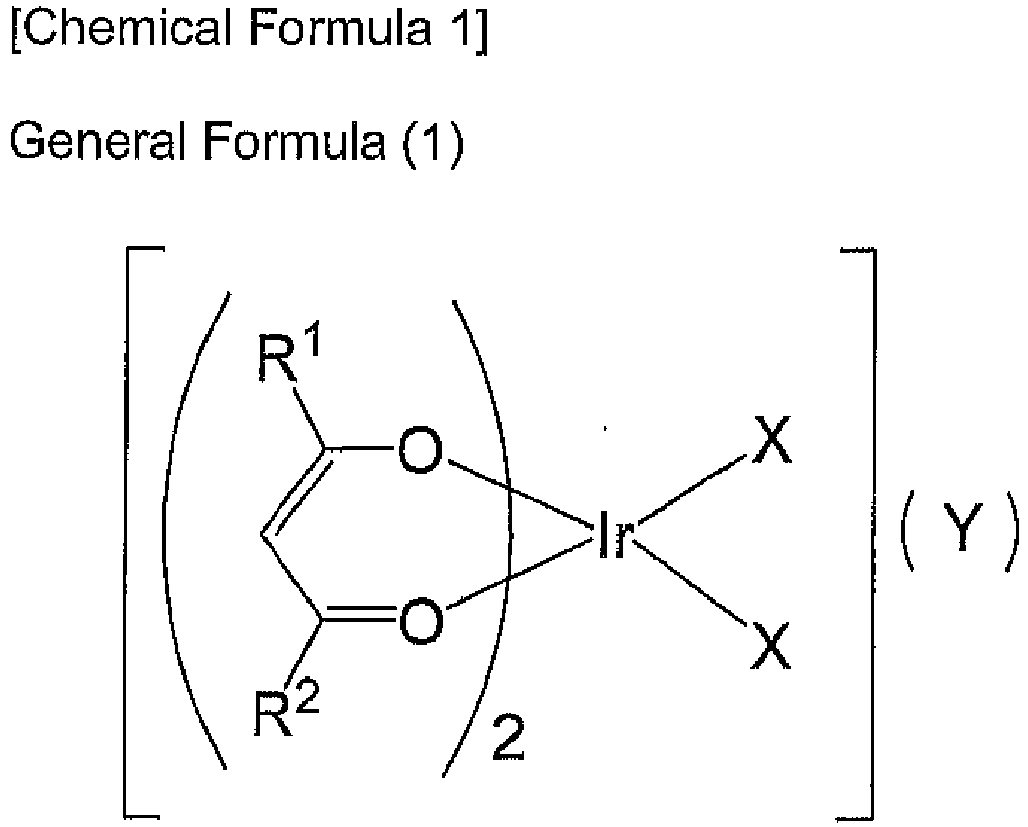
- the present invention provides an iridium compound which is represented by the following General Formula (1).
- Ir represents an iridium atom
- O represents an oxygen atom
- X represents a halogen atom
- Y represents a counter cation
- R 1 and R 2 each independently represent an alkyl group with a carbon number of 1 or more and 10 or less, with the proviso that only one of R 1 and R 2 is a branched alkyl group.
- the iridium compound according to the present invention has a structure represented by the following General Formula (1).
- Ir represents an iridium atom
- O represents an oxygen atom.
- X represents a halogen atom.
- X is preferably a chlorine atom, a bromine atom or an iodine atom, more preferably a chlorine atom or a bromine atom, especially preferably a chlorine atom.
- Y represents a counter cation.
- the counter cation plays a role in forming a salt by setting the overall charge of the iridium compound of the present invention to 0.
- Y is not particularly limited as long as it is a cation having the above-mentioned effect.
- Y is preferably a monovalent cation.
- Y is an alkali metal ion, an ammonium ion, a quaternary ammonium ion, a phosphonium ion, a sulfonium ion, an imidazolium ion, a pyridinium ion, a piperidinium ion, a pyrrolidinium ion, or a proton, preferably an alkali metal ion, an ammonium ion, a quaternary ammonium ion, a phosphonium ion or a sulfonium ion, more preferably an alkali metal ion, especially preferably a sodium ion or a potassium ion, even more preferably a potassium ion.
- R 1 and R 2 each independently represent an alkyl group with a carbon number of 1 or more and 10 or less, and only one of R 1 and R 2 is a branched alkyl group.
- the ligand coordinated to the iridium atom is asymmetric while the carbon number of R 1 and R 2 is limited. This is intended to secure the yield while moderating the conditions (reaction temperature etc.) in synthesis of a cyclometalated iridium complex, particularly an imidazole-based cyclometalated iridium complex by suitably adjusting the stability and reactivity of the iridium compound.
- the branched alkyl group that forms one of R 1 and R 2 in the asymmetric ⁇ -diketone ligand is preferably a branched alkyl group with a carbon number of 3 or more and 10 or less, more preferably a branched alkyl group with a carbon number 3 or more and 6 or less.
- the branched alkyl group is preferably an isopropyl group, an isobutyl group, a sec-butyl group, a tert-butyl group or the like, more preferably an isopropyl group.
- the alkyl group that forms the other one of R 1 and R 2 is preferably an alkyl group with a carbon number of 1 or more and 6 or less, more preferably an alkyl group with a carbon number of 1 or more and 3 or less, especially preferably an alkyl group with a carbon number of 1.
- the alkyl group is preferably a methyl group, an ethyl group, a n-propyl group or a n-butyl group, more preferably a methyl group.
- the iridium compound according to the present invention has a trans-isomer and a cis-isomer, and when the iridium compound is used as a raw material compound, either the trans-isomer or the cis-isomer may be used. In addition, a mixture of a cis-isomer and a trans-isomer may be used as a raw material.
- the iridium compound according to the present invention may have a plurality of geometrical isomers.
- the compound (Ir-1) of Chemical Formula 4 has geometrical isomers shown in Chemical Formula 5 (indications of counter cations are omitted in Chemical Formula 5).
- the iridium compound according to the present invention may be formed by only one of these geometrical isomers, or may be a mixture of two or more of these geometrical isomers. In the purpose of producing a cyclometalated iridium complex, whether or not the iridium compound to be used as a raw material is a mixture of geometrical isomers is not particularly important.
- Examples of the iridium compound according to the present invention are shown in Chemical Formula 6, but the iridium compound of the present invention is not limited to these examples.
- the iridium compounds (Ir-1) to (Ir-6) are preferable, the iridium compounds (Ir-1) to (Ir-3) are more preferable, and the iridium compound (Ir-1) is especially preferable.
- the iridium compound can be produced by reacting an appropriate iridium compound with a ⁇ -diketone ligand having an alkyl group and a branched alkyl group (R 1 and R 2 ).
- the iridium compound according to the present invention can be synthesized by reacting iridium trichloride n-hydrate with a ⁇ -diketone ligand in an aqueous solution containing a hydrogencarbonate (sodium hydrogencarbonate, potassium hydrogencarbonate or the like).
- a method for producing a cyclometalated iridium complex by use of the iridium compound according to the present invention will be described. It is not necessary to put a limit on a cyclometalated iridium complex that can be produced by use of the iridium compound according to the present invention.
- a cyclometalated iridium complex (Ir(ppy) 3 ) in which a 2-phenylpyridine derivative is coordinated to iridium as in Chemical Formula 1.
- the iridium compound according to the present invention is used as a raw material, and the raw material is reacted with a compound as a ligand.
- the iridium compound according to the present invention exhibits its effect particularly in production of an imidazole-based cyclometalated iridium complex in which a 2-phenylimidazole derivative is coordinated to iridium.
- an imidazole-based cyclometalated iridium complex can be produced with a high yield, and such a yield cannot be achieved with a previously known iridium compound.
- the method for producing an iridium complex according to the present invention is a method in which the iridium compound according to the present invention and a ligand (2-phenylimidazole derivative) represented by General Formula (2) are reacted with each other to produce an iridium compound of General Formula (3) which is an imidazole-based cyclometalated iridium complex.
- Ir represents an iridium atom
- N represents a nitrogen atom
- R 3 to R 9 each independently represent a hydrogen atom or a substituent; and adjacent substituents may be linked together to further form a ring structure.
- R 3 to R 9 in the general formulae each independently represent a hydrogen atom or a substituent. Adjacent substituents may be linked together to further form a ring structure. Examples of the substituents R 3 to R 9 include the following substituents.
- alkyl groups, aryl groups, amino groups, alkoxy groups, aryloxy groups, halogen atoms, cyano groups, trifluoromethyl groups, heterocyclic groups and silyl groups are preferable, alkyl groups, aryl groups, halogen atoms, cyano groups and heterocyclic groups are more preferable, and alkyl groups and aryl groups are especially preferable.
- substituents may be further substituted with substituents defined by R 3 to R 9 .
- a dendron (a group having a regular dendritic branched structure with a branch point at an atom or ring) is also preferable.
- the dendron include structures described in documents such as WO 02/067343 A1 , JP 2003-231692 A , WO 2003/079736 A1 , WO 2006/097717 A1 and WO 2016/006523 A1 .
- R 3 , R 4 , R 6 and R 9 are each preferably a hydrogen atom, an alkyl group, a heterocyclic group or an aryl group, more preferably a hydrogen atom, an alkyl group or an aryl group, still more preferably a hydrogen atom.
- R 5 is preferably an alkyl group or an aryl group, more preferably an aryl group, still more preferably a phenyl group, or a phenyl group substituted with an alkyl group.
- the method for producing an iridium complex according to the present invention will be described in detail.
- a solvent in which a reaction proceeds.
- the solvent is preferably an alcohol, a saturated aliphatic hydrocarbon, an ester, an ether, a nitrile, an aprotic polar solvent, a ketone, an amide, an aromatic hydrocarbon, a nitrogen-containing aromatic compound, an ionic liquid or water.
- the solvent is more preferably an alcohol, a saturated aliphatic hydrocarbon, an ester, an ether, an aprotic polar solvent or an amide, especially preferably an alcohol or an aprotic polar solvent (DMF, DMSO or the like), even more preferably an alcohol (with a carbon number of preferably 1 or more and 30 or less, more preferably 1 or more and 20 or less, still more preferably 1 or more and 10 or less).
- diol with a carbon number of preferably 1 or more and 30 or less, more preferably 1 or more and 20 or less, still more preferably 1 or more and 10 or less is most preferable.
- ethylene glycol diethylene glycol, triethylene glycol, 1,2-propanediol, 1,3-propanediol or 1,3-butanediol is preferable, with ethylene glycol being more preferable.
- the above-mentioned solvents may be used singly, or two or more solvents may be used in combination.
- the iridium compound (general formula (1)) as a raw material is dissolved in the solvent, the ligand represented by General Formula (2) is further added, and the mixture is heated and reacted.
- the concentration of the iridium compound as a raw material in the reaction system is not particularly limited, but is preferably 0.001 mol/L or more and 10.0 mol/L or less, more preferably 0.001 mol/L or more and 1.0 mol/L or less, still more preferably 0.01 mol/L or more and 1.0 mol/L or less, especially preferably 0.05 mol/L or more and 0.5 mol/L or less.
- the use amount of the ligand composed of the 2-phenylimidazole derivative represented by General Formula (2) is preferably 2 moles or more and less than 10 moles, more preferably 3 moles or more and less than 10 moles, especially preferably 3 moles or more and less than 8 moles based on 1 mole of the iridium compound as a raw material.
- the 2-phenylimidazole derivative is excessively added, removal of the 2-phenylimidazole derivative requires much time.
- the 2-phenylimidazole derivative is expensive, use of an excessive amount of the 2-phenylimidazole derivative increases production cost.
- the added amount of the ligand is preferably in the above-mentioned range.
- the reaction temperature in the method for producing an iridium complex according to the present invention is more preferably 100°C or higher and lower than 250°C, especially preferably 150°C or higher and lower than 250°C, further especially preferably 150°C or higher and lower than 200°C.
- the reaction time is preferably 0.5 hours or more and 72 hours or less, 1 hour or more and 48 hours or less, 1 hour or more and 24 hours or less.
- the heating means for the reaction system is not particularly limited. Specifically, external heating using an oil bath, a sand bath, a mantle heater, a block heater, or a heat-circulation jacket, as well as heating by irradiation with microwaves can be utilized, for example.
- the method for producing an iridium complex according to the present invention it is preferable to perform the method in an inert gas (nitrogen, argon or the like) atmosphere.
- the pressure in the method for producing an iridium complex according to the present invention is not particularly limited, but it is preferable to perform the method under normal pressure (atmospheric pressure).
- the iridium complex obtained by the above-described method and represented by General Formula (3) is treated by a general post-treatment method and then, after purification as necessary or without purification, can be used as a high-purity product.
- a general post-treatment method for example, extraction, cooling, crystallization by adding water or an organic solvent, distillation of the solvent from the reaction mixture, and the like may be performed alone or in combination.
- the method for purification recrystallization, distillation, sublimation, column chromatography and the like may be performed alone or in combination.
- the iridium complex obtained according to the present invention and represented by General Formula (3) can be suitably used as a phosphorescent material for an organic EL element or the like.
- Examples of the iridium complex which can be produced according to the present invention and represented by General Formula (3) are shown in Chemical Formula 9.
- the iridium compound according to the present invention is suitable as a starting material for producing a cyclometalated iridium complex to be used as a phosphorescent material for an organic EL device or the like.
- an imidazole-based cyclometalated iridium complex can also be produced with a high yield.
- the iridium compound (Ir-1) of Chemical Formula 6 was used as a raw material, and reacted with the following 2-phenylimidazole derivative (L-1) to produce an imidazole-based cyclometalated iridium complex (T-1).
- the present invention allows a cyclometalated iridium complex to be efficiently produced.
- an imidazole-based cyclometalated iridium complex can also be produced with a high yield.
- the present invention provides a raw material suitable for producing a cyclometalated iridium complex to be used as a phosphorescent material which is used for organic electroluminescent (EL) devices, organic electrochemiluminescent (ECL) devices, luminescent sensors, photosensitizing pigments, photocatalysts, luminescent probes, various light sources and the like.
- EL organic electroluminescent
- ECL organic electrochemiluminescent
Landscapes
- Chemical & Material Sciences (AREA)
- Organic Chemistry (AREA)
- Electroluminescent Light Sources (AREA)
- Organic Low-Molecular-Weight Compounds And Preparation Thereof (AREA)
Abstract
Description
- The present invention relates to a novel iridium compound as a starting material for a phosphorescent material which is used for organic electroluminescent (EL) devices, organic electrochemiluminescent (ECL) devices, luminescent sensors, photosensitizing pigments, photocatalysts, luminescent probes, various light sources and the like. The present invention also relates to a method for producing an iridium complex by use of the iridium compound.
- Organic EL devices obtained by use of a phosphorescent material are known to have light-emitting efficiency 3 to 4 times higher than that of organic EL devices obtained by use of a conventional fluorescent material. Thus, the phosphorescent material is essential to achieve higher efficiency and energy saving in organic EL devices. It is a cyclometalated iridium complex that is known as a compound which is used for the phosphorescent material. "Cyclometalated iridium complex" is a general term for organic iridium complexes, in which multidentate ligands are coordinated to the iridium atom to form a ring, and at least one iridium-carbon bond is present.
- As a specific example of the cyclometalated iridium complex useful for the phosphorescent material, a cyclometalated iridium complex in which a 2-phenylpyridine derivative is coordinated to iridium as shown in Chemical Formula 1 is well known (tris(2-phenylpyridinato)iridium (Ir(ppy)3): Patent Document 1). A cyclometalated iridium complex in which a 2-phenylimidazole derivative is coordinated to iridium as shown in Chemical Formula 2 is also known (Patent Document 2: hereinafter, the cyclometalated iridium complex in which a 2-phenylimidazole derivative is coordinated is sometimes referred to as an imidazole-based cyclometalated iridium complex). These cyclometalated iridium complexes can be produced by reacting a raw material composed of an iridium compound with a ligand.


- Here, as an iridium compound that forms a raw material for producing a cyclometalated iridium complex, an acetylacetonate compound of iridium has been heretofore well known. For example, Patent Document 1 discloses that by reacting bis(acetylacetonate)dichloroiridium (III) acid sodium with 2-phenylpyridine, the cyclometalated iridium complex of Chemical Formula 1 can be obtained with a high yield. In addition, Patent Document 2 discloses a method in which trisacetylacetonate iridium (III) is reacted with a 2-phenylimidazole derivative ligand to produce the imidazole-based cyclometalated iridium complex of Chemical Formula 2.
-
- Patent Document 1:
WO 2004/085449 A1 - Patent Document 2:
WO 2006/046980 A1 - However, studies conducted by the present inventors have revealed that when the bis(acetylacetonate)dichloroiridium (III) acid sodium in Patent Document 1 is used, the cyclometalated iridium complex of Chemical Formula 1 can be produced with a favorable yield, but the yield is significantly reduced in production of the imidazole-based cyclometalated iridium complex of Chemical Formula 2.
- In addition, the trisacetylacetonate iridium (III) in Patent Document 2 has the problem that this iridium compound has poor reactivity, and requires a very high reaction temperature in production of the complex (generally 200°C or higher). Further, from this iridium compound, the imidazole-based cyclometalated iridium complex of Chemical Formula 2 can be produced, but the yield of the complex is as low as about 35%.
- Thus, a previously known acetylacetonate compound of iridium does not necessarily suitably act as a raw material compound depending on the type of cyclometalated iridium complex to be produced.
- The present invention has been made in view of the above background, and provides a suitable iridium compound as a starting material for producing a cyclometalated iridium complex to be used as a phosphorescent material for an organic EL device or the like. In particular, the present invention provides a novel iridium compound with which an imidazole-based cyclometalated iridium complex, which has been heretofore difficult to produce with a high yield from a conventional iridium compound, can be produced with a high yield.
- For solving the problems described above, the present inventors extensively conducted studies on synthesis of an imidazole-based cyclometalated iridium complex, specifically on a structure of an iridium compound to which an imidazole-based ligand can be coordinated more favorably than ever before. As a result, the present inventors developed, as a starting material, an iridium compound having a specific structure of the following General Formula (1) in which an asymmetric β-diketone ligand is introduced into iridium. According to the present inventors, use of the novel iridium compound considerably improves the yield of an imidazole-based cyclometalated iridium complex as compared to use of an acetylacetonate-based compound which is a conventional raw material.
- The present invention provides an iridium compound which is represented by the following General Formula (1).

- (In General Formula (1), Ir represents an iridium atom, O represents an oxygen atom, X represents a halogen atom, and Y represents a counter cation; and R1 and R2 each independently represent an alkyl group with a carbon number of 1 or more and 10 or less, with the proviso that only one of R1 and R2 is a branched alkyl group.)
- Hereinafter, the iridium compound according to the present invention will be described in detail.
- As described above, the iridium compound according to the present invention has a structure represented by the following General Formula (1). Here, in General Formula (1), Ir represents an iridium atom, and O represents an oxygen atom.
- X represents a halogen atom. Specifically, X is preferably a chlorine atom, a bromine atom or an iodine atom, more preferably a chlorine atom or a bromine atom, especially preferably a chlorine atom.
- Y represents a counter cation. The counter cation plays a role in forming a salt by setting the overall charge of the iridium compound of the present invention to 0. Y is not particularly limited as long as it is a cation having the above-mentioned effect. Y is preferably a monovalent cation. Specifically, Y is an alkali metal ion, an ammonium ion, a quaternary ammonium ion, a phosphonium ion, a sulfonium ion, an imidazolium ion, a pyridinium ion, a piperidinium ion, a pyrrolidinium ion, or a proton, preferably an alkali metal ion, an ammonium ion, a quaternary ammonium ion, a phosphonium ion or a sulfonium ion, more preferably an alkali metal ion, especially preferably a sodium ion or a potassium ion, even more preferably a potassium ion.
- R1 and R2 each independently represent an alkyl group with a carbon number of 1 or more and 10 or less, and only one of R1 and R2 is a branched alkyl group. In the present invention, the ligand coordinated to the iridium atom is asymmetric while the carbon number of R1 and R2 is limited. This is intended to secure the yield while moderating the conditions (reaction temperature etc.) in synthesis of a cyclometalated iridium complex, particularly an imidazole-based cyclometalated iridium complex by suitably adjusting the stability and reactivity of the iridium compound.
- The branched alkyl group that forms one of R1 and R2 in the asymmetric β-diketone ligand is preferably a branched alkyl group with a carbon number of 3 or more and 10 or less, more preferably a branched alkyl group with a carbon number 3 or more and 6 or less. Specifically, the branched alkyl group is preferably an isopropyl group, an isobutyl group, a sec-butyl group, a tert-butyl group or the like, more preferably an isopropyl group.
- The alkyl group that forms the other one of R1 and R2 is preferably an alkyl group with a carbon number of 1 or more and 6 or less, more preferably an alkyl group with a carbon number of 1 or more and 3 or less, especially preferably an alkyl group with a carbon number of 1. Specifically, the alkyl group is preferably a methyl group, an ethyl group, a n-propyl group or a n-butyl group, more preferably a methyl group.
- The iridium compound according to the present invention has a trans-isomer and a cis-isomer, and when the iridium compound is used as a raw material compound, either the trans-isomer or the cis-isomer may be used. In addition, a mixture of a cis-isomer and a trans-isomer may be used as a raw material.
- Further, the iridium compound according to the present invention may have a plurality of geometrical isomers. For example, the compound (Ir-1) of Chemical Formula 4 has geometrical isomers shown in Chemical Formula 5 (indications of counter cations are omitted in Chemical Formula 5). The iridium compound according to the present invention may be formed by only one of these geometrical isomers, or may be a mixture of two or more of these geometrical isomers. In the purpose of producing a cyclometalated iridium complex, whether or not the iridium compound to be used as a raw material is a mixture of geometrical isomers is not particularly important.


- Examples of the iridium compound according to the present invention are shown in Chemical Formula 6, but the iridium compound of the present invention is not limited to these examples.


- Among the iridium compounds shown in Chemical Formula 6, the iridium compounds (Ir-1) to (Ir-6) are preferable, the iridium compounds (Ir-1) to (Ir-3) are more preferable, and the iridium compound (Ir-1) is especially preferable.
- Production of the above-described iridium compound according to the present invention is not difficult, and the iridium compound can be produced by reacting an appropriate iridium compound with a β-diketone ligand having an alkyl group and a branched alkyl group (R1 and R2). For example, the iridium compound according to the present invention can be synthesized by reacting iridium trichloride n-hydrate with a β-diketone ligand in an aqueous solution containing a hydrogencarbonate (sodium hydrogencarbonate, potassium hydrogencarbonate or the like).
- Next, a method for producing a cyclometalated iridium complex by use of the iridium compound according to the present invention will be described. It is not necessary to put a limit on a cyclometalated iridium complex that can be produced by use of the iridium compound according to the present invention. For example, it is possible to produce a cyclometalated iridium complex (Ir(ppy)3) in which a 2-phenylpyridine derivative is coordinated to iridium as in Chemical Formula 1. In production of the cyclometalated iridium complex, the iridium compound according to the present invention is used as a raw material, and the raw material is reacted with a compound as a ligand.
- The iridium compound according to the present invention exhibits its effect particularly in production of an imidazole-based cyclometalated iridium complex in which a 2-phenylimidazole derivative is coordinated to iridium. By using the iridium compound according to the present invention as a raw material, an imidazole-based cyclometalated iridium complex can be produced with a high yield, and such a yield cannot be achieved with a previously known iridium compound.
- The method for producing an iridium complex according to the present invention is a method in which the iridium compound according to the present invention and a ligand (2-phenylimidazole derivative) represented by General Formula (2) are reacted with each other to produce an iridium compound of General Formula (3) which is an imidazole-based cyclometalated iridium complex.


- (In General Formulae (2) and (3), Ir represents an iridium atom; N represents a nitrogen atom; R3 to R9 each independently represent a hydrogen atom or a substituent; and adjacent substituents may be linked together to further form a ring structure.)
- In the 2-phenylimidazole derivative represented by General Formula (2) and the imidazole-based cyclometalated iridium complex represented by Genera! Formula (3), Ir represents an iridium atom, N represents a nitrogen atom, and O represents an oxygen atom. R3 to R9 in the general formulae each independently represent a hydrogen atom or a substituent. Adjacent substituents may be linked together to further form a ring structure. Examples of the substituents R3 to R9 include the following substituents.
- Alkyl groups (with a carbon number of preferably 1 or more and 30 or less, more preferably 1 or more and 20 or less, especially preferably 1 or more and 10 or less) (e.g., methyl, ethyl, iso-propyl, tert-butyl, n-octyl, n-decyl, n-hexadecyl, cyclopropyl, cyclopentyl and cyclohexyl).
- Alkenyl groups (with a carbon number of preferably 2 or more and 30 or less, more preferably 2 or more and 20 or less, especially preferably 2 or more and 10 or less) (e.g., vinyl, allyl, 2-butenyl and 3-pentenyl).
- Alkynyl groups (with a carbon number of preferably 2 or more and 30 or less, more preferably 2 or more and 20 or less, especially preferably 2 or more and 10 or less) (e.g., propargyl and 3-pentynyl).
- Aryl groups (with a carbon number of preferably 6 or more and 30 or less, more preferably 6 or more and 20 or less, especially preferably 6 or more and 12 or less) (e.g., phenyl, p-methylphenyl, naphthyl and anthranil).
- Amino groups (with a carbon number of preferably 0 or more and 30 or less, more preferably 0 or more and 20 or less, especially preferably 0 or more and 10 or less) (e.g., amino, methylamino, dimethylamino, diethylamino, dibenzylamino, diphenylamino and ditolylamino).
- Alkoxy groups (with a carbon number of preferably 1 or more and 30 or less, more preferably 1 or more and 20 or less, especially preferably 1 or more and 10 or less) (e.g., methoxy, ethoxy, butoxy and 2-ethylhexyloxy).
- Aryloxy groups (with a carbon number of preferably 6 or more and 30 or less, more preferably 6 or more and 20 or less, especially preferably 6 or more and 12 or less) (e.g., phenyloxy, 1-naphthyloxy and 2-naphthyloxy).
- Heterocyclic oxy groups (with a carbon number of preferably 1 or more and 30 or less, more preferably 1 or more and 20 or less, especially preferably 1 or more and 12 or less) (e.g., pyridyloxy, pyrazyloxy, pyrimidyloxy and quinolyloxy).
- Acyl groups (with a carbon number of preferably 1 or more and 30 or less, more preferably 1 or more and 20 or less, especially preferably 1 or more and 12 or less) (e.g., acetyl, benzoyl, formyl and pivaloyl).
- Alkoxycarbonyl groups (with a carbon number of 2 or more and 30 or less, more preferably 2 or more and 20 or less, especially preferably 2 or more and 12 or less) (e.g., methoxycarbonyl and ethoxycarbonyl).
- Aryloxycarbonyl groups (with a carbon number of preferably 7 or more and 30 or less, more preferably 7 or more and 20 or less, especially preferably 7 or more and 12 or less) (e.g., phenyloxycarbonyl).
- Acyloxy groups (with a carbon number of preferably 2 or more and 30 or less, more preferably 2 or more and 20 or less, especially preferably 2 or more and 10 or less) (e.g., acetoxy and benzoyloxy).
- Acylamino groups (with a carbon number of preferably 2 or more and 30 or less, more preferably 2 or more and 20 or less, especially preferably 2 or more and 10 or less) (e.g., acetylamino and benzoylamino).
- Alkoxycarbonylamino groups (with a carbon number of 2 or more and 30 or less, more preferably 2 or more and 20 or less, especially preferably 2 or more and 12 or less) (e.g., methoxycarbonylamino).
- Aryloxycarbonylamino groups (with a carbon number of preferably 7 or more and 30 or less, more preferably 7 or more and 20 or less, especially preferably 7 or more and 12 or less) (e.g., phenyloxycarbonylamino).
- Sulfonylamino groups (with a carbon number of preferably 1 or more and 30 or less, more preferably 1 or more and 20 or less, especially preferably 1 or more and 12 or less) (e.g., methanesulfonylamino and benzenesulfonylamino).
- Sulfamoyl groups (with a carbon number of preferably 0 or more and 30 or less, more preferably 0 or more and 20 or less, especially preferably 0 or more and 12 or less) (e.g., sulfamoyl, methylsulfamoyl, dimethylsulfamoyl and phenylsulfamoyl).
- Carbamoyl groups (with a carbon number of preferably 1 or more and 30 or less, more preferably 1 or more and 20 or less, especially preferably 1 or more and 12 or less) (e.g., carbamoyl, methylcarbamoyl, diethylcarbamoyl and phenylcarbamoyl).
- Alkylthio groups (with a carbon number of preferably 1 or more and 30 or less, more preferably 1 or more and 20 or less, especially preferably 1 or more and 12 or less) (e.g., methylthio and ethylthio).
- Arylthio groups (with a carbon number of preferably 6 or more and 30 or less, more preferably 6 or more and 20 or less, especially preferably 6 or more and 12 or less) (e.g., phenylthio).
- Heterocyclic thio groups (with a carbon number of preferably 1 or more and 30 or less, more preferably 1 or more and 20 or less, especially preferably 1 or more and 12 or less) (e.g., pyridylthio, 2-benzimizolylthio, 2-benzoxazolylthio and 2-benzthiazolylthio).
- Sulfonyl groups (with a carbon number of preferably 1 or more and 30 or less, more preferably 1 or more and 20 or less, especially preferably 1 or more and 12 or less) (e.g., mesyl and tosyl).
- Sulfinyl groups (with a carbon number of preferably 1 or more and 30 or less, more preferably 1 or more and 20 or less, especially preferably 1 or more and 12 or less) (e.g., methanesulfinyl and benzenesulfinyl).
- Ureide groups (with a carbon number of preferably 1 or more and 30 or less, more preferably 1 or more and 20 or less, especially preferably 1 or more and 12 or less) (e.g., ureide, methylureide and phenylureide).
- Phosphoramide groups (with a carbon number of preferably 1 or more and 30 or less, more preferably 1 or more and 20 or less, especially preferably 1 or more and 12 or less) (e.g., diethylphosphoramide and phenylphosphoramide).
- Hydroxyl groups, mercapto groups, halogen atoms (e.g., fluorine atom, chlorine atom, bromine atom and iodine atom), cyano groups, sulfo groups, carboxyl groups, nitro groups, trifluoromethyl groups, hydroxamic acid groups, sulfino groups, hydrazino groups, imino groups and heterocyclic groups (with a carbon number of preferably 1 or more and 30 or less, more preferably 1 or more and 12 or less and having a nitrogen atom, an oxygen atom or a sulfur atom as a heteroatom (specifically, imidazolyl, pyridyl, quinolyl, furyl, thienyl, piperidyl, morpholino, benzoxazolyl, benzimidazolyl, benzothiazolyl, carbazolyl group, azepinyl group and the like).
- Silyl groups (with a carbon number of preferably 3 or more and 40 or less, more preferably 3 or more and 30 or less, especially preferably 3 or more and 24 or less) (e.g., trimethylsilyl and triphenylsilyl).
- Silyloxy groups (with a carbon number of preferably 3 or more and 40 or less, more preferably 3 or more and 30 or less, especially preferably 3 or more and 24 or less) (e.g., trimethylsilyloxy and triphenylsilyloxy).
- Among the above-mentioned substituents, alkyl groups, aryl groups, amino groups, alkoxy groups, aryloxy groups, halogen atoms, cyano groups, trifluoromethyl groups, heterocyclic groups and silyl groups are preferable, alkyl groups, aryl groups, halogen atoms, cyano groups and heterocyclic groups are more preferable, and alkyl groups and aryl groups are especially preferable. These substituents may be further substituted with substituents defined by R3 to R9.
- As a desired form of the aryl group or heterocyclic group, a dendron (a group having a regular dendritic branched structure with a branch point at an atom or ring) is also preferable. Examples of the dendron include structures described in documents such as
WO 02/067343 A1 JP 2003-231692 A WO 2003/079736 A1 ,WO 2006/097717 A1 andWO 2016/006523 A1 . - Desired forms of R3 to R9 will be described in further detail.
- R3, R4, R6 and R9 are each preferably a hydrogen atom, an alkyl group, a heterocyclic group or an aryl group, more preferably a hydrogen atom, an alkyl group or an aryl group, still more preferably a hydrogen atom.
- R5 is preferably an alkyl group or an aryl group, more preferably an aryl group, still more preferably a phenyl group, or a phenyl group substituted with an alkyl group.
- The method for producing an iridium complex according to the present invention will be described in detail. In the method for producing an iridium complex according to the present invention, it is preferable to use a solvent, in which a reaction proceeds. The solvent is preferably an alcohol, a saturated aliphatic hydrocarbon, an ester, an ether, a nitrile, an aprotic polar solvent, a ketone, an amide, an aromatic hydrocarbon, a nitrogen-containing aromatic compound, an ionic liquid or water. In particular, the solvent is more preferably an alcohol, a saturated aliphatic hydrocarbon, an ester, an ether, an aprotic polar solvent or an amide, especially preferably an alcohol or an aprotic polar solvent (DMF, DMSO or the like), even more preferably an alcohol (with a carbon number of preferably 1 or more and 30 or less, more preferably 1 or more and 20 or less, still more preferably 1 or more and 10 or less). Among alcohols, diol (with a carbon number of preferably 1 or more and 30 or less, more preferably 1 or more and 20 or less, still more preferably 1 or more and 10 or less) is most preferable. Specifically, ethylene glycol, diethylene glycol, triethylene glycol, 1,2-propanediol, 1,3-propanediol or 1,3-butanediol is preferable, with ethylene glycol being more preferable. The above-mentioned solvents may be used singly, or two or more solvents may be used in combination.
- In the method for producing an iridium complex according to the present invention, the iridium compound (general formula (1)) as a raw material is dissolved in the solvent, the ligand represented by General Formula (2) is further added, and the mixture is heated and reacted. Here, the concentration of the iridium compound as a raw material in the reaction system is not particularly limited, but is preferably 0.001 mol/L or more and 10.0 mol/L or less, more preferably 0.001 mol/L or more and 1.0 mol/L or less, still more preferably 0.01 mol/L or more and 1.0 mol/L or less, especially preferably 0.05 mol/L or more and 0.5 mol/L or less.
- On the other hand, the use amount of the ligand composed of the 2-phenylimidazole derivative represented by General Formula (2) is preferably 2 moles or more and less than 10 moles, more preferably 3 moles or more and less than 10 moles, especially preferably 3 moles or more and less than 8 moles based on 1 mole of the iridium compound as a raw material. When the 2-phenylimidazole derivative is excessively added, removal of the 2-phenylimidazole derivative requires much time. In addition, since the 2-phenylimidazole derivative is expensive, use of an excessive amount of the 2-phenylimidazole derivative increases production cost. Thus, the added amount of the ligand is preferably in the above-mentioned range.
- The reaction temperature in the method for producing an iridium complex according to the present invention is more preferably 100°C or higher and lower than 250°C, especially preferably 150°C or higher and lower than 250°C, further especially preferably 150°C or higher and lower than 200°C. In addition, the reaction time is preferably 0.5 hours or more and 72 hours or less, 1 hour or more and 48 hours or less, 1 hour or more and 24 hours or less. The heating means for the reaction system is not particularly limited. Specifically, external heating using an oil bath, a sand bath, a mantle heater, a block heater, or a heat-circulation jacket, as well as heating by irradiation with microwaves can be utilized, for example.
- In the method for producing an iridium complex according to the present invention, it is preferable to perform the method in an inert gas (nitrogen, argon or the like) atmosphere. The pressure in the method for producing an iridium complex according to the present invention is not particularly limited, but it is preferable to perform the method under normal pressure (atmospheric pressure).
- The iridium complex obtained by the above-described method and represented by General Formula (3) is treated by a general post-treatment method and then, after purification as necessary or without purification, can be used as a high-purity product. As the method for post-treatment, for example, extraction, cooling, crystallization by adding water or an organic solvent, distillation of the solvent from the reaction mixture, and the like may be performed alone or in combination. As the method for purification, recrystallization, distillation, sublimation, column chromatography and the like may be performed alone or in combination.
- The iridium complex obtained according to the present invention and represented by General Formula (3) can be suitably used as a phosphorescent material for an organic EL element or the like. Examples of the iridium complex which can be produced according to the present invention and represented by General Formula (3) are shown in Chemical Formula 9.


- The iridium compound according to the present invention is suitable as a starting material for producing a cyclometalated iridium complex to be used as a phosphorescent material for an organic EL device or the like. Particularly, in the present invention, an imidazole-based cyclometalated iridium complex can also be produced with a high yield.
- Hereinafter, an embodiment of the present invention will be described in detail, but the embodiment is illustrative, and the present invention is not limited thereto.
- In this embodiment, the iridium compound (Ir-1) of Chemical Formula 6 was used as a raw material, and reacted with the following 2-phenylimidazole derivative (L-1) to produce an imidazole-based cyclometalated iridium complex (T-1).
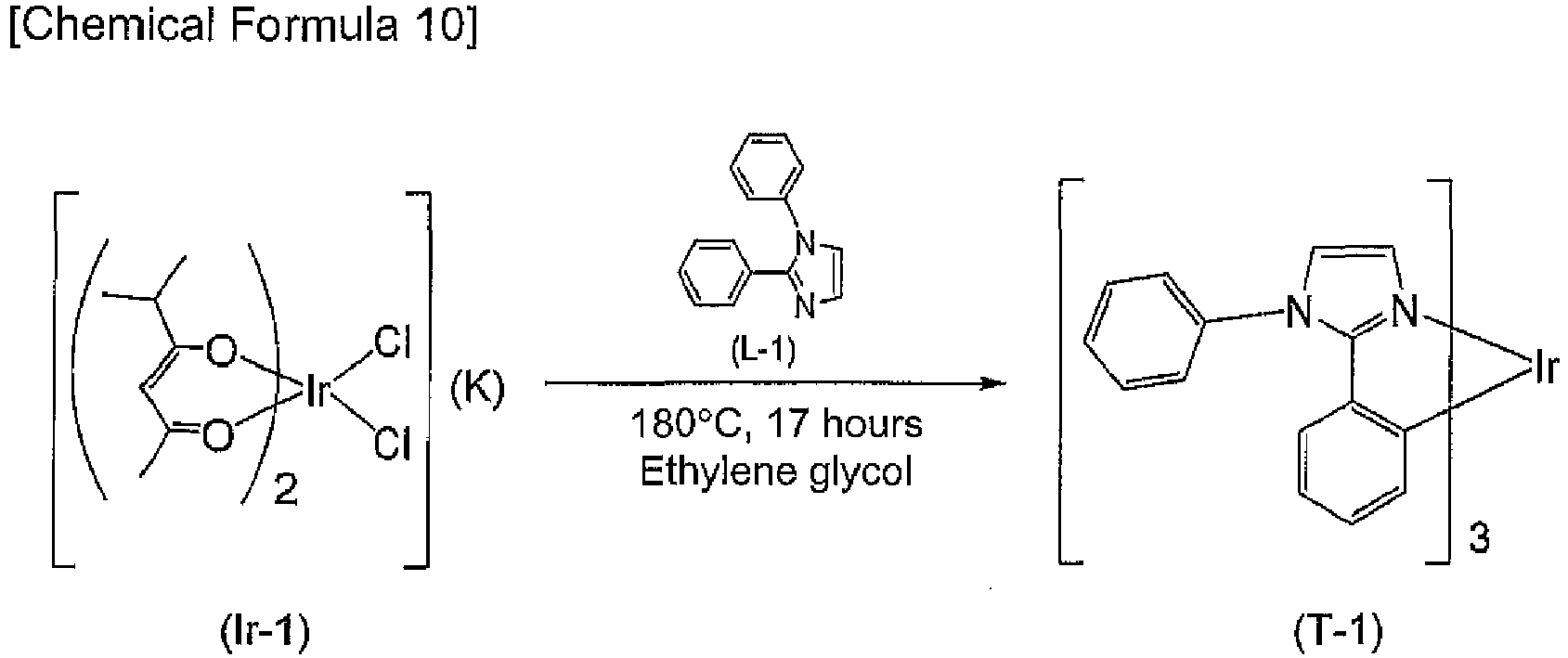
- 40.6 g (115 mmol) of iridium trichloride trihydrate and 530 ml of pure water were added in a three-necked flask, and dissolved, 45.7 g (357 mmol) of 5-methyl-2,4-hexanedione was subsequently added, the mixture was reacted at 95°C for 1 hour, and 47.5 g (475 mmol) of potassium carbonate was added to the mixture little by little to adjust the pH to about 8. Further, the mixture was heated and reacted for 5 hours. After the reaction, the reaction product was left standing overnight, unreacted 5-methyl-2,4-hexanedione was extracted and removed from the aqueous layer of the supernatant by use of hexane, an iridium compound (Ir-1) was subsequently extracted with ethyl acetate, and the extract was concentrated and dried to obtain 12 g of an orange crude crystal of the iridium compound (Ir-1). Further, the crude crystal was subjected to column purification to obtain 10.2 g of an orange crystal of the iridium compound (Ir-1). The isolation yield was 16%.
- 167.0 mg (0.3 mmol) of the iridium compound (Ir-1) produced as described above, 396.0 mg (1.8 mmol) of a 2-phenylimidazole derivative (L-1) and 5 ml of ethylene glycol as a solvent were added in a three-necked flask, and the mixture was heated and reacted in an argon atmosphere at 180°C for 17 hours. After completion of the reaction, the reaction solution was cooled to room temperature, and the precipitated solid was washed with methanol to obtain an imidazole-based cyclometalated iridium complex (T-1). The isolation yield was 73%. The product was analyzed by 1H-NMR, and identified.
- Comparative Example: In the comparative example, bis(acetylacetonate)dichloroiridium (III) acid sodium in Patent Document 1 was used as a raw material, and reacted with the following 2-phenylimidazole derivative (L-1) to produce an imidazole-based cyclometalated iridium complex (T-1).


- 145.3 mg (0.3 mmol) of bis(acetylacetonate)dichloroiridium (III) acid sodium, 396.0 mg (1.8 mmol) of a 2-phenylimidazole derivative (L-1) and 5 ml of ethylene glycol were added in a three-necked flask, and the mixture was heated and reacted in an argon atmosphere at 180°C for 17 hours. After completion of the reaction, the reaction solution was cooled to room temperature, and the precipitated solid was washed with methanol to obtain an imidazole-based cyclometalated iridium complex (T-1). The isolation yield was 52%.
- From the above results, it was confirmed that imidazole-based cyclometalated iridium (T-1) was produced with a high yield by use of the iridium compound (Ir-1) of this embodiment. Comparison between this embodiment and the comparative example shows that when the iridium compound (lr-1) of this embodiment was used, the yield was higher by 40% or more than when bis(acetylacetonate)dichloroiridium (III) acid sodium of the comparative example, which is a conventional compound, was used.
- The present invention allows a cyclometalated iridium complex to be efficiently produced. Particularly, an imidazole-based cyclometalated iridium complex can also be produced with a high yield. The present invention provides a raw material suitable for producing a cyclometalated iridium complex to be used as a phosphorescent material which is used for organic electroluminescent (EL) devices, organic electrochemiluminescent (ECL) devices, luminescent sensors, photosensitizing pigments, photocatalysts, luminescent probes, various light sources and the like.
Claims (5)
- An iridium compound which is represented by the following General Formula (1):

- The iridium compound according to claim 1, wherein one of R1 and R2 is a methyl group, and the other one of R1 and R2 is a branched alkyl group with a carbon number of 3 or more and 10 or less.
- The iridium compound according to claim 1 or 2, wherein one of R1 and R2 is an isopropyl group.
- The iridium compound according to any one of claims 1 to 3, wherein X represents a chlorine atom or a bromine atom.
- A method for producing an iridium complex by reacting a raw material including an iridium compound with a ligand, comprising producing an iridium complex by reacting the raw material with the ligand, the raw material being the iridium compound defined in any one of claims 1 to 4, the ligand being a ligand represented by the following General Formula (2), the iridium complex being represented by the following General Formula (3):


Applications Claiming Priority (2)
| Application Number | Priority Date | Filing Date | Title |
|---|---|---|---|
| JP2016125398A JP6570037B2 (en) | 2016-06-24 | 2016-06-24 | Iridium compound and method for producing iridium complex using the iridium compound |
| PCT/JP2017/022403 WO2017221847A1 (en) | 2016-06-24 | 2017-06-16 | Iridium compound and method for producing iridium complex by using iridium compound |
Publications (2)
| Publication Number | Publication Date |
|---|---|
| EP3476823A1 true EP3476823A1 (en) | 2019-05-01 |
| EP3476823A4 EP3476823A4 (en) | 2019-05-08 |
Family
ID=60784004
Family Applications (1)
| Application Number | Title | Priority Date | Filing Date |
|---|---|---|---|
| EP17815315.1A Withdrawn EP3476823A4 (en) | 2016-06-24 | 2017-06-16 | IRIDIUM COMPOUND AND PROCESS FOR PRODUCING IRIDIUM COMPLEX USING IRIDIUM COMPOUND |
Country Status (6)
| Country | Link |
|---|---|
| US (1) | US20190352321A1 (en) |
| EP (1) | EP3476823A4 (en) |
| JP (1) | JP6570037B2 (en) |
| KR (1) | KR20180135006A (en) |
| CN (1) | CN109311795A (en) |
| WO (1) | WO2017221847A1 (en) |
Family Cites Families (16)
| Publication number | Priority date | Publication date | Assignee | Title |
|---|---|---|---|---|
| GB0104177D0 (en) | 2001-02-20 | 2001-04-11 | Isis Innovation | Aryl-aryl dendrimers |
| JP4220767B2 (en) | 2001-12-04 | 2009-02-04 | 日本放送協会 | Organic compounds, organic EL devices and displays |
| AU2003214421A1 (en) | 2002-03-18 | 2003-09-29 | Isis Innovation Limited | Phosphorescent dendrimers for use in light-emitting devices |
| JP4054215B2 (en) * | 2002-05-01 | 2008-02-27 | 田中貴金属工業株式会社 | Chemical vapor deposition method of raw material compound for CVD and iridium or iridium compound thin film |
| DE10314102A1 (en) * | 2003-03-27 | 2004-10-14 | Covion Organic Semiconductors Gmbh | Process for the production of high-purity organo-iridium compounds |
| US20060008670A1 (en) | 2004-07-06 | 2006-01-12 | Chun Lin | Organic light emitting materials and devices |
| TW200624435A (en) * | 2004-08-12 | 2006-07-16 | Merck Patent Gmbh | Process for preparing iridium(Ⅲ) ketoketonates |
| ATE488522T1 (en) * | 2005-02-03 | 2010-12-15 | Merck Patent Gmbh | METAL COMPLEXES |
| US9078330B2 (en) | 2005-03-15 | 2015-07-07 | Isis Innovation Limited | Highly branched dendrimers |
| DE602007008642D1 (en) * | 2006-03-21 | 2010-10-07 | Semiconductor Energy Lab | Organometallic complex and light emitting element, light emitting device and electronic device using the organometallic complex |
| JP5238227B2 (en) * | 2006-12-27 | 2013-07-17 | 株式会社半導体エネルギー研究所 | ORGANIC METAL COMPLEX AND LIGHT EMITTING ELEMENT, LIGHT EMITTING DEVICE, AND ELECTRONIC DEVICE |
| DE102009007038A1 (en) * | 2009-02-02 | 2010-08-05 | Merck Patent Gmbh | metal complexes |
| WO2015000548A1 (en) * | 2013-07-02 | 2015-01-08 | Merck Patent Gmbh | Organic electroluminescent device |
| JP6434035B2 (en) * | 2013-09-17 | 2018-12-05 | メルク、パテント、ゲゼルシャフト、ミット、ベシュレンクテル、ハフツングMerck Patent GmbH | Polycyclic phenylpyridine iridium complex and its derivatives for OLED |
| WO2015104961A1 (en) * | 2014-01-10 | 2015-07-16 | 独立行政法人産業技術総合研究所 | Raw material and production method for cyclometallized iridium complex |
| WO2016006523A1 (en) | 2014-07-08 | 2016-01-14 | 住友化学株式会社 | Metal complex and light emitting element using same |
-
2016
- 2016-06-24 JP JP2016125398A patent/JP6570037B2/en active Active
-
2017
- 2017-06-16 KR KR1020187033215A patent/KR20180135006A/en not_active Ceased
- 2017-06-16 WO PCT/JP2017/022403 patent/WO2017221847A1/en not_active Ceased
- 2017-06-16 US US16/097,758 patent/US20190352321A1/en not_active Abandoned
- 2017-06-16 CN CN201780038936.5A patent/CN109311795A/en active Pending
- 2017-06-16 EP EP17815315.1A patent/EP3476823A4/en not_active Withdrawn
Also Published As
| Publication number | Publication date |
|---|---|
| EP3476823A4 (en) | 2019-05-08 |
| CN109311795A (en) | 2019-02-05 |
| KR20180135006A (en) | 2018-12-19 |
| JP2017226632A (en) | 2017-12-28 |
| US20190352321A1 (en) | 2019-11-21 |
| JP6570037B2 (en) | 2019-09-04 |
| WO2017221847A1 (en) | 2017-12-28 |
Similar Documents
| Publication | Publication Date | Title |
|---|---|---|
| US10053479B2 (en) | Raw material and production method for cyclometalated iridium complex | |
| US10533027B2 (en) | Method for producing cyclometalated iridium complex | |
| US10844086B2 (en) | Method for producing halogen-crosslinked iridium dimer | |
| US10538543B2 (en) | Method for producing cyclometalated iridium complex, and cyclometalated iridium complex precursor including organoiridium material | |
| EP3560939B1 (en) | Method for producing cyclometalated iridium complex | |
| EP3476823A1 (en) | Iridium compound and method for producing iridium complex by using iridium compound | |
| JP6423007B2 (en) | Method for producing cyclometalated iridium complex | |
| JP6617967B2 (en) | Method for producing cyclometalated iridium complex, and novel iridium compound suitably used in the method |
Legal Events
| Date | Code | Title | Description |
|---|---|---|---|
| STAA | Information on the status of an ep patent application or granted ep patent |
Free format text: STATUS: THE INTERNATIONAL PUBLICATION HAS BEEN MADE |
|
| PUAI | Public reference made under article 153(3) epc to a published international application that has entered the european phase |
Free format text: ORIGINAL CODE: 0009012 |
|
| STAA | Information on the status of an ep patent application or granted ep patent |
Free format text: STATUS: REQUEST FOR EXAMINATION WAS MADE |
|
| 17P | Request for examination filed |
Effective date: 20181119 |
|
| AK | Designated contracting states |
Kind code of ref document: A1 Designated state(s): AL AT BE BG CH CY CZ DE DK EE ES FI FR GB GR HR HU IE IS IT LI LT LU LV MC MK MT NL NO PL PT RO RS SE SI SK SM TR |
|
| AX | Request for extension of the european patent |
Extension state: BA ME |
|
| A4 | Supplementary search report drawn up and despatched |
Effective date: 20190408 |
|
| RIC1 | Information provided on ipc code assigned before grant |
Ipc: C07F 15/00 20060101ALI20190402BHEP Ipc: C07C 49/92 20060101AFI20190402BHEP |
|
| DAV | Request for validation of the european patent (deleted) | ||
| DAX | Request for extension of the european patent (deleted) | ||
| STAA | Information on the status of an ep patent application or granted ep patent |
Free format text: STATUS: EXAMINATION IS IN PROGRESS |
|
| 17Q | First examination report despatched |
Effective date: 20200102 |
|
| STAA | Information on the status of an ep patent application or granted ep patent |
Free format text: STATUS: THE APPLICATION HAS BEEN WITHDRAWN |
|
| 18W | Application withdrawn |
Effective date: 20200310 |