EP3476623A1 - Method for manufacturing tire - Google Patents
Method for manufacturing tire Download PDFInfo
- Publication number
- EP3476623A1 EP3476623A1 EP17815511.5A EP17815511A EP3476623A1 EP 3476623 A1 EP3476623 A1 EP 3476623A1 EP 17815511 A EP17815511 A EP 17815511A EP 3476623 A1 EP3476623 A1 EP 3476623A1
- Authority
- EP
- European Patent Office
- Prior art keywords
- resin
- manufacturing
- filament
- tire
- steel
- Prior art date
- Legal status (The legal status is an assumption and is not a legal conclusion. Google has not performed a legal analysis and makes no representation as to the accuracy of the status listed.)
- Granted
Links
Images

Classifications
-
- B—PERFORMING OPERATIONS; TRANSPORTING
- B60—VEHICLES IN GENERAL
- B60C—VEHICLE TYRES; TYRE INFLATION; TYRE CHANGING; CONNECTING VALVES TO INFLATABLE ELASTIC BODIES IN GENERAL; DEVICES OR ARRANGEMENTS RELATED TO TYRES
- B60C9/00—Reinforcements or ply arrangement of pneumatic tyres
- B60C9/0007—Reinforcements made of metallic elements, e.g. cords, yarns, filaments or fibres made from metal
-
- B—PERFORMING OPERATIONS; TRANSPORTING
- B29—WORKING OF PLASTICS; WORKING OF SUBSTANCES IN A PLASTIC STATE IN GENERAL
- B29D—PRODUCING PARTICULAR ARTICLES FROM PLASTICS OR FROM SUBSTANCES IN A PLASTIC STATE
- B29D30/00—Producing pneumatic or solid tyres or parts thereof
- B29D30/0061—Accessories, details or auxiliary operations not otherwise provided for
-
- B—PERFORMING OPERATIONS; TRANSPORTING
- B29—WORKING OF PLASTICS; WORKING OF SUBSTANCES IN A PLASTIC STATE IN GENERAL
- B29D—PRODUCING PARTICULAR ARTICLES FROM PLASTICS OR FROM SUBSTANCES IN A PLASTIC STATE
- B29D30/00—Producing pneumatic or solid tyres or parts thereof
- B29D30/06—Pneumatic tyres or parts thereof (e.g. produced by casting, moulding, compression moulding, injection moulding, centrifugal casting)
- B29D30/0601—Vulcanising tyres; Vulcanising presses for tyres
-
- B—PERFORMING OPERATIONS; TRANSPORTING
- B29—WORKING OF PLASTICS; WORKING OF SUBSTANCES IN A PLASTIC STATE IN GENERAL
- B29D—PRODUCING PARTICULAR ARTICLES FROM PLASTICS OR FROM SUBSTANCES IN A PLASTIC STATE
- B29D30/00—Producing pneumatic or solid tyres or parts thereof
- B29D30/06—Pneumatic tyres or parts thereof (e.g. produced by casting, moulding, compression moulding, injection moulding, centrifugal casting)
- B29D30/70—Annular breakers
-
- B—PERFORMING OPERATIONS; TRANSPORTING
- B60—VEHICLES IN GENERAL
- B60C—VEHICLE TYRES; TYRE INFLATION; TYRE CHANGING; CONNECTING VALVES TO INFLATABLE ELASTIC BODIES IN GENERAL; DEVICES OR ARRANGEMENTS RELATED TO TYRES
- B60C9/00—Reinforcements or ply arrangement of pneumatic tyres
- B60C9/005—Reinforcements made of different materials, e.g. hybrid or composite cords
-
- B—PERFORMING OPERATIONS; TRANSPORTING
- B60—VEHICLES IN GENERAL
- B60C—VEHICLE TYRES; TYRE INFLATION; TYRE CHANGING; CONNECTING VALVES TO INFLATABLE ELASTIC BODIES IN GENERAL; DEVICES OR ARRANGEMENTS RELATED TO TYRES
- B60C9/00—Reinforcements or ply arrangement of pneumatic tyres
- B60C9/18—Structure or arrangement of belts or breakers, crown-reinforcing or cushioning layers
- B60C9/20—Structure or arrangement of belts or breakers, crown-reinforcing or cushioning layers built-up from rubberised plies each having all cords arranged substantially parallel
- B60C9/2003—Structure or arrangement of belts or breakers, crown-reinforcing or cushioning layers built-up from rubberised plies each having all cords arranged substantially parallel characterised by the materials of the belt cords
- B60C9/2006—Structure or arrangement of belts or breakers, crown-reinforcing or cushioning layers built-up from rubberised plies each having all cords arranged substantially parallel characterised by the materials of the belt cords consisting of steel cord plies only
-
- C—CHEMISTRY; METALLURGY
- C08—ORGANIC MACROMOLECULAR COMPOUNDS; THEIR PREPARATION OR CHEMICAL WORKING-UP; COMPOSITIONS BASED THEREON
- C08K—Use of inorganic or non-macromolecular organic substances as compounding ingredients
- C08K3/00—Use of inorganic substances as compounding ingredients
- C08K3/02—Elements
- C08K3/08—Metals
-
- C—CHEMISTRY; METALLURGY
- C08—ORGANIC MACROMOLECULAR COMPOUNDS; THEIR PREPARATION OR CHEMICAL WORKING-UP; COMPOSITIONS BASED THEREON
- C08K—Use of inorganic or non-macromolecular organic substances as compounding ingredients
- C08K7/00—Use of ingredients characterised by shape
- C08K7/02—Fibres or whiskers
- C08K7/04—Fibres or whiskers inorganic
- C08K7/06—Elements
-
- C—CHEMISTRY; METALLURGY
- C08—ORGANIC MACROMOLECULAR COMPOUNDS; THEIR PREPARATION OR CHEMICAL WORKING-UP; COMPOSITIONS BASED THEREON
- C08L—COMPOSITIONS OF MACROMOLECULAR COMPOUNDS
- C08L33/00—Compositions of homopolymers or copolymers of compounds having one or more unsaturated aliphatic radicals, each having only one carbon-to-carbon double bond, and only one being terminated by only one carboxyl radical, or of salts, anhydrides, esters, amides, imides or nitriles thereof; Compositions of derivatives of such polymers
- C08L33/02—Homopolymers or copolymers of acids; Metal or ammonium salts thereof
-
- D—TEXTILES; PAPER
- D07—ROPES; CABLES OTHER THAN ELECTRIC
- D07B—ROPES OR CABLES IN GENERAL
- D07B1/00—Constructional features of ropes or cables
- D07B1/06—Ropes or cables built-up from metal wires, e.g. of section wires around a hemp core
- D07B1/0606—Reinforcing cords for rubber or plastic articles
- D07B1/062—Reinforcing cords for rubber or plastic articles the reinforcing cords being characterised by the strand configuration
-
- B—PERFORMING OPERATIONS; TRANSPORTING
- B60—VEHICLES IN GENERAL
- B60C—VEHICLE TYRES; TYRE INFLATION; TYRE CHANGING; CONNECTING VALVES TO INFLATABLE ELASTIC BODIES IN GENERAL; DEVICES OR ARRANGEMENTS RELATED TO TYRES
- B60C9/00—Reinforcements or ply arrangement of pneumatic tyres
- B60C9/18—Structure or arrangement of belts or breakers, crown-reinforcing or cushioning layers
- B60C9/20—Structure or arrangement of belts or breakers, crown-reinforcing or cushioning layers built-up from rubberised plies each having all cords arranged substantially parallel
- B60C2009/2074—Physical properties or dimension of the belt cord
-
- B—PERFORMING OPERATIONS; TRANSPORTING
- B60—VEHICLES IN GENERAL
- B60C—VEHICLE TYRES; TYRE INFLATION; TYRE CHANGING; CONNECTING VALVES TO INFLATABLE ELASTIC BODIES IN GENERAL; DEVICES OR ARRANGEMENTS RELATED TO TYRES
- B60C9/00—Reinforcements or ply arrangement of pneumatic tyres
- B60C9/18—Structure or arrangement of belts or breakers, crown-reinforcing or cushioning layers
- B60C9/20—Structure or arrangement of belts or breakers, crown-reinforcing or cushioning layers built-up from rubberised plies each having all cords arranged substantially parallel
- B60C2009/2074—Physical properties or dimension of the belt cord
- B60C2009/2096—Twist structures
-
- B—PERFORMING OPERATIONS; TRANSPORTING
- B60—VEHICLES IN GENERAL
- B60C—VEHICLE TYRES; TYRE INFLATION; TYRE CHANGING; CONNECTING VALVES TO INFLATABLE ELASTIC BODIES IN GENERAL; DEVICES OR ARRANGEMENTS RELATED TO TYRES
- B60C2200/00—Tyres specially adapted for particular applications
- B60C2200/06—Tyres specially adapted for particular applications for heavy duty vehicles
-
- D—TEXTILES; PAPER
- D02—YARNS; MECHANICAL FINISHING OF YARNS OR ROPES; WARPING OR BEAMING
- D02G—CRIMPING OR CURLING FIBRES, FILAMENTS, THREADS, OR YARNS; YARNS OR THREADS
- D02G3/00—Yarns or threads, e.g. fancy yarns; Processes or apparatus for the production thereof, not otherwise provided for
- D02G3/44—Yarns or threads characterised by the purpose for which they are designed
- D02G3/48—Tyre cords
-
- D—TEXTILES; PAPER
- D07—ROPES; CABLES OTHER THAN ELECTRIC
- D07B—ROPES OR CABLES IN GENERAL
- D07B1/00—Constructional features of ropes or cables
- D07B1/06—Ropes or cables built-up from metal wires, e.g. of section wires around a hemp core
- D07B1/0606—Reinforcing cords for rubber or plastic articles
- D07B1/062—Reinforcing cords for rubber or plastic articles the reinforcing cords being characterised by the strand configuration
- D07B1/0626—Reinforcing cords for rubber or plastic articles the reinforcing cords being characterised by the strand configuration the reinforcing cords consisting of three core wires or filaments and at least one layer of outer wires or filaments, i.e. a 3+N configuration
-
- D—TEXTILES; PAPER
- D07—ROPES; CABLES OTHER THAN ELECTRIC
- D07B—ROPES OR CABLES IN GENERAL
- D07B1/00—Constructional features of ropes or cables
- D07B1/16—Ropes or cables with an enveloping sheathing or inlays of rubber or plastics
- D07B1/165—Ropes or cables with an enveloping sheathing or inlays of rubber or plastics characterised by a plastic or rubber inlay
- D07B1/167—Ropes or cables with an enveloping sheathing or inlays of rubber or plastics characterised by a plastic or rubber inlay having a predetermined shape
-
- D—TEXTILES; PAPER
- D07—ROPES; CABLES OTHER THAN ELECTRIC
- D07B—ROPES OR CABLES IN GENERAL
- D07B2201/00—Ropes or cables
- D07B2201/20—Rope or cable components
- D07B2201/2015—Strands
- D07B2201/2046—Strands comprising fillers
-
- D—TEXTILES; PAPER
- D07—ROPES; CABLES OTHER THAN ELECTRIC
- D07B—ROPES OR CABLES IN GENERAL
- D07B2201/00—Ropes or cables
- D07B2201/20—Rope or cable components
- D07B2201/2075—Fillers
- D07B2201/2079—Fillers characterised by the kind or amount of filling
- D07B2201/2081—Fillers characterised by the kind or amount of filling having maximum filling
-
- D—TEXTILES; PAPER
- D07—ROPES; CABLES OTHER THAN ELECTRIC
- D07B—ROPES OR CABLES IN GENERAL
- D07B2201/00—Ropes or cables
- D07B2201/20—Rope or cable components
- D07B2201/2075—Fillers
- D07B2201/2082—Fillers characterised by the materials used
-
- D—TEXTILES; PAPER
- D07—ROPES; CABLES OTHER THAN ELECTRIC
- D07B—ROPES OR CABLES IN GENERAL
- D07B2207/00—Rope or cable making machines
- D07B2207/40—Machine components
- D07B2207/404—Heat treating devices; Corresponding methods
- D07B2207/4059—Heat treating devices; Corresponding methods to soften the filler material
Definitions
- the present invention relates to a method for manufacturing a tire (hereinafter also referred to simply as "manufacturing method"), and particularly to a method for manufacturing a tire using a steel cord which can be manufactured without reducing productivity and can prevent propagation of moisture inside.
- a steel cord formed by twisting steel filaments together is used as a material for reinforcing a belt of a tire.
- moisture or the like in external environment enters a gap between filaments forming the steel cord, which can create rust on the steel cord. Due to this, a blocking for the route of water is provided by forming a gap in the steel cord to allow rubber to enter the steel cord when vulcanizing.
- Patent Document 1 has made investigations, such as closing the route of water entry by previously inserting rubber or resin when twisting.
- Patent Document 1 Japanese Translation of PCT International Application Publication No. JP-T-2013-531741
- the technique allowing entry of rubber in a steel cord at vulcanization is not easily applicable to steel cords having complicated structures other than simple structures such as single twisting.
- the technique of previously inserting rubber or resin when twisting increases product cost, as well as a step of coating with the rubber or resin after twisting the wires together is added, leading to reduction of productivity.
- an excessive reaction may occur at an interface between the steel cord and the coating rubber, whereby adhesion may be hindered.
- the inventors of the present invention have found out that the above problems can be solved by using a predetermined material for a steel cord that is used as the belt cord of a tire, thereby having completed the present invention.
- a method for manufacturing a tire of the present invention is a method for manufacturing a tire including a vulcanization step of vulcanizing a green tire provided with a belt including at least one belt layer, characterized in that the belt layer includes a steel cord formed by twisting a steel filament together with a resin filament having a softening point of 125°C or lower, and the resin filament includes at least an ionomer.
- the softening point refers to a value measured using a softening point test method described in JIS K 7206 (1999).
- resin represents a concept encompassing thermoplastic resins including thermoplastic elastomers and thermosetting resins including thermosetting elastomers, but not encompassing vulcanized rubber.
- the resin filament preferably includes 0.1 to 30 parts by mass of an inorganic filler with respect to 100 parts by mass of a resin component, and the inorganic filler is preferably carbon black.
- a grade of the carbon black is preferably GPF.
- the resin filament may further include a resin modified with an acid anhydride.
- the modified resin is preferably a maleic acid-modified resin and/or a dimer acid-modified resin.
- a mass ratio of the maleic acid-modified resin to the ionomer may be 4:6 to 6:4.
- the manufacturing method of the present invention is suitable for manufacturing a heavy load tire.
- a method for manufacturing a tire using a steel cord which can be manufactured without reducing productivity and can prevent propagation of moisture inside.
- the manufacturing method of the present invention includes a vulcanization step of vulcanizing a green tire provided with a belt including at least one belt layer.
- the belt layer includes a steel cord formed by twisting a steel filament together with a resin filament containing a resin having a softening point of 125°C or lower, preferably a softening point of 60°C to 125°C, and more preferably 60°C to 90°C, in which the steel cord is coated with, for example, rubber, resin, elastomer, or the like (hereinafter, rubber or the like).
- the softening point of the resin is higher than 125°C, there occur influences, such as that the resin filament is hardly softened during tire vulcanization and that building workability is worsened. Note that when the softening point of the resin is too low, the resin is easily softened due to heat generated during running, which can cause looseness of the steel filament, so that the softening point of the resin is preferably 60°C or higher.
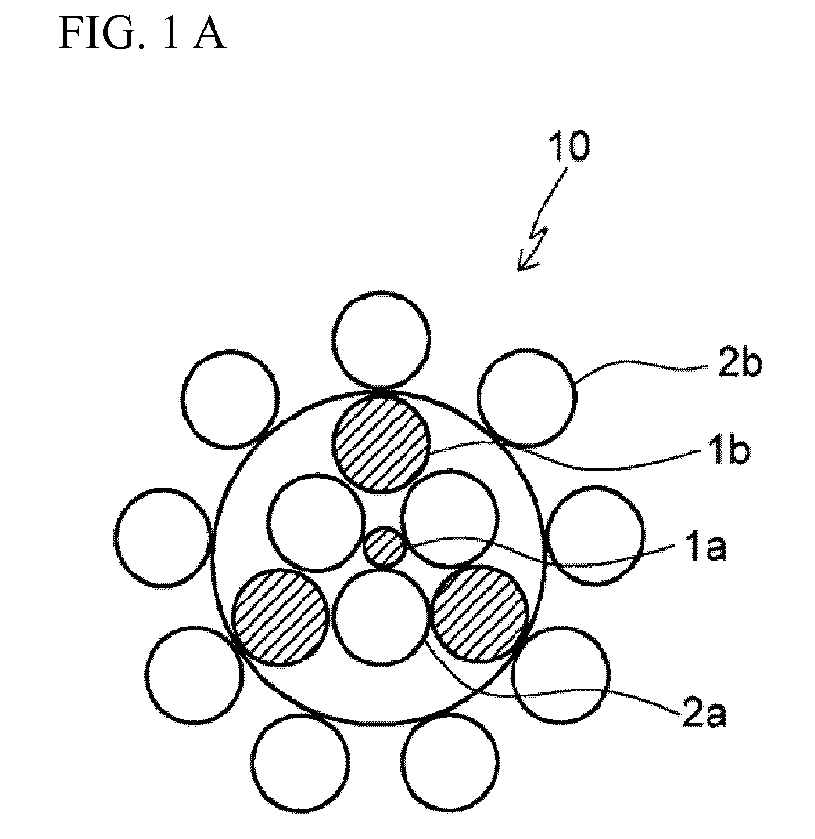
- FIGS. 1A and 1B show cross-sectional views of a steel cord according to one preferred embodiment of the manufacturing method of the present invention, in which FIG. 1A illustrates a state before vulcanization, and FIG. 1B illustrates a state after vulcanization.
- FIG. 1A illustrates a state before vulcanization
- FIG. 1B illustrates a state after vulcanization.
- three steel filaments 2a and three resin filaments 1b are twisted together around to a resin filament 1a, and furthermore, nine steel filaments 2b are twisted together around an outer periphery thereof.
- the resin filaments 1a and 1b are softened during vulcanization of a green tire, and, as illustrated in FIG. 1B , a softened resin 3 fills a gap between the steel filaments 2a and 2b.
- a softened resin 3 fills a gap between the steel filaments 2a and 2b.
- the resin filament is required to be made of a resin that has good adhesion to the interface of the steel filament after being softened so as to be able to prevent the interface with the steel filament from peeling off and becoming the route of water entry and that can prevent an interface with the rubber or the like coating the steel cord from peeling off and becoming the route of water entry.
- a resin including at least an ionomer is used for the resin filament.
- the ionomer smoothens the surface of the resin filament, so that when twisting the resin filament together with the steel filament, slipperiness between the steel filament and the resin filament can be improved, as a result of which breakage of the resin filament can be prevented, whereby spinnability of the steel cord can be improved, and simultaneously, slipperiness of the resin filament in a wire twisting machine can be improved.
- the resin filament can be any resin filament including at least an ionomer, and, for example, may be a resin filament including an ionomer alone.
- the resin filament preferably includes an inorganic filler.
- an inorganic filler may be added to the resin filament to improve the strength of the resin filament.
- adding an inorganic filler to the resin filament reduces surface tack of the resin filament, slipperiness of the resin filament is further improved, thereby facilitating twisting the filaments together into a steel cord.
- the amount of the inorganic filler to be added is preferably 0.1 to 30 parts by mass, more preferably 0.5 to 30 parts by mass, still more preferably 5 to 30 parts by mass, and particularly preferably 10 to 20 parts by mass, with respect to 100 parts by mass of a resin component.
- the amount of the inorganic filler to be added is below 0.1 parts by mass with respect to 100 parts by mass of the resin component, the reinforcement effect of the resin filament cannot be sufficiently obtained.
- the amount thereof exceeds 30 parts by mass the reinforcement effect of the resin filament is saturated, which is not preferable in terms of cost, and simultaneously, dispersibility of the inorganic filler is reduced, which may negatively affect durability of the resin filament.
- examples of the inorganic filler include carbon black, silica, aluminum hydroxide, clay, alumina, talc, mica, kaolin, glass balloons, glass beads, calcium carbonate, magnesium carbonate, magnesium hydroxide, magnesium oxide, titanium oxide, potassium titanate, and barium sulfate. These may be used singly or in combination of two or more kinds thereof. Among them, carbon black is preferable from the viewpoint of reinforcement of the resin filament. Note that, usually, a rubber composition forming a tire also includes carbon black, which thus improves compatibility between the resin filament according to the manufacturing method of the present invention and the rubber composition forming the tire, so that improvement in adhesion between the rubber and the resin can also be expected.
- the grade of the carbon black is not particularly limited, and any carbon black can be selected and used as appropriate.
- SRF, GPF, FEF, HAF, ISAF, SAF, and the like are used.
- FEF, HAF, ISAF, SAF, and the like excellent in bending resistance and fracture resistance are suitably mentioned.
- the nitrogen adsorption specific surface area N 2 SA (confirming to JIS K 6217-2: 2001) is preferably 30 to 150 m 2 /g, and more preferably 35 to 130 m 2 /g.
- the resin filament may further include an acid-modified resin.
- acid-modified resins resins modified with acid anhydrides such as dimer acid, maleic acid, and itaconic acid are preferable.
- Maleic acid-modified resin is preferable since it can improve adhesion to the steel filament.
- the percentage of the acid-modified resin can be set as appropriate as long as at least an ionomer is included.
- the mass ratio of maleic acid-modified resin to ionomer is 1:9 to 9:1, and suitably, the mass ratio thereof is in a range of 4:6 to 6:4 in consideration of balance among various performances.
- the mass of the ionomer is equal to or more than the lower limit value of the above mass ratio, slipperiness of the resin filament in manufacturing is improved.
- the neutralization degree of the ionomer is preferably set higher to give such a blend that does not cause vulcanization inhibition, as the alkaline side.
- maleic acid-modified resin examples include maleic anhydride-modified styrene-ethylene-butadiene-styrene block copolymer (SEBS), maleic anhydride-modified ultralow density polyethylene, maleic anhydride-modified ethylene-butene-1 copolymer, maleic anhydride-modified ethylene-propylene copolymer, maleic anhydride-modified ethylene-octene, and maleic anhydride-modified propylene.
- SEBS maleic anhydride-modified styrene-ethylene-butadiene-styrene block copolymer
- TUFTECTM manufactured by Asahi Kasei Corporation, such as M1943, M1911, and M1913.
- ADMERTM e.g., LB548, NF518, QF551, QF500, and QE060
- HI-WAXTM e.g., 4051E, 4252E, and 1105A
- TAFMERTM e.g., MH7010 and MH7020, all from Mitsui Chemicals, Inc. These may be used singly or in combination of two or more kinds thereof.
- the ionomer is a thermoplastic resin mainly composed of olefin (covalent bonding) and obtained by introducing ionic bonding (cross-linking) between long chains, and is characterized by having small density, large toughness and resilience, and excellent oil resistance and solvent resistance.
- a carboxyl group is used as the anion moiety of the ionic cross-linking, and a metal ion, such as sodium ion, potassium ion, magnesium ion, or zinc ion, is used as the cation moiety thereof.
- the ionomer resin can be obtained by performing cross-linking between molecular chains (carboxyl groups in the molecular chains) of, for example, an ethylene-methacrylic acid copolymer or the like by a metal ion as mentioned above.
- the ionomer include zinc ion neutralized ionomers, such as HIMILAN® 1554, HIMILAN® 1557, HIMILAN® 1650, HIMILAN® 1652, HIMILAN® 1702, HIMILAN® 1706, and HIMILAN® 1855 and sodium ion neutralized ionomers, such as HIMILAN® 1555, HIMILAN® 1601, HIMILAN® 1605, HIMILAN® 1707, HIMILAN® 1856, and AM 7331, all from Du Pont-Mitsui Polychemicals Co. Ltd.
- zinc ion neutralized ionomers such as HIMILAN® 1554, HIMILAN® 1557, HIMILAN® 1650, HIMILAN® 1652, HIMILAN® 1702, HIMILAN® 1706, and HIMILAN® 1855
- sodium ion neutralized ionomers such as HIMILAN® 1555, HIMILAN® 1601,
- lithium ion neutralized ionomers such as SURLYN® 7930 and sodium ion neutralized ionomers such as SURLYN® 8120, both from DuPont Co., Ltd. These may also be used singly or in combination of two or more kinds thereof.
- the resin filament according to the manufacturing method of the present invention may include, besides an acid-modified resin and an ionomer, a thermoplastic resin or a thermoplastic elastomer to the extent that the above-described effects are not impaired.
- various kinds of additives such as an antioxidant, an oil, a plasticizer, a color former, and a weather resistant agent may be included (blended).
- the resin filament according to the manufacturing method of the present invention can be manufactured by a known method, and the manufacturing method therefor is not particularly limited.
- the resin filament can be manufactured by mixing and kneading the resin and the inorganic filler and stretching the resulting resin composition.
- a master batch is produced in advance by adding a large amount of the inorganic filler to the resin and added to resin to prepare a resin composition containing a predetermined amount of the inorganic filler, and the resin composition is stretched so as to enable manufacturing of the resin filament.
- the structure of the steel cord is not particularly limited.
- the structure after vulcanization is preferably a structure that makes it hard for rubber or the like to enter into the steel cord, as in a steel cord having a layer-twisted structure, such as a 3+9 structure, a 3+9+15 structure, a 1+6 structure, or a 1+6+12 structure, or a multi-twisted structure obtained by further twisting any thereof together.
- a position for arranging the resin filament is preferably inner than an outermost layer sheath filament in the case of the steel cord having a layer-twisted structure, and is preferably inner than an outermost layer sheath strand or inner than the outermost layer sheath filament of each strand in the case of the steel cord having a multi-twisted structure.
- a cord having such a structure can be suitable to use as a cord for reinforcing a belt of a heavy load tire, so that the manufacturing method of the present invention can be suitable to apply to manufacturing of a heavy load tire for a truck, a bus, or the like.
- the structure of the heavy load tire is not particularly limited, and may be a known structure.
- it can be a tire that includes a pair of bead portions, a pair of side portions, and a tread portion and that is provided with a carcass extending in a toroidal shape between bead cores each buried in the bead portions and a belt including a plurality of belt layers arranged on an outside in a tire radial direction on a crown portion of the carcass.
- an inert gas such as nitrogen, argon, or helium can be used other than normal air or air having adjusted oxygen partial pressure.
- the surface of the steel filament to be used in the steel cord 10 of the present invention may be subjected to plating treatment.
- the composition of the plating on the surface of the steel filament is not particularly limited, but preferred is brass plating of copper and zinc, and more preferred is a copper content of 60% by mass or more. In this manner, adhesion between the steel filament and rubber can be improved.
- the strength of the resin filament is improved, so that the steel cord can be manufactured by twisting the resin filament together at the same time when twisting the steel filament using a twisting machine generally used for manufacturing a steel cord for a tire.
- a twisting machine generally used for manufacturing a steel cord for a tire.
- the strength of the resin filament can be enhanced by increasing a draw ratio in manufacturing the resin filament.
- the resin filament has good slipperiness in the twisting machine.
- the manufacturing method of the present invention includes the vulcanization step of vulcanizing a green tire including a belt having at least one belt layer, and is not particularly limited, except for using the above-described steel cord as a belt layer reinforcing material.
- the steel filament can be any conventionally used steel filament, it is preferable to use a steel filament having a tensile strength of 2700 N/mm 2 or more to secure belt strength.
- a steel filament having high tensile strength one including at least 0.72% by mass of carbon, and particularly at least 0.82% by mass of carbon can be suitably used.
- wire diameters of the steel filament and the resin filament are also not particularly limited, and can be designed as appropriate according to purposes.
- conditions such as twisting direction and twisting pitch in the steel cord are also not particularly limited, and can be designed as appropriate according to a usual method.
- the material for coating the steel cord is also not particularly limited, and a commonly used material for coating a steel cord can be used as appropriate, such as a thermoplastic resin, a thermosetting resin, a thermoplastic elastomer, a thermosetting elastomer, or rubber.
- vulcanization conditions such as vulcanization time, temperature, and pressure in the vulcanization step are also not particularly limited, and known conditions can be employed.
- steps other than the vulcanization step usual steps for manufacturing a tire can be employed. For example, at a tire building step before the vulcanization step, there may be prepared members required to form a tire provided with a belt layer, a carcass, a bead core, and the like, and then, using a building machine, these members may be assembled together into a single tire form to build a green tire, which may be followed by vulcanization.
- a steel cord having the structure illustrated in FIG. 1A was prepared by using steel filaments having a wire diameter of 0.36 mm and resin filaments having wire diameters of 0.36 mm and 0.15 mm, and the obtained steel cord was coated with coating rubber to prepare a steel cord-rubber composite.
- the resin filaments were prepared by stretching resin compositions obtained by mixing and kneading TUFTECTM M1943 (softening point: 39°C) manufactured by Asahi Kasei Corporation as maleic anhydride-modified SEBS, TUFTECTM H1052 (softening point: 37°C) manufactured by Asahi Kasei Corporation as SEBS resin, ADMER® QE060 (propylene-based copolymer, softening point: 123°C) manufactured by Mitsui Chemicals, Inc., as maleic anhydride-modified PP, HIMILAN® 1702 (softening point: 90°C) manufactured by Du Pont-Mitsui Polychemicals Co.
- the obtained steel cord-rubber composite was vulcanized at 145°C for 15 minutes, and adhesion between the resin and the steel filaments and compatibility of the resin at the rubber interface in the steel cord-rubber composite after the vulcanization were evaluated in the following manners.
- the steel cord was taken out from the steel cord-rubber composite according to each of the Examples and the Comparative Examples after vulcanization, and adhesion between the steel filaments and the resin was visually evaluated. One in which no separation was found between the steel filaments and the resin was evaluated as ⁇ , whereas one in which separation occurred between the steel filaments and the resin was evaluated as ⁇ . The obtained results are shown together in Tables 1 to 3.
- the gap between the steel filaments can be filled by softening the resin filaments, and there is good adhesion between the steel filaments and the resin, so that moisture can be favorably prevented from spreading inside the steel cords.
- a comparison between the Examples and the Comparative Examples shows that the spinnability and the twisting properties have been improved by the effect of the ionomer.
Landscapes
- Engineering & Computer Science (AREA)
- Mechanical Engineering (AREA)
- Chemical & Material Sciences (AREA)
- Medicinal Chemistry (AREA)
- Health & Medical Sciences (AREA)
- Chemical Kinetics & Catalysis (AREA)
- Polymers & Plastics (AREA)
- Organic Chemistry (AREA)
- Textile Engineering (AREA)
- Tires In General (AREA)
- Ropes Or Cables (AREA)
- Tyre Moulding (AREA)
- Compositions Of Macromolecular Compounds (AREA)
Abstract
Description
- The present invention relates to a method for manufacturing a tire (hereinafter also referred to simply as "manufacturing method"), and particularly to a method for manufacturing a tire using a steel cord which can be manufactured without reducing productivity and can prevent propagation of moisture inside.
- Conventionally, a steel cord formed by twisting steel filaments together is used as a material for reinforcing a belt of a tire. However, in such a steel cord, for example, when the tire is externally injured and damage reaches the belt, moisture or the like in external environment enters a gap between filaments forming the steel cord, which can create rust on the steel cord. Due to this, a blocking for the route of water is provided by forming a gap in the steel cord to allow rubber to enter the steel cord when vulcanizing. Additionally, regarding steel cords having complicated structures, such as layer-twisted or multi-twisted steel cords, for example, Patent Document 1 has made investigations, such as closing the route of water entry by previously inserting rubber or resin when twisting.
- Patent Document 1: Japanese Translation of
PCT International Application Publication No. JP-T-2013-531741 - However, the technique allowing entry of rubber in a steel cord at vulcanization is not easily applicable to steel cords having complicated structures other than simple structures such as single twisting. In addition, the technique of previously inserting rubber or resin when twisting, as proposed in Patent Document 1, increases product cost, as well as a step of coating with the rubber or resin after twisting the wires together is added, leading to reduction of productivity. In particular, in the case of coating with rubber, if there is a long pending period before tire vulcanization, an excessive reaction may occur at an interface between the steel cord and the coating rubber, whereby adhesion may be hindered. Thus, in order to improve the productivity of a steel cord and the durability of a tire, it is necessary to reexamine the structure of a steel cord and investigate a new method for manufacturing a tire.
- Accordingly, it is an object of the present invention to provide a method for manufacturing a tire using a steel cord which can be manufactured without reducing productivity and can prevent propagation of moisture inside.
- As a result of intensive and extensive studies to solve the above problems, the inventors of the present invention have found out that the above problems can be solved by using a predetermined material for a steel cord that is used as the belt cord of a tire, thereby having completed the present invention.
- Specifically, a method for manufacturing a tire of the present invention is a method for manufacturing a tire including a vulcanization step of vulcanizing a green tire provided with a belt including at least one belt layer, characterized in that the belt layer includes a steel cord formed by twisting a steel filament together with a resin filament having a softening point of 125°C or lower, and the resin filament includes at least an ionomer. Herein, the softening point refers to a value measured using a softening point test method described in JIS K 7206 (1999). Note that, in the manufacturing method of the present invention, resin represents a concept encompassing thermoplastic resins including thermoplastic elastomers and thermosetting resins including thermosetting elastomers, but not encompassing vulcanized rubber.
- In the manufacturing method of the present invention, the resin filament preferably includes 0.1 to 30 parts by mass of an inorganic filler with respect to 100 parts by mass of a resin component, and the inorganic filler is preferably carbon black. In addition, in the manufacturing method of the present invention, a grade of the carbon black is preferably GPF. Furthermore, the resin filament may further include a resin modified with an acid anhydride. Still furthermore, in the manufacturing method of the present invention, the modified resin is preferably a maleic acid-modified resin and/or a dimer acid-modified resin. In addition, in the manufacturing method of the present invention, a mass ratio of the maleic acid-modified resin to the ionomer may be 4:6 to 6:4. The manufacturing method of the present invention is suitable for manufacturing a heavy load tire.
- According to the present invention, there can be provided a method for manufacturing a tire using a steel cord which can be manufactured without reducing productivity and can prevent propagation of moisture inside.
-
-
FIG. 1A is a cross-sectional view of a steel cord in a state before vulcanization according to one preferred embodiment of a manufacturing method of the present invention. -
FIG. 1B is a cross-sectional view of a steel cord in a state after vulcanization according to one preferred embodiment of a manufacturing method of the present invention. - Hereinafter, a method for manufacturing a tire of the present invention will be described in detail by using the drawings.
- The manufacturing method of the present invention includes a vulcanization step of vulcanizing a green tire provided with a belt including at least one belt layer. In the manufacturing method of the present invention, the belt layer includes a steel cord formed by twisting a steel filament together with a resin filament containing a resin having a softening point of 125°C or lower, preferably a softening point of 60°C to 125°C, and more preferably 60°C to 90°C, in which the steel cord is coated with, for example, rubber, resin, elastomer, or the like (hereinafter, rubber or the like). When the softening point is higher than 125°C, there occur influences, such as that the resin filament is hardly softened during tire vulcanization and that building workability is worsened. Note that when the softening point of the resin is too low, the resin is easily softened due to heat generated during running, which can cause looseness of the steel filament, so that the softening point of the resin is preferably 60°C or higher.
-
FIGS. 1A and 1B show cross-sectional views of a steel cord according to one preferred embodiment of the manufacturing method of the present invention, in whichFIG. 1A illustrates a state before vulcanization, andFIG. 1B illustrates a state after vulcanization. In the example illustrated inFIG. 1A , threesteel filaments 2a and threeresin filaments 1b are twisted together around to aresin filament 1a, and furthermore, ninesteel filaments 2b are twisted together around an outer periphery thereof. In the belt layer including such a steel cord coated with rubber or the like, theresin filaments FIG. 1B , a softenedresin 3 fills a gap between thesteel filaments steel filaments - In the manufacturing method of the present invention, when twisting the steel filament and resin filament that are completely different in characteristics together, it is necessary to prevent breakage of the resin filament. In conjunction with this, the resin filament is required to be made of a resin that has good adhesion to the interface of the steel filament after being softened so as to be able to prevent the interface with the steel filament from peeling off and becoming the route of water entry and that can prevent an interface with the rubber or the like coating the steel cord from peeling off and becoming the route of water entry. Thus, in the manufacturing method of the present invention, a resin including at least an ionomer is used for the resin filament. The ionomer smoothens the surface of the resin filament, so that when twisting the resin filament together with the steel filament, slipperiness between the steel filament and the resin filament can be improved, as a result of which breakage of the resin filament can be prevented, whereby spinnability of the steel cord can be improved, and simultaneously, slipperiness of the resin filament in a wire twisting machine can be improved. In the manufacturing method of the present invention, the resin filament can be any resin filament including at least an ionomer, and, for example, may be a resin filament including an ionomer alone.
- In the manufacturing method of the present invention, the resin filament preferably includes an inorganic filler. As described above, since the resin filament is required to be easily melted at vulcanization temperature, the melting point thereof is set to 125°C or lower. However, when the melting point of the resin is low, the strength of the resin filament is reduced, which may therefore cause breakage of the resin filament when twisting, thereby deteriorating productivity. Thus, in the manufacturing method of the present invention, an inorganic filler may be added to the resin filament to improve the strength of the resin filament. In addition, since adding an inorganic filler to the resin filament reduces surface tack of the resin filament, slipperiness of the resin filament is further improved, thereby facilitating twisting the filaments together into a steel cord.
- The amount of the inorganic filler to be added is preferably 0.1 to 30 parts by mass, more preferably 0.5 to 30 parts by mass, still more preferably 5 to 30 parts by mass, and particularly preferably 10 to 20 parts by mass, with respect to 100 parts by mass of a resin component. When the amount of the inorganic filler to be added is below 0.1 parts by mass with respect to 100 parts by mass of the resin component, the reinforcement effect of the resin filament cannot be sufficiently obtained. On the other hand, when the amount thereof exceeds 30 parts by mass, the reinforcement effect of the resin filament is saturated, which is not preferable in terms of cost, and simultaneously, dispersibility of the inorganic filler is reduced, which may negatively affect durability of the resin filament.
- In the manufacturing method of the present invention, examples of the inorganic filler include carbon black, silica, aluminum hydroxide, clay, alumina, talc, mica, kaolin, glass balloons, glass beads, calcium carbonate, magnesium carbonate, magnesium hydroxide, magnesium oxide, titanium oxide, potassium titanate, and barium sulfate. These may be used singly or in combination of two or more kinds thereof. Among them, carbon black is preferable from the viewpoint of reinforcement of the resin filament. Note that, usually, a rubber composition forming a tire also includes carbon black, which thus improves compatibility between the resin filament according to the manufacturing method of the present invention and the rubber composition forming the tire, so that improvement in adhesion between the rubber and the resin can also be expected.
- In the case of using carbon black, the grade of the carbon black is not particularly limited, and any carbon black can be selected and used as appropriate. For example, SRF, GPF, FEF, HAF, ISAF, SAF, and the like are used. Particularly, FEF, HAF, ISAF, SAF, and the like excellent in bending resistance and fracture resistance are suitably mentioned. The nitrogen adsorption specific surface area N2SA (confirming to JIS K 6217-2: 2001) is preferably 30 to 150 m2/g, and more preferably 35 to 130 m2/g.
- In the manufacturing method of the present invention, the resin filament may further include an acid-modified resin. Among acid-modified resins, resins modified with acid anhydrides such as dimer acid, maleic acid, and itaconic acid are preferable. Maleic acid-modified resin is preferable since it can improve adhesion to the steel filament. In the manufacturing method of the present invention, the percentage of the acid-modified resin can be set as appropriate as long as at least an ionomer is included. In order to obtain the effect of the maleic acid-modified resin and the effect of the ionomer in a well-balanced manner, it is sufficient that the mass ratio of maleic acid-modified resin to ionomer is 1:9 to 9:1, and suitably, the mass ratio thereof is in a range of 4:6 to 6:4 in consideration of balance among various performances. When the mass of the ionomer is equal to or more than the lower limit value of the above mass ratio, slipperiness of the resin filament in manufacturing is improved. Note that, in order to promote vulcanization adhesion at the interface between the resin and rubber or the like when vulcanizing, the neutralization degree of the ionomer is preferably set higher to give such a blend that does not cause vulcanization inhibition, as the alkaline side.
- Examples of the maleic acid-modified resin include maleic anhydride-modified styrene-ethylene-butadiene-styrene block copolymer (SEBS), maleic anhydride-modified ultralow density polyethylene, maleic anhydride-modified ethylene-butene-1 copolymer, maleic anhydride-modified ethylene-propylene copolymer, maleic anhydride-modified ethylene-octene, and maleic anhydride-modified propylene. Specific examples of commercially available products include TUFTEC™ manufactured by Asahi Kasei Corporation, such as M1943, M1911, and M1913. Other than those, there can be mentioned ADMER™, e.g., LB548, NF518, QF551, QF500, and QE060, HI-WAX™, e.g., 4051E, 4252E, and 1105A, and TAFMER™, e.g., MH7010 and MH7020, all from Mitsui Chemicals, Inc. These may be used singly or in combination of two or more kinds thereof.
- The ionomer is a thermoplastic resin mainly composed of olefin (covalent bonding) and obtained by introducing ionic bonding (cross-linking) between long chains, and is characterized by having small density, large toughness and resilience, and excellent oil resistance and solvent resistance. A carboxyl group is used as the anion moiety of the ionic cross-linking, and a metal ion, such as sodium ion, potassium ion, magnesium ion, or zinc ion, is used as the cation moiety thereof. The ionomer resin can be obtained by performing cross-linking between molecular chains (carboxyl groups in the molecular chains) of, for example, an ethylene-methacrylic acid copolymer or the like by a metal ion as mentioned above.
- Specific examples of the ionomer include zinc ion neutralized ionomers, such as HIMILAN® 1554, HIMILAN® 1557, HIMILAN® 1650, HIMILAN® 1652, HIMILAN® 1702, HIMILAN® 1706, and HIMILAN® 1855 and sodium ion neutralized ionomers, such as HIMILAN® 1555, HIMILAN® 1601, HIMILAN® 1605, HIMILAN® 1707, HIMILAN® 1856, and AM 7331, all from Du Pont-Mitsui Polychemicals Co. Ltd. In addition, there may also be mentioned lithium ion neutralized ionomers, such as SURLYN® 7930 and sodium ion neutralized ionomers such as SURLYN® 8120, both from DuPont Co., Ltd. These may also be used singly or in combination of two or more kinds thereof.
- Note that the resin filament according to the manufacturing method of the present invention may include, besides an acid-modified resin and an ionomer, a thermoplastic resin or a thermoplastic elastomer to the extent that the above-described effects are not impaired. Furthermore, various kinds of additives, such as an antioxidant, an oil, a plasticizer, a color former, and a weather resistant agent may be included (blended).
- The resin filament according to the manufacturing method of the present invention can be manufactured by a known method, and the manufacturing method therefor is not particularly limited. For example, the resin filament can be manufactured by mixing and kneading the resin and the inorganic filler and stretching the resulting resin composition. Alternatively, a master batch is produced in advance by adding a large amount of the inorganic filler to the resin and added to resin to prepare a resin composition containing a predetermined amount of the inorganic filler, and the resin composition is stretched so as to enable manufacturing of the resin filament.
- In the manufacturing method of the present invention, the structure of the steel cord is not particularly limited. In the steel cord according to the manufacturing method of the present invention, the structure after vulcanization is preferably a structure that makes it hard for rubber or the like to enter into the steel cord, as in a steel cord having a layer-twisted structure, such as a 3+9 structure, a 3+9+15 structure, a 1+6 structure, or a 1+6+12 structure, or a multi-twisted structure obtained by further twisting any thereof together. Accordingly, in order to successfully obtain the effects of the present invention, a position for arranging the resin filament is preferably inner than an outermost layer sheath filament in the case of the steel cord having a layer-twisted structure, and is preferably inner than an outermost layer sheath strand or inner than the outermost layer sheath filament of each strand in the case of the steel cord having a multi-twisted structure. A cord having such a structure can be suitable to use as a cord for reinforcing a belt of a heavy load tire, so that the manufacturing method of the present invention can be suitable to apply to manufacturing of a heavy load tire for a truck, a bus, or the like.
- The structure of the heavy load tire is not particularly limited, and may be a known structure. For example, it can be a tire that includes a pair of bead portions, a pair of side portions, and a tread portion and that is provided with a carcass extending in a toroidal shape between bead cores each buried in the bead portions and a belt including a plurality of belt layers arranged on an outside in a tire radial direction on a crown portion of the carcass. Note that as a gas to be filled in the tire, an inert gas such as nitrogen, argon, or helium can be used other than normal air or air having adjusted oxygen partial pressure.
- Note that the surface of the steel filament to be used in the
steel cord 10 of the present invention may be subjected to plating treatment. The composition of the plating on the surface of the steel filament is not particularly limited, but preferred is brass plating of copper and zinc, and more preferred is a copper content of 60% by mass or more. In this manner, adhesion between the steel filament and rubber can be improved. - In the steel cord according to the manufacturing method of the present invention, the strength of the resin filament is improved, so that the steel cord can be manufactured by twisting the resin filament together at the same time when twisting the steel filament using a twisting machine generally used for manufacturing a steel cord for a tire. Thus, there is no increase in the number of working steps nor reduction of productivity. Note that, in order to prevent twist breakage of the steel filament and the resin filament, which are dissimilar materials, it is preferable to use a resin material having high strength as much as possible. The strength of the resin filament can be enhanced by increasing a draw ratio in manufacturing the resin filament. Additionally, preferably, the resin filament has good slipperiness in the twisting machine.
- The manufacturing method of the present invention includes the vulcanization step of vulcanizing a green tire including a belt having at least one belt layer, and is not particularly limited, except for using the above-described steel cord as a belt layer reinforcing material. For example, while the steel filament can be any conventionally used steel filament, it is preferable to use a steel filament having a tensile strength of 2700 N/mm2 or more to secure belt strength. As a steel filament having high tensile strength, one including at least 0.72% by mass of carbon, and particularly at least 0.82% by mass of carbon can be suitably used. In addition, wire diameters of the steel filament and the resin filament are also not particularly limited, and can be designed as appropriate according to purposes. Furthermore, in the manufacturing method of the present invention, conditions such as twisting direction and twisting pitch in the steel cord are also not particularly limited, and can be designed as appropriate according to a usual method. Still furthermore, in the manufacturing method of the present invention, the material for coating the steel cord is also not particularly limited, and a commonly used material for coating a steel cord can be used as appropriate, such as a thermoplastic resin, a thermosetting resin, a thermoplastic elastomer, a thermosetting elastomer, or rubber.
- In addition, in the manufacturing method of the present invention, vulcanization conditions such as vulcanization time, temperature, and pressure in the vulcanization step are also not particularly limited, and known conditions can be employed. Furthermore, when manufacturing a tire, regarding steps other than the vulcanization step, usual steps for manufacturing a tire can be employed. For example, at a tire building step before the vulcanization step, there may be prepared members required to form a tire provided with a belt layer, a carcass, a bead core, and the like, and then, using a building machine, these members may be assembled together into a single tire form to build a green tire, which may be followed by vulcanization.
- The present invention will be described in more detail hereinafter by using Examples.
- A steel cord having the structure illustrated in
FIG. 1A was prepared by using steel filaments having a wire diameter of 0.36 mm and resin filaments having wire diameters of 0.36 mm and 0.15 mm, and the obtained steel cord was coated with coating rubber to prepare a steel cord-rubber composite. The resin filaments were prepared by stretching resin compositions obtained by mixing and kneading TUFTEC™ M1943 (softening point: 39°C) manufactured by Asahi Kasei Corporation as maleic anhydride-modified SEBS, TUFTEC™ H1052 (softening point: 37°C) manufactured by Asahi Kasei Corporation as SEBS resin, ADMER® QE060 (propylene-based copolymer, softening point: 123°C) manufactured by Mitsui Chemicals, Inc., as maleic anhydride-modified PP, HIMILAN® 1702 (softening point: 90°C) manufactured by Du Pont-Mitsui Polychemicals Co. Ltd., as ionomer, and carbon black (ASAHI #55, manufactured by Asahi Carbon Co., Ltd.) in ratios given in Tables 1 to 3 below. In this case, spinnability of the resin filaments and surface roughnesses and strengths of the obtained resin filaments were evaluated in the following manners. Note that the unit for mixing amounts listed in the Tables is parts by mass. - Additionally, the obtained steel cord-rubber composite was vulcanized at 145°C for 15 minutes, and adhesion between the resin and the steel filaments and compatibility of the resin at the rubber interface in the steel cord-rubber composite after the vulcanization were evaluated in the following manners.
- Evaluation was made regarding workability in spinning of the resin filaments according to each of the Examples and the Comparative Examples. Cases in which spinning succeeded without any problem were evaluated as ○, whereas a case in which filament breakage occurred during spinning was evaluated as ×. The obtained results are shown together in Tables 1 to 3.
- Evaluation was made regarding roughness of surfaces of the obtained resin filaments according to each of the Examples and the Comparative Examples. The evaluation was visually performed, in which the roughness of the surfaces was evaluated as small, medium, and large as the roughness increased relatively with reference to one having a smooth surface. The obtained results are shown together in Tables 1 to 3.
- Evaluation was made regarding workability in manufacturing of a steel cord using the obtained resin filaments according to each of the Examples and the Comparative Examples. A case in which twisting succeeded without any problem was evaluated as A, a case in which filament breakage occurred accidentally during twisting was evaluated as B, and a case in which filament breakage occurred during twisting was evaluated as C. The obtained results are shown together in Tables 1 to 3.
- Regarding the obtained resin filaments according to each of the Examples and the Comparative Examples, measurement was performed according to the chemical fiber filament yarn testing method of JIS L 1013. The obtained results are shown together in Tables 1 to 3.
- The steel cord was taken out from the steel cord-rubber composite according to each of the Examples and the Comparative Examples after vulcanization, and adhesion between the steel filaments and the resin was visually evaluated. One in which no separation was found between the steel filaments and the resin was evaluated as ○, whereas one in which separation occurred between the steel filaments and the resin was evaluated as ×. The obtained results are shown together in Tables 1 to 3.
- The steel cord was taken out from the steel cord-rubber composite according to each of the Examples and the Comparative Examples after vulcanization, and compatibility between the resin and rubber was visually evaluated. One having good compatibility, one having partial separation, and one having obvious separation were evaluated as A, B, and C in order. The obtained results are shown together in Tables 1 to 3.
[Table 1] EX. 1 EX. 2 EX. 3 EX. 4 EX. 5 Maleic anhydride SEBS 90 80 70 60 50 SEBS - - - - - Maleic anhydride-modified PP - - - - - Ionomer 10 20 30 40 50 Carbon black 20 20 20 20 20 Spinnability ○ ○ ○ ○ ○ Twisting properties B B B B B Strength (MPa) 45 51 53 58 65 Resin filament surface roughness Medium Medium Small Smooth Smooth Adhesion to steel filaments ○ ○ ○ ○ ○ Compatibility with rubber interface A C B B A [Table 2] EX. 6 EX. 7 EX. 8 EX. 9 EX. 10 Maleic anhydride SEBS 40 - - - - SEBS - - 50 - - Maleic anhydride-modified PP - 50 - - - Ionomer 60 50 50 100 100 Carbon black 20 20 20 20 18 Spinnability ○ ○ ○ ○ ○ Twisting properties B A B A A Strength (MPa) 68 70 65 74 58 Resin filament surface roughness Smooth Smooth Large Smooth Smooth Adhesion to steel filaments ○ ○ ○ ○ ○ Compatibility with rubber interface A A A B B [Table 3] EX. 11 EX. 12 Comp-EX. 1 Comp-EX. 2 Maleic anhydride SEBS - - 100 - SEBS - - - 100 Maleic anhydride-modified PP - - - - Ionomer 100 100 - - Carbon black 15 10 0 0 Spinnability ○ ○ ○ × Twisting properties A A C B Strength (MPa) 48 45 22 25 Resin filament surface roughness Smooth Smooth Large Large Adhesion to steel filaments ○ ○ ○ × Compatibility with rubber interface B B A A - From the above, it can be seen that, in the steel cords according to the manufacturing method of the present invention, the gap between the steel filaments can be filled by softening the resin filaments, and there is good adhesion between the steel filaments and the resin, so that moisture can be favorably prevented from spreading inside the steel cords. In addition, a comparison between the Examples and the Comparative Examples shows that the spinnability and the twisting properties have been improved by the effect of the ionomer. Thus, according to the manufacturing method of the present invention, a tire can be manufactured that has excellent resistance against belt separation caused by rust due to moisture in external environment, without sacrificing productivity.
-
- 1a, 1b
- Resin filament
- 2a, 2b
- Steel filament
- 3
- Resin
- 10
- Steel cord
Claims (8)
- A method for manufacturing a tire comprising a vulcanization step of vulcanizing a green tire provided with a belt having at least one belt layer, characterized in that
the belt layer includes a steel cord formed by twisting a steel filament together with a resin filament having a softening point of 125°C or lower, and the resin filament includes at least an ionomer. - The method for manufacturing a tire according to claim 1, wherein the resin filament includes 0.1 to 30 parts by mass of an inorganic filler with respect to 100 parts by mass of a resin component.
- The method for manufacturing a tire according to claim 2, wherein the inorganic filler is carbon black.
- The method for manufacturing a tire according to claim 3, wherein a grade of the carbon black is GPF.
- The method for manufacturing a tire according to any one of claims 1 to 4, wherein the resin filament further includes a resin modified with an acid anhydride.
- The method for manufacturing a tire according to claim 5, wherein the modified resin is a maleic acid-modified resin and/or a dimer acid-modified resin.
- The method for manufacturing a tire according to claim 6, wherein a mass ratio of the maleic acid-modified resin to the ionomer is 4:6 to 6:4.
- The method for manufacturing a tire according to any one of claims 1 to 7, wherein the tire is for heavy load.
Applications Claiming Priority (3)
| Application Number | Priority Date | Filing Date | Title |
|---|---|---|---|
| JP2016125947 | 2016-06-24 | ||
| JP2017107042A JP6869108B2 (en) | 2016-06-24 | 2017-05-30 | Tire manufacturing method |
| PCT/JP2017/023181 WO2017222046A1 (en) | 2016-06-24 | 2017-06-23 | Method for manufacturing tire |
Publications (3)
| Publication Number | Publication Date |
|---|---|
| EP3476623A4 EP3476623A4 (en) | 2019-05-01 |
| EP3476623A1 true EP3476623A1 (en) | 2019-05-01 |
| EP3476623B1 EP3476623B1 (en) | 2021-03-10 |
Family
ID=60945264
Family Applications (1)
| Application Number | Title | Priority Date | Filing Date |
|---|---|---|---|
| EP17815511.5A Active EP3476623B1 (en) | 2016-06-24 | 2017-06-23 | Method for manufacturing tire |
Country Status (5)
| Country | Link |
|---|---|
| US (1) | US20190329593A1 (en) |
| EP (1) | EP3476623B1 (en) |
| JP (1) | JP6869108B2 (en) |
| CN (1) | CN109311346B (en) |
| ES (1) | ES2876154T3 (en) |
Cited By (3)
| Publication number | Priority date | Publication date | Assignee | Title |
|---|---|---|---|---|
| EP3702175A4 (en) * | 2017-10-25 | 2021-07-14 | Bridgestone Corporation | PNEUMATIC |
| EP3730692A4 (en) * | 2017-12-22 | 2022-01-19 | Bridgestone Corporation | ELASTOMER REINFORCED CORD |
| US11585044B2 (en) | 2017-04-27 | 2023-02-21 | Bridgestone Corporation | Cord for reinforcing elastomers |
Families Citing this family (4)
| Publication number | Priority date | Publication date | Assignee | Title |
|---|---|---|---|---|
| JP7278744B2 (en) | 2018-10-30 | 2023-05-22 | 株式会社ブリヂストン | Cord for elastomer reinforcement |
| JP7278745B2 (en) | 2018-10-30 | 2023-05-22 | 株式会社ブリヂストン | Cord for elastomer reinforcement |
| WO2020090834A1 (en) * | 2018-10-30 | 2020-05-07 | 株式会社ブリヂストン | Elastomer reinforcement cord |
| FR3099190A1 (en) * | 2019-07-25 | 2021-01-29 | Compagnie Generale Des Etablissements Michelin | Manufacturing process of at least three assemblies |
Family Cites Families (21)
| Publication number | Priority date | Publication date | Assignee | Title |
|---|---|---|---|---|
| DE1027539B (en) * | 1954-11-29 | 1958-04-03 | Dunlop Gummi Cie Ag Deutsche | Steel wire insert for vehicle tires |
| JPS6085001A (en) * | 1983-10-18 | 1985-05-14 | Ohtsu Tire & Rubber Co Ltd | Carbon fiber reinforced tyre |
| JPS60105698U (en) * | 1983-12-24 | 1985-07-18 | 半田 有正 | Composite wire rod |
| JPS60231884A (en) * | 1984-04-28 | 1985-11-18 | 興国鋼線索株式会社 | Steel cord |
| JPS60246886A (en) * | 1984-05-18 | 1985-12-06 | 興国鋼線索株式会社 | Steel cord |
| JPS6127519A (en) * | 1984-07-19 | 1986-02-07 | Matsushita Electric Ind Co Ltd | image recording device |
| JPS61138789A (en) * | 1984-12-06 | 1986-06-26 | 住友ゴム工業株式会社 | Steel cord |
| JPH0640626Y2 (en) * | 1987-12-21 | 1994-10-26 | 金井 宏之 | Steel cord |
| JP3385555B2 (en) * | 1992-10-09 | 2003-03-10 | ブリヂストンメタルファ株式会社 | Composite with reinforcing steel code and rubber and method for producing the same |
| JP2934664B2 (en) * | 1993-12-27 | 1999-08-16 | ヒエン電工株式会社 | Unbonded PC strand with rust-proof coating excellent in water barrier and gas barrier properties |
| JPH1029405A (en) * | 1996-07-16 | 1998-02-03 | Bridgestone Corp | Pneumatic tire |
| JP3568323B2 (en) * | 1996-07-23 | 2004-09-22 | 横浜ゴム株式会社 | Pneumatic radial tire |
| EP1033435A1 (en) * | 1999-03-04 | 2000-09-06 | N.V. Bekaert S.A. | Steel cord with polymer core |
| JP2001234444A (en) * | 2000-02-18 | 2001-08-31 | Sumitomo Rubber Ind Ltd | Composite cord and pneumatic tire using the same |
| JP2003289616A (en) * | 2002-03-28 | 2003-10-10 | Dainichi Seikan Kk | Twisted wire, coiled cable hanger, and manufacturing method therefor |
| DE60324922D1 (en) * | 2002-06-05 | 2009-01-08 | Bridgestone Corp | METHOD FOR PRODUCING AIR TIRES |
| CN101541564B (en) * | 2006-11-22 | 2012-03-28 | 倍耐力轮胎股份公司 | Tires with lightweight bead cores |
| JP2010053495A (en) * | 2008-08-29 | 2010-03-11 | Yokohama Rubber Co Ltd:The | Steel cord for reinforcing tire, and pneumatic tire using the same |
| WO2011024815A1 (en) * | 2009-08-24 | 2011-03-03 | 株式会社ブリヂストン | Run flat tire |
| JP2011073609A (en) * | 2009-09-30 | 2011-04-14 | Yokohama Rubber Co Ltd:The | Pneumatic tire and steel cord for reinforcing tire |
| FR2971187B1 (en) * | 2011-02-03 | 2013-03-08 | Michelin Soc Tech | SOLDER COMPOSITE REINFORCEMENT OF A SELF-ADHERING RUBBER POLYMER LAYER |
-
2017
- 2017-05-30 JP JP2017107042A patent/JP6869108B2/en active Active
- 2017-06-23 ES ES17815511T patent/ES2876154T3/en active Active
- 2017-06-23 US US16/312,377 patent/US20190329593A1/en not_active Abandoned
- 2017-06-23 CN CN201780038850.2A patent/CN109311346B/en active Active
- 2017-06-23 EP EP17815511.5A patent/EP3476623B1/en active Active
Cited By (3)
| Publication number | Priority date | Publication date | Assignee | Title |
|---|---|---|---|---|
| US11585044B2 (en) | 2017-04-27 | 2023-02-21 | Bridgestone Corporation | Cord for reinforcing elastomers |
| EP3702175A4 (en) * | 2017-10-25 | 2021-07-14 | Bridgestone Corporation | PNEUMATIC |
| EP3730692A4 (en) * | 2017-12-22 | 2022-01-19 | Bridgestone Corporation | ELASTOMER REINFORCED CORD |
Also Published As
| Publication number | Publication date |
|---|---|
| CN109311346B (en) | 2020-11-24 |
| CN109311346A (en) | 2019-02-05 |
| JP2018001749A (en) | 2018-01-11 |
| ES2876154T3 (en) | 2021-11-12 |
| EP3476623A4 (en) | 2019-05-01 |
| EP3476623B1 (en) | 2021-03-10 |
| US20190329593A1 (en) | 2019-10-31 |
| JP6869108B2 (en) | 2021-05-12 |
Similar Documents
| Publication | Publication Date | Title |
|---|---|---|
| EP3476623B1 (en) | Method for manufacturing tire | |
| WO2017222046A1 (en) | Method for manufacturing tire | |
| US11920295B2 (en) | Elastomer reinforcement cord | |
| EP3875676B1 (en) | Cord for elastomer reinforcement use | |
| EP3730692A1 (en) | Elastomer reinforcement cord | |
| US11585044B2 (en) | Cord for reinforcing elastomers | |
| US12054885B2 (en) | Elastomer reinforcement cord | |
| US11760129B2 (en) | Tire |
Legal Events
| Date | Code | Title | Description |
|---|---|---|---|
| STAA | Information on the status of an ep patent application or granted ep patent |
Free format text: STATUS: THE INTERNATIONAL PUBLICATION HAS BEEN MADE |
|
| PUAI | Public reference made under article 153(3) epc to a published international application that has entered the european phase |
Free format text: ORIGINAL CODE: 0009012 |
|
| STAA | Information on the status of an ep patent application or granted ep patent |
Free format text: STATUS: REQUEST FOR EXAMINATION WAS MADE |
|
| 17P | Request for examination filed |
Effective date: 20190123 |
|
| A4 | Supplementary search report drawn up and despatched |
Effective date: 20190403 |
|
| AK | Designated contracting states |
Kind code of ref document: A1 Designated state(s): AL AT BE BG CH CY CZ DE DK EE ES FI FR GB GR HR HU IE IS IT LI LT LU LV MC MK MT NL NO PL PT RO RS SE SI SK SM TR |
|
| AX | Request for extension of the european patent |
Extension state: BA ME |
|
| DAV | Request for validation of the european patent (deleted) | ||
| DAX | Request for extension of the european patent (deleted) | ||
| GRAP | Despatch of communication of intention to grant a patent |
Free format text: ORIGINAL CODE: EPIDOSNIGR1 |
|
| STAA | Information on the status of an ep patent application or granted ep patent |
Free format text: STATUS: GRANT OF PATENT IS INTENDED |
|
| INTG | Intention to grant announced |
Effective date: 20201208 |
|
| GRAS | Grant fee paid |
Free format text: ORIGINAL CODE: EPIDOSNIGR3 |
|
| GRAA | (expected) grant |
Free format text: ORIGINAL CODE: 0009210 |
|
| STAA | Information on the status of an ep patent application or granted ep patent |
Free format text: STATUS: THE PATENT HAS BEEN GRANTED |
|
| AK | Designated contracting states |
Kind code of ref document: B1 Designated state(s): AL AT BE BG CH CY CZ DE DK EE ES FI FR GB GR HR HU IE IS IT LI LT LU LV MC MK MT NL NO PL PT RO RS SE SI SK SM TR |
|
| REG | Reference to a national code |
Ref country code: GB Ref legal event code: FG4D |
|
| REG | Reference to a national code |
Ref country code: AT Ref legal event code: REF Ref document number: 1369397 Country of ref document: AT Kind code of ref document: T Effective date: 20210315 Ref country code: CH Ref legal event code: EP |
|
| REG | Reference to a national code |
Ref country code: IE Ref legal event code: FG4D |
|
| REG | Reference to a national code |
Ref country code: DE Ref legal event code: R096 Ref document number: 602017034462 Country of ref document: DE |
|
| REG | Reference to a national code |
Ref country code: LT Ref legal event code: MG9D |
|
| PG25 | Lapsed in a contracting state [announced via postgrant information from national office to epo] |
Ref country code: FI Free format text: LAPSE BECAUSE OF FAILURE TO SUBMIT A TRANSLATION OF THE DESCRIPTION OR TO PAY THE FEE WITHIN THE PRESCRIBED TIME-LIMIT Effective date: 20210310 Ref country code: GR Free format text: LAPSE BECAUSE OF FAILURE TO SUBMIT A TRANSLATION OF THE DESCRIPTION OR TO PAY THE FEE WITHIN THE PRESCRIBED TIME-LIMIT Effective date: 20210611 Ref country code: HR Free format text: LAPSE BECAUSE OF FAILURE TO SUBMIT A TRANSLATION OF THE DESCRIPTION OR TO PAY THE FEE WITHIN THE PRESCRIBED TIME-LIMIT Effective date: 20210310 Ref country code: NO Free format text: LAPSE BECAUSE OF FAILURE TO SUBMIT A TRANSLATION OF THE DESCRIPTION OR TO PAY THE FEE WITHIN THE PRESCRIBED TIME-LIMIT Effective date: 20210610 Ref country code: LT Free format text: LAPSE BECAUSE OF FAILURE TO SUBMIT A TRANSLATION OF THE DESCRIPTION OR TO PAY THE FEE WITHIN THE PRESCRIBED TIME-LIMIT Effective date: 20210310 Ref country code: BG Free format text: LAPSE BECAUSE OF FAILURE TO SUBMIT A TRANSLATION OF THE DESCRIPTION OR TO PAY THE FEE WITHIN THE PRESCRIBED TIME-LIMIT Effective date: 20210610 |
|
| REG | Reference to a national code |
Ref country code: AT Ref legal event code: MK05 Ref document number: 1369397 Country of ref document: AT Kind code of ref document: T Effective date: 20210310 |
|
| REG | Reference to a national code |
Ref country code: NL Ref legal event code: MP Effective date: 20210310 |
|
| PG25 | Lapsed in a contracting state [announced via postgrant information from national office to epo] |
Ref country code: LV Free format text: LAPSE BECAUSE OF FAILURE TO SUBMIT A TRANSLATION OF THE DESCRIPTION OR TO PAY THE FEE WITHIN THE PRESCRIBED TIME-LIMIT Effective date: 20210310 Ref country code: RS Free format text: LAPSE BECAUSE OF FAILURE TO SUBMIT A TRANSLATION OF THE DESCRIPTION OR TO PAY THE FEE WITHIN THE PRESCRIBED TIME-LIMIT Effective date: 20210310 Ref country code: SE Free format text: LAPSE BECAUSE OF FAILURE TO SUBMIT A TRANSLATION OF THE DESCRIPTION OR TO PAY THE FEE WITHIN THE PRESCRIBED TIME-LIMIT Effective date: 20210310 |
|
| PG25 | Lapsed in a contracting state [announced via postgrant information from national office to epo] |
Ref country code: NL Free format text: LAPSE BECAUSE OF FAILURE TO SUBMIT A TRANSLATION OF THE DESCRIPTION OR TO PAY THE FEE WITHIN THE PRESCRIBED TIME-LIMIT Effective date: 20210310 |
|
| PG25 | Lapsed in a contracting state [announced via postgrant information from national office to epo] |
Ref country code: CZ Free format text: LAPSE BECAUSE OF FAILURE TO SUBMIT A TRANSLATION OF THE DESCRIPTION OR TO PAY THE FEE WITHIN THE PRESCRIBED TIME-LIMIT Effective date: 20210310 Ref country code: EE Free format text: LAPSE BECAUSE OF FAILURE TO SUBMIT A TRANSLATION OF THE DESCRIPTION OR TO PAY THE FEE WITHIN THE PRESCRIBED TIME-LIMIT Effective date: 20210310 Ref country code: SM Free format text: LAPSE BECAUSE OF FAILURE TO SUBMIT A TRANSLATION OF THE DESCRIPTION OR TO PAY THE FEE WITHIN THE PRESCRIBED TIME-LIMIT Effective date: 20210310 Ref country code: AT Free format text: LAPSE BECAUSE OF FAILURE TO SUBMIT A TRANSLATION OF THE DESCRIPTION OR TO PAY THE FEE WITHIN THE PRESCRIBED TIME-LIMIT Effective date: 20210310 |
|
| REG | Reference to a national code |
Ref country code: ES Ref legal event code: FG2A Ref document number: 2876154 Country of ref document: ES Kind code of ref document: T3 Effective date: 20211112 |
|
| PG25 | Lapsed in a contracting state [announced via postgrant information from national office to epo] |
Ref country code: PL Free format text: LAPSE BECAUSE OF FAILURE TO SUBMIT A TRANSLATION OF THE DESCRIPTION OR TO PAY THE FEE WITHIN THE PRESCRIBED TIME-LIMIT Effective date: 20210310 Ref country code: PT Free format text: LAPSE BECAUSE OF FAILURE TO SUBMIT A TRANSLATION OF THE DESCRIPTION OR TO PAY THE FEE WITHIN THE PRESCRIBED TIME-LIMIT Effective date: 20210712 Ref country code: RO Free format text: LAPSE BECAUSE OF FAILURE TO SUBMIT A TRANSLATION OF THE DESCRIPTION OR TO PAY THE FEE WITHIN THE PRESCRIBED TIME-LIMIT Effective date: 20210310 Ref country code: SK Free format text: LAPSE BECAUSE OF FAILURE TO SUBMIT A TRANSLATION OF THE DESCRIPTION OR TO PAY THE FEE WITHIN THE PRESCRIBED TIME-LIMIT Effective date: 20210310 Ref country code: IS Free format text: LAPSE BECAUSE OF FAILURE TO SUBMIT A TRANSLATION OF THE DESCRIPTION OR TO PAY THE FEE WITHIN THE PRESCRIBED TIME-LIMIT Effective date: 20210710 |
|
| REG | Reference to a national code |
Ref country code: DE Ref legal event code: R097 Ref document number: 602017034462 Country of ref document: DE |
|
| PLBE | No opposition filed within time limit |
Free format text: ORIGINAL CODE: 0009261 |
|
| STAA | Information on the status of an ep patent application or granted ep patent |
Free format text: STATUS: NO OPPOSITION FILED WITHIN TIME LIMIT |
|
| PG25 | Lapsed in a contracting state [announced via postgrant information from national office to epo] |
Ref country code: DK Free format text: LAPSE BECAUSE OF FAILURE TO SUBMIT A TRANSLATION OF THE DESCRIPTION OR TO PAY THE FEE WITHIN THE PRESCRIBED TIME-LIMIT Effective date: 20210310 Ref country code: AL Free format text: LAPSE BECAUSE OF FAILURE TO SUBMIT A TRANSLATION OF THE DESCRIPTION OR TO PAY THE FEE WITHIN THE PRESCRIBED TIME-LIMIT Effective date: 20210310 Ref country code: MC Free format text: LAPSE BECAUSE OF FAILURE TO SUBMIT A TRANSLATION OF THE DESCRIPTION OR TO PAY THE FEE WITHIN THE PRESCRIBED TIME-LIMIT Effective date: 20210310 |
|
| REG | Reference to a national code |
Ref country code: CH Ref legal event code: PL |
|
| 26N | No opposition filed |
Effective date: 20211213 |
|
| GBPC | Gb: european patent ceased through non-payment of renewal fee |
Effective date: 20210623 |
|
| PG25 | Lapsed in a contracting state [announced via postgrant information from national office to epo] |
Ref country code: SI Free format text: LAPSE BECAUSE OF FAILURE TO SUBMIT A TRANSLATION OF THE DESCRIPTION OR TO PAY THE FEE WITHIN THE PRESCRIBED TIME-LIMIT Effective date: 20210310 |
|
| REG | Reference to a national code |
Ref country code: BE Ref legal event code: MM Effective date: 20210630 |
|
| PG25 | Lapsed in a contracting state [announced via postgrant information from national office to epo] |
Ref country code: LU Free format text: LAPSE BECAUSE OF NON-PAYMENT OF DUE FEES Effective date: 20210623 |
|
| PG25 | Lapsed in a contracting state [announced via postgrant information from national office to epo] |
Ref country code: LI Free format text: LAPSE BECAUSE OF NON-PAYMENT OF DUE FEES Effective date: 20210630 Ref country code: IT Free format text: LAPSE BECAUSE OF FAILURE TO SUBMIT A TRANSLATION OF THE DESCRIPTION OR TO PAY THE FEE WITHIN THE PRESCRIBED TIME-LIMIT Effective date: 20210310 Ref country code: IE Free format text: LAPSE BECAUSE OF NON-PAYMENT OF DUE FEES Effective date: 20210623 Ref country code: GB Free format text: LAPSE BECAUSE OF NON-PAYMENT OF DUE FEES Effective date: 20210623 Ref country code: CH Free format text: LAPSE BECAUSE OF NON-PAYMENT OF DUE FEES Effective date: 20210630 |
|
| PG25 | Lapsed in a contracting state [announced via postgrant information from national office to epo] |
Ref country code: IS Free format text: LAPSE BECAUSE OF FAILURE TO SUBMIT A TRANSLATION OF THE DESCRIPTION OR TO PAY THE FEE WITHIN THE PRESCRIBED TIME-LIMIT Effective date: 20210710 |
|
| PG25 | Lapsed in a contracting state [announced via postgrant information from national office to epo] |
Ref country code: BE Free format text: LAPSE BECAUSE OF NON-PAYMENT OF DUE FEES Effective date: 20210630 |
|
| PG25 | Lapsed in a contracting state [announced via postgrant information from national office to epo] |
Ref country code: CY Free format text: LAPSE BECAUSE OF FAILURE TO SUBMIT A TRANSLATION OF THE DESCRIPTION OR TO PAY THE FEE WITHIN THE PRESCRIBED TIME-LIMIT Effective date: 20210310 |
|
| P01 | Opt-out of the competence of the unified patent court (upc) registered |
Effective date: 20230531 |
|
| PG25 | Lapsed in a contracting state [announced via postgrant information from national office to epo] |
Ref country code: HU Free format text: LAPSE BECAUSE OF FAILURE TO SUBMIT A TRANSLATION OF THE DESCRIPTION OR TO PAY THE FEE WITHIN THE PRESCRIBED TIME-LIMIT; INVALID AB INITIO Effective date: 20170623 |
|
| PGFP | Annual fee paid to national office [announced via postgrant information from national office to epo] |
Ref country code: ES Payment date: 20230830 Year of fee payment: 7 |
|
| PG25 | Lapsed in a contracting state [announced via postgrant information from national office to epo] |
Ref country code: MK Free format text: LAPSE BECAUSE OF FAILURE TO SUBMIT A TRANSLATION OF THE DESCRIPTION OR TO PAY THE FEE WITHIN THE PRESCRIBED TIME-LIMIT Effective date: 20210310 |
|
| PG25 | Lapsed in a contracting state [announced via postgrant information from national office to epo] |
Ref country code: TR Free format text: LAPSE BECAUSE OF FAILURE TO SUBMIT A TRANSLATION OF THE DESCRIPTION OR TO PAY THE FEE WITHIN THE PRESCRIBED TIME-LIMIT Effective date: 20210310 |
|
| PG25 | Lapsed in a contracting state [announced via postgrant information from national office to epo] |
Ref country code: MT Free format text: LAPSE BECAUSE OF FAILURE TO SUBMIT A TRANSLATION OF THE DESCRIPTION OR TO PAY THE FEE WITHIN THE PRESCRIBED TIME-LIMIT Effective date: 20210310 |
|
| PGFP | Annual fee paid to national office [announced via postgrant information from national office to epo] |
Ref country code: DE Payment date: 20250618 Year of fee payment: 9 |
|
| PGFP | Annual fee paid to national office [announced via postgrant information from national office to epo] |
Ref country code: FR Payment date: 20250625 Year of fee payment: 9 |
|
| REG | Reference to a national code |
Ref country code: ES Ref legal event code: FD2A Effective date: 20250801 |
|
| PG25 | Lapsed in a contracting state [announced via postgrant information from national office to epo] |
Ref country code: ES Free format text: LAPSE BECAUSE OF NON-PAYMENT OF DUE FEES Effective date: 20240624 |