EP3475292B1 - Synthesis of thiolated oligonucleotides without a capping step - Google Patents
Synthesis of thiolated oligonucleotides without a capping step Download PDFInfo
- Publication number
- EP3475292B1 EP3475292B1 EP17735311.7A EP17735311A EP3475292B1 EP 3475292 B1 EP3475292 B1 EP 3475292B1 EP 17735311 A EP17735311 A EP 17735311A EP 3475292 B1 EP3475292 B1 EP 3475292B1
- Authority
- EP
- European Patent Office
- Prior art keywords
- formula
- compound
- sulfurization
- oligonucleotide
- agent
- Prior art date
- Legal status (The legal status is an assumption and is not a legal conclusion. Google has not performed a legal analysis and makes no representation as to the accuracy of the status listed.)
- Active
Links
Images




Classifications
-
- C—CHEMISTRY; METALLURGY
- C07—ORGANIC CHEMISTRY
- C07H—SUGARS; DERIVATIVES THEREOF; NUCLEOSIDES; NUCLEOTIDES; NUCLEIC ACIDS
- C07H1/00—Processes for the preparation of sugar derivatives
-
- C—CHEMISTRY; METALLURGY
- C07—ORGANIC CHEMISTRY
- C07H—SUGARS; DERIVATIVES THEREOF; NUCLEOSIDES; NUCLEOTIDES; NUCLEIC ACIDS
- C07H21/00—Compounds containing two or more mononucleotide units having separate phosphate or polyphosphate groups linked by saccharide radicals of nucleoside groups, e.g. nucleic acids
-
- C—CHEMISTRY; METALLURGY
- C07—ORGANIC CHEMISTRY
- C07H—SUGARS; DERIVATIVES THEREOF; NUCLEOSIDES; NUCLEOTIDES; NUCLEIC ACIDS
- C07H21/00—Compounds containing two or more mononucleotide units having separate phosphate or polyphosphate groups linked by saccharide radicals of nucleoside groups, e.g. nucleic acids
- C07H21/02—Compounds containing two or more mononucleotide units having separate phosphate or polyphosphate groups linked by saccharide radicals of nucleoside groups, e.g. nucleic acids with ribosyl as saccharide radical
-
- C—CHEMISTRY; METALLURGY
- C07—ORGANIC CHEMISTRY
- C07H—SUGARS; DERIVATIVES THEREOF; NUCLEOSIDES; NUCLEOTIDES; NUCLEIC ACIDS
- C07H21/00—Compounds containing two or more mononucleotide units having separate phosphate or polyphosphate groups linked by saccharide radicals of nucleoside groups, e.g. nucleic acids
- C07H21/04—Compounds containing two or more mononucleotide units having separate phosphate or polyphosphate groups linked by saccharide radicals of nucleoside groups, e.g. nucleic acids with deoxyribosyl as saccharide radical
-
- C—CHEMISTRY; METALLURGY
- C12—BIOCHEMISTRY; BEER; SPIRITS; WINE; VINEGAR; MICROBIOLOGY; ENZYMOLOGY; MUTATION OR GENETIC ENGINEERING
- C12N—MICROORGANISMS OR ENZYMES; COMPOSITIONS THEREOF; PROPAGATING, PRESERVING, OR MAINTAINING MICROORGANISMS; MUTATION OR GENETIC ENGINEERING; CULTURE MEDIA
- C12N15/00—Mutation or genetic engineering; DNA or RNA concerning genetic engineering, vectors, e.g. plasmids, or their isolation, preparation or purification; Use of hosts therefor
- C12N15/09—Recombinant DNA-technology
- C12N15/11—DNA or RNA fragments; Modified forms thereof; Non-coding nucleic acids having a biological activity
- C12N15/113—Non-coding nucleic acids modulating the expression of genes, e.g. antisense oligonucleotides; Antisense DNA or RNA; Triplex- forming oligonucleotides; Catalytic nucleic acids, e.g. ribozymes; Nucleic acids used in co-suppression or gene silencing
-
- C—CHEMISTRY; METALLURGY
- C12—BIOCHEMISTRY; BEER; SPIRITS; WINE; VINEGAR; MICROBIOLOGY; ENZYMOLOGY; MUTATION OR GENETIC ENGINEERING
- C12N—MICROORGANISMS OR ENZYMES; COMPOSITIONS THEREOF; PROPAGATING, PRESERVING, OR MAINTAINING MICROORGANISMS; MUTATION OR GENETIC ENGINEERING; CULTURE MEDIA
- C12N2310/00—Structure or type of the nucleic acid
- C12N2310/10—Type of nucleic acid
- C12N2310/11—Antisense
-
- C—CHEMISTRY; METALLURGY
- C12—BIOCHEMISTRY; BEER; SPIRITS; WINE; VINEGAR; MICROBIOLOGY; ENZYMOLOGY; MUTATION OR GENETIC ENGINEERING
- C12N—MICROORGANISMS OR ENZYMES; COMPOSITIONS THEREOF; PROPAGATING, PRESERVING, OR MAINTAINING MICROORGANISMS; MUTATION OR GENETIC ENGINEERING; CULTURE MEDIA
- C12N2310/00—Structure or type of the nucleic acid
- C12N2310/30—Chemical structure
- C12N2310/34—Spatial arrangement of the modifications
- C12N2310/341—Gapmers, i.e. of the type ===---===
-
- Y—GENERAL TAGGING OF NEW TECHNOLOGICAL DEVELOPMENTS; GENERAL TAGGING OF CROSS-SECTIONAL TECHNOLOGIES SPANNING OVER SEVERAL SECTIONS OF THE IPC; TECHNICAL SUBJECTS COVERED BY FORMER USPC CROSS-REFERENCE ART COLLECTIONS [XRACs] AND DIGESTS
- Y02—TECHNOLOGIES OR APPLICATIONS FOR MITIGATION OR ADAPTATION AGAINST CLIMATE CHANGE
- Y02P—CLIMATE CHANGE MITIGATION TECHNOLOGIES IN THE PRODUCTION OR PROCESSING OF GOODS
- Y02P20/00—Technologies relating to chemical industry
- Y02P20/50—Improvements relating to the production of bulk chemicals
- Y02P20/55—Design of synthesis routes, e.g. reducing the use of auxiliary or protecting groups
Definitions
- Oligonucleotides are short DNA or RNA oligomers that can be chemically synthesized for research and medical purposes. Oligonucleotides are typically prepared by a stepwise addition of nucleotide residues to produce a specific sequence.
- Current solid-phase synthesis manufacturing process of thiolated oligonucleotides uses repetition of four-reactions per cycle, namely deprotection (e.g., detritylation), coupling, sulfurization, and capping.
- the capping step was designed to block any unreacted 5'-hydroxyl groups that failed to couple with the phosphoramidite in each cycle, so the failure sequence does not participate further in the coupling reactions in the subsequent cycles to generate impurities missing the nucleoside of the failed coupling.
- the capping step is done typically using acetic anhydride with base catalysts, such as pyridine or N-methyl morpholine.
- US 2010/331533 A1 discloses a method and compositions for sulfurizing at least one phosphite or thiophosphite linkage in an oligonucleotide.
- US 6809195 B1 discloses methods for synthesizing oligomeric compounds.
- the invention herein describes a solid-phase synthesis manufacturing process for fully or partially thiolated oligonucleotides using repetition of a-three-reactions per cycle, namely detritylation, coupling, and sulfurization, rather than conventional four-reactions per cycle.
- nucleotides are added to a growing oligomer chain by coupling the free 5'-hydroxyl of the last nucleotide of the oligomer attached to the solid support with the appropriate phosphoramidite.
- Inefficiencies in the coupling reaction would leave some of the 5'-hydroxyl groups free to react in subsequent coupling reactions, resulting in a complicated mixture of oligomers missing a single, but random, nucleotide.
- the 5'-hydroxyl is capped via the use of a capping reagent such as acetic anhydride prior to or after the sulfurization step.
- the present inventors developed a process that eliminates the capping step prior to or following the sulfurization step.
- the present inventors have surprisingly discovered that the byproducts generated during the sulfurization step can be used to cap the unreacted 5'-hydroxy groups.
- the sulfurization agent itself for example PADS, may be recirculated across the solid support to cap the 5'-hydroxy groups that failed to couple with the phosphoramidite.
- the unreacted 5' hydroxyl groups react with the sulfurization byproducts, without the need of a separate capping step, and are no longer available to couple in the subsequent cycles.
- no capping step is needed at all and the process includes only 3 reactions per cycle (deprotection, coupling, and sulfurization).
- Use of the process described herein can be used to eliminate the capping step following the sulfurization step. However, because the byproducts of the oxidation step do not cap the unreacted 5'-hydroxy, residual amounts of unreacted 5'-hydroxyl groups may remain following the oxidation step.
- the process described here in can be used even without a capping step following the oxidation step.
- the process described herein can be used but a conventional capping step, for example, with acetic anhydride, may be used following each oxidation step.
- a sufficient amount of time could be determined by one of skill in the art based upon the reaction conditions. For example, the times provided in the thirteenth embodiment, namely 0 to 30 minutes, for example, 0, 5, 10, 15, 20, 25, or 30 minutes, would be "a sufficient amount of time”.
- substantially completely convert could be determined by one of skill in the art based upon the reaction conditions.
- substantially completely convert means to convert 50%, 60%, 65%, 70%, 75%, 80%, 85%, 90%, 95 % or 100 % of the unreacted compound of Formula (I) to Formula (V) or Formula (III) to Formula (IV).
- the process does not include an additional capping step following step b. Specifically, any unreacted compound of Formula (I), (VI), or (IX) is capped by the byproducts of the sulfurization step b without the require add any other reagent to cap any unreacted compound of Formula (I), (VI), or (IX) .
- Formula (II) is selected from any one of the following structural formula: wherein DMTO is the 4,4'-dimethoxytrityl protected 5'-hydroxy and R 11 is as defined for the first embodiment.
- a second embodiment of the invention is a process as described for the first embodiment or any aspect thereof, further comprising the step of c) deprotecting the compound of Formula (IV) to form the compound of Formula (VI): or a pharmaceutically acceptable salt thereof.
- a third embodiment of the invention is a process as described for the second embodiment, further comprising the step of d) reacting the compound of Formula (VI) with a compound of Formula (II) to form a compound of Formula (VII): or a pharmaceutically acceptable salt thereof; and e) oxidizing the compound of Formula (VII) with a oxidizing agent to form a compound of Formula (VIII):
- a fourth embodiment of the invention is a process as described for the third embodiment, further comprising the step of f) deprotecting the compound of Formula (VIII) to form the compound of Formula (IX): or a pharmaceutically acceptable salt thereof.
- a fifth embodiment of the invention is a process as described for the second and fourth embodiments, wherein starting with the compound of Formula (VI) or the compound of Formula (IX), steps a), b), and c) are repeated n times and steps d), e), and f) are repeated m times, wherein repetition of steps a), b), and c) and steps d), e) and f) can occur in any order relative to each other, wherein n is at least 1 or more and m is 0, 1, 2, 3, or 4, to form an oligonucleotide of Formula (X) or (XI): or (XI) or a pharmaceutically acceptable salt thereof, or forms a oligonucleotide wherein each repetition of steps a, b, and c, or steps d, e, and f results in some unreacted compound of Formula (VI) and (IX) that reacts with excess sulfurization agent or the byproduct of the sulfurization agent following the sulfurization step to form a compound of Formula (X
- the process described above for the fifth embodiment involves a stepwise addition of nucleotides to form the desired oligonucleotide. Each of these steps involve three reactions to add the nucleotide to the growing oligonucleotide.
- the first step corresponding to steps a and d
- the 5' end of a nucleoside such as a compound of Formula (I)
- the 3' end of nucleotide such as a compound of Formula (II)
- the oligonucleotide is either sulfurized (step b) or oxidized (step e), respectively.
- step c or f the next 5'-hydroxy group is deprotected (steps c or f, and for example, Formulas (VI) and (IX)) and the process is repeated to add the next nucleoside.
- this process allows for the synthesis of an oligonucleotide with any number of phosphothioate bonds and up to four phosphodiester without the need for any capping step at all because any unreacted 5'-hydroxy groups will react with the sulfurization agent itself or a byproduct of the reaction of the sulfurization agent with the phosphorous atom in the linkage between two nucleosides.
- This is in contrast to the conventional synthesis, where a capping step to block any of the unreacted 5'OH is done following the coupling step.
- a sixth embodiment of the invention is a process as described for the third embodiment, further comprising the step of g) reacting the unreacted compound of Formula (VI) with a capping agent to form the compound of Formula (XIV): or a pharmaceutically acceptable salt thereof, wherein R c is s a hydroxy protecting group formed from the capping agent.
- a "capping agent” may be any capping agent known to one of skill in the art, for example, acetic anhydride with base catalysts, such as pyridine or N-methyl morpholine.
- a seventh embodiment of the invention is a process as described for the sixth embodiment, further comprising the step of h) deprotecting the compound of Formula (VIII) to form the compound of Formula (XV): or a pharmaceutically acceptable salt thereof.
- a eighth embodiment of the invention is a process as described for the seventh embodiment, wherein starting with the compound of Formula (VI) or the compound of Formula (IX), steps a), b), and c) are repeated n times and steps d), e), g) and h) are repeated m times, wherein repetition of steps a), b), and c) and steps d), e), g) and h) can occur in any order relative to each other, wherein n is at least 1 and m is 0 or greater to form an oligonucleotide of Formula (X) or (XI): or (XI) or a pharmaceutically acceptable salt thereof, or forms a oligonucleotide wherein each repetition of steps a, b, and c, or steps d, e, and f results in some unreacted compound of Formula (VI) and (IX) that reacts with excess sulfurization agent or the byproduct of the sulfurization agent following the sulfurization step to form a compound of Formula XI
- the process described above for the eighth embodiment involves a stepwise addition of nucleotides to form the desired oligonucleotide.
- Each of these steps involve three reactions to add a nucleotide containing a phosphothioate linkage to the growing oligonucleotide and four reactions to add a nucleotide containing a phosphodiester linkage to the growing oligonucleotide.
- the 5' end of a nucleoside such as a compound of Formula I
- the 3' end of nucleotide such as a compound of Formula II
- the oligonucleotide is either sulfurized (step b, forming compound such as those of Formula (IV)) or oxidized (step e, forming compound such as those of Formula (IV) or (VIII)).
- step g forming compound such as those of Formula (IV)
- step g no capping step is required following the sulfurization step.
- next 5'-hydroxy group is deprotected (steps c or h, and for example, Formulas (VI) and (IX)) and the process is repeated to add the next nucleoside. Therefore, this process allows for the synthesis of an oligonucleotide with any number of phosphothioate bonds and phosphodiester bond, and requires a capping step only after the cycle including an oxidation step. This is in contrast to the conventional synthesis, where a capping step to block any of the unreacted 5'OH is done every cycle, even those including a sulfurization step.
- the compounds of Formulas (I), (II), (III), (IV), (V), (VI), (VII), (VIII), (IX), (X), (XI), (XII), (XIII), (XIV), or (XV) are not salts.
- n is 2 to 1000. In particular, n is 2 to 500. In particular, n is 2 to 50. In particular, n is 2 to 25.
- the process is as described for any one of the first, second, third, fourth, fifth, sixth, seventh, and eighth embodiments, or any aspect thereof, wherein the linker attached to the solid support is cleaved.
- the sulfurization agent is a compound of Formula A: wherein each of R 1 and R 2 are independently selected from H, an optionally substituted alkyl and an optionally substituted aryl group.
- R 1 and R 2 are both H: which is known as 3-amino-1,2,4-dithiazole-5-thione (XH or ADTT).
- R 1 and R 2 are both methyl: which is known as 3-N,N-dimethlamino-methlideneamino-3H-1,2,4-dithiazole (DDTT).
- the sulfurization agent is a compound of Formula B: wherein each of R 1 and R 2 are independently selected from H, an optionally substituted alkyl and an optionally substituted aryl group.
- R 1 and R 2 are both benzyl (PhCH 2 ): which is known as phenylacetyl disulfide (PADS).
- PADS phenylacetyl disulfide
- the process is as described for any one of the first, second, third, fourth, fifth, sixth, seventh, eighth, and ninth embodiments, or any aspect thereof, the sulfurization agent is 3H-1,2-benzodithiol-3-one 1,1-dioxide (Beaucage Reagent):
- the sulfurization agent is 3H-1,2-benzodithiol-3-one 1,1-dioxide (Beaucage Reagent):
- R S is 3H-1,2-benzodithiol-3-one 1,1-dioxide
- the process is as described for any one of the first, second, third, fourth, fifth, sixth, seventh, eighth, ninth, tenth, eleventh, and twelfth embodiments, or any aspect thereof, wherein the sulfurization agent is reacted by recirculating the sulfurization agent for 0 to 30 minutes, for example, 0, 5, 10, 15, 20, 25, or 30 minutes.
- the sulfurization agent is recirculated for 1 to 30 minutes, 1 to 20 minutes, 1 to 10 minutes, or 1 to 5 minutes.
- the sulfurization agent is recirculated for 1, 2, 3, 4, 5, 6, 7, 8, 9, or 10 minutes.
- the process is as described for any one of the first, second, third, fourth, fifth, sixth, seventh, eighth, ninth, tenth, eleventh, twelfth, and thirteenth embodiments, or any aspect thereof, wherein the sulfurization agent is recirculated for 1-20 times, for example, 1, 2, 5, 10, 15, 20 times. In one embodiment, the sulfurization agent is recirculated for 1-10 times, or 1-5 times.
- the process is as described for any one of the first, second, third, fourth, fifth, sixth, seventh, eighth, ninth, tenth, eleventh, twelfth, thirteenth, and fourteenth embodiments, or any aspect thereof, the sulfurization agent is reacted by recirculating 3 to 6 equivalents of sulfurization agent relative to the amount of the first nucleoside attached to the solid support.
- the process is as described for any one of the first, second, third, fourth, fifth, sixth, seventh, eighth, ninth, tenth, eleventh, twelfth, thirteenth, fourteenth, and fifteenth embodiments, or any aspect thereof, the concentration of the sulfurization reagent is from 0.02 M to 2.0 M.
- the sulfurization agent is dissolved in pyridine, 3-piccoline, acetonitrile, or a mixture thereof.
- the concentration of the sulfurization reagent is from 0.05 M to 0.5 M.
- the sulfurization reagent is 3-(dimethylamino-methylidene)amino)-3H-1,2,4-dithiazole (DDTT) added at a concentration of 0.02 M to 0.1 M, for example, 0.02, 0.03, 0.04, 0.05, 0.06, 0.07,0.08, 0.09, or 0.1M dissolved in pyridine.
- DDTT 3-(dimethylamino-methylidene)amino)-3H-1,2,4-dithiazole
- the sulfurization reagent is 3H-1,2-benzodithiol-3-one 1,1-dioxide (Beaucage Reagent) added at a concentration of 0.01 M to 0.2 M, for example, 0.01, 0.02, 0.03, 0.04, 0.05, 0.06, 0.07,0.08, 0.09, 0.10, 0.11, 0.12, 0.13, 0.14, 0.15, 0.16, 0.17, 0.18, 0.19, 0.2 M in acetonitrile (ACN).
- ACN acetonitrile
- the sulfurization reagent is phenylacetyl disulfide (PADS) added at a concentration of 0.01 M to 0.2 M, for example, 0.01, 0.02, 0.03, 0.04, 0.05, 0.06, 0.07,0.08, 0.09, 0.10, 0.11, 0.12, 0.13, 0.14, 0.15, 0.16, 0.17, 0.18, 0.19, 0.2 M in acetonitrile (ACN)/3-picoline.
- PADS phenylacetyl disulfide
- the sulfurization reagent is 3-amino-1,2,4-dithiazole-5-thione (XH or ADTT) added at a concentration of 0.01 M to 0.2 M, for example, 0.01, 0.02, 0.03, 0.04, 0.05, 0.06, 0.07,0.08, 0.09, 0.10, 0.11, 0.12, 0.13, 0.14, 0.15, 0.16, 0.17, 0.18, 0.19, 0.2 M in pyridine.
- XH or ADTT 3-amino-1,2,4-dithiazole-5-thione
- the sulfurization reagent described above e.g ., phenylacetyl disulfide (PADS) or 3-amino-1,2,4-dithiazole-5-thione (XH)
- PADS phenylacetyl disulfide
- XH 3-amino-1,2,4-dithiazole-5-thione
- a base i.e., aging
- the sulfurization reagent can be aged with the base ( i.e ., treated with the base) for 1 minute to 5 days, for example for 5 minutes to 24 hours, 10 minutes to 12 hours, 30 minutes to 10 hours, 1 hour to 8 hours, 2 hours to 6 hours, or 3 hours to 5 hours.
- the sulfurization reagent is aged for 4 hours.
- the sufurization reagent PADS is aged with 3-picoline for 4 hours before being used in the process of the present invention.
- the process is as described for any one of the first, second, third, fourth, fifth, sixth, seventh, eighth, ninth, tenth, eleventh, twelfth, thirteenth, fourteenth, fifteenth, and sixteenth embodiments, or any aspect thereof,
- each R 2 and R 12 are independently selected from the group consisting of H, F, and C 1-4 alkoxy optionally substituted with C 1-4 alkoxy; each R 4 is independently H or forms a ring with the alkoxy group of R 2 , wherein the ring is a 5 or 6-membered ring optionally substituted with 1 to 3 C 1-4 alkyl groups; R 16 is -CH 2 CH 2 CN; R 17a and R 17b are independently C 1-4 alkyl; and each R 14 is independently H or forms a ring with the alkoxy group of R 12 , wherein the ring is a 5 or 6-membered ring optionally substituted with 1 to 3 C 1-4 alkyl groups.
- each R 2 and R 12 are independently selected from H or C 1-4 alkoxy optionally substituted with C 1-4 alkoxy;
- R 15 is 4,4'-dimethoxytrityl;
- R 16 is -CH 2 CH 2 CN;
- R 17a and R 17b are independently C 1-6 alkyl; and
- Y is an oligonucleotide comprising 2 to 50 nucleotides, in particular, 2 to 40 nucleotides, 2 to 30 nucleotides, or 2 to 25 nucleotides.
- the process is as described for any one of the first, second, third, fourth, fifth, sixth, seventh, eighth, ninth, tenth, eleventh, twelfth, thirteenth, fourteenth, fifteenth, sixteenth, seventeenth, eighteenth, nineteenth, and twentieth embodiments, or any aspect thereof, the compound of Formula (X) or (XI) is an anti-sense oligonucleotide comprising 2 to 30 nucleotides.
- the anti-sense oligonucleotide comprises modified RNA only.
- the anti-sense oligonucleotide comprises DNA and modified RNA.
- the anti-sense oligonucleotide is a gapmer.
- the anti-sense oligonucleotide comprises DNA only.
- the anti-sense oligonucleotide is a phosphorothioate oligonucleotide having a sequence of (from 5' to 3') TCACTTTCATAATGCTGG (SEQ ID NO: 1), wherein each internucleoside linkage of the oligonucleotide is a phosphorothioate linkage, each nucleoside of the oligonucleotide is a 2'-O- methoxyethyl (MOE) nucleoside, and each cytosine is a 5-methylcytosine.
- SEQ ID NO: 1 is also known as BIIB058, and is described in WO
- the process is as described for any one of the first, second, third, fourth, fifth, sixth, seventh, eighth, ninth, tenth, eleventh, twelfth, thirteenth, fourteenth, fifteenth, sixteenth, seventeenth, eighteenth, nineteenth, twentieth, and twenty-first embodiments, or any aspect thereof,
- the sequence of the anti-sense oligonucleotide is a 5-10-5 MOE gapmer, having a sequence of (from 5' to 3') CAGGATACATTTCTACAGCT (SEQ ID NO: 2),
- SEQ ID NO: 2 is as known as BIIB067 or ISIS 666853 and is described in WO2015153800 .
- the process is as described for any one of the first, second, third, fourth, fifth, sixth, seventh, eighth, ninth, tenth, eleventh, twelfth, thirteenth, fourteenth, fifteenth, sixteenth, seventeenth, eighteenth, nineteenth, twentieth, and twenty-first embodiments, or any aspect thereof, the anti-sense oligonucleotide is a 4-8-6 gapmer, having a sequence of (from 5' to 3'): GCCCCTAGCGCGCGACUC (SEQ ID NO: 8) wherein each of nucleosides 1-4 and 13-18 are 2'-O-methoxyethylribose modified nucleosides, and each of nucleosides 5-12 are 2'-deoxy ribonucleotides, wherein the internucleoside linkages between nucleosides 2 to 3, 3 to 4, 13 to 14, 14 to 15, and 15 to 16 are phosphodiester linkages and the internucleoside linkages between nucleo
- the 5'-hydroxy that failed to couple during the coupling step forms a hydroxyl derivative from sulfurization with the sulfurization agent, such as, for example, PADS, or a N-cyanocarbonimidothioate from xanthane hydride, or N,N -dimethylthiourea- N -thiocarboxylate from DDTT:
- the sulfurization agent such as, for example, PADS, or a N-cyanocarbonimidothioate from xanthane hydride, or N,N -dimethylthiourea- N -thiocarboxylate from DDTT:
- a "hydroxy protecting group” includes any group suitable for protecting a hydroxy group, OH. These protecting groups and further examples of hydroy protecting groups can be found in Greene, TW et al., Protective Groups in Organic Synthesis, 4th Ed., John Wiley and Sons (2007 ).
- the hydroxy protecting group is formed from the capping agent (e.g., R c in Formula (XIV)), and can be selected from, for example, acetyl (Ac); benzoyl (Bz); benzyl (Bn); ⁇ -methoxyethoxymethyl ether (MEM); methoxymethyl ether (MOM); methoxytrityl [(4-methoxyphenyl)diphenylmethyl, MMT); p-methoxybenzyl ether (PMB); methylthiomethyl ether; pivaloyl (Piv); tetrahydropyranyl (THP); tetrahydrofuran (THF); silyl ether (including, but not limited to, trimethylsilyl (TMS), tert-butyldimethylsilyl (TBDMS), tri-iso-propylsilyloxymethyl (TOM), and triisopropylsilyl (TIPS) ethers);
- the capping agent
- the hydroxy protecting group blocks a 5'-hydoxy of a nucleoside or nucleotide (e.g., R 15 in Formulas (II), (III), (IV), (VII), and (VIII)), and in particular aspect is an acid-labile protecting group selected from 4,4'-dimethoxytrityl, [bis-(4-methoxyphenyl)phenylmethyl] (DMT) or trityl (triphenylmethyl, Tr).
- a nucleoside or nucleotide e.g., R 15 in Formulas (II), (III), (IV), (VII), and (VIII)
- an acid-labile protecting group selected from 4,4'-dimethoxytrityl, [bis-(4-methoxyphenyl)phenylmethyl] (DMT) or trityl (triphenylmethyl, Tr).
- Nucleobase means the heterocyclic base portion of a nucleoside. Nucleobases may be naturally occurring or may be modified. In certain embodiments, a nucleobase may comprise any atom or group of atoms capable of hydrogen bonding to a nucleobase of another nucleic acid. In particular, the nucleobase is a heterocyclic base, typically purines and pyrimidines.
- a modified nucleobase is a nucleobase that is fairly similar in structure to the parent nucleobase, such as for example a 7-deaza purine, a 5-methyl cytosine, or a G-clamp.
- nucleobase mimetic include more complicated structures, such as for example a tricyclic phenoxazine nucleobase mimetic. Methods for preparation of the above noted modified nucleobases are well known to those skilled in the art.
- Nucleoside means a compound comprising a heterocyclic base moiety and a sugar moiety.
- Nucleotide means a nucleoside comprising a phosphate linking group.
- oligonucleotide refers to a compound comprising a plurality of linked nucleosides. In certain embodiments, one or more of the plurality of nucleosides is modified. In certain embodiments, an oligonucleotide comprises one or more ribonucleosides (RNA) and/or deoxyribonucleosides (DNA).
- RNA ribonucleosides
- DNA deoxyribonucleosides
- Internucleoside linkage means a covalent linkage between adjacent nucleosides of an oligonucleotide.
- Gapmer means a chimeric antisense compound in which an internal region having a plurality of nucleosides that support RNase H cleavage is positioned between external regions having one or more nucleosides, wherein the nucleosides comprising the internal region are chemically distinct from the nucleoside or nucleosides comprising the external regions.
- alkyl refers to a fully saturated branched or unbranched hydrocarbon moiety.
- the alkyl comprises 1 to 20 carbon atoms, more preferably 1 to 16 carbon atoms, 1 to 10 carbon atoms, 1 to 6 carbon atoms, or 1 to 4 carbon atoms.
- an alkyl comprises from 6 to 20 carbon atoms.
- alkyl include, but are not limited to, methyl, ethyl, n-propyl, iso-propyl, n-butyl, sec-butyl, iso-butyl, tert-butyl, n-pentyl, isopentyl, neopentyl, n-hexyl, 3-methylhexyl, 2,2-dimethylpentyl, 2,3-dimethylpentyl, n-heptyl, n-octyl, n-nonyl, or n-decyl.
- aryl refers to monocyclic, bicyclic or tricyclic aromatic hydrocarbon groups having from 6 to 14 carbon atoms in the ring portion. In one embodiment, the term aryl refers to monocyclic and bicyclic aromatic hydrocarbon groups having from 6 to 10 carbon atoms. Representative examples of aryl groups include phenyl, naphthyl, fluorenyl, and anthracenyl.
- aryl also refers to a bicyclic or tricyclic group in which at least one ring is aromatic and is fused to one or two non-aromatic hydrocarbon ring(s).
- Nonlimiting examples include tetrahydronaphthalene, dihydronaphthalenyl and indanyl.
- Optional substituents for both the alkyl or aryl groups are, in each occurrence, independently selected from C 1-6 alkyl, C 2-6 alkenyl, C 2-6 alkynyl, 3- to 7-membered carbocyclyl, 3- to 7-membered heterocyclyl, halo, -CN, -C(O)R a , -C(O) 2 R a , - C(O)N(R a ) 2 , -OR a , -N(R a ) 2 , -N(R a )C(O)R a , -N(R a )N(R a ) 2 , -NO 2 , -N(R a )C(O) 2 R a , - N(R a )C(O)N(R a ) 2 , -N(R a )S(O) 2 R a , -SR a , -
- R a in each occurrence is independently selected from H, C 1-6 alkyl, 3- to 6-membered monocyclic carbocyclyl, and 3- to 6-membered monocyclic heterocyclyl.
- Carbocyclyl refers to saturated or unsaturated monocyclic or bicyclic hydrocarbon groups of 3-7 carbon atoms, 3-6, or 5-7 carbon atoms.
- the term “carbocyclyl” encompasses cycloalkyl groups and aromatic groups.
- the term “cycloalkyl” refers to completely saturated monocyclic or bicyclic hydrocarbon groups of 3-7 carbon atoms, 3-6 carbon atoms, or 5-7 carbon atoms.
- Exemplary monocyclic carbocyclyl groups include, but are not limited to, cyclopropyl, cyclobutyl, cyclopentyl, cyclohexyl, cycloheptyl, cyclopropenyl, cyclobutenyl, cyclopenentyl, cyclohexenyl, cycloheptenyl, cyclobutadienyl, cyclopentadienyl, cyclohexadienyl, cycloheptadienyl, phenyl and cycloheptatrienyl.
- Exemplary bicyclic carbocyclyl groups include bicyclo[2.1.1]hexyl, bicyclo[2.2.1]heptyl, bicyclo[2.2.1]heptenyl, tricyclo[2.2.1.0 2,6 ]heptanyl, 6,6-dimethylbicyclo[3.1.1]heptyl, or 2,6,6-trimethylbicyclo[3.1.1]heptyl, spiro[2.2]pentanyl, and spiro[3.3]heptanyl.
- bridged ring system is a ring system that has a carbocyclyl or heterocyclyl ring wherein two non-adjacent atoms of the ring are connected (bridged) by one or more (preferably from one to three) atoms selected from C, N, O, or S.
- a bridged ring system may have from 6-7 ring members.
- spiro ring system is a ring system that has two rings each of which are independently selected from a carbocyclyl or a heterocyclyl, wherein the two ring structures having one ring atom in common. Spiro ring systems have from 5 to 7 ring members.
- heterocyclyl refers to a saturated or unsaturated, monocyclic or bicyclic (e.g., bridged or spiro ring systems) ring system which has from 3- to 7-ring members, or in particular 3- to 6- ring members or 5- to 7- ring members, at least one of which is a heteroatom, and up to 4 (e.g., 1, 2, 3, or 4) of which may be heteroatoms, wherein the heteroatoms are independently selected from O, S and N, and wherein C can be oxidized (e.g., C(O)), N can be oxidized (e.g., N(O)) or quaternized, and S can be optionally oxidized to sulfoxide and sulfone.
- C can be oxidized
- N can be oxidized
- S can be optionally oxidized to sulfoxide and sulfone.
- heteroaryl refers to an aromatic 5 or 6 membered monocyclic ring system, having 1 to 4 heteroatoms independently selected from O, S and N, and wherein N can be oxidized (e.g., N(O)) or quaternized, and S can be optionally oxidized to sulfoxide and sulfone.
- a heterocyclyl is a 3-to 7-membered saturated monocyclic or a 3-to 6-membered saturated monocyclic or a 5-to 7-membered saturated monocyclic ring.
- a heterocyclyl is a 3-to 7-membered monocyclic or a 3-to 6-membered monocyclic or a 5-to 7-membered monocyclic ring.
- a heterocyclyl is a 6 or-7-membered bicyclic ring.
- the heterocyclyl group can be attached at a heteroatom or a carbon atom.
- heterocyclyls include aziridinyl, oxiranyl, thiiranyl, oxaziridinyl, dioxiranyl, azetidinyl, oxetanyl, thietanyl, pyrrolidinyl, tetrahydrofuranyl, thiolanyl, imidazolidinyl, pyrazolidinyl, oxazolidinyl, isoxazolidinyl, thiazolidinyl, isothiazolidinyl, dioxolanyl, dithiolanyl, oxathiolanyl, piperidinyl, tetrahydropyranyl, thianyl, piperazinyl, morpholinyl, thiomorpholinyl, dioxanyl, dithianyl, trioxanyl, trithianyl, azepanyl, oxepanyl, thiepanyl, dihydro
- bicyclic heterocyclic ring systems include 3-azabicyclo[3.1.0]hexanyl, 3-azabicyclo[3.1.1]heptanyl, 2-azaspiro[3.3]heptanyl, 2-oxa-6-azaspiro[3.3]heptanyl, and 5-azaspiro[2.3]hexanyl.
- Halogen or “halo” may be fluoro, chloro, bromo or iodo.
- Oligonucleotides were synthesized on 0.72-2.2 mmol scale using an AKTA 100 solid-phase synthesizer with Nittophase HL Unylinker (Kinovate, loading 350 ⁇ mol/g) as the solid support.
- the synthesis cycle for attaching each nucleoside consists of three reaction steps: detritylation, coupling, and sulfurization.
- the detritylation step was accomplished with dichloroacetic acid in toluene (10%) as the reagent.
- the coupling step was carried out by circulating a solution of corresponding phosphoramidite (0.1- 0.2 M in acetonitrile) and 4,5-dicyanoimidazole (1.0 M in acetonitrile containing 0.1M N-methylimidazole) through the solid support.
- the sulfurization step was completed by circulating any one of the following solutions: (a) 0.2 M PADS in acetonitrile/3-picoline (1:1, v/v); (b) 0.2 M 3-Amino-1,2,4-dithiazole-5-thione (XH) in Pyridine; (c) 0.2 M 3H-1,2-Benzodithiol-3-one 1,1-Dioxide (Beaucage Reagent) in Acetonitrile; or (d) 0.1 M 3-((Dimethylamino-methylidene)amino)-3H-1,2,4-dithiazole-3-thione (DDTT) in Pyridine.
- the synthesis consists of four reaction steps: detritylation, coupling, and sulfurization, and capping step. All the steps are carried out the same way as above, except with a capping step after the sulfurization step.
- the capping was done with a mixture of acetic anhydride, pyridine, and N-methyl imidazole in acetonitrile. Cleavage of the oligonucleotides from the support and base deprotection were performed in concentrated ammonium hydroxide at elevated temperature (50 to 60 °C).
- the synthesis reaction parameters are summarized in Table 1 below. The oligonucleotide products were analyzed by LC-MS.
- BIIB058 was prepared using the process of the invention (i.e., the 3-reactions-cycle) and compared to the conventional 4-reactions per cycle process.
- PADS and Xanthane Hydride were used as the sulfurization agent.
- the sulfurization reaction was in recirculation mode for 5 min. The results of each process are shown in Table 3. Table 3.
- BIIB067 was prepared using the process of the invention (i.e., the 3-reactions-cycle) and compared to the conventional 4-reactions per cycle process, with PADS used as sulfurization agent.
- the sulfurization reaction was in recirculation mode for 5 min.
- Table 4 The results of each process are shown in Table 4.
- Oligonucleotides A, B, C, D, and E were prepared using the process of the invention and compared to the conventional 4-reactions per cycle process.
- Table 5 provides the amidites used for the synthesis.
- the sulfurization agents used are shown in Table 6.
- Table 5. Amidites for the synthesis 5'ODMT-deoxy-phosphoramidite H 5'ODMT-2'OMe-phosphoramidite OMe 5'ODMT-2'MoE-phosphoramidite MoE 5'ODMT-cEt-phosphoramidite cEt 5'ODMT-2'F-phosphoramidite F Table 6.
- the yield, UV purity, and MS impurity profile of crude oligonucleotide from the process of the invention is similar to the crude oligonucleotide as prepared by the conventional 4-reactions-cycle process.
- Table 7. Optical yield (OD) and RPIP HPLC purity of DMT-on products Sulfurization Reagent Oligonucleotide 4 reactions-cycle 3 reactions-cycle.
- Yield and UV purity of crude from 3-Reactions-cycle process is similar as crude from 4-Reactions-cycle process.
- MS impurity profile from 3-reactions-cycle process is compatible as the crude from 4-reactions-cycle process.
- N-1 impurity for 3-reactions-cycle process is higher than the crude from 4-reactions-cycle process.
- E 141.0 OD/ ⁇ mol UV: 73.90 % 140.9 OD/ ⁇ mol UV: 75.77 % 1.
- Yield and UV purity of crude from 3-Reactions-cycle process is similar as crude from 4-Reactions-cycle process.
- MS impurity profile from 3-Reactions-cycle process is compatible as the crude from 4-Reactions-cycle process. Beaucage Reagent A 167.4 OD/ ⁇ mol UV: 79.70 % 166.1 OD/ ⁇ mol UV: 78.39 % Same as above
- BIIB078 was prepared using the process of the invention (i.e., the 3-reactions-cycle) and compared to the conventional 4-reactions per cycle process.
- PADS was used as the sulfurization agent.
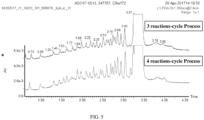
- the sulfurization reaction was in recirculation mode for 3 min. The results of each process are shown in Table 8 and FIGs. 4-7 .
- Table 8. BIIB 078 crude yield and purity comparison PADS 4 reactions-cycle Process 3 reactions-cycle Process DMT-on oligo Yield (%) 63.5 71.7 Total Purity (%) 81.29 83.46 MS Purity (%) 86.80 87.82 UV Purity (%) 93.65 95.04
Landscapes
- Chemical & Material Sciences (AREA)
- Organic Chemistry (AREA)
- Health & Medical Sciences (AREA)
- Life Sciences & Earth Sciences (AREA)
- Molecular Biology (AREA)
- Biochemistry (AREA)
- Engineering & Computer Science (AREA)
- Genetics & Genomics (AREA)
- Biotechnology (AREA)
- General Health & Medical Sciences (AREA)
- Biomedical Technology (AREA)
- General Engineering & Computer Science (AREA)
- Bioinformatics & Cheminformatics (AREA)
- Wood Science & Technology (AREA)
- Zoology (AREA)
- Physics & Mathematics (AREA)
- Biophysics (AREA)
- Plant Pathology (AREA)
- Microbiology (AREA)
- Saccharide Compounds (AREA)
- Pharmaceuticals Containing Other Organic And Inorganic Compounds (AREA)
Description
- This application claims the benefit of the filing date under 35 U.S.C. §119(e), of
U.S. Provisional Patent Application No. 62/354,433, filed on June 24, 2016 - The instant application contains a Sequence Listing which has been submitted electronically in ASCII format. Said ASCII copy, created on June 20, 2017, is named 123429-00220_SL.txt and is 3,101 bytes in size.
- Oligonucleotides are short DNA or RNA oligomers that can be chemically synthesized for research and medical purposes. Oligonucleotides are typically prepared by a stepwise addition of nucleotide residues to produce a specific sequence. Current solid-phase synthesis manufacturing process of thiolated oligonucleotides uses repetition of four-reactions per cycle, namely deprotection (e.g., detritylation), coupling, sulfurization, and capping. The capping step was designed to block any unreacted 5'-hydroxyl groups that failed to couple with the phosphoramidite in each cycle, so the failure sequence does not participate further in the coupling reactions in the subsequent cycles to generate impurities missing the nucleoside of the failed coupling. The capping step is done typically using acetic anhydride with base catalysts, such as pyridine or N-methyl morpholine.
- As each of the four steps need to be completed to add each nucleotide to the growing oligomer, reducing the number of steps would reduce the amount of time required for each nucleotide addition, as well reduce the amount of reagents required to complete the oligonucleotide synthesis. Therefore, new synthetic methods for preparing oligonucleotides are needed.
-
US 2010/331533 A1 discloses a method and compositions for sulfurizing at least one phosphite or thiophosphite linkage in an oligonucleotide.US 6809195 B1 discloses methods for synthesizing oligomeric compounds. - Zacharia S. Cheruvallath et al ("Synthesis of Antisense Oligonucleotides: Replacement of 3H-1,2-Benzodithiol-3-one 1,1-Dioxide (Beaucage Reagent) with Phenylacetyl Disulfide (PADS) As Efficient Sulfurization Reagent: From Bench to Bulk Manufacture of Active Pharmaceutical Ingredient", Org. Proc. Res. Dev. 2000, 4, 3, 199-204) disclose that phosphorothioate oligodeoxyribonucleotides can be synthesized using PADS as a replacement for Beaucage reagent.
- Marc M Lemaitre et al ("Volume 18 ) and Tang et al ("Large-scale synthesis of oligionucleotide phosphorothioates using 3-amino-1,2,4-dithiazole-5-thione as an efficient sulfur-transfer reagent", Org. Proc. Res. Dev. 2000, 4, 3, 194-198) disclose the use of DDTT or ADTT as a sulfurizaion agent in the synthesis of oligonucleotide phosphorothioates.
- The invention herein describes a solid-phase synthesis manufacturing process for fully or partially thiolated oligonucleotides using repetition of a-three-reactions per cycle, namely detritylation, coupling, and sulfurization, rather than conventional four-reactions per cycle.
- Typically, nucleotides are added to a growing oligomer chain by coupling the free 5'-hydroxyl of the last nucleotide of the oligomer attached to the solid support with the appropriate phosphoramidite. Inefficiencies in the coupling reaction would leave some of the 5'-hydroxyl groups free to react in subsequent coupling reactions, resulting in a complicated mixture of oligomers missing a single, but random, nucleotide. Accordingly, to prevent the unreacted 5'-hydroxyl from later reacting, the 5'-hydroxyl is capped via the use of a capping reagent such as acetic anhydride prior to or after the sulfurization step.
- Surprisingly, the present inventors developed a process that eliminates the capping step prior to or following the sulfurization step. In particular, rather than capping the unreacted 5'-hydroxyl groups with a reagent that needs to be newly introduced to the process, for example, acetic anhydride, the present inventors have surprisingly discovered that the byproducts generated during the sulfurization step can be used to cap the unreacted 5'-hydroxy groups. These byproducts or in certain cases, the sulfurization agent itself, for example PADS, may be recirculated across the solid support to cap the 5'-hydroxy groups that failed to couple with the phosphoramidite. The unreacted 5' hydroxyl groups react with the sulfurization byproducts, without the need of a separate capping step, and are no longer available to couple in the subsequent cycles.
- For a fully thiolated oligonucleotide (i.e., an oligonucleotide including only phosphothiolate (-P=S) bonds), no capping step is needed at all and the process includes only 3 reactions per cycle (deprotection, coupling, and sulfurization).
- The process described herein can be also used to prepare partially thiolated oligonucleotides, which include both phosphothiolate (-P=S) and phosphodiester (-P=O) bonds. Partially thiolated oligonucleotides are conventionally prepared by the 4-reaction step cycle, with the third step in the cycle being either oxidation or sulfurization depending on whether a -P=O or a -P=S bond is desired. Use of the process described herein can be used to eliminate the capping step following the sulfurization step. However, because the byproducts of the oxidation step do not cap the unreacted 5'-hydroxy, residual amounts of unreacted 5'-hydroxyl groups may remain following the oxidation step. However, for partially thiolated oligonucleotides including a small number of -P=O bonds, for example, 4 or less, the process described here in can be used even without a capping step following the oxidation step. For partially thiolated oligonucleotides including a greater number of -P=O bonds, for example, 5 or more, the process described herein can be used but a conventional capping step, for example, with acetic anhydride, may be used following each oxidation step. However, a capping step is still not needed following the sulfurization step regardless of how many -P=O bonds are present.
-
-
FIG. 1 is a diagram of the 3-step oligonucleotide synthetic method. -
FIG. 2 is a diagram of the conventional 4-step oligonucleotide synthetic method. It is noted that the sulfurization step may be performed before or after the capping step in the conventional 4-reactions per cycle process. -
FIG. 3 is a chromatogram comparing the purity by mass spectrometry for the 4-reactions-cycle with PADS (top); 3-reactions-cycle with PADS (middle); and 3-reactions-cycle with xanthane hydride (bottom). -
FIGs. 4 and5 are RPIP HPLC chromatograms comparing the BIIB078 prepared by the 4-reactions-cycle process (bottom) and the 3-reactions-cycle process (top) with PADS as the sulfurization agent. -
FIGs. 6 and7 are mass spectrometry chromatograms comparing BIIB078 prepared by the 4-reactions-cycle process (bottom) and the 3-reactions-cycle process (top) with PADS as the sulfurization agent. -
FIG. 8 shows 1H NMR spectra for reaction mixture of BuOH, P(OMe)3 and PADS over time, wherein PADS was aged with 3-picoline in acetonitrile-d3. -
FIG. 9 shows 1H NMR spectra for reaction mixture of BuOH, P(OMe)3 and PADS over time, wherein PADS was aged with N-methyl imidazole in acetonitrile-d3. - A first embodiment of the invention is a process for preparing an oligonucleotide comprising
- a) reacting the compound of Formula (I):


- b) sulfurizing the compound of Formula (III) with a sulfurization agent to form a compound of Formula (IV):


- Each R1 and R11 are independently a nucleobase, wherein the NH2 of the nucleobase, if present, is protected by an amine protecting group;
- Each R2 and R12 are independently selected from the group consisting of H, halo, and C1-6alkoxy optionally substituted with C1-6alkoxy;
- R3 is a solid support, optionally comprising a linker;
- Y is an oligonucleotide comprising 2 or more nucleotides;
- Each R4 is independently H or forms a ring with the alkoxy group of R2;
- Each R14 is independently H or forms a ring with the alkoxy group of R12;
- R15 is a hydroxy protecting group;
- R16 is C1-6alkyl optionally substituted with -CN;
- R17a and R17b are independently C1-6alkyl;
- RS is a hydroxy protecting group formed from a byproduct of the sulfurization agent;
- wherein the sulfurization agent is recirculated for 1-20 times in step b) to convert unreacted compound of Formula (I) to the compound of Formula (V) and to convert the compound of Formula (III) to Formula (IV);
- wherein the sulfurization agent is added in an
amount 3 to 6 equivalents relative to the amount of linker or the first nucleotide if the first nucleotide is directly attached to the solid support to convert unreacted compound of Formula (I) to Formula (V) and to convert the compound of Formula (III) to Formula (IV); and - wherein no other reagent is added to cap the unreacted compound of Formula (I); and wherein the compounds of Formulas (I), (II), (III), (IV), and (V) are optionally in the form of a pharmaceutically acceptable salt.
- As used herein, "a sufficient amount of time" could be determined by one of skill in the art based upon the reaction conditions. For example, the times provided in the thirteenth embodiment, namely 0 to 30 minutes, for example, 0, 5, 10, 15, 20, 25, or 30 minutes, would be "a sufficient amount of time".
- As used herein, "to substantially completely convert" could be determined by one of skill in the art based upon the reaction conditions. In particular, substantially completely convert means to convert 50%, 60%, 65%, 70%, 75%, 80%, 85%, 90%, 95 % or 100 % of the unreacted compound of Formula (I) to Formula (V) or Formula (III) to Formula (IV).
- In some aspects of the first embodiment, the process does not include an additional capping step following step b. Specifically, any unreacted compound of Formula (I), (VI), or (IX) is capped by the byproducts of the sulfurization step b without the require add any other reagent to cap any unreacted compound of Formula (I), (VI), or (IX) .
- In a particular aspect of the first embodiment,
- R11 is selected from the group consisting of cytosine, guanine, adenine, thymine (or 5-methyl uracil), uracil, hypoxanthine, xanthine, 7-methylguanine, 5,6-dihydrouracil, 5-methylcytosine, and 5-hydroxymethylcytosine, wherein the NH2 group of the nucleobase, if present, is protected by PhCO-, CH3CO-, iPrCO-, Me2N-CH=, or Me2N-CMe=.
- R12 is selected from the group consisting of H, halo, C1-4alkoxy, and C1-4alkoxyC1-4alkoxy;
- Each R14 is independently H or forms a 5- or 6-membered ring with the alkoxy group of R12;
- R15 is a hydroxy protecting group selected from 4,4'-dimethoxytrityl, [bis-(4-methoxyphenyl)phenylmethyl] (DMT) or trityl (triphenylmethyl, Tr).
- R16 is C1-4alkyl substituted with -CN; and
- R17a and R17b are independently C1-4alkyl.
- In a specific aspect of the first embodiment, Formula (II) is selected from any one of the following structural formula:


- A second embodiment of the invention is a process as described for the first embodiment or any aspect thereof, further comprising the step of c) deprotecting the compound of Formula (IV) to form the compound of Formula (VI):

- A third embodiment of the invention is a process as described for the second embodiment, further comprising the step of d) reacting the compound of Formula (VI) with a compound of Formula (II) to form a compound of Formula (VII):

e) oxidizing the compound of Formula (VII) with a oxidizing agent to form a compound of Formula (VIII):
- A fourth embodiment of the invention is a process as described for the third embodiment, further comprising the step of f) deprotecting the compound of Formula (VIII) to form the compound of Formula (IX):

- A fifth embodiment of the invention is a process as described for the second and fourth embodiments, wherein starting with the compound of Formula (VI) or the compound of Formula (IX), steps a), b), and c) are repeated n times and steps d), e), and f) are repeated m times, wherein repetition of steps a), b), and c) and steps d), e) and f) can occur in any order relative to each other, wherein n is at least 1 or more and m is 0, 1, 2, 3, or 4, to form an oligonucleotide of Formula (X) or (XI):


- The process described above for the fifth embodiment involves a stepwise addition of nucleotides to form the desired oligonucleotide. Each of these steps involve three reactions to add the nucleotide to the growing oligonucleotide. In the first step (corresponding to steps a and d), the 5' end of a nucleoside (such as a compound of Formula (I)) is coupled to the 3' end of nucleotide (such as a compound of Formula (II)). Depending on whether the linkage between these two newly bonded nucleotides is to be a phosphothioate (i.e., a P=S bond, as in, for example, Formula (IV)) or a phosphodiester (i.e., a P=O bond, as in, for example, Formula (VIII)), the oligonucleotide is either sulfurized (step b) or oxidized (step e), respectively. Finally, the next 5'-hydroxy group is deprotected (steps c or f, and for example, Formulas (VI) and (IX)) and the process is repeated to add the next nucleoside. As described above "some unreacted compound of Formula (VI) and (IX)" means that even if the coupling steps a) or d) complete, some compound of Formula (VI) and (IX) remains unreacted and available for subsequent coupling reaction, which would result in an oligonucleotide missing an oligonucleotide relative to the desired oligonucleotide. As oligionucleotides missing just one oligonucleotide ("the N-1 impurity") relative to the desired oligonucleotide can be difficult to separate from the desired oligonucleotide, the capping of the unreacted 5-OH hydroxy is necessary to prevent the formation of the N-1 impurity. By "some" any amount is contemplated, for example, less than 20 %, 15%, 10%, 5%, 4%, 3%, 2%, 1%, or 0.5% may remain.
- Therefore, this process allows for the synthesis of an oligonucleotide with any number of phosphothioate bonds and up to four phosphodiester without the need for any capping step at all because any unreacted 5'-hydroxy groups will react with the sulfurization agent itself or a byproduct of the reaction of the sulfurization agent with the phosphorous atom in the linkage between two nucleosides. This is in contrast to the conventional synthesis, where a capping step to block any of the unreacted 5'OH is done following the coupling step.
- A sixth embodiment of the invention is a process as described for the third embodiment, further comprising the step of g) reacting the unreacted compound of Formula (VI) with a capping agent to form the compound of Formula (XIV):

- A seventh embodiment of the invention is a process as described for the sixth embodiment, further comprising the step of h) deprotecting the compound of Formula (VIII) to form the compound of Formula (XV):

- A eighth embodiment of the invention is a process as described for the seventh embodiment, wherein starting with the compound of Formula (VI) or the compound of Formula (IX), steps a), b), and c) are repeated n times and steps d), e), g) and h) are repeated m times, wherein repetition of steps a), b), and c) and steps d), e), g) and h) can occur in any order relative to each other, wherein n is at least 1 and m is 0 or greater to form an oligonucleotide of Formula (X) or (XI):


- The process described above for the eighth embodiment involves a stepwise addition of nucleotides to form the desired oligonucleotide. Each of these steps involve three reactions to add a nucleotide containing a phosphothioate linkage to the growing oligonucleotide and four reactions to add a nucleotide containing a phosphodiester linkage to the growing oligonucleotide. In the first step (corresponding to steps a and d,), the 5' end of a nucleoside (such as a compound of Formula I) is coupled to the 3' end of nucleotide (such as a compound of Formula II) to couple these two nucleotides (forming compounds such as those of Formula (III) and (VII). Depending on whether the linkage between these two newly bonded nucleotides is to be a phosphothioate (i.e., a P=S bond) or a phosphodiester (i.e., a P=O bond) , the oligonucleotide is either sulfurized (step b, forming compound such as those of Formula (IV)) or oxidized (step e, forming compound such as those of Formula (IV) or (VIII)). Unlike the process described above for the fifth embodiment, as the eighth embodiment permits an unlimited number of phosphodiester linkages, a capping step must be completed following each oxidation step (step g). However, as for the fifth embodiment, no capping step is required following the sulfurization step. As for the fifth embodiment, the next 5'-hydroxy group is deprotected (steps c or h, and for example, Formulas (VI) and (IX)) and the process is repeated to add the next nucleoside. Therefore, this process allows for the synthesis of an oligonucleotide with any number of phosphothioate bonds and phosphodiester bond, and requires a capping step only after the cycle including an oxidation step. This is in contrast to the conventional synthesis, where a capping step to block any of the unreacted 5'OH is done every cycle, even those including a sulfurization step.
- In some aspects of the first, second, third, fourth, fifth, sixth, seventh, and eight embodiments, the compounds of Formulas (I), (II), (III), (IV), (V), (VI), (VII), (VIII), (IX), (X), (XI), (XII), (XIII), (XIV), or (XV) are not salts.
- In a particular aspect of the fifth or eighth embodiments, n is 2 to 1000. In particular, n is 2 to 500. In particular, n is 2 to 50. In particular, n is 2 to 25.
- In a ninth embodiment, the process is as described for any one of the first, second, third, fourth, fifth, sixth, seventh, and eighth embodiments, or any aspect thereof, wherein the linker attached to the solid support is cleaved.
- In a tenth embodiment, the process is as described for any one of the first, second, third, fourth, fifth, sixth, seventh, eighth, and ninth embodiments, or any aspect thereof, the sulfurization agent is a compound of Formula A:


- In a particular aspect of the tenth embodiment, R1 and R2 are both methyl:

- In an eleventh embodiment, the process is as described for any one of the first, second, third, fourth, fifth, sixth, seventh, eighth, and ninth embodiments, or any aspect thereof, the sulfurization agent is a compound of Formula B:


- In a twelfth embodiment, the process is as described for any one of the first, second, third, fourth, fifth, sixth, seventh, eighth, and ninth embodiments, or any aspect thereof, the sulfurization agent is 3H-1,2-benzodithiol-3-
one 1,1-dioxide (Beaucage Reagent):

- In a thirteenth embodiment, the process is as described for any one of the first, second, third, fourth, fifth, sixth, seventh, eighth, ninth, tenth, eleventh, and twelfth embodiments, or any aspect thereof, wherein the sulfurization agent is reacted by recirculating the sulfurization agent for 0 to 30 minutes, for example, 0, 5, 10, 15, 20, 25, or 30 minutes. In one embodiment, the sulfurization agent is recirculated for 1 to 30 minutes, 1 to 20 minutes, 1 to 10 minutes, or 1 to 5 minutes. In another embodiment, the sulfurization agent is recirculated for 1, 2, 3, 4, 5, 6, 7, 8, 9, or 10 minutes.
- In a fourteenth embodiment, the process is as described for any one of the first, second, third, fourth, fifth, sixth, seventh, eighth, ninth, tenth, eleventh, twelfth, and thirteenth embodiments, or any aspect thereof, wherein the sulfurization agent is recirculated for 1-20 times, for example, 1, 2, 5, 10, 15, 20 times. In one embodiment, the sulfurization agent is recirculated for 1-10 times, or 1-5 times.
- In a fifteenth embodiment, the process is as described for any one of the first, second, third, fourth, fifth, sixth, seventh, eighth, ninth, tenth, eleventh, twelfth, thirteenth, and fourteenth embodiments, or any aspect thereof, the sulfurization agent is reacted by recirculating 3 to 6 equivalents of sulfurization agent relative to the amount of the first nucleoside attached to the solid support.
- In a sixteenth embodiment, the process is as described for any one of the first, second, third, fourth, fifth, sixth, seventh, eighth, ninth, tenth, eleventh, twelfth, thirteenth, fourteenth, and fifteenth embodiments, or any aspect thereof, the concentration of the sulfurization reagent is from 0.02 M to 2.0 M. In some aspects, the sulfurization agent is dissolved in pyridine, 3-piccoline, acetonitrile, or a mixture thereof. In a particular aspect of the sixteenth embodiment, the concentration of the sulfurization reagent is from 0.05 M to 0.5 M. In a particular aspect, the sulfurization reagent is 3-(dimethylamino-methylidene)amino)-3H-1,2,4-dithiazole (DDTT) added at a concentration of 0.02 M to 0.1 M, for example, 0.02, 0.03, 0.04, 0.05, 0.06, 0.07,0.08, 0.09, or 0.1M dissolved in pyridine. In a particular aspect, the sulfurization reagent is 3H-1,2-benzodithiol-3-
one 1,1-dioxide (Beaucage Reagent) added at a concentration of 0.01 M to 0.2 M, for example, 0.01, 0.02, 0.03, 0.04, 0.05, 0.06, 0.07,0.08, 0.09, 0.10, 0.11, 0.12, 0.13, 0.14, 0.15, 0.16, 0.17, 0.18, 0.19, 0.2 M in acetonitrile (ACN). In a particular aspect, the sulfurization reagent is phenylacetyl disulfide (PADS) added at a concentration of 0.01 M to 0.2 M, for example, 0.01, 0.02, 0.03, 0.04, 0.05, 0.06, 0.07,0.08, 0.09, 0.10, 0.11, 0.12, 0.13, 0.14, 0.15, 0.16, 0.17, 0.18, 0.19, 0.2 M in acetonitrile (ACN)/3-picoline. In a particular aspect, the sulfurization reagent is 3-amino-1,2,4-dithiazole-5-thione (XH or ADTT) added at a concentration of 0.01 M to 0.2 M, for example, 0.01, 0.02, 0.03, 0.04, 0.05, 0.06, 0.07,0.08, 0.09, 0.10, 0.11, 0.12, 0.13, 0.14, 0.15, 0.16, 0.17, 0.18, 0.19, 0.2 M in pyridine. - In certain embodiments, the sulfurization reagent described above (e.g., phenylacetyl disulfide (PADS) or 3-amino-1,2,4-dithiazole-5-thione (XH)) is treated with a base (i.e., aging) prior to its use in the process of the present invention. Exemplary base includes, but is not limited to, N-methylimidazole, pyridine and 3-picoline. The sulfurization reagent can be aged with the base (i.e., treated with the base) for 1 minute to 5 days, for example for 5 minutes to 24 hours, 10 minutes to 12 hours, 30 minutes to 10 hours, 1 hour to 8 hours, 2 hours to 6 hours, or 3 hours to 5 hours. In one embodiment, the sulfurization reagent is aged for 4 hours. In another embodiment, the sufurization reagent PADS is aged with 3-picoline for 4 hours before being used in the process of the present invention.
- In a seventeenth embodiment, the process is as described for any one of the first, second, third, fourth, fifth, sixth, seventh, eighth, ninth, tenth, eleventh, twelfth, thirteenth, fourteenth, fifteenth, and sixteenth embodiments, or any aspect thereof, the nucleobase is selected from the group consisting of cytosine, guanine, adenine, thymine (or 5-methyl uracil), uracil, hypoxanthine, xanthine, 7-methylguanine, 5,6-dihydrouracil, 5-methylcytosine, and 5-hydroxymethylcytosine, wherein the NH2 group of the nucleobase, if present, is protected by PhCO-, CH3CO-, iPrCO-, Me2N-CH=, or Me2N-CMe=. In a particular embodiment, the nucleobase is selected from the group consisting of cytosine, guanine, adenine, thymine (or 5-methyl uracil), uracil, and 5-methylcytosine, wherein the NH2 group of the nucleobase, if present, is protected by PhCO-, CH3CO-, iPrCO-, Me2N-CH=, or Me2N-CMe=.
- In an eighteenth embodiment, the process is as described for any one of the first, second, third, fourth, fifth, sixth, seventh, eighth, ninth, tenth, eleventh, twelfth, thirteenth, fourteenth, fifteenth, sixteenth, and seventeenth embodiments, or any aspect thereof, each R2 and R12 are independently selected from the group consisting of H, F, and C1-4 alkoxy optionally substituted with C1-4 alkoxy; each R4 is independently H or forms a ring with the alkoxy group of R2, wherein the ring is a 5 or 6-membered ring optionally substituted with 1 to 3 C1-4 alkyl groups; R16 is -CH2CH2CN; R17a and R17b are independently C1-4 alkyl; and each R14 is independently H or forms a ring with the alkoxy group of R12, wherein the ring is a 5 or 6-membered ring optionally substituted with 1 to 3 C1-4 alkyl groups.
- In a nineteenth embodiment, the process is as described for any one of the first, second, third, fourth, fifth, sixth, seventh, eighth, ninth, tenth, eleventh, twelfth, thirteenth, fourteenth, fifteenth, sixteenth, seventeenth and eighteenth embodiments, or any aspect thereof, each R2 and R12 are independently selected from H or C1-4 alkoxy optionally substituted with C1-4 alkoxy; R15 is 4,4'-dimethoxytrityl; R16 is -CH2CH2CN; R17a and R17b are independently C1-6 alkyl; and RS is -C(=N)(SH)-CN or -C(=O)CH2C6H5.
- In a twentieth embodiment, the process is as described for any one of the first, second, third, fourth, fifth, sixth, seventh, eighth, ninth, tenth, eleventh, twelfth, thirteenth, fourteenth, fifteenth, sixteenth, seventeenth, eighteenth, and nineteenth embodiments, or any aspect thereof, Y is an oligonucleotide comprising 2 to 50 nucleotides, in particular, 2 to 40 nucleotides, 2 to 30 nucleotides, or 2 to 25 nucleotides.
- In a twenty-first embodiment, the process is as described for any one of the first, second, third, fourth, fifth, sixth, seventh, eighth, ninth, tenth, eleventh, twelfth, thirteenth, fourteenth, fifteenth, sixteenth, seventeenth, eighteenth, nineteenth, and twentieth embodiments, or any aspect thereof, the compound of Formula (X) or (XI) is an anti-sense oligonucleotide comprising 2 to 30 nucleotides. In a particular aspect, the anti-sense oligonucleotide comprises modified RNA only. Alternatively, the anti-sense oligonucleotide comprises DNA and modified RNA. In particular, the anti-sense oligonucleotide is a gapmer. Alternatively, the anti-sense oligonucleotide comprises DNA only.
- In a twenty-second embodiment, the process is as described for any one of the first, second, third, fourth, fifth, sixth, seventh, eighth, ninth, tenth, eleventh, twelfth, thirteenth, fourteenth, fifteenth, sixteenth, seventeenth, eighteenth, nineteenth, twentieth, and twenty-first embodiments, or any aspect thereof, the anti-sense oligonucleotide is a phosphorothioate oligonucleotide having a sequence of (from 5' to 3')
TCACTTTCATAATGCTGG (SEQ ID NO: 1),
wherein each internucleoside linkage of the oligonucleotide is a phosphorothioate linkage, each nucleoside of the oligonucleotide is a 2'-O- methoxyethyl (MOE) nucleoside, and each cytosine is a 5-methylcytosine. SEQ ID NO: 1 is also known as BIIB058, and is described inWO2007/002390 ,WO2010/148249 , andUS8,980,853 . - In a twenty-third embodiment, the process is as described for any one of the first, second, third, fourth, fifth, sixth, seventh, eighth, ninth, tenth, eleventh, twelfth, thirteenth, fourteenth, fifteenth, sixteenth, seventeenth, eighteenth, nineteenth, twentieth, and twenty-first embodiments, or any aspect thereof, the sequence of the anti-sense oligonucleotide is a 5-10-5 MOE gapmer, having a sequence of (from 5' to 3')
CAGGATACATTTCTACAGCT (SEQ ID NO: 2), - wherein each of nucleosides 1-5 and 16-20 are 2'-O-methoxyethylribose modified nucleosides, and each of nucleosides 6- 15 are 2'-deoxynucleosides, wherein the internucleoside linkages between
nucleosides 2 to 3, 4 to 5, 16 to 17, and 18 to 19 are phosphodiester linkages and the internucleoside linkages betweennucleosides 1 to 2, 3 to 4, 5 to 6, 6 to 7, 7 to 8, 8 to 9, 9 to 10, 10 to 11, 11 to 12, 12 to 13, 13 to 14, 14 to 15, 15 to 16, 17 to 18, and 19 to 20 are phosphorothioate linkages, and wherein each cytosine is a 5'-methylcytosine. SEQ ID NO:2 is described by the following chemical notation: mCes Aeo Ges Geo Aes Tds Ads mCds Ads Tds Tds Tds mCds Tds Ads mCeo Aes Geo mCes Te; wherein, - A = an adenine,
- mC = a 5'-methylcytosine
- G = a guanine,
- T = a thymine,
- e = a 2'-O-methoxyethylribose modified sugar,
- d = a 2'-deoxyribose sugar,
- s = a phosphorothioate internucleoside linkage, and
- o = a phosphodiester internucleoside linkage.
- SEQ ID NO: 2 is as known as BIIB067 or ISIS 666853 and is described in
WO2015153800 . - In a twenty-fourth embodiment, the process is as described for any one of the first, second, third, fourth, fifth, sixth, seventh, eighth, ninth, tenth, eleventh, twelfth, thirteenth, fourteenth, fifteenth, sixteenth, seventeenth, eighteenth, nineteenth, twentieth, and twenty-first embodiments, or any aspect thereof, the anti-sense oligonucleotide is a 4-8-6 gapmer, having a sequence of (from 5' to 3'):
GCCCCTAGCGCGCGACUC (SEQ ID NO: 8)
wherein each of nucleosides 1-4 and 13-18 are 2'-O-methoxyethylribose modified nucleosides, and each of nucleosides 5-12 are 2'-deoxy ribonucleotides, wherein the internucleoside linkages betweennucleosides 2 to 3, 3 to 4, 13 to 14, 14 to 15, and 15 to 16 are phosphodiester linkages and the internucleoside linkages betweennucleosides 1 to 2, 4 to 5, 5 to 6, 6 to 7, 7 to 8, 8 to 9, 9 to 10, 10 to 11, 11 to 12, 12 to 13, 16 to 17 and 17 to 18 are phosphorothioate linkages, wherein each cytosine is 5-methylcytosine, and wherein the uracil is 5-methyluracil. SEQ ID NO:8 is described by the following chemical notation:
5' - G Me C P=O Me C P=O Me C MeCTAGMeCGMeCGMe C P=O G P=O A P=O Me C Me U Me C - 3' - Underline = MoE ribonucleotide
- G = guanine
- MeC = 5-methylcytosine
- T = thymine
- A = adenine
- MeU = 5-methyluracil (also known as thymine)
- P=O = phosphodiester internucleoside linkage
- Any other internucleoside linkages are phosphothioester linkage.
- An "amine protecting group" includes any group suitable for protecting an amine group, NH2, for example, but not limited to, PhCO-, CH3CO-, iPrCO-, and Me2N-CH=, Me2N-CMe=. The resulting structure of an amino group protected by Me2N-CH= and Me2N-CMe= is as follows:

- Further amine protecting groups can be found in Greene, TW et al., Protective Groups in Organic Synthesis, 4th Ed., John Wiley and Sons (2007).
- Without wishing to be bound by theory, it is thought that the 5'-hydroxy that failed to couple during the coupling step forms a hydroxyl derivative from sulfurization with the sulfurization agent, such as, for example, PADS, or a N-cyanocarbonimidothioate from xanthane hydride, or N,N-dimethylthiourea-N-thiocarboxylate from DDTT:


- A "hydroxy protecting group" includes any group suitable for protecting a hydroxy group, OH. These protecting groups and further examples of hydroy protecting groups can be found in Greene, TW et al., Protective Groups in Organic Synthesis, 4th Ed., John Wiley and Sons (2007).
- In a specific embodiment, the hydroxy protecting group is formed from the capping agent (e.g., Rc in Formula (XIV)), and can be selected from, for example, acetyl (Ac); benzoyl (Bz); benzyl (Bn); β-methoxyethoxymethyl ether (MEM); methoxymethyl ether (MOM); methoxytrityl [(4-methoxyphenyl)diphenylmethyl, MMT); p-methoxybenzyl ether (PMB); methylthiomethyl ether; pivaloyl (Piv); tetrahydropyranyl (THP); tetrahydrofuran (THF); silyl ether (including, but not limited to, trimethylsilyl (TMS), tert-butyldimethylsilyl (TBDMS), tri-iso-propylsilyloxymethyl (TOM), and triisopropylsilyl (TIPS) ethers); methyl ethers, and ethoxyethyl ethers (EE).
- Alternatively, the hydroxy protecting group blocks a 5'-hydoxy of a nucleoside or nucleotide (e.g., R15 in Formulas (II), (III), (IV), (VII), and (VIII)), and in particular aspect is an acid-labile protecting group selected from 4,4'-dimethoxytrityl, [bis-(4-methoxyphenyl)phenylmethyl] (DMT) or trityl (triphenylmethyl, Tr).
- "Nucleobase" means the heterocyclic base portion of a nucleoside. Nucleobases may be naturally occurring or may be modified. In certain embodiments, a nucleobase may comprise any atom or group of atoms capable of hydrogen bonding to a nucleobase of another nucleic acid. In particular, the nucleobase is a heterocyclic base, typically purines and pyrimidines. In addition to "unmodified" or "natural" nucleobases such as the purine nucleobases adenine (A) and guanine (G), and the pyrimidine nucleobases thymine (T), cytosine (C) and uracil (U), many modified nucleobases or nucleobase mimetics known to those skilled in the art are amenable to incorporation into the compounds synthesized by the method described herein. In certain embodiments, a modified nucleobase is a nucleobase that is fairly similar in structure to the parent nucleobase, such as for example a 7-deaza purine, a 5-methyl cytosine, or a G-clamp. In certain embodiments, nucleobase mimetic include more complicated structures, such as for example a tricyclic phenoxazine nucleobase mimetic. Methods for preparation of the above noted modified nucleobases are well known to those skilled in the art.
- "Nucleoside" means a compound comprising a heterocyclic base moiety and a sugar moiety.
- "Nucleotide" means a nucleoside comprising a phosphate linking group.
- "Oligonucleotide" refers to a compound comprising a plurality of linked nucleosides. In certain embodiments, one or more of the plurality of nucleosides is modified. In certain embodiments, an oligonucleotide comprises one or more ribonucleosides (RNA) and/or deoxyribonucleosides (DNA).
- "Internucleoside linkage" means a covalent linkage between adjacent nucleosides of an oligonucleotide.
- "Gapmer" means a chimeric antisense compound in which an internal region having a plurality of nucleosides that support RNase H cleavage is positioned between external regions having one or more nucleosides, wherein the nucleosides comprising the internal region are chemically distinct from the nucleoside or nucleosides comprising the external regions.
- As used herein, the term "alkyl" refers to a fully saturated branched or unbranched hydrocarbon moiety. Preferably the alkyl comprises 1 to 20 carbon atoms, more preferably 1 to 16 carbon atoms, 1 to 10 carbon atoms, 1 to 6 carbon atoms, or 1 to 4 carbon atoms. In some embodiments, an alkyl comprises from 6 to 20 carbon atoms. Representative examples of alkyl include, but are not limited to, methyl, ethyl, n-propyl, iso-propyl, n-butyl, sec-butyl, iso-butyl, tert-butyl, n-pentyl, isopentyl, neopentyl, n-hexyl, 3-methylhexyl, 2,2-dimethylpentyl, 2,3-dimethylpentyl, n-heptyl, n-octyl, n-nonyl, or n-decyl.
- The term "aryl" refers to monocyclic, bicyclic or tricyclic aromatic hydrocarbon groups having from 6 to 14 carbon atoms in the ring portion. In one embodiment, the term aryl refers to monocyclic and bicyclic aromatic hydrocarbon groups having from 6 to 10 carbon atoms. Representative examples of aryl groups include phenyl, naphthyl, fluorenyl, and anthracenyl.
- The term "aryl" also refers to a bicyclic or tricyclic group in which at least one ring is aromatic and is fused to one or two non-aromatic hydrocarbon ring(s). Nonlimiting examples include tetrahydronaphthalene, dihydronaphthalenyl and indanyl.
- Optional substituents for both the alkyl or aryl groups are, in each occurrence, independently selected from C1-6alkyl, C2-6alkenyl, C2-6alkynyl, 3- to 7-membered carbocyclyl, 3- to 7-membered heterocyclyl, halo, -CN, -C(O)Ra, -C(O)2Ra, - C(O)N(Ra)2, -ORa, -N(Ra)2, -N(Ra)C(O)Ra, -N(Ra)N(Ra)2, -NO2, -N(Ra)C(O)2Ra, - N(Ra)C(O)N(Ra)2, -N(Ra)S(O)2Ra, -SRa, -S(O)Ra, -S(O)2Ra, -S(O)N(Ra)2, and -S(O)2N(Ra)2; and
- Ra in each occurrence is independently selected from H, C1-6alkyl, 3- to 6-membered monocyclic carbocyclyl, and 3- to 6-membered monocyclic heterocyclyl.
- As used herein, the term "carbocyclyl" refers to saturated or unsaturated monocyclic or bicyclic hydrocarbon groups of 3-7 carbon atoms, 3-6, or 5-7 carbon atoms. The term "carbocyclyl" encompasses cycloalkyl groups and aromatic groups. The term "cycloalkyl" refers to completely saturated monocyclic or bicyclic hydrocarbon groups of 3-7 carbon atoms, 3-6 carbon atoms, or 5-7 carbon atoms. Exemplary monocyclic carbocyclyl groups include, but are not limited to, cyclopropyl, cyclobutyl, cyclopentyl, cyclohexyl, cycloheptyl, cyclopropenyl, cyclobutenyl, cyclopenentyl, cyclohexenyl, cycloheptenyl, cyclobutadienyl, cyclopentadienyl, cyclohexadienyl, cycloheptadienyl, phenyl and cycloheptatrienyl. Exemplary bicyclic carbocyclyl groups include bicyclo[2.1.1]hexyl, bicyclo[2.2.1]heptyl, bicyclo[2.2.1]heptenyl, tricyclo[2.2.1.02,6]heptanyl, 6,6-dimethylbicyclo[3.1.1]heptyl, or 2,6,6-trimethylbicyclo[3.1.1]heptyl, spiro[2.2]pentanyl, and spiro[3.3]heptanyl.
- The term "bridged ring system," as used herein, is a ring system that has a carbocyclyl or heterocyclyl ring wherein two non-adjacent atoms of the ring are connected (bridged) by one or more (preferably from one to three) atoms selected from C, N, O, or S. A bridged ring system may have from 6-7 ring members.
- The term "spiro ring system," as used herein, is a ring system that has two rings each of which are independently selected from a carbocyclyl or a heterocyclyl, wherein the two ring structures having one ring atom in common. Spiro ring systems have from 5 to 7 ring members.
- As used herein, the term "heterocyclyl" refers to a saturated or unsaturated, monocyclic or bicyclic (e.g., bridged or spiro ring systems) ring system which has from 3- to 7-ring members, or in particular 3- to 6- ring members or 5- to 7- ring members, at least one of which is a heteroatom, and up to 4 (e.g., 1, 2, 3, or 4) of which may be heteroatoms, wherein the heteroatoms are independently selected from O, S and N, and wherein C can be oxidized (e.g., C(O)), N can be oxidized (e.g., N(O)) or quaternized, and S can be optionally oxidized to sulfoxide and sulfone. Unsaturated heterocyclic rings include heteroaryl rings. As used herein, the term "heteroaryl" refers to an aromatic 5 or 6 membered monocyclic ring system, having 1 to 4 heteroatoms independently selected from O, S and N, and wherein N can be oxidized (e.g., N(O)) or quaternized, and S can be optionally oxidized to sulfoxide and sulfone. In one embodiment, a heterocyclyl is a 3-to 7-membered saturated monocyclic or a 3-to 6-membered saturated monocyclic or a 5-to 7-membered saturated monocyclic ring. In one embodiment, a heterocyclyl is a 3-to 7-membered monocyclic or a 3-to 6-membered monocyclic or a 5-to 7-membered monocyclic ring. In another embodiment, a heterocyclyl is a 6 or-7-membered bicyclic ring. The heterocyclyl group can be attached at a heteroatom or a carbon atom. Examples of heterocyclyls include aziridinyl, oxiranyl, thiiranyl, oxaziridinyl, dioxiranyl, azetidinyl, oxetanyl, thietanyl, pyrrolidinyl, tetrahydrofuranyl, thiolanyl, imidazolidinyl, pyrazolidinyl, oxazolidinyl, isoxazolidinyl, thiazolidinyl, isothiazolidinyl, dioxolanyl, dithiolanyl, oxathiolanyl, piperidinyl, tetrahydropyranyl, thianyl, piperazinyl, morpholinyl, thiomorpholinyl, dioxanyl, dithianyl, trioxanyl, trithianyl, azepanyl, oxepanyl, thiepanyl, dihydrofuranyl, imidazolinyl, dihydropyranyl, and heteroaryl rings including azirinyl, oxirenyl, thiirenyl, diazirinyl, azetyl, oxetyl, thietyl, pyrrolyl, furanyl, thiophenyl (or thienyl), imidazolyl, pyrazolyl, oxazolyl, isoxazolyl, thiazolyl, isothiazolyl, furazanyl, oxadiazolyl, thiadiazolyl, dithiazolyl, triazolyl, tetrazolyl, pyridinyl, pyranyl, thiopyranyl, pyrazinyl, pyrimidinyl, pyridazinyl, oxazinyl, thiazinyl, dioxinyl, dithiinyl, oxathianyl, triazinyl, tetrazinyl, azepinyl, oxepinyl, thiepinyl, diazepinyl, and thiazepinyl and the like. Examples of bicyclic heterocyclic ring systems include 3-azabicyclo[3.1.0]hexanyl, 3-azabicyclo[3.1.1]heptanyl, 2-azaspiro[3.3]heptanyl, 2-oxa-6-azaspiro[3.3]heptanyl, and 5-azaspiro[2.3]hexanyl.
- "Halogen" or "halo" may be fluoro, chloro, bromo or iodo.
- Oligonucleotides were synthesized on 0.72-2.2 mmol scale using an
AKTA 100 solid-phase synthesizer with Nittophase HL Unylinker (Kinovate, loading 350 µmol/g) as the solid support. The synthesis cycle for attaching each nucleoside consists of three reaction steps: detritylation, coupling, and sulfurization. The detritylation step was accomplished with dichloroacetic acid in toluene (10%) as the reagent. The coupling step was carried out by circulating a solution of corresponding phosphoramidite (0.1- 0.2 M in acetonitrile) and 4,5-dicyanoimidazole (1.0 M in acetonitrile containing 0.1M N-methylimidazole) through the solid support. The sulfurization step was completed by circulating any one of the following solutions: (a) 0.2 M PADS in acetonitrile/3-picoline (1:1, v/v); (b) 0.2 M 3-Amino-1,2,4-dithiazole-5-thione (XH) in Pyridine; (c) 0.2 M 3H-1,2-Benzodithiol-3-one 1,1-Dioxide (Beaucage Reagent) in Acetonitrile; or (d) 0.1 M 3-((Dimethylamino-methylidene)amino)-3H-1,2,4-dithiazole-3-thione (DDTT) in Pyridine. For the control experiments, the synthesis consists of four reaction steps: detritylation, coupling, and sulfurization, and capping step. All the steps are carried out the same way as above, except with a capping step after the sulfurization step. The capping was done with a mixture of acetic anhydride, pyridine, and N-methyl imidazole in acetonitrile. Cleavage of the oligonucleotides from the support and base deprotection were performed in concentrated ammonium hydroxide at elevated temperature (50 to 60 °C). The synthesis reaction parameters are summarized in Table 1 below. The oligonucleotide products were analyzed by LC-MS.Table 1- Process Protocol Process Step Variable 3-reactions-cycle 4-reactions-cycle Units Synthesis Support Support Nittophase Unylinker HL Nittophase Unylinker HL µmol/g Loading 350 350 µmol/g Detritylation Reagent 10% DCA 10% DCA Deblock Volume 3 3 CV* Reaction Time 3-6 3-6 Min Coupling Eq amidite 1.5 1.5 eq** Conc. Amidite 0.2 0.2 M Activator: amidite ratio 5:1 5:1 Activator DCl [1.0 M] and NMI [0.1 M] DCl [1.0 M] and NMI [0.1 M] Recycle Flow Rate 240 240 cm/hr Recycle Time 3.2 3.2 min Sulfurization Reagent 0.2 M PADS in ACN/3-picoline (1:1, v/v) or 0.2 M XH in Pyridine or 0.2 M Beaucage Reagent in ACN or 0.1 M DDTT in Pyridine 0.2M PADS in ACN/3-picoline (1:1, v/v) 0.2 M XH in pyridine Charge Volume 1.1 1.2 1.1 CV Reaction Time Recycle mode Flow through mode Recycle or flow through mode min 5 3.3 5 Oxidation Reagent 0.5 M Iodine in water/pyridine 0.5 M Iodine in water/pyridine Charge Volume 2.0 2.0 CV ContactTime 5 5 min Capping Reagent NONE Cap A, 2:3:5 [NMI/pyridine/ACN] Cap B 1:4 [Ac2O/ACN] Capping Charge Volume 0.3 CV Reaction Time 3-8 min Phosphorus Deprotection Reagent 50 % TEA 50 % TEA Charge Volume 1.6 1.6 CV Reaction Time 90 90 min * CV: column volume
** eq.: equivalent -
- 1. BIIB 058 (SEQ ID NO: 1), an18-mer phosphorothioate oligonucleotide, in which each riboligonucleotide includes methoxy-ethyl (MoE) at the 2' position.
- 2. BIIB 067 (SEQ ID NO: 2), a 5-10-5 gapmer phosphothioester and phosphodiester mixed backbone oligonucleotide. The central block of a gapmer is 10 deoxy ribonucleotides, which is flanked by blocks of 2'-MoE ribonucleotides.
- 3. Phosphorothioate oligonucleotides A, B, C, D, and E as shown in Table 2, below.
- 4. BIIB 078 (SEQ ID NO:8), a 4-8-6 gapmer phosphothioester and phosphodiester mixed backbone oligonucleotide. The central block of a gapmer is 8 deoxy ribonucleotides, which is flanked by blocks of 2'-MoE ribonucleotides.
5' - G Me C P=O Me C P=O Me C MeCTAGMeCGMeCGMe C P=O G P=O A P=O Me C Me U Me C - 3' (SEQ ID NO: 8) - underline: MoE ribonucleotide
- P=O: phosphodiester
- any others: phosphothioester
- BIIB058 was prepared using the process of the invention (i.e., the 3-reactions-cycle) and compared to the conventional 4-reactions per cycle process. PADS and Xanthane Hydride were used as the sulfurization agent. The sulfurization reaction was in recirculation mode for 5 min. The results of each process are shown in Table 3.
Table 3. BIIB058 crude yield and purity comparison PADS Xanthane Hydride 4-reactions-cycle 3-reactions-cycle 3-reactions-cycle Total oligo Yield (%) 84.06 86.56 86.31 DMT-on oligo Yield (%) 70.81 77.12 76.89 Total Purity (%) 83.08 89.19 89.09 MS Purity (%) 91.97 93.29 93.67 UV Purity (%) 91.59 95.50 95.02 - Comparing the 4-reactions-cycle to the 3-reactions-cycle with PADS as the sulfurization agent, the yield and purity of BIIB058 was increased in the 3-reactions-cycle, and no new impurities were generated. Xanthane hydride in the 3-reactions-cycle performed similarly as PADS. A comparison of the mass spectrometry chromatograms is provided in
Fig. 3 . - BIIB067 was prepared using the process of the invention (i.e., the 3-reactions-cycle) and compared to the conventional 4-reactions per cycle process, with PADS used as sulfurization agent. The sulfurization reaction was in recirculation mode for 5 min. Unlike BIIB0058, BIIB067 includes P=O bonds as well as P=S bonds. Therefore, three different reactions were run: 1) the 4 reactions-cycle, 2) the 3 reactions-cycle, and 3) the 3 reactions-cycle with a capping step added only after the oxidation step. Therefore would include an oxidation rather than a sulfurization step for that nucleotide, no capping step was done following the oxidation step. The results of each process are shown in Table 4.
Table 4 BIIB 067 Crude Yield and Purity Comparison 4 reactions- cycle 3 reactions-cycle Without Capping Reaction after Oxidation With Capping Reaction after Oxidation Total Oligonucleotide Yield (%) 86.60 95.5 101.28 DMT-ON Oligonucleotide (%) 66.70 76.5 80.74 Mass purity (%) 89.00 90.70 87.84 UV Purity (%) 86.50 88.30 90.75 Total Purity (%) 76.99 80.09 79.71 - Comparing the 4-reactions-cycle to the 3-reactions-cycle without a capping reaction after oxidation, the yield and purity of BIIB067 increased, and no new impurities were generated. Inclusion of the capping step following the oxidation reaction only did not improve the overall purity of BIIB067 as prepared by the 3-reactions-cycle. Therefore, the 3-reactions-cycle without capping can be used even with oligonucleotides including P=O bonds.
- Oligonucleotides A, B, C, D, and E were prepared using the process of the invention and compared to the conventional 4-reactions per cycle process. Table 5 provides the amidites used for the synthesis. The sulfurization agents used are shown in Table 6.
Table 5. Amidites for the synthesis 5'ODMT-deoxy-phosphoramidite 
H 5'ODMT-2'OMe-phosphoramidite 
OMe 5'ODMT-2'MoE-phosphoramidite 
MoE 5'ODMT-cEt-phosphoramidite 
cEt 5'ODMT-2'F-phosphoramidite 
F Table 6. Sulfurization Reagents used for the synthesis of the corresponding oligonucleotides Oligonucleotides Sulfurization Reagent A XH PADS B XH PADS C XH PADS D XH PADS E XH PADS - As shown in Table 7, the yield, UV purity, and MS impurity profile of crude oligonucleotide from the process of the invention is similar to the crude oligonucleotide as prepared by the conventional 4-reactions-cycle process.
Table 7. Optical yield (OD) and RPIP HPLC purity of DMT-on products Sulfurization Reagent Oligonucleotide 4 reactions- cycle 3 reactions-cycle Conclusion Xanthane Hydride A 142.1 OD/µmol UV: 73.61 % 146.8 OD/µmol UV: 78.65 % 1. Yield and UV purity of crude from 3-Reactions-cycle process is similar as crude from 4-Reactions-cycle process. 2. MS impurity profile from 3-Reactions-cycle process is compatible as the crude from 4-Reactions-cycle process. B 149.8 OD/µmol UV: 78.20 % 155.7 OD/µmol UV: 79.71 % Same as above C 150.4 OD/µmol UV: 80.56 % 154.3 OD/µmol UV: 82.36 % Same as above D 126.3 OD/µmol UV: 71.15 % 129.4 OD/µmol UV: 73.31 % Same as above E 133.1 OD/µmol UV: 71.34 % 137.8 OD/µmol UV: 73.10 % Same as above PADS A 146.7 OD/µmol UV: 83.32 % 154.9 OD/µmol UV: 77.66 % Same as above B 150.1 OD/µmol UV: 81.33 % 154.3 OD/µmol UV: 79.17 % Same as above C 158.8 OD/µmol UV: 79.27 % 159.2 OD/µmol UV: 78.80 % Same as above D 107.5 OD/µmol UV: 72.29 % 129.3 OD/µmol UV: 71.13 % 1. Yield and UV purity of crude from 3-Reactions-cycle process is similar as crude from 4-Reactions-cycle process. 2. MS impurity profile from 3-reactions-cycle process is compatible as the crude from 4-reactions-cycle process. N-1 impurity for 3-reactions-cycle process is higher than the crude from 4-reactions-cycle process. E 141.0 OD/µmol UV: 73.90 % 140.9 OD/µmol UV: 75.77 % 1. Yield and UV purity of crude from 3-Reactions-cycle process is similar as crude from 4-Reactions-cycle process. 2. MS impurity profile from 3-Reactions-cycle process is compatible as the crude from 4-Reactions-cycle process. Beaucage Reagent A 167.4 OD/µmol UV: 79.70 % 166.1 OD/µmol UV: 78.39 % Same as above - BIIB078 was prepared using the process of the invention (i.e., the 3-reactions-cycle) and compared to the conventional 4-reactions per cycle process. PADS was used as the sulfurization agent. The sulfurization reaction was in recirculation mode for 3 min. The results of each process are shown in Table 8 and
FIGs. 4-7 .Table 8. BIIB 078 crude yield and purity comparison PADS 4 reactions- cycle Process 3 reactions-cycle Process DMT-on oligo Yield (%) 63.5 71.7 Total Purity (%) 81.29 83.46 MS Purity (%) 86.80 87.82 UV Purity (%) 93.65 95.04 - Comparing the 4-reactions-cycle to the 3-reactions-cycle with PADS as the sulfurization agent, the yield and purity of BIIB078 was increased in the 3-reactions-cycle, and no new impurities were generated. Comparisons of HPLC chromatograms and mass spectrometry chromatograms and are provided in
FIGs. 4-7 . - In the first NMR experiment, PADS was aged in 3-picoline in acetonitrile-d3 at 22 °C for 16 h (Scheme 1). After the aging, n-BuOH was added in the solution and NMR spectra were taken at different time points. The spectra showed that the formation of PHCH2CO2Bu was very slow.
- In a separate experiment following the same procedure as above, after addition of BuOH, to the reaction mixture was added P(OMe)3 and the NMR spectra of the reaction mixture were recorded at different time points. P(OMe)3 has a was similar structure as the phosphite intermediates in the solid phase synthesis. The spectra showed that in about 2 min sulfurization of P(OMe)3 completed and esterification (capping) of BuOH occurred (
FIG. 8 ). - These experimental results demonstrated that during the sulfurization an active capping reagent was generated and it capped the alcohol present.

- The same experiments were repeated with N-methyl imidazole as the base to age the PADS and similar results were obtained (Scheme 2). Without adding P(OMe)3, the esterification reaction was very slow, but esterification of BuOH occurred immediately after the sulfurization reaction. These results again showed that the sulfurization and capping occurred once sulfurization happened (
FIG. 9 ).
| Code | Sequence Type | Phosphorothioate Oligonucleotide Sequence |
| A | Fully DNA sequence | MeCGAMeCT ATAMeCGMeCGMeCAA TATGG (SEQ ID NO: 3) |
| B | 5-10-5 gapmer The central block of a gapmer is 10 deoxy ribonucleotides, which is flanked by blocks of 2'-OMe ribonucleotides. | MeCGAMeCU ATAMeCGMeCGMeCAA UAUGG (SEQ ID NO: 4) |
| C | 5-10-5 gapmer The central block of a gapmer is 10 deoxy ribonucleotides, which is flanked by blocks of 2'-MoE ribonucleotides. | MeCGAMeCT ATAMeCGMeCGMeCAA TATGG (SEQ ID NO: 5) |
| D | 5-10-5 gapmer The central block of a gapmer is 10 deoxy ribonucleotides, which is flanked by blocks of cEt ribonucleotides. | MeCGAMeCU ATAMeCGMeCGMeCAA UAUGG (SEQ ID NO: 6) |
| E | 5-10-5 gapmer The central block of a gapmer is 10 deoxy ribonucleotides, which is flanked by blocks of 2'-Fluoro ribonucleotides. | CGACU ATAMeCGMeCGMeCAA UAUGG (SEQ ID NO: 7) |
Claims (16)
- A process for preparing an oligonucleotide comprisinga) reacting the compound of Formula (I):


 b) sulfurizing the compound of Formula (III) with a sulfurization agent to form a compound of Formula (IV):and from unreacted compound of Formula (I) forms a compound of Formula (V):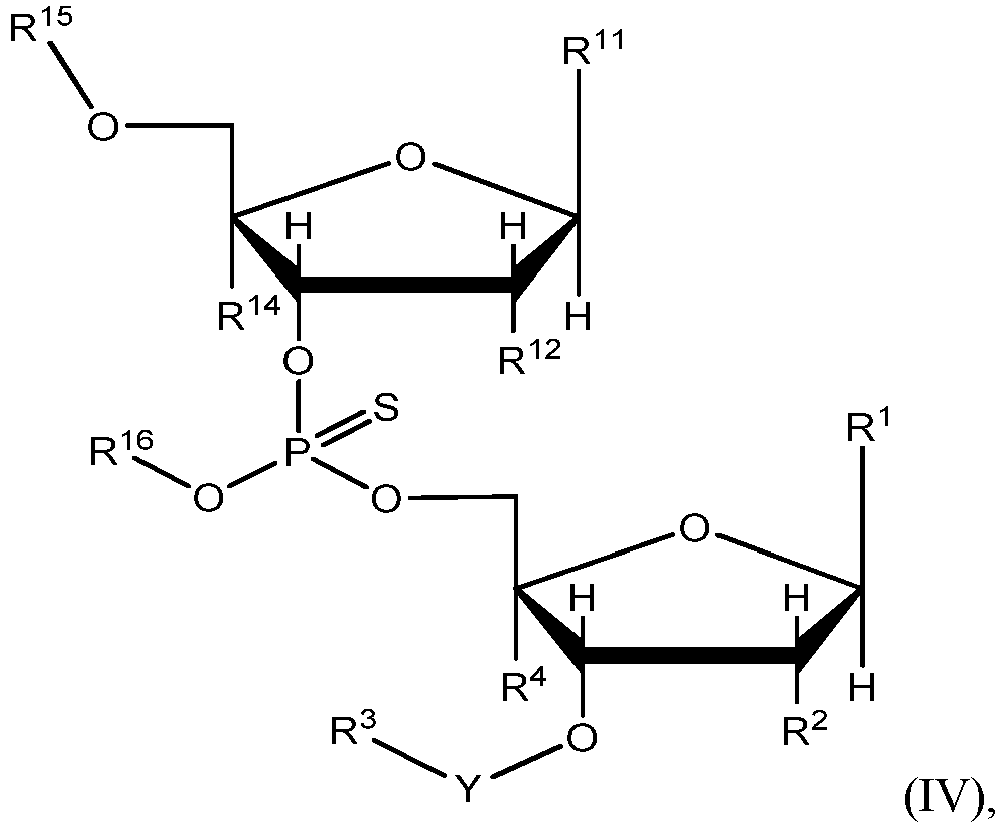
 Each R1 and R11 are independently a nucleobase, wherein the NH2 of the nucleobase, if present, is protected by an amine protecting group;Each R2 and R12 are independently selected from the group consisting of H, halo, and C1-6alkoxy optionally substituted with C1-6alkoxy;R3 is a solid support, optionally comprising a linker;Y is an oligonucleotide comprising 2 or more nucleotides;Each R4 is independently H or forms a ring with the alkoxy group of R2;Each R14 is independently H or forms a ring with the alkoxy group of R12;R15 is a hydroxy protecting group;R16 is C1-6alkyl optionally substituted with -CN;R17a and R17b are independently C1-6alkyl;RS is a hydroxy protecting group formed from a byproduct of the sulfurization agent;wherein the sulfurization agent is recirculated for 1-20 times in step b) to convert unreacted compound of Formula (I) to the compound of Formula (V) and to convert the compound of Formula (III) to Formula (IV);wherein the sulfurization agent is added in an amount 3 to 6 equivalents relative to the amount of the linker or the first nucleotide if the first nucleotide is directly attached to the solid support to convert unreacted compound of Formula (I) to Formula (V) and to convert the compound of Formula (III) to Formula (IV);wherein no other reagent is added to cap the unreacted compound of Formula (I); andwherein the compounds of Formulas (I), (II), (III), (IV), and (V) are optionally in the form of a pharmaceutically acceptable salt.
 - The process of claim 1, further comprising the step of c) deprotecting the compound of Formula (IV) to form the compound of Formula (VI):

- The process of claim 2, further comprising the step of d) reacting the compound of Formula (VI) with a compound of Formula (II) to form a compound of Formula (VII):

e) oxidizing the compound of Formula (VII) with a oxidizing agent to form a compound of Formula (VIII):
- The process of claim 3, further comprising the step of f) deprotecting the compound of Formula (VIII) to form the compound of Formula (IX):

- The process of claim 2 or 4, wherein starting with the compound of Formula (VI) or the compound of Formula (IX), steps a), b), and c) are repeated n times and steps d), e), and f) are repeated m times, wherein repetition of steps a), b), and c) and steps d), e) and f) can occur in any order relative to each other, wherein n is at least 1 and m is 0, 1, 2, 3, or 4, to form an oligonucleotide of Formula (X) or (XI):


- The process of claim 3, further comprising the step of g) reacting the unreacted compound of Formula (VI) with a capping agent to form the compound of Formula (XIV):

- The process of claim 6, further comprising the step of h) deprotecting the compound of Formula (VIII) to form the compound of Formula (IX):

- The process of claim 7, wherein starting with the compound of Formula (VI) or the compound of Formula (IX), steps a), b), and c) are repeated n times and steps d), e), g) and h) are repeated m times, wherein repetition of steps a), b), and c) and steps d), e), g) and h) can occur in any order relative to each other, wherein n is at least 1 and m is 0 or greater to form an oligonucleotide of Formula (X) or (XI):


- The process of claim 5 or 8, wherein n is 2 to 1000, 2 to 500, 2 to 100, 2 to 50 or 2 to 25.
- The process of any one of claims 1 to 9, wherein (i) the sulfurization agent is 3-amino-1,2,4-dithiazole-5-thione (XH or ADTT) and Rs is -C(SH)(=N)-CN; (ii) the sulfurization agent is phenylacetyl disulfide (PADS) and Rs is -C(=O)CH2C6H5; (iii) the sulfurization agent is 3-(dimethylamino-methylidene)amino)-3H-1,2,4-dithiazole (DDTT) and Rs is -C(=S)NHC(=S)N=CHN(CH3)2; or (iv) the sulfurization agent is 3H-1,2-benzodithiol-3-one 1,1-dioxide (Beaucage Reagent) and RS is

- The process of any one of claims 1 to 10, wherein the sulfurization agent is reacted by recirculating the sulfurization agent for 1 to 30, 1 to 20 or 1 to 10 minutes.
- The process of any one of claims 1 to 11, wherein the sulfurization agent is recirculated 1-10 times, or 1-5 times.
- The process of any one of claims 1 to 12, wherein the sulfurization reagent is 3-(dimethylamino-methylidene)amino)-3H-1,2,4-dithiazole (DDTT) added at a concentration of 0.02 M to 0.1 M.
- The process of any one of claims 1 to 13, whereineach R2 and R12 are independently selected from the group consisting of H, F, and C1-4alkoxy optionally substituted with C1-4alkoxy;each R4 is independently H or forms a ring with the alkoxy group of R2, wherein the ring is a 5 or 6-membered ring optionally substituted with 1 to 3 C1-4 alkyl groups;R16 is -CH2CH2CN;R17a and R17b are independently C1-4alkyl; andeach R14 is independently H or forms a ring with the alkoxy group of R12, wherein the ring is a 5 or 6-membered ring optionally substituted with 1 to 3 C1-4 alkyl groups; preferably, wherein:each R2 and R12 are independently selected from H or C1-4alkoxy optionally substituted with C1-4alkoxy;R15 is 4,4'-dimethoxytrityl;R16 is -CH2CH2CN;R17a and R17b are independently C1-6alkyl; andRS is -C(=N)(SH)-CN or -C(=O)CH2C6H5.
- The process of any one of claims 1 to 14, wherein Y is an oligonucleotide comprising 2 to 50 nucleotides, an oligonucleotide comprising 2 to 40 nucleotides, an oligonucleotide comprising 2 to 30 nucleotides, or an oligonucleotide comprising 2 to 25 nucleotides.
- The process of any one of claims 5-14, wherein compound of Formula (X) is an anti-sense oligonucleotide comprising 2 to 30 nucleotides, optionally, wherein:(i) the anti-sense oligonucleotide comprises modified RNA only;(ii) the anti-sense oligonucleotide comprises DNA and modified RNA;(iii) the anti-sense oligonucleotide is a gapmer;(iv) the anti-sense oligonucleotide comprises DNA only; or(v) the sequence of the anti-sense oligonucleotide is SEQ ID NO: 1, SEQ ID NO:2 or SEQ ID NO:8.
Applications Claiming Priority (2)
| Application Number | Priority Date | Filing Date | Title |
|---|---|---|---|
| US201662354433P | 2016-06-24 | 2016-06-24 | |
| PCT/US2017/038643 WO2017223258A1 (en) | 2016-06-24 | 2017-06-22 | Synthesis of thiolated oligonucleotides without a capping step |
Publications (2)
| Publication Number | Publication Date |
|---|---|
| EP3475292A1 EP3475292A1 (en) | 2019-05-01 |
| EP3475292B1 true EP3475292B1 (en) | 2024-09-18 |
Family
ID=59276874
Family Applications (1)
| Application Number | Title | Priority Date | Filing Date |
|---|---|---|---|
| EP17735311.7A Active EP3475292B1 (en) | 2016-06-24 | 2017-06-22 | Synthesis of thiolated oligonucleotides without a capping step |
Country Status (7)
| Country | Link |
|---|---|
| US (1) | US11142545B2 (en) |
| EP (1) | EP3475292B1 (en) |
| JP (1) | JP7235512B2 (en) |
| KR (2) | KR102722183B1 (en) |
| CN (1) | CN109689668B (en) |
| ES (1) | ES2999138T3 (en) |
| WO (1) | WO2017223258A1 (en) |
Families Citing this family (13)
| Publication number | Priority date | Publication date | Assignee | Title |
|---|---|---|---|---|
| WO2016040748A1 (en) | 2014-09-12 | 2016-03-17 | Ionis Pharmaceuticals, Inc. | Compositions and methods for detection of smn protein in a subject and treatment of a subject |
| BR112020000410A2 (en) | 2017-07-10 | 2020-07-14 | Geron Corporation | improved process for preparing imetelstat |
| WO2020227395A2 (en) | 2019-05-06 | 2020-11-12 | University Of Massachusetts | Anti-c9orf72 oligonucleotides and related methods |
| CN110468171B (en) * | 2019-09-20 | 2021-10-29 | 凯莱英医药集团(天津)股份有限公司 | Nucleic acid synthesis method |
| PH12022552258A1 (en) | 2020-02-28 | 2023-11-20 | Ionis Pharmaceuticals Inc | Compounds and methods for modulating smn2 |
| CN114685572B (en) * | 2022-06-02 | 2022-08-30 | 上海百力格生物技术有限公司 | Oxidant composition for MGB nucleic acid probe synthesis and probe synthesis method |
| EP4590684A1 (en) | 2022-09-19 | 2025-07-30 | Bachem Holding AG | Improved oligonucleotide synthesis |
| JPWO2025028656A1 (en) | 2023-08-02 | 2025-02-06 | ||
| WO2025038661A1 (en) * | 2023-08-14 | 2025-02-20 | Arrowhead Pharmaceuticals, Inc. | Oligonucleotide synthesis methods |
| WO2025165064A1 (en) * | 2024-02-02 | 2025-08-07 | 에스티팜 주식회사 | Improved method for oligonucleotide synthesis |
| WO2025234897A1 (en) * | 2024-05-07 | 2025-11-13 | Акционерное общество "ГЕНЕРИУМ" | Method for producing phosphorothioate oligonucleotides for therapeutic use |
| WO2025235761A1 (en) | 2024-05-09 | 2025-11-13 | Biogen Ma Inc. | Reagents and processes for preparing oligonucleotides |
| WO2026082783A1 (en) | 2024-10-17 | 2026-04-23 | F. Hoffmann-La Roche Ag | Synthesis of thiolated oligonucleotides without capping and without recirculation of the thiolating agent |
Family Cites Families (12)
| Publication number | Priority date | Publication date | Assignee | Title |
|---|---|---|---|---|
| US6087491A (en) * | 1993-01-08 | 2000-07-11 | Hybridon, Inc. | Extremely high purity oligonucleotides and methods of synthesizing them using dimer blocks |
| US5614621A (en) * | 1993-07-29 | 1997-03-25 | Isis Pharmaceuticals, Inc. | Process for preparing oligonucleotides using silyl-containing diamino phosphorous reagents |
| US6809195B1 (en) * | 2000-08-16 | 2004-10-26 | Isis Pharmaceuticals, Inc. | Process for the preparation of oligonucleotides |
| EP1386925A1 (en) * | 2002-07-31 | 2004-02-04 | Girindus AG | Method for preparing oligonucleotides |
| ES2397113T3 (en) | 2005-06-23 | 2013-03-04 | Isis Pharmaceuticals, Inc. | Compositions and procedures to modulate the splicing of SMN2 |
| CN115227709A (en) | 2009-06-17 | 2022-10-25 | 冷泉港实验室 | Compositions and methods for modulating SMN2 splicing in a subject |
| US8642755B2 (en) | 2009-06-30 | 2014-02-04 | Agilent Technologies, Inc. | Use of thioacetic acid derivatives in the sulfurization of oligonucleotides with phenylacetyl disulfide |
| EP2788087A4 (en) * | 2011-12-06 | 2015-08-26 | Ohio State Innovation Foundation | NON-IONIC LOW OSMOLARITY CONTRAST AGENTS FOR THE ADMINISTRATION OF ANTISENSE OLIGONUCLEOTIDES AND THE TREATMENT OF DISEASE |
| WO2015061246A1 (en) * | 2013-10-21 | 2015-04-30 | Isis Pharmaceuticals, Inc. | Method for solution phase detritylation of oligomeric compounds |
| MY192634A (en) | 2014-04-01 | 2022-08-29 | Biogen Ma Inc | Compositions for modulating sod-1 expression |
| JO3746B1 (en) * | 2015-03-10 | 2021-01-31 | Aduro Biotech Inc | Compositions and methods for activating “stimulator of interferon gene”-dependent signalling |
| JOP20190218A1 (en) * | 2017-03-22 | 2019-09-22 | Boehringer Ingelheim Int | Modified cyclic dinucleotide compounds |
-
2017
- 2017-06-22 WO PCT/US2017/038643 patent/WO2017223258A1/en not_active Ceased
- 2017-06-22 CN CN201780051170.4A patent/CN109689668B/en active Active
- 2017-06-22 JP JP2018567264A patent/JP7235512B2/en active Active
- 2017-06-22 ES ES17735311T patent/ES2999138T3/en active Active
- 2017-06-22 KR KR1020237031095A patent/KR102722183B1/en active Active
- 2017-06-22 EP EP17735311.7A patent/EP3475292B1/en active Active
- 2017-06-22 US US16/312,819 patent/US11142545B2/en active Active
- 2017-06-22 KR KR1020197001173A patent/KR20190020743A/en not_active Ceased
Also Published As
| Publication number | Publication date |
|---|---|
| WO2017223258A1 (en) | 2017-12-28 |
| US20190161513A1 (en) | 2019-05-30 |
| ES2999138T3 (en) | 2025-02-24 |
| US11142545B2 (en) | 2021-10-12 |
| KR102722183B1 (en) | 2024-10-24 |
| KR20230133947A (en) | 2023-09-19 |
| KR20190020743A (en) | 2019-03-04 |
| CN109689668B (en) | 2023-02-17 |
| EP3475292A1 (en) | 2019-05-01 |
| JP2019518778A (en) | 2019-07-04 |
| JP7235512B2 (en) | 2023-03-08 |
| CN109689668A (en) | 2019-04-26 |
Similar Documents
| Publication | Publication Date | Title |
|---|---|---|
| US11142545B2 (en) | Synthesis of thiolated oligonucleotides without a capping step | |
| JP7824080B2 (en) | Convergent liquid-phase synthesis of oligonucleotides | |
| CN113748116A (en) | Techniques useful for oligonucleotide preparation | |
| DE69030745T2 (en) | Process and reagent for the sulfurization of organophosphites | |
| JP2021521140A (en) | Oligonucleotide composition and its usage | |
| AU2017368283B2 (en) | Novel bicyclic nucleosides and oligomers prepared therefrom | |
| CN120129688A (en) | An efficient method for preparing highly purified 5′-capped oligonucleotides | |
| JP7085739B2 (en) | Artificial nucleosides and artificial nucleotides as well as artificial oligonucleotides | |
| HK40008182A (en) | Synthesis of thiolated oligonucleotides without a capping step | |
| HK40008182B (en) | Synthesis of thiolated oligonucleotides without a capping step | |
| US9802975B2 (en) | Protecting groups for “Z nucleotide” and methods thereof | |
| WO2020169695A1 (en) | Phosphonoacetate gapmer oligonucleotides | |
| US20250270179A1 (en) | Tricyclo-dna nucleoside precursors and processes for preparing the same | |
| WO2025146138A1 (en) | Ligands for extrahepatic delivery | |
| CN121627785A (en) | Oligonucleotides containing lipophilic monomers and their applications in non-hepatic delivery | |
| CA3129646A1 (en) | Novel phosphoramidites | |
| BR112021018492B1 (en) | METHOD FOR PREPARING AN OLIGONUCLEOTIDE AND OLIGONUCLEOTIDE | |
| US20100010069A1 (en) | Extended Length Borane Phosphonate Nucleic Acid Compounds |
Legal Events
| Date | Code | Title | Description |
|---|---|---|---|
| STAA | Information on the status of an ep patent application or granted ep patent |
Free format text: STATUS: UNKNOWN |
|
| STAA | Information on the status of an ep patent application or granted ep patent |
Free format text: STATUS: THE INTERNATIONAL PUBLICATION HAS BEEN MADE |
|
| PUAI | Public reference made under article 153(3) epc to a published international application that has entered the european phase |
Free format text: ORIGINAL CODE: 0009012 |
|
| STAA | Information on the status of an ep patent application or granted ep patent |
Free format text: STATUS: REQUEST FOR EXAMINATION WAS MADE |
|
| 17P | Request for examination filed |
Effective date: 20190117 |
|
| AK | Designated contracting states |
Kind code of ref document: A1 Designated state(s): AL AT BE BG CH CY CZ DE DK EE ES FI FR GB GR HR HU IE IS IT LI LT LU LV MC MK MT NL NO PL PT RO RS SE SI SK SM TR |
|
| AX | Request for extension of the european patent |
Extension state: BA ME |
|
| DAV | Request for validation of the european patent (deleted) | ||
| DAX | Request for extension of the european patent (deleted) | ||
| REG | Reference to a national code |
Ref country code: HK Ref legal event code: DE Ref document number: 40008182 Country of ref document: HK |
|
| STAA | Information on the status of an ep patent application or granted ep patent |
Free format text: STATUS: EXAMINATION IS IN PROGRESS |
|
| 17Q | First examination report despatched |
Effective date: 20220301 |
|
| P01 | Opt-out of the competence of the unified patent court (upc) registered |
Effective date: 20230601 |
|
| GRAP | Despatch of communication of intention to grant a patent |
Free format text: ORIGINAL CODE: EPIDOSNIGR1 |
|
| STAA | Information on the status of an ep patent application or granted ep patent |
Free format text: STATUS: GRANT OF PATENT IS INTENDED |
|
| INTG | Intention to grant announced |
Effective date: 20231115 |
|
| GRAJ | Information related to disapproval of communication of intention to grant by the applicant or resumption of examination proceedings by the epo deleted |
Free format text: ORIGINAL CODE: EPIDOSDIGR1 |
|
| STAA | Information on the status of an ep patent application or granted ep patent |
Free format text: STATUS: EXAMINATION IS IN PROGRESS |
|
| GRAP | Despatch of communication of intention to grant a patent |
Free format text: ORIGINAL CODE: EPIDOSNIGR1 |
|
| STAA | Information on the status of an ep patent application or granted ep patent |
Free format text: STATUS: GRANT OF PATENT IS INTENDED |
|
| INTC | Intention to grant announced (deleted) | ||
| INTG | Intention to grant announced |
Effective date: 20240409 |
|
| GRAS | Grant fee paid |
Free format text: ORIGINAL CODE: EPIDOSNIGR3 |
|
| GRAA | (expected) grant |
Free format text: ORIGINAL CODE: 0009210 |
|
| STAA | Information on the status of an ep patent application or granted ep patent |
Free format text: STATUS: THE PATENT HAS BEEN GRANTED |
|
| AK | Designated contracting states |
Kind code of ref document: B1 Designated state(s): AL AT BE BG CH CY CZ DE DK EE ES FI FR GB GR HR HU IE IS IT LI LT LU LV MC MK MT NL NO PL PT RO RS SE SI SK SM TR |
|
| REG | Reference to a national code |
Ref country code: GB Ref legal event code: FG4D |
|
| REG | Reference to a national code |
Ref country code: CH Ref legal event code: EP |
|
| REG | Reference to a national code |
Ref country code: DE Ref legal event code: R096 Ref document number: 602017084914 Country of ref document: DE |
|
| REG | Reference to a national code |
Ref country code: IE Ref legal event code: FG4D |
|
| REG | Reference to a national code |
Ref country code: LT Ref legal event code: MG9D |
|
| PG25 | Lapsed in a contracting state [announced via postgrant information from national office to epo] |
Ref country code: NO Free format text: LAPSE BECAUSE OF FAILURE TO SUBMIT A TRANSLATION OF THE DESCRIPTION OR TO PAY THE FEE WITHIN THE PRESCRIBED TIME-LIMIT Effective date: 20241218 |
|
| PG25 | Lapsed in a contracting state [announced via postgrant information from national office to epo] |
Ref country code: GR Free format text: LAPSE BECAUSE OF FAILURE TO SUBMIT A TRANSLATION OF THE DESCRIPTION OR TO PAY THE FEE WITHIN THE PRESCRIBED TIME-LIMIT Effective date: 20241219 Ref country code: FI Free format text: LAPSE BECAUSE OF FAILURE TO SUBMIT A TRANSLATION OF THE DESCRIPTION OR TO PAY THE FEE WITHIN THE PRESCRIBED TIME-LIMIT Effective date: 20240918 |
|
| PG25 | Lapsed in a contracting state [announced via postgrant information from national office to epo] |
Ref country code: BG Free format text: LAPSE BECAUSE OF FAILURE TO SUBMIT A TRANSLATION OF THE DESCRIPTION OR TO PAY THE FEE WITHIN THE PRESCRIBED TIME-LIMIT Effective date: 20240918 |
|
| PG25 | Lapsed in a contracting state [announced via postgrant information from national office to epo] |
Ref country code: LV Free format text: LAPSE BECAUSE OF FAILURE TO SUBMIT A TRANSLATION OF THE DESCRIPTION OR TO PAY THE FEE WITHIN THE PRESCRIBED TIME-LIMIT Effective date: 20240918 |
|
| PG25 | Lapsed in a contracting state [announced via postgrant information from national office to epo] |
Ref country code: HR Free format text: LAPSE BECAUSE OF FAILURE TO SUBMIT A TRANSLATION OF THE DESCRIPTION OR TO PAY THE FEE WITHIN THE PRESCRIBED TIME-LIMIT Effective date: 20240918 |
|
| REG | Reference to a national code |
Ref country code: NL Ref legal event code: MP Effective date: 20240918 |
|
| PG25 | Lapsed in a contracting state [announced via postgrant information from national office to epo] |
Ref country code: RS Free format text: LAPSE BECAUSE OF FAILURE TO SUBMIT A TRANSLATION OF THE DESCRIPTION OR TO PAY THE FEE WITHIN THE PRESCRIBED TIME-LIMIT Effective date: 20241218 |
|
| PG25 | Lapsed in a contracting state [announced via postgrant information from national office to epo] |
Ref country code: RS Free format text: LAPSE BECAUSE OF FAILURE TO SUBMIT A TRANSLATION OF THE DESCRIPTION OR TO PAY THE FEE WITHIN THE PRESCRIBED TIME-LIMIT Effective date: 20241218 Ref country code: NO Free format text: LAPSE BECAUSE OF FAILURE TO SUBMIT A TRANSLATION OF THE DESCRIPTION OR TO PAY THE FEE WITHIN THE PRESCRIBED TIME-LIMIT Effective date: 20241218 Ref country code: LV Free format text: LAPSE BECAUSE OF FAILURE TO SUBMIT A TRANSLATION OF THE DESCRIPTION OR TO PAY THE FEE WITHIN THE PRESCRIBED TIME-LIMIT Effective date: 20240918 Ref country code: HR Free format text: LAPSE BECAUSE OF FAILURE TO SUBMIT A TRANSLATION OF THE DESCRIPTION OR TO PAY THE FEE WITHIN THE PRESCRIBED TIME-LIMIT Effective date: 20240918 Ref country code: GR Free format text: LAPSE BECAUSE OF FAILURE TO SUBMIT A TRANSLATION OF THE DESCRIPTION OR TO PAY THE FEE WITHIN THE PRESCRIBED TIME-LIMIT Effective date: 20241219 Ref country code: FI Free format text: LAPSE BECAUSE OF FAILURE TO SUBMIT A TRANSLATION OF THE DESCRIPTION OR TO PAY THE FEE WITHIN THE PRESCRIBED TIME-LIMIT Effective date: 20240918 Ref country code: BG Free format text: LAPSE BECAUSE OF FAILURE TO SUBMIT A TRANSLATION OF THE DESCRIPTION OR TO PAY THE FEE WITHIN THE PRESCRIBED TIME-LIMIT Effective date: 20240918 |
|
| REG | Reference to a national code |
Ref country code: AT Ref legal event code: MK05 Ref document number: 1724629 Country of ref document: AT Kind code of ref document: T Effective date: 20240918 |
|
| PG25 | Lapsed in a contracting state [announced via postgrant information from national office to epo] |
Ref country code: NL Free format text: LAPSE BECAUSE OF FAILURE TO SUBMIT A TRANSLATION OF THE DESCRIPTION OR TO PAY THE FEE WITHIN THE PRESCRIBED TIME-LIMIT Effective date: 20240918 |
|
| REG | Reference to a national code |
Ref country code: ES Ref legal event code: FG2A Ref document number: 2999138 Country of ref document: ES Kind code of ref document: T3 Effective date: 20250224 |
|
| PG25 | Lapsed in a contracting state [announced via postgrant information from national office to epo] |
Ref country code: PT Free format text: LAPSE BECAUSE OF FAILURE TO SUBMIT A TRANSLATION OF THE DESCRIPTION OR TO PAY THE FEE WITHIN THE PRESCRIBED TIME-LIMIT Effective date: 20250120 Ref country code: IS Free format text: LAPSE BECAUSE OF FAILURE TO SUBMIT A TRANSLATION OF THE DESCRIPTION OR TO PAY THE FEE WITHIN THE PRESCRIBED TIME-LIMIT Effective date: 20250118 |
|
| PG25 | Lapsed in a contracting state [announced via postgrant information from national office to epo] |
Ref country code: RO Free format text: LAPSE BECAUSE OF FAILURE TO SUBMIT A TRANSLATION OF THE DESCRIPTION OR TO PAY THE FEE WITHIN THE PRESCRIBED TIME-LIMIT Effective date: 20240918 Ref country code: SM Free format text: LAPSE BECAUSE OF FAILURE TO SUBMIT A TRANSLATION OF THE DESCRIPTION OR TO PAY THE FEE WITHIN THE PRESCRIBED TIME-LIMIT Effective date: 20240918 |
|
| PG25 | Lapsed in a contracting state [announced via postgrant information from national office to epo] |
Ref country code: EE Free format text: LAPSE BECAUSE OF FAILURE TO SUBMIT A TRANSLATION OF THE DESCRIPTION OR TO PAY THE FEE WITHIN THE PRESCRIBED TIME-LIMIT Effective date: 20240918 Ref country code: AT Free format text: LAPSE BECAUSE OF FAILURE TO SUBMIT A TRANSLATION OF THE DESCRIPTION OR TO PAY THE FEE WITHIN THE PRESCRIBED TIME-LIMIT Effective date: 20240918 |
|
| PG25 | Lapsed in a contracting state [announced via postgrant information from national office to epo] |
Ref country code: PL Free format text: LAPSE BECAUSE OF FAILURE TO SUBMIT A TRANSLATION OF THE DESCRIPTION OR TO PAY THE FEE WITHIN THE PRESCRIBED TIME-LIMIT Effective date: 20240918 Ref country code: CZ Free format text: LAPSE BECAUSE OF FAILURE TO SUBMIT A TRANSLATION OF THE DESCRIPTION OR TO PAY THE FEE WITHIN THE PRESCRIBED TIME-LIMIT Effective date: 20240918 |
|
| PG25 | Lapsed in a contracting state [announced via postgrant information from national office to epo] |
Ref country code: SK Free format text: LAPSE BECAUSE OF FAILURE TO SUBMIT A TRANSLATION OF THE DESCRIPTION OR TO PAY THE FEE WITHIN THE PRESCRIBED TIME-LIMIT Effective date: 20240918 |
|
| REG | Reference to a national code |
Ref country code: DE Ref legal event code: R097 Ref document number: 602017084914 Country of ref document: DE |
|
| PGFP | Annual fee paid to national office [announced via postgrant information from national office to epo] |
Ref country code: DE Payment date: 20250520 Year of fee payment: 9 |
|
| PG25 | Lapsed in a contracting state [announced via postgrant information from national office to epo] |
Ref country code: DK Free format text: LAPSE BECAUSE OF FAILURE TO SUBMIT A TRANSLATION OF THE DESCRIPTION OR TO PAY THE FEE WITHIN THE PRESCRIBED TIME-LIMIT Effective date: 20240918 |
|
| PGFP | Annual fee paid to national office [announced via postgrant information from national office to epo] |
Ref country code: GB Payment date: 20250520 Year of fee payment: 9 |
|
| PGFP | Annual fee paid to national office [announced via postgrant information from national office to epo] |
Ref country code: IT Payment date: 20250520 Year of fee payment: 9 |
|
| PGFP | Annual fee paid to national office [announced via postgrant information from national office to epo] |
Ref country code: FR Payment date: 20250521 Year of fee payment: 9 |
|
| PLBE | No opposition filed within time limit |
Free format text: ORIGINAL CODE: 0009261 |
|
| STAA | Information on the status of an ep patent application or granted ep patent |
Free format text: STATUS: NO OPPOSITION FILED WITHIN TIME LIMIT |
|
| 26N | No opposition filed |
Effective date: 20250619 |
|
| PG25 | Lapsed in a contracting state [announced via postgrant information from national office to epo] |
Ref country code: SE Free format text: LAPSE BECAUSE OF FAILURE TO SUBMIT A TRANSLATION OF THE DESCRIPTION OR TO PAY THE FEE WITHIN THE PRESCRIBED TIME-LIMIT Effective date: 20240918 |
|
| PGFP | Annual fee paid to national office [announced via postgrant information from national office to epo] |
Ref country code: ES Payment date: 20250701 Year of fee payment: 9 |
|
| REG | Reference to a national code |
Ref country code: CH Ref legal event code: H13 Free format text: ST27 STATUS EVENT CODE: U-0-0-H10-H13 (AS PROVIDED BY THE NATIONAL OFFICE) Effective date: 20260127 |
|
| PG25 | Lapsed in a contracting state [announced via postgrant information from national office to epo] |
Ref country code: MC Free format text: LAPSE BECAUSE OF FAILURE TO SUBMIT A TRANSLATION OF THE DESCRIPTION OR TO PAY THE FEE WITHIN THE PRESCRIBED TIME-LIMIT Effective date: 20240918 |
|
| PG25 | Lapsed in a contracting state [announced via postgrant information from national office to epo] |
Ref country code: LU Free format text: LAPSE BECAUSE OF NON-PAYMENT OF DUE FEES Effective date: 20250622 |
|
| REG | Reference to a national code |
Ref country code: BE Ref legal event code: MM Effective date: 20250630 |
|
| PG25 | Lapsed in a contracting state [announced via postgrant information from national office to epo] |
Ref country code: IE Free format text: LAPSE BECAUSE OF NON-PAYMENT OF DUE FEES Effective date: 20250622 |
|
| PG25 | Lapsed in a contracting state [announced via postgrant information from national office to epo] |
Ref country code: BE Free format text: LAPSE BECAUSE OF NON-PAYMENT OF DUE FEES Effective date: 20250630 |
|
| PG25 | Lapsed in a contracting state [announced via postgrant information from national office to epo] |
Ref country code: CH Free format text: LAPSE BECAUSE OF NON-PAYMENT OF DUE FEES Effective date: 20250630 |