EP3474614A1 - Method for signal transmission, terminal device and network device - Google Patents
Method for signal transmission, terminal device and network device Download PDFInfo
- Publication number
- EP3474614A1 EP3474614A1 EP16909233.5A EP16909233A EP3474614A1 EP 3474614 A1 EP3474614 A1 EP 3474614A1 EP 16909233 A EP16909233 A EP 16909233A EP 3474614 A1 EP3474614 A1 EP 3474614A1
- Authority
- EP
- European Patent Office
- Prior art keywords
- basic
- transmission
- data
- transmission interval
- numerology
- Prior art date
- Legal status (The legal status is an assumption and is not a legal conclusion. Google has not performed a legal analysis and makes no representation as to the accuracy of the status listed.)
- Granted
Links
Images






Classifications
-
- H—ELECTRICITY
- H04—ELECTRIC COMMUNICATION TECHNIQUE
- H04L—TRANSMISSION OF DIGITAL INFORMATION, e.g. TELEGRAPHIC COMMUNICATION
- H04L5/00—Arrangements affording multiple use of the transmission path
- H04L5/003—Arrangements for allocating sub-channels of the transmission path
- H04L5/0048—Allocation of pilot signals, i.e. of signals known to the receiver
-
- H—ELECTRICITY
- H04—ELECTRIC COMMUNICATION TECHNIQUE
- H04L—TRANSMISSION OF DIGITAL INFORMATION, e.g. TELEGRAPHIC COMMUNICATION
- H04L1/00—Arrangements for detecting or preventing errors in the information received
- H04L1/12—Arrangements for detecting or preventing errors in the information received by using return channel
- H04L1/16—Arrangements for detecting or preventing errors in the information received by using return channel in which the return channel carries supervisory signals, e.g. repetition request signals
- H04L1/18—Automatic repetition systems, e.g. Van Duuren systems
- H04L1/1829—Arrangements specially adapted for the receiver end
- H04L1/1854—Scheduling and prioritising arrangements
-
- H—ELECTRICITY
- H04—ELECTRIC COMMUNICATION TECHNIQUE
- H04L—TRANSMISSION OF DIGITAL INFORMATION, e.g. TELEGRAPHIC COMMUNICATION
- H04L1/00—Arrangements for detecting or preventing errors in the information received
- H04L1/12—Arrangements for detecting or preventing errors in the information received by using return channel
- H04L1/16—Arrangements for detecting or preventing errors in the information received by using return channel in which the return channel carries supervisory signals, e.g. repetition request signals
- H04L1/18—Automatic repetition systems, e.g. Van Duuren systems
- H04L1/1829—Arrangements specially adapted for the receiver end
- H04L1/1861—Physical mapping arrangements
-
- H—ELECTRICITY
- H04—ELECTRIC COMMUNICATION TECHNIQUE
- H04L—TRANSMISSION OF DIGITAL INFORMATION, e.g. TELEGRAPHIC COMMUNICATION
- H04L1/00—Arrangements for detecting or preventing errors in the information received
- H04L1/12—Arrangements for detecting or preventing errors in the information received by using return channel
- H04L1/16—Arrangements for detecting or preventing errors in the information received by using return channel in which the return channel carries supervisory signals, e.g. repetition request signals
- H04L1/18—Automatic repetition systems, e.g. Van Duuren systems
- H04L1/1867—Arrangements specially adapted for the transmitter end
- H04L1/1887—Scheduling and prioritising arrangements
-
- H—ELECTRICITY
- H04—ELECTRIC COMMUNICATION TECHNIQUE
- H04L—TRANSMISSION OF DIGITAL INFORMATION, e.g. TELEGRAPHIC COMMUNICATION
- H04L27/00—Modulated-carrier systems
- H04L27/26—Systems using multi-frequency codes
- H04L27/2601—Multicarrier modulation systems
- H04L27/2626—Arrangements specific to the transmitter only
- H04L27/2627—Modulators
- H04L27/2634—Inverse fast Fourier transform [IFFT] or inverse discrete Fourier transform [IDFT] modulators in combination with other circuits for modulation
- H04L27/2636—Inverse fast Fourier transform [IFFT] or inverse discrete Fourier transform [IDFT] modulators in combination with other circuits for modulation with FFT or DFT modulators, e.g. standard single-carrier frequency-division multiple access [SC-FDMA] transmitter or DFT spread orthogonal frequency division multiplexing [DFT-SOFDM]
-
- H—ELECTRICITY
- H04—ELECTRIC COMMUNICATION TECHNIQUE
- H04L—TRANSMISSION OF DIGITAL INFORMATION, e.g. TELEGRAPHIC COMMUNICATION
- H04L5/00—Arrangements affording multiple use of the transmission path
- H04L5/003—Arrangements for allocating sub-channels of the transmission path
- H04L5/0053—Allocation of signalling, i.e. of overhead other than pilot signals
-
- H—ELECTRICITY
- H04—ELECTRIC COMMUNICATION TECHNIQUE
- H04L—TRANSMISSION OF DIGITAL INFORMATION, e.g. TELEGRAPHIC COMMUNICATION
- H04L5/00—Arrangements affording multiple use of the transmission path
- H04L5/003—Arrangements for allocating sub-channels of the transmission path
- H04L5/0053—Allocation of signalling, i.e. of overhead other than pilot signals
- H04L5/0055—Physical resource allocation for ACK/NACK
-
- H—ELECTRICITY
- H04—ELECTRIC COMMUNICATION TECHNIQUE
- H04L—TRANSMISSION OF DIGITAL INFORMATION, e.g. TELEGRAPHIC COMMUNICATION
- H04L5/00—Arrangements affording multiple use of the transmission path
- H04L5/003—Arrangements for allocating sub-channels of the transmission path
- H04L5/0078—Timing of allocation
-
- H—ELECTRICITY
- H04—ELECTRIC COMMUNICATION TECHNIQUE
- H04L—TRANSMISSION OF DIGITAL INFORMATION, e.g. TELEGRAPHIC COMMUNICATION
- H04L5/00—Arrangements affording multiple use of the transmission path
- H04L5/0091—Signalling for the administration of the divided path, e.g. signalling of configuration information
- H04L5/0094—Indication of how sub-channels of the path are allocated
-
- H—ELECTRICITY
- H04—ELECTRIC COMMUNICATION TECHNIQUE
- H04W—WIRELESS COMMUNICATION NETWORKS
- H04W72/00—Local resource management
- H04W72/04—Wireless resource allocation
-
- H—ELECTRICITY
- H04—ELECTRIC COMMUNICATION TECHNIQUE
- H04W—WIRELESS COMMUNICATION NETWORKS
- H04W72/00—Local resource management
- H04W72/04—Wireless resource allocation
- H04W72/044—Wireless resource allocation based on the type of the allocated resource
- H04W72/0446—Resources in time domain, e.g. slots or frames
-
- H—ELECTRICITY
- H04—ELECTRIC COMMUNICATION TECHNIQUE
- H04W—WIRELESS COMMUNICATION NETWORKS
- H04W72/00—Local resource management
- H04W72/20—Control channels or signalling for resource management
- H04W72/23—Control channels or signalling for resource management in the downlink direction of a wireless link, i.e. towards a terminal
-
- H—ELECTRICITY
- H04—ELECTRIC COMMUNICATION TECHNIQUE
- H04L—TRANSMISSION OF DIGITAL INFORMATION, e.g. TELEGRAPHIC COMMUNICATION
- H04L5/00—Arrangements affording multiple use of the transmission path
- H04L5/0001—Arrangements for dividing the transmission path
- H04L5/0003—Two-dimensional division
- H04L5/0005—Time-frequency
- H04L5/0007—Time-frequency the frequencies being orthogonal, e.g. OFDM(A) or DMT
Definitions
- the disclosure relates to the field of communications, and particularly relates to a method for transmitting a signal, a terminal device and a network device.
- LTE Long Term Evolution
- the embodiments of the disclosure provide a method for transmitting a signal, a terminal device and a network device, which can improve the flexibility of signal transmission.
- a first aspect provides a method for transmitting a signal, which includes: a first device determines a basic transmission interval and at least one basic numerology; and the first device takes the basic transmission interval as a time domain unit and employs parameters in the at least one basic numerology to perform transmission of at least one of data or a pilot signal with a second device.
- a novel method for transmitting the signal is disclosed and can keep the flexibility of signal transmission.
- the basic transmission interval may be the time length of a basic transmission interval determined by parameters in the basic numerology; and if the first device determines multiple basic numerologies, the basic transmission interval may be a fixed time length determined by parameters in the multiple basic numerologies.
- a first device determines at least one basic numerology includes: the first device determines the at least one basic numerology from multiple basic numerologies.
- the multiple basic numerologies may be configured in the first device, may also be configured in the second device communicating with the first device, and may further be basic numerologies determined by the first device according to own transmission parameters (such as a working frequency point), or basic numerologies appointed in advance and stored in the first device or the second device.
- own transmission parameters such as a working frequency point
- the first device may only select one basic numerology to perform signal transmission with other devices and thus may guarantee that an appropriate detection window or sending window is provided for a signal transmitted by the first device; and the first device may further take a determined basic transmission interval as the detection window or sending window for the signal transmitted by the first device when multiple basic numerologies are selected, and simultaneously also may perform interference coordination well among different cells of different basic numerologies.
- the first device takes the basic transmission interval as a time domain unit and employs parameters in the at least one basic numerology to perform transmission of at least one of data or a pilot signal with a second device includes: the first device determines time lengths corresponding to transmission time units in each basic numerology in the at least one basic numerology according to the at least one basic numerology; the first device determines the number of transmission time units corresponding to the each basic numerology according to the basic transmission interval as well as the time lengths corresponding to the transmission time units in the each basic numerology, the number of transmission time units being the number of transmission time units in the basic transmission interval; and the first device respectively takes the number of transmission time units corresponding to the each basic numerology as a time domain unit to perform the transmission of at least one of the data or the pilot signal with the second device.
- the transmission time unit is a time domain resource unit for transmitting the signal. It may be a transmission time unit defined in an LTE system such as a Transmission Time Interval (TTI), a sub-frame, a wireless frame, and an Orthogonal Frequency Division Multiplexing (OFDM) symbol, and may also be a transmission time unit newly defined in a 5th-Generation (5G) system.
- TTI Transmission Time Interval
- OFDM Orthogonal Frequency Division Multiplexing
- the signal is transmitted by taking one transmission time unit as a basic transmission unit, such as taking one TTI as the basic transmission unit and thus it is assured that a duration for transmission of each signal is an integer multiple of the transmission time unit.
- the number of transmission time units in the basic transmission interval is taken as the time domain unit; that is, the number of transmission time units used for each time of transmission is an integer multiple of the number of transmission time units in the basic transmission interval.
- a first device determines a basic transmission interval includes: the first device determines the basic transmission interval according to stored preset information; or the first device determines the basic transmission interval according to a received control signaling sent by the second device, the control signaling being used for indicating the basic transmission interval.
- the method further includes: the first device sends a control signaling to the second device, so that the second device determines the basic transmission interval according to the control signaling.
- the first device may be a terminal device and may also be a network side device.
- the second device may be the terminal device and may also be the network side device.
- the first device may be a receiving terminal and may also be a sending terminal.
- the first device is the terminal device and the second device is the network side device.
- the control signaling may be a downlink control signaling.
- the downlink control signaling may indicate one of multiple appointed basic transmission intervals.
- a time difference between a transmission time unit occupied by a scheduling signaling for scheduling at least one of the data or the pilot signal and a transmission time unit occupied by at least one of the data or the pilot signal sent or received by the first device is a positive integer multiple of the basic transmission interval.
- a time difference between a transmission time unit occupied by the data sent by the first device and a transmission time unit occupied by corresponding Acknowledgement (ACK)/Negative Acknowledgement (NACK) feedback information received by the first device is a positive integer multiple of the basic transmission interval, or a time difference between a transmission time unit occupied by the data received by the first device and a transmission time unit occupied by the corresponding ACK/NACK feedback information sent by the first device is a positive integer multiple of the basic transmission interval.
- the method further includes: the first device sends the ACK/NACK feedback information, the ACK/NACK feedback information being ACK/NACK feedback information corresponding to all data transmission blocks received by the first device in a single basic transmission interval; or the first device receives the ACK/NACK feedback information, the ACK/NACK feedback information being ACK/NACK feedback information corresponding to all data transmission blocks sent by the first device in the single basic transmission interval.
- the method before the first device takes the basic transmission interval as the time domain unit and employs the parameters in the at least one basic numerology to perform the transmission of at least one of the data or the pilot signal with the second device, the method further includes: the first device schedules data transmission blocks in the single basic transmission interval according to the received scheduling signaling sent by the second device.
- the method before the first device takes the basic transmission interval as the time domain unit and employs the parameters in the at least one basic numerology to perform the transmission of at least one of the data or the pilot signal with the second device, the method further includes: the first device sends the scheduling signaling to the second device, the scheduling signaling being used for scheduling the data transmission blocks in the single basic transmission interval.
- the basic numerology includes at least one parameter of the followings: a sub-carrier interval, the number of sub-carriers corresponding to a system bandwidth, the number of sub-carriers corresponding to a Physical Resource Block (PRB), the length of an OFDM symbol, the number of points of Fast Fourier Transformation(FFT) or Inverse Fast Fourier Transform (IFFT) used for generating an OFDM signal, the number of OFDM symbols included in a TTI, the number of TTIs included within a first time period and the length of a signal prefix.
- PRB Physical Resource Block
- FFT Fast Fourier Transformation
- IFFT Inverse Fast Fourier Transform
- the basic transmission interval is positive integer multiple of 1 millisecond (ms).
- a second aspect provides a terminal device, which is configured to execute the method in the first aspect or in any implementation manner of the first aspect.
- the apparatus includes a unit configured to execute the method in the first aspect or above any implementation manner of the first aspect.
- a third aspect provides a network device, which is configured to execute the method in the first aspect or in any implementation manner of the first aspect.
- the apparatus includes a unit configured to execute the method in the first aspect or above any implementation manner of the first aspect.
- a fourth aspect provides a terminal device, which includes a memory, a processor, an input/output interface, a communication interface and a bus system.
- the memory, the processor, the input/output interface and the communication interface are connected via the bus system;
- the memory is configured to store an instruction;
- the processor is configured to execute the instruction stored by the memory; and when the instruction is executed, the processor executes the method in the first aspect via the communication interface, and controls the input/output interface to receive input data and information and output data such as an operation result.
- a fifth aspect provides a network device, which includes a memory, a processor, an input/output interface, a communication interface and a bus system.
- the memory, the processor, the input/output interface and the communication interface are connected via the bus system;
- the memory is configured to store an instruction;
- the processor is configured to execute the instruction stored by the memory; and when the instruction is executed, the processor executes the method in the first aspect via the communication interface, and controls the input/output interface to receive input data and information and output data such as an operation result.
- a sixth aspect provides a computer storage medium, which is configured to store a computer software instruction used by the above method and includes a program designed for executing the above aspects.
- the names of the terminal device and the network device are not intended to form limits to the devices in itself. During actual implementation, these devices may appear in other names. As long as a function of each device is similar to the disclosure, all pertain to the scope of claims of the disclosure and equivalent technologies thereof.
- GSM Global System of Mobile communication
- CDMA Code Division Multiple Access
- WCDMA Wideband Code Division Multiple Access
- GPRS General Packet Radio Service
- LTE LTE
- FDD Frequency Division Duplex
- TDD Time Division Duplex
- UMTS Universal Mobile Telecommunication System
- WiMAX Worldwide Interoperability for Microwave Access
- the technical solutions in the embodiments of the disclosure may be applied to various communication systems based on a non-orthogonal multiple access technology, such as a Sparse Code Multiple Access (SCMA) system and a Low Density Signature (LDS) system.
- SCMA Sparse Code Multiple Access
- LDS Low Density Signature
- SCMA Sparse Code Multiple Access
- SCMA Sparse Code Multiple Access
- LDS Low Density Signature
- SCMA Sparse Code Multiple Access
- LDS Low Density Signature
- the technical solutions in the embodiments of the disclosure may be applied to multi-carrier transmission systems adopting the non-orthogonal multiple access technology, such as an Orthogonal Frequency Division Multiplexing (OFDM) system, a Filter Bank Multi-Carrier (FBMC) system, a Generalized Frequency Division Multiplexing (GFDM) system and a Filtered-OFDM (F-OFDM) system.
- OFDM Orthogonal Frequency Division Multiplexing
- FBMC Filter Bank Multi-Carrier
- GFDM Generalized Frequency Division Multiplexing
- F-OFDM Filtered-OFDM
- the first device in the embodiments of the disclosure may be a network side device, and may also be a terminal device.
- the second device may be the network side device, and may also be the terminal device.
- the first device is the terminal device, and the second device is the network side device.
- the terminal device in the embodiments of the disclosure may be User Equipment (UE), an access terminal, a user unit, a user station, a mobile station, a mobile platform, a remote station, a remote terminal, a mobile device, a user terminal, a terminal, a wireless communication device and a user proxy or user apparatus.
- UE User Equipment
- the access terminal may be a cellular phone, a cordless telephone, a Session Initiation Protocol (SIP) phone, a Wireless Local Loop (WLL) station, a Personal Digital Assistant (PDA), a handheld device having a wireless communication function, a computing device or other processing devices, vehicle-amounted devices and wearable devices connected to a wireless modulator-demodulator, a terminal device in a future 5th Generation (5G) network or a terminal device in a future evolved Public Land Mobile Network (PLMN), all of which are not limited in the embodiments of the disclosure.
- 5G 5th Generation
- PLMN Public Land Mobile Network
- the network device in the embodiments of the disclosure may be a device used for communicating with the terminal device.
- the network device may be a Base Transceiver Station (BTS) in a GSM or CDMA, may also be a NodeB (NB) in a WCDMA system, may further be an Evolutional NodeB (eNB or eNodeB) in an LTE system and may further be a wireless controller in a Cloud Radio Access Network (CRAN) scene; or the network device may be a relay station, an access point, a vehicle-amounted device, a wearable device as well as a network device in the future 5G system or a network device in the future evolved PLMN network, all of which are not limited in the embodiments of the disclosure.
- BTS Base Transceiver Station
- NB NodeB
- eNB or eNodeB Evolutional NodeB
- CRAN Cloud Radio Access Network
- FIG. 1 is a schematic diagram of an application scene of the disclosure.
- the communication system in FIG. 1 may include a terminal device 10 and a network device 20.
- the network device 20 is configured to provide a communication service for the terminal device 10 and is accessed to a core network.
- the terminal device 10 is accessed to a network via a synchronization signal, a broadcasting signal and the like sent by a search network device 20 and thus performs communication with the network.
- the arrow shown in FIG. 1 may represent uplink/downlink transmission performed via a cellular link between the terminal device 10 and the network device 20.
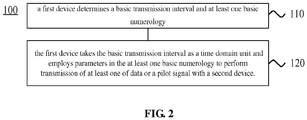
- FIG. 2 illustrates a schematic flowchart of a method for transmitting a signal provided by an embodiment of the disclosure. As shown in FIG. 2 , the method 100 includes the following operations.
- a first device determines a basic transmission interval and at least one basic numerology.
- the first device takes the basic transmission interval as a time domain unit and employs parameters in the at least one basic numerology to perform transmission of data and/or a pilot signal with a second device.
- multiple basic numerologies may coexist in a manner of Time-Division Multiplexing (TDM) or Frequency-Division Multiplexing (FDM) or a combination thereof in a carrier/cell/Transmit Receive Point (TRP) of a future wireless communication system such as 5G.
- TDM Time-Division Multiplexing
- FDM Frequency-Division Multiplexing
- TRP Transmit Receive Point
- different carrier intervals are adopted by different numerologies.
- the time lengths of transmission time units of different numerologies on a time domain also differ from each other.
- There is a need for a novel method for transmitting the signal in the future wireless communication system such as 5G so as to improve the flexibility of signal transmission.
- the above basic numerologies may include at least one of the following parameters.
- FFT Fast Fourier Transform
- IFFT Inverse Fast Fourier Transform
- the sub-carrier interval refers to a frequency interval between adjacent sub-carriers, such as 15kHz and 60kHz.
- the number of sub-carriers under the special bandwidth may be, for example, the number of sub-carriers corresponding to each possible system bandwidth.
- the number of sub-carriers in the PRB typically may be, for example, an integer multiple of 12.
- the number of OFDM symbols in the TTI may be, for example, an integer multiple of 14; the number of TTIs included within a special time period may refer to the number of TTIs included in the time length of 1ms or 10ms.
- the length of the signal prefix may be, for example, the time length of a Cyclic Prefix (CP) of a signal, or whether the CP employs a conventional CP or an extended CP or not.
- CP Cyclic Prefix
- the terminal device may determine a basic numerology, may determine the time length corresponding to a transmission time unit in the basic numerology upon the determination of a fixed basic numerology and then determines the time length as the basic transmission interval in the method 100, so that data and/or a pilot signal may be sent or received with the time length corresponding to the basic transmission unit as a time domain length. Furthermore, the terminal device may determine multiple basic numerologies, and determines a fixed time length as the basic transmission interval in the method 100 upon the determination of the multiple numerologies, so that the data and/or the pilot signal is sent or received by using the multiple basic numerologies.
- the basic numerology or the multiple basic numerologies may be determined by the terminal device according to own transmission parameters (such as a working frequency point), may also be selected from multiple basic numerologies configured in the terminal device, may further be appointed by the terminal device and the network device in advance, and may further be the basic numerologies selected by the network device from multiple basic numerologies configured in the network device and notified to the terminal device, etc., in which the manner that the terminal device acquires the basic numerologies is not defined in the disclosure.
- the basic transmission interval may include at least one transmission time unit and the transmission time unit is a time domain resource unit for transmitting the signal.
- the transmission time unit may be the OFDM symbol, may be a transmission time unit defined in the LTE system such as the TTI and the sub-frame, and may further be a transmission time unit newly defined in the future wireless communication system such as the 5G.
- the terminal device only appoints one basic numerology to transmit data with other devices (such as the network device), since the same basic numerology is adopted, a sending window or a detection window adopted by the terminal device to send the data or receive the data is uniform and thus the complexity in transmission is not increased. Moreover, if cells where the other devices communicating with the terminal device are located are different cells, when the other devices transmit the data to the terminal device simultaneously, since the same numerology is adopted, the problem that the interference coordination among the cells is affected to increase the inter-cell interference is not occurred.
- the terminal device appoints multiple basic numerologies to transmit data with other devices (such as the network device)
- a sending window or a detection window adopted by the terminal device to send the data or receive the data is the same and thus the complexity in transmission is not increased.
- cells where the other devices communicating with the terminal device are located are different cells, when the other devices transmit the data to the terminal device simultaneously, since the uniform basic transmission interval is adopted, the problem that the interference coordination among the cells is affected to increase the inter-cell interference is not occurred.
- the basic transmission interval may be appointed by the terminal device and the network device in advance.
- multiple basic transmission intervals are appointed by the terminal device and the network device in advance and are configured in the terminal device or the network device.
- the network device may select one basic transmission interval from the multiple basic transmission intervals appointed in advance and sends a control signaling to the terminal device, so that the terminal device determines a basic transmission interval according to the control signaling.
- the multiple basic transmission intervals may be determined by the network device according to the multiple numerologies configured inside.
- the time length of the transmission time unit corresponding to the first basic numerology is 0.5ms
- the time length of the transmission time unit corresponding to the second basic numerology is 1.0ms
- the time length of the transmission time unit corresponding to the third basic numerology is 1.5ms
- the network device may determine the basic transmission interval according to the time lengths of the transmission time units respectively corresponding to the first basic numerology, the second numerology and the third numerology, in which the basic transmission interval may be a common multiple such as 3ms and may also be two times of the common multiple such as 6ms, etc. Any manner for selecting the basic transmission interval may be appropriate.
- the basic transmission interval is a positive integer multiple of the time lengths of the transmission time units corresponding to the determined multiple basic numerologies.
- the above basic numerology may include at least one resource parameter for determining a time frequency resource to transmit the data.
- a corresponding relationship between the parameters in the above basic numerology and the time lengths of the transmission time units is appointed by the terminal device and the network device in advance.
- the time lengths of the transmission time units are calculated via the parameters in the above basic numerology.
- the relationship therebetween may be appointed in advance and may be appointed as that the sub-carrier interval is 15kHz and the time length corresponding to one TTI is 1ms.
- the transmission time unit is the TTI and the length of the OFDM symbol in the basic numerology is L.
- the signal is transmitted by taking one transmission time unit as a time domain unit, such as taking one TTI as the time domain unit and thus it is assured that a duration for transmission of each signal is an integer multiple of the transmission time unit.
- the number of transmission time units in the basic transmission interval is taken as the time domain unit.
- a time difference between a transmission time unit occupied by a scheduling signaling received by the first device for scheduling the data and/or the pilot signal and a transmission time unit occupied by the data and/or the pilot signal sent or received by the first device is a positive integer multiple of the basic transmission interval.
- a time difference between a transmission time unit occupied by a scheduling signaling sent by the first device for scheduling the data and/or the pilot signal and a transmission time unit occupied by the data and/or the pilot signal sent or received by the first device is a positive integer multiple of the basic transmission interval.
- a time difference between a transmission time unit occupied by the data sent by the first device and a transmission time unit occupied by corresponding ACK/NACK feedback information received by the first device is a positive integer multiple of the basic transmission interval, or a time difference between a transmission time unit occupied by the data received by the first device and a transmission time unit occupied by the corresponding ACK/NACK feedback information sent by the first device is a positive integer multiple of the basic transmission interval.
- the transmission time unit is the sub-frame
- the basic transmission interval is T and the network device sends an uplink authorization at an nth sub-frame
- the terminal device starts to schedule preparation data upon the reception of the uplink authorization at the nth sub-frame and starts to send the data at an (n+N*T)th sub-frame; and meanwhile, the network device detects and checks the data sent by the terminal device at the (n+N*T)th sub-frame and feeds a check result back to the terminal device at the (n+N*T)th sub-frame.
- the M and the N are a positive integer respectively and M>N.
- the network device controls the uplink sending of the terminal device via the uplink authorization (the uplink authorization information includes information such as the magnitude of a distributed air interface resource, a new retransmission indication and a sending time) and defines an uplink sending time sequence explicitly.
- the uplink authorization information includes information such as the magnitude of a distributed air interface resource, a new retransmission indication and a sending time
- the network device sends the uplink authorization at the nth sub-frame, and the terminal device starts to schedule the preparation data upon the reception of the uplink authorization at the nth sub-frame and must starts to send the data at the (n+4) sub-frame; and the network device detects and checks the data sent by the terminal device at the (n+4) sub-frame and feeds a check result to the terminal device at the (n+8)th sub-frame.
- FDD Frequency Division Duplexing
- the method further includes: the first device sends the ACK/NACK feedback information, the ACK/NACK feedback information being ACK/NACK feedback information corresponding to all data transmission blocks received by the first device in a single basic transmission interval; or the first device receives the ACK/NACK feedback information, the ACK/NACK feedback information being ACK/NACK feedback information corresponding to all data transmission blocks sent by the first device in the single basic transmission interval.
- the terminal device may feed the ACK/NACK back by employing an ACK binding manner, that is, the ACK is fed back only when the N transmission blocks are correct, or otherwise, the NACK is fed back.
- the terminal device may also feed the ACK/NACK back by employing a bitmap manner, that is, N bits of ACK/NACK are fed back and each bit corresponds to one transmission block in the N transmission blocks.
- the method further includes: the first device receives a scheduling signaling sent by the second device, the scheduling signaling being used for scheduling data transmission blocks in the single basic transmission interval, or the first device sends the scheduling signaling to the second device, the scheduling signaling being used for scheduling the data transmission blocks in the single basic transmission interval.
- one scheduling signaling may be used for scheduling parts or all of the data transmission blocks in the single basic transmission interval.
- the terminal device detects all data transmission blocks in the basic transmission interval based on the scheduling signaling and the network device sends the all data transmission blocks in the basic transmission interval based on the scheduling signaling.
- the terminal device sends all data transmission blocks in the basic transmission interval based on the scheduling signaling and the network device detects the all data transmission blocks in the basic transmission interval based on the scheduling signaling.
- different basic transmission intervals may be adopted by the data and the pilot signal.
- the basic transmission interval adopted to transmit the data is 1ms and that adopted to transmit the pilot signal is 1/14ms.
- a network device and a terminal device appoint the magnitude of a transmission time window (namely, a basic transmission interval) in advance.
- a transmission time window is 1ms.
- the network device determines the time length of one TTI according to a sub-carrier interval adopted for data transmission and thus determines the number of TTIs included in one transmission time window.
- the corresponding relationship between the sub-carrier interval and the length of the one TTI is appointed in advance.
- the sub-carrier interval is 15kHz and the time length of the corresponding one TTI is 1ms, so that one transmission time window only includes one TTI.
- the terminal device determines the time length of one TTI according to the sub-carrier interval adopted for the data transmission and thus determines the number of TTIs included in the transmission time window.
- the process herein is the same as the process of the network device.
- the network device indicates the terminal device of the magnitude of a time window for Hybrid Automatic Repeat request (HARQ) timing, namely, a time delayed by the ACK/NACK feedback compared with the data transmission, in which the time takes the transmission time window as the unit.
- HARQ Hybrid Automatic Repeat request
- the terminal device receives an indication of the network device and thus determines the magnitude of the time window for the HARQ timing, in which the time window takes the transmission time window as the unit. For example, the network device indicates that the magnitude of the time window for the HARQ timing is 4, which expresses that the ACK/NACK feedback is delayed for 4 transmission time windows, namely, 4 TTIs compared with the data transmission.
- the network device performs transmission of downlink data by taking one transmission time window (namely, one TII) as a time domain unit, in which each transmission time window transmits one transmission block and each transmission block is provided with an independent HARQ process.
- one transmission time window namely, one TII
- the terminal device performs reception of the downlink data by taking one transmission time window (namely, one TII) as a time domain unit, in which the transmission blocks sent by the network device are respectively detected in each transmission time window.
- the terminal device delays for 4 TTIs to perform corresponding ACK/NACK feedback.
- a network device indicates a terminal device of the magnitude of a basic transmission interval via a high-level signaling.
- the network device indicates the terminal device which basic transmission interval may be used by employing a 2-bit signaling.
- the four basic transmission intervals corresponding to 2-bit information are 1ms, 2ms, 4ms and 8ms respectively.
- the four basic transmission intervals are appointed between the terminal device and the network device in advance, and it is assumed that the basic transmission interval indicated by the network device is 2ms.
- the network device determines the time length of one sub-frame according to the length of an OFDM symbol in a basic numerology adopted for data transmission and thus determines the number of sub-frames included in the indicated basic transmission interval.
- the terminal device determines the time length of one sub-frame according to the length of the OFDM symbol in the basic numerology adopted for the data transmission and thus determines the number of sub-frames included in the basic transmission interval. It is assumed that the length of the OFDM symbol is 1/14ms and one sub-frame includes 14 OFDM symbols, the time length of the one sub-frame is 1ms. At this moment, one basic transmission interval includes two sub-frames.
- the terminal device and the network device appoint timing for uplink data scheduling, that is, the number of basic transmission intervals spaced between an uplink scheduling signaling and corresponding data transmission.
- the terminal device and the network device appoint timing for uplink data scheduling, that is, the number of basic transmission intervals spaced between an uplink scheduling signaling and corresponding data transmission.
- two basic transmission intervals namely, the time length of four sub-frames
- the terminal device delays for the time lengths of four sub-frames and takes two sub-frames as a time domain unit to perform transmission of uplink data, in which each sub-frame transmits one transmission block, that is, at least two transmission blocks are transmitted by the terminal device at each time.
- sequence numbers of the foregoing operations do not mean execution sequences.
- the execution sequences of the operations should be determined according to functions and internal logic of the operations, and should not be construed as any limitation on the implementation processes of the embodiments of the disclosure.
- first embodiment and the second embodiment illustrate the detailed steps or operations of the method for transmitting the signal.
- these actions or operations are merely for example, and other operations or variations of each operation may further be performed by the embodiments of the disclosure.
- the each operation in the first embodiment and the second embodiment may be executed according to different sequences and it is possible that not all of the operations in the first embodiment and the second embodiment are executed necessarily.
- FIG. 6 illustrates a schematic block diagram of a terminal device 200 for transmitting a signal provided by an embodiment of the disclosure.
- the terminal device 200 includes a determination unit 210 and a transmission unit 220.
- the determination unit 210 is configured to determine a basic transmission interval and at least one basic numerology.
- the transmission unit 220 is configured to take the basic transmission interval as a time domain unit and employ parameters in the at least one basic numerology to perform transmission of data and/or a pilot signal with a network device or a second terminal device.
- the terminal device may determine a basic numerology, may determine the time length corresponding to a transmission time unit in the basic numerology upon the determination of a fixed basic numerology and then determines the time length as the basic transmission interval in the method 100, so that data and/or a pilot signal may be sent or received with the time length corresponding to the basic transmission unit as a time domain length. Furthermore, the terminal device may determine multiple basic numerologies, and determines a fixed time length as the basic transmission interval in the method 100 upon the determination of the multiple numerologies, so that the data and/or the pilot signal is sent or received by using the multiple basic numerologies.
- a novel terminal device for transmitting the signal is provided and can improve the flexibility of signal transmission.
- the basic numerology or the multiple basic numerologies may be determined by the terminal device according to own transmission parameters (such as a working frequency point), may also be selected from multiple basic numerologies configured in the terminal device, may further be appointed by the terminal device and the network device in advance, and may further be the basic numerologies selected by the network device from multiple basic numerologies configured in the network device and notified to the terminal device, etc., in which the manner that the terminal device acquires the basic numerologies is not defined in the disclosure.
- the terminal device may only select one basic numerology to perform signal transmission with the network device and thus may guarantee that an appropriate detection window or sending window is provided for a signal transmitted by the terminal device; and the terminal device may further take a determined basic transmission interval as the detection window or sending window for the signal transmitted by the terminal device when multiple basic numerologies are selected, and simultaneously also may perform interference coordination well among different cells of different basic numerologies.
- the transmission unit is specifically configured to determine the time lengths corresponding to transmission time units in each basic numerology in the at least one basic numerology according to the at least one basic numerology; determine the number of transmission time units corresponding to the each basic numerology according to the basic transmission interval as well as the time lengths corresponding to the transmission time units in the each basic numerology, the number of transmission time units being the number of transmission time units in the basic transmission interval; and respectively take the number of transmission time units corresponding to the each basic numerology as a time domain unit to perform the transmission of the data and/or the pilot signal with the network device or the second device.
- the determination unit is specifically configured to determine the basic transmission interval according to the stored preset information; or determine the basic transmission interval according to the received control signaling sent by the network device, the control signaling being used for indicating the basic transmission interval.
- the terminal device further includes a sending unit.
- the sending unit is configured to send a control signaling to the network device or the second terminal device, so that the network device or the second terminal device determines the basic transmission interval according to the control signaling.
- a time difference between a transmission time unit occupied by a scheduling signaling for scheduling the data and/or the pilot signal and a transmission time unit occupied by the data and/or the pilot signal sent or received by the first device is a positive integer multiple of the basic transmission interval.
- a time difference between a transmission time unit occupied by the data sent by the terminal device and a transmission time unit occupied by corresponding ACK/NACK feedback information received by the terminal device is a positive integer multiple of the basic transmission interval, or a time difference between a transmission time unit occupied by the data received by the terminal device and a transmission time unit occupied by the corresponding ACK/NACK feedback information sent by the terminal device is a positive integer multiple of the basic transmission interval.
- the terminal device further includes a second sending unit or a first receiving unit.
- the second sending unit is configured to send the ACK/NACK feedback information, the ACK/NACK feedback information being ACK/NACK feedback information corresponding to all data transmission blocks received by the device in a single basic transmission interval.
- the first sending unit is configured to receive the ACK/NACK feedback information, the ACK/NACK feedback information being ACK/NACK feedback information corresponding to all data transmission blocks sent by the device in the single basic transmission interval.
- the terminal device further includes a second receiving unit.
- the second receiving unit is configured to receive a scheduling signaling sent by the network device or the second terminal device, the scheduling signaling being used for scheduling data transmission blocks in the single basic transmission interval.
- the terminal device further includes a third sending unit.
- the third sending unit is configured to send the scheduling signaling to the network device or the second terminal device, the scheduling signaling being used for scheduling the data transmission blocks in the single basic transmission interval.
- the terminal device 200 may correspond to an execution main body of the method 100 for transmitting the signal in the embodiments of the disclosure. Furthermore, the above and other operations and/or functions of each module in the terminal device 200 are intended to implement a corresponding process of each method in FIG. 2 and FIG. 5 and will not be repeated for the conciseness.
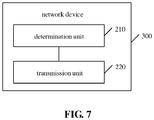
- FIG. 7 illustrates a schematic block diagram of a network device 300 for transmitting a signal provided by an embodiment of the disclosure.
- the network device 300 includes a determination unit 310 and a transmission unit 320.
- the determination unit 310 is configured to determine a basic transmission interval and at least one basic numerology.
- the transmission unit 320 is configured to take the basic transmission interval as a time domain unit and employ parameters in the at least one basic numerology to perform transmission of data and/or a pilot signal with a second network device or a terminal device.
- a novel network device for transmitting the signal is provided and can improve the flexibility of signal transmission.
- the determination unit is specifically configured to determine the at least one basic numerology from multiple basic numerologies.
- the transmission unit is specifically configured to determine the time lengths corresponding to transmission time units in each basic numerology in the at least one basic numerology according to the at least one basic numerology; determine the number of transmission time units corresponding to the each basic numerology according to the basic transmission interval as well as the time lengths corresponding to the transmission time units in the each basic numerology, the number of transmission time units being the number of transmission time units in the basic transmission interval; and respectively take the number of transmission time units corresponding to the each basic numerology as a time domain unit to perform the transmission of the data and/or the pilot signal with the second network device or the terminal device.
- the determination unit is specifically configured to determine the basic transmission interval according to the stored preset information; or determine the basic transmission interval according to the received control signaling sent by the second network device or the terminal device, the control signaling being used for indicating the basic transmission interval.
- the network device further includes a sending unit.
- the sending unit is configured to send a control signaling to the second network device or the terminal device, so that the second network device or the terminal device determines the basic transmission interval according to the control signaling.
- a time difference between a transmission time unit occupied by a scheduling signaling for scheduling the data and/or the pilot signal and a transmission time unit occupied by the data and/or the pilot signal sent or received by the first device is a positive integer multiple of the basic transmission interval.
- a time difference between a transmission time unit occupied by the data sent by the network device and a transmission time unit occupied by corresponding ACK/NACK feedback information received by the network device is a positive integer multiple of the basic transmission interval, or a time difference between a transmission time unit occupied by the data received by the network device and a transmission time unit occupied by the corresponding ACK/NACK feedback information sent by the network device is a positive integer multiple of the basic transmission interval.
- the network device further includes a second sending unit or a first sending unit.
- the second sending unit is configured to send the ACK/NACK feedback information, the ACK/NACK feedback information being ACK/NACK feedback information corresponding to all data transmission blocks received by the device in a single basic transmission interval.
- the first sending unit is configured to receive the ACK/NACK feedback information, the ACK/NACK feedback information being ACK/NACK feedback information corresponding to all data transmission blocks sent by the device in the single basic transmission interval.
- the network device further includes a second receiving unit.
- the second receiving unit is configured to receive a scheduling signaling sent by the second terminal device or the terminal device, the scheduling signaling being used for scheduling data transmission blocks in the single basic transmission interval.
- the network device further includes a third sending unit.
- the third sending unit is configured to send the scheduling signaling to the network device or the second terminal device, the scheduling signaling being used for scheduling the data transmission blocks in the single basic transmission interval.
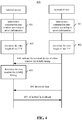
- the network device 300 may correspond to an execution main body of the method 100 for transmitting the signal in the embodiments of the disclosure. Furthermore, the above and other operations and/or functions of each module in the network device 300 are intended to implement a corresponding process of each method in FIG. 2 , FIG.3 , FIG.4 and FIG. 5 and will not be repeated for the conciseness.
- the apparatus provided by the above embodiments implements its functions
- the division of each functional unit is only for example.
- the functions may be distributed to different functional units as required to be completed, that is, an internal structure of the device is divided into different functional units to complete all or parts of functions described above.
- the apparatus provided by the above embodiments and the method embodiments pertain to the same concept and the specific implementation process is referred to the method embodiments and will not be repeated here.
- FIG. 8 illustrates a schematic block diagram of a terminal device 10 according to an embodiment of the disclosure.
- the terminal device 10 shown in FIG. 8 includes: a memory 11, a processor 12, an input/output interface 13, a communication interface 14 and a bus system 15.
- the memory 11, the processor 12, the input/output interface 13 and the communication interface 14 are connected via the bus system 15;
- the memory 11 is configured to store an instruction;
- the processor 12 is configured to execute the instruction stored by the memory 11 so as to control the input/output interface 13 to receive input data and information, output data such as an operation result and control the communication interface 14 to send a signal.
- the processor 12 is configured to determine a basic transmission interval and at least one basic numerology, and take the basic transmission interval as a time domain unit and employ parameters in the at least one basic numerology to perform transmission of data and/or a pilot signal with a network device or a second terminal device.
- the processor 12 may be a Central Processing Unit (CPU), a microprocessor, an Application Specific Integrated Circuit (ASIC), or one or more integrated circuits, and is configured to execute a related procedure to implement the technical solutions provided by this embodiment of the disclosure.
- CPU Central Processing Unit
- ASIC Application Specific Integrated Circuit
- the communication interface 14 employs, for example but is not limited to, a transmitter-receiver set such as a transmitter-receiver to implement the communication between the access network entity 10 and other devices or communication networks.
- a transmitter-receiver set such as a transmitter-receiver to implement the communication between the access network entity 10 and other devices or communication networks.
- the memory 11 may include a Read-Only Memory (ROM) and a Random-Access Memory (RAM) and provides instructions and data for the processor 12.
- a part of the processor 12 may further include a nonvolatile random access memory.
- the processor 12 may further store information on a type of a storage device.
- the bus system 15 may further include a power bus, a control bus and a state signal bus, etc.
- various buses in the figure all are marked as the bus system 15.
- the steps in the foregoing methods may be completed using an integrated logic circuit of hardware in the processor 12 or an instruction in a form of software.
- the method for transmitting the signal disclosed in combination with the embodiments of the disclosure may be directly executed and accomplished by means of a hardware processor or may be executed and accomplished using a combination of hardware and software modules in the processor.
- the software module may be located in a mature storage medium in the art, such as a RAM, a flash memory, a ROM, a programmable ROM (PROM), an electrically erasable PROM (EEPROM) or a register.
- the storage medium is located in the memory 11.
- the processor 12 reads information from the memory 11 and completes the steps of the foregoing methods in combination with the hardware. To avoid repetition, details are not described herein again.
- the processor 12 is specifically configured to: determine the at least one basic numerology from multiple basic numerologies.
- the processor 12 is specifically configured to: determine the time lengths corresponding to transmission time units in each basic numerology in the at least one basic numerology according to the at least one basic numerology; determine the number of transmission time units corresponding to the each basic numerology according to the basic transmission interval as well as the time lengths corresponding to the transmission time units in the each basic numerology, the number of transmission time units being the number of transmission time units in the basic transmission interval; and respectively take the number of transmission time units corresponding to the each basic numerology as a time domain unit to perform the transmission of the data and/or the pilot signal with the network device or the second terminal device.
- the processor 12 is specifically configured to: determine the basic transmission interval according to the stored preset information; or determine the basic transmission interval according to the received control signaling sent by the network device, the control signaling being used for indicating the basic transmission interval.
- the processor 12 is specifically configured to: send a control signaling to the network device or the second terminal device, so that the network device or the second terminal device determines the basic transmission interval according to the control signaling.
- the processor 12 is specifically configured to: receive a scheduling signaling sent by the network device or the second terminal device, the scheduling signaling being used for scheduling data transmission blocks in the single basic transmission interval.
- the processor 12 is specifically configured to: send the scheduling signaling to the network device or the second terminal device, the scheduling signaling being used for scheduling the data transmission blocks in the single basic transmission interval.
- FIG. 9 illustrates a schematic block diagram of a network device 20 according to an embodiment of the disclosure.
- the network device 20 shown in FIG. 9 includes: a memory 21, a processor 22, an input/output interface 23, a communication interface 24 and a bus system 25.
- the memory 21, the processor 22, the input/output interface 23 and the communication interface 24 are connected via the bus system 25;
- the memory 21 is configured to store an instruction;
- the processor 22 is configured to execute the instruction stored by the memory 21 so as to control the input/output interface 23 to receive input data and information, output data such as an operation result and control the communication interface 24 to send a signal.
- the processor 22 is configured to determine a basic transmission interval and at least one basic numerology, and take the basic transmission interval as a time domain unit and employ parameters in the at least one basic numerology to perform transmission of data and/or a pilot signal with a second network device or a terminal device.
- the processor 22 is specifically configured to: determine at least one basic numerology from multiple basic numerologies.
- the processor 12 is specifically configured to: determine the time lengths corresponding to transmission time units in each basic numerology in the at least one basic numerology according to the at least one basic numerology; determine the number of transmission time units corresponding to the each basic numerology according to the basic transmission interval as well as the time lengths corresponding to the transmission time units in the each basic numerology, the number of transmission time units being the number of transmission time units in the basic transmission interval; and respectively take the number of transmission time units corresponding to the each basic numerology as a time domain unit to perform the transmission of the data and/or the pilot signal with the second network device or the terminal device.
- the processor 12 is specifically configured to: determine the basic transmission interval according to the stored preset information; or determine the basic transmission interval according to the received control signaling sent by the second network device or the terminal device, the control signaling being used for indicating the basic transmission interval.
- the processor 12 is further configured to: send the control signaling to the second network device or the terminal device, so that the network device determines the basic transmission interval according to the control signaling.
- the processor 12 is further configured to: receive a scheduling signaling sent by the second network device or the terminal device, the scheduling signaling being used for scheduling data transmission blocks in the single basic transmission interval.
- the processor 12 is further configured to: send the scheduling signaling to the second network device or the terminal device, the scheduling signaling being used for scheduling the data transmission blocks in the single basic transmission interval.
- the processor 22 may be a Central Processing Unit (CPU), a microprocessor, an Application Specific Integrated Circuit (ASIC), or one or more integrated circuits, and is configured to execute a related procedure to implement the technical solutions provided by this embodiment of the disclosure.
- CPU Central Processing Unit
- ASIC Application Specific Integrated Circuit
- the communication interface 24 employs, for example but is not limited to, a transmitter-receiver set such as a transmitter-receiver to implement the communication between the access network entity 20 and other devices or communication networks.
- a transmitter-receiver set such as a transmitter-receiver to implement the communication between the access network entity 20 and other devices or communication networks.
- the memory 21 may include a Read-Only Memory (ROM) and a Random-Access Memory (RAM) and provides instructions and data for the processor 22.
- a part of the processor 22 may further include a nonvolatile random access memory.
- the processor 22 may further store information on a type of a storage device.
- the bus system 25 may further include a power bus, a control bus and a state signal bus, etc.
- various buses in the figure all are marked as the bus system 25.
- the steps in the foregoing methods may be completed using an integrated logic circuit of hardware in the processor 22 or an instruction in a form of software.
- the method for transmitting the signal disclosed in combination with the embodiments of the disclosure may be directly executed and accomplished by means of a hardware processor or may be executed and accomplished using a combination of hardware and software modules in the processor.
- the software module may be located in a mature storage medium in the art, such as a RAM, a flash memory, a ROM, a programmable ROM (PROM), an electrically erasable PROM (EEPROM) or a register.
- the storage medium is located in the memory 21.
- the processor 22 reads information from the memory 21 and completes the steps of the foregoing methods in combination with the hardware. To avoid repetition, details are not described herein again.
- B corresponding to A represents that the B is associated with the A and the B may be determined according to the A.
- the B is determined according to the A, which does not mean the B is determined only according to the A and the B may further be determined according to the A and/or other information.
- sequence numbers of the foregoing processes do not mean execution sequences in various embodiments of the disclosure.
- the execution sequences of the processes should be determined according to functions and internal logic of the processes, and should not be construed as any limitation on the implementation processes of the embodiments of the disclosure.
- the disclosed system, apparatus, and method may be implemented in other manners.
- the described apparatus embodiment is merely exemplary.
- the unit division is merely logical function division and may be other division in actual implementation.
- a plurality of units or components may be combined or integrated into another system, or some features may be ignored or not performed.
- the displayed or discussed mutual couplings or direct couplings or communication connections may be implemented through some interfaces.
- the indirect couplings or communication connections between the apparatuses or units may be implemented in electronic, mechanical, or other forms.
- the units described as separate parts may or may not be physically separate, and parts displayed as units may or may not be physical units, may be located in one position, or may be distributed on a plurality of network units. Some or all of the units may be selected according to actual needs to achieve the objectives of the solutions of the embodiments.
- functional units in the embodiments of the disclosure may be integrated into one processing unit, or each of the units may exist alone physically, or two or more units are integrated into one unit.
- the functions When the functions are implemented in the form of a software functional unit and sold or used as an independent product, the functions may be stored in a computer-readable storage medium. Based on such an understanding, the technical solutions of the disclosure essentially, or the part contributing to the prior art, or some of the technical solutions may be implemented in a form of a software product.
- the software product is stored in a storage medium and includes several instructions for instructing a computer device (which may be a personal computer, a server, or a network device) to perform all or some of the steps of the methods described in the embodiments of the disclosure.
- the foregoing storage medium includes any medium that can store program code, such as a universal serial bus (USB) flash drive, a removable hard disk, a ROM, a RAM, a magnetic disk, or an optical disc.
- USB universal serial bus
Landscapes
- Engineering & Computer Science (AREA)
- Signal Processing (AREA)
- Computer Networks & Wireless Communication (AREA)
- Physics & Mathematics (AREA)
- Discrete Mathematics (AREA)
- General Physics & Mathematics (AREA)
- Mathematical Physics (AREA)
- Mobile Radio Communication Systems (AREA)
Abstract
Description
- The disclosure relates to the field of communications, and particularly relates to a method for transmitting a signal, a terminal device and a network device.
- Along with continuous evolution of a wireless communication technology, a service type in a Long Term Evolution (LTE) is single, namely, a fixed sub-carrier width or a single sub-carrier width is used, so that the optimization cannot be performed on all services. Therefore, a novel method for transmitting a signal that can improve the flexibility of signal transmission is required urgently.
- In view of this, the embodiments of the disclosure provide a method for transmitting a signal, a terminal device and a network device, which can improve the flexibility of signal transmission.
- A first aspect provides a method for transmitting a signal, which includes: a first device determines a basic transmission interval and at least one basic numerology; and the first device takes the basic transmission interval as a time domain unit and employs parameters in the at least one basic numerology to perform transmission of at least one of data or a pilot signal with a second device.
- Under a condition in which multiple numerologies are supported, a novel method for transmitting the signal is disclosed and can keep the flexibility of signal transmission.
- Optionally, if the first device determines one basic numerology, the basic transmission interval may be the time length of a basic transmission interval determined by parameters in the basic numerology; and if the first device determines multiple basic numerologies, the basic transmission interval may be a fixed time length determined by parameters in the multiple basic numerologies.
- In combination with the first aspect, in a first possible implementation manner of the first aspect, that a first device determines at least one basic numerology includes: the first device determines the at least one basic numerology from multiple basic numerologies.
- Optionally, the multiple basic numerologies may be configured in the first device, may also be configured in the second device communicating with the first device, and may further be basic numerologies determined by the first device according to own transmission parameters (such as a working frequency point), or basic numerologies appointed in advance and stored in the first device or the second device.
- Under a condition in which multiple basic numerologies exist, the first device may only select one basic numerology to perform signal transmission with other devices and thus may guarantee that an appropriate detection window or sending window is provided for a signal transmitted by the first device; and the first device may further take a determined basic transmission interval as the detection window or sending window for the signal transmitted by the first device when multiple basic numerologies are selected, and simultaneously also may perform interference coordination well among different cells of different basic numerologies.
- In combination with the first aspect or any implementation manner of the first aspect, in a second possible implementation manner of the first aspect, that the first device takes the basic transmission interval as a time domain unit and employs parameters in the at least one basic numerology to perform transmission of at least one of data or a pilot signal with a second device includes: the first device determines time lengths corresponding to transmission time units in each basic numerology in the at least one basic numerology according to the at least one basic numerology; the first device determines the number of transmission time units corresponding to the each basic numerology according to the basic transmission interval as well as the time lengths corresponding to the transmission time units in the each basic numerology, the number of transmission time units being the number of transmission time units in the basic transmission interval; and the first device respectively takes the number of transmission time units corresponding to the each basic numerology as a time domain unit to perform the transmission of at least one of the data or the pilot signal with the second device.
- The transmission time unit is a time domain resource unit for transmitting the signal. It may be a transmission time unit defined in an LTE system such as a Transmission Time Interval (TTI), a sub-frame, a wireless frame, and an Orthogonal Frequency Division Multiplexing (OFDM) symbol, and may also be a transmission time unit newly defined in a 5th-Generation (5G) system.
- Generally, the signal is transmitted by taking one transmission time unit as a basic transmission unit, such as taking one TTI as the basic transmission unit and thus it is assured that a duration for transmission of each signal is an integer multiple of the transmission time unit. Similarly, in the embodiments of the disclosure, the number of transmission time units in the basic transmission interval is taken as the time domain unit; that is, the number of transmission time units used for each time of transmission is an integer multiple of the number of transmission time units in the basic transmission interval.
- In combination with the first aspect or any implementation manner of the first aspect, in a third possible implementation manner of the first aspect, that a first device determines a basic transmission interval includes: the first device determines the basic transmission interval according to stored preset information; or the first device determines the basic transmission interval according to a received control signaling sent by the second device, the control signaling being used for indicating the basic transmission interval.
- In combination with the first aspect or any implementation manner of the first aspect, in a fourth possible implementation manner of the first aspect, after the first device determines the basic transmission interval, the method further includes: the first device sends a control signaling to the second device, so that the second device determines the basic transmission interval according to the control signaling.
- The first device may be a terminal device and may also be a network side device. The second device may be the terminal device and may also be the network side device. The first device may be a receiving terminal and may also be a sending terminal.
- Typically, the first device is the terminal device and the second device is the network side device. The control signaling may be a downlink control signaling. The downlink control signaling may indicate one of multiple appointed basic transmission intervals.
- In combination with the first aspect or any implementation manner of the first aspect, in a fifth possible implementation manner of the first aspect, a time difference between a transmission time unit occupied by a scheduling signaling for scheduling at least one of the data or the pilot signal and a transmission time unit occupied by at least one of the data or the pilot signal sent or received by the first device is a positive integer multiple of the basic transmission interval.
- In combination with the first aspect or any implementation manner of the first aspect, in a sixth possible implementation manner of the first aspect, a time difference between a transmission time unit occupied by the data sent by the first device and a transmission time unit occupied by corresponding Acknowledgement (ACK)/Negative Acknowledgement (NACK) feedback information received by the first device is a positive integer multiple of the basic transmission interval, or a time difference between a transmission time unit occupied by the data received by the first device and a transmission time unit occupied by the corresponding ACK/NACK feedback information sent by the first device is a positive integer multiple of the basic transmission interval.
- In combination with the first aspect or any implementation manner of the first aspect, in a seventh possible implementation manner of the first aspect, the method further includes: the first device sends the ACK/NACK feedback information, the ACK/NACK feedback information being ACK/NACK feedback information corresponding to all data transmission blocks received by the first device in a single basic transmission interval; or the first device receives the ACK/NACK feedback information, the ACK/NACK feedback information being ACK/NACK feedback information corresponding to all data transmission blocks sent by the first device in the single basic transmission interval.
- In combination with the first aspect or any implementation manner of the first aspect, in an eighth possible implementation manner of the first aspect, before the first device takes the basic transmission interval as the time domain unit and employs the parameters in the at least one basic numerology to perform the transmission of at least one of the data or the pilot signal with the second device, the method further includes: the first device schedules data transmission blocks in the single basic transmission interval according to the received scheduling signaling sent by the second device.
- In combination with the first aspect or any implementation manner of the first aspect, in a ninth possible implementation manner of the first aspect, before the first device takes the basic transmission interval as the time domain unit and employs the parameters in the at least one basic numerology to perform the transmission of at least one of the data or the pilot signal with the second device, the method further includes: the first device sends the scheduling signaling to the second device, the scheduling signaling being used for scheduling the data transmission blocks in the single basic transmission interval.
- In combination with the first aspect or any implementation manner of the first aspect, in a tenth possible implementation manner of the first aspect, the basic numerology includes at least one parameter of the followings: a sub-carrier interval, the number of sub-carriers corresponding to a system bandwidth, the number of sub-carriers corresponding to a Physical Resource Block (PRB), the length of an OFDM symbol, the number of points of Fast Fourier Transformation(FFT) or Inverse Fast Fourier Transform (IFFT) used for generating an OFDM signal, the number of OFDM symbols included in a TTI, the number of TTIs included within a first time period and the length of a signal prefix.
- In combination with the first aspect or any implementation manner of the first aspect, in an eleventh possible implementation manner of the first aspect, the basic transmission interval is positive integer multiple of 1 millisecond (ms).
- In combination with the first aspect or any implementation manner of the first aspect, in a twelfth possible implementation manner of the first aspect, different basic transmission intervals are used for the data and the pilot signal.
- A second aspect provides a terminal device, which is configured to execute the method in the first aspect or in any implementation manner of the first aspect. Specifically, the apparatus includes a unit configured to execute the method in the first aspect or above any implementation manner of the first aspect.
- A third aspect provides a network device, which is configured to execute the method in the first aspect or in any implementation manner of the first aspect. Specifically, the apparatus includes a unit configured to execute the method in the first aspect or above any implementation manner of the first aspect.
- A fourth aspect provides a terminal device, which includes a memory, a processor, an input/output interface, a communication interface and a bus system. Herein, the memory, the processor, the input/output interface and the communication interface are connected via the bus system; the memory is configured to store an instruction; the processor is configured to execute the instruction stored by the memory; and when the instruction is executed, the processor executes the method in the first aspect via the communication interface, and controls the input/output interface to receive input data and information and output data such as an operation result.
- A fifth aspect provides a network device, which includes a memory, a processor, an input/output interface, a communication interface and a bus system. Herein, the memory, the processor, the input/output interface and the communication interface are connected via the bus system; the memory is configured to store an instruction; the processor is configured to execute the instruction stored by the memory; and when the instruction is executed, the processor executes the method in the first aspect via the communication interface, and controls the input/output interface to receive input data and information and output data such as an operation result.
- A sixth aspect provides a computer storage medium, which is configured to store a computer software instruction used by the above method and includes a program designed for executing the above aspects.
- In the disclosure, the names of the terminal device and the network device are not intended to form limits to the devices in itself. During actual implementation, these devices may appear in other names. As long as a function of each device is similar to the disclosure, all pertain to the scope of claims of the disclosure and equivalent technologies thereof.
- These aspects or other aspects of the disclosure will become more readable in the description of the following embodiments.
- In order to describe the technical solutions in the embodiments of the disclosure more clearly, a simple introduction on the accompanying drawings which are needed in the description of the embodiments is given below. Apparently, the accompanying drawings in the description below are merely some of the embodiments of the disclosure, based on which other drawings may be obtained by those of ordinary skill in the art without any creative effort.
-
FIG. 1 illustrates a schematic diagram of a possible application scene provided by an embodiment of the disclosure. -
FIG. 2 illustrates a schematic block diagram of a method for transmitting a signal provided by an embodiment of the disclosure. -
FIG. 3 illustrates a schematic diagram of an air interface time sequence provided by an embodiment of the disclosure. -
FIG. 4 illustrates a flowchart of a method for transmitting a signal provided by an embodiment of the disclosure. -
FIG. 5 illustrates another flowchart of a method for transmitting a signal provided by an embodiment of the disclosure. -
FIG. 6 illustrates a schematic block diagram of a terminal device for transmitting a signal provided by an embodiment of the disclosure. -
FIG. 7 illustrates a schematic block diagram of a network device for transmitting a signal provided by an embodiment of the disclosure. -
FIG. 8 illustrates another schematic block diagram of a terminal device for transmitting a signal provided by an embodiment of the disclosure. -
FIG. 9 illustrates another schematic block diagram of a network device for transmitting a signal provided by an embodiment of the disclosure. - A clear and complete description of the technical solutions in the disclosure will be given below, in combination with the accompanying drawings in the embodiments of the disclosure. Apparently, the embodiments described below are a part, but not all, of the embodiments of the disclosure. All of the other embodiments, obtained by those of ordinary skill in the art based on the embodiments of the disclosure without any inventive efforts, fall into the protection scope of the disclosure.
- It should be understood that the technical solutions of the disclosure may be applied in various communications systems, such as a Global System of Mobile communication (GSM) system, a Code Division Multiple Access (CDMA) system, a Wideband Code Division Multiple Access (WCDMA) system, a General Packet Radio Service (GPRS) system, an LTE system, an LTE Frequency Division Duplex (FDD) system, an LTE Time Division Duplex (TDD) system, a Universal Mobile Telecommunication System (UMTS) system, a Worldwide Interoperability for Microwave Access (WiMAX) communication system or a future 5G system.
- Particularly, the technical solutions in the embodiments of the disclosure may be applied to various communication systems based on a non-orthogonal multiple access technology, such as a Sparse Code Multiple Access (SCMA) system and a Low Density Signature (LDS) system. Of course, the SCMA system and the LDS system may also be referred to as other names in the field of communications. Further, the technical solutions in the embodiments of the disclosure may be applied to multi-carrier transmission systems adopting the non-orthogonal multiple access technology, such as an Orthogonal Frequency Division Multiplexing (OFDM) system, a Filter Bank Multi-Carrier (FBMC) system, a Generalized Frequency Division Multiplexing (GFDM) system and a Filtered-OFDM (F-OFDM) system.
- The first device in the embodiments of the disclosure may be a network side device, and may also be a terminal device. The second device may be the network side device, and may also be the terminal device. Typically, the first device is the terminal device, and the second device is the network side device.
- The terminal device in the embodiments of the disclosure may be User Equipment (UE), an access terminal, a user unit, a user station, a mobile station, a mobile platform, a remote station, a remote terminal, a mobile device, a user terminal, a terminal, a wireless communication device and a user proxy or user apparatus. The access terminal may be a cellular phone, a cordless telephone, a Session Initiation Protocol (SIP) phone, a Wireless Local Loop (WLL) station, a Personal Digital Assistant (PDA), a handheld device having a wireless communication function, a computing device or other processing devices, vehicle-amounted devices and wearable devices connected to a wireless modulator-demodulator, a terminal device in a future 5th Generation (5G) network or a terminal device in a future evolved Public Land Mobile Network (PLMN), all of which are not limited in the embodiments of the disclosure.
- The network device in the embodiments of the disclosure may be a device used for communicating with the terminal device. The network device may be a Base Transceiver Station (BTS) in a GSM or CDMA, may also be a NodeB (NB) in a WCDMA system, may further be an Evolutional NodeB (eNB or eNodeB) in an LTE system and may further be a wireless controller in a Cloud Radio Access Network (CRAN) scene; or the network device may be a relay station, an access point, a vehicle-amounted device, a wearable device as well as a network device in the future 5G system or a network device in the future evolved PLMN network, all of which are not limited in the embodiments of the disclosure.
-
FIG. 1 is a schematic diagram of an application scene of the disclosure. The communication system inFIG. 1 may include aterminal device 10 and anetwork device 20. Thenetwork device 20 is configured to provide a communication service for theterminal device 10 and is accessed to a core network. Theterminal device 10 is accessed to a network via a synchronization signal, a broadcasting signal and the like sent by asearch network device 20 and thus performs communication with the network. The arrow shown inFIG. 1 may represent uplink/downlink transmission performed via a cellular link between theterminal device 10 and thenetwork device 20. -
FIG. 2 illustrates a schematic flowchart of a method for transmitting a signal provided by an embodiment of the disclosure. As shown inFIG. 2 , themethod 100 includes the following operations. - At 110, a first device determines a basic transmission interval and at least one basic numerology.
- At 120, the first device takes the basic transmission interval as a time domain unit and employs parameters in the at least one basic numerology to perform transmission of data and/or a pilot signal with a second device.
- First of all, it is necessary to explain the following several points.
- 1. The data and/or the pilot signal may be an uplink data and/or pilot signal, and may also be a downlink data and/or pilot signal.
- 2. The basic transmission interval may be an absolute time length, such as the time length with second, millisecond or microsecond as a unit. Typically, it is a positive integer multiple of 1 millisecond (ms).
- 3. The transmission of the data and/or the pilot signal with the basic transmission interval as the time domain unit refers to that a duration that the first device receives or sends the signal at each time should be a positive integer multiple of the basic transmission interval.
- 4. The first device may be the network side device and may also be the terminal device. It may be the receiving terminal and may also be the sending terminal. For the convenience of description, a following description will be given with the first device being the terminal device and the second device being the network device as an example.
- Along with the continuous evolution of a communication technology, diversified service types are required in a future communication system and the communication requirement cannot be met by the single sub-carrier width in the LTE system. Different from the LTE system, in order to keep the flexibility and the forward compatibility of a system, multiple basic numerologies may coexist in a manner of Time-Division Multiplexing (TDM) or Frequency-Division Multiplexing (FDM) or a combination thereof in a carrier/cell/Transmit Receive Point (TRP) of a future wireless communication system such as 5G. Generally, different carrier intervals are adopted by different numerologies. As a result, the time lengths of transmission time units of different numerologies on a time domain also differ from each other. There is a need for a novel method for transmitting the signal in the future wireless communication system such as 5G so as to improve the flexibility of signal transmission.
- Optionally, the above basic numerologies may include at least one of the following parameters.
- A sub-carrier interval, the number of sub-carriers under a special bandwidth, the number of sub-carriers in a Physical Resource Block (PRB), the length of an OFDM symbol, the number of points of Fourier Transform (such as Fast Fourier Transform, referred to as FFT) or inverse Fourier transform (such as Inverse Fast Fourier Transform, referred to as IFFT) used for generating an OFDM signal, the number of OFDM symbols in a TTI, the number of TTIs included in a special time length and the length of a signal prefix.
- Herein, the sub-carrier interval refers to a frequency interval between adjacent sub-carriers, such as 15kHz and 60kHz. The number of sub-carriers under the special bandwidth may be, for example, the number of sub-carriers corresponding to each possible system bandwidth. The number of sub-carriers in the PRB typically may be, for example, an integer multiple of 12. The number of OFDM symbols in the TTI may be, for example, an integer multiple of 14; the number of TTIs included within a special time period may refer to the number of TTIs included in the time length of 1ms or 10ms. The length of the signal prefix may be, for example, the time length of a Cyclic Prefix (CP) of a signal, or whether the CP employs a conventional CP or an extended CP or not.
- In this embodiment, the terminal device may determine a basic numerology, may determine the time length corresponding to a transmission time unit in the basic numerology upon the determination of a fixed basic numerology and then determines the time length as the basic transmission interval in the
method 100, so that data and/or a pilot signal may be sent or received with the time length corresponding to the basic transmission unit as a time domain length. Furthermore, the terminal device may determine multiple basic numerologies, and determines a fixed time length as the basic transmission interval in themethod 100 upon the determination of the multiple numerologies, so that the data and/or the pilot signal is sent or received by using the multiple basic numerologies. - It should be understood that, the basic numerology or the multiple basic numerologies may be determined by the terminal device according to own transmission parameters (such as a working frequency point), may also be selected from multiple basic numerologies configured in the terminal device, may further be appointed by the terminal device and the network device in advance, and may further be the basic numerologies selected by the network device from multiple basic numerologies configured in the network device and notified to the terminal device, etc., in which the manner that the terminal device acquires the basic numerologies is not defined in the disclosure.
- It should further be understood that, the basic transmission interval may include at least one transmission time unit and the transmission time unit is a time domain resource unit for transmitting the signal. For example, it may be the OFDM symbol, may be a transmission time unit defined in the LTE system such as the TTI and the sub-frame, and may further be a transmission time unit newly defined in the future wireless communication system such as the 5G.
- For example, if the terminal device only appoints one basic numerology to transmit data with other devices (such as the network device), since the same basic numerology is adopted, a sending window or a detection window adopted by the terminal device to send the data or receive the data is uniform and thus the complexity in transmission is not increased. Moreover, if cells where the other devices communicating with the terminal device are located are different cells, when the other devices transmit the data to the terminal device simultaneously, since the same numerology is adopted, the problem that the interference coordination among the cells is affected to increase the inter-cell interference is not occurred.
- For example, if the terminal device appoints multiple basic numerologies to transmit data with other devices (such as the network device), since the uniform basic transmission interval is adopted, a sending window or a detection window adopted by the terminal device to send the data or receive the data is the same and thus the complexity in transmission is not increased. Moreover, if cells where the other devices communicating with the terminal device are located are different cells, when the other devices transmit the data to the terminal device simultaneously, since the uniform basic transmission interval is adopted, the problem that the interference coordination among the cells is affected to increase the inter-cell interference is not occurred.
- Optionally, the basic transmission interval may be appointed by the terminal device and the network device in advance. Or multiple basic transmission intervals are appointed by the terminal device and the network device in advance and are configured in the terminal device or the network device. When the data and/or the pilot signal needs to be transmitted between the terminal device and the network device, the network device may select one basic transmission interval from the multiple basic transmission intervals appointed in advance and sends a control signaling to the terminal device, so that the terminal device determines a basic transmission interval according to the control signaling. The multiple basic transmission intervals may be determined by the network device according to the multiple numerologies configured inside. For example, the time length of the transmission time unit corresponding to the first basic numerology is 0.5ms, the time length of the transmission time unit corresponding to the second basic numerology is 1.0ms and the time length of the transmission time unit corresponding to the third basic numerology is 1.5ms, so that the network device may determine the basic transmission interval according to the time lengths of the transmission time units respectively corresponding to the first basic numerology, the second numerology and the third numerology, in which the basic transmission interval may be a common multiple such as 3ms and may also be two times of the common multiple such as 6ms, etc. Any manner for selecting the basic transmission interval may be appropriate. For example, the basic transmission interval is a positive integer multiple of the time lengths of the transmission time units corresponding to the determined multiple basic numerologies.
- Optionally, as an embodiment, that the first device takes the basic transmission interval as a time domain unit and employs parameters in the at least one basic numerology to perform transmission of data and/or a pilot signal with a second device includes: the first device determines the time lengths corresponding to transmission time units in each basic numerology in the at least one basic numerology according to the at least one basic numerology; the first device determines the number of transmission time units corresponding to the each basic numerology according to the basic transmission interval as well as the time lengths corresponding to the transmission time units in the each basic numerology, the number of transmission time units being the number of transmission time units in the basic transmission interval; and the first device respectively takes the number of transmission time units corresponding to the each basic numerology as a time domain unit to perform the transmission of the data and/or the pilot signal with the second device.
- Specifically, the above basic numerology may include at least one resource parameter for determining a time frequency resource to transmit the data. A corresponding relationship between the parameters in the above basic numerology and the time lengths of the transmission time units is appointed by the terminal device and the network device in advance. Or, the time lengths of the transmission time units are calculated via the parameters in the above basic numerology. For example, when the above basic numerology includes the sub-carrier interval, the relationship therebetween may be appointed in advance and may be appointed as that the sub-carrier interval is 15kHz and the time length corresponding to one TTI is 1ms. Also for example, the transmission time unit is the TTI and the length of the OFDM symbol in the basic numerology is L. If one TTI includes K OFDM symbols, the time length of the one TTI is K*L. If the determined basic transmission interval is T and the time length of one transmission time unit is t, the number of transmission time units in the basic transmission interval is N=T/t by rounding. In general, when the basic TTI is appointed, the basic transmission interval is a positive integer multiple of the time lengths corresponding to the transmission time units in the basic numerology. Whenever the terminal device transmits the data and/or the pilot signal, there is a need to at least send or receive the corresponding number of transmission time units. In other words, the number of transmission time units when the terminal device sends or receives the data and/or the pilot signal should be a positive integer multiple of the number of the transmission time units.
- Generally, the signal is transmitted by taking one transmission time unit as a time domain unit, such as taking one TTI as the time domain unit and thus it is assured that a duration for transmission of each signal is an integer multiple of the transmission time unit. Similarly, in this embodiment of the disclosure, the number of transmission time units in the basic transmission interval is taken as the time domain unit.
- Optionally, a time difference between a transmission time unit occupied by a scheduling signaling received by the first device for scheduling the data and/or the pilot signal and a transmission time unit occupied by the data and/or the pilot signal sent or received by the first device is a positive integer multiple of the basic transmission interval. A time difference between a transmission time unit occupied by a scheduling signaling sent by the first device for scheduling the data and/or the pilot signal and a transmission time unit occupied by the data and/or the pilot signal sent or received by the first device is a positive integer multiple of the basic transmission interval.
- Optionally, a time difference between a transmission time unit occupied by the data sent by the first device and a transmission time unit occupied by corresponding ACK/NACK feedback information received by the first device is a positive integer multiple of the basic transmission interval, or a time difference between a transmission time unit occupied by the data received by the first device and a transmission time unit occupied by the corresponding ACK/NACK feedback information sent by the first device is a positive integer multiple of the basic transmission interval.
- Specifically, as shown in
FIG. 3 , it is assumed that the transmission time unit is the sub-frame, the basic transmission interval is T and the network device sends an uplink authorization at an nth sub-frame, the terminal device starts to schedule preparation data upon the reception of the uplink authorization at the nth sub-frame and starts to send the data at an (n+N*T)th sub-frame; and meanwhile, the network device detects and checks the data sent by the terminal device at the (n+N*T)th sub-frame and feeds a check result back to the terminal device at the (n+N*T)th sub-frame. Herein, the M and the N are a positive integer respectively and M>N. - In the LTE system, the network device controls the uplink sending of the terminal device via the uplink authorization (the uplink authorization information includes information such as the magnitude of a distributed air interface resource, a new retransmission indication and a sending time) and defines an uplink sending time sequence explicitly. By taking a Frequency Division Duplexing (FDD) air interface time sequence as an example, the network device sends the uplink authorization at the nth sub-frame, and the terminal device starts to schedule the preparation data upon the reception of the uplink authorization at the nth sub-frame and must starts to send the data at the (n+4) sub-frame; and the network device detects and checks the data sent by the terminal device at the (n+4) sub-frame and feeds a check result to the terminal device at the (n+8)th sub-frame.
- Optionally, the method further includes: the first device sends the ACK/NACK feedback information, the ACK/NACK feedback information being ACK/NACK feedback information corresponding to all data transmission blocks received by the first device in a single basic transmission interval; or the first device receives the ACK/NACK feedback information, the ACK/NACK feedback information being ACK/NACK feedback information corresponding to all data transmission blocks sent by the first device in the single basic transmission interval.
- Specifically, concerning N downlink data transmission blocks transmitted in the single basic transmission interval, the terminal device may feed the ACK/NACK back by employing an ACK binding manner, that is, the ACK is fed back only when the N transmission blocks are correct, or otherwise, the NACK is fed back. The terminal device may also feed the ACK/NACK back by employing a bitmap manner, that is, N bits of ACK/NACK are fed back and each bit corresponds to one transmission block in the N transmission blocks.
- Optionally, before the first device takes the basic transmission interval as the time domain unit and employs the parameters in the at least one basic numerology to perform the transmission of the data and/or the pilot signal with the second device, the method further includes: the first device receives a scheduling signaling sent by the second device, the scheduling signaling being used for scheduling data transmission blocks in the single basic transmission interval, or the first device sends the scheduling signaling to the second device, the scheduling signaling being used for scheduling the data transmission blocks in the single basic transmission interval.
- Specifically, one scheduling signaling may be used for scheduling parts or all of the data transmission blocks in the single basic transmission interval. With respect to downlink transmission, the terminal device detects all data transmission blocks in the basic transmission interval based on the scheduling signaling and the network device sends the all data transmission blocks in the basic transmission interval based on the scheduling signaling. With respect to uplink transmission, the terminal device sends all data transmission blocks in the basic transmission interval based on the scheduling signaling and the network device detects the all data transmission blocks in the basic transmission interval based on the scheduling signaling.
- Optionally, different basic transmission intervals may be adopted by the data and the pilot signal. For example, the basic transmission interval adopted to transmit the data is 1ms and that adopted to transmit the pilot signal is 1/14ms.
- In order to understand conveniently, the
methods - As shown in
FIG. 4 , the specific operations of themethod 400 are as follows. - At 401, a network device and a terminal device appoint the magnitude of a transmission time window (namely, a basic transmission interval) in advance. For example, the transmission time window is 1ms.
- At 402, the network device determines the time length of one TTI according to a sub-carrier interval adopted for data transmission and thus determines the number of TTIs included in one transmission time window. Herein, the corresponding relationship between the sub-carrier interval and the length of the one TTI is appointed in advance. For example, the sub-carrier interval is 15kHz and the time length of the corresponding one TTI is 1ms, so that one transmission time window only includes one TTI.
- At 403, the terminal device determines the time length of one TTI according to the sub-carrier interval adopted for the data transmission and thus determines the number of TTIs included in the transmission time window. Specifically, the process herein is the same as the process of the network device.
- At 404, the network device indicates the terminal device of the magnitude of a time window for Hybrid Automatic Repeat request (HARQ) timing, namely, a time delayed by the ACK/NACK feedback compared with the data transmission, in which the time takes the transmission time window as the unit.
- At 405, the terminal device receives an indication of the network device and thus determines the magnitude of the time window for the HARQ timing, in which the time window takes the transmission time window as the unit. For example, the network device indicates that the magnitude of the time window for the HARQ timing is 4, which expresses that the ACK/NACK feedback is delayed for 4 transmission time windows, namely, 4 TTIs compared with the data transmission.
- At 406, the network device performs transmission of downlink data by taking one transmission time window (namely, one TII) as a time domain unit, in which each transmission time window transmits one transmission block and each transmission block is provided with an independent HARQ process.
- At 407, the terminal device performs reception of the downlink data by taking one transmission time window (namely, one TII) as a time domain unit, in which the transmission blocks sent by the network device are respectively detected in each transmission time window. Upon the detection of the downlink data, the terminal device delays for 4 TTIs to perform corresponding ACK/NACK feedback.
- As shown in
FIG. 5 , the specific operations of themethod 500 are as follows. - At 501, a network device indicates a terminal device of the magnitude of a basic transmission interval via a high-level signaling. Herein, the network device indicates the terminal device which basic transmission interval may be used by employing a 2-bit signaling. The four basic transmission intervals corresponding to 2-bit information are 1ms, 2ms, 4ms and 8ms respectively. The four basic transmission intervals are appointed between the terminal device and the network device in advance, and it is assumed that the basic transmission interval indicated by the network device is 2ms.
- At 502, the network device determines the time length of one sub-frame according to the length of an OFDM symbol in a basic numerology adopted for data transmission and thus determines the number of sub-frames included in the indicated basic transmission interval.
- At 503, same as the network device, the terminal device determines the time length of one sub-frame according to the length of the OFDM symbol in the basic numerology adopted for the data transmission and thus determines the number of sub-frames included in the basic transmission interval. It is assumed that the length of the OFDM symbol is 1/14ms and one sub-frame includes 14 OFDM symbols, the time length of the one sub-frame is 1ms. At this moment, one basic transmission interval includes two sub-frames.
- At 504, the terminal device and the network device appoint timing for uplink data scheduling, that is, the number of basic transmission intervals spaced between an uplink scheduling signaling and corresponding data transmission. Herein, it is assumed that two basic transmission intervals (namely, the time length of four sub-frames) are spaced therebetween.
- At 505, upon the reception of the scheduling signaling of the network device, the terminal device delays for the time lengths of four sub-frames and takes two sub-frames as a time domain unit to perform transmission of uplink data, in which each sub-frame transmits one transmission block, that is, at least two transmission blocks are transmitted by the terminal device at each time.
- It should be understood that, in each embodiment of the disclosure, sequence numbers of the foregoing operations do not mean execution sequences. The execution sequences of the operations should be determined according to functions and internal logic of the operations, and should not be construed as any limitation on the implementation processes of the embodiments of the disclosure.
- It should further be understood that, the first embodiment and the second embodiment illustrate the detailed steps or operations of the method for transmitting the signal. However, these actions or operations are merely for example, and other operations or variations of each operation may further be performed by the embodiments of the disclosure. In addition, the each operation in the first embodiment and the second embodiment may be executed according to different sequences and it is possible that not all of the operations in the first embodiment and the second embodiment are executed necessarily.
- The method for transmitting the signal according to the embodiments of the disclosure is described above in detail in combination with
FIG. 2 to FIG. 5 . Hereinafter, the apparatus for transmitting the signal according to the embodiments of the disclosure will be described in detail in combination withFIG. 6 to FIG. 9 , and the technical characteristics described in the method embodiments may be applied to the following apparatus embodiments. -
FIG. 6 illustrates a schematic block diagram of aterminal device 200 for transmitting a signal provided by an embodiment of the disclosure. As shown inFIG. 6 , theterminal device 200 includes adetermination unit 210 and atransmission unit 220. - The
determination unit 210 is configured to determine a basic transmission interval and at least one basic numerology. - The
transmission unit 220 is configured to take the basic transmission interval as a time domain unit and employ parameters in the at least one basic numerology to perform transmission of data and/or a pilot signal with a network device or a second terminal device. - Specifically, the terminal device may determine a basic numerology, may determine the time length corresponding to a transmission time unit in the basic numerology upon the determination of a fixed basic numerology and then determines the time length as the basic transmission interval in the
method 100, so that data and/or a pilot signal may be sent or received with the time length corresponding to the basic transmission unit as a time domain length. Furthermore, the terminal device may determine multiple basic numerologies, and determines a fixed time length as the basic transmission interval in themethod 100 upon the determination of the multiple numerologies, so that the data and/or the pilot signal is sent or received by using the multiple basic numerologies. - According to this embodiment of the disclosure, a novel terminal device for transmitting the signal is provided and can improve the flexibility of signal transmission.
- It should be understood that, the basic numerology or the multiple basic numerologies may be determined by the terminal device according to own transmission parameters (such as a working frequency point), may also be selected from multiple basic numerologies configured in the terminal device, may further be appointed by the terminal device and the network device in advance, and may further be the basic numerologies selected by the network device from multiple basic numerologies configured in the network device and notified to the terminal device, etc., in which the manner that the terminal device acquires the basic numerologies is not defined in the disclosure.
- Under a condition in which multiple basic numerologies exist, the terminal device may only select one basic numerology to perform signal transmission with the network device and thus may guarantee that an appropriate detection window or sending window is provided for a signal transmitted by the terminal device; and the terminal device may further take a determined basic transmission interval as the detection window or sending window for the signal transmitted by the terminal device when multiple basic numerologies are selected, and simultaneously also may perform interference coordination well among different cells of different basic numerologies.
- Optionally, as an embodiment, the transmission unit is specifically configured to determine the time lengths corresponding to transmission time units in each basic numerology in the at least one basic numerology according to the at least one basic numerology; determine the number of transmission time units corresponding to the each basic numerology according to the basic transmission interval as well as the time lengths corresponding to the transmission time units in the each basic numerology, the number of transmission time units being the number of transmission time units in the basic transmission interval; and respectively take the number of transmission time units corresponding to the each basic numerology as a time domain unit to perform the transmission of the data and/or the pilot signal with the network device or the second device.
- Optionally, as an embodiment, the determination unit is specifically configured to determine the basic transmission interval according to the stored preset information; or determine the basic transmission interval according to the received control signaling sent by the network device, the control signaling being used for indicating the basic transmission interval.
- Optionally, as an embodiment, the terminal device further includes a sending unit.
- The sending unit is configured to send a control signaling to the network device or the second terminal device, so that the network device or the second terminal device determines the basic transmission interval according to the control signaling.
- Optionally, as an embodiment, a time difference between a transmission time unit occupied by a scheduling signaling for scheduling the data and/or the pilot signal and a transmission time unit occupied by the data and/or the pilot signal sent or received by the first device is a positive integer multiple of the basic transmission interval.
- Optionally, as an embodiment, a time difference between a transmission time unit occupied by the data sent by the terminal device and a transmission time unit occupied by corresponding ACK/NACK feedback information received by the terminal device is a positive integer multiple of the basic transmission interval, or a time difference between a transmission time unit occupied by the data received by the terminal device and a transmission time unit occupied by the corresponding ACK/NACK feedback information sent by the terminal device is a positive integer multiple of the basic transmission interval.
- Optionally, as an embodiment, the terminal device further includes a second sending unit or a first receiving unit.
- The second sending unit is configured to send the ACK/NACK feedback information, the ACK/NACK feedback information being ACK/NACK feedback information corresponding to all data transmission blocks received by the device in a single basic transmission interval.
- The first sending unit is configured to receive the ACK/NACK feedback information, the ACK/NACK feedback information being ACK/NACK feedback information corresponding to all data transmission blocks sent by the device in the single basic transmission interval.
- Optionally, as an embodiment, the terminal device further includes a second receiving unit.
- The second receiving unit is configured to receive a scheduling signaling sent by the network device or the second terminal device, the scheduling signaling being used for scheduling data transmission blocks in the single basic transmission interval.
- Optionally, as an embodiment, the terminal device further includes a third sending unit.
- The third sending unit is configured to send the scheduling signaling to the network device or the second terminal device, the scheduling signaling being used for scheduling the data transmission blocks in the single basic transmission interval.
- It should be understood that, the
terminal device 200 according to the embodiments of the disclosure may correspond to an execution main body of themethod 100 for transmitting the signal in the embodiments of the disclosure. Furthermore, the above and other operations and/or functions of each module in theterminal device 200 are intended to implement a corresponding process of each method inFIG. 2 andFIG. 5 and will not be repeated for the conciseness. -
FIG. 7 illustrates a schematic block diagram of anetwork device 300 for transmitting a signal provided by an embodiment of the disclosure. As shown inFIG. 7 , thenetwork device 300 includes a determination unit 310 and a transmission unit 320. - The determination unit 310 is configured to determine a basic transmission interval and at least one basic numerology.
- The transmission unit 320 is configured to take the basic transmission interval as a time domain unit and employ parameters in the at least one basic numerology to perform transmission of data and/or a pilot signal with a second network device or a terminal device.
- According to this embodiment of the disclosure, a novel network device for transmitting the signal is provided and can improve the flexibility of signal transmission.
- Optionally, as an embodiment, the determination unit is specifically configured to determine the at least one basic numerology from multiple basic numerologies.
- Optionally, as an embodiment, the transmission unit is specifically configured to determine the time lengths corresponding to transmission time units in each basic numerology in the at least one basic numerology according to the at least one basic numerology; determine the number of transmission time units corresponding to the each basic numerology according to the basic transmission interval as well as the time lengths corresponding to the transmission time units in the each basic numerology, the number of transmission time units being the number of transmission time units in the basic transmission interval; and respectively take the number of transmission time units corresponding to the each basic numerology as a time domain unit to perform the transmission of the data and/or the pilot signal with the second network device or the terminal device.
- Optionally, as an embodiment, the determination unit is specifically configured to determine the basic transmission interval according to the stored preset information; or determine the basic transmission interval according to the received control signaling sent by the second network device or the terminal device, the control signaling being used for indicating the basic transmission interval.
- Optionally, as an embodiment, the network device further includes a sending unit.
- The sending unit is configured to send a control signaling to the second network device or the terminal device, so that the second network device or the terminal device determines the basic transmission interval according to the control signaling.
- Optionally, as an embodiment, a time difference between a transmission time unit occupied by a scheduling signaling for scheduling the data and/or the pilot signal and a transmission time unit occupied by the data and/or the pilot signal sent or received by the first device is a positive integer multiple of the basic transmission interval.
- Optionally, as an embodiment, a time difference between a transmission time unit occupied by the data sent by the network device and a transmission time unit occupied by corresponding ACK/NACK feedback information received by the network device is a positive integer multiple of the basic transmission interval, or a time difference between a transmission time unit occupied by the data received by the network device and a transmission time unit occupied by the corresponding ACK/NACK feedback information sent by the network device is a positive integer multiple of the basic transmission interval.
- Optionally, as an embodiment, the network device further includes a second sending unit or a first sending unit.
- The second sending unit is configured to send the ACK/NACK feedback information, the ACK/NACK feedback information being ACK/NACK feedback information corresponding to all data transmission blocks received by the device in a single basic transmission interval.
- The first sending unit is configured to receive the ACK/NACK feedback information, the ACK/NACK feedback information being ACK/NACK feedback information corresponding to all data transmission blocks sent by the device in the single basic transmission interval.
- Optionally, as an embodiment, the network device further includes a second receiving unit.
- The second receiving unit is configured to receive a scheduling signaling sent by the second terminal device or the terminal device, the scheduling signaling being used for scheduling data transmission blocks in the single basic transmission interval.
- Optionally, as an embodiment, the network device further includes a third sending unit.
- The third sending unit is configured to send the scheduling signaling to the network device or the second terminal device, the scheduling signaling being used for scheduling the data transmission blocks in the single basic transmission interval.
- It should be understood that, the
network device 300 according to the embodiments of the disclosure may correspond to an execution main body of themethod 100 for transmitting the signal in the embodiments of the disclosure. Furthermore, the above and other operations and/or functions of each module in thenetwork device 300 are intended to implement a corresponding process of each method inFIG. 2 ,FIG.3 ,FIG.4 andFIG. 5 and will not be repeated for the conciseness. - It is to be noted that, when the apparatus provided by the above embodiments implements its functions, the division of each functional unit is only for example. During an actual application, the functions may be distributed to different functional units as required to be completed, that is, an internal structure of the device is divided into different functional units to complete all or parts of functions described above. In addition, the apparatus provided by the above embodiments and the method embodiments pertain to the same concept and the specific implementation process is referred to the method embodiments and will not be repeated here.
-
FIG. 8 illustrates a schematic block diagram of aterminal device 10 according to an embodiment of the disclosure. Theterminal device 10 shown inFIG. 8 includes: amemory 11, aprocessor 12, an input/output interface 13, acommunication interface 14 and a bus system 15. Herein, thememory 11, theprocessor 12, the input/output interface 13 and thecommunication interface 14 are connected via the bus system 15; thememory 11 is configured to store an instruction; theprocessor 12 is configured to execute the instruction stored by thememory 11 so as to control the input/output interface 13 to receive input data and information, output data such as an operation result and control thecommunication interface 14 to send a signal. - The
processor 12 is configured to determine a basic transmission interval and at least one basic numerology, and take the basic transmission interval as a time domain unit and employ parameters in the at least one basic numerology to perform transmission of data and/or a pilot signal with a network device or a second terminal device. - It should be understood that, in this embodiment of the disclosure, the
processor 12 may be a Central Processing Unit (CPU), a microprocessor, an Application Specific Integrated Circuit (ASIC), or one or more integrated circuits, and is configured to execute a related procedure to implement the technical solutions provided by this embodiment of the disclosure. - It should be further understood that, the
communication interface 14 employs, for example but is not limited to, a transmitter-receiver set such as a transmitter-receiver to implement the communication between theaccess network entity 10 and other devices or communication networks. - The
memory 11 may include a Read-Only Memory (ROM) and a Random-Access Memory (RAM) and provides instructions and data for theprocessor 12. A part of theprocessor 12 may further include a nonvolatile random access memory. For example, theprocessor 12 may further store information on a type of a storage device. - Beside data bus, the bus system 15 may further include a power bus, a control bus and a state signal bus, etc. For clarity of description, various buses in the figure all are marked as the bus system 15.
- In an implementation process, the steps in the foregoing methods may be completed using an integrated logic circuit of hardware in the
processor 12 or an instruction in a form of software. The method for transmitting the signal disclosed in combination with the embodiments of the disclosure may be directly executed and accomplished by means of a hardware processor or may be executed and accomplished using a combination of hardware and software modules in the processor. The software module may be located in a mature storage medium in the art, such as a RAM, a flash memory, a ROM, a programmable ROM (PROM), an electrically erasable PROM (EEPROM) or a register. The storage medium is located in thememory 11. Theprocessor 12 reads information from thememory 11 and completes the steps of the foregoing methods in combination with the hardware. To avoid repetition, details are not described herein again. - Optionally, as an embodiment, the
processor 12 is specifically configured to: determine the at least one basic numerology from multiple basic numerologies. - Optionally, as an embodiment, the
processor 12 is specifically configured to: determine the time lengths corresponding to transmission time units in each basic numerology in the at least one basic numerology according to the at least one basic numerology; determine the number of transmission time units corresponding to the each basic numerology according to the basic transmission interval as well as the time lengths corresponding to the transmission time units in the each basic numerology, the number of transmission time units being the number of transmission time units in the basic transmission interval; and respectively take the number of transmission time units corresponding to the each basic numerology as a time domain unit to perform the transmission of the data and/or the pilot signal with the network device or the second terminal device. - Optionally, as an embodiment, the
processor 12 is specifically configured to: determine the basic transmission interval according to the stored preset information; or determine the basic transmission interval according to the received control signaling sent by the network device, the control signaling being used for indicating the basic transmission interval. - Optionally, as an embodiment, the
processor 12 is specifically configured to: send a control signaling to the network device or the second terminal device, so that the network device or the second terminal device determines the basic transmission interval according to the control signaling. - Optionally, as an embodiment, the
processor 12 is specifically configured to: receive a scheduling signaling sent by the network device or the second terminal device, the scheduling signaling being used for scheduling data transmission blocks in the single basic transmission interval. - Optionally, as an embodiment, the
processor 12 is specifically configured to: send the scheduling signaling to the network device or the second terminal device, the scheduling signaling being used for scheduling the data transmission blocks in the single basic transmission interval. -
FIG. 9 illustrates a schematic block diagram of anetwork device 20 according to an embodiment of the disclosure. Thenetwork device 20 shown inFIG. 9 includes: amemory 21, a processor 22, an input/output interface 23, acommunication interface 24 and a bus system 25. Herein, thememory 21, the processor 22, the input/output interface 23 and thecommunication interface 24 are connected via the bus system 25; thememory 21 is configured to store an instruction; the processor 22 is configured to execute the instruction stored by thememory 21 so as to control the input/output interface 23 to receive input data and information, output data such as an operation result and control thecommunication interface 24 to send a signal. - The processor 22 is configured to determine a basic transmission interval and at least one basic numerology, and take the basic transmission interval as a time domain unit and employ parameters in the at least one basic numerology to perform transmission of data and/or a pilot signal with a second network device or a terminal device.
- Optionally, as an embodiment, the processor 22 is specifically configured to: determine at least one basic numerology from multiple basic numerologies.
- Optionally, as an embodiment, the
processor 12 is specifically configured to: determine the time lengths corresponding to transmission time units in each basic numerology in the at least one basic numerology according to the at least one basic numerology; determine the number of transmission time units corresponding to the each basic numerology according to the basic transmission interval as well as the time lengths corresponding to the transmission time units in the each basic numerology, the number of transmission time units being the number of transmission time units in the basic transmission interval; and respectively take the number of transmission time units corresponding to the each basic numerology as a time domain unit to perform the transmission of the data and/or the pilot signal with the second network device or the terminal device. - Optionally, as an embodiment, the
processor 12 is specifically configured to: determine the basic transmission interval according to the stored preset information; or determine the basic transmission interval according to the received control signaling sent by the second network device or the terminal device, the control signaling being used for indicating the basic transmission interval. - Optionally, as an embodiment, the
processor 12 is further configured to: send the control signaling to the second network device or the terminal device, so that the network device determines the basic transmission interval according to the control signaling. - Optionally, as an embodiment, the
processor 12 is further configured to: receive a scheduling signaling sent by the second network device or the terminal device, the scheduling signaling being used for scheduling data transmission blocks in the single basic transmission interval. - Optionally, as an embodiment, the
processor 12 is further configured to: send the scheduling signaling to the second network device or the terminal device, the scheduling signaling being used for scheduling the data transmission blocks in the single basic transmission interval. - It should be understood that, in this embodiment of the disclosure, the processor 22 may be a Central Processing Unit (CPU), a microprocessor, an Application Specific Integrated Circuit (ASIC), or one or more integrated circuits, and is configured to execute a related procedure to implement the technical solutions provided by this embodiment of the disclosure.
- It should further be understood that, the
communication interface 24 employs, for example but is not limited to, a transmitter-receiver set such as a transmitter-receiver to implement the communication between theaccess network entity 20 and other devices or communication networks. - The
memory 21 may include a Read-Only Memory (ROM) and a Random-Access Memory (RAM) and provides instructions and data for the processor 22. A part of the processor 22 may further include a nonvolatile random access memory. For example, the processor 22 may further store information on a type of a storage device. - Beside data bus, the bus system 25 may further include a power bus, a control bus and a state signal bus, etc. For clarity of description, various buses in the figure all are marked as the bus system 25.
- In an implementation process, the steps in the foregoing methods may be completed using an integrated logic circuit of hardware in the processor 22 or an instruction in a form of software. The method for transmitting the signal disclosed in combination with the embodiments of the disclosure may be directly executed and accomplished by means of a hardware processor or may be executed and accomplished using a combination of hardware and software modules in the processor. The software module may be located in a mature storage medium in the art, such as a RAM, a flash memory, a ROM, a programmable ROM (PROM), an electrically erasable PROM (EEPROM) or a register. The storage medium is located in the
memory 21. The processor 22 reads information from thememory 21 and completes the steps of the foregoing methods in combination with the hardware. To avoid repetition, details are not described herein again. - It should be understood that, in this embodiment of the disclosure, "B corresponding to A" represents that the B is associated with the A and the B may be determined according to the A. However, it should be further understood that the B is determined according to the A, which does not mean the B is determined only according to the A and the B may further be determined according to the A and/or other information.
- It should be understood that, the term "and/or" in this specification describes only an association relationship for describing associated objects and represents that three relationships may exist. For example, A and/or B may represent the following three cases: Only A exists, both A and B exist, and only B exists. In addition, the character "/" in this specification generally indicates an "or" relationship between the associated objects.
- It should be understood that, in each embodiment of the disclosure, sequence numbers of the foregoing processes do not mean execution sequences in various embodiments of the disclosure. The execution sequences of the processes should be determined according to functions and internal logic of the processes, and should not be construed as any limitation on the implementation processes of the embodiments of the disclosure.
- A person of ordinary skill in the art may be aware that, in combination with the examples described in the embodiments disclosed in this specification, units and algorithm operations may be implemented by electronic hardware or a combination of computer software and electronic hardware. Whether the functions are performed by hardware or software depends on particular applications and design constraint conditions of the technical solutions. A person skilled in the art may use different methods to implement the described functions for each particular application, but it should not be considered that the implementation goes beyond the scope of the disclosure.
- It may be clearly understood by a person skilled in the art that, for the purpose of convenient and brief description, for a detailed working process of the foregoing system, apparatus, and unit, reference may be made to a corresponding process in the foregoing method embodiments, and details are not described herein again.
- In the several embodiments provided in the present application, it should be understood that the disclosed system, apparatus, and method may be implemented in other manners. For example, the described apparatus embodiment is merely exemplary. For example, the unit division is merely logical function division and may be other division in actual implementation. For example, a plurality of units or components may be combined or integrated into another system, or some features may be ignored or not performed. In addition, the displayed or discussed mutual couplings or direct couplings or communication connections may be implemented through some interfaces. The indirect couplings or communication connections between the apparatuses or units may be implemented in electronic, mechanical, or other forms.
- The units described as separate parts may or may not be physically separate, and parts displayed as units may or may not be physical units, may be located in one position, or may be distributed on a plurality of network units. Some or all of the units may be selected according to actual needs to achieve the objectives of the solutions of the embodiments.
- In addition, functional units in the embodiments of the disclosure may be integrated into one processing unit, or each of the units may exist alone physically, or two or more units are integrated into one unit.
- When the functions are implemented in the form of a software functional unit and sold or used as an independent product, the functions may be stored in a computer-readable storage medium. Based on such an understanding, the technical solutions of the disclosure essentially, or the part contributing to the prior art, or some of the technical solutions may be implemented in a form of a software product. The software product is stored in a storage medium and includes several instructions for instructing a computer device (which may be a personal computer, a server, or a network device) to perform all or some of the steps of the methods described in the embodiments of the disclosure. The foregoing storage medium includes any medium that can store program code, such as a universal serial bus (USB) flash drive, a removable hard disk, a ROM, a RAM, a magnetic disk, or an optical disc.
- The foregoing descriptions are merely implementation manners of the disclosure but are not intended to limit the protection scope of the disclosure. Any variation or replacement readily figured out by a person skilled in the art within the technical scope disclosed in the disclosure shall fall within the protection scope of the disclosure. Therefore, the protection scope of the disclosure shall be subject to the protection scope of the claims.
Claims (27)
- A method for transmitting a signal, comprising:determining, by a first device, a basic transmission interval and at least one basic numerology; andtaking, by the first device, the basic transmission interval as a time domain unit and employing parameters in the at least one basic numerology to perform transmission of at least one of data or a pilot signal with a second device.
- The method of claim 1, wherein determining, by a first device, at least one basic numerology comprises:
determining, by the first device, the at least one basic numerology from multiple basic numerologies. - The method of claim 1 or 2, wherein taking, by the first device, the basic transmission interval as a time domain unit and employing parameters in the at least one basic numerology to perform transmission of at least one of data or a pilot signal with a second device comprises:determining, by the first device, time lengths corresponding to transmission time units in each basic numerology in the at least one basic numerology according to the at least one basic numerology;determining, by the first device, a number of transmission time units corresponding to the each basic numerology according to the basic transmission interval as well as the time lengths corresponding to the transmission time units in the each basic numerology, the number of transmission time units being the number of transmission time units in the basic transmission interval; andrespectively taking, by the first device, the number of transmission time units corresponding to the each basic numerology as a time domain unit to perform the transmission of at least one of the data or the pilot signal with the second device.
- The method of any one of claims 1-3, wherein determining, by a first device, a basic transmission interval comprises:determining, by the first device, the basic transmission interval according to stored preset information; ordetermining, by the first device, the basic transmission interval according to a received control signaling sent by the second device, the control signaling being used for indicating the basic transmission interval.
- The method of any one of claims 1-3, after determining, by the first device, the basic transmission interval, further comprising:
sending, by the first device, a control signaling to the second device, so that the second device determines the basic transmission interval according to the control signaling. - The method of any one of claims 1-5, wherein a time difference between a transmission time unit occupied by a scheduling signaling for scheduling at least one of the data or the pilot signal and a transmission time unit that the first device sends or receives at least one of the data or the pilot signal is a positive integer multiple of the basic transmission interval.
- The method of any one of claims 1-6, wherein a time difference between a transmission time unit occupied by the data sent by the first device and a transmission time unit occupied by corresponding Acknowledgement (ACK)/Negative Acknowledgement (NACK) feedback information received by the first device is a positive integer multiple of the basic transmission interval, or a time difference between a transmission time unit occupied by the data received by the first device and a transmission time unit occupied by the corresponding ACK/NACK feedback information sent by the first device is a positive integer multiple of the basic transmission interval.
- The method of any one of claims 1-6, further comprising:
sending, by the first device, the ACK/NACK feedback information, the ACK/NACK feedback information being ACK/NACK feedback information corresponding to all data transmission blocks received by the first device in a single basic transmission interval; or receiving, by the first device, the ACK/NACK feedback information, the ACK/NACK feedback information being ACK/NACK feedback information corresponding to all data transmission blocks sent by the first device in the single basic transmission interval. - The method of any one of claims 1-8, before taking, by the first device, the basic transmission interval as the time domain unit and employing the parameters in the at least one basic numerology to perform the transmission of at least one of the data or the pilot signal with the second device, further comprising:
receiving, by the first device, a scheduling signaling sent by the second device, the scheduling signaling being used for scheduling data transmission blocks in the single basic transmission interval. - The method of any one of claims 1-8, before taking, by the first device, the basic transmission interval as the time domain unit and employing the parameters in the at least one basic numerology to perform the transmission of at least one of the data or the pilot signal with the second device, further comprising:
sending, by the first device, the scheduling signaling to the second device, the scheduling signaling being used for scheduling the data transmission blocks in the single basic transmission interval. - The method of any one of claims 1-10, wherein the basic numerology comprises at least one parameter of the followings: a sub-carrier interval, a number of sub-carriers corresponding to a system bandwidth, the number of sub-carriers corresponding to a Physical Resource Block (PRB), the length of an OFDM symbol, the number of Fast Fourier Transformation(FFT) or Inverse Fast Fourier Transform (IFFT) points used for generating an OFDM signal, the number of OFDM symbols comprised in a Transmission Time Interval (TTI), the number of TTIs comprised within a first time period and the length of a signal prefix.
- The method of any one of claims 1-11, wherein the basic transmission interval is a positive integer multiple of 1 ms.
- The method of any one of claims 1-12, wherein different basic transmission intervals are used for the data and the pilot signal.
- A device for transmitting a signal, the device being a first device, and the device comprises:a determination unit, configured to determine a basic transmission interval and at least one basic numerology; anda transmission unit, configured to take the basic transmission interval as a time domain unit and employ parameters in the at least one basic numerology to perform transmission of at least one of data or a pilot frequency signal with a second device.
- The device of claim 14, wherein the determination unit is specifically configured to:
determining the at least one basic numerology from multiple basic numerologies. - The device of claim 14 or 15, wherein the transmission unit is specifically configured to:determine time lengths corresponding to transmission time units in each basic numerology in the at least one basic numerology according to the at least one basic numerology;determine the number of transmission time units corresponding to the each basic numerology according to the basic transmission interval as well as the time lengths corresponding to the transmission time units in the each basic numerology, the number of transmission time units being the number of transmission time units in the basic transmission interval; andrespectively take the number of transmission time units corresponding to the each basic numerology as a time domain unit to perform the transmission of at least one of the data or the pilot frequency signal with the second device.
- The device of any one of claims 14-16, wherein the determination unit is specifically configured to:determine the basic transmission interval according to stored preset information; ordetermine the basic transmission interval according to a received control signal sent by the second device, the control signal being used for indicating the basic transmission interval.
- The device of any one of claims 14-16, further comprising:
a sending unit, configured to send a control signal to the second device, so that the second device determines the basic transmission interval according to the control signal. - The device of any one of claims 14-18, wherein a time difference between a transmission time unit occupied by a scheduling signaling for scheduling at least one of the data or the pilot signal and a transmission time unit that the first device sends or receives at least one of the data or the pilot signal is a positive integer multiple of the basic transmission interval.
- The device of any one of claims 14-19, wherein a time difference between a transmission time unit occupied by the data sent by the first device and a transmission time unit occupied by corresponding Acknowledgement (ACK)/Negative Acknowledgement (NACK) feedback information received by the first device is a positive integer multiple of the basic transmission interval, or a time difference between a transmission time unit occupied by the data received by the first device and a transmission time unit occupied by the corresponding ACK/NACK feedback information sent by the first device is a positive integer multiple of the basic transmission interval.
- The device of any one of claims 14-19, further comprising:a second sending unit, configured to send the ACK/NACK feedback information, the ACK/NACK feedback information being ACK/NACK feedback information corresponding to all data transmission blocks received by the first device in a single basic transmission interval; ora first receiving unit, configured to receive the ACK/NACK feedback information, the ACK/NACK feedback information being ACK/NACK feedback information corresponding to all data transmission blocks sent by the first device in the single basic transmission interval.
- The device of any one of claims 14-21, further comprising:
a second receiving unit, configured to receive a scheduling signal sent by the second device, the scheduling signal being used for scheduling data transmission blocks in the single basic transmission interval. - The device of any one of claims 14-21, further comprising:
a third sending unit, configured to send the scheduling signal to the second device, the scheduling signal being used for scheduling the data transmission blocks in the single basic transmission interval. - The device of any one of claims 14-23, wherein the basic numerology comprises at least one parameter of the followings: a sub-carrier interval, the number of sub-carriers corresponding to a system bandwidth, the number of sub-carriers corresponding to a Physical Resource Block (PRB), the length of an OFDM symbol, the number of Fast Fourier Transformation(FFT) or Inverse Fast Fourier Transform (IFFT) points used for generating an OFDM signal, the number of OFDM symbols comprised in a Transmission Time Interval (TTI), the number of TTIs included within a first time period and the length of a signal prefix.
- The device of any one of claims 14-24, wherein the basic transmission interval is a positive integer multiple of 1ms.
- The device of any one of claims 14-25, wherein different basic transmission intervals are used for the data and the pilot frequency signal.
- The device of any one of claims 14-26, wherein the first device is a terminal device or a network device, and/or the second device is the terminal device or the network device.
Applications Claiming Priority (1)
| Application Number | Priority Date | Filing Date | Title |
|---|---|---|---|
| PCT/CN2016/090910 WO2018014306A1 (en) | 2016-07-21 | 2016-07-21 | Method for signal transmission, terminal device and network device |
Publications (3)
| Publication Number | Publication Date |
|---|---|
| EP3474614A1 true EP3474614A1 (en) | 2019-04-24 |
| EP3474614A4 EP3474614A4 (en) | 2019-07-17 |
| EP3474614B1 EP3474614B1 (en) | 2023-07-19 |
Family
ID=60992790
Family Applications (1)
| Application Number | Title | Priority Date | Filing Date |
|---|---|---|---|
| EP16909233.5A Active EP3474614B1 (en) | 2016-07-21 | 2016-07-21 | Method for signal transmission, terminal device and network device |
Country Status (16)
| Country | Link |
|---|---|
| US (1) | US11246130B2 (en) |
| EP (1) | EP3474614B1 (en) |
| JP (1) | JP7023923B2 (en) |
| KR (1) | KR20190033566A (en) |
| CN (2) | CN112615705A (en) |
| AU (1) | AU2016415599B2 (en) |
| BR (1) | BR112019001113A2 (en) |
| CA (1) | CA3031313A1 (en) |
| IL (1) | IL264328A (en) |
| MX (1) | MX2019000787A (en) |
| PH (1) | PH12019500148A1 (en) |
| RU (1) | RU2719465C1 (en) |
| SG (1) | SG11201900542RA (en) |
| TW (1) | TWI746591B (en) |
| WO (1) | WO2018014306A1 (en) |
| ZA (1) | ZA201901054B (en) |
Cited By (1)
| Publication number | Priority date | Publication date | Assignee | Title |
|---|---|---|---|---|
| US11665656B2 (en) | 2016-07-26 | 2023-05-30 | Guangdong Oppo Mobile Telecommunications Corp., Ltd. | Information transmission method and information transmission apparatus |
Families Citing this family (9)
| Publication number | Priority date | Publication date | Assignee | Title |
|---|---|---|---|---|
| RU2719465C1 (en) | 2016-07-21 | 2020-04-17 | Гуандун Оппо Мобайл Телекоммьюникейшнз Корп., Лтд. | Method of transmitting signals, terminal device and network device |
| ES2920144T3 (en) * | 2016-09-30 | 2022-08-01 | Ericsson Telefon Ab L M | Autonomous timing setting for a wireless device |
| KR20210045455A (en) | 2018-08-17 | 2021-04-26 | 광동 오포 모바일 텔레커뮤니케이션즈 코포레이션 리미티드 | Data transmission method, terminal device and network device |
| EP4195573A1 (en) | 2018-10-29 | 2023-06-14 | Guangdong Oppo Mobile Telecommunications Corp., Ltd. | Method of wireless communication, network device, computer-readable storage medium, and computer program |
| WO2020215288A1 (en) * | 2019-04-25 | 2020-10-29 | 北京小米移动软件有限公司 | Scheduling method and apparatus for transport blocks, base station, terminal, and storage medium |
| WO2021072714A1 (en) * | 2019-10-17 | 2021-04-22 | 华为技术有限公司 | Communication method and communication apparatus |
| CN113157300A (en) * | 2021-05-19 | 2021-07-23 | 深圳Tcl新技术有限公司 | Data processing method, device and storage medium |
| CN119135497A (en) * | 2023-06-13 | 2024-12-13 | 中兴通讯股份有限公司 | Data transmission method, device and storage medium |
| CN121056977A (en) * | 2024-05-30 | 2025-12-02 | 华为技术有限公司 | A communication method, apparatus and readable storage medium |
Family Cites Families (26)
| Publication number | Priority date | Publication date | Assignee | Title |
|---|---|---|---|---|
| CN101087288B (en) * | 2006-06-05 | 2010-12-08 | 大唐移动通信设备有限公司 | Cyclic prefix identification method and eNodeB in long evolving system |
| JP4800418B2 (en) * | 2007-02-28 | 2011-10-26 | 株式会社エヌ・ティ・ティ・ドコモ | Mobile communication system, base station apparatus and method |
| JP4574659B2 (en) * | 2007-10-01 | 2010-11-04 | 株式会社エヌ・ティ・ティ・ドコモ | Mobile station apparatus, uplink transmission method, and communication system |
| CN101621359A (en) * | 2008-07-04 | 2010-01-06 | 华为技术有限公司 | Method for transmitting channel quality instruction, device and system thereof |
| US9402247B2 (en) * | 2008-10-20 | 2016-07-26 | Interdigital Patent Holdings, Inc. | Uplink control information transmission methods for carrier aggregation |
| US9083482B2 (en) * | 2009-09-27 | 2015-07-14 | Lg Electronics Inc. | Method and apparatus for transmitting reference signal in wireless communication system |
| KR101108957B1 (en) * | 2009-11-16 | 2012-02-09 | 엘지전자 주식회사 | Group Resource Allocation Method in Broadband Wireless Access Systems |
| KR101497851B1 (en) * | 2011-01-02 | 2015-03-02 | 엘지전자 주식회사 | Method and device for ack/nack transmission in tdd-based wireless communication system |
| US9131498B2 (en) | 2012-09-12 | 2015-09-08 | Futurewei Technologies, Inc. | System and method for adaptive transmission time interval (TTI) structure |
| CN105393618B (en) | 2013-05-15 | 2019-11-29 | 华为技术有限公司 | Signal transmission method, device, communication system, terminal and base station |
| WO2015066909A1 (en) * | 2013-11-11 | 2015-05-14 | 华为技术有限公司 | Frequency-hopping processing method and device |
| CN104883237B (en) * | 2014-02-28 | 2018-03-09 | 中兴通讯股份有限公司 | A kind of data transmission method, apparatus and system |
| CN105025576B (en) * | 2014-04-19 | 2019-07-12 | 上海朗帛通信技术有限公司 | Resource allocation methods and device in a kind of D2D communication |
| CN105187153B (en) * | 2014-06-06 | 2021-07-09 | 中兴通讯股份有限公司 | Information feedback method, transmission method, feedback device and transmission device |
| CN104468030B (en) * | 2014-08-26 | 2018-06-05 | 上海华为技术有限公司 | A kind of data transmission method, user equipment and base station |
| EP3195508A1 (en) * | 2014-09-08 | 2017-07-26 | Interdigital Patent Holdings, Inc. | Systems and methods of operating with different transmission time interval (tti) durations |
| US9629066B2 (en) * | 2015-02-24 | 2017-04-18 | Huawei Technologies Co., Ltd. | System and method for transmission time intervals |
| US10536957B2 (en) * | 2015-03-08 | 2020-01-14 | Lg Electronics Inc. | Time delay adaptive signal transmission/reception method in wireless communication system and device therefor |
| US10038581B2 (en) * | 2015-06-01 | 2018-07-31 | Huawei Technologies Co., Ltd. | System and scheme of scalable OFDM numerology |
| JP6878278B2 (en) * | 2015-07-17 | 2021-05-26 | 株式会社Nttドコモ | Terminals, wireless communication methods, base stations and systems |
| WO2017132823A1 (en) * | 2016-02-02 | 2017-08-10 | Panasonic Intellectual Property Corporation Of America | Enodeb, user equipment and wireless communication method |
| CN107295678B (en) * | 2016-04-01 | 2022-05-13 | 夏普株式会社 | Base station, user equipment and related method |
| CN107294646B (en) * | 2016-04-01 | 2020-08-07 | 电信科学技术研究院 | Information feedback method, base station and terminal |
| US10356800B2 (en) * | 2016-05-09 | 2019-07-16 | Qualcomm Incorporated | Scalable numerology with symbol boundary alignment for uniform and non-uniform symbol duration in wireless communication |
| RU2719465C1 (en) | 2016-07-21 | 2020-04-17 | Гуандун Оппо Мобайл Телекоммьюникейшнз Корп., Лтд. | Method of transmitting signals, terminal device and network device |
| CL2018001451A1 (en) | 2018-05-30 | 2018-07-27 | Guangdong Oppo Mobile Telecommunications Corp Ltd | A method and terminal equipment to establish a communications connection |
-
2016
- 2016-07-21 RU RU2019104645A patent/RU2719465C1/en active
- 2016-07-21 US US16/308,694 patent/US11246130B2/en active Active
- 2016-07-21 EP EP16909233.5A patent/EP3474614B1/en active Active
- 2016-07-21 BR BR112019001113-7A patent/BR112019001113A2/en not_active IP Right Cessation
- 2016-07-21 WO PCT/CN2016/090910 patent/WO2018014306A1/en not_active Ceased
- 2016-07-21 CN CN202011469872.4A patent/CN112615705A/en not_active Withdrawn
- 2016-07-21 CN CN201680087830.XA patent/CN109479270B/en active Active
- 2016-07-21 CA CA3031313A patent/CA3031313A1/en not_active Abandoned
- 2016-07-21 SG SG11201900542RA patent/SG11201900542RA/en unknown
- 2016-07-21 AU AU2016415599A patent/AU2016415599B2/en not_active Ceased
- 2016-07-21 KR KR1020197004521A patent/KR20190033566A/en not_active Withdrawn
- 2016-07-21 JP JP2019502779A patent/JP7023923B2/en active Active
- 2016-07-21 MX MX2019000787A patent/MX2019000787A/en unknown
-
2017
- 2017-07-06 TW TW106122649A patent/TWI746591B/en active
-
2019
- 2019-01-20 IL IL264328A patent/IL264328A/en unknown
- 2019-01-21 PH PH12019500148A patent/PH12019500148A1/en unknown
- 2019-02-19 ZA ZA2019/01054A patent/ZA201901054B/en unknown
Cited By (1)
| Publication number | Priority date | Publication date | Assignee | Title |
|---|---|---|---|---|
| US11665656B2 (en) | 2016-07-26 | 2023-05-30 | Guangdong Oppo Mobile Telecommunications Corp., Ltd. | Information transmission method and information transmission apparatus |
Also Published As
| Publication number | Publication date |
|---|---|
| BR112019001113A2 (en) | 2019-04-30 |
| KR20190033566A (en) | 2019-03-29 |
| CN112615705A (en) | 2021-04-06 |
| JP2019527516A (en) | 2019-09-26 |
| TW201804749A (en) | 2018-02-01 |
| CA3031313A1 (en) | 2018-01-25 |
| AU2016415599B2 (en) | 2022-01-27 |
| TWI746591B (en) | 2021-11-21 |
| ZA201901054B (en) | 2019-12-18 |
| JP7023923B2 (en) | 2022-02-22 |
| IL264328A (en) | 2019-02-28 |
| RU2719465C1 (en) | 2020-04-17 |
| AU2016415599A1 (en) | 2019-03-07 |
| PH12019500148A1 (en) | 2019-10-28 |
| WO2018014306A1 (en) | 2018-01-25 |
| US11246130B2 (en) | 2022-02-08 |
| SG11201900542RA (en) | 2019-02-27 |
| CN109479270B (en) | 2021-01-05 |
| US20190150149A1 (en) | 2019-05-16 |
| CN109479270A (en) | 2019-03-15 |
| EP3474614B1 (en) | 2023-07-19 |
| EP3474614A4 (en) | 2019-07-17 |
| MX2019000787A (en) | 2019-06-03 |
Similar Documents
| Publication | Publication Date | Title |
|---|---|---|
| EP3474614B1 (en) | Method for signal transmission, terminal device and network device | |
| EP3413652B1 (en) | Method and apparatus for transmitting uplink control information | |
| KR102076896B1 (en) | Freestanding Time Division Duplex (TDD) Subframe Structure | |
| CN109661791B (en) | Method for transmitting uplink control information, terminal equipment and network equipment | |
| CN112187410B (en) | Data transmission method, terminal equipment and network equipment | |
| US11343835B2 (en) | Method for transmitting data, terminal device and network device | |
| CA3030456C (en) | Method and terminal device for transmitting data | |
| EP3700117A1 (en) | Method and user equipment for determining control channel resource | |
| CN108352976B (en) | Method, apparatus and computer readable storage medium for control signal transmission | |
| JP2020504977A (en) | Uplink transmission method, terminal, and network-side device | |
| CN103840931A (en) | Data transmission method and device in time-division duplex TDD guard band | |
| CN103188062A (en) | Transmission method and device for hybrid automatic repeat request information | |
| CN111031610B (en) | Methods of transmitting information and user equipment | |
| US11516835B2 (en) | Data transmission method, terminal device and network device | |
| CN103957564B (en) | A kind of data transmission method and device | |
| CN102215581A (en) | Method and communication device for processing sounding reference signal and physical uplink channel | |
| EP3200525B1 (en) | Lte-u carrier wave information transmission method, base station, and user device | |
| CN106358299A (en) | Method and device for transceiving feedback information of downlink data | |
| CN117061077A (en) | Physical control channel structure | |
| HK40000383B (en) | Method for signal transmission, terminal device and network device | |
| HK40000383A (en) | Method for signal transmission, terminal device and network device | |
| WO2017193351A1 (en) | Signal transmission method and terminal |
Legal Events
| Date | Code | Title | Description |
|---|---|---|---|
| STAA | Information on the status of an ep patent application or granted ep patent |
Free format text: STATUS: THE INTERNATIONAL PUBLICATION HAS BEEN MADE |
|
| PUAI | Public reference made under article 153(3) epc to a published international application that has entered the european phase |
Free format text: ORIGINAL CODE: 0009012 |
|
| STAA | Information on the status of an ep patent application or granted ep patent |
Free format text: STATUS: REQUEST FOR EXAMINATION WAS MADE |
|
| 17P | Request for examination filed |
Effective date: 20190118 |
|
| AK | Designated contracting states |
Kind code of ref document: A1 Designated state(s): AL AT BE BG CH CY CZ DE DK EE ES FI FR GB GR HR HU IE IS IT LI LT LU LV MC MK MT NL NO PL PT RO RS SE SI SK SM TR |
|
| AX | Request for extension of the european patent |
Extension state: BA ME |
|
| REG | Reference to a national code |
Ref country code: DE Free format text: PREVIOUS MAIN CLASS: H04W0072040000 Ref country code: DE Ref legal event code: R079 Ref document number: 602016081253 Country of ref document: DE Free format text: PREVIOUS MAIN CLASS: H04W0072040000 Ipc: H04L0001180000 |
|
| A4 | Supplementary search report drawn up and despatched |
Effective date: 20190619 |
|
| RIC1 | Information provided on ipc code assigned before grant |
Ipc: H04L 1/18 20060101AFI20190613BHEP Ipc: H04W 72/04 20090101ALI20190613BHEP |
|
| DAV | Request for validation of the european patent (deleted) | ||
| DAX | Request for extension of the european patent (deleted) | ||
| RAP1 | Party data changed (applicant data changed or rights of an application transferred) |
Owner name: GUANGDONG OPPO MOBILE TELECOMMUNICATIONS CORP., LT |
|
| STAA | Information on the status of an ep patent application or granted ep patent |
Free format text: STATUS: EXAMINATION IS IN PROGRESS |
|
| 17Q | First examination report despatched |
Effective date: 20210310 |
|
| GRAP | Despatch of communication of intention to grant a patent |
Free format text: ORIGINAL CODE: EPIDOSNIGR1 |
|
| STAA | Information on the status of an ep patent application or granted ep patent |
Free format text: STATUS: GRANT OF PATENT IS INTENDED |
|
| INTG | Intention to grant announced |
Effective date: 20230310 |
|
| GRAS | Grant fee paid |
Free format text: ORIGINAL CODE: EPIDOSNIGR3 |
|
| GRAA | (expected) grant |
Free format text: ORIGINAL CODE: 0009210 |
|
| STAA | Information on the status of an ep patent application or granted ep patent |
Free format text: STATUS: THE PATENT HAS BEEN GRANTED |
|
| AK | Designated contracting states |
Kind code of ref document: B1 Designated state(s): AL AT BE BG CH CY CZ DE DK EE ES FI FR GB GR HR HU IE IS IT LI LT LU LV MC MK MT NL NO PL PT RO RS SE SI SK SM TR |
|
| REG | Reference to a national code |
Ref country code: GB Ref legal event code: FG4D |
|
| REG | Reference to a national code |
Ref country code: CH Ref legal event code: EP |
|
| REG | Reference to a national code |
Ref country code: DE Ref legal event code: R096 Ref document number: 602016081253 Country of ref document: DE |
|
| REG | Reference to a national code |
Ref country code: IE Ref legal event code: FG4D |
|
| REG | Reference to a national code |
Ref country code: LT Ref legal event code: MG9D |
|
| REG | Reference to a national code |
Ref country code: NL Ref legal event code: MP Effective date: 20230719 |
|
| REG | Reference to a national code |
Ref country code: AT Ref legal event code: MK05 Ref document number: 1590538 Country of ref document: AT Kind code of ref document: T Effective date: 20230719 |
|
| PG25 | Lapsed in a contracting state [announced via postgrant information from national office to epo] |
Ref country code: NL Free format text: LAPSE BECAUSE OF FAILURE TO SUBMIT A TRANSLATION OF THE DESCRIPTION OR TO PAY THE FEE WITHIN THE PRESCRIBED TIME-LIMIT Effective date: 20230719 |
|
| PG25 | Lapsed in a contracting state [announced via postgrant information from national office to epo] |
Ref country code: GR Free format text: LAPSE BECAUSE OF FAILURE TO SUBMIT A TRANSLATION OF THE DESCRIPTION OR TO PAY THE FEE WITHIN THE PRESCRIBED TIME-LIMIT Effective date: 20231020 |
|
| PG25 | Lapsed in a contracting state [announced via postgrant information from national office to epo] |
Ref country code: IS Free format text: LAPSE BECAUSE OF FAILURE TO SUBMIT A TRANSLATION OF THE DESCRIPTION OR TO PAY THE FEE WITHIN THE PRESCRIBED TIME-LIMIT Effective date: 20231119 |
|
| PG25 | Lapsed in a contracting state [announced via postgrant information from national office to epo] |
Ref country code: SE Free format text: LAPSE BECAUSE OF FAILURE TO SUBMIT A TRANSLATION OF THE DESCRIPTION OR TO PAY THE FEE WITHIN THE PRESCRIBED TIME-LIMIT Effective date: 20230719 Ref country code: RS Free format text: LAPSE BECAUSE OF FAILURE TO SUBMIT A TRANSLATION OF THE DESCRIPTION OR TO PAY THE FEE WITHIN THE PRESCRIBED TIME-LIMIT Effective date: 20230719 Ref country code: PT Free format text: LAPSE BECAUSE OF FAILURE TO SUBMIT A TRANSLATION OF THE DESCRIPTION OR TO PAY THE FEE WITHIN THE PRESCRIBED TIME-LIMIT Effective date: 20231120 Ref country code: NO Free format text: LAPSE BECAUSE OF FAILURE TO SUBMIT A TRANSLATION OF THE DESCRIPTION OR TO PAY THE FEE WITHIN THE PRESCRIBED TIME-LIMIT Effective date: 20231019 Ref country code: LV Free format text: LAPSE BECAUSE OF FAILURE TO SUBMIT A TRANSLATION OF THE DESCRIPTION OR TO PAY THE FEE WITHIN THE PRESCRIBED TIME-LIMIT Effective date: 20230719 Ref country code: LT Free format text: LAPSE BECAUSE OF FAILURE TO SUBMIT A TRANSLATION OF THE DESCRIPTION OR TO PAY THE FEE WITHIN THE PRESCRIBED TIME-LIMIT Effective date: 20230719 Ref country code: IS Free format text: LAPSE BECAUSE OF FAILURE TO SUBMIT A TRANSLATION OF THE DESCRIPTION OR TO PAY THE FEE WITHIN THE PRESCRIBED TIME-LIMIT Effective date: 20231119 Ref country code: HR Free format text: LAPSE BECAUSE OF FAILURE TO SUBMIT A TRANSLATION OF THE DESCRIPTION OR TO PAY THE FEE WITHIN THE PRESCRIBED TIME-LIMIT Effective date: 20230719 Ref country code: GR Free format text: LAPSE BECAUSE OF FAILURE TO SUBMIT A TRANSLATION OF THE DESCRIPTION OR TO PAY THE FEE WITHIN THE PRESCRIBED TIME-LIMIT Effective date: 20231020 Ref country code: FI Free format text: LAPSE BECAUSE OF FAILURE TO SUBMIT A TRANSLATION OF THE DESCRIPTION OR TO PAY THE FEE WITHIN THE PRESCRIBED TIME-LIMIT Effective date: 20230719 Ref country code: AT Free format text: LAPSE BECAUSE OF FAILURE TO SUBMIT A TRANSLATION OF THE DESCRIPTION OR TO PAY THE FEE WITHIN THE PRESCRIBED TIME-LIMIT Effective date: 20230719 |
|
| PG25 | Lapsed in a contracting state [announced via postgrant information from national office to epo] |
Ref country code: PL Free format text: LAPSE BECAUSE OF FAILURE TO SUBMIT A TRANSLATION OF THE DESCRIPTION OR TO PAY THE FEE WITHIN THE PRESCRIBED TIME-LIMIT Effective date: 20230719 |
|
| REG | Reference to a national code |
Ref country code: CH Ref legal event code: PL |
|
| REG | Reference to a national code |
Ref country code: BE Ref legal event code: MM Effective date: 20230731 |
|
| PG25 | Lapsed in a contracting state [announced via postgrant information from national office to epo] |
Ref country code: LU Free format text: LAPSE BECAUSE OF NON-PAYMENT OF DUE FEES Effective date: 20230721 |
|
| PG25 | Lapsed in a contracting state [announced via postgrant information from national office to epo] |
Ref country code: LU Free format text: LAPSE BECAUSE OF NON-PAYMENT OF DUE FEES Effective date: 20230721 |
|
| REG | Reference to a national code |
Ref country code: DE Ref legal event code: R097 Ref document number: 602016081253 Country of ref document: DE |
|
| REG | Reference to a national code |
Ref country code: IE Ref legal event code: MM4A |
|
| PG25 | Lapsed in a contracting state [announced via postgrant information from national office to epo] |
Ref country code: ES Free format text: LAPSE BECAUSE OF FAILURE TO SUBMIT A TRANSLATION OF THE DESCRIPTION OR TO PAY THE FEE WITHIN THE PRESCRIBED TIME-LIMIT Effective date: 20230719 |
|
| PG25 | Lapsed in a contracting state [announced via postgrant information from national office to epo] |
Ref country code: SM Free format text: LAPSE BECAUSE OF FAILURE TO SUBMIT A TRANSLATION OF THE DESCRIPTION OR TO PAY THE FEE WITHIN THE PRESCRIBED TIME-LIMIT Effective date: 20230719 Ref country code: RO Free format text: LAPSE BECAUSE OF FAILURE TO SUBMIT A TRANSLATION OF THE DESCRIPTION OR TO PAY THE FEE WITHIN THE PRESCRIBED TIME-LIMIT Effective date: 20230719 Ref country code: ES Free format text: LAPSE BECAUSE OF FAILURE TO SUBMIT A TRANSLATION OF THE DESCRIPTION OR TO PAY THE FEE WITHIN THE PRESCRIBED TIME-LIMIT Effective date: 20230719 Ref country code: EE Free format text: LAPSE BECAUSE OF FAILURE TO SUBMIT A TRANSLATION OF THE DESCRIPTION OR TO PAY THE FEE WITHIN THE PRESCRIBED TIME-LIMIT Effective date: 20230719 Ref country code: DK Free format text: LAPSE BECAUSE OF FAILURE TO SUBMIT A TRANSLATION OF THE DESCRIPTION OR TO PAY THE FEE WITHIN THE PRESCRIBED TIME-LIMIT Effective date: 20230719 Ref country code: CZ Free format text: LAPSE BECAUSE OF FAILURE TO SUBMIT A TRANSLATION OF THE DESCRIPTION OR TO PAY THE FEE WITHIN THE PRESCRIBED TIME-LIMIT Effective date: 20230719 Ref country code: CH Free format text: LAPSE BECAUSE OF NON-PAYMENT OF DUE FEES Effective date: 20230731 Ref country code: SK Free format text: LAPSE BECAUSE OF FAILURE TO SUBMIT A TRANSLATION OF THE DESCRIPTION OR TO PAY THE FEE WITHIN THE PRESCRIBED TIME-LIMIT Effective date: 20230719 Ref country code: MC Free format text: LAPSE BECAUSE OF FAILURE TO SUBMIT A TRANSLATION OF THE DESCRIPTION OR TO PAY THE FEE WITHIN THE PRESCRIBED TIME-LIMIT Effective date: 20230719 |
|
| PLBE | No opposition filed within time limit |
Free format text: ORIGINAL CODE: 0009261 |
|
| STAA | Information on the status of an ep patent application or granted ep patent |
Free format text: STATUS: NO OPPOSITION FILED WITHIN TIME LIMIT |
|
| PG25 | Lapsed in a contracting state [announced via postgrant information from national office to epo] |
Ref country code: IT Free format text: LAPSE BECAUSE OF FAILURE TO SUBMIT A TRANSLATION OF THE DESCRIPTION OR TO PAY THE FEE WITHIN THE PRESCRIBED TIME-LIMIT Effective date: 20230719 Ref country code: BE Free format text: LAPSE BECAUSE OF NON-PAYMENT OF DUE FEES Effective date: 20230731 |
|
| 26N | No opposition filed |
Effective date: 20240422 |
|
| GBPC | Gb: european patent ceased through non-payment of renewal fee |
Effective date: 20231019 |
|
| PG25 | Lapsed in a contracting state [announced via postgrant information from national office to epo] |
Ref country code: IE Free format text: LAPSE BECAUSE OF NON-PAYMENT OF DUE FEES Effective date: 20230721 |
|
| PG25 | Lapsed in a contracting state [announced via postgrant information from national office to epo] |
Ref country code: GB Free format text: LAPSE BECAUSE OF NON-PAYMENT OF DUE FEES Effective date: 20231019 |
|
| PG25 | Lapsed in a contracting state [announced via postgrant information from national office to epo] |
Ref country code: IE Free format text: LAPSE BECAUSE OF NON-PAYMENT OF DUE FEES Effective date: 20230721 Ref country code: GB Free format text: LAPSE BECAUSE OF NON-PAYMENT OF DUE FEES Effective date: 20231019 Ref country code: FR Free format text: LAPSE BECAUSE OF NON-PAYMENT OF DUE FEES Effective date: 20230919 Ref country code: SI Free format text: LAPSE BECAUSE OF FAILURE TO SUBMIT A TRANSLATION OF THE DESCRIPTION OR TO PAY THE FEE WITHIN THE PRESCRIBED TIME-LIMIT Effective date: 20230719 |
|
| PG25 | Lapsed in a contracting state [announced via postgrant information from national office to epo] |
Ref country code: BG Free format text: LAPSE BECAUSE OF FAILURE TO SUBMIT A TRANSLATION OF THE DESCRIPTION OR TO PAY THE FEE WITHIN THE PRESCRIBED TIME-LIMIT Effective date: 20230719 |
|
| PG25 | Lapsed in a contracting state [announced via postgrant information from national office to epo] |
Ref country code: BG Free format text: LAPSE BECAUSE OF FAILURE TO SUBMIT A TRANSLATION OF THE DESCRIPTION OR TO PAY THE FEE WITHIN THE PRESCRIBED TIME-LIMIT Effective date: 20230719 |
|
| PG25 | Lapsed in a contracting state [announced via postgrant information from national office to epo] |
Ref country code: CY Free format text: LAPSE BECAUSE OF FAILURE TO SUBMIT A TRANSLATION OF THE DESCRIPTION OR TO PAY THE FEE WITHIN THE PRESCRIBED TIME-LIMIT; INVALID AB INITIO Effective date: 20160721 |
|
| PG25 | Lapsed in a contracting state [announced via postgrant information from national office to epo] |
Ref country code: HU Free format text: LAPSE BECAUSE OF FAILURE TO SUBMIT A TRANSLATION OF THE DESCRIPTION OR TO PAY THE FEE WITHIN THE PRESCRIBED TIME-LIMIT; INVALID AB INITIO Effective date: 20160721 |
|
| PGFP | Annual fee paid to national office [announced via postgrant information from national office to epo] |
Ref country code: DE Payment date: 20250724 Year of fee payment: 10 |
|
| PG25 | Lapsed in a contracting state [announced via postgrant information from national office to epo] |
Ref country code: TR Free format text: LAPSE BECAUSE OF FAILURE TO SUBMIT A TRANSLATION OF THE DESCRIPTION OR TO PAY THE FEE WITHIN THE PRESCRIBED TIME-LIMIT Effective date: 20230719 |