EP3474536A1 - Photographing method and system for smart television - Google Patents
Photographing method and system for smart television Download PDFInfo
- Publication number
- EP3474536A1 EP3474536A1 EP16905229.7A EP16905229A EP3474536A1 EP 3474536 A1 EP3474536 A1 EP 3474536A1 EP 16905229 A EP16905229 A EP 16905229A EP 3474536 A1 EP3474536 A1 EP 3474536A1
- Authority
- EP
- European Patent Office
- Prior art keywords
- brightness
- user
- screen
- smart television
- screen brightness
- Prior art date
- Legal status (The legal status is an assumption and is not a legal conclusion. Google has not performed a legal analysis and makes no representation as to the accuracy of the status listed.)
- Granted
Links
Images


Classifications
-
- G—PHYSICS
- G09—EDUCATION; CRYPTOGRAPHY; DISPLAY; ADVERTISING; SEALS
- G09G—ARRANGEMENTS OR CIRCUITS FOR CONTROL OF INDICATING DEVICES USING STATIC MEANS TO PRESENT VARIABLE INFORMATION
- G09G5/00—Control arrangements or circuits for visual indicators common to cathode-ray tube indicators and other visual indicators
- G09G5/10—Intensity circuits
-
- H—ELECTRICITY
- H04—ELECTRIC COMMUNICATION TECHNIQUE
- H04N—PICTORIAL COMMUNICATION, e.g. TELEVISION
- H04N23/00—Cameras or camera modules comprising electronic image sensors; Control thereof
- H04N23/60—Control of cameras or camera modules
- H04N23/63—Control of cameras or camera modules by using electronic viewfinders
- H04N23/631—Graphical user interfaces [GUI] specially adapted for controlling image capture or setting capture parameters
- H04N23/632—Graphical user interfaces [GUI] specially adapted for controlling image capture or setting capture parameters for displaying or modifying preview images prior to image capturing, e.g. variety of image resolutions or capturing parameters
-
- G—PHYSICS
- G09—EDUCATION; CRYPTOGRAPHY; DISPLAY; ADVERTISING; SEALS
- G09G—ARRANGEMENTS OR CIRCUITS FOR CONTROL OF INDICATING DEVICES USING STATIC MEANS TO PRESENT VARIABLE INFORMATION
- G09G3/00—Control arrangements or circuits, of interest only in connection with visual indicators other than cathode-ray tubes
- G09G3/20—Control arrangements or circuits, of interest only in connection with visual indicators other than cathode-ray tubes for presentation of an assembly of a number of characters, e.g. a page, by composing the assembly by combination of individual elements arranged in a matrix no fixed position being assigned to or needed to be assigned to the individual characters or partial characters
- G09G3/34—Control arrangements or circuits, of interest only in connection with visual indicators other than cathode-ray tubes for presentation of an assembly of a number of characters, e.g. a page, by composing the assembly by combination of individual elements arranged in a matrix no fixed position being assigned to or needed to be assigned to the individual characters or partial characters by control of light from an independent source
-
- G—PHYSICS
- G09—EDUCATION; CRYPTOGRAPHY; DISPLAY; ADVERTISING; SEALS
- G09G—ARRANGEMENTS OR CIRCUITS FOR CONTROL OF INDICATING DEVICES USING STATIC MEANS TO PRESENT VARIABLE INFORMATION
- G09G3/00—Control arrangements or circuits, of interest only in connection with visual indicators other than cathode-ray tubes
- G09G3/20—Control arrangements or circuits, of interest only in connection with visual indicators other than cathode-ray tubes for presentation of an assembly of a number of characters, e.g. a page, by composing the assembly by combination of individual elements arranged in a matrix no fixed position being assigned to or needed to be assigned to the individual characters or partial characters
- G09G3/34—Control arrangements or circuits, of interest only in connection with visual indicators other than cathode-ray tubes for presentation of an assembly of a number of characters, e.g. a page, by composing the assembly by combination of individual elements arranged in a matrix no fixed position being assigned to or needed to be assigned to the individual characters or partial characters by control of light from an independent source
- G09G3/3406—Control of illumination source
-
- H—ELECTRICITY
- H04—ELECTRIC COMMUNICATION TECHNIQUE
- H04N—PICTORIAL COMMUNICATION, e.g. TELEVISION
- H04N23/00—Cameras or camera modules comprising electronic image sensors; Control thereof
- H04N23/70—Circuitry for compensating brightness variation in the scene
-
- H—ELECTRICITY
- H04—ELECTRIC COMMUNICATION TECHNIQUE
- H04N—PICTORIAL COMMUNICATION, e.g. TELEVISION
- H04N23/00—Cameras or camera modules comprising electronic image sensors; Control thereof
- H04N23/70—Circuitry for compensating brightness variation in the scene
- H04N23/71—Circuitry for evaluating the brightness variation
-
- H—ELECTRICITY
- H04—ELECTRIC COMMUNICATION TECHNIQUE
- H04N—PICTORIAL COMMUNICATION, e.g. TELEVISION
- H04N23/00—Cameras or camera modules comprising electronic image sensors; Control thereof
- H04N23/70—Circuitry for compensating brightness variation in the scene
- H04N23/74—Circuitry for compensating brightness variation in the scene by influencing the scene brightness using illuminating means
-
- G—PHYSICS
- G09—EDUCATION; CRYPTOGRAPHY; DISPLAY; ADVERTISING; SEALS
- G09G—ARRANGEMENTS OR CIRCUITS FOR CONTROL OF INDICATING DEVICES USING STATIC MEANS TO PRESENT VARIABLE INFORMATION
- G09G2320/00—Control of display operating conditions
- G09G2320/02—Improving the quality of display appearance
- G09G2320/0233—Improving the luminance or brightness uniformity across the screen
-
- G—PHYSICS
- G09—EDUCATION; CRYPTOGRAPHY; DISPLAY; ADVERTISING; SEALS
- G09G—ARRANGEMENTS OR CIRCUITS FOR CONTROL OF INDICATING DEVICES USING STATIC MEANS TO PRESENT VARIABLE INFORMATION
- G09G2320/00—Control of display operating conditions
- G09G2320/06—Adjustment of display parameters
- G09G2320/0626—Adjustment of display parameters for control of overall brightness
Definitions
- the present disclosure relates to the technical field of photographing, and in particular to a photographing method by a smart television and a system thereof.
- the present disclosure intends to provide a photographing method by a smart television and a system thereof, attempting to solve the problems that the camera of the smart television fails to flash and no clear photos can be taken in the dark environment.
- the present disclosure provides a photographing method by smart television, which includes:
- the present disclosure also provides another photographing method by smart television, which includes:
- the step of adjusting the screen brightness to the required screen brightness selected by the user, for the user to be photographed includes:
- the method further includes:
- the method further includes: indicating a user to be photographed, when the brightness value of the environment is not less than the preset value.
- the step of adjusting the screen brightness to the required screen brightness selected by the user, for the user to be photographed includes:
- the step of determining a brightness value of current environment of the smart television, based on the picture of the environment includes:
- the step of adjusting the screen brightness to the required screen brightness selected by the user, for the user to be photographed includes:
- a photographing system of smart television which includes:
- the first adjusting module includes:
- the photographing system of smart television further includes: a second adjusting module, configured to save a current screen brightness for restoring the screen brightness of the smart television to the current screen brightness after photographing is completed, when the brightness value of current environment is less than the preset value, .
- the first adjusting module includes:
- the photographing system of smart television further includes: an indicating module, configured to indicate the user directly to be photographed, when the brightness value of the environment is not less than the preset value.
- the first adjusting module includes:
- the determining module includes:
- the first adjusting module includes:
- the smart television of the present disclosure takes photos by acquiring the picture of the environment captured by the camera of the smart television, when the smart television is photographing; determining the brightness value of current environment of the smart television, based on the picture of the environment; gradually increasing screen brightness of the smart television and showing the preview image of the picture at different screen brightness, when the brightness value of the environment is less than the preset value; and adjusting the screen brightness to the required screen brightness selected by the user, for the user to be photographed, after a required screen brightness is selected by the user according to the preview image of the picture.
- the smart television would acquire the current brightness value of the environment during the photographing process. If the brightness value of the environment is less than the preset value, indicating that the smart television is photographing at a dark environment.
- the user would be clearly photographed through adjusting the screen brightness to the required screen brightness selected by the user, based on the brightness of the current environment.
- the camera of the smart television could still take clear photos by means of the brightness of the smart television.
- the present disclosure provides a photographing method of smart television.
- Fig. 1 shows a flow diagram in a first exemplary embodiment of the photographing method by smart television in the present disclosure.
- the photographing method by the smart television includes:
- the picture of the current environment when it is detected that the user opens an APP on the smart television for photographing, the picture of the current environment would be captured by the camera linked with the smart television, and the picture of the current environment would be displayed on a viewfinder interface.
- the user presses a camera key and the photographing process is detected, and the picture of the environment captured by the camera of the smart television would be acquired, and the brightness value of current environment of the smart television is determined, based on the brightness value corresponding to the picture of the environment.
- the picture of the environment acquired could be a full picture of the environment in the viewfinder interface of the smart television, or it could also be a portion thereof.
- the brightness range of the current environment of the smart television is [0, 255].
- Step 30 gradually increasing screen brightness of the smart television and displaying a preview image of the picture at different screen brightness, when the brightness value of the current environment is less than the preset value.
- the brightness value of the current environment is compared with the preset value, and it is determined if the brightness value of the current environment is less than the preset value. If the brightness value of the current environment is less than the preset value, parameters regarding the screen brightness of the smart television would be adjusted according to the brightness value of the current environment, to gradually increase the screen brightness of the smart television. In the meanwhile, the preview image of the picture would be displayed at the adjusted screen brightness.
- the parameters regarding the screen brightness may include a backlight value, a brightness value and a contrast ratio.
- the captured brightness value of the current environment of the smart television is Lt
- the preset value of the smart television is L0. Lt is compared with L0.
- Lt is less than L0
- parameters regarding the screen brightness of the smart television would be adjusted according to Lt, and the screen brightness of the smart television would be gradually increased. And the preview image of the picture would also be displayed at the adjusted screen brightness.
- the range of the preset value is [65, 75].
- Step S40 adjusting the screen brightness is adjusted to the required screen brightness selected by the user, for the user to be photographed, after a required screen brightness is selected by the user according to the preview image of the picture.
- each preview image of the picture captured by the camera is shown on the display interface of the smart television.
- the user is also indicated if the screen brightness corresponding to the preview image of the picture is set as the screen brightness that would be required for further photographing. For example, when the user clicks some preview image of the picture, a question that "if the screen brightness corresponding to the preview image of the picture is set as the screen brightness that would be required for photographing" would be popped up. The user's selection would be accepted, so that the screen brightness required for further photographing could be rapidly confirmed.
- the question that "if the screen brightness corresponding to the preview image of the picture is set as the screen brightness that would be required for photographing" would be popped up. And the user's selection would be accepted. Or the user would be indicated of the question at the end of browsing the preview image of the picture, and the user's selection would be accepted.
- the screen brightness is adjusted to the selected screen brightness, for the user to be photographed. Flash is performed simultaneously on the display of the smart television when the camera is photographing. When photographing has been completed by the camera, the screen brightness of the smart television has been restored to the screen brightness selected by the user.
- the smart television of the present exemplary embodiment takes photos by acquiring the picture of the environment captured by the camera of the smart television, when the smart television is photographing, determining the brightness value of current environment of the smart television, based on the picture of the environment, gradually increasing screen brightness of the smart television and showing a preview image of the picture at different screen brightness, when the brightness value of the environment is less than the preset value; and adjusting the screen brightness to the required screen brightness selected by the user, for the user to be photographed, after a required screen brightness is selected by the user according to the preview image of the picture.
- the smart television would acquire the current brightness value of the environment during the photographing process. If the brightness value of the environment is less than the preset value, indicating a dark environment during photographing by the smart television.
- the user would be clearly photographed through adjusting the screen brightness to the required screen brightness selected by the user, based on the brightness of the current environment.
- the camera of the smart television could still take clear photos by aids of the brightness of the smart television.
- the schematic flow diagram in a second exemplary embodiment is provided of the photographing method by the smart television in the present disclosure, referring to Fig. 2 .
- the photographing method by the smart television after S20 includes:
- step S50 saving a current screen brightness for restoring the screen brightness of the smart television to the current screen brightness after photographing is completed, when the brightness value of current environment is less than the preset value.
- the brightness value of the current environment of the smart television is less than the preset value, indicating dark environment brightness for photographing, and thus clear photos could not be photographed by the camera of the smart television.
- the screen brightness is necessarily adjusted to the required screen brightness selected by the user, and the current screen brightness of the smart television is saved. Flash is performed simultaneously on the display of the smart television when the camera is photographing with the required screen brightness. When photographing has been completed by the camera, the screen brightness of the smart television has been restored to the current screen brightness of the smart television just saved. Thus, other operations, such as displaying pictures, is performed under the current screen brightness of the smart television just saved.
- L0 the preset value
- the present exemplary embodiment when the brightness value of current environment is less than the preset value, avoids the screen from possibility of aging under a high brightness condition for a long time, by means of saving the brightness value of current environment, and of adjusting the screen brightness of the smart television to the current screen brightness after photographing is completed.
- the schematic flow diagram in a third exemplary embodiment is provided of the photographing method by the smart television in the present disclosure, referring to Fig. 3 .
- the photographing method by the smart television after S20 includes: step S60, indicating the user directly to be photographed, when the brightness value of current environment is not less than the preset value.
- the brightness value of current environment is not less than the preset value, indicating high brightness of the environment of the smart television.
- the screen brightness of the smart television it is not necessary to adjust the screen brightness of the smart television, and the user could be directly indicated to be photographed. For example, a question of "if a photo would like to be taken" would be popped up and the user's selection would be accepted.
- the present exemplary embodiment indicates a user directly to be photographed, when the brightness value of the environment is not less than the preset value.
- the screen brightness needs to be adjusted to the required screen brightness before indicating the user to be photographed. If the brightness value of the environment is not less than the preset value, the user would be directly indicated to be photographed.
- the photographing mode is dynamically adjusted and changed with the brightness of the current environment. The user's requirement is fulfilled on environment brightness for camera of the smart television during photographing, and the user experience is thus improved.
- Fig. 4 shows a schematic flow diagram with detailed steps of S20 showing the first exemplary embodiment.
- the detailed steps of S20 includes:
- the picture of environment is screenshot, displayed on the current viewfinder interface of the smart television and a brightness value of each pixel in the picture of the environment is acquired, during photographing by the smart television. Since the brightness value of each pixel in the picture of the environment is directly output by the camera (a photosensitive element), which is image data without any processing, the brightness value of each pixel in the picture of the environment could be named as raw data. All the raw data of the picture of the environment are counted when acquired, or part of the raw data is selected deliberately and this part of the raw data are accumulated and averaged. The average value is taken as the brightness of the current environment of the smart television.
- the present exemplary embodiment enables calculation more precisely for the brightness of the current environment, by means of acquiring a brightness value of each pixel in the picture of the environment, and taking an average of the acquired brightness value of each pixel in the picture of the environment as brightness value of the environment.
- Fig. 5 shows a schematic flow diagram with detailed steps of S40 showing the first exemplary embodiment.
- the detailed steps of S40 includes:
- the display interface of the screen of the smart television is switched into the full white screen in the time of the camera photographing based on the required screen brightness, in order to increase the brightness of the display and to enable the camera to photograph under the full white screen.
- flash is performed on the display of the smart television based on the full white screen.
- R value, G value and B value of each pixel in the full white screen are 255 for each.
- the present exemplary embodiment indicates the user to be photographed, by means of switching the display interface of the screen of the smart television into the full white screen, and setting brightness of the full white screen as the required screen brightness selected by the user.
- the display interface of the screen of the smart television is switched into the full white screen, enabling the luminescence efficiency to be the highest without the environment color being changed. Even if the smart television is placed at a relatively dark environment, the user can still be photographed clearly via the smart television.
- the present disclosure further provides the photographing system of smart television.
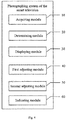
- FIG. 6 showing a schematic diagram of the functional modules in the first exemplary embodiment of the photographing system of smart television in the present disclosure.
- the photographing system of smart television includes: the acquiring module 10, the determining module 20, the displaying module 30 and the first adjusting module 40.
- the acquiring module 10 acquires a picture of an environment captured by the camera of the smart television, when the smart television is photographing.
- the determining module 20 determines the brightness value of current environment of the smart television, based on the picture of the environment.
- the current picture of the environment would be captured by the camera linked with the smart television, which is then displayed on a viewfinder interface.
- the acquiring module 10 acquires the picture of the environment captured by the camera of the smart TV.
- the determining module 20 determines the brightness value of current environment of the smart television, based on the brightness value corresponding to the picture of the environment.
- the picture of the environment acquired by the acquiring module 10 could be a full picture of the environment in the viewfinder interface of the smart television, or it could also be a portion thereof.
- the brightness range of the current environment of the smart television is [0, 255].
- the displaying module 30, gradually increases screen brightness of the smart television and displays a preview image of the picture at different screen brightness, when the current brightness value of the environment is less than a preset value.
- the indicating module 30 compares the current brightness value of the environment with the preset value, determining if the brightness value of the current environment is less than the preset value. If the brightness value of the current environment is less than the preset value, parameters regarding the screen brightness of the smart television would be adjusted according to the current brightness value of the environment, to gradually increase the screen brightness of the smart television. In the meanwhile, the preview image of the picture would be displayed at the adjusted screen brightness.
- the parameters regarding the screen brightness may include a backlight value, a brightness value and a contrast ratio.
- the captured brightness value of the current environment of the smart television is Lt
- the preset value of the smart television is L0. Lt is compared with L0.
- Lt is less than L0
- parameters regarding the screen brightness of the smart television would be adjusted according to Lt, and the screen brightness of the smart television would be gradually increased. And the preview image of the picture would also be shown at the adjusted screen brightness.
- the range of the preset value is [65, 75].
- the first adjusting module 40 adjusts the screen brightness to the required screen brightness selected by the user, for the user to be photographed, after a required screen brightness is selected by the user according to the preview image of the picture.
- the displaying module 30 displays each preview image of the picture captured by the camera on the display interface of the smart television.
- the user is indicated if the screen brightness corresponding to the preview image of the picture is set as the screen brightness that would be required for further photographing. For example, when the user clicks some preview image of the picture, a question that "if the screen brightness corresponding to the preview image of the picture is set as the screen brightness that would be required for photographing" would be popped up. And the user's selection would be accepted, so that the screen brightness required for further photographing could be rapidly confirmed.
- the question that "if the screen brightness corresponding to the preview image of the picture is set as the screen brightness that would be required for photographing" would be popped up. And the user's selection would be accepted. Or users would be indicated of the question at the end of browsing the preview image of the picture, and the user's selection would be accepted.
- the first adjusting module 40 adjusts the screen brightness to the selected screen brightness, for the user to be photographed. Flash is performed simultaneously on the display of the smart television when the camera is photographing. When photographing is completed by the camera, the screen brightness of the smart television would be restored to the screen brightness selected by the user.
- the smart television of the present exemplary embodiment takes photos by acquiring the picture of the environment captured by the camera of the smart television, when the smart television is photographing, determining the current brightness value of environment of the smart television, based on the picture of the environment, gradually increasing screen brightness of the smart television and showing a preview image of the picture at different screen brightness, when the current brightness value of the environment is less than the preset value; and adjusting the screen brightness to the required screen brightness selected by the user, for the user to be photographed, after a required screen brightness is selected by the user according to the preview image of the picture.
- the smart television would acquire the current brightness value of the environment during the photographing process. If the current brightness value of the environment is less than the preset value, indicating a dark environment for photographing by the smart television.
- the user would be clearly photographed through adjusting the screen brightness to the required screen brightness selected by the user, based on the brightness of the current environment.
- the camera of the smart television could still take clear photos by aids of the brightness of the smart television.
- the second exemplary embodiment of the photographing system of smart television is provided.
- Fig. 7 is referred to.
- the photographing system of smart television further includes: the second adjusting module 50.
- the second adjusting module 50 saves the brightness value of current environment when the brightness value of current environment is less than the preset value, in order to adjust the screen brightness of the smart television to the current screen brightness after photographing is completed.
- the second adjusting module 50 determines that the brightness value of the current environment of the smart television is less than the preset value in the smart television, indicating dark environment brightness for photographing, and thus clear photos could not be photographed by the camera of the smart television.
- the screen brightness is necessarily adjusted to the required screen brightness selected by the user, and the current screen brightness of the smart television is saved. Flash is performed simultaneously on the display of the smart television when the camera is photographing with the required screen brightness. When photographing is completed by the camera, the screen brightness of the smart television would be restored to the current screen brightness of the smart television just saved. Thus, other operations, such as displaying pictures, is performed under the current screen brightness of the smart television just saved.
- L0 the preset value
- the present exemplary embodiment when the brightness value of current environment is less than the preset value, avoids the screen from possibility of aging under a high brightness condition for a long time, by means of saving the current brightness value of environment, and adjusting the screen brightness of the smart television to the current brightness of environment after photographing is completed.
- the third exemplary embodiment of the photographing system of smart television is provided.
- Fig. 8 is referred to.
- the photographing system of smart television further includes: the indicating module 60.
- the indicating module 60 indicates a user to be photographed, when the brightness value of the environment is not less than the preset value.
- the indicating module 60 indicates directly the user to be photographed. For example, a question of "if a photo would like to be taken" could be popped up and the user's selection would be accepted.
- the present exemplary embodiment indicates a user directly to be photographed, when the brightness value of the environment is not less than the preset value.
- the screen brightness needs to be adjusted to the required screen brightness before indicating the user to be photographing. If the brightness value of the environment is not less than the preset value, the user would be directly indicated to be photographed.
- the photographing mode is dynamically adjusted and changed with the brightness of the current environment. The user's requirement is fulfilled on environment brightness for camera of the smart television during photographing, and the user experience is thus improved.
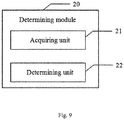
- the determining module further includes: the acquiring unit 21 and the determining unit 22.
- the acquiring unit 21, is configured to acquire brightness of each pixel in the picture of the environment.
- the determining unit 22 takes an average of the acquired brightness value of each pixel in the picture of the environment as the brightness value of the environment.
- the picture of environment is screenshot displayed on the current viewfinder interface of the smart television, and the acquiring unit 21 acquires a brightness value of each pixel in the picture of the environment, when photographing is performed by the smart television. Since the brightness value of each pixel in the picture of the environment is directly output by the camera (a photosensitive element), which is image data without any processing, the brightness value of each pixel in the picture of the environment could be named as raw data. All the raw data of the picture of the environment are counted when acquired, or part of the raw data is selected deliberately and the determining unit 22 accumulates this part of the raw data and average the accumulated raw data. The average value is taken as the brightness of the current environment of the smart television.
- the present exemplary embodiment enables calculation more precisely for the brightness of the current environment, by means of acquiring a brightness value of each pixel in the picture of the environment, and taking an average of the acquired brightness value of each pixel in the picture of the environment as brightness value of the environment.
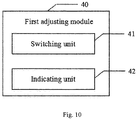
- the first adjusting module includes: the switching unit 41 and the indicating unit 42.
- the switching unit 41 is configured to switch the display interface of the screen of the smart television into the full white screen, and to set brightness of the full white screen as the required screen brightness selected by the user.
- the indicating unit 42 is configured to indicate the user to be photographed, when the screen brightness becomes the required screen brightness selected by the user.
- the switching unit 41 switches the display interface of the screen of the smart television into the full white screen in the time of the camera photographing based on the required screen brightness, in order to increase the brightness of the display.
- the indicating unit 42 indicates the users to be photographed and enables the camera to photograph under the full white screen. During photographing, flash is performed on the display of the smart television based on the full white screen. R value, G value and B value of each pixel in the full white screen are 255 for each.
- the fifth exemplary embodiment indicates the user to be photographed, by means of switching the display interface of the screen of the smart television into the full white screen, and setting brightness of the full white screen as the required screen brightness selected by the user.
- As the display interface of the screen of the smart television is switched into the full white screen, enabling the luminescence efficiency to be the highest.
- without changing the environment color Even if the smart television is placed at a relatively dark environment, the user can still be photographed clearly via the smart television.
Landscapes
- Engineering & Computer Science (AREA)
- Multimedia (AREA)
- Signal Processing (AREA)
- Physics & Mathematics (AREA)
- Computer Hardware Design (AREA)
- General Physics & Mathematics (AREA)
- Theoretical Computer Science (AREA)
- Human Computer Interaction (AREA)
- Transforming Electric Information Into Light Information (AREA)
- Studio Devices (AREA)
- Controls And Circuits For Display Device (AREA)
Abstract
Description
- The present disclosure relates to the technical field of photographing, and in particular to a photographing method by a smart television and a system thereof.
- Currently, there has been increasing functions on smart televisions. Users can be photographed or be videoed, for example, through a built-in or an external camera of a smart television, which brings the smart television of greater importance in daily life. Accordingly, the smart television with a better photographing function may possibly be more attractive to the users.
- However, flash fails to work in the camera of the smart television at present. Thus, other light sources, such as light of a lamp, should be provided to ensure a clear photo, once the smart television is placed in a dark environment. If brightness of other light sources is not sufficient, an unclear photo may be produced by the camera of the smart television.
- The present disclosure intends to provide a photographing method by a smart television and a system thereof, attempting to solve the problems that the camera of the smart television fails to flash and no clear photos can be taken in the dark environment.
- To fulfill such an intention, the present disclosure provides a photographing method by smart television, which includes:
- acquiring a picture of an environment captured by a camera of the smart television, when the smart television is photographing;
- acquiring a brightness value of each pixel in the picture of the environment;
- taking an average of the acquired brightness value of each pixel in the picture of the environment as a brightness value of the environment;
- indicating directly a user to be photographed, when the brightness value of the environment is not less than a preset value;
- gradually increasing screen brightness of the smart television and showing a preview image of the picture at different screen brightness, when the brightness value of the environment is less than the preset value; and
- adjusting the screen brightness to the required screen brightness selected by the user, for the user to be photographed, after a required screen brightness is selected by the user according to the preview image of the picture.
- To fulfill the above-mentioned intention, the present disclosure also provides another photographing method by smart television, which includes:
- acquiring a picture of an environment captured by a camera of the smart television, when the smart television is photographing;
- determining a brightness value of current environment of the smart television, based on the picture of the environment;
- gradually increasing screen brightness of the smart television and showing a preview image of the picture at different screen brightness, when the brightness value of the environment is less than a preset value; and
- adjusting the screen brightness to the required screen brightness selected by the user, for the user to be photographed, after a required screen brightness is selected by the user according to the preview image of the picture.
- Preferably, the step of adjusting the screen brightness to the required screen brightness selected by the user, for the user to be photographed includes:
- switching a display interface of a screen of the smart television into a full white screen, and setting brightness of the screen as the required screen brightness selected by the user; and
- indicating the user to be photographed, when the screen brightness becomes the required screen brightness selected by the user.
- Preferably, the method further includes:
- saving a current screen brightness for restoring the screen brightness of the smart television to the current screen brightness after photographing is completed,, when the brightness value of current environment is less than the preset value. Preferably, the step of adjusting the screen brightness to the required screen brightness selected by the user, for the user to be photographed includes:
- switching the display interface of the screen of the smart television into the full white screen, and setting brightness of the full white screen as the required screen brightness selected by the user; and
- indicating the user to be photographed, after the screen brightness becomes the required screen brightness selected by the user.
- Preferably, the method further includes:
indicating a user to be photographed, when the brightness value of the environment is not less than the preset value. - Preferably, the step of adjusting the screen brightness to the required screen brightness selected by the user, for the user to be photographed includes:
- switching the display interface of the screen of the smart television into the full white screen, and setting brightness of the full white screen as the required screen brightness selected by the user; and
- indicating the user to be photographed, after the screen brightness becomes the required screen brightness selected by the user.
- Preferably, the step of determining a brightness value of current environment of the smart television, based on the picture of the environment includes:
- acquiring a brightness value of each pixel in the picture of the environment; and
- taking an average of the acquired brightness value of each pixel in the picture of the environment as brightness value of the environment.
- Preferably, the step of adjusting the screen brightness to the required screen brightness selected by the user, for the user to be photographed includes:
- switching the display interface of the screen of the smart television into the full white screen, and setting brightness of the full white screen as the required screen brightness selected by the user; and
- indicating the user to be photographed, after the screen brightness becomes the required screen brightness selected by the user.
- In addition to fulfill the above intention, the present disclosure further discloses a photographing system of smart television, which includes:
- an acquiring module, configured to acquire a picture of an environment captured by a camera of the smart television, when the smart television is photographing;
- a determining module, configured to determine a brightness value of current environment of the smart television, based on the picture of the environment;
- a displaying module, configured to gradually increase screen brightness of the smart television and to show a preview image of the picture at different screen brightness, when the brightness value of the environment is less than a preset value;
- a first adjusting module, configured to adjust the screen brightness to a required screen brightness selected by the user, for the user to be photographed, after a required screen brightness is selected by the user according to the preview image of the picture.
- Preferably, the first adjusting module includes:
- a switching unit, configured to switch a display interface of a screen of the smart television into a full white screen, and to set brightness of the full white screen as the required screen brightness selected by the user; and
- an indicating unit, configured to indicate the user to be photographed, when the screen brightness becomes the required screen brightness selected by the user.
- Preferably, the photographing system of smart television further includes:
a second adjusting module, configured to save a current screen brightness for restoring the screen brightness of the smart television to the current screen brightness after photographing is completed, when the brightness value of current environment is less than the preset value, . - Preferably, the first adjusting module includes:
- a switching unit, configured to switch a display interface of a screen of the smart television into a full white screen, and to set brightness of the full white screen as the required screen brightness selected by the user; and
- an indicating unit, configured to indicate the user to be photographed, when the screen brightness becomes the required screen brightness selected by the user.
- Preferably, the photographing system of smart television further includes:
an indicating module, configured to indicate the user directly to be photographed, when the brightness value of the environment is not less than the preset value. - Preferably, the first adjusting module includes:
- a switching unit, configured to switch a display interface of a screen of the smart television into a full white screen, and to set brightness of the full white screen as the required screen brightness selected by the user; and
- an indicating unit, configured to indicate the user to be photographed, after the screen brightness becomes the required screen brightness selected by the user.
- Preferably, the determining module includes:
- an acquiring module, configured to acquire a brightness value of each pixel in the picture of the environment;
- a determining module, configured to take an average of the acquired brightness value of each pixel in the picture of the environment as a brightness value of the environment.
- Preferably, the first adjusting module includes:
- a switching unit, configured to switch a display interface of a screen of the smart television into a full white screen, and to set brightness of the full white screen as the required screen brightness selected by the user;
- an indicating unit, configured to indicate the user to be photographed, when the screen brightness becomes the required screen brightness selected by the user.
- The smart television of the present disclosure takes photos by acquiring the picture of the environment captured by the camera of the smart television, when the smart television is photographing; determining the brightness value of current environment of the smart television, based on the picture of the environment; gradually increasing screen brightness of the smart television and showing the preview image of the picture at different screen brightness, when the brightness value of the environment is less than the preset value; and adjusting the screen brightness to the required screen brightness selected by the user, for the user to be photographed, after a required screen brightness is selected by the user according to the preview image of the picture. The smart television would acquire the current brightness value of the environment during the photographing process. If the brightness value of the environment is less than the preset value, indicating that the smart television is photographing at a dark environment. The user would be clearly photographed through adjusting the screen brightness to the required screen brightness selected by the user, based on the brightness of the current environment. Thus, even if the smart television is in a dark environment, the camera of the smart television could still take clear photos by means of the brightness of the smart television.
-
-
Fig. 1 shows a schematic flow diagram in a first exemplary embodiment of the photographing method by smart television in the present disclosure; -
Fig. 2 shows a schematic flow diagram in a second exemplary embodiment of the photographing method by smart television in the present disclosure; -
Fig. 3 shows a schematic flow diagram in a third exemplary embodiment of the photographing method by smart television in the present disclosure; -
Fig. 4 shows a schematic flow diagram with detailed steps of S20 in the first exemplary embodiment shown inFig. 1 ; -
Fig. 5 shows a schematic flow diagram with detailed steps of S40 in the first exemplary embodiment shown inFig. 1 ; -
Fig. 6 shows a schematic diagram of functional modules in the first exemplary embodiment of the photographing system of smart television in the present disclosure; -
Fig. 7 shows a schematic diagram of functional modules in the second exemplary embodiment of the photographing system of smart television in the present disclosure; -
Fig. 8 shows a schematic diagram of functional modules in the third exemplary embodiment of photographing system of smart television in the present disclosure; -
Fig. 9 shows a schematic diagram of detailed functional modules of the determining modules in the fourth exemplary embodiment of the photographing system of smart television in the present disclosure; -
Fig. 10 shows a schematic diagram of detailed functional modules of the first adjusting modules in the fifth exemplary embodiment of the photographing system of smart television in the present disclosure. - Further description would be provided with the implementation, functional features and advantages of the present disclosure, with the exemplary embodiments combined and accompanying drawings referred to.
- It is understood that the specific embodiments described herein are merely illustrative of the present disclosure but not for limitation.
- Given to the above-mentioned problems, the present disclosure provides a photographing method of smart television.
- Referring to
Fig. 1, Fig. 1 shows a flow diagram in a first exemplary embodiment of the photographing method by smart television in the present disclosure. - In the first exemplary embodiment, the photographing method by the smart television includes:
- step S10, acquiring a picture of an environment captured by a camera of the smart television, when the smart television is photographing;
- step S20, determining a brightness value of current environment of the smart television, based on the picture of the environment.
- In the present exemplary embodiment, when it is detected that the user opens an APP on the smart television for photographing, the picture of the current environment would be captured by the camera linked with the smart television, and the picture of the current environment would be displayed on a viewfinder interface. When the user presses a camera key and the photographing process is detected, and the picture of the environment captured by the camera of the smart television would be acquired, and the brightness value of current environment of the smart television is determined, based on the brightness value corresponding to the picture of the environment. The picture of the environment acquired could be a full picture of the environment in the viewfinder interface of the smart television, or it could also be a portion thereof. The brightness range of the current environment of the smart television is [0, 255].
-
Step 30, gradually increasing screen brightness of the smart television and displaying a preview image of the picture at different screen brightness, when the brightness value of the current environment is less than the preset value. - When determining the brightness value of current environment of the smart television, the brightness value of the current environment is compared with the preset value, and it is determined if the brightness value of the current environment is less than the preset value. If the brightness value of the current environment is less than the preset value, parameters regarding the screen brightness of the smart television would be adjusted according to the brightness value of the current environment, to gradually increase the screen brightness of the smart television. In the meanwhile, the preview image of the picture would be displayed at the adjusted screen brightness. The parameters regarding the screen brightness may include a backlight value, a brightness value and a contrast ratio. For example, the captured brightness value of the current environment of the smart television is Lt, and the preset value of the smart television is L0. Lt is compared with L0. If Lt is less than L0, parameters regarding the screen brightness of the smart television would be adjusted according to Lt, and the screen brightness of the smart television would be gradually increased. And the preview image of the picture would also be displayed at the adjusted screen brightness. The range of the preset value is [65, 75].
- Step S40, adjusting the screen brightness is adjusted to the required screen brightness selected by the user, for the user to be photographed, after a required screen brightness is selected by the user according to the preview image of the picture.
- After the user press the camera key on the APP with the photographing function, each preview image of the picture captured by the camera is shown on the display interface of the smart television. The user is also indicated if the screen brightness corresponding to the preview image of the picture is set as the screen brightness that would be required for further photographing. For example, when the user clicks some preview image of the picture, a question that "if the screen brightness corresponding to the preview image of the picture is set as the screen brightness that would be required for photographing" would be popped up. The user's selection would be accepted, so that the screen brightness required for further photographing could be rapidly confirmed. Or when the user quits browsing the preview image of the picture, the question that "if the screen brightness corresponding to the preview image of the picture is set as the screen brightness that would be required for photographing" would be popped up. And the user's selection would be accepted. Or the user would be indicated of the question at the end of browsing the preview image of the picture, and the user's selection would be accepted. After a required screen brightness is selected by the user according to the preview image of the picture, the screen brightness is adjusted to the selected screen brightness, for the user to be photographed. Flash is performed simultaneously on the display of the smart television when the camera is photographing. When photographing has been completed by the camera, the screen brightness of the smart television has been restored to the screen brightness selected by the user.
- It has to be noted that if "no" is selected regarding the question "if the screen brightness corresponding to the preview image of the picture is set as the screen brightness that would be required for photographing", when the user clicks some preview image of the picture. Current preview image of the picture would be quit and the user may continue browsing each preview image of the picture.
- The smart television of the present exemplary embodiment takes photos by acquiring the picture of the environment captured by the camera of the smart television, when the smart television is photographing, determining the brightness value of current environment of the smart television, based on the picture of the environment, gradually increasing screen brightness of the smart television and showing a preview image of the picture at different screen brightness, when the brightness value of the environment is less than the preset value; and adjusting the screen brightness to the required screen brightness selected by the user, for the user to be photographed, after a required screen brightness is selected by the user according to the preview image of the picture. The smart television would acquire the current brightness value of the environment during the photographing process. If the brightness value of the environment is less than the preset value, indicating a dark environment during photographing by the smart television. The user would be clearly photographed through adjusting the screen brightness to the required screen brightness selected by the user, based on the brightness of the current environment. Thus, even if the user is in a dark environment, the camera of the smart television could still take clear photos by aids of the brightness of the smart television.
- Further, based on the first exemplary embodiment, the schematic flow diagram in a second exemplary embodiment is provided of the photographing method by the smart television in the present disclosure, referring to
Fig. 2 . In the second exemplary embodiment, the photographing method by the smart television after S20 includes: - step S50, saving a current screen brightness for restoring the screen brightness of the smart television to the current screen brightness after photographing is completed, when the brightness value of current environment is less than the preset value.
- If the brightness value of the current environment of the smart television is less than the preset value, indicating dark environment brightness for photographing, and thus clear photos could not be photographed by the camera of the smart television. The screen brightness is necessarily adjusted to the required screen brightness selected by the user, and the current screen brightness of the smart television is saved. Flash is performed simultaneously on the display of the smart television when the camera is photographing with the required screen brightness. When photographing has been completed by the camera, the screen brightness of the smart television has been restored to the current screen brightness of the smart television just saved. Thus, other operations, such as displaying pictures, is performed under the current screen brightness of the smart television just saved. For example, if the brightness value of the current environment is Lt1 (Lt1=60), which is less than the preset value L0 (L0=70), Lt2 would be saved and Lt2 would be adjusted to the required screen brightness selected by the user, which is Lt3 (Lt3=80). Flash is performed simultaneously on the display of the smart television when the camera is photographing at the brightness of Lt3. When photographing has been completed by the camera, the screen brightness Lt3 has been restored to Lt2.
- It could be understandable that the darker of the current environment of the smart television, the smaller of the brightness value of the current environment of the smart television, the larger of the required screen brightness value. And the brighter of the current environment of the smart television, the larger of the brightness value of the current environment of the smart television, the smaller of the required screen brightness value.
- The present exemplary embodiment, when the brightness value of current environment is less than the preset value, avoids the screen from possibility of aging under a high brightness condition for a long time, by means of saving the brightness value of current environment, and of adjusting the screen brightness of the smart television to the current screen brightness after photographing is completed.
- Further, based on the first exemplary embodiment, the schematic flow diagram in a third exemplary embodiment is provided of the photographing method by the smart television in the present disclosure, referring to
Fig. 3 . In the third exemplary embodiment, the photographing method by the smart television after S20 includes:
step S60, indicating the user directly to be photographed, when the brightness value of current environment is not less than the preset value. - In the exemplary embodiment, when the brightness value of current environment is not less than the preset value, indicating high brightness of the environment of the smart television. Thus, it is not necessary to adjust the screen brightness of the smart television, and the user could be directly indicated to be photographed. For example, a question of "if a photo would like to be taken" would be popped up and the user's selection would be accepted.
- The present exemplary embodiment indicates a user directly to be photographed, when the brightness value of the environment is not less than the preset value. Thus, as the brightness value of the environment is less than the preset value, the screen brightness needs to be adjusted to the required screen brightness before indicating the user to be photographed. If the brightness value of the environment is not less than the preset value, the user would be directly indicated to be photographed. The photographing mode is dynamically adjusted and changed with the brightness of the current environment. The user's requirement is fulfilled on environment brightness for camera of the smart television during photographing, and the user experience is thus improved.
- Further,
Fig. 4 is referred to, which shows a schematic flow diagram with detailed steps of S20 showing the first exemplary embodiment. The detailed steps of S20 includes: - step S21, acquiring a brightness value of each pixel in the picture of the environment;
- step S22, taking an average of the acquired brightness value of each pixel in the picture of the environment as the brightness value of the environment.
- In the present exemplary embodiment, the picture of environment is screenshot, displayed on the current viewfinder interface of the smart television and a brightness value of each pixel in the picture of the environment is acquired, during photographing by the smart television. Since the brightness value of each pixel in the picture of the environment is directly output by the camera (a photosensitive element), which is image data without any processing, the brightness value of each pixel in the picture of the environment could be named as raw data. All the raw data of the picture of the environment are counted when acquired, or part of the raw data is selected deliberately and this part of the raw data are accumulated and averaged. The average value is taken as the brightness of the current environment of the smart television.
- The present exemplary embodiment enables calculation more precisely for the brightness of the current environment, by means of acquiring a brightness value of each pixel in the picture of the environment, and taking an average of the acquired brightness value of each pixel in the picture of the environment as brightness value of the environment.
- Further,
Fig. 5 is referred to, which shows a schematic flow diagram with detailed steps of S40 showing the first exemplary embodiment. The detailed steps of S40 includes: - step S41, switching the display interface of the screen of the smart television into the full white screen, and setting brightness of the full white screen as the required screen brightness selected by the user;
- step S42, indicating the user to be photographed, after the screen brightness becomes the required screen brightness selected by the user.
- In the present exemplary embodiment, the display interface of the screen of the smart television is switched into the full white screen in the time of the camera photographing based on the required screen brightness, in order to increase the brightness of the display and to enable the camera to photograph under the full white screen. During photographing, flash is performed on the display of the smart television based on the full white screen. R value, G value and B value of each pixel in the full white screen are 255 for each.
- The present exemplary embodiment indicates the user to be photographed, by means of switching the display interface of the screen of the smart television into the full white screen, and setting brightness of the full white screen as the required screen brightness selected by the user. As the display interface of the screen of the smart television is switched into the full white screen, enabling the luminescence efficiency to be the highest without the environment color being changed. Even if the smart television is placed at a relatively dark environment, the user can still be photographed clearly via the smart television.
- The present disclosure further provides the photographing system of smart television.
- Referring to
Fig. 6 , showing a schematic diagram of the functional modules in the first exemplary embodiment of the photographing system of smart television in the present disclosure. - In the first exemplary embodiment, the photographing system of smart television includes: the acquiring
module 10, the determiningmodule 20, the displayingmodule 30 and thefirst adjusting module 40. - The acquiring
module 10, acquires a picture of an environment captured by the camera of the smart television, when the smart television is photographing. - The determining
module 20, determines the brightness value of current environment of the smart television, based on the picture of the environment. - In the present exemplary embodiment, when it is detected that the user opens an APP on the smart television for photographing, the current picture of the environment would be captured by the camera linked with the smart television, which is then displayed on a viewfinder interface. When the user presses camera key and the photographing process is detected, the acquiring
module 10 acquires the picture of the environment captured by the camera of the smart TV. And the determiningmodule 20 determines the brightness value of current environment of the smart television, based on the brightness value corresponding to the picture of the environment. The picture of the environment acquired by the acquiringmodule 10 could be a full picture of the environment in the viewfinder interface of the smart television, or it could also be a portion thereof. The brightness range of the current environment of the smart television is [0, 255]. - The displaying
module 30, gradually increases screen brightness of the smart television and displays a preview image of the picture at different screen brightness, when the current brightness value of the environment is less than a preset value. - When the determining
module 20 determines the brightness value of current environment of the smart television, the indicatingmodule 30 compares the current brightness value of the environment with the preset value, determining if the brightness value of the current environment is less than the preset value. If the brightness value of the current environment is less than the preset value, parameters regarding the screen brightness of the smart television would be adjusted according to the current brightness value of the environment, to gradually increase the screen brightness of the smart television. In the meanwhile, the preview image of the picture would be displayed at the adjusted screen brightness. The parameters regarding the screen brightness may include a backlight value, a brightness value and a contrast ratio. For example, the captured brightness value of the current environment of the smart television is Lt, and the preset value of the smart television is L0. Lt is compared with L0. If Lt is less than L0, parameters regarding the screen brightness of the smart television would be adjusted according to Lt, and the screen brightness of the smart television would be gradually increased. And the preview image of the picture would also be shown at the adjusted screen brightness. The range of the preset value is [65, 75]. - The
first adjusting module 40, adjusts the screen brightness to the required screen brightness selected by the user, for the user to be photographed, after a required screen brightness is selected by the user according to the preview image of the picture. - After the user press the camera key on the APP for photographing, the displaying
module 30 displays each preview image of the picture captured by the camera on the display interface of the smart television. In the meanwhile, the user is indicated if the screen brightness corresponding to the preview image of the picture is set as the screen brightness that would be required for further photographing. For example, when the user clicks some preview image of the picture, a question that "if the screen brightness corresponding to the preview image of the picture is set as the screen brightness that would be required for photographing" would be popped up. And the user's selection would be accepted, so that the screen brightness required for further photographing could be rapidly confirmed. Or when the user quits browsing the preview image of the picture, the question that "if the screen brightness corresponding to the preview image of the picture is set as the screen brightness that would be required for photographing" would be popped up. And the user's selection would be accepted. Or users would be indicated of the question at the end of browsing the preview image of the picture, and the user's selection would be accepted. After a required screen brightness is selected by the user according to the preview image of the picture, thefirst adjusting module 40 adjusts the screen brightness to the selected screen brightness, for the user to be photographed. Flash is performed simultaneously on the display of the smart television when the camera is photographing. When photographing is completed by the camera, the screen brightness of the smart television would be restored to the screen brightness selected by the user. - It has to be noted that if "no" is selected regarding the question "if the screen brightness corresponding to the preview image of the picture is set as the screen brightness that would be required for photographing", when the user clicks some preview image of the picture. Current preview image of the picture would be quit and the user may continue browsing each preview image of the picture.
- The smart television of the present exemplary embodiment takes photos by acquiring the picture of the environment captured by the camera of the smart television, when the smart television is photographing, determining the current brightness value of environment of the smart television, based on the picture of the environment, gradually increasing screen brightness of the smart television and showing a preview image of the picture at different screen brightness, when the current brightness value of the environment is less than the preset value; and adjusting the screen brightness to the required screen brightness selected by the user, for the user to be photographed, after a required screen brightness is selected by the user according to the preview image of the picture. The smart television would acquire the current brightness value of the environment during the photographing process. If the current brightness value of the environment is less than the preset value, indicating a dark environment for photographing by the smart television. The user would be clearly photographed through adjusting the screen brightness to the required screen brightness selected by the user, based on the brightness of the current environment. Thus, even if the user is in a dark environment, the camera of the smart television could still take clear photos by aids of the brightness of the smart television.
- Further, given to the first exemplary embodiment mentioned above, the second exemplary embodiment of the photographing system of smart television is provided. In the second exemplary embodiment of the photographing system of smart television,
Fig. 7 is referred to. The photographing system of smart television further includes: thesecond adjusting module 50. - The
second adjusting module 50, saves the brightness value of current environment when the brightness value of current environment is less than the preset value, in order to adjust the screen brightness of the smart television to the current screen brightness after photographing is completed. - If the
second adjusting module 50 determines that the brightness value of the current environment of the smart television is less than the preset value in the smart television, indicating dark environment brightness for photographing, and thus clear photos could not be photographed by the camera of the smart television. The screen brightness is necessarily adjusted to the required screen brightness selected by the user, and the current screen brightness of the smart television is saved. Flash is performed simultaneously on the display of the smart television when the camera is photographing with the required screen brightness. When photographing is completed by the camera, the screen brightness of the smart television would be restored to the current screen brightness of the smart television just saved. Thus, other operations, such as displaying pictures, is performed under the current screen brightness of the smart television just saved. For example, if the brightness value of the current environment is Lt1 (Lt1=60), which is less than the preset value L0 (L0=70), Lt2 would be saved and Lt2 would be adjusted to the required screen brightness selected by the user, which is Lt3 (Lt3=80). Flash is performed simultaneously on the display of the smart television when the camera is photographing at the brightness of Lt3. When photographing is completed by the camera, the screen brightness Lt3 would be restored to Lt2. - It could be understandable that the darker of the current environment of the smart television, the smaller of the brightness value of the current environment of the smart television, the larger of the required screen brightness value. And the brighter of the current environment of the smart television, the larger of the brightness value of the current environment of the smart television, the smaller of the required screen brightness value.
- The present exemplary embodiment, when the brightness value of current environment is less than the preset value, avoids the screen from possibility of aging under a high brightness condition for a long time, by means of saving the current brightness value of environment, and adjusting the screen brightness of the smart television to the current brightness of environment after photographing is completed.
- Further, given to the first exemplary embodiment mentioned above, the third exemplary embodiment of the photographing system of smart television is provided. In the third exemplary embodiment of the photographing system of smart television,
Fig. 8 is referred to. The photographing system of smart television further includes: the indicatingmodule 60. - The indicating
module 60, indicates a user to be photographed, when the brightness value of the environment is not less than the preset value. - In the third exemplary embodiment, when the brightness value of current environment is not less than the preset value, indicating high brightness of the environment of the smart television. Thus, it is not necessary to adjust the screen brightness of the smart television, and the indicating
module 60 indicates directly the user to be photographed. For example, a question of "if a photo would like to be taken" could be popped up and the user's selection would be accepted. - The present exemplary embodiment indicates a user directly to be photographed, when the brightness value of the environment is not less than the preset value. Thus, as the brightness value of the environment is less than the preset value, the screen brightness needs to be adjusted to the required screen brightness before indicating the user to be photographing. If the brightness value of the environment is not less than the preset value, the user would be directly indicated to be photographed. The photographing mode is dynamically adjusted and changed with the brightness of the current environment. The user's requirement is fulfilled on environment brightness for camera of the smart television during photographing, and the user experience is thus improved.
- Further, given to the first exemplary embodiment mentioned above, the fourth exemplary embodiment of the photographing system of smart television is provided. In the fourth exemplary embodiment of the photographing system of smart television,
Fig. 9 is referred to. The determining module further includes: the acquiringunit 21 and the determiningunit 22. - The acquiring
unit 21, is configured to acquire brightness of each pixel in the picture of the environment. - The determining
unit 22, takes an average of the acquired brightness value of each pixel in the picture of the environment as the brightness value of the environment. - In the fourth exemplary embodiment, the picture of environment is screenshot displayed on the current viewfinder interface of the smart television, and the acquiring
unit 21 acquires a brightness value of each pixel in the picture of the environment, when photographing is performed by the smart television. Since the brightness value of each pixel in the picture of the environment is directly output by the camera (a photosensitive element), which is image data without any processing, the brightness value of each pixel in the picture of the environment could be named as raw data. All the raw data of the picture of the environment are counted when acquired, or part of the raw data is selected deliberately and the determiningunit 22 accumulates this part of the raw data and average the accumulated raw data. The average value is taken as the brightness of the current environment of the smart television. - The present exemplary embodiment enables calculation more precisely for the brightness of the current environment, by means of acquiring a brightness value of each pixel in the picture of the environment, and taking an average of the acquired brightness value of each pixel in the picture of the environment as brightness value of the environment.
- Further, given to any exemplary embodiment mentioned above, the fifth exemplary embodiment of the photographing system of smart television is provided. In the fifth exemplary embodiment of the photographing system of smart television,
Fig. 10 is referred to. The first adjusting module includes: the switchingunit 41 and the indicatingunit 42. - The switching
unit 41, is configured to switch the display interface of the screen of the smart television into the full white screen, and to set brightness of the full white screen as the required screen brightness selected by the user. - The indicating
unit 42, is configured to indicate the user to be photographed, when the screen brightness becomes the required screen brightness selected by the user. - In the fifth exemplary embodiment, the switching
unit 41 switches the display interface of the screen of the smart television into the full white screen in the time of the camera photographing based on the required screen brightness, in order to increase the brightness of the display. The indicatingunit 42 indicates the users to be photographed and enables the camera to photograph under the full white screen. During photographing, flash is performed on the display of the smart television based on the full white screen. R value, G value and B value of each pixel in the full white screen are 255 for each. - The fifth exemplary embodiment indicates the user to be photographed, by means of switching the display interface of the screen of the smart television into the full white screen, and setting brightness of the full white screen as the required screen brightness selected by the user. As the display interface of the screen of the smart television is switched into the full white screen, enabling the luminescence efficiency to be the highest. Moreover, without changing the environment color. Even if the smart television is placed at a relatively dark environment, the user can still be photographed clearly via the smart television.
- The above is only preferred exemplary embodiments of the present disclosure, but not intended to limit the scope of the present disclosure. Any equivalent structure or any equivalent process transformations perceived from the specification and the drawings of the present disclosure, directly or indirectly applied to other related technical fields, should be included in the protection scope of the present disclosure.
Claims (17)
- A photographing method by smart television, characterized in that the method comprises:acquiring a picture of an environment captured by a camera of a smart television, when the smart television is photographing;acquiring a brightness value of each pixel in the picture of the environment;taking an average of the acquired brightness value of each pixel in the picture of the environment as a brightness value of current environment;indicating directly a user to be photographed when the brightness value of current environment is not less than a preset value;gradually increasing screen brightness of the smart television and showing a preview image of the picture at different screen brightness when the brightness value of the current environment is less than the preset value; andadjusting the screen brightness to a required screen brightness for the user to be photographed, after the required screen brightness is selected by the user according to the preview image of the picture.
- A photographing method by smart television, characterized in that the method comprises:acquiring a picture of an environment captured by a camera of a smart television, when the smart television is photographing;determining a brightness value of current environment of the smart television, based on the picture of the environment;gradually increasing screen brightness of the smart television and showing a preview image of the picture at different screen brightness, when the brightness value of the environment is less than a preset value; andadjusting the screen brightness to a required screen brightness selected by the user, for the user to be photographed, after the required screen brightness is selected by the user according to the preview image of the picture.
- The method of claim 2, characterized in that the step of adjusting the screen brightness to a required screen brightness selected by the user, for the user to be photographed, comprises:switching a display interface of a screen of the smart television into a full white screen, and setting brightness of the full white screen as the required screen brightness selected by the user; andindicating the user to be photographed, when the screen brightness becomes the required screen brightness selected by the user.
- The method of claim 2, characterized in that the method further comprises:
saving a current screen brightness for restoring the screen brightness of the smart television to the current screen brightness after photographing is completed, when the brightness value of current environment is less than the preset value. - The method of claim 4, characterized in that the step of adjusting the screen brightness to a required screen brightness selected by the user, for the user to be photographed, comprises:switching a display interface of a screen of the smart television into a full white screen, and setting brightness of the full white screen as the required screen brightness selected by the user; andindicating the user to be photographed, when the screen brightness becomes the required screen brightness selected by the user.
- The method of claim 2, characterized in that the method further comprises:
indicating directly a user to be photographed when the brightness value of the environment is not less than the preset value. - The method of claim 6, characterized in that the step of adjusting the screen brightness to a required screen brightness selected by the user, for the user to be photographed, comprises:switching a display interface of a screen of the smart television into a full white screen, and setting brightness of the full white screen as the required screen brightness selected by the user; andindicating the user to be photographed, when the screen brightness becomes the required screen brightness selected by the user.
- The method of claim 2, characterized in that the step of determining the brightness of current environment of the smart television, based on the picture of the environment, comprises:acquiring a brightness value of each pixel in the picture of the environment; andtaking an average of the acquired brightness value of each pixel in the picture of the environment as the brightness value of the current environment.
- The method of claim 8, characterized in that the step of adjusting the screen brightness to a required screen brightness selected by the user, for the user to be photographed, comprises:switching a display interface of the screen of the smart television into a full white screen, and setting brightness of the full white screen as the required screen brightness selected by the user; andindicating the user to be photographed, when the screen brightness becomes the required screen brightness selected by the user.
- A photographing system of smart television, characterized in that the photographing system comprises:an acquiring module , configured to acquire a picture of an environment captured by a camera of a smart television, when the smart television is photographing;a determining module , configured to determine a brightness value of current environment of the smart television, based on the picture of the environment;a displaying module , configured to gradually increase screen brightness value of the smart television and to show a preview image of the picture at different screen brightness, when the brightness value of the current environment is less than a preset value; anda first adjusting module , configured to adjust the screen brightness to a required screen brightness selected by the user, for the user to be photographed, after the required screen brightness is selected by the user according to the preview image of the picture.
- The photographing system of claim 10, characterized in that the first adjusting module 40 comprises:a switching unit , configured to switch a display interface of a screen of the smart television into a full white screen, and to set brightness of the full white screen as the required screen brightness selected by the user; andan indicating unit, configured to indicate the user to be photographed, when the screen brightness becomes the required screen brightness selected by the user.
- The photographing system of claim 10, characterized in that the photographing system further comprises:
a second adjusting module , configured to save a current screen brightness for restoring the screen brightness of the smart television to the current screen brightness after photographing is completed, when the brightness of current environment is less than the preset value. - The photographing system of claim 12, characterized in that the first adjusting module comprises:a switching unit , configured to switch a display interface of a screen of the smart television into a full white screen, and to set brightness of the full white screen as the required screen brightness selected by the user; andan indicating unit, configured to indicate the user to be photographed, when the screen brightness becomes the required screen brightness selected by the user.
- The photographing system of claim 10, characterized in that the photographing system further comprises:
an indicating module, configured to directly indicate the user to be photographed, when the current brightness value of the environment is not less than the preset value. - The photographing system of claim 14, characterized in that the photographing system further comprises:a switching unit, configured to switch a display interface of a screen of the smart television into a full white screen, and to set brightness of the full white screen as the required screen brightness selected by the user; andan indicating unit, configured to indicate the user to be photographed, when the screen brightness becomes the required screen brightness selected by the user.
- The photographing system of claim 10, characterized in that the determining module further comprises:an acquiring unit, configured to acquire a brightness value of each pixel in the picture of the environment; anda determining unit , configured to take an average of the acquired brightness value of each pixel in the picture of the environment as the brightness value of the current environment.
- The photographing system of claim 16, characterized in that the first adjusting module comprises:a switching unit , configured to switch a display interface of a screen of the smart television into a full white screen, and to set brightness of the full white screen as the required screen brightness selected by the user; andan indicating unit, configured to indicate the user to be photographed, when the screen brightness becomes the required screen brightness selected by the user.
Applications Claiming Priority (2)
| Application Number | Priority Date | Filing Date | Title |
|---|---|---|---|
| CN201610428254.2A CN105872402A (en) | 2016-06-15 | 2016-06-15 | Photographing method and system of smart television |
| PCT/CN2016/096245 WO2017215116A1 (en) | 2016-06-15 | 2016-08-22 | Photographing method and system for smart television |
Publications (3)
| Publication Number | Publication Date |
|---|---|
| EP3474536A1 true EP3474536A1 (en) | 2019-04-24 |
| EP3474536A4 EP3474536A4 (en) | 2020-02-26 |
| EP3474536B1 EP3474536B1 (en) | 2026-04-08 |
Family
ID=56649637
Family Applications (1)
| Application Number | Title | Priority Date | Filing Date |
|---|---|---|---|
| EP16905229.7A Active EP3474536B1 (en) | 2016-06-15 | 2016-08-22 | Photographing method and system for smart television |
Country Status (4)
| Country | Link |
|---|---|
| US (1) | US10957281B2 (en) |
| EP (1) | EP3474536B1 (en) |
| CN (1) | CN105872402A (en) |
| WO (1) | WO2017215116A1 (en) |
Families Citing this family (10)
| Publication number | Priority date | Publication date | Assignee | Title |
|---|---|---|---|---|
| CN105872402A (en) * | 2016-06-15 | 2016-08-17 | 深圳Tcl新技术有限公司 | Photographing method and system of smart television |
| CN106775527B (en) * | 2016-12-07 | 2019-06-28 | 中国联合网络通信集团有限公司 | Adjust the method, apparatus and display equipment of the display parameters of display panel |
| CN108564915B (en) * | 2018-04-25 | 2021-05-14 | Oppo广东移动通信有限公司 | Brightness adjustment method and related products |
| CN109309797B (en) * | 2018-08-08 | 2019-07-09 | 乐清市川嘉电气科技有限公司 | Real-time judgment system of light change |
| CN112073764B (en) * | 2019-06-10 | 2023-05-30 | 海信视像科技股份有限公司 | Display equipment |
| CN112399235B (en) * | 2019-08-18 | 2023-05-09 | 海信视像科技股份有限公司 | Camera shooting effect enhancement method and display device of intelligent television |
| CN111800585B (en) * | 2019-11-21 | 2021-06-04 | 天津九安医疗电子股份有限公司 | Intelligent lighting control system |
| CN111131720A (en) * | 2019-12-30 | 2020-05-08 | 惠州视维新技术有限公司 | Television control method, television and storage medium |
| CN113099278A (en) * | 2021-03-31 | 2021-07-09 | 深圳创维-Rgb电子有限公司 | Method and device for supplementing light of picture, television equipment and computer readable storage medium |
| CN118233740B (en) * | 2024-05-23 | 2024-08-30 | 杭州华橙软件技术有限公司 | Control method of image pickup apparatus, and storage medium |
Family Cites Families (28)
| Publication number | Priority date | Publication date | Assignee | Title |
|---|---|---|---|---|
| KR100364778B1 (en) * | 2000-03-08 | 2002-12-16 | 엘지전자 주식회사 | Apparatus for expressing screen |
| TWI243616B (en) * | 2003-12-24 | 2005-11-11 | Tatung Co Ltd | Method for adjusting brightness of display |
| KR100752850B1 (en) * | 2004-12-15 | 2007-08-29 | 엘지전자 주식회사 | Digital Imaging Device and Method |
| JP4396654B2 (en) * | 2006-03-03 | 2010-01-13 | ソニー株式会社 | Imaging apparatus, exposure control method, and computer program |
| JP5024067B2 (en) * | 2007-01-19 | 2012-09-12 | コニカミノルタホールディングス株式会社 | Face authentication system, method and program |
| CN101212552A (en) | 2007-12-25 | 2008-07-02 | 康佳集团股份有限公司 | TV digital photographing method and device |
| KR101510102B1 (en) * | 2008-04-08 | 2015-04-14 | 삼성전자주식회사 | Digital photographing device |
| US20090322889A1 (en) | 2008-06-27 | 2009-12-31 | Motorola, Inc. | Method and apparatus for illuminating users of video communication devices |
| US8421898B2 (en) * | 2010-07-27 | 2013-04-16 | Arcsoft (Hangzhou) Multimedia Technology Co., Ltd. | Method for detecting and showing quality of a preview or stored picture in an electronic imaging device |
| KR101772458B1 (en) * | 2011-06-28 | 2017-08-30 | 엘지전자 주식회사 | Display device and method for controlling thereof |
| KR102003255B1 (en) * | 2012-06-29 | 2019-07-24 | 삼성전자 주식회사 | Method and apparatus for processing multiple inputs |
| JP5647209B2 (en) * | 2012-11-07 | 2014-12-24 | オリンパスイメージング株式会社 | Imaging apparatus and imaging method |
| CN103856823A (en) | 2012-12-06 | 2014-06-11 | 腾讯科技(深圳)有限公司 | Interface adjustment method, device and terminal |
| KR20140090318A (en) * | 2013-01-07 | 2014-07-17 | 삼성전자주식회사 | Supporting Method For Operating a Camera based on a Haptic function and Electronic Device supporting the same |
| CN103312986A (en) * | 2013-06-08 | 2013-09-18 | 康佳集团股份有限公司 | Mobile terminal based front photographing fill light method and mobile terminal |
| US9525811B2 (en) * | 2013-07-01 | 2016-12-20 | Qualcomm Incorporated | Display device configured as an illumination source |
| CN104349033A (en) * | 2013-07-25 | 2015-02-11 | 共青城赛龙通信技术有限责任公司 | Self-timer light supplement method, self-timer light supplement device and electronic equipment |
| KR20150088614A (en) * | 2014-01-24 | 2015-08-03 | 삼성전자주식회사 | Apparatus and method for output control accoridng to environment in electronic device |
| CN103795929A (en) * | 2014-02-13 | 2014-05-14 | 苏州佳世达电通有限公司 | Photographing method of electronic device and electronic device |
| CN104184956A (en) * | 2014-08-29 | 2014-12-03 | 宇龙计算机通信科技(深圳)有限公司 | Mobile communication terminal photographing method and system and mobile communication terminal |
| CN105426068A (en) * | 2014-09-23 | 2016-03-23 | 鸿富锦精密工业(深圳)有限公司 | Photographing control system and photographing method |
| WO2016072565A1 (en) * | 2014-11-05 | 2016-05-12 | 엘지전자 주식회사 | Image output device, mobile terminal, and control method therefor |
| CN104660766B (en) * | 2015-03-04 | 2017-08-29 | 广东欧珀移动通信有限公司 | The backlight adjusting method and device of a kind of mobile terminal |
| CN104994274A (en) * | 2015-06-16 | 2015-10-21 | 惠州Tcl移动通信有限公司 | Rapid photographing method based on mobile terminal and mobile terminal |
| CN105323382B (en) * | 2015-11-04 | 2019-03-19 | Oppo广东移动通信有限公司 | Screen light supplementing method and device and mobile terminal |
| CN105578055A (en) * | 2016-01-08 | 2016-05-11 | 深圳市朵唯志远科技有限公司 | Mobile phone photographing control method |
| CN105554413B (en) * | 2016-02-15 | 2018-11-20 | 广东欧珀移动通信有限公司 | A kind of screen light filling photographic method, device and mobile terminal |
| CN105872402A (en) * | 2016-06-15 | 2016-08-17 | 深圳Tcl新技术有限公司 | Photographing method and system of smart television |
-
2016
- 2016-06-15 CN CN201610428254.2A patent/CN105872402A/en active Pending
- 2016-08-22 WO PCT/CN2016/096245 patent/WO2017215116A1/en not_active Ceased
- 2016-08-22 US US16/309,985 patent/US10957281B2/en active Active
- 2016-08-22 EP EP16905229.7A patent/EP3474536B1/en active Active
Also Published As
| Publication number | Publication date |
|---|---|
| EP3474536A4 (en) | 2020-02-26 |
| WO2017215116A1 (en) | 2017-12-21 |
| US10957281B2 (en) | 2021-03-23 |
| CN105872402A (en) | 2016-08-17 |
| EP3474536B1 (en) | 2026-04-08 |
| US20190172420A1 (en) | 2019-06-06 |
Similar Documents
| Publication | Publication Date | Title |
|---|---|---|
| US10957281B2 (en) | Photographing method by smart television and system thereof | |
| US11375128B2 (en) | Method for obtaining exposure compensation values of high dynamic range image, terminal device and non-transitory computer-readable storage medium | |
| US8405739B2 (en) | Imaging system and pixel signal readout method | |
| CN118175436B (en) | Image processing method and related device | |
| US9030600B2 (en) | Method and apparatus for controlling flash | |
| US9497385B2 (en) | Imaging device and image display method | |
| CN103220421B (en) | Method and device for using mobile terminal to carry out self photographing | |
| US8643767B2 (en) | Imaging device and imaging method | |
| US9571752B2 (en) | Display control apparatus and display control method | |
| KR20150122768A (en) | Shooting method and apparatus of electronic device, and electronic device | |
| CN110401798B (en) | Method and device for adjusting output resolution of MIPI camera | |
| US10440278B2 (en) | Imaging device and system including imaging device and server | |
| CN103155028B (en) | Display unit, image sensing unit and display system | |
| CN103369138A (en) | Photo shooting method of digital equipment and digital equipment | |
| CN107591134B (en) | MURA phenomenon compensation method, television and computer readable storage medium | |
| JP2023154269A (en) | Imaging device | |
| CN113810677A (en) | Screen brightness adjustment method, terminal and readable storage medium | |
| JP2009272813A (en) | Imaging apparatus, and image display method | |
| US20190342484A1 (en) | Electronic device, control device, control method, and storage medium | |
| KR101396342B1 (en) | Digital photographing apparatus and method for controlling the same | |
| JP2015192152A (en) | White balance adjustment device, white balance adjustment method and imaging device | |
| CN105578064A (en) | Imaging device and control method for imaging device | |
| US11336802B2 (en) | Imaging apparatus | |
| WO2014109129A1 (en) | Display control device, program, and display control method | |
| CN116051368A (en) | Image processing method and related equipment |
Legal Events
| Date | Code | Title | Description |
|---|---|---|---|
| STAA | Information on the status of an ep patent application or granted ep patent |
Free format text: STATUS: THE INTERNATIONAL PUBLICATION HAS BEEN MADE |
|
| PUAI | Public reference made under article 153(3) epc to a published international application that has entered the european phase |
Free format text: ORIGINAL CODE: 0009012 |
|
| STAA | Information on the status of an ep patent application or granted ep patent |
Free format text: STATUS: REQUEST FOR EXAMINATION WAS MADE |
|
| 17P | Request for examination filed |
Effective date: 20181220 |
|
| AK | Designated contracting states |
Kind code of ref document: A1 Designated state(s): AL AT BE BG CH CY CZ DE DK EE ES FI FR GB GR HR HU IE IS IT LI LT LU LV MC MK MT NL NO PL PT RO RS SE SI SK SM TR |
|
| AX | Request for extension of the european patent |
Extension state: BA ME |
|
| DAV | Request for validation of the european patent (deleted) | ||
| DAX | Request for extension of the european patent (deleted) | ||
| A4 | Supplementary search report drawn up and despatched |
Effective date: 20200124 |
|
| RIC1 | Information provided on ipc code assigned before grant |
Ipc: G09G 3/34 20060101ALI20200120BHEP Ipc: H04N 5/232 20060101ALI20200120BHEP Ipc: H04N 5/235 20060101AFI20200120BHEP |
|
| STAA | Information on the status of an ep patent application or granted ep patent |
Free format text: STATUS: EXAMINATION IS IN PROGRESS |
|
| 17Q | First examination report despatched |
Effective date: 20210802 |
|
| REG | Reference to a national code |
Ref country code: DE Ref legal event code: R079 Free format text: PREVIOUS MAIN CLASS: H04N0005235000 Ipc: H04N0023740000 Ref document number: 602016095177 Country of ref document: DE |
|
| GRAP | Despatch of communication of intention to grant a patent |
Free format text: ORIGINAL CODE: EPIDOSNIGR1 |
|
| STAA | Information on the status of an ep patent application or granted ep patent |
Free format text: STATUS: GRANT OF PATENT IS INTENDED |
|
| RIC1 | Information provided on ipc code assigned before grant |
Ipc: H04N 23/74 20230101AFI20250812BHEP Ipc: H04N 23/63 20230101ALI20250812BHEP |
|
| INTG | Intention to grant announced |
Effective date: 20250829 |
|
| GRAJ | Information related to disapproval of communication of intention to grant by the applicant or resumption of examination proceedings by the epo deleted |
Free format text: ORIGINAL CODE: EPIDOSDIGR1 |
|
| STAA | Information on the status of an ep patent application or granted ep patent |
Free format text: STATUS: EXAMINATION IS IN PROGRESS |
|
| P01 | Opt-out of the competence of the unified patent court (upc) registered |
Free format text: CASE NUMBER: UPC_APP_0013075_3474536/2025 Effective date: 20251112 |
|
| INTC | Intention to grant announced (deleted) | ||
| RAP3 | Party data changed (applicant data changed or rights of an application transferred) |
Owner name: SHENZHEN TCL NEW TECHNOLOGY CO., LTD |
|
| GRAS | Grant fee paid |
Free format text: ORIGINAL CODE: EPIDOSNIGR3 |
|
| STAA | Information on the status of an ep patent application or granted ep patent |
Free format text: STATUS: GRANT OF PATENT IS INTENDED |
|
| GRAP | Despatch of communication of intention to grant a patent |
Free format text: ORIGINAL CODE: EPIDOSNIGR1 |
|
| INTG | Intention to grant announced |
Effective date: 20260119 |
|
| GRAA | (expected) grant |
Free format text: ORIGINAL CODE: 0009210 |
|
| STAA | Information on the status of an ep patent application or granted ep patent |
Free format text: STATUS: THE PATENT HAS BEEN GRANTED |
|
| AK | Designated contracting states |
Kind code of ref document: B1 Designated state(s): AL AT BE BG CH CY CZ DE DK EE ES FI FR GB GR HR HU IE IS IT LI LT LU LV MC MK MT NL NO PL PT RO RS SE SI SK SM TR |
|
| RAP3 | Party data changed (applicant data changed or rights of an application transferred) |
Owner name: SHENZHEN TCL NEW TECHNOLOGY CO., LTD |
|
| REG | Reference to a national code |
Ref country code: CH Ref legal event code: F10 Free format text: ST27 STATUS EVENT CODE: U-0-0-F10-F00 (AS PROVIDED BY THE NATIONAL OFFICE) Effective date: 20260408 Ref country code: GB Ref legal event code: FG4D |
|
| REG | Reference to a national code |
Ref country code: DE Ref legal event code: R096 Ref document number: 602016095177 Country of ref document: DE |