EP3471077A1 - Automated vehicle safety system that protects pedestrians - Google Patents
Automated vehicle safety system that protects pedestrians Download PDFInfo
- Publication number
- EP3471077A1 EP3471077A1 EP18198237.2A EP18198237A EP3471077A1 EP 3471077 A1 EP3471077 A1 EP 3471077A1 EP 18198237 A EP18198237 A EP 18198237A EP 3471077 A1 EP3471077 A1 EP 3471077A1
- Authority
- EP
- European Patent Office
- Prior art keywords
- vehicle
- travel
- approaching
- host
- controller
- Prior art date
- Legal status (The legal status is an assumption and is not a legal conclusion. Google has not performed a legal analysis and makes no representation as to the accuracy of the status listed.)
- Granted
Links
Images

Classifications
-
- G—PHYSICS
- G08—SIGNALLING
- G08G—TRAFFIC CONTROL SYSTEMS
- G08G1/00—Traffic control systems for road vehicles
- G08G1/16—Anti-collision systems
- G08G1/166—Anti-collision systems for active traffic, e.g. moving vehicles, pedestrians, bikes
-
- B—PERFORMING OPERATIONS; TRANSPORTING
- B60—VEHICLES IN GENERAL
- B60Q—ARRANGEMENT OF SIGNALLING OR LIGHTING DEVICES, THE MOUNTING OR SUPPORTING THEREOF OR CIRCUITS THEREFOR, FOR VEHICLES IN GENERAL
- B60Q1/00—Arrangement of optical signalling or lighting devices, the mounting or supporting thereof or circuits therefor
- B60Q1/26—Arrangement of optical signalling or lighting devices, the mounting or supporting thereof or circuits therefor the devices being primarily intended to indicate the vehicle, or parts thereof, or to give signals, to other traffic
- B60Q1/50—Arrangement of optical signalling or lighting devices, the mounting or supporting thereof or circuits therefor the devices being primarily intended to indicate the vehicle, or parts thereof, or to give signals, to other traffic for indicating other intentions or conditions, e.g. request for waiting or overtaking
- B60Q1/525—Arrangement of optical signalling or lighting devices, the mounting or supporting thereof or circuits therefor the devices being primarily intended to indicate the vehicle, or parts thereof, or to give signals, to other traffic for indicating other intentions or conditions, e.g. request for waiting or overtaking automatically indicating risk of collision between vehicles in traffic or with pedestrians, e.g. after risk assessment using the vehicle sensor data
-
- B—PERFORMING OPERATIONS; TRANSPORTING
- B62—LAND VEHICLES FOR TRAVELLING OTHERWISE THAN ON RAILS
- B62D—MOTOR VEHICLES; TRAILERS
- B62D15/00—Steering not otherwise provided for
- B62D15/02—Steering position indicators ; Steering position determination; Steering aids
- B62D15/025—Active steering aids, e.g. helping the driver by actively influencing the steering system after environment evaluation
- B62D15/0265—Automatic obstacle avoidance by steering
-
- G—PHYSICS
- G08—SIGNALLING
- G08G—TRAFFIC CONTROL SYSTEMS
- G08G1/00—Traffic control systems for road vehicles
- G08G1/09—Arrangements for giving variable traffic instructions
- G08G1/0962—Arrangements for giving variable traffic instructions having an indicator mounted inside the vehicle, e.g. giving voice messages
- G08G1/0967—Systems involving transmission of highway information, e.g. weather, speed limits
-
- G—PHYSICS
- G08—SIGNALLING
- G08G—TRAFFIC CONTROL SYSTEMS
- G08G1/00—Traffic control systems for road vehicles
- G08G1/16—Anti-collision systems
- G08G1/161—Decentralised systems, e.g. inter-vehicle communication
- G08G1/162—Decentralised systems, e.g. inter-vehicle communication event-triggered
Definitions
- This disclosure generally relates to a safety system for an automated vehicle, and more particularly relates to a system that operates a host-vehicle to obstruct a travel-path of an approaching-vehicle when unimpeded travel by the approaching-vehicle on the travel-path may result in injury to a pedestrian.
- a safety system for an automated vehicle includes an object-detector and a controller.
- the object-detector is operable to detect an approaching-vehicle proximate to a host-vehicle.
- the controller is in communication with the object-detector.
- the controller is configured to operate the host-vehicle to obstruct a travel-path of the approaching-vehicle when unimpeded travel by the approaching-vehicle on the travel-path may result in injury to a pedestrian.
- the controller may be configured to operate the host-vehicle to obstruct a travel-path of the approaching-vehicle only when the host-vehicle is not occupied by a passenger.
- the controller may be configured to operate the host-vehicle to initiate physical-contact with the approaching-vehicle to prevent injury to the pedestrian.
- the controller may activate a warning-signal when unimpeded travel by the approaching-vehicle on the travel-path may result in injury to the pedestrian.
- the controller may be configured to notify nearby infrastructure when unimpeded travel by the approaching-vehicle on the travel-path may result in injury to the pedestrian.
- the controller may be configured to notify nearby vehicles proximate to the pedestrian when unimpeded travel by the approaching-vehicle on the travel-path may result in injury to the pedestrian.
- the controller may be configured to notify a passenger of the host-vehicle when unimpeded travel by the approaching-vehicle on the travel-path may result in injury to a pedestrian.
- Fig. 1 illustrates a non-limiting example of a safety system 10, hereafter referred to as the system 10, which is generally intended for use by an automated vehicle, e.g. a host-vehicle 12.
- an automated vehicle e.g. a host-vehicle 12.
- the term automated vehicle may apply to instances when the host-vehicle 12 is being operated in an automated-mode 14, i.e. a fully autonomous mode, where a human-operator (not shown) of the host-vehicle 12 may do little more than designate a destination in order to operate the host-vehicle 12.
- full automation is not a requirement.
- the teachings presented herein are useful when the host-vehicle 12 is operated in a manual-mode 16 where the degree or level of automation may be little more than providing an audible or visual warning to the human-operator who is generally in control of the steering, accelerator, and brakes of the host-vehicle 12.
- the system 10 may merely assist the human-operator with steering or braking on an as needed basis.
- the system 10 includes an object-detector 18 that is operable to detect an approaching-vehicle 20 (see also Fig. 2 ) proximate to a host-vehicle 12.
- the object-detector 18 may consist of or include a camera, a radar, a lidar, an ultrasonic-transducer, or any combination thereof.
- Those in the vehicle perception sensor arts will recognize that there are many varieties of commercially available devices suitable to be used to form the object-detector 18. While Fig. 1 might be interpreted by some to suggest that all of the devices must be co-located, this is not a requirement. Indeed, as will become apparent in the description that follows, it may be preferable that the devices be distributed at different locations about the host-vehicle 12. Furthermore, it is expected that there will be multiple instances of a particular type of device, e.g. multiple radars mounted at different locations on the host-vehicle 12 in order to have different fields-of-view about the host-vehicle 12.
- the system 10 includes a controller 22 in communication with the object-detector 18.
- the controller 22 may include a processor (not specifically shown) such as a microprocessor or other control circuitry such as analog and/or digital control circuitry including an application specific integrated circuit (ASIC) for processing data as should be evident to those in the art.
- the controller 22 may include memory (not specifically shown), including non-volatile memory, such as electrically erasable programmable read-only memory (EEPROM) for storing one or more routines, thresholds, and captured data.
- the one or more routines may be executed by the processor to perform steps for determining if the approaching-vehicle 20 represents a threat to, for example, a pedestrian 24 (see also Fig. 2 ) or a vehicle transporting passengers, based on signals received by the controller 22 from the object-detector 18 as described herein.
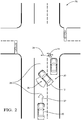
- Fig. 2 illustrates a non-limiting example of a scenario 26 where the approaching-vehicle 20 may not detect the presence of the pedestrian 24 prior to crossing a travel-path 28 of the approaching-vehicle 20. It is noted that prior to the instant depicted in Fig. 2 , the host-vehicle 12 was in an adjacent-lane 30 next to the lane identified as the travel-path 28, so at that prior time the forward movement of the approaching-vehicle 20 was unobstructed.
- the object-detector 18 of the host-vehicle 12 detected the presence of the pedestrian 24 and the approaching-vehicle 20, and the controller 22 was able to predict or foresee that the pedestrian 24 and the approaching-vehicle 20 would likely collide if both stayed on their present trajectories.
- the controller 22 may determine a vehicle-vector 32 that indicates a speed and direction of travel of the approaching-vehicle 20, and determine a pedestrian-vector 34 that indicates a speed and direction of travel of the pedestrian 24. The controller 22 may then perform an intersecting vectors test to determine if the vehicle-vector 32 and the pedestrian-vector 34 suggest that a collision of the pedestrian 24 and the approaching-vehicle 20 is likely.
- the controller 22 may be configured to operate the host-vehicle 12 to obstruct a travel-path 28 of the approaching-vehicle 20 when unimpeded travel by the approaching-vehicle 20 on the travel-path 28 may result in injury to a pedestrian 24. That is, as suggested in Fig. 2 , the host-vehicle 12 may move into the travel-path 28 which will block or obstruct the forward movement of the approaching-vehicle 20, and optionally broadcast a warning to the approaching-vehicle 20, thereby affording some protection to the pedestrian 24. It is recognized that such an action by the host-vehicle 12 (i.e.
- the controller 22 may place a passenger/operator of the host-vehicle 12 as some risk of injury, so the controller 22 may be optionally configured to operate the host-vehicle 12 to obstruct a travel-path 28 of the approaching-vehicle 20 only when the host-vehicle 12 is not occupied by a passenger or operator (not shown).
- the host-vehicle 12 may be equipped with interior sensors suitable to determine a passenger presence in the host-vehicle 12.
- the probability of a collision between the host-vehicle 12 and the approaching-vehicle 20 due to the host-vehicle 12 moving into the travel-path 28 can be estimated, and if the probability of such a collision is less than some threshold, the system 10 or controller 22 may be configured to proceed with obstructing the travel-path 28 even if passenger is present in the host-vehicle 12. If such an action is selected, it is contemplated that the host-vehicle 12 would be equipped to notify the passenger with an audible and/or visual warning of the situation.
- the controller 22 may be configured to notify a passenger of the host-vehicle 12 when unimpeded travel by the approaching-vehicle 20 on the travel-path 28 may result in injury to a pedestrian 24.
- the pedestrian 24 could be or include a baby in a baby carriage (not specifically shown in the drawings) being pushed in front of a pedestrian 24, or a bicyclist or skateboarder in a designated pedestrian zone.
- the controller 22 may be configured to operate the host-vehicle 12 to initiate physical-contact with the approaching-vehicle 20 to prevent injury to the pedestrian 24.
- the host-vehicle 12 is configured to emit or broadcast some sort of a warning-signal 36 when the host-vehicle 12 is about to or is in the process of taking action to obstruct the travel-path 28.
- the warning-signal 36 may be provided by exterior-lights 38 arranged along the side of the host-vehicle 12, i.e. lights other than known brake/turn-signal indicator lights commonly found on vehicles.
- the host-vehicle 12 may be equipped with infrastructure communication (V2I) and/or vehicle-to-vehicle (V2V) communication devices such as a dedicated-short-range-communications (DSRC) transceiver that can broadcast a message that the host-vehicle 12 is taking action to protect the pedestrian 24. That is, the controller 22 may be configured to activate the warning-signal 36 when unimpeded travel by the approaching-vehicle 20 on the travel-path 28 may result in injury to the pedestrian 24.
- the communications can be received by another vehicle or by the infrastructure. When received by the infrastructure additional warnings can be initiated from infrastructure components such as a safety siren, flashing lights, or a visually projected keep-out-zone in front of the pedestrian.
- a safety system for an automated vehicle (the system 10), a controller 22 for the system 10, and a method of operating the system 10 are provided.
- the system is generally configured to make use of a host-vehicle 12 to provide physical protection to a pedestrian 24 who is not a passenger/occupant of the host-vehicle 12.
Landscapes
- Physics & Mathematics (AREA)
- General Physics & Mathematics (AREA)
- Engineering & Computer Science (AREA)
- Mechanical Engineering (AREA)
- Chemical & Material Sciences (AREA)
- Combustion & Propulsion (AREA)
- Transportation (AREA)
- Life Sciences & Earth Sciences (AREA)
- Atmospheric Sciences (AREA)
- Traffic Control Systems (AREA)
Abstract
Description
- This disclosure generally relates to a safety system for an automated vehicle, and more particularly relates to a system that operates a host-vehicle to obstruct a travel-path of an approaching-vehicle when unimpeded travel by the approaching-vehicle on the travel-path may result in injury to a pedestrian.
- It is recognized that are situations when a third-party can foresee an impending collision between a pedestrian and an approaching vehicle.
- In accordance with one embodiment, a safety system for an automated vehicle is provided. The system includes an object-detector and a controller. The object-detector is operable to detect an approaching-vehicle proximate to a host-vehicle. The controller is in communication with the object-detector. The controller is configured to operate the host-vehicle to obstruct a travel-path of the approaching-vehicle when unimpeded travel by the approaching-vehicle on the travel-path may result in injury to a pedestrian.
- The controller may be configured to operate the host-vehicle to obstruct a travel-path of the approaching-vehicle only when the host-vehicle is not occupied by a passenger. The controller may be configured to operate the host-vehicle to initiate physical-contact with the approaching-vehicle to prevent injury to the pedestrian. The controller may activate a warning-signal when unimpeded travel by the approaching-vehicle on the travel-path may result in injury to the pedestrian. The controller may be configured to notify nearby infrastructure when unimpeded travel by the approaching-vehicle on the travel-path may result in injury to the pedestrian. The controller may be configured to notify nearby vehicles proximate to the pedestrian when unimpeded travel by the approaching-vehicle on the travel-path may result in injury to the pedestrian. The controller may be configured to notify a passenger of the host-vehicle when unimpeded travel by the approaching-vehicle on the travel-path may result in injury to a pedestrian.
- Further features and advantages will appear more clearly on a reading of the following detailed description of the preferred embodiment, which is given by way of non-limiting example only and with reference to the accompanying drawings.
- The present invention will now be described, by way of example with reference to the accompanying drawings, in which:
-
Fig. 1 is a diagram of a safety system for automated vehicle in accordance with one embodiment; and -
Fig. 2 is a scenario encountered by the system ofFig. 1 in accordance with one embodiment. -
Fig. 1 illustrates a non-limiting example of asafety system 10, hereafter referred to as thesystem 10, which is generally intended for use by an automated vehicle, e.g. a host-vehicle 12. As used herein, the term automated vehicle may apply to instances when the host-vehicle 12 is being operated in an automated-mode 14, i.e. a fully autonomous mode, where a human-operator (not shown) of the host-vehicle 12 may do little more than designate a destination in order to operate the host-vehicle 12. However, full automation is not a requirement. It is contemplated that the teachings presented herein are useful when the host-vehicle 12 is operated in a manual-mode 16 where the degree or level of automation may be little more than providing an audible or visual warning to the human-operator who is generally in control of the steering, accelerator, and brakes of the host-vehicle 12. For example, thesystem 10 may merely assist the human-operator with steering or braking on an as needed basis. - The
system 10 includes an object-detector 18 that is operable to detect an approaching-vehicle 20 (see alsoFig. 2 ) proximate to a host-vehicle 12. The object-detector 18 may consist of or include a camera, a radar, a lidar, an ultrasonic-transducer, or any combination thereof. Those in the vehicle perception sensor arts will recognize that there are many varieties of commercially available devices suitable to be used to form the object-detector 18. WhileFig. 1 might be interpreted by some to suggest that all of the devices must be co-located, this is not a requirement. Indeed, as will become apparent in the description that follows, it may be preferable that the devices be distributed at different locations about the host-vehicle 12. Furthermore, it is expected that there will be multiple instances of a particular type of device, e.g. multiple radars mounted at different locations on the host-vehicle 12 in order to have different fields-of-view about the host-vehicle 12. - The
system 10 includes acontroller 22 in communication with the object-detector 18. Thecontroller 22 may include a processor (not specifically shown) such as a microprocessor or other control circuitry such as analog and/or digital control circuitry including an application specific integrated circuit (ASIC) for processing data as should be evident to those in the art. Thecontroller 22 may include memory (not specifically shown), including non-volatile memory, such as electrically erasable programmable read-only memory (EEPROM) for storing one or more routines, thresholds, and captured data. The one or more routines may be executed by the processor to perform steps for determining if the approaching-vehicle 20 represents a threat to, for example, a pedestrian 24 (see alsoFig. 2 ) or a vehicle transporting passengers, based on signals received by thecontroller 22 from the object-detector 18 as described herein. -
Fig. 2 illustrates a non-limiting example of ascenario 26 where the approaching-vehicle 20 may not detect the presence of thepedestrian 24 prior to crossing a travel-path 28 of the approaching-vehicle 20. It is noted that prior to the instant depicted inFig. 2 , the host-vehicle 12 was in an adjacent-lane 30 next to the lane identified as the travel-path 28, so at that prior time the forward movement of the approaching-vehicle 20 was unobstructed. At that prior time, the object-detector 18 of the host-vehicle 12 detected the presence of thepedestrian 24 and the approaching-vehicle 20, and thecontroller 22 was able to predict or foresee that thepedestrian 24 and the approaching-vehicle 20 would likely collide if both stayed on their present trajectories. For example, thecontroller 22 may determine a vehicle-vector 32 that indicates a speed and direction of travel of the approaching-vehicle 20, and determine a pedestrian-vector 34 that indicates a speed and direction of travel of thepedestrian 24. Thecontroller 22 may then perform an intersecting vectors test to determine if the vehicle-vector 32 and the pedestrian-vector 34 suggest that a collision of thepedestrian 24 and the approaching-vehicle 20 is likely. - In order to prevent this predicted or forecasted collision, the
controller 22 may be configured to operate the host-vehicle 12 to obstruct a travel-path 28 of the approaching-vehicle 20 when unimpeded travel by the approaching-vehicle 20 on the travel-path 28 may result in injury to apedestrian 24. That is, as suggested inFig. 2 , the host-vehicle 12 may move into the travel-path 28 which will block or obstruct the forward movement of the approaching-vehicle 20, and optionally broadcast a warning to the approaching-vehicle 20, thereby affording some protection to thepedestrian 24. It is recognized that such an action by the host-vehicle 12 (i.e. action by thecontroller 22 or thesystem 10 in the operation of the host-vehicle 12) may place a passenger/operator of the host-vehicle 12 as some risk of injury, so thecontroller 22 may be optionally configured to operate the host-vehicle 12 to obstruct a travel-path 28 of the approaching-vehicle 20 only when the host-vehicle 12 is not occupied by a passenger or operator (not shown). Accordingly, the host-vehicle 12 may be equipped with interior sensors suitable to determine a passenger presence in the host-vehicle 12. - However, it is recognized that the probability of a collision between the host-
vehicle 12 and the approaching-vehicle 20 due to the host-vehicle 12 moving into the travel-path 28 can be estimated, and if the probability of such a collision is less than some threshold, thesystem 10 orcontroller 22 may be configured to proceed with obstructing the travel-path 28 even if passenger is present in the host-vehicle 12. If such an action is selected, it is contemplated that the host-vehicle 12 would be equipped to notify the passenger with an audible and/or visual warning of the situation. That is, thecontroller 22 may be configured to notify a passenger of the host-vehicle 12 when unimpeded travel by the approaching-vehicle 20 on the travel-path 28 may result in injury to apedestrian 24. It is contemplated that thepedestrian 24 could be or include a baby in a baby carriage (not specifically shown in the drawings) being pushed in front of apedestrian 24, or a bicyclist or skateboarder in a designated pedestrian zone. - It is recognized that there may be circumstances when the only way to protect the
pedestrian 24 would be to obstruct the travel-path 28 even though a collision between the approaching-vehicle 20 and the host-vehicle 12 was highly likely. That is, thecontroller 22 may be configured to operate the host-vehicle 12 to initiate physical-contact with the approaching-vehicle 20 to prevent injury to thepedestrian 24. - It may be advantageous of the host-
vehicle 12 is configured to emit or broadcast some sort of a warning-signal 36 when the host-vehicle 12 is about to or is in the process of taking action to obstruct the travel-path 28. The warning-signal 36 may be provided by exterior-lights 38 arranged along the side of the host-vehicle 12, i.e. lights other than known brake/turn-signal indicator lights commonly found on vehicles. Alternatively, or in addition to the exterior-lights 38, the host-vehicle 12 may be equipped with infrastructure communication (V2I) and/or vehicle-to-vehicle (V2V) communication devices such as a dedicated-short-range-communications (DSRC) transceiver that can broadcast a message that the host-vehicle 12 is taking action to protect thepedestrian 24. That is, thecontroller 22 may be configured to activate the warning-signal 36 when unimpeded travel by the approaching-vehicle 20 on the travel-path 28 may result in injury to thepedestrian 24. The communications can be received by another vehicle or by the infrastructure. When received by the infrastructure additional warnings can be initiated from infrastructure components such as a safety siren, flashing lights, or a visually projected keep-out-zone in front of the pedestrian. - Accordingly, a safety system for an automated vehicle (the system 10), a
controller 22 for thesystem 10, and a method of operating thesystem 10 are provided. The system is generally configured to make use of a host-vehicle 12 to provide physical protection to apedestrian 24 who is not a passenger/occupant of the host-vehicle 12. - While this invention has been described in terms of the preferred embodiments thereof, it is not intended to be so limited, but rather only to the extent set forth in the claims that follow.
Claims (7)
- A safety system (10) for an automated vehicle, said system (10) comprising:an object-detector (18) operable to detect an approaching-vehicle (20) proximate to a host-vehicle (12), anda controller (22) in communication with the object-detector (18), wherein the controller (22) is configured to operate the host-vehicle (12) to obstruct a travel-path (28) of the approaching-vehicle (20) when unimpeded travel by the approaching-vehicle (20) on the travel-path (28) may result in injury to a pedestrian (24).
- The system (10) in accordance with claim 1, wherein the controller (22) is configured to operate the host-vehicle (12) to obstruct a travel-path (28) of the approaching-vehicle (20) only when the host-vehicle (12) is not occupied by a passenger.
- The system (10) in accordance with claim 1, wherein the controller (22) is configured to operate the host-vehicle (12) to initiate physical-contact with the approaching-vehicle (20) to prevent injury to the pedestrian (24).
- The system (10) in accordance with claim 1, wherein the controller (22) activates a warning-signal (36) when unimpeded travel by the approaching-vehicle (20) on the travel-path (28) may result in injury to the pedestrian (24).
- The system (10) in accordance with claim 1, wherein the controller (22) is configured to notify nearby infrastructure when unimpeded travel by the approaching-vehicle (20) on the travel-path (28) may result in injury to the pedestrian (24).
- The system (10) in accordance with claim 1, wherein the controller (22) is configured to notify nearby vehicles proximate to the pedestrian (24) when unimpeded travel by the approaching-vehicle (20) on the travel-path (28) may result in injury to the pedestrian (24).
- The system (10) in accordance with claim 1, wherein the controller (22) is configured to notify a passenger of the host-vehicle (12) when unimpeded travel by the approaching-vehicle (20) on the travel-path (28) may result in injury to a pedestrian (24).
Applications Claiming Priority (1)
| Application Number | Priority Date | Filing Date | Title |
|---|---|---|---|
| US15/783,060 US20190114920A1 (en) | 2017-10-13 | 2017-10-13 | Automated vehicle safety system that protects pedestrians |
Publications (2)
| Publication Number | Publication Date |
|---|---|
| EP3471077A1 true EP3471077A1 (en) | 2019-04-17 |
| EP3471077B1 EP3471077B1 (en) | 2021-09-08 |
Family
ID=63722246
Family Applications (1)
| Application Number | Title | Priority Date | Filing Date |
|---|---|---|---|
| EP18198237.2A Active EP3471077B1 (en) | 2017-10-13 | 2018-10-02 | Automated vehicle safety system that protects pedestrians |
Country Status (3)
| Country | Link |
|---|---|
| US (1) | US20190114920A1 (en) |
| EP (1) | EP3471077B1 (en) |
| CN (1) | CN109671296B (en) |
Families Citing this family (6)
| Publication number | Priority date | Publication date | Assignee | Title |
|---|---|---|---|---|
| FR3076045A1 (en) * | 2017-12-22 | 2019-06-28 | Orange | METHOD FOR MONITORING AN ENVIRONMENT OF A FIRST ELEMENT POSITIONED AT THE LEVEL OF A CIRCULATION PATH, AND ASSOCIATED SYSTEM |
| KR102564013B1 (en) * | 2018-04-02 | 2023-08-07 | 현대자동차주식회사 | Apparatus for controlling vehicle, system having the same and method thereof |
| KR20210026248A (en) * | 2019-08-29 | 2021-03-10 | 현대자동차주식회사 | Apparatus for notifying accident of a vehicle, system having the same and method thereof |
| US12084050B1 (en) * | 2020-01-30 | 2024-09-10 | Anthony J. Bourget | Autonomous vehicles, apparatuses, systems and methods |
| CN111932941A (en) * | 2020-08-24 | 2020-11-13 | 重庆大学 | Intersection vehicle early warning method and system based on vehicle-road cooperation |
| EP4625389A1 (en) * | 2024-03-25 | 2025-10-01 | Ningbo Geely Automobile Research & Development Co. Ltd. | A method for protecting a vehicle on a road |
Citations (2)
| Publication number | Priority date | Publication date | Assignee | Title |
|---|---|---|---|---|
| US9381916B1 (en) * | 2012-02-06 | 2016-07-05 | Google Inc. | System and method for predicting behaviors of detected objects through environment representation |
| US20170249836A1 (en) * | 2016-02-25 | 2017-08-31 | Delphi Technologies, Inc. | Conflict-Resolution System For Operating An Automated Vehicle |
Family Cites Families (12)
| Publication number | Priority date | Publication date | Assignee | Title |
|---|---|---|---|---|
| JP2003173499A (en) * | 2001-12-05 | 2003-06-20 | Sony Corp | Approach warning system and approach warning device |
| DE112005003266T5 (en) * | 2004-12-28 | 2008-09-04 | Kabushiki Kaisha Toyota Chuo Kenkyusho | Vehicle motion control device |
| US7994902B2 (en) * | 2009-02-25 | 2011-08-09 | Southwest Research Institute | Cooperative sensor-sharing vehicle traffic safety system |
| US20120177336A1 (en) * | 2011-01-07 | 2012-07-12 | Heidi Bhan | Crossing arm for school bus systems |
| US9260059B2 (en) * | 2014-04-25 | 2016-02-16 | Robert Bosch Gmbh | False warning reduction using location data |
| KR102511334B1 (en) * | 2015-07-14 | 2023-03-20 | 삼성전자주식회사 | Apparatus and method for providing service in vehicle to everything communication system |
| CN105070076B (en) * | 2015-09-30 | 2017-12-12 | 招商局重庆交通科研设计院有限公司 | A kind of special vehicle leased circuit method and system for planning based on V2I |
| CN105869098B (en) * | 2016-04-06 | 2020-02-07 | 北京小米移动软件有限公司 | Vehicle control method and device |
| US10351237B2 (en) * | 2016-07-28 | 2019-07-16 | Qualcomm Incorporated | Systems and methods for utilizing unmanned aerial vehicles to monitor hazards for users |
| KR102441060B1 (en) * | 2016-12-13 | 2022-09-06 | 현대자동차주식회사 | Apparatus for preventing pedestrian collision, system having the same and method thereof |
| US10259452B2 (en) * | 2017-01-04 | 2019-04-16 | International Business Machines Corporation | Self-driving vehicle collision management system |
| US10872476B2 (en) * | 2017-08-10 | 2020-12-22 | Amazon Technologies, Inc. | Broadcast strategy modes for autonomous vehicle operations |
-
2017
- 2017-10-13 US US15/783,060 patent/US20190114920A1/en not_active Abandoned
-
2018
- 2018-10-02 EP EP18198237.2A patent/EP3471077B1/en active Active
- 2018-10-12 CN CN201811187931.1A patent/CN109671296B/en active Active
Patent Citations (2)
| Publication number | Priority date | Publication date | Assignee | Title |
|---|---|---|---|---|
| US9381916B1 (en) * | 2012-02-06 | 2016-07-05 | Google Inc. | System and method for predicting behaviors of detected objects through environment representation |
| US20170249836A1 (en) * | 2016-02-25 | 2017-08-31 | Delphi Technologies, Inc. | Conflict-Resolution System For Operating An Automated Vehicle |
Also Published As
| Publication number | Publication date |
|---|---|
| EP3471077B1 (en) | 2021-09-08 |
| CN109671296A (en) | 2019-04-23 |
| CN109671296B (en) | 2021-10-08 |
| US20190114920A1 (en) | 2019-04-18 |
Similar Documents
| Publication | Publication Date | Title |
|---|---|---|
| EP3471077B1 (en) | Automated vehicle safety system that protects pedestrians | |
| EP3196089B1 (en) | Vehicle safety assist system, vehicle comprising a vehicle safety assist system and a method for providing driver warning or performing autonomous braking | |
| US10037696B2 (en) | Cooperative automated vehicle system | |
| EP3313702B1 (en) | Cognitive driver assist with variable assistance for automated vehicles | |
| EP2302412B1 (en) | System and method for evaluation of an automotive vehicle forward collision threat | |
| US9896073B2 (en) | Method and device for carrying out collision-avoiding measures | |
| US9783201B2 (en) | Method and device for an overtaking assistant | |
| EP3134888B1 (en) | False warning reduction using location data | |
| CN110035918B (en) | emergency stop for vehicles | |
| JP7110635B2 (en) | Control device | |
| KR20160023193A (en) | Method and Apparatus of Predicting Collision Emergency for Omnidirectional Application in Emergency Brake System | |
| US10557935B2 (en) | Determining a state of a vehicle and assisting a driver in driving the vehicle | |
| WO2017003704A1 (en) | Automated vehicle response to imminent rear-end collision | |
| EP3392858A1 (en) | Automated vehicle control system | |
| EP3254938A1 (en) | Automated vehicle steering control system with lane position bias | |
| US20200353919A1 (en) | Target detection device for vehicle | |
| US9855946B2 (en) | Method and device for avoiding a collision of a motor vehicle with at least one other object which approaches the motor vehicle in such a way that a collision between the motor vehicle and the approaching object is imminent | |
| CN107408346A (en) | Vehicle control device and vehicle control method | |
| CN108010385A (en) | Automotive vehicle cross traffic detection system | |
| JP6551214B2 (en) | Lane departure warning device and lane departure warning method | |
| CN108973959B (en) | Automatic braking system for slow moving body | |
| KR102199787B1 (en) | Apparatus for preventing collision rear vehicle and control method thereof | |
| EP3737578B1 (en) | Method for controlling a vehicle | |
| US20170349171A1 (en) | Controlling a protection device of a motor vehicle | |
| EP3953222B1 (en) | Delay autonomous braking activation due to potential forward turning vehicle |
Legal Events
| Date | Code | Title | Description |
|---|---|---|---|
| PUAI | Public reference made under article 153(3) epc to a published international application that has entered the european phase |
Free format text: ORIGINAL CODE: 0009012 |
|
| STAA | Information on the status of an ep patent application or granted ep patent |
Free format text: STATUS: THE APPLICATION HAS BEEN PUBLISHED |
|
| AK | Designated contracting states |
Kind code of ref document: A1 Designated state(s): AL AT BE BG CH CY CZ DE DK EE ES FI FR GB GR HR HU IE IS IT LI LT LU LV MC MK MT NL NO PL PT RO RS SE SI SK SM TR |
|
| AX | Request for extension of the european patent |
Extension state: BA ME |
|
| STAA | Information on the status of an ep patent application or granted ep patent |
Free format text: STATUS: REQUEST FOR EXAMINATION WAS MADE |
|
| 17P | Request for examination filed |
Effective date: 20191015 |
|
| RBV | Designated contracting states (corrected) |
Designated state(s): AL AT BE BG CH CY CZ DE DK EE ES FI FR GB GR HR HU IE IS IT LI LT LU LV MC MK MT NL NO PL PT RO RS SE SI SK SM TR |
|
| GRAP | Despatch of communication of intention to grant a patent |
Free format text: ORIGINAL CODE: EPIDOSNIGR1 |
|
| STAA | Information on the status of an ep patent application or granted ep patent |
Free format text: STATUS: GRANT OF PATENT IS INTENDED |
|
| INTG | Intention to grant announced |
Effective date: 20210331 |
|
| GRAS | Grant fee paid |
Free format text: ORIGINAL CODE: EPIDOSNIGR3 |
|
| GRAA | (expected) grant |
Free format text: ORIGINAL CODE: 0009210 |
|
| STAA | Information on the status of an ep patent application or granted ep patent |
Free format text: STATUS: THE PATENT HAS BEEN GRANTED |
|
| AK | Designated contracting states |
Kind code of ref document: B1 Designated state(s): AL AT BE BG CH CY CZ DE DK EE ES FI FR GB GR HR HU IE IS IT LI LT LU LV MC MK MT NL NO PL PT RO RS SE SI SK SM TR |
|
| REG | Reference to a national code |
Ref country code: GB Ref legal event code: FG4D |
|
| REG | Reference to a national code |
Ref country code: AT Ref legal event code: REF Ref document number: 1429295 Country of ref document: AT Kind code of ref document: T Effective date: 20210915 Ref country code: CH Ref legal event code: EP |
|
| REG | Reference to a national code |
Ref country code: IE Ref legal event code: FG4D |
|
| REG | Reference to a national code |
Ref country code: DE Ref legal event code: R096 Ref document number: 602018023164 Country of ref document: DE |
|
| REG | Reference to a national code |
Ref country code: LT Ref legal event code: MG9D |
|
| REG | Reference to a national code |
Ref country code: NL Ref legal event code: MP Effective date: 20210908 |
|
| PG25 | Lapsed in a contracting state [announced via postgrant information from national office to epo] |
Ref country code: RS Free format text: LAPSE BECAUSE OF FAILURE TO SUBMIT A TRANSLATION OF THE DESCRIPTION OR TO PAY THE FEE WITHIN THE PRESCRIBED TIME-LIMIT Effective date: 20210908 Ref country code: SE Free format text: LAPSE BECAUSE OF FAILURE TO SUBMIT A TRANSLATION OF THE DESCRIPTION OR TO PAY THE FEE WITHIN THE PRESCRIBED TIME-LIMIT Effective date: 20210908 Ref country code: HR Free format text: LAPSE BECAUSE OF FAILURE TO SUBMIT A TRANSLATION OF THE DESCRIPTION OR TO PAY THE FEE WITHIN THE PRESCRIBED TIME-LIMIT Effective date: 20210908 Ref country code: FI Free format text: LAPSE BECAUSE OF FAILURE TO SUBMIT A TRANSLATION OF THE DESCRIPTION OR TO PAY THE FEE WITHIN THE PRESCRIBED TIME-LIMIT Effective date: 20210908 Ref country code: ES Free format text: LAPSE BECAUSE OF FAILURE TO SUBMIT A TRANSLATION OF THE DESCRIPTION OR TO PAY THE FEE WITHIN THE PRESCRIBED TIME-LIMIT Effective date: 20210908 Ref country code: BG Free format text: LAPSE BECAUSE OF FAILURE TO SUBMIT A TRANSLATION OF THE DESCRIPTION OR TO PAY THE FEE WITHIN THE PRESCRIBED TIME-LIMIT Effective date: 20211208 Ref country code: LT Free format text: LAPSE BECAUSE OF FAILURE TO SUBMIT A TRANSLATION OF THE DESCRIPTION OR TO PAY THE FEE WITHIN THE PRESCRIBED TIME-LIMIT Effective date: 20210908 Ref country code: NO Free format text: LAPSE BECAUSE OF FAILURE TO SUBMIT A TRANSLATION OF THE DESCRIPTION OR TO PAY THE FEE WITHIN THE PRESCRIBED TIME-LIMIT Effective date: 20211208 |
|
| REG | Reference to a national code |
Ref country code: AT Ref legal event code: MK05 Ref document number: 1429295 Country of ref document: AT Kind code of ref document: T Effective date: 20210908 |
|
| PG25 | Lapsed in a contracting state [announced via postgrant information from national office to epo] |
Ref country code: LV Free format text: LAPSE BECAUSE OF FAILURE TO SUBMIT A TRANSLATION OF THE DESCRIPTION OR TO PAY THE FEE WITHIN THE PRESCRIBED TIME-LIMIT Effective date: 20210908 Ref country code: GR Free format text: LAPSE BECAUSE OF FAILURE TO SUBMIT A TRANSLATION OF THE DESCRIPTION OR TO PAY THE FEE WITHIN THE PRESCRIBED TIME-LIMIT Effective date: 20211209 |
|
| PG25 | Lapsed in a contracting state [announced via postgrant information from national office to epo] |
Ref country code: AT Free format text: LAPSE BECAUSE OF FAILURE TO SUBMIT A TRANSLATION OF THE DESCRIPTION OR TO PAY THE FEE WITHIN THE PRESCRIBED TIME-LIMIT Effective date: 20210908 |
|
| REG | Reference to a national code |
Ref country code: CH Ref legal event code: PL |
|
| PG25 | Lapsed in a contracting state [announced via postgrant information from national office to epo] |
Ref country code: IS Free format text: LAPSE BECAUSE OF FAILURE TO SUBMIT A TRANSLATION OF THE DESCRIPTION OR TO PAY THE FEE WITHIN THE PRESCRIBED TIME-LIMIT Effective date: 20220108 Ref country code: SM Free format text: LAPSE BECAUSE OF FAILURE TO SUBMIT A TRANSLATION OF THE DESCRIPTION OR TO PAY THE FEE WITHIN THE PRESCRIBED TIME-LIMIT Effective date: 20210908 Ref country code: SK Free format text: LAPSE BECAUSE OF FAILURE TO SUBMIT A TRANSLATION OF THE DESCRIPTION OR TO PAY THE FEE WITHIN THE PRESCRIBED TIME-LIMIT Effective date: 20210908 Ref country code: RO Free format text: LAPSE BECAUSE OF FAILURE TO SUBMIT A TRANSLATION OF THE DESCRIPTION OR TO PAY THE FEE WITHIN THE PRESCRIBED TIME-LIMIT Effective date: 20210908 Ref country code: PT Free format text: LAPSE BECAUSE OF FAILURE TO SUBMIT A TRANSLATION OF THE DESCRIPTION OR TO PAY THE FEE WITHIN THE PRESCRIBED TIME-LIMIT Effective date: 20220110 Ref country code: PL Free format text: LAPSE BECAUSE OF FAILURE TO SUBMIT A TRANSLATION OF THE DESCRIPTION OR TO PAY THE FEE WITHIN THE PRESCRIBED TIME-LIMIT Effective date: 20210908 Ref country code: NL Free format text: LAPSE BECAUSE OF FAILURE TO SUBMIT A TRANSLATION OF THE DESCRIPTION OR TO PAY THE FEE WITHIN THE PRESCRIBED TIME-LIMIT Effective date: 20210908 Ref country code: EE Free format text: LAPSE BECAUSE OF FAILURE TO SUBMIT A TRANSLATION OF THE DESCRIPTION OR TO PAY THE FEE WITHIN THE PRESCRIBED TIME-LIMIT Effective date: 20210908 Ref country code: CZ Free format text: LAPSE BECAUSE OF FAILURE TO SUBMIT A TRANSLATION OF THE DESCRIPTION OR TO PAY THE FEE WITHIN THE PRESCRIBED TIME-LIMIT Effective date: 20210908 Ref country code: AL Free format text: LAPSE BECAUSE OF FAILURE TO SUBMIT A TRANSLATION OF THE DESCRIPTION OR TO PAY THE FEE WITHIN THE PRESCRIBED TIME-LIMIT Effective date: 20210908 |
|
| REG | Reference to a national code |
Ref country code: DE Ref legal event code: R097 Ref document number: 602018023164 Country of ref document: DE |
|
| REG | Reference to a national code |
Ref country code: BE Ref legal event code: MM Effective date: 20211031 |
|
| PG25 | Lapsed in a contracting state [announced via postgrant information from national office to epo] |
Ref country code: MC Free format text: LAPSE BECAUSE OF FAILURE TO SUBMIT A TRANSLATION OF THE DESCRIPTION OR TO PAY THE FEE WITHIN THE PRESCRIBED TIME-LIMIT Effective date: 20210908 |
|
| PLBE | No opposition filed within time limit |
Free format text: ORIGINAL CODE: 0009261 |
|
| STAA | Information on the status of an ep patent application or granted ep patent |
Free format text: STATUS: NO OPPOSITION FILED WITHIN TIME LIMIT |
|
| PG25 | Lapsed in a contracting state [announced via postgrant information from national office to epo] |
Ref country code: LU Free format text: LAPSE BECAUSE OF NON-PAYMENT OF DUE FEES Effective date: 20211002 Ref country code: DK Free format text: LAPSE BECAUSE OF FAILURE TO SUBMIT A TRANSLATION OF THE DESCRIPTION OR TO PAY THE FEE WITHIN THE PRESCRIBED TIME-LIMIT Effective date: 20210908 Ref country code: BE Free format text: LAPSE BECAUSE OF NON-PAYMENT OF DUE FEES Effective date: 20211031 |
|
| 26N | No opposition filed |
Effective date: 20220609 |
|
| PG25 | Lapsed in a contracting state [announced via postgrant information from national office to epo] |
Ref country code: SI Free format text: LAPSE BECAUSE OF FAILURE TO SUBMIT A TRANSLATION OF THE DESCRIPTION OR TO PAY THE FEE WITHIN THE PRESCRIBED TIME-LIMIT Effective date: 20210908 Ref country code: LI Free format text: LAPSE BECAUSE OF NON-PAYMENT OF DUE FEES Effective date: 20211031 Ref country code: CH Free format text: LAPSE BECAUSE OF NON-PAYMENT OF DUE FEES Effective date: 20211031 |
|
| PG25 | Lapsed in a contracting state [announced via postgrant information from national office to epo] |
Ref country code: IE Free format text: LAPSE BECAUSE OF NON-PAYMENT OF DUE FEES Effective date: 20211002 |
|
| PG25 | Lapsed in a contracting state [announced via postgrant information from national office to epo] |
Ref country code: IT Free format text: LAPSE BECAUSE OF FAILURE TO SUBMIT A TRANSLATION OF THE DESCRIPTION OR TO PAY THE FEE WITHIN THE PRESCRIBED TIME-LIMIT Effective date: 20210908 |
|
| P01 | Opt-out of the competence of the unified patent court (upc) registered |
Effective date: 20230424 |
|
| PG25 | Lapsed in a contracting state [announced via postgrant information from national office to epo] |
Ref country code: CY Free format text: LAPSE BECAUSE OF FAILURE TO SUBMIT A TRANSLATION OF THE DESCRIPTION OR TO PAY THE FEE WITHIN THE PRESCRIBED TIME-LIMIT Effective date: 20210908 |
|
| PG25 | Lapsed in a contracting state [announced via postgrant information from national office to epo] |
Ref country code: HU Free format text: LAPSE BECAUSE OF FAILURE TO SUBMIT A TRANSLATION OF THE DESCRIPTION OR TO PAY THE FEE WITHIN THE PRESCRIBED TIME-LIMIT; INVALID AB INITIO Effective date: 20181002 |
|
| PG25 | Lapsed in a contracting state [announced via postgrant information from national office to epo] |
Ref country code: MK Free format text: LAPSE BECAUSE OF FAILURE TO SUBMIT A TRANSLATION OF THE DESCRIPTION OR TO PAY THE FEE WITHIN THE PRESCRIBED TIME-LIMIT Effective date: 20210908 |
|
| PG25 | Lapsed in a contracting state [announced via postgrant information from national office to epo] |
Ref country code: TR Free format text: LAPSE BECAUSE OF FAILURE TO SUBMIT A TRANSLATION OF THE DESCRIPTION OR TO PAY THE FEE WITHIN THE PRESCRIBED TIME-LIMIT Effective date: 20210908 |
|
| PG25 | Lapsed in a contracting state [announced via postgrant information from national office to epo] |
Ref country code: MT Free format text: LAPSE BECAUSE OF FAILURE TO SUBMIT A TRANSLATION OF THE DESCRIPTION OR TO PAY THE FEE WITHIN THE PRESCRIBED TIME-LIMIT Effective date: 20210908 |
|
| REG | Reference to a national code |
Ref country code: DE Ref legal event code: R081 Ref document number: 602018023164 Country of ref document: DE Owner name: APTIV TECHNOLOGIES AG, CH Free format text: FORMER OWNER: APTIV TECHNOLOGIES LIMITED, ST. MICHAEL, BB |
|
| PGFP | Annual fee paid to national office [announced via postgrant information from national office to epo] |
Ref country code: GB Payment date: 20250924 Year of fee payment: 8 |
|
| PGFP | Annual fee paid to national office [announced via postgrant information from national office to epo] |
Ref country code: FR Payment date: 20250910 Year of fee payment: 8 |
|
| PGFP | Annual fee paid to national office [announced via postgrant information from national office to epo] |
Ref country code: DE Payment date: 20250917 Year of fee payment: 8 |