EP3470997B1 - Method for using dna to store text information, decoding method therefor and application thereof - Google Patents
Method for using dna to store text information, decoding method therefor and application thereof Download PDFInfo
- Publication number
- EP3470997B1 EP3470997B1 EP16900819.0A EP16900819A EP3470997B1 EP 3470997 B1 EP3470997 B1 EP 3470997B1 EP 16900819 A EP16900819 A EP 16900819A EP 3470997 B1 EP3470997 B1 EP 3470997B1
- Authority
- EP
- European Patent Office
- Prior art keywords
- dna sequence
- encoding
- dna
- adapter
- character
- Prior art date
- Legal status (The legal status is an assumption and is not a legal conclusion. Google has not performed a legal analysis and makes no representation as to the accuracy of the status listed.)
- Active
Links
Images

Classifications
-
- G—PHYSICS
- G06—COMPUTING OR CALCULATING; COUNTING
- G06N—COMPUTING ARRANGEMENTS BASED ON SPECIFIC COMPUTATIONAL MODELS
- G06N3/00—Computing arrangements based on biological models
- G06N3/12—Computing arrangements based on biological models using genetic models
- G06N3/123—DNA computing
-
- C—CHEMISTRY; METALLURGY
- C07—ORGANIC CHEMISTRY
- C07H—SUGARS; DERIVATIVES THEREOF; NUCLEOSIDES; NUCLEOTIDES; NUCLEIC ACIDS
- C07H21/00—Compounds containing two or more mononucleotide units having separate phosphate or polyphosphate groups linked by saccharide radicals of nucleoside groups, e.g. nucleic acids
- C07H21/04—Compounds containing two or more mononucleotide units having separate phosphate or polyphosphate groups linked by saccharide radicals of nucleoside groups, e.g. nucleic acids with deoxyribosyl as saccharide radical
-
- G—PHYSICS
- G06—COMPUTING OR CALCULATING; COUNTING
- G06F—ELECTRIC DIGITAL DATA PROCESSING
- G06F40/00—Handling natural language data
- G06F40/10—Text processing
- G06F40/12—Use of codes for handling textual entities
- G06F40/123—Storage facilities
-
- G—PHYSICS
- G06—COMPUTING OR CALCULATING; COUNTING
- G06F—ELECTRIC DIGITAL DATA PROCESSING
- G06F40/00—Handling natural language data
- G06F40/10—Text processing
- G06F40/12—Use of codes for handling textual entities
- G06F40/126—Character encoding
-
- G—PHYSICS
- G06—COMPUTING OR CALCULATING; COUNTING
- G06F—ELECTRIC DIGITAL DATA PROCESSING
- G06F40/00—Handling natural language data
- G06F40/20—Natural language analysis
- G06F40/263—Language identification
-
- G—PHYSICS
- G11—INFORMATION STORAGE
- G11C—STATIC STORES
- G11C13/00—Digital stores characterised by the use of storage elements not covered by groups G11C11/00, G11C23/00, or G11C25/00
- G11C13/0002—Digital stores characterised by the use of storage elements not covered by groups G11C11/00, G11C23/00, or G11C25/00 using resistive RAM [RRAM] elements
- G11C13/0009—RRAM elements whose operation depends upon chemical change
- G11C13/0014—RRAM elements whose operation depends upon chemical change comprising cells based on organic memory material
- G11C13/0019—RRAM elements whose operation depends upon chemical change comprising cells based on organic memory material comprising bio-molecules
-
- G—PHYSICS
- G11—INFORMATION STORAGE
- G11C—STATIC STORES
- G11C13/00—Digital stores characterised by the use of storage elements not covered by groups G11C11/00, G11C23/00, or G11C25/00
- G11C13/02—Digital stores characterised by the use of storage elements not covered by groups G11C11/00, G11C23/00, or G11C25/00 using elements whose operation depends upon chemical change
-
- G—PHYSICS
- G16—INFORMATION AND COMMUNICATION TECHNOLOGY [ICT] SPECIALLY ADAPTED FOR SPECIFIC APPLICATION FIELDS
- G16B—BIOINFORMATICS, i.e. INFORMATION AND COMMUNICATION TECHNOLOGY [ICT] SPECIALLY ADAPTED FOR GENETIC OR PROTEIN-RELATED DATA PROCESSING IN COMPUTATIONAL MOLECULAR BIOLOGY
- G16B50/00—ICT programming tools or database systems specially adapted for bioinformatics
- G16B50/20—Heterogeneous data integration
-
- G—PHYSICS
- G16—INFORMATION AND COMMUNICATION TECHNOLOGY [ICT] SPECIALLY ADAPTED FOR SPECIFIC APPLICATION FIELDS
- G16B—BIOINFORMATICS, i.e. INFORMATION AND COMMUNICATION TECHNOLOGY [ICT] SPECIALLY ADAPTED FOR GENETIC OR PROTEIN-RELATED DATA PROCESSING IN COMPUTATIONAL MOLECULAR BIOLOGY
- G16B99/00—Subject matter not provided for in other groups of this subclass
Definitions
- the present invention belongs to the technical field of DNA-based storage, and in particular relates to a method for encoding and storing text information by using DNA as a storage medium, and a decoding method therefor and application thereof.
- DNA-based storage is a future-focused, subversive information storage technology.
- the use of DNA as an information storage medium has many advantages such as small volume, large storage capacity, strong stability and low cost of maintenance.
- 1 gram of DNA can store thousands of terabytes of data, from which it is estimated that the storage of all the existing information of human beings including books, files, videos, etc. can be achieved by using only hundreds of kilograms of DNA, and the storage time can be up to thousands of years under normal conditions. Therefore, those information that is not commonly used but needs long-term preservation, such as government documents and historical files, etc., is especially suitable for DNA-based storage.
- DNA-based storage has many superior advantages as compared with the existing storage, there are some technical barriers that hinder its development, such as the inability to reuse synthetic DNA oligo fragments, high cost of DNA synthesis, complex design and poor flexibility, etc., resulting in difficulties in large-scale promotion and application of the existing DNA-based storage technology. Therefore, it is necessary to start from the design of basic information-constituting unit to optimize the coding design of DNA-based storage, thereby reducing costs and improving efficiency and convenience.
- the method for storing text information generally comprises: firstly, encoding a character into a computer binary digit by encoding, and then converting the binary digit into a DNA sequence by transcoding; and secondly, artificially synthesizing the DNA sequence encoding the character information and locating the character by a designed ligation adapter to assemble the DNA sequences encoding the characters in a preset order.
- the assembled DNA sequences can be further assembled into a longer DNA sequence as needed.
- each character can be used repeatedly, and by changing the adapter, can be used for storing any information, the principle of which is the same as that of the "movable-type printing" strategy.
- the DNA which has stored text information can be preserved under appropriate conditions.
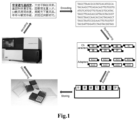
- the stored character information can be obtained by sequencing the DNA sequence followed by decoding with a computer (as shown in Figure 1 ).
- the method provided by the present invention has the advantages of small storage volume, large storage capacity, strong stability and low cost of maintenance, etc by using DNA as a storage medium.
- the technical object of the present invention can be achieved by the following aspects:
- the present invention provides a method for storing text information by using DNA as a storage medium, comprising the steps of:
- the encoding is Unicode-ucs2 encoding; that is, each Chinese character is encoded by a hexadecimal digit, for example, the corresponding Unicode code of the character " " is U+5535; each 1-bit hexadecimal digit is converted into a 4-bit binary digit, for example, 5 is converted into 0101 and 3 is converted into 0011, and thus the character " " is converted into a binary digit 0101010100110101; preferably, each 8-bit binary digit produce a 4-bit Hamming code for verification, and thus the Hamming codes of the character " " are 0010 and 1110 respectively. Finally, a complete binary code of the character " " can be obtained, that is 010101010010001101011110.
- the transcoding is performed according to the principle that the binary digit 0 is converted into G or T and the binary digit 1 is converted into C or A so as to convert the binary digit encoding a character into a DNA sequence.
- one Chinese character is encoded into 24 bases.
- the sequence design is controlled by considering one or more of parameters including GC content, secondary structure and base repetition rate of the DNA sequence; for example, preferably, the DNA sequence is designed such that the GC content thereof is 45-60%, preferably 50%; preferably, the DNA sequence is designed to avoid the formation of secondary structure; preferably, the DNA sequence is designed such that no more than 2 consecutive single bases are present therein. Taking the character " " as an example, it is finally converted into a DNA sequence TAGCTATAGGCTTGCATAGCACCG.
- Both the DNA sequence and the ligation adapter sequence in the present invention are obtained by de novo chemically synthesizing the forward and reverse strands and allowing them to anneal to form a double-stranded structure.
- a complementary locating base protrudes from both the DNA sequence fragment and the ligation adapter.
- the directional ligation of the DNA sequence to the ligation adapter is achieved via the complementary bases (i.e. , "locating base") respectively protruding from the DNA sequence and the ligation adapter.
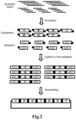
- the ligation adapter comprises an upstream adapter and a downstream adapter; ligation adapters with the same DNA sequence but the different overhanging locating bases will linked to the upstream and downstream of two DNA fragments respectively, and the resulted two DNA fragments can be ligated by the ligation adapters by using a conventional molecular biology method, preferably by PCA, GoldenGate, etc. (as shown in Figure 2 ).
- one base protrudes from each end of a DNA fragment respectively, such as a base “A” protrudes from the sense strand and a base “G” protrudes from the antisense strand of the DNA fragment at 5'-end, in which case, a base “T” should protrude from the antisense strand of the corresponding upstream adapter and a base “C” should protrude from the sense strand of the downstream adapter such that the directional ligation of the fragment to the adapter can be achieved by means of A/T and G/C pairing, that is, the adapter overhanging a "T” can only be linked at upstream of the DNA fragment and the adapter overhanging a "C” can only be linked at downstream of the DNA fragment.
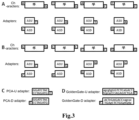
- the bases protruding from upstream and downstream of a DNA fragment may also be A/C, T/G and T/C, etc., in which case the corresponding bases protruding from the adapter become T/G, A/C and A/G, etc., correspondingly (as shown in Figure 3A ).
- more than one unpaired base may protrude from each of the DNA fragment and the adapter.
- the base may protrude from the DNA fragment and the adapter at the 3'-end thereof.
- a base “G” may protrude from the sense strand of the DNA fragment at both 5'-end and 3'-end, in which case, a base “C” should protrude from the antisense strand of the corresponding upstream adapter at 5'-end and the antisense strand of the downstream adapter at 3'-end, also allowing the directional ligation of the fragment to the adapter.
- the bases protruding from the sense strand of a DNA fragment at 5'-end and 3'-end may also be "C", "T” or "A”, in which case the bases protruding from the adapter should become “G", "A” or "T", correspondingly.
- Sequence of the ligation adapter can be automatically generated by a computer program.
- a PCA adapter needs to have a length of more than 8 bp, a GC content of 50%-60%, no secondary structure, no more than 2 consecutive bases, and no mismatch between the same set of adapters, etc .
- a GoldenGate adapter consists of an enzymatic cleavage site sequence and its outer protective bases, and the difference in the 4 bp sticky ends resulting from enzyme restriction between the same set of adapters needs to be more than 2 bp (as shown in Figure 3C ).
- the 5'-ends of the sense and antisense strands of the DNA fragment, the antisense strand of the upstream adapter, and the sense stand of the downstream adapter are phosphorylated.
- the 5'-ends of the sense strand of the upstream adapter and the antisense strand of the downstream adapter are dephosphorylated to reduce the probability of self-linking and misligation of the adapters.
- the designed ligation adapters are respectively added to the DNA sequences encoding the characters, though which locating is achieved; in a particular embodiment, by overlap extension PCR, individual DNA sequences comprising the encoding information of individual characters are ligated according to the character order of the information to be stored, and the ligated sequences can be further assembled into a longer DNA sequence; preferably, individual DNA sequences comprising the encoding information of individual characters are ligated by a method such as PCA or GoldenGate; preferably, the ligated DNA sequences are assembled by a Gibson method and the assembled DNA sequence which encodes the character information can be preserved under suitable storage conditions, for example, can be lyophilized for long-term storage at low temperatures.
- characters may be firstly assembled into a form of phrase or idiom, etc., such that the subsequent assembly becomes more convenient and efficient; for example, 10-20 characters may be assembled into a short sentence at once by using a method such as PCA or GoldenGate, etc., and then the short sentences can be further spliced into a long sentence, a paragraph or an article by using an assembly method such as Gibson assembly, etc.
- the assembled DNA sequence is cloned into a plasmid for storage; preferably, a step of verifying the correctness of the assembled DNA sequence by sequencing is also included prior to the storage.
- the present invention also provides a method for decoding the text information stored according to the method of the first aspect, comprising the steps of:
- the DNA sequence When a mutation exists in the DNA sequence, it can be corrected by the Hamming code. For example, if the base at position 2 of the above DNA sequence is mutated from A to G, i.e. the DNA sequence becomes TGGCTATAGGCTTGCATAGCACCG, the corresponding binary digit will become 000101010010001101011110. It can be calculated according to the Hamming code verification principle that the base at position 2 is mutated, and thereby the binary digit will be corrected to 010101010010001101011110 and the sequence can still be correctly decoded as " ".
- the decoding may further include the step of correcting mutations in the DNA sequence according to the Hamming code verification principle.
- the present invention provides use of the method for storing text information according to the first aspect and/or the method for decoding the stored text information according to the second aspect in the storage and/or reading of text information.
- the method for storing text information according to the present invention has the advantages of small storage volume, large storage capacity, strong stability and low cost of maintenance, etc. by using DNA as a storage medium.
- the present method is more suitable for storing text information, supporting text forms including characters of various countries including all Chinese characters, English letters, Japanese and Korean, etc., punctuation marks and mathematical symbols, etc .; has high encoding efficiency, wherein 1000 Chinese characters can be encoded within 100 milliseconds; adopts a strategy similar to "movable-type printing", wherein the DNA fragments and adapters can be used repeatedly, resulting in lower cost of synthesis; the stored DNA sequence can be in a double-stranded closed circular conformation, which is more stable in storage; the stored DNA sequence can be verified by sequencing and the Hamming verification code can be added thereto, allowing any one mutation in every 12 bases, which results in a more fidelity; and the stored DNA sequence is a long double-stranded DNA, which is more easier for reading information.
- the experimental procedures mentioned in the examples are conventional experimental methods unless otherwise specified; the reagents and consumables mentioned are conventional reagents and consumables unless otherwise specified.
- the synthetic oligos used in the experiments were diluted to 100 ⁇ M and the primers were diluted to 10 ⁇ M with sterile water.
- Transcoding was performed according to the method of the present invention and DNA oligo sequences were synthesized; the PCA adapters were used for locating and ligating according to G/C and A/T base pairing manner at the upstream and downstream, respectively.
- the DNA oligo and primer sequences were shown in Table 1 below.
- the forward and reverse oligos were each taken 10 ⁇ L for each character or adapter, mixed and annealed; the annealing procedure was: denatured at 99 °C for 10 min, slowly cooled to 25 °C at 0.1 °C/sec, maintained at 12 °C.
- the ligation system was: 1 ⁇ L of T4 DNA ligase (Enzymatics), 10 ⁇ L of 2 ⁇ ligation buffer, 2 ⁇ L each of the annealed character, upstream adapter and downstream adapter, 3 ⁇ L of ddH 2 O; ligating at 16°C overnight.
- the ligation products were subjected to gel electrophoresis on 15% PAGE gel at 100 V for 1 h (the electrophoresis results were shown in Figure 4A ); the target bands (42 bp in size, as indicated by the arrow in Figure 4A ) were cut off and purified: the cut gel was placed into a 0.5 mL tube with punctured bottom, which was then placed into a 2 mL tube, centrifuged at 14,000 rpm for 2 min, 200 ⁇ L of 0.3 M NaCl was added to the broken gel, shaken at 1400 rpm at 25 °C for 2 h; the broken gel and the liquid were transferred together into a filter column, centrifuged at 14,000 rpm for 2 min, the filtrate was transferred into a 1.5 mL centrifuge tube, 400 ⁇ L of absolute ethanol was added, left for sinking at -80 °C for 1 h.
- Step 1 0.2 ⁇ L of Ex Taq DNA polymerase (TAKARA), 2 ⁇ L of 10 ⁇ buffer, 1.6 ⁇ L of 2.5 mM dNTPs, 50 ng each of the ligated, cut and purified products of adapter 1-U + + adapter2-D, adapter2-U + + adapter5-D, adapter5-U + + adapter6-D, adapter6-U + + adapter7-D, adapter7-U + + adapter8-D, adapter8-U + + adapter9-D and adapter9-U+ + adapter10-D, adding water to 20 ⁇ L.
- TAKARA Ex Taq DNA polymerase
- Step 2 0.2 ⁇ L of Ex Taq DNA polymerase (TAKARA), 2 ⁇ L of 10 ⁇ buffer, 1.6 ⁇ L of 2.5 mM dNTPs, 3 ⁇ L of the PCR product of step 1, 1 ⁇ L each of the primers 12-F and St1-R, 11.2 ⁇ L of ddH 2 O.
- TAKARA Ex Taq DNA polymerase
- the PCR product was detected by electrophoresis: 5 ⁇ L of PCR product was used for electrophoresis detection. The electrophoresis was performed with 2% agarose gel at 180 V for 30 min (The electrophoresis result was shown in Figure 4B . The PCR product was approximately 280 bp in size as indicated by the arrows).
- the PCR product obtained in step 4 was purified by gel purification with a gel purification kit and the purified PCR product was cloned with a TA cloning kit (TAKARA).
- TAKARA TA cloning kit
- Monoclones were selected from the TA cloning plate obtained in step 5, incubated overnight, followed by plasmid extraction with a kit and identification by restriction digestion with the designed BssHII restriction site.
- the digestion system was: 0.5 ⁇ L of BssHII (NEB), 1 ⁇ L of CutSmart buffer, 4 ⁇ L of plasmid DNA and 4.5 ⁇ L of ddH 2 O. Digested at 37°C for 1 h. 5 ⁇ L of the digested product was used for electrophoresis with 2% agarose gel at 180 V for 30 min (the electrophoresis results were shown in Figure 4C and the band with correct size was indicated by the arrow).
Landscapes
- Engineering & Computer Science (AREA)
- Physics & Mathematics (AREA)
- Theoretical Computer Science (AREA)
- Health & Medical Sciences (AREA)
- Life Sciences & Earth Sciences (AREA)
- General Health & Medical Sciences (AREA)
- Biophysics (AREA)
- Evolutionary Biology (AREA)
- Bioinformatics & Cheminformatics (AREA)
- Bioinformatics & Computational Biology (AREA)
- General Engineering & Computer Science (AREA)
- General Physics & Mathematics (AREA)
- Computational Linguistics (AREA)
- Artificial Intelligence (AREA)
- Chemical & Material Sciences (AREA)
- Molecular Biology (AREA)
- Audiology, Speech & Language Pathology (AREA)
- Genetics & Genomics (AREA)
- Biotechnology (AREA)
- Spectroscopy & Molecular Physics (AREA)
- Data Mining & Analysis (AREA)
- Biochemistry (AREA)
- Organic Chemistry (AREA)
- Biomedical Technology (AREA)
- Medical Informatics (AREA)
- Evolutionary Computation (AREA)
- Computing Systems (AREA)
- Mathematical Physics (AREA)
- Software Systems (AREA)
- Bioethics (AREA)
- Databases & Information Systems (AREA)
- Measuring Or Testing Involving Enzymes Or Micro-Organisms (AREA)
Description
- The present invention belongs to the technical field of DNA-based storage, and in particular relates to a method for encoding and storing text information by using DNA as a storage medium, and a decoding method therefor and application thereof.
- With the development of human society, the accumulated amount of information shows an explosive growth trend. It has been predicted in IDC's report "Digital Universe in 2020" that by 2020 the total amount of global data will exceed 40 ZB! Moreover, the amount of global data is still growing rapidly at a rate of 58% per year, and a large amount of valid data is being lost. Data storage is a problem all over the world. The commonly used storage media at present, such as optical disks and hard disks, have disadvantages such as low storage capacity, large volume, high cost of maintenance and short storage time (~50 years). In order to solve these problems fundamentally, it is necessary to develop a novel information storage medium as soon as possible.
- DNA-based storage is a future-focused, subversive information storage technology. The use of DNA as an information storage medium has many advantages such as small volume, large storage capacity, strong stability and low cost of maintenance. Theoretically, 1 gram of DNA can store thousands of terabytes of data, from which it is estimated that the storage of all the existing information of human beings including books, files, videos, etc. can be achieved by using only hundreds of kilograms of DNA, and the storage time can be up to thousands of years under normal conditions. Therefore, those information that is not commonly used but needs long-term preservation, such as government documents and historical files, etc., is especially suitable for DNA-based storage.
- Although DNA-based storage has many superior advantages as compared with the existing storage, there are some technical barriers that hinder its development, such as the inability to reuse synthetic DNA oligo fragments, high cost of DNA synthesis, complex design and poor flexibility, etc., resulting in difficulties in large-scale promotion and application of the existing DNA-based storage technology. Therefore, it is necessary to start from the design of basic information-constituting unit to optimize the coding design of DNA-based storage, thereby reducing costs and improving efficiency and convenience.
- The following documents are also considered as the prior art but are apparently distinguished from the present invention:
- YAZDI S M HOSSEIN TABATABAEI ET AL: "DNA-Based Storage: Trends and Methods", IEEE TRANSACTIONS ON MOLECULAR, BIOLOGICAL AND MULTISCALE COMMUNICATIONS, IEEE, vol. 1, no. 3, 1 September 2015 (2015-09-01), pages 230-248, DOI: 10.1109/TMBMC.2016.2537305;
- Aisling O' Driscoll ET AL: "Synthetic DNA : The next generation of big data storage",
- Bioengineered, vol. 4, no. 3, 27 May 2013, pages 123-125, P055403531, US, ISSN: 2165-5979, DOI: 10.4161/bioe.24296;
-
US 2008/057546 A1 (LEXOW PREBEN [NO] ); -
KR 2016 0001455 A (KOREA RES INST OF BIOSCIENCE [KR]) - D. G. GIBSON ET AL: "Creation of a Bacterial Cell Controlled by a Chemically Synthesized Genome",SCIENCE, vol. 329, no. 5987, pages 52-56, , ISSN: 0036-8075, DOI: 10.1126/science.1190719;
- D. G. GIBSON: "Synthesis of DNA fragments in yeast by one-step assembly of overlapping oligonucleotides", NUCLEIC ACIDS RESEARCH ADVANCE ACCESS, vol. 37, no. 20, pages 6984-6990, GB, ISSN: 0305-1048, DOI: 10.1093/nar/gkp687; and
- BIJAN ZAKERI ET AL: "Multiplexed Sequence Encoding: A Framework for DNA Communication", PLOS ONE, vol. 11, no. 4, page e0152774, , DOI: 10.1371/journal.pone.0152774,
- The invention is defined by the appended claims.
- It is an object of the present invention to provide a method for encoding and storing text information by using DNA as a storage medium, and a decoding method therefor and application thereof.
- The method for storing text information provided by the present invention generally comprises: firstly, encoding a character into a computer binary digit by encoding, and then converting the binary digit into a DNA sequence by transcoding; and secondly, artificially synthesizing the DNA sequence encoding the character information and locating the character by a designed ligation adapter to assemble the DNA sequences encoding the characters in a preset order. Alternatively, the assembled DNA sequences can be further assembled into a longer DNA sequence as needed.
- In the method for storing text information of the present invention, each character can be used repeatedly, and by changing the adapter, can be used for storing any information, the principle of which is the same as that of the "movable-type printing" strategy. The DNA which has stored text information can be preserved under appropriate conditions. When the stored information needs to be read, the stored character information can be obtained by sequencing the DNA sequence followed by decoding with a computer (as shown in
Figure 1 ). The method provided by the present invention has the advantages of small storage volume, large storage capacity, strong stability and low cost of maintenance, etc by using DNA as a storage medium. - Specifically, the technical object of the present invention can be achieved by the following aspects:
In a first aspect, the present invention provides a method for storing text information by using DNA as a storage medium, comprising the steps of: - (1) encoding a character into a computer binary digit by encoding;
- (2) converting the computer binary digit encoding the character into a DNA sequence, which is represented by the four deoxyribonucleotides A, T, G, and C, by transcoding;
- (3) synthesizing the DNA sequence encoding the character;
- (4) locating the DNA sequence encoding the character by a designed ligation adapter, assembling individual DNA sequences encoding individual characters according to the order of characters of the information to be stored, followed by storing.
- In an alternative particular embodiment, the encoding is Unicode-ucs2 encoding; that is, each Chinese character is encoded by a hexadecimal digit, for example, the corresponding Unicode code of the character "" is U+5535; each 1-bit hexadecimal digit is converted into a 4-bit binary digit, for example, 5 is converted into 0101 and 3 is converted into 0011, and thus the character "
 " is converted into a binary digit 0101010100110101; preferably, each 8-bit binary digit produce a 4-bit Hamming code for verification, and thus the Hamming codes of the character "
 " are 0010 and 1110 respectively. Finally, a complete binary code of the character "
 " can be obtained, that is 010101010010001101011110.
- In an optional particular embodiment, the transcoding is performed according to the principle that the binary digit 0 is converted into G or T and the
binary digit 1 is converted into C or A so as to convert the binary digit encoding a character into a DNA sequence. - Preferably, one Chinese character is encoded into 24 bases.
- Preferably, the sequence design is controlled by considering one or more of parameters including GC content, secondary structure and base repetition rate of the DNA sequence; for example, preferably, the DNA sequence is designed such that the GC content thereof is 45-60%, preferably 50%; preferably, the DNA sequence is designed to avoid the formation of secondary structure; preferably, the DNA sequence is designed such that no more than 2 consecutive single bases are present therein. Taking the character "" as an example, it is finally converted into a DNA sequence TAGCTATAGGCTTGCATAGCACCG.

- Both the DNA sequence and the ligation adapter sequence in the present invention are obtained by de novo chemically synthesizing the forward and reverse strands and allowing them to anneal to form a double-stranded structure.
- In an optional particular embodiment, a complementary locating base protrudes from both the DNA sequence fragment and the ligation adapter. The directional ligation of the DNA sequence to the ligation adapter is achieved via the complementary bases (i.e. , "locating base") respectively protruding from the DNA sequence and the ligation adapter. By designing the ligation adapter, DNA sequence fragments encoding various characters can be ligated in the desired character order.
- In an optional particular embodiment, the ligation adapter comprises an upstream adapter and a downstream adapter; ligation adapters with the same DNA sequence but the different overhanging locating bases will linked to the upstream and downstream of two DNA fragments respectively, and the resulted two DNA fragments can be ligated by the ligation adapters by using a conventional molecular biology method, preferably by PCA, GoldenGate, etc. (as shown in
Figure 2 ). - For example, one base protrudes from each end of a DNA fragment respectively, such as a base "A" protrudes from the sense strand and a base "G" protrudes from the antisense strand of the DNA fragment at 5'-end, in which case, a base "T" should protrude from the antisense strand of the corresponding upstream adapter and a base "C" should protrude from the sense strand of the downstream adapter such that the directional ligation of the fragment to the adapter can be achieved by means of A/T and G/C pairing, that is, the adapter overhanging a "T" can only be linked at upstream of the DNA fragment and the adapter overhanging a "C" can only be linked at downstream of the DNA fragment. Similarly, the bases protruding from upstream and downstream of a DNA fragment may also be A/C, T/G and T/C, etc., in which case the corresponding bases protruding from the adapter become T/G, A/C and A/G, etc., correspondingly (as shown in
Figure 3A ). Similarly, more than one unpaired base may protrude from each of the DNA fragment and the adapter. Similarly, the base may protrude from the DNA fragment and the adapter at the 3'-end thereof. A base "G" may protrude from the sense strand of the DNA fragment at both 5'-end and 3'-end, in which case, a base "C" should protrude from the antisense strand of the corresponding upstream adapter at 5'-end and the antisense strand of the downstream adapter at 3'-end, also allowing the directional ligation of the fragment to the adapter. Similarly, the bases protruding from the sense strand of a DNA fragment at 5'-end and 3'-end may also be "C", "T" or "A", in which case the bases protruding from the adapter should become "G", "A" or "T", correspondingly. Similarly, "G", "C", "T" or "A" may protrude from the antisense strand of a DNA fragment, in which case "C", "G", "A" or "T" should protrude from the sense strand of the adapter, correspondingly (as shown inFigure 3B ). Similarly, more than one complementary base may protrude from each of the DNA fragment and the adapter. - Sequence of the ligation adapter can be automatically generated by a computer program. For example, a PCA adapter needs to have a length of more than 8 bp, a GC content of 50%-60%, no secondary structure, no more than 2 consecutive bases, and no mismatch between the same set of adapters, etc.; a GoldenGate adapter consists of an enzymatic cleavage site sequence and its outer protective bases, and the difference in the 4 bp sticky ends resulting from enzyme restriction between the same set of adapters needs to be more than 2 bp (as shown in
Figure 3C ). The 5'-ends of the sense and antisense strands of the DNA fragment, the antisense strand of the upstream adapter, and the sense stand of the downstream adapter are phosphorylated. The 5'-ends of the sense strand of the upstream adapter and the antisense strand of the downstream adapter are dephosphorylated to reduce the probability of self-linking and misligation of the adapters. - To the DNA sequences encoding the characters are respectively added the designed ligation adapters, though which locating is achieved; in a particular embodiment, by overlap extension PCR, individual DNA sequences comprising the encoding information of individual characters are ligated according to the character order of the information to be stored, and the ligated sequences can be further assembled into a longer DNA sequence; preferably, individual DNA sequences comprising the encoding information of individual characters are ligated by a method such as PCA or GoldenGate; preferably, the ligated DNA sequences are assembled by a Gibson method and the assembled DNA sequence which encodes the character information can be preserved under suitable storage conditions, for example, can be lyophilized for long-term storage at low temperatures.
- In a particular embodiment, characters may be firstly assembled into a form of phrase or idiom, etc., such that the subsequent assembly becomes more convenient and efficient; for example, 10-20 characters may be assembled into a short sentence at once by using a method such as PCA or GoldenGate, etc., and then the short sentences can be further spliced into a long sentence, a paragraph or an article by using an assembly method such as Gibson assembly, etc.
- Preferably, the assembled DNA sequence is cloned into a plasmid for storage; preferably, a step of verifying the correctness of the assembled DNA sequence by sequencing is also included prior to the storage.
- In a second aspect, the present invention also provides a method for decoding the text information stored according to the method of the first aspect, comprising the steps of:
- (1) sequencing the DNA sequence which stores text information, for example, by sanger sequencing, second generation sequencing, third generation sequencing or other sequencing methods;
- (2) converting the sequenced DNA sequence into a binary digit, which in turn is converted into a corresponding Chinese character according to the same transcoding and encoding rules as defined in the method described in the first aspect to obtain the stored text information.
- When a mutation exists in the DNA sequence, it can be corrected by the Hamming code. For example, if the base at
position 2 of the above DNA sequence is mutated from A to G, i.e. the DNA sequence becomes TGGCTATAGGCTTGCATAGCACCG, the corresponding binary digit will become 000101010010001101011110. It can be calculated according to the Hamming code verification principle that the base atposition 2 is mutated, and thereby the binary digit will be corrected to 010101010010001101011110 and the sequence can still be correctly decoded as "".
- Therefore, in particular embodiments, the decoding may further include the step of correcting mutations in the DNA sequence according to the Hamming code verification principle.
- In a third aspect, the present invention provides use of the method for storing text information according to the first aspect and/or the method for decoding the stored text information according to the second aspect in the storage and/or reading of text information.
- First, the method for storing text information according to the present invention has the advantages of small storage volume, large storage capacity, strong stability and low cost of maintenance, etc. by using DNA as a storage medium.
- In addition, compared with other existing DNA storage methods, the present method is more suitable for storing text information, supporting text forms including characters of various countries including all Chinese characters, English letters, Japanese and Korean, etc., punctuation marks and mathematical symbols, etc.; has high encoding efficiency, wherein 1000 Chinese characters can be encoded within 100 milliseconds; adopts a strategy similar to "movable-type printing", wherein the DNA fragments and adapters can be used repeatedly, resulting in lower cost of synthesis; the stored DNA sequence can be in a double-stranded closed circular conformation, which is more stable in storage; the stored DNA sequence can be verified by sequencing and the Hamming verification code can be added thereto, allowing any one mutation in every 12 bases, which results in a more fidelity; and the stored DNA sequence is a long double-stranded DNA, which is more easier for reading information.
-
-
Figure 1 shows a schematic view showing the overall flow of Example 1 of the present invention; -
Figure 2 shows a schematic view showing the assembly flow of Example 1 of the present invention; -
Figure 3 shows schematic views showing the designs of fragments/adapters of Example 1 of the present invention; -
Figure 4 shows electrophoretograms of the assembly test results of Example 1 of the present invention. - The experimental procedures mentioned in the examples are conventional experimental methods unless otherwise specified; the reagents and consumables mentioned are conventional reagents and consumables unless otherwise specified. The synthetic oligos used in the experiments were diluted to 100 µM and the primers were diluted to 10 µM with sterile water.
- The phrase for the assembly test:.

- Transcoding was performed according to the method of the present invention and DNA oligo sequences were synthesized; the PCA adapters were used for locating and ligating according to G/C and A/T base pairing manner at the upstream and downstream, respectively. The DNA oligo and primer sequences were shown in Table 1 below.
- The forward and reverse oligos were each taken 10 µL for each character or adapter, mixed and annealed; the annealing procedure was: denatured at 99 °C for 10 min, slowly cooled to 25 °C at 0.1 °C/sec, maintained at 12 °C.
- To each character were added upstream and downstream adapters in order respectively for ligation; the ligation system was: 1 µL of T4 DNA ligase (Enzymatics), 10 µL of 2 × ligation buffer, 2 µL each of the annealed character, upstream adapter and downstream adapter, 3 µL of ddH2O; ligating at 16°C overnight.
- The ligation products were subjected to gel electrophoresis on 15% PAGE gel at 100 V for 1 h (the electrophoresis results were shown in
Figure 4A ); the target bands (42 bp in size, as indicated by the arrow inFigure 4A ) were cut off and purified: the cut gel was placed into a 0.5 mL tube with punctured bottom, which was then placed into a 2 mL tube, centrifuged at 14,000 rpm for 2 min, 200 µL of 0.3 M NaCl was added to the broken gel, shaken at 1400 rpm at 25 °C for 2 h; the broken gel and the liquid were transferred together into a filter column, centrifuged at 14,000 rpm for 2 min, the filtrate was transferred into a 1.5 mL centrifuge tube, 400 µL of absolute ethanol was added, left for sinking at -80 °C for 1 h. Centrifuged at 14000 rpm at 4 °C for 30 min, discarded the supernatant, 500 µL of 70% ethanol was added for washing the precipitate once, drawn off the supernatant, dried at 37 °C for 5 min, and 20 µL of ddH2O was added to dissolve the DNA. - The characters were assembled into a short sentence by using a method of PCA. Step 1: 0.2 µL of Ex Taq DNA polymerase (TAKARA), 2 µL of 10×buffer, 1.6 µL of 2.5 mM dNTPs, 50 ng each of the ligated, cut and purified products of adapter 1-U ++ adapter2-D, adapter2-U +
 + adapter5-D, adapter5-U +
 + adapter6-D, adapter6-U +
 + adapter7-D, adapter7-U +
 + adapter8-D, adapter8-U +
 + adapter9-D and adapter9-U+
 + adapter10-D, adding water to 20 µL. 94 °C for 5 min; 94 °C for 30 sec, 55 °C for 1 sec, cooled to 45 °C at 0.5 °C/sec, 45 °C for 15 sec, 72 °C for 1 min, 20 cycles; 72 °C for 5 min, maintained at 12 °C. Step 2: 0.2 µL of Ex Taq DNA polymerase (TAKARA), 2 µL of 10×buffer, 1.6 µL of 2.5 mM dNTPs, 3 µL of the PCR product of step 1, 1 µL each of the primers 12-F and St1-R, 11.2 µL of ddH2O. 94 °C for 5 min; 94 °C for 30 sec, 60 °C for 30 sec, 72 °C for 30 sec, 35 cycles, 72 °C for 5 min, maintained at 12 °C∘
- The PCR product was detected by electrophoresis: 5 µL of PCR product was used for electrophoresis detection. The electrophoresis was performed with 2% agarose gel at 180 V for 30 min (The electrophoresis result was shown in
Figure 4B . The PCR product was approximately 280 bp in size as indicated by the arrows). - The PCR product obtained in
step 4 was purified by gel purification with a gel purification kit and the purified PCR product was cloned with a TA cloning kit (TAKARA). - Monoclones were selected from the TA cloning plate obtained in
step 5, incubated overnight, followed by plasmid extraction with a kit and identification by restriction digestion with the designed BssHII restriction site. The digestion system was: 0.5 µL of BssHII (NEB), 1 µL of CutSmart buffer, 4 µL of plasmid DNA and 4.5 µL of ddH2O. Digested at 37°C for 1 h. 5 µL of the digested product was used for electrophoresis with 2% agarose gel at 180 V for 30 min (the electrophoresis results were shown inFigure 4C and the band with correct size was indicated by the arrow). - The correctly enzyme-digested plasmid was selected for sanger sequencing, and the plasmid with the correct assembly sequence was analyzed and obtained.
Table 1 NO. Sequence -F (SEQ ID NO.1)
ATAGCTTAACGCGTATGACATCGCA -R (SEQ ID NO.2)
GTGCGATGTCATACGCGTTAAGCTA -F (SEQ ID NO.3)
ATACAAGCTTCAGACAGTTGTGGTG -R (SEQ ID NO.4)
GCACCACAACTGTCTGAAGCTTGTA -F (SEQ ID NO.5)
AATGTCATGGTTGTGACGTGCATAC -R (SEQ ID NO.6)
GGTATGCACGTCACAACCATGACAT -F (SEQ ID NO.7)
ATAGCTTGAGACCATTACGTACGGT -R (SEQ ID NO.8)
GACCGTACGTAATGGTCTCAAGCTA -F (SEQ ID NO.9)
ATAGCTAACCAACACCACTAGAGCT -R (SEQ ID NO.10)
GAGCTCTAGTGGTGTTGGTTAGCTA -F (SEQ ID NO.11)
ATAGCTAATCCGGAACTTGTGGTGT -R (SEQ ID NO.12)
GACACCACAAGTTCCGGATTAGCTA -F (SEQ ID NO.13)
ATACGATTGGATCCTAGTACGGTAG -R (SEQ ID NO.14)
GCTACCGTACTAGGATCCAATCGTA adapter 1-UF (SEQ ID NO.15) CTCATTCC adapter 1-UR (SEQ ID NO.16) TGGAATGAG adapter2-UF (SEQ ID NO.17) AATTCGCG adapter2-UR (SEQ ID NO.18) TCGCGAATT adapter2-DF (SEQ ID NO.19) CAATTCGCG adapter2-DR (SEQ ID NO.20) CGCGAATT adapter5-UF CCTTTAGC (SEQ ID NO.21) adapter5-UR (SEQ ID NO.22) TGCTAAAGG adapter5-DF (SEQ ID NO.23) CCCTTTAGC adapter5-DR (SEQ ID NO.24) GCTAAAGG adapter6-UF (SEQ ID NO.25) ACAGAGAC adapter6-UR (SEQ ID NO.26) TGTCTCTGT adapter6-DF (SEQ ID NO.27) CACAGAGAC adapter6-DR (SEQ ID NO.28) GTCTCTGT adapter7-UF (SEQ ID NO.29) CCGTCATA adapter7-UR (SEQ ID NO.30) TTATGACGG adapter7-DF (SEQ ID NO.31) CCCGTCATA adapter7-DR (SEQ ID NO.32) TATGACGG adapter8-UF (SEQ ID NO.33) GGATCTAC adapter8-UR (SEQ ID NO.34) TGTAGATCC adapter8-DF (SEQ ID NO.35) CGGATCTAC adapter8-DR (SEQ ID NO.36) GTAGATCC adapter9-UF (SEQ ID NO.37) GTTGCATC adapter9-UR (SEQ ID NO.38) TGATGCAAC adapter9-DF (SEQ ID NO.39) CGTTGCATC adapter9-DR (SEQ ID NO.40) GATGCAAC adapter 10-DF (SEQ ID NO.41) CATCGGGAA adapter 10-DR (SEQ ID NO.42) TTCCCGAT St12-F (SEQ ID NO.43) 
St1-R (SEQ ID NO.44) GCGCGCTACCGTACTAGGATCCAATCG
Claims (9)
- A method for storing text information by using DNA as a storage medium, comprising the steps of:(1) encoding a character into a computer binary digit by encoding;(2) converting the computer binary digit encoding the character into a DNA sequence, which is represented by the four deoxyribonucleotides A, T, G, and C, by transcoding;(3) synthesizing the DNA sequence encoding the character;(4) locating the DNA sequence encoding the character by a designed ligation adapter, ligating individual DNA sequences encoding individual characters according to the order of characters of the information to be stored, followed by assembling and storing, wherein the ligation adapter includes an upstream adapter and a downstream adapter, and the 5'-ends of the sense strand of the upstream adapter and the antisense strand of the downstream adapter are dephosphorylated.
- The method according to claim 1, wherein the encoding is Unicode-ucs2 encoding.
- The method according to claim 1 or 2, wherein the character is a Chinese character and the Chinese character is encoded by a hexadecimal digit, each 1-bit hexadecimal digit is converted into a 4-bit binary digit; preferably, each 8-bit binary digit produce a 4-bit Hamming code for verification.
- The method according to any of claims 1-3, wherein the transcoding is performed according to the principle that the binary digit 0 is converted into G or T and the binary digit 1 is converted into C or A so as to convert the binary digit encoding a character into a DNA sequence.
- The method according to any one of claims 2-3, wherein one Chinese character is encoded into 24 bases.
- The method according to any one of claims 1-5, wherein the sequence design is controlled by considering one or more of parameters including GC content, secondary structure and base repetition rate of the DNA sequence;preferably, the DNA sequence is designed such that the GC content thereof is 45-60%, preferably 50%;preferably, the DNA sequence is designed to avoid the formation of secondary structure;preferably, the DNA sequence is designed such that no more than 2 consecutive single bases are present therein.
- The method according to any one of claims 1-6, wherein in step (4), the ligation of the DNA sequence to the ligation adapter is directional and achieved via the complementary bases respectively protruding from the DNA sequence and the ligation adapter;preferably, by overlap extension PCR, individual DNA sequences comprising the encoding information of individual characters are ligated, followed by being further assembled into a longer DNA sequence; further preferably, the ligation is performed by Polymerase Chain Assembly or Golden Gate Assembly method; further preferably, the assembly is performed by Gibson Assembly method;preferably, the assembled DNA sequence is cloned into a plasmid for storage;preferably, a step of verifying the correctness of the assembled DNA sequence by sequencing is also included prior to the storage.
- A method for decoding the text information stored according to the method of claim 3, comprising the steps of:(1) sequencing the DNA sequence which stores text information;(2) reversely performing the encoding in the method according to claim 3 to decode the sequenced DNA sequence into a computer binary digit, and(3) reversely performing the converting in the method according to claim 3 to decode the computer binary digit into a corresponding Chinese character to obtain the stored text information.
- The method according to claim 8, the step (2) further including correcting mutations in the DNA sequence according to the Hamming code verification principle.
Applications Claiming Priority (1)
| Application Number | Priority Date | Filing Date | Title |
|---|---|---|---|
| PCT/CN2016/081037 WO2017190297A1 (en) | 2016-05-04 | 2016-05-04 | Method for using dna to store text information, decoding method therefor and application thereof |
Publications (3)
| Publication Number | Publication Date |
|---|---|
| EP3470997A1 EP3470997A1 (en) | 2019-04-17 |
| EP3470997A4 EP3470997A4 (en) | 2020-04-01 |
| EP3470997B1 true EP3470997B1 (en) | 2024-10-23 |
Family
ID=60202585
Family Applications (1)
| Application Number | Title | Priority Date | Filing Date |
|---|---|---|---|
| EP16900819.0A Active EP3470997B1 (en) | 2016-05-04 | 2016-05-04 | Method for using dna to store text information, decoding method therefor and application thereof |
Country Status (4)
| Country | Link |
|---|---|
| US (1) | US10839295B2 (en) |
| EP (1) | EP3470997B1 (en) |
| CN (1) | CN109074424B (en) |
| WO (1) | WO2017190297A1 (en) |
Families Citing this family (38)
| Publication number | Priority date | Publication date | Assignee | Title |
|---|---|---|---|---|
| US10650312B2 (en) | 2016-11-16 | 2020-05-12 | Catalog Technologies, Inc. | Nucleic acid-based data storage |
| ES2979182T3 (en) | 2016-11-16 | 2024-09-24 | Catalog Tech Inc | Nucleic acid-based data storage |
| KR20200132921A (en) * | 2018-03-16 | 2020-11-25 | 카탈로그 테크놀로지스, 인크. | Chemical methods for storing nucleic acid-based data |
| US11339423B2 (en) * | 2018-03-18 | 2022-05-24 | Bryan Bishop | Systems and methods for data storage in nucleic acids |
| KR102956991B1 (en) | 2018-05-16 | 2026-04-24 | 카탈로그 테크놀로지스, 인크. | Composition and method for storing nucleic acid-based data |
| GB2576304B (en) * | 2018-07-26 | 2020-09-09 | Evonetix Ltd | Accessing data storage provided using double-stranded nucleic acid molecules |
| KR20210053292A (en) | 2018-08-03 | 2021-05-11 | 카탈로그 테크놀로지스, 인크. | Nucleic acid-based data storage and reading system and method with error protection |
| CA3108869A1 (en) * | 2018-08-10 | 2020-02-13 | Nucleotrace Pty. Ltd. | Systems and methods for identifying a product's identity |
| US11017170B2 (en) | 2018-09-27 | 2021-05-25 | At&T Intellectual Property I, L.P. | Encoding and storing text using DNA sequences |
| CN109460822B (en) * | 2018-11-19 | 2021-11-12 | 天津大学 | DNA-based information storage method |
| CN109943560A (en) * | 2018-11-22 | 2019-06-28 | 西藏自治区人民政府驻成都办事处医院 | Chinese character information storage method based on DNA vector |
| CN109830263B (en) * | 2019-01-30 | 2023-04-07 | 东南大学 | DNA storage method based on oligonucleotide sequence coding storage |
| CN109887549B (en) * | 2019-02-22 | 2023-01-20 | 天津大学 | Data storage and restoration method and device |
| WO2020227718A1 (en) | 2019-05-09 | 2020-11-12 | Catalog Technologies, Inc. | Data structures and operations for searching, computing, and indexing in dna-based data storage |
| GB201907460D0 (en) | 2019-05-27 | 2019-07-10 | Vib Vzw | A method of storing information in pools of nucleic acid molecules |
| US10956806B2 (en) | 2019-06-10 | 2021-03-23 | International Business Machines Corporation | Efficient assembly of oligonucleotides for nucleic acid based data storage |
| CN114730616B (en) * | 2019-09-24 | 2025-05-09 | 深圳华大生命科学研究院 | Information encoding and decoding method, device, storage medium, and information storage and interpretation method |
| JP7726874B2 (en) | 2019-10-11 | 2025-08-20 | カタログ テクノロジーズ, インコーポレイテッド | Nucleic Acid Security and Authentication |
| CN111028883B (en) * | 2019-11-20 | 2023-07-18 | 广州达美智能科技有限公司 | Gene processing method, device and readable storage medium based on Boolean algebra |
| CN111091876B (en) * | 2019-12-16 | 2024-05-17 | 中国科学院深圳先进技术研究院 | DNA storage method, system and electronic device |
| CN111243670A (en) * | 2020-01-23 | 2020-06-05 | 天津大学 | A DNA information storage and coding method that satisfies biological constraints |
| CN111368132B (en) * | 2020-02-28 | 2023-04-14 | 元码基因科技(北京)股份有限公司 | Method for storing audio or video files based on DNA sequences and storage medium |
| CN111680797B (en) * | 2020-05-08 | 2023-06-06 | 中国科学院计算技术研究所 | DNA type printer, DNA-based data storage device and method |
| EP4150622B1 (en) | 2020-05-11 | 2024-09-25 | Catalog Technologies, Inc. | Programs and functions in dna-based data storage |
| US20240419325A1 (en) * | 2020-06-03 | 2024-12-19 | Bgi Shenzhen | Method for Generating a DNA Storage Encoding/Decoding rule, and Method for DNA Storage Encoding/Decoding |
| CN111737955A (en) * | 2020-06-24 | 2020-10-02 | 任兆瑞 | Method for storing character dot matrix by using DNA character code |
| CN114058471A (en) * | 2020-07-29 | 2022-02-18 | 东南大学 | Data storage device, preparation method and reading method loaded with DNA storage data |
| CN112100982B (en) * | 2020-08-07 | 2023-06-20 | 广州大学 | DNA storage method, system and storage medium |
| CN112002376B (en) * | 2020-08-13 | 2024-03-19 | 中国海洋大学 | Method for recording and reading information by DNA molecules |
| CN112382340B (en) * | 2020-11-25 | 2022-11-15 | 中国科学院深圳先进技术研究院 | Encoding and decoding method and encoding and decoding device for DNA data storage |
| CN112802549B (en) * | 2021-01-26 | 2022-05-13 | 武汉大学 | Coding and decoding method for DNA sequence integrity check and error correction |
| US20220243252A1 (en) * | 2021-02-03 | 2022-08-04 | Seagate Technology Llc | Isotope modified nucleotides for dna data storage |
| CN113744804B (en) * | 2021-06-21 | 2023-03-10 | 深圳先进技术研究院 | Method and device for storing data by using DNA and storage equipment |
| WO2023108616A1 (en) * | 2021-12-17 | 2023-06-22 | 深圳华大生命科学研究院 | Method and system for storing information using dna |
| CN114898806B (en) * | 2022-05-25 | 2024-09-20 | 天津大学 | DNA type writing system and method |
| CN114758703B (en) * | 2022-06-14 | 2022-09-13 | 深圳先进技术研究院 | Data information storage method based on recombinant plasmid DNA molecules |
| CN114958828B (en) * | 2022-06-14 | 2024-04-19 | 深圳先进技术研究院 | Data information storage method based on DNA molecular medium |
| CN119993238B (en) * | 2025-01-03 | 2025-09-12 | 中国科学院武汉病毒研究所 | Method and device for editing information and reading editing information in DNA storage |
Family Cites Families (15)
| Publication number | Priority date | Publication date | Assignee | Title |
|---|---|---|---|---|
| JP2004512807A (en) * | 1999-03-18 | 2004-04-30 | コンプリート ゲノミックス エイエス | Cloning and generation of fragment chains with readable information |
| US20040121362A1 (en) * | 2002-06-20 | 2004-06-24 | Whitney Gena S. | Identification and modulation of a G-protein coupled receptor (GPCR), RAI-3, associated with chronic obstructive pulmonary disease (COPD) and NF-kappaB and E-selectin regulation |
| US20040001371A1 (en) * | 2002-06-26 | 2004-01-01 | The Arizona Board Of Regents On Behalf Of The University Of Arizona | Information storage and retrieval device using macromolecules as storage media |
| US20040153255A1 (en) | 2003-02-03 | 2004-08-05 | Ahn Tae-Jin | Apparatus and method for encoding DNA sequence, and computer readable medium |
| US20050053968A1 (en) * | 2003-03-31 | 2005-03-10 | Council Of Scientific And Industrial Research | Method for storing information in DNA |
| JP2004355294A (en) * | 2003-05-29 | 2004-12-16 | National Institute Of Advanced Industrial & Technology | Designing method of dna code as information carrier |
| CN107055468A (en) * | 2012-06-01 | 2017-08-18 | 欧洲分子生物学实验室 | The high-capacity storage of digital information in DNA |
| WO2014093852A1 (en) * | 2012-12-13 | 2014-06-19 | Massachusetts Institute Of Technology | Recombinase-based logic and memory systems |
| CN105022935A (en) | 2014-04-22 | 2015-11-04 | 中国科学院青岛生物能源与过程研究所 | Encoding method and decoding method for performing information storage by means of DNA |
| KR20160001455A (en) * | 2014-06-27 | 2016-01-06 | 한국생명공학연구원 | DNA Memory for Data Storage |
| JP2017538234A (en) * | 2014-10-18 | 2017-12-21 | マリク、ギリクMALIK, Girik | Data storage system |
| US20170335334A1 (en) * | 2014-10-29 | 2017-11-23 | Massachusetts Institute Of Technology | Dna cloaking technologies |
| CN104850760B (en) | 2015-03-27 | 2016-12-21 | 苏州泓迅生物科技有限公司 | The information storing and reading method of artificial-synthetic DNA's storage medium |
| CN105119717A (en) * | 2015-07-21 | 2015-12-02 | 郑州轻工业学院 | DNA coding based encryption system and encryption method |
| US20170141793A1 (en) * | 2015-11-13 | 2017-05-18 | Microsoft Technology Licensing, Llc | Error correction for nucleotide data stores |
-
2016
- 2016-05-04 EP EP16900819.0A patent/EP3470997B1/en active Active
- 2016-05-04 WO PCT/CN2016/081037 patent/WO2017190297A1/en not_active Ceased
- 2016-05-04 CN CN201680085320.9A patent/CN109074424B/en active Active
- 2016-05-04 US US16/098,471 patent/US10839295B2/en active Active
Non-Patent Citations (1)
| Title |
|---|
| BIJAN ZAKERI ET AL: "Multiplexed Sequence Encoding: A Framework for DNA Communication", PLOS ONE, vol. 11, no. 4, 6 April 2016 (2016-04-06), pages e0152774, XP055563194, DOI: 10.1371/journal.pone.0152774 * |
Also Published As
| Publication number | Publication date |
|---|---|
| CN109074424B (en) | 2022-03-11 |
| US20190138909A1 (en) | 2019-05-09 |
| US10839295B2 (en) | 2020-11-17 |
| WO2017190297A1 (en) | 2017-11-09 |
| CN109074424A (en) | 2018-12-21 |
| EP3470997A1 (en) | 2019-04-17 |
| EP3470997A4 (en) | 2020-04-01 |
Similar Documents
| Publication | Publication Date | Title |
|---|---|---|
| EP3470997A1 (en) | Method for using dna to store text information, decoding method therefor and application thereof | |
| Sloan | One ring to rule them all? Genome sequencing provides new insights into the ‘master circle’model of plant mitochondrial DNA structure | |
| Babski et al. | Genome-wide identification of transcriptional start sites in the haloarchaeon Haloferax volcanii based on differential RNA-Seq (dRNA-Seq) | |
| CN109300508B (en) | DNA data storage coding decoding method | |
| Koslowsky et al. | The insect-phase gRNA transcriptome in Trypanosoma brucei | |
| Gilson et al. | Jam packed genomes–a preliminary, comparative analysis of nucleomorphs | |
| CN106868005B (en) | Anchor primer for efficiently and quickly amplifying cDNA (complementary deoxyribonucleic acid) terminal and amplification method | |
| CN106845158A (en) | A kind of method that information Store is carried out using DNA | |
| Haas et al. | Comparative analysis of ribonuclease P RNA structure in Archaea | |
| Buchko et al. | Detection of length heterogeneity in the ribosomal DNA of Pythium ultimum by PCR amplification of the intergenic region | |
| US11279927B2 (en) | Compositions and methods for constructing strand specific CDNA libraries | |
| US11845982B2 (en) | Key-value store that harnesses live micro-organisms to store and retrieve digital information | |
| Kan et al. | The intervening sequence of the ribosomal RNA gene is highly conserved between two Tetra-hymena species | |
| Uda et al. | Complete mitochondrial genomes of the Japanese pink coral (Corallium elatius) and the Mediterranean red coral (Corallium rubrum): a reevaluation of the phylogeny of the family Coralliidae based on molecular data | |
| KR20160001455A (en) | DNA Memory for Data Storage | |
| Garafutdinov et al. | Encoding of non-biological information for its long-term storage in DNA | |
| O’Driscoll et al. | Synthetic DNA: the next generation of big data storage | |
| EP3803882A1 (en) | A method of storing information using dna molecules | |
| Slomovic et al. | RNA polyadenylation in prokaryotes and organelles; different tails tell different tales | |
| Yang et al. | Telomere associated primase Tap repairs truncated telomeres of Streptomyces | |
| EP2411933A2 (en) | Methods for providing a set of symbols uniquely distinguishing an organism such as a human individual | |
| CN114898806A (en) | A DNA movable type writing system and method | |
| Ahmed et al. | Mitochondrial DNA of the demosponge Acanthella acuta: linear architecture and other unique features | |
| EP4451278A1 (en) | Method and system for storing information using dna | |
| HK1260446B (en) | Method for using dna to store text information, decoding method therefor and application thereof |
Legal Events
| Date | Code | Title | Description |
|---|---|---|---|
| STAA | Information on the status of an ep patent application or granted ep patent |
Free format text: STATUS: THE INTERNATIONAL PUBLICATION HAS BEEN MADE |
|
| PUAI | Public reference made under article 153(3) epc to a published international application that has entered the european phase |
Free format text: ORIGINAL CODE: 0009012 |
|
| STAA | Information on the status of an ep patent application or granted ep patent |
Free format text: STATUS: REQUEST FOR EXAMINATION WAS MADE |
|
| 17P | Request for examination filed |
Effective date: 20181204 |
|
| AK | Designated contracting states |
Kind code of ref document: A1 Designated state(s): AL AT BE BG CH CY CZ DE DK EE ES FI FR GB GR HR HU IE IS IT LI LT LU LV MC MK MT NL NO PL PT RO RS SE SI SK SM TR |
|
| AX | Request for extension of the european patent |
Extension state: BA ME |
|
| DAV | Request for validation of the european patent (deleted) | ||
| DAX | Request for extension of the european patent (deleted) | ||
| REG | Reference to a national code |
Ref country code: DE Ref legal event code: R079 Free format text: PREVIOUS MAIN CLASS: G06F0019100000 Ipc: G16B0050200000 Ref country code: DE Ref legal event code: R079 Ref document number: 602016089984 Country of ref document: DE Free format text: PREVIOUS MAIN CLASS: G06F0019100000 Ipc: G16B0050200000 |
|
| A4 | Supplementary search report drawn up and despatched |
Effective date: 20200227 |
|
| RIC1 | Information provided on ipc code assigned before grant |
Ipc: G16B 50/20 20190101AFI20200222BHEP |
|
| STAA | Information on the status of an ep patent application or granted ep patent |
Free format text: STATUS: EXAMINATION IS IN PROGRESS |
|
| 17Q | First examination report despatched |
Effective date: 20230517 |
|
| RIC1 | Information provided on ipc code assigned before grant |
Ipc: G06N 3/123 20230101ALI20231027BHEP Ipc: G11C 13/00 20060101ALI20231027BHEP Ipc: C07H 21/04 20060101ALI20231027BHEP Ipc: G16B 50/20 20190101AFI20231027BHEP |
|
| GRAP | Despatch of communication of intention to grant a patent |
Free format text: ORIGINAL CODE: EPIDOSNIGR1 |
|
| STAA | Information on the status of an ep patent application or granted ep patent |
Free format text: STATUS: GRANT OF PATENT IS INTENDED |
|
| INTG | Intention to grant announced |
Effective date: 20240513 |
|
| GRAS | Grant fee paid |
Free format text: ORIGINAL CODE: EPIDOSNIGR3 |
|
| GRAA | (expected) grant |
Free format text: ORIGINAL CODE: 0009210 |
|
| STAA | Information on the status of an ep patent application or granted ep patent |
Free format text: STATUS: THE PATENT HAS BEEN GRANTED |
|
| AK | Designated contracting states |
Kind code of ref document: B1 Designated state(s): AL AT BE BG CH CY CZ DE DK EE ES FI FR GB GR HR HU IE IS IT LI LT LU LV MC MK MT NL NO PL PT RO RS SE SI SK SM TR |
|
| REG | Reference to a national code |
Ref country code: GB Ref legal event code: FG4D |
|
| REG | Reference to a national code |
Ref country code: CH Ref legal event code: EP |
|
| REG | Reference to a national code |
Ref country code: DE Ref legal event code: R096 Ref document number: 602016089984 Country of ref document: DE |
|
| REG | Reference to a national code |
Ref country code: IE Ref legal event code: FG4D |
|
| REG | Reference to a national code |
Ref country code: LT Ref legal event code: MG9D |
|
| REG | Reference to a national code |
Ref country code: NL Ref legal event code: MP Effective date: 20241023 |
|
| REG | Reference to a national code |
Ref country code: AT Ref legal event code: MK05 Ref document number: 1735533 Country of ref document: AT Kind code of ref document: T Effective date: 20241023 |
|
| PG25 | Lapsed in a contracting state [announced via postgrant information from national office to epo] |
Ref country code: NL Free format text: LAPSE BECAUSE OF FAILURE TO SUBMIT A TRANSLATION OF THE DESCRIPTION OR TO PAY THE FEE WITHIN THE PRESCRIBED TIME-LIMIT Effective date: 20241023 |
|
| PG25 | Lapsed in a contracting state [announced via postgrant information from national office to epo] |
Ref country code: NL Free format text: LAPSE BECAUSE OF FAILURE TO SUBMIT A TRANSLATION OF THE DESCRIPTION OR TO PAY THE FEE WITHIN THE PRESCRIBED TIME-LIMIT Effective date: 20241023 |
|
| PG25 | Lapsed in a contracting state [announced via postgrant information from national office to epo] |
Ref country code: IS Free format text: LAPSE BECAUSE OF FAILURE TO SUBMIT A TRANSLATION OF THE DESCRIPTION OR TO PAY THE FEE WITHIN THE PRESCRIBED TIME-LIMIT Effective date: 20250223 Ref country code: HR Free format text: LAPSE BECAUSE OF FAILURE TO SUBMIT A TRANSLATION OF THE DESCRIPTION OR TO PAY THE FEE WITHIN THE PRESCRIBED TIME-LIMIT Effective date: 20241023 Ref country code: PT Free format text: LAPSE BECAUSE OF FAILURE TO SUBMIT A TRANSLATION OF THE DESCRIPTION OR TO PAY THE FEE WITHIN THE PRESCRIBED TIME-LIMIT Effective date: 20250224 |
|
| PG25 | Lapsed in a contracting state [announced via postgrant information from national office to epo] |
Ref country code: FI Free format text: LAPSE BECAUSE OF FAILURE TO SUBMIT A TRANSLATION OF THE DESCRIPTION OR TO PAY THE FEE WITHIN THE PRESCRIBED TIME-LIMIT Effective date: 20241023 |
|
| PG25 | Lapsed in a contracting state [announced via postgrant information from national office to epo] |
Ref country code: BG Free format text: LAPSE BECAUSE OF FAILURE TO SUBMIT A TRANSLATION OF THE DESCRIPTION OR TO PAY THE FEE WITHIN THE PRESCRIBED TIME-LIMIT Effective date: 20241023 |
|
| PG25 | Lapsed in a contracting state [announced via postgrant information from national office to epo] |
Ref country code: ES Free format text: LAPSE BECAUSE OF FAILURE TO SUBMIT A TRANSLATION OF THE DESCRIPTION OR TO PAY THE FEE WITHIN THE PRESCRIBED TIME-LIMIT Effective date: 20241023 |
|
| PG25 | Lapsed in a contracting state [announced via postgrant information from national office to epo] |
Ref country code: NO Free format text: LAPSE BECAUSE OF FAILURE TO SUBMIT A TRANSLATION OF THE DESCRIPTION OR TO PAY THE FEE WITHIN THE PRESCRIBED TIME-LIMIT Effective date: 20250123 |
|
| PG25 | Lapsed in a contracting state [announced via postgrant information from national office to epo] |
Ref country code: GR Free format text: LAPSE BECAUSE OF FAILURE TO SUBMIT A TRANSLATION OF THE DESCRIPTION OR TO PAY THE FEE WITHIN THE PRESCRIBED TIME-LIMIT Effective date: 20250124 Ref country code: LV Free format text: LAPSE BECAUSE OF FAILURE TO SUBMIT A TRANSLATION OF THE DESCRIPTION OR TO PAY THE FEE WITHIN THE PRESCRIBED TIME-LIMIT Effective date: 20241023 Ref country code: AT Free format text: LAPSE BECAUSE OF FAILURE TO SUBMIT A TRANSLATION OF THE DESCRIPTION OR TO PAY THE FEE WITHIN THE PRESCRIBED TIME-LIMIT Effective date: 20241023 |
|
| PG25 | Lapsed in a contracting state [announced via postgrant information from national office to epo] |
Ref country code: PL Free format text: LAPSE BECAUSE OF FAILURE TO SUBMIT A TRANSLATION OF THE DESCRIPTION OR TO PAY THE FEE WITHIN THE PRESCRIBED TIME-LIMIT Effective date: 20241023 |
|
| PG25 | Lapsed in a contracting state [announced via postgrant information from national office to epo] |
Ref country code: RS Free format text: LAPSE BECAUSE OF FAILURE TO SUBMIT A TRANSLATION OF THE DESCRIPTION OR TO PAY THE FEE WITHIN THE PRESCRIBED TIME-LIMIT Effective date: 20250123 |
|
| PG25 | Lapsed in a contracting state [announced via postgrant information from national office to epo] |
Ref country code: SM Free format text: LAPSE BECAUSE OF FAILURE TO SUBMIT A TRANSLATION OF THE DESCRIPTION OR TO PAY THE FEE WITHIN THE PRESCRIBED TIME-LIMIT Effective date: 20241023 |
|
| PGFP | Annual fee paid to national office [announced via postgrant information from national office to epo] |
Ref country code: DE Payment date: 20250513 Year of fee payment: 10 |
|
| PG25 | Lapsed in a contracting state [announced via postgrant information from national office to epo] |
Ref country code: DK Free format text: LAPSE BECAUSE OF FAILURE TO SUBMIT A TRANSLATION OF THE DESCRIPTION OR TO PAY THE FEE WITHIN THE PRESCRIBED TIME-LIMIT Effective date: 20241023 |
|
| PGFP | Annual fee paid to national office [announced via postgrant information from national office to epo] |
Ref country code: GB Payment date: 20250521 Year of fee payment: 10 |
|
| PG25 | Lapsed in a contracting state [announced via postgrant information from national office to epo] |
Ref country code: EE Free format text: LAPSE BECAUSE OF FAILURE TO SUBMIT A TRANSLATION OF THE DESCRIPTION OR TO PAY THE FEE WITHIN THE PRESCRIBED TIME-LIMIT Effective date: 20241023 |
|
| PGFP | Annual fee paid to national office [announced via postgrant information from national office to epo] |
Ref country code: FR Payment date: 20250530 Year of fee payment: 10 |
|
| PG25 | Lapsed in a contracting state [announced via postgrant information from national office to epo] |
Ref country code: RO Free format text: LAPSE BECAUSE OF FAILURE TO SUBMIT A TRANSLATION OF THE DESCRIPTION OR TO PAY THE FEE WITHIN THE PRESCRIBED TIME-LIMIT Effective date: 20241023 |
|
| REG | Reference to a national code |
Ref country code: DE Ref legal event code: R097 Ref document number: 602016089984 Country of ref document: DE |
|
| PG25 | Lapsed in a contracting state [announced via postgrant information from national office to epo] |
Ref country code: SK Free format text: LAPSE BECAUSE OF FAILURE TO SUBMIT A TRANSLATION OF THE DESCRIPTION OR TO PAY THE FEE WITHIN THE PRESCRIBED TIME-LIMIT Effective date: 20241023 |
|
| PG25 | Lapsed in a contracting state [announced via postgrant information from national office to epo] |
Ref country code: CZ Free format text: LAPSE BECAUSE OF FAILURE TO SUBMIT A TRANSLATION OF THE DESCRIPTION OR TO PAY THE FEE WITHIN THE PRESCRIBED TIME-LIMIT Effective date: 20241023 |
|
| PG25 | Lapsed in a contracting state [announced via postgrant information from national office to epo] |
Ref country code: IT Free format text: LAPSE BECAUSE OF FAILURE TO SUBMIT A TRANSLATION OF THE DESCRIPTION OR TO PAY THE FEE WITHIN THE PRESCRIBED TIME-LIMIT Effective date: 20241023 |
|
| PLBE | No opposition filed within time limit |
Free format text: ORIGINAL CODE: 0009261 |
|
| STAA | Information on the status of an ep patent application or granted ep patent |
Free format text: STATUS: NO OPPOSITION FILED WITHIN TIME LIMIT |
|
| PG25 | Lapsed in a contracting state [announced via postgrant information from national office to epo] |
Ref country code: SE Free format text: LAPSE BECAUSE OF FAILURE TO SUBMIT A TRANSLATION OF THE DESCRIPTION OR TO PAY THE FEE WITHIN THE PRESCRIBED TIME-LIMIT Effective date: 20241023 |
|
| 26N | No opposition filed |
Effective date: 20250724 |
|
| REG | Reference to a national code |
Ref country code: CH Ref legal event code: H13 Free format text: ST27 STATUS EVENT CODE: U-0-0-H10-H13 (AS PROVIDED BY THE NATIONAL OFFICE) Effective date: 20251223 |
|
| PG25 | Lapsed in a contracting state [announced via postgrant information from national office to epo] |
Ref country code: LU Free format text: LAPSE BECAUSE OF NON-PAYMENT OF DUE FEES Effective date: 20250504 |
|
| PG25 | Lapsed in a contracting state [announced via postgrant information from national office to epo] |
Ref country code: CH Free format text: LAPSE BECAUSE OF NON-PAYMENT OF DUE FEES Effective date: 20250531 |
|
| REG | Reference to a national code |
Ref country code: BE Ref legal event code: MM Effective date: 20250531 |
|
| PG25 | Lapsed in a contracting state [announced via postgrant information from national office to epo] |
Ref country code: MC Free format text: LAPSE BECAUSE OF FAILURE TO SUBMIT A TRANSLATION OF THE DESCRIPTION OR TO PAY THE FEE WITHIN THE PRESCRIBED TIME-LIMIT Effective date: 20241023 |
|
| PG25 | Lapsed in a contracting state [announced via postgrant information from national office to epo] |
Ref country code: IE Free format text: LAPSE BECAUSE OF NON-PAYMENT OF DUE FEES Effective date: 20250504 |
|
| PG25 | Lapsed in a contracting state [announced via postgrant information from national office to epo] |
Ref country code: BE Free format text: LAPSE BECAUSE OF NON-PAYMENT OF DUE FEES Effective date: 20250531 |