EP3470408B1 - Preparation method for 2-amino-3-substituted mercaptopropionate derivative and use thereof - Google Patents
Preparation method for 2-amino-3-substituted mercaptopropionate derivative and use thereof Download PDFInfo
- Publication number
- EP3470408B1 EP3470408B1 EP17802112.7A EP17802112A EP3470408B1 EP 3470408 B1 EP3470408 B1 EP 3470408B1 EP 17802112 A EP17802112 A EP 17802112A EP 3470408 B1 EP3470408 B1 EP 3470408B1
- Authority
- EP
- European Patent Office
- Prior art keywords
- substituted
- acid
- amino
- mercaptopropionate
- derivative
- Prior art date
- Legal status (The legal status is an assumption and is not a legal conclusion. Google has not performed a legal analysis and makes no representation as to the accuracy of the status listed.)
- Active
Links
- ALUOGYSWDKOQNM-UHFFFAOYSA-N C#CCSCC(C(OCc1ccccc1)=O)N Chemical compound C#CCSCC(C(OCc1ccccc1)=O)N ALUOGYSWDKOQNM-UHFFFAOYSA-N 0.000 description 1
- HRKCEVBEGBMBOG-UHFFFAOYSA-N C#CCSCC(C(Oc1ccc(C=O)cc1)=O)N Chemical compound C#CCSCC(C(Oc1ccc(C=O)cc1)=O)N HRKCEVBEGBMBOG-UHFFFAOYSA-N 0.000 description 1
- MZJFLQOMYCDKLW-UHFFFAOYSA-N C#CCSCC(COc1ccc(CO)cc1)(C=O)N Chemical compound C#CCSCC(COc1ccc(CO)cc1)(C=O)N MZJFLQOMYCDKLW-UHFFFAOYSA-N 0.000 description 1
- MSLYNMSPLZOMMP-UHFFFAOYSA-N CC(C)(C)OC(NC(CSCC#C)C(O)=O)=O Chemical compound CC(C)(C)OC(NC(CSCC#C)C(O)=O)=O MSLYNMSPLZOMMP-UHFFFAOYSA-N 0.000 description 1
- OKZQZNOSEXKJND-UHFFFAOYSA-N CC(C)(C)OC(NC(CSCC#C)C(Oc1ccc(CO)cc1)=O)=O Chemical compound CC(C)(C)OC(NC(CSCC#C)C(Oc1ccc(CO)cc1)=O)=O OKZQZNOSEXKJND-UHFFFAOYSA-N 0.000 description 1
- 0 CCSCC(C(OCCCC*)=O)N Chemical compound CCSCC(C(OCCCC*)=O)N 0.000 description 1
- BVJSUAQZOZWCKN-UHFFFAOYSA-N OCc(cc1)ccc1O Chemical compound OCc(cc1)ccc1O BVJSUAQZOZWCKN-UHFFFAOYSA-N 0.000 description 1
Classifications
-
- C—CHEMISTRY; METALLURGY
- C07—ORGANIC CHEMISTRY
- C07D—HETEROCYCLIC COMPOUNDS
- C07D339/00—Heterocyclic compounds containing rings having two sulfur atoms as the only ring hetero atoms
- C07D339/02—Five-membered rings
- C07D339/04—Five-membered rings having the hetero atoms in positions 1 and 2, e.g. lipoic acid
-
- A—HUMAN NECESSITIES
- A61—MEDICAL OR VETERINARY SCIENCE; HYGIENE
- A61K—PREPARATIONS FOR MEDICAL, DENTAL OR TOILETRY PURPOSES
- A61K31/00—Medicinal preparations containing organic active ingredients
- A61K31/21—Esters, e.g. nitroglycerine, selenocyanates
- A61K31/215—Esters, e.g. nitroglycerine, selenocyanates of carboxylic acids
- A61K31/22—Esters, e.g. nitroglycerine, selenocyanates of carboxylic acids of acyclic acids, e.g. pravastatin
- A61K31/223—Esters, e.g. nitroglycerine, selenocyanates of carboxylic acids of acyclic acids, e.g. pravastatin of alpha-aminoacids
-
- A—HUMAN NECESSITIES
- A61—MEDICAL OR VETERINARY SCIENCE; HYGIENE
- A61K—PREPARATIONS FOR MEDICAL, DENTAL OR TOILETRY PURPOSES
- A61K31/00—Medicinal preparations containing organic active ingredients
- A61K31/33—Heterocyclic compounds
- A61K31/38—Heterocyclic compounds having sulfur as a ring hetero atom
- A61K31/385—Heterocyclic compounds having sulfur as a ring hetero atom having two or more sulfur atoms in the same ring
-
- A—HUMAN NECESSITIES
- A61—MEDICAL OR VETERINARY SCIENCE; HYGIENE
- A61P—SPECIFIC THERAPEUTIC ACTIVITY OF CHEMICAL COMPOUNDS OR MEDICINAL PREPARATIONS
- A61P25/00—Drugs for disorders of the nervous system
- A61P25/28—Drugs for disorders of the nervous system for treating neurodegenerative disorders of the central nervous system, e.g. nootropic agents, cognition enhancers, drugs for treating Alzheimer's disease or other forms of dementia
-
- C—CHEMISTRY; METALLURGY
- C07—ORGANIC CHEMISTRY
- C07C—ACYCLIC OR CARBOCYCLIC COMPOUNDS
- C07C323/00—Thiols, sulfides, hydropolysulfides or polysulfides substituted by halogen, oxygen or nitrogen atoms, or by sulfur atoms not being part of thio groups
- C07C323/50—Thiols, sulfides, hydropolysulfides or polysulfides substituted by halogen, oxygen or nitrogen atoms, or by sulfur atoms not being part of thio groups containing thio groups and carboxyl groups bound to the same carbon skeleton
- C07C323/51—Thiols, sulfides, hydropolysulfides or polysulfides substituted by halogen, oxygen or nitrogen atoms, or by sulfur atoms not being part of thio groups containing thio groups and carboxyl groups bound to the same carbon skeleton having the sulfur atoms of the thio groups bound to acyclic carbon atoms of the carbon skeleton
- C07C323/57—Thiols, sulfides, hydropolysulfides or polysulfides substituted by halogen, oxygen or nitrogen atoms, or by sulfur atoms not being part of thio groups containing thio groups and carboxyl groups bound to the same carbon skeleton having the sulfur atoms of the thio groups bound to acyclic carbon atoms of the carbon skeleton the carbon skeleton being further substituted by nitrogen atoms, not being part of nitro or nitroso groups
- C07C323/58—Thiols, sulfides, hydropolysulfides or polysulfides substituted by halogen, oxygen or nitrogen atoms, or by sulfur atoms not being part of thio groups containing thio groups and carboxyl groups bound to the same carbon skeleton having the sulfur atoms of the thio groups bound to acyclic carbon atoms of the carbon skeleton the carbon skeleton being further substituted by nitrogen atoms, not being part of nitro or nitroso groups with amino groups bound to the carbon skeleton
Definitions
- the present invention relates to the fields of organic chemistry and medicinal chemistry, and more particularly, to a S-substituted-2-amino-3-mercaptopropionate derivative for use in treating and/or preventing neurodegenerative diseases, particularly Alzheimer's disease.
- Central nervous system degenerative diseases are a group of chronic progressive nervous system diseases based on primary neuronal degeneration. These diseases mainly include Alzheimer's disease, Parkinson's disease (PD), Huntington's disease, amyotrophic lateral sclerosis, spinal muscular atrophy and the like.
- Alzheimer's disease is a progressive degenerative disease of a central nervous system and includes main clinical manifestations such as progressive memory loss, losses of learning ability and living ability, social function withdrawal, mental behavior disorder and the like. Alzheimer's disease severely destroys health of middle-aged and aged people, while patients suffering from Alzheimer's disease unrelentingly torture relatives and caregivers, thereby bringing huge mental and economical burdens to the family and society.
- an effective measure to prevent and treat Alzheimer's disease does not exist up to now, largely because of complexity of etiology and pathogenesis of Alzheimer's disease. The pathogenesis of most of the patients is still unclear. Gene differences may be found from 1%-5% of patients only.
- Alzheimer's disease Since discovery of Alzheimer's disease in 1907, several pieces of different hypothesis try to explain the pathogenesis of Alzheimer's disease as follows: choline hypothesis, amyloid protein hypothesis, microtubule-associated protein hypothesis and the like, but none has been widely acceptable at present. Moreover, medicines developed according to main theories such as cholinergic neuron abnormality, metabolic disturbance of amyloid protein (A ⁇ cascade reaction) by domestic and foreign scholars and treatment performed cannot restrain occurrence and deterioration of Alzheimer's disease, which indicates that Alzheimer's disease is an extremely complex disease entity.
- H 2 S endogenous hydrogen sulfide
- H 2 S The endogenous hydrogen sulfide
- NO and CO The endogenous hydrogen sulfide
- a ⁇ ⁇ -amyloid protein
- lipopolysaccharide oxidative stress injury and the like
- MPP+ oxidative stress injury and the like
- the H 2 S achieves important neuromodulator and neuroprotective effects. In vitro and in vivo experiments show that, reduction of a H 2 S level may cause dysfunctions of multiple metabolic pathways, cell damage and other histopathologic changes.
- the clinical tests and experiments prove that the H 2 S concentration in brains of the patients with senile dementia is decreased.
- the in vitro and in vivo experiments discover that, a decrease of the H 2 S content may cause oxidative stress injury, A ⁇ cascade reaction, neuronal apoptosis and the like in model animals.
- a supplement of an exogenous H 2 S donor may enable related neurotransmitter and neuropathological changes of Alzheimer's disease to be obviously improved.
- SPRC S-propargyl-cysteine
- I formula (I)
- the SPRC has applications in various aspects such as immune-associated inflammations, cardiovascular system inflammations, digestive system neoplasm, central nervous system diseases, myocardial damage and the like.
- gastrodin is a main component of traditional Chinese medicine rhizoma gastrodiae, with a positive effect of treating diseases of the central nervous system and cardiovascular system, thus being a common medicine for treating stroke and also used for improving learning and memory functions and treating Alzheimer's disease in Japan. Therefore, an in-vivo metabolite of the gastrodin, i.e., p-hydroxybenzylalcohol (shown as a formula (IIIc) is combined with the H 2 S donor SPRC, and on this basis, a series of novel compounds are developed and expected to enhance treatment effects.
- p-hydroxybenzylalcohol shown as a formula (IIIc)
- the S-substituted-2-amino-3-mercaptopropionate derivative for use in treating and/or preventing a neurodegenerative disease in the present invention has a structure of a formula (A) as follows: wherein R 1 is selected from substituted or unsubstituted alkyl, aralkyl, alkoxy aryl, alkyl nitrate and aryl alkanol, and R 2 is selected from substituted or unsubstituted heterocyclyl, alkyl ester, alkyl carbonyl and alkane hydroxyl.
- R 1 is selected from substituted or unsubstituted C1-C10 linear or branched alkyl, C7-C20 aralkyl, C7-C20 alkoxy aryl, C1-C10 alkyl nitrate and C7-C20 aryl alkanol
- R 2 is selected from substituted or unsubstituted 4-7-membered heterocyclyl, C1-C10 alkyl ester, C1-C10 alkyl carbonyl and C1-C10 alkane hydroxyl.
- R 1 is further selected from C7-C20 aralkyl and C1-C6 alkyl nitrate, and R 2 is selected from 4-7-membered heterocyclothione, S-substituted-2-amino-3-mercaptopropionate, C1-C6 alkyl carbonyl and C1-C6 alkane hydroxyl.
- the S-substituted-2-amino-3-mercaptopropionate derivative in the present invention specifically includes compounds as follows:
- the present invention further provides a medicinal acid addition salt of the S-substituted-2-amino-3-mercaptopropionate derivative.
- the salt may be salt formed by the S-substituted-2-amino-3-mercaptopropionate derivative and sulfuric acid, hydrochloric acid, hydrobromic acid, phosphoric acid, tartaric acid, fumaric acid, maleic acid, citric acid, acetic acid, formic acid, methanesulfonic acid, p-toluenesulfonic acid, oxalic acid or succinic acid.
- Another purpose of the present invention is to provide a preparation method of the S-substituted-2-amino-3-mercaptopropionate derivative or the medicinal acid addition salt, the solvate, the polymorphism, the enantiomer or the racemic mixture or a pharmaceutical composition thereof.
- the preparation method of the S-substituted-2-amino-3-mercaptopropionate derivative in the present invention includes the following reaction steps: wherein, ROH is selected from compounds as follows: It's another object of the present invention to provide a pharmaceutical composition taking the S-substituted-2-amino-3-mercaptopropionate derivative or the medicinal acid addition salt, solvate, polymorphism, enantiomer or racemic mixture thereof as active ingredients.
- the pharmaceutical composition may include pharmaceutically acceptable carriers according to needs.
- the pharmaceutically acceptable inert carriers may be solid or liquid.
- the carriers can be prepared into solid or semisolid pharmaceutical preparations in forms of powder, tablets, dispersible powder, capsules, suppository and adhesive paste.
- the solid carriers are generally used in this case. Available solid carriers are preferably one or more substances of a diluent, a flavoring agent, a solubilizer, a lubricating agent, a suspending agent, an adhesive, an expanding agent and the like, or may be encapsulating substances.
- 5%-70% of pelletized active ingredients are included in the carriers.
- solid carriers include magnesium carbonate, magnesium stearate, talcum powder, sucrose, lactose, pectin, dextrin, starch, gelatin, xanthan gum, methylcellulose, sodium carboxymethylcellulose, low-boiling point wax, cocoa butter and the like. Since the carriers are easy for drug administration, the tablets, powder and capsules represent oral solid preparations that are the most absorbable.
- Liquid preparations include solutions, suspension and emulsion.
- An injectable preparation in non-gastrointestinal administration may be in a form of water or a solution of water and propylene glycol, and an isotonic degree, a pH value and the like are regulated to be suitable for physiological conditions of living bodies.
- the liquid preparations may further be prepared into a form of an aqueous solution of polyethylene glycol.
- An oral aqueous solution may be prepared by dissolving the active ingredients into water and adding the appropriate coloring agent, flavoring agent, stabilizer and thickening agent.
- the pelletized active ingredients may be dispersed in sticky substance such as natural or synthetic rubber, methylcellulose, acidic sodium methyl cellulose and other known suspending agents to prepare aqueous suspension to be orally taken.
- the dose unit form of the preparation is a physical separation unit suitable to serve as a single dose, and each unit includes active ingredients in a calculated preset amount capable of achieving an expected treatment effect.
- a dose unit form may be in a packaged form, such as tablets, capsules or powder filled in a small tube or bottle, or ointments, gel or cream filled in the tube or bottle.
- the amount of the active ingredients included in the dose unit form can change, the amount is generally regulated in a range of 1-1000 mg according to efficacy of the selected active ingredients.
- Those skilled in the art may determine an optimal dose suitable for a certain condition according to a conventional method.
- a dose used when treatment starts is lower than the optimal dose of the active ingredients, and the administration dose is gradually increased until an optimal treatment effect is achieved.
- a total daily dose may be divided into several parts, and drug administration is performed in several times.
- the neurodegenerative disease is senile dementia.
- the senile dementia is Alzheimer's disease.
- the S-substituted-2-amino-3-mercaptopropionate derivative can decrease a trend of error times of mice with memory impairment entering a darkroom and increase a trend of latency of the mice with memory impairment entering the darkroom, which indicates that the S-substituted-2-amino-3-mercaptopropionate derivative may serve as a therapeutic drug to be applied to the senile dementia such as Alzheimer's disease and other neurodegenerative diseases.
- mice Memory functions of mice are injured by scopolamine, and effects of improvement of tested materials on the memory functions of the mice are observed.
- mice purchasing 60 mice, and enabling the mice to adapt to an environment for three days; dividing the mice into 6 groups randomly, wherein a blank control group includes 10 mice, the rest mice are contained in administration groups, and each administration group includes 10 mice; respectively administering the tested materials and positive drug, performing intragastric administration for 7 days, putting the mice into a darkroom to adapt to the environment on the fifth day during administration, electrifying the darkroom on the sixth day during administration, training the mice to elude the darkroom, and training each mouse once; testing on the seventh day, administering with scopolamine by 3mg/kg within 20 minutes before testing, and recording time of the mice entering the darkroom for the first time and a number of times of the mice entering the darkroom within 3 minutes during testing.
- Passive avoidance response is a common method used commonly to detect learning and memory functions of small animals.
- a passive avoidance test by means of a feature that rodents like darkness and keep in a dark place, the rodents are stimulated in the dark to escape to a bright place to acquire memory, and the passive avoidance test is a type of passive avoidance response experiments.
- the passive avoidance test has a short experimental period and is applicable to rapid drug screening.
- the scopolamine may inhibit release of acetyl choline, so as to form learning and memory disorders.
- the passive avoidance test is a stable learning and memory disorder modeling method and has excellent model reproducibility.
- the compounds Vc, Vd and Vf have a trend of decreasing the error times of the mice with memory impairment entering the darkroom and a trend of increasing the latency of the mice with memory impairment entering the darkroom, and activities of the compounds are all obviously better than the activity of the SPRC.
Landscapes
- Chemical & Material Sciences (AREA)
- Organic Chemistry (AREA)
- Health & Medical Sciences (AREA)
- Medicinal Chemistry (AREA)
- Pharmacology & Pharmacy (AREA)
- Life Sciences & Earth Sciences (AREA)
- Animal Behavior & Ethology (AREA)
- General Health & Medical Sciences (AREA)
- Public Health (AREA)
- Veterinary Medicine (AREA)
- Engineering & Computer Science (AREA)
- Neurosurgery (AREA)
- Epidemiology (AREA)
- Bioinformatics & Cheminformatics (AREA)
- Biomedical Technology (AREA)
- Neurology (AREA)
- Hospice & Palliative Care (AREA)
- Emergency Medicine (AREA)
- Psychiatry (AREA)
- Chemical Kinetics & Catalysis (AREA)
- General Chemical & Material Sciences (AREA)
- Nuclear Medicine, Radiotherapy & Molecular Imaging (AREA)
- Acyclic And Carbocyclic Compounds In Medicinal Compositions (AREA)
- Organic Low-Molecular-Weight Compounds And Preparation Thereof (AREA)
- Pharmaceuticals Containing Other Organic And Inorganic Compounds (AREA)
Description
- The present invention relates to the fields of organic chemistry and medicinal chemistry, and more particularly, to a S-substituted-2-amino-3-mercaptopropionate derivative for use in treating and/or preventing neurodegenerative diseases, particularly Alzheimer's disease.
- Central nervous system degenerative diseases are a group of chronic progressive nervous system diseases based on primary neuronal degeneration. These diseases mainly include Alzheimer's disease, Parkinson's disease (PD), Huntington's disease, amyotrophic lateral sclerosis, spinal muscular atrophy and the like.
- Alzheimer's disease is a progressive degenerative disease of a central nervous system and includes main clinical manifestations such as progressive memory loss, losses of learning ability and living ability, social function withdrawal, mental behavior disorder and the like. Alzheimer's disease severely destroys health of middle-aged and aged people, while patients suffering from Alzheimer's disease unrelentingly torture relatives and caregivers, thereby bringing huge mental and economical burdens to the family and society. However, an effective measure to prevent and treat Alzheimer's disease does not exist up to now, largely because of complexity of etiology and pathogenesis of Alzheimer's disease. The pathogenesis of most of the patients is still unclear. Gene differences may be found from 1%-5% of patients only. Since discovery of Alzheimer's disease in 1907, several pieces of different hypothesis try to explain the pathogenesis of Alzheimer's disease as follows: choline hypothesis, amyloid protein hypothesis, microtubule-associated protein hypothesis and the like, but none has been widely acceptable at present. Moreover, medicines developed according to main theories such as cholinergic neuron abnormality, metabolic disturbance of amyloid protein (Aβ cascade reaction) by domestic and foreign scholars and treatment performed cannot restrain occurrence and deterioration of Alzheimer's disease, which indicates that Alzheimer's disease is an extremely complex disease entity. In recent ten years, some researchers have found that, in addition to metabolic disturbance of endogenous nitric oxide (NO) in brains of patients suffering from Alzheimer's disease, content of endogenous hydrogen sulfide (H2S) is obviously decreased and directly proportional to severity of dementia. Thus, there is a surge of study on physiological functions and pathogenesis of the endogenous H2S and study on relevance of the H2S to neurodegenerative disease, particularly Alzheimer's disease.
- The endogenous hydrogen sulfide (H2S) is a novel gas signal molecule discovered after NO and CO. Researches in recent over 20 years have revealed that the H2S has important physiological functions in the central nervous system, such as an effect of preventing nerve cells and tissues from suffering from inflammations, cell apoptosis, oxidative stress injury and the like caused by β-amyloid protein (Aβ), lipopolysaccharide, homocysteine, MPP+ and the like. The H2S achieves important neuromodulator and neuroprotective effects. In vitro and in vivo experiments show that, reduction of a H2S level may cause dysfunctions of multiple metabolic pathways, cell damage and other histopathologic changes. After the endogenous H2S is supplemented, pathological changes and clinical manifestations are obviously improved, which indicates that the H2S may participate in a pathogenetic process of the neurodegenerative disease. Clinical test discovers that, the level of the H2S in bodies of patients with senile dementia and some patients suffering from the neurodegenerative diseases is obviously decreased, and the change of the H2S level is related to severity of the illness.
- The clinical tests and experiments prove that the H2S concentration in brains of the patients with senile dementia is decreased. The in vitro and in vivo experiments discover that, a decrease of the H2S content may cause oxidative stress injury, Aβ cascade reaction, neuronal apoptosis and the like in model animals. A supplement of an exogenous H2S donor may enable related neurotransmitter and neuropathological changes of Alzheimer's disease to be obviously improved.
- S-propargyl-cysteine (SPRC) has a molecular formula of C6H9O2NS, has a structural formula shown as a formula (I) and is an H2S donor. The SPRC has applications in various aspects such as immune-associated inflammations, cardiovascular system inflammations, digestive system neoplasm, central nervous system diseases, myocardial damage and the like.

- In addition, gastrodin is a main component of traditional Chinese medicine rhizoma gastrodiae, with a positive effect of treating diseases of the central nervous system and cardiovascular system, thus being a common medicine for treating stroke and also used for improving learning and memory functions and treating Alzheimer's disease in Japan. Therefore, an in-vivo metabolite of the gastrodin, i.e., p-hydroxybenzylalcohol (shown as a formula (IIIc) is combined with the H2S donor SPRC, and on this basis, a series of novel compounds are developed and expected to enhance treatment effects.

- Ya-Dan Wen et al., "The Pharmacological Effects of S-Propargyl-Cysteine, a Novel Endogenous H2S-Producing Compound.", 13 December 2015 (2015-12-13), XP055645797, retrieved from the Internet: URL:http://www.ncbi.nlm.nih.gov/pubmed/26162842 on 2019-11-22 and
CN 102 078 327 A disclose SPRC for treating neurodegenerative diseases like Alzheimer's disease. - It's an object of the present invention to provide a novel S-substituted-2-amino-3-mercaptopropionate derivative for use in treating and/or preventing a neurodegenerative disease or a medicinal acid addition salt, a solvate, a polymorphism, an enantiomer or a racemic mixture thereof.
- Specifically, the S-substituted-2-amino-3-mercaptopropionate derivative for use in treating and/or preventing a neurodegenerative disease in the present invention has a structure of a formula (A) as follows:


- Preferably, R1 is selected from

- More preferably, R1 is further selected from

- The S-substituted-2-amino-3-mercaptopropionate derivative in the present invention specifically includes compounds as follows:


- The present invention further provides a medicinal acid addition salt of the S-substituted-2-amino-3-mercaptopropionate derivative. The salt may be salt formed by the S-substituted-2-amino-3-mercaptopropionate derivative and sulfuric acid, hydrochloric acid, hydrobromic acid, phosphoric acid, tartaric acid, fumaric acid, maleic acid, citric acid, acetic acid, formic acid, methanesulfonic acid, p-toluenesulfonic acid, oxalic acid or succinic acid.
- Another purpose of the present invention is to provide a preparation method of the S-substituted-2-amino-3-mercaptopropionate derivative or the medicinal acid addition salt, the solvate, the polymorphism, the enantiomer or the racemic mixture or a pharmaceutical composition thereof.
- The preparation method of the S-substituted-2-amino-3-mercaptopropionate derivative in the present invention includes the following reaction steps:


- The pharmaceutical composition may include pharmaceutically acceptable carriers according to needs. The pharmaceutically acceptable inert carriers may be solid or liquid. The carriers can be prepared into solid or semisolid pharmaceutical preparations in forms of powder, tablets, dispersible powder, capsules, suppository and adhesive paste. The solid carriers are generally used in this case. Available solid carriers are preferably one or more substances of a diluent, a flavoring agent, a solubilizer, a lubricating agent, a suspending agent, an adhesive, an expanding agent and the like, or may be encapsulating substances. In a powder preparation, 5%-70% of pelletized active ingredients are included in the carriers. Specific examples of appropriate solid carriers include magnesium carbonate, magnesium stearate, talcum powder, sucrose, lactose, pectin, dextrin, starch, gelatin, xanthan gum, methylcellulose, sodium carboxymethylcellulose, low-boiling point wax, cocoa butter and the like. Since the carriers are easy for drug administration, the tablets, powder and capsules represent oral solid preparations that are the most absorbable.
- Liquid preparations include solutions, suspension and emulsion. An injectable preparation in non-gastrointestinal administration may be in a form of water or a solution of water and propylene glycol, and an isotonic degree, a pH value and the like are regulated to be suitable for physiological conditions of living bodies. The liquid preparations may further be prepared into a form of an aqueous solution of polyethylene glycol. An oral aqueous solution may be prepared by dissolving the active ingredients into water and adding the appropriate coloring agent, flavoring agent, stabilizer and thickening agent. The pelletized active ingredients may be dispersed in sticky substance such as natural or synthetic rubber, methylcellulose, acidic sodium methyl cellulose and other known suspending agents to prepare aqueous suspension to be orally taken.
- In order to realize easy drug administration and uniform dose, preparation of the above pharmaceutical preparation into a dose unit form is particularly favorable. The dose unit form of the preparation is a physical separation unit suitable to serve as a single dose, and each unit includes active ingredients in a calculated preset amount capable of achieving an expected treatment effect. Such a dose unit form may be in a packaged form, such as tablets, capsules or powder filled in a small tube or bottle, or ointments, gel or cream filled in the tube or bottle. Although the amount of the active ingredients included in the dose unit form can change, the amount is generally regulated in a range of 1-1000 mg according to efficacy of the selected active ingredients.
- Those skilled in the art may determine an optimal dose suitable for a certain condition according to a conventional method. Generally, a dose used when treatment starts is lower than the optimal dose of the active ingredients, and the administration dose is gradually increased until an optimal treatment effect is achieved. For convenience, a total daily dose may be divided into several parts, and drug administration is performed in several times.
- Preferably, the neurodegenerative disease is senile dementia.
- More preferably, the senile dementia is Alzheimer's disease.
- In the present invention, by virtue of passive avoidance response experiments of mice, influences of the S-substituted-2-amino-3-mercaptopropionate derivative on learning and memory functions of the model are observed. The results show that the S-substituted-2-amino-3-mercaptopropionate derivative can decrease a trend of error times of mice with memory impairment entering a darkroom and increase a trend of latency of the mice with memory impairment entering the darkroom, which indicates that the S-substituted-2-amino-3-mercaptopropionate derivative may serve as a therapeutic drug to be applied to the senile dementia such as Alzheimer's disease and other neurodegenerative diseases.
- Embodiments below are used for further illustrating the present invention, rather than limiting the present invention.
-

- There are steps of: dissolving 25g of 2-amino-3-propinyl mercaptopropionic acid I into 250mL of tetrahydrofuran, adding 35g of di-tert-butyl dicarbonate ester, stirring to be uniform, adding 500mL of saturated sodium bicarbonate solution, heating to 50°C and reacting for 12 hours, cooling, neutralizing with 1M of diluted hydrochloric acid until a pH value is equal to 7; extracting with ethyl acetate, drying an organic phase with anhydrous sodium sulfate, filtering and removing a drying agent, and evaporating to dryness, thereby obtaining 35g of a light yellow oily matter 2-(t-butyloxycarbonylamino)-3-propinyl mercaptopropionic acid (II) having a yield of 86%.
1H NMR(400 MHz, DMSO): δ 12.78 (s, 1H), 7.16(d, 1H), 4.13-4.09(m, 1H), 3.39-3.37(m, 2H), 3.17-3.16(m, 1H), 3.07-3.02(m, 1H), 2.84-2.79(m, 1H), 1.39(s, 9H). MS: m/z 258 [M-1]- -

- There are steps of: dissolving 3g of 2-(t-butyloxycarbonylamino)-3-propinyl mercaptopropionic acid II, 1g of 4-(3-thio-3H-1,2-dithio-5-alkenyl) phenol IIIa and 4g of HBTU into 50mL of tetrahydrofuran, slowly dripping 2mL of triethylamine into a reaction solution, and reacting at a room temperature for 12 hours; adding 100mL of water, extracting with ethyl acetate, washing an organic phase with 1M of diluted hydrochloric acid, a saturated sodium bicarbonate solution and a saturated sodium chloride solution in sequence, and drying the organic phase with anhydrous sodium sulfate; filtering and removing a drying agent, evaporating to dryness, and performing column chromatography (a ratio of petroleum ether to ethyl acetate is 4:1), thereby obtaining 1.1g of 2-(t-butyloxycarbonylamino)-3-propinylmercaptopropionic acid-4-(3-thio-3H-1,2-dithio-5-alkenyl) phenol ester (IVa) having a yield of 53%.
1H NMR(400 MHz, DMSO): δ 8.02(d, 2H), 7.83(s, 1H), 7.73(d, 1H), 7.31-7.29(m, 2H), 4.49-4.44(m, 1H), 3.48(s, 2H), 3.24(s, 2H), 3.08-3.02(m, 1H), 1.43(s, 9H), MS: m/z 468 [M+1]+. -

- There are steps of: dissolving 0.5g of 2-(t-butyloxycarbonylamino)-3-propinylmercaptopropionic acid-4-(3-thio-3H-1,2-dithio-5-alkenyl) phenol ester (IVa) into 20mL of dichloromethane, adding 2mL of trifluoroacetic acid, and reacting at a room temperature for 6 hours; adding 3N of hydrochloric acid, continuously stirring for 2 hours, separating a water layer, evaporating water to dryness, and performing column chromatography (a ratio of dichloromethane to methanol is 10:1), thereby obtaining 0.23g of 2-amino-3-propinylmercaptopropionic acid-4-(3-thio-3H-1,2-dithio-5-alkenyl) phenol ester (Va) having a yield of 60%.
1H NMR(400 MHz, DMSO): δ 9.19(s, 3H), 8.05-8.03(m, 2H), 7.84(s, 1H), 7.45-7.43(m, 2H), 4.63-4.60(m, 1H), 3.59-3.56(m, 2H), 3.37-3.31(m, 3H), MS: m/z 368 [M+1]+. -
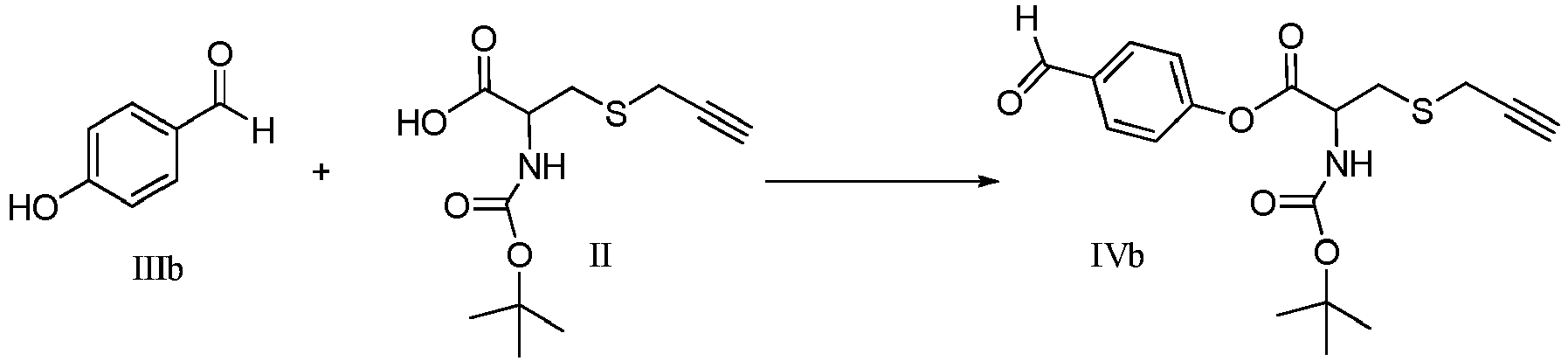
- There are steps of: dissolving 3g of 2-(t-butyloxycarbonylamino)-3-propinyl mercaptopropionic acid II, 2g of 4-hydroxybenzaldehyde IIIb and 5g of HBTU into 50mL of tetrahydrofuran, adding 2mL of triethylamine, and reacting at a room temperature for 12 hours; adding 100mL of water, extracting with ethyl acetate, washing an organic phase with 1M of diluted hydrochloric acid, a saturated sodium bicarbonate solution and a saturated sodium chloride solution in sequence, and drying the organic phase with anhydrous sodium sulfate; filtering and removing a drying agent, evaporating to dryness, and performing column chromatography (a ratio of petroleum ether to ethyl acetate is 3:1), thereby obtaining 3.6g of 2-(t-butyloxycarbonylamino)-3-propinylmercaptopropionic acid-4-formyl phenol ester (IVb) having a yield of 85%.
1H NMR(400 MHz, DMSO): δ 10.01(s, 1H), 8.03(d, 2H), 7.73(d, 1H), 7.37(d, 2H), 4.49-4.44(m, 1H), 3.48-3.47(m, 2H), 3.24-3.18(m, 2H), 3.07-3.01(m, 1H), 1.42(s, 9H), MS: m/z 464 [M+1]+. -

- There are steps of: dissolving 0.5g of 2-(t-butyloxycarbonylamino)-3-propinylmercaptopropionic acid-4-formyl phenol ester (IVb) into 20mL of dichloromethane, adding 2mL of trifluoroacetic acid, and reacting at a room temperature for 6 hours; adding 3N of hydrochloric acid, continuously stirring for 2 hours, separating a water layer, evaporating water to dryness, and performing column chromatography (a ratio of dichloromethane to methanol is 10:1), thereby obtaining 0.28g of 2-amino-3-propinylmercaptopropionic acid-4-formyl phenol ester (Vb) having a yield of 76%.
1H NMR(400 MHz, DMSO): δ 10.04(s, 1H), 9.18(s, 3H), 8.04-8.03(m, 2H), 7.83(s, 1H), 7.46-7.45(m, 2H), 4.62-4.61(m, 1H), 3.61-3.57(m, 2H), 3.38-3.30(m, 3H), MS: m/z 264 [M+1]+. -

- There are steps of: dissolving 3g of 2-(t-butyloxycarbonylamino)-3-propinyl mercaptopropionic acid II, 4g of p-hydroxybenzylalcohol IIIc and 6g of HBTU into 25mL of tetrahydrofuran, slowly dripping 3mL of triethylamine into a reaction solution, and reacting at a room temperature for 12 hours; adding 100mL of water, extracting with ethyl acetate, washing an organic phase with 1M of diluted hydrochloric acid, a saturated sodium bicarbonate solution and a saturated sodium chloride solution in sequence, and drying the organic phase with anhydrous sodium sulfate; filtering and removing a drying agent, evaporating to dryness, and performing column chromatography (a ratio of petroleum ether to ethyl acetate is 5:1), thereby obtaining 3.0g of 2-(t-butyloxycarbonylamino)-3-propinylmercaptopropionic acid-4-benzyl alcohol phenol ester (IVc) having a yield of 70%.
1H NMR(400 MHz, DMSO): δ 7.65-7.63(d, 1H), 7.38-7.36(d, 2H), 7.07-7.05(d, 1H), 5.26-5.24(m, 1H), 4.51-4.50(m, 2H), 4.45-4.36(m, 1H), 3.47(brs, 2H), 3.23-3.21(m, 1H), 3.19-3.16(m, 1H), 3.05-2.99(m, 1H), 1.42(s, 9H), MS: m/z 366 [M+1]+. -

- There are steps of: dissolving 0.5g of 2-(t-butyloxycarbonylamino)-3-propinylmercaptopropionic acid-4-benzyl alcohol phenol ester (IVc) into 20mL of dichloromethane, adding 2mL of trifluoroacetic acid, and reacting at a room temperature for 6 hours; adding 3N of hydrochloric acid, continuously stirring for 2 hours, separating a water layer, evaporating water to dryness, and performing column chromatography (a ratio of dichloromethane to methanol is 10:1), thereby obtaining 0.21g of 2-amino-3-propinylmercaptopropionic acid-4-benzyl alcohol phenol ester (Vc) having a yield of 57%.
1H NMR(400 MHz, CD3OD): δ 7.47-7.45(m, 2H), 7.24-7.22(m, 2H), 4.71-4.69(m, 1H), 4.65 (brs, 2H), 3.59-3.52(m, 3H), 3.43-3.37(m, 1H), 2.83-2.82(m, 1H), MS: m/z 266 [M+1]+. -

- There are steps of: dissolving 6g of 2-(t-butyloxycarbonylamino)-3-propinyl mercaptopropionic acid II, 4g of p-hydroxybenzylalcohol IIIc and 12g of HBTU into 100mL of tetrahydrofuran, slowly dripping 10mL of triethylamine into a reaction solution, and reacting at a room temperature for 12 hours; adding 100mL of water, extracting with ethyl acetate, washing an organic phase with 1M of diluted hydrochloric acid, a saturated sodium bicarbonate solution and a saturated sodium chloride solution in sequence, and drying the organic phase with anhydrous sodium sulfate; filtering and removing a drying agent, evaporating to dryness, and performing column chromatography (a ratio of petroleum ether to ethyl acetate is 6:1), thereby obtaining 4.6g of bis(2-(t-butyloxycarbonylamino)-3-propinylmercaptopropionic acid)-4-benzyl alcohol-1-phenol diester (IVd) having a yield of 65%.
1H NMR(400 MHz, DMSO): δ 7.67-7.65(m, 1H), 7.45-7.43(m, 3H), 7.12-7.10(m, 2H), 5.16(s, 2H), 4.44-4.41(m, 1H), 4.27-4.24(m, 1H), 3.46(brs, 2H), 3.40-3.39(m, 2H), 3.23-3.16(m, 3H), 3.09-3.05(m, 2H), 2.90-2.85(m, 1H), 1.42(s, 9H), 1.38(s, 9H), MS: m/z 607 [M+1]+. -

- There are steps of: dissolving 0.5g of bis(2-(t-butyloxycarbonylamino)-3-propinylmercaptopropionic acid)-4-benzyl alcohol-1-phenol diester (IVd) into 20mL of dichloromethane, adding 2mL of trifluoroacetic acid, and reacting at a room temperature for 6 hours; adding 3N of hydrochloric acid, continuously stirring for 2 hours, separating a water layer, evaporating water to dryness, and performing column chromatography (a ratio of dichloromethane to methanol is 10:1), thereby obtaining 0.26g of bis(2-amino-3-propinylmercaptopropionic acid)-4-benzyl alcohol-1-phenol diester (Vd) having a yield of 78%.
1HNMR(400 MHz, DMSO): δ 9.17(brs, 3H), 8.19(brs, 3H), 7.58-7.55(m, 2H), 7.29-7.26(m, 2H), 5.28(d, 1H), 4.59(t, 1H), 4.40(t, 1H), 4.18(t, 1H), 3.58-3.44(m, 5H), 3.35-3.32(m, 2H), 3.22-3.18(m, 2H), 3.14-3.09(m, 1H), MS: m/z 407 [M+1]+. -

- There are steps of: dissolving 3g of 2-(t-butyloxycarbonylamino)-3-propinyl mercaptopropionic acid II, 1g of 4-nitro-1-butanol IIIf and 4g of HBTU into 50mL of tetrahydrofuran, slowly dripping 2mL of triethylamine into a reaction solution, and reacting at a room temperature for 12 hours; adding 100mL of water, extracting with ethyl acetate, washing an organic phase with 1M of diluted hydrochloric acid, a saturated sodium bicarbonate solution and a saturated sodium chloride solution in sequence, and drying the organic phase with anhydrous sodium sulfate; filtering and removing a drying agent, evaporating to dryness, and performing column chromatography (a ratio of petroleum ether to ethyl acetate is 5:1), thereby obtaining 2.0g of 2-(t-butyloxycarbonylamino)-3-propinylmercaptopropionic acid-4-nitro-1-butanol ester (IVf) having a yield of 48%.
1H NMR(400 MHz, CDCl3): δ 5.41-5.39(m, 1H), 4.48(brs, 1H), 4.15-4.12(brs, 2H), 3.39-3.36(m, 2H), 3.29-2.99(m, 4H), 2.27-2.26(m, 1H), 1.91-1.88(m, 2H), 1.79-1.76(m, 2H), 1.38(s, 9H), MS: m/z 361 [M+1]+. -

- There are steps of: dissolving 0.5g of 2-(t-butyloxycarbonylamino)-3-propinylmercaptopropionic acid-4-nitro-1-butanol ester (IVf) into 20mL of dichloromethane, adding 2mL of trifluoroacetic acid, and reacting at a room temperature for 6 hours; adding 3N of hydrochloric acid, continuously stirring for 2 hours, separating a water layer, evaporating water to dryness, and performing column chromatography (a ratio of dichloromethane to methanol is 10:1), thereby obtaining 0.26g of 2-amino-3-propinylmercaptopropionic acid-4-nitro-1-butanol ester (Vf) having a yield of 72%.
1H NMR(400 MHz, CDCl3): δ 5.52-5.43(m, 1H), 4.52-4.48(m, 1H), 4.25-4.22(m, 2H), 3.42-3.39(m, 2H), 3.34-2.31(m, 4H), 2.29-2.25(m, 1H), 1.92-1.90(m, 2H), 1.82-1.79(m, 2H), MS: m/z 261 [M+1]+. - Memory functions of mice are injured by scopolamine, and effects of improvement of tested materials on the memory functions of the mice are observed.
-
- Animals: ICR mice, male, 20-22g, purchased from Institute for Experimental Animals in Chinese Academy of Medical Sciences, certification number: SCXK (JING) 2014-0004.
- Agent: scopolamine (J&K Company), donepezil reagent (TCI Company).
- Tested materials: 4 tested materials and a positive-drug donepezil are provided by Tasly Group.
- Dosage of administration: administered by tested materials according to 80mg/kg weight, administered by donepezil according to 5mg/kg weight, an administration volume of 2ml.
- purchasing 60 mice, and enabling the mice to adapt to an environment for three days; dividing the mice into 6 groups randomly, wherein a blank control group includes 10 mice, the rest mice are contained in administration groups, and each administration group includes 10 mice; respectively administering the tested materials and positive drug, performing intragastric administration for 7 days, putting the mice into a darkroom to adapt to the environment on the fifth day during administration, electrifying the darkroom on the sixth day during administration, training the mice to elude the darkroom, and training each mouse once; testing on the seventh day, administering with scopolamine by 3mg/kg within 20 minutes before testing, and recording time of the mice entering the darkroom for the first time and a number of times of the mice entering the darkroom within 3 minutes during testing.
-
Table 1. Influences of tested materials on latency and error times of mice with memory disorders caused by scopolamine entering the darkroom (x̅ ± s,n = 10) Group Latency (s) Error times Model group 47.0±55.6 4.6±4.2 Donepezil 49.5±71.6 6.8±5.4 SPRC 50.5±69.7 3.8±4.0 Va 55.8±61.3 4.7±4.6 Vb 53.2±59.4 4.1±3.7 Vc 66.8±57.1 2.4±1.3 Vd 63.6±69.5 2.6±3.3 Vf 60.2±61.3 2.4±2.3 - Passive avoidance response is a common method used commonly to detect learning and memory functions of small animals. With respect to a passive avoidance test, by means of a feature that rodents like darkness and keep in a dark place, the rodents are stimulated in the dark to escape to a bright place to acquire memory, and the passive avoidance test is a type of passive avoidance response experiments. The passive avoidance test has a short experimental period and is applicable to rapid drug screening. The scopolamine may inhibit release of acetyl choline, so as to form learning and memory disorders. The passive avoidance test is a stable learning and memory disorder modeling method and has excellent model reproducibility. The compounds Vc, Vd and Vf have a trend of decreasing the error times of the mice with memory impairment entering the darkroom and a trend of increasing the latency of the mice with memory impairment entering the darkroom, and activities of the compounds are all obviously better than the activity of the SPRC.
Claims (10)
- A S-substituted-2-amino-3-mercaptopropionate derivative with a structure of a formula (A) for use in treating and/or preventing a neurodegenerative disease,
 wherein R1 is selected from
 wherein R2 is selected from substituted or unsubstituted heterocyclyl, alkyl ester, alkyl carbonyl and alkane hydroxyl.
 - The S-substituted-2-amino-3-mercaptopropionate derivative for use in treating and/or preventing a neurodegenerative disease according to claim 1, wherein R1 is selected from

- The S-substituted-2-amino-3-mercaptopropionate derivative for use in treating and/or preventing a neurodegenerative disease according to claim 2, wherein R1 is further selected from

- The S-substituted-2-amino-3-mercaptopropionate derivative for use in treating and/or preventing a neurodegenerative disease according to claim 3, wherein the derivative is selected from compounds as follows:


- A medicinal acid addition salt, a solvate, a polymorphism, an enantiomer or a racemic mixture of the S-substituted-2-amino-3-mercaptopropionate derivative for use in treating and/or preventing a neurodegenerative disease according to claim 1.
- The medicinal acid addition salt, the solvate, the polymorphism, the enantiomer or the racemic mixture of the S-substituted-2-amino-3-mercaptopropionate derivative for use according to claim 5, wherein the medicinal acid addition salt is selected from salt formed by the S-substituted-2-amino-3-mercaptopropionate derivative and sulfuric acid, hydrochloric acid, hydrobromic acid, phosphoric acid, tartaric acid, fumaric acid, maleic acid, citric acid, acetic acid, formic acid, methanesulfonic acid, p-toluenesulfonic acid, oxalic acid or succinic acid.
- A pharmaceutical composition comprising the S-substituted-2-amino-3-mercaptopropionate derivative for use in treating and/or preventing a neurodegenerative disease according to claim 1 or the medicinal acid addition salt, the solvate, the polymorphism, the enantiomer or the racemic mixture of the S-substituted-2-amino-3-mercaptopropionate derivative according to claim 5.
- The pharmaceutical composition for use according to claim 7, wherein the pharmaceutical composition also comprises pharmaceutically acceptable carriers.
- The S-substituted-2-amino-3-mercaptopropionate derivative of claim 1 for use in treating and/or preventing senile dementia.
- A S-substituted-2-amino-3-mercaptopropionate derivative selected from compounds Va - Vf :


Applications Claiming Priority (2)
| Application Number | Priority Date | Filing Date | Title |
|---|---|---|---|
| CN201610356441.4A CN107434799B (en) | 2016-05-25 | 2016-05-25 | 2-amino-3-substituted mercaptopropionate derivative, preparation method and application thereof |
| PCT/CN2017/085321 WO2017202266A1 (en) | 2016-05-25 | 2017-05-22 | Preparation method for 2-amino-3-substituted mercaptopropionate derivative and use thereof |
Publications (3)
| Publication Number | Publication Date |
|---|---|
| EP3470408A1 EP3470408A1 (en) | 2019-04-17 |
| EP3470408A4 EP3470408A4 (en) | 2020-02-19 |
| EP3470408B1 true EP3470408B1 (en) | 2021-03-24 |
Family
ID=60411062
Family Applications (1)
| Application Number | Title | Priority Date | Filing Date |
|---|---|---|---|
| EP17802112.7A Active EP3470408B1 (en) | 2016-05-25 | 2017-05-22 | Preparation method for 2-amino-3-substituted mercaptopropionate derivative and use thereof |
Country Status (5)
| Country | Link |
|---|---|
| US (1) | US11149016B2 (en) |
| EP (1) | EP3470408B1 (en) |
| CN (2) | CN107434799B (en) |
| CA (1) | CA3025065C (en) |
| WO (1) | WO2017202266A1 (en) |
Cited By (1)
| Publication number | Priority date | Publication date | Assignee | Title |
|---|---|---|---|---|
| RU2812847C2 (en) * | 2021-12-10 | 2024-02-02 | Общество С Ограниченной Ответственностью "Валента - Интеллект" | Hepatoprotective agents |
Families Citing this family (1)
| Publication number | Priority date | Publication date | Assignee | Title |
|---|---|---|---|---|
| CN116410160B (en) * | 2023-03-21 | 2024-03-08 | 深圳市罗湖区人民医院 | Arctigenin derivative and preparation method and application thereof |
Family Cites Families (4)
| Publication number | Priority date | Publication date | Assignee | Title |
|---|---|---|---|---|
| CN102078327B (en) * | 2009-11-27 | 2014-01-08 | 复旦大学 | Use of propargyl cysteine in the preparation of medicines for treating Alzheimer's disease |
| KR101511056B1 (en) * | 2013-06-28 | 2015-04-10 | 한밭대학교 산학협력단 | Novel S-allyl cysteine derivatives and their biological functions |
| CN104974154B (en) * | 2014-04-01 | 2017-04-12 | 复旦大学 | Hirsutine analogue and application thereof in preparation of anti-hypertensive drugs |
| EP4212532A3 (en) * | 2015-04-30 | 2023-09-27 | Memorial Sloan Kettering Cancer Center | Mitragynine analogs and uses thereof |
-
2016
- 2016-05-25 CN CN201610356441.4A patent/CN107434799B/en active Active
-
2017
- 2017-05-22 EP EP17802112.7A patent/EP3470408B1/en active Active
- 2017-05-22 US US16/303,786 patent/US11149016B2/en active Active
- 2017-05-22 CA CA3025065A patent/CA3025065C/en active Active
- 2017-05-22 WO PCT/CN2017/085321 patent/WO2017202266A1/en not_active Ceased
- 2017-05-22 CN CN201780030188.6A patent/CN109195962A/en active Pending
Non-Patent Citations (1)
| Title |
|---|
| None * |
Cited By (1)
| Publication number | Priority date | Publication date | Assignee | Title |
|---|---|---|---|---|
| RU2812847C2 (en) * | 2021-12-10 | 2024-02-02 | Общество С Ограниченной Ответственностью "Валента - Интеллект" | Hepatoprotective agents |
Also Published As
| Publication number | Publication date |
|---|---|
| EP3470408A1 (en) | 2019-04-17 |
| CN107434799A (en) | 2017-12-05 |
| CA3025065A1 (en) | 2017-11-30 |
| CN109195962A (en) | 2019-01-11 |
| WO2017202266A1 (en) | 2017-11-30 |
| CA3025065C (en) | 2023-12-19 |
| CN107434799B (en) | 2020-12-25 |
| US20200317632A1 (en) | 2020-10-08 |
| EP3470408A4 (en) | 2020-02-19 |
| US11149016B2 (en) | 2021-10-19 |
Similar Documents
| Publication | Publication Date | Title |
|---|---|---|
| US12502385B2 (en) | Analogs of deutetrabenazine, their preparation and use | |
| WO2004082581A2 (en) | Use of derivatives of cholest-4-en-3-one as medicaments, pharmaceutical compositions containing same, novel derivatives and preparation method thereof | |
| US11149016B2 (en) | S-substituted-2-amino-3-mercaptopropionate derivative, preparation method and application thereof | |
| US10308641B2 (en) | Crystal form of 3-(6-(1-(2,2-difluorobenzo[d][1,3]dioxole-5-yl)cyclopropane formamido)-3-methylpyridine-2-yl)benzoic acid and preparation method thereof | |
| EP2952519A1 (en) | Protopanoxadiol derivative, preparation method thereof and application thereof | |
| EP3424502A1 (en) | Aquaporin 4 function promoter and pharmaceutical composition for neurological disorders | |
| EP3750904A1 (en) | Therapeutic drug for neurodegenerative disease and application thereof | |
| US9290464B2 (en) | Pharmaceutical composition for inhibiting apoptosis of neuron or neurodegeneration | |
| CZ279586B6 (en) | Pharmaceutical preparation containing 5-(2-chloro-1-hydroxymethyl)-4-methyl thiazole, 5-(2-chloro-1-hydroxymethyl)-4-methyl thiazole intended for use in therapy and salts thereof | |
| RU2799454C2 (en) | Therapeutic drug for the treatment of neurodegenerative diseases and its use | |
| BR122025016812A2 (en) | Adenine compounds, their use, pharmaceutical composition, method for modulating Pink Kinase 1 activity in an individual, and kit. | |
| EA046462B1 (en) | CRYSTAL FORM OF N-BUTYLDEOXYGALACTONOJIRIMYCIN | |
| JP2013170165A (en) | Amyotrophic lateral sclerosis prevention therapeutic agent | |
| HK40018479A (en) | Analogs of deutetrabenazine, their preparation and use |
Legal Events
| Date | Code | Title | Description |
|---|---|---|---|
| STAA | Information on the status of an ep patent application or granted ep patent |
Free format text: STATUS: THE INTERNATIONAL PUBLICATION HAS BEEN MADE |
|
| PUAI | Public reference made under article 153(3) epc to a published international application that has entered the european phase |
Free format text: ORIGINAL CODE: 0009012 |
|
| STAA | Information on the status of an ep patent application or granted ep patent |
Free format text: STATUS: REQUEST FOR EXAMINATION WAS MADE |
|
| 17P | Request for examination filed |
Effective date: 20181206 |
|
| AK | Designated contracting states |
Kind code of ref document: A1 Designated state(s): AL AT BE BG CH CY CZ DE DK EE ES FI FR GB GR HR HU IE IS IT LI LT LU LV MC MK MT NL NO PL PT RO RS SE SI SK SM TR |
|
| AX | Request for extension of the european patent |
Extension state: BA ME |
|
| DAV | Request for validation of the european patent (deleted) | ||
| DAX | Request for extension of the european patent (deleted) | ||
| RIC1 | Information provided on ipc code assigned before grant |
Ipc: A61K 31/385 20060101ALI20191218BHEP Ipc: C07D 339/04 20060101AFI20191218BHEP Ipc: A61K 31/223 20060101ALI20191218BHEP Ipc: A61P 25/00 20060101ALI20191218BHEP Ipc: C07C 323/58 20060101ALI20191218BHEP Ipc: A61P 25/28 20060101ALI20191218BHEP |
|
| A4 | Supplementary search report drawn up and despatched |
Effective date: 20200117 |
|
| REG | Reference to a national code |
Ref country code: DE Ref legal event code: R079 Ref document number: 602017035348 Country of ref document: DE Free format text: PREVIOUS MAIN CLASS: C07D0339040000 Ipc: A61K0031223000 |
|
| RIC1 | Information provided on ipc code assigned before grant |
Ipc: C07D 339/04 20060101ALI20201106BHEP Ipc: A61K 31/223 20060101AFI20201106BHEP Ipc: A61K 31/385 20060101ALI20201106BHEP Ipc: A61P 25/28 20060101ALI20201106BHEP Ipc: C07C 323/58 20060101ALI20201106BHEP |
|
| GRAP | Despatch of communication of intention to grant a patent |
Free format text: ORIGINAL CODE: EPIDOSNIGR1 |
|
| STAA | Information on the status of an ep patent application or granted ep patent |
Free format text: STATUS: GRANT OF PATENT IS INTENDED |
|
| INTG | Intention to grant announced |
Effective date: 20201218 |
|
| RIN1 | Information on inventor provided before grant (corrected) |
Inventor name: ZHONG, JUN Inventor name: WANG, GUOCHENG |
|
| GRAS | Grant fee paid |
Free format text: ORIGINAL CODE: EPIDOSNIGR3 |
|
| GRAA | (expected) grant |
Free format text: ORIGINAL CODE: 0009210 |
|
| STAA | Information on the status of an ep patent application or granted ep patent |
Free format text: STATUS: THE PATENT HAS BEEN GRANTED |
|
| AK | Designated contracting states |
Kind code of ref document: B1 Designated state(s): AL AT BE BG CH CY CZ DE DK EE ES FI FR GB GR HR HU IE IS IT LI LT LU LV MC MK MT NL NO PL PT RO RS SE SI SK SM TR |
|
| REG | Reference to a national code |
Ref country code: GB Ref legal event code: FG4D |
|
| REG | Reference to a national code |
Ref country code: CH Ref legal event code: EP |
|
| REG | Reference to a national code |
Ref country code: DE Ref legal event code: R096 Ref document number: 602017035348 Country of ref document: DE |
|
| REG | Reference to a national code |
Ref country code: IE Ref legal event code: FG4D |
|
| REG | Reference to a national code |
Ref country code: AT Ref legal event code: REF Ref document number: 1373771 Country of ref document: AT Kind code of ref document: T Effective date: 20210415 |
|
| REG | Reference to a national code |
Ref country code: LT Ref legal event code: MG9D |
|
| PG25 | Lapsed in a contracting state [announced via postgrant information from national office to epo] |
Ref country code: NO Free format text: LAPSE BECAUSE OF FAILURE TO SUBMIT A TRANSLATION OF THE DESCRIPTION OR TO PAY THE FEE WITHIN THE PRESCRIBED TIME-LIMIT Effective date: 20210624 Ref country code: HR Free format text: LAPSE BECAUSE OF FAILURE TO SUBMIT A TRANSLATION OF THE DESCRIPTION OR TO PAY THE FEE WITHIN THE PRESCRIBED TIME-LIMIT Effective date: 20210324 Ref country code: FI Free format text: LAPSE BECAUSE OF FAILURE TO SUBMIT A TRANSLATION OF THE DESCRIPTION OR TO PAY THE FEE WITHIN THE PRESCRIBED TIME-LIMIT Effective date: 20210324 Ref country code: GR Free format text: LAPSE BECAUSE OF FAILURE TO SUBMIT A TRANSLATION OF THE DESCRIPTION OR TO PAY THE FEE WITHIN THE PRESCRIBED TIME-LIMIT Effective date: 20210625 Ref country code: BG Free format text: LAPSE BECAUSE OF FAILURE TO SUBMIT A TRANSLATION OF THE DESCRIPTION OR TO PAY THE FEE WITHIN THE PRESCRIBED TIME-LIMIT Effective date: 20210624 |
|
| PG25 | Lapsed in a contracting state [announced via postgrant information from national office to epo] |
Ref country code: SE Free format text: LAPSE BECAUSE OF FAILURE TO SUBMIT A TRANSLATION OF THE DESCRIPTION OR TO PAY THE FEE WITHIN THE PRESCRIBED TIME-LIMIT Effective date: 20210324 Ref country code: RS Free format text: LAPSE BECAUSE OF FAILURE TO SUBMIT A TRANSLATION OF THE DESCRIPTION OR TO PAY THE FEE WITHIN THE PRESCRIBED TIME-LIMIT Effective date: 20210324 Ref country code: LV Free format text: LAPSE BECAUSE OF FAILURE TO SUBMIT A TRANSLATION OF THE DESCRIPTION OR TO PAY THE FEE WITHIN THE PRESCRIBED TIME-LIMIT Effective date: 20210324 |
|
| REG | Reference to a national code |
Ref country code: NL Ref legal event code: MP Effective date: 20210324 |
|
| REG | Reference to a national code |
Ref country code: AT Ref legal event code: MK05 Ref document number: 1373771 Country of ref document: AT Kind code of ref document: T Effective date: 20210324 |
|
| PG25 | Lapsed in a contracting state [announced via postgrant information from national office to epo] |
Ref country code: NL Free format text: LAPSE BECAUSE OF FAILURE TO SUBMIT A TRANSLATION OF THE DESCRIPTION OR TO PAY THE FEE WITHIN THE PRESCRIBED TIME-LIMIT Effective date: 20210324 |
|
| PG25 | Lapsed in a contracting state [announced via postgrant information from national office to epo] |
Ref country code: AT Free format text: LAPSE BECAUSE OF FAILURE TO SUBMIT A TRANSLATION OF THE DESCRIPTION OR TO PAY THE FEE WITHIN THE PRESCRIBED TIME-LIMIT Effective date: 20210324 Ref country code: SM Free format text: LAPSE BECAUSE OF FAILURE TO SUBMIT A TRANSLATION OF THE DESCRIPTION OR TO PAY THE FEE WITHIN THE PRESCRIBED TIME-LIMIT Effective date: 20210324 Ref country code: LT Free format text: LAPSE BECAUSE OF FAILURE TO SUBMIT A TRANSLATION OF THE DESCRIPTION OR TO PAY THE FEE WITHIN THE PRESCRIBED TIME-LIMIT Effective date: 20210324 Ref country code: CZ Free format text: LAPSE BECAUSE OF FAILURE TO SUBMIT A TRANSLATION OF THE DESCRIPTION OR TO PAY THE FEE WITHIN THE PRESCRIBED TIME-LIMIT Effective date: 20210324 Ref country code: EE Free format text: LAPSE BECAUSE OF FAILURE TO SUBMIT A TRANSLATION OF THE DESCRIPTION OR TO PAY THE FEE WITHIN THE PRESCRIBED TIME-LIMIT Effective date: 20210324 |
|
| PG25 | Lapsed in a contracting state [announced via postgrant information from national office to epo] |
Ref country code: IS Free format text: LAPSE BECAUSE OF FAILURE TO SUBMIT A TRANSLATION OF THE DESCRIPTION OR TO PAY THE FEE WITHIN THE PRESCRIBED TIME-LIMIT Effective date: 20210724 Ref country code: PT Free format text: LAPSE BECAUSE OF FAILURE TO SUBMIT A TRANSLATION OF THE DESCRIPTION OR TO PAY THE FEE WITHIN THE PRESCRIBED TIME-LIMIT Effective date: 20210726 Ref country code: PL Free format text: LAPSE BECAUSE OF FAILURE TO SUBMIT A TRANSLATION OF THE DESCRIPTION OR TO PAY THE FEE WITHIN THE PRESCRIBED TIME-LIMIT Effective date: 20210324 Ref country code: SK Free format text: LAPSE BECAUSE OF FAILURE TO SUBMIT A TRANSLATION OF THE DESCRIPTION OR TO PAY THE FEE WITHIN THE PRESCRIBED TIME-LIMIT Effective date: 20210324 Ref country code: RO Free format text: LAPSE BECAUSE OF FAILURE TO SUBMIT A TRANSLATION OF THE DESCRIPTION OR TO PAY THE FEE WITHIN THE PRESCRIBED TIME-LIMIT Effective date: 20210324 |
|
| REG | Reference to a national code |
Ref country code: CH Ref legal event code: PL |
|
| REG | Reference to a national code |
Ref country code: DE Ref legal event code: R097 Ref document number: 602017035348 Country of ref document: DE |
|
| PG25 | Lapsed in a contracting state [announced via postgrant information from national office to epo] |
Ref country code: ES Free format text: LAPSE BECAUSE OF FAILURE TO SUBMIT A TRANSLATION OF THE DESCRIPTION OR TO PAY THE FEE WITHIN THE PRESCRIBED TIME-LIMIT Effective date: 20210324 Ref country code: LU Free format text: LAPSE BECAUSE OF NON-PAYMENT OF DUE FEES Effective date: 20210522 Ref country code: MC Free format text: LAPSE BECAUSE OF FAILURE TO SUBMIT A TRANSLATION OF THE DESCRIPTION OR TO PAY THE FEE WITHIN THE PRESCRIBED TIME-LIMIT Effective date: 20210324 Ref country code: LI Free format text: LAPSE BECAUSE OF NON-PAYMENT OF DUE FEES Effective date: 20210531 Ref country code: CH Free format text: LAPSE BECAUSE OF NON-PAYMENT OF DUE FEES Effective date: 20210531 Ref country code: DK Free format text: LAPSE BECAUSE OF FAILURE TO SUBMIT A TRANSLATION OF THE DESCRIPTION OR TO PAY THE FEE WITHIN THE PRESCRIBED TIME-LIMIT Effective date: 20210324 Ref country code: AL Free format text: LAPSE BECAUSE OF FAILURE TO SUBMIT A TRANSLATION OF THE DESCRIPTION OR TO PAY THE FEE WITHIN THE PRESCRIBED TIME-LIMIT Effective date: 20210324 |
|
| PLBE | No opposition filed within time limit |
Free format text: ORIGINAL CODE: 0009261 |
|
| STAA | Information on the status of an ep patent application or granted ep patent |
Free format text: STATUS: NO OPPOSITION FILED WITHIN TIME LIMIT |
|
| REG | Reference to a national code |
Ref country code: BE Ref legal event code: MM Effective date: 20210531 |
|
| PG25 | Lapsed in a contracting state [announced via postgrant information from national office to epo] |
Ref country code: SI Free format text: LAPSE BECAUSE OF FAILURE TO SUBMIT A TRANSLATION OF THE DESCRIPTION OR TO PAY THE FEE WITHIN THE PRESCRIBED TIME-LIMIT Effective date: 20210324 |
|
| 26N | No opposition filed |
Effective date: 20220104 |
|
| PG25 | Lapsed in a contracting state [announced via postgrant information from national office to epo] |
Ref country code: IE Free format text: LAPSE BECAUSE OF NON-PAYMENT OF DUE FEES Effective date: 20210522 |
|
| PG25 | Lapsed in a contracting state [announced via postgrant information from national office to epo] |
Ref country code: IS Free format text: LAPSE BECAUSE OF FAILURE TO SUBMIT A TRANSLATION OF THE DESCRIPTION OR TO PAY THE FEE WITHIN THE PRESCRIBED TIME-LIMIT Effective date: 20210724 |
|
| PG25 | Lapsed in a contracting state [announced via postgrant information from national office to epo] |
Ref country code: BE Free format text: LAPSE BECAUSE OF NON-PAYMENT OF DUE FEES Effective date: 20210531 |
|
| P01 | Opt-out of the competence of the unified patent court (upc) registered |
Effective date: 20230504 |
|
| PG25 | Lapsed in a contracting state [announced via postgrant information from national office to epo] |
Ref country code: CY Free format text: LAPSE BECAUSE OF FAILURE TO SUBMIT A TRANSLATION OF THE DESCRIPTION OR TO PAY THE FEE WITHIN THE PRESCRIBED TIME-LIMIT Effective date: 20210324 |
|
| PG25 | Lapsed in a contracting state [announced via postgrant information from national office to epo] |
Ref country code: HU Free format text: LAPSE BECAUSE OF FAILURE TO SUBMIT A TRANSLATION OF THE DESCRIPTION OR TO PAY THE FEE WITHIN THE PRESCRIBED TIME-LIMIT; INVALID AB INITIO Effective date: 20170522 |
|
| PG25 | Lapsed in a contracting state [announced via postgrant information from national office to epo] |
Ref country code: MK Free format text: LAPSE BECAUSE OF FAILURE TO SUBMIT A TRANSLATION OF THE DESCRIPTION OR TO PAY THE FEE WITHIN THE PRESCRIBED TIME-LIMIT Effective date: 20210324 |
|
| PG25 | Lapsed in a contracting state [announced via postgrant information from national office to epo] |
Ref country code: TR Free format text: LAPSE BECAUSE OF FAILURE TO SUBMIT A TRANSLATION OF THE DESCRIPTION OR TO PAY THE FEE WITHIN THE PRESCRIBED TIME-LIMIT Effective date: 20210324 |
|
| PG25 | Lapsed in a contracting state [announced via postgrant information from national office to epo] |
Ref country code: MT Free format text: LAPSE BECAUSE OF FAILURE TO SUBMIT A TRANSLATION OF THE DESCRIPTION OR TO PAY THE FEE WITHIN THE PRESCRIBED TIME-LIMIT Effective date: 20210324 |
|
| PGFP | Annual fee paid to national office [announced via postgrant information from national office to epo] |
Ref country code: DE Payment date: 20250526 Year of fee payment: 9 |
|
| PGFP | Annual fee paid to national office [announced via postgrant information from national office to epo] |
Ref country code: GB Payment date: 20250522 Year of fee payment: 9 |
|
| PGFP | Annual fee paid to national office [announced via postgrant information from national office to epo] |
Ref country code: IT Payment date: 20250530 Year of fee payment: 9 |
|
| PGFP | Annual fee paid to national office [announced via postgrant information from national office to epo] |
Ref country code: FR Payment date: 20250521 Year of fee payment: 9 |