EP3470400B1 - Crystalline forms of ozanimod and ozanimod hydrochloride, and processes for preparation thereof - Google Patents
Crystalline forms of ozanimod and ozanimod hydrochloride, and processes for preparation thereof Download PDFInfo
- Publication number
- EP3470400B1 EP3470400B1 EP17812728.8A EP17812728A EP3470400B1 EP 3470400 B1 EP3470400 B1 EP 3470400B1 EP 17812728 A EP17812728 A EP 17812728A EP 3470400 B1 EP3470400 B1 EP 3470400B1
- Authority
- EP
- European Patent Office
- Prior art keywords
- ozanimod
- hydrochloride
- ozanimod hydrochloride
- shows
- crystalline form
- Prior art date
- Legal status (The legal status is an assumption and is not a legal conclusion. Google has not performed a legal analysis and makes no representation as to the accuracy of the status listed.)
- Active
Links
Images









Classifications
-
- A—HUMAN NECESSITIES
- A61—MEDICAL OR VETERINARY SCIENCE; HYGIENE
- A61P—SPECIFIC THERAPEUTIC ACTIVITY OF CHEMICAL COMPOUNDS OR MEDICINAL PREPARATIONS
- A61P25/00—Drugs for disorders of the nervous system
- A61P25/28—Drugs for disorders of the nervous system for treating neurodegenerative disorders of the central nervous system, e.g. nootropic agents, cognition enhancers, drugs for treating Alzheimer's disease or other forms of dementia
-
- A—HUMAN NECESSITIES
- A61—MEDICAL OR VETERINARY SCIENCE; HYGIENE
- A61P—SPECIFIC THERAPEUTIC ACTIVITY OF CHEMICAL COMPOUNDS OR MEDICINAL PREPARATIONS
- A61P37/00—Drugs for immunological or allergic disorders
-
- C—CHEMISTRY; METALLURGY
- C07—ORGANIC CHEMISTRY
- C07D—HETEROCYCLIC COMPOUNDS
- C07D271/00—Heterocyclic compounds containing five-membered rings having two nitrogen atoms and one oxygen atom as the only ring hetero atoms
- C07D271/02—Heterocyclic compounds containing five-membered rings having two nitrogen atoms and one oxygen atom as the only ring hetero atoms not condensed with other rings
- C07D271/06—1,2,4-Oxadiazoles; Hydrogenated 1,2,4-oxadiazoles
-
- C—CHEMISTRY; METALLURGY
- C07—ORGANIC CHEMISTRY
- C07B—GENERAL METHODS OF ORGANIC CHEMISTRY; APPARATUS THEREFOR
- C07B2200/00—Indexing scheme relating to specific properties of organic compounds
- C07B2200/13—Crystalline forms, e.g. polymorphs
Definitions
- the present disclosure relates to the field of pharmaceutical chemistry, particularly relates to a crystalline form of ozanimod hydrochloride, and processes for the preparation thereof.
- Ozanimod is a novel, oral, selective modulator of sphingosine-1-phosphate 1 receptor (S1P1R) developed by Receptos for the treatment of autoimmune diseases.
- ozanimod is in phase III trials in the USA for the treatment of multiple sclerosis (MS) and ulcerative colitis (UC).
- Ozanimod has very excellent pharmacokinetics, pharmacodynamics and safety data in clinical trials, which can perfectly meet the differentiated development strategy and is expected to be the best second-generation SIPIR modulator drug.
- the chemical structure of the drug is shown as formula (I).
- a specific pharmaceutical activity is the basic prerequisite to be fulfilled by a pharmaceutically active agent to be approved as a medicament on the market.
- a pharmaceutically active agent has to comply with. These requirements are based on various parameters which are connected with the nature of the active substance itself. Without being restricted, examples of these parameters are the chemical stability, solid-state stability and storage stability of the active substance under various environmental conditions, stability during production of the pharmaceutical composition and the stability of the active substance in the final drug products, etc.
- the pharmaceutically active agent used for preparing the pharmaceutical compositions should be as pure as possible and its stability in long-term storage must be guaranteed under various environmental conditions. It is essential to prevent using pharmaceutical compositions which contain agent other than the actual active agent, for example decomposition products thereof. In such cases the content of active agent in the drug might be less than that specified. In addition it is important that the pharmaceutically active agent should be non-hygroscopic, stable both to degradation and subsequent solid form changes. If the pharmaceutically active agent is hygroscopic in the sense that it absorbs water (either slowly or over time), it is almost impossible to reliably formulate the pharmaceutically active agent into a drug as the amount of agent to be added to provide the same dosage will vary greatly depending upon the degree of hydration.
- a pharmaceutically active substance should be only slightly hygroscopic.
- the pharmaceutically active substance and any compositions containing it should be capable of being effectively stored over appreciable periods of time, without exhibiting a significant change in the physicochemical properties of the active substance such as its activity, moisture content, solubility, solid form, etc.
- the pharmaceutically active substance usually needs to be processed to achieve a particle size suitable for inhalation and any crystalline form must be stable during such processing so that the properties of the final product are predictable and reliable.
- CN102762100A or US2011172202A1 disclosed the compound of formula (I), while there is no solid form or crystalline form of ozanimod disclosed in the prior art.
- the prior art has neither guidance nor inspiration for finding the crystalline forms. Therefore, it is necessary to perform comprehensive polymorph screening of ozanimod to select a crystalline form which is the most suitable for drug development.
- the inventors of the present disclosure have found several crystalline forms of ozanimod and a crystalline form of ozanimod hydrochloride through research process, which provides new choices for the preparation of ozanimod drug product.
- the present disclosure provides novel crystalline forms of ozanimod and ozanimod hydrochloride, and processes for preparation and use thereof.
- the present invention is defined by the claims.
- One objective of the present disclosure is to provide a crystalline form of ozanimod, designated as Form CS1.
- the X-ray powder diffraction pattern of Form CS1 shows characteristic peaks at 2theta values of 12.1° ⁇ 0.2°, 10.4° ⁇ 0.2° and 4.2° ⁇ 0.2° using CuK ⁇ radiation.
- the X-ray powder diffraction pattern of Form CS1 shows one or two or three diffraction peaks at 2theta values of 7.4° ⁇ 0.2°, 24.3° ⁇ 0.2° and 17.7° ⁇ 0.2°.
- the X-ray powder diffraction pattern of Form CS1 shows three diffraction peaks at 2theta values of 7.4° ⁇ 0.2°, 24.3° ⁇ 0.2°, 17.7° ⁇ 0.2°.
- the X-ray powder diffraction pattern of Form CS1 shows one or two or three characteristic peaks at 2theta values of 12.8° ⁇ 0.2°, 21.5° ⁇ 0.2° and 18.2° ⁇ 0.2°.
- the X-ray powder diffraction pattern of Form CS1 shows three diffraction peaks at 2theta values of 12.8° ⁇ 0.2°, 21.5° ⁇ 0.2° and 18.2° ⁇ 0.2°.
- the X-ray powder diffraction pattern of Form CS1 shows characteristic peaks at 2theta values of 4.2° ⁇ 0.2°, 7.4° ⁇ 0.2°, 10.4° ⁇ 0.2°, 12.1° ⁇ 0.2°, 12.8° ⁇ 0.2°, 17.7° ⁇ 0.2°, 18.2° ⁇ 0.2°, 21.5° ⁇ 0.2° and 24.3° ⁇ 0.2°.
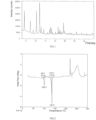
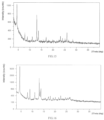
- the X-ray powder diffraction pattern of Form CS1 is substantially as depicted in FIG. 1 .
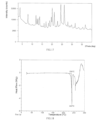
- the differential scanning calorimetry (DSC) curve of Form CS1 shows the first endothermic peak when heated to around 98 °C and the second endothermic peak when heated to around 134 °C, which is substantially as depicted in FIG. 2 .
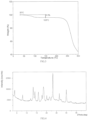
- the thermal gravimetric analysis (TGA) curve of Form CS1 shows about 4.3% weight loss when heated to 150°C, which is substantially as depicted in FIG. 3 .
- the present disclosure further provides the process for preparing Form CS1.
- the process comprises method 1) or method 2):
- said alcohol is methanol; said ketone is acetone; said ester is isopropyl acetate; said nitrile is acetonitrile.
- said alcohol is methanol.
- Another objective of the present disclosure is to provide a crystalline form of ozanimod, designated as Form CS2.
- the X-ray powder diffraction pattern of Form CS2 shows characteristic peaks at 2theta values of 23.2° ⁇ 0.2°, 18.5° ⁇ 0.2° and 13.3° ⁇ 0.2°using CuK ⁇ radiation.
- the X-ray powder diffraction pattern of Form CS2 shows one or two or three diffraction peaks at 2theta values of 15.9° ⁇ 0.2°, 30.0° ⁇ 0.2° and 14.2° ⁇ 0.2°.
- the X-ray powder diffraction pattern of Form CS2 shows three diffraction peaks at 2theta values of 15.9° ⁇ 0.2°, 30.0° ⁇ 0.2° and 14.2° ⁇ 0.2°.
- the X-ray powder diffraction pattern of Form CS2 shows one or two or three characteristic peaks at 2theta values of 4.0° ⁇ 0.2°, 26.5° ⁇ 0.2° and 17.7° ⁇ 0.2°.
- the X-ray powder diffraction pattern of Form CS2 shows three diffraction peaks at 2theta values of 4.0° ⁇ 0.2°, 26.5° ⁇ 0.2° and 17.7° ⁇ 0.2°.
- the X-ray powder diffraction pattern of Form CS2 shows characteristic peaks at 2theta values of 4.0° ⁇ 0.2°, 13.3° ⁇ 0.2°, 14.2° ⁇ 0.2°, 15.9° ⁇ 0.2°, 17.7° ⁇ 0.2°, 18.5° ⁇ 0.2°, 23.2° ⁇ 0.2°, 26.5° ⁇ 0.2° and 30.0° ⁇ 0.2°.
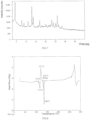
- the X-ray powder diffraction pattern of Form CS2 is substantially as depicted in FIG. 4 .
- the differential scanning calorimetry (DSC) curve of Form CS2 shows an endothermic peak when heated to around 134 °C, which is substantially as depicted in FIG. 5 .
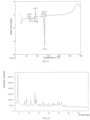
- the thermal gravimetric analysis (TGA) curve of Form CS2 shows about 1.1% weight loss when heated to 150 °C, which is substantially as depicted in FIG. 6 .
- the present disclosure further provides the process for preparing Form CS2.
- the process comprises method 1) or method 2):
- said heating temperature in method 1) is 110 °C.
- said nitrile is acetonitrile; said ketone is acetone or methyl isobutyl ketone; said ester is ethyl acetate; said aromatic hydrocarbons is toluene; said cyclic ether is 2-methyltetrahydrofuran; said mixture of solvents is mixture of ethanol and water, acetone and water, or N, N-dimethylformamide and water.
- Another objective of the present disclosure is to provide a crystalline form of ozanimod, designated as Form CS3.
- the X-ray powder diffraction pattern of Form CS3 shows at least one characteristic peak at 2theta values of 4.4° ⁇ 0.2°, 5.7° ⁇ 0.2°, 7.8° ⁇ 0.2°, 11.0° ⁇ 0.2°, 13.0° ⁇ 0.2°, 13.7° ⁇ 0.2°, 17.0° ⁇ 0.2°, 23.2° ⁇ 0.2°, 24.1° ⁇ 0.2° and 26.0° ⁇ 0.2°.
- the X-ray powder diffraction pattern of Form CS3 shows characteristic peaks at 2theta values of 4.4° ⁇ 0.2°, 13.0° ⁇ 0.2°, 26.0° ⁇ 0.2° and 11.0° ⁇ 0.2°.
- the X-ray powder diffraction pattern of Form CS3 shows one or two or three diffraction peaks at 2theta values of 7.8° ⁇ 0.2°, 23.2° ⁇ 0.2° and 17.0° ⁇ 0.2°.
- the X-ray powder diffraction pattern of Form CS3 shows three diffraction peaks at 2theta values of 7.8° ⁇ 0.2°, 23.2° ⁇ 0.2° and 17.0° ⁇ 0.2°.
- the X-ray powder diffraction pattern of Form CS3 shows one or two characteristic peaks at 2theta values of 13.7° ⁇ 0.2° and 24.1° ⁇ 0.2°.
- the X-ray powder diffraction pattern of Form CS3 shows two diffraction peaks at 2theta values of 13.7° ⁇ 0.2° and 24.1° ⁇ 0.2°.
- the X-ray powder diffraction pattern of Form CS3 shows one or two characteristic peaks at 2theta values of 5.7° ⁇ 0.2° and 24.1° ⁇ 0.2°.
- the X-ray powder diffraction pattern of Form CS3 shows two diffraction peaks at 2theta values of 5.7° ⁇ 0.2° and 24.1° ⁇ 0.2°.
- the X-ray powder diffraction pattern of Form CS3 shows characteristic peaks at 2theta values of 4.4° ⁇ 0.2°, 7.8° ⁇ 0.2°, 11.0° ⁇ 0.2°, 13.0° ⁇ 0.2°, 13.7° ⁇ 0.2°, 17.0° ⁇ 0.2°, 23.2° ⁇ 0.2°, 24.1° ⁇ 0.2° and 26.0° ⁇ 0.2°.
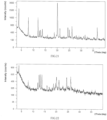
- the X-ray powder diffraction pattern of Form CS3 is substantially as depicted in FIG. 7 .
- the differential scanning calorimetry (DSC) curve of Form CS3 shows the first endothermic peak when heated to around 112 °C, shows an exothermic peak when heated to around 121 °C and shows the second endothermic peak when heated to around 133 °C which is substantially as depicted in FIG. 8 .
- the thermal gravimetric analysis (TGA) curve of Form CS3 shows about 3.1% weight loss when heated to 130 °C, which is substantially as depicted in FIG. 9 .
- the X-ray powder diffraction pattern of Form CS3 shows characteristic peaks at 2theta values of 4.4° ⁇ 0.2°, 5.7° ⁇ 0.2°, 7.8° ⁇ 0.2°, 11.0° ⁇ 0.2°, 13.0° ⁇ 0.2°, 17.0° ⁇ 0.2°, 23.2° ⁇ 0.2°, 24.1° ⁇ 0.2° and 26.0° ⁇ 0.2°.
- the X-ray powder diffraction pattern of Form CS3 is substantially as depicted in FIG. 53 .
- Another objective of the present disclosure is to provide the process for preparing Form CS3 of ozanimod.
- the process comprises: adding ozanimod into a solvent selected form alcohols, nitriles, dichloromethane, esters, sulfoxides or a mixture of glycol dimethyl ether and water, filtering, evaporating the filtrate and collecting the solid to obtain Form CS3 of ozanimod.
- said alcohol is methanol; said nitrile is acetonitrile; said ester is isopropyl acetate; said sulfoxide is dimethyl sulfoxide.
- Another objective of the disclosure is to provide a crystalline form of ozanimod, designated as Form CS5.
- the X-ray powder diffraction pattern of Form CS5 shows characteristic peaks at 2theta values of 4.3° ⁇ 0.2°, 6.8° ⁇ 0.2° and 16.4° ⁇ 0.2° using CuK ⁇ radiation.
- the X-ray powder diffraction pattern of Form CS5 shows one or two or three diffraction peaks at 2theta values of 21.6° ⁇ 0.2°, 8.5° ⁇ 0.2° and 13.6° ⁇ 0.2°.
- the X-ray powder diffraction pattern of Form CS5 shows three diffraction peaks at 2theta values of 21.6° ⁇ 0.2°, 8.5° ⁇ 0.2° and 13.6° ⁇ 0.2°.
- the X-ray powder diffraction pattern of Form CS5 shows one or two or three diffraction peaks at 2theta values of 13.0° ⁇ 0.2°, 25.0° ⁇ 0.2° and 26.0° ⁇ 0.2°.
- the X-ray powder diffraction pattern of Form CS5 shows three diffraction peaks at 2theta values of 13.0° ⁇ 0.2°, 25.0° ⁇ 0.2° and 26.0° ⁇ 0.2°.
- the X-ray powder diffraction pattern of Form CS5 shows characteristic peaks at 2theta values of 4.3° ⁇ 0.2°, 6.8° ⁇ 0.2°, 8.5° ⁇ 0.2°, 13.0° ⁇ 0.2°, 13.6° ⁇ 0.2°, 16.4° ⁇ 0.2°, 21.6° ⁇ 0.2°, 25.0° ⁇ 0.2° and 26.0° ⁇ 0.2°.
- the X-ray powder diffraction pattern of Form CS5 is substantially as depicted in FIG. 10 .
- the differential scanning calorimetry (DSC) curve of Form CS5 shows the first endothermic peak when heated to around 65 °C, shows an exothermic peak when heated to around 91 °C and shows the second endothermic peak when heated to around 133 °C and which is substantially as depicted in FIG. 11 .
- Another objective of the present disclosure is to provide the process of preparing Form CS5 of ozanimod.
- the process comprises adding the solid of ozanimod into cyclic ethers, filtering, evaporating the filtrate and collecting the solid to obtain Form CS5 of ozanimod.
- said cyclic ether is 2-methyltetrahydrofuran.
- Another objective of the present disclosure is to provide a crystalline form of ozanimod, designated as Form CS6.
- the X-ray powder diffraction pattern of Form CS6 shows characteristic peaks at 2theta values of 4.4° ⁇ 0.2°, 24.5° ⁇ 0.2°, 26.5° ⁇ 0.2° and 13.8° ⁇ 0.2° using CuK ⁇ radiation.
- the X-ray powder diffraction pattern of Form CS6 shows one or two diffraction peaks at 2theta values of 13.0° ⁇ 0.2° and 25.4° ⁇ 0.2°.
- the X-ray powder diffraction pattern of Form CS6 shows two diffraction peaks at 2theta values of 13.0° ⁇ 0.2° and 25.4° ⁇ 0.2°.
- the X-ray powder diffraction pattern of Form CS6 shows one or two or three diffraction peaks at 2theta values of 8.9° ⁇ 0.2°, 13.4° ⁇ 0.2° and 11.0° ⁇ 0.2°.
- the X-ray powder diffraction pattern of Form CS6 shows three diffraction peaks at 2theta values of 8.9° ⁇ 0.2°, 13.4° ⁇ 0.2° and 11.0° ⁇ 0.2°.
- the X-ray powder diffraction pattern of Form CS6 shows characteristic peaks at 2theta values of 4.4° ⁇ 0.2°, 8.9° ⁇ 0.2°, 11.0° ⁇ 0.2°, 13.0° ⁇ 0.2°, 13.4° ⁇ 0.2°, 13.8° ⁇ 0.2°, 24.5° ⁇ 0.2°, 25.4° ⁇ 0.2° and 26.5° ⁇ 0.2°.
- the X-ray powder diffraction pattern of Form CS6 is substantially as depicted in FIG. 16 .
- the differential scanning calorimetry (DSC) curve of Form CS6 shows an exothermic peak when heated to around 110 °C and shows an endothermic peak when heated to around 135 °C, which is substantially as depicted in FIG. 13 .
- the thermal gravimetric analysis (TGA) curve of Form CS6 shows about 1.2% weight loss when heated to 120 °C, which is substantially as depicted in FIG. 14 .
- Another objective of the present disclosure is to provide the process of preparing Form CS6 of ozanimod.
- the process comprises adding the solid of ozanimod into a solvent selected from ketones, chloroform and the like, filtering, evaporating the filtrate and collecting the solid to obtain Form CS6 of ozanimod.
- said ketone is acetone.
- Another objective of the present disclosure is to provide a pharmaceutical composition
- a pharmaceutical composition comprising a therapeutically amount of ozanimod Form CS1 or Form CS2 or a combination thereof and pharmaceutically acceptable carriers, diluents or excipients.
- pharmaceutically acceptable carriers, diluents or excipients Generally, mix or contact therapeutically a therapeutically amount of Form CS1 or Form CS2 or a combination thereof and one or more pharmaceutically acceptable excipients to make pharmaceutical composition or drug products, and the pharmaceutical composition or drug products are prepared by well-known method in the pharmaceutical field.
- Ozanimod Form CS1 or Form CS2 or combinations thereof provided by the present disclosure can be used for preparing drugs for treating autoimmune diseases, particularly used for preparing drug products for treating multiple sclerosis and ulcerative colitis.
- the present disclosure also provides a pharmaceutical composition
- a pharmaceutical composition comprising a therapeutically amount of ozanimod Form CS3, Form CS5, Form CS6 or combinations thereof and pharmaceutically acceptable carriers, diluents or excipients.
- pharmaceutically acceptable carriers diluents or excipients.
- mix or contact therapeutically an effective amount of Form CS3, Form CS5, Form CS6 or a combination thereof and one or more pharmaceutically acceptable excipients to make pharmaceutical composition or drug products and the pharmaceutical composition or drug products are prepared by well-known method in the pharmaceutical field.
- Ozanimod Form CS3, Form CS5 or Form CS6 or combinations thereof provided by present disclosure can be used for preparing drugs of selective modulator of sphingosine-1-phosphate 1 receptor.
- Ozanimod Form CS3, Form CS5 or Form CS6 or combinations thereof provided by present disclosure can be used for preparing drugs for treating autoimmune diseases, particularly used for preparing drug products for treating multiple sclerosis and ulcerative colitis.
- the present disclosure further provides a pharmaceutical composition
- a pharmaceutical composition comprising a therapeutically amount of ozanimod Form CS1, Form CS2, Form CS3, Form CS5, Form CS6 or combinations thereof and pharmaceutically acceptable carriers, diluents or excipients.
- ozanimod Form CS1, Form CS2, Form CS3, Form CS5, Form CS6 or combinations thereof can be used for preparing drugs of selective modulator of sphingosine-1-phosphate 1 receptor.
- Ozanimod Form CS1, Form CS2, Form CS3, Form CS5, Form CS6 or combinations thereof can be used for preparing drugs for treating ulcerative colitis.
- Ozanimod Form CS1, Form CS2, Form CS3, Form CS5, Form CS6 or combinations thereof can be used for preparing drugs for treating multiple sclerosis.
- Another objective of the present disclosure is to provide a crystalline form of ozanimod hydrochloride, designated as Form CS1of ozanimod hydrochloride.
- the X-ray powder diffraction pattern of Form CS1 of ozanimod hydrochloride shows characteristic peaks at 2theta values of 26.1° ⁇ 0.2°, 24.4° ⁇ 0.2° and 20.1° ⁇ 0.2° using CuK ⁇ radiation.
- the X-ray powder diffraction pattern of Form CS1 of ozanimod hydrochloride shows one or two or three diffraction peaks at 2theta values of 3.9° ⁇ 0.2°, 21.1° ⁇ 0.2° and 7.9° ⁇ 0.2°.
- the X-ray powder diffraction pattern of Form CS1 of ozanimod hydrochloride shows three diffraction peaks at 2theta values of 3.9° ⁇ 0.2°, 21.1° ⁇ 0.2° and 7.9° ⁇ 0.2°.
- the X-ray powder diffraction pattern of Form CS1 of ozanimod hydrochloride shows one or two or three diffraction peaks at 2theta values of 11.9° ⁇ 0.2°, 19.6° ⁇ 0.2° and 13.8° ⁇ 0.2°.
- the X-ray powder diffraction pattern of Form CS1 of ozanimod hydrochloride shows diffraction peaks at 2theta values of 11.9° ⁇ 0.2°, 19.6° ⁇ 0.2° and 13.8° ⁇ 0.2°.
- the X-ray powder diffraction pattern of Form CS1 of ozanimod hydrochloride shows characteristic peaks at 2theta values of 3.9° ⁇ 0.2°, 7.9° ⁇ 0.2°, 11.9° ⁇ 0.2°, 13.8° ⁇ 0.2°, 19.6° ⁇ 0.2°, 20.1° ⁇ 0.2°, 21.1° ⁇ 0.2°, 24.4° ⁇ 0.2° and 26.1° ⁇ 0.2°.
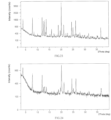
- the X-ray powder diffraction pattern of Form CS1 of hydrochloride is substantially as depicted in FIG. 17 .
- the X-ray powder diffraction pattern of Form CS1 of hydrochloride is substantially as depicted in FIG. 20 .
- the differential scanning calorimetry (DSC) curve of Form CS1 of hydrochloride shows an endothermic peak when heated to around 238 °C, which is substantially as depicted in FIG. 18 .
- the thermal gravimetric analysis (TGA) curve of Form CS1 of hydrochloride shows about 1.1% weight loss when heated to 150 °C, which is substantially as depicted in FIG. 19 .
- Another objective of the present invention is to provide the process of preparing Form CS1 of ozanimod hydrochloride.
- the process comprises method 1) or method 2) or method 3) or method 4),
- Another objective of the present invention is to provide a pharmaceutical composition
- a pharmaceutical composition comprising a therapeutically amount of Form CS1 of ozanimod hydrochloride and pharmaceutically acceptable carriers, diluents or excipients.
- pharmaceutically acceptable carriers diluents or excipients.
- Form CS1 of ozanimod hydrochloride provided by present invention can be used for preparing drugs for treating autoimmune diseases, particularly used for preparing drug products for treating multiple sclerosis and ulcerative colitis.
- room temperature in the present disclosure is not an exact temperature value and refers to 10-30 °C.
- reaction time of "evaporating" and “diffusion” in the present disclosure refers to the time before solid precipitation or longer.
- Said “stirring” is accomplished by using a conventional method in the field such as a magnetic stirring or a mechanical stirring and the stirring speed is 50 to 1800 r/min, preferably is 300 to 900 r/min.
- Said “separation” is accomplished by using a conventional method in the field such as centrifugation or filtration.
- the operation of "centrifugation” is as follows: the sample to be separated is placed into the centrifuge tube, and then centrifuged at a rate of 10000 r/min until the solid all sink to the bottom of the tube.
- drying is accomplished at room temperature or a higher temperature.
- the drying temperature is from room temperature to about 60 °C, or to 40 °C, or to 50 °C.
- the drying time can be 2 to 48 hours, or overnight. Drying is accomplished in a fume hood, oven or vacuum oven.
- Said "evaporating" is accomplished by using a conventional method in the field. For example, slow evaporation is to seal the container with a sealing film and puncture holes for evaporation. Rapid evaporation is to place the container open for evaporation.
- Said “polymer” is a mixture of equal masses of polycaprolactone, polyoxyethylene, polymethyl methacrylate, sodium alginate, and hydroxyethyl cellulose.
- the crystalline forms and crystalline form of hydrochloride provided by the present disclosure have advantages in solubility, melting point, stability, dissolution, bioavailability and processability.
- the crystalline Form CS1, Form CS2, Form CS3, Form CS5, Form CS6 and Form CS1 of the hydrochloride the hygroscopicity is low, stability is good, solubility meets the medicinal requirements, particle size distribution is uniform and the dispersion is good.
- test method is generally implemented according to a conventional condition or a condition recommended by manufacturer.
- X-ray powder diffraction pattern in the present disclosure was acquired by a Panalytical Empyrean X-ray powder diffractometer.
- the parameters of the X-ray powder diffraction method of the present disclosure were as follows:
- DSC Differential scanning calorimetry
- TGA Thermal gravimetric analysis
- Dynamic Vapor Sorption is measured via an SMS (Surface Measurement Systems Ltd.) intrinsic DVS.
- Typical Parameters for DVS test are as follows:
- the particle size distribution test in the present disclosure is acquired by the S3500 laser particle size analyzer of Microtrac.
- Microtrac S3500 is equipped with the SDC (Sample Delivery Controller).
- the test is carried out by wet process, and the dispersion medium is Isopar G.
- Raw materials of ozanimod and/or a hydrochloride thereof used in the following examples are prepared by methods disclosed in CN102762100A .
- Examples 11-15, 21 and 27-31 are working examples relating to the claimed crystalline Form CS1 of ozanimod hydrochloride.
- Examples relating solely to one or more of crystalline Form CS1, Form CS2, Form CS3, Form CS5 and Form CS6 of ozanimod are provided as reference examples.
- the obtained solid was identified as Form CS1.
- the XRPD data of the solid prepared in this example are listed in Table 1.
- the XRPD pattern is displayed in FIG. 1 .
- the DSC curve is displayed in FIG. 2 .
- the TGA curve is displayed in FIG. 3 .
- Form CS1 of ozanimod was added into a 3-mL glass vial. And then, the solid was dried under vacuum at 110 °C for 1 hour. The obtained white solid was identified as Form CS2.
- the XRPD data of the solid prepared in this example are listed in Table 2.
- the XRPD pattern is displayed in FIG. 4 .
- the DSC curve is displayed in FIG. 5 .
- the TGA curve is displayed in FIG. 6 .
- Table 2 2theta d spacing Relative intensity % 3.96 22.33 20.48 7.95 11.12 11.39 12.02 7.36 4.10 13.33 6.64 35.96 14.16 6.25 21.29 15.89 5.58 19.75 17.72 5.00 12.52 18.49 4.80 36.64 20.08 4.42 11.25 20.77 4.28 4.59 21.36 4.16 7.46 21.53 4.13 8.77 22.56 3.94 8.50 23.19 3.84 100.00 24.22 3.67 4.08 24.97 3.57 3.68 26.47 3.37 17.30 27.46 3.25 3.66 28.40 3.14 1.16 29.98 2.98 28.43 31.45 2.84 1.01 32.19 2.78 2.21 34.53 2.60 0.69 37.45 2.40 0.61 38.43 2.34 0.73 39.
- the XRPD data of the solid prepared in this example are listed in Table 4.
- the XRPD pattern is displayed in FIG. 7 .
- the DSC curve is displayed in FIG. 8 .
- the TGA curve is displayed in FIG. 9 .
- Table 4 2theta d spacing Relatively intensity % 3.04 29.02 12.88 4.43 19.93 100.00 7.84 11.28 16.58 8.92 9.92 10.16 11.03 8.02 15.96 12.96 6.83 83.06 13.43 6.59 11.89 13.72 6.46 33.05 15.80 5.61 3.44 16.57 5.35 5.55 17.00 5.21 19.94 17.98 4.93 4.44 18.38 4.83 4.34 19.83 4.48 6.93 20.06 4.43 8.40 20.57 4.32 5.85 21.53 4.13 7.15 21.98 4.04 6.11 22.56 3.94 8.12 23.17 3.84 23.33 24.09 3.69 14.77 25.14 3.54 12.77 26.00 3.43 41.57 26.68 3.34 9.46 28.42 3.14 6.82 30.67 2.91 1.27 33
- the obtained white solid was identified as Form CS3.
- the XRPD data of the solid prepared in this example are listed in Table 5.
- the XRPD pattern is displayed in FIG. 15 .
- Table 5 2theta d spacing Relatively intensity % 4.44 19.89 94.06 5.20 16.98 3.53 7.86 11.25 22.55 8.93 9.90 15.72 9.38 9.433 4.17 11.05 8.00 18.33 12.97 6.83 100.00 13.73 6.45 41.96 14.44 6.13 7.95 15.78 5.62 8.10 16.14 5.49 4.53 17.01 5.21 19.74 18.22 4.87 2.42 20.07 4.42 8.54 20.26 4.39 3.28 20.50 4.34 6.66 21.53 4.13 7.83 21.99 4.04 4.91 22.60 3.93 11.03 23.18 3.84 24.17 24.08 3.70 14.26 25.15 3.54 11.64 26.03 3.42 39.79 26.63 3.35 5.94 28.42 3.14 12.28 30.39 2.94 4.29 37.15 2.42 5.92 37.37 2.41 4.67
- Form CS3 can be prepared by evaporation in methanol, isopropyl acetate and dimethyl sulfoxide.
- the obtained white solid was identified as Form CS3, which shows characteristic peaks at 2theta values of 4.42°, 5.70°, 7.85°, 11.06°, 12.99°, 17.04°, 23.21°, 24.11° and 26.04°.
- the XRPD pattern is displayed in FIG. 53 .
- the obtained white solid was identified as Form CS5.
- the XRPD data of the solid prepared in this example are listed in Table 6.
- the XRPD pattern is displayed in FIG. 10 .
- the DSC curve is displayed in FIG. 11 .
- Table 6 2theta d spacing Relatively intensity % 4.25 20.80 100.00 6.76 13.08 3.43 7.71 11.47 1.36 8.55 10.34 13.99 10.79 8.20 1.07 12.96 6.83 34.38 13.61 6.51 9.98 14.42 6.14 1.40 15.13 5.85 1.00 16.39 5.41 3.84 16.86 5.26 4.05 17.29 5.13 2.70 18.37 4.83 0.78 19.57 4.54 2.18 20.48 4.34 5.14 21.60 4.12 8.34 22.52 3.95 1.56 23.20 3.83 1.88 24.04 3.70 4.04 24.98 3.56 4.18 26.03 3.42 5.50 27.06 3.30 3.14 28.35 3.15 0.64 29.00 3.08 0.35 30.27 2.95 0.47 31.14 2.87 0.58 32.77 2.73 0.
- the obtained white solid was identified as Form CS6.
- the XRPD data of the solid prepared in this example are listed in Table 7.
- the XRPD pattern is displayed in FIG. 12 .
- Table 7 2theta d spacing Relatively intensity % 4.45 19.88 100.00 7.86 11.24 6.23 8.89 9.95 10.03 11.03 8.02 7.43 13.01 6.81 26.15 13.37 6.62 8.34 13.75 6.44 11.19 14.89 5.95 0.81 15.49 5.72 1.94 15.79 5.61 1.52 16.94 5.23 3.00 17.12 5.18 4.44 17.87 4.96 2.72 19.06 4.66 1.52 19.22 4.62 1.51 20.13 4.41 3.22 21.55 4.12 2.16 22.40 3.97 3.75 22.82 3.90 2.11 23.58 3.77 2.04 24.51 3.63 5.93 25.42 3.50 4.55 26.22 3.40 2.19 26.52 3.36 5.03 27.06 3.30 0.91 27.86 3.20 1.37 28.32 3.15 0.61 28.86 3.09 0.51 30.04 2.97 0.
- Form CS6 can be prepared by evaporating in acetone.
- the obtained white solid was identified as Form CS6.
- the XRPD data of the solid prepared in this example are listed in Table 8.
- the XRPD pattern is displayed in FIG. 16 .
- ozanimod hydrochloride 10.1 mg was added into a 1.5-mL galss vial followed by adding 0.5 mL of 2-methyltetrahydrofuran to form a suspension. The suspension was stirred at room temperature for 1 week, then white solid was obtained after centrifugation and drying.
- the obtained white solid was identified as Form CS1 of ozanimod hydrochloride.
- the XRPD data of the solid prepared in this example are listed in Table 9.
- the XRPD pattern is displayed in FIG. 20 .
- the DSC curve is displayed in FIG. 18 .
- the TGA curve is displayed in FIG. 19 .
- the obtained solid was identified as Form CS1 of ozanimod hydrochloride.
- the XRPD data of the solid prepared in this example are listed in Table 10.
- Table 10 2theta d spacing Relatively intensity % 3.95 22.37 65.70 7.94 11.13 39.57 8.57 10.32 2.24 11.97 7.39 42.06 12.55 7.05 9.32 13.02 6.80 10.98 13.78 6.438 12.03 15.33 5.78 1.81 15.99 5.54 3.50 18.78 4.73 7.47 19.61 4.53 3.45 20.10 4.42 100.00 21.12 4.21 13.94 22.73 3.91 2.92 24.42 3.65 17.01 25.02 3.56 12.72 26.14 3.41 19.94 27.30 3.27 2.47 27.94 3.19 3.98 28.34 3.15 2.68 29.03 3.08 2.70 29.82 3.00 1.74 31.03 2.88 2.53 31.63 2.83 5.10 32.52 2.75 2.27 33.49 2.68 1.55 35.28 2.54 1.87 36.69
- ozanimod hydrochloride 5.5 mg was added into a 1.5-mL galss vial followed by adding 0.8 mL of solvent mixture of methanol and ethyl acetate (3:1, v/v) and 0.2 mg of polymer. The mixture was fast evaporated at room temperature for 1 week to obtain a solid.
- the obtained solid was identified as ozanimod hydrochloride Form CS1.
- the XRPD data of the solid prepared in this example are listed in Table 11.
- the XRPD pattern is displayed in FIG. 22 .
- Table 11 2theta d spacing Relatively intensity % 3.90 22.64 100.00 7.92 11.16 29.74 10.98 8.06 3.07 11.94 7.41 33.69 12.56 7.05 73.32 13.05 6.78 78.29 13.78 6.43 78.88 14.94 5.93 6.31 16.04 5.52 17.30 16.96 5.23 14.47 18.21 4.87 11.10 18.76 4.73 29.38 19.63 4.53 30.08 20.09 4.42 62.83 21.13 4.20 51.45 22.74 3.91 20.95 24.42 3.65 70.20 24.99 3.56 20.32 26.12 3.41 67.91 27.99 3.19 13.24 29.06 3.07 8.71 29.82 3.00 10.52 31.67 2.83 11.02 35.31 2.54 3.40 36.72 2.45 9.56 39.
- the obtained white solid was identified as ozanimod hydrochloride Form CS1.
- the XRPD data of the solid prepared in this example are listed in Table 12.
- the XRPD pattern is displayed in FIG. 23 .
- Table 12 2theta d spacing Relatively intensity % 3.94 22.42 29.02 7.94 11.13 40.24 8.59 10.30 6.70 10.08 8.78 3.14 11.98 7.39 43.32 12.56 7.05 30.75 13.03 6.79 34.04 13.78 6.42 38.84 15.31 5.79 2.91 15.96 5.55 12.46 16.95 5.23 4.31 17.31 5.12 2.90 18.22 4.87 2.15 18.79 4.72 20.42 19.62 4.52 8.57 20.10 4.42 100.00 21.08 4.22 21.17 22.03 4.04 4.56 22.73 3.91 5.82 24.40 3.65 30.21 25.01 3.56 16.38 25.47 3.50 3.80 26.13 3.41 34.94 26.77 3.33 4.27 27.02 3.30 3.66 27.30 3.27 5.18 27.
- ozanimod hydrochloride 5.4 mg was added into a 1.5-mL galss vial followed by adding 0.3 mL of solvent mixture of methanol and water (9:1, v/v) at 50 °C. The mixture was filtered and fast cooled at -20 °C to obtain solid.
- the obtained white solid was identified as Form CSI of ozanimod hydrochloride.
- the XRPD data of the solid prepared in this example are listed in Table 13.
- the XRPD pattern is displayed in FIG. 24 .
- Table 13 2theta d spacing Relatively intensity % 3.92 22.54 56.68 7.94 11.14 51.15 9.36 9.45 1.72 9.89 8.95 3.02 11.96 7.40 51.80 12.57 7.04 11.98 13.04 6.79 15.16 13.79 6.42 12.00 15.96 5.55 3.10 16.95 5.23 3.28 18.21 4.87 4.07 18.78 4.73 9.66 19.69 4.51 12.34 20.08 4.42 100.00 21.11 4.21 27.35 21.87 4.06 5.55 22.77 3.91 7.92 24.40 3.65 44.75 25.00 3.56 10.24 26.13 3.41 43.35 26.80 3.33 6.64 27.91 3.20 6.55 28.96 3.08 3.94 29.86 2.99 2.81 31.57 2.83 7.26 33.39 2.68 2.12 36.71 2.
- Form CS1 belongs to slightly hygroscopic.
- Form CS2 belongs to slightly hygroscopic.
- Form CS5 belongs to slightly hygroscopic.
- Form CS2 has good stability.
- Form CS5 has good stability.
- SD Standard deviation
- D10 particle size which accounts for 10% of the particle size distribution (volume distribution).
- D50 particle size which accounts for 50% of the particle size distribution (volume distribution), also known as the median diameter.
- D90 particle size which accounts for 90% of the particle size distribution (volume distribution).
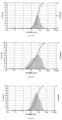
- the particle size distribution diagram of Form CS1 is shown in Figure 37 .
- the result shows that the average particle size of Form CS1 is 22.40 ⁇ m, and the particle size distribution is narrow, which presents an almost normal and uniform distribution.
- the particle size distribution diagram of Form CS2 is shown in Figure 38 .
- the result shows that the average particle size of Form CS2 is 23.24 ⁇ m, and the particle size distribution is narrow, which presents an almost normal and uniform distribution.
- the particle size distribution diagram of Form CS3 is shown in Figure 39 .
- the result shows that the average particle size of Form CS3 is 66.62 ⁇ m, and the particle size distribution is narrow, which presents an almost normal and uniform distribution.
- the particle size distribution diagram of Form CS5 is shown in Figure 40 .
- the result shows that the average particle size of Form CS5 is 68.84 ⁇ m, and the particle size distribution is narrow, which presents an almost normal and uniform distribution.
- the particle size distribution diagram of Form CS6 is shown in Figure 41 .
- the result shows that the average particle size of Form CS6 is 68.91 ⁇ m, and the particle size distribution is narrow, which presents an almost normal and uniform distribution.
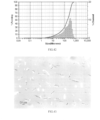
- the particle size distribution diagram of Form CS1 of ozanimod hydrochloride is shown in Figure 42 .
- the result shows that the average particle size of Form CS1 of ozanimod hydrochloride is 200.7 ⁇ m, and the particle size is large which conducive to separation during production.
- Form CS1 PLM plots of Form CS1, Form CS2, Form CS3, Form CS5, Form CS6 of ozanimod and Form CS1 of ozanimod hydrochloride were displayed in FIG. 43 , FIG. 44 , FIG. 45 , FIG. 46 , FIG. 47 and FIG.48 respectively.
- Form CS3 was flake-like
- Form CS1, Form CS2, Form CS5, Form CS6 and Form CS1 of ozanimod hydrochloride were short rod-like with good dispersion, less agglomeration and uniform particle size.
- Uniform particle size helps to simplify the post-treatment process and improve quality control.
- Form CS3 and Form CS5 were suspended into SGF (Simulated gastric fluids) and water, and Form CS2 was suspended into FeSSIF (Fed state simulated intestinal fluids) to obtain saturated solutions. After being equilibrated for 1 h, 4 h and 24 h, concentrations of the saturated solutions were measured by HPLC. The results were listed in Table 28.
- Form CS3, Form CS5, Form CS6 of ozanimod and Form CS1 of ozanimod hydrochloride under a certain mechanical stress with slightly decrease in crystallinity.
- Good physical and chemical properties including stability made these forms suitable for drug preparation and storage.
- Crystalline forms with better mechanical stability have good physicochemical properties and remain stable under certain mechanical stress.
- the crystalline drug with better mechanical stability has low requirements on the crystallization equipment, and no special post-treatment condition is required. It is more stable in the formulation process, can significantly reduce the development cost of the drug products, enhance the quality of the drug, and has strong economic value.
- Form CS1 used in Examples 16 to 31 of the present disclosure is prepared by the method of Example 1;
- Form CS2 is prepared by the method of Example 3;
- Form CS3 was prepared by the method of Example 6;
- Form CS5 was prepared by the method of Example 9;
- Form CS6 was prepared by the method of Example 10;
- Form CS1 of ozanimod hydrochloride was prepared by the method of Example 11.
Landscapes
- Organic Chemistry (AREA)
- Chemical & Material Sciences (AREA)
- Health & Medical Sciences (AREA)
- Engineering & Computer Science (AREA)
- Bioinformatics & Cheminformatics (AREA)
- Animal Behavior & Ethology (AREA)
- Public Health (AREA)
- Medicinal Chemistry (AREA)
- Nuclear Medicine, Radiotherapy & Molecular Imaging (AREA)
- Chemical Kinetics & Catalysis (AREA)
- Pharmacology & Pharmacy (AREA)
- Life Sciences & Earth Sciences (AREA)
- Neurosurgery (AREA)
- General Health & Medical Sciences (AREA)
- General Chemical & Material Sciences (AREA)
- Veterinary Medicine (AREA)
- Biomedical Technology (AREA)
- Neurology (AREA)
- Hospice & Palliative Care (AREA)
- Immunology (AREA)
- Psychiatry (AREA)
- Organic Low-Molecular-Weight Compounds And Preparation Thereof (AREA)
- Pharmaceuticals Containing Other Organic And Inorganic Compounds (AREA)
- Acyclic And Carbocyclic Compounds In Medicinal Compositions (AREA)
Description
- The present disclosure relates to the field of pharmaceutical chemistry, particularly relates to a crystalline form of ozanimod hydrochloride, and processes for the preparation thereof.
- Ozanimod is a novel, oral, selective modulator of sphingosine-1-
phosphate 1 receptor (S1P1R) developed by Receptos for the treatment of autoimmune diseases. ozanimod is in phase III trials in the USA for the treatment of multiple sclerosis (MS) and ulcerative colitis (UC). Ozanimod has very excellent pharmacokinetics, pharmacodynamics and safety data in clinical trials, which can perfectly meet the differentiated development strategy and is expected to be the best second-generation SIPIR modulator drug. The chemical structure of the drug is shown as formula (I).
- A specific pharmaceutical activity is the basic prerequisite to be fulfilled by a pharmaceutically active agent to be approved as a medicament on the market. However, there are a variety of additional requirements that a pharmaceutically active agent has to comply with. These requirements are based on various parameters which are connected with the nature of the active substance itself. Without being restricted, examples of these parameters are the chemical stability, solid-state stability and storage stability of the active substance under various environmental conditions, stability during production of the pharmaceutical composition and the stability of the active substance in the final drug products, etc.
- The pharmaceutically active agent used for preparing the pharmaceutical compositions should be as pure as possible and its stability in long-term storage must be guaranteed under various environmental conditions. It is essential to prevent using pharmaceutical compositions which contain agent other than the actual active agent, for example decomposition products thereof. In such cases the content of active agent in the drug might be less than that specified. In addition it is important that the pharmaceutically active agent should be non-hygroscopic, stable both to degradation and subsequent solid form changes. If the pharmaceutically active agent is hygroscopic in the sense that it absorbs water (either slowly or over time), it is almost impossible to reliably formulate the pharmaceutically active agent into a drug as the amount of agent to be added to provide the same dosage will vary greatly depending upon the degree of hydration. Furthermore, variations in hydration or solid form can lead to changes in physicochemical properties, such as solubility or dissolution rate, which can in turn lead to inconsistent oral absorption of the patient. Preferably, therefore, a pharmaceutically active substance should be only slightly hygroscopic.
- Accordingly, chemical stability, solid-state stability, "shelf life" and materials handling properties (such as ease of solubilizing the compound) of the pharmaceutically active substance are very important factors. In an ideal situation, the pharmaceutically active substance and any compositions containing it should be capable of being effectively stored over appreciable periods of time, without exhibiting a significant change in the physicochemical properties of the active substance such as its activity, moisture content, solubility, solid form, etc. Further, the pharmaceutically active substance usually needs to be processed to achieve a particle size suitable for inhalation and any crystalline form must be stable during such processing so that the properties of the final product are predictable and reliable. In short, in the production of commercially viable and pharmaceutically acceptable pharmaceutical compositions, it is desirable to provide the pharmaceutically active substance in a fully crystalline and stable form, wherever possible.
- Different crystalline forms of the same solid chemical drug are significantly different in solubility and stability which can in turn affect the absorption and bioavailability of the drug products.
CN102762100A orUS2011172202A1 disclosed the compound of formula (I), while there is no solid form or crystalline form of ozanimod disclosed in the prior art. The prior art has neither guidance nor inspiration for finding the crystalline forms. Therefore, it is necessary to perform comprehensive polymorph screening of ozanimod to select a crystalline form which is the most suitable for drug development. - The inventors of the present disclosure have found several crystalline forms of ozanimod and a crystalline form of ozanimod hydrochloride through research process, which provides new choices for the preparation of ozanimod drug product.
- The present disclosure provides novel crystalline forms of ozanimod and ozanimod hydrochloride, and processes for preparation and use thereof. The present invention is defined by the claims.
- One objective of the present disclosure is to provide a crystalline form of ozanimod, designated as Form CS1.
- The X-ray powder diffraction pattern of Form CS1 shows characteristic peaks at 2theta values of 12.1°±0.2°, 10.4°±0.2° and 4.2°±0.2° using CuKα radiation.
- Furthermore, the X-ray powder diffraction pattern of Form CS1 shows one or two or three diffraction peaks at 2theta values of 7.4°±0.2°, 24.3°±0.2° and 17.7°±0.2°. Preferably, the X-ray powder diffraction pattern of Form CS1 shows three diffraction peaks at 2theta values of 7.4°±0.2°, 24.3°±0.2°, 17.7°±0.2°.
- Furthermore, the X-ray powder diffraction pattern of Form CS1 shows one or two or three characteristic peaks at 2theta values of 12.8°±0.2°, 21.5°±0.2° and 18.2°±0.2°. Preferably, the X-ray powder diffraction pattern of Form CS1 shows three diffraction peaks at 2theta values of 12.8°±0.2°, 21.5°±0.2° and 18.2°±0.2°.
- Furthermore, the X-ray powder diffraction pattern of Form CS1 shows characteristic peaks at 2theta values of 4.2°±0.2°, 7.4°±0.2°, 10.4°±0.2°, 12.1°±0.2°, 12.8°±0.2°, 17.7°±0.2°, 18.2°±0.2°, 21.5°±0.2° and 24.3°±0.2°.
- In a preferred disclosure, the X-ray powder diffraction pattern of Form CS1 is substantially as depicted in
FIG. 1 . - In a preferred disclosure, the differential scanning calorimetry (DSC) curve of Form CS1 shows the first endothermic peak when heated to around 98 °C and the second endothermic peak when heated to around 134 °C, which is substantially as depicted in
FIG. 2 . - In a preferred disclosure, the thermal gravimetric analysis (TGA) curve of Form CS1 shows about 4.3% weight loss when heated to 150°C, which is substantially as depicted in
FIG. 3 . - The present disclosure further provides the process for preparing Form CS1. The process comprises method 1) or method 2):
- 1) Suspending ozanimod hydrochloride into a solvent selected from alcohols, ketones, esters and nitriles and the suspension becomes clear after adding 1.0 to 1.5 (preferably 1.0) equivalent of sodium hydroxide solution. Then, white solid precipitates from the solution after stirring at room temperature for a period of time. Isolating the white solid by centrifugation, and then Form CS1 is obtained after drying the isolated solid. Said stirring time is at least 0.5 h, more preferably at least 1 h, further more preferably 12 h; or
- 2) Suspending ozanimod in an alcohol, stirring, isolating and drying the solid to obtain Form CS1 of ozanimod; wherein said stirring time is at least 0.5 hour, more preferably at least 1 h, further more preferably 12 h.
- Furthermore, in method 1), said alcohol is methanol; said ketone is acetone; said ester is isopropyl acetate; said nitrile is acetonitrile. In method 2), said alcohol is methanol.
- Another objective of the present disclosure is to provide a crystalline form of ozanimod, designated as Form CS2.
- The X-ray powder diffraction pattern of Form CS2 shows characteristic peaks at 2theta values of 23.2°±0.2°, 18.5°±0.2° and 13.3°±0.2°using CuKα radiation.
- Furthermore, the X-ray powder diffraction pattern of Form CS2 shows one or two or three diffraction peaks at 2theta values of 15.9°±0.2°, 30.0°±0.2° and 14.2°±0.2°. Preferably, the X-ray powder diffraction pattern of Form CS2 shows three diffraction peaks at 2theta values of 15.9°±0.2°, 30.0°±0.2° and 14.2°±0.2°.
- Furthermore, the X-ray powder diffraction pattern of Form CS2 shows one or two or three characteristic peaks at 2theta values of 4.0°±0.2°, 26.5°±0.2° and 17.7°±0.2°. Preferably, the X-ray powder diffraction pattern of Form CS2 shows three diffraction peaks at 2theta values of 4.0°±0.2°, 26.5°±0.2° and 17.7°±0.2°.
- Furthermore, the X-ray powder diffraction pattern of Form CS2 shows characteristic peaks at 2theta values of 4.0°±0.2°, 13.3°±0.2°, 14.2°±0.2°, 15.9°±0.2°, 17.7°±0.2°, 18.5°±0.2°, 23.2°±0.2°, 26.5°±0.2° and 30.0°±0.2°.
- In a preferred disclosure, the X-ray powder diffraction pattern of Form CS2 is substantially as depicted in
FIG. 4 . - In a preferred disclosure, the differential scanning calorimetry (DSC) curve of Form CS2 shows an endothermic peak when heated to around 134 °C, which is substantially as depicted in
FIG. 5 . - In a preferred disclosure, the thermal gravimetric analysis (TGA) curve of Form CS2 shows about 1.1% weight loss when heated to 150 °C, which is substantially as depicted in
FIG. 6 . - The present disclosure further provides the process for preparing Form CS2. The process comprises method 1) or method 2):
- 1) The crystalline Form CS2 is prepared by heating Form CS1 to 100-130 °C, or
- 2) Suspending ozanimod into a solvent selected from nitriles, ketones, esters, aromatic hydrocarbons, cyclic ethers and water, or a mixture of solvents selected from alcohols and water, ketones and water, amides and water, and then stirring, isolating and drying the solid to obtain Form CS2 of ozanimod; said stirring time is at least 0.5 hour, more preferably at least 1 h, further more preferably 12 h.
- Furthermore, said heating temperature in method 1) is 110 °C.
- Furthermore, in method 2), said nitrile is acetonitrile; said ketone is acetone or methyl isobutyl ketone; said ester is ethyl acetate; said aromatic hydrocarbons is toluene; said cyclic ether is 2-methyltetrahydrofuran; said mixture of solvents is mixture of ethanol and water, acetone and water, or N, N-dimethylformamide and water.
- Another objective of the present disclosure is to provide a crystalline form of ozanimod, designated as Form CS3.
- The X-ray powder diffraction pattern of Form CS3 shows at least one characteristic peak at 2theta values of 4.4°±0.2°, 5.7°±0.2°, 7.8°±0.2°, 11.0°±0.2°, 13.0°±0.2°, 13.7°±0.2°, 17.0°±0.2°, 23.2°±0.2°, 24.1°±0.2° and 26.0°±0.2°.
- Furthermore, the X-ray powder diffraction pattern of Form CS3 shows characteristic peaks at 2theta values of 4.4°±0.2°, 13.0°±0.2°, 26.0°±0.2° and 11.0°±0.2°.
- Furthermore, the X-ray powder diffraction pattern of Form CS3 shows one or two or three diffraction peaks at 2theta values of 7.8°±0.2°, 23.2°±0.2° and 17.0°±0.2°. Preferably, the X-ray powder diffraction pattern of Form CS3 shows three diffraction peaks at 2theta values of 7.8°±0.2°, 23.2°±0.2° and 17.0°±0.2°.
- Furthermore, the X-ray powder diffraction pattern of Form CS3 shows one or two characteristic peaks at 2theta values of 13.7°±0.2° and 24.1°±0.2°. Preferably, the X-ray powder diffraction pattern of Form CS3 shows two diffraction peaks at 2theta values of 13.7°±0.2° and 24.1°±0.2°.
- Furthermore, the X-ray powder diffraction pattern of Form CS3 shows one or two characteristic peaks at 2theta values of 5.7°±0.2° and 24.1°±0.2°. Preferably, the X-ray powder diffraction pattern of Form CS3 shows two diffraction peaks at 2theta values of 5.7°±0.2° and 24.1°±0.2°.
- In a preferred disclosure, the X-ray powder diffraction pattern of Form CS3 shows characteristic peaks at 2theta values of 4.4°±0.2°, 7.8°±0.2°, 11.0°±0.2°, 13.0°±0.2°, 13.7°±0.2°, 17.0°±0.2°, 23.2°±0.2°, 24.1°±0.2° and 26.0°±0.2°.
- In a preferred disclosure, the X-ray powder diffraction pattern of Form CS3 is substantially as depicted in
FIG. 7 . - In a preferred disclosure, the differential scanning calorimetry (DSC) curve of Form CS3 shows the first endothermic peak when heated to around 112 °C, shows an exothermic peak when heated to around 121 °C and shows the second endothermic peak when heated to around 133 °C which is substantially as depicted in
FIG. 8 . - In a preferred disclosure, the thermal gravimetric analysis (TGA) curve of Form CS3 shows about 3.1% weight loss when heated to 130 °C, which is substantially as depicted in
FIG. 9 . - In a preferred disclosure, the X-ray powder diffraction pattern of Form CS3 shows characteristic peaks at 2theta values of 4.4°±0.2°, 5.7°±0.2°, 7.8°±0.2°, 11.0°±0.2°, 13.0°±0.2°, 17.0°±0.2°, 23.2°±0.2°, 24.1°±0.2° and 26.0°±0.2°.
- In a preferred disclosure, the X-ray powder diffraction pattern of Form CS3 is substantially as depicted in
FIG. 53 . - Another objective of the present disclosure is to provide the process for preparing Form CS3 of ozanimod. The process comprises: adding ozanimod into a solvent selected form alcohols, nitriles, dichloromethane, esters, sulfoxides or a mixture of glycol dimethyl ether and water, filtering, evaporating the filtrate and collecting the solid to obtain Form CS3 of ozanimod.
- Preferably, said alcohol is methanol; said nitrile is acetonitrile; said ester is isopropyl acetate; said sulfoxide is dimethyl sulfoxide.
- Another objective of the disclosure is to provide a crystalline form of ozanimod, designated as Form CS5.
- The X-ray powder diffraction pattern of Form CS5 shows characteristic peaks at 2theta values of 4.3°±0.2°, 6.8°±0.2° and 16.4°±0.2° using CuKα radiation.
- Furthermore, the X-ray powder diffraction pattern of Form CS5 shows one or two or three diffraction peaks at 2theta values of 21.6°±0.2°, 8.5°±0.2° and 13.6°±0.2°. Preferably, the X-ray powder diffraction pattern of Form CS5 shows three diffraction peaks at 2theta values of 21.6°±0.2°, 8.5°±0.2° and 13.6°±0.2°.
- Furthermore, the X-ray powder diffraction pattern of Form CS5 shows one or two or three diffraction peaks at 2theta values of 13.0°±0.2°, 25.0°±0.2° and 26.0°±0.2°. Preferably, the X-ray powder diffraction pattern of Form CS5 shows three diffraction peaks at 2theta values of 13.0°±0.2°, 25.0°±0.2° and 26.0°±0.2°.
- Furthermore, the X-ray powder diffraction pattern of Form CS5 shows characteristic peaks at 2theta values of 4.3°±0.2°, 6.8°±0.2°, 8.5°±0.2°, 13.0°±0.2°, 13.6°±0.2°, 16.4°±0.2°, 21.6°±0.2°, 25.0°±0.2° and 26.0°±0.2°.
- In a preferred disclosure, the X-ray powder diffraction pattern of Form CS5 is substantially as depicted in
FIG. 10 . - In a preferred disclosure, the differential scanning calorimetry (DSC) curve of Form CS5 shows the first endothermic peak when heated to around 65 °C, shows an exothermic peak when heated to around 91 °C and shows the second endothermic peak when heated to around 133 °C and which is substantially as depicted in
FIG. 11 . - Another objective of the present disclosure is to provide the process of preparing Form CS5 of ozanimod. The process comprises adding the solid of ozanimod into cyclic ethers, filtering, evaporating the filtrate and collecting the solid to obtain Form CS5 of ozanimod.
- Furthermore, said cyclic ether is 2-methyltetrahydrofuran.
- Another objective of the present disclosure is to provide a crystalline form of ozanimod, designated as Form CS6.
- The X-ray powder diffraction pattern of Form CS6 shows characteristic peaks at 2theta values of 4.4°±0.2°, 24.5°±0.2°, 26.5°±0.2° and 13.8°±0.2° using CuKα radiation.
- Furthermore, the X-ray powder diffraction pattern of Form CS6 shows one or two diffraction peaks at 2theta values of 13.0°±0.2° and 25.4°±0.2°. Preferably, the X-ray powder diffraction pattern of Form CS6 shows two diffraction peaks at 2theta values of 13.0°±0.2° and 25.4°±0.2°.
- Furthermore, the X-ray powder diffraction pattern of Form CS6 shows one or two or three diffraction peaks at 2theta values of 8.9°±0.2°, 13.4°±0.2° and 11.0°±0.2°. Preferably, the X-ray powder diffraction pattern of Form CS6 shows three diffraction peaks at 2theta values of 8.9°±0.2°, 13.4°±0.2° and 11.0°±0.2°.
- Furthermore, the X-ray powder diffraction pattern of Form CS6 shows characteristic peaks at 2theta values of 4.4°±0.2°, 8.9°±0.2°, 11.0°±0.2°, 13.0°±0.2°, 13.4°±0.2°, 13.8°±0.2°, 24.5°±0.2°, 25.4°±0.2° and 26.5°±0.2°.
- In a preferred disclosure, the X-ray powder diffraction pattern of Form CS6 is substantially as depicted in
FIG. 16 . - In a preferred disclosure, the differential scanning calorimetry (DSC) curve of Form CS6 shows an exothermic peak when heated to around 110 °C and shows an endothermic peak when heated to around 135 °C, which is substantially as depicted in
FIG. 13 . - In a preferred disclosure, the thermal gravimetric analysis (TGA) curve of Form CS6 shows about 1.2% weight loss when heated to 120 °C, which is substantially as depicted in
FIG. 14 . - Another objective of the present disclosure is to provide the process of preparing Form CS6 of ozanimod. The process comprises adding the solid of ozanimod into a solvent selected from ketones, chloroform and the like, filtering, evaporating the filtrate and collecting the solid to obtain Form CS6 of ozanimod.
- Preferably, said ketone is acetone.
- Another objective of the present disclosure is to provide a pharmaceutical composition comprising a therapeutically amount of ozanimod Form CS1 or Form CS2 or a combination thereof and pharmaceutically acceptable carriers, diluents or excipients. Generally, mix or contact therapeutically a therapeutically amount of Form CS1 or Form CS2 or a combination thereof and one or more pharmaceutically acceptable excipients to make pharmaceutical composition or drug products, and the pharmaceutical composition or drug products are prepared by well-known method in the pharmaceutical field.
- Ozanimod Form CS1 or Form CS2 or combinations thereof provided by the present disclosure can be used for preparing drugs for treating autoimmune diseases, particularly used for preparing drug products for treating multiple sclerosis and ulcerative colitis.
- The present disclosure also provides a pharmaceutical composition comprising a therapeutically amount of ozanimod Form CS3, Form CS5, Form CS6 or combinations thereof and pharmaceutically acceptable carriers, diluents or excipients. Generally, mix or contact therapeutically an effective amount of Form CS3, Form CS5, Form CS6 or a combination thereof and one or more pharmaceutically acceptable excipients to make pharmaceutical composition or drug products, and the pharmaceutical composition or drug products are prepared by well-known method in the pharmaceutical field.
- Ozanimod Form CS3, Form CS5 or Form CS6 or combinations thereof provided by present disclosure can be used for preparing drugs of selective modulator of sphingosine-1-
phosphate 1 receptor. - Ozanimod Form CS3, Form CS5 or Form CS6 or combinations thereof provided by present disclosure can be used for preparing drugs for treating autoimmune diseases, particularly used for preparing drug products for treating multiple sclerosis and ulcerative colitis.
- The present disclosure further provides a pharmaceutical composition comprising a therapeutically amount of ozanimod Form CS1, Form CS2, Form CS3, Form CS5, Form CS6 or combinations thereof and pharmaceutically acceptable carriers, diluents or excipients.
- Furthermore, ozanimod Form CS1, Form CS2, Form CS3, Form CS5, Form CS6 or combinations thereof can be used for preparing drugs of selective modulator of sphingosine-1-
phosphate 1 receptor. - Ozanimod Form CS1, Form CS2, Form CS3, Form CS5, Form CS6 or combinations thereof can be used for preparing drugs for treating ulcerative colitis.
- Ozanimod Form CS1, Form CS2, Form CS3, Form CS5, Form CS6 or combinations thereof can be used for preparing drugs for treating multiple sclerosis.
- Another objective of the present disclosure is to provide a crystalline form of ozanimod hydrochloride, designated as Form CS1of ozanimod hydrochloride.
- The X-ray powder diffraction pattern of Form CS1 of ozanimod hydrochloride shows characteristic peaks at 2theta values of 26.1°±0.2°, 24.4°±0.2° and 20.1°±0.2° using CuKα radiation.
- Furthermore, the X-ray powder diffraction pattern of Form CS1 of ozanimod hydrochloride shows one or two or three diffraction peaks at 2theta values of 3.9°±0.2°, 21.1°±0.2° and 7.9°±0.2°. Preferably, the X-ray powder diffraction pattern of Form CS1 of ozanimod hydrochloride shows three diffraction peaks at 2theta values of 3.9°±0.2°, 21.1°±0.2° and 7.9°±0.2°.
- Furthermore, the X-ray powder diffraction pattern of Form CS1 of ozanimod hydrochloride shows one or two or three diffraction peaks at 2theta values of 11.9°±0.2°, 19.6°±0.2° and 13.8°±0.2°. Preferably, the X-ray powder diffraction pattern of Form CS1 of ozanimod hydrochloride shows diffraction peaks at 2theta values of 11.9°±0.2°, 19.6°±0.2° and 13.8°±0.2°.
- Furthermore, the X-ray powder diffraction pattern of Form CS1 of ozanimod hydrochloride shows characteristic peaks at 2theta values of 3.9°±0.2°, 7.9°±0.2°, 11.9°±0.2°, 13.8°±0.2°, 19.6°±0.2°, 20.1°±0.2°, 21.1°±0.2°, 24.4°±0.2° and 26.1°±0.2°.
- In a preferred embodiment, the X-ray powder diffraction pattern of Form CS1 of hydrochloride is substantially as depicted in
FIG. 17 . - In a preferred embodiment, the X-ray powder diffraction pattern of Form CS1 of hydrochloride is substantially as depicted in
FIG. 20 . - In a preferred embodiment, the differential scanning calorimetry (DSC) curve of Form CS1 of hydrochloride shows an endothermic peak when heated to around 238 °C, which is substantially as depicted in
FIG. 18 . - In a preferred embodiment, the thermal gravimetric analysis (TGA) curve of Form CS1 of hydrochloride shows about 1.1% weight loss when heated to 150 °C, which is substantially as depicted in
FIG. 19 . - Another objective of the present invention is to provide the process of preparing Form CS1 of ozanimod hydrochloride. The process comprises method 1) or method 2) or method 3) or method 4),
- 1) Adding ozanimod hydrochloride into ethers and stirring for a period of time at a certain temperature (4-50 °C, preferably 25 °C), filtering and drying to obtain white solid; said stirring time is at least 1 hour, preferably at least 24 hours, more preferably seven days; or
- 2) Dissolving ozanimod hydrochloride into a solvent selected from alcohols and esters or a mixture of solvents thereof, evaporating at room temperature to obtain white solid; said "evaporation time" usually means the time or longer than the time for solid precipitation. The evaporation time is preferably 0.5 day to 14 days, more preferably 7 days; or
- 3) Dissolving ozanimod hydrochloride into a solvent selected from amides or a mixture of solvents thereof, then placing the solution in a system containing anti-solvent of ozanimod hydrochloride for liquid vapor diffusion at room temperature, filtering and drying to obtain white solid; said "diffusion time" usually means the time or longer than the time for solid precipitation. The diffusion time is preferably 1 day to 14 days, more preferably 7 days; or
- 4) Dissolving ozanimod hydrochloride into a mixture of alcohols and water to form a supersaturated solution, ozanimod hydrochloride is fully dissolved at 25-80 °C (preferably 50 °C), and then filtering, cooling the filtrate for precipitation, filtering and drying to obtain white solid of Form CS1 of ozanimod hydrochloride.
- Another objective of the present invention is to provide a pharmaceutical composition comprising a therapeutically amount of Form CS1 of ozanimod hydrochloride and pharmaceutically acceptable carriers, diluents or excipients. Generally, mix or contact therapeutically an effective amount of Form CS1 of ozanimod hydrochloride and one or more pharmaceutically acceptable excipients to make pharmaceutical composition or drug products, and the pharmaceutical composition or drug products are prepared by well-known method in the pharmaceutical field.
- Furthermore, Form CS1 of ozanimod hydrochloride provided by present invention can be used for preparing drugs for treating autoimmune diseases, particularly used for preparing drug products for treating multiple sclerosis and ulcerative colitis.
- Said "room temperature" in the present disclosure is not an exact temperature value and refers to 10-30 °C.
- The reaction time of "evaporating" and "diffusion" in the present disclosure refers to the time before solid precipitation or longer.
- Said "stirring" is accomplished by using a conventional method in the field such as a magnetic stirring or a mechanical stirring and the stirring speed is 50 to 1800 r/min, preferably is 300 to 900 r/min.
- Said "separation" is accomplished by using a conventional method in the field such as centrifugation or filtration. The operation of "centrifugation" is as follows: the sample to be separated is placed into the centrifuge tube, and then centrifuged at a rate of 10000 r/min until the solid all sink to the bottom of the tube.
- Said "drying" is accomplished at room temperature or a higher temperature. The drying temperature is from room temperature to about 60 °C, or to 40 °C, or to 50 °C. The drying time can be 2 to 48 hours, or overnight. Drying is accomplished in a fume hood, oven or vacuum oven.
- Said "evaporating" is accomplished by using a conventional method in the field. For example, slow evaporation is to seal the container with a sealing film and puncture holes for evaporation. Rapid evaporation is to place the container open for evaporation.
- Said "polymer" is a mixture of equal masses of polycaprolactone, polyoxyethylene, polymethyl methacrylate, sodium alginate, and hydroxyethyl cellulose.
- The beneficial effects of the present disclosure are as follows:
At present, no patent or literature has disclosed the crystalline form of ozanimod and inventors of the present disclosure broke through this difficult problem and several novel crystalline forms of ozanimod suitable for the drug development are found. - The crystalline forms and crystalline form of hydrochloride provided by the present disclosure have advantages in solubility, melting point, stability, dissolution, bioavailability and processability. As for the crystalline Form CS1, Form CS2, Form CS3, Form CS5, Form CS6 and Form CS1 of the hydrochloride, the hygroscopicity is low, stability is good, solubility meets the medicinal requirements, particle size distribution is uniform and the dispersion is good. These advantages help to simplify the post-treatment process of preparing drugs and provide new and better choices for the preparation of ozanimod drug products, which are very important for drug development.
-
-
FIG. 1 shows an XRPD pattern of Form CS1 obtained in Example 1. -
FIG. 2 shows a DSC curve of Form CS1 obtained in Example 1. -
FIG. 3 shows a TGA curve of Form CS1 obtained in Example 1. -
FIG. 4 shows an XRPD pattern of Form CS2 obtained in Example 3. -
FIG. 5 shows a DSC curve of Form CS2 obtained in Example 3. -
FIG. 6 shows a TGA curve of Form CS2 obtained in Example 3. -
FIG. 7 shows an XRPD pattern of Form CS3 obtained in Example 5. -
FIG. 8 shows a DSC curve of Form CS3 obtained in Example 5. -
FIG. 9 shows a TGA curve of Form CS3 obtained in Example 5. -
FIG. 10 shows an XRPD pattern of Form CS5 obtained in Example 8. -
FIG. 11 shows a DSC curve of Form CS5 obtained in Example 8. -
FIG. 12 shows an XRPD pattern of Form CS6 obtained in Example 9. -
FIG. 13 shows a DSC curve of Form CS6 obtained in Example 10. -
FIG. 14 shows a TGA curve of Form CS6 obtained in Example 10. -
FIG. 15 shows an XRPD pattern of Form CS3 obtained in Example 6. -
FIG. 16 shows an XRPD pattern of Form CS6 obtained in Example 10. -
FIG. 17 shows an XRPD pattern of Form CS1 of hydrochloride. -
FIG. 18 shows a DSC curve of Form CS1 of hydrochloride obtained in Example 11. -
FIG. 19 shows a TGA curve of Form CS1 of hydrochloride obtained in Example 11. -
FIG. 20 shows an XRPD pattern of Form CS1 of hydrochloride obtained in Example 11. -
FIG. 21 shows an XRPD pattern of Form CS1 of hydrochloride obtained in Example 12. -
FIG. 22 shows an XRPD pattern of Form CS1 of hydrochloride obtained in Example 13. -
FIG. 23 shows an XRPD pattern of Form CS1 of hydrochloride obtained in Example 14. -
FIG. 24 shows an XRPD pattern of Form CS1 of hydrochloride obtained in Example 15. -
FIG. 25 shows a DVS plot of Form CS1 in Example 16. -
FIG. 26 shows a DVS plot of Form CS2 in Example 17. -
FIG. 27 shows a DVS plot of Form CS3 in Example 18. -
FIG. 28 shows a DVS plot of Form CS5 in Example 19. -
FIG. 29 shows a DVS plot of Form CS6 in Example 20. -
FIG. 30 shows a DVS plot of Form CS1 of hydrochloride in Example 21. -
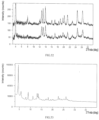
FIG. 31 shows an XRPD comparison pattern of Form CS1 before and after stability test in Example 22. -
FIG. 32 shows an XRPD comparison pattern of Form CS2 before and after stability test in Example 23. -
FIG. 33 shows an XRPD comparison pattern of Form CS3 before and after stability test in Example 24. -
FIG. 34 shows an XRPD comparison pattern of Form CS5 before and after stability test in Example 25. -
FIG. 35 shows an XRPD comparison pattern of Form CS6 before and after stability test in Example 26. -
FIG. 36 shows an XRPD comparison pattern of Form CS1 of hydrochloride before and after stability test in Example 27. -
FIG. 37 shows a PSD diagram of Form CS1 in Example 28. -
FIG. 38 shows a PSD diagram of Form CS2 in Example 28. -
FIG. 39 shows a PSD diagram of Form CS3 in Example 28. -
FIG. 40 shows a PSD diagram of Form CS5 in Example 28. -
FIG. 41 shows a PSD diagram of Form CS6 in Example 28. -
FIG. 42 shows a PSD diagram of Form CS1 of hydrochloride in Example 28. -
FIG. 43 shows a PLM image of Form CS1 in Example 28. -
FIG. 44 shows a PLM image of Form CS2 in Example 28. -
FIG. 45 shows a PLM image of Form CS3 in Example 28. -
FIG. 46 shows a PLM image of Form CS5 in Example 28. -
FIG. 47 shows a PLM image of Form CS6 in Example 28. -
FIG. 48 shows a PLM image of Form CS1 of hydrochloride in Example 28. -
FIG. 49 shows an XRPD comparison pattern of Form CS3 before and after grinding test in Example 31. -
FIG. 50 shows an XRPD comparison pattern of Form CS5 before and after grinding test in Example 31. -
FIG. 51 shows an XRPD comparison pattern of Form CS6 before and after grinding test in Example 31. -
FIG. 52 shows an XRPD comparison pattern of Form CS1 of hydrochloride before and after grinding test in Example 31. -
FIG. 53 shows an XRPD pattern of Form CS3 in Example 7. - The present disclosure is further illustrated by the following examples in detail, but is not intended to limit the scope of the present disclosure. The skilled in the art can make improvements to the process of preparation and the instruments used within the scope of the claims, and those improvements should be considered as falling into the scope of the present disclosure. Therefore, the protective scope of the present disclosure patent should be defined by the claims.
- In the following examples, the test method is generally implemented according to a conventional condition or a condition recommended by manufacturer.
- The abbreviations used in the disclosure are explained as follows:
- XRPD: X-ray Powder Diffraction
- DSC: Differential Scanning Calorimetry
- TGA: Thermal Gravimetric Analysis
- DVS: Dynamic Vapor Sorption
- PSD: Particle Size Distribution
- PLM: Polarized Light microscopy
- X-ray powder diffraction pattern in the present disclosure was acquired by a Panalytical Empyrean X-ray powder diffractometer. The parameters of the X-ray powder diffraction method of the present disclosure were as follows:
- X-ray Reflection: Cu, Kα
- Kα1 (Å): 1.540598; Kα2 (Å): 1.544426
- Kα2 / Kα1 intensity ratio: 0.50
- Voltage: 45 (kV)
- Current: 40 (mA)
- Scan range: from 3.0 degree to 40.0 degree
- Differential scanning calorimetry (DSC) data in the present disclosure were acquired by a TA Q2000. The parameters of the differential scanning calorimetry (DSC) method of the present disclosure were as follow:
- Heating rate: 10°C/min
- Purge gas: nitrogen
- Thermal gravimetric analysis (TGA) data in the present disclosure were acquired by a TA Q5000. The parameters of the thermal gravimetric analysis (TGA) method of the present disclosure were as follow:
- Heating rate: 10 °C/ min
- Purge gas: nitrogen
- Dynamic Vapor Sorption (DVS) is measured via an SMS (Surface Measurement Systems Ltd.) intrinsic DVS. Typical Parameters for DVS test are as follows:
- Temperature: 25 °C
- Gas and flow rate: N2, 200 mL/min
- dm/dt: 0.002%/min
- RH range: 0% RH to 95% RH
- The particle size distribution test in the present disclosure is acquired by the S3500 laser particle size analyzer of Microtrac. Microtrac S3500 is equipped with the SDC (Sample Delivery Controller). The test is carried out by wet process, and the dispersion medium is Isopar G. The parameters are as follow:
Size distribution: Volume Run Time: 10 s Dispersion medium: Isopar G Particle coordinates: Standard Run Number: Average of 3 runs Fluid refractive index: 1.42 Particle Transparency:: Trans Residuals: Enabled Particle refractive index: 1.5 Flow rate: 60%* Particle shape: Irregular Filtration: Enabled Ultrasonication power: 30 W Ultrasonication time: 30 s *: Flow rate 60% is 60% of 65 mL/s. - Raw materials of ozanimod and/or a hydrochloride thereof used in the following examples are prepared by methods disclosed in
CN102762100A . Examples 11-15, 21 and 27-31 are working examples relating to the claimed crystalline Form CS1 of ozanimod hydrochloride. Examples relating solely to one or more of crystalline Form CS1, Form CS2, Form CS3, Form CS5 and Form CS6 of ozanimod are provided as reference examples. - About 2.0 g of ozanimod hydrochloride was added into a 150-mL glass vial followed by adding 100 mL of methanol to form a suspension at room temperature. The suspension became clear after 7.0 mL of sodium hydroxide solution (32 mg/mL) was added dropwise. And then, white solid precipitated out after stirring at room temperature for 12 hours. The suspension was centrifuged and dried to isolate solid.
- The obtained solid was identified as Form CS1. The XRPD data of the solid prepared in this example are listed in Table 1. The XRPD pattern is displayed in
FIG. 1 . The DSC curve is displayed inFIG. 2 . The TGA curve is displayed inFIG. 3 .Table 1 2theta d spacing Relative intensity % 4.24 20.83 53.60 7.37 12.00 20.87 8.78 10.07 3.91 10.45 8.46 60.36 12.07 7.33 100.00 12.82 6.90 9.66 14.19 6.24 6.17 16.17 5.48 1.63 17.19 5.16 4.96 17.65 5.02 9.86 18.22 4.87 7.35 18.69 4.75 1.61 20.18 4.40 2.40 21.51 4.13 9.64 21.95 4.05 2.44 22.35 3.98 5.65 22.82 3.90 3.25 23.51 3.78 2.32 24.35 3.66 19.15 24.74 3.60 3.72 25.69 3.47 0.86 26.63 3.35 0.75 27.30 3.27 1.49 28.60 3.12 1.52 30.90 2.89 2.80 31.26 2.86 1.01 32.44 2.76 0.57 33.63 2.67 1.87 34.77 2.58 0.91 36.41 2.47 1.13 39.25 2.30 1.49 - Use the preparation method of example 1, about 10 mg of ozanimod hydrochloride was suspended in methanol, acetone, isopropyl acetate or acetonitrile. The suspension became clear after 1.0-1.5 equivalent of sodium hydroxide solution was added. Then white solid precipitated out after stirring the solution at room temperature for 12 hours. The suspension was centrifuged to obtain solid. The solid was dried under vacuum. The obtained solid was identified as Form CS1 and its XRPD pattern was same as
FIG.1 . - About 10 mg of ozanimod and 0.5 mL of methanol was added into a 1.5-mL glass vial. The suspension was stirred at room temperature for 24 hours. The obtained white solid was identified as Form CS1 and its XRPD pattern was substantially the same as
FIG.1 . - About 20 mg of Form CS1 of ozanimod was added into a 3-mL glass vial. And then, the solid was dried under vacuum at 110 °C for 1 hour. The obtained white solid was identified as Form CS2.
- The XRPD data of the solid prepared in this example are listed in Table 2. The XRPD pattern is displayed in
FIG. 4 . The DSC curve is displayed inFIG. 5 . The TGA curve is displayed inFIG. 6 .Table 2 2theta d spacing Relative intensity % 3.96 22.33 20.48 7.95 11.12 11.39 12.02 7.36 4.10 13.33 6.64 35.96 14.16 6.25 21.29 15.89 5.58 19.75 17.72 5.00 12.52 18.49 4.80 36.64 20.08 4.42 11.25 20.77 4.28 4.59 21.36 4.16 7.46 21.53 4.13 8.77 22.56 3.94 8.50 23.19 3.84 100.00 24.22 3.67 4.08 24.97 3.57 3.68 26.47 3.37 17.30 27.46 3.25 3.66 28.40 3.14 1.16 29.98 2.98 28.43 31.45 2.84 1.01 32.19 2.78 2.21 34.53 2.60 0.69 37.45 2.40 0.61 38.43 2.34 0.73 39.50 2.28 1.41 - As shown in Table 3, about 10 mg of ozanimod was added into 1.5-mL galss vials followed by adding a certain volume of slovents to form suspensions. These suspensions were stirred at room temperature for 24 hours. The obtained solids were collected and labeled as samples 1-10. Samples 1-10 were identified as Form CS2. The X-ray powder diffraction patterns of these samples are same as
FIG. 4 , which shows characteristic peaks at 2theta values of 4.0°±0.2°, 13.3°±0.2°, 14.2°±0.2°, 15.9°±0.2°, 17.7°±0.2°, 18.5°±0.2°, 23.2°±0.2°, 26.5°±0.2° and 30.0°±0.2°.Table 3 Example Mass (mg) Solvent Volume (mL) Solid Form Label 4a 10.2 Acetonitrile 0.5 CS2 Sample 1 4b 10.3 Acetone 0.5 CS2 Sample 2 4c 10.3 Methyl isobutyl ketone 0.5 CS2 Sample 3 4d 10.8 Ethyl acetate 0.5 CS2 Sample 4 4e 9.8 Toluene 0.5 CS2 Sample 5 4f 9.7 2-Methyltetrahydrofuran 0.5 CS2 Sample 6 4g 10.0 Water 0.5 CS2 Sample 7 4h 10.4 Ethanol/water (19:1, v/v) 0.5 CS2 Sample 8 4i 9.4 Dimethylformamide/water (3:2,v/v) 0.5 CS2 Sample 9 4j 9.7 Acetone/water (9: 1,v/v) 0.5 CS2 Sample10 - About 5.0 mg of ozanimod was added into a 3-mL galss vial followed by adding 0.4 mL of dichloromethane. The mixture was filtered and about 0.2 mg of polymer was added into the clear solution. And then the solution was slowly evaporated at room temperature until white solid was obtained. The obtained white solid was identified as Form CS3.
- The XRPD data of the solid prepared in this example are listed in Table 4. The XRPD pattern is displayed in
FIG. 7 . The DSC curve is displayed inFIG. 8 . The TGA curve is displayed inFIG. 9 .Table 4 2theta d spacing Relatively intensity % 3.04 29.02 12.88 4.43 19.93 100.00 7.84 11.28 16.58 8.92 9.92 10.16 11.03 8.02 15.96 12.96 6.83 83.06 13.43 6.59 11.89 13.72 6.46 33.05 15.80 5.61 3.44 16.57 5.35 5.55 17.00 5.21 19.94 17.98 4.93 4.44 18.38 4.83 4.34 19.83 4.48 6.93 20.06 4.43 8.40 20.57 4.32 5.85 21.53 4.13 7.15 21.98 4.04 6.11 22.56 3.94 8.12 23.17 3.84 23.33 24.09 3.69 14.77 25.14 3.54 12.77 26.00 3.43 41.57 26.68 3.34 9.46 28.42 3.14 6.82 30.67 2.91 1.27 33.98 2.64 0.53 35.51 2.53 0.79 - About 5 mg of ozanimod solid was added into a 3-mL galss vial followed by adding 1.0 mL of acetonitrile. The mixture was filtered and fast evaporated at room temperature until white solid was obtained.
- The obtained white solid was identified as Form CS3.The XRPD data of the solid prepared in this example are listed in Table 5. The XRPD pattern is displayed in
FIG. 15 .Table 5 2theta d spacing Relatively intensity % 4.44 19.89 94.06 5.20 16.98 3.53 7.86 11.25 22.55 8.93 9.90 15.72 9.38 9.433 4.17 11.05 8.00 18.33 12.97 6.83 100.00 13.73 6.45 41.96 14.44 6.13 7.95 15.78 5.62 8.10 16.14 5.49 4.53 17.01 5.21 19.74 18.22 4.87 2.42 20.07 4.42 8.54 20.26 4.39 3.28 20.50 4.34 6.66 21.53 4.13 7.83 21.99 4.04 4.91 22.60 3.93 11.03 23.18 3.84 24.17 24.08 3.70 14.26 25.15 3.54 11.64 26.03 3.42 39.79 26.63 3.35 5.94 28.42 3.14 12.28 30.39 2.94 4.29 37.15 2.42 5.92 37.37 2.41 4.67 - Use the preparation method of example 6, Form CS3 can be prepared by evaporation in methanol, isopropyl acetate and dimethyl sulfoxide.
- About 15 mg of ozanimod solid was added into a 3-mL galss vial followed by adding 1.0 mL of solvent mixture of glycol dimethyl ether and water (1:1, v/v). The mixture was filtered and slowly evaporated at room temperature until white solid was obtained.
- The obtained white solid was identified as Form CS3, which shows characteristic peaks at 2theta values of 4.42°, 5.70°, 7.85°, 11.06°, 12.99°, 17.04°, 23.21°, 24.11° and 26.04°. The XRPD pattern is displayed in
FIG. 53 . - About 10 mg of ozanimod solid was added into a 3-mL galss vial followed by adding 2.4 mL of 2-methyltetrahydrofuran. The mixture was filtered and fast evaporated at room temperature to obtain white solid.
- The obtained white solid was identified as Form CS5. The XRPD data of the solid prepared in this example are listed in Table 6. The XRPD pattern is displayed in
FIG. 10 . The DSC curve is displayed inFIG. 11 .Table 6 2theta d spacing Relatively intensity % 4.25 20.80 100.00 6.76 13.08 3.43 7.71 11.47 1.36 8.55 10.34 13.99 10.79 8.20 1.07 12.96 6.83 34.38 13.61 6.51 9.98 14.42 6.14 1.40 15.13 5.85 1.00 16.39 5.41 3.84 16.86 5.26 4.05 17.29 5.13 2.70 18.37 4.83 0.78 19.57 4.54 2.18 20.48 4.34 5.14 21.60 4.12 8.34 22.52 3.95 1.56 23.20 3.83 1.88 24.04 3.70 4.04 24.98 3.56 4.18 26.03 3.42 5.50 27.06 3.30 3.14 28.35 3.15 0.64 29.00 3.08 0.35 30.27 2.95 0.47 31.14 2.87 0.58 32.77 2.73 0.49 35.24 2.55 0.49 37.31 2.41 0.16 - About 15 mg of ozanimod was weighed into a 3-mL galss vial followed by adding about 0.2 mL of chloroform. The mixture was filtered and fast evaporated at room temperature to obtain white solid.
- The obtained white solid was identified as Form CS6. The XRPD data of the solid prepared in this example are listed in Table 7. The XRPD pattern is displayed in
FIG. 12 .Table 7 2theta d spacing Relatively intensity % 4.45 19.88 100.00 7.86 11.24 6.23 8.89 9.95 10.03 11.03 8.02 7.43 13.01 6.81 26.15 13.37 6.62 8.34 13.75 6.44 11.19 14.89 5.95 0.81 15.49 5.72 1.94 15.79 5.61 1.52 16.94 5.23 3.00 17.12 5.18 4.44 17.87 4.96 2.72 19.06 4.66 1.52 19.22 4.62 1.51 20.13 4.41 3.22 21.55 4.12 2.16 22.40 3.97 3.75 22.82 3.90 2.11 23.58 3.77 2.04 24.51 3.63 5.93 25.42 3.50 4.55 26.22 3.40 2.19 26.52 3.36 5.03 27.06 3.30 0.91 27.86 3.20 1.37 28.32 3.15 0.61 28.86 3.09 0.51 30.04 2.97 0.34 32.15 2.78 0.22 33.55 2.67 0.33 37.44 2.40 0.25 - Using the preparation method of example 9, Form CS6 can be prepared by evaporating in acetone.
- About 5 mg of ozanimod solid was added into a 3-mL galss vial followed by adding 0.4 mL of chloroform. The mixture was filtered and fast evaporated at room temperature to obtain white solid.
- The obtained white solid was identified as Form CS6. The XRPD data of the solid prepared in this example are listed in Table 8. The XRPD pattern is displayed in
FIG. 16 . - 10 mg of CS6 was re-prepared using the method of example 10, which was used for DSC and TGA characterization. The DSC curve is displayed in
FIG. 13 . The TGA curve is displayed inFIG. 14 .Table 8 2theta d spacing Relatively intensity % 4.44 19.88 100.00 7.86 11.25 11.49 8.89 9.94 19.71 11.03 8.02 12.60 13.00 6.81 53.68 13.37 6.62 15.73 13.75 6.44 21.24 14.95 5.93 2.05 15.44 5.74 2.80 15.78 5.62 1.84 17.08 5.19 4.53 17.87 4.96 5.38 19.11 4.64 2.07 20.06 4.43 4.31 21.55 4.12 4.26 22.43 3.96 6.47 23.44 3.80 1.73 24.51 3.63 3.95 25.34 3.51 3.19 26.18 3.40 3.93 26.61 3.35 4.89 27.75 3.22 1.62 28.94 3.09 1.01 30.18 2.96 0.66 32.42 2.76 0.81 36.51 2.46 0.47 37.42 2.40 0.33 38.94 2.31 0.76 39.35 2.29 0.61 - 10.1 mg of ozanimod hydrochloride was added into a 1.5-mL galss vial followed by adding 0.5 mL of 2-methyltetrahydrofuran to form a suspension. The suspension was stirred at room temperature for 1 week, then white solid was obtained after centrifugation and drying.
- The obtained white solid was identified as Form CS1 of ozanimod hydrochloride. The XRPD data of the solid prepared in this example are listed in Table 9. The XRPD pattern is displayed in
FIG. 20 . The DSC curve is displayed inFIG. 18 . The TGA curve is displayed inFIG. 19 .Table 9 2theta d spacing Relatively intensity % 3.93 22.51 58.37 7.93 11.14 23.15 11.95 7.41 21.69 12.56 7.05 70.18 13.02 6.80 82.51 13.77 6.43 85.16 14.86 5.96 6.06 15.97 5.55 21.05 16.91 5.24 30.15 18.19 4.88 20.42 18.54 4.79 4.12 18.79 4.72 33.76 19.59 4.53 38.99 20.07 4.42 46.27 21.11 4.21 64.20 22.75 3.91 26.66 23.22 3.83 10.34 24.41 3.65 100.00 26.10 3.41 93.31 27.11 3.29 9.18 27.90 3.20 20.23 28.31 3.15 6.44 28.99 3.08 8.18 29.85 2.99 7.60 31.11 2.88 5.90 31.55 2.84 11.45 33.37 2.69 3.80 35.35 2.54 5.57 36.66 2.45 6.89 - 6.0 mg of ozanimod hydrochloride was added into a 1.5-mL galss vial followed by adding 0.5 mL of methanol. The solution was filtered and evaporated quickly at room temperature for 1 week to obtain solid.
- The obtained solid was identified as Form CS1 of ozanimod hydrochloride. The XRPD data of the solid prepared in this example are listed in Table 10. The XRPD pattern is displayed in
FIG. 21 .Table 10 2theta d spacing Relatively intensity % 3.95 22.37 65.70 7.94 11.13 39.57 8.57 10.32 2.24 11.97 7.39 42.06 12.55 7.05 9.32 13.02 6.80 10.98 13.78 6.438 12.03 15.33 5.78 1.81 15.99 5.54 3.50 18.78 4.73 7.47 19.61 4.53 3.45 20.10 4.42 100.00 21.12 4.21 13.94 22.73 3.91 2.92 24.42 3.65 17.01 25.02 3.56 12.72 26.14 3.41 19.94 27.30 3.27 2.47 27.94 3.19 3.98 28.34 3.15 2.68 29.03 3.08 2.70 29.82 3.00 1.74 31.03 2.88 2.53 31.63 2.83 5.10 32.52 2.75 2.27 33.49 2.68 1.55 35.28 2.54 1.87 36.69 2.45 18.83 37.44 2.40 0.94 38.94 2.31 1.26 39.35 2.29 1.87 - 5.5 mg of ozanimod hydrochloride was added into a 1.5-mL galss vial followed by adding 0.8 mL of solvent mixture of methanol and ethyl acetate (3:1, v/v) and 0.2 mg of polymer. The mixture was fast evaporated at room temperature for 1 week to obtain a solid.
- The obtained solid was identified as ozanimod hydrochloride Form CS1. The XRPD data of the solid prepared in this example are listed in Table 11. The XRPD pattern is displayed in
FIG. 22 .Table 11 2theta d spacing Relatively intensity % 3.90 22.64 100.00 7.92 11.16 29.74 10.98 8.06 3.07 11.94 7.41 33.69 12.56 7.05 73.32 13.05 6.78 78.29 13.78 6.43 78.88 14.94 5.93 6.31 16.04 5.52 17.30 16.96 5.23 14.47 18.21 4.87 11.10 18.76 4.73 29.38 19.63 4.53 30.08 20.09 4.42 62.83 21.13 4.20 51.45 22.74 3.91 20.95 24.42 3.65 70.20 24.99 3.56 20.32 26.12 3.41 67.91 27.99 3.19 13.24 29.06 3.07 8.71 29.82 3.00 10.52 31.67 2.83 11.02 35.31 2.54 3.40 36.72 2.45 9.56 39.04 2.31 1.86 - 5.9 mg of ozanimod hydrochloride solid was added into a 1.5-mL galss vial followed by adding 0.3 mL of dimethylacetamide. The clear solution was placed into a 20-mL glass vial containing 5 mL of tetrahydrofuran for liquid vapor difusion for 1 week. Then the obtained suspension was filtered and dryed to obtain white solid.
- The obtained white solid was identified as ozanimod hydrochloride Form CS1. The XRPD data of the solid prepared in this example are listed in Table 12. The XRPD pattern is displayed in
FIG. 23 .Table 12 2theta d spacing Relatively intensity % 3.94 22.42 29.02 7.94 11.13 40.24 8.59 10.30 6.70 10.08 8.78 3.14 11.98 7.39 43.32 12.56 7.05 30.75 13.03 6.79 34.04 13.78 6.42 38.84 15.31 5.79 2.91 15.96 5.55 12.46 16.95 5.23 4.31 17.31 5.12 2.90 18.22 4.87 2.15 18.79 4.72 20.42 19.62 4.52 8.57 20.10 4.42 100.00 21.08 4.22 21.17 22.03 4.04 4.56 22.73 3.91 5.82 24.40 3.65 30.21 25.01 3.56 16.38 25.47 3.50 3.80 26.13 3.41 34.94 26.77 3.33 4.27 27.02 3.30 3.66 27.30 3.27 5.18 27.90 3.20 6.81 29.01 3.08 2.92 29.98 2.98 3.94 31.07 2.88 2.48 31.57 2.83 6.30 32.48 2.76 2.04 32.96 2.72 2.06 34.21 2.62 1.44 35.27 2.54 2.38 36.68 2.45 17.57 38.85 2.32 2.01 - 5.4 mg of ozanimod hydrochloride was added into a 1.5-mL galss vial followed by adding 0.3 mL of solvent mixture of methanol and water (9:1, v/v) at 50 °C. The mixture was filtered and fast cooled at -20 °C to obtain solid.
- The obtained white solid was identified as Form CSI of ozanimod hydrochloride. The XRPD data of the solid prepared in this example are listed in Table 13. The XRPD pattern is displayed in
FIG. 24 .Table 13 2theta d spacing Relatively intensity % 3.92 22.54 56.68 7.94 11.14 51.15 9.36 9.45 1.72 9.89 8.95 3.02 11.96 7.40 51.80 12.57 7.04 11.98 13.04 6.79 15.16 13.79 6.42 12.00 15.96 5.55 3.10 16.95 5.23 3.28 18.21 4.87 4.07 18.78 4.73 9.66 19.69 4.51 12.34 20.08 4.42 100.00 21.11 4.21 27.35 21.87 4.06 5.55 22.77 3.91 7.92 24.40 3.65 44.75 25.00 3.56 10.24 26.13 3.41 43.35 26.80 3.33 6.64 27.91 3.20 6.55 28.96 3.08 3.94 29.86 2.99 2.81 31.57 2.83 7.26 33.39 2.68 2.12 36.71 2.45 15.24 - Dynamic vapor sorption (DVS) was applied to test hygroscopicity of
Form CS 1 with about 10 mg of samples. The result is listed in Table 14. The DVS plot is shown inFIG. 25 .Table 14 Crystal Form Weight gain under 80% RH Form CS 1 0.36% - The results indicates that the weight gain of Form CS1 under 80% RH is 0.36%. According to the definition of hygroscopicity, Form CS1 belongs to slightly hygroscopic.
- Dynamic vapor sorption (DVS) was applied to test hygroscopicity of Form CS2 with about 10 mg of samples. The result is listed in Table 15. The DVS plot is shown in
FIG. 26 .Table 15 Crystal Form Weight gain under 80% RH Form CS2 0.25% - The results indicates that the weight gain of Form CS2 under 80% RH is 0.25%. According to the definition of hygroscopicity, Form CS2 belongs to slightly hygroscopic.
- Dynamic vapor sorption (DVS) was applied to test hygroscopicity of Form CS3 with about 10 mg of samples. The result is listed in Table 16. The DVS plot is shown in
FIG. 27 .Table 16 Crystal Form Weight gain under 80% RH Form CS3 2.25% - The results indicates that the weight gain of Form CS3 under 80% RH is 2.25%.
- Dynamic vapor sorption (DVS) was applied to test hygroscopicity of Form CS5 with about 10 mg of samples. The result is listed in Table 17. The DVS plot is shown in
FIG. 28 .Table 17 Crystal Form Weight gain under 80% RH Form CS5 0.23% - The results indicates that the weight gain of Form CS5 under 80% RH is 0.23%. According to the definition of hygroscopicity, Form CS5 belongs to slightly hygroscopic.
- Dynamic vapor sorption (DVS) was applied to test hygroscopicity of Form CS6 with about 10 mg of samples. The result is listed in Table 18. The DVS plot is shown in
FIG. 29 .Table 18 Crystal Form Weight gain under 80% Relative Humidity Form CS6 1.68% - The results indicates that the weight gain of Form CS6 under 80% RH is 1.68%.
- Dynamic vapor sorption (DVS) was applied to test hygroscopicity of Form CS1 of ozanimod hydrochloride with about 10 mg of samples.. The result is listed in Table 19. The DVS plot is shown in
FIG. 30 .Table 19 Crystal Form Weight gain under 80% Relative Humidity ozanimod hydrochloride Form CS1 0.55% - The results indicates that the weight gain of Form CS1 of ozanimod hydrochloride under 80% RH is 0.55%. According to the definition standard of hygroscopicity, ozanimod hydrochloride Form CS1 was slightly hygroscopic.
- Description and definition of hygroscopicity (Chinese Pharmacopoeia 2015 edition appendix Drug hygroscopic test guidelines, test at 25 °C+/-1 °C, 80% RH).
- deliquescent: Sufficient water is absorbed to form a liquid;
- very hygroscopic: Increase in mass is equal to or greater than 15 percent;
- hygroscopic: Increase in mass is less than 15 percent and equal to or greater than 2 percent;
- slightly hygroscopic: Increase in mass is less than 2 percent and equal to or greater than 0.2 percent.
- non hygroscopic or almost non hygroscopic: Increase in mass is less than 0.2 percent.
- Three solid samples of Form CS1 were placed in constant temperature and humidity chambers at 25 °C/60% RH, 40 °C/75% RH and 60 °C/75% RH for 4 weeks. XRPD was used to test the crystalline form at the end of
week 4. HPLC was used to measure the chemical purity at the end ofweek FIG. 31 (from top to bottom: XRPD pattern of Form CS1 before and after being stored under 25 °C/60% RH, 40 °C/75% RH and 60 °C/75% RH for 4 weeks), and the results are shown in Table 20.Table 20 Initial Form Conditions 1 week purity % 2 week purity % 4 week purity % Change of the crystalline form Form CS1 25 °C/60%RH 99.12 99.18 98.97 No change Form CS1 40 °C/75%RH 99.16 99.17 98.92 No change Form CS1 60 °C/75%RH 99.26 99.13 98.71 No change - No form change and obvious purity decrease were observed for Form CS1 after being stored at 25 °C/60% RH, 40 °C/75% RH and 60 °C/75% RH for 4 weeks. The result shows that Form CS1 has good stability.
- Four solid samples of Form CS2 were placed in constant temperature and humidity chambers at 25 °C/60% RH, 40 °C/75% RH and 60 °C/75% RH for 4 weeks and 80 °C for 1 week. XRPD was used to test the crystalline form at the end of
week 4. HPLC was used to measure the chemical purity at the end ofweek FIG. 32 (from top to bottom: XRPD pattern of Form CS2 before and after being stored under 25 °C/60% RH, 40 °C/75% RH and 60 °C/75% RH for 4 weeks and 80 °C for 1 week), and the results are shown in Table 21.Table 21 Initial Form Conditions 1 week purity % 2week purity % 4 week purity % Change of the crystalline form Form CS2 25 °C/60%RH 99.85 99.63 99.62 No change Form CS2 40 °C/75%RH 99.84 99.78 99.55 No change Form CS2 60 °C/75%RH 99.91 99.60 99.63 No change Form CS2 80 °C 99.71 N/A N/A No change N/A indicates not tested in this embodiment. - No form change and obvious purity decrease were observed for Form CS2 after being stored at 25 °C/60% RH, 40 °C/75% RH and 60 °C/75% RH for 4 weeks and 80 °C for 1 week. It can be seen that Form CS2 has good stability.
- Three solid samples of Form CS3 were placed in constant temperature and humidity chambers at 25 °C/60% RH, 40 °C/75% RH and 60 °C/75% RH for 4 weeks. XRPD was used to test the crystalline form at the end of
week 4. HPLC was used to measure the chemical purity at the end ofweek FIG. 33 (from top to bottom: XRPD pattern of Form CS3 before and after being stored under 25 °C/60% RH, 40 °C/75% RH and 60 °C/75% RH for 4 weeks), and the results are shown in Table 22.Table 22 Initial Form Conditions 1 week purity % 2week purity % 4 week purity % Change of the crystalline form Form CS3 25 °C/60%RH 99.53 99.30 99.31 No change Form CS3 40 °C/75%RH 99.52 99.28 99.17 No change Form CS3 60 °C/75%RH 99.36 98.84 98.54 No change - No form change and obvious purity decrease were observed for Form CS3 after being stored at 25 °C/60% RH, 40 °C/75% RH and 60 °C/75% RH for 4 weeks. It can be seen that Form CS3 has good stability.
- Three solid samples of Form CS5 were placed in constant temperature and humidity chambers at 25 °C/60% RH, 40 °C/75% RH and 60 °C/75% RH for 2 weeks. XRPD was used to test the crystalline form at the end of
week 4. The XRPD comparison pattern is shown inFIG. 34 (from top to bottom: XRPD pattern of Form CS5 before and after being stored under 25 °C/60% RH, 40 °C/75% RH and 60 °C/75% RH for 2 weeks), and the results are shown in Table 23.Table 23 Initial Form Conditions Time Change of the crystalline form Form CS5 25 °C/60 %RH 2 weeks No change Form CS5 40 °C/75 %RH 2 weeks No change Form CS5 60 °C/75 %RH 2 weeks No change - No form change and obvious purity decrease was observed for Form CS5 after being stored at 25 °C/60% RH, 40 °C/75% RH and 60 °C/75% RH for 2 weeks. It can be seen that Form CS5 has good stability.
- Two samples of Form CS6 were placed in constant temperature and humidity chambers at 25 °C/60% RH and 40 °C/75% RH for 4 weeks. XRPD was used to test the crystalline form at the end of
week 4. HPLC was used to measure the chemical purity at the end ofweek FIG. 35 (from top to bottom: XRPD pattern of Form CS6 before and after being stored under 25 °C/60% RH and 40 °C/75% RH for 4 weeks), and the results are shown in Table 24.Table 24 Initial Form Conditions 1 week purity % 2 week purity % 4 week purity % Change of the crystalline form Form CS6 25 °C/60%RH 98.44 98.21 98.27 No change Form CS6 40 °C/75%RH 98.47 98.33 97.97 No change - No form change and obvious purity decrease were observed for Form CS6 after being stored at 25 °C/60% RH and 40 °C/75% RH for 4 weeks. It can be seen that Form CS6 has good stability.
- Four samples of Form CS1 of ozanimod hydrochloride were placed in constant temperature and humidity chambers at 25 °C/60% RH, 40 °C/75% RH and 60 °C/75% RH for 4 weeks and 80 °C for 1 week. XRPD was used to test the crystalline form at the end of
week 4. HPLC was used to measure the chemical purity at the end ofweek FIG. 36 (from top to bottom: XRPD pattern of ozanimod hydrochloride Form CS1 before and after being stored under 25 °C/60% RH, 40 °C/75% RH and 60 °C/75% RH for 4 weeks and 80 °C for 1 week), and the results are shown in Table 25.Table 25 Initial Form Conditions 1 week purity% 2 week purity% 4 week purity% Change of the crystalline form Form CS1 of ozanimod hydrochloride 25 °C/60%RH 99.18 99.13 99.22 No change Form CS1 of ozanimod hydrochloride 40 °C/75%RH 99.15 99.12 99.24 No change Form CS1 of ozanimodhydrochloride 60 °C/75%RH 99.25 99.25 99.36 No change Form CS1 of ozanimod hydrochloride 80 °C 99.34 N/A N/A No change - No form change and obvious purity decrease were observed for ozanimod hydrochloride Form CS1 after being stored at 25 °C/60% RH, 40 °C/75% RH and 60 °C/75% RH for 4 weeks and 80 °C for 1 week. It can be seen that Form CS1 of ozanimod hydrochloride has good stability.
- Certain amount of samples of Form CS1, Form CS2, Form CS3, Form CS5, Form CS6 of ozanimod and Form CS1 of ozanimod hydrochloride were taken for particle size distribution test. The results are shown in Table 26.
Table 26 Form MV(µm) SD D10 (µm) D50 (µm) D90 (µm) Form CS 122.40 15.08 3.15 11.20 48.90 Form CS2 23.24 11.21 5.78 14.20 42.35 Form CS3 66.62 39.31 20.36 51.80 130.8 Form CS5 68.84 61.69 6.55 41.10 173.3 Form CS6 68.91 54.79 12.87 46.47 161.7 Form CS1 of ozanimod hydrochloride 200.7 168.4 20.84 180.8 397.7 Mv: Average particle size calculated by volume.
SD: Standard deviation
D10: particle size which accounts for 10% of the particle size distribution (volume distribution).
D50: particle size which accounts for 50% of the particle size distribution (volume distribution), also known as the median diameter.
D90: particle size which accounts for 90% of the particle size distribution (volume distribution). - The particle size distribution diagram of Form CS1 is shown in
Figure 37 . The result shows that the average particle size of Form CS1 is 22.40 µm, and the particle size distribution is narrow, which presents an almost normal and uniform distribution. - The particle size distribution diagram of Form CS2 is shown in
Figure 38 . The result shows that the average particle size of Form CS2 is 23.24 µm, and the particle size distribution is narrow, which presents an almost normal and uniform distribution. - The particle size distribution diagram of Form CS3 is shown in
Figure 39 . The result shows that the average particle size of Form CS3 is 66.62 µm, and the particle size distribution is narrow, which presents an almost normal and uniform distribution. - The particle size distribution diagram of Form CS5 is shown in
Figure 40 . The result shows that the average particle size of Form CS5 is 68.84 µm, and the particle size distribution is narrow, which presents an almost normal and uniform distribution. - The particle size distribution diagram of Form CS6 is shown in
Figure 41 . The result shows that the average particle size of Form CS6 is 68.91 µm, and the particle size distribution is narrow, which presents an almost normal and uniform distribution. - The particle size distribution diagram of Form CS1 of ozanimod hydrochloride is shown in
Figure 42 . The result shows that the average particle size of Form CS1 of ozanimod hydrochloride is 200.7 µm, and the particle size is large which conducive to separation during production. - Furthermore, PLM plots of Form CS1, Form CS2, Form CS3, Form CS5, Form CS6 of ozanimod and Form CS1 of ozanimod hydrochloride were displayed in
FIG. 43 ,FIG. 44 ,FIG. 45 ,FIG. 46 ,FIG. 47 andFIG.48 respectively. Form CS3 was flake-like, Form CS1, Form CS2, Form CS5, Form CS6 and Form CS1 of ozanimod hydrochloride were short rod-like with good dispersion, less agglomeration and uniform particle size. - Uniform particle size helps to simplify the post-treatment process and improve quality control.
- Form CS1 and Form CS1 of ozanimod hydrochloride were suspended into SGF (Simulated gastric fluids) and FeSSIF (Fed state simulated intestinal fluids, pH=5.0) to obtain saturated solutions. After being equilibrated for 1 h, 4 h and 24 h, concentrations of the saturated solutions were measured by HPLC. The results were listed in Table 27.
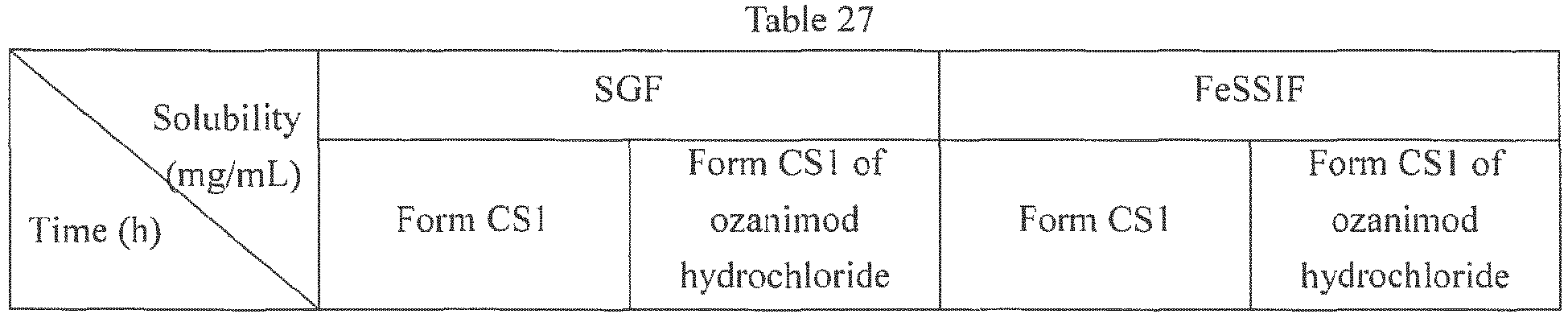

- Form CS3 and Form CS5 were suspended into SGF (Simulated gastric fluids) and water, and Form CS2 was suspended into FeSSIF (Fed state simulated intestinal fluids) to obtain saturated solutions. After being equilibrated for 1 h, 4 h and 24 h, concentrations of the saturated solutions were measured by HPLC. The results were listed in Table 28.
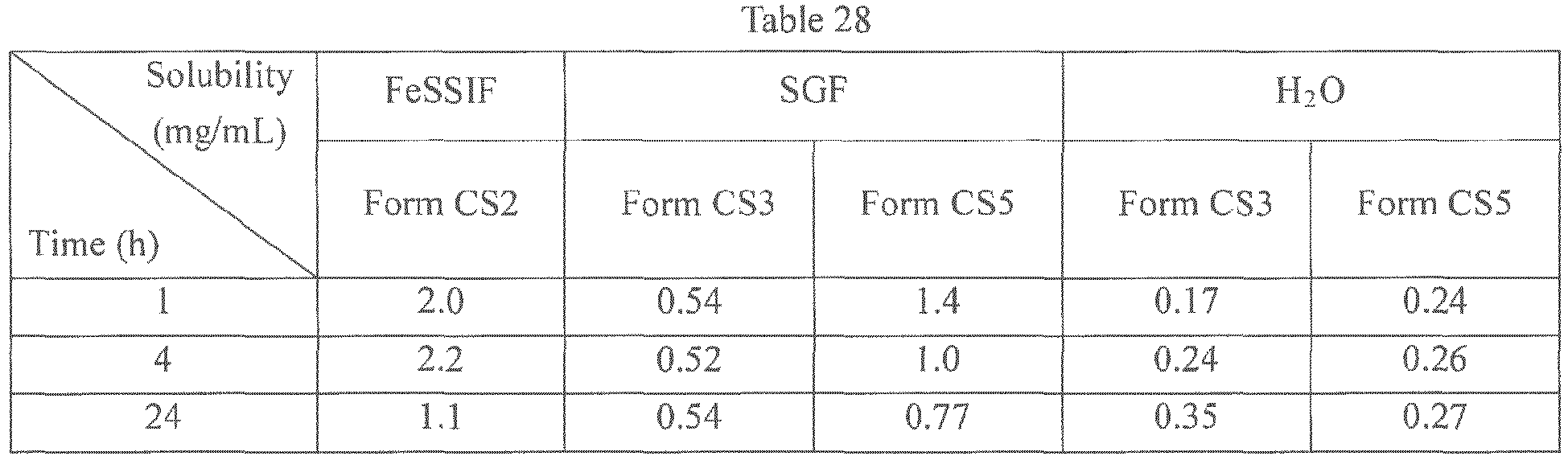
- Solid samples of Form CS3, Form CS5, Form CS6 of ozanimod and Form CS1 of ozanimod hydrochloride were ground manually for 5 minutes in mortar. The XRPD patterns were displayed in
FIG.49 ,FIG.50 ,FIG.51 andFIG.52 . respectively (the top pattern is before grinding and bottom pattern is after grinding). - No form change was observed for Form CS3, Form CS5, Form CS6 of ozanimod and Form CS1 of ozanimod hydrochloride under a certain mechanical stress with slightly decrease in crystallinity. Good physical and chemical properties including stability made these forms suitable for drug preparation and storage.
- Crystalline forms with better mechanical stability have good physicochemical properties and remain stable under certain mechanical stress. The crystalline drug with better mechanical stability has low requirements on the crystallization equipment, and no special post-treatment condition is required. It is more stable in the formulation process, can significantly reduce the development cost of the drug products, enhance the quality of the drug, and has strong economic value.
- It is to be noted that Form CS1 used in Examples 16 to 31 of the present disclosure is prepared by the method of Example 1; Form CS2 is prepared by the method of Example 3; Form CS3 was prepared by the method of Example 6; Form CS5 was prepared by the method of Example 9; Form CS6 was prepared by the method of Example 10; Form CS1 of ozanimod hydrochloride was prepared by the method of Example 11.
- The examples described above are only for illustrating the technical concepts and features of the present disclosure, and intended to make those skilled in the art being able to understand the present disclosure and thereby implement it.
Claims (9)
- A crystalline Form CS1 of ozanimod hydrochloride, wherein the X-ray powder diffraction pattern shows characteristic peaks at 2theta values of 26.1°±0.20°, 24.4°±0.20° and 20.1°±0.20° using CuKα radiation.
- The crystalline Form CS1 of ozanimod hydrochloride according to claim 1, wherein the X-ray powder diffraction pattern shows at least one characteristic peak at 2theta values of 3.9°±0.20°, 21.1°±0.20° and 7.9°±0.20° using CuKα radiation.
- The crystalline Form CS1 of ozanimod hydrochloride according to claim 1 or 2, wherein the X-ray powder diffraction pattern shows at least one characteristic peak at 2theta values of 11.9°±0.20°, 19.6°±0.20° and 13.8°±0.20° using CuKα radiation.
- A process for preparing crystalline Form CS1 of ozanimod hydrochloride according to any one of claims 1 to 3, wherein the process comprises method i) or method ii) or method iii) or method iv),i) adding ozanimod hydrochloride into ethers and stirring at 4-50°C, filtering and drying to obtain a white solid of Form CS1 of ozanimod hydrochloride; said stirring time is at least 0.5 hour; orii) dissolving ozanimod hydrochloride into a solvent selected from alcohols and esters or a mixture of solvents thereof, evaporating at room temperature to obtain white solid of Form CS1 of ozanimod hydrochloride; said evaporating time is at least 0.5 day; oriii) dissolving ozanimod hydrochloride into a solvent selected from amides or a mixture of solvents thereof, then placing the solution in a system containing an antisolvent of ozanimod hydrochloride for liquid vapor diffusion at room temperature, filtering and drying to obtain a white solid of Form CS1 of ozanimod hydrochloride; said diffusion time is at least 1 day; oriv) dissolving ozanimod hydrochloride in methanol in a concentration of 12 mg/mL, filtering the mixture to form a solution, then evaporating the solution at room temperature for 1 week to obtain a white solid of Form CS1 of ozanimod hydrochloride.
- A pharmaceutical composition, wherein said pharmaceutical composition comprises a therapeutically effective amount of crystalline Form CS1 of ozanimod hydrochloride according to any one of claims 1 to 3 and a pharmaceutically acceptable carrier, a diluent or an excipient.
- Crystalline Form CS1 of ozanimod hydrochloride according to any one of claims 1 to 3 for use in a method of treating ulcerative colitis, comprising administering to a patient in need thereof a therapeutically effective amount of the crystalline Form CS1 of ozanimod hydrochloride.
- Crystalline Form CS1 of ozanimod hydrochloride according to any one of claims 1 to 3 for use in a method of treating multiple sclerosis, comprising administering to a patient in need thereof a therapeutically effective amount of the crystalline Form CS1 of ozanimod hydrochloride.
- The use of the crystalline Form CS1 of ozanimod hydrochloride according to any one of claims 1 to 3 for the manufacture of a medicament for the treatment of ulcerative colitis.
- The use of the crystalline Form CS1 of ozanimod hydrochloride according to any one of claims 1 to 3 for the manufacture of a medicament for the treatment of multiple sclerosis.
Priority Applications (5)
| Application Number | Priority Date | Filing Date | Title |
|---|---|---|---|
| EP25155520.7A EP4566676A3 (en) | 2016-06-14 | 2017-06-14 | Crystalline forms of ozanimod and ozanimod hydrochloride, and processes for preparation thereof |
| HRP20250558TT HRP20250558T1 (en) | 2016-06-14 | 2017-06-14 | CRYSTAL FORMS OF OZANIMOD AND OZANIMOD HYDROCHLORIDE AND PROCESSES FOR THEIR PREPARATION |
| RS20250520A RS66905B1 (en) | 2016-06-14 | 2017-06-14 | Crystalline forms of ozanimod and ozanimod hydrochloride, and processes for preparation thereof |
| SM20250228T SMT202500228T1 (en) | 2016-06-14 | 2017-06-14 | Crystalline forms of ozanimod and ozanimod hydrochloride, and processes for preparation thereof |
| SI201731601T SI3470400T1 (en) | 2016-06-14 | 2017-06-14 | Crystalline forms of ozanimod and ozanimod hydrochloride, and processes for preparation thereof |
Applications Claiming Priority (3)
| Application Number | Priority Date | Filing Date | Title |
|---|---|---|---|
| CN201610416179 | 2016-06-14 | ||
| CN201610493910 | 2016-06-29 | ||
| PCT/CN2017/088314 WO2017215617A1 (en) | 2016-06-14 | 2017-06-14 | Crystal form of ozanimod, crystal form of hydrochloride thereof, and preparation method therefor |
Related Child Applications (2)
| Application Number | Title | Priority Date | Filing Date |
|---|---|---|---|
| EP25155520.7A Division EP4566676A3 (en) | 2016-06-14 | 2017-06-14 | Crystalline forms of ozanimod and ozanimod hydrochloride, and processes for preparation thereof |
| EP25155520.7A Division-Into EP4566676A3 (en) | 2016-06-14 | 2017-06-14 | Crystalline forms of ozanimod and ozanimod hydrochloride, and processes for preparation thereof |
Publications (3)
| Publication Number | Publication Date |
|---|---|
| EP3470400A4 EP3470400A4 (en) | 2019-04-17 |
| EP3470400A1 EP3470400A1 (en) | 2019-04-17 |
| EP3470400B1 true EP3470400B1 (en) | 2025-04-02 |
Family
ID=60663299
Family Applications (2)
| Application Number | Title | Priority Date | Filing Date |
|---|---|---|---|
| EP25155520.7A Pending EP4566676A3 (en) | 2016-06-14 | 2017-06-14 | Crystalline forms of ozanimod and ozanimod hydrochloride, and processes for preparation thereof |
| EP17812728.8A Active EP3470400B1 (en) | 2016-06-14 | 2017-06-14 | Crystalline forms of ozanimod and ozanimod hydrochloride, and processes for preparation thereof |
Family Applications Before (1)
| Application Number | Title | Priority Date | Filing Date |
|---|---|---|---|
| EP25155520.7A Pending EP4566676A3 (en) | 2016-06-14 | 2017-06-14 | Crystalline forms of ozanimod and ozanimod hydrochloride, and processes for preparation thereof |
Country Status (15)
| Country | Link |
|---|---|
| US (2) | US11111223B2 (en) |
| EP (2) | EP4566676A3 (en) |
| CN (2) | CN114957157A (en) |
| DK (1) | DK3470400T5 (en) |
| ES (1) | ES3022204T3 (en) |
| FI (1) | FI3470400T3 (en) |
| HR (1) | HRP20250558T1 (en) |
| HU (1) | HUE072197T2 (en) |
| LT (1) | LT3470400T (en) |
| PL (1) | PL3470400T3 (en) |
| PT (1) | PT3470400T (en) |
| RS (1) | RS66905B1 (en) |
| SI (1) | SI3470400T1 (en) |
| SM (1) | SMT202500228T1 (en) |
| WO (1) | WO2017215617A1 (en) |
Families Citing this family (13)
| Publication number | Priority date | Publication date | Assignee | Title |
|---|---|---|---|---|
| PL3470400T3 (en) | 2016-06-14 | 2025-08-04 | Receptos Llc | Crystalline forms of ozanimod and ozanimod hydrochloride, and processes for preparation thereof |
| CN109563059A (en) | 2016-08-19 | 2019-04-02 | 苏州科睿思制药有限公司 | Crystal form of Ozamod and preparation method thereof |
| EP3508481A1 (en) | 2016-09-14 | 2019-07-10 | Crystal Pharmaceutical (Suzhou) Co., Ltd. | Crystal form of ozanimod hydrochloride, and preparation method therefor |
| PT3630738T (en) * | 2017-05-22 | 2023-10-24 | Egyt Gyogyszervegyeszeti Gyar | Process for the production of ozanimod |
| CN109280035B (en) * | 2017-07-19 | 2023-06-09 | 广东东阳光药业有限公司 | Polymorphic forms of ozagrel and processes for their preparation |
| WO2019042219A1 (en) * | 2017-08-31 | 2019-03-07 | 苏州科睿思制药有限公司 | Crystalline form of ozanimod hydrochloride and preparation method therefor |
| CN107840830A (en) * | 2017-09-20 | 2018-03-27 | 广东东阳光药业有限公司 | Ozamod Hydrochloride Anhydrous Form I |
| WO2019094409A1 (en) | 2017-11-07 | 2019-05-16 | Teva Pharmaceuticals International Gmbh | Salts and solid state forms of ozanimod |
| WO2020152718A1 (en) * | 2019-01-25 | 2020-07-30 | Mylan Laboratories Limited | Polymorphic forms 5-[3-[(1s)-2,3-dihydro-1-[(2-hydroxyethyl) amino]-1h-inden-4-yl]-1,2,4-oxadiazol-5-yl]-2-(1-methylethoxy)benzonitrile |
| US12404256B2 (en) | 2019-07-16 | 2025-09-02 | Synthon B.V. | Process for preparing ozanimod |
| US12398112B2 (en) | 2020-04-02 | 2025-08-26 | Synthon B.V. | Crystalline form of ozanimod hydrochloride |
| WO2023152767A1 (en) | 2022-02-11 | 2023-08-17 | Mylan Laboratories Limited | Polymorphic forms of ozanimod hydrochloride |
| CN121194965A (en) | 2023-05-31 | 2025-12-23 | 奎米卡新特缇卡股份有限公司 | Amorphous form and crystal form of ozamado hydrochloride |
Citations (4)
| Publication number | Priority date | Publication date | Assignee | Title |
|---|---|---|---|---|
| WO2011060392A1 (en) | 2009-11-13 | 2011-05-19 | Receptos, Inc. | Selective sphingosine 1 phosphate receptor modulators and methods of chiral synthesis |
| WO2015066515A1 (en) | 2013-11-01 | 2015-05-07 | Receptos, Inc. | Selective sphingosine 1 phosphate receptor modulators and combination therapy therewith |
| WO2016164180A1 (en) | 2015-04-06 | 2016-10-13 | Auspex Pharmaceuticals, Inc. | Deuterium-substituted oxadiazoles |
| EP3470400A1 (en) | 2016-06-14 | 2019-04-17 | Crystal Pharmaceutical (Suzhou) Co., Ltd. | Crystal form of ozanimod, crystal form of hydrochloride thereof, and preparation method therefor |
Family Cites Families (8)
| Publication number | Priority date | Publication date | Assignee | Title |
|---|---|---|---|---|
| PT2291080E (en) | 2008-05-14 | 2015-10-30 | Scripps Research Inst | Novel modulators of sphingosine phosphate receptors |
| BRPI0912545B1 (en) | 2008-05-14 | 2022-02-01 | The Scripps Research Institute | Sphingosine phosphate receptor modulating compounds, use thereof and pharmaceutical composition and combination comprising said compounds |
| CN109563059A (en) | 2016-08-19 | 2019-04-02 | 苏州科睿思制药有限公司 | Crystal form of Ozamod and preparation method thereof |
| EP3508481A1 (en) | 2016-09-14 | 2019-07-10 | Crystal Pharmaceutical (Suzhou) Co., Ltd. | Crystal form of ozanimod hydrochloride, and preparation method therefor |
| WO2018049632A1 (en) | 2016-09-14 | 2018-03-22 | 杭州领业医药科技有限公司 | Crystal form of ozanimod, and preparation method and pharmaceutical composition thereof |
| CN110612292A (en) * | 2017-04-07 | 2019-12-24 | 杭州领业医药科技有限公司 | Crystal form of addition salt of ozapimod, preparation method, pharmaceutical composition and application |
| WO2019042219A1 (en) | 2017-08-31 | 2019-03-07 | 苏州科睿思制药有限公司 | Crystalline form of ozanimod hydrochloride and preparation method therefor |
| CN107840830A (en) | 2017-09-20 | 2018-03-27 | 广东东阳光药业有限公司 | Ozamod Hydrochloride Anhydrous Form I |
-
2017
- 2017-06-14 PL PL17812728.8T patent/PL3470400T3/en unknown
- 2017-06-14 PT PT178127288T patent/PT3470400T/en unknown
- 2017-06-14 US US16/310,328 patent/US11111223B2/en active Active
- 2017-06-14 CN CN202210226424.4A patent/CN114957157A/en active Pending
- 2017-06-14 DK DK17812728.8T patent/DK3470400T5/en active
- 2017-06-14 EP EP25155520.7A patent/EP4566676A3/en active Pending
- 2017-06-14 HU HUE17812728A patent/HUE072197T2/en unknown
- 2017-06-14 LT LTEPPCT/CN2017/088314T patent/LT3470400T/en unknown
- 2017-06-14 RS RS20250520A patent/RS66905B1/en unknown
- 2017-06-14 SI SI201731601T patent/SI3470400T1/en unknown
- 2017-06-14 HR HRP20250558TT patent/HRP20250558T1/en unknown
- 2017-06-14 EP EP17812728.8A patent/EP3470400B1/en active Active
- 2017-06-14 ES ES17812728T patent/ES3022204T3/en active Active
- 2017-06-14 SM SM20250228T patent/SMT202500228T1/en unknown
- 2017-06-14 FI FIEP17812728.8T patent/FI3470400T3/en active
- 2017-06-14 WO PCT/CN2017/088314 patent/WO2017215617A1/en not_active Ceased
- 2017-06-14 CN CN201780029499.0A patent/CN109219597A/en active Pending
-
2020
- 2020-01-21 US US16/748,303 patent/US11680050B2/en active Active
Patent Citations (6)
| Publication number | Priority date | Publication date | Assignee | Title |
|---|---|---|---|---|
| WO2011060392A1 (en) | 2009-11-13 | 2011-05-19 | Receptos, Inc. | Selective sphingosine 1 phosphate receptor modulators and methods of chiral synthesis |
| US20110172202A1 (en) | 2009-11-13 | 2011-07-14 | Esther Martinborough | Selective sphingosine 1 phosphate receptor modulators and methods of chiral synthesis |
| CN102762100A (en) | 2009-11-13 | 2012-10-31 | 瑞塞普托斯公司 | Selective sphingosine-1-phosphate receptor modulator and chiral synthesis method |
| WO2015066515A1 (en) | 2013-11-01 | 2015-05-07 | Receptos, Inc. | Selective sphingosine 1 phosphate receptor modulators and combination therapy therewith |
| WO2016164180A1 (en) | 2015-04-06 | 2016-10-13 | Auspex Pharmaceuticals, Inc. | Deuterium-substituted oxadiazoles |
| EP3470400A1 (en) | 2016-06-14 | 2019-04-17 | Crystal Pharmaceutical (Suzhou) Co., Ltd. | Crystal form of ozanimod, crystal form of hydrochloride thereof, and preparation method therefor |
Non-Patent Citations (34)
| Title |
|---|
| "Intermediate Organic Chemistry Chemistry 346, Laboratory Manual", vol. 346, 1 January 2005, UNIVERSITY OF WISCONSIN, Madison, USA, article T.P. YOON ET AL.: "A4 Recrystallization", pages: 155 - 164, XP009565611, DOI: https://www2.chem.wisc.edu/deptfiles/genchem/Chm346/pdf/ |
| ALLAN S. MYERSON: "Handbook of industrial crystallization", 8 January 2002, BOSTON : BUTTERWORTH-HEINEMANN , Boston, ISBN: 0-7506-7012-6, article PAUL A. MEENAN, STEPHEN R. ANDERSON, DIANA L. KLUG: "3 - The influence of impurities and solvents on crystallization", pages: 67 - 100, XP009565604, DOI: 10.1016/B978-075067012-8/50005-7 |
| ANONYMOUS: "NCT02294058: A Phase 3, Multi-Center, Randomized, Double-Blind, Double-Dummy, Active Controlled, Parallel Group Study To Evaluate The Efficacy And Safety Of RPC1063 Administered Orally To Relapsing Multiple Sclerosis Patients", XP055493421, Retrieved from the Internet <URL:https://clinicaltrials.gov/ct2/history/NCT02294058?V_19=View#StudyPageTop> |
| BAVIN M: "Polymorphism in Process Development", CHEMISTRY & INDUSTRY, SOCIETY OF CHEMICAL INDUSTRY. LONDON., GB, 21 August 1989 (1989-08-21), GB , pages 527 - 529, XP001180136, ISSN: 0009-3068 |
| CELGENE: "An Extension Study of RPC1063 as Therapy for Moderate to Severe Ulcerative Colitis - NCT02531126", CLINICAL TRIALS, CLINICALTRIALS.GOV, 25 August 2015 (2015-08-25), XP093353374, Retrieved from the Internet <URL:https://www.clinicaltrials.gov/study/NCT02531126?tab=history&a=1#version-content-panel> |
| D10 - Publication by the company SSCI Inc. (Custom Research and Analytical Services) |
| D17 - EXPERIMENTAL REPORT ENTITLED "OZANIMOD HYDROCHLORIDE", CHEMESSENTIA S.R.L., NOVARA, 10 FEBRUARY 2022, FILED WITH THIRD PARTY OBS |
| D18 - EXPERIMENTAL REPORT FILED WITH THIRD PARTY OBSERVATIONS DATED 18 MARCH 2021 |
| D20 - OZANIMOD, UNITED STATES ADOPTED NAME (USAN), 24 JUNE 2015 |
| D24 - EXPERT OPINION OF VERENA ADAMER, 22 DECEMBER 2025 |
| D25 - REPLY TO THE EXAMINATION REPORT AND EXPERIMENTAL REPORT FILED BY THE APPLICANT ON 25 SEPTEMBER 2019 |
| D26 - EXPERIMENTAL REPORT FILED BY THE APPLICANT ON 25 MAY 2021 |
| D27 - REPLY TO THE EXAMINATION REPORT FILED BY THE APPLICANT ON 16 MAY 2022 |
| D29 - STUDY PROTOCOL NO. RPC01-202 FOR DOCUMENT D1, SPONSOR RECEPTOS INC., VERSION 1.0, 13 JULY 2012, PAGES 1, AND 42 TO 44, PUBLISHED: 13 JULY 2012 |
| D31 - EXPERIMENTAL REPORT DATED OCTOBER 6, 2024 |
| D35 - Decision of the Court of Dirst Instance of the Unified Patent Court |
| D38 - Spectra Submitted by Patentee ( 25 September 2019 ) |
| D39 - Spectra Submitted by Patentee ( 25 May 2021 ) |
| D3a - Translation of the Int. preliminary report on patentability |
| D4 - FURNISS, B.S., A. J. HANNAFORD, V. ROGERS, P. W. G. SMITH, A. R. TATCHELL: "Vogel’s Textbook of Practical Organic Chemistry including QUALITATIVE ORGANIC ANALYSIS, 4th Ed.", 1 January 1978, LONGMAN SCIENTIFIC & TECHNICAL, ISBN: 0-582-44250-8, article BRIAN S. FURNISS: "1,20. RECRYSTALLISATION TECHNIQUES", pages: 105 - 124, XP009564968 |
| D40 - Spectra Submitted by Third Party ( January 2025 ) |
| D5 - PAVIA, D. L., GARY M. LAMPMAN, GEORGE S. KRIZ: "Introduction to Organic Laboratory Techniques – A contemporary Approach, 3rd Ed.", 1 January 1988, HARCOURT BRACE COLLEGE PUBLISHERS, ISBN: 0-03-014813-8, article PAVIA, D. L., GARY M. LAMPMAN, GEORGE S. KRIZ: "Technique 3 Crystallization: Purification of Solids", pages: 522 - 531, XP009565603 |
| D6 - MOHRIG, J. R., CHRISTINA NORING HAMMOND, PAUL E SCHATZ: "Techniques in Organic Chemistry, 3rd Ed.", 1 January 2010, W. H. FREEMAN AND COMPANY, ISBN: 978-1-4292-1956-3, article MOHRIG, JERRY R; HAMMOND, CHRISTINA NORING; SCHATZ, PAUL F: "15 Recrystallization", pages: 183 - 197, XP009565610 |
| D7 - EXPERIMENTAL REPORT |
| D8 - SUBMISSION DATED MAY 16TH, 2022, IN EP17812728.8 |
| DUNITZ J. D., BERNSTEIN J.: "DISAPPEARING POLYMORPHS.", ACCOUNTS OF CHEMICAL RESEARCH, ACS , WASHINGTON , DC, US, vol. 28., no. 04., 1 January 1995 (1995-01-01), US , pages 193 - 200., XP000916646, ISSN: 0001-4842, DOI: 10.1021/ar00052a005 |
| EMEA: "ICH Topic Q 6 A Specifications: Test Procedures and Acceptance Criteria for New Drug Substances and New Drug Products: Chemical Substances Step 5 NOTE FOR GUIDANCE SPECIFICATIONS: TEST PROCEDURES AND ACCEPTANCE CRITERIA FOR NEW DRUG SUBSTANCES AND NEW DRUG PRODUCTS: CHEMICAE SUBSTANCES", EUROPEAN MEDICINES AGENCY CPMP/ICH/3 67/96, 1 May 2000 (2000-05-01), XP093147842 |
| F L SCOTT, B CLEMONS, J BROOKS, E BRAHMACHARY, R POWELL, H DEDMAN, H G DESALE, G A TIMONY, E MARTINBOROUGH, H ROSEN, E ROBERTS, M : "Ozanimod (RPC1063) is a potent sphingosine-1-phosphate receptor-1 (S1P 1 ) and receptor-5 (S1P 5 ) agonist with autoimmune disease-modifying activity : Ozanimod: a S1P 1,5 receptor agonist for autoimmune disease", BRITISH JOURNAL OF PHARMACOLOGY, WILEY-BLACKWELL, UK, vol. 173, no. 11, 1 June 2016 (2016-06-01), UK , pages 1778 - 1792, XP055422423, ISSN: 0007-1188, DOI: 10.1111/bph.13476 |
| GU C-H, YOUNG V, GRANT D J W: "POLYMORPH SCREENING: INFLUENCE OF SOLVENTS ON THE RATE OF SOLVENT-MEDIATED POLYMORPHIC TRANSFORMATION", JOURNAL OF PHARMACEUTICAL SCIENCES, ELSEVIER INC, HOBOKEN, vol. 90, no. 11, 1 November 2001 (2001-11-01), Hoboken, pages 1878 - 1890, XP001182144, ISSN: 0022-3549, DOI: 10.1002/jps.1137 |
| SANDBORN: "Ozanimod Induction and Maintenance Treatment for Ulcerative Colitis.", 5 May 2016 (2016-05-05), pages 1754 - 1762, XP055550797, DOI: 10.1056/NEJMoa1513248 |
| SCOTT: "Ozanimod (RPC1063) Is a Potent Sphingosine‐1‐phosphate Receptor‐1 (S1P1) and Receptor‐5 (S1P5) Agonist with Autoimmune Disease‐modifying Activity", BRITISH JOURNAL OF PHARMACOLOGY, 15 March 2016 (2016-03-15) |
| STAHLY G PATRICK, BUGAY DAVID, NEWMAN ANN, BYRN SARAH R: "Custom Research and Analytical Services", SSCI INC., 8 October 1999 (1999-10-08), XP093353390 |
| STEPHEN BYRN; PFEIFFER RALPH; GANEY MICHAEL; HOIBERG CHARLES; POOCHIKIAN GUIRAG: "Pharmaceutical Solids: A strategic Approach to Regulatory Considerations", PHARMACEUTICAL RESEARCH, SPRINGER BERLIN HEIDELBERG, BERLIN/HEIDELBERG, vol. 12, no. 07, 1 July 1995 (1995-07-01), Berlin/Heidelberg, pages 945 - 954, XP000996386, ISSN: 0724-8741, DOI: 10.1023/A:1016241927429 |
| VOGEL, A. I.; FURNISS, B.S.; HANNAFORD, A.J.; SMITH, P.W.G.; TATCHELL, A.R.: "Vogel's Textbook of Practical Organic Chemistry", 1 January 1989, ADDISON WESLEY LONGMAN LIMITED , ISBN: 0-582-46236-3, article BRIAN S. FURNISS: "2.20 RECRYSTALLISATION TECHNIQUES", pages: 135 - 153, XP009563533 |
Also Published As
| Publication number | Publication date |
|---|---|
| EP3470400A4 (en) | 2019-04-17 |
| WO2017215617A1 (en) | 2017-12-21 |
| CN109219597A (en) | 2019-01-15 |
| PL3470400T3 (en) | 2025-08-04 |
| US11111223B2 (en) | 2021-09-07 |
| HRP20250558T1 (en) | 2025-07-04 |
| RS66905B1 (en) | 2025-07-31 |
| ES3022204T3 (en) | 2025-05-28 |
| US11680050B2 (en) | 2023-06-20 |
| CN114957157A (en) | 2022-08-30 |
| LT3470400T (en) | 2025-07-10 |
| EP3470400A1 (en) | 2019-04-17 |
| DK3470400T3 (en) | 2025-06-16 |
| US20200157065A1 (en) | 2020-05-21 |
| SMT202500228T1 (en) | 2025-07-22 |
| PT3470400T (en) | 2025-04-29 |
| DK3470400T5 (en) | 2025-06-30 |
| EP4566676A3 (en) | 2025-11-05 |
| SI3470400T1 (en) | 2025-09-30 |
| HUE072197T2 (en) | 2025-10-28 |
| FI3470400T3 (en) | 2025-06-13 |
| US20190337908A1 (en) | 2019-11-07 |
| EP4566676A2 (en) | 2025-06-11 |
Similar Documents
| Publication | Publication Date | Title |
|---|---|---|
| US11680050B2 (en) | Crystalline forms of ozanimod and ozanimod hydrochloride, and processes for preparation thereof | |
| EP3549932B1 (en) | Novel crystalline forms of {[5-(3-chlorophenyl)-3-hydroxypyridine-2-carbonyl]amino}acetic acid and processes for preparation thereof | |
| CN118434732A (en) | Tolebrutinib crystal form and preparation method and use thereof | |
| CN117794926A (en) | Crystal forms of Lanifibranor and its preparation methods and uses | |
| EP3553058A1 (en) | Crystal form of bromodomain protein inhibitor drug, preparation method and use thereof | |
| EP3466958B1 (en) | New crystal forms of sodium-glucose co-transporter inhibitor, processes for preparation and use thereof | |
| EP3269719A1 (en) | Crystal form of jak inhibitor and preparation method thereof | |
| EP3508481A1 (en) | Crystal form of ozanimod hydrochloride, and preparation method therefor | |
| CN112375093A (en) | Keliboro crystal form compound and preparation method thereof | |
| CN114644642B (en) | Crystal form A of thienopyridine compound, preparation method and pharmaceutical composition thereof | |
| CN111548310A (en) | Levosimendan sodium crystal form and preparation method thereof | |
| CN100418970C (en) | Method for producing polymorph of irinotecan hydrochloride | |
| CN110312705B (en) | Crystal form of GFT-505 and its preparation method and use | |
| CN106748996B (en) | Sorafenib tosylate crystal compound and preparation method thereof | |
| HK40126656A (en) | Crystalline forms of ozanimod and ozanimod hydrochloride, and processes for preparation thereof | |
| EP3792258B1 (en) | Addition salt of s1p1 receptor agonist and crystal form thereof, and pharmaceutical composition | |
| CN110291071B (en) | Crystal form of SB-939 salt, preparation method and application thereof | |
| HK40078390A (en) | Crystal form of ozanimod hydrochloride and preparation method thereof | |
| EP1626048A1 (en) | Crystal of benzimidazole derivative and process for producing the same | |
| CN115894440B (en) | Crystal forms of obutinib compound and preparation method thereof | |
| CN116410170B (en) | Icaritin eutectic | |
| CN116410165B (en) | An icariin and urea co-crystal | |
| CN116410169B (en) | Epimedium and 1,2-dipyridylethylene cocrystal | |
| CN121270411A (en) | Solid state form of ilalastine dihydrochloride and preparation method thereof | |
| EP4729522A1 (en) | Crystal forms of sodium salt of polycyclic carbamoylpyridone derivative, and preparation method therefor and use thereof |
Legal Events
| Date | Code | Title | Description |
|---|---|---|---|
| REG | Reference to a national code |
Ref country code: HR Ref legal event code: TUEP Ref document number: P20250558T Country of ref document: HR |
|
| STAA | Information on the status of an ep patent application or granted ep patent |
Free format text: STATUS: THE INTERNATIONAL PUBLICATION HAS BEEN MADE |
|
| PUAI | Public reference made under article 153(3) epc to a published international application that has entered the european phase |
Free format text: ORIGINAL CODE: 0009012 |
|
| STAA | Information on the status of an ep patent application or granted ep patent |
Free format text: STATUS: REQUEST FOR EXAMINATION WAS MADE |
|
| 17P | Request for examination filed |
Effective date: 20190114 |
|
| A4 | Supplementary search report drawn up and despatched |
Effective date: 20190227 |
|
| AK | Designated contracting states |
Kind code of ref document: A1 Designated state(s): AL AT BE BG CH CY CZ DE DK EE ES FI FR GB GR HR HU IE IS IT LI LT LU LV MC MK MT NL NO PL PT RO RS SE SI SK SM TR |
|
| AX | Request for extension of the european patent |
Extension state: BA ME |
|
| DAV | Request for validation of the european patent (deleted) | ||
| DAX | Request for extension of the european patent (deleted) | ||
| TPAC | Observations filed by third parties |
Free format text: ORIGINAL CODE: EPIDOSNTIPA |
|
| RAP1 | Party data changed (applicant data changed or rights of an application transferred) |
Owner name: RECEPTOS LLC |
|
| TPAC | Observations filed by third parties |
Free format text: ORIGINAL CODE: EPIDOSNTIPA |
|
| STAA | Information on the status of an ep patent application or granted ep patent |
Free format text: STATUS: EXAMINATION IS IN PROGRESS |
|
| 17Q | First examination report despatched |
Effective date: 20210623 |
|
| TPAC | Observations filed by third parties |
Free format text: ORIGINAL CODE: EPIDOSNTIPA |
|
| TPAC | Observations filed by third parties |
Free format text: ORIGINAL CODE: EPIDOSNTIPA |
|
| P01 | Opt-out of the competence of the unified patent court (upc) registered |
Effective date: 20230506 |
|
| RAP3 | Party data changed (applicant data changed or rights of an application transferred) |
Owner name: RECEPTOS LLC |
|
| TPAC | Observations filed by third parties |
Free format text: ORIGINAL CODE: EPIDOSNTIPA |
|
| GRAP | Despatch of communication of intention to grant a patent |
Free format text: ORIGINAL CODE: EPIDOSNIGR1 |
|
| STAA | Information on the status of an ep patent application or granted ep patent |
Free format text: STATUS: GRANT OF PATENT IS INTENDED |
|
| TPAC | Observations filed by third parties |
Free format text: ORIGINAL CODE: EPIDOSNTIPA |
|
| GRAS | Grant fee paid |
Free format text: ORIGINAL CODE: EPIDOSNIGR3 |
|
| INTG | Intention to grant announced |
Effective date: 20250102 |
|
| GRAA | (expected) grant |
Free format text: ORIGINAL CODE: 0009210 |
|
| STAA | Information on the status of an ep patent application or granted ep patent |
Free format text: STATUS: THE PATENT HAS BEEN GRANTED |
|
| AK | Designated contracting states |
Kind code of ref document: B1 Designated state(s): AL AT BE BG CH CY CZ DE DK EE ES FI FR GB GR HR HU IE IS IT LI LT LU LV MC MK MT NL NO PL PT RO RS SE SI SK SM TR |
|
| REG | Reference to a national code |
Ref country code: GB Ref legal event code: FG4D |
|
| REG | Reference to a national code |
Ref country code: CH Ref legal event code: EP |
|
| REG | Reference to a national code |
Ref country code: IE Ref legal event code: FG4D |
|
| REG | Reference to a national code |
Ref country code: DE Ref legal event code: R096 Ref document number: 602017088722 Country of ref document: DE |
|
| REG | Reference to a national code |
Ref country code: PT Ref legal event code: SC4A Ref document number: 3470400 Country of ref document: PT Date of ref document: 20250429 Kind code of ref document: T Free format text: AVAILABILITY OF NATIONAL TRANSLATION Effective date: 20250423 |
|
| REG | Reference to a national code |
Ref country code: ES Ref legal event code: FG2A Ref document number: 3022204 Country of ref document: ES Kind code of ref document: T3 Effective date: 20250528 |
|
| REG | Reference to a national code |
Ref country code: FI Ref legal event code: FGE |
|
| REG | Reference to a national code |
Ref country code: DK Ref legal event code: T3 Effective date: 20250613 |
|
| REG | Reference to a national code |
Ref country code: HR Ref legal event code: ODRP Ref document number: P20250558T Country of ref document: HR Payment date: 20250509 Year of fee payment: 9 |
|
| REG | Reference to a national code |
Ref country code: NL Ref legal event code: FP Ref country code: SK Ref legal event code: T3 Ref document number: E 46356 Country of ref document: SK |
|
| REG | Reference to a national code |
Ref country code: DK Ref legal event code: T5 Effective date: 20250627 |
|
| REG | Reference to a national code |
Ref country code: SE Ref legal event code: TRGR |
|
| REG | Reference to a national code |
Ref country code: HR Ref legal event code: T1PR Ref document number: P20250558 Country of ref document: HR |
|
| PGFP | Annual fee paid to national office [announced via postgrant information from national office to epo] |
Ref country code: AL Payment date: 20250410 Year of fee payment: 9 |
|
| REG | Reference to a national code |
Ref country code: EE Ref legal event code: FG4A Ref document number: E025081 Country of ref document: EE Effective date: 20250424 |
|
| REG | Reference to a national code |
Ref country code: GR Ref legal event code: EP Ref document number: 20250401174 Country of ref document: GR Effective date: 20250707 |
|
| PGFP | Annual fee paid to national office [announced via postgrant information from national office to epo] |
Ref country code: ES Payment date: 20250701 Year of fee payment: 9 |
|
| PGFP | Annual fee paid to national office [announced via postgrant information from national office to epo] |
Ref country code: CH Payment date: 20250701 Year of fee payment: 9 |
|
| REG | Reference to a national code |
Ref country code: HU Ref legal event code: AG4A Ref document number: E072197 Country of ref document: HU |
|
| PGFP | Annual fee paid to national office [announced via postgrant information from national office to epo] |
Ref country code: MK Payment date: 20250430 Year of fee payment: 9 |
|
| REG | Reference to a national code |
Ref country code: DE Ref legal event code: R026 Ref document number: 602017088722 Country of ref document: DE |
|
| PLBI | Opposition filed |
Free format text: ORIGINAL CODE: 0009260 |
|
| REG | Reference to a national code |
Ref country code: CH Ref legal event code: L11 Free format text: ST27 STATUS EVENT CODE: U-0-0-L10-L11 (AS PROVIDED BY THE NATIONAL OFFICE) Effective date: 20251231 |
|
| PLAB | Opposition data, opponent's data or that of the opponent's representative modified |
Free format text: ORIGINAL CODE: 0009299OPPO |
|
| PLBI | Opposition filed |
Free format text: ORIGINAL CODE: 0009260 |
|
| REG | Reference to a national code |
Ref country code: CH Ref legal event code: L10 Free format text: ST27 STATUS EVENT CODE: U-0-0-L10-L00 (AS PROVIDED BY THE NATIONAL OFFICE) Effective date: 20260114 |
|
| PGFP | Annual fee paid to national office [announced via postgrant information from national office to epo] |
Ref country code: CY Payment date: 20250514 Year of fee payment: 9 |
|
| PLAX | Notice of opposition and request to file observation + time limit sent |
Free format text: ORIGINAL CODE: EPIDOSNOBS2 |
|
| 26 | Opposition filed |
Opponent name: SYNTHON BV Effective date: 20251219 Opponent name: SANDOZ AG Effective date: 20251223 |
|
| 26 | Opposition filed |
Opponent name: DR. SCHOEN, NEYMEYR & PARTNER PATENTANWAELTE MBB Effective date: 20251223 Opponent name: ADALVO LTD. Effective date: 20251230 Opponent name: BRAND MURRAY FULLER LLP Effective date: 20260102 |
|
| R26 | Opposition filed (corrected) |
Opponent name: SYNTHON BV Effective date: 20251219 Opponent name: SANDOZ AG Effective date: 20251223 |
|
| PLAF | Information modified related to communication of a notice of opposition and request to file observations + time limit |
Free format text: ORIGINAL CODE: EPIDOSCOBS2 |
|
| PGFP | Annual fee paid to national office [announced via postgrant information from national office to epo] |
Ref country code: LU Payment date: 20260528 Year of fee payment: 10 Ref country code: NL Payment date: 20260514 Year of fee payment: 10 |
|
| REG | Reference to a national code |
Ref country code: HR Ref legal event code: ODRP Ref document number: P20250558 Country of ref document: HR Payment date: 20260506 Year of fee payment: 10 |
|
| REG | Reference to a national code |
Ref country code: CH Ref legal event code: U11 Free format text: ST27 STATUS EVENT CODE: U-0-0-U10-U11 (AS PROVIDED BY THE NATIONAL OFFICE) Effective date: 20260701 |
|
| PGFP | Annual fee paid to national office [announced via postgrant information from national office to epo] |
Ref country code: SM Payment date: 20260528 Year of fee payment: 10 |
|
| PGFP | Annual fee paid to national office [announced via postgrant information from national office to epo] |
Ref country code: GB Payment date: 20260507 Year of fee payment: 10 Ref country code: RS Payment date: 20260514 Year of fee payment: 10 Ref country code: DK Payment date: 20260611 Year of fee payment: 10 Ref country code: PL Payment date: 20260512 Year of fee payment: 10 |
|
| PGFP | Annual fee paid to national office [announced via postgrant information from national office to epo] |
Ref country code: GR Payment date: 20260513 Year of fee payment: 10 Ref country code: IT Payment date: 20260522 Year of fee payment: 10 Ref country code: MC Payment date: 20260528 Year of fee payment: 10 |
|
| PGFP | Annual fee paid to national office [announced via postgrant information from national office to epo] |
Ref country code: LT Payment date: 20260508 Year of fee payment: 10 Ref country code: DE Payment date: 20260430 Year of fee payment: 10 |
|
| PGFP | Annual fee paid to national office [announced via postgrant information from national office to epo] |
Ref country code: NO Payment date: 20260610 Year of fee payment: 10 |
|
| PGFP | Annual fee paid to national office [announced via postgrant information from national office to epo] |
Ref country code: SE Payment date: 20260511 Year of fee payment: 10 Ref country code: AT Payment date: 20260527 Year of fee payment: 10 Ref country code: FI Payment date: 20260623 Year of fee payment: 10 |
|
| REG | Reference to a national code |
Ref country code: AT Ref legal event code: UEP Ref document number: 1781213 Country of ref document: AT Kind code of ref document: T Effective date: 20250402 |
|
| PGFP | Annual fee paid to national office [announced via postgrant information from national office to epo] |
Ref country code: HU Payment date: 20250613 Year of fee payment: 10 Ref country code: RO Payment date: 20260527 Year of fee payment: 10 Ref country code: BE Payment date: 20260513 Year of fee payment: 10 Ref country code: IE Payment date: 20260514 Year of fee payment: 10 |
|
| PGFP | Annual fee paid to national office [announced via postgrant information from national office to epo] |
Ref country code: EE Payment date: 20260507 Year of fee payment: 10 Ref country code: HR Payment date: 20260506 Year of fee payment: 10 |
|
| PGFP | Annual fee paid to national office [announced via postgrant information from national office to epo] |
Ref country code: PT Payment date: 20260603 Year of fee payment: 10 Ref country code: IS Payment date: 20260610 Year of fee payment: 10 |
|
| PLBB | Reply of patent proprietor to notice(s) of opposition received |
Free format text: ORIGINAL CODE: EPIDOSNOBS3 |
|
| PGFP | Annual fee paid to national office [announced via postgrant information from national office to epo] |
Ref country code: CZ Payment date: 20260602 Year of fee payment: 10 Ref country code: TR Payment date: 20260610 Year of fee payment: 10 |
|
| PGFP | Annual fee paid to national office [announced via postgrant information from national office to epo] |
Ref country code: FR Payment date: 20260511 Year of fee payment: 10 |
|
| PGFP | Annual fee paid to national office [announced via postgrant information from national office to epo] |
Ref country code: LV Payment date: 20260506 Year of fee payment: 10 |
|
| PGFP | Annual fee paid to national office [announced via postgrant information from national office to epo] |
Ref country code: SK Payment date: 20260512 Year of fee payment: 10 |
|
| PGFP | Annual fee paid to national office [announced via postgrant information from national office to epo] |
Ref country code: BG Payment date: 20260515 Year of fee payment: 10 |
|
| PGFP | Annual fee paid to national office [announced via postgrant information from national office to epo] |
Ref country code: MT Payment date: 20260626 Year of fee payment: 10 |