EP3468132A1 - Method and device for transmitting speech data - Google Patents
Method and device for transmitting speech data Download PDFInfo
- Publication number
- EP3468132A1 EP3468132A1 EP17802136.6A EP17802136A EP3468132A1 EP 3468132 A1 EP3468132 A1 EP 3468132A1 EP 17802136 A EP17802136 A EP 17802136A EP 3468132 A1 EP3468132 A1 EP 3468132A1
- Authority
- EP
- European Patent Office
- Prior art keywords
- frame
- voice data
- voice
- data frames
- frames
- Prior art date
- Legal status (The legal status is an assumption and is not a legal conclusion. Google has not performed a legal analysis and makes no representation as to the accuracy of the status listed.)
- Granted
Links
Images






Classifications
-
- H—ELECTRICITY
- H04—ELECTRIC COMMUNICATION TECHNIQUE
- H04L—TRANSMISSION OF DIGITAL INFORMATION, e.g. TELEGRAPHIC COMMUNICATION
- H04L1/00—Arrangements for detecting or preventing errors in the information received
- H04L1/12—Arrangements for detecting or preventing errors in the information received by using return channel
- H04L1/16—Arrangements for detecting or preventing errors in the information received by using return channel in which the return channel carries supervisory signals, e.g. repetition request signals
- H04L1/18—Automatic repetition systems, e.g. Van Duuren systems
- H04L1/1867—Arrangements specially adapted for the transmitter end
- H04L1/188—Time-out mechanisms
- H04L1/1883—Time-out mechanisms using multiple timers
-
- H—ELECTRICITY
- H04—ELECTRIC COMMUNICATION TECHNIQUE
- H04L—TRANSMISSION OF DIGITAL INFORMATION, e.g. TELEGRAPHIC COMMUNICATION
- H04L1/00—Arrangements for detecting or preventing errors in the information received
- H04L1/12—Arrangements for detecting or preventing errors in the information received by using return channel
- H04L1/16—Arrangements for detecting or preventing errors in the information received by using return channel in which the return channel carries supervisory signals, e.g. repetition request signals
- H04L1/18—Automatic repetition systems, e.g. Van Duuren systems
- H04L1/1867—Arrangements specially adapted for the transmitter end
- H04L1/189—Transmission or retransmission of more than one copy of a message
-
- H—ELECTRICITY
- H04—ELECTRIC COMMUNICATION TECHNIQUE
- H04M—TELEPHONIC COMMUNICATION
- H04M7/00—Arrangements for interconnection between switching centres
- H04M7/006—Networks other than PSTN/ISDN providing telephone service, e.g. Voice over Internet Protocol (VoIP), including next generation networks with a packet-switched transport layer
-
- H—ELECTRICITY
- H04—ELECTRIC COMMUNICATION TECHNIQUE
- H04L—TRANSMISSION OF DIGITAL INFORMATION, e.g. TELEGRAPHIC COMMUNICATION
- H04L1/00—Arrangements for detecting or preventing errors in the information received
- H04L1/12—Arrangements for detecting or preventing errors in the information received by using return channel
- H04L1/16—Arrangements for detecting or preventing errors in the information received by using return channel in which the return channel carries supervisory signals, e.g. repetition request signals
-
- H—ELECTRICITY
- H04—ELECTRIC COMMUNICATION TECHNIQUE
- H04L—TRANSMISSION OF DIGITAL INFORMATION, e.g. TELEGRAPHIC COMMUNICATION
- H04L1/00—Arrangements for detecting or preventing errors in the information received
- H04L1/12—Arrangements for detecting or preventing errors in the information received by using return channel
- H04L1/16—Arrangements for detecting or preventing errors in the information received by using return channel in which the return channel carries supervisory signals, e.g. repetition request signals
- H04L1/18—Automatic repetition systems, e.g. Van Duuren systems
- H04L1/1867—Arrangements specially adapted for the transmitter end
- H04L1/1887—Scheduling and prioritising arrangements
-
- H—ELECTRICITY
- H04—ELECTRIC COMMUNICATION TECHNIQUE
- H04L—TRANSMISSION OF DIGITAL INFORMATION, e.g. TELEGRAPHIC COMMUNICATION
- H04L65/00—Network arrangements, protocols or services for supporting real-time applications in data packet communication
-
- H—ELECTRICITY
- H04—ELECTRIC COMMUNICATION TECHNIQUE
- H04L—TRANSMISSION OF DIGITAL INFORMATION, e.g. TELEGRAPHIC COMMUNICATION
- H04L1/00—Arrangements for detecting or preventing errors in the information received
- H04L1/12—Arrangements for detecting or preventing errors in the information received by using return channel
- H04L1/16—Arrangements for detecting or preventing errors in the information received by using return channel in which the return channel carries supervisory signals, e.g. repetition request signals
- H04L1/18—Automatic repetition systems, e.g. Van Duuren systems
- H04L1/1867—Arrangements specially adapted for the transmitter end
- H04L1/1874—Buffer management
-
- H—ELECTRICITY
- H04—ELECTRIC COMMUNICATION TECHNIQUE
- H04L—TRANSMISSION OF DIGITAL INFORMATION, e.g. TELEGRAPHIC COMMUNICATION
- H04L69/00—Network arrangements, protocols or services independent of the application payload and not provided for in the other groups of this subclass
- H04L69/16—Implementation or adaptation of Internet protocol [IP], of transmission control protocol [TCP] or of user datagram protocol [UDP]
- H04L69/164—Adaptation or special uses of UDP protocol
Definitions
- This application relates to the field of computer communication, and in particular, to a voice data transmission method and a voice data transmission apparatus.
- VoIP Voice over Internet Protocol
- VoIP call quality of two parties depends on network quality and network transmission capabilities.
- UDP User Datagram Protocol
- OSI Open System Interconnection
- IETF RFC 768 is a formal specification of UDP.
- a voice data transmission method including:
- a voice data transmission apparatus including:
- a placing and sending module configured to: place multiple voice data frames in a target sending queue, and sequentially send the multiple voice data frames to a data receiving party;
- an identifying and placing module configured to: identify the multiple voice data frames in the target sending queue, and place an identified important voice frame in a retransmission processing queue;
- a retransmission module configured to: for the multiple voice data frames, perform retransmission processing on only the important voice frame in the retransmission processing queue.
- the embodiments of this application disclose a mobile electronic device, including a processor, a memory, an input apparatus, and an output apparatus.
- the processor performs all the steps of the voice data transmission method by executing a synchronization service management program stored in the memory.
- the embodiments of this application disclose a computer storage medium.
- the computer storage medium stores a program. When the program is executed, all the steps of the voice data transmission method are performed.
- Retransmission is a technical means in which when detecting that a target data packet is not received when a time expires or discovering that a target receiving packet becomes erroneous, a data receiving party sends a request packet to a data sending party, to request the data sending party to retransmit the erroneous data packet.
- retransmission mainly includes the following several manners:
- a. Stop and wait retransmission manner After completing sending a data packet, a data sending party waits for a status report of a data receiving party, and if a status report packet indicates that the data packet is successfully sent, the data sending party sends a subsequent data packet. If a status report packet indicates that the data packet is unsuccessfully sent, the data sending party retransmits the packet.
- a receiving status of each data packet needs to be determined, that is, an acknowledge packet needs to be sent and received. This operation needs to occupy a relatively large quantity of network bandwidth resources. If the data receiving party still unsuccessfully receives a correct data packet after retransmission is performed for the first time, the data sending party needs to continue to retransmit the data packet until the data packet is successfully received. When a network capability is relatively weak, this process may be performed for each data packet. This undoubtedly puts more pressure on network bandwidths, and does not help data transmission.
- this application provides a voice data transmission method.
- the method is applied to a system architecture shown in FIG. 1 .
- FIG. 1 is an architectural diagram of a scenario of a voice data transmission method according to an embodiment of this application.
- Electronic devices may establish a voice connection and perform voice communication by using a network server. Therefore, a data sending party may send a collected voice data frame to a data receiving party in real time.
- the data receiving party may return an acknowledgement message indicating successful sending to the data sending party. Otherwise, the data receiving party may return an acknowledgement message indicating failed sending to the data sending party, and the data sending party may retransmit the lost voice data frame to the data receiving party by using a data retransmission mechanism, to ensure call quality of the two parties.
- FIG. 2 is a schematic flowchart of a voice data transmission method according to an embodiment of this application. The following describes, in detail with reference to FIG. 2 , the technical solution of the voice data transmission method provided in the embodiments. The method includes the following steps.
- Step S200 Place multiple voice data frames in a target sending queue, and sequentially send the multiple voice data frames to a data receiving party.
- the data sending party and the data receiving party establish a voice communication connection.
- the data sending party may encode collected voice information to generate the multiple voice data frames, place the multiple voice data frames in the target sending queue, and sequentially send the voice data frames to the data receiving party.
- Step S202 Identify one or more important voice frames among the multiple voice data frames in the target sending queue, and place the one or more important voice frame in a retransmission processing queue.
- the voice data frames may be classified into an important voice frame and an unimportant voice frame by using a specified condition.
- a frame meeting a preset condition is the important voice frame or the unimportant voice frame.
- the multiple voice data frames may be identified according to the preset condition. For example, it may be set that a data frame including no voice content information or a frame that can be desirably restored easily by using a packet loss compensation means is the unimportant voice frame (a frame other than the unimportant voice frame is the important voice frame).
- the data frame including no voice content information may include a non-voice frame, a noise frame with extremely low energy, or the like.
- the target sending queue and the retransmission processing queue may be two different queues.
- the target sending queue is used to normally send the voice data frame to be sent, and the retransmission processing queue is used to perform retransmission processing on the important voice frame.
- the target sending queue and the retransmission processing queue may alternatively be a same queue. That is, the important voice frame may be placed in the target sending queue. A time at which the important voice frame is sent again (that is, retransmitted) may be estimated, and the important voice frame is inserted to the target sending queue according to the time, to conveniently determine retransmission after packet loss occurs for the important voice frame.
- Step S204 For the multiple voice data frames, perform retransmission processing on only the important voice frames in the retransmission processing queue.
- retransmission processing is performed only on the important voice frame in the retransmission processing queue, and retransmission processing is not performed on the unimportant voice frame of the multiple voice data frames other than the important voice frame. That is, regardless of whether the unimportant voice frame is successfully received by the data receiving party, the data sending party does not retransmit the unimportant voice frame.
- a retransmission policy is executed by defining the unimportant voice frame and determining whether the sent voice data frame is the unimportant voice frame.
- a non-voice frame, a noise frame with extremely low energy, or a frame that can be desirably restored by using a packet loss compensation means is not retransmitted.
- a relatively large part of frame retransmission can be avoided in a call process, thereby more effectively using network bandwidth resources.
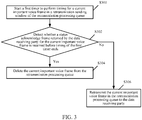
- FIG. 3 is a schematic flowchart of a voice data transmission method according to another embodiment of this application. The following describes how to perform retransmission processing on the important voice frame in the retransmission processing queue. The following steps are included.
- Step S300 Start a first timer to perform timing for a current important voice frame in a retransmission sending window of the retransmission processing queue.
- a timing start time of the first timer is a sending time point of the current important voice frame in the target sending queue.
- a timing length of the first timer is not limited, and a technical person may set the timing length of the first timer according to a requirement or experience thereof.
- Step S302 Detect whether a status acknowledge frame returned by the data receiving party for the current important voice frame is received before timing of the first timer ends.
- the status acknowledge frame indicates whether the current important voice frame is successfully received by the data receiving party.
- a detection result is yes, perform step S304; otherwise, perform step S306.
- Step S304 Delete the current important voice frame from the retransmission processing queue.
- Step S306 Retransmit the current important voice frame in the retransmission processing queue to the data receiving party.
- step S306 return to perform step S300 again to determine again whether the current important voice frame needs to be retransmitted. Further, in the embodiments of this application, to avoid that the important voice frame is retransmitted for an unlimited quantity of times and avoid more pressure on network bandwidths, the following steps may be performed.
- a second timer is started for timing.
- a timing length of the second timer is greater than the timing length of the first timer.
- the second timer is started for timing.
- a technical person may set the timing length of the second timer according to a requirement or experience thereof.
- the following describes how to determine whether the current voice data frame is the unimportant voice frame in detail with reference to FIG. 4 to FIG. 7 by using an example. It may be understood that a determined voice data frame of the multiple voice data frames other than the unimportant voice frame is an identified important voice frame.
- FIG. 4 is a schematic flowchart of a voice data transmission method according to another embodiment of this application. The following steps may be included.
- Step S400 Place multiple voice data frames in a target sending queue, and sequentially send the multiple voice data frames to a data receiving party.
- Step S402 Calculate frame energy of the voice data frame.
- Step S404 Determine whether the frame energy is less than a first preset threshold.
- the first preset threshold is related to a value of l .
- a value of the first preset threshold may be larger.
- the first preset threshold may be set to 5 * 10 5 .
- the value of the first preset threshold is not limited, and a technical person may set the first preset threshold according to a requirement or experience thereof.
- Step S406 Skip retransmitting the voice data frame.
- Step S408 Place an identified important voice frame in the retransmission processing queue.
- Step S410 For the multiple voice data frames, perform retransmission processing on only the important voice frame in the retransmission processing queue.
- step S408 and step S410 refer to description of step S202 and step S204 in the embodiment in FIG. 2 , and details are not described herein again.
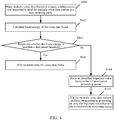
- FIG. 5 is a schematic flowchart of a voice data transmission method according to another embodiment of this application. The following steps may be included.
- Step S500 Place multiple voice data frames in a target sending queue, and sequentially send the multiple voice data frames to a data receiving party.
- Step S502 Analyze the voice data frame to determine whether the voice data frame does not include voice content information.
- that the voice content information is not included may be understood as that the voice data frame completely does not include the voice content information or a volume of the voice content information included is less than a threshold.
- a manner of analyzing whether a current data frame does not include the voice content information is not limited. When an analysis result is yes, it is determined that the voice data frame is the unimportant voice frame, and perform step S504. Otherwise, it may be considered that the voice data frame is not the unimportant voice frame, and perform step S506.
- Step S504 Skip retransmitting the voice data frame.
- Step S506 Place an identified important voice frame in the retransmission processing queue.
- Step S508 For the multiple voice data frames, perform retransmission processing on only the important voice frame in the retransmission processing queue.
- step S506 and step S508 refer to description of step S202 and step S204 in the embodiment in FIG. 2 , and details are not described herein again.
- FIG. 6 is a schematic flowchart of a voice data transmission method according to another embodiment of this application. The following steps may be included.
- Step S600 Place multiple voice data frames in a target sending queue, and sequentially send the multiple voice data frames to a data receiving party.
- Step S602 Calculate absolute values of first M linear spectrum pair (LSP) coefficient differences between the voice data frame and a previous voice data frame relative to the voice data frame.
- LSP linear spectrum pair
- an LSP coefficient of the voice data frame further needs to be calculated.
- a Hamming window may be added to the voice data frame
- a Yule-Walker equation is solved by means of Durbin recursion, to obtain a linear predictive coding (LPC) coefficient
- a complex conjugate root of a (p+1)th-order symmetric polynomial P (z) and a (p+1)th-order anti-symmetric polynomial Q(z) is solved according to the obtained pth-order LPC coefficient, to obtain the LSP coefficient A:
- P z A z + z ⁇ p + 1 ⁇ A z ⁇ 1 ;
- Q z A z + z ⁇ p + 1 ⁇ z ⁇ 1 .
- LSP coefficients may be calculated in voice encoding and decoding.
- M may be a positive integer such as 5, 6, or 7.
- M is 6. That is, in the embodiments of this application, absolute values of first 6 LSP coefficient differences may be compared.
- Neighboring frame stability of first 6 LSP coefficients of the voice data frame and the previous voice data frame relative to the voice data frame may be used to determine whether a frame is the unimportant voice frame.
- Step S604 Detect whether the calculated M absolute values are all less than a second preset threshold.
- the second preset threshold may be 0.005.
- a detection result is yes, it is detected that the voice data frame is the unimportant voice frame, and perform step S606. Otherwise, it may be considered that the voice data frame is not the unimportant voice frame, and perform step S608.
- the value of the second preset threshold is not limited, and a technical person may set the second preset threshold according to a requirement or experience thereof.
- Step S606 Skip retransmitting the voice data frame.
- Step S608 Place an identified important voice frame in the retransmission processing queue.
- Step S610 For the multiple voice data frames, perform retransmission processing on only the important voice frame in the retransmission processing queue.
- step S608 and step S610 refer to description of step S202 and step S204 in the embodiment in FIG. 2 , and details are not described herein again.
- FIG. 4 , FIG. 5 , and FIG. 6 may be randomly combined to implement data retransmission.
- An example is as follows:
- FIG. 4 and FIG. 5 may be combined: After the voice data frame is sent to the data receiving party, the frame energy of the voice data frame may be first calculated, and if it is determined that the energy is less than the first preset threshold, it is determined that the voice data frame is the unimportant voice frame. If it is determined that the energy is not less than the first preset threshold, it is analyzed whether the data frame does not include the voice content information. When it is learned by analysis that the voice data frame does not include the voice content information, it is determined that the voice data frame is the unimportant voice frame; otherwise, it is determined that the voice data frame is not the unimportant voice frame.
- the frame energy of the voice data frame may be first calculated, and if it is determined that the energy is less than the first preset threshold, it is determined that the voice data frame is the unimportant voice frame. If it is determined that the energy is not less than the first preset threshold, absolute values of first M LSP coefficient differences between the voice data frame and the previous voice data frame relative to the voice data frame are further calculated, and it is detected whether the calculated M absolute values are all less than the second preset threshold. When it is detected that the calculated M absolute values are all less than the second preset threshold, it is determined that the voice data frame is the unimportant voice frame; otherwise, it is determined that the voice data frame is not the unimportant voice frame.
- FIG. 5 and FIG. 6 are combined: After the voice data frame is sent to the data receiving party, it may be first analyzed whether the voice data frame does not include the voice content information, and when it is learned by analysis that the voice data frame does not include the voice content information, it is determined that the voice data frame is the unimportant voice frame. When it is learned by analysis that the voice data frame includes the voice content information, absolute values of first M LSP coefficient differences between the voice data frame and the previous voice data frame relative to the voice data frame are further calculated, and it is detected whether the calculated M absolute values are all less than the second preset threshold. When it is detected that the calculated M absolute values are all less than the second preset threshold, it is determined that the voice data frame is the unimportant voice frame; otherwise, it is determined that the voice data frame is not the unimportant voice frame.
- FIG. 4 , FIG. 5 , and FIG. 6 are combined as described in FIG. 7 .
- FIG. 7 is a schematic flowchart of a voice data transmission method according to another embodiment of this application. The following steps may be included.
- Step S700 Place multiple voice data frames in a target sending queue, and sequentially send the multiple voice data frames to a data receiving party.
- Step S702 Calculate frame energy of the voice data frame.
- step S402 in the embodiment in FIG. 4 , and details are not described herein again.
- Step S704 Determine whether the frame energy is less than a first preset threshold.
- step S404 in the embodiment in FIG. 4 .
- step S718 When a determining result is yes, perform step S718. Otherwise, perform step S706.
- Step S706 Perform fast Fourier transformation (FFT) of 2N points on the voice data frame, to obtain a power spectrum of the voice data frame; and estimate noise energy of each frequency, where N is a positive integer.
- FFT fast Fourier transformation
- Step S706 to step S712 are an implementation for analyzing whether the voice data frame does not include the voice content information.
- MCRA minima controlled recursive averaging
- Step S708 Calculate a signal-to-noise ratio of each frequency according to the power spectrum and the noise energy.
- Step S710 Calculate a quadratic sum of the signal-to-noise ratios of the frequencies according to the signal-to-noise ratios of the frequencies.
- Step S712 Perform comparison to determine whether the quadratic sum of the signal-to-noise ratios of the frequencies is less than a third preset threshold.
- the third preset threshold is related to a value of N.
- the first preset threshold may be set to 2.
- the value of the third preset threshold is not limited, and a technical person may set the third preset threshold according to a requirement or experience thereof.
- Step S714 Calculate absolute values of first M LSP coefficient differences between the voice data frame and a previous voice data frame relative to the voice data frame.
- step S602 in the embodiment in FIG. 6 , and details are not described herein again.
- Step S716 Detect whether calculated M absolute values are all less than a second preset threshold.
- step S604 in the embodiment in FIG. 6 .
- step S718 When a detection result is yes, perform step S718. Otherwise, perform step S720.
- Step S718 Skip retransmitting the voice data frame.
- Step S720 Place an identified important voice frame in the retransmission processing queue.
- Step S722 For the multiple voice data frames, perform retransmission processing on only the important voice frame in the retransmission processing queue.
- step S720 and step S722 refer to description of step S202 and step S204 in the embodiment in FIG. 2 , and details are not described herein again.
- FIG. 4 , FIG. 5 , and FIG. 6 may be randomly combined, and are not limited to the foregoing four combinations. There are other determining and combination manners. For example, an execution sequence of the combinations changes, and not all details are listed herein. Combination manners that may be implemented by a person skilled in the art according to descriptions in the embodiments of this application all belong to the protection scope of this application.
- the data receiving party may omit the unimportant voice frame or restore the unimportant voice frame by using a packet loss compensation means according to an actual case.
- the unimportant voice frame is restored by using a previous frame closely correlated to the voice data frame or a frame whose pitch period is different from that of a previous frame to the very low extent.
- multiple voice data frames are placed in a target sending queue, and the multiple voice data frames are sequentially sent to a data receiving party.
- the multiple voice data frames in the target sending queue are identified, and an identified important voice frame is placed in a retransmission processing queue.
- retransmission processing is performed on only the important voice frame in the retransmission processing queue. But retransmission processing is not performed on the unimportant voice frame. It is not required that a receiving status of each voice data frame is determined to determine whether retransmission is needed. This effectively resolves an existing-technology technical problem that when a network capability is relatively weak, data retransmission increases network bandwidth pressure and does not help data transmission.
- a retransmission policy is executed by defining the unimportant voice frame and determining whether the sent voice data frame is the unimportant voice frame.
- a non-voice frame, a noise frame with extremely low energy, or a frame that can be desirably restored by using a packet loss compensation means is not retransmitted.
- a relatively large part of frame retransmission can be avoided in a call process, thereby more effectively using network bandwidth resources.
- this application further correspondingly provides a voice data transmission apparatus.
- FIG. 8 is a schematic structural diagram of a voice data transmission apparatus according to an embodiment of this application.
- the voice data transmission apparatus 80 may include: a placing and sending module 800, an identifying and placing module 802, and a retransmission module 804.
- the placing and sending module 800 is configured to: place multiple voice data frames in a target sending queue, and sequentially send the multiple voice data frames to a data receiving party.
- the identifying and placing module 802 is configured to: identify one or more important voice frames among the multiple voice data frames in the target sending queue, and place the one or more important voice frame in a retransmission processing queue.
- the retransmission module 804 is configured to: for the multiple voice data frames, perform retransmission processing on only the important voice frames in the retransmission processing queue.
- FIG. 9 is a schematic structural diagram of a retransmission module according to an embodiment of this application.
- the retransmission module 804 may include: a first start unit 8040, a first detection unit 8042, a first deletion unit 8044, and a retransmission subunit 8046.
- the first start unit 8040 is configured to start a first timer to perform timing for a current important voice frame in a retransmission sending window of the retransmission processing queue, in which a timing start time of the first timer is a sending time point of the current important voice frame in the target sending queue.
- the first detection unit 8042 is configured to detect whether a status acknowledge frame returned by the data receiving party for the current important voice frame is received before timing of the first timer ends.
- the first deletion unit 8044 is configured to: when a detection result is yes, delete the current important voice frame from the retransmission processing queue.
- the retransmission subunit 8046 is configured to: when a detection result is no, retransmit the current important voice frame in the retransmission processing queue to the data receiving party.
- the retransmission module 804 may further include a second start unit and a second deletion unit.
- the second start unit is configured to: while the first start unit 8040 starts the first timer for timing, start a second timer for timing.
- the timing length of the second timer is greater than the timing length of the first timer.
- the second deletion unit is configured to: delete the current important voice frame from the retransmission processing queue when the status acknowledge frame returned by the data receiving party for the current important voice frame is received before timing of the second timer ends or when timing of the second timer ends.
- the retransmission module 804 may further include a third start unit and a third deletion unit.
- the third start unit is configured to: after the retransmission subunit 8046 retransmits the important voice frame in the retransmission processing queue to the data receiving party, start a second timer for timing.
- the third deletion unit is configured to delete the current important voice frame from the retransmission processing queue when the status acknowledge frame returned by the data receiving party for the current important voice frame is received before timing of the second timer ends or when timing of the second timer ends.
- the retransmission module 804 may include all of the second start unit, the second deletion unit, the third start unit, and the third deletion unit.
- FIG. 10 is a schematic structural diagram of an identifying and placing module according to an embodiment of this application.
- the identifying and placing module 802 may include: a first calculation unit 8020 and an energy determining unit 8022.
- the first calculation unit 8020 is configured to calculate frame energy of the voice data frame.
- the energy determining unit 8022 is configured to: determine whether the frame energy is less than a first preset threshold; and when a determining result is yes, identify the voice data frame as an unimportant voice frame.
- the identifying and placing module 802 may further include an analysis unit 8024, configured to: analyze the voice data frame to determine whether the voice data frame does not include voice content information; and when an analysis result is yes, identify the voice data frame as an unimportant voice frame.
- an analysis unit 8024 configured to: analyze the voice data frame to determine whether the voice data frame does not include voice content information; and when an analysis result is yes, identify the voice data frame as an unimportant voice frame.
- FIG. 11 is a schematic structural diagram of an identifying and placing module according to another embodiment of this application.
- the identifying and placing module 802 may include: a second calculation unit 8026 and a second detection unit 8028.
- the second calculation unit 8026 is configured to calculate absolute values of first M LSP coefficient differences between the voice data frame and a previous voice data frame relative to the voice data frame.
- the second detection unit 8028 is configured to: detect whether calculated M absolute values are all less than a second preset threshold; and when a detection result is yes, identify the voice data frame as an unimportant voice frame.
- FIG. 12 is a schematic structural diagram of an identifying and placing module according to another embodiment of this application.
- the identifying and placing module 802 may further include: a second calculation unit 8026 and a second detection unit 8028 in addition to the first calculation unit 8020, the energy determining unit 8022, and the analysis module 8024.
- the energy determining unit 8022 When determining that the frame energy is not less than the first preset threshold, the energy determining unit 8022 triggers the analysis module 8024 to analyze the voice data frame to determine whether the voice data frame does not include voice content information, and when learning by analysis that the voice data frame includes the voice content information, the energy determining unit 8022 triggers the second calculation unit 8026 to calculate absolute values of first M LSP coefficient differences between the voice data frame and a previous voice data frame relative to the voice data frame.
- the first calculation unit 8020, the energy determining unit 8022, the analysis module 8024, the second calculation unit 8026, and the second detection unit 8028 of the identifying and placing module 802 are combined in a manner not limited to the foregoing descriptions, and may further be randomly combined according to descriptions in the method embodiments.
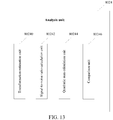
- FIG. 13 is a schematic structural diagram of an analysis unit according to an embodiment of this application.
- the analysis unit 8024 may include: a transformation estimation unit 80240, a signal-to-noise ratio calculation unit 80242, a quadratic sum calculation unit 80244, and a comparison unit 80246.
- the transformation estimation unit 80240 is configured to: perform FFT of 2N points on the voice data frame, to obtain a power spectrum of the voice data frame; and estimate noise energy of each frequency, where N is a positive integer.
- the signal-to-noise ratio calculation unit 80242 is configured to calculate a signal-to-noise ratio of each frequency according to the power spectrum and the noise energy.
- the quadratic sum calculation unit 80244 is configured to calculate a quadratic sum of the signal-to-noise ratios of the frequencies according to the signal-to-noise ratios of the frequencies.
- the comparison unit 80246 is configured to: perform comparison to determine whether the quadratic sum of the signal-to-noise ratios of the frequencies is less than a third preset threshold; and when a comparison result is yes, identify the voice data frame as an unimportant voice frame.
- multiple voice data frames are placed in a target sending queue, and the multiple voice data frames are sequentially sent to a data receiving party.
- the multiple voice data frames in the target sending queue are identified, and an identified important voice frame is placed in a retransmission processing queue.
- retransmission processing is performed on only the important voice frame in the retransmission processing queue. But retransmission processing is not performed on the unimportant voice frame. It is not required that a receiving status of each voice data frame is determined to determine whether retransmission is needed. This effectively resolves an existing-technology technical problem that when a network capability is relatively weak, data retransmission increases network bandwidth pressure and does not help data transmission.
- a retransmission policy is executed by defining the unimportant voice frame and determining whether the sent voice data frame is the unimportant voice frame.
- a non-voice frame, a noise frame with extremely low energy, or a frame that can be desirably restored by using a packet loss compensation means is not retransmitted.
- a relatively large part of frame retransmission can be avoided in a call process, thereby more effectively using network bandwidth resources.
- the methods, apparatuses, and modules and units thereof in the embodiments of this application may be integrated into one processing unit, or each of the modules and units may exist alone physically.
- two or more apparatuses or modules may be integrated into one unit.
- the integrated unit may be implemented in a form of hardware, or may be implemented in a form of a software functional unit.
- the voice data transmission apparatus may run in various computing devices that can perform user information processing based on Internet, and is loaded in memories of the computing devices.
- FIG. 14 is a structural composition diagram of a computing device in which a voice data transmission apparatus is located.
- the computing device includes at least one processor (CPU) 1402, a communications module 1404, a memory 1406, a user interface 1410, and a communications bus 1408 configured to interconnect these components.
- processor CPU
- communications module 1404 a communications module 1404
- memory 1406 a user interface 1410
- communications bus 1408 configured to interconnect these components.
- the processor 1402 may receive and send data by using the communications module 1404, to implement network communication and/or local communication.
- the user interface 1410 includes at least one output device 1412, including one or more speakers and/or one or more visual displays.
- the user interface 1410 also includes at least one input device 1414, including, for example, a keyboard, a mouse, a sound command input unit or a loudspeaker, a touchscreen display, a touch-sensitive tablet, a posture capturing camera, and another input button or control.
- the memory 1406 may be a high-speed random access memory such as a DRAM, a SRAM, or a DDR RAM, or another random access solid-state storage device, or a non-volatile memory such as one or more magnetic disk storage devices, an optical disc storage device, a flash memory device, or another non-volatile solid-state storage device.
- a high-speed random access memory such as a DRAM, a SRAM, or a DDR RAM
- a non-volatile memory such as one or more magnetic disk storage devices, an optical disc storage device, a flash memory device, or another non-volatile solid-state storage device.
- the memory 1406 stores an executable instruction set of the processor 1402, including:
- an operating system 1416 including a program used to process various basic system services and perform hardware-related tasks;
- an application 1418 including various programs used to implement voice data transmission, where the program can implement the processing procedures of the foregoing embodiments, for example, may include the voice data transmission apparatus 80 shown in FIG. 8 .
- the voice data transmission 80 may include the module 802, the module 804, the module 806, the unit 8020, the unit 8022, the unit 8024, the unit 8026, the unit 8028, the unit 8040, the unit 8042, the unit 8044, and the unit 8046 shown in FIG. 8 to FIG. 13 , and the modules may store a machine executable instruction.
- the processor 1402 can implement the functions of the modules and the units by executing the machine executable instruction in the modules and the units in the memory 1406.
- a person of ordinary skill in the art may understand that all or some of the processes of the methods in the embodiments may be implemented by a computer program instructing relevant hardware.
- the program may be stored in a computer readable storage medium. When the program runs, the processes of the methods in the embodiments are performed.
- the foregoing storage medium may include: a magnetic disk, an optical disc, a read-only memory (ROM), a random access memory (RAM), or the like.
- this application further discloses a non-volatile storage medium, which stores a data processing program.
- the data processing program is used for executing any embodiment of the foregoing method of this application.
Landscapes
- Engineering & Computer Science (AREA)
- Computer Networks & Wireless Communication (AREA)
- Signal Processing (AREA)
- Multimedia (AREA)
- Telephonic Communication Services (AREA)
- Data Exchanges In Wide-Area Networks (AREA)
- Computer Security & Cryptography (AREA)
Abstract
Description
- This application claims priority to Chinese Patent Application No.
201610356121.9 - This application relates to the field of computer communication, and in particular, to a voice data transmission method and a voice data transmission apparatus.
- Voice over IP (Voice over Internet Protocol, VoIP) is a real-time voice call system based on Ethernet. VoIP call quality of two parties depends on network quality and network transmission capabilities. To ensure data transmission of a real-time call, User Datagram Protocol (UDP) is usually used in VoIP. UDP is a connectionless transport layer protocol in the Open System Interconnection (OSI) reference model, and provides a transaction-oriented, simple, unreliable information transport service. IETF RFC 768 is a formal specification of UDP.
- To resolve the foregoing technical problem, embodiments of this application disclose a voice data transmission method, including:
- placing multiple voice data frames in a target sending queue and sequentially sending the multiple voice data frames to a data receiving party;
- identifying one or more important voice frames among the multiple voice data frames placed in the target sending queue and placing the one or more important voice frames that are identified, in a retransmission processing queue; and
- for the multiple voice data frames, performing retransmission processing on only the one or more important voice frames placed in the retransmission processing queue.
- The embodiments of this application disclose a voice data transmission apparatus, including:
- a placing and sending module, configured to: place multiple voice data frames in a target sending queue, and sequentially send the multiple voice data frames to a data receiving party;
- an identifying and placing module, configured to: identify the multiple voice data frames in the target sending queue, and place an identified important voice frame in a retransmission processing queue; and
- a retransmission module, configured to: for the multiple voice data frames, perform retransmission processing on only the important voice frame in the retransmission processing queue.
- The embodiments of this application disclose a mobile electronic device, including a processor, a memory, an input apparatus, and an output apparatus. The processor performs all the steps of the voice data transmission method by executing a synchronization service management program stored in the memory.
- The embodiments of this application disclose a computer storage medium. The computer storage medium stores a program. When the program is executed, all the steps of the voice data transmission method are performed.
- To describe technical solutions of embodiments or existing technology more clearly, the following briefly introduces the accompanying drawings for describing the embodiments. Apparently, the accompanying drawings in the following description show only some embodiments, and a person of ordinary skill in the art may still derive other drawings from these accompanying drawings without creative efforts.
-
FIG. 1 is an architectural diagram of a scenario of a voice data transmission method according to an embodiment of this application. -
FIG. 2 is a schematic flowchart of a voice data transmission method according to an embodiment of this application. -
FIG. 3 is a schematic flowchart of a voice data transmission method according to another embodiment of this application. -
FIG. 4 is a schematic flowchart of a voice data transmission method according to another embodiment of this application. -
FIG. 5 is a schematic flowchart of a voice data transmission method according to another embodiment of this application. -
FIG. 6 is a schematic flowchart of a voice data transmission method according to another embodiment of this application. -
FIG. 7 is a schematic flowchart of a voice data transmission method according to another embodiment of this application. -
FIG. 8 is a schematic structural diagram of a voice data transmission apparatus according to an embodiment of this application. -
FIG. 9 is a schematic structural diagram of a retransmission module according to an embodiment of this application. -
FIG. 10 is a schematic structural diagram of an identifying and placing module according to an embodiment of this application. -
FIG. 11 is a schematic structural diagram of an identifying and placing module according to another embodiment of this application. -
FIG. 12 is a schematic structural diagram of an identifying and placing module according to another embodiment of this application. -
FIG. 13 is a schematic structural diagram of an analysis unit according to an embodiment of this application. -
FIG. 14 is a structural diagram of a device according to an embodiment of this application. - The following clearly and completely describes technical solutions in embodiments of this application with reference to the accompanying drawings in the embodiments of this application. Apparently, the described embodiments are some but not all of the embodiments. All other embodiments obtained by persons skilled in the art based on the embodiments of the present application without creative efforts shall fall within the protection scope of the present application.
- In some embodiments, when data transmission of a VoIP real-time call is performed by using UDP, packet loss often occurs when a network status is undesirable. Main methods for resolving this problem include a forward error correction technology and a retransmission technology.
- Retransmission is a technical means in which when detecting that a target data packet is not received when a time expires or discovering that a target receiving packet becomes erroneous, a data receiving party sends a request packet to a data sending party, to request the data sending party to retransmit the erroneous data packet. In some embodiments, retransmission mainly includes the following several manners:
- a. Stop and wait retransmission manner: After completing sending a data packet, a data sending party waits for a status report of a data receiving party, and if a status report packet indicates that the data packet is successfully sent, the data sending party sends a subsequent data packet. If a status report packet indicates that the data packet is unsuccessfully sent, the data sending party retransmits the packet.
- b. Retransmission manner of retransmitting N previous frames: After a status packet sent by a data receiving party and received by a data sending party indicates that a packet is erroneous, the sending party retransmits N previous packets.
- c. Selective retransmission manner: After a status packet sent by a data receiving party and received by a data sending party indicates that a packet is erroneous, the data sending party needs to send only the erroneous packet.
- In the foregoing retransmission mechanism, a receiving status of each data packet needs to be determined, that is, an acknowledge packet needs to be sent and received. This operation needs to occupy a relatively large quantity of network bandwidth resources. If the data receiving party still unsuccessfully receives a correct data packet after retransmission is performed for the first time, the data sending party needs to continue to retransmit the data packet until the data packet is successfully received. When a network capability is relatively weak, this process may be performed for each data packet. This undoubtedly puts more pressure on network bandwidths, and does not help data transmission.
- To resolve the foregoing technical problem, this application provides a voice data transmission method. The method is applied to a system architecture shown in
FIG. 1 . -
FIG. 1 is an architectural diagram of a scenario of a voice data transmission method according to an embodiment of this application. Electronic devices may establish a voice connection and perform voice communication by using a network server. Therefore, a data sending party may send a collected voice data frame to a data receiving party in real time. When the data receiving party receives the voice data frame and determines that there is no error, the data receiving party may return an acknowledgement message indicating successful sending to the data sending party. Otherwise, the data receiving party may return an acknowledgement message indicating failed sending to the data sending party, and the data sending party may retransmit the lost voice data frame to the data receiving party by using a data retransmission mechanism, to ensure call quality of the two parties. -
FIG. 2 is a schematic flowchart of a voice data transmission method according to an embodiment of this application. The following describes, in detail with reference toFIG. 2 , the technical solution of the voice data transmission method provided in the embodiments. The method includes the following steps. - Step S200: Place multiple voice data frames in a target sending queue, and sequentially send the multiple voice data frames to a data receiving party.
- The data sending party and the data receiving party establish a voice communication connection. The data sending party may encode collected voice information to generate the multiple voice data frames, place the multiple voice data frames in the target sending queue, and sequentially send the voice data frames to the data receiving party.
- Step S202: Identify one or more important voice frames among the multiple voice data frames in the target sending queue, and place the one or more important voice frame in a retransmission processing queue.
- In the embodiments of this application, the voice data frames may be classified into an important voice frame and an unimportant voice frame by using a specified condition. For example, a frame meeting a preset condition is the important voice frame or the unimportant voice frame. The multiple voice data frames may be identified according to the preset condition. For example, it may be set that a data frame including no voice content information or a frame that can be desirably restored easily by using a packet loss compensation means is the unimportant voice frame (a frame other than the unimportant voice frame is the important voice frame). The data frame including no voice content information may include a non-voice frame, a noise frame with extremely low energy, or the like. After the important voice frame is identified from the multiple voice data frames, the important voice frame is placed in the preset retransmission processing queue.
- In the embodiments of this application, the target sending queue and the retransmission processing queue may be two different queues. The target sending queue is used to normally send the voice data frame to be sent, and the retransmission processing queue is used to perform retransmission processing on the important voice frame. In the embodiments of this application, the target sending queue and the retransmission processing queue may alternatively be a same queue. That is, the important voice frame may be placed in the target sending queue. A time at which the important voice frame is sent again (that is, retransmitted) may be estimated, and the important voice frame is inserted to the target sending queue according to the time, to conveniently determine retransmission after packet loss occurs for the important voice frame.
- Step S204: For the multiple voice data frames, perform retransmission processing on only the important voice frames in the retransmission processing queue.
- In the embodiments of this application, for the sent multiple voice data frames, retransmission processing is performed only on the important voice frame in the retransmission processing queue, and retransmission processing is not performed on the unimportant voice frame of the multiple voice data frames other than the important voice frame. That is, regardless of whether the unimportant voice frame is successfully received by the data receiving party, the data sending party does not retransmit the unimportant voice frame.
- In implementation of the embodiment of this application, it is not required that a receiving status of each voice data frame is determined to determine whether retransmission is needed. This effectively resolves a technical problem that when a network capability is relatively weak, data retransmission increases network bandwidth pressure and does not help avoid network packet loss. In the embodiments of this application, a retransmission policy is executed by defining the unimportant voice frame and determining whether the sent voice data frame is the unimportant voice frame. A non-voice frame, a noise frame with extremely low energy, or a frame that can be desirably restored by using a packet loss compensation means is not retransmitted. A relatively large part of frame retransmission can be avoided in a call process, thereby more effectively using network bandwidth resources.
-
FIG. 3 is a schematic flowchart of a voice data transmission method according to another embodiment of this application. The following describes how to perform retransmission processing on the important voice frame in the retransmission processing queue. The following steps are included. - Step S300: Start a first timer to perform timing for a current important voice frame in a retransmission sending window of the retransmission processing queue.
- A timing start time of the first timer is a sending time point of the current important voice frame in the target sending queue. In the embodiments of this application, a timing length of the first timer is not limited, and a technical person may set the timing length of the first timer according to a requirement or experience thereof.
- Step S302: Detect whether a status acknowledge frame returned by the data receiving party for the current important voice frame is received before timing of the first timer ends.
- In the embodiments of this application, the status acknowledge frame indicates whether the current important voice frame is successfully received by the data receiving party. When a detection result is yes, perform step S304; otherwise, perform step S306.
- Step S304: Delete the current important voice frame from the retransmission processing queue.
- Step S306: Retransmit the current important voice frame in the retransmission processing queue to the data receiving party.
- After step S306, return to perform step S300 again to determine again whether the current important voice frame needs to be retransmitted. Further, in the embodiments of this application, to avoid that the important voice frame is retransmitted for an unlimited quantity of times and avoid more pressure on network bandwidths, the following steps may be performed.
- While starting the first timer for timing, a second timer is started for timing. A timing length of the second timer is greater than the timing length of the first timer. In this way, if the status acknowledge frame returned by the data receiving party for the current important voice frame is received before timing of the second timer ends or when timing of the second timer ends, the current important voice frame is deleted from the retransmission processing queue, to avoid that the important voice frame is retransmitted for an unlimited quantity of times and avoid more pressure on network bandwidths.
- Alternatively, after the important voice frame in the retransmission processing queue is retransmitted to the data receiving party, the second timer is started for timing. In this case, a technical person may set the timing length of the second timer according to a requirement or experience thereof. When the status acknowledge frame returned by the data receiving party for the current important voice frame is received before timing of the second timer ends or when timing of the second timer ends, the current important voice frame is deleted from the retransmission processing queue, to avoid that the important voice frame is retransmitted for an unlimited quantity of times and avoid more pressure on network bandwidths.
- The following describes how to determine whether the current voice data frame is the unimportant voice frame in detail with reference to
FIG. 4 to FIG. 7 by using an example. It may be understood that a determined voice data frame of the multiple voice data frames other than the unimportant voice frame is an identified important voice frame. -
FIG. 4 is a schematic flowchart of a voice data transmission method according to another embodiment of this application. The following steps may be included. - Step S400: Place multiple voice data frames in a target sending queue, and sequentially send the multiple voice data frames to a data receiving party.
- Step S402: Calculate frame energy of the voice data frame.
- The frame energy Engr of the voice data frame may be calculated by using the following formula:
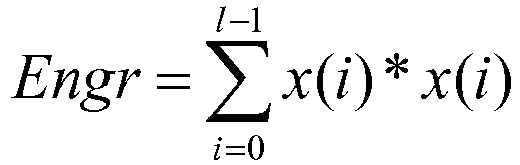
- Step S404: Determine whether the frame energy is less than a first preset threshold.
- In the embodiments of this application, the first preset threshold is related to a value of l . As l is larger, a value of the first preset threshold may be larger. For example, when l is equal to 80, the first preset threshold may be set to 5 * 105. When a determining result is yes, it is determined that the voice data frame is the unimportant voice frame, and perform step S406. Otherwise, it may be considered that the voice data frame is not the unimportant voice frame, and perform step S408.
- In the embodiments of this application, the value of the first preset threshold is not limited, and a technical person may set the first preset threshold according to a requirement or experience thereof.
- Step S406: Skip retransmitting the voice data frame.
- Step S408: Place an identified important voice frame in the retransmission processing queue.
- Step S410: For the multiple voice data frames, perform retransmission processing on only the important voice frame in the retransmission processing queue.
- For step S408 and step S410, refer to description of step S202 and step S204 in the embodiment in
FIG. 2 , and details are not described herein again. -
FIG. 5 is a schematic flowchart of a voice data transmission method according to another embodiment of this application. The following steps may be included. - Step S500: Place multiple voice data frames in a target sending queue, and sequentially send the multiple voice data frames to a data receiving party.
- Step S502: Analyze the voice data frame to determine whether the voice data frame does not include voice content information.
- In the embodiments of this application, that the voice content information is not included may be understood as that the voice data frame completely does not include the voice content information or a volume of the voice content information included is less than a threshold. In the embodiments of this application, a manner of analyzing whether a current data frame does not include the voice content information is not limited. When an analysis result is yes, it is determined that the voice data frame is the unimportant voice frame, and perform step S504. Otherwise, it may be considered that the voice data frame is not the unimportant voice frame, and perform step S506.
- Step S504: Skip retransmitting the voice data frame.
- Step S506: Place an identified important voice frame in the retransmission processing queue.
- Step S508: For the multiple voice data frames, perform retransmission processing on only the important voice frame in the retransmission processing queue.
- For step S506 and step S508, refer to description of step S202 and step S204 in the embodiment in
FIG. 2 , and details are not described herein again. -
FIG. 6 is a schematic flowchart of a voice data transmission method according to another embodiment of this application. The following steps may be included. - Step S600: Place multiple voice data frames in a target sending queue, and sequentially send the multiple voice data frames to a data receiving party.
- Step S602: Calculate absolute values of first M linear spectrum pair (LSP) coefficient differences between the voice data frame and a previous voice data frame relative to the voice data frame.
- Before the absolute values of the first M LSP coefficient differences between the voice data frame and a previous voice data frame relative to the voice data frame are calculated, an LSP coefficient of the voice data frame further needs to be calculated. For example, a Hamming window may be added to the voice data frame, a Yule-Walker equation is solved by means of Durbin recursion, to obtain a linear predictive coding (LPC) coefficient, and a complex conjugate root of a (p+1)th-order symmetric polynomial P (z) and a (p+1)th-order anti-symmetric polynomial Q(z) is solved according to the obtained pth-order LPC coefficient, to obtain the LSP coefficient A:


- After the LSP coefficient is obtained, in consideration that first three linear spectrum pairs affect voice to the greatest extent, 10 LSP coefficients may be calculated in voice encoding and decoding. In the embodiments of this application, M may be a positive integer such as 5, 6, or 7. For example, M is 6. That is, in the embodiments of this application, absolute values of first 6 LSP coefficient differences may be compared. A formula may be as follows:

- Neighboring frame stability of first 6 LSP coefficients of the voice data frame and the previous voice data frame relative to the voice data frame may be used to determine whether a frame is the unimportant voice frame.
- Step S604: Detect whether the calculated M absolute values are all less than a second preset threshold.
- In the embodiments of this application, the second preset threshold may be 0.005. When a detection result is yes, it is detected that the voice data frame is the unimportant voice frame, and perform step S606. Otherwise, it may be considered that the voice data frame is not the unimportant voice frame, and perform step S608.
- In the embodiments of this application, the value of the second preset threshold is not limited, and a technical person may set the second preset threshold according to a requirement or experience thereof.
- Step S606: Skip retransmitting the voice data frame.
- Step S608: Place an identified important voice frame in the retransmission processing queue.
- Step S610: For the multiple voice data frames, perform retransmission processing on only the important voice frame in the retransmission processing queue.
- For step S608 and step S610, refer to description of step S202 and step S204 in the embodiment in
FIG. 2 , and details are not described herein again. - The embodiments in
FIG. 4 ,FIG. 5 , andFIG. 6 may be randomly combined to implement data retransmission. An example is as follows: - 1.
FIG. 4 andFIG. 5 may be combined: After the voice data frame is sent to the data receiving party, the frame energy of the voice data frame may be first calculated, and if it is determined that the energy is less than the first preset threshold, it is determined that the voice data frame is the unimportant voice frame. If it is determined that the energy is not less than the first preset threshold, it is analyzed whether the data frame does not include the voice content information. When it is learned by analysis that the voice data frame does not include the voice content information, it is determined that the voice data frame is the unimportant voice frame; otherwise, it is determined that the voice data frame is not the unimportant voice frame. - 2. Alternatively,
FIG. 4 andFIG. 6 are combined: After the voice data frame is sent to the data receiving party, the frame energy of the voice data frame may be first calculated, and if it is determined that the energy is less than the first preset threshold, it is determined that the voice data frame is the unimportant voice frame. If it is determined that the energy is not less than the first preset threshold, absolute values of first M LSP coefficient differences between the voice data frame and the previous voice data frame relative to the voice data frame are further calculated, and it is detected whether the calculated M absolute values are all less than the second preset threshold. When it is detected that the calculated M absolute values are all less than the second preset threshold, it is determined that the voice data frame is the unimportant voice frame; otherwise, it is determined that the voice data frame is not the unimportant voice frame. - 3. Alternatively,
FIG. 5 andFIG. 6 are combined: After the voice data frame is sent to the data receiving party, it may be first analyzed whether the voice data frame does not include the voice content information, and when it is learned by analysis that the voice data frame does not include the voice content information, it is determined that the voice data frame is the unimportant voice frame. When it is learned by analysis that the voice data frame includes the voice content information, absolute values of first M LSP coefficient differences between the voice data frame and the previous voice data frame relative to the voice data frame are further calculated, and it is detected whether the calculated M absolute values are all less than the second preset threshold. When it is detected that the calculated M absolute values are all less than the second preset threshold, it is determined that the voice data frame is the unimportant voice frame; otherwise, it is determined that the voice data frame is not the unimportant voice frame. - 4. Alternatively,
FIG. 4 ,FIG. 5 , andFIG. 6 are combined as described inFIG. 7 . -
FIG. 7 is a schematic flowchart of a voice data transmission method according to another embodiment of this application. The following steps may be included. - Step S700: Place multiple voice data frames in a target sending queue, and sequentially send the multiple voice data frames to a data receiving party.
- Step S702: Calculate frame energy of the voice data frame.
- Refer to step S402 in the embodiment in
FIG. 4 , and details are not described herein again. - Step S704: Determine whether the frame energy is less than a first preset threshold.
- Refer to step S404 in the embodiment in
FIG. 4 . When a determining result is yes, perform step S718. Otherwise, perform step S706. - Step S706: Perform fast Fourier transformation (FFT) of 2N points on the voice data frame, to obtain a power spectrum of the voice data frame; and estimate noise energy of each frequency, where N is a positive integer.
- Step S706 to step S712 are an implementation for analyzing whether the voice data frame does not include the voice content information. FFT of 2N points is performed on the voice data frame, to obtain the power spectrum level (j) of the voice data frame, where j=1-N. Noise energy noise(j) of each frequency may be estimated based on a minima controlled recursive averaging (MCRA) algorithm, where j=1-N.
- Step S708: Calculate a signal-to-noise ratio of each frequency according to the power spectrum and the noise energy.
- The signal-to-noise ratio of each frequency snr (j) =level (j) /noise (j), where j=1-N.
- Step S710: Calculate a quadratic sum of the signal-to-noise ratios of the frequencies according to the signal-to-noise ratios of the frequencies.
- The quadratic sum of the signal-to-noise ratios of the frequencies is

- Step S712: Perform comparison to determine whether the quadratic sum of the signal-to-noise ratios of the frequencies is less than a third preset threshold.
- In the embodiments of this application, the third preset threshold is related to a value of N. For example, when N is equal to 64, the first preset threshold may be set to 2. When a comparison result is yes, perform step S718; otherwise, perform step S714.
- In the embodiments of this application, the value of the third preset threshold is not limited, and a technical person may set the third preset threshold according to a requirement or experience thereof.
- Step S714: Calculate absolute values of first M LSP coefficient differences between the voice data frame and a previous voice data frame relative to the voice data frame.
- Refer to step S602 in the embodiment in
FIG. 6 , and details are not described herein again. - Step S716: Detect whether calculated M absolute values are all less than a second preset threshold.
- Refer to step S604 in the embodiment in
FIG. 6 . When a detection result is yes, perform step S718. Otherwise, perform step S720. - Step S718: Skip retransmitting the voice data frame.
- Step S720: Place an identified important voice frame in the retransmission processing queue.
- Step S722: For the multiple voice data frames, perform retransmission processing on only the important voice frame in the retransmission processing queue.
- For step S720 and step S722, refer to description of step S202 and step S204 in the embodiment in
FIG. 2 , and details are not described herein again. - In the embodiments of this application, the embodiments in
FIG. 4 ,FIG. 5 , andFIG. 6 may be randomly combined, and are not limited to the foregoing four combinations. There are other determining and combination manners. For example, an execution sequence of the combinations changes, and not all details are listed herein. Combination manners that may be implemented by a person skilled in the art according to descriptions in the embodiments of this application all belong to the protection scope of this application. - Further, when packet loss occurs for the unimportant voice frame sent by the data sending party to the data receiving party, the data receiving party may omit the unimportant voice frame or restore the unimportant voice frame by using a packet loss compensation means according to an actual case. For example, the unimportant voice frame is restored by using a previous frame closely correlated to the voice data frame or a frame whose pitch period is different from that of a previous frame to the very low extent.
- In implementation of the embodiments, multiple voice data frames are placed in a target sending queue, and the multiple voice data frames are sequentially sent to a data receiving party. The multiple voice data frames in the target sending queue are identified, and an identified important voice frame is placed in a retransmission processing queue. For the multiple voice data frames, retransmission processing is performed on only the important voice frame in the retransmission processing queue. But retransmission processing is not performed on the unimportant voice frame. It is not required that a receiving status of each voice data frame is determined to determine whether retransmission is needed. This effectively resolves an existing-technology technical problem that when a network capability is relatively weak, data retransmission increases network bandwidth pressure and does not help data transmission. In the embodiment, a retransmission policy is executed by defining the unimportant voice frame and determining whether the sent voice data frame is the unimportant voice frame. A non-voice frame, a noise frame with extremely low energy, or a frame that can be desirably restored by using a packet loss compensation means is not retransmitted. A relatively large part of frame retransmission can be avoided in a call process, thereby more effectively using network bandwidth resources.
- To better implement the foregoing solutions in the embodiments of this application, this application further correspondingly provides a voice data transmission apparatus.
-
FIG. 8 is a schematic structural diagram of a voice data transmission apparatus according to an embodiment of this application. The voicedata transmission apparatus 80 may include: a placing and sendingmodule 800, an identifying and placingmodule 802, and aretransmission module 804. - The placing and sending
module 800 is configured to: place multiple voice data frames in a target sending queue, and sequentially send the multiple voice data frames to a data receiving party. - The identifying and placing
module 802 is configured to: identify one or more important voice frames among the multiple voice data frames in the target sending queue, and place the one or more important voice frame in a retransmission processing queue. - The
retransmission module 804 is configured to: for the multiple voice data frames, perform retransmission processing on only the important voice frames in the retransmission processing queue. -
FIG. 9 is a schematic structural diagram of a retransmission module according to an embodiment of this application. Theretransmission module 804 may include: afirst start unit 8040, afirst detection unit 8042, afirst deletion unit 8044, and aretransmission subunit 8046. - The
first start unit 8040 is configured to start a first timer to perform timing for a current important voice frame in a retransmission sending window of the retransmission processing queue, in which a timing start time of the first timer is a sending time point of the current important voice frame in the target sending queue. - The
first detection unit 8042 is configured to detect whether a status acknowledge frame returned by the data receiving party for the current important voice frame is received before timing of the first timer ends. - The
first deletion unit 8044 is configured to: when a detection result is yes, delete the current important voice frame from the retransmission processing queue. - The
retransmission subunit 8046 is configured to: when a detection result is no, retransmit the current important voice frame in the retransmission processing queue to the data receiving party. - Further, the
retransmission module 804 may further include a second start unit and a second deletion unit. The second start unit is configured to: while thefirst start unit 8040 starts the first timer for timing, start a second timer for timing. The timing length of the second timer is greater than the timing length of the first timer. The second deletion unit is configured to: delete the current important voice frame from the retransmission processing queue when the status acknowledge frame returned by the data receiving party for the current important voice frame is received before timing of the second timer ends or when timing of the second timer ends. - Alternatively, the
retransmission module 804 may further include a third start unit and a third deletion unit. The third start unit is configured to: after theretransmission subunit 8046 retransmits the important voice frame in the retransmission processing queue to the data receiving party, start a second timer for timing. The third deletion unit is configured to delete the current important voice frame from the retransmission processing queue when the status acknowledge frame returned by the data receiving party for the current important voice frame is received before timing of the second timer ends or when timing of the second timer ends. - The
retransmission module 804 may include all of the second start unit, the second deletion unit, the third start unit, and the third deletion unit. -
FIG. 10 is a schematic structural diagram of an identifying and placing module according to an embodiment of this application. The identifying and placingmodule 802 may include: afirst calculation unit 8020 and anenergy determining unit 8022. - The
first calculation unit 8020 is configured to calculate frame energy of the voice data frame. - The
energy determining unit 8022 is configured to: determine whether the frame energy is less than a first preset threshold; and when a determining result is yes, identify the voice data frame as an unimportant voice frame. - Further, the identifying and placing
module 802 may further include ananalysis unit 8024, configured to: analyze the voice data frame to determine whether the voice data frame does not include voice content information; and when an analysis result is yes, identify the voice data frame as an unimportant voice frame. -
FIG. 11 is a schematic structural diagram of an identifying and placing module according to another embodiment of this application. The identifying and placingmodule 802 may include: asecond calculation unit 8026 and asecond detection unit 8028. - The
second calculation unit 8026 is configured to calculate absolute values of first M LSP coefficient differences between the voice data frame and a previous voice data frame relative to the voice data frame. - The
second detection unit 8028 is configured to: detect whether calculated M absolute values are all less than a second preset threshold; and when a detection result is yes, identify the voice data frame as an unimportant voice frame. -
FIG. 12 is a schematic structural diagram of an identifying and placing module according to another embodiment of this application. The identifying and placingmodule 802 may further include: asecond calculation unit 8026 and asecond detection unit 8028 in addition to thefirst calculation unit 8020, theenergy determining unit 8022, and theanalysis module 8024. - When determining that the frame energy is not less than the first preset threshold, the
energy determining unit 8022 triggers theanalysis module 8024 to analyze the voice data frame to determine whether the voice data frame does not include voice content information, and when learning by analysis that the voice data frame includes the voice content information, theenergy determining unit 8022 triggers thesecond calculation unit 8026 to calculate absolute values of first M LSP coefficient differences between the voice data frame and a previous voice data frame relative to the voice data frame. - The
first calculation unit 8020, theenergy determining unit 8022, theanalysis module 8024, thesecond calculation unit 8026, and thesecond detection unit 8028 of the identifying and placingmodule 802 are combined in a manner not limited to the foregoing descriptions, and may further be randomly combined according to descriptions in the method embodiments. -
FIG. 13 is a schematic structural diagram of an analysis unit according to an embodiment of this application. As shown inFIG. 13 , theanalysis unit 8024 may include: atransformation estimation unit 80240, a signal-to-noiseratio calculation unit 80242, a quadraticsum calculation unit 80244, and acomparison unit 80246. - The
transformation estimation unit 80240 is configured to: perform FFT of 2N points on the voice data frame, to obtain a power spectrum of the voice data frame; and estimate noise energy of each frequency, where N is a positive integer. - The signal-to-noise
ratio calculation unit 80242 is configured to calculate a signal-to-noise ratio of each frequency according to the power spectrum and the noise energy. - The quadratic
sum calculation unit 80244 is configured to calculate a quadratic sum of the signal-to-noise ratios of the frequencies according to the signal-to-noise ratios of the frequencies. - The
comparison unit 80246 is configured to: perform comparison to determine whether the quadratic sum of the signal-to-noise ratios of the frequencies is less than a third preset threshold; and when a comparison result is yes, identify the voice data frame as an unimportant voice frame. - In conclusion, in implementation of the embodiments, multiple voice data frames are placed in a target sending queue, and the multiple voice data frames are sequentially sent to a data receiving party. The multiple voice data frames in the target sending queue are identified, and an identified important voice frame is placed in a retransmission processing queue. For the multiple voice data frames, retransmission processing is performed on only the important voice frame in the retransmission processing queue. But retransmission processing is not performed on the unimportant voice frame. It is not required that a receiving status of each voice data frame is determined to determine whether retransmission is needed. This effectively resolves an existing-technology technical problem that when a network capability is relatively weak, data retransmission increases network bandwidth pressure and does not help data transmission. In the embodiment, a retransmission policy is executed by defining the unimportant voice frame and determining whether the sent voice data frame is the unimportant voice frame. A non-voice frame, a noise frame with extremely low energy, or a frame that can be desirably restored by using a packet loss compensation means is not retransmitted. A relatively large part of frame retransmission can be avoided in a call process, thereby more effectively using network bandwidth resources.
- In addition, the methods, apparatuses, and modules and units thereof in the embodiments of this application may be integrated into one processing unit, or each of the modules and units may exist alone physically. Alternatively, two or more apparatuses or modules may be integrated into one unit. The integrated unit may be implemented in a form of hardware, or may be implemented in a form of a software functional unit.
- In an embodiment, the voice data transmission apparatus may run in various computing devices that can perform user information processing based on Internet, and is loaded in memories of the computing devices.
-
FIG. 14 is a structural composition diagram of a computing device in which a voice data transmission apparatus is located. As shown inFIG. 14 , the computing device includes at least one processor (CPU) 1402, acommunications module 1404, amemory 1406, a user interface 1410, and acommunications bus 1408 configured to interconnect these components. - The
processor 1402 may receive and send data by using thecommunications module 1404, to implement network communication and/or local communication. - The user interface 1410 includes at least one
output device 1412, including one or more speakers and/or one or more visual displays. The user interface 1410 also includes at least oneinput device 1414, including, for example, a keyboard, a mouse, a sound command input unit or a loudspeaker, a touchscreen display, a touch-sensitive tablet, a posture capturing camera, and another input button or control. - The
memory 1406 may be a high-speed random access memory such as a DRAM, a SRAM, or a DDR RAM, or another random access solid-state storage device, or a non-volatile memory such as one or more magnetic disk storage devices, an optical disc storage device, a flash memory device, or another non-volatile solid-state storage device. - The
memory 1406 stores an executable instruction set of theprocessor 1402, including: - an
operating system 1416, including a program used to process various basic system services and perform hardware-related tasks; and - an
application 1418, including various programs used to implement voice data transmission, where the program can implement the processing procedures of the foregoing embodiments, for example, may include the voicedata transmission apparatus 80 shown inFIG. 8 . - In some embodiments, the
voice data transmission 80 may include themodule 802, themodule 804, the module 806, theunit 8020, theunit 8022, theunit 8024, theunit 8026, theunit 8028, theunit 8040, theunit 8042, theunit 8044, and theunit 8046 shown inFIG. 8 to FIG. 13 , and the modules may store a machine executable instruction. Theprocessor 1402 can implement the functions of the modules and the units by executing the machine executable instruction in the modules and the units in thememory 1406. - A person of ordinary skill in the art may understand that all or some of the processes of the methods in the embodiments may be implemented by a computer program instructing relevant hardware. The program may be stored in a computer readable storage medium. When the program runs, the processes of the methods in the embodiments are performed. The foregoing storage medium may include: a magnetic disk, an optical disc, a read-only memory (ROM), a random access memory (RAM), or the like.
- Therefore, this application further discloses a non-volatile storage medium, which stores a data processing program. The data processing program is used for executing any embodiment of the foregoing method of this application.
- What is disclosed above are examples of this application, and is not intended to limit the claims of this application. Therefore, equivalent variations made in accordance with the claims of this application shall still fall within the scope of this application.
Claims (17)
- A voice data transmission method, comprising:placing multiple voice data frames in a target sending queue;sequentially sending the multiple voice data frames to a data receiving party;identifying one or more important voice frames among the multiple voice data frames placed in the target sending queue;placing the one or more important voice frames that are identified, in a retransmission processing queue; andfor the multiple voice data frames, performing retransmission processing on only the one or more important voice frames placed in the retransmission processing queue.
- The method according to claim 1, wherein the performing retransmission processing on the important voice frame in the retransmission processing queue comprises:starting a first timer to perform first timing for a current important voice frame, in a retransmission sending window of the retransmission processing queue, wherein a timing start time of the first timer is a sending time point of the current important voice frame that is placed in the target sending queue;detecting whether a status acknowledge frame that is returned by the data receiving party for the current important voice frame is received before the first timing of the first timer ends;in response to the status acknowledge frame being detected to be received before the first timing of the first timer ends, deleting the current important voice frame from the retransmission processing queue; andin response to the status acknowledge frame being detected to not be received before the first timing of the first timer ends, retransmitting the current important voice frame that is placed in the retransmission processing queue, to the data receiving party.
- The method according to claim 2, further comprising, while the first timer is started:starting a second timer to perform second timing for the current important voice frame, wherein a second timing length of the second timer is greater than a first timing length of the first timer; anddeleting the current important voice frame from the retransmission processing queue, in response to the status acknowledge frame returned by the data receiving party for the current important voice frame being detected to be received before the second timing of the second timer ends or when the second timing of the second timer ends.
- The method according to claim 2, further comprising, after the retransmitting the important voice frame in the retransmission processing queue to the data receiving party:starting a second timer to perform second timing for the current important voice frame;
anddeleting the current important voice frame from the retransmission processing queue, in response to the status acknowledge frame returned by the data receiving party for the current important voice frame being detected to be received before the second timing of the second timer ends or when the second timing of the second timer ends. - The method according to claim 1, wherein the identifying the one or more important voices frames among multiple voice data frames placed in the target sending queue comprises:calculating a frame energy of one of the multiple voice data frames placed in the target sending queue;determining whether the frame energy is less than a first preset threshold; andin response to the frame energy being determined to be less than the first preset threshold, identifying the one of the multiple voice data frames as an unimportant voice frame.
- The method according to claim 1, wherein the identifying the one or more important voices frames among multiple voice data frames placed in the target sending queue comprises:analyzing one of the multiple voice data frames to determine whether the one of the multiple voice data frames does not comprise voice content information; andin response to the one of the multiple data frames being determined to not comprise the voice content information, identifying the one of the multiple voice data frames as an unimportant voice frame.
- The method according to claim 1, wherein the identifying the one or more important voices frames among multiple voice data frames placed in the target sending queue comprises:calculating absolute values of first M linear spectrum pair (LSP) coefficient differences between one of the multiple voice data frames and a previous voice data frame relative to the one of the multiple voice data frames;detecting whether the calculated M absolute values are all less than a second preset threshold; andin response to the absolute values being detected to be all less than the preset threshold, identifying the one of the multiple voice data frames as an unimportant voice frame.
- The method according to claim 5, further comprising, based on the frame energy being determined to not be less than the first preset threshold:analyzing one of the multiple voice data frames to determine whether the one of the multiple voice data frames does not comprise voice content information; andin response to the one of the multiple data frames being determined to not comprise the voice content information, identifying the one of the multiple voice data frames as the unimportant voice frame.
- The method according to claim 5, further comprising, based on the frame energy being determined to not be less than the first preset threshold:calculating absolute values of first M linear spectrum pair (LSP) coefficient differences between one of the multiple voice data frames and a previous voice data frame relative to the one of the multiple voice data frames;detecting whether the calculated M absolute values are all less than a second preset threshold; andin response to the absolute values being detected to be all less than the second preset threshold, identifying the one of the multiple voice data frames as the unimportant voice frame.
- The method according to claim 6 or 8, further comprising, based on the one of the multiple data frames being determined to comprise the voice content information:calculating absolute values of first M linear spectrum pair (LSP) coefficient differences between one of the multiple voice data frames and a previous voice data frame relative to the one of the multiple voice data frames;detecting whether the calculated M absolute values are all less than a second preset threshold; andin response to the absolute values being detected to be all less than the preset threshold, identifying the one of the multiple voice data frames as the unimportant voice frame.
- The method according to claim 6 or 8, wherein the analyzing the voice data frame to determine whether the voice data frame does not comprise voice content information comprises:performing a fast Fourier transformation (FFT) of 2N points on the one of the multiple voice data frames, to obtain a power spectrum of the one of the multiple voice data frames, wherein N is a positive integer;estimating noise energy of each frequency;calculating a signal-to-noise ratio of each frequency, based on the power spectrum and the noise energy;calculating a quadratic sum of the signal-to-noise ratios of the frequencies according to the signal-to-noise ratios of the frequencies;performing comparison to determine whether the quadratic sum of the signal-to-noise ratios of the frequencies is less than a third preset threshold; andin response to the quadratic sum of the signal-to-noise ratio of each frequency being determined to be less than the third preset threshold, identifying the one of the multiple voice data frames as the unimportant voice frame.
- A voice data transmission apparatus, the apparatus comprising: a processor and a memory, and the memory storing a computer readable instruction, to enable the processor to perform the following operations:placing multiple voice data frames in a target sending queue;sequentially sending the multiple voice data frames to a data receiving party;identifying one or more important voice frames among the multiple voice data frames placed in the target sending queue;placing the one or more important voice frames that are identified, in a retransmission processing queue; andfor the multiple voice data frames, performing retransmission processing on only the one or more important voice frames placed in the retransmission processing queue.
- The apparatus according to claim 12, wherein the computer readable instruction can enable the processor to perform the following operations:starting a first timer to perform first timing for a current important voice frame, in a retransmission sending window of the retransmission processing queue, wherein a timing start time of the first timer is a sending time point of the current important voice frame that is placed in the target sending queue;detecting whether a status acknowledge frame that is returned by the data receiving party for the current important voice frame is received before the first timing of the first timer ends; andin response to the status acknowledge frame being detected to be received before the first timing of the first timer ends, deleting the current important voice frame from the retransmission processing queue; andin response to the status acknowledge frame being detected to not be received before the first timing of the first timer ends, retransmitting the current important voice frame that is placed in the retransmission processing queue, to the data receiving party.
- The apparatus according to claim 12, wherein the computer readable instruction can enable the processor to perform the following operations:calculating a frame energy of one of the multiple voice data frames placed in the target sending queue;determining whether the frame energy is less than a first preset threshold; andin response to the frame energy being determined to be less than the first preset threshold, identifying the one of the multiple voice data frames as an unimportant voice frame.
- The apparatus according to claim 12, wherein the computer readable instruction can enable the processor to perform the following operations:analyzing one of the multiple voice data frames to determine whether the one of the multiple voice data frames does not comprise voice content information; andin response to the one of the multiple data frames being determined to not comprise the voice content information, identifying the one of the multiple voice data frames as an unimportant voice frame.
- The apparatus according to claim 12, wherein the computer readable instruction can enable the processor to perform the following operations:calculating absolute values of first M linear spectrum pair (LSP) coefficient differences between one of the multiple voice data frames and a previous voice data frame relative to the one of the multiple voice data frames;detecting whether the calculated M absolute values are all less than a second preset threshold; andin response to the absolute values being detected to be all less than the preset threshold, identifying the one of the multiple voice data frames as an unimportant voice frame.
- A non-volatile computer readable storage medium, storing a computer readable instruction, to enable at least one processor to perform the following operations:placing multiple voice data frames in a target sending queue;sequentially sending the multiple voice data frames to a data receiving party;identifying one or more important voice frames among the multiple voice data frames placed in the target sending queue;placing the one or more important voice frames that are identified, in a retransmission processing queue; andfor the multiple voice data frames, performing retransmission processing on only the one or more important voice frames placed in the retransmission processing queue.
Applications Claiming Priority (2)
| Application Number | Priority Date | Filing Date | Title |
|---|---|---|---|
| CN201610356121.9A CN106067847B (en) | 2016-05-25 | 2016-05-25 | A kind of voice data transmission method and device |
| PCT/CN2017/085457 WO2017202290A1 (en) | 2016-05-25 | 2017-05-23 | Method and device for transmitting speech data |
Publications (3)
| Publication Number | Publication Date |
|---|---|
| EP3468132A1 true EP3468132A1 (en) | 2019-04-10 |
| EP3468132A4 EP3468132A4 (en) | 2019-10-16 |
| EP3468132B1 EP3468132B1 (en) | 2025-02-12 |
Family
ID=57420304
Family Applications (1)
| Application Number | Title | Priority Date | Filing Date |
|---|---|---|---|
| EP17802136.6A Active EP3468132B1 (en) | 2016-05-25 | 2017-05-23 | Method and device for transmitting speech data |
Country Status (4)
| Country | Link |
|---|---|
| US (1) | US10594449B2 (en) |
| EP (1) | EP3468132B1 (en) |
| CN (1) | CN106067847B (en) |
| WO (1) | WO2017202290A1 (en) |
Cited By (1)
| Publication number | Priority date | Publication date | Assignee | Title |
|---|---|---|---|---|
| EP4478640A1 (en) * | 2023-06-16 | 2024-12-18 | Tata Consultancy Services Limited | Method and system for context-based retransmission of lost packets |
Families Citing this family (12)
| Publication number | Priority date | Publication date | Assignee | Title |
|---|---|---|---|---|
| CN106067847B (en) | 2016-05-25 | 2019-10-22 | 腾讯科技(深圳)有限公司 | A kind of voice data transmission method and device |
| CN108616925B (en) * | 2016-12-13 | 2023-03-21 | 中兴通讯股份有限公司 | Data stream processing method and device |
| CN108234420B (en) * | 2016-12-21 | 2021-03-19 | 北京酷我科技有限公司 | System and method for solving video head loss of streaming media |
| CN107277423B (en) * | 2017-07-28 | 2020-10-09 | 北京小米移动软件有限公司 | Method and device for packet loss retransmission |
| CN111371534B (en) * | 2020-06-01 | 2020-09-18 | 腾讯科技(深圳)有限公司 | Data retransmission method and device, electronic equipment and storage medium |
| CN113936670B (en) * | 2020-06-28 | 2025-06-24 | 腾讯科技(深圳)有限公司 | Packet loss retransmission method, system, device, computer-readable storage medium and equipment |
| CN113936669B (en) * | 2020-06-28 | 2025-01-07 | 腾讯科技(深圳)有限公司 | Data transmission method, system, device, computer readable storage medium and equipment |
| CN112350816B (en) * | 2020-11-12 | 2023-01-17 | 海能达通信股份有限公司 | A data transmission method, storage medium and communication device |
| CN113037440B (en) | 2021-05-25 | 2021-08-06 | 腾讯科技(深圳)有限公司 | Data retransmission processing method, apparatus, computer equipment and storage medium |
| US11922026B2 (en) | 2022-02-16 | 2024-03-05 | T-Mobile Usa, Inc. | Preventing data loss in a filesystem by creating duplicates of data in parallel, such as charging data in a wireless telecommunications network |
| CN116112126B (en) * | 2023-04-12 | 2023-06-09 | 深圳市云天智能通讯有限公司 | Self-adaptive noise reduction method and device based on conversation scene and communication terminal |
| CN119325017B (en) * | 2024-10-15 | 2025-09-12 | 深圳市微联大象科技有限公司 | A monitoring data uploading method and device based on link load |
Family Cites Families (22)
| Publication number | Priority date | Publication date | Assignee | Title |
|---|---|---|---|---|
| FR2765715B1 (en) * | 1997-07-04 | 1999-09-17 | Sextant Avionique | METHOD FOR SEARCHING FOR A NOISE MODEL IN NOISE SOUND SIGNALS |
| EP1130839B1 (en) * | 2000-03-02 | 2005-06-08 | Matsushita Electric Industrial Co., Ltd. | Method and apparatus for retransmitting video data frames with priority levels |
| CA2396213A1 (en) * | 2002-07-31 | 2004-01-31 | Anthony Gerkis | Automatic retransmit request protocol for channels with time-varying capacity |
| CN1271593C (en) * | 2004-12-24 | 2006-08-23 | 北京中星微电子有限公司 | Voice signal detection method |
| CN101098173A (en) * | 2006-06-30 | 2008-01-02 | 华为技术有限公司 | Method for dynamically adjusting service quality of business transmitted in wireless network |
| US8260609B2 (en) * | 2006-07-31 | 2012-09-04 | Qualcomm Incorporated | Systems, methods, and apparatus for wideband encoding and decoding of inactive frames |
| JP4842075B2 (en) * | 2006-09-28 | 2011-12-21 | 京セラ株式会社 | Audio transmission device |
| US8295159B2 (en) * | 2009-01-14 | 2012-10-23 | Qualcomm Incorporated | Timer poll retransmission expiry in a wireless communication system |
| CN102137438A (en) * | 2010-01-25 | 2011-07-27 | 华为技术有限公司 | Method and device for allocating internet protocol (IP) network resources |
| US20120300663A1 (en) * | 2010-01-28 | 2012-11-29 | Thomson Licensing | Method and apparatus for retransmission decision making |
| US9143279B2 (en) * | 2013-01-18 | 2015-09-22 | Qualcomm Incorporated | Methods and devices for facilitating data retransmissions in wireless communication systems |
| US9741350B2 (en) * | 2013-02-08 | 2017-08-22 | Qualcomm Incorporated | Systems and methods of performing gain control |
| CN103259803B (en) * | 2013-06-04 | 2016-01-27 | 腾讯科技(深圳)有限公司 | A kind of voice reproducing method, device and system |
| CN103490972B (en) * | 2013-09-27 | 2016-06-22 | 迈普通信技术股份有限公司 | Multilink tunnel message transmission method and system |
| GB2520536B (en) * | 2013-11-25 | 2017-05-03 | Canon Kk | Method and device for data communication in a communication network |
| CN103632677B (en) * | 2013-11-27 | 2016-09-28 | 腾讯科技(成都)有限公司 | Noisy Speech Signal processing method, device and server |
| EP3090514B1 (en) * | 2013-12-31 | 2020-02-26 | Telecom Italia S.p.A. | Congestion management in a multicast communication network |
| WO2016068316A1 (en) * | 2014-10-31 | 2016-05-06 | 日本電気株式会社 | Wireless base station, packet transmission device, wireless terminal, control method and program |
| CN104506287A (en) * | 2014-12-29 | 2015-04-08 | 重庆邮电大学 | Real-time sound communication method under TD-LTE (time division-long term evolution) emergency communication |
| WO2016177435A1 (en) * | 2015-05-06 | 2016-11-10 | Telefonaktiebolaget Lm Ericsson (Publ) | Methods and devices for handling data packet transmissions in a multi-path multi-hop adapted wireless communication network |
| GB2539277A (en) * | 2015-06-12 | 2016-12-14 | Canon Kk | Backoff based selection method of channels for data transmission |
| CN106067847B (en) * | 2016-05-25 | 2019-10-22 | 腾讯科技(深圳)有限公司 | A kind of voice data transmission method and device |
-
2016
- 2016-05-25 CN CN201610356121.9A patent/CN106067847B/en active Active
-
2017
- 2017-05-23 EP EP17802136.6A patent/EP3468132B1/en active Active
- 2017-05-23 WO PCT/CN2017/085457 patent/WO2017202290A1/en not_active Ceased
-
2018
- 2018-05-21 US US15/984,569 patent/US10594449B2/en active Active
Cited By (1)
| Publication number | Priority date | Publication date | Assignee | Title |
|---|---|---|---|---|
| EP4478640A1 (en) * | 2023-06-16 | 2024-12-18 | Tata Consultancy Services Limited | Method and system for context-based retransmission of lost packets |
Also Published As
| Publication number | Publication date |
|---|---|
| US10594449B2 (en) | 2020-03-17 |
| US20180278372A1 (en) | 2018-09-27 |
| EP3468132A4 (en) | 2019-10-16 |
| WO2017202290A1 (en) | 2017-11-30 |
| EP3468132B1 (en) | 2025-02-12 |
| CN106067847B (en) | 2019-10-22 |
| CN106067847A (en) | 2016-11-02 |
Similar Documents
| Publication | Publication Date | Title |
|---|---|---|
| EP3468132B1 (en) | Method and device for transmitting speech data | |
| EP3832953B1 (en) | System, method, and apparatus for evaluating round-trip time | |
| US8478890B2 (en) | System and method for reliable virtual bi-directional data stream communications with single socket point-to-multipoint capability | |
| US10009259B2 (en) | Multi-path data transfer using network coding | |
| CN103986548B (en) | A kind of method and terminal for determining packet loss reason | |
| US7496036B2 (en) | Method and apparatus for determining client-perceived server response time | |
| CN112436924B (en) | Data transmission method and electronic equipment | |
| CN110557677A (en) | Video transmission method and device | |
| JP5838787B2 (en) | Communication device and communication method | |
| US20160094462A1 (en) | Method and apparatus for dynamically adjusting retransmission timing in a transport layer | |
| CN114039703A (en) | Data transmission method, device, equipment and medium | |
| CN112994851B (en) | Method and device for supporting differentiated negotiable parallel data communication | |
| CN113014505A (en) | Transmission control method for time delay differentiation in high dynamic topology satellite network | |
| CN101667897A (en) | Method, device and system for implementing retransmission on physical layer | |
| CN110192378B (en) | Apparatus and method for controlling use of non-optimal path | |
| JP5533177B2 (en) | Packet loss rate estimation device, packet loss rate estimation method, packet loss rate estimation program, and communication system | |
| EP4611347A1 (en) | Media data transmission method and apparatus, and electronic device, storage medium and program product | |
| CN110855510A (en) | Data transmission optimization method, device, equipment and medium | |
| US20150012792A1 (en) | Method and apparatus for providing a transmission control protocol minimum retransmission timer | |
| CN114615164B (en) | Packet loss rate detection method and device, storage medium and electronic equipment | |
| CN113541872A (en) | Real-time communication method and real-time communication device | |
| Lipovac et al. | Practical cross-layer testing of HARQ-induced delay variation on IP/RTP QoS and VoLTE QoE | |
| CN113439416B (en) | Continuously calibrated network system | |
| JP2009246533A (en) | Communication terminal, communicating method, data communication system, and program | |
| KR20180106293A (en) | Communication apparatus for calculating an rto value according to an actual rtt value and communication control method thereof |
Legal Events
| Date | Code | Title | Description |
|---|---|---|---|
| STAA | Information on the status of an ep patent application or granted ep patent |
Free format text: STATUS: THE INTERNATIONAL PUBLICATION HAS BEEN MADE |
|
| PUAI | Public reference made under article 153(3) epc to a published international application that has entered the european phase |
Free format text: ORIGINAL CODE: 0009012 |
|
| STAA | Information on the status of an ep patent application or granted ep patent |
Free format text: STATUS: REQUEST FOR EXAMINATION WAS MADE |
|
| 17P | Request for examination filed |
Effective date: 20181017 |
|
| AK | Designated contracting states |
Kind code of ref document: A1 Designated state(s): AL AT BE BG CH CY CZ DE DK EE ES FI FR GB GR HR HU IE IS IT LI LT LU LV MC MK MT NL NO PL PT RO RS SE SI SK SM TR |
|
| AX | Request for extension of the european patent |
Extension state: BA ME |
|
| RIC1 | Information provided on ipc code assigned before grant |
Ipc: H04L 1/18 20060101ALI20190528BHEP Ipc: H04L 29/06 20060101AFI20190528BHEP |
|
| DAV | Request for validation of the european patent (deleted) | ||
| DAX | Request for extension of the european patent (deleted) | ||
| A4 | Supplementary search report drawn up and despatched |
Effective date: 20190912 |
|
| RIC1 | Information provided on ipc code assigned before grant |
Ipc: H04L 29/06 20060101AFI20190906BHEP Ipc: H04L 1/18 20060101ALI20190906BHEP |
|
| STAA | Information on the status of an ep patent application or granted ep patent |
Free format text: STATUS: EXAMINATION IS IN PROGRESS |
|
| 17Q | First examination report despatched |
Effective date: 20210317 |
|
| RAP3 | Party data changed (applicant data changed or rights of an application transferred) |
Owner name: TENCENT TECHNOLOGY (SHENZHEN) COMPANY LIMITED |
|
| REG | Reference to a national code |
Ref country code: DE Ipc: H04L0001180000 Ref country code: DE Ref legal event code: R079 Ref document number: 602017087725 Country of ref document: DE Free format text: PREVIOUS MAIN CLASS: H04L0029060000 Ipc: H04L0001180000 |
|
| GRAP | Despatch of communication of intention to grant a patent |
Free format text: ORIGINAL CODE: EPIDOSNIGR1 |
|
| STAA | Information on the status of an ep patent application or granted ep patent |
Free format text: STATUS: GRANT OF PATENT IS INTENDED |
|
| RIC1 | Information provided on ipc code assigned before grant |
Ipc: H04L 1/18 20060101AFI20241021BHEP |
|
| INTG | Intention to grant announced |
Effective date: 20241106 |
|
| GRAS | Grant fee paid |
Free format text: ORIGINAL CODE: EPIDOSNIGR3 |
|
| GRAA | (expected) grant |
Free format text: ORIGINAL CODE: 0009210 |
|
| STAA | Information on the status of an ep patent application or granted ep patent |
Free format text: STATUS: THE PATENT HAS BEEN GRANTED |
|
| AK | Designated contracting states |
Kind code of ref document: B1 Designated state(s): AL AT BE BG CH CY CZ DE DK EE ES FI FR GB GR HR HU IE IS IT LI LT LU LV MC MK MT NL NO PL PT RO RS SE SI SK SM TR |
|
| REG | Reference to a national code |
Ref country code: GB Ref legal event code: FG4D |
|
| REG | Reference to a national code |
Ref country code: CH Ref legal event code: EP |
|
| REG | Reference to a national code |
Ref country code: DE Ref legal event code: R096 Ref document number: 602017087725 Country of ref document: DE |
|
| REG | Reference to a national code |
Ref country code: IE Ref legal event code: FG4D |
|
| REG | Reference to a national code |
Ref country code: NL Ref legal event code: MP Effective date: 20250212 |
|
| PG25 | Lapsed in a contracting state [announced via postgrant information from national office to epo] |
Ref country code: RS Free format text: LAPSE BECAUSE OF FAILURE TO SUBMIT A TRANSLATION OF THE DESCRIPTION OR TO PAY THE FEE WITHIN THE PRESCRIBED TIME-LIMIT Effective date: 20250512 |
|
| PG25 | Lapsed in a contracting state [announced via postgrant information from national office to epo] |
Ref country code: FI Free format text: LAPSE BECAUSE OF FAILURE TO SUBMIT A TRANSLATION OF THE DESCRIPTION OR TO PAY THE FEE WITHIN THE PRESCRIBED TIME-LIMIT Effective date: 20250212 |
|
| PG25 | Lapsed in a contracting state [announced via postgrant information from national office to epo] |
Ref country code: PL Free format text: LAPSE BECAUSE OF FAILURE TO SUBMIT A TRANSLATION OF THE DESCRIPTION OR TO PAY THE FEE WITHIN THE PRESCRIBED TIME-LIMIT Effective date: 20250212 |
|
| PGFP | Annual fee paid to national office [announced via postgrant information from national office to epo] |
Ref country code: DE Payment date: 20250519 Year of fee payment: 9 |
|
| PG25 | Lapsed in a contracting state [announced via postgrant information from national office to epo] |
Ref country code: ES Free format text: LAPSE BECAUSE OF FAILURE TO SUBMIT A TRANSLATION OF THE DESCRIPTION OR TO PAY THE FEE WITHIN THE PRESCRIBED TIME-LIMIT Effective date: 20250212 |
|
| REG | Reference to a national code |
Ref country code: LT Ref legal event code: MG9D |
|
| PG25 | Lapsed in a contracting state [announced via postgrant information from national office to epo] |
Ref country code: IS Free format text: LAPSE BECAUSE OF FAILURE TO SUBMIT A TRANSLATION OF THE DESCRIPTION OR TO PAY THE FEE WITHIN THE PRESCRIBED TIME-LIMIT Effective date: 20250612 Ref country code: NO Free format text: LAPSE BECAUSE OF FAILURE TO SUBMIT A TRANSLATION OF THE DESCRIPTION OR TO PAY THE FEE WITHIN THE PRESCRIBED TIME-LIMIT Effective date: 20250512 |
|
| PG25 | Lapsed in a contracting state [announced via postgrant information from national office to epo] |
Ref country code: NL Free format text: LAPSE BECAUSE OF FAILURE TO SUBMIT A TRANSLATION OF THE DESCRIPTION OR TO PAY THE FEE WITHIN THE PRESCRIBED TIME-LIMIT Effective date: 20250212 |
|
| PG25 | Lapsed in a contracting state [announced via postgrant information from national office to epo] |
Ref country code: HR Free format text: LAPSE BECAUSE OF FAILURE TO SUBMIT A TRANSLATION OF THE DESCRIPTION OR TO PAY THE FEE WITHIN THE PRESCRIBED TIME-LIMIT Effective date: 20250212 |
|
| PG25 | Lapsed in a contracting state [announced via postgrant information from national office to epo] |
Ref country code: PT Free format text: LAPSE BECAUSE OF FAILURE TO SUBMIT A TRANSLATION OF THE DESCRIPTION OR TO PAY THE FEE WITHIN THE PRESCRIBED TIME-LIMIT Effective date: 20250612 Ref country code: LV Free format text: LAPSE BECAUSE OF FAILURE TO SUBMIT A TRANSLATION OF THE DESCRIPTION OR TO PAY THE FEE WITHIN THE PRESCRIBED TIME-LIMIT Effective date: 20250212 |
|
| PGFP | Annual fee paid to national office [announced via postgrant information from national office to epo] |
Ref country code: FR Payment date: 20250516 Year of fee payment: 9 |
|
| PG25 | Lapsed in a contracting state [announced via postgrant information from national office to epo] |
Ref country code: GR Free format text: LAPSE BECAUSE OF FAILURE TO SUBMIT A TRANSLATION OF THE DESCRIPTION OR TO PAY THE FEE WITHIN THE PRESCRIBED TIME-LIMIT Effective date: 20250513 Ref country code: BG Free format text: LAPSE BECAUSE OF FAILURE TO SUBMIT A TRANSLATION OF THE DESCRIPTION OR TO PAY THE FEE WITHIN THE PRESCRIBED TIME-LIMIT Effective date: 20250212 |
|
| REG | Reference to a national code |
Ref country code: AT Ref legal event code: MK05 Ref document number: 1767131 Country of ref document: AT Kind code of ref document: T Effective date: 20250212 |
|
| PG25 | Lapsed in a contracting state [announced via postgrant information from national office to epo] |
Ref country code: SE Free format text: LAPSE BECAUSE OF FAILURE TO SUBMIT A TRANSLATION OF THE DESCRIPTION OR TO PAY THE FEE WITHIN THE PRESCRIBED TIME-LIMIT Effective date: 20250212 |
|
| PG25 | Lapsed in a contracting state [announced via postgrant information from national office to epo] |
Ref country code: SM Free format text: LAPSE BECAUSE OF FAILURE TO SUBMIT A TRANSLATION OF THE DESCRIPTION OR TO PAY THE FEE WITHIN THE PRESCRIBED TIME-LIMIT Effective date: 20250212 |
|
| PG25 | Lapsed in a contracting state [announced via postgrant information from national office to epo] |
Ref country code: DK Free format text: LAPSE BECAUSE OF FAILURE TO SUBMIT A TRANSLATION OF THE DESCRIPTION OR TO PAY THE FEE WITHIN THE PRESCRIBED TIME-LIMIT Effective date: 20250212 |
|
| PG25 | Lapsed in a contracting state [announced via postgrant information from national office to epo] |
Ref country code: IT Free format text: LAPSE BECAUSE OF FAILURE TO SUBMIT A TRANSLATION OF THE DESCRIPTION OR TO PAY THE FEE WITHIN THE PRESCRIBED TIME-LIMIT Effective date: 20250212 |
|
| PG25 | Lapsed in a contracting state [announced via postgrant information from national office to epo] |
Ref country code: AT Free format text: LAPSE BECAUSE OF FAILURE TO SUBMIT A TRANSLATION OF THE DESCRIPTION OR TO PAY THE FEE WITHIN THE PRESCRIBED TIME-LIMIT Effective date: 20250212 |
|
| PG25 | Lapsed in a contracting state [announced via postgrant information from national office to epo] |
Ref country code: EE Free format text: LAPSE BECAUSE OF FAILURE TO SUBMIT A TRANSLATION OF THE DESCRIPTION OR TO PAY THE FEE WITHIN THE PRESCRIBED TIME-LIMIT Effective date: 20250212 Ref country code: CZ Free format text: LAPSE BECAUSE OF FAILURE TO SUBMIT A TRANSLATION OF THE DESCRIPTION OR TO PAY THE FEE WITHIN THE PRESCRIBED TIME-LIMIT Effective date: 20250212 |
|
| PG25 | Lapsed in a contracting state [announced via postgrant information from national office to epo] |
Ref country code: RO Free format text: LAPSE BECAUSE OF FAILURE TO SUBMIT A TRANSLATION OF THE DESCRIPTION OR TO PAY THE FEE WITHIN THE PRESCRIBED TIME-LIMIT Effective date: 20250212 |
|
| PG25 | Lapsed in a contracting state [announced via postgrant information from national office to epo] |
Ref country code: SK Free format text: LAPSE BECAUSE OF FAILURE TO SUBMIT A TRANSLATION OF THE DESCRIPTION OR TO PAY THE FEE WITHIN THE PRESCRIBED TIME-LIMIT Effective date: 20250212 |
|
| REG | Reference to a national code |
Ref country code: DE Ref legal event code: R097 Ref document number: 602017087725 Country of ref document: DE |
|
| PLBE | No opposition filed within time limit |
Free format text: ORIGINAL CODE: 0009261 |
|
| STAA | Information on the status of an ep patent application or granted ep patent |
Free format text: STATUS: NO OPPOSITION FILED WITHIN TIME LIMIT |
|
| REG | Reference to a national code |
Ref country code: CH Ref legal event code: H13 Free format text: ST27 STATUS EVENT CODE: U-0-0-H10-H13 (AS PROVIDED BY THE NATIONAL OFFICE) Effective date: 20251223 |
|
| REG | Reference to a national code |
Ref country code: CH Ref legal event code: L10 Free format text: ST27 STATUS EVENT CODE: U-0-0-L10-L00 (AS PROVIDED BY THE NATIONAL OFFICE) Effective date: 20251224 |
|
| PG25 | Lapsed in a contracting state [announced via postgrant information from national office to epo] |
Ref country code: LU Free format text: LAPSE BECAUSE OF NON-PAYMENT OF DUE FEES Effective date: 20250523 |
|
| PG25 | Lapsed in a contracting state [announced via postgrant information from national office to epo] |
Ref country code: CH Free format text: LAPSE BECAUSE OF NON-PAYMENT OF DUE FEES Effective date: 20250531 |
|
| 26N | No opposition filed |
Effective date: 20251113 |
|
| REG | Reference to a national code |
Ref country code: BE Ref legal event code: MM Effective date: 20250531 |
|
| PG25 | Lapsed in a contracting state [announced via postgrant information from national office to epo] |
Ref country code: MC Free format text: LAPSE BECAUSE OF FAILURE TO SUBMIT A TRANSLATION OF THE DESCRIPTION OR TO PAY THE FEE WITHIN THE PRESCRIBED TIME-LIMIT Effective date: 20250212 |
|
| PGFP | Annual fee paid to national office [announced via postgrant information from national office to epo] |
Ref country code: GB Payment date: 20260324 Year of fee payment: 10 |
|
| PG25 | Lapsed in a contracting state [announced via postgrant information from national office to epo] |
Ref country code: IE Free format text: LAPSE BECAUSE OF NON-PAYMENT OF DUE FEES Effective date: 20250523 |
|
| PG25 | Lapsed in a contracting state [announced via postgrant information from national office to epo] |
Ref country code: BE Free format text: LAPSE BECAUSE OF NON-PAYMENT OF DUE FEES Effective date: 20250531 |