EP3467850A1 - Method for manufacturing coated magnetic powder, method for manufacturing dust core, and method for manufacturing magnetic component - Google Patents
Method for manufacturing coated magnetic powder, method for manufacturing dust core, and method for manufacturing magnetic component Download PDFInfo
- Publication number
- EP3467850A1 EP3467850A1 EP17806382.2A EP17806382A EP3467850A1 EP 3467850 A1 EP3467850 A1 EP 3467850A1 EP 17806382 A EP17806382 A EP 17806382A EP 3467850 A1 EP3467850 A1 EP 3467850A1
- Authority
- EP
- European Patent Office
- Prior art keywords
- magnetic powder
- silicone resin
- producing
- silicone
- soft magnetic
- Prior art date
- Legal status (The legal status is an assumption and is not a legal conclusion. Google has not performed a legal analysis and makes no representation as to the accuracy of the status listed.)
- Granted
Links
Images
Classifications
-
- C—CHEMISTRY; METALLURGY
- C22—METALLURGY; FERROUS OR NON-FERROUS ALLOYS; TREATMENT OF ALLOYS OR NON-FERROUS METALS
- C22C—ALLOYS
- C22C38/00—Ferrous alloys, e.g. steel alloys
- C22C38/02—Ferrous alloys, e.g. steel alloys containing silicon
-
- B—PERFORMING OPERATIONS; TRANSPORTING
- B22—CASTING; POWDER METALLURGY
- B22F—WORKING METALLIC POWDER; MANUFACTURE OF ARTICLES FROM METALLIC POWDER; MAKING METALLIC POWDER; APPARATUS OR DEVICES SPECIALLY ADAPTED FOR METALLIC POWDER
- B22F1/00—Metallic powder; Treatment of metallic powder, e.g. to facilitate working or to improve properties
- B22F1/10—Metallic powder containing lubricating or binding agents; Metallic powder containing organic material
- B22F1/102—Metallic powder coated with organic material
-
- B—PERFORMING OPERATIONS; TRANSPORTING
- B22—CASTING; POWDER METALLURGY
- B22F—WORKING METALLIC POWDER; MANUFACTURE OF ARTICLES FROM METALLIC POWDER; MAKING METALLIC POWDER; APPARATUS OR DEVICES SPECIALLY ADAPTED FOR METALLIC POWDER
- B22F1/00—Metallic powder; Treatment of metallic powder, e.g. to facilitate working or to improve properties
- B22F1/16—Metallic particles coated with a non-metal
-
- B—PERFORMING OPERATIONS; TRANSPORTING
- B22—CASTING; POWDER METALLURGY
- B22F—WORKING METALLIC POWDER; MANUFACTURE OF ARTICLES FROM METALLIC POWDER; MAKING METALLIC POWDER; APPARATUS OR DEVICES SPECIALLY ADAPTED FOR METALLIC POWDER
- B22F3/00—Manufacture of workpieces or articles from metallic powder characterised by the manner of compacting or sintering; Apparatus specially adapted therefor ; Presses and furnaces
- B22F3/02—Compacting only
-
- B—PERFORMING OPERATIONS; TRANSPORTING
- B22—CASTING; POWDER METALLURGY
- B22F—WORKING METALLIC POWDER; MANUFACTURE OF ARTICLES FROM METALLIC POWDER; MAKING METALLIC POWDER; APPARATUS OR DEVICES SPECIALLY ADAPTED FOR METALLIC POWDER
- B22F3/00—Manufacture of workpieces or articles from metallic powder characterised by the manner of compacting or sintering; Apparatus specially adapted therefor ; Presses and furnaces
- B22F3/24—After-treatment of workpieces or articles
-
- C—CHEMISTRY; METALLURGY
- C22—METALLURGY; FERROUS OR NON-FERROUS ALLOYS; TREATMENT OF ALLOYS OR NON-FERROUS METALS
- C22C—ALLOYS
- C22C38/00—Ferrous alloys, e.g. steel alloys
- C22C38/06—Ferrous alloys, e.g. steel alloys containing aluminium
-
- H—ELECTRICITY
- H01—ELECTRIC ELEMENTS
- H01F—MAGNETS; INDUCTANCES; TRANSFORMERS; SELECTION OF MATERIALS FOR THEIR MAGNETIC PROPERTIES
- H01F1/00—Magnets or magnetic bodies characterised by the magnetic materials therefor; Selection of materials for their magnetic properties
- H01F1/01—Magnets or magnetic bodies characterised by the magnetic materials therefor; Selection of materials for their magnetic properties of inorganic materials
- H01F1/03—Magnets or magnetic bodies characterised by the magnetic materials therefor; Selection of materials for their magnetic properties of inorganic materials characterised by their coercivity
- H01F1/12—Magnets or magnetic bodies characterised by the magnetic materials therefor; Selection of materials for their magnetic properties of inorganic materials characterised by their coercivity of soft-magnetic materials
- H01F1/14—Magnets or magnetic bodies characterised by the magnetic materials therefor; Selection of materials for their magnetic properties of inorganic materials characterised by their coercivity of soft-magnetic materials metals or alloys
- H01F1/147—Alloys characterised by their composition
- H01F1/14766—Fe-Si based alloys
-
- H—ELECTRICITY
- H01—ELECTRIC ELEMENTS
- H01F—MAGNETS; INDUCTANCES; TRANSFORMERS; SELECTION OF MATERIALS FOR THEIR MAGNETIC PROPERTIES
- H01F1/00—Magnets or magnetic bodies characterised by the magnetic materials therefor; Selection of materials for their magnetic properties
- H01F1/01—Magnets or magnetic bodies characterised by the magnetic materials therefor; Selection of materials for their magnetic properties of inorganic materials
- H01F1/03—Magnets or magnetic bodies characterised by the magnetic materials therefor; Selection of materials for their magnetic properties of inorganic materials characterised by their coercivity
- H01F1/12—Magnets or magnetic bodies characterised by the magnetic materials therefor; Selection of materials for their magnetic properties of inorganic materials characterised by their coercivity of soft-magnetic materials
- H01F1/14—Magnets or magnetic bodies characterised by the magnetic materials therefor; Selection of materials for their magnetic properties of inorganic materials characterised by their coercivity of soft-magnetic materials metals or alloys
- H01F1/147—Alloys characterised by their composition
- H01F1/14766—Fe-Si based alloys
- H01F1/14791—Fe-Si-Al based alloys, e.g. Sendust
-
- H—ELECTRICITY
- H01—ELECTRIC ELEMENTS
- H01F—MAGNETS; INDUCTANCES; TRANSFORMERS; SELECTION OF MATERIALS FOR THEIR MAGNETIC PROPERTIES
- H01F41/00—Apparatus or processes specially adapted for manufacturing or assembling magnets, inductances or transformers; Apparatus or processes specially adapted for manufacturing materials characterised by their magnetic properties
- H01F41/02—Apparatus or processes specially adapted for manufacturing or assembling magnets, inductances or transformers; Apparatus or processes specially adapted for manufacturing materials characterised by their magnetic properties for manufacturing cores, coils, or magnets
-
- H—ELECTRICITY
- H01—ELECTRIC ELEMENTS
- H01F—MAGNETS; INDUCTANCES; TRANSFORMERS; SELECTION OF MATERIALS FOR THEIR MAGNETIC PROPERTIES
- H01F41/00—Apparatus or processes specially adapted for manufacturing or assembling magnets, inductances or transformers; Apparatus or processes specially adapted for manufacturing materials characterised by their magnetic properties
- H01F41/02—Apparatus or processes specially adapted for manufacturing or assembling magnets, inductances or transformers; Apparatus or processes specially adapted for manufacturing materials characterised by their magnetic properties for manufacturing cores, coils, or magnets
- H01F41/0206—Manufacturing of magnetic cores by mechanical means
- H01F41/0246—Manufacturing of magnetic circuits by moulding or by pressing powder
-
- H—ELECTRICITY
- H01—ELECTRIC ELEMENTS
- H01F—MAGNETS; INDUCTANCES; TRANSFORMERS; SELECTION OF MATERIALS FOR THEIR MAGNETIC PROPERTIES
- H01F41/00—Apparatus or processes specially adapted for manufacturing or assembling magnets, inductances or transformers; Apparatus or processes specially adapted for manufacturing materials characterised by their magnetic properties
- H01F41/02—Apparatus or processes specially adapted for manufacturing or assembling magnets, inductances or transformers; Apparatus or processes specially adapted for manufacturing materials characterised by their magnetic properties for manufacturing cores, coils, or magnets
- H01F41/04—Apparatus or processes specially adapted for manufacturing or assembling magnets, inductances or transformers; Apparatus or processes specially adapted for manufacturing materials characterised by their magnetic properties for manufacturing cores, coils, or magnets for manufacturing coils
-
- B—PERFORMING OPERATIONS; TRANSPORTING
- B22—CASTING; POWDER METALLURGY
- B22F—WORKING METALLIC POWDER; MANUFACTURE OF ARTICLES FROM METALLIC POWDER; MAKING METALLIC POWDER; APPARATUS OR DEVICES SPECIALLY ADAPTED FOR METALLIC POWDER
- B22F3/00—Manufacture of workpieces or articles from metallic powder characterised by the manner of compacting or sintering; Apparatus specially adapted therefor ; Presses and furnaces
- B22F3/24—After-treatment of workpieces or articles
- B22F2003/248—Thermal after-treatment
-
- B—PERFORMING OPERATIONS; TRANSPORTING
- B22—CASTING; POWDER METALLURGY
- B22F—WORKING METALLIC POWDER; MANUFACTURE OF ARTICLES FROM METALLIC POWDER; MAKING METALLIC POWDER; APPARATUS OR DEVICES SPECIALLY ADAPTED FOR METALLIC POWDER
- B22F2301/00—Metallic composition of the powder or its coating
- B22F2301/35—Iron
-
- B—PERFORMING OPERATIONS; TRANSPORTING
- B22—CASTING; POWDER METALLURGY
- B22F—WORKING METALLIC POWDER; MANUFACTURE OF ARTICLES FROM METALLIC POWDER; MAKING METALLIC POWDER; APPARATUS OR DEVICES SPECIALLY ADAPTED FOR METALLIC POWDER
- B22F2998/00—Supplementary information concerning processes or compositions relating to powder metallurgy
- B22F2998/10—Processes characterised by the sequence of their steps
-
- C—CHEMISTRY; METALLURGY
- C22—METALLURGY; FERROUS OR NON-FERROUS ALLOYS; TREATMENT OF ALLOYS OR NON-FERROUS METALS
- C22C—ALLOYS
- C22C2202/00—Physical properties
- C22C2202/02—Magnetic
-
- H—ELECTRICITY
- H01—ELECTRIC ELEMENTS
- H01F—MAGNETS; INDUCTANCES; TRANSFORMERS; SELECTION OF MATERIALS FOR THEIR MAGNETIC PROPERTIES
- H01F1/00—Magnets or magnetic bodies characterised by the magnetic materials therefor; Selection of materials for their magnetic properties
- H01F1/01—Magnets or magnetic bodies characterised by the magnetic materials therefor; Selection of materials for their magnetic properties of inorganic materials
- H01F1/03—Magnets or magnetic bodies characterised by the magnetic materials therefor; Selection of materials for their magnetic properties of inorganic materials characterised by their coercivity
- H01F1/12—Magnets or magnetic bodies characterised by the magnetic materials therefor; Selection of materials for their magnetic properties of inorganic materials characterised by their coercivity of soft-magnetic materials
- H01F1/14—Magnets or magnetic bodies characterised by the magnetic materials therefor; Selection of materials for their magnetic properties of inorganic materials characterised by their coercivity of soft-magnetic materials metals or alloys
- H01F1/20—Magnets or magnetic bodies characterised by the magnetic materials therefor; Selection of materials for their magnetic properties of inorganic materials characterised by their coercivity of soft-magnetic materials metals or alloys in the form of particles, e.g. powder
- H01F1/22—Magnets or magnetic bodies characterised by the magnetic materials therefor; Selection of materials for their magnetic properties of inorganic materials characterised by their coercivity of soft-magnetic materials metals or alloys in the form of particles, e.g. powder pressed, sintered, or bound together
- H01F1/24—Magnets or magnetic bodies characterised by the magnetic materials therefor; Selection of materials for their magnetic properties of inorganic materials characterised by their coercivity of soft-magnetic materials metals or alloys in the form of particles, e.g. powder pressed, sintered, or bound together the particles being insulated
- H01F1/26—Magnets or magnetic bodies characterised by the magnetic materials therefor; Selection of materials for their magnetic properties of inorganic materials characterised by their coercivity of soft-magnetic materials metals or alloys in the form of particles, e.g. powder pressed, sintered, or bound together the particles being insulated by macromolecular organic substances
Definitions
- the present invention relates to a method for producing a coated magnetic powder, a method for producing a dust core, and a method for producing an electromagnetic component.
- Dust cores have been used as cores for electromagnetic components such as reactors and motors.
- dust cores are produced by compacting a coated magnetic powder that serves as a raw material and is obtained by covering particle surfaces of a soft magnetic powder with an insulating coating.
- the insulating coating is interposed between the particles of the soft magnetic powder constituting a dust core, which makes it difficult to bring the particles into direct contact with each other. This improves the insulation between the particles and reduces the eddy-current loss of the dust core, thereby reducing the iron loss (core loss).
- the insulating coating is formed of, for example, a silicone resin.
- a silicone resin coating can be formed on the particle surfaces of the soft magnetic powder by a method in which a silicone resin is dissolved in an organic solvent (e.g., xylene) and the resulting solution is applied onto the particle surfaces of the soft magnetic powder (e.g., refer to PTL 1 and PTL 2).
- an organic solvent e.g., xylene
- a method for producing a coated magnetic powder according to the present disclosure is a method for producing a coated magnetic powder in which particle surfaces of a soft magnetic powder are coated with a silicone resin, the method including a preparation step of preparing a silicone emulsion by mixing a silicone resin with water containing a surfactant and dispersing the silicone resin in the water; an application step of applying the silicone emulsion onto particle surfaces of a soft magnetic powder; and a drying step of drying the soft magnetic powder after the silicone emulsion is applied.
- a method for producing a dust core according to the present disclosure includes a compaction step of compacting a coated magnetic powder produced by the method for producing a coated magnetic powder to obtain a green compact; and a heat treatment step of heating the green compact.
- a method for producing an electromagnetic component according to the present disclosure includes a step of providing a coil to a dust core produced by the method for producing a dust core.
- a dense silicone resin coating is desirably formed on particle surfaces of a soft magnetic powder.
- the insulation between particles of the soft magnetic powder is improved by increasing the density of the silicone resin coating.
- the iron loss of dust cores can be further reduced.
- a dense silicone resin coating can be formed on particle surfaces of a soft magnetic powder.
- a dust core with low iron loss can be produced.
- an electromagnetic component with low iron loss and high energy efficiency can be produced.
- a solution prepared by dissolving a silicone resin in an organic solvent is used for formation of a silicone resin coating.
- a silicone resin When a silicone resin is dissolved in an organic solvent, the molecular bond is cleaved and silicone molecules are present in a monomolecular state, and monomolecular silicone resin particles (hereafter may be referred to as "silicone particles") are dissolved in the organic solvent.
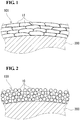
- this silicone resin organic solvent solution is applied onto particle surfaces of a soft magnetic powder to form a coating, a silicone resin coating 100 having a structure in which fine silicone particles 10 are accumulated on a surface of each particle 200 of the soft magnetic powder is formed as illustrated in Fig. 2 .
- Gaps are formed between the particles 10 and thus the coating 100 having a structure in which the fine particles 10 are accumulated has many gaps, which makes it difficult to increase the density. Therefore, in a known method that uses a silicone resin organic solvent solution, it is believed to be difficult to form a dense silicone resin coating.
- a dense silicone resin coating can be formed by using a silicone emulsion prepared by mixing a silicone resin with water containing a surfactant.
- the reason for this is believed to be as follows.
- the silicone emulsion is in a state in which the silicone resin is emulsified in water by a surfactant.
- the surfactant covers a surface of an assembly (cluster) of a plurality of silicone molecules bonded to each other, and silicone particles constituted by a plurality of silicone molecules are uniformly dispersed in water.
- a silicone resin coating 101 having a structure in which silicone particles 11 of the molecular assembly are accumulated on a surface of each particle 200 of the soft magnetic powder is formed as illustrated in Fig. 1 .
- the emulsified silicone particles 11 are the molecular assembly and have a larger particle size than the monomolecular particles 10 in Fig. 2 . Therefore, the coating 101 having a structure in which the silicone particles 11 are accumulated has a small number of gaps, thereby increasing the coating density.
- the silicone particles 11 have large deformability because they are not in a solid state, but in an emulsified state. Therefore, the silicone particles 11 accumulate while being in close contact with each other, which improves the density of the coating 101.
- a dust core produced by the method for producing a dust core according to an embodiment of the present invention is used as a core for electromagnetic components. Therefore, an electromagnetic component with low iron loss and high energy efficiency can be produced.
- Examples of an electromagnetic component including a dust core and a coil provided to the dust core include reactors and motors.
- the method for producing a coated magnetic powder includes a preparation step of preparing a silicone emulsion, an application step of applying the silicone emulsion onto particle surfaces of a soft magnetic powder, and a drying step of drying the soft magnetic powder after the application.
- a silicone resin coating is formed by applying a silicone emulsion in which a silicone resin is dispersed in water by using a surfactant onto particle surfaces of a soft magnetic powder and drying the soft magnetic powder.
- the soft magnetic powder is a powder of a soft magnetic material and is constituted by a plurality of particles.
- the soft magnetic material include pure iron (purity: 99 mass% or more) and iron-based alloys such as an Fe-Si-Al-based alloy (Sendust), an Fe-Si-based alloy (silicon steel), an Fe-Al-based alloy, and an Fe-Ni-based alloy (Permalloy).
- a soft magnetic powder produced by, for example, an atomization process (water atomization process or gas atomization process), a carbonyl process, or a reduction process can be used.
- the soft magnetic powder may be a publicly known soft magnetic powder.
- the soft magnetic powder is preferably an alloy powder having good magnetic properties.
- a powder formed of an Fe-Si-Al-based alloy or an Fe-Si-based alloy is used as the soft magnetic powder, a dust core with lower iron loss can be provided.
- the soft magnetic powder preferably has a Vickers hardness of HV 150 or more.
- the use of the soft magnetic powder with HV 150 or more can suppress separation of a silicone resin coating due to deformation of the soft magnetic powder during compaction in a production process of a dust core.
- the upper limit of the Vickers hardness is preferably, for example, HV 800 or less from the viewpoint of moldability during compaction.
- the average particle size of the soft magnetic powder is, for example, 20 ⁇ m or more and 300 ⁇ m or less or 40 ⁇ m or more and 250 ⁇ m or less. When the average particle size of the soft magnetic powder is within the above range, the soft magnetic powder is easily handled and compacted.
- the average particle size of the soft magnetic powder is measured with a laser diffraction/scattering particle size distribution analyzer and refers to a particle size at which the cumulative mass reaches 50% of the mass of all particles.
- the preparation step is a step of preparing a silicone emulsion by mixing a silicone resin with water containing a surfactant and dispersing the silicone resin in the water.
- a silicone resin having a weight-average molecular weight of, for example, 1000 or more and 30000 or less can be used.
- the weight-average molecular weight of the silicone resin is preferably 30000 or less. This makes it easy to apply a silicone emulsion onto particle surfaces of the soft magnetic powder with a uniform thickness in the application step, and thus a dense coating with a uniform thickness is easily formed.
- the weight-average molecular weight of the silicone resin is 30000 or less, emulsification is easily performed and silicone particles are easily uniformly dispersed in water.
- the weight-average molecular weight of the silicone resin is, for example, preferably 10000 or less and more preferably 5000 or less.
- the weight-average molecular weight of the silicone resin can be measured by gel permeation chromatography.
- silicone resin examples include methyl silicone resins (dimethyl silicone resin) in which all side chains and terminals of a polysiloxane are methyl groups and methyl phenyl silicone resins in which some of side chains of a polysiloxane are phenyl groups.
- a methyl phenyl silicone resin in which some of methyl groups are substituted with phenyl groups has high heat resistance and thus a coating having high heat resistance can be formed.
- the content of the phenyl groups is preferably 20 mol% or more and 50 mol% or less. When the content of the phenyl groups is 20 mol% or more, the heat resistance is improved.
- the content of phenyl groups can be determined as follows. A molar ratio is calculated from the peak intensity ratio of methyl groups and phenyl groups in an infrared absorption spectrum measured by infrared spectroscopic analysis. Then, the content of phenyl groups is determined from the molar ratio of phenyl groups to the total of methyl groups and phenyl groups, which is assumed to be 100 mol.
- the surfactant is used to disperse a silicone resin in water through emulsification.
- the surfactant may be, for example, a nonionic surfactant having a polyoxyethylene (CH 2 CH 2 O) n structure.
- the weight-average molecular weight of the surfactant is, for example, 300 or more and 700 or less, which makes it easy to uniformly disperse the silicone particles.
- Examples of the surfactant include polyoxyethylene alkyl ethers (AE) and polyoxyethylene alkyl phenyl ethers (APE).
- the weight-average molecular weight of the surfactant can be measured by matrix-assisted laser desorption/ionization.
- the silicone emulsion is obtained by dispersing the silicone resin in water using a surfactant.
- the surfactant covers a surface of an assembly (cluster) of a plurality of silicone molecules bonded to each other, and silicone particles constituted by a plurality of silicone molecules are uniformly dispersed in water.
- the content of the silicone resin in the silicone emulsion is, for example, 10 mass% or more and 60 mass% or less.
- the content of the silicone resin is 10 mass% or more, a sufficient amount of silicone particles can be provided in the silicone emulsion, which makes it easy to form a coating having a predetermined thickness.
- the content of the silicone resin is 60 mass% or less, the dispersibility of the silicone emulsion can be improved. Consequently, the silicone emulsion is easily applied onto particle surfaces of the soft magnetic powder with a uniform thickness, and thus a dense coating with a uniform thickness is easily formed.
- the content of the silicone resin is preferably, for example, 20 mass% or more and 50 mass% or less.
- the average particle size of the silicone particles in the silicone emulsion is, for example, 200 nm or more.
- the coating density is improved.
- the application step is a step of applying the silicone emulsion onto particle surfaces of a soft magnetic powder.
- the silicone emulsion can be applied by any publicly known method.
- the soft magnetic powder is immersed in the silicone emulsion, the silicone emulsion is sprayed onto the soft magnetic powder, or the soft magnetic powder and the silicone emulsion are mixed with each other under stirring.
- the amount of the silicone emulsion applied is dependent on the thickness of a silicone resin coating to be formed, but is, for example, adjusted so that the solid content (silicone resin) of the silicone emulsion is 0.05 parts by weight or more and 1.0 part by weight or less relative to 100 parts by weight of the soft magnetic powder.
- the drying step is a step of drying the soft magnetic powder after the silicone emulsion is applied.
- the drying step is performed, for example, at a saturated water vapor pressure of 20 kPa or more.
- a saturated water vapor pressure of 20 kPa or more.
- the drying atmosphere is generally an air atmosphere, but is not limited thereto and may be a non-oxidizing atmosphere such as a nitrogen atmosphere or an Ar atmosphere.
- the drying is preferably performed immediately after the silicone emulsion is applied.
- the application at a saturated water vapor pressure of 20 kPa or more, the application and the drying can be simultaneously performed.
- the silicone resin coating preferably has a pencil hardness of H or more and 6H or less.
- the silicone resin coating has high strength and the coating is not easily damaged during compaction.
- the silicone resin coating has high flexibility and the coating is not easily separated from the particle surfaces of the soft magnetic powder during compaction.
- high flexibility of the silicone resin coating does not easily inhibit the plastic deformation of the soft magnetic powder during compaction, which can increase the density of a green compact (dust core) and thus can increase the magnetic permeability of the dust core.
- the silicone resin coating has a pencil hardness of H or more and 6H or less, the damage to and separation of the silicone resin coating during compaction can be suppressed, which can effectively reduce the iron loss of the dust core.
- the hardness of the silicone resin coating can be changed in accordance with, for example, the type and composition of silicone resin, the structure, and the production conditions. For example, in the case where a methyl phenyl silicone resin is used as the silicone resin, the hardness of the coating varies depending on the content of the phenyl group. The hardness tends to increase (the flexibility tends to decrease) as the content of the phenyl group increases. Furthermore, the hardness tends to increase (the flexibility tends to decrease) as the content of Si in the silicone resin increases, that is, as the content of organic substituents such as a methyl group and a phenyl group in the silicone resin decreases.
- the hardness of the silicone resin coating is determined as follows.
- the silicone emulsion is applied onto a steel sheet and then dried to form a silicone resin coating.
- the pencil hardness of the silicone resin coating on the surface of the steel sheet is measured.
- the measured pencil hardness is regarded as the hardness of the silicone resin coating on particle surfaces of the soft magnetic powder.
- the pencil hardness of the silicone resin coating is measured by pressing a pencil against the coating at an angle of 45° at a load of 750 g in conformity with "Scratch hardness (Pencil method)" of JIS K 5600-5-4:1999.
- the coated magnetic powder produced by the above-described method for producing a coated magnetic powder according to an embodiment can be used as a raw material for dust cores.
- the coated magnetic powder has a dense silicone resin coating on the particle surfaces of the soft magnetic powder. Therefore, when a dust core is produced, the particles of the soft magnetic powder can be insulated from each other, which can reduce the iron loss due to eddy-current loss of the dust core.
- the silicone resin coating has a thickness of, for example, 0.05 ⁇ m or more and 3 ⁇ m or less. In particular, when a silicone resin coating is formed using a methyl phenyl silicone resin containing 20 mol% or more and 50 mol% or less of phenyl groups, a coated magnetic powder having a dense silicone resin coating with high heat resistance is provided.
- the method for producing a dust core according to an embodiment includes a compaction step of compacting a coated magnetic powder to obtain a green compact and a heat treatment step of heating the green compact.
- One of features of the method for producing a dust core according to an embodiment is that a coated magnetic powder produced by the above-described method for producing a coated magnetic powder according to an embodiment is used as a raw material for dust cores.
- the compaction step is a step of compacting a coated magnetic powder produced by the above-described method for producing a coated magnetic powder according to an embodiment to obtain a green compact.
- the compaction is performed, for example, by filling a mold with a coated magnetic powder and performing press molding.
- the compaction can be performed using a publicly known press.
- the molding pressure is, for example, 600 MPa or more or 700 MPa or more.
- the upper limit of the molding pressure is, for example, 1500 MPa or less from the viewpoint of production.
- hot compaction may be performed by heating a mold.
- the molding temperature is, for example, 60°C or higher or 80°C or higher.
- the upper limit of the molding temperature is, for example, 200°C or lower.
- the heat treatment step is a step of heating a green compact.
- the main purpose of the heat treatment step is to remove strain introduced into the green compact during compaction. By heating the green compact to remove strain, the magnetic permeability can be improved and thus the iron loss due to hysteresis loss of the dust core can be reduced.
- the heating temperature is, for example, 600°C or higher. In particular, when heat treatment is performed at a high temperature of 700°C or higher, the hysteresis loss can be considerably reduced.
- the upper limit of the heating temperature is, for example, 900°C or lower.
- the silicone resin coating When the green compact is heat-treated, heat may change the silicone resin coating into an insulating coating having a composition containing Si and C.
- the silicone resin may also change into silicon oxide such as silica (SiO 2 ), and thus the insulating coating may contain SiO 2 . Even if the heat treatment changes the composition of the coating formed on particles of the soft magnetic powder, the coating density is maintained. Therefore, the particles of the soft magnetic powder are insulated from each other in the dust core.
- a coated magnetic powder produced by the above-described method for producing a coated magnetic powder according to an embodiment is used as a raw material. Therefore, a dust core with low iron loss can be produced.
- the dust core produced by the above-described method for producing a dust core according to an embodiment can be used as a core for electromagnetic components. Since this dust core has low iron loss, the energy efficiency of electromagnetic components can be improved.
- the method for producing an electromagnetic component according to an embodiment includes a step of providing a coil to a dust core produced by the above-described method for producing a dust core according to an embodiment.
- an electromagnetic component including a dust core and a coil provided to the dust core can be produced.
- a dust core produced by the above-described method for producing a dust core according to an embodiment is used as a core for electromagnetic components. Therefore, an electromagnetic component with low iron loss and high energy efficiency can be produced.
- the electromagnetic component include reactors and motors.
- a coated magnetic powder was produced by the production method according to the embodiment.
- a dust core was produced using the coated magnetic powder, and evaluation was performed.
- Example 1 an iron-based alloy powder (average particle size: 120 ⁇ m) having a composition of Fe-3 mass% Si (the Si content was 3 mass% and the balance was Fe and unavoidable impurities) was prepared as a soft magnetic powder.
- the average particle size of this powder was determined by performing measurement with a laser diffraction/scattering particle size distribution analyzer and calculating a particle size at which the cumulative mass reached 50% of the mass of all particles.
- the prepared soft magnetic powder was produced by a gas atomization process and had a hardness of HV 200.
- a silicone emulsion was prepared by dispersing a silicone resin in water using a surfactant.
- the silicone resin was a methyl phenyl silicone resin including a methyl group and a phenyl group at a molar ratio of 4:1 (i.e., the content of a phenyl group: 25 mol%) and having a weight-average molecular weight of 2000.
- the molar ratio of a methyl group and a phenyl group was determined from the peak intensity ratio of a methyl group and a phenyl group in an infrared absorption spectrum obtained by performing infrared spectroscopic analysis.
- the weight-average molecular weight of the silicone resin was determined by gel permeation chromatography.
- the surfactant was a nonionic surfactant having a polyoxyethylene (CH 2 CH 2 O) n structure.
- the weight-average molecular weight of the surfactant was 500.
- the weight-average molecular weight of the surfactant was determined by matrix-assisted laser desorption/ionization.
- the silicone resin was mixed with water containing a surfactant and stirred to prepare a silicone emulsion.
- the silicone emulsion was prepared by mixing water and the silicone resin at a mass ratio of 1:1 so as to have a silicone resin content of 50 mass%.
- the average particle size of silicone particles in the silicone emulsion was 300 nm.
- the average particle size of the silicone particles was determined by performing measurement with a laser diffraction/scattering particle size distribution analyzer and calculating a particle size at which the cumulative mass reached 50% of the mass of all particles.
- the prepared silicone emulsion was applied onto particle surfaces of a soft magnetic powder and dried to coat the particle surfaces with the silicone resin.
- a coated magnetic powder was produced. The coating was performed as follows.
- the soft magnetic powder and the silicone emulsion were inserted into a mixer and mixed with each other under stirring in the mixer.
- the silicone emulsion was applied onto the particle surfaces of the soft magnetic powder and dried.
- the soft magnetic powder was dried by sending hot air at 80°C to the mixer while the soft magnetic powder and the silicone emulsion were mixed with each other under stirring. That is, the application and drying of the silicone emulsion were simultaneously performed through a single process.
- the saturated water vapor pressure in this atmosphere was 47 kPa and the temperature of the powder was 40°C.
- the mixing was performed so that the solid content (silicone resin) of the silicone emulsion was 0.3 parts by weight relative to 100 parts by weight of the soft magnetic powder.
- the hardness of the silicone resin coating formed by applying the silicone emulsion was measured.
- the pencil hardness of a silicone resin coating formed by applying the silicone emulsion onto a steel sheet and then performing drying was measured in conformity with "Scratch hardness (Pencil method)" of JIS K 5600-5-4:1999. As a result, the pencil hardness of the silicone resin coating was H.
- the thus-produced coated magnetic powder was referred to as sample No. 1-1.
- a dust core was produced using the coated magnetic powder as a raw material.
- the dust core was produced as follows.
- a mold was filled with the coated magnetic powder. Press molding was performed at a molding pressure of 980 MPa to prepare a ring-shaped green compact having an outside diameter of 30 mm, an inside diameter of 20 mm, and a height of 5 mm. The molding temperature (mold temperature) was set to 80°C. Then, the green compact was heat-treated in a nitrogen atmosphere at 800°C for 15 minutes to produce a dust core.
- a coated magnetic powder referred to as sample No. 1-2 was produced in the same manner as in the sample No. 1-1, except that the content of the phenyl group in the methyl phenyl silicone resin was changed so that the silicone resin coating had a hardness of 6H.
- a dust core was produced using the coated magnetic powder in the same manner as in the sample No. 1-1.
- the content of the phenyl group was set to 40 mol%.
- Coated magnetic powders referred to as sample No. 1-3 and sample No. 1-4 were produced in the same manner as in the sample No. 1-1, except that the content of the phenyl group in the methyl phenyl silicone resin was changed so that the silicone resin coatings had hardnesses of F and 7H, respectively. Dust cores were produced using the coated magnetic powders in the same manner as in the sample No. 1-1.
- the content of the phenyl group was set to 15 mol%.
- the content of the phenyl group was set to 60 mol%.
- sample No. 100 a coated magnetic powder referred to as sample No. 100 was produced in the same manner as in the sample No. 1-1, except that an organic solvent solution prepared by dissolving the silicone resin in xylene was used instead of the silicone emulsion.
- a dust core was produced using the coated magnetic powder in the same manner as in the sample No. 1-1.
- the iron loss was measured.
- the iron loss was measured by a secondary winding method by using a primary winding with 300 turns and a secondary winding with 30 turns on the dust core.
- the iron loss was measured at room temperature (25°C) using an AC B-H analyzer (manufactured by METRON, Inc.).
- the excitation flux density Bm was set to 1 T (10 kG) and the measurement frequency was set to 1 kHz.
- Table 1 shows the results. [Table 1] Sample No. Core loss (W/kg) 1-1 66 1-2 69 1-3 75 1-4 79 100 97
- the coated magnetic powders referred to as the samples No. 1-1 to No. 1-4 that were produced using the silicone emulsion can considerably reduce the iron loss of their dust cores compared with the sample No. 100 that was produced using the silicone resin organic solvent solution. This is believed to be because the samples in which the silicone emulsion is applied onto particle surfaces of the soft magnetic powder to form a silicone resin coating have a dense coating formed thereon.
- the coated magnetic powders referred to as the samples No. 1-1 and No. 1-2 in which the silicone resin coating has a hardness of H or more and 6H or less can reduce the iron loss of their dust cores compared with the coated magnetic powder referred to as the sample No.
- the samples No. 1-1 and No. 1-2 are found to have a high iron-loss-reduction effect.
- the silicone resin coating has a hardness of H or more in the coated magnetic powders referred to as the samples No. 1-1 and No. 1-2 and thus the coating has high strength, which makes it difficult to cause damage to the coating during compaction.
- the coated magnetic powders referred to as the samples No. 1-1 and No. 1-2 can reduce the iron loss of their dust cores compared with the coated magnetic powder referred to as the sample No. 1-4 in which the silicone resin coating has a hardness of 7H, and thus the samples No. 1-1 and No.
- the silicone resin coating has a hardness of 6H or less in the coated magnetic powders referred to as the samples No. 1-1 and No. 1-2 and thus the coating has high flexibility, which makes it difficult to cause separation of the coating during compaction.
- Example 2 an iron-based alloy powder (average particle size: 40 ⁇ m) having a composition of Fe-9.5 mass% Si-5.5 mass% Al (the Si content was 9.5 mass%, the Al content was 5.5 mass%, and the balance was Fe and unavoidable impurities) was prepared as a soft magnetic powder.
- the prepared soft magnetic powder was produced by a gas atomization process and had a hardness of HV 500.
- Example 2 In the same manner as in the sample No. 1-1 of Example 1, the same silicone emulsion as that of the sample No. 1-1 was applied onto particle surfaces of the soft magnetic powder and dried to coat the particle surfaces with a methyl phenyl silicone resin. Thus, a coated magnetic powder was produced.
- the produced coated magnetic powder was referred to as sample No. 2.
- a dust core was produced using the coated magnetic powder in the same manner as in the sample No. 1-1.
- sample No. 200 a coated magnetic powder referred to as sample No. 200 was produced in the same manner as in the sample No. 2, except that an organic solvent solution prepared by dissolving the silicone resin in xylene was used instead of the silicone emulsion.
- a dust core was produced using the coated magnetic powder in the same manner as in the sample No. 2.
- the iron loss was measured.
- the iron loss was measured in the same manner as in Example 1, except that the excitation flux density Bm was set to 0.1 T and the measurement frequency was set to 100 kHz.
- Table 2 shows the results. [Table 2] Sample No. Core loss (W/kg) 2 152 200 226
Landscapes
- Engineering & Computer Science (AREA)
- Power Engineering (AREA)
- Chemical & Material Sciences (AREA)
- Manufacturing & Machinery (AREA)
- Mechanical Engineering (AREA)
- Materials Engineering (AREA)
- Organic Chemistry (AREA)
- Metallurgy (AREA)
- Physics & Mathematics (AREA)
- Dispersion Chemistry (AREA)
- Electromagnetism (AREA)
- Spectroscopy & Molecular Physics (AREA)
- Soft Magnetic Materials (AREA)
- Powder Metallurgy (AREA)
Abstract
Description
- The present invention relates to a method for producing a coated magnetic powder, a method for producing a dust core, and a method for producing an electromagnetic component.
- The present application claims the priority based on Japanese Patent Application No.
2016-107750 filed on May 30, 2016 - Dust cores have been used as cores for electromagnetic components such as reactors and motors. In general, dust cores are produced by compacting a coated magnetic powder that serves as a raw material and is obtained by covering particle surfaces of a soft magnetic powder with an insulating coating. When particle surfaces of a soft magnetic powder are covered with an insulating coating, the insulating coating is interposed between the particles of the soft magnetic powder constituting a dust core, which makes it difficult to bring the particles into direct contact with each other. This improves the insulation between the particles and reduces the eddy-current loss of the dust core, thereby reducing the iron loss (core loss). The insulating coating is formed of, for example, a silicone resin.
- A silicone resin coating can be formed on the particle surfaces of the soft magnetic powder by a method in which a silicone resin is dissolved in an organic solvent (e.g., xylene) and the resulting solution is applied onto the particle surfaces of the soft magnetic powder (e.g., refer to PTL 1 and PTL 2).
-
- PTL 1: Japanese Unexamined Patent Application Publication No.
2000-223308 - PTL 2: Japanese Unexamined Patent Application Publication No.
2011-29605 - A method for producing a coated magnetic powder according to the present disclosure is a method for producing a coated magnetic powder in which particle surfaces of a soft magnetic powder are coated with a silicone resin, the method including a preparation step of preparing a silicone emulsion by mixing a silicone resin with water containing a surfactant and dispersing the silicone resin in the water; an application step of applying the silicone emulsion onto particle surfaces of a soft magnetic powder; and a drying step of drying the soft magnetic powder after the silicone emulsion is applied.
- A method for producing a dust core according to the present disclosure includes a compaction step of compacting a coated magnetic powder produced by the method for producing a coated magnetic powder to obtain a green compact; and a heat treatment step of heating the green compact.
- A method for producing an electromagnetic component according to the present disclosure includes a step of providing a coil to a dust core produced by the method for producing a dust core.
-
-
Figure 1 is a conceptual diagram illustrating a silicone resin coating formed by a production method according to an embodiment of the present invention. -
Figure 2 is a conceptual diagram illustrating a silicone resin coating formed by a known production method. - From the viewpoint of further reducing the iron loss due to eddy-current loss of dust cores, a dense silicone resin coating is desirably formed on particle surfaces of a soft magnetic powder. The insulation between particles of the soft magnetic powder is improved by increasing the density of the silicone resin coating. Thus, the iron loss of dust cores can be further reduced.
- Accordingly, it is an object of the present disclosure to provide a method for producing a coated magnetic powder in which a dense silicone resin coating can be formed on particle surfaces of a soft magnetic powder. It is another object of the present disclosure to provide a method for producing a dust core with low iron loss. It is still another object of the present disclosure to provide a method for producing an electromagnetic component with low iron loss and high energy efficiency.
- In the method for producing a coated magnetic powder, a dense silicone resin coating can be formed on particle surfaces of a soft magnetic powder. In the method for producing a dust core, a dust core with low iron loss can be produced. In the method for producing an electromagnetic component, an electromagnetic component with low iron loss and high energy efficiency can be produced.
- As a result of thorough studies on the method for forming a dense silicone resin coating on particle surfaces of a soft magnetic powder, the present inventors have found the following.
- In the related art, a solution prepared by dissolving a silicone resin in an organic solvent is used for formation of a silicone resin coating. When a silicone resin is dissolved in an organic solvent, the molecular bond is cleaved and silicone molecules are present in a monomolecular state, and monomolecular silicone resin particles (hereafter may be referred to as "silicone particles") are dissolved in the organic solvent. In the case where this silicone resin organic solvent solution is applied onto particle surfaces of a soft magnetic powder to form a coating, a
silicone resin coating 100 having a structure in whichfine silicone particles 10 are accumulated on a surface of eachparticle 200 of the soft magnetic powder is formed as illustrated inFig. 2 . Gaps are formed between theparticles 10 and thus thecoating 100 having a structure in which thefine particles 10 are accumulated has many gaps, which makes it difficult to increase the density. Therefore, in a known method that uses a silicone resin organic solvent solution, it is believed to be difficult to form a dense silicone resin coating. - As a result of further studies conducted by the present inventors, they have found that a dense silicone resin coating can be formed by using a silicone emulsion prepared by mixing a silicone resin with water containing a surfactant. The reason for this is believed to be as follows.
- Since the silicone resin is insoluble in water, the molecular bond is maintained and thus the silicone resin is present while a plurality of silicone molecules bond to each other. The silicone emulsion is in a state in which the silicone resin is emulsified in water by a surfactant. In the state of silicone emulsion, the surfactant covers a surface of an assembly (cluster) of a plurality of silicone molecules bonded to each other, and silicone particles constituted by a plurality of silicone molecules are uniformly dispersed in water. In the case where the silicone emulsion is applied onto surfaces of soft magnetic particles to form a coating, a
silicone resin coating 101 having a structure in whichsilicone particles 11 of the molecular assembly are accumulated on a surface of eachparticle 200 of the soft magnetic powder is formed as illustrated inFig. 1 . The emulsifiedsilicone particles 11 are the molecular assembly and have a larger particle size than themonomolecular particles 10 inFig. 2 . Therefore, thecoating 101 having a structure in which thesilicone particles 11 are accumulated has a small number of gaps, thereby increasing the coating density. Furthermore, thesilicone particles 11 have large deformability because they are not in a solid state, but in an emulsified state. Therefore, thesilicone particles 11 accumulate while being in close contact with each other, which improves the density of thecoating 101. - Hereafter, embodiments of the present invention will be listed and described.
- (1) A method for producing a coated magnetic powder according to an embodiment of the present invention is a method for producing a coated magnetic powder in which particle surfaces of a soft magnetic powder are coated with a silicone resin, the method including a preparation step of preparing a silicone emulsion by mixing a silicone resin with water containing a surfactant and dispersing the silicone resin in the water; an application step of applying the silicone emulsion onto particle surfaces of a soft magnetic powder; and a drying step of drying the soft magnetic powder after the silicone emulsion is applied.
In this method for producing a coated magnetic powder, a dense silicone resin coating can be formed by applying a silicone emulsion prepared through emulsification of a silicone resin in water onto particle surfaces of a soft magnetic powder and drying the soft magnetic powder. Therefore, a coated magnetic powder produced by the method for producing a coated magnetic powder has a dense silicone resin coating on particle surfaces of the soft magnetic powder. When the coated magnetic powder is used as a raw material for dust cores, the iron loss due to eddy-current loss of dust cores can be reduced.
The silicone emulsion is prepared using water as a solvent, but not an organic solvent. Therefore, the silicone emulsion is excellent in terms of cost, safety, environmental friendliness, and workability. For example, an organic solvent having high volatility (flammability) is not used, which does not require an explosion-proof apparatus. Thus, the cost for facilities can be reduced and the apparatus can be easily cleaned. - (2) In an embodiment of the method for producing a coated magnetic powder, the silicone resin has a weight-average molecular weight of 1000 or more and 30000 or less.
When a polymer silicone resin having a weight-average molecular weight of 1000 or more is used, the particle size of the emulsified silicone particles is large, which improves the coating density. When the silicone resin has a weight-average molecular weight of 30000 or less, the silicone emulsion is easily applied onto particle surfaces of the soft magnetic powder with a uniform thickness, which makes it easy to form a dense coating having a uniform thickness. When the silicone resin has a weight-average molecular weight of 30000 or less, emulsification is easily performed and thus the silicone particles are easily uniformly dispersed in water. The weight-average molecular weight of the silicone resin is, for example, preferably 10000 or less and more preferably 5000 or less. - (3) In an embodiment of the method for producing a coated magnetic powder, the silicone resin is a methyl phenyl silicone resin in which some of methyl groups are substituted with phenyl groups, the silicone resin containing the phenyl groups in an amount of 20 mol% or more and 50 mol% or less.
The silicone resin has a molecular structure including a main chain constituted by polysiloxane bonds and side chains to which organic groups bond. Examples of the organic groups include a methyl group (CH3) and a phenyl group (C6H5). Specific examples of the silicone resin include methyl silicone resins in which all side chains and terminals of a polysiloxane are methyl groups and methyl phenyl silicone resins in which some of methyl groups in the methyl silicone resin are substituted with phenyl groups so that some of side chains of the polysiloxane are phenyl groups. By substituting some of methyl groups with phenyl groups, the heat resistance is improved. A methyl phenyl silicone resin containing 20 mol% or more of phenyl groups has high heat resistance. Thus, a coating having high heat resistance can be formed. When the content of the phenyl groups is 50 mol% or less, high flexibility is achieved and silicone particles come in close contact with each other when the coating is formed by applying a silicone emulsion onto surfaces of soft magnetic particles and thus a dense coating is easily formed. The content (mol%) of phenyl groups refers to a ratio of the number of moles of phenyl groups relative to the total number of moles of methyl groups and phenyl groups, which is assumed to be 100 mol%. - (4) In an embodiment of the method for producing a coated magnetic powder, the soft magnetic powder is formed of an Fe-Si-Al-based alloy or an Fe-Si-based alloy and has a Vickers hardness of HV 150 or more.
When the soft magnetic powder is a soft magnetic material powder formed of an Fe-Si-Al-based alloy or an Fe-Si-based alloy, the iron loss of dust cores can be further reduced. When the soft magnetic powder (soft magnetic material) has a Vickers hardness of HV 150 or more, the separation of a silicone resin coating due to deformation of the soft magnetic powder during compaction is easily suppressed in a production process of dust cores. The upper limit of the Vickers hardness is, for example, HV 800 or less from the viewpoint of moldability during compaction and the component system of the iron-based alloy. - (5) In an embodiment of the method for producing a coated magnetic powder, a silicone resin coating on the particle surfaces of the soft magnetic powder has a pencil hardness of H or more and 6H or less.
When the pencil hardness of the silicone resin coating is H or more, the silicone resin coating has high strength and the coating is not easily damaged during compaction. When the pencil hardness of the silicone resin coating is 6H or less, the silicone resin coating has high flexibility and the coating is not easily separated from the particle surfaces of the soft magnetic powder during compaction. Furthermore, high flexibility of the silicone resin coating does not easily inhibit the plastic deformation of the soft magnetic powder during compaction, which can increase the density of a green compact (dust core) and thus can increase the magnetic permeability of the dust core. Therefore, when the silicone resin coating has a pencil hardness of H or more and 6H or less, the damage to and separation of the silicone resin coating during compaction can be suppressed, which can effectively reduce the iron loss of the dust core. - (6) In an embodiment of the method for producing a coated magnetic powder, the surfactant is a nonionic surfactant having a polyoxyethylene structure and has a weight-average molecular weight of 300 or more and 700 or less.
The nonionic surfactant having a polyoxyethylene (CH2CH2O)n structure has high stability and good emulsion dispersibility. The silicone resin is easily dispersed in water by using such a surfactant through emulsification. When the surfactant has a weight-average molecular weight of 300 or more and 700 or less, the silicone particles are easily uniformly dispersed. Furthermore, since the nonionic surfactant has high stability, other emulsions such as an aqueous solution of another resin and a wax can also be used in combination. - (7) In an embodiment of the method for producing a coated magnetic powder, the drying step is performed at a saturated water vapor pressure of 20 kPa or more.
When the soft magnetic powder to which the silicone emulsion has been applied is dried at a saturated water vapor pressure of 20 kPa or more, water is rapidly evaporated from the silicone emulsion, which makes it easy to suppress oxidation of the soft magnetic powder. - (8) In an embodiment of the method for producing a coated magnetic powder, a content of the silicone resin in the silicone emulsion is 10 mass% or more and 60 mass% or less.
When the content of the silicone resin is 10 mass% or more, a sufficient amount of silicone particles can be provided in the silicone emulsion, which makes it easy to form a coating having a predetermined thickness. When the content of the silicone resin is 60 mass% or less, the dispersibility of the silicone emulsion can be improved. Consequently, the silicone emulsion is easily applied onto particle surfaces of the soft magnetic powder with a uniform thickness, and thus a dense coating with a uniform thickness is easily formed. The content (mass%) of the silicone resin refers to a ratio of the mass of the silicone resin relative to the total mass of water and the silicone resin, which is assumed to be 100 mass%. - (9) In an embodiment of the method for producing a coated magnetic powder, an average particle size of particles of the silicone resin dispersed in the silicone emulsion is 200 nm or more.
When the average particle size of the emulsified silicone particles is 200 nm or more, the coating density is improved. The average particle size of the silicone particles is measured with a laser diffraction/scattering particle size distribution analyzer and refers to a particle size at which the cumulative mass reaches 50% of the mass of all particles. - (10) A method for producing a dust core according to an embodiment of the present invention includes a compaction step of compacting a coated magnetic powder produced by the method for producing a coated magnetic powder according to any one of (1) to (9) to obtain a green compact; and a heat treatment step of heating the green compact.
In the method for producing a dust core, a coated magnetic powder produced by the method for producing a coated magnetic powder according to an embodiment of the present invention is used as a raw material for dust cores. Therefore, a dust core with low iron loss can be produced.
In the heat treatment step, for example, a green compact is heated in order to remove strain introduced into the green compact during compaction. By heating the green compact to remove the strain, the hysteresis loss of the dust core can be reduced, thereby reducing the iron loss.
When the green compact is heat-treated, heat may change the silicone resin coating into an insulating coating having a composition containing Si and C. The silicone resin may also change into silicon oxide such as silica (SiO2), and thus the insulating coating may contain SiO2. Even if the heat treatment changes the composition of the coating formed on particles of the soft magnetic powder, the coating density is maintained. Therefore, the particles of the soft magnetic powder are insulated from each other in the dust core. - (11) A method for producing an electromagnetic component according to an embodiment of the present invention includes a step of providing a coil to a dust core produced by the method for producing a dust core according to (10).
- In the method for producing an electromagnetic component, a dust core produced by the method for producing a dust core according to an embodiment of the present invention is used as a core for electromagnetic components. Therefore, an electromagnetic component with low iron loss and high energy efficiency can be produced. Examples of an electromagnetic component including a dust core and a coil provided to the dust core include reactors and motors.
- The method for producing a coated magnetic powder, the method for producing a dust core, and the method for producing an electromagnetic component according to embodiments of the present invention will be specifically described below. The present invention is not limited to these examples but is defined by the claims, and is intended to include all modifications within the meaning and scope equivalent to those of the claims.
- In the method for producing a coated magnetic powder according to an embodiment, particle surfaces of a soft magnetic powder are coated with a silicone resin. The method includes a preparation step of preparing a silicone emulsion, an application step of applying the silicone emulsion onto particle surfaces of a soft magnetic powder, and a drying step of drying the soft magnetic powder after the application. One of features of the method for producing a coated magnetic powder according to an embodiment is that a silicone resin coating is formed by applying a silicone emulsion in which a silicone resin is dispersed in water by using a surfactant onto particle surfaces of a soft magnetic powder and drying the soft magnetic powder. Hereafter, each of the steps will be described in detail.
- First, the soft magnetic powder will be described. The soft magnetic powder is a powder of a soft magnetic material and is constituted by a plurality of particles. Examples of the soft magnetic material include pure iron (purity: 99 mass% or more) and iron-based alloys such as an Fe-Si-Al-based alloy (Sendust), an Fe-Si-based alloy (silicon steel), an Fe-Al-based alloy, and an Fe-Ni-based alloy (Permalloy). A soft magnetic powder produced by, for example, an atomization process (water atomization process or gas atomization process), a carbonyl process, or a reduction process can be used. The soft magnetic powder may be a publicly known soft magnetic powder.
- The soft magnetic powder is preferably an alloy powder having good magnetic properties. When a powder formed of an Fe-Si-Al-based alloy or an Fe-Si-based alloy is used as the soft magnetic powder, a dust core with lower iron loss can be provided.
- The soft magnetic powder preferably has a Vickers hardness of HV 150 or more. The use of the soft magnetic powder with HV 150 or more can suppress separation of a silicone resin coating due to deformation of the soft magnetic powder during compaction in a production process of a dust core. The upper limit of the Vickers hardness is preferably, for example, HV 800 or less from the viewpoint of moldability during compaction.
- The average particle size of the soft magnetic powder is, for example, 20 µm or more and 300 µm or less or 40 µm or more and 250 µm or less. When the average particle size of the soft magnetic powder is within the above range, the soft magnetic powder is easily handled and compacted. The average particle size of the soft magnetic powder is measured with a laser diffraction/scattering particle size distribution analyzer and refers to a particle size at which the cumulative mass reaches 50% of the mass of all particles.
- The preparation step is a step of preparing a silicone emulsion by mixing a silicone resin with water containing a surfactant and dispersing the silicone resin in the water.
- A silicone resin having a weight-average molecular weight of, for example, 1000 or more and 30000 or less can be used. When the silicone resin has a weight-average molecular weight of 1000 or more, the particle size of silicone particles dispersed in a silicone emulsion is large, which improves the coating density. The weight-average molecular weight of the silicone resin is preferably 30000 or less. This makes it easy to apply a silicone emulsion onto particle surfaces of the soft magnetic powder with a uniform thickness in the application step, and thus a dense coating with a uniform thickness is easily formed. When the weight-average molecular weight of the silicone resin is 30000 or less, emulsification is easily performed and silicone particles are easily uniformly dispersed in water. The weight-average molecular weight of the silicone resin is, for example, preferably 10000 or less and more preferably 5000 or less. The weight-average molecular weight of the silicone resin can be measured by gel permeation chromatography.
- Examples of the silicone resin include methyl silicone resins (dimethyl silicone resin) in which all side chains and terminals of a polysiloxane are methyl groups and methyl phenyl silicone resins in which some of side chains of a polysiloxane are phenyl groups. In particular, a methyl phenyl silicone resin in which some of methyl groups are substituted with phenyl groups has high heat resistance and thus a coating having high heat resistance can be formed. In the case of the methyl phenyl silicone resin, the content of the phenyl groups is preferably 20 mol% or more and 50 mol% or less. When the content of the phenyl groups is 20 mol% or more, the heat resistance is improved. When the content of the phenyl groups is 50 mol% or less, high flexibility is achieved and silicone particles come in close contact with each other when the coating is formed by applying a silicone emulsion onto surfaces of soft magnetic particles and thus a dense coating is easily formed. The content of phenyl groups can be determined as follows. A molar ratio is calculated from the peak intensity ratio of methyl groups and phenyl groups in an infrared absorption spectrum measured by infrared spectroscopic analysis. Then, the content of phenyl groups is determined from the molar ratio of phenyl groups to the total of methyl groups and phenyl groups, which is assumed to be 100 mol.
- The surfactant is used to disperse a silicone resin in water through emulsification. The surfactant may be, for example, a nonionic surfactant having a polyoxyethylene (CH2CH2O)n structure. The weight-average molecular weight of the surfactant is, for example, 300 or more and 700 or less, which makes it easy to uniformly disperse the silicone particles. Examples of the surfactant include polyoxyethylene alkyl ethers (AE) and polyoxyethylene alkyl phenyl ethers (APE). The weight-average molecular weight of the surfactant can be measured by matrix-assisted laser desorption/ionization.
- The silicone emulsion is obtained by dispersing the silicone resin in water using a surfactant. In the state of silicone emulsion, the surfactant covers a surface of an assembly (cluster) of a plurality of silicone molecules bonded to each other, and silicone particles constituted by a plurality of silicone molecules are uniformly dispersed in water.
- The content of the silicone resin in the silicone emulsion is, for example, 10 mass% or more and 60 mass% or less. When the content of the silicone resin is 10 mass% or more, a sufficient amount of silicone particles can be provided in the silicone emulsion, which makes it easy to form a coating having a predetermined thickness. When the content of the silicone resin is 60 mass% or less, the dispersibility of the silicone emulsion can be improved. Consequently, the silicone emulsion is easily applied onto particle surfaces of the soft magnetic powder with a uniform thickness, and thus a dense coating with a uniform thickness is easily formed. The content of the silicone resin is preferably, for example, 20 mass% or more and 50 mass% or less.
- The average particle size of the silicone particles in the silicone emulsion is, for example, 200 nm or more. When the average particle size of the silicone particles is 200 nm or more, the coating density is improved.
- The application step is a step of applying the silicone emulsion onto particle surfaces of a soft magnetic powder.
- The silicone emulsion can be applied by any publicly known method. For example, the soft magnetic powder is immersed in the silicone emulsion, the silicone emulsion is sprayed onto the soft magnetic powder, or the soft magnetic powder and the silicone emulsion are mixed with each other under stirring. The amount of the silicone emulsion applied is dependent on the thickness of a silicone resin coating to be formed, but is, for example, adjusted so that the solid content (silicone resin) of the silicone emulsion is 0.05 parts by weight or more and 1.0 part by weight or less relative to 100 parts by weight of the soft magnetic powder.
- The drying step is a step of drying the soft magnetic powder after the silicone emulsion is applied.
- By drying the soft magnetic powder, water is evaporated from the silicone emulsion. Thus, a silicone resin coating formed of accumulated silicone particles is formed on particle surfaces of the soft magnetic powder. The drying step is performed, for example, at a saturated water vapor pressure of 20 kPa or more. When the saturated water vapor pressure in a drying atmosphere is set to 20 kPa or more, water is rapidly evaporated from the silicone emulsion, which makes it easy to suppress oxidation of the soft magnetic powder. The drying atmosphere is generally an air atmosphere, but is not limited thereto and may be a non-oxidizing atmosphere such as a nitrogen atmosphere or an Ar atmosphere.
- From the viewpoint of suppressing oxidation of the soft magnetic powder, the drying is preferably performed immediately after the silicone emulsion is applied. For example, by performing the application at a saturated water vapor pressure of 20 kPa or more, the application and the drying can be simultaneously performed.
- The silicone resin coating preferably has a pencil hardness of H or more and 6H or less. When the pencil hardness of the silicone resin coating is H or more, the silicone resin coating has high strength and the coating is not easily damaged during compaction. When the pencil hardness of the silicone resin coating is 6H or less, the silicone resin coating has high flexibility and the coating is not easily separated from the particle surfaces of the soft magnetic powder during compaction. Furthermore, high flexibility of the silicone resin coating does not easily inhibit the plastic deformation of the soft magnetic powder during compaction, which can increase the density of a green compact (dust core) and thus can increase the magnetic permeability of the dust core. Therefore, when the silicone resin coating has a pencil hardness of H or more and 6H or less, the damage to and separation of the silicone resin coating during compaction can be suppressed, which can effectively reduce the iron loss of the dust core. The hardness of the silicone resin coating can be changed in accordance with, for example, the type and composition of silicone resin, the structure, and the production conditions. For example, in the case where a methyl phenyl silicone resin is used as the silicone resin, the hardness of the coating varies depending on the content of the phenyl group. The hardness tends to increase (the flexibility tends to decrease) as the content of the phenyl group increases. Furthermore, the hardness tends to increase (the flexibility tends to decrease) as the content of Si in the silicone resin increases, that is, as the content of organic substituents such as a methyl group and a phenyl group in the silicone resin decreases.
- The hardness of the silicone resin coating is determined as follows. The silicone emulsion is applied onto a steel sheet and then dried to form a silicone resin coating. The pencil hardness of the silicone resin coating on the surface of the steel sheet is measured. The measured pencil hardness is regarded as the hardness of the silicone resin coating on particle surfaces of the soft magnetic powder. The pencil hardness of the silicone resin coating is measured by pressing a pencil against the coating at an angle of 45° at a load of 750 g in conformity with "Scratch hardness (Pencil method)" of JIS K 5600-5-4:1999.
- The above-described method for producing a coated magnetic powder according to an embodiment provides the following effects.
- (1) A dense silicone resin coating can be formed by applying a silicone emulsion prepared by dispersing a silicone resin in water using a surfactant onto particle surfaces of a soft magnetic powder and drying the soft magnetic powder.
The silicone particles in the silicone emulsion are present in the form of a molecular assembly of a plurality of silicone molecules bonded to each other. Therefore, when the silicone emulsion is applied onto surfaces of soft magnetic particles to form a coating, a silicone resin coating having a structure in which the silicone particles of the molecular assembly are accumulated is formed on the particle surfaces of the soft magnetic powder (refer toFig. 1 ). Since the silicone particles of the molecular assembly have a large particle size, the gaps between the particles are small when the coating is formed, which can increase the density of the coating. Furthermore, the silicone particles have large deformability because they are not in a solid state, but in an emulsified state. Therefore, when the coating is formed, the silicone particles accumulate while being in close contact with each other, which improves the coating density. - (2) The silicone emulsion contains water as a solvent and is thus excellent in terms of cost, safety, environmental friendliness, and workability. For example, an organic solvent having high volatility (flammability) is not used as a solvent, which does not require an explosion-proof apparatus. Thus, the cost for facilities can be reduced and the apparatus can be easily cleaned.
- The coated magnetic powder produced by the above-described method for producing a coated magnetic powder according to an embodiment can be used as a raw material for dust cores. The coated magnetic powder has a dense silicone resin coating on the particle surfaces of the soft magnetic powder. Therefore, when a dust core is produced, the particles of the soft magnetic powder can be insulated from each other, which can reduce the iron loss due to eddy-current loss of the dust core. The silicone resin coating has a thickness of, for example, 0.05 µm or more and 3 µm or less. In particular, when a silicone resin coating is formed using a methyl phenyl silicone resin containing 20 mol% or more and 50 mol% or less of phenyl groups, a coated magnetic powder having a dense silicone resin coating with high heat resistance is provided.
- The method for producing a dust core according to an embodiment includes a compaction step of compacting a coated magnetic powder to obtain a green compact and a heat treatment step of heating the green compact. One of features of the method for producing a dust core according to an embodiment is that a coated magnetic powder produced by the above-described method for producing a coated magnetic powder according to an embodiment is used as a raw material for dust cores.
- The compaction step is a step of compacting a coated magnetic powder produced by the above-described method for producing a coated magnetic powder according to an embodiment to obtain a green compact.
- The compaction is performed, for example, by filling a mold with a coated magnetic powder and performing press molding. The compaction can be performed using a publicly known press. As the molding pressure during compaction is increased, the density of the green compact can be increased and consequently the density of the dust core can be increased. The molding pressure is, for example, 600 MPa or more or 700 MPa or more. The upper limit of the molding pressure is, for example, 1500 MPa or less from the viewpoint of production. To increase the moldability of the coated magnetic powder, for example, hot compaction may be performed by heating a mold. In the case of hot compaction, the molding temperature (mold temperature) is, for example, 60°C or higher or 80°C or higher. The upper limit of the molding temperature is, for example, 200°C or lower.
- The heat treatment step is a step of heating a green compact. The main purpose of the heat treatment step is to remove strain introduced into the green compact during compaction. By heating the green compact to remove strain, the magnetic permeability can be improved and thus the iron loss due to hysteresis loss of the dust core can be reduced. The heating temperature is, for example, 600°C or higher. In particular, when heat treatment is performed at a high temperature of 700°C or higher, the hysteresis loss can be considerably reduced. The upper limit of the heating temperature is, for example, 900°C or lower.
- When the green compact is heat-treated, heat may change the silicone resin coating into an insulating coating having a composition containing Si and C. The silicone resin may also change into silicon oxide such as silica (SiO2), and thus the insulating coating may contain SiO2. Even if the heat treatment changes the composition of the coating formed on particles of the soft magnetic powder, the coating density is maintained. Therefore, the particles of the soft magnetic powder are insulated from each other in the dust core.
- In the above-described method for producing a dust core according to an embodiment, a coated magnetic powder produced by the above-described method for producing a coated magnetic powder according to an embodiment is used as a raw material. Therefore, a dust core with low iron loss can be produced.
- The dust core produced by the above-described method for producing a dust core according to an embodiment can be used as a core for electromagnetic components. Since this dust core has low iron loss, the energy efficiency of electromagnetic components can be improved.
- The method for producing an electromagnetic component according to an embodiment includes a step of providing a coil to a dust core produced by the above-described method for producing a dust core according to an embodiment. Thus, an electromagnetic component including a dust core and a coil provided to the dust core can be produced.
- In the above-described method for producing an electromagnetic component according to an embodiment, a dust core produced by the above-described method for producing a dust core according to an embodiment is used as a core for electromagnetic components. Therefore, an electromagnetic component with low iron loss and high energy efficiency can be produced. Examples of the electromagnetic component include reactors and motors.
- A coated magnetic powder was produced by the production method according to the embodiment. A dust core was produced using the coated magnetic powder, and evaluation was performed.
- In Example 1, an iron-based alloy powder (average particle size: 120 µm) having a composition of Fe-3 mass% Si (the Si content was 3 mass% and the balance was Fe and unavoidable impurities) was prepared as a soft magnetic powder. The average particle size of this powder was determined by performing measurement with a laser diffraction/scattering particle size distribution analyzer and calculating a particle size at which the cumulative mass reached 50% of the mass of all particles. The prepared soft magnetic powder was produced by a gas atomization process and had a hardness of
HV 200. - A silicone emulsion was prepared by dispersing a silicone resin in water using a surfactant. The silicone resin was a methyl phenyl silicone resin including a methyl group and a phenyl group at a molar ratio of 4:1 (i.e., the content of a phenyl group: 25 mol%) and having a weight-average molecular weight of 2000. The molar ratio of a methyl group and a phenyl group was determined from the peak intensity ratio of a methyl group and a phenyl group in an infrared absorption spectrum obtained by performing infrared spectroscopic analysis. The weight-average molecular weight of the silicone resin was determined by gel permeation chromatography. The surfactant was a nonionic surfactant having a polyoxyethylene (CH2CH2O)n structure. The weight-average molecular weight of the surfactant was 500. The weight-average molecular weight of the surfactant was determined by matrix-assisted laser desorption/ionization.
- The silicone resin was mixed with water containing a surfactant and stirred to prepare a silicone emulsion. The silicone emulsion was prepared by mixing water and the silicone resin at a mass ratio of 1:1 so as to have a silicone resin content of 50 mass%. The average particle size of silicone particles in the silicone emulsion was 300 nm. The average particle size of the silicone particles was determined by performing measurement with a laser diffraction/scattering particle size distribution analyzer and calculating a particle size at which the cumulative mass reached 50% of the mass of all particles.
- The prepared silicone emulsion was applied onto particle surfaces of a soft magnetic powder and dried to coat the particle surfaces with the silicone resin. Thus, a coated magnetic powder was produced. The coating was performed as follows.
- The soft magnetic powder and the silicone emulsion were inserted into a mixer and mixed with each other under stirring in the mixer. Thus, the silicone emulsion was applied onto the particle surfaces of the soft magnetic powder and dried. Specifically, the soft magnetic powder was dried by sending hot air at 80°C to the mixer while the soft magnetic powder and the silicone emulsion were mixed with each other under stirring. That is, the application and drying of the silicone emulsion were simultaneously performed through a single process. The saturated water vapor pressure in this atmosphere was 47 kPa and the temperature of the powder was 40°C. Furthermore, the mixing was performed so that the solid content (silicone resin) of the silicone emulsion was 0.3 parts by weight relative to 100 parts by weight of the soft magnetic powder.
- The hardness of the silicone resin coating formed by applying the silicone emulsion was measured. For the hardness of the silicone resin coating, the pencil hardness of a silicone resin coating formed by applying the silicone emulsion onto a steel sheet and then performing drying was measured in conformity with "Scratch hardness (Pencil method)" of JIS K 5600-5-4:1999. As a result, the pencil hardness of the silicone resin coating was H.
- The thus-produced coated magnetic powder was referred to as sample No. 1-1. A dust core was produced using the coated magnetic powder as a raw material. The dust core was produced as follows.
- A mold was filled with the coated magnetic powder. Press molding was performed at a molding pressure of 980 MPa to prepare a ring-shaped green compact having an outside diameter of 30 mm, an inside diameter of 20 mm, and a height of 5 mm. The molding temperature (mold temperature) was set to 80°C. Then, the green compact was heat-treated in a nitrogen atmosphere at 800°C for 15 minutes to produce a dust core.
- A coated magnetic powder referred to as sample No. 1-2 was produced in the same manner as in the sample No. 1-1, except that the content of the phenyl group in the methyl phenyl silicone resin was changed so that the silicone resin coating had a hardness of 6H. A dust core was produced using the coated magnetic powder in the same manner as in the sample No. 1-1. In the sample No. 1-2, the content of the phenyl group was set to 40 mol%.
- Coated magnetic powders referred to as sample No. 1-3 and sample No. 1-4 were produced in the same manner as in the sample No. 1-1, except that the content of the phenyl group in the methyl phenyl silicone resin was changed so that the silicone resin coatings had hardnesses of F and 7H, respectively. Dust cores were produced using the coated magnetic powders in the same manner as in the sample No. 1-1. In the sample No. 1-3, the content of the phenyl group was set to 15 mol%. In the sample No. 1-4, the content of the phenyl group was set to 60 mol%.
- For comparison, a coated magnetic powder referred to as sample No. 100 was produced in the same manner as in the sample No. 1-1, except that an organic solvent solution prepared by dissolving the silicone resin in xylene was used instead of the silicone emulsion. A dust core was produced using the coated magnetic powder in the same manner as in the sample No. 1-1.
- For the dust cores produced using the coated magnetic powders referred to as the samples No. 1-1 to No. 1-4 and No. 100, the iron loss (core loss) was measured. Herein, the iron loss was measured by a secondary winding method by using a primary winding with 300 turns and a secondary winding with 30 turns on the dust core. The iron loss was measured at room temperature (25°C) using an AC B-H analyzer (manufactured by METRON, Inc.). For the measurement conditions, the excitation flux density Bm was set to 1 T (10 kG) and the measurement frequency was set to 1 kHz. Table 1 shows the results.
[Table 1] Sample No. Core loss (W/kg) 1-1 66 1-2 69 1-3 75 1-4 79 100 97 - As is clear from the results in Table 1, the coated magnetic powders referred to as the samples No. 1-1 to No. 1-4 that were produced using the silicone emulsion can considerably reduce the iron loss of their dust cores compared with the sample No. 100 that was produced using the silicone resin organic solvent solution. This is believed to be because the samples in which the silicone emulsion is applied onto particle surfaces of the soft magnetic powder to form a silicone resin coating have a dense coating formed thereon. In particular, the coated magnetic powders referred to as the samples No. 1-1 and No. 1-2 in which the silicone resin coating has a hardness of H or more and 6H or less can reduce the iron loss of their dust cores compared with the coated magnetic powder referred to as the sample No. 1-3 in which the silicone resin coating has a hardness of F, and thus the samples No. 1-1 and No. 1-2 are found to have a high iron-loss-reduction effect. This is believed to be because the silicone resin coating has a hardness of H or more in the coated magnetic powders referred to as the samples No. 1-1 and No. 1-2 and thus the coating has high strength, which makes it difficult to cause damage to the coating during compaction. The coated magnetic powders referred to as the samples No. 1-1 and No. 1-2 can reduce the iron loss of their dust cores compared with the coated magnetic powder referred to as the sample No. 1-4 in which the silicone resin coating has a hardness of 7H, and thus the samples No. 1-1 and No. 1-2 are found to have a high iron-loss-reduction effect. This is believed to be because the silicone resin coating has a hardness of 6H or less in the coated magnetic powders referred to as the samples No. 1-1 and No. 1-2 and thus the coating has high flexibility, which makes it difficult to cause separation of the coating during compaction.
- In Example 2, an iron-based alloy powder (average particle size: 40 µm) having a composition of Fe-9.5 mass% Si-5.5 mass% Al (the Si content was 9.5 mass%, the Al content was 5.5 mass%, and the balance was Fe and unavoidable impurities) was prepared as a soft magnetic powder. The prepared soft magnetic powder was produced by a gas atomization process and had a hardness of HV 500.
- In the same manner as in the sample No. 1-1 of Example 1, the same silicone emulsion as that of the sample No. 1-1 was applied onto particle surfaces of the soft magnetic powder and dried to coat the particle surfaces with a methyl phenyl silicone resin. Thus, a coated magnetic powder was produced. The produced coated magnetic powder was referred to as sample No. 2. A dust core was produced using the coated magnetic powder in the same manner as in the sample No. 1-1.
- For comparison, a coated magnetic powder referred to as sample No. 200 was produced in the same manner as in the sample No. 2, except that an organic solvent solution prepared by dissolving the silicone resin in xylene was used instead of the silicone emulsion. A dust core was produced using the coated magnetic powder in the same manner as in the sample No. 2.
- For the dust cores produced using the coated magnetic powders referred to as the samples No. 2 and No. 200, the iron loss (core loss) was measured. The iron loss was measured in the same manner as in Example 1, except that the excitation flux density Bm was set to 0.1 T and the measurement frequency was set to 100 kHz. Table 2 shows the results.
[Table 2] Sample No. Core loss (W/kg) 2 152 200 226 - The results in Table 2 show that, as in Example 1, the coated magnetic powder referred to as the sample No. 2 that was produced using the silicone emulsion can considerably reduce the iron loss of its dust core compared with the sample No. 200 that was produced using the organic solvent solution.
-
- 100, 101
- silicone resin coating
- 10, 11
- silicone particle
- 200
- particle of soft magnetic powder
Claims (11)
- A method for producing a coated magnetic powder in which particle surfaces of a soft magnetic powder are coated with a silicone resin, the method comprising:a preparation step of preparing a silicone emulsion by mixing a silicone resin with water containing a surfactant and dispersing the silicone resin in the water;an application step of applying the silicone emulsion onto particle surfaces of a soft magnetic powder; anda drying step of drying the soft magnetic powder after the silicone emulsion is applied.
- The method for producing a coated magnetic powder according to Claim 1, wherein the silicone resin has a weight-average molecular weight of 1000 or more and 30000 or less.
- The method for producing a coated magnetic powder according to Claim 1 or 2, wherein the silicone resin is a methyl phenyl silicone resin in which some of methyl groups are substituted with phenyl groups, the silicone resin containing the phenyl groups in an amount of 20 mol% or more and 50 mol% or less.
- The method for producing a coated magnetic powder according to any one of Claims 1 to 3, wherein the soft magnetic powder is formed of an Fe-Si-Al-based alloy or an Fe-Si-based alloy and has a Vickers hardness of HV 150 or more.
- The method for producing a coated magnetic powder according to any one of Claims 1 to 4, wherein a silicone resin coating on the particle surfaces of the soft magnetic powder has a pencil hardness of H or more and 6H or less.
- The method for producing a coated magnetic powder according to any one of Claims 1 to 5, wherein the surfactant is a nonionic surfactant having a polyoxyethylene structure and has a weight-average molecular weight of 300 or more and 700 or less.
- The method for producing a coated magnetic powder according to any one of Claims 1 to 6, wherein the drying step is performed at a saturated water vapor pressure of 20 kPa or more.
- The method for producing a coated magnetic powder according to any one of Claims 1 to 7, wherein a content of the silicone resin in the silicone emulsion is 10 mass% or more and 60 mass% or less.
- The method for producing a coated magnetic powder according to any one of Claims 1 to 8, wherein an average particle size of particles of the silicone resin dispersed in the silicone emulsion is 200 nm or more.
- A method for producing a dust core, comprising:a compaction step of compacting a coated magnetic powder produced by the method for producing a coated magnetic powder according to any one of Claims 1 to 9 to obtain a green compact; anda heat treatment step of heating the green compact.
- A method for producing an electromagnetic component, comprising:
a step of providing a coil to a dust core produced by the method for producing a dust core according to Claim 10.
Applications Claiming Priority (2)
| Application Number | Priority Date | Filing Date | Title |
|---|---|---|---|
| JP2016107750 | 2016-05-30 | ||
| PCT/JP2017/018541 WO2017208824A1 (en) | 2016-05-30 | 2017-05-17 | Method for manufacturing coated magnetic powder, method for manufacturing dust core, and method for manufacturing magnetic component |
Publications (3)
| Publication Number | Publication Date |
|---|---|
| EP3467850A1 true EP3467850A1 (en) | 2019-04-10 |
| EP3467850A4 EP3467850A4 (en) | 2019-07-31 |
| EP3467850B1 EP3467850B1 (en) | 2022-07-20 |
Family
ID=60478389
Family Applications (1)
| Application Number | Title | Priority Date | Filing Date |
|---|---|---|---|
| EP17806382.2A Active EP3467850B1 (en) | 2016-05-30 | 2017-05-17 | Method for manufacturing coated magnetic powder, method for manufacturing dust core, and method for manufacturing magnetic component |
Country Status (5)
| Country | Link |
|---|---|
| US (1) | US11718901B2 (en) |
| EP (1) | EP3467850B1 (en) |
| JP (1) | JP6734371B2 (en) |
| CN (1) | CN109313972B (en) |
| WO (1) | WO2017208824A1 (en) |
Families Citing this family (4)
| Publication number | Priority date | Publication date | Assignee | Title |
|---|---|---|---|---|
| JP7161307B2 (en) * | 2018-04-27 | 2022-10-26 | 株式会社タムラ製作所 | Method for manufacturing dust core |
| CN116666101B (en) * | 2023-07-24 | 2024-03-08 | 通友微电(四川)有限公司 | Preparation method of organic coated soft magnetic powder |
| TWI902101B (en) * | 2023-12-27 | 2025-10-21 | 南亞塑膠工業股份有限公司 | High-temperature resistant and anti-corrosion coating material and manufacturing method thereof |
| CN120376323A (en) * | 2025-05-15 | 2025-07-25 | 杭州包钢稀土科技发展有限责任公司 | Low-porosity high-insulation-resistance magnetic powder and preparation method and application thereof |
Family Cites Families (23)
| Publication number | Priority date | Publication date | Assignee | Title |
|---|---|---|---|---|
| CN1027473C (en) * | 1989-10-12 | 1995-01-18 | 川崎制铁株式会社 | Corrosion-resistant rare earth-transition metal magnet |
| US5145898A (en) | 1990-10-31 | 1992-09-08 | Dow Corning Corporation | Aqueous siliocone-organic hybrids |
| JPH05140255A (en) * | 1991-11-18 | 1993-06-08 | Toagosei Chem Ind Co Ltd | Preparation of aqueous resin dispersion |
| JP2849044B2 (en) * | 1993-08-23 | 1999-01-20 | 東芝シリコーン株式会社 | Film-forming silicone emulsion composition |
| JP3768564B2 (en) * | 1995-07-03 | 2006-04-19 | 豊久 藤田 | Silicone oil-based magnetic fluid and process for producing the same |
| EP0810615B1 (en) * | 1996-05-28 | 2002-12-11 | Hitachi, Ltd. | Soft-magnetic powder composite core having particles with insulating layers |
| JP3646461B2 (en) * | 1997-03-24 | 2005-05-11 | Jsr株式会社 | Magnetic polymer particles and method for producing the same |
| JP3509475B2 (en) * | 1997-06-26 | 2004-03-22 | Jfeスチール株式会社 | Non-oriented electrical steel sheet with insulating coating with excellent seizure resistance and slip resistance after strain relief annealing |
| JP2000223308A (en) | 1999-01-28 | 2000-08-11 | Daido Steel Co Ltd | Soft magnetic powder having coating and magnetic core produced from this powder |
| JP3507836B2 (en) * | 2000-09-08 | 2004-03-15 | Tdk株式会社 | Dust core |
| JP2003303711A (en) * | 2001-03-27 | 2003-10-24 | Jfe Steel Kk | Iron-based powder, dust core using the same, and method for producing iron-based powder |
| JP2005133168A (en) * | 2003-10-31 | 2005-05-26 | Mitsubishi Materials Corp | Method for producing composite soft magnetic material having excellent magnetic properties, high strength and low iron loss |
| JP4775543B2 (en) | 2005-01-24 | 2011-09-21 | 信越化学工業株式会社 | Organosilicone resin emulsion composition and method for producing the same, and article formed with a film of the composition |
| JP4654881B2 (en) * | 2005-11-02 | 2011-03-23 | 住友電気工業株式会社 | Dust core manufactured using soft magnetic material |
| JP4044591B1 (en) * | 2006-09-11 | 2008-02-06 | 株式会社神戸製鋼所 | Iron-based soft magnetic powder for dust core, method for producing the same, and dust core |
| JP4847977B2 (en) | 2008-04-07 | 2011-12-28 | 株式会社豊田中央研究所 | Powder for magnetic core, powder magnetic core and method for producing them |
| JP5202382B2 (en) | 2009-02-24 | 2013-06-05 | 株式会社神戸製鋼所 | Iron-based soft magnetic powder for dust core, method for producing the same, and dust core |
| CN102341869A (en) * | 2009-03-09 | 2012-02-01 | 松下电器产业株式会社 | Powder magnetic core and magnetic element using same |
| JP5650928B2 (en) | 2009-06-30 | 2015-01-07 | 住友電気工業株式会社 | SOFT MAGNETIC MATERIAL, MOLDED BODY, DUST CORE, ELECTRONIC COMPONENT, SOFT MAGNETIC MATERIAL MANUFACTURING METHOD, AND DUST CORE MANUFACTURING METHOD |
| JP2014031413A (en) | 2012-08-02 | 2014-02-20 | Shin Etsu Chem Co Ltd | Method for producing silicone resin emulsion and silicone resin emulsion |
| JP5993696B2 (en) * | 2012-10-09 | 2016-09-14 | 株式会社日立産機システム | Rotating electric machine and manufacturing method thereof |
| CN106659636B (en) * | 2014-06-26 | 2019-10-08 | R.P.谢勒技术有限公司 | Method for producing encapsulated particulate material, method for drying coating material, and fluidized bed dryer |
| WO2016014609A1 (en) * | 2014-07-23 | 2016-01-28 | Dow Corning Corporation | Silicone emulsions |
-
2017
- 2017-05-17 WO PCT/JP2017/018541 patent/WO2017208824A1/en not_active Ceased
- 2017-05-17 JP JP2018520786A patent/JP6734371B2/en active Active
- 2017-05-17 CN CN201780033896.5A patent/CN109313972B/en active Active
- 2017-05-17 US US16/306,003 patent/US11718901B2/en active Active
- 2017-05-17 EP EP17806382.2A patent/EP3467850B1/en active Active
Also Published As
| Publication number | Publication date |
|---|---|
| EP3467850B1 (en) | 2022-07-20 |
| US20190160527A1 (en) | 2019-05-30 |
| CN109313972A (en) | 2019-02-05 |
| WO2017208824A1 (en) | 2017-12-07 |
| EP3467850A4 (en) | 2019-07-31 |
| JP6734371B2 (en) | 2020-08-05 |
| US11718901B2 (en) | 2023-08-08 |
| JPWO2017208824A1 (en) | 2019-03-28 |
| CN109313972B (en) | 2020-11-17 |
Similar Documents
| Publication | Publication Date | Title |
|---|---|---|
| JP5022999B2 (en) | Powder magnetic core and manufacturing method thereof | |
| US7682695B2 (en) | Dust core with specific relationship between particle diameter and coating thickness, and method for producing same | |
| EP2578338B1 (en) | Soft magnetic powder, powder granules, dust core, electromagnetic component, and method for producing dust core | |
| EP3467850B1 (en) | Method for manufacturing coated magnetic powder, method for manufacturing dust core, and method for manufacturing magnetic component | |
| CN101802938B (en) | Iron core for reactor, manufacturing method thereof, and reactor | |
| US20080152897A1 (en) | Soft Magnetic Material and Dust Core | |
| JP5202382B2 (en) | Iron-based soft magnetic powder for dust core, method for producing the same, and dust core | |
| US20110068506A1 (en) | Method for producing soft magnetic material and method for producing dust core | |
| US8557330B2 (en) | Manufacturing method of soft magnetic material and manufacturing method of dust core | |
| KR20100072367A (en) | Powder for magnetic core, powder magnetic core, and their production methods | |
| CN105874547B (en) | The soft magnetic powder that temperature is stablized | |
| CN1965379A (en) | Soft magnetic material, powder magnetic core and method for preparing soft magnetic material | |
| EP2466597A1 (en) | Production process of dust core and dust core obtained thereby | |
| EP2359963B1 (en) | Method for producing soft magnetic material and method for producing dust core | |
| WO2013051229A1 (en) | Powder magnetic core and production method for same | |
| CN102598163A (en) | Ferromagnetic powder composition and method for its production | |
| JP7418194B2 (en) | Manufacturing method of powder magnetic core | |
| JP6545732B2 (en) | Composite magnetic powder material, metal composite core and method of manufacturing metal composite core | |
| JP2015095570A (en) | Low-noise reactor, powder-compact magnetic core, and manufacturing method thereof | |
| EP3157019A1 (en) | Compressed powder core, powders for compressed powder core, and method for producing compressed powder core | |
| JP7307603B2 (en) | Powder magnetic core and method for manufacturing powder magnetic core | |
| JP4803353B2 (en) | SOFT MAGNETIC MATERIAL, ITS MANUFACTURING METHOD, AND DUST MAGNETIC CORE CONTAINING THE SOFT MAGNETIC MATERIAL | |
| JP7049752B2 (en) | Method for manufacturing dust compact and dust core | |
| US11699542B2 (en) | Dust core | |
| US20090220372A1 (en) | Low Magnetostrictive Body and Dust Core Using the Same |
Legal Events
| Date | Code | Title | Description |
|---|---|---|---|
| STAA | Information on the status of an ep patent application or granted ep patent |
Free format text: STATUS: THE INTERNATIONAL PUBLICATION HAS BEEN MADE |
|
| PUAI | Public reference made under article 153(3) epc to a published international application that has entered the european phase |
Free format text: ORIGINAL CODE: 0009012 |
|
| STAA | Information on the status of an ep patent application or granted ep patent |
Free format text: STATUS: REQUEST FOR EXAMINATION WAS MADE |
|
| 17P | Request for examination filed |
Effective date: 20181108 |
|
| AK | Designated contracting states |
Kind code of ref document: A1 Designated state(s): AL AT BE BG CH CY CZ DE DK EE ES FI FR GB GR HR HU IE IS IT LI LT LU LV MC MK MT NL NO PL PT RO RS SE SI SK SM TR |
|
| AX | Request for extension of the european patent |
Extension state: BA ME |
|
| A4 | Supplementary search report drawn up and despatched |
Effective date: 20190701 |
|
| RIC1 | Information provided on ipc code assigned before grant |
Ipc: B22F 3/00 20060101ALI20190625BHEP Ipc: H01F 41/02 20060101ALI20190625BHEP Ipc: B22F 1/02 20060101ALI20190625BHEP Ipc: B22F 1/00 20060101ALI20190625BHEP Ipc: H01F 1/26 20060101AFI20190625BHEP |
|
| DAV | Request for validation of the european patent (deleted) | ||
| DAX | Request for extension of the european patent (deleted) | ||
| STAA | Information on the status of an ep patent application or granted ep patent |
Free format text: STATUS: EXAMINATION IS IN PROGRESS |
|
| 17Q | First examination report despatched |
Effective date: 20210923 |
|
| RIC1 | Information provided on ipc code assigned before grant |
Ipc: C22C 38/06 20060101ALI20211207BHEP Ipc: C22C 38/02 20060101ALI20211207BHEP Ipc: H01F 41/02 20060101ALI20211207BHEP Ipc: B22F 3/00 20210101ALI20211207BHEP Ipc: B22F 1/02 20060101ALI20211207BHEP Ipc: B22F 1/00 20060101ALI20211207BHEP Ipc: H01F 1/26 20060101AFI20211207BHEP |
|
| GRAP | Despatch of communication of intention to grant a patent |
Free format text: ORIGINAL CODE: EPIDOSNIGR1 |
|
| STAA | Information on the status of an ep patent application or granted ep patent |
Free format text: STATUS: GRANT OF PATENT IS INTENDED |
|
| RIC1 | Information provided on ipc code assigned before grant |
Ipc: B22F 1/16 20220101ALI20220131BHEP Ipc: C22C 38/06 20060101ALI20220131BHEP Ipc: C22C 38/02 20060101ALI20220131BHEP Ipc: H01F 41/02 20060101ALI20220131BHEP Ipc: B22F 3/00 20060101ALI20220131BHEP Ipc: B22F 1/102 20220101ALI20220131BHEP Ipc: B22F 1/00 20060101ALI20220131BHEP Ipc: H01F 1/26 20060101AFI20220131BHEP |
|
| INTG | Intention to grant announced |
Effective date: 20220302 |
|
| GRAS | Grant fee paid |
Free format text: ORIGINAL CODE: EPIDOSNIGR3 |
|
| GRAA | (expected) grant |
Free format text: ORIGINAL CODE: 0009210 |
|
| STAA | Information on the status of an ep patent application or granted ep patent |
Free format text: STATUS: THE PATENT HAS BEEN GRANTED |
|
| AK | Designated contracting states |
Kind code of ref document: B1 Designated state(s): AL AT BE BG CH CY CZ DE DK EE ES FI FR GB GR HR HU IE IS IT LI LT LU LV MC MK MT NL NO PL PT RO RS SE SI SK SM TR |
|
| REG | Reference to a national code |
Ref country code: CH Ref legal event code: EP |
|
| REG | Reference to a national code |
Ref country code: DE Ref legal event code: R096 Ref document number: 602017059695 Country of ref document: DE |
|
| REG | Reference to a national code |
Ref country code: AT Ref legal event code: REF Ref document number: 1506069 Country of ref document: AT Kind code of ref document: T Effective date: 20220815 |
|
| REG | Reference to a national code |
Ref country code: IE Ref legal event code: FG4D |
|
| REG | Reference to a national code |
Ref country code: LT Ref legal event code: MG9D |
|
| REG | Reference to a national code |
Ref country code: NL Ref legal event code: MP Effective date: 20220720 |
|
| PG25 | Lapsed in a contracting state [announced via postgrant information from national office to epo] |
Ref country code: SE Free format text: LAPSE BECAUSE OF FAILURE TO SUBMIT A TRANSLATION OF THE DESCRIPTION OR TO PAY THE FEE WITHIN THE PRESCRIBED TIME-LIMIT Effective date: 20220720 Ref country code: RS Free format text: LAPSE BECAUSE OF FAILURE TO SUBMIT A TRANSLATION OF THE DESCRIPTION OR TO PAY THE FEE WITHIN THE PRESCRIBED TIME-LIMIT Effective date: 20220720 Ref country code: PT Free format text: LAPSE BECAUSE OF FAILURE TO SUBMIT A TRANSLATION OF THE DESCRIPTION OR TO PAY THE FEE WITHIN THE PRESCRIBED TIME-LIMIT Effective date: 20221121 Ref country code: NO Free format text: LAPSE BECAUSE OF FAILURE TO SUBMIT A TRANSLATION OF THE DESCRIPTION OR TO PAY THE FEE WITHIN THE PRESCRIBED TIME-LIMIT Effective date: 20221020 Ref country code: NL Free format text: LAPSE BECAUSE OF FAILURE TO SUBMIT A TRANSLATION OF THE DESCRIPTION OR TO PAY THE FEE WITHIN THE PRESCRIBED TIME-LIMIT Effective date: 20220720 Ref country code: LV Free format text: LAPSE BECAUSE OF FAILURE TO SUBMIT A TRANSLATION OF THE DESCRIPTION OR TO PAY THE FEE WITHIN THE PRESCRIBED TIME-LIMIT Effective date: 20220720 Ref country code: LT Free format text: LAPSE BECAUSE OF FAILURE TO SUBMIT A TRANSLATION OF THE DESCRIPTION OR TO PAY THE FEE WITHIN THE PRESCRIBED TIME-LIMIT Effective date: 20220720 Ref country code: FI Free format text: LAPSE BECAUSE OF FAILURE TO SUBMIT A TRANSLATION OF THE DESCRIPTION OR TO PAY THE FEE WITHIN THE PRESCRIBED TIME-LIMIT Effective date: 20220720 Ref country code: ES Free format text: LAPSE BECAUSE OF FAILURE TO SUBMIT A TRANSLATION OF THE DESCRIPTION OR TO PAY THE FEE WITHIN THE PRESCRIBED TIME-LIMIT Effective date: 20220720 |
|
| REG | Reference to a national code |
Ref country code: AT Ref legal event code: MK05 Ref document number: 1506069 Country of ref document: AT Kind code of ref document: T Effective date: 20220720 |
|
| PG25 | Lapsed in a contracting state [announced via postgrant information from national office to epo] |
Ref country code: PL Free format text: LAPSE BECAUSE OF FAILURE TO SUBMIT A TRANSLATION OF THE DESCRIPTION OR TO PAY THE FEE WITHIN THE PRESCRIBED TIME-LIMIT Effective date: 20220720 Ref country code: IS Free format text: LAPSE BECAUSE OF FAILURE TO SUBMIT A TRANSLATION OF THE DESCRIPTION OR TO PAY THE FEE WITHIN THE PRESCRIBED TIME-LIMIT Effective date: 20221120 Ref country code: HR Free format text: LAPSE BECAUSE OF FAILURE TO SUBMIT A TRANSLATION OF THE DESCRIPTION OR TO PAY THE FEE WITHIN THE PRESCRIBED TIME-LIMIT Effective date: 20220720 Ref country code: GR Free format text: LAPSE BECAUSE OF FAILURE TO SUBMIT A TRANSLATION OF THE DESCRIPTION OR TO PAY THE FEE WITHIN THE PRESCRIBED TIME-LIMIT Effective date: 20221021 |
|
| REG | Reference to a national code |
Ref country code: DE Ref legal event code: R097 Ref document number: 602017059695 Country of ref document: DE |
|
| PG25 | Lapsed in a contracting state [announced via postgrant information from national office to epo] |
Ref country code: SM Free format text: LAPSE BECAUSE OF FAILURE TO SUBMIT A TRANSLATION OF THE DESCRIPTION OR TO PAY THE FEE WITHIN THE PRESCRIBED TIME-LIMIT Effective date: 20220720 Ref country code: RO Free format text: LAPSE BECAUSE OF FAILURE TO SUBMIT A TRANSLATION OF THE DESCRIPTION OR TO PAY THE FEE WITHIN THE PRESCRIBED TIME-LIMIT Effective date: 20220720 Ref country code: DK Free format text: LAPSE BECAUSE OF FAILURE TO SUBMIT A TRANSLATION OF THE DESCRIPTION OR TO PAY THE FEE WITHIN THE PRESCRIBED TIME-LIMIT Effective date: 20220720 Ref country code: CZ Free format text: LAPSE BECAUSE OF FAILURE TO SUBMIT A TRANSLATION OF THE DESCRIPTION OR TO PAY THE FEE WITHIN THE PRESCRIBED TIME-LIMIT Effective date: 20220720 Ref country code: AT Free format text: LAPSE BECAUSE OF FAILURE TO SUBMIT A TRANSLATION OF THE DESCRIPTION OR TO PAY THE FEE WITHIN THE PRESCRIBED TIME-LIMIT Effective date: 20220720 |
|
| PLBE | No opposition filed within time limit |
Free format text: ORIGINAL CODE: 0009261 |
|
| STAA | Information on the status of an ep patent application or granted ep patent |
Free format text: STATUS: NO OPPOSITION FILED WITHIN TIME LIMIT |
|
| PG25 | Lapsed in a contracting state [announced via postgrant information from national office to epo] |
Ref country code: SK Free format text: LAPSE BECAUSE OF FAILURE TO SUBMIT A TRANSLATION OF THE DESCRIPTION OR TO PAY THE FEE WITHIN THE PRESCRIBED TIME-LIMIT Effective date: 20220720 Ref country code: EE Free format text: LAPSE BECAUSE OF FAILURE TO SUBMIT A TRANSLATION OF THE DESCRIPTION OR TO PAY THE FEE WITHIN THE PRESCRIBED TIME-LIMIT Effective date: 20220720 |
|
| P01 | Opt-out of the competence of the unified patent court (upc) registered |
Effective date: 20230515 |
|
| 26N | No opposition filed |
Effective date: 20230421 |
|
| PG25 | Lapsed in a contracting state [announced via postgrant information from national office to epo] |
Ref country code: AL Free format text: LAPSE BECAUSE OF FAILURE TO SUBMIT A TRANSLATION OF THE DESCRIPTION OR TO PAY THE FEE WITHIN THE PRESCRIBED TIME-LIMIT Effective date: 20220720 |
|
| PG25 | Lapsed in a contracting state [announced via postgrant information from national office to epo] |
Ref country code: SI Free format text: LAPSE BECAUSE OF FAILURE TO SUBMIT A TRANSLATION OF THE DESCRIPTION OR TO PAY THE FEE WITHIN THE PRESCRIBED TIME-LIMIT Effective date: 20220720 |
|
| REG | Reference to a national code |
Ref country code: CH Ref legal event code: PL |
|
| PG25 | Lapsed in a contracting state [announced via postgrant information from national office to epo] |
Ref country code: MC Free format text: LAPSE BECAUSE OF FAILURE TO SUBMIT A TRANSLATION OF THE DESCRIPTION OR TO PAY THE FEE WITHIN THE PRESCRIBED TIME-LIMIT Effective date: 20220720 |
|
| GBPC | Gb: european patent ceased through non-payment of renewal fee |
Effective date: 20230517 |
|
| REG | Reference to a national code |
Ref country code: BE Ref legal event code: MM Effective date: 20230531 |
|
| PG25 | Lapsed in a contracting state [announced via postgrant information from national office to epo] |
Ref country code: MC Free format text: LAPSE BECAUSE OF FAILURE TO SUBMIT A TRANSLATION OF THE DESCRIPTION OR TO PAY THE FEE WITHIN THE PRESCRIBED TIME-LIMIT Effective date: 20220720 Ref country code: LU Free format text: LAPSE BECAUSE OF NON-PAYMENT OF DUE FEES Effective date: 20230517 Ref country code: LI Free format text: LAPSE BECAUSE OF NON-PAYMENT OF DUE FEES Effective date: 20230531 Ref country code: CH Free format text: LAPSE BECAUSE OF NON-PAYMENT OF DUE FEES Effective date: 20230531 |
|
| REG | Reference to a national code |
Ref country code: IE Ref legal event code: MM4A |
|
| PG25 | Lapsed in a contracting state [announced via postgrant information from national office to epo] |
Ref country code: IE Free format text: LAPSE BECAUSE OF NON-PAYMENT OF DUE FEES Effective date: 20230517 |
|
| PG25 | Lapsed in a contracting state [announced via postgrant information from national office to epo] |
Ref country code: IE Free format text: LAPSE BECAUSE OF NON-PAYMENT OF DUE FEES Effective date: 20230517 Ref country code: GB Free format text: LAPSE BECAUSE OF NON-PAYMENT OF DUE FEES Effective date: 20230517 |
|
| PG25 | Lapsed in a contracting state [announced via postgrant information from national office to epo] |
Ref country code: IT Free format text: LAPSE BECAUSE OF FAILURE TO SUBMIT A TRANSLATION OF THE DESCRIPTION OR TO PAY THE FEE WITHIN THE PRESCRIBED TIME-LIMIT Effective date: 20220720 Ref country code: FR Free format text: LAPSE BECAUSE OF NON-PAYMENT OF DUE FEES Effective date: 20230531 Ref country code: BE Free format text: LAPSE BECAUSE OF NON-PAYMENT OF DUE FEES Effective date: 20230531 |
|
| PG25 | Lapsed in a contracting state [announced via postgrant information from national office to epo] |
Ref country code: BG Free format text: LAPSE BECAUSE OF FAILURE TO SUBMIT A TRANSLATION OF THE DESCRIPTION OR TO PAY THE FEE WITHIN THE PRESCRIBED TIME-LIMIT Effective date: 20220720 |
|
| PG25 | Lapsed in a contracting state [announced via postgrant information from national office to epo] |
Ref country code: BG Free format text: LAPSE BECAUSE OF FAILURE TO SUBMIT A TRANSLATION OF THE DESCRIPTION OR TO PAY THE FEE WITHIN THE PRESCRIBED TIME-LIMIT Effective date: 20220720 |
|
| PGFP | Annual fee paid to national office [announced via postgrant information from national office to epo] |
Ref country code: DE Payment date: 20250402 Year of fee payment: 9 |
|
| PG25 | Lapsed in a contracting state [announced via postgrant information from national office to epo] |
Ref country code: CY Free format text: LAPSE BECAUSE OF FAILURE TO SUBMIT A TRANSLATION OF THE DESCRIPTION OR TO PAY THE FEE WITHIN THE PRESCRIBED TIME-LIMIT; INVALID AB INITIO Effective date: 20170517 |
|
| PG25 | Lapsed in a contracting state [announced via postgrant information from national office to epo] |
Ref country code: HU Free format text: LAPSE BECAUSE OF FAILURE TO SUBMIT A TRANSLATION OF THE DESCRIPTION OR TO PAY THE FEE WITHIN THE PRESCRIBED TIME-LIMIT; INVALID AB INITIO Effective date: 20170517 |
|
| PG25 | Lapsed in a contracting state [announced via postgrant information from national office to epo] |
Ref country code: TR Free format text: LAPSE BECAUSE OF FAILURE TO SUBMIT A TRANSLATION OF THE DESCRIPTION OR TO PAY THE FEE WITHIN THE PRESCRIBED TIME-LIMIT Effective date: 20220720 |