EP3466338A1 - Cognitive load estimation based on pupil dilation - Google Patents
Cognitive load estimation based on pupil dilation Download PDFInfo
- Publication number
- EP3466338A1 EP3466338A1 EP18197933.7A EP18197933A EP3466338A1 EP 3466338 A1 EP3466338 A1 EP 3466338A1 EP 18197933 A EP18197933 A EP 18197933A EP 3466338 A1 EP3466338 A1 EP 3466338A1
- Authority
- EP
- European Patent Office
- Prior art keywords
- frequency
- data
- cognitive load
- pupil size
- filtered data
- Prior art date
- Legal status (The legal status is an assumption and is not a legal conclusion. Google has not performed a legal analysis and makes no representation as to the accuracy of the status listed.)
- Granted
Links
Images


Classifications
-
- A—HUMAN NECESSITIES
- A61—MEDICAL OR VETERINARY SCIENCE; HYGIENE
- A61B—DIAGNOSIS; SURGERY; IDENTIFICATION
- A61B3/00—Apparatus for testing the eyes; Instruments for examining the eyes
- A61B3/10—Objective types, i.e. instruments for examining the eyes independent of the patients' perceptions or reactions
- A61B3/11—Objective types, i.e. instruments for examining the eyes independent of the patients' perceptions or reactions for measuring interpupillary distance or diameter of pupils
- A61B3/112—Objective types, i.e. instruments for examining the eyes independent of the patients' perceptions or reactions for measuring interpupillary distance or diameter of pupils for measuring diameter of pupils
-
- A—HUMAN NECESSITIES
- A61—MEDICAL OR VETERINARY SCIENCE; HYGIENE
- A61B—DIAGNOSIS; SURGERY; IDENTIFICATION
- A61B3/00—Apparatus for testing the eyes; Instruments for examining the eyes
- A61B3/10—Objective types, i.e. instruments for examining the eyes independent of the patients' perceptions or reactions
- A61B3/113—Objective types, i.e. instruments for examining the eyes independent of the patients' perceptions or reactions for determining or recording eye movement
-
- A—HUMAN NECESSITIES
- A61—MEDICAL OR VETERINARY SCIENCE; HYGIENE
- A61B—DIAGNOSIS; SURGERY; IDENTIFICATION
- A61B5/00—Measuring for diagnostic purposes; Identification of persons
- A61B5/16—Devices for psychotechnics; Testing reaction times ; Devices for evaluating the psychological state
- A61B5/163—Devices for psychotechnics; Testing reaction times ; Devices for evaluating the psychological state by tracking eye movement, gaze, or pupil change
-
- A—HUMAN NECESSITIES
- A61—MEDICAL OR VETERINARY SCIENCE; HYGIENE
- A61B—DIAGNOSIS; SURGERY; IDENTIFICATION
- A61B5/00—Measuring for diagnostic purposes; Identification of persons
- A61B5/16—Devices for psychotechnics; Testing reaction times ; Devices for evaluating the psychological state
- A61B5/165—Evaluating the state of mind, e.g. depression, anxiety
-
- A—HUMAN NECESSITIES
- A61—MEDICAL OR VETERINARY SCIENCE; HYGIENE
- A61B—DIAGNOSIS; SURGERY; IDENTIFICATION
- A61B5/00—Measuring for diagnostic purposes; Identification of persons
- A61B5/16—Devices for psychotechnics; Testing reaction times ; Devices for evaluating the psychological state
- A61B5/168—Evaluating attention deficit, hyperactivity
-
- A—HUMAN NECESSITIES
- A61—MEDICAL OR VETERINARY SCIENCE; HYGIENE
- A61B—DIAGNOSIS; SURGERY; IDENTIFICATION
- A61B5/00—Measuring for diagnostic purposes; Identification of persons
- A61B5/72—Signal processing specially adapted for physiological signals or for diagnostic purposes
- A61B5/7235—Details of waveform analysis
- A61B5/7253—Details of waveform analysis characterised by using transforms
- A61B5/7257—Details of waveform analysis characterised by using transforms using Fourier transforms
-
- G—PHYSICS
- G06—COMPUTING OR CALCULATING; COUNTING
- G06F—ELECTRIC DIGITAL DATA PROCESSING
- G06F3/00—Input arrangements for transferring data to be processed into a form capable of being handled by the computer; Output arrangements for transferring data from processing unit to output unit, e.g. interface arrangements
- G06F3/01—Input arrangements or combined input and output arrangements for interaction between user and computer
- G06F3/011—Arrangements for interaction with the human body, e.g. for user immersion in virtual reality
- G06F3/013—Eye tracking input arrangements
-
- A—HUMAN NECESSITIES
- A61—MEDICAL OR VETERINARY SCIENCE; HYGIENE
- A61B—DIAGNOSIS; SURGERY; IDENTIFICATION
- A61B5/00—Measuring for diagnostic purposes; Identification of persons
- A61B5/16—Devices for psychotechnics; Testing reaction times ; Devices for evaluating the psychological state
- A61B5/161—Flicker fusion testing
-
- A—HUMAN NECESSITIES
- A61—MEDICAL OR VETERINARY SCIENCE; HYGIENE
- A61B—DIAGNOSIS; SURGERY; IDENTIFICATION
- A61B5/00—Measuring for diagnostic purposes; Identification of persons
- A61B5/40—Detecting, measuring or recording for evaluating the nervous system
- A61B5/4076—Diagnosing or monitoring particular conditions of the nervous system
- A61B5/4088—Diagnosing of monitoring cognitive diseases, e.g. Alzheimer, prion diseases or dementia
-
- A—HUMAN NECESSITIES
- A61—MEDICAL OR VETERINARY SCIENCE; HYGIENE
- A61B—DIAGNOSIS; SURGERY; IDENTIFICATION
- A61B5/00—Measuring for diagnostic purposes; Identification of persons
- A61B5/72—Signal processing specially adapted for physiological signals or for diagnostic purposes
- A61B5/7235—Details of waveform analysis
- A61B5/725—Details of waveform analysis using specific filters therefor, e.g. Kalman or adaptive filters
-
- A—HUMAN NECESSITIES
- A61—MEDICAL OR VETERINARY SCIENCE; HYGIENE
- A61B—DIAGNOSIS; SURGERY; IDENTIFICATION
- A61B5/00—Measuring for diagnostic purposes; Identification of persons
- A61B5/72—Signal processing specially adapted for physiological signals or for diagnostic purposes
- A61B5/7235—Details of waveform analysis
- A61B5/7264—Classification of physiological signals or data, e.g. using neural networks, statistical classifiers, expert systems or fuzzy systems
Definitions
- the disclosure herein generally relates to cognitive load estimation, and particularly to cognitive load estimation based on pupil dilation.
- Cognitive load corresponds to the amount of working memory demanded while performing a certain task. Estimation of cognitive load is crucial to many domains pertaining to optimum work allocation, assessing a work environment, medical diagnosis, and the like.
- Various physiological sensing like Electroencephalogram (EEG), Galvanic Skin Response (GSR), Electrocardiogram (ECG), skin temperature, Electromyogram (EMG), Photophlethesmography (PPG), etc. have been used to determine cognitive load in the art. These techniques require subjects to wear physiological sensors which may be uncomfortable / unacceptable in certain scenarios. However, with the advent of nearable eye trackers, nowadays, it is possible to remotely assess cognitive load imposed on a subject.
- these devices are easy to use as they do not impose additional overhead experienced due to wearable sensors like head mounted eye trackers.
- Eye movements and pupil size variations render valuable information pertaining to the psychological states of the subjects. Normally pupils dilate in the absence of light in order to allow more light to pass into the eye. However, there are other instances resulting in pupil dilation like challenging cognitive task (termed as task evoked pupillary response (TEPR)), emotional states, medication, etc. These changes are involuntary actions and most of the time it happens unconsciously. Thus, the same pupil dilation might represent different conditions and the exact meaning depends largely on the situation. Estimating cognitive load based on pupil dilation is therefore a challenge.
- TEPR task evoked pupillary response
- Embodiments of the present disclosure present technological improvements as solutions to one or more of the above-mentioned technical problems recognized by the inventors in conventional systems.
- a processor implemented method comprising: capturing a cognitive task evoked pupillary response in the form of raw pupil size data associated with a subject, wherein the capturing is based on remote eye tracking; pre-processing the captured raw pupil size data to obtain filtered data; and performing frequency domain analysis on the filtered data to obtain cognitive load L(t) by: computing mean frequency f( ⁇ ) of the filtered data based on (i) number of frequency bins n , (ii) frequency band ⁇ i of each of the frequency bins i, and (iii) frequency f ⁇ i and energy density I ⁇ i associated with each of the frequency bins; and computing cognitive load L(t) based on the mean frequency f( ⁇ ) and power p ( ⁇ ) corresponding to the mean frequency f( ⁇ ) .
- a system comprising: one or more data storage devices operatively coupled to the one or more processors and configured to store instructions configured for execution by the one or more processors to: capture a cognitive task evoked pupillary response in the form of raw pupil size data associated with a subject, wherein the capture is based on remote eye tracking; pre-process the captured raw pupil size data to obtain filtered data; and perform frequency domain analysis on the filtered data to obtain cognitive load L(t) by: computing mean frequency f( ⁇ ) of the filtered data based on (i) number of frequency bins n, (ii) frequency band ⁇ i of each of the frequency bins i, and (iii) frequency f ⁇ i and energy density I ⁇ i associated with each of the frequency bins; and computing cognitive load L(t) based on the mean frequency f( ⁇ ) and power p( ⁇ ) corresponding to the mean frequency f( ⁇ ) .
- a computer program product comprising a non-transitory computer readable medium having a computer readable program embodied therein, wherein the computer readable program, when executed on a computing device, causes the computing device to: capture a cognitive task evoked pupillary response in the form of raw pupil size data associated with a subject, wherein the capture is based on remote eye tracking; pre-process the captured raw pupil size data to obtain filtered data; and perform frequency domain analysis on the filtered data to obtain cognitive load L(t) by: computing mean frequency f( ⁇ ) of the filtered data based on (i) number of frequency bins n , (ii) frequency band ⁇ i of each of the frequency bins i, and (iii) frequency f ⁇ i and energy density I ⁇ i associated with each of the frequency bins; and computing cognitive load L(t) based on the mean frequency f( ⁇ ) and power p( ⁇ ) corresponding to the mean frequency f( ⁇ ) .
- the one or more hardware processors are further configured to perform pre-processing by interpolating missed data in the captured raw pupil size data to obtain adjusted raw pupil data based on previous and subsequent data; and low pass filtering of the adjusted raw pupil data to eliminate noise and obtaining filtered data.
- the one or more hardware processors are further configured to perform frequency domain analysis on the filtered data comprises segmenting the filtered data to obtain baseline and trial portions based on time stamps extracted from metadata associated with the raw pupil size data.
- the one or more hardware processors are further configured to compute mean frequency f( ⁇ ) of the filtered data by performing short-time Fourier transform (s-transform) to obtain frequency f ⁇ i and power p ⁇ i associated with each of the frequency bins.
- s-transform short-time Fourier transform
- any block diagram herein represent conceptual views of illustrative systems embodying the principles of the present subject matter.
- any flow charts, flow diagrams, state transition diagrams, pseudo code, and the like represent various processes which may be substantially represented in computer readable medium and so executed by a computing device or processor, whether or not such computing device or processor is explicitly shown.
- Cognitive load or mental workload is characterized by the amount of memory resources utilized to ascertain a task.
- cognitive load can be broadly classified into three major classes, viz., intrinsic load, extraneous load and germane load.
- Intrinsic load is experienced due to the complexity of the task itself. For instance, adding 2 digit numbers is comparatively difficult than adding single digit numbers.
- Extraneous load occurs owing to the presentation of the information in the task; for instance, presenting data graphically over a tabulated format. The former induces lower extraneous load over the latter.
- Germane load occurs during comprehending and processing of new information.
- Most of the existing researches use raw pupil size as an indicator of mental workload and they do not use any specific metric which can be used to differentiate between various levels of cognitive load.
- the present disclosure is directed towards intrinsic cognitive load and for all purposes, the expression "cognitive load” referred hereinafter in the present disclosure refers to intrinsic cognitive load.
- Physiological sensing provides relatively better estimation in the art. It renders real time monitoring of load imposed on the subject without their knowledge. Perceptual-motor changes during a task may be measured using sensors and by inference the perceptual-motor changes are attributed to cognitive performance of the subject. High resolution sensors are efficient in terms of accuracy, however, their increased cost and complexity has created a surge for affordable and easy to use devices. However, such affordable devices are basically low resolution ones and are prone to noise inherent due to sensor mechanics involved.
- the present disclosure is directed towards employing low cost non-intrusive wearables that are traditionally considered inefficient in facilitating cognitive load estimation. Changes in screen illumination, ethnic differences among the subjects, operating distance from the screen, data loss due to blinks and other related measurement noise form key factors that affect efficiency of cognitive load estimation. Unobtrusive eye tracking is advantageous for scenarios like evaluation of distraction, mental effort, anxiety etc. Subjects may get disturbed while wearing the eye trackers mounted on head which may lead to distortion of results.
- non-intrusive wearables in the form of nearables such as low cost, infrared-based eye trackers are employed to capture raw pupil size data to quantify the cognitive load based on dilating nature of the pupil.
- the present disclosure distinguishes and quantifies the intrinsic cognitive load into two classes - low and high loads using the dilating nature of the pupil.
- a metric is provided to estimate cognitive load based on the pupil dilation and validated based on nature of visual field area and the percentage change in pupil diameter and also with the intelligence level of the participants, thereby eliminating the inherent inefficiency traditionally associated with low cost nearables.
- FIGS. 1 through 10 where similar reference characters denote corresponding features consistently throughout the figures, there are shown preferred embodiments and these embodiments are described in the context of the following exemplary system and method.
- FIG.1 illustrates an exemplary block diagram of a system 100 for cognitive load estimation based on pupil dilation, in accordance with an embodiment of the present disclosure.
- the system 100 includes one or more processors 104, communication interface device(s) or input/output (I/O) interface(s) 106, and one or more data storage devices or memory 102 operatively coupled to the one or more processors 104.
- the one or more processors 104 that are hardware processors can be implemented as one or more microprocessors, microcomputers, microcontrollers, digital signal processors, central processing units, state machines, graphics controllers, logic circuitries, and/or any devices that manipulate signals based on operational instructions.
- the processor(s) are configured to fetch and execute computer-readable instructions stored in the memory.
- the system 100 can be implemented in a variety of computing systems, such as laptop computers, notebooks, hand-held devices, workstations, mainframe computers, servers, a network cloud and the like.
- the I/O interface device(s) 106 can include a variety of software and hardware interfaces, for example, a web interface, a graphical user interface, and the like and can facilitate multiple communications within a wide variety of networks N/W and protocol types, including wired networks, for example, LAN, cable, etc., and wireless networks, such as WLAN, cellular, or satellite.
- the I/O interface device(s) can include one or more ports for connecting a number of devices to one another or to another server.
- the memory 102 may include any computer-readable medium known in the art including, for example, volatile memory, such as static random access memory (SRAM) and dynamic random access memory (DRAM), and/or non-volatile memory, such as read only memory (ROM), erasable programmable ROM, flash memories, hard disks, optical disks, and magnetic tapes.
- volatile memory such as static random access memory (SRAM) and dynamic random access memory (DRAM)
- non-volatile memory such as read only memory (ROM), erasable programmable ROM, flash memories, hard disks, optical disks, and magnetic tapes.
- ROM read only memory
- erasable programmable ROM erasable programmable ROM
- the system 100 comprises one or more data storage devices or memory 102 operatively coupled to the one or more processors 104 and is configured to store instructions configured for execution of steps of the method 200 by the one or more processors 104.
- FIG.2 is an exemplary flow diagram illustrating a computer implemented method for cognitive load estimation based on pupil dilation, in accordance with an embodiment of the present disclosure.
- the steps of the method 200 will now be explained in detail with reference to the components of the system 100 of FIG.1 .
- process steps, method steps, techniques or the like may be described in a sequential order, such processes, methods and techniques may be configured to work in alternate orders.
- any sequence or order of steps that may be described does not necessarily indicate a requirement that the steps be performed in that order.
- the steps of processes described herein may be performed in any order practical. Further, some steps may be performed simultaneously.
- the one or more processors 104 are configured to capture, at step 202, a cognitive task evoked pupillary response in the form of raw pupil size data associated with a subject, wherein the capturing is based on remote eye tracking.
- EyeTribeTM eye tracker may be used. Good calibration may be ensured to analyze the impact of eye motion under cognitive load since deviation from target gaze location is critical to the analyses.
- the raw pupil size data obtained by remote eye tracking may contain some missing values due to eye blinks or some abrupt values of pupil size due to hardware glitches.
- Remote eye tracker like EyeTribeTM returns a zero value during the blink interval.
- the one or more processors 104 are configured to pre-process, at step 204, the captured raw pupil size data to obtain filtered data.
- the missing portions in the captured raw pupil size data may be interpolated based on previous and consequent data points to obtain adjusted raw pupil data, wherein the adjusted raw pupil data accounts for the missing portions to ensure availability of continuous data.
- Pupil responses during cognitive activities mainly occur below 4Hz above which the signal is mainly due to measurement noise.
- the pre-processing at step 204 may include low pass filtering of the adjusted raw pupil data by a low pass filter having a cutoff frequency of 4Hz to eliminate noise and obtain filtered data.
- the one or more processors 104 are configured to perform frequency domain analysis, at step 206, on the filtered data to obtain cognitive load L(t).
- the step of performing frequency domain analysis on the filtered data comprises segmenting the filtered data to obtain baseline and trial portions based on time stamps extracted from metadata associated with the raw pupil size data.
- the baseline portion is illustrated in an exemplary embodiment depicted in FIG.3 and the associated description.
- the trial portions follow the marked base line portions.
- the estimated cognitive load is a function of a sequence of load pulses with varying magnitudes. The total cognitive load imparted for a given trial portion is thereby a combination of all the load pulses.
- short-time Fourier transform is performed to obtain frequency f ⁇ i and power p ⁇ i for each frequency bin associated with the filtered data.
- the one or more processors are configured to compute mean frequency f( ⁇ ) of the filtered data, at step 206a, based on (i) number of frequency bins n, (ii) frequency band ⁇ i of each of the frequency bins i, and (iii) frequency f ⁇ i and energy density I ⁇ i associated with each of the frequency bins.
- the mean frequency f( ⁇ ) of the filtered data in accordance with the present disclosure may be represented as given below.
- a mental addition task was used and developed using Matlab to impart low and high cognitive loads on subjects.
- the low load task single digit numbers from 0-5 were used, whereas for the high load task, numbers in the range of 6-19 were selected. Numbers such as 10, 11 and 15 were excluded since they are relatively easier to add with other numbers. In all, 10 numbers for the low load and 10 numbers for the high load were selected.
- EyeTribeTM eye tracker was used for the study. An initial calibration was done using the Software Development Kit (SDK) based calibration procedure to obtain a calibration score of 5, which is indicative of good calibration. The sampling frequency of the eye tracker was 30Hz.
- FIG.3 illustrates stimulus and cognitive tasks assigned to a subject in an exemplary setup in accordance with an embodiment of the present disclosure.
- the tone of the numbers is generated through a computer program so that same sound characteristics are maintained across all trial portions. Timestamps at appropriate locations were logged for further analysis. For 7 out of 15 participants, the low load task was administered first followed by the high load task. For rest of the participants, reverse order was followed in order to avoid any bias related effects owing to the sequence of the task. The eye tracker returned a zero value during blink intervals that lasted for almost 70-300ms. These blink portions were interpolated and low pass filtering was performed to eliminate noise and obtain filtered data.
- the cognitive load imposed on a participant were computed using equation (2) above.
- FIG.4 illustrates variations of estimated cognitive load values, in accordance with an embodiment of the present disclosure, for a participant. As the trial proceeds, the total load imparted on the participant also increases and is evident from FIG.4 .
- the cognitive load is estimated per session and averaged across both the low and the high load tasks and is illustrated in FIG.5 . It is noted that the difference between the cognitive loads corresponding to the low and high load tasks were significant for all the participants, thereby illustrating consistency of the proposed metric for cognitive load estimation.
- FIG.6 illustrates the nature of the distribution of the cognitive load points computed, in accordance with an embodiment of the present disclosure, for all the participants across trials, through a violin plot.
- PCPD Percentage change in pupil diameter
- PAR perimeter-area ratio
- FF form factor
- PCPD percentage change in pupil diameter
- Cognitive load may also be estimated based on the nature of visual field of the eyes during the stimulus.
- the eye tracker captures noisy (x,y) coordinates of the gaze on the screen.
- S represents a set of all captured coordinates over a period of time and the set S is represented through equation (3)
- S x 1 y 1 x 2 y 2 ... x n y n T where n is the number of samples in the signal.
- the missing data due to blinks in the set S are adjusted with interpolation based on previous and subsequent data samples.
- PAR Area 0.282 ⁇ Perimeter where the constant 0.282 returns a value of 1 in case of circles, and decreases as the shape gets compact. A zero value signifies a line having zero area.
- FIG. 7 illustrates the percentage change in pupil diameter (PCPD), as known in the art, averaged over all the trial portions
- FIG.8 illustrates the perimeter-area ratio (PAR), as known in the art, averaged over all the trial portions
- FIG.9 illustrates the form factor (FF), as known in the art, averaged over all the trial portions respectively.
- PCPD percentage change in pupil diameter
- PAR perimeter-area ratio
- FF form factor
- D is the estimated cognitive load metric in accordance with the present disclosure or other metrics like PCPD, PAR or FF.
- the time duration for both the loads is same and hence, d is computed per trial portion in each of the cases.
- Table I shows the TDI values for the estimated cognitive load metric in accordance with the present disclosure and the state of the art methods (averaged across the participants).
- Table I Approach Method of the present disclosure PCPD PAR FF Average TDI 71.34% 64.67% 46.67% 66.67%
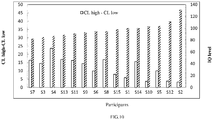
- FIG.10 illustrates the variations in estimated cognitive load (i.e. cognitive load for high load task - cognitive load for low load task) in accordance with an embodiment of the present disclosure versus IQ levels.
- the participants were sorted in increasing values of IQ. It was seen that for participants having higher IQ levels, the difference in the load imposed is less, indicating that the cognitive load for high load is relatively less.
- the method of the present disclosure conforms to the variations in cognitive load with IQ. This also shows the ability of the method of the present disclosure to handle subjective differences of the users under test.
- Cognitive load is imposed during all the day-to-day activities and tasks that require usage of working memory and the related resources.
- systems and methods of the present disclosure provide a metric for the estimation of cognitive load based on the dilating nature of pupil size.
- a mental addition task was used with two variants - easy and difficult to induce low and high loads, respectively, on the participants.
- the metric is based on the mean frequency and power of dilation of the pupil size for both the low and the high load tasks. It was seen that there is substantial amount of separation achieved in both the cases and the nature of separation is consistent for all the participants.
- the method of the present disclosure was also compared with the state-of-the art methods that are based on the percentage change in pupil dilation (PCPD) and the visual field metrics like perimeter-area ratio (PAR) and form factor (FF). It is noted that the method of the present disclosure outperforms the rest of the approaches in distinguishing the two levels of cognitive loads. Also, there was an inverse relation observed in case of the difference in the high and low loads vs the IQ levels of the participants. This shows that the candidates with higher IQ levels feel less load during the high load tasks in conjunction to the low load task.
- PCPD percentage change in pupil dilation
- PAR perimeter-area ratio
- FF form factor
- the hardware device can be any kind of device which can be programmed including e.g. any kind of computer like a server or a personal computer, or the like, or any combination thereof.
- the device may also include means which could be e.g. hardware means like e.g. an application-specific integrated circuit (ASIC), a field-programmable gate array (FPGA), or a combination of hardware and software means, e.g.
- ASIC application-specific integrated circuit
- FPGA field-programmable gate array
- the means can include both hardware means and software means.
- the method embodiments described herein could be implemented in hardware and software.
- the device may also include software means.
- the embodiments may be implemented on different hardware devices, e.g. using a plurality of CPUs.
- the embodiments herein can comprise hardware and software elements.
- the embodiments that are implemented in software include but are not limited to, firmware, resident software, microcode, etc.
- the functions performed by various modules described herein may be implemented in other modules or combinations of other modules.
- a computer-usable or computer readable medium can be any apparatus that can comprise, store, communicate, propagate, or transport the program for use by or in connection with the instruction execution system, apparatus, or device.
- a computer-readable storage medium refers to any type of physical memory on which information or data readable by a processor may be stored.
- a computer-readable storage medium may store instructions for execution by one or more processors, including instructions for causing the processor(s) to perform steps or stages consistent with the embodiments described herein.
- the term "computer-readable medium” should be understood to include tangible items and exclude carrier waves and transient signals, i.e., be non-transitory. Examples include random access memory (RAM), read-only memory (ROM), volatile memory, nonvolatile memory, hard drives, CD ROMs, DVDs, flash drives, disks, and any other known physical storage media.
Landscapes
- Health & Medical Sciences (AREA)
- Life Sciences & Earth Sciences (AREA)
- Engineering & Computer Science (AREA)
- Physics & Mathematics (AREA)
- Surgery (AREA)
- Public Health (AREA)
- Biomedical Technology (AREA)
- Heart & Thoracic Surgery (AREA)
- Medical Informatics (AREA)
- Molecular Biology (AREA)
- Biophysics (AREA)
- Animal Behavior & Ethology (AREA)
- General Health & Medical Sciences (AREA)
- Veterinary Medicine (AREA)
- Psychiatry (AREA)
- Developmental Disabilities (AREA)
- Pathology (AREA)
- Social Psychology (AREA)
- Psychology (AREA)
- Hospice & Palliative Care (AREA)
- Educational Technology (AREA)
- Child & Adolescent Psychology (AREA)
- Ophthalmology & Optometry (AREA)
- Human Computer Interaction (AREA)
- Theoretical Computer Science (AREA)
- General Engineering & Computer Science (AREA)
- Signal Processing (AREA)
- Physiology (AREA)
- Computer Vision & Pattern Recognition (AREA)
- Artificial Intelligence (AREA)
- Mathematical Physics (AREA)
- General Physics & Mathematics (AREA)
- Eye Examination Apparatus (AREA)
- Measurement Of The Respiration, Hearing Ability, Form, And Blood Characteristics Of Living Organisms (AREA)
Abstract
Description
- The present application claims priority from: Indian Patent Application No.
201721035054, filed on 3rd Oct, 2017 - The disclosure herein generally relates to cognitive load estimation, and particularly to cognitive load estimation based on pupil dilation.
- Cognitive load corresponds to the amount of working memory demanded while performing a certain task. Estimation of cognitive load is crucial to many domains pertaining to optimum work allocation, assessing a work environment, medical diagnosis, and the like. Various physiological sensing like Electroencephalogram (EEG), Galvanic Skin Response (GSR), Electrocardiogram (ECG), skin temperature, Electromyogram (EMG), Photophlethesmography (PPG), etc. have been used to determine cognitive load in the art. These techniques require subjects to wear physiological sensors which may be uncomfortable / unacceptable in certain scenarios. However, with the advent of nearable eye trackers, nowadays, it is possible to remotely assess cognitive load imposed on a subject. Moreover, these devices are easy to use as they do not impose additional overhead experienced due to wearable sensors like head mounted eye trackers. Eye movements and pupil size variations render valuable information pertaining to the psychological states of the subjects. Normally pupils dilate in the absence of light in order to allow more light to pass into the eye. However, there are other instances resulting in pupil dilation like challenging cognitive task (termed as task evoked pupillary response (TEPR)), emotional states, medication, etc. These changes are involuntary actions and most of the time it happens unconsciously. Thus, the same pupil dilation might represent different conditions and the exact meaning depends largely on the situation. Estimating cognitive load based on pupil dilation is therefore a challenge.
- Embodiments of the present disclosure present technological improvements as solutions to one or more of the above-mentioned technical problems recognized by the inventors in conventional systems.
- In an aspect, there is provided a processor implemented method comprising: capturing a cognitive task evoked pupillary response in the form of raw pupil size data associated with a subject, wherein the capturing is based on remote eye tracking; pre-processing the captured raw pupil size data to obtain filtered data; and performing frequency domain analysis on the filtered data to obtain cognitive load L(t) by: computing mean frequency f(ω) of the filtered data based on (i) number of frequency bins n, (ii) frequency band ωi of each of the frequency bins i, and (iii) frequency fω
i and energy density Iωi associated with each of the frequency bins; and computing cognitive load L(t) based on the mean frequency f(ω) and power p(ω) corresponding to the mean frequency f(ω). - In another aspect, there is provided a system comprising: one or more data storage devices operatively coupled to the one or more processors and configured to store instructions configured for execution by the one or more processors to: capture a cognitive task evoked pupillary response in the form of raw pupil size data associated with a subject, wherein the capture is based on remote eye tracking; pre-process the captured raw pupil size data to obtain filtered data; and perform frequency domain analysis on the filtered data to obtain cognitive load L(t) by: computing mean frequency f(ω) of the filtered data based on (i) number of frequency bins n, (ii) frequency band ωi of each of the frequency bins i, and (iii) frequency fω
i and energy density Iωi associated with each of the frequency bins; and computing cognitive load L(t) based on the mean frequency f(ω) and power p(ω) corresponding to the mean frequency f(ω). - In yet another aspect, there is provided a computer program product comprising a non-transitory computer readable medium having a computer readable program embodied therein, wherein the computer readable program, when executed on a computing device, causes the computing device to: capture a cognitive task evoked pupillary response in the form of raw pupil size data associated with a subject, wherein the capture is based on remote eye tracking; pre-process the captured raw pupil size data to obtain filtered data; and perform frequency domain analysis on the filtered data to obtain cognitive load L(t) by: computing mean frequency f(ω) of the filtered data based on (i) number of frequency bins n, (ii) frequency band ωi of each of the frequency bins i, and (iii) frequency fω
i and energy density Iωi associated with each of the frequency bins; and computing cognitive load L(t) based on the mean frequency f(ω) and power p(ω) corresponding to the mean frequency f(ω). - In an embodiment of the present disclosure, the one or more hardware processors are further configured to perform pre-processing by interpolating missed data in the captured raw pupil size data to obtain adjusted raw pupil data based on previous and subsequent data; and low pass filtering of the adjusted raw pupil data to eliminate noise and obtaining filtered data.
- In an embodiment of the present disclosure, the one or more hardware processors are further configured to perform frequency domain analysis on the filtered data comprises segmenting the filtered data to obtain baseline and trial portions based on time stamps extracted from metadata associated with the raw pupil size data.
- In an embodiment of the present disclosure, the one or more hardware processors are further configured to compute mean frequency f(ω) of the filtered data by performing short-time Fourier transform (s-transform) to obtain frequency fω
i and power pωi associated with each of the frequency bins. - It is to be understood that both the foregoing general description and the following detailed description are exemplary and explanatory only and are not restrictive of the embodiments of the present disclosure, as claimed.
- The accompanying drawings, which are incorporated in and constitute a part of this disclosure, illustrate exemplary embodiments and, together with the description, serve to explain the disclosed principles.
-
FIG.1 illustrates an exemplary block diagram of a system for cognitive load estimation based on pupil dilation, in accordance with an embodiment of the present disclosure. -
FIG.2 is an exemplary flow diagram illustrating a computer implemented method for cognitive load estimation based on pupil dilation, in accordance with an embodiment of the present disclosure. -
FIG.3 illustrates stimulus and cognitive tasks assigned to a subject in an exemplary setup in accordance with an embodiment of the present disclosure. -
FIG.4 illustrates variations of estimated cognitive load values, in accordance with an embodiment of the present disclosure, for a participant. -
FIG.5 illustrates estimated cognitive load values, in accordance with an embodiment of the present disclosure, averaged over all trials. -
FIG.6 illustrates the nature of the distribution of the cognitive load points computed, in accordance with an embodiment of the present disclosure, for all the participants across trials, through a violin plot. -
FIG.7 illustrates the percentage change in pupil diameter (PCPD), as known in the art, averaged over all the trial portions. -
FIG.8 illustrates the perimeter-area ratio (PAR), as known in the art, averaged over all the trial portions. -
FIG.9 illustrates the form factor (FF), as known in the art, averaged over all the trial portions. -
FIG.10 illustrates the variations in estimated cognitive load (i.e. cognitive load for high load task - cognitive load for low load task) in accordance with an embodiment of the present disclosure versus IQ levels. - It should be appreciated by those skilled in the art that any block diagram herein represent conceptual views of illustrative systems embodying the principles of the present subject matter. Similarly, it will be appreciated that any flow charts, flow diagrams, state transition diagrams, pseudo code, and the like represent various processes which may be substantially represented in computer readable medium and so executed by a computing device or processor, whether or not such computing device or processor is explicitly shown.
- Exemplary embodiments are described with reference to the accompanying drawings. In the figures, the left-most digit(s) of a reference number identifies the figure in which the reference number first appears. Wherever convenient, the same reference numbers are used throughout the drawings to refer to the same or like parts. While examples and features of disclosed principles are described herein, modifications, adaptations, and other implementations are possible without departing from the spirit and scope of the disclosed embodiments. It is intended that the following detailed description be considered as exemplary only, with the true scope and spirit being indicated by the following claims.
- Cognitive load or mental workload is characterized by the amount of memory resources utilized to ascertain a task. As per the cognitive load theory, cognitive load can be broadly classified into three major classes, viz., intrinsic load, extraneous load and germane load. Intrinsic load is experienced due to the complexity of the task itself. For instance, adding 2 digit numbers is comparatively difficult than adding single digit numbers. Extraneous load occurs owing to the presentation of the information in the task; for instance, presenting data graphically over a tabulated format. The former induces lower extraneous load over the latter. Germane load occurs during comprehending and processing of new information. Most of the existing researches use raw pupil size as an indicator of mental workload and they do not use any specific metric which can be used to differentiate between various levels of cognitive load. The present disclosure is directed towards intrinsic cognitive load and for all purposes, the expression "cognitive load" referred hereinafter in the present disclosure refers to intrinsic cognitive load.
- Traditional techniques of assessing cognitive load involved analyzing performance measures like total score or time taken to analyze the cognitive load imposed during a task. However, this method involves customizing the performance measures to the task as the tasks differ often. Also, this method lacks continuous monitoring as the performance score is obtained after a certain interval or after the completion of the task. Another method employed in the art is a questionnaire based approach which gives subjective measures of the task difficulty experienced by the user and is generally done after the task completion. This method is highly biased and solely depends on the subject's perception of work load.
- Physiological sensing provides relatively better estimation in the art. It renders real time monitoring of load imposed on the subject without their knowledge. Perceptual-motor changes during a task may be measured using sensors and by inference the perceptual-motor changes are attributed to cognitive performance of the subject. High resolution sensors are efficient in terms of accuracy, however, their increased cost and complexity has created a surge for affordable and easy to use devices. However, such affordable devices are basically low resolution ones and are prone to noise inherent due to sensor mechanics involved.
- The present disclosure is directed towards employing low cost non-intrusive wearables that are traditionally considered inefficient in facilitating cognitive load estimation. Changes in screen illumination, ethnic differences among the subjects, operating distance from the screen, data loss due to blinks and other related measurement noise form key factors that affect efficiency of cognitive load estimation. Unobtrusive eye tracking is advantageous for scenarios like evaluation of distraction, mental effort, anxiety etc. Subjects may get disturbed while wearing the eye trackers mounted on head which may lead to distortion of results. Hence, in accordance with the present disclosure, non-intrusive wearables in the form of nearables such as low cost, infrared-based eye trackers are employed to capture raw pupil size data to quantify the cognitive load based on dilating nature of the pupil. Particularly, the present disclosure distinguishes and quantifies the intrinsic cognitive load into two classes - low and high loads using the dilating nature of the pupil. In accordance with the present disclosure, a metric is provided to estimate cognitive load based on the pupil dilation and validated based on nature of visual field area and the percentage change in pupil diameter and also with the intelligence level of the participants, thereby eliminating the inherent inefficiency traditionally associated with low cost nearables.
- Referring now to the drawings, and more particularly to
FIGS. 1 through 10 , where similar reference characters denote corresponding features consistently throughout the figures, there are shown preferred embodiments and these embodiments are described in the context of the following exemplary system and method. -
FIG.1 illustrates an exemplary block diagram of asystem 100 for cognitive load estimation based on pupil dilation, in accordance with an embodiment of the present disclosure. In an embodiment, thesystem 100 includes one ormore processors 104, communication interface device(s) or input/output (I/O) interface(s) 106, and one or more data storage devices ormemory 102 operatively coupled to the one ormore processors 104. The one ormore processors 104 that are hardware processors can be implemented as one or more microprocessors, microcomputers, microcontrollers, digital signal processors, central processing units, state machines, graphics controllers, logic circuitries, and/or any devices that manipulate signals based on operational instructions. Among other capabilities, the processor(s) are configured to fetch and execute computer-readable instructions stored in the memory. In an embodiment, thesystem 100 can be implemented in a variety of computing systems, such as laptop computers, notebooks, hand-held devices, workstations, mainframe computers, servers, a network cloud and the like. - The I/O interface device(s) 106 can include a variety of software and hardware interfaces, for example, a web interface, a graphical user interface, and the like and can facilitate multiple communications within a wide variety of networks N/W and protocol types, including wired networks, for example, LAN, cable, etc., and wireless networks, such as WLAN, cellular, or satellite. In an embodiment, the I/O interface device(s) can include one or more ports for connecting a number of devices to one another or to another server.
- The
memory 102 may include any computer-readable medium known in the art including, for example, volatile memory, such as static random access memory (SRAM) and dynamic random access memory (DRAM), and/or non-volatile memory, such as read only memory (ROM), erasable programmable ROM, flash memories, hard disks, optical disks, and magnetic tapes. In an embodiment, one or more modules (not shown) of thesystem 100 can be stored in thememory 102. - In an embodiment, the
system 100 comprises one or more data storage devices ormemory 102 operatively coupled to the one ormore processors 104 and is configured to store instructions configured for execution of steps of themethod 200 by the one ormore processors 104. -
FIG.2 is an exemplary flow diagram illustrating a computer implemented method for cognitive load estimation based on pupil dilation, in accordance with an embodiment of the present disclosure. The steps of themethod 200 will now be explained in detail with reference to the components of thesystem 100 ofFIG.1 . Although process steps, method steps, techniques or the like may be described in a sequential order, such processes, methods and techniques may be configured to work in alternate orders. In other words, any sequence or order of steps that may be described does not necessarily indicate a requirement that the steps be performed in that order. The steps of processes described herein may be performed in any order practical. Further, some steps may be performed simultaneously. - In accordance with an embodiment of the present disclosure, the one or
more processors 104 are configured to capture, atstep 202, a cognitive task evoked pupillary response in the form of raw pupil size data associated with a subject, wherein the capturing is based on remote eye tracking. In an embodiment, EyeTribe™ eye tracker may be used. Good calibration may be ensured to analyze the impact of eye motion under cognitive load since deviation from target gaze location is critical to the analyses. The raw pupil size data obtained by remote eye tracking may contain some missing values due to eye blinks or some abrupt values of pupil size due to hardware glitches. Remote eye tracker like EyeTribe™ returns a zero value during the blink interval. Accordingly, in accordance with an embodiment of the present disclosure, the one ormore processors 104 are configured to pre-process, atstep 204, the captured raw pupil size data to obtain filtered data. In an embodiment the missing portions in the captured raw pupil size data may be interpolated based on previous and consequent data points to obtain adjusted raw pupil data, wherein the adjusted raw pupil data accounts for the missing portions to ensure availability of continuous data. Pupil responses during cognitive activities mainly occur below 4Hz above which the signal is mainly due to measurement noise. Accordingly, the pre-processing atstep 204 may include low pass filtering of the adjusted raw pupil data by a low pass filter having a cutoff frequency of 4Hz to eliminate noise and obtain filtered data. - In accordance with the present disclosure, the one or
more processors 104 are configured to perform frequency domain analysis, atstep 206, on the filtered data to obtain cognitive load L(t). The step of performing frequency domain analysis on the filtered data comprises segmenting the filtered data to obtain baseline and trial portions based on time stamps extracted from metadata associated with the raw pupil size data. The baseline portion is illustrated in an exemplary embodiment depicted inFIG.3 and the associated description. The trial portions follow the marked base line portions. The estimated cognitive load is a function of a sequence of load pulses with varying magnitudes. The total cognitive load imparted for a given trial portion is thereby a combination of all the load pulses. - In accordance with the present disclosure, short-time Fourier transform (s-transform) is performed to obtain frequency fω
i and power pωi for each frequency bin associated with the filtered data. In accordance with an embodiment, the one or more processors are configured to compute mean frequency f(ω) of the filtered data, atstep 206a, based on (i) number of frequency bins n, (ii) frequency band ωi of each of the frequency bins i, and (iii) frequency fωi and energy density Iωi associated with each of the frequency bins. The mean frequency f(ω) of the filtered data, in accordance with the present disclosure may be represented as given below.
- In accordance with an embodiment, the one or more processors are configured to compute cognitive load L(t), at
step 206b, based on the mean frequency f(ω) and power p(ω) corresponding to the mean frequency f(ω). Accordingly, the cognitive load L(t) may be represented as given below.
- A mental addition task was used and developed using Matlab to impart low and high cognitive loads on subjects. In the low load task, single digit numbers from 0-5 were used, whereas for the high load task, numbers in the range of 6-19 were selected. Numbers such as 10, 11 and 15 were excluded since they are relatively easier to add with other numbers. In all, 10 numbers for the low load and 10 numbers for the high load were selected.
- Fifteen participants (7 females, 8 males, mean age: 28±8years) participated in the study. Necessary consents and clearance were obtained from the participants. It was ensured that the participants have similar cultural and educational backgrounds. All the participants had normal or corrected to normal vision with spectacles and all were right handed. At the beginning, the task and the procedure were explained to them. In order to ensure that the participants followed the tasks properly, a demo version of the task was performed before starting the actual data capture.
EyeTribe™ eye tracker was used for the study. An initial calibration was done using the Software Development Kit (SDK) based calibration procedure to obtain a calibration score of 5, which is indicative of good calibration. The sampling frequency of the eye tracker was 30Hz. A chin rest was used in order to ensure minimal head movements and kept at a distance of 60cm away from the participant. The experiment was carried out in a closed quite room with constant lighting conditions. The participants wore a headphone to listen to the stimulus. A 10 second baseline section preceded the task during which the participants were asked to focus on a fixation cross in white background that was displayed in the midst of the computer screen. The fixation cross was used so that the participants are forced to keep their eyes open while calculating mentally. A series of numbers is played one after another with an interval of 3 seconds and the participants were instructed to add them mentally.FIG.3 illustrates stimulus and cognitive tasks assigned to a subject in an exemplary setup in accordance with an embodiment of the present disclosure. The tone of the numbers is generated through a computer program so that same sound characteristics are maintained across all trial portions. Timestamps at appropriate locations were logged for further analysis. For 7 out of 15 participants, the low load task was administered first followed by the high load task. For rest of the participants, reverse order was followed in order to avoid any bias related effects owing to the sequence of the task. The eye tracker returned a zero value during blink intervals that lasted for almost 70-300ms. These blink portions were interpolated and low pass filtering was performed to eliminate noise and obtain filtered data. The cognitive load imposed on a participant were computed using equation (2) above.FIG.4 illustrates variations of estimated cognitive load values, in accordance with an embodiment of the present disclosure, for a participant. As the trial proceeds, the total load imparted on the participant also increases and is evident fromFIG.4 . - Similar trend is followed for the rest of the participants. The cognitive load is estimated per session and averaged across both the low and the high load tasks and is illustrated in
FIG.5 . It is noted that the difference between the cognitive loads corresponding to the low and high load tasks were significant for all the participants, thereby illustrating consistency of the proposed metric for cognitive load estimation. -
FIG.6 illustrates the nature of the distribution of the cognitive load points computed, in accordance with an embodiment of the present disclosure, for all the participants across trials, through a violin plot. The data points are statistically different with a p =1.34e-08. - The performance of the method of the present disclosure was further compared with existing methods namely Percentage change in pupil diameter (PCPD), perimeter-area ratio (PAR) and form factor (FF) to distinguish the two levels of cognitive load.
- An obvious means of cognitive load assessment in pupillometry is by measuring the percentage change in pupil diameter (PCPD) with respect to that during the baseline portion. Generally, the PCPD increases with increase in cognitive load. Generally PCPD increases with increase in cognitive load. Accordingly, this metric was used for comparison with the method of the present disclosure.
- Cognitive load may also be estimated based on the nature of visual field of the eyes during the stimulus. During the data capture phase, the eye tracker captures noisy (x,y) coordinates of the gaze on the screen. S represents a set of all captured coordinates over a period of time and the set S is represented through equation (3)


- The FF method is given by equation (5),

- The cognitive load values were computed for each trial portion for the low and high load tasks for each participant and the average values are reported in
FIG. 7 ,8 and9 whereinFIG.7 illustrates the percentage change in pupil diameter (PCPD), as known in the art, averaged over all the trial portions;FIG.8 illustrates the perimeter-area ratio (PAR), as known in the art, averaged over all the trial portions; andFIG.9 illustrates the form factor (FF), as known in the art, averaged over all the trial portions respectively. It is evident that there is no consistent pattern for distinguishing the two levels of loads imparted on the participants. For instance, PCPD failed to distinguish the low and high levels of cognitive load for few participants namely, 4, 7, 12, 13 and 14, where reverse trends are observed. For PAR, though there is a considerable amount of separation between the two tasks, the reverse pattern is observed forparticipants - In order to further evaluate separation for the low and high load tasks, the discriminating index (DI) was computed per trial i, as given in equation (6),


- Table I below shows the TDI values for the estimated cognitive load metric in accordance with the present disclosure and the state of the art methods (averaged across the participants).
Table I Approach Method of the present disclosure PCPD PAR FF Average TDI 71.34% 64.67% 46.67% 66.67% - It is evident from the results in the table that the method of the present disclosure outperforms the existing metrics.
- As part of further validation, tests were conducted to investigate the relation between the method of the present disclosure and Intelligence Quotient (IQ) of the participants. The IQ level of an individual is known to be inversely proportional to the overall cognitive load. Higher the IQ, better is the management of mental resources and hence, less is the total cognitive load. In order to check if the metric of the present disclosure is reliable enough, the total cognitive load was compared with IQ levels of the participants. As part of the experimental procedure, an online IQ test by Brainmetrix™ was taken by the participants.
FIG.10 illustrates the variations in estimated cognitive load (i.e. cognitive load for high load task - cognitive load for low load task) in accordance with an embodiment of the present disclosure versus IQ levels. For ease of analysis, the participants were sorted in increasing values of IQ. It was seen that for participants having higher IQ levels, the difference in the load imposed is less, indicating that the cognitive load for high load is relatively less. Thus, the method of the present disclosure conforms to the variations in cognitive load with IQ. This also shows the ability of the method of the present disclosure to handle subjective differences of the users under test. - Cognitive load is imposed during all the day-to-day activities and tasks that require usage of working memory and the related resources. In accordance with the present disclosure, systems and methods of the present disclosure provide a metric for the estimation of cognitive load based on the dilating nature of pupil size. A mental addition task was used with two variants - easy and difficult to induce low and high loads, respectively, on the participants. The metric is based on the mean frequency and power of dilation of the pupil size for both the low and the high load tasks. It was seen that there is substantial amount of separation achieved in both the cases and the nature of separation is consistent for all the participants. The method of the present disclosure was also compared with the state-of-the art methods that are based on the percentage change in pupil dilation (PCPD) and the visual field metrics like perimeter-area ratio (PAR) and form factor (FF). It is noted that the method of the present disclosure outperforms the rest of the approaches in distinguishing the two levels of cognitive loads. Also, there was an inverse relation observed in case of the difference in the high and low loads vs the IQ levels of the participants. This shows that the candidates with higher IQ levels feel less load during the high load tasks in conjunction to the low load task.
- The written description describes the subject matter herein to enable any person skilled in the art to make and use the embodiments. The scope of the subject matter embodiments is defined by the claims and may include other modifications that occur to those skilled in the art. Such other modifications are intended to be within the scope of the claims if they have similar elements that do not differ from the literal language of the claims or if they include equivalent elements with insubstantial differences from the literal language of the claims.
- It is to be understood that the scope of the protection is extended to such a program and in addition to a computer-readable means having a message therein; such computer-readable storage means contain program-code means for implementation of one or more steps of the method, when the program runs on a server or mobile device or any suitable programmable device. The hardware device can be any kind of device which can be programmed including e.g. any kind of computer like a server or a personal computer, or the like, or any combination thereof. The device may also include means which could be e.g. hardware means like e.g. an application-specific integrated circuit (ASIC), a field-programmable gate array (FPGA), or a combination of hardware and software means, e.g. an ASIC and an FPGA, or at least one microprocessor and at least one memory with software modules located therein. Thus, the means can include both hardware means and software means. The method embodiments described herein could be implemented in hardware and software. The device may also include software means. Alternatively, the embodiments may be implemented on different hardware devices, e.g. using a plurality of CPUs.
- The embodiments herein can comprise hardware and software elements. The embodiments that are implemented in software include but are not limited to, firmware, resident software, microcode, etc. The functions performed by various modules described herein may be implemented in other modules or combinations of other modules. For the purposes of this description, a computer-usable or computer readable medium can be any apparatus that can comprise, store, communicate, propagate, or transport the program for use by or in connection with the instruction execution system, apparatus, or device.
- The illustrated steps are set out to explain the exemplary embodiments shown, and it should be anticipated that ongoing technological development will change the manner in which particular functions are performed. These examples are presented herein for purposes of illustration, and not limitation. Further, the boundaries of the functional building blocks have been arbitrarily defined herein for the convenience of the description. Alternative boundaries can be defined so long as the specified functions and relationships thereof are appropriately performed. Alternatives (including equivalents, extensions, variations, deviations, etc., of those described herein) will be apparent to persons skilled in the relevant art(s) based on the teachings contained herein. Such alternatives fall within the scope and spirit of the disclosed embodiments. Also, the words "comprising," "having," "containing," and "including," and other similar forms are intended to be equivalent in meaning and be open ended in that an item or items following any one of these words is not meant to be an exhaustive listing of such item or items, or meant to be limited to only the listed item or items. It must also be noted that as used herein and in the appended claims, the singular forms "a," "an," and "the" include plural references unless the context clearly dictates otherwise.
- Furthermore, one or more computer-readable storage media may be utilized in implementing embodiments consistent with the present disclosure. A computer-readable storage medium refers to any type of physical memory on which information or data readable by a processor may be stored. Thus, a computer-readable storage medium may store instructions for execution by one or more processors, including instructions for causing the processor(s) to perform steps or stages consistent with the embodiments described herein. The term "computer-readable medium" should be understood to include tangible items and exclude carrier waves and transient signals, i.e., be non-transitory. Examples include random access memory (RAM), read-only memory (ROM), volatile memory, nonvolatile memory, hard drives, CD ROMs, DVDs, flash drives, disks, and any other known physical storage media.
- It is intended that the disclosure and examples be considered as exemplary only, with a true scope and spirit of disclosed embodiments being indicated by the following claims.
Claims (9)
- A processor implemented method (200) comprising:capturing a cognitive task evoked pupillary response in the form of raw pupil size data associated with a subject, wherein the capturing is based on remote eye tracking (202);pre-processing the captured raw pupil size data to obtain filtered data (204); andperforming frequency domain analysis on the filtered data (206) to obtain cognitive load L(t) by:computing mean frequency f(ω) of the filtered data based on (i) number of frequency bins n, (ii) frequency band ωi of each of the frequency bins i, and (iii) frequency fω
i and energy density Iωi associated with each of the frequency bins (206a); andcomputing cognitive load L(t) based on the mean frequency f(ω) and power p(ω) corresponding to the mean frequency f(ω) (206b). - The processor implemented method of claim 1, wherein the step of pre-processing comprises:interpolating missed data in the captured raw pupil size data to obtain adjusted raw pupil data based on previous and subsequent data; andlow pass filtering of the adjusted raw pupil data to eliminate noise and obtaining filtered data.
- The processor implemented method of claim 1, wherein the step of performing frequency domain analysis on the filtered data comprises segmenting the filtered data to obtain baseline and trial portions based on time stamps extracted from metadata associated with the raw pupil size data.
- The processor implemented method of claim 1, wherein the step of computing mean frequency f(ω) of the filtered data comprises performing short-time Fourier transform (s-transform) to obtain frequency the fω
i and the power pωi associated with each of the frequency bins. - A system (100) comprising:one or more data storage devices (102) operatively coupled to one or more hardware processors (104) and configured to store instructions configured for execution by the one or more hardware processors to:capture a cognitive task evoked pupillary response in the form of raw pupil size data associated with a subject, wherein the capture is based on remote eye tracking;pre-process the captured raw pupil size data to obtain filtered data; andperform frequency domain analysis on the filtered data to obtain cognitive load L(t) by:computing mean frequency f(ω) of the filtered data based on (i) number of frequency bins n, (ii) frequency band ωi of each of the frequency bins i, and (iii) frequency fω
i and energy density Iωi associated with each of the frequency bins; andcomputing cognitive load L(t) based on the mean frequency f(ω) and power p(ω) corresponding to the mean frequency f(ω). - The system of claim 5, wherein the one or more hardware processors are further configured to pre-process the captured raw pupil size data by:interpolating missed data in the captured raw pupil size data to obtain adjusted raw pupil data based on previous and subsequent data; andlow pass filtering of the adjusted raw pupil data to eliminate noise and obtaining filtered data.
- The system of claim 5, wherein the one or more hardware processors are further configured to perform frequency domain analysis on the filtered data by segmenting the filtered data to obtain baseline and trial portions based on time stamps extracted from metadata associated with the raw pupil size data.
- The system of claim 5, wherein the one or more hardware processors are further configured to compute mean frequency f(ω) of the filtered data by performing short-time Fourier transform (s-transform) to obtain frequency the fω
i and the power pωi associated with each of the frequency bins. - A computer program product comprising a non-transitory computer readable medium having a computer readable program embodied therein, wherein the computer readable program, when executed on a computing device, causes the computing device to:capture a cognitive task evoked pupillary response in the form of raw pupil size data associated with a subject, wherein the capturing is based on remote eye tracking;pre-process the captured raw pupil size data to obtain filtered data; andperform frequency domain analysis on the filtered data to obtain cognitive load L(t) by:computing mean frequency f(ω) of the filtered data based on (i) number of frequency bins n, (ii) frequency band ωi of each of the frequency bins i, and (iii) frequency fω
i and energy density Iωi associated with each of the frequency bins; andcomputing cognitive load L(t) based on the mean frequency f(ω) and power p(ω) corresponding to the mean frequency f(ω).
Applications Claiming Priority (1)
| Application Number | Priority Date | Filing Date | Title |
|---|---|---|---|
| IN201721035054 | 2017-10-03 |
Publications (3)
| Publication Number | Publication Date |
|---|---|
| EP3466338A1 true EP3466338A1 (en) | 2019-04-10 |
| EP3466338C0 EP3466338C0 (en) | 2025-01-01 |
| EP3466338B1 EP3466338B1 (en) | 2025-01-01 |
Family
ID=63861980
Family Applications (1)
| Application Number | Title | Priority Date | Filing Date |
|---|---|---|---|
| EP18197933.7A Active EP3466338B1 (en) | 2017-10-03 | 2018-10-01 | Cognitive load estimation based on pupil dilation |
Country Status (2)
| Country | Link |
|---|---|
| US (1) | US11141061B2 (en) |
| EP (1) | EP3466338B1 (en) |
Families Citing this family (5)
| Publication number | Priority date | Publication date | Assignee | Title |
|---|---|---|---|---|
| CN108469560B (en) * | 2018-03-16 | 2020-01-14 | 武汉大学 | Electromagnetic interference objective complexity evaluation method based on rapid S-transform time-frequency space model |
| CN111387976B (en) * | 2020-03-30 | 2022-11-29 | 西北工业大学 | Cognitive load assessment method based on eye movement and electroencephalogram data |
| US20220130514A1 (en) * | 2020-10-22 | 2022-04-28 | Mahana Therapeutics, Inc. | Method and system for dynamically generating generalized therapeutic protocols using machine learning models |
| EP4465247A1 (en) * | 2023-05-17 | 2024-11-20 | Tata Consultancy Services Limited | Method and system for predicting distance of gazed objects using infrared (ir) camera |
| US12625548B2 (en) * | 2023-06-02 | 2026-05-12 | Apple Inc. | Eye tracking loss mitigations |
Citations (1)
| Publication number | Priority date | Publication date | Assignee | Title |
|---|---|---|---|---|
| WO2014146168A1 (en) * | 2013-03-19 | 2014-09-25 | National Ict Australia Limited | Automatic detection of task transition |
Family Cites Families (9)
| Publication number | Priority date | Publication date | Assignee | Title |
|---|---|---|---|---|
| US6090051A (en) * | 1999-03-03 | 2000-07-18 | Marshall; Sandra P. | Method and apparatus for eye tracking and monitoring pupil dilation to evaluate cognitive activity |
| WO2006091893A2 (en) | 2005-02-23 | 2006-08-31 | Eyetracking, Inc. | Mental alertness level determination |
| AU2015255652B2 (en) * | 2014-05-09 | 2018-03-29 | Google Llc | Systems and methods for using eye signals with secure mobile communications |
| JP6910291B2 (en) | 2014-05-21 | 2021-07-28 | アキリ・インタラクティヴ・ラブズ・インコーポレイテッド | Processor implementation systems and methods for enhancing cognitive abilities by personalizing cognitive training plans |
| WO2016046720A1 (en) * | 2014-09-23 | 2016-03-31 | Tata Consultancy Services Limited | Assessment of health care devices based on quality index |
| US10499823B2 (en) * | 2014-11-06 | 2019-12-10 | Tata Consultancy Services Limited | Selection of electroencephalography (EEG) channels valid for determining cognitive load of a subject |
| US9936250B2 (en) * | 2015-05-19 | 2018-04-03 | The Nielsen Company (Us), Llc | Methods and apparatus to adjust content presented to an individual |
| CA3020390A1 (en) * | 2016-04-08 | 2017-10-12 | Vizzario, Inc. | Methods and systems for obtaining, aggregating, and analyzing vision data to assess a person's vision performance |
| EP3503809A4 (en) * | 2016-08-26 | 2020-01-01 | Akili Interactive Labs, Inc. | COGNITIVE PLATFORM COUPLED TO A PHYSIOLOGICAL COMPONENT |
-
2018
- 2018-10-01 EP EP18197933.7A patent/EP3466338B1/en active Active
- 2018-10-03 US US16/150,955 patent/US11141061B2/en active Active
Patent Citations (1)
| Publication number | Priority date | Publication date | Assignee | Title |
|---|---|---|---|---|
| WO2014146168A1 (en) * | 2013-03-19 | 2014-09-25 | National Ict Australia Limited | Automatic detection of task transition |
Non-Patent Citations (7)
| Title |
|---|
| CAI ZHENGXIANG ET AL: "Cognitive state recognition using wavelet singular entropy and ARMA entropy with AFPA optimized GP classification", NEUROCOMPUTING, ELSEVIER, AMSTERDAM, NL, vol. 197, 5 March 2016 (2016-03-05), pages 29 - 44, XP029529852, ISSN: 0925-2312, DOI: 10.1016/J.NEUCOM.2016.01.054 * |
| ELKINS JOSHUA D ET AL: "Multinomial processing models in visual cognitive effort diagnostics", 2015 IEEE CONFERENCE ON COMPUTER VISION AND PATTERN RECOGNITION WORKSHOPS (CVPRW), IEEE, 7 June 2015 (2015-06-07), pages 9 - 15, XP032795547, DOI: 10.1109/CVPRW.2015.7301287 * |
| GAHANGIR HOSSAIN ET AL: "Understanding Effects of Cognitive Load from Pupillary Responses Using Hilbert Analytic Phase", 2014 IEEE CONFERENCE ON COMPUTER VISION AND PATTERN RECOGNITION WORKSHOPS, 1 June 2014 (2014-06-01), pages 381 - 386, XP055559813, ISBN: 978-1-4799-4308-1, DOI: 10.1109/CVPRW.2014.62 * |
| JAY W MCLAREN ET AL: "Computerized Analysis of Pupillogroms in Studies of Alertness", INVESTIGATIVE OPHTHALMOLOGY & VISUAL SCIENCE, vol. 33, no. 3, 1 March 1992 (1992-03-01), pages 671 - 673, XP055560107 * |
| JEFF KLINGNER: "MEASURING COGNITIVE LOAD DURING VISUAL TASKS BY COMBINING PUPILLOMETRY AND EYE TRACKING", 1 May 2010 (2010-05-01), XP055256289, Retrieved from the Internet <URL:http://graphics.stanford.edu/papers/klingner-dissertation/klingner-dissertation.pdf> [retrieved on 20160308] * |
| KEVIN MOLONEY ET AL: "Leveraging data complexity", ACM TRANSACTIONS ON COMPUTER-HUMAN INTERACTION (TOCHI), 1 September 2006 (2006-09-01), New York, pages 376 - 402, XP055560105, Retrieved from the Internet <URL:http://delivery.acm.org/10.1145/1190000/1183460/p376-moloney.pdf?ip=145.64.134.242&id=1183460&acc=ACTIVE%20SERVICE&key=E80E9EB78FFDF9DF.4D4702B0C3E38B35.4D4702B0C3E38B35.4D4702B0C3E38B35&__acm__=1550747314_62fd25cc1e9d77ecf1615ad5d44607a3> DOI: 10.1145/1183456.1183460 * |
| RAHUL GAVAS ET AL: "Estimation of cognitive load based on the pupil size dilation", 2017 IEEE INTERNATIONAL CONFERENCE ON SYSTEMS, MAN, AND CYBERNETICS (SMC), 1 October 2017 (2017-10-01), pages 1499 - 1504, XP055559811, ISBN: 978-1-5386-1645-1, DOI: 10.1109/SMC.2017.8122826 * |
Also Published As
| Publication number | Publication date |
|---|---|
| US11141061B2 (en) | 2021-10-12 |
| EP3466338C0 (en) | 2025-01-01 |
| US20190099075A1 (en) | 2019-04-04 |
| EP3466338B1 (en) | 2025-01-01 |
Similar Documents
| Publication | Publication Date | Title |
|---|---|---|
| US11141061B2 (en) | Cognitive load estimation based on pupil dilation | |
| Khowaja et al. | Toward soft real-time stress detection using wrist-worn devices for human workspaces: SA Khowaja et al. | |
| Baird et al. | The decoupled mind: mind-wandering disrupts cortical phase-locking to perceptual events | |
| US20220222687A1 (en) | Systems and Methods for Assessing the Marketability of a Product | |
| US11872040B2 (en) | Method and system for assessment of cognitive load from bio-potentials measured using wearable endosomatic device | |
| Mayya et al. | Continuous monitoring of stress on smartphone using heart rate variability | |
| Chen et al. | Automatic and continuous user task analysis via eye activity | |
| Pakter et al. | Measuring arteriolar-to-venous ratio in retinal photography of patients with hypertension: development and application of a new semi-automated method | |
| Read et al. | Biometric tools in a computational advertising context: An overview of use and application | |
| AU2014234955B2 (en) | Automatic detection of task transition | |
| Darvishi-Bayazi et al. | Beyond performance: the role of task demand, effort, and individual differences in ab initio pilots | |
| Newton | Measuring the perceptual, physiological and environmental factors that impact stress in the construction industry | |
| Bernabei et al. | A full-stack application for detecting seizures and reducing data during continuous electroencephalogram monitoring | |
| US20200185110A1 (en) | Computer-implemented method and an apparatus for use in detecting malingering by a first subject in one or more physical and/or mental function tests | |
| US11432779B2 (en) | Method and device for capacitive touch panel based biosignal measurement | |
| EP4529842A1 (en) | Method and system for real-time calibration of ear-eeg device | |
| Bai et al. | Method for semi-automated evaluation of user experience using brain activity | |
| Ke et al. | Monitoring distraction of construction workers using a wearable electroencephalography (EEG) device | |
| US11076796B2 (en) | Method and system for determining inactive state and its implication over cognitive load computation of a person | |
| Khushaba et al. | A neuroscientific approach to choice modeling: Electroencephalogram (EEG) and user preferences | |
| WO2014191805A1 (en) | Devices and methods for determination of cognitive load | |
| Fang et al. | Online assessment of spontaneous mental fatigue in construction workers considering data quality: Improved Online sequential extreme learning machine | |
| US11992316B2 (en) | System and method for eye-blink based assessment of sustained visual attention of a target | |
| Tsiampa et al. | Investigating Feasibility of Stress Detection from Social Media Content Through Wearables | |
| Doettl et al. | Mental tasking and rotary Chair-Induced vestibular nystagmus utilizing Video-Oculography |
Legal Events
| Date | Code | Title | Description |
|---|---|---|---|
| PUAI | Public reference made under article 153(3) epc to a published international application that has entered the european phase |
Free format text: ORIGINAL CODE: 0009012 |
|
| STAA | Information on the status of an ep patent application or granted ep patent |
Free format text: STATUS: THE APPLICATION HAS BEEN PUBLISHED |
|
| AK | Designated contracting states |
Kind code of ref document: A1 Designated state(s): AL AT BE BG CH CY CZ DE DK EE ES FI FR GB GR HR HU IE IS IT LI LT LU LV MC MK MT NL NO PL PT RO RS SE SI SK SM TR |
|
| AX | Request for extension of the european patent |
Extension state: BA ME |
|
| STAA | Information on the status of an ep patent application or granted ep patent |
Free format text: STATUS: REQUEST FOR EXAMINATION WAS MADE |
|
| 17P | Request for examination filed |
Effective date: 20191010 |
|
| RBV | Designated contracting states (corrected) |
Designated state(s): AL AT BE BG CH CY CZ DE DK EE ES FI FR GB GR HR HU IE IS IT LI LT LU LV MC MK MT NL NO PL PT RO RS SE SI SK SM TR |
|
| STAA | Information on the status of an ep patent application or granted ep patent |
Free format text: STATUS: EXAMINATION IS IN PROGRESS |
|
| 17Q | First examination report despatched |
Effective date: 20220912 |
|
| GRAP | Despatch of communication of intention to grant a patent |
Free format text: ORIGINAL CODE: EPIDOSNIGR1 |
|
| STAA | Information on the status of an ep patent application or granted ep patent |
Free format text: STATUS: GRANT OF PATENT IS INTENDED |
|
| INTG | Intention to grant announced |
Effective date: 20240911 |
|
| GRAS | Grant fee paid |
Free format text: ORIGINAL CODE: EPIDOSNIGR3 |
|
| GRAA | (expected) grant |
Free format text: ORIGINAL CODE: 0009210 |
|
| STAA | Information on the status of an ep patent application or granted ep patent |
Free format text: STATUS: THE PATENT HAS BEEN GRANTED |
|
| AK | Designated contracting states |
Kind code of ref document: B1 Designated state(s): AL AT BE BG CH CY CZ DE DK EE ES FI FR GB GR HR HU IE IS IT LI LT LU LV MC MK MT NL NO PL PT RO RS SE SI SK SM TR |
|
| REG | Reference to a national code |
Ref country code: GB Ref legal event code: FG4D |
|
| REG | Reference to a national code |
Ref country code: CH Ref legal event code: EP |
|
| REG | Reference to a national code |
Ref country code: DE Ref legal event code: R096 Ref document number: 602018078065 Country of ref document: DE |
|
| REG | Reference to a national code |
Ref country code: IE Ref legal event code: FG4D |
|
| U01 | Request for unitary effect filed |
Effective date: 20250101 |
|
| U07 | Unitary effect registered |
Designated state(s): AT BE BG DE DK EE FI FR IT LT LU LV MT NL PT RO SE SI Effective date: 20250110 |
|
| PG25 | Lapsed in a contracting state [announced via postgrant information from national office to epo] |
Ref country code: PL Free format text: LAPSE BECAUSE OF FAILURE TO SUBMIT A TRANSLATION OF THE DESCRIPTION OR TO PAY THE FEE WITHIN THE PRESCRIBED TIME-LIMIT Effective date: 20250101 |
|
| PG25 | Lapsed in a contracting state [announced via postgrant information from national office to epo] |
Ref country code: ES Free format text: LAPSE BECAUSE OF FAILURE TO SUBMIT A TRANSLATION OF THE DESCRIPTION OR TO PAY THE FEE WITHIN THE PRESCRIBED TIME-LIMIT Effective date: 20250101 |
|
| PG25 | Lapsed in a contracting state [announced via postgrant information from national office to epo] |
Ref country code: NO Free format text: LAPSE BECAUSE OF FAILURE TO SUBMIT A TRANSLATION OF THE DESCRIPTION OR TO PAY THE FEE WITHIN THE PRESCRIBED TIME-LIMIT Effective date: 20250401 Ref country code: IS Free format text: LAPSE BECAUSE OF FAILURE TO SUBMIT A TRANSLATION OF THE DESCRIPTION OR TO PAY THE FEE WITHIN THE PRESCRIBED TIME-LIMIT Effective date: 20250501 |
|
| PG25 | Lapsed in a contracting state [announced via postgrant information from national office to epo] |
Ref country code: HR Free format text: LAPSE BECAUSE OF FAILURE TO SUBMIT A TRANSLATION OF THE DESCRIPTION OR TO PAY THE FEE WITHIN THE PRESCRIBED TIME-LIMIT Effective date: 20250101 |
|
| PG25 | Lapsed in a contracting state [announced via postgrant information from national office to epo] |
Ref country code: GR Free format text: LAPSE BECAUSE OF FAILURE TO SUBMIT A TRANSLATION OF THE DESCRIPTION OR TO PAY THE FEE WITHIN THE PRESCRIBED TIME-LIMIT Effective date: 20250402 |
|
| PG25 | Lapsed in a contracting state [announced via postgrant information from national office to epo] |
Ref country code: CZ Free format text: LAPSE BECAUSE OF FAILURE TO SUBMIT A TRANSLATION OF THE DESCRIPTION OR TO PAY THE FEE WITHIN THE PRESCRIBED TIME-LIMIT Effective date: 20250101 |
|
| PG25 | Lapsed in a contracting state [announced via postgrant information from national office to epo] |
Ref country code: SM Free format text: LAPSE BECAUSE OF FAILURE TO SUBMIT A TRANSLATION OF THE DESCRIPTION OR TO PAY THE FEE WITHIN THE PRESCRIBED TIME-LIMIT Effective date: 20250101 |
|
| PG25 | Lapsed in a contracting state [announced via postgrant information from national office to epo] |
Ref country code: SK Free format text: LAPSE BECAUSE OF FAILURE TO SUBMIT A TRANSLATION OF THE DESCRIPTION OR TO PAY THE FEE WITHIN THE PRESCRIBED TIME-LIMIT Effective date: 20250101 |
|
| REG | Reference to a national code |
Ref country code: CH Ref legal event code: U11 Free format text: ST27 STATUS EVENT CODE: U-0-0-U10-U11 (AS PROVIDED BY THE NATIONAL OFFICE) Effective date: 20251101 |
|
| PLBE | No opposition filed within time limit |
Free format text: ORIGINAL CODE: 0009261 |
|
| STAA | Information on the status of an ep patent application or granted ep patent |
Free format text: STATUS: NO OPPOSITION FILED WITHIN TIME LIMIT |
|
| U20 | Renewal fee for the european patent with unitary effect paid |
Year of fee payment: 8 Effective date: 20251027 |
|
| 26N | No opposition filed |
Effective date: 20251002 |
|
| PGFP | Annual fee paid to national office [announced via postgrant information from national office to epo] |
Ref country code: GB Payment date: 20251023 Year of fee payment: 8 |
|
| PGFP | Annual fee paid to national office [announced via postgrant information from national office to epo] |
Ref country code: CH Payment date: 20251101 Year of fee payment: 8 |