EP3464172B1 - Method for stable ethanol steam reforming - Google Patents
Method for stable ethanol steam reforming Download PDFInfo
- Publication number
- EP3464172B1 EP3464172B1 EP17731292.3A EP17731292A EP3464172B1 EP 3464172 B1 EP3464172 B1 EP 3464172B1 EP 17731292 A EP17731292 A EP 17731292A EP 3464172 B1 EP3464172 B1 EP 3464172B1
- Authority
- EP
- European Patent Office
- Prior art keywords
- range
- ethanol
- reforming
- catalyst
- bar
- Prior art date
- Legal status (The legal status is an assumption and is not a legal conclusion. Google has not performed a legal analysis and makes no representation as to the accuracy of the status listed.)
- Active
Links
Images
Classifications
-
- C—CHEMISTRY; METALLURGY
- C01—INORGANIC CHEMISTRY
- C01B—NON-METALLIC ELEMENTS; COMPOUNDS THEREOF; METALLOIDS OR COMPOUNDS THEREOF NOT COVERED BY SUBCLASS C01C
- C01B3/00—Hydrogen; Gaseous mixtures containing hydrogen; Separation of hydrogen from mixtures containing it; Purification of hydrogen; Reversible storage of hydrogen
- C01B3/02—Production of hydrogen; Production of gaseous mixtures containing hydrogen
- C01B3/32—Production of hydrogen; Production of gaseous mixtures containing hydrogen by reaction of gaseous or liquid organic compounds with gasifying agents, e.g. water, carbon dioxide or air
- C01B3/323—Catalytic reaction of gaseous or liquid organic compounds other than hydrocarbons with gasifying agents
-
- B—PERFORMING OPERATIONS; TRANSPORTING
- B01—PHYSICAL OR CHEMICAL PROCESSES OR APPARATUS IN GENERAL
- B01J—CHEMICAL OR PHYSICAL PROCESSES, e.g. CATALYSIS OR COLLOID CHEMISTRY; THEIR RELEVANT APPARATUS
- B01J38/00—Regeneration or reactivation of catalysts, in general
- B01J38/04—Gas or vapour treating; Treating by using liquids vaporisable upon contacting spent catalyst
- B01J38/06—Gas or vapour treating; Treating by using liquids vaporisable upon contacting spent catalyst using steam
-
- B—PERFORMING OPERATIONS; TRANSPORTING
- B01—PHYSICAL OR CHEMICAL PROCESSES OR APPARATUS IN GENERAL
- B01J—CHEMICAL OR PHYSICAL PROCESSES, e.g. CATALYSIS OR COLLOID CHEMISTRY; THEIR RELEVANT APPARATUS
- B01J8/00—Chemical or physical processes in general, conducted in the presence of fluids and solid particles; Apparatus for such processes
- B01J8/02—Chemical or physical processes in general, conducted in the presence of fluids and solid particles; Apparatus for such processes with stationary particles, e.g. in fixed beds
- B01J8/0242—Chemical or physical processes in general, conducted in the presence of fluids and solid particles; Apparatus for such processes with stationary particles, e.g. in fixed beds the fluid flow within the bed being predominantly vertical
-
- B—PERFORMING OPERATIONS; TRANSPORTING
- B01—PHYSICAL OR CHEMICAL PROCESSES OR APPARATUS IN GENERAL
- B01J—CHEMICAL OR PHYSICAL PROCESSES, e.g. CATALYSIS OR COLLOID CHEMISTRY; THEIR RELEVANT APPARATUS
- B01J8/00—Chemical or physical processes in general, conducted in the presence of fluids and solid particles; Apparatus for such processes
- B01J8/02—Chemical or physical processes in general, conducted in the presence of fluids and solid particles; Apparatus for such processes with stationary particles, e.g. in fixed beds
- B01J8/0242—Chemical or physical processes in general, conducted in the presence of fluids and solid particles; Apparatus for such processes with stationary particles, e.g. in fixed beds the fluid flow within the bed being predominantly vertical
- B01J8/025—Chemical or physical processes in general, conducted in the presence of fluids and solid particles; Apparatus for such processes with stationary particles, e.g. in fixed beds the fluid flow within the bed being predominantly vertical in a cylindrical shaped bed
-
- B—PERFORMING OPERATIONS; TRANSPORTING
- B01—PHYSICAL OR CHEMICAL PROCESSES OR APPARATUS IN GENERAL
- B01J—CHEMICAL OR PHYSICAL PROCESSES, e.g. CATALYSIS OR COLLOID CHEMISTRY; THEIR RELEVANT APPARATUS
- B01J8/00—Chemical or physical processes in general, conducted in the presence of fluids and solid particles; Apparatus for such processes
- B01J8/02—Chemical or physical processes in general, conducted in the presence of fluids and solid particles; Apparatus for such processes with stationary particles, e.g. in fixed beds
- B01J8/0278—Feeding reactive fluids
-
- B—PERFORMING OPERATIONS; TRANSPORTING
- B01—PHYSICAL OR CHEMICAL PROCESSES OR APPARATUS IN GENERAL
- B01J—CHEMICAL OR PHYSICAL PROCESSES, e.g. CATALYSIS OR COLLOID CHEMISTRY; THEIR RELEVANT APPARATUS
- B01J8/00—Chemical or physical processes in general, conducted in the presence of fluids and solid particles; Apparatus for such processes
- B01J8/02—Chemical or physical processes in general, conducted in the presence of fluids and solid particles; Apparatus for such processes with stationary particles, e.g. in fixed beds
- B01J8/0285—Heating or cooling the reactor
-
- C—CHEMISTRY; METALLURGY
- C01—INORGANIC CHEMISTRY
- C01B—NON-METALLIC ELEMENTS; COMPOUNDS THEREOF; METALLOIDS OR COMPOUNDS THEREOF NOT COVERED BY SUBCLASS C01C
- C01B3/00—Hydrogen; Gaseous mixtures containing hydrogen; Separation of hydrogen from mixtures containing it; Purification of hydrogen; Reversible storage of hydrogen
- C01B3/02—Production of hydrogen; Production of gaseous mixtures containing hydrogen
- C01B3/32—Production of hydrogen; Production of gaseous mixtures containing hydrogen by reaction of gaseous or liquid organic compounds with gasifying agents, e.g. water, carbon dioxide or air
- C01B3/323—Catalytic reaction of gaseous or liquid organic compounds other than hydrocarbons with gasifying agents
- C01B3/3231—Catalytic reaction of gaseous or liquid organic compounds other than hydrocarbons with gasifying agents of alcohols, e.g. methanol or ethanol
-
- B—PERFORMING OPERATIONS; TRANSPORTING
- B01—PHYSICAL OR CHEMICAL PROCESSES OR APPARATUS IN GENERAL
- B01J—CHEMICAL OR PHYSICAL PROCESSES, e.g. CATALYSIS OR COLLOID CHEMISTRY; THEIR RELEVANT APPARATUS
- B01J2208/00—Processes carried out in the presence of solid particles; Reactors therefor
- B01J2208/00008—Controlling the process
- B01J2208/00017—Controlling the temperature
- B01J2208/00327—Controlling the temperature by direct heat exchange
- B01J2208/00336—Controlling the temperature by direct heat exchange adding a temperature modifying medium to the reactants
- B01J2208/00353—Non-cryogenic fluids
- B01J2208/00371—Non-cryogenic fluids gaseous
-
- B—PERFORMING OPERATIONS; TRANSPORTING
- B01—PHYSICAL OR CHEMICAL PROCESSES OR APPARATUS IN GENERAL
- B01J—CHEMICAL OR PHYSICAL PROCESSES, e.g. CATALYSIS OR COLLOID CHEMISTRY; THEIR RELEVANT APPARATUS
- B01J2219/00—Chemical, physical or physico-chemical processes in general; Their relevant apparatus
- B01J2219/00002—Chemical plants
- B01J2219/00027—Process aspects
- B01J2219/00038—Processes in parallel
-
- C—CHEMISTRY; METALLURGY
- C01—INORGANIC CHEMISTRY
- C01B—NON-METALLIC ELEMENTS; COMPOUNDS THEREOF; METALLOIDS OR COMPOUNDS THEREOF NOT COVERED BY SUBCLASS C01C
- C01B2203/00—Integrated processes for the production of hydrogen or synthesis gas
- C01B2203/02—Processes for making hydrogen or synthesis gas
- C01B2203/0205—Processes for making hydrogen or synthesis gas containing a reforming step
- C01B2203/0227—Processes for making hydrogen or synthesis gas containing a reforming step containing a catalytic reforming step
- C01B2203/0233—Processes for making hydrogen or synthesis gas containing a reforming step containing a catalytic reforming step the reforming step being a steam reforming step
-
- C—CHEMISTRY; METALLURGY
- C01—INORGANIC CHEMISTRY
- C01B—NON-METALLIC ELEMENTS; COMPOUNDS THEREOF; METALLOIDS OR COMPOUNDS THEREOF NOT COVERED BY SUBCLASS C01C
- C01B2203/00—Integrated processes for the production of hydrogen or synthesis gas
- C01B2203/10—Catalysts for performing the hydrogen forming reactions
-
- C—CHEMISTRY; METALLURGY
- C01—INORGANIC CHEMISTRY
- C01B—NON-METALLIC ELEMENTS; COMPOUNDS THEREOF; METALLOIDS OR COMPOUNDS THEREOF NOT COVERED BY SUBCLASS C01C
- C01B2203/00—Integrated processes for the production of hydrogen or synthesis gas
- C01B2203/12—Feeding the process for making hydrogen or synthesis gas
- C01B2203/1205—Composition of the feed
- C01B2203/1211—Organic compounds or organic mixtures used in the process for making hydrogen or synthesis gas
- C01B2203/1217—Alcohols
- C01B2203/1229—Ethanol
-
- C—CHEMISTRY; METALLURGY
- C01—INORGANIC CHEMISTRY
- C01B—NON-METALLIC ELEMENTS; COMPOUNDS THEREOF; METALLOIDS OR COMPOUNDS THEREOF NOT COVERED BY SUBCLASS C01C
- C01B2203/00—Integrated processes for the production of hydrogen or synthesis gas
- C01B2203/14—Details of the flowsheet
- C01B2203/141—At least two reforming, decomposition or partial oxidation steps in parallel
-
- C—CHEMISTRY; METALLURGY
- C01—INORGANIC CHEMISTRY
- C01B—NON-METALLIC ELEMENTS; COMPOUNDS THEREOF; METALLOIDS OR COMPOUNDS THEREOF NOT COVERED BY SUBCLASS C01C
- C01B2203/00—Integrated processes for the production of hydrogen or synthesis gas
- C01B2203/16—Controlling the process
- C01B2203/1604—Starting up the process
-
- C—CHEMISTRY; METALLURGY
- C01—INORGANIC CHEMISTRY
- C01B—NON-METALLIC ELEMENTS; COMPOUNDS THEREOF; METALLOIDS OR COMPOUNDS THEREOF NOT COVERED BY SUBCLASS C01C
- C01B2203/00—Integrated processes for the production of hydrogen or synthesis gas
- C01B2203/16—Controlling the process
- C01B2203/1609—Shutting down the process
Definitions
- Method and apparatus for stable ethanol steam reforming wherein a catalytic ethanol reforming is carried out in two vessels operating in parallel mode both filled in with a catalyst active for this reaction, with the first vessel acting in operation mode, generating an hydrogen rich stream, and the parallel vessel, acting in regeneration mode, made flowing with steam in order to carry out the gasification of carbonaceous compounds deposited on the catalyst.
- the invention pertains to process architecture suitable for the catalytic reaction of ethanol steam reforming characterised by an improved method for catalyst regeneration after chemical deactivation owing to coke formation.
- Bio-ethanol namely ethanol produced from biomass
- ethanol as hydrogen source has several benefits; for example, it assures CO 2 -emission neutrality (the carbon dioxide produced by ethanol conversion will be consumed during biomass growth) and such aqueous solution (10-18 wt% in ethanol [2]) can be directly employed for steam reforming, thus avoiding the expensive costs for water separation and increasing the overall energy efficiency of the process.
- Typical routes for hydrogen production from ethanol include steam reforming, partial oxidation and oxidative steam reforming.
- Ethanol steam reforming (Eq. 2) can potentially produce a high hydrogen amount per mole of converted reactant with no by-products formation other than carbon dioxide (according to the stoichiometry, 6 mol of H 2 with respect to 1 mol of C 2 H 5 OH reacted) .
- C 2 H 5 OH + 3H 2 O ⁇ 6H 2 + 2CO 2 (Eq. 2)
- the main pathways responsible for coke deposition include methane decomposition (Eq. 6), Boudouard reaction (Eq. 3) and ethylene polymerization (Eq. 7) [3].
- methane decomposition Eq. 6
- Boudouard reaction Eq. 3
- ethylene polymerization Eq. 7
- carbon formation from ethylene could occur through decomposition followed by accumulation and polymerization of carbon atoms (Eq. 8) .
- CH 4 ⁇ 2H 2 + C (Eq. 6)
- C 2 H 4 ⁇ polymers ⁇ coke Eq. 7)
- One possibility can be based on the recognition that it is not possible to completely exclude the deposition on the coke on the catalyst; accordingly a periodic regeneration of it is necessary.
- the invention presents in one aspect an architecture for catalytic ethanol reforming where the reaction is carried out in two vessels operating in parallel, with the first generating the hydrogen rich stream, and the parallel vessel made flowing with steam at high temperature in order to carry out the gasification of carbonaceous compounds.
- reaction of ethanol steam reforming and catalyst regeneration is carried out in parallel vessels, according to the Figure 2 .
- the invention is based on the fact that while one vessel is made flowing with an ethanol rich gaseous stream to generate a mixture of products containing hydrogen, the parallel vessel is made flowing with superheated steam to regenerate the catalyst. In this way, the overall system is operated continuously in operation/regeneration mode.
- the catalytic ethanol reforming is carried out in two vessels operating in parallel, with the first, 1, generating the hydrogen rich stream, and the parallel vessel 2 made flowing with superheated steam at high temperature in order to carry out the gasification of carbonaceous compounds.
- the vessel 2 when the vessel 1 is under operation, the vessel 2 is under regeneration.
- the ethanol rich gaseous stream is routed under pressure through the valve V-01 to the first vessel 1 and the reaction products, containing hydrogen, are collected through the valve V-02 for downstream conversion steps.
- a stream of superheated steam at low pressure is routed to vessel 2 for regeneration through the valve V-04, and the product of regeneration, mainly steam and CO2, are collected through the valve V-03.
- the catalytic ethanol reforming is conducted in the presence of steam.
- the quantity of steam fed to the reactor is selected so as to achieve the optimal steam /ethanol ratios in the feedstock to enhance the yield of the process.
- steam/ethanol ratio in the feedstock should be in the range 2:1-6:1, more preferably in the range 3:1-5:1, still more preferably in the range 4:1- 4.5:1. It should be emphasised that the presence of excess steam in the feedstock enables to inhibit carbonaceous compounds formation on the catalyst.
- selected reaction temperature to reduce energy penalty while maintaining an high hydrogen yield are in the range 300-600°C, preferably in the range 450-550°C, still more preferably at 500°C.
- selected operating reaction pressure is in the range 10-30 bar, preferably in the range 15-25 bar, still more preferably at 20 bar.
- the catalyst regeneration is conducted in the presence of superheated steam at high temperature and low pressure.
- selected regeneration temperature is in the range 400-600°C, preferably in the range 450-575°C, still more preferably at 550°C.
- selected operating regeneration pressure is in the range 1.1-7 bar, more preferably 1.1-5 bar, still more preferably 3 bar.
Landscapes
- Chemical & Material Sciences (AREA)
- Organic Chemistry (AREA)
- Chemical Kinetics & Catalysis (AREA)
- Engineering & Computer Science (AREA)
- Fluid Mechanics (AREA)
- Physics & Mathematics (AREA)
- General Health & Medical Sciences (AREA)
- Inorganic Chemistry (AREA)
- Combustion & Propulsion (AREA)
- Health & Medical Sciences (AREA)
- Materials Engineering (AREA)
- Hydrogen, Water And Hydrids (AREA)
- Organic Low-Molecular-Weight Compounds And Preparation Thereof (AREA)
Description
- Method and apparatus for stable ethanol steam reforming, wherein a catalytic ethanol reforming is carried out in two vessels operating in parallel mode both filled in with a catalyst active for this reaction, with the first vessel acting in operation mode, generating an hydrogen rich stream, and the parallel vessel, acting in regeneration mode, made flowing with steam in order to carry out the gasification of carbonaceous compounds deposited on the catalyst.
- The invention pertains to process architecture suitable for the catalytic reaction of ethanol steam reforming characterised by an improved method for catalyst regeneration after chemical deactivation owing to coke formation.
- The shortage of hydrocarbon-based energy reserves and the environmental concerns rising from fossil fuels use is pushing to the development of sustainable chemical processes based on the deployment of renewable sources. Clean hydrogen production and utilization is expected to become a feasible solution for a decarbonised energy production [1].
- Currently, H2 is mainly generated via methane steam reforming (Eq. 1). However, in order to exploit the maturity of reforming technology and, at the same time, limit emissions-related problems, ethanol reforming is regarded as a promising route for hydrogen production.
CH4+ H2O ↔ 3H2 + CO (Eq. 1) - Bio-ethanol (namely ethanol produced from biomass) as hydrogen source has several benefits; for example, it assures CO2-emission neutrality (the carbon dioxide produced by ethanol conversion will be consumed during biomass growth) and such aqueous solution (10-18 wt% in ethanol [2]) can be directly employed for steam reforming, thus avoiding the expensive costs for water separation and increasing the overall energy efficiency of the process.
- Typical routes for hydrogen production from ethanol include steam reforming, partial oxidation and oxidative steam reforming. Ethanol steam reforming (Eq. 2) can potentially produce a high hydrogen amount per mole of converted reactant with no by-products formation other than carbon dioxide (according to the stoichiometry, 6 mol of H2 with respect to 1 mol of C2H5OH reacted) .
C2H5OH + 3H2O ↔ 6H2 + 2CO2 (Eq. 2) - Under a thermodynamic point of view, high temperatures and steam/ethanol molar ratios promote H2 yield: 5.1 (molH2/molC2H5OH) of hydrogen yield can be reached at 700°C and steam to ethanol ratio of 6. On the other hand, moderate temperature and high water content in the reforming mixture can limit carbon monoxide formation, thus avoiding its easy conversion to coke through Boudouard reaction (Eq. 3). Moreover, a reduced content of carbon monoxide in the downstream gas can result in lower impact of further purification stages (e.g. water gas shift unit (Eq. 4)). Energy balance on the system evidenced that at high temperatures the contribution of steam reforming reactions results in a marked increasing of overall enthalpy, enhancing process endothermicity. On the other hand, at lower temperature, the exothermic contribution of water gas shift (Eq. 4) and methanation (Eq. 5) reactions reduces the external heat supply and the overall energy penalty; the auto-thermal point (Treact = Tprod), at which the system is completely thermally self-sustained, depends on feed ratios steam/ethanol and operating pressure.
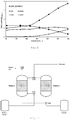
2CO ↔ CO2 + C (Eq. 3) CO + H2O ↔ CO2 + H2 (Eq. 4) CO + 3 H2O ↔ CH4 + H2O (Eq. 5) - The typical products distribution of ethanol steam reforming reaction, according to thermodynamic evaluations, results in considerable hydrogen production rates above 500°C and high methane yields at T < 450°C (
Figure 1 ). - However, depending on the selected operating conditions (temperature, ethanol partial pressure, steam to ethanol molar ratio, space velocity) and the used catalyst, different reaction pathways can be observed, which reduce the desired product selectivity. In particular, the easy transformation of ethanol to acetaldehyde, ethylene, acetone or other by-products through decomposition (not considered in
Fig.1 ), dehydrogenation and dehydration reaction strongly affects H2 yields, but above all could represent precursors for carbonaceous compounds that, depositing on the catalyst, determine its irreversible deactivation, and accordingly limiting the application of the process at industrial level. - The main pathways responsible for coke deposition include methane decomposition (Eq. 6), Boudouard reaction (Eq. 3) and ethylene polymerization (Eq. 7) [3]. Alternatively, carbon formation from ethylene could occur through decomposition followed by accumulation and polymerization of carbon atoms (Eq. 8) .
CH4 ↔ 2H2 + C (Eq. 6) C2H4 → polymers → coke (Eq. 7) C2H4 → 2C + 2H2 → coke (Eq. 8) - Low reaction temperatures generally favour the Boudouard mechanism while (Eq. 6) is the main route at high temperatures. Moreover, depending on the reaction temperature, both amorphous and graphitized carbon can be produced.
- Accordingly, there is a big interest in the literature in finding a way to enhance the stability of the catalyst.
- Under an industrial point of view, the operating conditions at which to operate the process are affected by several parameters. On the basis of the previous considerations and taking into account that the proper temperature selection may assure a considerable reduction of external thermal duty and overall energy penalty, the opportunity of performing ethanol steam reforming at T < 600°C appears very promising. However, the choice of carrying out steam reforming reaction in the low-temperature and/or high pressure ranges (to exploit exothermic reactions) may negatively effect on catalyst stability due to coking phenomena. On the other hand, excess water operations, despite can minimize carbon selectivity, involves a sensible growth in plant variable operating costs. Therefore, the main challenge of ethanol reforming process intensification lies in the development of active at low-temperature and coke-resistant catalysts. Several noble (Pt, Pd, Ru, Rh, Ir) / non-noble (Co, Ni) metals supported on different oxides [1] as well as more complex formulations (including perovskites) were reported as suitable catalysts active for ethanol steam reforming reaction. However, the main drawback of such formulations was represented by the poor stability affected by coke formation on the surface. Several attempts have been made in the literature to improve the catalyst resistance to deactivation, for instance through the addition of CeO2 and La2O3 to Ni/Al2O3 catalysts, or by the addition of a second metal that can induce significant changes in the catalytic properties of the final system [4,5]. However, despite the huge amount of work performed in the literature to make the catalyst less prone to deactivation under coke formation, a lack of information about catalyst stability in long term tests is still evidenced, in particular when the operating temperature is below 600°C and at high ethanol partial pressures.
- Accordingly, it would be desirable to provide a method and an architecture to improve the catalyst stability in the range of temperature between 300 and 600°C, and at relatively high operating ethanol partial pressures.
- One possibility can be based on the recognition that it is not possible to completely exclude the deposition on the coke on the catalyst; accordingly a periodic regeneration of it is necessary.
- This process is not novel in the state of the art, since commercialised technology for selective propane dehydrogenation to propylene still considers a series of parallel reactors, with some of them in processing the ethanol feed, and the others in regeneration in situ of the catalyst with air stream. This type of regeneration foresees an oxidation of the coke deposited on the catalyst with a consequent heat release. However, it must be taken into account that during this process of regeneration, an additional mechanism of deactivation may occur, due to catalyst particle agglomeration (sintering), owing to exposure of the catalyst at high temperature and accordingly to a reduction in active specific surface area. Periodic regenerations of the catalytic bed (to burn off deposited coke) make the sintering deactivation severe. Reference is made, e.g., to "Chemical Process Technology" by J.A. Moulijn, M. Makkee, A. van Diepen (2001) Wiley.
- Accordingly, it would be desirable to provide a method and architecture to regenerate the catalyst activity after coke deposition, without loss of activity owing to active species sintering phenomena.
- In order to better address one or more of the foregoing desires, the invention presents in one aspect an architecture for catalytic ethanol reforming where the reaction is carried out in two vessels operating in parallel, with the first generating the hydrogen rich stream, and the parallel vessel made flowing with steam at high temperature in order to carry out the gasification of carbonaceous compounds.
- Other aspects and advantages will be apparent from the following drawings, the following detailed description and the appended claims.
-
-
Figure 1 shows the thermodynamic product distribution in ethanol steam reforming; -
Figure 2 shows an ethanol steam reforming reactor, with two vessels operating in parallel, in operation/regeneration mode. - According to the invention, the reaction of ethanol steam reforming and catalyst regeneration is carried out in parallel vessels, according to the
Figure 2 . - The invention is based on the fact that while one vessel is made flowing with an ethanol rich gaseous stream to generate a mixture of products containing hydrogen, the parallel vessel is made flowing with superheated steam to regenerate the catalyst. In this way, the overall system is operated continuously in operation/regeneration mode.
- According to
fig.2 , the catalytic ethanol reforming is carried out in two vessels operating in parallel, with the first, 1, generating the hydrogen rich stream, and theparallel vessel 2 made flowing with superheated steam at high temperature in order to carry out the gasification of carbonaceous compounds. - In particular, when the
vessel 1 is under operation, thevessel 2 is under regeneration. Under such configuration, the ethanol rich gaseous stream is routed under pressure through the valve V-01 to thefirst vessel 1 and the reaction products, containing hydrogen, are collected through the valve V-02 for downstream conversion steps. At the same time a stream of superheated steam at low pressure is routed tovessel 2 for regeneration through the valve V-04, and the product of regeneration, mainly steam and CO2, are collected through the valve V-03. - On the contrary, when
vessel 2 is under operation, the ethanol rich gaseous stream is routed under pressure through the valve V-01 tovessel 2 and the reaction products, containing hydrogen, are collected through the valve V-02 for downstream conversion steps. At the same time a stream of steam at low pressure is routed tovessel 1 for regeneration of the catalyst through the valve V-04, and the product of regeneration, mainly steam and CO2, are collected through the valve V-03. - The catalytic ethanol reforming is conducted in the presence of steam. The quantity of steam fed to the reactor is selected so as to achieve the optimal steam /ethanol ratios in the feedstock to enhance the yield of the process. Preferably, steam/ethanol ratio in the feedstock should be in the range 2:1-6:1, more preferably in the range 3:1-5:1, still more preferably in the range 4:1- 4.5:1. It should be emphasised that the presence of excess steam in the feedstock enables to inhibit carbonaceous compounds formation on the catalyst.
- In the preferred embodiment, selected reaction temperature to reduce energy penalty while maintaining an high hydrogen yield are in the range 300-600°C, preferably in the range 450-550°C, still more preferably at 500°C.
- In the preferred embodiment, selected operating reaction pressure is in the range 10-30 bar, preferably in the range 15-25 bar, still more preferably at 20 bar.
- The catalyst regeneration is conducted in the presence of superheated steam at high temperature and low pressure. In the preferred embodiment, selected regeneration temperature is in the range 400-600°C, preferably in the range 450-575°C, still more preferably at 550°C.
- In the preferred embodiment, selected operating regeneration pressure is in the range 1.1-7 bar, more preferably 1.1-5 bar, still more preferably 3 bar.
-
- 1. Chi-Shen Lee "Ethanol reforming catalyst composition and method of producing ethanol reforming catalyst". No.
US 2014/0213440 A1, July 31, 2014 . - 2. A.L.A. Marinho, R.C. Rabelo-Neto, F.B. Noronha, L.V. Mattos, Appl. Catal. A: Gen. 520 (2016) 53-64.
- 3. A.L.A. Marinho, R.C. Rabelo-Neto, F.B. Noronha, L.V. Mattos, Appl. Catal. A: Gen. 520 (2016) 53-64.
- 4. L. Zhao, T. Han, H. Wang, L. Zhang, Y. Liu, Appl. Catal. B: Environ. 187 (2016) 19-29.
- 5. V. Palma, F. Castaldo, P. Ciambelli, G. Iaquaniello, Appl. Catal. B: Environ. 145 (2014) 73-84.
Claims (7)
- A method for stable ethanol steam reforming, wherein a catalytic ethanol reforming is carried out in two vessels operating in parallel mode both filled in with a catalyst active for this reaction, characterized in that while the first vessel, acting in reforming operation mode, is made flowing with an ethanol rich gaseous stream under pressure to generate an hydrogen rich stream, the second parallel vessel, acting in regeneration mode, is made flowing with superheated steam at pressure lower than the previous one in order to carry out the gasification of carbonaceous compounds deposited on the catalyst, wherein the regeneration temperature is higher than the reforming temperature, both temperatures being lower than or equal to 600°C.
- The method of claim 1 where the catalytic ethanol reforming is carried out with steam/ethanol ratio in the feedstock in the range 2:1-6:1, more preferably in the range 3:1-5:1, still more preferably in the range 4:1-4.5:1.
- The method of claim 1 where the catalytic ethanol reforming is carried out in the temperature range 300-600°C, preferably in the range 450-550°C, still more preferably at 500°C.
- The method of claim 1 where the catalytic ethanol reforming is carried out in the pressure range 10-30 bar, preferably in the range 15-25 bar, still more preferably at 20 bar.
- The method of claim 1 where the catalyst regeneration is carried out with superheated steam.
- The method of claim 1 where the catalyst regeneration temperature is in the range 400-600°C, preferably in the range 450-575°C, still more preferably at 550°C.
- The method of claim 1 where the catalyst regeneration pressure is in the range 1.1-7 bar, more preferably 1.1-5 bar, still more preferably 3 bar.
Applications Claiming Priority (2)
| Application Number | Priority Date | Filing Date | Title |
|---|---|---|---|
| ITUA2016A004008A ITUA20164008A1 (en) | 2016-05-31 | 2016-05-31 | "METHOD AND APPARATUS FOR CONDUCTING THE ETHANOL CATALYTIC REACTION OF STEAM REFORMING" |
| PCT/IB2017/053165 WO2017208142A1 (en) | 2016-05-31 | 2017-05-30 | Method for stable ethanol steam reforming |
Publications (2)
| Publication Number | Publication Date |
|---|---|
| EP3464172A1 EP3464172A1 (en) | 2019-04-10 |
| EP3464172B1 true EP3464172B1 (en) | 2020-03-11 |
Family
ID=56990882
Family Applications (1)
| Application Number | Title | Priority Date | Filing Date |
|---|---|---|---|
| EP17731292.3A Active EP3464172B1 (en) | 2016-05-31 | 2017-05-30 | Method for stable ethanol steam reforming |
Country Status (6)
| Country | Link |
|---|---|
| US (1) | US10889495B2 (en) |
| EP (1) | EP3464172B1 (en) |
| BR (1) | BR112018074614B1 (en) |
| ES (1) | ES2796480T3 (en) |
| IT (1) | ITUA20164008A1 (en) |
| WO (1) | WO2017208142A1 (en) |
Family Cites Families (8)
| Publication number | Priority date | Publication date | Assignee | Title |
|---|---|---|---|---|
| US5597474A (en) * | 1993-10-27 | 1997-01-28 | Exxon Research & Engineering Co. | Production of hydrogen from a fluid coking process using steam reforming |
| US7572429B1 (en) * | 2006-02-17 | 2009-08-11 | Nu Element, Inc. | Cyclic pre-reformer/desulphurization unit |
| DE102007055135A1 (en) * | 2007-11-19 | 2009-05-20 | Enerday Gmbh | Method for operating a fuel cell system |
| US20090165368A1 (en) * | 2007-12-28 | 2009-07-02 | Yunquan Liu | Process and apparatus for reforming gaseous and liquid fuels |
| BRPI0804120A2 (en) * | 2008-09-09 | 2010-07-06 | Petróleo Brasileiro S/A - Petrobras | method for the production of ethylene and synthesis gas in circulating fluidized bed |
| US8715616B2 (en) * | 2011-02-11 | 2014-05-06 | Phillips 66 Company | Soak and coke |
| EP2707324A1 (en) * | 2011-05-10 | 2014-03-19 | BioMethanol Chemie Nederland B.V. | A process for catalytic steam reforming of a feedstock comprising an oxygenated hydrocarbon and a hydrocarbon |
| TWI451905B (en) | 2013-01-25 | 2014-09-11 | Univ Nat Chiao Tung | Ethanol recombiner catalyst composition and preparation method of ethanol recombiner catalyst |
-
2016
- 2016-05-31 IT ITUA2016A004008A patent/ITUA20164008A1/en unknown
-
2017
- 2017-05-30 EP EP17731292.3A patent/EP3464172B1/en active Active
- 2017-05-30 BR BR112018074614-2A patent/BR112018074614B1/en active IP Right Grant
- 2017-05-30 US US16/306,482 patent/US10889495B2/en active Active
- 2017-05-30 ES ES17731292T patent/ES2796480T3/en active Active
- 2017-05-30 WO PCT/IB2017/053165 patent/WO2017208142A1/en not_active Ceased
Non-Patent Citations (1)
| Title |
|---|
| None * |
Also Published As
| Publication number | Publication date |
|---|---|
| WO2017208142A1 (en) | 2017-12-07 |
| ITUA20164008A1 (en) | 2017-12-01 |
| US10889495B2 (en) | 2021-01-12 |
| BR112018074614B1 (en) | 2023-01-03 |
| EP3464172A1 (en) | 2019-04-10 |
| BR112018074614A2 (en) | 2019-03-06 |
| US20190210870A1 (en) | 2019-07-11 |
| ES2796480T3 (en) | 2020-11-27 |
Similar Documents
| Publication | Publication Date | Title |
|---|---|---|
| Palma et al. | CeO2-supported Pt/Ni catalyst for the renewable and clean H2 production via ethanol steam reforming | |
| Davda et al. | Renewable hydrogen by aqueous-phase reforming of glucose | |
| Vaidya et al. | Glycerol reforming for hydrogen production: a review | |
| Zhang et al. | Hydrogen production by steam reforming of ethanol over an Ir/CeO2 catalyst: Reaction mechanism and stability of the catalyst | |
| Arman et al. | Syngas production through steam and CO2 reforming of methane over Ni-based catalyst-A Review | |
| CN103189307B (en) | For the preparation of the method for synthetic gas | |
| AU2020212484B2 (en) | Methanol production process with higher carbon utilization by CO2 recycle | |
| AU2009326172A1 (en) | Integrated gas refinery | |
| TW202408921A (en) | Production of syngas from methanol produced from syngas and/or co2 | |
| US11724936B2 (en) | Catalyst for low temperature ethanol steam reforming and related process | |
| NO318645B1 (en) | Process for hydro-switching of dimethyl ether and energy generation | |
| Ortiz et al. | Thermodynamic analysis and process simulation for the H2 production by dry reforming of ethanol with CaCO3 | |
| Lemonidou et al. | Steam reforming of bio-oils to hydrogen | |
| JP2025527464A (en) | Fischer-Tropsch production of hydrocarbons from carbon dioxide via methanol | |
| Lachén et al. | Production and purification of hydrogen by biogas combined reforming and steam-iron process | |
| EP3092287A1 (en) | Method for carbon dioxide hydrogenation of syngas | |
| JP7762728B2 (en) | Improved catalytic reactor system and catalyst for converting captured CO2 and renewable H2 to low carbon syngas | |
| Azadi et al. | Hydrogen production by catalytic near-critical water gasification and steam reforming of glucose | |
| US10889495B2 (en) | Method for stable ethanol steam reforming | |
| Nishimoto et al. | Partial oxidation of methane to synthesis gas over Ru-loaded Y2O3 catalyst | |
| US8507566B2 (en) | Process for the preparation of synthesis gas | |
| CN101511725B (en) | Process for the preparation of synthesis gas | |
| Demsash et al. | The Thermodynamic Analysis of Hydrogen Production from Glycerol Steam Reforming | |
| Coleman et al. | Ethanol Steam Reforming over a Ni/Mg-Al Mixed Oxide Catalyst | |
| Tippawan et al. | Thermodynamic Evaluation of Ethanol Steam Reforming via Acetaldehyde as an Intermediate |
Legal Events
| Date | Code | Title | Description |
|---|---|---|---|
| STAA | Information on the status of an ep patent application or granted ep patent |
Free format text: STATUS: UNKNOWN |
|
| STAA | Information on the status of an ep patent application or granted ep patent |
Free format text: STATUS: THE INTERNATIONAL PUBLICATION HAS BEEN MADE |
|
| PUAI | Public reference made under article 153(3) epc to a published international application that has entered the european phase |
Free format text: ORIGINAL CODE: 0009012 |
|
| STAA | Information on the status of an ep patent application or granted ep patent |
Free format text: STATUS: REQUEST FOR EXAMINATION WAS MADE |
|
| 17P | Request for examination filed |
Effective date: 20181210 |
|
| AK | Designated contracting states |
Kind code of ref document: A1 Designated state(s): AL AT BE BG CH CY CZ DE DK EE ES FI FR GB GR HR HU IE IS IT LI LT LU LV MC MK MT NL NO PL PT RO RS SE SI SK SM TR |
|
| AX | Request for extension of the european patent |
Extension state: BA ME |
|
| DAV | Request for validation of the european patent (deleted) | ||
| DAX | Request for extension of the european patent (deleted) | ||
| GRAP | Despatch of communication of intention to grant a patent |
Free format text: ORIGINAL CODE: EPIDOSNIGR1 |
|
| STAA | Information on the status of an ep patent application or granted ep patent |
Free format text: STATUS: GRANT OF PATENT IS INTENDED |
|
| INTG | Intention to grant announced |
Effective date: 20191002 |
|
| GRAS | Grant fee paid |
Free format text: ORIGINAL CODE: EPIDOSNIGR3 |
|
| GRAA | (expected) grant |
Free format text: ORIGINAL CODE: 0009210 |
|
| STAA | Information on the status of an ep patent application or granted ep patent |
Free format text: STATUS: THE PATENT HAS BEEN GRANTED |
|
| AK | Designated contracting states |
Kind code of ref document: B1 Designated state(s): AL AT BE BG CH CY CZ DE DK EE ES FI FR GB GR HR HU IE IS IT LI LT LU LV MC MK MT NL NO PL PT RO RS SE SI SK SM TR |
|
| REG | Reference to a national code |
Ref country code: GB Ref legal event code: FG4D |
|
| REG | Reference to a national code |
Ref country code: CH Ref legal event code: EP |
|
| REG | Reference to a national code |
Ref country code: AT Ref legal event code: REF Ref document number: 1242927 Country of ref document: AT Kind code of ref document: T Effective date: 20200315 |
|
| REG | Reference to a national code |
Ref country code: DE Ref legal event code: R096 Ref document number: 602017013017 Country of ref document: DE |
|
| REG | Reference to a national code |
Ref country code: IE Ref legal event code: FG4D |
|
| REG | Reference to a national code |
Ref country code: NL Ref legal event code: FP |
|
| PG25 | Lapsed in a contracting state [announced via postgrant information from national office to epo] |
Ref country code: FI Free format text: LAPSE BECAUSE OF FAILURE TO SUBMIT A TRANSLATION OF THE DESCRIPTION OR TO PAY THE FEE WITHIN THE PRESCRIBED TIME-LIMIT Effective date: 20200311 Ref country code: RS Free format text: LAPSE BECAUSE OF FAILURE TO SUBMIT A TRANSLATION OF THE DESCRIPTION OR TO PAY THE FEE WITHIN THE PRESCRIBED TIME-LIMIT Effective date: 20200311 Ref country code: NO Free format text: LAPSE BECAUSE OF FAILURE TO SUBMIT A TRANSLATION OF THE DESCRIPTION OR TO PAY THE FEE WITHIN THE PRESCRIBED TIME-LIMIT Effective date: 20200611 |
|
| PG25 | Lapsed in a contracting state [announced via postgrant information from national office to epo] |
Ref country code: HR Free format text: LAPSE BECAUSE OF FAILURE TO SUBMIT A TRANSLATION OF THE DESCRIPTION OR TO PAY THE FEE WITHIN THE PRESCRIBED TIME-LIMIT Effective date: 20200311 Ref country code: BG Free format text: LAPSE BECAUSE OF FAILURE TO SUBMIT A TRANSLATION OF THE DESCRIPTION OR TO PAY THE FEE WITHIN THE PRESCRIBED TIME-LIMIT Effective date: 20200611 Ref country code: LV Free format text: LAPSE BECAUSE OF FAILURE TO SUBMIT A TRANSLATION OF THE DESCRIPTION OR TO PAY THE FEE WITHIN THE PRESCRIBED TIME-LIMIT Effective date: 20200311 Ref country code: GR Free format text: LAPSE BECAUSE OF FAILURE TO SUBMIT A TRANSLATION OF THE DESCRIPTION OR TO PAY THE FEE WITHIN THE PRESCRIBED TIME-LIMIT Effective date: 20200612 Ref country code: SE Free format text: LAPSE BECAUSE OF FAILURE TO SUBMIT A TRANSLATION OF THE DESCRIPTION OR TO PAY THE FEE WITHIN THE PRESCRIBED TIME-LIMIT Effective date: 20200311 |
|
| REG | Reference to a national code |
Ref country code: LT Ref legal event code: MG4D |
|
| PG25 | Lapsed in a contracting state [announced via postgrant information from national office to epo] |
Ref country code: PT Free format text: LAPSE BECAUSE OF FAILURE TO SUBMIT A TRANSLATION OF THE DESCRIPTION OR TO PAY THE FEE WITHIN THE PRESCRIBED TIME-LIMIT Effective date: 20200805 Ref country code: IS Free format text: LAPSE BECAUSE OF FAILURE TO SUBMIT A TRANSLATION OF THE DESCRIPTION OR TO PAY THE FEE WITHIN THE PRESCRIBED TIME-LIMIT Effective date: 20200711 Ref country code: CZ Free format text: LAPSE BECAUSE OF FAILURE TO SUBMIT A TRANSLATION OF THE DESCRIPTION OR TO PAY THE FEE WITHIN THE PRESCRIBED TIME-LIMIT Effective date: 20200311 Ref country code: RO Free format text: LAPSE BECAUSE OF FAILURE TO SUBMIT A TRANSLATION OF THE DESCRIPTION OR TO PAY THE FEE WITHIN THE PRESCRIBED TIME-LIMIT Effective date: 20200311 Ref country code: SM Free format text: LAPSE BECAUSE OF FAILURE TO SUBMIT A TRANSLATION OF THE DESCRIPTION OR TO PAY THE FEE WITHIN THE PRESCRIBED TIME-LIMIT Effective date: 20200311 Ref country code: EE Free format text: LAPSE BECAUSE OF FAILURE TO SUBMIT A TRANSLATION OF THE DESCRIPTION OR TO PAY THE FEE WITHIN THE PRESCRIBED TIME-LIMIT Effective date: 20200311 Ref country code: LT Free format text: LAPSE BECAUSE OF FAILURE TO SUBMIT A TRANSLATION OF THE DESCRIPTION OR TO PAY THE FEE WITHIN THE PRESCRIBED TIME-LIMIT Effective date: 20200311 Ref country code: SK Free format text: LAPSE BECAUSE OF FAILURE TO SUBMIT A TRANSLATION OF THE DESCRIPTION OR TO PAY THE FEE WITHIN THE PRESCRIBED TIME-LIMIT Effective date: 20200311 |
|
| REG | Reference to a national code |
Ref country code: AT Ref legal event code: MK05 Ref document number: 1242927 Country of ref document: AT Kind code of ref document: T Effective date: 20200311 |
|
| REG | Reference to a national code |
Ref country code: ES Ref legal event code: FG2A Ref document number: 2796480 Country of ref document: ES Kind code of ref document: T3 Effective date: 20201127 |
|
| REG | Reference to a national code |
Ref country code: DE Ref legal event code: R097 Ref document number: 602017013017 Country of ref document: DE |
|
| PLBE | No opposition filed within time limit |
Free format text: ORIGINAL CODE: 0009261 |
|
| STAA | Information on the status of an ep patent application or granted ep patent |
Free format text: STATUS: NO OPPOSITION FILED WITHIN TIME LIMIT |
|
| PG25 | Lapsed in a contracting state [announced via postgrant information from national office to epo] |
Ref country code: DK Free format text: LAPSE BECAUSE OF FAILURE TO SUBMIT A TRANSLATION OF THE DESCRIPTION OR TO PAY THE FEE WITHIN THE PRESCRIBED TIME-LIMIT Effective date: 20200311 Ref country code: CH Free format text: LAPSE BECAUSE OF NON-PAYMENT OF DUE FEES Effective date: 20200531 Ref country code: AT Free format text: LAPSE BECAUSE OF FAILURE TO SUBMIT A TRANSLATION OF THE DESCRIPTION OR TO PAY THE FEE WITHIN THE PRESCRIBED TIME-LIMIT Effective date: 20200311 Ref country code: LI Free format text: LAPSE BECAUSE OF NON-PAYMENT OF DUE FEES Effective date: 20200531 Ref country code: MC Free format text: LAPSE BECAUSE OF FAILURE TO SUBMIT A TRANSLATION OF THE DESCRIPTION OR TO PAY THE FEE WITHIN THE PRESCRIBED TIME-LIMIT Effective date: 20200311 |
|
| 26N | No opposition filed |
Effective date: 20201214 |
|
| PG25 | Lapsed in a contracting state [announced via postgrant information from national office to epo] |
Ref country code: PL Free format text: LAPSE BECAUSE OF FAILURE TO SUBMIT A TRANSLATION OF THE DESCRIPTION OR TO PAY THE FEE WITHIN THE PRESCRIBED TIME-LIMIT Effective date: 20200311 Ref country code: SI Free format text: LAPSE BECAUSE OF FAILURE TO SUBMIT A TRANSLATION OF THE DESCRIPTION OR TO PAY THE FEE WITHIN THE PRESCRIBED TIME-LIMIT Effective date: 20200311 |
|
| REG | Reference to a national code |
Ref country code: BE Ref legal event code: MM Effective date: 20200531 |
|
| PG25 | Lapsed in a contracting state [announced via postgrant information from national office to epo] |
Ref country code: LU Free format text: LAPSE BECAUSE OF NON-PAYMENT OF DUE FEES Effective date: 20200530 |
|
| PG25 | Lapsed in a contracting state [announced via postgrant information from national office to epo] |
Ref country code: IE Free format text: LAPSE BECAUSE OF NON-PAYMENT OF DUE FEES Effective date: 20200530 |
|
| PG25 | Lapsed in a contracting state [announced via postgrant information from national office to epo] |
Ref country code: BE Free format text: LAPSE BECAUSE OF NON-PAYMENT OF DUE FEES Effective date: 20200531 |
|
| PG25 | Lapsed in a contracting state [announced via postgrant information from national office to epo] |
Ref country code: TR Free format text: LAPSE BECAUSE OF FAILURE TO SUBMIT A TRANSLATION OF THE DESCRIPTION OR TO PAY THE FEE WITHIN THE PRESCRIBED TIME-LIMIT Effective date: 20200311 Ref country code: MT Free format text: LAPSE BECAUSE OF FAILURE TO SUBMIT A TRANSLATION OF THE DESCRIPTION OR TO PAY THE FEE WITHIN THE PRESCRIBED TIME-LIMIT Effective date: 20200311 Ref country code: CY Free format text: LAPSE BECAUSE OF FAILURE TO SUBMIT A TRANSLATION OF THE DESCRIPTION OR TO PAY THE FEE WITHIN THE PRESCRIBED TIME-LIMIT Effective date: 20200311 |
|
| PG25 | Lapsed in a contracting state [announced via postgrant information from national office to epo] |
Ref country code: MK Free format text: LAPSE BECAUSE OF FAILURE TO SUBMIT A TRANSLATION OF THE DESCRIPTION OR TO PAY THE FEE WITHIN THE PRESCRIBED TIME-LIMIT Effective date: 20200311 Ref country code: AL Free format text: LAPSE BECAUSE OF FAILURE TO SUBMIT A TRANSLATION OF THE DESCRIPTION OR TO PAY THE FEE WITHIN THE PRESCRIBED TIME-LIMIT Effective date: 20200311 |
|
| P01 | Opt-out of the competence of the unified patent court (upc) registered |
Effective date: 20230605 |
|
| PGFP | Annual fee paid to national office [announced via postgrant information from national office to epo] |
Ref country code: NL Payment date: 20250421 Year of fee payment: 9 |
|
| PGFP | Annual fee paid to national office [announced via postgrant information from national office to epo] |
Ref country code: DE Payment date: 20250408 Year of fee payment: 9 |
|
| PGFP | Annual fee paid to national office [announced via postgrant information from national office to epo] |
Ref country code: GB Payment date: 20250410 Year of fee payment: 9 Ref country code: ES Payment date: 20250606 Year of fee payment: 9 |
|
| PGFP | Annual fee paid to national office [announced via postgrant information from national office to epo] |
Ref country code: IT Payment date: 20250515 Year of fee payment: 9 |
|
| PGFP | Annual fee paid to national office [announced via postgrant information from national office to epo] |
Ref country code: FR Payment date: 20250409 Year of fee payment: 9 |