EP3463236B1 - Nonwoven fabric sheet and method for making the same - Google Patents
Nonwoven fabric sheet and method for making the same Download PDFInfo
- Publication number
- EP3463236B1 EP3463236B1 EP17811847.7A EP17811847A EP3463236B1 EP 3463236 B1 EP3463236 B1 EP 3463236B1 EP 17811847 A EP17811847 A EP 17811847A EP 3463236 B1 EP3463236 B1 EP 3463236B1
- Authority
- EP
- European Patent Office
- Prior art keywords
- fibers
- fabric sheet
- nonwoven fabric
- spunbonded
- sheet
- Prior art date
- Legal status (The legal status is an assumption and is not a legal conclusion. Google has not performed a legal analysis and makes no representation as to the accuracy of the status listed.)
- Active
Links
Images




Classifications
-
- D—TEXTILES; PAPER
- D04—BRAIDING; LACE-MAKING; KNITTING; TRIMMINGS; NON-WOVEN FABRICS
- D04H—MAKING TEXTILE FABRICS, e.g. FROM FIBRES OR FILAMENTARY MATERIAL; FABRICS MADE BY SUCH PROCESSES OR APPARATUS, e.g. FELTS, NON-WOVEN FABRICS; COTTON-WOOL; WADDING ; NON-WOVEN FABRICS FROM STAPLE FIBRES, FILAMENTS OR YARNS, BONDED WITH AT LEAST ONE WEB-LIKE MATERIAL DURING THEIR CONSOLIDATION
- D04H3/00—Non-woven fabrics formed wholly or mainly of yarns or like filamentary material of substantial length
- D04H3/018—Non-woven fabrics formed wholly or mainly of yarns or like filamentary material of substantial length characterised by the shape
-
- A—HUMAN NECESSITIES
- A61—MEDICAL OR VETERINARY SCIENCE; HYGIENE
- A61F—FILTERS IMPLANTABLE INTO BLOOD VESSELS; PROSTHESES; DEVICES PROVIDING PATENCY TO, OR PREVENTING COLLAPSING OF, TUBULAR STRUCTURES OF THE BODY, e.g. STENTS; ORTHOPAEDIC, NURSING OR CONTRACEPTIVE DEVICES; FOMENTATION; TREATMENT OR PROTECTION OF EYES OR EARS; BANDAGES, DRESSINGS OR ABSORBENT PADS; FIRST-AID KITS
- A61F13/00—Bandages or dressings; Absorbent pads
- A61F13/15—Absorbent pads, e.g. sanitary towels, swabs or tampons for external or internal application to the body; Supporting or fastening means therefor; Tampon applicators
- A61F13/51—Absorbent pads, e.g. sanitary towels, swabs or tampons for external or internal application to the body; Supporting or fastening means therefor; Tampon applicators characterised by the outer layers of the pads
- A61F13/511—Topsheet, i.e. the permeable cover or layer facing the skin
- A61F13/51104—Topsheet, i.e. the permeable cover or layer facing the skin the top sheet having a three-dimensional cross-section, e.g. corrugations, embossments, recesses or projections
- A61F13/51108—Topsheet, i.e. the permeable cover or layer facing the skin the top sheet having a three-dimensional cross-section, e.g. corrugations, embossments, recesses or projections the top sheet having corrugations or embossments having one axis relatively longer than the other axis, e.g. forming channels or grooves in a longitudinal direction
-
- D—TEXTILES; PAPER
- D04—BRAIDING; LACE-MAKING; KNITTING; TRIMMINGS; NON-WOVEN FABRICS
- D04H—MAKING TEXTILE FABRICS, e.g. FROM FIBRES OR FILAMENTARY MATERIAL; FABRICS MADE BY SUCH PROCESSES OR APPARATUS, e.g. FELTS, NON-WOVEN FABRICS; COTTON-WOOL; WADDING ; NON-WOVEN FABRICS FROM STAPLE FIBRES, FILAMENTS OR YARNS, BONDED WITH AT LEAST ONE WEB-LIKE MATERIAL DURING THEIR CONSOLIDATION
- D04H3/00—Non-woven fabrics formed wholly or mainly of yarns or like filamentary material of substantial length
- D04H3/02—Non-woven fabrics formed wholly or mainly of yarns or like filamentary material of substantial length characterised by the method of forming fleeces or layers, e.g. reorientation of yarns or filaments
-
- D—TEXTILES; PAPER
- D04—BRAIDING; LACE-MAKING; KNITTING; TRIMMINGS; NON-WOVEN FABRICS
- D04H—MAKING TEXTILE FABRICS, e.g. FROM FIBRES OR FILAMENTARY MATERIAL; FABRICS MADE BY SUCH PROCESSES OR APPARATUS, e.g. FELTS, NON-WOVEN FABRICS; COTTON-WOOL; WADDING ; NON-WOVEN FABRICS FROM STAPLE FIBRES, FILAMENTS OR YARNS, BONDED WITH AT LEAST ONE WEB-LIKE MATERIAL DURING THEIR CONSOLIDATION
- D04H3/00—Non-woven fabrics formed wholly or mainly of yarns or like filamentary material of substantial length
- D04H3/02—Non-woven fabrics formed wholly or mainly of yarns or like filamentary material of substantial length characterised by the method of forming fleeces or layers, e.g. reorientation of yarns or filaments
- D04H3/07—Non-woven fabrics formed wholly or mainly of yarns or like filamentary material of substantial length characterised by the method of forming fleeces or layers, e.g. reorientation of yarns or filaments otherwise than in a plane, e.g. in a tubular way
-
- D—TEXTILES; PAPER
- D04—BRAIDING; LACE-MAKING; KNITTING; TRIMMINGS; NON-WOVEN FABRICS
- D04H—MAKING TEXTILE FABRICS, e.g. FROM FIBRES OR FILAMENTARY MATERIAL; FABRICS MADE BY SUCH PROCESSES OR APPARATUS, e.g. FELTS, NON-WOVEN FABRICS; COTTON-WOOL; WADDING ; NON-WOVEN FABRICS FROM STAPLE FIBRES, FILAMENTS OR YARNS, BONDED WITH AT LEAST ONE WEB-LIKE MATERIAL DURING THEIR CONSOLIDATION
- D04H3/00—Non-woven fabrics formed wholly or mainly of yarns or like filamentary material of substantial length
- D04H3/08—Non-woven fabrics formed wholly or mainly of yarns or like filamentary material of substantial length characterised by the method of strengthening or consolidating
- D04H3/14—Non-woven fabrics formed wholly or mainly of yarns or like filamentary material of substantial length characterised by the method of strengthening or consolidating with bonds between thermoplastic yarns or filaments produced by welding
-
- D—TEXTILES; PAPER
- D06—TREATMENT OF TEXTILES OR THE LIKE; LAUNDERING; FLEXIBLE MATERIALS NOT OTHERWISE PROVIDED FOR
- D06C—FINISHING, DRESSING, TENTERING OR STRETCHING TEXTILE FABRICS
- D06C3/00—Stretching, tentering or spreading textile fabrics; Producing elasticity in textile fabrics
- D06C3/06—Stretching, tentering or spreading textile fabrics; Producing elasticity in textile fabrics by rotary disc, roller, or like apparatus
Definitions
- the invention relates to a patterned spunbonded nonwoven fabric sheet obtained from mechanically activating a flat spunbonded nonwoven fabric sheet comprising a plurality of spunbonded crimped fibers.
- Nonwoven fabric materials are known in the art. They made from a plurality of polymer fibers randomly laid onto a surface to form a flat layer and bonded together at a plurality of bonding points to form a flat fabric sheet. Typical processes to obtain such materials comprise spunbonding, a continuous process where thin polymer fibers are spun, drawn and quenched by air streams, randomly dispersed onto a moving belt and bonded by, e.g., calender or hot air through bonding. Spunbonded nonwovens are frequently used in hygiene applications, e.g., as backsheets or leg cuffs for diapers.
- Typical nonwoven fabric materials are made from linear fibers, are flat and compact and have a comparatively high density (expressed in g/cm 3 of the nonwoven).
- Crimped fibers can, for example, be obtained by drawing bicomponent fibers comprising two zones asymmetrically distributed along their cross-section. The zones are constituted by different polymer materials, which are disparate in at least one physical property like melt elasticity, melt flow rate or the like. Such fibers exhibit asymmetric behavior during drawing and quenching, which induces crimp.
- An exemplary technology is disclosed in US 6,454,989 B1 .
- the bonding area i.e., the fraction of the total sheet surface which is occupied by, e.g., calendered bonding points is usually higher for compact nonwovens than for high-loft nonwovens, as high bonding areas run counter high loft properties.
- the compaction settings i.e., the settings for compacting the laid fibers that have been dispersed onto the belt, are different between typical standard and high loft products.
- Compact nonwovens from linear fibers typically have a rather high tensile strength, particularly in machine direction (“MD”), i.e., in the direction of the moving belt, as the fibers are mainly oriented in MD, meaning that the mean fiber orientation is in MD.
- MD machine direction
- CD cross-machine direction
- the elasticity is usually higher in high loft nonwovens.
- the air permeability is usually lower in compact nonwovens, while high loft nonwovens have a softer feel.
- One disadvantage of the high barrier nonwovens naturally, is the increased volume that is needed to ship the material.
- One goal of the present invention is the provision of a spunbonded nonwoven fabric material which is high loft but does not exhibit all mechanical properties usually observed for high loft nonwoven fabric materials, and specifically has increased tensile strength.
- Another goal of the invention is the provision of a spunbonded nonwoven fabric material which is high loft but can be adapted for shipping at low volume.
- Another goal of the invention is the provision of a spunbonded nonwoven fabric material having a unique and soft touch and appearance.
- the invention provides for a patterned spunbonded nonwoven fabric sheet comprising a plurality of spunbonded crimped fibers bonded together at a plurality of bonding points, wherein all fibers of the patterned spunbonded nonwoven fabric sheet are spunbonded crimped fibers.
- the fabric is characterized in that the configuration of the fibers within the sheet is inhomogeneous and varies according to a preferably regular pattern.
- the pattern is macroscopic in a sense that there are different macroscopic regions of different fiber configurations, the regions reach comprising a multitude of fibers following this configuration.
- the regions are preferably visible with the bare eye and may have a minimum size of, e.g., more than 10 mm 2 .
- the density of fibers and/or the mean orientation of the fibers of the fibers within the fabric sheet are inhomogeneous and vary according to the pattern.
- the mean crimp radius of the fibers can be inhomogeneous within the fabric sheet and vary according to the pattern.
- the sheet may, for example, comprise two or more classes of distinct regions distributed over its area according to the pattern, one having a first fiber concentration (and hence material density as expressed in weight per volume) and another one having a second fiber concentration (and hence material density as expressed in weight per volume).
- first fiber concentration and hence material density as expressed in weight per volume
- second fiber concentration and hence material density as expressed in weight per volume
- high and low density regions are defined.
- the starting point of this definition is the average density of the fabric. Areas having a density higher than average can be considered high density areas and areas having a density lower than average can be considered low density areas.
- the high density areas account for between 50 and 80% of the overall weight of the fabric.
- the pattern consists of parallel stripes oriented in machine direction of the sheet, wherein the stripes are preferably straight, sinus or zig-zag shaped.
- the stripes are preferably uninterrupted.
- the pattern is identical for the whole area of the sheet.
- the sheet has a three-dimensional structure comprising a plurality of alternating elevations and depressions arranged according to the pattern.
- the three-dimensional patterned structure leads to a windy cross-sectional profile of the fabric sheet, meaning that when there is a protrusion on one surface of the sheet, there is an indentation on the other surface.
- the fabric sheet may have a corrugated structure with grooves and crests oriented in one direction and a wavelike cross-section when cut along a direction perpendicular to the one direction.
- the elevations and depressions are high density regions and the transition zones between elevations and depressions are low density regions.
- the vertical dimension of the structured fabric sheet exceeds the thickness of the sheet.
- the factor may be, for example, at least two or at least three.
- the vertical dimension according to this definition corresponds to the mean distance between the highest point of elevations and the lowest point of depressions.
- the thickness of the sheet corresponds to the shortest distance between the upper and lower surface of the sheet at any particular spot on the surface.
- the thickness ("caliper") of the sheet remains essentially constant over the entire sheet surface, irrespective of differences in density or a three-dimensionally structured shape.
- the average density of the fabric is between 0,03 and 0,08 g/cm 3 .
- the average basis weight of the (potentially structured and not straightened) fabric is between 10 and 100 g/m 2 . While these are average values, both the actual density and basis weight at a certain point on the surface of the fabric may vary according to the pattern.
- the ratio of tensile strength in machine direction (“TSMD”) to tensile strength in cross-machine direction (“TSCD”) is between 0,8 and 1,2 when measured according to WSP 110.4. This ratio is more balanced than typically observed for products of the prior art.
- the crimped fibers are crimped multicomponent fibers, where preferably one or all components are polymer components.
- one or all components may comprise or consist of polypropylene.
- components may consist of pure polypropylene, a polypropylene and polyethylene copolymer or a mixture of polypropylene and polyethylene homopolymers.
- Crimped multicomponent fibers comprise at least two zones asymmetrically distributed along their cross-section. The zones are constituted by different polymer materials, which are disparate in at least one physical property like melt elasticity, melt flow rate or the like. The distribution of the zones may be side-by-side, eccentric sheath-core or the like. Such fibers exhibit asymmetric behavior during drawing and quenching, which induces crimp.
- the technology to obtain crimped fibers is well-known in the art, e.g., from US 6,454,989 B1 .
- the invention further relates to a method for forming a spunbonded patterned nonwoven fabric sheet of any preceding claim, the method comprising: providing a flat spunbonded nonwoven fabric sheet starting material comprising a plurality of spunbonded crimped fibers bonded together at a plurality of bonding points, wherein all fibers of the patterned spunbonded nonwoven fabric sheet are spunbonded crimped fibers; and mechanically activating the starting material upon application of localized stretching forces to change the configuration of the fibers according to the pattern.
- the mechanical activation causes deformation as bonds in the stretch zones are deactivated and the fiber structure becomes more open, meaning less dense.
- the fibers reorient themselves towards the direction of stretching.
- the fibers have a built in stretch capability due the, for example, helically crimped form or shape. It is thereby possible to stretch the in the Cross Machine (CD) with a so-called ring rolling process without shredding the material. If fibers of the starting material do not have any crimp the material would shred when trying to activate according to the invention. A certain amount of crimp in the individual fiber is needed in order to give the fibers enough extensibility to withstand the forces applied in the stretch zones during mechanical activation.
- the steps of providing and activating the starting material are carried out at different sites remote from one another.
- the process of mechanical activation can take place directly after the formation of the flat nonwoven fabric sheet, in a remote standalone activation process or directly at the remote lines for the end use, e.g., for hygiene disposable manufacturing process. It is hence possible to ship a starting material which is comparatively low loft and activate the material only at the end use site to obtain a higher loft material, thereby saving on space needed for shipping and hence shipping cost.
- the step of mechanical activation includes ring rolling the flat nonwoven fabric sheet in a mill comprising a pair of interacting rolls each comprising a structured surface having elevations and depressions, wherein the surface structures and positions of the two rolls are such that elevations on the surface of one roll impinge onto corresponding depressions on the surface of the other roll.
- the structure on rolls is macroscopic and follows the fiber configuration pattern of the patterned nonwoven fabric sheet of the invention.
- the surface structure of the rolls preferably exceeds the thickness of the flat nonwoven fabric sheet at least by factor two, three or five to impart a significant degree of mechanical activation.
- the step of mechanical activation includes rolling the flat nonwoven fabric sheet in a mill comprising a pair of interacting rolls whose surfaces comprise interlocking annular grooves and crests.
- the annular grooves and crests constitute the elevations and depressions.
- This allows for producing an activated sheet of the invention where the pattern consists of parallel stripes oriented in machine direction.
- the elevations and depressions on the surfaces of the rolls may, for example, have a straight pathway along the circumference of the rolls or may adopt a sinus shaped or zig-zag shaped pathway, leading to either straight, sinus shaped or zig-zag shaped parallel stripes in the activated fabric.
- the invention further relates to a flat spunbonded nonwoven fabric sheet starting material comprising a plurality of spunbonded crimped fibers, wherein the nonwoven is obtained by a process that involves a step of heat embossing with a calender roll to bond together the fibers at a plurality of preferably regularly distributed bonding points, wherein all fibers of the flat spunbonded nonwoven fabric sheet are spunbonded crimped fibers.
- the flat sheet is characterized in that the number of bonding points per cm 2 of fabric surface is between 10 and 40 and preferably between 20 and 30, and in that the total area of bonding points is between 6 and 18 % and preferably between 10 and 15 % of the total area of the fabric.
- the quotient obtained by dividing the basis weight of the fabric sheet as expressed in grams per square meter (g/m 2 ) with the height of the embossing pins on the calender roll, as expressed in millimeters (mm), is between 20 and 150 and preferably between 40 and 90.
- the bonding parameters are maintained during the process of the invention, such that the bonding parameters also apply to the patterned nonwoven fabric sheet according to the invention.
- the parameters such as fibers, materials, average basis weight and density, caliper and the like of the flat nonwoven fabric sheet according to the invention can be as defined above for the patterned spunbonded nonwoven fabric sheet according to the invention.
- the flat spunbonded nonwoven fabric sheet according to the invention is preferably used in a method of the invention to obtain a patterned spunbonded nonwoven fabric sheet according to the invention.
- the patterned/activated spunbonded nonwoven fabric sheets of the invention can be used, for example, in the manufacture of hygiene products such as baby diapers, adult incontinence products or sanitary napkins.
- Other applications of the patterned/activated nonwoven fabric sheets of the invention include cleaning products like dust-off products and cleaning wipes, industrial products, air filtration products or medical products in general.
- Figure 1 shows a mill 1 configured to carry out a method according to the invention. It comprises a pair of counter rotating rollers 2 and 3. Annular discs 4 are mounted to the surfaces of both rollers 2 and 3 to obtain a surface structure of annular grooves (between the discs) and crests (the discs). The discs 4 are mounted with an offset on rollers 2 and 3 and the discs 4 of one roller 2 or 3 interlock with the discs 4 of the other roller 3 or 2.
- the width "a" of the discs 4 is 0,8 mm
- the depth of engagement "b” (“DOE”) is variable and the distance "c" between the discs 4 is 1,65 mm.
- Figure 2 shows the mill of Figure 1 in operation.
- a flat nonwoven fabric sheet 5 comprising a plurality of crimped fibers bonded together at a plurality of bonding points is fed to the mill at a certain line speed and a corrugated pattern is worked into the nonwoven 5 by stretching in stress zones 6 while not stretching in stress-free zones 7.
- the starting materials i.e., the flat nonwoven fabric sheets used in different working examples were spunbonded polypropylene nonwovens made from crimped fibers in a side-by-side configuration with a regular PP homopolymer in combination with a PP/PE random copolymer at a distribution ratio of 50/50.
- the denier of the fibers was 1,8. All materials were open dot bonded at 24 dots/cm 2 by calender bonding at an engraving depth of 0,75 mm to obtain a bonding ratio of 12,1%.
- the starting materials had the characteristics as described in Table 1.
- the resulting materials had the characteristics as described in Table 3.
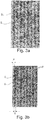
- Figure 3a shows a top view picture of the inventive nonwoven fabric sheet of Example 3.
- the material has a corrugated three-dimensional structure with grooves and crests oriented in longitudinal direction (MD) and a wavelike cross-section when cut in a direction perpendicular thereto (CD). It can be seen that the fiber structure within the material has been rearranged and is inhomogeneous. It varies according to the corrugated pattern.
- MD stripes 8 with a high fiber density and a mean fiber orientation in MD. These stripes appear brighter in the picture and extend longitudinally (in MD) in the top areas of the crests and the bottom areas of the valleys. The areas corresponding to these stripes 8 have not or hardly been stretched during the activation process. They correspond to the stress-free zones 7 of Figure 2 .
- the stripes 8 are interrupted by longitudinal (MD) stripes 9 of lower fiber density and a mean fiber orientation in CD. These stripes appear darker in the picture and extend longitudinally (in MD) in the transition zones between crests and valleys. The areas corresponding to these stripes 9 have significantly been stretched during the activation process. They correspond to the stress zones 6 of Figure 2 .
- the sheet of Example 3 has been sliced in longitudinal stripes as shown in Figure 3b .
- the cutting lines are marked with reference numeral 10 and extend longitudinally (in MD) along the boundaries between areas 8 and 9.
- the cutting lines 10 where chosen such that all strips had an equal width, meaning that the width of all strips corresponding to the areas 8 was equal to the width of all strips corresponding to the areas 9.
- the activated fabric of Example 3 has a textile-like appearance, which can be desirable in certain applications, for example, hygiene applications.
- FIGs 5a to 5c show top view pictures the nonwoven fabrics of Example 1 ( Figure 5a ), again Example 3 ( Figure 5b ) and Example 6 ( Figure 5c ).
- activation according to the invention can be observed in all examples. Different qualities of activation are observed.
- the dense starting material as in Example 1 the web does not open up as readily during activation as when using a more open fabric as in Example 3.
- the high and low density areas in the activated fabric are not as emphasized.
Landscapes
- Engineering & Computer Science (AREA)
- Textile Engineering (AREA)
- Health & Medical Sciences (AREA)
- Epidemiology (AREA)
- Biomedical Technology (AREA)
- Heart & Thoracic Surgery (AREA)
- Vascular Medicine (AREA)
- Life Sciences & Earth Sciences (AREA)
- Animal Behavior & Ethology (AREA)
- General Health & Medical Sciences (AREA)
- Public Health (AREA)
- Veterinary Medicine (AREA)
- Nonwoven Fabrics (AREA)
Description
- The invention relates to a patterned spunbonded nonwoven fabric sheet obtained from mechanically activating a flat spunbonded nonwoven fabric sheet comprising a plurality of spunbonded crimped fibers.
- Nonwoven fabric materials are known in the art. They made from a plurality of polymer fibers randomly laid onto a surface to form a flat layer and bonded together at a plurality of bonding points to form a flat fabric sheet. Typical processes to obtain such materials comprise spunbonding, a continuous process where thin polymer fibers are spun, drawn and quenched by air streams, randomly dispersed onto a moving belt and bonded by, e.g., calender or hot air through bonding. Spunbonded nonwovens are frequently used in hygiene applications, e.g., as backsheets or leg cuffs for diapers.
- Typical nonwoven fabric materials are made from linear fibers, are flat and compact and have a comparatively high density (expressed in g/cm3 of the nonwoven).
- There are also technologies available in the prior art to obtain a softer nonwoven fabric materials having much lower densities, so-called high loft nonwoven materials. These technologies use crimped fibers instead of straight fibers to induce loft. Crimped fibers can, for example, be obtained by drawing bicomponent fibers comprising two zones asymmetrically distributed along their cross-section. The zones are constituted by different polymer materials, which are disparate in at least one physical property like melt elasticity, melt flow rate or the like. Such fibers exhibit asymmetric behavior during drawing and quenching, which induces crimp. An exemplary technology is disclosed in
US 6,454,989 B1 . - The bonding area, i.e., the fraction of the total sheet surface which is occupied by, e.g., calendered bonding points is usually higher for compact nonwovens than for high-loft nonwovens, as high bonding areas run counter high loft properties. Also the compaction settings, i.e., the settings for compacting the laid fibers that have been dispersed onto the belt, are different between typical standard and high loft products.
- Compact nonwovens from linear fibers typically have a rather high tensile strength, particularly in machine direction ("MD"), i.e., in the direction of the moving belt, as the fibers are mainly oriented in MD, meaning that the mean fiber orientation is in MD. In high loft nonwovens, the tensile strength is generally lower, particularly in MD, but also in cross-machine direction ("CD") perpendicular thereto. The elasticity is usually higher in high loft nonwovens. The air permeability is usually lower in compact nonwovens, while high loft nonwovens have a softer feel. One disadvantage of the high barrier nonwovens, naturally, is the increased volume that is needed to ship the material.
- Relevant prior art is represented, inter alia, by
document EP 1 876 275 A1 , which discloses a process to obtain nonwoven materials of greater elasticity in cross-machine direction (CD). To achieve this purpose, a nonwoven material comprising both elastic fibers and extensible but inelastic fibers is produced and then stretched by corrugated rolls. ReferenceUS 4,035,219 A discloses methods for providing nonwoven webs having specific bonding patterns.WO 2004/085730 A1 relates to a specific bond pattern for nonwovens that comprises two distinct types of bonding points. - One goal of the present invention is the provision of a spunbonded nonwoven fabric material which is high loft but does not exhibit all mechanical properties usually observed for high loft nonwoven fabric materials, and specifically has increased tensile strength.
- Another goal of the invention is the provision of a spunbonded nonwoven fabric material which is high loft but can be adapted for shipping at low volume.
- Another goal of the invention is the provision of a spunbonded nonwoven fabric material having a unique and soft touch and appearance.
- Against this background the invention provides for a patterned spunbonded nonwoven fabric sheet comprising a plurality of spunbonded crimped fibers bonded together at a plurality of bonding points, wherein all fibers of the patterned spunbonded nonwoven fabric sheet are spunbonded crimped fibers. The fabric is characterized in that the configuration of the fibers within the sheet is inhomogeneous and varies according to a preferably regular pattern. The pattern is macroscopic in a sense that there are different macroscopic regions of different fiber configurations, the regions reach comprising a multitude of fibers following this configuration. The regions are preferably visible with the bare eye and may have a minimum size of, e.g., more than 10 mm2.
- Specifically, according to the invention, the density of fibers and/or the mean orientation of the fibers of the fibers within the fabric sheet are inhomogeneous and vary according to the pattern. In one embodiment, also the mean crimp radius of the fibers can be inhomogeneous within the fabric sheet and vary according to the pattern. These are variants of how the configuration of the fibers may vary on a microscopic level in the different macroscopic regions, according to the invention.
- The sheet may, for example, comprise two or more classes of distinct regions distributed over its area according to the pattern, one having a first fiber concentration (and hence material density as expressed in weight per volume) and another one having a second fiber concentration (and hence material density as expressed in weight per volume). For such fabrics there can be a definition of high and low density regions. The starting point of this definition is the average density of the fabric. Areas having a density higher than average can be considered high density areas and areas having a density lower than average can be considered low density areas. In one embodiment, there is one kind of high density regions and one kind of low density regions with more or less identical fiber densities. In one embodiment, the high density areas account for between 50 and 80% of the overall weight of the fabric.
- The same applies in principle to mean fiber orientation and mean fiber crimp radius.
- According to the invention, the pattern consists of parallel stripes oriented in machine direction of the sheet, wherein the stripes are preferably straight, sinus or zig-zag shaped. The stripes are preferably uninterrupted.
- In one embodiment, the pattern is identical for the whole area of the sheet.
- According to the invention, the sheet has a three-dimensional structure comprising a plurality of alternating elevations and depressions arranged according to the pattern. The three-dimensional patterned structure leads to a windy cross-sectional profile of the fabric sheet, meaning that when there is a protrusion on one surface of the sheet, there is an indentation on the other surface. For example, in the case where the pattern consists of parallel straight stripes, the fabric sheet may have a corrugated structure with grooves and crests oriented in one direction and a wavelike cross-section when cut along a direction perpendicular to the one direction.
- In one embodiment, the elevations and depressions are high density regions and the transition zones between elevations and depressions are low density regions.
- Because the sheet has a three-dimensional structure following the pattern, the vertical dimension of the structured fabric sheet exceeds the thickness of the sheet. The factor may be, for example, at least two or at least three. The vertical dimension according to this definition corresponds to the mean distance between the highest point of elevations and the lowest point of depressions. The thickness of the sheet corresponds to the shortest distance between the upper and lower surface of the sheet at any particular spot on the surface.
- In one embodiment, the thickness ("caliper") of the sheet remains essentially constant over the entire sheet surface, irrespective of differences in density or a three-dimensionally structured shape.
- In one embodiment, the average density of the fabric is between 0,03 and 0,08 g/cm3. In one embodiment, the average basis weight of the (potentially structured and not straightened) fabric is between 10 and 100 g/m2. While these are average values, both the actual density and basis weight at a certain point on the surface of the fabric may vary according to the pattern.
- In one embodiment, the ratio of tensile strength in machine direction ("TSMD") to tensile strength in cross-machine direction ("TSCD") is between 0,8 and 1,2 when measured according to WSP 110.4. This ratio is more balanced than typically observed for products of the prior art.
- In one embodiment, the TSCD when measured according to according to WSP 110.4 of the sheet is within the boundaries as calculated by

- In one embodiment the crimped fibers are crimped multicomponent fibers, where preferably one or all components are polymer components. For example, one or all components may comprise or consist of polypropylene. For example, components may consist of pure polypropylene, a polypropylene and polyethylene copolymer or a mixture of polypropylene and polyethylene homopolymers. Crimped multicomponent fibers comprise at least two zones asymmetrically distributed along their cross-section. The zones are constituted by different polymer materials, which are disparate in at least one physical property like melt elasticity, melt flow rate or the like. The distribution of the zones may be side-by-side, eccentric sheath-core or the like. Such fibers exhibit asymmetric behavior during drawing and quenching, which induces crimp. The technology to obtain crimped fibers is well-known in the art, e.g., from
US 6,454,989 B1 . - Against the background as initially rendered, the invention further relates to a method for forming a spunbonded patterned nonwoven fabric sheet of any preceding claim, the method comprising: providing a flat spunbonded nonwoven fabric sheet starting material comprising a plurality of spunbonded crimped fibers bonded together at a plurality of bonding points, wherein all fibers of the patterned spunbonded nonwoven fabric sheet are spunbonded crimped fibers; and mechanically activating the starting material upon application of localized stretching forces to change the configuration of the fibers according to the pattern.
- The mechanical activation causes deformation as bonds in the stretch zones are deactivated and the fiber structure becomes more open, meaning less dense. The fibers reorient themselves towards the direction of stretching. The fibers have a built in stretch capability due the, for example, helically crimped form or shape. It is thereby possible to stretch the in the Cross Machine (CD) with a so-called ring rolling process without shredding the material. If fibers of the starting material do not have any crimp the material would shred when trying to activate according to the invention. A certain amount of crimp in the individual fiber is needed in order to give the fibers enough extensibility to withstand the forces applied in the stretch zones during mechanical activation.
- In one embodiment the steps of providing and activating the starting material are carried out at different sites remote from one another. The process of mechanical activation can take place directly after the formation of the flat nonwoven fabric sheet, in a remote standalone activation process or directly at the remote lines for the end use, e.g., for hygiene disposable manufacturing process. It is hence possible to ship a starting material which is comparatively low loft and activate the material only at the end use site to obtain a higher loft material, thereby saving on space needed for shipping and hence shipping cost.
- In one embodiment, the step of mechanical activation includes ring rolling the flat nonwoven fabric sheet in a mill comprising a pair of interacting rolls each comprising a structured surface having elevations and depressions, wherein the surface structures and positions of the two rolls are such that elevations on the surface of one roll impinge onto corresponding depressions on the surface of the other roll. The structure on rolls is macroscopic and follows the fiber configuration pattern of the patterned nonwoven fabric sheet of the invention.
- The surface structure of the rolls preferably exceeds the thickness of the flat nonwoven fabric sheet at least by factor two, three or five to impart a significant degree of mechanical activation.
- In one embodiment the step of mechanical activation includes rolling the flat nonwoven fabric sheet in a mill comprising a pair of interacting rolls whose surfaces comprise interlocking annular grooves and crests. The annular grooves and crests constitute the elevations and depressions. This allows for producing an activated sheet of the invention where the pattern consists of parallel stripes oriented in machine direction. The elevations and depressions on the surfaces of the rolls may, for example, have a straight pathway along the circumference of the rolls or may adopt a sinus shaped or zig-zag shaped pathway, leading to either straight, sinus shaped or zig-zag shaped parallel stripes in the activated fabric.
- The invention further relates to a flat spunbonded nonwoven fabric sheet starting material comprising a plurality of spunbonded crimped fibers, wherein the nonwoven is obtained by a process that involves a step of heat embossing with a calender roll to bond together the fibers at a plurality of preferably regularly distributed bonding points, wherein all fibers of the flat spunbonded nonwoven fabric sheet are spunbonded crimped fibers. The flat sheet is characterized in that the number of bonding points per cm2 of fabric surface is between 10 and 40 and preferably between 20 and 30, and in that the total area of bonding points is between 6 and 18 % and preferably between 10 and 15 % of the total area of the fabric.
- According to the invention, the quotient obtained by dividing the basis weight of the fabric sheet as expressed in grams per square meter (g/m2) with the height of the embossing pins on the calender roll, as expressed in millimeters (mm), is between 20 and 150 and preferably between 40 and 90.
- These bonding parameters / compaction settings are usually considered too tight for a high loft fabric and are hence not applied in the prior art to fabrics having crimped fibers. They are rather applied to fabrics having linear fibers.
- Of course, the bonding parameters are maintained during the process of the invention, such that the bonding parameters also apply to the patterned nonwoven fabric sheet according to the invention.
- The parameters such as fibers, materials, average basis weight and density, caliper and the like of the flat nonwoven fabric sheet according to the invention can be as defined above for the patterned spunbonded nonwoven fabric sheet according to the invention.
- The flat spunbonded nonwoven fabric sheet according to the invention is preferably used in a method of the invention to obtain a patterned spunbonded nonwoven fabric sheet according to the invention.
- The patterned/activated spunbonded nonwoven fabric sheets of the invention can be used, for example, in the manufacture of hygiene products such as baby diapers, adult incontinence products or sanitary napkins. Other applications of the patterned/activated nonwoven fabric sheets of the invention include cleaning products like dust-off products and cleaning wipes, industrial products, air filtration products or medical products in general.
- Further details and advantages of the invention are explained with reference to the figures and working examples described in the following. The figures show:
- Figure 1:
- an illustration of a mill configured to carry out a method according to the invention;
- Figure 2:
- an illustration of the mill of
Figure 1 in operation; - Figure 3:
- enlarged top view pictures of an activated nonwoven fabric sheet according to the invention; and
- Figure 4:
- enlarged perspective pictures of the sheet of
Figure 3 ; and - Figure 5:
- top view pictures of the fabric of
Figure 3 and two other nonwoven fabric sheets according to the invention of different basis weights. -
Figure 1 shows amill 1 configured to carry out a method according to the invention. It comprises a pair ofcounter rotating rollers Annular discs 4 are mounted to the surfaces of bothrollers discs 4 are mounted with an offset onrollers discs 4 of oneroller discs 4 of theother roller discs 4 is 0,8 mm, the depth of engagement "b" ("DOE") is variable and the distance "c" between thediscs 4 is 1,65 mm. -
Figure 2 shows the mill ofFigure 1 in operation. A flatnonwoven fabric sheet 5 comprising a plurality of crimped fibers bonded together at a plurality of bonding points is fed to the mill at a certain line speed and a corrugated pattern is worked into the nonwoven 5 by stretching instress zones 6 while not stretching in stress-free zones 7. - The starting materials, i.e., the flat nonwoven fabric sheets used in different working examples were spunbonded polypropylene nonwovens made from crimped fibers in a side-by-side configuration with a regular PP homopolymer in combination with a PP/PE random copolymer at a distribution ratio of 50/50. The denier of the fibers was 1,8. All materials were open dot bonded at 24 dots/cm2 by calender bonding at an engraving depth of 0,75 mm to obtain a bonding ratio of 12,1%. The starting materials had the characteristics as described in Table 1.

- These starting materials were activated in a mill as shown in
Figure 1 in a process as shown inFigure 2 . The settings were as shown in Table 2.Table 2 Example # Material # DOE [mm] Line speed [m/min] 1 A 3,0 20 2 B 4,0 10 3 B 4,0 20 4 B 4,0 30 5 B 2,0 20 6 C 5,0 20 - The resulting materials had the characteristics as described in Table 3.

-
Figure 3a shows a top view picture of the inventive nonwoven fabric sheet of Example 3. The material has a corrugated three-dimensional structure with grooves and crests oriented in longitudinal direction (MD) and a wavelike cross-section when cut in a direction perpendicular thereto (CD). It can be seen that the fiber structure within the material has been rearranged and is inhomogeneous. It varies according to the corrugated pattern. - There are longitudinal (MD)
stripes 8 with a high fiber density and a mean fiber orientation in MD. These stripes appear brighter in the picture and extend longitudinally (in MD) in the top areas of the crests and the bottom areas of the valleys. The areas corresponding to thesestripes 8 have not or hardly been stretched during the activation process. They correspond to the stress-free zones 7 ofFigure 2 . - The
stripes 8 are interrupted by longitudinal (MD)stripes 9 of lower fiber density and a mean fiber orientation in CD. These stripes appear darker in the picture and extend longitudinally (in MD) in the transition zones between crests and valleys. The areas corresponding to thesestripes 9 have significantly been stretched during the activation process. They correspond to thestress zones 6 ofFigure 2 . - To determine the fiber concentration in the
high concentration areas 8 and thelow concentration areas 9, the sheet of Example 3 has been sliced in longitudinal stripes as shown inFigure 3b . The cutting lines are marked withreference numeral 10 and extend longitudinally (in MD) along the boundaries betweenareas areas 8 was equal to the width of all strips corresponding to theareas 9. This allowed a comparative analysis by simple weighting of the materials. In one step, all strips corresponding to theareas 8 were weighed. In another step, all strips corresponding to theareas 9 were weighted. The result was that thehigh concentration areas 8 account for 61,7% of the overall weight of the sample and thelow concentration areas 9 account for 38,3% of the overall weight of the samples. - As apparent from
Figures 4a and 4b , the activated fabric of Example 3 has a textile-like appearance, which can be desirable in certain applications, for example, hygiene applications. -
Figures 5a to 5c show top view pictures the nonwoven fabrics of Example 1 (Figure 5a ), again Example 3 (Figure 5b ) and Example 6 (Figure 5c ). As apparent from these illustrations, activation according to the invention can be observed in all examples. Different qualities of activation are observed. When using the dense starting material as in Example 1, the web does not open up as readily during activation as when using a more open fabric as in Example 3. On the other hand, when using a very open fabric as in Example 6, the high and low density areas in the activated fabric are not as emphasized.
Claims (8)
- Patterned spunbonded nonwoven fabric sheet comprising a plurality of spunbonded crimped fibers bonded together at a plurality of bonding points, wherein all fibers of the patterned spunbonded nonwoven fabric sheet are spunbonded crimped fibers,
characterized in that
the density of fibers and/or the mean orientation of the fibers and/or the mean crimp radius of the fibers within the fabric sheet are inhomogeneous and varies according to a regular pattern, which consists of parallel preferably uninterrupted stripes oriented in machine direction of the sheet, wherein the sheet has a three-dimensional structure comprising a plurality of alternating elevations and depressions arranged according to the pattern.. - The patterned spunbonded nonwoven fabric sheet according to claim 1, wherein the sheet comprises two classes of distinct regions distributed over its area according to the pattern, the classes being high-density areas having an above-average fiber concentration and low-density areas having a below-average fiber concentration, wherein the high-density areas account for between 50 and 80% of the overall weight of the fabric sheet.
- The patterned spunbonded nonwoven fabric sheet according to any preceding claim, wherein the stripes are straight, sinus or zig-zag shaped.
- The patterned spunbonded nonwoven fabric sheet according to any preceding claim, wherein the crimped fibers are crimped multicomponent fibers, where preferably one or all components are polymer components, and more preferably comprise or consist of polypropylene.
- A method for forming a patterned spunbonded nonwoven fabric sheet of any preceding claim, the method comprising:providing a flat spunbonded nonwoven fabric sheet starting material comprising a plurality of spunbonded crimped fibers bonded together at a plurality of bonding points, wherein all fibers of the patterned spunbonded nonwoven fabric sheet are spunbonded crimped fibers; andmechanically activating the starting material upon application of localized stretching forces to change the configuration of the fibers according to the pattern.
- The method of claim 5, wherein the steps of providing and activating the starting material are carried out at different sites remote from one another.
- The method of claim 5 or 6, wherein the step of mechanical activation includes rolling the flat nonwoven fabric sheet in a mill comprising a pair of interacting rolls whose surfaces comprise interlocking annular grooves and crests.
- A flat spunbonded nonwoven fabric sheet starting material comprising a plurality of spunbonded crimped fibers, wherein the nonwoven is obtained by a process that involves a step of heat embossing with a calender roll to bond together the fibers at a plurality of preferably regularly distributed bonding points, wherein all fibers of the flat spunbonded nonwoven fabric sheet are spunbonded crimped fibers, wherein the number of bonding points per cm2 of fabric surface is between 10 and 40 and preferably between 20 and 30, and wherein the total area of bonding points is between 6 and 18 % and preferably between 10 and 15 % of the total area of the fabric,
characterized in that
the quotient obtained by dividing the basis weight of the fabric sheet, as expressed in grams per square meter (g/m2), with the height of the embossing pins on the calender roll, as expressed in millimeters (mm), is between 20 and 150 and preferably between 40 and 90.
Priority Applications (1)
| Application Number | Priority Date | Filing Date | Title |
|---|---|---|---|
| PL17811847T PL3463236T3 (en) | 2016-08-31 | 2017-08-29 | Nonwoven fabric sheet and method for making the same |
Applications Claiming Priority (2)
| Application Number | Priority Date | Filing Date | Title |
|---|---|---|---|
| EP2016186645 | 2016-08-31 | ||
| PCT/EP2017/001027 WO2018046119A1 (en) | 2016-08-31 | 2017-08-29 | Nonwoven fabric sheet and method for making the same |
Publications (2)
| Publication Number | Publication Date |
|---|---|
| EP3463236A1 EP3463236A1 (en) | 2019-04-10 |
| EP3463236B1 true EP3463236B1 (en) | 2019-12-25 |
Family
ID=65563041
Family Applications (1)
| Application Number | Title | Priority Date | Filing Date |
|---|---|---|---|
| EP17811847.7A Active EP3463236B1 (en) | 2016-08-31 | 2017-08-29 | Nonwoven fabric sheet and method for making the same |
Country Status (2)
| Country | Link |
|---|---|
| EP (1) | EP3463236B1 (en) |
| PL (1) | PL3463236T3 (en) |
-
2017
- 2017-08-29 EP EP17811847.7A patent/EP3463236B1/en active Active
- 2017-08-29 PL PL17811847T patent/PL3463236T3/en unknown
Non-Patent Citations (1)
| Title |
|---|
| None * |
Also Published As
| Publication number | Publication date |
|---|---|
| EP3463236A1 (en) | 2019-04-10 |
| PL3463236T3 (en) | 2020-07-13 |
Similar Documents
| Publication | Publication Date | Title |
|---|---|---|
| US10982362B2 (en) | Nonwoven fabric sheet and method for making the same | |
| KR102321603B1 (en) | Nonwoven Laminate Fabric Containing Meltblown and Spunbond Layers | |
| EP1902168B1 (en) | Tufted fibrous web | |
| US7682686B2 (en) | Tufted fibrous web | |
| US10322038B2 (en) | Method and apparatus for making an apertured web | |
| EP2393640B1 (en) | Method for making an apertured web | |
| JP4545595B2 (en) | Sanitary napkin for body cleansing effect | |
| EP1572050B1 (en) | Tufted fibrous web | |
| US6673297B2 (en) | Method and apparatus for pin-hole prevention in zone laminates | |
| CN100522119C (en) | Tufted fibrous web | |
| US20130137328A1 (en) | Method of easy production of nonwoven fabric having at least one projection and at least one recess, and method of easy processing of nonwoven fabric | |
| CN103842570A (en) | Layered nonwoven fabric and method for producing layered nonwoven fabric | |
| US20210007908A1 (en) | Soft Nonwoven Fabric and Method of Manufacturing Thereof | |
| EP3595601B1 (en) | Activated composite web for absorptive devices | |
| US10857042B2 (en) | Nonwoven laminate | |
| EP3463236A1 (en) | Nonwoven fabric sheet and method for making the same | |
| US20240189156A1 (en) | Method for processing nonwoven sheets by combined activation and bonding |
Legal Events
| Date | Code | Title | Description |
|---|---|---|---|
| STAA | Information on the status of an ep patent application or granted ep patent |
Free format text: STATUS: UNKNOWN |
|
| STAA | Information on the status of an ep patent application or granted ep patent |
Free format text: STATUS: THE INTERNATIONAL PUBLICATION HAS BEEN MADE |
|
| PUAI | Public reference made under article 153(3) epc to a published international application that has entered the european phase |
Free format text: ORIGINAL CODE: 0009012 |
|
| STAA | Information on the status of an ep patent application or granted ep patent |
Free format text: STATUS: REQUEST FOR EXAMINATION WAS MADE |
|
| STAA | Information on the status of an ep patent application or granted ep patent |
Free format text: STATUS: EXAMINATION IS IN PROGRESS |
|
| 17P | Request for examination filed |
Effective date: 20181212 |
|
| AK | Designated contracting states |
Kind code of ref document: A1 Designated state(s): AL AT BE BG CH CY CZ DE DK EE ES FI FR GB GR HR HU IE IS IT LI LT LU LV MC MK MT NL NO PL PT RO RS SE SI SK SM TR |
|
| AX | Request for extension of the european patent |
Extension state: BA ME |
|
| 17Q | First examination report despatched |
Effective date: 20190402 |
|
| GRAP | Despatch of communication of intention to grant a patent |
Free format text: ORIGINAL CODE: EPIDOSNIGR1 |
|
| STAA | Information on the status of an ep patent application or granted ep patent |
Free format text: STATUS: GRANT OF PATENT IS INTENDED |
|
| DAV | Request for validation of the european patent (deleted) | ||
| DAX | Request for extension of the european patent (deleted) | ||
| INTG | Intention to grant announced |
Effective date: 20190731 |
|
| GRAS | Grant fee paid |
Free format text: ORIGINAL CODE: EPIDOSNIGR3 |
|
| GRAA | (expected) grant |
Free format text: ORIGINAL CODE: 0009210 |
|
| STAA | Information on the status of an ep patent application or granted ep patent |
Free format text: STATUS: THE PATENT HAS BEEN GRANTED |
|
| AK | Designated contracting states |
Kind code of ref document: B1 Designated state(s): AL AT BE BG CH CY CZ DE DK EE ES FI FR GB GR HR HU IE IS IT LI LT LU LV MC MK MT NL NO PL PT RO RS SE SI SK SM TR |
|
| REG | Reference to a national code |
Ref country code: GB Ref legal event code: FG4D |
|
| REG | Reference to a national code |
Ref country code: CH Ref legal event code: EP |
|
| REG | Reference to a national code |
Ref country code: AT Ref legal event code: REF Ref document number: 1216333 Country of ref document: AT Kind code of ref document: T Effective date: 20200115 |
|
| REG | Reference to a national code |
Ref country code: DE Ref legal event code: R096 Ref document number: 602017010209 Country of ref document: DE |
|
| REG | Reference to a national code |
Ref country code: IE Ref legal event code: FG4D |
|
| REG | Reference to a national code |
Ref country code: NL Ref legal event code: MP Effective date: 20191225 |
|
| PG25 | Lapsed in a contracting state [announced via postgrant information from national office to epo] |
Ref country code: FI Free format text: LAPSE BECAUSE OF FAILURE TO SUBMIT A TRANSLATION OF THE DESCRIPTION OR TO PAY THE FEE WITHIN THE PRESCRIBED TIME-LIMIT Effective date: 20191225 Ref country code: BG Free format text: LAPSE BECAUSE OF FAILURE TO SUBMIT A TRANSLATION OF THE DESCRIPTION OR TO PAY THE FEE WITHIN THE PRESCRIBED TIME-LIMIT Effective date: 20200325 Ref country code: SE Free format text: LAPSE BECAUSE OF FAILURE TO SUBMIT A TRANSLATION OF THE DESCRIPTION OR TO PAY THE FEE WITHIN THE PRESCRIBED TIME-LIMIT Effective date: 20191225 Ref country code: LV Free format text: LAPSE BECAUSE OF FAILURE TO SUBMIT A TRANSLATION OF THE DESCRIPTION OR TO PAY THE FEE WITHIN THE PRESCRIBED TIME-LIMIT Effective date: 20191225 Ref country code: LT Free format text: LAPSE BECAUSE OF FAILURE TO SUBMIT A TRANSLATION OF THE DESCRIPTION OR TO PAY THE FEE WITHIN THE PRESCRIBED TIME-LIMIT Effective date: 20191225 Ref country code: GR Free format text: LAPSE BECAUSE OF FAILURE TO SUBMIT A TRANSLATION OF THE DESCRIPTION OR TO PAY THE FEE WITHIN THE PRESCRIBED TIME-LIMIT Effective date: 20200326 Ref country code: NO Free format text: LAPSE BECAUSE OF FAILURE TO SUBMIT A TRANSLATION OF THE DESCRIPTION OR TO PAY THE FEE WITHIN THE PRESCRIBED TIME-LIMIT Effective date: 20200325 |
|
| REG | Reference to a national code |
Ref country code: LT Ref legal event code: MG4D |
|
| PG25 | Lapsed in a contracting state [announced via postgrant information from national office to epo] |
Ref country code: HR Free format text: LAPSE BECAUSE OF FAILURE TO SUBMIT A TRANSLATION OF THE DESCRIPTION OR TO PAY THE FEE WITHIN THE PRESCRIBED TIME-LIMIT Effective date: 20191225 Ref country code: RS Free format text: LAPSE BECAUSE OF FAILURE TO SUBMIT A TRANSLATION OF THE DESCRIPTION OR TO PAY THE FEE WITHIN THE PRESCRIBED TIME-LIMIT Effective date: 20191225 |
|
| PG25 | Lapsed in a contracting state [announced via postgrant information from national office to epo] |
Ref country code: AL Free format text: LAPSE BECAUSE OF FAILURE TO SUBMIT A TRANSLATION OF THE DESCRIPTION OR TO PAY THE FEE WITHIN THE PRESCRIBED TIME-LIMIT Effective date: 20191225 |
|
| PG25 | Lapsed in a contracting state [announced via postgrant information from national office to epo] |
Ref country code: EE Free format text: LAPSE BECAUSE OF FAILURE TO SUBMIT A TRANSLATION OF THE DESCRIPTION OR TO PAY THE FEE WITHIN THE PRESCRIBED TIME-LIMIT Effective date: 20191225 Ref country code: NL Free format text: LAPSE BECAUSE OF FAILURE TO SUBMIT A TRANSLATION OF THE DESCRIPTION OR TO PAY THE FEE WITHIN THE PRESCRIBED TIME-LIMIT Effective date: 20191225 Ref country code: PT Free format text: LAPSE BECAUSE OF FAILURE TO SUBMIT A TRANSLATION OF THE DESCRIPTION OR TO PAY THE FEE WITHIN THE PRESCRIBED TIME-LIMIT Effective date: 20200520 Ref country code: RO Free format text: LAPSE BECAUSE OF FAILURE TO SUBMIT A TRANSLATION OF THE DESCRIPTION OR TO PAY THE FEE WITHIN THE PRESCRIBED TIME-LIMIT Effective date: 20191225 |
|
| PG25 | Lapsed in a contracting state [announced via postgrant information from national office to epo] |
Ref country code: IS Free format text: LAPSE BECAUSE OF FAILURE TO SUBMIT A TRANSLATION OF THE DESCRIPTION OR TO PAY THE FEE WITHIN THE PRESCRIBED TIME-LIMIT Effective date: 20200425 Ref country code: SK Free format text: LAPSE BECAUSE OF FAILURE TO SUBMIT A TRANSLATION OF THE DESCRIPTION OR TO PAY THE FEE WITHIN THE PRESCRIBED TIME-LIMIT Effective date: 20191225 Ref country code: SM Free format text: LAPSE BECAUSE OF FAILURE TO SUBMIT A TRANSLATION OF THE DESCRIPTION OR TO PAY THE FEE WITHIN THE PRESCRIBED TIME-LIMIT Effective date: 20191225 |
|
| REG | Reference to a national code |
Ref country code: DE Ref legal event code: R097 Ref document number: 602017010209 Country of ref document: DE |
|
| PG25 | Lapsed in a contracting state [announced via postgrant information from national office to epo] |
Ref country code: ES Free format text: LAPSE BECAUSE OF FAILURE TO SUBMIT A TRANSLATION OF THE DESCRIPTION OR TO PAY THE FEE WITHIN THE PRESCRIBED TIME-LIMIT Effective date: 20191225 Ref country code: DK Free format text: LAPSE BECAUSE OF FAILURE TO SUBMIT A TRANSLATION OF THE DESCRIPTION OR TO PAY THE FEE WITHIN THE PRESCRIBED TIME-LIMIT Effective date: 20191225 |
|
| PLBE | No opposition filed within time limit |
Free format text: ORIGINAL CODE: 0009261 |
|
| STAA | Information on the status of an ep patent application or granted ep patent |
Free format text: STATUS: NO OPPOSITION FILED WITHIN TIME LIMIT |
|
| REG | Reference to a national code |
Ref country code: AT Ref legal event code: MK05 Ref document number: 1216333 Country of ref document: AT Kind code of ref document: T Effective date: 20191225 |
|
| PG25 | Lapsed in a contracting state [announced via postgrant information from national office to epo] |
Ref country code: SI Free format text: LAPSE BECAUSE OF FAILURE TO SUBMIT A TRANSLATION OF THE DESCRIPTION OR TO PAY THE FEE WITHIN THE PRESCRIBED TIME-LIMIT Effective date: 20191225 |
|
| 26N | No opposition filed |
Effective date: 20200928 |
|
| PG25 | Lapsed in a contracting state [announced via postgrant information from national office to epo] |
Ref country code: AT Free format text: LAPSE BECAUSE OF FAILURE TO SUBMIT A TRANSLATION OF THE DESCRIPTION OR TO PAY THE FEE WITHIN THE PRESCRIBED TIME-LIMIT Effective date: 20191225 Ref country code: IT Free format text: LAPSE BECAUSE OF FAILURE TO SUBMIT A TRANSLATION OF THE DESCRIPTION OR TO PAY THE FEE WITHIN THE PRESCRIBED TIME-LIMIT Effective date: 20191225 |
|
| PG25 | Lapsed in a contracting state [announced via postgrant information from national office to epo] |
Ref country code: MC Free format text: LAPSE BECAUSE OF FAILURE TO SUBMIT A TRANSLATION OF THE DESCRIPTION OR TO PAY THE FEE WITHIN THE PRESCRIBED TIME-LIMIT Effective date: 20191225 |
|
| REG | Reference to a national code |
Ref country code: CH Ref legal event code: PL |
|
| PG25 | Lapsed in a contracting state [announced via postgrant information from national office to epo] |
Ref country code: CH Free format text: LAPSE BECAUSE OF NON-PAYMENT OF DUE FEES Effective date: 20200831 Ref country code: LU Free format text: LAPSE BECAUSE OF NON-PAYMENT OF DUE FEES Effective date: 20200829 Ref country code: LI Free format text: LAPSE BECAUSE OF NON-PAYMENT OF DUE FEES Effective date: 20200831 |
|
| PG25 | Lapsed in a contracting state [announced via postgrant information from national office to epo] |
Ref country code: IE Free format text: LAPSE BECAUSE OF NON-PAYMENT OF DUE FEES Effective date: 20200829 |
|
| PG25 | Lapsed in a contracting state [announced via postgrant information from national office to epo] |
Ref country code: TR Free format text: LAPSE BECAUSE OF FAILURE TO SUBMIT A TRANSLATION OF THE DESCRIPTION OR TO PAY THE FEE WITHIN THE PRESCRIBED TIME-LIMIT Effective date: 20191225 Ref country code: MT Free format text: LAPSE BECAUSE OF FAILURE TO SUBMIT A TRANSLATION OF THE DESCRIPTION OR TO PAY THE FEE WITHIN THE PRESCRIBED TIME-LIMIT Effective date: 20191225 Ref country code: CY Free format text: LAPSE BECAUSE OF FAILURE TO SUBMIT A TRANSLATION OF THE DESCRIPTION OR TO PAY THE FEE WITHIN THE PRESCRIBED TIME-LIMIT Effective date: 20191225 |
|
| PG25 | Lapsed in a contracting state [announced via postgrant information from national office to epo] |
Ref country code: MK Free format text: LAPSE BECAUSE OF FAILURE TO SUBMIT A TRANSLATION OF THE DESCRIPTION OR TO PAY THE FEE WITHIN THE PRESCRIBED TIME-LIMIT Effective date: 20191225 |
|
| PGFP | Annual fee paid to national office [announced via postgrant information from national office to epo] |
Ref country code: DE Payment date: 20250828 Year of fee payment: 9 |
|
| PGFP | Annual fee paid to national office [announced via postgrant information from national office to epo] |
Ref country code: PL Payment date: 20250722 Year of fee payment: 9 |
|
| PGFP | Annual fee paid to national office [announced via postgrant information from national office to epo] |
Ref country code: GB Payment date: 20250827 Year of fee payment: 9 Ref country code: BE Payment date: 20250822 Year of fee payment: 9 |
|
| PGFP | Annual fee paid to national office [announced via postgrant information from national office to epo] |
Ref country code: FR Payment date: 20250826 Year of fee payment: 9 |
|
| PGFP | Annual fee paid to national office [announced via postgrant information from national office to epo] |
Ref country code: CZ Payment date: 20250718 Year of fee payment: 9 |