EP3462767A1 - Method for performing a test of an emergency call or quality management system or an emergency call or quality management functionality, mobile communication network, and system, program and computer program product - Google Patents
Method for performing a test of an emergency call or quality management system or an emergency call or quality management functionality, mobile communication network, and system, program and computer program product Download PDFInfo
- Publication number
- EP3462767A1 EP3462767A1 EP17194180.0A EP17194180A EP3462767A1 EP 3462767 A1 EP3462767 A1 EP 3462767A1 EP 17194180 A EP17194180 A EP 17194180A EP 3462767 A1 EP3462767 A1 EP 3462767A1
- Authority
- EP
- European Patent Office
- Prior art keywords
- test
- mobile communication
- quality management
- emergency call
- communication network
- Prior art date
- Legal status (The legal status is an assumption and is not a legal conclusion. Google has not performed a legal analysis and makes no representation as to the accuracy of the status listed.)
- Granted
Links
Images

Classifications
-
- H—ELECTRICITY
- H04—ELECTRIC COMMUNICATION TECHNIQUE
- H04W—WIRELESS COMMUNICATION NETWORKS
- H04W24/00—Supervisory, monitoring or testing arrangements
- H04W24/08—Testing, supervising or monitoring using real traffic
-
- H—ELECTRICITY
- H04—ELECTRIC COMMUNICATION TECHNIQUE
- H04W—WIRELESS COMMUNICATION NETWORKS
- H04W24/00—Supervisory, monitoring or testing arrangements
- H04W24/06—Testing, supervising or monitoring using simulated traffic
Definitions
- the present invention relates to a method for performing a test of an emergency call or quality management system or an emergency call or quality management functionality, wherein the emergency call or quality management system or the emergency call or quality management functionality is used with a mobile communication network, at least one mobile communication device or user equipment being connected to the mobile communication network, and the mobile communication network comprising or being associated with a plurality of public safety answering points or a plurality of public safety answering point functionalities or especially one or a plurality of quality management test call endpoint(s).
- the present invention relates to a mobile communication network for performing a test of an emergency call or quality management system or an emergency call or quality management functionality, wherein the emergency call or quality management system or the emergency call or quality management functionality is used with a mobile communication network, at least one mobile communication device or user equipment being connected to the mobile communication network, and the mobile communication network comprising or being associated with a plurality of public safety answering points or a plurality of public safety answering point functionalities or especially one or a plurality of quality management test call endpoint(s).
- the present invention relates to a system for performing end-to-end testing of an emergency call or quality management system or an emergency call or quality management functionality, wherein the emergency call or quality management system or the emergency call or quality management functionality is used with a mobile communication network as part of the system, wherein the system also comprises at least one mobile communication device or user equipment and at least one test mobile communication device, the at least one mobile communication device or user equipment being connected to the mobile communication network, and the mobile communication network comprising or being associated with a plurality of public safety answering points or a plurality of public safety answering point functionalities or especially one or a plurality of quality management test call endpoint(s).
- the present invention relates to a program and to a computer program product for performing a test of an emergency call or quality management system or an emergency call or quality management functionality.
- An object of the present invention is to provide a technically simple, effective and especially cost effective solution for performing end-to-end testing of an emergency call or quality management system or an emergency call or quality management functionality in a cost-effective manner and such that testing is able to be realized easily at different locations, and with a minimum risk of false routing of the involved test calls.
- the object of the present invention is achieved by a method for performing a test of an emergency call or quality management system or an emergency call or quality management functionality, wherein the emergency call or quality management system or the emergency call or quality management functionality is used with a mobile communication network, at least one mobile communication device or user equipment being connected to the mobile communication network, wherein the mobile communication network comprises an access network, a core network, and a plurality of base station entities, and the mobile communication network comprising or being associated with a plurality of public safety answering points or a plurality of public safety answering point functionalities or especially one or a plurality of quality management test call endpoint(s), wherein the at least one mobile communication device or user equipment is an operative mobile communication device or user equipment, being used operatively with the mobile communication network, and having an operative device identification identifier and/or an operative subscription identification identifier assigned or related to the at least one mobile communication device or user equipment (especially also using an operative originator identification identifier and/or an operative destination identification identifier for performing emergency calls), wherein at
- first generation eCall is based on Circuit Switched (CS) emergency calls (Teleservice 12), typically using an in-band modem, optimized for 2G (GSM) and 3G (UMTS) circuit-switched networks
- CS Circuit Switched
- GSM Global System for Mobile communications
- UMTS 3G
- PS packet switched
- IMS IP Multimedia Subsystem
- the mobile communication network is a packet switched network and the emergency call or quality management system or the emergency call or quality management functionality is configured to handle IP multimedia subsystem based packet switched emergency calls and/or session initiation protocol based packet switched emergency calls.
- an operative device identification identifier and/or an operative subscription identification identifier is assigned or related to each of these (operative) mobile communication devices or (operative) user equipments.
- an operative originator identification identifier (and, hence, not a test originator identification identifier) and/or an operative destination identification identifier (and, hence, not a test destination identification identifier) is used for performing such emergency calls.
- At least one test mobile communication device is simultaneously connected to the mobile communication network (operatively working with the at least one (operative) mobile communication device or (operative) user equipment, but typically working with a plurality of (operative) mobile communication devices or (operative) user equipments), the at least one test mobile communication device, being used - with at least a part of the mobile communication network - for performing a test of the emergency call or quality management system or the emergency call or quality management functionality.
- At least one test originator identification identifier and/or at least one test destination identification identifier is defined for being used to perform the test of the emergency call or quality management system or the emergency call or quality management functionality using the at least one test mobile communication device.
- a plurality of different test originator identification identifiers and/or test destination identification identifiers is defined.
- a test call needs to be initiated or performed in a second step.
- test calls are exclusively initiated or performed using the at least one test originator identification identifier and/or test destination identification identifier (or the plurality of test originator identification identifiers and/or test destination identification identifiers) together with the corresponding test mobile communication device.
- the use - while initiating or performing the test call - of the at least one test originator identification identifier and/or test destination identification identifier is detected by the mobile communication network.
- the detection of the use of the at least one test originator identification identifier and/or test destination identification identifier is performed by the mobile communication network by means of accessing a database entity or database functionality, especially located at or accessible via the core network of the mobile communication network.
- test originator identification identifier and/or test destination identification identifier or one of the plurality of the test originator identification identifiers and/or test destination identification identifiers
- detect such test calls and differentiate those from "normal" calls (initiated or performed by (operative) mobile communication devices and/or user equipment also present (and active) - along with the test mobile communication device or the plurality of test mobile communication devices - within the (operative) mobile communication network).
- test of the emergency call or quality management system or the emergency call or quality management functionality is an end-to-end test.
- the database entity or database functionality comprises a set of test originator identification identifiers and/or a set of test destination identification identifiers, the identifiers of the set of test originator identification identifiers and/or of the set of test destination identification identifiers being used to perform the test of the emergency call or quality management system or the emergency call or quality management functionality using the at least one test mobile communication device.
- test device originator identification identifiers and/or test destination identification identifiers of the set with one or a plurality of test mobile communication devices such that complex and realistic test scenarios are possible to be implemented in an easy and straightforward manner.
- test call is detected to be a test call by means of determining:
- the test destination identification identifier corresponds to a signalling bit, especially as part of a SIP message, and especially as part of the header of a SIP message, or as part of an XML body of a SIP message and/or wherein the test destination identification identifier corresponds to a test emergency uniform resource name, and/or wherein the test originator identification identifier corresponds to a specific test packet switched emergency call originator, and/or wherein the test originator identification identifier corresponds to or comprises a signature information, especially a signature information specific to the test packet switched emergency call originator.
- test call i.e. an operative call
- a new test packet switched emergency call concept is enables for IMS/SIP based packet switched emergency call (eCall) deployment scenarios used in packet switched networks (like 4G/LTE/WLAN and in future 5G mobile networks).
- the invention is based on the analysis of a piece of information that is specifically used in the packet switched IMS service core network to indicate a test PS-eCall (test destination identification identifier) and/or a piece of information (test originator identification identifier) that is specific of the originator of this test call.
- a test PS-eCall test destination identification identifier
- test originator identification identifier a piece of information that is specific of the originator of this test call.
- the indication of a test PS-eCall and/or the identity of the originator can be secured by encryption data (e.g. a digital signature) to verify the identity and validate the authorization for test PS-eCalls.
- this piece of information can, e.g., be included in a SIP header and/or in an XML body of a message (e.g. the initial SIP INVITE message) used for the IMS based PS-eCall.
- a specific routing - depending on the test PS-eCall indication (test destination identification identifier) and/or originator of the Test PS-eCall (test originator identification identifier) - can be applied in the IMS service core network.
- sos-URNs such as, e.g., "sos.ecall.manual", “sos.ecall.automaitc” or any other sos URN being defined for testing purposes
- This deployed data is stored in a data base which is interrogated and connected to the PS-eCall session setup to distinguish the test eCalls from operational emergency calls.
- test call In case the analysis of the relevant data or pieces of information reveals that a test destination identification identifier and/or a test originator identification identifier is used (i.e. is part of the defined pool (or set) of such identifiers in the database), then the call (detected as being a test call) is routed to a predefined destination, and the call is referred to as test call.
- test destination identification identifier and/or a test originator identification identifier While it might be recommended to define the pool (of test destination identification identifier and/or a test originator identification identifier) once (and keep it unchanged for the purposes of a specific test or a specific number of tests), it is also possible - according to an alternative variant of the present invention - to update or extend the set (or pool) of test destination identification identifier and/or a test originator identification identifier as necessary.
- test call upon detection of the use of the at least one test originator identification identifier and/or test destination identification identifier while initiating or performing the test call - the test call is specifically routed, within the mobile communication network, in order to perform the test of the emergency call or quality management system or the emergency call or quality management functionality, this specific routing especially involving at least one test public safety answering point or a plurality of test public safety answering point functionality within or associated with the mobile communication network.
- a detected test call is handled differently (by means of applying a specific routing) by the mobile communication network, compared to a "normal" or operative call.
- the operative call in case that - regarding an operative call - an operative destination identification identifier and/or an operative originator identification identifier, assigned or related to the at least one mobile communication device or user equipment, is detected in a fourth step prior, during or subsequent to the second and/or the third step, the operative call is routed, within the mobile communication network, in a normal or operative manner, this normal or operative routing especially involving - in case that the operative call is an emergency call - one of the plurality of public safety answering points or the plurality of public safety answering point functionalities within or associated with the mobile communication network.
- the at least one test mobile communication device is part of or corresponds to an in-vehicle-system and/or wherein the emergency call or quality management system or the emergency call or quality management functionality is an eCall emergency call system and/or a NIS ERA GLONASS emergency system.
- the present invention relates to a mobile communication network for performing a test of an emergency call or quality management system or an emergency call or quality management functionality, wherein the emergency call or quality management system or the emergency call or quality management functionality is used with a mobile communication network, at least one mobile communication device or user equipment being connected to the mobile communication network, wherein the mobile communication network comprises an access network, a core network, and a plurality of base station entities, and the mobile communication network comprising or being associated with a plurality of public safety answering points or a plurality of public safety answering point functionalities or especially one or a plurality of quality management test call endpoint(s), wherein the at least one mobile communication device or user equipment is an operative mobile communication device or user equipment, being used operatively with the mobile communication network, and having an operative device identification identifier and/or an operative subscription identification identifier assigned or related to the at least one mobile communication device or user equipment (especially as well as using an operative originator identification identifier and/or an operative destination identification identifier for performing emergency calls), where
- test calls it is advantageously possible to provide a mobile communication network such that a high dynamic range is provided for different realistic test cases. Furthermore, it is especially advantageous to easily realize tests, especially such end-to-end system (or functionality) verification tests, especially for emergency call related functionalities or quality management related functionalities, at different locations, in a cost efficient manner and with a minimized risk for a false routing of the test calls.
- the mobile communication network is configured such that the detection of the use of the at least one test originator identification identifier and/or test destination identification identifier is performed by the mobile communication network by means of accessing a database entity or database functionality, especially located at or accessible via the core network of the mobile communication network, wherein especially the database entity or database functionality comprises a set of test originator identification identifiers and/or test destination identification identifiers, the identifiers of the set of test originator identification identifiers and/or test destination identification identifiers being used to perform the test of the emergency call or quality management system or the emergency call or quality management functionality using the at least one test mobile communication device.
- the present invention relates to a system for performing a test of an emergency call or quality management system or an emergency call or quality management functionality, wherein the emergency call or quality management system or the emergency call or quality management functionality is used with a mobile communication network as part of the system, wherein the system also comprises at least one mobile communication device or user equipment and at least one test mobile communication device, the at least one mobile communication device or user equipment being connected to the mobile communication network, wherein the mobile communication network comprises an access network, a core network, and a plurality of base station entities, and the mobile communication network comprising or being associated with a plurality of public safety answering points or a plurality of public safety answering point functionalities or especially one or a plurality of quality management test call endpoint(s), wherein the at least one mobile communication device or user equipment is an operative mobile communication device or user equipment, being used operatively with the mobile communication network, and having an operative device identification identifier and/or an operative subscription identification identifier assigned or related to the at least one mobile communication device or user equipment (especially as well
- system is configured such as:
- the present invention relates to a program comprising a computer readable program code which, when executed on a computer and/or on a component of a mobile communication network, causes the computer and/or the component of a mobile communication network to perform the inventive method.
- the present invention relates to a computer program product for performing the test of an emergency call or quality management system or an emergency call or quality management functionality, the computer program product comprising a computer program stored on a storage medium, the computer program comprising program code which, when executed on a computer and/or on a component of a mobile communication network, causes the computer and/or the component of a mobile communication network to perform the inventive method.
- a mobile communication network 100 is schematically shown, the mobile communication network 100 comprising an access network 110 and a core network 120.
- the mobile communication network 100 is preferably a cellular telecommunications network comprising typically a plurality of network cells (or radio cells), wherein two network cells (or radio cells) are represented in Figure 1 by means of reference signs 11 and 12.
- the mobile communication network 100 typically comprises a plurality of user equipments or mobile communication devices.
- the plurality of user equipments or of mobile communication devices are referred to by means of reference signs 20 and 30, wherein reference sign 20 refers to a operative mobile communication device or user equipment, and reference sign 30 refers to a test mobile communication device.
- the access network 110 of the mobile communication network 100 comprises, in the exemplary representation of Figure 1 , a first base station entity 111, serving the (first) radio cell 11. Furthermore, a second base station entity 112, serving the neighbor (second) radio cell 12, is schematically shown.
- the base station entities 111, 112 are typically base stations, base transceiver stations or base station entities, e.g. a NodeB or an eNodeB base transceiver stations.
- a test (especially an end-to-end test) of an emergency call or quality management system or of an emergency call or quality management functionality is able to be conducted within the mobile communication network 100 wherein the mobile communication network 100 is both used in an operative manner - serving operative mobile communication devices or user equipments 30 -, and for testing purposes - serving test mobile communication devices 20.
- the mobile communication network 100 typically comprises or is associated with a plurality of public safety answering points 40 or a plurality of public safety answering point functionalities 40 or quality management test call endpoints. Each of such public safety answering points 40 is typically related (or assigned) to a specific part or sub-area of the (total) geographical area served by the mobile communication network 100.
- At least one mobile communication device or user equipment 20 (but typically a plurality of such mobile communication devices or user equipments) is (are) operatively used within the mobile communication network 100, hence, an operative device identification identifier and/or an operative subscription identification identifier being assigned or related to typically each of the at least one mobile communication device or user equipment 20.
- at least one test mobile communication device 30 (but likewise typically a plurality of such test mobile communication devices or user equipments 30) is simultaneously connected to the mobile communication network 100 in order to be used - with at least a part of the mobile communication network - for performing testing (especially end-to-end testing) of the emergency call or quality management system or the emergency call or quality management functionality.
- the test mobile communication device 30 (but likewise typically a plurality of such test mobile communication devices or user equipments 30) is also assigned (as each mobile communication device or user equipment within the mobile communication network 100) to a device identification identifier and/or a subscription identification identifier.
- the (operative) device identification identifier(s) and the (operative) subscription identification identifier(s) correspond to "normal" or operative device identification identifier(s) and/or subscription identification identifier(s), i.e. such identifers assigned to operative user equipments 20 compared to test user equipments 30 do not differ specifically and/or are not treated differently in the context of either an operative emergency call or a test emergency call.
- the differentiation between such operative emergency calls and test emergency call is done based on whether a test originator identification identifier and/or a test destination identification identifier is used or whether a test originator identification identifier and/or a test destination identification identifier is used instead of a an operative originator identification identifier or an operative destination identification identifier.
- At least one test originator identification identifier and/or at least one test destination identification identifier is defined for being used to perform the test of the emergency call or quality management system or the emergency call or quality management functionality using the at least one test mobile communication device.
- a plurality of such test identifiers are used - such as a set or a pool of such test originator identification identifiers and/or a set or a pool of such test destination identification identifiers.
- the set or pool of such test originator identification identifiers and/or test destination identification identifiers are stored in a database entity 130, depicted in Figure 1 schematically and exemplarily as part of the core network 120 of the mobile communication network 100.
- a test call is initiated or performed (in a second step, i.e. subsequent to the first step) using the at least one test originator identification identifier and/or test destination identification identifier (or one of the plurality of test originator identification identifiers and/or test destination identification identifiers) - typically using a test mobile communication device 30 -
- the use of the at least one test originator identification identifier and/or test destination identification identifier is detected (in a third step, i.e. while initiating or performing the test call) by the mobile communication network 100, and hence, it is possible to differentiate a test call from a normal or operative call within the mobile communication network 100.
- the present invention also refers to the context of the pan European eCall system and the ERA GLONASS system. In the following, both systems are referred to as eCall unless otherwise specified. These systems enhance traditional emergency call systems using emergency call numbers such as the emergency number "112". eCalls are either generated manually or automatically. While the first generation eCall is based on circuit switched (CS) emergency calls (Teleservice 12) and an in-band modem optimized for 2G (GSM) and 3G (UMTS) CS networks, a packet switched (PS) eCall based and implemented on packet switched networks (e.g. like WLAN, 4G and in future 5G IP based mobile networks), deploying the IP Multimedia Subsystem (IMS) emergency call framework, is standardized in 3GPP.
- CS circuit switched
- GSM 2G
- UMTS 3G
- PS packet switched
- IMS IP Multimedia Subsystem
- PSAP Public Safety Answering Point
- MSD minimum set of data
- the MSD contains vital data such as the location of the vehicle using GNSS (GLONASS, GPS, and Galileo), incident time and Vehicle Identification Number (VIN).
- GNSS GLONASS, GPS, and Galileo
- VIN Vehicle Identification Number
- circuit switched (CS) eCall is piggybacking on 112 emergency voice calls by muting the voice channel for the time needed to transmit the MSD modulated by an In-Band Modem over the voice channel
- a PS eCall is based on sos-URNs distinguishing manual / automatic emergency eCalls whereas the MSD is transported via SIP signaling.
- a dedicated test design for the PS based eCall type-approval and quality assurance is provided.
- a voice connection with the most appropriate (i.e. typically serving a specific geographical area or sub-area) public safety answering point (PSAP) is established.
- PSAP public safety answering point
- a minimum set of data (MSD) is sent to the respective public safety answering point receiving the voice call.
- the MSD contains vital data such as the location of the vehicle using a global navigation satellite system (such as GLONASS, GPS, or Galileo), incident time and vehicle description.
- GLONASS global navigation satellite system
- GPS GPS
- Galileo Galileo
- the eCall domains comprise the car domain which has to be equipped with an In-Vehicle-System (IVS), corresponding to a radio stack which, in case of emergency, sets up a voice call and transmits the emergency related data.
- IVS In-Vehicle-System
- the IVS comprises a GNSS based positioning system to determine the current location of the vehicle.
- the eCall domains comprise a network domain to transport the data.
- FIG. 2 schematically illustrates an operative mobile communication device or user equipment 20 being used, within the mobile communication network 100, especially for emergency calls or quality management test calls.
- the operative mobile communication device or user equipment 20 is used to conduct an emergency call or a quality management test call, the call is routed to one of a plurality of public safety answering points 40 or to a quality management test call endpoint.
- four individual public safety answering points, a first public safety answering point 41, a second public safety answering point 42, a third public safety answering point 43, and a fourth public safety answering point 44 are schematically represented. Which individual public safety answering point is used for a specific emergency call of the operative mobile communication device or user equipment 20 typically depends where the operative mobile communication device or user equipment 20 is located.
- figure 2 schematically illustrates a test mobile communication device 30 being also used, within the mobile communication network 100, especially for emergency calls.
- test calls especially test emergency calls are directed to a test public safety answering point 50, comprising - in the exemplary situation represented in Figure 2 - one individual test public safety answering point 51.
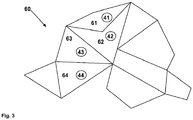
- Figure 3 schematically illustrates a geographical area 60 having a plurality of public safety answering points 41, 42, 43, 44.
- the geographical area 60 is separated or divided in sub-areas 61, 62, 63, 64, wherein each sub-area 61, 62, 63, 64 has a different (individual) public safety answering point 41, 42, 43, 44.
- the detection of the use of one of the test originator identification identifiers and/or test destination identification identifiers is performed by the mobile communication network 100 by means of accessing the database entity 130 or database functionality 130.
- the database entity 130 or database functionality 130 is especially - but not necessarily - located at or accessible via the core network 120 of the mobile communication network 100.
- the database entity 130 or database functionality 130 might be located in or close to the mobile switching center (MSC) or pool of mobile switching centers (MSC pool) that is connected to those base stations where the tests shall be conducted.
- normal or operative calls are processed by the mobile communication system 100 as if no test calls were present or performed.
- This normal or operative routing especially involves - in case that the operative call is an emergency call - one of the plurality of public safety answering points 40 or the plurality of public safety answering point functionalities 40 within or associated with the mobile communication network 100.
- a test originator identification identifier and/or a test destination identification identifier is used.
- the use of these pieces of information or these data (being detected in the third step by the mobile communication network 100) enables the mobile communication network 100 to differentiate between a test call and a normal or operative call within the mobile communication network 100.
- test PSAP or another quality assurance simulator
- IVS conformance including MSD data
- end-to-end quality may create a test result documentation (including the originator and authorization data).
- test packet switched eCalls In normal operation, meaning that the call is associated with such a piece of information indicating a test call and this call is not part of the data base and/or the originator of this test packet switched eCall is not authorized, the associated sos-URN (i.e. sos.ecall.manual, sos.ecall.automaitc or any other sos defined for testing purposes) is routed to the appropriate Public Safety Answering Point (PSAP) or handled as required and compliant with national regulation.
- PSAP Public Safety Answering Point
- test packet switched eCalls may, in accordance with local regulation and if required, be routed to a destination which can even be located outside the originating PLMN or other access network (e.g. WLAN).
- the design is also intended to be deployed for legally mandated periodical technical inspections or in the course of normal service interval tests carried out in workshops. In these cases or if otherwise required certificates or the like, can be included in the SIP message and if required stored in the IVS or filed in an appropriate Data-Base.
- the In Vehicle System (IVS) has to be registered to the network.
- IVS In Vehicle System
- the IMSI deployed is known by the network, or the credentials of the SIM Profile are configured so that the IVS is known in the network.
- each Profile can be configured in a way that the credentials associated with each profile allow to register to the network.
- the information added to indicate a Test PS-eCall of each such profile have to be part of the Data Base.
- the profile which is active when placing the emergency call can be identified, and handled as required according to predefined conditions.
- Test PS-eCalls and operational PS-eCalls is based on the analysis of these predetermined pieces of information (i.e. the test originator identification identifier(s) and/or the test destination identification identifier(s)) to indicate a test call used in the PS-eCall and the related SIMs used.
- predetermined pieces of information i.e. the test originator identification identifier(s) and/or the test destination identification identifier(s)
- the solution is based on commercial packet switched mobile networks. It is not necessary to set up and operate dedicated radio access test networks. Agreements for the use of frequencies for the purpose of carrying out crash tests and additional preparation and time which might be necessary to allocate frequencies for the duration of the tests are not necessary. The risk that Test PS-eCalls are routed towards an operational PSAP are limited.
- a specific signaling bit is introduced in the SIP message.
- the IVS is initiating a Test IMS PS-eCall to an appropriate sos URN (e.g. (i.e. sos.ecall.manual, sos.ecall.automaitc or any other sos URN defined for testing purposes), and the IMS network and/or the EPC network of the local Network recognize that new information (such as, e.g., the specific signalling bit) is added to indicate a Test PS-eCall and that the sos URN of the Test PS-eCall is part of the specified Data Base.
- an appropriate sos URN e.g. (i.e. sos.ecall.manual, sos.ecall.automaitc or any other sos URN defined for testing purposes)
- new information such as, e.g., the specific signalling bit
- Test PS-eCall Processing of a Test PS-eCall depending on the new information added to indicate a Test-eCall and/or originator authorization: If the pieces of information are not part of the data base and/or not authorized, the call is routed to the normally responsible PSAP; if the pieces of information are part of the data base and/or are authorized, the call is routed to a pre-defined destination, such as a public safety answering point simulator.
- a PSAP-Simulator takes the Test PS-eCall and can optionally verify the originator and document the Test results, providing the possibility of PS eCAll compliance testing of either IVS and/or Network and/or PSAP.
Landscapes
- Engineering & Computer Science (AREA)
- Computer Networks & Wireless Communication (AREA)
- Signal Processing (AREA)
- Mobile Radio Communication Systems (AREA)
Abstract
wherein the method comprises the following steps:
-- in a first step, at least one test originator identification identifier and/or test destination identification identifier is defined for being used to perform the test of the emergency call or quality management system or the emergency call or quality management functionality using the at least one test mobile communication device,
-- in a second step, subsequent to the first step, a test call is initiated or performed using the at least one test mobile communication device and the at least one test originator identification identifier and/or test destination identification identifier - the at least one test originator identification identifier and/or test destination identification identifier having been assigned to or having been associated to the at least one test mobile communication device-,
-- in a third step, subsequent to the second step, the use of the at least one test originator identification identifier and/or test destination identification identifier-while initiating or performing the test call - is detected by the mobile communication network.
Description
- The present invention relates to a method for performing a test of an emergency call or quality management system or an emergency call or quality management functionality, wherein the emergency call or quality management system or the emergency call or quality management functionality is used with a mobile communication network, at least one mobile communication device or user equipment being connected to the mobile communication network, and the mobile communication network comprising or being associated with a plurality of public safety answering points or a plurality of public safety answering point functionalities or especially one or a plurality of quality management test call endpoint(s).
- Furthermore, the present invention relates to a mobile communication network for performing a test of an emergency call or quality management system or an emergency call or quality management functionality, wherein the emergency call or quality management system or the emergency call or quality management functionality is used with a mobile communication network, at least one mobile communication device or user equipment being connected to the mobile communication network, and the mobile communication network comprising or being associated with a plurality of public safety answering points or a plurality of public safety answering point functionalities or especially one or a plurality of quality management test call endpoint(s).
- Additionally, the present invention relates to a system for performing end-to-end testing of an emergency call or quality management system or an emergency call or quality management functionality, wherein the emergency call or quality management system or the emergency call or quality management functionality is used with a mobile communication network as part of the system, wherein the system also comprises at least one mobile communication device or user equipment and at least one test mobile communication device, the at least one mobile communication device or user equipment being connected to the mobile communication network, and the mobile communication network comprising or being associated with a plurality of public safety answering points or a plurality of public safety answering point functionalities or especially one or a plurality of quality management test call endpoint(s).
- Furthermore, the present invention relates to a program and to a computer program product for performing a test of an emergency call or quality management system or an emergency call or quality management functionality.
- In order to certify interoperability of implementations of emergency call or quality management functionalities, such as, e.g., eCall implementations, tests of such emergency call or quality management functionalities (especially eCall implementations or end-of-production quality checks or quality assurances) - especially conformance tests - have to be conducted, proving compliance, interoperability and essential performance criteria.
- One possibility to conduct such interoperability tests (especially relating to the first generation eCall which is based on circuit switched (CS) emergency calls) is to use a radio test-bed which is typically distinct from the surrounding operating radio networks or mobile communications networks. Hence, such an approach is based on the use of a system simulator that replicates an access and core network of a mobile communications network, or at least parts thereof. In such a test-bed of a mobile communications network, test calls are conducted in order to test the implemented functionalities.
- This approach is feasible in surroundings that are sufficiently electromagnetically shielded or separated from the environment. In cases where this cannot be ascertained, there are a number of risks, including that such test calls are not connected to the simulator with the needed reliability and/or that the test calls run the risk to be connected to one of the surrounding operational networks and/or - vice versa - that real emergency calls or quality management calls are connected to the simulator in the test-bed environment (and not to the operative mobile communication network).
- An object of the present invention is to provide a technically simple, effective and especially cost effective solution for performing end-to-end testing of an emergency call or quality management system or an emergency call or quality management functionality in a cost-effective manner and such that testing is able to be realized easily at different locations, and with a minimum risk of false routing of the involved test calls.
- The object of the present invention is achieved by a method for performing a test of an emergency call or quality management system or an emergency call or quality management functionality, wherein the emergency call or quality management system or the emergency call or quality management functionality is used with a mobile communication network, at least one mobile communication device or user equipment being connected to the mobile communication network, wherein the mobile communication network comprises an access network, a core network, and a plurality of base station entities, and the mobile communication network comprising or being associated with a plurality of public safety answering points or a plurality of public safety answering point functionalities or especially one or a plurality of quality management test call endpoint(s),
wherein the at least one mobile communication device or user equipment is an operative mobile communication device or user equipment, being used operatively with the mobile communication network, and having an operative device identification identifier and/or an operative subscription identification identifier assigned or related to the at least one mobile communication device or user equipment (especially also using an operative originator identification identifier and/or an operative destination identification identifier for performing emergency calls),
wherein at least one test mobile communication device is simultaneously connected to the mobile communication network, the at least one test mobile communication device, being used - with at least a part of the mobile communication network - for performing the test of the emergency call or quality management system or the emergency call or quality management functionality,
wherein the mobile communication network is a packet switched network and the emergency call or quality management system or the emergency call or quality management functionality is configured to handle IP multimedia subsystem based packet switched emergency calls and/or session initiation protocol based packet switched emergency calls,
wherein the method comprises the following steps: - -- in a first step, at least one test originator identification identifier and/or at least one test destination identification identifier is defined for being used to perform the test of the emergency call or quality management system or the emergency call or quality management functionality using the at least one test mobile communication device,
- -- in a second step, subsequent to the first step, a test call is initiated or performed using the at least one test mobile communication device and the at least one test originator identification identifier and/or the at least one test destination identification identifier- the at least one test originator identification identifier and/or the at least one test destination identification identifier having been assigned to or having been associated to the at least one test mobile communication device -,
- -- in a third step, subsequent to the second step, the use of the at least one test originator identification identifier and/or the at least one test destination identification identifier- while initiating or performing the test call - is detected by the mobile communication network.
- It is thereby advantageously possible according to the present invention to enable tests, especially for eCall in-vehicle-systems built into cars. According to the present invention, it is also advantageously possible to take into account NIS ERA GLONASS tests in non-Russian countries. Furthermore, it is advantageously possible according to the present invention that a high dynamic range is provided for different realistic test cases. Furthermore, it is especially advantageous to easily realize such end-to-end system (or functionality) verification tests, especially for emergency call or quality management test call related functionalities, at different locations, in a cost efficient manner and with a minimized risk for a false routing of the test calls.
- While first generation eCall is based on Circuit Switched (CS) emergency calls (Teleservice 12), typically using an in-band modem, optimized for 2G (GSM) and 3G (UMTS) circuit-switched networks, a packet switched (PS) eCall based and implemented on packet switched networks (e.g. WLAN, 4G and in future 5G IP based mobile networks), deploying the IP Multimedia Subsystem (IMS) emergency call framework, is standardized in 3GPP.
- According to the present invention, the mobile communication network is a packet switched network and the emergency call or quality management system or the emergency call or quality management functionality is configured to handle IP multimedia subsystem based packet switched emergency calls and/or session initiation protocol based packet switched emergency calls.
- According to the present invention, it is assumed that an operative mobile communication network - serving "real" customers or users, typically using (operative) user equipments or (operative) mobile communication devices - exists within a certain geographical area. Hence, in order to operatively using such (operative) mobile communication device or (operative) user equipment, an operative device identification identifier and/or an operative subscription identification identifier is assigned or related to each of these (operative) mobile communication devices or (operative) user equipments. In cases that such (operative) user equipments or (operative) mobile communication devices are conducting an emergency call, it is especially preferred that an operative originator identification identifier (and, hence, not a test originator identification identifier) and/or an operative destination identification identifier (and, hence, not a test destination identification identifier) is used for performing such emergency calls.
- Furthermore, it is assumed according to the present invention that at least one test mobile communication device is simultaneously connected to the mobile communication network (operatively working with the at least one (operative) mobile communication device or (operative) user equipment, but typically working with a plurality of (operative) mobile communication devices or (operative) user equipments), the at least one test mobile communication device, being used - with at least a part of the mobile communication network - for performing a test of the emergency call or quality management system or the emergency call or quality management functionality.
- According to the present invention, in a first step, at least one test originator identification identifier and/or at least one test destination identification identifier is defined for being used to perform the test of the emergency call or quality management system or the emergency call or quality management functionality using the at least one test mobile communication device. However, typically, a plurality of different test originator identification identifiers and/or test destination identification identifiers is defined. In order to perform the test of the emergency call or quality management system or the emergency call or quality management functionality, a test call needs to be initiated or performed in a second step. According to the present invention, such test calls are exclusively initiated or performed using the at least one test originator identification identifier and/or test destination identification identifier (or the plurality of test originator identification identifiers and/or test destination identification identifiers) together with the corresponding test mobile communication device. In a third step, the use - while initiating or performing the test call - of the at least one test originator identification identifier and/or test destination identification identifier is detected by the mobile communication network.
- According to a preferred embodiment of the present invention, the detection of the use of the at least one test originator identification identifier and/or test destination identification identifier is performed by the mobile communication network by means of accessing a database entity or database functionality, especially located at or accessible via the core network of the mobile communication network.
- Thereby, it is advantageously possible according to the present invention to easily and detect the use of the test originator identification identifier and/or test destination identification identifier (or one of the plurality of the test originator identification identifiers and/or test destination identification identifiers), and, hence, to detect such test calls, and differentiate those from "normal" calls (initiated or performed by (operative) mobile communication devices and/or user equipment also present (and active) - along with the test mobile communication device or the plurality of test mobile communication devices - within the (operative) mobile communication network).
- According to the present invention it is furthermore preferred that the test of the emergency call or quality management system or the emergency call or quality management functionality is an end-to-end test.
- It is thereby advantageously possible to provide end-to-end testing of the emergency call or quality management system or the emergency call or quality management functionality.
- According to the present invention it is furthermore preferred that the database entity or database functionality comprises a set of test originator identification identifiers and/or a set of test destination identification identifiers, the identifiers of the set of test originator identification identifiers and/or of the set of test destination identification identifiers being used to perform the test of the emergency call or quality management system or the emergency call or quality management functionality using the at least one test mobile communication device.
- It is thereby advantageously possible to use the test device originator identification identifiers and/or test destination identification identifiers of the set with one or a plurality of test mobile communication devices such that complex and realistic test scenarios are possible to be implemented in an easy and straightforward manner.
- According to the present invention it is furthermore preferred that the test call is detected to be a test call by means of determining:
- -- whether a call involves the use of the at least one test destination identification identifier, and/or
- -- whether a call involves the use of the at least one test originator identification identifier.
- It is thereby advantageously possible to implement different test cases and test scenarios.
- According to a further preferred embodiment of the present invention, the test destination identification identifier corresponds to a signalling bit, especially as part of a SIP message, and especially as part of the header of a SIP message, or as part of an XML body of a SIP message and/or wherein the test destination identification identifier corresponds to a test emergency uniform resource name, and/or
wherein the test originator identification identifier corresponds to a specific test packet switched emergency call originator, and/or
wherein the test originator identification identifier corresponds to or comprises a signature information, especially a signature information specific to the test packet switched emergency call originator. - Thereby, it is advantageously possible to very easily and unambigously detect a test call, and differentiate it from a non-test call (i.e. an operative call).
- According to the present invention, a new test packet switched emergency call concept is enables for IMS/SIP based packet switched emergency call (eCall) deployment scenarios used in packet switched networks (like 4G/LTE/WLAN and in future 5G mobile networks). This includes compatibility tests or conformance tests (e.g. regarding SIP signaling, MSD (minimum set of data) data structure and end-to-end functional tests for type approval) as well as the end-to-end quality assurance at the end of the production line, also taking into account NIS ERA GLONASS tests in non-Russian countries deploying the IMS service core.
- Especially, the invention is based on the analysis of a piece of information that is specifically used in the packet switched IMS service core network to indicate a test PS-eCall (test destination identification identifier) and/or a piece of information (test originator identification identifier) that is specific of the originator of this test call. Optionally, the indication of a test PS-eCall and/or the identity of the originator can be secured by encryption data (e.g. a digital signature) to verify the identity and validate the authorization for test PS-eCalls.
- According to the present invention, this piece of information can, e.g., be included in a SIP header and/or in an XML body of a message (e.g. the initial SIP INVITE message) used for the IMS based PS-eCall. Based on the analysis of this piece of information, a specific routing - depending on the test PS-eCall indication (test destination identification identifier) and/or originator of the Test PS-eCall (test originator identification identifier) - can be applied in the IMS service core network. To identify and handle these test PS-eCalls, sos-URNs (such as, e.g., "sos.ecall.manual", "sos.ecall.automaitc" or any other sos URN being defined for testing purposes) or additionally provided data to the XML body and/or SIP message associated with the test PS-eCalls are analyzed. This deployed data is stored in a data base which is interrogated and connected to the PS-eCall session setup to distinguish the test eCalls from operational emergency calls.
- In case the analysis of the relevant data or pieces of information reveals that a test destination identification identifier and/or a test originator identification identifier is used (i.e. is part of the defined pool (or set) of such identifiers in the database), then the call (detected as being a test call) is routed to a predefined destination, and the call is referred to as test call.
- While it might be recommended to define the pool (of test destination identification identifier and/or a test originator identification identifier) once (and keep it unchanged for the purposes of a specific test or a specific number of tests), it is also possible - according to an alternative variant of the present invention - to update or extend the set (or pool) of test destination identification identifier and/or a test originator identification identifier as necessary.
- According to a further preferred embodiment of the present invention, - upon detection of the use of the at least one test originator identification identifier and/or test destination identification identifier while initiating or performing the test call - the test call is specifically routed, within the mobile communication network, in order to perform the test of the emergency call or quality management system or the emergency call or quality management functionality, this specific routing especially involving at least one test public safety answering point or a plurality of test public safety answering point functionality within or associated with the mobile communication network.
- Thereby, it is advantageously possible that a detected test call is handled differently (by means of applying a specific routing) by the mobile communication network, compared to a "normal" or operative call.
- According to still a further preferred embodiment of the present invention, in case that - regarding an operative call - an operative destination identification identifier and/or an operative originator identification identifier, assigned or related to the at least one mobile communication device or user equipment, is detected in a fourth step prior, during or subsequent to the second and/or the third step, the operative call is routed, within the mobile communication network, in a normal or operative manner, this normal or operative routing especially involving - in case that the operative call is an emergency call - one of the plurality of public safety answering points or the plurality of public safety answering point functionalities within or associated with the mobile communication network.
- Thereby, it is advantageously possible that normal or operative calls are not influenced by conducting the end-to-end testing of the emergency call or quality management system or the emergency call or quality management functionality.
- According to a further preferred embodiment of the present invention, the at least one test mobile communication device is part of or corresponds to an in-vehicle-system and/or wherein the emergency call or quality management system or the emergency call or quality management functionality is an eCall emergency call system and/or a NIS ERA GLONASS emergency system.
- Thereby, it is advantageously possible to perform a multitude of different test cases or test scenarios.
- According to still a further embodiment of the present invention, both in case of the test call or test calls as well as in case of the operative call or operative calls an identical public land mobile network identifier, PLMN ID, and/or identical radio transmission frequencies and/or time slots are used.
- Thereby it is advantageously possible according to the present invention to strongly reduce the impact of performing the end-to-end tests in an operating mobile communication network.
- Furthermore, the present invention relates to a mobile communication network for performing a test of an emergency call or quality management system or an emergency call or quality management functionality, wherein the emergency call or quality management system or the emergency call or quality management functionality is used with a mobile communication network, at least one mobile communication device or user equipment being connected to the mobile communication network, wherein the mobile communication network comprises an access network, a core network, and a plurality of base station entities, and the mobile communication network comprising or being associated with a plurality of public safety answering points or a plurality of public safety answering point functionalities or especially one or a plurality of quality management test call endpoint(s),
wherein the at least one mobile communication device or user equipment is an operative mobile communication device or user equipment, being used operatively with the mobile communication network, and having an operative device identification identifier and/or an operative subscription identification identifier assigned or related to the at least one mobile communication device or user equipment (especially as well as using an operative originator identification identifier and/or an operative destination identification identifier for performing emergency calls),
wherein at least one test mobile communication device is simultaneously connected to the mobile communication network, the at least one test mobile communication device, being used - with at least a part of the mobile communication network - for performing the test of the emergency call or quality management system or the emergency call or quality management functionality,
wherein the mobile communication network is a packet switched network and the emergency call or quality management system or the emergency call or quality management functionality is configured to handle IP multimedia subsystem based packet switched emergency calls and/or session initiation protocol based packet switched emergency calls,
wherein the mobile communication system is configured such as: - -- at least one test originator identification identifier and/or at least one test destination identification identifier is defined for being used to perform the test of the emergency call or quality management system or the emergency call or quality management functionality using the at least one test mobile communication device,
- -- upon a test call being initiated or performed using the at least one test mobile communication device and the at least one test originator identification identifier and/or test destination identification identifier - the at least one test originator identification identifier and/or test destination identification identifier having been assigned to or having been associated to the at least one test mobile communication device -,
- -- the use of the at least one test originator identification identifier and/or test destination identification identifier - while initiating or performing the test call - is detected by the mobile communication network.
- Thereby, it is advantageously possible to provide a mobile communication network such that a high dynamic range is provided for different realistic test cases. Furthermore, it is especially advantageous to easily realize tests, especially such end-to-end system (or functionality) verification tests, especially for emergency call related functionalities or quality management related functionalities, at different locations, in a cost efficient manner and with a minimized risk for a false routing of the test calls.
- According to a further preferred embodiment of the present invention - especially with respect to the inventive mobile communication network -, the mobile communication network is configured such that the detection of the use of the at least one test originator identification identifier and/or test destination identification identifier is performed by the mobile communication network by means of accessing a database entity or database functionality, especially located at or accessible via the core network of the mobile communication network, wherein especially the database entity or database functionality comprises a set of test originator identification identifiers and/or test destination identification identifiers, the identifiers of the set of test originator identification identifiers and/or test destination identification identifiers being used to perform the test of the emergency call or quality management system or the emergency call or quality management functionality using the at least one test mobile communication device.
- Furthermore, the present invention relates to a system for performing a test of an emergency call or quality management system or an emergency call or quality management functionality, wherein the emergency call or quality management system or the emergency call or quality management functionality is used with a mobile communication network as part of the system, wherein the system also comprises at least one mobile communication device or user equipment and at least one test mobile communication device, the at least one mobile communication device or user equipment being connected to the mobile communication network, wherein the mobile communication network comprises an access network, a core network, and a plurality of base station entities, and the mobile communication network comprising or being associated with a plurality of public safety answering points or a plurality of public safety answering point functionalities or especially one or a plurality of quality management test call endpoint(s),
wherein the at least one mobile communication device or user equipment is an operative mobile communication device or user equipment, being used operatively with the mobile communication network, and having an operative device identification identifier and/or an operative subscription identification identifier assigned or related to the at least one mobile communication device or user equipment (especially as well as using an operative originator identification identifier and/or an operative destination identification identifier for performing emergency calls),
wherein the at least one test mobile communication device is simultaneously connected to the mobile communication network, the at least one test mobile communication device, being used - with at least a part of the mobile communication network - for performing the test of the emergency call or quality management system or the emergency call or quality management functionality,
wherein the mobile communication network is a packet switched network and the emergency call or quality management system or the emergency call or quality management functionality is configured to handle IP multimedia subsystem based packet switched emergency calls and/or session initiation protocol based packet switched emergency calls, - wherein the system is configured such as:
- -- at least one test originator identification identifier and/or test destination identification identifier is defined for being used to perform the test of the emergency call or quality management system or the emergency call or quality management functionality using the at least one test mobile communication device,
- -- upon a test call being initiated or performed using the at least one test mobile communication device and the at least one test originator identification identifier and/or test destination identification identifier - the at least one test originator identification identifier and/or test destination identification identifier having been assigned to or having been associated to the at least one test mobile communication device -,
- -- the use of the at least one test originator identification identifier and/or test destination identification identifier - while initiating or performing the test call - is detected by the mobile communication network.
- Additionally, the present invention relates to a program comprising a computer readable program code which, when executed on a computer and/or on a component of a mobile communication network, causes the computer and/or the component of a mobile communication network to perform the inventive method.
- Still additionally, the present invention relates to a computer program product for performing the test of an emergency call or quality management system or an emergency call or quality management functionality, the computer program product comprising a computer program stored on a storage medium, the computer program comprising program code which, when executed on a computer and/or on a component of a mobile communication network, causes the computer and/or the component of a mobile communication network to perform the inventive method.
- These and other characteristics, features and advantages of the present invention will become apparent from the following detailed description, taken in conjunction with the accompanying drawings, which illustrate, by way of example, the principles of the invention. The description is given for the sake of example only, without limiting the scope of the invention. The reference figures quoted below refer to the attached drawings.
-
-
Figure 1 schematically illustrate a mobile communication network having a plurality of base station entities and a plurality of mobile communication devices (or user equipments). -
Figure 2 schematically illustrates an operative mobile communication device or user equipment being used, within the mobile communication network, especially for emergency calls, and a test mobile communication device being also used, within the mobile communication network, especially for emergency calls. -
Figure 3 schematically illustrates a geographical area having a plurality of public safety answering points, wherein the geographical area is separated or divided in sub-areas, each sub-area having a different public safety answering point. - The present invention will be described with respect to particular embodiments and with reference to certain drawings but the invention is not limited thereto but only by the claims. The drawings described are only schematic and are nonlimiting. In the drawings, the size of some of the elements may be exaggerated and not drawn on scale for illustrative purposes.
- Where an indefinite or definite article is used when referring to a singular noun, e.g. "a", "an", "the", this includes a plural of that noun unless something else is specifically stated.
- Furthermore, the terms first, second, third and the like in the description and in the claims are used for distinguishing between similar elements and not necessarily for describing a sequential or chronological order. It is to be understood that the terms so used are interchangeable under appropriate circumstances and that the embodiments of the invention described herein are capable of operation in other sequences than described or illustrated herein.
- In
Figure 1 , amobile communication network 100, especially a public landmobile network 100, is schematically shown, themobile communication network 100 comprising anaccess network 110 and acore network 120. Themobile communication network 100 is preferably a cellular telecommunications network comprising typically a plurality of network cells (or radio cells), wherein two network cells (or radio cells) are represented inFigure 1 by means ofreference signs mobile communication network 100 typically comprises a plurality of user equipments or mobile communication devices. The plurality of user equipments or of mobile communication devices are referred to by means ofreference signs reference sign 20 refers to a operative mobile communication device or user equipment, andreference sign 30 refers to a test mobile communication device. Theaccess network 110 of themobile communication network 100 comprises, in the exemplary representation ofFigure 1 , a firstbase station entity 111, serving the (first)radio cell 11. Furthermore, a secondbase station entity 112, serving the neighbor (second)radio cell 12, is schematically shown. Thebase station entities - According to the present invention, a test (especially an end-to-end test) of an emergency call or quality management system or of an emergency call or quality management functionality is able to be conducted within the
mobile communication network 100 wherein themobile communication network 100 is both used in an operative manner - serving operative mobile communication devices or user equipments 30 -, and for testing purposes - serving testmobile communication devices 20. In order to be able to execute emergency calls or quality management test calls, themobile communication network 100 typically comprises or is associated with a plurality of public safety answering points 40 or a plurality of public safetyanswering point functionalities 40 or quality management test call endpoints. Each of such public safety answering points 40 is typically related (or assigned) to a specific part or sub-area of the (total) geographical area served by themobile communication network 100. - According to the present invention, at least one mobile communication device or user equipment 20 (but typically a plurality of such mobile communication devices or user equipments) is (are) operatively used within the
mobile communication network 100, hence, an operative device identification identifier and/or an operative subscription identification identifier being assigned or related to typically each of the at least one mobile communication device oruser equipment 20. Additionally, at least one test mobile communication device 30 (but likewise typically a plurality of such test mobile communication devices or user equipments 30) is simultaneously connected to themobile communication network 100 in order to be used - with at least a part of the mobile communication network - for performing testing (especially end-to-end testing) of the emergency call or quality management system or the emergency call or quality management functionality. According to the present invention, the test mobile communication device 30 (but likewise typically a plurality of such test mobile communication devices or user equipments 30) is also assigned (as each mobile communication device or user equipment within the mobile communication network 100) to a device identification identifier and/or a subscription identification identifier. According to the present invention, the (operative) device identification identifier(s) and the (operative) subscription identification identifier(s) (assigned touser equipments 20 being operatively used within the mobile communication network 100) on the one hand, and the (operative) device identification identifier(s) and the (operative) subscription identification identifier(s) (assigned touser equipments 20 being operatively used within the mobile communication network 100) on the other hand, correspond to "normal" or operative device identification identifier(s) and/or subscription identification identifier(s), i.e. such identifers assigned tooperative user equipments 20 compared to testuser equipments 30 do not differ specifically and/or are not treated differently in the context of either an operative emergency call or a test emergency call. According to the present invention, the differentiation between such operative emergency calls and test emergency call is done based on whether a test originator identification identifier and/or a test destination identification identifier is used or whether a test originator identification identifier and/or a test destination identification identifier is used instead of a an operative originator identification identifier or an operative destination identification identifier. - According to the inventive method, in a first step, at least one test originator identification identifier and/or at least one test destination identification identifier is defined for being used to perform the test of the emergency call or quality management system or the emergency call or quality management functionality using the at least one test mobile communication device. Typically, a plurality of such test identifiers are used - such as a set or a pool of such test originator identification identifiers and/or a set or a pool of such test destination identification identifiers. According to the present invention, the set or pool of such test originator identification identifiers and/or test destination identification identifiers are stored in a
database entity 130, depicted inFigure 1 schematically and exemplarily as part of thecore network 120 of themobile communication network 100. In case that a test call is initiated or performed (in a second step, i.e. subsequent to the first step) using the at least one test originator identification identifier and/or test destination identification identifier (or one of the plurality of test originator identification identifiers and/or test destination identification identifiers) - typically using a test mobile communication device 30 -, the use of the at least one test originator identification identifier and/or test destination identification identifier is detected (in a third step, i.e. while initiating or performing the test call) by themobile communication network 100, and hence, it is possible to differentiate a test call from a normal or operative call within themobile communication network 100. - The present invention also refers to the context of the pan European eCall system and the ERA GLONASS system. In the following, both systems are referred to as eCall unless otherwise specified. These systems enhance traditional emergency call systems using emergency call numbers such as the emergency number "112". eCalls are either generated manually or automatically. While the first generation eCall is based on circuit switched (CS) emergency calls (Teleservice 12) and an in-band modem optimized for 2G (GSM) and 3G (UMTS) CS networks, a packet switched (PS) eCall based and implemented on packet switched networks (e.g. like WLAN, 4G and in future 5G IP based mobile networks), deploying the IP Multimedia Subsystem (IMS) emergency call framework, is standardized in 3GPP.
- When activating a voice connection with the most appropriate Public Safety Answering Point (PSAP) at the same time a minimum set of data (MSD) is sent to the PSAP.
- The MSD contains vital data such as the location of the vehicle using GNSS (GLONASS, GPS, and Galileo), incident time and Vehicle Identification Number (VIN).
- Whereas circuit switched (CS) eCall is piggybacking on 112 emergency voice calls by muting the voice channel for the time needed to transmit the MSD modulated by an In-Band Modem over the voice channel, a PS eCall is based on sos-URNs distinguishing manual / automatic emergency eCalls whereas the MSD is transported via SIP signaling. Hence, such tests to prove compliance for PS eCall (e.g. for vehicle type approval and quality assurance purposes at the end of the production line) are clearly distinct from those which are necessary for CS based eCall tests.
- According to the present invention, a dedicated test design for the PS based eCall type-approval and quality assurance is provided.
- By setting up an eCall, a voice connection with the most appropriate (i.e. typically serving a specific geographical area or sub-area) public safety answering point (PSAP) is established. At the same time, a minimum set of data (MSD) is sent to the respective public safety answering point receiving the voice call. The MSD contains vital data such as the location of the vehicle using a global navigation satellite system (such as GLONASS, GPS, or Galileo), incident time and vehicle description.
- The eCall domains comprise the car domain which has to be equipped with an In-Vehicle-System (IVS), corresponding to a radio stack which, in case of emergency, sets up a voice call and transmits the emergency related data. In addition the IVS comprises a GNSS based positioning system to determine the current location of the vehicle. Furthermore, the eCall domains comprise a network domain to transport the data.
-
Figure 2 schematically illustrates an operative mobile communication device oruser equipment 20 being used, within themobile communication network 100, especially for emergency calls or quality management test calls. In case of the operative mobile communication device oruser equipment 20 is used to conduct an emergency call or a quality management test call, the call is routed to one of a plurality of public safety answering points 40 or to a quality management test call endpoint. InFigure 2 , four individual public safety answering points, a first publicsafety answering point 41, a second publicsafety answering point 42, a third publicsafety answering point 43, and a fourth publicsafety answering point 44 are schematically represented. Which individual public safety answering point is used for a specific emergency call of the operative mobile communication device oruser equipment 20 typically depends where the operative mobile communication device oruser equipment 20 is located. Furthermore,figure 2 schematically illustrates a testmobile communication device 30 being also used, within themobile communication network 100, especially for emergency calls. Such test calls, especially test emergency calls are directed to a test publicsafety answering point 50, comprising - in the exemplary situation represented inFigure 2 - one individual test publicsafety answering point 51. -
Figure 3 schematically illustrates ageographical area 60 having a plurality of public safety answering points 41, 42, 43, 44. Thegeographical area 60 is separated or divided in sub-areas 61, 62, 63, 64, wherein each sub-area 61, 62, 63, 64 has a different (individual) publicsafety answering point - According to the present invention, it is preferred that the detection of the use of one of the test originator identification identifiers and/or test destination identification identifiers is performed by the
mobile communication network 100 by means of accessing thedatabase entity 130 ordatabase functionality 130. Thedatabase entity 130 ordatabase functionality 130 is especially - but not necessarily - located at or accessible via thecore network 120 of themobile communication network 100. Alternatively (not depicted inFigure 1 ), thedatabase entity 130 ordatabase functionality 130 might be located in or close to the mobile switching center (MSC) or pool of mobile switching centers (MSC pool) that is connected to those base stations where the tests shall be conducted. - According to the present invention, normal or operative calls are processed by the
mobile communication system 100 as if no test calls were present or performed. This means that - regarding an operative call - in case that neither a test originator identification identifier nor a test destination identification identifer is detected (and/or in case that the use of an operative originator identification identifier and/or of an operative destination identification identifier is detected in a fourth step prior, during or subsequent to the second and/or third step, the operative call is routed, within themobile communication network 100, in a normal or operative manner. This normal or operative routing especially involves - in case that the operative call is an emergency call - one of the plurality of public safety answering points 40 or the plurality of public safetyanswering point functionalities 40 within or associated with themobile communication network 100. - In case that a test call shall be initiated (in the second step, subsequent to the first step), a test originator identification identifier and/or a test destination identification identifier is used. The use of these pieces of information or these data (being detected in the third step by the mobile communication network 100) enables the
mobile communication network 100 to differentiate between a test call and a normal or operative call within themobile communication network 100. - Hence, in case these data (or pieces of information) indicating a Test PS-eCall are associated with that PS-eCall and this emergency session is part of the Data-Base and/or the originator of this test-PS-eCall is authorized, the corresponding eCall is routed to a destination (e.g. test PSAP or another quality assurance simulator) which is different to that applicable for operational PS emergency calls (or operative packet switched emergency calls). These calls are referred to as test calls and the test PSAP (or other quality assurance simulator) can verify the IVS conformance (including MSD data), the end-to-end quality and may create a test result documentation (including the originator and authorization data).
- In normal operation, meaning that the call is associated with such a piece of information indicating a test call and this call is not part of the data base and/or the originator of this test packet switched eCall is not authorized, the associated sos-URN (i.e. sos.ecall.manual, sos.ecall.automaitc or any other sos defined for testing purposes) is routed to the appropriate Public Safety Answering Point (PSAP) or handled as required and compliant with national regulation. In contrast, test packet switched eCalls may, in accordance with local regulation and if required, be routed to a destination which can even be located outside the originating PLMN or other access network (e.g. WLAN).
- The design is also intended to be deployed for legally mandated periodical technical inspections or in the course of normal service interval tests carried out in workshops. In these cases or if otherwise required certificates or the like, can be included in the SIP message and if required stored in the IVS or filed in an appropriate Data-Base.
- To initiate a Test PS-eCall, the In Vehicle System (IVS) has to be registered to the network. To ensure that the IVS registers to the network, either the IMSI deployed is known by the network, or the credentials of the SIM Profile are configured so that the IVS is known in the network.
- In case the IVS holds multiple SIM Profiles, the concept foresees that each Profile can be configured in a way that the credentials associated with each profile allow to register to the network. The information added to indicate a Test PS-eCall of each such profile have to be part of the Data Base. By this, the profile which is active when placing the emergency call can be identified, and handled as required according to predefined conditions.
- The separation and routing of Test PS-eCalls and operational PS-eCalls is based on the analysis of these predetermined pieces of information (i.e. the test originator identification identifier(s) and/or the test destination identification identifier(s)) to indicate a test call used in the PS-eCall and the related SIMs used.
- The solution is based on commercial packet switched mobile networks. It is not necessary to set up and operate dedicated radio access test networks. Agreements for the use of frequencies for the purpose of carrying out crash tests and additional preparation and time which might be necessary to allocate frequencies for the duration of the tests are not necessary. The risk that Test PS-eCalls are routed towards an operational PSAP are limited.
- Especially, according to the present invention, a specific signaling bit is introduced in the SIP message. The IVS is initiating a Test IMS PS-eCall to an appropriate sos URN (e.g. (i.e. sos.ecall.manual, sos.ecall.automaitc or any other sos URN defined for testing purposes), and the IMS network and/or the EPC network of the local Network recognize that new information (such as, e.g., the specific signalling bit) is added to indicate a Test PS-eCall and that the sos URN of the Test PS-eCall is part of the specified Data Base.
- Processing of a Test PS-eCall depending on the new information added to indicate a Test-eCall and/or originator authorization: If the pieces of information are not part of the data base and/or not authorized, the call is routed to the normally responsible PSAP; if the pieces of information are part of the data base and/or are authorized, the call is routed to a pre-defined destination, such as a public safety answering point simulator. Such a PSAP-Simulator (or another quality assurance measurement device) takes the Test PS-eCall and can optionally verify the originator and document the Test results, providing the possibility of PS eCAll compliance testing of either IVS and/or Network and/or PSAP.
- The following advantages are realized by means of the present invention:
- -- the solution can be is based on commercial
mobile communication networks 100, - -- it is not necessary to set up and operate dedicated radio test networks,
- -- agreements or arrangements for the use of frequencies for tests (such as crash tests) and additional preparation and time which might be necessary to allocate frequencies for the duration of the tests are not necessary,
- -- it is not necessary to use a dedicated PLMN ID for building up a dedicated test / trial network,
- -- the risk that test calls are routed towards an operational public safety answering point are minimized,
- -- operational emergency calls or quality management test calls are not impeded in proximity to the radio test bed.
Claims (15)
- Method for performing a test of an emergency call or quality management system or an emergency call or quality management functionality, wherein the emergency call or quality management system or the emergency call or quality management functionality is used with a mobile communication network (100), at least one mobile communication device (20) or user equipment (20) being connected to the mobile communication network (100), wherein the mobile communication network (100) comprises an access network (110), a core network (120), and a plurality of base station entities (111, 112), and the mobile communication network (100) comprising or being associated with a plurality of public safety answering points (40) or a plurality of public safety answering point functionalities (40) or especially one or a plurality of quality management test call endpoint(s),
wherein the at least one mobile communication device (20) or user equipment (20) is an operative mobile communication device (20) or user equipment (20), being used operatively with the mobile communication network (100), and having an operative device identification identifier and/or an operative subscription identification identifier assigned or related to the at least one mobile communication device (20) or user equipment (20),
wherein at least one test mobile communication device (30) is simultaneously connected to the mobile communication network (100), the at least one test mobile communication device (30), being used - with at least a part of the mobile communication network (100) - for performing the test of the emergency call or quality management system or the emergency call or quality management functionality,
wherein the mobile communication network (100) is a packet switched network and the emergency call or quality management system or the emergency call or quality management functionality is configured to handle IP multimedia subsystem based packet switched emergency calls and/or session initiation protocol based packet switched emergency calls,
wherein the method comprises the following steps:-- in a first step, at least one test originator identification identifier and/or at least one test destination identification identifier is defined for being used to perform the test of the emergency call or quality management system or the emergency call or quality management functionality using the at least one test mobile communication device (30),-- in a second step, subsequent to the first step, a test call is initiated or performed using the at least one test mobile communication device (30) and the at least one test originator identification identifier and/or the at least one test destination identification identifier - the at least one test originator identification identifier and/or the at least one test destination identification identifier having been assigned to or having been associated to the at least one test mobile communication device (30) -,-- in a third step, subsequent to the second step, the use of the at least one test originator identification identifier and/or the at least one test destination identification identifier - while initiating or performing the test call - is detected by the mobile communication network (100). - Method according to claim 1, wherein the detection of the use of the at least one test originator identification identifier and/or test destination identification identifier is performed by the mobile communication network (100) by means of accessing a database entity (130) or database functionality (130), especially located at or accessible via the core network (120) of the mobile communication network (100).
- Method according to one of the preceding claims, wherein the test of the emergency call or quality management system or the emergency call or quality management functionality is an end-to-end test.
- Method according to one of the preceding claims, wherein the database entity (130) or database functionality (130) comprises a set of test originator identification identifiers and/or a set of test destination identification identifiers, the identifiers of the set of test originator identification identifiers and/or of the set of test destination identification identifiers being used to perform the test of the emergency call or quality management system or the emergency call or quality management functionality using the at least one test mobile communication device (30).
- Method according to one of the preceding claims, wherein the test call is detected to be a test call by means of determining:-- whether a call involves the use of the at least one test destination identification identifier, and/or-- whether a call involves the use of the at least one test originator identification identifier.
- Method according to one of the preceding claims,
wherein the test destination identification identifier corresponds to a signalling bit, especially as part of a SIP message, and especially as part of the header of a SIP message, or as part of an XML body of a SIP message and/or
wherein the test destination identification identifier corresponds to a test emergency uniform resource name, and/or
wherein the test originator identification identifier corresponds to a specific test packet switched emergency call originator, and/or
wherein the test originator identification identifier corresponds to or comprises a signature information, especially a signature information specific to the test packet switched emergency call originator. - Method according to one of the preceding claims, wherein - upon detection of the use of the at least one test originator identification identifier and/or test destination identification identifier while initiating or performing the test call - the test call is specifically routed, within the mobile communication network (100), in order to perform the test of the emergency call or quality management system or the emergency call or quality management functionality, this specific routing especially involving at least one test public safety answering point (50) or a plurality of test public safety answering point functionality (50) within or associated with the mobile communication network (100).
- Method according to one of the preceding claims, wherein, in case that - regarding an operative call - an operative destination identification identifier and/or an operative originator identification identifier, assigned or related to the at least one mobile communication device (20) or user equipment (20), is detected in a fourth step prior, during or subsequent to the second and/or the third step, the operative call is routed, within the mobile communication network (100), in a normal or operative manner, this normal or operative routing especially involving - in case that the operative call is an emergency call - one of the plurality of public safety answering points (40) or the plurality of public safety answering point functionalities (40) within or associated with the mobile communication network (100).
- Method according to one of the preceding claims, wherein the at least one test mobile communication device (30) is part of or corresponds to an in-vehicle-system and/or wherein the emergency call or quality management system or the emergency call or quality management functionality is an eCall emergency call system and/or a NIS ERA GLONASS emergency system.
- Method according to one of the preceding claims, wherein both in case of the test call or test calls as well as in case of the operative call or operative calls an identical public land mobile network identifier, PLMN ID, and/or identical radio transmission frequencies and/or time slots are used.
- Mobile communication network (100) for performing a test of an emergency call or quality management system or an emergency call or quality management functionality, wherein the emergency call or quality management system or the emergency call or quality management functionality is used with a mobile communication network (100), at least one mobile communication device (20) or user equipment (20) being connected to the mobile communication network (100), wherein the mobile communication network (100) comprises an access network (110), a core network (120), and a plurality of base station entities (111, 112), and the mobile communication network (100) comprising or being associated with a plurality of public safety answering points (40) or a plurality of public safety answering point functionalities (40) or especially one or a plurality of quality management test call endpoint(s),
wherein the at least one mobile communication device (20) or user equipment (20) is an operative mobile communication device (20) or user equipment (20), being used operatively with the mobile communication network (100), and having an operative device identification identifier and/or an operative subscription identification identifier assigned or related to the at least one mobile communication device (20) or user equipment (20),
wherein at least one test mobile communication device (30) is simultaneously connected to the mobile communication network (100), the at least one test mobile communication device (30), being used - with at least a part of the mobile communication network (100) - for performing the test of the emergency call or quality management system or the emergency call or quality management functionality,
wherein the mobile communication network (100) is a packet switched network and the emergency call or quality management system or the emergency call or quality management functionality is configured to handle IP multimedia subsystem based packet switched emergency calls and/or session initiation protocol based packet switched emergency calls,
wherein the mobile communication system (100) is configured such as:-- at least one test originator identification identifier and/or at least one test destination identification identifier is defined for being used to perform the test of the emergency call or quality management system or the emergency call or quality management functionality using the at least one test mobile communication device (30),-- upon a test call being initiated or performed using the at least one test mobile communication device (30) and the at least one test originator identification identifier and/or test destination identification identifier - the at least one test originator identification identifier and/or test destination identification identifier having been assigned to or having been associated to the at least one test mobile communication device (30) -,-- the use of the at least one test originator identification identifier and/or test destination identification identifier - while initiating or performing the test call - is detected by the mobile communication network (100). - Mobile communication network (100) according to claim 11, wherein the mobile communication network (110) is configured such that the detection of the use of the at least one test originator identification identifier and/or test destination identification identifier is performed by the mobile communication network (100) by means of accessing a database entity (130) or database functionality (130), especially located at or accessible via the core network (120) of the mobile communication network (100), wherein especially the database entity (130) or database functionality (130) comprises a set of test originator identification identifiers and/or test destination identification identifiers, the identifiers of the set of test originator identification identifiers and/or test destination identification identifiers being used to perform the test of the emergency call or quality management system or the emergency call or quality management functionality using the at least one test mobile communication device (30).
- System for performing a test of an emergency call or quality management system or an emergency call or quality management functionality, wherein the emergency call or quality management system or the emergency call or quality management functionality is used with a mobile communication network (100) as part of the system, wherein the system also comprises at least one mobile communication device (20) or user equipment (20) and at least one test mobile communication device (30), the at least one mobile communication device (20) or user equipment (20) being connected to the mobile communication network (100), wherein the mobile communication network (100) comprises an access network (110), a core network (120), and a plurality of base station entities (111, 112), and the mobile communication network (100) comprising or being associated with a plurality of public safety answering points (40) or a plurality of public safety answering point functionalities (40) or especially one or a plurality of quality management test call endpoint(s),
wherein the at least one mobile communication device (20) or user equipment (20) is an operative mobile communication device (20) or user equipment (20), being used operatively with the mobile communication network (100), and having an operative device identification identifier and/or an operative subscription identification identifier assigned or related to the at least one mobile communication device (20) or user equipment (20),
wherein the at least one test mobile communication device (30) is simultaneously connected to the mobile communication network (100), the at least one test mobile communication device (30), being used - with at least a part of the mobile communication network (100) - for performing the test of the emergency call or quality management system or the emergency call or quality management functionality,
wherein the mobile communication network (100) is a packet switched network and the emergency call or quality management system or the emergency call or quality management functionality is configured to handle IP multimedia subsystem based packet switched emergency calls and/or session initiation protocol based packet switched emergency calls,
wherein the system is configured such as:-- at least one test originator identification identifier and/or test destination identification identifier is defined for being used to perform the test of the emergency call or quality management system or the emergency call or quality management functionality using the at least one test mobile communication device (30),-- upon a test call being initiated or performed using the at least one test mobile communication device (30) and the at least one test originator identification identifier and/or test destination identification identifier - the at least one test originator identification identifier and/or test destination identification identifier having been assigned to or having been associated to the at least one test mobile communication device (30) -,-- the use of the at least one test originator identification identifier and/or test destination identification identifier- while initiating or performing the test call - is detected by the mobile communication network (100). - Program comprising a computer readable program code which, when executed on a computer and/or on a component of a mobile communication network (100), causes the computer and/or the component of a mobile communication network (100) to perform a method according one of claims 1 to 10.
- Computer program product for performing the test of an emergency call or quality management system or an emergency call or quality management functionality, the computer program product comprising a computer program stored on a storage medium, the computer program comprising program code which, when executed on a computer and/or on a component of a mobile communication network (100), causes the computer and/or the component of a mobile communication network (100) to perform a method according one of claims 1 to 10.
Priority Applications (3)
| Application Number | Priority Date | Filing Date | Title |
|---|---|---|---|
| ES17194180T ES2893442T3 (en) | 2017-09-29 | 2017-09-29 | Method for performing a test of an emergency call system, mobile communication network, program and software product |
| PL17194180T PL3462767T3 (en) | 2017-09-29 | 2017-09-29 | Method for performing a test of an emergency call system, mobile communication network, program and computer program product |
| EP17194180.0A EP3462767B1 (en) | 2017-09-29 | 2017-09-29 | Method for performing a test of an emergency call system, mobile communication network, program and computer program product |
Applications Claiming Priority (1)
| Application Number | Priority Date | Filing Date | Title |
|---|---|---|---|
| EP17194180.0A EP3462767B1 (en) | 2017-09-29 | 2017-09-29 | Method for performing a test of an emergency call system, mobile communication network, program and computer program product |
Publications (2)
| Publication Number | Publication Date |
|---|---|
| EP3462767A1 true EP3462767A1 (en) | 2019-04-03 |
| EP3462767B1 EP3462767B1 (en) | 2021-08-11 |
Family
ID=60021909
Family Applications (1)
| Application Number | Title | Priority Date | Filing Date |
|---|---|---|---|
| EP17194180.0A Active EP3462767B1 (en) | 2017-09-29 | 2017-09-29 | Method for performing a test of an emergency call system, mobile communication network, program and computer program product |
Country Status (3)
| Country | Link |
|---|---|
| EP (1) | EP3462767B1 (en) |
| ES (1) | ES2893442T3 (en) |
| PL (1) | PL3462767T3 (en) |
Cited By (3)
| Publication number | Priority date | Publication date | Assignee | Title |
|---|---|---|---|---|
| EP3910991A1 (en) * | 2020-05-15 | 2021-11-17 | Deutsche Telekom AG | Performing a test of an emergency call (or quality management functionality) based on a predefined test identifier used for initiating a corresponding packet-switched call by a test mobile communication device registered with a private or non-public mobile communication network |
| US20250386398A1 (en) * | 2024-06-18 | 2025-12-18 | T-Mobile Usa, Inc. | Techniques for improved emergency test communication routing |
| WO2026025495A1 (en) * | 2024-08-02 | 2026-02-05 | Oppo广东移动通信有限公司 | Communication methods and communication devices |
Citations (3)
| Publication number | Priority date | Publication date | Assignee | Title |
|---|---|---|---|---|
| US20090047925A1 (en) * | 2003-06-24 | 2009-02-19 | Verizon Corporate Services Group Inc. | System and method for evaluating accuracy of an automatic location identification system |
| US20090305722A1 (en) * | 2008-06-04 | 2009-12-10 | Tiedeman Mark J | Method and system for automated collection of call routing performance data in a wireless network |
| US20160029197A1 (en) * | 2014-07-23 | 2016-01-28 | Qualcomm Incorporated | Vehicle-initiated emergency calls |
-
2017
- 2017-09-29 ES ES17194180T patent/ES2893442T3/en active Active
- 2017-09-29 EP EP17194180.0A patent/EP3462767B1/en active Active
- 2017-09-29 PL PL17194180T patent/PL3462767T3/en unknown
Patent Citations (3)
| Publication number | Priority date | Publication date | Assignee | Title |
|---|---|---|---|---|
| US20090047925A1 (en) * | 2003-06-24 | 2009-02-19 | Verizon Corporate Services Group Inc. | System and method for evaluating accuracy of an automatic location identification system |
| US20090305722A1 (en) * | 2008-06-04 | 2009-12-10 | Tiedeman Mark J | Method and system for automated collection of call routing performance data in a wireless network |
| US20160029197A1 (en) * | 2014-07-23 | 2016-01-28 | Qualcomm Incorporated | Vehicle-initiated emergency calls |
Non-Patent Citations (1)
| Title |
|---|
| ETSI: "Mobile Standards Group (MSG); eCall for VoIP", 18 August 2014 (2014-08-18), XP050803969, Retrieved from the Internet <URL:http://www.3gpp.org/ftp/Meetings_3GPP_SYNC/SA1/Docs/update_01/> [retrieved on 20140818] * |
Cited By (3)
| Publication number | Priority date | Publication date | Assignee | Title |
|---|---|---|---|---|
| EP3910991A1 (en) * | 2020-05-15 | 2021-11-17 | Deutsche Telekom AG | Performing a test of an emergency call (or quality management functionality) based on a predefined test identifier used for initiating a corresponding packet-switched call by a test mobile communication device registered with a private or non-public mobile communication network |
| US20250386398A1 (en) * | 2024-06-18 | 2025-12-18 | T-Mobile Usa, Inc. | Techniques for improved emergency test communication routing |
| WO2026025495A1 (en) * | 2024-08-02 | 2026-02-05 | Oppo广东移动通信有限公司 | Communication methods and communication devices |
Also Published As
| Publication number | Publication date |
|---|---|
| PL3462767T3 (en) | 2021-12-20 |
| ES2893442T3 (en) | 2022-02-09 |
| EP3462767B1 (en) | 2021-08-11 |
Similar Documents
| Publication | Publication Date | Title |
|---|---|---|
| CN108605383B (en) | Method and apparatus for performing cell specification procedure for network slice based NR in a wireless communication system | |
| EP3314879B1 (en) | System and method for mitigating emergency call failure | |
| US11729840B2 (en) | Access point name determination for mission critical services | |
| US10097981B1 (en) | Test procedure for a mobile network of an emergency call network | |
| CN113993121B (en) | A method and apparatus for data association of terminal devices | |
| RU2015129521A (en) | METHOD FOR CARRYING OUT COMMUNICATIONS IN A WIRELESS COMMUNICATION SYSTEM, SUPPORTING A MULTIPLE ACCESS NETWORK AND SUPPORTING THIS DEVICE | |
| KR20200028958A (en) | Systems and methods to improve mobility for mobile devices in eCall-only mode | |
| CN108432333B (en) | Method, system and apparatus for providing enhanced call setup via wireless local area network | |
| EP3462767B1 (en) | Method for performing a test of an emergency call system, mobile communication network, program and computer program product | |
| US9271116B1 (en) | Location-based telephone calls over a wireless local area network (WLAN) | |
| EP3216198B1 (en) | Improving voice call performance testing | |
| EP3910991A1 (en) | Performing a test of an emergency call (or quality management functionality) based on a predefined test identifier used for initiating a corresponding packet-switched call by a test mobile communication device registered with a private or non-public mobile communication network | |
| US20170230872A1 (en) | Network switching processing method and device | |
| CN105228155B (en) | A kind of localization method and device of pseudo-base station | |
| CN101330656A (en) | A Method of Tracking According to the Capabilities of Terminals | |
| CN109039676B (en) | Network fault diagnosis method and device and computer readable storage medium | |
| Arnez et al. | Analysis of emergency call tracking in a 4G/LTE mobile network | |
| EP3439353A1 (en) | Method for performing end-to-end testing of an emergency call or quality management system or an emergency call or quality management functionality, mobile communication network, and system, program and computer program product | |
| US10917819B2 (en) | Driveless method to capture CSFB experience | |
| EP4432640B1 (en) | Techniques to prevent spoofing and improvements of ecalls permitting a reliable call-back | |
| KR102369000B1 (en) | Method, apparatus and system for acquisition location of Wi-Fi access terminal in IMS | |
| EP4128681A1 (en) | Interworking of mission critical services with public networks | |
| CN115942251B (en) | A method, apparatus, electronic device, and medium for identifying cross-regional VoWiFi access. | |
| EP4645713A1 (en) | Communication quality checking regarding devices using terrestrial and non-terrestrial communication networks | |
| CN106535172A (en) | Method, apparatus and server for determining to-be-reminded terminal |
Legal Events
| Date | Code | Title | Description |
|---|---|---|---|
| PUAI | Public reference made under article 153(3) epc to a published international application that has entered the european phase |
Free format text: ORIGINAL CODE: 0009012 |
|
| STAA | Information on the status of an ep patent application or granted ep patent |
Free format text: STATUS: THE APPLICATION HAS BEEN PUBLISHED |
|
| AK | Designated contracting states |
Kind code of ref document: A1 Designated state(s): AL AT BE BG CH CY CZ DE DK EE ES FI FR GB GR HR HU IE IS IT LI LT LU LV MC MK MT NL NO PL PT RO RS SE SI SK SM TR |
|
| AX | Request for extension of the european patent |
Extension state: BA ME |
|
| STAA | Information on the status of an ep patent application or granted ep patent |
Free format text: STATUS: REQUEST FOR EXAMINATION WAS MADE |
|
| STAA | Information on the status of an ep patent application or granted ep patent |
Free format text: STATUS: EXAMINATION IS IN PROGRESS |
|
| 17P | Request for examination filed |
Effective date: 20191004 |
|
| RBV | Designated contracting states (corrected) |
Designated state(s): AL AT BE BG CH CY CZ DE DK EE ES FI FR GB GR HR HU IE IS IT LI LT LU LV MC MK MT NL NO PL PT RO RS SE SI SK SM TR |
|
| 17Q | First examination report despatched |
Effective date: 20191029 |
|
| GRAP | Despatch of communication of intention to grant a patent |
Free format text: ORIGINAL CODE: EPIDOSNIGR1 |
|
| STAA | Information on the status of an ep patent application or granted ep patent |
Free format text: STATUS: GRANT OF PATENT IS INTENDED |
|
| INTG | Intention to grant announced |
Effective date: 20201221 |
|
| GRAJ | Information related to disapproval of communication of intention to grant by the applicant or resumption of examination proceedings by the epo deleted |
Free format text: ORIGINAL CODE: EPIDOSDIGR1 |
|
| STAA | Information on the status of an ep patent application or granted ep patent |
Free format text: STATUS: EXAMINATION IS IN PROGRESS |
|
| INTC | Intention to grant announced (deleted) | ||
| GRAP | Despatch of communication of intention to grant a patent |
Free format text: ORIGINAL CODE: EPIDOSNIGR1 |
|
| STAA | Information on the status of an ep patent application or granted ep patent |
Free format text: STATUS: GRANT OF PATENT IS INTENDED |
|
| INTG | Intention to grant announced |
Effective date: 20210527 |
|
| GRAS | Grant fee paid |
Free format text: ORIGINAL CODE: EPIDOSNIGR3 |
|
| GRAA | (expected) grant |
Free format text: ORIGINAL CODE: 0009210 |
|
| STAA | Information on the status of an ep patent application or granted ep patent |
Free format text: STATUS: THE PATENT HAS BEEN GRANTED |
|
| AK | Designated contracting states |
Kind code of ref document: B1 Designated state(s): AL AT BE BG CH CY CZ DE DK EE ES FI FR GB GR HR HU IE IS IT LI LT LU LV MC MK MT NL NO PL PT RO RS SE SI SK SM TR |
|
| REG | Reference to a national code |
Ref country code: CH Ref legal event code: EP |
|
| REG | Reference to a national code |
Ref country code: DE Ref legal event code: R096 Ref document number: 602017043737 Country of ref document: DE |
|
| REG | Reference to a national code |
Ref country code: IE Ref legal event code: FG4D Ref country code: AT Ref legal event code: REF Ref document number: 1420666 Country of ref document: AT Kind code of ref document: T Effective date: 20210915 |
|
| REG | Reference to a national code |
Ref country code: LT Ref legal event code: MG9D |
|
| REG | Reference to a national code |
Ref country code: NL Ref legal event code: MP Effective date: 20210811 |
|
| REG | Reference to a national code |
Ref country code: AT Ref legal event code: MK05 Ref document number: 1420666 Country of ref document: AT Kind code of ref document: T Effective date: 20210811 |
|
| PG25 | Lapsed in a contracting state [announced via postgrant information from national office to epo] |
Ref country code: FI Free format text: LAPSE BECAUSE OF FAILURE TO SUBMIT A TRANSLATION OF THE DESCRIPTION OR TO PAY THE FEE WITHIN THE PRESCRIBED TIME-LIMIT Effective date: 20210811 Ref country code: PT Free format text: LAPSE BECAUSE OF FAILURE TO SUBMIT A TRANSLATION OF THE DESCRIPTION OR TO PAY THE FEE WITHIN THE PRESCRIBED TIME-LIMIT Effective date: 20211213 Ref country code: NO Free format text: LAPSE BECAUSE OF FAILURE TO SUBMIT A TRANSLATION OF THE DESCRIPTION OR TO PAY THE FEE WITHIN THE PRESCRIBED TIME-LIMIT Effective date: 20211111 Ref country code: BG Free format text: LAPSE BECAUSE OF FAILURE TO SUBMIT A TRANSLATION OF THE DESCRIPTION OR TO PAY THE FEE WITHIN THE PRESCRIBED TIME-LIMIT Effective date: 20211111 Ref country code: AT Free format text: LAPSE BECAUSE OF FAILURE TO SUBMIT A TRANSLATION OF THE DESCRIPTION OR TO PAY THE FEE WITHIN THE PRESCRIBED TIME-LIMIT Effective date: 20210811 Ref country code: LT Free format text: LAPSE BECAUSE OF FAILURE TO SUBMIT A TRANSLATION OF THE DESCRIPTION OR TO PAY THE FEE WITHIN THE PRESCRIBED TIME-LIMIT Effective date: 20210811 Ref country code: HR Free format text: LAPSE BECAUSE OF FAILURE TO SUBMIT A TRANSLATION OF THE DESCRIPTION OR TO PAY THE FEE WITHIN THE PRESCRIBED TIME-LIMIT Effective date: 20210811 Ref country code: SE Free format text: LAPSE BECAUSE OF FAILURE TO SUBMIT A TRANSLATION OF THE DESCRIPTION OR TO PAY THE FEE WITHIN THE PRESCRIBED TIME-LIMIT Effective date: 20210811 Ref country code: RS Free format text: LAPSE BECAUSE OF FAILURE TO SUBMIT A TRANSLATION OF THE DESCRIPTION OR TO PAY THE FEE WITHIN THE PRESCRIBED TIME-LIMIT Effective date: 20210811 |
|
| REG | Reference to a national code |
Ref country code: ES Ref legal event code: FG2A Ref document number: 2893442 Country of ref document: ES Kind code of ref document: T3 Effective date: 20220209 |
|
| PG25 | Lapsed in a contracting state [announced via postgrant information from national office to epo] |
Ref country code: LV Free format text: LAPSE BECAUSE OF FAILURE TO SUBMIT A TRANSLATION OF THE DESCRIPTION OR TO PAY THE FEE WITHIN THE PRESCRIBED TIME-LIMIT Effective date: 20210811 Ref country code: GR Free format text: LAPSE BECAUSE OF FAILURE TO SUBMIT A TRANSLATION OF THE DESCRIPTION OR TO PAY THE FEE WITHIN THE PRESCRIBED TIME-LIMIT Effective date: 20211112 |
|
| PG25 | Lapsed in a contracting state [announced via postgrant information from national office to epo] |
Ref country code: NL Free format text: LAPSE BECAUSE OF FAILURE TO SUBMIT A TRANSLATION OF THE DESCRIPTION OR TO PAY THE FEE WITHIN THE PRESCRIBED TIME-LIMIT Effective date: 20210811 |
|
| PG25 | Lapsed in a contracting state [announced via postgrant information from national office to epo] |
Ref country code: DK Free format text: LAPSE BECAUSE OF FAILURE TO SUBMIT A TRANSLATION OF THE DESCRIPTION OR TO PAY THE FEE WITHIN THE PRESCRIBED TIME-LIMIT Effective date: 20210811 |
|
| REG | Reference to a national code |
Ref country code: DE Ref legal event code: R097 Ref document number: 602017043737 Country of ref document: DE |
|
| REG | Reference to a national code |
Ref country code: CH Ref legal event code: PL |
|
| REG | Reference to a national code |
Ref country code: BE Ref legal event code: MM Effective date: 20210930 |
|
| PG25 | Lapsed in a contracting state [announced via postgrant information from national office to epo] |
Ref country code: SM Free format text: LAPSE BECAUSE OF FAILURE TO SUBMIT A TRANSLATION OF THE DESCRIPTION OR TO PAY THE FEE WITHIN THE PRESCRIBED TIME-LIMIT Effective date: 20210811 Ref country code: SK Free format text: LAPSE BECAUSE OF FAILURE TO SUBMIT A TRANSLATION OF THE DESCRIPTION OR TO PAY THE FEE WITHIN THE PRESCRIBED TIME-LIMIT Effective date: 20210811 Ref country code: RO Free format text: LAPSE BECAUSE OF FAILURE TO SUBMIT A TRANSLATION OF THE DESCRIPTION OR TO PAY THE FEE WITHIN THE PRESCRIBED TIME-LIMIT Effective date: 20210811 Ref country code: MC Free format text: LAPSE BECAUSE OF FAILURE TO SUBMIT A TRANSLATION OF THE DESCRIPTION OR TO PAY THE FEE WITHIN THE PRESCRIBED TIME-LIMIT Effective date: 20210811 Ref country code: EE Free format text: LAPSE BECAUSE OF FAILURE TO SUBMIT A TRANSLATION OF THE DESCRIPTION OR TO PAY THE FEE WITHIN THE PRESCRIBED TIME-LIMIT Effective date: 20210811 Ref country code: CZ Free format text: LAPSE BECAUSE OF FAILURE TO SUBMIT A TRANSLATION OF THE DESCRIPTION OR TO PAY THE FEE WITHIN THE PRESCRIBED TIME-LIMIT Effective date: 20210811 Ref country code: AL Free format text: LAPSE BECAUSE OF FAILURE TO SUBMIT A TRANSLATION OF THE DESCRIPTION OR TO PAY THE FEE WITHIN THE PRESCRIBED TIME-LIMIT Effective date: 20210811 |
|
| PLBE | No opposition filed within time limit |
Free format text: ORIGINAL CODE: 0009261 |
|
| STAA | Information on the status of an ep patent application or granted ep patent |
Free format text: STATUS: NO OPPOSITION FILED WITHIN TIME LIMIT |
|
| 26N | No opposition filed |
Effective date: 20220512 |
|
| GBPC | Gb: european patent ceased through non-payment of renewal fee |
Effective date: 20211111 |
|
| PG25 | Lapsed in a contracting state [announced via postgrant information from national office to epo] |
Ref country code: LU Free format text: LAPSE BECAUSE OF NON-PAYMENT OF DUE FEES Effective date: 20210929 Ref country code: IT Free format text: LAPSE BECAUSE OF FAILURE TO SUBMIT A TRANSLATION OF THE DESCRIPTION OR TO PAY THE FEE WITHIN THE PRESCRIBED TIME-LIMIT Effective date: 20210811 Ref country code: IE Free format text: LAPSE BECAUSE OF NON-PAYMENT OF DUE FEES Effective date: 20210929 Ref country code: BE Free format text: LAPSE BECAUSE OF NON-PAYMENT OF DUE FEES Effective date: 20210930 |
|
| PG25 | Lapsed in a contracting state [announced via postgrant information from national office to epo] |
Ref country code: SI Free format text: LAPSE BECAUSE OF FAILURE TO SUBMIT A TRANSLATION OF THE DESCRIPTION OR TO PAY THE FEE WITHIN THE PRESCRIBED TIME-LIMIT Effective date: 20210811 Ref country code: LI Free format text: LAPSE BECAUSE OF NON-PAYMENT OF DUE FEES Effective date: 20210930 Ref country code: CH Free format text: LAPSE BECAUSE OF NON-PAYMENT OF DUE FEES Effective date: 20210930 |
|
| PG25 | Lapsed in a contracting state [announced via postgrant information from national office to epo] |
Ref country code: FR Free format text: LAPSE BECAUSE OF NON-PAYMENT OF DUE FEES Effective date: 20211011 |
|
| PG25 | Lapsed in a contracting state [announced via postgrant information from national office to epo] |
Ref country code: GB Free format text: LAPSE BECAUSE OF NON-PAYMENT OF DUE FEES Effective date: 20211111 |
|
| PG25 | Lapsed in a contracting state [announced via postgrant information from national office to epo] |
Ref country code: CY Free format text: LAPSE BECAUSE OF FAILURE TO SUBMIT A TRANSLATION OF THE DESCRIPTION OR TO PAY THE FEE WITHIN THE PRESCRIBED TIME-LIMIT Effective date: 20210811 |
|
| PG25 | Lapsed in a contracting state [announced via postgrant information from national office to epo] |
Ref country code: HU Free format text: LAPSE BECAUSE OF FAILURE TO SUBMIT A TRANSLATION OF THE DESCRIPTION OR TO PAY THE FEE WITHIN THE PRESCRIBED TIME-LIMIT; INVALID AB INITIO Effective date: 20170929 |
|
| PG25 | Lapsed in a contracting state [announced via postgrant information from national office to epo] |
Ref country code: MK Free format text: LAPSE BECAUSE OF FAILURE TO SUBMIT A TRANSLATION OF THE DESCRIPTION OR TO PAY THE FEE WITHIN THE PRESCRIBED TIME-LIMIT Effective date: 20210811 |
|
| PG25 | Lapsed in a contracting state [announced via postgrant information from national office to epo] |
Ref country code: TR Free format text: LAPSE BECAUSE OF FAILURE TO SUBMIT A TRANSLATION OF THE DESCRIPTION OR TO PAY THE FEE WITHIN THE PRESCRIBED TIME-LIMIT Effective date: 20210811 |
|
| PG25 | Lapsed in a contracting state [announced via postgrant information from national office to epo] |
Ref country code: MT Free format text: LAPSE BECAUSE OF FAILURE TO SUBMIT A TRANSLATION OF THE DESCRIPTION OR TO PAY THE FEE WITHIN THE PRESCRIBED TIME-LIMIT Effective date: 20210811 |
|
| PGFP | Annual fee paid to national office [announced via postgrant information from national office to epo] |
Ref country code: DE Payment date: 20250919 Year of fee payment: 9 |
|
| PGFP | Annual fee paid to national office [announced via postgrant information from national office to epo] |
Ref country code: PL Payment date: 20250916 Year of fee payment: 9 |
|
| PGFP | Annual fee paid to national office [announced via postgrant information from national office to epo] |
Ref country code: ES Payment date: 20251020 Year of fee payment: 9 |