EP3462766A1 - Determining a behaviour of a wireless device - Google Patents
Determining a behaviour of a wireless device Download PDFInfo
- Publication number
- EP3462766A1 EP3462766A1 EP17194190.9A EP17194190A EP3462766A1 EP 3462766 A1 EP3462766 A1 EP 3462766A1 EP 17194190 A EP17194190 A EP 17194190A EP 3462766 A1 EP3462766 A1 EP 3462766A1
- Authority
- EP
- European Patent Office
- Prior art keywords
- sta
- behavioural
- metric data
- pattern
- management device
- Prior art date
- Legal status (The legal status is an assumption and is not a legal conclusion. Google has not performed a legal analysis and makes no representation as to the accuracy of the status listed.)
- Granted
Links
Images


Classifications
-
- H—ELECTRICITY
- H04—ELECTRIC COMMUNICATION TECHNIQUE
- H04W—WIRELESS COMMUNICATION NETWORKS
- H04W24/00—Supervisory, monitoring or testing arrangements
- H04W24/02—Arrangements for optimising operational condition
-
- H—ELECTRICITY
- H04—ELECTRIC COMMUNICATION TECHNIQUE
- H04W—WIRELESS COMMUNICATION NETWORKS
- H04W24/00—Supervisory, monitoring or testing arrangements
- H04W24/04—Arrangements for maintaining operational condition
-
- H—ELECTRICITY
- H04—ELECTRIC COMMUNICATION TECHNIQUE
- H04W—WIRELESS COMMUNICATION NETWORKS
- H04W24/00—Supervisory, monitoring or testing arrangements
- H04W24/08—Testing, supervising or monitoring using real traffic
-
- H—ELECTRICITY
- H04—ELECTRIC COMMUNICATION TECHNIQUE
- H04W—WIRELESS COMMUNICATION NETWORKS
- H04W84/00—Network topologies
- H04W84/02—Hierarchically pre-organised networks, e.g. paging networks, cellular networks, WLAN [Wireless Local Area Network] or WLL [Wireless Local Loop]
- H04W84/10—Small scale networks; Flat hierarchical networks
- H04W84/12—WLAN [Wireless Local Area Networks]
Definitions
- the present invention generally relates, among others, to a network management device for analysing a wireless communication network, for example a Wi-Fi network.
- Wireless communication networks such as for example Wi-Fi networks
- Wi-Fi networks are continuously evolving in terms of number of devices simultaneously operating in the network.
- this trend on his turn may obliges to increase even more the number of devices through the deployment of additional devices, such as access points, extenders and/or repeaters.
- Each of these devices may be utilised by different users, may run a variety of applications and even have different purposes in the network, such as for example an access point versus an associated device connected to it.
- the devices may be characterized by a range of parameters, such as, for example, their purpose in the network, data consumption, operating frequency band, operating standards and so on.
- devices may physically change location, connect over different frequency bands, connect to the network on a continuous or noncontinuous time period, and many other conducts. In other words, each device behaves differently within the wireless communication network.
- the aggregation of individual behaviours of each of the devices separately defines the behaviour or character of the network as a whole.
- An individual behaviour may cause or may have a particular problem, such as for example coverage or congestion problems.
- corrective measures may be taken by the device itself causing or having the problem.
- other devices in the network may take corrective measures as well. Anyhow, the behaviour of one or more devices in the network will be altered through the corrective measures, which on its behalf alters the behaviour of the network as a whole. Subsequently, other devices may start to suffer from novel problems due to this change of behaviour of the network.
- a networking device determining a behaviour of a wireless device, STA, in a wireless communication network comprising:
- a wireless device prior to any intervention, a wireless device, STA is classified.
- the collecting module obtains a first set of metric data vectors for consecutive time periods.
- a time period may, for example, be a day such that for consecutive days, for example during a week, a set of metric data vectors is collected or obtained.
- Each metric data vector comprises a wireless device metric associated with the respective time period.
- Such a wireless device metric may, for example, be a STA data consumption parameter, a STA mobility parameter, a STA roaming parameter, a STA connection parameter, a STA type parameter, a STA coverage parameter, a STA's user parameter and/or a STA usage parameter. All of these parameters may be used to determine a metric data vector or only a part of them. Obviously, within a set each vector has the same dimension. According to an embodiment, the parameters are standardized by the broadband forum TR-181 standard.
- the pattern analyzing module mutually compares the metric data vectors within the set. Based on this comparison of the consecutive metric data vectors within the set a behavioural pattern factor is obtained. If, for example, the vectors are represented as a matrix, the behavioural pattern factor may be calculated as the rank of such a matrix. Finally, based on this behavioural pattern factor, a wireless device is either classified as a deterministic behavioural or a randomly behavioural device.
- the pattern analyzing module is further configured to derive from the first set of metric data vectors a uniqueness factor, a transition factor and an alternation factor and to determine the behavioural pattern factor based on the uniqueness factor, the transition factor and/or the alternation factor.
- the uniqueness factor is indicative for a number of unique metric data vectors within the first set of metric data vectors.
- the transition factor is indicative for variations between sequencing metric data vectors within the first set.
- the alternation factor is indicative for variations of wireless device metrics between sequencing metric data vectors within the first set.
- the pattern analyzing module determines how many unique metric data vectors there are in the first set, how many times the vectors change in sequencing order and/or how many changes there are of the wireless device metric when a vector changes.
- the behavioural pattern factor encloses these three factors, or even only one or two factors are enclosed. Thus, the behavioural pattern may be calculated in a straightforward way.
- the network management device further comprises a prediction module.
- This prediction module is configured to predict for the STA a future metric data vector.
- the future metric data vector is predicted based on the first set of metric data vectors. Since, when prior to the prediction a STA is classified as deterministic behavioural, a future behaviour may be calculated based on the behaviour in the past.
- the future metric data vector is predicted based on a probabilistic approach.
- a probabilistic approach is applied in order to increase the reliability of the prediction.
- the pattern analyzing module is further configured to compare the future metric data vector with a library of behavioural patterns in the wireless communication network.
- a behavioural pattern in the library comprises a set of metric data vectors and the future metric data vector is related to a respective behavioural pattern in the library when the future metric data vector is similar to the metric data vector of the respective behavioural pattern.
- a future behavioural pattern of the STA is obtained through the related metric data vector in the library.
- a library or knowledge base comprises behavioural patterns of the wireless communication network. These behavioural patterns express how devices in the network behave or have behaved in the past. In order to describe and/or identify a behaviour, each of these behavioural patterns comprises a set of metric data vectors. Next, these metric data vectors are compared with the future metric data vector predicted for the STA. When a metric data vector in the library is similar to the future metric data vector, they are related to each other. Finally, the future behavioural of the STA obtained through the related metric data vector in the library describes how the STA will behave in the future.
- An advantage to compare and subsequently to relate the future metric vector with a behavioural pattern in the library is that a more accurate forecast is made on how a STA will evolve in time and thus also how the communication network will evolve. In this way, the network management device may better anticipate the possible outcomes when corrective measures are taken.
- the library further comprises recommended settings related to respective behavioural patterns and the pattern analyzing module is further configured to relate a recommended setting, labelled as the related recommended setting, to the future behavioural pattern of the STA by the library.
- a recommended setting may, for example, be a switching of a frequency band or a deployment of a repeater or an additional access point in the communication network.
- a recommended setting is an applied solution for a problem in a behavioural pattern.
- a behavioural pattern may be linked to more than one recommended setting.
- the future metric data vector is linked to a behavioural pattern in the library, which on his turn is related to a recommended setting.
- the future metric data vector is also related to said recommended setting, labelled as the related recommended setting.
- the pattern analyzing module is further configured to acquire a current recommended setting from the STA, and to compare the current recommended setting with the related recommended setting, and to terminate the current recommended setting when it differs from the related recommended setting.
- the network management device anticipates to a potential deterioration of functionalities within the network.
- the related recommended setting may be applied. This may be either done after the termination of the current recommended setting, or even immediately without a prior verification of the current recommended setting.
- the disclosure relates to a computer-implemented method for determining a behaviour of a wireless device, STA, in a wireless communication network comprising the steps of:
- the disclosure relates to a computer program product comprising computer-executable instructions for performing the method according to the second aspect when the program is run on a computer.
- the disclosure relates to a computer readable storage medium comprising the computer program product according to the third aspect.
- the disclosure relates to a data processing system programmed for carrying out the method according to the second aspect.
- the present disclosure relates to a network device for determining a behaviour of a wireless device, STA, in a wireless communication network.
- Fig. 1 illustrates such a wireless communication network 120
- Fig. 2 illustrates such a network management device 200.
- Fig. 4 illustrates steps performed by the network management device 200 to determine a behaviour of a STA and subsequently to trigger or terminate a recommended setting.
- the wireless communication network 120 comprises a multitude of devices, such as, for example, smartphones 100-103, access points 106-107 and a repeater 109. Each of these devices may be characterized by its functionality, purpose, running application and many more other aspects. Furthermore, end users of devices have several degrees of freedom within the communication network 120. Devices can physically change location, connect over different frequency bands, be connected or disconnected to the network 120, actively download or upload data through a wireless connection 104-105, and use different standards when transmitting or receiving to and from an access point 106-107 or repeater 109.
- the way these devices in the communication network 120 behave may be identified by a device behaviour or device fingerprint.
- a device behaviour may be more or less random or deterministic. Nevertheless, the aggregation of the behaviours of each device in the network 120 defines the character of the network 120 as a whole.
- the network management device 200 comprises a collecting module 201 which is configured to obtain 401 data, more in particular a set of metric data vectors.
- a set of metric data vectors is illustrated in Fig. 3 .
- the data may be obtained 401 for consecutive time periods, for example, a day.
- a metric vector is obtained, such as 301, 302 and 303.
- the set of metric vectors 300 may then comprises metric vectors which are obtained during a longer period P, for example a week.
- a metric vector descriptive for a wireless device in the network 120 may comprise a number of different parameters, such as, for example,
- the metrics may also be standardized according to the broadband forum TR-181 standard.
- the metric may then comprise one of the following parameters:
- the network management device 200 obtains through the collecting module 201 various parameters from one or more devices 100-103, 107-109, in the network 120 which respectively relates to a behaviour of a respective device during a time period.
- metric vector 301 for time period T 1 comprises, for example, M metrics, such as m 1 1 311 , m i 1 312 and m M 1 313.
- M metrics such as m 1 1 311 , m i 1 312 and m M 1 313.
- a metric vector is obtained and collected 402 into a set 300.
- Such a set of metric vectors 300 may also be transformed 320 in a binary form.
- one of the parameters such as m 1 1 311
- m 1 1 311 is a STA mobility parameter
- it may be set at one if the respective STA is stationary or zero when it is non-stationary.
- Other examples of parameters and there binary form are:
- the set 300 comprising different parameters, and possibly each expressed in a particular dimension, is transformed 320 in a matrix comprises binary numbers, such as 331, 332 and 333.
- Such a set is used to identify the behaviour of a respective STA.
- the metric data vectors for example 331, 332 and 333, are mutually compared by the pattern analyzing module 202. In this way, a behavioural pattern factor is determined 403.
- Such a behavioural pattern factor may be based on a number of unique vectors in the set, the uniqueness factor, a number of variations between sequencing 321, 322 metric data vectors within the set, the transition factor, and/or a number of variations of wireless device metrics between sequencing metric data vectors within the set, the alternation factor.
- the determined 403 behavioural pattern factor identifies the behaviour of a STA.
- a behavioural pattern factor of each device is used to classify 404 the devices or STAs. Based on the respective behavioural pattern, a STA may either be classified as deterministic behavioural or randomly behavioural.
- a future metric data vector is predicted 405 for a STA by a prediction module 203.
- the future metric data vector is calculated based on the set of metric data vectors previously collected.
- a future metric data vector is calculated by the use of a probabilistic approach.
- the predicted 405 future metric data vector is used to identify 406 a behavioural pattern of the respective STA. Therefore, the network management device 200 consults a library 204 or knowledge base. According to an embodiment, the library 204 may also be incorporated in the network management device 200. In order to identify 406 a behavioural pattern, the future metric vector is compared with metric data vectors in the library 204. In particular, the behavioural patterns in the library 204 are each referred by one or more metric data vectors. Thus, when the future metric data vector is similar to a metric data vector in the library 204, it is related to the behavioural pattern referring to said metric data vector. In this way, a future behavioural pattern of the STA is obtained.
- the pattern analyzing module 202 is further configured to identify 407 or acquire a current recommended setting of STA.
- a recommended setting is, for example, a recommendation to switch a frequency band or, as another example, to deploy an additional repeater in the network 120.
- the library 204 further comprises recommended settings related to respective behavioural patterns.
- the pattern analyzing module 201 is then further configured to relate a recommended setting in the library 204 to the future behavioural pattern of the STA.
- the related recommended setting is compared with the current recommended setting of the STA.
- the pattern analyzing 202 module terminates 408 the recommended setting.
- the pattern analyzing module 202 further applies or triggers the recommended setting to the STA.
- the pattern analyzing module 202 immediately applies or triggers the related recommended setting without previously identifying or acquiring the current recommended setting of the STA.
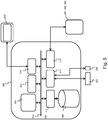
- Fig. 5 shows details of the networking management device 200 according to a further embodiment of the invention.
- Networking management device 200 is suitable for performing the steps according to the above embodiments.
- Networking management device 200 may also be incorporated in or used as access point 107-108.
- Networking management device 200 may in general be formed as a suitable general purpose computer and comprise a bus 510, a processor 502, a local memory 504, one or more optional input interfaces 514, one or more optional output interfaces 516, a communication interface 512, a storage element interface 506 and one or more storage elements 508.
- Bus 510 may comprise one or more conductors that permit communication among the components of the networking management device 200.
- Processor 502 may include any type of conventional processor or microprocessor that interprets and executes programming instructions.
- Local memory 504 may include a random access memory (RAM) or another type of dynamic storage device that stores information and instructions for execution by processor 502 and/or a read only memory (ROM) or another type of static storage device that stores static information and instructions for use by processor 502.
- Input interface 514 may comprise one or more conventional mechanisms that permit an operator to input information to the networking management device 200, such as a keyboard 520, a mouse 530, a pen, voice recognition and/or biometric mechanisms, etc.
- Output interface 516 may comprise one or more conventional mechanisms that output information to the operator, such as a display 540, etc.
- Communication interface 512 may comprise any transceiver-like mechanism such as for example one or more Ethernet interfaces that enables networking management device 200 to communicate with other devices and/or systems, for example with access point 107 or 108.
- the communication interface 512 of networking management device 200 may be connected to such another networking device by means of a local area network (LAN) or a wide area network (WAN) such as for example the internet.
- Storage element interface 506 may comprise a storage interface such as for example a Serial Advanced Technology Attachment (SATA) interface or a Small Computer System Interface (SCSI) for connecting bus 510 to one or more storage elements 508, such as one or more local disks, for example SATA disk drives, and control the reading and writing of data to and/or from these storage elements 508.
- SATA Serial Advanced Technology Attachment
- SCSI Small Computer System Interface
- the storage elements 508 above is described as a local disk, in general any other suitable computer-readable media such as a removable magnetic disk, optical storage media such as a CD or DVD, -ROM disk, solid state drives, flash memory cards, ... could be used.
- the networking management device 200 described above can also run as a virtual machine above the physical hardware.
- top, bottom, over, under, and the like are introduced for descriptive purposes and not necessarily to denote relative positions. It is to be understood that the terms so used are interchangeable under appropriate circumstances and embodiments of the invention are capable of operating according to the present invention in other sequences, or in orientations different from the one(s) described or illustrated above.
Landscapes
- Engineering & Computer Science (AREA)
- Computer Networks & Wireless Communication (AREA)
- Signal Processing (AREA)
- Mobile Radio Communication Systems (AREA)
Abstract
Description
- The present invention generally relates, among others, to a network management device for analysing a wireless communication network, for example a Wi-Fi network.
- Wireless communication networks, such as for example Wi-Fi networks, are continuously evolving in terms of number of devices simultaneously operating in the network. Moreover, since there is a trend of an increasing number of wireless devices in a communication network, this trend on his turn may obliges to increase even more the number of devices through the deployment of additional devices, such as access points, extenders and/or repeaters.
- Each of these devices may be utilised by different users, may run a variety of applications and even have different purposes in the network, such as for example an access point versus an associated device connected to it. The devices may be characterized by a range of parameters, such as, for example, their purpose in the network, data consumption, operating frequency band, operating standards and so on. Furthermore, since end users have several degrees of freedom in the context of the communication network, devices may physically change location, connect over different frequency bands, connect to the network on a continuous or noncontinuous time period, and many other conducts. In other words, each device behaves differently within the wireless communication network.
- The aggregation of individual behaviours of each of the devices separately defines the behaviour or character of the network as a whole. An individual behaviour, however, may cause or may have a particular problem, such as for example coverage or congestion problems. In this situation, corrective measures may be taken by the device itself causing or having the problem. At the same time, other devices in the network may take corrective measures as well. Anyhow, the behaviour of one or more devices in the network will be altered through the corrective measures, which on its behalf alters the behaviour of the network as a whole. Subsequently, other devices may start to suffer from novel problems due to this change of behaviour of the network.
- Since a change in an individual behaviour of a device in a network changes the behaviour of the network as a whole novel problems may be introduced in the network. This may lead to a chain of reactions whereby in alternating order behaviour of devices and of the network are changed, without assuring that initial problems are solved.
- It is therefore an object of the present disclosure to solve the above problem and to provide a solution to determine a behaviour of a device in a wireless network and subsequently enhance the decision-making process for possible interventions.
- This object is achieved, according to a first aspect, by a networking device determining a behaviour of a wireless device, STA, in a wireless communication network comprising:
- a collecting module configured to obtain a first set of metric data vectors for consecutive time periods; and wherein a metric data vector comprises a set of wireless device metrics associated with the respective time period; and
- a pattern analyzing module configured to compare the first set of metric data vectors, thereby obtaining a behavioural pattern factor; and to classify the STA based on the behavioural pattern factor as a deterministic behavioural STA or a randomly behavioural STA.
- In other words, prior to any intervention, a wireless device, STA, is classified. In order to do so, firstly, the collecting module obtains a first set of metric data vectors for consecutive time periods. A time period may, for example, be a day such that for consecutive days, for example during a week, a set of metric data vectors is collected or obtained. Each metric data vector comprises a wireless device metric associated with the respective time period. Such a wireless device metric may, for example, be a STA data consumption parameter, a STA mobility parameter, a STA roaming parameter, a STA connection parameter, a STA type parameter, a STA coverage parameter, a STA's user parameter and/or a STA usage parameter. All of these parameters may be used to determine a metric data vector or only a part of them. Obviously, within a set each vector has the same dimension. According to an embodiment, the parameters are standardized by the broadband forum TR-181 standard.
- Next, the pattern analyzing module mutually compares the metric data vectors within the set. Based on this comparison of the consecutive metric data vectors within the set a behavioural pattern factor is obtained. If, for example, the vectors are represented as a matrix, the behavioural pattern factor may be calculated as the rank of such a matrix. Finally, based on this behavioural pattern factor, a wireless device is either classified as a deterministic behavioural or a randomly behavioural device.
- By classifying STAs in the network as either deterministic or randomly behavioural devices, an improved overview or insight of the network is obtained. In other words, the way the network currently behaves is identified. In this way, any decision-making process may be co-ordinated more efficiently.
- According to an embodiment, the pattern analyzing module is further configured to derive from the first set of metric data vectors a uniqueness factor, a transition factor and an alternation factor and to determine the behavioural pattern factor based on the uniqueness factor, the transition factor and/or the alternation factor.
- The uniqueness factor is indicative for a number of unique metric data vectors within the first set of metric data vectors.
- The transition factor is indicative for variations between sequencing metric data vectors within the first set.
- The alternation factor is indicative for variations of wireless device metrics between sequencing metric data vectors within the first set.
- In other words, the pattern analyzing module determines how many unique metric data vectors there are in the first set, how many times the vectors change in sequencing order and/or how many changes there are of the wireless device metric when a vector changes. The behavioural pattern factor encloses these three factors, or even only one or two factors are enclosed. Thus, the behavioural pattern may be calculated in a straightforward way.
- According to an embodiment, the network management device further comprises a prediction module. This prediction module is configured to predict for the STA a future metric data vector.
- On the one hand, as for a deterministic behavioural STA, the future metric data vector is predicted based on the first set of metric data vectors. Since, when prior to the prediction a STA is classified as deterministic behavioural, a future behaviour may be calculated based on the behaviour in the past.
- On the other hand, as for a randomly behavioural STA, the future metric data vector is predicted based on a probabilistic approach. Thus, instead of solely predicting the future metric data vector based on the behaviour in the past, a probabilistic approach is applied in order to increase the reliability of the prediction.
- The distinction made on how a future metric data vector is calculated for a deterministic behavioural versus a randomly behavioural STA, results in a more accurate prediction on how the network will behave as a whole.
- According to an embodiment, the pattern analyzing module is further configured to compare the future metric data vector with a library of behavioural patterns in the wireless communication network. A behavioural pattern in the library comprises a set of metric data vectors and the future metric data vector is related to a respective behavioural pattern in the library when the future metric data vector is similar to the metric data vector of the respective behavioural pattern. As a result, a future behavioural pattern of the STA is obtained through the related metric data vector in the library.
- In other words, a library or knowledge base comprises behavioural patterns of the wireless communication network. These behavioural patterns express how devices in the network behave or have behaved in the past. In order to describe and/or identify a behaviour, each of these behavioural patterns comprises a set of metric data vectors. Next, these metric data vectors are compared with the future metric data vector predicted for the STA. When a metric data vector in the library is similar to the future metric data vector, they are related to each other. Finally, the future behavioural of the STA obtained through the related metric data vector in the library describes how the STA will behave in the future.
- An advantage to compare and subsequently to relate the future metric vector with a behavioural pattern in the library is that a more accurate forecast is made on how a STA will evolve in time and thus also how the communication network will evolve. In this way, the network management device may better anticipate the possible outcomes when corrective measures are taken.
- According to an embodiment, the library further comprises recommended settings related to respective behavioural patterns and the pattern analyzing module is further configured to relate a recommended setting, labelled as the related recommended setting, to the future behavioural pattern of the STA by the library.
- A recommended setting may, for example, be a switching of a frequency band or a deployment of a repeater or an additional access point in the communication network. In other words, a recommended setting is an applied solution for a problem in a behavioural pattern. A behavioural pattern may be linked to more than one recommended setting.
- The future metric data vector is linked to a behavioural pattern in the library, which on his turn is related to a recommended setting. Thus, in this way, the future metric data vector is also related to said recommended setting, labelled as the related recommended setting.
- According to an embodiment, the pattern analyzing module is further configured to acquire a current recommended setting from the STA, and to compare the current recommended setting with the related recommended setting, and to terminate the current recommended setting when it differs from the related recommended setting.
- In other words, when the current recommended setting differs from the related one, this may indicate that a wrong current recommended setting is active. By terminating this current recommended setting, the network management device anticipates to a potential deterioration of functionalities within the network.
- Alternatively, the related recommended setting may be applied. This may be either done after the termination of the current recommended setting, or even immediately without a prior verification of the current recommended setting.
- According to a second aspect, the disclosure relates to a computer-implemented method for determining a behaviour of a wireless device, STA, in a wireless communication network comprising the steps of:
- obtaining a first set of metric data vectors for consecutive time periods; and wherein a metric data vector comprises a set of wireless device metrics associated with the respective time period; and
- comparing the first set of metric data vectors, thereby obtaining a behavioural pattern factor; and
- classifying the STA based on the behavioural pattern factor as a deterministic behavioural STA or a randomly behavioural STA.
- According to a third aspect, the disclosure relates to a computer program product comprising computer-executable instructions for performing the method according to the second aspect when the program is run on a computer.
- According to a fourth aspect, the disclosure relates to a computer readable storage medium comprising the computer program product according to the third aspect.
- According to a fifth aspect, the disclosure relates to a data processing system programmed for carrying out the method according to the second aspect.
-
-
Fig. 1 illustrates a communication network according to an embodiment of the invention; and -
Fig. 2 illustrate a network management device according to an embodiment of the invention; and -
Fig. 3 illustrates a set of metric data vectors according to an embodiment of the invention; and -
Fig. 4 illustrates steps performed apply or terminate a recommended setting according to an embodiment of the invention; and -
Fig. 5 illustrates a suitable computing system for performing steps according to various embodiments of the invention. - The present disclosure relates to a network device for determining a behaviour of a wireless device, STA, in a wireless communication network.
Fig. 1 illustrates such awireless communication network 120 andFig. 2 illustrates such anetwork management device 200.Fig. 4 illustrates steps performed by thenetwork management device 200 to determine a behaviour of a STA and subsequently to trigger or terminate a recommended setting. - The
wireless communication network 120 comprises a multitude of devices, such as, for example, smartphones 100-103, access points 106-107 and arepeater 109. Each of these devices may be characterized by its functionality, purpose, running application and many more other aspects. Furthermore, end users of devices have several degrees of freedom within thecommunication network 120. Devices can physically change location, connect over different frequency bands, be connected or disconnected to thenetwork 120, actively download or upload data through a wireless connection 104-105, and use different standards when transmitting or receiving to and from an access point 106-107 orrepeater 109. - The way these devices in the
communication network 120 behave may be identified by a device behaviour or device fingerprint. A device behaviour may be more or less random or deterministic. Nevertheless, the aggregation of the behaviours of each device in thenetwork 120 defines the character of thenetwork 120 as a whole. - Certain behaviour, however, may lead to one or more problems, such as congestion or coverage problems. In order to solve such a potential or present problem, corrective measures may be taken. Yet, since a device behaviour alteration may lead to a change in recommendation settings of other devices, it is important to determine in advance how a device may react on an alternation. Hence, it is important to define, assess, compute and/or predict the behaviour of a STA.
- In order to determine the behaviour of a STA, the
network management device 200 comprises acollecting module 201 which is configured to obtain 401 data, more in particular a set of metric data vectors. Such set of metric data vectors is illustrated inFig. 3 . The data may be obtained 401 for consecutive time periods, for example, a day. For each day, illustrated as T1, Tj and TN, a metric vector is obtained, such as 301, 302 and 303. The set ofmetric vectors 300 may then comprises metric vectors which are obtained during a longer period P, for example a week. - A metric vector descriptive for a wireless device in the
network 120 may comprise a number of different parameters, such as, for example, - a STA data consumption parameter,
- a STA mobility parameter,
- a STA roaming parameter,
- a STA connection parameter,
- a STA type parameter,
- a STA coverage parameter,
- a STA's user parameter, and/or
- a STA usage parameter.
- Alternatively, the metrics may also be standardized according to the broadband forum TR-181 standard. The metric may then comprise one of the following parameters:
- Device.WiFi.Radio.{i}.Stats.BytesSent,
- Device.WiFi.Radio.{i}.Stats.Bytes Received,
- Device.WiFi.Radio.{i}.OperatingFrequencyBand,
- Device.WiFi.Radio.{i}CCARequest,
- Device.WiFi.Radio.{i}CCAReport,
- Device.WiFi.Radio.{i}.Stast.ErrosSent,
- Device.WiFi.Radio.{i}.Stats.PacketsSent,
- Device.WiFi.SSID.{i}.Stats.RetransCount,
- Device.WiFi.SSID.{i}.Stats.FailedRetransCount,
- Device.WiFi.AccesPoint.{i}.AssociatedDeviceNumberOfEntries,
- Device.WiFi.NeighboringWiFiDiagnostic.Result.{i},
- Device.WiFi.AccesPoint.{i}.AC{i}.OutQLenHistogramIntervals,
- Device.WiFi.AccesPoint.{i}.AC{i}.Stats.OutQlenHistogram,
- Device.WiFi.AccesPoint.{j}.AssociatedDevice.{i}.SignalStrength,
- Device.WiFi.AccesPoint.{j}.AssociatedDevice.{i}.AuthenticationState,
- Device.WiFi.AccesPoint.{i}.Enable,
- Device.WiFi.AccesPoint.*.AssociatedDevice.*.Stats.BytesSent,
- Device.WiFi.AccesPoint.*.AssociatedDevice.*.Stats.BytesReceived,
- Device.WiFi.AccesPoint.*.AssociatedDevice.*.Stats.ErrorsSent,
- Device.WiFi.AccesPoint.*.AssociatedDevice.*.Stats.RetransCount.
- Thus, the
network management device 200 obtains through thecollecting module 201 various parameters from one or more devices 100-103, 107-109, in thenetwork 120 which respectively relates to a behaviour of a respective device during a time period. Thus,metric vector 301 for time period T1 comprises, for example, M metrics, such as


set 300. - Such a set of
metric vectors 300 may also be transformed 320 in a binary form. When, for example one of the parameters, such as
- for a STA data consumption parameter: one for light versus zero for heavy;
- for a STA roaming parameter: one for not-roaming versus zero for roaming;
- for a STA type parameter: one for operator versus zero for user; and/or
- for a STA coverage parameter: one for good versus zero for poor.
- In other words, the
set 300 comprising different parameters, and possibly each expressed in a particular dimension, is transformed 320 in a matrix comprises binary numbers, such as 331, 332 and 333. - Such a set is used to identify the behaviour of a respective STA. The metric data vectors, for example 331, 332 and 333, are mutually compared by the
pattern analyzing module 202. In this way, a behavioural pattern factor is determined 403. - Such a behavioural pattern factor may be based on a number of unique vectors in the set, the uniqueness factor, a number of variations between
sequencing - The determined 403 behavioural pattern factor identifies the behaviour of a STA. Next, a behavioural pattern factor of each device is used to classify 404 the devices or STAs. Based on the respective behavioural pattern, a STA may either be classified as deterministic behavioural or randomly behavioural.
- Subsequently, a future metric data vector is predicted 405 for a STA by a
prediction module 203. When a STA is classified 404 as deterministic behavioural, the future metric data vector is calculated based on the set of metric data vectors previously collected. On the other hand, when a STA is classified 404 as randomly behavioural, a future metric data vector is calculated by the use of a probabilistic approach. - Then, the predicted 405 future metric data vector is used to identify 406 a behavioural pattern of the respective STA. Therefore, the
network management device 200 consults alibrary 204 or knowledge base. According to an embodiment, thelibrary 204 may also be incorporated in thenetwork management device 200. In order to identify 406 a behavioural pattern, the future metric vector is compared with metric data vectors in thelibrary 204. In particular, the behavioural patterns in thelibrary 204 are each referred by one or more metric data vectors. Thus, when the future metric data vector is similar to a metric data vector in thelibrary 204, it is related to the behavioural pattern referring to said metric data vector. In this way, a future behavioural pattern of the STA is obtained. - According to an embodiment, the
pattern analyzing module 202 is further configured to identify 407 or acquire a current recommended setting of STA. Such a recommended setting is, for example, a recommendation to switch a frequency band or, as another example, to deploy an additional repeater in thenetwork 120. - In addition, the
library 204 further comprises recommended settings related to respective behavioural patterns. Thepattern analyzing module 201 is then further configured to relate a recommended setting in thelibrary 204 to the future behavioural pattern of the STA. - Subsequently, the related recommended setting is compared with the current recommended setting of the STA. In the occurrence that the current recommended setting differs from the related recommended setting, the pattern analyzing 202 module terminates 408 the recommended setting.
- Optionally, the
pattern analyzing module 202 further applies or triggers the recommended setting to the STA. - Alternatively, the
pattern analyzing module 202 immediately applies or triggers the related recommended setting without previously identifying or acquiring the current recommended setting of the STA. -
Fig. 5 shows details of thenetworking management device 200 according to a further embodiment of the invention.Networking management device 200 is suitable for performing the steps according to the above embodiments.Networking management device 200 may also be incorporated in or used as access point 107-108.Networking management device 200 may in general be formed as a suitable general purpose computer and comprise abus 510, aprocessor 502, alocal memory 504, one or more optional input interfaces 514, one or moreoptional output interfaces 516, acommunication interface 512, astorage element interface 506 and one ormore storage elements 508.Bus 510 may comprise one or more conductors that permit communication among the components of thenetworking management device 200.Processor 502 may include any type of conventional processor or microprocessor that interprets and executes programming instructions.Local memory 504 may include a random access memory (RAM) or another type of dynamic storage device that stores information and instructions for execution byprocessor 502 and/or a read only memory (ROM) or another type of static storage device that stores static information and instructions for use byprocessor 502.Input interface 514 may comprise one or more conventional mechanisms that permit an operator to input information to thenetworking management device 200, such as akeyboard 520, amouse 530, a pen, voice recognition and/or biometric mechanisms, etc.Output interface 516 may comprise one or more conventional mechanisms that output information to the operator, such as adisplay 540, etc.Communication interface 512 may comprise any transceiver-like mechanism such as for example one or more Ethernet interfaces that enablesnetworking management device 200 to communicate with other devices and/or systems, for example withaccess point communication interface 512 ofnetworking management device 200 may be connected to such another networking device by means of a local area network (LAN) or a wide area network (WAN) such as for example the internet.Storage element interface 506 may comprise a storage interface such as for example a Serial Advanced Technology Attachment (SATA) interface or a Small Computer System Interface (SCSI) for connectingbus 510 to one ormore storage elements 508, such as one or more local disks, for example SATA disk drives, and control the reading and writing of data to and/or from thesestorage elements 508. Although thestorage elements 508 above is described as a local disk, in general any other suitable computer-readable media such as a removable magnetic disk, optical storage media such as a CD or DVD, -ROM disk, solid state drives, flash memory cards, ... could be used. Thenetworking management device 200 described above can also run as a virtual machine above the physical hardware. - Although the present invention has been illustrated by reference to specific embodiments, it will be apparent to those skilled in the art that the invention is not limited to the details of the foregoing illustrative embodiments, and that the present invention may be embodied with various changes and modifications without departing from the scope thereof. The present embodiments are therefore to be considered in all respects as illustrative and not restrictive, the scope of the invention being indicated by the appended claims rather than by the foregoing description, and all changes which come within the scope of the claims are therefore intended to be embraced therein.
- It will furthermore be understood by the reader of this patent application that the words "comprising" or "comprise" do not exclude other elements or steps, that the words "a" or "an" do not exclude a plurality, and that a single element, such as a computer system, a processor, or another integrated unit may fulfil the functions of several means recited in the claims. Any reference signs in the claims shall not be construed as limiting the respective claims concerned. The terms "first", "second", third", "a", "b", "c", and the like, when used in the description or in the claims are introduced to distinguish between similar elements or steps and are not necessarily describing a sequential or chronological order. Similarly, the terms "top", "bottom", "over", "under", and the like are introduced for descriptive purposes and not necessarily to denote relative positions. It is to be understood that the terms so used are interchangeable under appropriate circumstances and embodiments of the invention are capable of operating according to the present invention in other sequences, or in orientations different from the one(s) described or illustrated above.
Claims (15)
- A network management device (200) for determining a behaviour of a wireless device, STA, in a wireless communication network (120) comprising:- a collecting module (201) configured to obtain a first set of metric data vectors (301, 302, 303) for consecutive time periods; and wherein a metric data vector comprises a set of wireless device metrics (311, 312, 313) associated with the respective time period; and- a pattern analyzing module (202) configured to compare the first set of metric data vectors, thereby obtaining a behavioural pattern factor; and to classify (404) the STA based on the behavioural pattern factor as a deterministic behavioural STA or a randomly behavioural STA.
- The network management device (200) according to claim 1, wherein the pattern analyzing module (202) is further configured to derive from the first set of metric data vectors:- a uniqueness factor indicative for a number of unique metric data vectors within the first set of metric data vectors; and/or- a transition factor indicative for variations between sequencing metric data vectors within the first set; and/or- an alternation factor indicative for variations of wireless device metrics between sequencing metric data vectors within the first set; andto determine the behavioural pattern factor based on the uniqueness factor, the transition factor and/or the alternation factor.
- The network management device (200) according to claim 2, further comprising a prediction module (203) configured to predict for the deterministic behavioural STA a future metric data vector based on the first set of metric data vectors.
- The network management device (200) according to claim 2 or 3, wherein the prediction module (203) is further configured to predict for the randomly behavioural STA a future metric data vector based on a probabilistic approach.
- The network management device (200) according to claim 3 and 4, wherein the pattern analyzing module (202) is further configured to compare the future metric data vector with a library (204) of behavioural patterns in the wireless communication network (120); and wherein a behavioural pattern comprises a set of metric data vectors; and to relate the future metric data vector to a respective behavioural pattern in the library (204) when the future metric data vector is similar to the metric data vector of the respective behavioural pattern; and thereby obtaining a future behavioural pattern of the STA.
- The network management device (200) according to claim 5, wherein the library (204) further comprises recommended settings related to respective behavioural patterns; and wherein the pattern analyzing module (202) is further configured to relate a recommended setting, the related recommended setting, to the future behavioural pattern of the STA by the library (204).
- The network management device (200) according to claim 6, wherein the pattern analyzing module (202) is further configured:- to acquire (407) a current recommended setting from the STA; and- to compare the current recommended setting with the related recommended setting; and- to terminate (408) the current recommended setting when it differs from the related recommended setting.
- The network management device (200) according to claim 7, wherein the pattern analyzing module (202) is further configured to apply the related recommended setting to the STA.
- The network management device (200) according to claim 6, wherein the pattern analyzing module (202) is further configured to apply the related recommended setting to the STA.
- The network management device (200) according to claim 1, wherein the wireless device metrics comprise at least one of the group of:- a STA data consumption parameter; and- a STA mobility parameter; and- a STA roaming parameter; and- a STA connection parameter; and- a STA type parameter; and- a STA coverage parameter; and- a STA's user parameter; and- a STA usage parameter.
- The network management device (200) according to claim 9, wherein the parameters are standardized by the broadband forum TR-98/181 standard.
- Method for determining a behaviour of a wireless device, STA, in a wireless communication network comprising the steps of:- obtaining a first set of metric data vectors for consecutive time periods; and wherein a metric data vector comprises a set of wireless device metrics associated with the respective time period; and- comparing the first set of metric data vectors, thereby obtaining a behavioural pattern factor; and- classifying the STA based on the behavioural pattern factor as a deterministic behavioural STA or a randomly behavioural STA.
- A computer program product comprising computer-executable instructions for performing the method according to claim 12 when the program is run on a computer.
- A computer readable storage medium comprising the computer program product according to claim 11.
- A data processing system programmed for carrying out the method according to claim 12
Priority Applications (2)
| Application Number | Priority Date | Filing Date | Title |
|---|---|---|---|
| EP17194190.9A EP3462766B1 (en) | 2017-09-29 | 2017-09-29 | Determining a behaviour of a wireless device |
| PCT/EP2018/075924 WO2019063527A1 (en) | 2017-09-29 | 2018-09-25 | Determining a behaviour of a wireless device |
Applications Claiming Priority (1)
| Application Number | Priority Date | Filing Date | Title |
|---|---|---|---|
| EP17194190.9A EP3462766B1 (en) | 2017-09-29 | 2017-09-29 | Determining a behaviour of a wireless device |
Publications (2)
| Publication Number | Publication Date |
|---|---|
| EP3462766A1 true EP3462766A1 (en) | 2019-04-03 |
| EP3462766B1 EP3462766B1 (en) | 2020-11-04 |
Family
ID=60021910
Family Applications (1)
| Application Number | Title | Priority Date | Filing Date |
|---|---|---|---|
| EP17194190.9A Active EP3462766B1 (en) | 2017-09-29 | 2017-09-29 | Determining a behaviour of a wireless device |
Country Status (2)
| Country | Link |
|---|---|
| EP (1) | EP3462766B1 (en) |
| WO (1) | WO2019063527A1 (en) |
Citations (2)
| Publication number | Priority date | Publication date | Assignee | Title |
|---|---|---|---|---|
| WO2001073956A2 (en) * | 2000-03-28 | 2001-10-04 | Telefonaktiebolaget L.M. Ericsson (Publ) | Apparatus and methods for selective interference mitigation |
| US20160232352A1 (en) * | 2015-02-06 | 2016-08-11 | Qualcomm Incorporated | Methods and Systems for Detecting Fake User Interactions with a Mobile Device for Improved Malware Protection |
-
2017
- 2017-09-29 EP EP17194190.9A patent/EP3462766B1/en active Active
-
2018
- 2018-09-25 WO PCT/EP2018/075924 patent/WO2019063527A1/en not_active Ceased
Patent Citations (2)
| Publication number | Priority date | Publication date | Assignee | Title |
|---|---|---|---|---|
| WO2001073956A2 (en) * | 2000-03-28 | 2001-10-04 | Telefonaktiebolaget L.M. Ericsson (Publ) | Apparatus and methods for selective interference mitigation |
| US20160232352A1 (en) * | 2015-02-06 | 2016-08-11 | Qualcomm Incorporated | Methods and Systems for Detecting Fake User Interactions with a Mobile Device for Improved Malware Protection |
Also Published As
| Publication number | Publication date |
|---|---|
| WO2019063527A1 (en) | 2019-04-04 |
| EP3462766B1 (en) | 2020-11-04 |
Similar Documents
| Publication | Publication Date | Title |
|---|---|---|
| WO2017215647A1 (en) | Root cause analysis in a communication network via probabilistic network structure | |
| EP3849231B1 (en) | Configuration of a communication network | |
| US20210209481A1 (en) | Methods and systems for dynamic service performance prediction using transfer learning | |
| CN108463973A (en) | Fingerprint recognition basic reason is analyzed in cellular system | |
| Zafeiropoulos et al. | Benchmarking and profiling 5G verticals' applications: an industrial IoT use case | |
| JP2016517550A (en) | Churn prediction of broadband network | |
| WO2014102318A1 (en) | Method and system for predicting the channel usage | |
| EP4610887A1 (en) | Graph neural network training method and system, and abnormal account identification method | |
| EP3383088A1 (en) | A computer implemented method, a system and computer programs to quantify the performance of a network | |
| CN117715205A (en) | Spectrum sharing method and device based on cognitive radio and computer equipment | |
| Hashmi | Towards real-time user qoe assessment via machine learning on lte network data | |
| Grand-Clément et al. | Robust policies for proactive ICU transfers | |
| WO2023027863A1 (en) | Intelligent predictive a/b testing | |
| Shukla et al. | Xcelerate5G: Optimizing resource allocation strategies for 5G network using ML | |
| EP3462766A1 (en) | Determining a behaviour of a wireless device | |
| EP3389303B1 (en) | Triggering recommended settings in a communication network | |
| Rizwan et al. | Performance based cells classification in cellular network using cdr data | |
| EP3389304A1 (en) | Detection of behavioural patterns in a wireless network | |
| Soto et al. | Detection of the primary user’s behavior for the intervention of the secondary user using machine learning | |
| Papageorgiou et al. | Fog computing context analytics | |
| Cid-Fuentes et al. | Online behavior identification in distributed systems | |
| Zou et al. | Effi-Ace: Efficient and accurate prediction for High-Resolution spectrum tenancy | |
| EP3413663B1 (en) | Selection of an optimal communication channel of an access point | |
| Mao et al. | AI-Driven Spectrum Occupancy Prediction Using Real-World Spectrum Measurements | |
| EP3618486A1 (en) | Effectiveness rating of action based on user's experience and excecuted actions |
Legal Events
| Date | Code | Title | Description |
|---|---|---|---|
| PUAI | Public reference made under article 153(3) epc to a published international application that has entered the european phase |
Free format text: ORIGINAL CODE: 0009012 |
|
| STAA | Information on the status of an ep patent application or granted ep patent |
Free format text: STATUS: THE APPLICATION HAS BEEN PUBLISHED |
|
| AK | Designated contracting states |
Kind code of ref document: A1 Designated state(s): AL AT BE BG CH CY CZ DE DK EE ES FI FR GB GR HR HU IE IS IT LI LT LU LV MC MK MT NL NO PL PT RO RS SE SI SK SM TR |
|
| AX | Request for extension of the european patent |
Extension state: BA ME |
|
| RAP1 | Party data changed (applicant data changed or rights of an application transferred) |
Owner name: NOKIA SOLUTIONS AND NETWORKS OY |
|
| STAA | Information on the status of an ep patent application or granted ep patent |
Free format text: STATUS: REQUEST FOR EXAMINATION WAS MADE |
|
| 17P | Request for examination filed |
Effective date: 20191004 |
|
| RBV | Designated contracting states (corrected) |
Designated state(s): AL AT BE BG CH CY CZ DE DK EE ES FI FR GB GR HR HU IE IS IT LI LT LU LV MC MK MT NL NO PL PT RO RS SE SI SK SM TR |
|
| REG | Reference to a national code |
Ref country code: DE Ref legal event code: R079 Ref document number: 602017026726 Country of ref document: DE Free format text: PREVIOUS MAIN CLASS: H04W0024000000 Ipc: H04W0024020000 |
|
| GRAP | Despatch of communication of intention to grant a patent |
Free format text: ORIGINAL CODE: EPIDOSNIGR1 |
|
| STAA | Information on the status of an ep patent application or granted ep patent |
Free format text: STATUS: GRANT OF PATENT IS INTENDED |
|
| RIC1 | Information provided on ipc code assigned before grant |
Ipc: H04W 24/04 20090101ALN20200603BHEP Ipc: H04W 84/12 20090101ALN20200603BHEP Ipc: H04W 24/08 20090101ALN20200603BHEP Ipc: H04W 24/02 20090101AFI20200603BHEP |
|
| INTG | Intention to grant announced |
Effective date: 20200617 |
|
| GRAS | Grant fee paid |
Free format text: ORIGINAL CODE: EPIDOSNIGR3 |
|
| GRAA | (expected) grant |
Free format text: ORIGINAL CODE: 0009210 |
|
| STAA | Information on the status of an ep patent application or granted ep patent |
Free format text: STATUS: THE PATENT HAS BEEN GRANTED |
|
| AK | Designated contracting states |
Kind code of ref document: B1 Designated state(s): AL AT BE BG CH CY CZ DE DK EE ES FI FR GB GR HR HU IE IS IT LI LT LU LV MC MK MT NL NO PL PT RO RS SE SI SK SM TR |
|
| REG | Reference to a national code |
Ref country code: GB Ref legal event code: FG4D |
|
| REG | Reference to a national code |
Ref country code: CH Ref legal event code: EP |
|
| REG | Reference to a national code |
Ref country code: AT Ref legal event code: REF Ref document number: 1332425 Country of ref document: AT Kind code of ref document: T Effective date: 20201115 |
|
| REG | Reference to a national code |
Ref country code: IE Ref legal event code: FG4D |
|
| REG | Reference to a national code |
Ref country code: DE Ref legal event code: R096 Ref document number: 602017026726 Country of ref document: DE |
|
| REG | Reference to a national code |
Ref country code: NL Ref legal event code: MP Effective date: 20201104 |
|
| REG | Reference to a national code |
Ref country code: AT Ref legal event code: MK05 Ref document number: 1332425 Country of ref document: AT Kind code of ref document: T Effective date: 20201104 |
|
| PG25 | Lapsed in a contracting state [announced via postgrant information from national office to epo] |
Ref country code: FI Free format text: LAPSE BECAUSE OF FAILURE TO SUBMIT A TRANSLATION OF THE DESCRIPTION OR TO PAY THE FEE WITHIN THE PRESCRIBED TIME-LIMIT Effective date: 20201104 Ref country code: GR Free format text: LAPSE BECAUSE OF FAILURE TO SUBMIT A TRANSLATION OF THE DESCRIPTION OR TO PAY THE FEE WITHIN THE PRESCRIBED TIME-LIMIT Effective date: 20210205 Ref country code: NO Free format text: LAPSE BECAUSE OF FAILURE TO SUBMIT A TRANSLATION OF THE DESCRIPTION OR TO PAY THE FEE WITHIN THE PRESCRIBED TIME-LIMIT Effective date: 20210204 Ref country code: PT Free format text: LAPSE BECAUSE OF FAILURE TO SUBMIT A TRANSLATION OF THE DESCRIPTION OR TO PAY THE FEE WITHIN THE PRESCRIBED TIME-LIMIT Effective date: 20210304 Ref country code: RS Free format text: LAPSE BECAUSE OF FAILURE TO SUBMIT A TRANSLATION OF THE DESCRIPTION OR TO PAY THE FEE WITHIN THE PRESCRIBED TIME-LIMIT Effective date: 20201104 |
|
| PG25 | Lapsed in a contracting state [announced via postgrant information from national office to epo] |
Ref country code: SE Free format text: LAPSE BECAUSE OF FAILURE TO SUBMIT A TRANSLATION OF THE DESCRIPTION OR TO PAY THE FEE WITHIN THE PRESCRIBED TIME-LIMIT Effective date: 20201104 Ref country code: BG Free format text: LAPSE BECAUSE OF FAILURE TO SUBMIT A TRANSLATION OF THE DESCRIPTION OR TO PAY THE FEE WITHIN THE PRESCRIBED TIME-LIMIT Effective date: 20210204 Ref country code: PL Free format text: LAPSE BECAUSE OF FAILURE TO SUBMIT A TRANSLATION OF THE DESCRIPTION OR TO PAY THE FEE WITHIN THE PRESCRIBED TIME-LIMIT Effective date: 20201104 Ref country code: IS Free format text: LAPSE BECAUSE OF FAILURE TO SUBMIT A TRANSLATION OF THE DESCRIPTION OR TO PAY THE FEE WITHIN THE PRESCRIBED TIME-LIMIT Effective date: 20210304 Ref country code: LV Free format text: LAPSE BECAUSE OF FAILURE TO SUBMIT A TRANSLATION OF THE DESCRIPTION OR TO PAY THE FEE WITHIN THE PRESCRIBED TIME-LIMIT Effective date: 20201104 Ref country code: ES Free format text: LAPSE BECAUSE OF FAILURE TO SUBMIT A TRANSLATION OF THE DESCRIPTION OR TO PAY THE FEE WITHIN THE PRESCRIBED TIME-LIMIT Effective date: 20201104 Ref country code: AT Free format text: LAPSE BECAUSE OF FAILURE TO SUBMIT A TRANSLATION OF THE DESCRIPTION OR TO PAY THE FEE WITHIN THE PRESCRIBED TIME-LIMIT Effective date: 20201104 |
|
| REG | Reference to a national code |
Ref country code: LT Ref legal event code: MG9D |
|
| PG25 | Lapsed in a contracting state [announced via postgrant information from national office to epo] |
Ref country code: HR Free format text: LAPSE BECAUSE OF FAILURE TO SUBMIT A TRANSLATION OF THE DESCRIPTION OR TO PAY THE FEE WITHIN THE PRESCRIBED TIME-LIMIT Effective date: 20201104 |
|
| PG25 | Lapsed in a contracting state [announced via postgrant information from national office to epo] |
Ref country code: RO Free format text: LAPSE BECAUSE OF FAILURE TO SUBMIT A TRANSLATION OF THE DESCRIPTION OR TO PAY THE FEE WITHIN THE PRESCRIBED TIME-LIMIT Effective date: 20201104 Ref country code: SK Free format text: LAPSE BECAUSE OF FAILURE TO SUBMIT A TRANSLATION OF THE DESCRIPTION OR TO PAY THE FEE WITHIN THE PRESCRIBED TIME-LIMIT Effective date: 20201104 Ref country code: SM Free format text: LAPSE BECAUSE OF FAILURE TO SUBMIT A TRANSLATION OF THE DESCRIPTION OR TO PAY THE FEE WITHIN THE PRESCRIBED TIME-LIMIT Effective date: 20201104 Ref country code: CZ Free format text: LAPSE BECAUSE OF FAILURE TO SUBMIT A TRANSLATION OF THE DESCRIPTION OR TO PAY THE FEE WITHIN THE PRESCRIBED TIME-LIMIT Effective date: 20201104 Ref country code: EE Free format text: LAPSE BECAUSE OF FAILURE TO SUBMIT A TRANSLATION OF THE DESCRIPTION OR TO PAY THE FEE WITHIN THE PRESCRIBED TIME-LIMIT Effective date: 20201104 Ref country code: LT Free format text: LAPSE BECAUSE OF FAILURE TO SUBMIT A TRANSLATION OF THE DESCRIPTION OR TO PAY THE FEE WITHIN THE PRESCRIBED TIME-LIMIT Effective date: 20201104 |
|
| REG | Reference to a national code |
Ref country code: DE Ref legal event code: R097 Ref document number: 602017026726 Country of ref document: DE |
|
| PG25 | Lapsed in a contracting state [announced via postgrant information from national office to epo] |
Ref country code: DK Free format text: LAPSE BECAUSE OF FAILURE TO SUBMIT A TRANSLATION OF THE DESCRIPTION OR TO PAY THE FEE WITHIN THE PRESCRIBED TIME-LIMIT Effective date: 20201104 |
|
| PLBE | No opposition filed within time limit |
Free format text: ORIGINAL CODE: 0009261 |
|
| STAA | Information on the status of an ep patent application or granted ep patent |
Free format text: STATUS: NO OPPOSITION FILED WITHIN TIME LIMIT |
|
| 26N | No opposition filed |
Effective date: 20210805 |
|
| PG25 | Lapsed in a contracting state [announced via postgrant information from national office to epo] |
Ref country code: AL Free format text: LAPSE BECAUSE OF FAILURE TO SUBMIT A TRANSLATION OF THE DESCRIPTION OR TO PAY THE FEE WITHIN THE PRESCRIBED TIME-LIMIT Effective date: 20201104 Ref country code: NL Free format text: LAPSE BECAUSE OF FAILURE TO SUBMIT A TRANSLATION OF THE DESCRIPTION OR TO PAY THE FEE WITHIN THE PRESCRIBED TIME-LIMIT Effective date: 20201104 Ref country code: IT Free format text: LAPSE BECAUSE OF FAILURE TO SUBMIT A TRANSLATION OF THE DESCRIPTION OR TO PAY THE FEE WITHIN THE PRESCRIBED TIME-LIMIT Effective date: 20201104 |
|
| PG25 | Lapsed in a contracting state [announced via postgrant information from national office to epo] |
Ref country code: SI Free format text: LAPSE BECAUSE OF FAILURE TO SUBMIT A TRANSLATION OF THE DESCRIPTION OR TO PAY THE FEE WITHIN THE PRESCRIBED TIME-LIMIT Effective date: 20201104 |
|
| REG | Reference to a national code |
Ref country code: CH Ref legal event code: PL |
|
| REG | Reference to a national code |
Ref country code: BE Ref legal event code: MM Effective date: 20210930 |
|
| PG25 | Lapsed in a contracting state [announced via postgrant information from national office to epo] |
Ref country code: IS Free format text: LAPSE BECAUSE OF FAILURE TO SUBMIT A TRANSLATION OF THE DESCRIPTION OR TO PAY THE FEE WITHIN THE PRESCRIBED TIME-LIMIT Effective date: 20210304 Ref country code: MC Free format text: LAPSE BECAUSE OF FAILURE TO SUBMIT A TRANSLATION OF THE DESCRIPTION OR TO PAY THE FEE WITHIN THE PRESCRIBED TIME-LIMIT Effective date: 20201104 |
|
| PG25 | Lapsed in a contracting state [announced via postgrant information from national office to epo] |
Ref country code: LU Free format text: LAPSE BECAUSE OF NON-PAYMENT OF DUE FEES Effective date: 20210929 Ref country code: IE Free format text: LAPSE BECAUSE OF NON-PAYMENT OF DUE FEES Effective date: 20210929 Ref country code: FR Free format text: LAPSE BECAUSE OF NON-PAYMENT OF DUE FEES Effective date: 20210930 Ref country code: BE Free format text: LAPSE BECAUSE OF NON-PAYMENT OF DUE FEES Effective date: 20210930 |
|
| PG25 | Lapsed in a contracting state [announced via postgrant information from national office to epo] |
Ref country code: LI Free format text: LAPSE BECAUSE OF NON-PAYMENT OF DUE FEES Effective date: 20210930 Ref country code: CH Free format text: LAPSE BECAUSE OF NON-PAYMENT OF DUE FEES Effective date: 20210930 |
|
| PG25 | Lapsed in a contracting state [announced via postgrant information from national office to epo] |
Ref country code: CY Free format text: LAPSE BECAUSE OF FAILURE TO SUBMIT A TRANSLATION OF THE DESCRIPTION OR TO PAY THE FEE WITHIN THE PRESCRIBED TIME-LIMIT Effective date: 20201104 |
|
| P01 | Opt-out of the competence of the unified patent court (upc) registered |
Effective date: 20230527 |
|
| PG25 | Lapsed in a contracting state [announced via postgrant information from national office to epo] |
Ref country code: HU Free format text: LAPSE BECAUSE OF FAILURE TO SUBMIT A TRANSLATION OF THE DESCRIPTION OR TO PAY THE FEE WITHIN THE PRESCRIBED TIME-LIMIT; INVALID AB INITIO Effective date: 20170929 |
|
| PG25 | Lapsed in a contracting state [announced via postgrant information from national office to epo] |
Ref country code: MK Free format text: LAPSE BECAUSE OF FAILURE TO SUBMIT A TRANSLATION OF THE DESCRIPTION OR TO PAY THE FEE WITHIN THE PRESCRIBED TIME-LIMIT Effective date: 20201104 |
|
| PG25 | Lapsed in a contracting state [announced via postgrant information from national office to epo] |
Ref country code: MT Free format text: LAPSE BECAUSE OF FAILURE TO SUBMIT A TRANSLATION OF THE DESCRIPTION OR TO PAY THE FEE WITHIN THE PRESCRIBED TIME-LIMIT Effective date: 20201104 |
|
| PGFP | Annual fee paid to national office [announced via postgrant information from national office to epo] |
Ref country code: DE Payment date: 20250805 Year of fee payment: 9 |
|
| PGFP | Annual fee paid to national office [announced via postgrant information from national office to epo] |
Ref country code: GB Payment date: 20250807 Year of fee payment: 9 |
|
| PG25 | Lapsed in a contracting state [announced via postgrant information from national office to epo] |
Ref country code: TR Free format text: LAPSE BECAUSE OF FAILURE TO SUBMIT A TRANSLATION OF THE DESCRIPTION OR TO PAY THE FEE WITHIN THE PRESCRIBED TIME-LIMIT Effective date: 20201104 |