EP3462750A1 - Fixation element of telecoil in hearing aid - Google Patents
Fixation element of telecoil in hearing aid Download PDFInfo
- Publication number
- EP3462750A1 EP3462750A1 EP18157905.3A EP18157905A EP3462750A1 EP 3462750 A1 EP3462750 A1 EP 3462750A1 EP 18157905 A EP18157905 A EP 18157905A EP 3462750 A1 EP3462750 A1 EP 3462750A1
- Authority
- EP
- European Patent Office
- Prior art keywords
- hearing aid
- telecoil
- topographical feature
- housing
- user
- Prior art date
- Legal status (The legal status is an assumption and is not a legal conclusion. Google has not performed a legal analysis and makes no representation as to the accuracy of the status listed.)
- Withdrawn
Links
Images



Classifications
-
- H—ELECTRICITY
- H04—ELECTRIC COMMUNICATION TECHNIQUE
- H04R—LOUDSPEAKERS, MICROPHONES, GRAMOPHONE PICK-UPS OR LIKE ACOUSTIC ELECTROMECHANICAL TRANSDUCERS; ELECTRIC HEARING AIDS; PUBLIC ADDRESS SYSTEMS
- H04R25/00—Electric hearing aids
- H04R25/60—Mounting or interconnection of hearing aid parts, e.g. inside tips, housings or to ossicles
- H04R25/604—Mounting or interconnection of hearing aid parts, e.g. inside tips, housings or to ossicles of acoustic or vibrational transducers
-
- H—ELECTRICITY
- H04—ELECTRIC COMMUNICATION TECHNIQUE
- H04R—LOUDSPEAKERS, MICROPHONES, GRAMOPHONE PICK-UPS OR LIKE ACOUSTIC ELECTROMECHANICAL TRANSDUCERS; ELECTRIC HEARING AIDS; PUBLIC ADDRESS SYSTEMS
- H04R25/00—Electric hearing aids
- H04R25/55—Electric hearing aids using an external connection, either wireless or wired
- H04R25/554—Electric hearing aids using an external connection, either wireless or wired using a wireless connection, e.g. between microphone and amplifier or using Tcoils
-
- H—ELECTRICITY
- H04—ELECTRIC COMMUNICATION TECHNIQUE
- H04R—LOUDSPEAKERS, MICROPHONES, GRAMOPHONE PICK-UPS OR LIKE ACOUSTIC ELECTROMECHANICAL TRANSDUCERS; ELECTRIC HEARING AIDS; PUBLIC ADDRESS SYSTEMS
- H04R2225/00—Details of deaf aids covered by H04R25/00, not provided for in any of its subgroups
- H04R2225/025—In the ear hearing aids [ITE] hearing aids
-
- H—ELECTRICITY
- H04—ELECTRIC COMMUNICATION TECHNIQUE
- H04R—LOUDSPEAKERS, MICROPHONES, GRAMOPHONE PICK-UPS OR LIKE ACOUSTIC ELECTROMECHANICAL TRANSDUCERS; ELECTRIC HEARING AIDS; PUBLIC ADDRESS SYSTEMS
- H04R2225/00—Details of deaf aids covered by H04R25/00, not provided for in any of its subgroups
- H04R2225/51—Aspects of antennas or their circuitry in or for hearing aids
-
- H—ELECTRICITY
- H04—ELECTRIC COMMUNICATION TECHNIQUE
- H04R—LOUDSPEAKERS, MICROPHONES, GRAMOPHONE PICK-UPS OR LIKE ACOUSTIC ELECTROMECHANICAL TRANSDUCERS; ELECTRIC HEARING AIDS; PUBLIC ADDRESS SYSTEMS
- H04R25/00—Electric hearing aids
- H04R25/55—Electric hearing aids using an external connection, either wireless or wired
- H04R25/552—Binaural
Definitions
- the present disclosure relates to hearing aid, and more particularly a hearing aid for being worn in or at an ear canal of a user which may be manufactured in a simple manner ensuring control over position of the telecoil.
- the present disclosure provides a hearing aid for being worn in or at an ear canal of a user, the hearing aid comprising:
- An advantage of the hearing aid may be that the telecoil may be kept in a fixed relationship with respect to the housing, which ensures control of the orientation of the telecoil (such as ensures that an axis of the telecoil is in the range [30; 120] degrees with respect to horizontal during use), which may be relevant for, e.g., optimal receipt of signals transmitted to the telecoil.
- Another advantage may be that the telecoil is kept in a fixed relationship with the housing ensures control of the orientation and/or position of the telecoil with respect to other units, such as an antenna suitable for 2.45 GHz wireless communication and/or suitable for 5.1, 5.8 GHz wireless communication, of the hearing aid, which may be relevant for improved antenna performance.
- Control of position and/or orientation may be advantageous for overcoming potential problems related to audible artifacts, level dependent distortion and/or degradation in performance of other units, such BluetoothTM Low Energy (BLE) antenna performance degradation.
- BLE BluetoothTM Low Energy
- the telecoil is kept in a fixed relationship with the housing ensures control of the orientation and/or position of the telecoil with respect to other units, such as the output transducer.
- This may be relevant since current drawn in connection with operation of the output transducer (which may also be referred to as 'reciever' or speaker unit) may generate electromagnetic radiation interfering with communication via the telecoil, but having the telecoil rigidly mounted on the rigid fixation part which in turn is rigidly mounted on the housing enables avoiding that the physical relationship between the output transducer and the telecoil changes undesirably during use. Since the spatial relationship is fixed this way, and is thus known, it may be possible to reduce the interference.
- 'hearing aid' may be understood a device that is adapted to improve or augment the hearing capability of a user by receiving at least the transmitted output audio signal, but also the option to use or include an acoustic signal from a user's surroundings, and generating a corresponding audio signal, possibly modifying the audio signal and providing the possibly modified audio signal as an audible signal to at least one of the user's ears.
- the "hearing aid” may alternatively or further refer to a device such as an earphone or a headset adapted to receive an audio signal electronically, possibly modifying the audio signal and providing the possibly modified audio signals as an audible signal to at least one of the user's ears.
- Such audible signals may be provided in the form of an acoustic signal radiated into the user's outer ear, or an acoustic signal transferred as mechanical vibrations to the user's inner ears through bone structure of the user's head and/or through parts of middle ear of the user or electric signals transferred directly or indirectly to cochlear nerve and/or to auditory cortex of the user.
- a hearing aid in general, includes i) an input unit such as a microphone for receiving an acoustic signal from a user's surroundings and providing a corresponding input audio signal, and/or ii) a receiving unit, such as a hearing aid wireless interface, for electronically receiving an input audio signal, such as the transmitted output audio signal.
- the hearing aid may further include a signal processing unit for processing the input audio signal and an output unit, such as an output transducer, for providing an audible signal to the user in dependence on the processed audio signal.
- the input unit may include multiple input microphones, e.g. for providing direction-dependent audio signal processing.
- Such directional microphone system is adapted to enhance a target acoustic source among a multitude of acoustic sources in the user's environment.
- the directional system is adapted to detect (such as adaptively detect) from which direction a particular part of the microphone signal originates. This may be achieved by using conventionally known methods.
- the signal processing unit may include an amplifier that is adapted to apply a frequency dependent gain to the input audio signal.
- the signal processing unit may further be adapted to provide other relevant functionality such as compression, noise reduction, etc.
- the output unit may include an output transducer such as a loudspeaker/receiver for providing an air-borne acoustic signal transcutaneously or percutaneously to the skull bone or a vibrator for providing a structure-borne or liquid-borne acoustic signal.
- an output transducer such as a loudspeaker/receiver for providing an air-borne acoustic signal transcutaneously or percutaneously to the skull bone or a vibrator for providing a structure-borne or liquid-borne acoustic signal.
- hearing aids which fit in (such as exclusively in) the "bowl" (pinna) and/or the ear canal of the ear, such as in-the-ear (ITE) type hearing aids, In-the-Canal hearing aids (ITC) and/or Completely-in-the-canal hearing aids (CIC).
- ITE in-the-ear
- ITC In-the-Canal hearing aids
- CIC Completely-in-the-canal hearing aids
- the present disclosure further relates to in-the-ear (ITE) type hearing aids.
- the hearing aid may be part of a "binaural hearing system” which refers to a system comprising two hearing aids where the hearing aids are adapted to cooperatively provide audible signals to both of the user's ears.
- the hearing aids of the binaural hearing aid system need not be of the same type.
- topographical feature' may be understood a structural feature differing from a planar surface.
- a topographical feature may comprise one or more recesses and/or one or more protrusions.
- the first topographical feature may be monolithically integrated with the housing.
- topographical features may be that they define the position and orientation of the telecoil.
- An advantage may thus be that the topographical features, which may in a simple manner be provided very consistently during manufacture of the housing and the fixation part, thus define the spatial relationship between the telecoil and the housing and this enables defining the spatial relationship between the telecoil and other units of the hearing aid.
- this spatial relationship may in a simple, yet effective manner be effectively be defined with high precision and low tolerances during manufacture of the units, such as the housing and fixation part, rather than at the stage of assembly of the housing, fixation part and telecoil (and optionally other units).
- the first topographical feature may be positioned on the interior wall of the housing, such as on the interior facing side of the face plate.
- 'rigidly mounted is understood that the parts being rigidly mounted to each other are kept in a fixed spatial relationship, such as wherein position and/or orientation with respect to each other are kept constant, such as constant during normal use. For example, if the hearing aid is dropped on a flat, hard surface from a height of 1 meter, the position before/after the drop should not be able to differ by more than 0.1 mm, such as more than 0.01 mm.
- 'rigid' may be understood that the corresponding part, such as the rigid fixation part, does not deform during normal use.
- the 'fixation part' may in an alternative wording be described as a holder part for holding the telecoil and defining the telecoil's position with respect to the housing.
- the fixation part may comprise, such as consist of, a material with a Young's modulus being equal to or larger than a Young's modulus of the housing at the position where the fixation part is mounted.
- the fixation part may comprise, such as consist of, solid polymer.
- the fixation part may comprise, such as consist of, a material with a Young's modulus being equal to or larger than 0.1 GPa, such as equal to or larger than 0.5 GPa, such as equal to or larger than 1.0 GPa.
- the fixation part may comprise, such as consist of, a material with a Young's modulus being equal to or less than 2000 GPa, such as equal to or less than 200 GPa, such as equal to or less than 20 GPa.
- 'mounted on the housing' may be understood mounted on an inside wall of the housing.
- a hearing aid wherein the fixation part is mounted on the housing via glue.
- the fixation part may then be glued to the housing and/or the first topographical features, such as a holder of or an existing component, such as a microphone or a near field magnetic induction coil.
- a hearing aid wherein the telecoil is partially encircled by the rigid fixation part around an axis of the telecoil, wherein the partial encirculation spans an angular range of equal to or less than 180 degrees, such as equal to or less than 150 degrees, such as equal to or less than 120 degrees.
- This may for example be realized by having the third topographical feature corresponding to a cylindrical, concave recess with the shape of a segment of a circle, which segment at most corresponds to a semi-circle.
- An advantage of this may be, that during mounting, the telecoil can be placed into the third topographical feature by movement in a direction orthogonal to the axis of the telecoil (which may in turn facilitate simple mounting processes and/or reduced risk of damage to the telecoil for example because it is not necessary to move/slide the telecoil into the third topographical feature in a direction parallel with the telecoil).
- a hearing aid wherein the third topographical feature is arranged so that the mounting, the telecoil can be placed into the third topographical feature by movement in a direction orthogonal to the axis of the telecoil.
- the third topographical feature corresponding to a circular, cylindrical, concave recess with the shape of a segment of a circle, which segment at most corresponds to a semi-circle, such as which corresponds to the size and shape of the telecoil 110 (where 'corresponds' in this context may be understood to imply that the diameter of the segment of the circle of the third topographical features matches, such as is within ⁇ 1 0 % of the outer diameter of the telecoil).
- a hearing aid wherein the hearing aid comprises a plurality of wireless receivers, such as wireless receivers for receiving electromagnetic signals, such as BluetoothTM (such as BluetoothTM Low Energy (BLE)) and/or near-field magnetic induction (NFMI).
- Wireless transmission may in general be carried out using any one of a number of protocols and/or carriers, including, but not limited to, near-field magnetic induction (NFMI), baseband modulation, BluetoothTM, WiFi-based, radio frequency (RF) transmission, such as in the Giga Hz range, or any other type of suitable carrier frequency and/or using any other type of suitable protocol.
- NFMI near-field magnetic induction
- RF radio frequency
- a hearing aid wherein the hearing aid comprises a BluetoothTM receiver, such as a BluetoothTM Low Energy (BLE) receiver.
- a BluetoothTM receiver such as a BluetoothTM Low Energy (BLE) receiver.
- An advantage of embodiments of the present invention comprising a BluetoothTM receiver may be that the current drawn in connection with operation of the BluetoothTM receiver may generate electromagnetic radiation interfering with communication via the telecoil, but having the telecoil rigidly mounted on the rigid fixation part which in turn is rigidly mounted on the housing enables avoiding that the physical relationship between the BluetoothTM receiver and the telecoil changes undesirably during use. Since the spatial relationship is fixed this way, and is thus known, it may be possible to reduce the interference.
- a hearing aid wherein the hearing aid furthermore comprises an antenna suitable for 2.45 GHz and/or an antenna suitable for 5.8 GHz.
- the hearing aid furthermore comprises an antenna suitable for 2.45 GHz and/or an antenna suitable for 5.8 GHz.
- an antenna suitable for 2.45 GHz' may be understood suitable for the 2.45 GHz industrial, scientific and medical (ISM) radio band.
- ISM industrial, scientific and medical
- 'antenna suitable for 2.45 GHz' may be understood an antenna suitable for transmission and/or receipt of electromagnetic signals within the 2.45 GHz ISM band and/or within the wavelength range [2.4; 2.5] GHz.
- 5.8 GHz' may be understood suitable for the 5.8 GHz industrial, scientific and medical (ISM) radio band.
- 'antenna suitable for 5.8 GHz' may be understood an antenna suitable for transmission and/or receipt of electromagnetic signals within the 5.8 GHz ISM band and/or within the wavelength range [5.725; 5.875] GHz.
- the antenna comprises an at least partial loop, such as an at least partial loop around a battery housing and/or optionally around a battery during use.
- a hearing aid wherein the housing comprises a fourth topographical feature, which defines the position and/or orientation of the antenna.
- the fourth topographical feature may be positioned on the interior wall of the housing, such as on the interior facing side of the face plate.
- the fourth topographical feature may be monolithically integrated with the housing.
- a hearing aid wherein the hearing aid furthermore comprises an induction coil for near field magnetic induction (NFMI) communication.
- NFMI near field magnetic induction
- a hearing aid wherein the housing comprises a fifth topographical feature, which defines the position and/or orientation of the induction coil.
- the fifth topographical feature may be positioned on the interior wall of the housing, such as on the interior facing side of the face plate.
- the fifth topographical feature may be monolithically integrated with the housing.
- a distance (d 2 ) from an outer periphery of the telecoil to an internal surface of a topographical feature for housing a battery is at least 2 mm, such as is 2 mm, and/or wherein the distance (d 2 ) from an outer periphery of the telecoil to an internal surface of a topographical feature for housing a battery is at most 4 mm, such as at most 3 mm, such as a most 2 mm.
- Said distance may be equivalent to a distance to a battery during use.
- the hearing aid furthermore comprises a battery, in which case said distance is equivalent to a distance to the battery.
- a hearing aid wherein a distance (d 3 ) from an outer periphery of the telecoil to a Near Field Magnetic Induction (NFMI) coil is at least 1 mm, such as is 1 mm, and/or wherein the distance (d 3 ) from an outer periphery of the telecoil to a Near Field Magnetic Induction coil is at most 3 mm, such as a most 2 mm, such as at most 1 mm.
- NFMI Near Field Magnetic Induction
- a distance (d 1 ) from an outer periphery of the telecoil to an internal wall of face plate of the housing is at least 3 mm, such as is 3 mm, and/or wherein the distance (d 1 ) from an outer periphery of the telecoil to an internal wall of face plate of the housing is at most 5 mm, such as at most 4 mm, such as at most 3 mm.
- a hearing aid wherein the hearing aid furthermore comprises a microphone and wherein the first topographical feature furthermore engages with a microphone and/or wherein the first topographical feature is arranged on a face plate of the housing.
- a hearing aid wherein the fixation part has a mirror plane.
- An advantage of this may be that the same part can be used in hearing aids for both left and right ear.
- the fixation parts for left and right side may be made "symmetrical", so that the same fixation part can be used in both left and right side versions.
- the telecoil may then be placed "flush" to one end of the fixation part, so the left and right side preassemblies (telecoil and fixation part) are "mirrored".
- a binaural hearing aid system comprising two hearing aids, said two hearing aids comprising
- a hearing aid with a telecoil comprising:
- a hearing aid according to the first aspect or a pair of hearing aids according to the second aspect for providing an acoustic signal to one or both ear canals of a user.
- a hearing aid for being worn in or at an ear canal of a user, the hearing aid comprising:
- This alternative hearing aid may be seen as corresponding to a hearing aid according to the first aspect, wherein the fixation part of the first aspect is monolithically integrated with the housing.
- Figure 1 depicts a top-view of a portion of a hearing aid for being worn in or at an ear canal of a user, the hearing aid comprising:
- Figure 1 furthermore shows an internal surface 116 of a topographical feature for housing a battery 118, which battery is a size '312' battery, cf., IEC PR41 (e.g., cf., IEC 60086-2 Edition 10.1 2001-10) and/or ANSI 7002 ZD.
- IEC PR41 e.g., cf., IEC 60086-2 Edition 10.1 2001-10
- ANSI 7002 ZD e.g., cf., IEC 60086-2 Edition 10.1 2001-10
- Figure 1 furthermore shows a distance d1 from an outer periphery of the telecoil 110 to an internal wall of face plate 104 which in the present case is 3 mm.
- Figure 2 depicts a side-view of the portion of the hearing aid of figure 1 , and furthermore depicts an induction coil 220 for near field magnetic induction communication.
- Figure 3 depicts a perspective-view of the portion of the hearing aid of figure 1 , and furthermore depicts a microphone 322.
- Figure 4 depicts a bottom-view of the portion of the hearing aid of figure 1 .
- the figure also shows the third topographical feature partially encircling the telecoil around the telecoil axis (orthogonal to the plane of the paper) and spanning an angular range of approximately 135 degrees.
- Figure 5 depicts another perspective-view of the portion of the hearing aid of figure 1 .
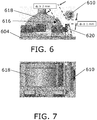
- Figure 6 depicts a top-view of a portion of another hearing aid for being worn in or at an ear canal of a user, the hearing aid comprising:
- Figure 6 furthermore shows an internal surface 616 of a topographical feature for housing a battery 618, which battery is a size '13' battery, cf., IEC PR48 (e.g., cf., IEC 60086-2 Edition 10.1 2001-10) and/or ANSI 7000 ZD.
- IEC PR48 e.g., cf., IEC 60086-2 Edition 10.1 2001-10
- ANSI 7000 ZD e.g., cf., IEC 60086-2 Edition 10.1 2001-10
- Figure 6 furthermore shows a distance (d 2 ) from an outer periphery of the telecoil 610 to an internal surface 616 of a topographical feature for housing a battery 618, which in the present case is 2 mm.
- Figure 6 furthermore shows a distance (d 3 ) from an outer periphery of the telecoil 610 to a Near Field Magnetic Induction (NFMI) coil 620 which in the present case is 1 mm.
- NFMI Near Field Magnetic Induction
- Figure 7 depicts a side-view of the portion of the hearing aid of figure 6 , and furthermore depicts fixation part 808 and first topographical feature 811.
- Figure 8 depicts a perspective-view of t the portion of the hearing aid of figure 6 , and furthermore depicts a microphone 322.
- Figure 9 depicts another perspective-view of the portion of the hearing aid of figure 6 , and furthermore depicts an induction coil 920 for near field magnetic induction communication.
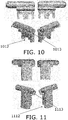
- Figure 10 depicts side views (in the upper row) and perspective views (in the lower row) of telecoil 110 and fixation part 308 of figures 1-5 , and furthermore depicts the second topographical feature 1012, which is a recess in the fixation part 308, and the third topographical feature 1013, which is a concave, circular (spanning an angular range of approximately 135 degrees), cylindrical recess, which corresponds to the size and shape of the telecoil 110.
- the second topographical feature 1012 which is a recess in the fixation part 308
- the third topographical feature 1013 which is a concave, circular (spanning an angular range of approximately 135 degrees), cylindrical recess, which corresponds to the size and shape of the telecoil 110.
- Figure 11 depicts side views (in the upper row) and perspective views (in the lower row) of telecoil 610 and fixation part 808 of figures 6-9 , and furthermore depicts the second topographical feature 1112, which is a recess in the fixation part 808, and the third topographical feature 1113, which is a concave, circular, cylindrical recess (spanning an angular range of approximately 135 degrees), which corresponds to the size and shape of the telecoil 610.
- connection or “coupled” as used herein may include wirelessly connected or coupled.
- the term “and/or” includes any and all combinations of one or more of the associated listed items. The steps of any disclosed method is not limited to the exact order stated herein, unless expressly stated otherwise.
Landscapes
- Engineering & Computer Science (AREA)
- Health & Medical Sciences (AREA)
- General Health & Medical Sciences (AREA)
- Neurosurgery (AREA)
- Otolaryngology (AREA)
- Physics & Mathematics (AREA)
- Acoustics & Sound (AREA)
- Signal Processing (AREA)
- Computer Networks & Wireless Communication (AREA)
- Headphones And Earphones (AREA)
Abstract
There is provided a hearing aid for being worn in or at an ear canal of a user, the hearing aid comprising a housing comprising a face plate (104, 604) configured to face the surrounding environment when the hearing aid is worn by the user, a custom shaped part configured to be positioned at least partly in the ear canal of the user when the hearing aid is worn by the user, and a first topographical feature (111, 811), the hearing aid further comprising a rigid fixation part (308, 808) comprising a second topographical feature (1012, 1112), and a third topographical feature (1013, 1113), where the rigid fixation part (308, 808) is rigidly mounted on the housing, and wherein the first topographical feature (111, 811) is engaging with the second topographical feature (1012, 1112), the hearing aid further comprising a telecoil (110, 610) mounted to the fixation part (308, 808) and wherein the telecoil (110, 610) engages with the third topographical feature (1013, 1113).
Description
- The present disclosure relates to hearing aid, and more particularly a hearing aid for being worn in or at an ear canal of a user which may be manufactured in a simple manner ensuring control over position of the telecoil.
- It may be an issue that suboptimal control over the position and orientation of the telecoil may lead to suboptimal performance in terms of receipt of signals with the telecoil and/or interference with other units, such as antennas and induction coils, of the hearing aid.
- Therefore, there is a need to provide a solution that addresses at least some of the above-mentioned problems.
- According to a first aspect, the present disclosure provides a hearing aid for being worn in or at an ear canal of a user, the hearing aid comprising:
- a housing comprising
- a face plate configured to face the surrounding environment when the hearing aid is worn by the user,
- a custom shaped part configured to be positioned at least partly in the ear canal of the user when the hearing aid is worn by the user, and
- a first topographical feature,
- a rigid fixation part comprising
- a second topographical feature, and
- a third topographical feature,
- a telecoil mounted, such as rigidly mounted, to the fixation part and wherein the telecoil engages with the third topographical feature.
- An advantage of the hearing aid may be that the telecoil may be kept in a fixed relationship with respect to the housing, which ensures control of the orientation of the telecoil (such as ensures that an axis of the telecoil is in the range [30; 120] degrees with respect to horizontal during use), which may be relevant for, e.g., optimal receipt of signals transmitted to the telecoil.
- Another advantage may be that the telecoil is kept in a fixed relationship with the housing ensures control of the orientation and/or position of the telecoil with respect to other units, such as an antenna suitable for 2.45 GHz wireless communication and/or suitable for 5.1, 5.8 GHz wireless communication, of the hearing aid, which may be relevant for improved antenna performance. Control of position and/or orientation may be advantageous for overcoming potential problems related to audible artifacts, level dependent distortion and/or degradation in performance of other units, such Bluetooth™ Low Energy (BLE) antenna performance degradation.
- Another advantage may be that the telecoil is kept in a fixed relationship with the housing ensures control of the orientation and/or position of the telecoil with respect to other units, such as the output transducer. This may be relevant since current drawn in connection with operation of the output transducer (which may also be referred to as 'reciever' or speaker unit) may generate electromagnetic radiation interfering with communication via the telecoil, but having the telecoil rigidly mounted on the rigid fixation part which in turn is rigidly mounted on the housing enables avoiding that the physical relationship between the output transducer and the telecoil changes undesirably during use. Since the spatial relationship is fixed this way, and is thus known, it may be possible to reduce the interference.
- By 'hearing aid' may be understood a device that is adapted to improve or augment the hearing capability of a user by receiving at least the transmitted output audio signal, but also the option to use or include an acoustic signal from a user's surroundings, and generating a corresponding audio signal, possibly modifying the audio signal and providing the possibly modified audio signal as an audible signal to at least one of the user's ears. The "hearing aid" may alternatively or further refer to a device such as an earphone or a headset adapted to receive an audio signal electronically, possibly modifying the audio signal and providing the possibly modified audio signals as an audible signal to at least one of the user's ears.
- Such audible signals may be provided in the form of an acoustic signal radiated into the user's outer ear, or an acoustic signal transferred as mechanical vibrations to the user's inner ears through bone structure of the user's head and/or through parts of middle ear of the user or electric signals transferred directly or indirectly to cochlear nerve and/or to auditory cortex of the user.
- In general, a hearing aid includes i) an input unit such as a microphone for receiving an acoustic signal from a user's surroundings and providing a corresponding input audio signal, and/or ii) a receiving unit, such as a hearing aid wireless interface, for electronically receiving an input audio signal, such as the transmitted output audio signal. The hearing aid may further include a signal processing unit for processing the input audio signal and an output unit, such as an output transducer, for providing an audible signal to the user in dependence on the processed audio signal.
- The input unit may include multiple input microphones, e.g. for providing direction-dependent audio signal processing. Such directional microphone system is adapted to enhance a target acoustic source among a multitude of acoustic sources in the user's environment. In one aspect, the directional system is adapted to detect (such as adaptively detect) from which direction a particular part of the microphone signal originates. This may be achieved by using conventionally known methods. The signal processing unit may include an amplifier that is adapted to apply a frequency dependent gain to the input audio signal. The signal processing unit may further be adapted to provide other relevant functionality such as compression, noise reduction, etc. The output unit may include an output transducer such as a loudspeaker/receiver for providing an air-borne acoustic signal transcutaneously or percutaneously to the skull bone or a vibrator for providing a structure-borne or liquid-borne acoustic signal.
- By 'for being worn in or at an ear canal of a user' may be understood hearing aids which fit in (such as exclusively in) the "bowl" (pinna) and/or the ear canal of the ear, such as in-the-ear (ITE) type hearing aids, In-the-Canal hearing aids (ITC) and/or Completely-in-the-canal hearing aids (CIC). The present disclosure further relates to in-the-ear (ITE) type hearing aids.
- The hearing aid may be part of a "binaural hearing system" which refers to a system comprising two hearing aids where the hearing aids are adapted to cooperatively provide audible signals to both of the user's ears. The hearing aids of the binaural hearing aid system need not be of the same type.
- By 'topographical feature' may be understood a structural feature differing from a planar surface. A topographical feature may comprise one or more recesses and/or one or more protrusions. The first topographical feature may be monolithically integrated with the housing.
- An advantage of the topographical features may be that they define the position and orientation of the telecoil. An advantage may thus be that the topographical features, which may in a simple manner be provided very consistently during manufacture of the housing and the fixation part, thus define the spatial relationship between the telecoil and the housing and this enables defining the spatial relationship between the telecoil and other units of the hearing aid. Thus, this spatial relationship may in a simple, yet effective manner be effectively be defined with high precision and low tolerances during manufacture of the units, such as the housing and fixation part, rather than at the stage of assembly of the housing, fixation part and telecoil (and optionally other units).
- The first topographical feature may be positioned on the interior wall of the housing, such as on the interior facing side of the face plate.
- By 'rigidly mounted' is understood that the parts being rigidly mounted to each other are kept in a fixed spatial relationship, such as wherein position and/or orientation with respect to each other are kept constant, such as constant during normal use. For example, if the hearing aid is dropped on a flat, hard surface from a height of 1 meter, the position before/after the drop should not be able to differ by more than 0.1 mm, such as more than 0.01 mm.
- By 'rigid' may be understood that the corresponding part, such as the rigid fixation part, does not deform during normal use.
- The 'fixation part' may in an alternative wording be described as a holder part for holding the telecoil and defining the telecoil's position with respect to the housing. The fixation part may comprise, such as consist of, a material with a Young's modulus being equal to or larger than a Young's modulus of the housing at the position where the fixation part is mounted. The fixation part may comprise, such as consist of, solid polymer. The fixation part may comprise, such as consist of, a material with a Young's modulus being equal to or larger than 0.1 GPa, such as equal to or larger than 0.5 GPa, such as equal to or larger than 1.0 GPa. The fixation part may comprise, such as consist of, a material with a Young's modulus being equal to or less than 2000 GPa, such as equal to or less than 200 GPa, such as equal to or less than 20 GPa.
- By 'mounted on the housing' may be understood mounted on an inside wall of the housing.
- According to the present disclosure, there is presented a hearing aid wherein the fixation part is mounted on the housing via glue. The fixation part may then be glued to the housing and/or the first topographical features, such as a holder of or an existing component, such as a microphone or a near field magnetic induction coil.
- According to the present disclosure, there is presented a hearing aid, wherein the telecoil is partially encircled by the rigid fixation part around an axis of the telecoil, wherein the partial encirculation spans an angular range of equal to or less than 180 degrees, such as equal to or less than 150 degrees, such as equal to or less than 120 degrees. This may for example be realized by having the third topographical feature corresponding to a cylindrical, concave recess with the shape of a segment of a circle, which segment at most corresponds to a semi-circle. An advantage of this may be, that during mounting, the telecoil can be placed into the third topographical feature by movement in a direction orthogonal to the axis of the telecoil (which may in turn facilitate simple mounting processes and/or reduced risk of damage to the telecoil for example because it is not necessary to move/slide the telecoil into the third topographical feature in a direction parallel with the telecoil).
- According to the present disclosure, there is presented a hearing aid, wherein the third topographical feature is arranged so that the mounting, the telecoil can be placed into the third topographical feature by movement in a direction orthogonal to the axis of the telecoil.
- According to the present disclosure, there is presented a hearing aid, wherein the third topographical feature corresponding to a circular, cylindrical, concave recess with the shape of a segment of a circle, which segment at most corresponds to a semi-circle, such as which corresponds to the size and shape of the telecoil 110 (where 'corresponds' in this context may be understood to imply that the diameter of the segment of the circle of the third topographical features matches, such as is within ±1 0 % of the outer diameter of the telecoil).
- According to the present disclosure, there is presented a hearing aid, wherein the hearing aid comprises a plurality of wireless receivers, such as wireless receivers for receiving electromagnetic signals, such as Bluetooth™ (such as Bluetooth™ Low Energy (BLE)) and/or near-field magnetic induction (NFMI). Wireless transmission may in general be carried out using any one of a number of protocols and/or carriers, including, but not limited to, near-field magnetic induction (NFMI), baseband modulation, Bluetooth™, WiFi-based, radio frequency (RF) transmission, such as in the Giga Hz range, or any other type of suitable carrier frequency and/or using any other type of suitable protocol.
- According to the present disclosure, there is presented a hearing aid, wherein the hearing aid comprises a Bluetooth™ receiver, such as a Bluetooth™ Low Energy (BLE) receiver. An advantage of embodiments of the present invention comprising a Bluetooth™ receiver may be that the current drawn in connection with operation of the Bluetooth™ receiver may generate electromagnetic radiation interfering with communication via the telecoil, but having the telecoil rigidly mounted on the rigid fixation part which in turn is rigidly mounted on the housing enables avoiding that the physical relationship between the Bluetooth™ receiver and the telecoil changes undesirably during use. Since the spatial relationship is fixed this way, and is thus known, it may be possible to reduce the interference.
- According to the present disclosure, there is presented a hearing aid, wherein the hearing aid furthermore comprises an antenna suitable for 2.45 GHz and/or an antenna suitable for 5.8 GHz. By 'suitable for 2.45 GHz' may be understood suitable for the 2.45 GHz industrial, scientific and medical (ISM) radio band. By 'antenna suitable for 2.45 GHz' may be understood an antenna suitable for transmission and/or receipt of electromagnetic signals within the 2.45 GHz ISM band and/or within the wavelength range [2.4; 2.5] GHz.
- By 'suitable for 5.8 GHz' may be understood suitable for the 5.8 GHz industrial, scientific and medical (ISM) radio band. By 'antenna suitable for 5.8 GHz' may be understood an antenna suitable for transmission and/or receipt of electromagnetic signals within the 5.8 GHz ISM band and/or within the wavelength range [5.725; 5.875] GHz.
- According to the present disclosure, there is presented a hearing aid, wherein the antenna comprises an at least partial loop, such as an at least partial loop around a battery housing and/or optionally around a battery during use.
- According to the present disclosure, there is presented a hearing aid, wherein the housing comprises a fourth topographical feature, which defines the position and/or orientation of the antenna. The fourth topographical feature may be positioned on the interior wall of the housing, such as on the interior facing side of the face plate. The fourth topographical feature may be monolithically integrated with the housing. An advantage of this embodiment may be that the topographical features, which may in a simple manner be provided very consistently during manufacture of the housing, define the spatial relationship between the antenna and the telecoil. Thus, this spatial relationship may in a simple, yet effective manner be effectively be defined with high precision and low tolerances during manufacture of the housing rather than at the stage of assembly of the housing, telecoil and antenna.
- According to the present disclosure, there is presented a hearing aid, wherein the hearing aid furthermore comprises an induction coil for near field magnetic induction (NFMI) communication.
- According to the present disclosure, there is presented a hearing aid, wherein the housing comprises a fifth topographical feature, which defines the position and/or orientation of the induction coil. The fifth topographical feature may be positioned on the interior wall of the housing, such as on the interior facing side of the face plate. The fifth topographical feature may be monolithically integrated with the housing. An advantage of this embodiment may be that the topographical features, which may in a simple manner be provided very consistently during manufacture of the housing, thus define the spatial relationship between the induction coil and the telecoil. Thus, this spatial relationship may in a simple, yet effective manner be effectively be defined with high precision and low tolerances during manufacture of the housing rather than at the stage of assembly of the housing, telecoil and induction coil
- According to the present disclosure, there is presented a hearing aid, wherein a distance (d2) from an outer periphery of the telecoil to an internal surface of a topographical feature for housing a battery is at least 2 mm, such as is 2 mm, and/or wherein the distance (d2) from an outer periphery of the telecoil to an internal surface of a topographical feature for housing a battery is at most 4 mm, such as at most 3 mm, such as a most 2 mm. Said distance may be equivalent to a distance to a battery during use. In embodiments the hearing aid furthermore comprises a battery, in which case said distance is equivalent to a distance to the battery.
- According to the present disclosure, there is presented a hearing aid, wherein a distance (d3) from an outer periphery of the telecoil to a Near Field Magnetic Induction (NFMI) coil is at least 1 mm, such as is 1 mm, and/or wherein the distance (d3) from an outer periphery of the telecoil to a Near Field Magnetic Induction coil is at most 3 mm, such as a most 2 mm, such as at most 1 mm.
- According to the present disclosure, there is presented a hearing aid, wherein a distance (d1) from an outer periphery of the telecoil to an internal wall of face plate of the housing is at least 3 mm, such as is 3 mm, and/or wherein the distance (d1) from an outer periphery of the telecoil to an internal wall of face plate of the housing is at most 5 mm, such as at most 4 mm, such as at most 3 mm.
- According to the present disclosure, there is presented a hearing aid, wherein the hearing aid furthermore comprises a microphone and wherein the first topographical feature furthermore engages with a microphone and/or wherein the first topographical feature is arranged on a face plate of the housing.
- According to the present disclosure, there is presented a hearing aid, wherein the fixation part has a mirror plane. An advantage of this may be that the same part can be used in hearing aids for both left and right ear. For example, the fixation parts for left and right side may be made "symmetrical", so that the same fixation part can be used in both left and right side versions. The telecoil may then be placed "flush" to one end of the fixation part, so the left and right side preassemblies (telecoil and fixation part) are "mirrored".
- According to a second aspect, there is presented a binaural hearing aid system comprising two hearing aids, said two hearing aids comprising
- a first hearing aid being a hearing aid according to any one of the preceding claims and being suitable as a right ear hearing aid, and
- a second hearing aid being a hearing aid according to any one of the preceding claims and being suitable as a left ear hearing aid,
- According to a third aspect, there is presented a method for providing a hearing aid with a telecoil, said method comprising:
- providing a housing comprising
- a face plate configured to face the surrounding environment when the hearing aid is worn by the user,
- a custom shaped part configured to be positioned at least partly in the ear canal of the user when the hearing aid is worn by the user, and
- a first topographical feature,
- providing a rigid fixation part comprising
- a second topographical feature, and
- a third topographical feature,
- rigidly mounting a telecoil on the fixation part so that the telecoil engages with the third topographical feature,
- rigidly mounting the fixation part on the housing so that the first topographical feature is engaging with the second topographical feature.
- According to a fourth aspect, there is presented use of a hearing aid according to the first aspect or a pair of hearing aids according to the second aspect for providing an acoustic signal to one or both ear canals of a user.
- According to an alternative there is provided a hearing aid for being worn in or at an ear canal of a user, the hearing aid comprising:
- a housing comprising
- a face plate configured to face the surrounding environment when the hearing aid is worn by the user,
- a custom shaped part configured to be positioned at least partly in the ear canal of the user when the hearing aid is worn by the user, and
- a first topographical feature monolithically integrated with the housing,
- a telecoil mounted, such as rigidly mounted, in relation to the housing and engaging with the first topographical feature.
- This alternative hearing aid may be seen as corresponding to a hearing aid according to the first aspect, wherein the fixation part of the first aspect is monolithically integrated with the housing.
- The features and/or technical details outlined above may be combined in any suitable ways.
- The aspects of the disclosure may be best understood from the following detailed description taken in conjunction with the accompanying figures. The figures are schematic and simplified for clarity, and they just show details to improve the understanding of the claims, while other details are left out. Throughout, the same reference numerals are used for identical or corresponding parts. The individual features of each aspect may each be combined with any or all features of the other aspects. These and other aspects, features and/or technical effect will be apparent from and elucidated with reference to the illustrations described hereinafter in which:
-
Figure 1 depicts a top-view of a portion of a hearing aid. -
Figure 2 depicts a side-view of the portion of the hearing aid offigure 1 . -
Figure 3 depicts a perspective-view of the portion of the hearing aid offigure 1 . -
Figure 4 depicts a bottom-view of the portion of the hearing aid offigure 1 . -
Figure 5 depicts another perspective-view of the portion of the hearing aid offigure 1 . -
Figure 6 depicts a top-view of a portion of another hearing aid. -
Figure 7 depicts a side-view of the portion of the hearing aid offigure 6 , -
Figure 8 depicts a perspective-view of t the portion of the hearing aid offigure 6 , -
Figure 9 depicts another perspective-view of the portion of the hearing aid offigure 6 , -
Figure 10 depicts side and perspective views of telecoil and fixation part offigures 1-5 . -
Figure 11 depicts side and perspective views of telecoil and fixation part offigures 6-9 . - The detailed description set forth below in connection with the appended drawings is intended as a description of various configurations. The detailed description includes specific details for the purpose of providing a thorough understanding of various concepts. However, it will be apparent to those skilled in the art that these concepts may be practised without these specific details.
-
Figure 1 depicts a top-view of a portion of a hearing aid for being worn in or at an ear canal of a user, the hearing aid comprising: - a housing comprising
- a
face plate 104 configured to face the surrounding environment when the hearing aid is worn by the user, and - a custom shaped part configured to be positioned at least partly in the ear canal of the user when the hearing aid is worn by the user,
- a first
topographical feature 111, which is an alignment rib for a microphone,
- a
- a
rigid fixation part 308 comprising- a second topographical feature, and
- a third topographical feature,
- a telecoil 110 mounted to the
fixation part 308 and wherein thetelecoil 110 engages with the third topographical feature. -
Figure 1 furthermore shows aninternal surface 116 of a topographical feature for housing abattery 118, which battery is a size '312' battery, cf., IEC PR41 (e.g., cf., IEC 60086-2 Edition 10.1 2001-10) and/or ANSI 7002 ZD. -
Figure 1 furthermore shows a distance d1 from an outer periphery of the telecoil 110 to an internal wall offace plate 104 which in the present case is 3 mm. -
Figure 2 depicts a side-view of the portion of the hearing aid offigure 1 , and furthermore depicts aninduction coil 220 for near field magnetic induction communication. -
Figure 3 depicts a perspective-view of the portion of the hearing aid offigure 1 , and furthermore depicts amicrophone 322. -
Figure 4 depicts a bottom-view of the portion of the hearing aid offigure 1 . The figure also shows the third topographical feature partially encircling the telecoil around the telecoil axis (orthogonal to the plane of the paper) and spanning an angular range of approximately 135 degrees. -
Figure 5 depicts another perspective-view of the portion of the hearing aid offigure 1 . -
Figure 6 depicts a top-view of a portion of another hearing aid for being worn in or at an ear canal of a user, the hearing aid comprising: - a housing comprising
- a
face plate 604 configured to face the surrounding environment when the hearing aid is worn by the user, and - a custom shaped part configured to be positioned at least partly in the ear canal of the user when the hearing aid is worn by the user,
- a first topographical feature, which is a face plate supporting wall for an
induction coil 620 for near field magnetic induction communication,
- a
- a rigid fixation part comprising
- a second topographical feature, and
- a third topographical feature,
- a telecoil 610 mounted to the fixation part and wherein the
telecoil 610 engages with the third topographical feature. -
Figure 6 furthermore shows aninternal surface 616 of a topographical feature for housing abattery 618, which battery is a size '13' battery, cf., IEC PR48 (e.g., cf., IEC 60086-2 Edition 10.1 2001-10) and/or ANSI 7000 ZD. -
Figure 6 furthermore shows a distance (d2) from an outer periphery of the telecoil 610 to aninternal surface 616 of a topographical feature for housing abattery 618, which in the present case is 2 mm. -
Figure 6 furthermore shows a distance (d3) from an outer periphery of the telecoil 610 to a Near Field Magnetic Induction (NFMI)coil 620 which in the present case is 1 mm. -
Figure 7 depicts a side-view of the portion of the hearing aid offigure 6 , and furthermore depictsfixation part 808 and firsttopographical feature 811. -
Figure 8 depicts a perspective-view of t the portion of the hearing aid offigure 6 , and furthermore depicts amicrophone 322. -
Figure 9 depicts another perspective-view of the portion of the hearing aid offigure 6 , and furthermore depicts aninduction coil 920 for near field magnetic induction communication. -
Figure 10 depicts side views (in the upper row) and perspective views (in the lower row) oftelecoil 110 andfixation part 308 offigures 1-5 , and furthermore depicts the secondtopographical feature 1012, which is a recess in thefixation part 308, and the thirdtopographical feature 1013, which is a concave, circular (spanning an angular range of approximately 135 degrees), cylindrical recess, which corresponds to the size and shape of thetelecoil 110. -
Figure 11 depicts side views (in the upper row) and perspective views (in the lower row) oftelecoil 610 andfixation part 808 offigures 6-9 , and furthermore depicts the secondtopographical feature 1112, which is a recess in thefixation part 808, and the thirdtopographical feature 1113, which is a concave, circular, cylindrical recess (spanning an angular range of approximately 135 degrees), which corresponds to the size and shape of thetelecoil 610. - As used, the singular forms "a," "an," and "the" are intended to include the plural forms as well (i.e. to have the meaning "at least one"), unless expressly stated otherwise. It will be further understood that the terms "includes," "comprises," "including," and/or "comprising," when used in this specification, specify the presence of stated features, integers, steps, operations, elements, and/or components, but do not preclude the presence or addition of one or more other features, integers, steps, operations, elements, components, and/or groups thereof. It will also be understood that when an element is referred to as being "connected" or "coupled" to another element, it can be directly connected or coupled to the other element but an intervening elements may also be present, unless expressly stated otherwise. Furthermore, "connected" or "coupled" as used herein may include wirelessly connected or coupled. As used herein, the term "and/or" includes any and all combinations of one or more of the associated listed items. The steps of any disclosed method is not limited to the exact order stated herein, unless expressly stated otherwise.
- It should be appreciated that reference throughout this specification to "one embodiment" or "an embodiment" or "an aspect" or features included as "may" means that a particular feature, structure or characteristic described in connection with the embodiment is included in at least one embodiment of the disclosure. Furthermore, the particular features, structures or characteristics may be combined as suitable in one or more embodiments of the disclosure. The previous description is provided to enable any person skilled in the art to practice the various aspects described herein. Various modifications to these aspects will be readily apparent to those skilled in the art, and the generic principles defined herein may be applied to other aspects.
- The claims are not intended to be limited to the aspects shown herein, but is to be accorded the full scope consistent with the language of the claims, wherein reference to an element in the singular is not intended to mean "one and only one" unless specifically so stated, but rather "one or more." Unless specifically stated otherwise, the term "some" refers to one or more.
- Accordingly, the scope should be judged in terms of the claims that follow.
Claims (15)
- A hearing aid for being worn in or at an ear canal of a user, the hearing aid comprising:- a housing comprising- a face plate (104, 604) configured to face the surrounding environment when the hearing aid is worn by the user,- a custom shaped part configured to be positioned at least partly in the ear canal of the user when the hearing aid is worn by the user, and- a first topographical feature (111, 811),- a rigid fixation part (308, 808) comprisingwhere the rigid fixation part (308, 808) is rigidly mounted on the housing, and wherein the first topographical feature (111, 811) is engaging with the second topographical feature (1012, 1112), the hearing aid further comprising:- a second topographical feature (1012, 1112), and- a third topographical feature (1013, 1113),- a telecoil (110, 610) mounted to the fixation part (308, 808) and wherein the telecoil (110, 610) engages with the third topographical feature (1013, 1113).
- A hearing aid according to any one of the preceding claims, wherein the hearing aid comprises a plurality of wireless receivers, such as wireless receivers for receiving electromagnetic signals.
- A hearing aid according to any one of the preceding claims, wherein the hearing aid comprises a Bluetooth™ receiver, such as a Bluetooth™ Low Energy receiver.
- A hearing aid according to any one of the preceding claims, wherein the hearing aid furthermore comprises an antenna suitable for 2.45 GHz and/or an antenna suitable for 5.8 GHz.
- A hearing aid according to claim 4, wherein the antenna comprises an at least partial loop, such as an at least partial loop around a battery housing and/or optionally around a battery (118, 618) during use.
- A hearing aid according to any one of claims 4-5, wherein the housing comprises a fourth topographical feature, which defines the position and/or orientation of the antenna.
- A hearing aid according to any one of the preceding claims, wherein the hearing aid furthermore comprises an induction coil (220, 620) for near field magnetic induction communication.
- A hearing aid according to claim 7, wherein the housing comprises a fifth topographical feature, which defines the position and/or orientation of the induction coil (220, 620).
- A hearing aid according to any one of the preceding claims, wherein the telecoil is partially encircled by the rigid fixation part around an axis of the telecoil, wherein the partical encirculation spans an angular range of equal to or less than 180 degrees, such as equal to or less than 150 degrees, such as equal to or less than 120 degrees.
- A hearing aid according to any one of the preceding claims, wherein the third topographical feature is arranged so that the mounting, the telecoil can be placed into the third topographical feature by movement in a direction orthogonal to the axis of the telecoil.
- A hearing aid according to any one of the preceding claims, wherein a distance from an outer periphery of the telecoil (110, 610) to an internal wall of face plate (104, 604) of the housing is at least 3 mm, such as is 3 mm, and/or wherein the distance from an outer periphery of the telecoil (110, 610) to an internal wall of face plate (104, 604) of the housing is at most 5 mm, such as at most 4 mm, such as at most 3 mm,
and/or
wherein a distance from an outer periphery of the telecoil to an internal surface (116, 616) of a topographical feature for housing a battery (118, 618) is at least 2 mm, such as is 2 mm, and/or wherein the distance from an outer periphery of the telecoil to an internal surface (116, 616) of a topographical feature for housing a battery (118, 618) is at most 4 mm, such as at most 3 mm, such as a most 2 mm.. - A hearing aid according to any one of the preceding claims, wherein the hearing aid furthermore comprises a microphone (322) and wherein the first topographical feature furthermore engages with a microphone and/or wherein the first topographical feature (111, 811) is arranged on a face plate (104, 604) of the housing.
- A binaural hearing aid system comprising two hearing aids, said two hearing aids comprising- a first hearing aid being a hearing aid according to any one of the preceding claims and being suitable as a right ear hearing aid, and- a second hearing aid being a hearing aid according to any one of the preceding claims and being suitable as a left ear hearing aid,wherein the fixation part of the first hearing aid is identical to the fixation part of the second hearing aid.
- A method for providing a hearing aid with a telecoil (110, 610), said method comprising:- providing a housing comprising- a face plate (104, 604) configured to face the surrounding environment when the hearing aid is worn by the user,- a custom shaped part configured to be positioned at least partly in the ear canal of the user when the hearing aid is worn by the user, and- a first topographical feature (111, 811),- providing a rigid fixation part (308, 808) comprising- a second topographical feature (1012, 1112), and- a third topographical feature (1013, 1113),- rigidly mounting a telecoil (110, 610) on the fixation part (308, 808) so that the telecoil (110, 610) engages with the third topographical feature (1013, 1113),- rigidly mounting the fixation part (308, 808) on the housing so that the first topographical feature (111,811) is engaging with the second topographical feature (1012, 1112).
- Use of a hearing aid according to any one of claims 1-12 or a pair of hearing aids according to claim 13 for providing an acoustic signal to one or both ear canals of a user.
Priority Applications (1)
| Application Number | Priority Date | Filing Date | Title |
|---|---|---|---|
| EP18157905.3A EP3462750A1 (en) | 2018-02-21 | 2018-02-21 | Fixation element of telecoil in hearing aid |
Applications Claiming Priority (1)
| Application Number | Priority Date | Filing Date | Title |
|---|---|---|---|
| EP18157905.3A EP3462750A1 (en) | 2018-02-21 | 2018-02-21 | Fixation element of telecoil in hearing aid |
Publications (1)
| Publication Number | Publication Date |
|---|---|
| EP3462750A1 true EP3462750A1 (en) | 2019-04-03 |
Family
ID=61256703
Family Applications (1)
| Application Number | Title | Priority Date | Filing Date |
|---|---|---|---|
| EP18157905.3A Withdrawn EP3462750A1 (en) | 2018-02-21 | 2018-02-21 | Fixation element of telecoil in hearing aid |
Country Status (1)
| Country | Link |
|---|---|
| EP (1) | EP3462750A1 (en) |
Citations (5)
| Publication number | Priority date | Publication date | Assignee | Title |
|---|---|---|---|---|
| EP1435758A1 (en) * | 2004-01-16 | 2004-07-07 | Phonak Ag | Housing for a hearing prosthesis and a hearing aid |
| US20070047750A1 (en) * | 2005-08-26 | 2007-03-01 | Siemens Audiologische Technik Gmbh | In-the-ear hearing aid having an electronics module |
| US20090175475A1 (en) * | 2006-10-16 | 2009-07-09 | Peter Nikles | Assembly device for a component of a hearing apparatus and corresponding method |
| EP2680366A1 (en) * | 2012-06-25 | 2014-01-01 | GN Resound A/S | Antenna system for a wearable computing device |
| US20180006752A1 (en) * | 2011-08-09 | 2018-01-04 | Sonova Ag | Wireless Sound Tranmission System and Method |
-
2018
- 2018-02-21 EP EP18157905.3A patent/EP3462750A1/en not_active Withdrawn
Patent Citations (5)
| Publication number | Priority date | Publication date | Assignee | Title |
|---|---|---|---|---|
| EP1435758A1 (en) * | 2004-01-16 | 2004-07-07 | Phonak Ag | Housing for a hearing prosthesis and a hearing aid |
| US20070047750A1 (en) * | 2005-08-26 | 2007-03-01 | Siemens Audiologische Technik Gmbh | In-the-ear hearing aid having an electronics module |
| US20090175475A1 (en) * | 2006-10-16 | 2009-07-09 | Peter Nikles | Assembly device for a component of a hearing apparatus and corresponding method |
| US20180006752A1 (en) * | 2011-08-09 | 2018-01-04 | Sonova Ag | Wireless Sound Tranmission System and Method |
| EP2680366A1 (en) * | 2012-06-25 | 2014-01-01 | GN Resound A/S | Antenna system for a wearable computing device |
Similar Documents
| Publication | Publication Date | Title |
|---|---|---|
| US10297910B2 (en) | Hearing device with bowtie antenna optimized for specific band | |
| US9986348B2 (en) | Antenna unit | |
| EP1681904B1 (en) | Hearing instrument | |
| EP3038382A1 (en) | Antenna unit for a hearing aid | |
| US12407994B2 (en) | Hearing aid for placement at an ear of a user | |
| US11683650B2 (en) | Antenna configuration for a hearing aid system | |
| EP3361751B1 (en) | A hearing aid with a flexible compression element | |
| US10412513B2 (en) | Hearing device | |
| US20170064469A1 (en) | Hearing device | |
| EP3462750A1 (en) | Fixation element of telecoil in hearing aid | |
| US20160037272A1 (en) | Microphone module latching configuration for a hearing instrument, microphone module and hearing instrument | |
| EP3113512A1 (en) | Coupling device | |
| US11785398B2 (en) | Hearing aid with transmission power adaptation | |
| EP4274254A1 (en) | An element comprising a physical filter | |
| EP3972290A1 (en) | Battery contacting system in a hearing device | |
| WO2024146944A1 (en) | Audio system comprising a head wearable carrier element configured with a beam forming loudspeaker system |
Legal Events
| Date | Code | Title | Description |
|---|---|---|---|
| PUAI | Public reference made under article 153(3) epc to a published international application that has entered the european phase |
Free format text: ORIGINAL CODE: 0009012 |
|
| AK | Designated contracting states |
Kind code of ref document: A1 Designated state(s): AL AT BE BG CH CY CZ DE DK EE ES FI FR GB GR HR HU IE IS IT LI LT LU LV MC MK MT NL NO PL PT RO RS SE SI SK SM TR |
|
| AX | Request for extension of the european patent |
Extension state: BA ME |
|
| STAA | Information on the status of an ep patent application or granted ep patent |
Free format text: STATUS: THE APPLICATION IS DEEMED TO BE WITHDRAWN |
|
| 18D | Application deemed to be withdrawn |
Effective date: 20191005 |