EP3462520A1 - Electrode and device employing the same - Google Patents
Electrode and device employing the same Download PDFInfo
- Publication number
- EP3462520A1 EP3462520A1 EP18196866.0A EP18196866A EP3462520A1 EP 3462520 A1 EP3462520 A1 EP 3462520A1 EP 18196866 A EP18196866 A EP 18196866A EP 3462520 A1 EP3462520 A1 EP 3462520A1
- Authority
- EP
- European Patent Office
- Prior art keywords
- electrode
- network structure
- aluminum
- metal
- active material
- Prior art date
- Legal status (The legal status is an assumption and is not a legal conclusion. Google has not performed a legal analysis and makes no representation as to the accuracy of the status listed.)
- Withdrawn
Links
Images







Classifications
-
- H—ELECTRICITY
- H01—ELECTRIC ELEMENTS
- H01M—PROCESSES OR MEANS, e.g. BATTERIES, FOR THE DIRECT CONVERSION OF CHEMICAL ENERGY INTO ELECTRICAL ENERGY
- H01M4/00—Electrodes
- H01M4/02—Electrodes composed of, or comprising, active material
- H01M4/64—Carriers or collectors
- H01M4/70—Carriers or collectors characterised by shape or form
- H01M4/80—Porous plates, e.g. sintered carriers
- H01M4/808—Foamed, spongy materials
-
- H—ELECTRICITY
- H01—ELECTRIC ELEMENTS
- H01M—PROCESSES OR MEANS, e.g. BATTERIES, FOR THE DIRECT CONVERSION OF CHEMICAL ENERGY INTO ELECTRICAL ENERGY
- H01M4/00—Electrodes
- H01M4/02—Electrodes composed of, or comprising, active material
- H01M4/13—Electrodes for accumulators with non-aqueous electrolyte, e.g. for lithium-accumulators; Processes of manufacture thereof
- H01M4/133—Electrodes based on carbonaceous material, e.g. graphite-intercalation compounds or CFx
-
- H—ELECTRICITY
- H01—ELECTRIC ELEMENTS
- H01G—CAPACITORS; CAPACITORS, RECTIFIERS, DETECTORS, SWITCHING DEVICES, LIGHT-SENSITIVE OR TEMPERATURE-SENSITIVE DEVICES OF THE ELECTROLYTIC TYPE
- H01G9/00—Electrolytic capacitors, rectifiers, detectors, switching devices, light-sensitive or temperature-sensitive devices; Processes of their manufacture
- H01G9/0029—Processes of manufacture
-
- H—ELECTRICITY
- H01—ELECTRIC ELEMENTS
- H01G—CAPACITORS; CAPACITORS, RECTIFIERS, DETECTORS, SWITCHING DEVICES, LIGHT-SENSITIVE OR TEMPERATURE-SENSITIVE DEVICES OF THE ELECTROLYTIC TYPE
- H01G9/00—Electrolytic capacitors, rectifiers, detectors, switching devices, light-sensitive or temperature-sensitive devices; Processes of their manufacture
- H01G9/004—Details
- H01G9/02—Diaphragms; Separators
-
- H—ELECTRICITY
- H01—ELECTRIC ELEMENTS
- H01G—CAPACITORS; CAPACITORS, RECTIFIERS, DETECTORS, SWITCHING DEVICES, LIGHT-SENSITIVE OR TEMPERATURE-SENSITIVE DEVICES OF THE ELECTROLYTIC TYPE
- H01G9/00—Electrolytic capacitors, rectifiers, detectors, switching devices, light-sensitive or temperature-sensitive devices; Processes of their manufacture
- H01G9/004—Details
- H01G9/022—Electrolytes; Absorbents
- H01G9/035—Liquid electrolytes, e.g. impregnating materials
-
- H—ELECTRICITY
- H01—ELECTRIC ELEMENTS
- H01G—CAPACITORS; CAPACITORS, RECTIFIERS, DETECTORS, SWITCHING DEVICES, LIGHT-SENSITIVE OR TEMPERATURE-SENSITIVE DEVICES OF THE ELECTROLYTIC TYPE
- H01G9/00—Electrolytic capacitors, rectifiers, detectors, switching devices, light-sensitive or temperature-sensitive devices; Processes of their manufacture
- H01G9/004—Details
- H01G9/04—Electrodes or formation of dielectric layers thereon
- H01G9/042—Electrodes or formation of dielectric layers thereon characterised by the material
-
- H—ELECTRICITY
- H01—ELECTRIC ELEMENTS
- H01G—CAPACITORS; CAPACITORS, RECTIFIERS, DETECTORS, SWITCHING DEVICES, LIGHT-SENSITIVE OR TEMPERATURE-SENSITIVE DEVICES OF THE ELECTROLYTIC TYPE
- H01G9/00—Electrolytic capacitors, rectifiers, detectors, switching devices, light-sensitive or temperature-sensitive devices; Processes of their manufacture
- H01G9/004—Details
- H01G9/04—Electrodes or formation of dielectric layers thereon
- H01G9/048—Electrodes or formation of dielectric layers thereon characterised by their structure
-
- H—ELECTRICITY
- H01—ELECTRIC ELEMENTS
- H01M—PROCESSES OR MEANS, e.g. BATTERIES, FOR THE DIRECT CONVERSION OF CHEMICAL ENERGY INTO ELECTRICAL ENERGY
- H01M10/00—Secondary cells; Manufacture thereof
- H01M10/05—Accumulators with non-aqueous electrolyte
- H01M10/054—Accumulators with insertion or intercalation of metals other than lithium, e.g. with magnesium or aluminium
-
- H—ELECTRICITY
- H01—ELECTRIC ELEMENTS
- H01M—PROCESSES OR MEANS, e.g. BATTERIES, FOR THE DIRECT CONVERSION OF CHEMICAL ENERGY INTO ELECTRICAL ENERGY
- H01M10/00—Secondary cells; Manufacture thereof
- H01M10/05—Accumulators with non-aqueous electrolyte
- H01M10/056—Accumulators with non-aqueous electrolyte characterised by the materials used as electrolytes, e.g. mixed inorganic/organic electrolytes
- H01M10/0564—Accumulators with non-aqueous electrolyte characterised by the materials used as electrolytes, e.g. mixed inorganic/organic electrolytes the electrolyte being constituted of organic materials only
- H01M10/0566—Liquid materials
- H01M10/0568—Liquid materials characterised by the solutes
-
- H—ELECTRICITY
- H01—ELECTRIC ELEMENTS
- H01M—PROCESSES OR MEANS, e.g. BATTERIES, FOR THE DIRECT CONVERSION OF CHEMICAL ENERGY INTO ELECTRICAL ENERGY
- H01M10/00—Secondary cells; Manufacture thereof
- H01M10/05—Accumulators with non-aqueous electrolyte
- H01M10/056—Accumulators with non-aqueous electrolyte characterised by the materials used as electrolytes, e.g. mixed inorganic/organic electrolytes
- H01M10/0564—Accumulators with non-aqueous electrolyte characterised by the materials used as electrolytes, e.g. mixed inorganic/organic electrolytes the electrolyte being constituted of organic materials only
- H01M10/0566—Liquid materials
- H01M10/0569—Liquid materials characterised by the solvents
-
- H—ELECTRICITY
- H01—ELECTRIC ELEMENTS
- H01M—PROCESSES OR MEANS, e.g. BATTERIES, FOR THE DIRECT CONVERSION OF CHEMICAL ENERGY INTO ELECTRICAL ENERGY
- H01M4/00—Electrodes
- H01M4/02—Electrodes composed of, or comprising, active material
- H01M4/04—Processes of manufacture in general
- H01M4/0402—Methods of deposition of the material
- H01M4/0421—Methods of deposition of the material involving vapour deposition
- H01M4/0428—Chemical vapour deposition
-
- H—ELECTRICITY
- H01—ELECTRIC ELEMENTS
- H01M—PROCESSES OR MEANS, e.g. BATTERIES, FOR THE DIRECT CONVERSION OF CHEMICAL ENERGY INTO ELECTRICAL ENERGY
- H01M4/00—Electrodes
- H01M4/02—Electrodes composed of, or comprising, active material
- H01M4/04—Processes of manufacture in general
- H01M4/0438—Processes of manufacture in general by electrochemical processing
- H01M4/044—Activating, forming or electrochemical attack of the supporting material
- H01M4/0445—Forming after manufacture of the electrode, e.g. first charge, cycling
-
- H—ELECTRICITY
- H01—ELECTRIC ELEMENTS
- H01M—PROCESSES OR MEANS, e.g. BATTERIES, FOR THE DIRECT CONVERSION OF CHEMICAL ENERGY INTO ELECTRICAL ENERGY
- H01M4/00—Electrodes
- H01M4/02—Electrodes composed of, or comprising, active material
- H01M4/04—Processes of manufacture in general
- H01M4/049—Manufacturing of an active layer by chemical means
- H01M4/0492—Chemical attack of the support material
-
- H—ELECTRICITY
- H01—ELECTRIC ELEMENTS
- H01M—PROCESSES OR MEANS, e.g. BATTERIES, FOR THE DIRECT CONVERSION OF CHEMICAL ENERGY INTO ELECTRICAL ENERGY
- H01M4/00—Electrodes
- H01M4/02—Electrodes composed of, or comprising, active material
- H01M4/13—Electrodes for accumulators with non-aqueous electrolyte, e.g. for lithium-accumulators; Processes of manufacture thereof
- H01M4/139—Processes of manufacture
- H01M4/1393—Processes of manufacture of electrodes based on carbonaceous material, e.g. graphite-intercalation compounds or CFx
-
- H—ELECTRICITY
- H01—ELECTRIC ELEMENTS
- H01M—PROCESSES OR MEANS, e.g. BATTERIES, FOR THE DIRECT CONVERSION OF CHEMICAL ENERGY INTO ELECTRICAL ENERGY
- H01M4/00—Electrodes
- H01M4/02—Electrodes composed of, or comprising, active material
- H01M4/36—Selection of substances as active materials, active masses, active liquids
- H01M4/362—Composites
- H01M4/366—Composites as layered products
-
- H—ELECTRICITY
- H01—ELECTRIC ELEMENTS
- H01M—PROCESSES OR MEANS, e.g. BATTERIES, FOR THE DIRECT CONVERSION OF CHEMICAL ENERGY INTO ELECTRICAL ENERGY
- H01M4/00—Electrodes
- H01M4/02—Electrodes composed of, or comprising, active material
- H01M4/36—Selection of substances as active materials, active masses, active liquids
- H01M4/58—Selection of substances as active materials, active masses, active liquids of inorganic compounds other than oxides or hydroxides, e.g. sulfides, selenides, tellurides, halogenides or LiCoFy; of polyanionic structures, e.g. phosphates, silicates or borates
- H01M4/583—Carbonaceous material, e.g. graphite-intercalation compounds or CFx
-
- H—ELECTRICITY
- H01—ELECTRIC ELEMENTS
- H01M—PROCESSES OR MEANS, e.g. BATTERIES, FOR THE DIRECT CONVERSION OF CHEMICAL ENERGY INTO ELECTRICAL ENERGY
- H01M4/00—Electrodes
- H01M4/02—Electrodes composed of, or comprising, active material
- H01M4/36—Selection of substances as active materials, active masses, active liquids
- H01M4/58—Selection of substances as active materials, active masses, active liquids of inorganic compounds other than oxides or hydroxides, e.g. sulfides, selenides, tellurides, halogenides or LiCoFy; of polyanionic structures, e.g. phosphates, silicates or borates
- H01M4/583—Carbonaceous material, e.g. graphite-intercalation compounds or CFx
- H01M4/587—Carbonaceous material, e.g. graphite-intercalation compounds or CFx for inserting or intercalating light metals
-
- H—ELECTRICITY
- H01—ELECTRIC ELEMENTS
- H01M—PROCESSES OR MEANS, e.g. BATTERIES, FOR THE DIRECT CONVERSION OF CHEMICAL ENERGY INTO ELECTRICAL ENERGY
- H01M4/00—Electrodes
- H01M4/02—Electrodes composed of, or comprising, active material
- H01M4/62—Selection of inactive substances as ingredients for active masses, e.g. binders, fillers
- H01M4/624—Electric conductive fillers
- H01M4/626—Metals
-
- H—ELECTRICITY
- H01—ELECTRIC ELEMENTS
- H01M—PROCESSES OR MEANS, e.g. BATTERIES, FOR THE DIRECT CONVERSION OF CHEMICAL ENERGY INTO ELECTRICAL ENERGY
- H01M4/00—Electrodes
- H01M4/02—Electrodes composed of, or comprising, active material
- H01M4/64—Carriers or collectors
- H01M4/66—Selection of materials
- H01M4/661—Metal or alloys, e.g. alloy coatings
-
- H—ELECTRICITY
- H01—ELECTRIC ELEMENTS
- H01M—PROCESSES OR MEANS, e.g. BATTERIES, FOR THE DIRECT CONVERSION OF CHEMICAL ENERGY INTO ELECTRICAL ENERGY
- H01M4/00—Electrodes
- H01M4/02—Electrodes composed of, or comprising, active material
- H01M2004/021—Physical characteristics, e.g. porosity, surface area
-
- H—ELECTRICITY
- H01—ELECTRIC ELEMENTS
- H01M—PROCESSES OR MEANS, e.g. BATTERIES, FOR THE DIRECT CONVERSION OF CHEMICAL ENERGY INTO ELECTRICAL ENERGY
- H01M2300/00—Electrolytes
- H01M2300/0017—Non-aqueous electrolytes
- H01M2300/0025—Organic electrolyte
- H01M2300/0045—Room temperature molten salts comprising at least one organic ion
-
- Y—GENERAL TAGGING OF NEW TECHNOLOGICAL DEVELOPMENTS; GENERAL TAGGING OF CROSS-SECTIONAL TECHNOLOGIES SPANNING OVER SEVERAL SECTIONS OF THE IPC; TECHNICAL SUBJECTS COVERED BY FORMER USPC CROSS-REFERENCE ART COLLECTIONS [XRACs] AND DIGESTS
- Y02—TECHNOLOGIES OR APPLICATIONS FOR MITIGATION OR ADAPTATION AGAINST CLIMATE CHANGE
- Y02E—REDUCTION OF GREENHOUSE GAS [GHG] EMISSIONS, RELATED TO ENERGY GENERATION, TRANSMISSION OR DISTRIBUTION
- Y02E60/00—Enabling technologies; Technologies with a potential or indirect contribution to GHG emissions mitigation
- Y02E60/10—Energy storage using batteries
Definitions
- the technical field relates to an electrode and a device employing the same.
- Aluminum is the most abundant metal on earth, and electronic devices that are based on aluminum have the advantage of being inexpensive to produce.
- An aluminum-based redox couple provides storage capacity that is competitive with that of a single-electron lithium-ion battery.
- aluminum has low flammability and low electronic redox properties, meaning that an aluminum-ion battery might offer significant safety improvements.
- the capacity of an aluminum-ion battery is proportional to the amount of graphite in the aluminum-ion battery.
- the conventional aluminum-ion battery employed the foamed graphite as an electrode, exhibits poor performance thereof due to the disadvantages of poor contact at current collector of the foamed graphite and poor electrical conductivity at high charging/discharging current.
- due to the fragility of the pure foamed graphite is brittle, the foamed graphite is difficult to process.
- the disclosure provides an electrode, such as the positive electrode of the metal-ion battery.
- the electrode includes a metal network structure; and an active material network structure, wherein the metal network structure is disposed in the hollow active material network structure, wherein the weight ratio of the metal network structure and the hollow active material network structure is from 0.5 to 155.
- the disclosure provides a method for fabricating an electrode.
- the method includes providing a metal network structure, and depositing an active material on the surface of the metal network structure, obtaining the electrode.
- the weight ratio of the metal network structure and the hollow active material network structure is from 0.5 to 155.
- the disclosure provides a device, such as metal-ion battery, or capacitor.
- the device includes a first electrode, wherein the first electrode is the electrode of the disclosure; a first separator; and, a second electrode, wherein the first electrode is separated from the second electrode by the first separator.
- the disclosure provides an electrode (such as a positive electrode of a metal-ion battery) and a device (such as a metal-ion battery employing the electrode).
- the electrode has an active material network structure by depositing an active material on the surface of a metal network structure. Since the metal material is disposed in the active material network structure, the electrical conductivity of the electrode can be enhanced and the flexibility of the active material network structure can be improved.
- the metal network structure can be subjected to an etching, to remove a part of the metal in the active material network structure, forming a plurality of voids in the active material network structure.
- the active material of the battery may be able to be infiltrated rapidly by the electrolyte, thereby increasing the capacity and the total capacity generation of the battery.
- the active material network structure covering the surface of the metal network structure can be non-continuous in order to improve the diffusion of the electrolyte.
- FIG. 1 is a schematic view of the electrode 10 according to an embodiment of the disclosure.
- the thickness T of the electrode 10 can be from about 100nm to 10mm.
- FIG. 2 is a perspective schematic view of the region 2 of the electrode shown in FIG. 1 .
- the electrode 10 includes a metal network structure 12, and an hallow active material network structure 14, wherein the metal network structure 12 is disposed in the hollow active material network structure 14.
- the hollow active material network structure 14 covers the metal network structure 12.
- the hollow active material network structure 14 which covers the metal network structure 12, can also have a sponge-like configuration.
- the weight ratio of the metal network structure to the hollow active material network structure can be from about 0.5 to 155, such as from 1.6 to 155.
- the metal network structure 12 can be made of a metal foam, such a nickel foam, iron foam, copper foam, titanium foam, or alloy foam (such as: nickel-containing alloy, iron-containing alloy, copper-containing alloy, or titanium-containing alloy).
- the metal network structure 12 can be nickel foam, nickel foam alloy, or stainless steel foam.
- the hollow active material network structure can be layered active layer, or an agglomeration of a layered active layer.
- the hollow active material network structure can be graphite, layered double hydroxide, layered oxide, layered chalcogenide, or a combination thereof.
- the amount of active material of the hollow active material network structure can be from 0.2 mg/cm 2 to 20 mg/cm 2 .
- the hollow active material network structure 14 can be a continuous structure, as shown in FIG. 2 .
- the hollow active material network structure 14 can be a non-continuous structure, and thus a part of the surface of the metal network structure 12 is exposed.
- the area ratio of the surface, which is covered by the hollow active material network structure, of the metal network structure to the whole surface of the metal network structure is 0.01 to 0.95, in order to facilitate the infiltration of electrolyte into the hollow active material network structure 14.
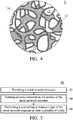
- a part of the metal network structure 12 can be removed, thereby forming a plurality of voids 15 disposed in the hollow active material network structure 14, as shown in FIG. 4 .
- the volume ratio of the voids to the metal network structure is from 99 to 1.
- the active material of the battery may be able to be infiltrated rapidly by the electrolyte through the voids, thereby increasing the capacity and the total capacity generation of the battery.
- the volume ratio of the voids to the metal network structure can be determined by measuring the weight of the metal network structure before and after etching.
- the metal network structure can have a weight W0 before etching, and the metal network structure can have a weight W1 after etching.
- the disclosure also provides a method for fabricating the aforementioned electrode.
- FIG. 5 is a flow chart illustrating a method for fabricating the electrode according to an embodiment of the disclosure. It should be understood that additional steps can be provided before, during, and after the method 50, and some of the steps described can be replaced or eliminated for other embodiments of the method 50.
- the initial step 52 of the method for fabricating the electrode provides a metal network structure.
- an active material is formed on the surface of the metal network structure through a depositing process (such as chemical vapor deposition (CVD)), obtaining the electrode (steps 54).
- the depositing process can be performed in a vacuum muffle furnace to promote the growth of the active material network structure (the temperature of the depositing process can be from about 800°C to 1200°C).
- the hollow active material network structure is graphite, methane, served as reactive gas, can be introduced during the depositing process.
- argon gas and hydrogen gas, served as carrier gas can be introduced optionally during the depositing process.
- the continuity of the active material network structure can be controlled by the process time period.
- a continuous active material network structure can be formed by increasing the process time period
- a non-continuous active material network structure can be formed by reducing the process time period.
- the electrode after performing the steps 54, the electrode can be further subjected to a wet etching process to remove a part of the metal network structure, forming a plurality of voids (steps 56).
- the weight per unit area of the active material is relative high (such as greater than 1.5 mg/cm 2 )
- the metal network structure can be subjected to a wet etching process to from voids which facilitates the diffusion of the electrolyte.
- the electrode when the metal network structure is a nickel foam, the electrode can be immersed into an etching solution, wherein the etching solution can include ferric chloride aqueous solution and hydrochloric acid.
- the etching degree of the metal network structure can be controlled by increasing or reducing the immersion time period. After etching, the result can be washed by deionized water to remove residual etching solution and then dried.
- the disclosure provides a device such as metal-ion battery, or capacitor.
- the device 200 includes a first electrode 101 (serving as a positive electrode), a first separator 102, and a second electrode 103 (serving as a negative electrode), wherein the first electrode 101 is the aforementioned electrode of the disclosure, and the first separator 102 is disposed between the first electrode 101 and the second electrode 103.
- the device 200 also includes an electrolyte 105, which is disposed between the first electrode 101 and the second electrode 103.
- the device 200 can be a rechargeable secondary battery, although primary batteries also are encompassed by the disclosure.
- the device 200 can further include a third electrode (serving as a negative electrode) and a second separator, wherein the second separator is disposed between the first electrode and the third electrode.
- the first electrode is disposed between the second electrode and the third electrode.
- the device 200 can be an aluminum-ion battery, although other types of metal ion batteries are encompassed by the disclosure.
- the second electrode 103 can include aluminum, such as a non-alloyed form of aluminum or an aluminum alloy. More generally, suitable materials for the second electrode 103 may include one or more of an alkali metal (e.g., lithium, potassium, sodium, and so forth), an alkaline earth metal (e.g., magnesium, calcium, and so forth), a transition metal (e.g., zinc, iron, nickel, cobalt, and so forth), a main group metal or metalloid (e.g., aluminum, silicon, tin, and so forth), and a metal alloy of two or more of the foregoing elements (e.g., an aluminum alloy).
- an alkali metal e.g., lithium, potassium, sodium, and so forth
- an alkaline earth metal e.g., magnesium, calcium, and so forth
- a transition metal e.g., zinc, iron, nickel, cobalt
- the first separator 102 can mitigate against electrical shorting of the first electrode 101 and the second electrode 103.
- the electrolyte 105 can support reversible intercalation and de-intercalation of anions at the first electrode 101 and support reversible deposition and dissolution (or stripping) of the second electrode 103 (such as aluminum).
- the electrolyte includes an ionic liquid.
- the electrolyte is a mixture of an ionic liquid and a metal halide.
- the ionic liquid can be choline chloride, ethylchlorine chloride, alkali halide, alkylimidazolium salt, alkylpyridinium salt, alkylfluoropyrazolium salt, alkyltriazolium salt, aralkylammonium salt, alkylalkoxyammonium salt, aralkylphosphonium salt, aralkylsulfonium salt, or a combination thereof.
- the metal halide can be aluminum halide.
- the molar ratio of the metal halide and the ionic liquid is at least or greater than about 1.1 or at least or greater than about 1.2, and is up to about 1.5, up to about 1.8, or more, such as where the aluminum halide is AlCl 3 , the ionic liquid is 1-ethyl- 3-methylimidazolium chloride, and the molar ratio of the aluminum chloride to 1-ethyl-3-methylimidazolium chloride is at least or greater than about 1.2, such as between 1.2 and 1.8.
- the electrolyte can be a mixture of a specific solvent and a metal halide, wherein the specific solvent can be urea, N-methylurea, dimethyl sulfoxide, methylsulfonylmethane, or a combination thereof.
- the molar ratio of the aluminum chloride to the solvent is greater than or equal to about 1.1, such as between 1.2 and 1.8.
- An ionic liquid electrolyte can be doped (or have additives added) to increase electrical conductivity and lower the viscosity, or can be otherwise altered to yield compositions that favor the reversible electrodeposition of metals.
- a nickel foam plate (having a size of 70mm x 70mm, a thickness of 0.2mm, and a porosity of 90%) was provided.
- the nickel foam plate was disposed into a vacuum muffle furnace to promote the growth of graphite at 900°C-1100°C, and methane was introduced into the vacuum muffle furnace with argon gas and hydrogen gas as carrier gas.
- the graphite amount per unit area was controlled to be about 1.78 mg/cm 2 , and the weight ratio of the nickel to graphite was 10.3.
- the nickel foam plate which a graphite layer was grown thereon, was immersed into an etching solution (ferric chloride aqueous solution with a concentration of 5%) to etch the nickel foam plate in order to remove a part of nickel of the nickel foam plate to form voids.
- the time period of the etching process was controlled until the weight ratio of the nickel to graphite was 0.63.
- the result was washed with deionized water to remove the residual etching solution and then dried at 80°C to remove deionized water, obtaining the graphite electrode.
- an aluminum foil (with a thickness of 0.03mm, manufactured by Alfa Aesar) was cut to obtain the aluminum electrode (having a size of 70mm x 70mm).
- separators (of glass filter paper (two layers), with trade No. Whatman) were provided.
- the aluminum electrode, the separator, the graphite electrode, the separator, and the aluminum electrode were placed in sequence and sealed within an aluminum plastic pouch.
- an electrolyte including aluminum chloride (AlCl 3 ) and 1-ethyl-3-methylimidazolium chloride ([EMIm]Cl, wherein the molar ratio between AlCl 3 and [EMIm]Cl was about 1.3
- AlCl 3 aluminum chloride
- [EMIm]Cl 1-ethyl-3-methylimidazolium chloride
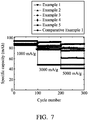
- Example 1 Aluminum-ion battery (1) of Example 1 was analyzed at charging/discharging current densities of about 1000 mA/g, 3000mA/g, and 5000mA/g by a NEWARE battery analyzer to analyze the performance of Aluminum-ion battery (1). The results are shown in FIG. 7 and Table 1.
- Example 2 was performed in the same manner as Example 1 except that the weight ratio of the nickel to graphite was 1.32 after etching, obtaining Aluminum-ion battery (2).
- Example 2 Aluminum-ion battery (2) of Example 2 was analyzed by a NEWARE battery analyzer to analyze the performance of Aluminum-ion battery (2). The results are shown in FIG. 7 and Table 1.
- Example 3 was performed in the same manner as Example 1 except that the weight ratio of the nickel to graphite was 1.63 after etching, obtaining Aluminum-ion battery (3).
- Example 3 Aluminum-ion battery (3) of Example 3 was analyzed by a NEWARE battery analyzer to analyze the performance of Aluminum-ion battery (3). The results are shown in FIG. 7 and Table 1.
- Example 4 was performed in the same manner as Example 1 except that the weight ratio of the nickel to graphite was 2.66 after etching, obtaining Aluminum-ion battery (4).
- Example 4 Aluminum-ion battery (4) of Example 4 was analyzed by a NEWARE battery analyzer to analyze the performance of Aluminum-ion battery (4). The results are shown in FIG. 7 and Table 1.
- Example 5 was performed in the same manner as Example 1 except that the weight ratio of the nickel to graphite was 4.99 after etching, obtaining Aluminum-ion battery (5).
- Example 5 Aluminum-ion battery (5) of Example 5 was analyzed by a NEWARE battery analyzer to analyze the performance of Aluminum-ion battery (5). The results are shown in FIG. 7 and Table 1.
- Comparative Example 1 was performed in the same manner as Example 1 except that the nickel was removed completely (i.e. the weight ratio of the nickel to graphite was 0) after etching, obtaining Aluminum-ion battery (6).
- Example 6 was performed in the same manner as Example 1 except that the weight ratio of the nickel to graphite was 5.7 after etching, obtaining Aluminum-ion battery (7).
- Example 6 Aluminum-ion battery (7) of Example 6 was analyzed by a NEWARE battery analyzer to analyze the performance of Aluminum-ion battery (7). The results are shown in FIG. 8 and Table 1.
- Example 7 was performed in the same manner as Example 1 except that the weight ratio of the nickel to graphite was 8.3 after etching, obtaining Aluminum-ion battery (8).
- Example 7 Aluminum-ion battery (8) of Example 7 was analyzed by a NEWARE battery analyzer to analyze the performance of Aluminum-ion battery (8). The results are shown in FIG. 8 and Table 1.
- Example 8 was performed in the same manner as Example 1 except that the graphite amount per unit area was controlled to force the weight ratio of the nickel to graphite was 31 after etching, obtaining Aluminum-ion battery (9).
- Example 8 Aluminum-ion battery (9) of Example 8 was analyzed by a NEWARE battery analyzer to analyze the performance of Aluminum-ion battery (9). The results are shown in FIG. 8 and Table 1.
- Example 9 was performed in the same manner as Example 1 except that the graphite amount per unit area was controlled to force the weight ratio of the nickel to graphite was 155 after etching, obtaining Aluminum-ion battery (10).
- Example 9 Aluminum-ion battery (10) of Example 9 was analyzed by a NEWARE battery analyzer to analyze the performance of Aluminum-ion battery (10). The results are shown in FIG. 8 and Table 1.
- Table 1 the weight ratio of the nickel to graphite specific capacity difference (mAh/g) (charging/discharging current density from 1000 mA/g to 3000 mA/g) specific capacity difference (mAh/g) (charging/discharging current density from 3000 mA/g to 5000 mA/g) specific capacity (mAh/g) (charging/discharging current density of 3000 mA/g) Comparative Example 1 0 38 6 47 Example 1 0.63 9 29 75 Example 2 1.32 6 19 78 Example 3 1.63 5 8 82 Example 4 2.66 3 4 84 Example 5 4.9 2 4 91 Example 6 5.7 2 2 92 Example 7 8.3 2 2 90
- Example 8 31 1 2 93 Example 9 155 1 -2 91
- a nickel foam plate (having a size of 70mm x 70mm, a thickness of 0.2mm, and a porosity of 90%) was provided.
- the nickel foam plate was disposed into a vacuum muffle furnace to promote the growth of graphite at 900°C-1100°C), and methane was introduced into the vacuum muffle furnace with argon gas and hydrogen gas as carrier gas.
- the graphite amount per unit area was controlled to be about 2 mg/cm 2 , and the weight ratio of the nickel to graphite was 8.9, obtaining the graphite electrode (no etching process was performed).
- an aluminum foil (with a thickness of 0.03mm, manufactured by Alfa Aesar) was cut to obtain the aluminum electrode (having a size of 70mm x 70mm).
- separators (of glass filter paper (two layers), with trade No. Whatman) were provided.
- the aluminum electrode, the separator, the graphite electrode, the separator, and the aluminum electrode were placed in sequence and sealed within an aluminum plastic pouch.
- an electrolyte including aluminum chloride (AlCl 3 ) and 1-ethyl-3-methylimidazolium chloride ([EMIm]Cl, wherein the molar ratio between AlCl 3 and [EMIm]Cl was about 1.3
- AlCl 3 aluminum chloride
- [EMIm]Cl 1-ethyl-3-methylimidazolium chloride
- Aluminum-ion battery (11) of Example 10 was analyzed at charging/discharging current densities of about 1000 mA/g, 3000mA/g, and 5000mA/g by a NEWARE battery analyzer to analyze the performance of Aluminum-ion battery (11). The results are shown in FIG. 9 .
- a nickel foam plate (having a size of 70mm x 70mm, a thickness of 0.2mm, and a porosity of 90%) was provided.
- the nickel foam plate was disposed into a vacuum muffle furnace, and methane was introduced into the vacuum muffle furnace with argon gas and hydrogen gas as carrier gas.
- the graphite amount per unit area was controlled to be about 2 mg/cm 2 , and the weight ratio of the nickel to graphite was 7.78.
- the weight ratio of the nickel to graphite was reduced from 7.78to 4.67 (i.e. 40% of nickel was removed), obtaining the graphite electrode.
- an aluminum foil (with a thickness of 0.03mm, manufactured by Alfa Aesar) was cut to obtain the aluminum electrode (having a size of 70mm x 70mm).
- separators (of glass filter paper (two layers), with trade No. Whatman) were provided.
- the aluminum electrode, the separator, the graphite electrode, the separator, and the aluminum electrode were placed in sequence and sealed within an aluminum plastic pouch.
- an electrolyte including aluminum chloride (AlCl 3 ) and 1-ethyl-3-methylimidazolium chloride ([EMIm]Cl, wherein the molar ratio between AlCl 3 and [EMIm]Cl was about 1.3
- AlCl 3 aluminum chloride
- [EMIm]Cl 1-ethyl-3-methylimidazolium chloride
- Example 11 Aluminum-ion battery (12) of Example 11 was analyzed by a NEWARE battery analyzer to analyze the performance of Aluminum-ion battery (12). The results are shown in FIG. 9 .
- a nickel foam plate (having a size of 70mm x 70mm, a thickness of 0.2mm, and a porosity of 90%) was provided.
- the nickel foam plate was disposed into a vacuum muffle furnace to promote the growth of graphite at 900°C-1100°C, and methane was introduced into the vacuum muffle furnace with argon gas and hydrogen gas as carrier gas.
- the graphite amount per unit area was controlled to be about 2 mg/cm 2 , and the weight ratio of the nickel to graphite was 7.85.
- the weight ratio of the nickel to graphite was reduced from 7.85 to 2.67 (i.e. 66% of nickel was removed), obtaining the graphite electrode.
- an aluminum foil (with a thickness of 0.03mm, manufactured by Alfa Aesar) was cut to obtain the aluminum electrode (having a size of 70mm x 70mm).
- separators (of glass filter paper (two layers), with trade No. Whatman) were provided.
- the aluminum electrode, the separator, the graphite electrode, the separator, and the aluminum electrode were placed in sequence and sealed within an aluminum plastic pouch.
- an electrolyte including aluminum chloride (AlCl 3 ) and 1-ethyl-3-methylimidazolium chloride ([EMIm]Cl, wherein the molar ratio between AlCl 3 and [EMIm]Cl was about 1.3
- AlCl 3 aluminum chloride
- [EMIm]Cl 1-ethyl-3-methylimidazolium chloride
- Example 12 Aluminum-ion battery (13) of Example 12 was analyzed by a NEWARE battery analyzer to analyze the performance of Aluminum-ion battery (13). The results are shown in FIG. 9 .
- a nickel foam plate (having a size of 70mm x 70mm, a thickness of 0.2mm, and a porosity of 90%) was provided.
- the nickel foam plate was disposed into a vacuum muffle furnace to promote the growth of graphite at 900°C-1100°C, and methane was introduced into the vacuum muffle furnace with argon gas and hydrogen gas as carrier gas.
- the graphite amount per unit area was controlled to be about 2 mg/cm 2 , and the weight ratio of the nickel to graphite was 7.64.
- the weight ratio of the nickel to graphite was reduced from 7.64 to 1.3 (i.e. 83% of nickel was removed), obtaining the graphite electrode.
- an aluminum foil (with a thickness of 0.03mm, manufactured by Alfa Aesar) was cut to obtain the aluminum electrode (having a size of 70mm x 70mm).
- separators (of glass filter paper (two layers), with trade No. Whatman) were provided.
- the aluminum electrode, the separator, the graphite electrode, the separator, and the aluminum electrode were placed in sequence and sealed within an aluminum plastic pouch.
- an electrolyte including aluminum chloride (AlCl 3 ) and 1-ethyl-3-methylimidazolium chloride ([EMIm]Cl, wherein the molar ratio between AlCl 3 and [EMIm]Cl was about 1.3
- AlCl 3 aluminum chloride
- [EMIm]Cl 1-ethyl-3-methylimidazolium chloride
- Example 13 Aluminum-ion battery (14) of Example 13 was analyzed by a NEWARE battery analyzer to analyze the performance of Aluminum-ion battery (14). The results are shown in FIG. 9 .
- a nickel foam plate (having a size of 70mm x 70mm, a thickness of 0.2mm, and a porosity of 90%) was provided.
- the nickel foam plate was disposed into a vacuum muffle furnace to promote the growth of graphite at 900°C-1100°C, and methane was introduced into the vacuum muffle furnace with argon gas and hydrogen gas as carrier gas.
- the graphite amount per unit area was controlled to be about 1.53 mg/cm 2 , and the weight ratio of the nickel to graphite was 10, obtaining the graphite electrode (no etching process was performed).
- an aluminum foil (with a thickness of 0.03mm, manufactured by Alfa Aesar) was cut to obtain the aluminum electrode (having a size of 70mm x 70mm).
- separators (of glass filter paper (two layers), with trade No. Whatman) were provided.
- the aluminum electrode, the separator, the graphite electrode, the separator, and the aluminum electrode were placed in sequence and sealed within an aluminum plastic pouch.
- an electrolyte including aluminum chloride (AlCl 3 ) and 1-ethyl-3-methylimidazolium chloride ([EMIm]Cl, wherein the molar ratio between AlCl 3 and [EMIm]Cl was about 1.3
- AlCl 3 aluminum chloride
- [EMIm]Cl 1-ethyl-3-methylimidazolium chloride
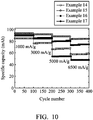
- Example 14 Aluminum-ion battery (15) of Example 14 was analyzed at charging/discharging current densities of about 1000 mA/g, 3000mA/g, and 5000mA/g by a NEWARE battery analyzer to analyze the performance of Aluminum-ion battery (15). The results are shown in FIG. 10 .
- a nickel foam plate (having a size of 70mm x 70mm, a thickness of 0.2mm, and a porosity of 90%) was provided.
- the nickel foam plate was disposed into a vacuum muffle furnace to promote the growth of graphite at 900°C-1100°C, and methane was introduced into the vacuum muffle furnace with argon gas and hydrogen gas as carrier gas.
- the graphite amount per unit area was controlled to be about 1.53 mg/cm 2 , and the weight ratio of the nickel to graphite was 10.21.
- the weight ratio of the nickel to graphite was reduced from 10.21 to 4.9 (i.e. 52% of nickel was removed), obtaining the graphite electrode.
- an aluminum foil (with a thickness of 0.03mm, manufactured by Alfa Aesar) was cut to obtain the aluminum electrode (having a size of 70mm x 70mm).
- separators (of glass filter paper (two layers), with trade No. Whatman) were provided.
- the aluminum electrode, the separator, the graphite electrode, the separator, and the aluminum electrode were placed in sequence and sealed within an aluminum plastic pouch.
- an electrolyte including aluminum chloride (AlCl 3 ) and 1-ethyl-3-methylimidazolium chloride ([EMIm]Cl, wherein the molar ratio between AlCl 3 and [EMIm]Cl was about 1.3
- AlCl 3 aluminum chloride
- [EMIm]Cl 1-ethyl-3-methylimidazolium chloride
- Example 15 Aluminum-ion battery (16) of Example 15 was analyzed by a NEWARE battery analyzer to analyze the performance of Aluminum-ion battery (16). The results are shown in FIG. 10 .
- a nickel foam plate (having a size of 70mm x 70mm, a thickness of 0.2mm, and a porosity of 90%) was provided.
- the nickel foam plate was disposed into a vacuum muffle furnace to promote the growth of graphite at 900°C-1100°C, and methane was introduced into the vacuum muffle furnace with argon gas and hydrogen gas as carrier gas.
- the graphite amount per unit area was controlled to be about 1.53 mg/cm 2 , and the weight ratio of the nickel to graphite was 9.64.
- the weight ratio of the nickel to graphite was reduced from 9.64 to 2.7 (i.e. 72% of nickel was removed), obtaining the graphite electrode.
- an aluminum foil (with a thickness of 0.03mm, manufactured by Alfa Aesar) was cut to obtain the aluminum electrode (having a size of 70mm x 70mm).
- separators (of glass filter paper (two layers), with trade No. Whatman) were provided.
- the aluminum electrode, the separator, the graphite electrode, the separator, and the aluminum electrode were placed in sequence and sealed within an aluminum plastic pouch.
- an electrolyte including aluminum chloride (AlCl 3 ) and 1-ethyl-3-methylimidazolium chloride ([EMIm]Cl, wherein the molar ratio between AlCl 3 and [EMIm]Cl was about 1.3
- AlCl 3 aluminum chloride
- [EMIm]Cl 1-ethyl-3-methylimidazolium chloride
- Example 16 Aluminum-ion battery (17) of Example 16 was analyzed by a NEWARE battery analyzer to analyze the performance of Aluminum-ion battery (17). The results are shown in FIG. 10 .
- a nickel foam plate (having a size of 70mm x 70mm, a thickness of 0.2mm, and a porosity of 90%) was provided.
- the nickel foam plate was disposed into a vacuum muffle furnace to promote the growth of graphite at 900°C-1100°C, and methane was introduced into the vacuum muffle furnace with argon gas and hydrogen gas as carrier gas.
- the graphite amount per unit area was controlled to be about 1.53 mg/cm 2 , and the weight ratio of the nickel to graphite was 10.
- the weight ratio of the nickel to graphite was reduced from 10 to 1.6 (i.e. 84% of nickel was removed), obtaining the graphite electrode.
- an aluminum foil (with a thickness of 0.03mm, manufactured by Alfa Aesar) was cut to obtain the aluminum electrode (having a size of 70mm x 70mm).
- separators (of glass filter paper (two layers), with trade No. Whatman) were provided.
- the aluminum electrode, the separator, the graphite electrode, the separator, and the aluminum electrode were placed in sequence and sealed within an aluminum plastic pouch.
- an electrolyte including aluminum chloride (AlCl 3 ) and 1-ethyl-3-methylimidazolium chloride ([EMIm]Cl, wherein the molar ratio between AlCl 3 and [EMIm]Cl was about 1.3
- AlCl 3 aluminum chloride
- [EMIm]Cl 1-ethyl-3-methylimidazolium chloride
- Example 17 Aluminum-ion battery (18) of Example 17 was analyzed by a NEWARE battery analyzer to analyze the performance of Aluminum-ion battery (18). The results are shown in FIG. 10 .
- the electrolyte can contact the graphite via the voids after etching a part of the nickel foam plate, thereby facilitating the infiltration of electrolyte into the graphite.
- a nickel foam plate (having a size of 70mm x 70mm, a thickness of 0.2mm, and a porosity of 90%) was provided.
- the nickel foam plate was disposed into a vacuum muffle furnace to promote the growth of graphite at 900°C-1100°C, and methane was introduced into the vacuum muffle furnace with argon gas and hydrogen gas as carrier gas.
- the graphite amount per unit area was controlled to be about 1.78 mg/cm 2 , and the weight ratio of the nickel to graphite was 8.58.
- the nickel foam plate which a graphite layer was grown thereon, was immersed into an etching solution (ferric chloride aqueous solution with a concentration of 5%) to etch the nickel foam plate in order to remove a part of nickel of the nickel foam plate to form voids.
- the time period of the etching process was controlled until the weight ratio of the nickel to graphite was 1.63 (i.e. about 81% of nickel was removed).
- the result was washed with deionized water to remove the residual etching solution and then dried at 80°C to remove deionized water, obtaining the graphite electrode.
- an aluminum foil (with a thickness of 0.03mm, manufactured by Alfa Aesar) was cut to obtain the aluminum electrode (having a size of 70mm x 70mm).
- separators (of glass filter paper (two layers), with trade No. Whatman) were provided.
- the aluminum electrode, the separator, the graphite electrode, the separator, and the aluminum electrode were placed in sequence and sealed within an aluminum plastic pouch.
- an electrolyte including aluminum chloride (AlCl 3 ) and 1-ethyl-3-methylimidazolium chloride ([EMIm]Cl, wherein the molar ratio between AlCl 3 and [EMIm]Cl was about 1.3
- AlCl 3 aluminum chloride
- [EMIm]Cl 1-ethyl-3-methylimidazolium chloride
- Aluminum-ion battery (19) of Example 18 was analyzed at charging/discharging current densities of about 1000 mA/g, 3000mA/g, and 5000mA/g by a NEWARE battery analyzer to analyze the performance of Aluminum-ion battery (19). The results are shown in FIG. 11 .
- the electrode when the graphite amount per unit area was greater than about 1.7 mg/cm 2 , the electrode, after removing 81% of metal, can still exhibit superior electrical conductivity, and the battery employing the electrode can exhibit high specific capacity at high charging/discharging current densities.
- a nickel foam plate (having a size of 70mm x 70mm, a thickness of 0.2mm, and a porosity of 90%) was provided.
- the nickel foam plate was disposed into a vacuum muffle furnace to promote the growth of graphite at 900°C-1100°C, and methane was introduced into the vacuum muffle furnace with argon gas and hydrogen gas as carrier gas.
- the graphite amount per unit area was controlled to be about 1.42 mg/cm 2 , and the weight ratio of the nickel to graphite was 10.7, obtaining the graphite electrode (no etching process was performed).
- an aluminum foil (with a thickness of 0.03mm, manufactured by Alfa Aesar) was cut to obtain the aluminum electrode (having a size of 70mm x 70mm).
- separators (of glass filter paper (two layers), with trade No. Whatman) were provided.
- the aluminum electrode, the separator, the graphite electrode, the separator, and the aluminum electrode were placed in sequence and sealed within an aluminum plastic pouch.
- an electrolyte including aluminum chloride (AlCl 3 ) and 1-ethyl-3-methylimidazolium chloride ([EMIm]Cl, wherein the molar ratio between AlCl 3 and [EMIm]Cl was about 1.3
- AlCl 3 aluminum chloride
- [EMIm]Cl 1-ethyl-3-methylimidazolium chloride
- Aluminum-ion battery (20) of Example 19 was analyzed at charging/discharging current densities of about 1000 mA/g, 3000mA/g, and 5000mA/g by a NEWARE battery analyzer to analyze the performance of Aluminum-ion battery (20). The results are shown in FIG. 12 .
- Example 20 was performed in the same manner as Example 19 except that the graphite electrode was further etched resulting in that the weight ratio of the nickel to graphite was reduced from 10.7 to 4.75 (i.e. 56% of nickel was removed), obtaining Aluminum-ion battery (21).
- Example 20 Aluminum-ion battery (21) of Example 20 was analyzed by a NEWARE battery analyzer to analyze the performance of Aluminum-ion battery (21). The results are shown in FIG. 12 .
Landscapes
- Chemical & Material Sciences (AREA)
- Engineering & Computer Science (AREA)
- Chemical Kinetics & Catalysis (AREA)
- Electrochemistry (AREA)
- General Chemical & Material Sciences (AREA)
- Manufacturing & Machinery (AREA)
- Power Engineering (AREA)
- Materials Engineering (AREA)
- Inorganic Chemistry (AREA)
- Microelectronics & Electronic Packaging (AREA)
- Physics & Mathematics (AREA)
- Condensed Matter Physics & Semiconductors (AREA)
- General Physics & Mathematics (AREA)
- Composite Materials (AREA)
- Battery Electrode And Active Subsutance (AREA)
- Cell Electrode Carriers And Collectors (AREA)
Abstract
Description
- This Application claims priority of Taiwan Patent Application No.
106133111, filed on Sep. 27, 2017 - The technical field relates to an electrode and a device employing the same.
- Aluminum is the most abundant metal on earth, and electronic devices that are based on aluminum have the advantage of being inexpensive to produce. An aluminum-based redox couple provides storage capacity that is competitive with that of a single-electron lithium-ion battery. Furthermore, aluminum has low flammability and low electronic redox properties, meaning that an aluminum-ion battery might offer significant safety improvements.
- Given the enhanced theoretical capacity of an aluminum-ion battery, it would be desirable to provide aluminum-ion battery constructions that may feasibly and reliably provide enhanced battery performance, such as enhanced capacity and discharge voltage.
- The capacity of an aluminum-ion battery is proportional to the amount of graphite in the aluminum-ion battery. The conventional aluminum-ion battery, employed the foamed graphite as an electrode, exhibits poor performance thereof due to the disadvantages of poor contact at current collector of the foamed graphite and poor electrical conductivity at high charging/discharging current. In addition, due to the fragility of the pure foamed graphite is brittle, the foamed graphite is difficult to process.
- Hence, it is against this background that a need arose to develop embodiments of this disclosure.
- According to embodiments of the disclosure, the disclosure provides an electrode, such as the positive electrode of the metal-ion battery. The electrode includes a metal network structure; and an active material network structure, wherein the metal network structure is disposed in the hollow active material network structure, wherein the weight ratio of the metal network structure and the hollow active material network structure is from 0.5 to 155.
- According to other embodiments of the disclosure, the disclosure provides a method for fabricating an electrode. The method includes providing a metal network structure, and depositing an active material on the surface of the metal network structure, obtaining the electrode. The weight ratio of the metal network structure and the hollow active material network structure is from 0.5 to 155.
- According to other embodiments of the disclosure, the disclosure provides a device, such as metal-ion battery, or capacitor. The device includes a first electrode, wherein the first electrode is the electrode of the disclosure; a first separator; and, a second electrode, wherein the first electrode is separated from the second electrode by the first separator.
- A detailed description is given in the following embodiments with reference to the accompanying drawings.
-
-
FIG. 1 is a schematic view of the electrode according to an embodiment of the disclosure. -
FIG. 2 is a perspective schematic view of theregion 2 of the electrode shown inFIG. 1 . -
FIGs. 3 and4 are schematic views of the electrodes according to other embodiments of the disclosure. -
FIG. 5 is a flow chart illustrating a method for fabricating the electrode according to an embodiment of the disclosure. -
FIG. 6 is a schematic view of the device according to an embodiment of the disclosure. -
FIG. 7 is a graph showing the results of cycling stability tests of the aluminum-ion batteries according to Examples 1-5 and Comparative Example 1 of the disclosure. -
FIG. 8 is a graph showing the results of cycling stability tests of the aluminum-ion batteries according to Examples 6-9 of the disclosure. -
FIG. 9 is a graph showing the results of cycling stability tests of the aluminum-ion batteries according to Examples 10-13 of the disclosure. -
FIG. 10 is a graph showing the results of cycling stability tests of the aluminum-ion batteries according to Examples 14-17 of the disclosure. -
FIG. 11 is a graph showing the results of cycling stability test of the aluminum-ion battery according to Example 18 of the disclosure. -
FIG. 12 is a graph showing the results of cycling stability tests of the aluminum-ion batteries according to Examples 19 and 20 of the disclosure. - According to embodiments of the disclosure, the disclosure provides an electrode (such as a positive electrode of a metal-ion battery) and a device (such as a metal-ion battery employing the electrode). The electrode has an active material network structure by depositing an active material on the surface of a metal network structure. Since the metal material is disposed in the active material network structure, the electrical conductivity of the electrode can be enhanced and the flexibility of the active material network structure can be improved. In addition, the metal network structure can be subjected to an etching, to remove a part of the metal in the active material network structure, forming a plurality of voids in the active material network structure. As a result, the active material of the battery may be able to be infiltrated rapidly by the electrolyte, thereby increasing the capacity and the total capacity generation of the battery. In addition, the active material network structure covering the surface of the metal network structure can be non-continuous in order to improve the diffusion of the electrolyte.
-
FIG. 1 is a schematic view of theelectrode 10 according to an embodiment of the disclosure. The thickness T of theelectrode 10 can be from about 100nm to 10mm.FIG. 2 is a perspective schematic view of theregion 2 of the electrode shown inFIG. 1 . As show inFIG. 2 , theelectrode 10 includes ametal network structure 12, and an hallow activematerial network structure 14, wherein themetal network structure 12 is disposed in the hollow activematerial network structure 14. Namely, the hollow activematerial network structure 14 covers themetal network structure 12. As show inFIG. 2 , since themetal network structure 12 has a sponge-like configuration, the hollow activematerial network structure 14, which covers themetal network structure 12, can also have a sponge-like configuration. As a result, a plurality ofholes 13 is three-dimensionally distributed around the hallow activematerial network structure 14. In addition, the weight ratio of the metal network structure to the hollow active material network structure can be from about 0.5 to 155, such as from 1.6 to 155. - According to embodiments of the disclosure, the metal network structure 12can be made of a metal foam, such a nickel foam, iron foam, copper foam, titanium foam, or alloy foam (such as: nickel-containing alloy, iron-containing alloy, copper-containing alloy, or titanium-containing alloy). According to embodiments of the disclosure, the
metal network structure 12 can be nickel foam, nickel foam alloy, or stainless steel foam. - According to embodiments of the disclosure, the hollow active material network structure can be layered active layer, or an agglomeration of a layered active layer. For example, the hollow active material network structure can be graphite, layered double hydroxide, layered oxide, layered chalcogenide, or a combination thereof. According to some embodiments of the disclosure, the amount of active material of the hollow active material network structure can be from 0.2 mg/cm2 to 20 mg/cm2.
- According to embodiments of the disclosure, the hollow active
material network structure 14 can be a continuous structure, as shown inFIG. 2 . According to some embodiments of the disclosure, as show inFIG. 3 , the hollow activematerial network structure 14 can be a non-continuous structure, and thus a part of the surface of themetal network structure 12 is exposed. When the hollow activematerial network structure 14 is a non-continuous structure, the area ratio of the surface, which is covered by the hollow active material network structure, of the metal network structure to the whole surface of the metal network structure is 0.01 to 0.95, in order to facilitate the infiltration of electrolyte into the hollow activematerial network structure 14. - According to embodiments of the disclosure, a part of the
metal network structure 12 can be removed, thereby forming a plurality ofvoids 15 disposed in the hollow activematerial network structure 14, as shown inFIG. 4 . - According to embodiments of the disclosure, the volume ratio of the voids to the metal network structure is from 99 to 1. As a result, the active material of the battery may be able to be infiltrated rapidly by the electrolyte through the voids, thereby increasing the capacity and the total capacity generation of the battery.
- The volume ratio of the voids to the metal network structure can be determined by measuring the weight of the metal network structure before and after etching. For example, the metal network structure can have a weight W0 before etching, and the metal network structure can have a weight W1 after etching. The volume ratio Rv of the voids to the metal network structure can be determined using the following equation:

- According to embodiments of the disclosure, the disclosure also provides a method for fabricating the aforementioned electrode.
FIG. 5 is a flow chart illustrating a method for fabricating the electrode according to an embodiment of the disclosure. It should be understood that additional steps can be provided before, during, and after themethod 50, and some of the steps described can be replaced or eliminated for other embodiments of themethod 50. - The
initial step 52 of the method for fabricating the electrode provides a metal network structure. Next, an active material is formed on the surface of the metal network structure through a depositing process (such as chemical vapor deposition (CVD)), obtaining the electrode (steps 54). According to embodiments of the disclosure, the depositing process can be performed in a vacuum muffle furnace to promote the growth of the active material network structure (the temperature of the depositing process can be from about 800°C to 1200°C). For example, when the hollow active material network structure is graphite, methane, served as reactive gas, can be introduced during the depositing process. Further, argon gas and hydrogen gas, served as carrier gas, can be introduced optionally during the depositing process. In the depositing process, the continuity of the active material network structure can be controlled by the process time period. For example, a continuous active material network structure can be formed by increasing the process time period, and a non-continuous active material network structure can be formed by reducing the process time period. According to embodiments of the disclosure, after performing thesteps 54, the electrode can be further subjected to a wet etching process to remove a part of the metal network structure, forming a plurality of voids (steps 56). In general, when the weight per unit area of the active material is relative high (such as greater than 1.5 mg/cm2), the metal network structure can be subjected to a wet etching process to from voids which facilitates the diffusion of the electrolyte. For example, when the metal network structure is a nickel foam, the electrode can be immersed into an etching solution, wherein the etching solution can include ferric chloride aqueous solution and hydrochloric acid. The etching degree of the metal network structure can be controlled by increasing or reducing the immersion time period. After etching, the result can be washed by deionized water to remove residual etching solution and then dried. - According to embodiments of the disclosure, the disclosure provides a device such as metal-ion battery, or capacitor. As shown in
FIG. 6 , thedevice 200 includes a first electrode 101 (serving as a positive electrode), afirst separator 102, and a second electrode 103 (serving as a negative electrode), wherein thefirst electrode 101 is the aforementioned electrode of the disclosure, and thefirst separator 102 is disposed between thefirst electrode 101 and thesecond electrode 103. Thedevice 200 also includes anelectrolyte 105, which is disposed between thefirst electrode 101 and thesecond electrode 103. Thedevice 200 can be a rechargeable secondary battery, although primary batteries also are encompassed by the disclosure. - According to other embodiments of the disclosure, the
device 200 can further include a third electrode (serving as a negative electrode) and a second separator, wherein the second separator is disposed between the first electrode and the third electrode. The first electrode is disposed between the second electrode and the third electrode. - According to embodiments of the disclosure, the
device 200 can be an aluminum-ion battery, although other types of metal ion batteries are encompassed by the disclosure. Thesecond electrode 103 can include aluminum, such as a non-alloyed form of aluminum or an aluminum alloy. More generally, suitable materials for thesecond electrode 103 may include one or more of an alkali metal (e.g., lithium, potassium, sodium, and so forth), an alkaline earth metal (e.g., magnesium, calcium, and so forth), a transition metal (e.g., zinc, iron, nickel, cobalt, and so forth), a main group metal or metalloid (e.g., aluminum, silicon, tin, and so forth), and a metal alloy of two or more of the foregoing elements (e.g., an aluminum alloy). - The
first separator 102 can mitigate against electrical shorting of thefirst electrode 101 and thesecond electrode 103. Theelectrolyte 105 can support reversible intercalation and de-intercalation of anions at thefirst electrode 101 and support reversible deposition and dissolution (or stripping) of the second electrode 103 (such as aluminum). According to embodiments of the disclosure, the electrolyte includes an ionic liquid. In addition, the electrolyte is a mixture of an ionic liquid and a metal halide. For example, the ionic liquid can be choline chloride, ethylchlorine chloride, alkali halide, alkylimidazolium salt, alkylpyridinium salt, alkylfluoropyrazolium salt, alkyltriazolium salt, aralkylammonium salt, alkylalkoxyammonium salt, aralkylphosphonium salt, aralkylsulfonium salt, or a combination thereof. The metal halide can be aluminum halide. The molar ratio of the metal halide and the ionic liquid is at least or greater than about 1.1 or at least or greater than about 1.2, and is up to about 1.5, up to about 1.8, or more, such as where the aluminum halide is AlCl3, the ionic liquid is 1-ethyl- 3-methylimidazolium chloride, and the molar ratio of the aluminum chloride to 1-ethyl-3-methylimidazolium chloride is at least or greater than about 1.2, such as between 1.2 and 1.8. According to other embodiments of the disclosure, the electrolyte can be a mixture of a specific solvent and a metal halide, wherein the specific solvent can be urea, N-methylurea, dimethyl sulfoxide, methylsulfonylmethane, or a combination thereof. The molar ratio of the aluminum chloride to the solvent is greater than or equal to about 1.1, such as between 1.2 and 1.8. An ionic liquid electrolyte can be doped (or have additives added) to increase electrical conductivity and lower the viscosity, or can be otherwise altered to yield compositions that favor the reversible electrodeposition of metals. - Below, exemplary embodiments will be described in detail so as to be easily realized by a person having ordinary knowledge in the art. The inventive concept may be embodied in various forms without being limited to the exemplary embodiments set forth herein. Descriptions of well-known parts are omitted for clarity.
- First, a nickel foam plate (having a size of 70mm x 70mm, a thickness of 0.2mm, and a porosity of 90%) was provided. Next, the nickel foam plate was disposed into a vacuum muffle furnace to promote the growth of graphite at 900°C-1100°C, and methane was introduced into the vacuum muffle furnace with argon gas and hydrogen gas as carrier gas. The graphite amount per unit area was controlled to be about 1.78 mg/cm2, and the weight ratio of the nickel to graphite was 10.3. Next, after cooling to room temperature, the nickel foam plate, which a graphite layer was grown thereon, was immersed into an etching solution (ferric chloride aqueous solution with a concentration of 5%) to etch the nickel foam plate in order to remove a part of nickel of the nickel foam plate to form voids. The time period of the etching process was controlled until the weight ratio of the nickel to graphite was 0.63. Finally, the result was washed with deionized water to remove the residual etching solution and then dried at 80°C to remove deionized water, obtaining the graphite electrode.
- Next, an aluminum foil (with a thickness of 0.03mm, manufactured by Alfa Aesar) was cut to obtain the aluminum electrode (having a size of 70mm x 70mm). Next, separators (of glass filter paper (two layers), with trade No. Whatman) were provided. Next, the aluminum electrode, the separator, the graphite electrode, the separator, and the aluminum electrode were placed in sequence and sealed within an aluminum plastic pouch. Next, an electrolyte (including aluminum chloride (AlCl3) and 1-ethyl-3-methylimidazolium chloride ([EMIm]Cl, wherein the molar ratio between AlCl3 and [EMIm]Cl was about 1.3) was injected into the aluminum plastic pouch, obtaining Aluminum-ion battery (1).
- Next, Aluminum-ion battery (1) of Example 1 was analyzed at charging/discharging current densities of about 1000 mA/g, 3000mA/g, and 5000mA/g by a NEWARE battery analyzer to analyze the performance of Aluminum-ion battery (1). The results are shown in
FIG. 7 and Table 1. - Example 2 was performed in the same manner as Example 1 except that the weight ratio of the nickel to graphite was 1.32 after etching, obtaining Aluminum-ion battery (2).
- Next, Aluminum-ion battery (2) of Example 2 was analyzed by a NEWARE battery analyzer to analyze the performance of Aluminum-ion battery (2). The results are shown in
FIG. 7 and Table 1. - Example 3 was performed in the same manner as Example 1 except that the weight ratio of the nickel to graphite was 1.63 after etching, obtaining Aluminum-ion battery (3).
- Next, Aluminum-ion battery (3) of Example 3 was analyzed by a NEWARE battery analyzer to analyze the performance of Aluminum-ion battery (3). The results are shown in
FIG. 7 and Table 1. - Example 4 was performed in the same manner as Example 1 except that the weight ratio of the nickel to graphite was 2.66 after etching, obtaining Aluminum-ion battery (4).
- Next, Aluminum-ion battery (4) of Example 4 was analyzed by a NEWARE battery analyzer to analyze the performance of Aluminum-ion battery (4). The results are shown in
FIG. 7 and Table 1. - Example 5 was performed in the same manner as Example 1 except that the weight ratio of the nickel to graphite was 4.99 after etching, obtaining Aluminum-ion battery (5).
- Next, Aluminum-ion battery (5) of Example 5 was analyzed by a NEWARE battery analyzer to analyze the performance of Aluminum-ion battery (5). The results are shown in
FIG. 7 and Table 1. - Comparative Example 1 was performed in the same manner as Example 1 except that the nickel was removed completely (i.e. the weight ratio of the nickel to graphite was 0) after etching, obtaining Aluminum-ion battery (6).
- Next, Aluminum-ion battery (6) of Comparative Example 1 was analyzed by a NEWARE battery analyzer to analyze the performance of Aluminum-ion battery (6). The results are shown in
FIG. 7 and Table 1. - Example 6 was performed in the same manner as Example 1 except that the weight ratio of the nickel to graphite was 5.7 after etching, obtaining Aluminum-ion battery (7).
- Next, Aluminum-ion battery (7) of Example 6 was analyzed by a NEWARE battery analyzer to analyze the performance of Aluminum-ion battery (7). The results are shown in
FIG. 8 and Table 1. - Example 7 was performed in the same manner as Example 1 except that the weight ratio of the nickel to graphite was 8.3 after etching, obtaining Aluminum-ion battery (8).
- Next, Aluminum-ion battery (8) of Example 7 was analyzed by a NEWARE battery analyzer to analyze the performance of Aluminum-ion battery (8). The results are shown in
FIG. 8 and Table 1. - Example 8 was performed in the same manner as Example 1 except that the graphite amount per unit area was controlled to force the weight ratio of the nickel to graphite was 31 after etching, obtaining Aluminum-ion battery (9).
- Next, Aluminum-ion battery (9) of Example 8 was analyzed by a NEWARE battery analyzer to analyze the performance of Aluminum-ion battery (9). The results are shown in
FIG. 8 and Table 1. - Example 9 was performed in the same manner as Example 1 except that the graphite amount per unit area was controlled to force the weight ratio of the nickel to graphite was 155 after etching, obtaining Aluminum-ion battery (10).
- Next, Aluminum-ion battery (10) of Example 9 was analyzed by a NEWARE battery analyzer to analyze the performance of Aluminum-ion battery (10). The results are shown in
FIG. 8 and Table 1.Table 1 the weight ratio of the nickel to graphite specific capacity difference (mAh/g) (charging/discharging current density from 1000 mA/g to 3000 mA/g) specific capacity difference (mAh/g) (charging/discharging current density from 3000 mA/g to 5000 mA/g) specific capacity (mAh/g) (charging/discharging current density of 3000 mA/g) Comparative Example 1 0 38 6 47 Example 1 0.63 9 29 75 Example 2 1.32 6 19 78 Example 3 1.63 5 8 82 Example 4 2.66 3 4 84 Example 5 4.9 2 4 91 Example 6 5.7 2 2 92 Example 7 8.3 2 2 90 Example 8 31 1 2 93 Example 9 155 1 -2 91 - As shown in Table 1 and
FIGs. 7 and8 , when there was no metal disposed in the graphite (i.e. the weight ratio of the nickel to graphite is 0 (Comparative Example 1)), the aluminum-ion battery exhibits a poor specific capacity at high charging/discharging density. In comparison with Examples 1-9, when the nickel foam was remained in the graphite, the performances of the batteries were enhanced obviously. In addition, when the weight ratio of the nickel to graphite is greater than or equal to 1.6, the specific capacity differences between various charging/discharging current densities are obviously convergent. It means that the residual nickel metal can enhance the electrical conductivity of the electrode, thereby resulting in that the graphite electrode of the disclosure exhibits high specific capacity at high charging/discharging current densities. - First, a nickel foam plate (having a size of 70mm x 70mm, a thickness of 0.2mm, and a porosity of 90%) was provided. Next, the nickel foam plate was disposed into a vacuum muffle furnace to promote the growth of graphite at 900°C-1100°C), and methane was introduced into the vacuum muffle furnace with argon gas and hydrogen gas as carrier gas. The graphite amount per unit area was controlled to be about 2 mg/cm2, and the weight ratio of the nickel to graphite was 8.9, obtaining the graphite electrode (no etching process was performed).
- Next, an aluminum foil (with a thickness of 0.03mm, manufactured by Alfa Aesar) was cut to obtain the aluminum electrode (having a size of 70mm x 70mm). Next, separators (of glass filter paper (two layers), with trade No. Whatman) were provided. Next, the aluminum electrode, the separator, the graphite electrode, the separator, and the aluminum electrode were placed in sequence and sealed within an aluminum plastic pouch. Next, an electrolyte (including aluminum chloride (AlCl3) and 1-ethyl-3-methylimidazolium chloride ([EMIm]Cl, wherein the molar ratio between AlCl3 and [EMIm]Cl was about 1.3) was injected into the aluminum plastic pouch, obtaining Aluminum-ion battery (11).
- Next, Aluminum-ion battery (11) of Example 10 was analyzed at charging/discharging current densities of about 1000 mA/g, 3000mA/g, and 5000mA/g by a NEWARE battery analyzer to analyze the performance of Aluminum-ion battery (11). The results are shown in
FIG. 9 . - A nickel foam plate (having a size of 70mm x 70mm, a thickness of 0.2mm, and a porosity of 90%) was provided. Next, the nickel foam plate was disposed into a vacuum muffle furnace, and methane was introduced into the vacuum muffle furnace with argon gas and hydrogen gas as carrier gas. The graphite amount per unit area was controlled to be about 2 mg/cm2, and the weight ratio of the nickel to graphite was 7.78. Next, after etching the nickel foam plate which a graphite layer was grown thereon, the weight ratio of the nickel to graphite was reduced from 7.78to 4.67 (i.e. 40% of nickel was removed), obtaining the graphite electrode.
- Next, an aluminum foil (with a thickness of 0.03mm, manufactured by Alfa Aesar) was cut to obtain the aluminum electrode (having a size of 70mm x 70mm). Next, separators (of glass filter paper (two layers), with trade No. Whatman) were provided. Next, the aluminum electrode, the separator, the graphite electrode, the separator, and the aluminum electrode were placed in sequence and sealed within an aluminum plastic pouch. Next, an electrolyte (including aluminum chloride (AlCl3) and 1-ethyl-3-methylimidazolium chloride ([EMIm]Cl, wherein the molar ratio between AlCl3 and [EMIm]Cl was about 1.3) was injected into the aluminum plastic pouch, obtaining Aluminum-ion battery (12).
- Next, Aluminum-ion battery (12) of Example 11 was analyzed by a NEWARE battery analyzer to analyze the performance of Aluminum-ion battery (12). The results are shown in
FIG. 9 . - A nickel foam plate (having a size of 70mm x 70mm, a thickness of 0.2mm, and a porosity of 90%) was provided. Next, the nickel foam plate was disposed into a vacuum muffle furnace to promote the growth of graphite at 900°C-1100°C, and methane was introduced into the vacuum muffle furnace with argon gas and hydrogen gas as carrier gas. The graphite amount per unit area was controlled to be about 2 mg/cm2, and the weight ratio of the nickel to graphite was 7.85. Next, after etching the nickel foam plate which a graphite layer was grown thereon, the weight ratio of the nickel to graphite was reduced from 7.85 to 2.67 (i.e. 66% of nickel was removed), obtaining the graphite electrode.
- Next, an aluminum foil (with a thickness of 0.03mm, manufactured by Alfa Aesar) was cut to obtain the aluminum electrode (having a size of 70mm x 70mm). Next, separators (of glass filter paper (two layers), with trade No. Whatman) were provided. Next, the aluminum electrode, the separator, the graphite electrode, the separator, and the aluminum electrode were placed in sequence and sealed within an aluminum plastic pouch. Next, an electrolyte (including aluminum chloride (AlCl3) and 1-ethyl-3-methylimidazolium chloride ([EMIm]Cl, wherein the molar ratio between AlCl3 and [EMIm]Cl was about 1.3) was injected into the aluminum plastic pouch, obtaining Aluminum-ion battery (13).
- Next, Aluminum-ion battery (13) of Example 12 was analyzed by a NEWARE battery analyzer to analyze the performance of Aluminum-ion battery (13). The results are shown in
FIG. 9 . - A nickel foam plate (having a size of 70mm x 70mm, a thickness of 0.2mm, and a porosity of 90%) was provided. Next, the nickel foam plate was disposed into a vacuum muffle furnace to promote the growth of graphite at 900°C-1100°C, and methane was introduced into the vacuum muffle furnace with argon gas and hydrogen gas as carrier gas. The graphite amount per unit area was controlled to be about 2 mg/cm2, and the weight ratio of the nickel to graphite was 7.64. Next, after etching the nickel foam plate which a graphite layer was grown thereon, the weight ratio of the nickel to graphite was reduced from 7.64 to 1.3 (i.e. 83% of nickel was removed), obtaining the graphite electrode.
- Next, an aluminum foil (with a thickness of 0.03mm, manufactured by Alfa Aesar) was cut to obtain the aluminum electrode (having a size of 70mm x 70mm). Next, separators (of glass filter paper (two layers), with trade No. Whatman) were provided. Next, the aluminum electrode, the separator, the graphite electrode, the separator, and the aluminum electrode were placed in sequence and sealed within an aluminum plastic pouch. Next, an electrolyte (including aluminum chloride (AlCl3) and 1-ethyl-3-methylimidazolium chloride ([EMIm]Cl, wherein the molar ratio between AlCl3 and [EMIm]Cl was about 1.3) was injected into the aluminum plastic pouch, obtaining Aluminum-ion battery (14).
- Next, Aluminum-ion battery (14) of Example 13 was analyzed by a NEWARE battery analyzer to analyze the performance of Aluminum-ion battery (14). The results are shown in
FIG. 9 . - A nickel foam plate (having a size of 70mm x 70mm, a thickness of 0.2mm, and a porosity of 90%) was provided. Next, the nickel foam plate was disposed into a vacuum muffle furnace to promote the growth of graphite at 900°C-1100°C, and methane was introduced into the vacuum muffle furnace with argon gas and hydrogen gas as carrier gas. The graphite amount per unit area was controlled to be about 1.53 mg/cm2, and the weight ratio of the nickel to graphite was 10, obtaining the graphite electrode (no etching process was performed).
- Next, an aluminum foil (with a thickness of 0.03mm, manufactured by Alfa Aesar) was cut to obtain the aluminum electrode (having a size of 70mm x 70mm). Next, separators (of glass filter paper (two layers), with trade No. Whatman) were provided. Next, the aluminum electrode, the separator, the graphite electrode, the separator, and the aluminum electrode were placed in sequence and sealed within an aluminum plastic pouch. Next, an electrolyte (including aluminum chloride (AlCl3) and 1-ethyl-3-methylimidazolium chloride ([EMIm]Cl, wherein the molar ratio between AlCl3 and [EMIm]Cl was about 1.3) was injected into the aluminum plastic pouch, obtaining Aluminum-ion battery (15).
- Next, Aluminum-ion battery (15) of Example 14 was analyzed at charging/discharging current densities of about 1000 mA/g, 3000mA/g, and 5000mA/g by a NEWARE battery analyzer to analyze the performance of Aluminum-ion battery (15). The results are shown in
FIG. 10 . - A nickel foam plate (having a size of 70mm x 70mm, a thickness of 0.2mm, and a porosity of 90%) was provided. Next, the nickel foam plate was disposed into a vacuum muffle furnace to promote the growth of graphite at 900°C-1100°C, and methane was introduced into the vacuum muffle furnace with argon gas and hydrogen gas as carrier gas. The graphite amount per unit area was controlled to be about 1.53 mg/cm2, and the weight ratio of the nickel to graphite was 10.21. Next, after etching the nickel foam plate which a graphite layer was grown thereon, the weight ratio of the nickel to graphite was reduced from 10.21 to 4.9 (i.e. 52% of nickel was removed), obtaining the graphite electrode.
- Next, an aluminum foil (with a thickness of 0.03mm, manufactured by Alfa Aesar) was cut to obtain the aluminum electrode (having a size of 70mm x 70mm). Next, separators (of glass filter paper (two layers), with trade No. Whatman) were provided. Next, the aluminum electrode, the separator, the graphite electrode, the separator, and the aluminum electrode were placed in sequence and sealed within an aluminum plastic pouch. Next, an electrolyte (including aluminum chloride (AlCl3) and 1-ethyl-3-methylimidazolium chloride ([EMIm]Cl, wherein the molar ratio between AlCl3 and [EMIm]Cl was about 1.3) was injected into the aluminum plastic pouch, obtaining Aluminum-ion battery (16).
- Next, Aluminum-ion battery (16) of Example 15 was analyzed by a NEWARE battery analyzer to analyze the performance of Aluminum-ion battery (16). The results are shown in
FIG. 10 . - A nickel foam plate (having a size of 70mm x 70mm, a thickness of 0.2mm, and a porosity of 90%) was provided. Next, the nickel foam plate was disposed into a vacuum muffle furnace to promote the growth of graphite at 900°C-1100°C, and methane was introduced into the vacuum muffle furnace with argon gas and hydrogen gas as carrier gas. The graphite amount per unit area was controlled to be about 1.53 mg/cm2, and the weight ratio of the nickel to graphite was 9.64. Next, after etching the nickel foam plate which a graphite layer was grown thereon, the weight ratio of the nickel to graphite was reduced from 9.64 to 2.7 (i.e. 72% of nickel was removed), obtaining the graphite electrode.
- Next, an aluminum foil (with a thickness of 0.03mm, manufactured by Alfa Aesar) was cut to obtain the aluminum electrode (having a size of 70mm x 70mm). Next, separators (of glass filter paper (two layers), with trade No. Whatman) were provided. Next, the aluminum electrode, the separator, the graphite electrode, the separator, and the aluminum electrode were placed in sequence and sealed within an aluminum plastic pouch. Next, an electrolyte (including aluminum chloride (AlCl3) and 1-ethyl-3-methylimidazolium chloride ([EMIm]Cl, wherein the molar ratio between AlCl3 and [EMIm]Cl was about 1.3) was injected into the aluminum plastic pouch, obtaining Aluminum-ion battery (17).
- Next, Aluminum-ion battery (17) of Example 16 was analyzed by a NEWARE battery analyzer to analyze the performance of Aluminum-ion battery (17). The results are shown in
FIG. 10 . - A nickel foam plate (having a size of 70mm x 70mm, a thickness of 0.2mm, and a porosity of 90%) was provided. Next, the nickel foam plate was disposed into a vacuum muffle furnace to promote the growth of graphite at 900°C-1100°C, and methane was introduced into the vacuum muffle furnace with argon gas and hydrogen gas as carrier gas. The graphite amount per unit area was controlled to be about 1.53 mg/cm2, and the weight ratio of the nickel to graphite was 10. Next, after etching the nickel foam plate which a graphite layer was grown thereon, the weight ratio of the nickel to graphite was reduced from 10 to 1.6 (i.e. 84% of nickel was removed), obtaining the graphite electrode.
- Next, an aluminum foil (with a thickness of 0.03mm, manufactured by Alfa Aesar) was cut to obtain the aluminum electrode (having a size of 70mm x 70mm). Next, separators (of glass filter paper (two layers), with trade No. Whatman) were provided. Next, the aluminum electrode, the separator, the graphite electrode, the separator, and the aluminum electrode were placed in sequence and sealed within an aluminum plastic pouch. Next, an electrolyte (including aluminum chloride (AlCl3) and 1-ethyl-3-methylimidazolium chloride ([EMIm]Cl, wherein the molar ratio between AlCl3 and [EMIm]Cl was about 1.3) was injected into the aluminum plastic pouch, obtaining Aluminum-ion battery (18).
- Next, Aluminum-ion battery (18) of Example 17 was analyzed by a NEWARE battery analyzer to analyze the performance of Aluminum-ion battery (18). The results are shown in
FIG. 10 . - As shown in
FIGs. 9 and10 , when the graphite amount per unit area was greater than about 1.5 mg/cm2, the electrolyte can contact the graphite via the voids after etching a part of the nickel foam plate, thereby facilitating the infiltration of electrolyte into the graphite. - First, a nickel foam plate (having a size of 70mm x 70mm, a thickness of 0.2mm, and a porosity of 90%) was provided. Next, the nickel foam plate was disposed into a vacuum muffle furnace to promote the growth of graphite at 900°C-1100°C, and methane was introduced into the vacuum muffle furnace with argon gas and hydrogen gas as carrier gas. The graphite amount per unit area was controlled to be about 1.78 mg/cm2, and the weight ratio of the nickel to graphite was 8.58. Next, after cooling to room temperature, the nickel foam plate, which a graphite layer was grown thereon, was immersed into an etching solution (ferric chloride aqueous solution with a concentration of 5%) to etch the nickel foam plate in order to remove a part of nickel of the nickel foam plate to form voids. The time period of the etching process was controlled until the weight ratio of the nickel to graphite was 1.63 (i.e. about 81% of nickel was removed). Finally, the result was washed with deionized water to remove the residual etching solution and then dried at 80°C to remove deionized water, obtaining the graphite electrode.
- Next, an aluminum foil (with a thickness of 0.03mm, manufactured by Alfa Aesar) was cut to obtain the aluminum electrode (having a size of 70mm x 70mm). Next, separators (of glass filter paper (two layers), with trade No. Whatman) were provided. Next, the aluminum electrode, the separator, the graphite electrode, the separator, and the aluminum electrode were placed in sequence and sealed within an aluminum plastic pouch. Next, an electrolyte (including aluminum chloride (AlCl3) and 1-ethyl-3-methylimidazolium chloride ([EMIm]Cl, wherein the molar ratio between AlCl3 and [EMIm]Cl was about 1.3) was injected into the aluminum plastic pouch, obtaining Aluminum-ion battery (19).
- Next, Aluminum-ion battery (19) of Example 18 was analyzed at charging/discharging current densities of about 1000 mA/g, 3000mA/g, and 5000mA/g by a NEWARE battery analyzer to analyze the performance of Aluminum-ion battery (19). The results are shown in
FIG. 11 . - As shown in
FIG. 11 , when the graphite amount per unit area was greater than about 1.7 mg/cm2, the electrode, after removing 81% of metal, can still exhibit superior electrical conductivity, and the battery employing the electrode can exhibit high specific capacity at high charging/discharging current densities. - First, a nickel foam plate (having a size of 70mm x 70mm, a thickness of 0.2mm, and a porosity of 90%) was provided. Next, the nickel foam plate was disposed into a vacuum muffle furnace to promote the growth of graphite at 900°C-1100°C, and methane was introduced into the vacuum muffle furnace with argon gas and hydrogen gas as carrier gas. The graphite amount per unit area was controlled to be about 1.42 mg/cm2, and the weight ratio of the nickel to graphite was 10.7, obtaining the graphite electrode (no etching process was performed).
- Next, an aluminum foil (with a thickness of 0.03mm, manufactured by Alfa Aesar) was cut to obtain the aluminum electrode (having a size of 70mm x 70mm). Next, separators (of glass filter paper (two layers), with trade No. Whatman) were provided. Next, the aluminum electrode, the separator, the graphite electrode, the separator, and the aluminum electrode were placed in sequence and sealed within an aluminum plastic pouch. Next, an electrolyte (including aluminum chloride (AlCl3) and 1-ethyl-3-methylimidazolium chloride ([EMIm]Cl, wherein the molar ratio between AlCl3 and [EMIm]Cl was about 1.3) was injected into the aluminum plastic pouch, obtaining Aluminum-ion battery (20).
- Next, Aluminum-ion battery (20) of Example 19 was analyzed at charging/discharging current densities of about 1000 mA/g, 3000mA/g, and 5000mA/g by a NEWARE battery analyzer to analyze the performance of Aluminum-ion battery (20). The results are shown in
FIG. 12 . - Example 20 was performed in the same manner as Example 19 except that the graphite electrode was further etched resulting in that the weight ratio of the nickel to graphite was reduced from 10.7 to 4.75 (i.e. 56% of nickel was removed), obtaining Aluminum-ion battery (21).
- Next, Aluminum-ion battery (21) of Example 20 was analyzed by a NEWARE battery analyzer to analyze the performance of Aluminum-ion battery (21). The results are shown in
FIG. 12 . - As shown in
FIG. 12 , when the graphite amount per unit area was less than about 1.5 mg/cm2, a non-continuous graphite layer was formed on the nickel foam plate due to the low amount of grown graphite. In this condition, the performance of batteries would not be enhanced obviously through further removing a part of the nickel foam plate. - It will be clear that various modifications and variations can be made to the disclosed methods and materials. It is intended that the specification and examples be considered as exemplary only, with the true scope of the disclosure being indicated by the following claims.
Claims (16)
- An electrode, comprising:a metal network structure; anda hollow active material network structure, wherein the metal network structure is disposed in the hollow active material network structure, wherein the weight ratio of the metal network structure to the hollow active material network structure is from 0.5 to 155.
- The electrode as claimed in Claim 1, wherein the metal network structure is a metal foam.
- The electrode as claimed in Claim 2, wherein the metal foam is nickel foam, iron foam, copper foam, titanium foam, cobalt foam, or an alloy foam thereof.
- The electrode as claimed in one of Claims 1, 2 and 3, wherein the hollow active material network structure is graphite, or layered active layer.
- The electrode as claimed in one of Claims 1, 2, 3 and 4, wherein the thickness of the electrode is from 100nm to 10mm.
- The electrode as claimed in one of Claims 1, 2, 3, 4 and 5, wherein the hollow active material network structure is a continuous structure.
- The electrode as claimed in one of Claims 1, 2, 3, 4 and 5, wherein the hollow active material network structure is a non-continuous structure.
- The electrode as claimed in one of Claims 1, 2, 3, 4, 5 and 7, wherein the area ratio of the surface, which is covered by the hollow active material network structure, of the metal network structure to the whole surface of the metal network structure is 0.01 to 0.95.
- The electrode as claimed in one of Claims 1, 2, 3, 4, 5, 6, 7 and 8, further comprising a plurality of voids disposed in the hollow active material network structure.
- The electrode as claimed in Claim 9, wherein the volume ratio of the voids to the metal network structure is from 99 to 1.
- A method for fabricating an electrode, comprising:providing a metal network structure; anddepositing an active material on the surface of the metal network structure, obtaining the electrode, wherein the weight ratio of the metal network structure and the hollow active material network structure is from 0.5 to 155.
- The method as claimed in Claim 11, further comprising:
subjecting the electrode to a wet etching to remove a part of the metal network structure, forming a plurality of voids. - A device, includes:a first electrode, wherein the first electrode is the electrode as claimed in one of Claims 1, 2, 3, 4, 5, 6, 7, 8, 9 and 10;a first separator;a second electrode, wherein the first electrode is separated from the second electrode by the first separator; andan electrolyte disposed between the first electrode and the second electrode.
- The device as claimed in Claim 13, wherein the electrolyte comprises an ionic liquid and a metal halide, wherein the ionic liquid is choline chloride, ethylchlorine chloride, alkali halide, alkylimidazolium salt, alkylpyridinium salt, alkylfluoropyrazolium salt, alkyltriazolium salt, aralkylammonium salt, alkylalkoxyammonium salt, aralkylphosphonium salt, aralkylsulfonium salt, or a combination thereof.
- The device as claimed in Claim 13, wherein the electrolyte comprises a solution and a metal halide, wherein the solution is urea, N-methylurea, dimethyl sulfoxide, methylsulfonylmethane, or a combination thereof.
- The device as claimed in one of Claims 13, 14 and 15, further comprising a third electrode and a second separator, wherein the first electrode is separated from the third electrode by the second separator.
Applications Claiming Priority (1)
| Application Number | Priority Date | Filing Date | Title |
|---|---|---|---|
| TW106133111A TWI645603B (en) | 2017-09-27 | 2017-09-27 | Electrode, method for fabricating the same and device employing the same |
Publications (1)
| Publication Number | Publication Date |
|---|---|
| EP3462520A1 true EP3462520A1 (en) | 2019-04-03 |
Family
ID=65431537
Family Applications (1)
| Application Number | Title | Priority Date | Filing Date |
|---|---|---|---|
| EP18196866.0A Withdrawn EP3462520A1 (en) | 2017-09-27 | 2018-09-26 | Electrode and device employing the same |
Country Status (4)
| Country | Link |
|---|---|
| US (1) | US20190097240A1 (en) |
| EP (1) | EP3462520A1 (en) |
| CN (1) | CN109560250A (en) |
| TW (1) | TWI645603B (en) |
Citations (7)
| Publication number | Priority date | Publication date | Assignee | Title |
|---|---|---|---|---|
| EP0740356A1 (en) * | 1995-04-24 | 1996-10-30 | Sharp Kabushiki Kaisha | Carbon electrode for nonaqueous secondary battery, preparation process therefor , and nonaqueous battery using the same |
| US20120070741A1 (en) * | 2010-03-03 | 2012-03-22 | Amprius, Inc. | High capacity battery electrode structures |
| US20130101907A1 (en) * | 2010-07-02 | 2013-04-25 | Hitachi, Ltd. | Metal air secondary battery |
| US20130319870A1 (en) * | 2012-06-01 | 2013-12-05 | Guorong Chen | Rechargeable dual electroplating cell |
| WO2014118547A1 (en) * | 2013-01-30 | 2014-08-07 | Cambridge Enterprise Limited | A cathode structure for an electrical energy storage device and the method of fabricating the cathode structure |
| US20150303000A1 (en) * | 2011-10-12 | 2015-10-22 | Sumitomo Electric Industries, Ltd. | Lithium ion capacitor, power storage device, power storage system |
| EP3301742A1 (en) * | 2016-10-03 | 2018-04-04 | Industrial Technology Research Institute | Electrode |
Family Cites Families (10)
| Publication number | Priority date | Publication date | Assignee | Title |
|---|---|---|---|---|
| US7993768B2 (en) * | 2007-12-20 | 2011-08-09 | General Electric Company | Energy storage device and method |
| EP2579364A4 (en) * | 2010-05-31 | 2016-03-23 | Sumitomo Electric Industries | THREE-DIMENSIONAL THREE-LIKE POROUS ALUMINUM MATERIAL, ELECTRODE COMPRISING POROUS ALUMINUM MATERIAL, NONAQUEOUS ELECTROLYTE BATTERY EQUIPPED WITH ELECTRODE AND NONAQUEOUS ELECTROLYTIC SOLUTION CAPACITOR EQUIPPED WITH THE ELECTRODE |
| WO2013019489A1 (en) * | 2011-07-29 | 2013-02-07 | The Board Of Trustees Of The University Of Illinois | Three-dimensional (3d) porous electrode architecture for a microbattery |
| CN103545121B (en) * | 2013-10-23 | 2016-12-07 | 南京大学 | A kind of electrode material for super capacitor preparation method based on three-dimensional grapheme |
| ITMO20130311A1 (en) * | 2013-11-11 | 2015-05-12 | Kemet Electronics Italia S R L | LAMINATION METHOD |
| WO2015105136A1 (en) * | 2014-01-09 | 2015-07-16 | 住友電気工業株式会社 | Positive electrode for lithium ion capacitors and lithium ion capacitor using same |
| CN204243148U (en) * | 2014-10-10 | 2015-04-01 | 南京中储新能源有限公司 | A kind of secondary cell combination electrode and secondary aluminium cell |
| CN104827021B (en) * | 2015-04-09 | 2017-03-08 | 山东师范大学 | A preparation method of highly conductive and stretchable sponge-like graphene-based electrode material |
| EP3246981B1 (en) * | 2016-05-17 | 2020-06-24 | Industrial Technology Research Institute | Metal-ion battery |
| CN105870453B (en) * | 2016-05-26 | 2019-01-29 | 唐林 | A kind of aluminum cell electrolyte and preparation method thereof |
-
2017
- 2017-09-27 TW TW106133111A patent/TWI645603B/en active
-
2018
- 2018-09-06 CN CN201811035778.0A patent/CN109560250A/en active Pending
- 2018-09-26 US US16/142,368 patent/US20190097240A1/en not_active Abandoned
- 2018-09-26 EP EP18196866.0A patent/EP3462520A1/en not_active Withdrawn
Patent Citations (7)
| Publication number | Priority date | Publication date | Assignee | Title |
|---|---|---|---|---|
| EP0740356A1 (en) * | 1995-04-24 | 1996-10-30 | Sharp Kabushiki Kaisha | Carbon electrode for nonaqueous secondary battery, preparation process therefor , and nonaqueous battery using the same |
| US20120070741A1 (en) * | 2010-03-03 | 2012-03-22 | Amprius, Inc. | High capacity battery electrode structures |
| US20130101907A1 (en) * | 2010-07-02 | 2013-04-25 | Hitachi, Ltd. | Metal air secondary battery |
| US20150303000A1 (en) * | 2011-10-12 | 2015-10-22 | Sumitomo Electric Industries, Ltd. | Lithium ion capacitor, power storage device, power storage system |
| US20130319870A1 (en) * | 2012-06-01 | 2013-12-05 | Guorong Chen | Rechargeable dual electroplating cell |
| WO2014118547A1 (en) * | 2013-01-30 | 2014-08-07 | Cambridge Enterprise Limited | A cathode structure for an electrical energy storage device and the method of fabricating the cathode structure |
| EP3301742A1 (en) * | 2016-10-03 | 2018-04-04 | Industrial Technology Research Institute | Electrode |
Also Published As
| Publication number | Publication date |
|---|---|
| TW201916433A (en) | 2019-04-16 |
| US20190097240A1 (en) | 2019-03-28 |
| TWI645603B (en) | 2018-12-21 |
| CN109560250A (en) | 2019-04-02 |
Similar Documents
| Publication | Publication Date | Title |
|---|---|---|
| US12573609B2 (en) | Lithium metal anode, fabrication method thereof, and lithium secondary battery comprising same anode | |
| Zhai et al. | A lithiophilic–lithiophobic gradient solid electrolyte interface toward a highly stable solid‐state polymer lithium metal batteries | |
| Huang et al. | Thickening and homogenizing aqueous electrolyte towards highly efficient and stable Zn metal batteries | |
| Paloukis et al. | Electrochemical Impedance Spectroscopy study in micro-grain structured amorphous silicon anodes for lithium-ion batteries | |
| US10833357B2 (en) | Battery structure with an anode structure containing a porous region and method of operation | |
| US9959983B2 (en) | Robust porous electrodes for energy storage devices | |
| US10777842B2 (en) | Rechargeable lithium-ion battery with an anode structure containing a porous region | |
| US10833356B2 (en) | Kinetically fast charging lithium-ion battery | |
| US20080070123A1 (en) | Nonaqueous electrolyte solution for secondary battery and nonaqueous electrolyte secondary battery | |
| US10833311B2 (en) | Method of making an anode structure containing a porous region | |
| EP3879602A1 (en) | Lithium metal anode, method for manufacturing same, and lithium secondary battery using same | |
| CN104584291A (en) | Sustainable current collectors for lithium batteries | |
| Zhang et al. | Insight into the effect of lithium-dendrite suppression by lithium bis (fluorosulfony) imide/1, 2-dimethoxyethane electrolytes | |
| Hu et al. | Superior cycle performance of Li metal electrode with {110} surface texturing | |
| CN115692706B (en) | A double-layer protective layer of metallic lithium and a method for modifying the interface of metallic lithium negative electrode | |
| Guan et al. | Lithiophilic liquid metal layer induced lithium plating/stripping in a 3D Cu matrix to mitigate lithium dendrites and volume expansion | |
| Chen et al. | Synergistic effect of LixSi/Li3N artificial interface and 3D framework for enabling Dendrite-free, long-life lithium metal anodes | |
| Wang et al. | Stabilizing lithium metal anodes with bismuth oxide-coated 3D copper foams via an in situ bifunctional mediation layer | |
| EP1693910A1 (en) | Secondary battery-use electrode and production method therefor and secondary battery | |
| Li et al. | A Bismuth‐Derived, Inorganic‐Rich Artificial Solid Electrolyte Interphase Enables a Stable and Dendrite‐Free Lithium‐Metal Anode in Rechargeable Batteries | |
| EP3291337B1 (en) | Electrode, method for fabricating the same, and metal ion battery employing the same | |
| US11309585B2 (en) | Molten ion conductive salt/silicon interface for decreased interfacial resistance | |
| US11127987B2 (en) | Evaporated ion conductive layer for decreased interfacial resistance/impedance at silicon based electrode interface | |
| Marrache et al. | Elucidation of losses in cycling lithium-metal anodes in ether-based electrolytes | |
| EP3462520A1 (en) | Electrode and device employing the same |
Legal Events
| Date | Code | Title | Description |
|---|---|---|---|
| PUAI | Public reference made under article 153(3) epc to a published international application that has entered the european phase |
Free format text: ORIGINAL CODE: 0009012 |
|
| STAA | Information on the status of an ep patent application or granted ep patent |
Free format text: STATUS: THE APPLICATION HAS BEEN PUBLISHED |
|
| AK | Designated contracting states |
Kind code of ref document: A1 Designated state(s): AL AT BE BG CH CY CZ DE DK EE ES FI FR GB GR HR HU IE IS IT LI LT LU LV MC MK MT NL NO PL PT RO RS SE SI SK SM TR |
|
| AX | Request for extension of the european patent |
Extension state: BA ME |
|
| STAA | Information on the status of an ep patent application or granted ep patent |
Free format text: STATUS: REQUEST FOR EXAMINATION WAS MADE |
|
| 17P | Request for examination filed |
Effective date: 20191002 |
|
| RBV | Designated contracting states (corrected) |
Designated state(s): AL AT BE BG CH CY CZ DE DK EE ES FI FR GB GR HR HU IE IS IT LI LT LU LV MC MK MT NL NO PL PT RO RS SE SI SK SM TR |
|
| STAA | Information on the status of an ep patent application or granted ep patent |
Free format text: STATUS: EXAMINATION IS IN PROGRESS |
|
| RIC1 | Information provided on ipc code assigned before grant |
Ipc: H01M 4/04 20060101AFI20191126BHEP Ipc: H01M 4/133 20100101ALI20191126BHEP Ipc: H01M 10/0568 20100101ALI20191126BHEP Ipc: H01M 4/583 20100101ALI20191126BHEP Ipc: H01M 4/587 20100101ALI20191126BHEP Ipc: H01M 10/054 20100101ALI20191126BHEP Ipc: H01M 4/1395 20100101ALI20191126BHEP Ipc: H01M 4/52 20100101ALI20191126BHEP Ipc: H01M 4/134 20100101ALI20191126BHEP Ipc: H01M 4/36 20060101ALI20191126BHEP Ipc: H01M 10/0569 20100101ALI20191126BHEP Ipc: H01M 4/1393 20100101ALI20191126BHEP Ipc: H01M 4/62 20060101ALI20191126BHEP |
|
| 17Q | First examination report despatched |
Effective date: 20191211 |
|
| STAA | Information on the status of an ep patent application or granted ep patent |
Free format text: STATUS: THE APPLICATION IS DEEMED TO BE WITHDRAWN |
|
| 18D | Application deemed to be withdrawn |
Effective date: 20240409 |