EP3462283A1 - Image display method and device utilized in virtual reality-based apparatus - Google Patents
Image display method and device utilized in virtual reality-based apparatus Download PDFInfo
- Publication number
- EP3462283A1 EP3462283A1 EP17852335.3A EP17852335A EP3462283A1 EP 3462283 A1 EP3462283 A1 EP 3462283A1 EP 17852335 A EP17852335 A EP 17852335A EP 3462283 A1 EP3462283 A1 EP 3462283A1
- Authority
- EP
- European Patent Office
- Prior art keywords
- scene
- fov
- image
- size
- scene image
- Prior art date
- Legal status (The legal status is an assumption and is not a legal conclusion. Google has not performed a legal analysis and makes no representation as to the accuracy of the status listed.)
- Granted
Links
Images




Classifications
-
- G—PHYSICS
- G06—COMPUTING OR CALCULATING; COUNTING
- G06F—ELECTRIC DIGITAL DATA PROCESSING
- G06F3/00—Input arrangements for transferring data to be processed into a form capable of being handled by the computer; Output arrangements for transferring data from processing unit to output unit, e.g. interface arrangements
- G06F3/01—Input arrangements or combined input and output arrangements for interaction between user and computer
- G06F3/011—Arrangements for interaction with the human body, e.g. for user immersion in virtual reality
-
- G—PHYSICS
- G06—COMPUTING OR CALCULATING; COUNTING
- G06F—ELECTRIC DIGITAL DATA PROCESSING
- G06F3/00—Input arrangements for transferring data to be processed into a form capable of being handled by the computer; Output arrangements for transferring data from processing unit to output unit, e.g. interface arrangements
- G06F3/01—Input arrangements or combined input and output arrangements for interaction between user and computer
-
- G—PHYSICS
- G06—COMPUTING OR CALCULATING; COUNTING
- G06F—ELECTRIC DIGITAL DATA PROCESSING
- G06F3/00—Input arrangements for transferring data to be processed into a form capable of being handled by the computer; Output arrangements for transferring data from processing unit to output unit, e.g. interface arrangements
- G06F3/01—Input arrangements or combined input and output arrangements for interaction between user and computer
- G06F3/011—Arrangements for interaction with the human body, e.g. for user immersion in virtual reality
- G06F3/012—Head tracking input arrangements
-
- G—PHYSICS
- G06—COMPUTING OR CALCULATING; COUNTING
- G06T—IMAGE DATA PROCESSING OR GENERATION, IN GENERAL
- G06T15/00—Three-dimensional [3D] image rendering
- G06T15/10—Geometric effects
- G06T15/20—Perspective computation
- G06T15/205—Image-based rendering
-
- G—PHYSICS
- G06—COMPUTING OR CALCULATING; COUNTING
- G06T—IMAGE DATA PROCESSING OR GENERATION, IN GENERAL
- G06T3/00—Geometric image transformations in the plane of the image
- G06T3/40—Scaling of whole images or parts thereof, e.g. expanding or contracting
- G06T3/4038—Image mosaicing, e.g. composing plane images from plane sub-images
-
- H—ELECTRICITY
- H04—ELECTRIC COMMUNICATION TECHNIQUE
- H04N—PICTORIAL COMMUNICATION, e.g. TELEVISION
- H04N21/00—Selective content distribution, e.g. interactive television or video on demand [VOD]
- H04N21/40—Client devices specifically adapted for the reception of or interaction with content, e.g. set-top-box [STB]; Operations thereof
- H04N21/41—Structure of client; Structure of client peripherals
- H04N21/422—Input-only peripherals, i.e. input devices connected to specially adapted client devices, e.g. global positioning system [GPS]
- H04N21/42204—User interfaces specially adapted for controlling a client device through a remote control device; Remote control devices therefor
- H04N21/42206—User interfaces specially adapted for controlling a client device through a remote control device; Remote control devices therefor characterized by hardware details
- H04N21/42212—Specific keyboard arrangements
- H04N21/42218—Specific keyboard arrangements for mapping a matrix of displayed objects on the screen to the numerical key-matrix of the remote control
Definitions
- the present disclosure relates to the field of computer technologies, and particularly, to a method and device for displaying an image based on a VR apparatus, and a computer storage medium.
- a head-mounted display In a conventional VR technology, a head-mounted display (HMD) is an important hardware device.
- the HMD acquires an orientation of a head of a user in real time, and presents scenery in this direction to the user on a display screen.
- a size and position of the presented scenery greatly influences the immersion sense of a viewer.
- the size of the scenery viewed by the viewer in a virtual scene should be the same as a size in a real scene, and the position of the scenery in the virtual scene should keep unchanged when the viewer rotates the head.
- a frame is rendered to a spherical inner surface randomly, a field of view (FOV) is put in the center of the sphere and the frame can be viewed at any FOV, and FOV refers to an extent that can be covered by a lens.
- FOV field of view
- a frame in a virtual scene viewed by a viewer is inconsistent with true feeling. For example, the viewer will feel like viewing from an FOV of a giant or an ant, and when the viewer rotates the head, scenery in the sight line will deviate with rotation of the head. Consequently, an image display method in the conventional VR technology has poor realness of visual effects.
- a method for displaying an image based on a VR apparatus includes:
- a device for displaying an image based on a VR apparatus includes:
- a computer storage medium stores a computer executable instruction, the computer executable instruction being used to perform the method for displaying an image based on the VR apparatus in the foregoing embodiment.
- a scene FOV of a scene image and a photographic FOV of a photographic material picture are set to be the same, so that when a user rotates a display screen of the VR apparatus, an image depth on the scene image does not change with the rotation performed by the user, and the display effects of the VR apparatus become more realistic, thereby enhancing the realness of imaging of the VR apparatus.
- a method for displaying an image based on a VR apparatus is provided.
- Implementation of the method may rely on a computer program, the computer program may run in a computer system based on a von Neumann system and may run in a head-mounted display (HMD) of a VR apparatus or a computer host connected to an HMD.
- HMD head-mounted display
- an HMD apparatus is connected to a computer host apparatus A in which a computer program may run, the computer host is based on a computer system of a von Neumann system, an HMD apparatus B1 serves as a display apparatus of the computer apparatus, and a luminance regulation method based on an HMD apparatus may run in the computer host.
- the computer host running the luminance regulation method based on the HMD apparatus may also be integrated into the HMD apparatus, and the luminance regulation method based on the HMD apparatus may run in the HMD apparatus.
- the method for displaying an image based on a VR apparatus includes the following steps: Step S102: Acquire a photographic material picture and acquire a photographic FOV of the photographic material picture.
- a user needs to wear an HMD apparatus.
- the apparatus is usually a helmet, spectacles, or an eyepatch.
- a display screen is disposed in the HMD, and located in front of the eyes of a user after the user wears the HMD apparatus.
- a photographic material image in a real scene is processed and is presented on the display screen of the HMD, so that the visual field of the user is fully covered by an image displayed on the display screen, and the user can stay in a virtual scene.
- a panoramic camera may be used to take pictures of the object museum at the early stage, so as to obtain panoramic or wide photographic images as materials, or a common camera can also be used to take panoramic pictures in a time-lapse shooting mode, so as to obtain panoramic or wide photographic images as materials.
- the photographic FOV of the photographic images may be obtained according to the FOVs of the lens of the panoramic camera or with reference to the rotation angles of the panoramic camera during photographing.
- the photographic images may be either panoramic images with a photographic FOV being 360 degrees or wide images with a photographic FOV less than 360 degrees.
- Step S104 Set a scene FOV of a virtual scene of the VR apparatus according to the photographic FOV.
- the scene FOV of the virtual scene of the VR apparatus is a visual angle of the virtual scene presented by the VR apparatus to a user.
- the scene FOV is an FOV of the virtual scene constructed by the VR apparatus according to the scene image
- the display screen may display only a part of an image area
- the visual angle of the naked eyes of a user is the visual angle of the display screen
- the scene FOV may be wider.
- the scene FOV is an observable angle of a virtual scene constructed by using all images that can be observed by a user through turning head or looking up.
- the panoramic camera in the museum is arranged at the entrance of an exhibition hall to take pictures of the entrance of the exhibition hall to construct a virtual scene that "the user is at the entrance of the exhibition hall".
- the photographic FOV of the panoramic camera may be set to 180 degrees (because only a virtual scene of looking at the interior of the exhibition hall from the entrance needs to be provided for the user, pictures of scenery outside the exhibition hall do not need to be taken), and the visual field of the naked eyes of a user may be only 120 degrees. Therefore, the user needs to turn head right or left to feel the virtual scene at the exhibition hall.
- Step S106 Generate a scene image according to the photographic material picture and the scene FOV, and determine a size of the scene image according to the scene FOV.
- the photographic material pictures cannot be used directly, but need to be processed first and set to be a scene image adapting to the VR apparatus, so that the VR scene becomes more realistic.
- adaption in two aspects needs to be performed.
- a photographic material picture needs to be rendered, so that it seems that there is a true distance.
- the photographic material picture is rendered to an arc inner surface of the virtual scene of the VR apparatus to generate the scene image, and a radian of the arc inner surface of the virtual scene of the VR apparatus is a radian corresponding to the scene FOV.
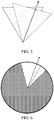
- the photographic material picture is rendered according to the radian corresponding to the scene FOV, as shown in FIG. 6 , no matter how the user rotates the helmet, the visual depth of the pixel points in the same direction is unchanged, and the distance of the image is unchanged, so that the scene presented by the VR is more realistic and the realness of imaging of the VR apparatus is enhanced.
- the generating a scene image according to the photographic material picture and the scene FOV, and determining a size of the scene image according to the scene FOV further includes: acquiring a preset size of a display screen rendered panoramic image of the VR apparatus; calculating a ratio of a degree of the scene FOV to 360 degrees, and determining the size of the scene image according to the ratio and the size of the display screen rendered panoramic image.
- a preset size of a panoramic scene image when the VR apparatus displays the panoramic image is 4096 ⁇ 2160 pixels
- the VR apparatus needs to adjust the size of panoramic (that is, the angle of the photographic FOV is 360 degrees) photographic picture material to be 4096 ⁇ 2160 pixels
- the scene FOV of the photographic picture material is 180 degrees (only the angle in the horizontal direction is considered herein, and the angle in the vertical angle can be deduced in a similar way)
- the size of the scene image corresponding to the photographic material picture may be set to 2048 ⁇ 2160 pixels (assuming that the vertical direction still has a panoramic FOV).
- the size of the scene image obtained after adjustment adapts to the VR apparatus.
- the scene FOV is not equal to the photographic FOV, it is assumed that the photographic FOV is greater than the scene FOV (vice versa), a scene contained in the photographic FOV is compressed to the scene FOV.
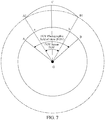
- the arc AB is compressed to ab for display. In this case, a frame is reduced. In other words, it is equivalent to that the arc AB is moved to A1B1.
- a head rotation angle is actually determined according to the scene FOV, when the head of the user points to point B1 from point A1, content in the scene viewed by the user moves from point A to point B.
- depths of the scenery in the center of the visual field and the scenery at the edge are changed, that is, C, A1, and B1 are not in a same arc.
- the arc AB has the same radian as that of the arc ab, point A1 and point A are located in a same direction, and point B1 and point B are located in a same direction, so that during rotation, the depths of the scenery in the center of the visual field and the scenery at the edge do not change, that is, C, A1, and B1 are still on the same arc.
- the depth of the image in the VR virtual scene does not change accordingly, so that the VR scene is more realistic and the realness of the imaging of the VR apparatus is enhanced.
- Step S108 Determine a display area of the scene image by using a gyroscope sensor, and display the display area on a display screen of the VR apparatus.
- the gyroscope sensor on the VR apparatus can detect a rotation angle of the VR apparatus, and the gyroscope sensor is usually a three-axis gyroscope, and therefore, can detect rotation angles in horizontal and vertical directions.
- the gyroscope sensor can detect an angle between an orientation of the user and a preset reference direction (a reference direction initially set during power-on or when an application is started), and then a display area is selected on the scene image according to a percentage between the angle and the scene FOV, and is finally displayed on the display screen of the VR apparatus.
- a rotation angle of the VR apparatus may further be detected by using the gyroscope sensor; a percentage between the rotation angle and the scene FOV is calculated, and the display area on the scene image is moved according to the size of the scene image and the percentage.
- a coordinate value of the initial display area is a 234 pixel position
- a length of the scene image in the rotation direction is 2096
- 30-degree rotation may cause movement by the 524 pixel position, and therefore, a coordinate value of a new display area is a 758 pixel position.
- a rotation angular velocity is 10 degrees per second
- the scene FOV is 160 degrees
- a length of the scene image in a rotation direction is 2096
- a size of the display area further needs to be set. Specifically, a lens FOV of the VR apparatus is acquired, and an observable FOV of the display screen of the VR apparatus is set according to the lens FOV of the VR apparatus; and the size of the display area is determined according to the observable FOV, the scene FOV, and the size of the scene image.
- the observable FOV of the display screen of the VR apparatus is an FOV of human eyes for observing the display screen in FIG. 4 .
- a lens is usually arranged between human eyes and a display screen, so that human eyes can see an enlarged virtual image.
- a larger display screen does not need to be arranged to cover the visual field of human eyes.
- a smaller display screen is arranged, and the visual field of human eyes can be covered through an optical enlargement function of the lens.
- FIG. 8 and FIG. 9 show an optical path diagram of imaging among human eyes, a lens, and a display screen.
- the visual angle of the display screen cannot be determined simply by calculating a distance between human eyes and the display screen and the size of the display screen, to determine the size of the display area.
- Conversion further needs to be performed according to the imaging formula of the lens, and a lens FOV is obtained through conversion.
- the lens FOV is obtained according to a size of a virtual image and a distance between human eyes and the virtual image.
- the lens FOV serves as the observable angle of the display screen, so as to determine the size of the display area.
- the display area of the scene image presented on the display screen by the VR apparatus having the lens should be smaller than the display area obtained when no lens is added.
- the observable FOV of the display screen is set not according to the lens FOV, but according to the size of the display screen and the distance between human eyes and the display screen, referring to FIG. 10 , it is assumed that the lens FOV is less than the FOV (vice versa), the angle observed by the user through the lens is less than the angle of the displayed content, that is, the content between the included angle DE is observed through the included angle de. In other words, content D' in a direction D in the virtual scene may be displayed in a direction d.
- head rotation of the user is corresponding to FOV rotation in the virtual scene
- the user may feel that D' can be viewed after rotation by an angle 1, but actually, the user can see D' only when rotating the head by an angle 2. Therefore, when observing D' by rotating from C1, D' may deviate to rotate from d to D. In this way, the user may have a feeling of unrealness that "the head rotates by an angle, but the object in the virtual scene rotates by a different angle", and as a result, the realness is reduced.
- D and D' are at the same position, and when a user rotates by a particular angle, the object in the virtual scene also rotates by the same degree, so as to enhance the realness of imaging of the VR apparatus.
- the position between the lens and the display screen may be adjusted, as well as the distance between the lens and human eyes and the distance between human eyes and the display screen.
- a corresponding sensor device may be arranged on the VR apparatus to detect the distance adjusted by the user. Then, the lens FOV is reset according to the distances adjusted by the user and between the human eyes, the lens, and the display and the focal length of the lens, so that even after the user adjusts the distances, the realness of imaging of the VR apparatus still can be ensured.
- a device for displaying an image based on a VR apparatus includes a material picture acquisition module 102, a scene FOV setting module 104, a scene image generation module 106, and an image display module 108.
- the material picture acquisition module 102 is configured to acquire a photographic material picture and acquire a photographic FOV of the photographic material picture.
- the scene FOV setting module 104 is configured to set a scene FOV of a virtual scene of the VR apparatus according to the photographic FOV.
- the scene image generation module 106 is configured to generate a scene image according to the photographic material picture and the scene FOV, determine a size of the scene image according to the scene FOV.
- the image display module 108 is configured to determine a display area of the scene image by using a gyroscope sensor, and display the display area on a display screen of the VR apparatus.
- the image display module 108 is configured to render the photographic material picture on an arc inner surface of the virtual scene of the VR apparatus to generate the scene image.
- a radian of the arc inner surface of the virtual scene of the VR apparatus is a radian corresponding to the scene FOV.
- the image display module 108 is further configured to acquire a preset size of a display screen rendered panoramic image of the VR apparatus; calculate a ratio of a degree of the scene FOV to 360 degrees, and determine the size of the scene image according to the ratio and the size of the display screen rendered panoramic image.
- the apparatus further includes a rotation imaging module 110, configured to detect a rotation angle of the VR apparatus by using the gyroscope sensor; calculate a percentage between the rotation angle and the scene FOV, and move the display area on the scene image according to the size of the scene image and the percentage.
- a rotation imaging module 110 configured to detect a rotation angle of the VR apparatus by using the gyroscope sensor; calculate a percentage between the rotation angle and the scene FOV, and move the display area on the scene image according to the size of the scene image and the percentage.
- the apparatus further includes a display area size determining module 112, configured to acquire a lens FOV of the VR apparatus; set an observable FOV of the display screen of the VR apparatus according to the lens FOV of the VR apparatus; and determine a size of the display area according to the observable FOV, the scene FOV, and the size of the scene image.
- a display area size determining module 112 configured to acquire a lens FOV of the VR apparatus; set an observable FOV of the display screen of the VR apparatus according to the lens FOV of the VR apparatus; and determine a size of the display area according to the observable FOV, the scene FOV, and the size of the scene image.
- a scene FOV of a scene image and a photographic FOV of a photographic material picture are set to be the same, so that when a user rotates a display screen of the VR apparatus, an image depth on the scene image does not change with the rotation performed by the user, and the display effects of the VR apparatus become more realistic, thereby enhancing the realness of the imaging of the VR apparatus.
- FIG. 12 shows a VR apparatus 10 in a computer system that is based on a von Neumann system and that runs the method for displaying an image based on a VR apparatus.
- the computer system may be a host device of the VR apparatus or a VR HMD apparatus integrated with functions of a host.
- the computer system may include an external input interface 1001, a processor 1002, a memory 1003, and an output interface 1004 that are connected by using a system bus.
- the external input interface 1001 optionally may include at least a network interface 10012 and a gyroscope sensor 10014.
- the memory 1003 may include an external memory 10032 (for example, a hard disk, an optical disk, or a floppy disk) and an internal memory 10034.
- the output interface 1004 may include at least a display screen 10042.
- the method is performed based on a computer program.
- a program file of the computer program is stored in the external memory 10032 of the computer system 10 based on the von Neumann system, is loaded into the internal memory 10034 during execution, and then, is compiled into machine code, and the machine code is transmitted to the processor 1002 for execution, so as to form the material picture acquisition module 102, the scene FOV setting module 104, the scene image generation module 106, and the image display module 108 logically in the computer system 10 based on the von Neumann system.
- entered parameters are all received through the external input interface 1001, are transmitted to the memory 1003 for buffering, and then, are input into the processor 1002 for processing. Processed result data is buffered in the memory 1003 for subsequent processing or transmitted to the output interface 1004 for outputting.
- a computer storage medium may be a memory including a computer program.
- the computer program may be executed by a processor in a data processing device, to perform the steps of the method in the foregoing embodiment.
- the computer storage medium may be an FRAM, a ROM, a PROM, an EPROM, an EEPROM, a Flash Memory, a magnetic surface memory, an optical disc, or a CD-ROM, or may be various devices including one or any combination of the memories, for example, a mobile phone, a computer, a tablet device, and a personal digital assistant.
- the computer readable storage medium stores a computer program.
- the processor executes the computer program, the processor performs the following steps of the method for displaying an image based on a VR apparatus.
- the processor when the processor executes the computer program, the processor performs the following steps:
- the processor when the processor executes the computer program, the processor performs the following steps: rendering the photographic material picture to an arc inner surface of a virtual scene of the VR apparatus to generate the scene image, where a radian of the arc inner surface is a radian corresponding to the scene FOV.
- the processor when the processor executes the computer program, the processor performs the following steps:
- the processor when the processor executes the computer program, the processor performs the following steps:
- the processor when the processor executes the computer program, the processor performs the following steps:
- a scene FOV of a scene image and a photographic FOV of a photographic material picture are set to be the same, so that when a user rotates a display screen of a VR apparatus, an image depth on the scene image does not change with the rotation performed by the user, and the display effects of the VR apparatus become more realistic, thereby enhancing the realness of the imaging of the VR apparatus
Landscapes
- Engineering & Computer Science (AREA)
- Theoretical Computer Science (AREA)
- General Engineering & Computer Science (AREA)
- Physics & Mathematics (AREA)
- General Physics & Mathematics (AREA)
- Human Computer Interaction (AREA)
- Computing Systems (AREA)
- Geometry (AREA)
- Computer Graphics (AREA)
- Multimedia (AREA)
- Signal Processing (AREA)
- Controls And Circuits For Display Device (AREA)
- User Interface Of Digital Computer (AREA)
- Processing Or Creating Images (AREA)
Abstract
Description
- This application claims priority to Chinese Patent Application No.
201610836608.7 filed on September 20th, 2016 - The present disclosure relates to the field of computer technologies, and particularly, to a method and device for displaying an image based on a VR apparatus, and a computer storage medium.
- In a conventional VR technology, a head-mounted display (HMD) is an important hardware device. The HMD acquires an orientation of a head of a user in real time, and presents scenery in this direction to the user on a display screen. During this process, a size and position of the presented scenery greatly influences the immersion sense of a viewer. The size of the scenery viewed by the viewer in a virtual scene should be the same as a size in a real scene, and the position of the scenery in the virtual scene should keep unchanged when the viewer rotates the head.
- According to a general processing method, a frame is rendered to a spherical inner surface randomly, a field of view (FOV) is put in the center of the sphere and the frame can be viewed at any FOV, and FOV refers to an extent that can be covered by a lens. As a result, a frame in a virtual scene viewed by a viewer is inconsistent with true feeling. For example, the viewer will feel like viewing from an FOV of a giant or an ant, and when the viewer rotates the head, scenery in the sight line will deviate with rotation of the head. Consequently, an image display method in the conventional VR technology has poor realness of visual effects.
- On the basis of this, in order to resolve a problem that an image display method in a conventional VR technology has poor realness of visual effects, a method and device for displaying an image based on a VR apparatus, and a computer storage medium are provided.
- A method for displaying an image based on a VR apparatus includes:
- acquiring a photographic material picture, and acquiring a photographic FOV of the photographic material picture;
- setting a scene FOV of a virtual scene of the VR apparatus according to the photographic FOV;
- generating a scene image according to the photographic material picture and the scene FOV during scene image generation and adaption, and determining a size of the scene image according to the scene FOV; and
- determining a display area of the scene image by using a gyroscope sensor, and displaying the display area on a display screen of the VR apparatus.
- A device for displaying an image based on a VR apparatus includes:
- a material picture acquisition module, configured to acquire a photographic material picture and acquire a photographic FOV of the photographic material picture;
- a scene FOV setting module, configured to set a scene FOV of a virtual scene of the VR apparatus according to the photographic FOV;
- a scene image generation module, configured to generate a scene image according to the photographic material picture and the scene FOV during scene image generation and adaption, and determine a size of the scene image according to the scene FOV; and
- the scene image generation module, configured to determine a display area of the scene image by using a gyroscope sensor, and display the display area on a display screen of the VR apparatus.
- A computer storage medium stores a computer executable instruction, the computer executable instruction being used to perform the method for displaying an image based on the VR apparatus in the foregoing embodiment.
- The embodiments of the present invention have the following beneficial effects.
- After the method and device for displaying an image based on a VR apparatus are used, a scene FOV of a scene image and a photographic FOV of a photographic material picture are set to be the same, so that when a user rotates a display screen of the VR apparatus, an image depth on the scene image does not change with the rotation performed by the user, and the display effects of the VR apparatus become more realistic, thereby enhancing the realness of imaging of the VR apparatus.
- To describe the technical solutions of the embodiments of the present invention or the existing technology more clearly, the following briefly introduces the accompanying drawings required for describing the embodiments or the existing technology. Apparently, the accompanying drawings in the following description show only some embodiments of the present invention, and a person of ordinary skill in the art may still derive other drawings from these accompanying drawings without creative efforts.
-
FIG. 1 is a schematic view of composition of a VR apparatus according to an embodiment; -
FIG. 2 is a schematic view of composition of another VR apparatus according to an embodiment; -
FIG. 3 is a flow chart of a method for displaying an image based on a VR apparatus according to an embodiment; -
FIG. 4 is a schematic view of a scene FOV of imaging of a VR apparatus according to an embodiment; -
FIG. 5 is a schematic view of a depth change of a scene image experiencing no arc rendering when a user rotates according to an embodiment; -
FIG. 6 is a schematic view of a depth change of a scene image experiencing arc rendering when a user rotates according to another embodiment; -
FIG. 7 is a principle diagram of image distortion caused when a scene FOV is not set according to a photographic FOV according to an embodiment; -
FIG. 8 is an optical path diagram of a process of imaging on a display screen of a VR apparatus through a lens according to an embodiment; -
FIG. 9 is an optical path diagram of a process of imaging on a display screen of a VR apparatus through a lens according to another embodiment; -
FIG. 10 is a principle diagram of image distortion caused when an observable FOV of a display screen is not set with reference to a lens FOV according to an embodiment; -
FIG. 11 is a schematic diagram of a device for displaying an image based on a VR apparatus according to an embodiment; and -
FIG. 12 is a schematic structural diagram of a computer apparatus that performs the method for displaying an image based on a VR apparatus according to an embodiment. - The following clearly and completely describes the technical solutions in the embodiments of the present invention with reference to the accompanying drawings in the embodiments of the present invention. Apparently, the described embodiments are some of the embodiments of the present invention rather than all of the embodiments. All other embodiments obtained by a person of ordinary skill in the art based on the embodiments of the present invention without creative efforts shall fall within the protection scope of the present disclosure.
- In order to resolve the problem that an image display method in a conventional VR technology has poor realness of visual effects, a method for displaying an image based on a VR apparatus is provided. Implementation of the method may rely on a computer program, the computer program may run in a computer system based on a von Neumann system and may run in a head-mounted display (HMD) of a VR apparatus or a computer host connected to an HMD.
- As shown in
FIG. 1 , inFIG. 1 , an HMD apparatus is connected to a computer host apparatus A in which a computer program may run, the computer host is based on a computer system of a von Neumann system, an HMD apparatus B1 serves as a display apparatus of the computer apparatus, and a luminance regulation method based on an HMD apparatus may run in the computer host. In another embodiment, as shown inFIG. 2 , the computer host running the luminance regulation method based on the HMD apparatus may also be integrated into the HMD apparatus, and the luminance regulation method based on the HMD apparatus may run in the HMD apparatus. - Specifically, as shown in
FIG. 3 , the method for displaying an image based on a VR apparatus includes the following steps:
Step S102: Acquire a photographic material picture and acquire a photographic FOV of the photographic material picture. - In a VR technology, a user needs to wear an HMD apparatus. The apparatus is usually a helmet, spectacles, or an eyepatch. A display screen is disposed in the HMD, and located in front of the eyes of a user after the user wears the HMD apparatus. In the VR technology, a photographic material image in a real scene is processed and is presented on the display screen of the HMD, so that the visual field of the user is fully covered by an image displayed on the display screen, and the user can stay in a virtual scene.
- For example, in a VR application of a museum scene, a virtual museum interior scene needs to be constructed for a VR user. Therefore, images shot inside the museum are needed and used as materials. A panoramic camera may be used to take pictures of the object museum at the early stage, so as to obtain panoramic or wide photographic images as materials, or a common camera can also be used to take panoramic pictures in a time-lapse shooting mode, so as to obtain panoramic or wide photographic images as materials. When files of the materials are saved, not only the photographic images need to be saved, but also photographic FOVs of the panoramic camera need to be recoded. For example, the photographic FOV of the photographic images may be obtained according to the FOVs of the lens of the panoramic camera or with reference to the rotation angles of the panoramic camera during photographing. The photographic images may be either panoramic images with a photographic FOV being 360 degrees or wide images with a photographic FOV less than 360 degrees.
- Step S104: Set a scene FOV of a virtual scene of the VR apparatus according to the photographic FOV.
- The scene FOV of the virtual scene of the VR apparatus is a visual angle of the virtual scene presented by the VR apparatus to a user. For example, referring to
FIG. 4 , the scene FOV is an FOV of the virtual scene constructed by the VR apparatus according to the scene image, the display screen may display only a part of an image area, the visual angle of the naked eyes of a user is the visual angle of the display screen, and the scene FOV may be wider. When the user turns head to rotate the helmet of the VR apparatus to adjust the position of the display screen of the VR apparatus, a view finding position of the display screen on the scene image is moved to present a display area of a new position. In other words, the scene FOV is an observable angle of a virtual scene constructed by using all images that can be observed by a user through turning head or looking up. - For example, in the foregoing example, the panoramic camera in the museum is arranged at the entrance of an exhibition hall to take pictures of the entrance of the exhibition hall to construct a virtual scene that "the user is at the entrance of the exhibition hall". The photographic FOV of the panoramic camera may be set to 180 degrees (because only a virtual scene of looking at the interior of the exhibition hall from the entrance needs to be provided for the user, pictures of scenery outside the exhibition hall do not need to be taken), and the visual field of the naked eyes of a user may be only 120 degrees. Therefore, the user needs to turn head right or left to feel the virtual scene at the exhibition hall.
- Step S106: Generate a scene image according to the photographic material picture and the scene FOV, and determine a size of the scene image according to the scene FOV.
- When the VR apparatus generates the scene image, the photographic material pictures cannot be used directly, but need to be processed first and set to be a scene image adapting to the VR apparatus, so that the VR scene becomes more realistic. During the adaption process, adaption in two aspects needs to be performed.
- On one hand, a photographic material picture needs to be rendered, so that it seems that there is a true distance. Specifically, the photographic material picture is rendered to an arc inner surface of the virtual scene of the VR apparatus to generate the scene image, and a radian of the arc inner surface of the virtual scene of the VR apparatus is a radian corresponding to the scene FOV.
- Referring to
FIG. 5 and FIG. 6 at the same time, if the photographic material picture is directly displayed without being rendered, as shown inFIG. 5 , when the user rotates the helmet, pixel points of the picture in a same direction exhibit visual sense of being close to or far away from the user, so that the user may feel the distance of the image changing with the rotation of the helmet, and then feel unrealistic. - If the photographic material picture is rendered according to the radian corresponding to the scene FOV, as shown in
FIG. 6 , no matter how the user rotates the helmet, the visual depth of the pixel points in the same direction is unchanged, and the distance of the image is unchanged, so that the scene presented by the VR is more realistic and the realness of imaging of the VR apparatus is enhanced. - On the other hand, the size of the scene image needs to be determined. In this embodiment, the generating a scene image according to the photographic material picture and the scene FOV, and determining a size of the scene image according to the scene FOV further includes: acquiring a preset size of a display screen rendered panoramic image of the VR apparatus; calculating a ratio of a degree of the scene FOV to 360 degrees, and determining the size of the scene image according to the ratio and the size of the display screen rendered panoramic image.
- For example, if a preset size of a panoramic scene image when the VR apparatus displays the panoramic image is 4096×2160 pixels, in other words, the VR apparatus needs to adjust the size of panoramic (that is, the angle of the photographic FOV is 360 degrees) photographic picture material to be 4096×2160 pixels, and if the scene FOV of the photographic picture material is 180 degrees (only the angle in the horizontal direction is considered herein, and the angle in the vertical angle can be deduced in a similar way), the size of the scene image corresponding to the photographic material picture may be set to 2048×2160 pixels (assuming that the vertical direction still has a panoramic FOV). The size of the scene image obtained after adjustment adapts to the VR apparatus.
- Referring to
FIG. 7 , if the scene FOV is not equal to the photographic FOV, it is assumed that the photographic FOV is greater than the scene FOV (vice versa), a scene contained in the photographic FOV is compressed to the scene FOV. In other words, the arc AB is compressed to ab for display. In this case, a frame is reduced. In other words, it is equivalent to that the arc AB is moved to A1B1. Furthermore, because a head rotation angle is actually determined according to the scene FOV, when the head of the user points to point B1 from point A1, content in the scene viewed by the user moves from point A to point B. As a result, during rotation, depths of the scenery in the center of the visual field and the scenery at the edge are changed, that is, C, A1, and B1 are not in a same arc. - After the scene FOV is set according to the photographic FOV, and the size of the scene image is set according to the scene FOV and a preset size corresponding to the panoramic scene image, the arc AB has the same radian as that of the arc ab, point A1 and point A are located in a same direction, and point B1 and point B are located in a same direction, so that during rotation, the depths of the scenery in the center of the visual field and the scenery at the edge do not change, that is, C, A1, and B1 are still on the same arc. Thus, even though a user rotates the helmet, the depth of the image in the VR virtual scene does not change accordingly, so that the VR scene is more realistic and the realness of the imaging of the VR apparatus is enhanced.
- Step S108: Determine a display area of the scene image by using a gyroscope sensor, and display the display area on a display screen of the VR apparatus.
- The gyroscope sensor on the VR apparatus can detect a rotation angle of the VR apparatus, and the gyroscope sensor is usually a three-axis gyroscope, and therefore, can detect rotation angles in horizontal and vertical directions. Referring to
FIG. 4 , the gyroscope sensor can detect an angle between an orientation of the user and a preset reference direction (a reference direction initially set during power-on or when an application is started), and then a display area is selected on the scene image according to a percentage between the angle and the scene FOV, and is finally displayed on the display screen of the VR apparatus. - In this embodiment, after the VR apparatus displays the scene image, a rotation angle of the VR apparatus may further be detected by using the gyroscope sensor; a percentage between the rotation angle and the scene FOV is calculated, and the display area on the scene image is moved according to the size of the scene image and the percentage.
- For example, if the rotation angle is 30 degrees, the scene FOV is 120 degrees, a coordinate value of the initial display area is a 234 pixel position, and a length of the scene image in the rotation direction is 2096, 30-degree rotation may cause movement by the 524 pixel position, and therefore, a coordinate value of a new display area is a 758 pixel position.
- Similarly, if a rotation angular velocity is 10 degrees per second, the scene FOV is 160 degrees, and a length of the scene image in a rotation direction is 2096, a moving speed of the coordinate value of the display area is 2096×10/160=131 pixels per second.
- In this embodiment, in order to further enhance the realness of imaging of the VR apparatus, a size of the display area further needs to be set. Specifically, a lens FOV of the VR apparatus is acquired, and an observable FOV of the display screen of the VR apparatus is set according to the lens FOV of the VR apparatus; and the size of the display area is determined according to the observable FOV, the scene FOV, and the size of the scene image.
- Referring to
FIG. 4 , the observable FOV of the display screen of the VR apparatus is an FOV of human eyes for observing the display screen inFIG. 4 . However, in the VR apparatus, in order to achieve better visual experience, a lens is usually arranged between human eyes and a display screen, so that human eyes can see an enlarged virtual image. In this case, a larger display screen does not need to be arranged to cover the visual field of human eyes. A smaller display screen is arranged, and the visual field of human eyes can be covered through an optical enlargement function of the lens. - Referring to
FIG. 8 and FIG. 9, FIG. 8 and FIG. 9 show an optical path diagram of imaging among human eyes, a lens, and a display screen. As can be learned according to an imaging formula of the lens
FIG. 8 and FIG. 9 , the display area of the scene image presented on the display screen by the VR apparatus having the lens should be smaller than the display area obtained when no lens is added. - If the observable FOV of the display screen is set not according to the lens FOV, but according to the size of the display screen and the distance between human eyes and the display screen, referring to
FIG. 10 , it is assumed that the lens FOV is less than the FOV (vice versa), the angle observed by the user through the lens is less than the angle of the displayed content, that is, the content between the included angle DE is observed through the included angle de. In other words, content D' in a direction D in the virtual scene may be displayed in a direction d. Because head rotation of the user is corresponding to FOV rotation in the virtual scene, when a user desires to see D' displayed in the direction d, the user may feel that D' can be viewed after rotation by an angle 1, but actually, the user can see D' only when rotating the head by anangle 2. Therefore, when observing D' by rotating from C1, D' may deviate to rotate from d to D. In this way, the user may have a feeling of unrealness that "the head rotates by an angle, but the object in the virtual scene rotates by a different angle", and as a result, the realness is reduced. - However, after the observable FOV of the display screen is set according to the lens FOV, D and D' are at the same position, and when a user rotates by a particular angle, the object in the virtual scene also rotates by the same degree, so as to enhance the realness of imaging of the VR apparatus.
- In addition, it should be noted that, in some VR apparatuses, the position between the lens and the display screen may be adjusted, as well as the distance between the lens and human eyes and the distance between human eyes and the display screen. In such an application scene, a corresponding sensor device may be arranged on the VR apparatus to detect the distance adjusted by the user. Then, the lens FOV is reset according to the distances adjusted by the user and between the human eyes, the lens, and the display and the focal length of the lens, so that even after the user adjusts the distances, the realness of imaging of the VR apparatus still can be ensured.
- In addition, in order to solve a problem that realness of visual effects is poor due to the image display method in the conventional VR technology, in an embodiment, as shown in
FIG. 11 , a device for displaying an image based on a VR apparatus is provided and includes a materialpicture acquisition module 102, a sceneFOV setting module 104, a sceneimage generation module 106, and animage display module 108. - The material
picture acquisition module 102 is configured to acquire a photographic material picture and acquire a photographic FOV of the photographic material picture. - The scene
FOV setting module 104 is configured to set a scene FOV of a virtual scene of the VR apparatus according to the photographic FOV. - The scene
image generation module 106 is configured to generate a scene image according to the photographic material picture and the scene FOV, determine a size of the scene image according to the scene FOV. - The
image display module 108 is configured to determine a display area of the scene image by using a gyroscope sensor, and display the display area on a display screen of the VR apparatus. - In this embodiment, the
image display module 108 is configured to render the photographic material picture on an arc inner surface of the virtual scene of the VR apparatus to generate the scene image. A radian of the arc inner surface of the virtual scene of the VR apparatus is a radian corresponding to the scene FOV. - In this embodiment, the
image display module 108 is further configured to acquire a preset size of a display screen rendered panoramic image of the VR apparatus; calculate a ratio of a degree of the scene FOV to 360 degrees, and determine the size of the scene image according to the ratio and the size of the display screen rendered panoramic image. - In this embodiment, as shown in
FIG. 11 , the apparatus further includes arotation imaging module 110, configured to detect a rotation angle of the VR apparatus by using the gyroscope sensor; calculate a percentage between the rotation angle and the scene FOV, and move the display area on the scene image according to the size of the scene image and the percentage. - In this embodiment, as shown in
FIG. 11 , the apparatus further includes a display areasize determining module 112, configured to acquire a lens FOV of the VR apparatus; set an observable FOV of the display screen of the VR apparatus according to the lens FOV of the VR apparatus; and determine a size of the display area according to the observable FOV, the scene FOV, and the size of the scene image. - Implementation of the embodiments of the present invention brings about the following beneficial effects.
- After the method and device for displaying an image based on the VR apparatus are used, a scene FOV of a scene image and a photographic FOV of a photographic material picture are set to be the same, so that when a user rotates a display screen of the VR apparatus, an image depth on the scene image does not change with the rotation performed by the user, and the display effects of the VR apparatus become more realistic, thereby enhancing the realness of the imaging of the VR apparatus.
- In an embodiment, as shown in
FIG. 12, FIG. 12 shows a VR apparatus 10 in a computer system that is based on a von Neumann system and that runs the method for displaying an image based on a VR apparatus. The computer system may be a host device of the VR apparatus or a VR HMD apparatus integrated with functions of a host. Specifically, the computer system may include anexternal input interface 1001, aprocessor 1002, amemory 1003, and anoutput interface 1004 that are connected by using a system bus. Theexternal input interface 1001 optionally may include at least anetwork interface 10012 and agyroscope sensor 10014. Thememory 1003 may include an external memory 10032 (for example, a hard disk, an optical disk, or a floppy disk) and aninternal memory 10034. Theoutput interface 1004 may include at least adisplay screen 10042. - In this embodiment, the method is performed based on a computer program. A program file of the computer program is stored in the
external memory 10032 of the computer system 10 based on the von Neumann system, is loaded into theinternal memory 10034 during execution, and then, is compiled into machine code, and the machine code is transmitted to theprocessor 1002 for execution, so as to form the materialpicture acquisition module 102, the sceneFOV setting module 104, the sceneimage generation module 106, and theimage display module 108 logically in the computer system 10 based on the von Neumann system. Furthermore, during a process of performing the method for displaying an image based on a VR apparatus, entered parameters are all received through theexternal input interface 1001, are transmitted to thememory 1003 for buffering, and then, are input into theprocessor 1002 for processing. Processed result data is buffered in thememory 1003 for subsequent processing or transmitted to theoutput interface 1004 for outputting. - A computer storage medium according to an embodiment of the present invention may be a memory including a computer program. The computer program may be executed by a processor in a data processing device, to perform the steps of the method in the foregoing embodiment. The computer storage medium may be an FRAM, a ROM, a PROM, an EPROM, an EEPROM, a Flash Memory, a magnetic surface memory, an optical disc, or a CD-ROM, or may be various devices including one or any combination of the memories, for example, a mobile phone, a computer, a tablet device, and a personal digital assistant.
- The computer readable storage medium stores a computer program. When the processor executes the computer program, the processor performs the following steps of the method for displaying an image based on a VR apparatus.
- In an embodiment, when the processor executes the computer program, the processor performs the following steps:
- acquiring a photographic material picture and acquiring a photographic FOV of the photographic material picture;
- setting a scene FOV of a virtual scene of the VR apparatus according to the photographic FOV;
- generating, during scene image generation and adaption, a scene image according to the photographic material picture and the scene FOV, and determining a size of the scene image according to the scene FOV; and
- determining a display area of the scene image by using a gyroscope sensor, and displaying the display area on a display screen of the VR apparatus.
- In an embodiment, when the processor executes the computer program, the processor performs the following steps:
rendering the photographic material picture to an arc inner surface of a virtual scene of the VR apparatus to generate the scene image, where a radian of the arc inner surface is a radian corresponding to the scene FOV. - In an embodiment, when the processor executes the computer program, the processor performs the following steps:
- acquiring a size of a display screen rendered panoramic image of the VR apparatus; and
- calculating a ratio of a degree of the scene FOV to 360 degrees, and determining the size of the scene image according to the ratio and the size of the display screen rendered panoramic image.
- In an embodiment, when the processor executes the computer program, the processor performs the following steps:
- detecting a rotation angle of the VR apparatus by using the gyroscope sensor; and
- calculating a percentage between the rotation angle and the scene FOV, and moving the display area on the scene image according to the size of the scene image and the percentage.
- In an embodiment, when the processor executes the computer program, the processor performs the following steps:
- acquiring a lens FOV of the VR apparatus;
- setting an observable FOV of the display screen of the VR apparatus according to the lens FOV of the VR apparatus; and
- determining a size of the display area according to the observable FOV, the scene FOV, and the size of the scene image.
- The foregoing descriptions are merely preferred embodiments of the present invention, but are not intended to limit the scope of the present disclosure. Any equivalent change made according to the claims of the present disclosure shall fall within the protection scope of the present disclosure.
- By using the embodiments of the present invention, a scene FOV of a scene image and a photographic FOV of a photographic material picture are set to be the same, so that when a user rotates a display screen of a VR apparatus, an image depth on the scene image does not change with the rotation performed by the user, and the display effects of the VR apparatus become more realistic, thereby enhancing the realness of the imaging of the VR apparatus
Claims (11)
- A method for displaying an image based on a virtual reality, VR, apparatus, comprising:acquiring a photographic material picture and acquiring a photographic field of view, FOV, of the photographic material picture;setting a scene FOV of a virtual scene of the VR apparatus according to the photographic FOV;generating, during scene image generation and adaption, a scene image according to the photographic material picture and the scene FOV, and determining a size of the scene image according to the scene FOV; anddetermining a display area of the scene image by using a gyroscope sensor, and displaying the display area on a display screen of the VR apparatus.
- The method for displaying an image based on a VR apparatus according to claim 1, wherein the generating a scene image according to the photographic material picture and the scene FOV comprises:
rendering the photographic material picture to an arc inner surface of a virtual scene of the VR apparatus to generate the scene image, a radian of the arc inner surface being a radian corresponding to the scene FOV. - The method for displaying an image based on a VR apparatus according to claim 1 or 2, wherein the generating a scene image according to the photographic material picture and the scene FOV comprises:acquiring a size of a display screen rendered panoramic image of the VR apparatus; andcalculating a ratio of a degree of the scene FOV to 360 degrees, and determining the size of the scene image according to the ratio and the size of the display screen rendered panoramic image.
- The method for displaying an image based on a VR apparatus according to claim 1, wherein after the displaying the scene image, the method further comprises:detecting a rotation angle of the VR apparatus by using the gyroscope sensor; andcalculating a percentage between the rotation angle and the scene FOV, and moving the display area on the scene image according to the size of the scene image and the percentage.
- The method for displaying an image based on a VR apparatus according to claim 1, wherein before the determining a display area of the scene image by using a gyroscope sensor, the method further comprises:acquiring a lens FOV of the VR apparatus;setting an observable FOV of the display screen of the VR apparatus according to the lens FOV of the VR apparatus; anddetermining a size of the display area according to the observable FOV, the scene FOV, and the size of the scene image.
- A device for displaying an image based on a virtual reality, VR, apparatus, comprising:a material picture acquisition module, configured to acquire a photographic material picture, and acquire a photographic field of view, FOV, of the photographic material picture;a scene FOV setting module, configured to set a scene FOV of a virtual scene of the VR apparatus according to the photographic FOV;a scene image generation module, configured to generate, during scene image generation and adaption, a scene image according to the photographic material picture and the scene FOV, and determine a size of the scene image according to the scene FOV; andthe scene image generation module, configured to determine a display area of the scene image by using a gyroscope sensor, and display the display area on a display screen of the VR apparatus.
- The device for displaying an image based on a VR apparatus according to claim 6, wherein the scene image generation module is configured to render the photographic material picture to an arc inner surface of a virtual scene of the VR apparatus to generate the scene image, and a radian of the arc inner surface is a radian corresponding to the scene FOV.
- The device for displaying an image based on a VR apparatus according to claim 6 or 7, wherein the scene image generation module is further configured to acquire a size of a display screen rendered panoramic image of the VR apparatus; and calculate a ratio of a degree of the scene FOV to 360 degrees, and determine the size of the scene image according to the ratio and the size of the display screen rendered panoramic image.
- The device for displaying an image based on a VR apparatus according to claim 6, further comprising a rotation imaging module, configured to detect a rotation angle of the VR apparatus by using the gyroscope sensor; and calculate a percentage between the rotation angle and the scene FOV, and move the display area on the scene image according to the size of the scene image and the percentage.
- The device for displaying an image based on a VR apparatus according to claim 6, further comprising a display area size determining module, configured to acquire a lens FOV of the VR apparatus; set an observable FOV of the display screen of the VR apparatus according to the lens FOV of the VR apparatus; and determine a size of the display area according to the observable FOV, the scene FOV, and the size of the scene image.
- A computer storage medium, storing a computer executable instruction, the computer executable instruction being used to perform the method for displaying an image based on a VR apparatus according to any one of claims 1 to 5.
Applications Claiming Priority (2)
| Application Number | Priority Date | Filing Date | Title |
|---|---|---|---|
| CN201610836608.7A CN107844190B (en) | 2016-09-20 | 2016-09-20 | Image display method and device based on virtual reality VR equipment |
| PCT/CN2017/101908 WO2018054267A1 (en) | 2016-09-20 | 2017-09-15 | Image display method and device utilized in virtual reality-based apparatus |
Publications (3)
| Publication Number | Publication Date |
|---|---|
| EP3462283A1 true EP3462283A1 (en) | 2019-04-03 |
| EP3462283A4 EP3462283A4 (en) | 2019-08-14 |
| EP3462283B1 EP3462283B1 (en) | 2021-09-01 |
Family
ID=61657567
Family Applications (1)
| Application Number | Title | Priority Date | Filing Date |
|---|---|---|---|
| EP17852335.3A Active EP3462283B1 (en) | 2016-09-20 | 2017-09-15 | Image display method and device utilized in virtual reality-based apparatus |
Country Status (4)
| Country | Link |
|---|---|
| US (1) | US10754420B2 (en) |
| EP (1) | EP3462283B1 (en) |
| CN (1) | CN107844190B (en) |
| WO (1) | WO2018054267A1 (en) |
Families Citing this family (14)
| Publication number | Priority date | Publication date | Assignee | Title |
|---|---|---|---|---|
| CN107277485B (en) * | 2017-07-18 | 2019-06-18 | 歌尔科技有限公司 | Image display method and device based on virtual reality |
| EP3736666B1 (en) * | 2018-01-04 | 2024-06-05 | Sony Group Corporation | Information processing device, information processing method and program |
| CN108579083B (en) * | 2018-04-27 | 2020-04-21 | 腾讯科技(深圳)有限公司 | Virtual scene display method and device, electronic device and storage medium |
| CN108830943B (en) * | 2018-06-29 | 2022-05-31 | 歌尔光学科技有限公司 | Image processing method and virtual reality device |
| CN109189215B (en) * | 2018-08-16 | 2021-08-20 | 腾讯科技(深圳)有限公司 | Virtual content display method and device, VR equipment and medium |
| CN109086755B (en) * | 2018-11-07 | 2022-07-08 | 上海电气集团股份有限公司 | Virtual reality display method and system of rehabilitation robot based on image segmentation |
| CN111726594B (en) * | 2019-03-21 | 2024-11-29 | 上海淘景立画信息技术有限公司 | Implementation method for efficient optimized rendering and pose anti-distortion fusion |
| CN112908220B (en) * | 2019-11-18 | 2023-01-24 | 上海美创文化科技有限公司 | Visual exhibit display method based on VR technology |
| CN113709415B (en) * | 2021-08-20 | 2024-10-15 | 翰和文化教育(深圳)有限公司 | VR 720-degree panoramic scene data interaction system and application method thereof |
| CN114266793B (en) * | 2022-01-07 | 2026-01-06 | 玩出梦想(上海)科技有限公司 | A VR MTP testing method |
| CN114666570B (en) * | 2022-02-24 | 2025-03-18 | 如你所视(北京)科技有限公司 | FOV measurement method, device, computer program product and storage medium |
| CN115629665A (en) * | 2022-09-15 | 2023-01-20 | 北京达佳互联信息技术有限公司 | Image display method, image display device, electronic equipment and storage medium |
| CN119690312B (en) * | 2023-09-22 | 2026-02-10 | 网易(杭州)网络有限公司 | A method, apparatus, electronic device and storage medium for controlling interface display |
| CN119172642B (en) * | 2024-08-29 | 2025-10-03 | 武汉精立电子技术有限公司 | MTF test method and device |
Family Cites Families (17)
| Publication number | Priority date | Publication date | Assignee | Title |
|---|---|---|---|---|
| US9286720B2 (en) * | 2009-08-20 | 2016-03-15 | Northrop Grumman Systems Corporation | Locative video for situation awareness |
| WO2011060525A1 (en) * | 2009-11-19 | 2011-05-26 | Esight Corporation | Image magnification on a head mounted display |
| WO2012166593A2 (en) * | 2011-05-27 | 2012-12-06 | Thomas Seidl | System and method for creating a navigable, panoramic three-dimensional virtual reality environment having ultra-wide field of view |
| US20140009503A1 (en) * | 2012-07-03 | 2014-01-09 | Tourwrist, Inc. | Systems and Methods for Tracking User Postures to Control Display of Panoramas |
| GB2523740B (en) * | 2014-02-26 | 2020-10-14 | Sony Interactive Entertainment Inc | Image encoding and display |
| CN104021585B (en) * | 2014-06-09 | 2017-04-26 | 苏州明日吉辰软件研发有限公司 | Three-dimensional exhibition method based on real scene |
| WO2016002445A1 (en) * | 2014-07-03 | 2016-01-07 | ソニー株式会社 | Information processing device, information processing method, and program |
| CN104168315B (en) * | 2014-08-08 | 2018-07-06 | 三星电子(中国)研发中心 | A kind of full visual angle smooth immersion display methods and system |
| CN104506841A (en) * | 2014-12-31 | 2015-04-08 | 宇龙计算机通信科技(深圳)有限公司 | 3D (three-dimensional) document producing and playing method and device of multi-camera terminal |
| CN104571532B (en) * | 2015-02-04 | 2018-01-30 | 网易有道信息技术(北京)有限公司 | A kind of method and device for realizing augmented reality or virtual reality |
| CN107615338B (en) * | 2015-02-17 | 2023-08-04 | 纳维曼德资本有限责任公司 | Methods and apparatus for generating and using reduced resolution images and/or delivering such images to playback or content distribution devices |
| US20170064289A1 (en) * | 2015-08-26 | 2017-03-02 | Holumino Limited | System and method for capturing and displaying images |
| CN105898138A (en) * | 2015-12-18 | 2016-08-24 | 乐视致新电子科技(天津)有限公司 | Panoramic video play method and device |
| US10735659B2 (en) * | 2016-03-17 | 2020-08-04 | Flir Systems, Inc. | Rotation-adaptive video analytics camera and method |
| CN105869110B (en) * | 2016-03-28 | 2018-09-28 | 腾讯科技(深圳)有限公司 | The method for customizing and device of method for displaying image and device, abnormal curved surface curtain |
| CN105912102B (en) * | 2016-03-31 | 2019-02-05 | 联想(北京)有限公司 | A kind of information processing method and electronic equipment |
| CN105913379A (en) * | 2016-04-29 | 2016-08-31 | 乐视控股(北京)有限公司 | Virtual reality terminal, its picture display method and apparatus |
-
2016
- 2016-09-20 CN CN201610836608.7A patent/CN107844190B/en active Active
-
2017
- 2017-09-15 WO PCT/CN2017/101908 patent/WO2018054267A1/en not_active Ceased
- 2017-09-15 EP EP17852335.3A patent/EP3462283B1/en active Active
-
2018
- 2018-11-30 US US16/206,146 patent/US10754420B2/en active Active
Also Published As
| Publication number | Publication date |
|---|---|
| WO2018054267A1 (en) | 2018-03-29 |
| EP3462283A4 (en) | 2019-08-14 |
| US10754420B2 (en) | 2020-08-25 |
| US20190094956A1 (en) | 2019-03-28 |
| EP3462283B1 (en) | 2021-09-01 |
| CN107844190A (en) | 2018-03-27 |
| CN107844190B (en) | 2020-11-06 |
Similar Documents
| Publication | Publication Date | Title |
|---|---|---|
| EP3462283B1 (en) | Image display method and device utilized in virtual reality-based apparatus | |
| US12131718B2 (en) | Image processing device and image processing method | |
| US11087443B2 (en) | Augmented reality system and color compensation method thereof | |
| CN106502427B (en) | Virtual reality system and scene presenting method thereof | |
| JP6899875B2 (en) | Information processing device, video display system, information processing device control method, and program | |
| EP3572916B1 (en) | Apparatus, system, and method for accelerating positional tracking of head-mounted displays | |
| CN109743626B (en) | An image display method, image processing method and related equipment | |
| CN111175972A (en) | Head-mounted display, scene display method and storage medium thereof | |
| BR112016010442B1 (en) | IMAGE GENERATION DEVICE AND METHOD, AND STORAGE UNIT | |
| US12112449B2 (en) | Camera-based transparent display | |
| KR101690646B1 (en) | Camera driving device and method for see-through displaying | |
| TW202403509A (en) | Smooth object correction for augmented reality devices | |
| KR20180055637A (en) | Electronic apparatus and method for controlling thereof | |
| KR102170749B1 (en) | Electro device comprising transparent display and method for controlling thereof | |
| CN114401362A (en) | Image display method and device and electronic equipment | |
| JP5645255B2 (en) | Image processing apparatus and image processing method | |
| JP6649010B2 (en) | Information processing device | |
| CN114390186A (en) | Video shooting method and electronic equipment | |
| EP4383700A1 (en) | Electronic device for generating three-dimensional photo based on images acquired from plurality of cameras, and method therefor | |
| KR20160128735A (en) | Display apparatus and control method thereof | |
| CN113170077A (en) | Display device | |
| JP7467748B1 (en) | Display control device, display system and program | |
| US12513258B2 (en) | Information processing apparatus | |
| JP2015184838A (en) | Image processing device, method, and program | |
| CN120066629A (en) | Screen recording method, device, equipment, medium and program of augmented reality equipment |
Legal Events
| Date | Code | Title | Description |
|---|---|---|---|
| STAA | Information on the status of an ep patent application or granted ep patent |
Free format text: STATUS: THE INTERNATIONAL PUBLICATION HAS BEEN MADE |
|
| PUAI | Public reference made under article 153(3) epc to a published international application that has entered the european phase |
Free format text: ORIGINAL CODE: 0009012 |
|
| STAA | Information on the status of an ep patent application or granted ep patent |
Free format text: STATUS: REQUEST FOR EXAMINATION WAS MADE |
|
| 17P | Request for examination filed |
Effective date: 20181224 |
|
| AK | Designated contracting states |
Kind code of ref document: A1 Designated state(s): AL AT BE BG CH CY CZ DE DK EE ES FI FR GB GR HR HU IE IS IT LI LT LU LV MC MK MT NL NO PL PT RO RS SE SI SK SM TR |
|
| AX | Request for extension of the european patent |
Extension state: BA ME |
|
| A4 | Supplementary search report drawn up and despatched |
Effective date: 20190715 |
|
| RIC1 | Information provided on ipc code assigned before grant |
Ipc: G06F 3/01 20060101AFI20190709BHEP |
|
| DAV | Request for validation of the european patent (deleted) | ||
| DAX | Request for extension of the european patent (deleted) | ||
| STAA | Information on the status of an ep patent application or granted ep patent |
Free format text: STATUS: EXAMINATION IS IN PROGRESS |
|
| 17Q | First examination report despatched |
Effective date: 20201023 |
|
| GRAP | Despatch of communication of intention to grant a patent |
Free format text: ORIGINAL CODE: EPIDOSNIGR1 |
|
| STAA | Information on the status of an ep patent application or granted ep patent |
Free format text: STATUS: GRANT OF PATENT IS INTENDED |
|
| INTG | Intention to grant announced |
Effective date: 20210623 |
|
| GRAS | Grant fee paid |
Free format text: ORIGINAL CODE: EPIDOSNIGR3 |
|
| GRAA | (expected) grant |
Free format text: ORIGINAL CODE: 0009210 |
|
| STAA | Information on the status of an ep patent application or granted ep patent |
Free format text: STATUS: THE PATENT HAS BEEN GRANTED |
|
| AK | Designated contracting states |
Kind code of ref document: B1 Designated state(s): AL AT BE BG CH CY CZ DE DK EE ES FI FR GB GR HR HU IE IS IT LI LT LU LV MC MK MT NL NO PL PT RO RS SE SI SK SM TR |
|
| REG | Reference to a national code |
Ref country code: GB Ref legal event code: FG4D |
|
| REG | Reference to a national code |
Ref country code: CH Ref legal event code: EP Ref country code: AT Ref legal event code: REF Ref document number: 1426902 Country of ref document: AT Kind code of ref document: T Effective date: 20210915 |
|
| REG | Reference to a national code |
Ref country code: DE Ref legal event code: R096 Ref document number: 602017045400 Country of ref document: DE |
|
| REG | Reference to a national code |
Ref country code: IE Ref legal event code: FG4D |
|
| REG | Reference to a national code |
Ref country code: LT Ref legal event code: MG9D |
|
| REG | Reference to a national code |
Ref country code: NL Ref legal event code: MP Effective date: 20210901 |
|
| PG25 | Lapsed in a contracting state [announced via postgrant information from national office to epo] |
Ref country code: SE Free format text: LAPSE BECAUSE OF FAILURE TO SUBMIT A TRANSLATION OF THE DESCRIPTION OR TO PAY THE FEE WITHIN THE PRESCRIBED TIME-LIMIT Effective date: 20210901 Ref country code: RS Free format text: LAPSE BECAUSE OF FAILURE TO SUBMIT A TRANSLATION OF THE DESCRIPTION OR TO PAY THE FEE WITHIN THE PRESCRIBED TIME-LIMIT Effective date: 20210901 Ref country code: FI Free format text: LAPSE BECAUSE OF FAILURE TO SUBMIT A TRANSLATION OF THE DESCRIPTION OR TO PAY THE FEE WITHIN THE PRESCRIBED TIME-LIMIT Effective date: 20210901 Ref country code: ES Free format text: LAPSE BECAUSE OF FAILURE TO SUBMIT A TRANSLATION OF THE DESCRIPTION OR TO PAY THE FEE WITHIN THE PRESCRIBED TIME-LIMIT Effective date: 20210901 Ref country code: HR Free format text: LAPSE BECAUSE OF FAILURE TO SUBMIT A TRANSLATION OF THE DESCRIPTION OR TO PAY THE FEE WITHIN THE PRESCRIBED TIME-LIMIT Effective date: 20210901 Ref country code: BG Free format text: LAPSE BECAUSE OF FAILURE TO SUBMIT A TRANSLATION OF THE DESCRIPTION OR TO PAY THE FEE WITHIN THE PRESCRIBED TIME-LIMIT Effective date: 20211201 Ref country code: LT Free format text: LAPSE BECAUSE OF FAILURE TO SUBMIT A TRANSLATION OF THE DESCRIPTION OR TO PAY THE FEE WITHIN THE PRESCRIBED TIME-LIMIT Effective date: 20210901 Ref country code: NO Free format text: LAPSE BECAUSE OF FAILURE TO SUBMIT A TRANSLATION OF THE DESCRIPTION OR TO PAY THE FEE WITHIN THE PRESCRIBED TIME-LIMIT Effective date: 20211201 |
|
| REG | Reference to a national code |
Ref country code: AT Ref legal event code: MK05 Ref document number: 1426902 Country of ref document: AT Kind code of ref document: T Effective date: 20210901 |
|
| PG25 | Lapsed in a contracting state [announced via postgrant information from national office to epo] |
Ref country code: PL Free format text: LAPSE BECAUSE OF FAILURE TO SUBMIT A TRANSLATION OF THE DESCRIPTION OR TO PAY THE FEE WITHIN THE PRESCRIBED TIME-LIMIT Effective date: 20210901 Ref country code: LV Free format text: LAPSE BECAUSE OF FAILURE TO SUBMIT A TRANSLATION OF THE DESCRIPTION OR TO PAY THE FEE WITHIN THE PRESCRIBED TIME-LIMIT Effective date: 20210901 Ref country code: GR Free format text: LAPSE BECAUSE OF FAILURE TO SUBMIT A TRANSLATION OF THE DESCRIPTION OR TO PAY THE FEE WITHIN THE PRESCRIBED TIME-LIMIT Effective date: 20211202 |
|
| PG25 | Lapsed in a contracting state [announced via postgrant information from national office to epo] |
Ref country code: AT Free format text: LAPSE BECAUSE OF FAILURE TO SUBMIT A TRANSLATION OF THE DESCRIPTION OR TO PAY THE FEE WITHIN THE PRESCRIBED TIME-LIMIT Effective date: 20210901 |
|
| REG | Reference to a national code |
Ref country code: CH Ref legal event code: PL |
|
| REG | Reference to a national code |
Ref country code: BE Ref legal event code: MM Effective date: 20210930 |
|
| PG25 | Lapsed in a contracting state [announced via postgrant information from national office to epo] |
Ref country code: IS Free format text: LAPSE BECAUSE OF FAILURE TO SUBMIT A TRANSLATION OF THE DESCRIPTION OR TO PAY THE FEE WITHIN THE PRESCRIBED TIME-LIMIT Effective date: 20220101 Ref country code: SM Free format text: LAPSE BECAUSE OF FAILURE TO SUBMIT A TRANSLATION OF THE DESCRIPTION OR TO PAY THE FEE WITHIN THE PRESCRIBED TIME-LIMIT Effective date: 20210901 Ref country code: SK Free format text: LAPSE BECAUSE OF FAILURE TO SUBMIT A TRANSLATION OF THE DESCRIPTION OR TO PAY THE FEE WITHIN THE PRESCRIBED TIME-LIMIT Effective date: 20210901 Ref country code: RO Free format text: LAPSE BECAUSE OF FAILURE TO SUBMIT A TRANSLATION OF THE DESCRIPTION OR TO PAY THE FEE WITHIN THE PRESCRIBED TIME-LIMIT Effective date: 20210901 Ref country code: PT Free format text: LAPSE BECAUSE OF FAILURE TO SUBMIT A TRANSLATION OF THE DESCRIPTION OR TO PAY THE FEE WITHIN THE PRESCRIBED TIME-LIMIT Effective date: 20220103 Ref country code: NL Free format text: LAPSE BECAUSE OF FAILURE TO SUBMIT A TRANSLATION OF THE DESCRIPTION OR TO PAY THE FEE WITHIN THE PRESCRIBED TIME-LIMIT Effective date: 20210901 Ref country code: EE Free format text: LAPSE BECAUSE OF FAILURE TO SUBMIT A TRANSLATION OF THE DESCRIPTION OR TO PAY THE FEE WITHIN THE PRESCRIBED TIME-LIMIT Effective date: 20210901 Ref country code: CZ Free format text: LAPSE BECAUSE OF FAILURE TO SUBMIT A TRANSLATION OF THE DESCRIPTION OR TO PAY THE FEE WITHIN THE PRESCRIBED TIME-LIMIT Effective date: 20210901 Ref country code: AL Free format text: LAPSE BECAUSE OF FAILURE TO SUBMIT A TRANSLATION OF THE DESCRIPTION OR TO PAY THE FEE WITHIN THE PRESCRIBED TIME-LIMIT Effective date: 20210901 |
|
| REG | Reference to a national code |
Ref country code: DE Ref legal event code: R097 Ref document number: 602017045400 Country of ref document: DE |
|
| PG25 | Lapsed in a contracting state [announced via postgrant information from national office to epo] |
Ref country code: MC Free format text: LAPSE BECAUSE OF FAILURE TO SUBMIT A TRANSLATION OF THE DESCRIPTION OR TO PAY THE FEE WITHIN THE PRESCRIBED TIME-LIMIT Effective date: 20210901 |
|
| PLBE | No opposition filed within time limit |
Free format text: ORIGINAL CODE: 0009261 |
|
| STAA | Information on the status of an ep patent application or granted ep patent |
Free format text: STATUS: NO OPPOSITION FILED WITHIN TIME LIMIT |
|
| RAP4 | Party data changed (patent owner data changed or rights of a patent transferred) |
Owner name: TENCENT TECHNOLOGY (SHENZHEN) COMPANY LIMITED |
|
| PG25 | Lapsed in a contracting state [announced via postgrant information from national office to epo] |
Ref country code: LU Free format text: LAPSE BECAUSE OF NON-PAYMENT OF DUE FEES Effective date: 20210915 Ref country code: IT Free format text: LAPSE BECAUSE OF FAILURE TO SUBMIT A TRANSLATION OF THE DESCRIPTION OR TO PAY THE FEE WITHIN THE PRESCRIBED TIME-LIMIT Effective date: 20210901 Ref country code: IE Free format text: LAPSE BECAUSE OF NON-PAYMENT OF DUE FEES Effective date: 20210915 Ref country code: DK Free format text: LAPSE BECAUSE OF FAILURE TO SUBMIT A TRANSLATION OF THE DESCRIPTION OR TO PAY THE FEE WITHIN THE PRESCRIBED TIME-LIMIT Effective date: 20210901 Ref country code: BE Free format text: LAPSE BECAUSE OF NON-PAYMENT OF DUE FEES Effective date: 20210930 |
|
| 26N | No opposition filed |
Effective date: 20220602 |
|
| PG25 | Lapsed in a contracting state [announced via postgrant information from national office to epo] |
Ref country code: SI Free format text: LAPSE BECAUSE OF FAILURE TO SUBMIT A TRANSLATION OF THE DESCRIPTION OR TO PAY THE FEE WITHIN THE PRESCRIBED TIME-LIMIT Effective date: 20210901 Ref country code: LI Free format text: LAPSE BECAUSE OF NON-PAYMENT OF DUE FEES Effective date: 20210930 Ref country code: CH Free format text: LAPSE BECAUSE OF NON-PAYMENT OF DUE FEES Effective date: 20210930 |
|
| PG25 | Lapsed in a contracting state [announced via postgrant information from national office to epo] |
Ref country code: CY Free format text: LAPSE BECAUSE OF FAILURE TO SUBMIT A TRANSLATION OF THE DESCRIPTION OR TO PAY THE FEE WITHIN THE PRESCRIBED TIME-LIMIT Effective date: 20210901 |
|
| PG25 | Lapsed in a contracting state [announced via postgrant information from national office to epo] |
Ref country code: HU Free format text: LAPSE BECAUSE OF FAILURE TO SUBMIT A TRANSLATION OF THE DESCRIPTION OR TO PAY THE FEE WITHIN THE PRESCRIBED TIME-LIMIT; INVALID AB INITIO Effective date: 20170915 |
|
| PG25 | Lapsed in a contracting state [announced via postgrant information from national office to epo] |
Ref country code: MK Free format text: LAPSE BECAUSE OF FAILURE TO SUBMIT A TRANSLATION OF THE DESCRIPTION OR TO PAY THE FEE WITHIN THE PRESCRIBED TIME-LIMIT Effective date: 20210901 |
|
| PG25 | Lapsed in a contracting state [announced via postgrant information from national office to epo] |
Ref country code: TR Free format text: LAPSE BECAUSE OF FAILURE TO SUBMIT A TRANSLATION OF THE DESCRIPTION OR TO PAY THE FEE WITHIN THE PRESCRIBED TIME-LIMIT Effective date: 20210901 |
|
| PG25 | Lapsed in a contracting state [announced via postgrant information from national office to epo] |
Ref country code: MT Free format text: LAPSE BECAUSE OF FAILURE TO SUBMIT A TRANSLATION OF THE DESCRIPTION OR TO PAY THE FEE WITHIN THE PRESCRIBED TIME-LIMIT Effective date: 20210901 |
|
| PGFP | Annual fee paid to national office [announced via postgrant information from national office to epo] |
Ref country code: DE Payment date: 20250919 Year of fee payment: 9 |
|
| PGFP | Annual fee paid to national office [announced via postgrant information from national office to epo] |
Ref country code: GB Payment date: 20250923 Year of fee payment: 9 |
|
| PGFP | Annual fee paid to national office [announced via postgrant information from national office to epo] |
Ref country code: FR Payment date: 20250924 Year of fee payment: 9 |