EP3459944A1 - Azepanyl-derivatives and pharmaceutical compositions comprising the same with antiparasitic activity - Google Patents
Azepanyl-derivatives and pharmaceutical compositions comprising the same with antiparasitic activity Download PDFInfo
- Publication number
- EP3459944A1 EP3459944A1 EP18202779.7A EP18202779A EP3459944A1 EP 3459944 A1 EP3459944 A1 EP 3459944A1 EP 18202779 A EP18202779 A EP 18202779A EP 3459944 A1 EP3459944 A1 EP 3459944A1
- Authority
- EP
- European Patent Office
- Prior art keywords
- infection
- azepan
- trifluoromethyl
- compound
- mmol
- Prior art date
- Legal status (The legal status is an assumption and is not a legal conclusion. Google has not performed a legal analysis and makes no representation as to the accuracy of the status listed.)
- Granted
Links
- 0 C1CC*CC1 Chemical compound C1CC*CC1 0.000 description 27
- DJCGFLINOSWAOV-UHFFFAOYSA-N CC(C)(C)OC(N1CC2OC2CCC1)=O Chemical compound CC(C)(C)OC(N1CC2OC2CCC1)=O DJCGFLINOSWAOV-UHFFFAOYSA-N 0.000 description 1
- JYYSRYZQQVAEFL-UHFFFAOYSA-N CC(C)(C)OC(N1CC=CCCC1)=O Chemical compound CC(C)(C)OC(N1CC=CCCC1)=O JYYSRYZQQVAEFL-UHFFFAOYSA-N 0.000 description 1
- NFOLCXOTQMVXML-UHFFFAOYSA-N CC(C)Nc(ccc(Cl)c1)c1Oc(cc(cc1)Cl)c1Cl Chemical compound CC(C)Nc(ccc(Cl)c1)c1Oc(cc(cc1)Cl)c1Cl NFOLCXOTQMVXML-UHFFFAOYSA-N 0.000 description 1
- TVCKIMCITTWPJE-UHFFFAOYSA-N CC(CC1)=CC(Cl)=C1[N+]([O-])=O Chemical compound CC(CC1)=CC(Cl)=C1[N+]([O-])=O TVCKIMCITTWPJE-UHFFFAOYSA-N 0.000 description 1
- RKBLAXHVQYRXFV-UHFFFAOYSA-N CCCN(C)C(OC(C)(C)C)=O Chemical compound CCCN(C)C(OC(C)(C)C)=O RKBLAXHVQYRXFV-UHFFFAOYSA-N 0.000 description 1
- LHEXRGZOSDEVIS-IRXDYDNUSA-N COc1c2[n]([C@@H](CCCNC3)[C@H]3O)c(ccc(Cl)c3)c3c2cc(Cl)c1 Chemical compound COc1c2[n]([C@@H](CCCNC3)[C@H]3O)c(ccc(Cl)c3)c3c2cc(Cl)c1 LHEXRGZOSDEVIS-IRXDYDNUSA-N 0.000 description 1
- OGTQAKDFSJSPBU-WMZOPIPTSA-N CS(c(c(C(F)(F)F)c1)cc2c1c(cc(C(F)(F)F)cc1)c1[n]2[C@@H](CCCNC1)[C@H]1O)(=O)=O Chemical compound CS(c(c(C(F)(F)F)c1)cc2c1c(cc(C(F)(F)F)cc1)c1[n]2[C@@H](CCCNC1)[C@H]1O)(=O)=O OGTQAKDFSJSPBU-WMZOPIPTSA-N 0.000 description 1
- YUGMHDPBAUKWHY-NSHDSACASA-N CS(c1c(C(F)(F)F)ccc([n]2[C@@H]3CNCCC3)c1c1c2ncc(C(F)(F)F)c1)(=O)=O Chemical compound CS(c1c(C(F)(F)F)ccc([n]2[C@@H]3CNCCC3)c1c1c2ncc(C(F)(F)F)c1)(=O)=O YUGMHDPBAUKWHY-NSHDSACASA-N 0.000 description 1
- HGRCIVLTAQGXLG-UHFFFAOYSA-N Clc(cc1)cc(Oc2c3)c1Nc2ccc3Cl Chemical compound Clc(cc1)cc(Oc2c3)c1Nc2ccc3Cl HGRCIVLTAQGXLG-UHFFFAOYSA-N 0.000 description 1
- IBURLHBUGUTWMQ-UHFFFAOYSA-N FC(c(cc1)cc2c1[nH]c1c2cc(C(F)(F)F)nc1)(F)F Chemical compound FC(c(cc1)cc2c1[nH]c1c2cc(C(F)(F)F)nc1)(F)F IBURLHBUGUTWMQ-UHFFFAOYSA-N 0.000 description 1
- PVFISVWBQQCKAB-UHFFFAOYSA-N FC(c(cc1)ccc1Nc1ccc(C(F)(F)F)nc1)(F)F Chemical compound FC(c(cc1)ccc1Nc1ccc(C(F)(F)F)nc1)(F)F PVFISVWBQQCKAB-UHFFFAOYSA-N 0.000 description 1
- GIFDWXWNFKZVEI-UHFFFAOYSA-N FC(c(nc1)ncc1Br)(F)F Chemical compound FC(c(nc1)ncc1Br)(F)F GIFDWXWNFKZVEI-UHFFFAOYSA-N 0.000 description 1
- ALBRNBVAAVRXNQ-UHFFFAOYSA-N FC(c(nc1)ncc1Nc(cc1)ccc1Cl)(F)F Chemical compound FC(c(nc1)ncc1Nc(cc1)ccc1Cl)(F)F ALBRNBVAAVRXNQ-UHFFFAOYSA-N 0.000 description 1
- GUJMXUSQWQNQMV-UHFFFAOYSA-N FC(c(nc1c2c3)ncc1[nH]c2ccc3Cl)(F)F Chemical compound FC(c(nc1c2c3)ncc1[nH]c2ccc3Cl)(F)F GUJMXUSQWQNQMV-UHFFFAOYSA-N 0.000 description 1
- DACIAFWYUZCMJW-UHFFFAOYSA-N FC(c1ccc2[nH]c3ncc(C(F)(F)F)cc3c2c1)(F)F Chemical compound FC(c1ccc2[nH]c3ncc(C(F)(F)F)cc3c2c1)(F)F DACIAFWYUZCMJW-UHFFFAOYSA-N 0.000 description 1
- QSNSCYSYFYORTR-UHFFFAOYSA-N Nc(cc1)ccc1Cl Chemical compound Nc(cc1)ccc1Cl QSNSCYSYFYORTR-UHFFFAOYSA-N 0.000 description 1
- ODGIMMLDVSWADK-UHFFFAOYSA-N Nc1ccc(C(F)(F)F)cc1 Chemical compound Nc1ccc(C(F)(F)F)cc1 ODGIMMLDVSWADK-UHFFFAOYSA-N 0.000 description 1
- HUMNYLRZRPPJDN-UHFFFAOYSA-N O=Cc1ccccc1 Chemical compound O=Cc1ccccc1 HUMNYLRZRPPJDN-UHFFFAOYSA-N 0.000 description 1
- SOYYOEYGVIGJTP-XGFYENRKSA-N O[C@@H](CNC(CCI)CC1)[C@H]1N(c(c1c2)ccc2Cl)c(cnc(Cl)c2)c2S1(=O)=O Chemical compound O[C@@H](CNC(CCI)CC1)[C@H]1N(c(c1c2)ccc2Cl)c(cnc(Cl)c2)c2S1(=O)=O SOYYOEYGVIGJTP-XGFYENRKSA-N 0.000 description 1
- BQSDHSIWCLPAEQ-BBRMVZONSA-N O[C@@H](CNCCC1)[C@H]1N(c(ccc(F)c1)c1S(c1c2)(=O)=O)c1ccc2F Chemical compound O[C@@H](CNCCC1)[C@H]1N(c(ccc(F)c1)c1S(c1c2)(=O)=O)c1ccc2F BQSDHSIWCLPAEQ-BBRMVZONSA-N 0.000 description 1
- SWIMYOUDBYVEIN-ZCFIWIBFSA-N O[C@H]1CNCCCC1 Chemical compound O[C@H]1CNCCCC1 SWIMYOUDBYVEIN-ZCFIWIBFSA-N 0.000 description 1
- RANCECPPZPIPNO-UHFFFAOYSA-N Oc1cc(Cl)ccc1Cl Chemical compound Oc1cc(Cl)ccc1Cl RANCECPPZPIPNO-UHFFFAOYSA-N 0.000 description 1
- XLSVXTNAFWRXOE-UHFFFAOYSA-N [O-][N+](c(ccc(Cl)c1)c1Oc(cc(cc1)Cl)c1Cl)=O Chemical compound [O-][N+](c(ccc(Cl)c1)c1Oc(cc(cc1)Cl)c1Cl)=O XLSVXTNAFWRXOE-UHFFFAOYSA-N 0.000 description 1
Classifications
-
- C—CHEMISTRY; METALLURGY
- C07—ORGANIC CHEMISTRY
- C07D—HETEROCYCLIC COMPOUNDS
- C07D487/00—Heterocyclic compounds containing nitrogen atoms as the only ring hetero atoms in the condensed system, not provided for by groups C07D451/00 - C07D477/00
- C07D487/02—Heterocyclic compounds containing nitrogen atoms as the only ring hetero atoms in the condensed system, not provided for by groups C07D451/00 - C07D477/00 in which the condensed system contains two hetero rings
- C07D487/04—Ortho-condensed systems
-
- A—HUMAN NECESSITIES
- A61—MEDICAL OR VETERINARY SCIENCE; HYGIENE
- A61K—PREPARATIONS FOR MEDICAL, DENTAL OR TOILETRY PURPOSES
- A61K31/00—Medicinal preparations containing organic active ingredients
- A61K31/33—Heterocyclic compounds
- A61K31/395—Heterocyclic compounds having nitrogen as a ring hetero atom, e.g. guanethidine or rifamycins
- A61K31/55—Heterocyclic compounds having nitrogen as a ring hetero atom, e.g. guanethidine or rifamycins having seven-membered rings, e.g. azelastine, pentylenetetrazole
-
- A—HUMAN NECESSITIES
- A61—MEDICAL OR VETERINARY SCIENCE; HYGIENE
- A61P—SPECIFIC THERAPEUTIC ACTIVITY OF CHEMICAL COMPOUNDS OR MEDICINAL PREPARATIONS
- A61P31/00—Antiinfectives, i.e. antibiotics, antiseptics, chemotherapeutics
- A61P31/04—Antibacterial agents
- A61P31/06—Antibacterial agents for tuberculosis
-
- A—HUMAN NECESSITIES
- A61—MEDICAL OR VETERINARY SCIENCE; HYGIENE
- A61P—SPECIFIC THERAPEUTIC ACTIVITY OF CHEMICAL COMPOUNDS OR MEDICINAL PREPARATIONS
- A61P33/00—Antiparasitic agents
-
- A—HUMAN NECESSITIES
- A61—MEDICAL OR VETERINARY SCIENCE; HYGIENE
- A61P—SPECIFIC THERAPEUTIC ACTIVITY OF CHEMICAL COMPOUNDS OR MEDICINAL PREPARATIONS
- A61P33/00—Antiparasitic agents
- A61P33/02—Antiprotozoals, e.g. for leishmaniasis, trichomoniasis, toxoplasmosis
- A61P33/06—Antimalarials
-
- A—HUMAN NECESSITIES
- A61—MEDICAL OR VETERINARY SCIENCE; HYGIENE
- A61P—SPECIFIC THERAPEUTIC ACTIVITY OF CHEMICAL COMPOUNDS OR MEDICINAL PREPARATIONS
- A61P33/00—Antiparasitic agents
- A61P33/10—Anthelmintics
-
- A—HUMAN NECESSITIES
- A61—MEDICAL OR VETERINARY SCIENCE; HYGIENE
- A61P—SPECIFIC THERAPEUTIC ACTIVITY OF CHEMICAL COMPOUNDS OR MEDICINAL PREPARATIONS
- A61P33/00—Antiparasitic agents
- A61P33/10—Anthelmintics
- A61P33/12—Schistosomicides
-
- A—HUMAN NECESSITIES
- A61—MEDICAL OR VETERINARY SCIENCE; HYGIENE
- A61P—SPECIFIC THERAPEUTIC ACTIVITY OF CHEMICAL COMPOUNDS OR MEDICINAL PREPARATIONS
- A61P33/00—Antiparasitic agents
- A61P33/14—Ectoparasiticides, e.g. scabicides
-
- C—CHEMISTRY; METALLURGY
- C07—ORGANIC CHEMISTRY
- C07D—HETEROCYCLIC COMPOUNDS
- C07D403/00—Heterocyclic compounds containing two or more hetero rings, having nitrogen atoms as the only ring hetero atoms, not provided for by group C07D401/00
- C07D403/02—Heterocyclic compounds containing two or more hetero rings, having nitrogen atoms as the only ring hetero atoms, not provided for by group C07D401/00 containing two hetero rings
- C07D403/04—Heterocyclic compounds containing two or more hetero rings, having nitrogen atoms as the only ring hetero atoms, not provided for by group C07D401/00 containing two hetero rings directly linked by a ring-member-to-ring-member bond
-
- C—CHEMISTRY; METALLURGY
- C07—ORGANIC CHEMISTRY
- C07D—HETEROCYCLIC COMPOUNDS
- C07D413/00—Heterocyclic compounds containing two or more hetero rings, at least one ring having nitrogen and oxygen atoms as the only ring hetero atoms
- C07D413/02—Heterocyclic compounds containing two or more hetero rings, at least one ring having nitrogen and oxygen atoms as the only ring hetero atoms containing two hetero rings
- C07D413/04—Heterocyclic compounds containing two or more hetero rings, at least one ring having nitrogen and oxygen atoms as the only ring hetero atoms containing two hetero rings directly linked by a ring-member-to-ring-member bond
-
- C—CHEMISTRY; METALLURGY
- C07—ORGANIC CHEMISTRY
- C07D—HETEROCYCLIC COMPOUNDS
- C07D417/00—Heterocyclic compounds containing two or more hetero rings, at least one ring having nitrogen and sulfur atoms as the only ring hetero atoms, not provided for by group C07D415/00
- C07D417/02—Heterocyclic compounds containing two or more hetero rings, at least one ring having nitrogen and sulfur atoms as the only ring hetero atoms, not provided for by group C07D415/00 containing two hetero rings
- C07D417/04—Heterocyclic compounds containing two or more hetero rings, at least one ring having nitrogen and sulfur atoms as the only ring hetero atoms, not provided for by group C07D415/00 containing two hetero rings directly linked by a ring-member-to-ring-member bond
-
- C—CHEMISTRY; METALLURGY
- C07—ORGANIC CHEMISTRY
- C07D—HETEROCYCLIC COMPOUNDS
- C07D471/00—Heterocyclic compounds containing nitrogen atoms as the only ring hetero atoms in the condensed system, at least one ring being a six-membered ring with one nitrogen atom, not provided for by groups C07D451/00 - C07D463/00
- C07D471/02—Heterocyclic compounds containing nitrogen atoms as the only ring hetero atoms in the condensed system, at least one ring being a six-membered ring with one nitrogen atom, not provided for by groups C07D451/00 - C07D463/00 in which the condensed system contains two hetero rings
- C07D471/04—Ortho-condensed systems
-
- Y—GENERAL TAGGING OF NEW TECHNOLOGICAL DEVELOPMENTS; GENERAL TAGGING OF CROSS-SECTIONAL TECHNOLOGIES SPANNING OVER SEVERAL SECTIONS OF THE IPC; TECHNICAL SUBJECTS COVERED BY FORMER USPC CROSS-REFERENCE ART COLLECTIONS [XRACs] AND DIGESTS
- Y02—TECHNOLOGIES OR APPLICATIONS FOR MITIGATION OR ADAPTATION AGAINST CLIMATE CHANGE
- Y02A—TECHNOLOGIES FOR ADAPTATION TO CLIMATE CHANGE
- Y02A50/00—TECHNOLOGIES FOR ADAPTATION TO CLIMATE CHANGE in human health protection, e.g. against extreme weather
- Y02A50/30—Against vector-borne diseases, e.g. mosquito-borne, fly-borne, tick-borne or waterborne diseases whose impact is exacerbated by climate change
Definitions
- the present invention pertains to the production and pharmaceutical use of antiparasitic compounds. More particularly, the present invention provides compounds of formula (i), their use in the treatment of parasitic diseases such as malaria and cerebral malaria.
- Malaria constitutes one of the most devastating global health problems in human history. Infection with malarial parasites affects more than 207 million people annually, killing ⁇ 627,000 children. (World Malaria Report 2013). More than 85% of malaria cases and 90% of malaria deaths occur in sub- Saharan Africa, mainly in young children (ie, those younger than 5 years).
- Malaria is a protozoan disease, caused by Plasmodium species, which are transmitted by Anopheles mosquitoes. There are more than 400 anopheline species known to date, however, only around 25 are good vectors for the transmittal of the disease ( Sinka ME, et al. Parasit Vectors 2012; 5: 69 ). About 200 Plasmodium species are known (cf. Martinsen et al. Mol Phylogenet Evol.2008 Apr;47(1):261-73 ), out of which only five species of the genus cause all malarial infections in human beings.
- Plasmodium falciparum or Plasmodium vivax Most cases are caused by either Plasmodium falciparum or Plasmodium vivax , but human infections can also be caused by Plasmodium ovale , Plasmodium malariae , and, in parts of southeast Asia, the monkey malaria Plasmodium knowlesi. Almost all deaths are caused by P. falciparum malaria. Malaria in pregnancy, which is caused by both P. falciparum and P. vivax causes indirect mortality from abortion and intrauterine growth retardation, which increases infant mortality ( White et al., (2014) Lancet; 383: 723-35 ).
- the pathogenesis of malaria is multifactorial, and serious sequalae can result from three primary pathophysiological events: (i) red blood cell destruction; (ii) adhesion of infected erythrocytes to the capillary veins; and (iii) an excessive pro-inflammatory response.
- Excessive pro-inflammatory response is responsible for sepsis-like signs and symptoms such as rigors, headache, chills, spiking fever, sweating, vasodilatation and hypoglycemia.
- Cerebral malaria is a severe neurological complication of malarial infection and is a major cause of acute non-traumatic encephalopathy in tropical countries. ( Idro et al. Lancet Neurol. 4: 827-840 (2005 )).
- P. falciparum begins with inoculation of motile sporozoites into the dermis of a human by an anophiline mosquito. Sporozoites then travel to the liver, where the sporozoites invade hepatocytes and then multiply. After about a week, the liver schizonts burst, releasing a large number of merozoites into the bloodstream. The merozoites in turn invade erythrocytes and begin the asexual cycle of P. falciparum. Once inside the erythrocyte the merozoites develop inside parasitophorous vacuoles, undergoing several biochemical and morphological changes that can be identified by three stages known as ring, trophozoite and schizont.
- the illness starts when total asexual parasite numbers in the circulation reach roughly 100 million. Some parasites develop into sexual forms (gametocytes). Gametocytes are taken up by a feeding anopheline mosquito and reproduce sexually, forming an ookinete and then an oocyst in the mosquito gut. The oocyst bursts and liberates sporozoites, which migrate to the salivary glands to await inoculation at the next blood feed. Typically, the entire cycle roughly takes about 1 month.
- gametocytes which are the infectious form of P. falciparum for its vector mosquito in which the sexual cycle occurs.
- gametogenesis a process which is also referred to as gametogenesis. Maturation is followed by fertilization with the union of male and female gametes originating in the formation of a zygote. The zygotes then migrate and adhere to the bowel epithelium, where they develop into an oocyst. Upon rupture of an oocyst, sporozoites are released which then migrate to the salivary gland of the mosquito and are released during mosquito feeding ( Ghosh A, et al. (2000) Parasitol Today 16: 196- 201 ).
- Malaria infections also have a strong impact on the shape of the human genome:
- the geographic distributions of sickle cell disease, haemoglobins C and E, ovalocytosis, thalassaemias, and glucose-6-phosphate dehydrogenase (G6PD) deficiency are roughly similar to that of malaria before the introduction of control measures, which suggests that these disorders confer a survival advantage in the presence of malaria.
- haemoglobin S [HbS] the heterozygote is protected against malaria, whereas the homozygote gets sickle cell disease.
- the adaptive genomic changes which provide protective mechanisms against Malaria include decreased parasite growth at low oxygen tensions (haemoglobin AS [HbAS], reduced cytoadherence (haemoglobins AC [HbAC] and CC [HbCC], HbAS), reduced invasion (ovalocytosis), reduced parasite densities (G6PD defi ciency), and reduced multiplication at high densities (haemoglobin AE [HbAE]) ( White NJ et al., (2014) Lancet; 383: 723-35 ).
- the primary objective in the treatment of Malaria is to ensure the rapid and complete elimination of the Plasmodium parasite from the patient's blood in order to prevent progression of uncomplicated malaria to severe disease or death, and to prevent chronic infection that leads to malaria-related anaemia. Furthermore, from a public health perspective, it is important to reduce transmission of the infection to others by means of treatment, by reducing the infectious reservoir, and to prevent the emergence and spread of resistance to antimalarial medicines.
- the World Health Organization recommends artemisinin-based combination therapies (ACTs) for the treatment of uncomplicated malaria caused by the P. falciparum parasite.
- ACTs artemisinin-based combination therapies
- the WHO currently recommends five ACTs for use against P. falciparum malaria.
- the choice of the respective ACT is based on the results of therapeutic efficacy studies against local strains of P . falciparum malaria.
- a treatment regimen of P . falciparum in children and adults typically comprises the administration of artesunate 2.4 mg/kg by intravenous or intramuscular injection, followed by 2.4 mg/kg at 12 h and 24 h with continued injections once daily if necessary. Where injectable treatment cannot be given, patients with severe malaria should immediately receive treatment with intrarectal artesunate and should be referred to an appropriate facility for full parenteral treatment.
- the occurrance of malaria drug resistance is a major problem in the tropical and subtropical world, which is a phenomenon common to all anti-infective agents that can be defined as a genetically encoded reduction in efficacy of a drug.
- Anti-malarial drugs are amongst the most commonly used drugs worldwide. Historically, the administration of these drugs has been relatively unsupervised, which in combination with their frequency of use has led to the successive demise of drugs used first line treatments, such as chloroquine, proguanil, pyrimethamine, sulphadoxie-pyrimethamine and mefloquine. These drugs have become unable to produce a 90% clinical response in many areas where they have been intensively deployed ( Ding et al. (2012) Malaria Journal 11:292 ).
- chloroquine resistance requires several mutations in the transporter pfcrt (chloroquine resistance transporter), while resistance to atovaquone only requires a single point mutation in the mitochondrially-encoded cytochrome bc1 pfcytb (cytochrome b) ( Korsinczky M.
- Natural carbazol alkaloids have been used for the treatment of malaria in folklore medicine ( Heterocycles, Vol 79, 2009, pages 121-144 ).
- Calothrixins A and B have potential antimalarial effect ( Tetrahedron 55 (1999) 13513-13520 ).
- Carbazol derivatives have been synthesized to inhibit the Plasmodium falciparum pyrimidine biosynthetic enzyme ( J. Med. Chem., 2007, 50, 186-191 ).
- Other carbazole derivatives have been disclosed in WO0129028 , WO2010/010027 , WO2007/062399 , WO2005/074971 and WO02/060867 .
- the present invention provides in a first embodiment a compound of formula (i) , wherein
- the present invention provides a compound according to formula (i), wherein R1 is H, halogen, CF 3 , NO 2 .
- the present invention provides compounds according to formula (i), wherein R2 is H, halogen, CF 3 , or NO 2 .
- the present invention provides for compounds according to the above embodiments, wherein W is a C-Sp2-Sp2-C bond, e.g. a C-C single bond.
- the present invention provides for compounds according to any one of the above embodiments, wherein W is O.
- the present invention provides for compounds according to any one of the above embodiments, wherein W is SO 2
- the present invention provides for compounds according any one of the above embodiments, wherein W is N.
- the present invention provides for compounds according to any one of the above embodiments, wherein W is S.
- the present invention provides for compunds according to any one of the above embodiments, wherein substituents R3, R4, R5, R7, R8, R9 and R10 are H.
- the present invention provides compounds of formula (i) according to any one of the above embodiments, wherein Y is C or N.
- the present invention provides compounds of formula (i) according to any one of the above embodiments, wherein Y' is C or N.
- the present invention provides compounds of formula (i) according to any one of the above embodiments, wherein Y' and Z' both are C.
- the present invention provides compounds according to formula (i) according to any one of the above embodiments, wherein Z, Z' both are N.
- the present invention provides compounds according to any one of the above embodiments, wherein Y', Z' are both N for formula (i) of the invention.
- the present invention provides compounds of formula (i) according to any one of the above embodiments, wherein Z, Z' both are N and Y, Y' both are C.
- the present invention provides compounds of formula (i) according to any one of the above embodiments, wherein Z, Z' both are C and Y, Y' both are N.
- the present invention provides compounds of formula (i) according to any one of the above embodiments, wherein Z, Z' and Y, Y' are C.
- the present invention provides compounds of formula (i) according to any one of the above embodiments, wherein R1, R2 are both H, Cl, or both are CF 3 , or both are NO 2 .
- the present invention provides compounds according to formula (i) according to any one of the above embodiments, wherein subsituent R1 is H, Cl, F, CF 3 , or NO 2 .
- the present invention provides compounds according to formula (i) according to any one of the above embodiments, wherein subsituent R2 is H, Cl, F, CF 3 , or NO 2 .
- the present invention provides compounds accoding to any one of the above embodiments, in which R8 is SO 2 Alk, or R8 is keto (-CO), is R8 is NO 2 .
- the present invention provides compounds of formula (i) according to any one of the above embodiments in which R6 is alkoxy or keto (-CO).
- the present invention provides compounds of formula (i) according to any one of the above embodiments in which R6 is selected from methoxy, ethoxy, propoxy, or tert-butoxy.
- the present invention provides for compounds of formula (i) according to any one of the above embodiments in which R3 is selected from methoxy, ethoxy, propoxy, or tert-butoxy.
- the present invention provides for compounds of formula (i) according to any one of the above embodiments, wherein R4 selected from H, methoxy, ethoxy, or NO 2 .
- the present invention provides for compounds of formula (i) according to any one of the above embodiments, wherein R10 is CF 3 or keto.
- the present invention provides compounds according to any one of the above embodiments, wherein R9 and R10 are both H.
- the present invention provides compounds according to formula (I) as disclosed herein.
- inventive compounds of formula (i) or any of its subformulae as disclosed herein are for use as a medicament, preferably for use as a medicament in the treatment of infectious and parasitic diseases as disclosed herein.
- inventive compounds of formula (i) or any of its subformulae as disclosed herein are for use in the treatment of malaria, or cerebral malaria.
- the present invention provides pharmaceutical compositions, which comprise at least compound according to any one of the above embodiments and/or pharmaceutically acceptable derivatives, tautomers, salts, solvates and stereoisomers thereof, including mixtures thereof in all ratios, and optionally excipients and/or adjuvants.
- compositions according to the invention as disclosed above further comprise at least one further pharmaceutically active compound.
- the invention pertains to a pharmaceutical composition as disclosed above for use in the treatment of parasitic disease, whereby according to a more specific embodiment of the present invention, the parasitic disease is selected from the group of malaria, African sleeping sickness (HAT), chagas, leishmaniasis, onchocerciasis, filariasis, schistosomiasis, more specifically, the parasitic disease is malaria.
- HAT African sleeping sickness
- chagas leishmaniasis
- onchocerciasis chagas
- filariasis schistosomiasis
- the parasitic disease is malaria.
- kits which comprise an effective amount of the inventive compound as disclosed above and/or pharmaceutically acceptable derivatives and/or solvates and/or stereoisomers thereof, including mixtures thereof in all ratios, and an effective amount of at least one further pharmaceutically active compound.
- inventive compound of formula (i) or any of its subformulae as disclosed herein (e.g. Formula (I)) and the at least one further pharmaceutically active compound may be provided as separate unit dosage forms, or may be provided as a single unit dosage form, which comprises both, the inventive compound according to formula (i) or any of its subformulae as disclosed herein (e.g. Formula (I)) as defined above and the at least one further pharmaceutically active compound.
- the unit dosage form of the inventive kit may be a pill, capsule, lozenge, injectable solution, suppository, or plaster.
- the present invention provides for a process of preparing a compound of formula (I), which comprises the steps of
- the present invention provides a method of treatment of a person person inflicted with parasitic disease, wherein the method of treatment comprises administering a pharmacologically effective amount of a compound of formula (i) or any of its subformulae as disclosed herein (e.g. Formula (I)) according to any one of the above embodiments, or a pharmaceutical composition as defined above to a person in need thereof.
- the parasitic disease to be treated by the inventive method is is selected from the group comprising malaria, cerebral malaria, tuberculosis, African sleeping sickness (HAT), chagas, leishmaniasis, onchocerciasis, filariasis and schistosomiasis.
- the inventive method comprises administering to a person in need thereof the inventive compound according to any one of the above embodiments or the pharmaceutical composition as defined above at least once a day, or twice or three times daily, or twice a week, or three times a week, or at least once every 2, 3, 4, 5, 6 days, for at least 1-18 weeks, or for at least 2-16 weeks, or for at least 3, 4, 5, 6, 7, 8, 9, 10, 11, 12, 13, 14, 15 weeks.
- the inventive method as disclosed above comprises administering to a person in need thereof from about 12.5 ⁇ g/kg to about 50 mg/kg body weight of the inventive compound as disclosed herein, or of the pharmaceutical composition as disclosed herein.
- the parasitic disease to be treated by the inventive method as disclosed above is malaria or cerebral malaria.
- the described objectives are solved by the present invention, preferably by the subject matter of the appended claims. More preferably, the present invention is solved according to a first embodiment by a compound according to formula (i) , wherein
- alkyl as used for the inventive compound according to formula (i) means saturated straight, branched, or cyclic hydrocarbon groups (i.e., cycloalkyl groups). Alkyl may e.g. also refer to groups comprising 1 to 10 carbon atoms, e.g. 1, 2, 3, 4, 5, 6, 7, 8, 9, or 10 carbon atoms.
- alkyl as used for the inventive compound may als refer to methyl, trifluoromethyl, ethyl, propyl, isopropyl, cyclopropyl, butyl, isobutyl, t-butyl, pentyl, cyclopentyl, isopentyl, neopentyl, hexyl, isohexyl, cyclohexyl, cyclohexylmethyl, 3-methylpentyl, 2,2-dimethylbutyl, and 2,3-dimethylbutyl.
- heteroalkyl as used for compounds of formula (I) in the present invention means an alkyl group, having at least one atom within the chain which is not carbon. Preferred heteroatoms include sulfur, oxygen, and nitrogen.
- alkoxy as used with the inventive formula (i) means straight or branched chain alkyl groups linked by an oxygen atom (i.e., -O-alkyl).
- alkoxy refers to oxygen-linked groups comprising 1 to 10 carbon atoms, e.g. 1, 2, 3, 4, 5, 6, 7, 8, 9, or 10 carbon atoms and may e.g. refer to methoxy, ethoxy, -propyloxy, butyloxy, i-butyloxy, pentyloxy, hexyloxy, octyloxy, nonyloxy, decyloxy, including their isomers.
- OMe as used with the inventive compound refers to an oxygen atom linked to one carbon atom, e.g. O-CH 3 .
- S-Alkyl refers to sulfidyl-alkyl residues, which may comprise branched or linear alkyl group as defined above having 1 to 8 carbon atoms, e.g. 1, 2, 3, 4, 5, 6, 7, or 8 carbon atoms, or cycloalkyl having 3 to 7 carbon atoms, e.g. 3, 4, 5, 6 or 7 carbon atoms, wherein 1 to 7 H-atoms, e.g.
- 2, 3, 4, 5, 6 H-atoms may be independently replaced by Hal, OR, COOR, CN, NR 2 , phenyl, linear or branched alkyl having 1, 2 or 3 C atoms, cycloalkyl having 3 to 6 carbon atoms and/or wherein 1 to 3 CH 2 -groups may be replaced by O, -NRCO-, -CO-, -COO-, -CONR, -NR- or S, or cycloalkyl having 3 to 6 carbon atoms, e.g. 3, 4, 5, or 6 carbon atoms.
- the term "SMe" as used for the inventive compound refers to a sulfide comprising 1 carbon atom, i.e. -SCH 3 (thiomethyl).
- SO 2 Alk refers to sulfonylalkyl residues, which may comprise branched or linear alkyl group as defined above having 1 to 8 carbon atoms, e.g. 1, 2, 3, 4, 5, 6, 7, or 8 carbon atoms, or cycloalkyl having 3 to 7 carbon atoms, e.g. 3, 4, 5, 6 or 7 carbon atoms, wherein 1 to 7 H-atoms, e.g.
- 2, 3, 4, 5, 6 H-atoms may be independently replaced by Hal, OR, COOR, CN, NR 2 , phenyl, linear or branched alkyl having 1, 2 or 3 C atoms, cycloalkyl having 3 to 6 carbon atoms and/or wherein 1 to 3 CH 2 -groups may be replaced by O, -NRCO-, -CO-, -COO-, -CONR, -NR- or S, or cycloalkyl having 3 to 6 carbon atoms, e.g. 3, 4, 5, or 6 carbon atoms.
- term "SO 2 Me” as used for the inventive compounds refers to methylsulfonyl residues -SO 2 CH 3 .
- halogen or "HAL”, "hal” as used for the inventive compound according to formula (I) shall refer to fluorine, chlorine, bromine, or iodine.
- amino as used with the inventive compounds according to formula (i) or any of its subformulae as disclosed herein refers to a -NH2 group, -NH-alkyl group, or -N(alkyl) 2 group wherein alkyl is as defined above.
- sulfonamide refers to a subsituent having the structure where e.g. R1, R2, R3 can be hydrogen, alkyl, aryl, cycloalkyl, and heterocyclyl.
- exemplary sulfonamides used with the inventive compound include e.g. alkylsulfonamides, arylsulfonamides, cycloalkyl sulfonamides, and heterocyclyl sulfonamides.
- each group independently denotes one of the meanings as defined herein.
- the relative stereoconfiguration of of any of the substituents R1, R2, R3, R4, R5, R6, R7 or R8 and adjacent ring subsitutents in compounds of formula (i) according to the invention may e.g. be in trans , or e.g.in cis configuration, e.g. the relative stereoconfiguration of of R1, R2 and adjacent ring subsitutents may e.g. be in trans , however, cis configuration may also be possible.
- Preferred compounds according to the invention are compounds of formula (i), wherein R1 is one of H, halogen (e.g. F, Cl), CF 3 , or NO 2 , or R2 is H, halogen, CF 3 , or NO 2 , or both R1, R2 are H, halogen, CF 3 , or NO 2 ., e.g. R1 and R2 may both be F, or Br, or Cl, CF 3 , or NO 2 , whereby R1, R2 may be independently chosen from H, Hal, CF 3 , NO 2 , e.g.
- R1 is H, R2 is CF 3 , or R1 is CF 3 , R2 is NO 2 , or R1 is NO 2 , R2 is H, or R1 is Cl, R2 is NO 2 , or R1 is F, R2 is Cl, e.g. according to the following structures:
- W is a C-Sp2-Sp2-C (C-C single bond) for the inventive compounds according to formula (i) as disclosed above, whereby the subsitutents R1, R2, R3, R4, R5, R6, R7, R8, R9, R10 may be as defined above, e.g. inventive compounds of formula (i) may comprise the following subformulae
- W is O for the inventive compounds according to formula (i) as disclosed above, e.g. inventive compounds of formula (i) may comprise inventive compounds of the following subformula: whereby the subsitutents R1, R2, R3, R4, R5, R6, R7, R8, R9, R10 may be as defined above, e,g, R1 is H, halogen (e.g. F, Cl), CF 3 , or NO 2 , or R2 is H, halogen, CF 3 , or NO 2 , or both R1, R2 are H, halogen, CF 3 , or NO 2 ., e.g.
- R1 and R2 may both be F, or Br, or Cl, CF 3 , or NO 2 , whereby R1, R2 may be independently chosen from H, Hal, CF 3 , NO 2 , e.g. R1 is H, R2 is CF 3 , or R1 is CF 3 , R2 is NO 2 , or R1 is NO 2 , R2 is H, or R1 is Cl, R2 is NO 2 , or R1 is F, R2 is Cl, e.g. according to the following subformulae
- W is SO 2 for the inventive compounds according to formula (i) as disclosed above, e.g. inventive compounds of formula (i) may comprise inventive compounds of the following structure / subformula whereby the subsitutents R1, R2, R3, R4, R5, R6, R7, R8, R9, R10 may be as defined above, e,g, R1 is H, halogen (e.g. F, Cl), CF 3 , or NO 2 , or R2 is H, halogen, CF 3 , or NO 2 , or both R1, R2 are H, halogen, CF 3 , or NO 2 ., e.g.
- R1 and R2 may both be F, or Br, or Cl, CF 3 , or NO 2 , whereby R1, R2 may be independently chosen from H, Hal, CF 3 , NO 2 , e.g. R1 is H, R2 is CF 3 , or R1 is CF 3 , R2 is NO 2 , or R1 is NO 2 , R2 is H, or R1 is Cl, R2 is NO 2 , or R1 is F, R2 is Cl, e.g. according to the following structures:
- inventive compounds of formula (i) may comprise the following structure whereby the subsitutents R1, R2, R3, R4, R5, R6, R7, R8, R9, R10 may be as defined above, e,g, R1 is H, halogen (e.g. F, Cl), CF 3 , or NO 2 , or R2 is H, halogen, CF 3 , or NO 2 , or both R1, R2 are H, halogen, CF 3 , or NO 2 ., e.g.
- R1 and R2 may both be F, or Br, or Cl, CF 3 , or NO 2 , whereby R1, R2 may be independently chosen from H, Hal, CF 3 , NO 2 , e.g. R1 is H, R2 is CF 3 , or R1 is CF 3 , R2 is NO 2 , or R1 is NO 2 , R2 is H, or R1 is Cl, R2 is NO 2 , or R1 is F, R2 is Cl, e.g. according to the following structures:
- inventive compounds according to formula (i) comprise susbstituents R3, R4, R5, R6, R7, R8, R9 and R10 as disclosed above , which e.g. may be H.
- inventive compounds according to formula (i) may comprise compounds of the general subformulae as disclosed below: whereby the subsitutents R1, R2 may be as defined above, e,g, R1 is H, halogen (e.g. F, Cl), CF 3 , or NO 2 , or R2 is H, halogen, CF 3 , or NO 2 , or both R1, R2 are H, halogen, CF 3 , or NO 2 ., e.g.
- R1 and R2 may both be F, or Br, or Cl, CF 3 , or NO 2 , whereby R1, R2 may be independently chosen from H, Hal, CF 3 , NO 2 , e.g. R1 is H, R2 is CF 3 , or R1 is CF 3 , R2 is NO 2 , or R1 is NO 2 , R2 is H, or R1 is Cl, R2 is NO 2 , or R1 is F, R2 is Cl.
- inventive compunds according to formula (i) or any of its subformulae as disclosed above comprise compounds for which Y may be C or N, e.g. the inventive compounds according to formula (i) may comprise compounds according to the following subformulae: whereby the subsitutents R1, R2 may be as defined above, e.g. R1 is H, halogen (e.g. F, Cl), CF 3 , or NO 2 , or R2 is H, halogen, CF 3 , or NO 2 , or both R1, R2 are H, halogen, CF 3 , or NO 2 ., e.g.
- R1 and R2 may both be F, or Br, or Cl, CF 3 , or NO 2 , whereby R1, R2 may be independently chosen from H, Hal, CF 3 , NO 2 , e.g. R1 is H, R2 is CF 3 , or R1 is CF 3 , R2 is NO 2 , or R1 is NO 2 , R2 is H, or R1 is Cl, R2 is NO 2 , or R1 is F, R2 is Cl and e.g. R3, R4, R5, R6, R7, R8 , R9 and R10 may be as defined above, e.g. R3-R10 may be H.
- inventive compunds according to formula (i) or any of it subformulae as disclosed above Y' may be C or N.
- inventive compounds may comprise compounds according to the following subformulae: whereby e.g. the subsitutents R1, R2, R3, R4, R5, R6, R7, R8, R9 and R10 may be as disclosed above, or e.g. the subsitutents R1-R10 may be as disclosed above and Y may be C or N as disclosed above, and e.g. W may be one of a C-Sp2-Sp2-C single bond, N, O, or SO2.
- subsitutens subsitutents R1, R2, R3, R4, R5, R6, R7, R8, R9 and R10 may as disclosed above independently of each other be any of H, halogen (e.g. F, Cl), CF 3 , or NO 2 , or e.g. may be identical, , or both R1, R2 are H, halogen, CF 3 , or NO 2 ., e.g. R1 and R2 may both be F, or Br, or Cl, CF 3 .
- Y and Y' may be as disclosed above, e.g.
- Y and Y' are C, or Y, Y' are N, or Y is C and Y' is N, or Y is N and Y' is C.
- inventive compounds may e.g. comprise compunds of the following subformulae:
- R1-R10 may be e.g. be as disclosed above, e.g. R1-R10 may be H, or e.g. R1, R2 may be as disclosed above and R3-R10 may be H as disclosed above.
- inventive compounds according to the invention according to formula (i) or any one of its subformulae for example also comprise compounds, in which Y' and Z' are both C.
- inventive compounds may comprise compounds according to the following subformulae
- R1, R2, R3, R4, R5, R6, R7, R8, R9 and R10 may be as disclosed above.
- inventive compounds also comprise compounds for which both Z and Z' are N.
- Z, Z' are N and e.g. W, Y and Y' may be as disclosed above and R1, R2, R3, R4, R5, R6, R7, R8, R9 and R10 may be as disclosed above.
- the inventive compounds as disclosed above may e.g. comprise compounds according to the following subformulae
- inventive compunds of formula (i) or any of its subformulae as disclosed above also comprise compunds in which Y', Z' are both N, e.g. compounds according to the following subformulae whereby R1, R2, R3, R4, R5, R6, R7, R8, R9 and R10 are as disclosed above for the inventive compounds.
- inventive compunds of formula (i) or any of its subformulae as disclosed above comprise compounds in which Z, Z' both are N and Y, Y' both are C.
- inventive compounds comprise compounds of the subformulae
- inventive compounds comprise subformulae as disclosed above, for which subsitutents R1, R2 may be as defined above, e,g, R1 is H, halogen (e.g. F, Cl), CF 3 , or NO 2 , or R2 is H, halogen, CF 3 , or NO 2 , or both R1, R2 are H, halogen, CF 3 , or NO 2 ., e.g. R1 and R2 may both be F, or Br, or Cl, CF 3 , or NO 2 , whereby R1, R2 may be independently chosen from H, Hal, CF 3 , NO 2 , e.g.
- R1 is H, R2 is CF 3 , or R1 is CF 3 , R2 is NO 2 , or R1 is NO 2 , R2 is H, or R1 is Cl, R2 is NO 2 , or R1 is F, R2 is Cl and e.g. R3, R4, R5, R6, R7, R8, R9 and R10 may be as defined above, e.g. R3-R10 may be H, or e.g. R7 may be OMe, or e.g. R7 may be keto (-CO).
- the inventive compounds may comprise compounds of the subformulae whereby R' is alkyl, e.g. R' may be methyl, ethyl, or propyl.
- the inventive compounds as disclosed above also comprise the enantiomers of each othe respective subformulae of the invention.
- the compounds of formula (i) or any of its subformulae as disclosed above also comprise compunds for which Z, Z' both are C and Y, Y' both are N.
- the subsitutents R1, R2, R3, R4, R5, R6, R7, R8, R9 and R10 are as disclosed above, e.g. R1, R2 may be as disclosed above and R3-R10 may be H, or e.g. R7 is alkyl, or alkoxy, or H and subistuents R3, R4, R5, R6, R8, R9 and R10 are H, or e.g. R7 is alkyl, or alkoxy, or e.g.
- H and subistuents R3, R4, R5, R6, R8, and R10 are H and R9 is keto, or e.g. H and subistuents R3, R4, R5, R6, R8, and R10 are H and R9 is alkyl, or alkoxy.
- inventive compounds comprise the subformuale:
- inventive compounds Z, Z' and Y, Y' are C, e.g. the inventive compounds comprise the following subformulae in which R1, R2, R3, R4, R5, R6, R7, R8, R9 and R10 are as disclosed above:
- inventive compounds as disclosed above comprise compounds for which R8 is SO 2 Alk, keto (-CO) or NO 2 , e.g. according to any one of the subformulae
- R1, R2, R3, R4, R5, R6, R7, R9 and are R10 are as disclosed above.
- the inventive compounds as disclosed above comprise compounds for which R6 is alkoxy or keto. More specifically, R6 may be e.g. methoxy, ethoxy, propoxy, or tert-butoxy.
- R6 is methoxy
- R1, R2 are as defined above
- R3-R10 are H
- R6 is alkoxy (e.g. methoxy, ethoxy)
- R1, R2 are as defined above
- R8 is NO 2 , keto or SO 2 Alk.
- inventive compounds according to formula (i) or any of its subformulae as disclosed above comprise compounds in which R3 is alkoxy, NO 2 , or amino (NH 2 ).
- amino as used with the inventive compounds refers to a nitrogen radical bonded to two substituents and can be represented as: -NH2, -NHR or -NR2, wherein each R is aliphatic, aryl, heterocyclyl or heteroaryl;
- R4 is selected from H, methoxy, ethoxy, or NO 2 for the inventive compounds.
- subsitutent R10 of the inventive compounds as disclosed above is is CF 3 or keto.
- the inventive compounds may comprise the below subformulae, whereby the subsitutents R1, R2, R3, R4, R5, R6, R7, R8, R9 are as disclosed above:
- inventive compounds as disclosed above also comprise isomers with regard to R10, which may be located on different carbon atoms of the azepanyl-3-ol ring, e.g. R10 may be positioned at C2, C3, C5, C6 or C7, e.g. the inventive compounds may comprise compounds according to the below subformulae which also encompass enantiomers of the respective subformula: wherein R1, R2, R3, R4, R5, R6, R7, R9 and R10 are as disclosed above, e.g.
- the inventive compounds comprise compounds 25-31 and their respective enantiomers, e.g. compound 25 ((3R,4R)-4-[(8-chloro-5H-pyrimido[5,4-b]indol-4-yl)amino]azepan-3-ol, compound 26 ((3R,4R)-4-(3-chloro-6-nitro-carbazol-9-yl)azepan-3-ol, compound 27 (5R,6R)-5-(3,6-dichloro-9H-carbazol-9-yl)-6-hydroxyazepan-2-one, compound 28 (3R,4R)-4-[8-chloro-2-(trifluoromethyl)pyrimido[5,4-b]indol-5-yl]-7-methyl-azepan-3-ol, compound 30 (8-chloro-5-[(3R,4R)-3-hydroxyazepan-4-yl]-3H-pyrimido[5,4-b
- the present present invention also provides compounds of formula (I) , wherein
- Compounds according to the invention comprise compounds of formula (I), wherein R1 is hal, or CF 3 , R2 is HAL, or CF 3 , more preferred are inventive compounds of formula (I), wherein both R1 and R2 are HAL, or both R1, R2 are CF 3 , e.g. R1 and R2 may both be F, or Br, or Cl, or CF 3 , e.g. compounds having the structure
- W is SO 2 for the inventive compounds according to formula (I) as disclosed above, e.g. inventive compounds of formula (I) may comprise the following structure whereby the subsitutents R1, R2, R3, R4, R5, R6, R7, R8 may be as defined above.
- R1 may be Hal, or CF 3 , e.g. F, Cl, or CF 3
- R2 may be Hal, Cl, F, or CF 3 .
- R1, R2 are both Hal, or CF 3 , e.g. R1 and R2 are both F, Cl, or CF 3 .
- the subsitutents R3, R4, R5, R6, R7 and R8 of the inventive compound according to formula (I), or its subformulae as disclosed above, e.g. structures (II a )-(II k ), (III), are all H.
- R3-R8 are all H as defined above and R1, R2 are as defined above, e.g. R1 and R2 are both Cl, or CF 3 , or F, and W may e.g.
- inventive compound may e.g. have a structure according to any one of formulae (IVa), (IVb), (IVc), (IVd):
- inventive compounds according to formula (I) may comprise compounds in which both, Y' and Z' are C. Accordingly, the inventive compounds may e.g. include compounds of the general structures (Va)-(Vd') :
- the subsitutents R1, R2 are both HAL, or CF 3 , e.g. R1, R2 are both Cl, or both F, or both CF 3 .
- the substituents R3, R4, R5, R6, R7, R8 may e.g. all be H, and R1, R2 may be F, Cl, or CF 3 , or e.g. R3 is OMe and R1, R2 are both Cl, or CF3 and R4, R5, R6, R7 and R8 are all H, or e.g.
- R4 is OMe and R1, R2 are both Cl, or CF 3 and R3, R5, R6, R7 and R8 are all H, or e.g. R7 is SO 2 and R1, R2 are both Cl, or CF 3 and R3, R4, R5, R6 and R8 are all H, or e.g. or e.g. R8 is SO 2 and R1, R2 are both Cl, or CF 3 and R3, R4, R5, R6 and R7 are all H.
- inventive compounds may comprise the following structures:
- the substituent R1, or R2 for the inventive compounds as disclosed above is selected from F, Cl, or CF 3 , preferably, both substituents R1 and R2 are both selected from F, Cl, or CF 3 , e.g. both R1, R2 are F, or R1, R2 are both Cl, or R1, R2 are both CF 3 .
- R1, R2 are both Cl
- R3, R4, R5, R6, R7, R8 are H
- R6, R7, R8 are H as disclosed below, e.g. R1, R2 are as disclosed above and R7, or R8 may be SO 2 Alk, e.g. SO 2 Me.
- inventive compounds may also comprise compounds, in which e.g. R1, R2 are both Cl, or CF 3 and any of the subsitutents R3-R8 may be SO 2 , e.g. R1, R2 are both Cl and R8 is SO 2 Me, or e.g. R1, R2 are both CF3 and R7 is SO 2 Me, or e.g. R1, R2 are both CF 3 and R8 is SO 2 Me, e.g. compounds of the following structures:
- Preferred inventive compounds of formula (I) are compounds 1-16 as disclosed below: Compound No. Structure 1 2 3 4 5 6 7 8 9 10 11 12 13 14 15 16
- the compounds of the present invention encompasses pure enantiomeres of formula (i) or any of its subformulae as disclosed above (e.g. Formula (I)), as well mixtures thereof in all ratios for all compounds as disclosed above, e.g. for all compounds according to claims 1-28 as disclosed above, or e.g. according to items 1-26 as disclosed herein.
- the present invention encompasses compounds of Formula formula (i) or any of its subformulae as disclosed above (e.g. Formula (I)), as well as their use as a medicament, e.g. for use as a medicament in human and/or veterinarian use.
- the present invention pertains the use of compounds of formula or any of its subformulae as disclosed above (e.g. Formula (I)),, or any compounds according to its subformulae as disclosed above, such as e.g. compounds 1-31, in the treatment or prevention of parasitic and infectious diseases (in humans as well as in other mammals).
- Said parasitic and infectious diseases include in particular malaria, cerebral malaria, HAT (human African trypanosomiasis), tuberculosis, chagas (American Trypanosomiasis), leishmaniasis, onchocerciasis, filariasis, and schistosomiasis.
- the compounds of the present invention may be used for or in the treatment of parasitic and/or infectious disease selected from the group comprising Acanthamoeba Infection, Acanthamoeba Keratitis Infection, Alveolar Echinococcosis (Echinococcosis, Hydatid Disease), Amebiasis (Entamoeba histolytica Infection), Ancylostomiasis (Hookworm, Cutaneous Larva Migrans [CLM]), Angiostrongyliasis (Angiostrongylus Infection), Anisakiasis (Anisakis Infection, Pseudoterranova Infection), Ascariasis (Ascaris Infection, Intestinal Roundworms), Babesiosis (Babesia Infection), Balantidiasis (Balantidium Infection), Baylisascariasis (Baylisascaris Infection, Racoon Roundworm), Bilharzia (Schisto
- the inventive compounds as disclosed above may be used for or in the treatment of parasitic and infectious diseases selected from the group constisting of malaria, African sleeping sickness (HAT), chagas, leishmaniasis, onchocerciasis, filariasis, schistosomiasis, Cryptosporidiosis (Cryptosporidium Infection), Entamoeba coli Infection (Nonpathogenic [Harmless] Intestinal Protozoa), Entamoeba dispar Infection (Nonpathogenic [Harmless] Intestinal Protozoa), Entamoeba hartmanni Infection (Nonpathogenic [Harmless] Intestinal Protozoa), Entamoeba histolytica Infection (Amebiasis), Entamoeba polecki, Toxoplasmosis (Toxoplasma Infection), Zoonotic Diseases (Diseases spread from animals to people), more preferably, the parasitic disease to be treated by the inventive compounds are selected from the group constisting
- the inventive compounds are for use in the treatment of malaria, or cerebral malaria.
- the present invention provides a pharmaceutical composition
- a pharmaceutical composition comprising at least one compound of Formula (i) or or any of its subformulae as disclosed above (e.g. Formula (I)), and/or pharmaceutically acceptable derivatives, tautomers, salts, solvates and stereoisomers thereof, including mixtures thereof in all ratios, and optionally excipients and/or adjuvants.
- inventive pharmaceutical composition may be applied in human medicine as well as in e.g. veterinary medicine.
- the present invention provides a pharmaceutical composition
- a pharmaceutical composition comprising at least one compound of formula (i) or any of its subformulae as disclosed above (e.g. Formula (I)), or related formulae as disclosed above and/or pharmaceutically acceptable derivatives, tautomers, salts, solvates and stereoisomers thereof, including mixtures thereof in all ratios, and at least one further pharmaceutically active compound.
- the further pharmaceutically active compound to be combined with the at least one inventive compound of formula or any of its subformulae as disclosed above (e.g. Formula (I)) may be selected from the goup of anti-malarial drugs, such as e.g.
- the at least compound according to formula or any of its subformulae as disclosed above may e.g. be combined with chloroquine, or e.g. may be combined with artemisinin and artemisinin-derivatives.
- the inventive pharmaceutical composition may e.g.
- inventive compound according formula (I) also comprise at least one inventive compound according formula (I) or any of its subformulae as disclosed above and e.g. artesunate and amodiaquine, or e.g. artesunate and mefloquine, or e.g. artesunate and lumefantrine, or e.g. artesunate and sulfadoxine/pyrimethamine, or e.g. artesunate and pyronaridine.
- inventive pharmaceutical compositions may comprise the at least one compound according to formula or any of its subformulae as disclosed above (e.g. Formula (I)), and the at least one further pharmaceutically active compound as disclosed above in any given ratio or weight.
- inventive pharmaceutical compositions may comprise at least one inventive compound according to formula (i) or any of its subformulae as disclosed above (e.g. Formula (I)), or any of its subformulae and the at least one further pharmaceutically active compounds in a relative ratio of from about 1:100 to about 100:1, or e.g. from about 2, 3, 4, 5, 6, 7, 8, 9, 10: 90, 91, 92, 93, 94, 95, 96, 97, 98 or 99, or e.g.
- the pharmaceutical composition comprises more than one, e.g. two or three, additional pharmaceutically active compounds, the relative ratios shall pertain to the sum of all relative abundances, or cumulative weight of all further pharmaceutically active compounds in the pharmaceutical composition.
- a therapeutically effective amount of a compound of the formula (i) or any of its subformulae as disclosed above (e.g. Formula (I)), according to the invention depends on a number of factors, including, for example, the age and weight of the individual to be treated, the precise condition that requires treatment, and its severity, the nature of the formulation and the method and/or route of administration, and is ultimately determined by the treating physican or veterinarian.
- an effective amount of a compound according to the invention may e.g. be generally in the range from about 0.1 to about 100 mg/kg of body weight of the recipient (mammal) per day and particularly typically in the range from 1 to 10 mg/kg of body weight per day.
- the actual amount per day for an adult mammal weighing 70 kg is usually between 70 and 700 mg, where this amount can be administered as a single dose per day or usually in a series of part-doses (such as, for example, two, three, four, five or six) per day, so that the total daily dose is the same.
- An effective amount of a salt or solvate or of a physiologically functional derivative thereof can be determined as the fraction of the effective amount of the compound according to the invention per se. It can be assumed that similar doses are suitable for the treatment of other conditions mentioned above.
- compositions according to the invention can be administered in the form of dosage units which comprise a predetermined amount of active compound per dosage unit.
- a unit can comprise, for example, 0.5 mg to 1 g, preferably 1 mg to 700 mg, particularly preferably from about 5 mg to about 100 mg, or from about 10 mg to about 90 mg, or from about 15 mg to about 85 mg, or from about 20 mg to about 80 mg, or from about 25 mg to about 75 mg, or from about 40 mg to about 65 mg, or from about 45 mg to about 60 mg, or from about 100mg to about 700 mg, or from about 125 mg to about 675 mg, or from about 125 mg to about 650 mg, or from about 150 mg to about 625 mg, or from about 175 mg to about 600 mg, or from about 200 mg, 250 mg, 300 mg, 350 mg, 400 mg to about 400 mg, 450 mg, 500 mg, 550 mg, or e.g.
- Preferred dosage unit formulations are those which comprise a daily dose or part-dose, as indicated above, or a corresponding fraction thereof of the at least one compound of the invention. Furthermore, pharmaceutical formulations of this type can be prepared using a process which is generally known in the pharmaceutical art.
- inventive pharmaceutical composition will contain or release sufficient active compound of formula (i) or any of its subformulae as disclosed above (e.g. Formula (I)), or its tautomers, salts, solvates and stereoisomers to provide a dose of about 10, 20, 50, or 100 nanograms per kilogram body weight (ng/kg) to about 1, 2.5, 5, 10, 15, 20, 25, 27.5, 30, 35, 45, 50, 75 milligrams per kilogram body weight (mg/kg), preferably about 10 micrograms per kilogram ( ⁇ g/kg) to about 50 mg/kg, e.g.
- the method includes administering sufficient active compound of formula (I) to provide a dose of from about 0.01, 0.02, 0.05, 0.1, 0.25, 0.5, 1.0, 2.5, 5, 7.5, 10, 12.5, 15, 17.5, 20, 22.5, 25, 27.5, 30, 35, 40, 45, 50 mg/m 2 to about 50, 52.5, 55, 57.5, 60, 65, 70, 75, 80, 85, 90, 95, 100, 125, 150, 175, 200 mg/ m 2 to the subject, for example, a dose of from about 0.1, 0.2, 0.3, 0.4, 0.5, 0.75, 1, 2, 3, 4, 5, 6, 7, 8, 9 mg/m 2 to about 10, 11, 12, 12.5, 13, 14, 15, 17.5, 20, 22.5, 25, 27.5, 30, 32.5, 35, 37.5, 40, 45, 50 mg/m 2 .
- inventive pharmaceutical formulations can be adapted for administration via any desired suitable method, for example by oral (including buccal or sublingual), rectal, nasal, topical (including buccal, sublingual or transdermal), vaginal or parenteral (including subcutaneous, intramuscular, intravenous or intradermal) methods.
- Such formulations can be prepared using all processes known in the pharmaceutical art by, for example, combining the active compound with the excipient(s) or adjuvant(s).
- compositions according to the invention which are adapted for oral administration can be administered as separate units, such as, for example, capsules or tablets; powders or granules; solutions or suspensions in aqueous or non-aqueous liquids; edible foams or foam foods; or oil-in-water liquid emulsions or water-in-oil liquid emulsions.
- the compounds of the formula (i) or any of its subformulae as disclosed above can also be administered in the form of liposome delivery systems, such as, for exam-ple, small unilamellar vesicles, large unilamellar vesicles and multilamellar vesicles.
- liposomes can be formed from various phospholipids, such as, for example, cholesterol, stearylamine or phosphatidylcholines.
- the compounds of the formula (i) or any of its subformulae as disclosed above can also be delivered using monoclonal antibodies as individual carriers to which the compound molecules are coupled.
- the compounds can also be coupled to soluble polymers as targeted medicament carriers.
- Such polymers may encompass polyvinylpyrrolidone, pyran copolymer, polyhydroxypropylmethacrylamidophenol, polyhydroxyethylaspartamidophenol or polyethylene oxide polylysine, substituted by palmitoyl radicals.
- the compounds may furthermore be coupled to a class of biodegradable polymers which are suitable for achieving controlled release of a medicament, for example polylactic acid, poly-epsiloncaprolactone, polyhydroxybutyric acid, polyorthoesters, polyacetals, polydihydroxypyrans, polycyanoacrylates and crosslinked or amphipathic block copolymers of hydrogels.
- a class of biodegradable polymers which are suitable for achieving controlled release of a medicament, for example polylactic acid, poly-epsiloncaprolactone, polyhydroxybutyric acid, polyorthoesters, polyacetals, polydihydroxypyrans, polycyanoacrylates and crosslinked or amphipathic block copolymers of hydrogels.
- composition of the invention may also be provided as formulations adapted for transdermal administration, which can be administered as independent plasters for extended, close contact with the epidermis of the individual to be treated.
- the active compound can be delivered from the plaster by iontophoresis, as described in general terms in Pharmaceutical Research, 3(6), 318 (1986 ).
- compositions of the invention may e.g. also be adapted for topical administration and may be formulated as ointments, creams, suspensions, lotions, powders, solutions, pastes, gels, sprays, aerosols or oils.
- the inventive compositions and formulations are preferably applied as topical ointment or cream.
- the active compound may e.g. be employed either with a paraffinic or a water-miscible cream base.
- the active compound according to formula (i) or any of its subformulae as disclosed above (e.g. Formula (I)), or any subformula of the invention may e.g. be formulated to give a cream with an oil-in-water cream base or a water-in-oil base.
- compositions according to the invention adapted for topical application in the mouth encompass lozenges, pastilles and mouthwashes, those adapted (formulated) for rectal administration may, e.g. be administered in the form of suppositories or enemas.
- compositions of the invention which are adapted for nasal administration in which for example the carrier substance is a solid, comprise a coarse powder having a particle size, in the range e.g. of about 10, 15, 20, 25, 30, 35, 40, 45, 50, 55, 60, 70, 80, 90, 100, 110, 125, 150 to about 160, 170, 180, 190, 200, 225, 250, 300, 400, 500 ⁇ m, which is administered in the manner in which snuff is taken, e.g. by rapid inhalation via the nasal passages from a container containing the powder held close to the nose.
- Suitable formulations for administration as nasal spray or nose drops with a liquid as carrier substance encompass active-compound solutions in water or oil.
- compositions or formulations adapted for administration by inhalation encompass finely particulate dusts or mists, which can be generated by various types of pressurized dispensers with aerosols, nebulisers or insufflators.
- Pharmaceutical formulations of the invention adapted for vaginal administration can be administered as pessaries, tampons, creams, gels, pastes, foams or spray formulations.
- compositions according to the invention which are adapted for parenteral administration, include aqueous and non-aqueous sterile injection solutions comprising antioxidants, buffers, bacteriostatics and solutes, by means of which the formulation is rendered isotonic with the blood of the recipient to be treated; and aqueous and non-aqueous sterile suspensions, which may comprise suspension media and thickeners.
- the formulations can be administered in single-dose or multidose containers, for example sealed ampoules and vials, and stored in freeze-dried (lyophilised) state, so that only the addition of the sterile carrier liquid, for example water for injection purposes, immediately before use is necessary.
- Injection solutions and suspensions prepared in accordance with the recipe can be prepared from sterile powders, granules and tablets.
- compositions which are suitable for oral administration may also comprise other agents commonly used in the art with respect to the particular type of formulation; thus, for example, compositions which are suitable for oral administration may comprise flavours or sweetener and/or antioxidants.
- a combined treatment of this type can be achieved with the aid of simultaneous, consecutive or separate dispensing of the individual components of the treatment.
- Combination products of this type employ the compounds according to the invention.
- the pharmaceutical composition of the invention as disclosed above may be used in the treatment of a parasitic disease as defined above.
- the inventive pharmaceutical composition is used for the treatment of parasitic diseases selected from the group of malaria, cerebral malaria, African sleeping sickness (HAT), chagas, leishmaniasis, onchocerciasis, filariasis, schistosomiasis, more preferably the parasitic disease is malaria, or cerebral malaria.
- the inventive pharmaceutical composition for use in the treatment of a parasitic disease, e.g. malaria, or cerebral malaria may be administered as disclosed above, e.g. in any of the dosing regimens and dosings disclosed above.
- the most effective amount of the inventive pharmaceutical composition to be provided to the person in need thereof is to be determined by the attending medical personel or physician.
- the invention provides a kit comprising, which comprises
- antioxidant or antioxidants which may be optionally comprised in the unit dosage form according to the invention, are chosen such that they do not interfere with the pharmaceutical effect or efficacy of the at least one inventive compound comprised in the unit dosage form, or with the pharmaceutical effect or efficacy of the at least one further pharmaceutically active compound.
- the at least one further pharmaceutically active compound may e.g. be selected from the group of anti-malarials as disclosed above, e.g. chloroquine, amodiaquine, proguanil, sulphonamides, mefloquine, atovaquone, primaquine, artemisinin and artemisinin-derivatives, halofantrine, doxycycline, tetracycline, clindamycin, or e.g. pain relievers, or e.g. anti-inflammatory agents, such as e.g. non-steroidal anti-inflammatory drugs (NSAIDs).
- NSAIDs non-steroidal anti-inflammatory drugs
- the unit dosage form comprised in the kit of the invention may e.g. be a pill, capsule, lozenge, injectable solution, suppository or plaster, or single-use syringe or auto-injector comprising an individual dose of the inventive compound of formula (i) or any of its subformulae as disclosed herein (e.g. Formula (I)), or of a pharmaceutical composition comprising at least one compound of formula (i) or any of its subformulae as disclosed herein (e.g. Formula (I)),, or mixtures thereof in any ratio as defined above and optionally at least one further pharmaceutically active compound as defined above.
- a pharmaceutical composition comprising at least one compound of formula (i) or any of its subformulae as disclosed herein (e.g. Formula (I)),, or mixtures thereof in any ratio as defined above and optionally at least one further pharmaceutically active compound as defined above.
- compounds of formula (i) or any of its subformulae as disclosed above can be converted to alternative compounds of formula (i) or e.g. any of its subformulae as disclosed above (e.g. Formula (I)),, employing suitable interconversion techniques well-known by a person skilled in the art.
- the present invention provides a process for preparing compounds of formula (I) and its subformulae as disclosed above.
- the synthesis pathways for any individual compounds of formula (I), or any of its subformulae as disclosed above, e.g. subformulae (II) - (VIIaa), or e.g. any one of the inventive compounds 1-16 depends on the specific substituents of each molecule, on the availability of intermediates or transformation of commercially available starting materials into key intermediates, such factors being appreciated by the one ordinary skilled in the art.
- inventive compounds according to formula (I) or any of its subformulae as disclosed above may e.g. be obtained by reacting a suitable intermediate such as, e.g. 8-oxa-5-azabicyclo[5.1.0]octane, or any suitable derivate thereof, which will allow for the coupling reaction to proceed to yield an inventive compound according to formula (I).
- a suitable intermediate such as, e.g. 8-oxa-5-azabicyclo[5.1.0]octane, or any suitable derivate thereof, which will allow for the coupling reaction to proceed to yield an inventive compound according to formula (I).
- PG protecting groups
- BOC- tert-butyloxycarbonyl
- FMOC- (9-fluorenylmethyloxycarbonyl
- Cbz- carboxycarbonyl
- MeOZ- MeOZ- (p-methoxybenzyl carbonyl)
- Bz- benzoyl
- PMB- -methoxybenzyl
- tosyl or sulfonamide groups.
- one 8-oxa-5-azabicyclo[5.1.0]octane-derivative which may be used in the coupling reactions is tert -butyl 8-oxa-5-azabicyclo[5.1.0]octane-5-carboxylate.
- Suitable intermediates for use for the synthesis of the inventive compounds according to formula (I) include, but are not limited to e.g. 3,6-difluoro-9H-carbazole, 3,6-dichloro-9H-carbazole, 3,6-bis(trifluoromethyl)-9H-carbazole, 3,6-dichloro-9H-pyrido[2,3-b]indole, 3,7-dichloro-10H-phenoxazine, 3,7-dichloro-10H-phenothiazine, 3,6-bis(trifluoromethyl)-9H-pyrido[2,3-b]indole, 6-chloro-2,3,4,9-tetrahydro-1H-carbazole, 3,6-bis(trifluoromethyl)-9H-pyrido[3,4-b]indole: 3,6-dichloro-2-methoxy-9H-carbazole, 3,6-dichloro-1-methoxy
- tert -butyl 8-oxa-5-azabicyclo[5.1.0]octane-5-carboxylate may be reacted with any one of the above intermediates under suitable reaction conditions, which will allow for the coupling reaction to proceed amd to yield as a major reaction product, e.g. >20% w/w, >30% w/w, >40% w/w, >50% w/w, >60% w/w, >70% w/w, >80% w/w the inventive compound of formula (I), or e.g. any of its subformulae (II) - (VII aa ).
- the reaction product may comprise all stereoisomers, enantiomers diastereoisomers of the inventive compounds. If required, chiral resolution may be carried out for the isolation of individual stereoisomers according to any technology known in the art, e.g. such as those disclosed in Porter (1991) Pure & Appl. Chem Vol. 63, No. 8, pp-1119-22 , or Davankov (1997) Pure & Appl. Chem. Vol. 69, No. 7, pp- 1469-74 .
- Subsituted carbazoles which may be used for the synthesis of the inventive compounds according to formula (I), may be prepared by standard methods known to those skilled in the art.
- carbazole-derivatives for which R1, R2 may be as disclosed above, e.g. R1, R2 may be both F, or Cl, or CF 3 and for which W is a C-Sp2-Sp2-C single bond, or e.g. compounds for which W is O and R1, R2 are as disclosed above, e.g. Cl, F, or CF 3 may e.g. be obtained according to the reaction schemes disclosed below (reaction schemes (Ai-iv), which is described in further detail in the appended examples, or as disclosed in e.g. Tetrahedron 64 (2008) 6038-6050 , U.S. Pat. Appl. Publ., US20130040977 .
- the present invention pertains to a method of treating a person inflicted with parasitic disease, wherein the method comprises: adiminstering an pharmacologically effective amount of a compound of formula (I) of the invention or any of its subformulae as disclosed above (e.g. Formula (I)), or a pharmaceutical composition as disclosed above to a person in need thereof.
- the method of treatment according to the invention pertains to the treatment of a parasitic disease, which is selected from the group comprising malaria, cerebral malaria, tuberculosis, African sleeping sickness (HAT), chagas, leishmaniasis, onchocerciasis, filariasis and schistosomiasis.
- a parasitic disease which is selected from the group comprising malaria, cerebral malaria, tuberculosis, African sleeping sickness (HAT), chagas, leishmaniasis, onchocerciasis, filariasis and schistosomiasis.
- the inventive method of treatment comprises administering to a person in need thereof the inventive compound according to formula (I) or any of its subformulae as disclosed above (e.g. Formula (I)), or the pharmaceutical composition as disclosed above at least once a day, or twice or three times daily, or twice a week, or three times a week, or at least once every 2, 3, 4, 5, 6 days, for at least 1-18 weeks, or for at least 2-16 weeks, or for at least 3, 4, 5, 6, 7, 8, 9, 10, 11, 12, 13, 14, 15 weeks.
- inventive compound according to formula (I) or any of its subformulae as disclosed above e.g. Formula (I)
- the pharmaceutical composition as disclosed above at least once a day, or twice or three times daily, or twice a week, or three times a week, or at least once every 2, 3, 4, 5, 6 days, for at least 1-18 weeks, or for at least 2-16 weeks, or for at least 3, 4, 5, 6, 7, 8, 9, 10, 11, 12, 13, 14, 15 weeks.
- the inventive method as disclosed above comprises administering to a person in need thereof from about the inventive compound or of the inventive pharmaceutical composition in an amount or dosing as disclosed above, e.g. from about 10 micrograms per kilogram ( ⁇ g/kg) to about 50 mg/kg body weight, e.g.
- the inventive method of treatment as disclosed above pertains to the treatment of malaria or cerebral malaria.
- the present invention also pertains to the preparation of compounds 1-31 according to formula (i) or any of its subformulae as disclosed herein (e.g. compounds according to Formula (I)) of the invention, as well as the corresponding reaction intermediates, which may e.g. be used for the the synthesis of the inventive compounds of formula (i) or any of its subformulae as disclosed herein, such as e.g. Formula (i), the syntheses of which will be described in the appended examples:
- the present invention also comprises the subsequent items: Item 1: A compound of formula (I) , wherein
- Step 1 To a suspension of sodium hydride (9.54 g, 238 mmol) in DMF (50 mL), tert-butyl N-allylcarbamate (23.0 g, 146 mmol) in DMF (100 mL) was added in a drop wise fashion at 0° C. The mixture was stirred at room temperature for approximately for 30 minutes and cooled to 0° C whereupon 5-bromo-1-pentene (24.0 g, 175 mmol) in DMF (100 mL) was added in to it. After complete addition, the reaction mixture brought to room temperature and stirred for 1 h. The reaction mixture was partitioned between ethyl acetate and water.
- Step 2 To a solution of the boc intermediate (7.0 g, 31.1 mmol) in toluene (250 mL) Grubb's first generation catalyst (1.28 g, 1.55 mmol) was added (Before adding the catalyst, reaction mixture should be degassed using N 2 ). The reaction mixture was heated at 80° C for 1 h, concentrated to remove toluene and the residue directly taken for column chromatography using 25-30% dichloromethane/hexane to afford 2.0 g of colorless oil as product (Yield: 32.7%).
- Step 3 3-chloroperoxybenzoic acid (2.1 g, 12.8 mmol) was added to a solution of tert-butyl 2,3,4,7-tetrahydro-1H-azepine-1-carboxylate (2.0 g, 10.1 mmol) in dichloromethane (20 mL) at 0° C. The mixture was stirred at room temperature overnight and then a 10% solution of Na 2 S 2 O 3 was added and the mixture basified with a saturated solution of Na 2 CO 3 . The organic layer was separated, dried (Na 2 SO 4 ), filtered and the solvent evaporated in vacuo.
- Step 1 2-Chloro-4-fluoroaniline (3.0 g, 20.6 mmol) and 4-fluoro-1-bromo benzene (3.6 g, 20.6 mmol) were added to NaO t Bu (9.9 g, 103.0 mmol), Pd(OAc) 2 (0.231 g, 1.03 mmol) and [HPtBu 3 ][BF 4 ] (0.42 g, 1.4 mmol) suspended in toluene (120 mL). The reaction was then heated to reflux for 18 h, allowed to cool and concentrated to remove toluene.
- Step 2 2-Chloro-4-fluoro- N -(4-fluorophenyl)aniline (1.6 g, 6.6 mmol) was added to potassium carbonate (4.6 g, 33.3 mmol), Pd(OAc) 2 (0.074 g, 0.33 mmol) and [HPtBu 3 ][BF 4 ] (0.14 g, 4.67 mmol) suspended in DMA (48 mL). The reaction then stirred at reflux temperature for 18 h, reaction mixture was diluted with water, extracted with ethyl acetate. The organic layer was dried over anhydrous sodium sulfate, filtered, and concentrated under reduced pressure.
- Step 1 To a solution of 4-trifluoromethylphenol (25.0 g, 154mmol) in dichloromethane (100 mL) was added pyridine (14.6 mL, 185mmol) and stirred. To this stirred solution was added solution of triflic anhydride (27.9 mL, 169 mmol) in dichloromethane (100 mL) at 0 °C. The mixture was stirred at 0 °C for 1 h, and then room temperature for 2.5 h. The reaction was quenched with 25 mL of water and the organic phase saturated with NaHCO 3 , 1M HCl and brine, then dried with MgSO 4 and concentrated to give crude product. The crude product was further purified by silica gel chromatography using 5% ethyl acetate/petroleum ether to afford 27.4 g of colorless oil as product (Yield 60.4%).
- Step 2 The product of step 1 (5.0 g, 16.9 mmol), 4-(trifluoromethyl)aniline (3.01 g, 18.6 mmol), Pd(OAc) 2 (0.38 g, 1.69mmol), XPhos (1.2 g, 2.5mmol) and Cs 2 CO 3 (6.6 g, 20.2mmol), was added toluene (100 mL) and stirred at 100 °C for 3 h in a sealed tube under nitrogen. After cooling, the crude mixture was diluted with ethyl acetate and washed with brine. The organic layer was dried with MgSO 4 and concentrated. The crude product was further purified by silica gel chromatography using 0-5% of EtOAc/Hex to afford 5.0g of the diaryl amine as a colorless oil (Yield:96%).
- Step 3 To bis(4-(trifluoromethyl)phenyl)amine (5.4 g, 17.6mmol), was added acetic acid (54 mL) and Pd(OAc) 2 (0.397 g, 1.76 mmol) and heated to 90 °C for 12 h under an oxygen balloon. Solid NaHCO 3 was added to quench the reaction and the mixture was diluted with ethyl acetate. The organic layer was dried with MgSO 4 and concentrated to give crude product. It was further purified by silica gel chromatography using 25% ethyl acetate/petroleum ether to afford 2.8 g of white solid (Yield: 56%). LCMS: (Method B) 303 (M+H), RT. 2.83 min,
- Step 1 A mixture of (9.78 g, 60 mmol) of 2,5-dichlorophenol and (11.58 g, 60 mmol) of 1,4 - dichloro-2-nitrobenzene was heated to 120-125° C, stirring commenced, a solution of 4.0 g of KOH pellets (85%) in 2.6 mL of water was added drop wise in to it and temperature was raised to 145° C and maintained for a further 18 h. The hot solution was poured in to a stirred solution of 1 mL of 30% of aqueous NaOH in 100 mL of water. The initially formed oil become solid in few minutes, filtered and re-crystallized from ethanol to get 1,4-dichloro-2-(5-chloro-2-nitrophenoxy)benzene as yellow solid (11.5 g, 59.9%).
- Step 2 To a solution of 1,4-dichloro-2-(5-chloro-2-nitrophenoxy)benzene (13.0 g, 40.88 mmol) in ethanol (150 mL):H 2 O (50 mL) mixture, SnCl 2 .H 2 O (36.8 g, 163.7 mmol) was added and the reaction mixture heated to 90° C for 12 h. The reaction mixture was concentrated and the residue was basified using 10% sodium hydroxide solution and extracted with ethyl acetate. The organic layer was separated, dried (Na 2 SO 4 ), filtered and the solvent evaporated in vacuo.
- Step 3 To a solution of 4-chloro-2-(2,5-dichlorophenoxy)aniline (4.0 g, 13.8 mmol) in MeOH (100 mL), benzaldehyde (1.17 g, 11.1 mmol) and 2 drops of acetic acid were added and stirred the reaction mixture at room temperature for 2 h. After 2 h, the reaction mixture was cooled to 0° C and NaBH 4 (0.62 g, 16.6 mmol) was added. Upon complete addition, warm the reaction mixture to room temperature and stir for 1h. Reaction mixture quenched with ice and concentrated in vacuo and to the residue was partitioned between water and ethyl acetate. The organic layer was separated, dried (Na 2 SO 4 ), filtered and the solvent evaporated in vacuo. Crude product with 18% mass by UPLC was taken as such for the next step.
- Step 4 To a stirred solution of N-benzyl-4-chloro-2-(2,5-dichlorophenoxy)aniline (0.95 g, 1.1 mmol) in DMF was added potassium carbonate (0.33 g, 2.3 mmol) and the reaction mixture was stirred at 100° C for 12 h. After completion of reaction, reaction mixture was diluted with ethyl acetate (100 mL), washed with water, brine solution and dried over anhydrous Na 2 SO 4 . Crude product was re-crystallized from methanol, filtered, dried to obtain 10-benzyl-3,7-dichloro-10H-phenoxazine (0.4 g, 47% as white solid.
- Step 5 A flask was charged 10-benzyl-3,7-dichloro-10H-phenoxazine (1.0 g, 2.9 mmol), ethanol (50 mL), THF (50 mL) and 10% Pd/C. The mixture was subjected to hydrogenation using bladder at RT for 30 min. After 3 h the reaction mixture was filtered through a pad of celite and the solvent removed under reduced pressure. The filtrate was evaporated and purified by flash chromatography using 0-5% of EtOAc/Hex to afford (0.4 g, 54.7%) as off white solid.
- 1 H NMR 300 MHz, DMSOd6): ⁇ 8.59 (s, 1H), 6.55-6.63 (m, 4H), 6.40-6.43 (m, 2H).
- Step 1 In a sealed tube, 5-chloro 2-trifluoromethyl pyridine (5.0 g, 27.5 mmol), 4-(trifluoromethyl)aniline (4.88 g, 30.0 mmol), XPhos (0.944 g, 0.13 mmol) and Cs 2 CO 3 (13.4 g, 41.2 mmol), were mixed in toluene (100 mL). The resulting mixture was purged with argon, added Pd(OAc) 2 (0.62 g, 0.275 mmol) and stirred at 110° C for 12 h. After completion of the reaction, the reaction mixture was filtered through celite® bed and concentrated under vacuum. The residue obtained was diluted with ethyl acetate and washed with brine.
- Step 2 To 6-(trifluoromethyl)-N-(4-(trifluoromethyl)phenyl)pyridin-3-amine (4.75 g, 15 mmol) was added acetic acid (50 mL) and Pd(OAc) 2 (3.48 g, 15 mmol) and heated to 100° C for 12 h. After completion of the reaction, the reaction mixture was filtered through celite® bed and concentrated under vacuum. The residue obtained was diluted with ethyl acetate (200 mL), washed with 10% sodium bicarbonate solution, water and brine solution. The organic layer was dried over anhydrous Na 2 SO 4 and concentrated.
- Step 1 In a sealed tube, 4-chloro 2-anisidine (1.0 g, 6.3 mmol), 4-iodo chloro benzene (1.51 g, 6.3 mmol), Xant-Phos (0.33 g, 0.63 mmol) and Cs 2 CO 3 (6.19 g, 19.0 mmol), were mixed in toluene (20 mL). The resulting mixture was purged with argon, added Pd(OAc) 2 (0.213 g, 0.95 mmol) and stirred at 110° C for 12 h. After completion of the reaction, the reaction mixture was filtered through celite® bed and concentrated under vacuum. The residue obtained was diluted with ethyl acetate and washed with brine.
- Step 2 To 4-chloro-N-(4-chlorophenyl)-2-methoxyaniline (0.5 g, 1.86 mmol) was added acetic acid (5 mL) and Pd(OAc) 2 (0.12 g, 0.55 mmol) and heated to 100° C for 12 h. After completion of the reaction, the reaction mixture was filtered through celite® bed and concentrated under vacuum. The residue obtained was diluted with ethyl acetate (20 mL), washed with 10% sodium bicarbonate solution, water and brine solution. The organic layer was dried over anhydrous Na 2 SO 4 and concentrated.
- Step 2 In a sealed tube, 4-chloro-N-(4_chlorophenyl)-3-methoxyaaniline (1.5 g, 5.5 mmol), Pd(OAC) 2 were taken in ACOH (5 mL) and heated the reaction mixture at 120° C for 24 h. Reaction mixture was diluted with ethyl acetate (150 mL), washed with water, brine solution and dried over anhydrous Na 2 SO 4 . The organic phase was concentrated and purified by column chromatography (230-400 size mesh) to afford Int 12 & Int 13 as yellow solid. Int 12: (0.2 g, 13.5%) LCMS: (Method B) 266 (M+H), RT. 3.62 min.
- Step 1 In a sealed tube, 4-chloro 2-methyl thiol-trifluoromethyl benzene (2.0 g, 8.8 mmol), 4-(trifluoromethyl)aniline (1.56 g, 9.7 mmol), XPhos (0.30 g, 0.44 mmol) and Cs 2 CO 3 (4.3 g, 13.2 mmol) were mixed in toluene (20 mL). The resulting mixture was purged with argon, added Pd(OAc) 2 (0.395 g, 1.76 mmol) and stirred at 110° C for 12 h. After completion of the reaction, the reaction mixture was filtered through celite® bed and concentrated under vacuum.
- Step 2 To 3-(methylthio)-4-(trifluoromethyl)-N-(4-(trifluoromethyl)phenyl)aniline (0.9 g, 2.56 mmol) was added acetic acid (10 mL), Pd(OAc) 2 (0.575 g, 2.56 mmol) and Cu(OAc) 2 (1.02 g, 5.12 mmol) and heated to 120° C for 18 h in sealed tube. After completion of the reaction, the reaction mixture was filtered through celite® bed and concentrated under vacuum. The residue obtained was diluted with ethyl acetate (200 mL), washed with ammonia solution, water, brine solution and dried over anhydrous Na 2 SO 4 and concentrated.
- elution 1 4-(methylthio)-3,6-bis(trifluoromethyl)-9H-carbazole Int 15 (0.20 g, 22.3%) and 2-(methylthio)-3,6-bis(trifluoromethyl)-9H-carbazole Int 14 (0.13 g, 14.5%) as elution 2.
- Step 1 To a stirred solution of 2-(methylthio)-3,6-bis(trifluoromethyl)-9H-carbazole Int 14 (0.1 g, 0.29 mmol) in dry N , N -dimethyl formamide (1 mL) was added cesium carbonate (0.139 g, 0.429 mmol) under N 2 atmosphere and the reaction mixture was stirred at 100° C for 1 h. After 1h, Int 1 (0.057 g, 0.27 mmol) was added to the reaction mixture and the stirring continued at 100° C for 48 h. After completion, the reaction mass was diluted with water, extracted over ethyl acetate, washed with water, brine solution and dried over anhydrous Na 2 SO 4 .
- Step 2 3-chloroperoxybenzoic acid (0.018 g, 0.109 mmol) was added to a solution of boc intermediate (0.030 g, 0.054 mmol) in dichloromethane (1 mL) at 0° C. The mixture was stirred at room temperature overnight. After the completion of reaction, the reaction mass was washed with saturated solution of Na 2 CO 3 , water and brine solution. The organic layer was separated, dried (Na 2 SO 4 ), filtered and the solvent evaporated in vacuo. Crude product was further purified by silica gel chromatography using 46% of ethyl acetate/hexane to afford 0.30 g as white solid (Yield: 53%). LCMS: (Method B) 615 (M+H), RT. 3.69 min,
- Step 3 Deprotection was done in HCl-dioxane. Crude was then purified by reverse phase prep to obtain compound 7 (0.010 g, 40.3%) LCMS: (Method B) 481(M+H), RT.
- Step 1 To a stirred solution of 2-(methylthio)-3,6-bis(trifluoromethyl)-9H-carbazole Int 15 (0.1 g, 0.29 mmol) in dry N, N -dimethyl formamide (1 mL) was added cesium carbonate (0.139 g, 0.429 mmol) under N 2 atmosphere and the reaction mixture was stirred at 100° C for 1 h. After 1h, Int 1 (0.057 g, 0.28 mmol) was added to the reaction mixture and the stirring continued at 100° C for 48 h. After completion, the reaction mass was diluted with water, extracted over ethyl acetate, washed with water, brine solution and dried over anhydrous Na 2 SO 4 .
- Step 2 3-chloroperoxybenzoic acid (0.018 g, 0.109 mmol) was added to a solution of boc intermediate (0.030 g, 0.054 mmol) in dichloromethane (1 mL) at 0° C. The mixture was stirred at room temperature overnight. After the completion of reaction, the reaction mass was washed with saturated solution of Na 2 CO 3 , water and brine solution. The organic layer was separated, dried (Na 2 SO 4 ), filtered and the solvent evaporated in vacuo. Crude product was further purified by silica gel chromatography using 46% of ethyl acetate/hexane to afford 0.30 g as white solid (Yield: 53%). LCMS: (Method B) 615 (M+H), RT. 3.69 min,
- Step 1 To a solution of 3,7-dichloro-10H-phenothiazine int 4 (1.0 g, 3.7 mmol) in dry N,N- dimethyl formamide (2 mL) was added cesium carbonate (2.4 g, 7.4 mmol) under N 2 atmosphere and the reaction mixture stirred at 80° C for 1 h. After 1 h, int 1 (1.18 g, 5.5 mmol) was added to the reaction mixture and allowed to stir at 100° C for 5 days. After completion of the reaction, the reaction mass was diluted with water, extracted over ethyl acetate, washed with water, brine solution and dried over anhydrous Na 2 SO 4 .
- cesium carbonate 2.4 g, 7.4 mmol
- Step 2 m-chloroperoxybenzoic acid (0.134 g, 0.7 mmol) was added to a solution of tert-butyl-4-(3,7-dichloro-10H-phenothiazin-10-yl)-3-hydroxyazepane-1-carboxylate (0.15 g, 0.3 mmol) in dichloromethane (2 mL) at 0° C. The mixture was stirred at room temperature overnight the mixture basified with a saturated solution of Na 2 CO 3 . The organic layer was separated, dried (Na 2 SO 4 ), filtered and the solvent evaporated in vacuo.
- Step 3 Same protocol was followed for all compounds which involved de-protection of the boc group.
- Step 1 To a stirred solution of 3,6-dichloro-9H-carbazole (int 6) (0.8 g, 3.3 mmol) in dry N, N-dimethyl formamide (5 mL), was added cesium carbonate (2.2 g, 6.7 mmol) under N 2 atmosphere and the reaction mixture was stirred at RT for 1 h. After 1 h, int 1 (0.56 g, 2.6 mmol) was added to the reaction mixture and allowed to stir at 100° C for 18 h. After completion of reaction, reaction mixture was diluted with ethyl acetate (100 mL), washed with water, brine solution and dried over anhydrous Na 2 SO 4 .
- the regio isomer 1 was submitted for chiral preparative purification using Method H and obtained 0.09 g of isomer 1 and 0.075 g of isomer 2. After de-protection of the respective individual isomers using HCI in dioxane, isomer 1 and isomer 2 were obtained.
- Step 1 To a stirred solution of 3,6-ditrifluoromethyl-9H-carbazole int 8 (2.0 g, 6.5 mmol) in dry N, N-dimethyl formamide (4 mL), was added cesium carbonate (3.17 g, 9.75 mmol) under N 2 atmosphere and the reaction mixture was stirred at RT for 1 h. After 1 h, int 1 (1.8g, 8.5 mmol) was added to the reaction mixture and allowed to stir at 100° C for 7days. After completion, the reaction mass was diluted with water, extracted over ethyl acetate, washed with water, brine solution and dried over anhydrous Na 2 SO 4 . Organic phase was concentrated and the regio isomers were purified by the flash column chromatography (230-400 size mesh) as elution 1 (non polar) was regio isomer 1 (1.2 g, 35.2%)
- Step 2 To a stirred solution of Boc protected intermediate (1.2 g, 2.4mmol) in dichloromethane, trifluoroacetic acid (0.545 mL, 7.3 mmol) was added after cooling to 0° C and stirred at room temperature overnight. After completion, the reaction mixture was washed with 10% sodiumbicarbonate solution, water, brine solution and dried over anhydrous Na 2 SO 4 . Organic phase was concentrated and purified by the flash column chromatography (230-400 size mesh) as elution 1 was int (ii) (0.3 g, 25.2%) and elution 2 was int (i) (0.62 g, 64.1%).
- Step 1 To a solution of 3,6-bis(trifluoromethyl)-9H-pyrido[2,3-b]indole int 3 (0.3 g, 0.98 mmol) in dry N , N -dimethyl formamide (3 mL), was added cesium carbonate (0.481 g, 1.479 mmol) under N 2 atmosphere and the reaction mixture stirred at 100° C for 1 h. After 1 h, int 1 (0.273 g, 1.28 mmol) was added to the reaction mixture and allowed to stir at 100° C for 7 days. After completion of the reaction, the reaction mass was diluted with water, extracted over ethyl acetate, washed with water, brine solution and dried over anhydrous Na 2 SO 4 .
- Step 2 Same protocol was followed for all compounds which involved de-protection of the boc group.
- Step 1 To a stirred solution of 3,6-dichloro-1-methoxy-9H-carbazole int 11 (0.5g, 1.87 mmol) in dry N, N-dimethyl formamide (5 mL), was added cesium carbonate (0.917 g, 2.81 mmol) under N 2 atmosphere and the reaction mixture was stirred at RT for 1 h. After 1 h, Int 1 (0.48 g, 2.25 mmol) was added to the reaction mixture and allowed to stir at 100° C for 7 days. After completion, the reaction mass was diluted with water, extracted over ethyl acetate, washed with water, brine solution and dried over anhydrous Na 2 SO 4 . Organic phase was concentrated and the regio isomers were purified by the flash column chromatography (230-400 size mesh) as elution 1 (non polar) was regio isomer 1 (0.06 g, 6.6%).
- Step 1 To a solution of 3,6-dichloro-2-methoxy-9H-carbazole Int 12 (0.2 g, 0.6 mmol) in dry N,N-dimethyl formamide (1 mL), was added cesium carbonate (0.488 g, 1.5 mmol) under N2 atmosphere and the reaction mixture stirred at 80° C for 1 h. After 1 h, tert-butyl 8-oxa-5-azabicyclo[5.1.0]octane-5-carboxylate (0.102 g, 0.4 mmol) was added to the reaction mixture and allowed to stir at 80° C for 18 h.
- Step 2 Same protocol was followed for all compounds which involved de-protection of the boc group.
- Step 1 To a stirred solution of 3,6-dichloro-1-methoxy-9H-carbazole int 11 (0.5 g, 1.87 mmol) in dry N, N-dimethyl formamide (5 mL), was added cesium carbonate (0.917 g, 2.81 mmol) under N 2 atmosphere and the reaction mixture was stirred at RT for 1 h. After 1 h, Int 1 (0.48 g, 2.25 mmol) was added to the reaction mixture and allowed to stir at 100° C for 7 days. After completion, the reaction mass was diluted with water, extracted over ethyl acetate, washed with water, brine solution and dried over anhydrous Na 2 SO 4 .
- Step 1 To a solution of 3,7-dichloro-10H-phenoxazine Int 9 (0.55 g, 2.18 mmol) in dry N,N- dimethyl formamide (3 mL), was added cesium carbonate (1.41 g, 4.3 mmol) under N 2 atmosphere and the reaction mixture stirred at 80 °C for 1 h. After 1 h, int 1 (0.371 g, 1.74 mmol) was added to the reaction mixture and allowed to stir at 80 °C for 18 h. After completion of the reaction, the reaction mass was diluted with water, extracted over ethyl acetate, washed with water, brine solution and dried over anhydrous Na 2 SO 4 .
- the regio-isomer-1 (0.17 g) was submitted for chiral SFC purification using Method K and obtained 0.035g of isomer 1 and 0.030 g of isomer 2. After de-protection of the respective individual isomers, Isomer 1 and Isomer 2 obtained. Isomer 1: 0.025g, 92.5% LCMS: (Method B) 366 (M+H), RT.
- Step 1 To a stirred solution of 3,6-bis(trifluoromethyl)-9H-pyrido[3,4-b]indole (int 10) (0.20 g, 0.66 mmol) in dry N , N -dimethyl formamide (3 mL) was added cesium carbonate (0.321 g, 0.99 mmol) under N 2 atmosphere and the reaction mixture was stirred at 100° C for 1 h. After 1h, int 1 (0.141 g, 0.66 mmol) was added to the reaction mixture and the stirring continued at 100° C for 48 h.
- int 10 3,6-bis(trifluoromethyl)-9H-pyrido[3,4-b]indole
- Step 2 N -(3-methoxy-4-(trifluoromethyl)phenyl-6-(trifluoromethyl)pyridine-3-amine (6.2 g, 18.4 mmol) and Pd(OAc) 2 (4.1 g, 18.4 mmol) was taken in acetic acid (70 mL) and heated to 100° C for 12 h under an oxygen balloon. After completion of the reaction, the reaction mixture was filtered through celite® bed and concentrated under vacuum. The residue obtained was diluted with ethyl acetate (250 mL), washed with NaHCO 3 solution, water, brine solution and dried over anhydrous Na 2 SO 4 and concentrated.
- Step 2 N -(4-chloro-2-methoxyphenyl)-6-(trifluromethyl)pyridine-3-amine (3.5 g, 11.5 mmol) and Pd(OAc) 2 (2.6 g, 11.5 mmol) was taken in acetic acid (40 mL) and heated to 100 °C for 12 h under an oxygen balloon. After completion of the reaction, the reaction mixture was filtered through Celite® bed and concentrated under vacuum. The residue obtained was diluted with ethyl acetate (200 mL), washed with NaHCO 3 solution, water, brine solution and dried over anhydrous Na 2 SO 4 and concentrated.
- Step 1 In a sealed tube 2-chloropyridin-3-amine (4.0 g, 24.0 mmol), 2,3-dichloro-5-(trifluoromethyl)pyridine (7.99 g, 37 mmol), and Cs 2 CO 3 (11.98 g, 37 mmol) were mixed in toluene (50 mL). The resulting mixture was purged with nitrogen, added Pd(OAc) 2 (0.55 g, 2.4 mmol) and X-Phos (0.58 g , 1.2 mmol) and heated at 140° C for 12 h. After completion of the reaction, the reaction mixture was filtered through Celite® bed and concentrated under vacuum.
- Step 2 In a sealed tube, 3-chloro-5-(trifluoromethyl)- N -(6-(trifluoromethyl)pyridin-3-yl)pyridin-2-amine (1.4 g, 4.1 mmol) was added to DBU (1.24 g, 8.2 mmol), tricyclohexyl phosphine tetrafluoro borate (0.15 g, 0.4 mmol), Pd(OAc) 2 (0.046 g, 0.02 mmol), suspended in DMA (15 mL). The reaction mixture was purged for 15 minutes and stirred at 170° C for 18 h. After completion of the reaction, the reaction mixture was filtered through celite® bed and concentrated under vacuum.
- Step 2 4-Chloro- N -4-nitrophenylaniline (1.22 g, 4.9 mmol) and Pd(OAc) 2 (1.1 g, 4.9 mmol) was taken in acetic acid (12 mL) and heated to 100 °C for 12 h under an oxygen balloon. After completion of the reaction, the reaction mixture was filtered through Celite® bed and concentrated under vacuum. The residue obtained was diluted with ethyl acetate (100 mL), washed with NaHCO 3 solution, water, brine solution and dried over anhydrous Na 2 SO 4 and concentrated.
- Step 1 To the ice cooled solution of N-allylhex-5-en-2-amine hydrochloride (2.0 g, 11.3 mmol) in THF (75 mL), DMAP (2.08 g, 17.1 mmol) and boc anhydride (2.95 g, 13.5 mmol) was added and stirred at RT overnight. The reaction mixture was partitioned between DCM and water, dried over Na 2 SO 4 and concentrated. The crude product was first purified by silica gel chromatography using ethyl acetate/petroleum ether to afford 1 (1.7 g, 62.9%).
- Step 2 To a solution of 1 (1.7 g, 7.1 mmol) in DCM (170 mL) Grubb's second generation catalyst (0.116 g, 0.142 mmol) was added (Before adding the catalyst reaction mixture should be degassed using N 2 ) and heated the reaction mixture at 40° C for 1h. Reaction mixture concentrated to remove toluene and the residue directly taken for column chromatography using ethyl acetate/petroleum to afford 2 (1.2 g, 80%).
- Step 3 3-Chloroperoxybenzoic acid (2.1 g, 8.1 mmol) was added to the ice cooled solution of 2 (1.2 g, 5.6 mmol) in DCM (20 mL) at 0 °C. The mixture was stirred at room temperature overnight and then a 10% solution of Na 2 S 2 O 3 was added and the mixture basified with a saturated solution of Na 2 CO 3 . The organic layer was separated, dried (Na 2 SO 4 ), filtered and the solvent evaporated in vacuo.
- Step 4 In a sealed tube 4-chloroaniline (3.1 g, 24.3 mmol), 5-bromo-2-trifluromethylpyrimidine (5 g, 22 mmol) and Cs 2 CO 3 (9.29 g, 28.6 mmol) were mixed in toluene (50 mL). The resulting mixture was purged with nitrogen, added Pd(OAc) 2 (0.74 g, 3.3 mmol) and X-phos (0.524 g, 1.1 mmol) and heated at 100 °C for 12 h. After completion of the reaction, the reaction mixture was filtered through Celite® bed and concentrated under vacuum.
- Step 5 N-(4-chlorophenyl)-2-(trifluromethyl)pyrimidine-5-amine 3 (5.5 g, 20.1 mmol) and Pd(OAc) 2 (4.5 g, 20.1 mmol) was taken in acetic acid (50 mL) and heated to 100° C for 12 h under an oxygen balloon. After completion of the reaction, the reaction mixture was filtered through Celite® bed and concentrated under vacuum. The residue obtained was diluted with ethyl acetate (200 mL), washed with NaHCO 3 solution, water, brine solution and dried over anhydrous Na 2 SO 4 and concentrated.
- Step 6 To a stirred solution of 8-chloro -2-trifluromethyl-5H-pyrimido[5,4-b]indole (0.48 g, 1.7 mmol) in dry N, N-dimethylformamide (3 mL), was added cesium carbonate (0.83 g, 2.6 mmol) under N 2 atmosphere and the reaction mixture was stirred at RT for 1 h. After 1 h, tert-Butyl 4-methyl 8-oxa-3-azabicyclo[5.1.0]octane-3-carboxylate (0.48 g, 2.1 mmol) was added to the reaction mixture and allowed to stir at 120° C for 7 days.
- reaction mixture was diluted with ethyl acetate (100 mL), washed with water, brine solution and dried over anhydrous Na 2 SO 4 .
- Organic phase was concentrated and purified by preparative HPLC to obtain the boc intermediate (0.11 g, 12.5%).
- LCMS 499(M+H), RT. 3.81 min, 97.99% (Max).
- Method A-0.1% HCOOH; B-ACN Flow 1.5 mL / min.
- Step 1 A solution of 5-chloro-2-fluorobenzonitrile (10.0 g, 64.2 mmol), ethylglycinate hydrochloride (7.9 g, 64.2 mmol) and potassium carbonate (22.17 g, 160 mmol) in DMSO (100 mL) was stirred at 100 °C for 12 h. Then the reaction mixture was cooled to RT and extracted with ethyl acetate (500 mL X 2), washed with water (500 mLX 3) and brine solution, dried over Na 2 SO 4 and concentrated.
- Step 2 To a solution of ethyl -3-amino-5-chloro-1 H-indole-2-carboxylate 1 (5.0 g, 20.9 mmol) in DMF (10 mL) was added 10 mL of N , N -dimethyl formamide dimethyl acetal and stirred at 100° C for 2 h. After the completion of the reaction, the reaction mixture was cooled to RT and concentrated under vacuum. The residue obtained was diluted with ethyl acetate (100 mL), washed with water, brine solution and dried over anhydrous Na 2 SO 4 and concentrated.
- Step 3 To a solution of 2 (2.5 g, 8.5 mmol) in ethanol (20 mL) was added NH 4 OH solution (20 mL) and heated at 70 °C overnight. The volatiles were removed in vacuo, the solid obtained was filtered and washed with ethyl acetate/pet ether mixture and dried to obtain 3 (1.5 g, 83.3%).
- LC MS: 218 (M-H), RT- 2.23 min, 92.3% (max) Method A-0.1% HCOOH; B-ACN Flow 1.5 mL / min.
- Step 4 3 (1.5 g, 6.8 mmol) was placed in POCl 3 (15 mL) and triethyl amine hydrochloride was added and the mixture was heated to 100 °C overnight. The reaction was cooled to RT and the excess POCl 3 was evaporated under vacuum. The residue was dissolved in anhydrous DCM (50 mL) and added dropwise to a rapidly stirred solution of saturated aqueous sodium bicarbonate (50 mL) and DCM (50 mL) at 0 °C. The mixture was stirred for 1 h, then the aqueous phase was extracted with DCM (3 X 0.50 mL).
- Step 6 De-protection of the of the above boc intermediate using HCI in dioxane (3R,4R)-4-((8-chloro-5H-pyrimido[5,4-b]indol-4-yl)amino)azepan-3-ol was obtained (0.016 g, 84.2%).
- Method A-0.1% TFA; B-ACN Flow 1.5 mL / min.
- Step 1 To a stirred solution of 8-chloro-3,5-dihydro-4H-pyrimido[5,4-b]indole-4-one (0.5g, 2.2 mmol) in dry DMF (3 mL), was added cesium carbonate (1.1 g, 3.4 mmol) under N 2 atmosphere and the reaction mixture was stirred at RT for 1 h. After 1 h, Int A1 (0.61 g, 2.8 mmol) was added to the reaction mixture and allowed to stir at 100 °C for 7 days. After completion of reaction, reaction mixture was diluted with ethyl acetate (100 mL), washed with water, brine solution and dried over anhydrous Na 2 SO 4 .
- Step 1 To a stirred solution of 4,8-dichloro-5H-pyrimido[5,4-b]indole (0.30 g, 1.24 mmol) in methanol (10.0 mL), was added sodium hydroxide (0.074 g, 1.87 mmol) and the reaction mixture was stirred at 70 °C overnight. After completion, the reaction mixture was diluted with ethyl acetate (100 mL), washed with water, brine solution and dried over anhydrous Na 2 SO 4 . Organic phase was concentrated to afford 8-chloro-4-methoxy-5H-pyrimido[5,4-b]indole (0.28 g, 96.5%). LCMS: 234.0 (M+H), RT.
- Step 2 To a stirred solution of 8-chloro-4-methoxy-5H-pyrimido[5,4-b]indole (0.28 g, 1.20 mmol) in dry N, N-dimethyl formamide (3.0 mL), was added cesium carbonate (0.59 g, 1.80 mmol) under N 2 atmosphere and the reaction mixture was stirred at RT for 1 h. After 1 h, Int A1 (0.384 g, 1.80 mmol) was added to the reaction mixture and allowed to stir at 100° C for 7 days. After completion of reaction, reaction mixture was diluted with ethyl acetate (100 mL), washed with water, brine solution and dried over anhydrous Na 2 SO 4 .
- Step 1 To a stirred solution of regio isomer 1 (int 16) (0.46 g, 1.3 mmol) in dry N, N-dimethyl formamide (5 mL), was added cesium carbonate (0.633 g, 1.9 mmol) under N 2 atmosphere and the reaction mixture was stirred at RT for 1 h. After 1 h, Int A1 (0.36 g, 1.6 mmol) was added to the reaction mixture and allowed to stir at 100° C for 7 days. After completion of reaction, reaction mixture was diluted with ethyl acetate (100 mL), washed with water, brine solution and dried over anhydrous Na 2 SO 4 .
- Step 1 (3S,4S)-4-(3,6-Dichloro-carbazol-9-yl)-azepan-3-ol (racemic) (1 g, 2.8mmol) was taken in DCM (10 ml)and Triethylamine (0.724 g, 7.1 mmol) was added in to it and stirred the reaction mixture for 5 minutes then cooled the reaction mixture to 0°c and boc anhydride (0.732 g, 3.3 mmol) was added in to it after addition attired the reaction mixture at RT for 2h. The reaction mixture was diluted with DCM (50 ml) and washed with water (2 X 25 mL), dried (Na 2 SO 4 ), then filtered and the solvent removed under reduced pressure.
- Step 2 tert -butyl(3R,4R)-4-(3,6-dichloro-9H-carbazole-9yl)-3-hydroxyazepene-1-caroxylate (1 g, 2.2 mmol). was taken in DCM (20 mL) and imidazole (0.224 g, 3.3 mmol) and was added in to it and cooled the reaction mixture to 0°c and TBDMSCI was added in to it and stirred the reaction mixture at RT for 12h . Reaction mixture was diluted with DCM (50 ml) and washed with water (2 X 25 mL), dried (Na 2 SO 4 ), then filtered and the solvent removed under reduced pressure.
- Step 3 tert -butyl-(3 R ,4 R )-6-(tertbutyldimethylsilyloxy)-5-(3,6-dichloro-9H-carbazole-9yl)-3-hydroxyazepene-1-caroxylate (0.7 g, 1.2 mmol). was taken in DCM (10 mL) and premixed powder of KMnO 4 (0.707 g, 4.4 mmol) and CUSO 4 was added in to it and stirred the reaction mixture at rt for 24 h in a sealed tube.
- Step 4 tert -butyl-(5R,6R)-4-(3,6-dichloro-9H-carbazole-9yl)-3-oxyazepene-1-caroxylate (0.11g, 0.019 mmol) was taken in DCM (3 mL) and zincbromide (0.214 g. 0.09 mmol)was added and stirred the reaction mixture at RT for 2h. Reaction mixture was diluted with DCM (50 ml) and washed with water (2 X 25 mL), dried (Na 2 SO 4 ), then filtered and the solvent removed under reduced pressure.
- Step 5 To a stirred solution of () (0.0.16 g, 2.6 mmol) in dry CHCl3 (1 mL), was added 1M solution of TBAF(1.2 g, 4 mmol) under N2 atmosphere and the reaction mixture was stirred at RT for 24 h. Reaction mixture was diluted with DCM (50 ml) and washed with water (2 X 25 mL), dried (Na 2 SO 4 ), then filtered and the solvent removed under reduced pressure. The crude product was purified by column chromatography using silica gel 230-400 mesh to get the desired compound 27 (0.003 g, 5.8 %). UPLC: 363 (M+H), RT. 1.36 min, 98.06% (Max).
- Selected compounds of the invention were assayed for their anti-malarial activity using cultured P. falciparum, which may be done according to the following protocols:
- P. falciparum strain NF54 was obtained from the Research and Reference Reagent Resource Center (MR4) (Manassas, VA). The two strains were maintained in vitro by a modification of the method of Trager and Jensen. Cultures were maintained in A positive (A+) human erythrocytes suspended at 5% hematocrit in complete medium.
- MR4 Research and Reference Reagent Resource Center
- This protocol or variations thereof may be used to assess the efficacy of selected compounds of the invention to inhibit growth of P. falciparum in vitro.
- falciparum culture (0.3%p and 1.25%h-synchronized ring stage) is added per well, by addition, anti-malarial agents are diluted in such a way that the final DMSO concentration in the well does not exceed 0.1%. All cultures used in the study are albumax II adopted.
- the microtiter plates were incubated in chamber in a standard gas environment at 37°C for 72 h. After 48 h of incubation and prior to addition of 50 ⁇ L (0.5 ⁇ Ci/well) 3H-Hypoxanthine (specific activity, 20Ci/mmol,Conc.1.0 mCi/ml; American Radiolabeled Chemicals, Inc., St.
- Table 1 Anti-malarial activity of selected inventive compounds on P. falciparum NF54 expressed as the concentration in nM that inhibits by 50% (EC 50 ) the incorporation of [3H]-hypoxanthine at 72h Compound EC50 (nM) 2 36.37 3 2.55 6 (racemic) 45.93 8 (racemic) 32.89 9 18.03 10 (racemic) 21.01 10 (isomer 1) 20.25 14 (i) 16.59 14 (ii) 26.88 17 12.8 18 5.4 19 24.0 20 13.1 21 41.7 22 46.1 23 11.2 24 2.3 27 28.18
- the parameters of efficacy estimated in the study are a) the dose of compounds no. 2 and 3 in mg•kg -1 that reduces parasitemia at day 7 after infection by 90 % with respect to vehicle-treated mice (parameter denoted as ED90)
- the ED90 for compounds no. 2 and 3 were ⁇ 10 mg•kg -1 and ⁇ 3 mg•kg -1 respectively,
Landscapes
- Chemical & Material Sciences (AREA)
- Organic Chemistry (AREA)
- Health & Medical Sciences (AREA)
- Veterinary Medicine (AREA)
- Life Sciences & Earth Sciences (AREA)
- Public Health (AREA)
- General Health & Medical Sciences (AREA)
- Medicinal Chemistry (AREA)
- Animal Behavior & Ethology (AREA)
- Pharmacology & Pharmacy (AREA)
- General Chemical & Material Sciences (AREA)
- Nuclear Medicine, Radiotherapy & Molecular Imaging (AREA)
- Chemical Kinetics & Catalysis (AREA)
- Tropical Medicine & Parasitology (AREA)
- Epidemiology (AREA)
- Pulmonology (AREA)
- Communicable Diseases (AREA)
- Oncology (AREA)
- Pharmaceuticals Containing Other Organic And Inorganic Compounds (AREA)
- Nitrogen Condensed Heterocyclic Rings (AREA)
- Plural Heterocyclic Compounds (AREA)
- Nitrogen And Oxygen Or Sulfur-Condensed Heterocyclic Ring Systems (AREA)
- Medicines That Contain Protein Lipid Enzymes And Other Medicines (AREA)
Abstract
Description
- The present invention pertains to the production and pharmaceutical use of antiparasitic compounds. More particularly, the present invention provides compounds of formula (i), their use in the treatment of parasitic diseases such as malaria and cerebral malaria.
- Malaria constitutes one of the most devastating global health problems in human history. Infection with malarial parasites affects more than 207 million people annually, killing ∼627,000 children. (World Malaria Report 2013). More than 85% of malaria cases and 90% of malaria deaths occur in sub- Saharan Africa, mainly in young children (ie, those younger than 5 years).
- Malaria is a protozoan disease, caused by Plasmodium species, which are transmitted by Anopheles mosquitoes. There are more than 400 anopheline species known to date, however, only around 25 are good vectors for the transmittal of the disease (Sinka ME, et al. Parasit Vectors 2012; 5: 69). About 200 Plasmodium species are known (cf. Martinsen et al. Mol Phylogenet Evol.2008 Apr;47(1):261-73), out of which only five species of the genus cause all malarial infections in human beings. Most cases are caused by either Plasmodium falciparum or Plasmodium vivax, but human infections can also be caused by Plasmodium ovale, Plasmodium malariae, and, in parts of southeast Asia, the monkey malaria Plasmodium knowlesi. Almost all deaths are caused by P. falciparum malaria. Malaria in pregnancy, which is caused by both P. falciparum and P. vivax causes indirect mortality from abortion and intrauterine growth retardation, which increases infant mortality (White et al., (2014) Lancet; 383: 723-35).
- The pathogenesis of malaria is multifactorial, and serious sequalae can result from three primary pathophysiological events: (i) red blood cell destruction; (ii) adhesion of infected erythrocytes to the capillary veins; and (iii) an excessive pro-inflammatory response. Excessive pro-inflammatory response is responsible for sepsis-like signs and symptoms such as rigors, headache, chills, spiking fever, sweating, vasodilatation and hypoglycemia. (Clark et al. Malaria Journal 5 (2006); Stevenson et al. Nat. Rev. Immunol. 4:169-180 (2004); Schofield et al. Nature Reviews Immunology 5:722-735 (2005)). Cerebral malaria is a severe neurological complication of malarial infection and is a major cause of acute non-traumatic encephalopathy in tropical countries. (Idro et al. Lancet Neurol. 4: 827-840 (2005)).
- The life cycle of P. falciparum begins with inoculation of motile sporozoites into the dermis of a human by an anophiline mosquito. Sporozoites then travel to the liver, where the sporozoites invade hepatocytes and then multiply. After about a week, the liver schizonts burst, releasing a large number of merozoites into the bloodstream. The merozoites in turn invade erythrocytes and begin the asexual cycle of P. falciparum. Once inside the erythrocyte the merozoites develop inside parasitophorous vacuoles, undergoing several biochemical and morphological changes that can be identified by three stages known as ring, trophozoite and schizont. Following proliferation in the erythrocytes, the infected erythrocytes rupture and release merozoites allowing the continuity of the intraerythrocytic cycle (Bannister et al. (2000) Parasitol Today 16: 427-433).
- The illness starts when total asexual parasite numbers in the circulation reach roughly 100 million. Some parasites develop into sexual forms (gametocytes). Gametocytes are taken up by a feeding anopheline mosquito and reproduce sexually, forming an ookinete and then an oocyst in the mosquito gut. The oocyst bursts and liberates sporozoites, which migrate to the salivary glands to await inoculation at the next blood feed. Typically, the entire cycle roughly takes about 1 month.
- Recently, it was proven that the sporozoites injected first cross through the dermis and only a few of them migrate into the capillary vessels, while others migrate into lymph vessels and give rise to exoerythrocytic forms, which were unknown until recently. The exoerythrocytic forms may have an important influence on host immunological system (Amino R, et al. (2006) Nat Med 12: 220-224).
- In the bloodstream some parasites develop into gametocytes, which are the infectious form of P. falciparum for its vector mosquito in which the sexual cycle occurs. Once in the mosquito the gametocytes mature in the mosquito bowel, a process which is also referred to as gametogenesis. Maturation is followed by fertilization with the union of male and female gametes originating in the formation of a zygote. The zygotes then migrate and adhere to the bowel epithelium, where they develop into an oocyst. Upon rupture of an oocyst, sporozoites are released which then migrate to the salivary gland of the mosquito and are released during mosquito feeding (Ghosh A, et al. (2000) Parasitol Today 16: 196- 201).
- Besides the great variety of parasite forms in the host and vector mosquito, a noticeable feature of the life cycle of several species of Plasmodium is its synchronization and periodicity. Such distinguished periodicity in formation of gametocytes, the sexual forms of parasite, have been observed since the beginning of last century, and all research done with several species of Plasmodium show the existence of a gametocyte production peak at night, every 24 hours, usually at the same time of mosquito feeding. In this way, the circadian rhythm of the gametocytes is likely to be an important adaptation for maintenance of parasite sexual cycle in the vector mosquito (Garcia CRS. et al. (2001) J Biol Rhythms 16: 436-443). Until now the signal responsible for the induction of gametocytes formation in the vertebrate host bloodstream remains elusive.
- The high degree of synchronization of intraerythrocytic asexual forms results in recurring fever attacks and shivers, always in periods of time multiple of 24 hours, coinciding with a practically simultaneously release of billion of merozoites into the bloodstream. Blood-stage infection can persist for months or years or for decades in cases of P. malariae infections when untreated. In tropical regions, P. vivax relapses typically every 3-4 weeks, or every 6-8 weeks after treatment when individuals are treated with slow eliminating drugs which suppress the first relapse. In temperate areas, P. vivax can remain latent for 8-10 months between primary infection and first relapse (White NJ., Malar J 2011; 10: e297; White NJ et al., (2014) Lancet; 383: 723-35). In children, recurrent P. falciparum and P. vivax malaria have pronounced adverse effects as they interfere with growth, development, and schooling.
- Malaria infections also have a strong impact on the shape of the human genome: The geographic distributions of sickle cell disease, haemoglobins C and E, ovalocytosis, thalassaemias, and glucose-6-phosphate dehydrogenase (G6PD) deficiency are roughly similar to that of malaria before the introduction of control measures, which suggests that these disorders confer a survival advantage in the presence of malaria. In the case of haemoglobin S [HbS], the heterozygote is protected against malaria, whereas the homozygote gets sickle cell disease. The adaptive genomic changes, which provide protective mechanisms against Malaria include decreased parasite growth at low oxygen tensions (haemoglobin AS [HbAS], reduced cytoadherence (haemoglobins AC [HbAC] and CC [HbCC], HbAS), reduced invasion (ovalocytosis), reduced parasite densities (G6PD defi ciency), and reduced multiplication at high densities (haemoglobin AE [HbAE]) (White NJ et al., (2014) Lancet; 383: 723-35).
- The primary objective in the treatment of Malaria is to ensure the rapid and complete elimination of the Plasmodium parasite from the patient's blood in order to prevent progression of uncomplicated malaria to severe disease or death, and to prevent chronic infection that leads to malaria-related anaemia. Furthermore, from a public health perspective, it is important to reduce transmission of the infection to others by means of treatment, by reducing the infectious reservoir, and to prevent the emergence and spread of resistance to antimalarial medicines.
- The World Health Organization (WHO) recommends artemisinin-based combination therapies (ACTs) for the treatment of uncomplicated malaria caused by the P. falciparum parasite. By combining two active compounds with different mechanisms of action, ACTs are the most effective antimalarial medicines available today. The WHO currently recommends five ACTs for use against P. falciparum malaria. The choice of the respective ACT is based on the results of therapeutic efficacy studies against local strains of P. falciparum malaria.
- In the treatment of P. falciparum malaria, artemisinin and its derivatives should not be used as oral monotherapy, as this promotes the development of artemisinin resistance in the parasite. Moreover, fixed-dose formulations, which combine two different active compounds co-formulated in one tablet are strongly preferred and recommended over co-blistered, co-packaged or loose tablet combinations, since they facilitate adherence to treatment and reduce the potential use of the individual components of co-blistered medicines as monotherapy. A treatment regimen of P. falciparum in children and adults typically comprises the administration of artesunate 2.4 mg/kg by intravenous or intramuscular injection, followed by 2.4 mg/kg at 12 h and 24 h with continued injections once daily if necessary. Where injectable treatment cannot be given, patients with severe malaria should immediately receive treatment with intrarectal artesunate and should be referred to an appropriate facility for full parenteral treatment.
- The occurrance of malaria drug resistance is a major problem in the tropical and subtropical world, which is a phenomenon common to all anti-infective agents that can be defined as a genetically encoded reduction in efficacy of a drug. Anti-malarial drugs are amongst the most commonly used drugs worldwide. Historically, the administration of these drugs has been relatively unsupervised, which in combination with their frequency of use has led to the successive demise of drugs used first line treatments, such as chloroquine, proguanil, pyrimethamine, sulphadoxie-pyrimethamine and mefloquine. These drugs have become unable to produce a 90% clinical response in many areas where they have been intensively deployed (Ding et al. (2012) Malaria Journal 11:292).
- Some anti-malarial medicines are more prone to resistance than others, e.g. resistant strains to chloroquine took decades to emerge, while for other drugs, such as atovaquone, which is an electron chain inhibitor, resistance emerged almost in parallel with its first clinical use. Studies have shown that the differences to build up a druig resistance has a molecular basis: chloroquine resistance requires several mutations in the transporter pfcrt (chloroquine resistance transporter), while resistance to atovaquone only requires a single point mutation in the mitochondrially-encoded cytochrome bc1 pfcytb (cytochrome b) (Korsinczky M. et al., Antimicrob Agents Chemother (2000) 44:2100-2108). The emergence of resistance and its spread are influenced by several factors. Among them is the level of immunity against the malaria parasite in the population, e.g. in low or unstable transmission areas, drug resistance propagates rapidly. This is due to minimal immunity in a population, thus parasite infections lead to acute symptomatic disease which is most likely treated. Therefore, drug resistance is likely to propagate rapidly due to high drug pressure on existing parasites in these areas. In areas with a high level of disease immunity, the spread of drug resistance is restricted. Here, the requirement for treatment is reduced, due to fewer clinical symptoms in this population.
- To date the development of resistance to arteminsinin has been relatively slow. This is partly due to the recommendation of the WHO that only fixed-dose combinations of arteminsinin derivatives with other anti-malarials should be used. However, the first signs of a reduction of the anti-parasitic activity of arteminsinins are emerging in Cambodia and Thailand, manifesting in a decrease in parasite clearance time.
- Various anti-malarial drugs have been pursued to overcome malarial resistance and to provide novel and effective treatment options: Natural carbazol alkaloids have been used for the treatment of malaria in folklore medicine (Heterocycles, Vol 79, 2009, pages 121-144).
- Calothrixins A and B have potential antimalarial effect (Tetrahedron 55 (1999) 13513-13520). Carbazol derivatives have been synthesized to inhibit the Plasmodium falciparum pyrimidine biosynthetic enzyme (J. Med. Chem., 2007, 50, 186-191). Other carbazole derivatives have been disclosed in
WO0129028 WO2010/010027 ,WO2007/062399 ,WO2005/074971 andWO02/060867 - Despite of countless efforts to control malaria and its further spread, there is a continued requirement for novel and effective anti-malarial drugs that overcome the emerging resistance to currently available anti-malarial drugs.
- It is thus an objective of the present invention to provide novel and effective compounds, for use in the treatment of parasitic diseases such as malaria.
- The present inventors have surprisingly found that compounds of formula (i) and its subformulae as disclosed herein are effective for use in the treatment of parasitic diseases, such as e.g.malaria.
- Accordingly, the present invention provides in a first embodiment a compound of formula (i)

- W is selected from a C-Sp2-Sp2-C bond, O, SO2, S, N
- Z is selected from C or N,
- Z' is selected from C, or N,
- Y' is selected from C or N,
- Y is selected from C or N,
- R1 denotes H, halogen, CF3, OMe, Alk, Alkoxy, S-Ak, SMe, SO2Me, SO2Alk, NO2, keto, amino, or amide,
- R2 denotes H, halogen, CF3, OMe, Alkoxy, Alk, S-Ak, SMe, SO2Me, SO2Alkyl, NO2, keto, amino, or amide,
- R3 denotes H, halogen, CF3, OMe, SO2, Alk, Alkoxy, S-Alkyl, SMe, SO2Me, SO2Alk, NO2, keto, amino, or amide,
- R4 denotes H, halogen, CF3, OMe, Alk, Alkoxy, S-Alkyl, SMe, SO2Me, SO2Alk, , NO2, keto, amino, or amide,
- R5 denotes H, alkyl, benzyl, amide, sulfonamide, Alk, Alkoxy, NO2, alkoxy, OMe, NO2, keto, amino, or amide,
- R6 denotes H, alkyl, OMe, SO2, Alk, Alkoxy, S-Alkyl, SMe, SO2Me, SO2Alk, NO2, keto, amino, or amide,
- R7 denotes H, halogen, SO2, SO2Alk, or S-Alk, Alk, Alkoxy, keto, amino, or amide,
- R8 denotes H, halogen, CF3, alk, alkoxy, keto, amino, amide, SO2, S-Alk,
- R9 denotes H, halogen, CF3, OMe, Alk, Alkoxy, S-Alkyl, SMe, SO2Me, SO2Alk, NO2, keto, amino, amide, azepanyl, azepanyl-3-ol, or amino-azepanyl-3-ol
- R10 denotes H, halogen, CF3, OMe, Alk, Alkoxy, S-Alkyl, SMe, SO2Me, SO2Alk, NO2, keto, aryl, hydroxyl, amino, or amide,
- and
- Alk is a branched or linear alkyl group having 1 to 8 carbon atoms or cycloalkyl having 3 to 6 carbon atoms, wherein 1 to 7 H-atoms may be independently replaced by Hal, OR, COOR, CN, NR2, phenyl, linear or branched alkyl having 1, 2 or 3 C atoms, cycloalkyl having 3 to 6 carbon atoms and/or wherein 1 to 3 CH2-groups may be replaced by O, -NRCO-, -CO-, -COO-, -CONR, -NR- or S, or cycloalkyl having 3 to 6 carbon atoms,
- According to one embodiment the present invention provides a compound according to formula (i), wherein R1 is H, halogen, CF3, NO2.
- In one embodiment the present invention provides compounds according to formula (i), wherein R2 is H, halogen, CF3, or NO2.
- In one embodiment the inventive compound according to formula (i), wherein R1, R2 are both H, Cl, F, CF3, or NO2.
- According to one embodiment the the present invention provides for compounds according to the above embodiments, wherein W is a C-Sp2-Sp2-C bond, e.g. a C-C single bond.
- According to one embodiment the the present invention provides for compounds according to any one of the above embodiments, wherein W is O.
- According to one embodiment the the present invention provides for compounds according to any one of the above embodiments, wherein W is SO2
- In one embodiment the present invention provides for compounds according any one of the above embodiments, wherein W is N.
- In one embodiment the present invention provides for compounds according to any one of the above embodiments, wherein W is S.
- According to one embodiment the present invention provides for compunds according to any one of the above embodiments, wherein substituents R3, R4, R5, R7, R8, R9 and R10 are H.
- In one embodiment, the present invention provides compounds of formula (i) according to any one of the above embodiments, wherein Y is C or N.
- In one embodiment, the present invention provides compounds of formula (i) according to any one of the above embodiments, wherein Y' is C or N.
- In one embodiment, the present invention provides compounds of formula (i) according to any one of the above embodiments, wherein Y' and Z' both are C.
- In one embodiment the present invention provides compounds according to formula (i) according to any one of the above embodiments, wherein Z, Z' both are N.
- In one embodiment, the present invention provides compounds according to any one of the above embodiments, wherein Y', Z' are both N for formula (i) of the invention.
- In one embodiment the present invention provides compounds of formula (i) according to any one of the above embodiments, wherein Z, Z' both are N and Y, Y' both are C.
- In one embodiment the present invention provides compounds of formula (i) according to any one of the above embodiments, wherein Z, Z' both are C and Y, Y' both are N.
- In one embodiment the present invention provides compounds of formula (i) according to any one of the above embodiments, wherein Z, Z' and Y, Y' are C.
- According to one embodiment the present invention provides compounds of formula (i) according to any one of the above embodiments, wherein R1, R2 are both H, Cl, or both are CF3, or both are NO2.
- In one embodiment the present invention provides compounds according to formula (i) according to any one of the above embodiments, wherein subsituent R1 is H, Cl, F, CF3, or NO2.
- In one embodiment the present invention provides compounds according to formula (i) according to any one of the above embodiments, wherein subsituent R2 is H, Cl, F, CF3, or NO2.
- According to one embodiment the present invention provides compounds accoding to any one of the above embodiments, in which R8 is SO2Alk, or R8 is keto (-CO), is R8 is NO2.
- According to one embodiment the present invention provides compounds of formula (i) according to any one of the above embodiments in which R6 is alkoxy or keto (-CO).
- In a preferred embodiment the present invention provides compounds of formula (i) according to any one of the above embodiments in which R6 is selected from methoxy, ethoxy, propoxy, or tert-butoxy.
- In one embodiment compounds of the present invention of formula (i) according to any one of the above embodiments for which R3 is alkoxy, NO2, or amino (NH2).
- In a preferred embodiment the present invention provides for compounds of formula (i) according to any one of the above embodiments in which R3 is selected from methoxy, ethoxy, propoxy, or tert-butoxy.
- In one embodiment the present invention provides for compounds of formula (i) according to any one of the above embodiments, wherein R4 selected from H, methoxy, ethoxy, or NO2.
- According to one embodiment the present invention provides for compounds of formula (i) according to any one of the above embodiments, wherein R10 is CF3 or keto.
- In one embodiment the present invention provides compounds according to any one of the above embodiments, wherein R9 and R10 are both H.
- According to one item the present invention provides compounds according to formula (I) as disclosed herein.
- In one embodiment, the inventive compounds of formula (i) or any of its subformulae as disclosed herein (e.g. Formula (I)) as defined herein are for use as a medicament, preferably for use as a medicament in the treatment of infectious and parasitic diseases as disclosed herein.
- More specifically, the inventive compounds of formula (i) or any of its subformulae as disclosed herein (e.g. Formula (I)) as disclosed herein are for use in the treatment of malaria, or cerebral malaria.
- In one embodiment, the present invention provides pharmaceutical compositions, which comprise at least compound according to any one of the above embodiments and/or pharmaceutically acceptable derivatives, tautomers, salts, solvates and stereoisomers thereof, including mixtures thereof in all ratios, and optionally excipients and/or adjuvants.
- In a preferred embodiment, the pharmaceutical compositions according to the invention as disclosed above further comprise at least one further pharmaceutically active compound.
- In one embodiement, the invention pertains to a pharmaceutical composition as disclosed above for use in the treatment of parasitic disease, whereby according to a more specific embodiment of the present invention, the parasitic disease is selected from the group of malaria, African sleeping sickness (HAT), chagas, leishmaniasis, onchocerciasis, filariasis, schistosomiasis, more specifically, the parasitic disease is malaria.
- In one embodiment, the present invention provides kits, which comprise an effective amount of the inventive compound as disclosed above and/or pharmaceutically acceptable derivatives and/or solvates and/or stereoisomers thereof, including mixtures thereof in all ratios, and an effective amount of at least one further pharmaceutically active compound. The inventive compound of formula (i) or any of its subformulae as disclosed herein (e.g. Formula (I)) and the at least one further pharmaceutically active compound may be provided as separate unit dosage forms, or may be provided as a single unit dosage form, which comprises both, the inventive compound according to formula (i) or any of its subformulae as disclosed herein (e.g. Formula (I)) as defined above and the at least one further pharmaceutically active compound. In one embodiment, the unit dosage form of the inventive kit may be a pill, capsule, lozenge, injectable solution, suppository, or plaster.
- According to one item or embodiment, the present invention provides for a process of preparing a compound of formula (I), which comprises the steps of
- (a) reacting a compound of formula (II), wherein R1-R8 and Y', Y, Z, Z' are as defined above:


- (b) removing the protective group (PG).
- According to one embodiment, the present invention provides a method of treatment of a person person inflicted with parasitic disease, wherein the method of treatment comprises administering a pharmacologically effective amount of a compound of formula (i) or any of its subformulae as disclosed herein (e.g. Formula (I)) according to any one of the above embodiments, or a pharmaceutical composition as defined above to a person in need thereof.
- In a preferred embodiment, the parasitic disease to be treated by the inventive method is is selected from the group comprising malaria, cerebral malaria, tuberculosis, African sleeping sickness (HAT), chagas, leishmaniasis, onchocerciasis, filariasis and schistosomiasis.
- In one embodiment, the inventive method comprises administering to a person in need thereof the inventive compound according to any one of the above embodiments or the pharmaceutical composition as defined above at least once a day, or twice or three times daily, or twice a week, or three times a week, or at least once every 2, 3, 4, 5, 6 days, for at least 1-18 weeks, or for at least 2-16 weeks, or for at least 3, 4, 5, 6, 7, 8, 9, 10, 11, 12, 13, 14, 15 weeks.
- In one embodiment, the inventive method as disclosed above comprises administering to a person in need thereof from about 12.5 µg/kg to about 50 mg/kg body weight of the inventive compound as disclosed herein, or of the pharmaceutical composition as disclosed herein.
- In more preferably, the parasitic disease to be treated by the inventive method as disclosed above is malaria or cerebral malaria.
- Although the present invention is described in detail below, it is to be understood that this invention is not limited to the particular methodologies, protocols and reagents described herein as these may vary. It is also to be understood that the terminology used herein is for the purpose of describing particular embodiments only, and is not intended to limit the scope of the present invention which will be limited only by the appended claims. Unless defined otherwise, all technical and scientific terms used herein have the same meanings as commonly understood by one of ordinary skill in the art.
- In the following, the elements of the present invention will be described. These elements are listed with specific embodiments, however, it should be understood that they may be combined in any manner and in any number to create additional embodiments. The variously described examples and preferred embodiments should not be construed to limit the present invention to only the explicitly described embodiments. This description should be understood to support and encompass embodiments which combine the explicitly described embodiments with any number of the disclosed and/or preferred elements. Furthermore, any permutations and combinations of all described elements in this application should be considered disclosed by the description of the present application unless the context indicates otherwise.
- Throughout this specification and the claims which follow, unless the context requires otherwise, the term "comprise", and variations such as "comprises" and "comprising", will be understood to imply the inclusion of a stated member, integer or step but not the exclusion of any other non-stated member, integer or step. The term "consist of" is a particular embodiment of the term "comprise", wherein any other non-stated member, integer or step is excluded. In the context of the present invention, the term "comprise" encompasses the term "consist of".
- The terms "a" and "an" and "the" and similar reference used in the context of describing the invention (especially in the context of the claims) are to be construed to cover both the singular and the plural, unless otherwise indicated herein or clearly contradicted by context. Recitation of ranges of values herein is merely intended to serve as a shorthand method of referring individually to each separate value falling within the range. Unless otherwise indicated herein, each individual value is incorporated into the specification as if it were individually recited herein. No language in the specification should be construed as indicating any non-claimed element essential to the practice of the invention.
- Several documents are cited throughout the text of this specification. Each of the documents cited herein (including all patents, patent applications, scientific publications, manufacturer's specifications, instructions, etc.), whether supra or infra, are hereby incorporated by reference in their entirety. Nothing herein is to be construed as an admission that the invention is not entitled to antedate such disclosure by virtue of prior invention.
- Chemical compounds as disclosed in the present invention are named according to IUPAC nomenclature, unless otherwise indicated, e.g. atoms and/or molecules are denoted by their IUPAC nomenclature.
- The described objectives are solved by the present invention, preferably by the subject matter of the appended claims. More preferably, the present invention is solved according to a first embodiment by a compound according to formula (i)

- W is selected from a C-Sp2-Sp2-C bond, O, SO2, S, N
- Z is selected from C or N,
- Z' is selected from C, or N,
- Y' is selected from C or N,
- Y is selected from C or N,
- R1 denotes H, halogen, CF3, OMe, Alk, Alkoxy, S-Ak, SMe, SO2Me, SO2Alk, NO2, keto, amino, or amide,
- R2 denotes H, halogen, CF3, OMe, Alkoxy, Alk, S-Ak, SMe, SO2Me, SO2Alkyl, NO2, keto, amino, or amide,
- R3 denotes H, halogen, CF3, OMe, SO2, Alk, Alkoxy, S-Alkyl, SMe, SO2Me, SO2Alk, NO2, keto, amino, or amide,
- R4 denotes H, halogen, CF3, OMe, Alk, Alkoxy, S-Alkyl, SMe, SO2Me, SO2Alk, , NO2, keto, amino, or amide,
- R5 denotes H, alkyl, benzyl, amide, sulfonamide, Alk, Alkoxy, NO2, alkoxy, OMe, , NO2, keto, amino, or amide,
- R6 denotes H, alkyl, OMe, SO2, Alk, Alkoxy, S-Alkyl, SMe, SO2Me, SO2Alk, NO2, keto, amino, or amide,
- R7 denotes H, halogen, SO2, SO2Alk, or S-Alk, Alk, Alkoxy, keto, amino, or amide,
- R8 denotes H, halogen, CF3, alk, alkoxy, keto, amino, amide, SO2, S-Alk,
- R9 denotes H, halogen, CF3, OMe, Alk, Alkoxy, S-Alkyl, SMe, SO2Me, SO2Alk, NO2, keto, amino, amide, azepanyl, azepanyl-3-ol, or amino-azepanyl-3-ol
- R10 denotes H, halogen, CF3, OMe, Alk, Alkoxy, S-Alkyl, SMe, SO2Me, SO2Alk, NO2, keto, aryl, hydroxyl, amino, or amide,
- and
- Alk is a branched or linear alkyl group having 1 to 8 carbon atoms or cycloalkyl having 3 to 6 carbon atoms, wherein 1 to 7 H-atoms may be independently replaced by Hal, OR, COOR, CN, NR2, phenyl, linear or branched alkyl having 1, 2 or 3 C atoms, cycloalkyl having 3 to 6 carbon atoms and/or wherein 1 to 3 CH2-groups may be replaced by O, -NRCO-, -CO-, -COO-, -CONR, -NR- or S, or cycloalkyl having 3 to 6 carbon atoms,
- and
- the pharmaceutically acceptable salts esters and N-oxides thereof, in a racemic form or in an enantiomerically pure form or enriched mixture of the respective enantiomers in all ratios, and/or as a mixture of diastereoisomers in all ratios.
- The term "alkyl" as used for the inventive compound according to formula (i) means saturated straight, branched, or cyclic hydrocarbon groups (i.e., cycloalkyl groups). Alkyl may e.g. also refer to groups comprising 1 to 10 carbon atoms, e.g. 1, 2, 3, 4, 5, 6, 7, 8, 9, or 10 carbon atoms. The term "alkyl" as used for the inventive compound may als refer to methyl, trifluoromethyl, ethyl, propyl, isopropyl, cyclopropyl, butyl, isobutyl, t-butyl, pentyl, cyclopentyl, isopentyl, neopentyl, hexyl, isohexyl, cyclohexyl, cyclohexylmethyl, 3-methylpentyl, 2,2-dimethylbutyl, and 2,3-dimethylbutyl. The term "heteroalkyl" as used for compounds of formula (I) in the present invention means an alkyl group, having at least one atom within the chain which is not carbon. Preferred heteroatoms include sulfur, oxygen, and nitrogen.
- The term "alkoxy" as used with the inventive formula (i) means straight or branched chain alkyl groups linked by an oxygen atom (i.e., -O-alkyl). In particular embodiments, alkoxy refers to oxygen-linked groups comprising 1 to 10 carbon atoms, e.g. 1, 2, 3, 4, 5, 6, 7, 8, 9, or 10 carbon atoms and may e.g. refer to methoxy, ethoxy, -propyloxy, butyloxy, i-butyloxy, pentyloxy, hexyloxy, octyloxy, nonyloxy, decyloxy, including their isomers. Accordingly, the term "OMe" as used with the inventive compound refers to an oxygen atom linked to one carbon atom, e.g. O-CH3.
- The term "S-Alkyl" as used for inventive compounds according to formula (i) refers to sulfidyl-alkyl residues, which may comprise branched or linear alkyl group as defined above having 1 to 8 carbon atoms, e.g. 1, 2, 3, 4, 5, 6, 7, or 8 carbon atoms, or cycloalkyl having 3 to 7 carbon atoms, e.g. 3, 4, 5, 6 or 7 carbon atoms, wherein 1 to 7 H-atoms, e.g. 2, 3, 4, 5, 6 H-atoms, may be independently replaced by Hal, OR, COOR, CN, NR2, phenyl, linear or branched alkyl having 1, 2 or 3 C atoms, cycloalkyl having 3 to 6 carbon atoms and/or wherein 1 to 3 CH2-groups may be replaced by O, -NRCO-, -CO-, -COO-, -CONR, -NR- or S, or cycloalkyl having 3 to 6 carbon atoms, e.g. 3, 4, 5, or 6 carbon atoms. The term "SMe" as used for the inventive compound refers to a sulfide comprising 1 carbon atom, i.e. -SCH3 (thiomethyl).
- The term "SO2Alk" as used with the inventive compound according to formula (i) refers to sulfonylalkyl residues, which may comprise branched or linear alkyl group as defined above having 1 to 8 carbon atoms, e.g. 1, 2, 3, 4, 5, 6, 7, or 8 carbon atoms, or cycloalkyl having 3 to 7 carbon atoms, e.g. 3, 4, 5, 6 or 7 carbon atoms, wherein 1 to 7 H-atoms, e.g. 2, 3, 4, 5, 6 H-atoms, may be independently replaced by Hal, OR, COOR, CN, NR2, phenyl, linear or branched alkyl having 1, 2 or 3 C atoms, cycloalkyl having 3 to 6 carbon atoms and/or wherein 1 to 3 CH2-groups may be replaced by O, -NRCO-, -CO-, -COO-, -CONR, -NR- or S, or cycloalkyl having 3 to 6 carbon atoms, e.g. 3, 4, 5, or 6 carbon atoms. Accordingly, term "SO2Me" as used for the inventive compounds refers to methylsulfonyl residues -SO2CH3. The term "halogen" or "HAL", "hal" as used for the inventive compound according to formula (I) shall refer to fluorine, chlorine, bromine, or iodine. The term "amino" as used with the inventive compounds according to formula (i) or any of its subformulae as disclosed herein refers to a -NH2 group, -NH-alkyl group, or -N(alkyl)2 group wherein alkyl is as defined above.
- The term "sulfonamide" as used in the present invention for inventive compounds according to formula (i) refers to a subsituent having the structure

- When a group R, e.g. R1, R2, R3, R4, R5, R6, R7, or R8, Hal, or Alk is present more than once in a compound of the present invention, each group independently denotes one of the meanings as defined herein. The relative stereoconfiguration of of any of the substituents R1, R2, R3, R4, R5, R6, R7 or R8 and adjacent ring subsitutents in compounds of formula (i) according to the invention may e.g. be in trans, or e.g.in cis configuration, e.g. the relative stereoconfiguration of of R1, R2 and adjacent ring subsitutents may e.g. be in trans, however, cis configuration may also be possible.
- Preferred compounds according to the invention are compounds of formula (i), wherein R1 is one of H, halogen (e.g. F, Cl), CF3, or NO2, or R2 is H, halogen, CF3, or NO2, or both R1, R2 are H, halogen, CF3, or NO2., e.g. R1 and R2 may both be F, or Br, or Cl, CF3, or NO2, whereby R1, R2 may be independently chosen from H, Hal, CF3, NO2, e.g. R1 is H, R2 is CF3, or R1 is CF3, R2 is NO2, or R1 is NO2, R2 is H, or R1 is Cl, R2 is NO2, or R1 is F, R2 is Cl, e.g. according to the following structures:


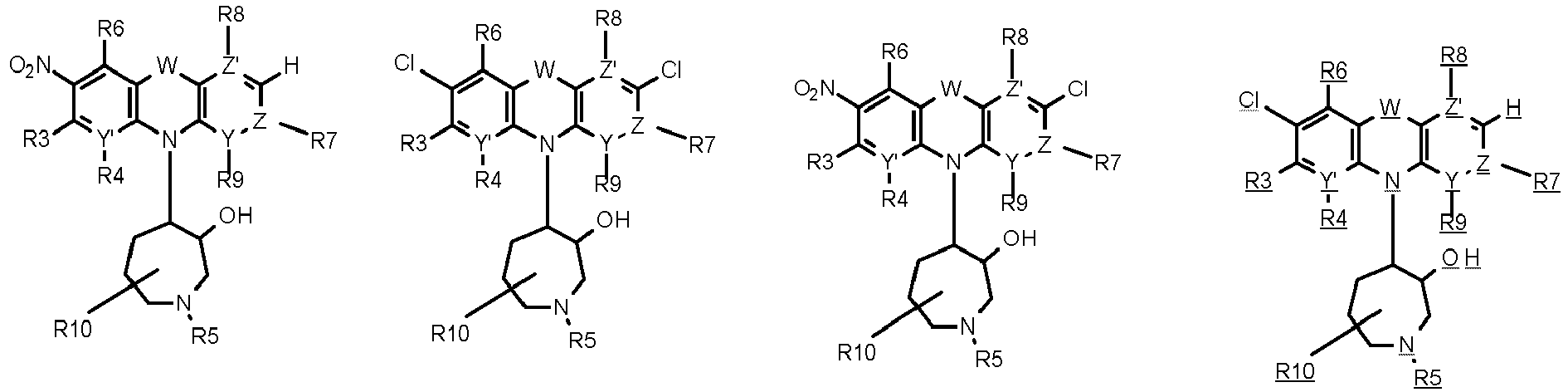
- In one embodiment of the present invention, W is a C-Sp2-Sp2-C (C-C single bond) for the inventive compounds according to formula (i) as disclosed above, whereby the subsitutents R1, R2, R3, R4, R5, R6, R7, R8, R9, R10 may be as defined above, e.g. inventive compounds of formula (i) may comprise the following subformulae


- In one embodiment of the present invention, W is O for the inventive compounds according to formula (i) as disclosed above, e.g. inventive compounds of formula (i) may comprise inventive compounds of the following subformula:
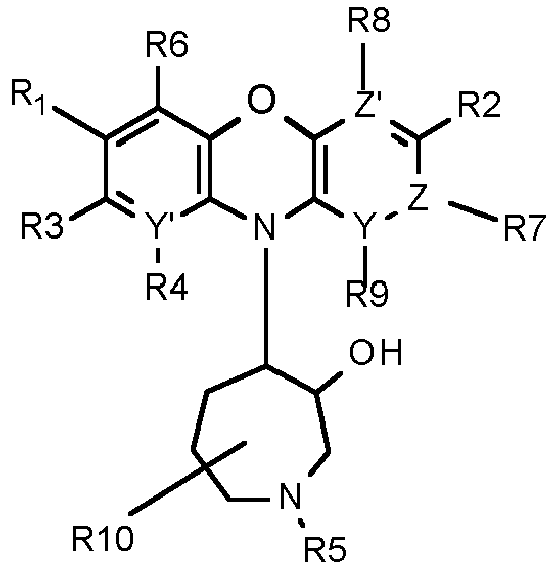


- In one embodiment of the present invention, W is SO2 for the inventive compounds according to formula (i) as disclosed above, e.g. inventive compounds of formula (i) may comprise inventive compounds of the following structure / subformula


- In one embodiment of the present invention, W is N for the inventive compounds according to formula (i) as disclosed above, e.g. inventive compounds of formula (i) may comprise the following structure
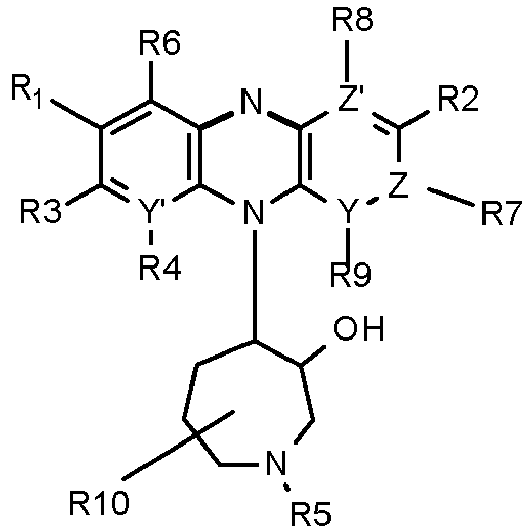


- In one embodiment the inventive compounds according to formula (i) comprise susbstituents R3, R4, R5, R6, R7, R8, R9 and R10 as disclosed above , which e.g. may be H. For example, the inventive compounds according to formula (i) may comprise compounds of the general subformulae as disclosed below:

- In one embodiment the inventive compunds according to formula (i) or any of its subformulae as disclosed above comprise compounds for which Y may be C or N, e.g. the inventive compounds according to formula (i) may comprise compounds according to the following subformulae:


- In one embodiment the inventive compunds according to formula (i) or any of it subformulae as disclosed above, Y' may be C or N. For example, the inventive compounds may comprise compounds according to the following subformulae:


- For the inventive compunds according to formula (i) or any of its subformulae as disclosed above R1-R10 may be e.g. be as disclosed above, e.g. R1-R10 may be H, or e.g. R1, R2 may be as disclosed above and R3-R10 may be H as disclosed above.
- Compounds according to the invention according to formula (i) or any one of its subformulae for example also comprise compounds, in which Y' and Z' are both C. For example, the inventive compounds may comprise compounds according to the following subformulae

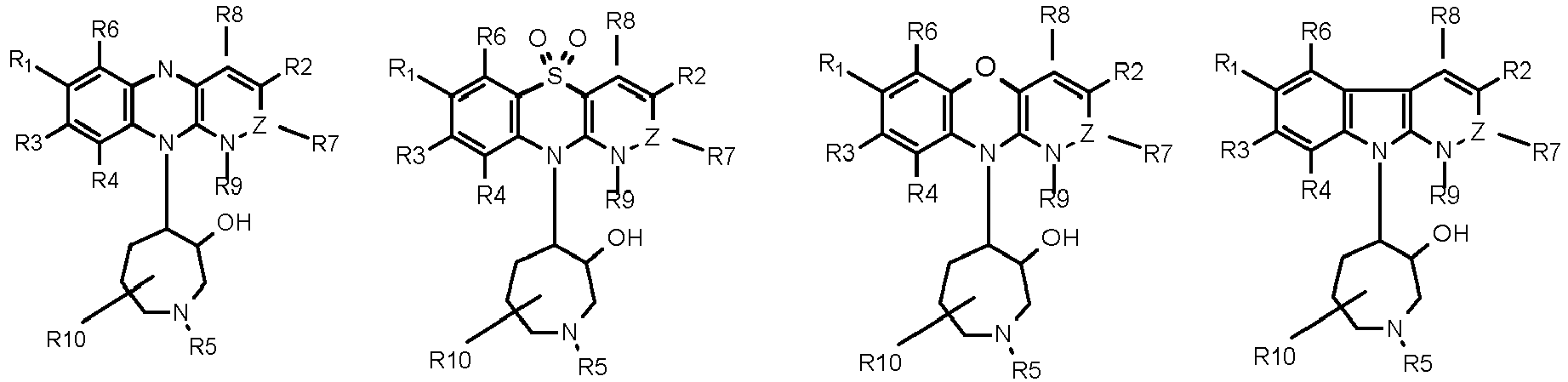
- For example, for the inventive compunds according to formula (i) or any of the subformulae as disclosed above R1, R2, R3, R4, R5, R6, R7, R8, R9 and R10 may be as disclosed above.
- The inventive compounds also comprise compounds for which both Z and Z' are N. For example, for the inventive compounds Z, Z' are N and e.g. W, Y and Y' may be as disclosed above and R1, R2, R3, R4, R5, R6, R7, R8, R9 and R10 may be as disclosed above. The inventive compounds as disclosed above may e.g. comprise compounds according to the following subformulae


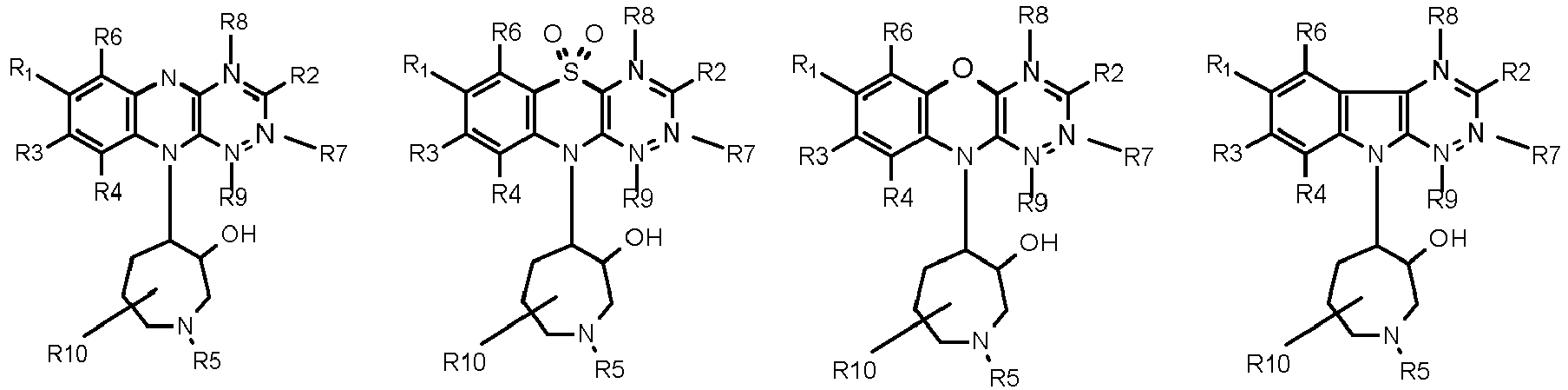
- According to one embodiment the inventive compunds of formula (i) or any of its subformulae as disclosed above also comprise compunds in which Y', Z' are both N, e.g. compounds according to the following subformulae

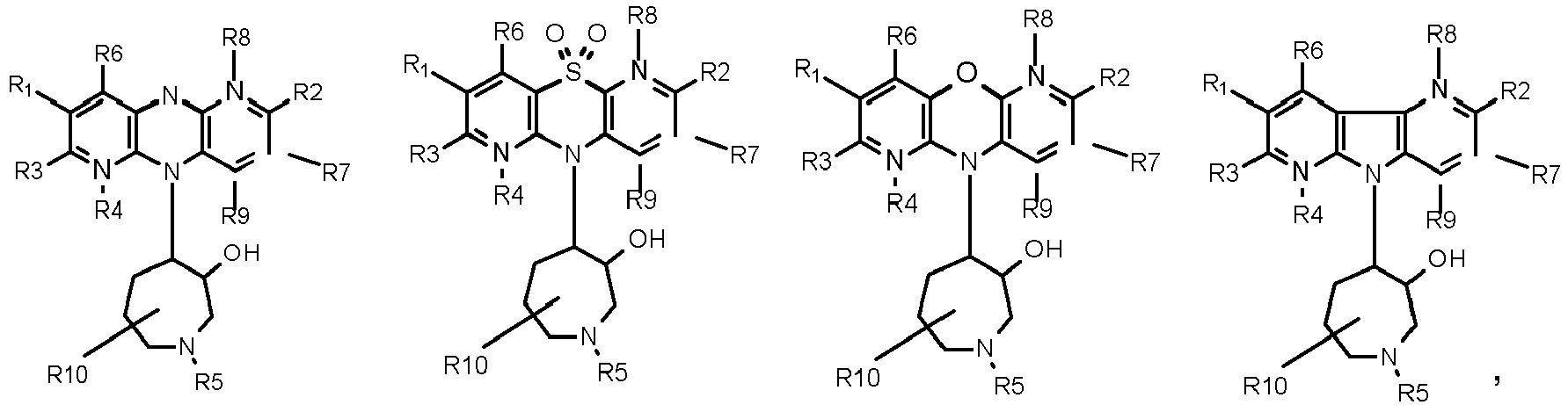
- According to one embodiment the inventive compunds of formula (i) or any of its subformulae as disclosed above comprise compounds in which Z, Z' both are N and Y, Y' both are C. For example, the inventive compounds comprise compounds of the subformulae

- For example, the inventive compounds comprise subformulae as disclosed above, for which subsitutents R1, R2 may be as defined above, e,g, R1 is H, halogen (e.g. F, Cl), CF3, or NO2, or R2 is H, halogen, CF3, or NO2, or both R1, R2 are H, halogen, CF3, or NO2., e.g. R1 and R2 may both be F, or Br, or Cl, CF3, or NO2, whereby R1, R2 may be independently chosen from H, Hal, CF3, NO2, e.g. R1 is H, R2 is CF3, or R1 is CF3, R2 is NO2, or R1 is NO2, R2 is H, or R1 is Cl, R2 is NO2, or R1 is F, R2 is Cl and e.g. R3, R4, R5, R6, R7, R8, R9 and R10 may be as defined above, e.g. R3-R10 may be H, or e.g. R7 may be OMe, or e.g. R7 may be keto (-CO). For example, the inventive compounds may comprise compounds of the subformulae


- According to one embodiment the compounds of formula (i) or any of its subformulae as disclosed above also comprise compunds for which Z, Z' both are C and Y, Y' both are N. For the inventive compounds the subsitutents R1, R2, R3, R4, R5, R6, R7, R8, R9 and R10 are as disclosed above, e.g. R1, R2 may be as disclosed above and R3-R10 may be H, or e.g. R7 is alkyl, or alkoxy, or H and subistuents R3, R4, R5, R6, R8, R9 and R10 are H, or e.g. R7 is alkyl, or alkoxy, or e.g. H and subistuents R3, R4, R5, R6, R8, and R10 are H and R9 is keto, or e.g. H and subistuents R3, R4, R5, R6, R8, and R10 are H and R9 is alkyl, or alkoxy. For example, the inventive compounds comprise the subformuale:

- According to one embodiment in the inventive compounds Z, Z' and Y, Y' are C, e.g. the inventive compounds comprise the following subformulae in which R1, R2, R3, R4, R5, R6, R7, R8, R9 and R10 are as disclosed above:
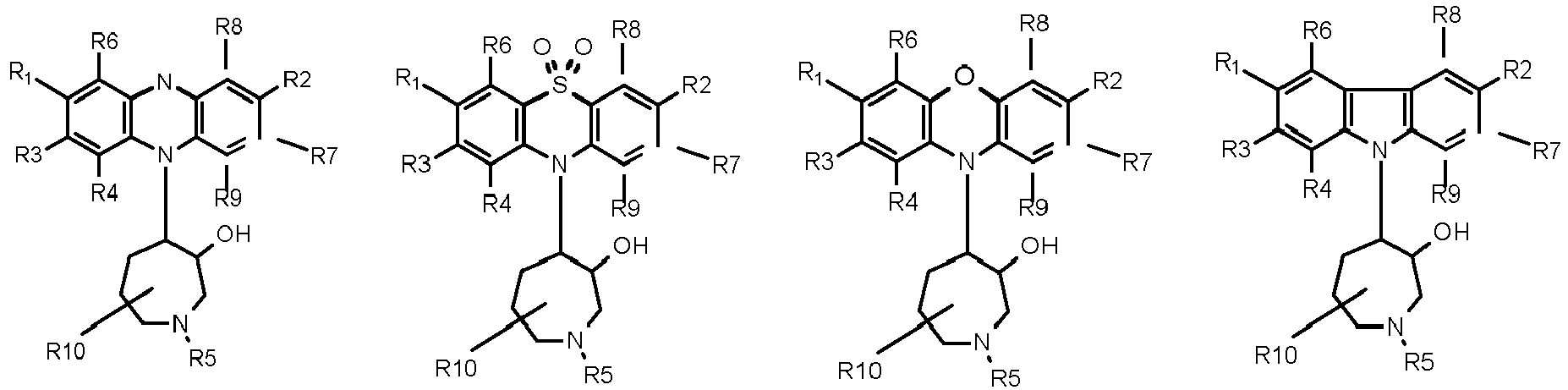

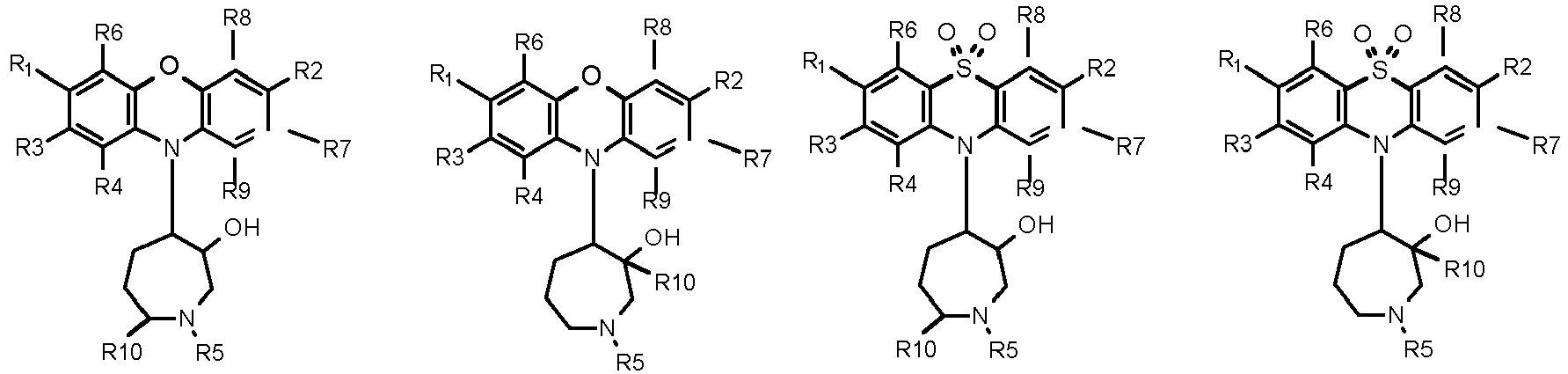
- In one embodiment the inventive compounds as disclosed above comprise compounds for which R8 is SO2Alk, keto (-CO) or NO2, e.g. according to any one of the subformulae


- For the inventive compounds according to subformulae as disclosed above, R1, R2, R3, R4, R5, R6, R7, R9 and are R10 are as disclosed above.
- In one embodiment the inventive compounds as disclosed above comprise compounds for which R6 is alkoxy or keto. More specifically, R6 may be e.g. methoxy, ethoxy, propoxy, or tert-butoxy. For example, R6 is methoxy, and R1, R2 are as defined above, and R3-R10 are H, or e.g. R6 is alkoxy (e.g. methoxy, ethoxy), and R1, R2 are as defined above and R8 is NO2, keto or SO2Alk.
- According to one embodiment the inventive compounds according to formula (i) or any of its subformulae as disclosed above comprise compounds in which R3 is alkoxy, NO2, or amino (NH2). The term amino as used with the inventive compounds, refers to a nitrogen radical bonded to two substituents and can be represented as: -NH2, -NHR or -NR2, wherein each R is aliphatic, aryl, heterocyclyl or heteroaryl;
- In a more preferred embodiment, R4 is selected from H, methoxy, ethoxy, or NO2 for the inventive compounds.
- According to a more preferred embodiment, subsitutent R10 of the inventive compounds as disclosed above, e.g. according to formula (i) or any of its subformulae as disclosed above, is is CF3 or keto. For example, the inventive compounds may comprise the below subformulae, whereby the subsitutents R1, R2, R3, R4, R5, R6, R7, R8, R9 are as disclosed above:
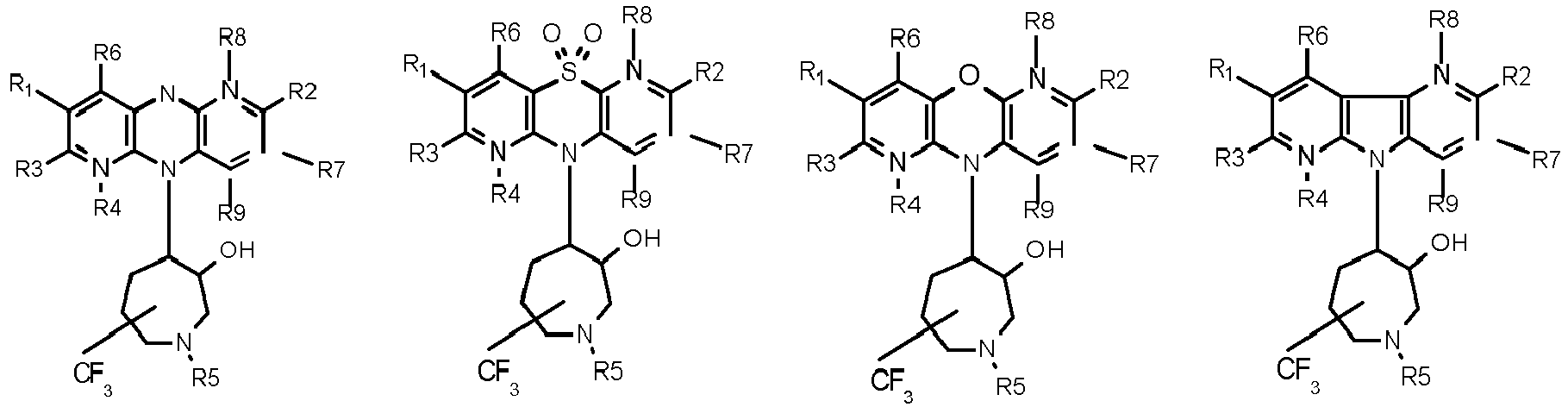


- The inventive compounds as disclosed above also comprise isomers with regard to R10, which may be located on different carbon atoms of the azepanyl-3-ol ring, e.g. R10 may be positioned at C2, C3, C5, C6 or C7, e.g. the inventive compounds may comprise compounds according to the below subformulae which also encompass enantiomers of the respective subformula:


- According to a more preferred embodiment the inventive compounds comprise compounds 25-31 and their respective enantiomers, e.g. compound 25 ((3R,4R)-4-[(8-chloro-5H-pyrimido[5,4-b]indol-4-yl)amino]azepan-3-ol, compound 26 ((3R,4R)-4-(3-chloro-6-nitro-carbazol-9-yl)azepan-3-ol, compound 27 (5R,6R)-5-(3,6-dichloro-9H-carbazol-9-yl)-6-hydroxyazepan-2-one, compound 28 (3R,4R)-4-[8-chloro-2-(trifluoromethyl)pyrimido[5,4-b]indol-5-yl]-7-methyl-azepan-3-ol, compound 30 (8-chloro-5-[(3R,4R)-3-hydroxyazepan-4-yl]-3H-pyrimido[5,4-b]indol-4-one, compound 31 (3R,4R)-4-(8-chloro-4-methoxy-pyrimido[5,4-b]indol-5-yl)azepan-3-ol, e.g.


- According to one item (e.g. item 1), the present present invention also provides compounds of formula (I)

- W is selected from a C-Sp2-Sp2-C bond, O, SO2, S,
- Z is selected from C or N,
- Z' is selected from C, or N,
- Y' is selected from C or N,
- Y is selected from C or N,
- R1 denotes halogen, CF3, OMe, Alkoxy, S-Alk, SMe, SO2Me, SO2Alk
- R2 denotes halogen, CF3, OMe, Alkoxy, S-Alk, SMe, SO2Me, SO2Alkyl,
- R3 denotes halogen, CF3, OMe, SO2, SO2Ak, Alkoxy, S-Alkyl, SMe, SO2Me, SO2Alk
- R4 denotes halogen, CF3, OMe, SO2Alk, Alkoxy, S-Alkyl, SMe, SO2Me, SO2Alk
- R5 denotes H, alkyl, benzyl, amide, sulfonamide,
- R6 denotes H, alkyl, OMe, SO2, SO2Ak, Alkoxy, S-Alkyl, SMe, SO2Me, SO2Alk
- R7 denotes H, SO2, SO2Alk, or S-Alk,
- R8 denotes H, SO2, or S-Alk,
- and
- Alk is a branched or linear alkyl group having 1 to 8 carbon atoms or cycloalkyl having 3 to 6 carbon atoms, wherein 1 to 7 H-atoms may be independently replaced by Hal, OR, COOR, CN, NR2, phenyl, linear or branched alkyl having 1, 2 or 3 C atoms, cycloalkyl having 3 to 6 carbon atoms and/or wherein 1 to 3 CH2-groups may be replaced by O, -NRCO-, -CO-, -COO-, -CONR, -NR- or S, or cycloalkyl having 3 to 6 carbon atoms, and the pharmaceutically acceptable salts esters and N-oxides thereof, in a racemic form or in an enantiomerically pure form or enriched mixture of the respective enantiomers in all ratios, and/or as a mixture of diastereoisomers in all ratios.
- Compounds according to the invention comprise compounds of formula (I), wherein R1 is hal, or CF3, R2 is HAL, or CF3, more preferred are inventive compounds of formula (I), wherein both R1 and R2 are HAL, or both R1, R2 are CF3, e.g. R1 and R2 may both be F, or Br, or Cl, or CF3, e.g. compounds having the structure


- In one item or embodiment of the present invention, W is SO2 for the inventive compounds according to formula (I) as disclosed above, e.g. inventive compounds of formula (I) may comprise the following structure
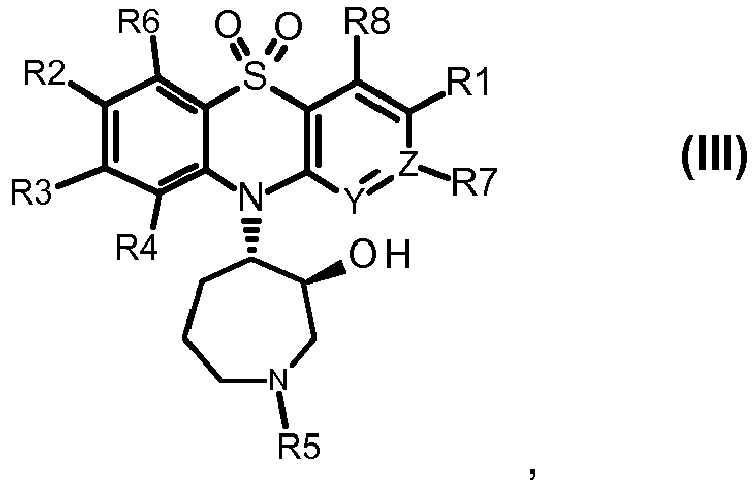
- In a one item orembodiment, the subsitutents R3, R4, R5, R6, R7 and R8 of the inventive compound according to formula (I), or its subformulae as disclosed above, e.g. structures (IIa)-(IIk), (III), are all H. According to one preferred item or embodiment of the present invention R3-R8 are all H as defined above and R1, R2 are as defined above, e.g. R1 and R2 are both Cl, or CF3, or F, and W may e.g. be a C-Sp2-Sp2-C bond, O, or S, or R4, R5, R6 are all H and R1, R2, R7 and R8 Accordingly, the inventive compound may e.g. have a structure according to any one of formulae (IVa), (IVb), (IVc), (IVd):


- More preferred are compounds according to any one of the structures (IVa) - (IVd), wherein Y' is C.
- In one item or embodiment, the inventive compounds according to formula (I) may comprise compounds in which both, Y' and Z' are C. Accordingly, the inventive compounds may e.g. include compounds of the general structures (Va)-(Vd') :


- According to one item or embodiment, for the inventive compounds (Va) - (Vd') the subsitutents R1, R2 are both HAL, or CF3, e.g. R1, R2 are both Cl, or both F, or both CF3. In the inventive compounds as disclosed above the substituents R3, R4, R5, R6, R7, R8 may e.g. all be H, and R1, R2 may be F, Cl, or CF3, or e.g. R3 is OMe and R1, R2 are both Cl, or CF3 and R4, R5, R6, R7 and R8 are all H, or e.g. R4 is OMe and R1, R2 are both Cl, or CF3 and R3, R5, R6, R7 and R8 are all H, or e.g. R7 is SO2 and R1, R2 are both Cl, or CF3 and R3, R4, R5, R6 and R8 are all H, or e.g. or e.g. R8 is SO2 and R1, R2 are both Cl, or CF3 and R3, R4, R5, R6 and R7 are all H.
- Compounds according to the invention may for example also comprise compounds, in which Y=N, e.g. inventive compounds as disclosed above, wherein Y=N, or e.g. for which Y=N and Z=C, or Z=N. For example, the inventive compounds may comprise the following structures:


- In one item or embodiment, the substituent R1, or R2 for the inventive compounds as disclosed above is selected from F, Cl, or CF3, preferably, both substituents R1 and R2 are both selected from F, Cl, or CF3, e.g. both R1, R2 are F, or R1, R2 are both Cl, or R1, R2 are both CF3. For example, R1, R2 are both Cl, and R3, R4, R5, R6, R7, R8 are H, or e.g. R1, R2 are both CF3 and R3, R4, R5, R6, R7, R8 are H as disclosed below, e.g. R1, R2 are as disclosed above and R7, or R8 may be SO2Alk, e.g. SO2Me.
- The inventive compounds may also comprise compounds, in which e.g. R1, R2 are both Cl, or CF3 and any of the subsitutents R3-R8 may be SO2, e.g. R1, R2 are both Cl and R8 is SO2Me, or e.g. R1, R2 are both CF3 and R7 is SO2Me, or e.g. R1, R2 are both CF3 and R8 is SO2Me, e.g. compounds of the following structures:


- Preferred inventive compounds of formula (I) are compounds 1-16 as disclosed below:
Compound No. Structure 1 
2 
3 
4 
5 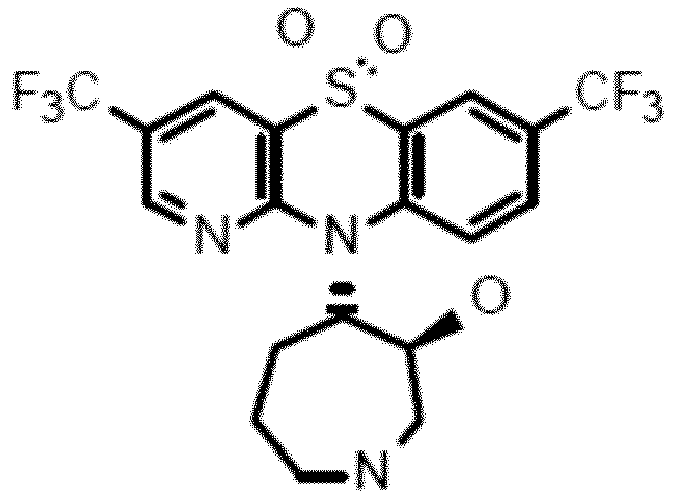
6 
7 
8 
9 
10 
11 
12 
13 
14 
15 
16 
- The compounds of the present invention encompasses pure enantiomeres of formula (i) or any of its subformulae as disclosed above (e.g. Formula (I)), as well mixtures thereof in all ratios for all compounds as disclosed above, e.g. for all compounds according to claims 1-28 as disclosed above, or e.g. according to items 1-26 as disclosed herein.
- The present invention encompasses compounds of Formula formula (i) or any of its subformulae as disclosed above (e.g. Formula (I)), as well as their use as a medicament, e.g. for use as a medicament in human and/or veterinarian use.
- In one embodiment the present invention pertains the use of compounds of formula or any of its subformulae as disclosed above (e.g. Formula (I)),, or any compounds according to its subformulae as disclosed above, such as e.g. compounds 1-31, in the treatment or prevention of parasitic and infectious diseases (in humans as well as in other mammals). Said parasitic and infectious diseases include in particular malaria, cerebral malaria, HAT (human African trypanosomiasis), tuberculosis, chagas (American Trypanosomiasis), leishmaniasis, onchocerciasis, filariasis, and schistosomiasis.
- The compounds of the present invention may be used for or in the treatment of parasitic and/or infectious disease selected from the group comprising Acanthamoeba Infection, Acanthamoeba Keratitis Infection, Alveolar Echinococcosis (Echinococcosis, Hydatid Disease), Amebiasis (Entamoeba histolytica Infection), Ancylostomiasis (Hookworm, Cutaneous Larva Migrans [CLM]), Angiostrongyliasis (Angiostrongylus Infection), Anisakiasis (Anisakis Infection, Pseudoterranova Infection), Ascariasis (Ascaris Infection, Intestinal Roundworms), Babesiosis (Babesia Infection), Balantidiasis (Balantidium Infection), Baylisascariasis (Baylisascaris Infection, Racoon Roundworm), Bilharzia (Schistosomiasis), Blastocystis hominis Infection, Body Lice Infestation (Pediculosis), Capillariasis (Capillaria Infection), Cercarial Dermatitis (Swimmer's Itch), Chilomastix mesnili Infection (Nonpathogenic [Harmless] Intestinal Protozoa), Clonorchiasis (Clonorchis Infection), CLM (Cutaneous Larva Migrans, Ancylostomiasis, Hookworm), "Crabs" (Pubic Lice), Cryptosporidiosis (Cryptosporidium Infection), Cutaneous Larva Migrans (CLM, Ancylostomiasis, Hookworm), Cyclosporiasis (Cyclospora Infection), Cysticercosis (Neurocysticercosis), Cystoisopora Infection (Cystoisosporiasis) formerly Isospora Infection, Diarrhea, Dientamoeba fragilis Infection, Diphyllobothriasis (Diphyllobothrium Infection), Dipylidium caninum Infection (dog or cat tapeworm infection), Dracunculiasis (Guinea Worm Disease), Dog tapeworm (Dipylidium caninum Infection), Echinococcosis (Alveolar Echinococcosis, Hydatid Disease), Elephantiasis (Filariasis, Lymphatic Filariasis), Endolimax nana Infection (Nonpathogenic [Harmless] Intestinal Protozoa), Entamoeba coli Infection (Nonpathogenic [Harmless] Intestinal Protozoa), Entamoeba dispar Infection (Nonpathogenic [Harmless] Intestinal Protozoa), Entamoeba hartmanni Infection (Nonpathogenic [Harmless] Intestinal Protozoa), Entamoeba histolytica Infection (Amebiasis), Entamoeba polecki, Enterobiasis (Pinworm Infection), Fascioliasis (Fasciola Infection), Fasciolopsiasis (Fasciolopsis Infection), Filariasis (Lymphatic Filariasis, Elephantiasis), Foodborne Diseases, Giardiasis (Giardia Infection), Gnathostomiasis (Gnathostoma Infection), Guinea Worm Disease (Dracunculiasis), Head Lice Infestation (Pediculosis), Heterophyiasis (Heterophyes Infection), Hydatid Disease (Alveolar Echinococcosis), Hymenolepiasis (Hymenolepis Infection), Hookworm Infection (Ancylostomiasis, Cutaneous Larva Migrans [CLM]), Intestinal Roundworms (Ascariasis, Ascaris Infection), Iodamoeba buetschlii Infection (Nonpathogenic [Harmless] Intestinal Protozoa), Isospora Infection (see Cystoisospora Infection), Kala-azar (Leishmaniasis, Leishmania Infection), Keratitis (Acanthamoeba Infection), Leishmaniasis (Kala-azar, Leishmania Infection), Lice Infestation (Body, Head, or Pubic Lice, Pediculosis, Pthiriasis), Loaiasis (Loa loa Infection), Lymphatic filariasis (Filariasis, Elephantiasis), Malaria (Plasmodium Infection), Microsporidiosis (Microsporidia Infection), Mite Infestation (Scabies), Naegleria Infection, Neurocysticercosis (Cysticercosis), Nonpathogenic (Harmless) Intestinal Protozoa, Ocular Larva Migrans (Toxocariasis, Toxocara Infection, Visceral Larva Migrans), Onchocerciasis (River Blindness), Opisthorchiasis (Opisthorchis Infection), Paragonimiasis (Paragonimus Infection), Pediculosis (Head or Body Lice Infestation), Pthiriasis (Pubic Lice Infestation), Pinworm Infection (Enterobiasis), Plasmodium Infection (Malaria), Pneumocystis jirovecii Pneumonia, Pseudoterranova Infection (Anisakiasis, Anisakis Infection), Pubic Lice Infestation ("Crabs," Pthiriasis), Raccoon Roundworm Infection (Baylisascariasis, Baylisascaris Infection), River Blindness (Onchocerciasis), Scabies, Schistosomiasis (Bilharzia), Sleeping Sickness (Trypanosomiasis, African; African Sleeping Sickness), Strongyloidiasis (Strongyloides Infection), Swimmer's Itch (Cercarial Dermatitis), Taeniasis (Taenia Infection, Tapeworm Infection), Tapeworm Infection (Taeniasis, Taenia Infection), Toxocariasis (Toxocara Infection, Ocular Larva Migrans, Visceral Larva Migrans), Toxoplasmosis (Toxoplasma Infection), Travelers' Diarrhea, Trichinellosis (Trichinosis), Trichinosis (Trichinellosis), Trichomoniasis (Trichomonas Infection), Trichuriasis (Whipworm Infection, Trichuris Infection), Trypanosomiasis, African (African Sleeping Sickness, Sleeping Sickness), Visceral Larva Migrans (Toxocariasis, Toxocara Infection, Ocular Larva Migrans), Waterborne Diseases, Whipworm Infection (Trichuriasis, Trichuris Infection).
- In a preferred embodiment, the inventive compounds as disclosed above may be used for or in the treatment of parasitic and infectious diseases selected from the group constisting of malaria, African sleeping sickness (HAT), chagas, leishmaniasis, onchocerciasis, filariasis, schistosomiasis, Cryptosporidiosis (Cryptosporidium Infection), Entamoeba coli Infection (Nonpathogenic [Harmless] Intestinal Protozoa), Entamoeba dispar Infection (Nonpathogenic [Harmless] Intestinal Protozoa), Entamoeba hartmanni Infection (Nonpathogenic [Harmless] Intestinal Protozoa), Entamoeba histolytica Infection (Amebiasis), Entamoeba polecki, Toxoplasmosis (Toxoplasma Infection), Zoonotic Diseases (Diseases spread from animals to people), more preferably, the parasitic disease to be treated by the inventive compounds are selected from the group comprising malaria, African sleeping sickness (HAT), chagas, leishmaniasis, schistosomiasis.
- In an even more preferred ambodiment, the inventive compounds are for use in the treatment of malaria, or cerebral malaria.
- In another specific embodment, the present invention provides a pharmaceutical composition comprising at least one compound of Formula (i) or or any of its subformulae as disclosed above (e.g. Formula (I)), and/or pharmaceutically acceptable derivatives, tautomers, salts, solvates and stereoisomers thereof, including mixtures thereof in all ratios, and optionally excipients and/or adjuvants. The inventive pharmaceutical composition may be applied in human medicine as well as in e.g. veterinary medicine.
- In more specific embodiment, the present invention provides a pharmaceutical composition comprising at least one compound of formula (i) or any of its subformulae as disclosed above (e.g. Formula (I)), or related formulae as disclosed above and/or pharmaceutically acceptable derivatives, tautomers, salts, solvates and stereoisomers thereof, including mixtures thereof in all ratios, and at least one further pharmaceutically active compound. The further pharmaceutically active compound to be combined with the at least one inventive compound of formula or any of its subformulae as disclosed above (e.g. Formula (I)), may be selected from the goup of anti-malarial drugs, such as e.g. chloroquine, amodiaquine, proguanil, sulphonamides, mefloquine, atovaquone, primaquine, artemisinin and artemisinin-derivatives, halofantrine, doxycycline, tetracycline, or clindamycin. Accordingly, the at least compound according to formula or any of its subformulae as disclosed above (e.g. Formula (I)), of the invention or compounds according to any of its subformulae disclosed above may e.g. be combined with chloroquine, or e.g. may be combined with artemisinin and artemisinin-derivatives. The inventive pharmaceutical composition may e.g. also comprise at least one inventive compound according formula (I) or any of its subformulae as disclosed above and e.g. artesunate and amodiaquine, or e.g. artesunate and mefloquine, or e.g. artesunate and lumefantrine, or e.g. artesunate and sulfadoxine/pyrimethamine, or e.g. artesunate and pyronaridine.
- The inventive pharmaceutical compositions may comprise the at least one compound according to formula or any of its subformulae as disclosed above (e.g. Formula (I)), and the at least one further pharmaceutically active compound as disclosed above in any given ratio or weight. For example, the inventive pharmaceutical compositions may comprise at least one inventive compound according to formula (i) or any of its subformulae as disclosed above (e.g. Formula (I)), or any of its subformulae and the at least one further pharmaceutically active compounds in a relative ratio of from about 1:100 to about 100:1, or e.g. from about 2, 3, 4, 5, 6, 7, 8, 9, 10: 90, 91, 92, 93, 94, 95, 96, 97, 98 or 99, or e.g. from about 2:50 to about 50:2, or e.g. from about 3:75 to about 75:3, or e.g. from about 4:70 to about 70:4, or e.g. from about 1, 2, 3, 4, 5, 6, 7, 8, 9, 10 to about 10, 9, 8, 7, 6, 5, 4, 3, 2, 1. If the inventive the pharmaceutical composition comprises more than one, e.g. two or three, additional pharmaceutically active compounds, the relative ratios shall pertain to the sum of all relative abundances, or cumulative weight of all further pharmaceutically active compounds in the pharmaceutical composition.
- A therapeutically effective amount of a compound of the formula (i) or any of its subformulae as disclosed above (e.g. Formula (I)), according to the invention depends on a number of factors, including, for example, the age and weight of the individual to be treated, the precise condition that requires treatment, and its severity, the nature of the formulation and the method and/or route of administration, and is ultimately determined by the treating physican or veterinarian. However, an effective amount of a compound according to the invention may e.g. be generally in the range from about 0.1 to about 100 mg/kg of body weight of the recipient (mammal) per day and particularly typically in the range from 1 to 10 mg/kg of body weight per day. Thus, the actual amount per day for an adult mammal weighing 70 kg is usually between 70 and 700 mg, where this amount can be administered as a single dose per day or usually in a series of part-doses (such as, for example, two, three, four, five or six) per day, so that the total daily dose is the same. An effective amount of a salt or solvate or of a physiologically functional derivative thereof can be determined as the fraction of the effective amount of the compound according to the invention per se. It can be assumed that similar doses are suitable for the treatment of other conditions mentioned above.
- Pharmaceutical compositions according to the invention can be administered in the form of dosage units which comprise a predetermined amount of active compound per dosage unit. Such a unit can comprise, for example, 0.5 mg to 1 g, preferably 1 mg to 700 mg, particularly preferably from about 5 mg to about 100 mg, or from about 10 mg to about 90 mg, or from about 15 mg to about 85 mg, or from about 20 mg to about 80 mg, or from about 25 mg to about 75 mg, or from about 40 mg to about 65 mg, or from about 45 mg to about 60 mg, or from about 100mg to about 700 mg, or from about 125 mg to about 675 mg, or from about 125 mg to about 650 mg, or from about 150 mg to about 625 mg, or from about 175 mg to about 600 mg, or from about 200 mg, 250 mg, 300 mg, 350 mg, 400 mg to about 400 mg, 450 mg, 500 mg, 550 mg, or e.g. about 7.5 mg, 10 mg, 12.5 mg, 15 mg, 17.5 mg, 20 mg, 22.5 mg, 25mg, 27.5mg, 30 mg, 32.5 mg, 35 mg, 37.5mg, 40 mg, 42.5, 47.5 mg, 50 mg, 55 mg, 60, mg, 75 mg, 80 mg, 85 mg, 90 mg, 100 mg, 110 mg, 112.5 mg, 125 mg, 150 mg, 160mg, 175 mg, 180 mg, 190 mg, 200 mg, 225 mg, 250 mg, 275 mg, 300 mg, 325 mg, 350 mg, 375 mg, 400 mg, 425 mg, 450 mg, 475 mg, 500 mg, 525 mg, 550 mg, 575 mg, 600 mg, 625 mg, 650 mg, 675 mg, or about 700 mg of a at least one compound according to the invention, depending on the condition to be treated, the method and route of administration, the age, weight and condition of the patient, or pharmaceutical formulations can be administered in the form of dosage units which comprise a predetermined amount of active compound per dosage unit. Preferred dosage unit formulations are those which comprise a daily dose or part-dose, as indicated above, or a corresponding fraction thereof of the at least one compound of the invention. Furthermore, pharmaceutical formulations of this type can be prepared using a process which is generally known in the pharmaceutical art.
- Without being bound thereto, the inventive pharmaceutical composition will contain or release sufficient active compound of formula (i) or any of its subformulae as disclosed above (e.g. Formula (I)), or its tautomers, salts, solvates and stereoisomers to provide a dose of about 10, 20, 50, or 100 nanograms per kilogram body weight (ng/kg) to about 1, 2.5, 5, 10, 15, 20, 25, 27.5, 30, 35, 45, 50, 75 milligrams per kilogram body weight (mg/kg), preferably about 10 micrograms per kilogram (µg/kg) to about 50 mg/kg, e.g. from about 12.5 µg/kg, 25 µg/kg, 50 µg/kg, 75 µg/kg, 100 µg/kg, 125 µg/kg, 150 µg/kg, 175 µg/kg, 200 µg/kg, 250 µg/kg, 300 µg/kg, 350 µg/kg, 400 µg/kg, 450 µg/kg, 500 µg/kg, 600 µg/kg, 750 µg/kg, 1 mg/kg, 2.5 mg/kg, 5 mg/kg, 7.5 mg/kg, 10 mg/kg to about 10 mg/kg, 12.5 mg/kg, 15 mg/kg, 17.5 mg/kg, 20 mg/kg, 22.5 mg/kg, 25 mg/kg, 27.5 mg/kg, 30 mg/kg, 35 mg/kg, 40 mg/kg, 45 mg/kg, 50 mg/kg of active compound of formula (I) or a salt thereof to the subject. Accordingly, the inventive pharmaceutical composition will contain or release sufficient active compound of Formula (I) to provide a dose of, for example, from about 0.005 mg/m2, 0.01 mg/m2, 0.1 mg/m2 to about 2.5 mg/m2, 5.0 mg/m2, 7.5 mg/m2, 10 mg/m2, 15 mg/m2, 20 mg/m2, 25 mg/m2, 50 mg/m2, 100 mg/m2, 250 mg/m2, computed according to the Dubois method, in which the body surface area of a subject (m2) is computed using the subject's body weight (wt) given in kg and the subject's height given in cm: m2=(wt0.425 x height0.725) x7,184x10-3, although in some embodiments the methods may be performed by administering a compound or salt or composition in a dose outside this range. In some of these embodiments, the method includes administering sufficient active compound of formula (I) to provide a dose of from about 0.01, 0.02, 0.05, 0.1, 0.25, 0.5, 1.0, 2.5, 5, 7.5, 10, 12.5, 15, 17.5, 20, 22.5, 25, 27.5, 30, 35, 40, 45, 50 mg/m2 to about 50, 52.5, 55, 57.5, 60, 65, 70, 75, 80, 85, 90, 95, 100, 125, 150, 175, 200 mg/ m2 to the subject, for example, a dose of from about 0.1, 0.2, 0.3, 0.4, 0.5, 0.75, 1, 2, 3, 4, 5, 6, 7, 8, 9 mg/m2 to about 10, 11, 12, 12.5, 13, 14, 15, 17.5, 20, 22.5, 25, 27.5, 30, 32.5, 35, 37.5, 40, 45, 50 mg/m2.
- The inventive pharmaceutical formulations can be adapted for administration via any desired suitable method, for example by oral (including buccal or sublingual), rectal, nasal, topical (including buccal, sublingual or transdermal), vaginal or parenteral (including subcutaneous, intramuscular, intravenous or intradermal) methods. Such formulations can be prepared using all processes known in the pharmaceutical art by, for example, combining the active compound with the excipient(s) or adjuvant(s).
- Pharmaceutical formulations according to the invention which are adapted for oral administration can be administered as separate units, such as, for example, capsules or tablets; powders or granules; solutions or suspensions in aqueous or non-aqueous liquids; edible foams or foam foods; or oil-in-water liquid emulsions or water-in-oil liquid emulsions.
- The compounds of the formula (i) or any of its subformulae as disclosed above (e.g. Formula (I)), according to the invention and salts thereof, solvates and physiologically and/or pharmaceutically active derivatives thereof can also be administered in the form of liposome delivery systems, such as, for exam-ple, small unilamellar vesicles, large unilamellar vesicles and multilamellar vesicles. Liposomes can be formed from various phospholipids, such as, for example, cholesterol, stearylamine or phosphatidylcholines.
- The compounds of the formula (i) or any of its subformulae as disclosed above (e.g. Formula (I)), and the salts, solvates and physiologically and/or pharmaceutically active derivatives thereof can also be delivered using monoclonal antibodies as individual carriers to which the compound molecules are coupled. The compounds can also be coupled to soluble polymers as targeted medicament carriers. Such polymers may encompass polyvinylpyrrolidone, pyran copolymer, polyhydroxypropylmethacrylamidophenol, polyhydroxyethylaspartamidophenol or polyethylene oxide polylysine, substituted by palmitoyl radicals. The compounds may furthermore be coupled to a class of biodegradable polymers which are suitable for achieving controlled release of a medicament, for example polylactic acid, poly-epsiloncaprolactone, polyhydroxybutyric acid, polyorthoesters, polyacetals, polydihydroxypyrans, polycyanoacrylates and crosslinked or amphipathic block copolymers of hydrogels.
- Pharmaceutical composition of the invention may also be provided as formulations adapted for transdermal administration, which can be administered as independent plasters for extended, close contact with the epidermis of the individual to be treated. Thus, for example, the active compound can be delivered from the plaster by iontophoresis, as described in general terms in Pharmaceutical Research, 3(6), 318 (1986).
- Pharmaceutical compositions of the invention may e.g. also be adapted for topical administration and may be formulated as ointments, creams, suspensions, lotions, powders, solutions, pastes, gels, sprays, aerosols or oils.
- For the treatment of the eye or other tissues such as e.g. mucosal tissues, such as for example the oral cavity, the inventive compositions and formulations are preferably applied as topical ointment or cream.
- In the case the pharmaceutical composition of the invention is to be formulated to be given as ointment, the active compound may e.g. be employed either with a paraffinic or a water-miscible cream base. Alternatively, the active compound according to formula (i) or any of its subformulae as disclosed above (e.g. Formula (I)), or any subformula of the invention may e.g. be formulated to give a cream with an oil-in-water cream base or a water-in-oil base.
- Pharmaceutical compositions of the invention, which are adapted for topical application to the eye include e.g. eye drops, in which the active compound is dissolved or suspended in a suitable carrier, in particular an aqueous solvent.
- Pharmaceutical compositions according to the invention adapted for topical application in the mouth encompass lozenges, pastilles and mouthwashes, those adapted (formulated) for rectal administration may, e.g. be administered in the form of suppositories or enemas.
- Pharmaceutical compositions of the invention, which are adapted for nasal administration in which for example the carrier substance is a solid, comprise a coarse powder having a particle size, in the range e.g. of about 10, 15, 20, 25, 30, 35, 40, 45, 50, 55, 60, 70, 80, 90, 100, 110, 125, 150 to about 160, 170, 180, 190, 200, 225, 250, 300, 400, 500 µm, which is administered in the manner in which snuff is taken, e.g. by rapid inhalation via the nasal passages from a container containing the powder held close to the nose. Suitable formulations for administration as nasal spray or nose drops with a liquid as carrier substance encompass active-compound solutions in water or oil.
- The inventive pharmaceutical compositions or formulations adapted for administration by inhalation encompass finely particulate dusts or mists, which can be generated by various types of pressurized dispensers with aerosols, nebulisers or insufflators. Pharmaceutical formulations of the invention adapted for vaginal administration can be administered as pessaries, tampons, creams, gels, pastes, foams or spray formulations.
- Pharmaceutical formulations according to the invention, which are adapted for parenteral administration, include aqueous and non-aqueous sterile injection solutions comprising antioxidants, buffers, bacteriostatics and solutes, by means of which the formulation is rendered isotonic with the blood of the recipient to be treated; and aqueous and non-aqueous sterile suspensions, which may comprise suspension media and thickeners. The formulations can be administered in single-dose or multidose containers, for example sealed ampoules and vials, and stored in freeze-dried (lyophilised) state, so that only the addition of the sterile carrier liquid, for example water for injection purposes, immediately before use is necessary. Injection solutions and suspensions prepared in accordance with the recipe can be prepared from sterile powders, granules and tablets.
- The inventive pharmaceutical compositions as disclosed above may also comprise other agents commonly used in the art with respect to the particular type of formulation; thus, for example, compositions which are suitable for oral administration may comprise flavours or sweetener and/or antioxidants.
- A combined treatment of this type can be achieved with the aid of simultaneous, consecutive or separate dispensing of the individual components of the treatment. Combination products of this type employ the compounds according to the invention.
- In one embodiment, the pharmaceutical composition of the invention as disclosed above may be used in the treatment of a parasitic disease as defined above. Preferably, the inventive pharmaceutical composition is used for the treatment of parasitic diseases selected from the group of malaria, cerebral malaria, African sleeping sickness (HAT), chagas, leishmaniasis, onchocerciasis, filariasis, schistosomiasis, more preferably the parasitic disease is malaria, or cerebral malaria. Accordingly, the inventive pharmaceutical composition for use in the treatment of a parasitic disease, e.g. malaria, or cerebral malaria, may be administered as disclosed above, e.g. in any of the dosing regimens and dosings disclosed above. The most effective amount of the inventive pharmaceutical composition to be provided to the person in need thereof is to be determined by the attending medical personel or physician.
- In another specific embodiment, the invention provides a kit comprising, which comprises
- (a) an effective amount of at least one compound of formula (i) or any of its subformulae as disclosed herein (e.g. Formula (I)), and/or pharmaceutically acceptable derivatives and/or solvates and/or stereoisomers thereof, including mixtures thereof in all ratios, and
- (b) an effective amount of at least one further pharmaceutically active compound, wherein the at least one compound of formula (i) or or any of its subformulae as disclosed herein (e.g. Formula (I)), and at least one further pharmaceutically active compound may be provided as separate unit dosage forms, or may be provided as a single unit dosage form comprising both (a) and (b), optionally, the unit dosage forms may further comprise antioxidants.
- The antioxidant or antioxidants which may be optionally comprised in the unit dosage form according to the invention, are chosen such that they do not interfere with the pharmaceutical effect or efficacy of the at least one inventive compound comprised in the unit dosage form, or with the pharmaceutical effect or efficacy of the at least one further pharmaceutically active compound.
- In the inventive kit the at least one further pharmaceutically active compound may e.g. be selected from the group of anti-malarials as disclosed above, e.g. chloroquine, amodiaquine, proguanil, sulphonamides, mefloquine, atovaquone, primaquine, artemisinin and artemisinin-derivatives, halofantrine, doxycycline, tetracycline, clindamycin, or e.g. pain relievers, or e.g. anti-inflammatory agents, such as e.g. non-steroidal anti-inflammatory drugs (NSAIDs).
- More specifically, the unit dosage form comprised in the kit of the invention may e.g. be a pill, capsule, lozenge, injectable solution, suppository or plaster, or single-use syringe or auto-injector comprising an individual dose of the inventive compound of formula (i) or any of its subformulae as disclosed herein (e.g. Formula (I)), or of a pharmaceutical composition comprising at least one compound of formula (i) or any of its subformulae as disclosed herein (e.g. Formula (I)),, or mixtures thereof in any ratio as defined above and optionally at least one further pharmaceutically active compound as defined above.
- According to a general process, compounds of formula (i) or any of its subformulae as disclosed above (e.g. Formula (I)),, can be converted to alternative compounds of formula (i) or e.g. any of its subformulae as disclosed above (e.g. Formula (I)),, employing suitable interconversion techniques well-known by a person skilled in the art.
- In one item the present invention provides a process for preparing compounds of formula (I) and its subformulae as disclosed above. In general, the synthesis pathways for any individual compounds of formula (I), or any of its subformulae as disclosed above, e.g. subformulae (II) - (VIIaa), or e.g. any one of the inventive compounds 1-16, depends on the specific substituents of each molecule, on the availability of intermediates or transformation of commercially available starting materials into key intermediates, such factors being appreciated by the one ordinary skilled in the art. For all the protection and deprotection methods, see e.g. Philipp J. Kocienski in "Protecting groups", Georg Thieme Verlag Stuttgart, New York, 1994 and Theodora W. Greene and Peter G. Wuts in "Protective groups in organic synthesis", Wiley Interscience, 3rd Edition 1999.
- The inventive compounds according to formula (I) or any of its subformulae as disclosed above may e.g. be obtained by reacting a suitable intermediate such as, e.g. 8-oxa-5-azabicyclo[5.1.0]octane, or any suitable derivate thereof, which will allow for the coupling reaction to proceed to yield an inventive compound according to formula (I). For example, amino functions in the intermediates used for the synthesis of the inventive compounds, may be protected by protecting groups (PG), such as e.g. BOC- (tert-butyloxycarbonyl), FMOC- (9-fluorenylmethyloxycarbonyl), Cbz- (carbobenzyloxy), MeOZ- (p-methoxybenzyl carbonyl), Ac-(acetyl), Bz- (benzoyl), PMB- (-methoxybenzyl), tosyl, or sulfonamide groups. For example, one 8-oxa-5-azabicyclo[5.1.0]octane-derivative which may be used in the coupling reactions is tert-butyl 8-oxa-5-azabicyclo[5.1.0]octane-5-carboxylate. Suitable intermediates for use for the synthesis of the inventive compounds according to formula (I) include, but are not limited to e.g. 3,6-difluoro-9H-carbazole, 3,6-dichloro-9H-carbazole, 3,6-bis(trifluoromethyl)-9H-carbazole, 3,6-dichloro-9H-pyrido[2,3-b]indole, 3,7-dichloro-10H-phenoxazine, 3,7-dichloro-10H-phenothiazine, 3,6-bis(trifluoromethyl)-9H-pyrido[2,3-b]indole, 6-chloro-2,3,4,9-tetrahydro-1H-carbazole, 3,6-bis(trifluoromethyl)-9H-pyrido[3,4-b]indole: 3,6-dichloro-2-methoxy-9H-carbazole, 3,6-dichloro-1-methoxy-9H-carbazole, 2-(methylsulfonyl)-3,6-bis(trifluoromethyl)-9H-carbazole, 4-(methylsulfonyl)-3,6-bis(trifluoromethyl)-9H-carbazole.
- For example, tert-butyl 8-oxa-5-azabicyclo[5.1.0]octane-5-carboxylate may be reacted with any one of the above intermediates under suitable reaction conditions, which will allow for the coupling reaction to proceed amd to yield as a major reaction product, e.g. >20% w/w, >30% w/w, >40% w/w, >50% w/w, >60% w/w, >70% w/w, >80% w/w the inventive compound of formula (I), or e.g. any of its subformulae (II) - (VIIaa). The reaction product may comprise all stereoisomers, enantiomers diastereoisomers of the inventive compounds. If required, chiral resolution may be carried out for the isolation of individual stereoisomers according to any technology known in the art, e.g. such as those disclosed in Porter (1991) Pure & Appl. Chem Vol. 63, No. 8, pp-1119-22, or Davankov (1997) Pure & Appl. Chem. Vol. 69, No. 7, pp- 1469-74.
- Subsituted carbazoles, which may be used for the synthesis of the inventive compounds according to formula (I), may be prepared by standard methods known to those skilled in the art. For example, carbazole-derivatives for which R1, R2 may be as disclosed above, e.g. R1, R2 may be both F, or Cl, or CF3 and for which W is a C-Sp2-Sp2-C single bond, or e.g. compounds for which W is O and R1, R2 are as disclosed above, e.g. Cl, F, or CF3, may e.g. be obtained according to the reaction schemes disclosed below (reaction schemes (Ai-iv), which is described in further detail in the appended examples, or as disclosed in e.g. Tetrahedron 64 (2008) 6038-6050, U.S. Pat. Appl. Publ.,
US20130040977 .
- Typically, compounds of general formula (I) of the invention for which the substituents R1-R8 may be as disclosed above and which may e.g. be obtained by way of a reaction as disclosed in reaction scheme (B), whereby "EWG" denotes an "electron withdrawing group", whereby EWG may be e.g. an atom or e.g. functional group that removes electron density from a conjugated π system via resonance or inductive electron withdrawal.

- However, certain compounds of formula (I) of the invention may require different syntheses strategies, which differ from that of reaction scheme (B).
- According to one item or embodiment, the present invention pertains to a method of treating a person inflicted with parasitic disease, wherein the method comprises: adiminstering an pharmacologically effective amount of a compound of formula (I) of the invention or any of its subformulae as disclosed above (e.g. Formula (I)), or a pharmaceutical composition as disclosed above to a person in need thereof.
- More specifically, the method of treatment according to the invention pertains to the treatment of a parasitic disease, which is selected from the group comprising malaria, cerebral malaria, tuberculosis, African sleeping sickness (HAT), chagas, leishmaniasis, onchocerciasis, filariasis and schistosomiasis.
- More specifically, the inventive method of treatment comprises administering to a person in need thereof the inventive compound according to formula (I) or any of its subformulae as disclosed above (e.g. Formula (I)), or the pharmaceutical composition as disclosed above at least once a day, or twice or three times daily, or twice a week, or three times a week, or at least once every 2, 3, 4, 5, 6 days, for at least 1-18 weeks, or for at least 2-16 weeks, or for at least 3, 4, 5, 6, 7, 8, 9, 10, 11, 12, 13, 14, 15 weeks.
- According to one item or embodiment the inventive method as disclosed above comprises administering to a person in need thereof from about the inventive compound or of the inventive pharmaceutical composition in an amount or dosing as disclosed above, e.g. from about 10 micrograms per kilogram (µg/kg) to about 50 mg/kg body weight, e.g. from about 12.5 µg/kg, 25 µg/kg, 50 µg/kg, 75 µg/kg, 100 µg/kg, 125 µg/kg, 150 µg/kg, 175 µg/kg, 200 µg/kg, 250 µg/kg, 300 µg/kg, 350 µg/kg, 400 µg/kg, 450 µg/kg, 500 µg/kg, 600 µg/kg, 750 µg/kg, 1 mg/kg, 2.5 mg/kg, 5 mg/kg, 7.5 mg/kg, 10 mg/kg to about 10 mg/kg, 12.5 mg/kg, 15 mg/kg, 17.5 mg/kg, 20 mg/kg, 22.5 mg/kg, 25 mg/kg, 27.5 mg/kg, 30 mg/kg, 35 mg/kg, 40 mg/kg, 45 mg/kg, 50 mg/kg body weight.
- More preferably, the inventive method of treatment as disclosed above pertains to the treatment of malaria or cerebral malaria.
- In a more specific embodiment or item, the present invention also pertains to the preparation of compounds 1-31 according to formula (i) or any of its subformulae as disclosed herein (e.g. compounds according to Formula (I)) of the invention, as well as the corresponding reaction intermediates, which may e.g. be used for the the synthesis of the inventive compounds of formula (i) or any of its subformulae as disclosed herein, such as e.g. Formula (i), the syntheses of which will be described in the appended examples:
-
- Intermediate 1: tert-Butyl 8-oxa-3-azabicyclo[5.1.0]octane-3-carboxylate (int 1)
- Intermediate 2: 3,6-difluoro-9H-carbazole (int 2)
- Intermediate 3: 3,6-dichloro-9H-carbazole (int 3)
- Intermediate 4: 3,6-bis(trifluoromethyl)-9H-carbazole (int 4)
- Intermediate 5: 3,6-dichloro-9H-pyrido[2,3-b]indole (int 5)
- Intermediate 6: 3,7-dichloro-10H-phenoxazine (int 6)
- Intermediate 7: 3,7-dichloro-10H-phenothiazine (int 7)
- Intermediate 8: 3,6-bis(trifluoromethyl)-9H-pyrido[2,3-b]indole (int 8)
- Intermediate 9: 6-chloro-2,3,4,9-tetrahydro-1H-carbazole (int 9)
- Intermediate 10: 3,6-bis(trifluoromethyl)-9H-pyrido[3,4-b]indole (int 10)
- Intermediate 11: 3,6-dichloro-1-methoxy-9H-carbazole (int 11)
- Intermediate 12: 3,6-dichloro-2-methoxy-9H-carbazole (int 12)
- Intermediate 13: 3,6-dichloro-4-methoxy-9H-carbazole (int 13)
- Intermediate 14: 2-(methylthio)-3,6-bis(trifluoromethyl)-9H-carbazole (int 14)
- Intermediate 15: 4-(methylthio)-3,6-bis(trifluoromethyl)-9H-carbazole (int 15)
- Intermediate 16 Synthesis of 7-methoxy-2,8-bis(trifluromethyl)-5H-pyrido[3,2-b]indole (int 16)
- Intermediate 17 Synthesis of 7-methoxy-2,8-bis(trifluromethyl)-5H-pyrido[3,2-b]indole (int 17)
- Intermediate 18: N-(4-chloro-2-methoxyphenyl)-6-(trifluoromethyl)pyridin-3-amine (int 18)
- Intermediate 19: N-(4-chloro-2-methoxyphenyl)-6-(trifluoromethyl)pyridin-3-amine (int 19)
- Intermediate 20: 3,6-bis(trifluoromethyl)-9H-pyrrolo[2,3-b:5,4-c'] di pyridine (int 20)
- Intermediate 21: 3,6-bis(trifluoromethyl)-9H-pyrrolo[2,3-b:5,4-c'] di pyridine (int 21)
- Intermediate 22: 3-chloro-6-nitro-9H-carbazole (int 22)
- Intermediate 23: tert-Butyl 4-methyl 8-oxa-3-azabicyclo[5.1.0]octane-3-carboxylate (int 23)
-
- Compound 1:
3,7-dichloro-10-((3R,4R)-3-hydroxyazepan-4-yl)-10H-phenothiazine 5,5-dioxide, 3,7-dichloro-10-((3S,4S)-3-hydroxyazepan-4-yl)-10H-phenothiazine 5,5-dioxide - Compound 2:
(3R,4R)-4-(3,6-dichloro-9H-carbazol-9-yl)azepan-3-ol (3S,4S)-4-(3,6-dichloro-9H-carbazol-9-yl)azepan-3-ol - Compound 3:
(3R,4R)-4-[3,6-bis(trifluoromethyl)-9H-carbazol-9-yl]azepan-3-ol (3S,4S)-4-[3,6-bis(trifluoromethyl)-9H-carbazol-9-yl]azepan-3-ol - Compound 6:
(3R,4R)-4-[4-methylsulfonyl-3,6-bis(trifluoromethyl)carbazol-9-yl]azepan-3-ol, (3S,4S)-4-[4-methylsulfonyl-3,6-bis(trifluoromethyl)carbazol-9-yl]azepan-3-ol - Compound 7:
(3R,4R)-4-[2-methylsulfonyl-3,6-bis(trifluoromethyl)carbazol-9-yl]azepan-3-ol, (3S,4S)-4-[2-methylsulfonyl-3,6-bis(trifluoromethyl)carbazol-9-yl]azepan-3-ol - Compound 8:
(3S,4S)-4-(3,6-dichloro-1-methoxy-9H-carbazol-9-yl)azepan-3-ol, (3R,4R)-4-(3,6-dichloro-1-methoxy-9H-carbazol-9-yl)azepan-3-ol - Compound 9:
(3R,4R)-4-(3,6-dichloro-2-methoxy-9H-carbazol-9-yl)azepan-3-ol, (3S,4S)-4-(3,6-dichloro-2-methoxy-9H-carbazol-9-yl)azepan-3-ol - Compound 10:
(3R,4R)-4-(3,7-dichloro-10H-phenoxazin-10-yl)azepan-3-ol, (3S,4S)-4-(3,7-dichloro-10H-phenoxazin-10-yl)azepan-3-ol - Compound 14:
(3R,4R)-4-[3,6-bis(trifluoromethyl)pyrido[2,3-b]indol-9-yl]azepan-3-ol, (3S,4S)-4-[3,6-bis(trifluoromethyl)pyrido[2,3-b]indol-9-yl]azepan-3-ol - Compound 15:
(3R,4R)-4-[3,6-bis(trifluoromethyl)pyrido[3,4-b]indol-9-yl]azepan-3-ol, (3S,4S)-4-[3,6-bis(trifluoromethyl)pyrido[3,4-b]indol-9-yl]azepan-3-ol - Compound 16:
(3R,4R)-4-(2,8-bis(trifluoromethyl)-5H-pyrido[3,2-b]indol-5-yl)azepan-3-ol (3S,4S)-4-(2,8-bis(trifluoromethyl)-5H-pyrido[3,2-b]indol-5-yl)azepan-3-ol - Compound 17:
(3R,4R)-4-(7-methoxy-2,8-bis(trifluoromethyl)-5H-pyrido[3,2-b]indol-5-yl)azepan-3-ol - Compound 18:
(3S,4S)-4-(7-methoxy-2,8-bis(trifluoromethyl)-5H-pyrido[3,2-b]indol-5-yl)azepan-3-ol - Compound 19:
(3R,4R)-4-(8-chloro-6-methoxy-2-(trifluoromethyl)-5H-pyrido[3,2-b]indol-5-yl)azepan-3-ol - Compound 20:
(3S,4S)-4-(8-chloro-6-methoxy-2-(trifluoromethyl)-5H-pyrido[3,2-b]indol-5-yl)azepan-3-ol - Compound 21:
(3R,4R)-4-(8-chloro-2-(trifluoromethyl)-5H-pyrimido[5,4-b]indol-5-yl)azepan-3-ol - Compound 22:
(3S,4S)-4-(8-chloro-2-(trifluoromethyl)-5H-pyrimido[5,4-b]indol-5-yl)azepan-3-ol - Compound 23:
(3R,4R)-4-(2,8-bis(trifluoromethyl)-5H-pyrrolo[2,3-b:4,5-b']dipyridin-5-yl)azepan-3-ol - Compound 24:
(3S,4S)-4-(2,8-bis(trifluoromethyl)-5H-pyrrolo[2,3-b:4,5-b']dipyridin-5-yl)azepan-3-ol - Compound 25:
Synthesis of (3R,4R)-4-((8-chloro-5H-pyrimido[5,4-b]indol-4-yl)amino)azepan-3-ol - Compound 26:
((3R,4R)-4-(3-chloro-6-nitro-carbazol-9-yl)azepan-3-ol, - Compound 27:
(5R,6R)-5-(3,6-dichloro-9H-carbazol-9-yl)-6-hydroxyazepan-2-one - Compound 28:
(3R,4R)-4-[8-chloro-2-(trifluoromethyl)pyrimido[5,4-b]indol-5-yl]-7-methyl-azepan-3-ol - Compound 30:
(8-chloro-5-[(3R,4R)-3-hydroxyazepan-4-yl]-3H-pyrimido[5,4-b]indol-4-one - Compound 31:
((3R,4R)-4-(8-chloro-4-methoxy-pyrimido[5,4-b]indol-5-yl)azepan-3-ol), - The present invention also comprises the subsequent items:
Item 1:
A compound of formula (I)
- W is selected from a C-Sp2-Sp2-C bond, O, SO2, S,
- Z is selected from C or N,
- Z' is selected from C, or N,
- Y' is selected from C or N,
- Y is selected from C or N,
- R1 denotes halogen, CF3, OMe, Alkoxy, S-Ak, SMe, SO2Me, SO2Alk
- R2 denotes halogen, CF3, OMe, Alkoxy, S-Ak, SMe, SO2Me, SO2Alkyl,
- R3 denotes halogen, CF3, OMe, SO2, Alkoxy, S-Alkyl, SMe, SO2Me, SO2Alk
- R4 denotes halogen, CF3, OMe, Alkoxy, S-Alkyl, SMe, SO2Me, SO2Alk
- R5 denotes H, alkyl, benzyl, amide, sulfonamide,
- R6 denotes H, alkyl, OMe, SO2, Alkoxy, S-Alkyl, SMe, SO2Me, SO2Alk
- R7 denotes H, SO2, SO2Alk, or S-Alk,
- R8 denotes H, SO2, or S-Alk,
- and
- Alk is a branched or linear alkyl group having 1 to 8 carbon atoms or cycloalkyl having 3 to 6 carbon atoms, wherein 1 to 7 H-atoms may be independently replaced by Hal, OR, COOR, CN, NR2, phenyl, linear or branched alkyl having 1, 2 or 3 C atoms, cycloalkyl having 3 to 6 carbon atoms and/or wherein 1 to 3 CH2-groups may be replaced by O, -NRCO-, -CO-, -COO-, -CONR, -NR- or S, or cycloalkyl having 3 to 6 carbon atoms,
- and
- the pharmaceutically acceptable salts esters and N-oxides thereof, in a racemic form or in an enantiomerically pure form or enriched mixture of the respective enantiomers in all ratios, and/or as a mixture of diastereoisomers in all ratios.
- (a) an effective amount of at least one compound of formula (I) or any of its subformulae according to any one of items 1-26 and/or pharmaceutically acceptable derivatives and/or solvates and/or stereoisomers thereof, including mixtures thereof in all ratios, and
- (b) an effective amount of at least one further medicament active compound, wherein said compound of formula (I) and said at least one further pharmaceutically active compound may are provided as separate unit dosage forms, or are provided as a single unit dosage form comprising both (a) and (b).
- (a) reacting a compound of formula (II), wherein R1-R8 and Y', Y, Z, Z' are as defined in item 1:


- (b) removing the protective group PG.
- The following Examples are intended to further illustrate the invention. They are not intended to limit the subject matter or scope of the invention thereto.
- The following abbreviations may be used throughout the appened examples and the specification as provided above:
Ac (acetyl), ABS (enantiopure form), ACN (acetonitrile), brs (broad singlet), Boc (tert-butoxycarbonyl), d (doublet), DCE (dichloroethane), DCM (dichloromethane), DMF (dimethylformamide), DMSO (dimethylsulfoxide), EA (ethyl acetate), equiv. (equivalent), ESI (electro-spray ionization), Et (ethyl), Et2O (diethyl ether), EtOAc (ethyl acetate), h (hour), HPLC (high performance liquid chromatography), L (liter), LC (liquid chromatography), MD Autoprep (mass directed preparative HPLC), MeOH (methanol), MeOD (deuterated methanol), mg (milligram), min (minute), mL (milliliter), µL (microliter), M.P. (melting point), mm (millimeter), µm (micrometer), mmol (millimole), m (multiplet), MS (mass spectrometry), NMR (nuclear magnetic resonance), PE (petroleum ether), q (quadruplet), RAC (racemic mixture) Rt (retention time), rt (room temperature), on (overnight), s (singlet), SFC (supercritical fluid chromatography) SPE (solid phase extraction), TBAF (tetrabutylammonium fluoride), TFA (trifluoroacetic acid), THF (tetrahydrofuran), t (triplet), UPLC (ultra performance liquid chromatography). - Throughout the examples, LCMS, GCMS-Analysis, HPLC-Analysis , UPLC, CHIRAL HPLC analyses were done according to the protocols disclosed below:
- Method A-10mM Ammonium acetate in water; B-ACN; Flow: 1.2 mL/min.
Column-ZORBAX XDB C18 (50 X 4.6mm-5µm) dual MODE - Method A-0.1% HCOOH; B-ACN; Flow: 1.2 mL/min.
Column-Atlantis dC18 (50 X 4.6mm-5µm) dual MODE - Method A-0.1% HCOOH; B-MEOH; Flow: 1.2 mL/min.
Column-Atlantis dC18 (50 X 4.6mm-5µm) dual MODE - Method A-0.1% HCOOH; B-ACN Flow: 1.2 mL/min.
Column-X-terra MS C8 (50 X 4.6mm-5µm) dual MODE - Method A-0.1% HCOOH; B-ACN Flow = 1.5 mL/min.
Column-ZORBAX XDB C18 (50 X 4.6mm-5µm) positive Mode - Method A-0.1% HCOOH; B-0.075% HCOOH IN ACN Flow = 1.0 mL/min
Column-PHENOMENEX GEMINI NX C18 (50 X 4.6mm-3µm) dual MODE - AcqMethod DB5MS_SPLlTTER1.M
- AcqMethod HP-1MS
- Acquity HSS T3 C18 (2.1 X 50 mm-1.8µm)
Acq.Method:595FA.olp % B:0min=5% 2.0min=95% 2.5min=5% 3.0min=5% - Method A: 0.1% TFA in water; B: ACN; Flow: 1.0 mL/min
Column: WELCHROM C18 (250 X 4.6mm-5µm) - Method A: 0.1% TFA in water; Flow: 1.0 mL/min
Column: Atlantis dC18 (250 X 4.6mm-5µm) - Method A: 0.1% TFA in water B: Methanol; Flow: 1.0 mL/min
Column: XDB- C18 (50 X 4.6mm-1.8µm) - Method A: 10mM NH4OAC in water, Flow: 0.7 mL/min
Column: phenomenex Gemini NX C18 (150 X 4.6mm-5µm) - Method A: 0.1% TFA in water; B: ACN; Flow: 1.0 mL/min
Column: SYNCRONIS C18 (250 X 4.6mm-5µm) - Method A: 0.1% TFA in water B: Methanol; Flow: 1.0 mL/min
Column: Atlantis dC18 (250 X 4.6mm-5µm) - Method A: HEXANE: IPA (95:05) Flow: 0.8 mL/min
Column: YMC-PACK silica (250 X 4.6mm-5µm) - Method: A: HEXANE: IPA (80:20) Flow: 1.0 mL/min
Column: CHIRAL PAK IA (250 X 4.6mm -5µ) - Method: A: HEXANE: ETHANOL (90:10); Flow: 1.0 mL/min
Column: CHIRAL PAK AD-H (250 X 4.6mm -5µ) - Method: A: HEXANE: ETHANOL (90:10); Flow: 1.0 mL/min.
Column: PHENOMENEX LUX C-4 (250 X 4.6mm -5µ) - Method A: 0.1% DEA in HEXANE: IPA (90:10)
Column: CHIRAL PAK IC (250 X 4.6mm -5µ) - Method A: HEXANE: ETHANOL (95:05)
Column: CHIRAL PAK IC (250 X 4.6mm -5µ) - Method A: HEXANE: ETHANOL (80:20); Flow: 1.0 mL/min
Column: CHIRAL PAK AD-H (250 X 4.6mm -5µ) - Method A: HEXANE: ETHANOL (40:60); Flow: 1.0 mL/min
Column: CHIRAL PAK AD-H (250 X 4.6mm -5µ) - Method A: 0.1% DEA IN HEXANE: IPA (95:05); Flow:1.0 mL/min
Column: CHIRAL PAK IA (250 X 4.6mm -5µ) - Method A: HEXANE: ETHANOL (60:40); Flow: 1.0 mL/min
Column: PHENOMENEX LUX C-4 (250 X 4.6mm -5µ) - Method A: HEXANE: ETHANOL (95:05); Flow: 1.0 mL/min
Column: PHENOMENEX LUX C-4 (250 X 4.6mm -5µ) - Method A: HEXANE: IPA (90:10); Flow: 1.0 mL/min
Column: CHIRAL PAK AD-H (250 X 4.6mm -5µ) - Method A: HEXANE: EtOH (70:30); Flow: 1.0 mL/min
Column: CHIRAL PAK IA (250 X 4.6mm -5µ) - Method A: 0.1% DEA IN HEXANE: ETHANOL (50:50) Flow: 1.0 mL/min
Column: CHIRAL PAK IA (250 X 4.6mm -5µ) - Method A: HEXANE: ETHANOL (30:70) Flow: 1.0 mL/min
Column: CHIRAL PAK ADH (250 X 4.6mm -5µ) -

- Step 1: To a suspension of sodium hydride (9.54 g, 238 mmol) in DMF (50 mL), tert-butyl N-allylcarbamate (23.0 g, 146 mmol) in DMF (100 mL) was added in a drop wise fashion at 0° C. The mixture was stirred at room temperature for approximately for 30 minutes and cooled to 0° C whereupon 5-bromo-1-pentene (24.0 g, 175 mmol) in DMF (100 mL) was added in to it. After complete addition, the reaction mixture brought to room temperature and stirred for 1 h. The reaction mixture was partitioned between ethyl acetate and water. The organic layer washed with water, brine, dried over anhydrous sodium sulfate, filtered and concentrated. The crude product was further purified by silica gel chromatography using 0-5% of ethyl acetatec/hexane to afford yellowish oil as product (Yield: 29.0 g, 88%).
- 1H NMR (300 MHz, DMSO-d6): δ 5.71-5.79 (m, 2H), 4.92-5.10 (m, 4H), 3.73 (d, J = 4.68 Hz, 2H), 3.08 (t, J = 7.10 Hz, 2H), 1.92-1.99 (m, 2H), 1.52 (t, J = 7.14 Hz, 2H), 1.36 (s, 9H).
- Step 2: To a solution of the boc intermediate (7.0 g, 31.1 mmol) in toluene (250 mL) Grubb's first generation catalyst (1.28 g, 1.55 mmol) was added (Before adding the catalyst, reaction mixture should be degassed using N2). The reaction mixture was heated at 80° C for 1 h, concentrated to remove toluene and the residue directly taken for column chromatography using 25-30% dichloromethane/hexane to afford 2.0 g of colorless oil as product (Yield: 32.7%).
- 1H NMR (400 MHz, DMSO-d6): δ 5.69-5.72 (m, 2H), 3.81-3.82 (m, 2H), 3.43 (t, J = 6.00 Hz, 2H), 2.13-2.21 (m, 2H), 1.70-1.76 (m, 2H), 1.41 (s, 1H).
- Step 3: 3-chloroperoxybenzoic acid (2.1 g, 12.8 mmol) was added to a solution of tert-butyl 2,3,4,7-tetrahydro-1H-azepine-1-carboxylate (2.0 g, 10.1 mmol) in dichloromethane (20 mL) at 0° C. The mixture was stirred at room temperature overnight and then a 10% solution of Na2S2O3 was added and the mixture basified with a saturated solution of Na2CO3. The organic layer was separated, dried (Na2SO4), filtered and the solvent evaporated in vacuo. Crude product was further purified by silica gel chromatography using 4-8% of ethylacetate/hexane to afford 1.0 g of tert-butyl 8-oxa-3-azabicyclo[5.1.0]octane-3-carboxylate as colorless oil (Yield:46.2%).
- 1H NMR (400 MHz, DMSO-d6): δ 3.55-3.65 (m, 2H), 3.13-3.14 (m, 2H), 2.50-2.70 (m, 2H), 2.10-2.15 (m, 2H), 1.93-2.02 (m, 2H), 1.38 (s, 9H).
-

- In a sealed tube, 2-amino-3-bromo-5-trifluoromethyl pyridine (2.0 g, 8.2 mmol), 4-iodo benzotrifluoride (2.25 g, 8.2 mmol), Xant-phos (0.425 g, 0.82 mmol) and cesium carbonate (4.0 g, 12.3 mmol) were mixed in anisole (30 mL). The resulting mixture was purged with argon, added Pd(OAc)2 (0.276 g, 1.23mmol) and heated at 130° C for 12 h. After completion of the reaction, the reaction mixture was filtered through celite® bed and concentrated under vacuum. The residue obtained was diluted with ethyl acetate (200 mL), washed with water, brine solution and dried over anhydrous Na2SO4. The organic phase was concentrated and purified by the column chromatography (230-400 size mesh) to get the yellow solid 3-bromo-5-(trifluoromethyl)-N-(4-(trifluoromethyl)phenyl)pyridin-2-amine (1.2 g, 37.7%).
- LCMS: (Method B) 385 (M+H), RT. 4.02 min, 1H NMR (400 MHz, DMSO-d6) : δ 8.47 (d, J = 0.80 Hz, 1H), 8.00 (d, J = 0.40 Hz, 1H), 7.80 (d, J = 8.4 Hz, 2H), 7.63 (d, J = 8.4 Hz, 2H), 7.42 (s, 1H).
- In a sealed tube, 3-bromo-5-(trifluoromethyl)-N-(4-(trifluoromethyl)phenyl)pyridin-2-amine (1.1 g, 2.8 mmol), DBU (0.87 g, 5.7 mmol) and tricyclohexyl phosphine tetrafluoro borate (0.103 g, 0.28 mmol) were mixed in DMA/o-xylene (1:2) (18 mL). The resulting mixture was purged with argon, added Pd(OAc)2 (0.031 g, 0.014mmol) and heated at 170° C for 24 h. After completion of the reaction, the solvent was concentrated under vacuum. The residue obtained was diluted with ethyl acetate (150 mL), washed with water, brine solution and dried over anhydrous Na2SO4. The organic phase was concentrated and purified by column chromatography (60-120 size mesh) to afford 3,6-bis(trifluoromethyl)-9H-pyrido[2,3-b]indole (0.440 g, 50.5%) as white solid.
- LCMS: (Method B) 305 (M+H), RT. 3.56 min,
- 1H NMR (400 MHz, DMSO-d6): δ 12.76 (s, 1H), 9.23 (d, J = 2.12 Hz, 1H), 8.86 (m, 2H), 7.86 (m, 1H), 7.75 (d, J = 8.56 Hz, 1H).
-

- To a solution of phenothiazine (5.0 g, 25 mmol) in THF (70 mL), 2 drops of con H2SO4 was added followed by N-chloro succinimide (6.6 g, 50 mmol) at 0° C and the reaction mixture stirred at same temperature for another 30 minutes. Then the reaction mixture was concentrated to remove THF, the solid obtained was re-crystallized from dichloromethane. The suspension was filtered, to afford pure product (5.0 g, 74.6%) of 3,7-dichloro-10H-phenothiazine as green color solid.
- 1H NMR (400 MHz, DMSO-d6): δ 8.84 (s, 1H), 7.02-7.04 (m, 4H), 6.63 (d, J = 9.20 Hz, 2H).
-

- Step 1: 2-Chloro-4-fluoroaniline (3.0 g, 20.6 mmol) and 4-fluoro-1-bromo benzene (3.6 g, 20.6 mmol) were added to NaOtBu (9.9 g, 103.0 mmol), Pd(OAc)2 (0.231 g, 1.03 mmol) and [HPtBu3][BF4] (0.42 g, 1.4 mmol) suspended in toluene (120 mL). The reaction was then heated to reflux for 18 h, allowed to cool and concentrated to remove toluene. The residue was extracted with dichloromethane (2 X 100 mL), dried (Na2SO4), then filtered and the solvent removed under reduced pressure. The crude product was purified by column chromatography using silica gel 230-400 mesh to get the desired colorless product 2-chloro-4-fluoro-N-(4-fluorophenyl)aniline (2.0 g, 41%).
GC MS: (Method B) 239.0 (M+H), RT- 4.73 min
1H NMR (400 MHz, DMSO-d6): δ 7.28 (s, 1H), 7.01-7.16 (m, 5H), 6.89-6.88 (m, 1H), 5.84 (s, 1H). - Step 2: 2-Chloro-4-fluoro-N-(4-fluorophenyl)aniline (1.6 g, 6.6 mmol) was added to potassium carbonate (4.6 g, 33.3 mmol), Pd(OAc)2 (0.074 g, 0.33 mmol) and [HPtBu3][BF4] (0.14 g, 4.67 mmol) suspended in DMA (48 mL). The reaction then stirred at reflux temperature for 18 h, reaction mixture was diluted with water, extracted with ethyl acetate. The organic layer was dried over anhydrous sodium sulfate, filtered, and concentrated under reduced pressure. The crude product was purified by column chromatography using silica gel 230-400 mesh to give intermediate 5 (int 5) (1.26 g, 93%) as white solid.
LCMS: (Method B) 202.0 (M+H), RT- 3.18 min,
1H NMR (400 MHz, DMSO-d6): δ 8.00 (s, 1H), 7.67-7.68 (m, 2H), 7.35-7.36 (m, 2H), 7.17-7.18 (m, 2H). -

- To a 3-neck, 100 mL round-bottomed flask equipped with septum, a mechanical stirrer and a thermometer, was added carbazole (5.0 g, 2.9 mmol) and dichloromethane (50 mL) The suspension was cooled to 0° C. With vigorous stirring, sulfuryl chloride (4.8 mL, 5.9 mmol) was added drop wise at such rate, that the temperature did not exceed 2° C. Following the addition, the cooling bath was removed and the reaction mixture was stirred for another 4 h at room temperature. The solid precipitated was filtered off, washed with dichloromethane and dried to give 4.4 g of raw 3,6-dichlorocarbazole contaminated with traces of 3-chlorocarbazole. The residue was suspended in 0.1 L of hexane and boiled for 0.5 h to remove the traces of 3-chlorocarbazole. The suspension was filtered, giving pure product (3.0 g, 42.9%).
1H NMR (400 MHz, DMSO-d6): δ 11.58 (s, 1H), 8.28 (d, J = 2.0 Hz, 2H) 7.52 (d, J = 8.6 Hz, 2H), 7.42 (dd, J = 8.6 Hz, J = 2.0 Hz, 2H) -

- Step 1: To a solution of 4-trifluoromethylphenol (25.0 g, 154mmol) in dichloromethane (100 mL) was added pyridine (14.6 mL, 185mmol) and stirred. To this stirred solution was added solution of triflic anhydride (27.9 mL, 169 mmol) in dichloromethane (100 mL) at 0 °C. The mixture was stirred at 0 °C for 1 h, and then room temperature for 2.5 h. The reaction was quenched with 25 mL of water and the organic phase saturated with NaHCO3, 1M HCl and brine, then dried with MgSO4 and concentrated to give crude product. The crude product was further purified by silica gel chromatography using 5% ethyl acetate/petroleum ether to afford 27.4 g of colorless oil as product (Yield 60.4%).
- 1H NMR (400 MHz, CDCl3): δ7.74-7.76 (m 2H), 7.27-7.29 (m, 2H).
- Step 2: The product of step 1 (5.0 g, 16.9 mmol), 4-(trifluoromethyl)aniline (3.01 g, 18.6 mmol), Pd(OAc)2 (0.38 g, 1.69mmol), XPhos (1.2 g, 2.5mmol) and Cs2CO3 (6.6 g, 20.2mmol), was added toluene (100 mL) and stirred at 100 °C for 3 h in a sealed tube under nitrogen. After cooling, the crude mixture was diluted with ethyl acetate and washed with brine. The organic layer was dried with MgSO4 and concentrated. The crude product was further purified by silica gel chromatography using 0-5% of EtOAc/Hex to afford 5.0g of the diaryl amine as a colorless oil (Yield:96%).
- LCMS: (Method B) 304 (M+H), RT. 3.59 min,
- 1H NMR (400 MHz, CDCl3): δ9.10 (s, 1H), 7.58-7.59 (m, 4H),7.25-7.27 (m, 4H).
- Step 3: To bis(4-(trifluoromethyl)phenyl)amine (5.4 g, 17.6mmol),was added acetic acid (54 mL) and Pd(OAc)2 (0.397 g, 1.76 mmol) and heated to 90 °C for 12 h under an oxygen balloon. Solid NaHCO3 was added to quench the reaction and the mixture was diluted with ethyl acetate. The organic layer was dried with MgSO4 and concentrated to give crude product. It was further purified by silica gel chromatography using 25% ethyl acetate/petroleum ether to afford 2.8 g of white solid (Yield: 56%).
LCMS: (Method B) 303 (M+H), RT. 2.83 min, - 1H NMR (400 MHz, CDCl3): δ12.12 (s, 1H), 8.81 (s, 2H), 7.75-7.77 (m, 2H), 7.73 (d, J = 8.00 Hz, 2H).
-

- In a sealed tube, 2,3,5-trichloro pyridine (8.0 g, 44mmol), 4-chloro aniline (6.17 g, 49 mmol), triphenyl phosphine (1.16 g, 44 mmol) and sodium-tert-butoxide (5.09 g, 53mmol) were mixed in o-xylene (80 mL). The resulting mixture was purged with argon, added Pd(OAc)2 (0.49 g, 2.2mmol) and heated at 110 °C for 12 h. After completion of the reaction, the reaction mixture was filtered through celite® bed and concentrated under vacuum. The residue obtained was diluted with ethyl acetate (200 mL), washed with water, brine solution and dried over anhydrous Na2SO4. The organic phase was concentrated and purified by the column chromatography (60-120 size mesh) to get the yellow solid 3,5-dichloro-N-(4-chlorophenyl)pyridin-2-amine (7.0 g, 58.23%).
LCMS: (Method B) 275 (M+H), RT. 3.69 min,
1H NMR (400 MHz, DMSO-d6) : δ 8.68 (s, 1H), 8.14 (d, J = 2.28 Hz, 1H), 8.04 (d, J = 2.32 Hz, 1H), 7.68-7.66 (m, 2H), 7.34-7.32 (m, 2H). - In a sealed tube, 3,5-dichloro-N-(4-chlorophenyl)pyridin-2-amine (4.0 g, 14.7mmol), DBU (4.4 g, 29.5 mmol) and tricyclohexyl phosphine tetrafluoro borate (0.54 g, 1.47mmol) were mixed in DMA/o-xylene (1:2) (50 mL). The resulting mixture was purged with argon, added Pd(OAc)2 (0.16 g, 0.73mmol) and heated at 170 °C for 48 h. After completion of the reaction, the solvent was concentrated under vacuum. The residue obtained was diluted with ethyl acetate (150 mL), washed with water, brine solution and dried over anhydrous Na2SO4. The organic phase was concentrated and purified by column chromatography (60-120 size mesh) to afford 3,6-dichloro-9H-pyrido[2,3-b]indole intermediate 8 (int 8) (1.2 g, 34.6%) as yellow solid.
LCMS: (Method B) 235 (M+H), RT. 3.34 min,
1H NMR (400 MHz, DMSO-d6) :δ 12.17 (s, 1H), 8.74 (s, 1H), 8.46 (s, 1H), 8.33 (s, 1H), 7.52-7.51 (m, 2H). -

- Step 1: A mixture of (9.78 g, 60 mmol) of 2,5-dichlorophenol and (11.58 g, 60 mmol) of 1,4 - dichloro-2-nitrobenzene was heated to 120-125° C, stirring commenced, a solution of 4.0 g of KOH pellets (85%) in 2.6 mL of water was added drop wise in to it and temperature was raised to 145° C and maintained for a further 18 h. The hot solution was poured in to a stirred solution of 1 mL of 30% of aqueous NaOH in 100 mL of water. The initially formed oil become solid in few minutes, filtered and re-crystallized from ethanol to get 1,4-dichloro-2-(5-chloro-2-nitrophenoxy)benzene as yellow solid (11.5 g, 59.9%).
- 1H NMR (400 MHz, DMSO-d6): δ 8.26 (d, J = 2.80 Hz, 1H), 7.76-7.78 (m, 1H), 7.68 (d, J = 8.40 Hz, 1H), 7.36-7.41 (m, 2H), 7.20 (d, J = 8.8 Hz, 1H).
- Step 2: To a solution of 1,4-dichloro-2-(5-chloro-2-nitrophenoxy)benzene (13.0 g, 40.88 mmol) in ethanol (150 mL):H2O (50 mL) mixture, SnCl2.H2O (36.8 g, 163.7 mmol) was added and the reaction mixture heated to 90° C for 12 h. The reaction mixture was concentrated and the residue was basified using 10% sodium hydroxide solution and extracted with ethyl acetate. The organic layer was separated, dried (Na2SO4), filtered and the solvent evaporated in vacuo. The crude product was further purified by silica gel chromatography using 0-3% of ethyl acetate/hexane to afford 4-chloro-2-(2,5-dichlorophenoxy)aniline (7.0 g, 59.8%) as brownish oil.
1H NMR (400 MHz, DMSO-d6): δ 7.59 (d, J = 8.56 Hz, 1H), 7.18-7.21 (m, 1H), 6.74-6.85 (m, 3H), 6.53-6.56 (s, 1H), 5.41 (s, 2H). - Step 3: To a solution of 4-chloro-2-(2,5-dichlorophenoxy)aniline (4.0 g, 13.8 mmol) in MeOH (100 mL), benzaldehyde (1.17 g, 11.1 mmol) and 2 drops of acetic acid were added and stirred the reaction mixture at room temperature for 2 h. After 2 h, the reaction mixture was cooled to 0° C and NaBH4 (0.62 g, 16.6 mmol) was added. Upon complete addition, warm the reaction mixture to room temperature and stir for 1h. Reaction mixture quenched with ice and concentrated in vacuo and to the residue was partitioned between water and ethyl acetate. The organic layer was separated, dried (Na2SO4), filtered and the solvent evaporated in vacuo. Crude product with 18% mass by UPLC was taken as such for the next step.
- Step 4: To a stirred solution of N-benzyl-4-chloro-2-(2,5-dichlorophenoxy)aniline (0.95 g, 1.1 mmol) in DMF was added potassium carbonate (0.33 g, 2.3 mmol) and the reaction mixture was stirred at 100° C for 12 h. After completion of reaction, reaction mixture was diluted with ethyl acetate (100 mL), washed with water, brine solution and dried over anhydrous Na2SO4. Crude product was re-crystallized from methanol, filtered, dried to obtain 10-benzyl-3,7-dichloro-10H-phenoxazine (0.4 g, 47% as white solid.
- 1H NMR (300 MHz, DMSO-d6): δ 7.34-7.36 (m, 1H), 7.26-7.28 (m, 3H), 6.71 (s, 4H), 6.53 (s, 2H), 4.91 (s, 2H).
- Step 5: A flask was charged 10-benzyl-3,7-dichloro-10H-phenoxazine (1.0 g, 2.9 mmol), ethanol (50 mL), THF (50 mL) and 10% Pd/C. The mixture was subjected to hydrogenation using bladder at RT for 30 min. After 3 h the reaction mixture was filtered through a pad of celite and the solvent removed under reduced pressure. The filtrate was evaporated and purified by flash chromatography using 0-5% of EtOAc/Hex to afford (0.4 g, 54.7%) as off white solid.
1H NMR (300 MHz, DMSOd6): δ 8.59 (s, 1H), 6.55-6.63 (m, 4H), 6.40-6.43 (m, 2H). -

- Step 1: In a sealed tube, 5-chloro 2-trifluoromethyl pyridine (5.0 g, 27.5 mmol), 4-(trifluoromethyl)aniline (4.88 g, 30.0 mmol), XPhos (0.944 g, 0.13 mmol) and Cs2CO3 (13.4 g, 41.2 mmol), were mixed in toluene (100 mL). The resulting mixture was purged with argon, added Pd(OAc)2 (0.62 g, 0.275 mmol) and stirred at 110° C for 12 h. After completion of the reaction, the reaction mixture was filtered through celite® bed and concentrated under vacuum. The residue obtained was diluted with ethyl acetate and washed with brine. The organic layer was dried with MgSO4 and concentrated. The crude product was further purified by silica gel chromatography using 0-5% of ethyl acetate/hexane to afford 4.75 g of the 6-(trifluoromethyl)-N-(4-(trifluoromethyl)phenyl)pyridin-3-amine as a white solid (Yield: 56.3%).
LCMS: (Method B) 307 (M+H), RT. 3.55 min,
1H NMR (300 MHz, CDCl3): δ 8.48 (d, J = 2.3 Hz, 1H), 7.54-7.61 (m, 4H), 7.22-7.27 (m, 1H), (s, 1H). - Step 2: To 6-(trifluoromethyl)-N-(4-(trifluoromethyl)phenyl)pyridin-3-amine (4.75 g, 15 mmol) was added acetic acid (50 mL) and Pd(OAc)2 (3.48 g, 15 mmol) and heated to 100° C for 12 h. After completion of the reaction, the reaction mixture was filtered through celite® bed and concentrated under vacuum. The residue obtained was diluted with ethyl acetate (200 mL), washed with 10% sodium bicarbonate solution, water and brine solution. The organic layer was dried over anhydrous Na2SO4 and concentrated. The crude product was further purified by silica gel chromatography using 0-14% of ethyl acetate/hexane to afford 0.75g of the 3,6-bis(trifluoromethyl)-9H-pyrido[3,4-b]indole.
- LCMS: (Method E) 305 (M+H), RT. 3.43 min,
- 1H NMR (400 MHz, CDCl3): δ 8.75-8.78 (m, 1H), 7.88 (d, J = 8.50 Hz, 1H), 7.77-7.82 (m, 2H), 7.58 (d, J = 8.60 Hz, 1H).
-
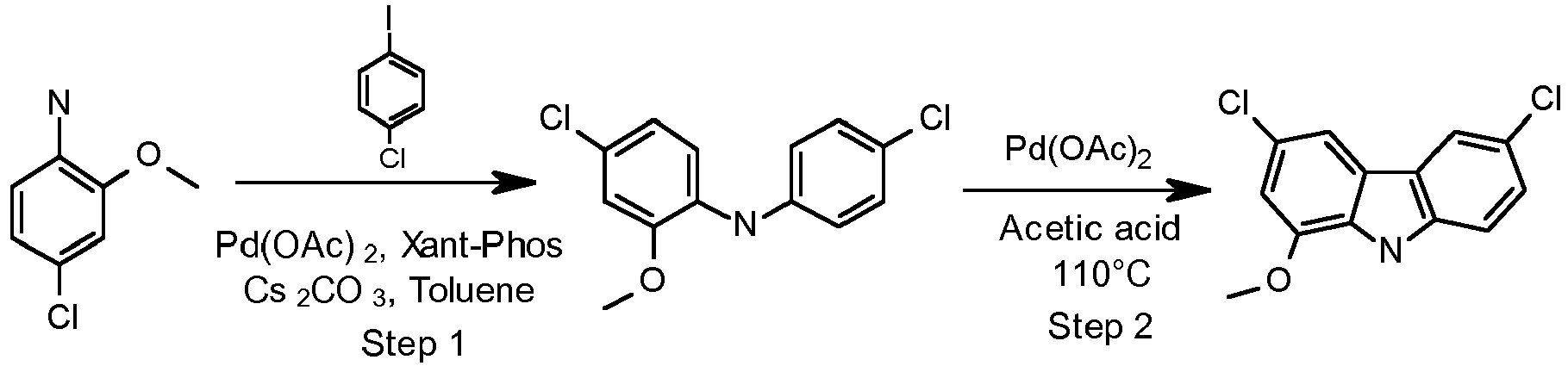
- Step 1: In a sealed tube, 4-chloro 2-anisidine (1.0 g, 6.3 mmol), 4-iodo chloro benzene (1.51 g, 6.3 mmol), Xant-Phos (0.33 g, 0.63 mmol) and Cs2CO3 (6.19 g, 19.0 mmol), were mixed in toluene (20 mL). The resulting mixture was purged with argon, added Pd(OAc)2 (0.213 g, 0.95 mmol) and stirred at 110° C for 12 h. After completion of the reaction, the reaction mixture was filtered through celite® bed and concentrated under vacuum. The residue obtained was diluted with ethyl acetate and washed with brine. The organic layer was dried with MgSO4 and concentrated. The crude product was further purified by silica gel chromatography using 0-1% of ethyl acetate/hexane to afford 0.5 g of the 4-chloro-N-(4-chlorophenyl)-2-methoxyaniline as a white solid (Yield: 29.4%)
LCMS: (Method B) 268(M+H), RT. 3.87 min, 92.28 % (Max).
1H NMR (400 MHz, DMSO-d6): δ 7.64 (s, 1H), 7.21 (dd, J = 5.20, 6.20 Hz, 2H), 7.14-7.16 (m, 1H), 7.06 (d, J = 2.40 Hz, 1H), 6.89-7.00 (m, 2H), 6.88 (d, J = 2.40 Hz, 1H), 3.82 (s, 1H). - Step 2: To 4-chloro-N-(4-chlorophenyl)-2-methoxyaniline (0.5 g, 1.86 mmol) was added acetic acid (5 mL) and Pd(OAc)2(0.12 g, 0.55 mmol) and heated to 100° C for 12 h. After completion of the reaction, the reaction mixture was filtered through celite® bed and concentrated under vacuum. The residue obtained was diluted with ethyl acetate (20 mL), washed with 10% sodium bicarbonate solution, water and brine solution. The organic layer was dried over anhydrous Na2SO4 and concentrated. The crude product was further purified by silica gel chromatography using 0-5% of ethyl acetate/hexane to afford 0.25 g of the 3,6-dichloro-1-methoxy-9H-carbazole int 11. (Yield: 50.4%)
LCMS: (Method B) 366 (M+H), RT. 3.72 min, - 1H NMR (400 MHz, DMSO-d6): δ 8.24 (s, 1H), 7.87 (s, 1H), 7.48 (d, J = 8.40 Hz, 1H), 7.40 (d, J = 8.40 Hz, 1H), 7.05 (s, 1H).
-

- 4-chloro-3-methoxy aniline (2.0 g, 12.6 mmol), 1-chloro-4-iodobenzene (3.33 g, 13.9 mmol, and sodium-tert-butoxide (6.04 g, 63 mmol) were taken in toluene (15 mL). The resulting mixture was purged with nitrogen, added Pd(OAc)2 (0.141 g, 0.63 mmol), [HPtBu3][BF4] ( 0.255 g, 0.88 mmol) and heated at 110° C for 12 h. After completion of the reaction, the reaction mixture was filtered through celite bed and concentrated under vacuum. The residue obtained was diluted with ethyl acetate (200 mL) washed with water, brine solution and dried over anhydrous Na2SO4. The organic phase was concentrated and purified by the column chromatography (230-400 size mesh) to get the white solid 4-chloro-N-(4_chlorophenyl)-3-methoxy aniline (1.2 g, 35.2%).
1H NMR (400 MHz, DMSO-d6): δ 8.46 (s, 1H), 7.22-7.28 (m, 3H), 7.08-7.10 (m, 2H), 6.75 (s, 1H), 6.64 (d, J = 8.68 Hz, 1H), 3.80 (s, 3H). - Step 2: In a sealed tube, 4-chloro-N-(4_chlorophenyl)-3-methoxyaaniline (1.5 g, 5.5 mmol), Pd(OAC)2 were taken in ACOH (5 mL) and heated the reaction mixture at 120° C for 24 h. Reaction mixture was diluted with ethyl acetate (150 mL), washed with water, brine solution and dried over anhydrous Na2SO4. The organic phase was concentrated and purified by column chromatography (230-400 size mesh) to afford Int 12 & Int 13 as yellow solid.
Int 12: (0.2 g, 13.5%)
LCMS: (Method B) 266 (M+H), RT. 3.62 min.
1H NMR 400 MHz, DMSO-d6: δ 11.42 (s, 1H), 8.26 (s, 1H), 8.17 (d, J = 1.60 Hz, 1H), 7.46 (d, J = 8.60 Hz, 1H), 7.31-7.33 (s, 1H), 7.14 (s, 1H), 3.94 (s, 3H).
Int 13: (0.05 g, 3.5%)
1H NMR (400 MHz, DMSO-d6): δ 8.41 (d, J = 1.60 Hz, 1H), 8.32-8.33 (m, 1H), 8.21-8.24 (m, 1H), 7.96-7.99 (m, 1H), 7.72 (s, 1H), 4.13 (s, 3H). -

- Step 1: In a sealed tube, 4-chloro 2-methyl thiol-trifluoromethyl benzene (2.0 g, 8.8 mmol), 4-(trifluoromethyl)aniline (1.56 g, 9.7 mmol), XPhos (0.30 g, 0.44 mmol) and Cs2CO3 (4.3 g, 13.2 mmol) were mixed in toluene (20 mL). The resulting mixture was purged with argon, added Pd(OAc)2 (0.395 g, 1.76 mmol) and stirred at 110° C for 12 h. After completion of the reaction, the reaction mixture was filtered through celite® bed and concentrated under vacuum. The residue obtained was diluted with ethyl acetate (200 mL), washed with water, brine solution and dried over anhydrous Na2SO4 and concentrated. The crude product was further purified by silica gel chromatography using 0-5% of ethyl acetate/hexane to afford 0.9 g of the 3-(methylthio)-4-(trifluoromethyl)-N-(4-(trifluoromethyl)phenyl)aniline as a yellow solid (Yield:29%).
LCMS: (Method B) 350 (M+H), RT. 3.91 min, - Step 2: To 3-(methylthio)-4-(trifluoromethyl)-N-(4-(trifluoromethyl)phenyl)aniline (0.9 g, 2.56 mmol) was added acetic acid (10 mL), Pd(OAc)2 (0.575 g, 2.56 mmol) and Cu(OAc)2 (1.02 g, 5.12 mmol) and heated to 120° C for 18 h in sealed tube. After completion of the reaction, the reaction mixture was filtered through celite® bed and concentrated under vacuum. The residue obtained was diluted with ethyl acetate (200 mL), washed with ammonia solution, water, brine solution and dried over anhydrous Na2SO4 and concentrated. The crude product was further purified by silica gel chromatography using ethyl acetate/petroleum ether to afford elution 1 as 4-(methylthio)-3,6-bis(trifluoromethyl)-9H-carbazole Int 15 (0.20 g, 22.3%) and 2-(methylthio)-3,6-bis(trifluoromethyl)-9H-carbazole Int 14 (0.13 g, 14.5%) as elution 2.
- LCMS: (Method B) 348 (M+H), RT. 3.90 min.
1H NMR (400 MHz, CDCl3): δ 9.26 (s, 1H), 8.65 (s, 1H), 7.76-7.84 (m, 2H), 7.51-7.58 (m, 2H), 2.48 (s, 3H). - LCMS: (Method B) 348 (M+H), RT. 3.74 min.
1H NMR (400 MHz, CDCl3): δ 8.31-8.39 (m, 3H), 7.70 (d, J = 8.40 Hz, 1H), 7.52 (d, J = 8.80 Hz, 1H), 7.42 (s, 1H), 2.61 (s, 3H). -

- Step 1: To a stirred solution of 2-(methylthio)-3,6-bis(trifluoromethyl)-9H-carbazole Int 14 (0.1 g, 0.29 mmol) in dry N, N-dimethyl formamide (1 mL) was added cesium carbonate (0.139 g, 0.429 mmol) under N2 atmosphere and the reaction mixture was stirred at 100° C for 1 h. After 1h, Int 1 (0.057 g, 0.27 mmol) was added to the reaction mixture and the stirring continued at 100° C for 48 h. After completion, the reaction mass was diluted with water, extracted over ethyl acetate, washed with water, brine solution and dried over anhydrous Na2SO4. The organic phase was concentrated and the regio isomers were purified by the flash column chromatography (230-400 size mesh) as elution 1 (non polar) was regio isomer 1 (0.030 g, 19.1%)
LCMS: (Method B) 563 (M+H), RT. 3.93 min, - Step 2: 3-chloroperoxybenzoic acid (0.018 g, 0.109 mmol) was added to a solution of boc intermediate (0.030 g, 0.054 mmol) in dichloromethane (1 mL) at 0° C. The mixture was stirred at room temperature overnight. After the completion of reaction, the reaction mass was washed with saturated solution of Na2CO3, water and brine solution. The organic layer was separated, dried (Na2SO4), filtered and the solvent evaporated in vacuo. Crude product was further purified by silica gel chromatography using 46% of ethyl acetate/hexane to afford 0.30 g as white solid (Yield: 53%).
LCMS: (Method B) 615 (M+H), RT. 3.69 min, - Step 3: Deprotection was done in HCl-dioxane. Crude was then purified by reverse phase prep to obtain compound 7 (0.010 g, 40.3%)
LCMS: (Method B) 481(M+H), RT. 2.45 min,
HPLC: (Method A) RT 11.67 min,
1H NMR (400 MHz, DMSO-d6): δ 9.13-9.22 (m, 4H), 8.65 (s, 1H), 8.31 (d, J = 9.20 Hz, 1H), 7.95 (d, J = 8.00 Hz, 1H), 5.66 (s, 1H), 5.08-5.10 (m, 1H), 4.60-4.80 (m, 1H), 3.62 (s, 3H), 3.50-3.52 (m, 1H), 3.02-3.10 (m, 1H), 2.80-2.90 (m, 1H), 2.15-2.18 (m, 1H). -

- Step 1: To a stirred solution of 2-(methylthio)-3,6-bis(trifluoromethyl)-9H-carbazole Int 15 (0.1 g, 0.29 mmol) in dry N, N-dimethyl formamide (1 mL) was added cesium carbonate (0.139 g, 0.429 mmol) under N2 atmosphere and the reaction mixture was stirred at 100° C for 1 h. After 1h, Int 1 (0.057 g, 0.28 mmol) was added to the reaction mixture and the stirring continued at 100° C for 48 h. After completion, the reaction mass was diluted with water, extracted over ethyl acetate, washed with water, brine solution and dried over anhydrous Na2SO4. The organic phase was concentrated and the regio isomers were purified by the flash column chromatography (230-400 size mesh) as elution 1 (non polar) was regio isomer 1 (0.030 g, 19.1%)
LCMS: (Method B) 563 (M+H), RT. 3.93 min, - Step 2: 3-chloroperoxybenzoic acid (0.018 g, 0.109 mmol) was added to a solution of boc intermediate (0.030 g, 0.054 mmol) in dichloromethane (1 mL) at 0° C. The mixture was stirred at room temperature overnight. After the completion of reaction, the reaction mass was washed with saturated solution of Na2CO3, water and brine solution. The organic layer was separated, dried (Na2SO4), filtered and the solvent evaporated in vacuo. Crude product was further purified by silica gel chromatography using 46% of ethyl acetate/hexane to afford 0.30 g as white solid (Yield: 53%).
LCMS: (Method B) 615 (M+H), RT. 3.69 min, - Step 3: Deprotection was done in HCl-dioxane. Crude was then purified by reverse phase prep to obtain compound 6
LCMS: (Method B) 481(M+H), RT. 2.45 min,
HPLC: (Method A) RT 11.67 min,
1H NMR (400 MHz, DMSO-d6): δ 9.13-9.22 (m, 4H), 8.65 (s, 1H), 8.31 (d, J = 9.20 Hz, 1H), 7.95 (d, J = 8.00 Hz, 1H), 5.66 (s, 1H), 5.08-5.10 (m, 1H), 4.60-4.80 (m, 1H), 3.62 (s, 3H), 3.50-3.52 (m, 1H), 3.02-3.10 (m, 1H), 2.80-2.90 (m, 1H), 2.15-2.18 (m, 1H). -

- Step 1: To a solution of 3,7-dichloro-10H-phenothiazine int 4 (1.0 g, 3.7 mmol) in dry N,N-dimethyl formamide (2 mL) was added cesium carbonate (2.4 g, 7.4 mmol) under N2 atmosphere and the reaction mixture stirred at 80° C for 1 h. After 1 h, int 1 (1.18 g, 5.5 mmol) was added to the reaction mixture and allowed to stir at 100° C for 5 days. After completion of the reaction, the reaction mass was diluted with water, extracted over ethyl acetate, washed with water, brine solution and dried over anhydrous Na2SO4. Organic phase was concentrated and the regio isomers purified by the flash column chromatography (230-400 size mesh) as elution 1 (non polar) was regio isomer 1 and elution 2 was the regio isomer 2 (only traces observed).
Yield: (Elution 1) (Regio isomer 1) 0.15 g, 8.8%
HPLC: (Method F) RT 7.08 min, - Step 2: m-chloroperoxybenzoic acid (0.134 g, 0.7 mmol) was added to a solution of tert-butyl-4-(3,7-dichloro-10H-phenothiazin-10-yl)-3-hydroxyazepane-1-carboxylate (0.15 g, 0.3 mmol) in dichloromethane (2 mL) at 0° C. The mixture was stirred at room temperature overnight the mixture basified with a saturated solution of Na2CO3. The organic layer was separated, dried (Na2SO4), filtered and the solvent evaporated in vacuo. Crude product was further purified by silica gel chromatography using 25-30% of ethyl acetate/hexane to afford 0.057 g of the product as colorless solid.
Compound 1 (Racemic): 0.057 g, 38%.
HPLC: (Method B) RT 11.37 min, - Step 3: Same protocol was followed for all compounds which involved de-protection of the boc group.
- Compound 1 (Racemic): 0.035 g, 77.7%
- LCMS: (Method B) 415 (M+H), RT. 2.35 min,
HPLC: (Method A) RT 11.03 min, 1H NMR 400 MHz, DMSO-d6: δ 7.96 (d, J = 1.60 Hz, 2H), 7.77 (s, 4H), 5.84 (s, 1H), 4.65 (s, 1H), 4.45 (t, J = 9.80 Hz, 1H), 3.47-3.50 (m, 1H), 3.26-3.40 (m, 3H), 3.03-3.05 (m, 1H), 2.02-2.06 (m, 3H). -

- Step 1: To a stirred solution of 3,6-dichloro-9H-carbazole (int 6) (0.8 g, 3.3 mmol) in dry N, N-dimethyl formamide (5 mL), was added cesium carbonate (2.2 g, 6.7 mmol) under N2 atmosphere and the reaction mixture was stirred at RT for 1 h. After 1 h, int 1 (0.56 g, 2.6 mmol) was added to the reaction mixture and allowed to stir at 100° C for 18 h. After completion of reaction, reaction mixture was diluted with ethyl acetate (100 mL), washed with water, brine solution and dried over anhydrous Na2SO4. Organic phase was concentrated and the regio-isomers were purified by the flash column chromatography (230-400 size mesh) as elution 1 (non polar) was regio isomer 1 (0.25 g, 12.3%) and elution 2 was the regio isomer 2 (0.15 g, 7.4%).
LCMS: (Method A) 350.0 (M+H), RT. 3.7 min,
HPLC: (Method C) RT 16.8 min, - The regio isomer 1 was submitted for chiral preparative purification using Method H and obtained 0.09 g of isomer 1 and 0.075 g of isomer 2. After de-protection of the respective individual isomers using HCI in dioxane, isomer 1 and isomer 2 were obtained.
- HPLC: (Method B) RT 16.8 min, 99.1 % (Max)
CHIRAL HPLC: (Method J) - RT 9.58 min, - HPLC: (Method B) RT 16.8 min, 97.2 % (Max)
CHIRAL HPLC: (Method J) - RT 14.65 min
Isomer 1: (0.06 g, 86%)
LCMS: (Method B) 350 (M+H), RT. 2.7 min,
HPLC: (Method B) RT 12.1 min,
1H NMR (400 MHz, DMSO-d6): δ 9.43 (s, 2H), 8.33 (s, 2H), 7.93 (s, 1H), 7.73 (s, 1H), 7.46 (s, 2H), 5.46 (d, J = 5.60 Hz, 1H), 4.76 (t, J = 9.6 Hz, 1H), 4.59 (s, 1H), 3.24-3.48 (m, 3H), 3.08-3.20 (m, 1H), 2.61-2.70 (m, 1H), 2.04-2.21 (m, 2H), 1.83-1.85 (m, 1H).
Isomer 2: (0.05 g, 86.2%)
LCMS: (Method B) 350 (M+H), RT. 2.7 min,
HPLC: (Method B) RT 12.1 min,
1H NMR (400 MHz, DMSO-d6): δ 9.39 (s, 2H), 8.33 (s, 2H), 7.97 (s, 1H), 7.72 (s, 1H), 7.47 (s, 2H), 5.47 (d, J = 5.60 Hz, 1H), 4.75 (t, J = 9.4 Hz, 1H), 4.57-4.59 (m, 1H), 3.40-3.44 (m, 1H), 3.24-3.32 (m, 2H), 3.09-3.12 (m, 1H), 2.63-2.66 (m, 1H), 2.04-2.15 (m, 2H), 1.83-1.86 (m, 1H). -

- Step 1: To a stirred solution of 3,6-ditrifluoromethyl-9H-carbazole int 8 (2.0 g, 6.5 mmol) in dry N, N-dimethyl formamide (4 mL), was added cesium carbonate (3.17 g, 9.75 mmol) under N2 atmosphere and the reaction mixture was stirred at RT for 1 h. After 1 h, int 1 (1.8g, 8.5 mmol) was added to the reaction mixture and allowed to stir at 100° C for 7days. After completion, the reaction mass was diluted with water, extracted over ethyl acetate, washed with water, brine solution and dried over anhydrous Na2SO4. Organic phase was concentrated and the regio isomers were purified by the flash column chromatography (230-400 size mesh) as elution 1 (non polar) was regio isomer 1 (1.2 g, 35.2%)
- LCMS: (Method B) 517.0 (M+H), RT.4.06 min,
- Step 2: To a stirred solution of Boc protected intermediate (1.2 g, 2.4mmol) in dichloromethane, trifluoroacetic acid (0.545 mL, 7.3 mmol) was added after cooling to 0° C and stirred at room temperature overnight. After completion, the reaction mixture was washed with 10% sodiumbicarbonate solution, water, brine solution and dried over anhydrous Na2SO4. Organic phase was concentrated and purified by the flash column chromatography (230-400 size mesh) as elution 1 was int (ii) (0.3 g, 25.2%) and elution 2 was int (i) (0.62 g, 64.1%).
- LCMS: (Method B) 417 (M+H), RT. 2.62min,
HPLC: (Method B) RT 12.70 min,
1H NMR (400 MHz, DMSO-d6): δ 9.05 (s, 2H), 8.86-8.90 (m, 2H), 7.81-8.09 (m, 4H), 5.52 (d, J = 5.2 Hz, 1H), 4.88 (t, J = 9.40 Hz, 1H), 4.58-4.59 (m, 1H), 3.46-3.50 (m, 1H), 3.12-3.19 (m, 1H), 2.66-2.71 (m, 1H), 2.07-2.33 (m, 2H), 1.93-1.97 (m, 1H). - UPLC: (Method A) 513 (M+H), RT. 1.93 min,
HPLC: (Method B) RT 15.62 min,
1H NMR (400 MHz, DMSO-d6): δ 8.86-8.88 (m, 2H), 7.75-8.08 (m, 4H), 5.34-5.35 (m, 1H), 4.76-4.80 (m, 1H), 4.32-4.34 (m, 1H), 4.04-4.09 (m, 1H), 3.81-3.85 (m, 2H), 3.47-3.53 (m, 1H), 1.05 (s, 2H), 1.96-1.99 (m, 1H). - The regio isomer 1 int (i) was submitted for chiral preparative purification using Method K and obtained 0.070 g, of isomer 1 and 0.070 g, of isomer 2.
(Isomer 1): (0.070g, 70%)
LCMS: (Method B) 317.0 (M+H), RT. 2.62 min
HPLC: (Method B) RT 12.95 min,
CHIRAL HPLC: (Method M) - RT 4.93 min,
1H NMR (400 MHz, DMSO-d6): δ 8.83-8.86 (m, 2H), 7.92-8.00 (m, 2H), 7.77 (s, 2H), 4.72-4.78 (m, 2H), 4.21-4.22 (m, 1H), 3.03-3.04 (m, 2H), 2.86-2.91 (m, 1H), 2.67-2.70 (m, 2H), 1.72-1.82 (m, 3H).
Isomer 2: (0.070 g, 70%)
LCMS: (Method B) 317.0 (M+H), RT. 2.63 min,
HPLC: (Method B) RT 12.69 min,
CHIRAL HPLC: (Method M) - RT 8.87 min,
1H NMR (400 MHz, DMSO-d6): δ 9.06 (s, 2H), 8.86-8.90 (m, 2H), 8.09 (s, 2H), 7.80-7.93 (m, 3H), 5.53 (d, J = 7.20 Hz, 1H), 4.85-4.88 (m, 1H), 4.59 (s, 1H), 3.46-3.49 (m, 1H), 3.15 (s, 1H), 2.62-2.72 (m, 1H), 2.07 (s, 2H), 1.93-1.95 (m, 1H). -

- Step 1: To a solution of 3,6-bis(trifluoromethyl)-9H-pyrido[2,3-b]indole int 3 (0.3 g, 0.98 mmol) in dry N,N-dimethyl formamide (3 mL), was added cesium carbonate (0.481 g, 1.479 mmol) under N2 atmosphere and the reaction mixture stirred at 100° C for 1 h. After 1 h, int 1 (0.273 g, 1.28 mmol) was added to the reaction mixture and allowed to stir at 100° C for 7 days. After completion of the reaction, the reaction mass was diluted with water, extracted over ethyl acetate, washed with water, brine solution and dried over anhydrous Na2SO4. Organic phase was concentrated and the regio isomers separated from crude by reverse phase preparative HPLC to get 0.2 g mixture of both regio isomers, which was then separated by normal phase preparative HPLC to isolate 0.14 g of regio isomer 1 and 0.04 g of regio isomer 2.
Yield: (Elution 1) (Regio isomer 1) 0.140 g, 27.4%
HPLC: (Method G) RT 6.84 min,
Yield: (Elution 2) (Regio-isomer 2) 0.040 g, 7.8%
HPLC: (Method G) RT 9.35 min, - Step 2: Same protocol was followed for all compounds which involved de-protection of the boc group.
Compound 14 (i) (Racemic): 0.030 g,
LCMS: (Method B) 418 (M+H), RT. 2.54 min,
HPLC: (Method B) RT 12.62 min,
1H NMR (400 MHz, DMSO-d6): δ 9.28 (s, 3H), 8.89-8.92 (m, 2H), 8.21-8.23 (m, 1H), 7.92 (d, J = 8.40 Hz, 1H), 5.52 (d, J = 4.40 Hz, 1H), 5.18-5.21 (m, 1H), 4.80 (s, 1H), 3.56-3.64 (m, 1H), 3.46-3.49 (m, 1H), 3.32 (s, 1H), 3.15 (s, 1H), 2.66-2.71 (m, 1H), 1.97-2.07 (m, 3H).
Compound 14 (ii) (Racemic): 0.031 g, 95.09%
LCMS: (Method B) 336 (M+H), RT. 2.44 min,
HPLC: (Method B) RT 11.72 min,
1H NMR (400 MHz, DMSO-d6): δ 9.40 (br s, 1H), 9.32 (d, J = 1.92 Hz, 1H), 8.92 (d, J = 6.52 Hz, 2H), 8.05-8.07 (m, 1H), 7.97-7.99 (m, 1H), 5.10 (d, J = 4.92 Hz, 1H), 4.49 (s, 1H), 4.03-4.09 (m, 2H), 3.49-3.65 (m, 3H), 2.30-2.33 (m, 2H), 1.91 (s, 2H). -

- Step 1: To a stirred solution of 3,6-dichloro-1-methoxy-9H-carbazole int 11 (0.5g, 1.87 mmol) in dry N, N-dimethyl formamide (5 mL), was added cesium carbonate (0.917 g, 2.81 mmol) under N2 atmosphere and the reaction mixture was stirred at RT for 1 h. After 1 h, Int 1 (0.48 g, 2.25 mmol) was added to the reaction mixture and allowed to stir at 100° C for 7 days. After completion, the reaction mass was diluted with water, extracted over ethyl acetate, washed with water, brine solution and dried over anhydrous Na2SO4. Organic phase was concentrated and the regio isomers were purified by the flash column chromatography (230-400 size mesh) as elution 1 (non polar) was regio isomer 1 (0.06 g, 6.6%).
- LCMS: (Method B) 379(M+H), RT. 4.17 min,
- Compound 8: (0.030 g, 63.2%)
- LCMS: (Method B) 381(M+H), RT. 2.52 min,
- HPLC: (Method A) RT 12.31 min,
- 1H NMR (400 MHz, DMSO-d6): δ 8.70-9.09 (m, 2H), 8.29-8.32 (m, 1H), 8.26 (d, J = 2.00 Hz, 1H), 7.80-7.82 (m, 1H), 7.40-7.44 (m, 1H), 7.08-7.18 (m, 1H), 5.50-5.60 (m, 1H), 4.54-4.77 (m, 2H), 3.98 (s, 3H), 3.37-3.50 (m, 2H), 3.07-3.26 (m, 2H), 1.73-2.08 (m, 4H).
-

- Step 1: To a solution of 3,6-dichloro-2-methoxy-9H-carbazole Int 12 (0.2 g, 0.6 mmol) in dry N,N-dimethyl formamide (1 mL), was added cesium carbonate (0.488 g, 1.5 mmol) under N2 atmosphere and the reaction mixture stirred at 80° C for 1 h. After 1 h, tert-butyl 8-oxa-5-azabicyclo[5.1.0]octane-5-carboxylate (0.102 g, 0.4 mmol) was added to the reaction mixture and allowed to stir at 80° C for 18 h. After completion of the reaction, the reaction mass was diluted with water, extracted over ethyl acetate, washed with water, brine solution and dried over anhydrous Na2SO4. Organic phase was concentrated and the regio isomers purified by the flash column chromatography (230-400 size mesh) as elution 1 (non polar) was regio isomer 1 and elution 2 was the regio isomer 2 (only traces observed).
Yield: (Elution 1) (Regio isomer 1) 0.07 g, 19.4%
LCMS: (Method B) 423 (M+H), RT.3.56 min, - Step 2: Same protocol was followed for all compounds which involved de-protection of the boc group.
Compound 9 (Racemic): 0.05 g, 90.9%
LCMS: (Method B) 379 (M+H), RT. 2.5 min,
HPLC: (Method B) RT 12.27 min,
1H NMR (400 MHz, DMSO-d6): δ 9.28 (s, 1H), 8.34-8.36 (m, 1H), 8.23-8.29 (m, 1H), 7.86-7.88 (m, 1H), 7.31-7.44 (m, 2H), 5.48 (d, J = 8.40 Hz, 1H), 4.56-4.80 (m, 2H), 4.02 (s, 1H), 3.49-3.57 (m, 1H), 3.04-3.13 (m, 1H), 2.52-2.68 (m, 2H), 2.05-2.17 (m, 3H), 1.84-1.88 (m, 1H). -

- Step 1: To a stirred solution of 3,6-dichloro-1-methoxy-9H-carbazole int 11 (0.5 g, 1.87 mmol) in dry N, N-dimethyl formamide (5 mL), was added cesium carbonate (0.917 g, 2.81 mmol) under N2 atmosphere and the reaction mixture was stirred at RT for 1 h. After 1 h, Int 1 (0.48 g, 2.25 mmol) was added to the reaction mixture and allowed to stir at 100° C for 7 days. After completion, the reaction mass was diluted with water, extracted over ethyl acetate, washed with water, brine solution and dried over anhydrous Na2SO4. Organic phase was concentrated and the regio isomers were purified by the flash column chromatography (230-400 size mesh) as elution 1 (non polar) was regio isomer 1 (0.06 g, 6.6%).
LCMS: (Method B) 379(M+H), RT. 4.17 min
Compound 8: (0.030 g)
LCMS: (Method B) 381(M+H), RT. 2.52 min,
HPLC: (Method A) RT 12.31 min
1H NMR (400 MHz, DMSO-d6): δ 8.70-9.09 (m, 2H), 8.29-8.32 (m, 1H), 8.26 (d, J = 2.00 Hz, 1H), 7.80-7.82 (m, 1H), 7.40-7.44 (m, 1H), 7.08-7.18 (m, 1H), 5.50-5.60 (m, 1H), 4.54-4.77 (m, 2H), 3.98 (s, 3H), 3.37-3.50 (m, 2H), 3.07-3.26 (m, 2H), 1.73-2.08 (m, 4H). -

- Step 1: To a solution of 3,7-dichloro-10H-phenoxazine Int 9 (0.55 g, 2.18 mmol) in dry N,N-dimethyl formamide (3 mL), was added cesium carbonate (1.41 g, 4.3 mmol) under N2 atmosphere and the reaction mixture stirred at 80 °C for 1 h. After 1 h, int 1 (0.371 g, 1.74 mmol) was added to the reaction mixture and allowed to stir at 80 °C for 18 h. After completion of the reaction, the reaction mass was diluted with water, extracted over ethyl acetate, washed with water, brine solution and dried over anhydrous Na2SO4. Organic phase was concentrated and the regio isomers purified by the flash column chromatography (230-400 size mesh) as elution 1 (non polar) was regio isomer 1 and elution 2 was the regio isomer 2.
Regio isomer 1 (Racemic) was de-protected using standard protocol and obtained as HCI salt (0.017 g, 89.4%).
LCMS: (Method B) 366 (M+H), RT. 2.47min,
HPLC: (Method A) RT 11.37 min,
1H NMR (400 MHz, MeOD): δ 6.89 (s, 2H), 6.80-6.82 (m, 2H), 6.72-6.74 (m, 2H), 4.58 (s, 1H), 3.97-3.99 (m, 1H), 3.56-3.59 (m, 1H), 3.44-3.47 (m, 2H), 3.14 (t, J = 12.60 Hz, 1H), 2.38-2.48 (m, 1H), 2.12-2.17 (m, 1H), 2.01-2.04 (m, 2H).
Yield: (Elution 1) (Regio isomer 1) 0.17 g, 17%.
HPLC: (Method C) RT 7.35 min, - The regio-isomer-1 (0.17 g) was submitted for chiral SFC purification using Method K and obtained 0.035g of isomer 1 and 0.030 g of isomer 2. After de-protection of the respective individual isomers, Isomer 1 and Isomer 2 obtained.
Isomer 1: 0.025g, 92.5%
LCMS: (Method B) 366 (M+H), RT. 2.49min,
HPLC: (Method B) RT 12.13 min,
1H NMR (400 MHz, DMSO-d6): δ 9.21 (s, 1H), 8.94 (s, 1H), 6.89 (s, 2H), 6.82-6.83 (m, 2H), 6.75-6.81 (m, 2H), 5.84 (d, J = 4.80 Hz, 1H), 4.43-4.44 (m, 1H), 3.89 (t, J = 9.5 Hz, 1H), 3.42-3.48 (m, 1H), 3.23-3.25 (m, 2H), 2.99-2.04 (m, 1H), 2.28-2.32 (m, 1H), 1.91-1.98 (m, 3H).
Isomer 2: 0.020 g, 86.9%
LCMS: (Method B) 366 (M+H), RT. 2.48 min,
HPLC: (Method B) RT 12.12min,
1H NMR 400 MHz, DMSO-d6: δ 9.16 (s, 1H), 8.89 (s, 1H), 6.89 (s, 2H), 6.80-6.83 (m, 2H), 6.75-6.77 (m, 2H), 5.85 (d, J = 4.80 Hz, 1H), 4.44 (d, J = 4.40 Hz, 1H), 3.89 (t, J = 9.40 Hz, 1H), 3.42-3.48 (m, 1H), 3.23-3.27 (m, 2H), 2.99-3.04 (m, 1H), 2.30-0.00 (m, 1H), 1.91-1.96 (m, 3H). -

- Step 1: To a stirred solution of 3,6-bis(trifluoromethyl)-9H-pyrido[3,4-b]indole (int 10) (0.20 g, 0.66 mmol) in dry N, N-dimethyl formamide (3 mL) was added cesium carbonate (0.321 g, 0.99 mmol) under N2 atmosphere and the reaction mixture was stirred at 100° C for 1 h. After 1h, int 1 (0.141 g, 0.66 mmol) was added to the reaction mixture and the stirring continued at 100° C for 48 h. After completion, the reaction mass was diluted with water, extracted over ethyl acetate, washed with water, brine solution and dried over anhydrous Na2SO4. The organic phase was concentrated and the regio isomers were purified by the flash column chromatography (230-400 size mesh) as elution 1 (non polar) was regio isomer 1 (0.02 g, 6%) LCMS: (Method B) 404 (M+H), RT. 2.36 min,
Compound 15: (0.015 g, 93.6%)
LCMS: (Method B) 481(M+H), RT. 2.45 min,
HPLC: (Method D) RT 9.93 min, 88.55% (Max)
1H NMR(400 MHz, DMSO-d6): δ 9.46 (s, 1H), 9.34 (s, 1H), 8.79 (s, 1H), 8.59 (s, 1H), 8.41 (s, 1H), 8.22-8.28 (m, 1H), 7.91-8.06 (m, 2H), 5.36 (s, 1H), 5.12 (s, 1H), 4.60 (s, 1H), 3.81 (s, 1H), 3.57 (d, J = 8.00 Hz, 1H), 3.35-3.44 (m, 2H), 2.20-2.23 (m, 1H), 1.94-1.96 (m, 1H). -

-

- In a sealed tube 3-methoxy-4-trifluromethylaniline (5.0 g, 26 mmol), 5-chloro-2-trifluromethylpyridine (4.7 g, 26 mmol) and Cs2CO3 (10.97 g, 33.8 mmol) were mixed in toluene (100 mL) and the resulting mixture was purged with nitrogen, added Pd(OAc)2 (0.88 g, 3.9 mmol) and X-phos (0.62 g, 1.3 mmol) and heated at 100°C for 12 h. After completion of the reaction, the reaction mixture was filtered through Celite® bed and concentrated under vacuum. The residue obtained was diluted with ethyl acetate (250 mL), washed with water, brine solution and dried over anhydrous Na2SO4. The organic phase was concentrated and purified by the column chromatography (230-400 size mesh) to get the desired product N-(3-methoxy-4-(trifluoromethyl)phenyl-6-(trifluoromethyl)pyridine-3-amine (6.2 g, 71.2 %).
LC MS: 335 (M-H), RT- 3.5 min, 99.75% (max)
Method A-0.1% HCOOH; B-ACN Flow = 1.5 mL/min.
Column-Atlantis dc18 (50 X 4.6mm-5µm) negative Mode
1H NMR (300 MHz, DMSO-d6): δ 9.36 (s, 1H), 8.54 (d, J = 3.66 Hz, 1H), 7.72-7.77 (m, 2H), 7.50 (d, J = 8.52 Hz, 1H), 6.83-6.92 (m, 2H), 3.87 (s, 3H). - Step 2: N-(3-methoxy-4-(trifluoromethyl)phenyl-6-(trifluoromethyl)pyridine-3-amine (6.2 g, 18.4 mmol) and Pd(OAc)2 (4.1 g, 18.4 mmol) was taken in acetic acid (70 mL) and heated to 100° C for 12 h under an oxygen balloon. After completion of the reaction, the reaction mixture was filtered through celite® bed and concentrated under vacuum. The residue obtained was diluted with ethyl acetate (250 mL), washed with NaHCO3 solution, water, brine solution and dried over anhydrous Na2SO4 and concentrated. The crude product was first purified by silica gel chromatography using ethyl acetate/petroleum ether and further purified by preparative HPLC afford Regio isomer 1 as 7-methoxy-2,8-bis(trifluromethyl)-5H-pyrido[3,2-b]indole (0.46 g, 7.5 %) and Regio isomer 2 as 7-methoxy-3,6-bis(trifluromethyl)-9H-pyrido[3,4-b]indole (0.25 g, 4 %).
- LCMS: 335 (M+H), RT- 3.39 min, 99.61 % (Max), positive mode
Method A-0.1% HCOOH; B-ACN Flow = 1.5 mL/min.
Column-ZORBAX XDB C18 (50 X 4.6mm-5µm) positive Mode
1H NMR: (300 MHz, DMSO-d6): δ 12.14 (s, 1H), 8.39 (s, 1H), 8.12 (d, J = 8.46 Hz, 1H), 7.86 (d, J = 8.43 Hz, 1H), 7.36 (s, 1H), 4.06 (s, 3H).
Regio isomer 2 (int 17):
LCMS: 335.0 (M+H), RT- 3.35 min, 99.09 % (max)
Method A-0.1% HCOOH; B-ACN Flow = 1.5 mL/min.
Column-ZORBAX XDB C18 (50 X 4.6mm-5µm) positive Mode
1H NMR: (300 MHz, DMSO-d6): δ 12.29 (s, 1H), 9.01 (s, 1H), 8.82 (s, 2H), 7.35 (s, 1H), 4.02 (s, 3H). - In a sealed tube 4-chloro-2-anisidine (3.0 g, 19.0 mmol), 5-chloro-2-trifluromethylpyridine (3.8 g, 20.9 mmol) and Cs2CO3 (8.02 g, 24.7 mmol) were mixed in toluene (50 mL). The resulting mixture was purged with nitrogen, added Pd(OAc)2 (0.64 g, 2.8 mmol) and X-phos (0.45 g, 0.95 mmol) and heated at 140 °C for 12 h. After completion of the reaction, the reaction mixture was filtered through Celite® bed and concentrated under vacuum. The residue obtained was diluted with ethyl acetate (200 mL), washed with water, brine solution and dried over anhydrous Na2SO4. The organic phase was concentrated and purified by the column chromatography (230-400 size mesh) to get the desired product N-(4-chloro-2-methoxyphenyl)-6-(trifluoromethyl)pyridin-3-amine (3.5 g, 61.4%).
LC MS: 303.0 (M+H), RT- 3.45 min, 96.03% (max)
Method A-0.1% HCOOH; B-ACN Flow = 1.5 mL/min.
Column-ZORBAX XDB C18 (50 X 4.6mm-5µm) positive Mode
1H NMR (300 MHz, DMSO-d6) : δ 8.42 (s, 1H), 8.27 (d, J = 2.58 Hz, 1H), 7.58 (d, J = 8.7 Hz, 1H), 7.21-7.27 (m, 2H), 7.16 (d, J = 2.16 Hz, 1H), 6.97 (dd, J = 2.17, 9.80 Hz, 1H), 3.81 (s, 3H). - Step 2: N-(4-chloro-2-methoxyphenyl)-6-(trifluromethyl)pyridine-3-amine (3.5 g, 11.5 mmol) and Pd(OAc)2(2.6 g, 11.5 mmol) was taken in acetic acid (40 mL) and heated to 100 °C for 12 h under an oxygen balloon. After completion of the reaction, the reaction mixture was filtered through Celite® bed and concentrated under vacuum. The residue obtained was diluted with ethyl acetate (200 mL), washed with NaHCO3 solution, water, brine solution and dried over anhydrous Na2SO4 and concentrated. The crude product was further purified by silica gel chromatography using ethyl acetate/petroleum ether to afford Regio isomer 1 as 8-chloro-6-methoxy-2-trifluromethyl-5H-pyrido[3,2-b]indole (0.8 g, 23%) and Regio isomer 2 as 6-chloro-8-methoxy-3-trifluromethyl-9H-pyrido[3,4-b]indole (0.7 g, 20%).
- LC MS: 301.0 (M+H), RT- 3.43 min, 98.0% (max)
Method A-0.1% HCOOH; B-ACN Flow = 1.5 mL/min.
Column-ZORBAX XDB C18 (50 X 4.6mm-5µm) positive Mode
1H NMR: (300 MHz, DMSO-d6): δ 12.23 (s, 1H), 8.05 (d, J = 8.4 Hz, 1H), 7.80-7.89 (m, 2H), 7.23 (s, 1H), 4.04 (s, 3H).
Regio isomer 2 (int 19):
LCMS: 301.0 (M+H), RT- 3.45 min, 92.5% (Max), positive mode
Method A-0.1% HCOOH; B-ACN Flow = 1.5 mL/min.
Column-ZORBAX XDB C18 (50 X 4.6mm-5µm) positive Mode
1H NMR: (300 MHz, DMSO-d6): δ 12.45 (s, 1H), 8.97 (s, 1H), 8.76 (s, 1H), 8.11 (s, 1H), 7.23 (s, 1H), 4.04 (s, 3H). -

- Step 1: In a sealed tube 2-chloropyridin-3-amine (4.0 g, 24.0 mmol), 2,3-dichloro-5-(trifluoromethyl)pyridine (7.99 g, 37 mmol), and Cs2CO3 (11.98 g, 37 mmol) were mixed in toluene (50 mL). The resulting mixture was purged with nitrogen, added Pd(OAc)2(0.55 g, 2.4 mmol) and X-Phos (0.58 g , 1.2 mmol) and heated at 140° C for 12 h. After completion of the reaction, the reaction mixture was filtered through Celite® bed and concentrated under vacuum. The residue obtained was diluted with ethyl acetate (200 mL), washed with water, brine solution and dried over anhydrous Na2SO4. The organic phase was concentrated and purified by the column chromatography (60-120 size mesh) to get the yellow solid 3-chloro-5-(trifluoromethyl)-N-(6-(trifluoromethyl)pyridin-3-yl)pyridin-2-amine (1.2 g, 15.03%).
LCMS: 340 (M-H), RT. 3.64 min, 99.16% (max)
Method A-0.1% HCOOH; B-ACN; Flow: 1.2 mL/min.
Column-Atlantis dC18 (50 X 4.6mm-5µm) dual MODE.
1H NMR (300 MHz, DMSO-d6) : δ 9.55 (s, 1H), 9.07 (s, 1H), 8.53 (s, 1H), 8.35 (d, J = 8.46 Hz, 8.33 (s, 1H), 7.87 (d, J = 8.67 Hz, 1H).
Step 2: In a sealed tube, 3-chloro-5-(trifluoromethyl)-N-(6-(trifluoromethyl)pyridin-3-yl)pyridin-2-amine (1.4 g, 4.1 mmol) was added to DBU (1.24 g, 8.2 mmol), tricyclohexyl phosphine tetrafluoro borate (0.15 g, 0.4 mmol), Pd(OAc)2 (0.046 g, 0.02 mmol), suspended in DMA (15 mL). The reaction mixture was purged for 15 minutes and stirred at 170° C for 18 h. After completion of the reaction, the reaction mixture was filtered through celite® bed and concentrated under vacuum. The residue obtained was diluted with ethyl acetate (200 mL), washed with water, brine solution and dried over anhydrous Na2SO4. The organic phase was concentrated and purified by preparative chromatography to get 3,6-bis(trifluoromethyl)-9H-pyrrolo[2,3-b:5,4-c'] di pyridine Int B (0.33 g, 26.4%).
LCMS: 306 (M+H), RT. 3.14 min, 99.61% (max)
Method A-0.1% HCOOH; B-ACN Flow = 1.5 mL/min.
Column-ZORBAX XDB C18 (50 X 4.6mm-5µm) positive Mode
1H NMR (400 MHz, DMSO-d6) : δ 13.2 (s, 1H), 9.39 (d, J=1.64, 1H), 9.13 (s, 1H), 9.05 (d, J=1.5 Hz, 1H), 8.98(s, 1H). -

- In a sealed tube 4-nitroaniline (1.0 g, 7.23 mmol), 4-bromo chlorobenzene (1.66 g, 8.68 mmol) and Cs2CO3 (3.05 g, 9.39 mmol) were mixed in toluene (10 mL). The resulting mixture was purged with nitrogen, added Pd(OAc)2 (0.24g, 0.1 mmol) and X-phos (0.17 g, 0.03 mmol) and heated at 100° C for 12 h. After completion of the reaction, the reaction mixture was filtered through Celite® bed and concentrated under vacuum. The residue obtained was diluted with ethyl acetate (150 mL), washed with water, brine solution and dried over anhydrous Na2SO4. The organic phase was concentrated and purified by the column chromatography (230-400 size mesh) to get the desired product 4-chloro-N-4-nitrophenylaniline (1.2 g, 66.6 %).
LC MS: 247 (M-H), RT- 3.41 min, 98.3% (max)
Method A-0.1% HCOOH; B-ACN Flow = 1.5 mL/min.
Column-ZORBAX XDB C18 (50 X 4.6mm-5µm) negative Mode
1H NMR (400 MHz, DMSO-d6): δ 9.36 (s, 1H), 8.10 (d, J = 9.20 Hz, 2H), 7.41 (dd, J = 2.00, 6.80 Hz, 2H), 7.25 (d, J = 8.80 Hz, 2H), 7.07 (d, J = 9.20 Hz, 2H). - Step 2: 4-Chloro-N-4-nitrophenylaniline (1.22 g, 4.9 mmol) and Pd(OAc)2 (1.1 g, 4.9 mmol) was taken in acetic acid (12 mL) and heated to 100 °C for 12 h under an oxygen balloon. After completion of the reaction, the reaction mixture was filtered through Celite® bed and concentrated under vacuum. The residue obtained was diluted with ethyl acetate (100 mL), washed with NaHCO3 solution, water, brine solution and dried over anhydrous Na2SO4 and concentrated. The crude product was first purified by silica gel chromatography using ethyl acetate/petroleum ether 3-chloro-6-nitro-9H-carbazole (0.39 g, 35.5%).
LC MS: 245(M+H), RT- 3.31 min, 99.62 % (max)
Method A-0.1% HCOOH; B-ACN Flow = 1.5 mL/min.
Column-ZORBAX XDB C18 (50 X 4.6mm-5µm) negative Mode
1H NMR: (400 MHz, DMSO-d6: δ 12.21 (s, 1H), 9.28 (s, 1H), 8.55 (s, 1H), 8.32 (dd, J = 2.12, 9.02 Hz, 1H), 7.45-7.67 (m, 3H). -

- Step 1: To the ice cooled solution of N-allylhex-5-en-2-amine hydrochloride (2.0 g, 11.3 mmol) in THF (75 mL), DMAP (2.08 g, 17.1 mmol) and boc anhydride (2.95 g, 13.5 mmol) was added and stirred at RT overnight. The reaction mixture was partitioned between DCM and water, dried over Na2SO4 and concentrated. The crude product was first purified by silica gel chromatography using ethyl acetate/petroleum ether to afford 1 (1.7 g, 62.9%).
1H NMR (400 MHz, DMSO-d6): δ 5.74-5.84 (m, 2H), 4.93-5.15 (m, 4H), 4.06 (s, 1H), 3.64-3.67 (m, 2H), 1.93-1.94 (m, 2H), 1.50-1.70 (m, 1H), 1.39 (s, 9H), 1.07 (s, 3H). - Step 2: To a solution of 1 (1.7 g, 7.1 mmol) in DCM (170 mL) Grubb's second generation catalyst (0.116 g, 0.142 mmol) was added (Before adding the catalyst reaction mixture should be degassed using N2) and heated the reaction mixture at 40° C for 1h. Reaction mixture concentrated to remove toluene and the residue directly taken for column chromatography using ethyl acetate/petroleum to afford 2 (1.2 g, 80%).
1H NMR (300 MHz, DMSO-d6): δ 5.62 (s, 2H), 3.98-4.23 (m, 2H), 3.53-3.59 (m, 1H), 2.28 (s, 1H), 1.96-2.06 (m, 1H), 1.79-1.91 (m, 1H), 1.50-1.69 (m, 1H), 1.40 (s, 9H), 1.06 (s, 3H). - Step 3: 3-Chloroperoxybenzoic acid (2.1 g, 8.1 mmol) was added to the ice cooled solution of 2 (1.2 g, 5.6 mmol) in DCM (20 mL) at 0 °C. The mixture was stirred at room temperature overnight and then a 10% solution of Na2S2O3 was added and the mixture basified with a saturated solution of Na2CO3. The organic layer was separated, dried (Na2SO4), filtered and the solvent evaporated in vacuo. Crude product was further purified by silica gel chromatography using EtOAc/Hex to afford tert-Butyl 4-methyl 8-oxa-3-azabicyclo[5.1.0]octane-3-carboxylate as colorless oil (0.48 g, 37.2%).
1H NMR (300 MHz, DMSO-d6): δ 3.93-4.03 (m, 1H), 3.85-3.90 (m, 1H), 3.27 (d, J = 3.87 Hz, 1H), 3.04 (s, 1H), 2.86-2.91 (m, 1H), 2.00-2.28 (m, 1H), 1.61-1.71 (m, 1H), 1.42 (s, 9H), 1.19-1.42 (m, 2H), 1.06 (s, 3H).
- Step 4: In a sealed tube 4-chloroaniline (3.1 g, 24.3 mmol), 5-bromo-2-trifluromethylpyrimidine (5 g, 22 mmol) and Cs2CO3 (9.29 g, 28.6 mmol) were mixed in toluene (50 mL). The resulting mixture was purged with nitrogen, added Pd(OAc)2 (0.74 g, 3.3 mmol) and X-phos (0.524 g, 1.1 mmol) and heated at 100 °C for 12 h. After completion of the reaction, the reaction mixture was filtered through Celite® bed and concentrated under vacuum. The residue obtained was diluted with ethyl acetate (200 mL), washed with water, brine solution and dried over anhydrous Na2SO4. The organic phase was concentrated and purified by the column chromatography (230-400 size mesh) to get the desired product N-(4-chlorophenyl)-2-(trifluoromethyl)pyrimidine-5-amine 3 (5.5 g, 91.6%).
LC MS: 272.0 (M-H), RT- 3.23 min, 98.09% (max)
Method A-0.1% HCOOH; B-ACN Flow = 1.5 mL/min
Column-ZORBAX XDB C18 (50 X 4.6mm-5µm) Dual Mode
1H NMR (400 MHz, DMSO-d6): δ 9.23 (s, 1H), 8.65 (s, 2H), 7.39 (d, J = 1.92 Hz, 2H), 7.28 (d, J = 1.84 Hz, 2H). - Step 5: N-(4-chlorophenyl)-2-(trifluromethyl)pyrimidine-5-amine 3 (5.5 g, 20.1 mmol) and Pd(OAc)2 (4.5 g, 20.1 mmol) was taken in acetic acid (50 mL) and heated to 100° C for 12 h under an oxygen balloon. After completion of the reaction, the reaction mixture was filtered through Celite® bed and concentrated under vacuum. The residue obtained was diluted with ethyl acetate (200 mL), washed with NaHCO3 solution, water, brine solution and dried over anhydrous Na2SO4 and concentrated. The crude product was further purified by silica gel chromatography using ethyl acetate/petroleum ether to afford as 8-chloro -2-trifluromethyl-5H-pyrimido[5,4-b]indole (2.0 g, 37.3%).
LC MS: 272 (M+H), RT- 3.14 min, 94.16% (max)
Method A-0.1% HCOOH; B-ACN Flow = 1.5 mL/min.
Column-ZORBAX XDB C18 (50 X 4.6mm-5µm) dual Mode
1H NMR (300 MHz, DMSO-d6): δ 12.51 (s, 1H), 9.34 (s, 1H), 8.39 (s, 1H), 7.81 (s, 2H).
- Step 6: To a stirred solution of 8-chloro -2-trifluromethyl-5H-pyrimido[5,4-b]indole (0.48 g, 1.7 mmol) in dry N, N-dimethylformamide (3 mL), was added cesium carbonate (0.83 g, 2.6 mmol) under N2 atmosphere and the reaction mixture was stirred at RT for 1 h. After 1 h, tert-Butyl 4-methyl 8-oxa-3-azabicyclo[5.1.0]octane-3-carboxylate (0.48 g, 2.1 mmol) was added to the reaction mixture and allowed to stir at 120° C for 7 days. After completion of reaction, reaction mixture was diluted with ethyl acetate (100 mL), washed with water, brine solution and dried over anhydrous Na2SO4. Organic phase was concentrated and purified by preparative HPLC to obtain the boc intermediate (0.11 g, 12.5%).
LCMS: 499(M+H), RT. 3.81 min, 97.99% (Max).
Method A-0.1% HCOOH; B-ACN Flow = 1.5 mL/min.
Column-ZORBAX XDB C18 (50 X 4.6mm-5µm)
HPLC: RT 14.70 min, 95.94% (Max).
Method A: 10mM NH4OAC in water; B: MeOH; Flow: 1.0 mL/min
COLUMN: Phenomenex Gemini-NX C18 (150X4.6 mm-3 µm)
1H NMR (400 MHz, CD3OD): δ 9.34-9.39 (m, 1H), 8.45-8.48 (m, 1H), 7.77-7.97 (m, 2H), 4.71-4.87 (m, 1H), 3.90-4.07 (m, 3H), 1.94-2.17 (m, 5H), 1.43 (s, 9H) 1.13 (s, 3H). - De-protection of the of the above boc intermediate using HCI in dioxane, (3R,4R)-4-(8-chloro-2-(trifluoromethyl)-5H-pyrimido[5,4-b]indol-5-yl)-7-methylazepan-3-ol (compound 28) was obtained. (0.013 g, 86.6 %)
LCMS: 399 (M+H), RT. 2.22 min, 93.15% (Max).
Method A-0.1% HCOOH; B-ACN Flow = 1.5 mL/min.
Column-ZORBAX XDB C18 (50 X 4.6mm-5µm)
HPLC: RT 10.275 min, 92.09% (Max).
Method A: 10mM NH4OAC in water; B: MeOH; Flow: 1.0 mL/min
COLUMN: Phenomenex Gemini-NX C18 (150X4.6) mm-3 µ
1H NMR (400 MHz, CD3OD): δ 9.38 (s, 1H), 8.49 (s, 1H), 7.82 (s, 2H), 5.19-5.24 (m, 1H), 4.57-4.58 (m, 1H), 4.36 (s, 1H), 3.56-3.69 (m, 2H), 2.37-2.42 (m, 1H), 2.12-2.16 (m, 3H), 1.50 (s, 3H). -

- Step 1: A solution of 5-chloro-2-fluorobenzonitrile (10.0 g, 64.2 mmol), ethylglycinate hydrochloride (7.9 g, 64.2 mmol) and potassium carbonate (22.17 g, 160 mmol) in DMSO (100 mL) was stirred at 100 °C for 12 h. Then the reaction mixture was cooled to RT and extracted with ethyl acetate (500 mL X 2), washed with water (500 mLX 3) and brine solution, dried over Na2SO4 and concentrated. The crude product was first purified by silica gel chromatography using ethyl acetate/petroleum ether to get the desired product ethyl 3-amino-5-chloro-1H-indole-2-carboxylate 1 (5.0 g, 32.6 %).
LC MS: 239 (M-H), RT- 2.88 min, 81.6% (max)
Method A-0.1% HCOOH; B-ACN Flow = 1.5 mL/min.
Column-ZORBAX XDB C18 (50 X 4.6mm-5µm) dual Mode
1H NMR (400 MHz, DMSO-d6): δ 10.59 (s, 1H), 8.23 (s, 1H), 7.82-7.87 (m, 2H), 7.32 (d, J = 9.20 Hz, 1H), 5.71 (s, 2H), 4.27-4.32 (m, 2H), 1.33 (t, J = 7.20 Hz, 3H). - Step 2: To a solution of ethyl -3-amino-5-chloro-1 H-indole-2-carboxylate 1 (5.0 g, 20.9 mmol) in DMF (10 mL) was added 10 mL of N,N-dimethyl formamide dimethyl acetal and stirred at 100° C for 2 h. After the completion of the reaction, the reaction mixture was cooled to RT and concentrated under vacuum. The residue obtained was diluted with ethyl acetate (100 mL), washed with water, brine solution and dried over anhydrous Na2SO4 and concentrated. The crude product was purified by silica gel chromatography using ethyl acetate/petroleum ether to afford 2 (2.5 g, 40.6%).
1H NMR (400 MHz, DMSO-d6): δ 7.78 (s, 1H), 7.49 (d, J = 2.00 Hz, 1H), 7.31 (d, J = 8.80 Hz, 1H), 7.19 (dd, J = 2.2 & 8.4 Hz, 1H), 4.19-4.25 (m, 2H), 2.99 (s, 6H), 1.27 (t, J = 7.20 Hz, 3H). Step 3: To a solution of 2 (2.5 g, 8.5 mmol) in ethanol (20 mL) was added NH4OH solution (20 mL) and heated at 70 °C overnight. The volatiles were removed in vacuo, the solid obtained was filtered and washed with ethyl acetate/pet ether mixture and dried to obtain 3 (1.5 g, 83.3%).
LC MS: 218 (M-H), RT- 2.23 min, 92.3% (max)
Method A-0.1% HCOOH; B-ACN Flow = 1.5 mL/min.
Column-ZORBAX XDB C18 (50 X 4.6mm-5µm) negative Mode
1H NMR (300 MHz, DMSO-d6): δ 12.30 (s, 2H), 8.00 (d, J = 9.96 Hz, 1H), 7.56 (d, J = 8.73 Hz, 1H), 7.47 (d, J = 6.75 Hz, 1H). - Step 4: 3 (1.5 g, 6.8 mmol) was placed in POCl3 (15 mL) and triethyl amine hydrochloride was added and the mixture was heated to 100 °C overnight. The reaction was cooled to RT and the excess POCl3 was evaporated under vacuum. The residue was dissolved in anhydrous DCM (50 mL) and added dropwise to a rapidly stirred solution of saturated aqueous sodium bicarbonate (50 mL) and DCM (50 mL) at 0 °C. The mixture was stirred for 1 h, then the aqueous phase was extracted with DCM (3 X 0.50 mL). The organic phases were washed with saturated aqueous sodium bicarbonate (1 X 50 mL), water (1 X 50 mL), and brine (1 X 50 mL), then dried over MgSO4, filtered, and concentrated to afford 4 (1.0 g, 62.5%).
LC MS: 239(M+H), RT- 2.88 min, 97.8% (max)
Method A-0.1% HCOOH; B-ACN Flow = 1.5 mL/min.
Column-ZORBAX XDB C18 (50 X 4.6mm-5µm)
1H NMR: (400 MHz, DMSO-d6): δ 12.59 (s, 1H), 8.90 (s, 1H), 8.29 (s, 1H), 7.71-7.77 (m, 2H), Step 5: To a solution of 4 (0.1 g, 0.42 mmol) in isopropyl alcohol (2.0 mL), DIPEA (0.108 g, 0.8 mmol) and tert butyl (3R,4R)-4-amino-3-hydroxyazepeneas-1-carboxylate (0.116 g, 0.5 mmol) was added, the mixture was heated to 100 °C overnight. The reaction mixture was cooled to RT and concentrated under vacuum. The residue obtained was diluted with ethyl acetate (100 mL), washed with water, brine solution and dried over anhydrous Na2SO4 and concentrated. The crude product was purified by silica gel chromatography using ethyl acetate/petroleum ether to obtain 5 (0.03 g, 16.6%).
LC MS: 432.2(M+H), RT- 3.31 min, 99.62 % (max)
Method A-0.1% HCOOH; B-ACN Flow = 1.5 mL/min.
Column-ZORBAX XDB C18 (50 X 4.6mm-5µm)
1H NMR (400 MHz, CD3OD): δ 8.40 (s, 1H), 8.15 (d, J = 1.84 Hz, 1H), 7.58 (d, J = 8.80 Hz, 1H), 7.51 (d, J = 8.72 Hz, 1H), 4.16-4.18 (m, 1H), 3.75-3.77 (m, 1H), 3.50-3.71 (m, 3H), 3.12-3.22 (m, 1H), 2.17-2.20 (m, 1H), 1.91-1.95 (m, 3H), 1.48 (s, 9H). - Step 6: De-protection of the of the above boc intermediate using HCI in dioxane (3R,4R)-4-((8-chloro-5H-pyrimido[5,4-b]indol-4-yl)amino)azepan-3-ol was obtained (0.016 g, 84.2%). LCMS: 332 (M+H), RT 1.759 min, 98.53% (Max).
Method A-0.1% TFA; B-ACN Flow = 1.5 mL/min.
Column-ZORBAX XDB C18 (50 X 4.6mm-5µm) positive Mode
HPLC: RT 7.93min, 97.7% (Max).
Method A: 0.1% TFA in water; B: ACN; Flow: 1.0 mL /min
COLUMN: Welchrom C18 (250X4.6mm-5µm)
1H NMR (400 MHz, CD3OD): δ 8.81 (s, 1H), 8.17 (d, J = 2.02 Hz, 1H), 7.81 (d, J = 8.92 Hz, 1H), 7.70 (dd, J = 2.04, 8.96 Hz, 1H), 4.33-4.34 (m, 1H), 3.62-3.72 (m, 2H), 3.40-3.50 (m, 3H), 2.20-2.40 (m, 2H), 2.08-2.11 (m, 2H). -

- Step 1: To a stirred solution of 8-chloro-3,5-dihydro-4H-pyrimido[5,4-b]indole-4-one (0.5g, 2.2 mmol) in dry DMF (3 mL), was added cesium carbonate (1.1 g, 3.4 mmol) under N2 atmosphere and the reaction mixture was stirred at RT for 1 h. After 1 h, Int A1 (0.61 g, 2.8 mmol) was added to the reaction mixture and allowed to stir at 100 °C for 7 days. After completion of reaction, reaction mixture was diluted with ethyl acetate (100 mL), washed with water, brine solution and dried over anhydrous Na2SO4. Organic phase was concentrated and purified by preparative HPLC was isolated (0.06 g, 6.1%).
LCMS: 433 (M+H), RT. 2.94 min, 99.47% (Max).
Method A-0.1% HCOOH; B-ACN Flow = 1.5 mL/min.
Column-ZORBAX XDB C18 (50 X 4.6mm-5µm)
HPLC: RT 5.63 min, 92.96% (Max).
Method A: 0.1% TFA in water; B: MeOH; Flow: 1.0 mL /min
COLUMN: Atlantis dC18 (50X4.6mm-5µm)
1H NMR (400 MHz, CD3OD): δ 8.22 (d, J = 8.80 Hz, 1H), 8.07 (s, 1H), 7.56 (d, J = 8.80 Hz, 1H), 7.45 (d, J = 2.00 Hz, 1H), 4.33-4.38 (m, 1H), 3.92-3.98 (m, 1H), 3.64-3.65 (m, 2H), 3.36-3.37 (m, 1H), 3.11-3.17 (m, 2H), 2.02-2.12 (m, 1H), 1.94-1.96 (m, 2H), 1.50 (s, 9H). - De-protection of the of the above boc intermediate using HCl in dioxane, 8-chloro-5-((3R,4R)-3-hydroxyazepan-4-yl)-3,5-dihydro-4H-pyrimido[5,4-b]indol-4-one was obtained (0.012 g, 80%).
LCMS: 333 (M+H), RT. 1.92 min, 95.39% (Max).
Method A-0.1% HCOOH; B-ACN Flow = 1.5 mL/min.
Column-ZORBAX XDB C18 (50 X 4.6mm-5µm) positive Mode
HPLC: RT 6.69min, 94.68% (Max).
Method A: 10mM NH4OAC in water; B: MeOH; Flow: 1.0 mL /min
COLUMN: Phenomenex Gemini-NX C18 (150X4.6mm-3 µm).
1H NMR (400 MHz, CD3OD): δ 8.70 (s, 1H), 8.10 (s, 1H), 7.62-7.62 (m, 1H), 7.54-7.54 (m, 1H), 4.62-4.63 (m, 2H), 3.70-3.72 (m, 1H), 3.49-3.49 (m, 2H), 3.15-3.32 (m, 1H), 2.60-2.70 (m, 1H), 2.15-2.30 (m, 2H), 2.00-2.10 (m, 1H). -

- Step 1: To a stirred solution of 4,8-dichloro-5H-pyrimido[5,4-b]indole (0.30 g, 1.24 mmol) in methanol (10.0 mL), was added sodium hydroxide (0.074 g, 1.87 mmol) and the reaction mixture was stirred at 70 °C overnight. After completion, the reaction mixture was diluted with ethyl acetate (100 mL), washed with water, brine solution and dried over anhydrous Na2SO4. Organic phase was concentrated to afford 8-chloro-4-methoxy-5H-pyrimido[5,4-b]indole (0.28 g, 96.5%).
LCMS: 234.0 (M+H), RT. 2.67 min, 98.54 % (Max).
Method A-0.1% HCOOH; B-ACN Flow = 1.5 mL/min.
Column-ZORBAX XDB C18 (50 X 4.6mm-5µm) positive Mode
1H NMR (400 MHz, DMSO-d6): δ 8.56 (s, 1H), 8.10 (d, J = 2.00 Hz, 1H), 7.60 (d, J = 8.8 Hz, 1H), 7.51 (dd, J = 2.0 & 8.8 Hz, 1H), 4.13 (s, 3H). - Step 2: To a stirred solution of 8-chloro-4-methoxy-5H-pyrimido[5,4-b]indole (0.28 g, 1.20 mmol) in dry N, N-dimethyl formamide (3.0 mL), was added cesium carbonate (0.59 g, 1.80 mmol) under N2 atmosphere and the reaction mixture was stirred at RT for 1 h. After 1 h, Int A1 (0.384 g, 1.80 mmol) was added to the reaction mixture and allowed to stir at 100° C for 7 days. After completion of reaction, reaction mixture was diluted with ethyl acetate (100 mL), washed with water, brine solution and dried over anhydrous Na2SO4. Organic phase was concentrated and purified by preparative HPLC to afford 0.020 g (3.72%) of the desired product.
LCMS: 447.0 (M+H), RT. 3.26 min, 95.54% (Max).
Method A-0.1% HCOOH; B-ACN Flow = 1.5 mL/min.
Column-ZORBAX XDB C18 (50 X 4.6mm-5µm) positive Mode - De-protection of the above boc intermediate using HCl in dioxane, (3R,4R)-4-(8-chloro-4-methoxy-5H-pyrimido[5,4-b]indol-5-yl)azepan-3-ol (0.010 g, 66.6%)
LCMS. : 347.2 (M+H), RT. 2.05 min, 97.72 % (Max)
Method A-0.1% formic acid in water; B-Acetonitrile flow = 1.5ML/MIN
Column-Zorbax XDBC18 (50X4.6mm-5µm)
HPLC: RT 7.36 min, 96.16 % (Max)
Method: 10mM NH4OAC in water, B: Acetonitrile flow: 1.0 ml\min
Column: Phenomenex Gemini-NX C18 (150 X4.6mm, 3µm)
1H NMR (400 MHz,CD3OD): δ 8.48 (s, 1H), 8.10 (d, J = 1.60 Hz, 1H), 7.66-7.68 (m, 1H), 7.59 (dd, J = 2.00, 8.80 Hz, 1H), 4.56-4.60 (m, 2H), 4.26 (s, 3H), 3.45-3.50 (m, 2H), 3.14-3.31 (m, 1H), 2.60-2.69 (m, 1H), 2.17-2.24 (m, 2H), 2.00-2.17 (m, 1H). -

- Step 1: To a stirred solution of regio isomer 1 (int 16) (0.46 g, 1.3 mmol) in dry N, N-dimethyl formamide (5 mL), was added cesium carbonate (0.633 g, 1.9 mmol) under N2 atmosphere and the reaction mixture was stirred at RT for 1 h. After 1 h, Int A1 (0.36 g, 1.6 mmol) was added to the reaction mixture and allowed to stir at 100° C for 7 days. After completion of reaction, reaction mixture was diluted with ethyl acetate (100 mL), washed with water, brine solution and dried over anhydrous Na2SO4. Organic phase was concentrated and purified by the flash column chromatography (230-400 size mesh) and elution 1 (non-polar) was isolated (0.15 g, 20%).
LCMS: 549 (M+H), RT. 3.24 min, 99.9% (Max).
Method A-0.1% HCOOH; B-ACN Flow = 1.5 mL/min.
Column-ZORBAX XDB C18 (50 X 4.6mm-5µm) positive Mode
Chiral HPLC: RT 6.94 min, 49.68% (Max), 12.90 min, 49.92% (Max)
Method A: HEXANE: IPA (90:10)
Column: CHIRAL PAK IA (250 X 4.6mm -5µ)
1H NMR: (400 MHz, MeOD): δ 9.15 (s, 1H), 8.95 (s, 1H), 8.60 (d, J = 10.52 Hz, 1H), 7.47 (d, J = 12.00 Hz, 1H), 4.87-4.89 (m, 2H), 4.69-4.71 (m, 2H), 4.04 (s, 3H), 3.94-3.99 (m, 2H), 3.47-3.49 (m, 1H), 2.55-2.57 (m, 2H), 2.03-2.11 (m, 1H), 1.58 (s, 9H). - This boc intermediate was submitted for chiral preparative purification using the above method and obtained 0.05 g of isomer 1 and 0.06 g of isomer 2.
- ISOMER1 :
CHIRAL HPLC: RT 7.03min, 99.22 % (Max)
Method A: HEXANE: IPA (90:10)
Column: CHIRAL PAK IA (250 X 4.6mm -5µ)
ISOMER2:
CHIRAL HPLC: RT 12.22min, 94 % (Max)
Method A: HEXANE: IPA (90:10)
Column: CHIRAL PAK IA (250 X 4.6mm -5µ) - After de-protection of the respective individual isomers using HCl in dioxane, compound 17 and compound 18 were obtained.
Compound 17: (0.027 g, 83.3%)
LCMS: 448(M+H), RT. 2.57 min, 99.54% (Max)
Method A-0.1% HCOOH; B-ACN Flow = 1.5 mL/min.
Column-ZORBAX XDB C18 (50 X 4.6mm-5µm) positive Mode
HPLC: RT 9.6 min, 99.09% (Max)
Method A: 0.1% TFA in water, Flow: 0.7 mL/min
Column: Atlantic dC18 (50 X 4.6mm-5µm)
1H NMR (400 MHz, DMSO-d6): δ 8.43-8.50 (m, 2H), 7.90 (s, 1H), 7.60 (s, 1H), 4.90-4.91 (m, 1H), 4.55 (s, 1H), 4.07 (s, 3H), 3.29-3.48 (m, 4H), 3.16-3.20 (m, 1H), 2.02-2.10 (m, 3H).
Compound 18: (0.035 g, 100%)
LCMS: 448 (M+H), RT; 2.56 min, 99.07 % (Max)
Method A-0.1% HCOOH; B-ACN Flow = 1.5 mUmin.
Column-ZORBAX XDB C18 (50 X 4.6mm-5µm) positive Mode
HPLC: RT 12.02 min, 98.48% (Max)
Method A: 0.1% TFA in water, Flow: 0.7 mL/min
Column: Atlantic dC18 (50 X4.6mm-5µm)
1H NMR: (400 MHz, DMSO-d6): δ 8.44 (s, 2H), 7.91 (s, 1H), 7.57 (s, 1H), 4.86-4.87 (m, 1H), 4.54-4.56 (m, 1H), 4.05 (s, 3H), 3.40-3.55 (m, 4H), 3.20-3.25 (m, 1H), 2.33-2.49 (m, 3H). -

- Step 1: (3S,4S)-4-(3,6-Dichloro-carbazol-9-yl)-azepan-3-ol (racemic) (1 g, 2.8mmol) was taken in DCM (10 ml)and Triethylamine (0.724 g, 7.1 mmol) was added in to it and stirred the reaction mixture for 5 minutes then cooled the reaction mixture to 0°c and boc anhydride (0.732 g, 3.3 mmol) was added in to it after addition attired the reaction mixture at RT for 2h.The reaction mixture was diluted with DCM (50 ml) and washed with water (2 X 25 mL), dried (Na2SO4), then filtered and the solvent removed under reduced pressure. The crude product was purified by column chromatography using silica gel 230-400 mesh to get the desired product tert-butyl-(3R,4R-4-(3,6-dichloro-9H-carbazole-9yl)-3-hydroxyazepene-1 - caroxylate obtained (1.1 g, 91.6%)
LCMS: (M+H) 349, RT. 4.07 min, 98.34% (Max).
Method A-0.1% HCOOH; B-ACN Flow = 1.5 mL/ min.
Column-ZORBAX XDB C18 (50 X 4.6mm-5µm) positive Mode
1H NMR: (400 MHz, DMSO-d6): δ 8.32-8.38 (m, 2H), 7.71 (d, J = 8.80 Hz, 1H), 7.42-7.46 (m, 3H), 5.07 (d, J = 5.60 Hz, 1H), 4.51 (q, J = 10.00 Hz, 1H), 4.26-4.27 (m, 1H), 3.71-3.85 (m, 2H), 3.05-3.19 (m, 2H), 2.26-2.34 (m, 1H), 1.94-1.96 (m, 2H), 1.80-1.84 (m, 1H), 1.48 (s, 9H). Step 2: tert-butyl(3R,4R)-4-(3,6-dichloro-9H-carbazole-9yl)-3-hydroxyazepene-1-caroxylate (1 g, 2.2 mmol). was taken in DCM (20 mL) and imidazole (0.224 g, 3.3 mmol) and was added in to it and cooled the reaction mixture to 0°c and TBDMSCI was added in to it and stirred the reaction mixture at RT for 12h . Reaction mixture was diluted with DCM (50 ml) and washed with water (2 X 25 mL), dried (Na2SO4), then filtered and the solvent removed under reduced pressure. The crude product was purified by column chromatography using silica gel 230-400 mesh to get the desired product tert-butyl(3R,4R)-3-(tertbutyldimethylsilyloxy)-4-(3,6-dichloro-9H-carbazole-9yl)-2-oxyazepene-1-caroxylate obtained (0.7 g, 20 %) - Step 3: tert-butyl-(3R,4R)-6-(tertbutyldimethylsilyloxy)-5-(3,6-dichloro-9H-carbazole-9yl)-3-hydroxyazepene-1-caroxylate (0.7 g, 1.2 mmol). was taken in DCM (10 mL) and premixed powder of KMnO4 (0.707 g, 4.4 mmol) and CUSO4 was added in to it and stirred the reaction mixture at rt for 24 h in a sealed tube. Reaction mixture filtered through celite® and washed with DCM and the filtrate was concentrated in vacuo , the crude obtained was directly purified by silica gel chromatography using ethyl acetate/petroleum ether to afford tert-butyl(5R,6R)-4-(3,6-dichloro-9H-carbazole-9yl)-3-oxyazepene-1-caroxylate (0.11 g, 15.3 %)
UPLC: (M+H) 477, RT. 1.70 min, 97.68% (Max).
(Method): Acquity HSS T3 C18 (2.1 X 50 mm-1,8µm)
Acq.Method3070FA.olp % B:0min=30% 1.25-2.0min=95% 2.5min=30% 3.0min=30%
1H NMR (400 MHz, CDCl3): δ 8.00 (s, 1H), 7.27-7.53 (m, 5H), 4.34-4.54 (m, 3H), 3.50-3.59 (m, 1H), 2.76-2.99 (m, 3H), 2.06-2.18 (m, 1H), 1.71 (s, 9H), 0.45 (s, 9H), (s, 3H), (s, 3H), . - Step 4: tert-butyl-(5R,6R)-4-(3,6-dichloro-9H-carbazole-9yl)-3-oxyazepene-1-caroxylate (0.11g, 0.019 mmol) was taken in DCM (3 mL) and zincbromide (0.214 g. 0.09 mmol)was added and stirred the reaction mixture at RT for 2h. Reaction mixture was diluted with DCM (50 ml) and washed with water (2 X 25 mL), dried (Na2SO4), then filtered and the solvent removed under reduced pressure. The crude product was purified by column chromatography using silica gel 230-400 mesh to get the desired product the crude obtained was directly purified by silica gel chromatography using ethyl acetate/petroleum ether to afford rac-tert-butyl-(5R,6R)-4-(3,6-dichloro-9H-carbazole-9yl)-3-hydroxyazepene-1-caroxylate (0.016 g, 15.3 %). UPLC: (M+H) 477, RT. 1.39 min, 94.84% (Max).
(Method): Acquity HSS T3 C18 (2.1 X 50 mm-1,8µm)
Acq.Method3070FA.olp % B:0min=30% 1.25-2.0min=95% 2.5min=30% 3.0min=30% - 1H NMR (400 MHz, MeOD): δ 8.08-8.13 (m, 2H), 7.64 (d, J = 8.80 Hz, 2H), 7.42 (d, J = 2.00 Hz, 2H), 4.77-4.88 (m, 1H), 4.39-4.44 (m, 1H), 3.59-3.65 (m, 1H), 3.28-3.32 (m, 1H), 3.00 (t, J = 12.80 Hz, 1H), 2.75-2.79 (m, 1H), 2.46 (q, J = 6.40 Hz, 1H), 2.13-2.15 (m, 1H), 0.43 (s, 9H), (s, 3H), (s, 3H), .
- Step 5: To a stirred solution of () (0.0.16 g, 2.6 mmol) in dry CHCl3 (1 mL), was added 1M solution of TBAF(1.2 g, 4 mmol) under N2 atmosphere and the reaction mixture was stirred at RT for 24 h. Reaction mixture was diluted with DCM (50 ml) and washed with water (2 X 25 mL), dried (Na2SO4), then filtered and the solvent removed under reduced pressure. The crude product was purified by column chromatography using silica gel 230-400 mesh to get the desired compound 27 (0.003 g, 5.8 %).
UPLC: 363 (M+H), RT. 1.36 min, 98.06% (Max).
(Method): Acquity HSS T3 C18 (2.1 X 50 mm-1,8µm)
Acq.Method:595FA.olp % B:0min=5% 2.0min=95% 2.5min=5% 3.0min=5% - Selected compounds of the invention were assayed for their anti-malarial activity using cultured P. falciparum, which may be done according to the following protocols:
- P. falciparum strain NF54 was obtained from the Research and Reference Reagent Resource Center (MR4) (Manassas, VA). The two strains were maintained in vitro by a modification of the method of Trager and Jensen. Cultures were maintained in A positive (A+) human erythrocytes suspended at 5% hematocrit in complete medium. 5 g albumax II (Gibco-Invitrogen, Cat No# 11021037), 2.5 mg gentamicin (Sigma Aldrich), 25 mM HEPES (Invitrogen), 5 mg hypoxanthine (Sigma), and 1 L of RPMI 1640 (Invitrogen, Cat No#11875085).Cultures were grown in 100 mm petri-dishes (BD Falcon) at a volume of 15 mL and were kept in a standard gas environment of 4% CO2 and 3% O2 at temperature 37 °C in a tri-gas incubator (Cat#3131, Thermo Scientific Forma Series II Water Jacketed). Parasite growth and morphology were observed daily using thin smears at 100X (oil immersion) magnification following staining with Geimsa stain.
- This protocol or variations thereof may be used to assess the efficacy of selected compounds of the invention to inhibit growth of P. falciparum in vitro.
- Parasite growth was detected in assay by the traditional [3H] hypoxanthine incorporation assay as previously described by Desjardins and colleagues (Antimicrob. Agents Chemother., 16(6), 710, 1979). To perform the [3H] hypoxanthine incorporation assay, the new antimalarial agents were serially diluted 1:1 into hypoxanthine-free complete medium to a final volume of 100 µL (final antimalarial agent concentration range, 10,000 nM to 4.8 nM may change in special case) in 96 well sterile cell culture plates. 100 µL of P. falciparum culture (0.3%p and 1.25%h-synchronized ring stage) is added per well, by addition, anti-malarial agents are diluted in such a way that the final DMSO concentration in the well does not exceed 0.1%. All cultures used in the study are albumax II adopted. The microtiter plates were incubated in chamber in a standard gas environment at 37°C for 72 h. After 48 h of incubation and prior to addition of 50 µL (0.5µCi/well) 3H-Hypoxanthine (specific activity, 20Ci/mmol,Conc.1.0 mCi/ml; American Radiolabeled Chemicals, Inc., St. Louis, MO), culture growth was assessed by making the smears that ensures the culture has grown and assay plate is further incubated for 24 h. Following the incubation period, the plates were harvested with a FilterMate cell harvester (Perkin Elmer) onto unifilter-96 GF/B plates, washed with distilled water to remove excess radiochemical and plates were kept for drying 37 °C overnight or 60 °C for 1h. 50 µL of Microscint scintillation cocktail (Microscint-High Efficiency LSC-Cocktail; Perkin Elmer) added in the unifilter-96 GF/B plates and kept for 15-20 min. The plates were counted in a Top Count NXT microplate scintillation and luminescence counter (Perkin Elmer). The mean values for [3H]hypoxanthine incorporation in parasitized control and non-parasitized control erythrocytes were calculated.
- The resulting assay data is provided in Table 1.
Table 1: Anti-malarial activity of selected inventive compounds on P. falciparum NF54 expressed as the concentration in nM that inhibits by 50% (EC50) the incorporation of [3H]-hypoxanthine at 72h Compound EC50 (nM) 2 36.37 3 2.55 6 (racemic) 45.93 8 (racemic) 32.89 9 18.03 10 (racemic) 21.01 10 (isomer 1) 20.25 14 (i) 16.59 14 (ii) 26.88 17 12.8 18 5.4 19 24.0 20 13.1 21 41.7 22 46.1 23 11.2 24 2.3 27 28.18 - In vivo efficacy against P falciparum PF3D/0087/N9 for the compounds no. 2 and 3 as described in Examples 16 and 17.
- The in vivo activity in a murine model of P. falciparum-malaria was adapted from the protocol as provided by Angulo-Barturen I, Jiménez-Díaz MB, Mulet T, Rullas J, Herreros E, et al. (2008) PLoS ONE 3(5): e2252. doi:10.1371/journal.pone.0002252.
- This study measures the therapeutic efficacy of compounds no. 2 and 3 against Plasmodium falciparum growing in peripheral blood of NODscidIL2Rγnull mice engrafted with human erythrocytes .The antimalarial efficacy of compounds no. 2 and 3 were assessed using a "4-day test".
- The parameters of efficacy estimated in the study are a) the dose of compounds no. 2 and 3 in mg•kg-1 that reduces parasitemia at day 7 after infection by 90 % with respect to vehicle-treated mice (parameter denoted as ED90)
- The ED90 for compounds no. 2 and 3 were < 10 mg•kg-1 and < 3 mg•kg-1 respectively,
Compound according to item 1, wherein R1 is halogen, or CF3.
Item 3:
Compound according to item 1 or item 2, wherein R2 is halogen, or CF3.
Item 4:
Compound according to any one of items 1-3, wherein R1, R2 are both Cl, or both F, or both are CF3.
Item 5:
Compund according to any one of items 1-4, wherein W is SO2.
Item 6:
Compound according to any one of items 1-5, wherein R3, R4, R5, R7 and R8 are H.
Item 7:
Compound according to any one of items 1-6, wherein Y' and Z' both are C.
Item 8:
Compound according to any one of items 1-7, wherein R1, R2 are both Cl, or both are CF3.
Item 9:
Compound according to any one of items 1-8, wherein W is a C-Sp2-Sp2-C bond.
Item 10:
Compound according to any one of items 1-9, wherein Y is C.
Item 11:
Compound according to any one of items 1-10, wherein Y is N.
Item 12:
Compound according to item 11, wherein R1 is Cl, F, or CF3.
Item 13:
Compound according to item 12, wherein R2 is Cl, F, or CF3.
Item 14:
Compound according to item 13, wherein R1, R2 are both Cl, or both are CF3.
Item 15:
Compound according to any one of items 9-14, wherein R8 is SO2Alk.
Item 16:
Compound according to any one of items 9-15, wherein R6 is alkoxy.
Item 17:
Compound according to item 16, wherein R6 is OMe.
Item 18:
Compound according to any one of items 9-17, wherein R3 is alkoxy.
Item 19:
Compound according to any one of items 9-18, wherein R3 is OMe.
Item 20:
Compound according to any one of items 1-19, wherein W is O.
Item 21:
Compound according to item 20, wherein Y is C or N.
Item 22:
Compound according to item 20 or item 21, wherein R2 is Cl, F, or CF3.
Item 23:
Compound according to any one of items 20-22, wherein R2 is CF3.
Item 24:
Compound according to any one of items 20-23, wherein Y is O and Z' is N or C.
Item 25:
Compound according to any one of items 20-24, wherein Y is N and Z' is O.
Item 26:
Compound according to any one of items 1-25, wherein the compound is selected from the group comprising:
| Compound No. | Structure |
| 1 | 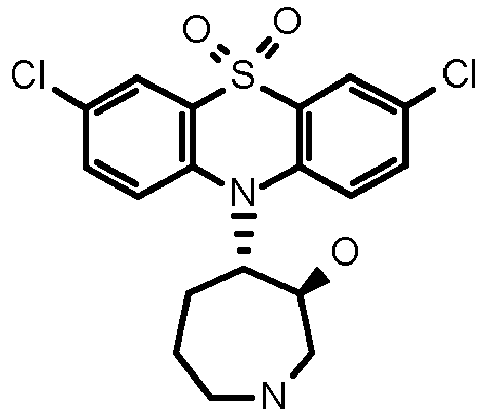 |
| 2 |  |
| 3 |  |
| 4 |  |
| 5 |  |
| 6 |  |
| 7 |  |
| 8 |  |
| 9 |  |
| 10 |  |
| 11 |  |
| 12 |  |
| 13 |  |
| 14 |  |
| 15 |  |
| 16 |  |
A compound of formula (I) according to any one of items 1-26 for use as a medicament.
Item 28:
A compound of formula (I) according to any one of items 1-27 for use in the treatment or prevention of infectious and parasitic diseases.
Item 29:
A compound for use according to item 28, wherein the parasitic diseases is selected from malaria, tuberculosis, African sleeping sickness (HAT), chagas, leishmaniasis, onchocerciasis, filariasis, schistosomiasis, or one of the following diseases: Acanthamoeba Infection, Acanthamoeba Keratitis Infection, African Sleeping Sickness (African trypanosomiasis), Alveolar Echinococcosis (Echinococcosis, Hydatid Disease), Amebiasis (Entamoeba histolytica Infection), American Trypanosomiasis (Chagas Disease), Ancylostomiasis (Hookworm, Cutaneous Larva Migrans [CLM]), Angiostrongyliasis (Angiostrongylus Infection), Anisakiasis (Anisakis Infection, Pseudoterranova Infection), Ascariasis (Ascaris Infection, Intestinal Roundworms), Babesiosis (Babesia Infection), Balantidiasis (Balantidium Infection), Baylisascariasis (Baylisascaris Infection, Racoon Roundworm), Bilharzia (Schistosomiasis), Blastocystis hominis Infection, Body Lice Infestation (Pediculosis), Capillariasis (Capillaria Infection), Cercarial Dermatitis (Swimmer's Itch), Chagas Disease (American Trypanosomiasis), Chilomastix mesnili Infection (Nonpathogenic [Harmless] Intestinal Protozoa), Clonorchiasis (Clonorchis Infection), CLM (Cutaneous Larva Migrans, Ancylostomiasis, Hookworm), "Crabs" (Pubic Lice), Cryptosporidiosis (Cryptosporidium Infection), Cutaneous Larva Migrans (CLM, Ancylostomiasis, Hookworm), Cyclosporiasis (Cyclospora Infection), Cysticercosis (Neurocysticercosis), Cystoisopora Infection (Cystoisosporiasis) formerly Isospora Infection, Diarrhea, Dientamoeba fragilis Infection, Diphyllobothriasis (Diphyllobothrium Infection), Dipylidium caninum Infection (dog or cat tapeworm infection), Dracunculiasis (Guinea Worm Disease), Dog tapeworm (Dipylidium caninum Infection), Echinococcosis (Alveolar Echinococcosis, Hydatid Disease), Elephantiasis (Filariasis, Lymphatic Filariasis), Endolimax nana Infection (Nonpathogenic [Harmless] Intestinal Protozoa), Entamoeba coli Infection (Nonpathogenic [Harmless] Intestinal Protozoa), Entamoeba dispar Infection (Nonpathogenic [Harmless] Intestinal Protozoa), Entamoeba hartmanni Infection (Nonpathogenic [Harmless] Intestinal Protozoa), Entamoeba histolytica Infection (Amebiasis), Entamoeba polecki, Enterobiasis (Pinworm Infection), Fascioliasis (Fasciola Infection), Fasciolopsiasis (Fasciolopsis Infection), Filariasis (Lymphatic Filariasis, Elephantiasis), Foodborne Diseases, Giardiasis (Giardia Infection), Gnathostomiasis (Gnathostoma Infection), Guinea Worm Disease (Dracunculiasis), Head Lice Infestation (Pediculosis), Heterophyiasis (Heterophyes Infection), Hydatid Disease (Alveolar Echinococcosis), Hymenolepiasis (Hymenolepis Infection), Hookworm Infection (Ancylostomiasis, Cutaneous Larva Migrans [CLM]), Intestinal Roundworms (Ascariasis, Ascaris Infection), Iodamoeba buetschlii Infection (Nonpathogenic [Harmless] Intestinal Protozoa), Isospora Infection (see Cystoisospora Infection), Kala-azar (Leishmaniasis, Leishmania Infection), Keratitis (Acanthamoeba Infection), Leishmaniasis (Kala-azar, Leishmania Infection), Lice Infestation (Body, Head, or Pubic Lice, Pediculosis, Pthiriasis), Loaiasis (Loa loa Infection), Lymphatic filariasis (Filariasis, Elephantiasis), Malaria (Plasmodium Infection), Microsporidiosis (Microsporidia Infection), Mite Infestation (Scabies), Naegleria Infection, Neurocysticercosis (Cysticercosis), Nonpathogenic (Harmless) Intestinal Protozoa, Ocular Larva Migrans (Toxocariasis, Toxocara Infection, Visceral Larva Migrans), Onchocerciasis (River Blindness), Opisthorchiasis (Opisthorchis Infection), Paragonimiasis (Paragonimus Infection), Pediculosis (Head or Body Lice Infestation), Pthiriasis (Pubic Lice Infestation), Pinworm Infection (Enterobiasis), Plasmodium Infection (Malaria), Pneumocystis jirovecii Pneumonia, Pseudoterranova Infection (Anisakiasis, Anisakis Infection), Pubic Lice Infestation ("Crabs," Pthiriasis), Raccoon Roundworm Infection (Baylisascariasis, Baylisascaris Infection), River Blindness (Onchocerciasis), Scabies, Schistosomiasis (Bilharzia), Sleeping Sickness (Trypanosomiasis, African; African Sleeping Sickness), Strongyloidiasis (Strongyloides Infection), Swimmer's Itch (Cercarial Dermatitis), Taeniasis (Taenia Infection, Tapeworm Infection), Tapeworm Infection (Taeniasis, Taenia Infection), Toxocariasis (Toxocara Infection, Ocular Larva Migrans, Visceral Larva Migrans), Toxoplasmosis (Toxoplasma Infection), Travelers' Diarrhea, Trichinellosis (Trichinosis), Trichinosis (Trichinellosis), Trichomoniasis (Trichomonas Infection), Trichuriasis (Whipworm Infection, Trichuris Infection), Trypanosomiasis, African (African Sleeping Sickness, Sleeping Sickness), Trypanosomiasis, American (Chagas Disease), Visceral Larva Migrans (Toxocariasis, Toxocara Infection, Ocular Larva Migrans), Waterborne Diseases, Whipworm Infection (Trichuriasis, Trichuris Infection).
Item 30:
A compound for use according to item 28 or 29, wherein the parasitic disease is malaria, or cerebral malaria.
Item 31:
Pharmaceutical composition comprising at least one compound according to any one of items 1-26 and/or pharmaceutically acceptable derivatives thereof, tautomers, salts, solvates and stereoisomers thereof, including mixtures thereof in all ratios, and optionally excipients and/or adjuvants and/or a carrier.
Item 32:
Pharmaceutical composition according to item 31 comprising at least one further pharmaceutically active compound.
Item 33:
Pharmaceutical composition according to item 31 or item 32 for use in the treatment of parasitic disease.
Item 34:
Pharmaceutical composition for use according to item 33, wherein the parasitic disease is selected from the group of malaria, cerebral malaria, African sleeping sickness (HAT), chagas, leishmaniasis, onchocerciasis, filariasis, schistosomiasis.
Item 35:
Pharmaceutical composition for use according to item 33 or item 34, wherein the parasitic disease is malaria, or cerebral malaria.
Item 36:
Kit comprising:
Kit according to item 36, wherein the unit dosage form is a pill, capsule, lozenge, injectable solution, suppository or plaster.
Item 38:
A process for preparing a compound of formula (I) comprising the steps of
Method of treating a person inflicted with parasitic disease, wherein the method comprises: adiminstering a pharmacologically effective amount of a compound of formula (I) according to any one of items 1-26, or a pharmaceutical composition according to item 31 or item 32 to a person in need thereof.
Item 40:
Method according to item 39, wherein the parasitic disease is selected from the group comprising malaria, cerebral malaria, tuberculosis, African sleeping sickness (HAT), chagas, leishmaniasis, onchocerciasis, filariasis and schistosomiasis.
Item 41:
Method according to item 39 or item 40, wherein the method comprises administering to a person in need thereof a pharmacologically effective amount the inventive compound according to any one of items 1-28, or the pharmaceutical composition according to item 34 or item 35 at least once a day, or twice or three times daily, or twice a week, or three times a week, or at least once every 2, 3, 4, 5, 6 days, for at least 1-18 weeks, or for at least 2-16 weeks, or for at least 3, 4, 5, 6, 7, 8, 9, 10, 11, 12, 13, 14, 15 weeks.
Item 42:
Method according to any one of items 39-41, wherein the method comprises administering to a person in need thereof from about 12.5 µg/kg, 25 µg/kg, 50 µg/kg, 75 µg/kg, 100 µg/kg, 125 µg/kg, 150 µg/kg, 175 µg/kg, 200 µg/kg, 250 µg/kg, 300 µg/kg, 350 µg/kg, 400 µg/kg, 450 µg/kg, 500 µg/kg, 600 µg/kg, 750 µg/kg, 1 mg/kg, 2.5 mg/kg, 5 mg/kg, 7.5 mg/kg, 10 mg/kg to about 10 mg/kg, 12.5 mg/kg, 15 mg/kg, 17.5 mg/kg, 20 mg/kg, 22.5 mg/kg, 25 mg/kg, 27.5 mg/kg, 30 mg/kg, 35 mg/kg, 40 mg/kg, 45 mg/kg, 50 mg/kg of the compound of the compound according to any one of items 1-26, or of the pharmaceutical composition according to item 31 or item 32.
Item 43:
Method according to any one of items 39-42, wherein the parasitic disease is malaria, or cerebral malaria.
Claims (17)
- A compound selected from the group consisting of:3,7-dichloro-10-((3R,4R)-3-hydroxyazepan-4-yl)-10H-phenothiazine 5,5-dioxide,3,7-dichloro-10-((3S,4S)-3-hydroxyazepan-4-yl)-10H-phenothiazine 5,5-dioxide,(3R,4R)-4-(3,6-dichloro-9H-carbazol-9-yl)azepan-3-ol,(3S,4S)-4-(3,6-dichloro-9H-carbazol-9-yl)azepan-3-ol,(3R,4R)-4-[3,6-bis(trifluoromethyl)-9H-carbazol-9-yl]azepan-3-ol,(3S,4S)-4-[3,6-bis(trifluoromethyl)-9H-carbazol-9-yl]azepan-3-ol,(3R,4R)-4-[4-methylsulfonyl-3,6-bis(trifluoromethyl)carbazol-9-yl]azepan-3-ol,(3S,4S)-4-[4-methylsulfonyl-3,6-bis(trifluoromethyl)carbazol-9-yl]azepan-3-ol,(3R,4R)-4-[2-methylsulfonyl-3,6-bis(trifluoromethyl)carbazol-9-yl]azepan-3-ol,(3S,4S)-4-[2-methylsulfonyl-3,6-bis(trifluoromethyl)carbazol-9-yl]azepan-3-ol,(3S,4S)-4-(3,6-dichloro-1-methoxy-9H-carbazol-9-yl)azepan-3-ol,(3R,4R)-4-(3,6-dichloro-1-methoxy-9H-carbazol-9-yl)azepan-3-o,l(3R,4R)-4-(3,6-dichloro-2-methoxy-9H-carbazol-9-yl)azepan-3-ol,(3S,4S)-4-(3,6-dichloro-2-methoxy-9H-carbazol-9-yl)azepan-3-ol,(3R,4R)-4-(3,7-dichloro-10H-phenoxazin-10-yl)azepan-3-ol,(3S,4S)-4-(3,7-dichloro-10H-phenoxazin-10-yl)azepan-3-ol,(3R,4R)-4-[3,6-bis(trifluoromethyl)pyrido[2,3-b]indol-9-yl]azepan-3-ol,(3S,4S)-4-[3,6-bis(trifluoromethyl)pyrido[2,3-b]indol-9-yl]azepan-3-ol,(3R,4R)-4-[3,6-bis(trifluoromethyl)pyrido[3,4-b]indol-9-yl]azepan-3-ol,(3S,4S)-4-[3,6-bis(trifluoromethyl)pyrido[3,4-b]indol-9-yl]azepan-3-ol,(3R,4R)-4-(2,8-bis(trifluoromethyl)-5H-pyrido[3,2-b]indol-5-yl)azepan-3-ol,(3S,4S)-4-(2,8-bis(trifluoromethyl)-5H-pyrido[3,2-b]indol-5-yl)azepan-3-ol,(3R,4R)-4-(7-methoxy-2,8-bis(trifluoromethyl)-5H-pyrido[3,2-b]indol-5-yl)azepan-3-ol,(3S,4S)-4-(7-methoxy-2,8-bis(trifluoromethyl)-5H-pyrido[3,2-b]indol-5-yl)azepan-3-ol,(3R,4R)-4-(8-chloro-6-methoxy-2-(trifluoromethyl)-5H-pyrido[3,2-b]indol-5-yl)azepan-3-ol,(3S,4S)-4-(8-chloro-6-methoxy-2-(trifluoromethyl)-5H-pyrido[3,2-b]indol-5-yl)azepan-3-ol,(3R,4R)-4-(8-chloro-2-(trifluoromethyl)-5H-pyrimido[5,4-b]indol-5-yl)azepan-3-ol,(3S,4S)-4-(8-chloro-2-(trifluoromethyl)-5H-pyrimido[5,4-b]indol-5-yl)azepan-3-ol,(3R,4R)-4-(2,8-bis(trifluoromethyl)-5H-pyrrolo[2,3-b:4,5-b']dipyridin-5-yl)azepan-3-ol,(3S,4S)-4-(2,8-bis(trifluoromethyl)-5H-pyrrolo[2,3-b:4,5-b']dipyridin-5-yl)azepan-3-ol,(3R,4R)-4-((8-chloro-5H-pyrimido[5,4-b]indol-4-yl)amino)azepan-3-ol,(3R,4R)-4-(3-chloro-6-nitro-carbazol-9-yl)azepan-3-ol,(5R,6R)-5-(3,6-dichloro-9H-carbazol-9-yl)-6-hydroxyazepan-2-one,(3R,4R)-4-[8-chloro-2-(trifluoromethyl)pyrimido[5,4-b]indol-5-yl]-7-methyl-azepan-3-ol,(8-chloro-5-[(3R,4R)-3-hydroxyazepan-4-yl]-3H-pyrimido[5,4-b]indol-4-one,(3R,4R)-4-(8-chloro-4-methoxy-pyrimido[5,4-b]indol-5-yl)azepan-3-oland the pharmaceutically acceptable tautomers, salts, solvates and stereoisomers thereof
- A compound according to claim 1 and/or pharmaceutically acceptable tautomers, salts, solvates and stereoisomers thereof, including mixtures thereof in all ratios for use as a medicament.
- A compound according to claim 1 and/or pharmaceutically acceptable tautomers, salts, solvates and stereoisomers thereof, including mixtures thereof in all ratios for use in the treatment or prevention of infectious and parasitic diseases.
- A compound for use according to claim 3, wherein the parasitic diseases is selected from malaria, tuberculosis, African sleeping sickness (HAT), chagas, leishmaniasis, onchocerciasis, filariasis, schistosomiasis, or one of the following diseases:
Acanthamoeba Infection, Acanthamoeba Keratitis Infection, African Sleeping Sickness (African trypanosomiasis), Alveolar Echinococcosis (Echinococcosis, Hydatid Disease), Amebiasis (Entamoeba histolytica Infection), American Trypanosomiasis (Chagas Disease), Ancylostomiasis (Hookworm, Cutaneous Larva Migrans [CLM]), Angiostrongyliasis (Angiostrongylus Infection), Anisakiasis (Anisakis Infection, Pseudoterranova Infection), Ascariasis (Ascaris Infection, Intestinal Roundworms), Babesiosis (Babesia Infection), Balantidiasis (Balantidium Infection), Baylisascariasis (Baylisascaris Infection, Racoon Roundworm), Bilharzia (Schistosomiasis), Blastocystis hominis Infection, Body Lice Infestation (Pediculosis), Capillariasis (Capillaria Infection), Cercarial Dermatitis (Swimmer's Itch), Chagas Disease (American Trypanosomiasis), Chilomastix mesnili Infection (Nonpathogenic [Harmless] Intestinal Protozoa), Clonorchiasis (Clonorchis Infection), CLM (Cutaneous Larva Migrans, Ancylostomiasis, Hookworm), "Crabs" (Pubic Lice), Cryptosporidiosis (Cryptosporidium Infection), Cutaneous Larva Migrans (CLM, Ancylostomiasis, Hookworm), Cyclosporiasis (Cyclospora Infection), Cysticercosis (Neurocysticercosis), Cystoisopora Infection (Cystoisosporiasis) formerly Isospora Infection, Diarrhea, Dientamoeba fragilis Infection, Diphyllobothriasis (Diphyllobothrium Infection), Dipylidium caninum Infection (dog or cat tapeworm infection), Dracunculiasis (Guinea Worm Disease), Dog tapeworm (Dipylidium caninum Infection), Echinococcosis (Alveolar Echinococcosis, Hydatid Disease), Elephantiasis (Filariasis, Lymphatic Filariasis), Endolimax nana Infection (Nonpathogenic [Harmless] Intestinal Protozoa), Entamoeba coli Infection (Nonpathogenic [Harmless] Intestinal Protozoa), Entamoeba dispar Infection (Nonpathogenic [Harmless] Intestinal Protozoa), Entamoeba hartmanni Infection (Nonpathogenic [Harmless] Intestinal Protozoa), Entamoeba histolytica Infection (Amebiasis), Entamoeba polecki, Enterobiasis (Pinworm Infection), Fascioliasis (Fasciola Infection), Fasciolopsiasis (Fasciolopsis Infection), Filariasis (Lymphatic Filariasis, Elephantiasis), Foodborne Diseases, Giardiasis (Giardia Infection), Gnathostomiasis (Gnathostoma Infection), Guinea Worm Disease (Dracunculiasis), Head Lice Infestation (Pediculosis), Heterophyiasis (Heterophyes Infection), Hydatid Disease (Alveolar Echinococcosis), Hymenolepiasis (Hymenolepis Infection), Hookworm Infection (Ancylostomiasis, Cutaneous Larva Migrans [CLM]), Intestinal Roundworms (Ascariasis, Ascaris Infection), Iodamoeba buetschlii Infection (Nonpathogenic [Harmless] Intestinal Protozoa), Isospora Infection (see Cystoisospora Infection), Kala-azar (Leishmaniasis, Leishmania Infection), Keratitis (Acanthamoeba Infection), Leishmaniasis (Kala-azar, Leishmania Infection), Lice Infestation (Body, Head, or Pubic Lice, Pediculosis, Pthiriasis), Loaiasis (Loa loa Infection), Lymphatic filariasis (Filariasis, Elephantiasis), Malaria (Plasmodium Infection), Microsporidiosis (Microsporidia Infection ), Mite Infestation (Scabies), Naegleria Infection, Neurocysticercosis (Cysticercosis), Nonpathogenic (Harmless) Intestinal Protozoa, Ocular Larva Migrans (Toxocariasis, Toxocara Infection, Visceral Larva Migrans), Onchocerciasis (River Blindness), Opisthorchiasis (Opisthorchis Infection), Paragonimiasis (Paragonimus Infection), Pediculosis (Head or Body Lice Infestation), Pthiriasis (Pubic Lice Infestation), Pinworm Infection (Enterobiasis), Plasmodium Infection (Malaria), Pneumocystis jirovecii Pneumonia, Pseudoterranova Infection (Anisakiasis, Anisakis Infection), Pubic Lice Infestation ("Crabs," Pthiriasis), Raccoon Roundworm Infection (Baylisascariasis, Baylisascaris Infection), River Blindness (Onchocerciasis), Scabies, Schistosomiasis (Bilharzia), Sleeping Sickness (Trypanosomiasis, African; African Sleeping Sickness), Strongyloidiasis (Strongyloides Infection), Swimmer's Itch (Cercarial Dermatitis), Taeniasis (Taenia Infection, Tapeworm Infection), Tapeworm Infection (Taeniasis, Taenia Infection), Toxocariasis (Toxocara Infection, Ocular Larva Migrans, Visceral Larva Migrans), Toxoplasmosis (Toxoplasma Infection), Travelers' Diarrhea, Trichinellosis (Trichinosis), Trichinosis (Trichinellosis), Trichomoniasis (Trichomonas Infection), Trichuriasis (Whipworm Infection, Trichuris Infection), Trypanosomiasis, African (African Sleeping Sickness, Sleeping Sickness), Trypanosomiasis, American (Chagas Disease), Visceral Larva Migrans (Toxocariasis, Toxocara Infection, Ocular Larva Migrans), Waterborne Diseases, Whipworm Infection (Trichuriasis, Trichuris Infection). - A compound for use according to claim 3 or 4, wherein the parasitic disease is malaria, or cerebral malaria.
- Pharmaceutical composition comprising at least one compound according to claim 1 and/or pharmaceutically acceptable tautomers, salts, solvates and stereoisomers thereof, including mixtures thereof in all ratios, and optionally excipients and/or adjuvants and/or a carrier.
- Pharmaceutical composition according to claim 6 comprising at least one further pharmaceutically active compound.
- Pharmaceutical composition according to claim 6 or claim 7 for use in the treatment of parasitic disease.
- Pharmaceutical composition for use according to claim 8, wherein the parasitic disease is selected from the group of malaria, cerebral malaria, African sleeping sickness (HAT), chagas, leishmaniasis, onchocerciasis, filariasis, schistosomiasis.
- Pharmaceutical composition for use according to claim 8 or claim 9, wherein the parasitic disease is malaria, or cerebral malaria.
- Kit comprising:(a) an effective amount of at least one compound of formula (I) or any of its subformulae according to claim 1 and/or pharmaceutically acceptable tautomers, salts, solvates and stereoisomers thereof, including mixtures thereof in all ratios and(b) an effective amount of at least one further medicament active compound, wherein said compound of formula (I) and said at least one further pharmaceutically active compound may are provided as separate unit dosage forms or are provided as a single unit dosage form comprising both (a) and (b).
- Kit according to claim 11, wherein the unit dosage form is a pill, capsule, lozenge, injectable solution, suppository or plaster.
- Method of treating a person inflicted with parasitic disease, wherein the method comprises: adiminstering a pharmacologically effective amount of a compound of formula (I) according to claim 1 and/or pharmaceutically acceptable tautomers, salts, solvates and stereoisomers thereof, including mixtures thereof in all ratios, or a pharmaceutical composition according to claim 33 or claim 34 to a person in need thereof.
- Method according to claim 13, wherein the parasitic disease is selected from the group comprising malaria, cerebral malaria, tuberculosis, African sleeping sickness (HAT), chagas, leishmaniasis, onchocerciasis, filariasis and schistosomiasis.
- Method according to claim 13 or claim 14, wherein the method comprises administering to a person in need thereof a pharmacologically effective amount the inventive compound according to claim 1 and/or pharmaceutically acceptable tautomers, salts, solvates and stereoisomers thereof, including mixtures thereof in all ratios, or the pharmaceutical composition according to claim 6 or claim 7 at least once a day, or twice or three times daily, or twice a week, or three times a week, or at least once every 2, 3, 4, 5, 6 days, for at least 1-18 weeks, or for at least 2-16 weeks, or for at least 3, 4, 5, 6, 7, 8, 9, 10, 11, 12, 13, 14, 15 weeks.
- Method according to any one of claims 13-15, wherein the method comprises administering to a person in need thereof from about 12.5 µg/kg, 25 µg/kg, 50 µg/kg, 75 µg/kg, 100 µg/kg, 125 µg/kg, 150 µg/kg, 175 µg/kg, 200 µg/kg, 250 µg/kg, 300 µg/kg, 350 µg/kg, 400 µg/kg, 450 µg/kg, 500 µg/kg, 600 µg/kg, 750 µg/kg, 1 mg/kg, 2.5 mg/kg, 5 mg/kg, 7.5 mg/kg, 10 mg/kg to about 10 mg/kg, 12.5 mg/kg, 15 mg/kg, 17.5 mg/kg, 20 mg/kg, 22.5 mg/kg, 25 mg/kg, 27.5 mg/kg, 30 mg/kg, 35 mg/kg, 40 mg/kg, 45 mg/kg, 50 mg/kg of the compound of the compound according to claim 1, or of the pharmaceutical composition according to claim 6 or claim 7.
- Method according to any one of claims 13-16, wherein the parasitic disease is malaria, or cerebral malaria.
Applications Claiming Priority (3)
| Application Number | Priority Date | Filing Date | Title |
|---|---|---|---|
| EP14002292 | 2014-07-04 | ||
| EP15739513.8A EP3164397B1 (en) | 2014-07-04 | 2015-07-06 | Azepanyl-derivatives and pharmaceutical compositions comprising the same with antiparasitic activity |
| PCT/EP2015/001368 WO2016000827A1 (en) | 2014-07-04 | 2015-07-06 | Azepanyl-derivatives and pharmaceutical compositions comprising the same with antiparasitic activity |
Related Parent Applications (2)
| Application Number | Title | Priority Date | Filing Date |
|---|---|---|---|
| EP15739513.8A Division EP3164397B1 (en) | 2014-07-04 | 2015-07-06 | Azepanyl-derivatives and pharmaceutical compositions comprising the same with antiparasitic activity |
| EP15739513.8A Division-Into EP3164397B1 (en) | 2014-07-04 | 2015-07-06 | Azepanyl-derivatives and pharmaceutical compositions comprising the same with antiparasitic activity |
Publications (2)
| Publication Number | Publication Date |
|---|---|
| EP3459944A1 true EP3459944A1 (en) | 2019-03-27 |
| EP3459944B1 EP3459944B1 (en) | 2021-01-06 |
Family
ID=51162413
Family Applications (2)
| Application Number | Title | Priority Date | Filing Date |
|---|---|---|---|
| EP15739513.8A Active EP3164397B1 (en) | 2014-07-04 | 2015-07-06 | Azepanyl-derivatives and pharmaceutical compositions comprising the same with antiparasitic activity |
| EP18202779.7A Active EP3459944B1 (en) | 2014-07-04 | 2015-07-06 | Azepanyl-derivatives and pharmaceutical compositions comprising the same with antiparasitic activity |
Family Applications Before (1)
| Application Number | Title | Priority Date | Filing Date |
|---|---|---|---|
| EP15739513.8A Active EP3164397B1 (en) | 2014-07-04 | 2015-07-06 | Azepanyl-derivatives and pharmaceutical compositions comprising the same with antiparasitic activity |
Country Status (9)
| Country | Link |
|---|---|
| US (1) | US9994577B2 (en) |
| EP (2) | EP3164397B1 (en) |
| JP (2) | JP2017519795A (en) |
| CN (2) | CN106573918B (en) |
| AU (1) | AU2015283220B2 (en) |
| CA (1) | CA2953843C (en) |
| ES (2) | ES2902143T3 (en) |
| IL (1) | IL249803B (en) |
| WO (1) | WO2016000827A1 (en) |
Families Citing this family (12)
| Publication number | Priority date | Publication date | Assignee | Title |
|---|---|---|---|---|
| ES2928773T3 (en) | 2017-01-17 | 2022-11-22 | Heparegenix Gmbh | Protein kinase inhibitors to promote liver regeneration or reduce or prevent hepatocyte death |
| WO2018204532A1 (en) | 2017-05-03 | 2018-11-08 | Vivace Therapeutics, Inc. | Non-fused tricyclic compounds |
| US11192865B2 (en) | 2017-08-21 | 2021-12-07 | Vivace Therapeutics, Inc. | Benzosulfonyl compounds |
| US11524943B1 (en) | 2017-12-06 | 2022-12-13 | Vivace Therapeutics, Inc. | Benzocarbonyl compounds |
| US11661403B2 (en) | 2018-05-16 | 2023-05-30 | Vivace Therapeutics, Inc. | Oxadiazole compounds |
| EP3810139A1 (en) | 2018-06-21 | 2021-04-28 | HepaRegeniX GmbH | Tricyclic protein kinase inhibitors for promoting liver regeneration or reducing or preventing hepatocyte death |
| GB201811695D0 (en) * | 2018-07-17 | 2018-08-29 | Salvensis | Compounds for use in the treatment of fascioliasis |
| JPWO2020090989A1 (en) * | 2018-10-31 | 2021-09-24 | 日産化学株式会社 | Method for Producing Fluoroaromatic Secondary or Tertiary Amine Compound |
| EP4136087A1 (en) * | 2020-04-17 | 2023-02-22 | Merck Patent GmbH | Crystalline forms of 4-[(7-chloro-2-methoxybenzo[b][1,5]naphthyridin-10-yl)amino]-2,6-bis(pyrrolidin-1-ylmethyl)phenol and salts thereof |
| TW202440574A (en) * | 2023-02-09 | 2024-10-16 | 印度商薩蒂亞製藥創新私人有限公司 | Heteroaryl compounds as pkmyt1 inhibitors |
| CN117327028B (en) * | 2023-09-25 | 2024-07-23 | 中国疾病预防控制中心寄生虫病预防控制所(国家热带病研究中心) | Phenothiazine derivatives, pharmaceutical compositions and use thereof in treating echinococcosis |
| CN119638925B (en) * | 2024-11-21 | 2025-10-10 | 西安交通大学 | Hypoxic bioreduction-responsive amphiphilic block polymer and its preparation method and application |
Citations (7)
| Publication number | Priority date | Publication date | Assignee | Title |
|---|---|---|---|---|
| WO2001029028A1 (en) | 1999-10-18 | 2001-04-26 | Applied Research Systems Ars Holding N.V. | 9- (piperazinylalkyl) carbazoles as bax-modulators |
| WO2002060867A2 (en) | 2001-01-29 | 2002-08-08 | Insight Strategy And Marketing Ltd | Carbazole derivatives and their uses as heparanase inhibitors |
| WO2005074971A1 (en) | 2004-01-29 | 2005-08-18 | Cellzome Ag | Treatment of neurodegenerative diseases by the use of cgi-13 interacting molecules |
| WO2007062399A2 (en) | 2005-11-23 | 2007-05-31 | The Board Of Regents Of The University Of Texas System | Oncogenic ras-specific cytotoxic compound and methods of use thereof |
| WO2010010027A1 (en) | 2008-07-23 | 2010-01-28 | Vib Vzw | Antifungal compounds |
| US20130040977A1 (en) | 2009-01-09 | 2013-02-14 | Board Of Regents Of The University Of Texas System | Pro-Neurogenic Compounds |
| WO2014108168A1 (en) * | 2013-01-10 | 2014-07-17 | Merck Patent Gmbh | Piperidinylcarbazole as antimalarial |
Family Cites Families (2)
| Publication number | Priority date | Publication date | Assignee | Title |
|---|---|---|---|---|
| UA107652C2 (en) * | 2008-10-06 | 2015-02-10 | Incuron Llc | Carbazole compounds and therapeutic uses of the compounds |
| ES2736200T3 (en) * | 2009-07-22 | 2019-12-26 | Univ Illinois | HDAC inhibitors and therapeutic methods that use them |
-
2015
- 2015-07-06 ES ES18202779T patent/ES2902143T3/en active Active
- 2015-07-06 CN CN201580035409.XA patent/CN106573918B/en not_active Expired - Fee Related
- 2015-07-06 CN CN202010380137.XA patent/CN111533734A/en active Pending
- 2015-07-06 CA CA2953843A patent/CA2953843C/en active Active
- 2015-07-06 EP EP15739513.8A patent/EP3164397B1/en active Active
- 2015-07-06 WO PCT/EP2015/001368 patent/WO2016000827A1/en not_active Ceased
- 2015-07-06 US US15/323,215 patent/US9994577B2/en active Active
- 2015-07-06 EP EP18202779.7A patent/EP3459944B1/en active Active
- 2015-07-06 AU AU2015283220A patent/AU2015283220B2/en not_active Ceased
- 2015-07-06 ES ES15739513T patent/ES2716956T3/en active Active
- 2015-07-06 JP JP2017500045A patent/JP2017519795A/en active Pending
-
2016
- 2016-12-27 IL IL249803A patent/IL249803B/en active IP Right Grant
-
2019
- 2019-12-25 JP JP2019234561A patent/JP6934930B2/en not_active Expired - Fee Related
Patent Citations (7)
| Publication number | Priority date | Publication date | Assignee | Title |
|---|---|---|---|---|
| WO2001029028A1 (en) | 1999-10-18 | 2001-04-26 | Applied Research Systems Ars Holding N.V. | 9- (piperazinylalkyl) carbazoles as bax-modulators |
| WO2002060867A2 (en) | 2001-01-29 | 2002-08-08 | Insight Strategy And Marketing Ltd | Carbazole derivatives and their uses as heparanase inhibitors |
| WO2005074971A1 (en) | 2004-01-29 | 2005-08-18 | Cellzome Ag | Treatment of neurodegenerative diseases by the use of cgi-13 interacting molecules |
| WO2007062399A2 (en) | 2005-11-23 | 2007-05-31 | The Board Of Regents Of The University Of Texas System | Oncogenic ras-specific cytotoxic compound and methods of use thereof |
| WO2010010027A1 (en) | 2008-07-23 | 2010-01-28 | Vib Vzw | Antifungal compounds |
| US20130040977A1 (en) | 2009-01-09 | 2013-02-14 | Board Of Regents Of The University Of Texas System | Pro-Neurogenic Compounds |
| WO2014108168A1 (en) * | 2013-01-10 | 2014-07-17 | Merck Patent Gmbh | Piperidinylcarbazole as antimalarial |
Non-Patent Citations (27)
| Title |
|---|
| AMINO R ET AL., NAT MED, vol. 12, 2006, pages 220 - 224 |
| ANGULO-BARTUREN I; JIMENEZ-DIAZ MB; MULET T; RULLAS J; HERREROS E ET AL., PLOS ONE, vol. 3, no. 5, 2008, pages e2252 |
| BANNISTER ET AL., PARASITOL TODAY, vol. 16, 2000, pages 427 - 433 |
| CLARK ET AL., MALARIA JOURNAL, vol. 5, 2006 |
| DAVANKOV, PURE & APPL. CHEM., vol. 69, no. 7, 1997, pages 1469 - 74 |
| DESJARDINS, ANTIMICROB. AGENTS CHEMOTHER., vol. 16, no. 6, 1979, pages 710 |
| DING ET AL., MALARIA JOURNAL, vol. 11, 2012, pages 292 |
| GARCIA CRS ET AL., J BIOL RHYTHMS, vol. 16, 2001, pages 436 - 443 |
| GHOSH A ET AL., PARASITOL TODAY, vol. 16, 2000, pages 196 - 201 |
| HETEROCYCLES, vol. 79, 2009, pages 121 - 144 |
| IDRO ET AL., LANCET NEUROL., vol. 4, 2005, pages 827 - 840 |
| J. MED. CHEM., vol. 50, 2007, pages 186 - 191 |
| JEROME MOLETTE ET AL: "Identification and Optimization of an Aminoalcohol-Carbazole Series with Antimalarial Properties", ACS MEDICINAL CHEMISTRY LETTERS, vol. 4, no. 11, 14 November 2013 (2013-11-14), pages 1037 - 1041, XP055189170, ISSN: 1948-5875, DOI: 10.1021/ml400015f * |
| KORSINCZKY M. ET AL., ANTIMICROB AGENTS CHEMOTHER, vol. 44, 2000, pages 2100 - 2108 |
| MARTINSEN ET AL., MOL PHYLOGENET EVOL., vol. 47, no. 1, April 2008 (2008-04-01), pages 261 - 73 |
| PHARMACEUTICAL RESEARCH, vol. 3, no. 6, 1986, pages 318 |
| PHILIPP J. KOCIENSKI: "Protecting groups", 1994, GEORG THIEME VERLAG |
| PORTER, PURE & APPL. CHEM, vol. 63, no. 8, 1991, pages 1119 - 22 |
| SCHOFIELD ET AL., NATURE REVIEWS IMMUNOLOGY, vol. 5, 2005, pages 722 - 735 |
| SINKA ME ET AL., PARASIT VECTORS, vol. 5, 2012, pages 69 |
| STEVENSON ET AL., NAT. REV. IMMUNOL., vol. 4, 2004, pages 169 - 180 |
| TETRAHEDRON, vol. 55, 1999, pages 13513 - 13520 |
| TETRAHEDRON, vol. 64, 2008, pages 6038 - 6050 |
| THEODORA W. GREENE; PETER G. WUTS: "Protective groups in organic synthesis", 1999, WILEY INTERSCIENCE |
| WHITE ET AL., LANCET, vol. 383, 2014, pages 723 - 35 |
| WHITE NJ ET AL., LANCET, vol. 383, 2014, pages 723 - 35 |
| WHITE NJ., MALAR J 2011, vol. 10, pages e297 |
Also Published As
| Publication number | Publication date |
|---|---|
| US9994577B2 (en) | 2018-06-12 |
| JP2020073532A (en) | 2020-05-14 |
| JP2017519795A (en) | 2017-07-20 |
| JP6934930B2 (en) | 2021-09-15 |
| CN106573918A (en) | 2017-04-19 |
| AU2015283220B2 (en) | 2019-06-20 |
| ES2902143T3 (en) | 2022-03-25 |
| CN111533734A (en) | 2020-08-14 |
| CA2953843A1 (en) | 2016-01-07 |
| CN106573918B (en) | 2020-06-16 |
| AU2015283220A1 (en) | 2017-02-16 |
| EP3164397A1 (en) | 2017-05-10 |
| IL249803B (en) | 2020-03-31 |
| CA2953843C (en) | 2023-03-14 |
| EP3459944B1 (en) | 2021-01-06 |
| WO2016000827A1 (en) | 2016-01-07 |
| ES2716956T3 (en) | 2019-06-18 |
| US20170137428A1 (en) | 2017-05-18 |
| EP3164397B1 (en) | 2018-12-19 |
| IL249803A0 (en) | 2017-03-30 |
Similar Documents
| Publication | Publication Date | Title |
|---|---|---|
| EP3459944B1 (en) | Azepanyl-derivatives and pharmaceutical compositions comprising the same with antiparasitic activity | |
| TWI858267B (en) | Capsid inhibitors for the treatment of hiv | |
| US11866441B2 (en) | Compounds and methods for the treatment of parasitic diseases | |
| KR102132574B1 (en) | Tricyclic gyrase inhibitors | |
| CN106029666B (en) | [1,2,4]triazolo[1,5-a]pyrimidine derivatives as protozoan proteasome inhibitors for the treatment of parasitic diseases such as leishmaniasis | |
| WO2021026884A1 (en) | Antimalarial agents | |
| WO2019141153A1 (en) | Indolamine 2,3-dioxygenase inhibitor and use thereof | |
| WO2021155612A1 (en) | Antimalarial agents | |
| US9908863B2 (en) | Piperidinylcarbazoles | |
| US20100113589A1 (en) | Deuterated darunavir | |
| WO2023107356A1 (en) | Antimalarial agents | |
| HK1226725B (en) | [1,2,4]triazolo[1,5-a]pyrimidine derivatives as protozoan proteasome inhibitors for the treatment of parasitic diseases such as leishmaniasis | |
| HK1226725A1 (en) | [1,2,4]triazolo[1,5-a]pyrimidine derivatives as protozoan proteasome inhibitors for the treatment of parasitic diseases such as leishmaniasis |
Legal Events
| Date | Code | Title | Description |
|---|---|---|---|
| PUAI | Public reference made under article 153(3) epc to a published international application that has entered the european phase |
Free format text: ORIGINAL CODE: 0009012 |
|
| STAA | Information on the status of an ep patent application or granted ep patent |
Free format text: STATUS: REQUEST FOR EXAMINATION WAS MADE |
|
| 17P | Request for examination filed |
Effective date: 20181026 |
|
| AC | Divisional application: reference to earlier application |
Ref document number: 3164397 Country of ref document: EP Kind code of ref document: P |
|
| AK | Designated contracting states |
Kind code of ref document: A1 Designated state(s): AL AT BE BG CH CY CZ DE DK EE ES FI FR GB GR HR HU IE IS IT LI LT LU LV MC MK MT NL NO PL PT RO RS SE SI SK SM TR |
|
| STAA | Information on the status of an ep patent application or granted ep patent |
Free format text: STATUS: EXAMINATION IS IN PROGRESS |
|
| 17Q | First examination report despatched |
Effective date: 20200131 |
|
| GRAP | Despatch of communication of intention to grant a patent |
Free format text: ORIGINAL CODE: EPIDOSNIGR1 |
|
| STAA | Information on the status of an ep patent application or granted ep patent |
Free format text: STATUS: GRANT OF PATENT IS INTENDED |
|
| INTG | Intention to grant announced |
Effective date: 20200915 |
|
| GRAS | Grant fee paid |
Free format text: ORIGINAL CODE: EPIDOSNIGR3 |
|
| GRAA | (expected) grant |
Free format text: ORIGINAL CODE: 0009210 |
|
| STAA | Information on the status of an ep patent application or granted ep patent |
Free format text: STATUS: THE PATENT HAS BEEN GRANTED |
|
| AC | Divisional application: reference to earlier application |
Ref document number: 3164397 Country of ref document: EP Kind code of ref document: P |
|
| AK | Designated contracting states |
Kind code of ref document: B1 Designated state(s): AL AT BE BG CH CY CZ DE DK EE ES FI FR GB GR HR HU IE IS IT LI LT LU LV MC MK MT NL NO PL PT RO RS SE SI SK SM TR |
|
| REG | Reference to a national code |
Ref country code: GB Ref legal event code: FG4D |
|
| REG | Reference to a national code |
Ref country code: AT Ref legal event code: REF Ref document number: 1352244 Country of ref document: AT Kind code of ref document: T Effective date: 20210115 Ref country code: CH Ref legal event code: EP |
|
| REG | Reference to a national code |
Ref country code: DE Ref legal event code: R096 Ref document number: 602015064650 Country of ref document: DE |
|
| REG | Reference to a national code |
Ref country code: IE Ref legal event code: FG4D |
|
| REG | Reference to a national code |
Ref country code: NL Ref legal event code: MP Effective date: 20210106 |
|
| REG | Reference to a national code |
Ref country code: AT Ref legal event code: MK05 Ref document number: 1352244 Country of ref document: AT Kind code of ref document: T Effective date: 20210106 |
|
| REG | Reference to a national code |
Ref country code: LT Ref legal event code: MG9D |
|
| PG25 | Lapsed in a contracting state [announced via postgrant information from national office to epo] |
Ref country code: FI Free format text: LAPSE BECAUSE OF FAILURE TO SUBMIT A TRANSLATION OF THE DESCRIPTION OR TO PAY THE FEE WITHIN THE PRESCRIBED TIME-LIMIT Effective date: 20210106 Ref country code: HR Free format text: LAPSE BECAUSE OF FAILURE TO SUBMIT A TRANSLATION OF THE DESCRIPTION OR TO PAY THE FEE WITHIN THE PRESCRIBED TIME-LIMIT Effective date: 20210106 Ref country code: GR Free format text: LAPSE BECAUSE OF FAILURE TO SUBMIT A TRANSLATION OF THE DESCRIPTION OR TO PAY THE FEE WITHIN THE PRESCRIBED TIME-LIMIT Effective date: 20210407 Ref country code: BG Free format text: LAPSE BECAUSE OF FAILURE TO SUBMIT A TRANSLATION OF THE DESCRIPTION OR TO PAY THE FEE WITHIN THE PRESCRIBED TIME-LIMIT Effective date: 20210406 Ref country code: PT Free format text: LAPSE BECAUSE OF FAILURE TO SUBMIT A TRANSLATION OF THE DESCRIPTION OR TO PAY THE FEE WITHIN THE PRESCRIBED TIME-LIMIT Effective date: 20210506 Ref country code: NO Free format text: LAPSE BECAUSE OF FAILURE TO SUBMIT A TRANSLATION OF THE DESCRIPTION OR TO PAY THE FEE WITHIN THE PRESCRIBED TIME-LIMIT Effective date: 20210406 Ref country code: LT Free format text: LAPSE BECAUSE OF FAILURE TO SUBMIT A TRANSLATION OF THE DESCRIPTION OR TO PAY THE FEE WITHIN THE PRESCRIBED TIME-LIMIT Effective date: 20210106 |
|
| PG25 | Lapsed in a contracting state [announced via postgrant information from national office to epo] |
Ref country code: PL Free format text: LAPSE BECAUSE OF FAILURE TO SUBMIT A TRANSLATION OF THE DESCRIPTION OR TO PAY THE FEE WITHIN THE PRESCRIBED TIME-LIMIT Effective date: 20210106 Ref country code: RS Free format text: LAPSE BECAUSE OF FAILURE TO SUBMIT A TRANSLATION OF THE DESCRIPTION OR TO PAY THE FEE WITHIN THE PRESCRIBED TIME-LIMIT Effective date: 20210106 Ref country code: LV Free format text: LAPSE BECAUSE OF FAILURE TO SUBMIT A TRANSLATION OF THE DESCRIPTION OR TO PAY THE FEE WITHIN THE PRESCRIBED TIME-LIMIT Effective date: 20210106 Ref country code: AT Free format text: LAPSE BECAUSE OF FAILURE TO SUBMIT A TRANSLATION OF THE DESCRIPTION OR TO PAY THE FEE WITHIN THE PRESCRIBED TIME-LIMIT Effective date: 20210106 Ref country code: SE Free format text: LAPSE BECAUSE OF FAILURE TO SUBMIT A TRANSLATION OF THE DESCRIPTION OR TO PAY THE FEE WITHIN THE PRESCRIBED TIME-LIMIT Effective date: 20210106 |
|
| PG25 | Lapsed in a contracting state [announced via postgrant information from national office to epo] |
Ref country code: IS Free format text: LAPSE BECAUSE OF FAILURE TO SUBMIT A TRANSLATION OF THE DESCRIPTION OR TO PAY THE FEE WITHIN THE PRESCRIBED TIME-LIMIT Effective date: 20210506 |
|
| REG | Reference to a national code |
Ref country code: DE Ref legal event code: R097 Ref document number: 602015064650 Country of ref document: DE |
|
| PG25 | Lapsed in a contracting state [announced via postgrant information from national office to epo] |
Ref country code: EE Free format text: LAPSE BECAUSE OF FAILURE TO SUBMIT A TRANSLATION OF THE DESCRIPTION OR TO PAY THE FEE WITHIN THE PRESCRIBED TIME-LIMIT Effective date: 20210106 Ref country code: CZ Free format text: LAPSE BECAUSE OF FAILURE TO SUBMIT A TRANSLATION OF THE DESCRIPTION OR TO PAY THE FEE WITHIN THE PRESCRIBED TIME-LIMIT Effective date: 20210106 Ref country code: SM Free format text: LAPSE BECAUSE OF FAILURE TO SUBMIT A TRANSLATION OF THE DESCRIPTION OR TO PAY THE FEE WITHIN THE PRESCRIBED TIME-LIMIT Effective date: 20210106 |
|
| PLBE | No opposition filed within time limit |
Free format text: ORIGINAL CODE: 0009261 |
|
| STAA | Information on the status of an ep patent application or granted ep patent |
Free format text: STATUS: NO OPPOSITION FILED WITHIN TIME LIMIT |
|
| PG25 | Lapsed in a contracting state [announced via postgrant information from national office to epo] |
Ref country code: DK Free format text: LAPSE BECAUSE OF FAILURE TO SUBMIT A TRANSLATION OF THE DESCRIPTION OR TO PAY THE FEE WITHIN THE PRESCRIBED TIME-LIMIT Effective date: 20210106 Ref country code: RO Free format text: LAPSE BECAUSE OF FAILURE TO SUBMIT A TRANSLATION OF THE DESCRIPTION OR TO PAY THE FEE WITHIN THE PRESCRIBED TIME-LIMIT Effective date: 20210106 Ref country code: SK Free format text: LAPSE BECAUSE OF FAILURE TO SUBMIT A TRANSLATION OF THE DESCRIPTION OR TO PAY THE FEE WITHIN THE PRESCRIBED TIME-LIMIT Effective date: 20210106 |
|
| 26N | No opposition filed |
Effective date: 20211007 |
|
| PG25 | Lapsed in a contracting state [announced via postgrant information from national office to epo] |
Ref country code: AL Free format text: LAPSE BECAUSE OF FAILURE TO SUBMIT A TRANSLATION OF THE DESCRIPTION OR TO PAY THE FEE WITHIN THE PRESCRIBED TIME-LIMIT Effective date: 20210106 |
|
| PG25 | Lapsed in a contracting state [announced via postgrant information from national office to epo] |
Ref country code: SI Free format text: LAPSE BECAUSE OF FAILURE TO SUBMIT A TRANSLATION OF THE DESCRIPTION OR TO PAY THE FEE WITHIN THE PRESCRIBED TIME-LIMIT Effective date: 20210106 |
|
| REG | Reference to a national code |
Ref country code: ES Ref legal event code: FG2A Ref document number: 2902143 Country of ref document: ES Kind code of ref document: T3 Effective date: 20220325 |
|
| PG25 | Lapsed in a contracting state [announced via postgrant information from national office to epo] |
Ref country code: MC Free format text: LAPSE BECAUSE OF FAILURE TO SUBMIT A TRANSLATION OF THE DESCRIPTION OR TO PAY THE FEE WITHIN THE PRESCRIBED TIME-LIMIT Effective date: 20210106 |
|
| REG | Reference to a national code |
Ref country code: BE Ref legal event code: MM Effective date: 20210731 |
|
| PG25 | Lapsed in a contracting state [announced via postgrant information from national office to epo] |
Ref country code: IS Free format text: LAPSE BECAUSE OF FAILURE TO SUBMIT A TRANSLATION OF THE DESCRIPTION OR TO PAY THE FEE WITHIN THE PRESCRIBED TIME-LIMIT Effective date: 20210506 Ref country code: LU Free format text: LAPSE BECAUSE OF NON-PAYMENT OF DUE FEES Effective date: 20210706 |
|
| PG25 | Lapsed in a contracting state [announced via postgrant information from national office to epo] |
Ref country code: IE Free format text: LAPSE BECAUSE OF NON-PAYMENT OF DUE FEES Effective date: 20210706 Ref country code: BE Free format text: LAPSE BECAUSE OF NON-PAYMENT OF DUE FEES Effective date: 20210731 |
|
| PG25 | Lapsed in a contracting state [announced via postgrant information from national office to epo] |
Ref country code: NL Free format text: LAPSE BECAUSE OF NON-PAYMENT OF DUE FEES Effective date: 20210206 Ref country code: CY Free format text: LAPSE BECAUSE OF FAILURE TO SUBMIT A TRANSLATION OF THE DESCRIPTION OR TO PAY THE FEE WITHIN THE PRESCRIBED TIME-LIMIT Effective date: 20210106 |
|
| PG25 | Lapsed in a contracting state [announced via postgrant information from national office to epo] |
Ref country code: HU Free format text: LAPSE BECAUSE OF FAILURE TO SUBMIT A TRANSLATION OF THE DESCRIPTION OR TO PAY THE FEE WITHIN THE PRESCRIBED TIME-LIMIT; INVALID AB INITIO Effective date: 20150706 |
|
| PGFP | Annual fee paid to national office [announced via postgrant information from national office to epo] |
Ref country code: IT Payment date: 20230612 Year of fee payment: 9 Ref country code: FR Payment date: 20230608 Year of fee payment: 9 |
|
| PGFP | Annual fee paid to national office [announced via postgrant information from national office to epo] |
Ref country code: GB Payment date: 20230601 Year of fee payment: 9 Ref country code: ES Payment date: 20230801 Year of fee payment: 9 Ref country code: CH Payment date: 20230801 Year of fee payment: 9 |
|
| PGFP | Annual fee paid to national office [announced via postgrant information from national office to epo] |
Ref country code: DE Payment date: 20230607 Year of fee payment: 9 |
|
| PG25 | Lapsed in a contracting state [announced via postgrant information from national office to epo] |
Ref country code: MK Free format text: LAPSE BECAUSE OF FAILURE TO SUBMIT A TRANSLATION OF THE DESCRIPTION OR TO PAY THE FEE WITHIN THE PRESCRIBED TIME-LIMIT Effective date: 20210106 |
|
| PG25 | Lapsed in a contracting state [announced via postgrant information from national office to epo] |
Ref country code: TR Free format text: LAPSE BECAUSE OF FAILURE TO SUBMIT A TRANSLATION OF THE DESCRIPTION OR TO PAY THE FEE WITHIN THE PRESCRIBED TIME-LIMIT Effective date: 20210106 |
|
| PG25 | Lapsed in a contracting state [announced via postgrant information from national office to epo] |
Ref country code: MT Free format text: LAPSE BECAUSE OF FAILURE TO SUBMIT A TRANSLATION OF THE DESCRIPTION OR TO PAY THE FEE WITHIN THE PRESCRIBED TIME-LIMIT Effective date: 20210106 |
|
| REG | Reference to a national code |
Ref country code: DE Ref legal event code: R119 Ref document number: 602015064650 Country of ref document: DE |
|
| REG | Reference to a national code |
Ref country code: CH Ref legal event code: PL |
|
| GBPC | Gb: european patent ceased through non-payment of renewal fee |
Effective date: 20240706 |
|
| PG25 | Lapsed in a contracting state [announced via postgrant information from national office to epo] |
Ref country code: DE Free format text: LAPSE BECAUSE OF NON-PAYMENT OF DUE FEES Effective date: 20250201 |
|
| PG25 | Lapsed in a contracting state [announced via postgrant information from national office to epo] |
Ref country code: CH Free format text: LAPSE BECAUSE OF NON-PAYMENT OF DUE FEES Effective date: 20240731 |
|
| PG25 | Lapsed in a contracting state [announced via postgrant information from national office to epo] |
Ref country code: FR Free format text: LAPSE BECAUSE OF NON-PAYMENT OF DUE FEES Effective date: 20240731 |
|
| PG25 | Lapsed in a contracting state [announced via postgrant information from national office to epo] |
Ref country code: GB Free format text: LAPSE BECAUSE OF NON-PAYMENT OF DUE FEES Effective date: 20240706 |
|
| PG25 | Lapsed in a contracting state [announced via postgrant information from national office to epo] |
Ref country code: IT Free format text: LAPSE BECAUSE OF NON-PAYMENT OF DUE FEES Effective date: 20240706 |
|
| REG | Reference to a national code |
Ref country code: ES Ref legal event code: FD2A Effective date: 20250828 |
|
| PG25 | Lapsed in a contracting state [announced via postgrant information from national office to epo] |
Ref country code: ES Free format text: LAPSE BECAUSE OF NON-PAYMENT OF DUE FEES Effective date: 20240707 |